Guinea
pp. 57-58 · Read in the full issue
Novel is classic New Guinea
The Fate of O’Loughlin. By
Dudley McCarthy, Published by
McGraw-Hill, Aust. $A 12.95.
Dudley McCarthy’s two or
three years as a Patrol Officer in the New Guinea bush when he was in his early 20s seem incidental in a career that went on to include a whole assort ment of experiences: school teacher, airline employee, soldier in the Middle East and Islands, finally with the rank of
major, Commonwealth public
servant, adviser to government, Australian Minister to the United Nations and, finally, Australian Ambassador to Mexico and then Spain.
But the fact that he has based his first novel The Fate of O’Loughlin on New Guinea proves not so much that the im
pressions of youth go deepest
but that lonely living in the re moteness of a New Guinea bush outpost indelibly marks the individual who has experi enced it. More so, perhaps, in the 1930’5, when both
McCarthy and ‘O’Loughlin’
were having their early experi
ences, than today when there is
always an airstrip just around
the comer.
In a foreword, the author makes the conventional denial that the novel is autobiogra phical or that the scene of the action is the Sepik River. It is hard, however, to believe that either statement is entirely true, particularly for anyone who knew the area about the same time and who instinc tively puts tags on people and places. For this reaction, the author can only blame his own
very good writing.
Co-incidentally, at the time
that O’Loughlin was supposed
to be living on his patch of mud beside the great river, I was liv ing between the Sepik and the sea and having my own experi ences, which did not include taking our brand of law to the jungle or, thank God, stringing up recalcitrant head-hunters the incident with which the novel opens and one which haunted O’Loughlin all his life.
But it is easy to identify with O’L, to sit again in memory within the small circle of light
shed by a hissing petrol lantern,
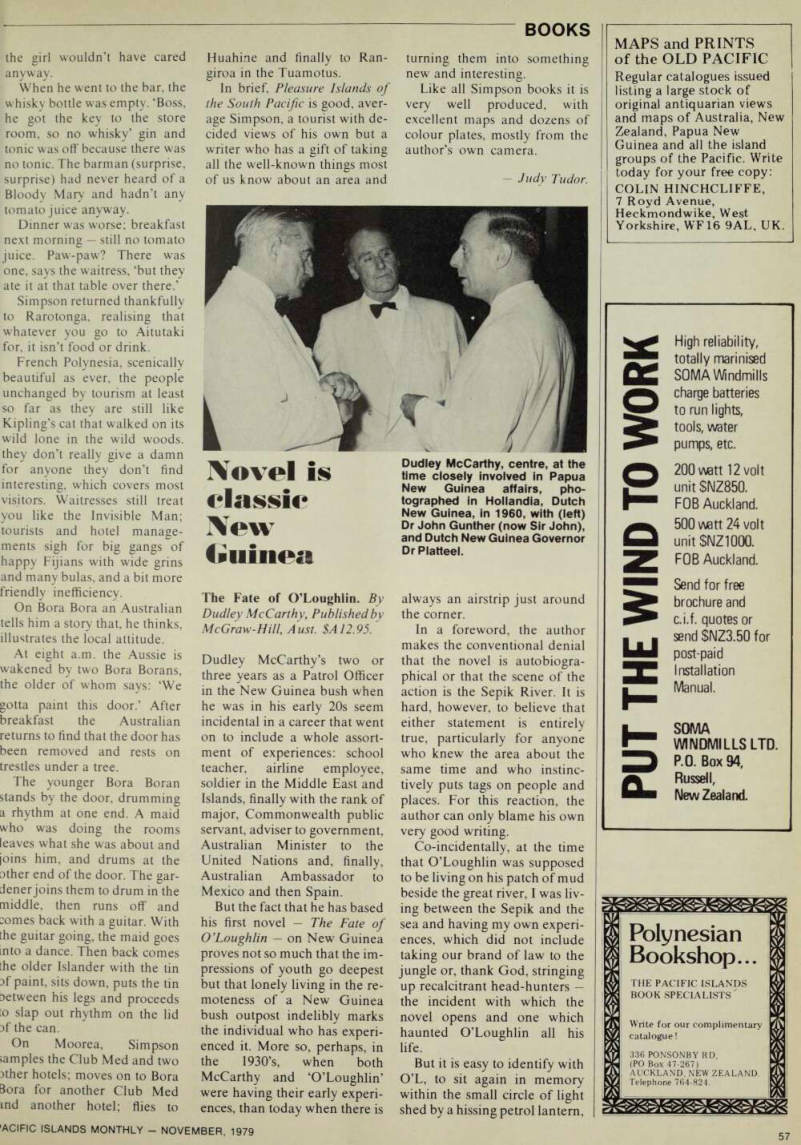
Dudley McCarthy, centre, at the time closely involved in Papua New Guinea affairs, pho tographed in Hollandia, Dutch New Guinea, in 1960, with (left) Dr John Gunther (now Sir John), and Dutch New Guinea Governor Dr Platteel.
to smell again the mouldy dampness rising from the forest floor, to hear the noises of the night and - induced partly by constant low fever that quinine seemed incapable of quenching - to feel great aloneness and the sinister presences in the dark, in an atmosphere unreal and five-dimensional.
O’Loughlin, as well as being introspective to the nth degree
and indulging in long
soliloquies and think-pieces,
was also fey an affliction, if ever there was one in the bush situation in which he found himself.
He was, in fact, not the archetypal Patrol Officer although he carried out a P.O.’s duties without (thanks to the author) agonising with 1979 thoughts and hindsight in a 1936 situation. He put down sorcery (with one exception), waged war on superstition and savagery, pursued headhunters and attempted to bring concepts of Western law to stone-age people.
Because he was a sensitive and intelligent man, he lived
with fear but strove to over come it and believed himself to be one of the few white men who could see into the native
mind, although this appeared
to do little for his comfort in
spite of the special empathy
that developed between him self and his police sergeant, Imago, who shared his
forebodings,
The first tragedy O’L fore sees; the second takes place some years later, by which time he is in the Army. This second incident is based on a real life drama of 1942 when a Eu ropean official, temporarily unhinged, barricaded himself in his house and fought off those sent to relieve him of his post. He eventually took his own life while his native police rampaged up and down the
river, killing and pillaging,
Another tragedy at this
‘place no good’ eventuates long
afterwards when O’Loughlin, now a UN official, sets out at the instigation of the PNG Prime Minister to investigate a movement that appears to be a cross between old cargo-cult
and a local version of the PLO.
Hi-jacking, abduction and mayhem follow in a surprising, if modem, ending which critics may feel is out of context with the rest of the story, something that wouldn’t or couldn’t hap pen there. Non-critics may not be so sure.
The Fate of O’Loughlin is not a pretty island story but a grim one about a country that away from the Australian-type
suburban towns and townlets was, and perhaps still is, a grim country, dark with its own mys teries and in which O’Loughlin’s and Imago’s forebodings are entirely believ able and relevant.
Perhaps it’s a story for New Guinea old-timers more than others but, above all, one that
is excellently, even classically,
written.
Judy Tudor.