Life At Aggie's
pp. 53-56 · Read in the full issue
Place
Vggie Grey of Samoa. By Mel on Eustis. Published by Hobby r nvestments, Adelaide. Paper back, $A 3.95. A vail able through
°lM’s Mail Order Bookshop,
3ox 3408 GPO Sydney at >A 4.50 or SUSS.SO posted.
Although screeds have been vritten and published about he backwardness and/or poli ics of Melanesia, and further creeds about the glamour and omance islands of Tahiti and dawaii, not much can be found n print about Western Jamoa.
This is strange in view of the act that Western Samoa had
ome stirring history including
what, in these days, would be called Freedom Fighters the members of the underground movement called the Mau.
The Samoan Mau was unique in the South Pacific in that while most former colonial territories in the region were content to let independence be imposed upon them from above when and as it suited their former administrators, the Western Samoans were prepared to fight for theirs.
It is even more remarkable that the Mau had its beginning as far back as the early years of this century, under German administration, then went underground for some years
and reached its full strength in the late 1920’s and 1930’s when Western Samoa was adminis tered by New Zealand as a C class Mandated Territory.
It was a period of truculence and non-cooperation on the part of the Samoans and ham handed bureaucracy on the part of the administrators. It ended in bloodshed and the exile or banishment of some of Samoa’s best-known citizens. If
anything similar had happened
in Papua New Guinea, 57 varieties of academics would have already sprung into print about it, all in the sacred quest for PhD’s.
An account of the Mau movement, now all but forgot ten by present generations, is one of many incidental pieces of history that appear in Aggie
Grey of Samoa.
Aggie, the best-known hotel keeper in the South Pacific and probably the first of her pro fession in the world to have her portrait on a postage stamp (it happened in 1971) had nothing to do with the Mau, but the period of her life she is now in her 80’s spans pretty well the modem or European period of Samoa. Although the
book is called her biography, it is more correctly a short history of Samoa during the last cen tury, using Aggie and her family as convenient pegs on which to hang it.
Aggie’s father was William J.
Swann, son of an English fam ily which settled in Fiji in 1867 to open a chemist shop in the then capital, Levuka. William also trained as a chemist and
eventually opened his own
pharmacy in Apia, Western
Samoa, in 1889. Two years later he married Pele, a local girl who bore him three daugh
ters, Maggie, Aggie and Mary,
before she died at the early age of 31.
Nothing much that hap
pened from that date, either to members of the Swann family or to Samoa, escapes mention by author Eustis, including full documentation of the various stages of Aggie’s Hotel which had begun life as the Inter national Hotel, on a different site, last century.
Much later it became the
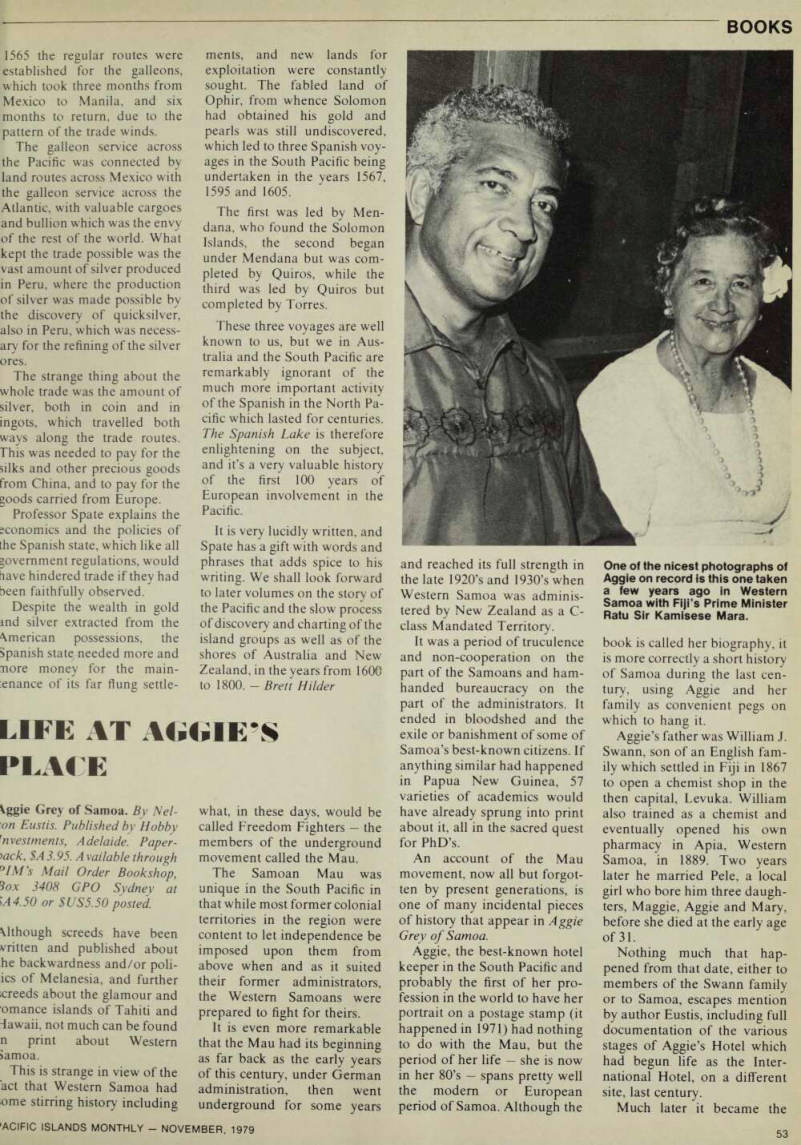
One of the nicest photographs of Aggie on record is this one taken a few years ago in Western Samoa with Fiji’s Prime Minister Ratu Sir Kamisese Mara.
headquarters for New Zealand
police members during the
Mau troubles, then turned into the British Club whose mem bers were anything but as staid as the name suggests. Finally,
under Aggie’s ownership, the
establishment became a ren dezvous for bored Gl’s stationed in Samoa during the Pacific War, while Aggie sold coffee and hamburgers from what is now her store next door. Today, extended and revamped many times, with swimming pools, air conditioning and all the frills, the old pub is all but lost under
its improvements.
There are, of course, even classier hotels in the Pacific but no one can be considered a real Pacific traveller who has not sampled life and hospitality at Aggie’s in Apia. It’s run now by son Alan, but Aggie is still there.
For real Pacific status, of course, he or she should also be old enough to have experi enced the original building, ex- Intemational Hotel, with its alfresco bedrooms, and to have grappled with the business of getting a drink in the days when all liquor in Western Samoa was regarded as ‘medi
cine’ and doled out by a government medical officer through ‘points’ on a permit.
In those days, according to Aggie, blessed were those who drank little or not at all and who, upon departing, left be hind unused points to satisfy the bigger thirst of other tour ists.
With numerous black and white illustrations, Aggie Grey of Samoa provides a quick run down of Samoan history as well as being a memento of one of its most entertaining citi
zens.
Judy Tudor.