Monumental work
pp. 52-53 · Read in the full issue
Books
Monumental work traces Pacific discovery
The Spanish Lake. By O.H.K.
Spate A.N.U. Press, Canberra 1979, being Volume 1 of The Pacific since Magellan. $ A 35.00. Deluxe signed edition
Sa9O.
This beautiful volume is monumental in its conception and scholarship, and treats the Pacific Ocean as a European concept in space and time.
It traces the discovery of the Pacific from before it was known to exist, and through the shaky period when it was thought by some to be part of the Indian Ocean, following the voyages of Columbus and Vasco da Gama. But they were both before 1500, and this book is mainly concerned with the century from 1500 to 1600.
Later volumes will no doubt deal with the following cen turies.
After the ocean was first sighted by Balboa in 1513, near Panama, and first traversed by Magellan in 1519, its great extent was still not known, and
the mapmakers drawing maps
and globes of the world had a tendency to stretch the dis tances of the known lands both east and west from Europe so that there wasn’t much room left for the Pacific.
While all the century of
expansion of voyages, trading
and political developments
were taking place, and they fill
this volume to overflowing, the ancient land of Australia was sleeping undisturbed in its Dreamtime.
Professor Spate deals with the geographical, economic, historical and political situ ation of Europe leading up to the Pacific’s first century, and while this largely concerns the
Spanish and Portuguese
nations and their colonies and trade ventures, the Chinese voyages of Cheng Ho and the Arab and Indian trading routes are also included where they affect the fringes of the Pacific.
This book cannot limit itself to the Ocean itself, but must in clude the maritime activities of
all the then-known lands sur rounding the Pacific. So we have the story of Spanish expansion from the West Indies to the Pacific coasts of America, south to Peru, Chile, and the Strait of Magellan, and north to California.
The internal histories of Japan and the East Indies are given as far as they affect the trading policies of these mari time areas. The islands in the Pacific do not figure much in this book, for they were dis covered one or two at a time, and mostly were very small, or atolls without shelter or anchorages. The natives gener ally appeared to be hostile, or otherwise were either treacher ous or thieving. The result was that the islands and their natives were unimportant to their discoverers, for prac tically all the Pacific voyages were only concerned with the trade in spices, gold, silver and
pearls.
To the Europeans con cerned, the Pacific was just a highway for trade, an alterna tive highway to the route around Africa and across the Indian Ocean. For this reason the northern and southern coasts of the Pacific were neglected except for the early searches for a route around the north or south of the American continent.
The first two great circum
navigations, by Magellan and
by Drake, are not given very much navigational detail in this book. But by the time the backgrounds and reasons for the voyages are given, there is only room for general mention of the practice of navigation, which is a kindness to the gen eral reader.
I found the treatment of Drake’s voyage very satisfying, and there are aspects of it which will surprise the average reader. Drake must have had nine lives to have survived the three-year voyage, for unlike
most explorers, he kept looking
for trouble in addition to the
troubles which descended upon him from natural causes or the angry gods above.
Although Drake used Magellan’s Strait to get into the Pacific in quick time, he was immediately struck by very bad weather and one of his ships went back into the Strait for shelter and returned to England. Another was lost at sea in the bad weather, which forced Drake well to the south.
At the end of a month he was back at the western entrance with only his Golden Hinde left of his original five ships.
Here he was again struck by impossible weather, and driven by stages around the rocky coasts to the south until he was
finally somewhere near Cape
Horn, and where he realised that there was a clear sea be tween Tierra del Fuego and any land which might exist further south. This was a great
discovery, and Drake’s Passage
was henceforth used by most ships which wanted to get from the Atlantic to the Pacific. Be tween Magellan in 1519 and Drake in 1578 the Spanish expansion north and south of Panama had been in ships built
on the west coast of America, and this continued for cen turies.
After Drake had passed up the western coasts of America, to the site of the present San
Francisco and beyond, causing
a lot of havoc and taking a lot of plunder, he set forth across the vast Pacific on July 23 1579 and met only one island, (Yap or Palau) before reaching the Philippines in October. He worked south down the coast of Mindinao to Ternate, the chief port for the Spice Islands or Moluccas. Here he made a ver bal treaty with the Sultan, in
opposition to the Portuguese
presence, loaded six tons of cloves, and sailed away before things could go wrong. The ship was careened in the Celebes, then ran aground and was saved with difficulty.
After passing Timor a fort night was spent on the little known south coast of Java, and
they took fresh provisions
again at Sierra Leone before
reaching Plymouth, after a
magnificent voyage which
brought the first Englishmen
into the Pacific.
Well before Drake’s time, the Pacific saw an annual shuttle service between Mexico and the Philippines, and by
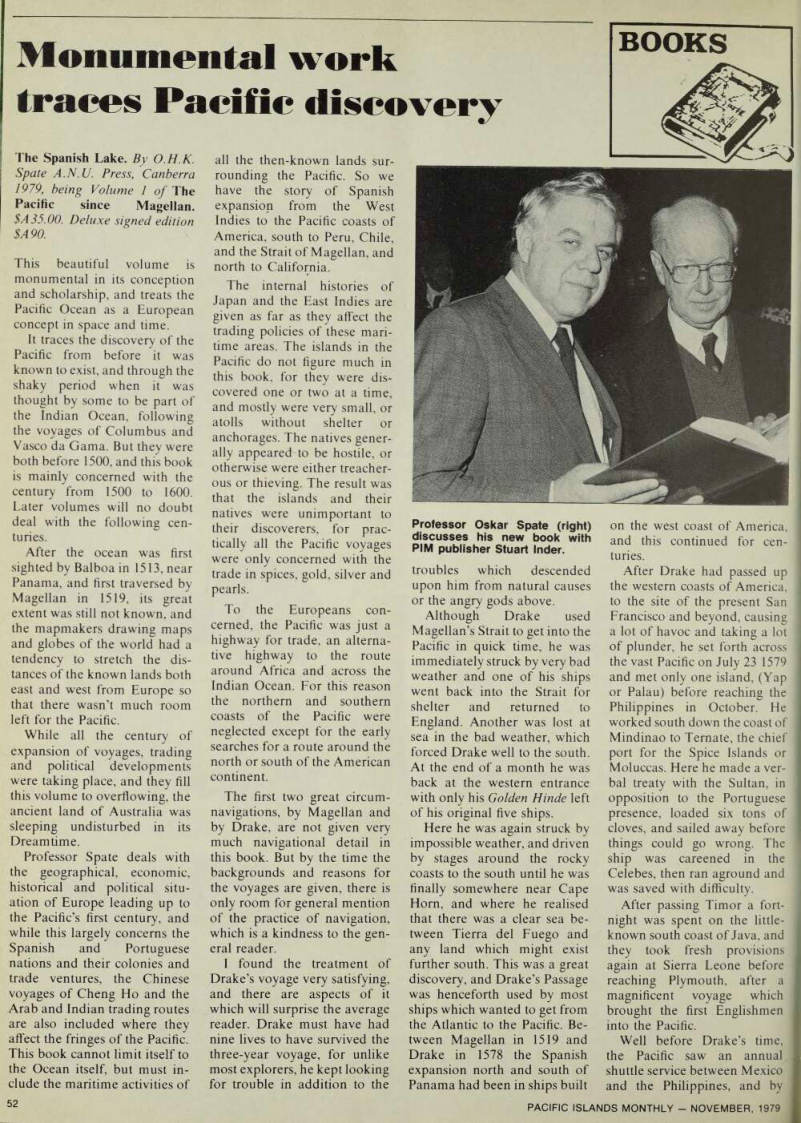
Professor Oskar Spate (right) discusses his new book with PIM publisher Stuart Inder.
1565 the regular routes were established for the galleons, which took three months from Mexico to Manila, and six months to return, due to the pattern of the trade winds.
The galleon service across the Pacific was connected by land routes across Mexico with the galleon service across the Atlantic, with valuable cargoes and bullion which was the envy of the rest of the world. What kept the trade possible was the vast amount of silver produced in Peru, where the production of silver was made possible by
the discovery of quicksilver,
also in Peru, which was necess ary for the refining of the silver ores.
The strange thing about the whole trade was the amount of silver, both in coin and in ingots, which travelled both ways along the trade routes.
This was needed to pay for the
silks and other precious goods
from China, and to pay for the
goods carried from Europe.
Professor Spate explains the
economics and the policies of the Spanish state, which like all
government regulations, would
have hindered trade if they had
been faithfully observed.
Despite the wealth in gold md silver extracted from the
\merican possessions, the
Spanish state needed more and iiore money for the main tenance of its far flung settle
ments, and new lands for exploitation were constantly sought. The fabled land of Ophir, from whence Solomon had obtained his gold and pearls was still undiscovered, which led to three Spanish voy ages in the South Pacific being undertaken in the years 1567, 1595 and 1605.
The first was led by Men dana, who found the Solomon Islands, the second began under Mendana but was com pleted by Quiros, while the third was led by Quiros but
completed by Torres.
These three voyages are well known to us, but we in Aus tralia and the South Pacific are
remarkably ignorant of the
much more important activity
of the Spanish in the North Pa cific which lasted for centuries.
The Spanish Lake is therefore
enlightening on the subject,
and it’s a very valuable history of the first 100 years of European involvement in the Pacific.
It is very lucidly written, and Spate has a gift with words and phrases that adds spice to his writing. We shall look forward to later volumes on the story of the Pacific and the slow process of discovery and charting of the island groups as well as of the shores of Australia and New Zealand, in the years from 1600
to 1800.
Brett Hilder