Fiji Hotels:
pp. 25-27 · Read in the full issue
Oh, For Roast
Beef & 2 Veg.
It was owned by the Union Steam Ship Co and usually run by one of its ex-pursers or chief stewards, ensuring that transfer from ship to shore was painless.
Tariff was 17/6 a day, equivalent in terms if not in value to $1.75 today, and in cluded all meals and morning tea delivered shortly after dawn by a bare-footed Indian servant. At those daily rates it was just one shilling (or 10c) less than the cost of a glass of house wine, red, white or rose, at the Steak House of today’s
most prestigious Fiji hostelry,
the Regent, near Nadi.
Time has, indeed, marched on.
In those far-off days, when one travelled out of Suva around Viti Levu, one stayed at a Ragg hotel at Sigatoka, Nadi, Lautoka, Tavua, Ba or Rakiraki and these cost con siderably less than the GPH, provided substantial breakfasts and lunches and exotica like roast beef and two veg, caramel
custard or steamed pud for din ner.
At night, in GPH or else where, you slept shrouded in mosquito net, without benefit of fans or air-conditioning, lulled or irritated as the case might be by the natural noises of the night, frogs, crickets, or the snores of the guest next door.
No hotel had a band or
swimming pool; the place
where you ate was called a din ing room and not a restaurant and was lit as brilliantly as the local power supply or the pub’s own generator could contrive so that you actually could see what you were eating. The waiters were Indian, in white
pants and long white coats, with coloured sashes and little round white hats.
Then Sir Hugh Ragg built his first bures at Korolevu, the beginning of resort hotels for Fiji; the 1952 hurricane blew down the old Club Hotel in Suva and a new Club rose to take its place at the corner of Victoria Parade and Gordon Street, with innovations like air-conditioners in the bed rooms and a ballroom on the roof, while Barry Philp resusci tated the Mocambo, the old thatch and bamboo US army club on Nadi airport.
It was some years before he moved the name away from the airport and built the first stage of the current model on the hill, and by this time Fiji tour ism was on its way,
government-encouraged and
looking north to the mighty US dollar, then rejoicing in the name of ‘hard currency’, instead of south to Australian and New Zealand £s, still hitched to the restrictive Ster
ling bloc.
Hotels thereafter began to
spring up like tropical
mushrooms. Navita Invest ments built the motel-type
Outrigger beyond Suva’s G PH;
Colin Philp produced
Tradewinds at the other end of the city limits; the USS Co sold the GPH to Singapore interests who gave the Old Girl a pink bedroom block, ‘modern’ as opposed to ‘colonial’, and a swimming pool, while Aus tralian Travelodge, Burns Philp and UK Trust Motels went one better next door with Suva Travelodge. Pan
American pilots bought
Mocambo from Barry Philp,
who had already built the orig inal Reef Lodge at Korotogo.
Castaway Island became the first of the get-away-from-it-all resorts on the islands off
Nadi/Lautoka. Fijian-owned
Yanuca Island, 13 km from Sigatoka was joined to the
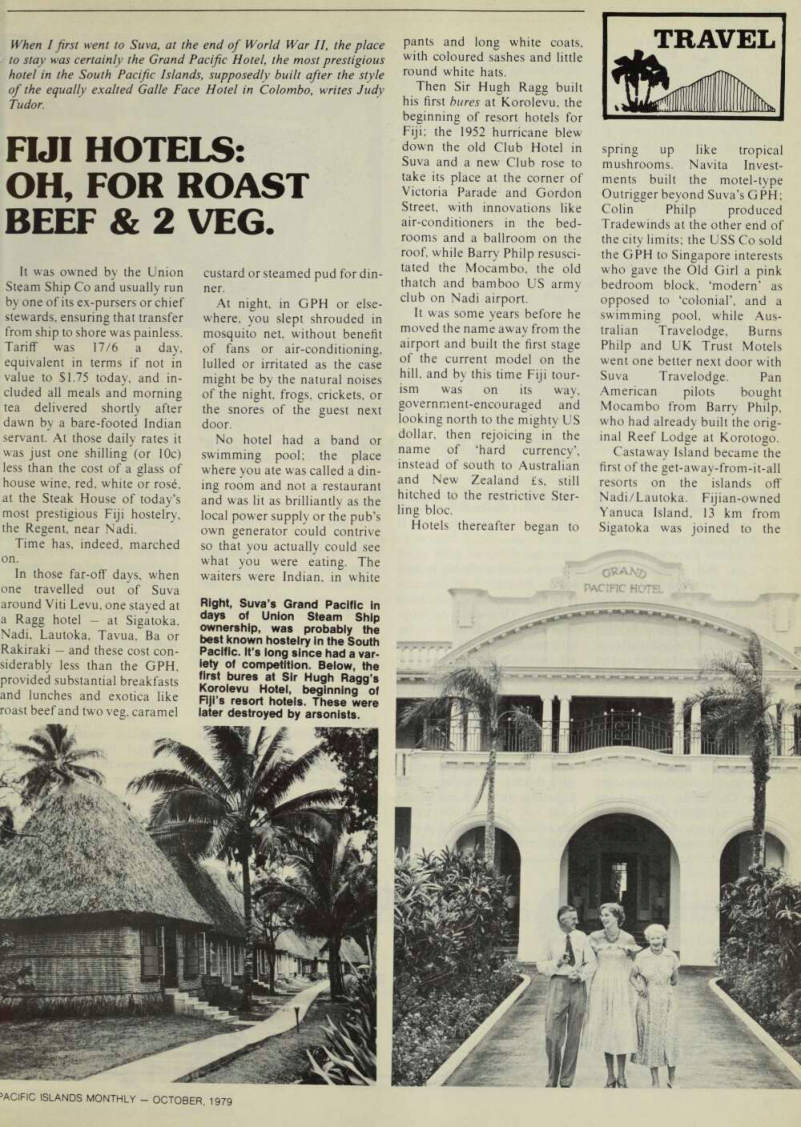
Right, Suva’s Grand Pacific in days of Union Steam Ship ownership, was probably the best known hostelry In the South Pacific. It’s long since had a var iety of competition. Below, the first bures at Sir Hugh Ragg’s Korolevu Hotel, beginning of Fiji's resort hotels. These were later destroyed by arsonists.
mainland by a causeway and on it The Fijian set a pattern for future Fiji resorts. Mean time, Mocambo was joined on
neighbouring Nadi hilltops,
first by Tanoa then by
Travelodge, with Gateway at
the airport gates and a whole string of lesser establishments along the road to Nadi Town.
In the wet zone of Viti Levu, Toberua resort came into being on an offshore island and a consortium of big names in the international travel business started to plough up acres of swamp at Deuba to create Pa cific Harbour with, eventually, its beachside Beachcomber Hotel on the site of a ram shackle predecessor of the same name built in the fifties for the crew making the film
His Majesty O'Keefe , and lin
gering on as a weekend retreat for Suva-ites.
Among the more socially im portant, each hotel in its turn became the place to go, only to be eclipsed in its turn by some thing newer, if not always bet ter. In Fiji the hotel business rarely remains static for long, so mid-1979 finds Suva minus its Club Hotel, closed some time ago, with the building to be turned into a bank; no Ragg now operates a hotel; the parts of the famous chain were sold off or leased individually, a fact that probably keeps the late Sir Hugh turning in his grave.
Castaway Island resort in the Mamanucas has been joined by others on the islands of Nadi and Lautoka, with more a building for what seem like Fiji’s best satisfied customers.
At The Fijian guests keep
circulating through Qantas
package tours, ferried there and back four times weekly on
their so-called Funjets, but Naviti Investments finds itself in financial strife through its resort on the coast between Korotoga and Korolevu; and current top of the heap. Fiji hotel-wise, is the four-year-old Regent at Denarau Beach, a couple of kilometres from Nadi town. It was built by an organisation that had imagin ation as well as finance 10 years ago most locals who thought they knew the area would probably have dismis sed this flat sand-and-silt island, now joined to the main land by a short bridge, as a use less piece of real estate consisting largely of mud, man groves and mosquitoes.
Landscaping, water and cli mate have now turned it into a tropical garden which half hides the scattered bedroom
blocks, duplex bungalows and
the huge reception, dining and
entertainment area with its arcade of shops.
Attached on the outskirts is a John Newcombe tennis ranch which currently can’t be adding much to that pro’s income. It is, after all, a long way to go from any direction for a game of tennis, and probably lacks a solid backstop of tennis playing locals to provide basic income. Overseas hopefuls who want to settle in for inten sive coaching by the resident pro (not Newk) would need to be fairly well-heeled as accom modation at the Regent is not
cheap. However, hope springs
eternal, and plans are in hand for additional all-weather courts.
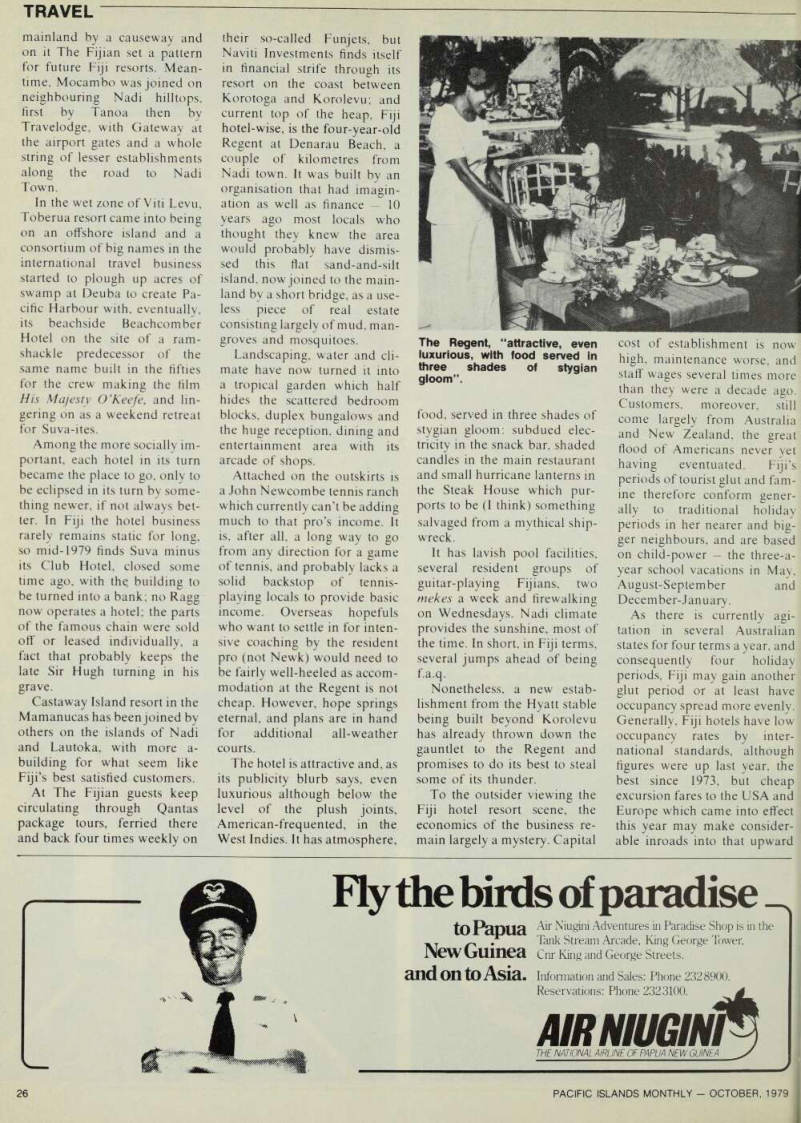
The hotel is attractive and, as its publicity blurb says, even luxurious although below the level of the plush joints.
American-frequented, in the West Indies. It has atmosphere,
food, served in three shades of stygian gloom: subdued elec tricity in the snack bar, shaded candles in the main restaurant and small hurricane lanterns in the Steak House which pur ports to be (I think) something
salvaged from a mythical ship
wreck.
It has lavish pool facilities, several resident groups of guitar-playing Fijians, two mekes a week and firewalking on Wednesdays. Nadi climate provides the sunshine, most of the time. In short, in Fiji terms, several jumps ahead of being f- a <F Nonetheless, a new estab lishment from the Hyatt stable
being built beyond Korolevu
has already thrown down the gauntlet to the Regent and promises to do its best to steal some of its thunder.
To the outsider viewing the Fiji hotel resort scene, the economics of the business re main largely a mystery. Capital
cost of establishment is now high, maintenance worse, and , , staff wa g es several times more than they were a decade ago.
Customers, moreover, still come largely from Australia and New Zealand, the great flood of Americans never yet having eventuated Fiji’s periods of tourist glut and fam ine therefore conform gener
ally to traditional holiday
periods in her nearer and big ger neighbours, and are based on child-power the three-a year school vacations in May,
August-September and
December-January.
As there is currently agi tation in several Australian states for four terms a year, and
consequently four holiday
periods, Fiji may gain another glut period or at least have
occupancy spread more evenly,
Generally, Fiji hotels have low occupancy rates by inter national standards, although figures were up last year, the best since 1973, but cheap excursion fares to the USA and Europe which came into effect this year may make consider able inroads into that upward
The Regent, “attractive, even luxurious, with food served in three shades of stygian gloom”.
trend, as Australasians try to prove that it is cheaper to travel to the other side of the world than to stay at home.
Fiji hotels, like everything
else, have become more ex pensive, and for Australians, New Zealanders and Ameri cans this isn’t helped by the fact that the dollars of all three countries are worth less in Fiji than at home or, respect ively, on the Barrier Reef re sorts, Rarotonga, or Hawaii.
An Australian can expect to lose from 11% to 8%, depend ing on where in Fiji he cashes his travellers’ cheques. New Zealanders and Americans are even worse off. Nonetheless, in Fiji as elsewhere, the traveller gets what he pays for. He can get accommodation for $lO a night or, in a different establishment, pay $5O. It’s up to him to decide whether the second is worth five times more than the first, and he generally decides that it is.
In spite of the fact that Prime Minister Sir Kamisese Mara seems to be having second thoughts about tourism (PIM
luly), Fiji now depends on the
ndustry for part of its bread md butter, and if it declines there is nothing in sight to take ts place. The problem for hose in the business is how to
uggle rising costs, competition
Tom other overseas desti rations, concession air fares md a fair return on capital, and ;till come up with something hat doesn’t price the tra litional customer out of the narket.
They deserve our sympathy,
fhere were far fewer head iches in the Fiji hotel business n the days of mosquito nets, oast beef and two veg. and no ourist nonsense, all now, alas,
indent history.