Somare Wins
pp. 22-23 · Read in the full issue
charged, in July this year, with a criminal violation of the US
Foreign Corrupt Practices Act,
1977. Judge John Penn fined the corporation SUSSO 000.
As part of a plea-bargaining agreement with the US Justice
Department, Finbar Kenny
agreed to appear voluntarily in Rarotonga and also to make restitution of the $337 000 to the Cook Islands Government, on condition that the Justice
Department bring no further
charges against Kenny.
Now that the dramatic events of the last 18 months are almost over, Cook Islanders still seem reluctant to put aside what has been their main topic of conversation.
Reactions to the court de cision have been predictable: the CIP is jubilant at the dis charge of Messrs Short and Henry, and many Democrats appear outraged at Mr Justice Beattie’s decisions. Govern ment ministers were conspicu ously absent from a cocktail party hosted by the judge at his
Rarotonga residence shortly
after the trial ended.
The government has an nounced it will re-examine its contracts with the Cook Islands Philatelic and Numismatic Bu reau. The Premier, Dr Davis, has said he has been critical of the existing contracts over a considerable period and be lieves they were drawn up in a highly secret manner. This seems to contradict his earlier statements that his government emphatically wished to retain the stamp contracts with Fin
bar Kenny.
Some of the questions that are being asked publicly are, if Geoffrey Henry and his col league Apenera Short hadn’t been able to deduce what was going on, by what right were they in office?
And why did Finbar Kenny get involved in a conspiracy with so little to gain and so much to lose? And was Sir Albert Henry really the villain, or is there another story to come out?
And the biggest question of all is, what is the government going to do with the $337 000 it has been reimbursed?
Maybe, it’s thought, the pot holes in the road will be mended at last.
As You Were
In W Samoa?
Western Samoa’s Prime Minis ter Tupuola Efi appears to have survived the biggest crisis of his relatively brief but im pressive political career after four crucial by-elections on August 18, writes James Tully from Auckland. Tupuola sup porters had to win three of the four seats if he was to secure a majority in the legislative as sembly and so remain prime minister. The situation won’t be settled until the assembly next sits, but he can probably do no worse than 24 of the 47 votes.
Tupuola will be hoping that the by-elections have ended an unexpectedly difficult six months which have seen him hanging on grimly to power.
As the February election ap proached he anticipated no serious threat to his position.
After almost three years as prime minister he had established himself as a force ful, energetic young leader with considerable mana in the
South Pacific region. Tupuola
was confident of retaining his seat and then the support of a majority of his fellow MPs.
But February brought some
shocks. More than half of the former MPs were thrown out.
Then, opponents in the as sembly formed Western Samoa’s first political party, the United Human Rights Pro tection Party, to make a play for power. The party put up veteran politician Va’ai
Kolone against Tupuola when
the assembly met to choose a prime minister in late March.
Tupuola won the battle but not the war when he scraped home by 24 votes to 23.
The next skirmish took place in the electoral court where five unsuccessful candidates sought to have the results in their con stituencies overturned. Bribery and treating were alleged in all but one case. Chief Justice Nicholson, a New Zealander, caused a stir in early May when he upheld the allegations in four cases and declared void the results in the appropriate seats. By-elections were ordered. Tupuola supporters had held three of the seats.
In what has been called an ‘historic’ decision he attempted to draw a dividing line between fa’a Samoa and bribery. He ruled there was proven evi dence of corrupt practices involving four of the successful candidates and three of those who had filed petitions. Sev eral criminal cases for electoral bribery followed. On the basis of the chief justice’s decision others could be prosecuted too.
Tupuola was left with 21 supporters, including the Speaker, and Va’ai Kolone 22,
with the by-elections pending.
Tupuola avoided a no confidence motion by not con vening the assembly for the normal June session to debate the supplementary estimates.
He took no risks by staying in Apia to keep on top of the situ ation rather than attending the South Pacific Forum in
Honiara in early July.
The opposition responded
with a petition to the Head of State Malietoa Tanumafili II
asking for Tupuola’s removal,
claiming he lacked majority
support in the assembly. The head of state said he would not make a decision until after the
by-elections. During this crisis,
Tupuola had remarkably little to say. But he broke his self imposed silence on July 20 with a 30-minute radio broadcast to
the people.
He discussed the electoral court decision and its con sequences. He said he felt the number of criminal charges should be restricted, or a new election held. That was the scene when the by-elections
took place. Tupuola supporters
needed to hold the three seats they had won in February.
The one opposition seat went to the government when Mapuilesua Pelenato polled 93 votes to Leota Pita’s 82. The government held two other seats, but lost the Safata seat when Muliagatele Vena could only muster 133 votes to Pule Lameko’s 244. Muliagatele was one of those convicted on criminal charges for electoral bribery. He was fined a total of
Swsisso.
Somare Wins
Again
For the third time in 13 months, the Papua New Guinea Prime Minister, Mr Michael Somare, survived a no-confidence vote in parlia ment in September, writes Angus Smales in Port
Moresby.
He won by 63 votes to 34 a better margin than in either of the earlier challenges. The opposition mounted the no confidence move against Mr Somare, nominating its leader, Mr lambakey Okuk, as the new prime minister. Under the PNG constitution any motion of no-confidence in a prime minister must nominate his successor.
The mover of the motion,
Deputy Opposition Leader
Galeva Kwarara, told parlia ment that there was mounting distrust of the entire Somare government over its manage ment, attitudes and ability. He accused the government of being unable to create a cli mate for full employment, and of failing to carry out resol utions passed by parliament.
He alleged that the govern ment had failed to come to t grips with a mounting rate of crime and lawlessness, and he accused it of mismanagement of public funds.
Most observers had not seen Mr Somare in any danger be fore the vote. But because of the fluid nature of the party system in PNG, and the often emotional reaction to immediate situations, no confidence motions remain something of a lottery. The re sult of the vote suggests that Mr Somare continues to have a fairly strong personal backing, although his government as a whole is going through a period of bitter criticism.
Under the PNG system, par liament itself holds a direct vote to elect (or depose) a prime minister. This makes the personal standing of a prime minister in parliament as im portant as party numbers, be cause bloc alignments frequently occur across party lines.
Accidents On
Moruroa
Marie-Therese and Bengt Danielsson, in Papeete, sum marise reports in the Paris daily Le Matin about recent nuclear events in French Polynesia.
Meanwhile, PIM reports on the reactions of the owners of the Palmyra A toll, south of Hawaii, to a US Government offer to buy the atoll so it can store nuclear waste on it.
The most sensational revel ation made by Le Matin is that Moruroa has for some time been used not only for under ground nuclear tests, but also for detonation experiments carried out in concrete bunkers on the atoll’s surface. These ex periments release unknown quantities of the most lethal of all radio-active substances, plutonium, which has a half life of 24 000 years.
Previously, the bunkers had been sealed and abandoned at the end of each experiment.
But, ‘for economy reasons’, it was decided early in July to decontaminate and re-use the latest chamber built on the coral rim. The inside walls were plastered with paper drenched in acetone, which supposedly would dissolve the plutonium released by the det
onation device. Special filters
were installed in all openings in
the walls, to ‘capture’ the plu
tonium before it escaped into the air.
The deadly experiment took
place, according to schedule,
on July 6. What happened next
must be attributed largely to faulty instructions and human -rror. Six ‘decontaminators’ entered the bunker soon after the experiment. One of them decided, or had orders, to en large a hole in a metal plate.
Die boring machine he used "or this purpose caused a spark vhich ignited the gas still fili ng the chamber. The first man n the team was killed instantly ?y the intense heat (1500 to 1800°C). Another had his chest :rushed by a door thrown off ts hinges by the blast and died icon afterwards. The remain ng four were all badly burnt.
Both dead and injured were mmediately flown to Paris. At he same time another 40
‘decontaminators’ arrived from Paris. They had to undertake the hopeless task of cleaning up the whole atoll which, by now, had received an unknown amount of radio-active fall-out from the plutonium cloud emerging from the death chamber.
Most of the above infor mation was obtained by Le Matin reporters Jean Darriulat and Jean-Charles Rosier in a Paris hospital from the injured ‘decontaminators’ who, know ing themselves to be near death, broke the secrecy rule imposed by the French army.
Not so the official army spokesmen who, despite the clamour from the French press and the vehement protests of the elected representatives of the Polynesian people, have refused to furnish any infor mation on the accident, except to claim that it was ‘chemical’ and not ‘nuclear’, obviously
hoping by this means to allay
the fears aroused by that word
in these post-Harrisburg days.
The second accident on Moruroa two weeks later was, like the Harrisburg events, exactly of the sort that the tech nicians have sworn could never happen. As it was being lowered down the shaft drilled on the rim of the atoll a nuclear bomb got stuck before it reached the bottom. Unable to dislodge it for further descent, technicians decided to explode it anyway on July 25. As a re sult of this blast at an ‘abnor
mal’ depth underground, a
tidal wave developed which washed over the atoll, over turned vehicles and injured half a dozen workmen and ser vice personnel. As it spread through the Tuamotu group, the wave caused considerable
damage to buildings on nearby
Marutea, where the French owner, multi-millionaire Jean- Claude Brouillet, runs a pearl farm.
Responding to these disas trous events, the Territorial As sembly of French Polynesia on August 17 carried a resolution demanding; 1) the immediate establishment of a local com mittee of inquiry, whose main task would be the securing of affidavits from Polynesian workmen, and investigation of the circumstances surrounding
the accidents of July 6 and 25; 2) the despatch to Tahiti of a team of civilian, impartial, French and foreign radio biologists which would visit all islands in French Polynesia in order to carry out all necessary technical and medical examin ations, and take all samples they deem necessary; the as sembly also requested the establishment of a permanent radiation laboratory in French
Polynesia, likewise staffed by
impartial and competent pro fessional men.
Its resolution concluded: ‘lf no satisfactory answer to these requests, and/or to those made by such a committee of inquiry have been received within a month, we, the elected rep resentatives of the territory, re serve the right to take
appropriate actions.’
Refusal On
Palmyra
The Sydney Morning Herald of August 21 banner-headlined a report on its front page: ‘ “Paradise” is not for sale’. The story below quoted a Mr Dudley Fullard-Leo of Honolulu saying on behalf of his family, owners of the atoll;
‘Palymra is totally unsuited
to the disposal or storage of nu clear material. We are opposed to the proposal because of the environmental risks it would pose to the Pacific area. ‘lt is an extremely high rain fall area with heat, humidity and corrosive salt-laden winds
we have trouble storing any
thing there. Palmyra’s waters
feed three equatorial currents, two of which are known to flow west and the other flows east.
They are rich in tuna and every other type of edible fish.’
Speaking not only for him self but for the joint owners, his brothers Leslie and Ainslie, Mr Fullard-Leo replied to the re porter’s question, ‘Was an offer of $lB million that easy to re fuse?’ with the words: ‘Oh, very easy. We would not permit such a thing to happen. We could not, for environmental reasons do such a thing. Let me make it clear. Palmyra is not and has not been for sale.’
The father of the Fullard- Leo brothers, Mr Leslie Fullard-Leo, was born in Syd ney in 1864, and settled in Hawaii in 1915 after pursuing his fortune in South Africa and Canada. He and his wife. South African-born Ellen, bought Palmyra in 1922 from Judge Henry E. Cooper, who had acquired it in 1911 on the strength of rumours of buried Inca treasures. The Fullard- Leos tried to develop Palmyra for copra, but the early plan tations failed. The Fullard-Leo brothers point out that despite earlier claims that the atoll was uninhabited, there are in fact about 25 residents on it now,
once again trying to develop a
copra plantation.
See Travel section, p 27.
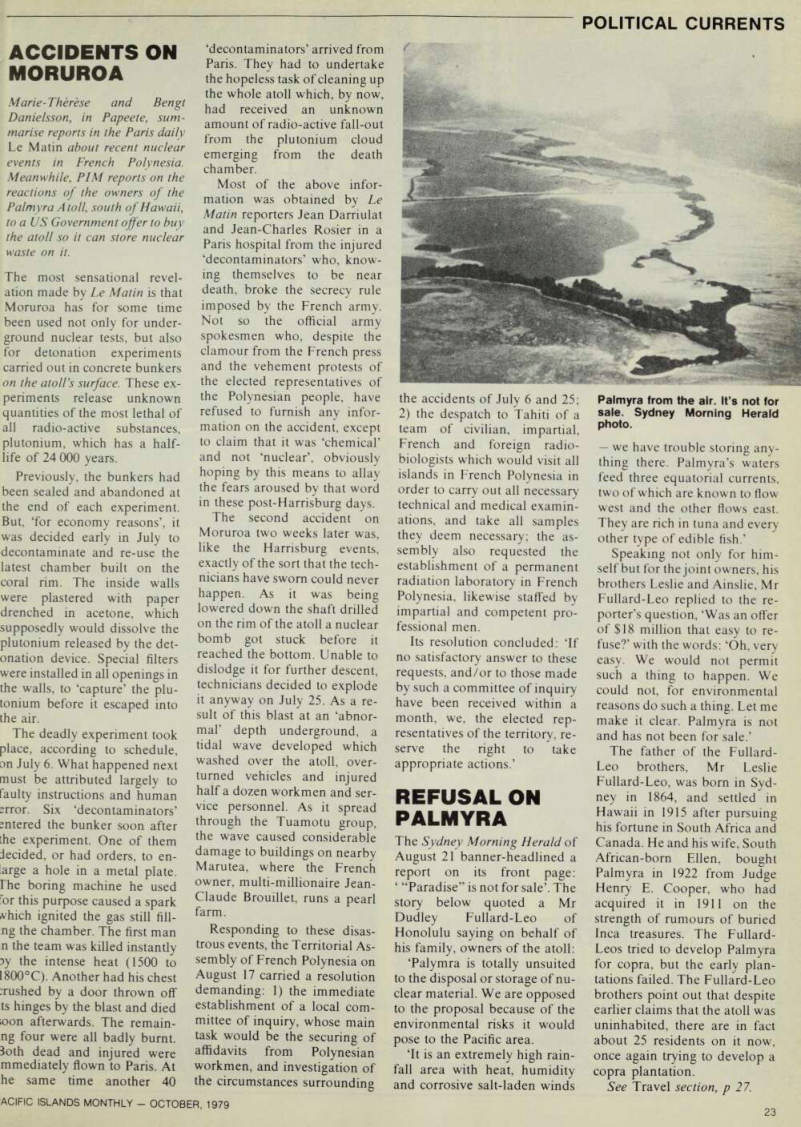
Palmyra from the air. It’s not for sale. Sydney Morning Herald photo.