conspiracy trial
p. 20 · Read in the full issue
At last: The wash up of the Cooks’ conspiracy trial
The Cook Islands' long-drawn conspiracy trial drama is over bar some final shouting from Sir Albert Henry, convicted at the trial, who is appealing against a three-year ban on any political activity on his part imposed by trial judge Mr Justice Beattie. The complex tale is pulled together by PIM staff correspondents, and by Margie Mcllroy and Karen Garner-Williams writing from Rarotonga.
The celebrated Cook Islands conspiracy trial ended on August 20 with a fizzle and not
the anticipated big bang. It
didn’t take months, as people had predicted, but just three days of court sittings to come to a decision. And Sir Albert Henry, Cook Islands premier for 13 years until last year, didn’t go to gaol.
Sir Albert, with New York businessman Finbar Kenny, and Kenny’s agent in the Cook Islands, James W. Little, pleaded guilty to charges of having conspired in a scheme to defraud the state of nearly $350 000 early last year. ‘You have placed yourself above the democratic process and let down your people,’ Mr Justice Beattie, told Sir Henry in fining him $2OO on each of two counts of conspiracy.
For a breach of the Public Monies Act, Sir Albert was fined $lOOO and order to pay $2OOO towards the high costs of the prosecution (at least $l2O 000).
Mr Justice Beattie also asked him to give a written assurance that he would not stand as a candidate for the Legislative Assembly or offer himself for any other political office in the Cook Islands for three years.
Finbar Kenny was fined $2OO for his part in the con spiracy and ordered to pay $6O 000 towards court costs.
Jim Little, manager of the Philatelic Bureau, was fined $l5O on the conspiracy charge and ordered to pay $750 towards court costs. Little was also ordered to sign a political non-involvement assurance.
Geoffrey Henry, Leader of the Opposition, and Max Turner, former advocate general, were discharged on charges of conspiracy, but Henry was fined $5OO for a breach of the Public Monies Act, and Turner was ordered to pay $3OO costs on that charge, but was not convicted.
Mr Apenera Pera Short, for mer deputy premier, had his case a charge of breaching the Public Monies Act dis missed, and the court did not proceed with a charge of con
spiracy.
Sir Albert won’t be giving the . assurance to the court about non-involvement in poli tics. He has been granted an appeal to the Supreme Court against this condition, which is expected to be heard in Auckland in October. It would appear that despite his age, 73,
the unofficial leader of the Cook Islands Party still has
political aspirations for a
return to power.
Defence lawyers, in their submissions, said that Mr
Kenny had probably commit
ted the most expensive error of
judgment in living memory
his mistake having cost him nearly half a million dollars in fines and restitution, not to mention his personal legal fees and travel expenses. Most of these costs were imposed by the US Government (see later).
Jim Little was portrayed as a man who was simply ab sorbed into an inevitable stream of events without the strength of purpose to resist.
In discharging Messrs Henry
and Turner on the conspiracy charges, Mr Justice Beattie said there was no evidence which showed conclusively that either had dishonest criminal intent, or that they knew for sure that the money which was used to finance the fly-in voter aircraft had come from the Philatelic Bureau.
He said although the two de fendants were fully involved with the arrangements for the fly-in voters, he accepted that they both believed that the money was coming from Fin
bar Kenny personally, not
from public funds.
The extraordinary events that led up to this final trial began early in 1978 when Sir Albert, then the premier, called a snap general election. Plans were discussed in cabinet to obtain planes to fly in Cook Islands voters from New Zealand so that the govern ment would retain power.
Finbar Kenny, who as long ago as 1965 had entered into a
contract with the government to organise the sale of Cook Islands postage stamps, the government to receive 50% of the profits, offered his support for this undertaking.
Support was in the form of $337 000, eventually used to pay Ansett Airlines of Aus tralia for charter flights to bring in Cook Islands voters.
The voters brought Sir Albert Henry’s Cook Islands Party back to power early last year.
But the Leader of the Oppo sition, then Dr Tom Davis, challenged the electoral results in court with the result that the fly-in votes were discarded and the government removed from office.
It was alleged that the money used was in fact government money the property of the Philatelic Bureau and this resulted in the various charges which have now been dealt with.
The trial was adjourned four times since it was first called in December 1978. One of the adjournments was for the pros ecution to prepare evidence for
extradition proceedings against
Finbar Kenny. While the ex tradition order went ahead, the United States Justice Depart ment • got into the act, and Kenny International Corpor ation, based in New York, was
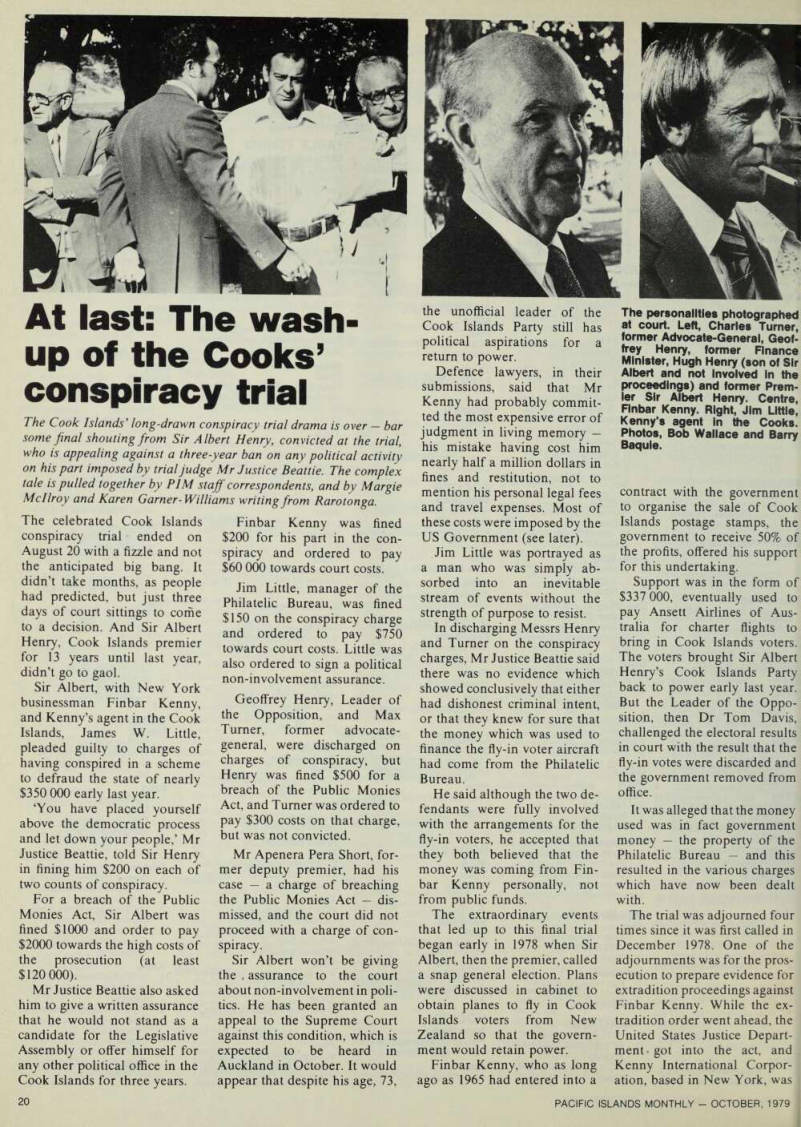
The personalities photographed at court. Left, Charles Turner, former Advocate-General, Geof frey Henry, former Finance Minister, Hugh Henry (son of Sir Albert and not involved in the proceedings) and former Prem ier Sir Albert Henry. Centre, Flnbar Kenny. Right, Jim Little, Kenny’s agent in the Cooks.
Photos, Bob Wallace and Barry Baquie.