Start Drilling
pp. 89-90 · Read in the full issue
Trade
Winds
Fiji’S Oil Men
Gear Up To
Start Drilling
Fiji’s search for oil so far has been confined to seismic and geological surveys but early next year a drilling rig will begin boring into the seabed of the shallow, reef-strewn area north of Viti Levu, Fiji’s largest island, writes Robert Keith- Reid in Suva.
Chances of a commercial strike of oil or gas are rated good. The reason, says San Francisco-based Pacific En ergy and Minerals Limited (PEML), is that seabed geology around and between Viti Levu and the second largest island, Vanua Levu, is extraordinarily like that of rich oil-bearing areas of Indonesia.
The company says it has the same kind of subterranean temperature gradients which indicate conditions for oil for mation. Things are so hot, in fact, that PEML reckons that Viti Levu itself is a reservoir of geo-thermal energy worth tap ping commercially in its own
right.
PEML’s chairman is Jonathan Stoen who was for merly with a US company which ran seismic checks for oil in Fiji in the early seventies but abandoned work when pros pects elsewhere became more attractive.
Mr Stoen, however, was so sure of Fiji’s possibilities that he set PEML up to find out.
Now, working in partnership
with Mapco Incorporated of Tulsa, Oklahoma, and Chev ron Overseas Petroleum Cor
poration, a subsidiary of
Standard Oil of California, PEML is exploring 8000 square
kilometre concessions covering
Bligh Water, immediately
north of Viti Levu; the Yasawa Islands, west of Viti Levu; and the Great Sea Reef area west of Vanua Levu.
Another US company, Dakota Exploration, is at work in an 8000 square kilometre
concession covering the
Lomaiviti Islands which lie be tween the two big islands.
So far PEML has spent around SF3 million and this
figure will be bumped up con siderably when drilling, to which it is committed under an agreement with the Fiji Government, begins next year.
At least six, possibly nine, exploratory wells are being talked about.
A commercial strike would transform Fiji’s sugar and tour ism dependent economy al most overnight, relieving it of the need to buy oil and pet roleum now costing about $2O million a year and bringing the government revenue conserva tively estimated at $lOO,OOO a
day.
But and despite all the op timism it’s still a very big but there’s really no knowing whether PEML and govern ment dreams will come true until those exploratory wells are drilled.
Fiji’s Director of Mines Ronald Richmond, who had much to do with reviving ex ploration interest in Fiji after the the first phase of it waned in the early 19705, says: ‘My own feeling is that we will find something, probably gas and oil. But will it be commercially viable?’ Even a modest find would do wonders for the Fiji economy. PEML thinks oil will be found in small pockets that, while amounting to no Saudi Arabian bonanza, will yield a very nice living. The govern ment and companies have
already signed detailed agree
ments on how oil profits, if any, will be shared.
In May the then minister for minerals, Militoni Leweniqila, went to the US to look at off shore oil rigs at work in the Gulf of Mexico. In June his successor, Bill Clark, left for British Columbia, the Philip pines and Papua New Guinea to look at open pit copper mines. The reason for the sec ond trip is that Fiji’s other great mineral hope, a copper deposit at Namosi, about 40 km north west of Suva, looks a goer as a major mine and the govern ment wants to know how to
handle the situation if mining starts.
America’s Amax group, Conzinc Riotinto of Australia, Anglo American of South Africa and West Germany’s Preusagg, are the Namosi ex
ploration partners. They’ve
spent $l4 million testing the prospects and are now talking of putting $6OO million into a mine.
However it will be another 18 months or so before a final decision is made on whether to
proceed with this project.
PUDS at work
in the Islands
New Zealand’s Department of Trade and Industry, by March this year, had received 249 enquiries about PUDS, includ ing 48 applications for assist ance. PUDS ventures so far include: • Western Samoa: Wisemans South Pacific Ltd makes vinyl
bags and considering manufac
turing airline bags for the United States including Hawaii.
Shannon Marketing Inter national (New Zealand Export Promotions Ltd) has an annato
processing venture to produce
dye from the seeds for the dairy
industry. The department of
scientific and industrial re search rates the Western
Samoan dye as high quality.
NZ Industrial Gases is help ing to expand a carbolic ice
plant and industrial training
programme.
Rothmans Industries
manufactures cigarettes. This scheme created such a furore in Western Samoa and New Zealand that Trevor Lloyd of the Department of Trade and Industry admitted that before any similar scheme was ap proved elsewhere there would be discussion in New Zealand and the Islands first.
Brugger Industries has estab lished a light engineering oper
ation that provides import
substitution for some pro ducts, SMI Biscuits has been offered assistance to make sweet biscuits.
• Tonga: Tonga Wire
Company makes the island’s entire chain link fencing re
quirements.
Dolphin Tanks Ltd makes concrete storage tanks and sep tic tanks in Vavau, an area af
fected by water shortages.
F. C. Matthews and Sons Ltd make leather soccer balls.
Associated Confectioners/ Oasis Industries have a soft
drink bottling operation.
• Fiji: Butland Industries Ltd processes ginger with a Fijian company, Balthan Inter national Ltd.
W. F. Tucker and Co. Ltd has a food processing oper ation in Suva which produces peanut butter at present from
imported peanuts, eventually
from island peanuts.
J. A. Bolt has been offered help to open a sausage casing
operation.
Timber and Building
Supplies (Fiji) Ltd has
expanded its timber processing
operation and is to treat timber
locally.
Fiji Steel Industries has
expanded its bucket-making
operation from waste steel.
Allen E. Douglas Ltd has been offered help to manufac ture jewelry. It found its island
trainees picked up jewelry
making skills quicker than
New Zealanders. Eventually it plans to make and export wed ding rings to Hawaii and the United States.
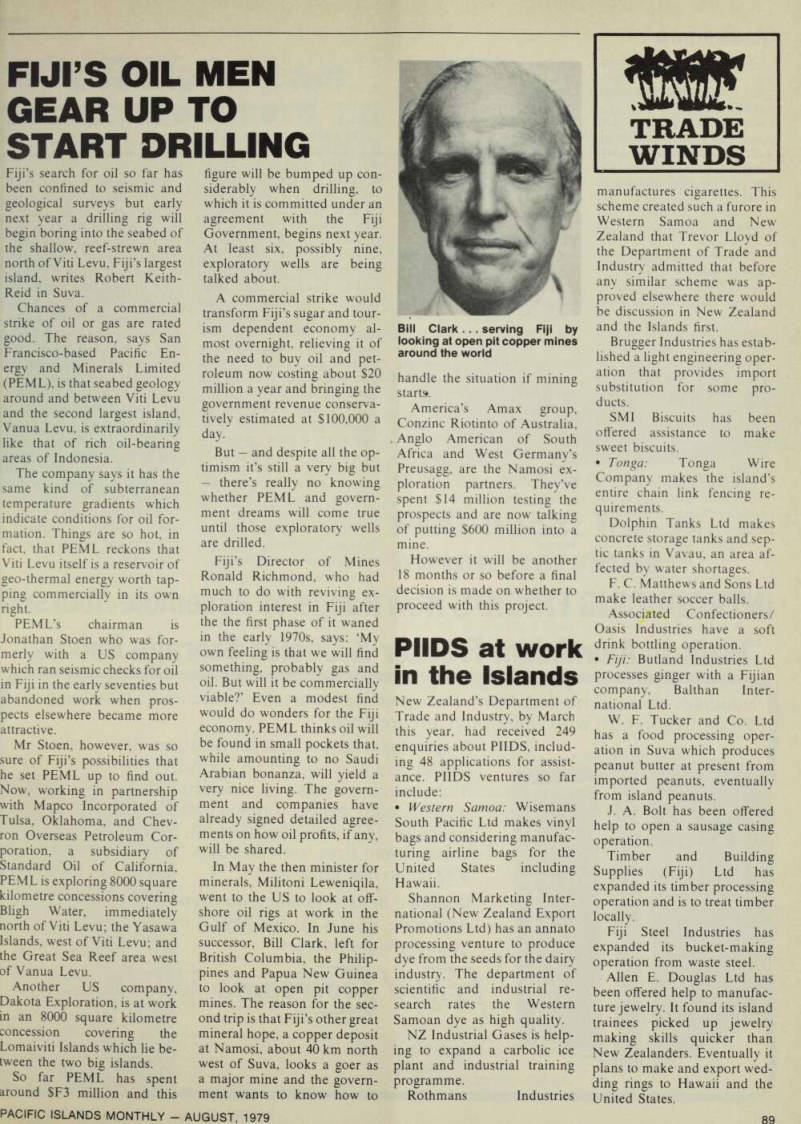
Bill Clark ... serving Fiji by
looking at open pit copper mines around the world
• Cook Islands: Mortco Hold ings Ltd manufacture corru gated roofing iron and other
metal products.
• Niue: Niue Products Ltd expanded its softdrink manufacturing operation and opened a coconut cream can ning line for local and export markets.
Astrafine Leather has established a hand-sewn soccer
ball operation.
In addition there has been
approval for;
• Potter Brown Ltd to open an
adhesive manufacturing plant
in Fiji.
• Natural Energy Ltd to pro ceed with a solar heater manufacturing unit that may be based in Western Samoa or Tonga for the Islands and other markets. • Caxton Printing Works Ltd to proceed with a paper
processing operation in West
ern Samoa. • Norsewear Industries Ltd to
open a hand-operated knitting
business in Tonga to market its products in North America.
Feasibility studies have been
approved for storing and dry
ing maize and processing gin
ger in Fiji; manufacturing
chain-link fencing, paint and
more cigarettes in Western Samoa; drying fruit and manufacturing parquet floor ing from coconut palm stems in
Tonga; and opening a sheep
skin clothing operation in
either Fiji or Samoa.
Ideas for the
villagers
‘A business co-operative in the New Hebrides makes soap from coconut oil for home con
sumption. The Community
Education Training Centre in Fiji is using borax and table salt to fix the brilliant colours from hibiscus flowers, wild gin ger and marigolds for use as textile dyes. A common activity in Papua New Guinea is mak
ing wooden roofing shingles.
Niue is investigating the possi
bility of adding local fruit pulp
to coconut cream to make a frozen dessert. Bananas, as well as being dried whole, can be made into sweet chips, powder, flakes, chips flour, pulp and
vinegar..
So begins an enthusiastic re
view in the Cook Islands News of a new publication from the South Pacific Commission, T- Shirts and Tapa Cloth , by Alan Bollard.
The reviewer goes on; ‘This is a handbook, which looks at a number of small businesses
designed for Pacific villages,
but it is not a step-by-step “how-to” book for business men to follow. Rather, it is a collection of experiences in the Pacific to give ideas and introduce new possibilities. ‘The handbook has been
designed for rural develop
ment workers, teachers and extension officers who are involved with rural economic activity, and for government planners who are selecting and
financing rural projects ...
‘At a time when we are increasingly concerned with trying to achieve economic self-reliance we should be thinking about ways to meet our own consumer needs, sub
stituting locally produced
goods for imported ones.’
Copies may be obtained from the Secretariat, South Pa cific Commission, Noumea.
‘WESPAC’ plan
from Perth
The Western Pacific should build its own economic bloc to counter the threat of the world’s established economic blocs.
That was the message of Dr Liu Yat-wing of the East Asian Studies Centre at the Univer sity of Western Australia to a Perth seminar on future politi cal and economic development of the Pacific Basin region.
Dr Liu said that, ideally, the Western Pacific group would include Japan, South Korea, Australia, New Zealand, Papua New Guinea and the ASEAN countries with Hong Kong and Taiwan as associate members.
Calling the group WESPAC, Dr Liu said the economies in such a community ‘are comp lementary in character’ and, together, formed a group ‘which is not only well endowed in natural resources but also one with a large popu lation and the necessary capital and technology to become a powerful and prosperous econ omic bloc’.