Pacific Islands

Monthly Pim
August 1979
Duza
Cuson
Pda
Guinea
American Samoa USsl.2s Australia.:...'. Asl.oo* Fiji ;.. FSt.OO Hawaii . US$l.5O Nauru 5A1.50 New Caledonia...; CFPI4O New Hebrides ASI.OO NZ, Cook Is. & Niue NZSI.OO Norfolk Island Asl.oo Papua New Guinea...*. KI.OO 5010m0n5... Ssl.oo Tahiti CFPISO Tonga PI.OO USTT & Guam USsl.2s
Western<£amoa TI.OO
‘Recommended retail price only.
Registered (or posting as publication Category BT
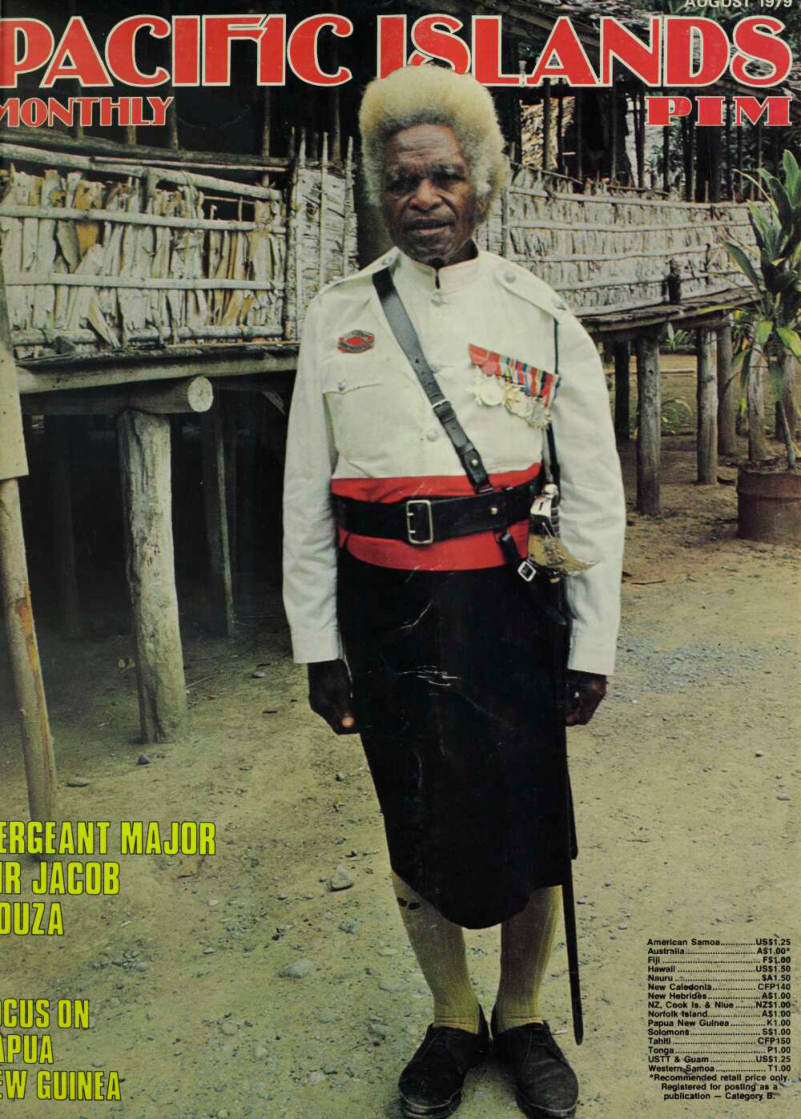
Cover: Sir Jacob Vouza of Solomon Islands the knighthood may have come but he’ll still be remem bered as Sergeant-Major. (See Pacific Report.) Photo: Bruce Adams
Advertisements & other items, p. 2 (1 item)
Toyota
How to find a REAL economy car* When you look at a car billed as an economy
model, ask yourself a few questions.
What sort of fuel consumption can be expected?
Low? Good.
What about other operating costs? Oil, lubrication, that kind of thing. Low again? Great.
How about maintenance? The car has a low-breakdown record? You are definitely on the right track.
What is the average life of the car? Is it better than the average in your area? Super. That’s important in an economy car.
Mow. How is the after service? Buying a car is not all in the price you know. Plenty of service outlets?
One economy car coming up. All you have to do is check the price. Then you can tell if you are really getting an economy car.
You will probably find, after asking these questions about town, that REAL economy cars come down to Toyota, the world’s economy car builder.
See Toyota first. Then you won’t have to shop around.
IHE HAPPY ECONOMIZER
TOYOTA STARLET
The car that says economy in every way And you will be happy for it. Big inside.
Small outside. Miserly with petrol.
Without sacrificing comfort. A good buy in an economy car even for Toyota. k
PAPUA NEW GUINEA:
ELA MOTORS,
Scratchley Rd., Badili, P.O. Box 675, Port Moresby.
U.S. TRUST
TERRITORY: MICROL
CORPORATION,
P.O. Box 267, Saipan.
FIJI ISLANDS:
AUTOMOTIVE
SUPPLIES CO., LTD.,
G.P.O. Box 355, Suva.
AMERICAN SAMOA:
BURNS PHILP
(SOUTHSEA) CO., LTD.,
P.O. 1057, Pago Pago.
WESTERN SAMOA:
BURNS PHILP
(SOUTHSEA) CO., LTD.,
P.O. Box 188, Apia.
TONGA: BURNS PHILP
(SOUTHSEA) CO., LTD.,
P.O. Box 55, Nukualofa.
GUAM: ATKINS, KROLL
(GUAM) LTD., P.O. Box
TOYOTA
SERVICE
6248, Tamuning.
NEW HEBRIDES:
NEW HEBRIDES
MOTORS, P.O. Box 18, Vila.
TOYOTA
SOLOMON ISLANDS:
MENDANA
ENTERPRISES (5.1.)
LTD., P.O. Box 174,
Honiara.
TAHITI: NIPPON
AUTOMOTO, B.P. 342,
Papeete.
COOK ISLANDS:
COOK ISLANDS
TRADING
CORPORATION LTD.,
P.O. Box 92, Rarotonga.
NAURU ISLAND:
NAURU COOPERATIVE
SOCIETY.
GILBERT ISLANDS:
TARAWA MOTORS,
Box 36, Bairiki Tarawa.
NORFOLK ISLAND;
MOUNT PITT
(ENTERPRISES) LTD.,
P.O. Box 169
NEW CALEDONIA:
SOCIETE IMPORTATION
AUTOMOBILE DE
PACIFIQUE, Rond-Point du Pacific (Station Total) B.P. 438, Noumea.
The Toyota range includes: Toyota 1000, Toyota Starlet, Toyota Corolla, Toyota Celica, Toyota Corona, Toyota Cressida, Toyota Crown
Pacific Islands Monthly
Pim
Vol. 50 No. 8
Ahughĥst 1979
(Usps 952480)
Payment by personal cheque is accepted in Australian, US, New Zealand, UK and Fiji currency. For other remit tances please obtain a bank draft in Australian dollars made payable to the ANZ Banking Group, 88 Wentworth Avenue, Sydney, Australia.
Representatives
AUSTRALIA: Distribution: NSW & ACT: Allan Rodney Wright (Circulation) Pty Ltd, PO Box 907, Darlinghurst, NSW 2010; Elsewhere: Gordon & Gotch (A/asia) Ltd, Box 40, PO, Rosebery, NSW 2018 Advertising Melbourne Pacific Publications (Aust.) Pty Ltd, sth Floor, Alley Building, 75-77 Flinders Lane, Melbourne 3000, tele phone 63*0211, ext. 1565 Jeff Gates, ext. 1858 Ida Pad gett; Brisbane D. Wood, Anday Agency, Box 1918, GPO. Brisbane 4001, telephone 44 3485, 44 1546; Adelaide Hastwell Media, PO Box 30, Glen Osmond, SA 5064, 233 Glen Osmond Rd, Frewville, SA 5063, tele phone 79 1869, 79 5956; cables Hastmedia, Adelaide.
FIJI: Distribution and subscriptions Desai Bookshops, PO Box 160, Suva, Fiji, telephone Suva 23036 Advertis ing - Fiji Times & Herald Ltd, 20 Gordon St, Suva, tele phone 312 111, telex FJ2124.
FRENCH POLYNESIA: Distribution - Hachette Pacifique, 10 Ave Bruat, Papeete, telephone 25610.
HAWAII, UNITED STATES: Distribution PIM, Hawaii PO Box 22250, Honolulu, Hawaii 96822.
JAPAN: Advertising and subscriptions Universal Media Corporation, CPO Box 46, Tokyo, telephone 666 3036.
NEW CALEDONIA: Distribution Depot Centre de Presse Michel Pentecost, CBP2, Noumea, telephone 27 2434, 27 4729.
NEW ZEALAND: Distribution - Gordon &-Gotch, PO Box 584, 2 Carr Road, Mt. Roskill, Auckland 4. Advertising - International Media Representatives Ltd, PO Box 2313 Auckland, telephone 795 487; 493 389, cables Intereps, Auckland. Subscriptions - Ross Haines & Son Ltd PO Box 1289, Auckland, telephone 769 042 PAPUA NEW GUINEA: Distribution - Robert Brown & Assoc., PO Box 3395, Port Moresby, telephone 25855.
Advertising - PNG Post-Courier, PO Box 85 Port Moresby, telephone 21 2577.
UNITED KINGDOM: The Herald & Weekly Times Ltd, 8-10 Clifford's Inn, Fetter Lane, London EC4A IBU, telephone 01 831 6041, telex London 21989.
UNITED STATES MAINLAND: Advertising Joshua B Powers Jr, Powers International Inc., 551 Fifth Ave, New York, New York 100017, telephone 867 9580, telex 236514 Subscriptions - PIM, Hawaii, 2812 Kahawai St Honolulu, Hawaii 96822, Published monthly by Pacific Publications (Aust.) Pty Ltd and printed in Australia by Paramac, Alexandria, NSW, Australian cover price is recommended retail only. Regis tered at the GPO Sydney for transmission by post as a publication category B. Second class postage paid at Honolulu, Hawaii. Copyright § 1978 Pacific Publications
(Aust.) Pty Ltd.
Postmaster Honolulu: Send address changes to PIM Hawaii, PO Box 22250 Honolulu, Hawaii 96822.
Subscriptions
PIM is airfreighted to most subscribers and agents in the Pacific Islands and the United States.
Aust.
Other American Samoa $13 $US16 Australia $12 Canada $14 $US18 Cook Islands $13 Fiji $12 $F12 French Polynesia $14
Cfp 1700
Guam $13 $US16 Gilbert Islands $13 Hawaii $13 $US16 Japan $16 Y4500 Micronesia $13 $US16 Nauru $18 New Caledonia $14
Cfp 1700
New Hebrides $13 New Zealand $12 $NZ13.50 Niue $13 Norfolk Island $12 Northern Marianas $13 $US16 Papua New Guinea $13 K12 Solomon Islands $13 Tonga $13 Tuvalu $13 United Kingdom $15 £10 US Mainland $14 $US18 Western Samoa $13 Elsewhere: $A16
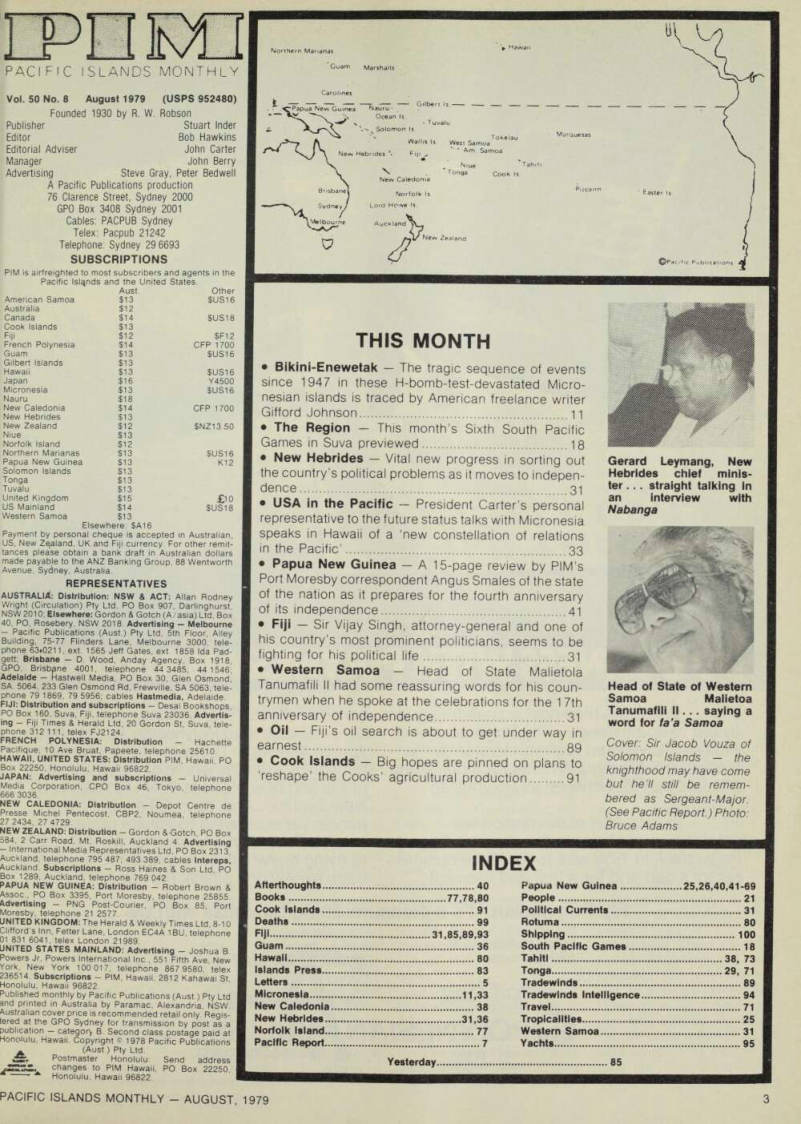
This Month
• Bikini-Enewetak The tragic sequence of events since 1947 in these H-bomb-test-devastated Micro nesian islands is traced by American freelance writer Gifford Johnson 11 • The Region This month’s Sixth South Pacific Games in Suva previewed 18 • New Hebrides Vital new progress in sorting out the country’s political problems as it moves to indepen dence 31 • USA in the Pacific President Carter’s personal representative to the future status talks with Micronesia speaks in Hawaii of a ‘new constellation of relations in the Pacific’ 33 • Papua New Guinea A 15-page review by PlM’s Port Moresby correspondent Angus Smales of the state of the nation as it prepares for the fourth anniversary of its independence 41 •Fiji Sir Vijay Singh, attorney-general and one of his country’s most prominent politicians, seems to be fighting for his political life 31 • Western Samoa - Head of State Malietola Tanumafili II had some reassuring words for his coun trymen when he spoke at the celebrations for the 17th anniversary of independence 31 • Oil Fiji’s oil search is about to get under way in earnest 39 • Cook Islands Big hopes are pinned on plans to ‘reshape’ the Cooks’ agricultural production 91
Gerard Leymang, New Hebrides chief minis ter ... straight talking in an interview with Nabanga
Head of State of Western Samoa Malietoa Tanumafili ll ... saying a word for fa’a Samoa
Index
Afterthoughts 40 Books 77,78,80 Cook Islands 91 Deaths 99
Fiji 31,85,89,93
Guam 36 Hawaii 80 Islands Press 83 Letters 5 Micronesia 11,33 New Caledonia 38 New Hebrides 31,36 Norfolk Island 77 Pacific Report.. 7
Papua New Guinea 25,26,40,41-69 People 21 Political Currents 31 Rotuma 80 Shipping 100 South Pacific Games 18 Tahiti 38, 73 Tonga 29, 71 Tradewlnds 89 Tradewlnds Intelligence 94 Travel 71 Troplcallties 25 Western Samoa 31 Yachts 95
Yesterday 85
Advertisements & other items, pp. 3-4 (2 items)
3
PACIFIC ISLANDS MONTHLY - AUGUST, 1979
Founded 1930 by R. W. Robson Publisher Stuart Inder Editor Bob Hawkins Editorial Adviser John Carter Manager John Berry Advertising Steve Gray, Peter Bedwell A Pacific Publications production 76 Clarence Street, Sydney 2000 GPO Box 3408 Sydney 2001 Cables: PACPUB Sydney Telex; Pacpub 21242 Telephone: Sydney 29 6693
(Tj Polynesian/Airlines
A-** ' 4» <s* i AN S
DO BUSINESS Wl
When the time next comes for you to fly out to do business fly Polynesian Airlines. Polynesian really understands the businessman’s requirements for a quick and efficient service between all Polynesian countries.
In fact, part of the reason we established our first service (Apia Pago Pago) back in 1959 was to meet the business sector’s demand for a fast and frequent service between the Samoas.
Since then Polynesian Airlines has spread its wings. Today our extensive route network covers the whole of Polynesia east of Fiji and now extends down to Auckland, New Zealand. And, as in ‘59 a lot of the people we’re carrying today are professional people. People who know that when it comes to flying anywhere in Polynesia on business there is only one airline. Polynesian Airlines, Fly Polynesian. It’s a pleasure doing business with us.
Offices in: Auckland, Tonga, Niue, Rarotonga.
Box 599 Apia, Western Samoa, Ph 21261
WESTERN SAMOA
AMERICAN
SAMOA
Y NIUE
(tj POLYNESIAN/AIRLINES
Nandi Airport Nandi Ph 72733 We are Polynesia.
Letters
Dictionaries and the scent of gardenias I read with interest Carolus Ketsimur’s excellent and per ceptive review of Robert Stuart’s book Nuts to You (an unfortunate title: I think the book deserved a better one). I also read with affection and amusement the reference to my dear late Paul. I thought a few comments might clear up one or two points (though I can hear Paul saying: ‘What does it matter, dear?’).
I quote first from the bio graphical notes Paul himself was preparing at the time of his death: ‘Bob Stuart and I were about the same age, we may even have been born on the same day. But what a different background! Stuart was a tall dark handsome young man, born in India and sent to school in England when he was nine years old, to a preparatory school, and then on to the
English public school of
Tunbridge. From there it was intended that he go to Sandhurst, but he did not make the grade, and was sent to
Hawkesbury Agricultural
College in New South Wales ... ‘Bob proved to be the best assistant I ever had and he took over Inus after I left. We had a hard battle together getting the place cleaned up and in order.’ It is to be remembered that the previous manager had been murdered on the beach front at Inus, and Paul had been asked to come and ‘clean up’ more than literally. The plantation work line was a rabble. Bob was always con cerned that Paul walked inno
cently amongst these tough
specimens and not on a horse as he preferred. It is nice that Bob is here to take the bow
or perhaps, more rightly, give
a bow.
I also read with interest his reference to Paul’s affection for
the dictionary. He always wrote with one beside him: he loved the right nuance of a word. Paul had left school at the age of 14 to help support
his parents’ large family.
Though I had had the good for tune of a university education I was always humble (as I was in my father’s presence) at Paul’s extraordinary wealth of learning. (I don’t note here his tremendous and inventive mechanical and engineering skills; someone else may be able to write of that and its postwar contribution to Papua New Guinea.) We all loved the dictionary: some of my fondest memories are of us as a family sitting around the Inus breakfast table, the scent of Cape Jasmin gardenias outside (Paul always put the first of the larger gar denias beside my breakfast plate) and, in turn, choosing words while the others guessed at the origin and derivation of the word.
As I wrote to Bob thanking him for his suitably inscribed copy of the book: ‘lt is a simple story of achievement well told.
Paul I think might have told some of the stories a little dif ferently. But then he was on a plane above us poor ordinary mortals.’
Noelle Mason
Kundiawa PNG
A choice cut on
Solomons’ beef
I refer to ‘Pitfalls in a promis ing Solomons scene’ (PIM Tradewinds May). Your Honiara correspondent was quite wrong in stating that ‘while Solomon Islands looks like becoming a sizable rice exporter, it is not likely to be come a major beef exporter as was envisaged until recently’. It has never been the intention that Solomon Islands becomes a major beef exporter for although it was envisaged that in the early 1980 s the necessity may arise to seek markets in
adjacent countries for superior
cuts surplus to demand here, the primary intention is to be come self-sufficient in beef.
This point was recognised by
the author later on in the article but it hardly reconciles with
previous observations.
I am especially dismayed by
the statement which claims that ‘the government has failed to
provide adequate transport,
stockholding and marketing
facilities’. This again is quite wrong in every respect for these functions fall to the Cattle Development Authority which has done an excellent job in fostering the cattle smallholder and developing a reliable and
regular marketing system. The
authority is funded by overseas aid donors and I am very dis turbed indeed by the thought that they will read these damaging and totally inac curate statements in your
magazine.
Waeta Ben
Minister of Agriculture and Lands Honiara Solomon Islands
Questions about
French nuclear tests
What a pleasant surprise to read in the May issue of PIM the Moruroa newsletter by the French charge d’affaires in Fiji, Bernard Malandain,
heralding a complete reversal
of the long-standing French in formation policy in the nuclear weapons field.
As a matter of fact, for 13 years ever since nuclear test ing began at Moruroa all French cabinet ministers, governors, admirals, generals, ambassadors and other diplo mats have stubbornly refused to furnish any information whatsoever about the health hazards resulting from 41 ex plosions of A and H bombs in the atmosphere and about 20 underwater blasts.
To ensure complete secrecy, the French Government has even forbidden the French National Radiation Labora tory to send observers to the islands and entrusted the radi ation control to the very people who explode the bombs the French army. Not very surprisingly, the admirals and
generals have never publicly
critised their own undertak
ings.
Only once in the past has a high-ranking French official deigned to depart from this
strictly enforced hush-up pol
icy. This was in 1973, when the then deputy for French Polynesia, Francis Sanford,
sent in the following question to Minister for Health Michel Poniatowski: ‘Mr Sanford asks the minis ter for public health and social security (1) if he is able to indi cate the exact number of deaths due to cancer that have oc curred in French Polynesia during the last 10 years, and (2) if he can undertake an evalu ation of the amount of radioac tive contamination existing in the following three French Polynesian islands: Hao, Tureia and Mangareva.
To everybody’s surprise, Mr
Poniatowski on this occasion took time off to answer although not in a very satisfac tory manner. This is the com
plete reply, dated September
15, 1973: ‘The minister for public health and social security informs the honourable mem ber of parliament that he has no direct responsibility for the territory of Polynesia. He is nevertheless able to state (i) that the frequency of cancer and leukemia has remained
unchanged in Polynesia during
the last 10 years, and (ii) that the radioactivity in the islands of Polynesia, taken as a whole, has stayed within the limits of the fluctuations of the natural
radioactivity.’
Since then, however, all French officials, both civilian and military, have maintained the traditional stony silence.
That is until Mr Malandain showed by his letter to PIM that he knows perfectly well what is going on at Moruroa, and that he is ready to publish the facts.
Incidentally, it is very sad to hear that some ‘residents’ at Moruroa have been hit by a
viral hepatitis, probably caused
by seafood poisoning that had nothing to do with the radioac
tivity produced by the tests,
and I sincerely hope that they
will soon be back again at their
peaceful tasks.
But what about us other 150 000 inhabitants of French
Polynesia who seriously fear
that the long-lived radioactive fallout from all these bombs may have affected our health and that of our children? All we have heard so far are flat de nials that French bombs are harmful. Which is exactly what
the American officials said in Micronesia until the Bikinians, all severely contaminated, had to be evacuated in a great hurry last year. It is therefore a great relief to discover at long last there is at least one French official willing to tear asunder the veil of secrecy surrounding the French tests.
So I trust that Mr Malandain will answer the following simple questions that countless anguished men and women here in the islands have hith erto asked in vain: • When was the last health sur vey made in French Polynesia to ascertain the radioactive body contents of the inhabi tants, and what were the re sults? • It is a well-known fact that certain marine and land ani
mals absorb unusually high
quantities of radioactivity, and among these are the following,
commonly eaten especially in
the Tuamotu islands: turbo shells, tridacna clams, squid, sea turtles and coconut crabs?
What are the doses measured in the samples studied, group by group and year by year? • What studies have been made of the amount of rain water, collected and preserved over long periods in concrete cis terns and regularly consumed by the inhabitants of the Tuamotu Islands, because there is no other drinking water? • What is the annual incidence of cancer and leukemia in French Polynesia since 1966? (The only paper published so far is a short list of cases dis covered by chance, solely be cause the patient came to the Papeete hospital and asked to be examined.) • On certain islands, like Man gareva and Pukarua, the popu lation has on several occasions been locked up in huge atomic shelters. On others, like Tureia, all inhabitants were evacuated for several months in 1968.
According to official state ments, in between the blasts, these islands were decon taminated. How was this dif ficult task that the Americans never mastered in Micronesia accomplished, and what is the present environmental radio
activity?
• Where can I find a copy of the
geological survey of Moruroa, allegedly showing that it will take 1500 years for the radioac tivity, produced by each ex plosion, to leak out into the ocean?
As a French citizen, ashamed of these deceitful and disgraceful tactics, used in the past by my government, I sin cerely hope that this is the start ing point for a steady flow of useful information from Mr Malandain’s office in answer to the great number of similar questions that have accumula ted over the years.
Marie-Therese Danielsson
Co-author of Moruroa, Mon Amour Papehue Paea Tahiti
Chatterton and ‘My
Reluctant
Missionary’
Undoubtedly Dr Chatterton considers his review of John Kolia’s My Reluctant Mission ary (PIM June), to be lively and tolerant, coming, as he does, from the establishment side of missionary circles. But it is a pity that he could not perceive the wit and sympathy with which Kolia handles both his character Judy and the contexts she finds herself uncomfort
ably placed in.
For a start, Dr Chatterton ignores two-thirds of the novel’s title the ‘My’ and the ‘Reluctant’. To be unaware of
the disguised autobiographical
elements in the novel is forgiv able, but to judge Judy as a missionary of the ordinary sort is inappropriate to the book’s intentions.
She, like many who make wrong choices, finds that her best intentions for others lead to the worst situation for her self. Judy’s saving grace, her honesty with respect to her own passions, is the cause and cure for her dissatisfaction with the missionary life. Dr Chatterton likes the ‘evangelical ring’ of the chapter title ‘Saved’, but he cannot concede that saving oneself from a life of dis honesty and hypocrisy is as good a personal solution as undergoing an orthodox con version.
Paralleling his inability to
comprehend the vacillations of the half-devoted Christian, Reverend Chatterton’s amaze
ment at Judy’s flaunting of ‘the nursing profession’s code of conduct’ stems from his appar ent faith in people’s ability to wholly commit themselves to an elected cause. A nubile nurse’s manner has been known to go further than the bedside more than once be fore.
As for his assertion that Kolia’s novel peters out with a whimper, Dr Chatterton here shows a surprising lack of sym
pathy for distraught humanity.
The story’s close is a most pain ful affair. Judy’s achievement of devotion to a house full of mixed-race orphans provides her with not a sense of triumph but of suffering martyrdom.
Neither the Christian nor the hedonist in Judy is ultimately satisfied. She remains doomed to a surburban limbo.
Thus puzzled by the novel itself, it is not surprising that Dr Chatterton found its Coda (the ‘Memo on Missionaires’) ‘neg tive and defeatist’. Here, unfor tunately, Dr Chatterton’s sense of humour has let him down.
It is no good being upset by a satirist’s barbs, for that is exactly what the satirist wishes to achieve. Kolia’s wry look at the Old and New Testaments, supposedly from an uncon verted Papuan point of view, was meant to embarrass the
foreign faith. Apparently it
has.
Dr Chatterton ends by attacking Kolia’s English and the Institute of Papua New Guinea Studies’ publishing policy. I agree that Kolia would benefit from a tough editor, and I am sure Kolia would agree too, but there is a home grown rawness and honesty about his books which reflects exactly the way things are done in many areas of endeavour in
Papua New Guinea today.
Hopefully, the interest of pro fessional editors will return to Papua New Guinea soon.
Meanwhile, a perusal of other publications from the Institute will show Dr Chatter ton that Kolia’s novel is con sistent with past publishing policy, an aspect of which is the airing of topics relevant to the contemporary scene. I don’t believe any blame lies with the Institute for refusing to concen trate on the past, and refusing
to bury its findings in mouldy
archives. Creating discussion on topical issues through publi cation in various styles and media has allowed the Institute to produce, as part of one of its roles, a vitalising effect on the intellectual life of the Papua New Guinean community.
Nigel Krauth
Brisbane Australia
Lieutenant Bell,
coastwatcher
I am seeking information con
cerning events during the
World War II period in the Southwest Pacific.
During the war I was a cot respondent and for a time wa. in Emirau, in the St Mathias group, where there was a PT boat base. I occasionally went down on a PT boat to cover the raids on New Ireland. On one such raid we were to pick up a Lieutenant Bell, formerly of a family of planters on New Ireland.
The US PT boat skippers seemed to keep in touch with Bell, who was on the island, hidden by the locals, picking him up, then dropping him off later, after he had delivered
intelligence information.
On one trip, we were sup posed to pick him up for deliv ery of intelligence reports, but he failed to show.
The June 1946 issue of PIM reported that the Australian Department of External Terri tories was making investi gations into the fate of 68 civilians missing in New Bri tain and other islands. Among the names of the missing was J. W. Bell, planter, Penipol Plantation, Kavieng. Much later, in the October 1971 issue of your magazine, there was a reference to ‘coastwatcher Stan Bell, brother of Lincoln Bell’,
telling of wartime occupation
intelligence activities by Aus tralians in New Ireland.
I wonder if any readers can help me to find out more about the Lieutenant Bell whom we
dropped off and picked up by
PT boat off New Ireland so many years ago?
Wilmon Menard
PO Box M Honolulu Hawaii
Pacific Report
Welcome To Independent Kiribati!
Armed with a pledge of ample but tied aid from Britain, Gilbert Islands (now Kiribati) began their independent career on July 12 in front of a capacity crowd of 7000 people in the sports stadium on Tarawa. Princess Anne, representing Her Majesty the Queen, handed the instruments giving Kiribati its freedom to Chief Minister leremia Tabai, and less than two hours later had flown out of the country. Kiribati is one of only two republics in full association with the commonwealth. Its chief minister be comes its first president. (Full report in PIM September by John Carter, who was in Tarawa for the occasion.)
France, Usa In Forum Sights
French secretary of state for foreign affairs, Olivier Stirn, did his work well during his July Pacific whistle-stop tour, par ticularly so in Wellington where he seemed to have put the fear of death into Prime Minister Robert Muldoon. But, for all the French outrage at the thought of any other nation interfering in French affairs in the Pacific, the South Pacific Forum, at its meeting in the same month in the Solomon Islands capital of Honiara, decided it would interfere: not as boldly as Papua New Guinea advocated, not as mildly as Mr Muldoon would have liked. The final resolution, noting the desire of Pacific Island peoples, including those in French territories, to determine their own future and calling on ‘the metropolitan powers concerned to work with the peoples of their Pacific territories to this end’, did not live up to the hopes of the four Melanesian New Caledonian Independence Front representatives who went to Honiara to put their case to Forum delegates. But they took hope from indications that individual Forum nations might make rep resentations to the UN Committee of 24 (on decolonisation) to get New Caledonia and French Polynesia back on the com mittee’s list of ‘non-autonomous territories’. The ‘French terri tories’ question occupied more than half of the Forum’s business time this year a one-day-only sitting. Another international issue was aired when the Cook Islands sponsored a motion call ing upon the United States to abandon plans to use a Pacific island (Palmyra atoll is the latest candidate to be mentioned) for storage of spent nuclear fuel. The motion, adopted by the Forum meeting, expressed ‘grave concern at the possible environmental hazards’ involved in the plan. The Forum adopted the convention establishing the South Pacific Forum Fisheries Agency (FFA) but left the matter of a wider fisheries agency, which could embrace distant water fishing nations in its mem bership, to be resolved by its administrative arm, the South Pa cific Bureau for Economic Co-operation (SPEC). Dr Gabriel Gris, secretary of Papua New Guinea’s Department of Decentralis ation and a former vice-chancellor of the University of Papua New Guinea, is to succeed Tonga’s Mahe Tupouniua who is returning to ministerial duties in Nukualofa after seven years as SPEC’s first director.
New Caledonia Votes
Almost 74% of the 68 289 registered voters turned out for New Caledonia’s July 1 poll to elect a new 36-member territorial as sembly. The election was made necessary by the March dissol ution of the old by French High Commissioner Claude Charbon niaud. The Gaullist RPCR (Rally for Caledonia and the Republic) and the Centrist FNSC (Federation for a New Society in Caledonia) between them got 32 841 votes (65.5%), and won 22 seats (RPCR 15, FNSC 7). The coalition of pro-independence parties got 17 243 votes (34.4%), and won 14 seats. Largest of the pro-independence parties is the Union Caledonienne, which won nine seats, the same number as it held in the old assembly. Generally speaking, the poll appears to have achieved the results desired by Paris: consilidation of the old profusion of small groups into a few larger formations, and emergence
of a stable majority favouring continued association with France.
Unifil Fijians; Woundings, Kidnapping
Two Fijian soldiers were wounded in June when Palestinians attacked a position held by the United Nations Interim Force in Lebanon (UNIFIL) south of Tyre. UN headquarters in Jerusalem said one was hit in the arm and the other had leg wounds. But the condition of both was described as ‘satisfactory’. Two Fijian soldiers were killed by Palestinian guerrillas in February (PIM March). In mid-June, in what appeared to be a propaganda exer cise by Rightwing Israeli-backed Lebanese forces, a Fijian lance-corporal, Waqa Vakaloloma, 21, was kidnapped and held for several days. He managed to escape. According to Fiji army sources, the Rightists had sought to use him to exploit Fijian feelings about the February killings by Palestinians.
It’S Sunshine Again In New Hebrides
A new and positive turn in New Hebrides affairs: at a June meet ing in Noumea, French and British representatives agreed with Chief Minister Gerard Leymang and Deputy Chief Minister Walter Lini that the condominium powers would drop their earlier controversial requirement that there must be a referendum on the constitution and independence before elections. They accepted an alternative three-stage plan proposed by the New Hebridean leaders. At the same time, it was agreed that the New Hebridean constitutional committee, whose work has been stalled by internal wrangles, would get back to the job. (Political Currents.)
‘Arise, Sir Jacob...’
Sergeant-Major Sir Jacob Vouza, Solomon Islands’ legendary hero of World War 11, received a knighthood in the 1979 Queen’s birthday honours. Sir Jacob, a former police sergeant-major now in his seventies, served with the Solomon Islands Defence Force and the US Marines during the battle of Guadalcanal. By refusing under torture to give information to the enemy he saved the lives of many allied soldiers. Britain decorated him with the George Medal and the US with the Silver Star. He was made a Member of the British Empire (MBE) in 1957 for his postwar community service activities. Sir Jacob has also been active in keeping alive the friendship with American war veterans, especially on their pilgrimages to the old battlefields.
Banabans Reject London Ruling
Leaders of the Banaban community have rejected the June de cision of the British Government not to allow their Ocean Island homeland to be separated from the new nation of Kiribati.
Spokesman Tebaiti Tawaka said Britain had once again cheated the Banabans out of their birthright. ‘Britain and her partners ripped the Banabans off for years. Now the British Government has committed the final betrayal . . . We cannot give up the struggle now.’
Finbar Kenny For Rarotonga
American millionaire Finbar Kenny will appear voluntarily to face conspiracy charges in the Cook Islands (PIM June). The Cook Islands Government had earlier started extradition proceedings in the USA against Mr Kenny. Along with former Premier Sir Albert Henry and other defendants, he faces charges connected with the flying-in of voters from New Zealand in the Cook Islands’ elections in March 1978. Mr Kenny is the financial power behind the Cook Islands Philatelic Bureau. Meanwhile, a group in Mel bourne, Australia, known as ‘The Friends from Rarotonga As sociation’, has been raising money to help pay Sir Albert’s legal costs in the case. The group is appealing for money from families of people who went to Rarotonga for cancer treatment while Mylan Byrch was there. It claims to have raised $3OOO so far.
Radio Australia Beefs Up Its Pidgin
Radio Australia has increased the strength of the transmission used for its Pidgin service from 10 kW to 100 kW. ‘GET THE HELL OUT OF ISLANDS’ (I) New Zealand journalist Mike Field, editor of the Apia-based Western Samoa Government newspaper Savali, whose free wheeling journalistic ways have more than once tried the patience of his mentors in the prime minister’s department, has resigned and, for good measure, been ordered to quit the country. The crunch came when, after receiving instructions not to publish a report of a court hearing of bribery charges against a former MR (Political Currents), Field brought out the June 5 issue of Savali with a blank column on the front page and a blank page two (PIM July). The large white spaces were ac companied by a short note from Field saying the report, of which all that appeared was the headline ‘Ex-MP Fined $1550 in Brib ery Case;’ was ‘ordered removed by the government only a few hours before it was due to be printed’.
GET THE HELL OUT OF ISLANDS’ (II) The Papua New Guinea Government has ordered Dr Ralph Premdas, head of the politics department at the University of PNG, and a US citizen hailing originally from Guyana, to leave the country. There were suggestions the reason was his involve ment in the recent damaging five-week student strike at the university (PIM July), but this has been denied by Dr Premdas.
He was told to go but last minute recourse to the National Court won him time to make a legal appeal.
Now Neave Runs ‘Soviet Weapons’
The New Caledonian newspaper France Australe carried a four column front-page banner headline in June ’Soviet Weapons off Noumea Dropped off by the Australian Gun-runner Arrested in the New Hebrides’. On page two, the paper carried practically the same headline, with a report of the opening of the court hearing in vila of charges against Australian David Neave (PIM July). The small print in the court report took much of the steam and sensationalism out of the headlines.
• Liberal-Minded Norfolk Administrator
Peter Coleman, 51, former leader of the NSW state parliamen tary opposition, takes over as administrator of the Australian ter ritory of Norfolk Island in September from D. V. O’Leary. Mr Coleman lost his Liberal seat at the NSW state elections last October, and his appointment by the federal Liberal government brought criticism of ‘jobs for the boys’. Nevertheless, most people who know anything about Mr Coleman see his appoint ment as a good one. He’s a trained lawyer, a former chief sec retary of NSW and minister for revenue, author of several books on Australian history (including censorship laws), and genuinely liberal-minded, with wide-ranging interests. His arrival will follow establishment in August of an elected Norfolk Island legislative assembly which will give the Islanders a greater measure of self government.
Petition To Oust Tupuola
Western Samoa’s opposition party headed by Vaai Kolone in late June handed to the head of state a petition asking him to ask Tupuola Efi to stand down as prime minister and to appoint Vaai in his place. The reasons given were that the country had lost confidence in the present government, who were in any case in a minority, and that the country, in view of its economic crisis, needed a government with a mandate from the people.
Death Link With Arawa
F. R. ‘Kip’ McKillop, the man whose Arawa plantation on Bougainville was forcibly resumed by the Papua New Guinea Administration in 1969 as the site of the town of Arawa that today services the activities of the giant Panguna copper mine, died
at Teresopolis, Brazil, on July 2, aged 63. Kip McKillop, who died from a heart attack, built up Arawa plantation during 17 years on Bougainville, and bitterly fought acquisition of the prop erty. Arawa, among other things, was noted for its magnificent collection of orchids and native plants, and McKillop was one of the founders of the New Guinea Biological Foundation. He bought and developed planting property in Brazil, with his wife Mary, following the loss of Arawa. About 50 old PNG friends attended a memorial service to him in Sydney on July 11.
Tonga’S ‘Sea’ Of Pumice
A ‘sea’ of pumice covering almost 200 km by 10 km of ocean north of Tonga s main island of Tongatapu was baffling geol ogists in June. Among a number of clues as to its origin, Ron Richmond, Fiji’s director of mineral development, told the Fiji Times that on May 10 an orbiting satellite had detected steam coming from Tonga’s Fonualei volcano.
Getting Closer To Karkar
The Papua New Guinea Government will spend Kl2B 000 to make volcanic Karkar Island, north of Madang, more accessible to emergency services. Among measures planned are upgrad ing of airstrip and wharf facilities to take bigger planes and ships, installing radio and communications equipment and placing a television monitor near the volcano mouth. The volcano’s activity increased late last year, but has been reported stable since the deaths of two volcanologists in an explosion in March (PIM May).
A New Franco-Tongan Pact?
In his June speech from the throne opening the session of Ton ga’s legislative assembly, King Taufa’ahau Tupou IV spoke of planned celebrations of the 125th anniversary of Tonga’s treaty with the French Government, and foreshadowed possible re newal of the treaty in January 1980.
Oscar Temaru Touches Sore Spot
Oscar Temaru, outspoken leader of the pro-independence Front de la Liberation de la Polynesia has raised a matter generally regarded as tabu by pointing at a press conference to the prob lem posed in French Polynesia by the economically powerful Chinese community. Affirming ‘We are not racists, we are patriots’, Mr Temaru spoke of ‘the non-integration into French Polynesia of an ethnic group of Asiatic origin who still refer to China as their mother country’.
They’Ll Fly Noumea-Norfolk-Nz
The Aero Club of New Caledonia has organised a New Caledonia—Norfolk Island—New Zealand aerial rally for November-December. A dozen Caledonian and one Australian aircraft had already entered by early June. Decision to stage the rally was based on the success of the 1978 Coral Sea rally organised by the club.
SIX MONTHS BAN ON MOVING WAR RELICS Effective from July 1, the Papua New Guinea Government declared a six-months moratorium on the removal of human re mains and other relics of World War 11. The moratorium will allow the government to devise a new policy covering the collection and export of relics, particularly weapons, aircraft and utensils, some of which, it is believed, have been taken out illegally.
Timing of the moratorium allowed the Japanese mission which had been diving for remains of Japanese war dead (PIM July) just enough time to finish its work.
Giant Man-Eating Croc Caught In Png
A government wildlife and fisheries team has caught and killed a five-metre man-eating crocodile near Madang in Papua New Guinea. The remains of a man, taken six days earlier while his children watched, were cut from the stomach of the crocodile.
The victim was 34-year-old Gabriel Solop, a plantation inspector, who was seized by the leg and dragged into a river while check ing fishing lines.
Advertisements & other items, pp. 7-10 (2 items)
7
3 ACIFIC ISLANDS MONTHLY - AUGUST IQ7Q
The Globescanners.
SONY
CRF-330K
ICF-6700W
:i i s s n o *' • * = 1 V fi- 8 u V\ 0 ' • 5 - : 3 / N se.
“T son V s *
ICF-6800W
*“* v 1' * % v *
SONY -
• *. • * * : 156 v- ■H-. --•■ K~— ' . S '** ft y .
The Globescanners.
Turn on one of these Sony multi-band receivers and prepare to do some traveling. They're made to take you out of the country, off the continent, clear to the other side of the earth.
There's enough heavyweight communi-
cations technology inside Sony's lightweight
31-band ICF-6800W and 5-band ICF-6700W receivers to scan radio broadcasts from around the globe.
For example, the ICF-6800W's dual conversion superheterodyne circuitry for clear and stable reception. And phase-locked-loop synthesized timing so that whatever you tune will be guaranteed quartz-accurate. It pulls in FM/MW and SWI-SW29 (1.6~30MHz), including the single side band and continuous wave band.
The ICF-6700W breaks its shortwave coverage into three zones spanning the same frequency range and puts it on three bands.
Sony's way of cutting the world to size. It also picks up FM/MW broadcasts.
Both models have LED digital readouts that display MW/ SW frequencies with unfailing precision. You always know exactly where you're tuned without waiting for station identification.
The advanced technology found in these multi-band models comes right out of the electronic wizardry that went into Sony's CRF-330K, the 33-band wonder complete with a built-in cassette deck.
Take your pick of the three and get everything you need to explore the world via radio. Via Sony.
WeVe made the
world of difference
to Tonga’s communications.
With the opening of the Cable & Wireless earth station, the people ofTonga can enjoy the benefits of the fastest, most efficient and reliable telephone, telex and telegraph links to the rest of the world. Via satellite.
At Cable & Wireless we have over a century of experience in the design, installation and maintenance of communications systems throughout the world.To date we have been involved with over 30 earth stations, each designed to meet their individual climatic and geographic conditions.
So, for more information, do a little communicating yourself. Contact us. % * °CS?^ aV S CQmmUn^Cat^QnS - Comer of Queen ; Mercury Road, London woil &RX. Tel: 01-242 4433 Telex 23181 "I.
Bikini Enewetak

Micronesia
On August 6, 1945, the B-29 Enola Gay dropped the first of two atomic bombs that would kill over 200 000 people in Hiroshima and Nagasaki.
Within months the United States began searching for sites far from American population centres for further develop ment and testing of nuclear weapons. The Defense Depart ment looked to Micronesia in the western Pacific, whose 2000 remote islands have only one half the land area of the state of Rhode Island.
Easternmost in Micronesia lie the Marshall Islands, about 3500 km southwest of Hawaii.
Up to the 1940 s the Marshall [slanders, like most other Micronesians, were self sufficient, living off the ocean
md land. Though covering a
>reat expanse of ocean, the Marshalls’ 28 multi-islet atolls md five single islands com
3rise only about 180
square km. The atolls are rings }f 15 to as many as 97 islets xmnected by a coral reef that mcircles a clear blue lagoon.
Dut of necessity, the
Marshallese are traditionally
expert fishermen, deriving
nost of their protein from the ich lagoons, while the land )rovides coconuts, breadfruit, )andanus and taro.
The most isolated and least vestemised of the Marshallese ived on the northern atolls of
Bikini and Enewetak. Having
ittle contact with foreigners not even with the Japanese
luring their 25-year occu
>ation), they relied on the out ide world for almost nothing, ronically, this very isolation hrust the Bikini and Enewetak )eople into the nuclear age.
In January 1946, Navy
)fficials in Washington, DC,
mnounced that Bikini Atoll
itted all requirements for Op
ration Crossroads , designed to
est the destructive power of mclear weapons on naval vessels. When the US military governor of the Marshalls went o Bikini in February, he told he people that American
■dentists were experimenting
vith nuclear weapons ‘for the
In July 1947 the United States of America gave its word to the United Nations, when it signed the UN Trusteeship Agree ment for the US Trust Territories of the Pacific Islands (Micronesia) to *. . .protect the inhabitants against the loss of their land and resources’. The Micronesians of Bikini and Enewetak Atolls have good reason to doubt the United States’ sincerity as they survey the devastation of their homelands for the good of mankind and to end all world wars’. Gifford Johnson, a freelance writer, traces the tragic sequence of events since 1947 in this article which first appeared in the Bulletin of the Atomic Scientests. PIM reprints it in the hope of widening public discussion on a problem which shows no sign of going away. It is not a question of digging up an old story. The future for the Bikinians and the Enewetakese is as bleak now as it was, without their knowing, in the middle
forties.
good of mankind and to end all world wars’. He promised that their atoll would be returned after the tests were finished, and asked that they consent to being moved to another island.
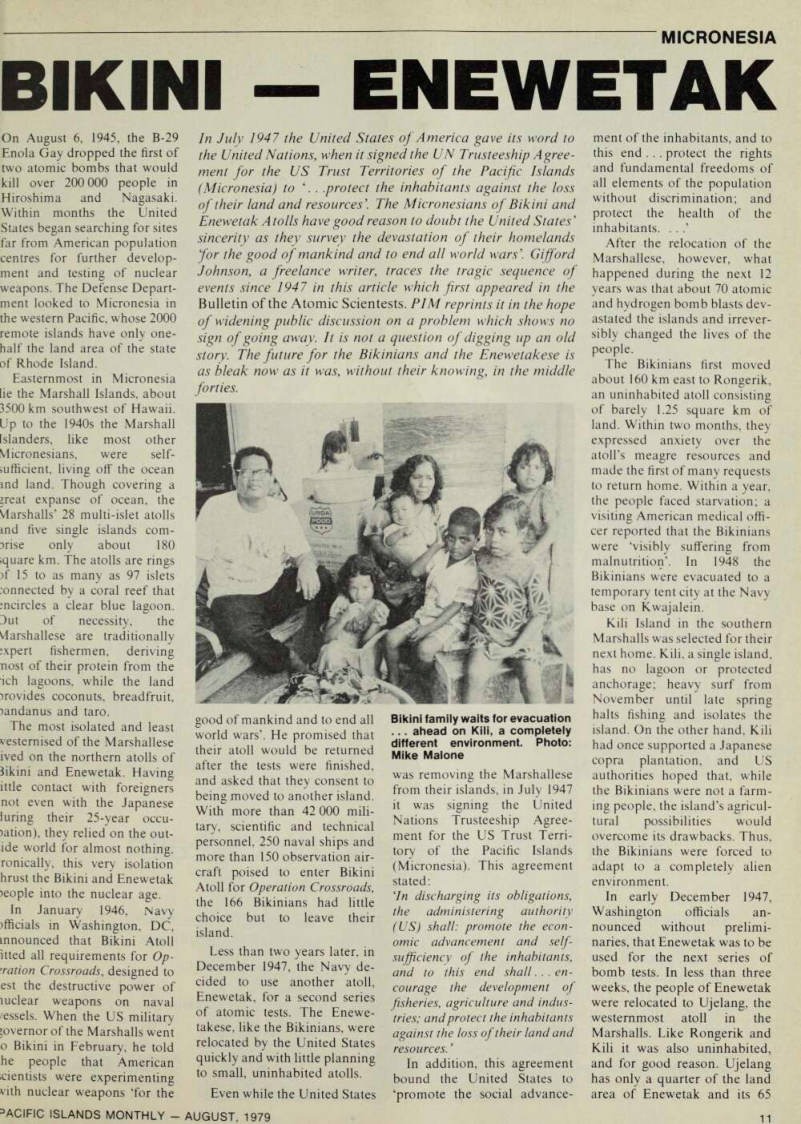
With more than 42 000 mili tary, scientific and technical personnel, 250 naval ships and more than 150 observation air craft poised to enter Bikini Atoll for Operation Crossroads, the 166 Bikinians had little choice but to leave their island.
Less than two years later, in December 1947, the Navy de cided to use another atoll, Enewetak, for a second series of atomic tests. The Enewe takese, like the Bikinians, were relocated by the United States quickly and with little planning to small, uninhabited atolls.
Even while the United States
was removing the Marshallese from their islands, in July 1947 it was signing the United Nations Trusteeship Agree ment for the US Trust Terri tory of the Pacific Islands (Micronesia). This agreement stated: 7« discharging its obligations, the administering authority (US) shall: promote the econ omic advancement and self sufficiency of the inhabitants, and to this end shall ... en courage the development of
fisheries, agriculture and indus
tries; and protect the inhabitants against the loss of their land and resources. ’
In addition, this agreement bound the United States to ‘promote the social advance
ment of the inhabitants, and to this end .. . protect the rights and fundamental freedoms of all elements of the population without discrimination; and protect the health of the inhabitants. . .
After the relocation of the Marshallese, however, what happened during the next 12 years was that about 70 atomic and hydrogen bomb blasts dev astated the islands and irrever sibly changed the lives of the
people.
The Bikinians first moved about 160 km east to Rongerik, an uninhabited atoll consisting of barely 1.25 square km of land. Within two months, they
expressed anxiety over the
atoll’s meagre resources and made the first of many requests to return home. Within a year, the people faced starvation; a visiting American medical offi cer reported that the Bikinians
were ‘visibly suffering from
malnutrition’. In 1948 the Bikinians were evacuated to a temporary tent city at the Navy base on Kwajalein.
Kili Island in the southern Marshalls was selected for their next home. Kili, a single island, has no lagoon or protected
anchorage; heavy surf from
November until late spring halts fishing and isolates the island. On the other hand, Kili had once supported a Japanese copra plantation, and US authorities hoped that, while the Bikinians were not a farm
ing people, the island’s agricul
tural possibilities would overcome its drawbacks. Thus, the Bikinians were forced to adapt to a completely alien environment.
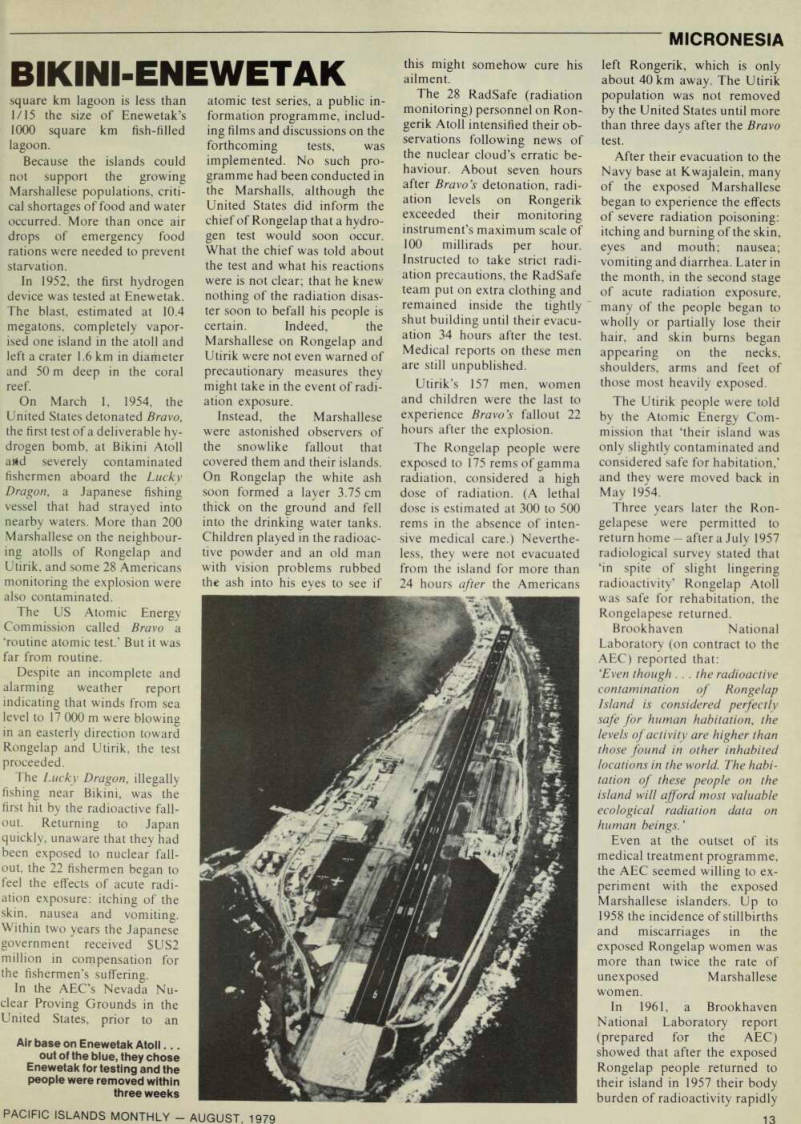
In early December 1947, Washington officials an nounced without prelimi naries, that Enewetak was to be used for the next series of bomb tests. In less than three weeks, the people of Enewetak were relocated to Ujelang, the westernmost atoll in the Marshalls. Like Rongerik and Kili it was also uninhabited, and for good reason. Ujelang has only a quarter of the land area of Enewetak and its 65
Bikini family waits for evacuation ... ahead on Kili, a completely different environment. Photo: Mike Malone
square km lagoon is less than 1/15 the size of Enewetak’s 1000 square km fish-filled
lagoon.
Because the islands could not support the growing Marshallese populations, criti cal shortages of food and water occurred. More than once air drops of emergency food rations were needed to prevent starvation.
In 1952, the first hydrogen device was tested at Enewetak.
The blast, estimated at 10.4 megatons, completely vapor ised one island in the atoll and left a crater 1.6 km in diameter and 50 m deep in the coral reef.
On March 1, 1954, the United States detonated Bravo, the first test of a deliverable hy drogen bomb, at Bikini Atoll attd severely contaminated fishermen aboard the Lucky
Dragon, a Japanese fishing
vessel that had strayed into nearby waters. More than 200 Marshallese on the neighbour ing atolls of Rongelap and Utirik, and some 28 Americans
monitoring the explosion were
also contaminated.
The US Atomic Energy Commission called Bravo a ‘routine atomic test.’ But it was far from routine.
Despite an incomplete and
alarming weather report indicating that winds from sea level to 17 000 m were blowing in an easterly direction toward Rongelap and Utirik, the test proceeded.
The Lucky Dragon, illegally
fishing near Bikini, was the first hit by the radioactive fall
out. Returning to Japan
quickly, unaware that they had been exposed to nuclear fall out, the 22 fishermen began to feel the effects of acute radi ation exposure: itching of the skin, nausea and vomiting.
Within two years the Japanese government received SUS 2 million in compensation for the fishermen’s suffering.
In the AEC’s Nevada Nu clear Proving Grounds in the United States, prior to an
atomic test series, a public in formation programme, includ ing films and discussions on the forthcoming tests, was implemented. No such pro gramme had been conducted in the Marshalls, although the United States did inform the chief of Rongelap that a hydro gen test would soon occur.
What the chief was told about the test and what his reactions were is not clear; that he knew nothing of the radiation disas ter soon to befall his people is certain. Indeed, the Marshallese on Rongelap and Utirik were not even warned of
precautionary measures they
might take in the event of radi ation exposure.
Instead, the Marshallese were astonished observers of the snowlike fallout that covered them and their islands.
On Rongelap the white ash soon formed a layer 3.75 cm thick on the ground and fell into the drinking water tanks.
Children played in the radioac tive powder and an old man with vision problems rubbed the ash into his eyes to see if
this might somehow cure his ailment.
The 28 Rad Safe (radiation monitoring) personnel on Ron gerik Atoll intensified their ob servations following news of the nuclear cloud’s erratic be haviour. About seven hours after Bravo’s detonation, radi ation levels on Rongerik exceeded their monitoring instrument’s maximum scale of 100 millirads per hour.
Instructed to take strict radi ation precautions, the Rad Safe team put on extra clothing and remained inside the tightly shut building until their evacu ation 34 hours after the test.
Medical reports on these men are still unpublished.
Utirik’s 157 men, women and children were the last to experience Bravo’s fallout 22 hours after the explosion.
The Rongelap people were
exposed to 175 rems of gamma radiation, considered a high dose of radiation. (A lethal dose is estimated at 300 to 500 rems in the absence of inten sive medical care.) Neverthe less, they were not evacuated from the island for more than 24 hours after the Americans
left Rongerik, which is only about 40 km away. The Utirik population was not removed by the United States until more than three days after the Bravo test.
After their evacuation to the Navy base at Kwajalein, many of the exposed Marshallese began to experience the effects of severe radiation poisoning: itching and burning of the skin, eyes and mouth; nausea; vomiting and diarrhea. Later in the month, in the second stage of acute radiation exposure, many of the people began to wholly or partially lose their hair, and skin burns began appearing on the necks, shoulders, arms and feet of
those most heavily exposed.
The Utirik people were told by the Atomic Energy Com mission that ‘their island was
only slightly contaminated and
considered safe for habitation,’ and they were moved back in
May 1954.
Three years later the Ron
gelapese were permitted to
return home after a July 1957 radiological survey stated that
‘in spite of slight lingering
radioactivity’ Rongelap Atoll
was safe for rehabitation, the
Rongelapese returned.
Brookhaven National Laboratory (on contract to the AEC) reported that: ‘ Even though . . . the radioactive
contamination of Rongelap
Island is considered perfectly safe for human habitation, the levels of activity are higher than those found in other inhabited locations in the world. The habi tation of these people on the island will afford most valuable ecological radiation data on
human beings.’
Even at the outset of its medical treatment programme, the AEC seemed willing to ex
periment with the exposed
Marshallese islanders. Up to 1958 the incidence of stillbirths and miscarriages in the exposed Rongelap women was more than twice the rate of
unexposed Marshallese
women.
In 1961, a Brookhaven National Laboratory report (prepared for the AEC) showed that after the exposed
Rongelap people returned to
their island in 1957 their body
burden of radioactivity rapidly
Air base on Enewetak Atoll... out of the blue, they chose Enewetak for testing and the people were removed within three weeks
increased. In 1961 their body levels of radioactive cesium had risen 60-fold, zinc rose 8-fold and strontium-90 rose 6-fold.
In 1964, the first thyroid tu mours and cancers appeared.
Since that time, more than 90% of the Rongelap children who were under 12 years old in 1954
have developed thyroid tu
mours. Forty percent of all the exposed Marshallese have de
veloped thyroid problems, as
compared to an average of 3-4% among Americans.
Some people who returned to Rongelap in 1957 had been away from the island when the bomb exploded and therefore had not been exposed to radi ation.
Brookhaven’s 1960 medical survey showed little difference in radioactivity levels among
exposed and unexposed people
living on Rongelap. However,
as late as 1969, the body radioactivity levels of pre
viously unexposed Rongelap
people was 10 times that of Marshallese living on a non contaminated island.
In 1971, Marshall Islands leaders invited a Japanese medical team to perform an independent survey of the
Rongelap and Utirik people.
Barred by the United States from actually going to Ron gelap and Utirik, the team
examined exposed people in
the district centre of Majuro.
The Japanese report stated:
‘The people of Rongelap who
were not exposed to fallout, received a considerable amount of radioactive nuclides from the environment. Consequently, the
“unexposed” group actually be
came an “ exposed” group ... it was a great mistake to permit
the people of Rongelap to return
to their island in July 1957 with out sufficient work having been done to remove radioactive pol lution from the island . ’
In 1972, Lekoj Anjain, who had been only a year old at the time of his exposure in 1954, died of myelogenous leukemia at the National Cancer Insti tute in Bethesda, Maryland.
The Atomic Energy Com mission has consistently obs cured information about the
irradiation of the people and their high incidence of thyroid disease and cancer. In 1975
Nelson Anjain, Rongelap’s
magistrate, wrote to Dr Robert Conard of Brookhaven: ‘For me and the people on Rongelap, it is life which mat ters most. For you it is facts and figures. We want our life and our health. In all the years you’ve come to our island you’ve never once treated us as people. You’ve never sat down among us and really helped us
honestly with our problems.
You have told the people that the “worst is over,” then Lekoj
and this was quite unpredicted and we had some of the best experts in the United States, said Dr Conard, who has headed the Atomic Energy Commission and now ERDA (Energy Research and
Development Administration)
medical programme in the Marshalls since 1954. ‘The theory was put forth that Utirik received low radi ation so a detailed follow-up was not necessary,’ said Dr Konrad Kotrady, a former Brookhaven resident physician in the Marshalls. ‘Now the facts of the thyroid cancer of Utirik have strongly shown that the
theory was wrong,’ Kotrady
Anjain died. I am very worried that we will suffer again and
again.’
The Utirik people were suf fering as well. Because their exposure was considered small, tests on genetic and second generation effects were not conducted on them. The Atomic Energy Commission had always told the Utirik people that the 14 rads of radi ation they had experienced was too insignificant to be harmful.
Nevertheless, in 23 years the Atomic Energy Commission treated 11 reported cases of thyroid tumours, three of them malignant, out of a population of only 157.
But suddenly in 1977 the cancer and thyroid disease rate among the Utirikese rose so sharply that it equalled that of the much more heavily
exposed Rongelap population.
This unexpected increase has forced government scientists to revise theories on which radi ation dose rate will lead to adverse human effects. ‘Thyroid nodules have been increasing in the Utirik people
wrote in a stinging critique of the ERDA medical pro gramme. ‘The people ask if this
thyroid problem has suddenly
occurred is it not possible that the experts have been wrong for so many years and more problems will occur in the future?
Despite the inability of the AEC’s ‘experts’ to predict the thyroid cancers among the Utirik population, they have adamantly barred outside medical teams from the islands. Not until the Ron gelapese and others refused to undergo the 1972 AEC medical examinations unless indepen dent doctors participated were two doctors added to the AEC team for that examination.
Every year since 1954, the AEC and later ERDA medical teams have examined the Marshallese people, and every year they reassure them of their good health. When the people
eventually began asking ‘lf
nothing is wrong with us, why
do you keep coming back every year to examine us? ERDA re plied that it was a precaution ary measure.
A study by a special com mittee of the Congress of Micronesia stated: ‘Time and again the committee found that the people did not understand anything about their exposure, the possible effects on them selves and to their children and on their environment.”
Protesting at what they con sidered inadequate medical care and, to underline the monumental cultural clash be tween the US medical person nel and the islanders, the Utirikese refused a quarterly ERDA medical checkup on December 1976, and the ERDA physician was recalled. ‘The people of Utirik are very distressed and angry as a result of the radiation,’ the chiefs of the atoll wrote in a letter to the
Energy Research and Develop
ment Association in 1977. ‘The people feel that the ERDA pro gramme is in need of vast
changes.’
While the Utirik and Ron gelap populations were experi encing the effects of direct fallout exposure, the peoples of Bikini and Enewetak were attempting to survive in their US-imposed exile on tiny, in
hospitable islands.
Because living conditions on both Kili and Ujelang deteriorated further during the late 1950 s and early 19605, the United States instituted small trust funds in an effort to al leviate some of the problems.
For the Enewetak people the trust fund was $150,000 and for the Bikinians it was $300,000, both yielding semi annual interest payments (about $l5 per capita for the Bikinians).
By the mid-1960s the people were demanding a return to their home islands. Because the Bikinians and Enewetakese began to receive extensive in ternational publicity for their plight, the pressure increased on the United States to return them to Bikini and Enewetak.
In addition, the Atomic Energy Commission, which had been increasingly criticised for advocating that there were per missible levels of radiation
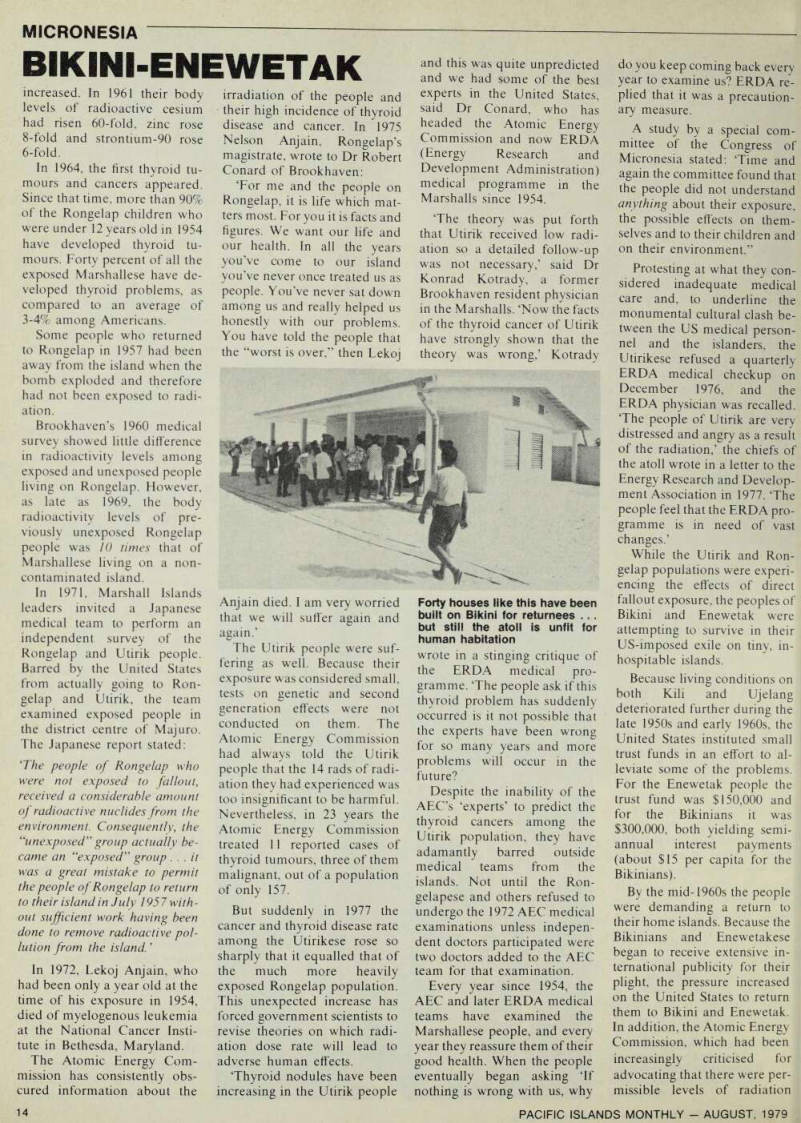
Forty houses like this have been built on Bikini for returnees ... but still the atoll is unfit for human habitation
exposure, was eager to demon strate that low levels of radi ation were not harmful to
people.
In 1968, 10 years after the Marshalls’ nuclear test pro gramme had ended, President
Lyndon Johnson promised the
540 Bikini people a permanent return to their home; the radi ation had dropped below the danger level, according to the Atomic Energy Commission.
In 1969, an AEC radiological survey stated: ‘There’s virtually no radiation left and we can find no discernible effect on plant or animal life (on Bikini).’
In the early 1970 s the
Bikinians began slowly return
ing to their atoll to help in the massive rehabilitation pro gramme, which included the replanting of more then 50,000 coconut trees and many other local crops, as well as construc tion of a new village.
About 100 Bikinians were on the atoll when the Lawrence Livermore Laboratory con ducted a radiation assessment in June 1975. The study, Dose Assessment at Bikini Atoll, not released until mid-1977, stated
clearly: ‘All living patterns
involving Bikini Island exceed federal (radiation) guidelines
for 30-year population doses.’
A preliminary report issued by the Engergy Research and Development Association in August 1975 pointed to the need to restrict completely the use of pandanus, breadfruit and conconut crabs ( a dietary mainstay in the Marshalls).
Despite these and other
warnings. Energy Research
and Development Associ ation’s Dr Conard stated a short time earlier; ‘Our medi cal team has evaluated the radiation exposure in the people who have been working on Bikini the past two years.
There is some low level radi ation remaining on the island of Bikini and measures have been taken to reduce these levels . . . The internal absorp tion of radioactive materials will be . . . only slight from ter restrial food plant sources.
Therefore, we do not expect to see any ill effects in the Bikini people or in their offspring
from the small amounts of radiation to which they will be exposed.’
Caught in the middle of these conflicting statements, in late 1975 the Bikinians filed a federal law suit against the US government demanding a com plete scientific survey of Bikini to determine if the island was
indeed safe for habitation.
In late 1977, ERDA monitor ing of the Bikinians who had returned earlier showed a marked increase in the amount of radioactive nuclides in the people’s bodies. These tests show that the Bikinians were
ingesting higher than accept
able concentrations of cancer causing radiation from the water and from food grown in the island’s contaminated soil.
The US government then
began importing all food
(except local fish, which was declared safe) and drink to Bikini. This food programme has compounded the Bikini di lemma; while the Bikinians have been told that the island is radioactive and potentially dangerous, the prospect of free
food and housing and a chance to move from Kili called the
‘prison’ by resident has
encouraged people to return.
In early 1978, the Energy Re search and Development As sociation considered moving the people to another island in Bikini Atoll Eneu and was
growing fruits and vegetables
in an experimental gardens to test radioactivity levels there.
Results from these exper iments, however, weren’t expected for about a year.
According to a careful report in the Los Angeles Times, by February 1978 it was official government policy: Bikini was unfit for people to live on.
Nevertheless, In April, Trust
Territory officials, testifying at
a congressional hearing on
funding for re-establishing the
Bikinians on Eneu Island, insisted that the people could remain on Bikini without harm until the experiments on Eneu
were completed in January
1979 provided that they
didn’t eat any coconuts, and that the coming medical tests showed, as was expected, no large increases in internal radi ation levels.
In the April 1978 medical examinations, however, the Bikinians’ internal radiation levels ranged up to 0.980, or nearly twice the US maximum safety standard of 0.5 rems. At the same time, the preliminary results from the experimental garden at Eneu Island showed that radioactivity levels were 5-6 times higher than
expected.
Throughout the rehabilita tion of Bikini, the Energy Re search and Development Association and the Depart ment of Energy (DOE) had conducted countless radiologi cal surveys of the island many of which suggest the
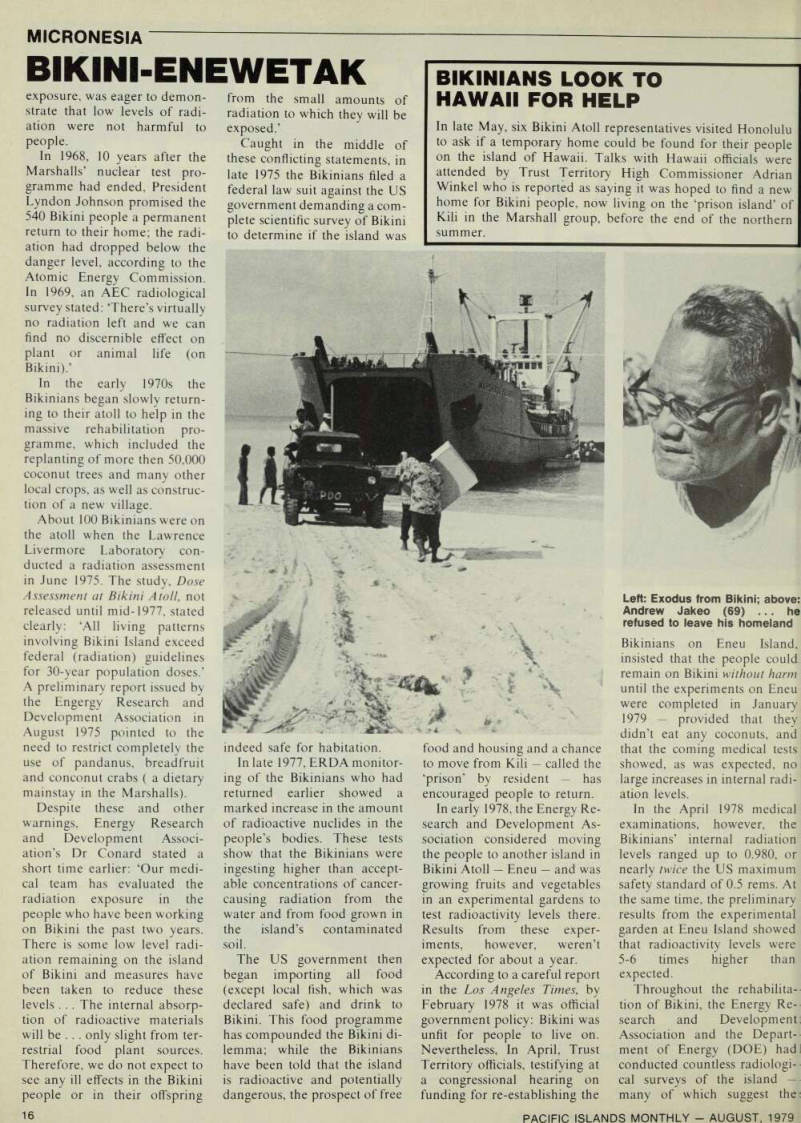
Left: Exodus from Bikini; above: Andrew Jakeo (69) ... he refused to leave his homeland
Bikinians were unwitting sub jects for scientific radiation tests. A recent study for the Department of Energy concluded that ‘Bikini Atoll may be the only global source of data on humans where intake via ingestion is thought to contribute the major fraction
of plutonium body burden’.
A 1976 Lawrence Livermore Laboratory scientist stated that Bikini ‘is possibly the best available source of data for evaluating the transfer of plu tonium across the gut wall after
being incorporated into bio
logical systems.’
Government scientists ve
hemently deny they have used
the Marshallese for experimen tation. A DOE official
explained: ‘lt was done by technical types anxious to know about the transfer of radioactive elements.’
Interior Department officials announced in May 1978 that the atoll would be evacuated within 90 days, and the people returned to Kill Island. In late August, Interior represen tatives went to Bikini to super vise the evacuation, in many ways reminiscent of the 1946 removal. ‘There are some things we didn’t feel good about,’ said Taro Lokebal, who serves as liaison between the Bikini Council and the United States. ‘The high commissioner made the people rush ... Some things were left behind pigs, chickens, lumber. We had to
have our ceremony on the ship.
It was supposed to be on the shore but we had no time.’
Though the Bikinians, like the Enewetakese, suffered the
devastating physical and
psychological effects of relo cation and, at times, even near starvation, they had never suf fered radiation exposure until they returned to their radioac tive island after 25 years. Now the Bikinians are an exposed population, too. And who knows what the future holds for the Enewetak people many of whom have now re turned to their home atoll to work with thousands of US army soldiers in the massive nuclear debris cleanup.
Until the scientific com
munity and independent or
ganisations begin critically to
monitor US government agen cies’ treatment of the Marshallese, their situation is not apt to change.
From the nuclear bomb tests at Bikini and Enewetak to the medical treatment of the irradiated islanders, the 30 years of American trusteeship has brought the Marshallese anything but the conditions promised in the UN trust agreement.
Reprinted by permission of the Bull etin of the Atomic Scientists, a magazine of science and public affairs. Copyright 1979 by the Edu cational Foundation for Nuclear Science, Chicago, Illinois.
Advertisements & other items, pp. 11-15 (2 items)
11
ACIFIC ISLANDS MONTHLY AUGUST, 1979
Shell helps unearth new wealth
/ / k § fn -f J v / s I i / V -5S ‘ / 9 H J
Shell has played a vital role in the Pacific for over 50 years now.
And part of that role has been in assisting, aiding and developing the local min-
ing industry. Helping to create jobs,
money and new opportunities. Shell has also aided development in aviation, fish-
ing, tourism, sugar cane, ships’ bunkering
and other vital areas.
It’s development that has benefited the Pacific region and its people as a whole.
Shell Papua New Guinea Pty. Limited, P.O. Box 169, Port Moresby, Papua New Guinea.
Shell. Company (Pacific Islands) Limited, Box 168, Suva, Fiji.
Societe des Petroles Shell des lies du Pacifique Boite postale L 2, Noumea, New Caledonia.
II
SHI77
CHLORIDE
= i Hr *
FOR ALL
APPLICATIONS
- •wfm
*• ' • • •*% . w * ■■■{• M.«U 4 . v |R* -IP ».• •• • •• Chloride is the largest and only manufacturer of both lead acid and nickel cadmium alkaline batteries in Australia.
The Company is equipped and qualified to offer advice, guidance and service on any battery requirement no matter how large or small.
On the question of size, it could be as small as a battery for a hearing aid the dimensions r of a coat button or a power station battery weighing as much as 40 tonnes.
Again it could be a no break D.C. Power System for a computer or emergency lighting for a hospital.
The Chloride Company operates in 40 countries throughout the world, and when you consider that in Australia alone its production is approaching 1% million batteries per year, it gives some idea of the far reaching role that batteries play in our lives. © •v: A selection of Chloride Automotive and Industrial Batteries.
Chloride Batteries Australia Limited
P.O. Box 141, Bankstown. N.S.W. 2200. Australia. Telephone: 77 0177. Telex: 21262
Hawaii For Help
Bikinians Look To
In late May, six Bikini Atoll representatives visited Honolulu to ask if a temporary home could be found for their people on the island of Hawaii. Talks with Hawaii officials were attended by Trust Territory High Commissioner Adrian Winkel who is reported as saying it was hoped to find a new home for Bikini people, now living on the ‘prison island’ of Kill in the Marshall group, before the end of the northern summer.
Advertisements & other items, p. 16 (1 item)
Bikini-Enewetak
MICRONESIA
Plea for independent
check on radiation
Gifford Johnson, in an updater, filed from Majuro, reports on a document which, it seems, the US Government would have preferred to have kept under wraps.
The US Government at first suppressed a Government Accounting Office (GAO) re port of May 8 which said it was not ‘in the best interests of the US Government to inform
people living on Enewetak
Atoll in the Marshall Islands that they may be exposed to ex cessive doses of radiation.’
Enewetak, site of 43 atomic and hydrogen bomb tests from 1948 to 1958, is now undergo ing a $ 100-million nuclear clean-up by the Department of Energy (DOE) to make the islands safe for rehabitation by the Enewetak people who have lived in exile since 1947.
But, the GAO says, there is no guarantee that the islands will be safe for habitation at the completion of the radiation clean-up late this year. The GAO report indicates the
jncertainty surrounding the
unprecedented project among
the government agencies in volved. In spite of this uncer ainty, ‘the government has consistently told us that the islands are safe,’ said Ismael John, a member of the Marshalls’ legislature from Enewetak.
The GAO attempted to pre vent public release of the ‘sen
sitive’ report because negotiations are in progress between the US and the Marshall Islands Political Sta tus Commission to end the United Nations trusteeship agreement which governs the islands. ‘The issue of post-trusteeship liability and claims are a part of the status negotiations,’ said the report, adding that for this reason ‘release of this report. .. would not be in the best interest of the government’.
The government eventually released the GAO report under pressure in late May, following an anonymous phone call to representatives of the Marshalls Status Commission informing them of the study.
When the clean-up started in early 1977, the DOE said ‘it could not assure that the radi ation doses would not sig nificantly exceed the proposed Environmental Protection Agency guidelines’ for popu lation safety. From the outset, the Defense Nuclear Agency (DNA) in charge of the clean-up operations said it was impossible to reduce the contamination to pre-test levels, but Ridded that the southern islands are ‘relatively free’ of contamination and are
safe for habitation. Enewetak’s northern islands are still dangerously radioactive but,
following the clean-up, only
one island, Runit - where
plutonium-contaminated earth
* from other islands is to be dumped in an atomic bomb crater and capped with cement will be off limits. In addition, living and food gathering re strictions will be placed on many islands.
But even if the Enewetak people ‘adhere to living pattern restrictions’, states the GAO re port, ‘they could receive radi ation doses in excess of current standards’,
Tony Debrum, spokesman
for the Marshalls Status Com mission, said even the living re strictions placed on the islands were unrealistic. ‘lslands on either side and within five kilo metres of Runit which must be quarantined for at least 24 000 years are designated for “picnics and food gather ing’’,’ Mr Debrum said.
The GAO questioned the
safety of entombing the
plutonium-saturated debris in cement in a bomb crater.
The high levels of radioac tivity on the northern islands and the problems that devel oped at Bikini Atoll during a
similar clean-up, have delayed,
since 1974, the planting of coconut trees at Enewetak.
In 1969 the Atomic Energy Commission declared that there was ‘virtually no radi ation left’ on Bikini. Then in
1978, after 130 people re turned, medical tests showed the Bikinians’ body levels of radiation were, in some cases, more than twice the maximum considered a safe level in the US. So they were re-evacuated.
The GAO is concerned that the same problems could occur at Enewetak and strongly cri ticised the DNA and the Interior Department for their
opposition to any independent
scientific assessment of radi ation levels at Enewetak. ‘This situation could raise questions on the objectivity of the pro
ject,’ the report suggested.
The GAO report found that the ‘radiological assessments
are being made by employees
of DOE and the Department of Defense or contractors working for these agencies’. The GAO’s concern centred on recent exposure of an Atomic Energy Commission/DOE cover-up of the dangers of radiation from nuclear tests in the 1950 s and the unsatisfactory AEG hand ling of the Bikini nuclear clean-up, informed sources said.
The report concluded that independent scientists should perform an assessment of the
‘post-clean-up hazards’ before
resettlement of the Enewetak
people begins. The report
failed to mention that 55 Enewetak people are now liv ing on one of the islands and that many others have lived there since part of the popu lation was allowed to return in early 1977.
Advertisements & other items, p. 17 (1 item)
17
MICRONESIA
'ACIFIC ISLANDS MONTHLY - AUGUST, 1979
Sports
The participants
Nations and territories taking part in the games (team numbers in parenth eses) are: American Samoa (104) Cook Islands (139) Fiji (389) French Polynesia (241) Guam (185) Kiribati (29) Nauru (44) New Caledonia (278) New Hebrides (130) Niue (42) Norfolk Island (12) Papua New Guinea (287) Solomon Islands (142) Tokelau (3) Tonga (175) US Trust Territory (93) Tuvalu (36) Wallis and Futuna (84) Western Samoa (291) Total, 2672 including 715 officials.
A thletics Basketball Boxing
Cricket Golf Hockey Judo Lawn bowls
Lawn tennis Netball Rugby Soccer Squash
Swimming Table tennis Volleyball Weightlifting Yachting
All Systems
‘Go’ For
The Games
The suggestion by an organiser of the sixth South Pacific Games in Suva that he didn’t think any other country in the region could handle them, probably wouldn’t go over too well with some of the Pacific’s more affluent countries say Papua New Guinea or New Caledonia. But it did clearly in dicate that, unless some limi tations are placed on future
games, they are only going to
be possible to stage in places like Suva, Port Moresby and Noumea. No other centre, without massive outside financial assistance, could con template the prospect.
The statistics for the Suva games, beginning on August 28
and running through to Sep
tember 8, are daunting enough: 19 competing nations, 18 sports, and a theoretical 2672 competitors a figure which is likely to shrink a little as com peting nations find cost factors forcing them to pare their teams.
The bill? Probably at lot more than Fiji thought it was
going to be when it agreed to host this year’s games. When the organising committee first got together it set a fund raising target of $F 100 000.
Now there’s talk in Suva of a bill exceeding $3OO 000. Even more frightening is the knowl edge that the SP Games lottery tickets at $2 each, are not sell ing well, and that there are now doubts about the amount of revenue from spectator ticket sales. And there’s little chance of pruning costs Fiji and the games organising committee are committed to a sporting spectacular, the like of which has never been seen in the Pa cific and which, in terms of
competitors, will be bigger
than last year’s Common wealth Games at Edmonton, Canada.
Not only bigger but prob
ably faster, much faster on the athletics track. At the heart of Suva’s Buckhurst Park national sports complex funded to the tune of $3.5 million by the Fiji Government, a surprisingly generous splurge by a cabinet
which normally keeps a tight
hand on the national purse strings is an all-weather Canadian ‘tartan’ track. Some of New Zealand’s top runners, including world record miler
John Walker, have already tried it out. Said long-distance star Rod Dixon: ‘That track would be one of the best in the world.’ This was music to local ears. Dixon continued: ‘That’s something I’ve never said about our two top venues in Christchurch and at Mount Smart .. . The new track .. . would be one of the fastest I’ve ever run on and certainly faster than anything in New Zealand and Australia.’
With that accolade. South Pacific records should be run ragged. Athletes will surprise even themselves, their own previous best times having, in many instances, been achieved under pretty rough circum stances.
Fifteen teams will be com peting on the athletics scene, 13 at tennis and soccer, 12 in volleyball, 11 in boxing and
golf, 10 in yachting, rugby and
basketball, nine in table tennis,
eight in weightlifting and judo,
seven in netball and cricket, six in squash and swimming, five in lawn bowls and four in hockey. Fiji and Papua New Guinea will contest all 18 sports and Western Samoa all but basketball.
Marshall Islands made a late bid to put in a team but entries had closed and the games com mittee saw no way of accom modating them. However one team in the games line-up, which Australia probably won ders about, is Norfolk Island.
Some see political overtones in
its participation including
some Norfolk Islanders. But basically it’s a question of phil osophy. No matter how legally Norfolk Island may be tied to Australia, as the recent Norfolk Island Act passed through the Australian Parliament in Can berra emphasises, Norfolk Islanders see themselves as part of the South Pacific com munity. Why shouldn’t they be there? Another change is Tuvalu and Kiribati entering as separate teams. In the past they have always competed as the ‘Gilbert and Ellice Islands’.
French-governed New
Caledonia is challenging the ‘Britishness’ of cricket and both New Caledonia and French Polynesia will be doing battle on the rugby field for the first time.
Fiji, as host country, is field ing the largest squad but it will be closely followed by Pacific champions New Caledonia who will be fighting to main tain their overall medals su periority, Western Samoa, who have high hopes this year, and Papua New Guinea who, by sheer size, always rank high in the final medal count.
Apart from the Hobie cata maran sailing and two soccer matches at the sugar town of Lautoka on Viti Levu’s west coast, all events, in every sport, will take place at Buckhurst Park or within four kilometres of it.
If only sporting facilities had to be provided there’d be no
problem. The big headaches
come from accommodation
and victualling logistics. ‘Vil
lages’ are lined up for competi tors and officials on the University of the South Pacific campus, at Corpus Christi College, about three kilo metres away, and a third at the Derrick Technical Institute.
How much food is needed to cope with more than 2500 com petitors and officials? The organising committee has de cided that 12 tonnes of meat and fish, 15 000 kg of potatoes, cassava and taro, 11 700 kg of other vegetables, 2600 kg of butter, 2800 dozen eggs, 25 400 litres of soup, 31 000 litres of tea and coffee and 3800 kg of sugar, should be enough.
One of the big hitches is that the games have coincided with a peak in the Fiji tourist trade making it extremely difficult to find accommodation in Suva for the hundreds of supporters who would have liked to be there to egg on their teams.
However, anyone who does come from overseas to watch the games has been guaranteed the opportunity to buy a ticket to watch events. A season ticket, to watch everything in the stadium, has been set at $5O. There’s also a $35 ticket for slightly less than the best seats. Otherwise, it’s $1.50 a day to get into Buckhurst Park and that means queueing.
Princess Alexandra will be opening the games, flying from London specifically for the event, and the end-of-games party will be held in the old
Sunderland flying boat hangar
at the lower end of the USP campus near the bay.
When it’s all over, the organising committee will start cleaning up and counting the cost. The financial picture has already been painted. The in quest could well provide the message that future games will not allow participating coun tries to bring alongas many com petitors as they can afford.
They might be told by future
hosts that there will be a limit on the number they can send.
This projection might be
somewhat gloomy. But don’t let it cast a shadow over this month’s sixth South Pacific Games. Last month, with or ganisation activities in full swing, committee members
were confidently saying that
preparations were ‘one month ahead of schedule’. Said Com mander Stan Brown, chairman of the committee: ‘lt’s all sys tems go.’
Records
Tumble
In Suva
Some indication of improved performances anticipated at the Suva Games came in the June ‘quadrangular’ athletics meeting at Buckhurst Park when athletes from Fiji, New Hebrides, New Caledonia and Solomon Islands competed.
Three national and two all comer Fiji records were
smashed. Alena Waqasiwa set a national record of 59 seconds in the women’s 400 metres event; Rusila Radinibeqa broke two national records with 11 minutes 10.7 seconds in the 3000 metres and five min utes 11 seconds in the 1500 metres; Alain Lazare of New Caledonia broke the 5000 metres all-comers record with a time of 14 minutes 55 seconds (an improvement of 4.8 sec onds); and Frederick Gassier, also of New Caledonia, set an all-comers record with a ham mer throw of 47.3 metres.
Meanwhile in Goroka, Papua New Guinea, Port Moresby’s Titi Christian emerged as a top games hope
with a convincing performance
against Moses Aloysius of
North Solomons in the national boxing cham
pionships. This light welter
weight took only one round to
flatten Aloysius.
Papua New Guinea has Mark Mandibi and Tony Aiam as medals hopefuls in the men’s 100 and 200 metre events.
From Papeete comes the news that French Polynesia’s
big hopes are Jeanclaude
Duhaze in shotput, discus and
hammer, Dany Guyonnet in
high and long jump, shotput
and pentathlon, and Sandra Bordes in discus. French
Polynesia also expects good
team performances in table tennis and football.
Noumea reports suggest that the territory’s young athletes are determined not to be overshadowed by their former
champions. They plan to be
well among the medals in ath
letics, volleyball, judo, tennis,
table tennis and football.
There’s no forecast on how New Caledonia’s cricketers (males) will go. It’s a game in New Caledonia which, hith erto, has been confined to the girls.
Games hopes, from left: Solomon Islands’ Matthew Hovaisuta, long distance, and Jim Marau, sprint; Fiji’s Usaia Sotutu, 800 to 3000 metres, and Samu Yavala, sprint; New Caledonia’s Brigitte Hardel, sprint and long jump, and Alain Lazare, long distance; Guam’s Peter Cruz, boxing; and PNG’s Nettie Elisha
Advertisements & other items, pp. 18-20 (3 items)
The Region
The Region
19
'ACIFIC ISLANDS MONTHLY - AUGUST, 1979
Cio Pioneer
The excellence of our
new Non-Switching amps can be describee
with just one line.
Once again, Pioneer leads the audio industry with a major technological breakthrough. A glance at our distortion free oscillograph readout and you can see for yourself.
Confronted with the old nuisance of transistor switching distortion and power robbing heat, we responded with something typically Pioneer.
A new idea.
Now, these problems are effectively solved with the new patented Pioneer Vari-Bias (PVB) Circuit* In this way, on/off switching distortion ‘Pioneer Vari-Bias is a registered trademark of Pioneer Electronic Corporation. is eliminated along with wasteful thermal loss for the true improvement of dynamic characteristics plus expansion of frequency range.
In fact, total harmonic distortion is reduced to a barely measurable 0.005%.
And to make it even better, Pioneer's Non- Switching Amplifiers are available in a wide range of power ratings to satisfy a wide range of musical tastes and audio requirements.
To be brief, the best performance for your audio dollars. After that, what else can we say.
Switching Distortion Conventional Class-B Amp Non-Switching Amp it n SA-9800 ■ '■
CiO PIONEER
For further information, please contact; Australia; Pioneer Marketing Service Pty. Ltd., P.O. Box 317, Mordialloc, Victoria, 3195 Nauru Island: Jacob Enterprises, RO. Box No. 4, Republic of Nauru Tel. 90-9011 Tahjtj; Ets PERFECT, B.P. 594, Papeete, Tahiti Tel: 20 407 Fiji Islands: Bnjlal & Company, G.P.O. Box No. 362, Suva, Fiji Islands Tel: 22258 New Caledonia: Menard Freres Ville, B.P. H 2 Cedex, Noumea, New ( Fountain Marketing Ltd., Maidstone Street, Auckland, New Zealand American Samoa: Transnac Corooration. P.O. Box 1477. Paoo Paoo.
Tel: 763-064 Norfolk Island: Burns Philp (Norfolk Island) Ltd., Norfolk Island, South Pacific New Hebrides: Burns Philo (New Hebrides! Itd Vila N Tahiti: Ets. PERFECT, B.P. 594, Papeete, Tahiti Tel: 20 407 New Caledonia; Menard Freres Ville, B.P. H 2 Cedex, Noumea, New Caledonia Tel: 27.52.22 American Samoa; Transpac Corporation, P.O. Box 1477, Pago Pago, American Samoa 96799 Tel: 633-5224 Rarotonga; South Seas International Ltd., P.O. Box 49, Rarotonga, Cook Islands Tel: 2327
People
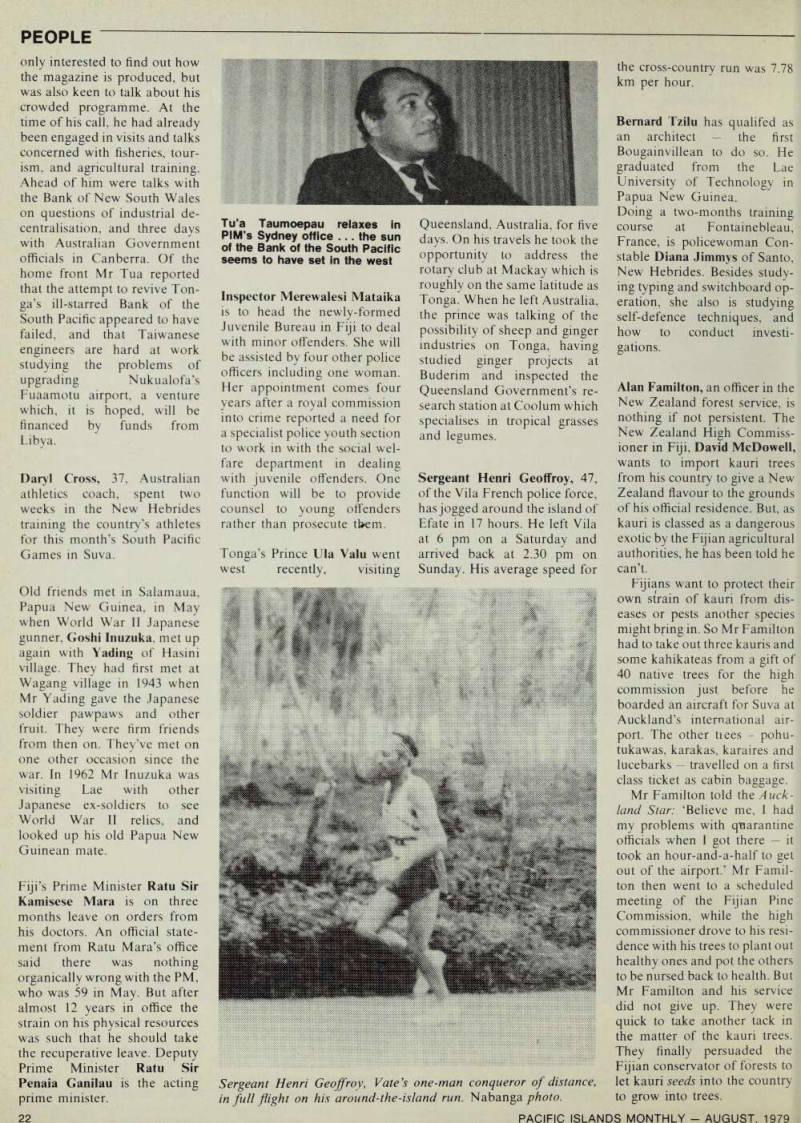
‘The Martin Luther of the Pa cific or a fly-by-night cult fig ure?’ asks the Auckland Star about former Methodist minis ter, Senitulu Koloi, 53. Mr Koloi has led a breakaway independent fellowship in pro test at the burden of annual offerings of money and Sunday feasting imposed by the Ton gan Methodist Church in Auckland.
The Star comments: ‘Like the sixteenth-century Prot estant reformer, Mr Koloi has denounced from the pulpit what he considers abuses of the Christian teachings. ‘At issue is the church prac tice of setting annual amounts of money as targets for the con gregation to achieve. ‘Last year, Auckland’s 2000 Tongans gave about $2OO 000 in offerings. The money was used largely to pay expenses. In Tonga, where work is hard to get, the effect is even worse. ‘ “People are given $5O to pay but end up paying $lOOO in the competitive spirit to outdo each other,” says a Koloi sup porter. Equally “evil” is the
regular Tongan Sunday feast
ing “when families can hardly afford meat during the week”.
Some ministers, says Mr Koloi, are preaching “the more you to the church the more slessings you get”. Mr Koloi las about 200 followers in ~nd and his message is ;hat work comes after sal tation.’
Cook Islands bantamweight aoxer Richard Pittman was the )nly gold medallist from a Pa cific Island country at the
Oceania Boxing Champion
hips held at Dubbo, New South Wales, Australia, in May.
Jis three wins over opponents rom New Zealand and the Australian states of Victoria ind Queensland clinched his )lace in the Oceania team vhich will compete at the
vorld championships in New
fork in October.
Relating his experiences at Oubbo to the Cook Islands
News, Richard said ‘lt was cold’. When he arrived for the
weigh-in nobody could believe
he was a bantamweight he looked too big. Then he started taking off his tracksuit, three sweatshirts and three T-shirts.
Everybody laughed as the
Cook Islands representative
visilby shrank.
Toughest bout for Richard was the third and final one
against Queensland champion
Gordon Willis. He said; ‘I just managed to “psych” him out to win on points. But I don’t mind telling you I’d had it I was gone by the end.’
He added: ‘After the fight I
felt happy. Many people
cheered for me New Zealanders, other Islanders but they weren’t my own people ... I wish some of my own people could have been there to see it.’
As for the future, Richard’s only definite venture will be the World Cup in October. The Queensland and Tahitian
champions want to challenge
him, though nothing has been decided yet. There’s this month’s South Pacific Games, and possibly even the 1980 Olympics in Moscow. ‘But we’ll have to wait and see,’ says Richard.
Whatever happens, the Cook Islands News says, ‘our cham pion boxer has already won the pride and admiration of his people, and it’s certain that Richard, and other local boxers, will be able to count on their help and support’.
Margaret Thatcher’s elec tion as Britain’s first woman prime minister appealed as an
omen to Fetaui Mata’afa, well known member of Western Samoa’s parliament. The New Zealand Herald reports her ju bilant reaction to the news in an interview at Auckland’s Samoa House. ‘I am so happy for Maragaret Thatcher and for Britain,’ she said, beaming. ‘Perhaps the day is not so far away when a woman will head the Samoan Government. I might even win the post my self.’
Elected to parliament in February, Mrs Mata’afa known to her constituents as La’ulu Fetauimalemau is the only woman among 46 men.
When her husband, Fiame Mata’afa, a former Samoan prime minister, died in office in 1975, she won the by election in his rural constitu ency, but lost the seat in the general election a year later.
Now back in the house, she stands firmly behind the idea of an opposition party in Samoa.
As only the second Samoan woman to win a seat in parlia ment, she is keen to encourage others of her sex. ‘lt was not so long ago that Samoan women
were content to leave politics to men,’ she said. ‘Now they are becoming more aware of their
political responsibility. In the
last election I was impressed with the large number who, though not candidates, were
lobbying and campaigning for
husbands or relatives.’ She says
Samoan women have yet to reach their full strength, but sees no obstacles in their path.
It would certainly encourage their advance if she were ever to achieve the prime minis terial mantle on which she’s set
her sights.
Father George Kester, the Dutch-born priest who has befriended thousands of visit ing yachties over his 32 years in the Cook Islands, is having a holiday in Holland, but expects to be back in the Cooks
by Christmas.
Wes Guy DFC, has been
appointed general manager of
Norfolk Island Airways. A for mer flying instructor in the Royal Australian Air Force, Mr Guy has also served as chief examiner for Australia’s Department of Civil Aviation, conducted his own flying train ing school in Papua New Guinea, and worked with
Douglas Airways in PNG.
A new face in the Marshall Islands is that of New Zealand law graduate Tony Johns, 29, who has just taken up duty as secretary to the cabinet of the Marshall Islands Govern ment.
Bonnie Anne Quintal, of Nor folk Island, received an MBE ‘for service to health and the community’, in the 1979 Queen’s Birthday Honours.
Godwin Ligo, 33, chief news re porter for Radio New Hebrides, has returned home after a three-weeks familiaris ation visit to Australia.
Philip Rating, the New Hebrides’ first professional boxer, had another victory when he outboxed New Zealand Viti Patterson in a 10-round professional middle weight bout in Auckland’s town hall.
In Australia at the invitation of the government in June was Tu’a Taumoepeau, deputy sec retary to government in Tonga.
On a courtesy visit to PI M’s Sydney office, Mr Tua was not
Senitulu Koloi ... ‘Martin Luther of the Pacific’, or ‘fly-by-night cult operator’? Time alone will tell
Mrs Fetaui Mata’afa - La’ula Fetauimealemau to friends ... in her sights, a prime minister’s mantle
only interested to find out how the magazine is produced, but was also keen to talk about his crowded programme. At the time of his call, he had already been engaged in visits and talks concerned with fisheries, tour
ism, and agricultural training.
Ahead of him were talks with the Bank of New South Wales on questions of industrial de centralisation, and three days with Australian Government officials in Canberra. Of the home front Mr Tua reported that the attempt to revive Ton ga’s ill-starred Bank of the South Pacific appeared to have failed, and that Taiwanese engineers are hard at work
studying the problems of
upgrading Nukualofa’s
Fuaamotu airport, a venture which, it is hoped, will be financed by funds from
Libya.
Daryl Cross, 37, Australian athletics coach, spent two weeks in the New Hebrides training the country’s athletes for this month’s South Pacific Games in Suva.
Old friends met in Salamaua, Papua New Guinea, in May when World War II Japanese gunner, Goshi Inuzuka. met up again with Yading of Hasini village. They had first met at Wagang village in 1943 when Mr Yading gave the Japanese soldier pawpaws and other fruit. They were firm friends from then on. They’ve met on one other occasion since the war. In 1962 Mr Inuzuka was visiting Lae with other Japanese ex-soldiers to see World War II relics, and looked up his old Papua New Guinean mate.
Fiji’s Prime Minister Ratu Sir Kamisese Mara is on three months leave on orders from his doctors. An official state ment from Ratu Mara’s office said there was nothing organically wrong with the PM, who was 59 in May. But after almost 12 years in office the strain on his physical resources was such that he should take the recuperative leave. Deputy Prime Minister Ratu Sir Penaia Ganilau is the acting prime minister.
Inspector Merewalesi Mataika is to head the newly-formed Juvenile Bureau in Fiji to deal with minor offenders. She will be assisted by four other police officers including one woman.
Her appointment comes four years after a royal commission into crime reported a need for
a specialist police youth section
to work in with the social wel
fare department in dealing
with juvenile offenders. One function will be to provide counsel to young offenders rather than prosecute them.
Tonga’s Prince Ula Valu went
west recently, visiting
Queensland, Australia, for five days. On his travels he took the opportunity to address the rotary club at Mackay which is roughly on the same latitude as Tonga. When he left Australia, the prince was talking of the possibility of sheep and ginger industries on Tonga, having studied ginger projects at Buderim and inspected the Queensland Government’s re search station at Coolum which specialises in tropical grasses
and legumes.
Sergeant Henri Geoffrey, 47, of the Vila French police force, has jogged around the island of Efate in 17 hours. He left Vila at 6 pm on a Saturday and arrived back at 2.30 pm on Sunday. His average speed for
the cross-country run was 7.78 km per hour.
Bernard Tzilu has qualifed as an architect the first Bougainvillean to do so. He graduated from the Lae
University of Technology in
Papua New Guinea.
Doing a two-months training
course at Fontainebleau, France, is policewoman Con stable Diana Jimmys of Santo, New Hebrides. Besides study ing typing and switchboard op eration, she also is studying self-defence techniques, and how to conduct investi
gations.
Alan Familton, an officer in the New Zealand forest service, is nothing if not persistent. The New Zealand High Commiss ioner in Fiji, David McDowell, wants to import kauri trees from his country to give a New Zealand flavour to the grounds of his official residence. But, as kauri is classed as a dangerous
exotic by the Fijian agricultural
authorities, he has been told he can’t.
Fijians want to protect their own strain of kauri from dis eases or pests another species might bfing in. So Mr Familton had to take out three kauris and some kahikateas from a gift of 40 native trees for the high commission just before he boarded an aircraft for Suva at Auckland’s international air port. The other tiees - pohu tukawas, karakas, karaires and lucebarks travelled on a first class ticket as cabin baggage.
Mr Familton told the Auck land Star: ‘Believe me, I had
my problems with quarantine
officials when I got there it took an hour-and-a-half to get out of the airport.’ Mr Famil ton then went to a scheduled meeting of the Fijian Pine Commission, while the high commissioner drove to his resi dence with his trees to plant out healthy ones and pot the others to be nursed back to health. But Mr Familton and his service did not give up. They were quick to take another tack in the matter of the kauri trees.
They finally persuaded the
Fijian conservator of forests to let kauri seeds into the country to grow into trees.
Tu’a Taumoepau relaxes in PIM’s Sydney office ... the sun of the Bank of the South Pacific seems to have set in the west
Sergeant Henri Geoffrey, Vate’s one-man conqueror of distance, in full flight on his around-the-island run. Nabanga photo.
Advertisements & other items, pp. 21-24 (2 items)
21
ACIFIC ISLANDS MONTHLY AUGUST, 1979
Make You Next "Voyage** More
"BON.. WITH YAMAHA’S GREAT
NEW 85.
m i E >* 1.
V 3 V * V*S/ Yamaha 85.
Three cylinders for triple excitement mm Tremendous range, smooth even at full throttle and powerful enough to slice through biggest waves. That’s the new Yamaha 85, one of the most mannerly big outboards ever built.
It’s 3-cylinder powerhead is inherently smooth. The virtually perfect firing geometry of the 3-cylinder configuration results in less vibration, more power and less wear. And combined with the Schnule scavenging system it reduces fuel consumption to a level almost unbelievable in an 85hp engine.
The 85 is also great at low rpm. A reed valve intake and CD Ignition prevent stalls while maintaining steady power at the slowest speed. So docking and navigating through narrow channels is easy and worry-free.
Other features crusing enthusiasts will appreciate include Dual Thrust exhaust, intake silencers and dependable generator.
Try one soon. And bon voyage.
From 2 to 85. Power for any purpose.
Outboard
with
YAMAHA
The Vi eta Professional 460
built to handlethe tough
jobs with ease
PROFESSIONAL 460 FEATURES
Victa Hi-Torque 6 two-stroke 160 cc engine.
Larger fuel tank 2.3 litres as against 1 litre Heavy duty wheels.
Easy pull zip starter Safety blade disc 46 cm (18") cut Concealed throttle cable LM carburettor Folding handle 8 position height adjuster Noise reducing muffler Side chute with safety cover Lightweight (weighs only 54 lb) Rugged 14-gauge steel baseplate Specifications and models subject to alteration without notice or obligation
lOTA
TURNS GRASS INTO LAWN
Cook painting
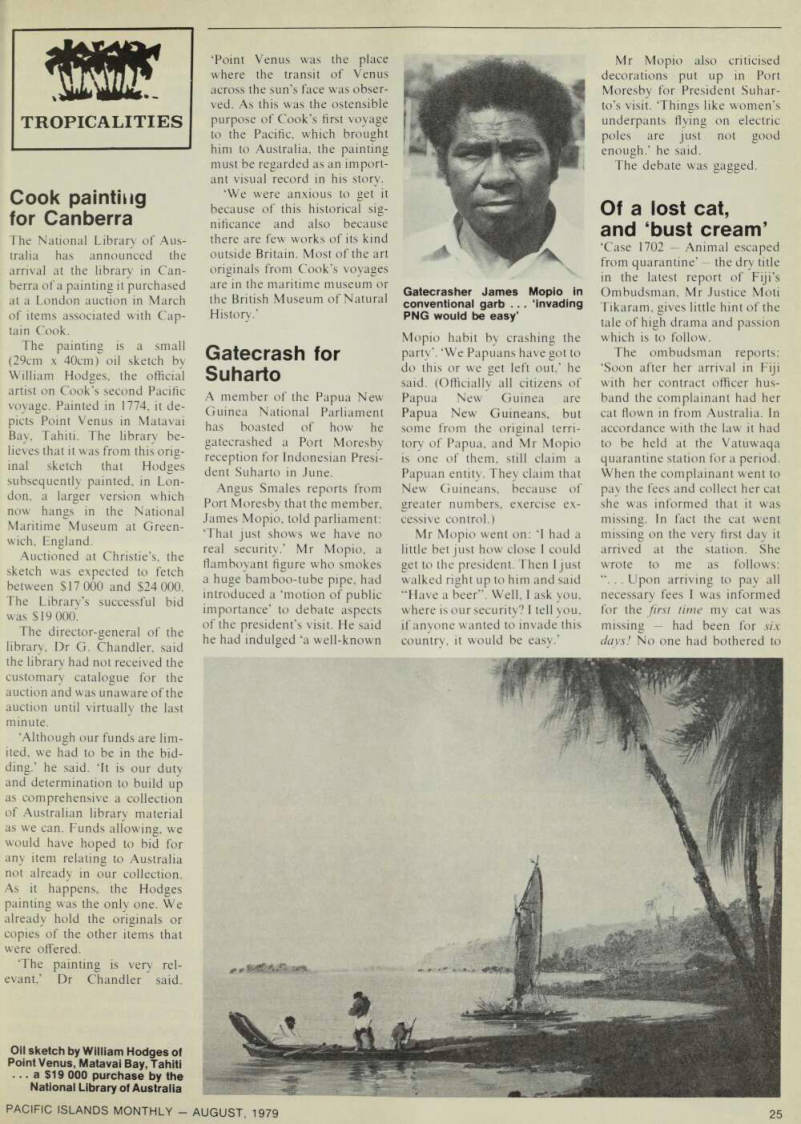
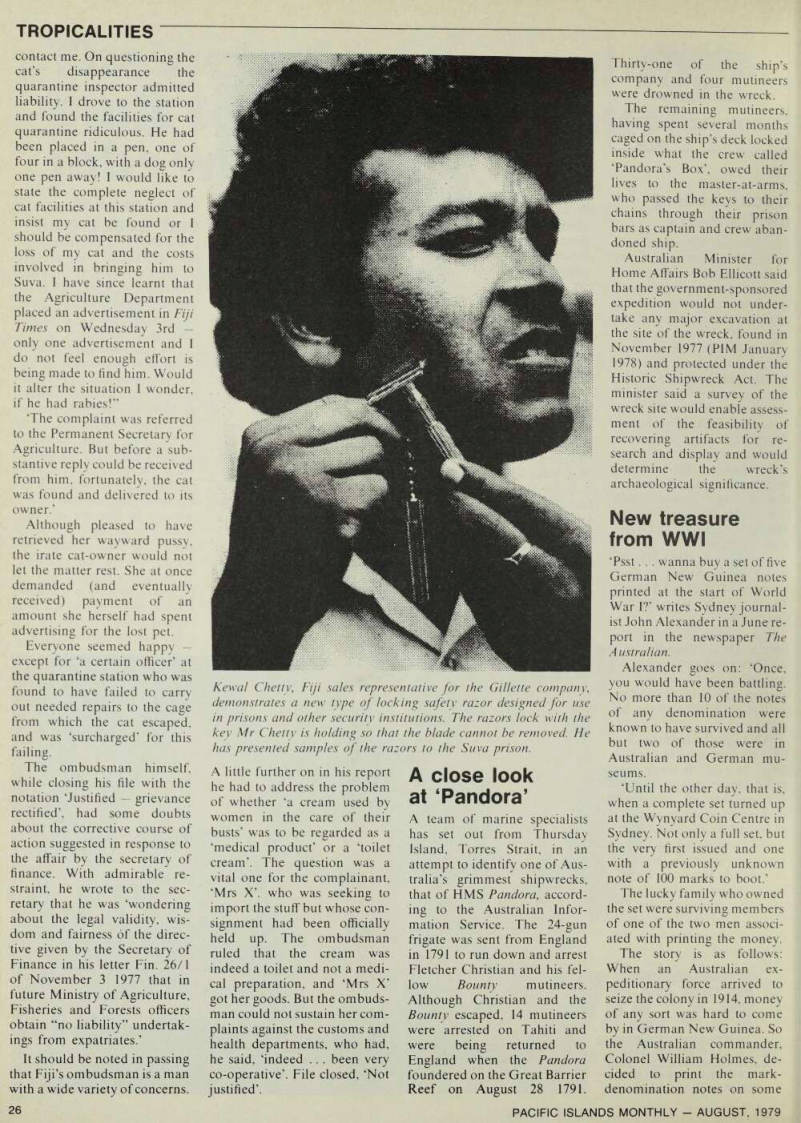

Tropicalities
for Canberra
The National Library of Aus tralia has announced the arrival at the library in Can berra of a painting it purchased at a London auction in March of items associated with Cap tain Cook.
The painting is a small (29cm x 40cm) oil sketch by William Hodges, the official artist on Cook’s second Pacific voyage. Painted in 1774, it de picts Point Venus in Matavai Bay, Tahiti. The library be lieves that it was from this orig inal sketch that Hodges
subsequently painted, in Lon
don, a larger version which now hangs in the National Maritime Museum at Green
wich, England.
Auctioned at Christie’s, the sketch was expected to fetch between $l7 000 and $24 000.
The Library’s successful bid was $l9 000.
The director-general of the library. Dr G. Chandler, said the library had not received the customary catalogue for the auction and was unaware of the auction until virtually the last minute. ‘Although our funds are lim ited, we had to be in the bid ding.’ he said. ‘lt is our duty and determination to build up as comprehensive a collection of Australian library material as we can. Funds allowing, we would have hoped to bid for any item relating to Australia not already in our collection.
As it happens, the Hodges painting was the only one. We already hold the originals or copies of the other items that were offered. ‘The painting is very rel evant,’ Dr Chandler said.
‘Point Venus was the place where the transit of Venus across the sun’s face was obser ved. As this was the ostensible purpose of Cook’s first voyage to the Pacific, which brought him to Australia, the painting must be regarded as an import ant visual record in his story. ‘We were anxious to get it because of this historical sig nificance and also because there are few works of its kind outside Britain. Most of the art originals from Cook’s voyages are in the maritime museum or the British Museum of Natural History.’
Gatecrash for
Suharto
A member of the Papua New Guinea National Parliament has boasted of how he gatecrashed a Port Moresby reception for Indonesian Presi dent Suharto in June.
Angus Smales reports from Port Moresby that the member,
James Mopio, told parliament;
‘That just shows we have no real security.’ Mr Mopio, a
flamboyant figure who smokes
a huge bamboo-tube pipe, had introduced a ‘motion of public importance’ to debate aspects of the president’s visit. He said he had indulged ‘a well-known
Mopio habit by crashing the
party’. ‘We Papuans have got to do this or we get left out,’ he said. (Officially all citizens of Papua New Guinea are Papua New Guineans, but some from the original terri tory of Papua, and Mr Mopio is one of them, still claim a
Papuan entity. They claim that
New Guineans, because of greater numbers, exercise ex cessive control.) Mr Mopio went on: ‘I had a little bet just how close I could get to the president. Then I just walked right up to him and said “Have a beer”. Well, I ask you, where is our security? I tell you, if anyone wanted to invade this country, it would be easy.’
Mr Mopio also criticised decorations put up in Port Moresby for President Suhar to’s visit. ‘Things like women’s
underpants flying on electric
poles are just not good
enough.’ he said.
The debate was gagged.
Of a lost cat,
and ‘bust cream’
‘Case 1702 Animal escaped from quarantine’ the dry title in the latest report of Fiji’s Ombudsman. Mr Justice Moti Tikaram, gives little hint of the tale of high drama and passion which is to follow.
The ombudsman reports: ‘Soon after her arrival in Fiji with her contract officer hus band the complainant had her cat flown in from Australia. In accordance with the law it had to be held at the Vatuwaqa quarantine station for a period.
When the complainant went to pay the fees and collect her cat she was informed that it was missing. In fact the cat went missing on the very first day it arrived at the station. She wrote to me as follows:
“... Upon arriving to pay all
necessary fees I was informed for the first time my cat was missing had been for six days! No one had bothered to
Oil sketch by William Hodges of Point Venus, Matavai Bay, Tahiti ... a $19 000 purchase by the National Library of Australia
Gatecrasher James Mopio in conventional garb ... ‘invading PNG would be easy’
contact me. On questioning the cat’s disappearance the quarantine inspector admitted liability. I drove to the station and found the facilities for cat quarantine ridiculous. He had been placed in a pen, one of four in a block, with a dog only one pen away! I would like to state the complete neglect of cat facilities at this station and insist my cat be found or I should be compensated for the loss of my cat and the costs involved in bringing him to Suva. I have since learnt that
the Agriculture Department
placed an advertisement in Fiji Times on Wednesday 3rd only one advertisement and I do not feel enough effort is being made to find him. Would it alter the situation I wonder, if he had rabies!”
The complaint was referred to the Permanent Secretary for Agriculture. But before a sub stantive reply could be received from him, fortunately, the cat was found and delivered to its owner.’
Although pleased to have retrieved her wayward pussy, the irate cat-owner would not let the matter rest. She at once demanded (and eventually received) payment of an amount she herself had spent advertising for the lost pet.
Everyone seemed happy -
except for ‘a certain officer’ at the quarantine station who was found to have failed to carry out needed repairs to the cage from which the cat escaped, and was ‘surcharged’ for this
failing.
The ombudsman himself, while closing his file with the notation ‘Justified grievance rectified’, had some doubts about the corrective course of action suggested in response to the affair by the secretary of finance. With admirable re straint, he wrote to the sec retary that he was ‘wondering about the legal validity, wis dom and fairness of the direc
tive given by the Secretary of
Finance in his letter Fin. 26/1 of November 3 1977 that in
future Ministry of Agriculture,
Fisheries and Forests officers obtain “no liability” undertak
ings from expatriates.’
It should be noted in passing that Fiji’s ombudsman is a man with a wide variety of concerns.
A little further on in his report he had to address the problem of whether ‘a cream used by women in the care of their busts’ was to be regarded as a ‘medical product’ or a ‘toilet cream’. The question was a vital one for the complainant, ‘Mrs X’. who was seeking to import the stuff but whose con
signment had been officially
held up. The ombudsman ruled that the cream was indeed a toilet and not a medi cal preparation, and ‘Mrs X’ got her goods. But the ombuds man could not sustain her com plaints against the customs and health departments, who had, he said, ‘indeed .. . been very co-operative’. File closed, ‘Not
justified’.
A close look
at ‘Pandora’
A team of marine specialists has set out from Thursday Island, Torres Strait, in an attempt to identify one of Aus
tralia’s grimmest shipwrecks,
that of HMS Pandora, accord ing to the Australian Infor mation Service. The 24-gun frigate was sent from England in 1791 to run down and arrest Fletcher Christian and his fel low Bounty mutineers.
Although Christian and the Bounty escaped, 14 mutineers were arrested on Tahiti and were being returned to England when the Pandora foundered on the Great Barrier Reef on August 28 1791.
Thirty-one of the ship’s
company and four mutineers were drowned in the wreck.
The remaining mutineers, having spent several months caged on the ship’s deck locked inside what the crew called ’Pandora’s Box’, owed their lives to the master-at-arms, who passed the keys to their
chains through their prison
bars as captain and crew aban
doned ship.
Australian Minister for Home Affairs Bob Ellicott said that the government-sponsored expedition would not under take any major excavation at the site of the wreck, found in November 1977 (PIM January 1978) and protected under the Historic Shipwreck Act. The minister said a survey of the wreck site would enable assess ment of the feasibility of recovering artifacts for re search and display and would determine the wreck’s
archaeological significance.
New treasure
from WWI
‘Psst... wanna buy a set of five German New Guinea notes printed at the start of World War I?’ writes Sydney journal ist John Alexander in a June re port in the newspaper The A ustralian.
Alexander goes on: ‘Once, you would have been battling.
No more than 10 of the notes of any denomination were known to have survived and all but two of those were in Australian and German mu seums. ‘Until the other day, that is, when a complete set turned up at the Wynyard Coin Centre in Sydney. Not only a full set, but the very first issued and one with a previously unknown note of 100 marks to boot.’
The lucky family who owned the set were surviving members of one of the two men associ ated with printing the money.
The story is as follows: When an Australian ex peditionary force arrived to seize the colony in 1914, money of any sort was hard to come by in German New Guinea. So the Australian commander.
Colonel William Holmes, de cided to print the mark denomination notes on some
Kewal Chetty, Fiji sales representative for the Gillette company, demonstrates a new type of locking safety razor designed for use in prisons and other security institutions. The razors lock with the key Mr Chetty is holding so that the blade cannot be removed. He has presented samples of the razors to the Suva prison.
roughly-hewn printing blocks.
They are a unique part of our numismatic history.’ says Bob Roberts, of the Wynyard Coin Centre. ‘They represent the only time “foreign money” was legal tender in Australian territory.’
Bids were coming thick and fast for the newly discovered treasure. One New York doctor offered SASO 000 for the set.
But Mr Roberts was anxious to see them stay in Australia. ‘ln comparison with many other Australian coin rarities, this German New Guinea set is worth at least $lOO 000.’
Any buyer who donated the set to an Australian museum or public collection could claim their market value as a tax deduction against assessable income.
Haapai causeway
rises again
The islands of Lifuka and Foa in Tonga’s Haapai group are to be linked by a causeway built under a New Zealand aid scheme, writes Jimmy Cornell from the spot. One third of the 600 m gap separating the two islands has already been filled in. The work is being carried out by a team of 43 army
engineers commanded by
Lieut. John Kamp of the Ist
Field Squadron. Papakura
(Auckland).
Another causeway was attempted on the same spot more than 20 years ago but was not strong enough to withstand the rough weather conditions and only lasted a few weeks.
The present causeway is built solidly on a bedding of coral boulders of up to 10 tonnes weight laid over the shallow reef linking the two islands.
The causeway will be one lane wide with a concrete cap ping and will rise about one metre above the highest tide level. It will enable the islands to communicate more easily and also give access to the people of Foa to the Pangai market, on Lifuka, and the new 28-bed hospital, also built
under a New Zealand aid scheme. The hospital is sched
uled to be opened by King
Taufa’ahau Tupou IV in Sep tember. No completion date has been set for the causeway, but Lieut. Kamp is confident that it will be a lasting job.
Now it’s Emma
on the stage
The islands around New Bri tain and New Ireland have their fair share of legendary characters, but perhaps none stands out more than the ener
getic Emma Forsayth
‘Queen Emma’ who established and ruled a copra and trading empire in the Duke of York Islands from 1878,
writes Stephen Measday.
Emma Forsayth was born in 1850 of a Samoan mother, Le Utu, princess of the royal fam ily of Samoa, and James Coe, an American agent and later American consul in Apia.
Her life has long attracted the interest and curiosity of his torians and authors. It has already been the subject of at least two full-length books.
The first, by R. W. Robson, founder of PIM, was published in 1965, under the title Queen Emma: in 1976 this was fol lowed by Queen Emma of the South Seas, by Australian author Geoffrey Dutton.
Now Troupe, an indepen
dent theatre ensemble based in Adelaide, has recreated Emma’s life on stage in a pro duction entitled Missis (sic) Queen.
Written by Adelaide play
wright Doreen Clarke, Missis Queen had its Australian premiere at the end of July, and was to run for a three-week season.
The production, with a cast of seven, was directed by David Allen, a playwright who had recent Australia-wide success with his play about Stan
Laurel. Gone with Hardy.
With Missis Queen , Troupe has demonstrated a hard
working, innovative approach
that has led to comparisons with the style of production in
the early days of Sydney’s very
successful Nimrod Theatre.
Church of Tonga
is fifty years old
The jubilee of the Church of Tonga, one of the branches of Methodism, was celebrated at Pangai, the capital of the Haapai group, where it was founded half a century ago by the Hon Ulukalala, its first
president, writes Jimmy Cor
nell. A special ceremony was held at dawn on May 3, a
plaque being unveiled by the
fourth president of the Church of Tonga, Selu Pepelimafi. The plaque was erected ‘to com memorate the golden jubilee of the Church of Tonga which was founded in Haapai in May 1928 and was formally con secrated on May 3 1929’. The church has about 8000 fol lowers in the kingdom, of whom about 3000 reside in the
Haapai group.
Lieut Kamp with the Haapai causeway ... confident it will be a lasting job. Photo Jimmy Cornell.
Plaque for the 50th anniversary of the Church of Tonga. Selu Pepelimafi, president of the church (left), with the Reverend Fono, Pagai’s minister. Photo Jimmy Cornell.
Advertisements & other items, pp. 27-30 (1 item)
Component-like
audio performance.
© Professional-like mic mixing with independent volume control for sing along or special effects recording/playback.
Powerful 2-way 4-speaker system with true portable convenience like snap-lock quick on/off capability for dynamic stereo sound indoors or out.
SLEEP TIMER
SET SET TIME
HOUR MINUTE START TIME SET
OFF/SNOOZE J OFF
24-ftr preset programming i m Built-in phono equalizer An LCD quartz clock allows auto on or off preset timing up to 24 hours in advance, to record while you're away.
For easy connect to a stereo turntable which turns the TRK-9150W into a mini sound control center.
in a portable.
TRK-9150W
The trk-91 sow. 25 big watts of pure dynamic stereo output, and a detachable 2-way 4-speaker system. Plus, 3-band <fm stereo-MW-sw) tuner, air damp cassette eject, auto or manual record level control and other audio extras. Full features and convenient handling that adds up to solid stereo enjoyment.
HITACHI
EXPORTERSand
BUYERS for the
PACIFIC ISLAND
4 Beehive Building 94 Elizabeth Street Melbourne, Victoria Australia 3000 G.P.O. Box 8 Melbourne, Victoria Australia 3 its
IMS
YOUR GUARANTEE
FOR SERVICE
SINCE 1924
CONSTRUCTIVE
ADVICE.
MJLr^
j sl; V 4
Komatsu makes 76-ton Bulldozers.
Small 2-ton Bulldozers. * - ’
Jg* Radio-Controlled Bulldozers and Dozer Shovels. w Swamp Bulldozers as well as Swamp Dozer Shovels.
Dozer Shovels.
JH Electric Powered A wide range of Pipelayers.
Dozer Shovels.
Amphibious Bulldozers. ■ i= a .. jn 1 u - ■ Wheel Loaders.
A wide selection of Off-Highway Slag Dump Trucks.
Dump Trucks.
And offer Motor Graders. 2,.
As well as Motor Scrapers.
K --9.
Soil Compactors.
Trash Compactors.
Towing Tractors. 5?
Vibratory Rollers. Diesel Generator Sets. m rr : Portable Air Compressors.
A wide selection of Diesel Engines. :S ~T Machine Tools X 3- J 3.
A * a- Mechanical and Hydraulic Presses. A variety of Maypres Presses. OBS Power Presses. Tunnel-Boring Machines.
We're constructive in other ways. We offer castings, foundries, and important advice on construction and manufacturing projects.
•HKOMATSU LTD
Tokyo, Japan Komatsu overseas offices: Sydney, Singapore, Jakarta, Manila, Seoul, Bangkok, Bangalore, Teheran, Dubai, Jeddah, Riyadh, Ad Dammam, Baghdad, Ankara, Moscow, London, Brussels, Dusseldorf, Stuttgart, Warszawa, Paris, Madrid, Cairo, Alger, Abidjan, Lagos, Nairobi, Johannesburg, Toronto, San Francisco, Fort Lee Arlington, Atlanta, Detroit, Mexico City, Habana, Panama, Sao Paulo, Caracas, Lima, Buenos Aires, and distributors in over 100 countries around the world.
Currents
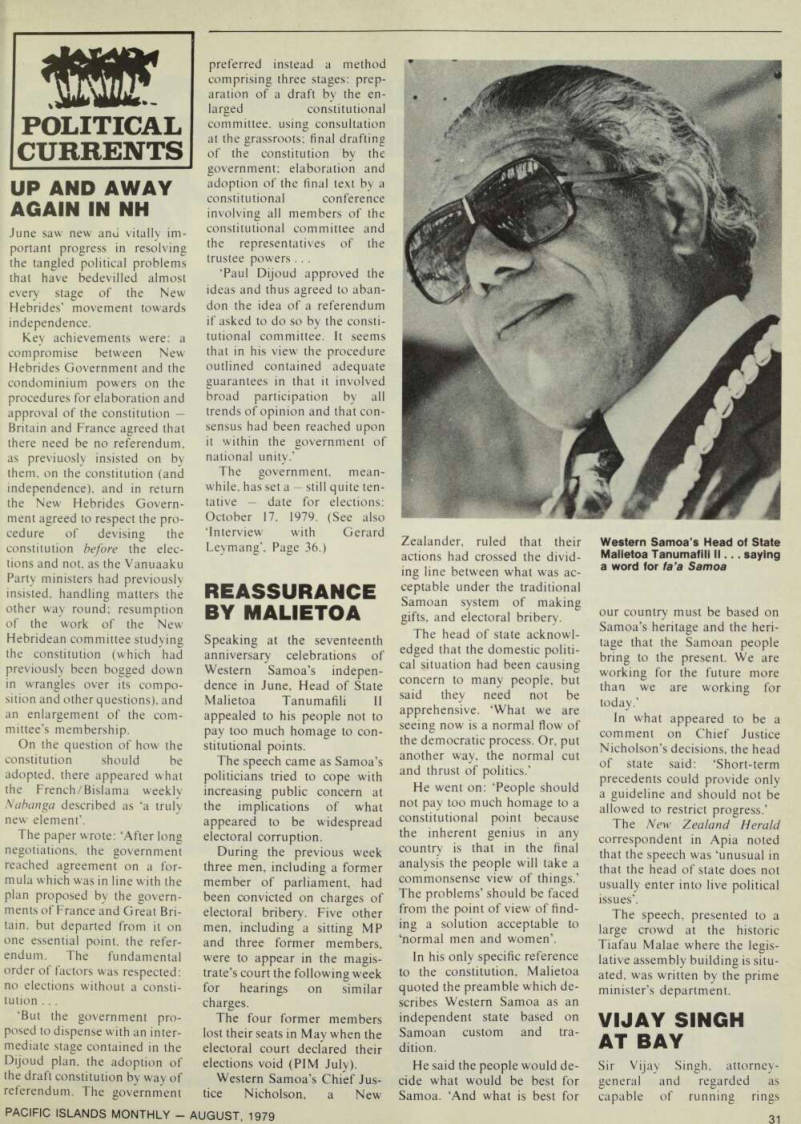

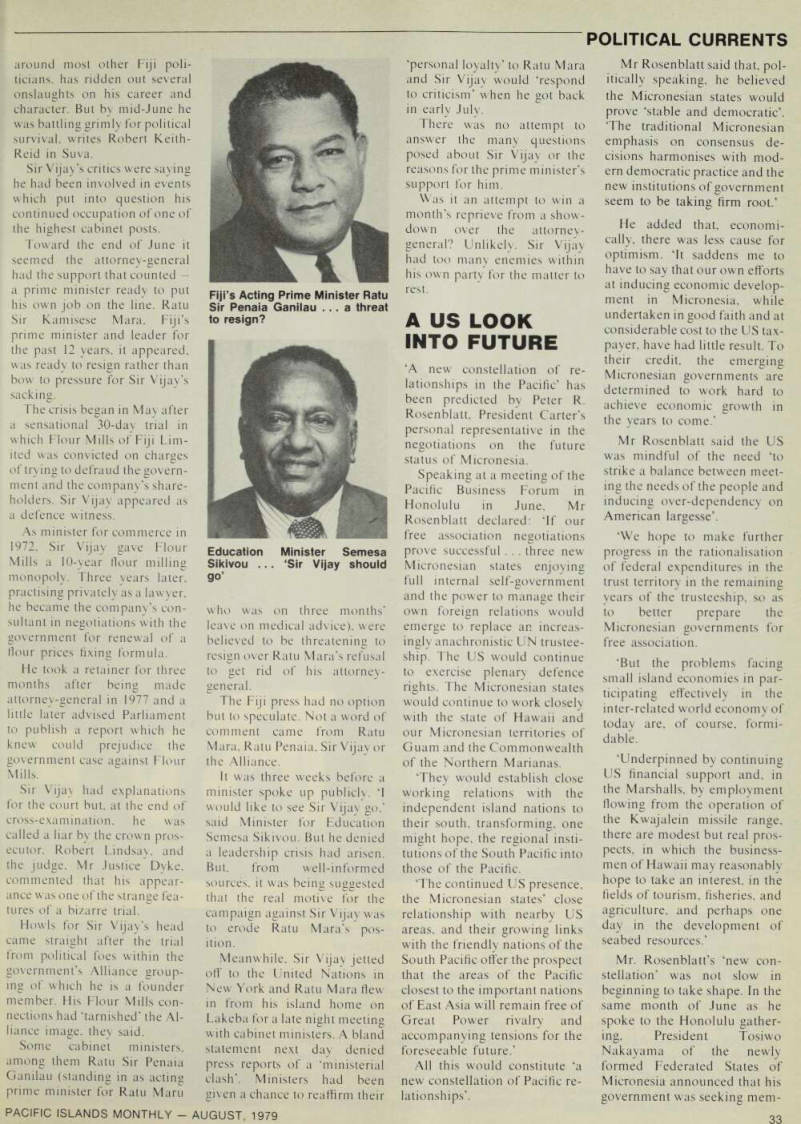
Political
Up And Away
Again In Nh
June saw new and vitally im portant progress in resolving the tangled political problems that have bedevilled almost every stage of the New Hebrides’ movement towards
independence.
Key achievements were: a compromise between New Hebrides Government and the condominium powers on the procedures for elaboration and approval of the constitution Britain and France agreed that there need be no referendum, as previuosly insisted on by them, on the constitution (and independence), and in return the New Hebrides Govern ment agreed to respect the pro cedure of devising the constitution before the elec tions and not, as the Vanuaaku Party ministers had previously insisted, handling matters the other way round; resumption of the work of the New Hebridean committee studying the constitution (which had previously been bogged down in wrangles over its compo sition and other questions), and an enlargement of the com mittee’s membership.
On the question of how the constitution should be adopted, there appeared what the French/Bislama weekly Nahanga described as ‘a truly new element’.
The paper wrote: ‘After long negotiations, the government reached agreement on a for mula which was in line with the plan proposed by the govern ments of France and Great Bri tain. but departed from it on one essential point, the refer endum. The fundamental order of factors was respected: no elections without a consti tution ... ‘But the government pro posed to dispense with an inter mediate stage contained in the Dijoud plan, the adoption of the draft constitution by way of referendum. The government
preferred instead a method comprising three stages: prep aration of a draft by the en
larged constitutional
committee, using consultation at the grassroots; final drafting of the constitution by the government; elaboration and adoption of the final text by a constitutional conference involving all members of the constitutional committee and the representatives of the trustee powers.. . ‘Paul Dijoud approved the ideas and thus agreed to aban don the idea of a referendum if asked to do so by the consti tutional committee. It seems that in his view the procedure outlined contained adequate guarantees in that it involved
broad participation by all
trends of opinion and that con sensus had been reached upon it within the government of
national unity.’
The government, mean while, has set a still quite ten tative date for elections: October 17. 1979. (See also ‘lnterview with Gerard Leymang’, Page 36.)
Reassurance
By Malietoa
Speaking at the seventeenth anniversary celebrations of Western Samoa’s indepen dence in June, Head of State Malietoa Tanumafili II appealed to his people not to pay too much homage to con
stitutional points.
The speech came as Samoa’s politicians tried to cope with
increasing public concern at
the implications of what appeared to be widespread
electoral corruption.
During the previous week
three men, including a former member of parliament, had been convicted on charges of electoral bribery. Five other men, including a sitting MP and three former members, were to appear in the magis trate’s court the following week for hearings on similar
charges.
The four former members lost their seats in May when the electoral court declared their elections void (PIM July).
Western Samoa’s Chief Jus tice Nicholson, a New
Zealander, ruled that their actions had crossed the divid ing line between what was ac ceptable under the traditional Samoan system of making
gifts, and electoral bribery.
The head of state acknowl edged that the domestic politi cal situation had been causing concern to many people, but said they need not be apprehensive. ‘What we are seeing now is a normal flow of the democratic process. Or, put another way, the normal cut and thrust of politics.’
He went on: ‘People should not pay too much homage to a constitutional point because the inherent genius in any country is that in the final analysis the people will take a commonsense view of things.’
The problems’ should be faced from the point of view of find ing a solution acceptable to ‘normal men and women’.
In his only specific reference to the constitution, Malietoa quoted the preamble which de scribes Western Samoa as an independent state based on Samoan custom and tra dition.
He said the people would de cide what would be best for Samoa. ‘And what is best for
our country must be based on Samoa’s heritage and the heri tage that the Samoan people bring to the present. We are working for the future more than we are working for
today.’
In what appeared to be a comment on Chief Justice Nicholson’s decisions, the head of state said: ‘Short-term
precedents could provide only
a guideline and should not be allowed to restrict progress.’
The New Zealand Herald correspondent in Apia noted that the speech was ‘unusual in that the head of state does not usually enter into live political issues’.
The speech, presented to a large crowd at the historic Tiafau Malae where the legis lative assembly building is situ ated, was written by the prime minister’s department.
Vijay Singh
At Bay
Sir Vijay Singh, attorney
general and regarded as
capable of running rings
Western Samoa’s Head of State Malietoa Tanumafili II ... saying a word for fa’a Samoa
around most other Fiji poli ticians. has ridden out several onslaughts on his career and character. But by mid-June he was battling grimly for political survival, writes Robert Keith- Reid in Suva.
Sir Vijay’s critics were saying he had been involved in events which put into question his continued occupation of one of the highest cabinet posts.
Toward the end of June it seemed the attorney-general had the support that counted a prime minister ready to put his own job on the line. Ratu Sir Kamisese Mara, Fiji’s prime minister and leader for the past 12 years, it appeared, was ready to resign rather than bow to pressure for Sir Vijay’s
sacking.
The crisis began in May after a sensational 30-day trial in which Flour Mills of Fiji Lim ited was convicted on charges of trying to defraud the govern ment and the company’s share holders. Sir Vijay appeared as a defence witness.
As minister for commerce in 1972. Sir Vijay gave Flour Mills a 10-year flour milling monopoly. Three years later,
practising privately as a lawyer,
he became the company’s con sultant in negotiations with the government for renewal of a
flour prices fixing formula.
He took a retainer for three months after being made attorney-general in 1977 and a little later advised Parliament to publish a report which he knew could prejudice the government case against Flour Mills.
Sir Vijay had explanations
for the court but. at the end of cross-examination, he was called a liar by the crown pros ecutor. Robert Lindsay, and the judge. Mr Justice Dyke, commented that his appear ance was one of the strange fea tures of a bizarre trial.
Howls for Sir Vijay’s head came straight after the trial from political foes within the government’s Alliance group ing of which he is a founder member. His Flour Mills con nections had ‘tarnished’ the Al
liance image, they said.
Some cabinet ministers, among them Ratu Sir Penaia Ganilau (standing in as acting prime minister for Ratu Maru
who was on three months’ leave on medical advice), were believed to be threatening to resign over Ratu Mara’s refusal to get rid of his attorney general.
The Fiji press had no option but to speculate. Not a word of comment came from Ratu Mara. Ratu Penaia. Sir Vijay or the Alliance.
It was three weeks before a minister spoke up publicly. ’I would like to see Sir Vijay go.’ said Minister for Education Semesa Sikivou. But he denied a leadership crisis had arisen.
But. from well-informed sources, it was being suggested that the real motive for the campaign against Sir Vijay was to erode Ratu Mara’s pos ition.
Meanwhile. Sir Vijay jetted
off to the United Nations in New York and Ratu Mara flew in from his island home on Lakeba for a late night meeting with cabinet ministers. A bland statement next day denied press reports of a ‘ministerial clash’. Ministers had been given a chance to reaffirm their
‘personal loyalty’ to Ratu Mara and Sir Vijay would ‘respond to criticism’ when he got back
in early July.
There was no attempt to answer the many questions posed about Sir Vijay or the reasons for the prime minister’s support for him.
Was it an attempt to win a month’s reprieve from a show down over the attorney
general? Unlikely. Sir Vijay
had too many enemies within his own party for the matter to rest.
A Us Look
Into Future
‘A new constellation of re lationships in the Pacific’ has been predicted by Peter R.
Rosenblatt. President Carter’s personal representative in the negotiations on the future status of Micronesia.
Speaking at a meeting of the Pacific Business Forum in Honolulu in June, Mr Rosenblatt declared: ‘lf our free association negotiations prove successful . . . three new Micronesian states enjoying full internal self-government and the power to manage their own foreign relations would emerge to replace an increas ingly anachronistic UN trustee ship. The US would continue to exercise plenary defence rights. The Micronesian states would continue to work closely with the state of Hawaii and our Micronesian territories of Guam and the Commonwealth of the Northern Marianas.
They would establish close working relations with the independent island nations to their south, transforming, one
might hope, the regional insti
tutions of the South Pacific into those of the Pacific. ‘The continued US presence, the Micronesian states’ close
relationship with nearby US
areas, and their growing links with the friendly nations of the South Pacific offer the prospect that the areas of the Pacific closest to the important nations of East Asia will remain free of Great Power rivalry and accompanying tensions for the foreseeable future.’
All this would constitute ‘a new constellation of Pacific re
lationships’.
Mr Rosenblatt said that, pol
itically speaking, he believed
the Micronesian states would prove ‘stable and democratic’. ‘The traditional Micronesian emphasis on consensus de cisions harmonises with mod ern democratic practice and the new institutions of government seem to be taking firm root.’
He added that, economi cally, there was less cause for optimism. ‘lt saddens me to have to say that our own efforts
at inducing economic develop
ment in Micronesia, while undertaken in good faith and at considerable cost to the US tax payer, have had little result. To their credit, the emerging Micronesian governments are determined to work hard to achieve economic growth in the years to come.' Mr Rosenblatt said the US was mindful of the need ‘to strike a balance between meet ing the needs of the people and
inducing over-dependency on
American largesse’.
‘We hope to make further progress in the rationalisation of federal expenditures in the trust territory in the remaining years of the trusteeship, so as to better prepare the Micronesian governments for free association.
‘But the problems facing
small island economies in par
ticipating effectively in the
inter-related world economy of today are, of course, formi dable.
‘Underpinned by continuing
US financial support and, in
the Marshalls, by employment
flowing from the operation of the Kwajalein missile range, there are modest but real pros pects, in which the business men of Hawaii may reasonably hope to take an interest, in the fields of tourism, fisheries, and
agriculture, and perhaps one
day in the development of seabed resources.’
Mr. Rosenblatt’s ‘new con stellation’ was not slow in beginning to take shape. In the same month of June as he spoke to the Honolulu gather ing, President Tosiwo
Nakayama of the newly
formed Federated States of Micronesia announced that his government was seeking mem
Fiji’s Acting Prime Minister Ratu Sir Penaia Ganilau ... a threat to resign?
Education Minister Semesa Sikivou ... ‘Sir Vijay should go’
bership of the South Pacific Forum - At the same time he sought details of the official US attitude to the move, since the US retains control of FSM foreign affairs until after the termination of the trusteeship, target date for which is 1981.
President Nakayama, in an
explanatory telegram to trust
territory High Commissioner
Adrian P. Winkel, said the FSM hopes to ‘extend our Forum ad hoc participation into formalised membership of some sort’.
He said the most important reason for the move ‘is the
hope of participating in Forum economic activities. par ticularly those of the South Pa cific Bureau of Economic Co-operation (SPEC), and the Forum’s fisheries agency’. He said the FSM was also seeking regional recognition as a new government, and experience in the conduct of regional re lations.
His telegram said he antici pated that some Forum mem bers would ask for clarification from relevant US embassies concerning the FSM’s consti tutional status and US policy
concerning its membership.
Guam: Who
Runs Gaol?
Problems at Guam’s long troubled prison (PIM July) boiled over in mid-June when the department of corrections director. James Miles, was fired by Lieutenant-Governor Joe Ada for insubordination and defiance of gubernatorial orders.
Paul Addison writes from Agana that after months of un rest at the overcrowded peni tentiary, Miles received his marching orders on the same day that two persons escaped and a crime prevention cru-
sader was arrested for trying to smuggle marihuana into the prison.
Governor Paul Calvo ... first sacking
According to the office of the governor. Miles was sacked for his unwillingness to support the efforts of a newly established board of inquiry into prison conditions. Miles branded the inquiry ‘a political move’ and said everyone con nected with it was connected in some way to Governor Paul Calvo.
Miles became prison boss in
January after a long search by
Calvo to find a willing can didate to sort out chaotic prison affairs. A hard-liner on disci
pline. parole and prison
escapes. Miles took a no nonsense stance on prisoner
troubles which brought a mixed reaction from Guam’s
population. And the outspoken
ex-Marine said he would not go along with a Calvo execu tive order barring Guam’s media from talking to prison officials about penitentiary conditions for two months, while the board of inquiry meets. Miles’ firing is the first dismissal by Calvo of any of his appointees since he was elected last November.
Prisoners charge they lack an adequate diet, good medical and dental care, and decent laundry facilities. The Inmates Council, a representative body
of prisoners, has requested more visiting rights, and re alistic and effective rehabilita tion programs with more time for recreation.
According to officials, prob lems at the prison have become much worse over the past year since the conviction of numer ous heroin dealers and mur derers. In late May convicted murderer Johnny C. Dela Rosa, Anthony Santos, a re puted heroin dealer currently serving time for tax evasion, and three unnamed ‘John Does’ were indicted as co
conspirators to murder eight
prominent island officials. The
‘hit list’ included Superior Court Judge Paul Abbate, Attorney-General Ken North, Senator James Underwood, former senator Howard Trapp, and Miles.
Since the indictment, prison unrest has intensified. On June 11 prisoners set more than 50 mattresses ablaze causing dam age of about SUS2O 000.
On June 15 armed police wielding batons and rifles were called to the prison late at night to quash the attempted escape of at least five prisoners, including three convicted mur derers, who had broken out of
their maximum confinement cells. No one was injured and the prisoners were contained.
But one prison guard told PIM:
‘These people didn’t want to escape. They just wanted to show they can get out any time they want to; they want to show they rule the prison. One man had an iron pipe he could have used to kill me anytime. But he
didn’t. They just are telling us
they’re in charge.’
Polynesia’S
June 10
June 10 saw one of the strangest elections ever held in French Polynesia and a heavy setback for the majority autonomist parties of Francis Sanford and John Teariki, writes Marie-Therese Daniels son from Papeete.
Local voters were asked to cast their ballots for a confus ing array of 243 mostly un known candidates for the future parliament of the European Common Market.
The list of President Giscard d’Estaing candidates, incon
gruously supported by the local
autonomists, got 16 496 votes, or 40.8% of the total, while the
list headed by Right wing
Gaullist Jaques Chirac, and
supported by local opposition
leader Gaston Flosse, got 18 074 votes, or 44.5%.
The French Socialist Party, represented locally by the five
year-old and steadily growing
pro-independence la Mana te Nunaa party, made a good showing, bettering its share of the vote from 7.1% in the 1978 legislative elections (3398 votes) to 10.4% (4137 votes).
This was achieved despite an official ban on radio and tele vision appearances by party representatives, and was the re sult of their reaching out, through personal appearances, to the voters of Tahiti and Moorea.
Some of their speakers were
impudent enough to point out
that Polynesia is not in Europe, and to suggest that the best common market and inter national parliament would be those made up of the peoples and nations of the South Pa cific.
In every respect the elections
reflected the long-standing and absurd policy of the Paris government which has always considered it a patriotic duty and right for the Polynesians to participate in all French elec tions and referenda, no matter how futile or meaningless they may be to them. They were thus, in 1958, asked to vote for or against de Gaulle’s new French constitution, in 1962 for or against negotiations with the nationalists of Algeria, in 1969 for or against the suppression of the French senate and re establishment of the old French provincial govern ments, and in 1973 for or against the admission of Great Britain, Ireland and Denmark to the Common Market!
All in all it is not surprising that on June 10 the quietest polling day for many years only 56.4% of registered voters bothered to go to the polls, most of them delivered there
by the major political parties in
hired trucks and motor cars.
Dijoud In
Noumea
In New Caledonia, the visits of Paul Dijoud, minister of over seas territories, are becoming so frequent that his arrival in June caused hardly a ripple, writes Andre Chaville from Noumea. But plenty was said after his departure.
It is not an easy job to pacify
and satisfy everybody, but the minister seemed reasonably confident he had done so. He said he was pleased to receive criticism both from the far Left and the far Right, as this gener ally meant the policies con cerned had the approval of the
‘silent majority’.
When New Caledonia went to the polls on June 10 to vote for the French representatives in the Common Market parlia ment, they turned in a result very similar to that in France: a majority for the list support ing President Giscard d’Esta ing, who were closely followed by the Socialists.
The conservative, Gaullist party, supported by the tra
ditional Rightwing parties in
New Caledonia, obtained very poor results, both in France and in the territory.
The most important aspect of Mr Dijoud’s visit was his ap pearance live on television, with viewers invited to tele
phone in their questions.
The minister talked frankly of the need to increase
Melanesian land-holdings,
particularly the tribal reserves.
He also admitted that some changes in Melanesian ‘cus toms’ were unavoidable, and that the rural population would only find peace of mind when freehold farmers ‘of all racial origins’ lived side by side. If he spoke of a redistribution of land between ‘Caledonians’, he also added that a Caledonian was any person of French nationality who freely chose to take up permanent residence in
the territory.
His main argument was the fact that claims for land could be easily satisfied, both by using the state’s reserves, and also by breaking up ‘the enor mous properties belonging to a rich minority’, where the only land improvement had been the installation of barbed wire.
But he warned the Melanesians that ‘land-grabbing’ was not the purpose of the programme, and that if ritual land was to be returned to the clans, pastoral
and agricultural holdings
would only be granted to those who could prove their need and demonstrate their capacity to use the land productively.
An improvement of rural production would necessitate outlets what Mr Dijoud called ‘potential export mar kets’. Placed between Australia and New Zealand, it is hard to imagine New Caledonia com peting successfully on the inter national market, unless its agriculture concentrated on
specialised tropical produce.
The only alternative would be a substantial increase in the
territory’s population, which is
very small. Here, other prob lems arise, as the current natu ral increase could create future racial frictions, the fastest growing section of the popu
lation being the Polynesians.
Immigration, another alterna tive, would increase the num ber of Europeans, Asians or people from the French West Indies.
Undoubtedly, the territory
can go further to satisfy its own needs. But with such a small
population the margin between
potential consumption and sur
plus is small.
Mr Dijoud’s plan, in its in itial stages at least, seems there fore to be motivated more by philosophical than economic factors.
The minister refused to accept suggestions that the July election could be interpreted as a referendum to approve or
disapprove of his plan.
But the fact remains that the moderate coalition, fighting against both Left and Right
wing parties, made acceptance
of the plan its main campaign
point.
The other coalition, group ing those in favour of indepen dence, harboured some confusing elements. Some of its members were practically forced to declare themselves in favour of independence,
although many really consider
independence more as a long term, inevitable and natural outcome, for which the status of overseas territory was cre ated. For many of these people, the Dijoud plan could indeed be interpreted as a ‘democratic revolution’, designed to pre pare New Caledonia’s trans formation into a more
equitable, multi-racial,
independent country but in 10 years’ time.
Polynesia’s Francis Sanford ... ‘incongruous’ support for Gis card?
Advertisements & other items, pp. 32-35 (1 item)
What is it a Coconut Palm
and a Kental Building
have in common?
They’re ‘tailormade’ for Pacific conditions
m
Special needs for Pacific area
Like a coconut tree, any building for this area has to be tough. When you settle for a Kental Packaged Building you are assured that it is specially designed and manufactured to withstand the climatic conditions of the Pacific area. Aluminium, Plywood and PVC plus Kental' s unique manufacturing system guarantee you this.
Speed and ease of erection
Kental Packaged Buildings come containerised, incomplete sections, ready to be erected in a matter of days. Building experience is not necessary because everything down to the last screw, including easy-to-follow instructions, is included in the kits.
Attractive and low maintenance
The high-gloss, interlocking PVC Kentalboard outside panels look good and are extremely tough. They help keep your building cool, are impact and scratch resistant and will not warp or crack. Best of all you don't have to paint them. Needless to say, Aluminium Frames look after themselves and so does the hardwearing, water resistant ply lining.
Homes, shops, halls or whole towns
The Kental Packaged Building system is totally adaptable. I Whether you need a handsome home, a shop, a hal I or maybe a whole town you can't go past Kental Packaged Buildings. If you' re in the real big league we can even supply you with a complete town planning scheme.
Wait until you see our prices
If all this sounds great to you, wait until you see our incredibly low prices. You can have a building as 'tailormade' to Pacific conditions as a coconut tree and not pay the earth for it. Send for full information today.
I 5
Kental
Structures
Pty Limited
Lot C, Groves Avenue, Vineyard,N.S.W. Australia.
this coupon
today
Send this coupon to; Kental Structures Pty Limited, P.O. Box 7, Round Corner, N.S.W. 2154, Australia.
Please send me detailed information on Kental Packaged Buildings. I' m interested in the following (please tick): □ Private Home □ Commercial Building □ Mining Development □ Schools or Hospitals Name Address If you don’t want to cut up this issue of Pacific Islands Monthly, write details on piece of paper.
Probably the most important neglected distortion in today’s quality amplifiers is TIM transient intermodulation distortion. That’s why Sansui engineers went beyond ordinary specs to virtually annihilate TIM with the PAT.PEMD.
Diamond Differential DC circuit (DD/DC) of the new AG-919 powerful integrated amplifier.
Briefly: ordinary amplifiers, even high-wattage units, cannot respond rapidly to sudden pulsive signals.
But Sansui’s AG-919 can, and the proof is in a slew rate of ±2OOV/ jusec. and a rise/fall time of 0.5 /usee.
You might also think of Sansui’s virtual elimination of TIM in this way: the exclusive DD/DC finally realizes the potential benefits of straight DC circuitry truly clear and accurate reproduction of even the most complex nuances of recorded sound.
Power is a clean 110 RMS watts
Only hi-fi,every thing hi-fi.
'O'*-* ~3 12 “11 li.
“10 -9 “8 “7 “6 “5 “4 “3 “2 dB Phono-2 (mm) Phono-l (mc)
Input Selector
\ Phono-1 (mm) tuner aux
ting
balance
1 0 «
Tape Play
left r| ght source tape-i tape-2 tuner
Copy
off . source per channel with distortion under 0.008%! Frequency response is unparalleled from DC (0 Hz) to 500,000 Hz.
No doubt about it. The AG-919 sets new standards: it comes closer to theoretically perfect performance than any other comparable unit.
Sansui’s AO-919: the standard by which others will be judged.
SANSUI ELECTRIC CO., LTD. 14-1 Izumi 2-chome, Suginami-ku, Tokyo 168, Japan • Australia VANFI (Aust.) Pty. Ltd. 162, Albert Road, South Melbourne, Victoria 3205, Australia Phone: 699-5473 / 283 Alfred Street. North Sydney, N.S.W. 2060, Australia Phone: 929-0293 • Fiji Prabhu Brothers Ltd. P.O. Box 183, Nadi Phone: 70183/4 • Papua New Guinea Oceania Indent Agency (P.N.G.) Pty. Ltd. Box 5518, Boroko, Port Moresby Phone: PM 256406 • New Zealand David Reid Electronics Ltd. C.P.O. Box 2630, Auckland, 1 Phone: 492-189 • New Caledonia Ets Michel MERCIER B.P. 1123, Noumea Phone: 27. 59. 11 • South Pacific Miltons Department Stores Limited n° X 146, N ° r * olk ls,and 2899 ® Central Pacific Nauru Co-operative Society Republic of Nauru • New Hebrides The Sound Centre P.O. Box 434, Port Villa • Cook Island United Island Traders Ltd. P.O. Box 1& 2, Rarotonga • Tahiti DIMECO P.O. Box 2622
Gerard Leymang
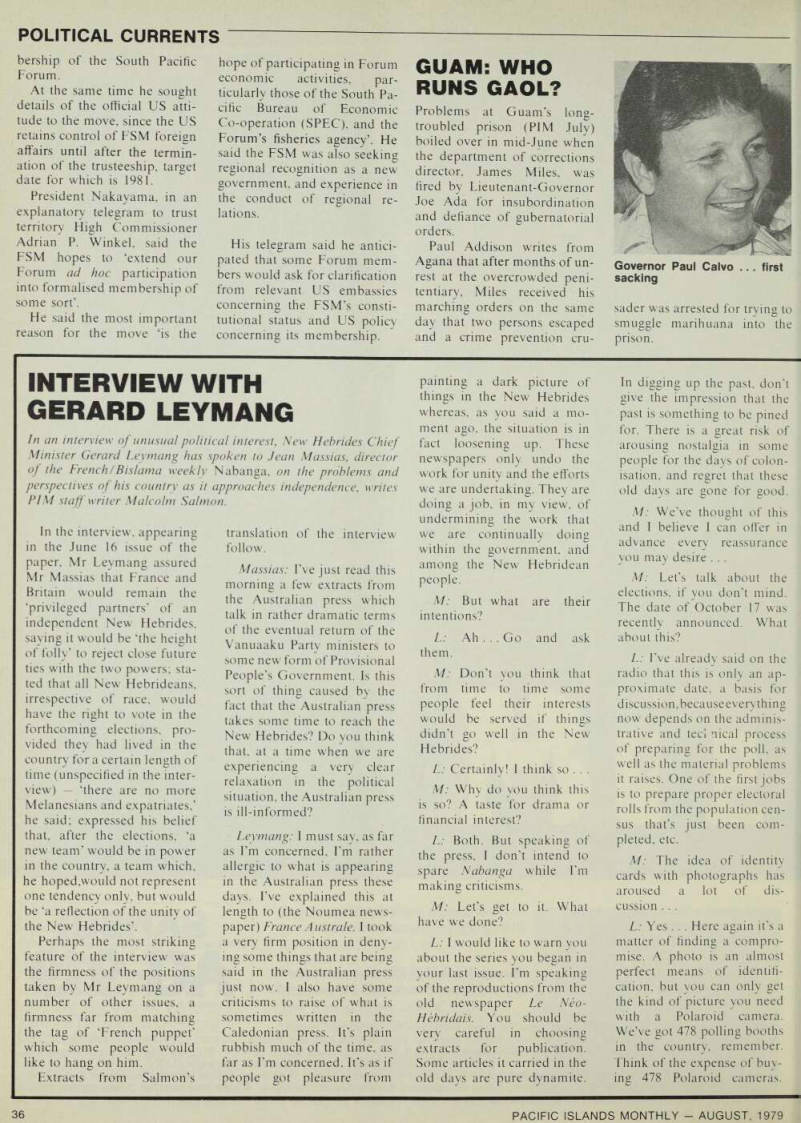
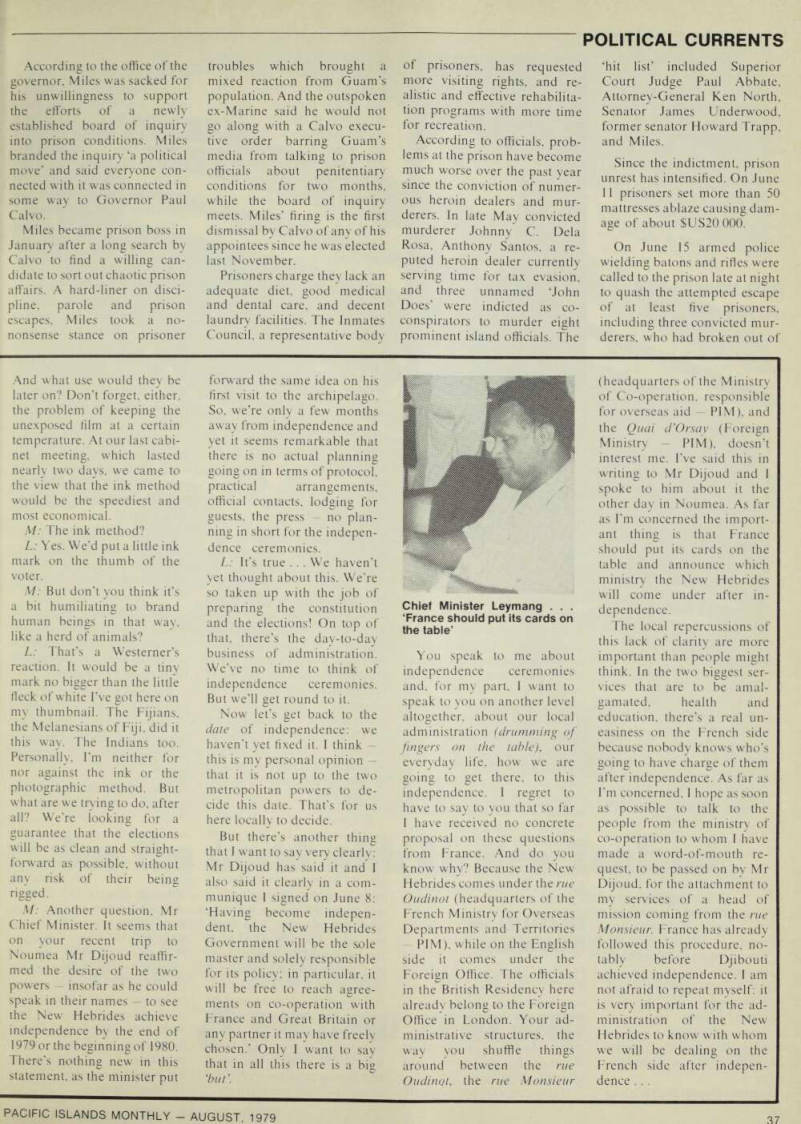
Interview With
In an interview of unusual political interest. New Hebrides Chief Minister Gerard Leymang has spoken to Jean Massias, director of the French!Bislama weekly Nabanga, on the problems and perspectives of his country as it approaches independence, writes PIM staff writer Malcolm Salmon.
In the interview, appearing in the June 16 issue of the paper. Mr Leymang assured Mr Massias that France and Britain would remain the ‘privileged partners’ of an independent New Hebrides, saying it would be ‘the height of folly’ to reject close future ties with the two powers; sta ted that all New Hebrideans, irrespective of race, would have the right to vote in the forthcoming elections, pro vided they had lived in the country for a certain length of time (unspecified in the inter view) ‘there are no more Melanesians and expatriates,’ he said; expressed his belief that, after the elections, ‘a new team’ would be in power in the country, a team which, he hoped.would not represent one tendency only, but would be ‘a reflection of the unity of the New Hebrides’.
Perhaps the most striking
feature of the interview was the firmness of the positions taken by Mr Leymang on a number of other issues, a firmness far from matching the tag of ‘French puppet’ which some people would like to hang on him.
Extracts from Salmon’s
translation of the interview follow.
Massias: I’ve just read this morning a few extracts from the Australian press which talk in rather dramatic terms of the eventual return of the Vanuaaku Party ministers to some new form of Provisional People’s Government. Is this sort of thing caused by the fact that the Australian press takes some time to reach the New Hebrides? Do you think that, at a time when we are experiencing a very clear relaxation in the political situation, the Australian press is ill-informed?
Leymang: I must say, as far as I’m concerned. I’m rather allergic to what is appearing in the Australian press these days. I’ve explained this at length to (the Noumea news paper) France Australe. I took a very firm position in deny
ing some things that are being
said in the Australian press just now. I also have some criticisms to raise of what is sometimes written in the Caledonian press. It’s plain rubbish much of the time, as far as I’m concerned. It’s as if people got pleasure from
painting a dark picture of things in the New Hebrides whereas, as you said a mo ment ago. the situation is in fact loosening up. These newspapers only undo the work for unity and the efforts we are undertaking. They are doing a job, in my view, of undermining the work that
we are continually doing
within the government, and among the New Hebridean
people.
M: But what are their intentions?
L: Ah ... Go and ask them.
M: Don’t you think that from time to time some people feel their interests would be served if things didn’t go well in the New Hebrides?
L: Certainly! I think so . . .
M: Why do ydu think this is so? A taste for drama or financial interest?
L: Both. But speaking of the press, I don’t intend to spare Nabanga while I’m making criticisms.
M: Let’s get to it. What have we done?
L: I would like to warn you about the series you began in your last issue. I’m speaking of the reproductions from the old newspaper Le Neo- Hebhdais. You should be very careful in choosing extracts for publication.
Some articles it carried in the old days are pure dynamite.
In digging up the past, don’t give the impression that the past is something to be pined for. There is a great risk of arousing nostalgia in some people for the days of colon isation, and regret that these old days are gone for good.
M: We’ve thought of this and I believe I can offer in advance every reassurance
you may desire . . .
M: Let’s talk about the elections, if you don’t mind.
The date of October 17 was recently announced. What about this?
L: I’ve already said on the radio that this is only an ap proximate date, a basis for
discussion, becauseeverything
now depends on the adminis trative and tec! nical process of preparing for the poll, as well as the material problems it raises. One of the first jobs is to prepare proper electoral rolls from the population cen sus that’s just been com
pleted, etc.
M: The idea of identity cards with photographs has aroused a lot of dis cussion . . .
L: Yes . . . Here again it’s a matter of finding a compro mise. A photo is an almost perfect means of identifi cation, but you can only get the kind of picture you need with a Polaroid camera.
We’ve got 478 polling booths in the country, remember.
Think of the expense of buy ing 478 Polaroid cameras.
And what use would they be later on? Don’t forget, either, the problem of keeping the unexposed film at a certain temperature. At our last cabi net meeting, which lasted nearly two days, we came to the view that the ink method would be the speediest and most economical.
M: The ink method?
L: Yes. We’d put a little ink mark on the thumb of the voter.
M: But don’t you think it’s a bit humiliating to brand human beings in that way, like a herd of animals?
L: That’s a Westerner’s reaction. It would be a tiny mark no bigger than the little fleck of white I’ve got here on my thumbnail. The Fijians, the Melanesians of Fiji, did it this way. The Indians too.
Personally, I’m neither for nor against the ink or the photographic method. But what are we trying to do. after all? We’re looking for a guarantee that the elections will be as clean and straight forward as possible, without any risk of their being
rigged.
M: Another question, Mr Chief Minister. It seems that on your recent trip to Noumea Mr Dijoud reaffir med the desire of the two powers insofar as he could speak in their names to see the New Hebrides achieve independence by the end of 1979 or the beginning of 1980.
There’s nothing new in this statement, as the minister put
forward the same idea on his first visit to the archipelago.
So, we’re only a few months away from independence and yet it seems remarkable that there is no actual planning going on in terms of protocol,
practical arrangements,
official contacts, lodging for guests, the press no plan ning in short for the indepen dence ceremonies.
L: It’s true . . . We haven’t yet thought about this. We’re so taken up with the job of preparing the constitution and the elections! On top of that, there’s the day-to-day business of administration.
We’ve no time to think of
independence ceremonies.
But we'll get round to it.
Now let’s get back to the date of independence: we haven’t yet fixed it. I think this is my personal opinion that it is not up to the two metropolitan powers to de cide this date. That’s for us here locally to decide.
But there’s another thing that I want to say very clearly: Mr Dijoud has said it and I also said it clearly in a com munique I signed on June 8:
‘Having become indepen
dent, the New Hebrides Government will be the sole
master and solely responsible
for its policy; in particular, it will be free to reach agree ments on co-operation with France and Great Britain or any partner it may have freely chosen.’ Only I want to say that in all this there is a big ‘but’.
You speak to me about
independence ceremonies
and, for my part, I want to speak to you on another level altogether, about our local
administration (drumming of
fingers on the table), our everyday life, how we are going to get there, to this independence. 1 regret to have to say to you that so far 1 have received no concrete proposal on these questions from France. And do you know why? Because the New Hebrides comes under the rue Oudinot (headquarters of the French Ministry for Overseas Departments and Territories PIM), while on the English side it comes under the Foreign Office. The officials in the British Residency here
already belong to the Foreign
Office in London. Your ad ministrative structures, the way you shuffle things around between the rue Oudinot, the rue Monsieur
(headquarters of the Ministry
of Co-operation, responsible
for overseas aid PIM), and the Quai d'Orsav (Foreign Ministry PIM), doesn’t interest me. I’ve said this in writing to Mr Dijoud and 1 spoke to him about it the other day in Noumea. As far as I’m concerned the import ant thing is that France should put its cards on the table and announce which ministry the New Hebrides will come under after in
dependence.
The local repercussions of this lack of clarity are more
important than people might
think. In the two biggest ser vices that are to be amal gamated. health and education, there’s a real un easiness on the French side because nobody knows who’s going to have charge of them after independence. As far as I'm concerned. I hope as soon as possible to talk to the people from the ministry of co-operation to whom I have made a word-of-mouth re quest, to be passed on by Mr Dijoud, for the attachment to my services of a head of mission coming from the rue Monsieur. France has already followed this procedure, no tably before Djibouti achieved independence. I am not afraid to repeat myself: it is very important for the ad ministration of the New Hebrides to know with whom we will be dealing on the French side after indepen dence ...
Chief Minister Leymang ... ‘France should put its cards on the table’
Advertisements & other items, p. 39 (1 item)
See the world with Air New Zealand
E\ See the world with Air New Zealand If your journey is to take you far or near, first see Air New Zealand or your travel agent to discuss the flights and fares that suit you best.
In the Pacific we fly to New Zealand, Australia, Fiji, Honolulu, Tahiti, Samoa, New Caledonia and Rarotonga. If you’re travelling farther, let us fly you to our Gateway cities to the world - Los Angeles, Hong Kong and Singapore, where you can connect with the airline of your choice.
And best of all, you’ll start by enjoying the special attentive service Air New Zealand is famous for.
Begin your trip with Air New Zealand
air new ze
We fly the Pacific.
ANZ 79/12 G
those free
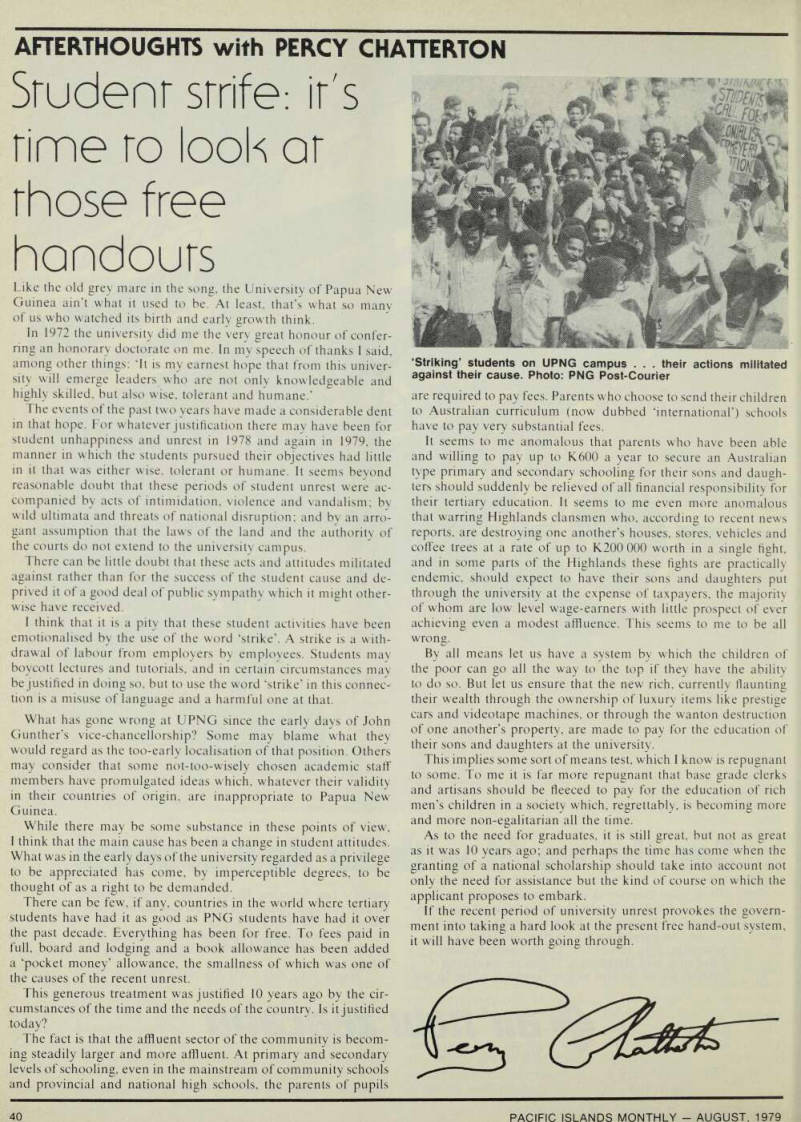
Afterthoughts With Percy Chatterton
Student strife: it's time to look at those free handouts
Like the old grey mare in the song, the University of Papua New Guinea ain’t what it used to be. At least, that’s what so many of us who watched its birth and early growth think.
In 1972 the university did me the very great honour of confer ring an honorary doctorate on me. In my speech of thanks I said, among other things: ‘lt is my earnest hope that from this univer sity will emerge leaders who are not only knowledgeable and highly skilled, but also wise, tolerant and humane.’
The events of the past two years have made a considerable dent in that hope. For whatever justification there may have been for student unhappiness and unrest in 1978 and again in 1979, the manner in which the students pursued their objectives had little in it that was either wise, tolerant or humane. It seems beyond reasonable doubt that these periods of student unrest were ac companied by acts of intimidation, violence and vandalism; by wild ultimata and threats of national disruption; and by an arro gant assumption that the laws of the land and the authority of the courts do not extend to the university campus.
There can be little doubt that these acts and attitudes militated against rather than for the success of the student cause and de prived it of a good deal of public sympathy which it might other wise have received.
I think that it is a pity that these student activities have been emotionalised by the use of the word ‘strike’. A strike is a with drawal of labour from employers by employees. Students may boycott lectures and tutorials, and in certain circumstances may be justified in doing so, but to use the word ‘strike’ in this connec tion is a misuse of language and a harmful one at that.
What has gone wrong at UPNG since the early days of John Gunther’s vice-chancellorship? Some may blame what they would regard as the too-early localisation of that position. Others may consider that some not-too-wisely chosen academic staff members have promulgated ideas which, whatever their validity in their countries of origin, are inappropriate to Papua New Guinea.
While there may be some substance in these points of view, I think that the main cause has been a change in student attitudes.
What was in the early days of the university regarded as a privilege to be appreciated has come, by imperceptible degrees, to be thought of as a right to be demanded.
There can be few, if any, countries in the world where tertiary students have had it as good as PNG students have had it over the past decade. Everything has been for free. To fees paid in full, board and lodging and a book allowance has been added a ‘pocket money’ allowance, the smallness of which was one of the causes of the recent unrest.
This generous treatment was justified 10 years ago by the cir cumstances of the time and the needs of the country. Is it justified
today?
The fact is that the affluent sector of the community is becom ing steadily larger and more affluent. At primary and secondary levels of schooling, even in the mainstream of community schools and provincial and national high schools, the parents of pupils
are required to pay fees. Parents who choose to send their children to Australian curriculum (now dubbed ‘international’) schools have to pay very substantial fees.
It seems to me anomalous that parents who have been able and willing to pay up to K6OO a year to secure an Australian type primary and secondary schooling for their sons and daugh ters should suddenly be relieved of all financial responsibility for their tertiary education. It seems to me even more anomalous that warring Highlands clansmen who, according to recent news reports, are destroying one another’s houses, stores, vehicles and coffee trees at a rate of up to K2OO 000 worth in a single fight, and in some parts of the Highlands these fights are practically endemic, should expect to have their sons and daughters put through the university at the expense of taxpayers, the majority of whom are low level wage-earners with little prospect of ever achieving even a modest affluence. This seems to me to be all wrong.
By all means let us have a system by which the children of the poor can go all the way to the top if they have the ability to do so. But let us ensure that the new rich, currently flaunting their wealth through the ownership of luxury items like prestige cars and videotape machines, or through the wanton destruction of one another’s property, are made to pay for the education of their sons and daughters at the university.
This implies some sort of means test, which I know is repugnant to some. To me it is far more repugnant that base grade clerks and artisans should be fleeced to pay for the education of rich men’s children in a society which, regrettably, is becoming more and more non-egalitarian all the time.
As to the need for graduates, it is still great, but not as great as it was 10 years ago; and perhaps the time has come when the granting of a national scholarship should take into account not only the need for assistance but the kind of course on which the applicant proposes to embark.
If the recent period of university unrest provokes the govern ment into taking a hard look at the present free hand-out system, it will have been worth going through.
‘Striking’ students on UPNG campus ... their actions militated against their cause. Photo: PNG Post-Courier
Papua New Guinea
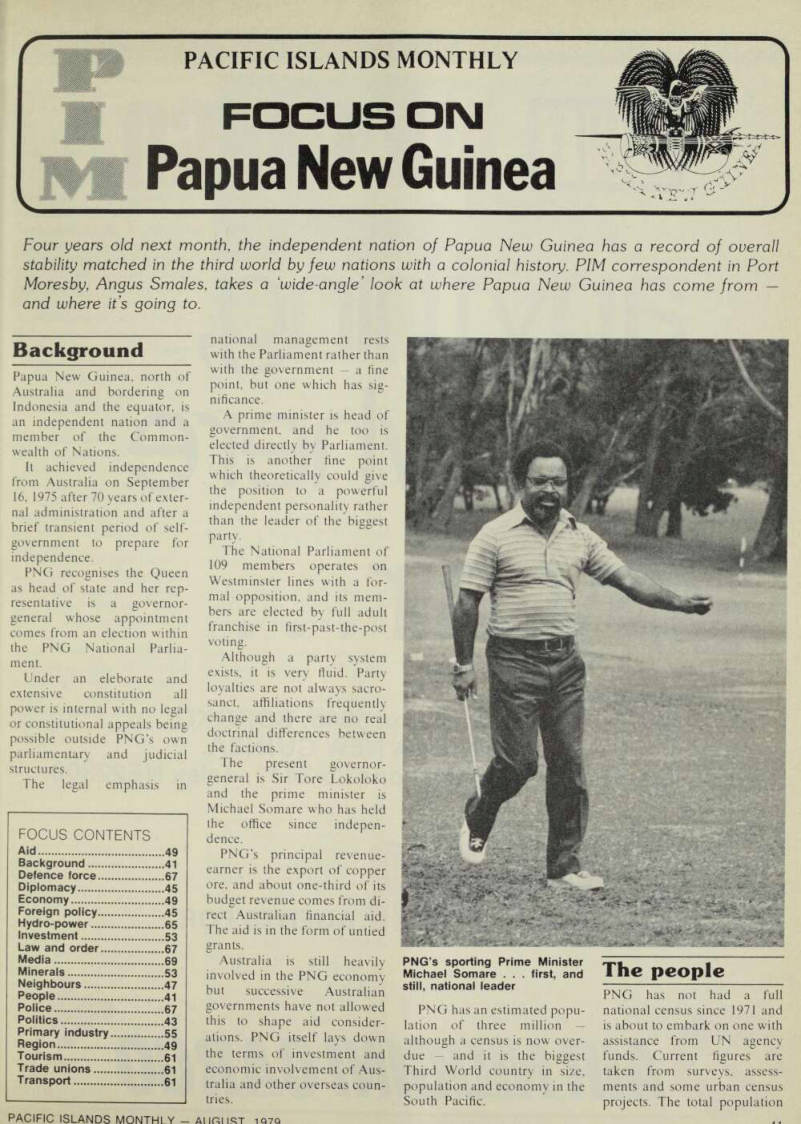
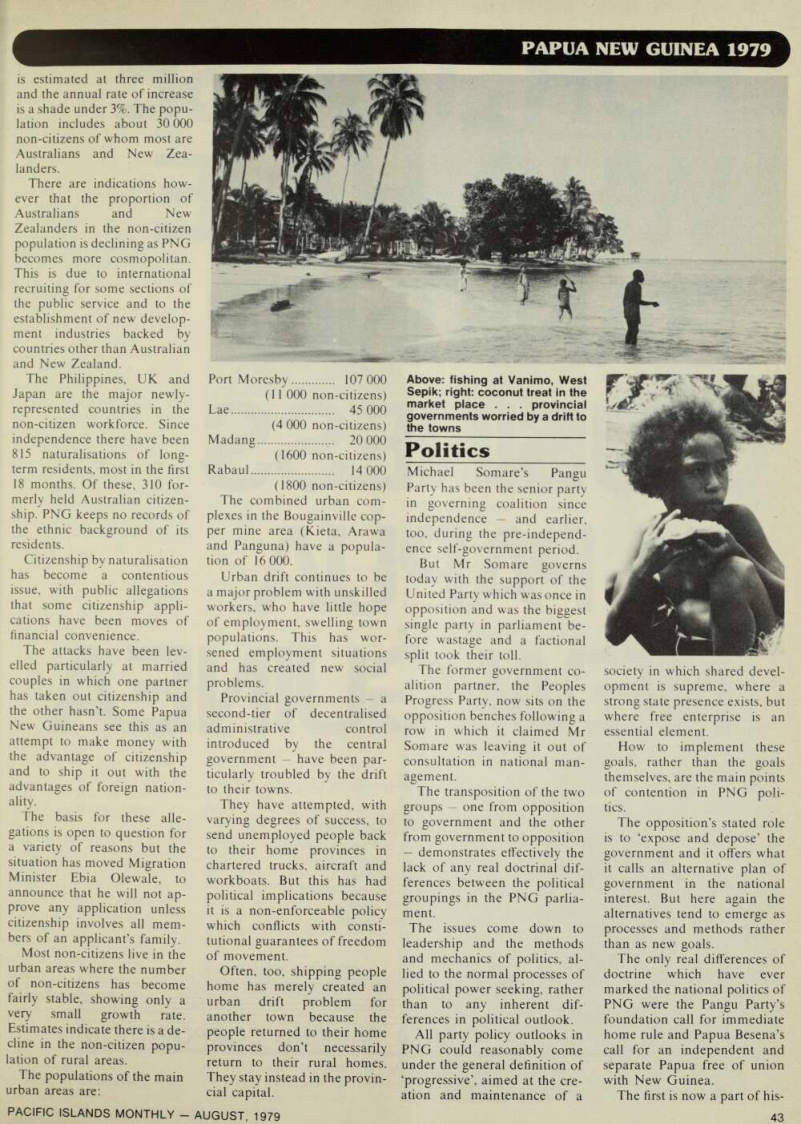

Pim Pacific Islands Monthly
Focus On
Four years old next month , the independent nation of Papua New Guinea has a record of overall stability matched in the third world by few nations with a colonial history. PIM correspondent in Port Moresby , Angus Sma/es, takes a ‘ wide-angle ’ look at where Papua New Guinea has come from and where it's going to.
Background
Papua New Guinea, north of Australia and bordering on Indonesia and the equator, is an independent nation and a member of the Common wealth of Nations.
It achieved independence from Australia on September 16, 1975 after 70 years of exter nal administration and after a brief transient period of self government to prepare for
independence.
PNG recognises the Queen as head of state and her rep resentative is a governor
general whose appointment
comes from an election within the PNG National Parlia ment.
Under an eleborate and extensive constitution all power is internal with no legal or constitutional appeals being possible outside PNG’s own
parliamentary and judicial
structures.
The legal emphasis in
national management rests with the Parliament rather than with the government a fine point, but one which has sig nificance.
A prime minister is head of government, and he too is
elected directly by Parliament.
This is another fine point
which theoretically could give
the position to a powerful
independent personality rather
than the leader of the biggest party.
The National Parliament of 109 members operates on Westminster lines with a for mal opposition, and its mem bers are elected by full adult franchise in first-past-the-post
voting.
Although a party system exists, it is very fluid. Party loyalties are not always sacro sanct, affiliations frequently change and there are no real doctrinal differences between the factions.
The present governor general is Sir Tore Lokoloko and the prime minister is Michael Somare who has held the office since indepen dence.
PNG’s principal revenue earner is the export of copper ore, and about one-third of its budget revenue comes from di rect Australian financial aid.
The aid is in the form of untied grants.
Australia is still heavily involved in the PNG economy but successive Australian governments have not allowed this to shape aid consider ations. PNG itself lays down the terms of investment and economic involvement of Aus tralia and other overseas coun tries.
PNG has an estimated population of three million although a census is now overdue and it is the biggest Third World country in size, population and economy in the South Pacific.
The people
PNG has not had a full national census since 1971 and is about to embark on one with assistance from UN agency funds. Current figures are taken from surveys, assess ments and some urban census
projects. The total population
PNG’s sporting Prime Minister Michael Somare ... first, and still, national leader
is estimated at three million and the annual rate of increase is a shade under 3%. The popu lation includes about 30 000 non-citizens of whom most are Australians and New Zea landers.
There are indications how ever that the proportion of Australians and New Zealanders in the non-citizen population is declining as PNG becomes more cosmopolitan.
This is due to international recruiting for some sections of the public service and to the establishment of new develop ment industries backed by countries other than Australian and New Zealand.
The Philippines, UK and
Japan are the major newly
represented countries in the non-citizen workforce. Since independence there have been 815 naturalisations of long term residents, most in the first 18 months. Of these, 310 for merly held Australian citizen ship. PNG keeps no records of the ethnic background of its residents.
Citizenship by naturalisation
has become a contentious
issue, with public allegations
that some citizenship appli
cations have been moves of financial convenience.
The attacks have been lev elled particularly at married couples in which one partner has taken out citizenship and the other hasn’t. Some Papua New Guineans see this as an attempt to make money with
the advantage of citizenship
and to ship it out with the
advantages of foreign nation
ality.
The basis for these alle gations is open to question for a variety of reasons but the situation has moved Migration Minister Ebia Olewale, to announce that he will not ap prove any application unless citizenship involves all mem bers of an applicant’s family.
Most non-citizens live in the urban areas where the number of non-citizens has become
fairly stable, showing only a
very small growth rate.
Estimates indicate there is a de cline in the non-citizen popu lation of rural areas.
The populations of the main urban areas are:
Port Moresby 107 000 (11 000 non-citizens) Lae 45 000 (4 000 non-citizens) Madang 20 000 (1600 non-citizens) Rabaul 14 000 (1800 non-citizens) The combined urban com plexes in the Bougainville cop per mine area (Kieta, Arawa and Panguna) have a popula tion of 16 000.
Urban drift continues to be a major problem with unskilled workers, who have little hope
of employment, swelling town
populations. This has wor sened employment situations and has created new social
problems.
Provincial governments a second-tier of decentralised administrative control introduced by the central government have been par ticularly troubled by the drift to their towns.
They have attempted, with
varying degrees of success, to
send unemployed people back
to their home provinces in chartered trucks, aircraft and workboats. But this has had
political implications because
it is a non-enforceable policy which conflicts with consti tutional guarantees of freedom of movement.
Often, too, shipping people home has merely created an urban drift problem for another town because the people returned to their home
provinces don’t necessarily
return to their rural homes.
They stay instead in the provin
cial capital.
Politics
Michael Somare’s Pangu Party has been the senior party in governing coalition since independence - and earlier,
too, during the pre-independ
ence self-government period.
But Mr Somare governs today with the support of the United Party which was once in opposition and was the biggest single party in parliament be fore wastage and a factional split took their toll.
The former government co alition partner, the Peoples Progress Party, now sits on the
opposition benches following a
row in which it claimed Mr Somare was leaving it out of consultation in national man agement.
The transposition of the two groups one from opposition to government and the other from government to opposition demonstrates effectively the lack of any real doctrinal dif ferences between the political groupings in the PNG parlia ment.
The issues come down to leadership and the methods and mechanics of politics, al lied to the normal processes of
political power seeking, rather
than to any inherent dif ferences in political outlook.
All party policy outlooks in PNG could reasonably come under the general definition of ‘progressive’, aimed at the cre ation and maintenance of a
society in which shared devel opment is supreme, where a strong state presence exists, but where free enterprise is an essential element.
How to implement these goals, rather than the goals themselves, are the main points of contention in PNG poli tics.
The opposition’s stated role is to ‘expose and depose’ the government and it offers what it calls an alternative plan of government in the national interest. But here again the alternatives tend to emerge as processes and methods rather than as new goals.
The only real differences of doctrine which have ever marked the national politics of PNG were the Pangu Party’s foundation call for immediate home rule and Papua Besena’s call for an independent and separate Papua free of union with New Guinea.
The first is now a part of his
Above: fishing at Vanimo, West Sepik; right: coconut treat in the market place ... provincial governments worried by a drift to the towns
tory and the second has be come symbolic of a Papuan insistence for full involvement in national management rather than for secession.
The two party leaders in government are Michael Somare (Pangu Party) and Sir Tei Abal (United Party), with Pangu holding the top posts of
prime minister, deputy prime
minister and finance. Sir Tei, as minister for public utilities, is in a service rather than a policy
portfolio.
The two principal figures
across the floor of parliament are the Opposition Leader lambakey Okuk, leader of the loosely-linked Okuk group, and Julius Chan, leader of the
Peoples Progress Party and
who was once deputy prime minister.
In numbers which are not
always significant in isolation
because day-to-day issues affect them the government has a narrow majority but the
opposition’s minority is
widened because of the pres ence of about 10 effective
independents.
Mr Somare and his deputy, Ebia Olewale another long time Pangu man are both se cure in their group leadership.
Their government also appears immediately secure after with standing a number of chal lenges last year.
Mr Somare has no plan to step down at the next election
despite occasional speculation
over the past 12 months and despite a statement attributed to him in Australia which he later described as not accu
rately reflecting what he
meant.
In the opposition ranks some dissatisfaction is known to exist over leadership matters. A
Peoples Progress Party move to
establish Julius Chan as oppo sition leader was tipped in May and June but there were no immediate developments and Mr Chan refuses to discuss the issues.
Diplomacy
PNG has established diplo matic relations with 53 coun tries, and seven of these have established resident embassies in Port Moresby. PNG itself has six missions overseas.
including ambassadors to the United Nations and to the European Economic Com munity.
PNG is one of 57 developing countries, mainly members of the ACP States (Africa, the Caribbean and the Pacific), which have links with the EEC
through membership of the
Lome Convention.
The main benefits of this membership for PNG are duty free access to EEC markets, a potential for development loans, and an opportunity for commodity price stabilisation protection. This is of particular value to PNG’s rubber indus try. although rubber is a com paratively small PNG export.
However, the Lome Con vention ends its five-year run early next year, and PNG is now one of the ACP States
actively campaigning for the
best possible terms under new arrangements which the nine EEC countries are investigat
ing.
Foreign policy
Papua New Guinea defines its
foreign policy as ‘Univer
salism’, first laid down by the foundation foreign minister, Sir Maori Kiki, and carried on by the present minister, Ebia Olewale.
The basic definition of
PNG political leaders, clockwise from above: Oppostion Leader lambakey Okuk, Peoples Pro gress Party Chief Julius Chan, Minister for Public Utilities Sir Tei Abal, and Deputy Prime Minister and Foreign Minister Ebia Olewale with Australia’s Andrew Peacock
Universalism is ‘Friends of all, enemies of none’. Under this policy PNG refuses to align itself with any power bloc on the grounds that its size would make it subservient.
The policy believes that a comparatively small country can actually turn size to advan tage and co-exist with all blocs.
In a theorectical way the sys tem was demonstrated when PNG established diplomatic relations with China, becoming the first country not asked by China to declare non recognition of Taiwan.
In practice however the pol icy has at times appeared naive, and the government is known to have reconsidered its stand on a number of recent oc casions.
There are also increasing political pressures inside PNG to rethink the policy. ‘We should come out and say who our friends are,’ was the com ment of Vincent Eri, until re
cently PNG high commiss
ioner in Australia. Mr Eri claimed that, in any event, membership of the Common wealth was a negation of Universalism.
Universalism has so far pre vented the signing of any de fence agreement with Australia because of the ‘political’ over tones, but vague ‘cultural’ agreements have been entered into in the South Pacific and South-East Asia.
The most recent questioning of the policy came from the prime minister himself, when
Mr Somare spoke in Australia to the Australian Institute of International Affairs.
Confirming a review of
foreign policy, Mr Somare
said: ‘The policies which have served us since independence are now due for close examin ation. Universalism ... made sense for a new democracy.
Now for the first time since we became independent in 1975
our foreign policy is undergo
ing a complete review.’
Mr Somare said that in its
foreign policy his country
wanted to ensure security but the sort of security he meant was not protection from attack, but protection for trade re lations and prospects.
Neighbours
PNG has three immediate neighbours Solomon Islands, Australia and Indonesia.
Of the three, the Solomons link is both the most serene and the least technical. A reason
ably common ethnic heritage,
an identical background and an unquestionable brother hood have made formal diplo macy almost unnecessary.
The border is something of a question mark but no one
particularly cares, and the big gest argument of recent years was over a claim that Solomons mosquitoes were flying to the PNG island of Bougainville.
The two countries established formal links at Solomons independence last year, but their strongest link is mutual membership of the South Pacific Forum.
The Australian link is far too complex today to be described in a few lines, but geography and events and attitudes have
created a surprisingly healthy
bond from what was once a straight colonial situation.
It would be idle to suggest there are no anti-Australian attitudes in PNG society, but the formal diplomacy is firm and real.
Sir John Guise, PNG’s
governor-general at indepen
dence, said on that occasion: ‘We are hauling down the Aus-
tralian flag, not tearing it down.’ The attitude displayed in that statement continues to hold generally true.
The Indonesian link is an ambivalent one. Formal diplo matic links are strong, and PNG unhesitatingly accepts Indonesian sovereignty in
adjoining Irian Jaya.
But a significant sector of
public opinion defines
Indonesia as a neo-colonial power in Irian Jaya and, de
spite protestations of friend
ship, is uneasy at the
Indonesian proximity.
President Suharto, who visi ted PNG in June, drew a bigger crowd than Australia’s Gough Whitlam or Malcolm Fraser
has ever managed (although
the Queen won hands down), but curiosity rather than
Former PNG high commissioner to Australia, Vincent Eri ... call to rethink ‘universalism’ policy
Torres Treaty signing ... seated from left: Australia’s Foreign Minister Peacock and Prime Minister Malcolm Fraser; PNG’s Prime Minister Somare and Foreign Minister Olewale
Former governor-general, Sir John Guise ... independence day statement still holds true
togetherness stood out as the motive.
The PNG and Indonesian governments have formal agreements on border defi nition and management (with a renegotiation in the offing),
on cultural exchanges, sharing
of expertise, mutual aid and mutual regional attitudes.
Apart from the border, how ever, the agreements are of a very general nature so far, defining attitudes rather than specifics.
The Region
PNG is the only South Pacific country which has a land border with an Asian country.
The border is with Indonesia, one of three with other countries, and was the first to be properly formalised. (The other two, both sea borders, are with Australia and Solomon Islands. Also, there is a high seas border to the north.) Because of its Indonesian border, PNG sees itself as
occupying a special diplomatic
‘bridging’ role between Asia and the South Pacific. This has led PNG to obtain observer status in the Association of South-East Asian Nations (ASEAN), largely with the support of Indonesia.
PNG has no wish to extend its ASEAN links beyond ob server status, because it sees its direct regional role in the South Pacific.
As a result PNG has become one of the principal members of the South Pacific Forum countries - an association of the independent island coun tries of the South Pacific but it has worked for closer ties be tween Forum and ASEAN countries.
Any hard material benefits in trade and development from these links have yet to be realised, but PNG has been active in bringing together the two regions in a common con servation role.
This has included a common line towards the banning of nu clear tests and in campaigning to keep the Indian and South Pacific Oceans free of super power rivalries.
Aid
PNG’s principal source of aid is an annual untied grant from Australia which this year is worth about SA2IS million about one-third of the PNG
budget.
This is the third year of a five-year committed aid program from Australia.
Under the program Australia has guaranteed an annual grant of $lBO million, to be
supplemented by an additional
amount agreed to by annual
negotiation.
Under the scheme the first annual supplementary grant was $lO million, the second $2O million, and this year’s was $35 million.
Despite the progressive in
crease, the real value of Aus tralian aid in terms of purchasing power is estimated to have dropped by 7.6% over the period because of inter national economic factors including Australian currency movements.
On general principles PNG
does not quarrel with this tapering-off which is part of its own process of increasing self reliance. From the start of the aid agreement PNG adopted a strict policy to use the grant as little as possible for ongoing
public expenditure. Where
possible the money is applied to capital development of a type which will eventually gen erate national revenue, or will at least reduce avenues of
recurring expenditure.
The policy, piloted by the
first finance minister, Julius Chan and later by the present
minister, Barry Holloway, is
progressively reducing depen
dence on outside aid.
In addition to Australian aid, PNG is also receiving grants from the United Nations
Development Program and
from the New Zealand Government to a total this year of more than $6 million.
PNG as a developing country also has access to special concessional loans made available by overseas governments and international
agencies.
This type of aid at present totals an annual content of about $26 million, with the
principal sources being Japan.
West Germany, the Asian Development Bank, the World Bank and the International
Development Association.
Other sources involved or likely to be involved are the European Investment Bank, the Kuwait Fund and agencies in UK and the UN.
The economy
PNG has what economists de fine as an extremely open economy the value of its exports and imports is very large in relation to the value of its gross domestic product.
This makes any economy
highly susceptible to world
economic fluctuations, and in PNG the susceptibility is accentuated by the ‘com modity’ nature of the exports.
PNG exports, particularly the significant ones of copper ore, coffee, cocoa and copra, are sold on markets which swing wildly according to world con ditions as well as according to supply and demand.
Unlike most developing countries, PNG does not have
balance of payment problems and its inflation rate is lower than average. This situation is partly fortuitous for several reasons. One is the efficient running of the Conzinc
Riotinto-backed Bougainville
Copper mine, the biggest single
government revenue earner in PNG and in which the govern ment has a 20% share. The mine’s economy enabled it to continue profitably when other major world mines couldn't counter a recent recession in copper.
Another reason is the bol stering presence of the Aus tralian grant in aid. con tributing about one-third of the national budget. But. more sig
nificantly. PNG’s own policies
of financial management have contributed to the more favoured position which the country holds in balancing its
books and financing long-term
development.
PNG is passing through a period in which lack of home
Bougainville Copper's Panguna mine ... PNG’s single biggest revenue earner
skills is creating the utmost dif ficulty in staffing and operat ing its institutions.
Inefficiencies and problems are rife and a source of con stant management frus trations.
But these are largely mech anical problems which should
gradually recede. The import
ant areas of policy and strategy in national finances have fol lowed sound principles.
A hard currency exchange policy, an extensive back-up of export market stabilisation
schemes, emphasis on develop
ment projects when commit
ting major expenditure, and
the deliberate cultivation of a
high international credit rating
are the four cornerstones of the structure.
Details of the cornerstones are: Hard currency: A hard cur rency policy is used in which the curency unit, the kina (named after a traditional tribal symbol of wealth, a type of seashell), is not manipulated for short-term advantages.
Instead, the kina is measured against an average value of cur rencies from the main overseas countries which are involved in transactions with PNG. Its value is then adjusted up or down according to the average of this relationship.
The aim is to keep the real value of the kina as a purchas ing unit as constant as possible.
The kina started life at par with the Australian dollar, but since January 1976 it has been dropped in value against the Japanese yen and the West German mark and it has been raised in value against the Aus tralian dollar and the US dol lar. The effective net movement has been an upward revaluation of about 7%. (Kl.oo is now worth $A1.25).
The upward movement has not been an altogether popular measure at home because it has lowered the return (in figures, anyway) from exports. But in terms of financial management of the entire economy, as reflected in cost of living indicators and the assessed in
flation rate, the policy has been successful. This has been par ticularly so as a hedge against
‘imported’ inflation.
Export market stabilisation: Two years ago when com modity prices boomed and pro ducers looked for bigger returns the government again
risked some unpopularity by
holding down the returns and building up stabilisation buffers. Stabilisation formulas were applied to copper ore exports as well as to agricul
tural products. The policies
were soon vindicated in more recent slumps. The coffee situ ation was particularly interest
ing where PNG producers
experienced the least fall in
prices of producers anywhere
in the world.
The slump in copper, coffee
and cocoa naturally enough
had its effect on national finances. The gross domestic product, for instance, increased that year by less than 2% and overseas reserves went up a mere $3 million.
As a comparison, the earlier
Gathering cocoa pods ... slump before recovery
1977 boom year had seen an 11% increase in the gross dom estic product and a $l5O million lift in overseas re serves.
The important point, how
ever, was that PNG weathered
the depressed period without
hardship and spending power
remained reasonably constant.
With copper now improving and coffee and cocoa firming, funds available for stabilis ation and overseas reserves are
now moving up again.
Emphasis on development type spending: PNG has resisted a temptation to pour its available funds in electorate
pleasing expenditure of a
recurrent type and on glamour
capital projects. Where poss
ible it has attempted to use its own direct revenue for recur
rent public expenditures,
applying its Australian and loan aid to long-term develop
ment projects particularly in
the rural sector which will
eventually provide new rev
enue bases.
From time to time there is public and political argument about the appropriateness of some of the schemes the government chooses to establish. But the thrust of any controversy is not against the
principle involved, and mainly
concerns the degree of success which different projects are likely to achieve.
International credit rating: As a developing country with a guaranteed aid input from Australia, PNG had an easy in itial access to international bor rowings at concessional rates.
At first there was a tacit stipu lation that Australia should guarantee the loans, and this was the basis of early arrange ments. PNG made a point of
maintaining absolute integrity
in how it applied the loans and in how it met its loan commit ments.
This policy, together with
import management to ensure an overall favourable balance of payments, has also paid off.
PNG now has a surprisingly wide access, on its own guaran tee, to international money at nominal or low rates. The only factor today which would in-
hibit any development loan ap plication by PNG would be
disagreement over the viability
of a project under consider ation.
Investment
Since independence, a series of policy statements, many of them complex and sometimes emotional, have been made
regarding general investment
and foreign investment in PNG. There has never been any basic change in policy atti tudes which in itself is a stabilising element in the econ omy but the processes relat ing to investment tend to be in a constant state of flux.
This has produced some mcertainties for the investor, often not realised by the bu reaucracy which defines the situation as ‘refinement’. In essence, PNG investment pol
icy makes the following
points: • Too much capital and control is in the hands of non-nationals particularly resident and non resident Australians. • But. . . this will be tolerated if certain guidelines are fol lowed to phase in local partner
ships, capital and manage
ment. • Investment will be actively encouraged from outside, and even sought, if it is of a
developmental or highly
capitalised nature which is
obviously beyond the country’s
present resources. • Where the above require ments are met a foreign inves tor will be guaranteed freedom from expropriation and dis criminatory sanctions, and will be free to repatriate earnings, interest payments and capital.
These four guidelines have stood fairly strongly from the start of PNG nationhood, but where investors run into some uncertainty is in the continual
replanning and rethinking of
the processes involved, in the creation of new institutions and the re-aligning of older ones, in re-interpretations of situations, and in differing methods of applying the rules.
For foreigh investors the situation has created two some what conflicting reactions. One is an optimism bred by an ac ceptance that PNG genuinely wants certain types of invest ment and will provide a fair deal to those who qualify.
The other is caution bred from the uncertainties of day to-day processes, and the sensi tivities of fluctuating national
politics.
The net result is that PNG is still attractive to some types of investment, but the capital car ries a much higher speculative component than it would for a similar venture in many other countries.
If the PNG planners have any blind spot, it is a failure to realise that foreign investors need just as much concessional treatment as Papua New
Guinean investors (although of different types) if ultimate stability is to be assured.
NIDA (National Investment
and Development Authority)
masterminds the investment and employment scene, recom mending to the government what employment and what investment is being progress ively closed to non-nationals.
There has never been any
significant questioning of the
genuine nature of what PNG is offering. However the process of making, applying and main taining the rules is frequently a source of investment
insecurity.
Planning schemes, too, have sometimes been accused of failing to see the wood for the
trees. Don Harvey, managing
director of the big multi interest group Steamships
Trading Company, recently
pointed out that the shares of his company, all publicly listed, are mainly held in Australia only because of the historical accident of how the firm was financed at its establishment.
He could see no reason why Papua New Guineans who wanted part of the show (or all of it for that matter) couldn’t start buying up the shares on the open market. But PNG groups had been prevented by their own government from doing this, he said, under the emotional restrictive tag of
‘foreign business’.
Meanwhile, elaborate and expensive planning went on in the government to determine how Papua New Guineans could gain a greater share of their country’s economy. ‘All they have to do in some instances is put their money where their mouth is,' he com mented.
Minerals
Bougainville Copper mine is
PNG’s biggest engineering
project, a giant open-pit mine
in the Crown Prince Range on Bougainville Island. It has a annual net sales revenue exceeding $270 million.
The mine, operated by
Bougainville Copper Ltd. is
majority owned (over 60 per cent) by Conzinc Riotinto of Australia Ltd, and the PNG Government (with more than
Picking coffee ... with prices firming overseas reserves are moving up again
20 percent) is the other major shareholder. The mine is
PNG’s major export earnings
producer, and the return from shareholdings is only a small part of what the government derives from the venture.
Company tax alone which the government received from the mine last year was $27.5
million and royalties produced
another $3.5 million. The oper
ation also provides employ
ment in PNG for more than 4000 men and women, of whom 3300 are Papua New Guineans.
Through scholarships, ap
prenticeships and on-site train ing the mine is a major contributor to developing skilled professionals, tech nicians, tradesmen and oper ators in the PNG workforce.
The mine is expected to op erate for at least another 30 years on proven reserves, but in the meantime extensive new exploration is being carried out within the mining reserve.
Gold and silver as well as cop per are recovered from the Bougainville ore. Gold sales last year amounted to $l2O million and silver to more than $6 million.
The present agreement under which the mine operates was negotiated by the PNG Government at independence, reopening an agreement which Australia had made several years earlier as the then administering country in
Png.
PNG gained some important
advantages from the renegotia
tions particularly a surplus
earnings tax but the newly independent country was criti cised abroad for what was seen as repudiating an international agreement, and criticised at home for fear it would lose confidence on the international investment market.
The government defended its action on the grounds that it had not been party to the original agreement between CRA and Australia, and gave an assurance that its own future agreements would be firm.
The government then launched into a major planning
inquiry which eventually pro
duced its formal attitudes and policies towards any future
mining operations involving
major multinational invest ment. The guidelines do not insist that a major government equity should necessarily be a prime consideration. More im portant aspects are seen as the
best possible guaranteed
financial returns, a graded sur
tax on unexpectedly high
profits, contributions to national development and the provision of wider economic
Five months has yet to run before the final feasibility study is completed, but there seems little doubt that the country will get its second major copper venture, and that the new mine will be about three-quarters the size of
Bougainville.
The US Kennecott group carried out the original Ok
Tedi exploration, dating back
to 1968. But Kennecott pulled
opportunities for people and
their communities.
The test of PNG’s mining
policy expertise and negotiat
ing ability will come soon when arrangements begin for the construction and commission
ing phases of the proposed new
copper mine at Ok Tedi in the central western Star Mountains of the PNG mainland.
out in 1975 when it couldn’t get the assurances it wanted for its share in any eventual mining venture.
PNG then took a bold step for a new country, forming its own exploration company. Ok Tedi Development, and
employing or contracting the
skills it wanted.
Then in November 1976 the government made a deal with the big Australian miner BHP.
under which BHP formed a consortium to push ahead a
feasibility study without
delay.
The consortium represents Australian, US and West Ger man interests, and the project partners are: PNG Govern ment 20%, BHP through its
subsidiary Dampier Mining
30%, Standard Oil of Indiana
through its subsidiary Mount
Fubilan Development 30%,
and Kupfer Explorations,
representing three West Ger man industrials, 20%.
These percentages will be the relative share options avail able to the parent companies when the mining phase starts.
Extraction and transport problems will be major hurdles in the Ok Tedi venture. The site is in rugged remote country, high in the mountains near the Indonesian border and 640 km from the Gulf of
Papua coastline.
The feasibility study should
have been completed by the middle of this year but the con sortium was granted an exten sion and expects to present its report in November.
Primary industry
Agriculture, except for major
developmental projects involv
ing joint estates and process plants, is no longer an attract ive investment for outside money because of deliberate
government policies.
The industry, particularly
where individual ownership is
involved, is gradually being
closed to all but Papua New Guinean nationals. The pro cess includes the expropriation
of foreign-owned properties at
government valuation for re distribution to Papua New Guineans living in the areas involved.
In general, the system has
worked fairly smoothly with
the government willing to renegotiate some valuations, and with only a handful of
deep-seated disputes involving
the displaced owners.
The government is not buy
ing every foreign-owned prop
erty on principle, but is selecting those in areas where acute local land shortages have
developed.
The expropriations have
Apprentice at work at Bougain ville Copper’s workshop ... a duty to develop skilled Papua New Guineans
meant a long-term loss to most of the displaced owners be cause of the ongoing earnings involved, but they have at least permitted the realisation of capital on an otherwise dead property market.
Coffee has replaced cocoa as the boom glamour crop in PNG and heads the list of exports in agriculture and fisheries production. The value of agriculture and fisheries exports in 1978 was: coffee sl34m, cocoa s7Bm, coconut products s46m, tuna s2sm. timber and ply s24m, palm oil sl3m. tea slom. prawns ssm. rubber s3m. (For comparison, PNG’s biggest export, copper ore, was valued for the same period at $271m.) Coffee: Frosts which almost wiped out crops in Brazil,
together with the development
of a reputation for providing a
special flavouring coffee, have
boosted PNG’s coffee earnings considerably in the past four years. The boom is expected to last for at least another two years, despite a temporary set back last season.
The industry is protected by
a stabilisation scheme. The crop comes solely from the
Highlands and has injected
huge amounts of cash income into a relatively primitive com
munity which previously had
only a sustenance economy.
Sociologically, there is some concern at squandering of incomes by producers and in the emergence of coffee indus
try crime, mainly stealing
beans from properties or dur
ing trucking.
Cocoa: Once a booming industry near the top, cocoa is the export earner which is most
reflecting the departure of
many white planters. Pro duction has fallen off through a running down of some
properties although many of
the former owners themselves have been accused of allowing this to happen when they knew their time was short.
World market situations, the economies of the industry and the breaking down of some properties into small units have all taken their toll of the indus try but the general prospects re main good provided PNG can maintain quality and grade ac
curately.
The centres of production are East New Britain (Rabaul
and Kokopo areas), Bougain
ville and New Ireland.
Foreign-owned cocoa
properties were among the first properties to come under intense pressures for expropri ation. but more recently there have been calls to ensure that
experienced planters are al
lowed to remain at least in lim ited numbers in the general interests of the industry.
Coconut products: PNG exports raw copra and has a coconut oil expressing mill which is operated in Rabaul by the Australian-based W. R.
Husking coconuts near Rabaul ... reasonably trouble-free industry
Carpenter group of com panies.
The mill sells oil on world markets, particularly to
Europe, and the by-product,
copra cake, is sold to the US as a cattle feed. Coconut pro duction remains a steady and reasonably trouble-free indus try for thousands of small holder growers.
Tuna: The 1978 figure of $25 million in tuna exports partly represents experimental pro grammes in conjunction with Japanese interests. Meanwhile, Japanese rights to fish for tuna in PNG waters on a licence and royalty basis have ended with the expiry of a government-to government agreement.
Negotiations to reach a new agreement have come to a stalemate mainly over PNG’s firm demands that the $1.25 million paid for the initial rights should be continued an
nually.
PNG is not anxious to sell any rights cheaply because it sees tuna fishing as a means of
building a brand-new industry
of its own, boosted by the newly-declared 200-mile mar ine resource limits.
Timber and plywood: Ply wood production at Bulolo, once an Australian venture but
now backed by Japanese
interests, continues as a steady industry and, as a minor by product, the factory has started exporting chopsticks to Japan.
Logging and timber milling,
ofte-n troubled industries in PNG because of shoestring capitalisation, are going through a series of reorganis ations with political presssures to ensure greater equity for PNG nationals.
The industry continues to be critical of government policies towards it but the indications are that it has a sound future.
Japanese interests continue to operate a successful
woodchip industry and reaf
forestation programme at Madang on the north coast of the PNG Mainland.
Palm oil: This is one of the newest and fastest-developing of PNG industries, growing and harvesting the palms and expressing the oil at central mills. The industry is centred on West New Britain.
It is mainly backed by UK investment and expertise with government involvement.
Japanese interest attempted to become involved in the indus try but lacked the expertise and the PNG government termin ated the agreement.
Palm oil has been the basis of PNG’s most ambitious pro gramme in agricultural settle ment. Applications were called from all parts of the country, settlers and their families were flown into newly-acquired land, and there they built their houses and planted their crops
in a self-help development
venture.
The experiment has not been without social problems, mainly caused by frictions be tween groups from different home areas, but financially it is successful.
Among the minor industries of PNG, special attention is being given to crocodile farm ing and crocodile skin export
ing. The industry is particularly
Planting out the seedlings at Hoskins palm oil project, West New Britain ... one of PNG’s fas test developing industries
Crocodile trade . . . exemption from world ban on export of salt water skins valuable to the relatively de pressed areas of the south west.
Australia and the US re
cently supported moves for
PNG to be exempted from a proposed world ban on the export of saltwater crocodile skins. The ban is wanted by the International Union of Conser vation of Nature which claims saltwater crocodiles are in danger of extinction.
US and Australian officials are satisfied that the crocodiles are not endangered in PNG be cause of numbers and existing conservation measures.
Tourism
‘Papua New Guinea like every other place you’ve never been’ is the advertising slogan which has become synonymous with the PNG tourist industry.
But the industry itself is still settling down and it has be-
come the focus of several conflicting attitudes at home and from visitors. Despite the effort going into it, the industry is not yet a major revenue earner for PNG.
Foreign exchange earnings
from tourism (not counting fares in and out but counting internal fare spending) is run ning at just under $lO million a year, and increasing. This makes tourism PNG’s seventh
highest foreign exchange
earner. There is little doubt that the earnings will increase sharply under the present promotional moves by the Office of Tourism a statutory body and by travel and ac commodation interests in volved in the industry. This includes the promotional work of the national airline. Air
Niugini.
However the position of
tourism in the scale of earnings is not likely to change because the two revenue-earners just ahead of it timber and fish - are also on the threshold of
an expansion.
As part of a Pacific-wide trend, tourism is officially accepted and tacitly seen as something which must be pro moted. From time to time, however, and recently with some increasing frequency, the
overall value of tourism has been questioned. How much can we really earn and are the problems really worth it? are
the questions being asked.
There are fears that tourism could promote the destruction of existing cultures and the emergence of‘sham’ cultures in the traditional tribal areas which are the main tourist drawcard. Tourists themselves
criticise the comparatively high
cost of transport and accom modation, accentuated now by cheap international airfares which do not extend to PNG.
Human nature itself has created another problem. With
charming honesty, PNG tour
ism is sold partly as a visit to one of the last remaining links with ancient tribal cultures. But the very people who lap this up as bait are often the first to complain if the hot water is lukewarm or if the cooking is not up to their standards.
Migration statistics show that 56% of all short-term visi tors to PNG are tourists, and the most recent figures show an annual intake of 20 000 tourists
travelling by air.
Nearly the same number pass through in cruise ships in some years, but these visits are
only one-day stopovers in
single ports and do not involve
significant tourist expendi
ture.
In 1974, just before political independence, there was a 13% drop in the number of short term visitors, including tour ists. The decline continued for three years and then the trend was reversed but it was not until last year that the figures returned to 1973 levels. The Office of Tourism believes that real fears about the political future of PNG, later allayed, were the reasons for the de cline. Australia, Japan and the US are the three main sources of visitors to PNG.
Recent figures show that 62.5% of the visitors were from Australia, 7.8% from Japan and 7.6% from the US. (These pro portions are for all short-term visitors, not merely tourists, but they are considered to reflect the tourist situation fairly
closely.)
South Pacific countries, including New Zealand but
excluding Australia, provided 6.6% of the visitors, UK 3.6% and West Germany 2.1%.
As a side issue, a tourism sur vey disclosed that New Zealanders were the biggest
individual spenders once they
hit PNG, and visitors from UK and West Germany the most frugal (perhaps the fare from Europe left them little
change.)
Australians as spenders were in the middle of the list, a shade ahead of Americans but when it came to spending money on souvenir artifacts the Americans won hands down over visitors from all coun tries.
Transport
Land: The biggest revolution in PNG transport today is in the ownership of freight haul age companies using the roads or what some operators de scribe as ‘the strips of ground joining the towns to each other’.
The revolution comes from a
policy decision by Transport
Minister Paias Wingti that all
foreign-owned trucking com
panies must release at least 50% of their shares to Papua New Guineans by next year and be out of the business altogether by 1981.
‘Foreign-owned’ means
ownership by non-citizens,
even if the owners have been long established and resident in PNG. Mr Wingti’s portfolio covers land, sea and air trans port, and he believes that of all
three, complete ‘localisation’ of ownership and control is now possible in the road transport business.
The move is causing concern among a number of operators, particularly in the truck capital of Lae, the coastal gateway to the highway which serves the
PNG Highlands.
Operators claim that
although they accept the prin
ciple involved they believe the timetable is too rapid.
Taxi and public motor ve hicle licences are already confined to Papua New Guineans.
Sea: The PNG Government has conducted a major reor ganisation of shipping services,
including involving itself di
rectly as a partner in coastal and overseas shipping lines.
The coastal shipping pro gramme was largely forced on the government by the large numbers of aging and often un suitable ships which were in service until recently.
In conjunction with the re
equipment and reorganisation
programme the government has also set up or extended for mal training schemes to de velop Papua New Guineans as ships officers and seamen.
Air: Air services remain the backbone of passenger travel throughout PNG because of
the lack of a continuous trunk road system.
The government is an 83% owner of the national airline Air Niugini (the Australian Ansett group holds the remain ing shares) and the airline op erates as an international and domestic trunk carrier.
Its fleet consists of two Boe ing 707 jets on lease, three F2B Fokker Fellowship jets (with a fourth due soon) and nine F 27
Fokker Friendships.
International routes are to Australia, Japan, Indonesia,
the Philippines, Hawaii, Hong
Kong, Singapore and Solomon
Islands.
An extensive network of light aircraft charter operations provides feeder services and has also been instrumental in opening up many isolated com
munities by flying produce to
markets and bringing in
supplies (see PIM July).
Trade unions
In its original form trade unionism did not rise spon taneously from the workforce in PNG a surprising fact be cause there was once cause enough - but it was ‘established’ by the former Australian administration of the country.
The move arose from United Nations insistence that union ism was an essential protective element in society and should be created as part of the nation building exercise in PNG.
Since then, PNG unionism has become more spontaneous
Lae’s new airport at Nadzab in the Markham Valley ... flying is the backbone of passenger travel because of lack of roads
but it still lacks much of the co herence evident in more devel oped countries. The only consistent militancy so far has come from the waterfront and to a smaller extent from the
mining operation on Bougain
ville Island.
The same lack of coherence which marks the union scene is also partly evident in the single organisation the PNG Em ployers Federation which balances the unions under PNG’s quite extensive labour, industrial, arbitration and con ciliation structure.
This is because individual employers as much as indi vidual workers have a history of independent orientation in PNG. This has left the indus trial scene very fluid and often without hard precedents on either side of the negotiating table. Some observers claim this will lead ultimately to major shakedowns and con frontations on the industrial scene.
A complicating issue has been the white employer/black employee situation inherited by PNG, and which has some times clouded real industrial issues. This aspect is becoming less significant as PNG policies force an increasing degree of local equity and control into the economy.
There are about 60 organis ations in PNG which call them selves unions but the number
properly registered is consider
ably less.
Most of the unregistered unions have forfeited their right to registration because of failure to meet certain require ments, but some have simply never applied.
Unregistered unions are per mitted to operate but they have no legal standing and an
increasing body of political
opinion is agitating for the pre sent situation to be put into order.
The biggest single union in PNG is the Public Service As sociation with a membership of about 15,000.
Lae has the best-organised overall union structure with the PNG Trade Union Congress, the Lae Waterside Workers and Seamen’s Union and the Lae Miscellaneous Workers
Union. Other centres with active union organisation are Port Moresby, Rabaul. the Bougainville copper mine and
Madang.
An organised union struc ture is only just emerging in Kavieng on New Ireland and in Wewak on the north coast of the PNG mainland.
Hydro-power
One of the greatest sources of relatively untapped power in PNG is in its river systems which drain away tropical rain falls of up to 200 centimetres a year.
Port Moresby has been sup
plied by a hydro scheme
generating its electricity and
supplying its water for nearly 20 years, and there is another
major hydro-electric scheme in
the Eastern Highlands. Several local schemes are either in ser vice or under construction and
planning.
But one of the world’s great-
Waterfall near Sogeri, Central Province ... hydro-power barely tapped so far
est potentials for cheap electric power is in the Purari and Aure rivers which rise in the central spine of the mainland and flow into the Gulf of Papua. Projec tion surveys have shown a potential exceeding that of the big Snowy Mountains scheme in Australia.
The Purari is an ideal river for tapping and its huge flow drops 4500 metres over its 740kilometre course.
Australian, Japanese and PNG interests last year com pleted a $9 million survey to assess the potential and vi ability of a stage one hydro electric scheme on the Purari.
A dam at Wabo, towards the headwaters, was selected as the site for any initial develop ment. The position now is that PNG knows it has the possi
bility for mass-produced power
at one of the cheapest rates in the world. But it can’t reticulate or use the power itself and needs a wholesale industrial customer prepared to establish
an industry.
Port sites and town sites have been surveyed in the Gulf of Papua, and tentative interest has been shown by inter national smelting groups in
West Germany, Japan and
Australia. So far however nothing firm has come from any of the approaches and in
quiries.
Minerals and Energy Minis ter Karl Stack, has been
investigating the possibility of
an undersea cable to carry power to northern Australia for consumption at Gove and Weipa where power for smelt ing is at present expensive.
Talks have yet to be held in Australia on the suggestion and Mr Kitchens describes the situ ation as ‘very tentative so far’.
Defence force
The PNG Defence Force has maritime, army and air ele ments, and is responsible through its commander to the defence minister and govern ment of the day. The former defence presence in PNG was Papua New Guinea Command of the Australian Military Forces, which included two battalions of Papua New
Guinean soldiers and mainly Australian officers.
When the Australian pres ence was withdrawn, facilities, installations and equipment were handed over to the new government. Some Australians still serve in the force on secondment for special duties, but the numbers are being re
duced annually.
The main elements of the force are two battalions of infantry, an engineer and sup port battalions, a transport and patrol air unit (with Nomad and Dakota aircraft), a water transport section and a mari time fast patrol boat squad ron.
PNG has no defence treaty with Australia but there is
extensive training and general
co-operation between the forces of the two countries, and under an ‘agreement of under standing’ Australia extends support and aid directly to the defence establishment.
Police
The police force in PNG is incorporated under royal char ter as the Royal Papua New
Guinea Constabulary.
It is responsible for civil law and order through the police minister to the government and is a single national force established in urban and rural areas. The service itself is under the control of a com missioner.
Its present strength is about 4000 officers and men, but this is almost 1000 below author ised and required strength and
the force is engaged in an extensive recruiting cam
paign.
The force has almost com
pletely phased out Australians
and other non-nationals who served with it before PNG be came independent. However it is still bringing in experts from overseas as instructors or advisers in special or technical fields.
Under this arrangement it is at present using the services of a New Zealand police officer
for prosecutions training, four
officers from the South Aus tralian police force for a survey of sector patrol work and three Australian military personnel for aid in communications and
catering services.
In conjunction with the de fence force the police service maintains a joint officers train ing college in Lae and it has its own police college near Port Moresby and a mobile force training centre near Rabaul.
The force has come under a
considerable testing period in
recent years following sweep
ing changes in PNG society
which have included increases in crowd violence situations and a rise in petty crime and law and order problems.
The suitability or otherwise of the force for the work it is called on to do is a continuing cause of controversy in the force itself and as a political issue. It is still undergoing a
period of extreme change in methods and outlook.
Law and order
Law and order is probably the most serious national issue fac ing PNG at present, not merely in social terms but because of the heavy financial cost and the wastage and disruption it causes to the economy. It falls into two types urban crime and inter-tribal fightings.
The urban situation has im
proved slightly in recent
months, and the improvement is attributed to more efficient
police patrolling and to tighter
restrictions on the availability of alcohol. There is only 30 hours bar trading a week, and in Port Moresby all bottle sales are banned three days a week.
Officialdom sometimes tries to play down the urban crime situation with claims that it is symptomatic of a world urban condition, and that it is
highlighted in PNG only by
comparison with sleepier days
which are close enough to re member.
For their size, however. Port
Moresby in particular and
other PNG centres to a lesser
degree are indeed badly
troubled by urban crime de spite what statistical com
parison might be introduced.
In any event, they are not big cities and towns in the absolute sense which complicates stat
istical comparison.
Stoning of vehicles almost as a night-time sport, theft of ve hicles, street fights, knifing of
householders during burglar
Queen Elizabeth II, nominally head of state of PNG, inspects PNG Defence Force infantry guard of honour ... no treaties but extensive co-operation with Australia
ies, vandalism, break and enters, gang attacks and wan ton property damage all have a high incidence.
Factory-type wire fences round suburban houses, jail like bars on the windows and
privately-employed security
guards for houses and residen tial streets are all part of the
picture.
Opposition Leader lam
bakey Okuk spoke recently of
‘people living in fear behind high wire fences’.
Alcohol (getting it and the effects of drinking it) is seen as a major factor in the urban crime scene, and one of the big gest housebreaking targets is the drinks cupboard. Unem ployment is another, and with younger offenders this is often not so much lack of a job as lack of something to do.
The presence in a single so ciety of huge extremes of
income, including highly-paid
foreigners and low-paid locals,
is quoted as another factor but it does not appear to be as sig nificant today as it once might have been. Certainly rank and file Papua New Guineans as much as any one else are among the victims.
A number of surveys, private and statutory, have been made into urban crime and drinking problems but the problem re mains a very real one.
Far more embarrassing to the government and to the nation in general is the current tribal fighting situation which has intensified this year and which is mainly a problem of
the Highland regions.
More than 50 people have died this year at the end of an arrow, an axe or a spear, hun dreds of acres of food and com mercial crops have been torn ap and several hundred houses
lave been destroyed.
This has been the direct cost
if tribal fighting in the Highl
ands, but the indirect costs in lolice, government and court ictivity, in loss of production,
lisruption of society, and
Jiversion of funds cannot be :ounted.
Payback feuds, which the
ights represent, have always
leen a part of traditional Highl ands society and neither the ormer Australian adminis-
trators nor the PNG leaders themselves ever believed that the payback system could be ended easily. It was assumed, however, that the problem would recede as a new
organised society developed.
Modern developments how ever - roads, vehicles, cash incomes, freedom of move ment, consumer goods and im
proved farming methods -
have had exactly the reverse effect in some areas.
Now there are more issues on which a feud can flare up. more means of carrying it on, and more means of entrench ing it. Modern fights start over road accidents, pigs, women,
land and farming expansion,
disputes over crops, and the re sults of formal court cases.
One payback leads simply to another, and an aggrieved per son sees an entire clan as fair game for his own revenge.
In a submission to cabinet a few weeks ago Police Minister Lukas Waka said bluntly that PNG was on the verge of anar chy if the tribal fighting situ ation could not be contained.
In political theory tribal
fighting is a form of anarchy because it represents a system where the only law is a clan’s right to take the law into its own hands.
One of the worst aspects of the situation is that the effects of a tribal dispute spread to the trained workforce, often in offices or workshops far away, creating personal fears and
undermining national unity.
Not only the government but the entire leadership of PNG has now accepted that the tribal fighting situation with its drain on resources and its
disruptions represents a major
national problem. It is also
seen as a dangerous element towards weakening the normal rule of law. This has been shown in a number of instances when men actually on trial have been seized from court or
police station by tribal lynch
gangs and killed.
In another recent incident tribesmen burnt down a court
building because they
disagreed with a magistrate’s
decision.
Media
PNG has two newspapers, the Post-Courier and the Niugini Nius, and two widely distributed national periodicals, Wantok and New Nation, sev
eral regional publications and
about 60 special interest and
generally non-commercial
publications of a more or less
regular nature.
The Post-Courier, published five days a week in Port Moresby, is a subsidiary of the Australian newspaper group Herald and Weekly Times Ltd. but the PNG operation has just been opened to share subscrip tions from PNG citizens.
The newly-launched four days-a-week Niugini Nius is
published by a wholly-owned
subsidiary of the locally-based
PNG Printing Company Pty
Ltd. This publication marks a
merging of three publications,
Lae Nius, Hail ans Nius and A Hans Nius.
Wantok and New Nation are
also locally-owned, emerging
from a joint churches commer cial venture aimed at providing a service rather than making money.
A statutory broadcasting
authority, the National Broad casting Commission, operates more than 20 national and re
gional stations.
There is no television broad
casting or commercially
owned radio, although the NBC supplements its govern ment grant with advertising sales, a step taken by the NBC itself in the face of wide politi
cal and public opposition.
Full press freedoms exist under the national consti tution, and the situation has never been seriously ques tioned. The same freedoms extend to radio but the prac tical situation there has been lessclear-cutthan in the private
enterprise-owned press.
This is because some poli ticians believe they should have control over broadcasting because the NBC is a state funded authority. There is some public belief, too, that the government does in fact con trol the broadcast content a situation strongly denied by the government.
Generally speaking there is
no political pressure to censor the broadcast content, but rather to guarantee the broad cast and form of statements
which political leaders might
want to air.
While present attitudes exist - and there is no indication that they are changing a free press and radio remains as a cornerstone of PNG policy.
The need for wider avenues
of publication has consistently
occupied the government and an inquiry on whether new newspapers were needed, poss
ibly involving government
financial support, has just been concluded. A final report from the inquiry is still awaited.
From time to time there is public concern over what the overseas press and radio, mainly in Australia, writes about PNG. Tribal fighting re ports constitute a particularly sensitive issue and there are claims that the Australian press distorts PNG’s image.
At least three overseas journalists have been refused visas to visit PNG but there have been no incidents revok ing the permits of resident rep resentatives of the overseas press.
Western Highlands clan marches before making com pensation payment to settle debts ... too often there’s fight ing before friendship
Focus Contents
Aid 49 Background 41 Defence force 67 Diplomacy 45 Economy 49 Foreign policy 45 Hydro-power 65 Investment 53 Law and order 67 Media 69 Minerals 53 Neighbours 47 People 41 Police 67 Politics 43 Primary industry 55 Region 49 Tourism 61 Trade unions 61 Transport 61
Advertisements & other items, pp. 41-70 (10 items)
41
PACIFIC ISLANDS MONTHI V Al im I.QT -iqvq
anything,
mu
AIR CARGO
anywhere
by air...
□□D
P.O. Box 6645, BOROKO,
PAPUA NEW GUINEA.
Telephone 25-2411. Telex NE22300. mu
AIR
AGENTS FOR
AIR NIUGINI CARGO
FOR THOSE
WHO HAVE
BANKING
BUSINESS
INRAPUA
NEW GUINEA
The Papua New Guinea Banking Corporation provides: • Import/export finance • Information on trade opportunities • Travellers cheques and letters of credit • Arrangements with correspondent banks throughout the world. • As well as a complete commercial banking service at all major centres in Papua New Guinea.
PAPUA NEW GUINEA BANKING CORPORATION
Head Office: P.O. Box 78, Port Moresby Telephone: 211999. Telex: 22160/22209 ««p/pMoac./^46
6 V
Our 700 tongues speak as one
No other Pacific nation has so rich and varied a range of cultures and peoples, of landscapes and attractions. Now we are starting to tell the world about them.
Papua New Guinea is becoming the crossroads of the south-west Pacific, with new international air links putting us firmly on the tourism map.
New hotels and building. New roads are opening. New jet equipment serves our busy airways. New and exciting tourism projects are on the way.
So now it’s time to come to meet us. We talk your language too.
SBFVa WCTf CSOZMEA
the unique travel experience
For information on tours , hotels , places to see and things to do , write to the Papua New Guinea Office of Tourism P.O. Box 773, Port Moresby Telephone: 25 4200 Cables: Pangtour, Port Moresby
f 0/7 • • • %>• * You can get all your needs from one supply source: water taps, valves, copper tube, tools and a host of other fittings and related plumbing equipment for domestic, industrial and multi-storey buildings.
Watson & Crane Pty Ltd have over 20,000 plumbing items in stock at their central warehouse located at Waterloo, NSW, Australia.
Years of experience in handling and shipping right throughout the South Pacific add up to another big reason for you to deal with Watson & Crane Pty Ltd.
Representatives call regularly at Papua New Guinea, the Solomons, New Hebrides and Fiji Islands to personally discuss your requirements and appropriate credit arrangements.
Write, cable or telephone today for complete plumbers' supplies service. r*c Watson & Crane Pty. Ltd. 1037 Bourke Street, Waterloo,
NSW 2017.
Phone: Sydney 699-1333.
Telex: AA 25548.
Cables: "Watcrane" Sydney.
G.
CRANE
GROUP
Pacific Island distributors of Crano Enfield copper tube for water, sanitation, engineering, refrigeration and air conditioning.
WATSON & CRANE
are organised to fulfil your needs
wherever you are in the South Pacific
fj|K
• • •::V*v.vV 7 k^. * • ♦ • . • Our new low rates put us smiles ahead...
Besi'des all the friendly, cheerful attention, we have lowered our rental rates (The new Rate Brochure is available from all our branches).
Cheaper kilometres per day plus more smiles per hour that’s AVISERVICE. Choose from over 150 modern vehicles and our hostesses will put you behind the wheel with minimum of hassles and maximum of courtesy.
AVIS
BAV ICOI n-r linnrnnu n> m...
WISA
Regular customer card index To further increase out efficiency we have introduced the AVISA customer card Index. This system is designed to make it even easier for customers who use our vehicles more than 4 times a year. Your name and details are registered at all our branches so a quick phone call assures a minimum of delay when you pick up your vehicle. Write to AVIS P.O. Box 3533 Port Moresby for further details.
AVIS -smiles ahead M ATIHMXA/inC in Do m in Klou/
I
THE NATIONAL NEWSPAPER
OF
PAPUA NEW GUINEA
Covers all of Papua New Guinea Published Monday to Friday For details:
SOUTH PACIFIC POST PTY LIMITED
PO BOX 85 PORT MORESBY
P.N.G. ARTWORK AND
WRITING IS PUBLISHED
BY SOGERI NATIONAL
HIGH SCHOOL
SOGERI
publications
LIMITED EDITIONS
COLLECTORS ITEMS
BOOKS;
TAIRU - PUKARI
ASIMBA
ISEDA MIUSIKI
WATI KOI
GREETING CARDS
AND
SCREEN PRINTS
Write for details to: Expressive Arts Department Sogeri National High School Private Bag Boroko P. 0., P.N.G.
Every Thursday and Sunday
enjoy Qantas747B comfort
from Papua New Guinea
to Australia.
Relax in big jet luxury aboard the world’s only all 7478 fleet, flying from Sydney and Brisbane to Port Moresby and return, every Thursday and Sunday. % I I
QFPO7SO
Ve don’t live in the past
..but we are proud of it
*% - & : il . nr > i ■V I ■ m mob * *■: !*• ’ «r r r^TT
i'Mf:
Burns Philp set the pace in business in Papua New Guinea when the company commenced trading in Port Moresby in 1891. Long before the former colony became independant. Burns Philp took the lead in trade, plantation development, shipping, stevedoring and many other enterprises. As the Nation grows. Burns Philp is still in front. For example, a new multi-million kina arcade project is planned just a few metres from the site of the original Burns Philp office in downtown Port Moresby. Burns Phi Ip's experience and local knowledge is available for you if you've come to talk business. Burns Phi Ip's head office is in Champion Parade Port Moresby, Telex NE22116.
BURNS PHILP
Burns Philp (New Guinea) Limited, Box 75 Port Moresby. Ph. 21 2233
GEORGE PAGE PTY. LTD.
CUTHBERTSON STREET, PORT MORESBY
RO. BOX 25 PHONE 214.144
Full Range Photographic
Supplies
H^inoHa * - 4 - £ 30
EIKI
MINOLTA CAMERAS
EIKI 16mm PROJECTORS
Also Available a Full Range of
• OLYMPUS OM-I CAMERAS • DURST ENLARGERS • PATERSON DARKROOM ACCESSORIES • JAPO GLAZERS
• ILFORD PAPER AND CHEMICALS
• POLAROID INDUSTRIAL AGENTS • I. D. SPECIALISTS 16mm FILM LIBRARY of WORLD FAMOUS TITLES
tillage Kris
20,000 Artifacts!
Owned and Operated by the Papua New Guinea Government P.O. Box 9160, Hohola, Papua New Guinea.
Telephone 25 4934.
Collector quality and commercial items Wholesale and retail from all artproducing provinces Worldwide shipping arranged All major currencies accepted Open seven days a week On Rigo Road, 2 km from Jackson's Airport Also located at Jackson's Airport Free hotel and airport pick-up for groups
ROBERT BROWN
& ASSOCIATES PTY. LTD.
BOOK PUBLISHERS
& WHOLESALERS
Publishers of * Pacific Islands Monthly (and other Pacific Publications books) * Time * Papua New Guinea books * Cookery books * Childrens books * General books * Educational books * Paperback books * Valentines greeting cards * Tims Chalkboard & Whiteboard For all trade and overseas enquiries, write to:
ROBERT BROWN & ASSOCIATES PTY. LTD.
P.O. Box 3395
PORT MORESBY
PAPUA NEW GUINEA
Phone 25 4551, 25 4855 Telex NE22263 Cables Brown Books
HRD CB 101
♦ » 2 m E J! * ’ f i - '*» • * * « 1» ■» *■ • R * * » i. * % *P '* 3 " M * f ’■**» m * V; * #-; .:. * % * %f* ,v * w* ■ ; % A a .# * * * m » 9 • « * ■ 3^ B % * - R -at * : /;■ - % , /
5%tv% V (
v.: * * #* ' * Wm % m * V* r: / -
*: v V i -:
* % ’* r/ 0 i ia :■ Ji JE " \v; /i i / »• i . j* u s
PMmm
% * -s* ft 1 V i t ■ •'■ < , f '■» v j 1.. '- v i . X % >X«-»2 ♦ V * * . * /- J * * . V, - .«$ m » * . \m> *ys j , % 0 * i” « *■ X .. /** *J? *- * k i j i * * \ % 3 & P J*. K
NEW
a- * '■ ** V ■ #, .# ?> • / I si •J > jm * #<
f<.*, * Rpasted and Gro
« v >i •* • ' f • * ,/
■_ Jf?s
UtO ' 1 v 4*l <.• V, '• ,\ V- - • " I '•NtINGA ?!o. BwCli2S, LTal* Phone'*42 2981‘. ! « /! •*
KOftONAfcQFBEC. 22, UeLPhone 42 3013.
* NAMASU COFFEi. F'.Orßox 615,1a5 *f*)rfe 42 2690. ; r . ,v /> 1 lOKKA COFf EE. P.Oi 128, Hagen. Phorfeiss 1218. ! EE/ GOROKA COFFEE PRODUCERS LTD. aO. Box 555, Gdrokia.Fhone 1245.
y».. fc » ■ w
» VWVrrEC ucinjLirvM ourrcc rnuouocnd-.l i 14. n.u. di#x aaa, uuruivw. rniunc /sac uty. s|P % f For redpid i^ri^to jCoffel* Industries Board,•f.d. Box 137, Cjproka, E.H.P. . ■ 1 ' ■ « » f ♦ * f I
pac|£!S
THE
TO
BREWO
Breekwoldt & Co
Pty Ltd
Suite 1909, 19th Floor, King George Tower,
Corner King & George Streets, Sydney.
G.P.O. Box 5027, Sydney 2001.
CABLES; 'BREWO' SYDNEY, TELEX: AA22890.
TELEPHONES: 233 2366, 232 2315, 233 1462. *
PACIFIC ISLAM) ()l FICUS
BRECKWOLDT & CO (PNG) PTY, LTD.
PO BOX 1549, BOROKO, PORT MORESBY.
PO BOX 222, RABAUL
PO BOX 72. KIETA
PO BOX 178, WEWAK
PO BOX 185, MAOANG
PO BOX 237, MT. HAGEN
PO BOX 1188, LAE
BRECKWOLDT & CO., PO BOX 47, APIA BRECKWOLDT & CO. (SI) LTD. PO BOX 140, HONIARA
BRECKWOLDT SARL BP 2369, NOUMEA
OFFICES IN:
HAMBURG
LONDON
MILAN
& WEST AFRICA
ALSO AT:
SINGAPORE
KUALA LUMPUR
BANGKOK
& HONG KONG
ENQUIRIES
FROM OVERSEAS MANUFACTURERS INVITED.
SULLIVAN export
FOR SERVICE ...
• Auckland •Brisbane •Melbourne
• Sydney
A MEMBER
OF SCOA
c»*> o o {O'
Congratulations to
Papua New Guinea
YOUR AGENT IN THE SOUTH PACIFIC
CELEBRATE
** - . >5 * m. i
alii
- fiVT
\ v \V v * <^l
* Ss§x,■#
WITH A
/>//£ CWC/Tf* BISCUIT
AND A
SALTY CRACKER BISCUIT
Made in Papua New Guinea by:
MOROBE BAKERY
PTY. LTD.
BOX 347, LAE. PHONE LAE 42-2692
Distributors throughout PNG & The Solomon Islands Also manufacturers of: WOPA BISCUITS. UK UK WOPA BISCUITS, MARIE SWEET BISCUITS, FLOWER SWEET BISCUITS, CUPTEA SWEET BISCUITS, CREME CRACKERS & SALTY CRACKERS. PIES, FARMHOUSE PLAIN AND
SLICED BREAD.
ROBERT LAURIE - CARPENTERS Pty. Ltd.
SERVICES IN PAPUA NEW GUINEA
THE AIR FREIGHT FORWARDING SPECIALISTS
PAPUA AGENCIES
Quality in Air Transport
lATA
Member • Full import /export “door-to-door" air cargo handling facilities offered to importers, exporters and overseas freight forwarders e Customs documentation and clearance facilities attended to by our own staff e Ample under bond storage facilities, including availability of freezer and cooler space e Cargoes deconsolidated and consolidated e On-forwarding arranged throughout Papua New Guinea e Document courier service e Packing and shipment of household effects e We specialise in the air consignment and shipment of motor vehicles
CONTAINER FREIGHT STATIONS
(PNG) PTT. LTD.
PORT MORESBY
A NEW CONCEPT IN SHIPPING AND FREIGHT FORWARDING ★ A TOTALLY INTEGRATED IMPORT/EXPORT CONTAINERISED AND NON-CONTAINERISED
GOODS-HANDLING SERVICE.
★ DE-CONSOLIDATION OF CARGOES AND DISTRIBUTION SERVICES ON BEHALF OF EXPORTERS AND FREIGHT FORWARDERS IN AUSTRALIA AND NEW ZEALAND. ★ REFRIGERATED STORAGE WITH CAPACITY FOR 400 TONNES FREEZER AND 150 TONNES
COOLER COMMODITIES.
★ CONTAINER STORAGE, INCLUDING REEFER POINTS.
★ FULL CUSTOMS AGENCY FACILITIES AVAILABLE ON SITE, COVERING DOCUMENTATION AND
CLEARING OF CONSIGNMENTS.
★ HOUSEHOLD EFFECTS AND MOTOR VEHICLE IMPORTS, EXPORTS AND TRANSHIPMENTS
ARRANGED.
★ PROVISION OF INFORMATION REGARDING PORT SERVICES, TRANSPORTATION, MATERIALS
HANDLING AND MARKETS IN P.N.G.
Container Freight Stations (PNG) Pty. Ltd.
LAWES ROAD, KONEDOBU, PORT MORESBY, P.N.G.
TELEPHONE: 21 2466 TELEX: NE22182
FOR ALL INSURANCE NEEDS IN
PAPUA NEW GUINEA
i s W
NIUGINI INSURANCE CORPORATION
(Established by The Insurance Corporation Act, No. 1 5 of 1977) AM classes of General Insurance
FIRE
MARINE
ACCIDENT
P.N.G.'s ONLY NATIONAL INSURANCE COMPANY-
"EVERY POLICY GOVERNMENT GUARANTEED"
CONSTRUCTION INSURANCE A SPECIALITY
214077 ■ 211268 CNR. MUSGRAVE & DOUGLAS ST. PORT MORESBY
P.O. BOX 7291 BOROKO CABLE: NINSCO
Papua
New Guinea’s
electrical
specialists.
m ip The home of Hoover appliances. l4m
ana
Air-conditioners for home, office and factory.
For all your electrical appliance needs.
The Energy Savers & co
PTY LTD
Turumu St., Boroko. Phone 25 5411.
South Pacific Festival of Arts
Invitation to tender
for franchise use
of Festival Trademark
The Third South Pacific Festival of Arts will be held between June 29 and July 12, 1980, in Port Moresby and seven other regional centres in Papua New Guinea.
The Festival will feature exciting and colourful performances of dance, music, song, drama, craft skills, etc., drawn from over 20 Pacific nations, and will include over 1,000 participants from overseas and at least 600 representatives of the wide range of Papua New Guinean cultures. A large number of visitors from all over the world are expected to join some of Papua New Guinea's nearly three million inhabitants as spectators.
The Festival Logotype shown is the Registered Trademark of the Third South Pacific Festival of Arts, and the Festival Board (a Statutory Authority of the Government of Papua New Guinea) hereby invites tenders for the use of the Trademark on souvenir items on sale before, during and after the Festival both in Papua New Guinea and other Pacific countries who are member nations of the South Pacific Commission.
Applications are therefore invited from principals only for the manufacture and/or distribution of suitable items bearing the Festival Logotype (either in monochrome or four colours), or the words: "South Pacific Festival of Arts", on an exclusive or semi-exclusive basis. The Festival Board would prefer to negotiate on the basis of an outright fee rather than on a royalty formula. All revenue derived will be put towards Festival Funds.
Tenders will close at 4pm on August 31, 1979, and the Festival Board reserves the right to accept or reject any tender. For further information, and the submission of tenders, please write to: The Director, Third South Pacific Festival of Arts, P.O. Box 6918, Boroko, Papua New Guinea.
Cables: "RESTART", Boroko. Telephone: 21 2244.
Telex: NE22248, marking your envelope "Franchise Tender".
SOUTH
PACIFIC
FESTIVAL
OF ARTS
rm 'xsm
PAPUA IIEUI
GUINEA 1980
%*wWMt5 i ; * *»••« ■
PAPUA NEW GUINEA
Travelodge
•fc''"— rnmmm
HHHHH
ZsM
•' « »* ifl <*e
PORT MORESBY & RABAUL
Situated on a hill overlooking the nation’s capital, this, the newest hotel in the Southern Pacific Hotel Corporation chain affords you superb views of picturesque Port Moresby harbour on the one side and beautiful Ela beach on the other.
Architecturally impressive, the hotel offers you the highest international standards in accommodation. 176 comfortable, airconditioned rooms and suites, each with private bathroom facilities and personal balcony. A fine restaurant serving both national and overseas dishes cooked to perfection, with a very good cellar to complement your meal. The shopping mezzanine will delight you with its large range of goods and the Papua New Guinean artifacts available are a ‘must’. Combine all this with excellent service from the cheerful, friendly staff and you have the Port Moresby Travelodge a mixture of traditional and up-to-the-minute hospitality. ■ \ A (£
r J<h.
On the other side of the mainland is situated the beautiful island of East New Britain. Here in the town of Rabaul is Papua New Guinea’s second Travelodge.
Smaller than its Port Moresby counterpart with a correspondingly more intimate atmosphere, it offers exactly the same high standards of accommodation and friendly service.
Free Booking Service; std phone telex AUSTRALIA (Sydney)
PORT MORESBY
RABAUL
P.O. Box 3661, Port Moresby. Tel: 21 2266. Telex: NE22248 P.O. Box 449, Rabaul. Tel: 92 2111 110 Bayswater Rd., Rushcutters Bay, 2011 N.Z. (Auckland) 203 Queen Street FIJI (Suva) Victoria Parade U.S.A. (toll free) Travelodge international inc.
U.K. (London) Trust Houses-Forte Ltd.
JAPAN (Tokyo) Travelodge (Branch Office) 02 310601 07 37 4108 800 2553050 426275 5673444 934946 03 2140961/3 J 26810 Operated by a division of
SOOXGDEBN PAOEBIC MOTEL OOM3EOMADIOM
O Australia 9 New Zealand O Fiji 9 Tahiti 9 Cook Islands O Papua New Guinea 9 New Caledonia 9 Western Samoa 9
I r is!
IP! :.r- -4*? m -V ;•: s*r>; g « * »« «£« % s *. #* ■ -> IN SM
some of mr chiefs
In Papua New Guinea there are 717 different cultures, each represented by its own language and its own "chief”. Few men know this country better than our chief pilot, Captain John Regan.
He's logged more than 16,000 hours flying, much of that in Papua New Guinea.
John Regan is one of ninety highly skilled Australian, New Zealand, British, and American pilots flying our aircraft to seventeen places in Papua New Guinea and eight destinations overseas.
AIRNIUGINI
THE NA TIONAL AIRLINE OF PAPUA NEW GUINEaM
Papua New Guinea 1979
43
PACIFIC ISLANDS MONTHLY - AUGUST, 1979
Papua New Guinea 1979
45
PACIFIC ISLANDS MONTHLY - AUGUST 1979
Papua New Guinea 1979
47
PACIFIC ISLANDS MONTHLY - AUGUST 1979
Papua New Guinea 1979
55
PACIFIC ISLANDS MONTHLY - AUGUST, 1979
Papua New Guinea 1979
57
PACIFIC ISLANDS MONTHLY - AUGUST. 1979
Papua New Guinea 1979
65
PAPUA NEW GUINEA 1979
PACIFIC ISLANDS MONTHLY - AUGUST, 1979
Papua New Guinea 1979
67
PACIFIC ISLANDS MDNTHI Y ai iqt -iqtq
Now it’s 'hire a yacht
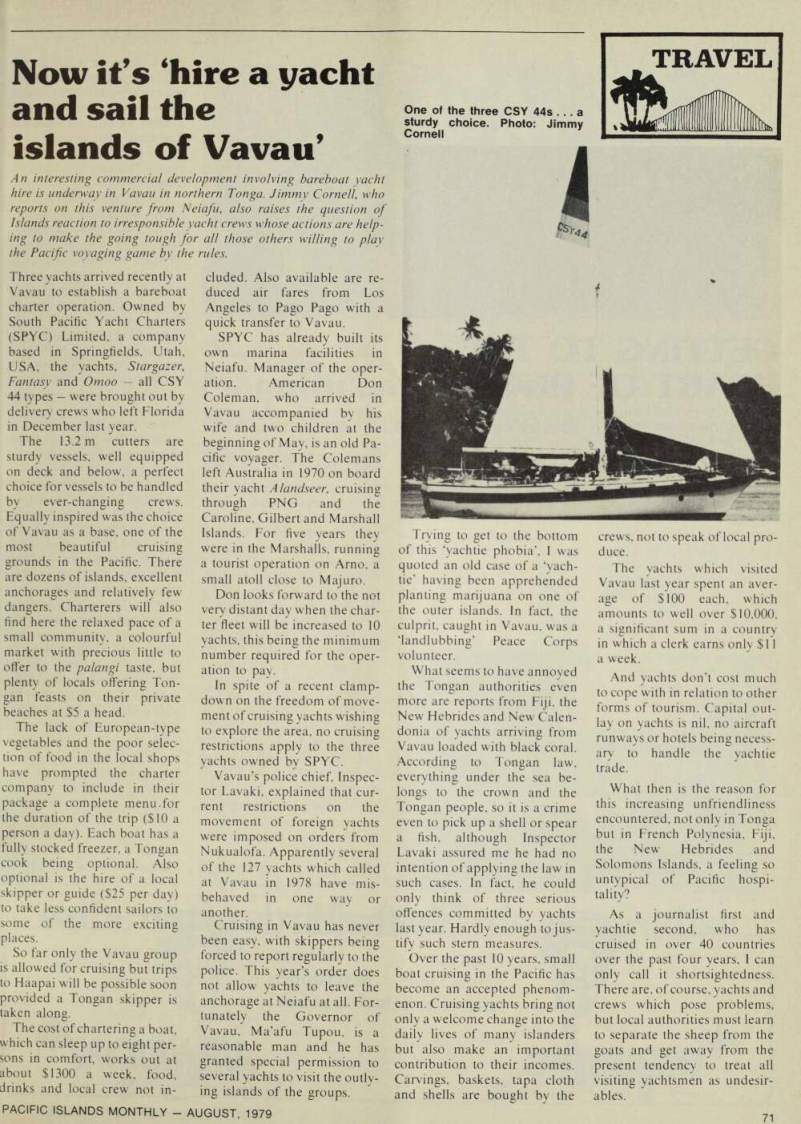
Travel
Now it’s 'hire a yacht and sail the islands of Vavau’
An interesting commercial development involving bareboat yacht hire is underway in Vavau in northern Tonga. Jimmy Cornell, who reports on this venture from Neiafu, also raises the question of Islands reaction to irresponsible yacht crews whose actions are help ing to make the going tough for all those others willing to play the Pacific voyaging game by the rules.
Three yachts arrived recently at Vavau to establish a bareboat
charter operation. Owned by
South Pacific Yacht Charters (SPYC) Limited, a company based in Springfields, Utah, USA, the yachts, Stargazer, Fantasy and Omoo all CSY 44 types were brought out by delivery crews who left Florida in December last year.
The 13.2 m cutters are
sturdy vessels, well equipped
on deck and below, a perfect choice for vessels to be handled
by ever-changing crews.
Equally inspired was the choice of Vavau as a base, one of the most beautiful cruising grounds in the Pacific. There are dozens of islands, excellent
anchorages and relatively few
dangers. Charterers will also find here the relaxed pace of a small community, a colourful market with precious little to offer to the palangi taste, but plenty of locals offering Ton gan feasts on their private beaches at $5 a head.
The lack of European-type vegetables and the poor selec tion of food in the local shops have prompted the charter company to include in their
package a complete menu.for
the duration of the trip ($lO a person a day). Each boat has a fully stocked freezer, a Tongan
cook being optional. Also
optional is the hire of a local
skipper or guide ($25 per day)
to take less confident sailors to some of the more exciting
places.
So far only the Vavau group
is allowed for cruising but trips
to Haapai will be possible soon
provided a Tongan skipper is
taken along.
The cost of chartering a boat, which can sleep up to eight per sons in comfort, works out at about $l3OO a week, food, drinks and local crew not in
eluded. Also available are re duced air fares from Los
Angeles to Pago Pago with a
quick transfer to Vavau.
SPYC has already built its own marina facilities in Neiafu. Manager of the oper ation, American Don Coleman, who arrived in
Vavau accompanied by his
wife and two children at the beginning of May, is an old Pa cific voyager. The Colemans left Australia in 1970 on board
their yacht Alandseer, cruising
through PNG and the Caroline, Gilbert and Marshall Islands. For five years they were in the Marshalls, running a tourist operation on Arno, a small atoll close to Majuro.
Don looks forward to the not very distant day when the char ter fleet will be increased to 10 yachts, this being the minimum number required for the oper ation to pay.
In spite of a recent clamp down on the freedom of move
ment of cruising yachts wishing
to explore the area, no cruising restrictions apply to the three
yachts owned by SPYC.
Vavau’s police chief. Inspec
tor Lavaki. explained that cur rent restrictions on the movement of foreign yachts were imposed on orders from Nukualofa. Apparently several of the 127 yachts which called at Vavau in 1978 have mis behaved in one way or another.
Cruising in Vavau has never been easy, with skippers being forced to report regularly to the police. This year’s order does not allow yachts to leave the anchorage at Neiafu at all. For tunately the Governor of Vavau, Ma’afu Tupou. is a reasonable man and he has
granted special permission to
several yachts to visit the outly ing islands of the groups.
Trying to get to the bottom of this ‘yachtie phobia’, I was quoted an old case of a ‘yach
tie’ having been apprehended
planting marijuana on one of the outer islands. In fact, the culprit, caught in Vavau, was a
‘landlubbing’ Peace Corps
volunteer.
What seems to have annoyed the Tongan authorities even more are reports from Fiji, the New Hebrides and New Calen donia of yachts arriving from Vavau loaded with black coral.
According to Tongan law,
everything under the sea be longs to the crown and the Tongan people, so it is a crime even to pick up a shell or spear
a fish, although Inspector
Lavaki assured me he had no intention of applying the law in such cases. In fact, he could only think of three serious
offences committed by yachts
last year. Hardly enough to jus
tify such stern measures.
Over the past 10 years, small boat cruising in the Pacific has
become an accepted phenom
enon. Cruising yachts bring not
only a welcome change into the daily lives of many islanders but also make an important contribution to their incomes.
Carvings, baskets, tapa cloth and shells are bought by the
crews, not to speak oflocal pro duce.
The yachts which visited Vavau last year spent an aver age of $lOO each, which amounts to well over $lO,OOO, a significant sum in a country in which a clerk earns only $ll a week.
And yachts don’t cost much to cope with in relation to other forms of tourism. Capital out lay on yachts is nil. no aircraft runways or hotels being necess ary to handle the yachtie trade.
What then is the reason for this increasing unfriendliness encountered, not only in Tonga but in French Polynesia, Fiji, the New Hebrides and Solomons Islands, a feeling so
untypical of Pacific hospi
tality?
As a journalist first and yachtie second, who has cruised in over 40 countries over the past four years, I can
only call it shortsightedness.
There are, of course, yachts and crews which pose problems, but local authorities must learn to separate the sheep from the goats and get away from the present tendency to treat all
visiting yachtsmen as undesir
ables.
One of the three CSY 44s ... a sturdy choice. Photo: Jimmy Cornell
Getting To The
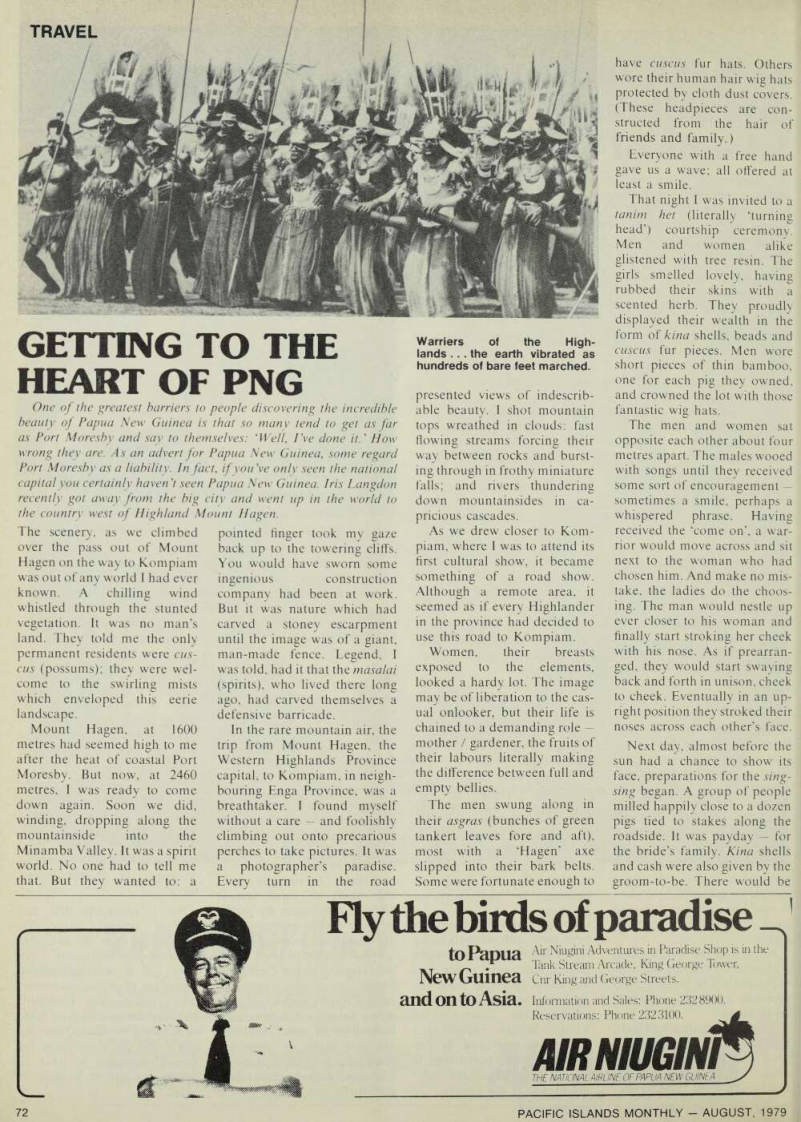
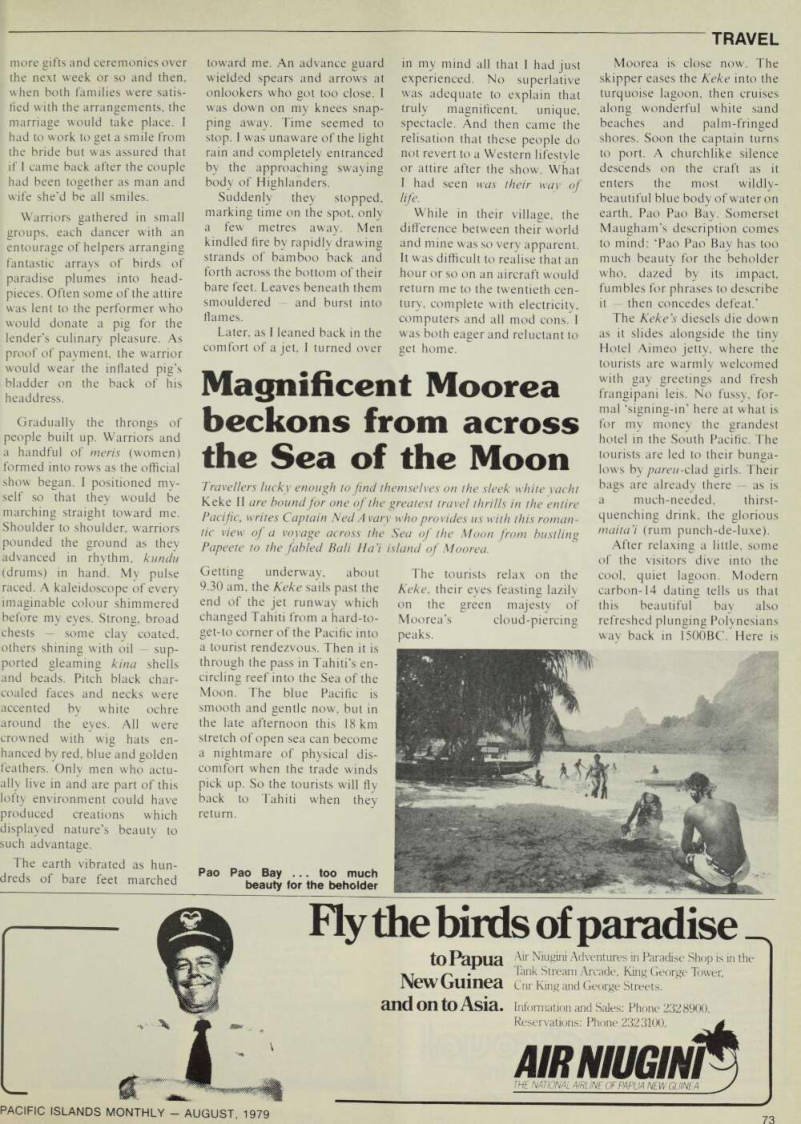
Heart Of Png
One of the greatest barriers to people discovering the incredible beauty of Papua New Guinea is that so many tend to get as far as Port Moresby and say to themselves: ‘Well, I've done it.' How wrong they are. As an advert for Papua New Guinea, some regard Port Moresby as a liability. In fact, if you've only seen the national capital you certainly haven't seen Papua New Guinea. Iris Langdon recently got away from the big city and went up in the world to the country west of Highland Mount Hagen.
The scenery, as we climbed over the pass out of Mount Hagen on the way to Kompiam was out of any world I had ever known. A chilling wind whistled through the stunted vegetation. It was no man’s land. They told me the only permanent residents were cus cus (possums); they were wel come to the swirling mists which enveloped this eerie
landscape.
Mount Hagen, at 1600 metres had seemed high to me after the heat of coastal Port Moresby. But now, at 2460 metres, I was ready to come down again. Soon we did,
winding, dropping along the
mountainside into the Minamba Valley. It was a spirit world. No one had to tell me that. But they wanted to: a
pointed finger took my gaze back up to the towering cliffs.
You would have sworn some
ingenious construction
company had been at work.
But it was nature which had carved a stoney escarpment until the image was of a giant, man-made fence. Legend. I was told, had it that the masalai (spirits), who lived there long ago, had carved themselves a defensive barricade.
In the rare mountain air. the trip from Mount Hagen, the Western Highlands Province
capital, to Kompiam, in neigh
bouring Enga Province, was a breathtaker. I found myself without a care and foolishly
climbing out onto precarious
perches to take pictures. It was
a photographer’s paradise.
Every turn in the road
presented views of indescrib able beauty. I shot mountain tops wreathed in clouds: fast
flowing streams forcing their
way between rocks and burst
ing through in frothy miniature
falls; and rivers thundering down mountainsides in ca
pricious cascades.
As we drew closer to Kom piam, where I was to attend its first cultural show, it became something of a road show.
Although a remote area, it seemed as if every Highlander in the province had decided to use this road to Kompiam.
Women, their breasts exposed to the elements, looked a hardy lot. The image may be of liberation to the cas ual onlooker, but their life is chained to a demanding role mother / gardener, the fruits of
their labours literally making
the difference between full and empty bellies.
The men swung along in their asgras (bunches of green tankert leaves fore and aft), most with a ‘Hagen’ axe slipped into their bark belts.
Some were fortunate enough to
have cuscus fur hats. Others wore their human hair wig hats protected by cloth dust covers. (These headpieces are con structed from the hair of friends and family.) Everyone with a free hand gave us a wave; all offered at least a smile.
That night I was invited to a
tanim het (literally ‘turning
head’) courtship ceremony.
Men and women alike glistened with tree resin. The
girls smelled lovely, having
rubbed their skins with a
scented herb. They proudly
displayed their wealth in the form of kina shells, beads and cuscus fur pieces. Men wore short pieces of thin bamboo, one for each pig they owned, and crowned the lot with those fantastic wig hats.
The men and women sat opposite each other about four metres apart. The males wooed with songs until they received some sort of encouragement sometimes a smile, perhaps a
whispered phrase. Having
received the ‘come on', a war rior would move across and sit next to the woman who had chosen him. And make no mis take, the ladies do the choos ing. The man would nestle up ever closer to his woman and finally start stroking her cheek with his nose. As if prearran
ged. they would start swaying
back and forth in unison, cheek to cheek. Eventually in an up
right position they stroked their
noses across each other’s face.
Next day. almost before the sun had a chance to show its face, preparations for the sing sing began. A group of people milled happily close to a dozen pigs tied to stakes along the roadside. It was payday for the bride’s family. Kina shells and cash were also given by the groom-to-be. There would be
Warriers of the High lands ... the earth vibrated as hundreds of bare feet marched.
more gifts and ceremonies over the next week or so and then, when both families were satis fied with the arrangements, the marriage would take place. I had to work to get a smile from the bride but was assured that if I came back after the couple had been together as man and wife she’d be all smiles.
Warriors gathered in small groups, each dancer with an entourage of helpers arranging fantastic arrays of birds of
paradise plumes into head
pieces. Often some of the attire was lent to the performer who would donate a pig for the lender’s culinary pleasure. As proof of payment, the warrior would wear the inflated pig’s bladder on the back of his headdress.
Gradually the throngs of
people built up. Warriors and a handful of meris (women) formed into rows as the official show began. I positioned my self so that they would be
marching straight toward me.
Shoulder to shoulder, warriors pounded the ground as they advanced in rhythm, kundu (drums) in hand. My pulse raced. A kaleidoscope of every imaginable colour shimmered before my eyes. Strong, broad chests some clay coated, others shining with oil sup ported gleaming kina shells and beads. Pitch black char coaled faces and necks were accented by white ochre around the eyes. All were crowned with wig hats en hanced by red, blue and golden feathers. Only men who actu ally live in and are part of this lofty environment could have produced creations which
displayed nature’s beauty to
such advantage.
The earth vibrated as hun dreds of bare feet marched
toward me. An advance guard wielded spears and arrows at onlookers who got too close. I was down on my knees snap ping away. Time seemed to stop. I was unaware of the light rain and completely entranced
by the approaching swaying
body of Highlanders.
Suddenly they stopped,
marking time on the spot, only a few metres away. Men kindled fire by rapidly drawing strands of bamboo back and forth across the bottom of their bare feet. Leaves beneath them smouldered and burst into flames.
Later, as I leaned back in the comfort of a jet, I turned over
in my mind all that I had just experienced. No superlative was adequate to explain that
truly magnificent. unique,
spectacle. And then came the relisation that these people do not revert to a Western lifestyle or attire after the show. What I had seen was their way of
life.
While in their village, the difference between their world and mine was so very apparent.
It was difficult to realise that an hour or so on an aircraft would return me to the twentieth cen
tury, complete with electricity,
computers and all mod cons. I was both eager and reluctant to get home.
Advertisements & other items, p. 72 (1 item)
Fly the birds of paradise _
Fly the birds of paradise
to PilDUrl Air Niugini Adventures in Paradise Shop is in the y Tank Stream Arcade, King George Tower, New Guinea Cnr King and George Streets. and on to Asia. Information and Sales: Phone 232 8900.
Magnificent Moorea
beckons from across the Sea of the Moon
Travellers lucky enough to find themselves on the sleek w hite vacht Keke II are bound for one of the greatest travel thrills in the entire Pacific, writes Captain Ned A vary who provides us with this roman tic view> of a voyage across the Sea of the Moon from bustling Papeete to the fabled Bali Ha'i island of Moorea.
Getting underway, about
9.30 am. the Keke sails past the end of the jet runway which changed Tahiti from a hard-to get-to corner of the Pacific into a tourist rendezvous. Then it is through the pass in Tahiti’s en circling reef into the Sea of the Moon. The blue Pacific is smooth and gentle now, but in the late afternoon this 18 km stretch of open sea can become a nightmare of physical dis comfort when the trade winds pick up. So the tourists will fly back to Tahiti when they return.
The tourists relax on the Keke , their eyes feasting lazily on the green majesty of Moorea’s cloud-piercing peaks.
Moorea is close now. The skipper eases the Keke into the
turquoise lagoon, then cruises
along wonderful white sand beaches and palm-fringed shores. Soon the captain turns to port. A churchlike silence descends on the craft as it enters the most wildly beautiful blue body of water on earth. Pao Pao Bay. Somerset
Maugham’s description comes
to mind: ‘Pao Pao Bay has too much beauty for the beholder who, dazed by its impact, fumbles for phrases to describe it then concedes defeat.’
The Keke's diesels die down as it slides alongside the tiny Hotel Aimeo jetty, where the tourists are warmly welcomed with gay greetings and fresh frangipani leis. No fussy, for mal ‘signing-in’ here at what is for my money the grandest hotel in the South Pacific. The tourists are led to their bunga lows by pareu- clad girls. Their bags are already there as is a much-needed, thirst
quenching drink, the glorious
maita 7 (rum punch-de-luxe).
After relaxing a little, some of the visitors dive into the
cool, quiet lagoon. Modern
carbon-14 dating tells us that this beautiful bay also
refreshed plunging Polynesians
way back in 1500 BC. Here is
Pao Pao Bay ... too much beauty for the beholder
the secret of Moorea. So little
has changed since Polynesians
first arrived. Even the two ‘civi lised centuries’ since Captain Cook sighted this green jewel have been kind to Moorea.
It being a Wednesday, that night the tourists will enjoy the sumptuous Polynesian feast of the tamaraa, followed by a per formance by temae dancers.
Their performance is unique to the Aimeo.
Moorea is rather heart shaped. There are two routes to attract the tourist, one west, one east. We won’t go clear round the island. This is a hot, dusty waste of time. We’ll con centrate on the north coast, where there are many attrac tions.
The hotel provides push bikes free of charge. For the less active, jeeps can be rented across the road.
First of all let’s head south alongside Pao Pao Bay (also called Cook's Bay) to the mini metropolis of Pao Pao village.
Right out of a Maugham novel! Two Chinese shops ped
dling everything from bikinis
to beer. A tiny clinic, lovely tropical-style school, a rusty old petrol pump, and a couple of slow-moving local charac ters. That’s Pao Pao village, except for the one and only Pao Pao Hotel, locally and lovingly known as One Chicken Inn.
Since the deplorable destruc tion of the world-famous Quinn’s Tahitian Hut on Papeete’s waterfront, the One Chicken Inn on Saturday night steals the South Pacific show for sheer, uninhibited enter tainment. Only then does sleepy Moorea really wake up, as all hell breaks loose at the One Chicken Inn.
Now we press on around the western shore of Pao Pao Bay.
On our right is a lovely, coral white Catholic chapel. You’ll be charmed by this delightful little house of God. Pierre Heyman’s marvellous murals, with brown-skinned Poly
nesians portraying the nativity
scene, are world-renowned.
It’s hot now. We pause at our nearest oasis, the Moorea La goon Hotel. It’s a lovely place, with a pool and lagoonside set ting. Its maita’is hit the spot.
Westward again. The island road gently curves into another deep bay. We stare in wonder, for this Opunohu Bay is as stag geringly beautiful as Pao Pao which we have just left.
On the shores of Opunohu Bay we now discover the tiny,
storybook village of Papetoai.
Here are the rebuilt ruins of the first (1813) Protestant church in the South Pacific. Here also the Temae dancers came to enter tain the first royalty, the Maramas of Moorea, and later the powerful Pomare, who
conquered all the Society
Islands.
At the head of Opunohu Bay we see a wooden sign in the heart-shape of Moorea. It says that this is the inland road to the lovely lookout park of Bel vedere. After checking our Moorea map we also spot this as the forested area of ancient marae (sacred temples).
Up into the green mountains we go on a wonderful, winding road. At the lookout we take in one of the world’s grandest views, of both Pao Pao and
Opunohu bays, the lovely la
goon with its rough reef and the distant Pacific.
Later, visiting one of the sev eral ancient marae in the area,
the gloom surrounding these
semi-restored ruins hauntingly recalls savage spectacles of human sacrifice, royal wed dings, wild and weird religious
rites, and the crowning of
ancient kings.
Soon we are back home at our Aimeo, ready for a lagoon dip, and, of course, another maita V.
Do the things that I’ve de scribed, and also visit the vil lage of Temae, and the Shangri-La of Kia Ora Moorea, and you’ll have seen ‘the best’ of this glorious island.
Moorea numbers about 5 000 uninhibited inhabitants.
They are scattered over the lush lowlands of the island’s 130 square km area. The island road covers 70 memorable kilometres, and the highest cloud-piercing peak is about 1220 metres closer to heaven than you.
Tourists who come to Moorea to be with their own nationals will be more than sat isfied with the Club Med with its rollicking, regimented regime at the western tip of Moorea. But remember, prices at the Bali Ha’i and the Club Med are not cheap.
For the budget-minded here is a highly-unpublicised pair of Moorea secrets: there are two modest, yet very comfortable,
fully-furnished housekeeping
‘motels’ right here. Same view,
same setting, same everything,
except the price. They’re called Chez Albert and Chez Jacqueline.
A word about food: all meals are expensive in French Polynesia. For budgeteers; stay at one of the ‘motels’ men tioned, shop at your local Chinese store, cook your own food. You’ll save a bundle.
Advertisements & other items, pp. 73-76 (1 item)
Airniuginr
X
Fly the birds of paradise
to Papua
New Guinea
and on to Asia.
.Air Niugini Adventures in Paradise Shop is in the Tank Stream Arcade, King George Tower, Cnr King and George Streets.
Information and Sales: Phone 2328900.
Reservations: Phone 2323100. £
AIRNIUGINr
-IE NATIONAL AIRLINE OF PAPUA NEW GUINEA y
When you’re
looking for that
extra touch of class
'H 5* In Brisbane, Melbourne, Adelaide and Canberra, the Parkroyal Motor Inn group offer you that little extra touch of class that has always made them popular with the discerning traveller.
Backed by Travelodge the number one name in accommodation throughout the South Pacific.
Book through Sydney (02) 31 0601 Melbourne (03) 387 1233 Brisbane (07) 221 8586 Darwin (089) 81 5388 Fort Moresby 21 2266 Suva 2 4600 Adelaide (08) 223 6194 Perth (09) 325 3811 Canberra (062) 49 1424 Auckland 3 3749
Motor Inns' 1
PORT MOl
♦ Right in tl business cei * A tradition comfort andifin* food * All rpoms airconditioned * Restaurant * Bai * Banquet hall
*A. C. NEUMANN
manager Phone 21-2622 !lf J 1
Stay at Aggie Grey’s . . . the South Pacific’s
legendary hotel.
Situated right in the heart ot Western Samoa. Enjoy Polynesian-stylc friendliness and service, in cool surroundings, superb entertainment and food.
Magnificent white sand beaches only a short drive away. Airconditioned rooms, swimming pool and full bar facilities.
Bookings through Union Steam ship Company of NZ. Pan Am.
Air New Zealand or direct to Aggie Grey's, Apia. Western Samoa. Cables: ‘AGGIES' Apia.
PS-200T FM/AM Digital Quartz Synthesizer Tuner
L 1 t i -
PS-200C D C Pre Amplifier
Q
PS-200M DC Power Amplifier
Audio & Video
AKAI
PNG.
S.O. Svensson (N.G.) Ltd.
P.O. Box 705, Port Moresby Tel: 2275 Fiji Islands Motibhai &Company Ltd.
P.0.80x 9175, Nadi International Airport Tel: 72-165
AKAI ELECTRIC
Tokyo, Japan
■ -j-pv New Zealand CO., LI D. Pye Ltd., Consumer Products Sector 110 Mt. Eden Rd., Mt. Eden, Auckland Tel: 686-437 New Caledonia M6nard Pacifique s.a.r.l.
B.P. H 2, Noumea Tel: 275222 Tahiti Etablissements Comimpex New Hebrides (Islands) Burns Philp (New Hebrides) Co., Ltd.
P.O. Box 27, Port Vila, New Hebrides Islands Norfolk Island Burns Philp (Norfolk Island) Co., Ltd.
P.O. Box 21, Norfolk Island Samoa Islands Burns Philp (South Sea) Co., Ltd.
P.O. Box 129, Pago Pago, American Samoa Mariana Islands J.C. Tenorio Enterprises P.O. Box 137, Saipan Tel: 6444/8 Solomon Islands Security Electrical Co., Ltd.
P.O. Box 174, Honiara Tel: 881 Cook Islands JPS Enterprises Ltd.
For more information, please send this coupon to our distributor in your country or to AKAI ELECTRIC CO., LTI 12-14,2-Chome, Higashi-Kojiya, Ohta-ku, Tokyo, Japan
■ £ U'
GBOO+S
n
GBOO
Grand Rally
GBOO+S
Grand Prix7o
You can trust Goodyear technology
to give you grip. World champion
racing drivers do. So drive on steel
belted radial car tyres developed by
Goodyear. Built for grip in any
weather. Extra high mileage too.
GOOD-YEAR
The Choice of Champions
GOODYEAR DISTRIBUTORS IN S.E. ASIA AND PACIFIC BASIN
GOODYEAR SUBSIDIARIES
Richard Pieris & Co.. Ltd Colombo, Sri Lanka Nepal Motor Company (P) Ltd Biratnagar, Nepal Navana Ltd.
Dacca, Bangladesh Diethelm & Co.. Ltd.
Bangkok, Thailand Landis Brothers &Co Ltd.
Hong Kong Guam Tire & Supply Co.
Agana, Guam Susupe Enterprises Saipan. Mariana Is.
Microl Corporation Saipan, Mariana Is Truk Trading Co.
Truk E , Caroline Is
RAM.I.
Kolonia, Ponape Island Transport Service Co.
Majuro, Marshall Is.
Yap Cooperative Ass.
Yap, W Caroline Is Cook Islands Motor Centre Ltd.
Rarotonga, Cook Is.
Ngiratkel Etpison Co. Ltd.
Koror. Palau Boroko Motors Ltd Port Moresby, Papua New Guinea Solomon Motors Ltd Honiara, Solomon Is.
Santo Engineers Santo, New Hebrides Pacific Motors Vila. New Hebrides
S.G.A.
Noumea. New Caledonia Duncombe Bay Garage Norfolk Is Coral Island Motors Suva, Fiji Morris Hedslrom Ltd.
Nukualofa, Tonga Morris Hedslrom Ltd.
Apia. Western Samoa Western Samoa Transport Cooperative Society Ltd Apia. Western Samoa Samoa Motors Inc Pago Pago, American Samoa Service Mobil Papeete. Tahiti The Goodyear Tyre & Rubber Co (Aust.) Ltd Sydney. AUSTRALIA Tel: 31-0311 Goodyear India Limited New Delhi 1. INDIA. Tel: 46886/9 PT Goodyear Indonesia Bogor. Republic of Indonesia, Tel: 3371/2 Nippon Goodyear Kabushiki Kaisha Tokyo, JAPAN Tel: 582-0481/8 Goodyear Malaysia Berhad Selangor, MALAYSIA Tel: 362501/5 The Goodyear Tyre & Rubber Co. of New Zealand. Limited Lower Hull. NEW ZEALAND Tel: 684-389 The Goodyear Tyre & Rubber Company of the Philippines. Limited Makati-Metro Manila Republic of the Philippines Tel: 89-20-41 Goodyear Singapore Pvt Limited Geylang SINGAPORE 14, Tel 408281/3 Goodyear Taiwan Limited Taipei, TAIWAN Tel: 5117135/8 Goodyear (Thailand) Limited Bangkok, THAILAND. Tel: 252-6141/5
FOR FURTHER INFORMATION
PLEASE CONTACT
Goodyear International Corporation Room 1603. Wing On Center 111 Connaught Road Central
HONG KONG Tel: 5-433331
HRMEI7I 0252
'conquest' of
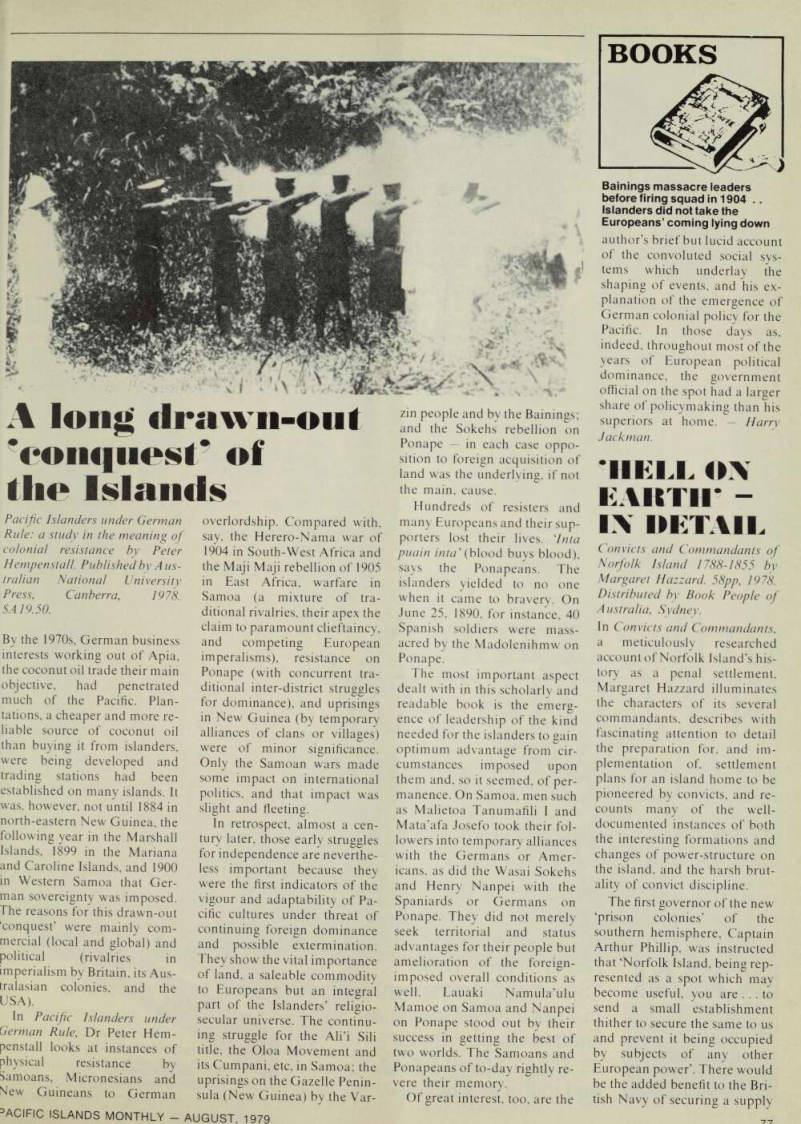
Books
A long drawn-out 'conquest' of the Islands
Pacific Islanders under German Rule: a study in the meaning of colonial resistance by Peter Hempensta/l. Published by A ustralian National University Press, Canberra, 1978. $A 19.50.
By the 19705, German business interests working out of Apia, the coconut oil trade their main objective, had penetrated much of the Pacific. Plantations, a cheaper and more reliable source of coconut oil than buying it from islanders,
were being developed and
trading stations had been established on many islands. It was, however, not until 1884 in north-eastern New Guinea, the following year in the Marshall Islands, 1899 in the Mariana and Caroline Islands, and 1900 in Western Samoa that Ger-
man sovereignty was imposed.
The reasons for this drawn-out
‘conquest’ were mainly com-
mercial (local and global) and political (rivalries in imperialism by Britain, its Australasian colonies, and the In Pacific Islanders under German Rule, Dr Peter Hempenstall looks at instances of
physical resistance by
Samoans, Micronesians and New Guineans to German
zin people and by the Bainings;
and the Sokehs rebellion on Ponape in each case oppo sition to foreign acquisition of land was the underlying, if not the main, cause.
Hundreds of resisters and many Europeans and their sup porters lost their lives. ‘ lnta puain inta’ (blood buys blood), says the Ponapeans. The islanders yielded to no one when it came to bravery. On June 25, 1890, for instance, 40 Spanish soldiers were mass acred by the Madolenihmw on
Ponape.
The most important aspect dealt with in this scholarly and readable book is the emerg ence of leadership of the kind needed for the islanders to gain optimum advantage from cir cumstances imposed upon them and, so it seemed, of per manence. On Samoa, men such as Malietoa Tanumafili I and Mata’afa Josefo took their fol lowers into temporary alliances with the Germans or Amer icans, as did the Wasai Sokehs and Henry Nanpei with the Spaniards or Germans on
Ponape. They did not merely
seek territorial and status advantages for their people but amelioration of the foreign imposed overall conditions as well. Lauaki Namula’ulu Mamoe on Samoa and Nanpei on Ponape stood out by their success in getting the best of two worlds. The Samoans and
Ponapeans of to-day rightly re
vere their memory.
Of great interest, too, are the
overlordship. Compared with.
say, the Herero-Nama war of 1904 in South-West Africa and the Maji Maji rebellion of 1905 in East Africa, warfare in Samoa (a mixture of tra ditional rivalries, their apex the claim to paramount clieftaincy.
and competing European
imperalisms), resistance on Ponape (with concurrent tra ditional inter-district struggles for dominance), and uprisings in New Guinea (by temporary alliances of clans or villages) were of minor significance, Only the Samoan wars made some impact on international politics, and that impact was
slight and fleeting,
In retrospect, almost a cen tury later, those early struggles for independence are neverthe
less important because they
were the first indicators of the vigour and adaptability of Pa cific cultures under threat of
continuing foreign dominance
and possible extermination, They show the vital importance of land, a saleable commodity to Europeans but an integral part of the Islanders’ religio secular universe. The continu ing struggle for the Ali’i Sili title, the Oloa Movement and its Cumpani, etc, in Samoa; the uprisings on the Gazelle Penin sula (New Guinea) by the Var-
author’s brief but lucid account of the convoluted social sys tems which underlay the shaping of events, and his ex planation of the emergence of German colonial policy for the Pacific. In those days as, indeed, throughout most of the
years of European political
dominance, the government official on the spot had a larger share of policymaking than his
superiors at home.
Harry
Jackman.
Bainings massacre leaders before firing squad in 1904 ..
Islanders did not take the Europeans’ coming lying down
Earth
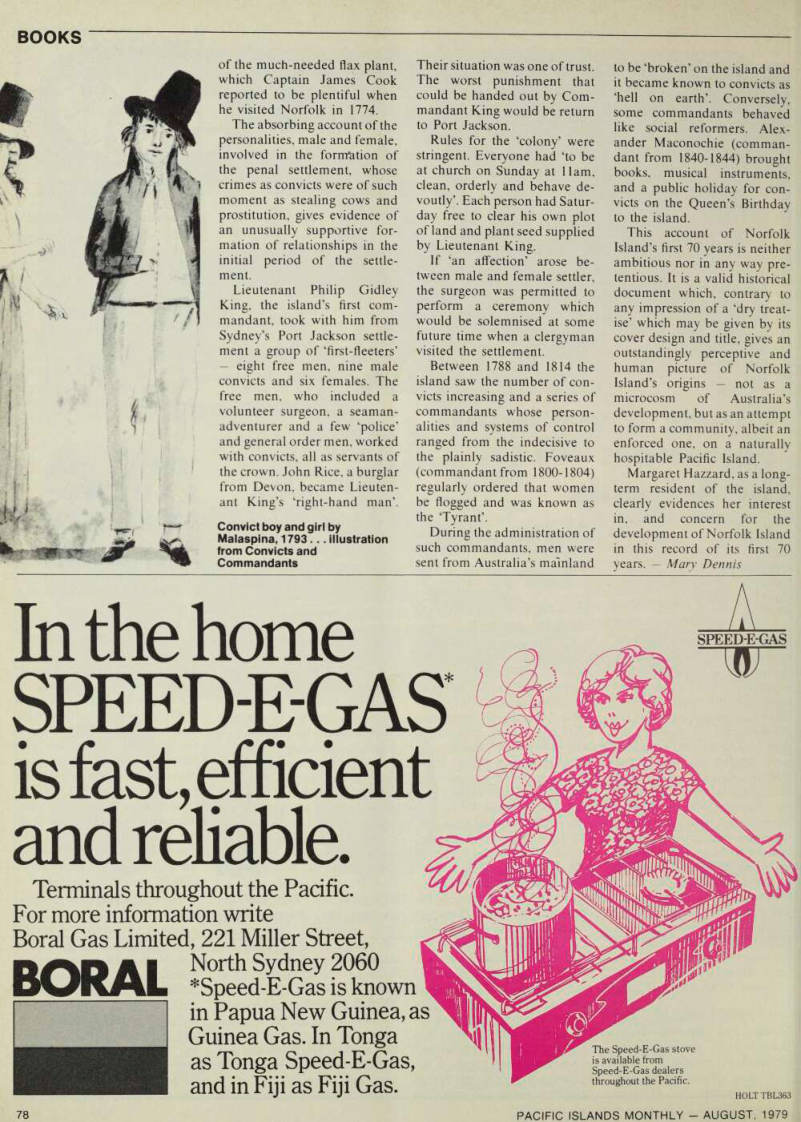
'Hell On
In Detail
Convicts and Commandants of Norfolk Island 1788-1855 by Margaret Hazzard. 58pp, 1978.
Distributed by Book People of
Australia, Sydney.
In Convicts and Commandants, a meticulously researched account of Norfolk Island’s his tory as a penal settlement, Margaret Hazzard illuminates the characters of its several commandants, describes with fascinating attention to detail the preparation for, and im plementation of, settlement plans for an island home to be pioneered by convicts, and re counts many of the well documented instances of both the interesting formations and changes of power-structure on the island, and the harsh brut ality of convict discipline.
The first governor of the new ‘prison colonies’ of the
southern hemisphere, Captain
Arthur Phillip, was instructed that ‘Norfolk Island, being rep resented as a spot which may become useful, you are ... to send a small establishment thither to secure the same to us and prevent it being occupied by subjects of any other European power’. There would be the added benefit to the Bri tish Navy of securing a supply
of the much-needed flax plant, which Captain James Cook reported to be plentiful when he visited Norfolk in 1774.
The absorbing account of the personalities, male and female, involved in the fornTation of the penal settlement, whose crimes as convicts were of such moment as stealing cows and
prostitution, gives evidence of
an unusually supportive for
mation of relationships in the initial period of the settle ment.
Lieutenant Philip Gidley
King, the island’s first com mandant, took with him from Sydney’s Port Jackson settle ment a group of ‘first-fleeters’ eight free men, nine male convicts and six females. The free men, who included a volunteer surgeon, a seaman adventurer and a few ‘police’ and general order men, worked with convicts, all as servants of the crown. John Rice, a burglar from Devon, became Lieuten
ant King’s ‘right-hand man’.
Their situation was one of trust.
The worst punishment that could be handed out by Com mandant King would be return to Port Jackson.
Rules for the ‘colony’ were stringent. Everyone had ‘to be at church on Sunday at 11am, clean, orderly and behave de voutly’. Each person had Satur day free to clear his own plot of land and plant seed supplied
by Lieutenant King.
If ‘an affection’ arose be tween male and female settler, the surgeon was permitted to perform a ceremony which would be solemnised at some future time when a clergyman visited the settlement.
Between 1788 and 1814 the island saw the number of con victs increasing and a series of commandants whose person alities and systems of control ranged from the indecisive to the plainly sadistic. Foveaux (commandant from 1800-1804) regularly ordered that women be flogged and was known as
the ‘Tyrant’.
During the administration of such commandants, men were sent from Australia’s mainland
to be ‘broken’ on the island and it became known to convicts as ‘hell on earth’. Conversely, some commandants behaved like social reformers. Alex ander Maconochie (comman dant from 1840-1844) brought books, musical instruments, and a public holiday for con victs on the Queen’s Birthday to the island.
This account of Norfolk Island’s first 70 years is neither ambitious nor in any way pre tentious. It is a valid historical document which, contrary to any impression of a ‘dry treat ise’ which may be given by its cover design and title, gives an
outstandingly perceptive and
human picture of Norfolk Island’s origins not as a microcosm of Australia’s development, but as an attempt to form a community, albeit an enforced one, on a naturally hospitable Pacific Island.
Margaret Hazzard, as a long term resident of the island, clearly evidences her interest in, and concern for the development of Norfolk Island in this record of its first 70
years.
Mary Dennis
Convict boy and girl by Malaspina, 1793... illustration from Convicts and Commandants
Advertisements & other items, pp. 78-79 (1 item)
and reliable.
In the home
SPEED-E-GAS
is fast, efficient
and reliable.
Terminals throughout the Pacific.
For more information write Boral Gas Limited, 221 Miller Street, North Sydney 2060 *Speed-E-Gas is known in Papua New Guinea, as Guinea Gas. In Tonga
BORAL
Fiji as Fiji Gas
SPEED-E-GAS
The Speed-E-Gas stove is available from Speed-E-Gas dealers throughout the Pacific.
HOLT T8L363
4 4 3 N r - - / m ■ - ■ T N t iV ?*v: 3 as Cathay Pacific. From the heart of Asia.
Cathay Pacific now flies every Sunday at 6.05 p.m. from Port Moresby to Hong Kong. rom Hong Kong, Cathay Pacific flies North, South, East and West serving all the major cities in South-East Asia, Australia and the Middle East. On board you will be cared for by charming Oriental flight-hostesses specially chosen from the countries we serve and by highly experienced British and Australian pilots and flight engineers. Hong Kong's discovery airline Cathay Pacific. Direct from the heart of Asia to the heart of Papua New Guinea. CATHAY
Challenges
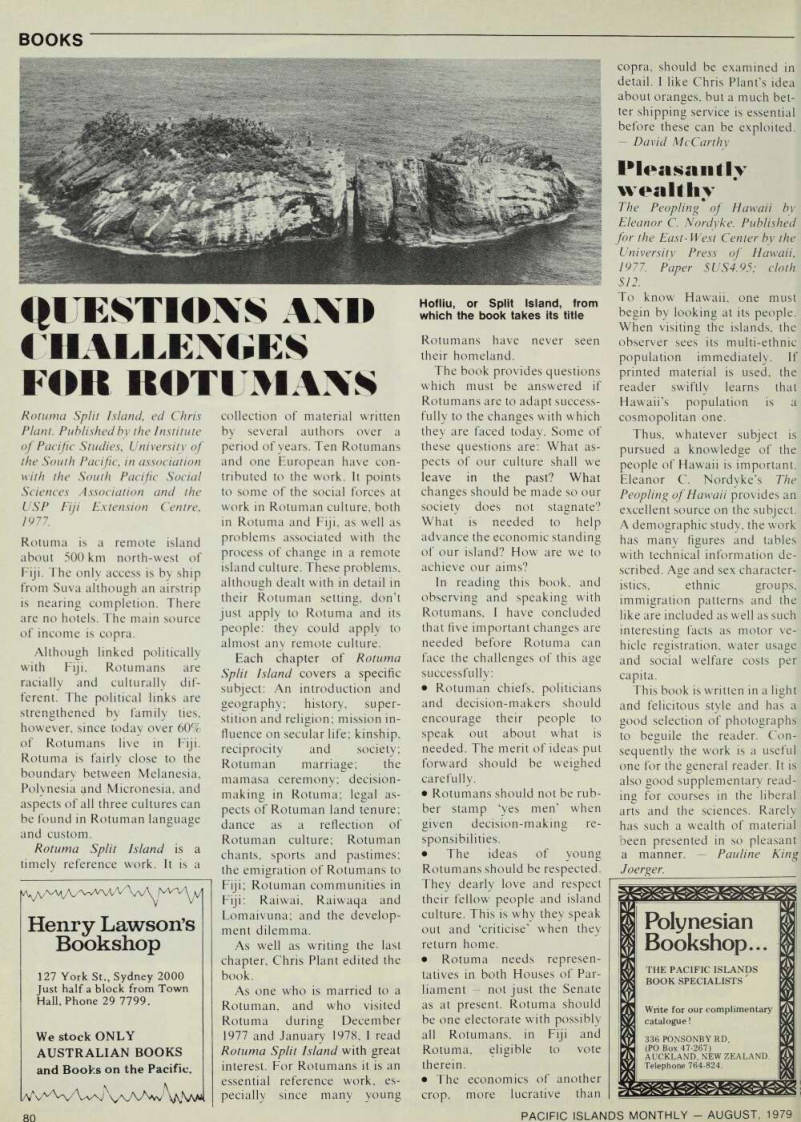
Questions And
For Rotumans
Rotuma Split Island, ed Chris Plant. Published by the Institute
of Pacific Studies, University of
the South Pacific, in association with the South Pacific Social Sciences Association and the USP Fiji Extension Centre, 1977.
Rotuma is a remote island about 500 km north-west of Fiji. The only access is by ship from Suva although an airstrip
is nearing completion. There
are no hotels. The main source of income is copra.
Although linked politically
with Fiji, Rotumans are
racially and culturally dif
ferent. The political links are
strengthened by family ties,
however, since today over 60% of Rotumans live in Fiji.
Rotuma is fairly close to the boundary between Melanesia, Polynesia Micronesia, and aspects of all three cultures can be found in Rotuman language and custom.
Rotuma Split Island is a timely reference work. It is a
collection of material written by several authors over a period of years. Ten Rotumans and one European have con tributed to the work. It points to some of the social forces at work in Rotuman culture, both in Rotuma and Fiji, as well as problems associated with the process of change in a remote island culture. These problems, although dealt with in detail in their Rotuman setting, don’t just apply to Rotuma and its people: they could apply to almost any remote culture.
Each chapter of Rotuma Split Island covers a specific subject: An introduction and
geography; history, super
stition and religion: mission in fluence on secular life; kinship,
reciprocity and society;
Rotuman marriage; the mamasa ceremony; decision making in Rotuma; legal as pects of Rotuman land tenure; dance as a reflection of Rotuman culture; Rotuman chants, sports and pastimes; the emigration of Rotumans to Fiji; Rotuman communities in
Fiji: Raiwai, Raiwaqa and
Lomaivuna; and the develop ment dilemma.
As well as writing the last chapter, Chris Plant edited the book.
As one who is married to a Rotuman, and who visited Rotuma during December 1977 and January 1978, I read Rotuma Split Island with great interest. For Rotumans it is an essential reference work, es pecially since many young
Rotumans have never seen their homeland.
The book provides questions which must be answered if Rotumans are to adapt success fully to the changes with which they are faced today. Some of these questions are: What as pects of our culture shall we leave in the past? What changes should be made so our
society does not stagnate?
What is needed to help advance the economic standing of our island? How are we to achieve our aims?
In reading this book, and
observing and speaking with
Rotumans, I have concluded that five important changes are needed before Rotuma can face the challenges of this age
successfully:
• Rotuman chiefs, politicians and decision-makers should encourage their people to speak out about what is needed. The merit of ideas put forward should be weighed carefully. • Rotumans should not be rub ber stamp ‘yes men’ when given decision-making re
sponsibilities.
• The ideas of young Rotumans should be respected.
They dearly love and respect their fellow people and island culture. This is why they speak out and ‘criticise’ when they return home. • Rotuma needs represen tatives in both Houses of Par liament not just the Senate as at present. Rotuma should be one electorate with possibly all Rotumans, in Fiji and Rotuma, eligible to vote therein. • The economics of another crop, more lucrative than
copra, should be examined in detail. I like Chris Plant’s idea about oranges, but a much bet ter shipping service is essential before these can be exploited.
David McCarthy
Hofliu, or Split Island, from which the book takes its title
Pleasantly
wealthy
The Peopling of Hawaii by Eleanor C. Nordyke. Published for the East- West Center by the University Press of Hawaii, 1977. Paper SUS4.95; cloth $12.
To know Hawaii, one must
begin by looking at its people.
When visiting the islands, the observer sees its multi-ethnic population immediately. If printed material is used, the reader swiftly learns that Hawaii’s population is a cosmopolitan one.
Thus, whatever subject is pursued a knowledge of the people of Hawaii is important.
Eleanor C. Nordyke’s The
Peopling of Hawaii provides an
excellent source on the subject.
A demographic study, the work has many figures and tables with technical information de scribed. Age and sex character istics, ethnic groups, immigration patterns and the like are included as well as such interesting facts as motor ve hicle registration, water usage and social welfare costs per
capita.
This book is written in a light and felicitous style and has a
good selection of photographs
to beguile the reader. Con sequently the work is a useful one for the general reader. It is
also good supplementary read
ing for courses in the liberal arts and the sciences. Rarely has such a wealth of material been presented in so pleasant
a manner.
Pauline King
Joerger.
Advertisements & other items, pp. 80-82 (2 items)
Bookshop...
Polynesian
THE PACIFIC ISLANDS
BOOK SPECIALISTS '
Write for our complimentary catalogue!
336 PONSONBY RD,
(PO Box 47-267)
AUCKLAND, NEW ZEALAND.
Telephone 764-824.
.iff m
1 «««n» •»»*»** . »*WV«
CATEBPi^
«»« J m «i9Mp *5 X : BL - ZA: *i * . * ~4.
CATERPILLAR SKIDDERS ARE BUILTTOUGH
TO STAY ON THE JOB.
MUFFLER
Cat-built Skidders have protection all
round. You get protection for man and
machine with the roll-over canopy and
other machine guarding. And you get
protection against excessive downtime with
dependable CAT construction, CAT dealer
backup and easy on the job maintenance.
THE CATERPILLAR 518 SKIDDER
features 120 flywheel
horsepower @ 2200 rpm,
powered by the Cat 3304
turbocharged engine, with an
operating weight of 20,400 lbs,
turning diameter of 34' 8" and
utilises a Gearmatic 119 winch
with a linepull (max.) of 32,000 lbs.
QUIET OPERATION
You get low noise levels from the 4-stroke cycle diesel, muffler and low-speed fan. You'll hear the difference in Cat-built Skidders.
STRONG DOZER BLADES
deck and bunch logs, clear brush, protect the radiator. The blades are high-strength steel with trunnions that never need greasing. Dozer blades are box-sectioned for greater strength and durability.
LOW RATED RPM
4 STROKE CYCLE DIESEL
MUFFLER LOW-SPEED
FAN RUGGED ARCH AND
FAIRLEAD
stand up under heavy loads.
The main roller is a Lifetime Lubricated hardened casting to reduce scarring that tears up cables. Side rollers are heat-treated for long life.
LOW RATED RPM
FAN
£
fisafpc
HASTINGS DEERING
LAE ;
Milford Haven Telephone 42 2355
PORT MORESBY
Telephone 256650
BOUGAINVILLE .
Itakara Industrial Road, Park.
C
carptrac
SUVA : Carpenter Street, Raiwai.
Private Mail Bag, GPO Suva. Fiji. Ph. 381622, Telex FJ2190 Cables CARPTRAC LAUTOKA : Veitari. Telephone 61877 LABASA : Vulovi, Telephone 81888 Arawa. Telephone 959077 Caterpillar Cat and S are Trademarks of Caterpillar Tractor Co
YOUR
CATERPILLAR
DEALER
BA 10441
I N S T A N T L Y
FROM TWO REACTIVE LIQUIDS IMPORTED
IN SHIPPING DRUMS WHICH EXPAND 30-40
TIMES LIQUID VOLUME WHEN MIXED!
MATERIALS AND A PORTABLE PNEUMATIC
DISPENSING GUN WHICH DOES NOT NEED
A SOLVENT FLUSH AFTER USE AVAILABLE
PROMPTLY FROM . . .
INDUSTRIES
P.O. Box 912, Parramatta, N.S.W. Australia 2150 Telephone (02) 682 1969
COMPARE SHIPPING FOAM SLABS TO
IMPORTING THE CHEMICALS AND THE
INEXPENSIVE DISPENSING EQUIPMENT!
DISTRIBUTOR
REQUIRED
A distributor is required in Noumea for successful International Company which markets high quality maintenance products, ideal for all types of industry and commerce.
This opportunity is suitable for either small-medium sized business looking for expansion, or an ambitious individual who wishes to build up a successful enterprise.
Applicant should write for further details to:
Burwood Industries,
Modern Maintenance Products, P.O. Box 87,
Indooroopilly,
Brisbane, Queensland,
Australia 4068.
Since 1947 . . . . . . sth year in Australia
GOLD
DETECTORS
with enviable history of
AUSTRALIAN GOLD NUGGET FINDS
"The Professionals' Choice . .
GET YOUR
FREE INFORMATION PACKAGE - NOW!
Write or phone the Australian importers:
HENDON DETECTOR COMPANY
TEL: 24 hours 7 DA YS A WEEK - (02)918-6667 Box 155. V. (121 Plateau Rd.), Avalon Beach,
N.S.W. 2107.
\ PEA LER INQU WELCOMED^
r
Henry Lawson’s
Bookshop
127 York St., Sydney 2000 Just half a block from Town Hall. Phone 29 7799.
We stock ONLY
AUSTRALIAN BOOKS
and Books on the Pacific.
Islands
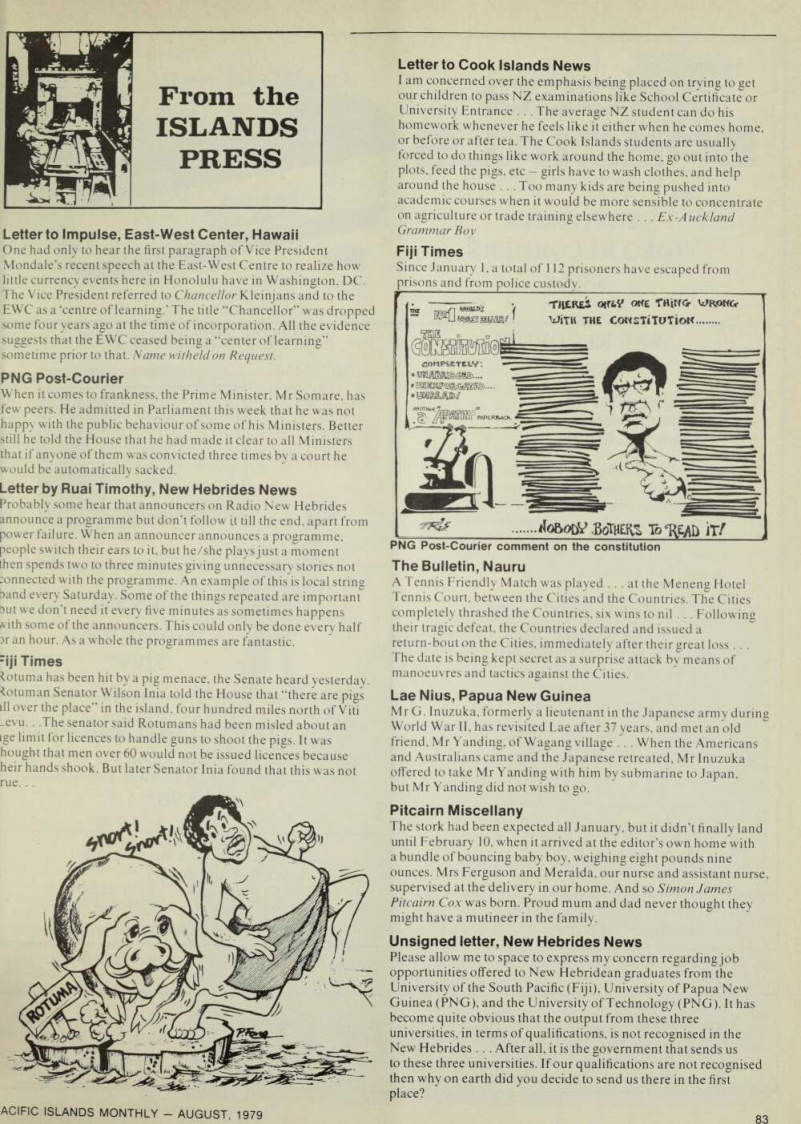
From the
Press
Letter to Impulse, East-West Center, Hawaii One had only to hear the first paragraph of Vice President Mondale’s recent speech at the East-West Centre to realize how little currency events here in Honolulu have in Washington, DC.
The Vice President referred to Chancellor Kleinjans and to the EWC as a ‘centre of learning.’ The title “Chancellor” was dropped some fouryears ago at the time of incorporation. All the evidence suggests that the EWC ceased being a “center of learning” sometime prior to that. Name nit held on Request.
PNG Post-Courier When it comes to frankness, the Prime Minister. Mr Somare. has few peers. He admitted in Parliament this week that he was not happy with the public behaviour of some of his Ministers. Better still he told the House that he had made it clear to all Ministers that if anyone of them was convicted three times by a court he
would be automatically sacked.
Letter by Ruai Timothy, New Hebrides News Probably some hear that announcers on Radio New Hebrides announce a programme but don’t follow it till the end. apart from power failure. When an announcer announces a programme, people switch their ears to it, but he/she plays just a moment then spends two to three minutes giving unnecessary stories not :onnected with the programme. An example of this is local string band every Saturday. Some of the things repeated are important but we don’t need it every five minutes as sometimes happens vith some of the announcers. This could only be done every half 3r an hour. As a whole the programmes are fantastic.
r iji Times
lotuma has been hit by a pig menace, the Senate heard yesterday.
Lotuman Senator Wilson Inia told the House that “there are pigs ill over the place” in the island, four hundred miles north of Viti evu.. .The senator said Rotumans had been misled about an ige limit for licences to handle guns to shoot the pigs. It was bought that men over 60 would not be issued licences because heir hands shook. But later Senator Inia found that this was not rue...
Letter to Cook Islands News I am concerned over the emphasis being placed on trying to get our children to pass NZ examinations like School Certificate or University Entrance . . . The average NZ student can do his homework whenever he feels like it either when he comes home, or before or after tea. The Cook Islands students are usually forced to do things like work around the home, go out into the plots, feed the pigs, etc girls have to wash clothes, and help around the house ... Too many kids are being pushed into academic courses when it would be more sensible to concentrate on agriculture or trade training elsewhere . . . Ex-A uckland
Grammar Boy
Fiji Times
Since January 1. a total of 112 prisoners have escaped from prisons and from police custody.
The Bulletin, Nauru A Tennis Friendly Match was played ... at the Meneng Hotel Tennis Court, between the Cities and the Countries. The Cities completely thrashed the Countries, six wins to nil . . . Following their tragic defeat, the Countries declared and issued a return-bout on the Cities, immediately after their great loss ...
The date is being kept secret as a surprise attack by means of manoeuvres and tactics against the Cities.
Lae Nius, Papua New Guinea Mr G. Inuzuka, formerly a lieutenant in the Japanese army during World War 11, has revisited Lae after 37 years, and met an old friend, Mr Yanding, of Wagang village . . . When the Americans and Australians came and the Japanese retreated. Mr Inuzuka offered to take Mr Yanding with him by submarine to Japan, but Mr Yanding did not wish to go.
Pitcairn Miscellany
The stork had been expected all January, but it didn’t finally land until February 10, when it arrived at the editor’s own home with a bundle of bouncing baby boy, weighing eight pounds nine ounces. Mrs Ferguson and Meralda, our nurse and assistant nurse, supervised at the delivery in our home. And so Simon James Pitcairn Cox was born. Proud mum and dad never thought they might have a mutineer in the family.
Unsigned letter, New Hebrides News Please allow me to space to express my concern regarding job opportunities offered to New Hebridean graduates from the University of the South Pacific (Fiji), University of Papua New Guinea (PNG), and the University of Technology (PNG). It has become quite obvious that the output from these three universities, in terms of qualifications, is not recognised in the New Hebrides. . . After all, it is the government that sends us to these three universities. If our qualifications are not recognised then why on earth did you decide to send us there in the first
place?
PNG Post-Courier comment on the constitution
Advertisements & other items, pp. 83-84 (2 items)
83
ACIFIC ISLANDS MONTHLY AUGUST, 1979
Interscope Pty.Ltd.
VIDEO
SPECIALS
SANYO BETA
VIDEO RECORDERS
sB99*
PRE RECORDED
CASSETTES
YOU'LL NEVER FIND
OUR PROGRAMMES
IN YOUR T.V. GUIDE...
A lot of people believe TV has a nine-yearold mentality. To them there is more to adult programming then "Charlie's Angels".
That's where we come in. Our range of films is a refreshing change from the TV networks roster. Don't be surprised if your TV grows up right before your eyes.
Video Classics are a unique collection of movies on video cassette. Movies you'll never see on television, each one a classic in its own right. Show them to your family and friends in your own home at your convenience. At a cost less than taking the family to the movies.
Video Classic cassettes are all in their original uncut form at broadcast quality. Available in formats to suit...
SANYO TELEVISION
10” $334
(AC/DC)
14” $343 18” $390 20” $506
SANYO
CAMERA
$294*
U-MATIC RELOAD SERVICE
WE WILL RELOAD YOUR OLD U-MATIC CASSETTES WITH NEW SCOTCH VIDEO TAPE AND HUBS $19.90*
U MATIC $125.95
U-DO RELOAD KITS $17.00*
BETA and VHS $69.95
SEND $l.OO FOR COLOUR CASSETTE CATALOGUE
3M BLANK TAPE
U-MATIC KCA 60 $26,00
BETA L5OO $17.56 L 750 $22.75
VHS El2o $20.03 ElBo $24.06
REFUNDABLE WITH YOUR FIRST PURCHASE
WE HAVE BULK PRICES
ALL PRICES QUOTED ARE FOB SYDNEY AND IN AUSTRALIAN DOLLARS. OFFER VALID UNTIL
SEPTEMBER 30th 1979
INTERSCOPE PTY.LTD.
G.P.0., Box 1757,
SYDNEY, N.S.W., 2001.
Phone: 92 1948
Davuilevu—'biggest
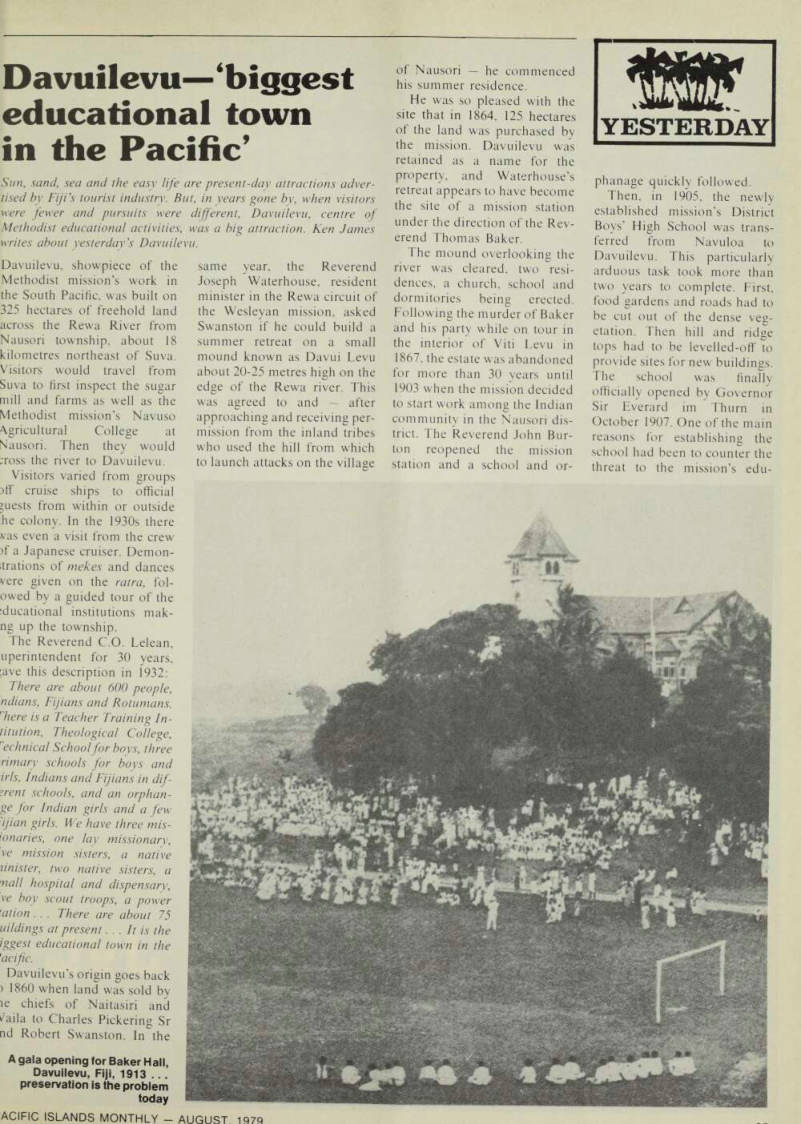
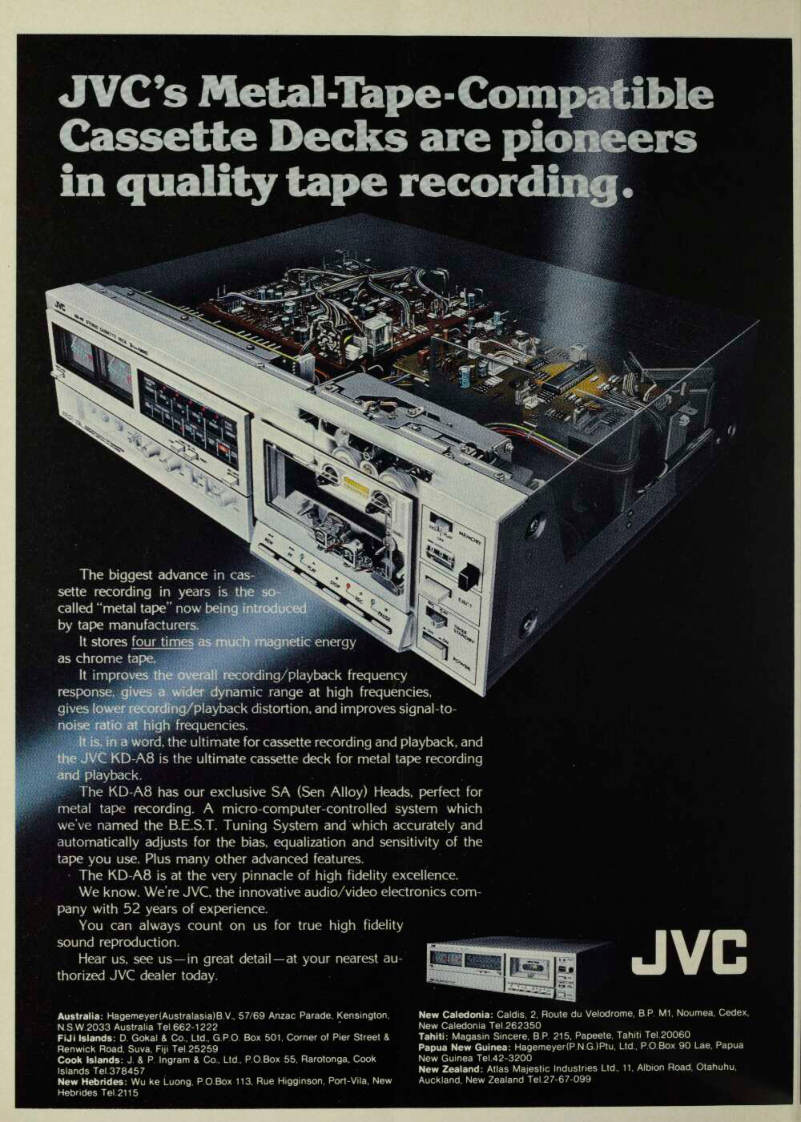
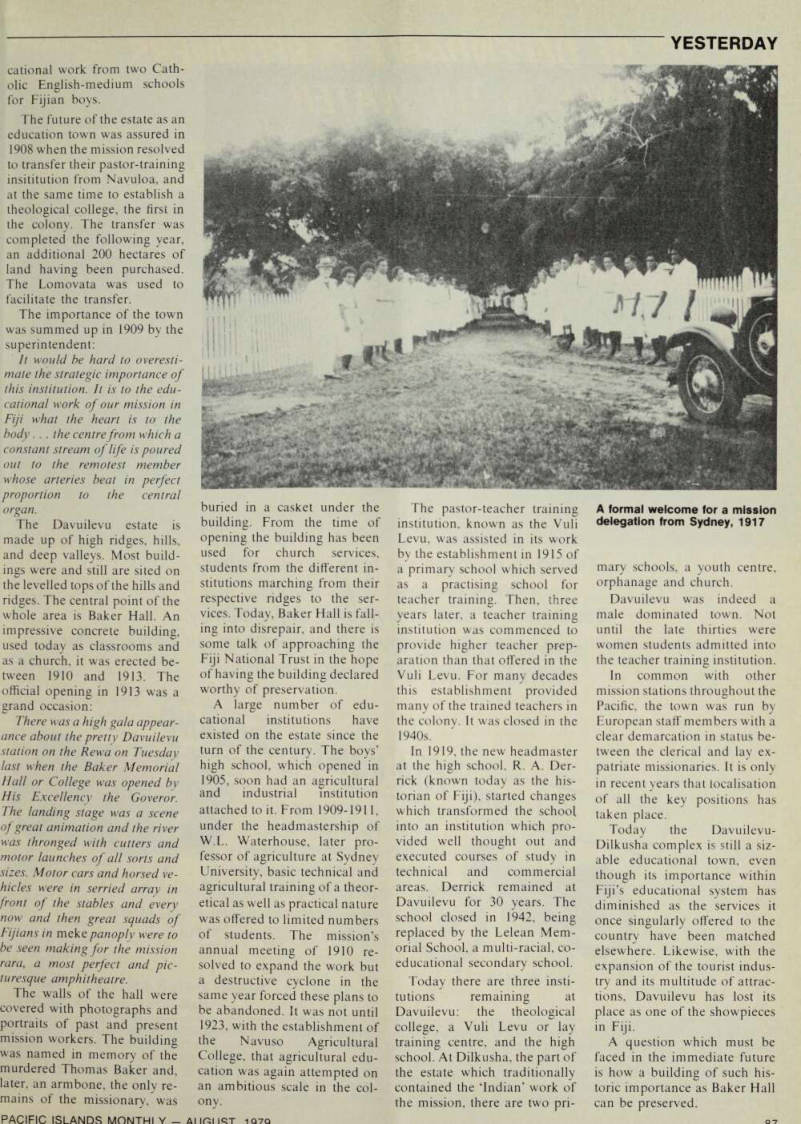
Yesterday
Davuilevu—'biggest educational town in the Pacific’
Sun, sand, sea and the easy life are present-day attractions adver tised by Fiji's tourist industry. But, in years gone by, when visitors were fewer and pursuits were different, Davuilevu, centre of Methodist educational activities, was a big attraction. Ken James writes about yesterday's Davuilevu.
Davuilevu, showpiece of the Methodist mission’s work in the South Pacific, was built on 325 hectares of freehold land across the Rewa River from
Nausori township, about 18
kilometres northeast of Suva.
Visitors would travel from Suva to first inspect the sugar mill and farms as well as the Methodist mission’s Navuso
Agricultural College at
Nausori. Then they would :ross the river to Davuilevu.
Visitors varied from groups )ff cruise ships to official quests from within or outside he colony. In the 1930 s there vas even a visit from the crew )f a Japanese cruiser. Demon ;trations of mekes and dances vere given on the ratra, fol owed by a guided tour of the :ducational institutions mak ng up the township.
The Reverend C.O. Lelean, uperintendent for 30 years, ;ave this description in 1932: There are about 600 people, ndians, Fijians and Rotumans. r here is a Teacher Training In
titution. Theological College,
technical School for boys, three rimary schools for boys and iris, Indians and Fijians in dif ?rent schools, and an orphan ge for Indian girls and a few ijian girls. We have three mis 'onaries, one lay missionary, ve mission sisters, a native unister, two native sisters, a
'nail hospital and dispensary,
ve boy scout troops, a power f ation . . . There are about 75 uildings at present... It is the iggest educational town in the ' acific.
Davuilevu’s origin goes back ) 1860 when land was sold by ie chiefs of Naitasiri and /aila to Charles Pickering Sr nd Robert Swanston. In the
same year, the Reverend Joseph Waterhouse, resident minister in the Rewa circuit of the Wesleyan mission, asked Swanston if he could build a summer retreat on a small mound known as Davui Levu about 20-25 metres high on the edge of the Rewa river. This was agreed to and - after
approaching and receiving per
mission from the inland tribes who used the hill from which to launch attacks on the village
of Nausori he commenced his summer residence.
He was so pleased with the site that in 1864, 125 hectares of the land was purchased by the mission. Davuilevu was retained as a name for the property, and Waterhouse’s retreat appears to have become the site of a mission station under the direction of the Rev erend Thomas Baker.
The mound overlooking the river was cleared, two resi dences, a church, school and dormitories being erected.
Following the murder of Baker and his party while on tour in the interior of Viti Levu in 1867, the estate was abandoned for more than 30 years until 1903 when the mission decided to start work among the Indian community in the Nausori dis trict. The Reverend John Bur ton reopened the mission station and a school and or-
phanage quickly followed.
Then, in 1905, the newly established mission’s District Boys’ High School was trans ferred from Navuloa to Davuilevu. This particularly arduous task took more than two years to complete. First, food gardens and roads had to be cut out of the dense veg etation. Then hill and ridge tops had to be levelled-off to provide sites for new buildings.
The school was finally
officially opened by Governor
Sir Everard im Thurn in October 1907. One of the main reasons for establishing the school had been to counter the threat to the mission’s edu-
A gala opening for Baker Hall, Davuilevu, Fiji, 1913 ... preservation Is the problem today
cational work from two Cath olic English-medium schools for Fijian boys.
The future of the estate as an education town was assured in 1908 when the mission resolved to transfer their pastor-training insititution from Navuloa, and at the same time to establish a theological college, the first in the colony. The transfer was
completed the following year,
an additional 200 hectares of
land having been purchased.
The Lomovata was used to facilitate the transfer.
The importance of the town was summed up in 1909 by the
superintendent:
It would be hard to overesti mate the strategic importance of this institution. It is to the edu cational work of our mission in Fiji what the heart is to the body . . . the centre from which a constant stream of life is poured out to the remotest member whose arteries beat in perfect proportion to the central organ.
The Davuilevu estate is made up of high ridges, hills, and deep valleys. Most build ings were and still are sited on the levelled tops of the hills and ridges. The central point of the whole area is Baker Hall. An
impressive concrete building,
used today as classrooms and as a church, it was erected be tween 1910 and 1913. The official opening in 1913 was a grand occasion: There was a high gala appear ance about the pretty Davuilevu station on the Rewa on Tuesday last when the Baker Memorial
Hall or College was opened by
His Excellency the Goveror.
The landing stage was a scene of great animation and the river was thronged with cutters and motor launches of all sorts and sizes. Motor cars and horsed ve hicles were in serried array in front of the stables and every now and then great squads of Fijians in meke panoply were to
be seen making for the mission
rara, a most perfect and pic
turesque amphitheatre.
The walls of the hall were
covered with photographs and
portraits of past and present
mission workers. The building
was named in memory of the murdered Thomas Baker and. later, an armbone, the only re mains of the missionary, was
buried in a casket under the building. From the time of opening the building has been used for church services, students from the different in stitutions marching from their respective ridges to the ser vices. Today, Baker Hall is fall ing into disrepair, and there is some talk of approaching the Fiji National Trust in the hope of having the building declared
worthy of preservation.
A large number of edu cational institutions have existed on the estate since the turn of the century. The boys’ high school, which opened in 1905, soon had an agricultural and industrial institution attached to it. From 1909-1911, under the headmastership of W.L. Waterhouse, later pro fessor of agriculture at Sydney University, basic technical and agricultural training of a theor etical as well as practical nature was offered to limited numbers of students. The mission’s annual meeting of 1910 re solved to expand the work but a destructive cyclone in the same year forced these plans to be abandoned. It was not until 1923, with the establishment of the Navuso Agricultural
College, that agricultural edu
cation was again attempted on an ambitious scale in the col ony.
The pastor-teacher training institution, known as the Yuli Levu, was assisted in its work by the establishment in 1915 of a primary school which served as a practising school for teacher training. Then, three years later, a teacher training institution was commenced to
provide higher teacher prep
aration than that offered in the Yuli Levu. For many decades this establishment provided many of the trained teachers in the colony. It was closed in the 19405.
In 1919, the new headmaster at the high school, R. A. Der rick (known today as the his torian of Fiji), started changes which transformed the school into an institution which pro vided well thought out and executed courses of study in technical and commercial areas. Derrick remained at Davuilevu for 30 years. The school closed in 1942, being replaced by the Lelean Mem orial School, a multi-racial, co educational secondary school.
Today there are three insti tutions remaining at Davuilevu: the theological college, a Yuli Levu or lay training centre, and the high school. At Dilkusha, the part of the estate which traditionally contained the ‘lndian’ work of the mission, there are two pri
mary schools, a youth centre, orphanage and church.
Davuilevu was indeed a male dominated town. Not until the late thirties were women students admitted into the teacher training institution.
In common with other mission stations throughout the Pacific, the town was run by European staff members with a clear demarcation in status be tween the clerical and lay ex patriate missionaries. It is only in recent years that localisation of all the key positions has
taken place.
Today the Davuilevu- Dilkusha complex is still a siz able educational town, even
though its importance within
Fiji’s educational system has diminished as the services it once singularly offered to the country have been matched elsewhere. Likewise, with the expansion of the tourist indus try and its multitude of attrac tions, Davuilevu has lost its place as one of the showpieces
in Fiji.
A question which must be faced in the immediate future is how a building of such his toric importance as Baker Hall can be preserved.
A formal welcome for a mission delegation from Sydney, 1917
Advertisements & other items, pp. 85-88 (3 items)
Acific Islands Monthly August Iq7Q
85
JVC’s Metal-Tape - Compatible
Cassette Decks are pioneers
in quality tape recordl
it s^r i m & m m & i i ¥ > 0 i* P 9 s c The biggest advance in cas sette recording in years is the socalled "metal tape" now being introduced by tape manufacturers, ■ -iJmm It stores four times as much magnetic energy as chrome tape.
It improves the overall recording/playback frequency response, gives a wider dynamic range at high frequencies, gives lower recording/playback distortion, and improves signal-tonoise ratio at high frequencies.
It is, in a word, the ultimate for cassette recording and playback, and the JVC KD-A8 is the ultimate cassette deck for metal tape recording and playback.
The KD-A8 has our exclusive SA (Sen Alloy) Heads, perfect for metal tape recording. A micro-computer-controlled system which we’ve named the B.E.S.T. Tuning System and which accurately and automatically adjusts for the bias, equalization and sensitivity of the tape you use. Plus many other advanced features.
The KD-A8 is at the very pinnacle of high fidelity excellence.
We know. We're JVC. the innovative audio/video electronics company with 52 years of experience.
You can always count on us for true high fidelity sound reproduction.
Hear us, see us—in great detail—at your nearest authorized JVC dealer today. ... -
JVC
Australia: Hagemeyer(Australasia)B.V.. 57/69 Anzac Parade, Kensington, N.5.W.2033 Australia Te 1.662-1222 Fiji Islands: D. Gokal & Co., Ltd., G.P.O. Box 501, Corner of Pier Street & Renwick Road, Suva, Fiji Te 1.25259 Cook Islands: J. & P. Ingram & Co., Ltd., P.0.80x 55, Rarotonga, Cook Islands Te 1.378457 New Hebrides: Wu ke Luong, P.0.80x 113, Rue Higginson, Port-Vila, New Hebrides Te 1.2115 New Caledonia: Caldis, 2, Route du Velodrome. B.P. Ml, Noumea, Cedex, New Caledonia Te 1.262350 Tahiti: Magasin Sincere, B.P. 215, Papeete, Tahiti Te 1.20060 Papua New Guinea: Hagemeyer(P.N.G.)Ptu, Ltd., P.0.80x 90 Lae, Papua New Guinea Te 1.42-3200 New Zealand: Atlas Majestic Industries Ltd., 11. Albion Road. Otahuhu, Auckland, New Zealand Te 1.27-67-099
A FLEET OF DEPENDABLE PERFORMERS
-FOR POWER IN THE WATER
n?n I w m w v Bl Bf W/ w Taking to the open sea or to calmer waters?
Going for sport or for labor?
Get there and back in style with dependability.
Go with a Suzuki! choose that outboard motor among our powerful fleet,
just matching your boating needs.
pOo*
fob
and
• • Look the into
SUZUKI TS 125
traditional excellence of Suzuki's performance-proven motorcycles and 4-wheel drive vehicles something to satisfy your every motoring need. Going by sea or by land . . . go with a Suzuki.
SUZUKI MOTOR CO, LTD
Hamamatsu, Japan
SUZUKI 4 WHEEL
DRIVE VEHICLE
SUZUKI
SOLOMON ISLANDS SOLOMON ISLAND SERVICE STATION LTD. • NEW CALEDONIA STE. SUPERCAL • PAPUA NEW GUINEA TUTT BRYANT PACIFIC LTD. • NEW HEBRIDES HENRI LEROUX • NIUE ISLAND BURNS PHILP (SOUTH SEA) CO., LTD. • PONAPE LEO ETSCHEIT • TAHITI NIPPON AUTOMOTO • ELLICE ISLAND TUVALU COOPERATIVE WHOLESALE SOCIETY LTD. • GUAM & SAIPAN ISLAND CYCLERY, INC. • NORFOLK MARTIN'S AGENCIES LTD. • SAMOA PACIFIC PRODUCTS, INC. • TARAWA GILBERT ISLANDS COOPERATIVE FEDERATION LIMITED • TONGA MORRIS HEDSTROM LTD. • WESTERN CAROLINES BECHESRRAK T. COMPANY • AMBROSE D. MINGINFEL'S WHOLESALER • EASTERN CAROLINES KIOMASA STORE
Yesterday
87
PACIFIC ISLANDS MONTHI Y ai mi ict iqtq
Start Drilling
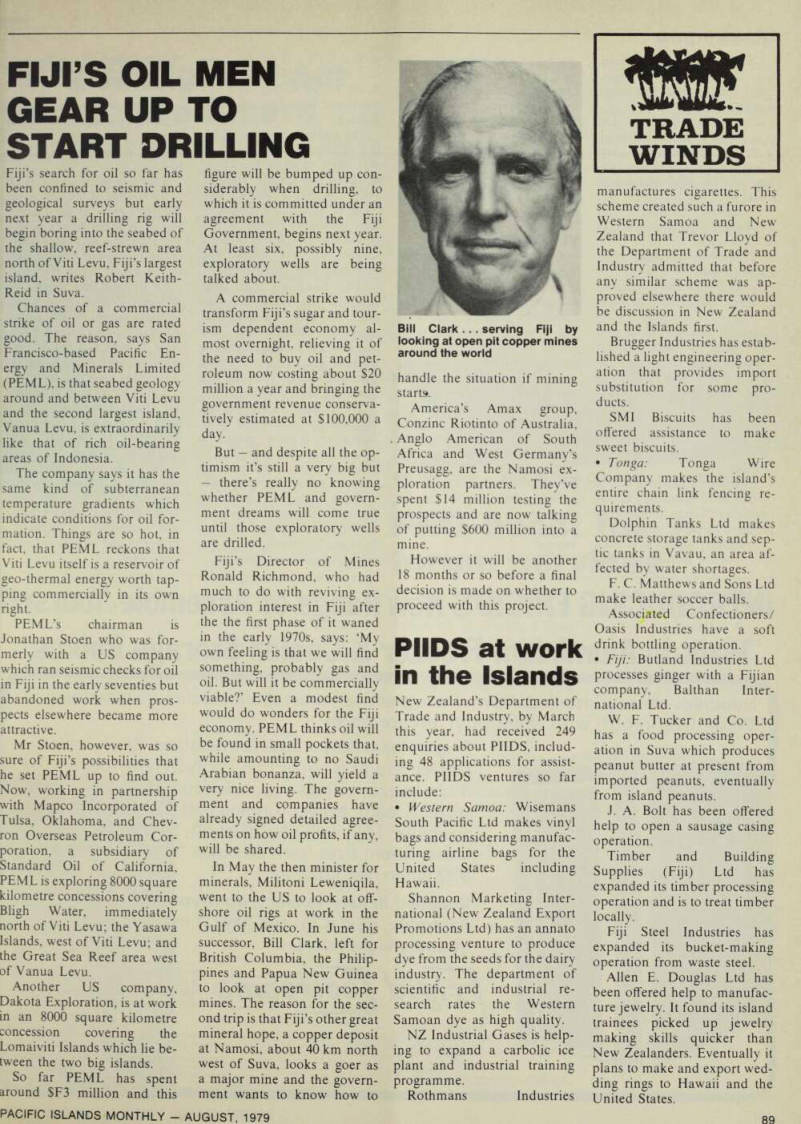

Trade
Winds
Fiji’S Oil Men
Gear Up To
Start Drilling
Fiji’s search for oil so far has been confined to seismic and geological surveys but early next year a drilling rig will begin boring into the seabed of the shallow, reef-strewn area north of Viti Levu, Fiji’s largest island, writes Robert Keith- Reid in Suva.
Chances of a commercial strike of oil or gas are rated good. The reason, says San Francisco-based Pacific En ergy and Minerals Limited (PEML), is that seabed geology around and between Viti Levu and the second largest island, Vanua Levu, is extraordinarily like that of rich oil-bearing areas of Indonesia.
The company says it has the same kind of subterranean temperature gradients which indicate conditions for oil for mation. Things are so hot, in fact, that PEML reckons that Viti Levu itself is a reservoir of geo-thermal energy worth tap ping commercially in its own
right.
PEML’s chairman is Jonathan Stoen who was for merly with a US company which ran seismic checks for oil in Fiji in the early seventies but abandoned work when pros pects elsewhere became more attractive.
Mr Stoen, however, was so sure of Fiji’s possibilities that he set PEML up to find out.
Now, working in partnership
with Mapco Incorporated of Tulsa, Oklahoma, and Chev ron Overseas Petroleum Cor
poration, a subsidiary of
Standard Oil of California, PEML is exploring 8000 square
kilometre concessions covering
Bligh Water, immediately
north of Viti Levu; the Yasawa Islands, west of Viti Levu; and the Great Sea Reef area west of Vanua Levu.
Another US company, Dakota Exploration, is at work in an 8000 square kilometre
concession covering the
Lomaiviti Islands which lie be tween the two big islands.
So far PEML has spent around SF3 million and this
figure will be bumped up con siderably when drilling, to which it is committed under an agreement with the Fiji Government, begins next year.
At least six, possibly nine, exploratory wells are being talked about.
A commercial strike would transform Fiji’s sugar and tour ism dependent economy al most overnight, relieving it of the need to buy oil and pet roleum now costing about $2O million a year and bringing the government revenue conserva tively estimated at $lOO,OOO a
day.
But and despite all the op timism it’s still a very big but there’s really no knowing whether PEML and govern ment dreams will come true until those exploratory wells are drilled.
Fiji’s Director of Mines Ronald Richmond, who had much to do with reviving ex ploration interest in Fiji after the the first phase of it waned in the early 19705, says: ‘My own feeling is that we will find something, probably gas and oil. But will it be commercially viable?’ Even a modest find would do wonders for the Fiji economy. PEML thinks oil will be found in small pockets that, while amounting to no Saudi Arabian bonanza, will yield a very nice living. The govern ment and companies have
already signed detailed agree
ments on how oil profits, if any, will be shared.
In May the then minister for minerals, Militoni Leweniqila, went to the US to look at off shore oil rigs at work in the Gulf of Mexico. In June his successor, Bill Clark, left for British Columbia, the Philip pines and Papua New Guinea to look at open pit copper mines. The reason for the sec ond trip is that Fiji’s other great mineral hope, a copper deposit at Namosi, about 40 km north west of Suva, looks a goer as a major mine and the govern ment wants to know how to
handle the situation if mining starts.
America’s Amax group, Conzinc Riotinto of Australia, Anglo American of South Africa and West Germany’s Preusagg, are the Namosi ex
ploration partners. They’ve
spent $l4 million testing the prospects and are now talking of putting $6OO million into a mine.
However it will be another 18 months or so before a final decision is made on whether to
proceed with this project.
PUDS at work
in the Islands
New Zealand’s Department of Trade and Industry, by March this year, had received 249 enquiries about PUDS, includ ing 48 applications for assist ance. PUDS ventures so far include: • Western Samoa: Wisemans South Pacific Ltd makes vinyl
bags and considering manufac
turing airline bags for the United States including Hawaii.
Shannon Marketing Inter national (New Zealand Export Promotions Ltd) has an annato
processing venture to produce
dye from the seeds for the dairy
industry. The department of
scientific and industrial re search rates the Western
Samoan dye as high quality.
NZ Industrial Gases is help ing to expand a carbolic ice
plant and industrial training
programme.
Rothmans Industries
manufactures cigarettes. This scheme created such a furore in Western Samoa and New Zealand that Trevor Lloyd of the Department of Trade and Industry admitted that before any similar scheme was ap proved elsewhere there would be discussion in New Zealand and the Islands first.
Brugger Industries has estab lished a light engineering oper
ation that provides import
substitution for some pro ducts, SMI Biscuits has been offered assistance to make sweet biscuits.
• Tonga: Tonga Wire
Company makes the island’s entire chain link fencing re
quirements.
Dolphin Tanks Ltd makes concrete storage tanks and sep tic tanks in Vavau, an area af
fected by water shortages.
F. C. Matthews and Sons Ltd make leather soccer balls.
Associated Confectioners/ Oasis Industries have a soft
drink bottling operation.
• Fiji: Butland Industries Ltd processes ginger with a Fijian company, Balthan Inter national Ltd.
W. F. Tucker and Co. Ltd has a food processing oper ation in Suva which produces peanut butter at present from
imported peanuts, eventually
from island peanuts.
J. A. Bolt has been offered help to open a sausage casing
operation.
Timber and Building
Supplies (Fiji) Ltd has
expanded its timber processing
operation and is to treat timber
locally.
Fiji Steel Industries has
expanded its bucket-making
operation from waste steel.
Allen E. Douglas Ltd has been offered help to manufac ture jewelry. It found its island
trainees picked up jewelry
making skills quicker than
New Zealanders. Eventually it plans to make and export wed ding rings to Hawaii and the United States.
Bill Clark ... serving Fiji by
looking at open pit copper mines around the world
• Cook Islands: Mortco Hold ings Ltd manufacture corru gated roofing iron and other
metal products.
• Niue: Niue Products Ltd expanded its softdrink manufacturing operation and opened a coconut cream can ning line for local and export markets.
Astrafine Leather has established a hand-sewn soccer
ball operation.
In addition there has been
approval for;
• Potter Brown Ltd to open an
adhesive manufacturing plant
in Fiji.
• Natural Energy Ltd to pro ceed with a solar heater manufacturing unit that may be based in Western Samoa or Tonga for the Islands and other markets. • Caxton Printing Works Ltd to proceed with a paper
processing operation in West
ern Samoa. • Norsewear Industries Ltd to
open a hand-operated knitting
business in Tonga to market its products in North America.
Feasibility studies have been
approved for storing and dry
ing maize and processing gin
ger in Fiji; manufacturing
chain-link fencing, paint and
more cigarettes in Western Samoa; drying fruit and manufacturing parquet floor ing from coconut palm stems in
Tonga; and opening a sheep
skin clothing operation in
either Fiji or Samoa.
Ideas for the
villagers
‘A business co-operative in the New Hebrides makes soap from coconut oil for home con
sumption. The Community
Education Training Centre in Fiji is using borax and table salt to fix the brilliant colours from hibiscus flowers, wild gin ger and marigolds for use as textile dyes. A common activity in Papua New Guinea is mak
ing wooden roofing shingles.
Niue is investigating the possi
bility of adding local fruit pulp
to coconut cream to make a frozen dessert. Bananas, as well as being dried whole, can be made into sweet chips, powder, flakes, chips flour, pulp and
vinegar..
So begins an enthusiastic re
view in the Cook Islands News of a new publication from the South Pacific Commission, T- Shirts and Tapa Cloth , by Alan Bollard.
The reviewer goes on; ‘This is a handbook, which looks at a number of small businesses
designed for Pacific villages,
but it is not a step-by-step “how-to” book for business men to follow. Rather, it is a collection of experiences in the Pacific to give ideas and introduce new possibilities. ‘The handbook has been
designed for rural develop
ment workers, teachers and extension officers who are involved with rural economic activity, and for government planners who are selecting and
financing rural projects ...
‘At a time when we are increasingly concerned with trying to achieve economic self-reliance we should be thinking about ways to meet our own consumer needs, sub
stituting locally produced
goods for imported ones.’
Copies may be obtained from the Secretariat, South Pa cific Commission, Noumea.
‘WESPAC’ plan
from Perth
The Western Pacific should build its own economic bloc to counter the threat of the world’s established economic blocs.
That was the message of Dr Liu Yat-wing of the East Asian Studies Centre at the Univer sity of Western Australia to a Perth seminar on future politi cal and economic development of the Pacific Basin region.
Dr Liu said that, ideally, the Western Pacific group would include Japan, South Korea, Australia, New Zealand, Papua New Guinea and the ASEAN countries with Hong Kong and Taiwan as associate members.
Calling the group WESPAC, Dr Liu said the economies in such a community ‘are comp lementary in character’ and, together, formed a group ‘which is not only well endowed in natural resources but also one with a large popu lation and the necessary capital and technology to become a powerful and prosperous econ omic bloc’.
Advertisements & other items, p. 90 (1 item)
INTRODUCING FRIGID’S New Range of Assemble-Yourself
Walk-In Aluminium Freezer & Cooler Storage Rooms Hundreds already installed. Now with attractive timber grain aluminium exterior finish, (rust-proof) with white vinyl interior finish.
Frigid Foam Polyurethane insulation. 2" in cooler storage rooms is equal to 5" polystyrene foam. 3" in freezer storage rooms is equal to 8" polystyrene foam. Lower running costs. Best insulation available. Thin wall construction. Save in freight costs. Room sizes from 90 cubic feet (2V2 m 3) to 930 cubic feet (25’/2 m 3).
Supplied in easy-to-erect, do-it-yourself form Assemble, plug it in, and have it in operation in under eight hours!
T 1 Manufactured by:
FRIGID CABINETS PTY. LTD.
14a Duffy Ave., Thornleigh, N.S.W. Aust. 2120. Ph. 848 8292.
AVAILABLE FROM:
AUSTRALIA NEW CALEDONIA EXPORTS, 363 George St., Sydney 2000 BRECKWOLDT & CO., G P.O_Box 5027 Sydney 2001 HAGEMEYER (A'ASIA), 59 Anzac Pde , Kensington 2033. GEOFFREY HUGHES & CO. 167 Macquarie St., Sydney 2000. NE LSON & ROBERTSON PTY. LTD., 197 Clarence St., Sydney 2000. E. RABOT (EXPORTS) PTY LTD 67 Castlereagh St., Sydney 2000. RABTRAD NIUGINI PTY LTD ,P O. Box 1406, Lae.
A RIETTE (PACIFIC) PTY LTD. 20 Loftus St„ Sydney 2000, C, SULLIVAN (EXPORT) PTY. LTD., G.P.O. Box 3373 Sydney 2001 W.S. TAIT & CO. PTY. LTD., 31 Macquarie Place, Sydney 2000.
Cooks’ producers
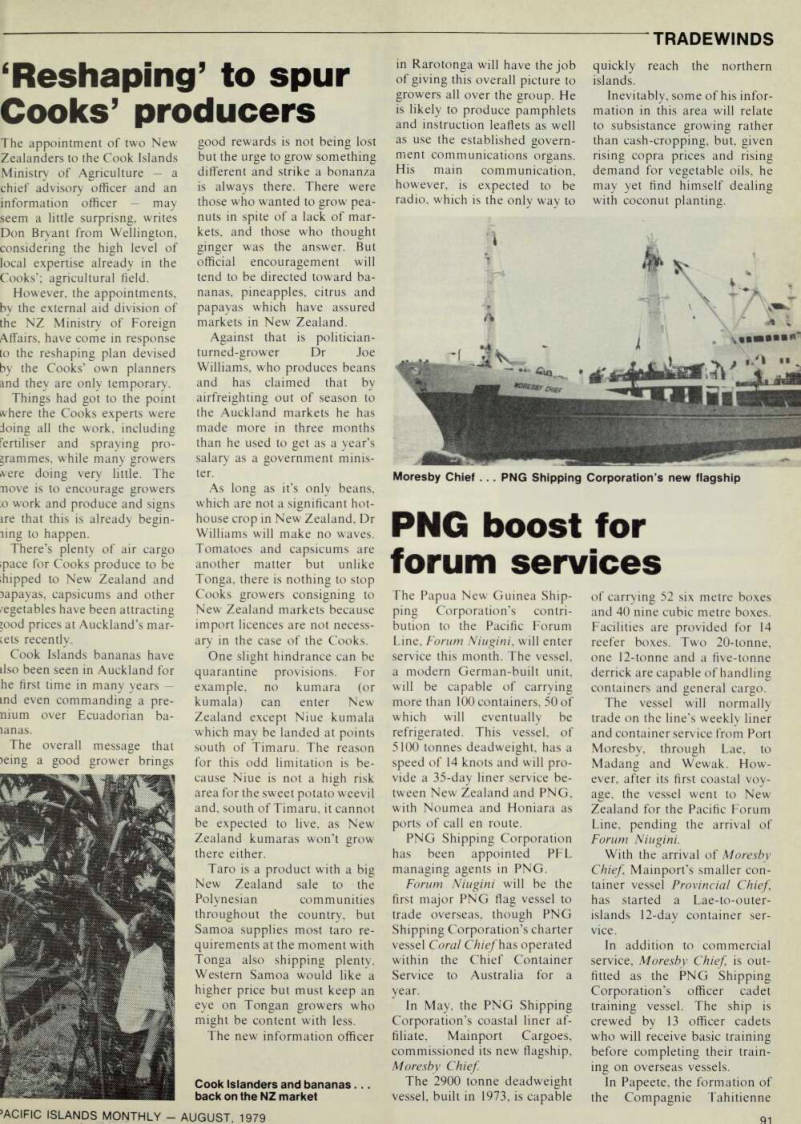
‘Reshaping’ to spur Cooks’ producers
The appointment of two New Zealanders to the Cook Islands Ministry of Agriculture a chief advisory officer and an information officer may seem a little surprisng, writes Don Bryant from Wellington, considering the high level of local expertise already in the Cooks’; agricultural field.
However, the appointments, by the external aid division of
the NZ Ministry of Foreign
Affairs, have come in response
to the reshaping plan devised
by the Cooks’ own planners and they are only temporary.
Things had got to the point where the Cooks experts were doing all the work, including fertiliser and spraying pro grammes, while many growers were doing very little. The nove is to encourage growers ;o work and produce and signs ire that this is already begin
ling to happen.
There’s plenty of air cargo ipace for Cooks produce to be ihipped to New Zealand and aapayas, capsicums and other
vegetables have been attracting
>ood prices at Auckland’s mar kets recently.
Cook Islands bananas have ilso been seen in Auckland for he first time in many years md even commanding a pre nium over Ecuadorian ba tanas.
The overall message that >eing a good grower brings
good rewards is not being lost but the urge to grow something different and strike a bonanza is always there. There were those who wanted to grow pea nuts in spite of a lack of mar kets, and those who thought ginger was the answer. But official encouragement will tend to be directed toward ba nanas, pineapples, citrus and papayas which have assured markets in New Zealand.
Against that is politician
turned-grower Dr Joe Williams, who produces beans and has claimed that by airfreighting out of season to the Auckland markets he has made more in three months than he used to get as a year’s salary as a government minis ter.
As long as it’s only beans, which are not a significant hot house crop in New Zealand. Dr Williams will make no waves.
Tomatoes and capsicums are another matter but unlike Tonga, there is nothing to stop Cooks growers consigning to New Zealand markets because import licences are not necess ary in the case of the Cooks.
One slight hindrance can be
quarantine provisions. For
example, no kumara (or kumala) can enter New Zealand except Niue kumala which may be landed at points south of Timaru. The reason for this odd limitation is be cause Niue is not a high risk area for the sweet potato weevil and. south of Timaru, it cannot be expected to live, as New Zealand kumaras won’t grow there either.
Taro is a product with a big New Zealand sale to the
Polynesian communities
throughout the country, but Samoa supplies most taro re quirements at the moment with
Tonga also shipping plenty.
Western Samoa would like a
higher price but must keep an
eye on Tongan growers who might be content with less.
The new information officer
in Rarotonga will have the job of giving this overall picture to growers all over the group. He is likely to produce pamphlets and instruction leaflets as well as use the established govern ment communications organs.
His main communication, however, is expected to be radio, which is the only way to
quickly reach the northern islands.
Inevitably, some of his infor mation in this area will relate to subsistance growing rather
than cash-cropping, but, given
rising copra prices and rising
demand for vegetable oils, he may yet find himself dealing with coconut planting.
Cook Islanders and bananas... back on the NZ market
forum services

PNG boost for forum services
The Papua New Guinea Ship
ping Corporation’s contri
bution to the Pacific Forum Line, Forum Niugini , will enter service this month. The vessel, a modern German-built unit, will be capable of carrying more than 100 containers, 50 of which will eventually be refrigerated. This vessel, of 5100 tonnes deadweight, has a speed of 14 knots and will pro vide a 35-day liner service be tween New Zealand and PNG, with Noumea and Honiara as ports of call en route.
PNG Shipping Corporation
has been appointed PFL managing agents in PNG.
Forum Niugini will be the first major PNG flag vessel to trade overseas, though PNG
Shipping Corporation’s charter
vessel Coral Chief has operated within the Chief Container Service to Australia for a year.
In May, the PNG Shipping Corporation’s coastal liner af
filiate, Mainport Cargoes,
commissioned its new flagship,
Moresby Chief
The 2900 tonne deadweight vessel, built in 1973, is capable
of carrying 52 six metre boxes and 40 nine cubic metre boxes.
Facilities are provided for 14 reefer boxes. Two 20-tonne, one 12-tonne and a five-tonne derrick are capable of handling containers and general cargo.
The vessel will normally trade on the line’s weekly liner and container service from Port
Moresby, through Lae, to
Madang and Wewak. How ever, after its first coastal voy age, the vessel went to New Zealand for the Pacific Forum Line, pending the arrival of Forum Niugini.
With the arrival of Moresby
Chief ‘ Mainport’s smaller con
tainer vessel Provincial Chief has started a Lae-to-outer islands 12-day container ser vice.
In addition to commercial service, Moresby Chief is out fitted as the PNG Shipping Corporation’s officer cadet training vessel. The ship is crewed by 13 officer cadets who will receive basic training before completing their train ing on overseas vessels.
In Papeete, the formation of the Compagnie Tahitienne
Moresby Chief ... PNG Shipping Corporation’s new flagship
Maritime, Tahiti’s first international shipping line, is expected to boost trade between Trench Polynesia and New Zealand. The company’s first vessel is the Capitaine La Perouse, from Sofrana Unilines, which has been renamed Bounty. Sofrana will be the company’s agents in New Zealand.
XT „ . .
The New Zealand Shipping Corporation which hitherto had provided the only service between NZ and Tahiti, has two vessels on the run, the Tiare Moana and the Fetu Moana which also call at the Moana which also call at the Cook Islands.
This service is run at a loss and has a government subsidy.
Tahitienne Maritime’s entry can only make life harder for
the NZ Shipping Corporation.
The new service was expected
to be in operation before mid-
July.
Another Pacific shipping development recently was the introduction of the 1700-tonne freighter Fijian to the New Zealand-Fiji trade. The Fijian's big attraction is that it can carry up to 10 passengers in twin and single berth cabins.
Sailing mainly between Lau ,oka and Suva m Fiji and Qnehunga in NZ the at times , wi a i so call at other Fiji and a , wha arei D ’
Round trip passenger charges are S NZ63O (share twin basis) and $770 (single cabin). Return sailing time will
be about eight days.
The Fijian, formerly the Shaw Savill Cotswold Prince , is owned by Reef Shipping Agen cies, Auckland.
Advertisements & other items, pp. 91-92 (2 items)
Tradewinds
91
’ACIFIC ISLANDS MONTHLY - AUGUST, 1979
See the experts
FindWeVe
OnThe Ball
atftorkshire Imperial
Quality, reliability and economy are three standards Australian plumbers want most. Yorkshire Imperial knows this and is on the ball when it comes to meeting plumbers’ requests.
Quality control at Yorkshire Imperial most of the company’s capillary fittings are approved to Australian Standard 1585 has always been the best of its kind in the country.
Reliability in meeting supply has always been a by-word of Yorkshire Imperial service.
Economy is afforded through the efficient way Yorkshire Imperial employees face their tasks, helping keep overheads down and prices fair.
The ball’s in your court ask your supplier for Yorkshire Imperial products toctey. YLR7P Full range of capillary fittings tees, elbows, couplings, connectors, reducing pieces, stopends, bushes and nipples plus flared compression fittings, recess cock bodies, Edsun gas cocks, steel pipe unions, flux, asbestos mats, and tap reseating kits.
Supplied direct to all parts of the Pacific by: Yorkshire Imperial Australia Pty. Ltd. 144-154 Milperra Road, Revesby, NSW 2212, Australia. Phone: 02 770561.
Telex: 21517.
YORKSHIRE
IMPERIAL
See the experts
for business anywhere in the South-West Pacific For comprehensive service and advice on trade, both inter-island and with Australia and New Zealand, see the experienced staff at your nearest ANZ branch or agency. We can help you with importing and exporting, business transactions and personal banking. Offices are located at: Suva 128 Victoria Parade and Waimanu Road. Lautoka Naviti Street. Nadi Queen’s Road. Nausori Kings Road. Boroko Hubert Murray Highway. Lae Cnr. Coronation Drive and 7th Street. Madang Lightfoot Arcade, Kasagten Road. Mount Hagen Hagen bKJ fmk Drive. Port Moresby ANG House, Hunter Street. Rabaul Mango Avenue. Waigani Honiara Mendana Avenue. Vila Rue Higginson.
A
BANK
AN7* QQD
Government co-ordination
worries Steamships boss
The effectiveness of adminis trative government in Papua New Guinea is slipping, claims the managing director of the Australia-based Steam ships Trading Company Lim ited, Don Harvey.
In a paper to the PNG Institute of Management, published in mid-June, Mr Harvey praises the orderly manner in which PNG assumed control of its affairs from Australia. But he ex pressed concern that the past five years have seen ‘co ordination and effectiveness disappearing from the national administration’.
Steamships Trading
Company is a major multi interest group operating in PNG. It is engaged in retail ing, service industries, agriculture, shipping and
slipways, cargo handling,
light industry, the automotive
trades, hotels and tourism.
Because of the historical background to investment in PNG, most of the company’s shareholders are in Australia.
But all of its shares are listed on the public market and, un like many other major enterprises in PNG, it is fully controlled in PNG and is not a subsidiary of an Australian company.
Mr Harvey said that de
spite the government’s ex
pensive research into the need for development, invest ment and internal equity, there appeared to be a lack of overall co-ordination and a failure to apply consistent guidelines to the economy.
Referring to his own company, Mr Harvey said great concern was felt at the
oft-quoted phrase ‘foreign
enterprise’. The shares were freely available any day, he said, but the company had to smart under the tag of
‘foreign enterprise’, often
used by people whom, he suspected, did not know what they were talking about. He said he had already told critics: ‘Put your money where your mouth is and you could take control today.’
He said he knew of
companies owned by Papua
New Guineans wanting to invest in Steamships but they were denied this opportunity by the government itself be cause some person in the government classified Steam
ships as ‘foreign’.
‘Surely with this attitude, the government’s policy of “buying back the farm” will never be fulfilled,’ said Mr
Harvey. He said the stability
of Steamships Trading Com
pany shares on the Australian market was long established but there was a low rating out of context with the results.
He saw this not as a reflec tion on the company but on the investment climate of PNG, and this in turn stemmed from government and public attitudes on PNG itself.
On the wider sphere of general management in PNG, Mr Harvey said that the deterioration of law and order was a cause for great concern.
He said that staffing costs were escalating because em
ployees whites or Papua
New Guineans had to be protected from fear and
apprehension. Shoplifting
and theft were on the increase and social responsibility and social consciousness were
disappearing.
Port Moresby, he said, had
become a dirty, untidy city,
and private enterprise was
disheartened when its attempts to upgrade facilities
created vandalism, destruc tion and graffiti.
The slipping of control, he said, was also noticeable in an
increasing lack of discipline
in the workforce. Govern ment had to be looked at as a business, he said, but until all its arms and activities could be co-ordinated im provement could not be
expected.
PNG’s tax man
chasing s2om
Former residents of Papua New Guinea, mainly Aus tralians, have left the country owing $A7.5 million in back taxes. This sum, disclosed in the taxation office’s annual re port, is part of a total overdue tax amounting to nearly $2O million.
The chief collector of taxes said that the amount owed by
people living in Australia,
mainly overdue personal tax,
could not be recovered by any existing standard process be cause ‘our recovery rights do not extend beyond our terri torial boundaries’.
Advertisements & other items, pp. 93-94 (2 items)
Tradewinds
93
ACIFIC ISLANDS MONTHLY - AUGUST 1979
Fasfair Spares
* We Find- Buyand get ■ parts to you
FAST
i AND WE SEND ALL YOUR DOCUMENTS /.
Fasfair Spares
P.O. Box 54, Lutwyche, Brisbane, Queensland, Australia, 4030.
Phone: 57 7600 (3 Lines) Telex: AA 41239
NATIONAL HOUSING
COMMISSION
PAPUA NEW GUINEA
« Our competent and qualified technical staff will design and supervise the construction of your staff housing in Papua New Guinea For further information contact ; General Manager (Technical Division) National Housing Commission P.O. Box 1550 Boroko Papua New Guinea Telephone 253255
. . .TRADEWINDS INTELLIGENCE
DON Adams is Hawaiian Air’s new director of resident sales in Honolulu.
TIM Phillips is British Airways’ new manager in Australia. He is based in Sydney.
TOUA Vai of Hanuabada, Port Moresby, has been appointed company secretary of Burns Philp (New Guinea) Ltd. He joined Burns Philp in 1977.
UNION Steam Ship Co appointed Jackson St Julian to the new post of Pacific region manager. Mr St Julian, formerly manager for Fiji, will remain at Suva but his area of responsibilities will be extended to include the company’s overall shipping and marketing operations in the Fiji, Samoa and Tonga regions.
FIRST quarter 1979 visitor figure to Guam was 67 996 against 63 563 in the same period in 1978. Japanese visitors totalled 50 380 against 44 510 in the same quarter of 1978.
LANDING charges at Nadi International Airport, Fiji, have been cut by 20% which means a 360 tonnes Boeing 747 can now land for SFI9OB against a previous charge of $2124.
WARNER Shipping of Tonga has taken space on the new Sofrana-Uniline vessel Capitaine Cook (No 2) in a slot charter arrangement to carry freight from the major ports of eastern Australia to Tonga.
THE Asian Development Bank has made a concessional loan of SUS 2 million to the Development Bank of Solomon Islands and a concessional loan of $3.45 million to Western Samoa to cover foreign exchange financing of its $4.2 million hydro-electric runof-the-river project on the Vaisigano River near Apia.
LOMAIVUNA farmers in Fiji have recently harvested 90 tonnes of ginger, a 50% improvement on their performance the previous year. The National Marketing Authority buys their product at $F0.26 a kilo.
THE International Monetary Fund has made a soft loan of SSI 1.173 million dollars to Solomon Islands, qualification being the country’s $2 million balance of payments deficit last year.
SPECIALISTS who have studied the requirements for expansion of Papeete’s Faaa Airport have warned: ‘Nineteen-seventy-eight was the year of general planning; 1979 must be the year of the action plan so that 1980 may be the year of action. If not, 1982 could well be the year when it will be too late to do any of the things that ought to have been done before.’
NEW Caledonia’s major company, Societe le Nickel, showed a loss in 1978 of CFP9O9O million (SAI.2 million).
CLUB Mediterranee’s Noumea operation, based on the old Chateau Royal hotel and due to go into action before the year’s end, is already booked out for two years ahead, according to the Noumea paper France Australe. Tourists interested by the venture are mainly Australians (90%) and Japanese (10%). Key attractions, according to the paper, are the facilities offered for windsurfing and hobie-catting.
PACIFIC Energy and Minerals has entered into an agreement with Chevron Overseas Petroleum, a wholly-owned subsidiary of California’s Standard Oil Company, under which Chevron has exercised an option to earn the right to acquire 80% of Pacific’s interest in two offshore oil and gas licences in Fiji totalling about 1.6 million hectares.
RADEWINDS INTELLIGENCE...
Tim Phillips Toua Vai Jackson St Julian
COCOA GROWERS
1 it "A.S.P. Mk 50/300/78 Cocoa Dryer for yearly production to 60 tonnes.”
Whether your production is 30 or 3000 tonnes, A.S.P. has a dryer for you , . . * Diesel or Electric Drive * Delivery ex stock Rabaul or Sydney * Design Service Available Write, phone, call or telex for details A.S.P. Dryers Pty. Ltd. 870 Pacific Highway, Gordon, N.S.W., Australia 2072.
Phone 498-4777. Telex AA23974.
Cables “CHATSPA” Sydney A.S.P. (N.G.) Pty. Ltd., P.O. Box 166, Rabaul, P.N.G.
Phone 92-2411, 92-2649.
Cables “CHATSPA" Rabaul.
Cruising
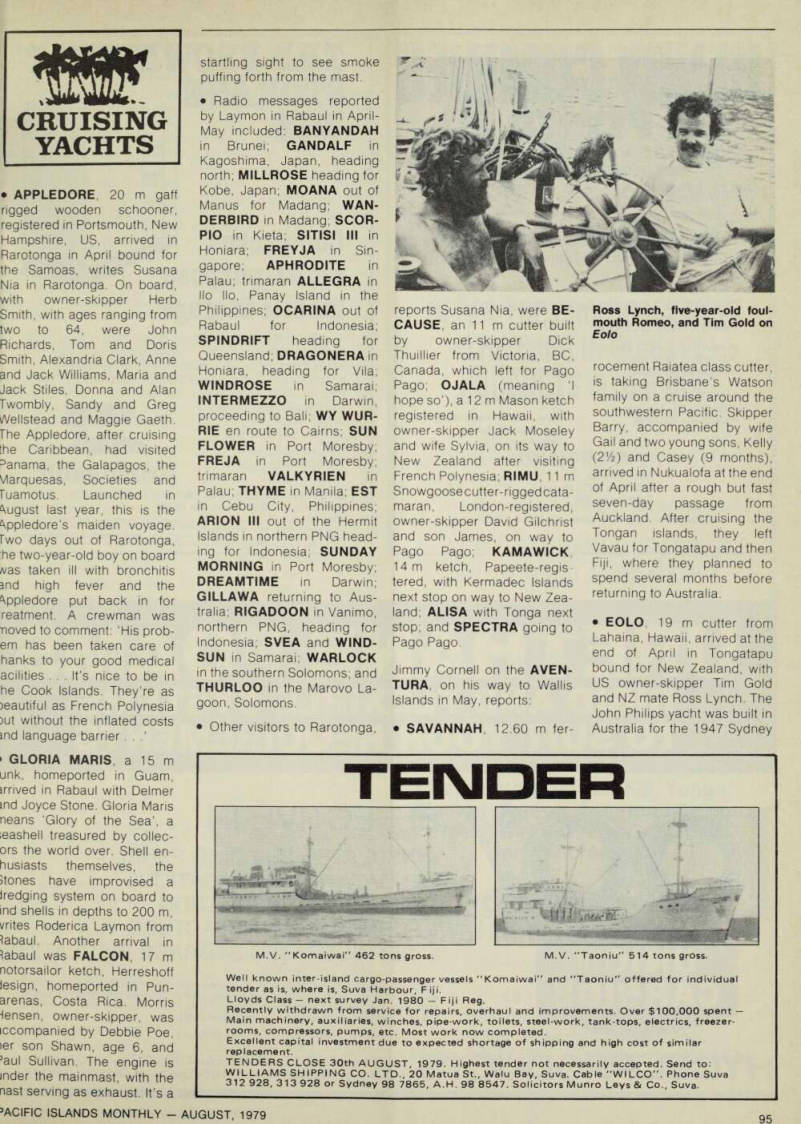


Yachts
• APPLEDORE 20 m gaff rigged wooden schooner, registered in Portsmouth, New Hampshire, US, arrived in Rarotonga in April bound for the Samoas, writes Susana Nia in Rarotonga. On board, with owner-skipper Herb Smith, with ages ranging from two to 64, were John Richards, Tom and Doris Smith, Alexandria Clark, Anne and Jack Williams, Maria and Jack Stiles, Donna and Alan Twombly, Sandy and Greg Wellstead and Maggie Gaeth.
T he Appledore, after cruising the Caribbean, had visited 3 anama, the Galapagos, the Marquesas, Societies and Fuamotus. Launched in last year, this is the maiden voyage.
Fwo days out of Rarotonga, he two-year-old boy on board /vas taken ill with bronchitis and high fever and the Appledore put back in for reatment. A crewman was noved to comment; ‘His prob em has been taken care of hanks to your good medical acilities . . . It’s nice to be in he Cook Islands. They’re as beautiful as French Polynesia )ut without the inflated costs md language barrier
• Gloria Maris, A 15 M
unk, homeported in Guam, arrived in Rabaul with Delmer md Joyce Stone. Gloria Maris neans ‘Glory of the Sea’, a ieashell treasured by collec ors the world over. Shell en husiasts themselves, the >tones have improvised a Iredging system on board to ind shells in depths to 200 m, writes Roderica Laymon from labaul. Another arrival in labaul was FALCON, 17 m notorsailor ketch, Herreshoff lesign, homeported in Pun arenas, Costa Rica. Morris lensen, owner-skipper, was iccompanied by Debbie Poe, ler son Shawn, age 6, and ’aul Sullivan. The engine is mder the mainmast, with the nast serving as exhaust. It’s a
startling sight to see smoke puffing forth from the mast. • Radio messages reported by Laymon in Rabaul in April- May included: BANYANDAH in Brunei: GANDALF in Kagoshima, Japan, heading north; MILLROSE heading for Kobe, Japan; MOANA out of Manus for Madang; WAN DERBIRD in Madang; SCOR PIO in Kieta; SITISI 111 in Honiara: FREYJA in Sin gapore; APHRODITE in Palau; trimaran ALLEGRA in No 110, Panay Island in the Philippines; OCARINA out of Rabaul for Indonesia: SPINDRIFT heading for Queensland; DRAGONERA in Honiara, heading for Vila; WINDROSE in Samarai; INTERMEZZO in Darwin, proceeding to Bali WY WUR RIE en route to Cairns; SUN FLOWER in Port Moresby: FREJA in Port Moresby; trimaran VALKYRIEN in Palau; THYME in Manila; EST in Cebu City, Philippines; ARION 111 out of the Hermit Islands in northern PNG head ing for Indonesia SUNDAY MORNING in Port Moresby; DREAMTIME in Darwin; GILLAWA returning to Aus tralia RIGADOON in Vanimo, northern PNG, heading for Indonesia: SVEA and WIND SUN in Samarai WARLOCK in the southern Solomons; and THURLOO in the Marovo La goon, Solomons. • Other visitors to Rarotonga,
reports Susana Nia, were BE CAUSE. an 11 m cutter built by owner-skipper Dick Thuillier from Victoria, BC, Canada, which left for Pago Pago; OJALA (meaning ‘I hope so’), al2 m Mason ketch registered in Hawaii, with owner-skipper Jack Moseley and wife Sylvia, on its way to New Zealand after visiting French Polynesia; RIMU, 11 m Snowgoosecutter-rigged cata maran, London-registered, owner-skipper David Gilchrist and son James, on way to Pago Pago; KAMAWICK 14 m ketch, Papeete-regis tered, with Kermadec Islands next stop on way to New Zea land ALISA with Tonga next stop; and SPECTRA going to Pago Pago.
Jimmy Cornell on the AVEN TURA on his way to Wallis Islands in May, reports: • SAVANNAH 12.60 m fer
rocement Raiatea class cutter, is taking Brisbane's Watson family on a cruise around the southwestern Pacific. Skipper Barry, accompanied by wife Gail and two young sons, Kelly (2V2) and Casey (9 months), arrived in Nukualofa at the end of April after a rough but fast seven-day passage from Auckland. After cruising the Tongan islands, they left Vavau for Tongatapu and then Fiji, where they planned to spend several months before returning to Australia. • EOLO, 19 m cutter from Lahaina, Hawaii, arrived at the end of April in Tongatapu bound for New Zealand, with US owner-skipper Tim Gold and NZ mate Ross Lynch. The John Philips yacht was built in Australia for the 1947 Sydney
Ross Lynch, five-year-old foul mouth Romeo, and Tim Gold on Eolo
to Hobart Race. Over the past 30 years Eolo has taken part in several races out of Hawaii and California and has also undertaken two Pacific cruises under different owner ship. On the present cruise, Eolo left Hawaii in June 1978 for the Marquesas, Tuamotu and Society Islands. After a brief stopover in the Cooks, Eolo arrived in Nukualofa, her owner planning to sail on to New Zealand for a major refit before continuing to Japan and, hopefully, China. Ross, who describes himself as ‘mul tifunctional’ left home in 1977 on board the yacht SUN SHINE. The last, but not least important member of the crew is five year old Romeo, a parrot with a wide repertoire of whistles and an even better supply of four letter words.
• Morning Star, 21 M
steel schooner from Santa Cruz, California, is cruising the Pacific with a mission. Its crew are members of the Glo bal Youth Evangelism move ment. President Reverend Al Lewis is accompanied by the skipper of Morning Star, Bren dan Baer, his wife, Pat Baer, Mike and Susie Mclntosh.
They left California in July 1978 sailing to Hawaii, then sailing in at ports in American and Western Samoa before 'caching Tonga. The move ment, which is based in Santa Sruz, has followers in Mexico, Canada and Samoa, the mem bers of the organisation songregating in what are ermed as Assemblies of God.
Corning Star’s present mission, says Mr Lewis, is not >o much to attract new fol owers as to encourage and strengthen the missionaries of he Christian faith in the Pa cific area and to help revive he Christian church. So far, le says, they have had an excellent reception every vhere. After Tonga, Morning Star's crew planned to sail to /licronesia, visiting the /larshall Islands, Yap and s alau. • KIANO. For more than 30 'ears Cliff Garvie has been isked by friends when he was joing on his dream cruise, iverytime he replied: ‘Not yet.’
So it’s not surprising he called his dreamboat Kiano, meaning ‘not yet’ in Maori. Not worried by the age-old superstition, Kiano left Auckland on Friday, May 13, bound for Tongatapu.
En route the crew stopped at Raoul Island, in the Ker madecs, diving for several hours among the huge number of fish and several two-metre sharks, intrigued by the strange intruders into their do main. On board the 10.70 m cutter are the skipper’s wife Mona and crew Peter Wilkin son, Peter Worley and Bernie Marshall. Only Bernie was staying on to cruise with the Garvies through Tonga from south to north before heading for Fiji.
• New Morning 13 M
Philip 43 sloop from Dart mouth, England, arrived in Vavau in May from Tahiti. Skip per Philip Wade and wife Sue were delivering New Morning to its Australian owner in Mel bourne. The 24 000 km job started in November in England, from where they sailed to the Canaries, West Indies and Panama. In the Pa cific, New Morning has made stops in Cocos Island, Marquesas, Tuamotus and So ciety Islands. After Vavau the crew were planning to stop in Suva before the final leg to Australia. Skipper Phil is an old salt in the yacht delivery business having completed so far 12 trans-Atlantic deliveries (several from the UK to Brazil), one across the Indian Ocean and one other Pacific delivery. • CASTAWAY, 17 m staysail schooner, provisionally‘based in Suva, Fiji, spent May cruis ing the Tongan islands. On board were US owner Steve Humen, Connie Myers and Fijian crew Jack Wickham.
Steve bought the boat in Tahiti in 1976. During the past three years he has cruised in American Samoa, Tonga and Fiji. Steve Humen is a com mercial diver working on the North Sea oilrigs off the British coast. He commutes regularly between the UK and Fiji, spending his long holidays aboard Castaway. He hopes to take more time off soon and sail to the New Hebrides.
Advertisements & other items, pp. 95-98 (3 items)
95
ACIFIC ISLANDS MONTHLY - AUGUST, 1979
t
ip® i f X \ M.V. "Komaiwai" 462 tons gross.
M.V. "Taoniu" 514 tons gross.
Well known inter-island cargo-passenger vessels "Komaiwai'' and "Taoniu" offered for individual tender as is, where is, Suva Harbour, Fiji.
Lloyds Class next survey Jan. 1980 Fiji Reg.
Recently withdrawn from service for repairs, overhaul and improvements. Over $lOO,OOO spent Main machinery, auxiliaries, winches, pipe-work, toilets, steel-work, tank-tops, electrics, freezerrooms, compressors, pumps, etc. Most work now completed.
Excellent capital investment due to expected shortage of shipping and high cost of similar replacement.
TENDERS CLOSE 30th AUGUST, 1979. Highest tender not necessarily accepted. Send to: WILLIAMS SHIPPING CO. LTD., 20 Matua St., Walu Bay, Suva. Cable "WILCO". Phone Suva 312 928, 313 928 or Sydney 98 7865, A.H. 98 8547. Solicitors Munro Leys & Co., Suva.
HENRY GUMINES
PTY. LTD.
EXPORTERS o GENERAL MERCHANTS
428 GEORGE ST., SYDNEY
CABLES: HENCO SYDNEY. G.P.O. Box 3949. PHONE; 232-5377 For specialised and personalised buying service throughout the Pacific Islands and the East.
• LOCAL AGENTS AND
PAPUA NEW GUINEA:
RABAUL: M. & C. Seeto, P.O. Box 131, Rabaul.
Telephone 92-2919.
REPRESENTATION; •-
FIJI:
K. Witherington Ltd., P.O. Box 293, Suva.
Telephone 22-356.
MADANG: W. Double, P.O. Box 22, Madang.
Telephone 82-2696.
SOLOMON
NEW HEBRIDES:
John Lum & Associates, P.O. Box 65, Santo.
Telephone 329..
ISLANDS.
Mr, Tom Lo, P.O. Box 327, Honiara.
Telephone 399.
Resident Agents in other Pacific Territories.
THE BROWNBUILT
STORAGE
WIZ
Gompactus
multi-purpose
Mobile Storage
Accommodates contents of ten 4-drawer filing cabinets in about half the floor area . . . allowing more profitable use of the space saved. Cabinets roll smoothly apart for instant access. No permanent fixing of tracks to floor.
Ideal for use in multi-storey buildings because of low overall weight. All cabinets lock centrally.
For free expert advice and brochures contact: • Registered Trade Mark .DlXllVllblUXt BROWNBUILT LTD., Cnr. Bath Rd. and Waratah St., Sutherland, N.S.W., Australia 2232.
AGENTS - SOLOMON ISLANDS: NCR Corporation, Honiara. NEW HEBR IDES: NCR Corporation, Vila NEW CALEDONIA: NCR Corporation. Noumea. PNG: Brownbuilt (PNG) Pty, Ltd., Port Moresby & Lae. FIJI: Lysaght Brownbuilt Ind. (Fiji) Ltd., Suva. HAWAII: Records Management Services Inc., Honolulu.
URETHANE FOAMS
RIGID AND FLEXIBLE SYSTEMS
TO SUIT YOUR REQUIREMENTS
OQ
UNION
CARBIDE
EFFECTIVE IN . ..
• INSULATED BUILDING PANELS
• FLOATATION APPLICATIONS
• INDUSTRIAL INSULATION
• FURNITURE MANUFACTURE
• REFRIGERATED STORAGE INSULATION
Rigid Polyurethane Foam made from Hycel Activators and Hycel Resins have proved their worth in the above situations, due to their superior physical properties, including extremely low thermal conductivity factor. Hycel Rigid, Flexible, and Semi-Rigid foams may be adapted to suit your individual needs.
For free technical information write or phone:
HYCEL PRODUCTS
UNION CARBIDE NEW ZEALAND LTD
P.O. Box 33-228. TAKAPUNA, AUCKLAND. TELEPHONE; 449-166
W/y
THE WATER WHEEL GROUP OF COMPANIES,
Winners of Australia’s Top Export Award and Flour Millers for over 100 years,
OFFER THE PACIFIC ISLANDS
THE TOPS IN QUALITY
PRODUCTS & SERVICE
☆ BEST AUSTRALIAN WHEATEN
FLOUR
(Roller, Wholemeal, High Protein, Cake, etc.)
☆ COMPLETE RANGE OF FROZEN
AND GENERAL FOOD ITEMS
☆ STOCK & POULTRY FEEDS
(Pellets or Mash form)
☆ YELLOW SPLIT PEAS & WHOLE
PEAS
(Machined-Dressed) Areas Serviceable are: Papua New Guinea, Fiji, Tonga, Western Samoa, American Samoa, New Hebrides, New Caledonia and Micronesia.
All Enquiries Welcome To:
WATER WHEEL EXPORTS
Pty. Ltd.
493 Bourke Street, Melbourne, 3000, Australia Cables: Watermill-Melbourne.
Telex: AA 32165 Telephone: 602 1433
CAPTAIN W. L KENNEDY PTY. LTD
Brokers for the Sale & Charter of Fishing, Commercial and Pleasure Craft.
(Established 1931)
mmmm mmmm Licensed - Com. Dept. Transport - Carry Passengers Dimensions; 79 x 1 9 6 General Purpose Vessel “MAGUS”
Commissioned 12/1978 Dimensions; 70'x 19' 6"x 7'6 Professionally designed and built in 1969. Twin screw, ea.
D 333 Caterpillar diesels of 190 hpat2,ooo r.p.m. Speed 12 k. 4 cyl. Caterpillardiesel driven 50 KVA alternator. Accommodates 12 passengers in twin and double berth cabins, plus additional accommodation forB persons. Large galley with electric range.
Saloon 25 xl5 with bar. Three refrigerators, including bar, three deep freeze units, incl. one of lOOcu.ft. Radar, SSB radio, (radphone), Depth recorder, Auto pilot and every required fitting.
Working Barrier Reef area, but Certificate permits if wanted, to work Australia wide or even overseas. This could be a sound financial proposition, or opportunity for a sea lover to earn a good return in relaxing surroundings.
Price: $425,000
Built of heavy steel to high standards. Completely Dimet treated. Main engine is Lister Blackstone, bridge controlled. 1 60 BMP @ 600 r.p.m. giving 9 kon consumption 4.5 g.p.h. Fuel cap. 5,000 gls. Water 2,000 gls. 3 cyl. Perkins driving refrig, compressor and hydraulic pump. 2 cyl Petters drives 12.5 KVA alternator and small Petters drives air compressor. Two large refrig, spray brine tanks for product, plus dry hold. Hydraulic winch and line hauler. 4 single cabins, two twin cabins, large galley mess plus large saloon. Equipment includes 48 ml Radar, Weather fascimilator, three depth recorders, SSB Radio and spare, Auto Pilot, Clear View screen. Fully equipped with large inventory.
The owner-builders of this fine vessel will negotiate to modify the vessel to suit the trade of prospective purchaser.
Price: $375,000
For further particulars and inspection, refer to: Phone; Sydney 27 3797
Captain W.L. Kennedy Pty. Ltd.,
32 Bridge Street, Sydney.
Telex: AA22333
|Q|B|E
offers expert insurance service
throughout the Islands.
QBE INSURANCE LIMITED
Central Office: 82 Pitt Street, Sydney.
NEW CALEDONIA - T.A. Hagen , Ste. I/V.A. Johnston, S.A.R.L. • Noumea.
NEW HEBRIDES - Manager: G.F. Donnelly, Vila; Santo Santr: Burns Philp (New Hebrides) Ltd.
TAHITI - Arthur Chung: Immeub/e 8.1., Front de Mer, Papeete.
NIUE, NORFOLK ISLAND, SAMOA, TONGA and other South Sea Islands - Burns Philp (South Sea) Company Ltd.
QUEENSLAND INSURANCE (FIJI) LIMITED
Head Office, 34 Usher St., SUVA, General Manager: L.G. Liddell. A.A.1.1.
Assistant Managers: Vijay Lal and J.T. Laidlaw. LAUTOKA Office, Burns Philp Bldg. District Manager: J. Dalton.
QUEENSLAND INSURANCE (RN.C.) LIMITED
PAPUA NEW GUINEA -
Head Office, PORT MORESBY. General Manager; J.M, Dawe. Assistant Manager: R.V. Maskell.
District Managers at; LAE; I.R. Martin. MOUNT HAGEN: D.F. Carroll, ARAWA: J Longbut. MADANG R.W.V. Collmgs. RABAUL: W.F. Tinker.
97
YACHTS
'ACIFIC ISLANDS MONTHLY AUGUST, 1979
Deaths
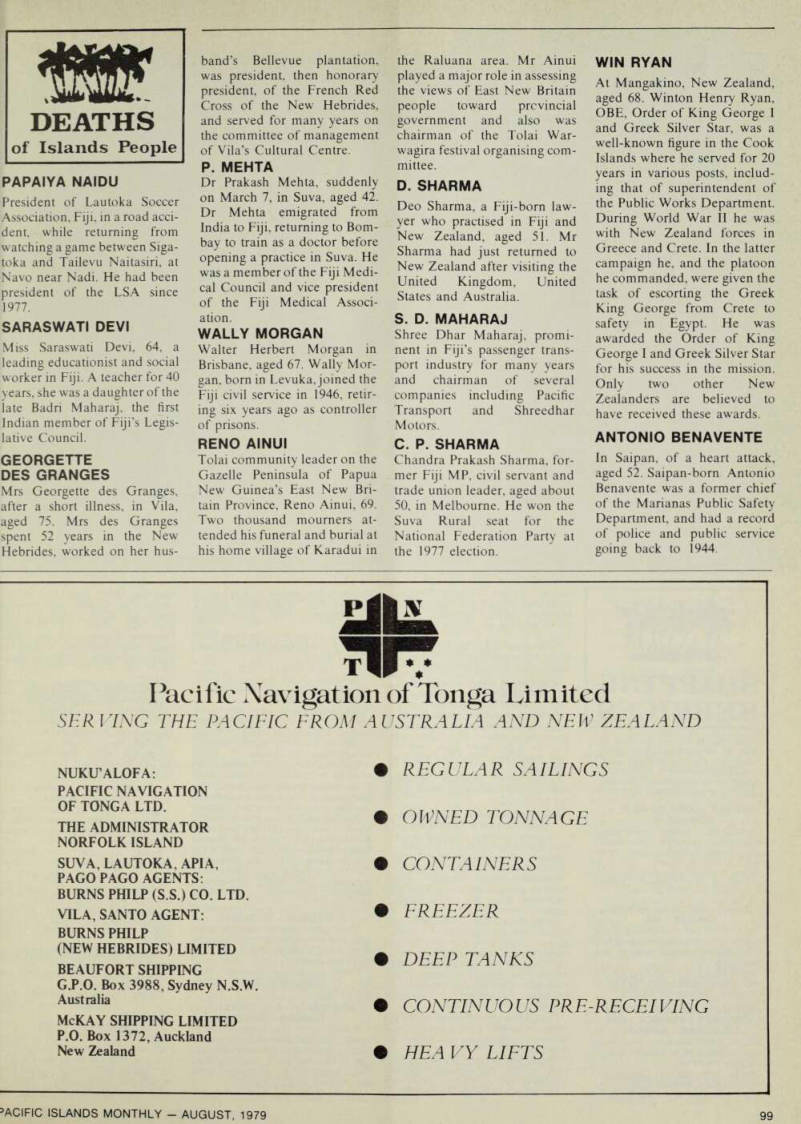
of Islands People
Papaiya Naidu
President of Lautoka Soccer Association, Fiji, in a road acci dent, while returning from watching a game between Siga toka and Tailevu Naitasiri, at Navo near Nadi. He had been president of the LSA since 1977.
Saraswati Devi
Miss Saraswati Devi, 64, a leading educationist and social worker in Fiji. A teacher for 40 years, she was a daughter of the late Badri Maharaj, the first Indian member of Fiji’s Legis lative Council.
Georgette
Des Granges
Mrs Georgette des Granges,
after a short illness, in Vila, aged 75. Mrs des Granges spent 52 years in the New Hebrides, worked on her hus
band’s Bellevue plantation, was president, then honorary president, of the French Red Cross of the New Hebrides, and served for many years on the committee of management of Vila’s Cultural Centre.
P. Mehta
Dr Prakash Mehta, suddenly on March 7, in Suva, aged 42.
Dr Mehta emigrated from India to Fiji, returning to Bom bay to train as a doctor before opening a practice in Suva. He was a member of the Fiji Medi cal Council and vice president of the Fiji Medical Associ ation.
Wally Morgan
Walter Herbert Morgan in Brisbane, aged 67. Wally Mor gan, bom in Levuka, joined the Fiji civil service in 1946, retir ing six years ago as controller
of prisons.
Reno Ainui
Tolai community leader on the Gazelle Peninsula of Papua New Guinea’s East New Bri tain Province. Reno Ainui, 69.
Two thousand mourners at tended his funeral and burial at his home village of Karadui in
the Raluana area. Mr Ainui
played a major role in assessing
the views of East New Britain
people toward provincial
government and also was chairman of the Tolai War
wagira festival organising com
mittee.
D. Sharma
Deo Sharma, a Fiji-born law yer who practised in Fiji and New Zealand, aged 51. Mr Sharma had just returned to New Zealand after visiting the United Kingdom, United States and Australia.
S. D. Maharaj
Shree Dhar Maharaj, promi nent in Fiji’s passenger trans port industry for many years and chairman of several
companies including Pacific
Transport and Shreedhar Motors.
C. P. Sharma
Chandra Prakash Sharma, for mer Fiji MP, civil servant and trade union leader, aged about 50, in Melbourne. He won the Suva Rural seat for the National Federation Party at the 1977 election.
Win Ryan
At Mangakino, New Zealand, aged 68. Winton Henry Ryan, OBE, Order of King George I and Greek Silver Star, was a well-known figure in the Cook Islands where he served for 20 years in various posts, includ ing that of superintendent of the Public Works Department.
During World War II he was with New Zealand forces in Greece and Crete. In the latter campaign he, and the platoon he commanded, were given the task of escorting the Greek King George from Crete to safety in Egypt. He was awarded the Order of King George I and Greek Silver Star for his success in the mission.
Only two other New Zealanders are believed to have received these awards.
Antonio Benavente
In Saipan, of a heart attack,
aged 52. Saipan-born Antonio
Benavente was a former chief of the Marianas Public Safety Department, and had a record of police and public service going back to 1944.
Advertisements & other items, pp. 99-101 (1 item)
Pacific Navigation of Tonga Limited
SERVING THE PACIFIC FROM AUSTRALIA AND NEW ZEALAND
There is more time to rei
i \ t V,- 4 K % For more information contact: • Kelvinator Australia Limited . . . Adelaide, South Australia • Truk Cooperative Association . .. Truk, Eastern Caroline Islands • Berm Inc. . . Yap District, Western Caroline Islands • Cook Islands Trading Corporation , Ltd.. . Rarotonga, Cook Islands • Carpenters Fiji Lin Enterprises .. . Majuro, Marshall Islands • Electric Radio Noumea .. . Noumea, New Caledonia • Pentecost Pacific SA. . . Port-Vila, 3 Pacific Traders , Inc. . . Pago Pago, American Samoa • Motor Distributors (Samoa) Ltd. . . Apia, Western Samoa • Guadalcanal Elec
vhen you own a Kelvinator
Refrigerators, Freezers, Gas and Electric Ranges, Air Conditioners, Automatic Washers and Dryers, Wringer Washers, Microwave Ovens, Humidifiers, Dehumidifiers, Water Coolers, Commercial Air Conditioners and Refrigerators.
QBQ 1
%sm mcam ■n
mTERJVAT/OJVALCOM PAM s
Kelvinator International Company. P.O. Box 9200. Grand Rapids, Michigan 49509, U.S.A. rprises . . . Ponape, Eastern Caroline Islands • Western Carolines Trading Co. . . Palau, Western Caroline Islands • Family Chain Stores, iuva, Fiji • Pacific International Co., Inc. . . Agana, Guam • M.S. Villagomez Enterprises ... Saipan, Mariana Islands • Robert Reimers ides • Fisher & Paykel Ltd. . . Panmure, New Zealand • Bums Philp (New Guinea) Ltd. . . Port Moresby. Papua New Guinea • South . Honiara, Solomon Islands • Ets. Rene Solari etFils . . . Papeete, Tahiti • E.M. Jones . . . Nukualofa, Tonga
Shipping


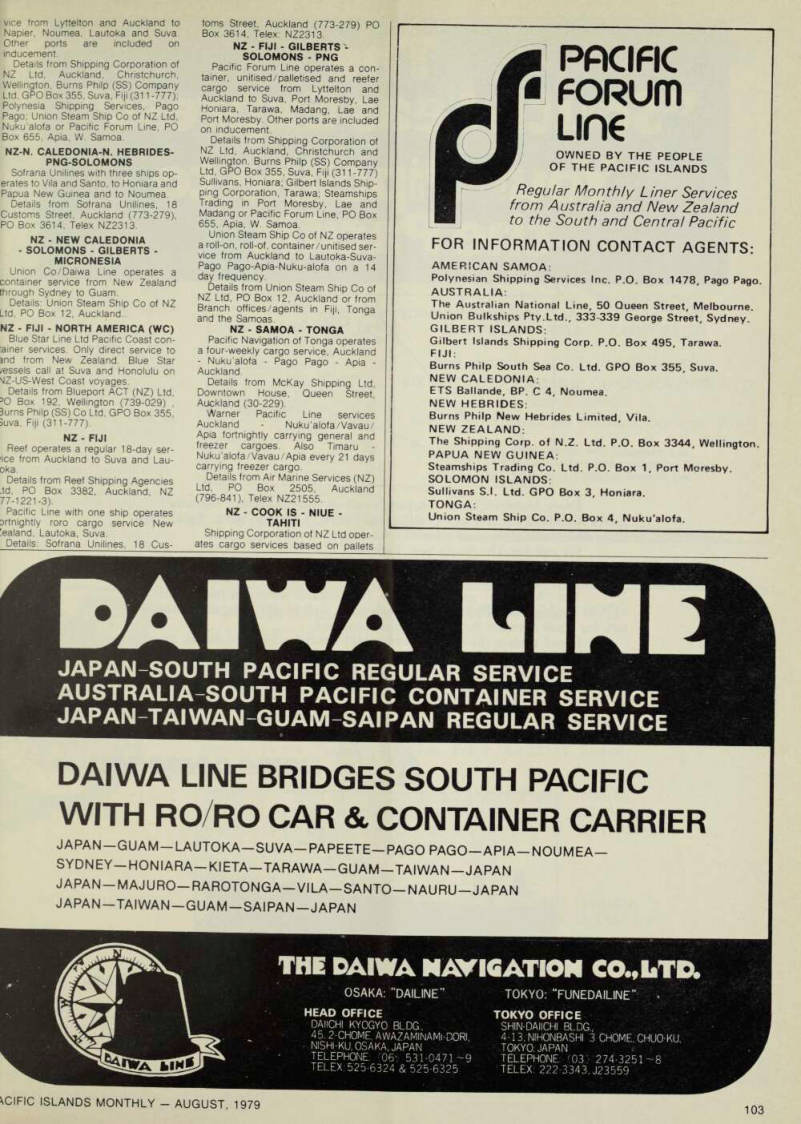
Services
These listings do not necessarily cover all services to Island ports.
Should any shipping company wish to have its services cargo and passenger included in these list ings they should contact PIM.
Sydney - Lord Howe Is -
Norolk Is
Compagnie des Chargeurs Caledoniens operates four-weekly cargo service Sydney - Lord Howe Island and Norfolk Island.
Details Hetherington Kingsbury Pty Ltd, 37-49 Pitt Street, Sydney (27-1671).
SYDNEY - NZ - FIJI - HAWAII -
Canada - Us
P & O liners call at Auckland. Suva, Honolulu and Vancouver on eastbound and westbound voyages between Syd ney and the US.
Details from P & O Booking Centre, World Travel Headquarters Pty Ltd, 33 Bligh Street, Sydney (231-6655).
AUSTRALIA - NZ - FIJI - TONGA - N. HEBRIDES - NOUMEA - PNG -
Solomons -Samoas
Sitmar Cruises operates a year-round cruise programme to include most of the above countries.
Details from Sitmar Cruises, 47 Elizabeth Street, Sydney (232-7511).
P & O liners call at Auckland, Bay of
Islands, Honiara, Lautoka, Noumea, Nuku’alofa, Pago Pago, Papeete, Port Moresby, Santo, Savusavu, Suva, Vavau and Vila on cruises from Aus tralia.
Details from P & O Booking Centre, World Travel Headquarters Pty Ltd, 33 Bligh Street, Sydney (231-6655).
Australia - Fiji - Samoas -
New Hebrides - Tonga -
Norfolk Island
Pacific Navigation of Tonga operates a five-weekly refrigerated general car go/container service from Sydney and Brisbane to Vila, Santo, Suva, Lautoka, Apia, Pago Pago, Nuku’alofa and Nor folk Island.
Details from Beaufort Shipping Agency Co, 2 Castlereagh Street, Syd ney (239-1022).
Australia - New Caledonia
(And/Or) New Hebrides
Karlander operates a monthly service from Sydney to Noumea.
Details: Karlander (Aust) Pty Ltd, 19-31 Pitt Street, Sydney (27-6301).
Sofrana-Unilines ships serve Noumea every three weeks from the main ports along the east Australian coast.
Details from Sofrana-Unilines, 37 Pitt Street, Sydney (27-2031), Trans- Austral Shipping Pty Ltd. 570 Bourke Street, Melbourne (67-9162), ACTA Pty Ltd. Brisbane (221-3116), Elders-ANL Pty Ltd, Port Adelaide (47-5688), ANL, Newcastle (049-24364), Clements & Marshall, Burnie, Tasmania (31-1833).
Compagnie des Chargeurs Cale donians operates a three-weekly con tainerised cargo service from Sydney to Noumea.
Details Hetherington Kingsbury Pty Ltd, 37-49 Pitt Street, Sydney (27-1671).
Compagnie Generale Maritime oper
ates a monthly service from Sydney to Noumea. Port Vila and Santo, using a self-sustained fully containerised vessel.
Details Compagnie Generale Mari time, 12 Castlereagh Street, Sydney (231 -3700).
Australia - Fiji
Karlander (Aust) Pty Ltd operates monthly cargo services from Sydney to Suva and Lautoka.
Details from Karlander (Aust) Pty Ltd, 19-31 Pitt Street, Sydney (27-6301), Dalgety Shipping, 461 Bourke Street, Melbourne (60-0731), Burns Philp (SS) Co Ltd, Suva and Lautoka.
Sofrana-Unilines (Fiji Express Line) operates to Suva and Lautoka every three weeks from the main ports on the east coast of Australia and monthly to Lautoka from Melbourne and Sydney.
Details from Sofrana-Unilines, 37 Pitt Street, Sydney, (27-2031), Trans- Austral Shipping Pty Ltd, 570 Bourke Street. Melbourne (67-9162), ACTA Pty Ltd, Brisbane (221-3116), Elder-ANL Pty Ltd, Port Adelaide (47-5688), ANL, Newcastle (049-24364), Clements & Marshall, Burnie, Tasmania (31-1833).
Australia • W. Samoa
Compagnie Generale Maritime oper ates a monthly service from Sydney to Apia, using a self-sustained fully con tainerised vessel.
Details Compagnie Generale Mari time, 12 Castlereagh Street, Sydney (231-3700).
Australia - Fiji - Tuvalu
• Samoas - Tonga
Pacific Forum Line operates a con tainer, unitised/palletised and reefer cargo service from Melbourne and Syd ney to Lautoka, Suva, Funafuti, Pago Pago, Apia and Nuku'alofa. Other ports are included on inducement.
Details from ANL Melbourne and
Brisbane, Union Bulkships, Sydney, Hobart, Port Adelaide and Fremantle, Burns Philp (SS) Company Ltd, GPO Box 355, Suva, Fiji (311-777); Polynesia Shipping Services, Pago Pago; Union Steam Ship Co of NZ Ltd, Nuku'alofa; PWD, Funafuti; or Pacific Forum Line, PO Box 655, Apia, W.
Samoa.
Australia - Northern
Marianas - Micronesia
Nauru Pacific Line operates a regular container service from Melbourne to Saipan. Truk, Ponape and Kosrai.
Details Nauru Pacific Line, Nauru House, 80 Collins Street, Melbourne, (653-5709), Nedlloyd Swire, 8 Spring Street, Sydney (2-0522).
Australia - Tonga -
Samoas - Tahiti
Karlander operates a monthly cargo service from Melbourne and Sydney to Nuku’alofa, Apia, Pago Pago, Papeete.
US west coast.
Details: Karlander (Aust) Pty Ltd, 19-31 Pitt Street, Sydney (27-6301).
Australia - Tahiti
Daiwa Line offers a four-weekly ser vice from Australia to Papeete.
Details: Meridian Shipping & Trans port Agencies Pty Ltd, Box 3410 GPO, Sydney 2001 (29-4987), Tlx: AA25970.
Compagnie Generale Maritime oper ates a monthly service from Sydney to Papeete using a self-sustained fully containerised vessel.
Details Compagnie Generale Mari time, 12 Castlereagh Street, Sydney (231-3700).
Australia - Png
Containers Pacific Express (Burns Philp and AWP Line) and NGAL/PNGL Operate chief Container Service from Australia to PNG-Solomon Islands ports on joint slot sharing basis. Three con tainer vessels operate on 28-day turn
ound from Melbourne, Sydney and risbane to Port Moresby, Lae, Rabaul, avieng, Wewak, Madang, Kieta and oniara.
Details from Burns Philp & Co Ltd, 51 tt Street, Sydney (2-0547) and terocean Swire, 8 Spring Street, Syd -3y (2-0522).
New Guinea Express Lines operates ree-weekly conventional and con iner services Melbourne, Sydney, risbane, Port Moresby. Lae, Rabaul, lotau.
Details from New Guinea Express nes, PO Box R 73, Royal Exchange D, Sydney (241-3991) MacArthur lipping Agency Co, 82-92 Eagle reet, Brisbane (229-3777), New uinea Express Lines, 327 Collins reet, Melbourne (61-3053), Niugini (press Lines in Port Moresby 1-2466), Lae (42-1536), Rabtrad iugini Pty Ltd, Rabaul (92-2911), otau Stevedoring & T’sport 1-1318).
Karlander New Guinea Line’s cargo sssels call at Melbourne, Sydney, Port oresby, Lae, Madang, Wewak, anus, Kimbe, Rabaul, Popondetta.
Details from Karlander (Aust) Pty Ltd, )-31 Pitt Street, Sydney (27-6301), algetty Shipping, 461 Bourke Street, elbourne (60-0731).
Australia-Solomons
Jorthern Marianas-Taiwan
Japan
Daiwa Line offers a four-weekly ser ze Sydney-Honiara-Guam-Taiwan ipan with transhipment at Guam for aipan.
Details Meridian Shipping & Trans )rt Agencies Pty Ltd, Box 3410 GPO, rtJney 2001 (29-4987). Tlx. <\25970.
Australia - Solomons -
Gilbert Is - Micronesia
Daiwa Line operates a container ser :e every 30 days from Sydney to
Honiara, Kieta, Tarawa and Guam. Gizo cargoes transhipped at Honiara, Saipan, cargoes transhipped at Guam.
Details Meridian Shipping & Trans port Agancies Pty Ltd, Box 3410 GPO Sydney 2001 (29-4987), Tlx.
AA25970.
Australia - Nauru -
Majuro
Nauru Pacific Line operates regular cargo/passenger service from Mel bourne to Nauru and Majuro.
Details: Nauru Pacific Line, Nauru House, 80 Collins Street, Melbourne (653-5709), Nedlloyd Swire, 8 Spring Street, Sydney (2-0522).
Png ■ Uk/Continent
Bank Line operates regular cargo service from Kieta, Rabaul, Kimbe, Madang and Lae to Cardiff, Hamburg, Rotterdam and Antwerp, Details from Bank Line (A’asia) Pty Ltd, 1 York Street, Sydney (27-2041); Burns Philp (PNG) Ltd, ports.
Png - Us
Bank Line operates regular cargo service from Kieta, Rabaul, Kimbe, Madang and Lae direct to New Orleans; calls at other US and Gulf and East Coast ports on inducement.
Details from Bank Line (A’asia) Pty Ltd, 1 York Street, Sydney (27-2041); Burns Philp (PNG) Ltd, PNG ports.
Solomons - Usa -
Uk/Continent
Bank Line operates regular cargo service from Honiara to New Orleans, Cardiff, Hamburg, Rotterdam and Ant werp.
Details from Bank Line (A’asia) Pty Ltd. 1 York Street, Sydney (27-2041); Trading Co, Honiara (389).
Far East - Fiji - New
Zealand
New Zealand Unit Express (CNC.
MNOL, Nedlloyd) operates a three weekly cargo service from Hong Kong to Lautoka, Suva. NZ ports, Manila, Kaoshiung, Keelung, Hong Kong.
Details from Nedlloyd, 8 Spring Street, Sydney (2-0522).
Nedlloyd operates monthly cargo service with three ships from Surabaya, Jakarta, Bangkok, Port Keland and Sin gapore to Suva and NZ ports.
Details from Nedlloyd (Aust) Pty Ltd, 8 Spring Street, Sydney (27-3801); Burns Philp (SS) Co Ltd, Suva and Lau toka.
Japan - Nz - Png
China Navigation Co, with three ships operates a monthly service from Japan to New Zealand calling at Fiji and Noumea en route Details Carpenters Shipping, Suva (312-2441); P & O S. N. Co, Wellington (736-477),
Far East • Mid-S. Pacific
China Navigation Co’s vessels oper ate a regular cargo service from Hong Kong, Taiwan, Manila, Port Kelang and Singapore to Wewak, Madang, Kimbe, Rabaul, Kieta, Lae, Port Moresby, Honiara, Santo, Vila, Noumea, Papeete, Pago Pago, Apia, Tarawa and Nauru.
Details from Steamships Trading Co., Port Moresby (21-2000).
Kyowa Shipping Co Ltd, operates monthly services from Hong Kong, Taiwan, S. Korea and Japan, to Guam, Saipan, Solomons, New Caledonia, Fiji, Western and American Samoa, Tahiti, Cook Is., Tonga and New Hebrides.
Details: Hetherington Kingsbury Pty Ltd, 37-49 Pitt Street, Sydney (27-1671).
Daiwa Line operates 30-day service from Moji, Kobe, Nagoya and Yokohama to Papeete, Pago Pago, Apia, Suva, Lautoka, Noumea, Sydney, Honiara, Kieta, Tarawa, Guam and Taiwan.
Details: Meridian Shipping & Trans port Agencies Pty Ltd, Box 3410 GPO Sydney 2001 (29-4987) Tlx: AA25970.
North Europe - Tahiti -
New Caledonia
Hamburg-Sued operates monthly cargo services from Hamburg, Dunkirk and Le Havre to Papeete, Noumea, via Panama.
Details from Columbus Overseas Services Pty Ltd, 333 George Street, Sydney (290-2966), Columbus Mari time Services, 17 Albert Street, Auckland (77-3460),
Europe - Pacific Islands
Compagnie Generate Maritime oper ates services from Europe and Mediter ranean ports to Papeete and Noumea using three Ro-Ro and one multi purpose vessel thus ensuring a bi monthly sailing to and from.
Details Compagnie Generate Mari time, 12 Castlereagh Street, Sydney (231-3700).
EUROPE - TAHITI - W. SAMOA -
Fiji - N. Caledonia
Nedlloyd offers regular cargo ser vices from Northern Europe and UK to Papeete, Apia, Fiji and New Caledonia.
Details Nedlloyd (Aust) Pty Ltd, 8 Spring Street. Sydney (27-3801).
JAPAN - GUAM - FIJI - TAHITI -
Samoa - N. Caledonia -
Solomons - Gilberts
Daiwa Lines runs a monthly cargo service from Japan via Guam to Lau toka, Suva, Papeete, Pago Pago.'Apia, Sydney, Noumea, Honiara, Tarawa, Guam.
Details from Burns Philp (SS) Co Ltd, Suva.
Nz - New Caledonia - Fiji
Pacific Forum Line operates a uni tized /palletized and reefer cargo ser
vice from Lyttelton and Auckland to Napier, Noumea, Lautoka and Suva.
Other ports are included on inducement.
Details from Shipping Corporation of NZ Ltd, Auckland, Christchurch, Wellington, Burns Philp (SS) Company Ltd, GPO Box 355, Suva, Fiji (311 -777); Polynesia Shipping Services, Pago Pago; Union Steam Ship Co of NZ Ltd, Nukualofa or Pacific Forum Line, PO Box 655, Apia, W. Samoa.
Nz-N. Caledonia-N. Hebrides
Png-Solomons
Sofrana Unilines with three ships op erates to Vila and Santo, to Honiara and Papua New Guinea and to Noumea.
Details from Sofrana Unilines, 18 Customs Street, Auckland (773-279), PO Box 3614, Telex NZ2313.
Nz - New Caledonia
- Solomons - Gilberts -
Micronesia
Union Co/Daiwa Line operates a container service from New Zealand through Sydney to Guam.
Details: Union Steam Ship Co of NZ Ltd, PO Box 12, Auckland..
NZ - FIJI - NORTH AMERICA (WC) Blue Star Line Ltd Pacific Coast con sider services. Only direct service to and from New Zealand. Blue Star /essels call at Suva and Honolulu on MZ-US-West Coast voyages.
Details from Blueport ACT (NZ) Ltd, 3 0 Box 192, Wellington (739-029) , Burns Philp (SS) Co Ltd. GPO Box 355, Suva, Fiji (311-777).
Nz • Fiji
Reef operates a regular 18-day ser 'ice from Auckland to Suva and Lau oka.
Details from Reef Shipping Agencies -td. PO Box 3382, Auckland. NZ 77-1221-3).
Pacific Line with one ship operates crtnightly roro cargo service New [ealand, Lautoka, Suva.
Details: Sofrana Unilines, 18 Cus
toms Street, Auckland (773-279) PO Box 3614, Telex: NZ2313.
Nz - Fiji - Gilberts -
Solomons - Png
Pacific Forum Line operates a con tainer, unitised/palletised and reefer cargo service from Lyttelton and Auckland to Suva, Port Moresby, Lae Honiara, Tarawa, Madang, Lae and Port Moresby. Other ports are included on inducement.
Details from Shipping Corporation of NZ Ltd, Auckland, Christchurch and Wellington. Burns Philp (SS) Company Ltd, GPO Box 355, Suva, Fiji (311 -777) Sullivans, Honiara; Gilbert Islands Ship ping Corporation, Tarawa; Steamships Trading in Port Moresby, Lae and Madang or Pacific Forum Line, PO Box 655, Apia, W. Samoa.
Union Steam Ship Co of NZ operates a roll-on, roll-of, container/unitised ser vice from Auckland to Lautoka-Suva- Pago Pago-Apia-Nuku-alofa on a 14 day frequency.
Details from Union Steam Ship Co of NZ Ltd, PO Box 12, Auckland or from Branch offices/agents in Fiji, Tonga and the Samoas.
Nz - Samoa - Tonga
Pacific Navigation of Tonga operates a four-weekly cargo service, Auckland - Nuku’alofa - Pago Pago - Apia - Auckland.
Details from McKay Shipping Ltd, Downtown House, Queen Street, Auckland (30-229).
Warner Pacific Line services Auckland - Nuku’alofa/Vavau/ Apia fortnightly carrying general and freezer cargoes. Also Timaru - Nuku'alofa/Vavau/Apia every 21 days carrying freezer cargo.
Details from Air Marine Services (NZ) Ltd, PO Box 2505, Auckland (796-841), Telex NZ21555, NZ - COOK IS - NIUE -
Tahiti
Shipping Corporation of NZ Ltd oper ates cargo services based on pallets
and similar units from Auckland to Niue, Cook Islands and Tahiti.
Details from the Shipping Corp of NZ Ltd, PO Box 3420, Auckland (797-210); Waterfront Commission, PO Box 61, Rarotonga, Lighterage and Stevedoring Co, Aitutaki, Niue Govt Offices, Niue Island Compagnie Mari time Polynesienne, B'P’ 368, Papeete, Tahiti.
Uk - N Continent - Fiji
The Bank Line operates a direct, fast monthly service from Hull, Hamburg, Bremen, Antwerp and Rotterdam to Suva and Lautoka.
Details from the Bank Line (Aus tralasia) Pty Ltd, 1 York St, Sydney (27-2041); Burns Philp (South Sea) Co Ltd, Suva and Lautoka.
Uk/N. Continent - Tahiti -
N. Caledonia - N. Hebrides
Bank Line operates regular cargo service from Hull, Hamburg, Bremen, Antwerp and Rotterdam to Papeete and Noumea.
Details from Bank Line (A’asia) Pty Ltd, 1 York Street, Sydney (27-2041); Ets A M Fare UTE, Papeete; Ets Ballande, Noumea.
Uk/N. Continent - Png -
Solomons
Bank Line operates regular cargo service from Hull, Hamburg, Bremen, Antwerp and Rotterdam to Port Moresby, Lae, Madang, Kimbe, Rabaul, Kieta and Honiara and on inducement to Yandina.
Details from Bank Line (A’asia) Pty Ltd, 1 York Street, Sydney (27-2041); Burns Philp (PNG) Ltd, PNG ports; Trading Co Honiara.
San Francisco - Honolulu -
Nauru - Micronesia
Nauru Pacific Line operates regular conventional/container service from Ban Francisco and Honolulu to Majuro, 3 onape, Truk and Saipan. Cargo is accepted for Nauru and Kosrai with Tanshipment at Majuro and Ponape.
Details from Nauru Pacific Line, Mauru House, 80 Collins Street, Mel
bourne (653-5709); North American Maritime Agencies, 100 California Street, San Francisco, California 9411 (981-0343).
US - FIJI - TAHITI - NZ -
Australia
Bank and Savill Line Ltd, operates regular cargo services from US Gulf ports to Australia and NZ. Calls at Suva, Lautoka and Papeete on demand.
Details from Bank Line (A’asia) Pty Ltd, 1 York Street, Sydney (27-2041) or Howard Smith Industries Pty Ltd, 1 York Street, Sydney (27-5611).
Us - Tahiti - Samoa
Pacific Islands Transport operates a five weekly cargo service from North America west coast ports to Papeete, Pago Pago, Apia.
Details from Polynesia Shipping Ser vices Inc, PO Box 1478 Pago Pago (9-6799).
Polynesia Line operates container and general cargo service from US west coast ports to Papeete and Pago Pago.
Details from Polynesia Shipping Ser vices Inc., PO Box 1478, Pago Pago (9-6799).
US - TAHITI - SAMOA - NZ - AUST Farrell Lines Inc, operate a fast reg ular lash/container cargo service from west coast ports Canada/USA to Papeete and Pago Pago thence to NZ and Australia.
Details Wilh Wilhelmson Agency, Sydney, Melbourne and Brisbane, Tlx AA20136, Cable FARSHIPS Sydney; Dalgety (NZ) Ltd, Auckland and Wellington, Tlx NZ2445, Cable DALSHIP Auckland; Compagnie Mari time Polynesienne, Immeuble Franco Oceanienne, PO Box 368, Papeete, Tahiti, Tel 26393, Tlx 258. FP ANSB Taporo, Cable OCEAN Papeete; Kneubuhl Maritime Service, PO Box 39, Pago Pago, Telephone 633-5121; Tlx 782505.
Advertisements & other items, pp. 101-108 (4 items)
101
VCIFIC ISLANDS MONTHLY AUGUST 1979
Line
THE
Papua New Guinea & Solomon Islands
USA- UK /Continent Service
Regular direct monthly sailings
PAPUA NEW GUINEA and SOLOMON ISLANDS
to: NORTH AMERICA • UNITED KINGDOM & CONTINENT For particulars apply:
THE BANK LINE (AUSTRALASIA) PTY. LTD.
18th Floor 1 York Street Sydney N.S.W. 2000 Australia Telephone; 272041 Telex: 24063
Regular Monthly Liner Services
from Australia and New Zealand
to the South and Central Pacific
OWNED BY THE PEOPLE
OF THE PACIFIC ISLANDS
PACIFIC
FORUm
me
FOR INFORMATION CONTACT AGENTS:
AMERICAN SAMOA:
Polynesian Shipping Services Inc. P.O. Box 1478. Pago Pago.
AUSTRALIA:
The Australian National Line, 50 Queen Street, Melbourne.
Union Bulkships Pty.Ltd., 333-339 George Street, Sydney.
GILBERT ISLANDS:
Gilbert Islands Shipping Corp. P.O. Box 495, Tarawa.
FIJI:
Burns Philp South Sea Co. Ltd. GPO Box 355, Suva.
NEW CALEDONIA;
ETS Ballande, BP. C 4, Noumea.
NEW HEBRIDES:
Burns Philp New Hebrides Limited, Vila.
NEW ZEALAND:
The Shipping Corp. of N.Z. Ltd. P.O. Box 3344, Wellington.
PAPUA NEW GUINEA:
Steamships Trading Co. Ltd. P.O. Box 1, Port Moresby.
SOLOMON ISLANDS:
Sullivans S.l. Ltd. GPO Box 3, Honiara.
TONGA:
Union Steam Ship Co. P.O. Box 4, Nuku'alofa.
DAIWA LIME
JAPAN-SOUTH PACIFIC REGULAR SERVICE
AUSTRALIA SOUTH PACIFIC CONTAINER SERVICE
JAPAN-TAIWAN GUAM-SAIPAN REGULAR SERVICE
DAIWA LINE BRIDGES SOUTH PACIFIC
WITH RO/RO CAR & CONTAINER CARRIER
JAPAN GUAM LAUTOKA—SUVA—PAPEETE—PAGO PAGO—APIA—NOUMEA—
SYDNEY HONIARA—KIETA—TARAWA—GUAM—TAIWAN—JAPAN
JAPAN —MAJURO—RAROTONGA—VILA—SANTO—NAURU—JAPAN
JAPAN—TAIWAN—GUAM—SAIPAN—JAPAN
m. m
THE DAIWA MATIGATIOM CO.. LTD.
OSAKA: “DAILINE” TOKYO: “FUNEDAILINE” ,
HEAD OFFICE
DAIICHI KYOGYO BLDG
45. 2-CHOME. AWAZAMINAMi-DORI,
• NISHi-KU, OSAKA, JAPAN
TELEPHONE 05v 531-0471 '9
TELEX: 525-6324 & 525-6325
TOKYO OFFICE
SHIN-DAIICHI BLDG.,
4-13, NIHONBASHI 3 CHOME, CHUO- KU,
TOKYO. JAPAN
TELEPHONE: (03} 274-3251'8
TELEX: 222-3343. J 23559
The
"South Seas Express"
Your Pipeline to
the Pacific
Every 14 days Union Company’s roll-on roll-off vessel “Marama” leaves Auckland for five key Pacific Island ports; Lautoka, Suva, Apia, Pago Pago and Nuku’alofa, and return to Auckland.
We call her The South Seas Express.
New Zealand exporters outside Auckland can take advantage of Union Company’s internal ‘Relay’ system to connect up with the “Marama” service.
The “Marama” provides a safe, fast, reliable service to the advantage of New Zealand and Pacific Island traders, as well as providing the essential link for trade between the Pacific Islands nations.
Island traders can take advantage of “Marama” service to link through New Zealand to other world markets, using Union Company’s international relay service.
Talk Pacific Island trading with Union Company at any New Zealand or Pacific Island office.
union company
M t * every day one of our ships is in one of your markets
HEAD OFFICE
Wellington 729-699
NEW ZEALAND
BRANCHES
Auckland 774-730 Bluff 8174 Dunedin 777-201 Lyttleton 7149 Mount Maunganui 53-199 Napier 58-788 Nelson 81-459 New Plymouth 75-459 Timaru 86-099 Wellington 850-799 Westport 7279 Whangarei 88-759
PACIFIC ISLAND
BRANCHES
Suva, Fiji 23861 Lautoka, Fiji 60577 Apia, Western Samoa 21781 Pago Pago, American Samoa C/oB.F. Kneubuhl Inc. (Agent) Nuku’alofa, Tonga 118 or 160 13495
PACIFIC
ISLANDS
TRANSPORT
LINE
MS AFRICANSTARS
Express Freight Service between Pacific Coast Ports of U.S.A. and...
Tahiti 6 Samoa
PAPEETE APIA PAGO PAGO
Full container service including reefers.
GENERAL STEAMSHIP CORPORATION LTD.
General Agents 400 California Street, San Francisco, California, U.S.A.
APIA: Bums Philp (South Sea) Company Ltd.
PAPEETE: Agence Maritime Internationale, Tahiti PAGO PAGO: Polynesia Shipping Services Inc.
q6E/?^ * A O *
FOR;
IN OUR 85th YEAR SELLING ‘SERVICE’
TO THE PACIFIC ISLANDS . . .
Nelson & Robertson
PTY. LTD. (Established 1895)
Plantation House, 197 Clarence Street, Sydney.
Cables: ‘IVANT, Sydney, Brisbane. Telex: AA22381, Sydney.
INDENTS - FROM AUSTRALIA, NEW ZEALAND and OVERSEAS.
FOODSTUFFS • HARDWARE • TRAVEL • CANNED FISH MACHINERY • INSURANCE • SOFTGOODS • JUTE GOODS
• REAL ESTATE •
BRANCH OFFICES: Nelson & Robertson Pty. Ltd., P.O. Box 575, Brisbane, Qld., Australia.
P.O, Box 2092, Govt. Bldg., Suva, Fiji. P.O. Box 258, Lautoka, Fiji.
P.O. Box 2420, CPO Auckland 1, New Zealand.
PAPUA NEW GUINEA Rabtrad Niugini Pty. Ltd., P.O. Box 219, Rabaul, P.N.G.
REPRESENTATIVES: P.0.80x 1406, Lae, P.N.G. P.O. Box 711, Madang, P.N.G.
P.O. Box 253, Kieta, P.N.G.
FOR SALE
FLEETS 49 ft 6 inch x 17 ft x 6 ft
PARTLY PLANKED HULL, Timbers
frames, stringers fitted "AS IS", including balance planking timber, timber for decks, 3” Stainless Steel prop shaft, stern tube, $42,000 FLEETS 221 Esplanade, Wynnum Central, Brisbane. Cable “FLEETS
BRISBANE".
Australian couple, in mid-thirties.
Interested Islands work. She managerial experience, he wide general experience, including yachting.
What offers? Reply Sean Lee, PO Box 74, Windsor, 2756, Australia.
STAMP EXCHANGE
I have Australian stamps to exchange tor Island stamps in good condition Mrs B Moorhouse, 9 Banool Street Keiraville, Wollongong, 2500, NSW.
Australia
ALuminium yachts
y'y-K ■■
LIGHT - STRONG - LOW MAINTENANCE
>lB' LOA >2o' LOA >2l'6 LOA >24' LOA >2B' LOA
KAYFA INDUSTRIES
13 Tarnard Drive, Braeside Vic. 3195. Tel: 900255
£ High reliability, totally marinised SOMA Windmills charge batteries to run lights, tools, water pumps, etc. o £ 200 watt 12 volt unit SNZBSO.
FOB Auckland. 500 watt 24 volt unit SNZIOOO.
FOB Auckland.
Send for free brochure and c.i.f. quotes or send SNZ3.SO for post-paid Installation Manual.
SOMA
WINDMILLS LTD.
P.O. Box 94, Russell, New Zealand.
ADVERTISERS’ INDEX
Office Suite 2 Mac Donnell Lane 26 Abbott St Cairns Phone (070) 514039 A/Hrs 93 7268 Telex QUMAR AA 48475 Mail PO. Box 1871, Cairns 4870 Director Captain Donald A. Hopper
T. Eng (CEO
ouggnsmnp mflmriE brokerage
COMMERCIAL SHIPPING SALES & CHARTERS
Yacht, 52 ft, Queensland survey, world cruiser $lBO,OOO Dredge, 2 x 760 hp Caterpillars, 600 cu. yds pr. hr. capacity, harbour and reclamation work $200,000 Motor yacht, 80 ft, 2 x G.M. 671, sleeps 10 $70,000 Steel cargo vessel, 81 ft. capacity 150 cubic metres $65,000 Servicing Australia and the South West Pacific.
Servicing Australia and the South West Pacific.
MAPS and PRINTS
of the OLD PACIFIC Regular catalogues issued listing a large stock of original antiquarian views and maps of Australia, New Zealand, Papua New Guinea and all the island groups of the Pacific. Write today for your free copy:
COLIN HINCHCLIFFE,
7 Royd Avenue, Heckmondwike, West Yorkshire, WFI6 9AL, UK.
Frostpak
% * / V
Koolatron
INDUSTRIES
Portable Electronic
Solid State Refrigerators
For people on the move Ideal for Campers & Caravans Indispensable for Travellers and Holidaymakers A must for Truckdrivers Popular with Yachts.
Aircraft and Fishermen For Medical & Technical purposes & Food Samples Big cooling performance No Gas - No Compressor Large 33 Litre capacity Unaffected by motion or level No nmse or vibration Low Battery Drain Low Weight - 7 KG I Virtually Indestructable l 2 Year Guarantee From 5199.00 incl. Sales Tax Connects to 12V Battery or Cigarette Lighter Operates on 240 V with Battery Charger 297 Williamstown Road, Port Melbourne 3027 Phone 645 2068 Telex 32571
FOR PEOPLE ON THE MOVE
The only newsletter that lists professional vacancies throughout Pacific and Middle East Reply Box 150, Canberra City, Australia.
RINE PACIFIC LTD.
SALVAGE - TOWAGE
TUGS
500 -2700 b.h.p.
RAMPED - BARGES
250 - 500 d.w.t.
For charter throughout the South Pacific cable: TUGBOAT , SUVA, telex: FJ2202
PETER FISHER
TRADING
Pty Ltd
321 PITT St., SYDNEY, AUSTRALIA 2000
Telephone; 26 1109 Cables: "FISHE R ION” SYDNEY
EXPORTERS TO THE
PACIFIC ISLANDS
- J&.\ . . i - -> V*-. _Jt*- • % ■<s * * y.
S=—id?
b!& o v>.
Kov
r &S i £
* * *sZ •> w «v v . \ I • > * v '.
'~t* >■, \ N \> "
Datsuns'temper'control,
so you never lose yours!
* w A.
Color coded rear axle shafts.
The rear axle shaft. It s vitally important and must be really tough to withstand the twisting forces and power that it transfers to the car's wheels, not to mention the shocks of hitting things on the road.
Datsun's high technology, mass production techniques and “extra” effort make sure you won’t get stranded with a breakdown. Each axle shaft is specially treated.
High frequency electrical waves are used to “temper” the shaft. This hardening process creates a hard outer surface for maximum wear resistance but allows the interior of the shaft to remain softer for toughness and shock absorption. This balance of properties provides exactly what is needed for troublefree motoring. In addition, each axle shaft is color coded and registered. If it doesn't meet Datsun's rigid standards or the unusual happens, the flaw is easily traceable. Through highly perfected quality control procedures Datsun has built a worldwide reputation for quality. Datsun knows how to deliver the best... and millions agree. m Datsun’s “extra” effort for total quality. datsun « Datsun Distributors: Boroko Motors Ltd. P.O. Box 1259, Boroko, Port Moresby. PN G /Carpenters Motors, Sales Division 61-63 Foster St Walu Bay, Suva, Fiji Islands Private Mail Bag/Morris Hedstrom Ltd. P.O. Box 189, Apia, Western Samoa/ United Enterprises Ltd. PO. Box 262, Honiara, Solomon Islands/ Sirius Motors PO. Box 34, Norfolk Island, South Pacific/ Jacob Enterprises P.O. Box 4, Republic of Nauru/Cook Islands Motor Center Ltd. P.O. Box 74, Rarotonga, Cook Islands, South Pacific/ Pentecost Pacific S.A. P.O. Box 119, Port Vila, New Hebrides/ Agence Alma S.A. B.P. A 3, Noumea Cedex, New Caledonia/ Tahitibull S.A.R.L. B.P. 359, Papeete, Tahiti / Gilbert Islands Government, Supply Division P.O. Box 71, Bairiki, Tarawa. Gilbert Islands
103
ISLANDS MONTHLY - AUGUST, 1979
105
ACIFIC ISLANDS MONTHLY - AUGUST, 1979