Cooks’ producers
p. 91 · Read in the full issue
‘Reshaping’ to spur Cooks’ producers
The appointment of two New Zealanders to the Cook Islands Ministry of Agriculture a chief advisory officer and an information officer may seem a little surprisng, writes Don Bryant from Wellington, considering the high level of local expertise already in the Cooks’; agricultural field.
However, the appointments, by the external aid division of
the NZ Ministry of Foreign
Affairs, have come in response
to the reshaping plan devised
by the Cooks’ own planners and they are only temporary.
Things had got to the point where the Cooks experts were doing all the work, including fertiliser and spraying pro grammes, while many growers were doing very little. The nove is to encourage growers ;o work and produce and signs ire that this is already begin
ling to happen.
There’s plenty of air cargo ipace for Cooks produce to be ihipped to New Zealand and aapayas, capsicums and other
vegetables have been attracting
>ood prices at Auckland’s mar kets recently.
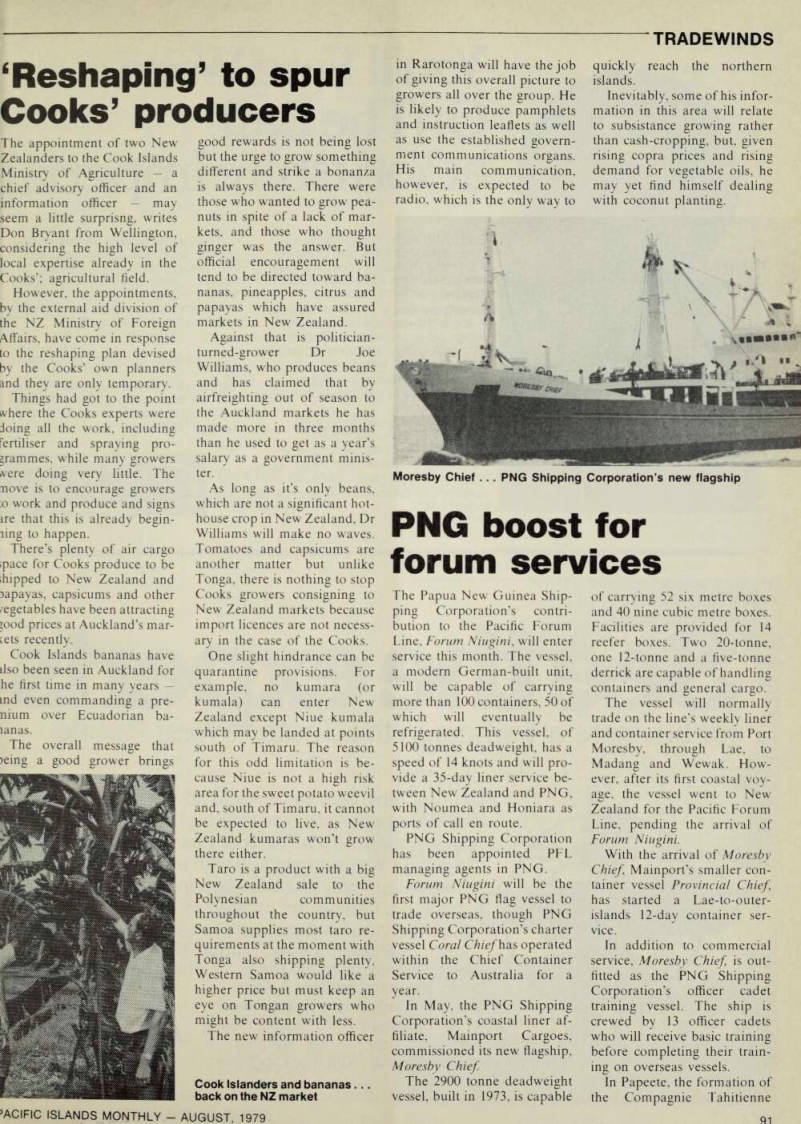
Cook Islands bananas have ilso been seen in Auckland for he first time in many years md even commanding a pre nium over Ecuadorian ba tanas.
The overall message that >eing a good grower brings
good rewards is not being lost but the urge to grow something different and strike a bonanza is always there. There were those who wanted to grow pea nuts in spite of a lack of mar kets, and those who thought ginger was the answer. But official encouragement will tend to be directed toward ba nanas, pineapples, citrus and papayas which have assured markets in New Zealand.
Against that is politician
turned-grower Dr Joe Williams, who produces beans and has claimed that by airfreighting out of season to the Auckland markets he has made more in three months than he used to get as a year’s salary as a government minis ter.
As long as it’s only beans, which are not a significant hot house crop in New Zealand. Dr Williams will make no waves.
Tomatoes and capsicums are another matter but unlike Tonga, there is nothing to stop Cooks growers consigning to New Zealand markets because import licences are not necess ary in the case of the Cooks.
One slight hindrance can be
quarantine provisions. For
example, no kumara (or kumala) can enter New Zealand except Niue kumala which may be landed at points south of Timaru. The reason for this odd limitation is be cause Niue is not a high risk area for the sweet potato weevil and. south of Timaru, it cannot be expected to live, as New Zealand kumaras won’t grow there either.
Taro is a product with a big New Zealand sale to the
Polynesian communities
throughout the country, but Samoa supplies most taro re quirements at the moment with
Tonga also shipping plenty.
Western Samoa would like a
higher price but must keep an
eye on Tongan growers who might be content with less.
The new information officer
in Rarotonga will have the job of giving this overall picture to growers all over the group. He is likely to produce pamphlets and instruction leaflets as well as use the established govern ment communications organs.
His main communication, however, is expected to be radio, which is the only way to
quickly reach the northern islands.
Inevitably, some of his infor mation in this area will relate to subsistance growing rather
than cash-cropping, but, given
rising copra prices and rising
demand for vegetable oils, he may yet find himself dealing with coconut planting.
Cook Islanders and bananas... back on the NZ market