Davuilevu—'biggest
pp. 85-87 · Read in the full issue
Yesterday
Davuilevu—'biggest educational town in the Pacific’
Sun, sand, sea and the easy life are present-day attractions adver tised by Fiji's tourist industry. But, in years gone by, when visitors were fewer and pursuits were different, Davuilevu, centre of Methodist educational activities, was a big attraction. Ken James writes about yesterday's Davuilevu.
Davuilevu, showpiece of the Methodist mission’s work in the South Pacific, was built on 325 hectares of freehold land across the Rewa River from
Nausori township, about 18
kilometres northeast of Suva.
Visitors would travel from Suva to first inspect the sugar mill and farms as well as the Methodist mission’s Navuso
Agricultural College at
Nausori. Then they would :ross the river to Davuilevu.
Visitors varied from groups )ff cruise ships to official quests from within or outside he colony. In the 1930 s there vas even a visit from the crew )f a Japanese cruiser. Demon ;trations of mekes and dances vere given on the ratra, fol owed by a guided tour of the :ducational institutions mak ng up the township.
The Reverend C.O. Lelean, uperintendent for 30 years, ;ave this description in 1932: There are about 600 people, ndians, Fijians and Rotumans. r here is a Teacher Training In
titution. Theological College,
technical School for boys, three rimary schools for boys and iris, Indians and Fijians in dif ?rent schools, and an orphan ge for Indian girls and a few ijian girls. We have three mis 'onaries, one lay missionary, ve mission sisters, a native unister, two native sisters, a
'nail hospital and dispensary,
ve boy scout troops, a power f ation . . . There are about 75 uildings at present... It is the iggest educational town in the ' acific.
Davuilevu’s origin goes back ) 1860 when land was sold by ie chiefs of Naitasiri and /aila to Charles Pickering Sr nd Robert Swanston. In the
same year, the Reverend Joseph Waterhouse, resident minister in the Rewa circuit of the Wesleyan mission, asked Swanston if he could build a summer retreat on a small mound known as Davui Levu about 20-25 metres high on the edge of the Rewa river. This was agreed to and - after
approaching and receiving per
mission from the inland tribes who used the hill from which to launch attacks on the village
of Nausori he commenced his summer residence.
He was so pleased with the site that in 1864, 125 hectares of the land was purchased by the mission. Davuilevu was retained as a name for the property, and Waterhouse’s retreat appears to have become the site of a mission station under the direction of the Rev erend Thomas Baker.
The mound overlooking the river was cleared, two resi dences, a church, school and dormitories being erected.
Following the murder of Baker and his party while on tour in the interior of Viti Levu in 1867, the estate was abandoned for more than 30 years until 1903 when the mission decided to start work among the Indian community in the Nausori dis trict. The Reverend John Bur ton reopened the mission station and a school and or-
phanage quickly followed.
Then, in 1905, the newly established mission’s District Boys’ High School was trans ferred from Navuloa to Davuilevu. This particularly arduous task took more than two years to complete. First, food gardens and roads had to be cut out of the dense veg etation. Then hill and ridge tops had to be levelled-off to provide sites for new buildings.
The school was finally
officially opened by Governor
Sir Everard im Thurn in October 1907. One of the main reasons for establishing the school had been to counter the threat to the mission’s edu-
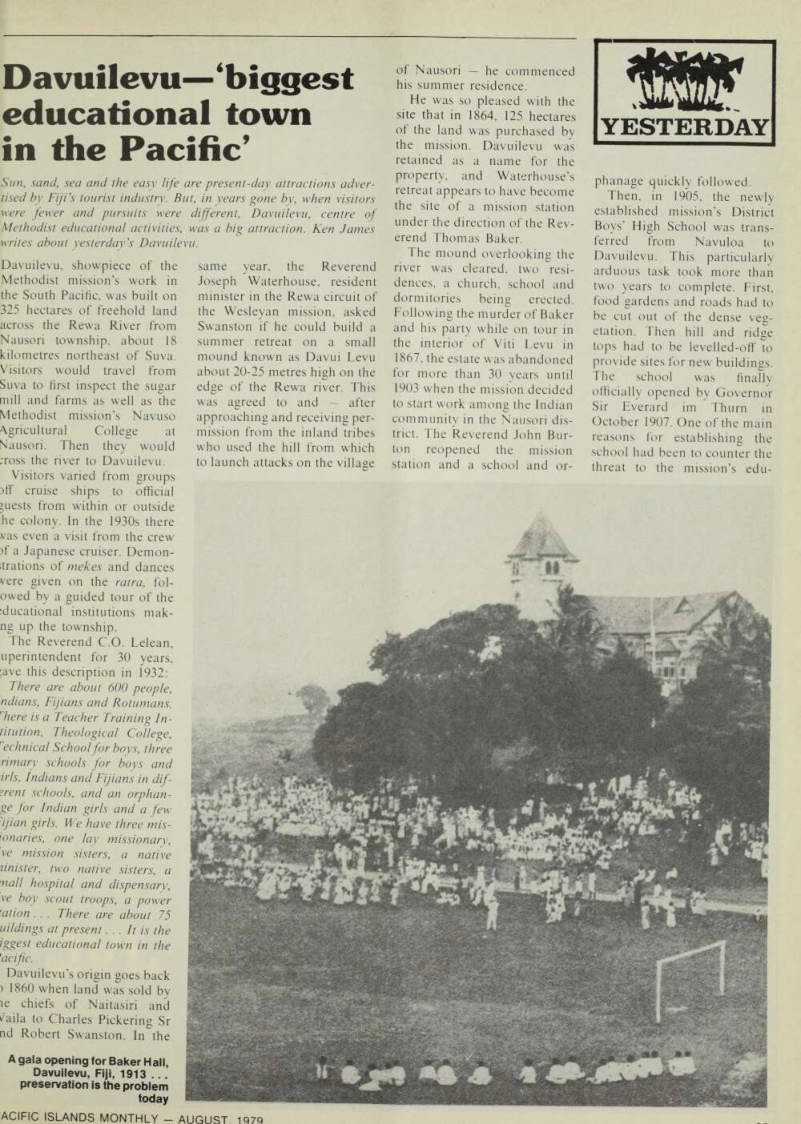
A gala opening for Baker Hall, Davuilevu, Fiji, 1913 ... preservation Is the problem today
cational work from two Cath olic English-medium schools for Fijian boys.
The future of the estate as an education town was assured in 1908 when the mission resolved to transfer their pastor-training insititution from Navuloa, and at the same time to establish a theological college, the first in the colony. The transfer was
completed the following year,
an additional 200 hectares of
land having been purchased.
The Lomovata was used to facilitate the transfer.
The importance of the town was summed up in 1909 by the
superintendent:
It would be hard to overesti mate the strategic importance of this institution. It is to the edu cational work of our mission in Fiji what the heart is to the body . . . the centre from which a constant stream of life is poured out to the remotest member whose arteries beat in perfect proportion to the central organ.
The Davuilevu estate is made up of high ridges, hills, and deep valleys. Most build ings were and still are sited on the levelled tops of the hills and ridges. The central point of the whole area is Baker Hall. An
impressive concrete building,
used today as classrooms and as a church, it was erected be tween 1910 and 1913. The official opening in 1913 was a grand occasion: There was a high gala appear ance about the pretty Davuilevu station on the Rewa on Tuesday last when the Baker Memorial
Hall or College was opened by
His Excellency the Goveror.
The landing stage was a scene of great animation and the river was thronged with cutters and motor launches of all sorts and sizes. Motor cars and horsed ve hicles were in serried array in front of the stables and every now and then great squads of Fijians in meke panoply were to
be seen making for the mission
rara, a most perfect and pic
turesque amphitheatre.
The walls of the hall were
covered with photographs and
portraits of past and present
mission workers. The building
was named in memory of the murdered Thomas Baker and. later, an armbone, the only re mains of the missionary, was
buried in a casket under the building. From the time of opening the building has been used for church services, students from the different in stitutions marching from their respective ridges to the ser vices. Today, Baker Hall is fall ing into disrepair, and there is some talk of approaching the Fiji National Trust in the hope of having the building declared
worthy of preservation.
A large number of edu cational institutions have existed on the estate since the turn of the century. The boys’ high school, which opened in 1905, soon had an agricultural and industrial institution attached to it. From 1909-1911, under the headmastership of W.L. Waterhouse, later pro fessor of agriculture at Sydney University, basic technical and agricultural training of a theor etical as well as practical nature was offered to limited numbers of students. The mission’s annual meeting of 1910 re solved to expand the work but a destructive cyclone in the same year forced these plans to be abandoned. It was not until 1923, with the establishment of the Navuso Agricultural
College, that agricultural edu
cation was again attempted on an ambitious scale in the col ony.
The pastor-teacher training institution, known as the Yuli Levu, was assisted in its work by the establishment in 1915 of a primary school which served as a practising school for teacher training. Then, three years later, a teacher training institution was commenced to
provide higher teacher prep
aration than that offered in the Yuli Levu. For many decades this establishment provided many of the trained teachers in the colony. It was closed in the 19405.
In 1919, the new headmaster at the high school, R. A. Der rick (known today as the his torian of Fiji), started changes which transformed the school into an institution which pro vided well thought out and executed courses of study in technical and commercial areas. Derrick remained at Davuilevu for 30 years. The school closed in 1942, being replaced by the Lelean Mem orial School, a multi-racial, co educational secondary school.
Today there are three insti tutions remaining at Davuilevu: the theological college, a Yuli Levu or lay training centre, and the high school. At Dilkusha, the part of the estate which traditionally contained the ‘lndian’ work of the mission, there are two pri
mary schools, a youth centre, orphanage and church.
Davuilevu was indeed a male dominated town. Not until the late thirties were women students admitted into the teacher training institution.
In common with other mission stations throughout the Pacific, the town was run by European staff members with a clear demarcation in status be tween the clerical and lay ex patriate missionaries. It is only in recent years that localisation of all the key positions has
taken place.
Today the Davuilevu- Dilkusha complex is still a siz able educational town, even
though its importance within
Fiji’s educational system has diminished as the services it once singularly offered to the country have been matched elsewhere. Likewise, with the expansion of the tourist indus try and its multitude of attrac tions, Davuilevu has lost its place as one of the showpieces
in Fiji.
A question which must be faced in the immediate future is how a building of such his toric importance as Baker Hall can be preserved.
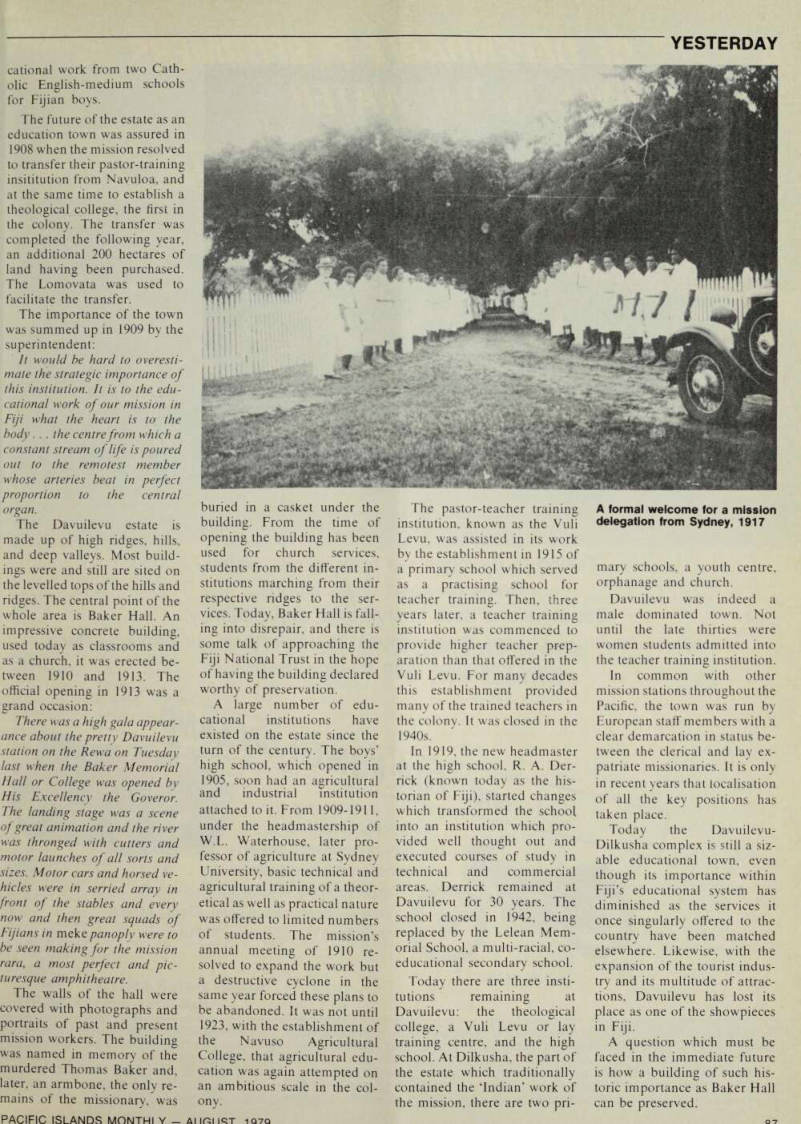
A formal welcome for a mission delegation from Sydney, 1917