Earth
pp. 77-78 · Read in the full issue
'Hell On
In Detail
Convicts and Commandants of Norfolk Island 1788-1855 by Margaret Hazzard. 58pp, 1978.
Distributed by Book People of
Australia, Sydney.
In Convicts and Commandants, a meticulously researched account of Norfolk Island’s his tory as a penal settlement, Margaret Hazzard illuminates the characters of its several commandants, describes with fascinating attention to detail the preparation for, and im plementation of, settlement plans for an island home to be pioneered by convicts, and re counts many of the well documented instances of both the interesting formations and changes of power-structure on the island, and the harsh brut ality of convict discipline.
The first governor of the new ‘prison colonies’ of the
southern hemisphere, Captain
Arthur Phillip, was instructed that ‘Norfolk Island, being rep resented as a spot which may become useful, you are ... to send a small establishment thither to secure the same to us and prevent it being occupied by subjects of any other European power’. There would be the added benefit to the Bri tish Navy of securing a supply
of the much-needed flax plant, which Captain James Cook reported to be plentiful when he visited Norfolk in 1774.
The absorbing account of the personalities, male and female, involved in the fornTation of the penal settlement, whose crimes as convicts were of such moment as stealing cows and
prostitution, gives evidence of
an unusually supportive for
mation of relationships in the initial period of the settle ment.
Lieutenant Philip Gidley
King, the island’s first com mandant, took with him from Sydney’s Port Jackson settle ment a group of ‘first-fleeters’ eight free men, nine male convicts and six females. The free men, who included a volunteer surgeon, a seaman adventurer and a few ‘police’ and general order men, worked with convicts, all as servants of the crown. John Rice, a burglar from Devon, became Lieuten
ant King’s ‘right-hand man’.
Their situation was one of trust.
The worst punishment that could be handed out by Com mandant King would be return to Port Jackson.
Rules for the ‘colony’ were stringent. Everyone had ‘to be at church on Sunday at 11am, clean, orderly and behave de voutly’. Each person had Satur day free to clear his own plot of land and plant seed supplied
by Lieutenant King.
If ‘an affection’ arose be tween male and female settler, the surgeon was permitted to perform a ceremony which would be solemnised at some future time when a clergyman visited the settlement.
Between 1788 and 1814 the island saw the number of con victs increasing and a series of commandants whose person alities and systems of control ranged from the indecisive to the plainly sadistic. Foveaux (commandant from 1800-1804) regularly ordered that women be flogged and was known as
the ‘Tyrant’.
During the administration of such commandants, men were sent from Australia’s mainland
to be ‘broken’ on the island and it became known to convicts as ‘hell on earth’. Conversely, some commandants behaved like social reformers. Alex ander Maconochie (comman dant from 1840-1844) brought books, musical instruments, and a public holiday for con victs on the Queen’s Birthday to the island.
This account of Norfolk Island’s first 70 years is neither ambitious nor in any way pre tentious. It is a valid historical document which, contrary to any impression of a ‘dry treat ise’ which may be given by its cover design and title, gives an
outstandingly perceptive and
human picture of Norfolk Island’s origins not as a microcosm of Australia’s development, but as an attempt to form a community, albeit an enforced one, on a naturally hospitable Pacific Island.
Margaret Hazzard, as a long term resident of the island, clearly evidences her interest in, and concern for the development of Norfolk Island in this record of its first 70
years.
Mary Dennis
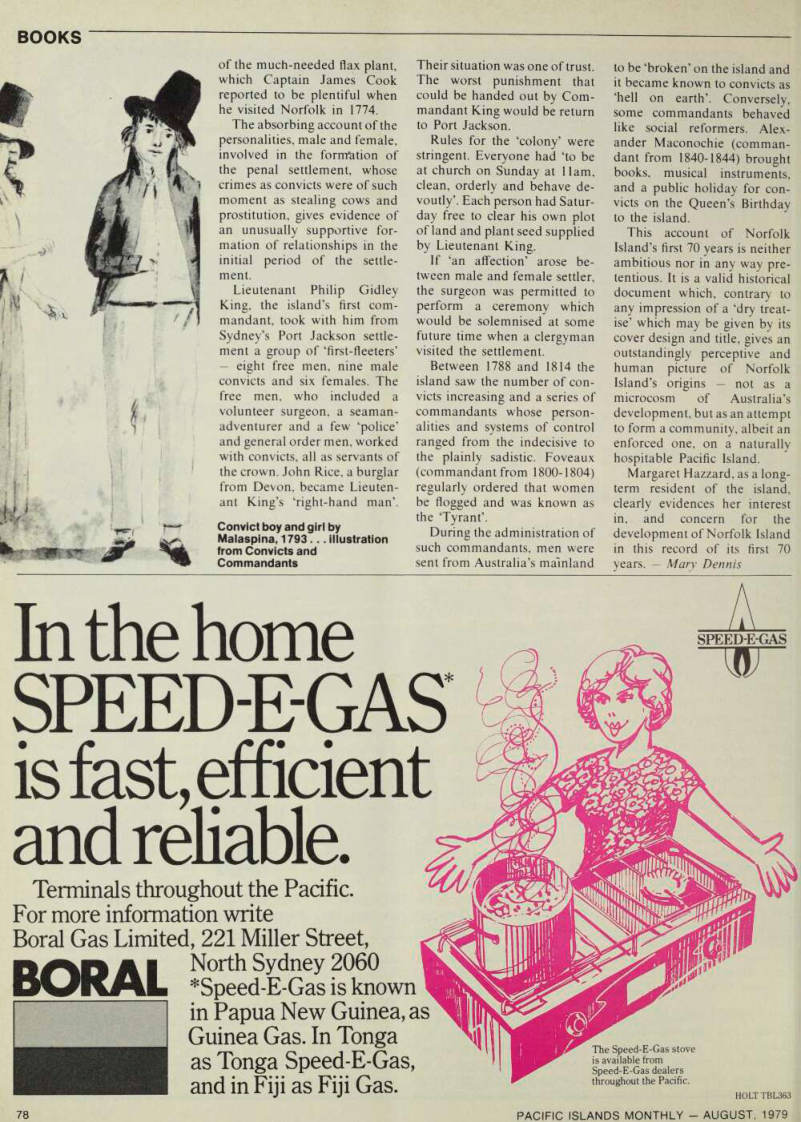
Convict boy and girl by Malaspina, 1793... illustration from Convicts and Commandants