'conquest' of
p. 77 · Read in the full issue
Books
A long drawn-out 'conquest' of the Islands
Pacific Islanders under German Rule: a study in the meaning of colonial resistance by Peter Hempensta/l. Published by A ustralian National University Press, Canberra, 1978. $A 19.50.
By the 19705, German business interests working out of Apia, the coconut oil trade their main objective, had penetrated much of the Pacific. Plantations, a cheaper and more reliable source of coconut oil than buying it from islanders,
were being developed and
trading stations had been established on many islands. It was, however, not until 1884 in north-eastern New Guinea, the following year in the Marshall Islands, 1899 in the Mariana and Caroline Islands, and 1900 in Western Samoa that Ger-
man sovereignty was imposed.
The reasons for this drawn-out
‘conquest’ were mainly com-
mercial (local and global) and political (rivalries in imperialism by Britain, its Australasian colonies, and the In Pacific Islanders under German Rule, Dr Peter Hempenstall looks at instances of
physical resistance by
Samoans, Micronesians and New Guineans to German
zin people and by the Bainings;
and the Sokehs rebellion on Ponape in each case oppo sition to foreign acquisition of land was the underlying, if not the main, cause.
Hundreds of resisters and many Europeans and their sup porters lost their lives. ‘ lnta puain inta’ (blood buys blood), says the Ponapeans. The islanders yielded to no one when it came to bravery. On June 25, 1890, for instance, 40 Spanish soldiers were mass acred by the Madolenihmw on
Ponape.
The most important aspect dealt with in this scholarly and readable book is the emerg ence of leadership of the kind needed for the islanders to gain optimum advantage from cir cumstances imposed upon them and, so it seemed, of per manence. On Samoa, men such as Malietoa Tanumafili I and Mata’afa Josefo took their fol lowers into temporary alliances with the Germans or Amer icans, as did the Wasai Sokehs and Henry Nanpei with the Spaniards or Germans on
Ponape. They did not merely
seek territorial and status advantages for their people but amelioration of the foreign imposed overall conditions as well. Lauaki Namula’ulu Mamoe on Samoa and Nanpei on Ponape stood out by their success in getting the best of two worlds. The Samoans and
Ponapeans of to-day rightly re
vere their memory.
Of great interest, too, are the
overlordship. Compared with.
say, the Herero-Nama war of 1904 in South-West Africa and the Maji Maji rebellion of 1905 in East Africa, warfare in Samoa (a mixture of tra ditional rivalries, their apex the claim to paramount clieftaincy.
and competing European
imperalisms), resistance on Ponape (with concurrent tra ditional inter-district struggles for dominance), and uprisings in New Guinea (by temporary alliances of clans or villages) were of minor significance, Only the Samoan wars made some impact on international politics, and that impact was
slight and fleeting,
In retrospect, almost a cen tury later, those early struggles for independence are neverthe
less important because they
were the first indicators of the vigour and adaptability of Pa cific cultures under threat of
continuing foreign dominance
and possible extermination, They show the vital importance of land, a saleable commodity to Europeans but an integral part of the Islanders’ religio secular universe. The continu ing struggle for the Ali’i Sili title, the Oloa Movement and its Cumpani, etc, in Samoa; the uprisings on the Gazelle Penin sula (New Guinea) by the Var-
author’s brief but lucid account of the convoluted social sys tems which underlay the shaping of events, and his ex planation of the emergence of German colonial policy for the Pacific. In those days as, indeed, throughout most of the
years of European political
dominance, the government official on the spot had a larger share of policymaking than his
superiors at home.
Harry
Jackman.
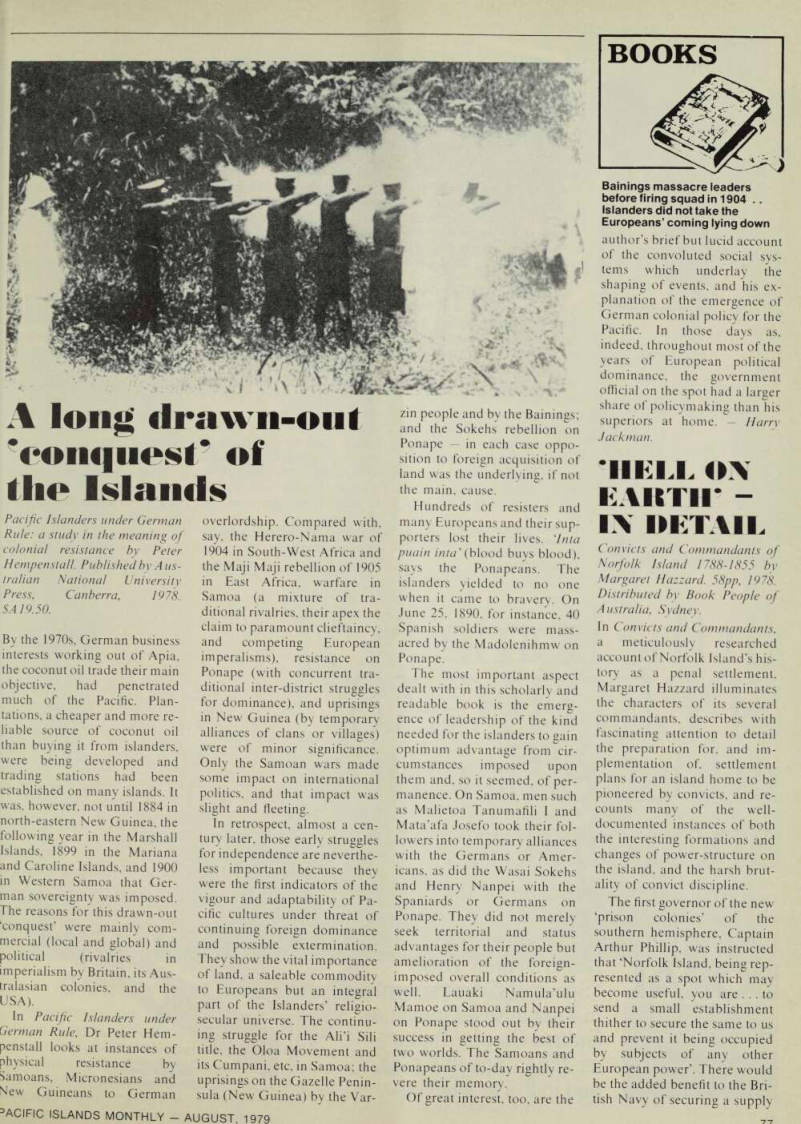
Bainings massacre leaders before firing squad in 1904 ..
Islanders did not take the Europeans’ coming lying down