Magnificent Moorea
pp. 73-74 · Read in the full issue
beckons from across the Sea of the Moon
Travellers lucky enough to find themselves on the sleek w hite vacht Keke II are bound for one of the greatest travel thrills in the entire Pacific, writes Captain Ned A vary who provides us with this roman tic view> of a voyage across the Sea of the Moon from bustling Papeete to the fabled Bali Ha'i island of Moorea.
Getting underway, about
9.30 am. the Keke sails past the end of the jet runway which changed Tahiti from a hard-to get-to corner of the Pacific into a tourist rendezvous. Then it is through the pass in Tahiti’s en circling reef into the Sea of the Moon. The blue Pacific is smooth and gentle now, but in the late afternoon this 18 km stretch of open sea can become a nightmare of physical dis comfort when the trade winds pick up. So the tourists will fly back to Tahiti when they return.
The tourists relax on the Keke , their eyes feasting lazily on the green majesty of Moorea’s cloud-piercing peaks.
Moorea is close now. The skipper eases the Keke into the
turquoise lagoon, then cruises
along wonderful white sand beaches and palm-fringed shores. Soon the captain turns to port. A churchlike silence descends on the craft as it enters the most wildly beautiful blue body of water on earth. Pao Pao Bay. Somerset
Maugham’s description comes
to mind: ‘Pao Pao Bay has too much beauty for the beholder who, dazed by its impact, fumbles for phrases to describe it then concedes defeat.’
The Keke's diesels die down as it slides alongside the tiny Hotel Aimeo jetty, where the tourists are warmly welcomed with gay greetings and fresh frangipani leis. No fussy, for mal ‘signing-in’ here at what is for my money the grandest hotel in the South Pacific. The tourists are led to their bunga lows by pareu- clad girls. Their bags are already there as is a much-needed, thirst
quenching drink, the glorious
maita 7 (rum punch-de-luxe).
After relaxing a little, some of the visitors dive into the
cool, quiet lagoon. Modern
carbon-14 dating tells us that this beautiful bay also
refreshed plunging Polynesians
way back in 1500 BC. Here is
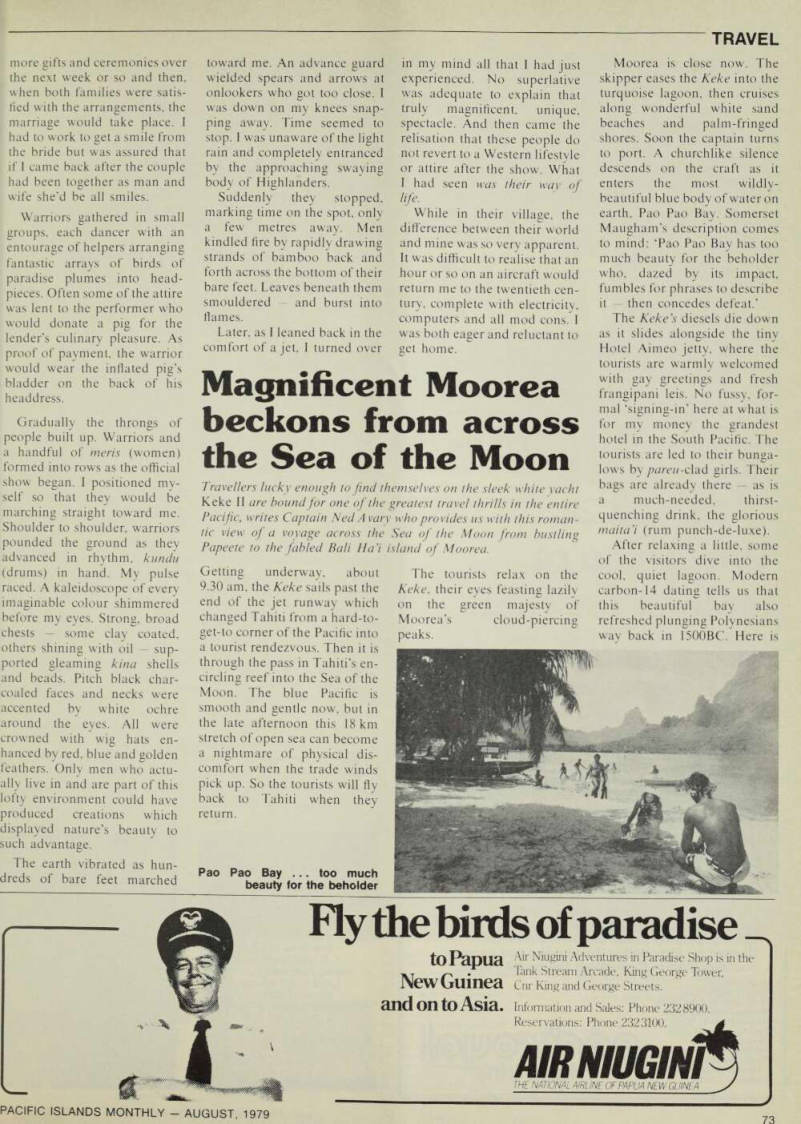
Pao Pao Bay ... too much beauty for the beholder
the secret of Moorea. So little
has changed since Polynesians
first arrived. Even the two ‘civi lised centuries’ since Captain Cook sighted this green jewel have been kind to Moorea.
It being a Wednesday, that night the tourists will enjoy the sumptuous Polynesian feast of the tamaraa, followed by a per formance by temae dancers.
Their performance is unique to the Aimeo.
Moorea is rather heart shaped. There are two routes to attract the tourist, one west, one east. We won’t go clear round the island. This is a hot, dusty waste of time. We’ll con centrate on the north coast, where there are many attrac tions.
The hotel provides push bikes free of charge. For the less active, jeeps can be rented across the road.
First of all let’s head south alongside Pao Pao Bay (also called Cook's Bay) to the mini metropolis of Pao Pao village.
Right out of a Maugham novel! Two Chinese shops ped
dling everything from bikinis
to beer. A tiny clinic, lovely tropical-style school, a rusty old petrol pump, and a couple of slow-moving local charac ters. That’s Pao Pao village, except for the one and only Pao Pao Hotel, locally and lovingly known as One Chicken Inn.
Since the deplorable destruc tion of the world-famous Quinn’s Tahitian Hut on Papeete’s waterfront, the One Chicken Inn on Saturday night steals the South Pacific show for sheer, uninhibited enter tainment. Only then does sleepy Moorea really wake up, as all hell breaks loose at the One Chicken Inn.
Now we press on around the western shore of Pao Pao Bay.
On our right is a lovely, coral white Catholic chapel. You’ll be charmed by this delightful little house of God. Pierre Heyman’s marvellous murals, with brown-skinned Poly
nesians portraying the nativity
scene, are world-renowned.
It’s hot now. We pause at our nearest oasis, the Moorea La goon Hotel. It’s a lovely place, with a pool and lagoonside set ting. Its maita’is hit the spot.
Westward again. The island road gently curves into another deep bay. We stare in wonder, for this Opunohu Bay is as stag geringly beautiful as Pao Pao which we have just left.
On the shores of Opunohu Bay we now discover the tiny,
storybook village of Papetoai.
Here are the rebuilt ruins of the first (1813) Protestant church in the South Pacific. Here also the Temae dancers came to enter tain the first royalty, the Maramas of Moorea, and later the powerful Pomare, who
conquered all the Society
Islands.
At the head of Opunohu Bay we see a wooden sign in the heart-shape of Moorea. It says that this is the inland road to the lovely lookout park of Bel vedere. After checking our Moorea map we also spot this as the forested area of ancient marae (sacred temples).
Up into the green mountains we go on a wonderful, winding road. At the lookout we take in one of the world’s grandest views, of both Pao Pao and
Opunohu bays, the lovely la
goon with its rough reef and the distant Pacific.
Later, visiting one of the sev eral ancient marae in the area,
the gloom surrounding these
semi-restored ruins hauntingly recalls savage spectacles of human sacrifice, royal wed dings, wild and weird religious
rites, and the crowning of
ancient kings.
Soon we are back home at our Aimeo, ready for a lagoon dip, and, of course, another maita V.
Do the things that I’ve de scribed, and also visit the vil lage of Temae, and the Shangri-La of Kia Ora Moorea, and you’ll have seen ‘the best’ of this glorious island.
Moorea numbers about 5 000 uninhibited inhabitants.
They are scattered over the lush lowlands of the island’s 130 square km area. The island road covers 70 memorable kilometres, and the highest cloud-piercing peak is about 1220 metres closer to heaven than you.
Tourists who come to Moorea to be with their own nationals will be more than sat isfied with the Club Med with its rollicking, regimented regime at the western tip of Moorea. But remember, prices at the Bali Ha’i and the Club Med are not cheap.
For the budget-minded here is a highly-unpublicised pair of Moorea secrets: there are two modest, yet very comfortable,
fully-furnished housekeeping
‘motels’ right here. Same view,
same setting, same everything,
except the price. They’re called Chez Albert and Chez Jacqueline.
A word about food: all meals are expensive in French Polynesia. For budgeteers; stay at one of the ‘motels’ men tioned, shop at your local Chinese store, cook your own food. You’ll save a bundle.