Getting To The
pp. 72-73 · Read in the full issue
Heart Of Png
One of the greatest barriers to people discovering the incredible beauty of Papua New Guinea is that so many tend to get as far as Port Moresby and say to themselves: ‘Well, I've done it.' How wrong they are. As an advert for Papua New Guinea, some regard Port Moresby as a liability. In fact, if you've only seen the national capital you certainly haven't seen Papua New Guinea. Iris Langdon recently got away from the big city and went up in the world to the country west of Highland Mount Hagen.
The scenery, as we climbed over the pass out of Mount Hagen on the way to Kompiam was out of any world I had ever known. A chilling wind whistled through the stunted vegetation. It was no man’s land. They told me the only permanent residents were cus cus (possums); they were wel come to the swirling mists which enveloped this eerie
landscape.
Mount Hagen, at 1600 metres had seemed high to me after the heat of coastal Port Moresby. But now, at 2460 metres, I was ready to come down again. Soon we did,
winding, dropping along the
mountainside into the Minamba Valley. It was a spirit world. No one had to tell me that. But they wanted to: a
pointed finger took my gaze back up to the towering cliffs.
You would have sworn some
ingenious construction
company had been at work.
But it was nature which had carved a stoney escarpment until the image was of a giant, man-made fence. Legend. I was told, had it that the masalai (spirits), who lived there long ago, had carved themselves a defensive barricade.
In the rare mountain air. the trip from Mount Hagen, the Western Highlands Province
capital, to Kompiam, in neigh
bouring Enga Province, was a breathtaker. I found myself without a care and foolishly
climbing out onto precarious
perches to take pictures. It was
a photographer’s paradise.
Every turn in the road
presented views of indescrib able beauty. I shot mountain tops wreathed in clouds: fast
flowing streams forcing their
way between rocks and burst
ing through in frothy miniature
falls; and rivers thundering down mountainsides in ca
pricious cascades.
As we drew closer to Kom piam, where I was to attend its first cultural show, it became something of a road show.
Although a remote area, it seemed as if every Highlander in the province had decided to use this road to Kompiam.
Women, their breasts exposed to the elements, looked a hardy lot. The image may be of liberation to the cas ual onlooker, but their life is chained to a demanding role mother / gardener, the fruits of
their labours literally making
the difference between full and empty bellies.
The men swung along in their asgras (bunches of green tankert leaves fore and aft), most with a ‘Hagen’ axe slipped into their bark belts.
Some were fortunate enough to
have cuscus fur hats. Others wore their human hair wig hats protected by cloth dust covers. (These headpieces are con structed from the hair of friends and family.) Everyone with a free hand gave us a wave; all offered at least a smile.
That night I was invited to a
tanim het (literally ‘turning
head’) courtship ceremony.
Men and women alike glistened with tree resin. The
girls smelled lovely, having
rubbed their skins with a
scented herb. They proudly
displayed their wealth in the form of kina shells, beads and cuscus fur pieces. Men wore short pieces of thin bamboo, one for each pig they owned, and crowned the lot with those fantastic wig hats.
The men and women sat opposite each other about four metres apart. The males wooed with songs until they received some sort of encouragement sometimes a smile, perhaps a
whispered phrase. Having
received the ‘come on', a war rior would move across and sit next to the woman who had chosen him. And make no mis take, the ladies do the choos ing. The man would nestle up ever closer to his woman and finally start stroking her cheek with his nose. As if prearran
ged. they would start swaying
back and forth in unison, cheek to cheek. Eventually in an up
right position they stroked their
noses across each other’s face.
Next day. almost before the sun had a chance to show its face, preparations for the sing sing began. A group of people milled happily close to a dozen pigs tied to stakes along the roadside. It was payday for the bride’s family. Kina shells and cash were also given by the groom-to-be. There would be
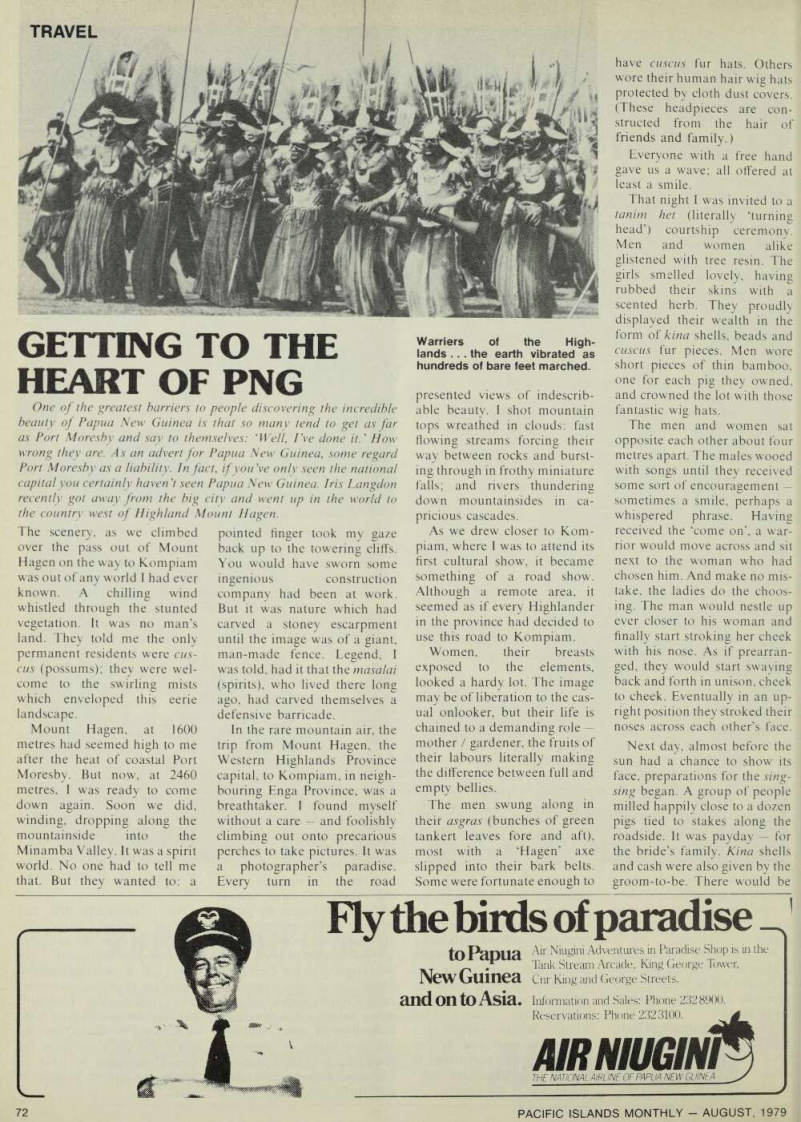
Warriers of the High lands ... the earth vibrated as hundreds of bare feet marched.
more gifts and ceremonies over the next week or so and then, when both families were satis fied with the arrangements, the marriage would take place. I had to work to get a smile from the bride but was assured that if I came back after the couple had been together as man and wife she’d be all smiles.
Warriors gathered in small groups, each dancer with an entourage of helpers arranging fantastic arrays of birds of
paradise plumes into head
pieces. Often some of the attire was lent to the performer who would donate a pig for the lender’s culinary pleasure. As proof of payment, the warrior would wear the inflated pig’s bladder on the back of his headdress.
Gradually the throngs of
people built up. Warriors and a handful of meris (women) formed into rows as the official show began. I positioned my self so that they would be
marching straight toward me.
Shoulder to shoulder, warriors pounded the ground as they advanced in rhythm, kundu (drums) in hand. My pulse raced. A kaleidoscope of every imaginable colour shimmered before my eyes. Strong, broad chests some clay coated, others shining with oil sup ported gleaming kina shells and beads. Pitch black char coaled faces and necks were accented by white ochre around the eyes. All were crowned with wig hats en hanced by red, blue and golden feathers. Only men who actu ally live in and are part of this lofty environment could have produced creations which
displayed nature’s beauty to
such advantage.
The earth vibrated as hun dreds of bare feet marched
toward me. An advance guard wielded spears and arrows at onlookers who got too close. I was down on my knees snap ping away. Time seemed to stop. I was unaware of the light rain and completely entranced
by the approaching swaying
body of Highlanders.
Suddenly they stopped,
marking time on the spot, only a few metres away. Men kindled fire by rapidly drawing strands of bamboo back and forth across the bottom of their bare feet. Leaves beneath them smouldered and burst into flames.
Later, as I leaned back in the comfort of a jet, I turned over
in my mind all that I had just experienced. No superlative was adequate to explain that
truly magnificent. unique,
spectacle. And then came the relisation that these people do not revert to a Western lifestyle or attire after the show. What I had seen was their way of
life.
While in their village, the difference between their world and mine was so very apparent.
It was difficult to realise that an hour or so on an aircraft would return me to the twentieth cen
tury, complete with electricity,
computers and all mod cons. I was both eager and reluctant to get home.