Now it’s 'hire a yacht
p. 71 · Read in the full issue
Travel
Now it’s 'hire a yacht and sail the islands of Vavau’
An interesting commercial development involving bareboat yacht hire is underway in Vavau in northern Tonga. Jimmy Cornell, who reports on this venture from Neiafu, also raises the question of Islands reaction to irresponsible yacht crews whose actions are help ing to make the going tough for all those others willing to play the Pacific voyaging game by the rules.
Three yachts arrived recently at Vavau to establish a bareboat
charter operation. Owned by
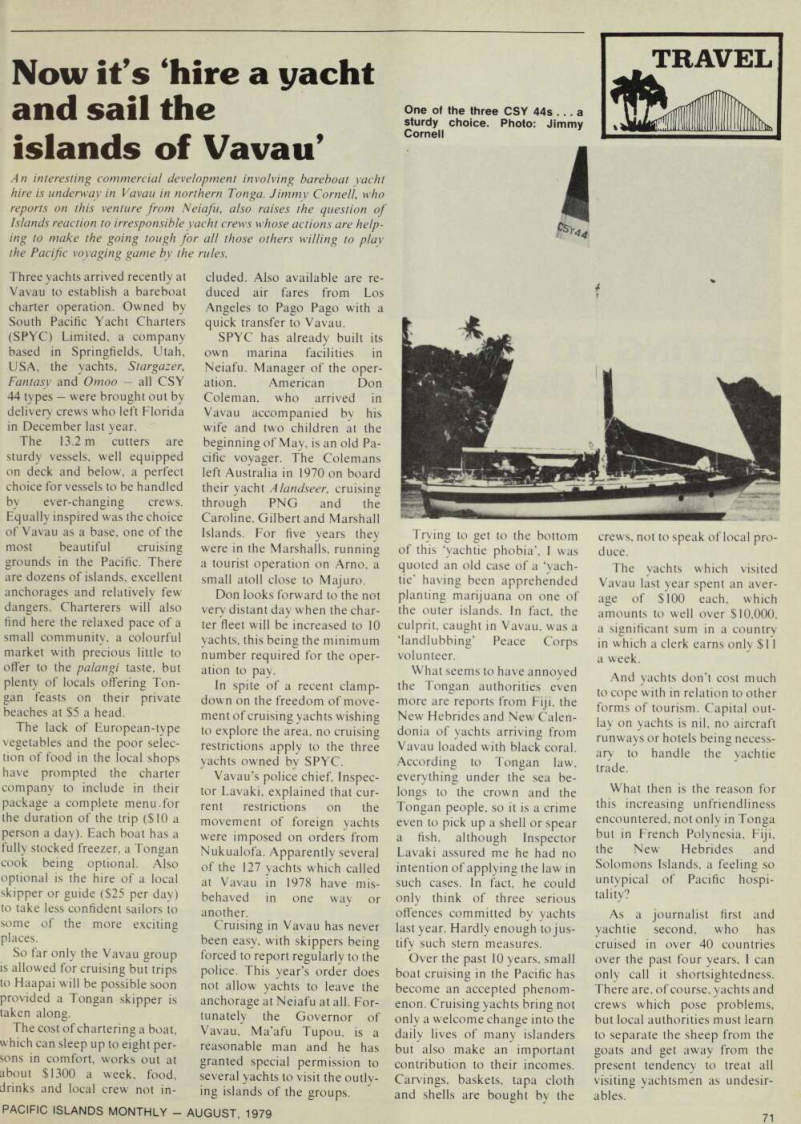
South Pacific Yacht Charters (SPYC) Limited, a company based in Springfields, Utah, USA, the yachts, Stargazer, Fantasy and Omoo all CSY 44 types were brought out by delivery crews who left Florida in December last year.
The 13.2 m cutters are
sturdy vessels, well equipped
on deck and below, a perfect choice for vessels to be handled
by ever-changing crews.
Equally inspired was the choice of Vavau as a base, one of the most beautiful cruising grounds in the Pacific. There are dozens of islands, excellent
anchorages and relatively few
dangers. Charterers will also find here the relaxed pace of a small community, a colourful market with precious little to offer to the palangi taste, but plenty of locals offering Ton gan feasts on their private beaches at $5 a head.
The lack of European-type vegetables and the poor selec tion of food in the local shops have prompted the charter company to include in their
package a complete menu.for
the duration of the trip ($lO a person a day). Each boat has a fully stocked freezer, a Tongan
cook being optional. Also
optional is the hire of a local
skipper or guide ($25 per day)
to take less confident sailors to some of the more exciting
places.
So far only the Vavau group
is allowed for cruising but trips
to Haapai will be possible soon
provided a Tongan skipper is
taken along.
The cost of chartering a boat, which can sleep up to eight per sons in comfort, works out at about $l3OO a week, food, drinks and local crew not in
eluded. Also available are re duced air fares from Los
Angeles to Pago Pago with a
quick transfer to Vavau.
SPYC has already built its own marina facilities in Neiafu. Manager of the oper ation, American Don Coleman, who arrived in
Vavau accompanied by his
wife and two children at the beginning of May, is an old Pa cific voyager. The Colemans left Australia in 1970 on board
their yacht Alandseer, cruising
through PNG and the Caroline, Gilbert and Marshall Islands. For five years they were in the Marshalls, running a tourist operation on Arno, a small atoll close to Majuro.
Don looks forward to the not very distant day when the char ter fleet will be increased to 10 yachts, this being the minimum number required for the oper ation to pay.
In spite of a recent clamp down on the freedom of move
ment of cruising yachts wishing
to explore the area, no cruising restrictions apply to the three
yachts owned by SPYC.
Vavau’s police chief. Inspec
tor Lavaki. explained that cur rent restrictions on the movement of foreign yachts were imposed on orders from Nukualofa. Apparently several of the 127 yachts which called at Vavau in 1978 have mis behaved in one way or another.
Cruising in Vavau has never been easy, with skippers being forced to report regularly to the police. This year’s order does not allow yachts to leave the anchorage at Neiafu at all. For tunately the Governor of Vavau, Ma’afu Tupou. is a reasonable man and he has
granted special permission to
several yachts to visit the outly ing islands of the groups.
Trying to get to the bottom of this ‘yachtie phobia’, I was quoted an old case of a ‘yach
tie’ having been apprehended
planting marijuana on one of the outer islands. In fact, the culprit, caught in Vavau, was a
‘landlubbing’ Peace Corps
volunteer.
What seems to have annoyed the Tongan authorities even more are reports from Fiji, the New Hebrides and New Calen donia of yachts arriving from Vavau loaded with black coral.
According to Tongan law,
everything under the sea be longs to the crown and the Tongan people, so it is a crime even to pick up a shell or spear
a fish, although Inspector
Lavaki assured me he had no intention of applying the law in such cases. In fact, he could only think of three serious
offences committed by yachts
last year. Hardly enough to jus
tify such stern measures.
Over the past 10 years, small boat cruising in the Pacific has
become an accepted phenom
enon. Cruising yachts bring not
only a welcome change into the daily lives of many islanders but also make an important contribution to their incomes.
Carvings, baskets, tapa cloth and shells are bought by the
crews, not to speak oflocal pro duce.
The yachts which visited Vavau last year spent an aver age of $lOO each, which amounts to well over $lO,OOO, a significant sum in a country in which a clerk earns only $ll a week.
And yachts don’t cost much to cope with in relation to other forms of tourism. Capital out lay on yachts is nil. no aircraft runways or hotels being necess ary to handle the yachtie trade.
What then is the reason for this increasing unfriendliness encountered, not only in Tonga but in French Polynesia, Fiji, the New Hebrides and Solomons Islands, a feeling so
untypical of Pacific hospi
tality?
As a journalist first and yachtie second, who has cruised in over 40 countries over the past four years, I can
only call it shortsightedness.
There are, of course, yachts and crews which pose problems, but local authorities must learn to separate the sheep from the goats and get away from the present tendency to treat all
visiting yachtsmen as undesir
ables.
One of the three CSY 44s ... a sturdy choice. Photo: Jimmy Cornell