Papua New Guinea
pp. 41-69 · Read in the full issue
Pim Pacific Islands Monthly
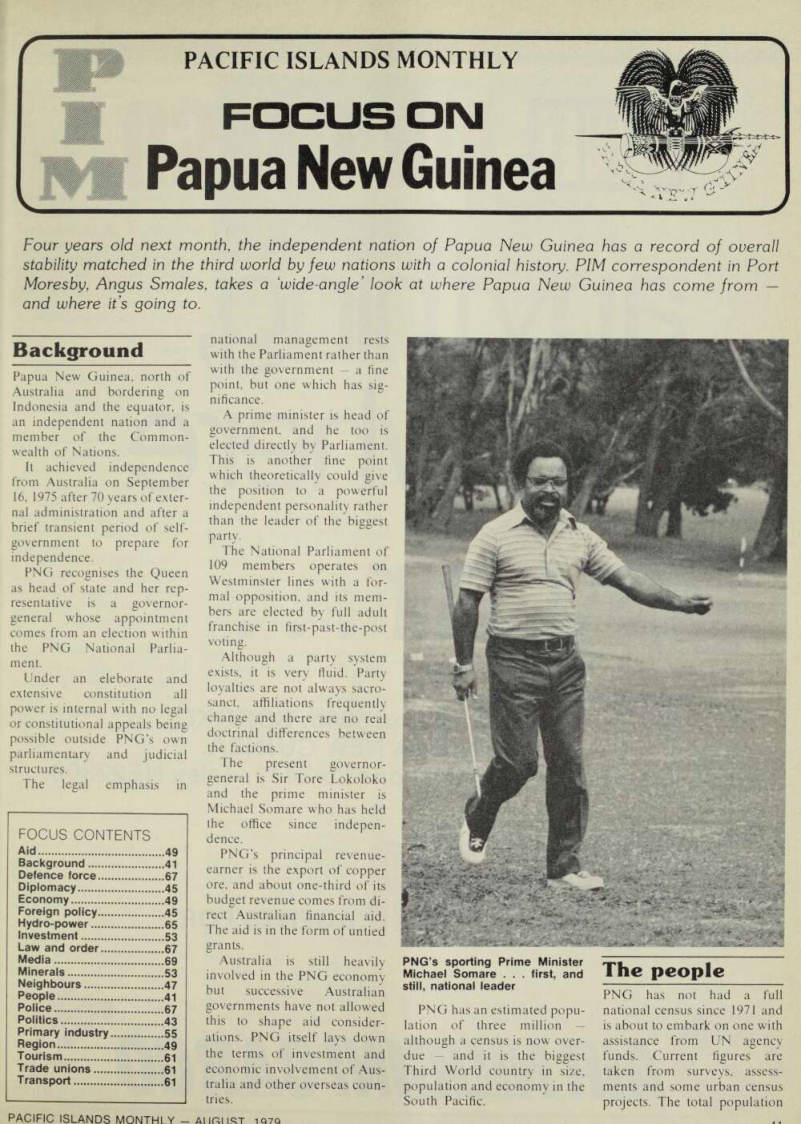
Focus On
Four years old next month , the independent nation of Papua New Guinea has a record of overall stability matched in the third world by few nations with a colonial history. PIM correspondent in Port Moresby , Angus Sma/es, takes a ‘ wide-angle ’ look at where Papua New Guinea has come from and where it's going to.
Background
Papua New Guinea, north of Australia and bordering on Indonesia and the equator, is an independent nation and a member of the Common wealth of Nations.
It achieved independence from Australia on September 16, 1975 after 70 years of exter nal administration and after a brief transient period of self government to prepare for
independence.
PNG recognises the Queen as head of state and her rep resentative is a governor
general whose appointment
comes from an election within the PNG National Parlia ment.
Under an eleborate and extensive constitution all power is internal with no legal or constitutional appeals being possible outside PNG’s own
parliamentary and judicial
structures.
The legal emphasis in
national management rests with the Parliament rather than with the government a fine point, but one which has sig nificance.
A prime minister is head of government, and he too is
elected directly by Parliament.
This is another fine point
which theoretically could give
the position to a powerful
independent personality rather
than the leader of the biggest party.
The National Parliament of 109 members operates on Westminster lines with a for mal opposition, and its mem bers are elected by full adult franchise in first-past-the-post
voting.
Although a party system exists, it is very fluid. Party loyalties are not always sacro sanct, affiliations frequently change and there are no real doctrinal differences between the factions.
The present governor general is Sir Tore Lokoloko and the prime minister is Michael Somare who has held the office since indepen dence.
PNG’s principal revenue earner is the export of copper ore, and about one-third of its budget revenue comes from di rect Australian financial aid.
The aid is in the form of untied grants.
Australia is still heavily involved in the PNG economy but successive Australian governments have not allowed this to shape aid consider ations. PNG itself lays down the terms of investment and economic involvement of Aus tralia and other overseas coun tries.
PNG has an estimated population of three million although a census is now overdue and it is the biggest Third World country in size, population and economy in the South Pacific.
The people
PNG has not had a full national census since 1971 and is about to embark on one with assistance from UN agency funds. Current figures are taken from surveys, assess ments and some urban census
projects. The total population
PNG’s sporting Prime Minister Michael Somare ... first, and still, national leader
is estimated at three million and the annual rate of increase is a shade under 3%. The popu lation includes about 30 000 non-citizens of whom most are Australians and New Zea landers.
There are indications how ever that the proportion of Australians and New Zealanders in the non-citizen population is declining as PNG becomes more cosmopolitan.
This is due to international recruiting for some sections of the public service and to the establishment of new develop ment industries backed by countries other than Australian and New Zealand.
The Philippines, UK and
Japan are the major newly
represented countries in the non-citizen workforce. Since independence there have been 815 naturalisations of long term residents, most in the first 18 months. Of these, 310 for merly held Australian citizen ship. PNG keeps no records of the ethnic background of its residents.
Citizenship by naturalisation
has become a contentious
issue, with public allegations
that some citizenship appli
cations have been moves of financial convenience.
The attacks have been lev elled particularly at married couples in which one partner has taken out citizenship and the other hasn’t. Some Papua New Guineans see this as an attempt to make money with
the advantage of citizenship
and to ship it out with the
advantages of foreign nation
ality.
The basis for these alle gations is open to question for a variety of reasons but the situation has moved Migration Minister Ebia Olewale, to announce that he will not ap prove any application unless citizenship involves all mem bers of an applicant’s family.
Most non-citizens live in the urban areas where the number of non-citizens has become
fairly stable, showing only a
very small growth rate.
Estimates indicate there is a de cline in the non-citizen popu lation of rural areas.
The populations of the main urban areas are:
Port Moresby 107 000 (11 000 non-citizens) Lae 45 000 (4 000 non-citizens) Madang 20 000 (1600 non-citizens) Rabaul 14 000 (1800 non-citizens) The combined urban com plexes in the Bougainville cop per mine area (Kieta, Arawa and Panguna) have a popula tion of 16 000.
Urban drift continues to be a major problem with unskilled workers, who have little hope
of employment, swelling town
populations. This has wor sened employment situations and has created new social
problems.
Provincial governments a second-tier of decentralised administrative control introduced by the central government have been par ticularly troubled by the drift to their towns.
They have attempted, with
varying degrees of success, to
send unemployed people back
to their home provinces in chartered trucks, aircraft and workboats. But this has had
political implications because
it is a non-enforceable policy which conflicts with consti tutional guarantees of freedom of movement.
Often, too, shipping people home has merely created an urban drift problem for another town because the people returned to their home
provinces don’t necessarily
return to their rural homes.
They stay instead in the provin
cial capital.
Politics
Michael Somare’s Pangu Party has been the senior party in governing coalition since independence - and earlier,
too, during the pre-independ
ence self-government period.
But Mr Somare governs today with the support of the United Party which was once in opposition and was the biggest single party in parliament be fore wastage and a factional split took their toll.
The former government co alition partner, the Peoples Progress Party, now sits on the
opposition benches following a
row in which it claimed Mr Somare was leaving it out of consultation in national man agement.
The transposition of the two groups one from opposition to government and the other from government to opposition demonstrates effectively the lack of any real doctrinal dif ferences between the political groupings in the PNG parlia ment.
The issues come down to leadership and the methods and mechanics of politics, al lied to the normal processes of
political power seeking, rather
than to any inherent dif ferences in political outlook.
All party policy outlooks in PNG could reasonably come under the general definition of ‘progressive’, aimed at the cre ation and maintenance of a
society in which shared devel opment is supreme, where a strong state presence exists, but where free enterprise is an essential element.
How to implement these goals, rather than the goals themselves, are the main points of contention in PNG poli tics.
The opposition’s stated role is to ‘expose and depose’ the government and it offers what it calls an alternative plan of government in the national interest. But here again the alternatives tend to emerge as processes and methods rather than as new goals.
The only real differences of doctrine which have ever marked the national politics of PNG were the Pangu Party’s foundation call for immediate home rule and Papua Besena’s call for an independent and separate Papua free of union with New Guinea.
The first is now a part of his
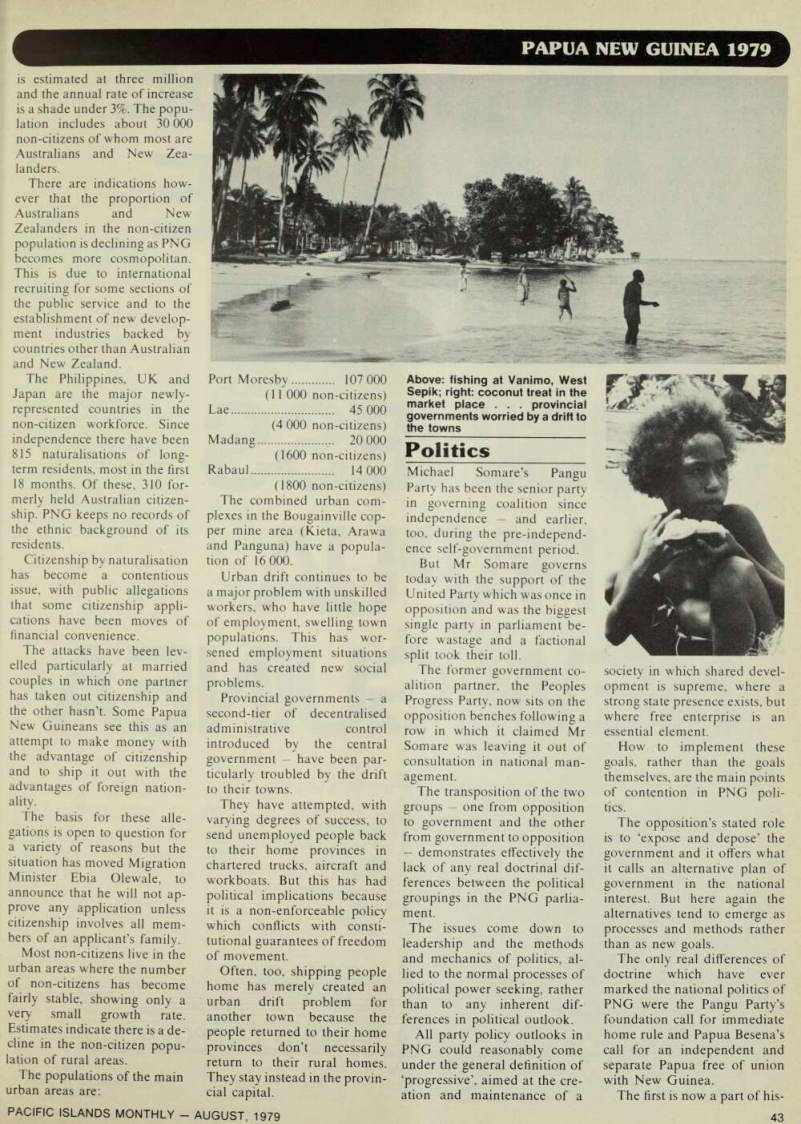
Above: fishing at Vanimo, West Sepik; right: coconut treat in the market place ... provincial governments worried by a drift to the towns
tory and the second has be come symbolic of a Papuan insistence for full involvement in national management rather than for secession.
The two party leaders in government are Michael Somare (Pangu Party) and Sir Tei Abal (United Party), with Pangu holding the top posts of
prime minister, deputy prime
minister and finance. Sir Tei, as minister for public utilities, is in a service rather than a policy
portfolio.
The two principal figures
across the floor of parliament are the Opposition Leader lambakey Okuk, leader of the loosely-linked Okuk group, and Julius Chan, leader of the
Peoples Progress Party and
who was once deputy prime minister.
In numbers which are not
always significant in isolation
because day-to-day issues affect them the government has a narrow majority but the
opposition’s minority is
widened because of the pres ence of about 10 effective
independents.
Mr Somare and his deputy, Ebia Olewale another long time Pangu man are both se cure in their group leadership.
Their government also appears immediately secure after with standing a number of chal lenges last year.
Mr Somare has no plan to step down at the next election
despite occasional speculation
over the past 12 months and despite a statement attributed to him in Australia which he later described as not accu
rately reflecting what he
meant.
In the opposition ranks some dissatisfaction is known to exist over leadership matters. A
Peoples Progress Party move to
establish Julius Chan as oppo sition leader was tipped in May and June but there were no immediate developments and Mr Chan refuses to discuss the issues.
Diplomacy
PNG has established diplo matic relations with 53 coun tries, and seven of these have established resident embassies in Port Moresby. PNG itself has six missions overseas.
including ambassadors to the United Nations and to the European Economic Com munity.
PNG is one of 57 developing countries, mainly members of the ACP States (Africa, the Caribbean and the Pacific), which have links with the EEC
through membership of the
Lome Convention.
The main benefits of this membership for PNG are duty free access to EEC markets, a potential for development loans, and an opportunity for commodity price stabilisation protection. This is of particular value to PNG’s rubber indus try. although rubber is a com paratively small PNG export.
However, the Lome Con vention ends its five-year run early next year, and PNG is now one of the ACP States
actively campaigning for the
best possible terms under new arrangements which the nine EEC countries are investigat
ing.
Foreign policy
Papua New Guinea defines its
foreign policy as ‘Univer
salism’, first laid down by the foundation foreign minister, Sir Maori Kiki, and carried on by the present minister, Ebia Olewale.
The basic definition of
PNG political leaders, clockwise from above: Oppostion Leader lambakey Okuk, Peoples Pro gress Party Chief Julius Chan, Minister for Public Utilities Sir Tei Abal, and Deputy Prime Minister and Foreign Minister Ebia Olewale with Australia’s Andrew Peacock
Universalism is ‘Friends of all, enemies of none’. Under this policy PNG refuses to align itself with any power bloc on the grounds that its size would make it subservient.
The policy believes that a comparatively small country can actually turn size to advan tage and co-exist with all blocs.
In a theorectical way the sys tem was demonstrated when PNG established diplomatic relations with China, becoming the first country not asked by China to declare non recognition of Taiwan.
In practice however the pol icy has at times appeared naive, and the government is known to have reconsidered its stand on a number of recent oc casions.
There are also increasing political pressures inside PNG to rethink the policy. ‘We should come out and say who our friends are,’ was the com ment of Vincent Eri, until re
cently PNG high commiss
ioner in Australia. Mr Eri claimed that, in any event, membership of the Common wealth was a negation of Universalism.
Universalism has so far pre vented the signing of any de fence agreement with Australia because of the ‘political’ over tones, but vague ‘cultural’ agreements have been entered into in the South Pacific and South-East Asia.
The most recent questioning of the policy came from the prime minister himself, when
Mr Somare spoke in Australia to the Australian Institute of International Affairs.
Confirming a review of
foreign policy, Mr Somare
said: ‘The policies which have served us since independence are now due for close examin ation. Universalism ... made sense for a new democracy.
Now for the first time since we became independent in 1975
our foreign policy is undergo
ing a complete review.’
Mr Somare said that in its
foreign policy his country
wanted to ensure security but the sort of security he meant was not protection from attack, but protection for trade re lations and prospects.
Neighbours
PNG has three immediate neighbours Solomon Islands, Australia and Indonesia.
Of the three, the Solomons link is both the most serene and the least technical. A reason
ably common ethnic heritage,
an identical background and an unquestionable brother hood have made formal diplo macy almost unnecessary.
The border is something of a question mark but no one
particularly cares, and the big gest argument of recent years was over a claim that Solomons mosquitoes were flying to the PNG island of Bougainville.
The two countries established formal links at Solomons independence last year, but their strongest link is mutual membership of the South Pacific Forum.
The Australian link is far too complex today to be described in a few lines, but geography and events and attitudes have
created a surprisingly healthy
bond from what was once a straight colonial situation.
It would be idle to suggest there are no anti-Australian attitudes in PNG society, but the formal diplomacy is firm and real.
Sir John Guise, PNG’s
governor-general at indepen
dence, said on that occasion: ‘We are hauling down the Aus-
tralian flag, not tearing it down.’ The attitude displayed in that statement continues to hold generally true.
The Indonesian link is an ambivalent one. Formal diplo matic links are strong, and PNG unhesitatingly accepts Indonesian sovereignty in
adjoining Irian Jaya.
But a significant sector of
public opinion defines
Indonesia as a neo-colonial power in Irian Jaya and, de
spite protestations of friend
ship, is uneasy at the
Indonesian proximity.
President Suharto, who visi ted PNG in June, drew a bigger crowd than Australia’s Gough Whitlam or Malcolm Fraser
has ever managed (although
the Queen won hands down), but curiosity rather than
Former PNG high commissioner to Australia, Vincent Eri ... call to rethink ‘universalism’ policy
Torres Treaty signing ... seated from left: Australia’s Foreign Minister Peacock and Prime Minister Malcolm Fraser; PNG’s Prime Minister Somare and Foreign Minister Olewale
Former governor-general, Sir John Guise ... independence day statement still holds true
togetherness stood out as the motive.
The PNG and Indonesian governments have formal agreements on border defi nition and management (with a renegotiation in the offing),
on cultural exchanges, sharing
of expertise, mutual aid and mutual regional attitudes.
Apart from the border, how ever, the agreements are of a very general nature so far, defining attitudes rather than specifics.
The Region
PNG is the only South Pacific country which has a land border with an Asian country.
The border is with Indonesia, one of three with other countries, and was the first to be properly formalised. (The other two, both sea borders, are with Australia and Solomon Islands. Also, there is a high seas border to the north.) Because of its Indonesian border, PNG sees itself as
occupying a special diplomatic
‘bridging’ role between Asia and the South Pacific. This has led PNG to obtain observer status in the Association of South-East Asian Nations (ASEAN), largely with the support of Indonesia.
PNG has no wish to extend its ASEAN links beyond ob server status, because it sees its direct regional role in the South Pacific.
As a result PNG has become one of the principal members of the South Pacific Forum countries - an association of the independent island coun tries of the South Pacific but it has worked for closer ties be tween Forum and ASEAN countries.
Any hard material benefits in trade and development from these links have yet to be realised, but PNG has been active in bringing together the two regions in a common con servation role.
This has included a common line towards the banning of nu clear tests and in campaigning to keep the Indian and South Pacific Oceans free of super power rivalries.
Aid
PNG’s principal source of aid is an annual untied grant from Australia which this year is worth about SA2IS million about one-third of the PNG
budget.
This is the third year of a five-year committed aid program from Australia.
Under the program Australia has guaranteed an annual grant of $lBO million, to be
supplemented by an additional
amount agreed to by annual
negotiation.
Under the scheme the first annual supplementary grant was $lO million, the second $2O million, and this year’s was $35 million.
Despite the progressive in
crease, the real value of Aus tralian aid in terms of purchasing power is estimated to have dropped by 7.6% over the period because of inter national economic factors including Australian currency movements.
On general principles PNG
does not quarrel with this tapering-off which is part of its own process of increasing self reliance. From the start of the aid agreement PNG adopted a strict policy to use the grant as little as possible for ongoing
public expenditure. Where
possible the money is applied to capital development of a type which will eventually gen erate national revenue, or will at least reduce avenues of
recurring expenditure.
The policy, piloted by the
first finance minister, Julius Chan and later by the present
minister, Barry Holloway, is
progressively reducing depen
dence on outside aid.
In addition to Australian aid, PNG is also receiving grants from the United Nations
Development Program and
from the New Zealand Government to a total this year of more than $6 million.
PNG as a developing country also has access to special concessional loans made available by overseas governments and international
agencies.
This type of aid at present totals an annual content of about $26 million, with the
principal sources being Japan.
West Germany, the Asian Development Bank, the World Bank and the International
Development Association.
Other sources involved or likely to be involved are the European Investment Bank, the Kuwait Fund and agencies in UK and the UN.
The economy
PNG has what economists de fine as an extremely open economy the value of its exports and imports is very large in relation to the value of its gross domestic product.
This makes any economy
highly susceptible to world
economic fluctuations, and in PNG the susceptibility is accentuated by the ‘com modity’ nature of the exports.
PNG exports, particularly the significant ones of copper ore, coffee, cocoa and copra, are sold on markets which swing wildly according to world con ditions as well as according to supply and demand.
Unlike most developing countries, PNG does not have
balance of payment problems and its inflation rate is lower than average. This situation is partly fortuitous for several reasons. One is the efficient running of the Conzinc
Riotinto-backed Bougainville
Copper mine, the biggest single
government revenue earner in PNG and in which the govern ment has a 20% share. The mine’s economy enabled it to continue profitably when other major world mines couldn't counter a recent recession in copper.
Another reason is the bol stering presence of the Aus tralian grant in aid. con tributing about one-third of the national budget. But. more sig
nificantly. PNG’s own policies
of financial management have contributed to the more favoured position which the country holds in balancing its
books and financing long-term
development.
PNG is passing through a period in which lack of home
Bougainville Copper's Panguna mine ... PNG’s single biggest revenue earner
skills is creating the utmost dif ficulty in staffing and operat ing its institutions.
Inefficiencies and problems are rife and a source of con stant management frus trations.
But these are largely mech anical problems which should
gradually recede. The import
ant areas of policy and strategy in national finances have fol lowed sound principles.
A hard currency exchange policy, an extensive back-up of export market stabilisation
schemes, emphasis on develop
ment projects when commit
ting major expenditure, and
the deliberate cultivation of a
high international credit rating
are the four cornerstones of the structure.
Details of the cornerstones are: Hard currency: A hard cur rency policy is used in which the curency unit, the kina (named after a traditional tribal symbol of wealth, a type of seashell), is not manipulated for short-term advantages.
Instead, the kina is measured against an average value of cur rencies from the main overseas countries which are involved in transactions with PNG. Its value is then adjusted up or down according to the average of this relationship.
The aim is to keep the real value of the kina as a purchas ing unit as constant as possible.
The kina started life at par with the Australian dollar, but since January 1976 it has been dropped in value against the Japanese yen and the West German mark and it has been raised in value against the Aus tralian dollar and the US dol lar. The effective net movement has been an upward revaluation of about 7%. (Kl.oo is now worth $A1.25).
The upward movement has not been an altogether popular measure at home because it has lowered the return (in figures, anyway) from exports. But in terms of financial management of the entire economy, as reflected in cost of living indicators and the assessed in
flation rate, the policy has been successful. This has been par ticularly so as a hedge against
‘imported’ inflation.
Export market stabilisation: Two years ago when com modity prices boomed and pro ducers looked for bigger returns the government again
risked some unpopularity by
holding down the returns and building up stabilisation buffers. Stabilisation formulas were applied to copper ore exports as well as to agricul
tural products. The policies
were soon vindicated in more recent slumps. The coffee situ ation was particularly interest
ing where PNG producers
experienced the least fall in
prices of producers anywhere
in the world.
The slump in copper, coffee
and cocoa naturally enough
had its effect on national finances. The gross domestic product, for instance, increased that year by less than 2% and overseas reserves went up a mere $3 million.
As a comparison, the earlier
Gathering cocoa pods ... slump before recovery
1977 boom year had seen an 11% increase in the gross dom estic product and a $l5O million lift in overseas re serves.
The important point, how
ever, was that PNG weathered
the depressed period without
hardship and spending power
remained reasonably constant.
With copper now improving and coffee and cocoa firming, funds available for stabilis ation and overseas reserves are
now moving up again.
Emphasis on development type spending: PNG has resisted a temptation to pour its available funds in electorate
pleasing expenditure of a
recurrent type and on glamour
capital projects. Where poss
ible it has attempted to use its own direct revenue for recur
rent public expenditures,
applying its Australian and loan aid to long-term develop
ment projects particularly in
the rural sector which will
eventually provide new rev
enue bases.
From time to time there is public and political argument about the appropriateness of some of the schemes the government chooses to establish. But the thrust of any controversy is not against the
principle involved, and mainly
concerns the degree of success which different projects are likely to achieve.
International credit rating: As a developing country with a guaranteed aid input from Australia, PNG had an easy in itial access to international bor rowings at concessional rates.
At first there was a tacit stipu lation that Australia should guarantee the loans, and this was the basis of early arrange ments. PNG made a point of
maintaining absolute integrity
in how it applied the loans and in how it met its loan commit ments.
This policy, together with
import management to ensure an overall favourable balance of payments, has also paid off.
PNG now has a surprisingly wide access, on its own guaran tee, to international money at nominal or low rates. The only factor today which would in-
hibit any development loan ap plication by PNG would be
disagreement over the viability
of a project under consider ation.
Investment
Since independence, a series of policy statements, many of them complex and sometimes emotional, have been made
regarding general investment
and foreign investment in PNG. There has never been any basic change in policy atti tudes which in itself is a stabilising element in the econ omy but the processes relat ing to investment tend to be in a constant state of flux.
This has produced some mcertainties for the investor, often not realised by the bu reaucracy which defines the situation as ‘refinement’. In essence, PNG investment pol
icy makes the following
points: • Too much capital and control is in the hands of non-nationals particularly resident and non resident Australians. • But. . . this will be tolerated if certain guidelines are fol lowed to phase in local partner
ships, capital and manage
ment. • Investment will be actively encouraged from outside, and even sought, if it is of a
developmental or highly
capitalised nature which is
obviously beyond the country’s
present resources. • Where the above require ments are met a foreign inves tor will be guaranteed freedom from expropriation and dis criminatory sanctions, and will be free to repatriate earnings, interest payments and capital.
These four guidelines have stood fairly strongly from the start of PNG nationhood, but where investors run into some uncertainty is in the continual
replanning and rethinking of
the processes involved, in the creation of new institutions and the re-aligning of older ones, in re-interpretations of situations, and in differing methods of applying the rules.
For foreigh investors the situation has created two some what conflicting reactions. One is an optimism bred by an ac ceptance that PNG genuinely wants certain types of invest ment and will provide a fair deal to those who qualify.
The other is caution bred from the uncertainties of day to-day processes, and the sensi tivities of fluctuating national
politics.
The net result is that PNG is still attractive to some types of investment, but the capital car ries a much higher speculative component than it would for a similar venture in many other countries.
If the PNG planners have any blind spot, it is a failure to realise that foreign investors need just as much concessional treatment as Papua New
Guinean investors (although of different types) if ultimate stability is to be assured.
NIDA (National Investment
and Development Authority)
masterminds the investment and employment scene, recom mending to the government what employment and what investment is being progress ively closed to non-nationals.
There has never been any
significant questioning of the
genuine nature of what PNG is offering. However the process of making, applying and main taining the rules is frequently a source of investment
insecurity.
Planning schemes, too, have sometimes been accused of failing to see the wood for the
trees. Don Harvey, managing
director of the big multi interest group Steamships
Trading Company, recently
pointed out that the shares of his company, all publicly listed, are mainly held in Australia only because of the historical accident of how the firm was financed at its establishment.
He could see no reason why Papua New Guineans who wanted part of the show (or all of it for that matter) couldn’t start buying up the shares on the open market. But PNG groups had been prevented by their own government from doing this, he said, under the emotional restrictive tag of
‘foreign business’.
Meanwhile, elaborate and expensive planning went on in the government to determine how Papua New Guineans could gain a greater share of their country’s economy. ‘All they have to do in some instances is put their money where their mouth is,' he com mented.
Minerals
Bougainville Copper mine is
PNG’s biggest engineering
project, a giant open-pit mine
in the Crown Prince Range on Bougainville Island. It has a annual net sales revenue exceeding $270 million.
The mine, operated by
Bougainville Copper Ltd. is
majority owned (over 60 per cent) by Conzinc Riotinto of Australia Ltd, and the PNG Government (with more than
Picking coffee ... with prices firming overseas reserves are moving up again
20 percent) is the other major shareholder. The mine is
PNG’s major export earnings
producer, and the return from shareholdings is only a small part of what the government derives from the venture.
Company tax alone which the government received from the mine last year was $27.5
million and royalties produced
another $3.5 million. The oper
ation also provides employ
ment in PNG for more than 4000 men and women, of whom 3300 are Papua New Guineans.
Through scholarships, ap
prenticeships and on-site train ing the mine is a major contributor to developing skilled professionals, tech nicians, tradesmen and oper ators in the PNG workforce.
The mine is expected to op erate for at least another 30 years on proven reserves, but in the meantime extensive new exploration is being carried out within the mining reserve.
Gold and silver as well as cop per are recovered from the Bougainville ore. Gold sales last year amounted to $l2O million and silver to more than $6 million.
The present agreement under which the mine operates was negotiated by the PNG Government at independence, reopening an agreement which Australia had made several years earlier as the then administering country in
Png.
PNG gained some important
advantages from the renegotia
tions particularly a surplus
earnings tax but the newly independent country was criti cised abroad for what was seen as repudiating an international agreement, and criticised at home for fear it would lose confidence on the international investment market.
The government defended its action on the grounds that it had not been party to the original agreement between CRA and Australia, and gave an assurance that its own future agreements would be firm.
The government then launched into a major planning
inquiry which eventually pro
duced its formal attitudes and policies towards any future
mining operations involving
major multinational invest ment. The guidelines do not insist that a major government equity should necessarily be a prime consideration. More im portant aspects are seen as the
best possible guaranteed
financial returns, a graded sur
tax on unexpectedly high
profits, contributions to national development and the provision of wider economic
Five months has yet to run before the final feasibility study is completed, but there seems little doubt that the country will get its second major copper venture, and that the new mine will be about three-quarters the size of
Bougainville.
The US Kennecott group carried out the original Ok
Tedi exploration, dating back
to 1968. But Kennecott pulled
opportunities for people and
their communities.
The test of PNG’s mining
policy expertise and negotiat
ing ability will come soon when arrangements begin for the construction and commission
ing phases of the proposed new
copper mine at Ok Tedi in the central western Star Mountains of the PNG mainland.
out in 1975 when it couldn’t get the assurances it wanted for its share in any eventual mining venture.
PNG then took a bold step for a new country, forming its own exploration company. Ok Tedi Development, and
employing or contracting the
skills it wanted.
Then in November 1976 the government made a deal with the big Australian miner BHP.
under which BHP formed a consortium to push ahead a
feasibility study without
delay.
The consortium represents Australian, US and West Ger man interests, and the project partners are: PNG Govern ment 20%, BHP through its
subsidiary Dampier Mining
30%, Standard Oil of Indiana
through its subsidiary Mount
Fubilan Development 30%,
and Kupfer Explorations,
representing three West Ger man industrials, 20%.
These percentages will be the relative share options avail able to the parent companies when the mining phase starts.
Extraction and transport problems will be major hurdles in the Ok Tedi venture. The site is in rugged remote country, high in the mountains near the Indonesian border and 640 km from the Gulf of
Papua coastline.
The feasibility study should
have been completed by the middle of this year but the con sortium was granted an exten sion and expects to present its report in November.
Primary industry
Agriculture, except for major
developmental projects involv
ing joint estates and process plants, is no longer an attract ive investment for outside money because of deliberate
government policies.
The industry, particularly
where individual ownership is
involved, is gradually being
closed to all but Papua New Guinean nationals. The pro cess includes the expropriation
of foreign-owned properties at
government valuation for re distribution to Papua New Guineans living in the areas involved.
In general, the system has
worked fairly smoothly with
the government willing to renegotiate some valuations, and with only a handful of
deep-seated disputes involving
the displaced owners.
The government is not buy
ing every foreign-owned prop
erty on principle, but is selecting those in areas where acute local land shortages have
developed.
The expropriations have
Apprentice at work at Bougain ville Copper’s workshop ... a duty to develop skilled Papua New Guineans
meant a long-term loss to most of the displaced owners be cause of the ongoing earnings involved, but they have at least permitted the realisation of capital on an otherwise dead property market.
Coffee has replaced cocoa as the boom glamour crop in PNG and heads the list of exports in agriculture and fisheries production. The value of agriculture and fisheries exports in 1978 was: coffee sl34m, cocoa s7Bm, coconut products s46m, tuna s2sm. timber and ply s24m, palm oil sl3m. tea slom. prawns ssm. rubber s3m. (For comparison, PNG’s biggest export, copper ore, was valued for the same period at $271m.) Coffee: Frosts which almost wiped out crops in Brazil,
together with the development
of a reputation for providing a
special flavouring coffee, have
boosted PNG’s coffee earnings considerably in the past four years. The boom is expected to last for at least another two years, despite a temporary set back last season.
The industry is protected by
a stabilisation scheme. The crop comes solely from the
Highlands and has injected
huge amounts of cash income into a relatively primitive com
munity which previously had
only a sustenance economy.
Sociologically, there is some concern at squandering of incomes by producers and in the emergence of coffee indus
try crime, mainly stealing
beans from properties or dur
ing trucking.
Cocoa: Once a booming industry near the top, cocoa is the export earner which is most
reflecting the departure of
many white planters. Pro duction has fallen off through a running down of some
properties although many of
the former owners themselves have been accused of allowing this to happen when they knew their time was short.
World market situations, the economies of the industry and the breaking down of some properties into small units have all taken their toll of the indus try but the general prospects re main good provided PNG can maintain quality and grade ac
curately.
The centres of production are East New Britain (Rabaul
and Kokopo areas), Bougain
ville and New Ireland.
Foreign-owned cocoa
properties were among the first properties to come under intense pressures for expropri ation. but more recently there have been calls to ensure that
experienced planters are al
lowed to remain at least in lim ited numbers in the general interests of the industry.
Coconut products: PNG exports raw copra and has a coconut oil expressing mill which is operated in Rabaul by the Australian-based W. R.
Husking coconuts near Rabaul ... reasonably trouble-free industry
Carpenter group of com panies.
The mill sells oil on world markets, particularly to
Europe, and the by-product,
copra cake, is sold to the US as a cattle feed. Coconut pro duction remains a steady and reasonably trouble-free indus try for thousands of small holder growers.
Tuna: The 1978 figure of $25 million in tuna exports partly represents experimental pro grammes in conjunction with Japanese interests. Meanwhile, Japanese rights to fish for tuna in PNG waters on a licence and royalty basis have ended with the expiry of a government-to government agreement.
Negotiations to reach a new agreement have come to a stalemate mainly over PNG’s firm demands that the $1.25 million paid for the initial rights should be continued an
nually.
PNG is not anxious to sell any rights cheaply because it sees tuna fishing as a means of
building a brand-new industry
of its own, boosted by the newly-declared 200-mile mar ine resource limits.
Timber and plywood: Ply wood production at Bulolo, once an Australian venture but
now backed by Japanese
interests, continues as a steady industry and, as a minor by product, the factory has started exporting chopsticks to Japan.
Logging and timber milling,
ofte-n troubled industries in PNG because of shoestring capitalisation, are going through a series of reorganis ations with political presssures to ensure greater equity for PNG nationals.
The industry continues to be critical of government policies towards it but the indications are that it has a sound future.
Japanese interests continue to operate a successful
woodchip industry and reaf
forestation programme at Madang on the north coast of the PNG Mainland.
Palm oil: This is one of the newest and fastest-developing of PNG industries, growing and harvesting the palms and expressing the oil at central mills. The industry is centred on West New Britain.
It is mainly backed by UK investment and expertise with government involvement.
Japanese interest attempted to become involved in the indus try but lacked the expertise and the PNG government termin ated the agreement.
Palm oil has been the basis of PNG’s most ambitious pro gramme in agricultural settle ment. Applications were called from all parts of the country, settlers and their families were flown into newly-acquired land, and there they built their houses and planted their crops
in a self-help development
venture.
The experiment has not been without social problems, mainly caused by frictions be tween groups from different home areas, but financially it is successful.
Among the minor industries of PNG, special attention is being given to crocodile farm ing and crocodile skin export
ing. The industry is particularly
Planting out the seedlings at Hoskins palm oil project, West New Britain ... one of PNG’s fas test developing industries
Crocodile trade . . . exemption from world ban on export of salt water skins valuable to the relatively de pressed areas of the south west.
Australia and the US re
cently supported moves for
PNG to be exempted from a proposed world ban on the export of saltwater crocodile skins. The ban is wanted by the International Union of Conser vation of Nature which claims saltwater crocodiles are in danger of extinction.
US and Australian officials are satisfied that the crocodiles are not endangered in PNG be cause of numbers and existing conservation measures.
Tourism
‘Papua New Guinea like every other place you’ve never been’ is the advertising slogan which has become synonymous with the PNG tourist industry.
But the industry itself is still settling down and it has be-
come the focus of several conflicting attitudes at home and from visitors. Despite the effort going into it, the industry is not yet a major revenue earner for PNG.
Foreign exchange earnings
from tourism (not counting fares in and out but counting internal fare spending) is run ning at just under $lO million a year, and increasing. This makes tourism PNG’s seventh
highest foreign exchange
earner. There is little doubt that the earnings will increase sharply under the present promotional moves by the Office of Tourism a statutory body and by travel and ac commodation interests in volved in the industry. This includes the promotional work of the national airline. Air
Niugini.
However the position of
tourism in the scale of earnings is not likely to change because the two revenue-earners just ahead of it timber and fish - are also on the threshold of
an expansion.
As part of a Pacific-wide trend, tourism is officially accepted and tacitly seen as something which must be pro moted. From time to time, however, and recently with some increasing frequency, the
overall value of tourism has been questioned. How much can we really earn and are the problems really worth it? are
the questions being asked.
There are fears that tourism could promote the destruction of existing cultures and the emergence of‘sham’ cultures in the traditional tribal areas which are the main tourist drawcard. Tourists themselves
criticise the comparatively high
cost of transport and accom modation, accentuated now by cheap international airfares which do not extend to PNG.
Human nature itself has created another problem. With
charming honesty, PNG tour
ism is sold partly as a visit to one of the last remaining links with ancient tribal cultures. But the very people who lap this up as bait are often the first to complain if the hot water is lukewarm or if the cooking is not up to their standards.
Migration statistics show that 56% of all short-term visi tors to PNG are tourists, and the most recent figures show an annual intake of 20 000 tourists
travelling by air.
Nearly the same number pass through in cruise ships in some years, but these visits are
only one-day stopovers in
single ports and do not involve
significant tourist expendi
ture.
In 1974, just before political independence, there was a 13% drop in the number of short term visitors, including tour ists. The decline continued for three years and then the trend was reversed but it was not until last year that the figures returned to 1973 levels. The Office of Tourism believes that real fears about the political future of PNG, later allayed, were the reasons for the de cline. Australia, Japan and the US are the three main sources of visitors to PNG.
Recent figures show that 62.5% of the visitors were from Australia, 7.8% from Japan and 7.6% from the US. (These pro portions are for all short-term visitors, not merely tourists, but they are considered to reflect the tourist situation fairly
closely.)
South Pacific countries, including New Zealand but
excluding Australia, provided 6.6% of the visitors, UK 3.6% and West Germany 2.1%.
As a side issue, a tourism sur vey disclosed that New Zealanders were the biggest
individual spenders once they
hit PNG, and visitors from UK and West Germany the most frugal (perhaps the fare from Europe left them little
change.)
Australians as spenders were in the middle of the list, a shade ahead of Americans but when it came to spending money on souvenir artifacts the Americans won hands down over visitors from all coun tries.
Transport
Land: The biggest revolution in PNG transport today is in the ownership of freight haul age companies using the roads or what some operators de scribe as ‘the strips of ground joining the towns to each other’.
The revolution comes from a
policy decision by Transport
Minister Paias Wingti that all
foreign-owned trucking com
panies must release at least 50% of their shares to Papua New Guineans by next year and be out of the business altogether by 1981.
‘Foreign-owned’ means
ownership by non-citizens,
even if the owners have been long established and resident in PNG. Mr Wingti’s portfolio covers land, sea and air trans port, and he believes that of all
three, complete ‘localisation’ of ownership and control is now possible in the road transport business.
The move is causing concern among a number of operators, particularly in the truck capital of Lae, the coastal gateway to the highway which serves the
PNG Highlands.
Operators claim that
although they accept the prin
ciple involved they believe the timetable is too rapid.
Taxi and public motor ve hicle licences are already confined to Papua New Guineans.
Sea: The PNG Government has conducted a major reor ganisation of shipping services,
including involving itself di
rectly as a partner in coastal and overseas shipping lines.
The coastal shipping pro gramme was largely forced on the government by the large numbers of aging and often un suitable ships which were in service until recently.
In conjunction with the re
equipment and reorganisation
programme the government has also set up or extended for mal training schemes to de velop Papua New Guineans as ships officers and seamen.
Air: Air services remain the backbone of passenger travel throughout PNG because of
the lack of a continuous trunk road system.
The government is an 83% owner of the national airline Air Niugini (the Australian Ansett group holds the remain ing shares) and the airline op erates as an international and domestic trunk carrier.
Its fleet consists of two Boe ing 707 jets on lease, three F2B Fokker Fellowship jets (with a fourth due soon) and nine F 27
Fokker Friendships.
International routes are to Australia, Japan, Indonesia,
the Philippines, Hawaii, Hong
Kong, Singapore and Solomon
Islands.
An extensive network of light aircraft charter operations provides feeder services and has also been instrumental in opening up many isolated com
munities by flying produce to
markets and bringing in
supplies (see PIM July).
Trade unions
In its original form trade unionism did not rise spon taneously from the workforce in PNG a surprising fact be cause there was once cause enough - but it was ‘established’ by the former Australian administration of the country.
The move arose from United Nations insistence that union ism was an essential protective element in society and should be created as part of the nation building exercise in PNG.
Since then, PNG unionism has become more spontaneous
Lae’s new airport at Nadzab in the Markham Valley ... flying is the backbone of passenger travel because of lack of roads
but it still lacks much of the co herence evident in more devel oped countries. The only consistent militancy so far has come from the waterfront and to a smaller extent from the
mining operation on Bougain
ville Island.
The same lack of coherence which marks the union scene is also partly evident in the single organisation the PNG Em ployers Federation which balances the unions under PNG’s quite extensive labour, industrial, arbitration and con ciliation structure.
This is because individual employers as much as indi vidual workers have a history of independent orientation in PNG. This has left the indus trial scene very fluid and often without hard precedents on either side of the negotiating table. Some observers claim this will lead ultimately to major shakedowns and con frontations on the industrial scene.
A complicating issue has been the white employer/black employee situation inherited by PNG, and which has some times clouded real industrial issues. This aspect is becoming less significant as PNG policies force an increasing degree of local equity and control into the economy.
There are about 60 organis ations in PNG which call them selves unions but the number
properly registered is consider
ably less.
Most of the unregistered unions have forfeited their right to registration because of failure to meet certain require ments, but some have simply never applied.
Unregistered unions are per mitted to operate but they have no legal standing and an
increasing body of political
opinion is agitating for the pre sent situation to be put into order.
The biggest single union in PNG is the Public Service As sociation with a membership of about 15,000.
Lae has the best-organised overall union structure with the PNG Trade Union Congress, the Lae Waterside Workers and Seamen’s Union and the Lae Miscellaneous Workers
Union. Other centres with active union organisation are Port Moresby, Rabaul. the Bougainville copper mine and
Madang.
An organised union struc ture is only just emerging in Kavieng on New Ireland and in Wewak on the north coast of the PNG mainland.
Hydro-power
One of the greatest sources of relatively untapped power in PNG is in its river systems which drain away tropical rain falls of up to 200 centimetres a year.
Port Moresby has been sup
plied by a hydro scheme
generating its electricity and
supplying its water for nearly 20 years, and there is another
major hydro-electric scheme in
the Eastern Highlands. Several local schemes are either in ser vice or under construction and
planning.
But one of the world’s great-
Waterfall near Sogeri, Central Province ... hydro-power barely tapped so far
est potentials for cheap electric power is in the Purari and Aure rivers which rise in the central spine of the mainland and flow into the Gulf of Papua. Projec tion surveys have shown a potential exceeding that of the big Snowy Mountains scheme in Australia.
The Purari is an ideal river for tapping and its huge flow drops 4500 metres over its 740kilometre course.
Australian, Japanese and PNG interests last year com pleted a $9 million survey to assess the potential and vi ability of a stage one hydro electric scheme on the Purari.
A dam at Wabo, towards the headwaters, was selected as the site for any initial develop ment. The position now is that PNG knows it has the possi
bility for mass-produced power
at one of the cheapest rates in the world. But it can’t reticulate or use the power itself and needs a wholesale industrial customer prepared to establish
an industry.
Port sites and town sites have been surveyed in the Gulf of Papua, and tentative interest has been shown by inter national smelting groups in
West Germany, Japan and
Australia. So far however nothing firm has come from any of the approaches and in
quiries.
Minerals and Energy Minis ter Karl Stack, has been
investigating the possibility of
an undersea cable to carry power to northern Australia for consumption at Gove and Weipa where power for smelt ing is at present expensive.
Talks have yet to be held in Australia on the suggestion and Mr Kitchens describes the situ ation as ‘very tentative so far’.
Defence force
The PNG Defence Force has maritime, army and air ele ments, and is responsible through its commander to the defence minister and govern ment of the day. The former defence presence in PNG was Papua New Guinea Command of the Australian Military Forces, which included two battalions of Papua New
Guinean soldiers and mainly Australian officers.
When the Australian pres ence was withdrawn, facilities, installations and equipment were handed over to the new government. Some Australians still serve in the force on secondment for special duties, but the numbers are being re
duced annually.
The main elements of the force are two battalions of infantry, an engineer and sup port battalions, a transport and patrol air unit (with Nomad and Dakota aircraft), a water transport section and a mari time fast patrol boat squad ron.
PNG has no defence treaty with Australia but there is
extensive training and general
co-operation between the forces of the two countries, and under an ‘agreement of under standing’ Australia extends support and aid directly to the defence establishment.
Police
The police force in PNG is incorporated under royal char ter as the Royal Papua New
Guinea Constabulary.
It is responsible for civil law and order through the police minister to the government and is a single national force established in urban and rural areas. The service itself is under the control of a com missioner.
Its present strength is about 4000 officers and men, but this is almost 1000 below author ised and required strength and
the force is engaged in an extensive recruiting cam
paign.
The force has almost com
pletely phased out Australians
and other non-nationals who served with it before PNG be came independent. However it is still bringing in experts from overseas as instructors or advisers in special or technical fields.
Under this arrangement it is at present using the services of a New Zealand police officer
for prosecutions training, four
officers from the South Aus tralian police force for a survey of sector patrol work and three Australian military personnel for aid in communications and
catering services.
In conjunction with the de fence force the police service maintains a joint officers train ing college in Lae and it has its own police college near Port Moresby and a mobile force training centre near Rabaul.
The force has come under a
considerable testing period in
recent years following sweep
ing changes in PNG society
which have included increases in crowd violence situations and a rise in petty crime and law and order problems.
The suitability or otherwise of the force for the work it is called on to do is a continuing cause of controversy in the force itself and as a political issue. It is still undergoing a
period of extreme change in methods and outlook.
Law and order
Law and order is probably the most serious national issue fac ing PNG at present, not merely in social terms but because of the heavy financial cost and the wastage and disruption it causes to the economy. It falls into two types urban crime and inter-tribal fightings.
The urban situation has im
proved slightly in recent
months, and the improvement is attributed to more efficient
police patrolling and to tighter
restrictions on the availability of alcohol. There is only 30 hours bar trading a week, and in Port Moresby all bottle sales are banned three days a week.
Officialdom sometimes tries to play down the urban crime situation with claims that it is symptomatic of a world urban condition, and that it is
highlighted in PNG only by
comparison with sleepier days
which are close enough to re member.
For their size, however. Port
Moresby in particular and
other PNG centres to a lesser
degree are indeed badly
troubled by urban crime de spite what statistical com
parison might be introduced.
In any event, they are not big cities and towns in the absolute sense which complicates stat
istical comparison.
Stoning of vehicles almost as a night-time sport, theft of ve hicles, street fights, knifing of
householders during burglar
Queen Elizabeth II, nominally head of state of PNG, inspects PNG Defence Force infantry guard of honour ... no treaties but extensive co-operation with Australia
ies, vandalism, break and enters, gang attacks and wan ton property damage all have a high incidence.
Factory-type wire fences round suburban houses, jail like bars on the windows and
privately-employed security
guards for houses and residen tial streets are all part of the
picture.
Opposition Leader lam
bakey Okuk spoke recently of
‘people living in fear behind high wire fences’.
Alcohol (getting it and the effects of drinking it) is seen as a major factor in the urban crime scene, and one of the big gest housebreaking targets is the drinks cupboard. Unem ployment is another, and with younger offenders this is often not so much lack of a job as lack of something to do.
The presence in a single so ciety of huge extremes of
income, including highly-paid
foreigners and low-paid locals,
is quoted as another factor but it does not appear to be as sig nificant today as it once might have been. Certainly rank and file Papua New Guineans as much as any one else are among the victims.
A number of surveys, private and statutory, have been made into urban crime and drinking problems but the problem re mains a very real one.
Far more embarrassing to the government and to the nation in general is the current tribal fighting situation which has intensified this year and which is mainly a problem of
the Highland regions.
More than 50 people have died this year at the end of an arrow, an axe or a spear, hun dreds of acres of food and com mercial crops have been torn ap and several hundred houses
lave been destroyed.
This has been the direct cost
if tribal fighting in the Highl
ands, but the indirect costs in lolice, government and court ictivity, in loss of production,
lisruption of society, and
Jiversion of funds cannot be :ounted.
Payback feuds, which the
ights represent, have always
leen a part of traditional Highl ands society and neither the ormer Australian adminis-
trators nor the PNG leaders themselves ever believed that the payback system could be ended easily. It was assumed, however, that the problem would recede as a new
organised society developed.
Modern developments how ever - roads, vehicles, cash incomes, freedom of move ment, consumer goods and im
proved farming methods -
have had exactly the reverse effect in some areas.
Now there are more issues on which a feud can flare up. more means of carrying it on, and more means of entrench ing it. Modern fights start over road accidents, pigs, women,
land and farming expansion,
disputes over crops, and the re sults of formal court cases.
One payback leads simply to another, and an aggrieved per son sees an entire clan as fair game for his own revenge.
In a submission to cabinet a few weeks ago Police Minister Lukas Waka said bluntly that PNG was on the verge of anar chy if the tribal fighting situ ation could not be contained.
In political theory tribal
fighting is a form of anarchy because it represents a system where the only law is a clan’s right to take the law into its own hands.
One of the worst aspects of the situation is that the effects of a tribal dispute spread to the trained workforce, often in offices or workshops far away, creating personal fears and
undermining national unity.
Not only the government but the entire leadership of PNG has now accepted that the tribal fighting situation with its drain on resources and its
disruptions represents a major
national problem. It is also
seen as a dangerous element towards weakening the normal rule of law. This has been shown in a number of instances when men actually on trial have been seized from court or
police station by tribal lynch
gangs and killed.
In another recent incident tribesmen burnt down a court
building because they
disagreed with a magistrate’s
decision.
Media
PNG has two newspapers, the Post-Courier and the Niugini Nius, and two widely distributed national periodicals, Wantok and New Nation, sev
eral regional publications and
about 60 special interest and
generally non-commercial
publications of a more or less
regular nature.
The Post-Courier, published five days a week in Port Moresby, is a subsidiary of the Australian newspaper group Herald and Weekly Times Ltd. but the PNG operation has just been opened to share subscrip tions from PNG citizens.
The newly-launched four days-a-week Niugini Nius is
published by a wholly-owned
subsidiary of the locally-based
PNG Printing Company Pty
Ltd. This publication marks a
merging of three publications,
Lae Nius, Hail ans Nius and A Hans Nius.
Wantok and New Nation are
also locally-owned, emerging
from a joint churches commer cial venture aimed at providing a service rather than making money.
A statutory broadcasting
authority, the National Broad casting Commission, operates more than 20 national and re
gional stations.
There is no television broad
casting or commercially
owned radio, although the NBC supplements its govern ment grant with advertising sales, a step taken by the NBC itself in the face of wide politi
cal and public opposition.
Full press freedoms exist under the national consti tution, and the situation has never been seriously ques tioned. The same freedoms extend to radio but the prac tical situation there has been lessclear-cutthan in the private
enterprise-owned press.
This is because some poli ticians believe they should have control over broadcasting because the NBC is a state funded authority. There is some public belief, too, that the government does in fact con trol the broadcast content a situation strongly denied by the government.
Generally speaking there is
no political pressure to censor the broadcast content, but rather to guarantee the broad cast and form of statements
which political leaders might
want to air.
While present attitudes exist - and there is no indication that they are changing a free press and radio remains as a cornerstone of PNG policy.
The need for wider avenues
of publication has consistently
occupied the government and an inquiry on whether new newspapers were needed, poss
ibly involving government
financial support, has just been concluded. A final report from the inquiry is still awaited.
From time to time there is public concern over what the overseas press and radio, mainly in Australia, writes about PNG. Tribal fighting re ports constitute a particularly sensitive issue and there are claims that the Australian press distorts PNG’s image.
At least three overseas journalists have been refused visas to visit PNG but there have been no incidents revok ing the permits of resident rep resentatives of the overseas press.
Western Highlands clan marches before making com pensation payment to settle debts ... too often there’s fight ing before friendship