those free
p. 40 · Read in the full issue
Afterthoughts With Percy Chatterton
Student strife: it's time to look at those free handouts
Like the old grey mare in the song, the University of Papua New Guinea ain’t what it used to be. At least, that’s what so many of us who watched its birth and early growth think.
In 1972 the university did me the very great honour of confer ring an honorary doctorate on me. In my speech of thanks I said, among other things: ‘lt is my earnest hope that from this univer sity will emerge leaders who are not only knowledgeable and highly skilled, but also wise, tolerant and humane.’
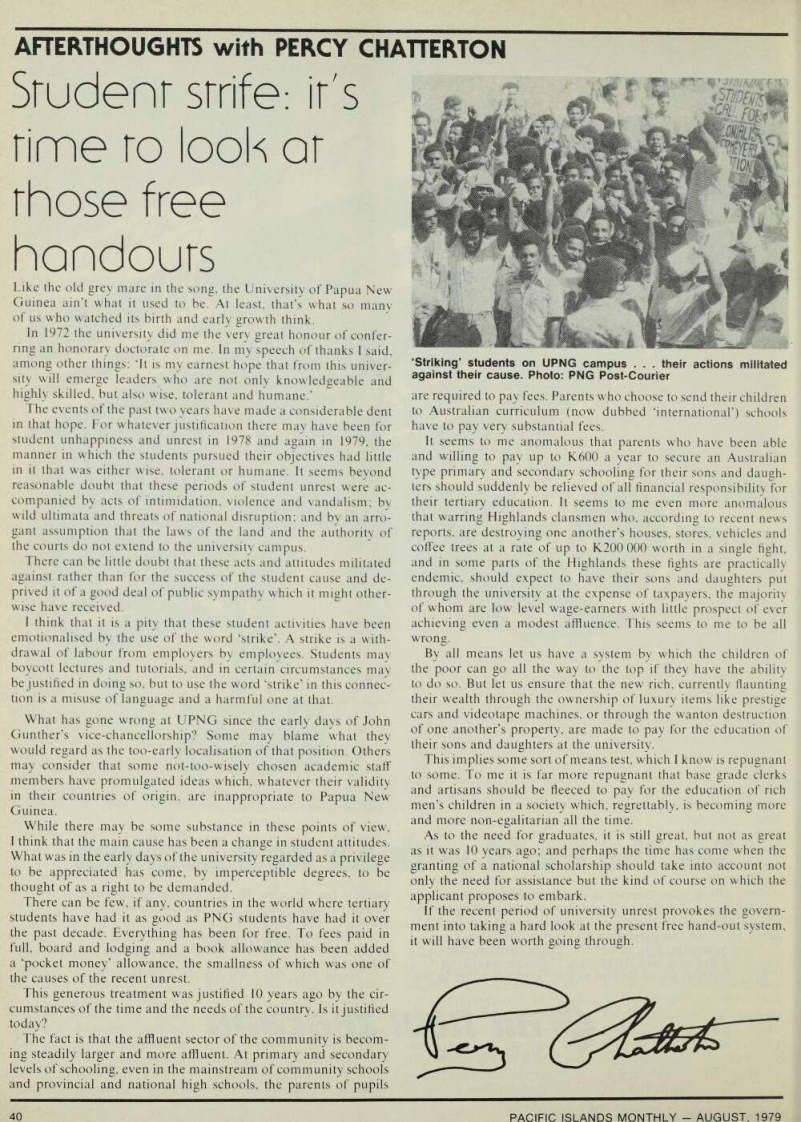
The events of the past two years have made a considerable dent in that hope. For whatever justification there may have been for student unhappiness and unrest in 1978 and again in 1979, the manner in which the students pursued their objectives had little in it that was either wise, tolerant or humane. It seems beyond reasonable doubt that these periods of student unrest were ac companied by acts of intimidation, violence and vandalism; by wild ultimata and threats of national disruption; and by an arro gant assumption that the laws of the land and the authority of the courts do not extend to the university campus.
There can be little doubt that these acts and attitudes militated against rather than for the success of the student cause and de prived it of a good deal of public sympathy which it might other wise have received.
I think that it is a pity that these student activities have been emotionalised by the use of the word ‘strike’. A strike is a with drawal of labour from employers by employees. Students may boycott lectures and tutorials, and in certain circumstances may be justified in doing so, but to use the word ‘strike’ in this connec tion is a misuse of language and a harmful one at that.
What has gone wrong at UPNG since the early days of John Gunther’s vice-chancellorship? Some may blame what they would regard as the too-early localisation of that position. Others may consider that some not-too-wisely chosen academic staff members have promulgated ideas which, whatever their validity in their countries of origin, are inappropriate to Papua New Guinea.
While there may be some substance in these points of view, I think that the main cause has been a change in student attitudes.
What was in the early days of the university regarded as a privilege to be appreciated has come, by imperceptible degrees, to be thought of as a right to be demanded.
There can be few, if any, countries in the world where tertiary students have had it as good as PNG students have had it over the past decade. Everything has been for free. To fees paid in full, board and lodging and a book allowance has been added a ‘pocket money’ allowance, the smallness of which was one of the causes of the recent unrest.
This generous treatment was justified 10 years ago by the cir cumstances of the time and the needs of the country. Is it justified
today?
The fact is that the affluent sector of the community is becom ing steadily larger and more affluent. At primary and secondary levels of schooling, even in the mainstream of community schools and provincial and national high schools, the parents of pupils
are required to pay fees. Parents who choose to send their children to Australian curriculum (now dubbed ‘international’) schools have to pay very substantial fees.
It seems to me anomalous that parents who have been able and willing to pay up to K6OO a year to secure an Australian type primary and secondary schooling for their sons and daugh ters should suddenly be relieved of all financial responsibility for their tertiary education. It seems to me even more anomalous that warring Highlands clansmen who, according to recent news reports, are destroying one another’s houses, stores, vehicles and coffee trees at a rate of up to K2OO 000 worth in a single fight, and in some parts of the Highlands these fights are practically endemic, should expect to have their sons and daughters put through the university at the expense of taxpayers, the majority of whom are low level wage-earners with little prospect of ever achieving even a modest affluence. This seems to me to be all wrong.
By all means let us have a system by which the children of the poor can go all the way to the top if they have the ability to do so. But let us ensure that the new rich, currently flaunting their wealth through the ownership of luxury items like prestige cars and videotape machines, or through the wanton destruction of one another’s property, are made to pay for the education of their sons and daughters at the university.
This implies some sort of means test, which I know is repugnant to some. To me it is far more repugnant that base grade clerks and artisans should be fleeced to pay for the education of rich men’s children in a society which, regrettably, is becoming more and more non-egalitarian all the time.
As to the need for graduates, it is still great, but not as great as it was 10 years ago; and perhaps the time has come when the granting of a national scholarship should take into account not only the need for assistance but the kind of course on which the applicant proposes to embark.
If the recent period of university unrest provokes the govern ment into taking a hard look at the present free hand-out system, it will have been worth going through.
‘Striking’ students on UPNG campus ... their actions militated against their cause. Photo: PNG Post-Courier