Gerard Leymang
pp. 36-37 · Read in the full issue
Interview With
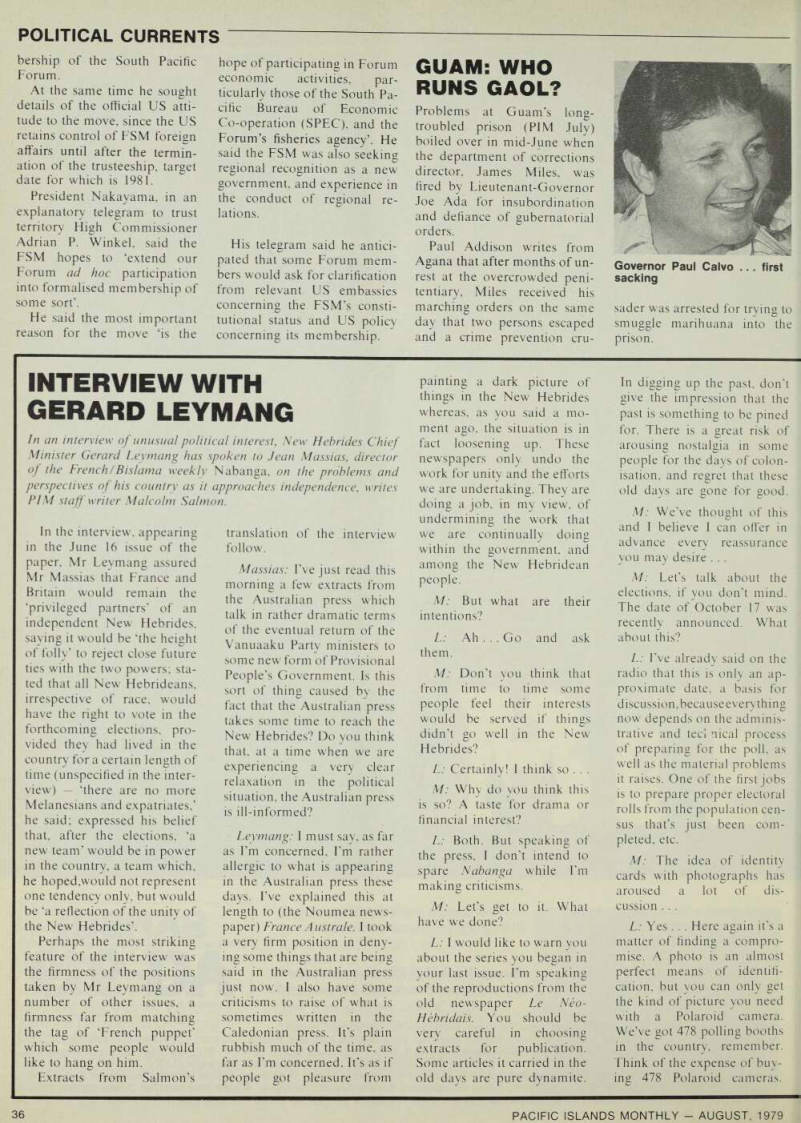
In an interview of unusual political interest. New Hebrides Chief Minister Gerard Leymang has spoken to Jean Massias, director of the French!Bislama weekly Nabanga, on the problems and perspectives of his country as it approaches independence, writes PIM staff writer Malcolm Salmon.
In the interview, appearing in the June 16 issue of the paper. Mr Leymang assured Mr Massias that France and Britain would remain the ‘privileged partners’ of an independent New Hebrides, saying it would be ‘the height of folly’ to reject close future ties with the two powers; sta ted that all New Hebrideans, irrespective of race, would have the right to vote in the forthcoming elections, pro vided they had lived in the country for a certain length of time (unspecified in the inter view) ‘there are no more Melanesians and expatriates,’ he said; expressed his belief that, after the elections, ‘a new team’ would be in power in the country, a team which, he hoped.would not represent one tendency only, but would be ‘a reflection of the unity of the New Hebrides’.
Perhaps the most striking
feature of the interview was the firmness of the positions taken by Mr Leymang on a number of other issues, a firmness far from matching the tag of ‘French puppet’ which some people would like to hang on him.
Extracts from Salmon’s
translation of the interview follow.
Massias: I’ve just read this morning a few extracts from the Australian press which talk in rather dramatic terms of the eventual return of the Vanuaaku Party ministers to some new form of Provisional People’s Government. Is this sort of thing caused by the fact that the Australian press takes some time to reach the New Hebrides? Do you think that, at a time when we are experiencing a very clear relaxation in the political situation, the Australian press is ill-informed?
Leymang: I must say, as far as I’m concerned. I’m rather allergic to what is appearing in the Australian press these days. I’ve explained this at length to (the Noumea news paper) France Australe. I took a very firm position in deny
ing some things that are being
said in the Australian press just now. I also have some criticisms to raise of what is sometimes written in the Caledonian press. It’s plain rubbish much of the time, as far as I’m concerned. It’s as if people got pleasure from
painting a dark picture of things in the New Hebrides whereas, as you said a mo ment ago. the situation is in fact loosening up. These newspapers only undo the work for unity and the efforts we are undertaking. They are doing a job, in my view, of undermining the work that
we are continually doing
within the government, and among the New Hebridean
people.
M: But what are their intentions?
L: Ah ... Go and ask them.
M: Don’t you think that from time to time some people feel their interests would be served if things didn’t go well in the New Hebrides?
L: Certainly! I think so . . .
M: Why do ydu think this is so? A taste for drama or financial interest?
L: Both. But speaking of the press, I don’t intend to spare Nabanga while I’m making criticisms.
M: Let’s get to it. What have we done?
L: I would like to warn you about the series you began in your last issue. I’m speaking of the reproductions from the old newspaper Le Neo- Hebhdais. You should be very careful in choosing extracts for publication.
Some articles it carried in the old days are pure dynamite.
In digging up the past, don’t give the impression that the past is something to be pined for. There is a great risk of arousing nostalgia in some people for the days of colon isation, and regret that these old days are gone for good.
M: We’ve thought of this and I believe I can offer in advance every reassurance
you may desire . . .
M: Let’s talk about the elections, if you don’t mind.
The date of October 17 was recently announced. What about this?
L: I’ve already said on the radio that this is only an ap proximate date, a basis for
discussion, becauseeverything
now depends on the adminis trative and tec! nical process of preparing for the poll, as well as the material problems it raises. One of the first jobs is to prepare proper electoral rolls from the population cen sus that’s just been com
pleted, etc.
M: The idea of identity cards with photographs has aroused a lot of dis cussion . . .
L: Yes . . . Here again it’s a matter of finding a compro mise. A photo is an almost perfect means of identifi cation, but you can only get the kind of picture you need with a Polaroid camera.
We’ve got 478 polling booths in the country, remember.
Think of the expense of buy ing 478 Polaroid cameras.
And what use would they be later on? Don’t forget, either, the problem of keeping the unexposed film at a certain temperature. At our last cabi net meeting, which lasted nearly two days, we came to the view that the ink method would be the speediest and most economical.
M: The ink method?
L: Yes. We’d put a little ink mark on the thumb of the voter.
M: But don’t you think it’s a bit humiliating to brand human beings in that way, like a herd of animals?
L: That’s a Westerner’s reaction. It would be a tiny mark no bigger than the little fleck of white I’ve got here on my thumbnail. The Fijians, the Melanesians of Fiji, did it this way. The Indians too.
Personally, I’m neither for nor against the ink or the photographic method. But what are we trying to do. after all? We’re looking for a guarantee that the elections will be as clean and straight forward as possible, without any risk of their being
rigged.
M: Another question, Mr Chief Minister. It seems that on your recent trip to Noumea Mr Dijoud reaffir med the desire of the two powers insofar as he could speak in their names to see the New Hebrides achieve independence by the end of 1979 or the beginning of 1980.
There’s nothing new in this statement, as the minister put
forward the same idea on his first visit to the archipelago.
So, we’re only a few months away from independence and yet it seems remarkable that there is no actual planning going on in terms of protocol,
practical arrangements,
official contacts, lodging for guests, the press no plan ning in short for the indepen dence ceremonies.
L: It’s true . . . We haven’t yet thought about this. We’re so taken up with the job of preparing the constitution and the elections! On top of that, there’s the day-to-day business of administration.
We’ve no time to think of
independence ceremonies.
But we'll get round to it.
Now let’s get back to the date of independence: we haven’t yet fixed it. I think this is my personal opinion that it is not up to the two metropolitan powers to de cide this date. That’s for us here locally to decide.
But there’s another thing that I want to say very clearly: Mr Dijoud has said it and I also said it clearly in a com munique I signed on June 8:
‘Having become indepen
dent, the New Hebrides Government will be the sole
master and solely responsible
for its policy; in particular, it will be free to reach agree ments on co-operation with France and Great Britain or any partner it may have freely chosen.’ Only I want to say that in all this there is a big ‘but’.
You speak to me about
independence ceremonies
and, for my part, I want to speak to you on another level altogether, about our local
administration (drumming of
fingers on the table), our everyday life, how we are going to get there, to this independence. 1 regret to have to say to you that so far 1 have received no concrete proposal on these questions from France. And do you know why? Because the New Hebrides comes under the rue Oudinot (headquarters of the French Ministry for Overseas Departments and Territories PIM), while on the English side it comes under the Foreign Office. The officials in the British Residency here
already belong to the Foreign
Office in London. Your ad ministrative structures, the way you shuffle things around between the rue Oudinot, the rue Monsieur
(headquarters of the Ministry
of Co-operation, responsible
for overseas aid PIM), and the Quai d'Orsav (Foreign Ministry PIM), doesn’t interest me. I’ve said this in writing to Mr Dijoud and 1 spoke to him about it the other day in Noumea. As far as I’m concerned the import ant thing is that France should put its cards on the table and announce which ministry the New Hebrides will come under after in
dependence.
The local repercussions of this lack of clarity are more
important than people might
think. In the two biggest ser vices that are to be amal gamated. health and education, there’s a real un easiness on the French side because nobody knows who’s going to have charge of them after independence. As far as I'm concerned. I hope as soon as possible to talk to the people from the ministry of co-operation to whom I have made a word-of-mouth re quest, to be passed on by Mr Dijoud, for the attachment to my services of a head of mission coming from the rue Monsieur. France has already followed this procedure, no tably before Djibouti achieved independence. I am not afraid to repeat myself: it is very important for the ad ministration of the New Hebrides to know with whom we will be dealing on the French side after indepen dence ...
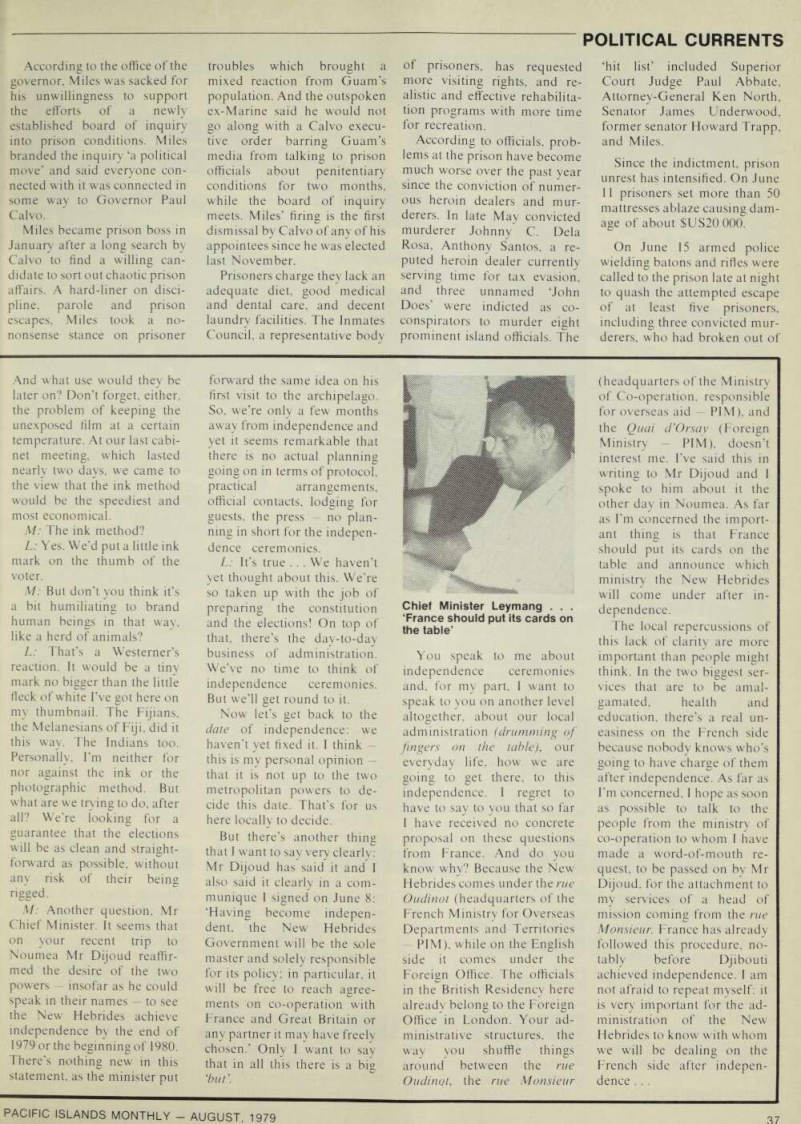
Chief Minister Leymang ... ‘France should put its cards on the table’