Currents
pp. 31-38 · Read in the full issue

Political
Up And Away
Again In Nh
June saw new and vitally im portant progress in resolving the tangled political problems that have bedevilled almost every stage of the New Hebrides’ movement towards
independence.
Key achievements were: a compromise between New Hebrides Government and the condominium powers on the procedures for elaboration and approval of the constitution Britain and France agreed that there need be no referendum, as previuosly insisted on by them, on the constitution (and independence), and in return the New Hebrides Govern ment agreed to respect the pro cedure of devising the constitution before the elec tions and not, as the Vanuaaku Party ministers had previously insisted, handling matters the other way round; resumption of the work of the New Hebridean committee studying the constitution (which had previously been bogged down in wrangles over its compo sition and other questions), and an enlargement of the com mittee’s membership.
On the question of how the constitution should be adopted, there appeared what the French/Bislama weekly Nahanga described as ‘a truly new element’.
The paper wrote: ‘After long negotiations, the government reached agreement on a for mula which was in line with the plan proposed by the govern ments of France and Great Bri tain. but departed from it on one essential point, the refer endum. The fundamental order of factors was respected: no elections without a consti tution ... ‘But the government pro posed to dispense with an inter mediate stage contained in the Dijoud plan, the adoption of the draft constitution by way of referendum. The government
preferred instead a method comprising three stages: prep aration of a draft by the en
larged constitutional
committee, using consultation at the grassroots; final drafting of the constitution by the government; elaboration and adoption of the final text by a constitutional conference involving all members of the constitutional committee and the representatives of the trustee powers.. . ‘Paul Dijoud approved the ideas and thus agreed to aban don the idea of a referendum if asked to do so by the consti tutional committee. It seems that in his view the procedure outlined contained adequate guarantees in that it involved
broad participation by all
trends of opinion and that con sensus had been reached upon it within the government of
national unity.’
The government, mean while, has set a still quite ten tative date for elections: October 17. 1979. (See also ‘lnterview with Gerard Leymang’, Page 36.)
Reassurance
By Malietoa
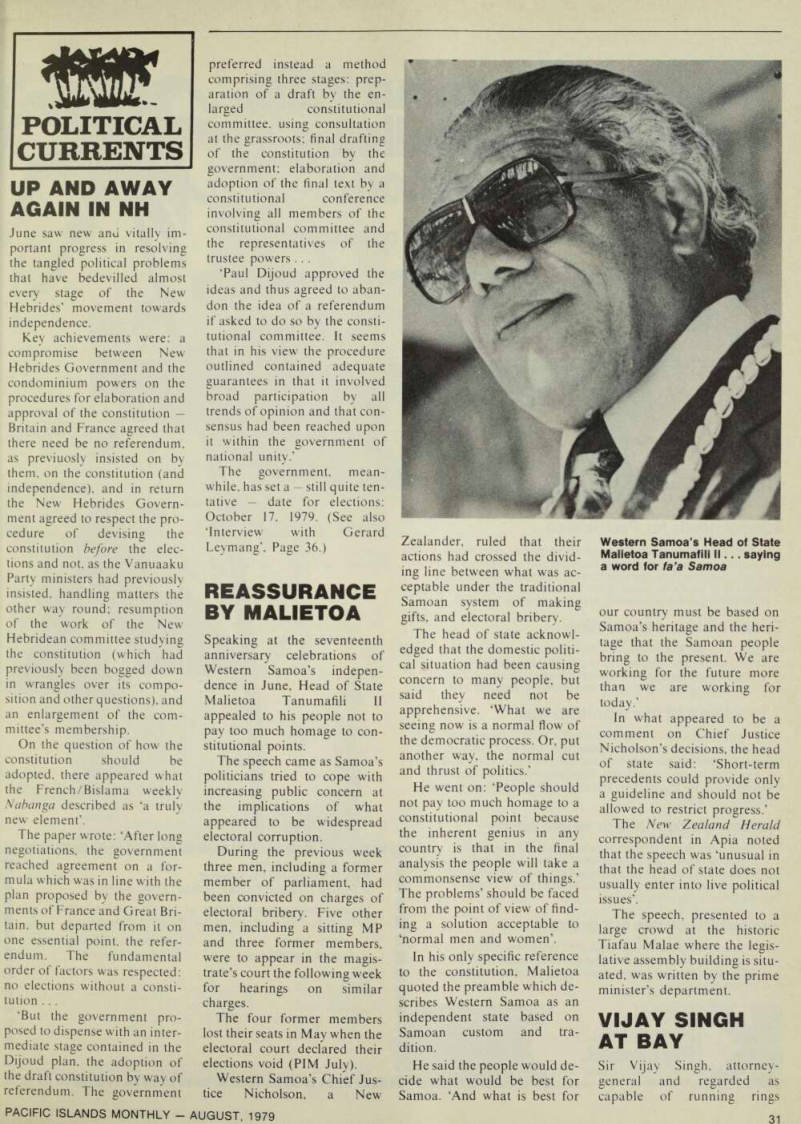
Speaking at the seventeenth anniversary celebrations of Western Samoa’s indepen dence in June, Head of State Malietoa Tanumafili II appealed to his people not to pay too much homage to con
stitutional points.
The speech came as Samoa’s politicians tried to cope with
increasing public concern at
the implications of what appeared to be widespread
electoral corruption.
During the previous week
three men, including a former member of parliament, had been convicted on charges of electoral bribery. Five other men, including a sitting MP and three former members, were to appear in the magis trate’s court the following week for hearings on similar
charges.
The four former members lost their seats in May when the electoral court declared their elections void (PIM July).
Western Samoa’s Chief Jus tice Nicholson, a New
Zealander, ruled that their actions had crossed the divid ing line between what was ac ceptable under the traditional Samoan system of making
gifts, and electoral bribery.
The head of state acknowl edged that the domestic politi cal situation had been causing concern to many people, but said they need not be apprehensive. ‘What we are seeing now is a normal flow of the democratic process. Or, put another way, the normal cut and thrust of politics.’
He went on: ‘People should not pay too much homage to a constitutional point because the inherent genius in any country is that in the final analysis the people will take a commonsense view of things.’
The problems’ should be faced from the point of view of find ing a solution acceptable to ‘normal men and women’.
In his only specific reference to the constitution, Malietoa quoted the preamble which de scribes Western Samoa as an independent state based on Samoan custom and tra dition.
He said the people would de cide what would be best for Samoa. ‘And what is best for
our country must be based on Samoa’s heritage and the heri tage that the Samoan people bring to the present. We are working for the future more than we are working for
today.’
In what appeared to be a comment on Chief Justice Nicholson’s decisions, the head of state said: ‘Short-term
precedents could provide only
a guideline and should not be allowed to restrict progress.’
The New Zealand Herald correspondent in Apia noted that the speech was ‘unusual in that the head of state does not usually enter into live political issues’.
The speech, presented to a large crowd at the historic Tiafau Malae where the legis lative assembly building is situ ated, was written by the prime minister’s department.
Vijay Singh
At Bay
Sir Vijay Singh, attorney
general and regarded as
capable of running rings
Western Samoa’s Head of State Malietoa Tanumafili II ... saying a word for fa’a Samoa
around most other Fiji poli ticians. has ridden out several onslaughts on his career and character. But by mid-June he was battling grimly for political survival, writes Robert Keith- Reid in Suva.
Sir Vijay’s critics were saying he had been involved in events which put into question his continued occupation of one of the highest cabinet posts.
Toward the end of June it seemed the attorney-general had the support that counted a prime minister ready to put his own job on the line. Ratu Sir Kamisese Mara, Fiji’s prime minister and leader for the past 12 years, it appeared, was ready to resign rather than bow to pressure for Sir Vijay’s
sacking.
The crisis began in May after a sensational 30-day trial in which Flour Mills of Fiji Lim ited was convicted on charges of trying to defraud the govern ment and the company’s share holders. Sir Vijay appeared as a defence witness.
As minister for commerce in 1972. Sir Vijay gave Flour Mills a 10-year flour milling monopoly. Three years later,
practising privately as a lawyer,
he became the company’s con sultant in negotiations with the government for renewal of a
flour prices fixing formula.
He took a retainer for three months after being made attorney-general in 1977 and a little later advised Parliament to publish a report which he knew could prejudice the government case against Flour Mills.
Sir Vijay had explanations
for the court but. at the end of cross-examination, he was called a liar by the crown pros ecutor. Robert Lindsay, and the judge. Mr Justice Dyke, commented that his appear ance was one of the strange fea tures of a bizarre trial.
Howls for Sir Vijay’s head came straight after the trial from political foes within the government’s Alliance group ing of which he is a founder member. His Flour Mills con nections had ‘tarnished’ the Al
liance image, they said.
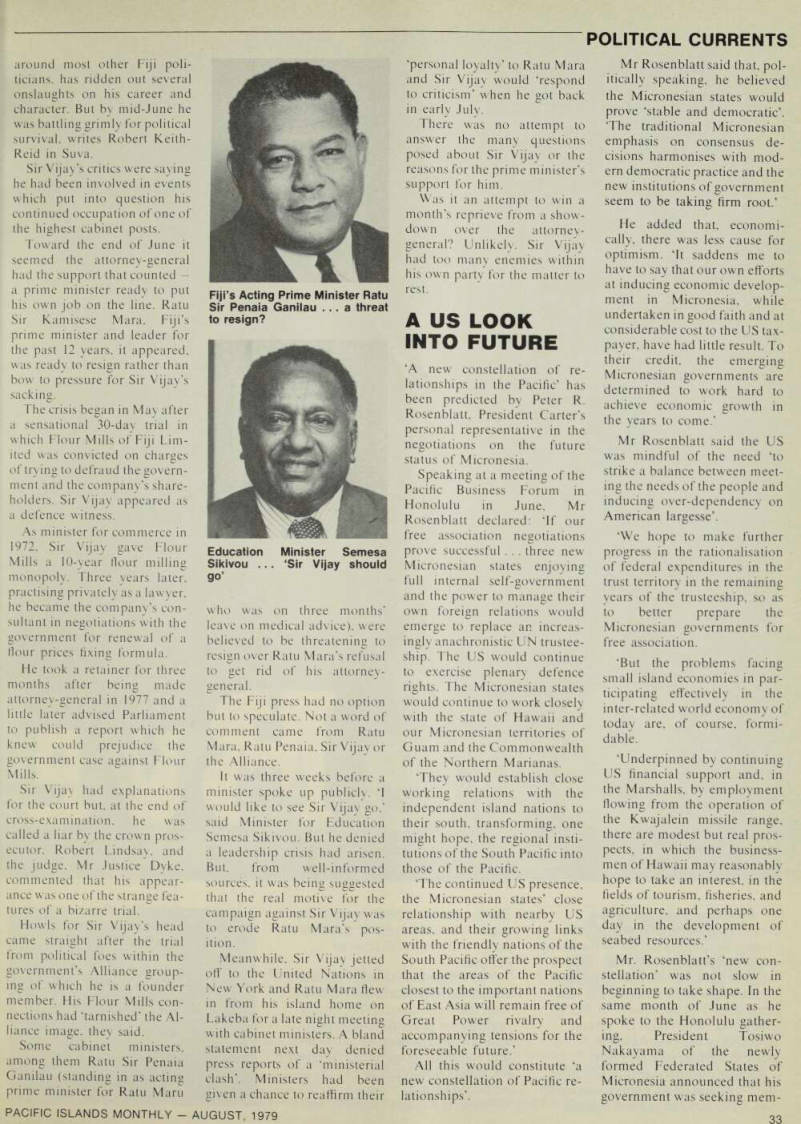
Some cabinet ministers, among them Ratu Sir Penaia Ganilau (standing in as acting prime minister for Ratu Maru
who was on three months’ leave on medical advice), were believed to be threatening to resign over Ratu Mara’s refusal to get rid of his attorney general.
The Fiji press had no option but to speculate. Not a word of comment came from Ratu Mara. Ratu Penaia. Sir Vijay or the Alliance.
It was three weeks before a minister spoke up publicly. ’I would like to see Sir Vijay go.’ said Minister for Education Semesa Sikivou. But he denied a leadership crisis had arisen.
But. from well-informed sources, it was being suggested that the real motive for the campaign against Sir Vijay was to erode Ratu Mara’s pos ition.
Meanwhile. Sir Vijay jetted
off to the United Nations in New York and Ratu Mara flew in from his island home on Lakeba for a late night meeting with cabinet ministers. A bland statement next day denied press reports of a ‘ministerial clash’. Ministers had been given a chance to reaffirm their
‘personal loyalty’ to Ratu Mara and Sir Vijay would ‘respond to criticism’ when he got back
in early July.
There was no attempt to answer the many questions posed about Sir Vijay or the reasons for the prime minister’s support for him.
Was it an attempt to win a month’s reprieve from a show down over the attorney
general? Unlikely. Sir Vijay
had too many enemies within his own party for the matter to rest.
A Us Look
Into Future
‘A new constellation of re lationships in the Pacific’ has been predicted by Peter R.
Rosenblatt. President Carter’s personal representative in the negotiations on the future status of Micronesia.
Speaking at a meeting of the Pacific Business Forum in Honolulu in June, Mr Rosenblatt declared: ‘lf our free association negotiations prove successful . . . three new Micronesian states enjoying full internal self-government and the power to manage their own foreign relations would emerge to replace an increas ingly anachronistic UN trustee ship. The US would continue to exercise plenary defence rights. The Micronesian states would continue to work closely with the state of Hawaii and our Micronesian territories of Guam and the Commonwealth of the Northern Marianas.
They would establish close working relations with the independent island nations to their south, transforming, one
might hope, the regional insti
tutions of the South Pacific into those of the Pacific. ‘The continued US presence, the Micronesian states’ close
relationship with nearby US
areas, and their growing links with the friendly nations of the South Pacific offer the prospect that the areas of the Pacific closest to the important nations of East Asia will remain free of Great Power rivalry and accompanying tensions for the foreseeable future.’
All this would constitute ‘a new constellation of Pacific re
lationships’.
Mr Rosenblatt said that, pol
itically speaking, he believed
the Micronesian states would prove ‘stable and democratic’. ‘The traditional Micronesian emphasis on consensus de cisions harmonises with mod ern democratic practice and the new institutions of government seem to be taking firm root.’
He added that, economi cally, there was less cause for optimism. ‘lt saddens me to have to say that our own efforts
at inducing economic develop
ment in Micronesia, while undertaken in good faith and at considerable cost to the US tax payer, have had little result. To their credit, the emerging Micronesian governments are determined to work hard to achieve economic growth in the years to come.' Mr Rosenblatt said the US was mindful of the need ‘to strike a balance between meet ing the needs of the people and
inducing over-dependency on
American largesse’.
‘We hope to make further progress in the rationalisation of federal expenditures in the trust territory in the remaining years of the trusteeship, so as to better prepare the Micronesian governments for free association.
‘But the problems facing
small island economies in par
ticipating effectively in the
inter-related world economy of today are, of course, formi dable.
‘Underpinned by continuing
US financial support and, in
the Marshalls, by employment
flowing from the operation of the Kwajalein missile range, there are modest but real pros pects, in which the business men of Hawaii may reasonably hope to take an interest, in the fields of tourism, fisheries, and
agriculture, and perhaps one
day in the development of seabed resources.’
Mr. Rosenblatt’s ‘new con stellation’ was not slow in beginning to take shape. In the same month of June as he spoke to the Honolulu gather ing, President Tosiwo
Nakayama of the newly
formed Federated States of Micronesia announced that his government was seeking mem
Fiji’s Acting Prime Minister Ratu Sir Penaia Ganilau ... a threat to resign?
Education Minister Semesa Sikivou ... ‘Sir Vijay should go’
bership of the South Pacific Forum - At the same time he sought details of the official US attitude to the move, since the US retains control of FSM foreign affairs until after the termination of the trusteeship, target date for which is 1981.
President Nakayama, in an
explanatory telegram to trust
territory High Commissioner
Adrian P. Winkel, said the FSM hopes to ‘extend our Forum ad hoc participation into formalised membership of some sort’.
He said the most important reason for the move ‘is the
hope of participating in Forum economic activities. par ticularly those of the South Pa cific Bureau of Economic Co-operation (SPEC), and the Forum’s fisheries agency’. He said the FSM was also seeking regional recognition as a new government, and experience in the conduct of regional re lations.
His telegram said he antici pated that some Forum mem bers would ask for clarification from relevant US embassies concerning the FSM’s consti tutional status and US policy
concerning its membership.
Guam: Who
Runs Gaol?
Problems at Guam’s long troubled prison (PIM July) boiled over in mid-June when the department of corrections director. James Miles, was fired by Lieutenant-Governor Joe Ada for insubordination and defiance of gubernatorial orders.
Paul Addison writes from Agana that after months of un rest at the overcrowded peni tentiary, Miles received his marching orders on the same day that two persons escaped and a crime prevention cru-
sader was arrested for trying to smuggle marihuana into the prison.
Governor Paul Calvo ... first sacking
According to the office of the governor. Miles was sacked for his unwillingness to support the efforts of a newly established board of inquiry into prison conditions. Miles branded the inquiry ‘a political move’ and said everyone con nected with it was connected in some way to Governor Paul Calvo.
Miles became prison boss in
January after a long search by
Calvo to find a willing can didate to sort out chaotic prison affairs. A hard-liner on disci
pline. parole and prison
escapes. Miles took a no nonsense stance on prisoner
troubles which brought a mixed reaction from Guam’s
population. And the outspoken
ex-Marine said he would not go along with a Calvo execu tive order barring Guam’s media from talking to prison officials about penitentiary conditions for two months, while the board of inquiry meets. Miles’ firing is the first dismissal by Calvo of any of his appointees since he was elected last November.
Prisoners charge they lack an adequate diet, good medical and dental care, and decent laundry facilities. The Inmates Council, a representative body
of prisoners, has requested more visiting rights, and re alistic and effective rehabilita tion programs with more time for recreation.
According to officials, prob lems at the prison have become much worse over the past year since the conviction of numer ous heroin dealers and mur derers. In late May convicted murderer Johnny C. Dela Rosa, Anthony Santos, a re puted heroin dealer currently serving time for tax evasion, and three unnamed ‘John Does’ were indicted as co
conspirators to murder eight
prominent island officials. The
‘hit list’ included Superior Court Judge Paul Abbate, Attorney-General Ken North, Senator James Underwood, former senator Howard Trapp, and Miles.
Since the indictment, prison unrest has intensified. On June 11 prisoners set more than 50 mattresses ablaze causing dam age of about SUS2O 000.
On June 15 armed police wielding batons and rifles were called to the prison late at night to quash the attempted escape of at least five prisoners, including three convicted mur derers, who had broken out of
their maximum confinement cells. No one was injured and the prisoners were contained.
But one prison guard told PIM:
‘These people didn’t want to escape. They just wanted to show they can get out any time they want to; they want to show they rule the prison. One man had an iron pipe he could have used to kill me anytime. But he
didn’t. They just are telling us
they’re in charge.’
Polynesia’S
June 10
June 10 saw one of the strangest elections ever held in French Polynesia and a heavy setback for the majority autonomist parties of Francis Sanford and John Teariki, writes Marie-Therese Daniels son from Papeete.
Local voters were asked to cast their ballots for a confus ing array of 243 mostly un known candidates for the future parliament of the European Common Market.
The list of President Giscard d’Estaing candidates, incon
gruously supported by the local
autonomists, got 16 496 votes, or 40.8% of the total, while the
list headed by Right wing
Gaullist Jaques Chirac, and
supported by local opposition
leader Gaston Flosse, got 18 074 votes, or 44.5%.
The French Socialist Party, represented locally by the five
year-old and steadily growing
pro-independence la Mana te Nunaa party, made a good showing, bettering its share of the vote from 7.1% in the 1978 legislative elections (3398 votes) to 10.4% (4137 votes).
This was achieved despite an official ban on radio and tele vision appearances by party representatives, and was the re sult of their reaching out, through personal appearances, to the voters of Tahiti and Moorea.
Some of their speakers were
impudent enough to point out
that Polynesia is not in Europe, and to suggest that the best common market and inter national parliament would be those made up of the peoples and nations of the South Pa cific.
In every respect the elections
reflected the long-standing and absurd policy of the Paris government which has always considered it a patriotic duty and right for the Polynesians to participate in all French elec tions and referenda, no matter how futile or meaningless they may be to them. They were thus, in 1958, asked to vote for or against de Gaulle’s new French constitution, in 1962 for or against negotiations with the nationalists of Algeria, in 1969 for or against the suppression of the French senate and re establishment of the old French provincial govern ments, and in 1973 for or against the admission of Great Britain, Ireland and Denmark to the Common Market!
All in all it is not surprising that on June 10 the quietest polling day for many years only 56.4% of registered voters bothered to go to the polls, most of them delivered there
by the major political parties in
hired trucks and motor cars.
Dijoud In
Noumea
In New Caledonia, the visits of Paul Dijoud, minister of over seas territories, are becoming so frequent that his arrival in June caused hardly a ripple, writes Andre Chaville from Noumea. But plenty was said after his departure.
It is not an easy job to pacify
and satisfy everybody, but the minister seemed reasonably confident he had done so. He said he was pleased to receive criticism both from the far Left and the far Right, as this gener ally meant the policies con cerned had the approval of the
‘silent majority’.
When New Caledonia went to the polls on June 10 to vote for the French representatives in the Common Market parlia ment, they turned in a result very similar to that in France: a majority for the list support ing President Giscard d’Esta ing, who were closely followed by the Socialists.
The conservative, Gaullist party, supported by the tra
ditional Rightwing parties in
New Caledonia, obtained very poor results, both in France and in the territory.
The most important aspect of Mr Dijoud’s visit was his ap pearance live on television, with viewers invited to tele
phone in their questions.
The minister talked frankly of the need to increase
Melanesian land-holdings,
particularly the tribal reserves.
He also admitted that some changes in Melanesian ‘cus toms’ were unavoidable, and that the rural population would only find peace of mind when freehold farmers ‘of all racial origins’ lived side by side. If he spoke of a redistribution of land between ‘Caledonians’, he also added that a Caledonian was any person of French nationality who freely chose to take up permanent residence in
the territory.
His main argument was the fact that claims for land could be easily satisfied, both by using the state’s reserves, and also by breaking up ‘the enor mous properties belonging to a rich minority’, where the only land improvement had been the installation of barbed wire.
But he warned the Melanesians that ‘land-grabbing’ was not the purpose of the programme, and that if ritual land was to be returned to the clans, pastoral
and agricultural holdings
would only be granted to those who could prove their need and demonstrate their capacity to use the land productively.
An improvement of rural production would necessitate outlets what Mr Dijoud called ‘potential export mar kets’. Placed between Australia and New Zealand, it is hard to imagine New Caledonia com peting successfully on the inter national market, unless its agriculture concentrated on
specialised tropical produce.
The only alternative would be a substantial increase in the
territory’s population, which is
very small. Here, other prob lems arise, as the current natu ral increase could create future racial frictions, the fastest growing section of the popu
lation being the Polynesians.
Immigration, another alterna tive, would increase the num ber of Europeans, Asians or people from the French West Indies.
Undoubtedly, the territory
can go further to satisfy its own needs. But with such a small
population the margin between
potential consumption and sur
plus is small.
Mr Dijoud’s plan, in its in itial stages at least, seems there fore to be motivated more by philosophical than economic factors.
The minister refused to accept suggestions that the July election could be interpreted as a referendum to approve or
disapprove of his plan.
But the fact remains that the moderate coalition, fighting against both Left and Right
wing parties, made acceptance
of the plan its main campaign
point.
The other coalition, group ing those in favour of indepen dence, harboured some confusing elements. Some of its members were practically forced to declare themselves in favour of independence,
although many really consider
independence more as a long term, inevitable and natural outcome, for which the status of overseas territory was cre ated. For many of these people, the Dijoud plan could indeed be interpreted as a ‘democratic revolution’, designed to pre pare New Caledonia’s trans formation into a more
equitable, multi-racial,
independent country but in 10 years’ time.
Polynesia’s Francis Sanford ... ‘incongruous’ support for Gis card?