Cook painting
pp. 25-29 · Read in the full issue

Tropicalities
for Canberra
The National Library of Aus tralia has announced the arrival at the library in Can berra of a painting it purchased at a London auction in March of items associated with Cap tain Cook.
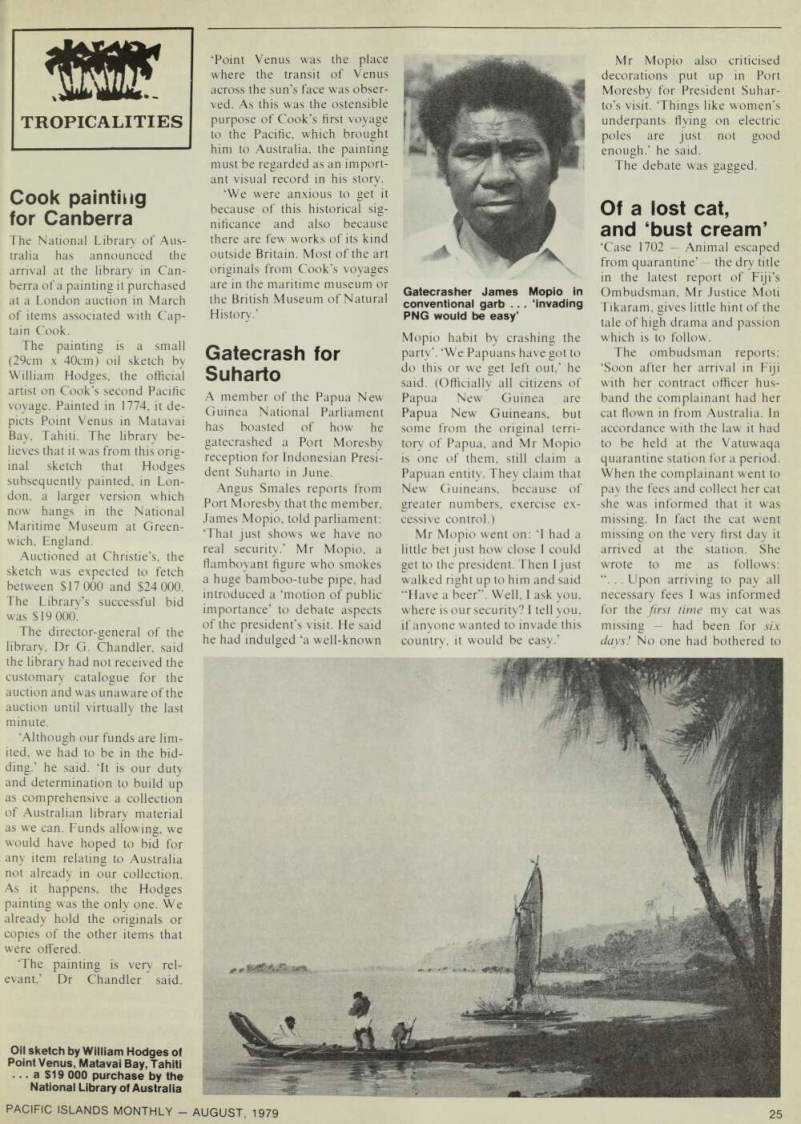
The painting is a small (29cm x 40cm) oil sketch by William Hodges, the official artist on Cook’s second Pacific voyage. Painted in 1774, it de picts Point Venus in Matavai Bay, Tahiti. The library be lieves that it was from this orig inal sketch that Hodges
subsequently painted, in Lon
don, a larger version which now hangs in the National Maritime Museum at Green
wich, England.
Auctioned at Christie’s, the sketch was expected to fetch between $l7 000 and $24 000.
The Library’s successful bid was $l9 000.
The director-general of the library. Dr G. Chandler, said the library had not received the customary catalogue for the auction and was unaware of the auction until virtually the last minute. ‘Although our funds are lim ited, we had to be in the bid ding.’ he said. ‘lt is our duty and determination to build up as comprehensive a collection of Australian library material as we can. Funds allowing, we would have hoped to bid for any item relating to Australia not already in our collection.
As it happens, the Hodges painting was the only one. We already hold the originals or copies of the other items that were offered. ‘The painting is very rel evant,’ Dr Chandler said.
‘Point Venus was the place where the transit of Venus across the sun’s face was obser ved. As this was the ostensible purpose of Cook’s first voyage to the Pacific, which brought him to Australia, the painting must be regarded as an import ant visual record in his story. ‘We were anxious to get it because of this historical sig nificance and also because there are few works of its kind outside Britain. Most of the art originals from Cook’s voyages are in the maritime museum or the British Museum of Natural History.’
Gatecrash for
Suharto
A member of the Papua New Guinea National Parliament has boasted of how he gatecrashed a Port Moresby reception for Indonesian Presi dent Suharto in June.
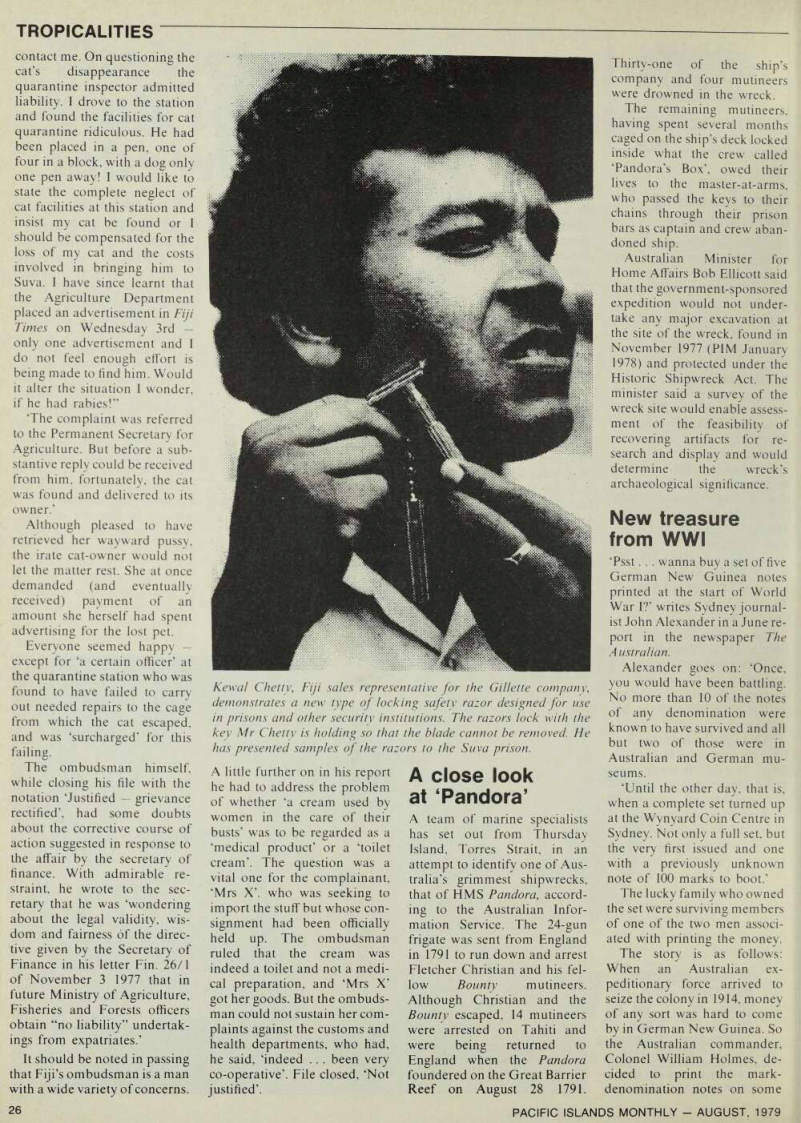
Angus Smales reports from Port Moresby that the member,
James Mopio, told parliament;
‘That just shows we have no real security.’ Mr Mopio, a
flamboyant figure who smokes
a huge bamboo-tube pipe, had introduced a ‘motion of public importance’ to debate aspects of the president’s visit. He said he had indulged ‘a well-known
Mopio habit by crashing the
party’. ‘We Papuans have got to do this or we get left out,’ he said. (Officially all citizens of Papua New Guinea are Papua New Guineans, but some from the original terri tory of Papua, and Mr Mopio is one of them, still claim a
Papuan entity. They claim that
New Guineans, because of greater numbers, exercise ex cessive control.) Mr Mopio went on: ‘I had a little bet just how close I could get to the president. Then I just walked right up to him and said “Have a beer”. Well, I ask you, where is our security? I tell you, if anyone wanted to invade this country, it would be easy.’
Mr Mopio also criticised decorations put up in Port Moresby for President Suhar to’s visit. ‘Things like women’s
underpants flying on electric
poles are just not good
enough.’ he said.
The debate was gagged.
Of a lost cat,
and ‘bust cream’
‘Case 1702 Animal escaped from quarantine’ the dry title in the latest report of Fiji’s Ombudsman. Mr Justice Moti Tikaram, gives little hint of the tale of high drama and passion which is to follow.
The ombudsman reports: ‘Soon after her arrival in Fiji with her contract officer hus band the complainant had her cat flown in from Australia. In accordance with the law it had to be held at the Vatuwaqa quarantine station for a period.
When the complainant went to pay the fees and collect her cat she was informed that it was missing. In fact the cat went missing on the very first day it arrived at the station. She wrote to me as follows:
“... Upon arriving to pay all
necessary fees I was informed for the first time my cat was missing had been for six days! No one had bothered to
Oil sketch by William Hodges of Point Venus, Matavai Bay, Tahiti ... a $19 000 purchase by the National Library of Australia
Gatecrasher James Mopio in conventional garb ... ‘invading PNG would be easy’
contact me. On questioning the cat’s disappearance the quarantine inspector admitted liability. I drove to the station and found the facilities for cat quarantine ridiculous. He had been placed in a pen, one of four in a block, with a dog only one pen away! I would like to state the complete neglect of cat facilities at this station and insist my cat be found or I should be compensated for the loss of my cat and the costs involved in bringing him to Suva. I have since learnt that
the Agriculture Department
placed an advertisement in Fiji Times on Wednesday 3rd only one advertisement and I do not feel enough effort is being made to find him. Would it alter the situation I wonder, if he had rabies!”
The complaint was referred to the Permanent Secretary for Agriculture. But before a sub stantive reply could be received from him, fortunately, the cat was found and delivered to its owner.’
Although pleased to have retrieved her wayward pussy, the irate cat-owner would not let the matter rest. She at once demanded (and eventually received) payment of an amount she herself had spent advertising for the lost pet.
Everyone seemed happy -
except for ‘a certain officer’ at the quarantine station who was found to have failed to carry out needed repairs to the cage from which the cat escaped, and was ‘surcharged’ for this
failing.
The ombudsman himself, while closing his file with the notation ‘Justified grievance rectified’, had some doubts about the corrective course of action suggested in response to the affair by the secretary of finance. With admirable re straint, he wrote to the sec retary that he was ‘wondering about the legal validity, wis dom and fairness of the direc
tive given by the Secretary of
Finance in his letter Fin. 26/1 of November 3 1977 that in
future Ministry of Agriculture,
Fisheries and Forests officers obtain “no liability” undertak
ings from expatriates.’
It should be noted in passing that Fiji’s ombudsman is a man with a wide variety of concerns.
A little further on in his report he had to address the problem of whether ‘a cream used by women in the care of their busts’ was to be regarded as a ‘medical product’ or a ‘toilet cream’. The question was a vital one for the complainant, ‘Mrs X’. who was seeking to import the stuff but whose con
signment had been officially
held up. The ombudsman ruled that the cream was indeed a toilet and not a medi cal preparation, and ‘Mrs X’ got her goods. But the ombuds man could not sustain her com plaints against the customs and health departments, who had, he said, ‘indeed .. . been very co-operative’. File closed, ‘Not
justified’.
A close look
at ‘Pandora’
A team of marine specialists has set out from Thursday Island, Torres Strait, in an attempt to identify one of Aus
tralia’s grimmest shipwrecks,
that of HMS Pandora, accord ing to the Australian Infor mation Service. The 24-gun frigate was sent from England in 1791 to run down and arrest Fletcher Christian and his fel low Bounty mutineers.
Although Christian and the Bounty escaped, 14 mutineers were arrested on Tahiti and were being returned to England when the Pandora foundered on the Great Barrier Reef on August 28 1791.
Thirty-one of the ship’s
company and four mutineers were drowned in the wreck.
The remaining mutineers, having spent several months caged on the ship’s deck locked inside what the crew called ’Pandora’s Box’, owed their lives to the master-at-arms, who passed the keys to their
chains through their prison
bars as captain and crew aban
doned ship.
Australian Minister for Home Affairs Bob Ellicott said that the government-sponsored expedition would not under take any major excavation at the site of the wreck, found in November 1977 (PIM January 1978) and protected under the Historic Shipwreck Act. The minister said a survey of the wreck site would enable assess ment of the feasibility of recovering artifacts for re search and display and would determine the wreck’s
archaeological significance.
New treasure
from WWI
‘Psst... wanna buy a set of five German New Guinea notes printed at the start of World War I?’ writes Sydney journal ist John Alexander in a June re port in the newspaper The A ustralian.
Alexander goes on: ‘Once, you would have been battling.
No more than 10 of the notes of any denomination were known to have survived and all but two of those were in Australian and German mu seums. ‘Until the other day, that is, when a complete set turned up at the Wynyard Coin Centre in Sydney. Not only a full set, but the very first issued and one with a previously unknown note of 100 marks to boot.’
The lucky family who owned the set were surviving members of one of the two men associ ated with printing the money.
The story is as follows: When an Australian ex peditionary force arrived to seize the colony in 1914, money of any sort was hard to come by in German New Guinea. So the Australian commander.
Colonel William Holmes, de cided to print the mark denomination notes on some
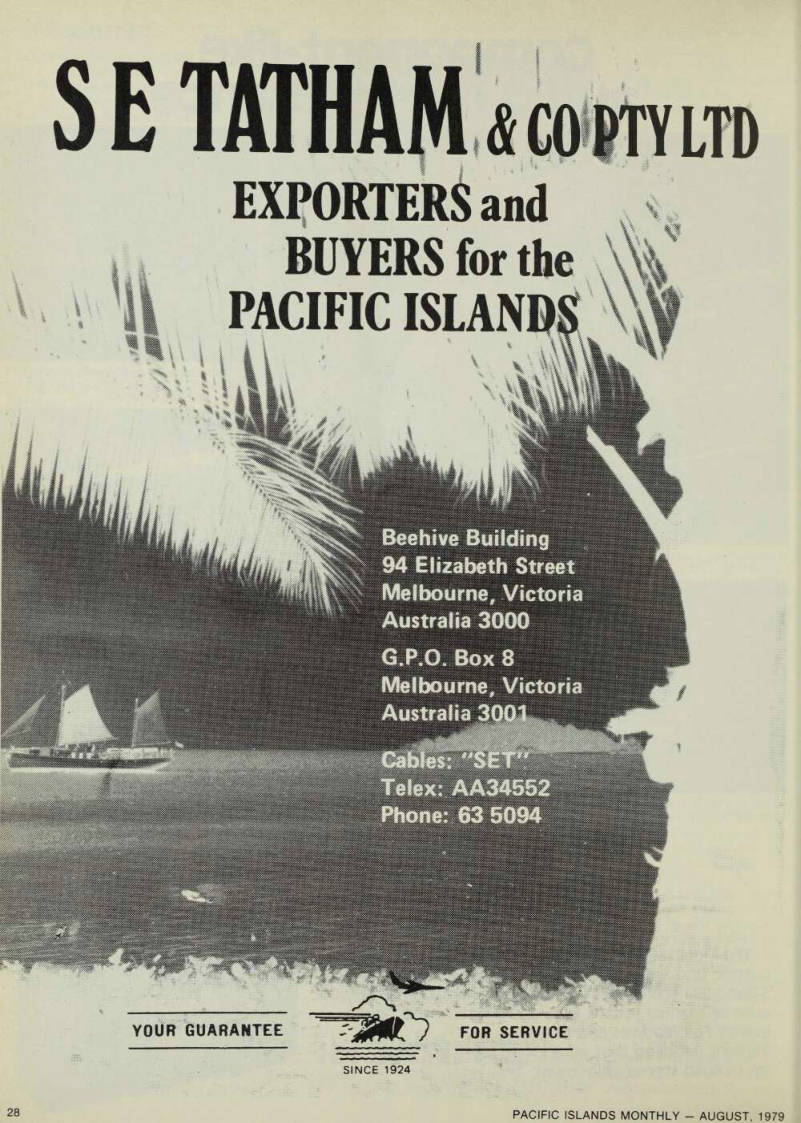
Kewal Chetty, Fiji sales representative for the Gillette company, demonstrates a new type of locking safety razor designed for use in prisons and other security institutions. The razors lock with the key Mr Chetty is holding so that the blade cannot be removed. He has presented samples of the razors to the Suva prison.
roughly-hewn printing blocks.
They are a unique part of our numismatic history.’ says Bob Roberts, of the Wynyard Coin Centre. ‘They represent the only time “foreign money” was legal tender in Australian territory.’
Bids were coming thick and fast for the newly discovered treasure. One New York doctor offered SASO 000 for the set.
But Mr Roberts was anxious to see them stay in Australia. ‘ln comparison with many other Australian coin rarities, this German New Guinea set is worth at least $lOO 000.’
Any buyer who donated the set to an Australian museum or public collection could claim their market value as a tax deduction against assessable income.
Haapai causeway
rises again
The islands of Lifuka and Foa in Tonga’s Haapai group are to be linked by a causeway built under a New Zealand aid scheme, writes Jimmy Cornell from the spot. One third of the 600 m gap separating the two islands has already been filled in. The work is being carried out by a team of 43 army
engineers commanded by
Lieut. John Kamp of the Ist
Field Squadron. Papakura
(Auckland).
Another causeway was attempted on the same spot more than 20 years ago but was not strong enough to withstand the rough weather conditions and only lasted a few weeks.
The present causeway is built solidly on a bedding of coral boulders of up to 10 tonnes weight laid over the shallow reef linking the two islands.
The causeway will be one lane wide with a concrete cap ping and will rise about one metre above the highest tide level. It will enable the islands to communicate more easily and also give access to the people of Foa to the Pangai market, on Lifuka, and the new 28-bed hospital, also built
under a New Zealand aid scheme. The hospital is sched
uled to be opened by King
Taufa’ahau Tupou IV in Sep tember. No completion date has been set for the causeway, but Lieut. Kamp is confident that it will be a lasting job.
Now it’s Emma
on the stage
The islands around New Bri tain and New Ireland have their fair share of legendary characters, but perhaps none stands out more than the ener
getic Emma Forsayth
‘Queen Emma’ who established and ruled a copra and trading empire in the Duke of York Islands from 1878,
writes Stephen Measday.
Emma Forsayth was born in 1850 of a Samoan mother, Le Utu, princess of the royal fam ily of Samoa, and James Coe, an American agent and later American consul in Apia.
Her life has long attracted the interest and curiosity of his torians and authors. It has already been the subject of at least two full-length books.
The first, by R. W. Robson, founder of PIM, was published in 1965, under the title Queen Emma: in 1976 this was fol lowed by Queen Emma of the South Seas, by Australian author Geoffrey Dutton.
Now Troupe, an indepen
dent theatre ensemble based in Adelaide, has recreated Emma’s life on stage in a pro duction entitled Missis (sic) Queen.
Written by Adelaide play
wright Doreen Clarke, Missis Queen had its Australian premiere at the end of July, and was to run for a three-week season.
The production, with a cast of seven, was directed by David Allen, a playwright who had recent Australia-wide success with his play about Stan
Laurel. Gone with Hardy.
With Missis Queen , Troupe has demonstrated a hard
working, innovative approach
that has led to comparisons with the style of production in
the early days of Sydney’s very
successful Nimrod Theatre.
Church of Tonga
is fifty years old
The jubilee of the Church of Tonga, one of the branches of Methodism, was celebrated at Pangai, the capital of the Haapai group, where it was founded half a century ago by the Hon Ulukalala, its first
president, writes Jimmy Cor
nell. A special ceremony was held at dawn on May 3, a
plaque being unveiled by the
fourth president of the Church of Tonga, Selu Pepelimafi. The plaque was erected ‘to com memorate the golden jubilee of the Church of Tonga which was founded in Haapai in May 1928 and was formally con secrated on May 3 1929’. The church has about 8000 fol lowers in the kingdom, of whom about 3000 reside in the
Haapai group.
Lieut Kamp with the Haapai causeway ... confident it will be a lasting job. Photo Jimmy Cornell.
Plaque for the 50th anniversary of the Church of Tonga. Selu Pepelimafi, president of the church (left), with the Reverend Fono, Pagai’s minister. Photo Jimmy Cornell.