Challenges
p. 80 · Read in the full issue
Questions And
For Rotumans
Rotuma Split Island, ed Chris Plant. Published by the Institute
of Pacific Studies, University of
the South Pacific, in association with the South Pacific Social Sciences Association and the USP Fiji Extension Centre, 1977.
Rotuma is a remote island about 500 km north-west of Fiji. The only access is by ship from Suva although an airstrip
is nearing completion. There
are no hotels. The main source of income is copra.
Although linked politically
with Fiji, Rotumans are
racially and culturally dif
ferent. The political links are
strengthened by family ties,
however, since today over 60% of Rotumans live in Fiji.
Rotuma is fairly close to the boundary between Melanesia, Polynesia Micronesia, and aspects of all three cultures can be found in Rotuman language and custom.
Rotuma Split Island is a timely reference work. It is a
collection of material written by several authors over a period of years. Ten Rotumans and one European have con tributed to the work. It points to some of the social forces at work in Rotuman culture, both in Rotuma and Fiji, as well as problems associated with the process of change in a remote island culture. These problems, although dealt with in detail in their Rotuman setting, don’t just apply to Rotuma and its people: they could apply to almost any remote culture.
Each chapter of Rotuma Split Island covers a specific subject: An introduction and
geography; history, super
stition and religion: mission in fluence on secular life; kinship,
reciprocity and society;
Rotuman marriage; the mamasa ceremony; decision making in Rotuma; legal as pects of Rotuman land tenure; dance as a reflection of Rotuman culture; Rotuman chants, sports and pastimes; the emigration of Rotumans to Fiji; Rotuman communities in
Fiji: Raiwai, Raiwaqa and
Lomaivuna; and the develop ment dilemma.
As well as writing the last chapter, Chris Plant edited the book.
As one who is married to a Rotuman, and who visited Rotuma during December 1977 and January 1978, I read Rotuma Split Island with great interest. For Rotumans it is an essential reference work, es pecially since many young
Rotumans have never seen their homeland.
The book provides questions which must be answered if Rotumans are to adapt success fully to the changes with which they are faced today. Some of these questions are: What as pects of our culture shall we leave in the past? What changes should be made so our
society does not stagnate?
What is needed to help advance the economic standing of our island? How are we to achieve our aims?
In reading this book, and
observing and speaking with
Rotumans, I have concluded that five important changes are needed before Rotuma can face the challenges of this age
successfully:
• Rotuman chiefs, politicians and decision-makers should encourage their people to speak out about what is needed. The merit of ideas put forward should be weighed carefully. • Rotumans should not be rub ber stamp ‘yes men’ when given decision-making re
sponsibilities.
• The ideas of young Rotumans should be respected.
They dearly love and respect their fellow people and island culture. This is why they speak out and ‘criticise’ when they return home. • Rotuma needs represen tatives in both Houses of Par liament not just the Senate as at present. Rotuma should be one electorate with possibly all Rotumans, in Fiji and Rotuma, eligible to vote therein. • The economics of another crop, more lucrative than
copra, should be examined in detail. I like Chris Plant’s idea about oranges, but a much bet ter shipping service is essential before these can be exploited.
David McCarthy
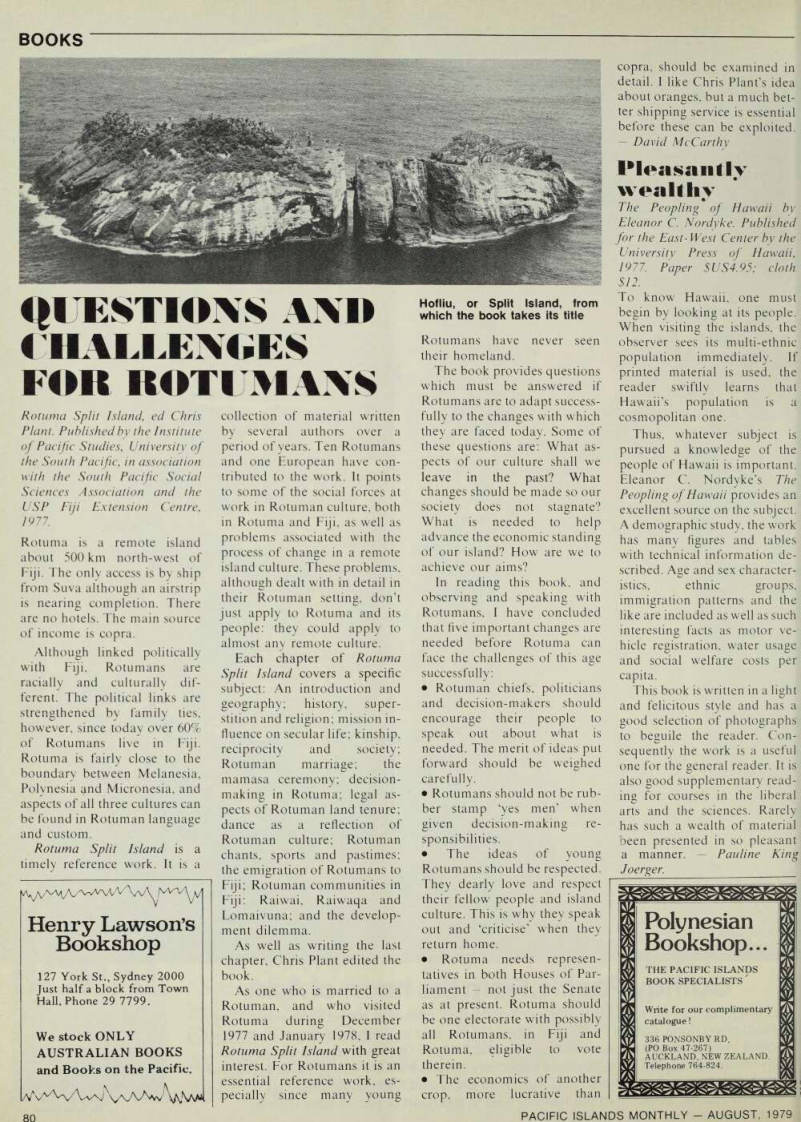
Hofliu, or Split Island, from which the book takes its title