Carrier’S Lot
pp. 79-82 · Read in the full issue

Yesterday
A Papuan View
Of A Wartime
Carrier’S Lot
Retribution hangings and beatings by Australians against Papua New Guineans who consorted with the Japanese during the Pacific War hits the headlines from time to time. PIM, in 1971, in the words of former PNG public servant Tom Grahamslaw told as complete a story as has ever been published. When Australian volitician Barry Jones last year questioned the disappearance of re cords of legal ‘justice ’ meted out to Papua New Guineans caught up in a war not of their own making, the headlines with dramatic pictures of battered buttocks proliferated. Papua New Guinean 'ournalist Maclaren Hiari, to get another view of events from the Hps of a Melanesian, interviewed Simon Ogomeni Pehara, now in his fifties, of Papaki village near Kokoda in PNG’s Northern Prov hce. Mr Pehara was a 16-year-old when he was recruited with other nllagers by Captain Claude Champion, then in charge of local carrier recruiting at Kokoda.
>imon Ogomeni Pehara was ecruited as a carrier to serve Ulied forces in 1943. Mr ehara, fellow Papaki vil agers, and Papuans from miles round, had fled into the bush yith the onset of the war with he Japanese the year before, 'he people of Papaki made heir way to friends in the vil jge of Asisi, off the beaten rack and, hopefully, out of the
ray of the fighting.
However, when the Aus •alian army realised that with ut local help the movement of applies and ammunition was
Imost impossible, Captain
laude Champion was given
ic job of finding that help.
Ogomeni Pehara and fellow illagers were assembled at /airope from where they were mt to Dobuduru. There they
egan carrying supplies and
uilding shelters for both men
nd equipment.
Mr Pehara recalls ‘thou sands’ of men carrying materials from Dobuduru to Higaturu and on to loma and other destinations. The Papuan labour force was also used to help build the road from Oro Bay on the Northern District coast to Higaturu and then on to Kokoda with picks, shovels, hammers and weighted drums.
Because of the great number of people employed on the highway, says Mr Pehara, it was finished in less than three months, enabling the Aus tralians to move quickly up to Kokoda. During this time Mr
Pehara was bosboi (foreman) of the labour force on the high way. In the space of a week, he said, thousands of labourers turned the ‘impassable Oivi hills’ into a ‘passable’ road.
With the road finished, the labourers became carriers,
moving materials along the
Oro Bay-Kokoda track until they were moved all the way to Kokoda where they joined up
again with Captain Champion,
the man who had originally re cruited them. Their next job was to carry from Kokoda to
Kagi.
Mr Pehara describes Captain Champion as ‘a good army of ficer who sympathised with the carriers’, but goes on to explain why he and his fellow Papuans were willing to do the work they did: ‘lt was a time of war so people had to fight other people for the sake of survival.
It was necessary for the survival of Papua New Guinea and Australia so we had to help the
If the work he had been doing was tough, Mr Pehara’s next assignment was much more distasteful. He was asked to work with a Mr Franklin who had the job of retrieving corpses, either left or buried on the battlefield, and bringing them in for burial in the nearest ‘civil native cemetery’. ‘We had to travel as far as Gorari back on the Kokoda-Higaturu road and Kagi on the Kokoda Trail to bring corpses back for burial at Kokoda. I was involved in this work for almost a year be fore becoming a hausboi (dom estic servant) for Mr Franklin at Kokoda. Another Papaki vil lager, Theo Isoro Handu, be came bosboi to the labourers who were digging up the corpses.
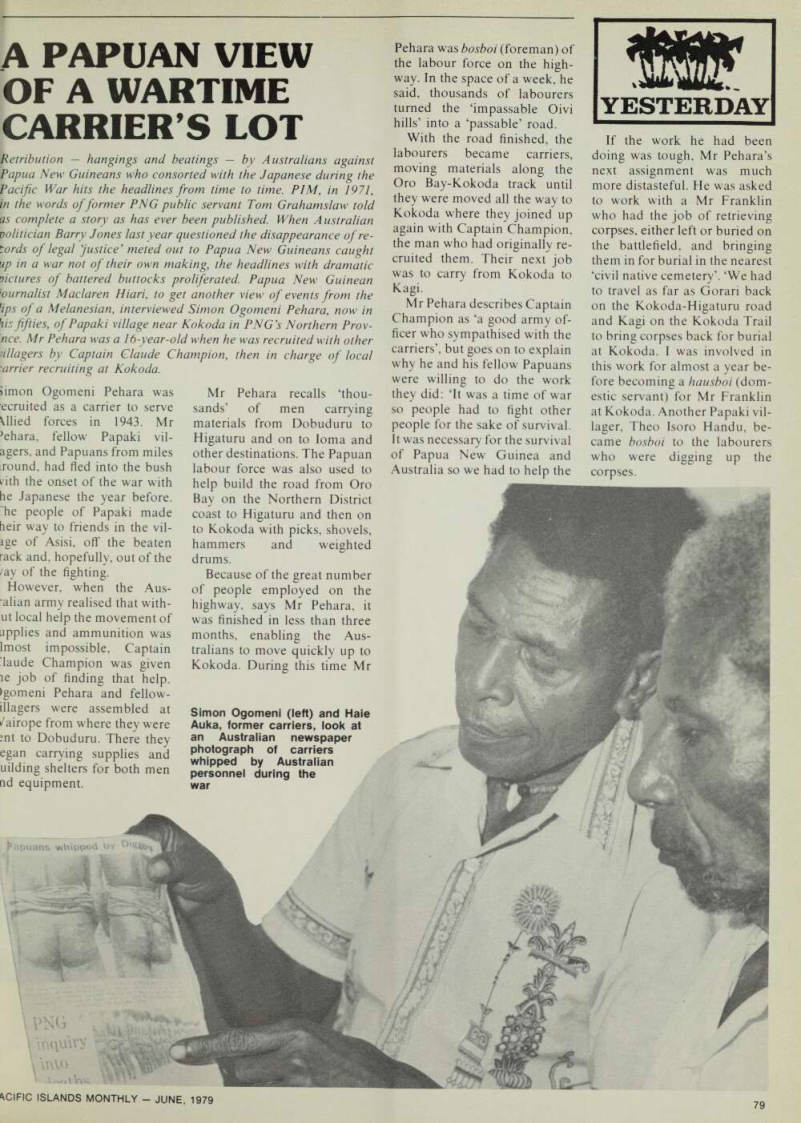
Simon Ogomeni (left) and Haie Auka, former carriers, look at an Australian newspaper photograph of carriers whipped by Australian personnel during the war
It was during this time that Mr Pehara made his first flight in an aircraft, from Kokoda to Dobuduru, with Mr Franklin, for a dental check-up, and to spend a week working at the Soputa cemetery. After a short spell back at Kokoda, Mr Pehara was transferred to Oro Bay to help in the unloading of
ship-borne food supplies. That
was where he was when the war ended.
Mr Pehara’s ‘war work’ did not end with the cessation of hostilities. First he returned to his village and, for domestic reasons, did not take up an in vitation to move to an ex service settlement block at Sangara. Soon afterward. Mr Franklin visited his village and asked if he would return to Kokoda to collect the bodies of the fallen and send them to Bomana War Memorial cem etery just outside Port Moresby. His job was to exhume the remains, put them in bags and label them ready for flying to Port Moresby. The grave markers were shipped by sea. For that work Mr Pehara
says he was paid eight sticks of black tobacco.
He was later asked to go to Port Moresby to help maintain Bomana cemetery but, again for personal reasons, he de cided not to leave his village.
T had coffee and cocoa gardens to look after for my family,’ he
explained.
Mr Pehara did not witness the hangings which have caused controversy on and off in both Australia and Papua New Guinea in recent years.
But he remembers well the rough gallows on which most of the executions were done.
Of the hangings at Higaturu
by Australian Army personnel,
he believes they were done ‘for good purpose’ and did a lot to dissuade further consorting with the enemy Japanese. But while he thought the Higaturu hangings were ‘just’, Mr Pehara
regarded the whipping and
caning of Papua New
Guineans at Isurawa and Alola along the Kokoda Trail as ‘sav
age and rough punishment’
which should have been avoided.
He sees the floggings as the work of Australian Army per sonnel who believed the ‘natives’ were nothing more than ‘cannibals and animals’, not fit for anything better. Mr Pehara said he emerged un scathed but saw fellow coun trymen whipped, in some cases for ‘unbelievable reasons’.
When shown Australian newspaper photographs of the lacerated backsides of whipped and beaten Papuans, Mr Pehara expressed surprise at
the photographs ever having
been taken. ‘I never thought that such photographs existed and I am surprised that photo graphs of war events in Papua New Guinea are being kept in Australia.’ He said he intended to show the photographs of the buttock wounds and of the gallows at Higaturu to fellow former carriers now living in Northern Province.
Looking back on his years of hard labour during the war, Mr Pehara now sees the Papua New Guinean people as having been pressed into building the Oro Bay-Kokoda road and car
rying supplies and other
materials of war. He says it was
exploitation of cheap labour.
The Australian army ‘fooled us’, he says, by promising com pensation to labourers and car riers after the war. But nothing had happened and now Papua New Guinea was an indepen dent nation.
Late last year there was an announcement by the Aus tralian Government that Kina 37 000 would at last be paid in war compensation to labourers and carriers. But this falls far short of the K 3 million former minister for defence Louis Mona was talking about when he came out in support of com pensation claims lodged by the Returned Services League of Papua New Guinea. Present Minister for Defence Gai Duwabane praised the Aus tralian Government for its ges ture, but it is doubtful that the PNGRSL will give up easily in its campaign to win compen sation for the thousands of Papua New Guineans who gave their all for payment in sticks of black tobacco.