Islands

Pacific
Monthly
Pim
June, 1979
Ojnx¥ T>Ut
Anldticanilrnoa rt?SUSSI.2S
iP a " 3 < fHSvfaii USSI.SO New Cal. & Fr. Pol. CFPI4O New Hebrides ASI.OO NZ. Cook Is. & Niue NZSI.OQ..
Norfolk Island Papua new Guinea Kl.OO Solomons SSI.OO Tonga Pl.OO
Ustt & Guam Ussi.2S
Western Samoa XlvOO Recommended retail price only. ’Registered for posting as a publication - Category B.
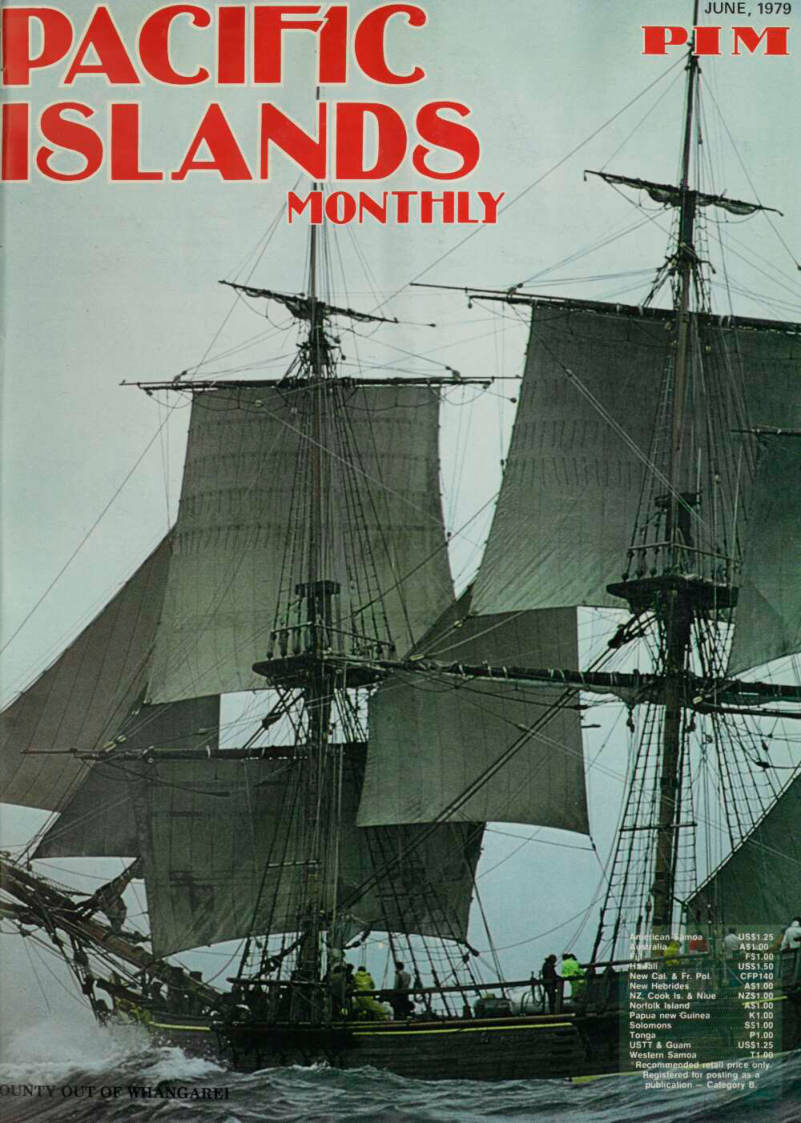
COVER: PIM yachting cor respondent Jimmy Cornell was on hand to capture the Bounty replica on its maiden voyage out of Whangarei, New Zealand.
Advertisements & other items, p. 2 (1 item)
Toyota
How to find a REAL economy car* When you look at a car billed as an economy model, ask yourself a few questions.
What sort of fuel consumption can be expected?
Low? Good.
What about other operating costs? Oil, lubrication, that kind of thing. Low again? Great.
How about maintenance? The car has a low-breakdown record? You are definitely on the right track.
What is the average life of the car? Is it better than the average in your area? Super. That’s important in an economy car.
Now. How is the after service? Buying a car is not all in the price you know. Plenty of service outlets?
One economy car coming up. All you have to do is check the price. Then you can tell if you are really getting an economy car.
You will probably find, after asking these questions about town, that REAL economy cars come down to Toyota, the world’s economy car builder.
See Toyota first. Then you won’t have to shop around.
IHE HAPPY ECONOMIZER
TOYOTA STARLET
The car that says economy in every way.
And you will be happy for it. Big inside.
Small outside. Miserly with petrol.
Without sacrificing comfort. A good buy in an economy car even for Toyota.
PAPUA NEW GUINEA:
ELA MOTORS LIMITED,
Scratchley Rd., Badili, P.O. Box 75, Port Moresby.
U.S. TRUST
TERRITORY; MICROL
CORPORATION,
P.O. Box 267, Saipan.
FIJI ISLANDS:
AUTOMOTIVE
SUPPLIES CO., LTD.,
G.P.O. Box 355, Suva.
AMERICAN SAMOA:
BURNS PHILP
(SOUTHSEA) CO., LTD.,
P.O. 1057, Pago Pago.
WESTERN SAMOA;
BURNS PHILP
(SOUTHSEA) LTD.,
P.O. Box 188, Apia.
GUAM: ATKINS, KROLL
(GUAM) LTD., P.O. Box
6248, Tamuning.
NEW HEBRIDES:
NEW HEBRIDES
MOTORS LTD.,
P.O. Box 18, Vila.
SOLOMON ISLANDS:
MENDANA
TOYOTA
SERVICE
TOYOTA
ENTERPRISES (5.1.)
LTD., P.O. Box 174,
Honiara.
TAHITI: NIPPON
AUTOMOTO, B.P. 342,
Papeete.
COOK ISLANDS;
COOK ISLANDS
TRADING
CORPORATION LTD.,
P.O. Box 92, Rarotonga.
NAURU ISLAND:
NAURU COOPERATIVE
SOCIETY.
GILBERT ISLANDS:
TARAWA MOTORS,
Box 36, Bairjki Tarawa.
NORFOLK ISLAND:
MOUNT PITT
(ENTERPRISES) LTD.,
P.O. Box 169
NEW CALEDONIA:
SOCIETE
IMPORTATION
AUTOMOBILE DE
PACIFIQUE,
Rond-Point du Pacific (Station Total) B.P. 438, Noumea.
The Toyota range includes: Toyota 1000, Toyota Starlet, Toyota Corolla, Toyota Celica, Toyota Corona, Toyota Cressida, Toyota Crown
Pacific Islands Monthly
Pim
Vol. 50 No. 6
June 1979
(Usps 952480)
Elsewhere: SAI6 *ayment by personal cheque is accepted in Australian, JS, New Zealand, UK and Fiji currency. For other remit ances please obtain a bank draft in Australian dollars nade payable to the ANZ Banking Group, 88 Wentworth kvenue, Sydney, Australia.
Representatives
lUSTRALIA; Distribution: NSW & ACT: Allan Rodney Vright (Circulation) Pty Ltd, PO Box 907, Darlinghurst, JSW 2010; Elsewhere; Gordon & Gotch (A/asia) Ltd, Box •0. PO, Rosebery, NSW 2018 Advertising - Melbourne - Pacific Publications (Aust.) Pty Ltd, sth Floor, Alley fuilding, 75-77 Flinders Lane, Melbourne 3000, tele ihone 63-0211, ext. 1565 Jeff Gates, ext. 1858 Ida Pad lett; Brisbane D Wood, Anday Agency, Box 1918, »PO, Brisbane 4001, telephone 44 3485. 44 1546; Adelaide - Hastwell Media, 233 Glen Osmond Rd, Frew ille, SA 5063, telephone 79 1869, 79 5956; cables Hast ledla, Adelaide.
Ul: Distribution and subscriptions Desai Bookshops, 0 Box 160, Suva, Fiji, telephone Suva 23036 Advertls ig - Fiji Times & Herald Ltd, 20 Gordon St, Suva, tele hone 312 111, telex FJ2124 RENCH POLYNESIA; Distribution Hachette acifique, 10 Ave Bruat, Papeete, telephone 2 5610.
AWAII, UNITED STATES: Distribution PIM, Hawaii, 812 Kahawai St, Honolulu, Hawaii 96822.
APAN: Advertising and subscriptions Universal ledia Corporation, -CPO Box 46, Tokyo, telephone 66 3036. lEW CALEDONIA: Distribution Depot Centre de resse Michel Pentecost, CBP2, Noumea, telephone 7 2434, 27 4729.
EW ZEALAND; Distribution - Gordon & Gotch, PO Box 84, 2 Carr Road, Mt. Roskill, Auckland 4 Advertising ■ International Media Representatives Ltd, PO Box 2313 uckland, telephone 795 487; 493 389, cables Intereps! uckland. Subscriptions - Ross Haines & Son Ltd, PO ox 1289, Auckland, telephone 769 042.
APUA NEW GUINEA: Distribution Robert Brown & ssoc., PO Box 3395, Port Moresby, telephone 2 5855 dvertlslng - PNG Post-Courier, PO Box 85, Port loresby, telephone 212577.
NITEO KINGDOM: The Herald & Weekly Times Ltd, 8-10 lifford s Inn, Fetter Lane, London EC4A IBU, telephone 1 831 6041, telex London 21989.
NITED STATES MAINLAND: Advertising - Joshua B owers Jr, Powers International Inc., 551 Fifth Ave New ork. New York 100 017, telephone 867 9580, telex 36514. Subscriptions - P|M, Hawaii, 2812 Kahawai St onolulu, Hawaii 96822. üblished monthly by Pacific Publications (Aust.) Pty Ltd nd printed in Australia by Paramac, Alexandria, NSW. ustralian cover price is recommended retail only. Regis ired at the GPO Sydney for transmission by post as a Jblication category B. Second class postage paid at onolulu. Hawaii. Copyright © 1978 Pacific Publications
(Aust.) Pty Ltd.
Postmaster Honolulu: Send address changes to PIM Hawaii, 2812 Kahawai St Honolulu, Hawaii 96822.
PIM is airfreighted to most subscribers and agents in the Pacific Islands and the United States.
Aust.
Other American Samoa $13 $US16 Australia $12 Canada $14 $US18 Cook Islands $13 Fiji $12 $F12 French Polynesia $14
Cfp 1700
Guam $13 $US16 Gilbert Islands $13 Hawaii $13 $US16 Japan $16 Y4500 Micronesia $13 $US16 Nauru $13 New Caledonia $14
Cfp 1700
New Hebrides $13 New Zealand $12 $NZ13.50 Niue $13 Norfolk Island $12 Northern Marianas $13 $US16 s apua New Guinea $13 K12 Solomon Islands $13 Conga $13 Cuvalu $13 Jnited Kingdom $15 £io JS Mainland $14
Sus18
Western Samoa $13
This Month
• Tonga Death of Tevita Fifita of Minerva Reef fame and one of modern Tonga’s ‘greats’ 13 • France in the Pacific New stirrings in the ‘back waters’of the Marquesasand Wallis and Futuna 18 • Tanna Troubles in the New Hebridean 50uth...21 • Nuclear weapons New Zealanders protest against visits by US N-subs, while the US and Japan search for a Pacific dump for nuclear waste 21 • Western Samoa At last, the long-awaited ‘party politics’ show 23 • Cook Islands Opening of a conspiracy trial hangs on efforts to extradite an American millionaire 23 • New Zealand in the Pacific Twenty pages analys ing a complex and growing relationship 41 • Pacific War A Papuan carrier looks back on his wartime experiences while working with Australians 79 • Tuvalu A story of fish, and thinking behind Prime Minister Toalipi Lauti’s bold deal with an American businessman 83
Tevita Fifita ... hero
Yamak of Tanna ... ordeal at the hands of anti-Vanuaaku activists
Afterthoughts 39 Australia 5,7, 9, 10, 22, 84, 91 Banaba 5 Books 71 Cook Islands 23, 71 Fiji 5,6, 9, 10, 22, 30, 50 France 9, 18 French Polynesia 7,9, 10, 58 Gilbert Islands (Kiribati) 5,6, 9, 67 Guam io Hawaii 9 Irian Jaya 22, 28 Islands Press 37 Japan 10 Letters 5 Marquesas 18 Micronesia 10 Midway Island 9, 21 New Caledonia 7,9, 53, 68 New Hebrides 5,6, 9, 10, 21 New Zealand 5,7, 9, 10, 21, 22, 23, 30, 41-65 Norfolk Island 10, 28
Yesterday 79
Pacific Report 9 PNG 9, 10, 22, 26, 28, 30, 39, 53, 72, 79, 84 People 75 Pitcairn 26, 28 Political Currents 21 Ponape 10 Shipping Services 94 Solomon Islands 6, 10, 22, 55. 83
Spec 5
Tahiti 7,9, 10, 58 Tonga 5, 10, 13, 28, 32 Tradewlnds 83 Tradewlnds Intelligence 87 Travel 67 Troplcallties 26 Tuvalu 5,6, 83, 84
Ttpi 10
United States 21, 23 Wake Island 9, 21 Wallis & Futuna 18 Western Samoa 10, 22, 23, 62 Yachts 91
Advertisements & other items, pp. 3-4 (2 items)
3
ACIFIC ISLANDS MONTHLY - JUNE, 1979
Founded 1930 by R. W. Robson Publisher Stuart Inder Editor Bob Hawkins Editorial Adviser John Carter Manager John Berry Advertising Steve Gray, Peter Bedwell A Pacific Publications production 76 Clarence Street, Sydney 2000 GPO Box 3408 Sydney 2001 Cables: PACPUB Sydney Telex: Pacpub 21242 Telephone: Sydney 296693
carptrac
t *1
I r&T£aP<V.^S
”»wa ** « J * -?
LOW RATED RPM
CATERPILLAR SKIDDERS ARE BUILT TOUGH
TO STAY ON THE JOB.
Cat-built Skidders have protection all
round. You get protection for man and
machine with the roll-over canopy and
other machine guarding. And you get
protection against excessive downtime with
dependable CAT construction, CAT dealer
backup and easy on the job maintenance.
MUFFLER
THE CATERPILLAR 518 SKIDDER
features 120 flywheel
horsepower @ 2200 rpm,
powered by the Cat 3304
turbocharged engine, with an
operating weight of 20,400 lbs,
turning diameter of 34' 8" and
utilises a Gearmatic 119 winch
with a linepull (max.) of 32,000 lbs.
QUIET OPERATION
You get low noise levels from the 4 stroke cycle diesel, muffler and low-speed fan. You’ll hear the difference in Cat-built Skidders.
STRONG DOZER BLADES
deck and bunch logs, clear brush, protect the radiator. The blades are high-strength steel with trunnions that never need greasing. Dozer blades are box-sectioned for greater strength and durability.
LOW RATED RPM
4-STROKE CYCLE DIESEL
MUFFLER LOW-SPEED
FAN RUGGED ARCH AND
FAIRLEAD
stand up under heavy loads.
The main roller is a Lifetime Lubricated hardened casting to reduce scarring that tears up cables. Side rollers are heat-treated for long life.
LAE :
Milford Haven Road, Telephone 42 2355
PORT MORESBY :
Telephone 256650
BOUGAINVILLE ;
Itakara Industrial Park, Arawa. Telephone 959077 C
carptrac
SUVA : Carpenter Street, Raiwai.
Private Mail Bag, GPO Suva. Fiji. Ph. 381622, Telex FJ2190 Cables CARPTRAC LAUTOKA : Veitari. Telephone 61877 LABASA : Vulovi, Telephone 81888
YOUR
CATERPILLAR
DEALER
Caterpillar, Cat and 33 are Trademarks of Caterpillar Tractor Co BA 10441
Letters
And then there
was none?
After reading Manuka Mita Puku’s article (PIM March), we . can only hope that as the econ omy of New Zealand becomes more and more shaky, he and his Maori brothers are not forced to paddle their way back to Havaiiki, their true ‘home’.
Kainantu EHP R. & S. EDWARDS Papua New Guinea (New Zealanders)
Mahe: no political
union intended
In your otherwise accurate article on SPEC (South Pacific Bureau for Economic Co operation) in which you drew on my 1977-78 annual report (PIM March), you offered the interpolation that ‘Mahe does not venture a time scale on his dream of a unified non colonial Pacific’. In doing so, I fear that you may have given the impression that I advocated some kind of political union of Pacific countries.
On the contrary, I was stress ing the importance of a co
ordinated approach to the
economic development of
independent South Pacific countries and how the strength
of regional arrangements such
as SPEC lies in the fact that partners are free to decide for themselves the course of their development. ASEAN and CARICOM have shown that
this goal could be achieved just
as effectively without political
merger of the kind you attribu ted to me.
Spec
Suva
Fiji
M. U. Tupouniua
Director
Australia in the Pacific fhe article by Malcolm Salmon ‘Australia and the South Pacific’ (PIM March) vas quite interesting. In par ticular, the appraisals made by Vl r Forsyth and Mr Mac lonald of the Senate com nittee’s report are certainly in
line with what many Islanders themselves have been reiterat
ing.
It seems to me that if Aus tralia wishes to change its image in the South Pacific and honestly cares about the ‘lslanders’ interests and not its own, then there should have been more input by the Islanders themselves, whether
by visiting and listening to the
people in the various areas of the Pacific, interviewing Islanders at universities within the country (as done with Baba and Tupouniua), or by review
ing conference proceedings
where Islanders have given tes
timony.
As pointed out in the article, one of the criticisms of the Sen ate committee’s report was the lack of Islander input, which is definitely a valid one. PIM seemed to follow a similar path by the writer also overlooking the incorporation of Islander testimony. If, as stated on the first page of the article, that at least two Islanders gave evi dence and that Mr Baba’s appeared in the February issue, then what of Tupouniua’s evi dence? His name is mentioned and his picture even shown, but what of his testimony?
Hawaiian Studies
Sarah Quick
Kamehameha Schools Instructor Hawaii The point should have been made, but Sione Tupouniua's evidence was apparently given in camera it does not appear in the official transcript of the committee's proceedings and PIM, therefore, was not in a position to quote from it.
Not even PIM
can be perfect
PIM is developing at an im pressive rate as the premier journal of a lively and import ant region, and you are to be congratulated on the continu
ing improvement in depth and
breadth of coverage in your editorial matter.
One suggestion, though. I
still seem to hit up against four or five statements per issue that aren’t quite right, and this tends to sap my confidence in the precision of other state ments about matters I don’t know anything about. To give a couple of examples, gathered in about three minutes of leaf
ing through the April 1979
issue; pl 4 - Dr Tom Davis as medical monitor of the US Pro ject Mercury moon shots. The
Project Mercury flights were
the first manned US orbital and suborbital earth shots and by no stretch of the imagin ation could they be called moon shots (you could as well credit the Wright Brothers with
inventing the jumbo jet); pl 9
the ‘US marines’ in the photo graphs are neither marines nor Americans there isn’t even a family resemblance in the uni forms; I suspect they are French sailors, but you should know you’ve no doubt spent more time in Pacific ports than I have.
The remedy, obviously, is a tough and fastidious editorial desk. I assure you that the effort will pay off in the per ceived stature of your maga zine. Best wishes.
John G. Rhoads (Dr)
Yale University Assistant Professor New Haven of Anthropology Conn USA Thanks. We'll try harder.
W. Pacific Archives
I add my support to Bruce Bume’s letter (PIM March). I also support the thinking of C.
Guy Powles (PIM September
1978) although he was not cor rect in detail.
The Gilbert Islands has established its own National Library and Archives, and as a consequence of the closure of the Western Pacific Archives (WPA) we received 61 cases of records in October 1978. These
comprise mainly resident com
missioners’ records, secretariat and district office records. As Bruce Bume correctly states, many valuable records were lost at Banaba (Ocean Island), the former administrative
headquarters, during World
War 11.
The Western Pacific High Commission (WPHC) records are of infinite value and im portance where the recent his tory of the Gilbert Islands is concerned and would greatly assist in filling the gaps in our sequence of records. These re cords were available to us, and to other former WPHC terri tories while housed in Suva but sadly are no longer available to anyone in this region where the
interest is, and always will, be far greater than in London.
There is also, of course, the last point Bruce Burne raised that the WPA was never sup ported or encouraged in any way, least of all financially by London. That the WPA achieved so much is entirely to the credit of the member coun tries who gave financial sup port, and the credit of archivists lan Diamond, Bruce Burne, and P.D. Macdonald who had the sad task of finally winding up the operations of the
Wpa.
Tarawa
R. Overy
Gilbert Islands Librarian/Archivist As I fear that some erroneous conclusions may be drawn from the letter of Mr Burne concerning the Western Pacific Archives, I feel I should make certain comments, especially as I took over from him as archi vist late in February 1978 and remained in charge until the closing down of those archives on November 20.
It might reasonably be in ferred from what he has written that the records of the New Hebrides and of the agent and consul in Tonga have been per
manently despatched to the
Foreign and Commonwealth Office. That is not the case.
They have only been tem porarily transferred since, with the closure of the archives, there was no suitable air conditioned accommodation for them either in Suva or in the territory concerned.
To state, as Mr Burne does, that ‘less than 40% of the hold ings of the Western Pacific Ar chives have been transferred to “their countries of origin”,’ may also be misleading unless the circumstances are fully ap preciated. In making that state ment, he clearly has not taken into account the New Hebrides and Tonga records which filled 75 large cases, and it may reasonably be assumed that they will be sent to those coun tries in due course.
Further, it must be remem bered that by far the greater part, if not all, of the head quarters records of the then British Solomon Islands Pro tectorate and the then Gilbert and Ellice Islands Colony were
presumably destroyed when
those territories were invaded in 1941-42. It was only after the war that the governments of those two territories, when relocated in their headquarters at Honiara and Tarawa, trans ferred their records over the years to the Western Pacific Archives in Suva. That process continued until about the early seventies and all such records,
roughly covering the period
1946-71, have been returned to them.
In view of the foregoing, and whilst not wishing to be dog matic, I should assess the figure at about 50% or 55% rather than 40%. But the important point is that they have there fore received all the records to which they are ‘entitled’. If it were not for the loss of their pre-war records, the percent age would clearly have been very much higher. However, I revert to this question of ‘entitlement’ later.
The statement that ‘the WPHC records include Solomons Secretariat material and make up for much of the administrative documentation of the Solomon and Gilberts lost during World War IF could also be misleading and is not strictly correct.
The WPHC records com prise, inter alia, the originals of all correspondence addressed to the high commissioner in Suva by the resident com missioners of the British Solomon Islands Protectorate and the Gilbert and Ellice Islands (as well as originals of all the secretary of state’s cor respondence to the high com missioner and the latter’s reply to him). Whilst, therefore, much of the correspondence of the WPHC records certainly relates to the affairs of the two territories concerned, they can not correctly be held to be the records of those territories alone which were unfortu
nately destroyed but are
those of the high commissioner for the Western Pacific, or the British Government. The first part of the quotation is there fore incorrect and the impli cation in the second part misleading. Both governments have received in full all the ar chival records to which they were ‘entitled’.
The further statement by Mr
Bume that, ‘when planned in 1974 the new archives building in Honiara, which he (Sydney Hockey, PIM December 1978) mentions, was designed to take WPHC records as the then chief secretary proposed the transfer of the holdings of the WPA from Suva to Honiara’, needs considerable clarifi cation. It may well be true that the then chief secretary did ‘propose’ the transfer as men tioned (though I have it on good authority that he knew that archival records other than those of the Solomon Islands would certainly not be sent to Honiara).
In fact, the source of this ‘proposal’ is in some doubt.
But, in any case, the inescap able fact is that he had no auth ority whatsoever to give the
impression that his ‘proposal’
could be in any way authoritat ive, binding or final. The auth ority for any such transfer of the WPHC records at least was the UK Government and all concerned in the ‘proposal’ must have known this. The fact that it was thus decided was made very clear to me after I sought directions in this respect almost as soon as I assumed duty. Now I am advised that the auditor-general of the Solomon Islands Government has commented that the new archives building in Honiara is many times larger than the space formerly available for all the Western Pacific Archives in Suva and has questioned how this came to be authorised.
Lastly, it will be noted that the phrase ‘holdings of the WPA’ is used in the last quo tation. But the ‘proposal’ borders on the ridiculous since it is quite unbelievable that other governments participat ing in the Western Pacific Ar chives, (the Gilbert Islands, the New Hebrides and Tuvalu), would have agreed to their re cords being transferred to, and housed in, Honiara.
Finally, as to the microfilms of the WPHC records, whilst it is true that such work was undertaken through the extreme generosity of the Aus tralian Government, no useful purpose is served by attempt ing to discredit the Foreign and Commonwealth Office in this respect, especially since, as far
as can be ascertained, it never seems to have been asked to provide funds for a microfilm ing programme. But in any case I find it quite incomprehen sible that neither the govern ment of the Gilbert Islands nor that of the Solomon Islands should have made any attempt
to acquire positive copies of
such microfilms, which cover the years 1874-1927, and which would have made good much of their lost pre-war records.
I can only assume that they were unaware, or uninformed, of the progress of the microfilming programme and
the possibility of acquiring
copies of such microfilms.
However, it seems to me that the actual location of the original WPHC records is not a matter in which opinions should differ, as envisaged by Mr Powles (PIM September 1978) since the completion of the microfilming programme
surely provides the obvious
solution.
P. D. Macdonald
Suva, Fiji.
lately archivist, Western Pacific Archivest
From Cell 4, French
Prison, Vila
A thick aroma of international intrigue surrounds a letter received by PIM from Paris born Polynesian Pierre- Francois Tarii. Writing from Cell No 4 in Vila's French prison, the 29-year-old Mr Tarii tells a tale which will cause ears to prick up throughout the South Pacific and South-east Asia, especially in aviation circles and among that shadowy brotherhood known as the
‘intelligence community'.
According to the official
French/Bislama weekly
Nabanga Mr Tarii was gaoled by the French court in Vila on March 22 for passing 10 dud
cheques with a face value of
NHFI million (SAI2 987). He was sentenced to six months
imprisonment, exclusion for five
years from the New Hebrides and New Caledonia, and five years' deprivation of the right to operate a bank account in those
places.
Mr Tarii's story is,
understandably perhaps, dif
ferent. He claims that he was framed' by the French authori ties for political and commercial
reasons. He writes: In the middle of 1978 I went to the New Hebrides after a long period in various South-east Asian countries. As a journalist I was interested in starting two magazines in this country as it moves towards independence.
One was to be called Orients Melanesia, a political-social magazine, and the other Melanesia South Pacific, oriented to the tourist trade.
The first issue of Orients Melanesia appeared on the bookstands in November 1978, and the public response was very good. Meanwhile the
French residency, the ‘Big
Masta Long New Hebrides’ and Nabanga ignored this new publication, the first issue of which was soon sold out. But after the fall of chief minister George Kalsakau, who was featured on the cover of the first issue of the magazine, Nabanga felt free to publish some disparaging comments about it.
Despite the pressure, I car ried on with my job and even asked a colleague from Malaysia to come over to help me as I was planning to start a daily newspaper in
February.
Now it happened that while I was away between November 1978 and January 1979 the French police visited all the advertisers they could, and tried to persuade them not to advertise in my magazine.
They also broke into my office and photocopied con fidential letters addressed to local ministers pertaining to
the purchase of hydro-electric
generators from Indonesia, which cost about a tenth of
their French equivalents ...
The French police even man ged to get hold of confidential telexes which demonstrated my outstanding connections in the
Asia-Pacific regions, including
one which made clear the readiness of the Indonesian air line Garuda to establish an air charter company in the New Hebrides which would use Fokker F2B jets to link Vila with Honiara and Port Moresby, from which passen gers could travel to the coun tries of the European Economic Community on Garuda flights.
I was in charge of the air charter company negotiations, * in the course of which I had pointed out that while the French airline UTA has land ing rights in Jakarta, Garuda does not enjoy reciprocal rights. Garuda planned to offer a return fare Vila-EEC of SA6OO, $250 cheaper than UTA’s student-offpeak season fare.
That was too much for the colonial power. They decided to strike. With the complicity of some other French nationals they framed me on a charge of passing dud cheques. (Mr Tarii here gives his account of the banking problems which led to his arrest, claiming that the only cheque involved was for the sum of $83.) That’s what happens when somebody dares to oppose French aviation interests .. , and on top of that dares to try and establish a free press.
Meanwhile, my Malaysian friend Mr Das was asked by the police to leave the country within 24 hours, although he held a valid 30-day visa, a return air ticket, and sufficient funds to stay. Only after the in tervention of a government minister was he allowed to re main in the New Hebrides.
PIM publishes extracts from Mr Tarii’s letter not because it accepts his claims but because of their interest to readers in the
Pacific.
‘Quebec’ in an
‘English’ Pacific
I read your monthly publi cation regularly, and with keen interest. It provides some reflections of life in the Pacific Islands which are usually com
pletely ignored by the bulk of
the Australian press.
I wish however to make a few remarks about your stand
point concerning the French
speaking islands, with their population of some 320 000
people.
Your approach to life in New Caledonia and French Polynesia is incorrect. It re flects only trends of opinion that are hostile to the French presence and not those of the
majority of these populations
who have always declared
themselves against indepen
dence. If independence should
come one day it will come from France itself, within the frame work of a new orientation of French policy. This policy at present is determined by the fact that the majority of the population of these territories is not in favour of indepen dence.
Compared with the English
speaking countries which have now become independent, standards of living and social progress are infinitely higher in the French territories. France each year spends about SA3OO million in civil expenditures in these territories, whereas Aus tralia and New Zealand spend less than $3O million on 1 200 000 people (Papua New Guinea excluded). Moreover, the fact that inhabitants of French territories are French citizens entails numerous advantages for them.
There are no racial con straints or violence in these ter ritories apart from such events, described at length in your columns by Mr Danielsson (PIM April), as those in French
Polynesia involving individ
uals convicted of murder and of dynamiting a public build
ing where the only people
employed were Tahitians. The Tahitians by the way took no demonstrative action against the trial of this new martyr,
Charlie Ching.
Mr Danielsson takes advan tage of your columns to express his hatred for France. I was once director of the daily Les Nouvelles de Tahiti and I know the case of Mr Danielsson (for mer Swedish consul) well. Mr Danielsson applied for the post of director of the Museum of French Polynesia. He failed to get the job and today he is able to express his violent resent ment through your pages.
I repeat that your approach to the problem of the French territories does not conform with the real situation and with the aspirations of the majority of their populations.
Your lack of knowledge of the French language is prob ably the main reason.
Quebec is here in the English Pacific we are witnesses to it.
You are acting towards us with the same lack of understanding as the Ottawa politicians in Canada display towards the
French Canadians of Quebec.
Daniel A. Tardieu
Sydney Australia
Islanders the
ocean pioneers?
There has been considerable talk about the gains that are
possible through an extension
of the ocean economic zones to 200 miles. While I would quite agree that talk must of necess ity prelude action, it seems to me that this particular talk has missed the real issue: this 200-mile ocean zone is an area of natural resource develop ment, too long overlooked, which could be of tremendous economic and social sig nificance to the Islands.
It is a resource which might just tip the economic scales toward self-sufficiency for the Islanders.
I am talking, of course, about marine resource development, an area which challenges space as the world’s new frontier, with all the rewards and fewer risks in the state of our present technology associ ated with new frontiers. In ad dition to its most obvious facets such as fisheries, marine bio logical research, offshore data gathering, and beach and water contamination control a program of marine resource development should also in clude artificial reef develop ments, open sea and embayment mariculture oper ations, the exploitation of under-utilised species, the development of new marine related products and indus tries, and training and exploration programmes for the youth of the Islands.
From the socio-economic viewpoint, such a programme must be an integrated oper ation, which can reach directly from the highest echelons of government, down to the fisherman in his rowboat, bypassing along the way the
labyrinth of splintered bureau
cratic agencies where small ideas are lost and large con cepts are diluted by self interest into expensive but ineffectual programmes. Con sidering the wide range of
capabilities of the populations,
a marine resource develop ment programme must be
sophisticated enough on the
one hand to create university level research projects; and, on the other, initiate labour intensive operations with the
seashore villagers.
If concerted and intensive effort were put into such a pro gramme, it would do much for the Islands. For example, care ful, large-scale co-ordinated placement of artificial reefs could multiply sport and com mercial fisheries, and provide mariculture sites for new
species development, which
could lead to the export of pro tein to the less developed coun tries of Asia. Offshore mariculture of algae and shell fish are labour-intensive pro jects which could relieve the unemployment problem and lead to the creation of other local industries.
As pragmatic as such a pro gramme may appear, its most
important and long-reaching
benefits will surely be socio psychological rather than
simply economic. Along with
the development of an ocean resource programme, there will be an attendant need for edu cation and training, as well as the creation of new occu pational fields in diving, boat
ing, underwater exploration
and construction.
The cadre of leaders that could evolve out of these occu pations would be unique in the world; they would be the ocean
pioneers, capable of
spearheading a movement to excite the imagination of the Island youth and develop in the
population a pride and esprit
de corps that would be truly a Pacific Islands accomplish ment.
When in history have a people who have staked out a claim or wrested a living from the virgin wilderness feared the future or become an indolent
or dependent people? The
answer is never. It is only when there are no frontiers to cross that initiative and the cour age to face real choices vanishes.
The line of demarcation be tween the Pacific Islanders and their frontier is at their shore lines. Can they be helped to cross that line?
New York United States
Adam Starchild
Advertisements & other items, p. 8 (1 item)
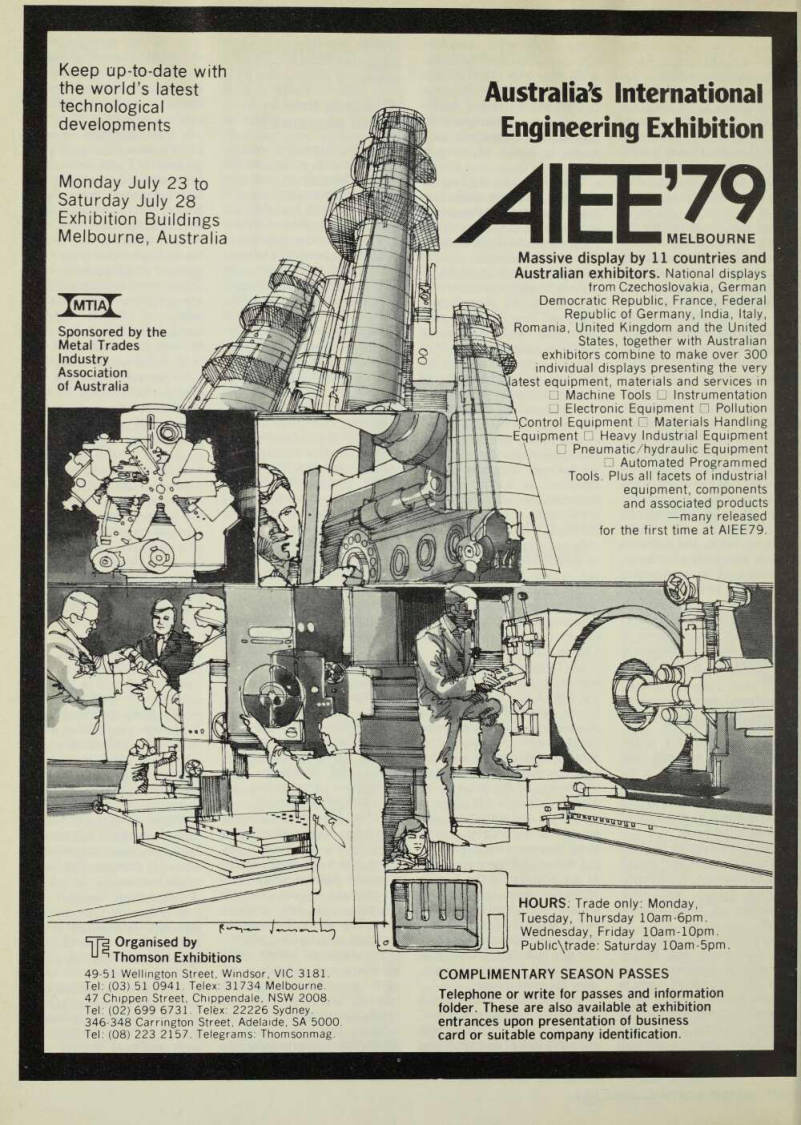
>4Iee’T9
Keep up-to-date with the world’s latest
technological
developments
Monday July 23 to
Saturday July 28
Exhibition Buildings
Melbourne, Australia
Sponsored by the Metal Trades Industry Association of Australia
ImtiaJ
Australia’s International
Engineering Exhibition
>4IEE’T9
Jr 11 mammam MELBOURNE
Massive display by 11 countries and Australian exhibitors. National displays from Czechoslovakia, German Democratic Republic, France, Federal Republic of Germany, India, Italy, Romania, United Kingdom and the United States, together with Australian exhibitors combine to make over 300 individual displays presenting the very latest equipment, materials and services in □ Machine Tools □ Instrumentation □ Electronic Equipment □ Pollution Control Equipment □ Materials Handling Equipment □ Heavy Industrial Equipment □ Pneumatic/hydraulic Equipment □ Automated Programmed Tools. Plus all facets of industrial equipment, components and associated products —many released for the first time at AIEE79.
HTa Organised by Exhibitions 49-51 Wellington Street, Windsor, VIC 3181.
Tel: (03) 51 0941. Telex: 31734 Melbourne. 47 Chippen Street, Chippendale, NSW 2008.
Tel: (02) 699 6731. Telex: 22226 Sydney. 346-348 Carrington Street, Adelaide, SA 5000 Tel: (08) 223 2157. Telegrams: Thomsonmag.
HOURS. Trade only: Monday, Tuesday, Thursday 10am-6pm.
Wednesday, Friday lOam-lOpm.
Public\trade: Saturday 10am-spm.
COMPLIMENTARY SEASON PASSES
Telephone or write for passes and information folder. These are also available at exhibition entrances upon presentation of business card or suitable company identification.
Pacific Report
Washington’S Un Man In Port Moresby
Addressing a May meeting in Port Moresby, the US ambassador to the United Nations, Andrew Young, undertook to pass on to appropriate UN authorities charges from the audience of viol ation of human rights by Indonesia in Irian Jaya. Mr Young said that while many of today’s international boundaries were born out of a legacy of colonialism, excessive redrawing of bound aries often multiplied human problems. To a question concern ing US attitudes in the event of an Indonesian invasion of Papua New Guinea, Mr Young replied; ‘I believe Indonesia has all the ■troubles it needs on its own, and is not going to look for further trouble.’ Questions raised with Mr Young in bilateral talks with a PNG delegation led by Foreign Minister Ebia Olewale included tuna fishing, airline rights and super-power rivalries in the Indian Ocean. The PNG submissions accused the US of interfering in the rights of South Pacific Island nations to fish their own tuna resources in a regional fishing body. They also claimed that the US is frustrating attempts by Air Niugini to fly to Hawaii, although a formal agreement to the rights exists. In a general submission on regional affairs, PNG asked the US to withdraw from ‘escalat ing super-power rivalries’ in the Indian Ocean, Mr Olewale also asked for US support to ensure that the South Pacific is a nuclear-free zone. Mr Young’s two-day visit, made on his way to Australia for Australian-American Week celebrations, aroused keen interest in PNG. PIM correspondent Angus Smales reported on reaction among PNG citizens as being ‘He’s not black enough’. Smales quoted one person as saying: ‘We thought he’d be blacker and more militant.’
‘Elections First’, Says Vanuaaku
Inspector-General Jean-Jacques Robert, special delegate of the French republic in the New Hebrides, has rejected new demands by the Vanuaaku Party for the holding of elections before the establishment of a constitution. The Franco-British plan is for the constitution to be drawn up and voted upon in a referendum before elections are held. Mr Robert also rejected a VP call for a change in the designation of the present ‘government of national unity’. The VP wants it to be called a ‘transitional government’.
Tories To Re-Present Gilberts Bill
The Gilbert Islands Independence Bill had its first reading in the House of Commons shortly before the former Labour govern ment was defeated in a confidence vote. The new Conservative government will now have to reintroduce the bill. According to the Justice for the Banabans Campaign, about 200 MPs in the former parliament had pledged to oppose it. The campaign is designed to secure amendments to allow for the independence of Banaba (Ocean Island). Meanwhile, the Rev Tebaiti Tawaka, leader of the 3000 Banabans, has claimed that 400 Gilbertese police were now stationed on Ocean Island, and had turned the Island into an ‘armed camp’.
Muldoon On ‘Independent South Pacific’
New Zealand’s Prime Minister Robert Muldoon has spoken of the ‘growing difficulties’ faced by France in the South Pacific as ‘the major French colonies, New Caledonia and French p olynesia, become more and more restive in aspiring to ndependence’. He said New Zealand’s position was that it wished ‘to see in due time a wholly independent South Pacific, with the various small independent states conferring and work ng together to co-operate in maintaining political and economic stability throughout the region’.
Doubts On Giscard’S Noumea Trip
question mark has taken shape over the planned visit to New Caledonia in July of French President Valery Giscard d’Estaing.
Fhe possibility of a disturbed political scene in the territory ollowing the dissolution by Paris of the local government council s causing tour organisers to have second thoughts. (PIM Politi
cal Currents).
/Vake, Midway As N-Waste Dumps?
Make and Midway Islands have been named as possible sites
for a dump for spent nuclear fuel wastes (PIM Political Currents).
Search for a dumping ground for the radioactive material is being jointly conducted by the US and Japanese Governments.
Lawnmower Man Gaoled In Vila
An Australian businessman, David Neave, 33, is in gaol in Vila, New Hebrides, awaiting trial on charges of alleged illegal import ation of ammunition, illegal possession of firearms and cannabis seeds, and committing acts ‘injurious to public order’. While Mr Neave’s public activities centre mainly on selling Australian made lawnmowers, the French prosecutor has described him as an arms trafficker, ‘whose stock in trade could be used to set up a private army’. Neave told an Australian reporter who interviewed him in his cell: ‘This talk about me setting up a private army is a joke. The French landowners already have one.
They’ve got a hundred times more ammunition than I have. I know. I sold it to them.’ (For news of another Vila prisoner, see PIM Letters.)
‘No N-Test Pollution’ - French Hicom
Polynesians employed on the French nuclear testing site at Mururoa Atoll themselves affirm that French underground nu clear tests there cause no pollution of the ocean, according to a statement in Canberra by Paul Cousseran, high commissioner in French Polynesia. Mr Cousseran was on a courtesy visit at the invitation of the Australian Government. (PIM People.)
‘Leadership Code’ - Somare Stands Fast
Papua New Guinea Prime Minister Michael Somare, speaking at a Canberra ceremony at which an honorary degree of Doctor of Laws was conferred on him at the Australian National Univer sity (PIM People), has reaffirmed his determination to rein troduce his controversial ‘leadership code’. The code, which places severe limits on the business interests that may be held by those defined as ‘national leaders’, was withdrawn by Mr Somare last year when it proved a major factor leading to the withdrawal from the government coalition of his Pangu Party’s partner, the People’s Progress Party. Mr Somare said in Can berra: ‘For political reasons I was forced to shelve the code for the time being. But the aspiration and determination re mains as strong as ever.’ He added: ‘The code arose from a conviction that all was not well with economic nationalism . . . We did not want to follow the pattern of corrup tion of some Third World countries.’
HAWAII MAKES A BIT OF AVIATION HISTORY For the first time in the 50-year-history of Hawaiian Airlines an all-female crew has ‘manned’ one of its flights. Piloting the new 30-passenger SD3-30 on the Honolulu-Molokai flight was cap tain Sharyn Emminger, with First Officer Karen Squyres assisting her in the cockpit, and Flight Attendant Trude Asada in charge in the cabin. Hawaiian Airlines president John H. Magoon Jr said the flight was an ‘historic first’ not only for his airline ‘but for any certified scheduled American carrier’. . . . AND SO DOES AUSTRALIA Aviation history of another kind was made in May when a US airline for the first time ever purchased aircraft designed and built in Australia. A 16-passenger Nomad N24A commercial airliner was handed over at Sydney’s Bankstown airport to rep resentatives of the Guam-based Trans-Micronesia Airways. It was the first of the two purchased by-the airline in a deal worth SAI.S million. The Nomad is manufactured by the Australian Government Aircraft Factory. Regional distributor is Hawker Pa cific Pty Ltd.
Freak Storm Kills Five In Suva
Still reeling from the effects of hurricane Meli (PIM May), Fiji was struck in May by a freak storm which caused landslides and killed five people near Suva. Three were children crushed by thousands of tonnes of earth and rocks at Lami, on the outskirts of the capital.
Png Should Join Asean’ - Okuk
Leader of the opposition in Papua New Guinea’s parliament, lambakey Okuk, has urged that PNG should seek early associate membership of the Association of South-east Asian Nations (ASEAN) as a first step towards full membership. Mr Okuk said it was time PNG recognised its future role as a nation with interests in South-east Asia as well as the Pacific. He said PNG
had missed out on a ‘golden opportunity’ to develop an associ ation with ASEAN in the group’s dispute with Australia over air fares. ‘The reasons why Air Niugini refused to take up this oppor tunity have never been adequately explained,’ he claimed.
Steep Trade Deficit Worries Apia
The new and precariously placed government of Prime Minister Tupuola Efi (PIM Political Currents) faces a critical economic situation following a drop in export receipts and volumes and a spending spree on imports. Figures just published show a bal ance of payments deficit of $W52.24 million in 1977. Provisional figures for 1978 suggest that the deficit for that year will sky rocket to $32.21 million.
Canberra Sniffs Oil Off Norfolk?
Oil is the key to Australian Government attitudes to Norfolk Island, according to the Norfolk Island News. The paper claimed in May that geological information indicated that the Norfolk Ridge might be a fertile area for offshore oil exploration. It also claimed that the passage of the Norfolk Island Bill by the Aus tralian parliament in April meant the effective annexation of the island by Australia.
Fiji Poll Approves Coalition
Talk of a coalition government in Fiji (PIM May) has been further spurred by an opinion poll conducted by the Suva paper The Fiji Times. The poll showed 58% in favour, with most Indians and most general voters (neither Indians nor Fijians) supporting the idea. Fijians, however, recorded a 57% ‘no’ vote.
APIA BEATS FRENCH CHALLENGE ON ’Bl GAMES Western Samoa has been confirmed as the venue of the 1981 South Pacific Games, despite strong opposition from the French territories. At a meeting of the South Pacific Games Convening Council in Suva the French pressed for New Caledonia, saying they had seen no progress on sporting facilities for the games in Western Samoa. The Western Samoa delegates faced a bar rage of questions from the French territories. But the majority of delegates eventually came down in favour of Western Samoa after Fiji reported that its own developments for the 1979 games were started only eight months before the due date for their opening.
Guam To Attract Smillions?
A new law (Public Law 15-11) allows Guam banks to keep profits on loans made abroad tax-exempt. Millions of dollars could be attracted to Guam by this ‘offshore lending’ capability. Northern Marianas is considering a similar law, as well as its own develop ment bank.
DR WANG’ GETS SHORT SHRIFT IN APIA The Western Samoa Government soon got rid of an American citizen of Chinese descent who planned to sell Western Samoa passports to Taiwanese businessmen at SWSSOOO a time.
Instead of accepting the suggestion the government gave the man, said to go under the name of Dr Peter Wang, an order to leave Western Samoa by a particular day. He was told that Western Samoa had friendly relations with the People’s Republic of China, and would have no part of the scheme. The man repor tedly claimed that Samoan passports would enable the business men to travel more freely than they could these days on Taiwan
Nz Will Have Those Tongan Tomatoes
The New Zealand Government is standing firm against demands that it reduce its 1979 quota for Tongan tomato imports of 400 tonnes. The demands have been made by New Zealand glasshouse growers whose yearly production exceeds 20 000 tonnes.
Pig Stupidity’ Of Journalists Slammed
In a hard-hitting article titled Take the Third World Seriously’, Mike Field, editor of Savali, newspaper of the Western Samoa Prime Minister’s Department, writes in The New Zealand Journalist, published by the New Zealand journalists’ trade union: ‘lt can probably go without saying, but in case somebody hasn’t got the message, one thing that really bugs people in the Pacific is New Zealand court reporting. It is always “a Samoan rapist”, ‘‘a Tongan murderer”, or “an Islander assaults”. Never ‘‘a Pakeha beats up”, etc. Nine times out of 10 there is absolutely no reason for it. It’s just plain pig stupidity on the part of insensitive reporters and sub-editors . . .’
Japanese Help Solomons’ Phone System
Solomon Islands’ Minister of Communications and Transpor John Tapaika hopes to have on his desk this month the repor of a group of Japanese experts on the problems of upgrading the country’s still rudimentary communications system. Thi experts, sent by the Japanese Government, examined in par ticular the establishment of a national telephone network to con nect Honiara with the islands and eventually to link the island: with each other.
Niuean Brothers’ Big Plan For Homeland
Niuean brothers Sani Elia, Petala and Moheni Lakatani, who rur the Hawaii-based Lakatani Brothers Corporation Ltd, are plan ning big things for their tiny homeland. Their ‘multi-million dollar plan is for a farming venture incorporating passionfruit, limes pawpaw, taro, coconut, vegetables and honey, as well a: promoting a tourist and fishing industry, on Niue. Their business is funded by the American International Equity Company, whicl is also Hawaii-based. According to a report in Tohi Tala Niue the trio are confident that if their financiers are satisfied with the venture, they will expand it further. They say land is no prob lem - their family has assured them that land at Tapaiki on th< northern side of the island is available.
Bougainville Copper’S Bonanza
Bougainville Copper Ltd achieved a 32% profit rise in 1978 ove the previous year. Profit was K4B million, compared with K2B.f million in 1977. The company is the world’s fourth largest coppe producer and the twelfth largest producer of gold.
PONAPE GUEST LIST GIVES PAST ITS DUE The guest list for the inauguration of Leo A. Falcam as the firs elected governor of Ponape, Federated States of Micronesia took due account of the island’s history. It included King Juar Carlos of Spain, Chancellor Helmut Schmidt of West Germany Prime Minister Masayoshi Ohira of Japan, and President Jimm> Carter of the USA. Also invited and probably more likely t( be able to respond were the heads of government of Fiji Tonga and Nauru. Officials of the South Pacific Commission alsc figured on the list.
Air Niugini’S Wait For New Boss
No announcement on the appointment of a new general man ager for Air Niugini was expected until late May or early June Air Niugini staff, lobbying for the appointment of officers already serving the company, said National Airline Commission membei Paul Bengo, had opened the doors to ‘greater lobbyists’. Aii Niugini executives being promoted by staff are acting genera manager Bart Philemon, or deputy manager Neils Brockdorff.
Hebrides: Wreck Survivors’ Long Drift
A 30-tonne coastal vessel, Nevehu, sank off Erromanga, New Hebrides, in April on a journey from Vila to Lenakel, on Tanne Island. The eight-man crew and two passengers drifted in a smal lifeboat for two days and three nights before reaching the shore at Dillon’s Bay on Erromanga. A marine court of inquiry is probing the incident.
Png Arrests Australian Couple
An Australian couple on a flying holiday were charged in Papua New Guinea in May with possessing marihuana. The couple were arrested on PNG’s Daru Island after a police search ol their single-engined Cessna aircraft had revealed about 20 kg of unprocessed leaf. The two, Wolfgang Klein, 34, and Ann Lepah, 19, gave their addresses as care of the Gold Coast City Council, Queensland.
Sydney’S First Maori Festival
The growing Maori community in Sydney, Australia, made its presence felt in May with the holding of the First Maori Festiva of Sydney, which launched a campaign to raise SA2O 000 foi the building of a marae (meeting house) in the city.
Chinese Envoy In Papeete
Chinese ambassador to Fiji Mi Guozhung in April paid a private visit of several days to Papeete. French Polynesia.
Xylotis To Keep Polynesian Teeth In?
A World Health Organisation mission has visited French Polynesia to study the effectiveness in reducing the incidence of dental caries of a form of sugar known as xylitol, which is claimed not to contribute to tooth decay.
Advertisements & other items, pp. 9-12 (2 items)
9
'ACIFIC ISLANDS MONTHLY - JUNE, 1979
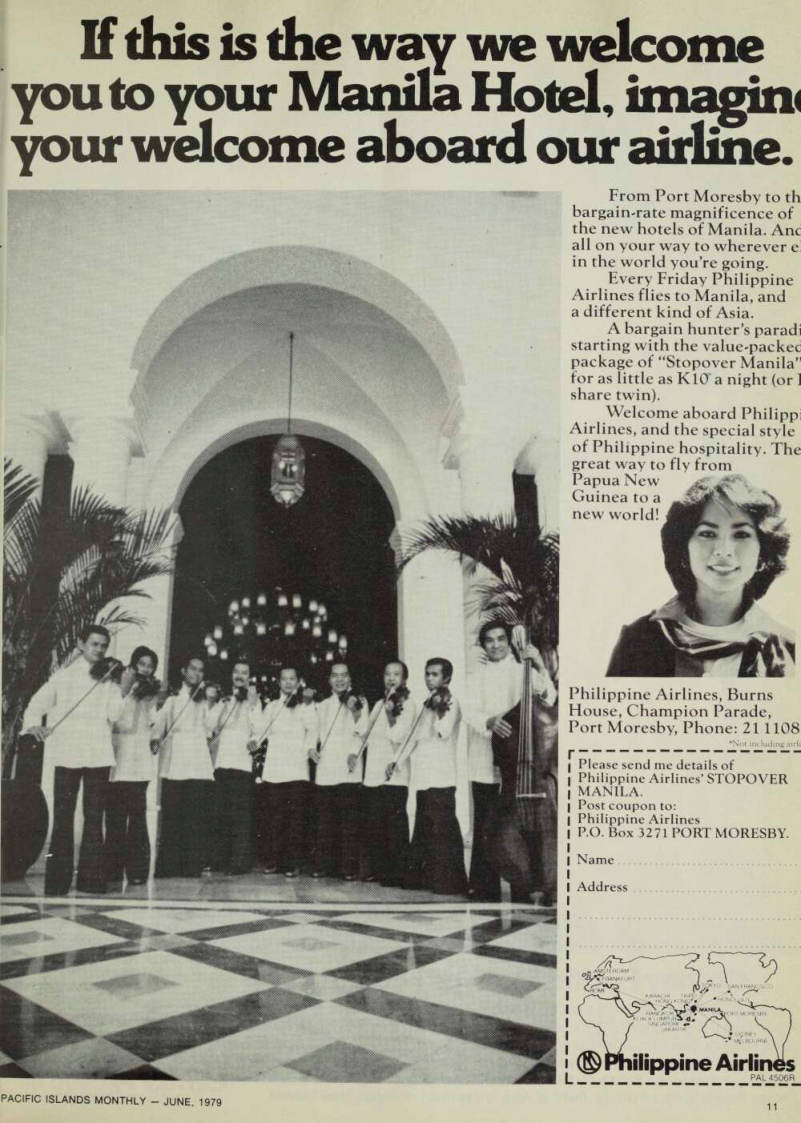
your welcome aboard our airline.
If this is the way we welcome
you to your Manila Hotel, imagin'
from Port Moresby to th bargain-rate magnificence of the new hotels of Manila. Anc all on your way to wherever e in the world you’re going.
Every Friday Philippine Airlines flies to Manila, and a different kind of Asia.
A bargain hunter’s paradi starting with the value-packec package of “Stopover Manila’ for as little as KICT a night (or ] share twin).
Welcome aboard Philipp Airlines, and the special style of Philippine hospitality. The great way to fly from Papua New Guinea to a new world!
Philippine Airlines, Burns House, Champion Parade, Port Moresby, Phone: 21 1108 *Not including airf; Please send me details of Philippine Airlines’ STOPOVER
MANILA.
Post coupon to: Philippine Airlines
P.O. Box 3271 PORT MORESBY.
Name Address
RANG!
CHI TAIPEI
>S r * * Sp. jht mpur^d*
SINGAPORE dm / \
JAKARIA ( )
ilippine Airlines
PAL 4506 R
: I I ' MK ' - ml v T /i i^> * 14 M ' - V I*/*
*GsasS?s3t*
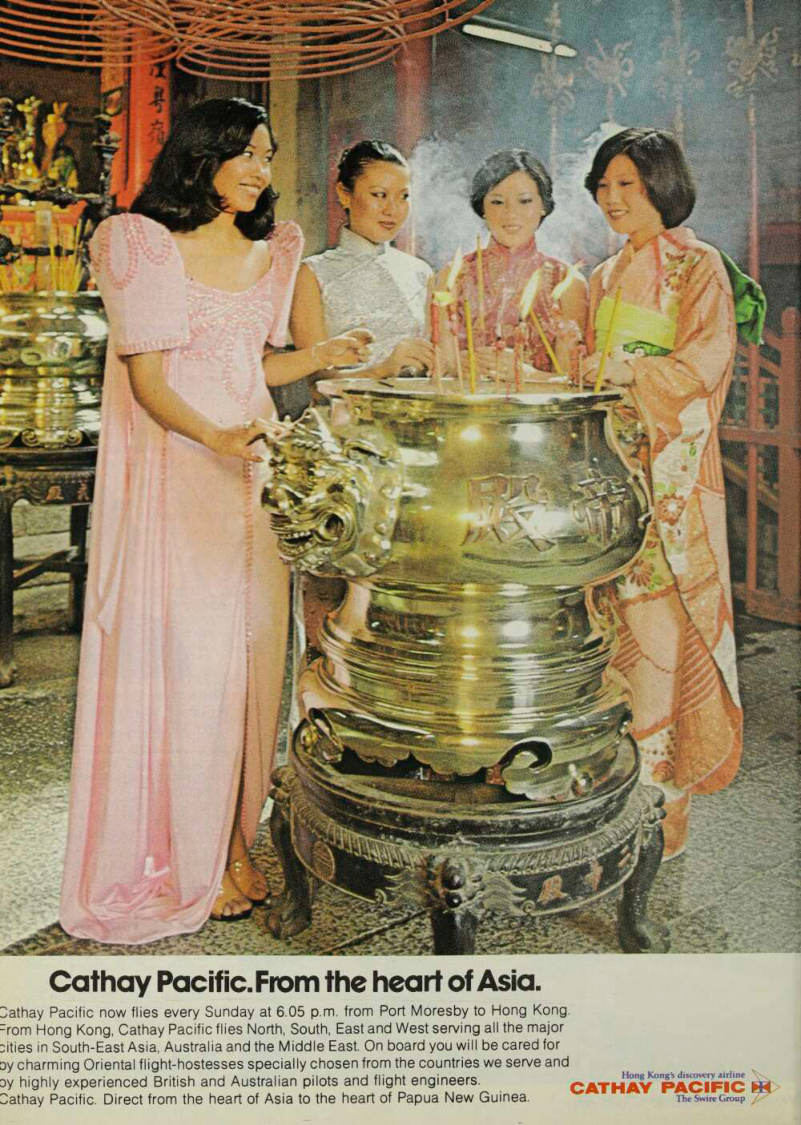
: * h k .tJSI Cathay Pacific. From the heart of Asia.
Sathay Pacific now flies every Sunday at 6.05 p.m. from Port Moresby to Hong Kong. = rom Hong Kong, Cathay Pacific flies North, South, East and West serving all the major cities in South-East Asia, Australia and the Middle East. On board you will be cared for oy charming Oriental flight-hostesses specially chosen from the countries we serve and cy highly experienced British and Australian pilots and flight engineers. CATH^Y^PAcVfIO Cathay Pacific. Direct from the heart of Asia to the heart of Papua New Guinea.
The Swire Group
Tongan tradition

Tonga
Tevita of Minerva - a man in finest Tongan tradition
r he little kingdom of Tonga has many heroes - the courage and ■esource which breeds them are all too frequently a condition of sur vival in the fragile security of island living - but the one best known o the outside world was Captain Tevita Fifita, writes Olaf luhen.
n a life punctuated at frequent
ntervals by successful
ncounters with marine emerg ncy he captured international ttention when in 1962 he ngineered the survival and ventual self-rescue of 12 of 17 nen shipwrecked for a record-
Teaking 102 days on the lonely
'acific coral reef Minerva.
Of these 12 survivors he be ame the first to die - in March
in Pago Pago, American Samoa. Although only 59, Cap tain Fifita retired from the sea about four years ago, perhaps in response to the warning of a heart attack. By special re quest, he was making his first overseas voyage since retirement.
In the epic Minerva Reef ex perience, his 17 men had found a shaky refuge in the reef
bound wreck of a Japanese fishing vessel. For two months they waited confidently for res cue, building a still from scrap materials to obtain fresh water.
The process progressively con sumed their shelter and, in the last month, Tevita supervised the building by Tevita Uaisele, his ship’s carpenter, of a little vessel he named Malolelei, a word of cheerful welcome that had been the name of his father’s ship. Their only tools were a table-knife, a clawham mer, and the chisel-shaped ends of spikes from timbers burnt in the fire. On a final sur vey, he replaced the keel of his first design with a cleverly bal
anced outrigger which, though
safer, necessitated making immediate use of October’s last fitful stirrings of the southeast season. The first man died be
fore it was launched.
On this, three of them set sail for Fiji: Tevita Fifita, with Tevita Uaisele and Fifita’s son Sateki (chosen for his swim
ming ability).
Eight days later, having had
no sustenance except that the two crewmen had diluted the blood of a seagull with spirits from the compass, they attempted to cross an ocean reef on the exposed shore of Kadavu Island, south of Fiji’s Viti Levu. Malolelei was wrecked, and its famished complement set out on an eight kilometre swim to the shore.
Not far from the beach, young Sateki’s magnificent will col lapsed. He swam round in circles, no longer conscious of the moment’s need for concen trated effort, no longer (after
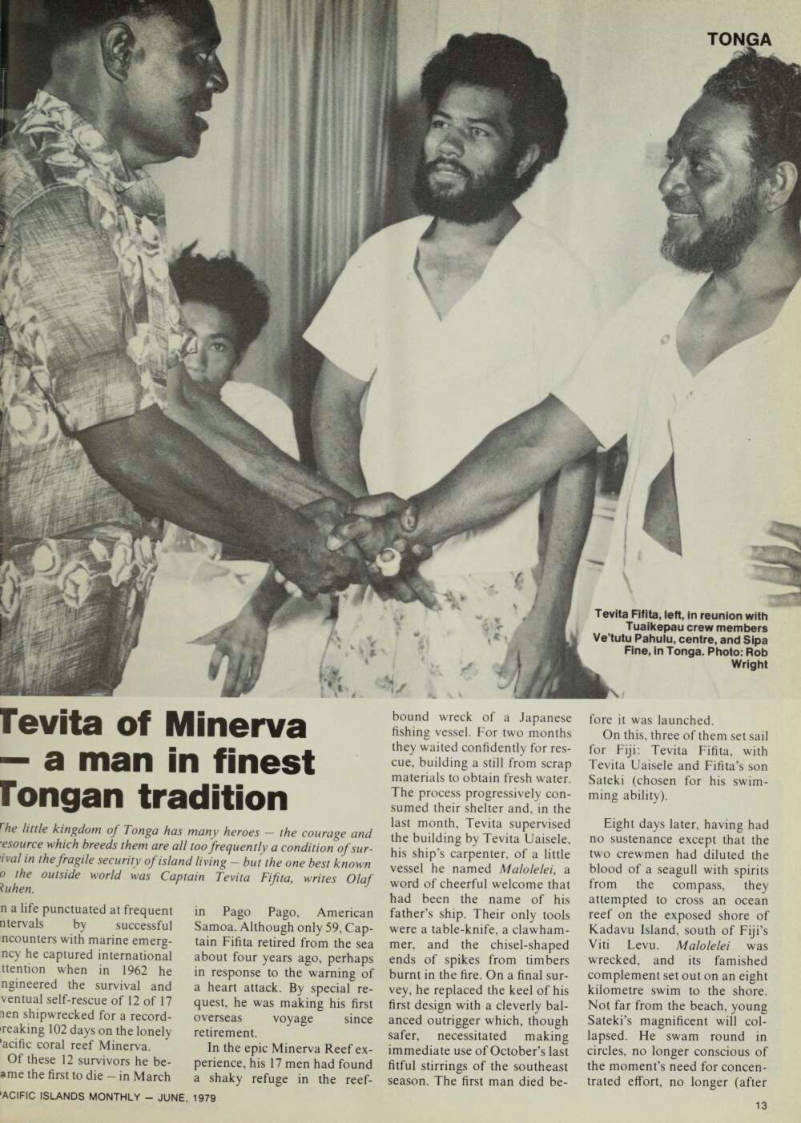
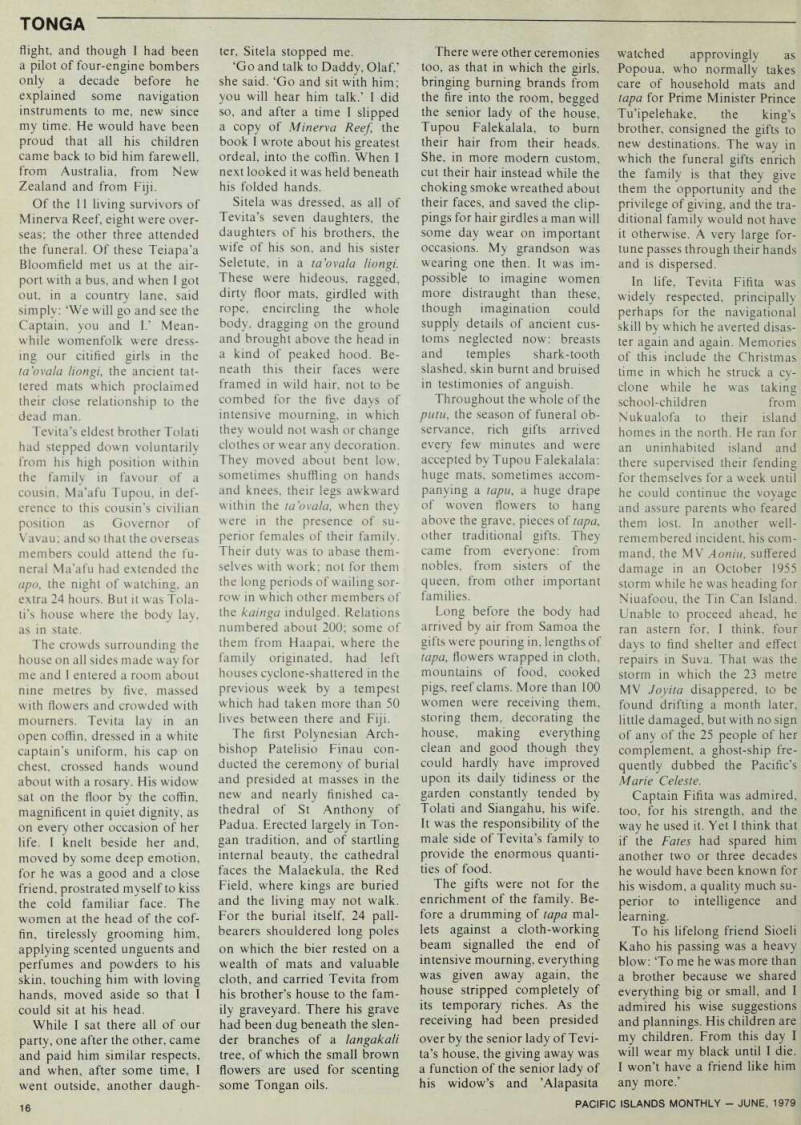
Tevita fifita, left, in reunion with Tuaikepau crew members Ve’tutu Pahulu, centre, and Sipa Fine, in Tonga. Photo: Rob Wright
the three-month ordeal) able to ‘"furnish it.
Ahead of him his father turned back to help. When he •reached his son he saw that also had turned back; without a break in the pattern the certainty imposed itself that not only the three of them would die, but also the 10 remaining 11 as he thought on Minerva Reef. Tevita held _up his son, said a brief prayer, and then abandoned him,
sacrificing him. driving Uaisele
to the beach with blows. Their ordeal continued ashore, while they tried to contact a village.
When they did, Fifita con tacted authorities who sent a flying-boat to the succour and eventual rescue of the Minerva Reef survivors, but he would not tell his story until he had sent word to his wife, ’Alapasita, that he had allowed their son to die. Her courage, morality and pride matched his own. She replied: ‘lf our son died that other men might live I am a proud woman.’
Fifita’s recourse to prayer was typical. One of the small Roman Catholic community of Tonga, he had at all times for tified his companions and
imposed a life-saving disci
pline by insistence upon
prayer.
In Tonga the whole popu lation celebrated the miracle of
survival with heart-warming
joy, stilled momentarily when
the gaunt survivors landed from Fiji where their appear ance had frightened nurses at
Suva Hospital. Barely able to
walk, they paid their respects to
their country, exemplified by
the regal presence of the late Queen Salote who wrote a song to commemorate the almost miraculous return: Mahina Tolu (Three Months). Its sol
emn verses dominated Tonga
Radio for a long time. Perhaps
:hat quelled a wealth of lational creativity for no Ton »ans well, very few would 3e so presumptuous as to for
vard their offerings when they
might be judged against those
ff their queen. Some minor as pects of the epic were remem bered in other songs.
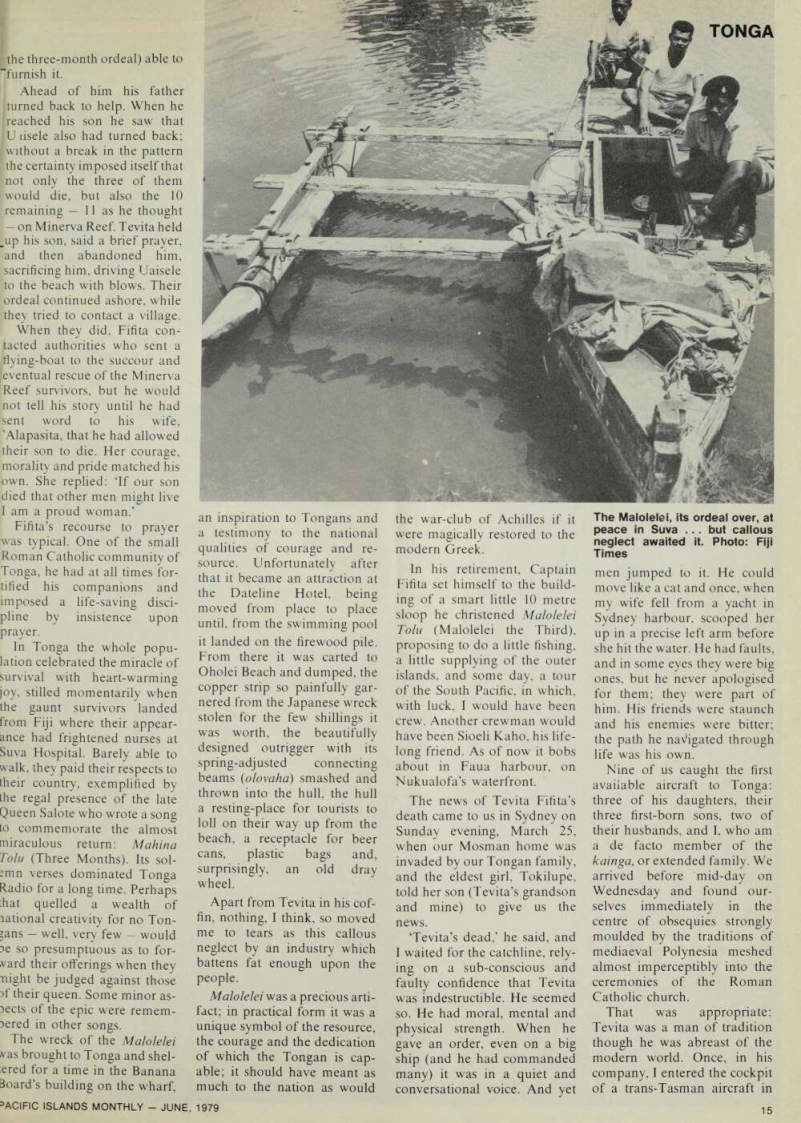
The wreck of the Malolelei
vas brought to Tonga and shel
ved for a time in the Banana Board’s building on the wharf,
an inspiration to Tongans and a testimony to the national qualities of courage and re source. Unfortunately after that it became an attraction at the Dateline Hotel, being moved from place to place until, from the swimming pool it landed on the firewood pile.
From there it was carted to Oholei Beach and dumped, the copper strip so painfully gar nered from the Japanese wreck stolen for the few shillings it was worth, the beautifully
designed outrigger with its
spring-adjusted connecting
beams ( olovaha ) smashed and thrown into the hull, the hull a resting-place for tourists to 101 l on their way up from the beach, a receptacle for beer
cans, plastic bags and,
surprisingly, an old dray
wheel.
Apart from Tevita in his cof fin, nothing, I think, so moved me to tears as this callous
neglect by an industry which
battens fat enough upon the
people.
Malolelei was a precious arti fact; in practical form it was a unique symbol of the resource, the courage and the dedication of which the Tongan is cap able; it should have meant as much to the nation as would
the war-club of Achilles if it were magically restored to the modern Greek.
In his retirement, Captain Fifita set himself to the build ing of a smart little 10 metre sloop he christened Malolelei Tolu (Malolelei the Third), proposing to do a little fishing, a little supplying of the outer islands, and some day, a tour of the South Pacific, in which, with luck, I would have been crew. Another crewman would have been Sioeli Kaho, his life long friend. As of now it bobs about in Faua harbour, on Nukualofa’s waterfront.
The news of Tevita Fifita’s death came to us in Sydney on
Sunday evening, March 25,
when our Mosman home was
invaded by our Tongan family,
and the eldest girl, Tokilupe, told her son (Tevita’s grandson and mine) to give us the news. ‘Tevita’s dead,’ he said, and I waited for the catchline, rely ing on a sub-conscious and faulty confidence that Tevita was indestructible. He seemed so. He had moral, mental and
physical strength. When he
gave an order, even on a big ship (and he had commanded many) it was in a quiet and conversational voice. And yet
men jumped to it. He could move like a cat and once, when my wife fell from a yacht in
Sydney harbour, scooped her
up in a precise left arm before she hit the water. He had faults, and in some eyes they were big ones, but he never apologised for them; they were part of him. His friends were staunch and his enemies were bitter;
the path he naVigated through
life was his own.
Nine of us caught the first available aircraft to Tonga: three of his daughters, their three first-born sons, two of their husbands, and I, who am a de facto member of the kainga, or extended family. We arrived before mid-day on Wednesday and found our selves immediately in the
centre of obsequies strongly
moulded by the traditions of mediaeval Polynesia meshed almost imperceptibly into the ceremonies of the Roman Catholic church.
That was appropriate: Tevita was a man of tradition though he was abreast of the modern world. Once, in his company, I entered the cockpit of a trans-Tasman aircraft in
The Malolelei, its ordeal over, at peace in Suva ... but callous neglect awaited it. Photo: Fiji Times
flight, and though I had been a pilot of four-engine bombers only a decade before he
explained some navigation
instruments to me, new since my time. He would have been proud that all his children came back to bid him farewell, from Australia, from New Zealand and from Fiji.
Of the 11 living survivors of Minerva Reef, eight were over seas; the other three attended the funeral. Of these Teiapa’a Bloomfield met us at the air port with a bus, and when I got out. in a country lane, said simply: ‘We will go and see the Captain, you and I.’ Mean while womenfolk were dress ing our citified girls in the ta'ovala liongi, the ancient tat tered mats which proclaimed their close relationship to the dead man.
Tevita’s eldest brother Tolati
had stepped down voluntarily
from his high position within the family in favour of a cousin, Ma’afu Tupou, in def erence to this cousin’s civilian position as Governor of Vavau; and so that the overseas members could attend the fu neral Ma’afu had extended the apo, the night of watching, an extra 24 hours. But it was Tola ti’s house where the body lay, as in state.
The crowds surrounding the house on all sides made way for me and I entered a room about nine metres by five, massed with flowers and crowded with mourners. Tevita lay in an open coffin, dressed in a white captain’s uniform, his cap on chest, crossed hands wound about with a rosary. His widow sat on the floor by the coffin,
magnificent in quiet dignity, as
on every other occasion of her life. I knelt beside her and, moved by some deep emotion, for he was a good and a close friend, prostrated myself to kiss the cold familiar face. The women at the head of the cof
fin, tirelessly grooming him,
applying scented unguents and perfumes and powders to his skin, touching him with loving hands, moved aside so that I could sit at his head.
While I sat there all of our party, one after the other, came and paid him similar respects, and when, after some time, I went outside, another daugh
ter, Sitela stopped me. ‘Go and talk to Daddy, Olaf,’ she said. ‘Go and sit with him; you will hear him talk.’ I did so, and after a time I slipped a copy of Minerva Reef, the book I wrote about his greatest ordeal, into the coffin. When I next looked it was held beneath his folded hands.
Sitela was dressed, as all of Tevita’s seven daughters, the daughters of his brothers, the wife of his son, and his sister Seletute, in a ta'ovala liongi.
These were hideous, ragged, dirty floor mats, girdled with rope, encircling the whole
body, dragging on the ground
and brought above the head in a kind of peaked hood. Be neath this their faces were framed in wild hair, not to be combed for the five days of intensive mourning, in which they would not wash or change clothes or wear any decoration.
They moved about bent low, sometimes shuffling on hands and knees, their legs awkward within the ta'ovala, when they were in the presence of su perior females of their family.
Their duty was to abase them selves with work; not for them
the long periods of wailing sor
row in which other members of
the kainga indulged. Relations
numbered about 200; some of them from Haapai, where the
family originated, had left
houses cyclone-shattered in the previous week by a tempest which had taken more than 50 lives between there and Fiji.
The first Polynesian Arch bishop Patelisio Finau con ducted the ceremony of burial and presided at masses in the new and nearly finished ca thedral of St Anthony of Padua. Erected largely in Ton gan tradition, and of startling internal beauty, the cathedral faces the Malaekula, the Red Field, where kings are buried and the living may not walk.
For the burial itself, 24 pall
bearers shouldered long poles
on which the bier rested on a wealth of mats and valuable cloth, and carried Tevita from his brother’s house to the fam ily graveyard. There his grave had been dug beneath the slen der branches of a langakali tree, of which the small brown flowers are used for scenting some Tongan oils.
There were other ceremonies too, as that in which the girls,
bringing burning brands from
the fire into the room, begged the senior lady of the house, Tupou Falekalala, to burn their hair from their heads.
She, in more modern custom, cut their hair instead while the choking smoke wreathed about their faces, and saved the clip pings for hair girdles a man will some day wear on important
occasions. My grandson was
wearing one then. It was im
possible to imagine women
more distraught than these,
though imagination could
supply details of ancient cus toms neglected now: breasts and temples shark-tooth slashed, skin burnt and bruised in testimonies of anguish.
Throughout the whole of the putu, the season of funeral ob servance, rich gifts arrived every few minutes and were
accepted by Tupou Falekalala:
huge mats, sometimes accom
panying a tapu, a huge drape
of woven flowers to hang above the grave, pieces of tapa,
other traditional gifts. They
came from everyone: from nobles, from sisters of the queen, from other important families.
Long before the body had arrived by air from Samoa the
gifts were pouring in, lengths of
tapa, flowers wrapped in cloth, mountains of food, cooked pigs, reef clams. More than 100 women were receiving them,
storing them, decorating the
house, making everything
clean and good though they
could hardly have improved
upon its daily tidiness or the
garden constantly tended by
Tolati and Siangahu, his wife.
It was the responsibility of the male side of Tevita’s family to
provide the enormous quanti
ties of food.
The gifts were not for the enrichment of the family. Be fore a drumming of tapa mal
lets against a cloth-working
beam signalled the end of
intensive mourning, everything
was given away again, the
house stripped completely of
its temporary riches. As the
receiving had been presided
over by the senior lady of Tevi ta’s house, the giving away was a function of the senior lady of his widow’s and ’Alapasita
watched approvingly as Popoua, who normally takes care of household mats and tapa for Prime Minister Prince
Tu’ipelehake, the king’s
brother, consigned the gifts to new destinations. The way in which the funeral gifts enrich
the family is that they give
them the opportunity and the privilege of giving, and the tra ditional family would not have it otherwise. A very large for tune passes through their hands and is dispersed.
In life, Tevita Fifita was
widely respected, principally
perhaps for the navigational
skill by which he averted disas ter again and again. Memories of this include the Christmas time in which he struck a cy clone while he was taking school-children from Nukualofa to their island homes in the north. He ran for an uninhabited island and
there supervised their fending
for themselves for a week until he could continue the voyage and assure parents who feared them lost. In another well remembered incident, his com mand, the MV Aoniu, suffered damage in an October 1955 storm while he was heading for Niuafoou, the Tin Can Island.
Unable to proceed ahead, he ran astern for, I think, four days to find shelter and effect repairs in Suva. That was the storm in which the 23 metre MV Joyita disappered, to be found drifting a month later, little damaged, but with no sign of any of the 25 people of her
complement, a ghost-ship fre
quently dubbed the Pacific’s Marie Celeste.
Captain Fifita was admired, too, for his strength, and the way he used it. Yet I think that if the Fates had spared him another two or three decades he would have been known for his wisdom, a quality much su
perior to intelligence and
learning.
To his lifelong friend Sioeli Kaho his passing was a heavy blow: To me he was more than a brother because we shared everything big or small, and I admired his wise suggestions and plannings. His children are my children. From this day I will wear my black until I die.
I won’t have a friend like him any more.’
Advertisements & other items, pp. 13-17 (3 items)
13
'ACIFIC ISLANDS MONTHLY - JUNE, 1979
W world of difference
WeVe made the
to Tonga’s communications.
With the opening of the Cable & Wireless earth station, the people of Tonga can enjoy the benefits of the fastest, most efficient and reliable telephone, telex and telegraph links to the rest of the world. Via satellite.
At Cable & Wireless we have over a century of experience in the design, installation and maintenance of communications systems throughout the world. To date we have been involved with over 30 earth stations. each designed to meet their individual climatic and geographic conditions.
So, for more information, do a little communicating yourself. Contact us.
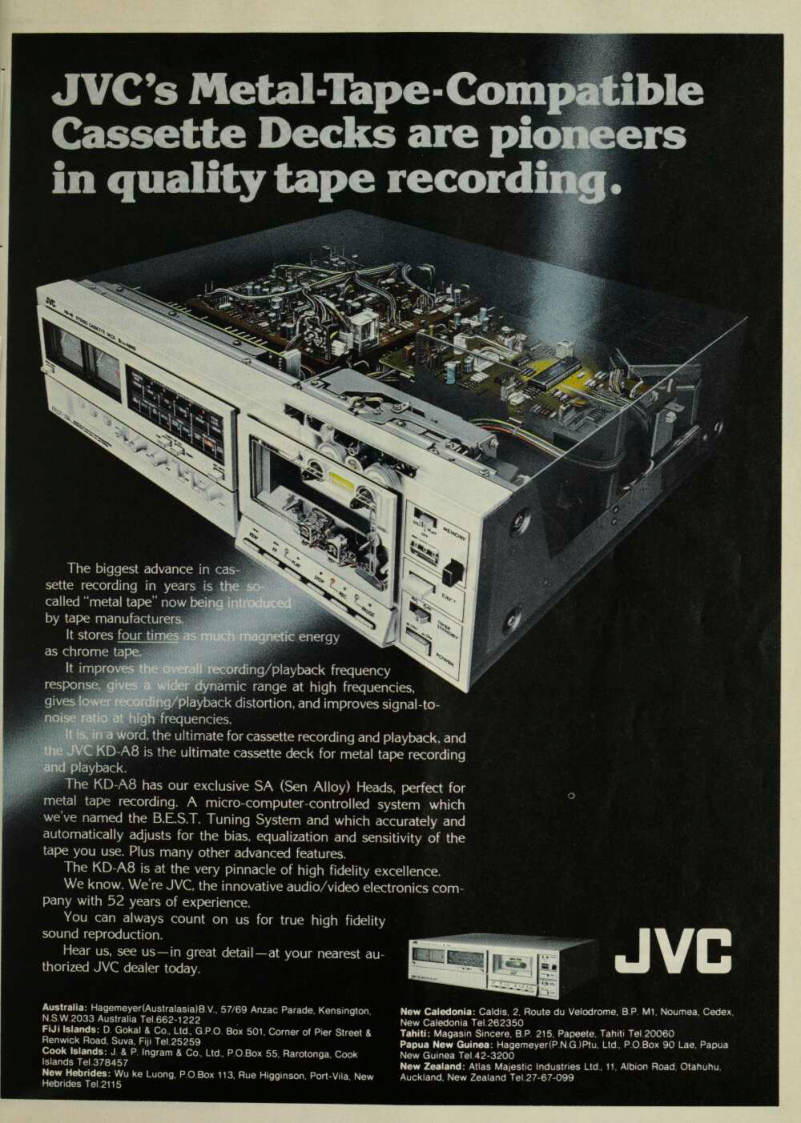
JVC’s Metal-Tape-Com
Cassette Decks are pio
in quality tape record!
❖ to » m d ! 4b. /• . k N A ¥ ic energy The biggest advance in cassette recording in years is the socalled "metal tape” now beinfli by tape manufacturers^ It stores four timesag as chrome tape, It improves recording/playback frequency response, jives a wider dynamic range at high frequencies, givesJower recording/playback distortion, and improves signal-tonoise high frequencies.
It is, in W word, the ultimate for cassette recording and playback, and the JVC KD-A8 is the ultimate cassette deck for metal tape recording and playback.
The KD-A8 has our exclusive SA (Sen Alloy) Heads, perfect for metal tape recording. A micro-computer-controlled system which we’ve named the B.E.S.T. Tuning System and which accurately and automatically adjusts for the bias, equalization and sensitivity of the tape you use. Plus many other advanced features.
The KD-A8 is at the very pinnacle of high fidelity excellence.
We know. We re JVC, the innovative audio/video electronics company with 52 years of experience.
You can always count on us for true high fidelity sound reproduction.
Hear us, see us—in great detail—at your nearest au thorized JVC dealer today.
Australia: Hagemeyer(Australasia)B.V. 57/69 Anzac Parade, Kensington, N.5.W.2033 Australia Te 1.662-1222 Fiji Islands: D Gokal & Co., Ltd., G.P.O, Box 501, Corner of Pier Street & Renwick Road. Suva. Fiji Te 1.25259 Cook Islands: J & P. Ingram & Co.. Ltd., P.0.80x 55, Rarotonga Cook Islands Te 1.378457 New Hebrides: Wu ke Luong, P.0.80x 113, Rue Higginson, Port-Vila New Hebrides Te 1.2115
JVC
New Caledonia: Caldis, 2, Route du Velodrome, B.P Ml, Noumea, Cedex, New Caledonia Te 1.262350 Tahiti: Magasin Sincere, B.P 215, Papeete, Tahiti Te 1.20060 Papua New Guinea: Hagemeyer(P.N.G.)Ptu. Ltd., P.0.80x 90 Lae, Papua New Guinea Te 1.42-3200 New Zealand: Atlas Majestic Industries Ltd., 11, Albion Road, Otahuhu, Auckland, New Zealand Te 1.27-67-099
Tonga
15
3 ACIFIC ISLANDS MONTHLY - JUNE, 1979
Theocratic
The Marquesas and Wallis and Futuna
Paths To
Resurrection
Malcolm Salmon concludes his review of a series of articles in the French daily Le Monde on France's Pacific territories. This second article deals with the Marquesas Islands and Wallis and Futuna.
Articles on New Caledonia, Tahiti and the New Hebrides were re viewed in PIM, May.
More than 3000 kilometres separate the Marquesas Islands in the eastern Pacific from Wallis and Futuna to the west.
The Marquesas are adminis tratively part of French
Polynesia, and gravitate politi
cally around Tahiti. Wallis and Futuna have a quite separate status as an overseas territory of France, and are much more in the political orbit of New Caledonia, 2000 kilometres further west.
But justification for discuss ing them together may be claimed in their common Polynesian culture, their small populations and meagre econ omic resources, and, more gen erally, in their shared status as part of that ‘confetti of empire’ of which a French journalist wrote eloquently some years ago.
First ‘discovered’ by the Spaniard Alvaro de Mendana de Neyra in the late sixteenth century, the Marquesas were
visited briefly by Captain Cook
about 200 years later, again in 1791 by the French navigator Marchand, and then by the Russian Krusenstern in 1804 (he left behind a couple of goats whose many descendants have done great environmental damage), it was not until the reign of the French king Louis- Philippe, about 140 years ago, that a firm French presence was established in the Islands.
The presence took the form of a few ships and an admiral
accompanied by tradesmen of
various kinds, among whose tasks were the building of small forts and the hacking of stair ways out of the basaltic rock on
the island of Nukuhiva. ‘But,’ writes Le Monde cor respondent Pierre Vallincland, a long-time resident of the Marquesas, ‘France had chosen a spot too far to the north. It was further south, towards Tahiti and the Cook Islands, and further west towards Fiji and New Caledonia, that the political cards were to be dealt a little later on. In their outlying situ ation, the Marquesas were soon to regain that noble, dull lethargy from which they were only really to re-emerge in 1977. The Anglican and Pres byterian missions did not even deign to interest themselves in this archipelago which, accord ing to contemporary estimates, then had a population of about 40 000, six or seven times today’s figure. Even the build
ings comprising the royal com
missioner’s residence prefabricated in France were transferred to Tahiti.’
Administration of the islands was henceforth for a number of years largely in the hands of the Catholic mission of the fathers and brothers of the Picpus order the more so as the central power had neither the desire nor the means to administer the
indigenous population. The re
sult. according to Vallincland, was the establishment of a sort
of ‘theocracy’.
But things were to change under the Third Republic, established in 1870. The French state, whose represen tatives often enough were bearers of the anti-clericalism then prevalent in France, took an increasing interest in the islands, and greatly increased the number of its personnel there. The change led to what Vallincland describes as ‘a cold war’ between the French state and the mission a war which, he says, later became a ‘mis trustful peace’ and remains today ‘a courteous peace, still lacking in warmth’.
These developments ‘at the top’ were accompanied ‘below’ by what amounted almost to the disappearance of the Islanders themselves. Over the
50 years from 1880 to 1930 the number of Marquesans fell from several tens of thousands to about 2000. The imported diseases of smallpox and syph ilis, and of a new form of al coholism (French booze was the more attractive due to the tedious character of the prep arations required for the old
time Marquesan tipples based
mainly on coconut and banana juices) were the main culprits.
The indigenous population of
the Marquesas seemed fated for total disappearance.
If one man can claim credit for their ‘rescue’ it is Dr Louis Rollin, who through the thirties combined the functions of official French ‘resident’ and medical officer. Rollin. taking advantage of the truce then in effect between government and mission personnel, enlisted the aid of the latter first to arrest and then to reverse the drastic population decline.
Rollin’s work and that of the missions has been complemented in the sixties and seventies by the wide
spread introduction of supplies
of running water and by greatly
expanded educational and health systems.
While the absolute popu lation increase is not great due to the permanent or long-term emigration of many in the most active and prolific age groups, school attendance has risen from about 10% to 15% at the end of World War II to almost
100% today.
In the early 19605, geological tests were made on the uninhabited island of Eiao, in the far northeast of the Marquesas archipelago, with a
view to staging underground
nuclear tests on it. But the island’s volcanic soil offered too tough a resistance to the ge ologists’ drills, and the ‘privi lege’ of being smashed about by nuclear explosions went to the atolls of Fangataufa and Mururoa.
As far as the central power in Paris is concerned, Vallincland sees the
Marquesas today as poised be
tween the options of ‘loyalty
and particularism’.
He quotes one Marquesan as
saying of the loyalty long
shown by Marquesans to the conservative forces in Papeete
Wallisian fire dancers ... spirit triumphant over the combined powers of traditional kings and domineering priests
I and the metropolis: ‘The more * loyal you are to Paris the less it’ll give you. Look at the Aus tral Islands. They’ve voted for I autonomy for years and they’ve i got an airstrip that will take Fokkers. We haven’t got one
I yet.’
Vallincland sees a straw in the wind in the May 1977 elec tion to the territorial assembly in Papeete. In the Marquesas a deceased Gaullist was replaced " by a young autonomist whose election guaranteed Francis Sanford’s autonomist Front Uni a majority of one.
Vallincland writes: ‘As things stand, and despite their small population, it would not be as spendthrift as one might i imagine to seek to overcome the
I lag suffered by this archipelago
whose geographical position,
tourist attractions and marine wealth justify hopes for the decades to come far beyond any military considerations.’
Far away to the west, in their different conditions, the inhabitants of Wallis and Futuna (population about 9000) had an even more intense nineteenth century experience of the ‘France of the missions’.
Encompassing three tra
ditional Polynesian kingdoms
one on Wallis and two on Futuna the islands witnessed a strange merging of local tra ditional authority with that of the Catholic missions. Still
today, the ‘lavuelas’ (kings),
and the archbishop, remain extremely powerful authori ties.
Jean-Noel Feraud describes the process in the following terms in Le Monde: ‘Never
having been occupied by a
European nation, Wallis and Futuna were nevertheless colonised by the missionaries.
The history of these islands has been closely linked with the presence of the Catholic church since 1837, date of arrival of the first missionary, Father Bataillon. The very rapid assimilation of religion is certainly connected with the way in which the missionaries imposed it. It is also related to the organisation of the local so ciety, which shows a great
attachment to hierarchy, the
king being a master with very extensive powers. The six ministers around him and the
noble families keep a jealous watch over these powers.
Catholicism exploited this awe of authority, and exhibited itself in Wallis and Futuna in its most domineering form. ‘With the passage of time a kind of amalgam was formed between the powers of the king and those of the church. This influence was such at certain times that the priests or the bishop took the most important decisions. It was in this way that Monsignor Bataillon, fear ing the arrival of Protestant
missionaries, persuaded King
Soane Patita Lavelua in 1842 to seek French protection. This protectorate was ratified in 1886 by Queen Amelia, and gave way, in 1961, to the status of an overseas territory of France. ‘lf the Wallisians and Futunans, after a few incidents and one martyr (Saint Pierre Chanel), so completely adopted Catholicism, it was due in part to the fact that the church also knew how to make concessions. The missionaries made extensive use of an ima gery which leads one to con clude that the original beliefs of these populations were
predominantly fetishist.. . Still
today, each Wallisian fale has its altar with a representation of the Virgin. ‘Religion and custom were thus merged within one absol ute power. A former seminarist does not hesitate to call the sys
tem “organised slavery”. He
says that in the past if an unmarried girl became preg nant, the custom chiefs set out to find the guilty male. If he managed to elude them, they arrested the first young man
who happened along, because
such an action could under no circumstances go unpunished.
The unfortunate victim, as well as being condemned to what amounted to forced labour, was also beaten, sometimes to the point of having limbs broken.’
Feraud notes that two major factors are contributing to the relaxation of this customary religious tyranny on Wallis and Futuna: emigration, and developments within the church itself.
For lack of openings at home, about 10 000 Wallisians
and Futunans now work in New Caledonia. ‘The younger ones are open to new ideas, and are discovering that there are countries where missing mass does not necessarily entail penalties,’ writes Feraud.
On their side, the mis sionaries have had to accept discussion with those who dif fer from them - and they have had to take notice of the direc tives of Vatican 11.
Along with the ‘demythifica
tion’ of the church has gone the influence of those young people who have spent time abroad in study and have re turned with ideas of their own to express. Finding themselves up against the brick wall of cus tom and the intransigence of religion, they have turned to
politics.
While there is no such thing as a socialist or communist party on Wallis and Futuna (both parties are anathema tised as ‘opposed to God’) the ‘new politics’ of the islands is expressed in the emergence of a ‘Giscardian’ tendency as opposed to the conservative ‘RPR’ (Rassemblement pour la
Republique).
In the March 1978 election, the outgoing RPR deputy to the national assembly in Paris, Benjamin Brial, who had been comfortably elected at every poll since 1967, faced a 35-
year-old ‘Giscardian’ priest,
Petelo Falelavaki. This chal
lenger was immediately dis
owned by the archbishop,
Monsignor Laurent Fuatea, and by the King of Alo.
Although he failed narrowly to win the election (2132 votes to 2302) Mr Falelavaki did secure a majority in the kingdom of Alo. In Wallis and Futuna, ‘the
king can do no wrong’ quite
literally. He is not permitted to
France In The Pacific
be mistaken. So the population of Alo went right ahead and deposed their king, who had become unworthy of their trust. Unresolved at the time Feraud wrote his article, the dispute over the succession in the kingdom of Alo was bitter in the extreme.
Feraud writes: ‘There is no lack of candidates, but in re ality the fight is going on within the one extended family - be tween one clan supporting Mr Benjamin Brial and another in favour of Mr Falelavaki. ‘This dynastic crisis, which has led to the destruction by arson of a large communal house and to endless quarrels, presents in miniature the struggle going on between the young progressives and the conservatives. ‘lf the latter are still in a ma jority, it is only by a whisker.
Mr Brial commands 11 of the 20 votes in the local Wallis and Futuna assembly. But this is a feeble bulwark against a public opinion that is awakening to political life and to the modern world.’
In the midst of this ‘revol ution’, the French resident, Henri Beaux, from his seat on Mata Utu in Wallis, contrives to maintain a serene neutrality, not wishing to be seen as sup porting one side or the other.
The 100-odd French officials who back him up in his work do likewise, most of them look ing forward more than any thing else to the end of their terms of service which will
bring them substantial savings
due to their being paid in French Pacific francs.
Of the future Feraud writes:
‘Beyond the political problems
lies a fundamental question: will it be possible to achieve a clash-free coexistence between
tradition, which prohibits pri
vate property, and the young, who want a measure of inte gration into the consumer so ciety? The absence of the thousands of Wallisians and Futunans living in New Caledonia no doubt lessens the risk that the struggle between the two tendencies will de generate into violence. ‘Meanwhile, there are few grounds for concern about the survival of this 700-year-old
kingdom.’
A 1930s picture of an elderly Marquesan ... sad relic of a race that seemed doomed to die
Advertisements & other items, p. 20 (1 item)
believes in Brownies
Five reasons why Kodak
The Kodak Brownie Camera Outfit. It includes camera, CllO-12 film, wrist strap, instructions and a 3 year Kodak warranty. At a suggested retail price of $19.50, we’re sure of its success.
The Kodak Brownie Camera Case. It's made of moulded black plastic, carries picture-taking instructions, and has a suggested retail price of just $1.99.
The Kodak Brownie Rogues Gallery. A wall-hanger for all the kids favourite photos. With a suggested retail price of only 45 cents, you can count on it selling well.
'Our Consumer Research. It confirms the interest in a low-priced, easy-to-use camera, supports the appeal of the “Brownie” name, and indicates a very positive response to the camera and accessories.
Our Advertising Campaign. The Brownie Camera Outfit will be promoted nationally on prime-time television, More than 8 out of 10 Australians will see the commercial, an average of 7 times each.
You can order 12 Kodak Brownie Outfits, 8 camera cases, 10 Rogues Galleries and a point-of-sale window streamer in a reliable starter pack now.
Believe us, the Brownie camera will be selling fast!
KODAK (Australasia) PTY. LTD.
KO/5969
Political
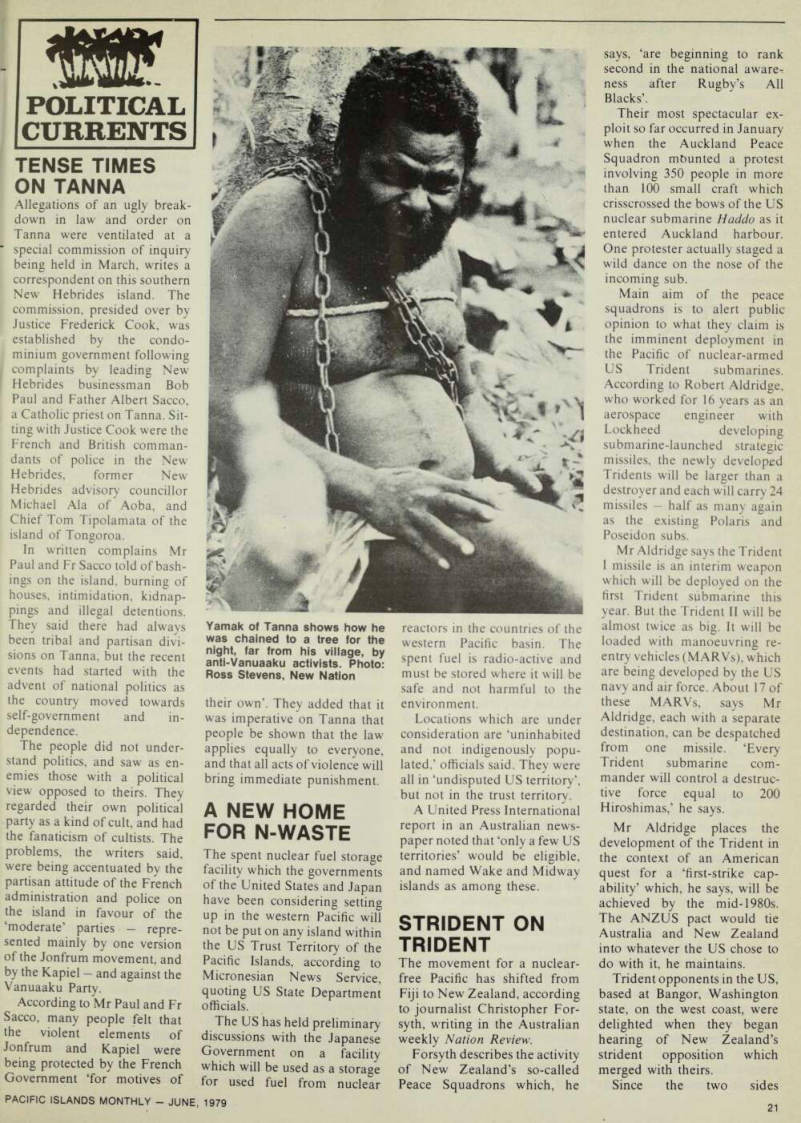
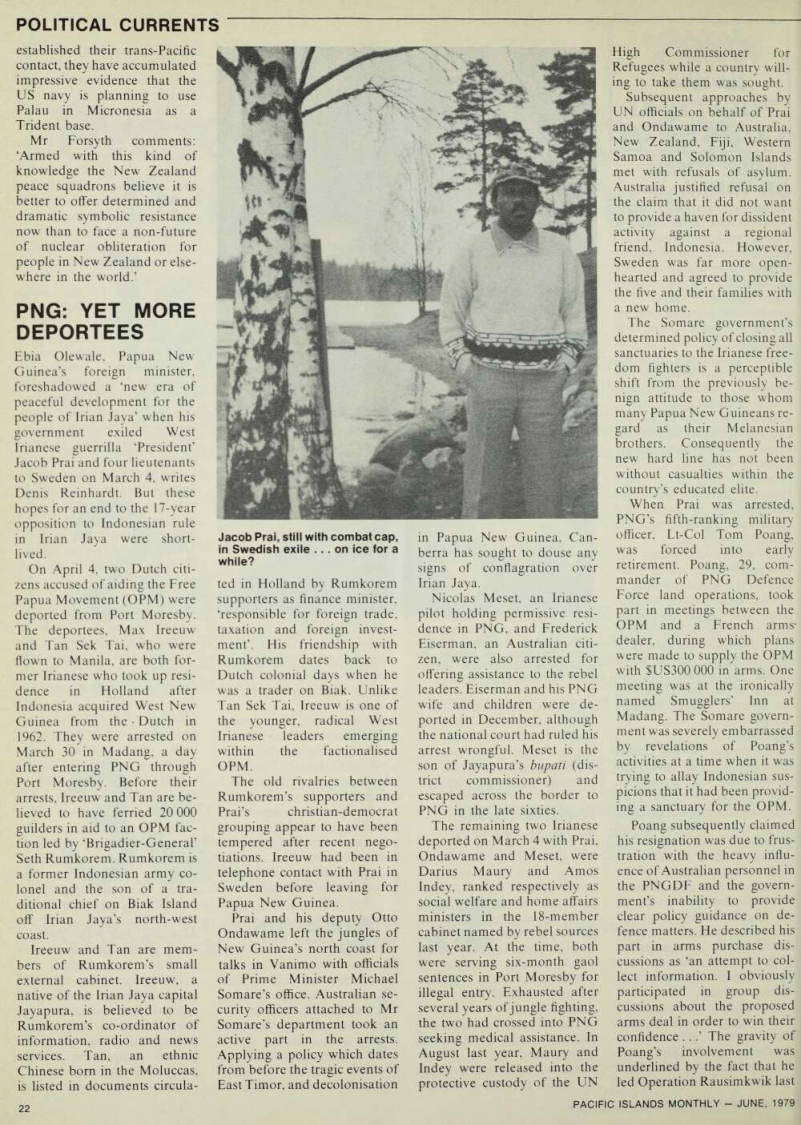
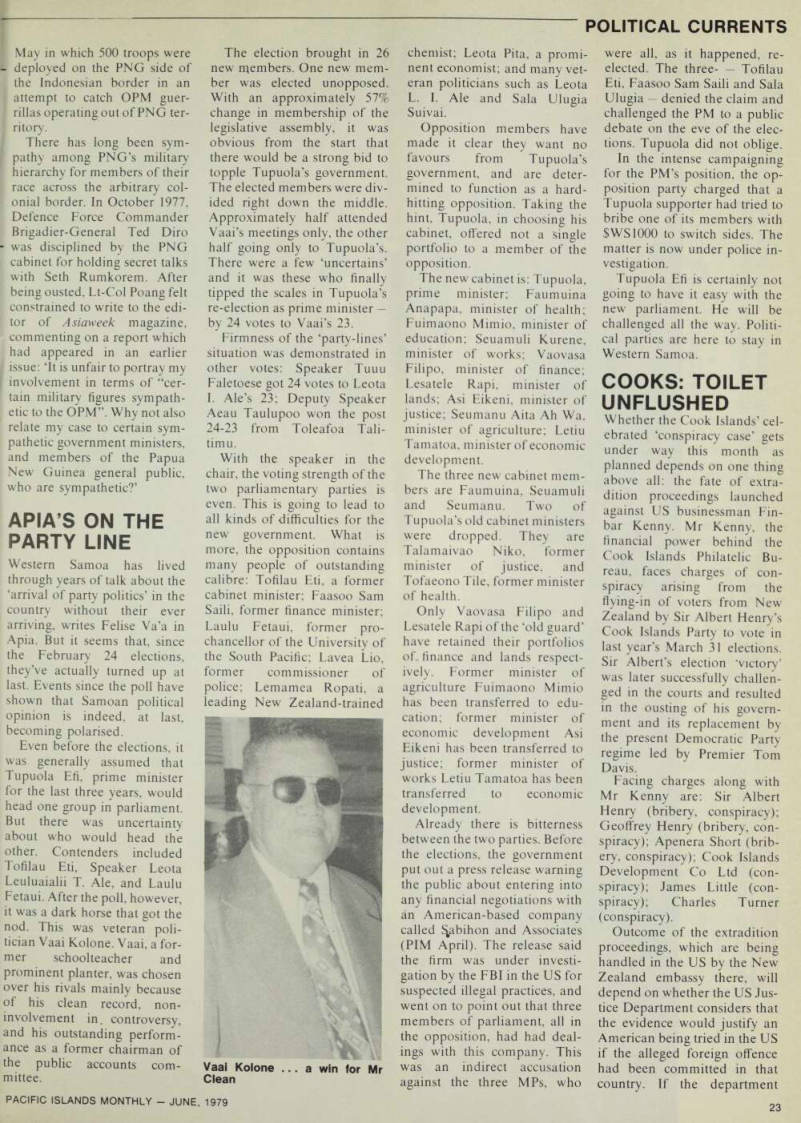
Currents
Tense Times
On Tanna
Allegations of an ugly break down in law and order on Tanna were ventilated at a special commission of inquiry being held in March, writes a correspondent on this southern New Hebrides island. The commission, presided over by Justice Frederick Cook, was established by the condo minium government following complaints by leading New Hebrides businessman Bob Paul and Father Albert Sacco, a Catholic priest on Tanna. Sit ting with Justice Cook were the French and British comman dants of police in the New Hebrides, former New Hebrides advisory councillor Michael Ala of Aoba, and Chief Tom Tipolamata of the island of Tongoroa.
In written complains Mr Paul and Fr Sacco told of bash ings on the island, burning of houses, intimidation, kidnap
pings and illegal detentions.
They said there had always been tribal and partisan divi sions on Tanna, but the recent events had started with the advent of national politics as the country moved towards self-government and in
dependence.
The people did not under stand politics, and saw as en emies those with a political view opposed to theirs. They regarded their own political party as a kind of cult, and had the fanaticism of cultists. The problems, the writers said, were being accentuated by the partisan attitude of the French administration and police on the island in favour of the ‘moderate’ parties repre sented mainly by one version of the Jonfrum movement, and by the Kapiel and against the
Vanuaaku Party.
According to Mr Paul and Fr Sacco, many people felt that the violent elements of Jonfrum and Kapiel were being protected by the French Government ‘for motives of
their own’. They added that it was imperative on Tanna that people be shown that the law
applies equally to everyone,
and that all acts of violence will bring immediate punishment.
A New Home
For N-Waste
The spent nuclear fuel storage facility which the governments of the United States and Japan
have been considering setting
up in the western Pacific will not be put on any island within the US Trust Territory of the Pacific Islands, according to Micronesian News Service, quoting US State Department officials.
The US has held preliminary discussions with the Japanese Government on a facility which will be used as a storage for used fuel from nuclear
reactors in the countries of the western Pacific basin. The spent fuel is radio-active and must be stored where it will be safe and not harmful to the environment.
Locations which are under consideration are ‘uninhabited and not indigenously popu lated,’ officials said. They were all in ‘undisputed US territory’, but not in the trust territory.
A United Press International report in an Australian news paper noted that ‘only a few US territories’ would be eligible, and named Wake and Midway islands as among these.
Strident On
Trident
The movement for a nuclear free Pacific has shifted from Fiji to New Zealand, according
to journalist Christopher For
syth, writing in the Australian weekly Nation Review.
Forsyth describes the activity
of New Zealand’s so-called Peace Squadrons which, he
says, ‘are beginning to rank second in the national ness after Rugby’s All Blacks’.
Their most spectacular ex ploit so far occurred in January when the Auckland Peace Squadron mbunted a protest involving 350 people in more than 100 small craft which crisscrossed the bows of the US nuclear submarine Haddo as it entered Auckland harbour.
One protester actually staged a wild dance on the nose of the
incoming sub.
Main aim of the peace squadrons is to alert public opinion to what they claim is the imminent deployment in the Pacific of nuclear-armed US Trident submarines.
According to Robert Aldridge,
who worked for 16 years as an aerospace engineer with
Lockheed developing
submarine-launched strategic
missiles, the newly developed
Tridents will be larger than a destroyer and each will carry 24 missiles half as many again as the existing Polaris and Poseidon subs.
Mr Aldridge says the Trident I missile is an interim weapon which will be deployed on the first Trident submarine this year. But the Trident II will be almost twice as big. It will be loaded with manoeuvring re entry vehicles (MARVs), which
are being developed by the US
navy and air force. About 17 of these MARVs, says Mr Aldridge, each with a separate destination, can be despatched from one missile. ‘Every Trident submarine com mander will control a destruc tive force equal to 200 Hiroshimas,’ he says.
Mr Aldridge places the development of the Trident in the context of an American quest for a ‘first-strike cap ability’ which, he says, will be achieved by the mid-1980s.
The ANZUS pact would tie Australia and New Zealand into whatever the US chose to do with it, he maintains.
Trident opponents in the US,
based at Bangor, Washington
state, on the west coast, were delighted when they began hearing of New Zealand’s strident opposition which merged with theirs.
Since the two sides
Yamak of Tanna shows how he was chained to a tree for the night, far from his village, by anti-Vanuaaku activists. Photo: Ross Stevens, New Nation
established their trans-Pacific contact, they have accumulated impressive evidence that the US navy is planning to use Palau in Micronesia as a Trident base.
Mr Forsyth comments: ‘Armed with this kind of knowledge the New Zealand peace squadrons believe it is better to offer determined and dramatic symbolic resistance now than to face a non-future of nuclear obliteration for people in New Zealand or else where in the world.’
Png: Yet More
Deportees
Ebia Olewale, Papua New Guinea’s foreign minister, foreshadowed a ‘new era of
peaceful development for the
people of Irian Jaya’ when his government exiled West Irianese guerrilla ‘President’
Jacob Prai and four lieutenants to Sweden on March 4, writes Denis Reinhardt. But these hopes for an end to the 17-year opposition to Indonesian rule in Irian Jaya were short lived.
On April 4, two Dutch citi zens accused of aiding the Free Papua Movement (OPM) were
deported from Port Moresby.
The deportees, Max Ireeuw and Tan Sek Tai, who were flown to Manila, are both for mer Irianese who took up resi dence in Holland after Indonesia acquired West New Guinea from the • Dutch in 1962. They were arrested on March 30 in Madang, a day
after entering PNG through
Port Moresby. Before their arrests. Ireeuw and Tan are be lieved to have ferried 20 000 guilders in aid to an OPM fac
tion led by ‘Brigadier-General’
Seth Rumkorem. Rumkorem is a former Indonesian army co lonel and the son of a tra ditional chief on Biak Island off Irian Jaya’s north-west coast.
Ireeuw and Tan are mem bers of Rumkorem’s small external cabinet. Ireeuw, a native of the Irian Jaya capital Jayapura, is believed to be Rumkorem’s co-ordinator of information, radio and news services. Tan, an ethnic Chinese bom in the Moluccas, is listed in documents circula-
ted in Holland by Rumkorem supporters as finance minister,
‘responsible for foreign trade,
taxation and foreign invest ment’. His friendship with Rumkorem dates back to Dutch colonial days when he was a trader on Biak. Unlike Tan Sek Tai, Ireeuw is one of the younger, radical West Irianese leaders emerging within the factionalised
Opm.
The old rivalries between Rumkorem’s supporters and Prai’s christian-democrat grouping appear to have been tempered after recent nego tiations. Ireeuw had been in telephone contact with Prai in Sweden before leaving for Papua New Guinea.
Prai and his deputy Otto Ondawame left the jungles of New Guinea’s north coast for talks in Vanimo with officials of Prime Minister Michael Somare’s office. Australian se curity officers attached to Mr Somare’s department took an active part in the arrests.
Applying a policy which dates from before the tragic events of East Timor, and decolonisation
in Papua New Guinea, Can berra has sought to douse any
signs of conflagration over
Irian Jaya.
Nicolas Meset, an Irianese
pilot holding permissive resi
dence in PNG, and Frederick Eiserman, an Australian citi zen, were also arrested for offering assistance to the rebel leaders. Eiserman and his PNG wife and children were de
ported in December, although
the national court had ruled his arrest wrongful. Meset is the son of Jayapura’s bupati (dis trict commissioner) and escaped across the border to PNG in the late sixties.
The remaining two Irianese deported on March 4 with Prai, Ondawame and Meset, were Darius Maury and Amos
Indey, ranked respectively as
social welfare and home affairs ministers in the 18-member cabinet named by rebel sources last year. At the time, both were serving six-month gaol sentences in Port Moresby for illegal entry. Exhausted after several years of jungle fighting, the two had crossed into PNG seeking medical assistance. In August last year, Maury and Indey were released into the protective custody of the UN
High Commissioner for Refugees while a country will ing to take them was sought.
Subsequent approaches by
UN officials on behalf of Prai and Ondawame to Australia, New Zealand. Fiji, Western Samoa and Solomon Islands met with refusals of asylum.
Australia justified refusal on the claim that it did not want to provide a haven for dissident
activity against a regional
friend, Indonesia. However, Sweden was far more open hearted and agreed to provide the five and their families with a new home.
The Somare government’s determined policy of closing all sanctuaries to the Irianese free dom fighters is a perceptible shift from the previously be nign attitude to those whom many Papua New Guineans re gard as their Melanesian brothers. Consequently the new hard line has not been without casualties within the country’s educated elite.
When Prai was arrested,
PNG’s fifth-ranking military
officer, Lt-Col Tom Poang, was forced into early retirement. Poang, 29, com mander of PNG Defence Force land operations, took part in meetings between the OPM and a French arms
dealer, during which plans
were made to supply the OPM with SUS3OO 000 in arms. One meeting was at the ironically named Smugglers’ Inn at Madang. The Somare govern ment was severely embarrassed
by revelations of Poang’s
activities at a time when it was trying to allay Indonesian sus picions that it had been provid ing a sanctuary for the OPM.
Poang subsequently claimed
his resignation was due to frus tration with the heavy influ ence of Australian personnel in the PNGDF and the govern
ment’s inability to provide
clear policy guidance on de fence matters. He described his part in arms purchase dis cussions as ‘an attempt to col lect information. I obviously participated in group dis cussions about the proposed arms deal in order to win their confidence ...’ The gravity of Poang’s involvement was underlined by the fact that he led Operation Rausimkwik last
Jacob Prai, still with combat cap, in Swedish exile ... on ice for a while?
[ May in which 500 troops were - deployed on the PNG side of the Indonesian border in an attempt to catch OPM guer rillas operating out of PNG ter-
I ritory.
There has long been sym
pathy among PNG’s military
hierarchy for members of their ' race across the arbitrary col onial border. In October 1977, Defence Force Commander Brigadier-General Ted Diro
• was disciplined by the PNG
cabinet for holding secret talks with Seth Rumkorem. After being ousted, Lt-Col Poang felt constrained to write to the edi tor of Asiaweek magazine, commenting on a report which had appeared in an earlier [ issue: Tt is unfair to portray my involvement in terms of “cer
tain military figures sympath
etic to the OPM’’. Why not also relate my case to certain sym pathetic government ministers, and members of the Papua
New Guinea general public,
who are sympathetic?’
Apia’S On The
Party Line
Western Samoa has lived through years of talk about the ‘arrival of party politics’ in the country without their ever arriving, writes Felise Va’a in Apia. But it seems that, since the February 24 elections, they’ve actually turned up at last. Events since the poll have shown that Samoan political opinion is indeed, at last,
becoming polarised.
Even before the elections, it was generally assumed that
Tupuola Efi, prime minister
for the last three years, would head one group in parliament.
But there was uncertainty about who would head the other. Contenders included Tofilau Eti, Speaker Leota Leuluaialii T. Ale, and Laulu Fetaui. After the poll, however, it was a dark horse that got the nod. This was veteran poli tician Vaai Kolone. Vaai, a for mer schoolteacher and prominent planter, was chosen over his rivals mainly because of his clean record, non involvement in. controversy,
and his outstanding perform
ance as a former chairman of the public accounts com mittee.
The election brought in 26 new members. One new mem ber was elected unopposed.
With an approximately 57% change in membership of the
legislative assembly, it was
obvious from the start that there would be a strong bid to
topple Tupuola’s government.
The elected members were div ided right down the middle.
Approximately half attended Vaai’s meetings only, the other
half going only to Tupuola’s.
There were a few ‘uncertains’ and it was these who finally tipped the scales in Tupuola’s re-election as prime minister by 24 votes to Vaai’s 23.
Firmness of the ‘party-lines’ situation was demonstrated in other votes: Speaker Tuuu Faletoese got 24 votes to Leota I. Ale’s 23; Deputy Speaker Aeau Taulupoo won the post 24-23 from Toleafoa Tali timu.
With the speaker in the chair, the voting strength of the two parliamentary parties is even. This is going to lead to all kinds of difficulties for the new government. What is more, the opposition contains
many people of outstanding
calibre: Tofilau Eti, a former cabinet minister; Faasoo Sam Saili, former finance minister; Laulu Fetaui, former pro chancellor of the University of the South Pacific; Lavea Lio, former commissioner of
police; Lemamea Ropati, a
leading New Zealand-trained
chemist; Leota Pita, a promi nent economist; and many vet eran politicians such as Leota L. I. Ale and Sala Ulugia Suivai.
Opposition members have made it clear they want no favours from Tupuola’s government, and are deter mined to function as a hard
hitting opposition. Taking the
hint, Tupuola, in choosing his cabinet, offered not a single portfolio to a member of the
opposition.
The new cabinet is; Tupuola, prime minister; Faumuina Anapapa, minister of health; Fuimaono Mimio, minister of education; Seuamuli Kurene, minister of works; Vaovasa Filipo, minister of finance; Lesatele Rapi, minister of lands; Asi Eikeni, minister of justice; Seumanu Aita Ah Wa, minister of agriculture; Letiu Tamatoa, minister of economic
development.
The three new cabinet mem bers are Faumuina, Seuamuli and Seumanu. Two of Tupuola’s old cabinet ministers
were dropped. They are
Talamaivao Niko, former minister of justice, and Tofaeono Tile, former minister of health.
Only Vaovasa Filipo and
Lesatele Rapi of the ‘old guard’ have retained their portfolios of, finance and lands respect ively. Former minister of agriculture Fuimaono Mimio has been transferred to edu cation; former minister of economic development Asi Eikeni has been transferred to justice; former minister of works Letiu Tamatoa has been transferred to economic
development.
Already there is bitterness between the two parties. Before the elections, the government put out a press release warning the public about entering into any financial negotiations with an American-based company called and Associates (PIM April). The release said the firm was under investi gation by the FBI in the US for
suspected illegal practices, and
went on to point out that three members of parliament, all in the opposition, had had deal ings with this company. This was an indirect accusation against the three MPs, who
were all, as it happened, re elected. The three- Tofilau Eti, Faasoo Sam Saili and Sala Ulugia denied the claim and challenged the PM to a public debate on the eve of the elec tions. Tupuola did not oblige.
In the intense campaigning for the PM’s position, the op position party charged that a Tupuola supporter had tried to bribe one of its members with SWSIOOO to switch sides. The matter is now under police in
vestigation.
Tupuola Efi is certainly not going to have it easy with the new parliament. He will be challenged all the way. Politi cal parties are here to stay in Western Samoa.
Cooks: Toilet
Unflushed
Whether the Cook Islands’ cel ebrated ‘conspiracy case’ gets under way this month as
planned depends on one thing
above all: the fate of extra dition proceedings launched against US businessman Fin bar Kenny. Mr Kenny, the financial power behind the Cook Islands Philatelic Bu reau, faces charges of con
spiracy arising from the
flying-in of voters from New Zealand by Sir Albert Henry’s Cook Islands Party to vote in last year’s March 31 elections.
Sir Albert’s election 'victory’ was later successfully challen ged in the courts and resulted in the ousting of his govern ment and its replacement by the present Democratic Party regime led by Premier Tom Davis.
Facing charges along with
Mr Kenny are: Sir Albert
Henry (bribery, conspiracy);
Geoffrey Henry (bribery, con
spiracy); Apenera Short (brib ery, conspiracy); Cook Islands Development Co Ltd (con spiracy); James Little (con spiracy); Charles Turner
(conspiracy).
Outcome of the extradition
proceedings, which are being
handled in the US by the New Zealand embassy there, will depend on whether the US Jus tice Department considers that the evidence would justify an American being tried in the US if the alleged foreign offence had been committed in that country. If the department
Vaai Kolone ... a win for Mr Clean
finds in Mr Kenny’s case that - there is not, he could not be extradited.
Whatever the outcome, it seems unlikely that the wheels of justice will turn fast enough for the matter to be resolved by June 18, date set down for the opening of the case in the Cook Islands.
The government-run Cook Islands News has recently de voted lavish space to reproduc
' ing and commenting on the
documents seized in prep aration for the prosecution’s case. Its March 24 issue sum marised the documents as fol lows: ‘The evidence for the extra dition of Finbar Kenny —con sisting of more than 2000 pages of affidavits, correspondence, telex messages and notes of conversation purports to show that Kenny was involved in the alleged scheme to use public money to charter air craft during the elections last year. ‘The notebook seized from Sir Albert’s residence gave cal culations of the numbers of fly-in voters and charter flights required to clinch every elec torate in the Cook Islands,
except Mangaia.
‘ln the notes Jim Little [director of the philatelic bu reau] is said to have written, he says that the only way to prove to the opposition that flying in voters is wrong is to fly in hun dreds, “sufficient to cover nearly every island to ensure he gets his two-thirds majority”.
The note further says that if it is going to be done then do it on a large scale. The cost would be upwards of $3OO 000 to be repaid from stamp and coin revenues after the election was won. ‘ln another note Little says the Cook Islands Party solicitor is very much against the advance being contributed to the Cook Islands Development Company because it was likely the source of the funds could be traced and he recommends instead an outright donation to the branch of the CIP in New Zealand which could then transfer money to the develop ment company. ‘A donation of this type would not be illegal. ‘A further note apparently
written by Little and headed Premier/FK/17/2/78 contains the cryptic notes: “OK the
Help”, but queries how help
can be given in view of the US law . .. (US law prohibits any individual from making gifts to foreign governments or officials and provides fines for offenders of up to SUSI million or 10 years imprison ment PIM.) ‘A draft letter from Little to Sir Albert dated February 17, 1978, referred to discussions with Kenny and then step-by step “actions to be taken to re alise your objectives”, and goes on to say “it’s essential that what we are undertaking is known to as few people as
possible.”
‘Another exhibit is a letter from Kenny of March 4 announcing that he had added $3OO 000 to the bureau’s exter nal account, and that “the proper safeguards” discussed at his meeting with Sir Albert in Hawaii earlier, should be proceeded with. ‘Another major piece of evi dence is the handwritten notes of a letter to Kenny from Little which was torn up by Little and thrown in the toilet at the philatelic bureau, but not flushed away. This was later recovered by police. In his statement to the police Little admits that these were notes taken of a letter marked “Read and Destroy” to Sir Albert from his New Zealand lawyer Mr John Collinge. ‘As further evidence for the prosecution’s case of Kenny’s involvement in Cook Islands politics the police have in cluded a draft letter apparently composed by Kenny for Sir Albert to appeal to every voter
before the general election.
This letter was never distribu ted. ‘Printed in complete form below is the text of Little’s “Read and Destroy” letter; ‘Read and Destroy’ Letter received by the premier from his lawyer. Makes reference to the payment by philatelic bu reau to Cook Islands Govern ment New Projects Ltd, and says that because it is a govern ment company there is sub stantial onus on the premier and the lawyer to prove that there was a misunderstanding over the payment to the company. Would like F.K. and J.L. to give evidence that the money was intended to be given to the premier per
sonally. Lawyer appreciates
the problem created by the US law and wonders how this can be overcome and whether you can and should help and whether willing to be called as a witness. QC agrees. Lawyer
proposes personal meeting
with you in L.A. or Hono. be tween May 17 and well before case hearing June 6. He also asked Premier whether he thought he should be in attend ance. Premier in Hono week beginning June 5. Is our line still that we were asked to make an advance against future rev enue as we were in the past to a government company? What happened from that point is no concern of ours. We cannot and will not be involved in local politics.” ’
On the inquiry conducted by the New Zealand Government of National Party leader
Robert Muldoon to determine whether New Zealand aid funds to the Cooks might have been used to finance the fly ins, Finbar Kenny in one com munication made comments
which were highly revealing,
especially of his own political persuasions. Little describes Kenny’s reaction as follows: ‘With regard to the New Zealand inquiry as to the poss ible use of NZ funds, Kenny says it was a perfectly legit imate action on the part of New Zealand, but he was “sure that it does not worry the Premier in the slightest, as the way they (NZ) control their funds, two dollars could not slip by.” ‘He said, however, that if New Zealand attempted to economically force the Cook Islands to its knees by econ omic pressure, he would be morally bound to help the Cook Islands, as he was aware that quite often socialist governrnents can become ruth less and cynical in crushing
what they consider opposition.’
Mr Muldoon’s comments on
Finbar Kenny’s description of
his conservative New Zealand administration as ‘socialist’ have not been recorded.
Interviewed in New York, Mr Kenny said calmly of the extradition proceedings: i assume the State Department will eventually get in touch with my attorneys. They will study the position and I will be
guided by what they say.’
Mr Kenny added that he was continuing his association with the philatelic bureau, i wanted out,’ he said. ‘But I’ve had friendly letters from Tom Davis and I just stayed on.’
He said his contract with the bureau still had V/i years to run. He told a New Zealand Press Association reporter that sales of Cook Islands stamps had shrunk dramatically in re cent months ‘contaminated’, he believed, by the past year’s political events in the Cooks.
Cooks defendants ... from left, Finbar Kenney, Sir Albert Henry and Jim Little
Advertisements & other items, p. 24 (1 item)
Travel light. Pentax ME.
PBp 1
■WHSaMHi Mfi 'Aj
■ ■H ■■■•• . 7 i
NTAX
1,111 1 . i... i v
Travel light. Pentax ME.
Designed for travelling light and shooting easy. It's the most compact 35mm SLR. With tost and simple automatic exposure. And proven, solid state reliability. The ME captures every memorable image. Beautifully. pg NTAX
Feel The Difference.
‘Savages in
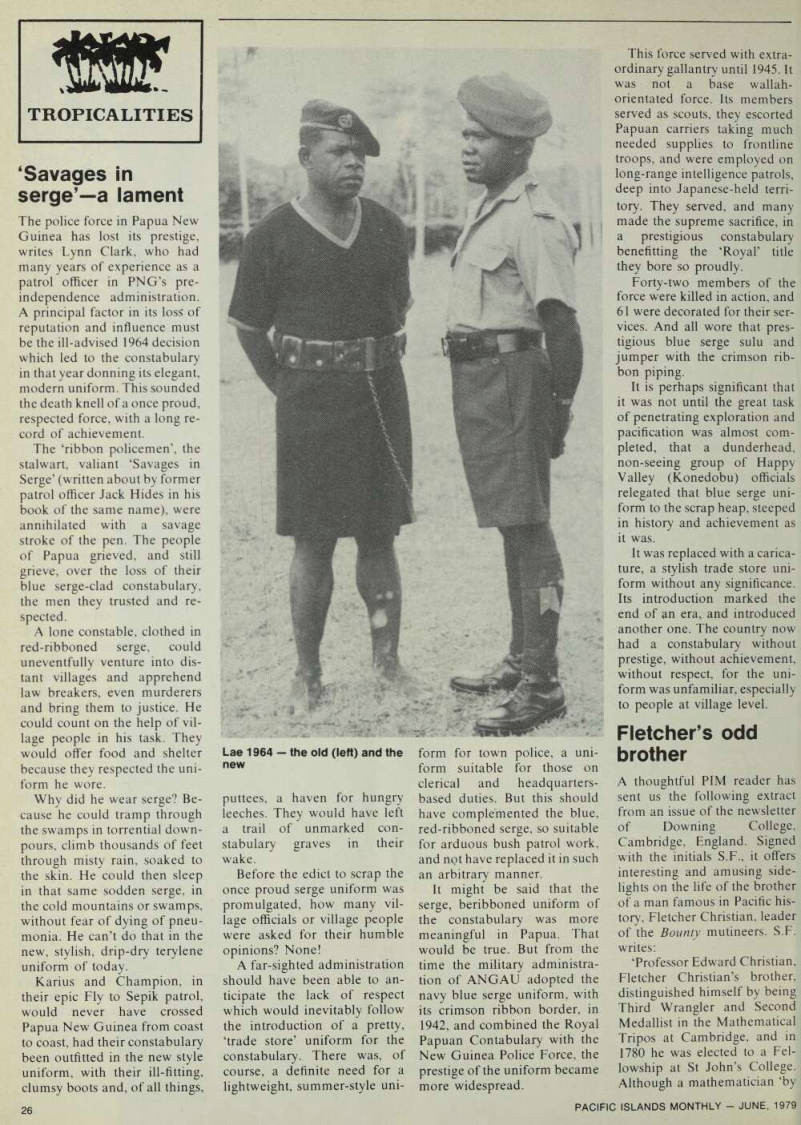
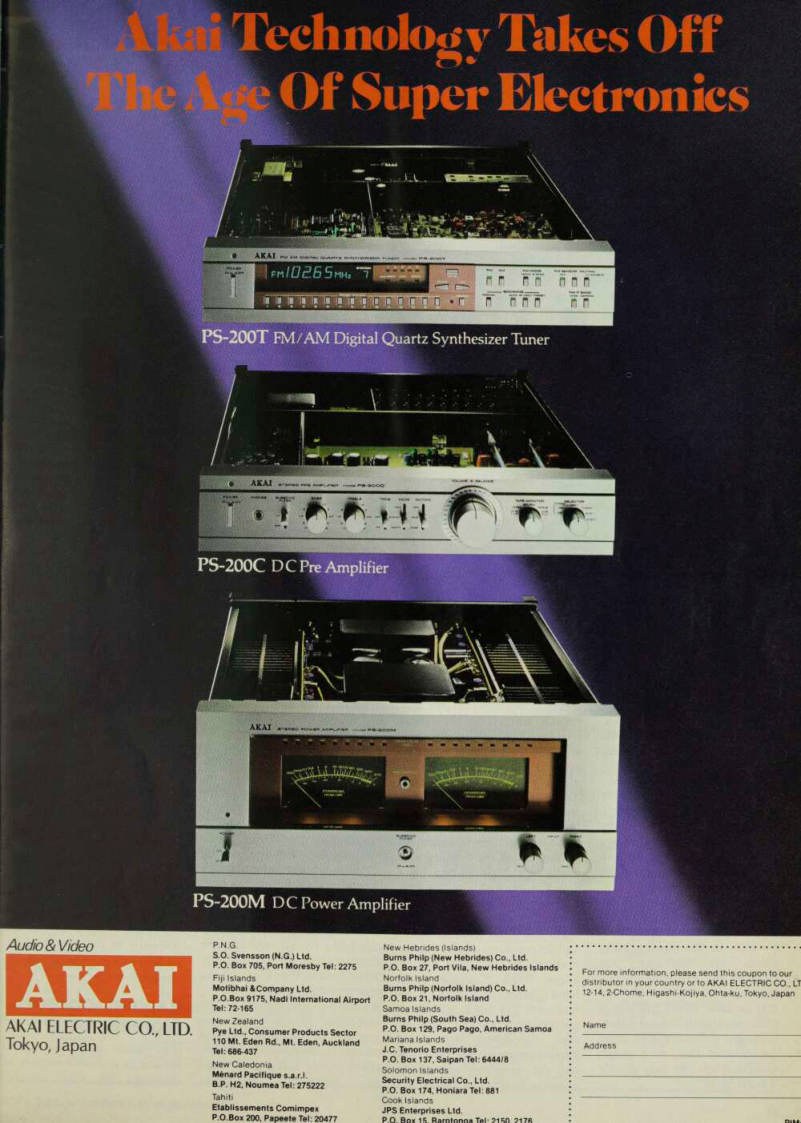
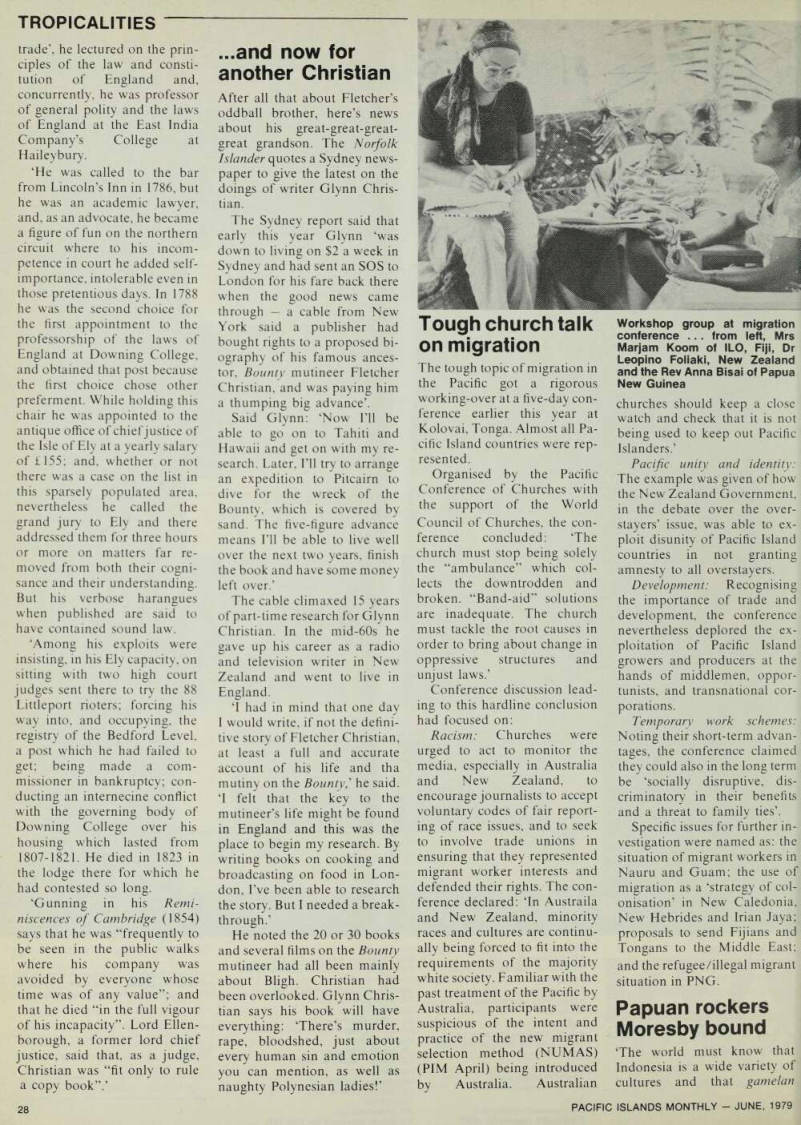
Tropicalities
serge’—a lament
The police force in Papua New Guinea has lost its prestige, writes Lynn Clark, who had many years of experience as a patrol officer in PNG’s pre
independence administration.
A principal factor in its loss of reputation and influence must be the ill-advised 1964 decision which led to the constabulary in that year donning its elegant, modern uniform. This sounded the death knell of a once proud, respected force, with a long re cord of achievement.
The ‘ribbon policemen’, the stalwart, valiant ‘Savages in Serge’ (written about by former patrol officer Jack Hides in his book of the same name), were annihilated with a savage stroke of the pen. The people of Papua grieved, and still grieve, over the loss of their
blue serge-clad constabulary,
the men they trusted and re
spected.
A lone constable, clothed in red-ribboned serge, could uneventfully venture into dis
tant villages and apprehend
law breakers, even murderers and bring them to justice. He could count on the help of vil
lage people in his task. They
would offer food and shelter because they respected the uni form he wore.
Why did he wear serge? Be cause he could tramp through the swamps in torrential down pours, climb thousands of feet through misty rain, soaked to the skin. He could then sleep in that same sodden serge, in the cold mountains or swamps, without fear of dying of pneu monia. He can’t do that in the
new, stylish, drip-dry terylene
uniform of today.
Karius and Champion, in
their epic Fly to Sepik patrol,
would never have crossed Papua New Guinea from coast to coast, had their constabulary been outfitted in the new style uniform, with their ill-fitting, clumsy boots and, of all things,
puttees, a haven for hungry leeches. They would have left a trail of unmarked con stabulary graves in their wake.
Before the edict to scrap the once proud serge uniform was promulgated, how many vil
lage officials or village people
were asked for their humble
opinions? None!
A far-sighted administration should have been able to an ticipate the lack of respect which would inevitably follow the introduction of a pretty, ‘trade store’ uniform for the constabulary. There was, of course, a definite need for a
lightweight, summer-style uni-
form for town police, a uni form suitable for those on clerical and headquarters based duties. But this should have complemented the blue, red-ribboned serge, so suitable for arduous bush patrol work, and not have replaced it in such an arbitrary manner.
It might be said that the serge, beribboned uniform of the constabulary was more meaningful in Papua. That would be true. But from the time the military administra tion of ANGAU adopted the navy blue serge uniform, with its crimson ribbon border, in 1942, and combined the Royal
Papuan Contabulary with the
New Guinea Police Force, the prestige of the uniform became
more widespread.
This force served with extra ordinary gallantry until 1945. It was not a base wallah orientated force. Its members served as scouts, they escorted
Papuan carriers taking much
needed supplies to frontline troops, and were employed on
long-range intelligence patrols,
deep into Japanese-held terri tory. They served, and many made the supreme sacrifice, in
a prestigious constabulary
benefitting the ‘Royal’ title
they bore so proudly.
Forty-two members of the force were killed in action, and 61 were decorated for their ser vices. And all wore that pres tigious blue serge sulu and jumper with the crimson rib
bon piping.
It is perhaps significant that it was not until the great task
of penetrating exploration and
pacification was almost com pleted, that a dunderhead,
non-seeing group of Happy
Valley (Konedobu) officials relegated that blue serge uni form to the scrap heap, steeped in history and achievement as it was.
It was replaced with a carica ture, a stylish trade store uni form without any significance.
Its introduction marked the end of an era, and introduced another one. The country now had a constabulary without prestige, without achievement, without respect, for the uni form was unfamiliar, especially to people at village level.
Fletcher’s odd
brother
A thoughtful PIM reader has sent us the following extract from an issue of the newsletter of Downing College,
Cambridge, England. Signed
with the initials S.F., it offers
interesting and amusing side
lights on the life of the brother of a man famous in Pacific his tory, Fletcher Christian, leader of the Bounty mutineers. S.F. writes: ‘Professor Edward Christian, Fletcher Christian’s brother,
distinguished himself by being
Third Wrangler and Second Medallist in the Mathematical Tripos at Cambridge, and in 1780 he was elected to a Fel lowship at St John’s College.
Although a mathematician ‘by
Lae 1964 - the old (left) and the new
trade’, he lectured on the prin ciples of the law and consti tution of England and,
concurrently, he was professor
of general polity and the laws of England at the East India
Company’s College at
Haileybury.
‘He was called to the bar from Lincoln’s Inn in 1786, but he was an academic lawyer, and, as an advocate, he became a figure of fun on the northern circuit where to his incom petence in court he added self importance, intolerable even in those pretentious days. In 1788 he was the second choice for the first appointment to the professorship of the laws of
England at Downing College,
and obtained that post because the first choice chose other
preferment. While holding this
chair he was appointed to the antique office of chief justice of the Isle of Ely at a yearly salary of £155; and, whether or not there was a case on the list in
this sparsely populated area,
nevertheless he called the
grand jury to Ely and there
addressed them for three hours or more on matters far re moved from both their cogni sance and their understanding.
But his verbose harangues when published are said to have contained sound law. ‘Among his exploits were
insisting, in his Ely capacity, on
sitting with two high court judges sent there to try the 88
Littleport rioters; forcing his
way into, and occupying, the registry of the Bedford Level, a post which he had failed to get; being made a com missioner in bankruptcy; con ducting an internecine conflict with the governing body of
Downing College over his
housing which lasted from 1807-1821. He died in 1823 in the lodge there for which he had contested so long. ‘Gunning in his Remi niscences of Cambridge (1854) says that he was “frequently to be seen in the public walks where his company was avoided by everyone whose time was of any value”; and that he died “in the full vigour of his incapacity”. Lord Ellen borough, a former lord chief justice, said that, as a judge, Christian was “fit only to rule a copy book”.’
...and now for
another Christian
After all that about Fletcher’s oddball brother, here’s news about his great-great-great
great grandson. The Norfolk
Islander quotes a Sydney news paper to give the latest on the doings of writer Glynn Chris tian.
The Sydney report said that early this year Glynn ‘was down to living on $2 a week in Sydney and had sent an SOS to London for his fare back there when the good news came through a cable from New York said a publisher had
bought rights to a proposed bi
ography of his famous ances tor, Bounty mutineer Fletcher Christian, and was paying him
a thumping big advance’.
Said Glynn: ‘Now I’ll be able to go on to Tahiti and Hawaii and get on with my re search. Later, I’ll try to arrange an expedition to Pitcairn to dive for the wreck of the Bounty, which is covered by sand. The five-figure advance means I’ll be able to live well over the next two years, finish the book and have some money left over.’
The cable climaxed 15 years of part-time research for Glynn Christian. In the mid-60s he gave up his career as a radio and television writer in New Zealand and went to live in
England.
T had in mind that one day I would write, if not the defini tive story of Fletcher Christian, at least a full and accurate account of his life and tha mutiny on the Bounty ,’ he said.
T felt that the key to the mutineer’s life might be found in England and this was the
place to begin my research. By
writing books on cooking and broadcasting on food in Lon don, I’ve been able to research the story. But I needed a break
through.’
He noted the 20 or 30 books and several films on the Bounty mutineer had all been mainly about Bligh. Christian had been overlooked. Glynn Chris tian says his book will have everything: ‘There’s murder, rape, bloodshed, just about every human sin and emotion you can mention, as well as
naughty Polynesian ladies!’
Tough church talk
on migration
The tough topic of migration in
the Pacific got a rigorous working-over at a five-day con ference earlier this year at Kolovai, Tonga. Almost all Pa cific Island countries were rep resented.
Organised by the Pacific
Conference of Churches with the support of the World Council of Churches, the con ference concluded; ‘The church must stop being solely the “ambulance” which col lects the downtrodden and broken. “Band-aid” solutions are inadequate. The church must tackle the root causes in order to bring about change in oppressive structures and
unjust laws.’
Conference discussion lead ing to this hardline conclusion had focused on: Racism: Churches were urged to act to monitor the media, especially in Australia and New Zealand, to encourage journalists to accept voluntary codes of fair report ing of race issues, and to seek to involve trade unions in
ensuring that they represented
migrant worker interests and defended their rights. The con ference declared: ‘ln Austraila and New Zealand, minority races and cultures are continu ally being forced to fit into the
requirements of the majority
white society. Familiar with the past treatment of the Pacific by Australia, participants were suspicious of the intent and practice of the new migrant selection method (NUMAS) (PIM April) being introduced by Australia. Australian
churches should keep a close watch and check that it is not being used to keep out Pacific Islanders.’
Pacific unity and identity:
The example was given of how the New Zealand Government, in the debate over the over stayers’ issue, was able to ex ploit disunity of Pacific Island countries in not granting amnesty to all overstayers.
Development: Recognising
the importance of trade and development, the conference nevertheless deplored the ex ploitation of Pacific Island growers and producers at the hands of middlemen, oppor tunists, and transnational cor
porations.
Temporary work schemes: Noting their short-term advan tages, the conference claimed they could also in the long term
be ‘socially disruptive, dis
criminatory in their benefits and a threat to family ties’.
Specific issues for further in vestigation were named as: the situation of migrant workers in Nauru and Guam; the use of migration as a ‘strategy of col onisation’ in New Caledonia, New Hebrides and Irian Jaya; proposals to send Fijians and Tongans to the Middle East;
and the refugee/illegal migrant
situation in PNG.
Papuan rockers
Moresby bound
‘The world must know that Indonesia is a wide variety of cultures and that gamelan
Workshop group at migration conference ... from left, Mrs Marjam Koom of ILO, Fiji, Dr Leopino Foliaki, New Zealand and the Rev Anna Bisai of Papua New Guinea
Advertisements & other items, pp. 27-29 (2 items)
Akai
Takes Off
Of Super Electronics
. '.A
FM/o£?esHH.Tmj,:u
n r r n nn n
a i !■ ii n )■
PS-200T FM/AM Digital Quartz Synthesizer Tuner
PS-200C DCPre Amplifier
pT*
PS-200M DC Power Amplifier
Audio & Video
AKAI
P.N.G.
S.O. Svensson (N.G.) Ltd.
P-0. Box 705, Port Moresby Tel: 2275 Fiji Islands Motibhai &Company Ltd.
P.0.80x 9175, Nadi International Airport Tel; 72-165
AKAI ELECTRIC CO., LTD.
Tokyo, Japan
New Zealand Pye Ltd., Consumer Products Sector 110 Ml. Eden Rd., Mt. Eden, Auckland Tel: 666-437 New Caledonia Menard Pacifique s.a.r.l.
B.P. H 2, Noumea Tel: 275222 Tahiti Elablissements Comimpex P.0.80x 200, Papeete Tel: 20477 New Hebrides (Islands) Burns Philp (New Hebrides) Co., Ltd.
P.O. Box 27, Port Vila, New Hebrides Islands Norfolk Island Burns Philp (Norfolk Island) Co., Ltd.
P.O. Box 21, Norfolk Island Samoa Islands Burns Philp (South Sea) Co., Ltd.
P.O. Box 129, Pago Pago, American Samoa Mariana Islands J.C. Tenorio Enterprises P.O. Box 137, Saipan Tel: 6444/8 Solomon Islands Security Electrical Co., Ltd.
P.O. Box 174, Honiara Tel; 881 Cook Islands JPS Enterprises Ltd.
P.O. Box 15 Rarotonna Tel- 915(1 917fi For more information, please send this coupon to our distributor in your country or to AKAI ELECTRIC CO., LT 12-14, 2-Chome, Higashi-Kojiya, Ohta-ku, Tokyo, Japan
i p f
GBOO+S
GBOO
Grand Rally
GBOO+S
Grand Prix 70
You can trust Goodyear technology
to give you grip. World champion
racing drivers do. So drive on steel
belted radial car tyres developed by
Goodyear. Built for grip in any
weather. Extra high mileage too.
GOODfYCAR
The Choice of Champions
GOODYEAR DISTRIBUTORS IN S.E. ASIA AND PACIFIC B/ “ J Tmk Trading Co. Santo Engineers Truk E Caroline Is Santo. New Hebrides £ * M l n Pacific Motors Koloma. Ponape Vila New Hebrides Island Transport Service Co. S.G.A.
Maiuro, Marshall Is Noumea New Caledo Yap Cooperative Ass. Duncombe Bay Garai Yap W Caroline Is Norfolk Is Cook Islands Motor Centre Ltd, Coral Island Motors Rarotonga. Cook Is Suva. Fiji Ngiralkel Elpison Co. Ltd. Morris Hedstrom Ltd Koror. Palau Nukualofa. Tonga Motors Ltd. Morris Hedstrom Ltd Port Moresby Papua New Guinea Apia Western Samoa Solomon Motors Ltd.
Honiara. Solomon Is Richard Pieris & Co., Ltd Colombo. Sri Lanka Nepal Motor Company (P) Ltd Biratnagar Nepal Havana Ltd.
Dacca. Bangladesh Diethelm & Co., Ltd.
Bangkok, Thailand Landis Brothers & Co.. Ltd Hong Kong Guam Tire & Supply Co.
Agana. Guam Susupe Enterprises Saipan, Marlara Is Microl Corporation Saipan. Mariana Is Western Samoa Transport Cooperative Society Ltd Apia. Western Samoa Samoa Motors Inc.
Pago Pago, American Samoa Service Mobil Papeete Tahiti
GOODYEAR SUBSIDIARIES
The Goodyear Tyre & Rubber Co (Ausl ) Ltd Sydney. AUSTRALIA Tel 31-0311 Goodyear India Limited New Delhi 1, INDIA Tel 46886/9 PT Goodyear Indonesia Bogor, Republic of Indonesia Tel: 3371/2 Nippon Goodyear Kabushiki Kaisha Tokyo, JAPAN Tel 582-0481/8 Goodyear Malaysia Berhad Selangor, MALAYSIA Tel 362501/5 The Goodyear Tyre & Rubber Co. of New Zealand. Limited Lower Hull NEW ZEALAND Tel 684-389 The Goodyear Tyre & Rubber Company of the Philippines. Limited Makati-Metro Manila Republic of the Philippines Tel 89-20-41 Goodyear Singapore Pvt Limited Geylang SINGAPORE 14 Tel 408281/3 Goodyear Taiwan Limited Taipei, TAIWAN Tel 5117135/8 Goodyear (Thailand) Limited Bangkok. THAILAND Tel 252-6141/5
FOR FURTHER INFORMATION
PLEASE CONTACT
Goodyear International Corporation Room 1603, Wing On Center 111 Connaught Road Central
HONGKONG Tel 5-433331
HRMEI7I 0252
3 Acific Islands Monthly - June, 1979
Island style
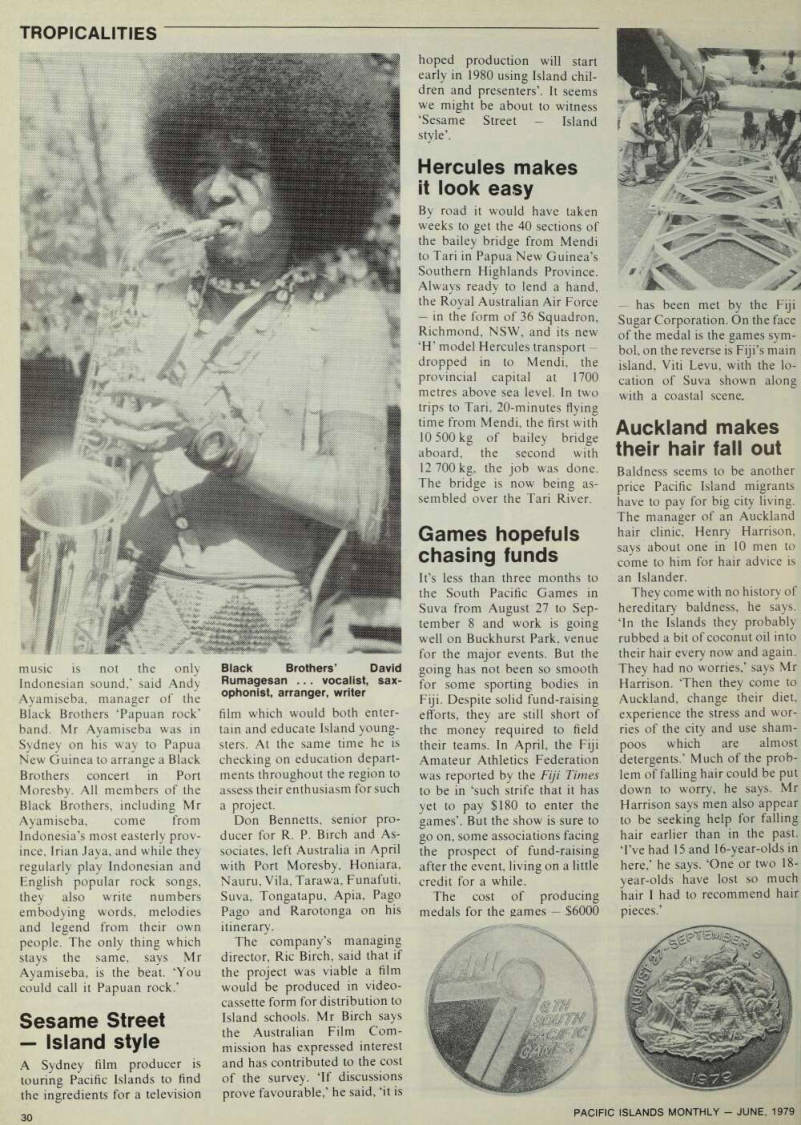
music is not the only Indonesian sound,’ said Andy Ayamiseba, manager of the Black Brothers ‘Papuan rock’ band. Mr Ayamiseba was in Sydney on his way to Papua New Guinea to arrange a Black Brothers concert in Port Moresby. All members of the Black Brothers, including Mr Ayamiseba, come from Indonesia’s most easterly prov ince, Irian Jaya, and while they
regularly play Indonesian and
English popular rock songs,
they also write numbers embodying words, melodies and legend from their own
people. The only thing which
stays the same, says Mr Ayamiseba, is the beat. ‘You could call it Papuan rock.’
Sesame Street
Island style
A Sydney film producer is touring Pacific Islands to find the ingredients for a television
film which would both enter tain and educate Island young sters. At the same time he is checking on education depart ments throughout the region to assess their enthusiasm for such
a project.
Don Bennetts, senior pro ducer for R. P. Birch and As sociates, left Australia in April with Port Moresby, Honiara, Nauru, Vila, Tarawa, Funafuti, Suva, Tongatapu, Apia, Pago Pago and Rarotonga on his itinerary.
The company’s managing
director, Ric Birch, said that if the project was viable a film would be produced in video cassette form for distribution to Island schools. Mr Birch says the Australian Film Com mission has expressed interest and has contributed to the cost of the survey. ‘lf discussions prove favourable,’ he said, ‘it is
hoped production will start
early in 1980 using Island chil dren and presenters’. It seems we might be about to witness ‘Sesame Street Island
style’.
Hercules makes
it look easy
By road it would have taken weeks to get the 40 sections of the bailey bridge from Mendi to Tari in Papua New Guinea’s Southern Highlands Province.
Always ready to lend a hand, the Royal Australian Air Force in the form of 36 Squadron, Richmond, NSW, and its new ‘H’ model Hercules transport dropped in to Mendi, the
provincial capital at 1700
metres above sea level. In two trips to Tari, 20-minutes flying time from Mendi, the first with
10 500 kg of bailey bridge
aboard, the second with 12 700 kg, the job was done.
The bridge is now being as sembled over the Tari River.
Games hopefuls
chasing funds
It’s less than three months to the South Pacific Games in Suva from August 27 to Sep tember 8 and work is going well on Buckhurst Park, venue for the major events. But the going has not been so smooth for some sporting bodies in
Fiji. Despite solid fund-raising
efforts, they are still short of the money required to field their teams. In April, the Fiji Amateur Athletics Federation
was reported by the Fiji Times
to be in ‘such strife that it has yet to pay $lBO to enter the games’. But the show is sure to go on, some associations facing the prospect of fund-raising after the event, living on a little credit for a while.
The cost of producing medals for the games $6OOO
has been met by the Fiji Sugar Corporation. On the face of the medal is the games sym bol, on the reverse is Fiji’s main island, Viti Levu, with the lo cation of Suva shown along with a coastal scene.
Auckland makes
their hair fall out
Baldness seems to be another
price Pacific Island migrants
have to pay for big city living.
The manager of an Auckland hair clinic, Henry Harrison, says about one in 10 men to come to him for hair advice is an Islander.
They come with no history of hereditary baldness, he says.
Tn the Islands they probably rubbed a bit of coconut oil into their hair every now and again.
They had no worries,’ says Mr Harrison. ‘Then they come to Auckland, change their diet, experience the stress and wor ries of the city and use sham poos which are almost detergents.’ Much of the prob lem of falling hair could be put down to worry, he says. Mr Harrison says men also appear
to be seeking help for falling
hair earlier than in the past.
T’ve had 15 and 16-year-olds in here,’ he says. ‘One or two 18year-olds have lost so much hair I had to recommend hair
pieces.’
Black Brothers’ David Rumagesan ... vocalist, sax ophonist, arranger, writer
Advertisements & other items, p. 31 (1 item)
"niiimm
As Seiko enters its second decade of world leadership in quartz technology:
Seiko LC Digital Quartz Alarm Chronograph.
Its a precision watch, a stopwatch, a wrist alarm.
And it’s water-tested to 30 meters
"niiimm
C
STOP
watch la~armI a ar m Tlf/p set set lap
STOP
1/10 m 0(V0 graph
I 'GHT
X
DATE
mode start
STOP
READ
SELECT
STOp
lap Reset
SET
Now you can own a remarkably accurate quartz watch that displays the time, day, date and month; instantly converts to a stopwatch, and gives you the convenience of a wrist alarm. It can also alert you to the passing of every hour on the hour with a short signal.
Yet it's amazingly compact and simple to operate.
Its what you'd expect from Seiko, the company that sold the world's first quartz watch and that never ends its quest for quality and dedication to technology. Seiko Quartz.§Q[
SEIKO
Someday all watches will be made this wav.
What A Dish!
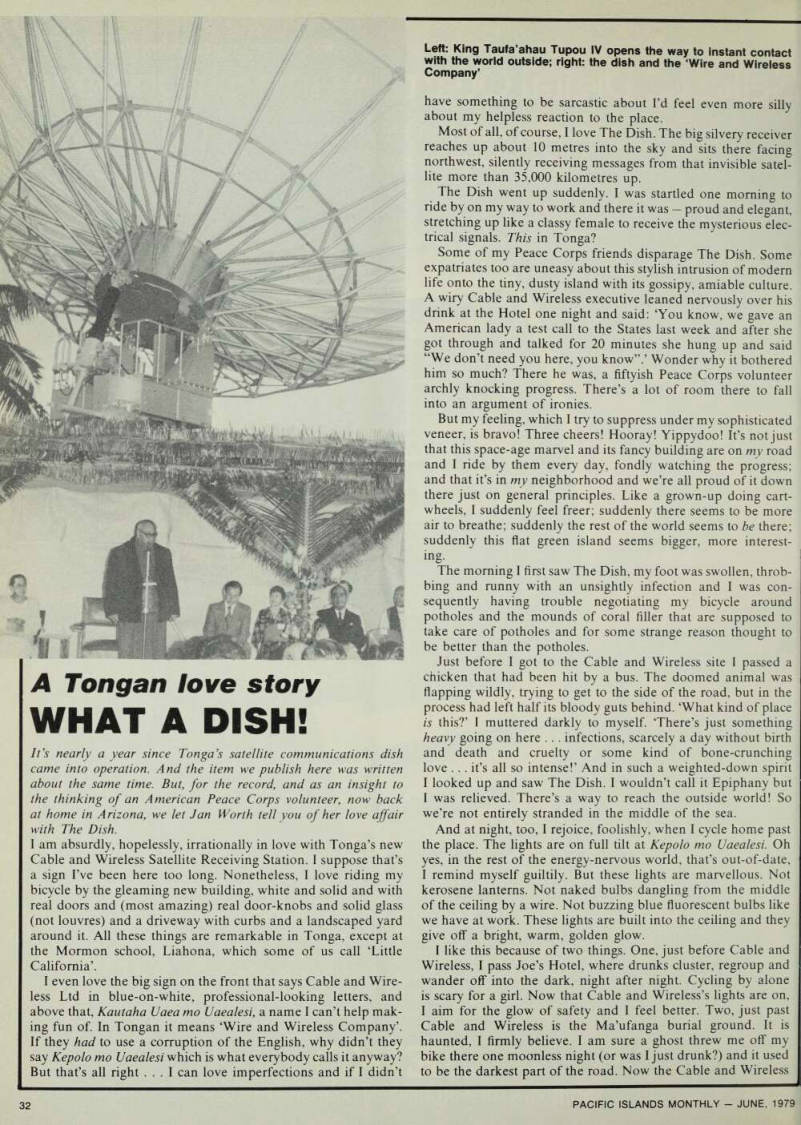

A Tongan love story
It’s nearly a year since Tonga’s satellite communications dish came into operation. And the item we publish here was written about the same time. But, for the record, and as an insight to the thinking of an American Peace Corps volunteer, now back at home in Arizona, we let Jan Worth tell you of her love affair with The Dish.
I am absurdly, hopelessly, irrationally in love with Tonga’s new Cable and Wireless Satellite Receiving Station. I suppose that’s a sign I’ve been here too long. Nonetheless, I love riding my bicycle by the gleaming new building, white and solid and with real doors and (most amazing) real door-knobs and solid glass (not louvres) and a driveway with curbs and a landscaped yard around it. All these things are remarkable in Tonga, except at the Mormon school, Liahona, which some of us call ‘Little California’.
I even love the big sign on the front that says Cable and Wire less Ltd in blue-on-white, professional-looking letters, and above that, Kautaha Uaea mo Uaealesi, a name I can’t help mak ing fun of. In Tongan it means ‘Wire and Wireless Company’.
If they had to use a corruption of the English, why didn’t they say Kepolo mo Uaealesi which is what everybody calls it anyway?
But that’s all right ... I can love imperfections and if I didn’t
have something to be sarcastic about I’d feel even more silly about my helpless reaction to the place.
Most of all, of course, I love The Dish. The big silvery receiver reaches up about 10 metres into the sky and sits there facing northwest, silently receiving messages from that invisible satel lite more than 35,000 kilometres up.
The Dish went up suddenly. I was startled one morning to ride by on my way to work and there it was proud and elegant, stretching up like a classy female to receive the mysterious elec trical signals. This in Tonga?
Some of my Peace Corps friends disparage The Dish. Some expatriates too are uneasy about this stylish intrusion of modern life onto the tiny, dusty island with its gossipy, amiable culture.
A wiry Cable and Wireless executive leaned nervously over his drink at the Hotel one night and said: ‘You know, we gave an American lady a test call to the States last week and after she got through and talked for 20 minutes she hung up and said “We don’t need you here, you know”.’ Wonder why it bothered him so much? There he was, a fiftyish Peace Corps volunteer archly knocking progress. There’s a lot of room there to fall into an argument of ironies.
But my feeling, which I try to suppress under my sophisticated veneer, is bravo! Three cheers! Hooray! Yippydoo! It’s not just that this space-age marvel and its fancy building are on my road and I ride by them every day, fondly watching the progress; and that it’s in my neighborhood and we’re all proud of it down there just on general principles. Like a grown-up doing cart wheels, I suddenly feel freer; suddenly there seems to be more air to breathe; suddenly the rest of the world seems to be there; suddenly this flat green island seems bigger, more interest
ing.
The morning I first saw The Dish, my foot was swollen, throb bing and runny with an unsightly infection and I was con sequently having trouble negotiating my bicycle around potholes and the mounds of coral filler that are supposed to take care of potholes and for some strange reason thought to be better than the potholes.
Just before I got to the Cable and Wireless site I passed a chicken that had been hit by a bus. The doomed animal was flapping wildly, trying to get to the side of the road, but in the process had left half its bloody guts behind. ‘What kind of place is this?’ I muttered darkly to myself. ‘There’s just something heavy going on here ... infections, scarcely a day without birth and death and cruelty or some kind of bone-crunching love ... it’s all so intense!’ And in such a weighted-down spirit I looked up and saw The Dish. I wouldn’t call it Epiphany but I was relieved. There’s a way to reach the outside world! So we’re not entirely stranded in the middle of the sea.
And at night, too, I rejoice, foolishly, when I cycle home past the place. The lights are on full tilt at Kepolo mo Uaealesi. Oh yes, in the rest of the energy-nervous world, that’s out-of-date, I remind myself guiltily. But these lights are marvellous. Not kerosene lanterns. Not naked bulbs dangling from the middle of the ceiling by a wire. Not buzzing blue fluorescent bulbs like we have at work. These lights are built into the ceiling and they give off a bright, warm, golden glow.
I like this because of two things. One, just before Cable and Wireless, I pass Joe’s Hotel, where drunks cluster, regroup and wander off into the dark, night after night. Cycling by alone is scary for a girl. Now that Cable and Wireless’s lights are on, I aim for the glow of safety and I feel better. Two, just past Cable and Wireless is the Ma’ufanga burial ground. It is haunted, I firmly believe. I am sure a ghost threw me off my bike there one moonless night (or was I just drunk?) and it used to be the darkest part of the road. Now the Cable and Wireless
Left: King Taufa 'ahau Tupou IV opens the way to instant contact with the world outside; right: the dish and the ‘Wire and Wireless
Company’
lights extend at least half-way down the cemetery, giving me enough light at least to see the ghosts in advance.
It’s hard to say what Cable and Wireless will do to and for Tonga. Foreigners, it’s certain, can now get a good connection when they want to call home for Christmas. There’s a telex set up now so local business people can finally hook up to that fancy thing called ‘cable traffic’. Certainly tourists will have bet ter luck getting hotel reservations in Suva and onward plane tickets to Sydney. There is now, we’re told, the capability for television in Tonga. That is a sobering thought, one I prefer to think about later.
In the old days, Tongans used to paddle around the whole South Pacific in their huge, magnificent canoes. They were good at it. When their curiosity or island fever overtook them, they knew how to manufacture adventure and bring back news of the world, Today Tongans (if they can afford it) can travel every where by jet, but in many ways they still seem culturally insu
lated. Physically and emotionally, they can still come back to their remote, homogeneous island culture. There’s some degree of ethnocentric vengeance in my glee with Cable and Wirless.
In my opinion, the chance to have more communication with the rest of the world will do Tonga good. My happiness has its own smug aspect, of course: the Cable and Wireless station is from my world, and maybe that is all there is to my puppy love.
The funny thing is, though you can now call Paris or New York, you still have trouble getting Vavau the Tongan island 260 kilometres to the north. There’s an old building in the back to handle local calls, with no fancy tools, nice lights or slick overseas executives. Tongans have to wait a while, it appears, before they can call each other. (Vavau these days is much easier to contact than when Jan Worth wrote her confession. Earlier this year Tonga's 1500-line auto matic telephone exchange came into operation. Editor.)
Advertisements & other items, pp. 33-36 (1 item)
Qbe Insurance Limited
offers expert insurance service
throughout the Islands.
Central Office: 82 Pitt Street, Sydney.
NEW CALEDONIA T.A. Hagen, Ste. l/l/.A. Johnston, S.A.R.L. - Noumea.
NEW HEBRIDES Manager: G.F. Donnelly, Vila; Santo Santr: Burns Phi/p (New Hebrides) Ltd.
TAHITI Arthur Chung: Immeub/e B.L, Front de Mer, Papeete.
NIUE, NORFOLK ISLAND, SAMOA, TONGA and other South Sea Islands Burns Philp (South Sea) Company Ltd.
QUEENSLAND INSURANCE (FIJI) LIMITED
Head Office, 34 Usher St., SUVA. General Manager: L.G. Liddell. A.A.1.1.
Assistant Managers: Vijay Lai and J.T. Laidlaw. LAUTOKA Office, Burns Philp Bldg. District Manager: J. Dalton.
QUEENSLAND INSURANCE (P.N.C.) LIMITED
PAPUA NEW GUINEA -
Head Office, PORT MORESBY. General Manager; J.M. Dawe. Assistant Manager: R.V. Masked.
District Managers at; LAE; I.R. Martin. MOUNT HAGEN: D.F. Carroll. ARAWA; J Longbut. MADANG: R.W.V. Codings. RABAUL: W.F. Tinker.
Q B E
Speakers A (direct) Treble OH.
'Wr/Prote^' .a+b
SansttL
ated A
AU-919
*** ‘oo/DC
Power WO 3kt m. £
Subsonic
tsot mm.
Probably the most important neglected distortion in today’s quality amplifiers is TIM transient intermodulation distortion. That’s why Sansui engineers went beyond ordinary specs to virtually annihilate TIM with the PAT.PEMD.
Diamond Differential DC circuit (DD/DC) of the new AG-919 powerful integrated amplifier.
Briefly: ordinary amplifiers, even high-wattage units, cannot respond rapidly to sudden pulsive signals.
But Sansui’s AG-919 can, and the proof is in a slew rate of ±2OOV/ /Lrsec. and a rise/fall time of 0.5 /use c.
You might also think of Sansui’s virtual elimination of TIM in this way: the exclusive DD/DC finally realizes the potential benefits of straight DC circuitry truly clear and accurate reproduction of even the most complex nuances of recorded sound.
Power is a clean 110 RMS watts ■t A
. - -..v :
Only hi-fi, every thing hi-fi
Input Selector
-18 *“«o -14 ~20 -13 -22 Phono-2 (MM) -11 -10 ■ -9 Phono-1 (mc) § -8 -7 Phono-1 (mm) V -6 -5 tuner -3 aux -2 dB source
Copy
tuner °. ff tape-i left right
tape-2
source • £ C/ v M per channel with distortion under 0.008%! Frequency response is unparalleled from DC (0 Hz) to 500,000 Hz.
No doubt about it. The AG-919 sets new standards: it comes closer to theoretically perfect performance than any other comparable unit.
Sansui’s AU-919: the standard by which others will be judged, SAMSUI ELECTRIC CO., LTD. 14-1 Izumi 2-chome, Suginami-ku, Tokyo 168, Japan m Q?Sn T? , AUS n Pty ‘ Ltd ‘ 162, Albert Road ’ South Melbourne . Victoria 3205, Australia Phone: 699-5473 / 283 Alfred Street, North Sydney AaenYlpSi c92 9 '0 2" • Fiji Prabhu Brothers Ltd. P.O. Box 183, Nadi Phone: 70183/4 • Papua New Guinea Oceania Indent V 9 PhonJIBQ® M td ‘ 5518, Boroko - Port Moresby Phone; PM 256406 • New Zealand David Reid Electronics Ltd. C.P.O. Box 2630, Auckland P n h ßny Lm h, " C J J o e o d oo m l EtS Mi ° he ' MERCIER BP ‘ 1123 ' Noumea Phone: 27. 59. 1 1 • South Pacific Miltons Department Stores Limited 434 Port Villa ? Central Pacific Nauru Co-operative Society Republic of Nauru • New Hebrides The Sound Centre P.O. Box 434, Port Villa • Cook Island United Island Traders Ltd. P.O. Box 1& 2, Rarotonga • Tahiti DIMECO P.O. Box 2622
Beehive Building 94 Elizabeth Street Melbourne, Victoria Australia 3000 G.P.O. Box 8 Melbourne, Victoria Australia 31 Telex: AA34552 Phone: 63 5094
Islands
From the
Press
PNG Post-Courier comment Lawlessness is the disease that is eating the heart out of Papua New Guinea. The majority suffer because of the idiotic behaviour of a few. The public are uneasy and with just reason. The breakdown in law and order has been the topic of ceaseless debate for more than two years now, but still nothing has been done.
Atoll Pioneer, Gilbert Islands The world is about to give birth to the newest nation with a new name; KIRIBATI (Pron; KIRI-BAS). It is not an original name, in fact it is a Gilbertese word derived from its original English version - Gilbert. The new nation, Kiribati, comprising the Gilbert Islands including Banaba, the Phoenix Islands and the Line Islands, will become independent from Britain to be a sovereign republic on Thursday, 12 July 1979.
News Drum, Solomon Islands The new Director of the South Pacific Fisheries’ Agency, which is to have its headquarters in Honiara, visited the capital last week ... The agency will serve as a cleaning house for the fisheries of all the countries concerned.
Fiji Times, Suva The chairman of the Fiji Kuomintang, Mr Peter Seeto, said ... he would not attend a welcome reception for the visiting Vice-Premier of the State Council of China, Madam Chen
MuhuaattheChinaClub.. .MrSeetosaid.. .hewouldnotgo
because China did not ‘recognise’ the Chinese in Fiji as Chinese.
Tohi Tala Niue Niue is presently facing the problem of accommodating ‘cheap’ tourists who transit through the Pacific seeking low-priced accommodation ... ‘knapsack tagged’ tourists are not catered for here and when they do arrive they are often disappointed . . . (One knapsack tourist) has the cheek to suggest ‘that the people of Niue create an alternative accommodation ... to cater for their needs’... Knapsack tourist needs his head examined! If that type of tourist cannot afford to stay in our hotel then the island can very well do without them.
Les Nouvelles de Tahiti, Papeete Tahiti s new intelligence boss, Roger Maury, writes a novel every weekend ... Isn t there a danger that with his undoubted literary talents and unusual capacity for work, fiction might get the upper hand in the compilation of intelligence dossiers, and there might soon even be a crisis of over-production of dossiers?
Norfolk Island News After a year of soothing assurances about its concern for the people of Norfolk, the Australian Government stopped play-acting and swung an iron fist down on the Island on April sth. Its Norfolk Island Bill was rubber-stamped through Australia’s House of Representatives that night.
PNG Post-Courier, Port Moresby
Thieves broke into the Prime Minister’s Mirigini House at Waigani for the second time at the weekend ... several mattresses and bed sheets were stolen ...
Fiji Times comment This is a requiem for a true Florence Nightingale of Fiji - Loata Wakolo Kacimaiwai. She died in the service of others. No person
can give more than that. . . Sister Kacimaiwai, District Nurse Nayau, was one of the hundreds caught in the fierce, destructive force of Cyclone Meli. . . She was trying to help other victims when she was injured herself. Yet she carried on as best she could, through the hellish days of hoping and waiting for aid from outside. When it finally came, it was too late for Sister Kacimaiwai.
Allans Nius, Rabaul, PNG
A village court magistrate of Mioko village court on the Duke of York Islands of East New Britain, Mr Jack Para, has denied allegations that magistrates on the islands get drunk before
conducting village court cases.
Fiji Times
A teenage girl was choked to death after she accidentally swallowed a fish while fishing in the Ba River on Sunday . . . The river was shallow but as the women were biting the heads off the fish, to kill them after catching them, one of the fish, a 4in long Malaya, slipped into Asenaca’s throat. Efforts by other women to clear the fish from her throat failed.
Arawa Bulletin, PNG I am originally from Buin and I’m not at all happy about what I am based on. Taking other centres of PNG, for an example Lae, in the Morobe Province, where I have lived long enough to realise that getting married there is easy because bride prices are around K6OO and downwards . . . But here in Buin, bride prices are .. . even up to K2OOO and K3OOO ... I got married to one of the girls . .. and her parents asked me to pay KlO5O . .. which I couldn’t afford ... One day I was shocked to see a car parked in front of our house and the father of my wife saying ‘Well tambu, you fail to pay the price’... I was sad to see my wife forced into the car .. . but I’m happy after all that I won’t be bothered . .. about the bride price any more.
News Drum, Solomon Islands Mr David Kausimae, MP for West Are Are, questioned in parliament whether the governor-general and the prime minister should have people to drive their cars for them. He said that since Solomon Islands had become independent, it ‘should do away with all colonial practices’. The leaders should drive their own cars, be free to walk and meet the people to show an example to those who will come after them, he said.
PNG Post-Courier In light of the recent comments by the acting Transport Secretary Mr Gaius and the Transport Minister Mr Wingti about the terrible dangers attached to using Lae airport I was horrified to see the arrival of the Papua New Guinea Prime Minister Mr Somare and his retinue at that very airport. Surely Mr Wingti values Mr Somare’s life; why then does he allow ‘Kumul 2’ to land at an airport which his ministerial department has deemed to be dangerous and unsuitable for further use? ... Mr Wingti owes Lae city and the Morobe Province a full explanation of this grave incident.
Lae Nius, PNG The National Planning Office in Waigani should be given a change of name to ‘the National Panning Office’ because of the way they fry up and burn genuine proposals, serve them up again on a plate disguised as a new dish, sugared with sweet talk.
News Drum, Solomon Islands The fruit tree at Lilisian village, Auki, planted by the Duke of Gloucester during his visit at independence, has withered and died. The tree had grown to a height of 2ft 9in and villagers helped to nourish it by giving good soil. Fenced with cyclone wire, the sapling was safe from children. It was replanted but failed to survive.
Atoll Pioneer, Gilbert Islands The Teinainano Urban Council has increased dog licences from $2 to $5 for males and $5 to $ 10 for females.
Advertisements & other items, p. 38 (1 item)
plumbing supplies Tast
Total service 0n ...
Sr You can get all your needs from one supply source: water taps, valves, copper tube, tools and a host of other fittings and related plumbing equipment for domestic, industrial and multi-storey buildings.
Watson & Crane Pty Ltd have over 20,000 plumbing items in stock at their central warehouse located at Waterloo, NSW, Australia.
Years of experience in handling and shipping right throughout the South Pacific add up to another big reason for you to deal with Watson & Crane Pty Ltd.
Representatives call regularly at Papua New Guinea, the Solomons, New Hebrides and Fiji Islands to personally discuss your requirements and appropriate credit arrangements.
Write, cable or telephone today for complete plumbers' supplies service.
ill
r*: « Watson & Crane Pty. Ltd. 1037 Bourke Street, Waterloo,
NSW 2017.
Phone: Sydney 699-1333.
Telex: AA 25548.
Cables: "Watcrane" Sydney.
Pacific Island distributors of Crane Enfield copper tube for water, sanitation, engineering, refrigeration and air conditioning.
WATSON & CRANE
are organised to fulfil your needs
wherever you are in the South Pacific
and let's get on
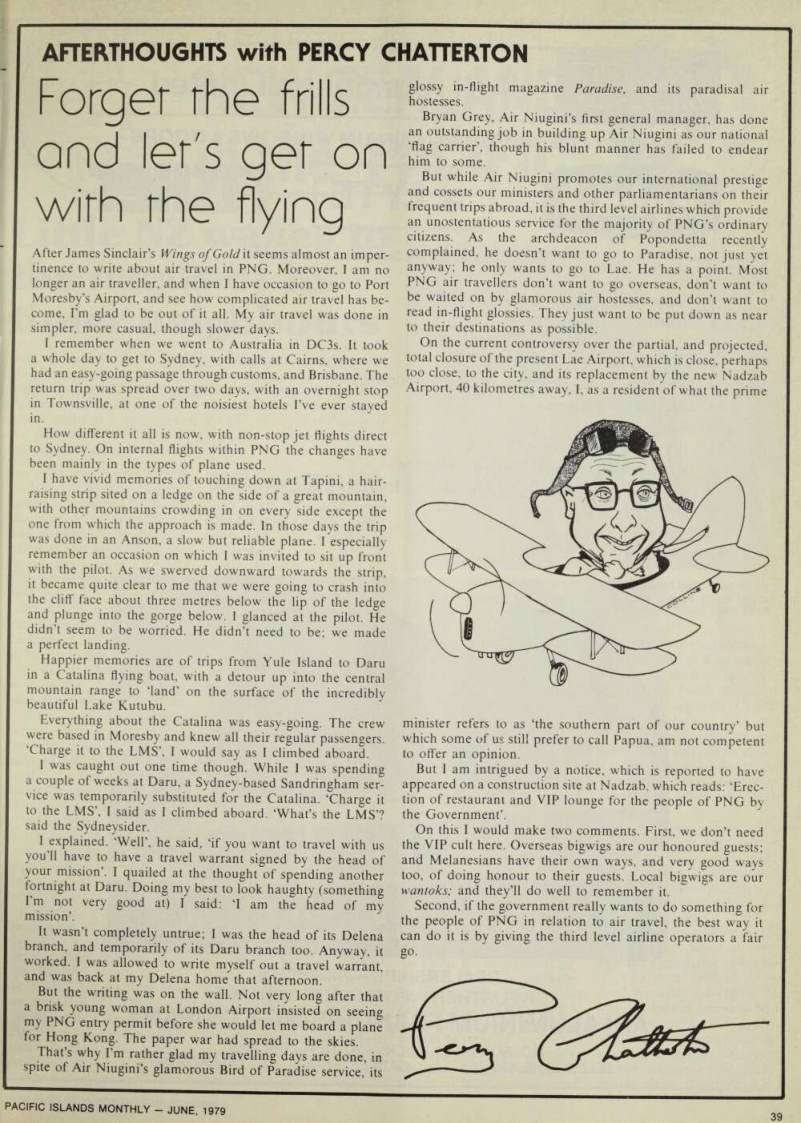
Afterthoughts With Percy Chatterton
Forger the frills and let's get on wirh the flying
After James Sinclair’s Wings of Gold it seems almost an imper tinence to write about air travel in PNG. Moreover, I am no longer an air traveller, and when I have occasion to go to Port Moresby’s Airport, and see how complicated air travel has be come, I’m glad to be out of it all. My air travel was done in
simpler, more casual, though slower days.
I remember when we went to Australia in DC3s. It took a whole day to get to Sydney, with calls at Cairns, where we had an easy-going passage through customs, and Brisbane. The return trip was spread over two days, with an overnight stop in Townsville, at one of the noisiest hotels I’ve ever stayed in.
How different it all is now, with non-stop jet flights direct to Sydney. On internal flights within PNG the changes have been mainly in the types of plane used.
I have vivid memories of touching down at Tapini, a hair raising strip sited on a ledge on the side of a great mountain, with other mountains crowding in on every side except the one from which the approach is made. In those days the trip was done in an Anson, a slow but reliable plane. I especially remember an occasion on which I was invited to sit up front with the pilot. As we swerved downward towards the strip, it became quite clear to me that we were going to crash into the cliff face about three metres below the lip of the ledge and plunge into the gorge below. I glanced at the pilot. He didn’t seem to be worried. He didn’t need to be; we made
a perfect landing.
Happier memories are of trips from Yule Island to Daru in a Catalina flying boat, with a detour up into the central mountain range to ‘land’ on the surface of the incredibly beautiful Lake Kutubu.
Everything about the Catalina was easy-going. The crew were based in Moresby and knew all their regular passengers. ‘Charge it to the LMS’, I would say as I climbed aboard.
I was caught out one time though. While I was spending a couple of weeks at Daru, a Sydney-based Sandringham ser vice was temporarily substituted for the Catalina. ‘Charge it to the LMS’, I said as I climbed aboard. ‘What’s the LMS’? said the Sydneysider.
I explained. ‘Well’, he said, ‘if you want to travel with us you’ll have to have a travel warrant signed by the head of your mission’. I quailed at the thought of spending another fortnight at Daru. Doing my best to look haughty (something I’m not very good at) I said: T am the head of my mission’.
It wasn’t completely untrue; I was the head of its Delena branch, and temporarily of its Daru branch too. Anyway, it worked. I was allowed to write myself out a travel warrant, and was back at my Delena home that afternoon.
But the writing was on the wall. Not very long after that a brisk young woman at London Airport insisted on seeing my PNG entry permit before she would let me board a plane for Hong Kong. The paper war had spread to the skies.
That’s why I’m rather glad my travelling days are done, in spite of Air Niugini s glamorous Bird of Paradise service, its
glossy in-flight magazine Paradise, and its paradisal air hostesses.
Bryan Grey, Air Niugini’s first general manager, has done an outstanding job in building up Air Niugini as our national ‘flag carrier’, though his blunt manner has failed to endear him to some.
But while Air Niugini promotes our international prestige and cossets our ministers and other parliamentarians on their frequent trips abroad, it is the third level airlines which provide an unostentatious service for the majority of PNG’s ordinary citizens. As the archdeacon of Popondetta recently complained, he doesn’t want to go to Paradise, not just yet anyway; he only wants to go to Lae. He has a point. Most PNG air travellers don’t want to go overseas, don’t want to be waited on by glamorous air hostesses, and don’t want to read in-flight glossies. They just want to be put down as near to their destinations as possible.
On the current controversy over the partial, and projected, total closure of the present Lae Airport, which is close, perhaps too close, to the city, and its replacement by the new Nadzab Airport, 40 kilometres away, I, as a resident of what the prime
minister refers to as ‘the southern part of our country’ but which some of us still prefer to call Papua, am not competent to offer an opinion.
But I am intrigued by a notice, which is reported to have appeared on a construction site at Nadzab, which reads: ‘Erec tion of restaurant and VIP lounge for the people of PNG by the Government’.
On this I would make two comments. First, we don’t need the VIP cult here. Overseas bigwigs are our honoured guests; and Melanesians have their own ways, and very good ways too, of doing honour to their guests. Local bigwigs are our wantoks; and they’ll do well to remember it.
Second, if the government really wants to do something for the people of PNG in relation to air travel, the best way it can do it is by giving the third level airline operators a fair go-
Advertisements & other items, p. 40 (1 item)
4 Lyte
mm
AHI Aluminium Limited
MARKET LEADERS IN ALUMINIUM WINDOWS & DOORS
4 LYTE
Manufactured throughout the Pacific • Exterior & Interior Sliding Doors • Wardrobe Doors • Hinged Doors (open in and out) • Hinged French Doors(double) • Shower Doors (folding, hinged or sliding) • Awning Windows • Sliding Windows • Louvre Windows • Double Glazed Windows and Doors • Insect Screens (hinged and sliding for doors and windows) • Porch Screens • Ladders • Glasshouses (Kitset)
DEALERSHIPS AVAILABLE
FOR FURTHER INFORMATION CONTACT
AHI ALUMINIUM FRANCHISING COMPANY
P.O. BOX 18299, AUCKLAND, NEW ZEALAND
TELEPHONE: 580 704 CABLES: AHIAL TELEX: 2222
New Zealand
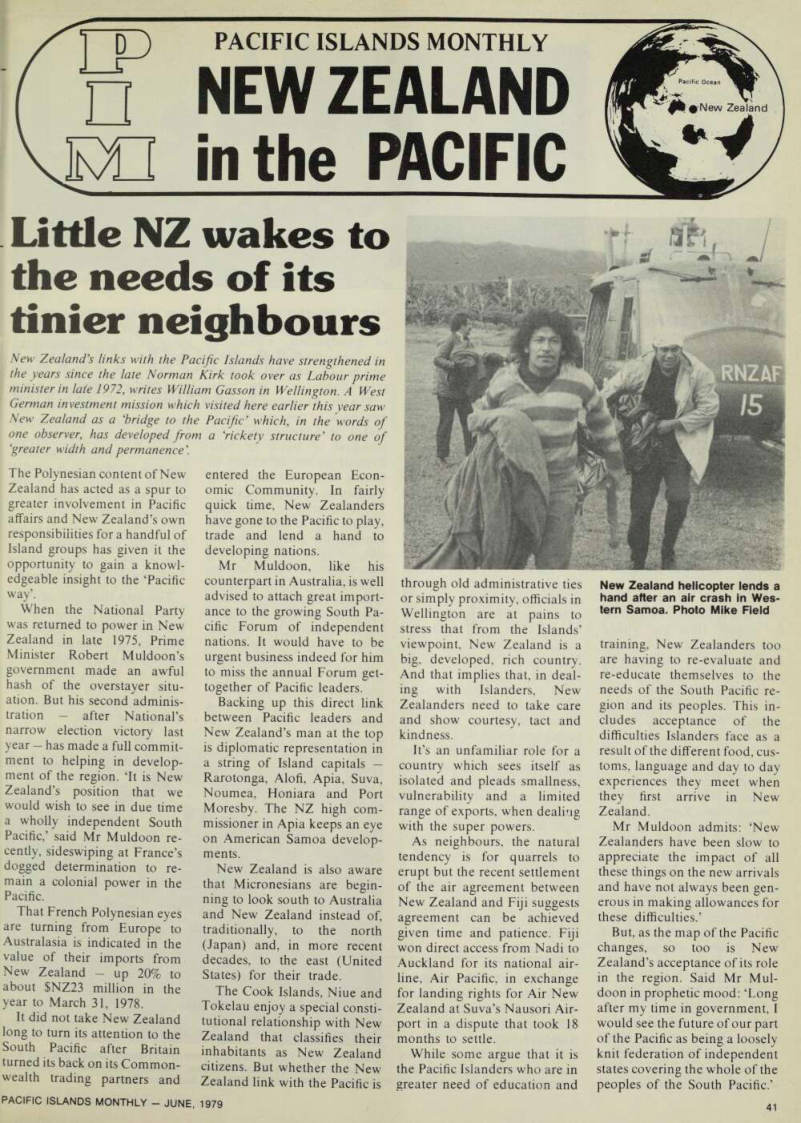
P I M
Pacific Islands Monthly
in the PACIFIC
Little NZ wakes to the needs of Its tinier neighbours
New Zealand's links with the Pacific Islands have strengthened in the years since the late Norman Kirk took over as Labour prime minister in late 1972, writes William Gasson in Wellington. A West German investment mission which visited here earlier this year saw New Zealand as a ‘ bridge to the Pacific ’ which, in the words of one observer, has developed from a ‘rickety structure ’ to one of ' greater width and permanence ’.
The Polynesian content of New Zealand has acted as a spur to greater involvement in Pacific affairs and New Zealand’s own responsibilities for a handful of Island groups has given it the opportunity to gain a knowl edgeable insight to the ‘Pacific
way’.
When the National Party was returned to power in New Zealand in late 1975, Prime Minister Robert Muldoon’s government made an awful hash of the overstayer situ ation. But his second adminis tration - after National’s narrow election victory last year - has made a full commit ment to helping in develop ment of the region. ‘lt is New Zealand’s position that we would wish to see in due time
a wholly independent South
Pacific,’ said Mr Muldoon re
cently, sideswiping at France’s
dogged determination to re main a colonial power in the Pacific.
That French Polynesian eyes are turning from Europe to Australasia is indicated in the value of their imports from New Zealand - up 20% to about SNZ23 million in the year to March 31, 1978.
It did not take New Zealand long to turn its attention to the South Pacific after Britain turned its back on its Common wealth trading partners and
entered the European Econ
omic Community. In fairly
quick time, New Zealanders have gone to the Pacific to play, trade and lend a hand to
developing nations.
Mr Muldoon, like his counterpart in Australia, is well advised to attach great import ance to the growing South Pa cific Forum of independent nations. It would have to be urgent business indeed for him to miss the annual Forum get together of Pacific leaders.
Backing up this direct link between Pacific leaders and New Zealand’s man at the top
is diplomatic representation in
a string of Island capitals
Rarotonga, Alofi, Apia, Suva,
Noumea, Honiara and Port Moresby. The NZ high com missioner in Apia keeps an eye on American Samoa develop ments.
New Zealand is also aware that Micronesians are begin ning to look south to Australia and New Zealand instead of, traditionally, to the north (Japan) and, in more recent decades, to the east (United States) for their trade.
The Cook Islands, Niue and Tokelau enjoy a special consti tutional relationship with New Zealand that classifies their inhabitants as New Zealand citizens. But whether the New Zealand link with the Pacific is
through old administrative ties or simply proximity, officials in Wellington are at pains to stress that from the Islands’ viewpoint. New Zealand is a
big, developed, rich country.
And that implies that, in deal ing with Islanders, New Zealanders need to take care and show courtesy, tact and kindness.
It’s an unfamiliar role for a country which sees itself as isolated and pleads smallness, vulnerability and a limited range of exports, when dealing with the super powers.
As neighbours, the natural tendency is for quarrels to erupt but the recent settlement of the air agreement between New Zealand and Fiji suggests agreement can be achieved
given time and patience. Fiji
won direct access from Nadi to Auckland for its national air line, Air Pacific, in exchange for landing rights for Air New Zealand at Suva’s Nausori Air port in a dispute that took 18 months to settle.
While some argue that it is the Pacific Islanders who are in greater need of education and
training, New Zealanders too are having to re-evaluate and re-educate themselves to the needs of the South Pacific re gion and its peoples. This in cludes acceptance of the difficulties Islanders face as a result of the different food, cus
toms, language and day to day
experiences they meet when
they first arrive in New Zealand.
Mr Muldoon admits: ‘New Zealanders have been slow to appreciate the impact of all these things on the new arrivals and have not always been gen erous in making allowances for these difficulties.’
But, as the map of the Pacific changes, so too is New Zealand’s acceptance of its role in the region. Said Mr Mul doon in prophetic mood: ‘Long after my time in government, I would see the future of our part of the Pacific as being a loosely knit federation of independent states covering the whole of the peoples of the South Pacific.’
New Zealand helicopter lends a hand after an air crash in Wes tern Samoa. Photo Mike Field
closing on
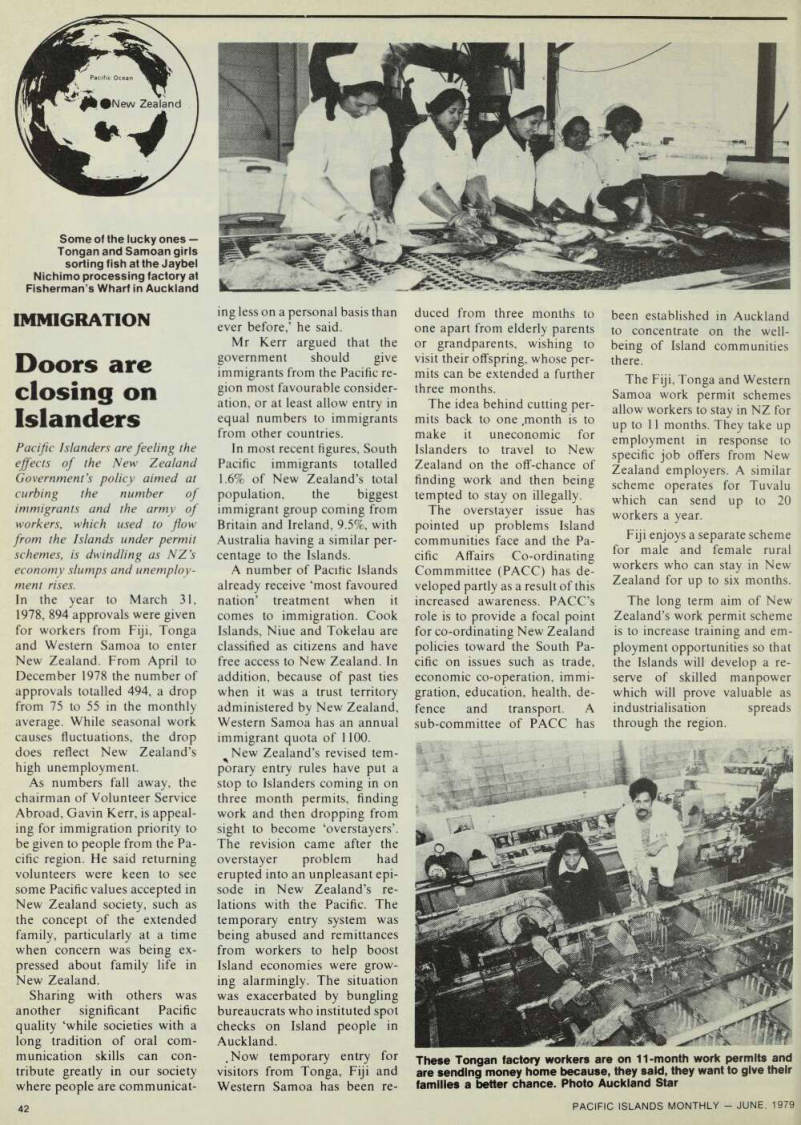
Immigration
Doors are closing on Islanders
Pacific Islanders are feeling the effects of the New Zealand Government’s policy aimed at
curbing the number of
immigrants and the army of workers, which used to flow from the Islands under permit schemes, is dwindling as NZ’s
economy slumps and unemploy
ment rises.
In the year to March 31, 1978, 894 approvals were given for workers from Fiji, Tonga and Western Samoa to enter New Zealand. From April to December 1978 the number of approvals totalled 494, a drop from 75 to 55 in the monthly average. While seasonal work causes fluctuations, the drop does reflect New Zealand’s
high unemployment.
As numbers fall away, the chairman of Volunteer Service Abroad, Gavin Kerr, is appeal
ing for immigration priority to
be given to people from the Pa cific region. He said returning volunteers were keen to see some Pacific values accepted in New Zealand society, such as the concept of the extended family, particularly at a time when concern was being ex pressed about family life in New Zealand.
Sharing with others was another significant Pacific quality ‘while societies with a long tradition of oral com munication skills can con tribute greatly in our society where people are communicat-
ing less on a personal basis than ever before,’ he said.
Mr Kerr argued that the government should give immigrants from the Pacific re gion most favourable consider ation, or at least allow entry in
equal numbers to immigrants
from other countries.
In most recent figures, South Pacific immigrants totalled 1.6% of New Zealand’s total
population, the biggest
immigrant group coming from
Britain and Ireland, 9.5%, with Australia having a similar per centage to the Islands.
A number of Pacific Islands already receive ‘most favoured nation’ treatment when it comes to immigration. Cook Islands, Niue and Tokelau are classified as citizens and have free access to New Zealand. In addition, because of past ties when it was a trust territory administered by New Zealand, Western Samoa has an annual immigrant quota of 1100.
Zealand’s revised tem porary entry rules have put a stop to Islanders coming in on
three month permits, finding
work and then dropping from
sight to become ‘overstayers’.
The revision came after the overstayer problem had
erupted into an unpleasant epi
sode in New Zealand’s re lations with the Pacific. The temporary entry system was being abused and remittances from workers to help boost Island economies were grow
ing alarmingly. The situation
was exacerbated by bungling
bureaucrats who instituted spot checks on Island people in Auckland. .Now temporary entry for visitors from Tonga, Fiji and Western Samoa has been re
duced from three months to one apart from elderly parents
or grandparents, wishing to
visit their offspring, whose per mits can be extended a further three months.
The idea behind cutting per mits back to one .month is to make it uneconomic for Islanders to travel to New Zealand on the off-chance of finding work and then being tempted to stay on illegally.
The overstayer issue has
pointed up problems Island
communities face and the Pa cific Affairs Co-ordinating Commmittee (PACC) has de veloped partly as a result of this increased awareness. PACC’s role is to provide a focal point for co-ordinating New Zealand policies toward the South Pa cific on issues such as trade, economic co-operation, immi gration, education, health, de fence and transport. A sub-committee of PACC has
been established in Auckland to concentrate on the well being of Island communities there.
The Fiji, Tonga and Western Samoa work permit schemes allow workers to stay in NZ for up to 11 months. They take up employment in response to specific job offers from New Zealand employers. A similar scheme operates for Tuvalu which can send up to 20 workers a year.
Fiji enjoys a separate scheme for male and female rural workers who can stay in New Zealand for up to six months.
The long term aim of New Zealand’s work permit scheme is to increase training and em
ployment opportunities so that
the Islands will develop a re serve of skilled manpower which will prove valuable as
industrialisation spreads
through the region.
Some of the lucky ones Tongan and Samoan girls sorting fish at the Jaybel Nichimo processing factory at Fisherman’s Wharf in Auckland
These Tongan factory workers are on 11-month work permits and are sending money home because, they said, they want to give their families a better chance. Photo Auckland Star
Worthwhile
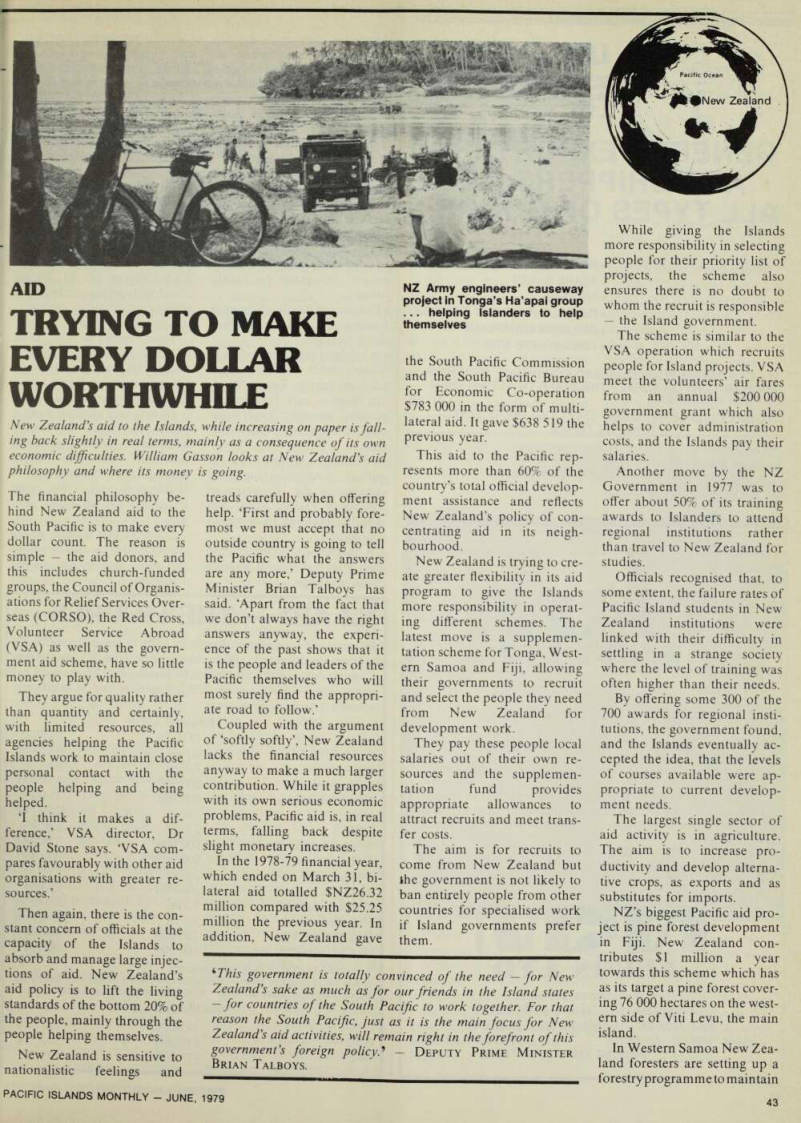
Aid
Trying To Make
Every Dollar
Worthwhile
New Zealand's aid to the Islands, while increasing on paper is fall ing back slightly in real terms, mainly as a consequence of its own economic difficulties. William Gasson looks at New Zealand's aid philosophy and where its money is going.
The financial philosophy be hind New Zealand aid to the South Pacific is to make every dollar count. The reason is simple the aid donors, and this includes church-funded groups, the Council of Organis ations for Relief Services Over seas (CORSO), the Red Cross, Volunteer Service Abroad (VSA) as well as the govern ment aid scheme, have so little money to play with.
They argue for quality rather than quantity and certainly, with limited resources, all agencies helping the Pacific Islands work to maintain close personal contact with the
people helping and being
helped.
T think it makes a dif ference,’ VSA director, Dr David Stone says. ‘VSA com pares favourably with other aid organisations with greater re sources.’
Then again, there is the con stant concern of officials at the capacity of the Islands to absorb and manage large injec tions of aid. New Zealand’s aid policy is to lift the living standards of the bottom 20% of the people, mainly through the people helping themselves.
New Zealand is sensitive to nationalistic feelings and
treads carefully when offering help. ‘First and probably fore most we must accept that no outside country is going to tell the Pacific what the answers are any more,’ Deputy Prime Minister Brian Talboys has said. ‘Apart from the fact that we don’t always have the right answers anyway, the experi ence of the past shows that it is the people and leaders of the Pacific themselves who will most surely find the appropri ate road to follow.’
Coupled with the argument of ‘softly softly’, New Zealand lacks the financial resources anyway to make a much larger contribution. While it grapples with its own serious economic problems, Pacific aid is, in real
terms, falling back despite
slight monetary increases.
In the 1978-79 financial year, which ended on March 31, bi lateral aid totalled $NZ26.32 million compared with $25.25 million the previous year. In addition, New Zealand gave
the South Pacific Commission and the South Pacific Bureau for Economic Co-operation $783 000 in the form of multi lateral aid. It gave $638 519 the
previous year.
This aid to the Pacific rep resents more than 60% of the
country’s total official develop
ment assistance and reflects New Zealand’s policy of con centrating aid in its neigh bourhood.
New Zealand is trying to cre ate greater flexibility in its aid program to give the Islands more responsibility in operat ing different schemes. The latest move is a supplemen tation scheme for Tonga, West ern Samoa and Fiji, allowing their governments to recruit and select the people they need from New Zealand for
development work.
They pay these people local salaries out of their own re sources and the supplemen tation fund provides appropriate allowances to attract recruits and meet trans fer costs.
The aim is for recruits to come from New Zealand but the government is not likely to ban entirely people from other countries for specialised work if Island governments prefer them.
‘This government is totally convinced of the need for New Zealand's sake as much as for our friends in the Island states for countries of the South Pacific to work together. For that reason the South Pacific, just as it is the main focus for New Zealand's aid activities, will remain right in the forefront of this government's foreign policy .’ Deputy Prime Minister Brian Talboys.
While giving the Islands
more responsibility in selecting
people for their priority list of projects, the scheme also ensures there is no doubt to whom the recruit is responsible the Island government.
The scheme is similar to the VS A operation which recruits people for Island projects. VSA meet the volunteers’ air fares from an annual $2OO 000 government grant which also helps to cover administration costs, and the Islands pay their salaries.
Another move by the NZ Government in 1977 was to offer about 50% of its training awards to Islanders to attend regional institutions rather than travel to New Zealand for studies.
Officials recognised that, to some extent, the failure rates of Pacific Island students in New Zealand institutions were linked with their difficulty in settling in a strange society where the level of training was often higher than their needs.
By offering some 300 of the 700 awards for regional insti tutions, the government found, and the Islands eventually ac cepted the idea, that the levels of courses available were ap
propriate to current develop
ment needs.
The largest single sector of aid activity is in agriculture.
The aim is to increase pro
ductivity and develop alterna
tive crops, as exports and as substitutes for imports.
NZ’s biggest Pacific aid pro
ject is pine forest development
in Fiji. New Zealand con tributes $1 million a year towards this scheme which has as its target a pine forest cover ing 76 000 hectares on the west ern side of Viti Levu, the main island.
In Western Samoa New Zea land foresters are setting up a forestry programme to maintain
NZ Army engineers’ causeway project In Tonga’s Ha’apai group ... helping Islanders to help themselves
supplies of timber to the big sawmill at Awau while in Tonga the world’s first portable coconut stem sawmill is providing the Island with building timber. At the same time, New Zealand has launched a modest afforest ation scheme in Tonga.
Other projects include; • Passionfruit development on Niue with a VSA horticul turalist. • VSA teachers at high schools in the outer Cook Islands. • A chain of vocational training centres throughout the Tuvalu islands. • Deepening Avatiu harbour in
Rarotonga and improving
shore facilities. • A medical registrar exchange scheme under which five regis trars are sent to Tonga, West ern Samoa and Fiji for six
months, allowing local regis
trars to train and study over seas. • $9OO 000 toward the $ 1 million kitchen/dining hall complex at the University of the South Pacific, Suva, and then the building of a hall of residence. • A mechanical service centre with a workshop and training block in Tonga.
• Establishment of sheep and bee keeping management centres in Papua New Guinea. • A 28-bed hospital for Tonga’s Ha’apai group of islands, population about 15,000. • Specialists for Solomon Islands’ fisheries venture. • Boat channels (by blasting) 33 in all through coral reefs in Western Samoa, Gilbert Islands and Tuvalu to improve access to offshore fishing
grounds.
There are more than 100 VSA officers in 10 Pacific countries working in medicine,
teaching, journalism, engineer
ing and agriculture.
Then there is aid from CORSO and church organis ations which, altogether, create a comprehensive fabric of as sistance for the Islands.
Having said all that, there is heard the voice of former Solomons chief minister, Solomon Mamaloni whose message some months ago in Wellington was: ‘We want trade, not aid, as equal part ners.’
It’s a cry that is likely to be come louder as aid develops the skills and output of the Islanders.
Advertisements & other items, p. 44 (1 item)
I\Rimi
ULLRICH
EXPORTS
LTD
GENERAL EXPORTERS
AND SHIPPERS OF
ALL TYPES OF GOODS.
CAN WE ASSIST YOU WITH • MACHINERY NEW AND USED
• SPARE PARTS
• ENGINES
• PIPING. TUBING AND FITTINGS
• BUILDING MATERIALS
• FOODSTUFFS ETC.
WE CAN REPAIR YOUR DAMAGED EQUIPMENT, OVERHAUL YOUR MOTORS OR SUPPLY THE STAFF TO REPAIR THEM
IN YOUR WORKSHOP.
WE SPECIALISE IN “SAME DAY ” DELIVERY FOR
URGENT ITEMS.
CONTACT US AT.
ULLRICH EXPORTS LTD
P.O. BOX 22305 OTAHUHU, AUCKLAND, NEW ZEALAND
TELEPHONE OTAHUHU 63997
CABLE ULLEXCO TELEX NZ2572.
I\RIMI
FEEDS LTD
Exporters to the Pacific
NRM manufactures a complete range of animal feeds and
concentrates, including:
Poultry layer, broiler, duck, turkey, pigeon pig horse dairy fish.
NRM Group is the largest feed milling organisation in New Zealand and has established a high reputation for quality and service in New Zealand and the Pacific. Our export range is: • formulated for tropical conditions • fortified with vitamins and trace minerals • medicated on request.
I\RIMI
FEEDS LTD
For further information, contact The Manager, NRM Feeds Ltd, P.O. Box 20, Auckland, New Zealand Cables: “MillroU”, Auckland. Telephone: 33 119.
Telex: NZ 21671 (NRM FEED)
NZ AID THE FIGURES
Bilateral aid to the South Pacific in 1978-79 totalled $NZ26.32 million, multilateral aid to institutions (the South Pacific Commission and the South Pacific Bureau For Economic Cooperation) $783 000 against $25,258 million and $638 500 re-
spectively the previous year.
The Islands
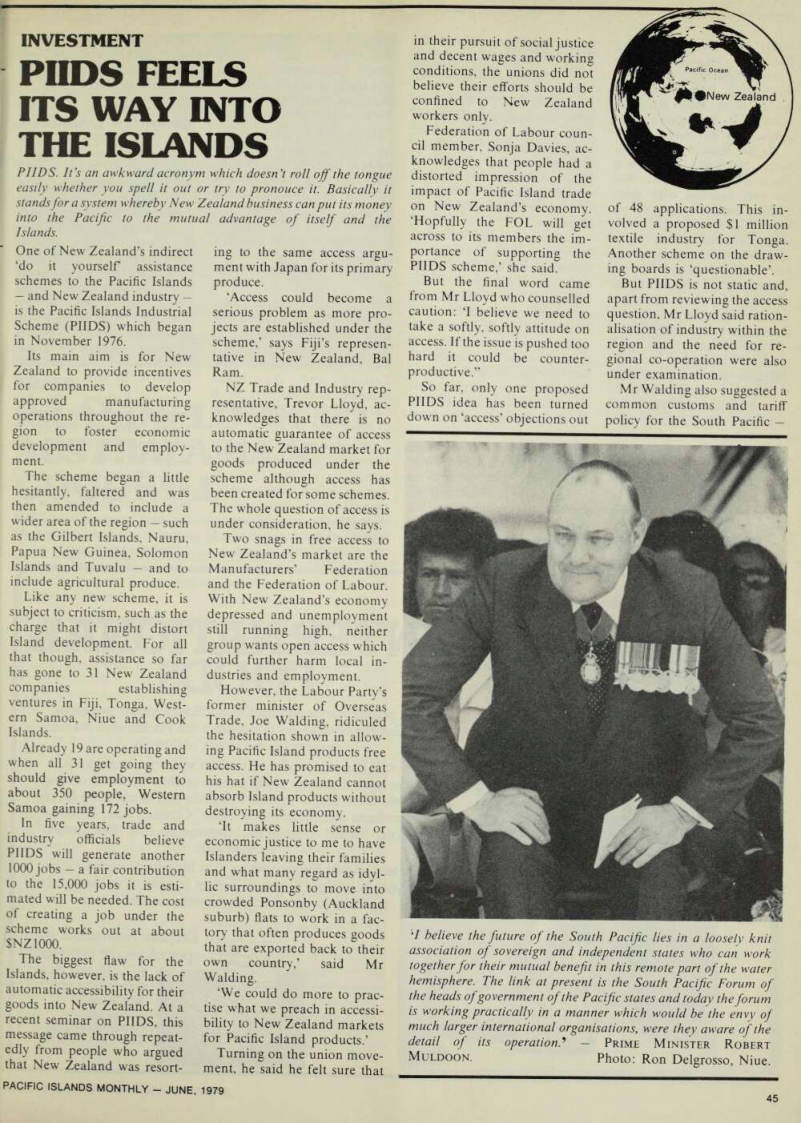

Investment
Phds Feels
Its Way Into
The Islands
PIIDS. It’s an awkward acronym which doesn’t roll off the tongue easily whether you spell it out or try to pronouce it. Basically it stands for a system whereby New Zealand business can put its money into the Pacific to the mutual advantage of itself and the Islands.
One of New Zealand’s indirect ‘do it yourself assistance schemes to the Pacific Islands and New Zealand industry is the Pacific Islands Industrial Scheme (PUDS) which began in November 1976.
Its main aim is for New Zealand to provide incentives for companies to develop
approved manufacturing
operations throughout the re gion to foster economic development and employ ment.
The scheme began a little hesitantly, faltered and was then amended to include a wider area of the region such as the Gilbert Islands, Nauru, Papua New Guinea, Solomon Islands and Tuvalu and to include agricultural produce.
Like any new scheme, it is subject to criticism, such as the charge that it might distort Island development. For all that though, assistance so far has gone to 31 New Zealand
companies establishing
ventures in Fiji, Tonga, West ern Samoa, Niue and Cook Islands.
Already 19 are operating and when all 31 get going they
should give employment to
about 350 people, Western
Samoa gaining 172 jobs.
In five years, trade and industry officials believe PUDS will generate another 1000 jobs a fair contribution to the 15,000 jobs it is esti mated will be needed. The cost of creating a job under the scheme works out at about
Snziooo.
The biggest flaw for the Islands, however, is the lack of automatic accessibility for their goods into New Zealand. At a recent seminar on PUDS, this message came through repeat edly from people who argued that New Zealand was resort
ing to the same access argu ment with Japan for its primary
produce.
‘Access could become a serious problem as more pro jects are established under the scheme,’ says Fiji’s represen tative in New Zealand, Bal Ram.
NZ Trade and Industry rep resentative, Trevor Lloyd, ac knowledges that there is no automatic guarantee of access to the New Zealand market for
goods produced under the
scheme although access has been created for some schemes.
The whole question of access is under consideration, he says.
Two snags in free access to New Zealand’s market are the Manufacturers’ Federation and the Federation of Labour.
With New Zealand’s economy
depressed and unemployment
still running high, neither
group wants open access which could further harm local in dustries and employment.
However, the Labour Party’s former minister of Overseas Trade, Joe Walding, ridiculed the hesitation shown in allow ing Pacific Island products free access. He has promised to eat his hat if New Zealand cannot absorb Island products without destroying its economy. ‘lt makes little sense or economic justice to me to have Islanders leaving their families and what many regard as idyl lic surroundings to move into crowded Ponsonby (Auckland suburb) flats to work in a fac tory that often produces goods that are exported back to their own country,’ said Mr
Walding.
‘We could do more to prac tise what we preach in accessi bility to New Zealand markets for Pacific Island products.’
Turning on the union move ment, he said he felt sure that
in their pursuit of social justice and decent wages and working conditions, the unions did not believe their efforts should be confined to New Zealand
workers only.
Federation of Labour coun cil member, Sonja Davies, ac knowledges that people had a distorted impression of the impact of Pacific Island trade on New Zealand’s economy. ‘Hopfully the FOL will get across to its members the im portance of supporting the PUDS scheme,’ she said.
But the final word came from Mr Lloyd who counselled caution: ‘I believe we need to take a softly, softly attitude on access. If the issue is pushed too hard it could be counter productive.”
So far, only one proposed PUDS idea has been turned down on ‘access’ objections out
of 48 applications. This in volved a proposed $1 million
textile industry for Tonga.
Another scheme on the draw ing boards is ‘questionable’.
But PUDS is not static and, apart from reviewing the access question, Mr Lloyd said ration alisation of industry within the region and the need for re gional co-operation were also under examination.
Mr Walding also suggested a common customs and tariff policy for the South Pacific -
'I believe the future of the South Pacific lies in a loosely knit association of sovereign and independent states who can work together for their mutual benefit in this remote part of the water hemisphere. The link at present is the South Pacific Forum of the heads of government of the Pacific states and today the forum is working practically in a manner which would be the envy of much larger international organisations, were they aware of the detail of its operation .’- PRIME MINISTER ROBERT MULDOON. Photo: Ron Delgrosso, Niue.
similar to that used by European Economic Com
munity members. Progress on
developing such a scheme should come from the June meeting of the region’s trade ministers in Rarotonga.
Mr Bal Ram, a PUDS sup porter, pointing to the jobs it has created in Fiji, said: ‘We are very satisfied with them and the objectives they set up have been achieved. We choose what schemes we want and we do not hesitate to say “no” if they are not in the interests of the country and its economy.’ He would like to see PUDS expanded to include
more agricultural projects.
Western Samoa high com mission official, A. F.
Toleafoa, was more cautious, believing it was too early to pass judgment on PUDS. He said there was a need to eval uate the number of companies
opened, the employment
opportunities they produced
and the value of exports. One bag making company so far
employed only five people
when it had promised to em ploy 35, he said.
Comments of businessmen
operating in the Pacific under PUDS are worth noting.
Managing director of Mortco Holdings Ltd, Auckland, N. P. Mortimer, says: ‘The operation should be fairly small, self-contained, labour intensified and, most definitely, not always tied to
large manufacturing, rather
distant impersonal companies
from either New Zealand or elsewhere. ‘lt is essential that the Pacific Island people have a stake in the companies which are set up and that they prove their
willingness to participate by
contributing some capital. This
is always my first criterion.
After capital is contributed to a local venture then aid should
be requested. But only then ...
People do not want unecon omic schemes which don’t do anything for the participants or the area in which they are based. They do require sound industrial development which will benefit both the area in which it is established and the people who contribute the
capital by producing them a
profit.’
Training Pacific Islanders in
New Zealand for the schemes is an important spin-off and a
point emphasised by the
managing director of F. C.
Matthews and Sons Ltd of Auckland, G. H. Matthews.
He set up a scheme in Tonga
for manufacturing 32-panel
leather laceless soccer balls which are reimported to New
Zealand to replace existing
imports. The balls are not made in New Zealand because the product is labour intensive and, under New Zealand standards, would be unecon omic.
Mr Matthews said the Tonga company is financed 60-40% with Tonga holding the smaller share. Four Tongans were trained as supervisors in New Zealand and the Island company now employs 36. It has a waiting list for vacancies of more than 80. ‘We consider that the type of industry to be established there should be initially those in dustries which largely utilise manual skills and are not
dependent upon highly sophis
ticated technological equip
ment,’ Mr Matthews said.
He urged labour intensive industries, access to the New Zealand market ‘particularly during development years!
The president of the Manufacturers’ Association, Fred Turnovsky, asked a businessman’s list of questions; Am I going to find a trained and educated work force there with management skills? Is there likely to be long term
development potential? Will
there be third market outlets to Australia and the United States or Europe? Does it make sense to put our investment in the Pacific Islands and not, say, Singapore? What taxation con cessions are there? ‘Eventually of course you want the indus tries run by, and for, the Islanders,’ he said.
Frank Brugger, who has opened a company in Western Samoa, addressed himself to the Islands: ‘lf you want us, okay, we’ll come. If you don’t, okay, say so and we won’t come.’ The point he was mak ing, said Mr Brugger, was that the final sucess of any PUDS venture rested with the Islanders themselves.
Advertisements & other items, p. 46 (1 item)
International
FOODS
As part of the Spedding Consolidated group, we have regular representation throughout the Pacific and we can You'll like our products, and so will your customers.
Supermarket proven performance in New Zealand means that we have bright attractive labels and packaging for all our products including:- 'Top Cook" Cooking oils, "Sundew cordials, "Horst" cordials and detergents, and "Sea Casket At International Foods, we go that little bit further to make make you part of our call cycle. canned fish. sure your goods get to you in perfect condition, to the point of packing our products in export wooden crates.
Enquire Now about our
special export price list.
International Foods, P.O. Box 21-123,
AUCKLAND.
Phone No.
Henderson 63189 Telex No. NZ 2994
Australasia’S
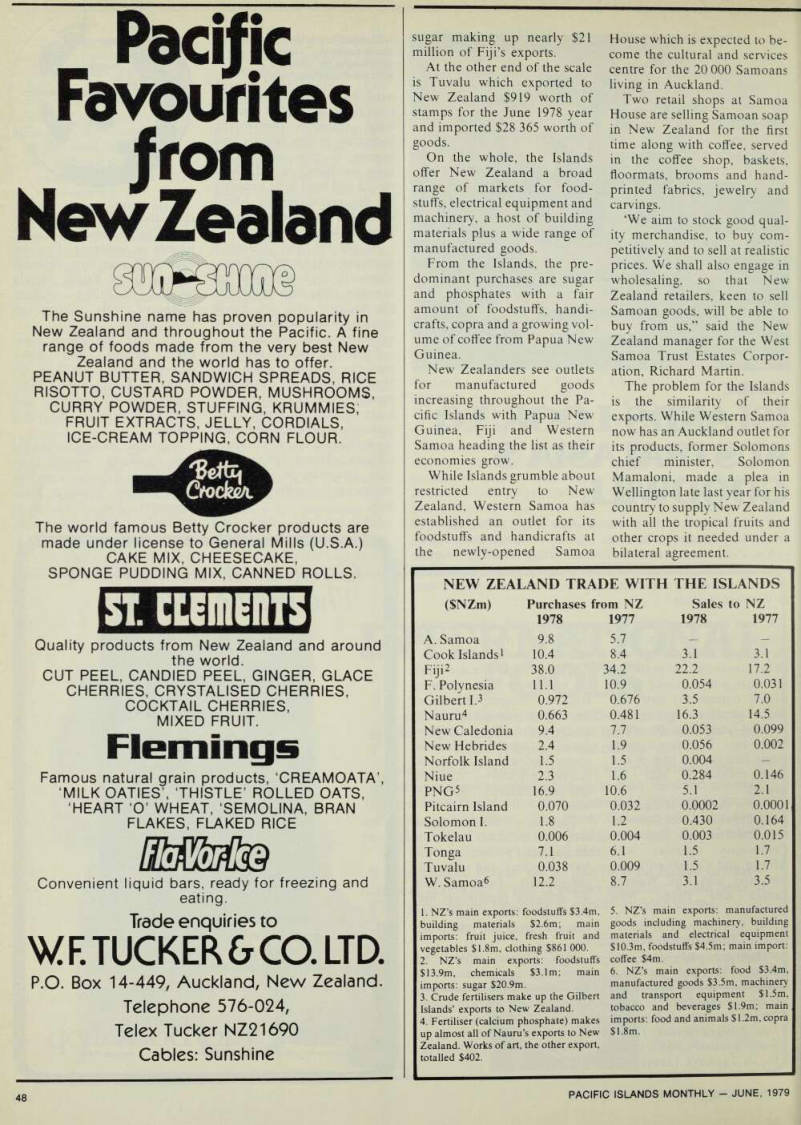
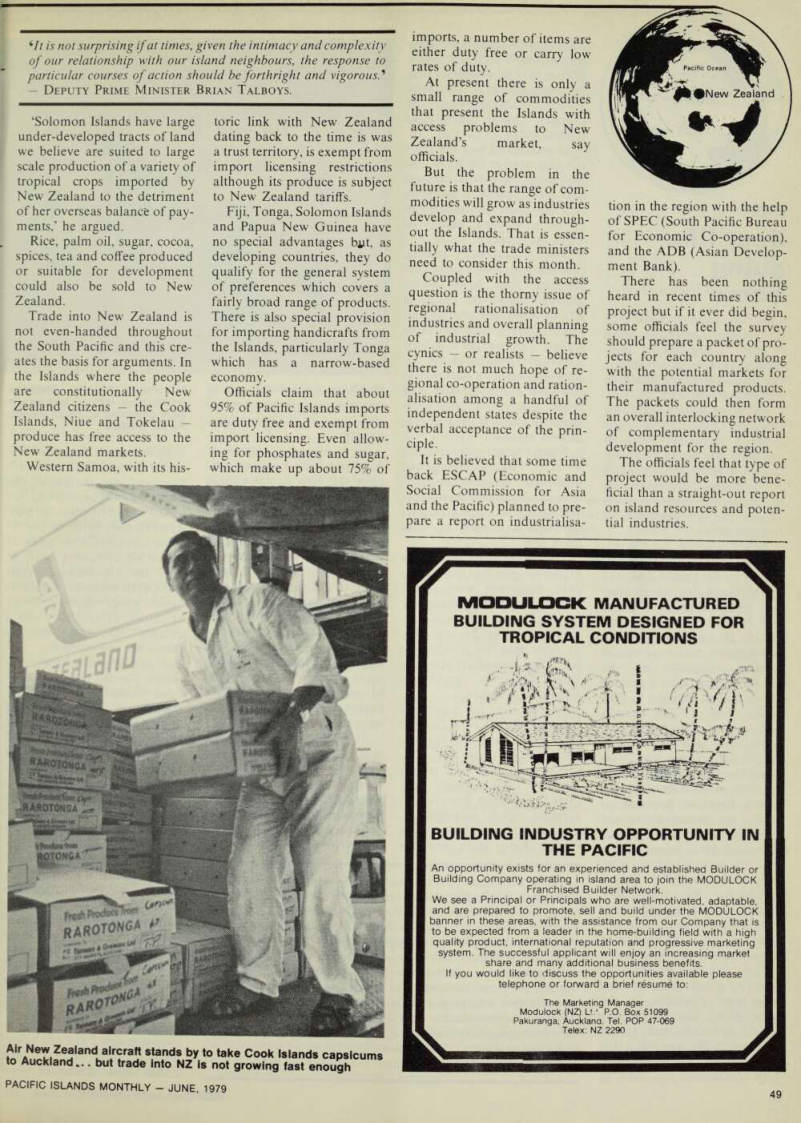
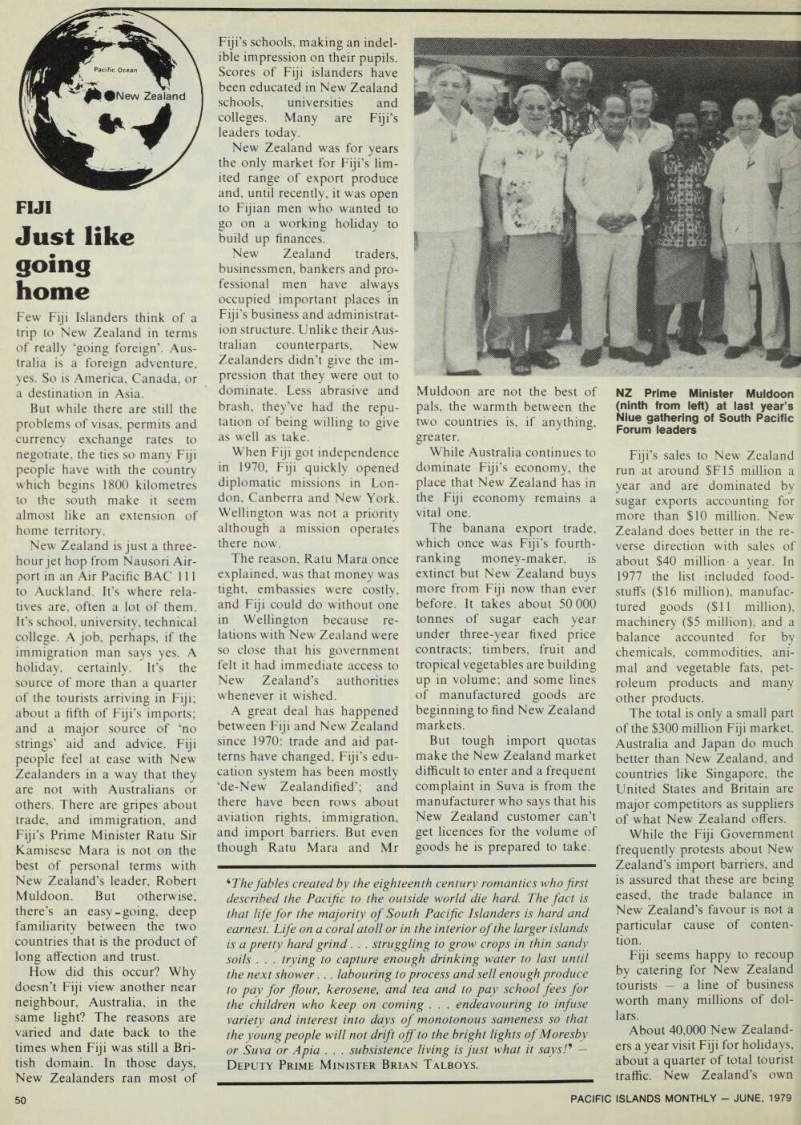
Trade
Islands Look To
Goodwill
The future pattern of South Pacific trade hinges on the degree of accessibility for the Islands to the two major markets in the region New Zealand and Australia. Islands nations should find out this month just how far these two countries are prepared to go along the road to accepting unrestricted imports when trade ministers meet in the Cook Islands.
The basic recommendation be fore the trade ministers when they gather in Rarotonga will be for non-reciprocal preferen tial trade which would allow Islands unrestricted entry for their produce into New Zealand and Australia while these two countries’ goods would face normal import and tariff restrictions into the Islands.
This is the type of arrange ment, under the Lome Conven tion, the European Economic Community operates with African and Caribbean coun tries and with Fiji, Western Samoa and Papua New Guinea.
The Commonwealth Secre tariat in a report on industrial development and trade re lations in May last year saw a
non-reciprocal scheme as an important step in South Pacific economic co-operation.
The overriding factor which we emphasise is the growing economic interdependence of the region and the pressures which are building up from outside to establish improved access provisions to the two de veloped markets Australia and New Zealand,’ the report said.
The fate of the non reciprocal scheme hinges on the degree of political goodwill New Zealand and Australia can generate - bearing in mind
the domestic grumblings they
encounter from their own manufacturing and labour sec tors.
New Zealand officials be lieve any agreement would
6 / am convinced that the best contribution we can make to South Pacific development lies in the provision of freer access to the New Zealand market. This will almost certainly call for us to make adjustments here at home. 9 Deputy Prime Minister Brian Talboys. (September 1977).
need built-in safeguards and conditions to protect against third countries developing industries in the Islands and
hoping to gain unrestricted
entry into New Zealand. There would also need to be a control on the percentage of Island content in products exported to New Zealand.
At present New Zealand’s unemployment runs uncharac teristically high and there are sensitive areas such as the tex tile industry and hot house tomato growers to pacify in any unlimited access scheme.
From the Islands’ point of view the growth of trade into New Zealand is not nearly fast enough. New Zealand has the same trouble with Japan for its agricultural products and while the politicians and government officials acknowledge the par allel, businessmen and trade unions are less willing to admit to it.
On top of that, the
imbalance in the trade between New Zealand and the Pacific Islands is widening. For the June 1978 year New Zealand exports to the Pacific Islands totalled SNZ 124.6 million
compared with imports of
$55.7 million.
For 1977, the figures were $99.8 million and $49.7 million; 1976 $72.7 million and $41.8 million; 1975 $58.1 million and $37.3 million; and 1974 $47.9 million and $16.8 million.
Top of the trading list is Fiji.
New Zealand exports $3B million and imports from Fiji $22.2 million. Trade in both directions has more than doubled in four years, with
NZ-aided Tokomololo coconut trunk sawmill... special provisions for Tonga’s narrow-based economy
sugar making up nearly $2l million of Fiji’s exports.
At the other end of the scale is Tuvalu which exported to New Zealand $919 worth of stamps for the June 1978 year and imported $2B 365 worth of goods.
On the whole, the Islands offer New Zealand a broad range of markets for food stuffs, electrical equipment and machinery, a host of building materials plus a wide range of
manufactured goods.
From the Islands, the pre dominant purchases are sugar and phosphates with a fair amount of foodstuffs, handi crafts, copra and a growing vol ume of coffee from Papua New Guinea.
New Zealanders see outlets for manufactured goods
increasing throughout the Pa
cific Islands with Papua New Guinea, Fiji and Western Samoa heading the list as their economies grow.
While Islands grumble about restricted entry to New Zealand, Western Samoa has established an outlet for its foodstuffs and handicrafts at the newly-opened Samoa
House which is expected to be come the cultural and services centre for the 20 000 Samoans living in Auckland.
Two retail shops at Samoa House are selling Samoan soap in New Zealand for the first time along with coffee, served in the coffee shop, baskets, floormats, brooms and hand
printed fabrics, jewelry and
carvings.
‘We aim to stock good qual ity merchandise, to buy com petitively and to sell at realistic prices. We shall also engage in wholesaling, so that New Zealand retailers, keen to sell Samoan goods, will be able to buy from us,” said the New Zealand manager for the West Samoa Trust Estates Corpor ation, Richard Martin.
The problem for the Islands is the similarity of their exports. While Western Samoa now has an Auckland outlet for its products, former Solomons chief minister, Solomon Mamaloni, made a plea in Wellington late last year for his country to supply New Zealand with all the tropical fruits and other crops it needed under a bilateral agreement.
6 // is not surprising if at times, given the intimacy and complexity of our relationship with our island neighbours, the response to particular courses of action should be forthright and vigorous Deputy Prime Minister Brian Talboys.
‘Solomon Islands have large under-developed tracts of land we believe are suited to large scale production of a variety of
tropical crops imported by
New Zealand to the detriment of her overseas balance of pay ments,’ he argued.
Rice, palm oil, sugar, cocoa, spices, tea and coffee produced or suitable for development could also be sold to New Zealand.
Trade into New Zealand is not even-handed throughout the South Pacific and this cre ates the basis for arguments. In the Islands where the people are constitutionally New Zealand citizens the Cook Islands, Niue and Tokelau produce has free access to the New Zealand markets.
Western Samoa, with its his
toric link with New Zealand dating back to the time is was a trust territory, is exempt from
import licensing restrictions
although its produce is subject to New Zealand tariffs.
Fiji, Tonga, Solomon Islands
and Papua New Guinea have no special advantages b±it, as developing countries, they do qualify for the general system of preferences which covers a fairly broad range of products.
There is also special provision for importing handicrafts from the Islands, particularly Tonga which has a narrow-based economy.
Officials claim that about 95% of Pacific Islands imports are duty free and exempt from import licensing. Even allow ing for phosphates and sugar, which make up about 75% of
imports, a number of items are either duty free or carry low rates of duty.
At present there is only a small range of commodities that present the Islands with access problems to New Zealand’s market, say officials.
But the problem in the future is that the range of com modities will grow as industries
develop and expand through
out the Islands. That is essen tially what the trade ministers need to consider this month.
Coupled with the access question is the thorny issue of regional rationalisation of industries and overall planning of industrial growth. The cynics or realists believe there is not much hope of re gional co-operation and ration alisation among a handful of
independent states despite the
verbal acceptance of the prin
ciple.
It is believed that some time back ESCAP (Economic and Social Commission for Asia and the Pacific) planned to pre pare a report on industrialisa-
tion in the region with the help of SPEC (South Pacific Bureau for Economic Co-operation), and the ADB (Asian Develop ment Bank).
There has been nothing heard in recent times of this project but if it ever did begin, some officials feel the survey should prepare a packet of pro jects for each country along with the potential markets for their manufactured products.
The packets could then form an overall interlocking network of complementary industrial development for the region.
The officials feel that type of project would be more bene ficial than a straight-out report on island resources and poten tial industries.
Air New Zealand aircraft stands by to take Cook Islands capsicums to Auckland... but trade into NZ is not growing fast enough
Fiji
Just like
going
home
Few Fiji Islanders think of a trip to New Zealand in terms
of really ‘going foreign’. Aus
tralia is a foreign adventure, yes. So is America, Canada, or a destination in Asia.
But while there are still the problems of visas, permits and currency exchange rates to negotiate, the ties so many Fiji people have with the country which begins 1800 kilometres to the south make it seem almost like an extension of
home territory.
New Zealand is just a three hour jet hop from Nausori Air port in an Air Pacific BAC 111 to Auckland. It’s where rela tives are, often a lot of them.
It’s school, university, technical
college. A job, perhaps, if the
immigration man says yes. A
holiday, certainly. It’s the
source of more than a quarter of the tourists arriving in Fiji; about a fifth of Fiji’s imports; and a major source of ‘no strings’ aid and advice. Fiji people feel at ease with New Zealanders in a way that they are not with Australians or others. There are gripes about trade, and immigration, and Fiji’s Prime Minister Ratu Sir Kamisese Mara is not on the best of personal terms with New Zealand’s leader, Robert Muldoon. But otherwise,
there’s an easy-going, deep
familiarity between the two countries that is the product of long affection and trust.
How did this occur? Why doesn’t Fiji view another near neighbour, Australia, in the same light? The reasons are varied and date back to the times when Fiji was still a Bri tish domain. In those days, New Zealanders ran most of
Fiji’s schools, making an indel ible impression on their pupils.
Scores of Fiji islanders have been educated in New Zealand schools, universities and
colleges. Many are Fiji’s
leaders today.
New Zealand was for years the only market for Fiji’s lim ited range of export produce and, until recently, it was open to Fijian men who wanted to go on a working holiday to build up finances.
New Zealand traders, businessmen, bankers and pro fessional men have always
occupied important places in
Fiji’s business and administrat ion structure. Unlike their Aus tralian counterparts. New Zealanders didn’t give the im pression that they were out to dominate. Less abrasive and brash, they’ve had the repu
tation of being willing to give
as well as take.
When Fiji got independence
in 1970, Fiji quickly opened
diplomatic missions in Lon don, Canberra and New York.
Wellington was not a priority although a mission operates there now.
The reason, Ratu Mara once explained, was that money was
tight, embassies were costly,
and Fiji could do without one in Wellington because re lations with New Zealand were so close that his government felt it had immediate access to New Zealand’s authorities whenever it wished.
A great deal has happened between Fiji and New Zealand since 1970: trade and aid pat terns have changed, Fiji’s edu cation system has been mostly ‘de-New Zealandified’; and there have been rows about
aviation rights, immigration,
and import barriers. But even though Ratu Mara and Mr
Muldoon are not the best of pals, the warmth between the two countries is, if anything, greater.
While Australia continues to dominate Fiji’s economy, the place that New Zealand has in the Fiji economy remains a vital one.
The banana export trade, which once was Fiji’s fourth
ranking money-maker, is
extinct but New Zealand buys more from Fiji now than ever before. It takes about 50 000 tonnes of sugar each year
under three-year fixed price
contracts; timbers, fruit and
tropical vegetables are building
up in volume; and some lines of manufactured goods are beginning to find New Zealand markets.
But tough import quotas
make the New Zealand market difficult to enter and a frequent complaint in Suva is from the manufacturer who says that his New Zealand customer can’t get licences for the volume of goods he is prepared to take.
6 The fables created by the eighteenth century romantics who first described the Pacific to the outside world die hard. The fact is that life for the majority of South Pacific Islanders is hard and earnest. Life on a coral atoll or in the interior of the larger islands is a pretty hard grind. . . struggling to grow crops in thin sandy soils . . . trying to capture enough drinking water to last until the next shower. .. labouring to process and sell enough produce to pay for flour, kerosene, and tea and to pay school fees for the children who keep on coming . . . endeavouring to infuse variety and interest into days of monotonous sameness so that the young people will not drift off to the bright lights of Moresby or Suva or Apia . . . subsistence living is just what it says! 9 Deputy Prime Minister Brian Talboys.
Fiji’s sales to New Zealand run at around SFIS million a year and are dominated by sugar exports accounting for more than $lO million. New Zealand does better in the re verse direction with sales of about $4O million-a year. In 1977 the list included food stuffs ($l6 million), manufac tured goods ($ll million), machinery ($5 million), and a balance accounted for by chemicals, commodities, ani mal and vegetable fats, pet roleum products and many
other products.
The total is only a small part of the $3OO million Fiji market.
Australia and Japan do much better than New Zealand, and countries like Singapore, the United States and Britain are
major competitors as suppliers
of what New Zealand offers.
While the Fiji Government frequently protests about New Zealand’s import barriers, and is assured that these are being eased, the trade balance in New Zealand’s favour is not a particular cause of conten tion.
Fiji seems happy to recoup by catering for New Zealand tourists a line of business worth many millions of dol lars.
About 40,000 New Zealand ers a year visit Fiji for holidays, about a quarter of total tourist traffic. New Zealand’s own
NZ Prime Minister Muldoon (ninth from left) at last year’s Niue gathering of South Pacific Forum leaders
economic troubles have led to a slight decline of late, but, says the Fiji Visitors Bureau, New Zealand is likely to stay as the second source of visitors, after Australia, for as far ahead as can be seen.
The flow of passenger traffic between the two countries is almost all by air. Controversy,
finally resolved by negotiation
in April, over who should be carrying it caused one of the most protracted and angry dis putes so far experienced in Fiji- New Zealand relations.
After years of having a vir tual monopoly of the Auckland-Nadi route, Air New Zealand, with its big wide bodied DC 10 and smaller DCS jets, found itself being chal lenged by the much smaller BAC 11 Is of the Fiji controlled airline. Air Pacific.
Fiji said it was entitled to carry half the 70 000 passengers moving between the two coun tries annually and pressed for
New Zealand landing rights
that would let it compete against Air New Zealand.
The New Zealand airline
naturally resisted, not wanting
to give $35 million worth of business away. More than 18 months of haggling ended in an agreement in April under which, from the middle of this year? Air Pacific will be making daily flights to Auckland and will be able to add Wellington or Christchurch to its desti nation list when it gets bigger
jets.
Air New Zealand has had to
partly curtail its Fiji service by
operating some flights with the small Boeing 737 instead of the big DC 10 but now has the right to fly 737 s to Nausori Airport, which serves Suva, as well as to Nadi.
If aviation relations have changed, so have shipping links between Suva and Auckland.
Once dominated by the New Zealand-owned Union Steam Ship Company, this is now a much more diversifed scene.
The Union company, which used to run several cargo ships to Fiji, is represented now by one large roll-on roll-off con tainer vessel operating a fort nightly service. It shares cargo with one Fiji-managed rival plus the South Pacific Forum Line and several small oper ators.
New Zealand investment in Fiji has never been as obviously visible as the Aus tralian presence, partly because New Zealand entrepreneurs have not been as vigorous as their Australian counterparts.
New Zealand banking, insurance and other financial and commercial representation have been the main areas of business involvement and are links which, in some cases, are a century or more old.
Fiji’s desire for manufactur ing ventures that will produce goods to replace imports and add to the range of local exports promises to draw New Zealand capital into areas that have scarcely seen it.
Investment incentives
offered by Fiji, coupled with a
New Zealand Government scheme to encourage New Zealand manufacturers to establish themselves in the Pa cific Islands in joint ventures with local partners, have in the past 12 months aroused defi nite New Zealand interest in several Fiji projects. Most are in the food processing field but light industrial schemes also are in the offing.
Possibly the most successful of New Zealand newcomers is the Trans Holdings Ltd group of Christchurch. Working
through a local public
company, established by it to
bring in Fiji equity, Trans
Holdings has built up a chain of hotels and an internat ionally-based tour operation and has branched out into farming in a style tailored to meet official policies that invite the foreign investor to give locals a meaningful stake and say in the business.
Another form of New
6 lt Is important constantly to remind ourselves that in this region we are a metropolitan power.' Deputy Prime Minister Brian Talboys.
Zealand investment in Fiji is one that has evolved since independence. It’s the New Zealand aid program, now run ning at a level of about $5 million a year. While Fiji gets
foreign aid in significant lumps
from half a dozen other sources, the New Zealand pro gramme is unique. It’s the only one that is not tied to con ditions which tend to make re cipient countries champ at the bit.
Mounting steadily in vol
ume, it is being used to fund some of Fiji’s most important
land development projects and
comes not just as cash but as technical advice and assist ance.
Pine forest, beef, dairy, fish ing, crop and rural road schemes, that will begin to transform the whole Fiji econ omy from the 1980 s on, owe much of the success they seem to be heading for to New Zealand support. New Zealand took a lead when it honoured a United Nations resolution on
aid in February by cancelling
a SI million debt for a highway scheme.
Political relations between Suva and Wellington were strengthened this year when, for the first time, top civil ser vants met for what is planned to be an annual conference to discuss specific points of dif ference and for a general pow wow on anything anyone wants to air his mind on.
Fiji has pragmatically
accepted the fact that New Zealand’s serious internal economic problems make it impossible to admit an unre strained volume of ‘working holiday-makers’ as it once did.
For several years the two coun tries have had an amicable ar
rangement under which several hundred Fiji Islanders are an nually admitted for short spells as farm workers.
While Ratu Sir Kamisese Mara likes to boast that Fiji is one of the few truly ‘unaligned’ countries, with no military al liances with anyone, his government happily admits New Zealand troops for jungle warfare exercises with Fiji’s own small army several times a year. And when the need arises, Fiji knows it can whistle up RNZAF helicopters and maritime search planes to help in emergencies, as was the case when Hurricane Meli blasted several small islands in March.
In an era when big powers have turned their cultures into weapons of psychological war fare, such exchanges between New Zealand and Fiji remain almost entirely muted. Radio New Zealand comes in loud and clear for those who want to hear it in Suva, and the New Zealand Herald or Auckland Star you may find yourself scanning in the city may be only a couple of days old. If a
Maori concert party wants to do the Fiji round, it does so ■ under its own steam, and will be welcomed.
For its part, the Fiji Visitors Bureau stokes up a trip to Auckland or Christchurch every couple of years by the Fiji police or army band in the cause of drumming up more New Zealand tourists.
In Suva, unlike several other missions, the New Zealand High Commission doesn’t bother to equip itself with full time cultural or information attaches. Perhaps it is thanks to the presence of several gener ations of New Zealand school masters in the local education system that it doesn’t feel it has such a need.
If there’s one common de nominator, its rugby union. Fiji hasn’t yet managed to murder the All Blacks in the style it would like to, ‘but one day,’ promise its coaches, ‘we will’.
Robert Keith-Reid.
New Caledonia
Cagous head
south for
hospitality
‘Cagous love Kiwis’ was the
slogan generously displayed on
motor cars in New Caledonia two or three years ago. Bruno Tabuteau, director of Noumea’s Office of Tourism, had chosen this method of announcing to New Zealand visitors just how welcome they were. It was a love affair be tween two national birds. Per haps the welcome was not always evident as a New Zealander in Noumea is just another poken, a word the lo cals use to describe the Anglo- Saxon visitors.
The Cagous do love the Kiwis. Many New Caledonians migrate to New Zealand, either for winter or summer holidays.
But very few birds seem to migrate in the other direction, probably because of the com paratively high cost of a nest in Noumea. If New Caledonians fly to Australia for business or
medical reasons, they choose
New Zealand for a quiet holi day. They will warn you that a holiday in New Zealand will be very quiet, the food is poor,
shopping of little interest, but the countryside beautiful,
hotels reasonably cheap and
the people very hospitable. For a citizen of New Caledonia, a flat in Double Bay or Potts Point, Sydney, is an invest ment, a cottage in Queenstown a place of rest.
Although few New Caledonians travel very far over the vast Australian con tinent, they are extremely mo bile in New Zealand, visiting both islands by plane, train or self-drive hire cars. The French Airline UTA does much more promotion for New Zealand than Australia, and the New Zealanders do their bit, too.
Australia as a country, and its individual citizens, do little to encourage overseas visitors.
If the Kings Cross shop keeper in Sydney rubs his hands and. jacks up his prices when the first planeloads of New Caledonian visitors arrive in December, the New Zealanders do not. They have a reputation of being more interested in the visitor himself than in the contents of his wallet. Thus, if the Frenchman is the pigeon in Sydney, he has
a superiority complex in
Auckland. In New Zealand he has the reputation of being wealthy, well-dressed and cul tivated.
If New Caledonians have a jealous admiration for the enormous continent, with its mineral and agricultural wealth, they feel happier in New Zealand where they feel themselves the envy of the poor New Zealanders. Some are genuinely grateful for New
Zealand’s well-known hospi tality, others are comforted to see that there are Europeans in the Pacific far worse off than themselves.
In Auckland, smiling and polite drivers crawl along in quaint motor cars that would have disappeared under the scrap-iron merchant’s press many years before in Noumea.
In Australia, in-ground swim
ming pools and air
conditioned Statesman and Fairlane motor cars give them an odd feeling that in spite of their higher income they are not enjoying such a high stan dard of living.
Most New Caledonian businessmen will tell you that they buy from New Zealand because of the rather kind and
gentle agents, absolutely hope
less in business. But in spite of the shortcomings of New Zealand exporters, their business with New Caledonia continues to expand.
Perhaps the greatest disap
pointment is for the New Zealand visitor. Lost in the mass of Australian tourists, he receives no special treatment.
The generous hospitality offered in his own home is gen
erally met by one expensive
night out in a French res taurant. New Zealand generos ity comes from the heart, in Noumea it comes from the wallet. In either case, the host can only offer what he has to spare. If an Englishman’s home is his castle, a Frenchman’s home is his fortress. Which is probably why there are so many restaurants in Noumea.
Andre Chaville.
Png
Steady as
she goes
Traditionally New Zealand’s ties may have been with the Polynesian Pacific but it could hardly ignore the emergence in the seventies of Oceania’s largest Island nation, Papua New Guinea. There was a
newly-released ex-colonial
market (previously cornered by
Australia) to be won and to make a breakthrough in that direction it was necessary for New Zealand to back its effort with an attractive aid pro gramme.
Apart from the odd ripple, especially in the past year or so,
the developing relationship be
tween Papua New Guinea and New Zealand appears to be
proving mutually beneficial.
PNG and New Zealand established full diplomatic re lations on September 16, 1975, when PNG achieved indepen dence, and each country lifted its representation in the other’s capital to high commission status, both being Common weath members.
The two countries share many common views vis-a-vis Pacific affairs. Both are strong supporters of the South Pacific Forum and both strongly sup port the concept of a nuclear free Pacific and condemn the continued use of the Pacific for nuclear weapons testing.
Since independence New Zealand has grown as a market for PNG primary products and as a principle source of development assistance. As in other Pacific nations, New Zealand puts strong emphasis on helping PNG to foster rural
economic development.
New Zealand’s aid pro-
New Zealander Vince Cook, with lan Mopafi, at Papua New Guinea’s Goroka bee-keeping project...some differences on aid
gramme to PNG began in 1973, the year after PNG achieved self-government. New Zea land’s then prime minister made a three-year pledge of development assistance. In 1976 Deputy Prime Minister Brian Talboys pledged a con tinuation of New Zealand aid but hinted that it wasn’t going to be easy because of New Zealand’s own economic diffi culties.
Since the inception of the programme New Zealand de velopment assistance has totalled more than SNZB million. Annual bilateral pro ject aid is now running at about $2.5 million. NZ aid takes two forms project aid and train
ing and study awards for Papua
New Guineans in New Zealand.
Small scale grassroots pro jects (up to Kina 10 000) are handled completely by the NZ High Commission which has its offices in the Australian High Commission building in Wai
gani, Port Moresby’s adminis
trative centre. Anything larger
is administered from Welling ton as part of NZ’s regular bi lateral aid programme.
In May 1978 the PNG Government decided that aid should be negotiated in two ways: preferably in the form of cash grants to the national budget to be used on projects it selected itself or, alterna tively, in the form of direct cash aid to specific projects. Con
sequently, countries insisting
on making direct cash grants to projects are given a list of pro jects to choose from. PNG also prefers to use aid money to buy goods and services from the best value source, not necess arily from the country provid ing the aid. This does not sit too well with New Zealand and, consequently, there are con tinuing differences between the two countries over aid.
New Zealand will agree on
its money being spent by PNG on the best value source if NZ itself cannot supply the appro priate goods and services.
However, if New Zealand feels it can supply the goods, it insists on its money being spent back in New Zealand. A PNG foreign affairs official said: ‘PNG and NZ are continuing to discuss the matter in the friendly way which has charac terised their relationship. PNG believes its policy is seen by some donors as tough but it be lieves it to be realistic on the basis that tied aid can seriously reduce the value of the aid and the policy avoids situations where the aid benefits the donor country more than the
recipient.’
A major reason New Zealand does not favour a sys tem of untied cash grants is be cause it views development assistance as a co-operative exercise between two govern ments. ‘We do not see our aid programme simply as an in flow of money,’ says New Zealand High Commissioner to PNG Miss Alison Stokes.
The largest single New
Zealand aid project in PNG has been a new timber industry
training college at Lae,
expected to cost more than SNZ2 million.
Other major New Zealand projects in PNG have concen trated in the agricultural and related transport sector. New Zealand is assisting with a
long-term sheep research pro
ject in the Highlands and is also involved in a similar bee keeping project there. A new vegetable coolstore was re cently completed for the PNG
Food Marketing Corporation
in Lae to help improve the dis tribution and marketing of
fresh produce.
In the transport sector New Zealand has provided a barge for agricultural transport in the Milne Bay area, and smaller
Hamilton jet barges for agri cultural transport in the West ern Province. Another barge, intended as a fish collection vessel for a West New Britain village fisheries project, will begin service later this year.
Papua New Guinea is assist ing New Zealand with its third country training program.
Under this scheme, 47 New
Zealand Government-spon
sored students from seven South Pacific countries (Fiji, Tonga, Western Samoa, Cook Islands, Solomon Islands, Gil bert Islands, and New Hebrides) are studying at three Papua New Guinea tertiary in
stitutions the University of
PNG in Port Moresby, the
University of Technology at
Lae, and the PNG Forestry College at Bulolo.
The largest training pro
gramme NZ has undertaken is a 2*/2-year scheme of electrical and instrument training for six Air Niugini apprentices at Air
New Zealand’s engineering
facilities in Christchurch.
New Zealand is helping Papua New Guinea to improve its share of trade between the two countries, at present run ning about three to one in
favour of New Zealand. PNG is included in New Zealand’s Pacific Islands Industrial Development Scheme (PUDS) and the Developing Countries Liaison Unit (DCLU) and the New Zealand Government has promoted two PNG general and one timber trade missions to New Zealand.
Although the PNG Depart ment of Trade sees PNG’s prospects of trade with New Zealand as limited in volume and value, its main exports of coffee, cocoa, tea, artifacts, logs
and plywood are increasing.
Coffee was the major money earner in 1977-78, selling for a little over SNZ4 million.
In the other direction, New Zealand has experienced an increasing demand for its pro ducts in Papua New Guinea, biting into Australia’s overall share of the PNG market.
Imports from New Zealand are mainly food, chemicals, chemi
cal products, machinery and
transport equipment.
The introduction of a direct shipping route between the two countries saw an upsurge in trade and other New Zealand shipping companies are under stood to be interested in getting onto the route. Today, South Pacific Forum Line, Sofrano Line and PNG Pacific operate
regular services between PNG and New Zealand ports.
Initially PNG has been a beneficiary of a number of NZ preferential tariff arrange ment. These included the Bri tish Preference Scheme (phased out in 1977), the Com monwealth Preference Scheme (phased out in 1978) and Generalised Scheme of Prefer ences (GSP). After the two preference schemes were ended, New Zealand extended its GSP scheme on a unilateral and non-reciprocal basis to compensate developing Com monwealth counries for the loss of these preferences in the NZ market. The extension of GSP covered 70% of all lines of
tariffs, including agricultural
and manufactured goods, pro viding more favourable tariffs for PNG goods than under the other preference schemes.
Contacts have been made on government-to-government basis on the possibility of concluding a preferential trade agreement between PNG and New Zealand. New Zealand’s view is that it has already an extended GSP scheme with a wide coverage of products for
developing countries including
PNG, and that these arrange ments are adequate.
After a number of exchanges, it became apparent that a joint committee would be an appropriate substitute.
The committee is to meet regu larly and consult on trade and related issues that are of sig nificance to the two coun tries.
Quarantine requirements
have been of concern to both PNG and NZ exporters. PNG has placed quarantine restric tions on New Zealand pork and potatoes and New Zealand’s last request for the lifting of the potatoes ban in December last year had not
had a reply by April.
New Zealand investment in PNG has gone into the dairy, timber and related industries.
Fletcher Holdings, NZ Dairy
Board, Neil Holdings, Rent-O- Kil and Scollay (PNG) Ltd are among NZ companies operat ing in PNG at present.
The flow of tourists from New Zealand into PNG is small butgrowing. PNG Bureau of Statistics figures show that
508 New Zealanders visited PNG between July and Sep tember last year. Sinclaire Solomon.
Solomon 1.
Aid is fine
but hurry
it up, please
New Zealand had played a cru cial role in the economic and social development of Solomon Islands over the past 125 years or so, although its
fairly unimportant place
among Solomon Islands’ trading partners and the small amount of official aid the country receives from New
New Zealand sawmilling specialist shows how at PNG’s timber industry training college ... a $2m NZ aid project
Zealand might not immedi ately suggest this.
Since the middle of the last century, the two-way flow of Anglican missionaries from the Church of Melanesia’s head quarters in Auckland to Solomon Islands on the one hand and, on the other, the many Solomon Islanders who have gone to New Zealand for
religious (and later, general
academic) education, has forged a strong bond.
A good many of today’s leaders in Solomon Islands, among them Governor Gen eral Baddeley Devesi, Prime Minister Peter Kenilorea, Sec retary for Foreign Affairs Francis Bugotu and the Arch bishop of the Church of Melanesia, received part of their education in NZ.
Until the government took over this responsibility a few years ago, the various churches, backed by substantial funds from New Zealand, were run ning practically the whole edu cation system in Solomon Islands. Even now several of the churches, among them the Anglicans, Catholics and Sev enth Day Adventists, are giving substantial financial and other support to local secondary schools (and in some cases to primary schools). Thus, a fifth of the running costs of one of
the country’s six secondary
schools, Selwyn College, is
financed from Church of Melanesia funds, which almost all come from New Zealand.
In fact, if one tots up the annual contributions from the New Zealand Leprosy Trust Board to local churches and the government, the substantial help that the Anglicans get from the NZ Anglican Board of Missions, the sizable funds from other churches and individual church groups in NZ plus the large chunk of ren
tal income that the Anglican Church receives from its prime real estate in Auckland (orig
inally bought for farming by a
farsighted Bishop Selwyn!), the
total financial church and char ity support from New Zealand must be well in excess of pre sent official aid levels.
Although the NZ church funds now tend to go mainly to the clergy and their activities, but also into some shipping (the Church of Melanesia runs
five ships for example),
agriculture and some business ventures, education has con tinued to be one of the import ant areas of support from NZ.
Most of the six members of the privately-run NZ Volun teers Service Abroad are teach ing out in the districts. One of the five NZ government financed experts is a resources programme teacher in Honiara, and, as part of NZ’s regional aid programme, funds go into supporting the regional survey training school.
Apart from that, $lOO 000 of
NZ’s official aid money for 1978-79 is spent on sending Solomon Islanders on vo cational courses and to further educational institutions in NZ,
Fiji and Papua New Guinea, This longstanding edu cational exchange plus increas ing official contact (for example, through parliamen
tary visits) since the opening of NZ’s high commission in Honiara in July last year, have built up a sound understanding between the two countries.
Although there are now about 160 New Zealanders living and working in Solomon Islands, contact through tourists from NZ remains fairly limited. New Zealanders continue to prefer established South Pacific desti nations such as the Cook Islands, Fiji, Tonga and the New Hebrides. One reason is that there is no direct air link between NZ and Solomon Islands, tourists having to travel via either Fiji or Aus tralia.
Cargo ships of the Sofrano Line, on the other hand, call
regularly at Honiara, bringing
mainly NZ foodstuffs, elec trical goods, manufactures and chemicals. For Solomon
Islands housewives, the most obvious contact with NZ is through the wide range of NZ foodstuffs on sale in the local shops. Watties conserves, Hud son biscuits as well as Fisher
and Paykel refrigerators,
freezers and ovens are among the most prominent NZ import
products.
Solomon Islands imports from NZ have been rising rap idly in recent years to SSI 1.94 million last year, nearly five times the level of Solomon exports to NZ. But, compared with Australia, which supplies a third of all Solomon Islands imports. New Zealand’s share
NZ Deputy Prime Minister Brian Talboys meets Solomon Islands Minister of Trade Pulepada Ghemu...plenty of room for trade growth
of a little over 6% in total imports is still small fry.
With a stake of a mere 1.3% in Solomon Islands’ total exports, NZ is even more insig nificant as an export outlet.
Furthermore, exports to NZ
have been stagnating recently
and would in fact have fallen quite dramatically in 1978 if rising rice exports had not filled the gap left by drastically reduced exports of rough timber.
The scope for Solomon Island exports to NZ, or indeed most countries in the region is extremely limited, due to the rather similar agricultural pro duct structure and to the fact that there is practically no local
manufacturing industry
producing either consumer or
simple industrial goods. New
Zealand’s tariff barriers and import quotas do not help either.
But a fairly recently started official scheme to stimulate joint ventures in manufactur
ing and agriculture between
NZ and Pacific Islands businessmen could well lead to some limited NZ investment and increased exports to NZ.
Since 1976 NZ’s Pacific Islands
Industrial Development
Scheme (PUDS) has fostered a series of joint ventures in the South Pacific, ranging from food processing and jewelry in Fiji to soccer ball stitching in Tonga, industrial gases in Samoa and soft-drink bottling in Niue.
New Zealand’s Pacific Islands Industrial Develop ment Scheme (PUDS) could lead to some limited New Zealand investment and in creased Solomon exports. The incentives, offered under PUDS suspensory loans, small venture grants, feasibility study grants and training assist ance and the fact that its activities have been extended to the agricultural sector suggest room for co-operation in this area.
Solomon Islands has been receiving official aid support from New Zealand for five years and this has now been stepped up since the establish ment of the New Zealand high commission last year. How ever, it is now expected to level off at around half a million
dollars. In the aid year to March 31 last, NZ’s money was mainly spent on three technical
experts and capital equipment
in agricultural, forestry and
fisheries. An economic plan ning officer from NZ is assist ing Solomon Islands’ Central Planning Office in its work on the 1980-85 National Develop ment plan and another special ist is attached to the education
ministry.
By the end of the current financial year, the recently established Development Bank of Solomon Islands will have received a cash grant from NZ of a little over $5O 000 plus another $7O 000 originally allocated to finance equipment for a cannery, the construction of which has been deferred
indefinitely.
New Zealand aid, poten tially, has considerable advan tages over aid from other more distant donors without the firsthand knowledge of the Pa cific and its problems and cir cumstances. But, to maximise its benefit to Solomon Islands, it is essential that New Zealand’s aid machinery speeds up its delivery of prom ised equipment and concen trates more on where its expertise is of greatest value in the technical, educational, agricultural and natural re sources fields. Irene Hawkins.
Tahiti
A thousand
years of
friendship
The extent and general charac ter of New Zealand-Tahitian links can easily be sum marised: for the past lOOOyears they have been extremely cor dial, except, of course, for a few years in the early 19705, when the accumulation of radio-
active fall-out from the nuclear tests at Mururoa Atoll sparked off strong protest action in New Zealand. But even then, the general resentment was, very
sensibly, directed against the
French Government and not against the people of French Polynesia, who were them selves, like New Zealanders, innocent victims.
As post-war archaeological research in New Zealand has revealed especially that car ried out by the sadly-missed director of Canterbury Mu seum, the late Dr Roger Duff the first known cultural con tacts between the two countries occurred about 900 AD, when Tahitian seafarers landed on NZ’s South Island and were so
delighted with the abundance of huge moa birds that they de cided to stay. Those who settled on the shores of the rugged, fiord-studded Banks peninsula must have felt perfectly at home because it closely re sembled Tahiti.
Although the time-honoured legend of the great fourteenth century fleet is still being told in the schools and on the maraes in New Zealand, the next undisputed evidence of a direct contact between the Tahitian motherland and its distant Aotearoa colony dates from 1769, when the famous
priest Tupaia landed at Poverty
Bay and struck up a conver sation with the local Maoris, as easily as if he were a member of the tribe.
With the arrival of English settlers in New Zealand and French settlers in Tahiti, in the 1840 s, the scene was, in prin ciple, set for serious rivalry and conflict. But geography and trade overcame politics and national prejudices, and soon
ships were plying between
Papeete and Auckland, loaded
6 The whole of the map of the Pacific has changed and it is my aim, and the aim of my government, to have the right of the various independent nations to the resources which lie inside those 200-mile (economic) zones, recognised and confirmed by the great powers whatever their interest in the South Pacific might be. 19 - Prime Minister Robert Muldoon.
with oranges when going west bound, and with timber when eastward bound.
At the turn of the century, Tahiti was still exporting or anges at the rate of two million a year while New
Zealand ships were unloading
a wide assortment of manufac
tured British goods, including
specially designed Tahitian
pareu cloth. Several attempts were also made to introduce New Zealand sheep, but they always ended in the same disastrous manner: the poor animals collected so many burrs from the Tahitian thistles that the wool became useless.
The preference for Auckland as a transit port was dictated by the 50% lower freight charges, compared to what it cost to ship out French goods on French ships to Tahiti. Papeete’s stat
istics (in French francs) for 1898 tell the story;
Exports from French Poly
nesia as the colony was then
known comprised mainly
copra, vanilla, cotton and
mother-of-pearl shell.
The outbreak of the First World War forged still stronger links between the peoples of Tahiti and New Zealand who, all of a sudden, had a common enemy. There are still a few veterans alive who remember the delirious welcome the Tahitian battalion received in Auckland and Wellington,
Imports Exports to Tahiti from Tahiti United States 1 111 042 1 022 337 New Zealand 481 355 687 829 France 709 918 102 190
when passing through these cit ies in 1916, on such legendary vessels as the Maitai, the Flora and the Moana. To tell the whole truth, some of the ban quets which these stopovers gave rise to, were so over whelming that dozens of Tahi tian soldiers became on the spot casualties and had to be sent home with serious diges tive troubles.
The much shorter sea link with Europe that the new Panama Canal offered after the war resulted, unavoidably, in a decline of New Zealand- French Oceania trade.
Symbol of Tahiti-New Zealand trade ties was the Donald Company, whose department store on the Papeete waterfront until the late fifties, was the biggest and best-stocked in town. Its schooners, mostly called
Taporo or Tiare Taporo,
brought vital supplies of
corned beef, ship’s biscuits, condensed milk, canned butter and fresh news to all the islands within a radius of 1000 miles of Tahiti. Both the company and the Hellaby corned beef have
been importalised by haun
tingly beautiful songs, still sung by the Islanders. The Donald directors had, moreover, a
unique policy: they employed
almost exclusively Polynesians.
Another global conflict again forced the small Tahitian brother to seek help and pro tection from his big New Zealand brother. When peace eventually came, France was in an even worse shambles than in 1918, and it thus fell largely on New Zealand, Australia and the United States to provide freight and passenger services in the Pacific. The most mem
orable year was 1951 which saw the inauguration of the TEAL
(Tasman Empire Airways Ltd)
Coral Route. From then on,
chief pilot Big Joe Shepherd
was a local hero in Tahiti be cause of his consummate skill of setting down and pulling up the heavy Solent flying boat among the flotsam and jetsam in the Papeete harbour lagoon.
All oldtimers still have fond memories of the monthly TEAL day that brought all business to a standstill and emptied all government offices, so that everybody could read in peace the incoming mail and answer the most im portant letters before the departure of the flying boat.
Although communications
have greatly improved in the sixties and seventies, there is no denial that New Zealand’s share of sea and air traffic and its importance as a trading partner have diminished. Thus
the seemingly respectable fig
ure of 1200 million Pacific francs, which is the annual amount spent on such New Zealand products as fresh meat
and dairy products, represents
only 3.8% of Tahiti’s total imports. In comparison, 53% of imports come from France, 12% from other European countries belonging to the Common Market, and 17% from the United States.
The main explanation for this modest performance is of course the maintenance of old political divisions: Tahiti, as a French possession, is inside the European Common Market whereas New Zealand is out side.
As to Tahitian exports, they have taken a still deeper plunge for, with almost the entire
population working now for
the administration, for the
bomb or in the tourist industry, there is nobody left to till the ground, plant and harvest. In fact, Tahiti is back to the situ ation prevailing 100 years ago, the only difference being that the only export crop then was oranges, whereas today it is mangoes.
Fortunately, New Zealand- Tahitian exchanges in the human and cultural field are flourishing. More than 3000 Kiwi tourists visit the Tahitian islands each year. This influx is matched by a considerable out flow of Islanders bound for New Zealand, many of them
partly or wholly attracted by
the high quality of NZ medical and dental services. A very special group consists of the 40 or so cancer patients sent every year by the local health depart ment to Dunedin to get expert treatment not available in Tahiti.
Football and rugby matches are also occasions for huge mi grations of players and their fans. It is a matter for perpetual wonder that the Tahitians have so far not been disheartened by the tremendous superiority of all Kiwi teams. After all, you must almost be a masochist or an Indian fakir in order to
enjoy being beaten by a rugby
team 38-0, as happened re cently. Last but not least there is a lively student exchange programme which involves an nually about 500 teenagers from the two countries. (The
exchange, for unexplained
reasons, is a little bit lopsided: while 400 French and Tahitian students go to New Zealand, only 125 students come to Tahiti.) There is no doubt a rich harvest in the form of mutual goodwill and increased trade to be reaped in the future as these youngsters grow up
and become leaders in their re spective countries.
Taking all these recent,
promising developments into
consideration, the time seems to have come for the New Zealand Government to for malise the existing ties of
friendship and commerce by
opening a consulate in Papeete.
And when this happens, why not send a diplomat who is a Maori. For who else would be better fitted for the role than a
Polynesian-speaking descend
ant of the first Tahitian tourists who, 1000 years ago, sailed westward to New Zealand?
Marie-Therese and Bengt Danielsson.
Western Samoa
All is calm
at least on
the surface
New Zealand is no fairy god mother to Western Samoa, and Samoa is not the wayward son of its colonial parent. That re mark, originally made by Sir Guy Powles, a former New Zealand high commissioner to Western Samoa, sums up Samoa’s unofficial attitude toward New Zealand. In as sessing the state of affairs be tween Samoa and New Zealand, an observer has to be careful not to be deceived by the 50 years of colonial re lationship, and 17 years of independence and a treaty of
friendship.
Even today, elements of New Zealand’s imperialism and paternalism creep into re lations, and Samoa has even felt it necessary to publicly de clare that the nation is not a ward of New Zealand.
New Zealand became
TEAL flying boat on Papeete harbour...business would come to a standstill
Samoa’s colonial master in 1916 after annexing the islands from Germany. New Zealand, itself a virtual colony of Bri tain, had no experience in run
ning other people’s countries,
and, in the process made a fairly consistent mess of it all.
It was not a very distinguished time for New Zealand, and its rule was marked by stupidity, carelessness, pure savagery and racism. Throughout the entire period of colonial rule, Samoans point blank refused to accept New Zealand’s col onial rights in Samoa, or the ‘God given’ destiny of white men to rule the rest.
Some of this feeling remains 17 years after independence and so it is surprising that at least on the surface things be tween the two nations are smooth. For example there are the treaty of friendship. New Zealand’s SNZ 3 million a year aid to Samoa, and a constant movement of people between the two countries. Aside from the treaty, which has as much meaning as any ‘treaty of friendship’, each of the positive aspects of Samoan-New Zealand relations is marked
with painful negatives.
Immigration offers the best example. New Zealand is home to some 30 000 Samoans, many of whom hold the kind
of jobs first-generation mi
grants have traditionally done the unskilled and semi skilled jobs white New Zealanders will not do.
Samoans believed that in helping their families and help ing the Samoan economy by sending money back, they were also playing an important part in the New Zealand economic and social life. But, in 1975, the then opposition National Party, painted Samoans and other Islanders as welfare bludgers and a brown van guard of a wave of crime and
disease. Once elected, the National Government launched dawn police raids and street checks, all designed to root-out Samoans and Ton
gans, overstaying their permits.
The extremely strong-armed
tactics deeply shocked Samoans and, in the words of Sir Guy Powles, they caused ‘very grave offence to the Island people'. He said it had been bitter to see the labori ously created fruits of some dedicated New Zealanders thrown away in a breath of ‘anger and unthinking selfish ness’.
The National Government tactics dealt a body blow to the goodwill that existed between Samoa and New Zealand but it is not realised that even today New Zealand’s immigration policy continues to harm re lations and people’s attitudes.
A Samoan going to New Zealand gets put through the hoops in a spectacular fashion when he or she applies for a 30-day permit. A lot of it seems outright racist. Before a
Samoan can get a permit he must obtain a police report.
Other countries take a person’s word for it when he says he has no police record. A Samoan
signature on a permit appli
cation cannot be witnessed by any other ordinary Samoan, it has to be witnessed by the sec retary to justice. New Zealand appears to believe that a Samoan signature cannot be accepted at face value.
Samoans going to New Zea land must prove they have a considerable amount of funds, or must agree to the New Zealand government checking up on the applicant’s proposed sponsor.
All this is done by New Zealand immigration staff in Apia and Auckland under the apparent assumption that Samoans will, inevitably, break the law and overstay. It stretches the imagination to accept that this belief in the basic criminality of Samoans by New Zealand officials does not do any harm.
The unending complaints
Samoan politicians have to hear from people whose dig nity has been offended testifies to the fact that New Zealand’s
immigration policy is continu
‘ While we have done our best to assist Western Samoa in broadening its horizons, we hope that we have never taken a patronising attitude and that we have been able to deal on a basis of equality, as between two South Pacific nations.' Prime Minister Robert Muldoon.
ing to harm relations between the two countries.
In foreign policy Samoa has, in recent years, repeatedly stressed its independence from New Zealand. Finance Minis ter Vaovasamanaia Filipo in his address to the United Nations last year did not men tion New Zealand once.
In 1977 Prime Minister Tupuola Efi also addressed the United Nations, and the only direct mention of New Zealand came in a definition of the geo
graphical extent of Polynesia.
He did, indirectly, link New Zealand’s colonial era in Samoa with the black struggle in Zimbabwe.
Tupuola agreed at the time that some people may have been offended at this, but stres sed that he was making the point that Samoa was of the Third World, and not a ‘stalk ing horse’ of New Zealand.
Tt is unfortunate, but never theless true, that some coun tries look on Samoa as a ward of New Zealand. It is important that we try to demolish this image lest it compromise the position of our permanent rep resentative,’ he said after his
UN speech.
Samoa has to break away from New Zealand, not only because of its diplomatic image, but also to ensure its own economic stability. New Zealand is seen these days as an
economically unstable agricul
tural nation, and for another agricultural nation, like Samoa, it is obviously unwise to link in with that.
New Zealand, with $3 million a year in aid to Samoa, until recently was the biggest single donor. Part of that is
spent on financing scholarship
programmes to allow Samoans to go to New Zealand schools and universities. The danger of depending on New Zealand aid was illustrated when New Zealand wanted to cut back on the scholarship programme be cause of economic restraints in the country. For the Samoan
leadership that was politically
dangerous at a local level, so in recent years there has been a rush to spread the aid base among other countries and agencies. It means Samoa now is less subject to the ups and downs of New Zealand econ
Samoa House, Auckland ... but NZ’s strong-arm tactics against overstayers shocked Samoans.
Photo: Auckland Star
‘The overstayer issue left deep scars which no “law and order ” talk from the (then) minister of immigration, Mr Gill, hard econ omic and social realism from the prime minister, Mr Muldoon, or a bridge-mending visit to the islands by deputy prime minister, Mr Talboys, will heal rapidly .’ Mary Boyd, reader in history, Victoria University, Wellington.
[ omic and political life.
New Zealand’s aid is some times seen as carrying around
heavy neo-colonial baggage
with it in Samoa. Even New ■ Zealand’s Minister of Foreign Affairs, Brian Talboys, admits that. He sees the danger of an attitude that New Zealand knows best.
Oddly the New Zealand public seems to think Samoa should be on its bended knees in thanks for aid. Few realise that most of the $3 million goes back to New Zealand as an investment in that country’s industry and services. And New Zealand, aside from see ing the aid return, also takes out an additional $5 million by
selling consumer goods in
Samoa, thus producing a major trade imbalance for Samoa.
The paternalism of some as pects of New Zealand aid can even be seen in what is meant to be the idealistic volunteer programme. Last year New Zealand Volunteer Service Abroad members in Samoa
publicly complained about
conditions in Samoa, and through a news item on the local radio service, gave the im
pression of generally griping
about what was wrong with Samoa. Other volunteer pro grammes have problems in the
country, but it was perhaps typical of the New Zealand col onial attitude that their volun teers set about upsetting local officials. In the end most of that draft of volunteers pulled
out early.
The volunteers and many of the other New Zealand aid pro gramme workers either expect to be loved for what they do, or to be respected for obviously knowing what is best * for Samoa.
In recent years the standard of the New Zealand aid pro
gramme has improved, helped
in part by an oddity a New Zealand diplomat who can speak fluent Samoan. And, in the past year, great attempts have been made to allow Samoa greater control over how the aid money is to be spent. One such decision al lowed a cigarette company to come to Samoa under the aid programme. The irony is that the Samoan Government al lowed and welcomed it, while the New Zealand public and press condemned it. New Zealanders devalued their own image of themselves in the Pa cific because of it.
We-know-best attitudes assert themselves frequently in transport issues and Air New Zealand comes across as the modern face of New Zealand colonialism. Prime Minister Tupuola once claimed Aus-
tralia and New Zealand took stands on airline issues that fre quently had no basis in logic or morality. He cited Samoa’s Faleolo Airport which had been finished for seven years before jets could operate into it. In that time New Zealand had provided a whole host of technical reasons why the air port could not take Boeing 7375.
After hard and extensive
lobbying by Samoa, New
Zealand finally agreed to allow a Boeing 737 service into Faleolo from Auckland. No changes had been made to the airport, but oddly the technical handicaps of seven years had
just disappeared. ‘We wonder
if we have been sold short somewhere along the line,’
Tupuola asked.
It was an appropriate com ment on the state of Samoan- New Zealand relations at the time that led the then econ omics minister, Asi Eikeni, to say that the new jet service had not been instituted just so that overstayers could be flown out of New Zealand quicker.
On shipping, Samoa seems to have suffered from a general lack of interest in providing Samoan exporters and im porters with a quick and re liable service that eventually led to the establishment of the Pacific Forum Line. It is worth noting that one bright spot in relations between Samoa and New Zealand is that both coun tries are the strongest sup porters of the Forum Line.
Once the line became a reality, the services offered by rival
companies improved consider
ably as the harsh truth of com petition woke them up.
New Zealand Prime Minis ter Robert Muldoon is as much responsible for the present state of affairs between the two countries as is anybody. His
public image here is largely the
one of the man behind the overstayers’ raids. Many Samoans now resident in New Zealand are hardened Labour
Party supporters.
But Prime Minister Mul doon, behind the scenes, has been a strong supporter of Samoa. He and Tupuola Efi can take the credit for eventu ally getting the direct services started by the airlines. And the
strong support for the PFL must originate in his office.
The relationship between Muldoon and Tupuola is loaded with mutual respect and admiration. Both prime minis ters are lovers of the cut and thrust of politics, both having experienced it first hand and both have been winners.
It is hard to know whether the relationship could ever be described as ‘friendly’, as Mr Muldoon would have it. On his two visits here in the past three years, Mr Muldoon has given
the public impression of being
uncomfortable in the atmo sphere of Samoa. And his visits always have a rushed look about them as if he has not got the time to be bothered with Samoa.
Samoan government officials disagree, and are pleased with his visits. The statements made after never give much away. But there is
that unfortunate public image
he has here and it is in a way a symbol of New Zealand in Samoa. New Zealand through its immigration policy and its neo-colonial attitude, seems destined to destroy the ‘close friendship’ between Samoa and New Zealand, if it ever existed.
In the short term this will probably be seen as unfor tunate, and may even be associated with the ever pre sent racist attitudes between New Zealand and Samoa. In the long term it is hard to see how anything but good can come from an end to this ‘close friendship’. It will introduce a note of realism into Pacific affairs and force New Zealand and its people to accept West ern Samoa as a viable, sover eign and independent state, a nation which has existed as such for several thousand years before any European ever hap pened along the way. Mike Field.
Prime Ministers Tupuola Efi and Muldoon...Western Samoa no 'stalking horse’ of New Zealand.
Photo: Mike Field
Advertisements & other items, pp. 47-48 (1 item)
Mail Order Bookshop
Cook Islands Politics:
The inside story
M Fascinating political drama behind the fall of Sir Albert Henry. Written mainly by leading Cook Islanders. $7.50, or SUSB.7S posted.
PACIFIC PUBLICATIONS’
Mail Order Bookshop
76 Clarence St., Sydney, 2000, or G.P.O. Box 3408, Sydney, Australia 2001.
Pacific
Favourites
from
New Zealand
The Sunshine name has proven popularity in New Zealand and throughout the Pacific. A fine range of foods made from the very best New Zealand and the world has to offer.
PEANUT BUTTER, SANDWICH SPREADS, RICE
RISOTTO, CUSTARD POWDER, MUSHROOMS,
CURRY POWDER, STUFFING, KRUMMIES,
FRUIT EXTRACTS, JELLY, CORDIALS,
ICE-CREAM TOPPING, CORN FLOUR.
Ctocim.
The world famous Betty Crocker products are made under license to General Mills (U.S.A.)
CAKE MIX, CHEESECAKE,
SPONGE PUDDING MIX, CANNED ROLLS.
sr. ccEmcnrs
Quality products from New Zealand and around the world.
CUT PEEL, CANDIED PEEL, GINGER, GLACE
CHERRIES, CRYSTALISED CHERRIES,
COCKTAIL CHERRIES,
MIXED FRUIT.
Flemings
Famous natural grain products, ‘CREAMOATA’,
‘MILK OATIES’, THISTLE’ ROLLED OATS,
HEART ‘O’ WHEAT, ‘SEMOLINA, BRAN
FLAKES, FLAKED RICE
IMMsa
Convenient liquid bars, ready for freezing and eating.
Trade enquiries to
WF. TUCKER (j CO. LTD.
P.O. Box 14-449, Auckland, New Zealand.
Telephone 576-024,
Telex Tucker NZ21690 Cables; Sunshine
New Zealand Trade With The Islands
1. NZ’s main exports: foodstuffs $3.4m, building materials $2.6m; main imports: fruit juice, fresh fruit and vegetables sl.Bm, clothing $B6l 000. 2. NZ’s main exports: foodstuffs $13.9m, chemicals s3.lm; main imports: sugar $20.9m. 3. Crude fertilisers make up the Gilbert Islands’ exports to New Zealand. 4. Fertiliser (calcium phosphate) makes up almost all of Nauru’s exports to New Zealand. Works of art, the other export, totalled $402.
5. NZ’s main exports; manufactured
goods including machinery, building
materials and electrical equipment $ 10.3 m, foodstuffs $4.5m; main import: coffee s4m. 6. NZ’s main exports: food $3.4m, manufactured goods $3.5m, machinery and transport equipment sl.sm, tobacco and beverages sl.9m; main imports: food and animals sl.2m, copra sl.Bm.
($NZm) Purchases from NZ Sales to NZ 1978 1977 1978 1977 A. Samoa 9.8 5.7 — — Cook Islands 1 10.4 8.4 3.1 3.1
Fiji 2
38.0 34.2 22.2 17.2
F. Polynesia
11.1 10.9 0.054 0.031 Gilbert I. 3 0.972 0.676 3.5 7.0 Nauru 4 0.663 0.481 16.3 14.5 New Caledonia 9.4 7.7 0.053 0.099 New Hebrides 2.4 1.9 0.056 0.002 Norfolk Island 1.5 1.5 0.004 — Niue 2.3 1.6 0.284 0.146
Png 5
16.9 10.6 5.1 2.1 Pitcairn Island 0.070 0.032 0.0002 0.0001 Solomon I. 1.8 1.2 0.430 0.164 Tokelau 0.006 0.004 0.003 0.015
Tonga
7.1 6.1 1.5 1.7 Tuvalu 0.038 0.009 1.5 1.7 W. Samoa 6 12.2 8.7 3.1 3.5
Advertisements & other items, pp. 49-54 (1 item)
Tropical Conditions
MANUFACTURED
BUILDING SYSTEM DESIGNED FOR
■h -
BUILDING INDUSTRY OPPORTUNITY IN
THE PACIFIC
An opportunity exists for an experienced and establisheo Builder or Building Company operating in island area to join the MODULOCK Franchised Builder Network.
We see a Principal or Principals who are well-motivated, adaptable, and are prepared to promote, sell and build under the MODULOCK banner in these areas, with the assistance from our Company that is to be expected from a leader in the home-building field with a high quality product, international reputation and progressive marketing system. The successful applicant will enjoy an increasing market share and many additional business benefits.
If you would like to discuss the opportunities available please telephone or forward a brief resume to: The Marketing Manager Modulock (NZ) L?.‘ P.O. Box 51099 Pakuranga, Auckland. Tel. POP 47-069 Telex: NZ 2290
A guide to New Zealand’s finest range
of particle boards,plywoods and doors.
o PLYCO
Bison board
Bisonboard the versatile, thin particle board with a multitude of time and money saving uses in both construction and the joinery and furniture industries. Build it better with Bisonboard. oimo
Superfine
Superfine is a medium density particle board with a smooth-sanded, dense surface of extremely fine particles. Perfect for painting or any high quality finish, it is widely used as a substitute for wood veneer and synthetic overlays. o plyco
Superflake
Available in both medium and low density grades, Plyco Superflake is the particle board with the traditional smooth-textured surface ideal as a base for heavy laminates, wood veneers or clear-finishing.
Aimo
Plywoods
Plyco Plywood's set the standard for workability, strength and reliability. There are Plyco Plywoods for construction, industrial, housing, transport, agricultural, marine and home handyman use.
o PLYCO
Doors
Choose from the wide range of selected timber veneers that enhance the elegant interior doors. And there are also doors suitable for paint finish. Inside or out, specify Plyco doors.
MIMYCO
All enquiries to: The Export Manager, Fletcher Wood Panels, P.O. Box 17-201, Greenlane, Auckland, New Zealand. Telephone: 591-259 Auckland. Telex: "Fletply" N.Z. 2811
New Zealand Glass Manufacturers run a complete glass container design, production and end-use packaging operation.
Rigorous testing and quality control throughout the process ensure all specifications are met.
So you can be sure our glass containers are as good as the products you store in them.
For glass containers in almost unlimited runs, shapes and sizes, contact New Zealand Glass Manufacturers. We could be solving your packaging problems, now.
For further information contact; New Zealand Glass Manufacturers Company Private Bag, Auckland.
NEW ZEALAND
XGM4O 0
HavmarLet
Bain
m
FLOUR
< TUui
NOW AVAILABLE IN
1.25 Kg POLYTHENE PACKS
REGULAR SUPPLIES ARE GUARANTEED
for further details contact:
QUALITY PACKERS LTD.
HAYMARKET FOODS DIVISION
P.O. Box 13-011, Onehunga, Auckland 6, New Zealand or your local agent also suppliers of:
. HIGH GRADE SELF RAISING FLOUR
• NATURAL CITRUS PEEL
• ICING SUGAR
• DRY PASTRY MIXES
• SAUCES
AND OTHER GROCERY PRODUCTS
PLUS“NEVERONG”-
NEW ZEALAND’S LEADING ANT KILLER
Nz-Png Trade

Source: PNG Bureau of Statistics.
Png
Png
Ratio ($NZm) sales purchases
Png:Nz
1974 1.6 1.8 1:1.1 1975 2.4 3.6 1:1.5 1976 1.5 5.9 1:3.9 1977 2.1 10.6 1:5.0 1978 5.1 16.9 1:3.3
Advertisements & other items, p. 55 (1 item)
I
s High reliability, totally marinised SOMA Windmills charge batteries to run lights, tools, water pumps, etc. 200 watt 12 volt unit SNZBSO.
FOB Auckland. 500 watt 24 volt unit SNZIOOO.
FOB Auckland.
Send for free brochure and c.i.f. quotes or send SNZ3.SO for post-paid Installation Manual.
SOMA
WINDMILLS LTD.
P.O. Box 94, Russell, New Zealand.
Solomon Islands-New Zealand Trade

asrooo) 1970 1975 1976 1977 1978 Exports to NZ 43 157 144 395 392
Rough timber
29 71 78 262 97 Sawn timber — — — 8 8 Rice — — — 32 213 Re-export of cars 8 77 29 65 na Imports from NZ 305 555 1078 1245 1941 Food na 93 174 156 na Chemicals na 55 82 172 na Manufactures na 258 476 623 na
Machinery/transport
equipment
na 91 253 181 na
Advertisements & other items, pp. 56-66 (1 item)
Adhesta Vinyl
fTTJSWP
V St,
Coverall Self
Adhesta Vinyl
The great self adhesive cover-up, for just about any dull, dowdy surface.
Coverall is available in a vast range of colors and patterns and is a high turnover item in any store.
Available with complete display stand and point-of-sale support.
Manufactured in New Zealand by Spedding Limited and distributed throughout the Pacific.
Spedding Limited, P.O. Box 13-166, Auckland New Zealand.
Phone No. 661-279 Telex No. NZ 2994 N
Houseman Service to Industry
t ■ % Jfr-'
Boiler systems
The highest standard of Water Treatment is essential.
For both external and Internal water needs, Houseman Hegro has an unrivalled range and coupled with our dosing and control equipment ensures trouble free and efficient boiler systems operation.
Other Requirements
Potable Water Supplies
Sewage & Effluent
Industrial Water
Reverse Osmosis
Ultra-filtration,Chemical Dosing
Demineralisers, Softeners, Etc. etc.
IN SHORT - - - TOTAL SERVICE.
Cooling systems
Corrosion, scale deposition and microbiological growth can seriously reduce the efficency of cooling systems and with inadequate treatment can ultimately cause shutdowns and consequent loss of production.
The Houseman Hegro range of chemical treatments are specifically formulated to suit any conditions of water and cooling system design, whether open or closed.
Air Conditioning Systems
Air conditioning systems are becoming increasingly sophisticated. Houseman Hegro's technology and experience have kept pace with this progress so that we provide a total range of treatments for the prevention and control of scale, corrosion and biological contamination within all the complex open and closed water circuits of the modern plant.
Portals
Portals Water Treatment (NZ) Ltd P.O. Box 13-558. Auckland 6. New Zealand Candy House, 11 Spring Street, Onehunga, Auckland Telephone: 661-079 (7 lines) Telex: NZ 21175 Telegrams: Portals Auckland.
PCI-PATERSON CANDY, PERMUTIT, BOBY, STELLA-MET A
PORTACEL, HOUSEMAN - ALL PORTALS GROUP.
3396
SOFR ANA-UNI LINES
SHIPPING TO THE PACIFIC
FROM NEW ZEALAND TO PAPUA NEW
GUINEA, HONIARA, NEW CALEDONIA,
NEW HEBRIDES, FIJI, NORFOLK IS.
SOFRANA-UNILINES
P.O, BOX 3614, AUCKLAND, N.Z.
TELEPHONE 773-279
TELEX N.Z. 2313
ULLRICH ALUMINIUM COMPANY
Manufacturers and exporters of aluminium products to forty countries ★ sheets ★ sections ★ roofing ★ tubes & fittings ★ cladding ★ scaffolding ★ ladders ★ insect screening ★ stepladders ★ rivets & tools ★ truck decks ★ fastenings ★ screws ★ boats & dinghies Contact the specialists:
Ullrich Aluminium
Company Limited
P.O. Box 22-244, Otahuhu, Auckland New Zealand Telephone: Otahuhu 67-062 (10 lines) Cable: ULLRICHAL Telex: NZ2572
: >« £ m cr W. t. & ■•‘I: i tt
The
International Beer
From New Zealand
The Export Division of New Zealand Breweries Limited P.O. Box 23, Auckland, New Zealand.
Cables "Breweries" Auckland. Telex NZ 2980. Telephone 778-840.
URETHANE FOAMS
RIGID AND FLEXIBLE SYSTEMS
TO SUIT YOUR REQUIREMENTS
OQ
UNION
CARBIDE
EFFECTIVE IN .. .
• INSULATED BUILDING PANELS
• FLOATATION APPLICATIONS
• INDUSTRIAL INSULATION
• FURNITURE MANUFACTURE
• REFRIGERATED STORAGE INSULATION
Rigid Polyurethane Foam made from Hycel Activators and Hycel Resins have proved their worth in the above situations, due to their superior physical properties, including extremely low thermal conductivity factor. Hycel Rigid, Flexible, and Semi-Rigid foams may be adapted to suit your individual needs.
HYCEL PRODUCTS
For free technical information write or phone:
UNION CARBIDE NEW ZEALAND LTD
P.O. Box 33-228, TAKAPUNA, AUCKLAND. TELEPHONE: 449-166
GENERAL OR
REFRIG^H
TED
I i» h O i »» u > • « »•#» ‘ OJBfJtt Q
We've got the Pacific covered
It’s never been easier to move general or refrigerated cargoes between New Zealand and the Islands of the Pacific. The Shipping Corporation of New Zealand offers shippers two regular services, at attractive freight rates, to and from a growing number of ports throughout the region.
Cook Islands, Niue, Tahiti
The Corporation operates two vessels "Tiare Moana” and "Fetu Moana” to Niue, the Cook Islands and Tahiti. Both vessels are specially suited to the nature of this trade with side doors, for easier pallet and unit load stowage, and a variety of derricks and cranes.
Pacific Forum Line New Zealand General Agents Two vessels are under charter to the line. Important ports of call are Suva, Lautoka, Apia, Nukualofa, Tarawa, Honiara, Lae, Port Moresby, Noumea and others as the need arises.
The Shipping Corporation
of New Zealand Limited
Sea Carrier to the Nation % AUCKLAND: PC Box 3420, Phone 797-210 Telex NZ2822. WELLINGTON: PC Box 3344, Phone 728-500 Telex NZ3495. CHRISTCHURCH: PC Box 777. Phone 795-760 Telex NZ4434. DUNEDIN: PC Box 904, Phone 776-076 Telex NZ5228 NAPIER: PC Box 748, Phone 58-411 Telex 31047.
Area Agents: NIUE: Government Shipping Office, Alofi COOK ISLANDS: Waterfront Commission, PO Box 61, Rarotonga, Telex: Shipping RG 2002. TAHITI; Compagnie Maritime Polynesienne, PO Box 368 Papeete, Telex: Taporo FP2SB. 142
LZI
You’ll like our style to all
our destinations.
We have many flights to many destinations, but on each and every one you can be sure of one thing: attentive and friendly service. Plus of course good food and fine wines served in big jet comfort.
Today this special style of Air New Zealand is yours to enjoy on direct flights to New Zealand, or on your way around the Pacific; even to the East now that the fast, friendly way there is first to fly south with us! And of course to Honolulu, Los Angeles and on to Canada, London or Europe.
Your travel agent or Air New Zealand is ready now to help you plan the trip and the fares that suit you best wherever you want to fly.
air new ze atari a
We fly the Pacific.
ANZ7B/3
-C—' f ' J zm Mi - '>• ; ■ m ■ y-‘ : " ■ - W: *' •*/ % ms ■X A . ■» \ : _. 4
Wmmm
;*w**r v -,
; •■ , .J'A' .'•.Vv'fiw* k& '...• mm 'V. p:^-v| i Iffl 4
some
GUY C
In Papua New Guinea there are 717 different cultures, each represented by its own language and its own "chief". Few men know this country better than our chief pilot. Captain John Regan.
He's logged more than 16,000 hours flying, much of that in Papua New Guinea.
John Regan is one of ninety highly skilled Australian, New Zealand, British, and American pilots flying our aircraft to seventeen places in Papua New Guinea and eight destinations overseas.
AißNiuem
THE NA TIONAL AIRLINE OF PAPUA NEW GUINEA
A Coralisland
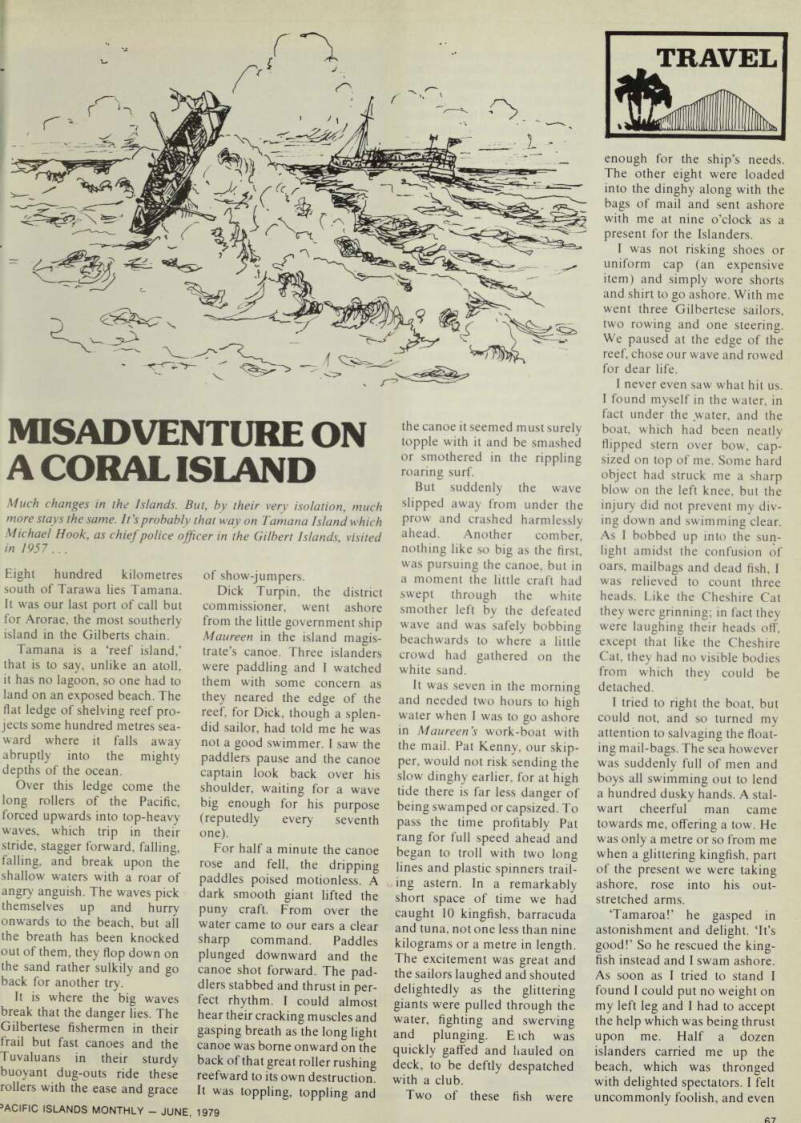
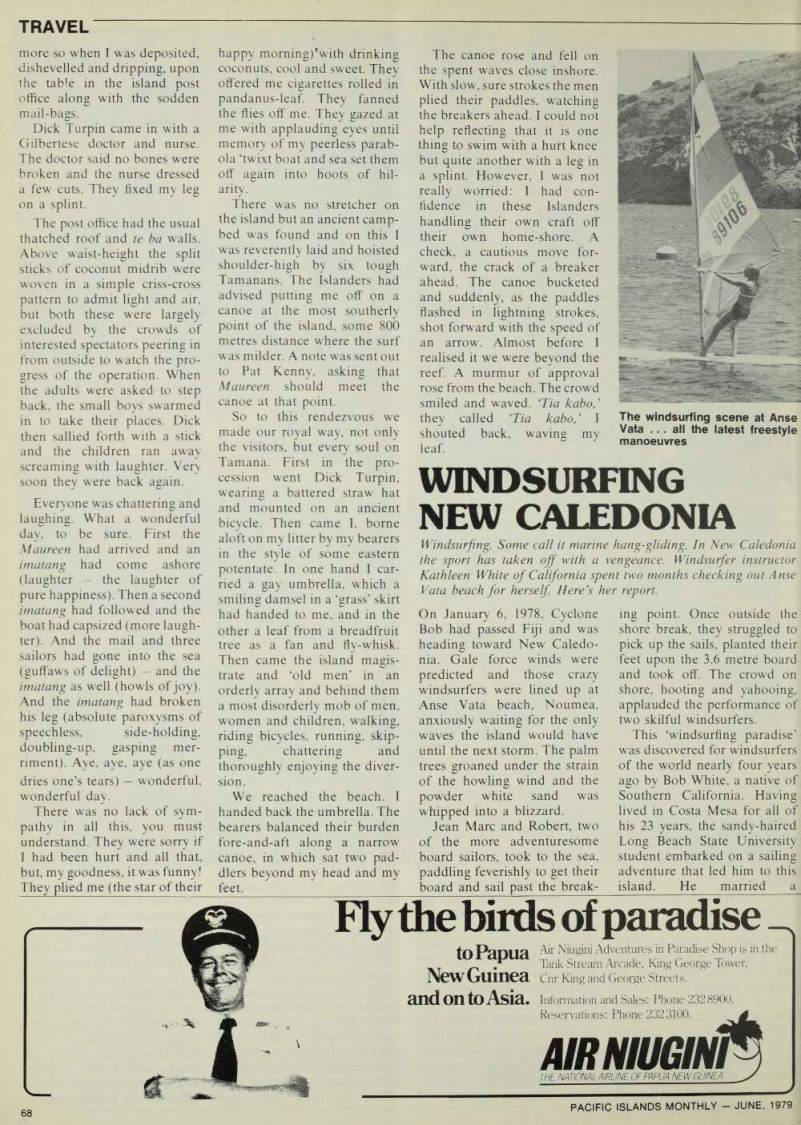
Travel
Misadventure On
Much changes in the Islands. But, by their very isolation, much more stays the same. It’sprobably that way on Tamana Island which Michael Hook, as chief police officer in the Gilbert Islands, visited in 1957 ...
Eight hundred kilometres south of Tarawa lies Tamana.
It was our last port of call but for Arorae, the most southerly island in the Gilberts chain.
Tamana is a ‘reef island,’ that is to say, unlike an atoll, it has no lagoon, so one had to land on an exposed beach. The flat ledge of shelving reef pro jects some hundred metres sea ward where it falls away
abruptly into the mighty
depths of the ocean.
Over this ledge come the long rollers of the Pacific,
forced upwards into top-heavy
waves, which trip in their stride, stagger forward, falling, falling, and break upon the shallow waters with a roar of angry anguish. The waves pick themselves up and hurry onwards to the beach, but all the breath has been knocked out of them, they flop down on the sand rather sulkily and go back for another try.
It is where the big waves break that the danger lies. The Gilbertese fishermen in their frail but fast canoes and the Tuvaluans in their sturdy
buoyant dug-outs ride these
rollers with the ease and grace
of show-jumpers.
Dick Turpin, the district commissioner, went ashore from the little government ship Maureen in the island magis trate’s canoe. Three islanders were paddling and I watched them with some concern as they neared the edge of the reef, for Dick, though a splen did sailor, had told me he was not a good swimmer. I saw the paddlers pause and the canoe captain look back over his shoulder, waiting for a wave big enough for his purpose (reputedly every seventh one).
For half a minute the canoe rose and fell, the dripping paddles poised motionless. A dark smooth giant lifted the puny craft. From over the water came to our ears a clear sharp command. Paddles plunged downward and the canoe shot forward. The pad dlers stabbed and thrust in per fect rhythm. I could almost hear their cracking muscles and gasping breath as the long light canoe was borne onward on the back of that great roller rushing reefward to its own destruction.
It was toppling, toppling and
the canoe it seemed must surely topple with it and be smashed or smothered in the rippling
roaring surf.
But suddenly the wave slipped away from under the prow and crashed harmlessly ahead. Another comber, nothing like so big as the first, was pursuing the canoe, but in a moment the little craft had swept through the white smother left by the defeated wave and was safely bobbing beachwards to where a little crowd had gathered on the white sand.
It was seven in the morning and needed two hours to high water when I was to go ashore in Maureen's work-boat with the mail. Pat Kenny, our skip per, would not risk sending the slow dinghy earlier, for at high tide there is far less danger of
being swamped or capsized. To
pass the time profitably Pat rang for full speed ahead and began to troll with two long lines and plastic spinners trail ing astern. In a remarkably short space of time we had
caught 10 kingfish, barracuda
and tuna, not one less than nine kilograms or a metre in length.
The excitement was great and the sailors laughed and shouted
delightedly as the glittering
giants were pulled through the
water, fighting and swerving
and plunging. E ich was quickly gaffed and hauled on deck, to be deftly despatched with a club.
Two of these fish were
enough for the ship’s needs.
The other eight were loaded into the dinghy along with the bags of mail and sent ashore with me at nine o’clock as a present for the Islanders.
I was not risking shoes or uniform cap (an expensive item) and simply wore shorts and shirt to go ashore. With me went three Gilbertese sailors, two rowing and one steering.
We paused at the edge of the reef, chose our wave and rowed for dear life.
I never even saw what hit us.
I found myself in the water, in fact under the water, and the boat, which had been neatly flipped stern over bow, cap sized on top of me. Some hard object had struck me a sharp blow on the left knee, but the injury did not prevent my div ing down and swimming clear.
As I bobbed up into the sun light amidst the confusion of oars, mailbags and dead fish, I was relieved to count three heads. Like the Cheshire Cat
they were grinning; in fact they
were laughing their heads off, except that like the Cheshire Cat, they had no visible bodies from which they could be detached.
I tried to right the boat, but could not, and so turned my attention to salvaging the float ing mail-bags. The sea however was suddenly full of men and boys all swimming out to lend a hundred dusky hands. A stal wart cheerful man came towards me, offering a tow. He was only a metre or so from me when a glittering kingfish, part of the present we were taking ashore, rose into his out stretched arms.
Tamaroa!’ he gasped in astonishment and delight. ‘lt’s good!’ So he rescued the king fish instead and I swam ashore.
As soon as I tried to stand I found I could put no weight on my left leg and I had to accept the help which was being thrust upon me. Half a dozen islanders carried me up the beach, which was thronged with delighted spectators. I felt uncommonly foolish, and even
more so when I was deposited, dishevelled and dripping, upon the table in the island post office along with the sodden
mail-bags.
Dick Turpin came in with a Gilbertese doctor and nurse.
The doctor said no bones were broken and the nurse dressed a few cuts. They fixed my leg on a splint.
The post office had the usual thatched roof and te ba walls.
Above waist-height the split
slicks of coconut midrib were woven in a simple criss-cross pattern to admit light and air, but both these were largely excluded by the crowds of interested spectators peering in from outside to watch the pro gress of the operation. When the adults were asked to step back, the small boys swarmed in to take their places. Dick then sallied forth with a stick and the children ran away
screaming with laughter. Very
soon they were back again.
Everyone was chattering and
laughing. What a wonderful day, to be sure. First the Maureen had arrived and an imatang had come ashore
(laughter the laughter of
pure happiness). Then a second imatang had followed and the boat had capsized (more laugh ter). And the mail and three sailors had gone into the sea (guffaws of delight) and the imatang as well (howls of joy).
And the imatang had broken his leg (absolute paroxysms of
speechless, side-holding,
doubling-up. gasping mer
riment). Aye, aye, aye (as one dries one’s tears) wonderful,
wonderful day.
There was no lack of sym pathy in all this, you must understand. They were sorry if I had been hurt and all that, but, my goodness, it was funny!
They plied me (the star of their
happy morning)’with drinking
coconuts, cool and sweet. They offered me cigarettes rolled in
pandanus-leaf. They fanned
the flies off me. They gazed at me with applauding eyes until memory of my peerless parab ola ‘twixt boat and sea set them off again into hoots of hil
arity.
There was no stretcher on the island but an ancient camp bed was found and on this I was reverently laid and hoisted
shoulder-high by six tough
Tamanans. The Islanders had advised putting me off on a canoe at the most southerly point of the island, some 800 metres distance where the surf was milder. A note was sent out to Pat Kenny, asking that Maureen should meet the canoe at that point.
So to this rendezvous we made our royal way, not only the visitors, but every soul on Tamana. First in the pro cession went Dick Turpin, wearing a battered straw hat and mounted on an ancient bicycle. Then came I. borne aloft on my litter by my bearers in the style of some eastern potentate. In one hand I car ried a gay umbrella, which a smiling damsel in a ‘grass’ skirt had handed to me. and in the other a leaf from a breadfruit tree as a fan and fly-whisk.
Then came the island magis trate and ‘old men’ in an orderly array and behind them a most disorderly mob of men. women and children, walking,
riding bicycles, running, skip
ping, chattering and
thoroughly enjoying the diver
sion.
We reached the beach. I handed back the umbrella. The bearers balanced their burden fore-and-aft along a narrow canoe, in which sat two pad dlers beyond my head and my feet.
The canoe rose and fell on the spent waves close inshore.
With slow, sure strokes the men
plied their paddles, watching
the breakers ahead. I could not help reflecting that it is one thing to swim with a hurt knee but quite another with a leg in a splint. However. I was not really worried: I had con fidence in these Islanders handling their own craft off their own home-shore. A check, a cautious move for ward, the crack of a breaker ahead. The canoe bucketed and suddenly, as the paddles flashed in lightning strokes, shot forward with the speed of an arrow. Almost before I realised it we were beyond the reef. A murmur of approval rose from the beach. The crowd smiled and waved. ‘Tia kabo ,’ they called ‘ Tia kabo,’ I shouted back, waving my leaf.
The windsurfing scene at Anse Vata ... all the latest freestyle manoeuvres
Advertisements & other items, p. 67 (1 item)
67
3 ACIFIC ISLANDS MONTHLY - JUNE, 1979
Windsurfing
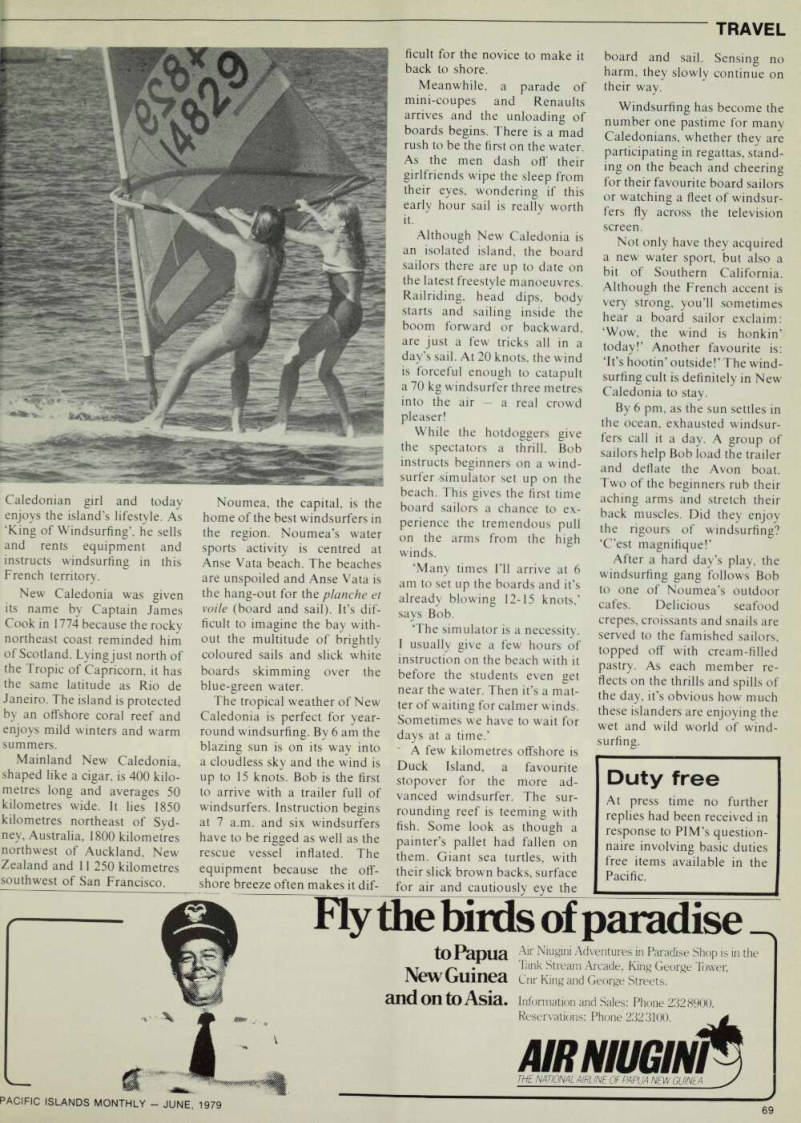
New Caledonia
Windsurfing. Some call it marine hang-gliding. In New Caledonia the sport has taken off with a vengeance. Windsurfer instructor Kathleen White of California spent two months checking out Anse Vata beach for herself. Here’s her report.
On January 6, 1978, Cyclone Bob had passed Fiji and was heading toward New Caledo nia. Gale force winds were predicted and those crazy windsurfers were lined up at Anse Vata beach, Noumea,
anxiously waiting for the only
waves the island would have until the next storm. The palm trees groaned under the strain of the howling wind and the powder white sand was whipped into a blizzard.
Jean Marc and Robert, two of the more adventuresome board sailors, took to the sea, paddling feverishly to get their board and sail past the break
ing point. Once outside the shore break, they struggled to pick up the sails, planted their feet upon the 3.6 metre board and took off. The crowd on
shore, hooting and yahooing,
applauded the performance of
two skilful windsurfers.
This ‘windsurfing paradise’
was discovered for windsurfers of the world nearly four years ago by Bob White, a native of Southern California. Having lived in Costa Mesa for all of his 23 years, the sandy-haired
Long Beach State University
student embarked on a sailing adventure that led him to this island. He married _a_
Caledonian girl and today enjoys the island’s lifestyle. As King of Windsurfing’, he sells and rents equipment and instructs windsurfing in this French territory.
New Caledonia was given its name by Captain James Cook in 1774 because the rocky northeast coast reminded him of Scotland. Lying just north of the Tropic of Capricorn, it has the same latitude as Rio de Janeiro. The island is protected by an offshore coral reef and enjoys mild winters and warm summers.
Mainland New Caledonia, shaped like a cigar, is 400 kilometres long and averages 50 kilometres wide. It lies 1850 kilometres northeast of Sydney, Australia, 1800 kilometres northwest of Auckland, New Zealand and 11 250 kilometres southwest of San Francisco.
Noumea, the capital, is the home of the best windsurfers in the region. Noumea’s water sports activity is centred at Anse Vata beach. The beaches are unspoiled and Anse Vata is the hang-out for the planche et voile (board and sail). It’s dif ficult to imagine the bay with out the multitude of brightly coloured sails and slick white boards skimming over the
blue-green water.
The tropical weather of New Caledonia is perfect for year round windsurfing. By 6 am the blazing sun is on its way into a cloudless sky and the wind is up to 15 knots. Bob is the first to arrive with a trailer full of windsurfers. Instruction begins at 7 a.m. and six windsurfers have to be rigged as well as the rescue vessel inflated. The equipment because the off shore breeze often makes it dif
ficult for the novice to make it back to shore.
Meanwhile, a parade of mini-coupes and Renaults arrives and the unloading of boards begins. There is a mad rush to be the first on the water.
As the men dash off their
girlfriends wipe the sleep from
their eyes, wondering if this early hour sail is really worth it.
Although New Caledonia is an isolated island, the board sailors there are up to date on the latest freestyle manoeuvres.
Railriding, head dips, body
starts and sailing inside the boom forward or backward, are just a few tricks all in a day’s sail. At 20 knots, the wind is forceful enough to catapult a 70 kg windsurfer three metres into the air a real crowd
pleaser!
While the hotdoggers give
the spectators a thrill, Bob instructs beginners on a wind surfer-simulator set up on the beach. This gives the first time board sailors a chance to ex perience the tremendous pull on the arms from the high winds. ‘Many times I’ll arrive at 6 am to set up the boards and it’s
already blowing 12-15 knots,’
says Bob. ‘The simulator is a necessity.
I usually give a few hours of instruction on the beach with it before the students even get near the water. Then it’s a mat ter of waiting for calmer winds.
Sometimes we have to wait for days at a time.’
A few kilometres offshore is Duck Island, a favourite stopover for the more ad vanced windsurfer. The sur rounding reef is teeming with fish. Some look as though a painter’s pallet had fallen on them. Giant sea turtles, with their slick brown backs, surface for air and cautiously eye the
board and sail. Sensing no harm, they slowly continue on their way.
Windsurfing has become the number one pastime for many Caledonians, whether they are participating in regattas, stand ing on the beach and cheering for their favourite board sailors or watching a fleet of windsur fers fly across the television screen.
Not only have they acquired a new water sport, but also a bit of Southern California.
Although the French accent is very strong, you’ll sometimes hear a board sailor exclaim: ‘Wow. the wind is honkin’ today!’ Another favourite is: ‘lt’s hootin’ outside!’ The wind surfing cult is definitely in New Caledonia to stay.
By 6 pm, as the sun settles in the ocean, exhausted windsur fers call it a day. A group of sailors help Bob load the trailer and deflate the Avon boat.
Two of the beginners rub their aching arms and stretch their back muscles. Did they enjoy
the rigours of windsurfing?
‘C’est magnifique!’
After a hard day’s play, the windsurfing gang follows Bob to one of Noumea’s outdoor cafes. Delicious seafood crepes, croissants and snails are served to the famished sailors, topped off with cream-filled pastry. As each member re flects on the thrills and spills of the day, it’s obvious how much these islanders are enjoying the wet and wild world of wind
surfing.
Advertisements & other items, pp. 68-70 (1 item)
Fly the birds of paradise
to Papua
New Guinea
and on to Asia.
Air Niugini Adventures in Paradise Shop is in the Tank Stream Arcade, King George Tower, Cnr King and George Streets.
Information and Sales: Phone 232 8900.
Duty free
At press time no further replies had been received in response to PI M’s questionnaire involving basic duties free items available in the Pacific.
Fly the birds of paradise
to Papua
New Guinea
and on to Asia.
Air Niugini Adventures in Paradise Shop is in the Tank Stream Arcade, King George Tower, Cnr King and George Streets.
Information and Sales: Phone 2328900.
Reservations: Phone 2323100. £
AIRNIUGINr
€ NATIONAL AIRLINE OF PAPUA NEW GUINEA y
CRF-330K
5 £ 1 3 *"• ' ' os/ ;.•>* - ~7> </ y T.-5
ICF-6700W
•' ii" < 'A— -7. soktv - ■ |i 'SS9o "
ICF-6800W
-fV •• 'Pr '■ r 5 -a % j •* sonv ||S; ■*d i , - ■ ... -■■•■ ■ ■. -- -i
Imm
r. <£ / [..:
‘ISBW
s ■ 1
.C/MOO*
- - i > --
3SSR
V'US
The Globescanners
IP Turn on one of these Sony multi-band receivers and prepare to do some traveling. They're made to take you out of the country, off the continent, clear to the other side of the earth.
There's enough heavyweight communications technology inside Sony's lightweight 31-band ICF-6800W and 5-band ICF-6700W receivers to scan radio broadcasts from around the globe.
For example, the ICF-6800W's dual conversion superheterodyne circuitry for clear and stable reception. And phase-locked-loop synthesized tuning so that whatever you tune will be guaranteed quartz-accurate. It pulls in FM/MW and SWi~SW 29 (1.6~30MHz), including the single side band and continuous wave band.
The ICF-6700W breaks its shortwave coverage into three zones spanning the same frequency range and puts it on three bands.
Sony's way of cutting the world to size. It also picks up FM/MW broadcasts.
Both models have LED digital readouts that display MW/SW frequencies with unfailing precision. You always know exactly where you're tuned without waiting for station identification.
The advanced technology found in these multi-band models comes right out of the electronic wizardry that went into Sony's CRF-330K, the 33-band wonder complete with a built-in cassette deck.
Take your pick of the three and get everything you need to explore the world via radio. Via Sony.
Out Of Balance
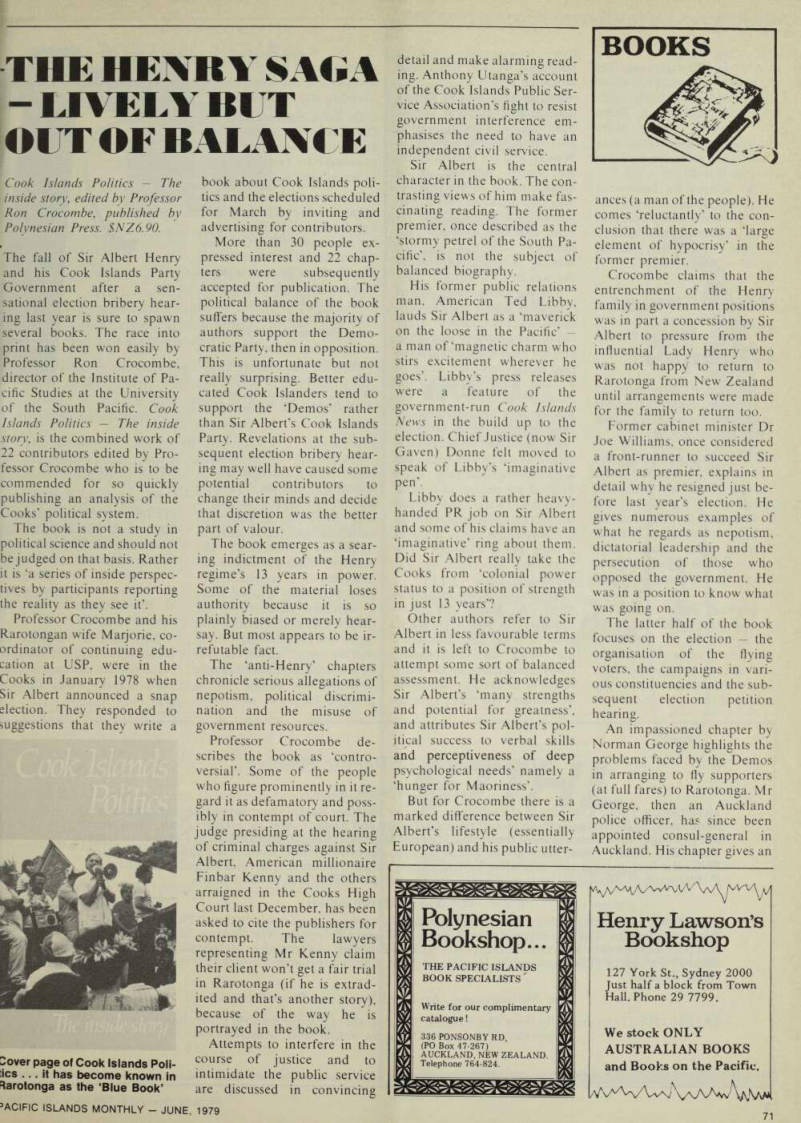
Books
The Henry Saga
- Lively But
Out Of Balance
Cook Islands Politics The inside story, edited by Professor Ron Crocombe, published by Polynesian Press. SNZ6.9O.
The fall of Sir Albert Henry and his Cook Islands Party Government after a sen sational election bribery hear ing last year is sure to spawn several books. The race into
print has been won easily by
Professor Ron Crocombe, director of the Institute of Pa cific Studies at the University of the South Pacific. Cook Islands Politics The inside story, is the combined work of 22 contributors edited by Pro fessor Crocombe who is to be commended for so quickly publishing an analysis of the Cooks’ political system.
The book is not a study in political science and should not be judged on that basis. Rather it is ‘a series of inside perspec
tives by participants reporting
the reality as they see it’.
Professor Crocombe and his
Rarotongan wife Marjorie, co
ordinator of continuing edu
cation at USP, were in the Cooks in January 1978 when Sir Albert announced a snap
election. They responded to
suggestions that they write a
book about Cook Islands poli tics and the elections scheduled for March by inviting and advertising for contributors.
More than 30 people ex pressed interest and 22 chap ters were subsequently
accepted for publication. The
political balance of the book suffers because the majority of authors support the Demo cratic Party, then in opposition.
This is unfortunate but not
really surprising. Better edu
cated Cook Islanders tend to support the ‘Demos’ rather than Sir Albert’s Cook Islands Party. Revelations at the sub sequent election bribery hear ing may well have caused some potential contributors to change their minds and decide that discretion was the better part of valour.
The book emerges as a sear ing indictment of the Henry regime’s 13 years in power.
Some of the material loses authority because it is so plainly biased or merely hear say. But most appears to be ir refutable fact.
The ‘anti-Henry’ chapters
chronicle serious allegations of nepotism, political discrimi nation and the misuse of government resources.
Professor Crocombe de scribes the book as ‘contro versial’. Some of the people who figure prominently in it re gard it as defamatory and poss ibly in contempt of court. The
judge presiding at the hearing
of criminal charges against Sir Albert, American millionaire Finbar Kenny and the others arraigned in the Cooks High Court last December, has been asked to cite the publishers for contempt. The lawyers
representing Mr Kenny claim
their client won’t get a fair trial in Rarotonga (if he is extrad ited and that’s another story), because of the way he is portrayed in the book.
Attempts to interfere in the course of justice and to intimidate the public service are discussed in convincing
detail and make alarming read
ing. Anthony Utanga’s account
of the Cook Islands Public Ser vice Association’s fight to resist government interference em phasises the need to have an independent civil service.
Sir Albert is the central character in the book. The con trasting views of him make fas
cinating reading. The former
premier, once described as the ‘stormy petrel of the South Pa cific’, is not the subject of
balanced biography.
His former public relations man. American Ted Libby, lauds Sir Albert as a ‘maverick on the loose in the Pacific’ a man of‘magnetic charm who stirs excitement wherever he
goes’. Libby’s press releases
were a feature of the government-run Cook Islands News in the build up to the election. Chief Justice (now Sir Gaven) Donne felt moved to
speak of Libby’s ‘imaginative
pen’.
Libby does a rather heavy handed PR job on Sir Albert and some of his claims have an
‘imaginative’ ring about them.
Did Sir Albert really take the Cooks from ‘colonial power status to a position of strength
in just 13 years’?
Other authors refer to Sir Albert in less favourable terms and it is left to Crocombe to attempt some sort of balanced assessment. He acknowledges Sir Albert’s ‘many strengths and potential for greatness’, and attributes Sir Albert’s pol itical success to verbal skills
and perceptiveness of deep
psychological needs’ namely a
‘hunger for Maoriness’.
But for Crocombe there is a marked difference between Sir
Albert’s lifestyle (essentially
European) and his public utter
ances (a man of the people). He comes ‘reluctantly’ to the con clusion that there was a ‘large element of hypocrisy’ in the
former premier.
Crocombe claims that the entrenchment of the Henry
family in government positions
was in part a concession by Sir Albert to pressure from the
influential Lady Henry who
was not happy to return to Rarotonga from New Zealand until arrangements were made for the family to return too.
Former cabinet minister Dr Joe Williams, once considered a front-runner to succeed Sir Albert as premier, explains in
detail why he resigned just be
fore last year’s election. He
gives numerous examples of
what he regards as nepotism, dictatorial leadership and the persecution of those who opposed the government. He was in a position to know what was going on.
The latter half of the book focuses on the election the organisation of the flying voters, the campaigns in vari ous constituencies and the sub sequent election petition
hearing.
An impassioned chapter by
Norman George highlights the
problems faced by the Demos in arranging to fly supporters (at full fares) to Rarotonga. Mr George, then an Auckland police officer, has since been
appointed consul-general in
Auckland. His chapter gives an
Cover page of Cook Islands Poll ies ... It has become known in Rarotonga as the ‘Blue Book’
interesting insight into the
reactions of the various airlines that were approached. Cook Islands Politics is a lively, read able and timely book. There are obvious gaps. More material on the Henry side would have given the book the balance it lacks.
But because the book does not purport to be a study in pol itical science it seems unfair to judge it as a reasoned, objective analysis of the Cooks political
scene.
James Tally
Judy out
with a
whimper
My Reluctant Missionary by John Kolia. Published by the Institute of Papua New Guinea Studies, Port Moresby.
Judy, the heroine, if that’s the right word to use, of John Kolia’s novel My Reluctant
Missionary, is a good-time girl
in Port Moresby. She’s mixed race, or so she says. Dr Kolia doesn’t seem quite sure whether she is or she isn’t, and if he doesn’t know, who does?
Anyway, Judy decides to
give away the gay life, and goes off to Wewak to become a missionary nurse. We are not told whether she has any nurs ing qualifications, or how she managed to con the conserva
tive evangelical mission portrayed by Dr Kolia into
accepting her.
But there it is, and Dr Kolia’s first chapter, entitled ‘Forth’, describes her departure from Port Moresby, her arrival in Wewak, and her initiation into the varied activities of a mission nurse. In Judy’s case, they turn out to be very varied indeed, and to show little re gard for the nursing pro fession’s code of conduct, making one wonder whether she was really a nurse at all.
The second chapter is called ‘Tempted’, and it must be con ceded that Judy takes to temp tation like a duck to water. She and her patients and her mixed race friends have the whale of a time until belatedly the mission catches up with her and she gets the sack. It should have happened a lot sooner.
The third and last chapter is called ‘Saved’, a title which has a nice evangelical ring. But I finished my perusal of it quite uncertain who had saved whom from what and why? So the story peters out ‘not with a bang but a whimper’. The story, but, unfortunately, not the book.
Appended is an essay en titled ‘A Memo on Mis sionaries’, in which Dr Kolia gives us in no uncertain terms his views on missionaries, Christianity and what he oddly refers to as ‘the so-called New Testament’. His thesis appears
to be that Papua New Guineans are savage, sensual and sadistic, and should be al lowed to stay that way.
Dr Kolia concludes that the Old Testament is ‘in accord ance with village custom. The so-called New Testament is not in accordance with custom’.
This seems to me to be a negative and defeatist attitude.
I prefer that of the Papuan pas tor who said: ‘The Old Tes tament shows us what we are like: the New Testament shows us what we ought to be like’.
I am glad that during my 54 years in Papua I have known many Papuans who have taken the ‘so-called’ New Testament quite seriously, and have tried
with simple sincerity to apply
its ethic to their daily lives. It is clear that Dr Kolia and I have moved in different circles.
Dr Kolia’s style is idiosyn cratic in the extreme. He is addicted to what A. P. Herbert used to call ‘ribbon writing’
long rambling, ill-structured
sentences. And the narrative is
frequently interrupted by
asides in which the author ad umbrates on a variety of sub jects. Personally I found these a welcome relief from the dreary story and salacious dia
logue. But I cannot help feeling
that the sort of reader who will be attracted to this book, eager to know with whom Judy is going to bed next, will resent
these delays in getting to where the action is .
It seems strange that a man of John Collier’s academic attainments should write such queer English. Can it be that,
having re-spelt his name to give
it a Papua New Guinean flavour, he is now trying to kid us that English is not his
mother tongue?
This book is published by the so-called Institute of Papua New Guinea Studies. I can’t think why. Percy Chatter ton.
Advertisements & other items, pp. 71-74 (1 item)
Bookshop..
Polynesian
THE PACIFIC ISLANDS
BOOK SPECIALISTS '
Write for our complimentary catalogue!
336 PONSONBY RD,
(PO Box 47-267)
AUCKLAND, NEW ZEALAND.
Telephone 764-824.
Henry Lawson’s
Bookshop
127 York St., Sydney 2000 Just half a block from Town Hall. Phone 29 7799.
We stock ONLY
AUSTRALIAN BOOKS
and Books on the Pacific.
At v A/ WA^^^\y^AA^^A7\,^A^
The Journal of Pacific History
Vol. XIII 1978 (two issues) ARTICLES ON: Tonga’s venture in church unity, Charles Forman; Early labour recruiting in southern Melanesia, K. R. Howe; German labour policy in Nauru and Angaur 1906-14, Stewart Firth; Land tenure in Fiji’s sugar cane districts since the 19205, Michael Moynagh; Capital punishment in Papua New Guinea 1888-1945, Hank Nelson ; The work of the vakavuvuli, David Wetherell; Holmes in Papua, R. E. Reid; PNG: the first general elections after independence, Ralph Premdas; Australia’s Pacific Islanders, P. Mercer & C. Moore; Kinship and authority in aboriginal Tonga, S. Decktor Korn.
Vol. XIV 1979 (two issues) FIRST ISSUE —ISLANDS LEADERSHIP: A reassessment of traditional leadership in South Pacific societies, Bronwen Douglas; The hau concept of leadership in Western Polynesia, Niel Gunson; Ritual authority and political power in traditional Maori society, Ross Bowden; Leadership in Melanesia, Ann Chowning; Mekeo views of the village constable, Michele Stephen; Chimbu leadership before Provincial Government, Paula Brown.
Also Bibliography, Archival Notes and Book Reviews $A12.50 (SUSI7.OO) annually from The Editors, The Journal of Pacific History, Australian National University, P.O. Box 4, Canberra, A.C.T. 2600, Australia.
(Advertisement)
NIEUW LEVEN
NIEUW LEVEN a new revolutionary hair rehabilitation process.
The NIEUW LEVEN process involves the regrowth of hair nature working it is not artificial replacement. Hair losses are caused by a variety of factors; stress, strain, chemical deficiencies in the human body, skin and scalp disorders.
The NIEUW LEVEN (new life) process can be compared to the growth of a baby’s hair from birth to the age of one (in most cases) is the time taken for the hair to develop.
The treatment consists of application of a special preparation that restores healthy growth. Hair needs food and care, a balance of which is essential. The whole concept of the NIEUW LEVEN treatment is to help nature work again. The treatment requires that the body be in a healthy and receptive state. Each individual differs in make-up. Therefore the treatment must be tailored to individual situations and needs.
Gina Wardenaar is the inventor of the NIEUW LEVEN process and has spent 20 years in the development of her revolutionary hair rehabilitation treatment. Ten years were spent in research and development of the formula, and the treatment has been successfully applied to people suffering from hair loss for over a decade. In most cases it has proved remarkably successful. In cases of grave or terminal illness, the treatment may not be successful, but if the patient is otherwise healthy, hair replacement is assured by conscientious application of the formula.
Gina Wardenaar stipulates that her methods must be rigidly adhered to, and that nature must be left, with her help, to take its course. Rate of growth depends upon the individual’s previous hair growth levels, and on diet.
Full information and details of this revolutionary process are available from: Gina Wardenaar NIEUW LEVEN Hair Clinics Situated at: sth Floor, Suite 6
Dymocks Building
428 George Street
SYDNEY NSW 2000
Ph: 232 8091 sth Floor, Suite 3
Jorobe Building
Cnr. Edward & Queen Sts.
BRISBANE QLD 4000
Ph: 221 0278
The best
power-
to-
weight
ratio
big saw
in the
world.
075 AVE
111 cc power with an all-up weight of just 25.75 lbs.
(11.7 kg). Anti-Vibration
system standard equipment.
im
Sbiii
in M * r
ST/HL
Fiji Islands Carpenters Motors-Sales Walu Bay, Suva.
Carpenters Motors-Parts, Walu Bay, Suva.
Papua New Guinea Morgan Equipment Pty. Ltd.
Arawa, Bougainville.
Rabaul, Boroko, Lae Western Samoa Carptrac, Apia Norfolk Island Cameralines Limited New Hebrides Roy Gallimore & Associates, Port Vila.
Solomon Islands Foxwood (S .1. Timbers) Ltd.
CONSTRUCTIVE
ADVICE.
r“
■ gnpsr
iU^ l» 5* y *5 - Radio-Controlled Bulldozers and Dozer Shovels. 4 —■ Wheel Loaders.
Electric Powered Dozer Shovels.
A wide range of Pipelayers.
Amphibious Bulldozers.
A wide selection of Off-Highway Dump Trucks.
JEk- c
sTn m tc - JL -r-V As well as Motor Scrapers.
Soil Compactors.
Trash Compactors.
Towing Tractors. ?-■ Vibratory Rollers. Diesel Generator Sets.
A m
vy In:
t [i Portable Air Compressors.
A wide selection of Diesel Engines. t. tlx \ 3 Machine Tools <9
iin.
IL*S
W<T J Mechanical and Hydraulic Presses. A variety of Maypres Presses. OBS Power Presses. Tunnel-Boring Machines.
We're constructive in other ways. We offer castings, foundries, and important advice on construction and manufacturing projects.
•H KOMATSU LTD.
Tokyo, Japan Komatsu overseas offices: Sydney, Singapore, Jakarta, Manila, Seoul, Bangkok, Bangalore, Teheran, Dubai, Jeddah, Riyadh, Ad Dammam, Baghdad, Ankara, Moscow, London, Brussels, Dusseldorf, Stuttgart, Warszawa, Paris, Madrid, Cairo, Alger, Abidjan, Lagos, Nairobi, Johannesburg, Toronto, San Francisco, Fort Lee, Arlington, Atlanta, Detroit, Mexico City, Habana, Panama, Sao Paulo, Caracas, Lima, Buenos Aires, and distributors in over 100 countries around the world.
People
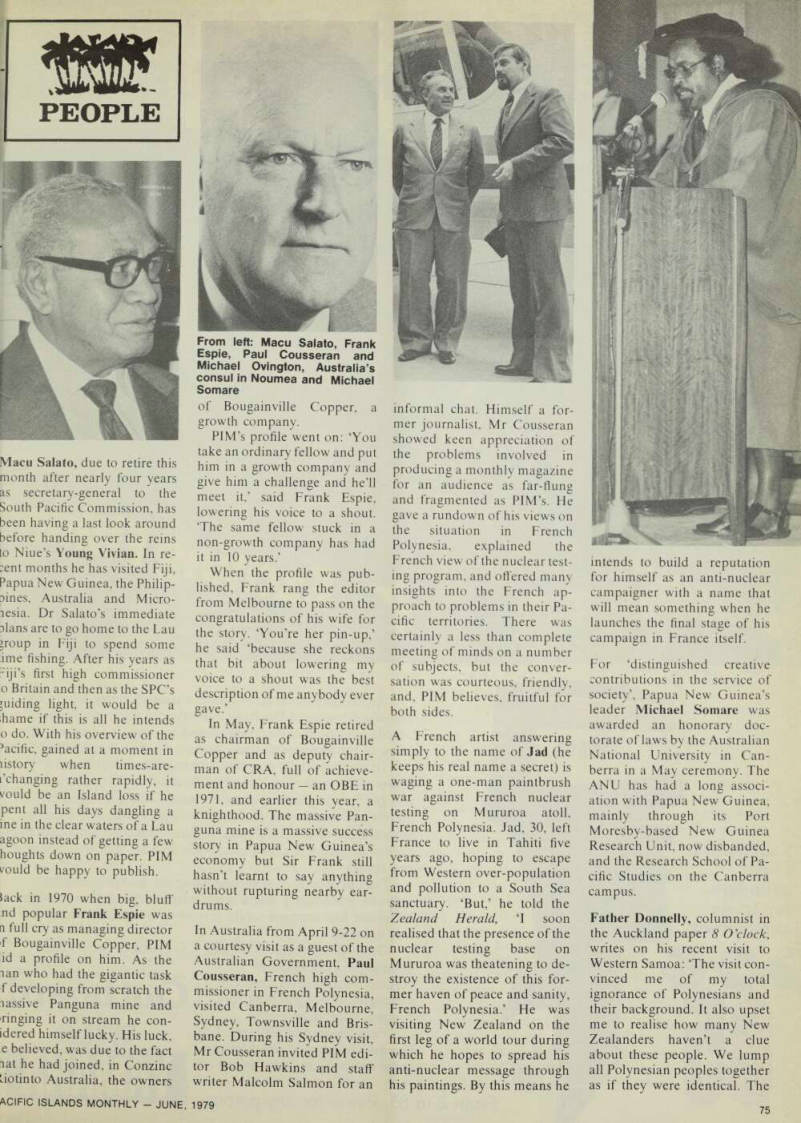
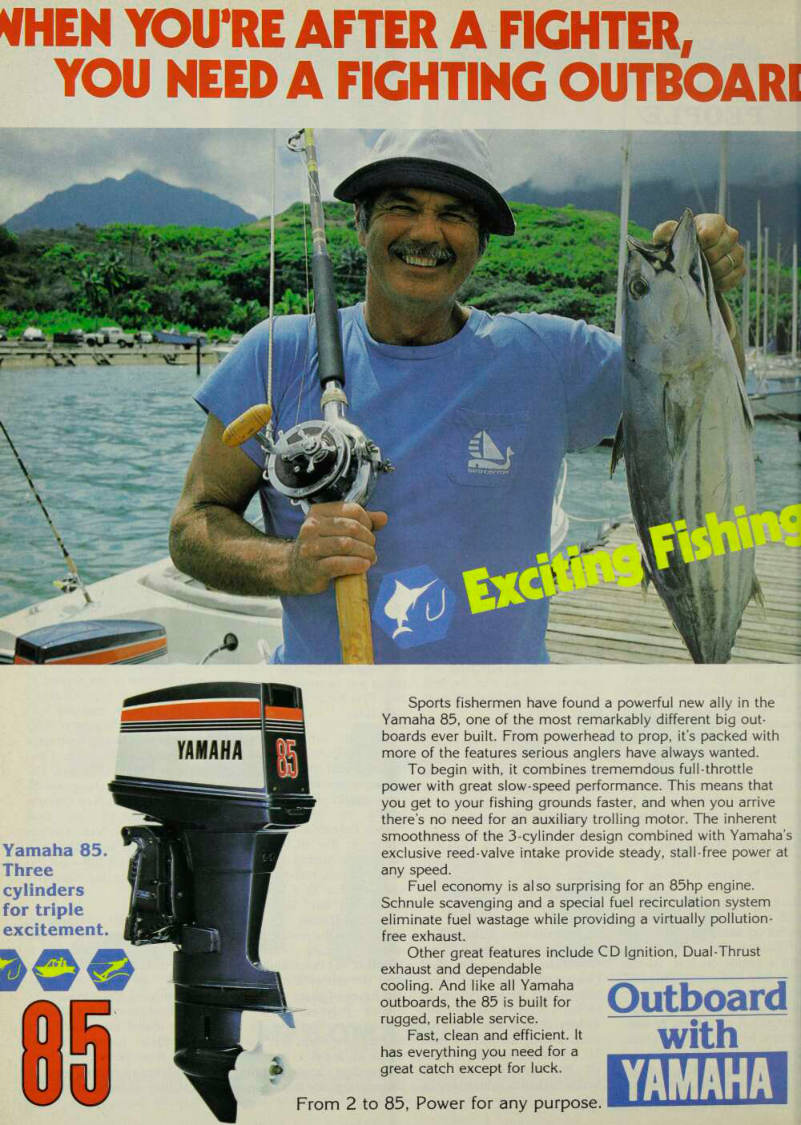
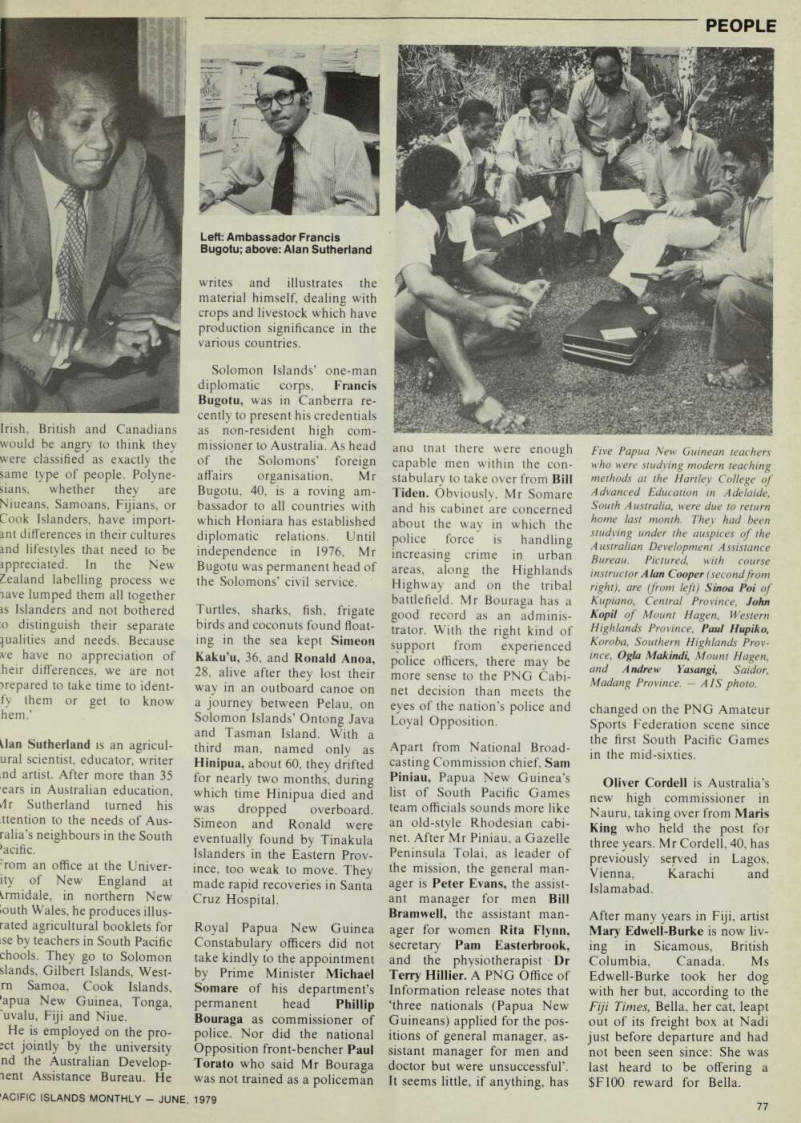
Macu Salato, due to retire this month after nearly four years as secretary-general to the South Pacific Commission, has been having a last look around before handing over the reins to Niue’s Young Vivian. In re cent months he has visited Fiji, Papua New Guinea, the Philip aines, Australia and Micro lesia. Dr Salato’s immediate alans are to go home to the Lau in Fiji to spend some ime fishing. After his years as ■Tji’s first high commissioner o Britain and then as the SPC’s guiding light, it would be a hame if this is all he intends o do. With his overview of the 3 acific, gained at a moment in listory when times-are
t’changing rather rapidly, it
vould be an Island loss if he pent all his days dangling a ine in the clear waters of a Lau agoon instead of getting a few houghts down on paper. PIM yould be happy to publish. lack in 1970 when big, bluff nd popular Frank Espie was ti full cry as managing director f Bougainville Copper, PIM id a profile on him. As the ian who had the gigantic task f developing from scratch the lassive Panguna mine and ringing it on stream he con idered himself lucky. His luck, e believed, was due to the fact lat he had joined, in Conzinc liotinto Australia, the owners
of Bougainville Copper, a
growth company.
PlM’s profile went on: ‘You take an ordinary fellow and put him in a growth company and give him a challenge and he’ll meet it,’ said Frank Espie, lowering his voice to a shout. ‘The same fellow stuck in a non-growth company has had it in 10 years.’
When the profile was pub lished, Frank rang the editor from Melbourne to pass on the congratulations of his wife for the story. ‘You’re her pin-up,’ he said ‘because she reckons that bit about lowering my voice to a shout was the best description of me anybody ever
gave.’
In May, Frank Espie retired as chairman of Bougainville Copper and as deputy chair man of CRA, full of achieve ment and honour an OBE in 1971, and earlier this year, a knighthood. The massive Pan guna mine is a massive success story in Papua New Guinea’s economy but Sir Frank still hasn’t learnt to say anything
without rupturing nearby ear
drums.
In Australia from April 9-22 on a courtesy visit as a guest of the Australian Government, Paul Cousseran, French high com missioner in French Polynesia, visited Canberra, Melbourne, Sydney, Townsville and Bris bane. During his Sydney visit, Mr Cousseran invited PIM edi tor Bob Hawkins and staff writer Malcolm Salmon for an
informal chat. Himself a for mer journalist, Mr Cousseran showed keen appreciation of the problems involved in
producing a monthly magazine
for an audience as far-flung and fragmented as PlM’s. He gave a rundown of his views on the situation in French
Polynesia, explained the
French view of the nuclear test ing program, and offered many insights into the French ap proach to problems in their Pa cific territories. There was certainly a less than complete meeting of minds on a number of subjects, but the conver sation was courteous, friendly, and, PIM believes, fruitful for both sides.
A French artist answering simply to the name of Jad (he keeps his real name a secret) is
waging a one-man paintbrush
war against French nuclear testing on Mururoa atoll, French Polynesia. Jad, 30, left France to live in Tahiti five years ago, hoping to escape from Western over-population and pollution to a South Sea sanctuary. ‘But,’ he told the Zealand Herald, T soon realised that the presence of the nuclear testing base on Mururoa was theatening to de stroy the existence of this for mer haven of peace and sanity, French Polynesia.’ He was visiting New Zealand on the first leg of a world tour during which he hopes to spread his anti-nuclear message through his paintings. By this means he
intends to build a reputation for himself as an anti-nuclear campaigner with a name that will mean something when he launches the final stage of his campaign in France itself.
For ‘distinguished creative contributions in the service of
society’, Papua New Guinea’s
leader Michael Somare was awarded an honorary doc torate of laws by the Australian National University in Can berra in a May ceremony. The ANU has had a long associ ation with Papua New Guinea,
mainly through its Port
Moresby-based New Guinea Research Unit, now disbanded, and the Research School of Pa cific Studies on the Canberra campus.
Father Donnelly, columnist in the Auckland paper 8 O’clock, writes on his recent visit to Western Samoa: ‘The visit con vinced me of my total
ignorance of Polynesians and
their background. It also upset me to realise how many New Zealanders haven’t a clue about these people. We lump
all Polynesian peoples together
as if they were identical. The
From left: Macu Salato, Frank Espie, Paul Cousseran and Michael Ovington, Australia’s consul in Noumea and Michael Somare
Irish, British and Canadians would be angry to think they were classified as exactly the same type of people. Polyne
sians, whether they are
Niueans, Samoans, Fijians, or
Cook Islanders, have import
ant differences in their cultures and lifestyles that need to be appreciated. In the New
Zealand labelling process we
aave lumped them all together as Islanders and not bothered
;o distinguish their separate
qualities and needs. Because ve have no appreciation of heir differences, we are not prepared to take time to ident fy them or get to know hem.’
Uan Sutherland is an agricul ural scientist, educator, writer nd artist. After more than 35 ears in Australian education, dr Sutherland turned his ttention to the needs of Aus ralia’s neighbours in the South ‘acific. : rom an office at the Univer ity of New England at in northern New louth Wales, he produces illus
rated agricultural booklets for
ise by teachers in South Pacific chools. They go to Solomon slands, Gilbert Islands, West rn Samoa, Cook Islands,
*apua New Guinea, Tonga,
'uvalu, Fiji and Niue.
He is employed on the pro
pel jointly by the university
nd the Australian Develop ment Assistance Bureau. He
writes and illustrates the material himself, dealing with crops and livestock which have production significance in the various countries.
Solomon Islands’ one-man diplomatic corps, Francis Bugotu, was in Canberra re cently to present his credentials as non-resident high com missioner to Australia. As head of the Solomons’ foreign affairs organisation, Mr Bugotu, 40, is a roving am bassador to all countries with which Honiara has established diplomatic relations. Until independence in 1976, Mr Bugotu was permanent head of the Solomons’ civil service.
Turtles, sharks, fish, frigate birds and coconuts found float ing in the sea kept Simeon Kaku’u, 36, and Ronald Anoa, 28, alive after they lost their way in an outboard canoe on a journey between Pelau, on Solomon Islands’ Ontong Java and Tasman Island. With a third man, named only as Hinipua, about 60, they drifted for nearly two months, during which time Hinipua died and was dropped overboard.
Simeon and Ronald were eventually found by Tinakula Islanders in the Eastern Prov ince, too weak to move. They made rapid recoveries in Santa
Cruz Hospital.
Royal Papua New Guinea Constabulary officers did not take kindly to the appointment by Prime Minister Michael Somare of his department’s permanent head Phillip Bouraga as commissioner of police. Nor did the national Opposition front-bencher Paul Torato who said Mr Bouraga was not trained as a policeman
anu mat there were enough capable men within the con stabulary to take over from Bill Tiden. Obviously, Mr Somare and his cabinet are concerned about the way in which the
police force is handling
increasing crime in urban
areas, along the Flighlands
Highway and on the tribal battlefield. Mr Bouraga has a good record as an adminis trator. With the right kind of support from experienced police officers, there may be more sense to the PNG Cabi net decision than meets the eyes of the nation’s police and
Loyal Opposition.
Apart from National Broad casting Commission chief, Sam Piniau, Papua New Guinea’s list of South Pacific Games team officials sounds more like an old-style Rhodesian cabi net. After Mr Piniau, a Gazelle Peninsula Tolai, as leader of the mission, the general man ager is Peter Evans, the assist ant manager for men Bill Bramwell, the assistant man ager for women Rita Flynn, secretary Pam Easterbrook, and the physiotherapist Dr Terry Hillier. A PNG Office of Information release notes that ‘three nationals (Papua New Guineans) applied for the pos itions of general manager, as sistant manager for men and doctor but were unsuccessful’.
It seems little, if anything, has
Five Papua New Guinean teachers who were studying modern teaching methods at the Hartley College of Advanced Education in Adelaide, South A ustralia, were due to return home last month. They had been studying under the auspices of the Australian Development Assistance Bureau. Pictured, with course instructor A lan Cooper (secondfrom right), are (from left) Sinoa Pot of Kupiano, Central Province, John Kopil of Mount Hagen, Western Highlands Province, Paul Hupiko, Koroba, Southern Highlands Prov ince, Ogla Makindi, Mount Hagen, and Andrew Yasangi, Saidor, Madang Province. AIS photo. changed on the PNG Amateur Sports Federation scene since the first South Pacific Games in the mid-sixties.
Oliver Cordell is Australia’s new high commissioner in Nauru, taking over from Maris King who held the post for three years. Mr Cordell, 40, has previously served in Lagos, Vienna, Karachi and Islamabad.
After many years in Fiji, artist Mary Edwell-Burke is now liv ing in Sicamous, British Columbia, Canada. Ms Edwell-Burke took her dog with her but, according to the Fiji Times, Bella, her cat, leapt out of its freight box at Nadi just before departure and had not been seen since: She was last heard to be offering a SFIOO reward for Bella.
Left: Ambassador Francis Bugotu; above: Alan Sutherland
Advertisements & other items, pp. 75-78 (3 items)
75
ACIFIC ISLANDS MONTHLY - JUNE, 1979
Yamaha
VHEN YOU’RE AFTER A FIGHTER,
YOU NEED A FIGHTING OUTBOARI
I
p- var“sac
m - * - \ \ Mr a Yamaha 85.
Three
cylinders
for triple
excitement. mm Sports fishermen have found a powerful new ally in the Yamaha 85, one of the most remarkably different big outboards ever built. From powerhead to prop, it’s packed with more of the features serious anglers have always wanted.
To begin with, it combines trememdous full-throttle power with great slow-speed performance. This means that you get to your fishing grounds faster, and when you arrive there’s no need for an auxiliary trolling motor. The inherent smoothness of the 3-cylinder design combined with Yamaha’s exclusive reed-valve intake provide steady, stall-free power at any speed.
Fuel economy is also surprising for an 85hp engine.
Schnule scavenging and a special fuel recirculation system eliminate fuel wastage while providing a virtually pollutionfree exhaust.
Other great features include CD Ignition, Dual-Thrust exhaust and dependable cooling. And like all Yamaha outboards, the 85 is built for rugged, reliable service.
Fast, clean and efficient. It has everything you need for a great catch except for luck.
Outboard
with
From 2 to 85, Power for any purpose.
YAMAHA
The Vfecta Professional 460
bin It to handle£he tough
jobs with eas
PROFESSIONAL 460 FEATURES
Victa Hi-Torque 6 two-stroke 160 cc engine.
Larger fuel tank 2.3 litres as against 1 litre Heavy duty wheels.
Easy pull zip starter Safety blade disc 46 cm (18") cut Concealed throttle cable LM carburettor Folding handle 8 position height adjuster Noise reducing muffler Side chute with safety cover Lightweight (weighs only 54 lb) Rugged 14-gauge steel baseplate Specifications and models subject to alteration without notice or obligation
ECTA
TURNS GRASS INTO LAWN
People
77
'ACIFIC ISLANDS MONTHLY - JUNE, 1979
Carrier’S Lot
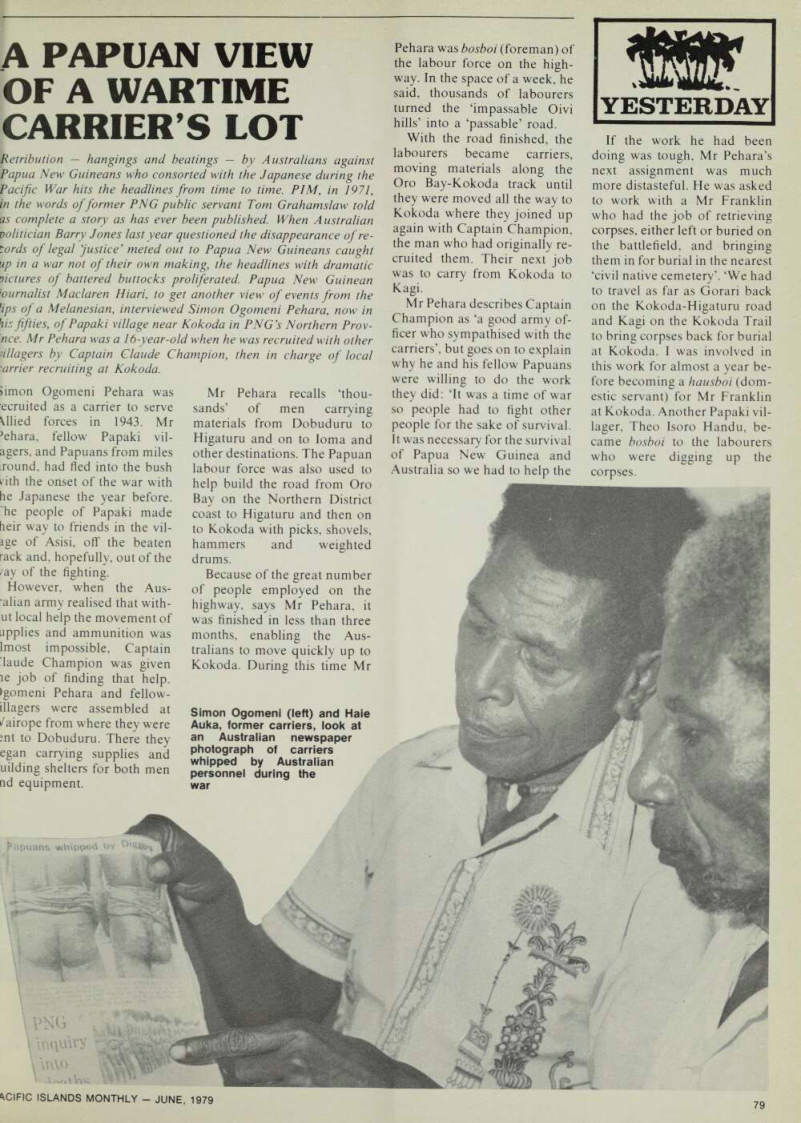



Yesterday
A Papuan View
Of A Wartime
Carrier’S Lot
Retribution hangings and beatings by Australians against Papua New Guineans who consorted with the Japanese during the Pacific War hits the headlines from time to time. PIM, in 1971, in the words of former PNG public servant Tom Grahamslaw told as complete a story as has ever been published. When Australian volitician Barry Jones last year questioned the disappearance of re cords of legal ‘justice ’ meted out to Papua New Guineans caught up in a war not of their own making, the headlines with dramatic pictures of battered buttocks proliferated. Papua New Guinean 'ournalist Maclaren Hiari, to get another view of events from the Hps of a Melanesian, interviewed Simon Ogomeni Pehara, now in his fifties, of Papaki village near Kokoda in PNG’s Northern Prov hce. Mr Pehara was a 16-year-old when he was recruited with other nllagers by Captain Claude Champion, then in charge of local carrier recruiting at Kokoda.
>imon Ogomeni Pehara was ecruited as a carrier to serve Ulied forces in 1943. Mr ehara, fellow Papaki vil agers, and Papuans from miles round, had fled into the bush yith the onset of the war with he Japanese the year before, 'he people of Papaki made heir way to friends in the vil jge of Asisi, off the beaten rack and, hopefully, out of the
ray of the fighting.
However, when the Aus •alian army realised that with ut local help the movement of applies and ammunition was
Imost impossible, Captain
laude Champion was given
ic job of finding that help.
Ogomeni Pehara and fellow illagers were assembled at /airope from where they were mt to Dobuduru. There they
egan carrying supplies and
uilding shelters for both men
nd equipment.
Mr Pehara recalls ‘thou sands’ of men carrying materials from Dobuduru to Higaturu and on to loma and other destinations. The Papuan labour force was also used to help build the road from Oro Bay on the Northern District coast to Higaturu and then on to Kokoda with picks, shovels, hammers and weighted drums.
Because of the great number of people employed on the highway, says Mr Pehara, it was finished in less than three months, enabling the Aus tralians to move quickly up to Kokoda. During this time Mr
Pehara was bosboi (foreman) of the labour force on the high way. In the space of a week, he said, thousands of labourers turned the ‘impassable Oivi hills’ into a ‘passable’ road.
With the road finished, the labourers became carriers,
moving materials along the
Oro Bay-Kokoda track until they were moved all the way to Kokoda where they joined up
again with Captain Champion,
the man who had originally re cruited them. Their next job was to carry from Kokoda to
Kagi.
Mr Pehara describes Captain Champion as ‘a good army of ficer who sympathised with the carriers’, but goes on to explain why he and his fellow Papuans were willing to do the work they did: ‘lt was a time of war so people had to fight other people for the sake of survival.
It was necessary for the survival of Papua New Guinea and Australia so we had to help the
If the work he had been doing was tough, Mr Pehara’s next assignment was much more distasteful. He was asked to work with a Mr Franklin who had the job of retrieving corpses, either left or buried on the battlefield, and bringing them in for burial in the nearest ‘civil native cemetery’. ‘We had to travel as far as Gorari back on the Kokoda-Higaturu road and Kagi on the Kokoda Trail to bring corpses back for burial at Kokoda. I was involved in this work for almost a year be fore becoming a hausboi (dom estic servant) for Mr Franklin at Kokoda. Another Papaki vil lager, Theo Isoro Handu, be came bosboi to the labourers who were digging up the corpses.
Simon Ogomeni (left) and Haie Auka, former carriers, look at an Australian newspaper photograph of carriers whipped by Australian personnel during the war
It was during this time that Mr Pehara made his first flight in an aircraft, from Kokoda to Dobuduru, with Mr Franklin, for a dental check-up, and to spend a week working at the Soputa cemetery. After a short spell back at Kokoda, Mr Pehara was transferred to Oro Bay to help in the unloading of
ship-borne food supplies. That
was where he was when the war ended.
Mr Pehara’s ‘war work’ did not end with the cessation of hostilities. First he returned to his village and, for domestic reasons, did not take up an in vitation to move to an ex service settlement block at Sangara. Soon afterward. Mr Franklin visited his village and asked if he would return to Kokoda to collect the bodies of the fallen and send them to Bomana War Memorial cem etery just outside Port Moresby. His job was to exhume the remains, put them in bags and label them ready for flying to Port Moresby. The grave markers were shipped by sea. For that work Mr Pehara
says he was paid eight sticks of black tobacco.
He was later asked to go to Port Moresby to help maintain Bomana cemetery but, again for personal reasons, he de cided not to leave his village.
T had coffee and cocoa gardens to look after for my family,’ he
explained.
Mr Pehara did not witness the hangings which have caused controversy on and off in both Australia and Papua New Guinea in recent years.
But he remembers well the rough gallows on which most of the executions were done.
Of the hangings at Higaturu
by Australian Army personnel,
he believes they were done ‘for good purpose’ and did a lot to dissuade further consorting with the enemy Japanese. But while he thought the Higaturu hangings were ‘just’, Mr Pehara
regarded the whipping and
caning of Papua New
Guineans at Isurawa and Alola along the Kokoda Trail as ‘sav
age and rough punishment’
which should have been avoided.
He sees the floggings as the work of Australian Army per sonnel who believed the ‘natives’ were nothing more than ‘cannibals and animals’, not fit for anything better. Mr Pehara said he emerged un scathed but saw fellow coun trymen whipped, in some cases for ‘unbelievable reasons’.
When shown Australian newspaper photographs of the lacerated backsides of whipped and beaten Papuans, Mr Pehara expressed surprise at
the photographs ever having
been taken. ‘I never thought that such photographs existed and I am surprised that photo graphs of war events in Papua New Guinea are being kept in Australia.’ He said he intended to show the photographs of the buttock wounds and of the gallows at Higaturu to fellow former carriers now living in Northern Province.
Looking back on his years of hard labour during the war, Mr Pehara now sees the Papua New Guinean people as having been pressed into building the Oro Bay-Kokoda road and car
rying supplies and other
materials of war. He says it was
exploitation of cheap labour.
The Australian army ‘fooled us’, he says, by promising com pensation to labourers and car riers after the war. But nothing had happened and now Papua New Guinea was an indepen dent nation.
Late last year there was an announcement by the Aus tralian Government that Kina 37 000 would at last be paid in war compensation to labourers and carriers. But this falls far short of the K 3 million former minister for defence Louis Mona was talking about when he came out in support of com pensation claims lodged by the Returned Services League of Papua New Guinea. Present Minister for Defence Gai Duwabane praised the Aus tralian Government for its ges ture, but it is doubtful that the PNGRSL will give up easily in its campaign to win compen sation for the thousands of Papua New Guineans who gave their all for payment in sticks of black tobacco.
Advertisements & other items, pp. 79-82 (2 items)
79
ISLANDS MONTHLY - JUNE, 1979
mm
m m A mmm wmßßtusMai ft. 1
MEM
M
BHfaHi
B ; .-.- ■ .
IJS-3
The world’s other
great mini.
Never has anything so small produced an impact so big. Not until now, that is.
Pioneer’s new Mini Hi-fi System attracts the eyes as well as the ears. We've taken the best advantages of compact size and successfully blended them with over 40 years of audio expertise. Like the car you drive and the home you live in, the Mini Hi-fi System is sensitive to human needs. The result—a quality design for today’s sophisticated life-styles and quality engineered for today’s demanding sound-styles.
Small, but not too small. That would only make it tough to operate.
Technically advanced, but not so complicated that you need a license to turn it on.
And unlike some other makers, Pioneer’s Mini Hi-fi System is really complete. Turntable, Amp, FM/AM Tuner, a choice of Speaker Systems, plus a matching Cassette Deck. And only Pioneer maintains strict uniformity of design. Every component is a standard 38cm wide. No audible distortion to your music. No visual distortion to your room.
Pioneer’s new Mini Hi-fi System. Hi-fi realism at a realistic price. The only “mini” thing about it. is the space it’ll take.
Mini Hi-fi System
cw,CS-\2 For further information, please contact:
diDPIOIMEER
Te| S 9O-901 3 1 Oneer ar^e *' n 9 Service Pty. Ltd., P.O. Box 317, Mordialloc, Victoria, 3195 Nauru Island; Jacob Enterprises, P.O. Box No. 4, Republic of Nauru Fiii islands RrMiai x. rnmnon,, n d d m Tahiti: Ets. PERFECT, B.P. 594, Papeete, Tahiti Tel: 20 407 r. ndS Bn i lal & Company ’ G-P-O. Box No. 362, Suva, Fiji Islands Tel: 22258 o D k, , Te^ W 763<)64 ,: Fountain Marketin 9 Ltd., Maidstone Street, Auckland, New Zealand Norfolk Island; Burns Philp (Norfolk Island) Ltd., Norfolk Island, South Pacific New Hebrides: Burns Philp (New Hebrides) Ltd., Vila, New Hebrides Tahiti: Ets. PERFECT, B.P. 594, Papeete, Tahiti Tel 20 407 New Caledonia: Menard Freres Ville, B.P. H 2 Cedex, Noumea, New Caledonia Tel: 27.52.22 American Samoa: Transpac Corporation, P.O. Box 1477, Pago Pago, American Samoa 96799 Tel: 633-5224 Rarotonga; South Seas International Ltd., P.O. Box 49, Rarotonga, Cook Islands Tel: 2327 Papua New Guinea: Bali Merchants Pty. Ltd., P.O. Box 6103, BorokoTel; 254887
INTRODUCING FRIGID’S New Range of Assemble-Yourself
Walk-In Aluminium Freezer & Cooler Storage Rooms Hundreds already installed. Now with attractive timber grain aluminium exterior finish, (rust-proof) with white vinyl interior finish.
Frigid Foam Polyurethane insulation. 2" in cooler storage rooms is equal to 5” polystyrene foam. 3" in freezer storage rooms is equal to 8" polystyrene foam. Lower running costs. Best insulation available. Thin wall construction. Save in freight costs. Room sizes from 90 cubic feet (2 1 /2 m 3) to 930 cubic feet (25 1 /2 m 3).
Supplied in easy-to-erect, do-it-yourself form Assemble, plug it in, and have it in operation in under eight hours!
Manufactured by;
FRIGID CABINETS PTY. LTD.
14a Duffy Ave., Thornleigh, N.S.W. Aust. 2120. Ph. 848 8292.
AVAILABLE FROM:
AUSTRALIA NEW CALEDONIA EXPORTS, 363 George St., Sydney 2000. BRECKWOLDT & CO.. G.P.O. Box 5027 Sydney 2001 HAGEMEYER (A'ASIA), 59 Anzac Pde., Kensington 2033. GEOFFREY HUGHES & CO., 167 Macquarie St., Sydney 2000. NELSON & ROBERTSON PTY. LTD., 197 Clarence St., Sydney 2000 E RABOT (EXPORTS) PTY LTD. 67 Castlereagh St., Sydney 2000. RABTRAD NIUGIN I PTY. LTD., P.O. Box 1406, Lae.
A RIETTE (PACIFIC) PTY. LTD., 20 Loftus St., Sydney 2000. C. SULLIVAN (EXPORT) PTY. LTD., G.P.O, Box 3373 Sydney 2001. W.S. TAIT & CO. PTY. LTD., 31 Macquarie Place, Sydney 2000.
Fishing
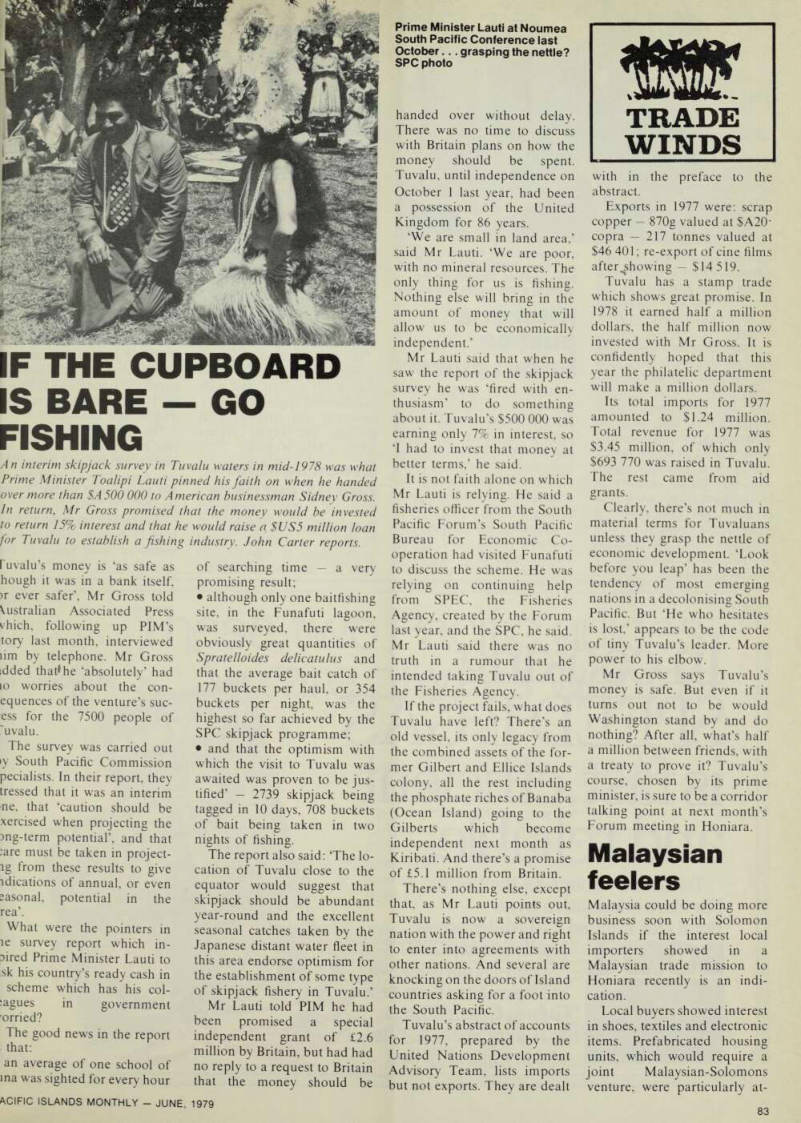

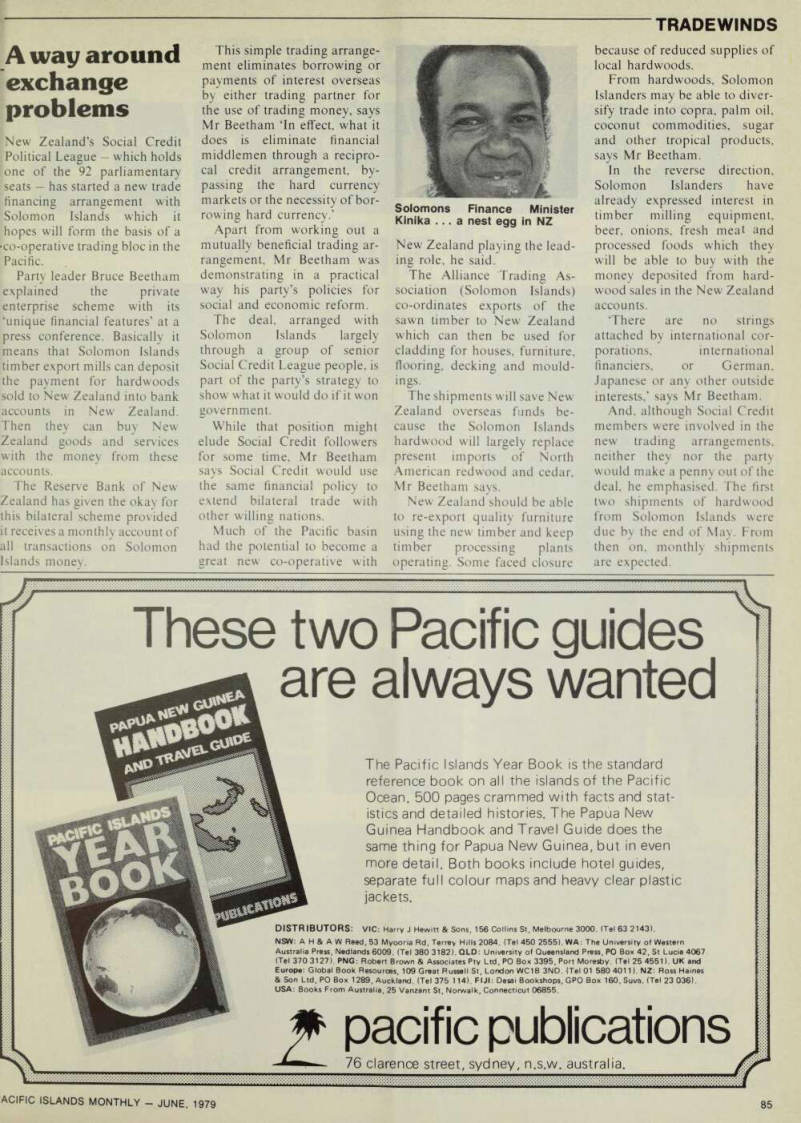
Trade
Winds
If The Cupboard
Is Bare Go
Fishing
An interim skipjack survey in Tuvalu waters in mid-1978 was what Prime Minister Toalipi Lauti pinned his faith on when he handed over more than SASOO 000 to American businessman Sidney Gross.
In return, Mr Gross promised that the money would be invested to return 15% interest and that he would raise a SUSS million loan for Tuvalu to establish a fishing industry. John Carter reports.
fuvalu’s money is ‘as safe as hough it was in a bank itself, >r ever safer’, Mr Gross told Australian Associated Press
vhich, following up PlM’s
tory last month, interviewed urn by telephone. Mr Gross
idded thaffhe ‘absolutely’ had
io worries about the con equences of the venture’s suc ess for the 7500 people of 'uvalu.
The survey was carried out •y South Pacific Commission pecialists. In their report, they tressed that it was an interim ne, that ‘caution should be xercised when projecting the )ng-term potential’, and that 'are must be taken in project ig from these results to give idications of annual, or even sasonal, potential in the rea’.
What were the pointers in te survey report which in ured Prime Minister Lauti to sk his country’s ready cash in scheme which has his ecl ogues in government orried?
The good news in the report that: an average of one school of ma was sighted for every hour
of searching time a very promising result; • although only one baitfishing site, in the Funafuti lagoon, was surveyed, there were
obviously great quantities of
Spratelloides delicatulus and that the average bait catch of 177 buckets per haul, or 354 buckets per night, was the highest so far achieved by the SPC skipjack programme; • and that the optimism with which the visit to Tuvalu was awaited was proven to be jus
tified’ 2739 skipjack being
tagged in 10 days, 708 buckets of bait being taken in two nights of fishing.
The report also said: ‘The lo cation of Tuvalu close to the equator would suggest that skipjack should be abundant year-round and the excellent seasonal catches taken by the Japanese distant water fleet in this area endorse optimism for the establishment of some type of skipjack fishery in Tuvalu.’
Mr Lauti told PIM he had been promised a special independent grant of £2.6 million by Britain, but had had no reply to a request to Britain that the money should be
handed over without delay.
There was no time to discuss with Britain plans on how the money should be spent.
Tuvalu, until independence on October 1 last year, had been a possession of the United Kingdom for 86 years. ‘We are small in land area,’ said Mr Lauti. ‘We are poor, with no mineral resources. The
only thing for us is fishing.
Nothing else will bring in the amount of money that will allow us to be economically
independent.’
Mr Lauti said that when he saw the report of the skipjack survey he was ‘fired with en thusiasm’ to do something about it. Tuvalu’s $5OO 000 was earning only 7% in interest, so T had to invest that money at better terms,’ he said.
It is not faith alone on which Mr Lauti is relying. He said a fisheries officer from the South Pacific Forum’s South Pacific Bureau for Economic Co operation had visited Funafuti to discuss the scheme. He was
relying on continuing help
from SPEC, the Fisheries Agency, created by the Forum last year, and the SPC, he said.
Mr Lauti said there was no truth in a rumour that he intended taking Tuvalu out of the Fisheries Agency.
If the project fails, what does Tuvalu have left? There’s an old vessel, its only legacy from the combined assets of the for mer Gilbert and Ellice Islands colony, all the rest including the phosphate riches of Banaba (Ocean Island) going to the Gilberts which become independent next month as Kiribati. And there’s a promise of £5.1 million from Britain.
There’s nothing else, except that, as Mr Lauti points out, Tuvalu is now a sovereign nation with the power and right to enter into agreements with other nations. And several are knocking on the doors of Island countries asking for a foot into the South Pacific.
Tuvalu’s abstract of accounts for 1977, prepared by the United Nations Development
Advisory Team, lists imports
but not exports. They are dealt
with in the preface to the abstract.
Exports in 1977 were: scrap copper —870 g at SA2O - 217 tonnes valued at $46 401; re-export of cine films — $l4 519.
Tuvalu has a stamp trade which shows great promise. In 1978 it earned half a million dollars, the half million now invested with Mr Gross. It is
confidently hoped that this
year the philatelic department will make a million dollars.
Its total imports for 1977 amounted to $1.24 million.
Total revenue for 1977 was $3.45 million, of which only $693 770 was raised in Tuvalu.
The rest came from aid grants.
Clearly, there’s not much in material terms for Tuvaluans unless they grasp the nettle of economic development. ‘Look before you leap’ has been the
tendency of most emerging
nations in a decolonising South Pacific. But ‘He who hesitates is lost,’ appears to be the code of tiny Tuvalu’s leader. More power to his elbow.
Mr Gross says Tuvalu’s money is safe. But even if it turns out not to be would Washington stand by and do nothing? After all, what’s half a million between friends, with a treaty to prove it? Tuvalu’s course, chosen by its prime minister, is sure to be a corridor talking point at next month’s Forum meeting in Honiara.
Malaysian
feelers
Malaysia could be doing more business soon with Solomon Islands if the interest local importers showed in a Malaysian trade mission to Honiara recently is an indi cation.
Local buyers showed interest in shoes, textiles and electronic items. Prefabricated housing units, which would require a
joint Malaysian-Solomons
venture, were particularly at-
Prime Minister Lauti at Noumea South Pacific Conference last October... grasping the nettle?
SPC photo
tractive. (The housing shortage
in Solomon Islands has become so acute the government has been forced to stop all recruit ing of foreigners for the time
being.)
Other lines the Malaysians were pushing were food, rub
ber and plastic goods and gift
ware.
In 1975 Solomon Islands bought SSI 719 000 worth of
Malaysian goods, mainly ma
chinery. Last year purchases,
mainly food and chemicals, were only $Bl 000. Exports to Malaysia are more-or-less non existent but Malaysia is interested in buying sizeable
quantities of rice. Surprisingly
the Malaysians also showed an interest in timber.
Kitchens
pushes
Purari power
Australia and Papua New Guinea have been talking again about the possibility of
feeding electricity by sub
marine cable to northern Aus tralia from PNG, if and when the Purari River hydro-electric scheme in Gulf Province comes
into operation.
Australia and Japan co operated with the PNG Government in a feasibility study from 1974 to 1977, find
ing that a large development at Wabo on the Purari was tech nically feasible and even econ omically attractive if industrial demand could match optimum
generating capacity within a
decade of the scheme going
into operation.
Australia’s Minister for National Development Kevin Newman told PNG Minister for Minerals and Energy Karl Kitchens in Canberra recently that he would talk to the Queensland State Government about Mr Kitchens’ suggestion that the Purari scheme could provide power for aluminium smelting in Northern Queensland.
In the meantime, at an estimated rough cost of more than K 750 million, and with considerable opposition on so ciological and environmental
grounds, the Purari project
seems a long way off.
Green light for
two US carriers
The US Civil Aeronautics Board has given approval to Hawaiian Airlines and Aeroamerica to operate ser vices in the South Pacific,
following a petition in 1978 from American Samoa for an immediate restoration of air services to the territory. The petition was filed when Pan American World Airways cut back on services to American Samoa from Hawaii.
Hawaiian Airlines, if their service goes ahead, will operate
an Hawaii-Samoa-Fiji-Tahiti-
Hawaii service. The CAB has given Hawaiian Airlines two years to start the service.
Approval to Aeroamerica is subject to terms not yet
public.
Contract let for
Funafuti Wharf
A 5A1.78 million contract for a deepwater wharf at Funafuti, capital of Tuvalu, has been let to Hornibrook Construction (Papua New Guinea).
The work, which will pro vide employment for about 60 people, will be paid for under the Australian Government’s aid programme to the South Pacific.
The project involves a 50 m long 12 m wide wharf in eight metres of water linked to the shore by a 40 m jetty
Energy Minister Kitchens (right) and Esso-BHP’s Rex White on Bass Straight, Victoria, oil rig ... pushing water power. AIS photo
Away around
exchange
problems
New Zealand’s Social Credit Political League which holds one of the 92 parliamentary seats has started a new trade financing arrangement with Solomon Islands which it hopes will form the basis of a ■co-operative trading bloc in the Pacific.
Party leader Bruce Beetham
explained the private
enterprise scheme with its ‘unique financial features’ at a press conference. Basically it means that Solomon Islands timber export mills can deposit the payment for hardwoods sold to New Zealand into bank accounts in New Zealand.
Then they can buy New Zealand goods and services with the money from these accounts.
The Reserve Bank of New
Zealand has given the okay for
this bilateral scheme provided it receives a monthly account of all transactions on Solomon Islands money.
This simple trading arrange
ment eliminates borrowing or payments of interest overseas by either trading partner for the use of trading money, says Mr Beetham Tn effect, what it does is eliminate financial
middlemen through a recipro
cal credit arrangement, by passing the hard currency markets or the necessity of bor
rowing hard currency.’
Apart from working out a
mutually beneficial trading ar
rangement, Mr Beetham was
demonstrating in a practical
way his party’s policies for social and economic reform.
The deal, arranged with Solomon Islands largely through a group of senior Social Credit League people, is part of the party’s strategy to show what it would do if it won government.
While that position might
elude Social Credit followers for some time, Mr Beetham says Social Credit would use the same financial policy to extend bilateral trade with other willing nations.
Much of the Pacific basin had the potential to become a great new co-operative with
New Zealand playing the lead ing role, he said.
The Alliance Trading As sociation (Solomon Islands) co-ordinates exports of the sawn timber to New Zealand which can then be used for cladding for houses, furniture,
flooring, decking and mould
ings.
The shipments will save New Zealand overseas funds be cause the Solomon Islands hardwood will largely replace present imports of North American redwood and cedar, Mr Beetham says.
New Zealand should be able to re-export quality furniture using the new timber and keep timber processing plants operating. Some faced closure
because of reduced supplies of local hardwoods.
From hardwoods, Solomon Islanders may be able to diver sify trade into copra, palm oil, coconut commodities, sugar
and other tropical products,
says Mr Beetham.
In the reverse direction, Solomon Islanders have
already expressed interest in
timber milling equipment,
beer, onions, fresh meat and processed foods which they will be able to buy with the money deposited from hard wood sales in the New Zealand accounts.
There are no strings attached by international cor
porations, international
financiers, or German, Japanese or any other outside interests,’ says Mr Beetham.
And, although Social Credit members were involved in the new trading arrangements, neither they nor the party would make a penny out of the deal, he emphasised. The first two shipments of hardwood from Solomon Islands were due by the end of May. From
then on, monthly shipments
are expected.
Solomons Finance Minister Kinika ... a nest egg in NZ
Advertisements & other items, pp. 83-90 (5 items)
83
ACIFIC ISLANDS MONTHLY - JUNE, 1979
Tradewinds
In cooking
SPEED-E-GAS
is fast, efficient
and reliable.
Terminals throughout the Pacific.
For more information write Boral Gas Limited, 221 Miller Street,
BORAL
North Sydney 2060 *Speed-E-Gas is known in Papua New Guinea, as Guinea Gas. In Tonga as Tonga Speed-E-Gas, and in Fiji as Fiji Gas.
SPEED-E-GAS
Q m
HOLT GS 13
These two Pacific guides
are always wanted
DISTRIBUTORS:
The Pacific Islands Year Book is the standard reference book on all the islands of the Pacific Ocean. 500 pages crammed with facts and statistics and detailed histories. The Papua New Guinea Handbook and Travel Guide does the same thing for Papua New Guinea, but in even more detail. Both books include hotel guides, separate full colour maps and heavy clear plastic jackets.
Sons, 156 Collins St, Melbourne 3000. (Tel 63 2143).
VIC: Harry J Hewitt.
NSW: A H & A W Reed, 53 Myooria Rd, Terrey Hills 2084. (Tel 450 2555). WA: The University of Western Australia Press, Nedlands 6009. (Tel 380 3182). OLD: University of Queensland Press, PO Box 42, St Lucia 4067 (Tel 370 3127) PNG: Robert Brown & Associates Pty Ltd, PO Box 3395, Port Moresby. (Tel 25 4551). UK and Europe: Global Book Resources, 109 Great Russell St, London WCIB 3ND. (Tel 01 580 4011). NZ: Ross Haines & Son Ltd, PO Box 1289, Auckland. (Tel 375 114). FIJI: Desai Bookshops, GPO Box 160, Suva. (Tel 23 036).
USA: Books From Australia, 25 Vanzant St, Norwalk, Connecticut 06855.
f' pacific publications
76 clarence street, Sydney, n.s.w. australia.
CHLORIDE
for all applications
M n - T. & 2S m r- - W- P m nm n a OS TO era
mtA^
b *» s%* a 3£ a< Chloride is the largest and only manufacturer of both lead acid and nickel cadmium alkaline batteries in Australia.
The Company is equipped and qualified to offer advice, guidance and service on any battery requirement no matter how large or small.
On the question of size, it could be as small as a battery for a hearing aid the dimensions of a coat button or a power station battery weighing as much as 40 tonnes.
Again it could be a no break D.C.
Power System for a computer or emergency lighting for a hospital.
The Chloride Company operates in 40 countries throughout the world, and when you consider that in Australia alone its production is approaching VA million batteries per year, it gives some idea of the far reaching role that batteries play in our lives.
Chloride Batteries Australia Limited
P.O. Box 141, Bankstown. IM.S.W. 2200. Australia. Telephone: 77 0177. Telex: 21262
TRADEWINDS INTELLIGENCE
Australia's curtailment of exports of butane gas to French Polynesia, where it is widely used for domestic and other purposes, was one of the matters raised during the April visit to Australia by France’s high commissioner in French Polynesia, Paul Cousseran. On the eve of his departure from Papeete Mr Cousseran told La Depeche de Tahiti: ‘l’m certainly going to make the point that as we are only very small customers we consume only 4800 tonnes a year our imports are only a drop in the bucket of their overall exports of gas and really couldn’t cause them much of a problem. I will also be saying that on a national scale Australia’s imports from and commercial exchanges with metropolitan France are on a very large scale, and that the Australian Government should bear this in mind in making its decision, which is of fundamental importance for the Polynesians.
If the embargo isn’t lifted, they could find themselves faced with a steep rise in the price of a bottle of gas.’ Australia claimed that it was stopping the exports because it wanted to conserve its supplies. French Polynesia has had to import gas from Venezuela,
at considerably increased freight costs.
British Airways’ manager in Papua New Guinea, David Graeme, ust before leaving on posting to Rawalpindi, took 10 Air Niugini >taff to London to inspect BA training and administrative facili- ;ies. Mr Graeme’s successor is Richard Froggatt from BA’s Lonlon office. fourist Hotel Corporation of New Zealand has appointed Linda Treenborough Australian sales manager. Ms Greenborough, also epresents the Cook Islands Tourist Authority, The THC Sydney Dperation is in Air New Zealand’s city offices.
Urline agreements are flying thick and fast. Three in recent weeks vere the Papua New Guinea-United States deal to allow airlines )f both countries into each other’s territory; the Continental- J olynesian Airlines general sales agents arrangement; and the -iji-New Zealand air rights agreement which allows Air Pacific o make direct flights to NZ from Nadi and Air New Zealand o land at Nausori airport near Suva. *an Am in February launched a US-wide publicity campaign to )romote Tahiti as a tourist destination. A company spokesman n Papeete said that the positive effects of the campaign had been loticeable within a month. Pan Am was flying more passengers o Papeete and had been obliged to increase services, oals to Newcastle? Thousands of Solomon Islanders need a ship- Dad of coconuts to replace thousands of coconut palms destroyed
/hen Cyclone Kerry hit in February.
continental Airlines, whose trans-Pacific service started early in vlay has appointed Jack C. Tobin as its Sydney-based vice presilent and managing director, and Steven Handy as regional direc-
or in Fiji.
Sydney?
Melbourne?
Adelaide? . . . stay
Travelodge for top
accommodation
In Australia’s major centres you’ll find Travelodge is number one, offering the same top facilities and service that has made our name famous throughout the South Pacific.
Sis
Book through Sydney (02)31 0601 Melbourne (03) 387 1233 Brisbane (07) 221 8586 Darwin (089) 81 5388 Fort Moresby 21 2266 Suva 2 4600 Adelaide (08) 223 6194 Perth (09) 325 3811 Canberra (062) 49 1424 Auckland 3 3749
ravelodge
I South Pacific
The small business
computer/
For equipment, standard programmes and installation at current leasing rates over 5 years with 10% residual.
SBC 105
SUB-DISTRIBUTORSHIPS AVAILABLE ALL PACIFIC AREAS
WRITE TO: Mr. M. LOUE
from The Small Business
ftnmni iter Ctn RING NOW FOR
WUIIIJJUiei UU. DEMO-(02)929-7699
200 Pacific Highway, Crows Nest, N.S.W., Australia 2065.
PORT
* Right in tl business cej * A traditio|l;tor comfort andifint food * All thorns airconditioned * Restaurant * Bai * Banquet hall
...A. C. NEUMANN
manager Phone 21-2622 Cables]
Stay at Aggie Grey’s ...
the South Pacific’s
legendary hotel.
Situated right in the heart of Western Samoa. Enjoy Polynesian-style friendliness and service, in cool surroundings, superb entertainment and food.
Magnificent white sand beaches only a short drive away. Airconditioned rooms, swimming pool and full bar facilities.
Bookings through Union Steamship Company of NZ, Pan Am, Air New Zealand or direct to Aggie Grey’s, Apia, Western Samoa. Cables: ‘AGGIES’Apia,
WINDS INTELLIGENCE...TRADEWINDS INTELLIGENCE...TRADEWINDS I
CHEAPER landing fees at Fiji’s Nadi airport have been announced by Minister for Civil Aviation Tomasi Vakatora. Route changes for air-traffic control and communications and meteorological services given by the airport to aircraft in southwest Pacific area would be cut by 20%, Mr Vakatora said.
THE GUAM Visitors Bureau has decided to give up to $5O 000 a year to organisations which promote off-season and special interest tours to Guam.
EAST-WEST Airlines, which services Norfolk Island from Sydney, carried more than half a million passengers last year, a near 10% lift on 4977 figures.
THE FIJI Sugar Corporation is to spend $l6 million to expand the Labasa mill on Vanau Levu in time to crush increased production of cane in the 1980 season.
THE PNG Government has asked third level operators to phase out single-engined aircraft within three years.
FIJI Industries, cement manufacturer, earned a net profit of $159 390 in the six months to December 31, 1978, up from $B4 846 in the last six months of 1977.
CO-OPERATIVES in Tonga had a turnover of more than $ f 1.25 million last year.
FIFTY rooms are being added to the Madang Resort Hotel in Papua New Guinea and plans are being drawn for a six story block containing a further 100 rooms, bringing the total number of rooms to 210.
FIJI is issuing $250 (featuring a banded iguana), $2O (golden cowrie) and $lO (pink-billed parrot) gold coins as part of the world’s wildlife conservation coin series.
SOLOMON Islands exports in 1978, at $5131.1 million, were up 7% on the previous year while imports, at $3l million were 20% up on 1977, leaving a tiny trade surplus.
TURTLE Island Airways of Nadi, Fiji, has launched a Lautoka- Sigatoka-Suva seaplane charter service with Cessna 206 aircraft.
FIJI is claiming SFI.2 million from a British contracting company, Sir Lindsay Parkinson and Company, alleging that the company took too long to build the Lautoka Hospital. The dispute will be settled by arbitration in London.
THE TUVALU Government’s Fish Processing Officer Keith Machell has announced that a beche-de-mer project, started in May last year, is about to begin exporting, the first consignment
going to a Hong Kong buyer.
CONSTRUCTION is underway, financed by the Australian Government, of a SA2OO 000 harbour pilot launch for Santo, New Hebrides, at the Morton Engineering Company dockyard in Hemnant, Queensland.
BAUERFIELD airport, Vila, New Hebrides, caught up with most others in the Pacific when in March for the first time it introduced a passenger security check.
FIJI had a visible trade deficit of $130.12 million in 1978 compared with $118.13 million in 1977, mainly because of a slump in sugar earnings.
VISITORS to New Caledonia in 1978 totalled 52 280, 29% up on the figure of 40 369 in 1977. Australian visitors were up from 20 275 to 21 834 and New Zealand visitors increased from 4895 to 5003. Japanese arrivals rose from 4633 to 11 885.
DEWINDS INTELLIGENCE...TRADEWINDS INTELLIGENCE..
. TRADEWINDS
The Supreme Status Watch!
K.
CITIZEN
Bin
UMI
OMI
multi ALARM mm
mSmi:
I WSKmm L :
y T ■lifet
.!«' gb Mr
The only Timepiece of its kind
in the world.
No other timepiece comes close! Because here is a completely-new kind of time system. Incredibly complex Yet marvelously simple to own and use.
Only the Citizen heritage of superb craftsmanship could achieve this multi-feature instrument. It can outperform every other watch in the world.
To own it is to know instant response... and suprem* versatility.
Here is the Status Watch supreme.. .as unique as the exciting life style it was born to serve.
MEMO/CHIME Model #4O-1030-50
When you forget... Citizen remembers
Alarm 1 Alarm 2 Chime Timer Stop Watch
|B3 B 3 SI fOEil
TRADEWINDS INTELLIGENCE TRADEWINDS INTELLIGENCE...TRADEWI
_NEW CALEDONIAN beekeepers plan to establish a demonstration apiary in an effort to learn more about the ways of bees
and produce more honey and by-products.
MICRONESIA in mid-March saw the inauguration of the firstever airmail service between Ponape and Kosrae. The service is operated by Pacific Missionary Aviation, which for the past two years has been gearing itself to meet the stringent requirements of the US postal service for airmail operators.
THE LEVEL of the Western Samoa all groups consumer price index for January dropped by 0.7% compared with December 1978 but was up 3.3% on January last year.
BURNS Philp (SS) lifted net profit by 7.2% to SFI.6 million for the half-year ended December 31 and is paying an interim dividend of 7.5 c a share on capital increased by a two-for-three bonus issue.
GUAM’S tourist industry has generated SUS7OO million in gross business receipts over the past 11 years, making it Guam’s second largest source of revenue after US federal government spending.
The industry provides more than 7000 jobs, 22% of Guam’s 30 000 labour force. A total of 238 000 tourists visited the territory in 1978.
FIJI expects a record output of 459 000 tonnes of sugar in 1979, 102 000 tonnes above the 1978 figure and 59 000 tonnes higher Jian the 1968 record.
TONGA Co-Operatives Federation has received grants of 5U52300, to build and expand 10 vanilla drying sheds for 10 co-ops on Vavau, and $5200, to build a co-operative federation warehouse at Neiafu, Vavau, from the US Agency for Inter-
national Development Accelerated Impact Programme.
THE CANADIAN Government has extended most favoured nation and general preferential tariff status to the Caroline, Marshall and Mariana Islands. Officials say the Canadians might be interested in importing coconut oil, fish, black pepper, handicrafts items produced in bulk in Micronesia.
TOTAL number of tourists visiting the New Hebrides in 1978 was 27 579, up 12% over 1977 (24 545).
NEW CALEDONIA’S chamber of commerce celebrated its centenary in April. More than 300 members of various chambers in France visited Noumea for the occasion.
THE NEI Manganibuka, a fishing vessel built in Japan for the Gilbert Islands is now in service.
VANILLA has become Tonga’s third ranking export. In 1953 King Taufa’ahau Tupou (then Prince Tungi and prime minister) directed that the possibility of vanilla becoming a cash crop be
investigated.
A MILL to produce feed for poultry and pigs and costing SNZSOO 000 has been handed over by the New Zealand Government to the Western Samoa Government.
A MINIMUM of K 5 million will be required to develop a 0.8 hectare hotel site next to the Davara Hotel across the road from Port Moresby’s Ela Beach. The PNG Government is seeking overseas investment to get the project off the ground.
VISITORS to Fiji last October numbered 15 561, 1.4% less than in October 1977. A breakdown showed that 5561 were from Australia (35.7%), 2924 from New Zealand (18.8%), 3170 from United States (20.4%) and 783 from Canada (5%). In the first 10 months of 1978 152 595 people visited Fiji, a 6.3% increase over the same period in 1977.
TRADEWINDS INTELLIGENCE...TRADEWINDS INTELLIGENCE.
.TRADEWI
The Memo/Chime by Citizen.
! ;Ti
IITI/KS
MULTI
HttJtTl
I ITI/.KN
■3
CCS
■■o mucn multi
NUATI
\ • M 1. The Time: Gives hours, minutes, seconds. AM or PM 2. The Calendar: Shows month, date, day 3. Alarm 1: Sounds every day at the hour and minute selected. The Memo Chime memory never forgets! 4. Alarm 2: Added convenience, extra reminder.
Works separately from Alarm 1. 5. All Alarms Deleted: Both Alarm 1 and Alarm 2 can be deleted and reset easily and quickly. 6. The Chime: Sounds every hour on the hour with two sharp beeps. Once set, Memo Chime s memory will mark the hours. 7. Chime-Deleted: The chime feature can be deleted by simply depressing the reset button. 8. Timer: A classic "countdown"...indicates time still remaining in time period; beep signals for one minute when period is up. . 9. Stop Watch: Times intervals up to 11 hours. 59 minutes, 59 seconds.
•CITIZEN
Anything less is merely time on your hands
Mamma .
The South Seas Express.
The first regular roll-on roll-off express
service between N. the Islands.
The introduction of Marama to the Islands trade will enable exporters to greatly increase their export potential by providing faster, more frequent sailings as well as the greater cargo handling flexibility which a roll-on, roll-off service can provide.
Lautoka^>_^
,4 S^ySuva
1 Departures every 14 days from Auckland to: Lautoka, Suva, Pago Pago.
Apia. Nukualofa. •y Nukualofa Pago Pago Co-ordinated transhipment facilities from other N.Z. centres Intermodal coastal roll-on roll-off services as well as rail and road services can be utilised by shippers in other New Zealand centres to take advantage of the new Marama schedule. Your nearest Union Company office can assist you in organising the most efficient transhipment method.
International Transhipment Facilities Flexibility in cargo modules catered by this new service can provide for shipping operators and exporters the advantage of reaching international markets using onforwarding services through Union Company contacts and expertise.
Additionally Union can also arrange for cargoes originating from overseas sources to be transhipped at ports covered by Marama' to their final destination to the benefit of the importer in New Zealand or the Islands. m.v. Marama Your new export incentive 6350 deadweight tonnes.
Capacity 340 seafreighter units or their equivalent, plus space for wheeled vehicles, livestock, etc.
Greater Flexibility Means a more satisfactory and versatile way to ship your consignment.
The following equipment is provided free to shippers Standard dry general cargo ISO containers 20' xB' x B'6" box container 20' xB' x B'6" Opensided container.
Seafreighter Units
For movement of general and bulk cargoes. (Internal) Length 13'9"(4.24M) width 7'6"(2.29M) height 5' (1.52 M) N.B. Units are fully collapsible and open topped to facilitate loading cargoes in excess of 1.52 M height, A shower-proof cover is also provided free with every seafreighter.
Newsprint Flats These units are specifically designed for carriage of forest industry cargo but are also suitable for the carriage of other specified types of cargoes. (Internal) Length 15'6" (4.77 M) Width 6' (1.830 M) W. Containers These containers are totally enclosed suitable for the movement of smaller consignments or valuable ones. (Internal) Length 5'7"(1.75M) Width 4' (1.22 M) Height 5'6"(1.70M) Unit Loads This covers cargo that is unable to be containerised or is not covered by the term mobile equipment'.
These unit loadings must be of a secure nature to facilitate handling by a forklift with 5" gluts (loading forks).
Refrigerated Cargo The following containers will be available: Cold wrap containers 20' x 8' x 8' Integral containers 20' x 8' x B'6"
Livestock Livestock stalls are available for the carriage of all types of stock.
Wheeled Cargo The versatility of Marama means that all types of wheeled cargoes including cars, trucks, tractors, scrapers, machinery on mobile tracks, cranes, trailers etc can be catered for.
Hazardous Cargo The majority of hazardous cargoes will be accommodated on the vessels upper deck either in seafreighters, ISO containers or W. Containers. Full details are available on application.
union
eompnnq
u moving
Tradewinds
85
ACIFIC ISLANDS MONTHLY JUNE, 1979
87
ACIFIC ISLANDS MONTHLY - JUNE, 1979
Yachts
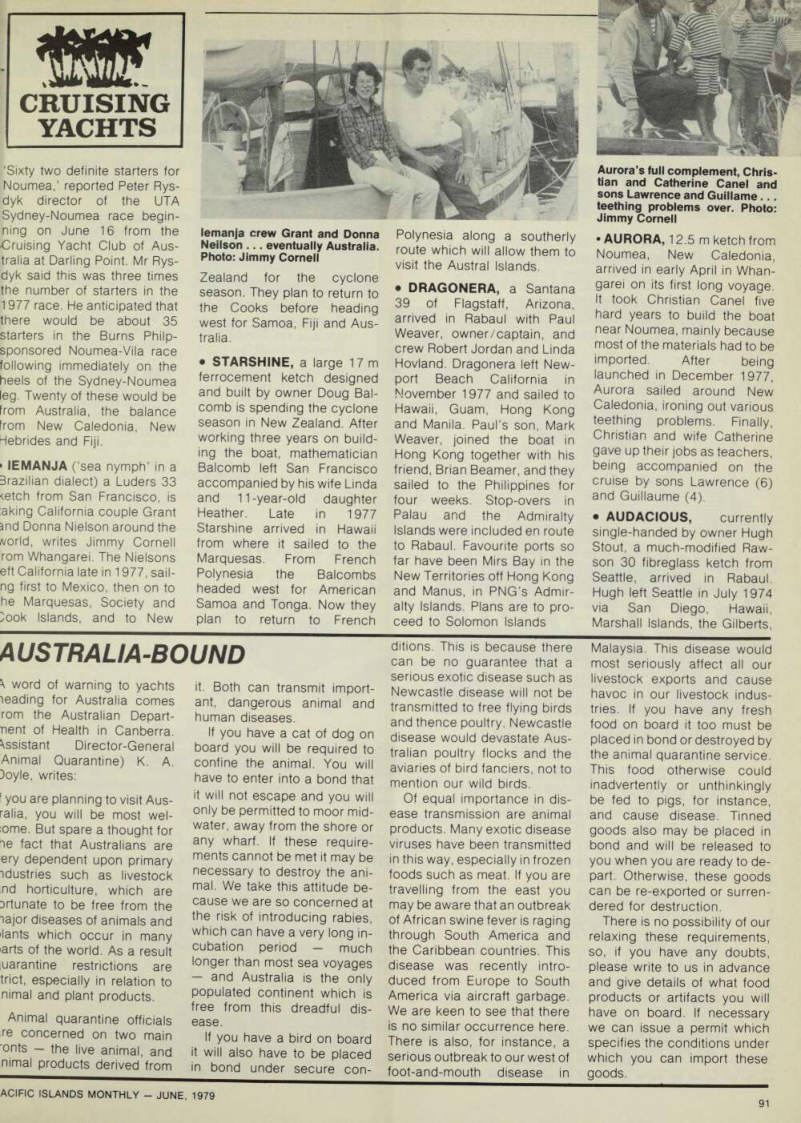
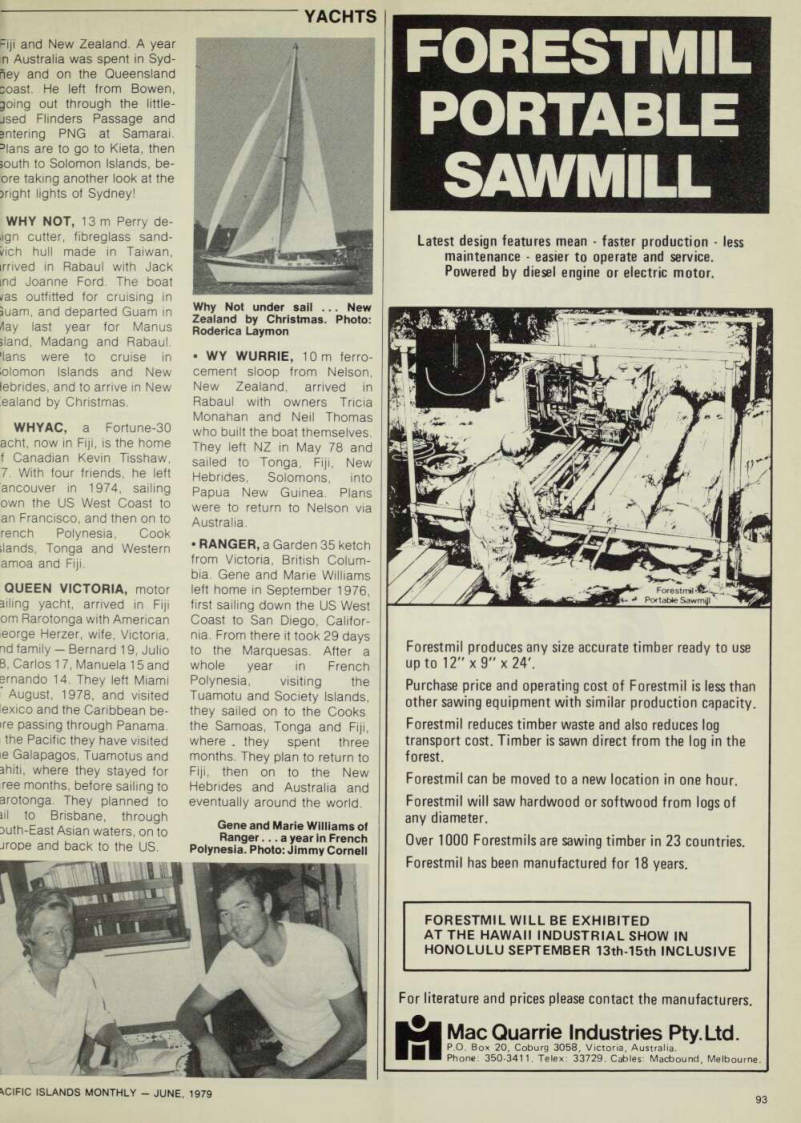
Cruising
‘Sixty two definite starters for Noumea,’ reported Peter Rys dyk director of the UTA Sydney-Noumea race begin ning on June 16 from the Cruising Yacht Club of Aus tralia at Darling Point. Mr Rys dyk said this was three times the number of starters in the 1977 race. He anticipated that there would be about 35 starters in the Burns Philp sponsored Noumea-Vila race following immediately on the heels of the Sydney-Noumea leg. Twenty of these would be from Australia, the balance from New Caledonia, New Hebrides and Fiji. * lEMANJA (‘sea nymph’ in a Brazilian dialect) a Luders 33 <etch from San Francisco, is aking California couple Grant and Donna Nielson around the /vorld, writes Jimmy Cornell rom Whangarei. The Nielsons eft California late in 1977, sail ng first to Mexico, then on to he Marquesas, Society and lslands, and to New
Zealand for the cyclone season. They plan to return to the Cooks before heading west for Samoa, Fiji and Aus tralia. • STARSHINE, a large 17 m ferrocement ketch designed and built by owner Doug Bal comb is spending the cyclone season in New Zealand. After working three years on build ing the boat, mathematician Balcomb left San Francisco accompanied by his wife Linda and 11-year-old daughter Heather. Late in 1977 Starshine arrived in Hawaii from where it sailed to the Marquesas. From French Polynesia the Balcombs headed west for American Samoa and Tonga. Now they plan to return to French
Polynesia along a southerly route which will allow them to visit the Austral Islands. • DRAGONERA, a Santana 39 of Flagstaff, Arizona, arrived in Rabaul with Paul Weaver, owner/captain, and crew Robert Jordan and Linda Hovland. Dragonera left New port Beach California in November 1977 and sailed to Hawaii, Guam, Hong Kong and Manila. Paul’s son, Mark Weaver, joined the boat in Hong Kong together with his friend, Brian Beamer, and they sailed to the Philippines for four weeks. Stop-overs in Palau and the Admiralty Islands were included en route to Rabaul. Favourite ports so far have been Mirs Bay in the New Territories off Hong Kong and Manus, in PNG’s Admir alty Islands. Plans are to pro ceed to Solomon Islands
• AURORA, 12.5 m ketch from Noumea, New Caledonia, arrived in early April in Whan garei on its first long voyage.
It took Christian Canel five hard years to build the boat near Noumea, mainly because most of the materials had to be imported. After being launched in December 1977, Aurora sailed around New Caledonia, ironing out various teething problems. Finally, Christian and wife Catherine gave up their jobs as teachers, being accompanied on the cruise by sons Lawrence (6) and Guillaume (4). • AUDACIOUS, currently single-handed by owner Hugh Stout, a much-modified Raw son 30 fibreglass ketch from Seattle, arrived in Rabaul.
Hugh left Seattle in July 1974 via San Diego, Hawaii, Marshall Islands, the Gilberts,
lemanja crew Grant and Donna Neilson ... eventually Australia.
Photo: Jimmy Cornell
Aurora’s full complement, Chris tian and Catherine Canel and sons Lawrence and Guillame... teething problems over. Photo: Jimmy Cornell
Fiji and New Zealand. A year n Australia was spent in Syd ney and on the Queensland coast. He left from Bowen, going out through the little jsed Flinders Passage and sntering PNG at Samarai. 3 lans are to go to Kieta, then south to Solomon Islands, be ore taking another look at the )right lights of Sydney!
WHY NOT, 13 m Perry de ign cutter, fibreglass sand wich hull made in Taiwan, irrived in Rabaul with Jack md Joanne Ford. The boat /as outfitted for cruising in suam, and departed Guam in /lay last year for Manus sland, Madang and Rabaul. •lans were to cruise in lolomon Islands and New lebrides, and to arrive in New Zealand by Christmas.
WHYAC, a Fortune-30 acht, now in Fiji, is the home f Canadian Kevin Tisshaw, 7. With four friends, he left ancouver in 1974, sailing own the US West Coast to an Francisco, and then on to rench Polynesia, Cook ilands, Tonga and Western amoa and Fiji.
Queen Victoria, Motor
ailing yacht, arrived in Fiji om Rarotonga with American eorge Herzer, wife, Victoria, nd family Bernard 19, Julio B, Carlos 17, Manuela 15 and srnando 14. They left Miami August, 1978, and visited exico and the Caribbean be •re passing through Panama, the Pacific they have visited ie Galapagos, Tuamotus and ahiti, where they stayed for ree months, before sailing to arotonga. They planned to lil to Brisbane, through cuth-East Asian waters, on to jrooe and back to the US.
• WY WURRIE, 10 m ferro cement sloop from Nelson, New Zealand, arrived in Rabaul with owners Tricia Monahan and Neil Thomas who built the boat themselves.
They left NZ in May 78 and sailed to Tonga, Fiji, New Hebrides, Solomons, into Papua New Guinea. Plans were to return to Nelson via Australia. • RANGER, a Garden 35 ketch from Victoria, British Colum bia. Gene and Marie Williams left home in September 1976, first sailing down the US West Coast to San Diego, Califor nia. From there it took 29 days to the Marquesas. After a whole year in French Polynesia, visiting the Tuamotu and Society Islands, they sailed on to the Cooks the Samoas, Tonga and Fiji, where . they spent three months. They plan to return to Fiji, then on to the New Hebrides and Australia and eventually around the world.
Why Not under sail ... New Zealand by Christmas. Photo: Roderica Laymon
Gene and Marie Williams of Ranger...a year in French Polynesia. Photo: Jimmy Cornell
Australia-Bound
\ word of warning to yachts leading for Australia comes rom the Australian Depart nent of Health in Canberra. \ssistant Director-General Animal Quarantine) K. A.
Joyle, writes: f you are planning to visit Aus ralia, you will be most wel ;ome. But spare a thought for ie fact that Australians are ery dependent upon primary idustries such as livestock nd horticulture, which are Drtunate to be free from the lajor diseases of animals and lants which occur in many arts of the world. As a result uarantine restrictions are trict, especially in relation to nimal and plant products.
Animal quarantine officials re concerned on two main 'onts the live animal, and nimal products derived from
it. Both can transmit import ant, dangerous animal and human diseases.
If you have a cat of dog on board you will be required to confine the animal. You will have to enter into a bond that it will not escape and you will only be permitted to moor mid water, away from the shore or any wharf. If these require ments cannot be met it may be necessary to destroy the ani mal. We take this attitude be cause we are so concerned at the risk of introducing rabies, which can have a very long in cubation period much longer than most sea voyages and Australia is the only populated continent which is free from this dreadful dis ease.
If you have a bird on board it will also have to be placed in bond under secure con
ditions. This is because there can be no guarantee that a serious exotic disease such as Newcastle disease will not be transmitted to free flying birds and thence poultry. Newcastle disease would devastate Aus tralian poultry flocks and the aviaries of bird fanciers, not to mention our wild birds.
Of equal importance in dis ease transmission are animal products. Many exotic disease viruses have been transmitted in this way, especially in frozen foods such as meat. If you are travelling from the east you may be aware that an outbreak of African swine fever is raging through South America and the Caribbean countries. This disease was recently intro duced from Europe to South America via aircraft garbage.
We are keen to see that there is no similar occurrence here.
There is also, for instance, a serious outbreak to our west of foot-and-mouth disease in
Malaysia. This disease would most seriously affect all our livestock exports and cause havoc in our livestock indus tries. If you have any fresh food on board it too must be placed in bond or destroyed by the animal quarantine service.
This food otherwise could inadvertently or unthinkingly be fed to pigs, for instance, and cause disease. Tinned goods also may be placed in bond and will be released to you when you are ready to de part. Otherwise, these goods can be re-exported or surren dered for destruction.
There is no possibility of our relaxing these requirements, so, if you have any doubts, please write to us in advance and give details of what food products or artifacts you will have on board. If necessary we can issue a permit which specifies the conditions under which you can import these goods.
Advertisements & other items, pp. 91-94 (3 items)
Acific Islands Monthly - June, 1979
Superior
BUSINESS
OPPORTUNITY
SUB-DISTRIBUTORSHIPS AVAILABLE
ALL PACIFIC AREAS to market and support a complete range of computer systems and Australian softwear, to the small businessman.
Write to Cary M. Laue
THE SMALL BUSINESS COMPUTER CO.
See our System Ad. This issue 5.8.C.0G9
PTY. LTD.
EXPORTERS o GENERAL MERCHANTS
428 GEORGE ST., SYDNEY
CABLES: HENCO SYDNEY. G.P.O. Box 3949. PHONE: 232-5377
For specialised and personalised buying service
throughout the Pacific Islands and the East.
« LOCAL AGENTS AND REPRESENTATION:
PAPUA NEW GUINEA: FIJI:
RABAUL: M. & C. Seeto, P.O. Box 131, Rabaul.
Telephone 92-2919.
K. Witherington Ltd., P.O. Box 293, Suva.
Telephone 22-356.
MADANG: W. Double P.O. Box 22, Madang.
Telephone 82-2696.
NEW HEBRIDES:
John Lum & Associates, P.O. Box 65, Santo.
Telephone 329..
SOLOMON ISLANDS:
Mr, Tom Lo, P.O. Box 327, Honiara.
Telephone 399.
Resident Agents in other Pacific Territories,
Superior
WE COVER YOUR SLASHING
REQUIREMENTS
QUALITY RIGHT - PRICE RIGHT
CHECK OUR RANGE OF MACHINES
FOR THE ONE TO SUIT YOUR NEEDS EXTRA BOTTOM SEAL PROTECTION IN EVERY MODEL SLASHER MOWERS to suit Kubota/Mitsubishi
□ 33" L 33 T.P.L □36"L36T.P.L
ECONOMY SLASHERS 75 h.p. Box. 2 1/16" Shaft
□ 48" LL4 □ 54" LL4.5
□ 60" LLS □ 72" LL6
FROM ..
TO .. £ t 24'
SUPPLIERS TO: GOVT. DEPTS, LOCAL AUTHORITIES,
CONTRACTORS and the MAN on the LAND
MULTI PURPOSE SLASHERS
□ 10LX10 □ 10 ' TX 10 □ 12' TXI2 □ 20'TX20 □ 24'TX24
GRASS SLASHERS
□ 42" L 42 □ 48" L4B Tick Ef the machine you are interested in and send this advert for FREE brochure to:
SUPERIOR FARM EQUIPMENT PTY. LTD.,
782 Fairfield Road, Veerongpilly, Brisbane, Old. 4105 Phone; (07( 392 2788.
HEAVY DUTY SLASHERS SlOO Gear Box
□ 60" LXS □ 72" LX6
□ 84" LX7 □ 15'Trail TXIS PRICES INCLUDE CLUTCH & DRIVESHAFT ON ALL MODELS ALL UNITS SOLD WITH FULL FACTORY WARRANTY SUPERIOR’S EXTRA SEAL
PROTECTION ON EVERY SLASHER
NAME
ADDRESS
POSTCODE
FORESTMIL
PORTABLE
SAWMILL
Latest design features mean - faster production - less maintenance - easier to operate and service.
Powered by diesel engine or electric motor. k ncr A 3 Forestrml 1 * Portable Sawmjl Forestmil produces any size accurate timber ready to use up to 12" x 9" x 24'.
Purchase price and operating cost of Forestmil is less than other sawing equipment with similar production capacity.
Forestmil reduces timber waste and also reduces log transport cost. Timber is sawn direct from the log in the forest.
Forestmil can be moved to a new location in one hour.
Forestmil will saw hardwood or softwood from logs of any diameter.
Over 1000 Forestmils are sawing timber in 23 countries.
Forestmil has been manufactured for 18 years.
FORESTMIL WILL BE EXHIBITED
AT THE HAWAII INDUSTRIAL SHOW IN
HONOLULU SEPTEMBER 13th-15th INCLUSIVE
For literature and prices please contact the manufacturers.
VH
MacQuarrie Industries Pty.Ltd.
P.O. Box 20, Coburg 3058, Victoria, Australia.
Phone: 350-3411. Telex: 33729. Cables: Macbound, Melbourne.
ISLANDS
TRANSPORT
LINE
MS AFRICANSTARS
Express Freight Service between Pacific Coast Ports of U.S.A. and...
Tahiti 6 Samoa
PAPEETE - APIA - PAGO PAGO
Full container service including reefers.
GENERAL STEAMSHIP CORPORATION LTD.
General Agents 400 California Street, San Francisco, California, U.S.A.
APIA: Bums Philp (South Sea) Company Ltd.
PAPEETE: Agence Maritime Internationale, Tahiti.
PAGO PAGO; Polynesia Shipping Services Inc.
i
PACIFIC
FORUm
uric
OWNED BY THE PEOPLE
OF THE PACIFIC ISLANDS
Regular Monthly Liner Services
from Australia and New Zealand
to the South and Central Pacific
FOR INFORMATION CONTACT AGENTS:
AMERICAN SAMOA:
Polynesian Shipping Services Inc. P.O. Box 1478, Pago Pago.
AUSTRALIA:
The Australian National Line, 50 Queen Street, Melbourne.
Union Bulkships Pty.Ltd., 333-339 George Street, Sydney.
GILBERT ISLANDS:
Gilbert Islands Shipping Corp. P.O. Box 495, Tarawa.
FIJI:
Burns Philp South Sea Co. Ltd. GPO Box 355, Suva.
NEW CALEDONIA;
ETS Ballande, BP. C 4, Noumea.
NEW HEBRIDES:
Burns Philp New Hebrides Limited, Vila.
NEW ZEALAND;
The Shipping Corp. of N.Z. Ltd. P.O. Box 3344, Wellington.
PAPUA NEW GUINEA;
Steamships Trading Co. Ltd. P.O. Box 1, Port Moresby.
SOLOMON ISLANDS;
Sullivans S.l. Ltd. GPO Box 3, Honiara.
TONGA:
Union Steam Ship Co. P.O. Box 4, Nukualofa.
Yachts
93
XCIFIC ISLANDS MONTHLY - JUNE, 1979
Services
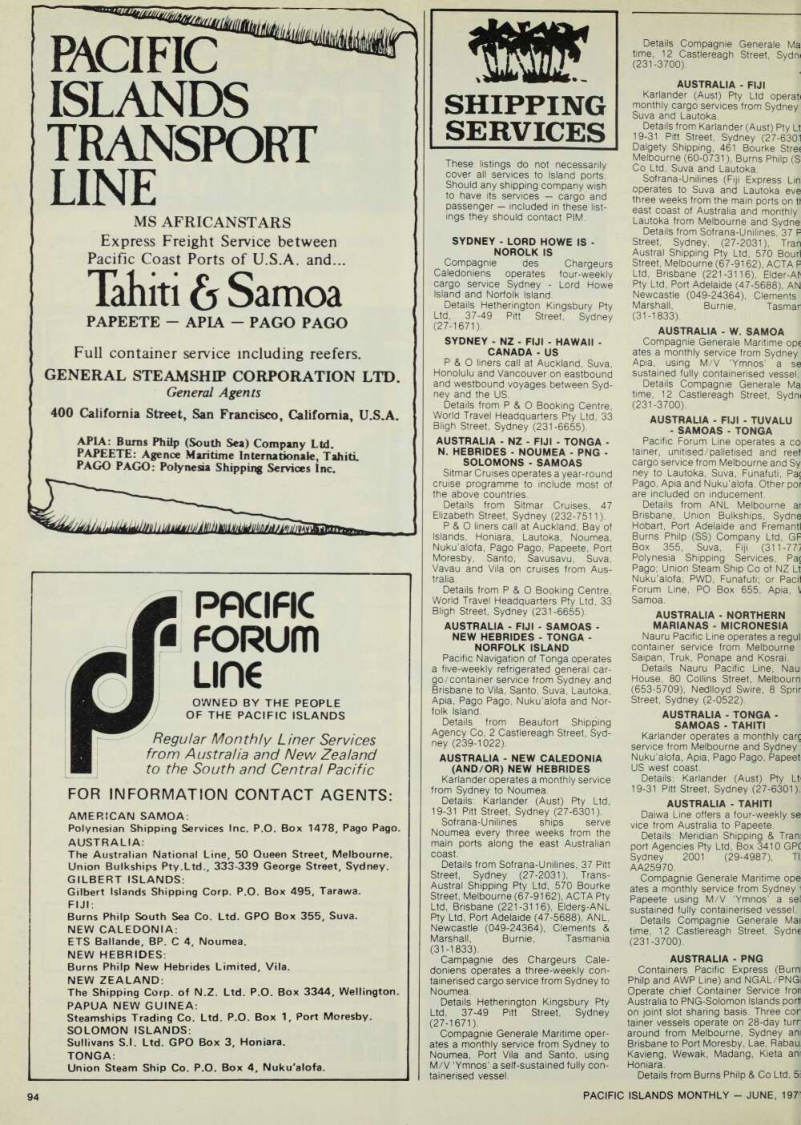
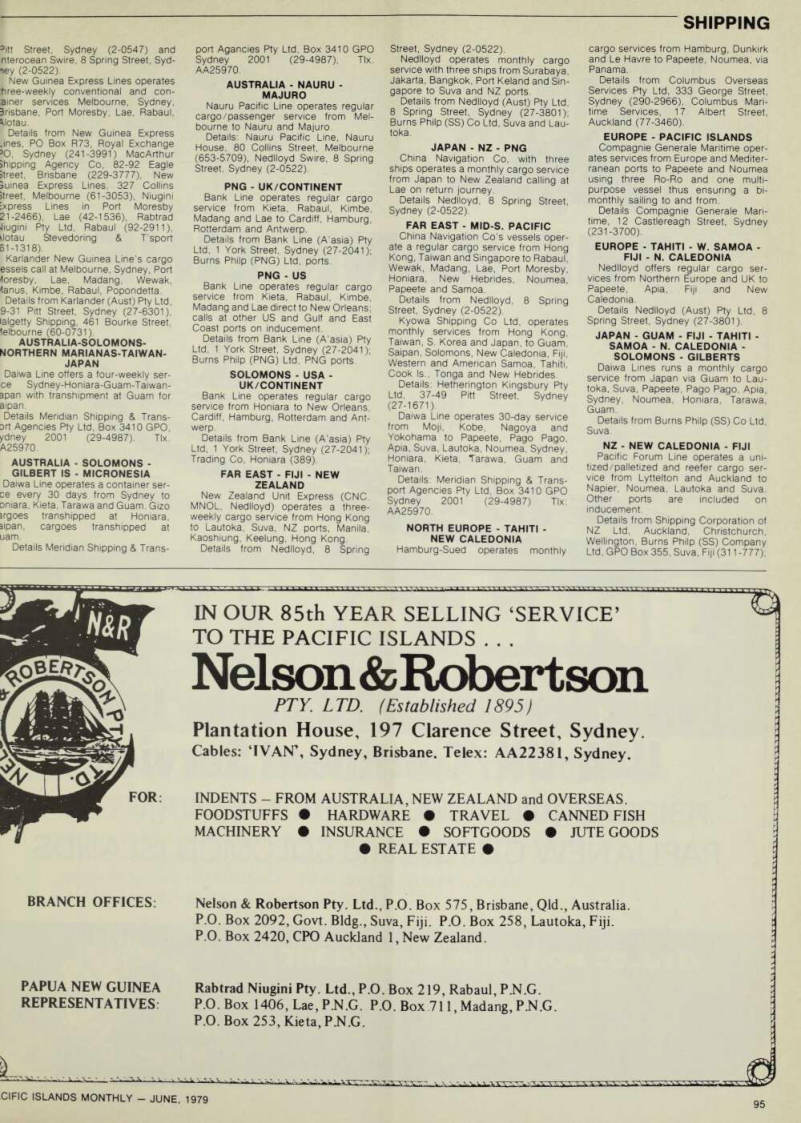
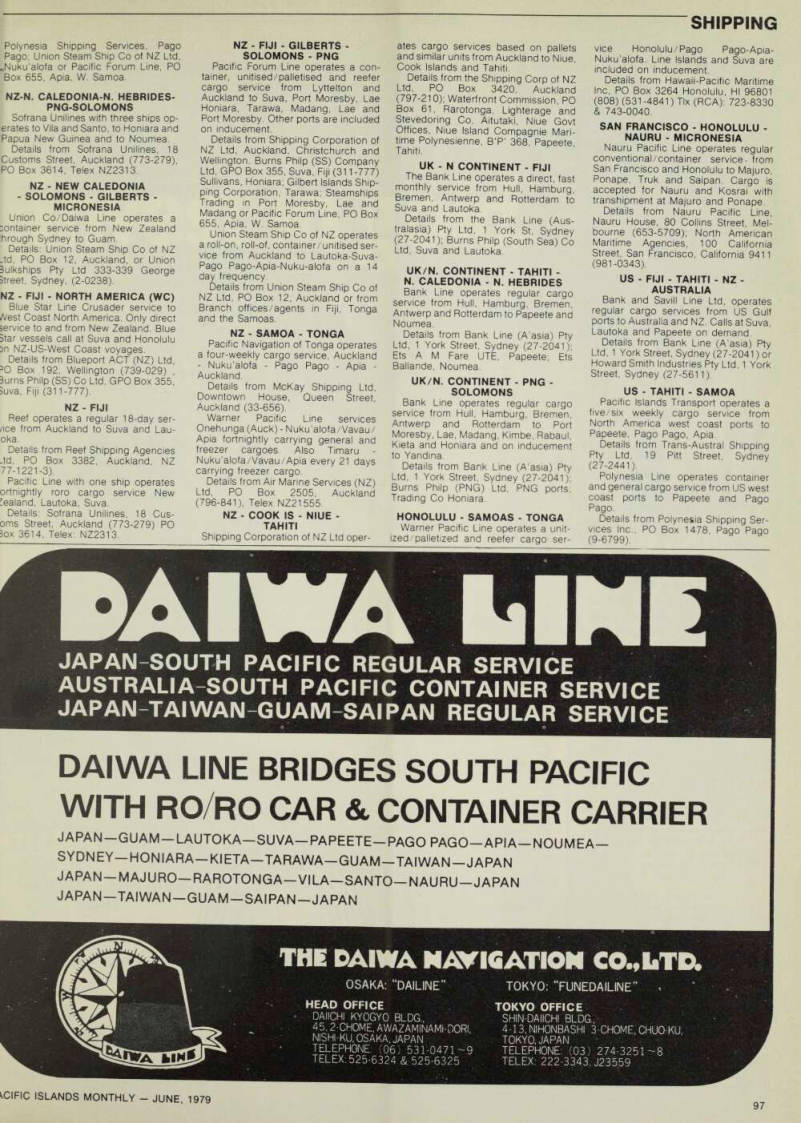
Shipping
These listings do not necessarily cover all services to Island ports.
Should any shipping company wish to have its services cargo and passenger included in these list ings they should contact PIM.
Sydney - Lord Howe Is -
Norolk Is
Compagnie des Chargeurs Caledoniens operates four-weekly cargo service Sydney - Lord Howe Island and Norfolk Island.
Details Hetherington Kingsbury Pty Ltd, 37-49 Pitt Street, Sydney (27-1671).
SYDNEY - NZ - FIJI - HAWAII -
Canada - Us
P & O liners call at Auckland, Suva, Honolulu and Vancouver on eastbound and westbound voyages between Syd ney and the US.
Details from P & O Booking Centre, World Travel Headquarters Pty Ltd, 33 Bligh Street, Sydney (231-6655).
AUSTRALIA - NZ - FIJI - TONGA - N. HEBRIDES - NOUMEA - PNG -
Solomons - Samoas
Sitmar Cruises operates a year-round cruise programme to include most of the above countries.
Details from Sitmar Cruises, 47 Elizabeth Street, Sydney (232-7511).
P & O liners call at Auckland, Bay of Islands, Honiara, Lautoka, Noumea, Nukualofa, Pago Pago, Papeete, Port Moresby, Santo, Savusavu, Suva, Vavau and Vila on cruises from Aus tralia.
Details from P & O Booking Centre, World Travel Headquarters Pty Ltd, 33 Bligh Street. Sydney (231-6655).
Australia - Fiji - Samoas -
New Hebrides - Tonga -
Norfolk Island
Pacific Navigation of Tonga operates a five-weekly refrigerated general car go/container service from Sydney and Brisbane to Vila, Santo, Suva, Lautoka, Apia, Pago Pago. Nuku’alofa and Nor folk Island.
Details from Beaufort Shipping Agency Co, 2 Castlereagh Street, Syd ney (239-1022).
Australia - New Caledonia
(And/Or) New Hebrides
Karlander operates a monthly service from Sydney to Noumea.
Details: Karlander (Aust) Pty Ltd, 19-31 Pitt Street, Sydney (27-6301), Sofrana-Unilines ships serve Noumea every three weeks from the main ports along the east Australian coast.
Details from Sofrana-Unilines, 37 Pitt Street, Sydney (27-2031), Trans- Austral Shipping Pty Ltd, 570 Bourke Street, Melbourne (67-9162), ACTA Pty Ltd, Brisbane (221-3116), Elder§-ANL Pty Ltd, Port Adelaide (47-5688), ANL, Newcastle (049-24364), Clements & Marshall, Burnie, Tasmania (31-1833).
Campagnie des Chargeurs Cale doniens operates a three-weekly con tainerised cargo service from Sydney to Noumea.
Details Hetherington Kingsbury Pty Ltd, 37-49 Pitt Street, Sydney (27-1671).
Compagnie Generate Maritime oper ates a monthly service from Sydney to Noumea, Port Vila and Santo, using M/V ‘Ymnos’ a self-sustained fully con tainerised vessel.
Details Compagnie Generate Ma time, 12 Castlereagh Street, Sydm (231-3700).
Australia - Fiji
Karlander (Aust) Pty Ltd operat< monthly cargo services from Sydney Suva and Lautoka.
Details from Karlander (Aust) Pty Lt 19-31 Pitt Street, Sydney (27-6301 Dalgety Shipping, 461 Bourke Stref Melbourne (60-0731), Burns Philp (S Co Ltd, Suva and Lautoka.
Sofrana-Unilines (Fiji Express Lin operates to Suva and Lautoka eve three weeks from the main ports on tf east coast of Australia and monthly Lautoka from Melbourne and Sydne' Details from Sofrana-Unilines. 37 P Street, Sydney, (27-2031), Tran Austral Shipping Pty Ltd, 570 Bourl Street, Melbourne (67-9162), ACTA P Ltd, Brisbane (221-3116), Elder-Ah Pty Ltd, Port Adelaide (47-5688), AN Newcastle (049-24364), Clements Marshall, Burnie, Tasman (31-1833).
Australia - W. Samoa
Compagnie Generate Maritime ope ates a monthly service from Sydney Apia, using M/V ‘Ymnos’ a se sustained fully containerised vessel.
Details Compagnie Generate Ma time, 12 Castlereagh Street, Sydm (231-3700).
Australia - Fiji - Tuvalu
-Samoas - Tonga
Pacific Forum Line operates a co tainer, unitised/palletised and reef cargo service from Melbourne and Sy ney to Lautoka, Suva, Funafuti, Pac Pago, Apia and Nukualofa. Other pof are included on inducement.
Details from ANL Melbourne ar Brisbane, Union Bulkships, Sydne Hobart, Port Adelaide and Fremantl Burns Philp (SS) Company Ltd, GP Box 355, Suva, Fiji (311-777 Polynesia Shipping Services, Paj Pago; Union Steam Ship Co of NZ Lt Nuku’alofa; PWD, Funafuti; or Pacif Forum Line, PC Box 655, Apia, V Samoa.
Australia - Northern
Marianas - Micronesia
Nauru Pacific Line operates a regul< container service from Melbourne Saipan, Truk, Ponape and Kosrai.
Details Nauru Pacific Line, Naui House, 80 Collins Street, Melbourn (653-5709), Nedlloyd Swire, 8 Sprir Street, Sydney (2-0522).
Australia - Tonga -
Samoas - Tahiti
Karlander operates a monthly care service from Melbourne and Sydney"
Nukualofa, Apia, Pago Pago, Papeet US west coast.
Details: Karlander (Aust) Pty Lt; 19-31 Pitt Street, Sydney (27-6301).
Australia - Tahiti
Daiwa Line offers a four-weekly se vice from Australia to Papeete.
Details: Meridian Shipping & Tram port Agencies Pty Ltd, Box 3410 GPC Sydney 2001 (29-4987), Tli AA25970.
Compagnie Generate Maritime ope ates a monthly service from Sydney 1 Papeete using M/V ‘Ymnos’ a sei sustained fully containerised vessel.
Details Compagnie Generate Mat time, 12 Castlereagh Street, Sydne (231-3700).
Australia ■ Png
Containers Pacific Express (Burm Philp and AWP Line) and NGAL/PNGi Operate chief Container Service fron Australia to PNG-Solomon Islands port on joint slot sharing basis. Three cor tainer vessels operate on 28-day turr around from Melbourne, Sydney ant Brisbane to Port Moresby, Lae, Rabau Kavieng, Wewak, Madang, Kieta anr Honiara.
Details from Burns Philp & Co Ltd, 5c
3 itt Street, Sydney (2-0547) and nterocean Swire, 8 Spring Street, Syd ney (2-0522).
New Guinea Express Lines operates tiree-weekly conventional and con ainer services Melbourne, Sydney, Brisbane, Port Moresby, Lae, Rabaul.
Motau.
Details from New Guinea Express .ines, PC Box R 73, Royal Exchange J C, Sydney (241-3991) MacArthur Shipping Agency Co, 82-92 Eagle Street, Brisbane (229-3777), New Suinea Express Lines, 327 Collins Street, Melbourne (61-3053), Niugini ixpress Lines in Port Moresby 21-2466), Lae (42-1536), Rabtrad Jiugini Pty Ltd, Rabaul (92-2911), Jotau Stevedoring & T’sport 51-1318).
Karlander New Guinea Line’s cargo essels call at Melbourne, Sydney, Port loresby, Lae, Madang, Wewak, lanus, Kimbe. Rabaul, Popondetta.
Details from Karlander (Aust) Pty Ltd, 9-31 Pitt Street, Sydney (27-6301), (algetty Shipping, 461 Bourke Street, lelbourne (60-0731).
Australia-Solomons
Northern Marianas-Taiwan
Japan
Daiwa Line offers a four-weekly ser ce Sydney-Honiara-Guam-Taiwan apan with transhipment at Guam for aipan.
Details Meridian Shipping & Trans crt Agencies Pty Ltd, Box 3410 GPO, /dney 2001 (29-4987). Tlx.
A 25970.
Australia - Solomons -
Gilbert Is - Micronesia
Daiwa Line operates a container ser ce every 30 days from Sydney to oniara, Kieta, Tarawa and Guam. Gizo jrgoes transhipped at Honiara, aipan, cargoes transhipped at uam.
Details Meridian Shipping & Trans
port Agancies Pty Ltd. Box 3410 GPO Sydney 2001 (29-4987), Tlx.
AA25970.
Australia - Nauru -
Majuro
Nauru Pacific Line operates regular cargo/passenger service from Mel bourne to Nauru and Majuro.
Details: Nauru Pacific Line, Nauru House, 80 Collins Street, Melbourne (653-5709), Nedlloyd Swire, 8 Spring Street, Sydney (2-0522).
Png - Uk/Continent
Bank Line operates regular cargo service from Kieta, Rabaul, Kimbe, Madang and Lae to Cardiff, Hamburg, Rotterdam and Antwerp.
Details from Bank Line (A'asia) Pty Ltd, 1 York Street, Sydney (27-2041); Burns Philp (PNG) Ltd, ports.
Png - Us
Bank Line operates regular cargo service from Kieta, Rabaul, Kimbe, Madang and Lae direct to New Orleans; calls at other US and Gulf and East Coast ports on inducement, Details from Bank Line (A’asia) Pty Ltd, 1 York Street, Sydney (27-2041); Burns Philp (PNG) Ltd, PNG ports.
Solomons - Usa -
Uk/Continent
Bank Line operates regular cargo service from Honiara to New Orleans, Cardiff, Hamburg, Rotterdam and Ant werp.
Details from Bank Line (A'asia) Pty Ltd, 1 York Street, Sydney (27-2041); Trading Co, Honiara (389).
Far East - Fiji - New
Zealand
New Zealand Unit Express (CNC.
MNOL, Nedlloyd) operates a three weekly cargo service from Hong Kong to Lautoka, Suva, NZ ports, Manila, Kaoshiung, Keelung, Hong Kong.
Details from Nedlloyd, 8 Spring
Street, Sydney (2-0522).
Nedlloyd operates monthly cargo service with three ships from Surabaya, Jakarta, Bangkok, Port Keland and Sin gapore to Suva and NZ ports.
Details from Nedlloyd (Aust) Pty Ltd, 8 Spring Street, Sydney (27-3801); Burns Philp (SS) Co Ltd, Suva and Lau toka.
Japan - Nz - Png
China Navigation Co, with three ships operates a monthly cargo service from Japan to New Zealand calling at Lae on return journey.
Details Nedlloyd, 8 Spring Street, Sydney (2-0522).
Far East - Mid-S. Pacific
China Navigation Co’s vessels oper ate a regular cargo service from Hong Kong, Taiwan and Singapore to Rabaul, Wewak, Madang, Lae, Port Moresby, Honiara, New Hebrides, Noumea, Papeete and Samoa.
Details from Nedlloyd, 8 Spring Street, Sydney (2-0522).
Kyowa Shipping Co Ltd, operates monthly services from Hong Kong, Taiwan, S. Korea and Japan, to Guam, Saipan, Solomons, New Caledonia, Fiji, Western and American Samoa, Tahiti, Cook Is., Tonga and New Hebrides.
Details: Hethenngton Kingsbury Pty Ltd, 37-49 Pitt Street, Sydney (27-1671).
Daiwa Line operates 30-day service from Moji, Kobe, Nagoya and Yokohama to Papeete, Pago Pago, Apia, Suva, Lautoka, Noumea, Sydney, Honiara, Kieta, Tarawa, Guam and Taiwan.
Details: Meridian Shipping & Trans port Agencies Pty Ltd, Box 3410 GPO Sydney 2001 (29-4987) Tlx: AA25970.
North Europe - Tahiti -
New Caledonia
Hamburg-Sued operates monthly
cargo services from Hamburg, Dunkirk and Le Havre to Papeete, Noumea, via Panama.
Details from Columbus Overseas Services Pty Ltd, 333 George Street, Sydney (290-2966), Columbus Mari time Services, 17 Albert Street, Auckland (77-3460).
Europe - Pacific Islands
Compagnie Generate Maritime oper ates services from Europe and Mediter ranean ports to Papeete and Noumea using three Ro-Ro and one multi purpose vessel thus ensuring a bi monthly sailing to and from.
Details Compagnie Generate Mari time, 12 Castlereagh Street, Sydney (231-3700).
EUROPE - TAHITI - W. SAMOA -
Fiji - N. Caledonia
Nedlloyd offers regular cargo ser vices from Northern Europe and UK to Papeete, Apia, Fiji and New Caledonia.
Details Nedlloyd (Aust) Pty Ltd, 8 Spring Street, Sydney (27-3801).
JAPAN - GUAM - FIJI - TAHITI -
Samoa - N. Caledonia -
Solomons - Gilberts
Daiwa Lines runs a monthly cargo service from Japan via Guam to Lau toka, Suva, Papeete, Pago Pago, Apia, Sydney, Noumea, Honiara, Tarawa, Guam.
Details from Burns Philp (SS) Co Ltd, Suva.
Nz - New Caledonia - Fiji
Pacific Forum Line operates a uni tized/palletized and reefer cargo ser vice from Lyttelton and Auckland to Napier, Noumea, Lautoka and Suva.
Other ports are included on inducement.
Details from Shipping Corporation of NZ Ltd, Auckland, Christchurch, Wellington, Burns Philp (SS) Company Ltd, GPO Box 355, Suva, Fiji (311 -777);
Polynesia Shipping Services, Pago Pago; Union Steam Ship Co of NZ Ltd, .Nukualofa or Pacific Forum Line, PO Box 655, Apia, W. Samoa.
Nz-N. Caledonia-N. Hebrides
Png-Solomons
Sofrana Unilines with three ships op erates to Vila and Santo, to Honiara and Papua New Guinea and to Noumea.
Details from Sofrana Unilines, 18 Customs Street, Auckland (773-279), PO Box 3614, Telex NZ2313.
Nz - New Caledonia
- Solomons - Gilberts -
Micronesia
Union Co/Daiwa Line operates a :ontainer service from New Zealand
ihrough Sydney to Guam.
Details: Union Steam Ship Co of NZ .td, PO Box 12, Auckland, or Union Bulkships Pty Ltd 333-339 George street, Sydney, (2-0238).
NZ - FIJI - NORTH AMERICA (WC) Blue Star Line Crusader service to /Vest Coast North America. Only direct service to and from New Zealand. Blue star vessels call at Suva and Honolulu )n NZ-US-West Coast voyages.
Details from Blueport ACT (NZ) Ltd, 3 0 Box 192, Wellington (739-029) , Burns Philp (SS) Co Ltd, GPO Box 355,
>uva, Fiji (311-777).
Nz - Fiji
Reef operates a regular 18-day ser vice from Auckland to Suva and Lau oka.
Details from Reef Shipping Agencies .td, PO Box 3382, Auckland, NZ 77-1221-3).
Pacific Line with one ship operates ortnightly roro cargo service New Zealand, Lautoka, Suva.
Details: Sofrana Unilines, 18 Cus oms Street, Auckland (773-279) PO Box 3614, Telex: NZ2313.
Nz - Fiji - Gilberts -
Solomons - Png
Pacific Forum Line operates a con tainer, unitised/palletised and reefer cargo service from Lyttelton and Auckland to Suva, Port Moresby, Lae Honiara, Tarawa, Madang, Lae and Port Moresby. Other ports are included on inducement.
Details from Shipping Corporation of NZ Ltd, Auckland, Christchurch and Wellington. Burns Philp (SS) Company Ltd, GPO Box 355, Suva, Fiji (311 -777) Sullivans, Honiara; Gilbert Islands Ship ping Corporation, Tarawa; Steamships Trading in Port Moresby, Lae and Madang or Pacific Forum Line, PO Box 655, Apia, W. Samoa.
Union Steam Ship Co of NZ operates a roll-on, roll-of, container/unitised ser vice from Auckland to Lautoka-Suva- Pago Pago-Apia-Nuku-alofa on a 14 day frequency.
Details from Union Steam Ship Co of NZ Ltd, PO Box 12, Auckland or from Branch offices/agents in Fiji, Tonga and the Samoas.
Nz - Samoa - Tonga
Pacific Navigation of Tonga operates a four-weekly cargo service, Auckland - Nukualofa - Pago Pago - Apia - Auckland.
Details from McKay Shipping Ltd, Downtown House, Queen Street, Auckland (33-656).
Warner Pacific Line services Onehunga (Auck) - Nuku’alofa/Vavau/ Apia fortnightly carrying general and freezer cargoes. Also Timaru - Nuku’alofa/Vavau/Apia every 21 days carrying freezer cargo.
Details from Air Marine Services (NZ) Ltd, PO Box 2505, Auckland (796-841), Telex NZ21555.
NZ - COOK IS - NIUE -
Tahiti
Shipping Corporation of NZ Ltd oper
ates cargo services based on pallets and similar units from Auckland to Niue, Cook Islands and Tahiti, Details from the Shipping Corp of NZ Ltd, PO Box 3420, Auckland (797-210); Waterfront Commission, PO Box 61, Rarotonga, Lighterage and Stevedoring Co, Aitutaki, Niue Govt Offices, Niue Island Compagnie Mari time Polynesienne, B’P’ 368, Papeete Tahiti.
Uk - N Continent - Fiji
The Bank Line operates a direct, fast monthly service from Hull, Hamburg, Bremen, Antwerp and Rotterdam to Suva and Lautoka.
Details from the Bank Line (Aus tralasia) Pty Ltd, 1 York St, Sydney (27-2041); Burns Philp (South Sea) Co Ltd, Suva and Lautoka.
Uk/N. Continent - Tahiti -
N. Caledonia - N. Hebrides
Bank Line operates regular cargo service from Hull, Hamburg, Bremen, Antwerp and Rotterdam to Papeete and Noumea.
Details from Bank Line (A’asia) Pty Ltd, 1 York Street, Sydney (27-2041); Ets A M Fare UTE, Papeete; Ets Ballande, Noumea.
Uk/N. Continent - Png -
Solomons
Bank Line operates regular cargo service from Hull, Hamburg, Bremen, Antwerp and Rotterdam to Port Moresby, Lae, Madang, Kimbe, Rabaul, Kieta and Honiara and on inducement to Yandina.
Details from Bank Line (A’asia) Pty Ltd, 1 York Street, Sydney (27-2041); Burns Philp (PNG) Ltd, PNG ports; Trading Co Honiara.
Honolulu - Samoas - Tonga
Warner Pacific Line operates a unit ized/palletized and reefer cargo ser
vice Honolulu /Pago Pago-Apia- Nuku'alofa, Line Islands and Suva are included on inducement.
Details from Hawaii-Pacific Maritime Inc, PO Box 3264 Honolulu, HI 96801 (808) (531 -4841) Tlx (RCA): 723-8330 & 743-0040.
San Francisco - Honolulu -
Nauru - Micronesia
Nauru Pacific Line operates regular conventional/container service- from San Francisco and Honolulu to Majuro, Ponape, Truk and Saipan. Cargo is accepted for Nauru and Kosrai with transhipment at Majuro and Ponape.
Details from Nauru Pacific Line, Nauru House. 80 Collins Street, Mel bourne (653-5709); North American Maritime Agencies, 100 California Street, San Francisco, California 9411 (981-0343).
US - FIJI - TAHITI - NZ -
Australia
Bank and Savill Line Ltd, operates regular cargo services from US Gulf ports to Australia and NZ. Calls at Suva, Lautoka and Papeete on demand.
Details from Bank Line (A’asia) Pty Ltd, 1 York Street, Sydney (27-2041) or Howard Smith Industries Pty Ltd, 1 York Street, Sydney (27-5611).
Us - Tahiti - Samoa
Pacific Islands Transport operates a five/six weekly cargo service from North America west coast ports to Papeete, Pago Pago, Apia.
Details from Trans-Austral Shipping Pty Ltd, 19 Pitt Street, Sydney (27-2441).
Polynesia Line operates container and general cargo service from US west coast ports to Papeete and Pago Pago, Details from Polynesia Shipping Ser vices Inc., PO Box 1478, Pago Pago (9-6799).
Advertisements & other items, pp. 95-100 (3 items)
Shipping
95
CIFIC ISLANDS MONTHLY - JUNE, 1979
Nelson & Robert son
q6E/?> o -o a & *
FOR
IN OUR 85th YEAR SELLING ‘SERVICE’
TO THE PACIFIC ISLANDS . . .
Nelson & Robert son
PTY.LTD. (Established 1895)
Plantation House, 197 Clarence Street, Sydney.
Cables: ‘IVAN\ Sydney, Brisbane. Telex: AA22381, Sydney.
INDENTS - FROM AUSTRALIA, NEW ZEALAND and OVERSEAS.
FOODSTUFFS • HARDWARE • TRAVEL • CANNED FISH MACHINERY • INSURANCE • SOFTGOODS • JUTE GOODS
• REAL ESTATE •
BRANCH OFFICES: Nelson & Robertson Pty. Ltd., P.O. Box 575, Brisbane, Qld., Australia.
P.O. Box 2092, Govt. Bldg., Suva, Fiji. P.O. Box 258, Lautoka, Fiji.
P.O. Box 2420, CPO Auckland 1, New Zealand.
PAPUA NEW GUINEA Rabtrad Niugini Pty. Ltd., P.O. Box 219, Rabaul, P N G.
REPRESENTATIVES: P.0.80x 1406, Lae, P.N.G. P.O. Box 711, Madang, P.N.G.
P.O. Box 253, Kieta, P.N.G.
-A \ V’WGWS:
THE
LINE
■rtl
Papua New Guinea & Solomon Islands
USA- UK /Continent Service
Regular direct monthly sailings
PAPUA NEW GUINEA and SOLOMON ISLANDS
to: NORTH AMERICA • UNITED KINGDOM & CONTINENT For particulars apply:
THE BANK LINE (AUSTRALASIA) PTY LTD.
18th Floor 1 York Street Sydney N.SW 2000 Australia Telephone; 272041 Telex; 24063
DAIWA LINE
JAPAN-SOUTH PACIFIC REGULAR SERVICE
AUSTRALIA SOUTH PACIFIC CONTAINER SERVICE
JAPAN-TAIWAN-GUAM-SAIPAN REGULAR SERVICE
DAIWA LINE BRIDGES SOUTH PACIFIC
WITH RO/RO CAR &. CONTAINER CARRIER
JAPAN—GUAM —LAUTOKA—SUVA—PAPEETE—PAGO PAGO—APIA—NOUMEA—
SYDNEY—HONIARA—KIETA—TARAWA—GUAM—TAIWAN—JAPAN
JAPAN —MAJURO—RAROTONGA—VILA— SANTO—NAURU—JAPAN
JAPAN—TAIWAN—GUAM—SAIPAN—JAPAN
ssr
£ ■M
THE DAIWA NAVIGATION CO., LTD.
OSAKA: “DAILINE” TOKYO; “FUNEDAILINE” ,
HEAD OFFICE
DAIICHI KYOGYO BLDG
45,2-CHOME, AWAZAMINAMi-DORI,
NISHi-KU, OSAKA, JAPAN
TELEPHONE: (06) 531-0471 ~9
TELEX: 525-6324 & 525-6325
TOKYO OFFICE
SHIN-DAIICHI BLDG.,
4-13, NIHONBASHI 3-CHOME, CHUO-KU,
TOKYO, JAPAN
TELEPHONE: (03) 274-3251 ~8
TELEX: 222-3343, J 23559
Office: Suite 2 Mac Donnell Lane 26 Abbott St Cairns Ph0ne(070)514039 Qreclof 48475 A H ° pper Mail RO. Box 1871, Cairns 4870 T En 9 <CEI)
QUEEnsinno mpßine brokerage
COMMERCIAL SHIPPING SALES & CHARTERS
We sell barges, ferries, refrigerated and general
cargo vessels, dredges, trawlers, yachts, charter
fishing vessels and landing craft. Listings wanted.
Servicing Australia and the South West Pacific.
PETER FISHER
TRADING
Pty Ltd
321 PITT St., SYDNEY, AUSTRALIA 2000
Telephone: 261109 Cables: "FISHERION" SYDNEY
EXPORTERS TO THE
PACIFIC ISLANDS
Frostpak
m.
Koolalron
INDUSTRIES
Portable Electronic
Solid State Refrigerators
For people on the move ideal for Campers & Caravans Indispensable for T ravellersand Holidaymakers A must for Truckdnvers Popular with Yachts.
Aircraft and Fishermen ■ Big cooling performance ■ No Gas - No Compresso ■ Large 33 Litre capacity ■ Unaffected by motion or level ■ No noise or vibration ■ Low Battery Dram ■ Low Weight - 7 KG ■ Virtually Indestructable ■ 2 Year Guarantee From 5199.00 incl. Sales Tax For Medical & Technical purposes & Food Samples Connects to 12V Battery or Cigarette Lighter Operates on 240 V with Battery Charger 297 Williamstown Road, Port Melbourne 3027 Phone 645 2068 Telex 32571
NOTICE TRADE MARK:
Notice is hereby given that Aiwa Co., Ltd., a corporation duly organised and existing under the laws of Japan of 2-3, 5-chrome, Sotokanda, Chiyodaku, Tokyo, Japan, is the sole proprietor in Papua New Guinea and Nauru and elsewhere of the following Trade Mark:
AIWA
Used in respect of the following: Radio and television equipments; sound amplifying apparatus and instruments and parts thereof; microphones, loud-speakers, tuners, record players, turntables, pickups, tape recorders, video recorders, phonograph records, tapes and other sound and/or image recording and/or reproducing apparatus, articles and implements; cassette tape recorders, combined radio receivers and cassette tape recorders, phonomotors; parts and accessories of foregoing goods.
The Proprietor claims all rights in respect of the above Trade Mark and will take all necessary legal steps against any person or company infringing those rights.
F. B. RICE & CO.
Patent Attorneys, Sydney, Australia.
CAUTIONARY NOTICE:
Trade Mark IDEM
Wiggins Teape Limited of
Gateway House, Basing View,
Basingstoke, Hampshire,
RG2I 2EE, England, wish it to be known that they are the owners of the trade mark IDEM and that the IDEM mark is used by WIGGINS TEAPE LIMITED on or in connection with paper.
Proceedings will be taken against any third party found to be using the IDEM mark or any closely similar mark on or in connection with paper.
GOT A BOAT FOR SALE?
If you are selling a boat in the biggest ocean in the world, why not advertise it in the biggest magazine in that ocean
RIM?
We're read by seafarers from Sydney to the Societies, from New Zealand to the Northern Marianas And that's only our Pacific Island readers. You'd be surprised how many yachting enthusiasts, professional fishermen and sea cargo operators from around the rim of the Pacific Basin look to PIM to keep them informed of what’s going on inside the Basin.
FLEETS 50 ft Steel Ketch Rig Coastal Passenger Charter Boat bit. 1974, in Survey, some Freezer space, good ac-
com. $BO,OOO. FLEETS 221
Esplanade, Wynnum Central, Brisbane. Cable “FLEETS
BRISBANE”.
t
RINE PACIFIC LTD.
SALVAGE - TOWAGE
TUGS
500 - 2700 b.h.p.
RAMPED - BARGES
250 - 500 d.w.t.
For charter throughout the South Pacific cable: TUGBOAT, SUVA, telex: FJ2202
Mr’ • *
•fey-
V-. 3&L* "" \ m ■■■ i '
-s^^gy-
>l6£ : i - >% k' 1 V I • J < V v *. - ::■/ S V
f/rifr '
J .s « „ •VW. -r . -
mmm
-r- ■% „
ri>S'L- '■^
I J I <39^*l A- A * -S » :-> ■ m
Datsun's'temper'control,
so you never lose yours!
-A Color coded rear axle shafts The rear axle shaft. It’s vitally important and must be really tough to withstand the twisting forces and power that it transfers to the car's wheels, not to mention the shocks of hitting things on the road.
Datsun’s high technology, mass production techniques and “extra” effort make sure you won't get stranded with a breakdown. Each axle shaft is specially treated.
High frequency electrical waves are used to "temper” the shaft. This hardening process creates a hard outer surface for maximum wear resistance but allows the interior of the shaft to remain softer for toughness and shock absorption. This balance of properties provides exactly what is needed for troublefree motoring. In addition, each axle shaft is color coded and registered. If it doesn't meet Datsun’s rigid standards or the unusual happens, the flaw is easily traceable. Through highly perfected quality control procedures Datsun has built a worldwide reputation for quality. Datsun knows how to deliver the best...and millions agree.
LL a
fTHE NAME Of QUALITY
Datsun’s “extra” effort for total quality. DATSUN s Datsun Distributors Boroko Motors Ltd. P.O. Box 1259, Boroko, Port Moresby, PN G./ Carpenters Motors, Sales Division 61-63 Foster St. Walu Bay, Suva, Fiji Islands Private Mail Bag/ Morris Hedstrom Ltd. P.O. Box 189, Apia, Western Samoa/ United Enterprises Ltd. P.O. Box 262, Honiara, Solomon Islands/ Sirius Motors P.O. Box 34, Norfolk Island, South Pacific/ Jacob Enterprises P.O. Box 4, Republic of Nauru/Cook Islands Motor Center Ltd. P.O. Box 74, Rarotonga, Cook Islands, South Pacific/ Pentecost Pacific S.A. P.O. Box 119, Port Vila, New Hebrides/ Agence Alma S.A. B.P A 3. Noumea Cedex, New Caledonia/ Tahitibull S.A.R.L. B P. 359, Papeete, Tahiti / Gilbert Islands Government, Supply Division P.O. Box 71, Bairiki, Tarawa, Gilbert Islands
Shipping
97
ICIFIC ISLANDS MONTHLY - JUNE, 1979