Fishing
pp. 83-85 · Read in the full issue
Trade
Winds
If The Cupboard
Is Bare Go
Fishing
An interim skipjack survey in Tuvalu waters in mid-1978 was what Prime Minister Toalipi Lauti pinned his faith on when he handed over more than SASOO 000 to American businessman Sidney Gross.
In return, Mr Gross promised that the money would be invested to return 15% interest and that he would raise a SUSS million loan for Tuvalu to establish a fishing industry. John Carter reports.
fuvalu’s money is ‘as safe as hough it was in a bank itself, >r ever safer’, Mr Gross told Australian Associated Press
vhich, following up PlM’s
tory last month, interviewed urn by telephone. Mr Gross
idded thaffhe ‘absolutely’ had
io worries about the con equences of the venture’s suc ess for the 7500 people of 'uvalu.
The survey was carried out •y South Pacific Commission pecialists. In their report, they tressed that it was an interim ne, that ‘caution should be xercised when projecting the )ng-term potential’, and that 'are must be taken in project ig from these results to give idications of annual, or even sasonal, potential in the rea’.
What were the pointers in te survey report which in ured Prime Minister Lauti to sk his country’s ready cash in scheme which has his ecl ogues in government orried?
The good news in the report that: an average of one school of ma was sighted for every hour
of searching time a very promising result; • although only one baitfishing site, in the Funafuti lagoon, was surveyed, there were
obviously great quantities of
Spratelloides delicatulus and that the average bait catch of 177 buckets per haul, or 354 buckets per night, was the highest so far achieved by the SPC skipjack programme; • and that the optimism with which the visit to Tuvalu was awaited was proven to be jus
tified’ 2739 skipjack being
tagged in 10 days, 708 buckets of bait being taken in two nights of fishing.
The report also said: ‘The lo cation of Tuvalu close to the equator would suggest that skipjack should be abundant year-round and the excellent seasonal catches taken by the Japanese distant water fleet in this area endorse optimism for the establishment of some type of skipjack fishery in Tuvalu.’
Mr Lauti told PIM he had been promised a special independent grant of £2.6 million by Britain, but had had no reply to a request to Britain that the money should be
handed over without delay.
There was no time to discuss with Britain plans on how the money should be spent.
Tuvalu, until independence on October 1 last year, had been a possession of the United Kingdom for 86 years. ‘We are small in land area,’ said Mr Lauti. ‘We are poor, with no mineral resources. The
only thing for us is fishing.
Nothing else will bring in the amount of money that will allow us to be economically
independent.’
Mr Lauti said that when he saw the report of the skipjack survey he was ‘fired with en thusiasm’ to do something about it. Tuvalu’s $5OO 000 was earning only 7% in interest, so T had to invest that money at better terms,’ he said.
It is not faith alone on which Mr Lauti is relying. He said a fisheries officer from the South Pacific Forum’s South Pacific Bureau for Economic Co operation had visited Funafuti to discuss the scheme. He was
relying on continuing help
from SPEC, the Fisheries Agency, created by the Forum last year, and the SPC, he said.
Mr Lauti said there was no truth in a rumour that he intended taking Tuvalu out of the Fisheries Agency.
If the project fails, what does Tuvalu have left? There’s an old vessel, its only legacy from the combined assets of the for mer Gilbert and Ellice Islands colony, all the rest including the phosphate riches of Banaba (Ocean Island) going to the Gilberts which become independent next month as Kiribati. And there’s a promise of £5.1 million from Britain.
There’s nothing else, except that, as Mr Lauti points out, Tuvalu is now a sovereign nation with the power and right to enter into agreements with other nations. And several are knocking on the doors of Island countries asking for a foot into the South Pacific.
Tuvalu’s abstract of accounts for 1977, prepared by the United Nations Development
Advisory Team, lists imports
but not exports. They are dealt
with in the preface to the abstract.
Exports in 1977 were: scrap copper —870 g at SA2O - 217 tonnes valued at $46 401; re-export of cine films — $l4 519.
Tuvalu has a stamp trade which shows great promise. In 1978 it earned half a million dollars, the half million now invested with Mr Gross. It is
confidently hoped that this
year the philatelic department will make a million dollars.
Its total imports for 1977 amounted to $1.24 million.
Total revenue for 1977 was $3.45 million, of which only $693 770 was raised in Tuvalu.
The rest came from aid grants.
Clearly, there’s not much in material terms for Tuvaluans unless they grasp the nettle of economic development. ‘Look before you leap’ has been the
tendency of most emerging
nations in a decolonising South Pacific. But ‘He who hesitates is lost,’ appears to be the code of tiny Tuvalu’s leader. More power to his elbow.
Mr Gross says Tuvalu’s money is safe. But even if it turns out not to be would Washington stand by and do nothing? After all, what’s half a million between friends, with a treaty to prove it? Tuvalu’s course, chosen by its prime minister, is sure to be a corridor talking point at next month’s Forum meeting in Honiara.
Malaysian
feelers
Malaysia could be doing more business soon with Solomon Islands if the interest local importers showed in a Malaysian trade mission to Honiara recently is an indi cation.
Local buyers showed interest in shoes, textiles and electronic items. Prefabricated housing units, which would require a
joint Malaysian-Solomons
venture, were particularly at-
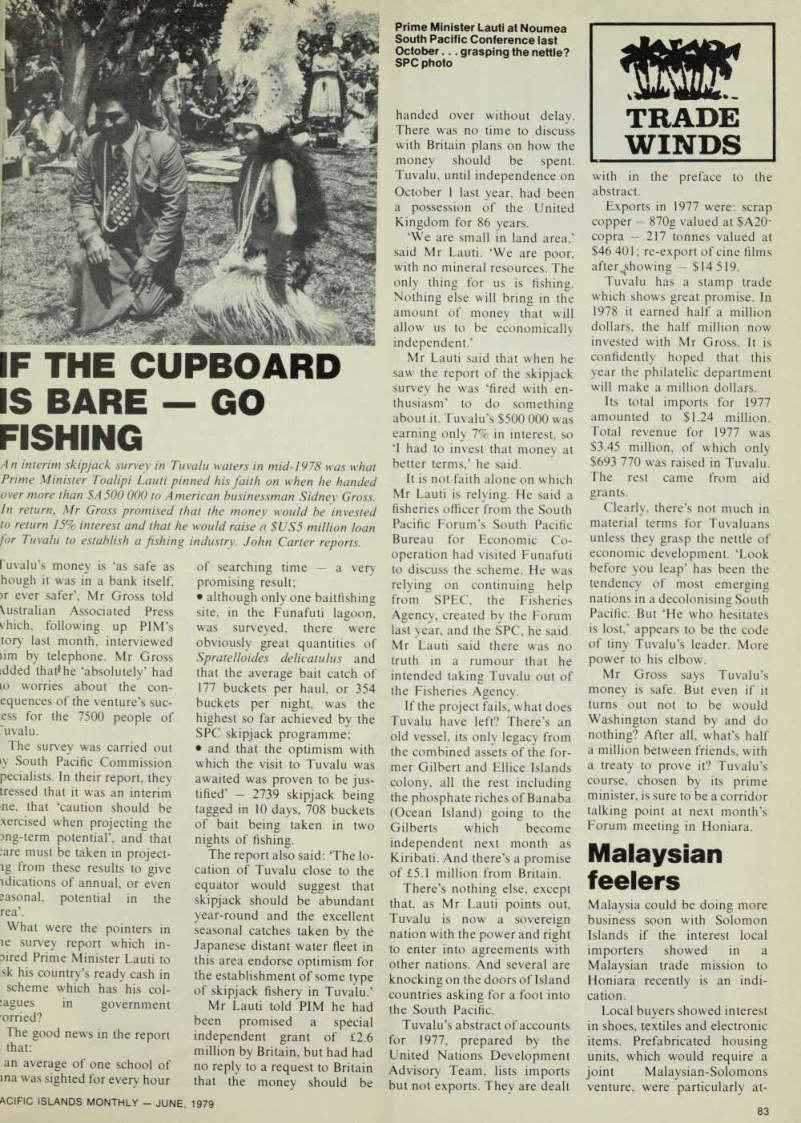
Prime Minister Lauti at Noumea South Pacific Conference last October... grasping the nettle?
SPC photo
tractive. (The housing shortage
in Solomon Islands has become so acute the government has been forced to stop all recruit ing of foreigners for the time
being.)
Other lines the Malaysians were pushing were food, rub
ber and plastic goods and gift
ware.
In 1975 Solomon Islands bought SSI 719 000 worth of
Malaysian goods, mainly ma
chinery. Last year purchases,
mainly food and chemicals, were only $Bl 000. Exports to Malaysia are more-or-less non existent but Malaysia is interested in buying sizeable
quantities of rice. Surprisingly
the Malaysians also showed an interest in timber.
Kitchens
pushes
Purari power
Australia and Papua New Guinea have been talking again about the possibility of
feeding electricity by sub
marine cable to northern Aus tralia from PNG, if and when the Purari River hydro-electric scheme in Gulf Province comes
into operation.
Australia and Japan co operated with the PNG Government in a feasibility study from 1974 to 1977, find
ing that a large development at Wabo on the Purari was tech nically feasible and even econ omically attractive if industrial demand could match optimum
generating capacity within a
decade of the scheme going
into operation.
Australia’s Minister for National Development Kevin Newman told PNG Minister for Minerals and Energy Karl Kitchens in Canberra recently that he would talk to the Queensland State Government about Mr Kitchens’ suggestion that the Purari scheme could provide power for aluminium smelting in Northern Queensland.
In the meantime, at an estimated rough cost of more than K 750 million, and with considerable opposition on so ciological and environmental
grounds, the Purari project
seems a long way off.
Green light for
two US carriers
The US Civil Aeronautics Board has given approval to Hawaiian Airlines and Aeroamerica to operate ser vices in the South Pacific,
following a petition in 1978 from American Samoa for an immediate restoration of air services to the territory. The petition was filed when Pan American World Airways cut back on services to American Samoa from Hawaii.
Hawaiian Airlines, if their service goes ahead, will operate
an Hawaii-Samoa-Fiji-Tahiti-
Hawaii service. The CAB has given Hawaiian Airlines two years to start the service.
Approval to Aeroamerica is subject to terms not yet
public.
Contract let for
Funafuti Wharf
A 5A1.78 million contract for a deepwater wharf at Funafuti, capital of Tuvalu, has been let to Hornibrook Construction (Papua New Guinea).
The work, which will pro vide employment for about 60 people, will be paid for under the Australian Government’s aid programme to the South Pacific.
The project involves a 50 m long 12 m wide wharf in eight metres of water linked to the shore by a 40 m jetty
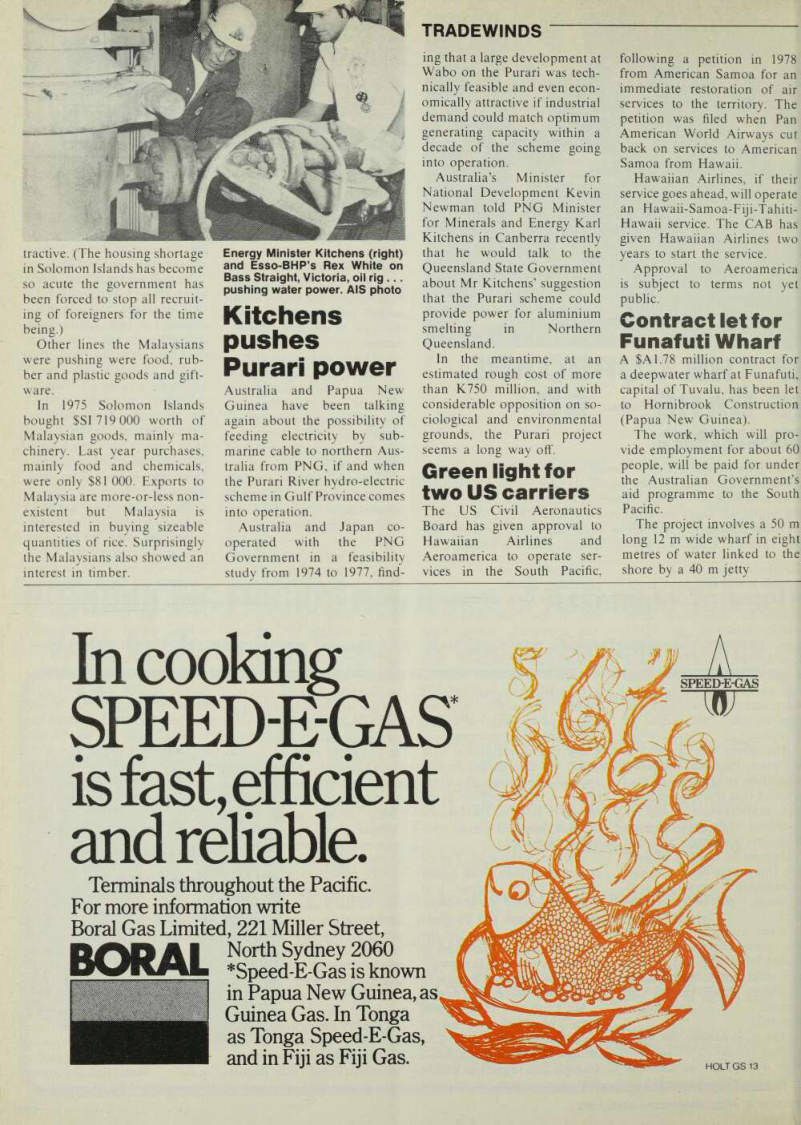
Energy Minister Kitchens (right) and Esso-BHP’s Rex White on Bass Straight, Victoria, oil rig ... pushing water power. AIS photo
Away around
exchange
problems
New Zealand’s Social Credit Political League which holds one of the 92 parliamentary seats has started a new trade financing arrangement with Solomon Islands which it hopes will form the basis of a ■co-operative trading bloc in the Pacific.
Party leader Bruce Beetham
explained the private
enterprise scheme with its ‘unique financial features’ at a press conference. Basically it means that Solomon Islands timber export mills can deposit the payment for hardwoods sold to New Zealand into bank accounts in New Zealand.
Then they can buy New Zealand goods and services with the money from these accounts.
The Reserve Bank of New
Zealand has given the okay for
this bilateral scheme provided it receives a monthly account of all transactions on Solomon Islands money.
This simple trading arrange
ment eliminates borrowing or payments of interest overseas by either trading partner for the use of trading money, says Mr Beetham Tn effect, what it does is eliminate financial
middlemen through a recipro
cal credit arrangement, by passing the hard currency markets or the necessity of bor
rowing hard currency.’
Apart from working out a
mutually beneficial trading ar
rangement, Mr Beetham was
demonstrating in a practical
way his party’s policies for social and economic reform.
The deal, arranged with Solomon Islands largely through a group of senior Social Credit League people, is part of the party’s strategy to show what it would do if it won government.
While that position might
elude Social Credit followers for some time, Mr Beetham says Social Credit would use the same financial policy to extend bilateral trade with other willing nations.
Much of the Pacific basin had the potential to become a great new co-operative with
New Zealand playing the lead ing role, he said.
The Alliance Trading As sociation (Solomon Islands) co-ordinates exports of the sawn timber to New Zealand which can then be used for cladding for houses, furniture,
flooring, decking and mould
ings.
The shipments will save New Zealand overseas funds be cause the Solomon Islands hardwood will largely replace present imports of North American redwood and cedar, Mr Beetham says.
New Zealand should be able to re-export quality furniture using the new timber and keep timber processing plants operating. Some faced closure
because of reduced supplies of local hardwoods.
From hardwoods, Solomon Islanders may be able to diver sify trade into copra, palm oil, coconut commodities, sugar
and other tropical products,
says Mr Beetham.
In the reverse direction, Solomon Islanders have
already expressed interest in
timber milling equipment,
beer, onions, fresh meat and processed foods which they will be able to buy with the money deposited from hard wood sales in the New Zealand accounts.
There are no strings attached by international cor
porations, international
financiers, or German, Japanese or any other outside interests,’ says Mr Beetham.
And, although Social Credit members were involved in the new trading arrangements, neither they nor the party would make a penny out of the deal, he emphasised. The first two shipments of hardwood from Solomon Islands were due by the end of May. From
then on, monthly shipments
are expected.
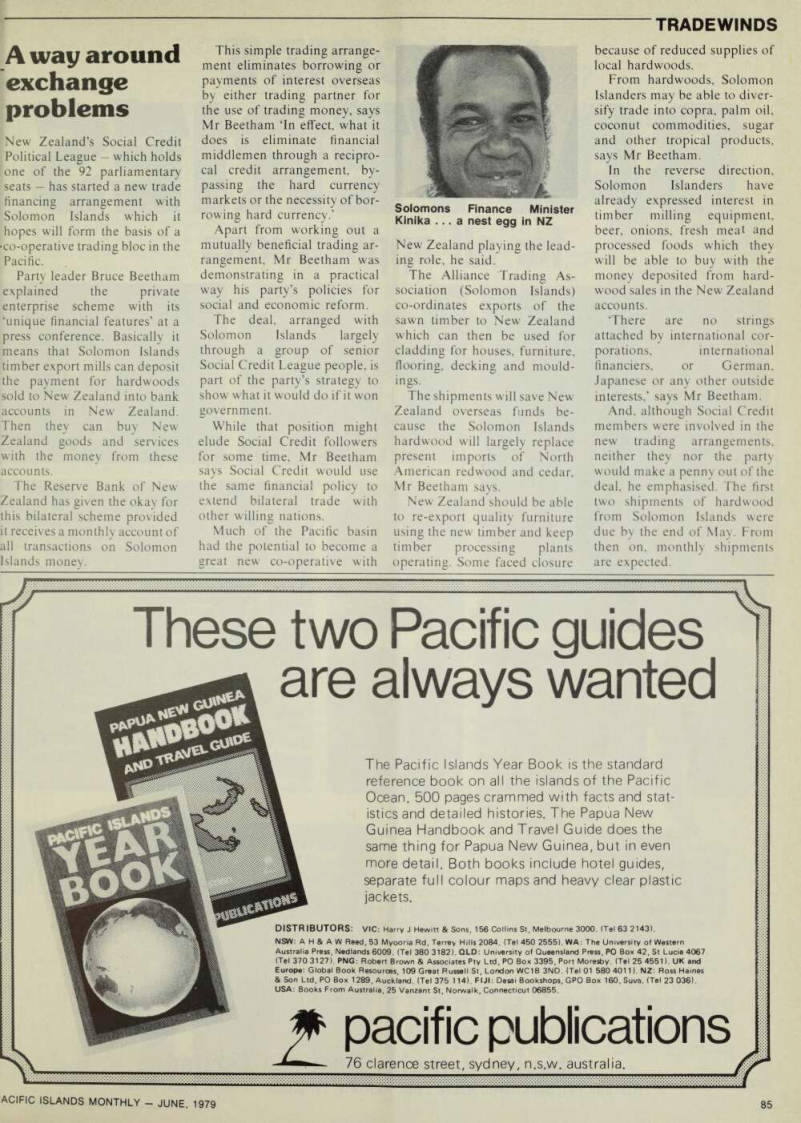
Solomons Finance Minister Kinika ... a nest egg in NZ