People
pp. 75-77 · Read in the full issue
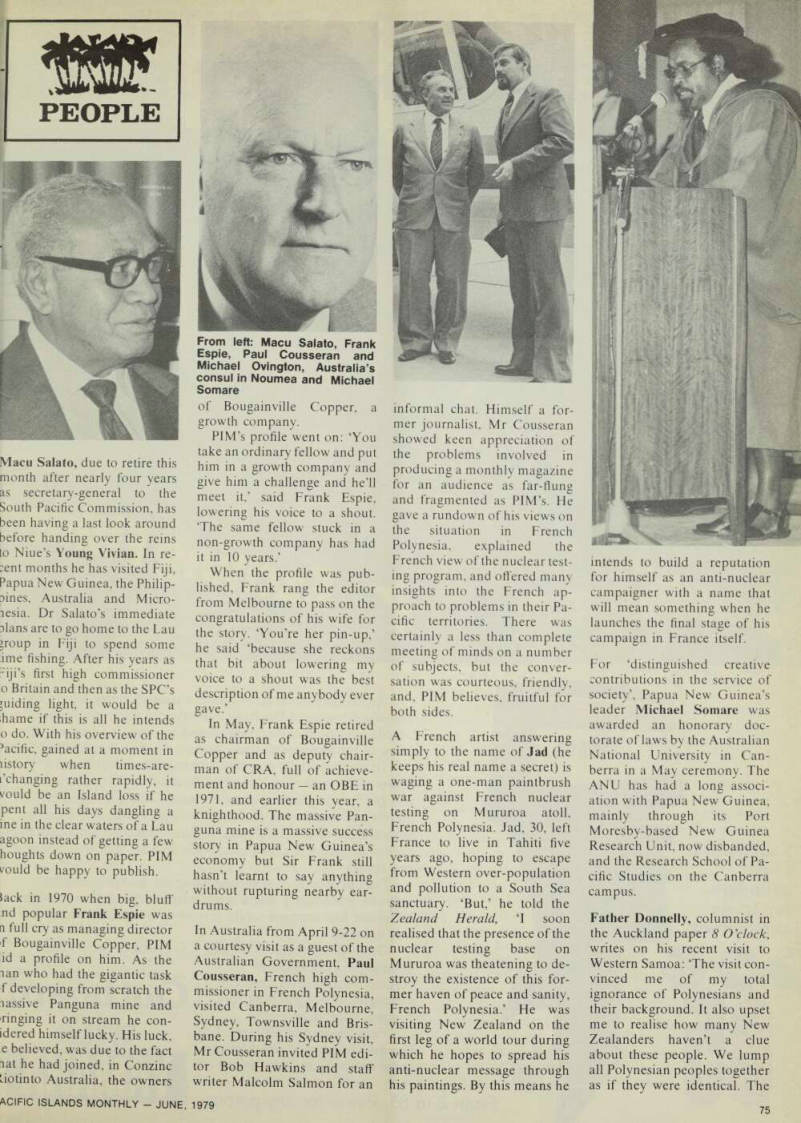
Macu Salato, due to retire this month after nearly four years as secretary-general to the South Pacific Commission, has been having a last look around before handing over the reins to Niue’s Young Vivian. In re cent months he has visited Fiji, Papua New Guinea, the Philip aines, Australia and Micro lesia. Dr Salato’s immediate alans are to go home to the Lau in Fiji to spend some ime fishing. After his years as ■Tji’s first high commissioner o Britain and then as the SPC’s guiding light, it would be a hame if this is all he intends o do. With his overview of the 3 acific, gained at a moment in listory when times-are
t’changing rather rapidly, it
vould be an Island loss if he pent all his days dangling a ine in the clear waters of a Lau agoon instead of getting a few houghts down on paper. PIM yould be happy to publish. lack in 1970 when big, bluff nd popular Frank Espie was ti full cry as managing director f Bougainville Copper, PIM id a profile on him. As the ian who had the gigantic task f developing from scratch the lassive Panguna mine and ringing it on stream he con idered himself lucky. His luck, e believed, was due to the fact lat he had joined, in Conzinc liotinto Australia, the owners
of Bougainville Copper, a
growth company.
PlM’s profile went on: ‘You take an ordinary fellow and put him in a growth company and give him a challenge and he’ll meet it,’ said Frank Espie, lowering his voice to a shout. ‘The same fellow stuck in a non-growth company has had it in 10 years.’
When the profile was pub lished, Frank rang the editor from Melbourne to pass on the congratulations of his wife for the story. ‘You’re her pin-up,’ he said ‘because she reckons that bit about lowering my voice to a shout was the best description of me anybody ever
gave.’
In May, Frank Espie retired as chairman of Bougainville Copper and as deputy chair man of CRA, full of achieve ment and honour an OBE in 1971, and earlier this year, a knighthood. The massive Pan guna mine is a massive success story in Papua New Guinea’s economy but Sir Frank still hasn’t learnt to say anything
without rupturing nearby ear
drums.
In Australia from April 9-22 on a courtesy visit as a guest of the Australian Government, Paul Cousseran, French high com missioner in French Polynesia, visited Canberra, Melbourne, Sydney, Townsville and Bris bane. During his Sydney visit, Mr Cousseran invited PIM edi tor Bob Hawkins and staff writer Malcolm Salmon for an
informal chat. Himself a for mer journalist, Mr Cousseran showed keen appreciation of the problems involved in
producing a monthly magazine
for an audience as far-flung and fragmented as PlM’s. He gave a rundown of his views on the situation in French
Polynesia, explained the
French view of the nuclear test ing program, and offered many insights into the French ap proach to problems in their Pa cific territories. There was certainly a less than complete meeting of minds on a number of subjects, but the conver sation was courteous, friendly, and, PIM believes, fruitful for both sides.
A French artist answering simply to the name of Jad (he keeps his real name a secret) is
waging a one-man paintbrush
war against French nuclear testing on Mururoa atoll, French Polynesia. Jad, 30, left France to live in Tahiti five years ago, hoping to escape from Western over-population and pollution to a South Sea sanctuary. ‘But,’ he told the Zealand Herald, T soon realised that the presence of the nuclear testing base on Mururoa was theatening to de stroy the existence of this for mer haven of peace and sanity, French Polynesia.’ He was visiting New Zealand on the first leg of a world tour during which he hopes to spread his anti-nuclear message through his paintings. By this means he
intends to build a reputation for himself as an anti-nuclear campaigner with a name that will mean something when he launches the final stage of his campaign in France itself.
For ‘distinguished creative contributions in the service of
society’, Papua New Guinea’s
leader Michael Somare was awarded an honorary doc torate of laws by the Australian National University in Can berra in a May ceremony. The ANU has had a long associ ation with Papua New Guinea,
mainly through its Port
Moresby-based New Guinea Research Unit, now disbanded, and the Research School of Pa cific Studies on the Canberra campus.
Father Donnelly, columnist in the Auckland paper 8 O’clock, writes on his recent visit to Western Samoa: ‘The visit con vinced me of my total
ignorance of Polynesians and
their background. It also upset me to realise how many New Zealanders haven’t a clue about these people. We lump
all Polynesian peoples together
as if they were identical. The
From left: Macu Salato, Frank Espie, Paul Cousseran and Michael Ovington, Australia’s consul in Noumea and Michael Somare
Irish, British and Canadians would be angry to think they were classified as exactly the same type of people. Polyne
sians, whether they are
Niueans, Samoans, Fijians, or
Cook Islanders, have import
ant differences in their cultures and lifestyles that need to be appreciated. In the New
Zealand labelling process we
aave lumped them all together as Islanders and not bothered
;o distinguish their separate
qualities and needs. Because ve have no appreciation of heir differences, we are not prepared to take time to ident fy them or get to know hem.’
Uan Sutherland is an agricul ural scientist, educator, writer nd artist. After more than 35 ears in Australian education, dr Sutherland turned his ttention to the needs of Aus ralia’s neighbours in the South ‘acific. : rom an office at the Univer ity of New England at in northern New louth Wales, he produces illus
rated agricultural booklets for
ise by teachers in South Pacific chools. They go to Solomon slands, Gilbert Islands, West rn Samoa, Cook Islands,
*apua New Guinea, Tonga,
'uvalu, Fiji and Niue.
He is employed on the pro
pel jointly by the university
nd the Australian Develop ment Assistance Bureau. He
writes and illustrates the material himself, dealing with crops and livestock which have production significance in the various countries.
Solomon Islands’ one-man diplomatic corps, Francis Bugotu, was in Canberra re cently to present his credentials as non-resident high com missioner to Australia. As head of the Solomons’ foreign affairs organisation, Mr Bugotu, 40, is a roving am bassador to all countries with which Honiara has established diplomatic relations. Until independence in 1976, Mr Bugotu was permanent head of the Solomons’ civil service.
Turtles, sharks, fish, frigate birds and coconuts found float ing in the sea kept Simeon Kaku’u, 36, and Ronald Anoa, 28, alive after they lost their way in an outboard canoe on a journey between Pelau, on Solomon Islands’ Ontong Java and Tasman Island. With a third man, named only as Hinipua, about 60, they drifted for nearly two months, during which time Hinipua died and was dropped overboard.
Simeon and Ronald were eventually found by Tinakula Islanders in the Eastern Prov ince, too weak to move. They made rapid recoveries in Santa
Cruz Hospital.
Royal Papua New Guinea Constabulary officers did not take kindly to the appointment by Prime Minister Michael Somare of his department’s permanent head Phillip Bouraga as commissioner of police. Nor did the national Opposition front-bencher Paul Torato who said Mr Bouraga was not trained as a policeman
anu mat there were enough capable men within the con stabulary to take over from Bill Tiden. Obviously, Mr Somare and his cabinet are concerned about the way in which the
police force is handling
increasing crime in urban
areas, along the Flighlands
Highway and on the tribal battlefield. Mr Bouraga has a good record as an adminis trator. With the right kind of support from experienced police officers, there may be more sense to the PNG Cabi net decision than meets the eyes of the nation’s police and
Loyal Opposition.
Apart from National Broad casting Commission chief, Sam Piniau, Papua New Guinea’s list of South Pacific Games team officials sounds more like an old-style Rhodesian cabi net. After Mr Piniau, a Gazelle Peninsula Tolai, as leader of the mission, the general man ager is Peter Evans, the assist ant manager for men Bill Bramwell, the assistant man ager for women Rita Flynn, secretary Pam Easterbrook, and the physiotherapist Dr Terry Hillier. A PNG Office of Information release notes that ‘three nationals (Papua New Guineans) applied for the pos itions of general manager, as sistant manager for men and doctor but were unsuccessful’.
It seems little, if anything, has
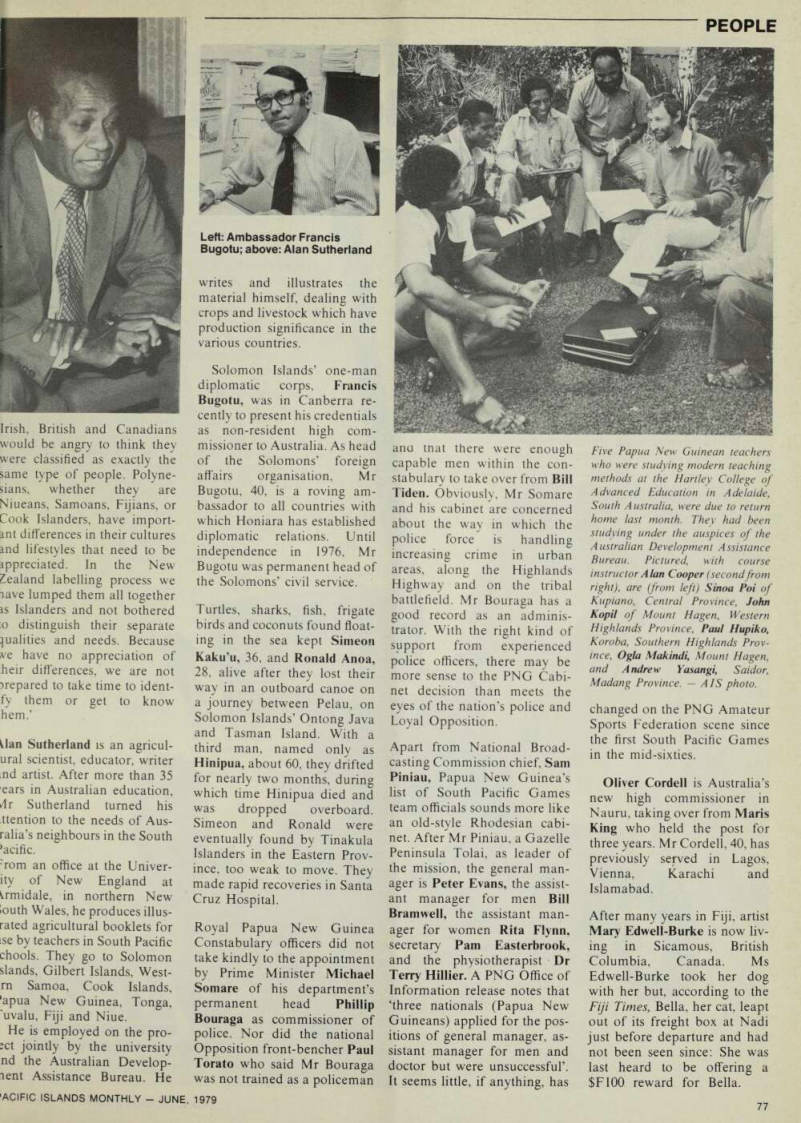
Five Papua New Guinean teachers who were studying modern teaching methods at the Hartley College of Advanced Education in Adelaide, South A ustralia, were due to return home last month. They had been studying under the auspices of the Australian Development Assistance Bureau. Pictured, with course instructor A lan Cooper (secondfrom right), are (from left) Sinoa Pot of Kupiano, Central Province, John Kopil of Mount Hagen, Western Highlands Province, Paul Hupiko, Koroba, Southern Highlands Prov ince, Ogla Makindi, Mount Hagen, and Andrew Yasangi, Saidor, Madang Province. AIS photo. changed on the PNG Amateur Sports Federation scene since the first South Pacific Games in the mid-sixties.
Oliver Cordell is Australia’s new high commissioner in Nauru, taking over from Maris King who held the post for three years. Mr Cordell, 40, has previously served in Lagos, Vienna, Karachi and Islamabad.
After many years in Fiji, artist Mary Edwell-Burke is now liv ing in Sicamous, British Columbia, Canada. Ms Edwell-Burke took her dog with her but, according to the Fiji Times, Bella, her cat, leapt out of its freight box at Nadi just before departure and had not been seen since: She was last heard to be offering a SFIOO reward for Bella.
Left: Ambassador Francis Bugotu; above: Alan Sutherland