Out Of Balance
pp. 71-72 · Read in the full issue
Books
The Henry Saga
- Lively But
Out Of Balance
Cook Islands Politics The inside story, edited by Professor Ron Crocombe, published by Polynesian Press. SNZ6.9O.
The fall of Sir Albert Henry and his Cook Islands Party Government after a sen sational election bribery hear ing last year is sure to spawn several books. The race into
print has been won easily by
Professor Ron Crocombe, director of the Institute of Pa cific Studies at the University of the South Pacific. Cook Islands Politics The inside story, is the combined work of 22 contributors edited by Pro fessor Crocombe who is to be commended for so quickly publishing an analysis of the Cooks’ political system.
The book is not a study in political science and should not be judged on that basis. Rather it is ‘a series of inside perspec
tives by participants reporting
the reality as they see it’.
Professor Crocombe and his
Rarotongan wife Marjorie, co
ordinator of continuing edu
cation at USP, were in the Cooks in January 1978 when Sir Albert announced a snap
election. They responded to
suggestions that they write a
book about Cook Islands poli tics and the elections scheduled for March by inviting and advertising for contributors.
More than 30 people ex pressed interest and 22 chap ters were subsequently
accepted for publication. The
political balance of the book suffers because the majority of authors support the Demo cratic Party, then in opposition.
This is unfortunate but not
really surprising. Better edu
cated Cook Islanders tend to support the ‘Demos’ rather than Sir Albert’s Cook Islands Party. Revelations at the sub sequent election bribery hear ing may well have caused some potential contributors to change their minds and decide that discretion was the better part of valour.
The book emerges as a sear ing indictment of the Henry regime’s 13 years in power.
Some of the material loses authority because it is so plainly biased or merely hear say. But most appears to be ir refutable fact.
The ‘anti-Henry’ chapters
chronicle serious allegations of nepotism, political discrimi nation and the misuse of government resources.
Professor Crocombe de scribes the book as ‘contro versial’. Some of the people who figure prominently in it re gard it as defamatory and poss ibly in contempt of court. The
judge presiding at the hearing
of criminal charges against Sir Albert, American millionaire Finbar Kenny and the others arraigned in the Cooks High Court last December, has been asked to cite the publishers for contempt. The lawyers
representing Mr Kenny claim
their client won’t get a fair trial in Rarotonga (if he is extrad ited and that’s another story), because of the way he is portrayed in the book.
Attempts to interfere in the course of justice and to intimidate the public service are discussed in convincing
detail and make alarming read
ing. Anthony Utanga’s account
of the Cook Islands Public Ser vice Association’s fight to resist government interference em phasises the need to have an independent civil service.
Sir Albert is the central character in the book. The con trasting views of him make fas
cinating reading. The former
premier, once described as the ‘stormy petrel of the South Pa cific’, is not the subject of
balanced biography.
His former public relations man. American Ted Libby, lauds Sir Albert as a ‘maverick on the loose in the Pacific’ a man of‘magnetic charm who stirs excitement wherever he
goes’. Libby’s press releases
were a feature of the government-run Cook Islands News in the build up to the election. Chief Justice (now Sir Gaven) Donne felt moved to
speak of Libby’s ‘imaginative
pen’.
Libby does a rather heavy handed PR job on Sir Albert and some of his claims have an
‘imaginative’ ring about them.
Did Sir Albert really take the Cooks from ‘colonial power status to a position of strength
in just 13 years’?
Other authors refer to Sir Albert in less favourable terms and it is left to Crocombe to attempt some sort of balanced assessment. He acknowledges Sir Albert’s ‘many strengths and potential for greatness’, and attributes Sir Albert’s pol itical success to verbal skills
and perceptiveness of deep
psychological needs’ namely a
‘hunger for Maoriness’.
But for Crocombe there is a marked difference between Sir
Albert’s lifestyle (essentially
European) and his public utter
ances (a man of the people). He comes ‘reluctantly’ to the con clusion that there was a ‘large element of hypocrisy’ in the
former premier.
Crocombe claims that the entrenchment of the Henry
family in government positions
was in part a concession by Sir Albert to pressure from the
influential Lady Henry who
was not happy to return to Rarotonga from New Zealand until arrangements were made for the family to return too.
Former cabinet minister Dr Joe Williams, once considered a front-runner to succeed Sir Albert as premier, explains in
detail why he resigned just be
fore last year’s election. He
gives numerous examples of
what he regards as nepotism, dictatorial leadership and the persecution of those who opposed the government. He was in a position to know what was going on.
The latter half of the book focuses on the election the organisation of the flying voters, the campaigns in vari ous constituencies and the sub sequent election petition
hearing.
An impassioned chapter by
Norman George highlights the
problems faced by the Demos in arranging to fly supporters (at full fares) to Rarotonga. Mr George, then an Auckland police officer, has since been
appointed consul-general in
Auckland. His chapter gives an
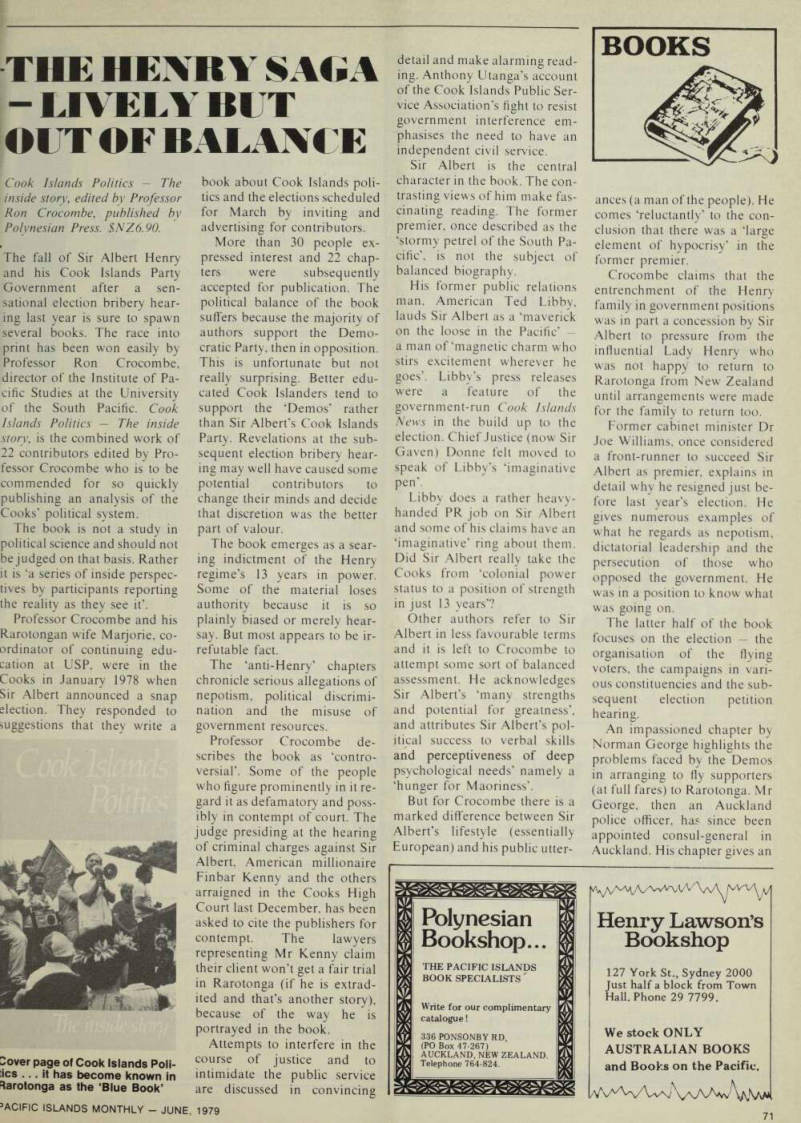
Cover page of Cook Islands Poll ies ... It has become known in Rarotonga as the ‘Blue Book’
interesting insight into the
reactions of the various airlines that were approached. Cook Islands Politics is a lively, read able and timely book. There are obvious gaps. More material on the Henry side would have given the book the balance it lacks.
But because the book does not purport to be a study in pol itical science it seems unfair to judge it as a reasoned, objective analysis of the Cooks political
scene.
James Tally
Judy out
with a
whimper
My Reluctant Missionary by John Kolia. Published by the Institute of Papua New Guinea Studies, Port Moresby.
Judy, the heroine, if that’s the right word to use, of John Kolia’s novel My Reluctant
Missionary, is a good-time girl
in Port Moresby. She’s mixed race, or so she says. Dr Kolia doesn’t seem quite sure whether she is or she isn’t, and if he doesn’t know, who does?
Anyway, Judy decides to
give away the gay life, and goes off to Wewak to become a missionary nurse. We are not told whether she has any nurs ing qualifications, or how she managed to con the conserva
tive evangelical mission portrayed by Dr Kolia into
accepting her.
But there it is, and Dr Kolia’s first chapter, entitled ‘Forth’, describes her departure from Port Moresby, her arrival in Wewak, and her initiation into the varied activities of a mission nurse. In Judy’s case, they turn out to be very varied indeed, and to show little re gard for the nursing pro fession’s code of conduct, making one wonder whether she was really a nurse at all.
The second chapter is called ‘Tempted’, and it must be con ceded that Judy takes to temp tation like a duck to water. She and her patients and her mixed race friends have the whale of a time until belatedly the mission catches up with her and she gets the sack. It should have happened a lot sooner.
The third and last chapter is called ‘Saved’, a title which has a nice evangelical ring. But I finished my perusal of it quite uncertain who had saved whom from what and why? So the story peters out ‘not with a bang but a whimper’. The story, but, unfortunately, not the book.
Appended is an essay en titled ‘A Memo on Mis sionaries’, in which Dr Kolia gives us in no uncertain terms his views on missionaries, Christianity and what he oddly refers to as ‘the so-called New Testament’. His thesis appears
to be that Papua New Guineans are savage, sensual and sadistic, and should be al lowed to stay that way.
Dr Kolia concludes that the Old Testament is ‘in accord ance with village custom. The so-called New Testament is not in accordance with custom’.
This seems to me to be a negative and defeatist attitude.
I prefer that of the Papuan pas tor who said: ‘The Old Tes tament shows us what we are like: the New Testament shows us what we ought to be like’.
I am glad that during my 54 years in Papua I have known many Papuans who have taken the ‘so-called’ New Testament quite seriously, and have tried
with simple sincerity to apply
its ethic to their daily lives. It is clear that Dr Kolia and I have moved in different circles.
Dr Kolia’s style is idiosyn cratic in the extreme. He is addicted to what A. P. Herbert used to call ‘ribbon writing’
long rambling, ill-structured
sentences. And the narrative is
frequently interrupted by
asides in which the author ad umbrates on a variety of sub jects. Personally I found these a welcome relief from the dreary story and salacious dia
logue. But I cannot help feeling
that the sort of reader who will be attracted to this book, eager to know with whom Judy is going to bed next, will resent
these delays in getting to where the action is .
It seems strange that a man of John Collier’s academic attainments should write such queer English. Can it be that,
having re-spelt his name to give
it a Papua New Guinean flavour, he is now trying to kid us that English is not his
mother tongue?
This book is published by the so-called Institute of Papua New Guinea Studies. I can’t think why. Percy Chatter ton.