Windsurfing
pp. 68-69 · Read in the full issue
New Caledonia
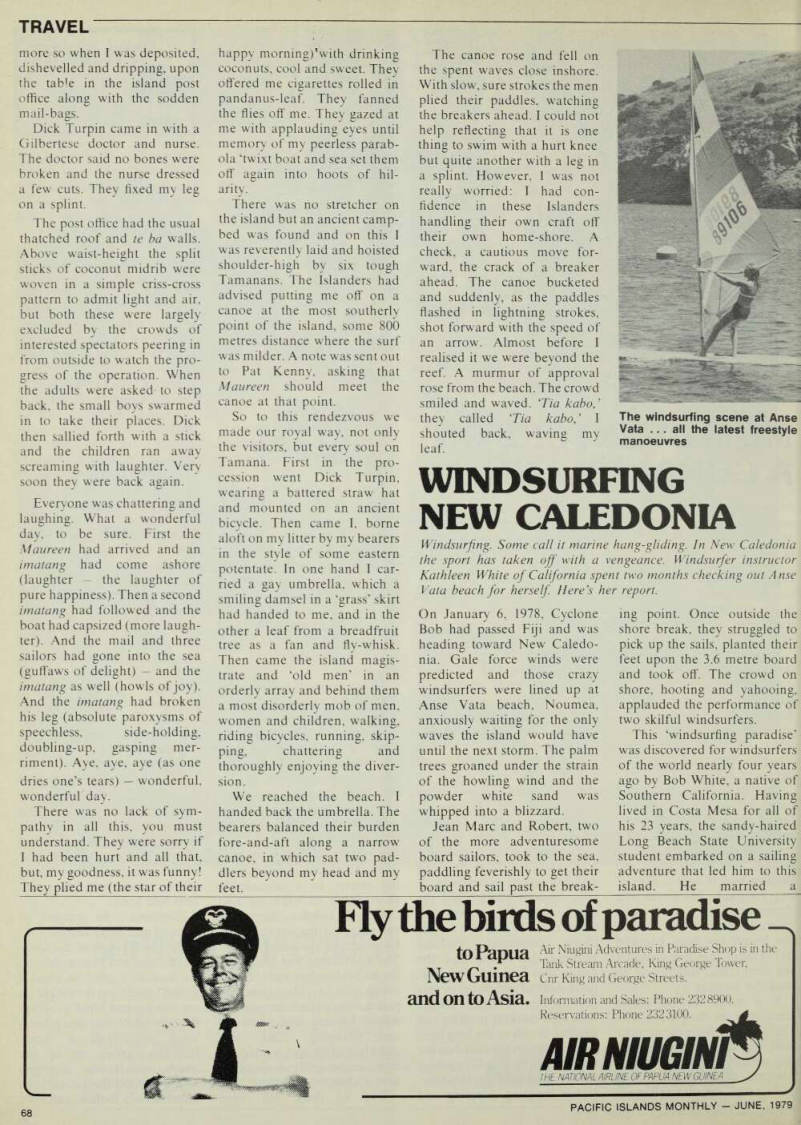
Windsurfing. Some call it marine hang-gliding. In New Caledonia the sport has taken off with a vengeance. Windsurfer instructor Kathleen White of California spent two months checking out Anse Vata beach for herself. Here’s her report.
On January 6, 1978, Cyclone Bob had passed Fiji and was heading toward New Caledo nia. Gale force winds were predicted and those crazy windsurfers were lined up at Anse Vata beach, Noumea,
anxiously waiting for the only
waves the island would have until the next storm. The palm trees groaned under the strain of the howling wind and the powder white sand was whipped into a blizzard.
Jean Marc and Robert, two of the more adventuresome board sailors, took to the sea, paddling feverishly to get their board and sail past the break
ing point. Once outside the shore break, they struggled to pick up the sails, planted their feet upon the 3.6 metre board and took off. The crowd on
shore, hooting and yahooing,
applauded the performance of
two skilful windsurfers.
This ‘windsurfing paradise’
was discovered for windsurfers of the world nearly four years ago by Bob White, a native of Southern California. Having lived in Costa Mesa for all of his 23 years, the sandy-haired
Long Beach State University
student embarked on a sailing adventure that led him to this island. He married _a_
Caledonian girl and today enjoys the island’s lifestyle. As King of Windsurfing’, he sells and rents equipment and instructs windsurfing in this French territory.
New Caledonia was given its name by Captain James Cook in 1774 because the rocky northeast coast reminded him of Scotland. Lying just north of the Tropic of Capricorn, it has the same latitude as Rio de Janeiro. The island is protected by an offshore coral reef and enjoys mild winters and warm summers.
Mainland New Caledonia, shaped like a cigar, is 400 kilometres long and averages 50 kilometres wide. It lies 1850 kilometres northeast of Sydney, Australia, 1800 kilometres northwest of Auckland, New Zealand and 11 250 kilometres southwest of San Francisco.
Noumea, the capital, is the home of the best windsurfers in the region. Noumea’s water sports activity is centred at Anse Vata beach. The beaches are unspoiled and Anse Vata is the hang-out for the planche et voile (board and sail). It’s dif ficult to imagine the bay with out the multitude of brightly coloured sails and slick white boards skimming over the
blue-green water.
The tropical weather of New Caledonia is perfect for year round windsurfing. By 6 am the blazing sun is on its way into a cloudless sky and the wind is up to 15 knots. Bob is the first to arrive with a trailer full of windsurfers. Instruction begins at 7 a.m. and six windsurfers have to be rigged as well as the rescue vessel inflated. The equipment because the off shore breeze often makes it dif
ficult for the novice to make it back to shore.
Meanwhile, a parade of mini-coupes and Renaults arrives and the unloading of boards begins. There is a mad rush to be the first on the water.
As the men dash off their
girlfriends wipe the sleep from
their eyes, wondering if this early hour sail is really worth it.
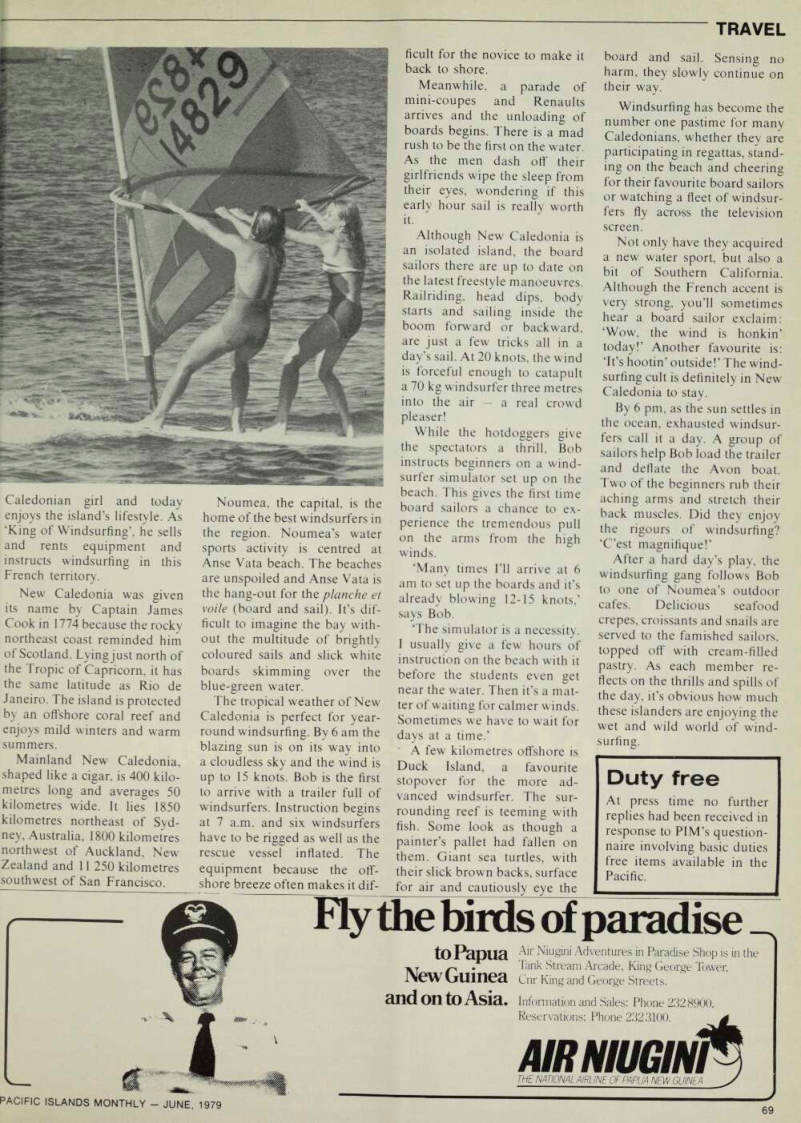
Although New Caledonia is an isolated island, the board sailors there are up to date on the latest freestyle manoeuvres.
Railriding, head dips, body
starts and sailing inside the boom forward or backward, are just a few tricks all in a day’s sail. At 20 knots, the wind is forceful enough to catapult a 70 kg windsurfer three metres into the air a real crowd
pleaser!
While the hotdoggers give
the spectators a thrill, Bob instructs beginners on a wind surfer-simulator set up on the beach. This gives the first time board sailors a chance to ex perience the tremendous pull on the arms from the high winds. ‘Many times I’ll arrive at 6 am to set up the boards and it’s
already blowing 12-15 knots,’
says Bob. ‘The simulator is a necessity.
I usually give a few hours of instruction on the beach with it before the students even get near the water. Then it’s a mat ter of waiting for calmer winds.
Sometimes we have to wait for days at a time.’
A few kilometres offshore is Duck Island, a favourite stopover for the more ad vanced windsurfer. The sur rounding reef is teeming with fish. Some look as though a painter’s pallet had fallen on them. Giant sea turtles, with their slick brown backs, surface for air and cautiously eye the
board and sail. Sensing no harm, they slowly continue on their way.
Windsurfing has become the number one pastime for many Caledonians, whether they are participating in regattas, stand ing on the beach and cheering for their favourite board sailors or watching a fleet of windsur fers fly across the television screen.
Not only have they acquired a new water sport, but also a bit of Southern California.
Although the French accent is very strong, you’ll sometimes hear a board sailor exclaim: ‘Wow. the wind is honkin’ today!’ Another favourite is: ‘lt’s hootin’ outside!’ The wind surfing cult is definitely in New Caledonia to stay.
By 6 pm, as the sun settles in the ocean, exhausted windsur fers call it a day. A group of sailors help Bob load the trailer and deflate the Avon boat.
Two of the beginners rub their aching arms and stretch their back muscles. Did they enjoy
the rigours of windsurfing?
‘C’est magnifique!’
After a hard day’s play, the windsurfing gang follows Bob to one of Noumea’s outdoor cafes. Delicious seafood crepes, croissants and snails are served to the famished sailors, topped off with cream-filled pastry. As each member re flects on the thrills and spills of the day, it’s obvious how much these islanders are enjoying the wet and wild world of wind
surfing.