A Coralisland
pp. 67-68 · Read in the full issue
Travel
Misadventure On
Much changes in the Islands. But, by their very isolation, much more stays the same. It’sprobably that way on Tamana Island which Michael Hook, as chief police officer in the Gilbert Islands, visited in 1957 ...
Eight hundred kilometres south of Tarawa lies Tamana.
It was our last port of call but for Arorae, the most southerly island in the Gilberts chain.
Tamana is a ‘reef island,’ that is to say, unlike an atoll, it has no lagoon, so one had to land on an exposed beach. The flat ledge of shelving reef pro jects some hundred metres sea ward where it falls away
abruptly into the mighty
depths of the ocean.
Over this ledge come the long rollers of the Pacific,
forced upwards into top-heavy
waves, which trip in their stride, stagger forward, falling, falling, and break upon the shallow waters with a roar of angry anguish. The waves pick themselves up and hurry onwards to the beach, but all the breath has been knocked out of them, they flop down on the sand rather sulkily and go back for another try.
It is where the big waves break that the danger lies. The Gilbertese fishermen in their frail but fast canoes and the Tuvaluans in their sturdy
buoyant dug-outs ride these
rollers with the ease and grace
of show-jumpers.
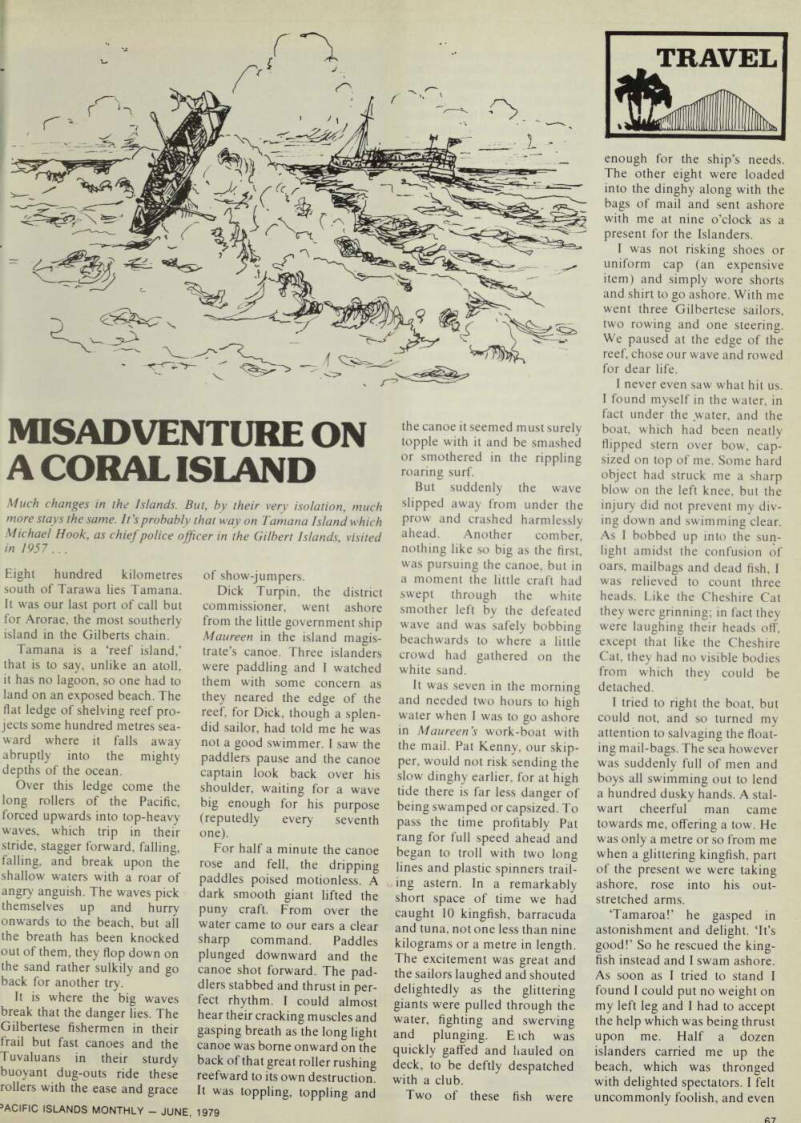
Dick Turpin, the district commissioner, went ashore from the little government ship Maureen in the island magis trate’s canoe. Three islanders were paddling and I watched them with some concern as they neared the edge of the reef, for Dick, though a splen did sailor, had told me he was not a good swimmer. I saw the paddlers pause and the canoe captain look back over his shoulder, waiting for a wave big enough for his purpose (reputedly every seventh one).
For half a minute the canoe rose and fell, the dripping paddles poised motionless. A dark smooth giant lifted the puny craft. From over the water came to our ears a clear sharp command. Paddles plunged downward and the canoe shot forward. The pad dlers stabbed and thrust in per fect rhythm. I could almost hear their cracking muscles and gasping breath as the long light canoe was borne onward on the back of that great roller rushing reefward to its own destruction.
It was toppling, toppling and
the canoe it seemed must surely topple with it and be smashed or smothered in the rippling
roaring surf.
But suddenly the wave slipped away from under the prow and crashed harmlessly ahead. Another comber, nothing like so big as the first, was pursuing the canoe, but in a moment the little craft had swept through the white smother left by the defeated wave and was safely bobbing beachwards to where a little crowd had gathered on the white sand.
It was seven in the morning and needed two hours to high water when I was to go ashore in Maureen's work-boat with the mail. Pat Kenny, our skip per, would not risk sending the slow dinghy earlier, for at high tide there is far less danger of
being swamped or capsized. To
pass the time profitably Pat rang for full speed ahead and began to troll with two long lines and plastic spinners trail ing astern. In a remarkably short space of time we had
caught 10 kingfish, barracuda
and tuna, not one less than nine kilograms or a metre in length.
The excitement was great and the sailors laughed and shouted
delightedly as the glittering
giants were pulled through the
water, fighting and swerving
and plunging. E ich was quickly gaffed and hauled on deck, to be deftly despatched with a club.
Two of these fish were
enough for the ship’s needs.
The other eight were loaded into the dinghy along with the bags of mail and sent ashore with me at nine o’clock as a present for the Islanders.
I was not risking shoes or uniform cap (an expensive item) and simply wore shorts and shirt to go ashore. With me went three Gilbertese sailors, two rowing and one steering.
We paused at the edge of the reef, chose our wave and rowed for dear life.
I never even saw what hit us.
I found myself in the water, in fact under the water, and the boat, which had been neatly flipped stern over bow, cap sized on top of me. Some hard object had struck me a sharp blow on the left knee, but the injury did not prevent my div ing down and swimming clear.
As I bobbed up into the sun light amidst the confusion of oars, mailbags and dead fish, I was relieved to count three heads. Like the Cheshire Cat
they were grinning; in fact they
were laughing their heads off, except that like the Cheshire Cat, they had no visible bodies from which they could be detached.
I tried to right the boat, but could not, and so turned my attention to salvaging the float ing mail-bags. The sea however was suddenly full of men and boys all swimming out to lend a hundred dusky hands. A stal wart cheerful man came towards me, offering a tow. He was only a metre or so from me when a glittering kingfish, part of the present we were taking ashore, rose into his out stretched arms.
Tamaroa!’ he gasped in astonishment and delight. ‘lt’s good!’ So he rescued the king fish instead and I swam ashore.
As soon as I tried to stand I found I could put no weight on my left leg and I had to accept the help which was being thrust upon me. Half a dozen islanders carried me up the beach, which was thronged with delighted spectators. I felt uncommonly foolish, and even
more so when I was deposited, dishevelled and dripping, upon the table in the island post office along with the sodden
mail-bags.
Dick Turpin came in with a Gilbertese doctor and nurse.
The doctor said no bones were broken and the nurse dressed a few cuts. They fixed my leg on a splint.
The post office had the usual thatched roof and te ba walls.
Above waist-height the split
slicks of coconut midrib were woven in a simple criss-cross pattern to admit light and air, but both these were largely excluded by the crowds of interested spectators peering in from outside to watch the pro gress of the operation. When the adults were asked to step back, the small boys swarmed in to take their places. Dick then sallied forth with a stick and the children ran away
screaming with laughter. Very
soon they were back again.
Everyone was chattering and
laughing. What a wonderful day, to be sure. First the Maureen had arrived and an imatang had come ashore
(laughter the laughter of
pure happiness). Then a second imatang had followed and the boat had capsized (more laugh ter). And the mail and three sailors had gone into the sea (guffaws of delight) and the imatang as well (howls of joy).
And the imatang had broken his leg (absolute paroxysms of
speechless, side-holding,
doubling-up. gasping mer
riment). Aye, aye, aye (as one dries one’s tears) wonderful,
wonderful day.
There was no lack of sym pathy in all this, you must understand. They were sorry if I had been hurt and all that, but, my goodness, it was funny!
They plied me (the star of their
happy morning)’with drinking
coconuts, cool and sweet. They offered me cigarettes rolled in
pandanus-leaf. They fanned
the flies off me. They gazed at me with applauding eyes until memory of my peerless parab ola ‘twixt boat and sea set them off again into hoots of hil
arity.
There was no stretcher on the island but an ancient camp bed was found and on this I was reverently laid and hoisted
shoulder-high by six tough
Tamanans. The Islanders had advised putting me off on a canoe at the most southerly point of the island, some 800 metres distance where the surf was milder. A note was sent out to Pat Kenny, asking that Maureen should meet the canoe at that point.
So to this rendezvous we made our royal way, not only the visitors, but every soul on Tamana. First in the pro cession went Dick Turpin, wearing a battered straw hat and mounted on an ancient bicycle. Then came I. borne aloft on my litter by my bearers in the style of some eastern potentate. In one hand I car ried a gay umbrella, which a smiling damsel in a ‘grass’ skirt had handed to me. and in the other a leaf from a breadfruit tree as a fan and fly-whisk.
Then came the island magis trate and ‘old men’ in an orderly array and behind them a most disorderly mob of men. women and children, walking,
riding bicycles, running, skip
ping, chattering and
thoroughly enjoying the diver
sion.
We reached the beach. I handed back the umbrella. The bearers balanced their burden fore-and-aft along a narrow canoe, in which sat two pad dlers beyond my head and my feet.
The canoe rose and fell on the spent waves close inshore.
With slow, sure strokes the men
plied their paddles, watching
the breakers ahead. I could not help reflecting that it is one thing to swim with a hurt knee but quite another with a leg in a splint. However. I was not really worried: I had con fidence in these Islanders handling their own craft off their own home-shore. A check, a cautious move for ward, the crack of a breaker ahead. The canoe bucketed and suddenly, as the paddles flashed in lightning strokes, shot forward with the speed of an arrow. Almost before I realised it we were beyond the reef. A murmur of approval rose from the beach. The crowd smiled and waved. ‘Tia kabo ,’ they called ‘ Tia kabo,’ I shouted back, waving my leaf.
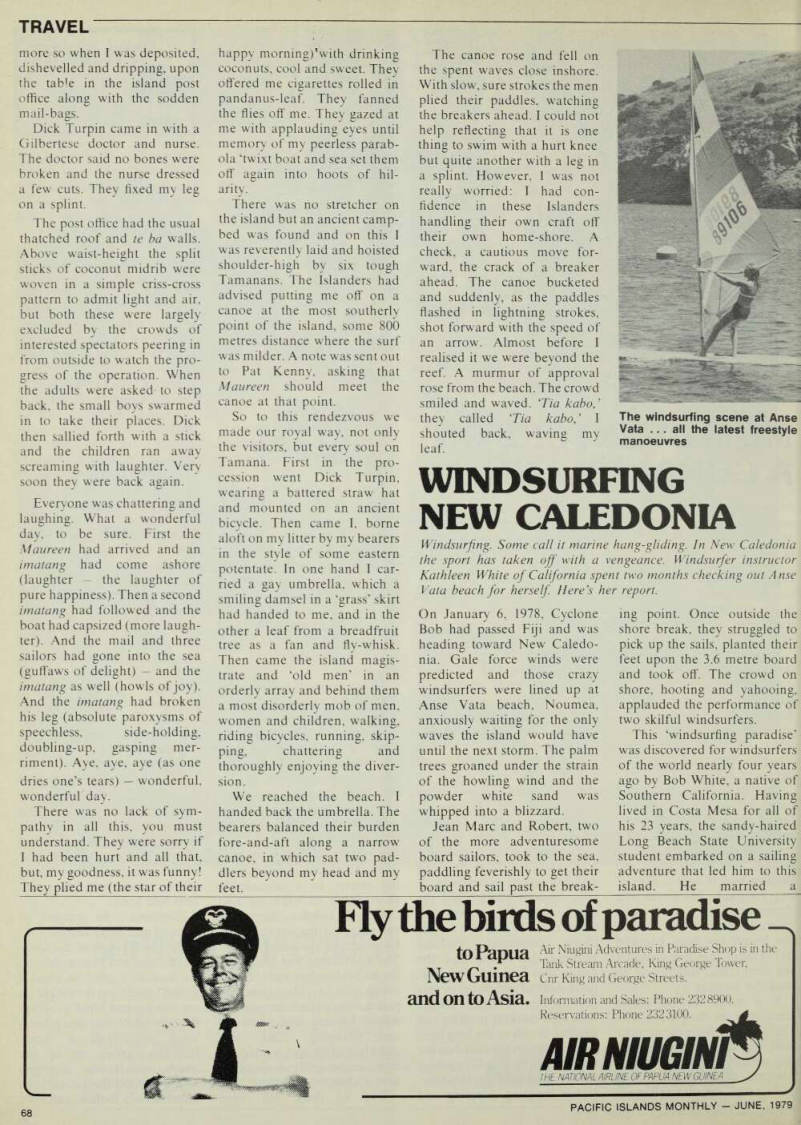
The windsurfing scene at Anse Vata ... all the latest freestyle manoeuvres