The Islands
pp. 45-46 · Read in the full issue

Investment
Phds Feels
Its Way Into
The Islands
PIIDS. It’s an awkward acronym which doesn’t roll off the tongue easily whether you spell it out or try to pronouce it. Basically it stands for a system whereby New Zealand business can put its money into the Pacific to the mutual advantage of itself and the Islands.
One of New Zealand’s indirect ‘do it yourself assistance schemes to the Pacific Islands and New Zealand industry is the Pacific Islands Industrial Scheme (PUDS) which began in November 1976.
Its main aim is for New Zealand to provide incentives for companies to develop
approved manufacturing
operations throughout the re gion to foster economic development and employ ment.
The scheme began a little hesitantly, faltered and was then amended to include a wider area of the region such as the Gilbert Islands, Nauru, Papua New Guinea, Solomon Islands and Tuvalu and to include agricultural produce.
Like any new scheme, it is subject to criticism, such as the charge that it might distort Island development. For all that though, assistance so far has gone to 31 New Zealand
companies establishing
ventures in Fiji, Tonga, West ern Samoa, Niue and Cook Islands.
Already 19 are operating and when all 31 get going they
should give employment to
about 350 people, Western
Samoa gaining 172 jobs.
In five years, trade and industry officials believe PUDS will generate another 1000 jobs a fair contribution to the 15,000 jobs it is esti mated will be needed. The cost of creating a job under the scheme works out at about
Snziooo.
The biggest flaw for the Islands, however, is the lack of automatic accessibility for their goods into New Zealand. At a recent seminar on PUDS, this message came through repeat edly from people who argued that New Zealand was resort
ing to the same access argu ment with Japan for its primary
produce.
‘Access could become a serious problem as more pro jects are established under the scheme,’ says Fiji’s represen tative in New Zealand, Bal Ram.
NZ Trade and Industry rep resentative, Trevor Lloyd, ac knowledges that there is no automatic guarantee of access to the New Zealand market for
goods produced under the
scheme although access has been created for some schemes.
The whole question of access is under consideration, he says.
Two snags in free access to New Zealand’s market are the Manufacturers’ Federation and the Federation of Labour.
With New Zealand’s economy
depressed and unemployment
still running high, neither
group wants open access which could further harm local in dustries and employment.
However, the Labour Party’s former minister of Overseas Trade, Joe Walding, ridiculed the hesitation shown in allow ing Pacific Island products free access. He has promised to eat his hat if New Zealand cannot absorb Island products without destroying its economy. ‘lt makes little sense or economic justice to me to have Islanders leaving their families and what many regard as idyl lic surroundings to move into crowded Ponsonby (Auckland suburb) flats to work in a fac tory that often produces goods that are exported back to their own country,’ said Mr
Walding.
‘We could do more to prac tise what we preach in accessi bility to New Zealand markets for Pacific Island products.’
Turning on the union move ment, he said he felt sure that
in their pursuit of social justice and decent wages and working conditions, the unions did not believe their efforts should be confined to New Zealand
workers only.
Federation of Labour coun cil member, Sonja Davies, ac knowledges that people had a distorted impression of the impact of Pacific Island trade on New Zealand’s economy. ‘Hopfully the FOL will get across to its members the im portance of supporting the PUDS scheme,’ she said.
But the final word came from Mr Lloyd who counselled caution: ‘I believe we need to take a softly, softly attitude on access. If the issue is pushed too hard it could be counter productive.”
So far, only one proposed PUDS idea has been turned down on ‘access’ objections out
of 48 applications. This in volved a proposed $1 million
textile industry for Tonga.
Another scheme on the draw ing boards is ‘questionable’.
But PUDS is not static and, apart from reviewing the access question, Mr Lloyd said ration alisation of industry within the region and the need for re gional co-operation were also under examination.
Mr Walding also suggested a common customs and tariff policy for the South Pacific -
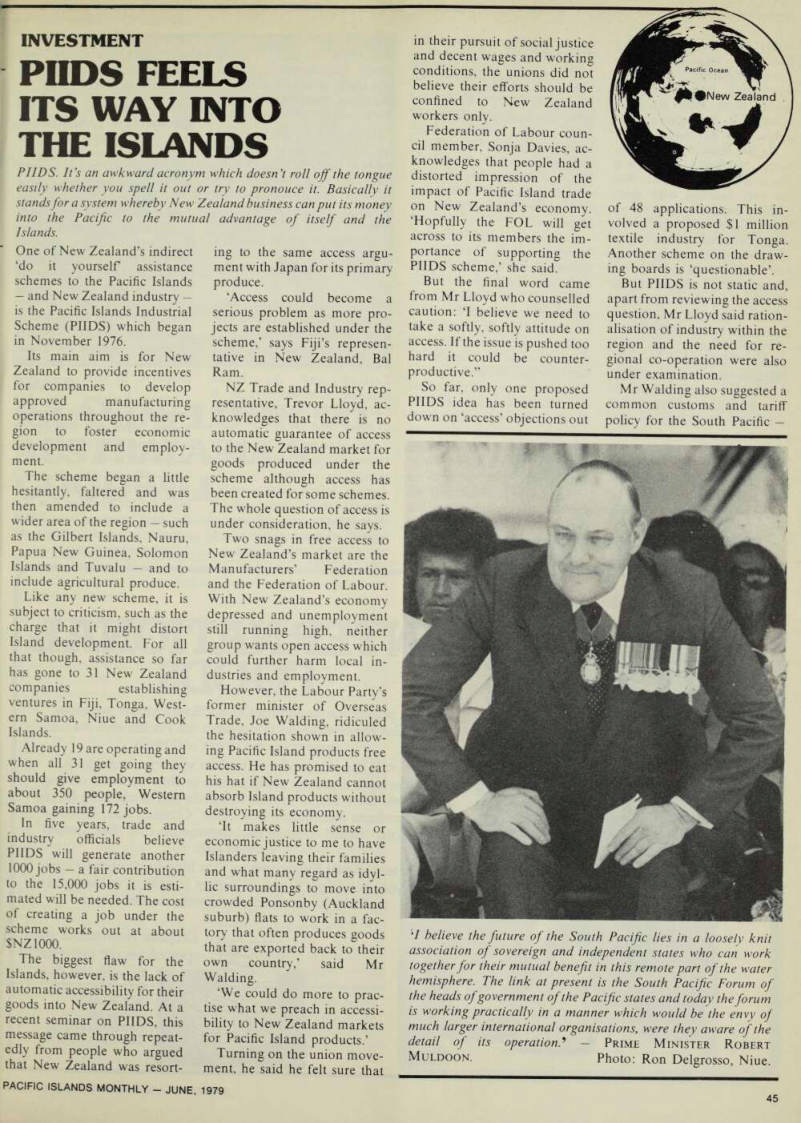
'I believe the future of the South Pacific lies in a loosely knit association of sovereign and independent states who can work together for their mutual benefit in this remote part of the water hemisphere. The link at present is the South Pacific Forum of the heads of government of the Pacific states and today the forum is working practically in a manner which would be the envy of much larger international organisations, were they aware of the detail of its operation .’- PRIME MINISTER ROBERT MULDOON. Photo: Ron Delgrosso, Niue.
similar to that used by European Economic Com
munity members. Progress on
developing such a scheme should come from the June meeting of the region’s trade ministers in Rarotonga.
Mr Bal Ram, a PUDS sup porter, pointing to the jobs it has created in Fiji, said: ‘We are very satisfied with them and the objectives they set up have been achieved. We choose what schemes we want and we do not hesitate to say “no” if they are not in the interests of the country and its economy.’ He would like to see PUDS expanded to include
more agricultural projects.
Western Samoa high com mission official, A. F.
Toleafoa, was more cautious, believing it was too early to pass judgment on PUDS. He said there was a need to eval uate the number of companies
opened, the employment
opportunities they produced
and the value of exports. One bag making company so far
employed only five people
when it had promised to em ploy 35, he said.
Comments of businessmen
operating in the Pacific under PUDS are worth noting.
Managing director of Mortco Holdings Ltd, Auckland, N. P. Mortimer, says: ‘The operation should be fairly small, self-contained, labour intensified and, most definitely, not always tied to
large manufacturing, rather
distant impersonal companies
from either New Zealand or elsewhere. ‘lt is essential that the Pacific Island people have a stake in the companies which are set up and that they prove their
willingness to participate by
contributing some capital. This
is always my first criterion.
After capital is contributed to a local venture then aid should
be requested. But only then ...
People do not want unecon omic schemes which don’t do anything for the participants or the area in which they are based. They do require sound industrial development which will benefit both the area in which it is established and the people who contribute the
capital by producing them a
profit.’
Training Pacific Islanders in
New Zealand for the schemes is an important spin-off and a
point emphasised by the
managing director of F. C.
Matthews and Sons Ltd of Auckland, G. H. Matthews.
He set up a scheme in Tonga
for manufacturing 32-panel
leather laceless soccer balls which are reimported to New
Zealand to replace existing
imports. The balls are not made in New Zealand because the product is labour intensive and, under New Zealand standards, would be unecon omic.
Mr Matthews said the Tonga company is financed 60-40% with Tonga holding the smaller share. Four Tongans were trained as supervisors in New Zealand and the Island company now employs 36. It has a waiting list for vacancies of more than 80. ‘We consider that the type of industry to be established there should be initially those in dustries which largely utilise manual skills and are not
dependent upon highly sophis
ticated technological equip
ment,’ Mr Matthews said.
He urged labour intensive industries, access to the New Zealand market ‘particularly during development years!
The president of the Manufacturers’ Association, Fred Turnovsky, asked a businessman’s list of questions; Am I going to find a trained and educated work force there with management skills? Is there likely to be long term
development potential? Will
there be third market outlets to Australia and the United States or Europe? Does it make sense to put our investment in the Pacific Islands and not, say, Singapore? What taxation con cessions are there? ‘Eventually of course you want the indus tries run by, and for, the Islanders,’ he said.
Frank Brugger, who has opened a company in Western Samoa, addressed himself to the Islands: ‘lf you want us, okay, we’ll come. If you don’t, okay, say so and we won’t come.’ The point he was mak ing, said Mr Brugger, was that the final sucess of any PUDS venture rested with the Islanders themselves.