Worthwhile
pp. 43-44 · Read in the full issue
Aid
Trying To Make
Every Dollar
Worthwhile
New Zealand's aid to the Islands, while increasing on paper is fall ing back slightly in real terms, mainly as a consequence of its own economic difficulties. William Gasson looks at New Zealand's aid philosophy and where its money is going.
The financial philosophy be hind New Zealand aid to the South Pacific is to make every dollar count. The reason is simple the aid donors, and this includes church-funded groups, the Council of Organis ations for Relief Services Over seas (CORSO), the Red Cross, Volunteer Service Abroad (VSA) as well as the govern ment aid scheme, have so little money to play with.
They argue for quality rather than quantity and certainly, with limited resources, all agencies helping the Pacific Islands work to maintain close personal contact with the
people helping and being
helped.
T think it makes a dif ference,’ VSA director, Dr David Stone says. ‘VSA com pares favourably with other aid organisations with greater re sources.’
Then again, there is the con stant concern of officials at the capacity of the Islands to absorb and manage large injec tions of aid. New Zealand’s aid policy is to lift the living standards of the bottom 20% of the people, mainly through the people helping themselves.
New Zealand is sensitive to nationalistic feelings and
treads carefully when offering help. ‘First and probably fore most we must accept that no outside country is going to tell the Pacific what the answers are any more,’ Deputy Prime Minister Brian Talboys has said. ‘Apart from the fact that we don’t always have the right answers anyway, the experi ence of the past shows that it is the people and leaders of the Pacific themselves who will most surely find the appropri ate road to follow.’
Coupled with the argument of ‘softly softly’, New Zealand lacks the financial resources anyway to make a much larger contribution. While it grapples with its own serious economic problems, Pacific aid is, in real
terms, falling back despite
slight monetary increases.
In the 1978-79 financial year, which ended on March 31, bi lateral aid totalled $NZ26.32 million compared with $25.25 million the previous year. In addition, New Zealand gave
the South Pacific Commission and the South Pacific Bureau for Economic Co-operation $783 000 in the form of multi lateral aid. It gave $638 519 the
previous year.
This aid to the Pacific rep resents more than 60% of the
country’s total official develop
ment assistance and reflects New Zealand’s policy of con centrating aid in its neigh bourhood.
New Zealand is trying to cre ate greater flexibility in its aid program to give the Islands more responsibility in operat ing different schemes. The latest move is a supplemen tation scheme for Tonga, West ern Samoa and Fiji, allowing their governments to recruit and select the people they need from New Zealand for
development work.
They pay these people local salaries out of their own re sources and the supplemen tation fund provides appropriate allowances to attract recruits and meet trans fer costs.
The aim is for recruits to come from New Zealand but the government is not likely to ban entirely people from other countries for specialised work if Island governments prefer them.
‘This government is totally convinced of the need for New Zealand's sake as much as for our friends in the Island states for countries of the South Pacific to work together. For that reason the South Pacific, just as it is the main focus for New Zealand's aid activities, will remain right in the forefront of this government's foreign policy .’ Deputy Prime Minister Brian Talboys.
While giving the Islands
more responsibility in selecting
people for their priority list of projects, the scheme also ensures there is no doubt to whom the recruit is responsible the Island government.
The scheme is similar to the VS A operation which recruits people for Island projects. VSA meet the volunteers’ air fares from an annual $2OO 000 government grant which also helps to cover administration costs, and the Islands pay their salaries.
Another move by the NZ Government in 1977 was to offer about 50% of its training awards to Islanders to attend regional institutions rather than travel to New Zealand for studies.
Officials recognised that, to some extent, the failure rates of Pacific Island students in New Zealand institutions were linked with their difficulty in settling in a strange society where the level of training was often higher than their needs.
By offering some 300 of the 700 awards for regional insti tutions, the government found, and the Islands eventually ac cepted the idea, that the levels of courses available were ap
propriate to current develop
ment needs.
The largest single sector of aid activity is in agriculture.
The aim is to increase pro
ductivity and develop alterna
tive crops, as exports and as substitutes for imports.
NZ’s biggest Pacific aid pro
ject is pine forest development
in Fiji. New Zealand con tributes $1 million a year towards this scheme which has as its target a pine forest cover ing 76 000 hectares on the west ern side of Viti Levu, the main island.
In Western Samoa New Zea land foresters are setting up a forestry programme to maintain
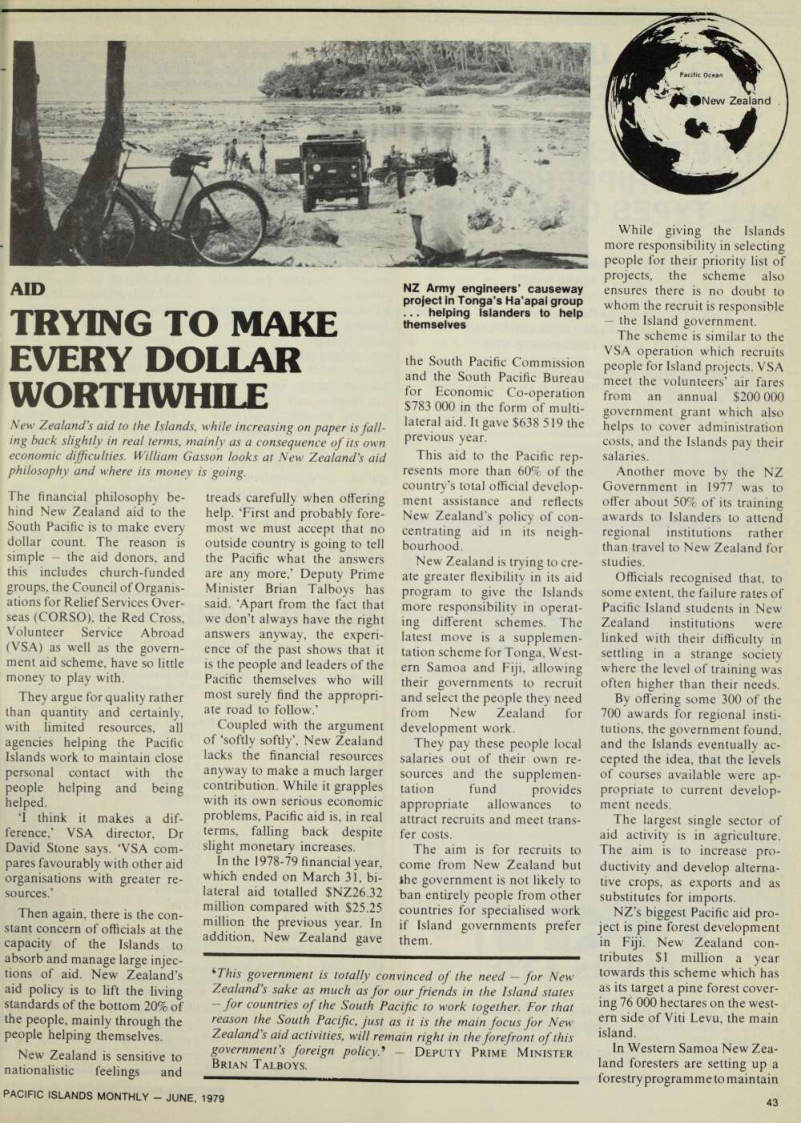
NZ Army engineers’ causeway project In Tonga’s Ha’apai group ... helping Islanders to help themselves
supplies of timber to the big sawmill at Awau while in Tonga the world’s first portable coconut stem sawmill is providing the Island with building timber. At the same time, New Zealand has launched a modest afforest ation scheme in Tonga.
Other projects include; • Passionfruit development on Niue with a VSA horticul turalist. • VSA teachers at high schools in the outer Cook Islands. • A chain of vocational training centres throughout the Tuvalu islands. • Deepening Avatiu harbour in
Rarotonga and improving
shore facilities. • A medical registrar exchange scheme under which five regis trars are sent to Tonga, West ern Samoa and Fiji for six
months, allowing local regis
trars to train and study over seas. • $9OO 000 toward the $ 1 million kitchen/dining hall complex at the University of the South Pacific, Suva, and then the building of a hall of residence. • A mechanical service centre with a workshop and training block in Tonga.
• Establishment of sheep and bee keeping management centres in Papua New Guinea. • A 28-bed hospital for Tonga’s Ha’apai group of islands, population about 15,000. • Specialists for Solomon Islands’ fisheries venture. • Boat channels (by blasting) 33 in all through coral reefs in Western Samoa, Gilbert Islands and Tuvalu to improve access to offshore fishing
grounds.
There are more than 100 VSA officers in 10 Pacific countries working in medicine,
teaching, journalism, engineer
ing and agriculture.
Then there is aid from CORSO and church organis ations which, altogether, create a comprehensive fabric of as sistance for the Islands.
Having said all that, there is heard the voice of former Solomons chief minister, Solomon Mamaloni whose message some months ago in Wellington was: ‘We want trade, not aid, as equal part ners.’
It’s a cry that is likely to be come louder as aid develops the skills and output of the Islanders.