closing on
p. 42 · Read in the full issue
Immigration
Doors are closing on Islanders
Pacific Islanders are feeling the effects of the New Zealand Government’s policy aimed at
curbing the number of
immigrants and the army of workers, which used to flow from the Islands under permit schemes, is dwindling as NZ’s
economy slumps and unemploy
ment rises.
In the year to March 31, 1978, 894 approvals were given for workers from Fiji, Tonga and Western Samoa to enter New Zealand. From April to December 1978 the number of approvals totalled 494, a drop from 75 to 55 in the monthly average. While seasonal work causes fluctuations, the drop does reflect New Zealand’s
high unemployment.
As numbers fall away, the chairman of Volunteer Service Abroad, Gavin Kerr, is appeal
ing for immigration priority to
be given to people from the Pa cific region. He said returning volunteers were keen to see some Pacific values accepted in New Zealand society, such as the concept of the extended family, particularly at a time when concern was being ex pressed about family life in New Zealand.
Sharing with others was another significant Pacific quality ‘while societies with a long tradition of oral com munication skills can con tribute greatly in our society where people are communicat-
ing less on a personal basis than ever before,’ he said.
Mr Kerr argued that the government should give immigrants from the Pacific re gion most favourable consider ation, or at least allow entry in
equal numbers to immigrants
from other countries.
In most recent figures, South Pacific immigrants totalled 1.6% of New Zealand’s total
population, the biggest
immigrant group coming from
Britain and Ireland, 9.5%, with Australia having a similar per centage to the Islands.
A number of Pacific Islands already receive ‘most favoured nation’ treatment when it comes to immigration. Cook Islands, Niue and Tokelau are classified as citizens and have free access to New Zealand. In addition, because of past ties when it was a trust territory administered by New Zealand, Western Samoa has an annual immigrant quota of 1100.
Zealand’s revised tem porary entry rules have put a stop to Islanders coming in on
three month permits, finding
work and then dropping from
sight to become ‘overstayers’.
The revision came after the overstayer problem had
erupted into an unpleasant epi
sode in New Zealand’s re lations with the Pacific. The temporary entry system was being abused and remittances from workers to help boost Island economies were grow
ing alarmingly. The situation
was exacerbated by bungling
bureaucrats who instituted spot checks on Island people in Auckland. .Now temporary entry for visitors from Tonga, Fiji and Western Samoa has been re
duced from three months to one apart from elderly parents
or grandparents, wishing to
visit their offspring, whose per mits can be extended a further three months.
The idea behind cutting per mits back to one .month is to make it uneconomic for Islanders to travel to New Zealand on the off-chance of finding work and then being tempted to stay on illegally.
The overstayer issue has
pointed up problems Island
communities face and the Pa cific Affairs Co-ordinating Commmittee (PACC) has de veloped partly as a result of this increased awareness. PACC’s role is to provide a focal point for co-ordinating New Zealand policies toward the South Pa cific on issues such as trade, economic co-operation, immi gration, education, health, de fence and transport. A sub-committee of PACC has
been established in Auckland to concentrate on the well being of Island communities there.
The Fiji, Tonga and Western Samoa work permit schemes allow workers to stay in NZ for up to 11 months. They take up employment in response to specific job offers from New Zealand employers. A similar scheme operates for Tuvalu which can send up to 20 workers a year.
Fiji enjoys a separate scheme for male and female rural workers who can stay in New Zealand for up to six months.
The long term aim of New Zealand’s work permit scheme is to increase training and em
ployment opportunities so that
the Islands will develop a re serve of skilled manpower which will prove valuable as
industrialisation spreads
through the region.
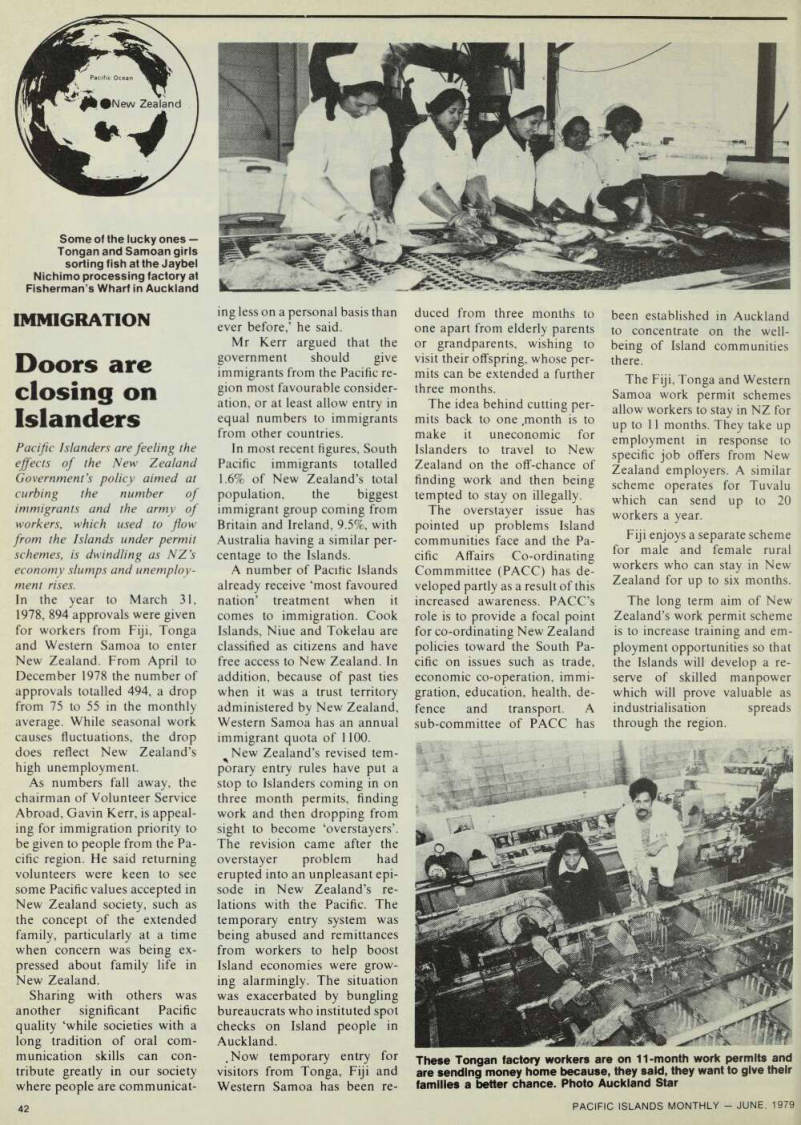
Some of the lucky ones Tongan and Samoan girls sorting fish at the Jaybel Nichimo processing factory at Fisherman’s Wharf in Auckland
These Tongan factory workers are on 11-month work permits and are sending money home because, they said, they want to give their families a better chance. Photo Auckland Star