New Zealand
p. 41 · Read in the full issue
P I M
Pacific Islands Monthly
in the PACIFIC
Little NZ wakes to the needs of Its tinier neighbours
New Zealand's links with the Pacific Islands have strengthened in the years since the late Norman Kirk took over as Labour prime minister in late 1972, writes William Gasson in Wellington. A West German investment mission which visited here earlier this year saw New Zealand as a ‘ bridge to the Pacific ’ which, in the words of one observer, has developed from a ‘rickety structure ’ to one of ' greater width and permanence ’.
The Polynesian content of New Zealand has acted as a spur to greater involvement in Pacific affairs and New Zealand’s own responsibilities for a handful of Island groups has given it the opportunity to gain a knowl edgeable insight to the ‘Pacific
way’.
When the National Party was returned to power in New Zealand in late 1975, Prime Minister Robert Muldoon’s government made an awful hash of the overstayer situ ation. But his second adminis tration - after National’s narrow election victory last year - has made a full commit ment to helping in develop ment of the region. ‘lt is New Zealand’s position that we would wish to see in due time
a wholly independent South
Pacific,’ said Mr Muldoon re
cently, sideswiping at France’s
dogged determination to re main a colonial power in the Pacific.
That French Polynesian eyes are turning from Europe to Australasia is indicated in the value of their imports from New Zealand - up 20% to about SNZ23 million in the year to March 31, 1978.
It did not take New Zealand long to turn its attention to the South Pacific after Britain turned its back on its Common wealth trading partners and
entered the European Econ
omic Community. In fairly
quick time, New Zealanders have gone to the Pacific to play, trade and lend a hand to
developing nations.
Mr Muldoon, like his counterpart in Australia, is well advised to attach great import ance to the growing South Pa cific Forum of independent nations. It would have to be urgent business indeed for him to miss the annual Forum get together of Pacific leaders.
Backing up this direct link between Pacific leaders and New Zealand’s man at the top
is diplomatic representation in
a string of Island capitals
Rarotonga, Alofi, Apia, Suva,
Noumea, Honiara and Port Moresby. The NZ high com missioner in Apia keeps an eye on American Samoa develop ments.
New Zealand is also aware that Micronesians are begin ning to look south to Australia and New Zealand instead of, traditionally, to the north (Japan) and, in more recent decades, to the east (United States) for their trade.
The Cook Islands, Niue and Tokelau enjoy a special consti tutional relationship with New Zealand that classifies their inhabitants as New Zealand citizens. But whether the New Zealand link with the Pacific is
through old administrative ties or simply proximity, officials in Wellington are at pains to stress that from the Islands’ viewpoint. New Zealand is a
big, developed, rich country.
And that implies that, in deal ing with Islanders, New Zealanders need to take care and show courtesy, tact and kindness.
It’s an unfamiliar role for a country which sees itself as isolated and pleads smallness, vulnerability and a limited range of exports, when dealing with the super powers.
As neighbours, the natural tendency is for quarrels to erupt but the recent settlement of the air agreement between New Zealand and Fiji suggests agreement can be achieved
given time and patience. Fiji
won direct access from Nadi to Auckland for its national air line, Air Pacific, in exchange for landing rights for Air New Zealand at Suva’s Nausori Air port in a dispute that took 18 months to settle.
While some argue that it is the Pacific Islanders who are in greater need of education and
training, New Zealanders too are having to re-evaluate and re-educate themselves to the needs of the South Pacific re gion and its peoples. This in cludes acceptance of the difficulties Islanders face as a result of the different food, cus
toms, language and day to day
experiences they meet when
they first arrive in New Zealand.
Mr Muldoon admits: ‘New Zealanders have been slow to appreciate the impact of all these things on the new arrivals and have not always been gen erous in making allowances for these difficulties.’
But, as the map of the Pacific changes, so too is New Zealand’s acceptance of its role in the region. Said Mr Mul doon in prophetic mood: ‘Long after my time in government, I would see the future of our part of the Pacific as being a loosely knit federation of independent states covering the whole of the peoples of the South Pacific.’
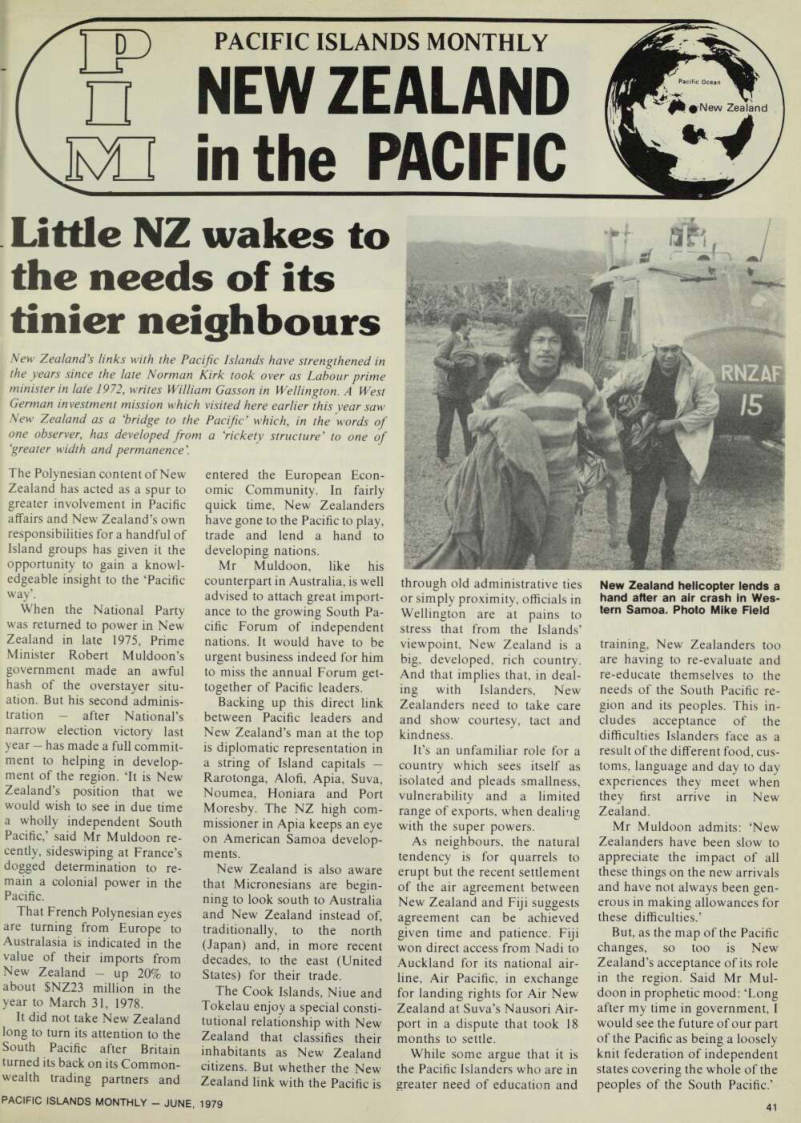
New Zealand helicopter lends a hand after an air crash in Wes tern Samoa. Photo Mike Field