Australasia’S
pp. 47-65 · Read in the full issue
Trade
Islands Look To
Goodwill
The future pattern of South Pacific trade hinges on the degree of accessibility for the Islands to the two major markets in the region New Zealand and Australia. Islands nations should find out this month just how far these two countries are prepared to go along the road to accepting unrestricted imports when trade ministers meet in the Cook Islands.
The basic recommendation be fore the trade ministers when they gather in Rarotonga will be for non-reciprocal preferen tial trade which would allow Islands unrestricted entry for their produce into New Zealand and Australia while these two countries’ goods would face normal import and tariff restrictions into the Islands.
This is the type of arrange ment, under the Lome Conven tion, the European Economic Community operates with African and Caribbean coun tries and with Fiji, Western Samoa and Papua New Guinea.
The Commonwealth Secre tariat in a report on industrial development and trade re lations in May last year saw a
non-reciprocal scheme as an important step in South Pacific economic co-operation.
The overriding factor which we emphasise is the growing economic interdependence of the region and the pressures which are building up from outside to establish improved access provisions to the two de veloped markets Australia and New Zealand,’ the report said.
The fate of the non reciprocal scheme hinges on the degree of political goodwill New Zealand and Australia can generate - bearing in mind
the domestic grumblings they
encounter from their own manufacturing and labour sec tors.
New Zealand officials be lieve any agreement would
6 / am convinced that the best contribution we can make to South Pacific development lies in the provision of freer access to the New Zealand market. This will almost certainly call for us to make adjustments here at home. 9 Deputy Prime Minister Brian Talboys. (September 1977).
need built-in safeguards and conditions to protect against third countries developing industries in the Islands and
hoping to gain unrestricted
entry into New Zealand. There would also need to be a control on the percentage of Island content in products exported to New Zealand.
At present New Zealand’s unemployment runs uncharac teristically high and there are sensitive areas such as the tex tile industry and hot house tomato growers to pacify in any unlimited access scheme.
From the Islands’ point of view the growth of trade into New Zealand is not nearly fast enough. New Zealand has the same trouble with Japan for its agricultural products and while the politicians and government officials acknowledge the par allel, businessmen and trade unions are less willing to admit to it.
On top of that, the
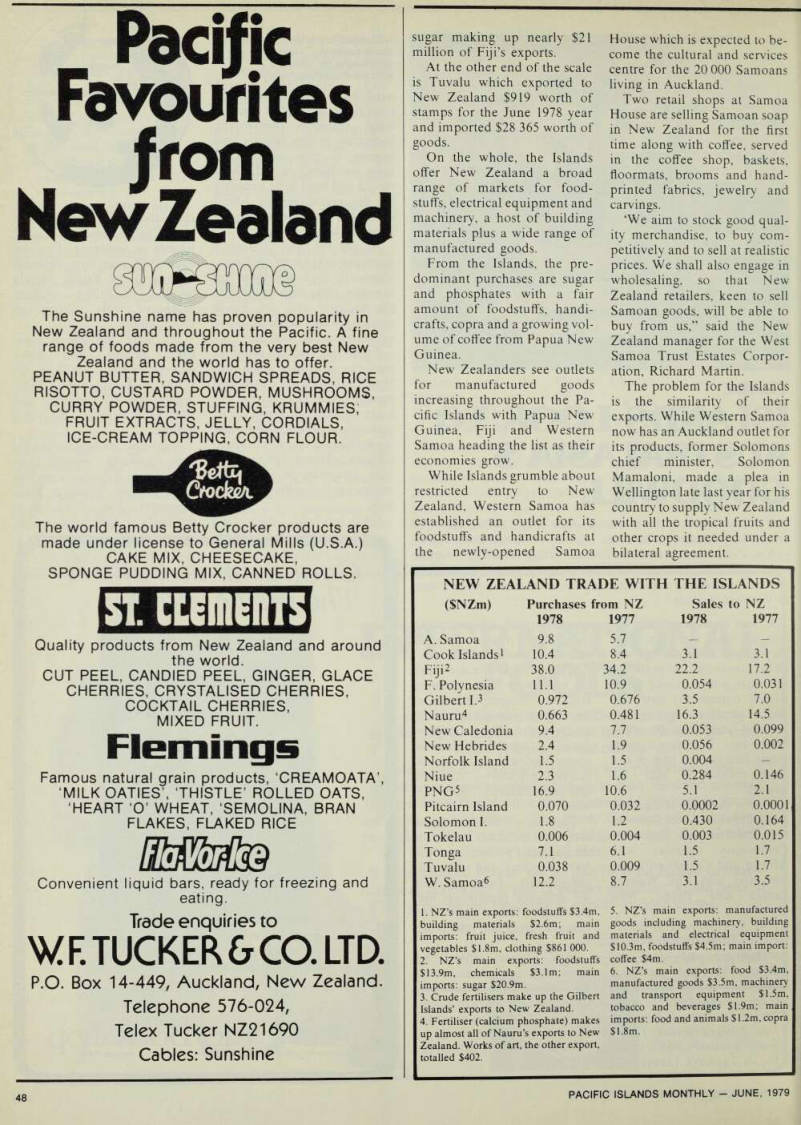
imbalance in the trade between New Zealand and the Pacific Islands is widening. For the June 1978 year New Zealand exports to the Pacific Islands totalled SNZ 124.6 million
compared with imports of
$55.7 million.
For 1977, the figures were $99.8 million and $49.7 million; 1976 $72.7 million and $41.8 million; 1975 $58.1 million and $37.3 million; and 1974 $47.9 million and $16.8 million.
Top of the trading list is Fiji.
New Zealand exports $3B million and imports from Fiji $22.2 million. Trade in both directions has more than doubled in four years, with
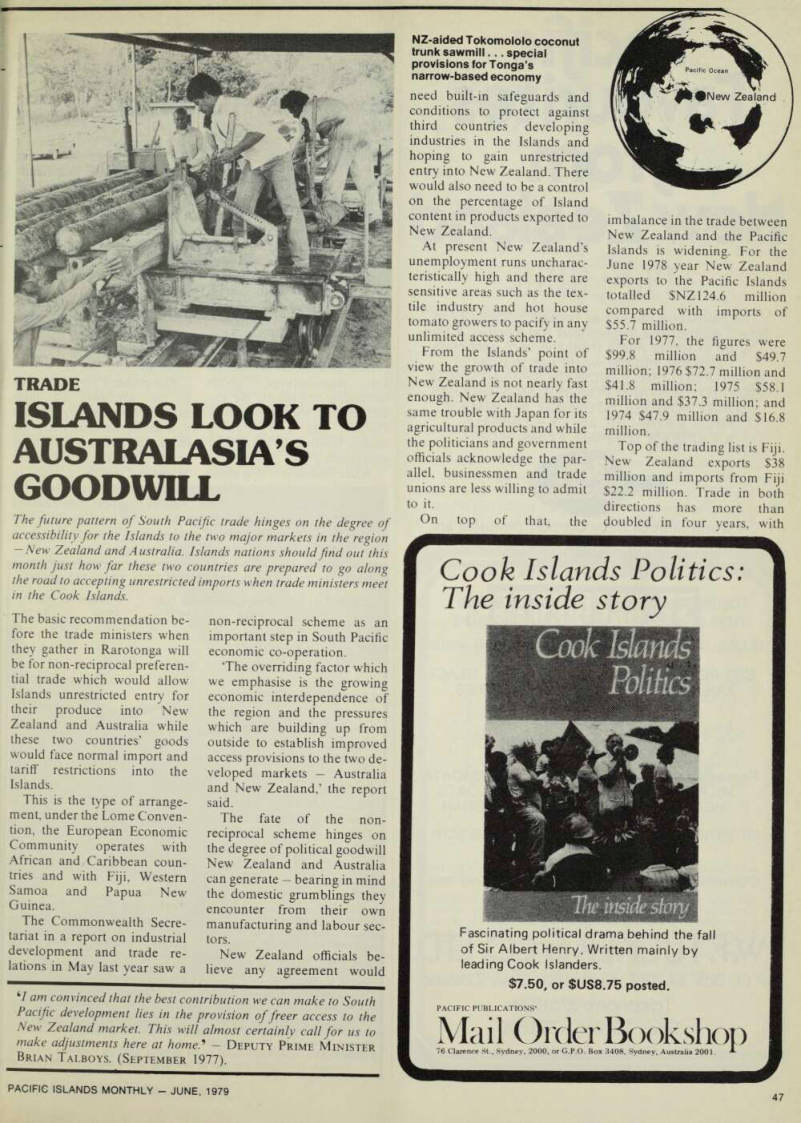
NZ-aided Tokomololo coconut trunk sawmill... special provisions for Tonga’s narrow-based economy
sugar making up nearly $2l million of Fiji’s exports.
At the other end of the scale is Tuvalu which exported to New Zealand $919 worth of stamps for the June 1978 year and imported $2B 365 worth of goods.
On the whole, the Islands offer New Zealand a broad range of markets for food stuffs, electrical equipment and machinery, a host of building materials plus a wide range of
manufactured goods.
From the Islands, the pre dominant purchases are sugar and phosphates with a fair amount of foodstuffs, handi crafts, copra and a growing vol ume of coffee from Papua New Guinea.
New Zealanders see outlets for manufactured goods
increasing throughout the Pa
cific Islands with Papua New Guinea, Fiji and Western Samoa heading the list as their economies grow.
While Islands grumble about restricted entry to New Zealand, Western Samoa has established an outlet for its foodstuffs and handicrafts at the newly-opened Samoa
House which is expected to be come the cultural and services centre for the 20 000 Samoans living in Auckland.
Two retail shops at Samoa House are selling Samoan soap in New Zealand for the first time along with coffee, served in the coffee shop, baskets, floormats, brooms and hand
printed fabrics, jewelry and
carvings.
‘We aim to stock good qual ity merchandise, to buy com petitively and to sell at realistic prices. We shall also engage in wholesaling, so that New Zealand retailers, keen to sell Samoan goods, will be able to buy from us,” said the New Zealand manager for the West Samoa Trust Estates Corpor ation, Richard Martin.
The problem for the Islands is the similarity of their exports. While Western Samoa now has an Auckland outlet for its products, former Solomons chief minister, Solomon Mamaloni, made a plea in Wellington late last year for his country to supply New Zealand with all the tropical fruits and other crops it needed under a bilateral agreement.
6 // is not surprising if at times, given the intimacy and complexity of our relationship with our island neighbours, the response to particular courses of action should be forthright and vigorous Deputy Prime Minister Brian Talboys.
‘Solomon Islands have large under-developed tracts of land we believe are suited to large scale production of a variety of
tropical crops imported by
New Zealand to the detriment of her overseas balance of pay ments,’ he argued.
Rice, palm oil, sugar, cocoa, spices, tea and coffee produced or suitable for development could also be sold to New Zealand.
Trade into New Zealand is not even-handed throughout the South Pacific and this cre ates the basis for arguments. In the Islands where the people are constitutionally New Zealand citizens the Cook Islands, Niue and Tokelau produce has free access to the New Zealand markets.
Western Samoa, with its his
toric link with New Zealand dating back to the time is was a trust territory, is exempt from
import licensing restrictions
although its produce is subject to New Zealand tariffs.
Fiji, Tonga, Solomon Islands
and Papua New Guinea have no special advantages b±it, as developing countries, they do qualify for the general system of preferences which covers a fairly broad range of products.
There is also special provision for importing handicrafts from the Islands, particularly Tonga which has a narrow-based economy.
Officials claim that about 95% of Pacific Islands imports are duty free and exempt from import licensing. Even allow ing for phosphates and sugar, which make up about 75% of
imports, a number of items are either duty free or carry low rates of duty.
At present there is only a small range of commodities that present the Islands with access problems to New Zealand’s market, say officials.
But the problem in the future is that the range of com modities will grow as industries
develop and expand through
out the Islands. That is essen tially what the trade ministers need to consider this month.
Coupled with the access question is the thorny issue of regional rationalisation of industries and overall planning of industrial growth. The cynics or realists believe there is not much hope of re gional co-operation and ration alisation among a handful of
independent states despite the
verbal acceptance of the prin
ciple.
It is believed that some time back ESCAP (Economic and Social Commission for Asia and the Pacific) planned to pre pare a report on industrialisa-
tion in the region with the help of SPEC (South Pacific Bureau for Economic Co-operation), and the ADB (Asian Develop ment Bank).
There has been nothing heard in recent times of this project but if it ever did begin, some officials feel the survey should prepare a packet of pro jects for each country along with the potential markets for their manufactured products.
The packets could then form an overall interlocking network of complementary industrial development for the region.
The officials feel that type of project would be more bene ficial than a straight-out report on island resources and poten tial industries.
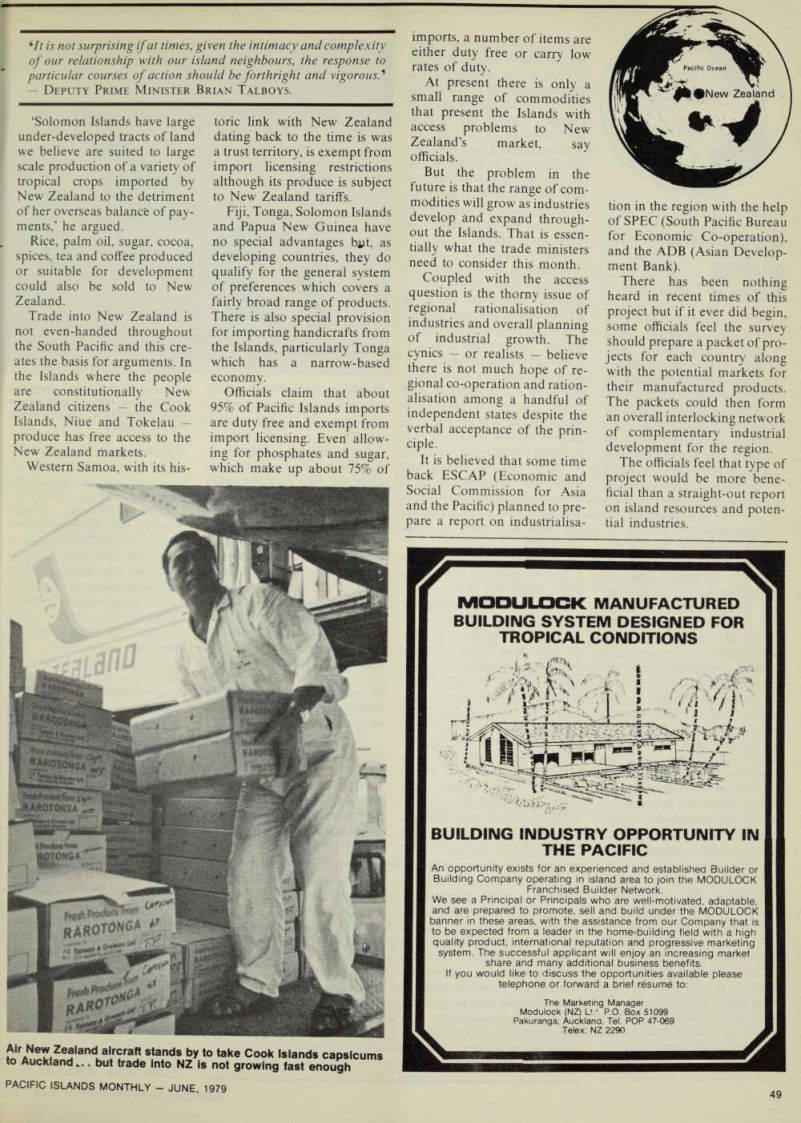
Air New Zealand aircraft stands by to take Cook Islands capsicums to Auckland... but trade into NZ is not growing fast enough
Fiji
Just like
going
home
Few Fiji Islanders think of a trip to New Zealand in terms
of really ‘going foreign’. Aus
tralia is a foreign adventure, yes. So is America, Canada, or a destination in Asia.
But while there are still the problems of visas, permits and currency exchange rates to negotiate, the ties so many Fiji people have with the country which begins 1800 kilometres to the south make it seem almost like an extension of
home territory.
New Zealand is just a three hour jet hop from Nausori Air port in an Air Pacific BAC 111 to Auckland. It’s where rela tives are, often a lot of them.
It’s school, university, technical
college. A job, perhaps, if the
immigration man says yes. A
holiday, certainly. It’s the
source of more than a quarter of the tourists arriving in Fiji; about a fifth of Fiji’s imports; and a major source of ‘no strings’ aid and advice. Fiji people feel at ease with New Zealanders in a way that they are not with Australians or others. There are gripes about trade, and immigration, and Fiji’s Prime Minister Ratu Sir Kamisese Mara is not on the best of personal terms with New Zealand’s leader, Robert Muldoon. But otherwise,
there’s an easy-going, deep
familiarity between the two countries that is the product of long affection and trust.
How did this occur? Why doesn’t Fiji view another near neighbour, Australia, in the same light? The reasons are varied and date back to the times when Fiji was still a Bri tish domain. In those days, New Zealanders ran most of
Fiji’s schools, making an indel ible impression on their pupils.
Scores of Fiji islanders have been educated in New Zealand schools, universities and
colleges. Many are Fiji’s
leaders today.
New Zealand was for years the only market for Fiji’s lim ited range of export produce and, until recently, it was open to Fijian men who wanted to go on a working holiday to build up finances.
New Zealand traders, businessmen, bankers and pro fessional men have always
occupied important places in
Fiji’s business and administrat ion structure. Unlike their Aus tralian counterparts. New Zealanders didn’t give the im pression that they were out to dominate. Less abrasive and brash, they’ve had the repu
tation of being willing to give
as well as take.
When Fiji got independence
in 1970, Fiji quickly opened
diplomatic missions in Lon don, Canberra and New York.
Wellington was not a priority although a mission operates there now.
The reason, Ratu Mara once explained, was that money was
tight, embassies were costly,
and Fiji could do without one in Wellington because re lations with New Zealand were so close that his government felt it had immediate access to New Zealand’s authorities whenever it wished.
A great deal has happened between Fiji and New Zealand since 1970: trade and aid pat terns have changed, Fiji’s edu cation system has been mostly ‘de-New Zealandified’; and there have been rows about
aviation rights, immigration,
and import barriers. But even though Ratu Mara and Mr
Muldoon are not the best of pals, the warmth between the two countries is, if anything, greater.
While Australia continues to dominate Fiji’s economy, the place that New Zealand has in the Fiji economy remains a vital one.
The banana export trade, which once was Fiji’s fourth
ranking money-maker, is
extinct but New Zealand buys more from Fiji now than ever before. It takes about 50 000 tonnes of sugar each year
under three-year fixed price
contracts; timbers, fruit and
tropical vegetables are building
up in volume; and some lines of manufactured goods are beginning to find New Zealand markets.
But tough import quotas
make the New Zealand market difficult to enter and a frequent complaint in Suva is from the manufacturer who says that his New Zealand customer can’t get licences for the volume of goods he is prepared to take.
6 The fables created by the eighteenth century romantics who first described the Pacific to the outside world die hard. The fact is that life for the majority of South Pacific Islanders is hard and earnest. Life on a coral atoll or in the interior of the larger islands is a pretty hard grind. . . struggling to grow crops in thin sandy soils . . . trying to capture enough drinking water to last until the next shower. .. labouring to process and sell enough produce to pay for flour, kerosene, and tea and to pay school fees for the children who keep on coming . . . endeavouring to infuse variety and interest into days of monotonous sameness so that the young people will not drift off to the bright lights of Moresby or Suva or Apia . . . subsistence living is just what it says! 9 Deputy Prime Minister Brian Talboys.
Fiji’s sales to New Zealand run at around SFIS million a year and are dominated by sugar exports accounting for more than $lO million. New Zealand does better in the re verse direction with sales of about $4O million-a year. In 1977 the list included food stuffs ($l6 million), manufac tured goods ($ll million), machinery ($5 million), and a balance accounted for by chemicals, commodities, ani mal and vegetable fats, pet roleum products and many
other products.
The total is only a small part of the $3OO million Fiji market.
Australia and Japan do much better than New Zealand, and countries like Singapore, the United States and Britain are
major competitors as suppliers
of what New Zealand offers.
While the Fiji Government frequently protests about New Zealand’s import barriers, and is assured that these are being eased, the trade balance in New Zealand’s favour is not a particular cause of conten tion.
Fiji seems happy to recoup by catering for New Zealand tourists a line of business worth many millions of dol lars.
About 40,000 New Zealand ers a year visit Fiji for holidays, about a quarter of total tourist traffic. New Zealand’s own
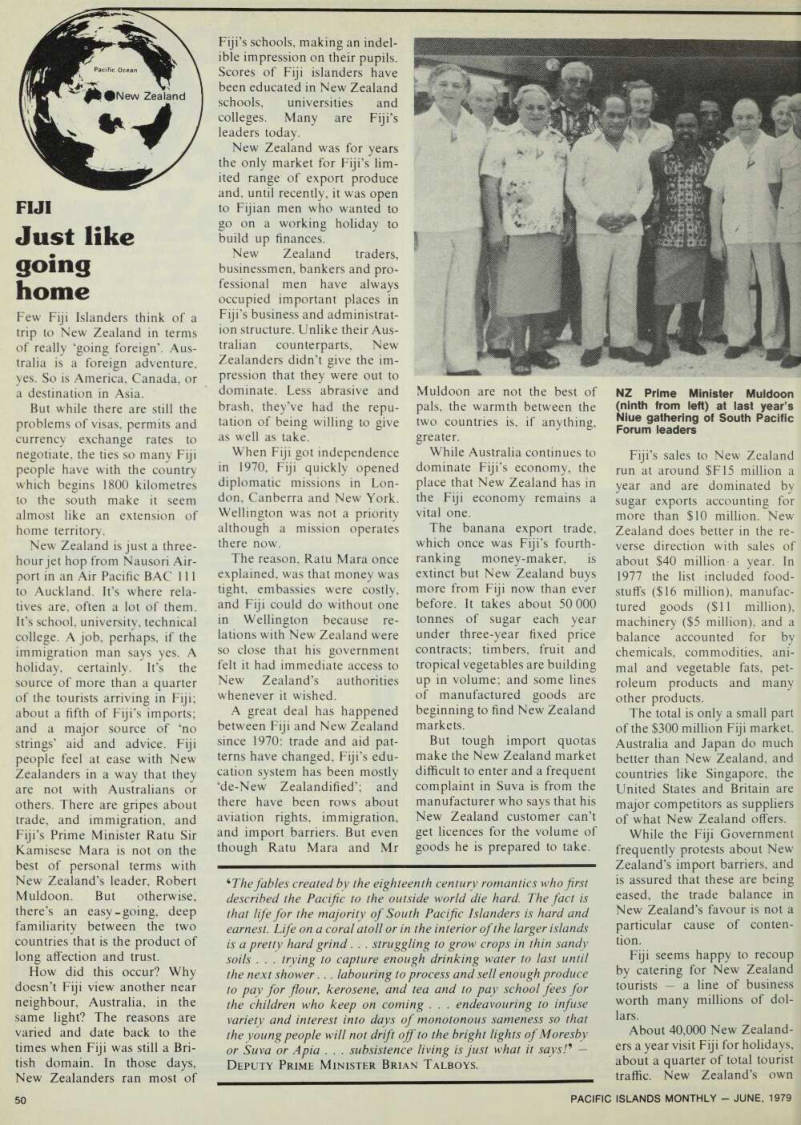
NZ Prime Minister Muldoon (ninth from left) at last year’s Niue gathering of South Pacific Forum leaders
economic troubles have led to a slight decline of late, but, says the Fiji Visitors Bureau, New Zealand is likely to stay as the second source of visitors, after Australia, for as far ahead as can be seen.
The flow of passenger traffic between the two countries is almost all by air. Controversy,
finally resolved by negotiation
in April, over who should be carrying it caused one of the most protracted and angry dis putes so far experienced in Fiji- New Zealand relations.
After years of having a vir tual monopoly of the Auckland-Nadi route, Air New Zealand, with its big wide bodied DC 10 and smaller DCS jets, found itself being chal lenged by the much smaller BAC 11 Is of the Fiji controlled airline. Air Pacific.
Fiji said it was entitled to carry half the 70 000 passengers moving between the two coun tries annually and pressed for
New Zealand landing rights
that would let it compete against Air New Zealand.
The New Zealand airline
naturally resisted, not wanting
to give $35 million worth of business away. More than 18 months of haggling ended in an agreement in April under which, from the middle of this year? Air Pacific will be making daily flights to Auckland and will be able to add Wellington or Christchurch to its desti nation list when it gets bigger
jets.
Air New Zealand has had to
partly curtail its Fiji service by
operating some flights with the small Boeing 737 instead of the big DC 10 but now has the right to fly 737 s to Nausori Airport, which serves Suva, as well as to Nadi.
If aviation relations have changed, so have shipping links between Suva and Auckland.
Once dominated by the New Zealand-owned Union Steam Ship Company, this is now a much more diversifed scene.
The Union company, which used to run several cargo ships to Fiji, is represented now by one large roll-on roll-off con tainer vessel operating a fort nightly service. It shares cargo with one Fiji-managed rival plus the South Pacific Forum Line and several small oper ators.
New Zealand investment in Fiji has never been as obviously visible as the Aus tralian presence, partly because New Zealand entrepreneurs have not been as vigorous as their Australian counterparts.
New Zealand banking, insurance and other financial and commercial representation have been the main areas of business involvement and are links which, in some cases, are a century or more old.
Fiji’s desire for manufactur ing ventures that will produce goods to replace imports and add to the range of local exports promises to draw New Zealand capital into areas that have scarcely seen it.
Investment incentives
offered by Fiji, coupled with a
New Zealand Government scheme to encourage New Zealand manufacturers to establish themselves in the Pa cific Islands in joint ventures with local partners, have in the past 12 months aroused defi nite New Zealand interest in several Fiji projects. Most are in the food processing field but light industrial schemes also are in the offing.
Possibly the most successful of New Zealand newcomers is the Trans Holdings Ltd group of Christchurch. Working
through a local public
company, established by it to
bring in Fiji equity, Trans
Holdings has built up a chain of hotels and an internat ionally-based tour operation and has branched out into farming in a style tailored to meet official policies that invite the foreign investor to give locals a meaningful stake and say in the business.
Another form of New
6 lt Is important constantly to remind ourselves that in this region we are a metropolitan power.' Deputy Prime Minister Brian Talboys.
Zealand investment in Fiji is one that has evolved since independence. It’s the New Zealand aid program, now run ning at a level of about $5 million a year. While Fiji gets
foreign aid in significant lumps
from half a dozen other sources, the New Zealand pro gramme is unique. It’s the only one that is not tied to con ditions which tend to make re cipient countries champ at the bit.
Mounting steadily in vol
ume, it is being used to fund some of Fiji’s most important
land development projects and
comes not just as cash but as technical advice and assist ance.
Pine forest, beef, dairy, fish ing, crop and rural road schemes, that will begin to transform the whole Fiji econ omy from the 1980 s on, owe much of the success they seem to be heading for to New Zealand support. New Zealand took a lead when it honoured a United Nations resolution on
aid in February by cancelling
a SI million debt for a highway scheme.
Political relations between Suva and Wellington were strengthened this year when, for the first time, top civil ser vants met for what is planned to be an annual conference to discuss specific points of dif ference and for a general pow wow on anything anyone wants to air his mind on.
Fiji has pragmatically
accepted the fact that New Zealand’s serious internal economic problems make it impossible to admit an unre strained volume of ‘working holiday-makers’ as it once did.
For several years the two coun tries have had an amicable ar
rangement under which several hundred Fiji Islanders are an nually admitted for short spells as farm workers.
While Ratu Sir Kamisese Mara likes to boast that Fiji is one of the few truly ‘unaligned’ countries, with no military al liances with anyone, his government happily admits New Zealand troops for jungle warfare exercises with Fiji’s own small army several times a year. And when the need arises, Fiji knows it can whistle up RNZAF helicopters and maritime search planes to help in emergencies, as was the case when Hurricane Meli blasted several small islands in March.
In an era when big powers have turned their cultures into weapons of psychological war fare, such exchanges between New Zealand and Fiji remain almost entirely muted. Radio New Zealand comes in loud and clear for those who want to hear it in Suva, and the New Zealand Herald or Auckland Star you may find yourself scanning in the city may be only a couple of days old. If a
Maori concert party wants to do the Fiji round, it does so ■ under its own steam, and will be welcomed.
For its part, the Fiji Visitors Bureau stokes up a trip to Auckland or Christchurch every couple of years by the Fiji police or army band in the cause of drumming up more New Zealand tourists.
In Suva, unlike several other missions, the New Zealand High Commission doesn’t bother to equip itself with full time cultural or information attaches. Perhaps it is thanks to the presence of several gener ations of New Zealand school masters in the local education system that it doesn’t feel it has such a need.
If there’s one common de nominator, its rugby union. Fiji hasn’t yet managed to murder the All Blacks in the style it would like to, ‘but one day,’ promise its coaches, ‘we will’.
Robert Keith-Reid.
New Caledonia
Cagous head
south for
hospitality
‘Cagous love Kiwis’ was the
slogan generously displayed on
motor cars in New Caledonia two or three years ago. Bruno Tabuteau, director of Noumea’s Office of Tourism, had chosen this method of announcing to New Zealand visitors just how welcome they were. It was a love affair be tween two national birds. Per haps the welcome was not always evident as a New Zealander in Noumea is just another poken, a word the lo cals use to describe the Anglo- Saxon visitors.
The Cagous do love the Kiwis. Many New Caledonians migrate to New Zealand, either for winter or summer holidays.
But very few birds seem to migrate in the other direction, probably because of the com paratively high cost of a nest in Noumea. If New Caledonians fly to Australia for business or
medical reasons, they choose
New Zealand for a quiet holi day. They will warn you that a holiday in New Zealand will be very quiet, the food is poor,
shopping of little interest, but the countryside beautiful,
hotels reasonably cheap and
the people very hospitable. For a citizen of New Caledonia, a flat in Double Bay or Potts Point, Sydney, is an invest ment, a cottage in Queenstown a place of rest.
Although few New Caledonians travel very far over the vast Australian con tinent, they are extremely mo bile in New Zealand, visiting both islands by plane, train or self-drive hire cars. The French Airline UTA does much more promotion for New Zealand than Australia, and the New Zealanders do their bit, too.
Australia as a country, and its individual citizens, do little to encourage overseas visitors.
If the Kings Cross shop keeper in Sydney rubs his hands and. jacks up his prices when the first planeloads of New Caledonian visitors arrive in December, the New Zealanders do not. They have a reputation of being more interested in the visitor himself than in the contents of his wallet. Thus, if the Frenchman is the pigeon in Sydney, he has
a superiority complex in
Auckland. In New Zealand he has the reputation of being wealthy, well-dressed and cul tivated.
If New Caledonians have a jealous admiration for the enormous continent, with its mineral and agricultural wealth, they feel happier in New Zealand where they feel themselves the envy of the poor New Zealanders. Some are genuinely grateful for New
Zealand’s well-known hospi tality, others are comforted to see that there are Europeans in the Pacific far worse off than themselves.
In Auckland, smiling and polite drivers crawl along in quaint motor cars that would have disappeared under the scrap-iron merchant’s press many years before in Noumea.
In Australia, in-ground swim
ming pools and air
conditioned Statesman and Fairlane motor cars give them an odd feeling that in spite of their higher income they are not enjoying such a high stan dard of living.
Most New Caledonian businessmen will tell you that they buy from New Zealand because of the rather kind and
gentle agents, absolutely hope
less in business. But in spite of the shortcomings of New Zealand exporters, their business with New Caledonia continues to expand.
Perhaps the greatest disap
pointment is for the New Zealand visitor. Lost in the mass of Australian tourists, he receives no special treatment.
The generous hospitality offered in his own home is gen
erally met by one expensive
night out in a French res taurant. New Zealand generos ity comes from the heart, in Noumea it comes from the wallet. In either case, the host can only offer what he has to spare. If an Englishman’s home is his castle, a Frenchman’s home is his fortress. Which is probably why there are so many restaurants in Noumea.
Andre Chaville.
Png
Steady as
she goes
Traditionally New Zealand’s ties may have been with the Polynesian Pacific but it could hardly ignore the emergence in the seventies of Oceania’s largest Island nation, Papua New Guinea. There was a
newly-released ex-colonial
market (previously cornered by
Australia) to be won and to make a breakthrough in that direction it was necessary for New Zealand to back its effort with an attractive aid pro gramme.
Apart from the odd ripple, especially in the past year or so,
the developing relationship be
tween Papua New Guinea and New Zealand appears to be
proving mutually beneficial.
PNG and New Zealand established full diplomatic re lations on September 16, 1975, when PNG achieved indepen dence, and each country lifted its representation in the other’s capital to high commission status, both being Common weath members.
The two countries share many common views vis-a-vis Pacific affairs. Both are strong supporters of the South Pacific Forum and both strongly sup port the concept of a nuclear free Pacific and condemn the continued use of the Pacific for nuclear weapons testing.
Since independence New Zealand has grown as a market for PNG primary products and as a principle source of development assistance. As in other Pacific nations, New Zealand puts strong emphasis on helping PNG to foster rural
economic development.
New Zealand’s aid pro-
New Zealander Vince Cook, with lan Mopafi, at Papua New Guinea’s Goroka bee-keeping project...some differences on aid
gramme to PNG began in 1973, the year after PNG achieved self-government. New Zea land’s then prime minister made a three-year pledge of development assistance. In 1976 Deputy Prime Minister Brian Talboys pledged a con tinuation of New Zealand aid but hinted that it wasn’t going to be easy because of New Zealand’s own economic diffi culties.
Since the inception of the programme New Zealand de velopment assistance has totalled more than SNZB million. Annual bilateral pro ject aid is now running at about $2.5 million. NZ aid takes two forms project aid and train
ing and study awards for Papua
New Guineans in New Zealand.
Small scale grassroots pro jects (up to Kina 10 000) are handled completely by the NZ High Commission which has its offices in the Australian High Commission building in Wai
gani, Port Moresby’s adminis
trative centre. Anything larger
is administered from Welling ton as part of NZ’s regular bi lateral aid programme.
In May 1978 the PNG Government decided that aid should be negotiated in two ways: preferably in the form of cash grants to the national budget to be used on projects it selected itself or, alterna tively, in the form of direct cash aid to specific projects. Con
sequently, countries insisting
on making direct cash grants to projects are given a list of pro jects to choose from. PNG also prefers to use aid money to buy goods and services from the best value source, not necess arily from the country provid ing the aid. This does not sit too well with New Zealand and, consequently, there are con tinuing differences between the two countries over aid.
New Zealand will agree on
its money being spent by PNG on the best value source if NZ itself cannot supply the appro priate goods and services.
However, if New Zealand feels it can supply the goods, it insists on its money being spent back in New Zealand. A PNG foreign affairs official said: ‘PNG and NZ are continuing to discuss the matter in the friendly way which has charac terised their relationship. PNG believes its policy is seen by some donors as tough but it be lieves it to be realistic on the basis that tied aid can seriously reduce the value of the aid and the policy avoids situations where the aid benefits the donor country more than the
recipient.’
A major reason New Zealand does not favour a sys tem of untied cash grants is be cause it views development assistance as a co-operative exercise between two govern ments. ‘We do not see our aid programme simply as an in flow of money,’ says New Zealand High Commissioner to PNG Miss Alison Stokes.
The largest single New
Zealand aid project in PNG has been a new timber industry
training college at Lae,
expected to cost more than SNZ2 million.
Other major New Zealand projects in PNG have concen trated in the agricultural and related transport sector. New Zealand is assisting with a
long-term sheep research pro
ject in the Highlands and is also involved in a similar bee keeping project there. A new vegetable coolstore was re cently completed for the PNG
Food Marketing Corporation
in Lae to help improve the dis tribution and marketing of
fresh produce.
In the transport sector New Zealand has provided a barge for agricultural transport in the Milne Bay area, and smaller
Hamilton jet barges for agri cultural transport in the West ern Province. Another barge, intended as a fish collection vessel for a West New Britain village fisheries project, will begin service later this year.
Papua New Guinea is assist ing New Zealand with its third country training program.
Under this scheme, 47 New
Zealand Government-spon
sored students from seven South Pacific countries (Fiji, Tonga, Western Samoa, Cook Islands, Solomon Islands, Gil bert Islands, and New Hebrides) are studying at three Papua New Guinea tertiary in
stitutions the University of
PNG in Port Moresby, the
University of Technology at
Lae, and the PNG Forestry College at Bulolo.
The largest training pro
gramme NZ has undertaken is a 2*/2-year scheme of electrical and instrument training for six Air Niugini apprentices at Air
New Zealand’s engineering
facilities in Christchurch.
New Zealand is helping Papua New Guinea to improve its share of trade between the two countries, at present run ning about three to one in
favour of New Zealand. PNG is included in New Zealand’s Pacific Islands Industrial Development Scheme (PUDS) and the Developing Countries Liaison Unit (DCLU) and the New Zealand Government has promoted two PNG general and one timber trade missions to New Zealand.
Although the PNG Depart ment of Trade sees PNG’s prospects of trade with New Zealand as limited in volume and value, its main exports of coffee, cocoa, tea, artifacts, logs
and plywood are increasing.
Coffee was the major money earner in 1977-78, selling for a little over SNZ4 million.
In the other direction, New Zealand has experienced an increasing demand for its pro ducts in Papua New Guinea, biting into Australia’s overall share of the PNG market.
Imports from New Zealand are mainly food, chemicals, chemi
cal products, machinery and
transport equipment.
The introduction of a direct shipping route between the two countries saw an upsurge in trade and other New Zealand shipping companies are under stood to be interested in getting onto the route. Today, South Pacific Forum Line, Sofrano Line and PNG Pacific operate
regular services between PNG and New Zealand ports.
Initially PNG has been a beneficiary of a number of NZ preferential tariff arrange ment. These included the Bri tish Preference Scheme (phased out in 1977), the Com monwealth Preference Scheme (phased out in 1978) and Generalised Scheme of Prefer ences (GSP). After the two preference schemes were ended, New Zealand extended its GSP scheme on a unilateral and non-reciprocal basis to compensate developing Com monwealth counries for the loss of these preferences in the NZ market. The extension of GSP covered 70% of all lines of
tariffs, including agricultural
and manufactured goods, pro viding more favourable tariffs for PNG goods than under the other preference schemes.
Contacts have been made on government-to-government basis on the possibility of concluding a preferential trade agreement between PNG and New Zealand. New Zealand’s view is that it has already an extended GSP scheme with a wide coverage of products for
developing countries including
PNG, and that these arrange ments are adequate.
After a number of exchanges, it became apparent that a joint committee would be an appropriate substitute.
The committee is to meet regu larly and consult on trade and related issues that are of sig nificance to the two coun tries.
Quarantine requirements
have been of concern to both PNG and NZ exporters. PNG has placed quarantine restric tions on New Zealand pork and potatoes and New Zealand’s last request for the lifting of the potatoes ban in December last year had not
had a reply by April.
New Zealand investment in PNG has gone into the dairy, timber and related industries.
Fletcher Holdings, NZ Dairy
Board, Neil Holdings, Rent-O- Kil and Scollay (PNG) Ltd are among NZ companies operat ing in PNG at present.
The flow of tourists from New Zealand into PNG is small butgrowing. PNG Bureau of Statistics figures show that
508 New Zealanders visited PNG between July and Sep tember last year. Sinclaire Solomon.
Solomon 1.
Aid is fine
but hurry
it up, please
New Zealand had played a cru cial role in the economic and social development of Solomon Islands over the past 125 years or so, although its
fairly unimportant place
among Solomon Islands’ trading partners and the small amount of official aid the country receives from New
New Zealand sawmilling specialist shows how at PNG’s timber industry training college ... a $2m NZ aid project
Zealand might not immedi ately suggest this.
Since the middle of the last century, the two-way flow of Anglican missionaries from the Church of Melanesia’s head quarters in Auckland to Solomon Islands on the one hand and, on the other, the many Solomon Islanders who have gone to New Zealand for
religious (and later, general
academic) education, has forged a strong bond.
A good many of today’s leaders in Solomon Islands, among them Governor Gen eral Baddeley Devesi, Prime Minister Peter Kenilorea, Sec retary for Foreign Affairs Francis Bugotu and the Arch bishop of the Church of Melanesia, received part of their education in NZ.
Until the government took over this responsibility a few years ago, the various churches, backed by substantial funds from New Zealand, were run ning practically the whole edu cation system in Solomon Islands. Even now several of the churches, among them the Anglicans, Catholics and Sev enth Day Adventists, are giving substantial financial and other support to local secondary schools (and in some cases to primary schools). Thus, a fifth of the running costs of one of
the country’s six secondary
schools, Selwyn College, is
financed from Church of Melanesia funds, which almost all come from New Zealand.
In fact, if one tots up the annual contributions from the New Zealand Leprosy Trust Board to local churches and the government, the substantial help that the Anglicans get from the NZ Anglican Board of Missions, the sizable funds from other churches and individual church groups in NZ plus the large chunk of ren
tal income that the Anglican Church receives from its prime real estate in Auckland (orig
inally bought for farming by a
farsighted Bishop Selwyn!), the
total financial church and char ity support from New Zealand must be well in excess of pre sent official aid levels.
Although the NZ church funds now tend to go mainly to the clergy and their activities, but also into some shipping (the Church of Melanesia runs
five ships for example),
agriculture and some business ventures, education has con tinued to be one of the import ant areas of support from NZ.
Most of the six members of the privately-run NZ Volun teers Service Abroad are teach ing out in the districts. One of the five NZ government financed experts is a resources programme teacher in Honiara, and, as part of NZ’s regional aid programme, funds go into supporting the regional survey training school.
Apart from that, $lOO 000 of
NZ’s official aid money for 1978-79 is spent on sending Solomon Islanders on vo cational courses and to further educational institutions in NZ,
Fiji and Papua New Guinea, This longstanding edu cational exchange plus increas ing official contact (for example, through parliamen
tary visits) since the opening of NZ’s high commission in Honiara in July last year, have built up a sound understanding between the two countries.
Although there are now about 160 New Zealanders living and working in Solomon Islands, contact through tourists from NZ remains fairly limited. New Zealanders continue to prefer established South Pacific desti nations such as the Cook Islands, Fiji, Tonga and the New Hebrides. One reason is that there is no direct air link between NZ and Solomon Islands, tourists having to travel via either Fiji or Aus tralia.
Cargo ships of the Sofrano Line, on the other hand, call
regularly at Honiara, bringing
mainly NZ foodstuffs, elec trical goods, manufactures and chemicals. For Solomon
Islands housewives, the most obvious contact with NZ is through the wide range of NZ foodstuffs on sale in the local shops. Watties conserves, Hud son biscuits as well as Fisher
and Paykel refrigerators,
freezers and ovens are among the most prominent NZ import
products.
Solomon Islands imports from NZ have been rising rap idly in recent years to SSI 1.94 million last year, nearly five times the level of Solomon exports to NZ. But, compared with Australia, which supplies a third of all Solomon Islands imports. New Zealand’s share
NZ Deputy Prime Minister Brian Talboys meets Solomon Islands Minister of Trade Pulepada Ghemu...plenty of room for trade growth
of a little over 6% in total imports is still small fry.
With a stake of a mere 1.3% in Solomon Islands’ total exports, NZ is even more insig nificant as an export outlet.
Furthermore, exports to NZ
have been stagnating recently
and would in fact have fallen quite dramatically in 1978 if rising rice exports had not filled the gap left by drastically reduced exports of rough timber.
The scope for Solomon Island exports to NZ, or indeed most countries in the region is extremely limited, due to the rather similar agricultural pro duct structure and to the fact that there is practically no local
manufacturing industry
producing either consumer or
simple industrial goods. New
Zealand’s tariff barriers and import quotas do not help either.
But a fairly recently started official scheme to stimulate joint ventures in manufactur
ing and agriculture between
NZ and Pacific Islands businessmen could well lead to some limited NZ investment and increased exports to NZ.
Since 1976 NZ’s Pacific Islands
Industrial Development
Scheme (PUDS) has fostered a series of joint ventures in the South Pacific, ranging from food processing and jewelry in Fiji to soccer ball stitching in Tonga, industrial gases in Samoa and soft-drink bottling in Niue.
New Zealand’s Pacific Islands Industrial Develop ment Scheme (PUDS) could lead to some limited New Zealand investment and in creased Solomon exports. The incentives, offered under PUDS suspensory loans, small venture grants, feasibility study grants and training assist ance and the fact that its activities have been extended to the agricultural sector suggest room for co-operation in this area.
Solomon Islands has been receiving official aid support from New Zealand for five years and this has now been stepped up since the establish ment of the New Zealand high commission last year. How ever, it is now expected to level off at around half a million
dollars. In the aid year to March 31 last, NZ’s money was mainly spent on three technical
experts and capital equipment
in agricultural, forestry and
fisheries. An economic plan ning officer from NZ is assist ing Solomon Islands’ Central Planning Office in its work on the 1980-85 National Develop ment plan and another special ist is attached to the education
ministry.
By the end of the current financial year, the recently established Development Bank of Solomon Islands will have received a cash grant from NZ of a little over $5O 000 plus another $7O 000 originally allocated to finance equipment for a cannery, the construction of which has been deferred
indefinitely.
New Zealand aid, poten tially, has considerable advan tages over aid from other more distant donors without the firsthand knowledge of the Pa cific and its problems and cir cumstances. But, to maximise its benefit to Solomon Islands, it is essential that New Zealand’s aid machinery speeds up its delivery of prom ised equipment and concen trates more on where its expertise is of greatest value in the technical, educational, agricultural and natural re sources fields. Irene Hawkins.
Tahiti
A thousand
years of
friendship
The extent and general charac ter of New Zealand-Tahitian links can easily be sum marised: for the past lOOOyears they have been extremely cor dial, except, of course, for a few years in the early 19705, when the accumulation of radio-
active fall-out from the nuclear tests at Mururoa Atoll sparked off strong protest action in New Zealand. But even then, the general resentment was, very
sensibly, directed against the
French Government and not against the people of French Polynesia, who were them selves, like New Zealanders, innocent victims.
As post-war archaeological research in New Zealand has revealed especially that car ried out by the sadly-missed director of Canterbury Mu seum, the late Dr Roger Duff the first known cultural con tacts between the two countries occurred about 900 AD, when Tahitian seafarers landed on NZ’s South Island and were so
delighted with the abundance of huge moa birds that they de cided to stay. Those who settled on the shores of the rugged, fiord-studded Banks peninsula must have felt perfectly at home because it closely re sembled Tahiti.
Although the time-honoured legend of the great fourteenth century fleet is still being told in the schools and on the maraes in New Zealand, the next undisputed evidence of a direct contact between the Tahitian motherland and its distant Aotearoa colony dates from 1769, when the famous
priest Tupaia landed at Poverty
Bay and struck up a conver sation with the local Maoris, as easily as if he were a member of the tribe.
With the arrival of English settlers in New Zealand and French settlers in Tahiti, in the 1840 s, the scene was, in prin ciple, set for serious rivalry and conflict. But geography and trade overcame politics and national prejudices, and soon
ships were plying between
Papeete and Auckland, loaded
6 The whole of the map of the Pacific has changed and it is my aim, and the aim of my government, to have the right of the various independent nations to the resources which lie inside those 200-mile (economic) zones, recognised and confirmed by the great powers whatever their interest in the South Pacific might be. 19 - Prime Minister Robert Muldoon.
with oranges when going west bound, and with timber when eastward bound.
At the turn of the century, Tahiti was still exporting or anges at the rate of two million a year while New
Zealand ships were unloading
a wide assortment of manufac
tured British goods, including
specially designed Tahitian
pareu cloth. Several attempts were also made to introduce New Zealand sheep, but they always ended in the same disastrous manner: the poor animals collected so many burrs from the Tahitian thistles that the wool became useless.
The preference for Auckland as a transit port was dictated by the 50% lower freight charges, compared to what it cost to ship out French goods on French ships to Tahiti. Papeete’s stat
istics (in French francs) for 1898 tell the story;
Exports from French Poly
nesia as the colony was then
known comprised mainly
copra, vanilla, cotton and
mother-of-pearl shell.
The outbreak of the First World War forged still stronger links between the peoples of Tahiti and New Zealand who, all of a sudden, had a common enemy. There are still a few veterans alive who remember the delirious welcome the Tahitian battalion received in Auckland and Wellington,
Imports Exports to Tahiti from Tahiti United States 1 111 042 1 022 337 New Zealand 481 355 687 829 France 709 918 102 190
when passing through these cit ies in 1916, on such legendary vessels as the Maitai, the Flora and the Moana. To tell the whole truth, some of the ban quets which these stopovers gave rise to, were so over whelming that dozens of Tahi tian soldiers became on the spot casualties and had to be sent home with serious diges tive troubles.
The much shorter sea link with Europe that the new Panama Canal offered after the war resulted, unavoidably, in a decline of New Zealand- French Oceania trade.
Symbol of Tahiti-New Zealand trade ties was the Donald Company, whose department store on the Papeete waterfront until the late fifties, was the biggest and best-stocked in town. Its schooners, mostly called
Taporo or Tiare Taporo,
brought vital supplies of
corned beef, ship’s biscuits, condensed milk, canned butter and fresh news to all the islands within a radius of 1000 miles of Tahiti. Both the company and the Hellaby corned beef have
been importalised by haun
tingly beautiful songs, still sung by the Islanders. The Donald directors had, moreover, a
unique policy: they employed
almost exclusively Polynesians.
Another global conflict again forced the small Tahitian brother to seek help and pro tection from his big New Zealand brother. When peace eventually came, France was in an even worse shambles than in 1918, and it thus fell largely on New Zealand, Australia and the United States to provide freight and passenger services in the Pacific. The most mem
orable year was 1951 which saw the inauguration of the TEAL
(Tasman Empire Airways Ltd)
Coral Route. From then on,
chief pilot Big Joe Shepherd
was a local hero in Tahiti be cause of his consummate skill of setting down and pulling up the heavy Solent flying boat among the flotsam and jetsam in the Papeete harbour lagoon.
All oldtimers still have fond memories of the monthly TEAL day that brought all business to a standstill and emptied all government offices, so that everybody could read in peace the incoming mail and answer the most im portant letters before the departure of the flying boat.
Although communications
have greatly improved in the sixties and seventies, there is no denial that New Zealand’s share of sea and air traffic and its importance as a trading partner have diminished. Thus
the seemingly respectable fig
ure of 1200 million Pacific francs, which is the annual amount spent on such New Zealand products as fresh meat
and dairy products, represents
only 3.8% of Tahiti’s total imports. In comparison, 53% of imports come from France, 12% from other European countries belonging to the Common Market, and 17% from the United States.
The main explanation for this modest performance is of course the maintenance of old political divisions: Tahiti, as a French possession, is inside the European Common Market whereas New Zealand is out side.
As to Tahitian exports, they have taken a still deeper plunge for, with almost the entire
population working now for
the administration, for the
bomb or in the tourist industry, there is nobody left to till the ground, plant and harvest. In fact, Tahiti is back to the situ ation prevailing 100 years ago, the only difference being that the only export crop then was oranges, whereas today it is mangoes.
Fortunately, New Zealand- Tahitian exchanges in the human and cultural field are flourishing. More than 3000 Kiwi tourists visit the Tahitian islands each year. This influx is matched by a considerable out flow of Islanders bound for New Zealand, many of them
partly or wholly attracted by
the high quality of NZ medical and dental services. A very special group consists of the 40 or so cancer patients sent every year by the local health depart ment to Dunedin to get expert treatment not available in Tahiti.
Football and rugby matches are also occasions for huge mi grations of players and their fans. It is a matter for perpetual wonder that the Tahitians have so far not been disheartened by the tremendous superiority of all Kiwi teams. After all, you must almost be a masochist or an Indian fakir in order to
enjoy being beaten by a rugby
team 38-0, as happened re cently. Last but not least there is a lively student exchange programme which involves an nually about 500 teenagers from the two countries. (The
exchange, for unexplained
reasons, is a little bit lopsided: while 400 French and Tahitian students go to New Zealand, only 125 students come to Tahiti.) There is no doubt a rich harvest in the form of mutual goodwill and increased trade to be reaped in the future as these youngsters grow up
and become leaders in their re spective countries.
Taking all these recent,
promising developments into
consideration, the time seems to have come for the New Zealand Government to for malise the existing ties of
friendship and commerce by
opening a consulate in Papeete.
And when this happens, why not send a diplomat who is a Maori. For who else would be better fitted for the role than a
Polynesian-speaking descend
ant of the first Tahitian tourists who, 1000 years ago, sailed westward to New Zealand?
Marie-Therese and Bengt Danielsson.
Western Samoa
All is calm
at least on
the surface
New Zealand is no fairy god mother to Western Samoa, and Samoa is not the wayward son of its colonial parent. That re mark, originally made by Sir Guy Powles, a former New Zealand high commissioner to Western Samoa, sums up Samoa’s unofficial attitude toward New Zealand. In as sessing the state of affairs be tween Samoa and New Zealand, an observer has to be careful not to be deceived by the 50 years of colonial re lationship, and 17 years of independence and a treaty of
friendship.
Even today, elements of New Zealand’s imperialism and paternalism creep into re lations, and Samoa has even felt it necessary to publicly de clare that the nation is not a ward of New Zealand.
New Zealand became
TEAL flying boat on Papeete harbour...business would come to a standstill
Samoa’s colonial master in 1916 after annexing the islands from Germany. New Zealand, itself a virtual colony of Bri tain, had no experience in run
ning other people’s countries,
and, in the process made a fairly consistent mess of it all.
It was not a very distinguished time for New Zealand, and its rule was marked by stupidity, carelessness, pure savagery and racism. Throughout the entire period of colonial rule, Samoans point blank refused to accept New Zealand’s col onial rights in Samoa, or the ‘God given’ destiny of white men to rule the rest.
Some of this feeling remains 17 years after independence and so it is surprising that at least on the surface things be tween the two nations are smooth. For example there are the treaty of friendship. New Zealand’s SNZ 3 million a year aid to Samoa, and a constant movement of people between the two countries. Aside from the treaty, which has as much meaning as any ‘treaty of friendship’, each of the positive aspects of Samoan-New Zealand relations is marked
with painful negatives.
Immigration offers the best example. New Zealand is home to some 30 000 Samoans, many of whom hold the kind
of jobs first-generation mi
grants have traditionally done the unskilled and semi skilled jobs white New Zealanders will not do.
Samoans believed that in helping their families and help ing the Samoan economy by sending money back, they were also playing an important part in the New Zealand economic and social life. But, in 1975, the then opposition National Party, painted Samoans and other Islanders as welfare bludgers and a brown van guard of a wave of crime and
disease. Once elected, the National Government launched dawn police raids and street checks, all designed to root-out Samoans and Ton
gans, overstaying their permits.
The extremely strong-armed
tactics deeply shocked Samoans and, in the words of Sir Guy Powles, they caused ‘very grave offence to the Island people'. He said it had been bitter to see the labori ously created fruits of some dedicated New Zealanders thrown away in a breath of ‘anger and unthinking selfish ness’.
The National Government tactics dealt a body blow to the goodwill that existed between Samoa and New Zealand but it is not realised that even today New Zealand’s immigration policy continues to harm re lations and people’s attitudes.
A Samoan going to New Zealand gets put through the hoops in a spectacular fashion when he or she applies for a 30-day permit. A lot of it seems outright racist. Before a
Samoan can get a permit he must obtain a police report.
Other countries take a person’s word for it when he says he has no police record. A Samoan
signature on a permit appli
cation cannot be witnessed by any other ordinary Samoan, it has to be witnessed by the sec retary to justice. New Zealand appears to believe that a Samoan signature cannot be accepted at face value.
Samoans going to New Zea land must prove they have a considerable amount of funds, or must agree to the New Zealand government checking up on the applicant’s proposed sponsor.
All this is done by New Zealand immigration staff in Apia and Auckland under the apparent assumption that Samoans will, inevitably, break the law and overstay. It stretches the imagination to accept that this belief in the basic criminality of Samoans by New Zealand officials does not do any harm.
The unending complaints
Samoan politicians have to hear from people whose dig nity has been offended testifies to the fact that New Zealand’s
immigration policy is continu
‘ While we have done our best to assist Western Samoa in broadening its horizons, we hope that we have never taken a patronising attitude and that we have been able to deal on a basis of equality, as between two South Pacific nations.' Prime Minister Robert Muldoon.
ing to harm relations between the two countries.
In foreign policy Samoa has, in recent years, repeatedly stressed its independence from New Zealand. Finance Minis ter Vaovasamanaia Filipo in his address to the United Nations last year did not men tion New Zealand once.
In 1977 Prime Minister Tupuola Efi also addressed the United Nations, and the only direct mention of New Zealand came in a definition of the geo
graphical extent of Polynesia.
He did, indirectly, link New Zealand’s colonial era in Samoa with the black struggle in Zimbabwe.
Tupuola agreed at the time that some people may have been offended at this, but stres sed that he was making the point that Samoa was of the Third World, and not a ‘stalk ing horse’ of New Zealand.
Tt is unfortunate, but never theless true, that some coun tries look on Samoa as a ward of New Zealand. It is important that we try to demolish this image lest it compromise the position of our permanent rep resentative,’ he said after his
UN speech.
Samoa has to break away from New Zealand, not only because of its diplomatic image, but also to ensure its own economic stability. New Zealand is seen these days as an
economically unstable agricul
tural nation, and for another agricultural nation, like Samoa, it is obviously unwise to link in with that.
New Zealand, with $3 million a year in aid to Samoa, until recently was the biggest single donor. Part of that is
spent on financing scholarship
programmes to allow Samoans to go to New Zealand schools and universities. The danger of depending on New Zealand aid was illustrated when New Zealand wanted to cut back on the scholarship programme be cause of economic restraints in the country. For the Samoan
leadership that was politically
dangerous at a local level, so in recent years there has been a rush to spread the aid base among other countries and agencies. It means Samoa now is less subject to the ups and downs of New Zealand econ
Samoa House, Auckland ... but NZ’s strong-arm tactics against overstayers shocked Samoans.
Photo: Auckland Star
‘The overstayer issue left deep scars which no “law and order ” talk from the (then) minister of immigration, Mr Gill, hard econ omic and social realism from the prime minister, Mr Muldoon, or a bridge-mending visit to the islands by deputy prime minister, Mr Talboys, will heal rapidly .’ Mary Boyd, reader in history, Victoria University, Wellington.
[ omic and political life.
New Zealand’s aid is some times seen as carrying around
heavy neo-colonial baggage
with it in Samoa. Even New ■ Zealand’s Minister of Foreign Affairs, Brian Talboys, admits that. He sees the danger of an attitude that New Zealand knows best.
Oddly the New Zealand public seems to think Samoa should be on its bended knees in thanks for aid. Few realise that most of the $3 million goes back to New Zealand as an investment in that country’s industry and services. And New Zealand, aside from see ing the aid return, also takes out an additional $5 million by
selling consumer goods in
Samoa, thus producing a major trade imbalance for Samoa.
The paternalism of some as pects of New Zealand aid can even be seen in what is meant to be the idealistic volunteer programme. Last year New Zealand Volunteer Service Abroad members in Samoa
publicly complained about
conditions in Samoa, and through a news item on the local radio service, gave the im
pression of generally griping
about what was wrong with Samoa. Other volunteer pro grammes have problems in the
country, but it was perhaps typical of the New Zealand col onial attitude that their volun teers set about upsetting local officials. In the end most of that draft of volunteers pulled
out early.
The volunteers and many of the other New Zealand aid pro gramme workers either expect to be loved for what they do, or to be respected for obviously knowing what is best * for Samoa.
In recent years the standard of the New Zealand aid pro
gramme has improved, helped
in part by an oddity a New Zealand diplomat who can speak fluent Samoan. And, in the past year, great attempts have been made to allow Samoa greater control over how the aid money is to be spent. One such decision al lowed a cigarette company to come to Samoa under the aid programme. The irony is that the Samoan Government al lowed and welcomed it, while the New Zealand public and press condemned it. New Zealanders devalued their own image of themselves in the Pa cific because of it.
We-know-best attitudes assert themselves frequently in transport issues and Air New Zealand comes across as the modern face of New Zealand colonialism. Prime Minister Tupuola once claimed Aus-
tralia and New Zealand took stands on airline issues that fre quently had no basis in logic or morality. He cited Samoa’s Faleolo Airport which had been finished for seven years before jets could operate into it. In that time New Zealand had provided a whole host of technical reasons why the air port could not take Boeing 7375.
After hard and extensive
lobbying by Samoa, New
Zealand finally agreed to allow a Boeing 737 service into Faleolo from Auckland. No changes had been made to the airport, but oddly the technical handicaps of seven years had
just disappeared. ‘We wonder
if we have been sold short somewhere along the line,’
Tupuola asked.
It was an appropriate com ment on the state of Samoan- New Zealand relations at the time that led the then econ omics minister, Asi Eikeni, to say that the new jet service had not been instituted just so that overstayers could be flown out of New Zealand quicker.
On shipping, Samoa seems to have suffered from a general lack of interest in providing Samoan exporters and im porters with a quick and re liable service that eventually led to the establishment of the Pacific Forum Line. It is worth noting that one bright spot in relations between Samoa and New Zealand is that both coun tries are the strongest sup porters of the Forum Line.
Once the line became a reality, the services offered by rival
companies improved consider
ably as the harsh truth of com petition woke them up.
New Zealand Prime Minis ter Robert Muldoon is as much responsible for the present state of affairs between the two countries as is anybody. His
public image here is largely the
one of the man behind the overstayers’ raids. Many Samoans now resident in New Zealand are hardened Labour
Party supporters.
But Prime Minister Mul doon, behind the scenes, has been a strong supporter of Samoa. He and Tupuola Efi can take the credit for eventu ally getting the direct services started by the airlines. And the
strong support for the PFL must originate in his office.
The relationship between Muldoon and Tupuola is loaded with mutual respect and admiration. Both prime minis ters are lovers of the cut and thrust of politics, both having experienced it first hand and both have been winners.
It is hard to know whether the relationship could ever be described as ‘friendly’, as Mr Muldoon would have it. On his two visits here in the past three years, Mr Muldoon has given
the public impression of being
uncomfortable in the atmo sphere of Samoa. And his visits always have a rushed look about them as if he has not got the time to be bothered with Samoa.
Samoan government officials disagree, and are pleased with his visits. The statements made after never give much away. But there is
that unfortunate public image
he has here and it is in a way a symbol of New Zealand in Samoa. New Zealand through its immigration policy and its neo-colonial attitude, seems destined to destroy the ‘close friendship’ between Samoa and New Zealand, if it ever existed.
In the short term this will probably be seen as unfor tunate, and may even be associated with the ever pre sent racist attitudes between New Zealand and Samoa. In the long term it is hard to see how anything but good can come from an end to this ‘close friendship’. It will introduce a note of realism into Pacific affairs and force New Zealand and its people to accept West ern Samoa as a viable, sover eign and independent state, a nation which has existed as such for several thousand years before any European ever hap pened along the way. Mike Field.
Prime Ministers Tupuola Efi and Muldoon...Western Samoa no 'stalking horse’ of New Zealand.
Photo: Mike Field