Political
pp. 21-25 · Read in the full issue
Currents
Tense Times
On Tanna
Allegations of an ugly break down in law and order on Tanna were ventilated at a special commission of inquiry being held in March, writes a correspondent on this southern New Hebrides island. The commission, presided over by Justice Frederick Cook, was established by the condo minium government following complaints by leading New Hebrides businessman Bob Paul and Father Albert Sacco, a Catholic priest on Tanna. Sit ting with Justice Cook were the French and British comman dants of police in the New Hebrides, former New Hebrides advisory councillor Michael Ala of Aoba, and Chief Tom Tipolamata of the island of Tongoroa.
In written complains Mr Paul and Fr Sacco told of bash ings on the island, burning of houses, intimidation, kidnap
pings and illegal detentions.
They said there had always been tribal and partisan divi sions on Tanna, but the recent events had started with the advent of national politics as the country moved towards self-government and in
dependence.
The people did not under stand politics, and saw as en emies those with a political view opposed to theirs. They regarded their own political party as a kind of cult, and had the fanaticism of cultists. The problems, the writers said, were being accentuated by the partisan attitude of the French administration and police on the island in favour of the ‘moderate’ parties repre sented mainly by one version of the Jonfrum movement, and by the Kapiel and against the
Vanuaaku Party.
According to Mr Paul and Fr Sacco, many people felt that the violent elements of Jonfrum and Kapiel were being protected by the French Government ‘for motives of
their own’. They added that it was imperative on Tanna that people be shown that the law
applies equally to everyone,
and that all acts of violence will bring immediate punishment.
A New Home
For N-Waste
The spent nuclear fuel storage facility which the governments of the United States and Japan
have been considering setting
up in the western Pacific will not be put on any island within the US Trust Territory of the Pacific Islands, according to Micronesian News Service, quoting US State Department officials.
The US has held preliminary discussions with the Japanese Government on a facility which will be used as a storage for used fuel from nuclear
reactors in the countries of the western Pacific basin. The spent fuel is radio-active and must be stored where it will be safe and not harmful to the environment.
Locations which are under consideration are ‘uninhabited and not indigenously popu lated,’ officials said. They were all in ‘undisputed US territory’, but not in the trust territory.
A United Press International report in an Australian news paper noted that ‘only a few US territories’ would be eligible, and named Wake and Midway islands as among these.
Strident On
Trident
The movement for a nuclear free Pacific has shifted from Fiji to New Zealand, according
to journalist Christopher For
syth, writing in the Australian weekly Nation Review.
Forsyth describes the activity
of New Zealand’s so-called Peace Squadrons which, he
says, ‘are beginning to rank second in the national ness after Rugby’s All Blacks’.
Their most spectacular ex ploit so far occurred in January when the Auckland Peace Squadron mbunted a protest involving 350 people in more than 100 small craft which crisscrossed the bows of the US nuclear submarine Haddo as it entered Auckland harbour.
One protester actually staged a wild dance on the nose of the
incoming sub.
Main aim of the peace squadrons is to alert public opinion to what they claim is the imminent deployment in the Pacific of nuclear-armed US Trident submarines.
According to Robert Aldridge,
who worked for 16 years as an aerospace engineer with
Lockheed developing
submarine-launched strategic
missiles, the newly developed
Tridents will be larger than a destroyer and each will carry 24 missiles half as many again as the existing Polaris and Poseidon subs.
Mr Aldridge says the Trident I missile is an interim weapon which will be deployed on the first Trident submarine this year. But the Trident II will be almost twice as big. It will be loaded with manoeuvring re entry vehicles (MARVs), which
are being developed by the US
navy and air force. About 17 of these MARVs, says Mr Aldridge, each with a separate destination, can be despatched from one missile. ‘Every Trident submarine com mander will control a destruc tive force equal to 200 Hiroshimas,’ he says.
Mr Aldridge places the development of the Trident in the context of an American quest for a ‘first-strike cap ability’ which, he says, will be achieved by the mid-1980s.
The ANZUS pact would tie Australia and New Zealand into whatever the US chose to do with it, he maintains.
Trident opponents in the US,
based at Bangor, Washington
state, on the west coast, were delighted when they began hearing of New Zealand’s strident opposition which merged with theirs.
Since the two sides
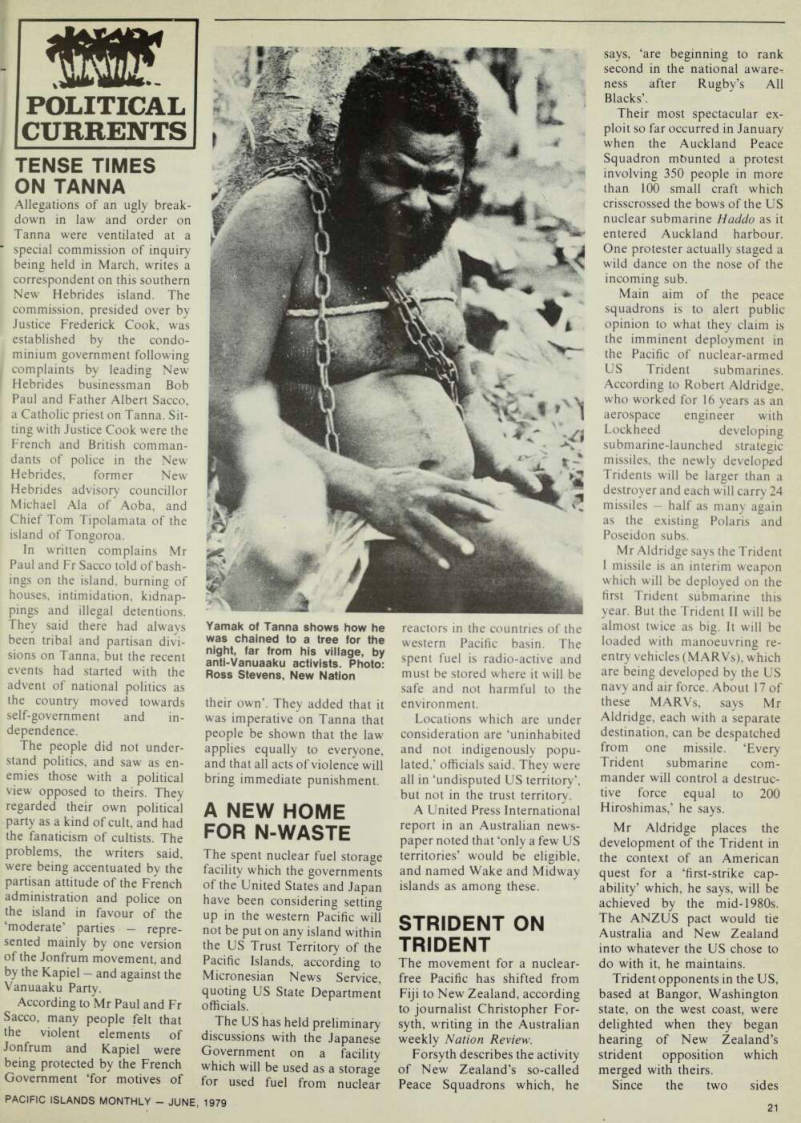
Yamak of Tanna shows how he was chained to a tree for the night, far from his village, by anti-Vanuaaku activists. Photo: Ross Stevens, New Nation
established their trans-Pacific contact, they have accumulated impressive evidence that the US navy is planning to use Palau in Micronesia as a Trident base.
Mr Forsyth comments: ‘Armed with this kind of knowledge the New Zealand peace squadrons believe it is better to offer determined and dramatic symbolic resistance now than to face a non-future of nuclear obliteration for people in New Zealand or else where in the world.’
Png: Yet More
Deportees
Ebia Olewale, Papua New Guinea’s foreign minister, foreshadowed a ‘new era of
peaceful development for the
people of Irian Jaya’ when his government exiled West Irianese guerrilla ‘President’
Jacob Prai and four lieutenants to Sweden on March 4, writes Denis Reinhardt. But these hopes for an end to the 17-year opposition to Indonesian rule in Irian Jaya were short lived.
On April 4, two Dutch citi zens accused of aiding the Free Papua Movement (OPM) were
deported from Port Moresby.
The deportees, Max Ireeuw and Tan Sek Tai, who were flown to Manila, are both for mer Irianese who took up resi dence in Holland after Indonesia acquired West New Guinea from the • Dutch in 1962. They were arrested on March 30 in Madang, a day
after entering PNG through
Port Moresby. Before their arrests. Ireeuw and Tan are be lieved to have ferried 20 000 guilders in aid to an OPM fac
tion led by ‘Brigadier-General’
Seth Rumkorem. Rumkorem is a former Indonesian army co lonel and the son of a tra ditional chief on Biak Island off Irian Jaya’s north-west coast.
Ireeuw and Tan are mem bers of Rumkorem’s small external cabinet. Ireeuw, a native of the Irian Jaya capital Jayapura, is believed to be Rumkorem’s co-ordinator of information, radio and news services. Tan, an ethnic Chinese bom in the Moluccas, is listed in documents circula-
ted in Holland by Rumkorem supporters as finance minister,
‘responsible for foreign trade,
taxation and foreign invest ment’. His friendship with Rumkorem dates back to Dutch colonial days when he was a trader on Biak. Unlike Tan Sek Tai, Ireeuw is one of the younger, radical West Irianese leaders emerging within the factionalised
Opm.
The old rivalries between Rumkorem’s supporters and Prai’s christian-democrat grouping appear to have been tempered after recent nego tiations. Ireeuw had been in telephone contact with Prai in Sweden before leaving for Papua New Guinea.
Prai and his deputy Otto Ondawame left the jungles of New Guinea’s north coast for talks in Vanimo with officials of Prime Minister Michael Somare’s office. Australian se curity officers attached to Mr Somare’s department took an active part in the arrests.
Applying a policy which dates from before the tragic events of East Timor, and decolonisation
in Papua New Guinea, Can berra has sought to douse any
signs of conflagration over
Irian Jaya.
Nicolas Meset, an Irianese
pilot holding permissive resi
dence in PNG, and Frederick Eiserman, an Australian citi zen, were also arrested for offering assistance to the rebel leaders. Eiserman and his PNG wife and children were de
ported in December, although
the national court had ruled his arrest wrongful. Meset is the son of Jayapura’s bupati (dis trict commissioner) and escaped across the border to PNG in the late sixties.
The remaining two Irianese deported on March 4 with Prai, Ondawame and Meset, were Darius Maury and Amos
Indey, ranked respectively as
social welfare and home affairs ministers in the 18-member cabinet named by rebel sources last year. At the time, both were serving six-month gaol sentences in Port Moresby for illegal entry. Exhausted after several years of jungle fighting, the two had crossed into PNG seeking medical assistance. In August last year, Maury and Indey were released into the protective custody of the UN
High Commissioner for Refugees while a country will ing to take them was sought.
Subsequent approaches by
UN officials on behalf of Prai and Ondawame to Australia, New Zealand. Fiji, Western Samoa and Solomon Islands met with refusals of asylum.
Australia justified refusal on the claim that it did not want to provide a haven for dissident
activity against a regional
friend, Indonesia. However, Sweden was far more open hearted and agreed to provide the five and their families with a new home.
The Somare government’s determined policy of closing all sanctuaries to the Irianese free dom fighters is a perceptible shift from the previously be nign attitude to those whom many Papua New Guineans re gard as their Melanesian brothers. Consequently the new hard line has not been without casualties within the country’s educated elite.
When Prai was arrested,
PNG’s fifth-ranking military
officer, Lt-Col Tom Poang, was forced into early retirement. Poang, 29, com mander of PNG Defence Force land operations, took part in meetings between the OPM and a French arms
dealer, during which plans
were made to supply the OPM with SUS3OO 000 in arms. One meeting was at the ironically named Smugglers’ Inn at Madang. The Somare govern ment was severely embarrassed
by revelations of Poang’s
activities at a time when it was trying to allay Indonesian sus picions that it had been provid ing a sanctuary for the OPM.
Poang subsequently claimed
his resignation was due to frus tration with the heavy influ ence of Australian personnel in the PNGDF and the govern
ment’s inability to provide
clear policy guidance on de fence matters. He described his part in arms purchase dis cussions as ‘an attempt to col lect information. I obviously participated in group dis cussions about the proposed arms deal in order to win their confidence ...’ The gravity of Poang’s involvement was underlined by the fact that he led Operation Rausimkwik last
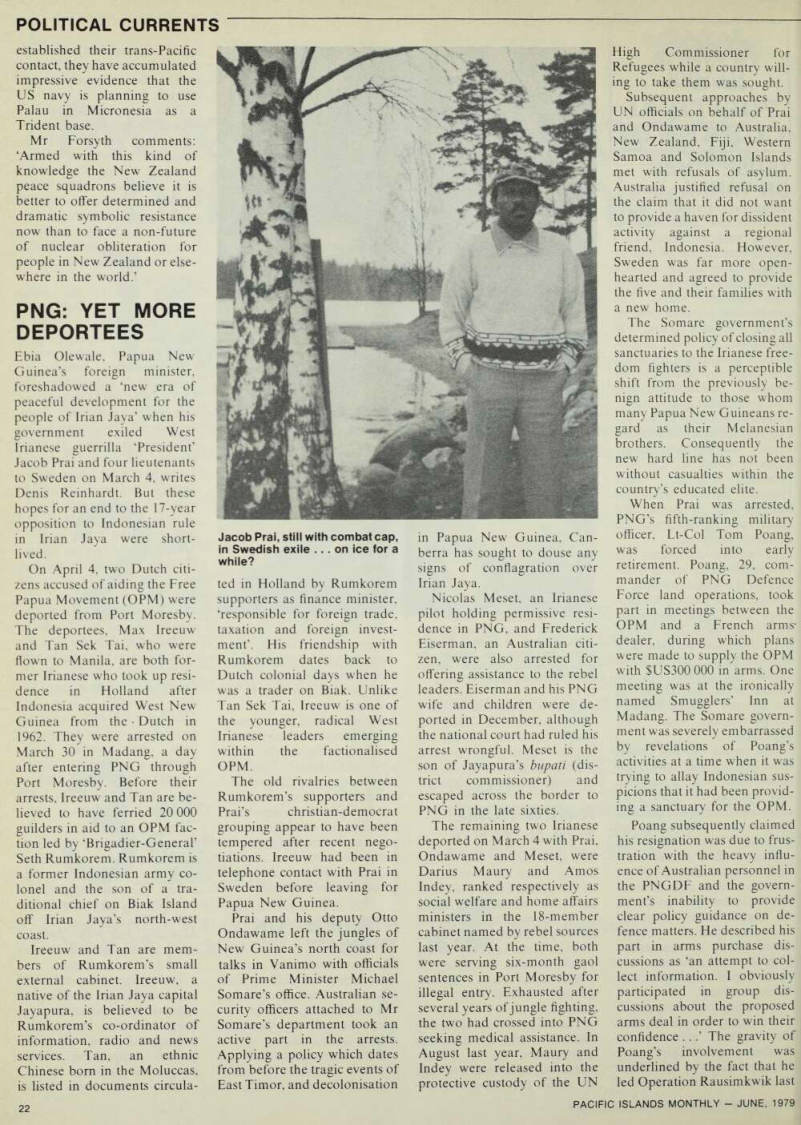
Jacob Prai, still with combat cap, in Swedish exile ... on ice for a while?
[ May in which 500 troops were - deployed on the PNG side of the Indonesian border in an attempt to catch OPM guer rillas operating out of PNG ter-
I ritory.
There has long been sym
pathy among PNG’s military
hierarchy for members of their ' race across the arbitrary col onial border. In October 1977, Defence Force Commander Brigadier-General Ted Diro
• was disciplined by the PNG
cabinet for holding secret talks with Seth Rumkorem. After being ousted, Lt-Col Poang felt constrained to write to the edi tor of Asiaweek magazine, commenting on a report which had appeared in an earlier [ issue: Tt is unfair to portray my involvement in terms of “cer
tain military figures sympath
etic to the OPM’’. Why not also relate my case to certain sym pathetic government ministers, and members of the Papua
New Guinea general public,
who are sympathetic?’
Apia’S On The
Party Line
Western Samoa has lived through years of talk about the ‘arrival of party politics’ in the country without their ever arriving, writes Felise Va’a in Apia. But it seems that, since the February 24 elections, they’ve actually turned up at last. Events since the poll have shown that Samoan political opinion is indeed, at last,
becoming polarised.
Even before the elections, it was generally assumed that
Tupuola Efi, prime minister
for the last three years, would head one group in parliament.
But there was uncertainty about who would head the other. Contenders included Tofilau Eti, Speaker Leota Leuluaialii T. Ale, and Laulu Fetaui. After the poll, however, it was a dark horse that got the nod. This was veteran poli tician Vaai Kolone. Vaai, a for mer schoolteacher and prominent planter, was chosen over his rivals mainly because of his clean record, non involvement in. controversy,
and his outstanding perform
ance as a former chairman of the public accounts com mittee.
The election brought in 26 new members. One new mem ber was elected unopposed.
With an approximately 57% change in membership of the
legislative assembly, it was
obvious from the start that there would be a strong bid to
topple Tupuola’s government.
The elected members were div ided right down the middle.
Approximately half attended Vaai’s meetings only, the other
half going only to Tupuola’s.
There were a few ‘uncertains’ and it was these who finally tipped the scales in Tupuola’s re-election as prime minister by 24 votes to Vaai’s 23.
Firmness of the ‘party-lines’ situation was demonstrated in other votes: Speaker Tuuu Faletoese got 24 votes to Leota I. Ale’s 23; Deputy Speaker Aeau Taulupoo won the post 24-23 from Toleafoa Tali timu.
With the speaker in the chair, the voting strength of the two parliamentary parties is even. This is going to lead to all kinds of difficulties for the new government. What is more, the opposition contains
many people of outstanding
calibre: Tofilau Eti, a former cabinet minister; Faasoo Sam Saili, former finance minister; Laulu Fetaui, former pro chancellor of the University of the South Pacific; Lavea Lio, former commissioner of
police; Lemamea Ropati, a
leading New Zealand-trained
chemist; Leota Pita, a promi nent economist; and many vet eran politicians such as Leota L. I. Ale and Sala Ulugia Suivai.
Opposition members have made it clear they want no favours from Tupuola’s government, and are deter mined to function as a hard
hitting opposition. Taking the
hint, Tupuola, in choosing his cabinet, offered not a single portfolio to a member of the
opposition.
The new cabinet is; Tupuola, prime minister; Faumuina Anapapa, minister of health; Fuimaono Mimio, minister of education; Seuamuli Kurene, minister of works; Vaovasa Filipo, minister of finance; Lesatele Rapi, minister of lands; Asi Eikeni, minister of justice; Seumanu Aita Ah Wa, minister of agriculture; Letiu Tamatoa, minister of economic
development.
The three new cabinet mem bers are Faumuina, Seuamuli and Seumanu. Two of Tupuola’s old cabinet ministers
were dropped. They are
Talamaivao Niko, former minister of justice, and Tofaeono Tile, former minister of health.
Only Vaovasa Filipo and
Lesatele Rapi of the ‘old guard’ have retained their portfolios of, finance and lands respect ively. Former minister of agriculture Fuimaono Mimio has been transferred to edu cation; former minister of economic development Asi Eikeni has been transferred to justice; former minister of works Letiu Tamatoa has been transferred to economic
development.
Already there is bitterness between the two parties. Before the elections, the government put out a press release warning the public about entering into any financial negotiations with an American-based company called and Associates (PIM April). The release said the firm was under investi gation by the FBI in the US for
suspected illegal practices, and
went on to point out that three members of parliament, all in the opposition, had had deal ings with this company. This was an indirect accusation against the three MPs, who
were all, as it happened, re elected. The three- Tofilau Eti, Faasoo Sam Saili and Sala Ulugia denied the claim and challenged the PM to a public debate on the eve of the elec tions. Tupuola did not oblige.
In the intense campaigning for the PM’s position, the op position party charged that a Tupuola supporter had tried to bribe one of its members with SWSIOOO to switch sides. The matter is now under police in
vestigation.
Tupuola Efi is certainly not going to have it easy with the new parliament. He will be challenged all the way. Politi cal parties are here to stay in Western Samoa.
Cooks: Toilet
Unflushed
Whether the Cook Islands’ cel ebrated ‘conspiracy case’ gets under way this month as
planned depends on one thing
above all: the fate of extra dition proceedings launched against US businessman Fin bar Kenny. Mr Kenny, the financial power behind the Cook Islands Philatelic Bu reau, faces charges of con
spiracy arising from the
flying-in of voters from New Zealand by Sir Albert Henry’s Cook Islands Party to vote in last year’s March 31 elections.
Sir Albert’s election 'victory’ was later successfully challen ged in the courts and resulted in the ousting of his govern ment and its replacement by the present Democratic Party regime led by Premier Tom Davis.
Facing charges along with
Mr Kenny are: Sir Albert
Henry (bribery, conspiracy);
Geoffrey Henry (bribery, con
spiracy); Apenera Short (brib ery, conspiracy); Cook Islands Development Co Ltd (con spiracy); James Little (con spiracy); Charles Turner
(conspiracy).
Outcome of the extradition
proceedings, which are being
handled in the US by the New Zealand embassy there, will depend on whether the US Jus tice Department considers that the evidence would justify an American being tried in the US if the alleged foreign offence had been committed in that country. If the department
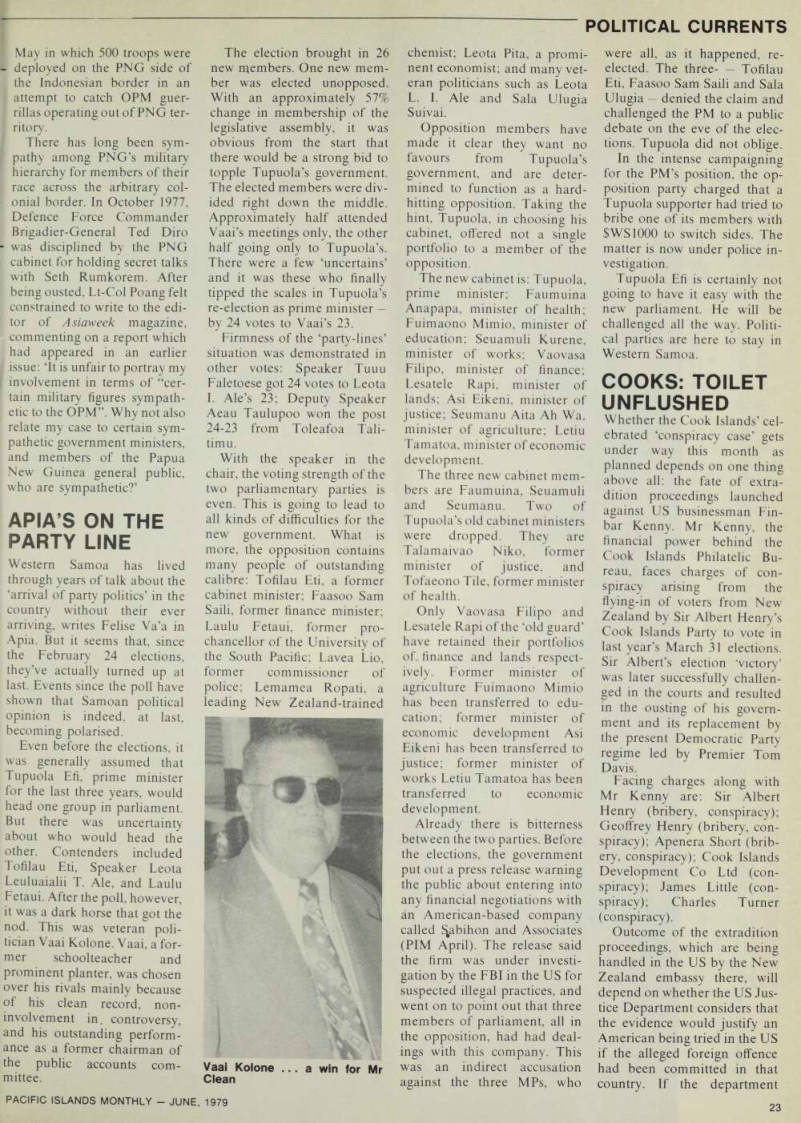
Vaai Kolone ... a win for Mr Clean
finds in Mr Kenny’s case that - there is not, he could not be extradited.
Whatever the outcome, it seems unlikely that the wheels of justice will turn fast enough for the matter to be resolved by June 18, date set down for the opening of the case in the Cook Islands.
The government-run Cook Islands News has recently de voted lavish space to reproduc
' ing and commenting on the
documents seized in prep aration for the prosecution’s case. Its March 24 issue sum marised the documents as fol lows: ‘The evidence for the extra dition of Finbar Kenny —con sisting of more than 2000 pages of affidavits, correspondence, telex messages and notes of conversation purports to show that Kenny was involved in the alleged scheme to use public money to charter air craft during the elections last year. ‘The notebook seized from Sir Albert’s residence gave cal culations of the numbers of fly-in voters and charter flights required to clinch every elec torate in the Cook Islands,
except Mangaia.
‘ln the notes Jim Little [director of the philatelic bu reau] is said to have written, he says that the only way to prove to the opposition that flying in voters is wrong is to fly in hun dreds, “sufficient to cover nearly every island to ensure he gets his two-thirds majority”.
The note further says that if it is going to be done then do it on a large scale. The cost would be upwards of $3OO 000 to be repaid from stamp and coin revenues after the election was won. ‘ln another note Little says the Cook Islands Party solicitor is very much against the advance being contributed to the Cook Islands Development Company because it was likely the source of the funds could be traced and he recommends instead an outright donation to the branch of the CIP in New Zealand which could then transfer money to the develop ment company. ‘A donation of this type would not be illegal. ‘A further note apparently
written by Little and headed Premier/FK/17/2/78 contains the cryptic notes: “OK the
Help”, but queries how help
can be given in view of the US law . .. (US law prohibits any individual from making gifts to foreign governments or officials and provides fines for offenders of up to SUSI million or 10 years imprison ment PIM.) ‘A draft letter from Little to Sir Albert dated February 17, 1978, referred to discussions with Kenny and then step-by step “actions to be taken to re alise your objectives”, and goes on to say “it’s essential that what we are undertaking is known to as few people as
possible.”
‘Another exhibit is a letter from Kenny of March 4 announcing that he had added $3OO 000 to the bureau’s exter nal account, and that “the proper safeguards” discussed at his meeting with Sir Albert in Hawaii earlier, should be proceeded with. ‘Another major piece of evi dence is the handwritten notes of a letter to Kenny from Little which was torn up by Little and thrown in the toilet at the philatelic bureau, but not flushed away. This was later recovered by police. In his statement to the police Little admits that these were notes taken of a letter marked “Read and Destroy” to Sir Albert from his New Zealand lawyer Mr John Collinge. ‘As further evidence for the prosecution’s case of Kenny’s involvement in Cook Islands politics the police have in cluded a draft letter apparently composed by Kenny for Sir Albert to appeal to every voter
before the general election.
This letter was never distribu ted. ‘Printed in complete form below is the text of Little’s “Read and Destroy” letter; ‘Read and Destroy’ Letter received by the premier from his lawyer. Makes reference to the payment by philatelic bu reau to Cook Islands Govern ment New Projects Ltd, and says that because it is a govern ment company there is sub stantial onus on the premier and the lawyer to prove that there was a misunderstanding over the payment to the company. Would like F.K. and J.L. to give evidence that the money was intended to be given to the premier per
sonally. Lawyer appreciates
the problem created by the US law and wonders how this can be overcome and whether you can and should help and whether willing to be called as a witness. QC agrees. Lawyer
proposes personal meeting
with you in L.A. or Hono. be tween May 17 and well before case hearing June 6. He also asked Premier whether he thought he should be in attend ance. Premier in Hono week beginning June 5. Is our line still that we were asked to make an advance against future rev enue as we were in the past to a government company? What happened from that point is no concern of ours. We cannot and will not be involved in local politics.” ’
On the inquiry conducted by the New Zealand Government of National Party leader
Robert Muldoon to determine whether New Zealand aid funds to the Cooks might have been used to finance the fly ins, Finbar Kenny in one com munication made comments
which were highly revealing,
especially of his own political persuasions. Little describes Kenny’s reaction as follows: ‘With regard to the New Zealand inquiry as to the poss ible use of NZ funds, Kenny says it was a perfectly legit imate action on the part of New Zealand, but he was “sure that it does not worry the Premier in the slightest, as the way they (NZ) control their funds, two dollars could not slip by.” ‘He said, however, that if New Zealand attempted to economically force the Cook Islands to its knees by econ omic pressure, he would be morally bound to help the Cook Islands, as he was aware that quite often socialist governrnents can become ruth less and cynical in crushing
what they consider opposition.’
Mr Muldoon’s comments on
Finbar Kenny’s description of
his conservative New Zealand administration as ‘socialist’ have not been recorded.
Interviewed in New York, Mr Kenny said calmly of the extradition proceedings: i assume the State Department will eventually get in touch with my attorneys. They will study the position and I will be
guided by what they say.’
Mr Kenny added that he was continuing his association with the philatelic bureau, i wanted out,’ he said. ‘But I’ve had friendly letters from Tom Davis and I just stayed on.’
He said his contract with the bureau still had V/i years to run. He told a New Zealand Press Association reporter that sales of Cook Islands stamps had shrunk dramatically in re cent months ‘contaminated’, he believed, by the past year’s political events in the Cooks.
Cooks defendants ... from left, Finbar Kenney, Sir Albert Henry and Jim Little