Theocratic
pp. 18-19 · Read in the full issue
The Marquesas and Wallis and Futuna
Paths To
Resurrection
Malcolm Salmon concludes his review of a series of articles in the French daily Le Monde on France's Pacific territories. This second article deals with the Marquesas Islands and Wallis and Futuna.
Articles on New Caledonia, Tahiti and the New Hebrides were re viewed in PIM, May.
More than 3000 kilometres separate the Marquesas Islands in the eastern Pacific from Wallis and Futuna to the west.
The Marquesas are adminis tratively part of French
Polynesia, and gravitate politi
cally around Tahiti. Wallis and Futuna have a quite separate status as an overseas territory of France, and are much more in the political orbit of New Caledonia, 2000 kilometres further west.
But justification for discuss ing them together may be claimed in their common Polynesian culture, their small populations and meagre econ omic resources, and, more gen erally, in their shared status as part of that ‘confetti of empire’ of which a French journalist wrote eloquently some years ago.
First ‘discovered’ by the Spaniard Alvaro de Mendana de Neyra in the late sixteenth century, the Marquesas were
visited briefly by Captain Cook
about 200 years later, again in 1791 by the French navigator Marchand, and then by the Russian Krusenstern in 1804 (he left behind a couple of goats whose many descendants have done great environmental damage), it was not until the reign of the French king Louis- Philippe, about 140 years ago, that a firm French presence was established in the Islands.
The presence took the form of a few ships and an admiral
accompanied by tradesmen of
various kinds, among whose tasks were the building of small forts and the hacking of stair ways out of the basaltic rock on
the island of Nukuhiva. ‘But,’ writes Le Monde cor respondent Pierre Vallincland, a long-time resident of the Marquesas, ‘France had chosen a spot too far to the north. It was further south, towards Tahiti and the Cook Islands, and further west towards Fiji and New Caledonia, that the political cards were to be dealt a little later on. In their outlying situ ation, the Marquesas were soon to regain that noble, dull lethargy from which they were only really to re-emerge in 1977. The Anglican and Pres byterian missions did not even deign to interest themselves in this archipelago which, accord ing to contemporary estimates, then had a population of about 40 000, six or seven times today’s figure. Even the build
ings comprising the royal com
missioner’s residence prefabricated in France were transferred to Tahiti.’
Administration of the islands was henceforth for a number of years largely in the hands of the Catholic mission of the fathers and brothers of the Picpus order the more so as the central power had neither the desire nor the means to administer the
indigenous population. The re
sult. according to Vallincland, was the establishment of a sort
of ‘theocracy’.
But things were to change under the Third Republic, established in 1870. The French state, whose represen tatives often enough were bearers of the anti-clericalism then prevalent in France, took an increasing interest in the islands, and greatly increased the number of its personnel there. The change led to what Vallincland describes as ‘a cold war’ between the French state and the mission a war which, he says, later became a ‘mis trustful peace’ and remains today ‘a courteous peace, still lacking in warmth’.
These developments ‘at the top’ were accompanied ‘below’ by what amounted almost to the disappearance of the Islanders themselves. Over the
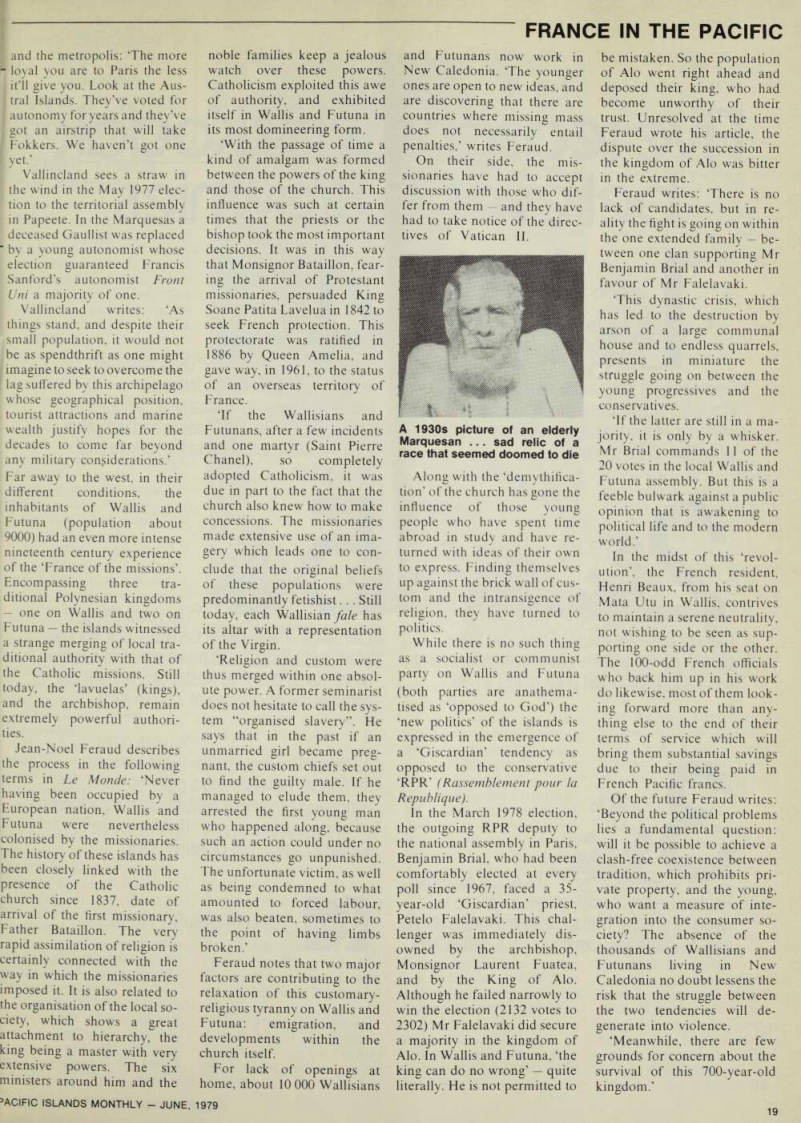
50 years from 1880 to 1930 the number of Marquesans fell from several tens of thousands to about 2000. The imported diseases of smallpox and syph ilis, and of a new form of al coholism (French booze was the more attractive due to the tedious character of the prep arations required for the old
time Marquesan tipples based
mainly on coconut and banana juices) were the main culprits.
The indigenous population of
the Marquesas seemed fated for total disappearance.
If one man can claim credit for their ‘rescue’ it is Dr Louis Rollin, who through the thirties combined the functions of official French ‘resident’ and medical officer. Rollin. taking advantage of the truce then in effect between government and mission personnel, enlisted the aid of the latter first to arrest and then to reverse the drastic population decline.
Rollin’s work and that of the missions has been complemented in the sixties and seventies by the wide
spread introduction of supplies
of running water and by greatly
expanded educational and health systems.
While the absolute popu lation increase is not great due to the permanent or long-term emigration of many in the most active and prolific age groups, school attendance has risen from about 10% to 15% at the end of World War II to almost
100% today.
In the early 19605, geological tests were made on the uninhabited island of Eiao, in the far northeast of the Marquesas archipelago, with a
view to staging underground
nuclear tests on it. But the island’s volcanic soil offered too tough a resistance to the ge ologists’ drills, and the ‘privi lege’ of being smashed about by nuclear explosions went to the atolls of Fangataufa and Mururoa.
As far as the central power in Paris is concerned, Vallincland sees the
Marquesas today as poised be
tween the options of ‘loyalty
and particularism’.
He quotes one Marquesan as
saying of the loyalty long
shown by Marquesans to the conservative forces in Papeete
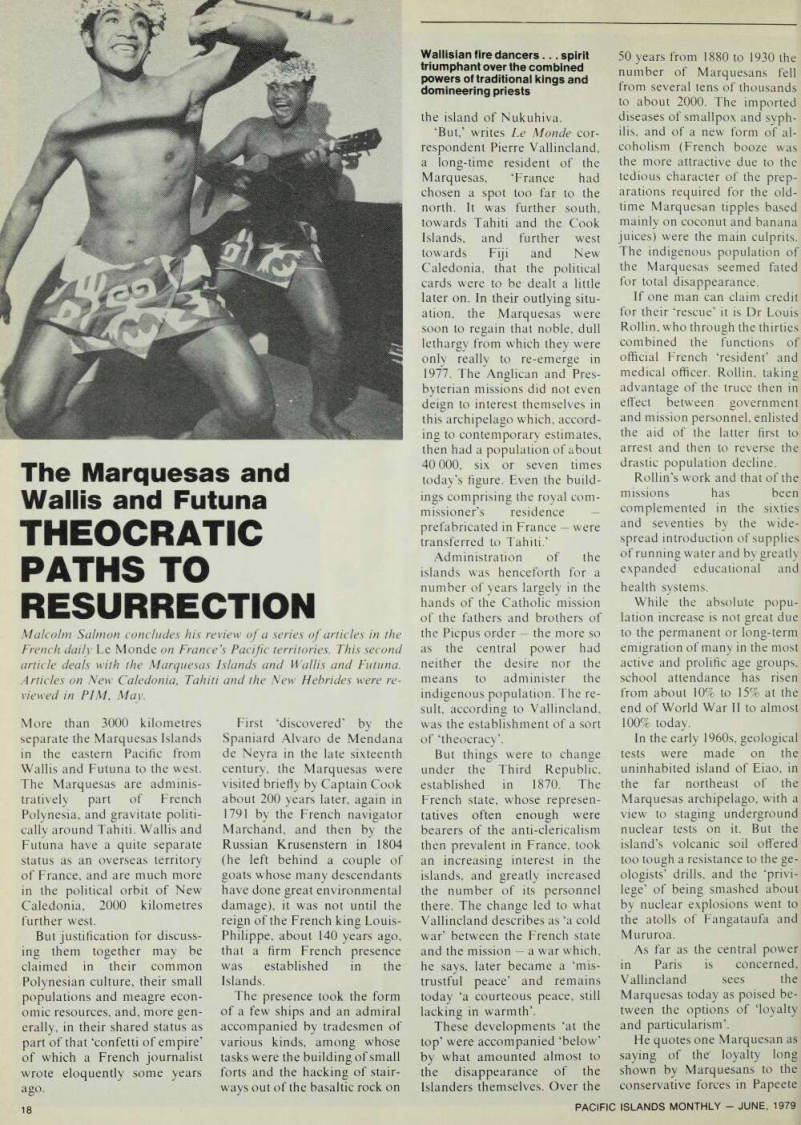
Wallisian fire dancers ... spirit triumphant over the combined powers of traditional kings and domineering priests
I and the metropolis: ‘The more * loyal you are to Paris the less it’ll give you. Look at the Aus tral Islands. They’ve voted for I autonomy for years and they’ve i got an airstrip that will take Fokkers. We haven’t got one
I yet.’
Vallincland sees a straw in the wind in the May 1977 elec tion to the territorial assembly in Papeete. In the Marquesas a deceased Gaullist was replaced " by a young autonomist whose election guaranteed Francis Sanford’s autonomist Front Uni a majority of one.
Vallincland writes: ‘As things stand, and despite their small population, it would not be as spendthrift as one might i imagine to seek to overcome the
I lag suffered by this archipelago
whose geographical position,
tourist attractions and marine wealth justify hopes for the decades to come far beyond any military considerations.’
Far away to the west, in their different conditions, the inhabitants of Wallis and Futuna (population about 9000) had an even more intense nineteenth century experience of the ‘France of the missions’.
Encompassing three tra
ditional Polynesian kingdoms
one on Wallis and two on Futuna the islands witnessed a strange merging of local tra ditional authority with that of the Catholic missions. Still
today, the ‘lavuelas’ (kings),
and the archbishop, remain extremely powerful authori ties.
Jean-Noel Feraud describes the process in the following terms in Le Monde: ‘Never
having been occupied by a
European nation, Wallis and Futuna were nevertheless colonised by the missionaries.
The history of these islands has been closely linked with the presence of the Catholic church since 1837, date of arrival of the first missionary, Father Bataillon. The very rapid assimilation of religion is certainly connected with the way in which the missionaries imposed it. It is also related to the organisation of the local so ciety, which shows a great
attachment to hierarchy, the
king being a master with very extensive powers. The six ministers around him and the
noble families keep a jealous watch over these powers.
Catholicism exploited this awe of authority, and exhibited itself in Wallis and Futuna in its most domineering form. ‘With the passage of time a kind of amalgam was formed between the powers of the king and those of the church. This influence was such at certain times that the priests or the bishop took the most important decisions. It was in this way that Monsignor Bataillon, fear ing the arrival of Protestant
missionaries, persuaded King
Soane Patita Lavelua in 1842 to seek French protection. This protectorate was ratified in 1886 by Queen Amelia, and gave way, in 1961, to the status of an overseas territory of France. ‘lf the Wallisians and Futunans, after a few incidents and one martyr (Saint Pierre Chanel), so completely adopted Catholicism, it was due in part to the fact that the church also knew how to make concessions. The missionaries made extensive use of an ima gery which leads one to con clude that the original beliefs of these populations were
predominantly fetishist.. . Still
today, each Wallisian fale has its altar with a representation of the Virgin. ‘Religion and custom were thus merged within one absol ute power. A former seminarist does not hesitate to call the sys
tem “organised slavery”. He
says that in the past if an unmarried girl became preg nant, the custom chiefs set out to find the guilty male. If he managed to elude them, they arrested the first young man
who happened along, because
such an action could under no circumstances go unpunished.
The unfortunate victim, as well as being condemned to what amounted to forced labour, was also beaten, sometimes to the point of having limbs broken.’
Feraud notes that two major factors are contributing to the relaxation of this customary religious tyranny on Wallis and Futuna: emigration, and developments within the church itself.
For lack of openings at home, about 10 000 Wallisians
and Futunans now work in New Caledonia. ‘The younger ones are open to new ideas, and are discovering that there are countries where missing mass does not necessarily entail penalties,’ writes Feraud.
On their side, the mis sionaries have had to accept discussion with those who dif fer from them - and they have had to take notice of the direc tives of Vatican 11.
Along with the ‘demythifica
tion’ of the church has gone the influence of those young people who have spent time abroad in study and have re turned with ideas of their own to express. Finding themselves up against the brick wall of cus tom and the intransigence of religion, they have turned to
politics.
While there is no such thing as a socialist or communist party on Wallis and Futuna (both parties are anathema tised as ‘opposed to God’) the ‘new politics’ of the islands is expressed in the emergence of a ‘Giscardian’ tendency as opposed to the conservative ‘RPR’ (Rassemblement pour la
Republique).
In the March 1978 election, the outgoing RPR deputy to the national assembly in Paris, Benjamin Brial, who had been comfortably elected at every poll since 1967, faced a 35-
year-old ‘Giscardian’ priest,
Petelo Falelavaki. This chal
lenger was immediately dis
owned by the archbishop,
Monsignor Laurent Fuatea, and by the King of Alo.
Although he failed narrowly to win the election (2132 votes to 2302) Mr Falelavaki did secure a majority in the kingdom of Alo. In Wallis and Futuna, ‘the
king can do no wrong’ quite
literally. He is not permitted to
France In The Pacific
be mistaken. So the population of Alo went right ahead and deposed their king, who had become unworthy of their trust. Unresolved at the time Feraud wrote his article, the dispute over the succession in the kingdom of Alo was bitter in the extreme.
Feraud writes: ‘There is no lack of candidates, but in re ality the fight is going on within the one extended family - be tween one clan supporting Mr Benjamin Brial and another in favour of Mr Falelavaki. ‘This dynastic crisis, which has led to the destruction by arson of a large communal house and to endless quarrels, presents in miniature the struggle going on between the young progressives and the conservatives. ‘lf the latter are still in a ma jority, it is only by a whisker.
Mr Brial commands 11 of the 20 votes in the local Wallis and Futuna assembly. But this is a feeble bulwark against a public opinion that is awakening to political life and to the modern world.’
In the midst of this ‘revol ution’, the French resident, Henri Beaux, from his seat on Mata Utu in Wallis, contrives to maintain a serene neutrality, not wishing to be seen as sup porting one side or the other.
The 100-odd French officials who back him up in his work do likewise, most of them look ing forward more than any thing else to the end of their terms of service which will
bring them substantial savings
due to their being paid in French Pacific francs.
Of the future Feraud writes:
‘Beyond the political problems
lies a fundamental question: will it be possible to achieve a clash-free coexistence between
tradition, which prohibits pri
vate property, and the young, who want a measure of inte gration into the consumer so ciety? The absence of the thousands of Wallisians and Futunans living in New Caledonia no doubt lessens the risk that the struggle between the two tendencies will de generate into violence. ‘Meanwhile, there are few grounds for concern about the survival of this 700-year-old
kingdom.’
A 1930s picture of an elderly Marquesan ... sad relic of a race that seemed doomed to die