Tongan tradition
pp. 13-16 · Read in the full issue

Tonga
Tevita of Minerva - a man in finest Tongan tradition
r he little kingdom of Tonga has many heroes - the courage and ■esource which breeds them are all too frequently a condition of sur vival in the fragile security of island living - but the one best known o the outside world was Captain Tevita Fifita, writes Olaf luhen.
n a life punctuated at frequent
ntervals by successful
ncounters with marine emerg ncy he captured international ttention when in 1962 he ngineered the survival and ventual self-rescue of 12 of 17 nen shipwrecked for a record-
Teaking 102 days on the lonely
'acific coral reef Minerva.
Of these 12 survivors he be ame the first to die - in March
in Pago Pago, American Samoa. Although only 59, Cap tain Fifita retired from the sea about four years ago, perhaps in response to the warning of a heart attack. By special re quest, he was making his first overseas voyage since retirement.
In the epic Minerva Reef ex perience, his 17 men had found a shaky refuge in the reef
bound wreck of a Japanese fishing vessel. For two months they waited confidently for res cue, building a still from scrap materials to obtain fresh water.
The process progressively con sumed their shelter and, in the last month, Tevita supervised the building by Tevita Uaisele, his ship’s carpenter, of a little vessel he named Malolelei, a word of cheerful welcome that had been the name of his father’s ship. Their only tools were a table-knife, a clawham mer, and the chisel-shaped ends of spikes from timbers burnt in the fire. On a final sur vey, he replaced the keel of his first design with a cleverly bal
anced outrigger which, though
safer, necessitated making immediate use of October’s last fitful stirrings of the southeast season. The first man died be
fore it was launched.
On this, three of them set sail for Fiji: Tevita Fifita, with Tevita Uaisele and Fifita’s son Sateki (chosen for his swim
ming ability).
Eight days later, having had
no sustenance except that the two crewmen had diluted the blood of a seagull with spirits from the compass, they attempted to cross an ocean reef on the exposed shore of Kadavu Island, south of Fiji’s Viti Levu. Malolelei was wrecked, and its famished complement set out on an eight kilometre swim to the shore.
Not far from the beach, young Sateki’s magnificent will col lapsed. He swam round in circles, no longer conscious of the moment’s need for concen trated effort, no longer (after
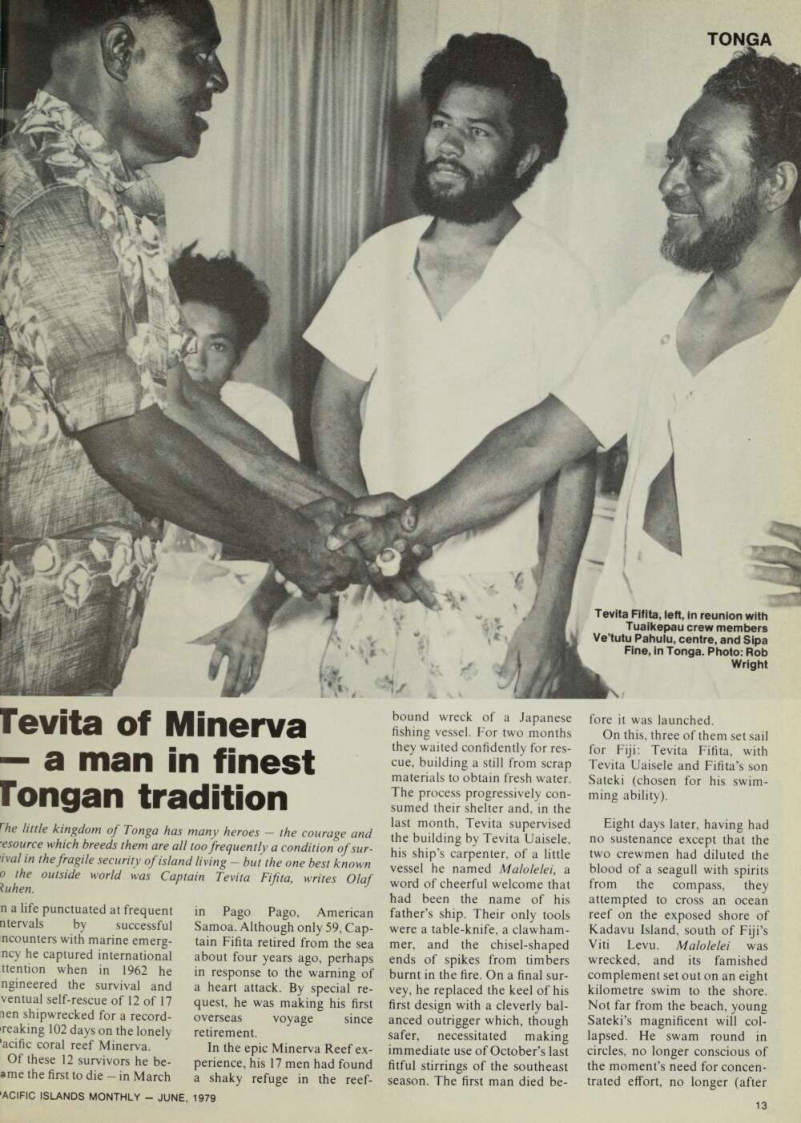
Tevita fifita, left, in reunion with Tuaikepau crew members Ve’tutu Pahulu, centre, and Sipa Fine, in Tonga. Photo: Rob Wright
the three-month ordeal) able to ‘"furnish it.
Ahead of him his father turned back to help. When he •reached his son he saw that also had turned back; without a break in the pattern the certainty imposed itself that not only the three of them would die, but also the 10 remaining 11 as he thought on Minerva Reef. Tevita held _up his son, said a brief prayer, and then abandoned him,
sacrificing him. driving Uaisele
to the beach with blows. Their ordeal continued ashore, while they tried to contact a village.
When they did, Fifita con tacted authorities who sent a flying-boat to the succour and eventual rescue of the Minerva Reef survivors, but he would not tell his story until he had sent word to his wife, ’Alapasita, that he had allowed their son to die. Her courage, morality and pride matched his own. She replied: ‘lf our son died that other men might live I am a proud woman.’
Fifita’s recourse to prayer was typical. One of the small Roman Catholic community of Tonga, he had at all times for tified his companions and
imposed a life-saving disci
pline by insistence upon
prayer.
In Tonga the whole popu lation celebrated the miracle of
survival with heart-warming
joy, stilled momentarily when
the gaunt survivors landed from Fiji where their appear ance had frightened nurses at
Suva Hospital. Barely able to
walk, they paid their respects to
their country, exemplified by
the regal presence of the late Queen Salote who wrote a song to commemorate the almost miraculous return: Mahina Tolu (Three Months). Its sol
emn verses dominated Tonga
Radio for a long time. Perhaps
:hat quelled a wealth of lational creativity for no Ton »ans well, very few would 3e so presumptuous as to for
vard their offerings when they
might be judged against those
ff their queen. Some minor as pects of the epic were remem bered in other songs.
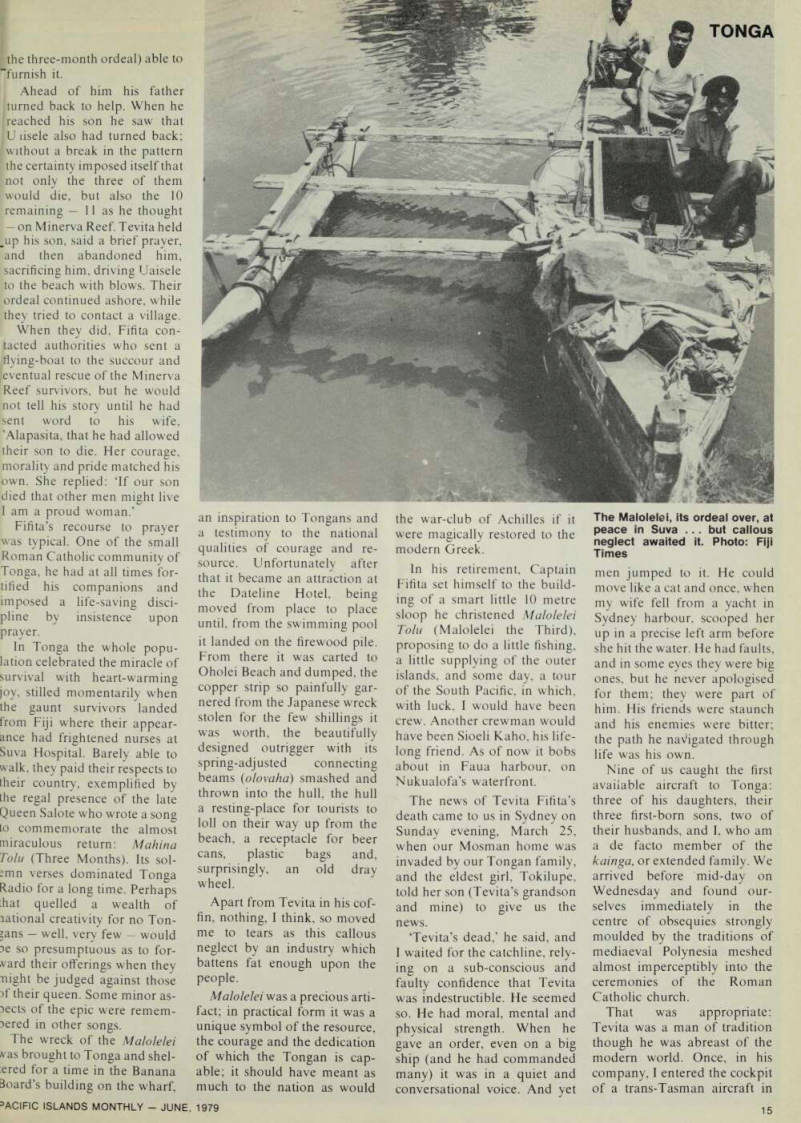
The wreck of the Malolelei
vas brought to Tonga and shel
ved for a time in the Banana Board’s building on the wharf,
an inspiration to Tongans and a testimony to the national qualities of courage and re source. Unfortunately after that it became an attraction at the Dateline Hotel, being moved from place to place until, from the swimming pool it landed on the firewood pile.
From there it was carted to Oholei Beach and dumped, the copper strip so painfully gar nered from the Japanese wreck stolen for the few shillings it was worth, the beautifully
designed outrigger with its
spring-adjusted connecting
beams ( olovaha ) smashed and thrown into the hull, the hull a resting-place for tourists to 101 l on their way up from the beach, a receptacle for beer
cans, plastic bags and,
surprisingly, an old dray
wheel.
Apart from Tevita in his cof fin, nothing, I think, so moved me to tears as this callous
neglect by an industry which
battens fat enough upon the
people.
Malolelei was a precious arti fact; in practical form it was a unique symbol of the resource, the courage and the dedication of which the Tongan is cap able; it should have meant as much to the nation as would
the war-club of Achilles if it were magically restored to the modern Greek.
In his retirement, Captain Fifita set himself to the build ing of a smart little 10 metre sloop he christened Malolelei Tolu (Malolelei the Third), proposing to do a little fishing, a little supplying of the outer islands, and some day, a tour of the South Pacific, in which, with luck, I would have been crew. Another crewman would have been Sioeli Kaho, his life long friend. As of now it bobs about in Faua harbour, on Nukualofa’s waterfront.
The news of Tevita Fifita’s death came to us in Sydney on
Sunday evening, March 25,
when our Mosman home was
invaded by our Tongan family,
and the eldest girl, Tokilupe, told her son (Tevita’s grandson and mine) to give us the news. ‘Tevita’s dead,’ he said, and I waited for the catchline, rely ing on a sub-conscious and faulty confidence that Tevita was indestructible. He seemed so. He had moral, mental and
physical strength. When he
gave an order, even on a big ship (and he had commanded many) it was in a quiet and conversational voice. And yet
men jumped to it. He could move like a cat and once, when my wife fell from a yacht in
Sydney harbour, scooped her
up in a precise left arm before she hit the water. He had faults, and in some eyes they were big ones, but he never apologised for them; they were part of him. His friends were staunch and his enemies were bitter;
the path he naVigated through
life was his own.
Nine of us caught the first available aircraft to Tonga: three of his daughters, their three first-born sons, two of their husbands, and I, who am a de facto member of the kainga, or extended family. We arrived before mid-day on Wednesday and found our selves immediately in the
centre of obsequies strongly
moulded by the traditions of mediaeval Polynesia meshed almost imperceptibly into the ceremonies of the Roman Catholic church.
That was appropriate: Tevita was a man of tradition though he was abreast of the modern world. Once, in his company, I entered the cockpit of a trans-Tasman aircraft in
The Malolelei, its ordeal over, at peace in Suva ... but callous neglect awaited it. Photo: Fiji Times
flight, and though I had been a pilot of four-engine bombers only a decade before he
explained some navigation
instruments to me, new since my time. He would have been proud that all his children came back to bid him farewell, from Australia, from New Zealand and from Fiji.
Of the 11 living survivors of Minerva Reef, eight were over seas; the other three attended the funeral. Of these Teiapa’a Bloomfield met us at the air port with a bus, and when I got out. in a country lane, said simply: ‘We will go and see the Captain, you and I.’ Mean while womenfolk were dress ing our citified girls in the ta'ovala liongi, the ancient tat tered mats which proclaimed their close relationship to the dead man.
Tevita’s eldest brother Tolati
had stepped down voluntarily
from his high position within the family in favour of a cousin, Ma’afu Tupou, in def erence to this cousin’s civilian position as Governor of Vavau; and so that the overseas members could attend the fu neral Ma’afu had extended the apo, the night of watching, an extra 24 hours. But it was Tola ti’s house where the body lay, as in state.
The crowds surrounding the house on all sides made way for me and I entered a room about nine metres by five, massed with flowers and crowded with mourners. Tevita lay in an open coffin, dressed in a white captain’s uniform, his cap on chest, crossed hands wound about with a rosary. His widow sat on the floor by the coffin,
magnificent in quiet dignity, as
on every other occasion of her life. I knelt beside her and, moved by some deep emotion, for he was a good and a close friend, prostrated myself to kiss the cold familiar face. The women at the head of the cof
fin, tirelessly grooming him,
applying scented unguents and perfumes and powders to his skin, touching him with loving hands, moved aside so that I could sit at his head.
While I sat there all of our party, one after the other, came and paid him similar respects, and when, after some time, I went outside, another daugh
ter, Sitela stopped me. ‘Go and talk to Daddy, Olaf,’ she said. ‘Go and sit with him; you will hear him talk.’ I did so, and after a time I slipped a copy of Minerva Reef, the book I wrote about his greatest ordeal, into the coffin. When I next looked it was held beneath his folded hands.
Sitela was dressed, as all of Tevita’s seven daughters, the daughters of his brothers, the wife of his son, and his sister Seletute, in a ta'ovala liongi.
These were hideous, ragged, dirty floor mats, girdled with rope, encircling the whole
body, dragging on the ground
and brought above the head in a kind of peaked hood. Be neath this their faces were framed in wild hair, not to be combed for the five days of intensive mourning, in which they would not wash or change clothes or wear any decoration.
They moved about bent low, sometimes shuffling on hands and knees, their legs awkward within the ta'ovala, when they were in the presence of su perior females of their family.
Their duty was to abase them selves with work; not for them
the long periods of wailing sor
row in which other members of
the kainga indulged. Relations
numbered about 200; some of them from Haapai, where the
family originated, had left
houses cyclone-shattered in the previous week by a tempest which had taken more than 50 lives between there and Fiji.
The first Polynesian Arch bishop Patelisio Finau con ducted the ceremony of burial and presided at masses in the new and nearly finished ca thedral of St Anthony of Padua. Erected largely in Ton gan tradition, and of startling internal beauty, the cathedral faces the Malaekula, the Red Field, where kings are buried and the living may not walk.
For the burial itself, 24 pall
bearers shouldered long poles
on which the bier rested on a wealth of mats and valuable cloth, and carried Tevita from his brother’s house to the fam ily graveyard. There his grave had been dug beneath the slen der branches of a langakali tree, of which the small brown flowers are used for scenting some Tongan oils.
There were other ceremonies too, as that in which the girls,
bringing burning brands from
the fire into the room, begged the senior lady of the house, Tupou Falekalala, to burn their hair from their heads.
She, in more modern custom, cut their hair instead while the choking smoke wreathed about their faces, and saved the clip pings for hair girdles a man will some day wear on important
occasions. My grandson was
wearing one then. It was im
possible to imagine women
more distraught than these,
though imagination could
supply details of ancient cus toms neglected now: breasts and temples shark-tooth slashed, skin burnt and bruised in testimonies of anguish.
Throughout the whole of the putu, the season of funeral ob servance, rich gifts arrived every few minutes and were
accepted by Tupou Falekalala:
huge mats, sometimes accom
panying a tapu, a huge drape
of woven flowers to hang above the grave, pieces of tapa,
other traditional gifts. They
came from everyone: from nobles, from sisters of the queen, from other important families.
Long before the body had arrived by air from Samoa the
gifts were pouring in, lengths of
tapa, flowers wrapped in cloth, mountains of food, cooked pigs, reef clams. More than 100 women were receiving them,
storing them, decorating the
house, making everything
clean and good though they
could hardly have improved
upon its daily tidiness or the
garden constantly tended by
Tolati and Siangahu, his wife.
It was the responsibility of the male side of Tevita’s family to
provide the enormous quanti
ties of food.
The gifts were not for the enrichment of the family. Be fore a drumming of tapa mal
lets against a cloth-working
beam signalled the end of
intensive mourning, everything
was given away again, the
house stripped completely of
its temporary riches. As the
receiving had been presided
over by the senior lady of Tevi ta’s house, the giving away was a function of the senior lady of his widow’s and ’Alapasita
watched approvingly as Popoua, who normally takes care of household mats and tapa for Prime Minister Prince
Tu’ipelehake, the king’s
brother, consigned the gifts to new destinations. The way in which the funeral gifts enrich
the family is that they give
them the opportunity and the privilege of giving, and the tra ditional family would not have it otherwise. A very large for tune passes through their hands and is dispersed.
In life, Tevita Fifita was
widely respected, principally
perhaps for the navigational
skill by which he averted disas ter again and again. Memories of this include the Christmas time in which he struck a cy clone while he was taking school-children from Nukualofa to their island homes in the north. He ran for an uninhabited island and
there supervised their fending
for themselves for a week until he could continue the voyage and assure parents who feared them lost. In another well remembered incident, his com mand, the MV Aoniu, suffered damage in an October 1955 storm while he was heading for Niuafoou, the Tin Can Island.
Unable to proceed ahead, he ran astern for, I think, four days to find shelter and effect repairs in Suva. That was the storm in which the 23 metre MV Joyita disappered, to be found drifting a month later, little damaged, but with no sign of any of the 25 people of her
complement, a ghost-ship fre
quently dubbed the Pacific’s Marie Celeste.
Captain Fifita was admired, too, for his strength, and the way he used it. Yet I think that if the Fates had spared him another two or three decades he would have been known for his wisdom, a quality much su
perior to intelligence and
learning.
To his lifelong friend Sioeli Kaho his passing was a heavy blow: To me he was more than a brother because we shared everything big or small, and I admired his wise suggestions and plannings. His children are my children. From this day I will wear my black until I die.
I won’t have a friend like him any more.’