‘Savages in
pp. 26-28 · Read in the full issue

Tropicalities
serge’—a lament
The police force in Papua New Guinea has lost its prestige, writes Lynn Clark, who had many years of experience as a patrol officer in PNG’s pre
independence administration.
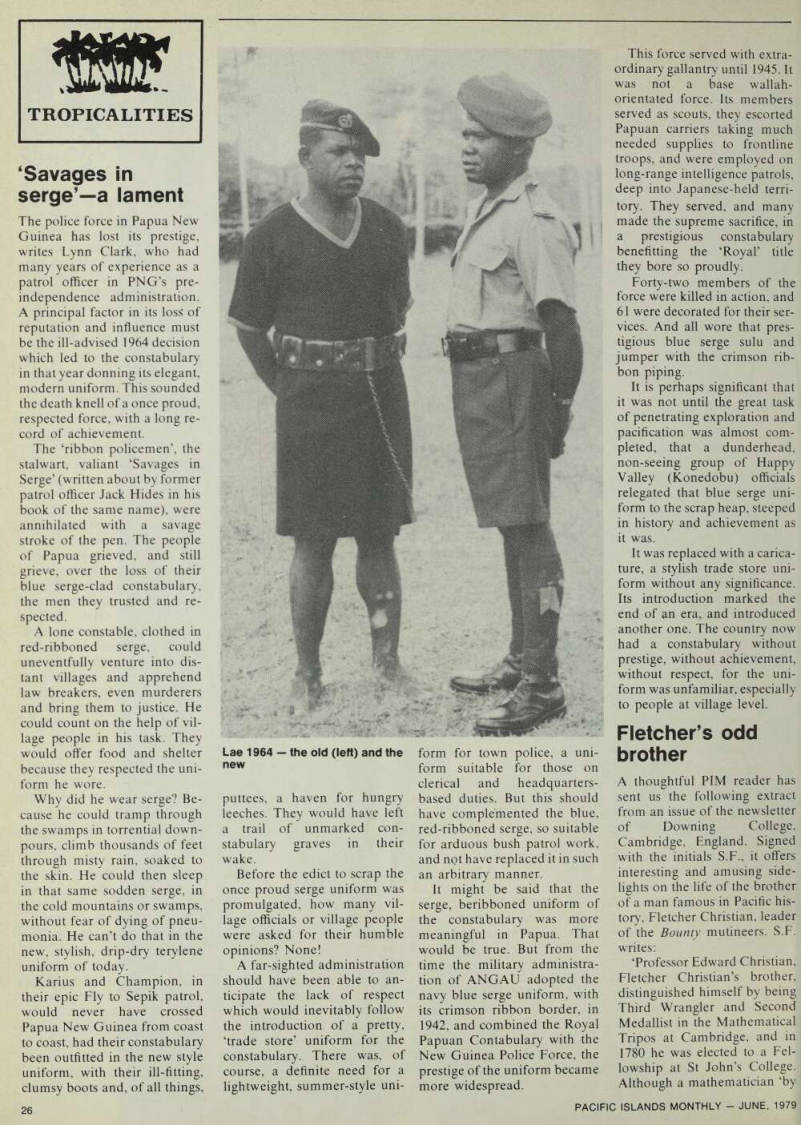
A principal factor in its loss of reputation and influence must be the ill-advised 1964 decision which led to the constabulary in that year donning its elegant, modern uniform. This sounded the death knell of a once proud, respected force, with a long re cord of achievement.
The ‘ribbon policemen’, the stalwart, valiant ‘Savages in Serge’ (written about by former patrol officer Jack Hides in his book of the same name), were annihilated with a savage stroke of the pen. The people of Papua grieved, and still grieve, over the loss of their
blue serge-clad constabulary,
the men they trusted and re
spected.
A lone constable, clothed in red-ribboned serge, could uneventfully venture into dis
tant villages and apprehend
law breakers, even murderers and bring them to justice. He could count on the help of vil
lage people in his task. They
would offer food and shelter because they respected the uni form he wore.
Why did he wear serge? Be cause he could tramp through the swamps in torrential down pours, climb thousands of feet through misty rain, soaked to the skin. He could then sleep in that same sodden serge, in the cold mountains or swamps, without fear of dying of pneu monia. He can’t do that in the
new, stylish, drip-dry terylene
uniform of today.
Karius and Champion, in
their epic Fly to Sepik patrol,
would never have crossed Papua New Guinea from coast to coast, had their constabulary been outfitted in the new style uniform, with their ill-fitting, clumsy boots and, of all things,
puttees, a haven for hungry leeches. They would have left a trail of unmarked con stabulary graves in their wake.
Before the edict to scrap the once proud serge uniform was promulgated, how many vil
lage officials or village people
were asked for their humble
opinions? None!
A far-sighted administration should have been able to an ticipate the lack of respect which would inevitably follow the introduction of a pretty, ‘trade store’ uniform for the constabulary. There was, of course, a definite need for a
lightweight, summer-style uni-
form for town police, a uni form suitable for those on clerical and headquarters based duties. But this should have complemented the blue, red-ribboned serge, so suitable for arduous bush patrol work, and not have replaced it in such an arbitrary manner.
It might be said that the serge, beribboned uniform of the constabulary was more meaningful in Papua. That would be true. But from the time the military administra tion of ANGAU adopted the navy blue serge uniform, with its crimson ribbon border, in 1942, and combined the Royal
Papuan Contabulary with the
New Guinea Police Force, the prestige of the uniform became
more widespread.
This force served with extra ordinary gallantry until 1945. It was not a base wallah orientated force. Its members served as scouts, they escorted
Papuan carriers taking much
needed supplies to frontline troops, and were employed on
long-range intelligence patrols,
deep into Japanese-held terri tory. They served, and many made the supreme sacrifice, in
a prestigious constabulary
benefitting the ‘Royal’ title
they bore so proudly.
Forty-two members of the force were killed in action, and 61 were decorated for their ser vices. And all wore that pres tigious blue serge sulu and jumper with the crimson rib
bon piping.
It is perhaps significant that it was not until the great task
of penetrating exploration and
pacification was almost com pleted, that a dunderhead,
non-seeing group of Happy
Valley (Konedobu) officials relegated that blue serge uni form to the scrap heap, steeped in history and achievement as it was.
It was replaced with a carica ture, a stylish trade store uni form without any significance.
Its introduction marked the end of an era, and introduced another one. The country now had a constabulary without prestige, without achievement, without respect, for the uni form was unfamiliar, especially to people at village level.
Fletcher’s odd
brother
A thoughtful PIM reader has sent us the following extract from an issue of the newsletter of Downing College,
Cambridge, England. Signed
with the initials S.F., it offers
interesting and amusing side
lights on the life of the brother of a man famous in Pacific his tory, Fletcher Christian, leader of the Bounty mutineers. S.F. writes: ‘Professor Edward Christian, Fletcher Christian’s brother,
distinguished himself by being
Third Wrangler and Second Medallist in the Mathematical Tripos at Cambridge, and in 1780 he was elected to a Fel lowship at St John’s College.
Although a mathematician ‘by
Lae 1964 - the old (left) and the new
trade’, he lectured on the prin ciples of the law and consti tution of England and,
concurrently, he was professor
of general polity and the laws of England at the East India
Company’s College at
Haileybury.
‘He was called to the bar from Lincoln’s Inn in 1786, but he was an academic lawyer, and, as an advocate, he became a figure of fun on the northern circuit where to his incom petence in court he added self importance, intolerable even in those pretentious days. In 1788 he was the second choice for the first appointment to the professorship of the laws of
England at Downing College,
and obtained that post because the first choice chose other
preferment. While holding this
chair he was appointed to the antique office of chief justice of the Isle of Ely at a yearly salary of £155; and, whether or not there was a case on the list in
this sparsely populated area,
nevertheless he called the
grand jury to Ely and there
addressed them for three hours or more on matters far re moved from both their cogni sance and their understanding.
But his verbose harangues when published are said to have contained sound law. ‘Among his exploits were
insisting, in his Ely capacity, on
sitting with two high court judges sent there to try the 88
Littleport rioters; forcing his
way into, and occupying, the registry of the Bedford Level, a post which he had failed to get; being made a com missioner in bankruptcy; con ducting an internecine conflict with the governing body of
Downing College over his
housing which lasted from 1807-1821. He died in 1823 in the lodge there for which he had contested so long. ‘Gunning in his Remi niscences of Cambridge (1854) says that he was “frequently to be seen in the public walks where his company was avoided by everyone whose time was of any value”; and that he died “in the full vigour of his incapacity”. Lord Ellen borough, a former lord chief justice, said that, as a judge, Christian was “fit only to rule a copy book”.’
...and now for
another Christian
After all that about Fletcher’s oddball brother, here’s news about his great-great-great
great grandson. The Norfolk
Islander quotes a Sydney news paper to give the latest on the doings of writer Glynn Chris tian.
The Sydney report said that early this year Glynn ‘was down to living on $2 a week in Sydney and had sent an SOS to London for his fare back there when the good news came through a cable from New York said a publisher had
bought rights to a proposed bi
ography of his famous ances tor, Bounty mutineer Fletcher Christian, and was paying him
a thumping big advance’.
Said Glynn: ‘Now I’ll be able to go on to Tahiti and Hawaii and get on with my re search. Later, I’ll try to arrange an expedition to Pitcairn to dive for the wreck of the Bounty, which is covered by sand. The five-figure advance means I’ll be able to live well over the next two years, finish the book and have some money left over.’
The cable climaxed 15 years of part-time research for Glynn Christian. In the mid-60s he gave up his career as a radio and television writer in New Zealand and went to live in
England.
T had in mind that one day I would write, if not the defini tive story of Fletcher Christian, at least a full and accurate account of his life and tha mutiny on the Bounty ,’ he said.
T felt that the key to the mutineer’s life might be found in England and this was the
place to begin my research. By
writing books on cooking and broadcasting on food in Lon don, I’ve been able to research the story. But I needed a break
through.’
He noted the 20 or 30 books and several films on the Bounty mutineer had all been mainly about Bligh. Christian had been overlooked. Glynn Chris tian says his book will have everything: ‘There’s murder, rape, bloodshed, just about every human sin and emotion you can mention, as well as
naughty Polynesian ladies!’
Tough church talk
on migration
The tough topic of migration in
the Pacific got a rigorous working-over at a five-day con ference earlier this year at Kolovai, Tonga. Almost all Pa cific Island countries were rep resented.
Organised by the Pacific
Conference of Churches with the support of the World Council of Churches, the con ference concluded; ‘The church must stop being solely the “ambulance” which col lects the downtrodden and broken. “Band-aid” solutions are inadequate. The church must tackle the root causes in order to bring about change in oppressive structures and
unjust laws.’
Conference discussion lead ing to this hardline conclusion had focused on: Racism: Churches were urged to act to monitor the media, especially in Australia and New Zealand, to encourage journalists to accept voluntary codes of fair report ing of race issues, and to seek to involve trade unions in
ensuring that they represented
migrant worker interests and defended their rights. The con ference declared: ‘ln Austraila and New Zealand, minority races and cultures are continu ally being forced to fit into the
requirements of the majority
white society. Familiar with the past treatment of the Pacific by Australia, participants were suspicious of the intent and practice of the new migrant selection method (NUMAS) (PIM April) being introduced by Australia. Australian
churches should keep a close watch and check that it is not being used to keep out Pacific Islanders.’
Pacific unity and identity:
The example was given of how the New Zealand Government, in the debate over the over stayers’ issue, was able to ex ploit disunity of Pacific Island countries in not granting amnesty to all overstayers.
Development: Recognising
the importance of trade and development, the conference nevertheless deplored the ex ploitation of Pacific Island growers and producers at the hands of middlemen, oppor tunists, and transnational cor
porations.
Temporary work schemes: Noting their short-term advan tages, the conference claimed they could also in the long term
be ‘socially disruptive, dis
criminatory in their benefits and a threat to family ties’.
Specific issues for further in vestigation were named as: the situation of migrant workers in Nauru and Guam; the use of migration as a ‘strategy of col onisation’ in New Caledonia, New Hebrides and Irian Jaya; proposals to send Fijians and Tongans to the Middle East;
and the refugee/illegal migrant
situation in PNG.
Papuan rockers
Moresby bound
‘The world must know that Indonesia is a wide variety of cultures and that gamelan
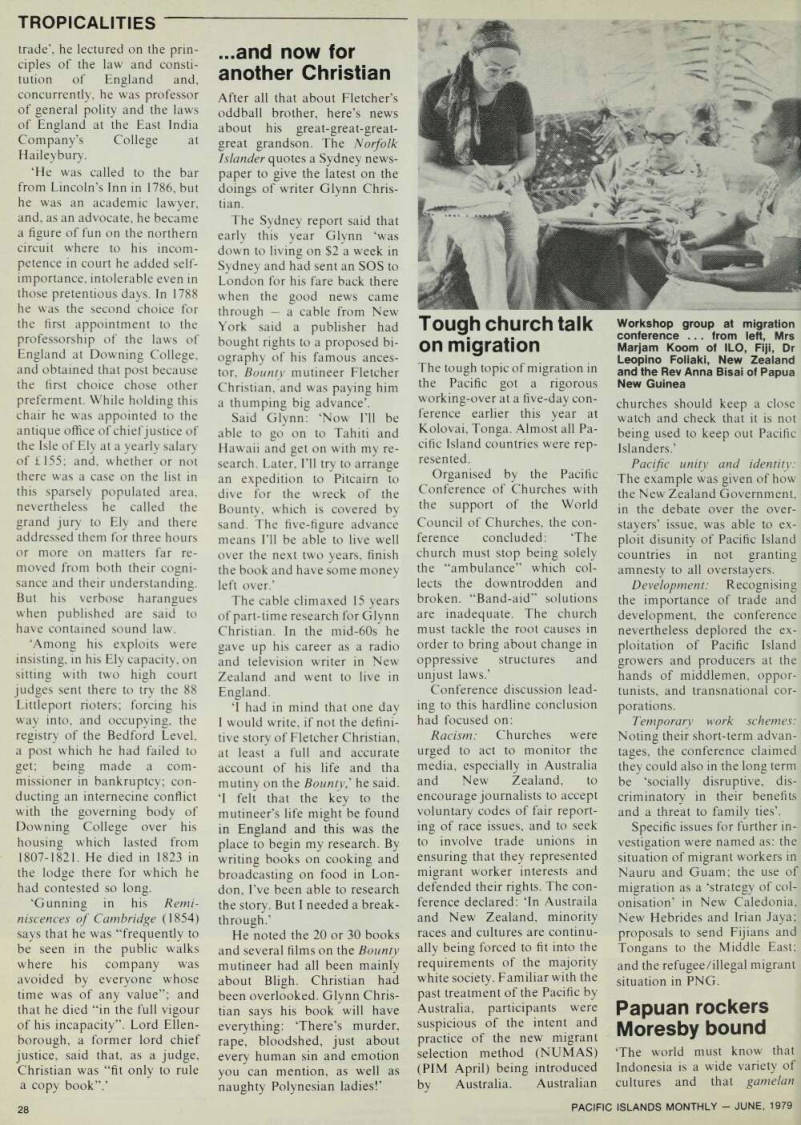
Workshop group at migration conference ... from left, Mrs Marjam Koom of ILO, Fiji, Dr Leopino Foliaki, New Zealand and the Rev Anna Bisai of Papua New Guinea