the ‘Bounty’
pp. 39-42 · Read in the full issue

Tropicalities
costs’ for the films which are estimated to be budgeted at around SNZSO million. From London a few days later came the report that Lean had can celled plans to film parts of the films in New Zealand.
Trouble with New Zealand’s taxmen is not the only problem that has bedevilled prep arations for the films. The de Laurentiis production company initiated the scheme for the two films but then backed down. It was at this point that United Artists ex pressed interest.
Just where the Bounty goes from here is not clear. But on the whole New Zealanders are a little saddened to miss out on the publicity, fame and job opportunities that would have come with the filming of many of the sequences in their country.
Meanwhile the $1.3 million replica of the Bounty rides ser enely at anchor at a Whan garei, a small settlement in the north of the North Island where it was built to exact specifications by a local firm.
Mara upsets
‘iat cats’
Fji’s Prime Minister, Ratu Sir Kamisese Mara, upset Suva based staff of the United Nations Development Pro gramme when he said the in clusion in aid programmes of highly paid consultants upset local salary structures and raised the cost of living in Fiji.
He suggested it might be poss ible for UNDP to fund aid pro jects, leaving Fiji itself to find the experts. Ratu Mara was speaking at a luncheon for visiting UNDP administrator, Bradford Morse.
Mr Morse, 58, a US lawyer and former congressman, said UNDP was ready to go along with Ratu Mara’s idea. It was already in effect elsewhere in the world. But he was guarded about criticism of Ratu Mara by UNDP staff. ‘l’m not div ine,’ he said. ‘I can’t say what their subjective attitudes are.’
Taxmen scuttle
the ‘Bounty’
Plans to base in New Zealand production operations for two films on the Bounty mutiny (PIM March) are all at sea, writes William Gasson from
Wellington. Oscar-winning
director David Lean’s plans to film much of the two-film epic in New Zealand ran aground on tax matters. He failed to convince. New Zealand’s beady-eyed taxmen to allow tax concessions for incoming technicians and actors.
The plans came unstuck when Lean and United Artists senior executive Lee Katz met government financial rep resentatives. Said Mr Katz after the morning-long session; ‘Our visit here had gone very well until today. But I had hoped the government would make tax concessions available within our assessment of the added costs involved in basing the project here.’ He declined to give any figures on ‘added
French Polynesia, wrote an open letter to French President
Giscard d’Estaing.
The text of the letter, which has appeared in the Paris daily Le Monde and the Swedish press, reads; ‘Mr President, We the undersigned, the first of whom is a French citizen and the sec ond a citizen of Sweden, and who are by profession anthro pologists, historians and writers, have for the past 30 years been permanent resi dents of French Polynesia. Our researches and publications on local culture and history, both ancient and modern, have always attracted keen interest and have frequently been praised by both individuals and institutions. In addition to our literary and scientific pur suits, the first signatory has
actively participated in local
politics and is at present a councillor in the municipality where we have our home. The second signatory was appointed honorary consul for Sweden in 1961. ‘Seventeen years later, at the
Danielssons
tell Giscard
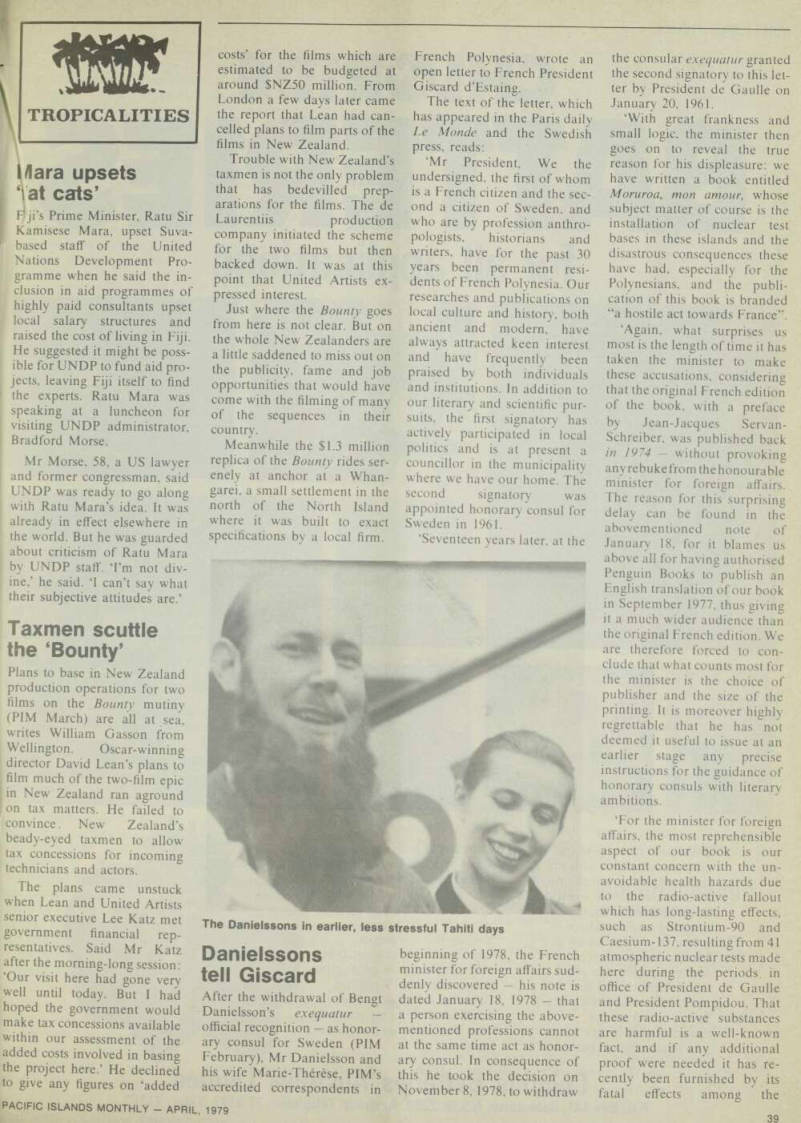
After the withdrawal of Bengt Danielsson’s exequatur official recognition as honor ary consul for Sweden (PIM February), Mr Danielsson and his wife Marie-Therese, PlM’s accredited correspondents in
beginning of 1978, the French minister for foreign affairs sud denly discovered his note is dated January 18, 1978 that a person exercising the above mentioned professions cannot at the same time act as honor ary consul. In consequence of this he took the decision on November 8, 1978, to withdraw
the consular exequatur granted the second signatory to this let ter by President de Gaulle on January 20, 1961. ‘With great frankness and small logic, the minister then goes on to reveal the true reason for his displeasure: we have written a book entitled Moruroa, mon amour, whose subject matter of course is the installation of nuclear test bases in these islands and the disastrous consequences these have had, especially for the
Polynesians, and the publi
cation of this book is branded “a hostile act towards France”.
‘Again, what surprises us
most is the length of time it has taken the minister to make these accusations, considering that the original French edition of the book, with a preface
by Jean-Jacques Servan-
Schreiber. was published back in 1974 without provoking anyrebukefromthehonourable minister for foreign affairs.
The reason for this surprising delay can be found in the abovementioned note of January 18, for it blames us above all for having authorised Penguin Books to publish an English translation of our book in September 1977, thus giving it a much wider audience than the original French edition. We are therefore forced to con clude that what counts most for the minister is the choice of publisher and the size of the printing. It is moreover highly regrettable that he has not deemed it useful to issue at an earlier stage any precise instructions for the guidance of
honorary consuls with literary
ambitions. ‘For the minister for foreign affairs, the most reprehensible aspect of our book is our constant concern with the un avoidable health hazards due to the radio-active fallout which has long-lasting effects, such as Strontium-90 and Caesium-137, resulting from 41 atmospheric nuclear tests made here during the periods in office of President de Gaulle and President Pompidou. That these radio-active substances are harmful is a well-known fact, and if any additional proof were needed it has re cently been furnished by its fatal effects among the
The Danielssons in earlier, less stressful Tahiti days
* islanders in Micronesia, re f cently discovered, as long as 25 years after the first nuclear tests although the most reputable experts had always sworn that there were no health hazards whatsoever. The quite precise questions asked by us in our I book about the radio-active I fallout and the contamination I of the islanders here in French I Polynesia call, in our opinion, I for a more adequate reply than the sanctions taken by the minister for foreign affairs. It will, furthermore, undoubtedly be taken by all the peoples of the Pacific as a confirmation of the fears that they have always held. ‘Let us only add here that our concern about the health hazards due to the tests in our islands is fully shared by such local political leaders as the late senator Pouvanaa a Oopa, ■ the present senator Daniel Millaud, the president of the territorial assembly John Teariki and the former deputy and present vice-president of the government council Fran cis Sanford. As a matter of fact we have simply echoed in our book statements and questions from these well-known leaders. ‘Their names also figure prominently in the chapters of our book dealing with the pol itical events in French Poly nesia, all closely linked with the nuclear test issue, whereas others deal with the long struggle for internal self government which has domin ated local politics since the last World War. Although most of the political leaders mentioned above have publicly testified to the truthfulness of our account, the French minister for foreign affairs now accuses us with out furnishing any proofs whatsoever of having “mis represented the significance of the recent administrative re forms in the territory”, and of
having “painted a black picture
of French policies in this part of the world”. ‘lf the only strictures decided by the minister had been the withdrawal of a consular exequatur, we could or would hardly have done more than express our surprise at such an unusual sanction. But it so hap pens that it was accompanied
by a thinly veiled threat to expel us from our adoptive country, where we have our home, where our son was born and where our daughter is buried - if we don’t shut up!
Coming from a country which honours free speech and which has traditionally given asylum to foreign writers persecuted in their home countries because of their dissident opinions, this threat seems particularly strange to us. ‘As a result of our writings, we have in the past often been shadowed by various agents of the French Thought Police ( Renseignements Generaux ), our office and home have been visited during our absence by specialists in electronic gadgetry, and several attempts have been made to blackmail friends into supplying infor mation tending to incriminate us. Such antics are of course unworthy of a democratic country such as France, but we have nevertheless occasionally found them quite amusing be cause of the clumsiness of these French agents, so easily spotted in the local, tropical environ ment. Charitably, we have also been inclined to ascribe these
spying activities, occurring
long after your welcome civil liberties programme was implemented in France, to the usual delays which occur in the French overseas territories after new reforms are promul gated in France. ‘The recent sanction and threat, however, emanated from one of your ministers.
This is the reason why we are attempting by the present letter to draw your attention to this distressing affair which, we are sure, you know nothing about,
considering its insignificance in
the French national context.
We consider moreover that there is an additional justifi cation for writing directly to the holder of the highest office in the country, and that is the simple fact that the consular exequatur which has just been withdrawn was originally granted and signed by a previous president of the republic. ‘We remain. Respectfully yours, Marie-Therese Daniels son, Benet Danielsson.’
The Tami tr2d&
canoe revived
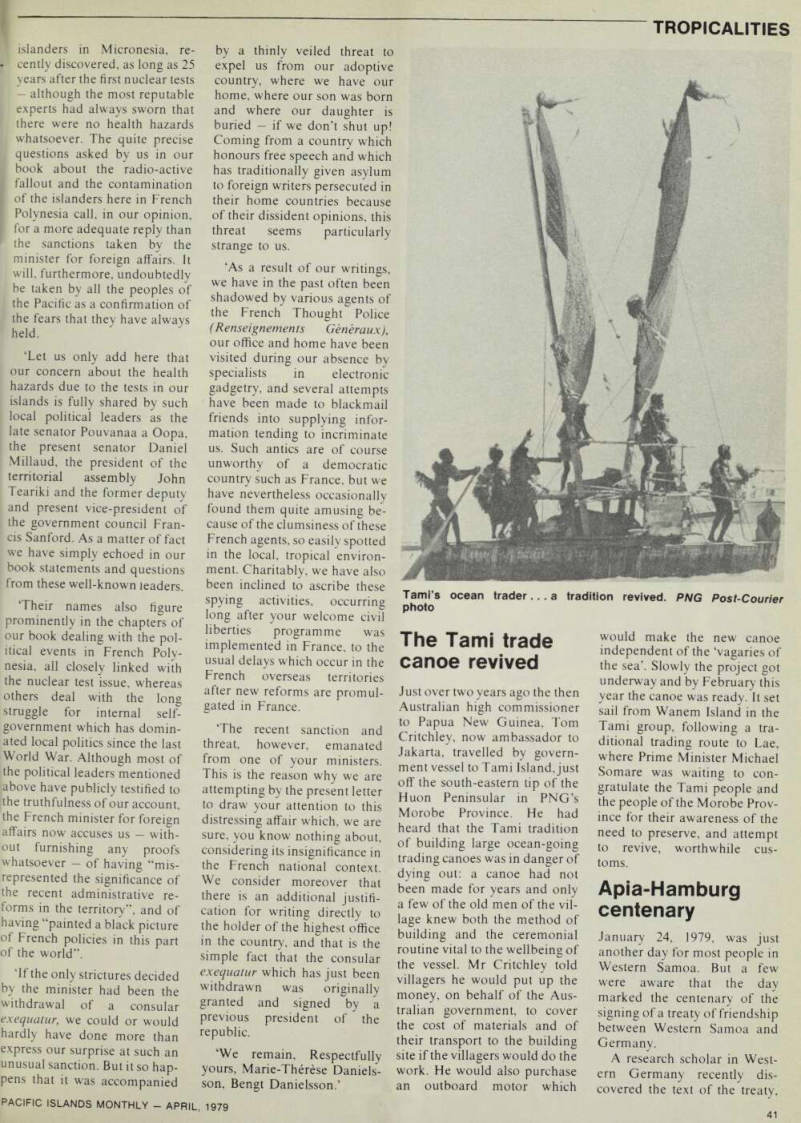
Just over two years ago the then Australian high commissioner to Papua New Guinea, Tom Cntchley, now ambassador to Jakarta, travelled by government vessel to Tami Island, just off the south-eastern tip of the Huon Peninsular in PNG’s Morobe Province. He had heard that the Tami tradition
of building large ocean-going
trading canoes was in danger of dying out: a canoe had not been made for years and only a few of the old men of the village knew both the method of building and the ceremonial routine vital to the wellbeing of the vessel. Mr Critchley told villagers he would put up the money, on behalf of the Australian government, to cover the cost of materials and of their transport to the building site if the villagers would do the work. He would also purchase an outboard motor which
would make the new canoe independent of the ‘vagaries of the sea’. Slowly the project got
underway and by February this
yea r the canoe was ready. It set sai i from Wanem Island in the Tami group following a tra ditional trading route to Lae where Prime Minister Michael Somare was waiting to con gratulate the Tami people and the people of the Morobe Prov ince for their awareness of the nee d to preserve, and attempt t o revive, worthwhile cus toms
Apia-Hamburg
rpnfpnprv * January 24, 1979, was just another day for most people in Western Samoa. But a few were aware that the day marked the centenary of the signing of a treaty of friendship between Western Samoa and
Germany,
A research scholar in West
ern Germany recently dis
covered the text of the treaty.
Tami’s ocean trader... a tradition revived. PNG Post-Courier photo
in German and Samoan. It was
signed by four gentlemen; von
Werner and Weber for Ger many, and Tuia Lemana and Meisake for Samoa.
According to the Western
Samoa prime minister’s department, the treaty is not valid in today’s circumstances, but ‘represented a stage in Western Samoa’s develop ment’. The long-standing Ger
man influence in Western Samoa is still reflected in special agreements between the two countries on ‘economic co-operation’ the West Ger* man expression for aid to
under-developed countries.
Hayo Breckwoldt, who is Western Samoa’s honorary consul in Hamburg and whose family name has been well known m Pacific trading circles for many decades, sent a special message to Prime Minister Tupuola Efi on the
anniversary. The national flag
of Western Samoa was flown from the flagpole of Brewo House. Hamburg, for the first time since the consulate was established there.
W. Samoa goes
11l Dig OH games
The Western Samoa Sports Federation is planning a kingsize effort in the August South Pacific Games in Fiji, writes Judie Teall from Apia. By sending a team of more than 200 at a cost of SWS9O 000 the federation hopes to expose as many people as possible to the
organisation and regulation of
the games in preparation for the 1981 games, to be hosted by Western Samoa at Apia Park.
The 200 include hockey, rugby, soccer and cricket teams. New grandstands are already under construction at the park. Plans also include a swimming
pool.
Gov. Coleman’s
‘come home’ call
The Governor of American Samoa, Peter Tali Coleman, hopes to encourage some of the territory’s 32 000 Samoans now living in Hawaii to come back to Samoa to work. For this pur pose American Samoa is set ting up a liaison office in Hawaii to serve as a recruit ment and information centre.
The figures show that more than 20 per cent of the Samoans in Hawaii between 20-25 years of age are unem ployed. The Governor says a similar office in California may be established if the American Samoa legislature is satisfied with the accomplishments of the office in Honolulu.
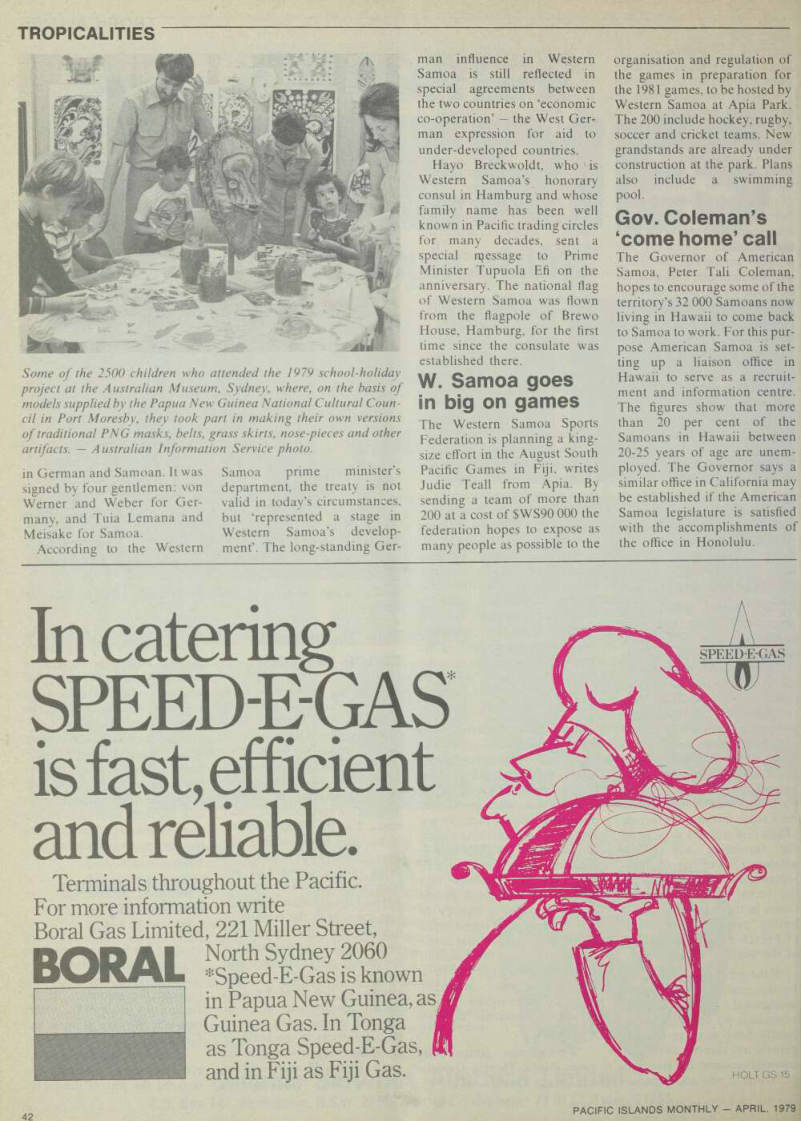
Some of the 2500 children who attended the 1979 school-holiday project at the Australian Museum, Sydney, where, on the basis of models supplied by the Papua New Guinea National Cultural Coun cil in Port Moresby, they took part in making their own versions of traditional PNG masks, belts, grass skirts, nose-pieces and other artifacts. Australian Information Service photo.