Advertisements & other items, pp. 1-3 (2 items)
HbeSi
PACIFIC ISLANDS MONTHLY PIM
APRIL 1979
Amarican Smni USJ1.25
Australia AS1.00'
nji fji.oo HiwiiL US J 1.50 New Cel. A Fr. Psi.CFP 140 New Hebrides AS100 N2. Cook Is. A NiueNZS 1 00 Norfolk IsJsad AS 1.00 Pipes New Bailee KI.OO Solomons SSI.00
To*i* P1.00
USH A Gum US$1.25
Western Sums II 00 • RKommondod rata4 pnca only.
Raginarad for posting as a publication -Catatpory B.
r§j j Fal *i ■ I ■ mj rfl ■Tyipsni : iMro^rrl 1 ] HbeSi
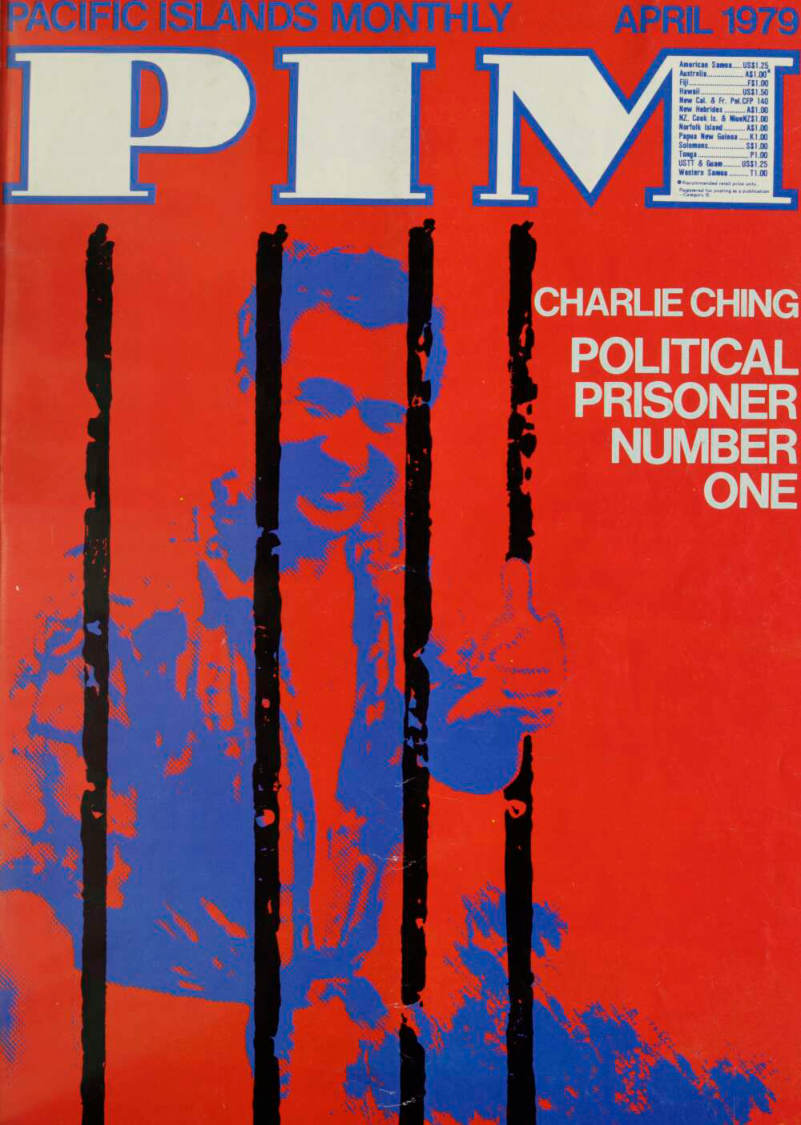
Cover: From a Bengt Danielsson photograph of French Polynesia's political prisoner Charlie Ching.
Toyota
How to find a REAL economy car.
When you look at a car billed as an economy
model, ask yourself a few questions.
What sort of fuel consumption can be expected?
Low? Good.
What about other operating costs? Oil, lubrication, that kind of thing. Low again? Great.
How about maintenance? The car has a low-breakdown record? You are definitely on the right track.
What is the average life of the car? Is it better than the average in your area? Super. That’s important in an economy car.
Now. How is the after service? Buying a car is not all in the price you know. Plenty of service outlets?
One economy car coming up. All you have to do is check the price. Then you can tell if you are really getting an economy car.
You will probably find, after asking these questions about town, that REAL economy cars come down to Toyota, the world’s economy car builder.
See Toyota first. Then you won’t have to shop around.
1HE HAPPY ECONOMIZER
TOYOTA STARLET
The car that says economy in every way.
And you will be happy for it. Big inside.
Small outside. Miserly with petrol.
Without sacrificing comfort. A good buy in an economy car — even for Toyota. fi u
PAPUA NEW GUINEA:
ELA MOTORS LIMITED,
Scratchley Rd., Badili, P.O. Box 75, Port Moresby.
U.S. TRUST
TERRITORY; MICROL
CORPORATION,
P.O. Box 267, Saipan.
FIJI ISLANDS:
AUTOMOTIVE
SUPPLIES CO., LTD.,
G.P.O. Box 355, Suva.
AMERICAN SAMOA:
BURNS PHILP
(SOUTHSEA) CO., LTD.,
P.O. 1057, Pago Pago.
WESTERN SAMOA:
BURNS PHILP
(SOUTHSEA) LTD.,
P.O. Box 188, Apia.
GUAM: ATKINS, KROLL
(GUAM) LTD., P.O. Box
6248, Tamuning.
NEW HEBRIDES;
NEW HEBRIDES
MOTORS LTD.,
P.O. Box 18, Vila.
SOLOMON ISLANDS:
MENDANA
TOYOTA
SERVICE
TOYOTA
ENTERPRISES (S.l.)
LTD., P.O. Box 174,
Honiara.
TAHITI: NIPPON
AUTOMOTO, B.P. 342,
Papeete.
COOK ISLANDS:
COOK ISLANDS
TRADING
CORPORATION LTD.,
P.O. Box 92, Rarotonga.
NAURU ISLAND:
NAURU COOPERATIVE
SOCIETY.
GILBERT ISLANDS:
TARAWA MOTORS,
Box 36, Bairiki Tarawa.
NORFOLK ISLAND:
MOUNT PITT
(ENTERPRISES) LTD.,
P.O. Box 169
NEW CALEDONIA:
SOCIETE
IMPORTATION
AUTOMOBILE DE
PACIFIQUE,
Rond-Point du Pacific (Station Total) B.P. 438, Noumea.
The Toyota range includes; Toyota 1000, Toyota Starlet, Toyota Corolla, Toyota Celica, Toyota Corona, Toyota Cressida, Toyota Crown
Epoko
Pacific Islands Monthly
Voi. 50 No. 4
April 1979
(Usps 952480)
Elsewhere: SAI6 Payment by personal cheque is accepted in Australian, US, New Zealand, UK and Fiji currency. For other remit tances please obtain a bank draft in Australian dollars made payable to the ANZ Banking Group, 88 Wentworth Avenue, Sydney, Australia.
Representatives
AUSTRALIA: Distribution: NSW & ACT: Allan Rodney Wright (Circulation) Pty Ltd, PO Box 907, Darlinghurst, NSW 2010; Elsewhere: Gordon & Gotch (A/asia) Ltd, Box 40, PO, Rosebery, NSW 2018 Advertising - Melbourne - Pacific Publications (Aust.) Pty Ltd, sth Floor, Alley Building, 75-77 Flinders Lane, Melbourne 3000, tele phone 63-0211, ext. 1565 Jeff Gates, ext. 1858 Ida Pad gett; Brisbane D. Wood, Anday Agency, Box 1918, GPO, Brisbane 4001, telephone 44 3485, 44 1546; Adelaide - Hastwell Media, 233 Glen Osmond Rd, Frew ville, SA 5063, telephone 79 1869, 79 5956; cables Hast medla, Adelaide.
FIJI: Distribution and subscriptions - Desai Bookshops PO Box 160, Suva, Fiji, telephone Suva 23036. Advertis ing - Fiji Times & Herald Ltd. 20 Gordon St, Suva tele phone 312 111, telex FJ2124.
FRENCH POLYNESIA: Distribution - Hachette Pacifique, 10 Ave Bruat, Papeete, telephone 2 5610 HAWAII, UNITED STATES: Distribution PIM, Hawaii 2812 Kahawai St, Honolulu. Hawaii 96822.
JAPAN: Advertising and subscriptions Universal Media Corporation, -CPO Box 46, Tokyo, telephone 666 3036.
NEW CALEDONIA: Distribution Depot Centre de Presse Michel Pentecost, CBP2, Noumea, telephone 27 2434, 27 4729, NEW ZEALAND: Distribution Gordon & Gotch PO Box 584, 2 Carr Road, Mt. Roskill, Auckland 4 Advertising - International Media Representatives Ltd, PO Box 2313 Auckland, telephone 795 487; 493 389, cables Intereps, Auckland Subscriptions Ross Haines & Son Ltd, PO Box 1289, Auckland, telephone 769 042, PAPUA NEW GUINEA: Distribution Robert Brown & Assoc , PO Box 3395, Port Moresby, telephone 2 5855 Advertising - PNG Post-Courier, PO Box 85 Port Moresby, telephone 212577.
UNITED KINGDOM: The Herald & Weekly Times Ltd, 8-10 Clifford s Inn. Fetter Lane, London EC4A IBU, telephone 01 831 6041, telex London 21989.
UNITED STATES MAINLAND: Advertising Joshua B Powers Jr, Powers International Inc., 551 Fifth Ave New York, New York 100 017, telephone 867 9580, telex 236514 Subscriptions - PIM, Hawaii, 2812 Kahawai St Honolulu, Hawaii 96822.
Published monthly by Pacific Publications (Aust.) Pty Ltd and printed in Australia by Paramac, Alexandria, NSW Australian cover price is recommended retail only. Regis tered at the GPO Sydney for transmission by post as a publication category B. Second class postage paid at Honolulu, Hawaii. Copyright © 1978 Pacific Publications
(Aust.) Pty Ltd.
Postmaster Honolulu: Send address changes to PIM Hawaii, 2812 Kahawai St Honolulu, Hawaii 96822.
Subscriptions
PIM is airfreighted to most subscribers and agents in the Pacific Islands and the United States.
Aust.
Other American Samoa $13 $US16 Australia $12 Canada $14 $US18 Cook Islands $13 Fiji $12 $F12 French Polynesia $14
Cfp 1700
Guam $13 $US16 Gilbert Islands $13 Hawaii $13 $US16 Japan $16 Y4500 Micronesia $13 $US16 Nauru $13 New Caledonia $14
Cfp 1700
New Hebrides $13 New Zealand $12 $NZ13.50 Niue $13 Norfolk Island $12 Northern Marianas $13 $US16 Papua New Guinea $13 K12 Solomon Islands $13 Tonga $13 Tuvalu $13 United Kingdom $15 £10 US Mainland $14 $US18 Western Samoa $13
This Month
• Political trial in Tahiti Six men gaoled, but de fence lawyers from Paris turn the case into something the like of which Papeete has never seen before . 9 • Art Artist Bobby Holcomb tells what he tries to do in his paintings, and why he chooses to live in French Polynesia rather than his native Hawaii .. 12 • Cook Islands More excerpts from a new book tell ing the colourful tale of the reign of the now fallen House of Henry 14 • US and the Pacific A US Senate committee hear ing shows that Uncle Sam hasn’t yet got his act together on future relations with Pacific Island coun tries 17 • Banaba —Banabans ‘invade’ their homeland, Ocean Island, and argue their case for ownership with petrol bombs 22 • New Hebrides Despite deep misgivings on the ‘moderate’ side of politics, the new government of national unity holds together and the painful progress to independence goes on 27 • New Caledonia A thesis by an Australian history student on an episode in New Caledonian history sparks controversy in Noumea 35 • Fiji Ratu Sir Kamisese Mara is characteristically outspoken on the high salaries paid to United Nations experts in his country, and puts a possible solution to visiting UN tall poppy Bradford Morse 39 • Aviation A close look at the dilemma facing Pacific regional airlines in the wake of the low fare revolution 49 • PNG investment Foreign investors are welcome in Papua New Guinea, but not if they’re only after ‘a fast buck or kina’ 55
Afterthoughts 29
American Samoa 42, 57 Art 12 Australia 24, 25 Aviation 49 Books 45 Banaba 22 Colonialism 9 Cook Islands 14, 25 Deaths 67 Fill 39 Hawaii 48 Indonesia 25 Islands Press 21 Letters 4 New Caledonia 35
New Hebrides 27 New Zealand 24, 25, 39 Pacific Report 7 Papua New Guinea 25, 29, 41, 45, 46, 55 People 32 Philately 63 Shipping 69 Solomon Islands 22 Tahiti 9, 12, 39 The Region 17, 24, 49 Tourism 49 Tradewlnds 49 United States 17, 24, 25 Western Samoa 25, 41, 42 Yachts 65 Yesterday 35
Bobby Holcomb... Neo- Polynesian art in Tahiti
John Kaputin... guide lines for investors in PNG.
Advertisements & other items, p. 3 (1 item)
Pacific Islands Monthly - April, 1979
Founded 1930 by R. W. Robson Publisher Stuart Inder Editor Bob Hawkins Editorial Adviser John Carter Manager John Berry Advertising Steve Gray, Peter Bedwell A Pacific Publications production 76 Clarence Street, Sydney 2000 GPO Box 3408 Sydney 2001 Cables: PACPUB Sydney Telex: Pacpub 21242 Telephone: Sydney 29 6693
Letters
Simple questions
for US
My questions may be very simplistic and naive but never theless have bothered me for some time. As a member of the Micronesian community for four years and also a US citi zen, I feel the right to ask them of the US and particularly the Department of Interior.
Was the ‘trust’ of Micronesia in the hands of the US under the United Nations to guide and assist them from the end of World War II to economic and
political self-determination?
If so, why is it that the US
has been continually increasing
economic aid, social welfare programmes particularly, with no apparent concern for the lack of tangible economic
development until the begin
ning of the issue of transition and termination of that ‘trust’?
Why has the US built up a bureaucratic monster that em ploys 61% of the employed in Micronesia and then under taken a fiscal restraint and budget cut programme two years prior to the opening rounds of status talks with
these peoples?
Why does the ‘free feeding’ programme, so generously volunteered by the US, sud denly have a price tag of SUSI 7 million?
Why was it initiated in the
first place without explanation
that it was a welfare pro gramme only as long as the
people stayed politically
dependent upon the US, or they would have to pay for it out of their own funds?
Does the US feel any re sponsibility for the divisive re percussions of the withdrawal of the programme, or the ‘strings’ now attached, among the Micronesian people toward their leaders who have opposed it?
How well have we handled our ‘trust’ if the peoples of
Micronesia are economically crippled and must seek foreign investment after termination of the trusteeship to begin econ
omic self-sufficiency?
How politically developed
are these people if the leaders’ credibility and wisdom are
being challenged by their own
who have no idea of the state of their economy and blame their leaders for the withdrawal of the US ‘generosity’?
I feel the people of America do believe in human rights and are moral and people of con science. The actions of our Department of Interior and the US Congress are another mat ter. A person responds from the heart. A politician or bureau crat is sensitive to votes and
public opinion.
Ask the average American where Micronesia is and he’ll say: ‘Mike who?’ I pray for Micronesia and her people. I pray for America.
Saipan Northern Marianas
Jon D. Kawika
A man before
his time
Re the article on Ratu Sir Lala Sukuna which I submitted last year and which was published in PIM January.
Recently I have been work ing in the Fiji National Ar chives in Suva. While working through the Methodist collec tion I came across a file con
taining the same speech given
by Ratu Sukuna to the Defence Club but the date was 1934.
Mention is made to 60 years of British rule. As Fiji ceded to Britain in 1874, this would mean the paper was delivered in 1934 which makes it an even more interesting state ment.
Camberwell Victoria Australia
Ken James
A good point, Percy
Percy Chatterton is to be con gratulated for his criticism of
the condom-pushing campaign
in Papua New Guinea (PIM February). He has said what many other people are think
ing.
There is one other aspect which has not been discussed
publicly. The condoms being
sold by Family Planning As
sociation pedlars in PNG are, I assure you, uncomfortable and very difficult to use. There must by now have been many
pregnancies directly attribu
table to this FPA campaign. I wonder whether members of the FPA executive have tried
using the wretched things
themselves?
This misguided FPA cam paign has surely set back the cause of birth control by many years in PNG. The public has now come to associate birth control with the selling of third rate condoms by self-interested
pedlars.
Upng
Papua New Guinea
T.E.S.
No ‘lapse of taste’
My attention has been drawn to your comments on the report in Nabanga of my farewell interview with Jean Massias and Mr Laffont (PIM
January).
In fairness to them and
Nabanga they should be
acquitted of any ‘lapse of taste’ on their part. The quotation in their report of what, to a Frenchman reading my French, might have been taken as a rather colourful and amus
ing Anglicism, was certainly
with affectionate rather than any malicious intent.
Equally certainly, I took no offence, where none was intended very much the re verse in fact. Nor should you.
Callow
J. S. Champion
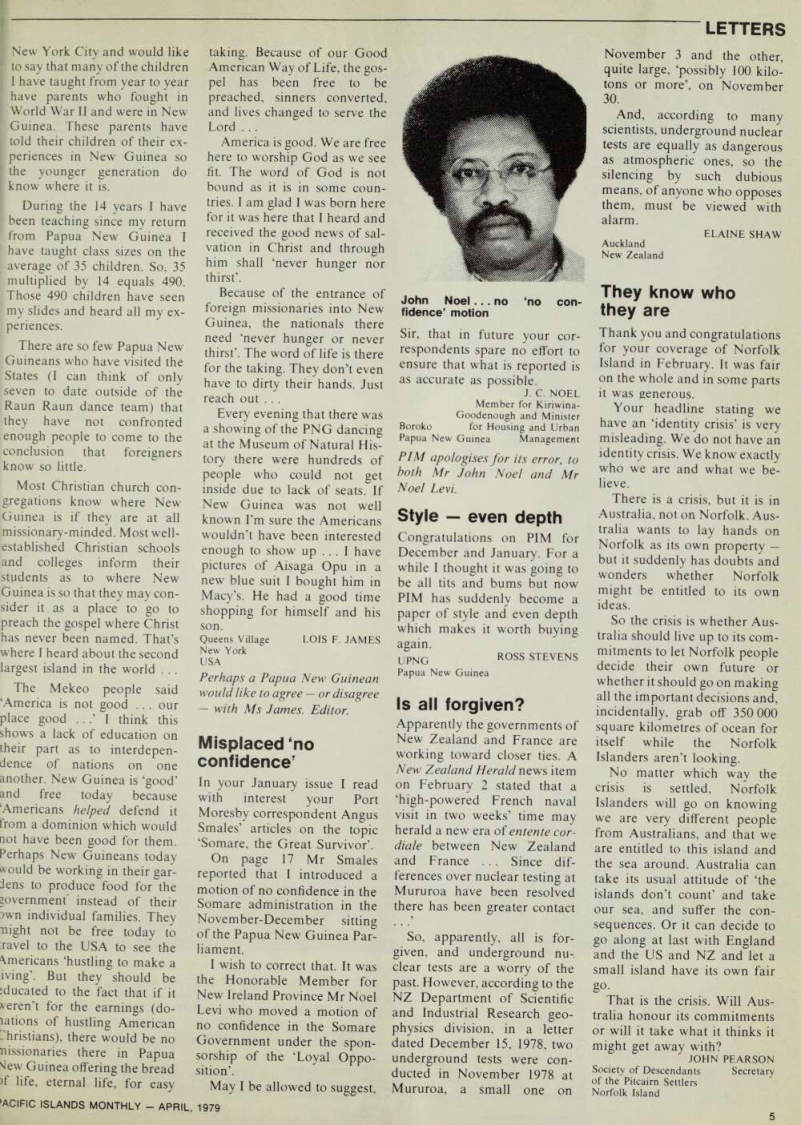
Hereford ( latel y British England Resident Commissioner in the New Hebrides) PIM is relieved that Mr Cham pion was not offended and that he took the matter in the spirit in which Mr Massias says it was intended.
PNG the lucky
country?
I read your Tropicalities item about the three Mekeo men back from the United States (PIM January). I met all the nationals who were in the PNG dance group while they were here in New York City. It was good to talk with them, some in Pidgin, others in Motu. I was a missionary in New Guinea in the 1950 s and early 19605. I love New Guinea, both the people and the land.
Andy Supeke says; ‘As usual these people ... discovered, as do so many Papua New Guineans, that foreigners know so little about their country not even where it is.’
I am a school teacher here in
John Champion... no offence taken
I New York City and would like * to say that many of the children I have taught from year to year [ have parents who fought in [ World War II and were in New r Guinea. These parents have [ told their children of their ex periences in New Guinea so the younger generation do know where it is.
During the 14 years I have been teaching since my return from Papua New Guinea I have taught class sizes on the average of 35 children. So, 35
multiplied by 14 equals 490.
Those 490 children have seen my slides and heard all my ex periences.
There are so few Papua New Guineans who have visited the States (I can think of only seven to date outside of the Raun Raun dance team) that they have not confronted enough people to come to the conclusion that foreigners know so little.
Most Christian church con gregations know where New Guinea is if they are at all missionary-minded. Most well established Christian schools and colleges inform their students as to where New Guinea is so that they may con sider it as a place to go to preach the gospel where Christ has never been named. That’s where I heard about the second largest island in the world .. .
The Mekeo people said ‘America is not good .. . our place good ...’ I think this shows a lack of education on their part as to interdepen dence of nations on one another. New Guinea is ‘good’
and free today because
Americans helped defend it
from a dominion which would not have been good for them.
Perhaps New Guineans today
would be working in their gar dens to produce food for the government instead of their
awn individual families. They
night not be free today to ravel to the USA to see the \mericans ‘hustling to make a iving’. But they should be educated to the fact that if it veren’t for the earnings (de
lations of hustling American
Christians), there would be no
nissionaries there in Papua
'Jew Guinea offering the bread )f life, eternal life, for easy
taking. Because of our Good American Way of Life, the gos pel has been free to be preached, sinners converted, and lives changed to serve the Lord . . .
America is good. We are free here to worship God as we see fit. The word of God is not bound as it is in some coun tries. I am glad I was born here for it was here that I heard and received the good news of sal vation in Christ and through him shall ‘never hunger nor thirst’.
Because of the entrance of foreign missionaries into New Guinea, the nationals there need ‘never hunger or never thirst’. The word of life is there for the taking. They don’t even have to dirty their hands. Just reach out .. .
Every evening that there was a showing of the PNG dancing at the Museum of Natural His tory there were hundreds of people who could not get inside due to lack of seats. If New Guinea was not well known I’m sure the Americans wouldn’t have been interested enough to show up ... I have
pictures of Aisaga Opu in a
new blue suit I bought him in Macy’s. He had a good time shopping for himself and his
son.
Queens Village
New York
Usa
Lois F. James
Perhaps a Papua New Guinean would like to agree or disagree with Ms James. Editor.
Misplaced ‘no
confidence 7
In your January issue I read with interest your Port Moresby correspondent Angus Smales’ articles on the topic ‘Somare, the Great Survivor’.
On page 17 Mr Smales reported that I introduced a motion of no confidence in the Somare administration in the
November-December sitting
of the Papua New Guinea Par liament.
I wish to correct that. It was the Honorable Member for New Ireland Province Mr Noel Levi who moved a motion of no confidence in the Somare Government under the spon sorship of the ‘Loyal Oppo sition’.
May I be allowed to suggest,
Sir, that in future your cor respondents spare no effort to ensure that what is reported is as accurate as possible.
J. C. Noel
Member for Kiriwina- Goodenough and Minister Boroko for Housing and Urban Papua New Guinea Management PIM apologises for its error, to both Mr John Noel and Mr Noel Levi.
Style even depth
Congratulations on PIM for December and January. For a while I thought it was going to be all tits and bums but now PIM has suddenly become a paper of style and even depth which makes it worth buying
again.
Upng
Papua New Guinea
Ross Stevens
Is all forgiven?
Apparently the governments of New Zealand and France are working toward closer ties. A New Zealand Herald news item on February 2 stated that a ‘high-powered French naval visit in two weeks’ time may herald a new era of entente cor diale between New Zealand and France . .. Since dif ferences over nuclear testing at Mururoa have been resolved there has been greater contact 9 So, apparently, all is for
given, and underground nu
clear tests are a worry of the past. However, according to the NZ Department of Scientific and Industrial Research geo physics division, in a letter dated December 15, 1978, two underground tests were con ducted in November 1978 at Mururoa, a small one on
November 3 and the other, quite large, ‘possibly 100 kilo tons or more’, on November 30.
And, according to many scientists, underground nuclear tests are equally as dangerous as atmospheric ones, so the
silencing by such dubious
means, of anyone who opposes them, must be viewed with alarm.
Elaine Shaw
Auckland New Zealand
They know who
they are
Thank you and congratulations for your coverage of Norfolk Island in February. It was fair on the whole and in some parts it was generous.
Your headline stating we have an ‘identity crisis’ is very misleading. We do not have an identity crisis. We know exactly who we are and what we be lieve.
There is a crisis, but it is in Australia, not on Norfolk. Aus tralia wants to lay hands on Norfolk as its own property but it suddenly has doubts and wonders whether Norfolk might be entitled to its own ideas.
So the crisis is whether Aus tralia should live up to its com mitments to let Norfolk people decide their own future or whether it should go on making all the important decisions and, incidentally, grab off 350 000 square kilometres of ocean for itself while the Norfolk Islanders aren’t looking.
No matter which way the crisis is settled, Norfolk Islanders will go on knowing we are very different people from Australians, and that we are entitled to this island and the sea around. Australia can take its usual attitude of ‘the islands don’t count’ and take our sea, and suffer the con sequences. Or it can decide to go along at last with England and the US and NZ and let a small island have its own fair g°- That is the crisis. Will Aus tralia honour its commitments or will it take what it thinks it might get away with?
John Pearson
Society of Descendants Secretary of the Pitcairn Settlers Norfolk Island
John Noel... no ‘no con fidence’ motion
Advertisements & other items, pp. 5-6 (2 items)
Letters
5
'ACIFIC ISLANDS MONTHLY APRIL, 1979
Akai
World Command Performance
Yours to command ... the best of music from all round the world.
Discs, cassettes, or ultrahigh-quality open-reel tapes.
FM/AM stereo broadcasts, or the fun of making your own superb recordings.
AKAFs top-of-the-line audio products make them authentically yours, for enjoyment limited only by the horizons
of your taste.
*■ o H ■ , ■■ ' ■ ■ . - - n ;
BOii
an ...
AA-1175 • SW-187 • GX-650D • AP-307 #GXCS7ODII Stereo receiver (75W/ch RMS, 8H) 3-Way speaker system Open reel tape deck Direct drive quartz lock turntable 3-Head 3-motor cassette der
\udio & Video
AKAI
KKM ELECTRIC CO., LTD.
okyo, japan
P.N.G.
S.O. Svensson (N.G.) Ltd.
P.O. Box 705, Port Moresby Tel; 2275 Fiji Islands Motibhai £t company Ltd.
P.O. Box 9175, Nadi International Airport Tel: 72-165 New Zealand Pye Ltd., Consumer Products Sector 110 Mt. Eden Rd., Mt. Eden, Auckland Tel: 686-437 New Caledonia Menard Pacifique s.a.r.l.
B.P. H 2, Noumea Tel: 275222 Tahiti Etablissements Comimpex o n onn t q i- 9fM77 New Hebrides (Islands) Burns Philp (New Hebrides) Co., Ltd.
P.O. Box 27, Port Vila, New Hebrides Islands Norfolk Island Burns Philp (Norfolk Island) Co., Ltd.
P.O. Box 21, Norfolk Island Samoa Islands Burns Philp (South Sea) Co., Ltd.
P.O. Box 129, Pago Pago, American Samoa Mariana Islands J.C. Tenorio Enterprises P.O. Box 137, Saipan Tel: 6444/8 Solomon Islands Security Electrical Co., Ltd.
P.O. Box 174, Honiara Tel: 881 Cook Islands JPS Enterprises Ltd.
P n Rnv 1R Rarntnnna Tpl - 91R0 2176 For more information, please send this coupon to our distributor in your country or to AKAI ELECTRIC CO., LT 12-14, 2-Chome, Higashi-Kojiya, Ohta-ku, Tokyo, Japan Name Address
PIM-
Pacific Report
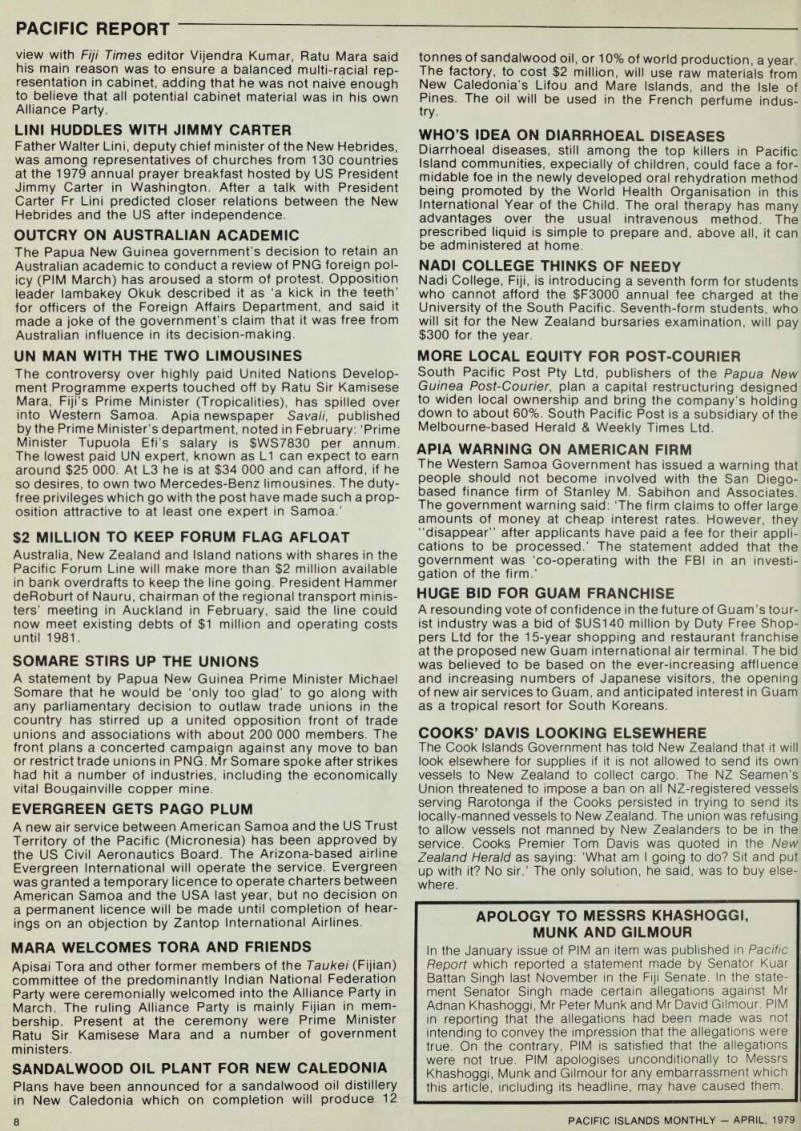
Chinese Vice-Premier Gives Png A Miss
‘Pressure of business’ arising from the invasion of Vietnam was probably behind the cancellation of the planned March Pacific tour by Chinese Vice-premier Geng Biao. Vice premier Geng has a reputation as an international trouble shooter. But Zhen Muhua, a more junior vice-premier, stood in for him so the various hosts would not be too disappointed.
She was to visit Australia, New Zealand, Fiji and Western Samoa. A curious feature of the itinerary was the absence - from it of Papua New Guinea, largest of the Pacific nations.
The official PNG Newsletter had announced on January 19 that Vice-premier Geng would be spending seven days in PNG in the course of his March tour. The idea of exchange visits between PNG and Chinese leaders went into operation in late 1976 with a visit to China by PNG Prime Minister Michael Somare himself. Mrs Zhen has not the seniority of a prime minister, or of Vice-premier Geng, and in view of the fact that PNG is currently reviewing its whole foreign policy with particular reference to China and Russia (neither of which is at present represented diplomatically in PNG), Mrs Zhen’s omission of PNG from her swing through the Pacific is seen by PNG foreign affairs officials as having all the hall marks of that inscrutable oriental tact which might be expected of her.
New Caledonia’S ‘Contract’ With France
After a bumpy passage, New Caledonia’s council of govern ment in February approved the French Government’s plan for a 10-year contract between France and the territory. It provides for an economic reorganisation of the territory, with emphasis on the economic, social and cultural promotion of its Melanesian and Polynesian inhabitants.
Banabans Say No Again - Loudly
More than 1000 Banabans at a March meeting on Fiji’s Rabi Island angrily rejected new British proposals to meet their demand for separation from the Gilbert Islands (to be known as Kiribati after independence in July). British Under secretary of State for Foreign and Commonwealth Affairs Evan Luard was shouted down as he put the proposals, which fell short of Banaban claims for complete separation Meanwhile, the Banaban cause has won expressions of sup port from the World Federation of Trade Unions, headquar tered in Prague, Czechoslovakia.
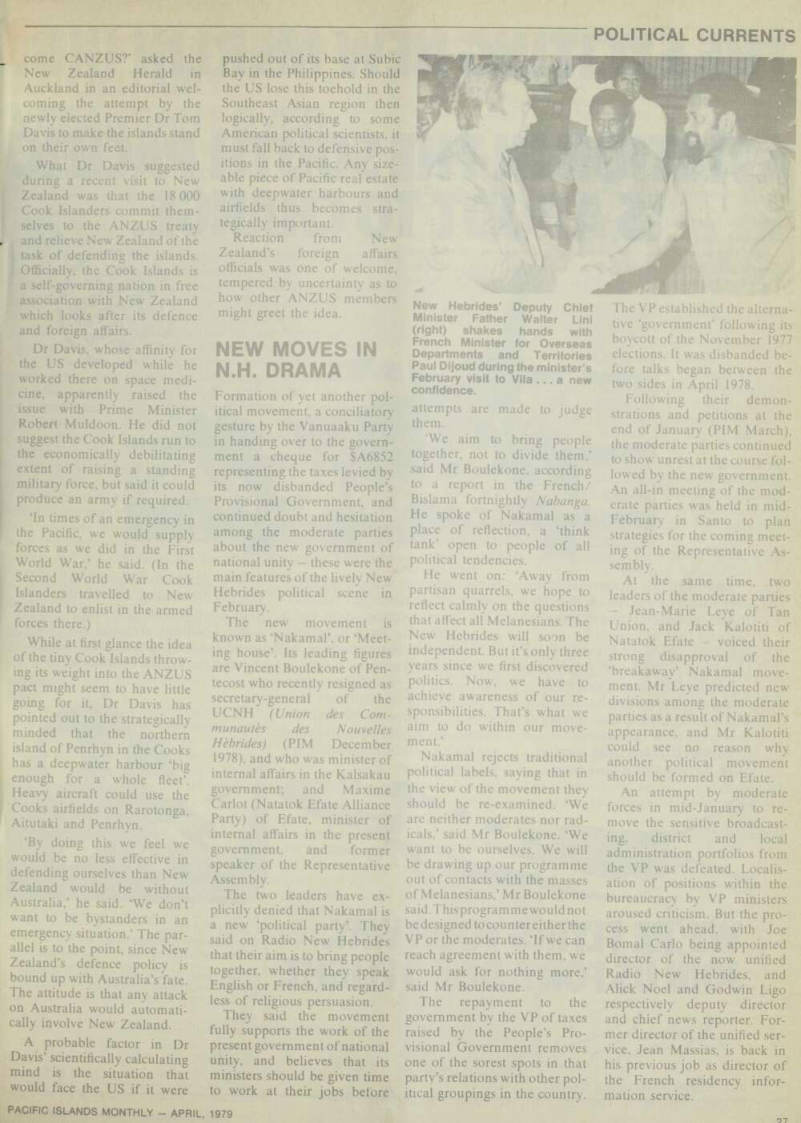
TOP BRASS BEAT PATH TO NEW HEBRIDES After many decades of ‘benign neglect’ by the condominial powers, the New Hebrides is now a Mecca for a succession of s ©n' or British and French officials. February saw visits by Sir Michael Palliser, permanent Under-secretary of State in the Foreign and Commonwealth Office and head of the diplo matic service of that office, and of French Secretary of State m ° verseas De P ar tments and Territories Paul Dijoud It was Mr Dijoud’s second visit in six months. He is expected back yet again in May. With Lord Goronwy-Roberts, British minis ♦ r i )f A ? tate for forei 9 n and commonwealth affairs, he will study the proposed New Hebrides constitution which, if ap proved at a referendum, will form the basis for election’s. The elected government will then decide on a date for indepen dence in 1980. H
Tuvalu Signs With Uncle Sam
Under a recent treaty of friendship between the United States and Tuvalu, the US has dropped its claims to four of the country s nine islands - Funafuti, Nukufetau, Nukulaelae and Niualakita. The treaty provides for consultations between the two parties on security and marine resource matters, waters near Tuvalu are an important fishing ground for US and other foreign fishermen.
Polynesia’S Problem As Seen By Paris
France’s High Commissioner in French Polynesia, Paul
Cousseran, said in an interview with the newspaper Depeche de Tahiti: ‘One can be intellectually for the CEP (Centre d'Ex perimentations du Pacifique, the French nuclear test agency), or one can be intellectually against it. But the fact is that this country lives off it. Three thousand two hundred families do so quite directly, not counting Polynesian military personnel. Above all, thousands of families live off it indirectly,’ Mr Cousseran added: ‘I have said before and I repeat: independence is not the problem faced by this country. On the contrary, its problem is its depend ence . . . Polynesia’s problem is that it does not produce what it consumes, it does not produce the money necessary to pay for what it consumes, so someone must always be found to pay in its stead.’
MICK LEAHY DIES IN PAPUA NEW GUINEA Explorer, farmer, grazier, Michael James Leahy died at his Zenag, Morobe Province, Papua New Guinea, home in March, aged 78. Mick Leahy won world fame for his explorations in the PNG Highlands in the early thirties. His search was for gold but he will be remembered for his trail-blazing.
Tupuola Efi Under Threat
Early March saw strong suggestions that Prime Minister Tupuola Efi of Western Samoa could be toppled when the new parliament met late in the month or early in April. A majority of new mem bers, with three former Tupuola supporters, had pledged to vote for Vaai Kolone, a veteran member from Savaii. Should they all stand firm, Vaai Kolone could win as many as 30 of the 47 votes (See election report, Political Currents.)
Irian Java Rebels Fly To Sweden
Jacob Prai, self-proclaimed president of the provisional government of West Papua (Irian Jaya), and his three most senior aides flew out of Port Moresby in February for Sweden.
With Mr Prai were his former deputy, Otto Ondawame, Darius Maury and Amos Indey. The group also included Nicholas Meset, a Papua New Guinea citizen, who was arrested with Messrs Prai and Ondawame last September in the township of Vanimo near the Irian Jaya border. The United Nations High Commission for Refugees spent more than three months seeking a sanctuary for the men after PNG refused them political asylum. Announcing Sweden’s decision, a UN regional representative said he was continuing talks with the PNG Government on the future of another 103 Irianese refugees seeking asylum.
Pacific’S Big Slice Of Undp Funds
This year’s United Nations Development Programme budget lifts aid for South Pacific countries from $2 million to $12.3 million, giving a regional per capita aid figure of about $3, the highest amount provided by the UNDP to any part of the world. UNDP administrator, Brad Morse, said the money would be used for fisheries development, off-shore prospect ing, research into root crops, telecommunications and the bulk purchase of drugs.
Fiji Casts Out The Noose
Fiji has abolished capital punishment for murder. The crime in future will be punishable only by life imprisonment Fiji’s fast hanging was in 1964. When the question was debated in parliament in March, seven members said they opposed abolition, but only one opposing voice was heard when the vote was taken.
Joint Exercises For France. Nz?
The French navy has invited two New Zealand warships and two Royal New Zealand Air Force Orion aircraft to take part in training exercises off Tahiti in May. The invitation was issued by Rear-Admiral Y.L.L. Leenhardt, commander-in chief of French military forces in the Pacific, during a February visit to New Zealand.
Coalition Talk Again In Fiji
The prospect of a coalition government between the mainly Fijian Alliance Party and the mainly Indian National Feder ation Party is a hardy annual of Fiji politics. It was flowering again in March with Prime Minister Ratu Sir Kamisese Mara once again expressing support for the idea. In a long inter
view with Fiji Times editor Vijendra Kumar, Ratu Mara said his main reason was to ensure a balanced multi-racial rep resentation in cabinet, adding that he was not naive enough to believe that all potential cabinet material was in his own Alliance Party.
Lini Huddles With Jimmy Carter
Father Walter Lini, deputy chief minister of the New Hebrides, was among representatives of churches from 130 countries at the 1979 annual prayer breakfast hosted by US President Jimmy Carter in Washington. After a talk with President Carter Fr Lini predicted closer relations between the New Hebrides and the US after independence.
Outcry On Australian Academic
The Papua New Guinea government’s decision to retain an Australian academic to conduct a review of PNG foreign pol icy (PIM March) has aroused a storm of protest. Opposition leader lambakey Okuk described it as ‘a kick in the teeth’ for officers of the Foreign Affairs Department, and said it made a joke of the government’s claim that it was free from Australian influence in its decision-making.
Un Man With The Two Limousines
The controversy over highly paid United Nations Develop ment Programme experts touched off by Ratu Sir Kamisese Mara, Fiji’s Prime Minister (Tropicalities), has spilled over into Western Samoa. Apia newspaper Savali, published by the Prime Minister’s department, noted in February: ‘Prime Minister Tupuola Efi’s salary is SWS7B3O per annum.
The lowest paid UN expert, known as L 1 can expect to earn around $25 000. At L 3 he is at $34 000 and can afford, if he so desires, to own two Mercedes-Benz limousines. The duty free privileges which go with the post have made such a prop osition attractive to at least one expert in Samoa.’ $2 MILLION TO KEEP FORUM FLAG AFLOAT Australia, New Zealand and Island nations with shares in the Pacific Forum Line will make more than $2 million available in bank overdrafts to keep the line going. President Hammer deßoburt of Nauru, chairman of the regional transport minis ters’ meeting in Auckland in February, said the line could now meet existing debts of $1 million and operating costs until 1981.
Somare Stirs Up The Unions
A statement by Papua New Guinea Prime Minister Michael Somare that he would be ‘only too glad’ to go along with any parliamentary decision to outlaw trade unions in the country has stirred up a united opposition front of trade unions and associations with about 200 000 members. The front plans a concerted campaign against any move to ban or restrict trade unions in PNG. Mr Somare spoke after strikes had hit a number of industries, including the economically vital Bougainville copper mine.
Evergreen Gets Pago Plum
A new air service between American Samoa and the US Trust Territory of the Pacific (Micronesia) has been approved by the US Civil Aeronautics Board. The Arizona-based airline Evergreen International will operate the service. Evergreen was granted a temporary licence to operate charters between American Samoa and the USA last year, but no decision on a permanent licence will be made until completion of hear ings on an objection by Zantop International Airlines.
Mara Welcomes Tora And Friends
Apisai Tora and other former members of the Taukei (Fijian) committee of the predominantly Indian National Federation Party were ceremonially welcomed into the Alliance Party in March. The ruling Alliance Party is mainly Fijian in mem bership. Present at the ceremony were Prime Minister Ratu Sir Kamisese Mara and a number of government ministers.
Sandalwood Oil Plant For New Caledonia
Plans have been announced for a sandalwood oil distillery in New Caledonia which on completion will produce 12
tonnes of sandalwood oil, or 10% of world production, a year.
The factory, to cost $2 million, will use raw materials from New Caledonia’s Lifou and Mare Islands, and the Isle of Pines. The oil will be used in the French perfume indus try.
Who’S Idea On Diarrhoeal Diseases
Diarrhoeal diseases, still among the top killers in Pacific Island communities, expecially of children, could face a for midable foe in the newly developed oral rehydration method being promoted by the World Health Organisation in this International Year of the Child. The oral therapy has many advantages over the usual intravenous method. The prescribed liquid is simple to prepare and, above all, it can be administered at home.
Nadi College Thinks Of Needy
Nadi College, Fiji, is introducing a seventh form for students who cannot afford the SF3OOO annual fee charged at the University of the South Pacific. Seventh-form students, who will sit for the New Zealand bursaries examination, will pay S3OO for the year.
More Local Equity For Post-Courier
South Pacific Post Pty Ltd, publishers of the Papua New Guinea Post-Courier, plan a capital restructuring designed to widen local ownership and bring the company’s holding down to about 60%. South Pacific Post is a subsidiary of the Melbourne-based Herald & Weekly Times Ltd.
Apia Warning On American Firm
The Western Samoa Government has issued a warning that people should not become involved with the San Diego based finance firm of Stanley M. Sabihon and Associates.
The government warning said: The firm claims to offer large amounts of money at cheap interest rates. However, they "disappear” after applicants have paid a fee for their appli cations to be processed.’ The statement added that the government was ‘co-operating with the FBI in an investi gation of the firm.’
Huge Bid For Guam Franchise
A resounding vote of confidence in the future of Guam’s tour ist industry was a bid of SUSI4O million by Duty Free Shop pers Ltd for the 15-year shopping and restaurant franchise at the proposed new Guam international air terminal. The bid was believed to be based on the ever-increasing affluence and increasing numbers of Japanese visitors, the opening of new air services to Guam, and anticipated interest in Guam as a tropical resort for South Koreans.
Cooks’ Davis Looking Elsewhere
The Cook Islands Government has told New Zealand that it will look elsewhere for supplies if it is not allowed to send its own vessels to New Zealand to collect cargo. The NZ Seamen’s Union threatened to impose a ban on all NZ-registered vessels serving Rarotonga if the Cooks persisted in trying to send its locally-manned vessels to New Zealand. The union was refusing to allow vessels not manned by New Zealanders to be in the service. Cooks Premier Tom Davis was quoted in the New Zealand Herald as saying: ‘What am I going to do? Sit and put up with it? No sir.’ The only solution, he said, was to buy else where.
Apology To Messrs Khashoggi,
Munk And Gilmour
In the January issue of PIM an item was published in Pacific Report which reported a statement made by Senator Kuar Battan Singh last November in the Fiji Senate. In the state ment Senator Singh made certain allegations against Mr Adnan Khashoggi, Mr Peter Munk and Mr David Gilmour. PIM in reporting that the allegations had been made was not intending to convey the impression that the allegations were true. On the contrary, PIM is satisfied that the allegations were not true. PIM apologises unconditionally to Messrs Khashoggi, Munk and Gilmour for any embarrassment which this article, including its headline, may have caused them.
Tahiti: Political
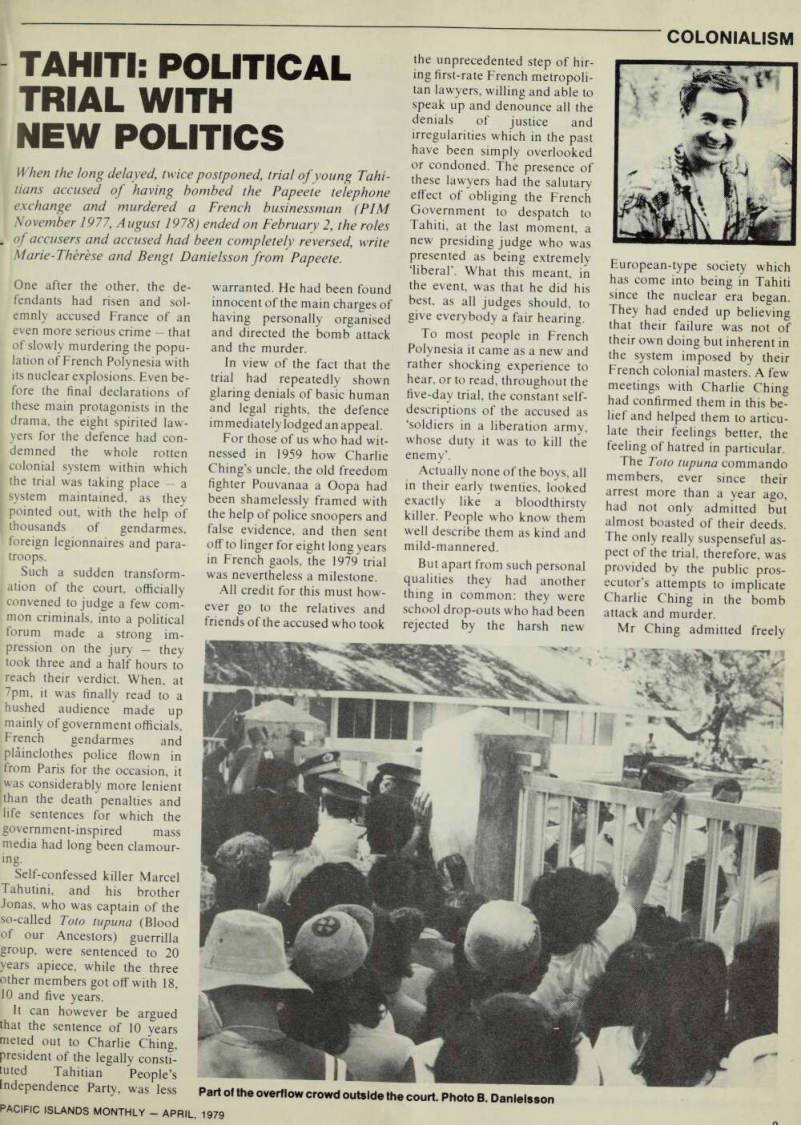
Trial With
New Politics
When the long delayed, twice postponed, trial of young Tahi tians accused of having bombed the Papeete telephone exchange and murdered a French businessman (PIM November 1977, August 1978) ended on February 2, the roles of accusers and accused had been completely reversed, write Marie-Therese and Bengt Danielsson from Papeete.
One after the other, the de fendants had risen and sol emnly accused France of an even more serious crime that of slowly murdering the popu lation of French Polynesia with its nuclear explosions. Even be fore the final declarations of these main protagonists in the drama, the eight spirited law -1 yers for the defence had con demned the whole rotten i colonial system within which the trial was taking place a I system maintained, as they pointed out, with the help of I thousands of gendarmes, foreign legionnaires and para troops.
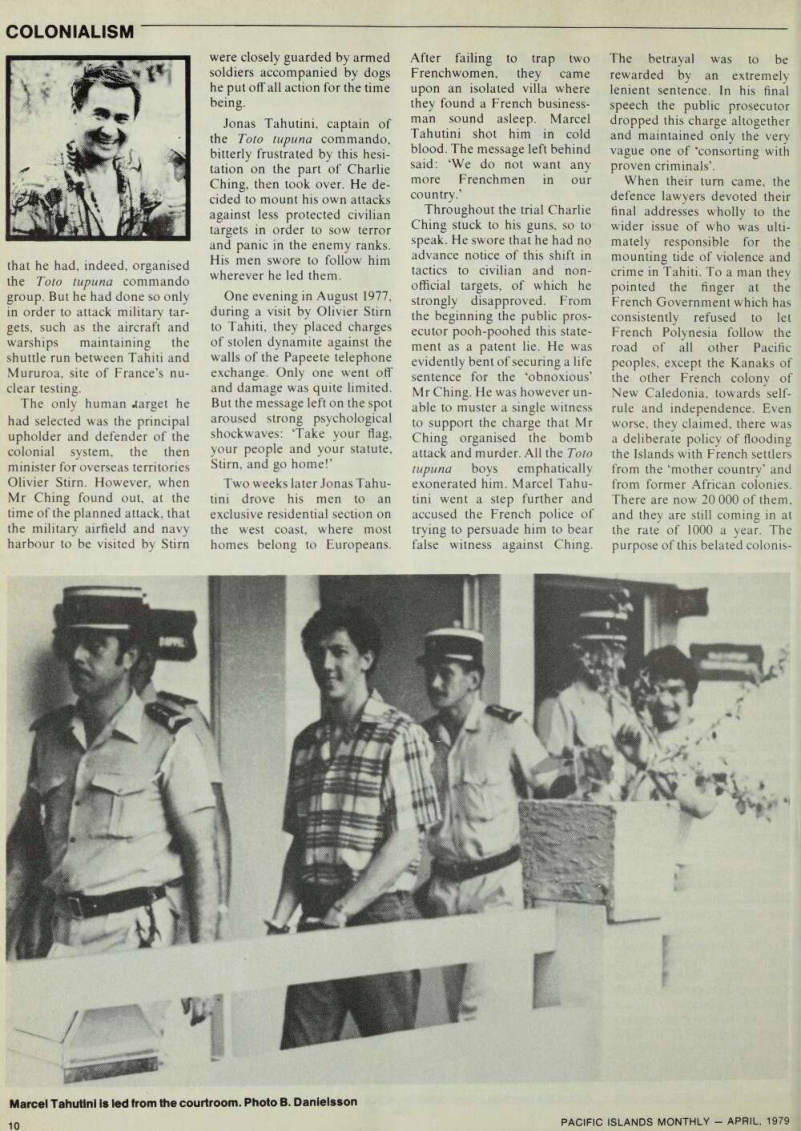
Such a sudden transform -1 ation of the court, officially f convened to judge a few com mon criminals, into a political forum made a strong im pression on the jury they took three and a half hours to reach their verdict. When, at 7pm, it was finally read to a hushed audience made up mainly of government officials, French gendarmes and plainclothes police flown in from Paris for the occasion, it
jwas considerably more lenient
than the death penalties and life sentences for which the
government-inspired mass
media had long been clamour
ing.
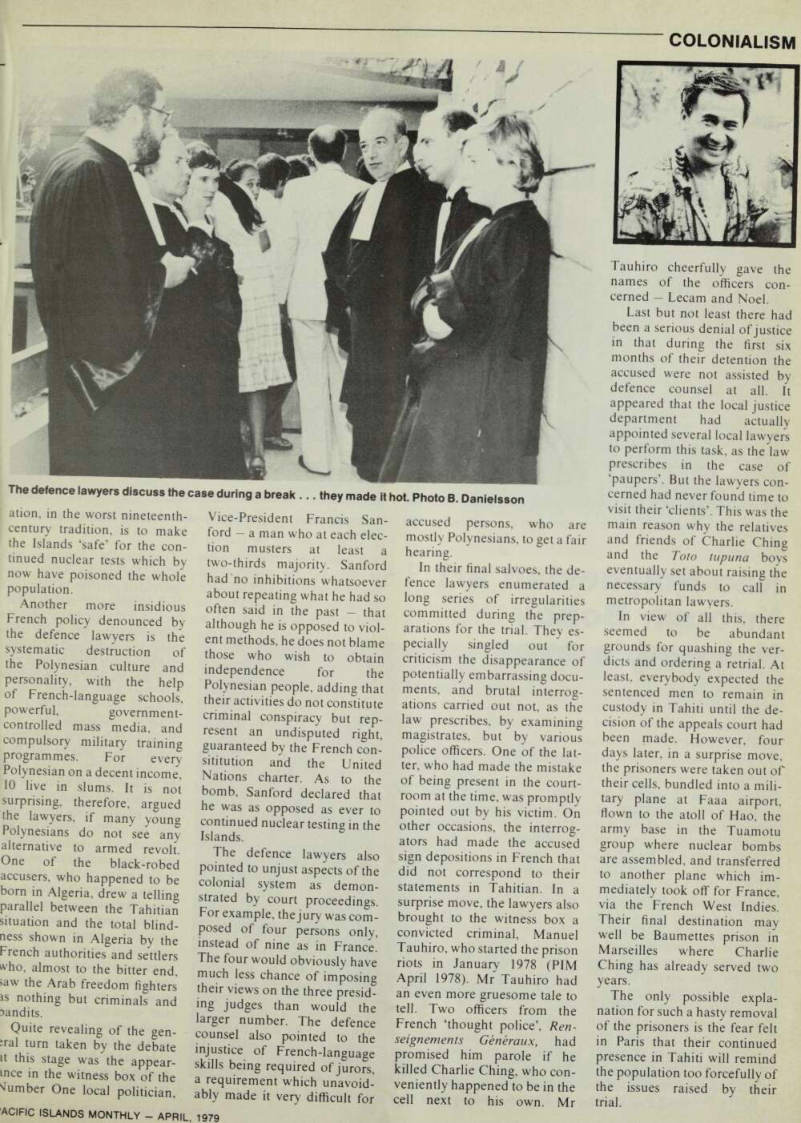
Self-confessed killer Marcel Tahutini, and his brother Jonas, who was captain of the so-called Toto tupuna (Blood of our Ancestors) guerrilla group, were sentenced to 20 years apiece, while the three other members got off with 18, 10 and five years.
It can however be argued that the sentence of 10 years meted out to Charlie Ching, president of the legally consti
tuted Tahitian People’s
Independence Party, was less
warranted. He had been found innocent of the main charges of
having personally organised
and directed the bomb attack and the murder.
In view of the fact that the trial had repeatedly shown glaring denials of basic human and legal rights, the defence
immediately lodged an appeal.
For those of us who had wit nessed in 1959 how Charlie Ching’s uncle, the old freedom fighter Pouvanaa a Oopa had been shamelessly framed with the help of police snoopers and false evidence, and then sent off to linger for eight long years in French gaols, the 1979 trial was nevertheless a milestone.
All credit for this must how ever go to the relatives and friends of the accused who took
the unprecedented step of hir ing first-rate French metropoli tan lawyers, willing and able to speak up and denounce all the denials of justice and irregularities which in the past have been simply overlooked or condoned. The presence of these lawyers had the salutary effect of obliging the French Government to despatch to Tahiti, at the last moment, a new presiding judge who was presented as being extremely liberal’. What this meant, in the event, was that he did his best, as all judges should, to give everybody a fair hearing.
To most people in French Polynesia it came as a new and rather shocking experience to hear, or to read, throughout the five-day trial, the constant self descriptions of the accused as ‘soldiers in a liberation army, whose duty it was to kill the enemy’.
Actually none of the boys, all in their early twenties, looked exactly like a bloodthirsty killer. People who know them well describe them as kind and mild-mannered.
But apart from such personal qualities they had another thing in common: they were school drop-outs who had been rejected by the harsh new
European-type society which has come into being in Tahiti since the nuclear era began.
They had ended up believing that their failure was not of their own doing but inherent in the system imposed by their French colonial masters. A few
meetings with Charlie Ching
had confirmed them in this be lief and helped them to articu late their feelings better, the feeling of hatred in particular.
The Toto tupuna commando members, ever since their arrest more than a year ago, had not only admitted but almost boasted of their deeds.
The only really suspenseful as pect of the trial, therefore, was provided by the public pros ecutor’s attempts to implicate Charlie Ching in the bomb attack and murder.
Mr Ching admitted freely
Part of the overflow crowd outside the court. Photo B. Danielsson
that he had, indeed, organised the Toto tupuna commando group. But he had done so only in order to attack military tar gets, such as the aircraft and
warships maintaining the
shuttle run between Tahiti and Mururoa, site of France’s nu
clear testing.
The only human .target he had selected was the principal upholder and defender of the colonial system, the then minister for overseas territories Olivier Stirn. However, when Mr Ching found out, at the time of the planned attack, that the military airfield and navy harbour to be visited by Stirn
were closely guarded by armed
soldiers accompanied by dogs
he put off all action for the time
being.
Jonas Tahutini, captain of the Toto tupuna commando, bitterly frustrated by this hesi tation on the part of Charlie Ching, then took over. He de cided to mount his own attacks
against less protected civilian
targets in order to sow terror and panic in the enemy ranks.
His men swore to follow him wherever he led them.
One evening in August 1977, during a visit by Olivier Stirn
to Tahiti, they placed charges
of stolen dynamite against the walls of the Papeete telephone exchange. Only one went off and damage was quite limited.
But the message left on the spot aroused strong psychological shockwaves: ‘Take your flag, your people and your statute, Stirn, and go home!’
Two weeks later Jonas Tahu tini drove his men to an exclusive residential section on the west coast, where most homes belong to Europeans.
After failing to trap two Frenchwomen, they came upon an isolated villa where they found a French business man sound asleep. Marcel Tahutini shot him in cold blood. The message left behind said; ‘We do not want any more Frenchmen in our
country.’
Throughout the trial Charlie Ching stuck to his guns, so to speak. He swore that he had no advance notice of this shift in tactics to civilian and non official targets, of which he
strongly disapproved. From
the beginning the public pros ecutor pooh-poohed this state ment as a patent lie. He was evidently bent of securing a life sentence for the ‘obnoxious’
Mr Ching. He was however un able to muster a single witness to support the charge that Mr
Ching organised the bomb
attack and murder. All the Toto tupuna boys emphatically exonerated him. Marcel Tahu tini went a step further and accused the French police of trying to persuade him to bear
false witness against Ching.
The betrayal was to be rewarded by an extremely lenient sentence. In his final speech the public prosecutor
dropped this charge altogether
and maintained only the very vague one of ‘consorting with proven criminals’.
When their turn came, the defence lawyers devoted their final addresses wholly to the wider issue of who was ulti
mately responsible for the
mounting tide of violence and crime in Tahiti. To a man they pointed the finger at the French Government which has consistently refused to let French Polynesia follow the road of all other Pacific peoples, except the Kanaks of the other French colony of New Caledonia, towards self rule and independence. Even worse, they claimed, there was a deliberate policy of flooding the Islands with French settlers from the ‘mother country’ and from former African colonies.
There are now 20 000 of them, and they are still coming in at the rate of 1000 a year. The purpose of this belated colonis-
Marcel Tahutini is led from the courtroom. Photo B. Danielsson
ation, in the worst nineteenth century tradition, is to make the Islands ‘safe’ for the con tinued nuclear tests which by now have poisoned the whole population.
Another more insidious French policy denounced by the defence lawyers is the systematic destruction of the Polynesian culture and
personality, with the help
of French-language schools, powerful. government controlled mass media, and
compulsory military training
programmes. For every Polynesian on a decent income, 10 live in slums. It is not surprising, therefore, argued the lawyers, if many young Polynesians do not see any alternative to armed revolt.
One of the black-robed accusers, who happened to be born in Algeria, drew a telling parallel between the Tahitian situation and the total blind ness shown in Algeria by the French authorities and settlers who, almost to the bitter end, >aw the Arab freedom fighters is nothing but criminals and bandits.
Quite revealing of the gen eral turn taken by the debate it this stage was the appear mce in the witness box of the dumber One local politician.
Vice-President Francis San ford a man who at each elec tion musters at least a two-thirds majority. Sanford had no inhibitions whatsoever about repeating what he had so often said in the past - that although he is opposed to viol ent methods, he does not blame those who wish to obtain independence for the
Polynesian people, adding that
their activities do not constitute criminal conspiracy but rep
resent an undisputed right,
guaranteed by the French con sititution and the United Nations charter. As to the bomb, Sanford declared that he was as opposed as ever to continued nuclear testing in the Islands.
The defence lawyers also pointed to unjust aspects of the colonial system as demon
strated by court proceedings.
For example, the jury was com posed of four persons only, instead of nine as in France.
The four would obviously have much less chance of imposing their views on the three presid ing judges than would the larger number. The defence counsel also pointed to the
injustice of French-language
skills being required of jurors, a requirement which unavoid ably made it very difficult for
accused persons, who are mostly Polynesians, to get a fair
hearing.
In their final salvoes, the de fence lawyers enumerated a
long series of irregularities
committed during the prep arations for the trial. They es
pecially singled out for
criticism the disappearance of
potentially embarrassing docu
ments, and brutal interrog ations carried out not, as the
law prescribes, by examining
magistrates, but by various police officers. One of the lat ter, who had made the mistake of being present in the court room at the time, was promptly pointed out by his victim. On other occasions, the interrog ators had made the accused sign depositions in French that did not correspond to their statements in Tahitian. In a surprise move, the lawyers also brought to the witness box a convicted criminal, Manuel Tauhiro, who started the prison riots in January 1978 (PIM April 1978). Mr Tauhiro had an even more gruesome tale to tell. Two officers from the
French ‘thought police’, Ren
seignements Generaux, had promised him parole if he killed Charlie Ching, who con veniently happened to be in the cell next to his own. Mr
Tauhiro cheerfully gave the names of the officers con cerned Lecam and Noel.
Last but not least there had been a serious denial of justice in that during the first six months of their detention the accused were not assisted by defence counsel at all. It appeared that the local justice
department had actually
appointed several local lawyers to perform this task, as the law prescribes in the case of ‘paupers’. But the lawyers con cerned had never found time to visit their ‘clients’. This was the main reason why the relatives and friends of Charlie Ching and the Toto tupuna boys eventually set about raising the necessary funds to call in metropolitan lawyers.
In view of all this, there seemed to be abundant grounds for quashing the ver dicts and ordering a retrial. At least, everybody expected the sentenced men to remain in custody in Tahiti until the de cision of the appeals court had been made. However, four days later, in a surprise move, the prisoners were taken out of their cells, bundled into a mili tary plane at Faaa airport, flown to the atoll of Hao, the army base in the Tuamotu group where nuclear bombs are assembled, and transferred to another plane which im mediately took off for France, via the French West Indies.
Their final destination may well be Baumettes prison in Marseilles where Charlie Ching has already served two years.
The only possible expla
nation for such a hasty removal of the prisoners is the fear felt in Paris that their continued presence in Tahiti will remind the population too forcefully of the issues raised by their trial.
The defence lawyers discuss the case during a break... they made It hot. Photo B, Danielsson
Advertisements & other items, p. 11 (1 item)
Colonialism
ACIFIC ISLANDS MONTHLY - APRIL, 1979
Neo-Polynesian art
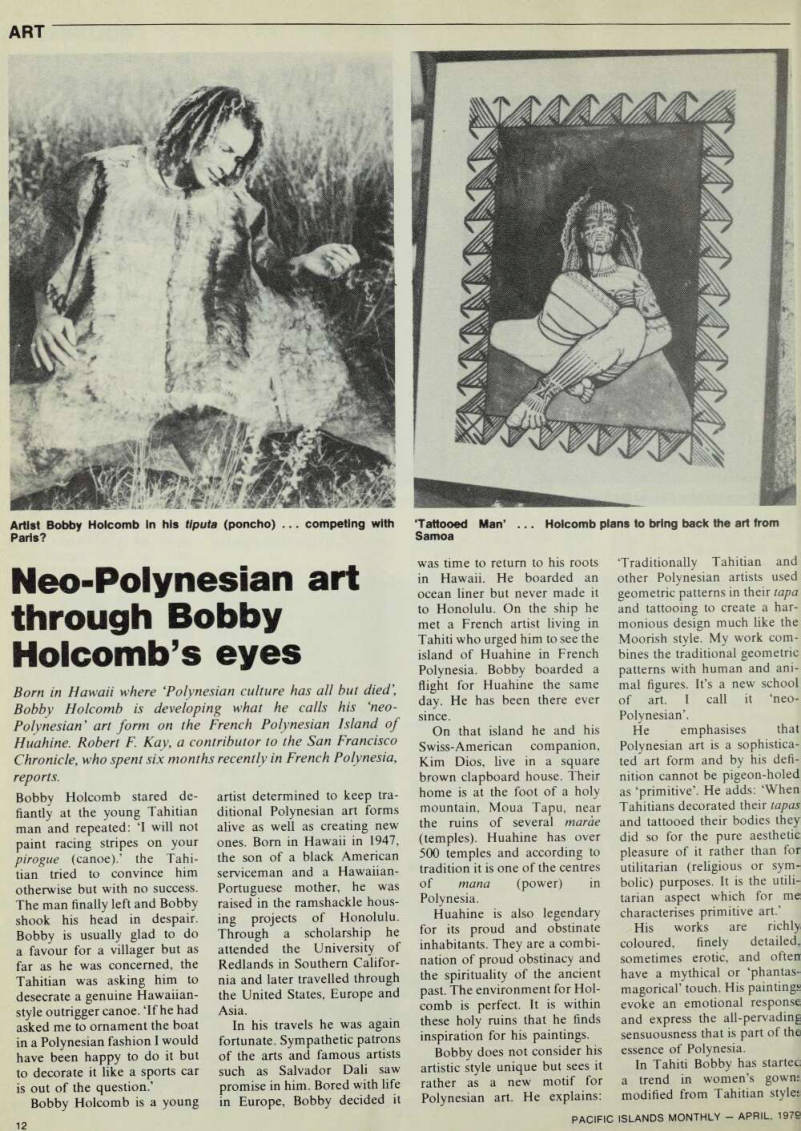
through Bobby Holcomb’s eyes
Born in Hawaii where ‘Polynesian culture has all but died ’
Bobby Holcomb is developing what he calls his ‘ neo - Polynesian ’ art form on the French Polynesian Island of Huahine. Robert F. Kay, a contributor to the San Francisco Chronicle, who spent six months recently in French Polynesia, reports.
Bobby Holcomb stared defiantly at the young Tahitian man and repeated: T will not
paint racing stripes on your
pirogue (canoe).’ the Tahitian tried to convince him otherwise but with no success.
The man finally left and Bobby shook his head in despair.
Bobby is usually glad to do
a favour for a villager but as far as he was concerned, the Tahitian was asking him to desecrate a genuine Hawaiianstyle outrigger canoe. ‘lf he had asked me to ornament the boat in a Polynesian fashion I would have been happy to do it but to decorate it like a sports car is out of the question.’
Bobby Holcomb is a young
artist determined to keep tra ditional Polynesian art forms alive as well as creating new ones. Bom in Hawaii in 1947, the son of a black American serviceman and a Hawaiian- Portuguese mother, he was raised in the ramshackle hous ing projects of Honolulu.
Through a scholarship he attended the University of Redlands in Southern Califor nia and later travelled through the United States, Europe and Asia.
In his travels he was again fortunate. Sympathetic patrons of the arts and famous artists such as Salvador Dali saw promise in him. Bored with life in Europe, Bobby decided it
was time to return to his roots in Hawaii. He boarded an ocean liner but never made it to Honolulu. On the ship he met a French artist living in Tahiti who urged him to see the island of Huahine in French
Polynesia. Bobby boarded a
flight for Huahine the same day. He has been there ever since.
On that island he and his
Swiss-American companion,
Kim Dios, live in a square brown clapboard house. Their home is at the foot of a holy mountain, Moua Tapu, near the ruins of several marde (temples). Huahine has over 500 temples and according to tradition it is one of the centres of mana (power) in
Polynesia.
Huahine is also legendary for its proud and obstinate inhabitants. They are a combi nation of proud obstinacy and the spirituality of the ancient past. The environment for Hol comb is perfect. It is within these holy ruins that he finds
inspiration for his paintings.
Bobby does not consider his artistic style unique but sees it rather as a new motif for
Polynesian art. He explains:
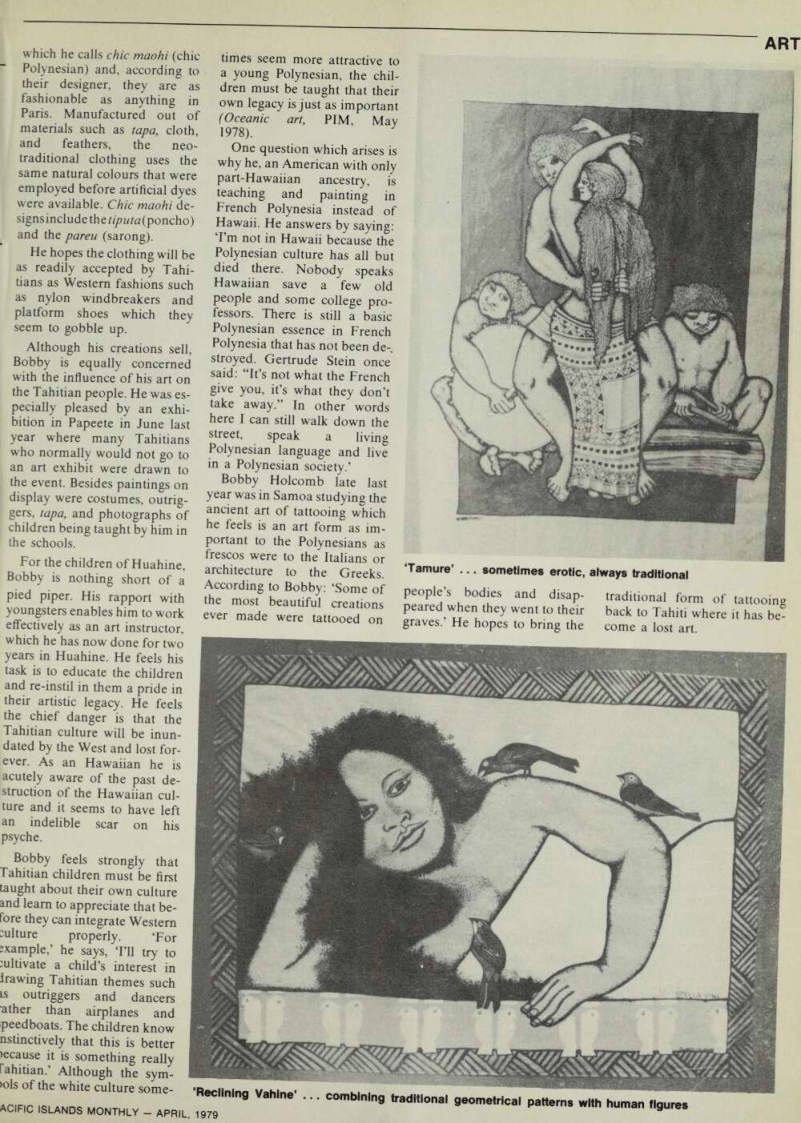
Traditionally Tahitian and other Polynesian artists used geometric patterns in their tapa and tattooing to create a har monious design much like the Moorish style. My work com bines the traditional geometric patterns with human and ani mal figures. It’s a new school of art. I call it ‘neo-
Polynesian’.
He emphasises that Polynesian art is a sophistica ted art form and by his defi nition cannot be pigeon-holed as ‘primitive’. He adds: ‘When Tahitians decorated their tapas and tattooed their bodies they did so for the pure aesthetic: pleasure of it rather than for utilitarian (religious or sym bolic) purposes. It is the utili tarian aspect which for me: characterises primitive art.’
His works are richly coloured, finely detailed* sometimes erotic, and often have a mythical or ‘phantas
magorical’ touch. His paintings
evoke an emotional response and express the all-pervading sensuousness that is part of the essence of Polynesia.
In Tahiti Bobby has startec a trend in women’s gowm. modified from Tahitian styles:
Artist Bobby Holcomb in his tiputa (poncho)... competing with Paris?
'Tattooed Man’ ... Holcomb plans to bring back the art from Samoa
which he calls chic maohi (chic Polynesian) and, according to their designer, they are as fashionable as anything in Paris. Manufactured out of materials such as tapa, cloth, and feathers, the neo traditional clothing uses the same natural colours that were employed before artificial dyes were available. Chic maohi de signs include the tiputa{poncho) and the pareu (sarong).
He hopes the clothing will be as readily accepted by Tahi tians as Western fashions such as nylon windbreakers and platform shoes which they seem to gobble up.
Although his creations sell, Bobby is equally concerned with the influence of his art on the Tahitian people. He was es pecially pleased by an exhi bition in Papeete in June last year where many Tahitians who normally would not go to an art exhibit were drawn to the event. Besides paintings on
display were costumes, outrig
gers, tapa, and photographs of children being taught by him in the schools.
For the children of Huahine, Bobby is nothing short of a pied piper. His rapport with youngsters enables him to work effectively as an art instructor, which he has now done for two years in Huahine. He feels his task is to educate the children and re-instil in them a pride in their artistic legacy. He feels the chief danger is that the Tahitian culture will be inun dated by the West and lost for ever. As an Hawaiian he is acutely aware of the past de struction of the Hawaiian cul ture and it seems to have left an indelible scar on his psyche.
Bobby feels strongly that
Tahitian children must be first taught about their own culture and leam to appreciate that be
fore they can integrate Western
culture properly. ‘For
Jxample,’ he says, ‘l’ll try to cultivate a child’s interest in Irawing Tahitian themes such
is outriggers and dancers
ather than airplanes and peedboats. The children know nstinctively that this is better
)ecause it is something really
fahitian.’ Although the sym
bols of the white culture some
times seem more attractive to a young Polynesian, the chil dren must be taught that their own legacy is just as important (Oceanic art, PIM, May 1978).
One question which arises is why he, an American with only part-Hawaiian ancestry, is
teaching and painting in
French Polynesia instead of Hawaii. He answers by saying: ‘l’m not in Hawaii because the Polynesian culture has all but died there. Nobody speaks Hawaiian save a few old people and some college pro fessors. There is still a basic Polynesian essence in French Polynesia that has not been de-. stroyed. Gertrude Stein once said; “It’s not what the French give you, it’s what they don’t take away.” In other words here I can still walk down the street, speak a living
Polynesian language and live
in a Polynesian society.’
Bobby Holcomb late last year was in Samoa studying the ancient art of tattooing which he feels is an art form as im portant to the Polynesians as frescos were to the Italians or architecture to the Greeks.
According to Bobby; ‘Some of the most beautiful creations ever made were tattooed on
people’s bodies and disap peared when they went to their graves.’ He hopes to bring the
traditional form of tattooing back to Tahiti where it has be come a lost art.
'Tamure’... sometimes erotic, always traditional
Reclining Vahme'... combining traditional geometrical patterns with human figures
Advertisements & other items, p. 13 (1 item)
Art
ACIFIC ISLANDS MONTHLY - APRIL. 1979
‘Subjection’
Cook Islands
Davis Returns
To ‘Fear’ And
‘Subjection’
Fear he had seen among the people of Haiti and the Dominican Republic was to be seen in the people of the Cook Islands on his return in 1971, writes Dr Tom Davis, now the Cooks premier, in Cook Islands Politics: The Inside Story published by Polynesian Press, Auckland, in association with the South Pacific Social Sci ences Association of Suva, from a study co-ordinated by Professor Ron Crocombe of the Institute of Pacific Studies, University of the South Pacific. PI M’s editorial adviser, John Carter, presents a sec ond selection of extracts. The first appeared in PIM last month.
Dr Tom Davis, born in the Cooks in 1917, graduate of the University of Otago (NZ), ex
fellow of Sydney University, ex
surgeon specialist to the Cook Islands Medical Service, ex medical monitor of the US Pro ject Mercury moon shots and renowned in America as a phys ician and now Premier of the Cook Islands, devotes five pages to the ‘Rise of the Democratic Party'. Considering his battles with the CIP after answering an appeal from Cook Islanders ‘to come home\ Dr Davis' story is told with great restraint. But it
pulls few punches when he tells
of what he found during a short stay on Rarotonga in July 1971: i came back in 1971 to have a look and see for myself. I spent two weeks in Rarotonga, but it took only a few days to see that the complaints about the Henry Government were justified. The sense of an all pervasive fear in the people
was overpowering and highly
disturbing. The people as I remembered them of yore were self-assured, stood up for their rights, laughed a great deal and were always full of joy in meet ing an old friend. This was no longer the case. I was avoided by people with whom I had grown up. Former patients and people whose health if not their lives I had given back to them, were cold toward me. People whose homes were as homes to me were no longer friends. I no longer could distinguish friend from foe. There were few who
openly showed their pleasure
at seeing me again.
‘lt was obviously no secret that I had returned with the possibility that I might oppose
the existing government.
Indeed I had been away for 19 years, but I had been pre viously away for 16 years and had been welcomed home as a
conquering hero. My achieve
ments in the USA were not un known to them and these were more notable than my achieve ments during the 16 years absence at school and medical school. The fear was real and existed in all but a few. It was what 1 had seen in Haiti and the Dominican Republic and elsewhere where people’s sur
vival depended on subjection
to those in political power. It was sad to see this in my once happy homeland. If there was one single factor which made me resolve to return, it was this. ‘There were other factors, of course. The two weeks’ stay
showed clearly the nepotism,
the deliberate distortion of
democracy to gain politically
‘True to expect ations Albert Henry... offered me head of state or deputy premier.
self-serving ends, the political subjection of the public service, the deliberate use of people’s ignorance to gain credence with half truths as well as blatant misrepresentations, the purposeful destruction of both traditional and national leader ship, the “happy the body and to hell with the mind” ap proach to the young, the under mining of the natural industriousness of our people with “no work” jobs, the re moval of people from pro-
ductive efforts to unproductive and unnecessary government jobs, the attack and deliberate
downgrading of qualified and
trained individuals, the victimisation of those foolish enough to voice criticisms of government, the rewarding of those whose only qualification was that they supported the Henry regime. The list goes on. All these helped me to make up my mind ...’
After returning to the United States to wind up his affairs. Dr Davis ‘arrived back in Rarotonga on October 1, 1971 to start what proved to be a long relentless road of political battles and personal abuse against a backdrop of corruption, dishonesty, deceit, discrimination, intimidation, economic ignorance and administrative ineptness. All of this I had expected, having known Albert of the silvery tongue long ago. True to expectations Albert Henry, both on my first visit and soon after my return, approached me and offered me head of state or deputy premier. Both were
firmly refused.
‘The opposition party in the
Cook Islands at that time was the United Cook Islanders Party (UCI) which was not really a party but a loosely organised group of sincere and honest citizenry dedicated to the downfall of Albert Henry, Their politics were emotionally charged, well-intentioned, but
unsophisticated. They had
little chance against the ruling Cook Islands Party under the leadership of Albert Henry who had received the pur posive training of the New Zealand Communist Party, This basic training was obvious in the political prac tices that he put into effect which, as has happened else where, eventually resulted
in a grossly over-controlling
government with party oriented benefits of political office, and economic
chaos . . .’
Dr Joe Williams, once regarded as Sir Albert’s most likely successor and a firm sup porter for years, ‘ defected ’ in January, 1978, when he was minister of health and edu cation. Dr Williams spills the beans in the eight pages he writes:
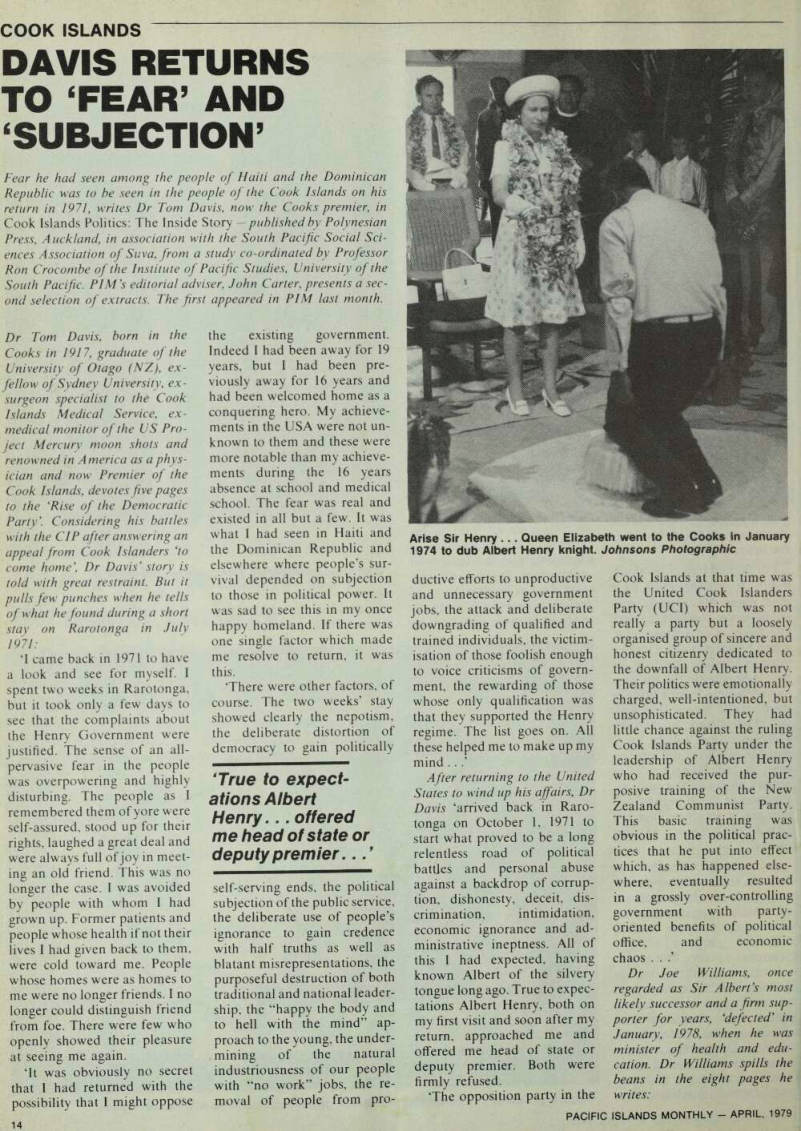
Arise Sir Henry... Queen Elizabeth went to the Cooks in January 1974 to dub Albert Henry knight. Johnsons Photographic
‘ln January 1978 two Cabi net ministers resigned. William
Estall (agriculture) and myself
(health and education). It was said that we were “power hungry academics” who re signed from our posts as minis ters of the crown and from the Cook Islands Party because we were “greedy for position and money”. Does a minister resign from a prestigious position be cause of greed for power? Does a minister resign from the sec
ond highest paid position in the
Cook Islands Government be cause of greed for money? I re
signed to uphold the principles
that I believe in; to uphold jus tice, to fight injustice and an ineffective system of govern ment. I have come through the very heart of the Cook Islands Party government. I am
intelligent enough to know
what is wrong and what is right.
To continue to be part of a government that is riddled with discrimination, nepotism, ex
ploitation, favouritism,
authoritarianism and inef ficiency at the expense of the
well-being of the community
would be the greatest injustice that I would commit in my pol itical career . . .
T joined the Cook Islands Cabinet in January 1975. My first reaction was one of disillusionment. I thought I was joining the highest execu tive authority, “the mana” of the country to take part in high level discussions for the benefit of our people. But instead, we wasted time in Cabinet meet
‘... even relatives of relatives have been included on the bandwagon
ings on trivial matters such as overseas travel of public ser vants, appointments to the
public service, scholarships,
etc. One of the fundamental criteria for approval was politi cal loyalty; “Yes” to CIPs and generally “No” to Demos. This procedure of Cabinet con
tinued with systematic appli
cation of discriminatory
principles until my resignation.
Important matters such as the economy, dependency, em
ployment, cost of living,
business opportunities for Cook Islanders etc, received very little attention. Hence the retarded state of development in almost every facet of the
Cook Islands society ...
T have always found nepot ism a little hard to swallow. But being part of CPI political ma chinery and having had a very high regard and admiration for
the premier, I partly ignored
nepotism in the Cook Islands government hierarchy. But the expansion of the Henry dyn asty over recent years with
appointments made on family
ties became too overbearing for me to accept. ‘What was once a joke be came blatant full-blown nepot ism. It would be foolish for anyone to deny the expansion
of nepotistic practices or to jus
tify it in terms of the Henrys
being a “clever” family as they
feel. It has reached the stage where almost every close rela tive or associate of the premier is in a high ranking or comfort able position. Even the media is dominated by the fruits of
nepotism.
‘ln 1968 when I joined the Cook Islands Party, there were few Henrys in Government.
Since then, the number has in creased so much that even rela tives of relatives have been included on the band wagon. ‘ln this 1978 general election, four new CIP candidates within the family circle were nominated, Hugh Henry (premier’s son), Tepou Boaza (speaker’s son-in-law), Eric Ponia (Geoffrey Henry’s brother-in-law) and Charlie Carlson (husband of Lady
Henry’s niece).
‘The first thunderbolt jolt for me to have a hard look at nep otism was in the 1974 general election when all standing CIP candidates were surnamed Henry by the Henrys to “jus
tify” the family government
image, and thus neutralise Op position criticism of it. I resented being called Joe
Henry . . .
‘lt was decided after we lost the Atiu seats by a narrow mar gin in 1974 that Atiu would be developed to “buy Atiu”. Man gaia was neglected because it would not accept the premier and the CIP and the gap was too big to close. Again after
CIP lost the 1977 by-election in Mangaia, it was decided to “punish Mangaia” by minimis ing government expenditure there. Mauke received top pri ority because of the “special privileges and favour” of its CIP member, Hon Tupui Ariki Henry ... ‘The large-scale persecution was of civil servants. Pro motions of government officers were much influenced by ministers. Loyalty and service to the Cook Islands Party was a major criterion in promotion, appointment and the provision of training and travel oppor
as soon as was realised that Cyclone Charles had political potential, the meteorologists were asked to dismount...’
tunities. For example Mr Tutu Ina was chief health inspector, but a strong supporter of the Democratic Party. We ensured that he was denied normal and
justified salary increases and
opportunities so that he would resign once he realised that he would suffer if he remained.
The strategy succeeded and he resigned and migrated to New Zealand. We replaced him by a strong supporter of the Cook Islands Party ...’
All political parties were sup posed to have access to radio which was controlled by the Henry family and friends. Mrs Marjorie Crocombe describes how the CIP sabotaged Demo cratic Party time on the air: ‘The Democratic Party al leged a number of other minor media harassments. These in
elude “technical problems” leading to the radio stopping
broadcasting during key
Democratic Party speeches, but not during Cook Islands Party
speeches, the postponing of
materials booked and paid for at peak listening time until the peak was over, giving poor quality transmission to the
Democratic Party’s English
speaking meeting but not to any Cook Islands Party meet ing, and turning up the volume for the clapping at meetings of the Cook Islands Party which were broadcast. Ironically, ex-CIP Cabinet minister Dr Williams also complained about unfair actions by the CIBNC to his Unity Move ment, but no complaints were heard from the CTP..
Sir Albert even managed to
make political capital out of a
cyclone. Mrs Crocombe illus trates: ‘ln the last week of February, Cyclone Charles de veloped north of Palmerston atoll. It was election time, and as soon as it was realised that
Cyclone Charles had political
potential, the meteorologists
were asked to dismount. The premier swung into the saddle, with his closest henchmen clinging firmly behind, and they rode the storm across the radio waves like cowboys in a rodeo. But it was handled like a TV rodeo rather than a live one, so the media men could use the zoom lens and the sound effects to make the bronco appear more dangerous and the riders more courageous than was true in real life. Sir Albert used to the full his su perb talent for making his sup porting audience feel that they were riding with him, vicari
ously sharing every prance.’
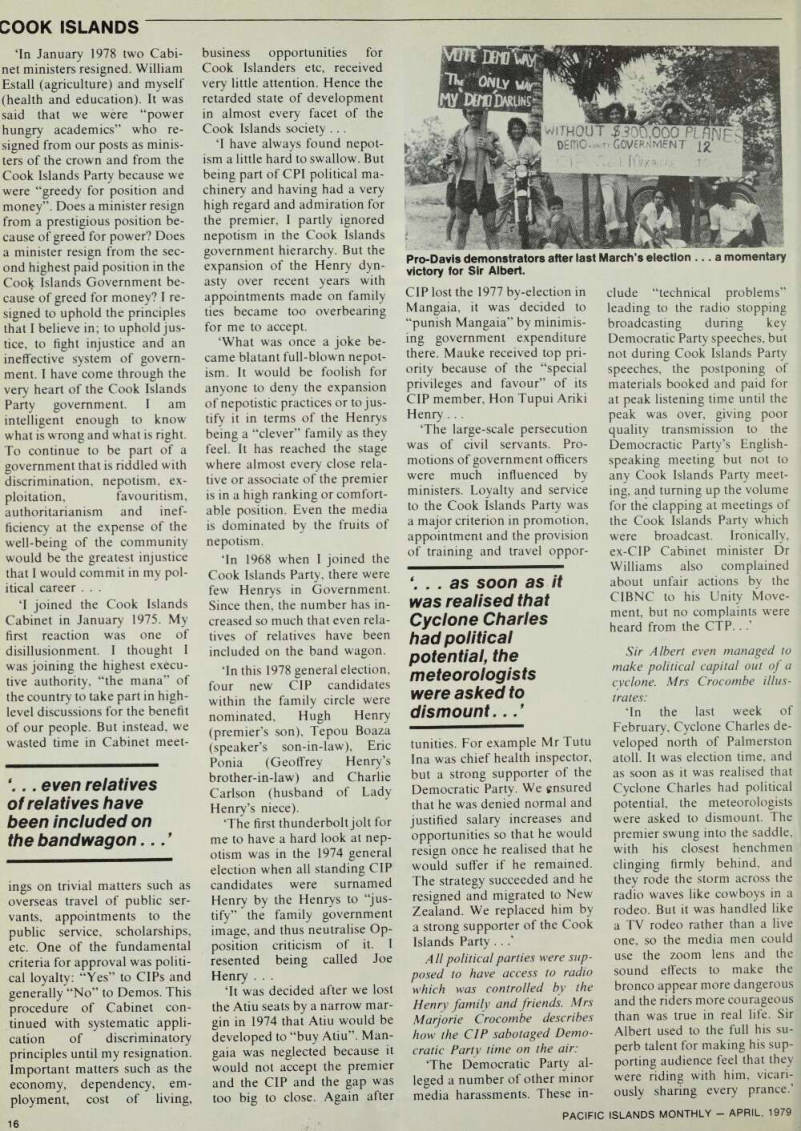
Pro-Davis demonstrators after last March’s election... a momentary victory for Sir Albert.
Advertisements & other items, p. 15 (1 item)
v?wLs *
■' ’ j i ' v -nU -
- * . . ' : &** . . -V* . > • 4 ' .^ Vt .V; v , “•< o w v- ■ K&. c-/ V r- <**, VV...
'i <• -r !W m m m *>■ rasv ✓ ■1 ✓ ✓ 'M »&« - 1 v v .. 3 / S*
Uncle Sam Dips

Into The ‘Sea
Of The Future’
The inquiry into Australia and the South Pacific conducted by the Australian Senate Standing Committee on Foreign Affairs and De fence (PIM March) is not the only such effort made recently by an off dal body of a ‘metropolitan' power. In July 1978 the Sub committee on East Asian and Pacific Affairs of the United States Senate Committee on Foreign Relations devoted a morning to the subject of the ‘Emerging Pacific Island Community'. Staff writer Malcolm Salmon examines the report.
Opening the hearing the
chairman, former astronaut Senator John Glenn, recalled that Queen Victoria had once described the Pacific as the ‘Sea of the Future’. He sug gested her idea was proving correct. He noted also that Pa cific Island countries were ‘often overshadowed by their more powerful neighbours’ in the deliberations of his com mittee, but that the region ‘has too much economic and politi cal significance to be overlooked any longer’.
It is fair to say that past rela tive neglect of Pacific Island countries by the committee showed through in Senator Glenn’s own remarks. His claim that they ‘form a com munity of equal and sovereign nations’, for example, com pletely ignored the very real problem of the continuing pol itical dependence of a good number of them, notably on France and on his own country, the United States. Similarly, his reference to the ‘lO - South Pacific Forum’ would have been more im pressive if he had got the num ber of Forum members right. It was 11 at the time of the hear
ing.
First witness was Richard Holbrooke, assistant secretary for East Asian and Pacific Affairs at the US State Depart ment, and the man generally credited with the initiatives of establishing the new ‘Office of Pacific Affairs’ within the department, and the appoint ment of a new deputy assistant secretary with special responsi bilities for the South Pacific not, as Mr Holbrooke himself Jiad the modesty to tell the committee, that ‘within the
context of the vast Washington bureaucracy’, these are ‘earth
shaking moves’.
Sketching in the background
to the new US concerns, Mr Holbrooke noted: ‘There are, to be sure, signs of growing Soviet and Chinese interest in the area. However, at this time the Soviet side seems to be con
cerned largely with advancing
their fishing interests in the re
gion and promoting their
diplomatic standing vis-a-vis
our own and that of the People’s Republic of China.
Peking is also interested in
expanding its diplomatic pres
ence in competition not only with Moscow but also with
Taipei.’
As for the line of future US action, he said: ‘We do not need to develop massive pro grammes for the South Pacific; this would be contrary to the interests of the islands and our own. Nor should we seek a dominant role as initiator, helper, and guide. We do not wish in any way to impinge
upon the sovereignty of these free peoples or to usurp the leadership role that belongs to them and to their near neigh bours, Australia and New Zealand.’
The theme of smallness, of the modesty of scale of any future US aid projects in the Pacific, recurred again and again during the hearing. The main reason for this can be summed up in one word: Micronesia.
Senator Glenn introduced the Micronesian theme, saying: ‘We saw an article in The Washington Post last week, a
rather devasting critique,
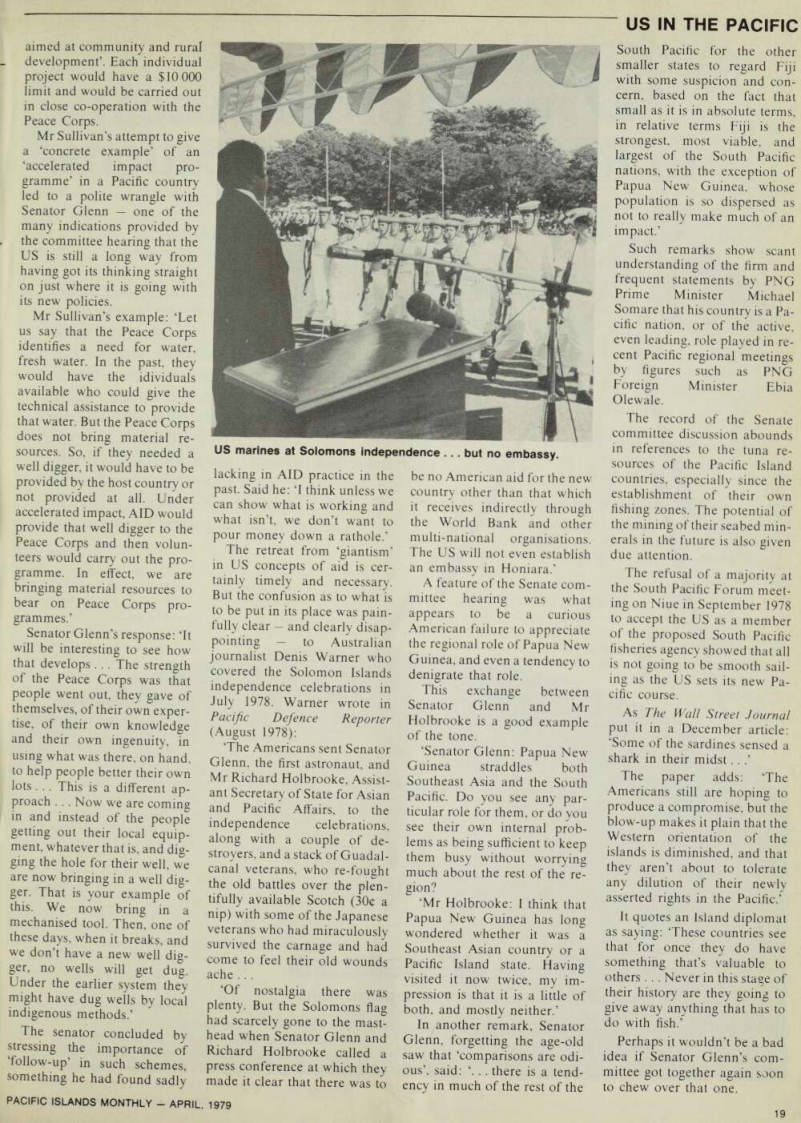
which was critical of how we have handled our programmes in Micronesia .. . The article spelled out how because of our influence there and our moving in with large amounts of money and programmes from the outside, we have pretty much devastated their econ omy. We have made people largely dependent on what will be, at least in part, government
Us In The Pacific
dole. It seemed to me that per haps for certain islands which were used for nuclear testing it was inevitable that all the re quirements for support would mean that local people would
become partially dependent on
us. I can understand a few situ ations like that. But if that article is even halfway correct - and I presume it is - we have pretty much devastated the normal, the better, patterns of
development that might have
been followed in those areas’.
The late Dr Frank Mahony, formerly of the South Pacific Commission, took up the theme, saying; ‘Micronesia got
along during the 1950 s and
until mid-1969 on a budget of about SUSS million a year.
Then there was a massive in flux of aid, and the budget went up tenfold and twenty fold. It was far more than Micronesia could digest very
easily.
To cite one example, funds were budgeted to build schools, but there was so much money available that outside contrac tors from places like Korea and
Hong Kong were brought in
and they built the schools. It would have been much better to train local people and get local contractors established and have them build the schools so that the schools would be built by the people themselves ... What you find today is that the schools that were built by these outside con tractors are being defaced now.
People scratch them up, write on the walls, throw rocks at them, and so on. But there have been a few projects, done when the programme ran out of money and outside funds were brought in to help people con struct their own schools where they really wanted them, which are being much better cared for. These were much more successful kinds of projects.’
Consensus at the committee hearing was that the best hope for the future lay in what were described as ‘accelerated
impact programmes’ jointly
mounted by the Peace Corps and the US Agency for Inter
national Development. They
were described to the com mittee by AID representative John Sullivan as ‘small-scale,
self-help projects, primarily
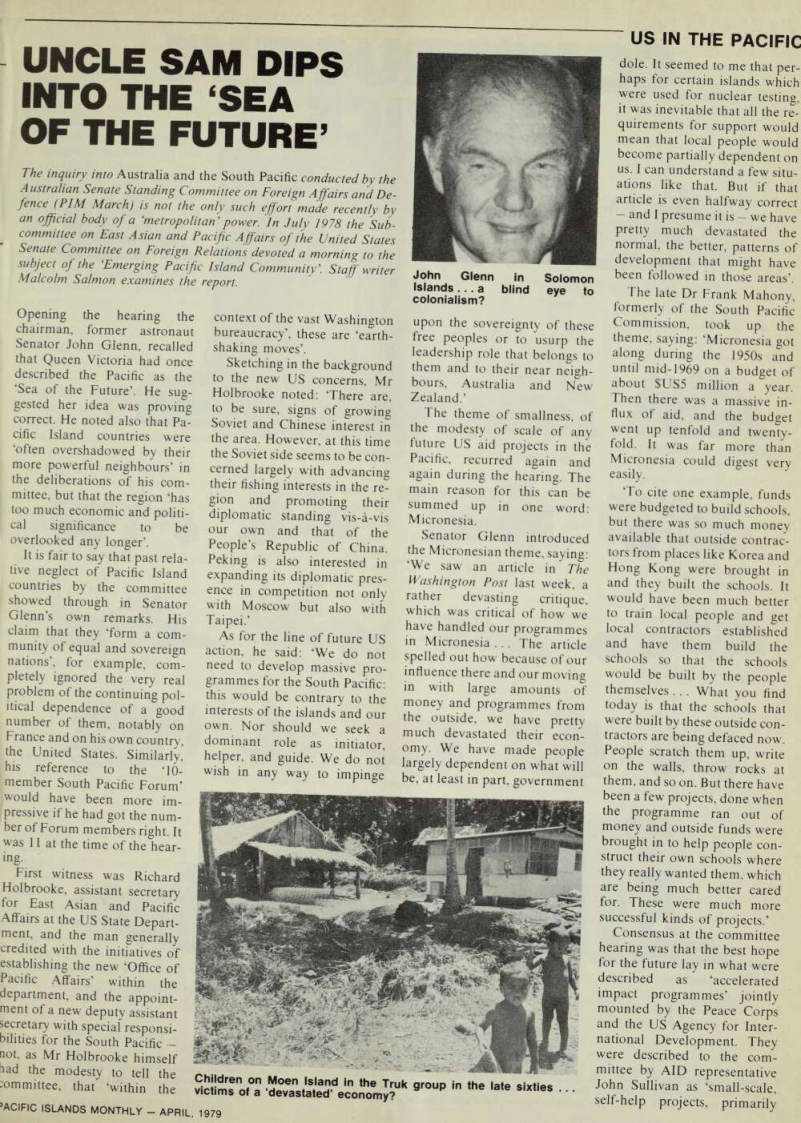
John Glenn In Solomon Islands... a blind eye to colonialism?
Children on Moen Island in the Truk group in the late Sixties... victims of a 'de vastated economy?
aimed at community and rural development’. Each individual project would have a $lO 000 limit and would be carried out in close co-operation with the Peace Corps.
Mr Sullivan’s attempt to give a ‘concrete example’ of an ‘accelerated impact pro gramme’ in a Pacific country led to a polite wrangle with Senator Glenn one of the many indications provided by the committee hearing that the US is still a long way from having got its thinking straight on just where it is going with its new policies.
Mr Sullivan’s example: ‘Let us say that the Peace Corps identifies a need for water, fresh water. In the past, they would have the idividuals available who could give the technical assistance to provide that water. But the Peace Corps does not bring material re sources. So, if they needed a well digger, it would have to be provided by the host country or not provided at all. Under accelerated impact, AID would provide that well digger to the Peace Corps and then volun teers would carry out the pro gramme. In effect, we are bringing material resources to bear on Peace Corps pro grammes.’
Senator Glenn’s response: ‘lt will be interesting to see how that develops ... The strength of the Peace Corps was that people went out, they gave of themselves, of their own exper tise, of their own knowledge and their own ingenuity, in using what was there, on hand, to help people better their own 10t5... This is a different ap proach ... Now we are coming in and instead of the people getting out their local equip ment, whatever that is, and dig ging the hole for their well, we are now bringing in a well dig ger. That is your example of this. We now bring in a mechanised tool. Then, one of these days, when it breaks, and we don’t have a new well dig ger, no wells will get dug.
Under the earlier system they might have dug wells by local
indigenous methods.’
The senator concluded by
stressing the importance of
follow-up’ in such schemes, something he had found sadly
lacking in AID practice in the past. Said he: i think unless we can show what is working and what isn’t, we don’t want to pour money down a rathole.’
The retreat from ‘giantism’ in US concepts of aid is cer tainly timely and necessary.
But the confusion as to what is to be put in its place was pain
fully clear and clearly disap
pointing - to Australian journalist Denis Warner who covered the Solomon Islands independence celebrations in July 1978. Warner wrote in Pacific Defence Reporter (August 1978); ‘The Americans sent Senator Glenn, the first astronaut, and Mr Richard Holbrooke, Assist ant Secretary of State for Asian and Pacific Affairs, to the
independence celebrations,
along with a couple of de stroyers, and a stack of Guadal canal veterans, who re-fought the old battles over the plen tifully available Scotch (30c a nip) with some of the Japanese veterans who had miraculously survived the carnage and had come to feel their old wounds ache ... ‘Of nostalgia there was plenty. But the Solomons flag had scarcely gone to the mast head when Senator Glenn and Richard Holbrooke called a press conference at which they made it clear that there was to
be no American aid for the new country other than that which
it receives indirectly through
the World Bank and other multi-national organisations.
The US will not even establish an embassy in Honiara.’
A feature of the Senate com mittee hearing was what appears to be a curious American failure to appreciate the regional role of Papua New Guinea, and even a tendency to denigrate that role.
This exchange between Senator Glenn and Mr Holbrooke is a good example of the tone. ‘Senator Glenn; Papua New Guinea straddles both Southeast Asia and the South Pacific. Do you see any par ticular role for them, or do you see their own internal prob lems as being sufficient to keep them busy without worrying much about the rest of the re gion? ‘Mr Holbrooke; I think that Papua New Guinea has long wondered whether it was a Southeast Asian country or a Pacific Island state. Having visited it now twice, my im pression is that it is a little of both, and mostly neither.’
In another remark. Senator Glenn, forgetting the age-old saw that ‘comparisons are odi ous’, said: ‘. . . there is a tend ency in much of the rest of the
South Pacific for the other smaller states to regard Fiji with some suspicion and con cern, based on the fact that small as it is in absolute terms, in relative terms Fiji is the strongest, most viable, and largest of the South Pacific nations, with the exception of Papua New Guinea, whose population is so dispersed as not to really make much of an
impact.’
Such remarks show scant understanding of the firm and
frequent statements by PNG
Prime Minister Michael Somare that his country is a Pa cific nation, or of the active, even leading, role played in re
cent Pacific regional meetings
by figures such as PNG Foreign Minister Ebia Olewale.
The record of the Senate committee discussion abounds in references to the tuna re sources of the Pacific Island countries, especially since the establishment of their own fishing zones. The potential of the mining of their seabed min erals in the future is also given due attention.
The refusal of a majority at the South Pacific Forum meet ing on Niue in September 1978 to accept the US as a member of the proposed South Pacific fisheries agency showed that all is not going to be smooth sail ing as the US sets its new Pa cific course.
As The Wall Street Journal put it in a December article; ‘Some of the sardines sensed a shark in their midst.. .’
The paper adds: ‘The Americans still are hoping to produce a compromise, but the blow-up makes it plain that the Western orientation of the islands is diminished, and that they aren’t about to tolerate any dilution of their newly asserted rights in the Pacific.’
It quotes an Island diplomat as saying: ‘These countries see that for once they do have something that’s valuable to others. . . Never in this stage of
their history are they going to
give away anything that has to do with fish.’
Perhaps it wouldn’t be a bad idea if Senator Glenn’s com mittee got together again soon to chew over that one.
US marines at Solomons independence... but no embassy.
Advertisements & other items, pp. 18-20 (2 items)
Constructive
ADVICE.
=3 m w'tii.ssia Swamp Bulldozers as well as Swamp Dozer Shovels.
Dozer Shovels. i Radio-Controlled Bulldozers and Dozer Shovels.
A jOL_J
Wheel Loaders.
Electric Powered A wide range of Pipelayers.
Dozer Shovels.
Amphibious Bulldozers.
ST\ SB in.
A wide selection of Off-Highway Slag Dump Trucks.
Dump Trucks. i And offer Motor Graders. .b- . y As well as Motor Scrapers.
Soil Compactors.
Trash Compactors.
L- J Towing Tractors.
Mi 5?
Vibratory Rollers. Diesel Generator Sets. nvs. 11 li Portable Air Compressors.
A wide selection of Diesel Engines.
I*' Machine Tools. 0 *7 > Mechanical and Hydraulic Presses. A variety of Maypres Presses. OBS Power Presses. Tunnel-Boring Machines.
We're constructive in other ways. We offer castings, foundries, and important advice on construction and manufacturing projects.
•§• KOMATSU LTD.
Tokyo, Japan Komatsu overseas offices: Sydney, Singapore, Jakarta, Manila, Seoul,^^J^ k^^^y'T oh^^ D San Francisco, Fort Lee
WeVe made the
world of difference
to Tonga's communications.
With the opening of the Cable & Wireless earth station, the people of Tonga can enjoy the benefits of the fastest, most efficient and reliable telephone, telex and telegraph links to the rest of the world. Via satellite.
At Cable & Wireless we have over a century of experience in the design, installation and maintenance of communications systems throughout the world. To date we have been involved with over 30 earth stations, each designed to meet their individual climatic and geographic conditions.
So, for more information, do a little communicating yourself. Contact us. ■S m & rad oftpday’s communications. f Queen Housea'heqMds Road, London VtOX ip. Tel: 01-242 4433 Telex 23181
BHHw
Us In The Pacific
19
PACIFIC ISLANDS MONTHLY - APRIL. 1979
Islands
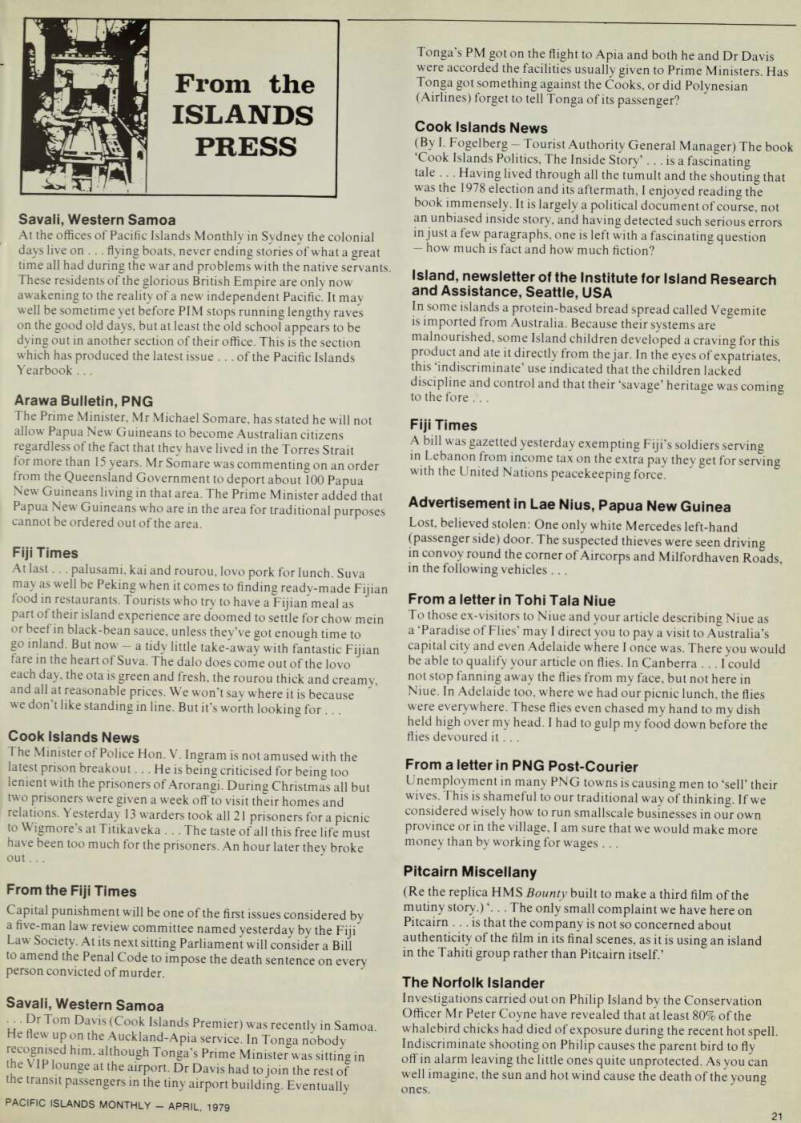
From the
Press
Savali, Western Samoa At the offices of Pacific Islands Monthly in Sydney the colonial days live on ... flying boats, never ending stories of what a great time all had during the war and problems with the native servants These residents of the glorious British Empire are only now awakening to the reality of a new independent Pacific. It may well be sometime yet before PIM stops running lengthy raves on the good old days, but at least the old school appears to be dying out in another section of their office. This is the section which has produced the latest issue ... of the Pacific Islands Yearbook ...
Arawa Bulletin, PNG The Prime Minister. Mr Michael Somare, has stated he will not allow Papua New Guineans to become Australian citizens regardless of the fact that they have lived in the Torres Strait for more than 15 years. Mr Somare was commenting on an order from the Queensland Government to deport about 100 Papua New Guineans living in that area. The Prime Minister added that Papua New Guineans who are in the area for traditional purposes cannot be ordered out of the area.
Fiji Times
At last. . . palusami. kai and rourou, lovo pork for lunch. Suva may as well be Peking when it comes to finding ready-made Fijian food in restaurants. Tourists who try to have a Fijian meal as part of their island experience are doomed to settle for chow mein or beef in black-bean sauce, unless they’ve got enough time to go inland. But now a tidy little take-away with fantastic Fijian fare in the heart of Suva. The dalo does come out of the lovo each day, the ota is green and fresh, the rourou thick and creamy, and all at reasonable prices. We won’t say where it is because we don’t like standing in line. But it’s worth looking for . . .
Cook Islands News The Minister of Police Hon. V. Ingram is not amused with the latest prison breakout... He is being criticised for being too lenient with the prisoners of Arorangi. During Christmas all but two prisoners were given a week off to visit their homes and relations. Yesterday 13 warders took all 21 prisoners fora picnic to Wigmore’s at Titikaveka ... The taste of all this free life must have been too much for the prisoners. An hour later they broke out.. .
From the Fiji Times Capital punishment will be one of the first issues considered by a five-man law review committee named yesterday by the Fiji Law Society. At its next sitting Parliament will consider a Bill to amend the Penal Code to impose the death sentence on every person convicted of murder.
Savali, Western Samoa • • J? r Tom Davis (Cook Islands Premier) was recently in Samoa He flew up on the Auckland-Apia service. In Tonga nobody recognised him. although Tonga’s Prime Minister was sitting in the VIP lounge at the airport. Dr Davis had to join the rest of the transit passengers in the tiny airport building. Eventually
Tonga’s PM got on the flight to Apia and both he and Dr Davis were accorded the facilities usually given to Prime Ministers. Has Tonga got something against the Cooks, or did Polynesian (Airlines) forget to tell Tonga of its passenger?
Cook Islands News (By I. Fogelberg - Tourist Authority General Manager) The book Cook Islands Politics, The Inside Story’... is a fascinating tale . . . Having lived through all the tumult and the shouting that was the 1978 election and its aftermath, I enjoyed reading the book immensely. It is largely a political document of course, not an unbiased inside story, and having detected such serious errors in just a few paragraphs, one is left with a fascinating question how much is fact and how much fiction?
Island, newsletter of the Institute for Island Research
and Assistance, Seattle, USA
In some islands a protein-based bread spread called Vegemite is imported from Australia. Because their systems are malnourished, some Island children developed a craving for this product and ate it directly from the jar. In the eyes of expatriates, this ‘indiscriminate’ use indicated that the children lacked discipline and control and that their ‘savage’ heritage was coming to the fore ...
Fiji Times
A bill was gazetted yesterday exempting Fiji’s soldiers serving in Lebanon from income tax on the extra pay they get for serving with the United Nations peacekeeping force.
Advertisement in Lae Nius, Papua New Guinea Lost, believed stolen: One only white Mercedes left-hand (passenger side) door. The suspected thieves were seen driving in convoy round the comer of Aircorps and Milfordhaven Roads,
in the following vehicles .. .
From a letter in Tohi Tala Niue To those ex-visitors to Niue and your article describing Niue as a ‘Paradise of Flies’ may I direct you to pay a visit to Australia’s capital city and even Adelaide where I once was. There you would be able to qualify your article on flies. In Canberra ... I could not stop fanning away the flies from my face, but not here in Niue. In Adelaide too, where we had our picnic lunch, the flies were everywhere. These flies even chased my hand to my dish held high over my head. I had to gulp my food down before the flies devoured it. . .
From a letter in PNG Post-Courier Unemployment in many PNG towns is causing men to ‘sell’ their wives. This is shameful to our traditional way of thinking. If we considered wisely how to run smallscale businesses in our own province or in the village, I am sure that we would make more money than by working for wages ...
Pitcairn Miscellany
(Re the replica HMS Bounty built to make a third film of the mutiny story.) ‘.. . The only small complaint we have here on Pitcairn ... is that the company is not so concerned about authenticity of the film in its final scenes, as it is using an island in the Tahiti group rather than Pitcairn itself.’
The Norfolk Islander Investigations carried out on Philip Island by the Conservation Officer Mr Peter Coyne have revealed that at least 80% of the whalebird chicks had died of exposure during the recent hot spell.
Indiscriminate shooting on Philip causes the parent bird to fly off in alarm leaving the little ones quite unprotected. As you can well imagine, the sun and hot wind cause the death of the young ones.
Currents
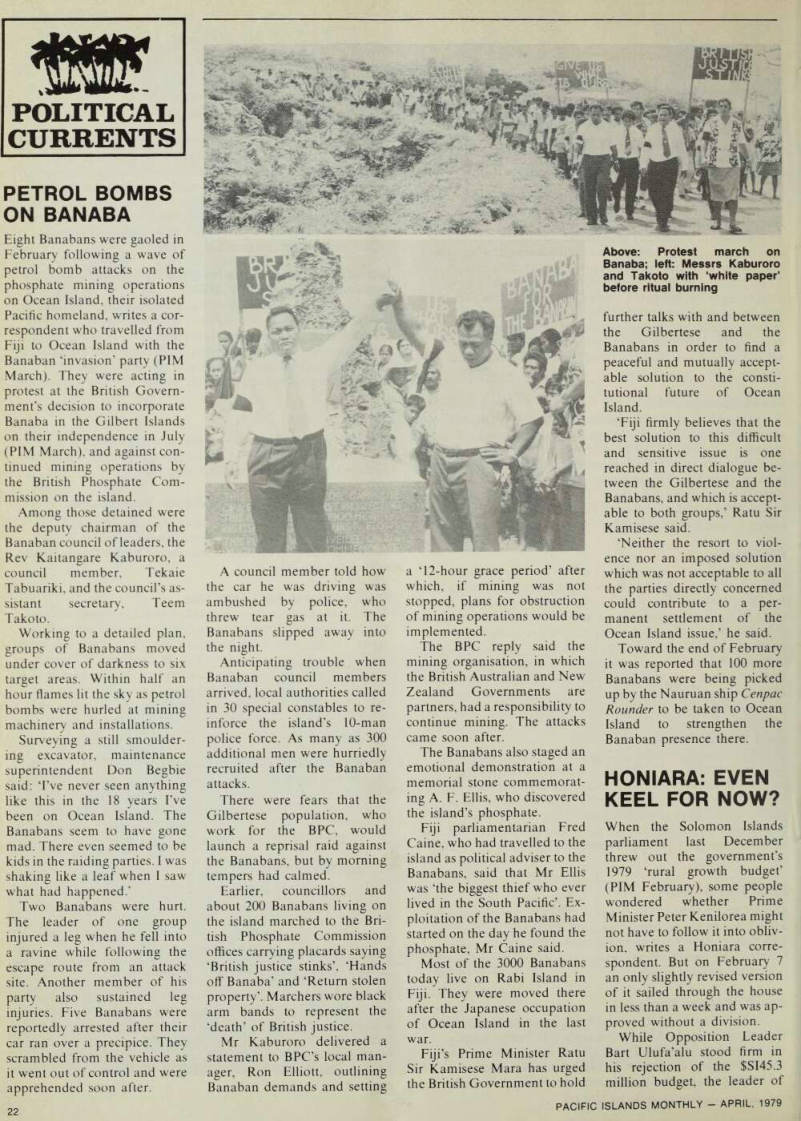
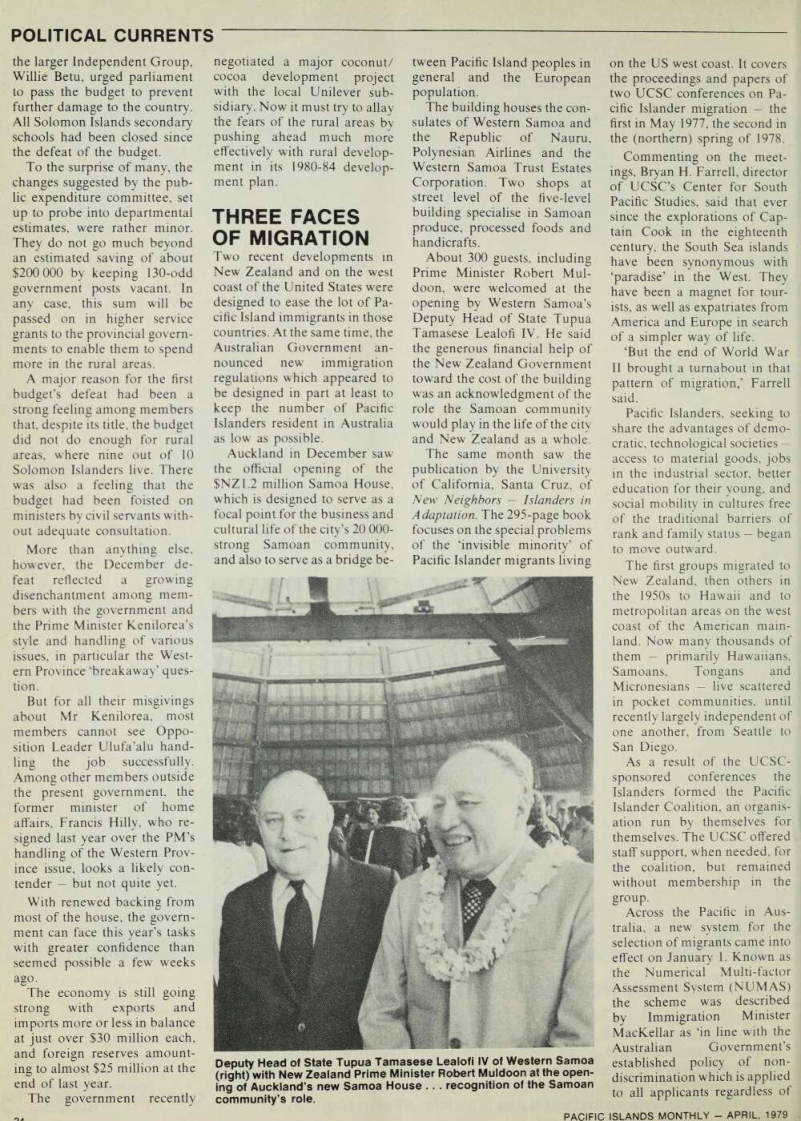
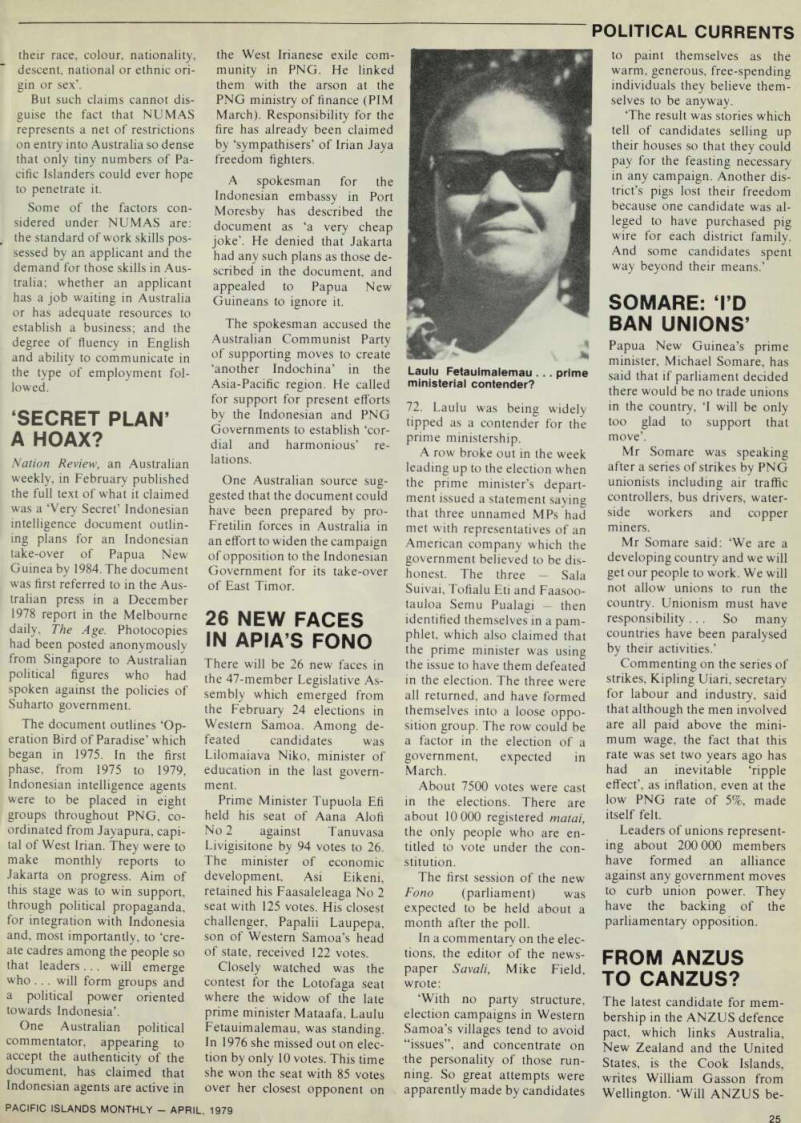
Political
Petrol Bombs
On Banaba
Eight Banabans were gaoled in February following a wave of petrol bomb attacks on the
phosphate mining operations
on Ocean Island, their isolated Pacific homeland, writes a cor respondent who travelled from Fiji to Ocean Island with the Banaban ‘invasion’ party (PIM March). They were acting in protest at the British Govern ment’s decision to incorporate Banaba in the Gilbert Islands on their independence in July (PIM March), and against con
tinued mining operations by
the British Phosphate Com mission on the island.
Among those detained were the deputy chairman of the Banaban council of leaders, the Rev Kaitangare Kaburoro, a council member, Tekaie Tabuariki, and the council’s as sistant secretary. Teem Takoto.
Working to a detailed plan, groups of Banabans moved under cover of darkness to six target areas. Within half an hour flames lit the sky as petrol bombs were hurled at mining machinery and installations.
Surveying a still smoulder ing excavator, maintenance
superintendent Don Begbie
said: ‘l’ve never seen anything like this in the 18 years I’ve been on Ocean Island. The Banabans seem to have gone mad. There even seemed to be kids in the raiding parties. I was shaking like a leaf when I saw what had happened.’
Two Banabans were hurt.
The leader of one group injured a leg when he fell into a ravine while following the escape route from an attack site. Another member of his party also sustained leg injuries. Five Banabans were reportedly arrested after their car ran over a precipice. They scrambled from the vehicle as it went out of control and were apprehended soon after.
A council member told how the car he was driving was
ambushed by police, who
threw tear gas at it. The Banabans slipped away into
the night.
Anticipating trouble when Banaban council members arrived, local authorities called in 30 special constables to re inforce the island’s 10-man police force. As many as 300 additional men were hurriedly recruited after the Banaban attacks.
There were fears that the Gilbertese population, who work for the BPC, would launch a reprisal raid against the Banabans, but by morning tempers had calmed.
Earlier, councillors and about 200 Banabans living on the island marched to the Bri tish Phosphate Commission
offices carrying placards saying
‘British justice stinks’, ‘Hands off Banaba’ and ‘Return stolen property’. Marchers wore black arm bands to represent the ‘death’ of British justice.
Mr Kaburoro delivered a statement to BPC’s local man ager, Ron Elliott, outlining Banaban demands and setting
a T2-hour grace period’ after which, if mining was not
stopped, plans for obstruction
of mining operations would be
implemented.
The BPC reply said the
mining organisation, in which
the British Australian and New Zealand Governments are partners, had a responsibility to continue mining. The attacks came soon after.
The Banabans also staged an emotional demonstration at a memorial stone commemorat ing A. F. Ellis, who discovered the island’s phosphate.
Fiji parliamentarian Fred
Caine, who had travelled to the island as political adviser to the Banabans, said that Mr Ellis was ‘the biggest thief who ever lived in the South Pacific’. Ex ploitation of the Banabans had started on the day he found the phosphate, Mr Caine said.
Most of the 3000 Banabans today live on Rabi Island in Fiji. They were moved there after the Japanese occupation of Ocean Island in the last war.
Fiji’s Prime Minister Ratu Sir Kamisese Mara has urged the British Government to hold
further talks with and between the Gilbertese and the Banabans in order to find a
peaceful and mutually accept
able solution to the consti tutional future of Ocean Island. ‘Fiji firmly believes that the best solution to this difficult and sensitive issue is one reached in direct dialogue be tween the Gilbertese and the Banabans, and which is accept able to both groups,’ Ratu Sir Kamisese said. ‘Neither the resort to viol ence nor an imposed solution which was not acceptable to all
the parties directly concerned
could contribute to a per manent settlement of the Ocean Island issue,’ he said.
Toward the end of February it was reported that 100 more
Banabans were being picked
up by the Nauruan ship Cenpac Rounder to be taken to Ocean Island to strengthen the Banaban presence there.
Honiara: Even
Keel For Now?
When the Solomon Islands parliament last December threw out the government’s
1979 ‘rural growth budget’
(PIM February), some people
wondered whether Prime Minister Peter Kenilorea might not have to follow it into obliv ion, writes a Honiara corre spondent. But on February 7 an only slightly revised version of it sailed through the house in less than a week and was ap proved without a division.
While Opposition Leader Bart Ulufa’alu stood firm in his rejection of the $8145.3 million budget, the leader of
Above: Protest march on Banaba; left: Messrs Kaburoro and Takoto with ‘white paper’ before ritual burning
the larger Independent Group,
Willie Betu, urged parliament
to pass the budget to prevent further damage to the country.
All Solomon Islands secondary schools had been closed since the defeat of the budget.
To the surprise of many, the
changes suggested by the pub
lic expenditure committee, set up to probe into departmental estimates, were rather minor.
They do not go much beyond an estimated saving of about $2OO 000 by keeping 130-odd government posts vacant. In any case, this sum will be passed on in higher service grants to the provincial govern ments to enable them to spend more in the rural areas.
A major reason for the first budget’s defeat had been a strong feeling among members that, despite its title, the budget did not do enough for rural areas, where nine out of 10 Solomon Islanders live. There was also a feeling that the budget had been foisted on ministers by civil servants with out adequate consultation.
More than anything else, however, the December de feat reflected a growing disenchantment among mem bers with the government and the Prime Minister Kenilorea’s style and handling of various issues, in particular the West ern Province ‘breakaway’ ques tion.
But for all their misgivings about Mr Kenilorea, most members cannot see Oppo sition Leader Ulufa’alu hand
ling the job successfully.
Among other members outside the present government, the former minister of home affairs, Francis Hilly, who re signed last year over the PM’s handling of the Western Prov ince issue, looks a likely con tender but not quite yet.
With renewed backing from most of the house, the govern ment can face this year’s tasks with greater confidence than seemed possible a few weeks ago.
The economy is still going strong with exports and imports more or less in balance at just over $3O million each, and foreign reserves amount ing to almost $25 million at the end of last year.
The government recently
negotiated a major coconut/
cocoa development project
with the local Unilever sub sidiary. Now it must try to allay the fears of the rural areas by pushing ahead much more
effectively with rural develop
ment in its 1980-84 develop ment plan.
Three Faces
Of Migration
Two recent developments in New Zealand and on the west coast of the United States were designed to ease the lot of Pa cific Island immigrants in those countries. At the same time, the Australian Government an nounced new immigration
regulations which appeared to
be designed in part at least to keep the number of Pacific Islanders resident in Australia as low as possible.
Auckland in December saw the official opening of the SNZI.2 million Samoa House, which is designed to serve as a focal point for the business and cultural life of the city’s 20 000strong Samoan community, and also to serve as a bridge be
tween Pacific Island peoples in
general and the European
population.
The building houses the con sulates of Western Samoa and the Republic of Nauru, Polynesian Airlines and the Western Samoa Trust Estates
Corporation. Two shops at
street level of the five-level
building specialise in Samoan
produce, processed foods and
handicrafts.
About 300 guests, including Prime Minister Robert Mul doon, were welcomed at the
opening by Western Samoa’s
Deputy Head of State Tupua Tamasese Lealofi IV. He said the generous financial help of the New Zealand Government toward the cost of the building was an acknowledgment of the role the Samoan community would play in the life of the city and New Zealand as a whole.
The same month saw the
publication by the University
of California, Santa Cruz, of New Neighbors Islanders in
Adaptation. The 295-page book
focuses on the special problems of the ‘invisible minority’ of
Pacific Islander migrants living
on the US west coast. It covers the proceedings and papers of two UCSC conferences on Pa cific Islander migration the first in May 1977, the second in the (northern) spring of 1978.
Commenting on the meet ings, Bryan H. Farrell, director of UCSC’s Center for South Pacific Studies, said that ever since the explorations of Cap tain Cook in the eighteenth century, the South Sea islands have been synonymous with ‘paradise’ in the West. They have been a magnet for tour ists, as well as expatriates from America and Europe in search of a simpler way of life. ‘But the end of World War II brought a turnabout in that pattern of migration,’ Farrell said.
Pacific Islanders, seeking to share the advantages of demo cratic, technological societies access to material goods, jobs in the industrial sector, better education for their young, and social mobility in cultures free of the traditional barriers of rank and family status began to move outward.
The first groups migrated to New Zealand, then others in the 1950 s to Hawaii and to metropolitan areas on the west coast of the American main land. Now many thousands of them primarily Hawaiians, Samoans, Tongans and Micronesians live scattered in pocket communities, until
recently largely independent of
one another, from Seattle to
San Diego.
As a result of the UCSC sponsored conferences the Islanders formed the Pacific Islander Coalition, an organis ation run by themselves for themselves. The UCSC offered staff support, when needed, for the coalition, but remained without membership in the group.
Across the Pacific in Aus tralia, a new system for the selection of migrants came into effect on January 1. Known as the Numerical Multi-factor Assessment System (NUMAS) the scheme was described
by Immigration Minister
MacKellar as ‘in line with the Australian Government’s established policy of non discrimination which is applied to all applicants regardless of
Deputy Head of State Tupua Tamasese Lealofl IV of Western Samoa (right) with New Zealand Prime Minister Robert Muldoon at the open ing of Auckland’s new Samoa House... recognition of the Samoan community’s role.
their race, colour, nationality, descent, national or ethnic ori gin or sex’.
But such claims cannot dis guise the fact that NUMAS represents a net of restrictions on entry into Australia so dense that only tiny numbers of Pa cific Islanders could ever hope to penetrate it.
Some of the factors con sidered under NUMAS are: the standard of work skills pos sessed by an applicant and the demand for those skills in Aus tralia; whether an applicant has a job waiting in Australia or has adequate resources to establish a business; and the
degree of fluency in English
and ability to communicate in the type of employment fol lowed.
‘Secret Plan’
A Hoax?
Nation Review, an Australian
weekly, in February published
the full text of what it claimed was a ‘Very Secret’ Indonesian intelligence document outlin ing plans for an Indonesian take-over of Papua New Guinea by 1984. The document was first referred to in the Aus tralian press in a December 1978 report in the Melbourne
daily, The Age. Photocopies
had been posted anonymously from Singapore to Australian
political figures who had
spoken against the policies of
Suharto government.
The document outlines ‘Op eration Bird of Paradise’ which began in 1975. In the first phase, from 1975 to 1979, Indonesian intelligence agents were to be placed in eight groups throughout PNG, co
ordinated from Jayapura, capi
tal of West Irian. They were to make monthly reports to Jakarta on progress. Aim of this stage was to win support,
through political propaganda,
for integration with Indonesia and, most importantly, to ‘cre ate cadres among the people so that leaders... will emerge who ... will form groups and a political power oriented towards Indonesia’.
One Australian political commentator, appearing to accept the authenticity of the document, has claimed that Indonesian agents are active in
the West Irianese exile com munity in PNG. He linked them with the arson at the PNG ministry of finance (PIM March). Responsibility for the fire has already been claimed by ‘sympathisers’ of Irian Jaya
freedom fighters.
A spokesman for the Indonesian embassy in Port Moresby has described the document as ‘a very cheap joke’. He denied that Jakarta had any such plans as those de scribed in the document, and
appealed to Papua New
Guineans to ignore it.
The spokesman accused the Australian Communist Party of supporting moves to create ‘another Indochina’ in the Asia-Pacific region. He called for support for present efforts by the Indonesian and PNG Governments to establish ‘cor dial and harmonious’ re lations.
One Australian source sug gested that the document could have been prepared by pro- Fretilin forces in Australia in an effort to widen the campaign of opposition to the Indonesian Government for its take-over of East Timor.
26 New Faces
In Apia’S Fono
There will be 26 new faces in the 47-member Legislative As
sembly which emerged from
the February 24 elections in Western Samoa. Among de feated candidates was Lilomaiava Niko, minister of education in the last govern ment.
Prime Minister Tupuola Efi held his seat of Aana Alofi No 2 against Tanuvasa Livigisitone by 94 votes to 26.
The minister of economic development, Asi Eikeni, retained his Faasaleleaga No 2 seat with 125 votes. His closest
challenger, Papalii Laupepa,
son of Western Samoa’s head of state, received 122 votes.
Closely watched was the contest for the Lotofaga seat where the widow of the late prime minister Mataafa, Laulu Fetauimalemau, was standing.
In 1976 she missed out on elec tion by only 10 votes. This time she won the seat with 85 votes over her closest opponent on
72. Laulu was being widely tipped as a contender for the
prime ministership.
A row broke out in the week leading up to the election when
the prime minister’s depart
ment issued a statement saying that three unnamed MPs had met with representatives of an American company which the government believed to be dis honest. The three - Sala Suivai, Tofialu Eti and Faasoo tauloa Semu Pualagi then identified themselves in a pam phlet, which also claimed that the prime minister was using the issue to have them defeated in the election. The three were all returned, and have formed themselves into a loose oppo sition group. The row could be a factor in the election of a government, expected in March.
About 7500 votes were cast in the elections. There are about 10 000 registered matai, the only people who are en titled to vote under the con stitution.
The first session of the new Fono (parliament) was expected to be held about a month after the poll.
In a commentary on the elec tions, the editor of the news paper Savali, Mike Field, wrote; ‘With no party structure, election campaigns in Western Samoa’s villages tend to avoid “issues”, and concentrate on •the personality of those run ning. So great attempts were
apparently made by candidates
to paint themselves as the warm, generous, free-spending individuals they believe them selves to be anyway, ‘The result was stories which tell of candidates selling up their houses so that they could pay for the feasting necessary in any campaign. Another dis trict’s pigs lost their freedom because one candidate was al
leged to have purchased pig
wire for each district family.
And some candidates spent way beyond their means.’
Somare: ‘I’D
Ban Unions’
Papua New Guinea’s prime
minister, Michael Somare, has said that if parliament decided there would be no trade unions in the country, ‘I will be only too glad to support that move’.
Mr Somare was speaking after a series of strikes by PNG unionists including air traffic controllers, bus drivers, water side workers and copper miners.
Mr Somare said: ‘We are a developing country and we will get our people to work. We will not allow unions to run the country. Unionism must have responsibility... So many countries have been paralysed by their activities.’
Commenting on the series of strikes, Kipling Uiari, secretary for labour and industry, said that although the men involved are all paid above the mini mum wage, the fact that this rate was set two years ago has had an inevitable ‘ripple effect’, as inflation, even at the low PNG rate of 5%, made itself felt.
Leaders of unions represent ing about 200 000 members have formed an alliance against any government moves to curb union power. They have the backing of the
parliamentary opposition.
From Anzus
To Canzus?
The latest candidate for mem bership in the ANZUS defence pact, which links Australia, New Zealand and the United States, is the Cook Islands, writes William Gasson from Wellington. ‘Will ANZUS be
Laulu Fetauimalemau... prime ministerial contender?
come CANZUS?’ asked the New Zealand Herald in Auckland in an editorial wel coming the attempt by the newly elected Premier Dr Tom Davis to make the islands stand on their own feet.
What Dr Davis suggested during a recent visit to New Zealand was that the 18 000 Cook Islanders commit them selves to the ANZUS treaty and relieve New Zealand of the task of defending the islands.
Officially, the Cook Islands is a self-governing nation in free association with New Zealand which looks after its defence and foreign affairs.
Dr Davis, whose affinity for the US developed while he worked there on space medi cine, apparently raised the issue with Prime Minister Robert Muldoon. He did not suggest the Cook Islands run to the economically debilitating extent of raising a standing military force, but said it could produce an army if required. ‘ln times of an emergency in the Pacific, we would supply forces as we did in the First World War,’ he said. (In the Second World War Cook Islanders travelled to New Zealand to enlist in the armed forces there.) While at first glance the idea of the tiny Cook Islands throw ing its weight into the ANZUS pact might seem to have little going for it, Dr Davis has pointed out to the strategically minded that the northern island of Penrhyn in the Cooks has a deepwater harbour ‘big enough for a whole fleet’.
Heavy aircraft could use the Cooks airfields on Rarotonga, Aitutaki and Penrhyn. ‘By doing this we feel we would be no less effective in defending ourselves than New Zealand would be without Australia,’ he said. ‘We don’t want to be bystanders in an emergency situation.’ The par allel is to the point, since New Zealand’s defence policy is bound up with Australia’s fate.
The attitude is that any attack on Australia would automati cally involve New Zealand.
A probable factor in Dr
Davis’ scientifically calculating
mind is the situation that would face the US if it were
pushed out of its base at Subic Bay in the Philippines. Should the US lose this toehold in the Southeast Asian region then
logically, according to some
American political scientists, it must fall back to defensive pos itions in the Pacific. Any size able piece of Pacific real estate with deepwater harbours and airfields thus becomes stra
tegically important.
Reaction from New Zealand’s foreign affairs officials was one of welcome, tempered by uncertainty as to how other ANZUS members might greet the idea.
New Moves In
N.H. Drama
Formation of yet another pol itical movement, a conciliatory gesture by the Vanuaaku Party in handing over to the govern ment a cheque for $A6852 representing the taxes levied by its now disbanded People’s Provisional Government, and continued doubt and hesitation among the moderate parties about the new government of national unity these were the main features of the lively New Hebrides political scene in
February.
The new movement is known as ‘Nakamal’, or ‘Meet ing house’. Its leading figures are Vincent Boulekone of Pen tecost who recently resigned as secretary-general of the UCNH (Union des Com munautes des Nouvelles Hebrides) (PIM December 1978), and who was minister of internal affairs in the Kalsakau government; and Maxime Carlot (Natatok Efate Alliance Party) of Efate, minister of internal affairs in the present government, and former speaker of the Representative
Assembly.
The two leaders have ex plicitly denied that Nakamal is
a new ‘political party’. They
said on Radio New Hebrides that their aim is to bring people together, whether they speak English or French, and regard less of religious persuasion.
They said the movement fully supports the work of the present government of national unity, and believes that its ministers should be given time to work at their jobs before
attempts are made to judge . . e aim to bring people
r ’r. not t 0 them
said Mr Boulekone, according to a report in the french/
islama fortnightly Nabanga.
e spoke of Nakamal as a p ace of reflection, a think tank open to people of all
pohtical tendencies.
He went on: ‘Away from partisan quarrels, we hope to reflect calmly on the questions that affect all Melanesians. The New Hebrides will soon be independent. But it’s only three years since we first discovered po itics. Now, we have to achieve awareness of our re sponsibilities. That s what we aim tp do within our move
mtl?t, 1 , .
i akama(rejects traditional
political labels, saying that in the view of the movement they should be re-examined. ‘We are neither moderates nor rad icals,’ said Mr Boulekone. ‘We want to be ourselves. We will be drawing up our programme out of contacts with the masses of Melanesians,’ Mr Boulekone said. This programme would not be designed to countereither the VP or the moderates. ‘lf we can reach agreement with them, we would ask for nothing more,’ said Mr Boulekone.
The repayment to the government by the VP of taxes raised by the People’s Pro visional Government removes one of the sorest spots in that party s relations with other pol itical groupings in the country,
The VP established the alterna
!| ve following its
bo y cott of the November 1977 elections. It was disbanded be fore talks began between the *wo sides in April 1978.
Following their demon strations and petitions at the end of January (PIM March), fo e moderate parties continued to show unrest at the course fol iowed by the new government.
An all-in meeting of the mod erate parties was held in mid- February in Santo to plan strategies for the coming meet jng Q f tbe Representative As
sembly
At t he same time two leaders of the moderate parties j ea n-Marie Leye of Tan Union , and Jack Kalotiti of Natatok Efate voiced their strong disa p prova i of the ‘breakaway’ Nakamal move ment. Mr Leye predicted new divisions among the moderate parties as a result of Nakamal’s appearance, and Mr Kalotiti could see no reason why another political movement should be formed on Efate> An attempt by moderate forces in mid-January to re move the sensitive broadcast fog, district and local administration portfolios from the VP was defeated. Localis ation of positions within the
bureaucracy by VP ministers
aroused criticism. But the pro cess went ahead , wit h Joe B omal Carlo being appointed director of the now unified Radio New Hebrides, and Alfok Noel and Godwin Ligo
respectively deputy director
and chief news reporter. For mer director of the unified ser vice, Jean Massias, is back in his previous job as director of the French residency infor mation service.
New Hebrides’ Deputy Chief Minister Father Walter Lini (right) shakes hands with French Minister for Overseas Departments and Territories Paul Dijoud during the minister’s February visit to Vila... a new confidence.
Advertisements & other items, pp. 23-28 (1 item)
Cathay Pacific. From the heart of Asia.
ct - V* I * \ w z >■ ■ a I *BS 4^ #1 /'/* ' • V I* ~-**K ■
SSKS
r: H*2 Cathay Pacific. From the heart of Asia.
Cathay Pacific now flies every Sunday at 7.05 p.m. from Port Moresby to Hong Kong.
From Hong Kong, Cathay Pacific flies North, South, East and West serving all the major cities in South-East Asia, Australia and the Middle East. On board you will be cared for by charming Oriental flight-hostesses specially chosen from the countries we serve and by highly experienced British and Australian pilots and flight engineers. Hon s Kong* discovery airline \ Cathay Pacific. Direct from the heart of Asia to the heart of Papua New Guinea. CATHAY PACIFIC
VRE YOU GOOD ENOUGH FOR
YAMAHA'S NEW 85?
\ V £ M w tm f A ..tS Yamaha 85.
Three
cylinders
for triple
excitement.
YAMAHA
At full throttle, the Yamaha 85 is definitely not for beginners.
There’s enough power in its three cylinders to test the most accomplished slalom artist. At 85hp, it pulls three with ease and never falters, not even in the tightest turn.
Despite its awesome power, the new king of the Yamaha line runs silky smooth at low rpm. The three-cylinder designs provides an inherent balance to eliminate vibration and stalling.
Schnule scavenging, specially-tuned carburetion and Yamaha’s famous reed valve intake do the rest, while reducing fuel consumption to a level almost unbelievable in a 1140 cc outboard.
Other sophisticated features, like CD Ignition, Dual-Thrust- Exhaust and oversize mufflers, are designed to strike a perfect balance between performance and reliability. In short, the 85 is always ready to go when you are.
But don’t get the idea that this is a single-purpose outboard.
Any big boat runs better when you hitch an 85 on the transom. Try one soon. If you’re good enough.
Outboard
with
From 2 to 85. Power for any purpose.
YAMAHA
THE EXCITING NEW MERLIN IMS.
AVIATION IN THE SOUTH PACIFIC
IS ABOUT TO CHANGE.
m if Merlin 1118 is an aircraft that is very much in touch with the 1980 s It presents an impressive array of features that will upgrade standards of aviation comfort and operation in the South Pacific area.
Merlin 1118 from Swearingen Aviation Corporation has speed, around 355 mph cruise, thanks to
powerful twin turboprops.
Merlin 1118 has quiet comfort Slow turning props plus noise barrier acoustic walls to dampen sound add to passenger comfort.
Then there’s pressurisation and a roomy cabin for up to 10 people.
Merlin HIB has endurance, with an operational range of 2,425 nautical miles plus IFR reserves.
Merlin 1118 is distributed by Stillwell Aviation in the South Pacific. Inaugural demonstration test flights will be conducted in the region soon.
If youd like to inspect and discuss the exciting new Merlin 1118 when it visits your area, contact Stillwell Aviation now. Join us on our program of demo flights by completing the coupon below. m m
WE'RE FLYING YOUR WAY.
JOIN US FOR A DEMO FLIGHT.
\ r* Captain Neil Morris.
B.S. Stillwell Aviation»(A/Asia) Pty. Ltd.
P.O. Box 161. Kew. Victoria. 3101. Australia Please register my name for your demonstration flights of Swearingen Merlin 1118.
Name Address B.S. Stillwell Aviation (A/Asia) Pty. Ltd.
P.O. Box 161. Kew, Victoria. 3101. Australia. Phone (03) 804485.
Tall Story From
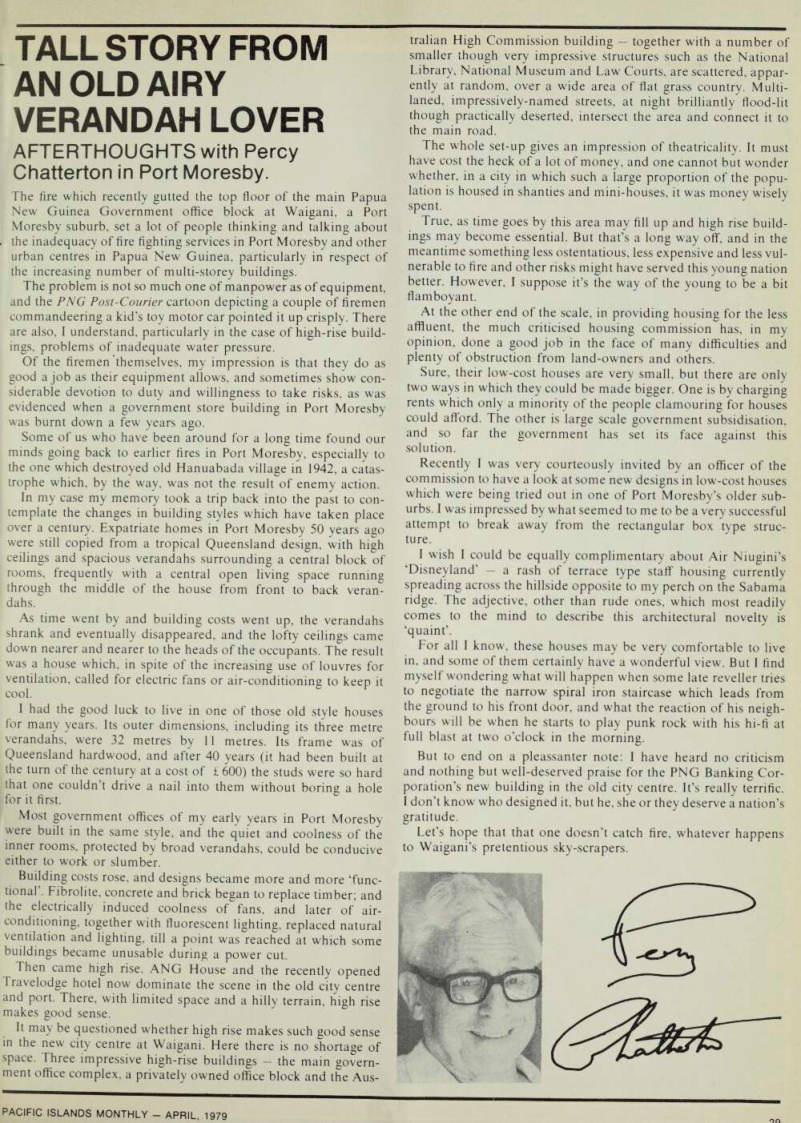
An Old Airy
Verandah Lover
AFTERTHOUGHTS with Percy Chatterton in Port Moresby.
The fire which recently gutted the top floor of the main Papua New Guinea Government office block at Waigani, a Port Moresby suburb, set a lot of people thinking and talking about , the inadequacy of fire fighting services in Port Moresby and other urban centres in Papua New Guinea, particularly in respect of
the increasing number of multi-storey buildings.
The problem is not so much one of manpower as of equipment, and the PNG Post-Courier cartoon depicting a couple of firemen commandeering a kid’s toy motor car pointed it up crisply. There are also, I understand, particularly in the case of high-rise build
ings, problems of inadequate water pressure.
Of the firemen themselves, my impression is that they do as good a job as their equipment allows, and sometimes show con siderable devotion to duty and willingness to take risks, as was evidenced when a government store building in Port Moresby was burnt down a few years ago.
Some of us who have been around for a long time found our minds going back to earlier fires in Port Moresby, especially to the one which destroyed old Hanuabada village in 1942, a catas trophe which, by the way, was not the result of enemy action.
In my case my memory took a trip back into the past to con template the changes in building styles which have taken place over a century. Expatriate homes in Port Moresby 50 years ago were still copied from a tropical Queensland design, with high ceilings and spacious verandahs surrounding a central block of rooms, frequently with a central open living space running through the middle of the house from front to back veran dahs.
As time went by and building costs went up, the verandahs shrank and eventually disappeared, and the lofty ceilings came down nearer and nearer to the heads of the occupants. The result was a house which, in spite of the increasing use of louvres for ventilation, called for electric fans or air-conditioning to keep it cool.
I had the good luck to live in one of those old style houses for many years. Its outer dimensions, including its three metre verandahs, were 32 metres by 11 metres. Its frame was of Queensland hardwood, and after 40 years (it had been built at the turn of the century at a cost of £ 600) the studs were so hard that one couldn’t drive a nail into them without boring a hole for it first.
Most government offices of my early years in Port Moresby were built in the same style, and the quiet and coolness of the inner rooms, protected by broad verandahs, could be conducive either to work or slumber.
Building costs rose, and designs became more and more ‘func tional . Fibrolite, concrete and brick began to replace timber; and the electrically induced coolness of fans, and later of air conditioning, together with fluorescent lighting, replaced natural ventilation and lighting, till a point was reached at which some buildings became unusable during a power cut.
Then came high rise. ANG House and the recently opened Travelodge hotel now dominate the scene in the old city centre and port. There, with limited space and a hilly terrain, high rise makes good sense.
It may be questioned whether high rise makes such good sense in the new city centre at Waigani. Here there is no shortage of space. Three impressive high-rise buildings - the main govern ment office complex, a privately owned office block and the Aus
tralian High Commission building together with a number of smaller though very impressive structures such as the National Library, National Museum and Law Courts, are scattered, appar ently at random, over a wide area of flat grass country. Multi laned, impressively-named streets, at night brilliantly flood-lit though practically deserted, intersect the area and connect it to the main road.
The whole set-up gives an impression of theatricality. It must have cost the heck of a lot of money, and one cannot but wonder whether, in a city in which such a large proportion of the popu lation is housed in shanties and mini-houses, it was money wisely spent.
True, as time goes by this area may fill up and high rise build ings may become essential. But that’s a long way off, and in the meantime something less ostentatious, less expensive and less vul nerable to fire and other risks might have served this young nation better. However, I suppose it’s the way of the young to be a bit
flamboyant.
At the other end of the scale, in providing housing for the less affluent, the much criticised housing commission has, in my opinion, done a good job in the face of many difficulties and plenty of obstruction from land-owners and others.
Sure, their low-cost houses are very small, but there are only two ways in which they could be made bigger. One is by charging rents which only a minority of the people clamouring for houses could afford. The other is large scale government subsidisation, and so far the government has set its face against this solution.
Recently I was very courteously invited by an officer of the commission to have a look at some new designs in low-cost houses which were being tried out in one of Port Moresby’s older sub urbs. I was impressed by what seemed to me to be a very successful attempt to break away from the rectangular box type struc ture.
I wish I could be equally complimentary about Air Niugini’s ‘Disneyland’ a rash of terrace type staff housing currently spreading across the hillside opposite to my perch on the Sabama ridge. The adjective, other than rude ones, which most readily comes to the mind to describe this architectural novelty is
‘quaint’.
For all I know, these houses may be very comfortable to live in, and some of them certainly have a wonderful view. But I find myself wondering what will happen when some late reveller tries to negotiate the narrow spiral iron staircase which leads from the ground to his front door, and what the reaction of his neigh bours will be when he starts to play punk rock with his hi-fi at full blast at two o’clock in the morning.
But to end on a pleassanter note: I have heard no criticism and nothing but well-deserved praise for the PNG Banking Cor poration’s new building in the old city centre. It’s really terrific.
I don’t know who designed it, but he, she or they deserve a nation’s
gratitude.
Let’s hope that that one doesn’t catch fire, whatever happens
to Waigani’s pretentious sky-scrapers.
Advertisements & other items, pp. 30-31 (1 item)
■i
WHY THE
, REPUBLIC OF NAURU
(POPULATION 62001 HAS AN
INTERNATIONAL AIRLINE.
You will discover the Republic of Nauru on a map of the Pacific if you run your finger along the Equator until it arrives at the point marked 166°55' East. We are 26 miles south of that point.
Having now put your finger on us, and taken a long look around, you will be able to make the same observation that we made long ago, which is that, in the general geographic scheme of things, we are not only one of the smallest nations of the world (about nine square miles, including a chunk of our coral reef), but also one of the most isolated.
Frankly, a location 2,500 miles from Sydney, 2,600 miles from Honolulu and 3,000 or so miles from Tokyo-let alone 190 miles from our nearest neighbor, Ocean Island-seems reason enough for having an international airline. And we do admit, when pressed, that having a jet fleet in the
HONG KONG
Pacific helps immeasurably to expedite our affairs of state.
And so, ladies and gentlemen, you will discover, when you fly with us, that Air Nauru is, on the one hand, an airline that helps link us with our Micronesian, Melanesian and Polynesian neighbors. And that, on the other, it is an opportunity for you to share memorable, even profound, travel adventures.
Today, Air Nauru—the airline of the Central Pacific-flies Boeing 727 s and 737 s to 16 ports of call and our own home island. We’re the first airline to link Asia with the three great ethnic regions of the Pacific. You can board us in Hong Kong and fly with us through Nauru all the way to Melbourne. You can fly a truly significant airline route that links distant, distinctive places that, in many cases, have never before been linked by jet.
No matter how you like to travel, you’ll have to admit, when you glance at our route map, that Air Nauru can provide you with some tantalizing travel alternatives.
And that’s why the Republic of Nauru has an interjuro national airline.
KAGOSHIMA
TAIPEI OKINAWA
MANILA
PONAPE
GUAM
NAURU
TARAWA
HONIARA
MELBOURNE
NAURU
V AIRLINE OF THE CENTRAL PACIFIC
or ticketing, reservations and flight information, telephone, 740 in Apia, Western Samoa; 477-7106 in Guam; 595 or 727 in Honiara Solomon Islands; 229 in M a) uro, Marshall Islands; 312-377 in Suva, Fiji, 27-33-22 in Noumea, New Caledonia; 458 in Ponape, arolme Islands, 27-39 in Vila, New Hebrides; 72795 in Nadi. Fiji; 448 in Tarawa, Gilbert Islands; and 653-5709 in Melbourne, Australia.
People
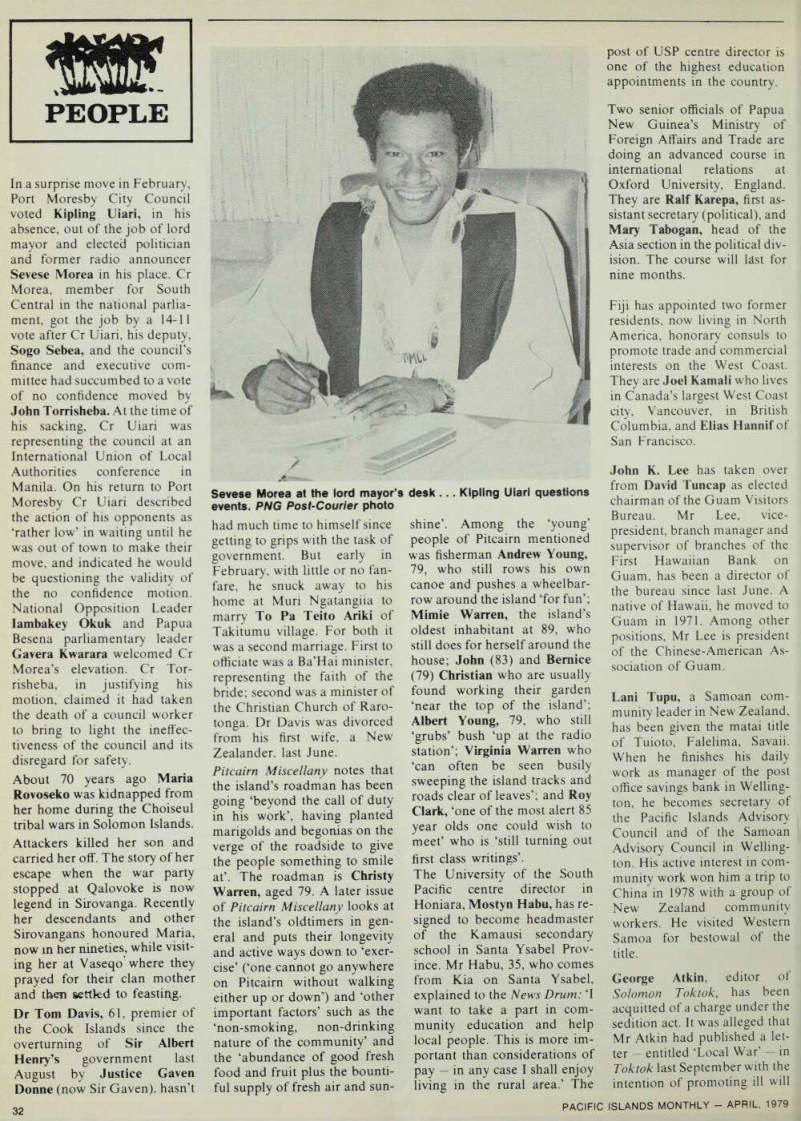
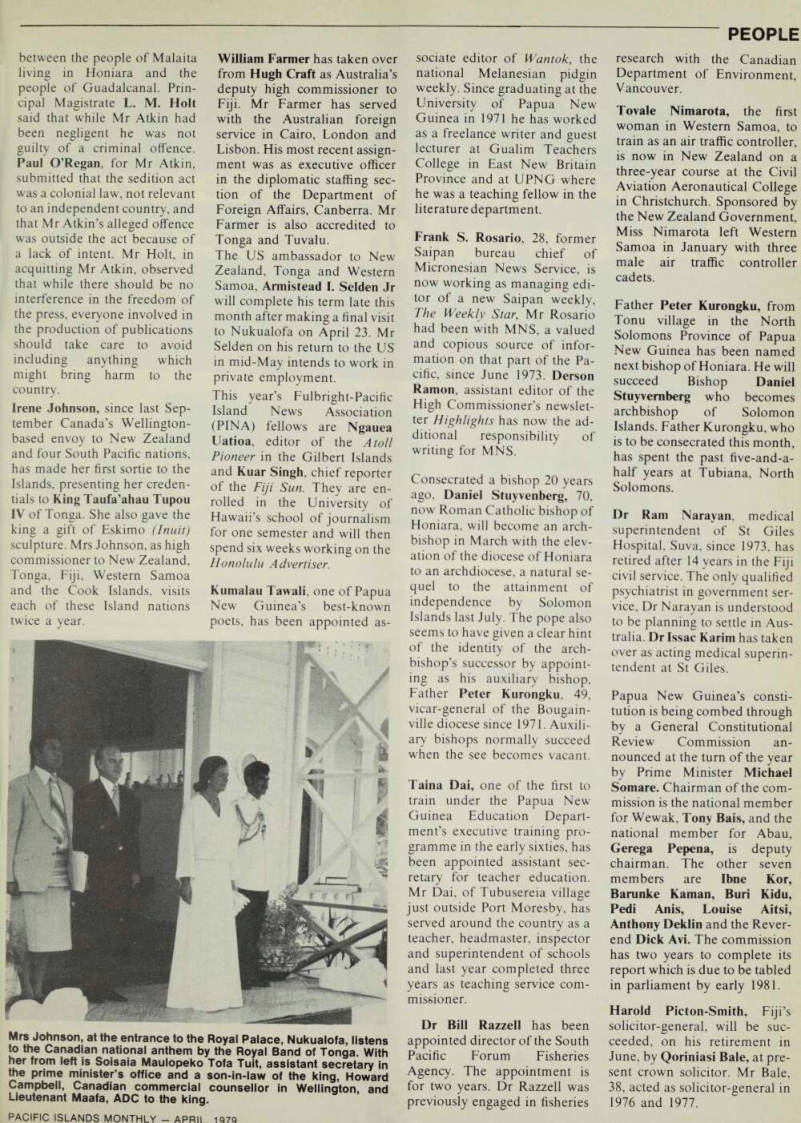
In a surprise move in February,
Port Moresby City Council
voted Kipling Uiari, in his absence, out of the job of lord mayor and elected politician and former radio announcer Sevese Morea in his place. Cr Morea, member for South Central in the national parlia ment, got the job by a 14-11 vote after Cr Uiari, his deputy, Sogo Sebea, and the council’s finance and executive com mittee had succumbed to a vote of no confidence moved by John Torrisheba. At the time of his sacking, Cr Uiari was representing the council at an International Union of Local Authorities conference in Manila. On his return to Port Moresby Cr Uiari described the action of his opponents as ‘rather low’ in waiting until he was out of town to make their move, and indicated he would be questioning the validity of the no confidence motion.
National Opposition Leader lambakey Okuk and Papua Besena parliamentary leader Gavera Kwarara welcomed Cr Morea’s elevation. Cr Tor risheba, in justifying his motion, claimed it had taken the death of a council worker to bring to light the ineffec tiveness of the council and its
disregard for safety.
About 70 years ago Maria Rovoseko was kidnapped from her home during the Choiseul tribal wars in Solomon Islands.
Attackers killed her son and carried her off. The story of her escape when the war party stopped at Qalovoke is now
legend in Sirovanga. Recently
her descendants and other Sirovangans honoured Maria, now in her nineties, while visit
ing her at Vaseqo'where they
prayed for their clan mother and then settled to feastifig.
Dr Tom Davis, 61, premier of the Cook Islands since the overturning of Sir Albert Henry’s government last August by Justice Gaven Donne (now Sir Gaven). hasn’t
had much time to himself since getting to grips with the task of government. But early in February, with little or no fan fare, he snuck away to his home at Muri Ngatangiia to marry To Pa Teito Ariki of Takitumu village. For both it was a second marriage. First to officiate was a Ba’Hai minister, representing the faith of the bride; second was a minister of the Christian Church of Raro tonga. Dr Davis was divorced from his first wife, a New Zealander, last June.
Pitcairn Miscellany notes that the island’s roadman has been
going ‘beyond the call of duty
in his work’, having planted marigolds and begonias on the verge of the roadside to give the people something to smile at’. The roadman is Christy Warren, aged 79. A later issue of Pitcairn Miscellany looks at the island’s oldtimers in gen eral and puts their longevity and active ways down to ‘exer cise’ (‘one cannot go anywhere on Pitcairn without walking either up or down’) and ‘other important factors’ such as the
‘non-smoking, non-drinking
nature of the community’ and the ‘abundance of good fresh food and fruit plus the bounti ful supply of fresh air and sun
shine’. Among the ‘young’ people of Pitcairn mentioned was fisherman Andrew Young, 79, who still rows his own canoe and pushes a wheelbar row around the island ‘for fun’; Mimic Warren, the island’s oldest inhabitant at 89, who still does for herself around the house; John (83) and Bernice (79) Christian who are usually
found working their garden
‘near the top of the island’; Albert Young, 79, who still ‘grubs’ bush ‘up at the radio station’; Virginia Warren who ‘can often be seen busily sweeping the island tracks and roads clear of leaves’; and Roy Clark, ‘one of the most alert 85 year olds one could wish to meet’ who is ‘still turning out first class writings’.
The University of the South Pacific centre director in Honiara, Mostyn Hahu, has re signed to become headmaster of the Kamausi secondary school in Santa Ysabel Prov ince. Mr Habu, 35, who comes from Kia on Santa Ysabel, explained to the News Drum: T want to take a part in com
munity education and help
local people. This is more im portant than considerations of pay in any case I shall enjoy living in the rural area.’ The
post of USP centre director is one of the highest education appointments in the country.
Two senior officials of Papua New Guinea’s Ministry of Foreign Affairs and Trade are doing an advanced course in international relations at Oxford University, England.
They are Ralf Karepa, first as sistant secretary (political), and Mary Tabogan, head of the Asia section in the political div ision. The course will list for nine months.
Fiji has appointed two former residents, now living in North America, honorary consuls to promote trade and commercial interests on the West Coast.
They are Joel Kamali who lives in Canada’s largest West Coast city, Vancouver, in British Columbia, and Elias Hannif of San Francisco.
John K. Lee has taken over from David Tuncap as elected chairman of the Guam Visitors Bureau. Mr Lee, vice president, branch manager and supervisor of branches of the First Hawaiian Bank on Guam, has been a director of the bureau since last June. A native of Hawaii, he moved to Guam in 1971. Among other positions, Mr Lee is president of the Chinese-American As sociation of Guam.
Lani Tupu, a Samoan com munity leader in New Zealand, has been given the matai title of Tuioto, Falelima, Savaii.
When he finishes his daily work as manager of the post office savings bank in Welling ton, he becomes secretary of the Pacific Islands Advisory Council and of the Samoan
Advisory Council in Welling
ton. His active interest in com munity work won him a trip to China in 1978 with a group of New Zealand community workers. He visited Western Samoa for bestowal of the title.
George Atkin, editor of Solomon Toktok, has been acquitted of a charge under the sedition act. It was alleged that Mr Atkin had published a let ter entitled ‘Local War’ in Toktok last September with the intention of promoting ill will
Sevese Morea at the lord mayor’s desk... Kipling Uiari questions events. PNG Post-Courier photo
between the people of Malaita living in Honiara and the people of Guadalcanal. Prin cipal Magistrate L. M. Holt said that while Mr Atkin had been negligent he was not guilty of a criminal offence.
Paul O’Regan, for Mr Atkin, submitted that the sedition act was a colonial law, not relevant to an independent country, and that Mr Atkin’s alleged offence was outside the act because of a lack of intent. Mr Holt, in acquitting Mr Atkin, observed that while there should be no interference in the freedom of the press, everyone involved in the production of publications should take care to avoid
including anything which
might bring harm to the country.
Irene Johnson, since last Sep tember Canada’s Wellington based envoy to New Zealand and four South Pacific nations, has made her first sortie to the Islands, presenting her creden tials to King Taufa’ahau Tupou IV of Tonga. She also gave the king a gift of Eskimo (Inuit) sculpture. Mrs Johnson, as high commissioner to New Zealand.
Tonga, Fiji, Western Samoa
and the Cook Islands, visits each of these Island nations twice a year.
William Farmer has taken over from Hugh Craft as Australia’s
deputy high commissioner to
Fiji. Mr Farmer has served with the Australian foreign service in Cairo, London and Lisbon. His most recent assign ment was as executive officer in the diplomatic staffing sec tion of the Department of Foreign Affairs, Canberra. Mr Farmer is also accredited to Tonga and Tuvalu, The US ambassador to New Zealand, Tonga and Western Samoa, Armistead I. Selden Jr will complete his term late this month after making a final visit to Nukualofa on April 23. Mr Selden on his return to the US in mid-May intends to work in
private employment,
This
year’s Fulbright-Pacific
island News Association (PINA) fellows are Ngauea Uatioa, editor of the Atoll Pioneer in the Gilbert Islands and Kuar Singh, chief reporter G f the Fiji Sun. They are en rolled in the University of Hawaii’s school of journalism for one semester and will then spend six weeks working on the Honolulu Advertiser Kumalau Tawali, one of Papua New Guinea’s best-known poets, has been appointed as-
sociate editor of Wantok, the national Melanesian pidgin weekly. Since graduating at the
University of Papua New
Guinea in 1971 he has worked as a freelance writer and guest lecturer at Gualim Teachers College in East New Britain Province and at UPNG where he was a teaching fellow in the
literature department.
Frank S. Rosario, 28, former Saipan bureau chief of Micronesian News Service, is now working as managing edi tor of a new Saipan weekly, The Weekly Star, Mr Rosario had been with MNS, a valued and copious source of infor mation on that part of the Pa cific, since June 1973. Derson Ramon, assistant editor of the High Commissioner’s newslet ter Highlights has now the ad ditional responsibility of writing for MNS.
Consecrated a bishop 20 years ago. Daniel Stuyvenberg, 70, now Roman Catholic bishop of Honiara, will become an arch bishop in March with the elev ation of the diocese of Honiara to an archdiocese, a natural se quel to the attainment of
independence by Solomon
Islands last July. The pope also seems to have given a clear hint of the identity of the arch
bishop’s successor by appoint
ing as his auxiliary bishop.
Father Peter Kurongku, 49,
vicar-general of the Bougain
ville diocese since 1971. Auxili
ary bishops normally succeed
when the see becomes vacant.
Taina Dai, one of the first to train under the Papua New Guinea Education Depart ment’s executive training pro gramme in the early sixties, has been appointed assistant sec retary for teacher education.
Mr Dai, of Tubusereia village just outside Port Moresby, has served around the country as a teacher, headmaster, inspector and superintendent of schools and last year completed three years as teaching service com missioner.
Dr Bill Razzell has been appointed director of the South Pacific Forum Fisheries
Agency. The appointment is
for two years. Dr Razzell was
previously engaged in fisheries
research with the Canadian Department of Environment, Vancouver.
Tovale Nimarota, the first woman in Western Samoa, to train as an air traffic controller, is now in New Zealand on a three-year course at the Civil Aviation Aeronautical College
in Christchurch. Sponsored by
the New Zealand Government, Miss Nimarota left Western Samoa in January with three male air traffic controller cadets.
Father Peter Kurongku, from Tonu village in the North Solomons Province of Papua New Guinea has been named next bishop of Honiara. He will succeed Bishop Daniel Stuyvernberg who becomes archbishop of Solomon Islands. Father Kurongku, who is to be consecrated this month, has spent the past five-and-a half years at Tubiana, North Solomons.
Dr Ram Narayan, medical superintendent of St Giles Hospital, Suva, since 1973, has retired after 14 years in the Fiji civil service. The only qualified psychiatrist in government ser vice, Dr Narayan is understood to be planning to settle in Aus tralia. Dr Issac Karim has taken over as acting medical superin tendent at St Giles.
Papua New Guinea’s consti tution is being combed through by a General Constitutional Review Commission an nounced at the turn of the year by Prime Minister Michael Somare. Chairman of the com mission is the national member for Wewak, Tony Bais, and the national member for Abau, Gerega Pepena, is deputy chairman. The other seven members are Ibne Kor, Barunke Kaman, Buri Kidu, Pedi Anis, Louise Aitsi, Anthony Deklin and the Rever end Dick Avi. The commission has two years to complete its report which is due to be tabled
in parliament by early 1981.
Harold Picton-Smith, Fiji’s solicitor-general, will be suc ceeded, on his retirement in June, by Qoriniasi Bale, at pre sent crown solicitor. Mr Bale, 38, acted as solicitor-general in 1976 and 1977.
Mrs Johnson, at the entrance to the Royal Palace, Nukualofa, listens to the Canadian national anthem by the Royal Band of Tonga. With her from left is Soisaia Maulopeko Tofa Tuit, assistant secretary in the prime minister’s office and a son-in-law of the king, Howard Campbell, Canadian commercial counsellor in Wellington, and Lieutenant Maafa, ADC to the king.
Advertisements & other items, p. 34 (1 item)
Ws hard to caH this deck No. 3.
With so many No.l features,
Ws hard to caH this deck No. 3. mm £ oca-ev
i'TDK
C6O SA @ ® ® pioneer stereo CO^££2iey
F3OO
Pioneer doesn’t stop with just giving you great sound; even coming from the middle of our new line, the new CT-FBOO cassette deck features an exclusive electronic microprocessor that provides recording/playback level accuracy that (up ’til now) was only available on our more expensive model.
Home or studio. This complex, yet amazingly compact computer takes the incoming signal and instantly feeds the information to a fluorescent display.
Divided into left and right channels, the full range is covered.
In this way, critical level adjustments can be made by monitoring the display and controlling the input, so that the peak signal levels never oversaturate the recording tape.
Tape travel during record!ng/playback has nothing to do with rewind/fastforward. That’s why the CT-FBOO employs two separate motors, in addition, the closed-loop dual capstan drive system utilizes two separate sets of capstans/ pinch rollers on either side of the heads.
Combined with the three-head, fully monitorable RECORD/PLAYBACK/ ERASE configuration using our newly developed Sendust head material, the resulting increase in performance can be aptly described by the incredibly low wow & flutter of no more than 0.045% (WRMS). A figure unattainable except in decks which cost hundreds of dollars more.
Pioneer’s new CT-FBOO. Number 3 in our wide range of stereo cassette decks, it was created to satisfy an equally wide range of listening requirements and budgets. But, coming from the leading audio maker, you can be sure the sound is Number 1 all the way. * Dolby is a trademark of Dolby Laboratories, Inc.
M PIONEER
Pioneer products are available through: Australia: Pioneer Marketing Service Pty. Ltd., P.O. Box 317, Mordialloc, Victoria, 3195 Nauru Island: Jacob Enterprises, P.O. Box No. 4, Republic of Nauru Tel. 90-9011 Fiji islands: Brijial & Company, G.P.O. Box No. 362, Suva, Fiji Islands Tel: 22258 New Zealand: Fountain Marketing Ltd., Maidstone Street, Auckland. New Zealand Tel: 763-064 Norfolk Island: Burns Philp (Norfolk Island) Ltd., Norfolk Island. South Pacific Now Hebrides; Burns Philp (New Hebrides) Ltd., Vila, New Hebrides Tahiti: Ets, PERFECT, B.P. 594. Papeete, Tahiti Tel: 20 407 New Caledonia: Menard Freres Ville, B.P. H 2 Cedex, Noumea, New Caledonia Tel: 27.52.22 American Samoa: Transpac Corporation, P.O. Box 1477, Pago Pago. American Samoa 9679€ Tel: 633-5224 Rarotonga: South Seas International Ltd., P.O. Box 49, Rarotonga, Cook Islands Tel: 2327 Papua New Guinea: Bali Merchants Pty. Ltd., P.O. Box 6103, Boroko Tel: 254887
Caledonia revolt
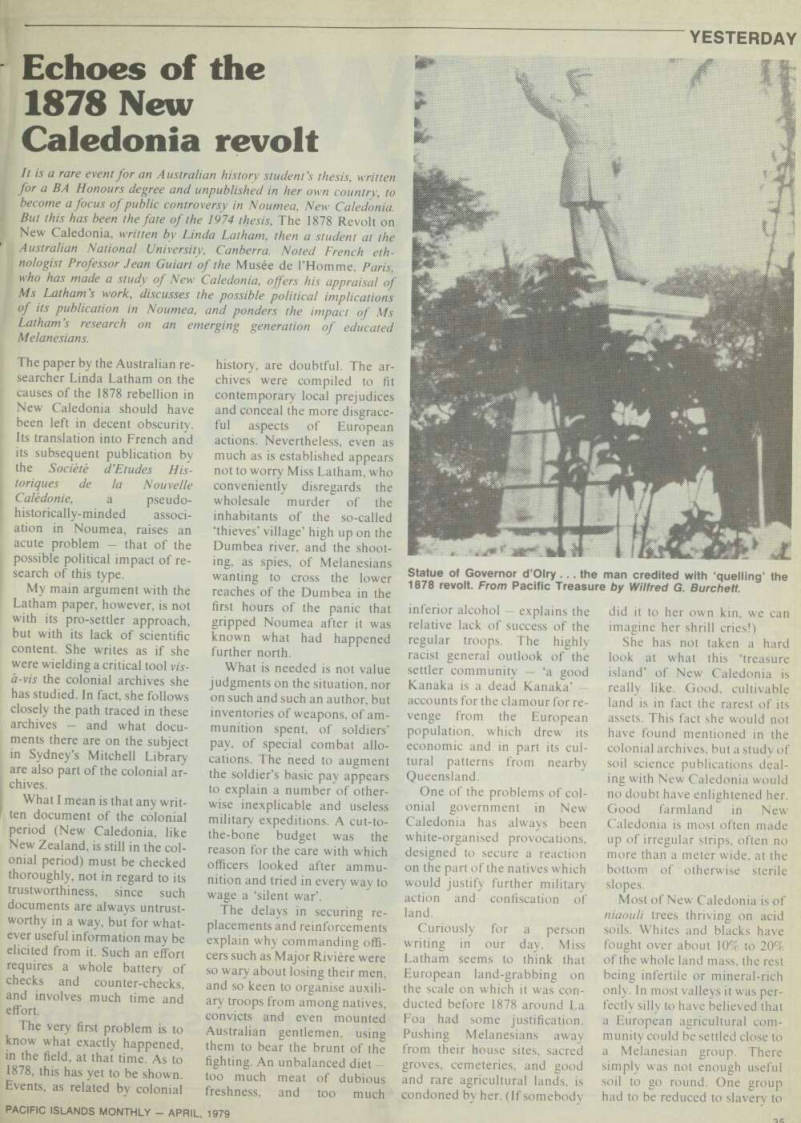

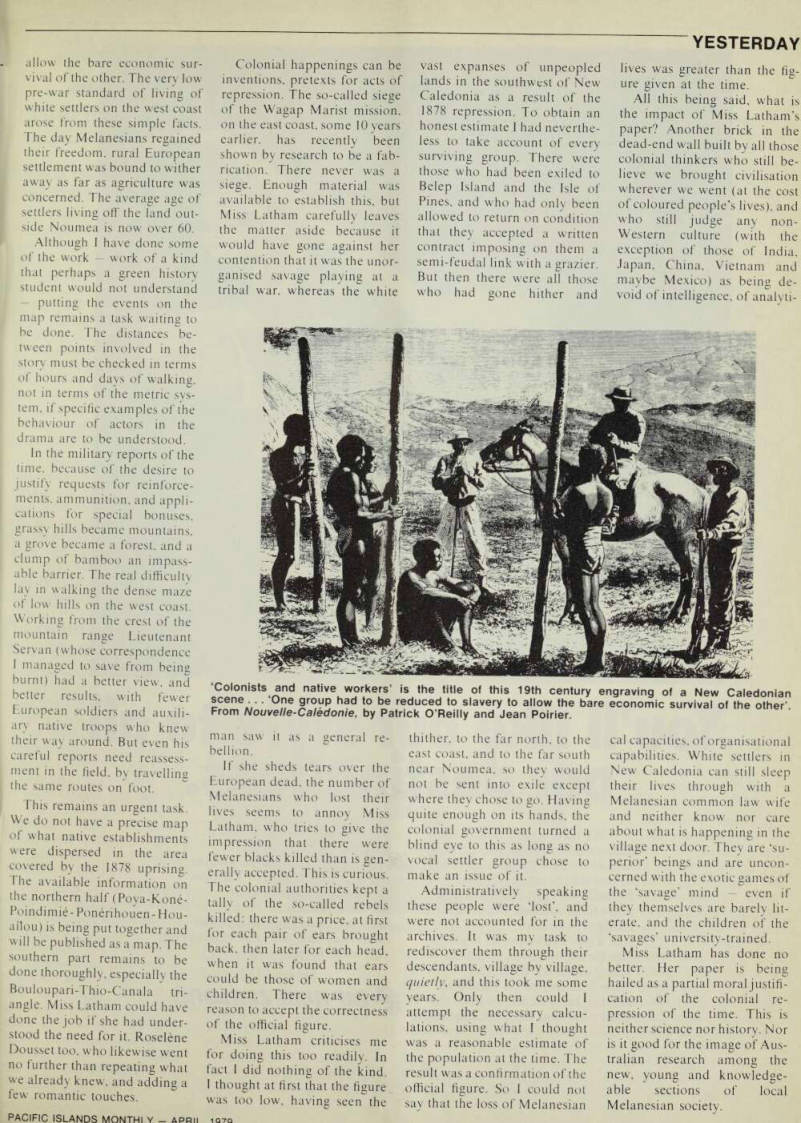
Yesterday
Echoes of the 1878 New Caledonia revolt
It is a rare event for an Australian history student’s thesis, written for a BA Honours degree and unpublished in her own country, to become a focus of public controversy in Noumea, New Caledonia.
But this has been the fate of the 1974 thesis, The 1878 Revolt on New Caledonia, written by Linda Latham, then a student at the Australian National University, Canberra. Noted French eth nologist Professor Jean Guiart of the Musee de I’Homme. Paris, who has made a study of New Caledonia, offers his appraisal of Ms Latham’s work, discusses the possible political implications of its publication in Noumea, and ponders the impact of Ms Latham s research on an emerging generation of educated Melanesians.
The paper by the Australian re searcher Linda Latham on the causes of the 1878 rebellion in New Caledonia should have been left in decent obscurity.
Its translation into French and its subsequent publication by the Societe d’Etudes His toriques de la Nouvelle Caledonie, a pseudo
historically-minded associ
ation in Noumea, raises an acute problem - that of the possible political impact of re search of this type.
My main argument with the Latham paper, however, is not with its pro-settler approach, but with its lack of scientific content. She writes as if she were wielding a critical tool vis d-vis the colonial archives she has studied. In fact, she follows closely the path traced in these archives - and what docu ments there are on the subject
in Sydney’s Mitchell Library
are also part of the colonial ar chives.
What I mean is that any writ ten document of the colonial period (New Caledonia, like New Zealand, is still in the col onial period) must be checked thoroughly, not in regard to its trustworthiness, since such documents are always untrust worthy in a way, but for what ever useful information may be elicited from it. Such an effort requires a whole battery of checks and counter-checks, and involves much time and effort.
The very first problem is to
know what exactly happened,
in the field, at that time. As to 1878, this has yet to be shown.
Events, as related by colonial
history, are doubtful. The ar chives were compiled to fit contemporary local prejudices and conceal the more disgrace ful aspects of European actions. Nevertheless, even as much as is established appears not to worry Miss Latham, who
conveniently disregards the
wholesale murder of the inhabitants of the so-called ‘thieves’ village’ high up on the Dumbea river, and the shoot ing, as spies, of Melanesians wanting to cross the lower reaches of the Dumbea in the first hours of the panic that gripped Noumea after it was known what had happened further north.
What is needed is not value judgments on the situation, nor on such and such an author, but inventories of weapons, of am munition spent, of soldiers' pay, of special combat allo cations. The need to augment the soldier’s basic pay appears to explain a number of other wise inexplicable and useless
military expeditions. A cut-to
the-bone budget was the reason for the care with which officers looked after ammu nition and tried in every way to wage a ‘silent war’.
The delays in securing re placements and reinforcements
explain why commanding offi
cers such as Major Riviere were so wary about losing their men, and so keen to organise auxili ary troops from among natives, convicts and even mounted Australian gentlemen, using them to bear the brunt of the fighting. An unbalanced diet too much meat of dubious freshness, and too much
inferior alcohol explains the relative lack of success of the
regular troops. The highly
racist general outlook of the settler community - ‘a good Kanaka is a dead Kanaka’ accounts for the clamour for revenge from the European population, which drew its economic and in part its cultural patterns from nearby Queensland.
One of the problems of colonial government in New Caledonia has always been
white-organised provocations,
designed to secure a reaction on the part of the natives which
would justify further military
action and confiscation of l an d.
Curiously for a person writing in our day. Miss Latham seems to think that European land-grabbing on the scale on which it was conducted before 1878 around La Foa had some justification, Pushing Melanesians away from their house sites, sacred groves, cemeteries, and good and rare agricultural lands, is condoned by her. (If somebody
did it to her own kin, we can imagine her shrill cries!) She has not taken a hard look at what this ‘treasure island’ of New Caledonia is really like. Good, cultivable land is in fact the rarest of its assets. This fact she would not have found mentioned in the colonial archives, but a study of soil science publications deal ing with New Caledonia would no doubt have enlightened her.
Good farmland in New Caledonia is most often made up of irregular strips, often no more than a meter wide, at the bottom of otherwise sterile
slopes.
Most of New Caledonia is of niaouli trees thriving on acid soils. Whites and blacks have fought over about 10% to 20% of the whole land mass, the rest being infertile or mineral-rich only. In most valleys it was per fectly silly to have believed that
a European agricultural com
munity could be settled close to a Melanesian group. There simply was not enough useful soil to go round. One group had to be reduced to slavery to
Statue of Governor d’Olry... the man credited with ‘quelling’ the 1878 revolt. From Pacific Treasure by Wilfred G. Burchett.
allow the bare economic sur vival of the other. The very low pre-war standard of living of white settlers on the west coast arose from these simple facts.
The day Melanesians regained their freedom, rural European settlement was bound to wither away as far as agriculture was concerned. The average age of settlers living off the land out side Noumea is now over 60.
Although I have done some of the work work of a kind that perhaps a green history student would not understand - putting the events on the map remains a task waiting to be done. The distances be tween points involved in the story must be checked in terms of hours and days of walking, not in terms of the metric sys tem. if specific examples of the behaviour of actors in the drama are to be understood.
In the military reports of the time, because of the desire to justify requests for reinforce ments. ammunition, and appli cations for special bonuses, grassy hills became mountains, a grove became a forest, and a clump of bamboo an impass able barrier. The real difficulty lay in walking the dense maze of low hills on the west coast.
Working from the crest of the mountain range Lieutenant Servan (whose correspondence I managed to save from being burnt) had a better view, and better results, with fewer European soldiers and auxili ary native troops who knew their way around. But even his careful reports need reassess ment in the field, by travelling the same routes on foot This remains an urgent task.
We do not have a precise map of what native establishments were dispersed in the area covered by the 1878 uprising.
The available information on the northern half (Poya-Kone- Poindimie- Ponerihouen- Hou ailou) is being put together and will be published as a map. The southern part remains to be
done thoroughly, especially the
Bouloupari-Thio-Canala tri
angle. Miss Latham could have done the job if she had under stood the need for it. Roselene Dousset too, who likewise went no further than repeating what we already knew, and adding a few romantic touches.
Colonial happenings can be inventions, pretexts for acts of
repression. The so-called siege
of the Wagap Marist mission, on the east coast, some 10 years earlier, has recently been shown by research to be a fab rication. There never was a
siege. Enough material was
available to establish this, but Miss Latham carefully leaves the matter aside because it would have gone against her contention that it was the unor ganised savage playing at a tribal war, whereas the white
man saw it as a general re bellion.
If she sheds tears over the European dead, the number of Melanesians who lost their lives seems to annoy Miss Latham, who tries to give the impression that there were fewer blacks killed than is gen erally accepted. This is curious.
The colonial authorities kept a tally of the so-called rebels killed: there was a price, at first for each pair of ears brought back, then later for each head, when it was found that ears could be those of women and children. There was every reason to accept the correctness of the official figure.
Miss Latham criticises me for doing this too readily. In fact I did nothing of the kind.
I thought at first that the figure was too low, having seen the
vast expanses of unpeopled lands in the southwest of New Caledonia as a result of the 1878 repression. To obtain an honest estimate I had neverthe less to take account of every surviving group. There were those who had been exiled to Belep Island and the Isle of Pines, and who had only been allowed to return on condition that they accepted a written contract imposing on them a semi-feudal link with a grazier.
But then there were all those who had gone hither and
thither, to the far north, to the east coast, and to the far south near Noumea, so they would not be sent into exile except where they chose to go. Having quite enough on its hands, the colonial government turned a blind eye to this as long as no vocal settler group chose to make an issue of it.
Administratively speaking
these people were ‘lost’, and were not accounted for in the archives. It was my task to rediscover them through their
descendants, village by village,
quietly, and this took me some years. Only then could I attempt the necessary calcu lations. using what I thought was a reasonable estimate of the population at the time. The result was a confirmation of the official figure. So I could not say that the loss of Melanesian
lives was greater than the fig ure given at the time.
All this being said, what is the impact of Miss Latham’s paper? Another brick in the dead-end wall built by all those colonial thinkers who still be lieve we brought civilisation wherever we went (at the cost of coloured people’s lives), and who still judge any non- Western culture (with the exception of those of India.
Japan, China, Vietnam and maybe Mexico) as being de void of intelligence, of analyti
cal capacities, of organisational capabilities. White settlers in New Caledonia can still sleep their lives through with a Melanesian common law wife and neither know nor care about what is happening in the village next door. They are ‘su perior’ beings and are uncon cerned with the exotic games of the ‘savage’ mind even if they themselves are barely lit erate, and the children of the
‘savages’ university-trained.
Miss Latham has done no better. Her paper is being hailed as a partial moral justifi cation of the colonial re pression of the time. This is neither science nor history. Nor is it good for the image of Aus tralian research among the new, young and knowledge able sections of local Melanesian society.
‘Colonists and native workers’ is the title of this 19th century engraving of a New Caledonian scene... One group had to be reduced to slavery to allow the bare economic survival of the other' From Nouvelle-Caledonie, by Patrick O’Reilly and Jean Poirier.
Advertisements & other items, pp. 36-38 (2 items)
Colorburst
NOW!
New Kodak
cameras.
At last a camera to capture the fun times instantly with rich and vibrant color by Kodak.
With the Colorburst cameras instant color picture fun has never been so easy indoors or out, with flash or natural light, you just aim, frame, focus and shoot, and the new Colorburst instant camera automatically produces clean, dry prints that develop right before your very eyes. Within minutes you have a superb color picture with beautiful Satinluxe finish from Kodak PRIO Instant Print Film.
Kodak Colorburst cameras feature: • Adjustable focus control with special ‘zooming circle’, focusing symbols, and distance scale • Electronic shutter — 1/3000 sec. to 1/20 sec. • Eyecup on viewfinder • Flash socket • Tripod socket • Automatic motor-driven print ejection • Red low-light signal warns you when to use flash • Lighten/darken print control • Exposure counter • Neckstrap and monograms • Kodak 3 year warranty.
See your photo dealer for a free demonstration, retail price.
New Kodak Instant Cameras and Film.
m Kodak (Australasia) Pty. Ltd. ‘Kodak’, ‘Colorburst’ and ‘Satinluxe’ are trademarks. 345 0091
■ 1 ■p u ■m o W^Sm m i * sm i ■ ■p* •v 28 te:-. **m v- . m ■HR *
You’ll like our style to all
our destinations.
We have many flights to many destinations, but on each and every one you can be sure of one thing: attentive and friendly service. Plus of course good food and fine wines served in big jet comfort.
Today this special style of Air New Zealand is yours to enjoy on direct flights to New Zealand, or on your way around the Pacific; even to the East now that the fast, friendly way there is first to fly south with us! And of course to Honolulu, Los Angeles and on to Canada, London or Europe.
Your travel agent or Air New Zealand is ready now to help you plan the trip and the fares that suit you best wherever you want to fly.
4= air new zEatano
*** We fly the Pacific.
ANZ7B/3
Yesterday
PACIFIC ISLANDS MONTHI Y APRii iqtq
the ‘Bounty’
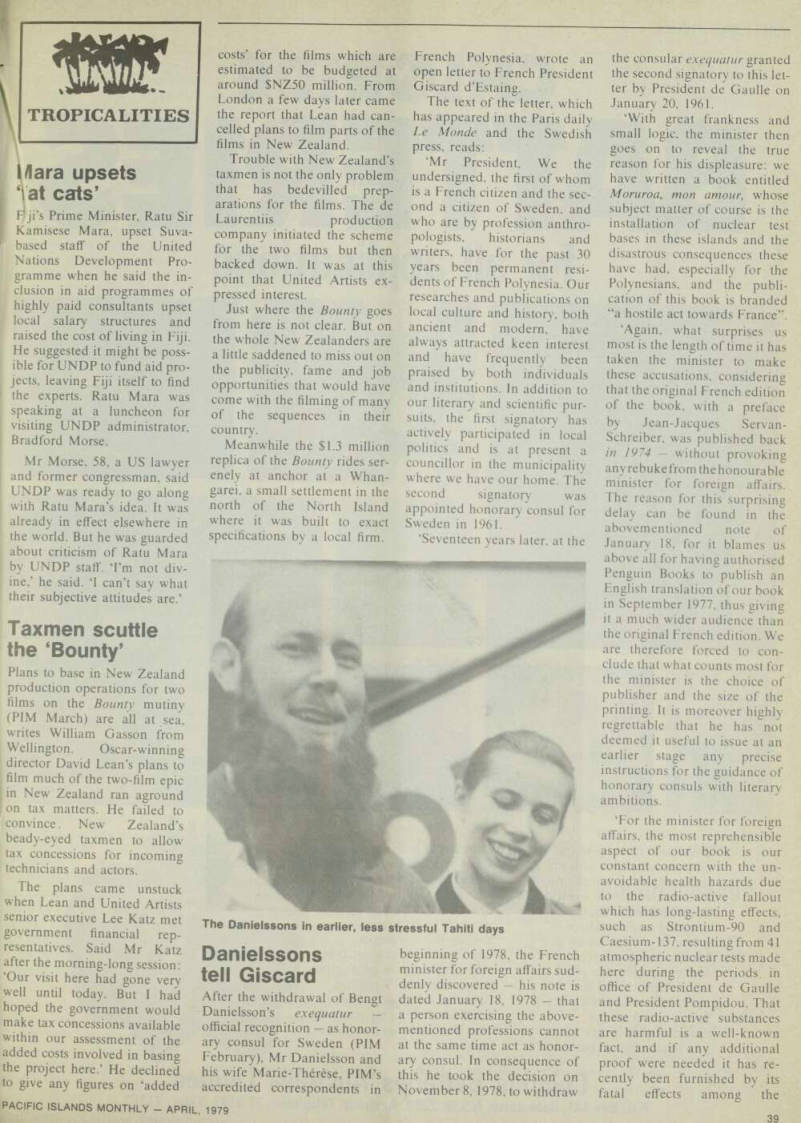

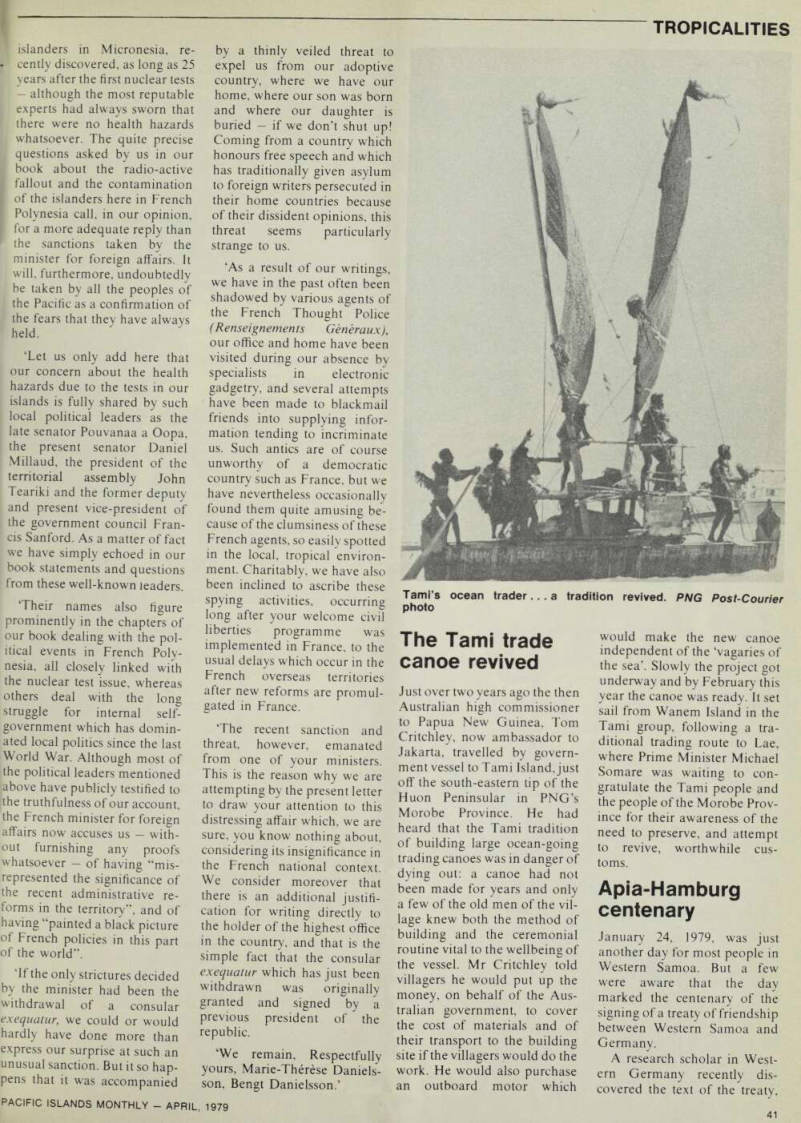
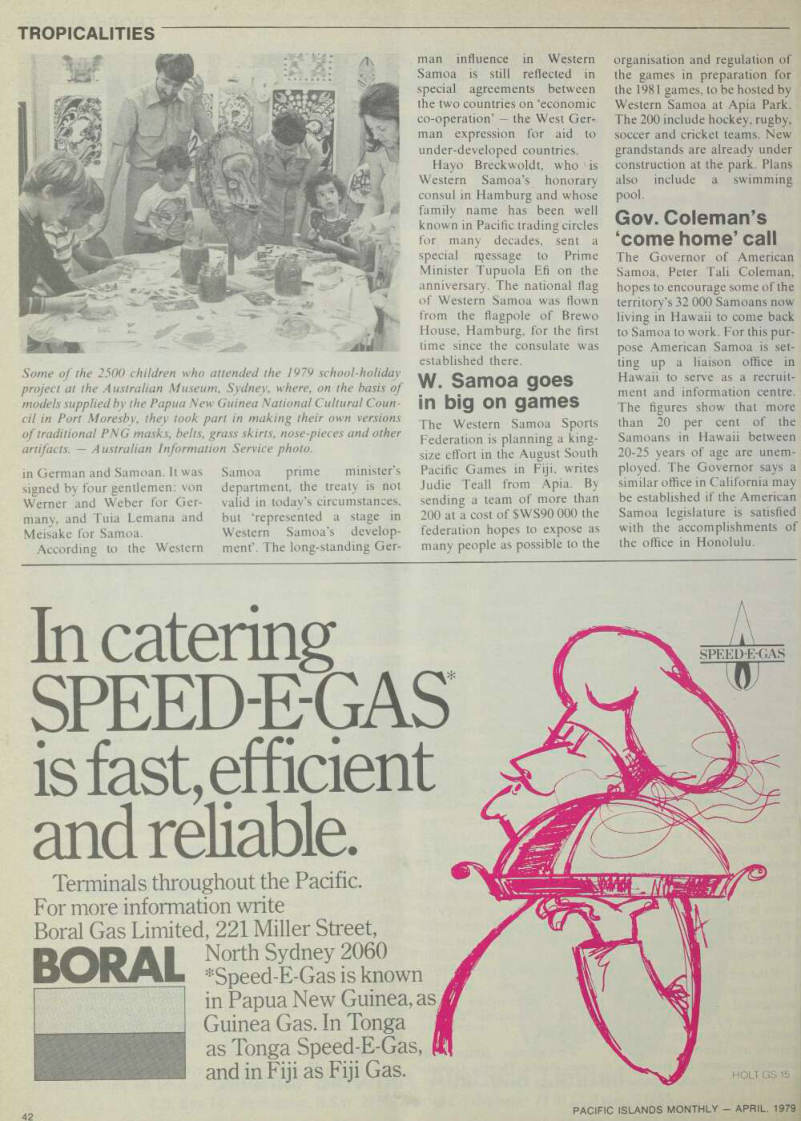
Tropicalities
costs’ for the films which are estimated to be budgeted at around SNZSO million. From London a few days later came the report that Lean had can celled plans to film parts of the films in New Zealand.
Trouble with New Zealand’s taxmen is not the only problem that has bedevilled prep arations for the films. The de Laurentiis production company initiated the scheme for the two films but then backed down. It was at this point that United Artists ex pressed interest.
Just where the Bounty goes from here is not clear. But on the whole New Zealanders are a little saddened to miss out on the publicity, fame and job opportunities that would have come with the filming of many of the sequences in their country.
Meanwhile the $1.3 million replica of the Bounty rides ser enely at anchor at a Whan garei, a small settlement in the north of the North Island where it was built to exact specifications by a local firm.
Mara upsets
‘iat cats’
Fji’s Prime Minister, Ratu Sir Kamisese Mara, upset Suva based staff of the United Nations Development Pro gramme when he said the in clusion in aid programmes of highly paid consultants upset local salary structures and raised the cost of living in Fiji.
He suggested it might be poss ible for UNDP to fund aid pro jects, leaving Fiji itself to find the experts. Ratu Mara was speaking at a luncheon for visiting UNDP administrator, Bradford Morse.
Mr Morse, 58, a US lawyer and former congressman, said UNDP was ready to go along with Ratu Mara’s idea. It was already in effect elsewhere in the world. But he was guarded about criticism of Ratu Mara by UNDP staff. ‘l’m not div ine,’ he said. ‘I can’t say what their subjective attitudes are.’
Taxmen scuttle
the ‘Bounty’
Plans to base in New Zealand production operations for two films on the Bounty mutiny (PIM March) are all at sea, writes William Gasson from
Wellington. Oscar-winning
director David Lean’s plans to film much of the two-film epic in New Zealand ran aground on tax matters. He failed to convince. New Zealand’s beady-eyed taxmen to allow tax concessions for incoming technicians and actors.
The plans came unstuck when Lean and United Artists senior executive Lee Katz met government financial rep resentatives. Said Mr Katz after the morning-long session; ‘Our visit here had gone very well until today. But I had hoped the government would make tax concessions available within our assessment of the added costs involved in basing the project here.’ He declined to give any figures on ‘added
French Polynesia, wrote an open letter to French President
Giscard d’Estaing.
The text of the letter, which has appeared in the Paris daily Le Monde and the Swedish press, reads; ‘Mr President, We the undersigned, the first of whom is a French citizen and the sec ond a citizen of Sweden, and who are by profession anthro pologists, historians and writers, have for the past 30 years been permanent resi dents of French Polynesia. Our researches and publications on local culture and history, both ancient and modern, have always attracted keen interest and have frequently been praised by both individuals and institutions. In addition to our literary and scientific pur suits, the first signatory has
actively participated in local
politics and is at present a councillor in the municipality where we have our home. The second signatory was appointed honorary consul for Sweden in 1961. ‘Seventeen years later, at the
Danielssons
tell Giscard
After the withdrawal of Bengt Danielsson’s exequatur official recognition as honor ary consul for Sweden (PIM February), Mr Danielsson and his wife Marie-Therese, PlM’s accredited correspondents in
beginning of 1978, the French minister for foreign affairs sud denly discovered his note is dated January 18, 1978 that a person exercising the above mentioned professions cannot at the same time act as honor ary consul. In consequence of this he took the decision on November 8, 1978, to withdraw
the consular exequatur granted the second signatory to this let ter by President de Gaulle on January 20, 1961. ‘With great frankness and small logic, the minister then goes on to reveal the true reason for his displeasure: we have written a book entitled Moruroa, mon amour, whose subject matter of course is the installation of nuclear test bases in these islands and the disastrous consequences these have had, especially for the
Polynesians, and the publi
cation of this book is branded “a hostile act towards France”.
‘Again, what surprises us
most is the length of time it has taken the minister to make these accusations, considering that the original French edition of the book, with a preface
by Jean-Jacques Servan-
Schreiber. was published back in 1974 without provoking anyrebukefromthehonourable minister for foreign affairs.
The reason for this surprising delay can be found in the abovementioned note of January 18, for it blames us above all for having authorised Penguin Books to publish an English translation of our book in September 1977, thus giving it a much wider audience than the original French edition. We are therefore forced to con clude that what counts most for the minister is the choice of publisher and the size of the printing. It is moreover highly regrettable that he has not deemed it useful to issue at an earlier stage any precise instructions for the guidance of
honorary consuls with literary
ambitions. ‘For the minister for foreign affairs, the most reprehensible aspect of our book is our constant concern with the un avoidable health hazards due to the radio-active fallout which has long-lasting effects, such as Strontium-90 and Caesium-137, resulting from 41 atmospheric nuclear tests made here during the periods in office of President de Gaulle and President Pompidou. That these radio-active substances are harmful is a well-known fact, and if any additional proof were needed it has re cently been furnished by its fatal effects among the
The Danielssons in earlier, less stressful Tahiti days
* islanders in Micronesia, re f cently discovered, as long as 25 years after the first nuclear tests although the most reputable experts had always sworn that there were no health hazards whatsoever. The quite precise questions asked by us in our I book about the radio-active I fallout and the contamination I of the islanders here in French I Polynesia call, in our opinion, I for a more adequate reply than the sanctions taken by the minister for foreign affairs. It will, furthermore, undoubtedly be taken by all the peoples of the Pacific as a confirmation of the fears that they have always held. ‘Let us only add here that our concern about the health hazards due to the tests in our islands is fully shared by such local political leaders as the late senator Pouvanaa a Oopa, ■ the present senator Daniel Millaud, the president of the territorial assembly John Teariki and the former deputy and present vice-president of the government council Fran cis Sanford. As a matter of fact we have simply echoed in our book statements and questions from these well-known leaders. ‘Their names also figure prominently in the chapters of our book dealing with the pol itical events in French Poly nesia, all closely linked with the nuclear test issue, whereas others deal with the long struggle for internal self government which has domin ated local politics since the last World War. Although most of the political leaders mentioned above have publicly testified to the truthfulness of our account, the French minister for foreign affairs now accuses us with out furnishing any proofs whatsoever of having “mis represented the significance of the recent administrative re forms in the territory”, and of
having “painted a black picture
of French policies in this part of the world”. ‘lf the only strictures decided by the minister had been the withdrawal of a consular exequatur, we could or would hardly have done more than express our surprise at such an unusual sanction. But it so hap pens that it was accompanied
by a thinly veiled threat to expel us from our adoptive country, where we have our home, where our son was born and where our daughter is buried - if we don’t shut up!
Coming from a country which honours free speech and which has traditionally given asylum to foreign writers persecuted in their home countries because of their dissident opinions, this threat seems particularly strange to us. ‘As a result of our writings, we have in the past often been shadowed by various agents of the French Thought Police ( Renseignements Generaux ), our office and home have been visited during our absence by specialists in electronic gadgetry, and several attempts have been made to blackmail friends into supplying infor mation tending to incriminate us. Such antics are of course unworthy of a democratic country such as France, but we have nevertheless occasionally found them quite amusing be cause of the clumsiness of these French agents, so easily spotted in the local, tropical environ ment. Charitably, we have also been inclined to ascribe these
spying activities, occurring
long after your welcome civil liberties programme was implemented in France, to the usual delays which occur in the French overseas territories after new reforms are promul gated in France. ‘The recent sanction and threat, however, emanated from one of your ministers.
This is the reason why we are attempting by the present letter to draw your attention to this distressing affair which, we are sure, you know nothing about,
considering its insignificance in
the French national context.
We consider moreover that there is an additional justifi cation for writing directly to the holder of the highest office in the country, and that is the simple fact that the consular exequatur which has just been withdrawn was originally granted and signed by a previous president of the republic. ‘We remain. Respectfully yours, Marie-Therese Daniels son, Benet Danielsson.’
The Tami tr2d&
canoe revived
Just over two years ago the then Australian high commissioner to Papua New Guinea, Tom Cntchley, now ambassador to Jakarta, travelled by government vessel to Tami Island, just off the south-eastern tip of the Huon Peninsular in PNG’s Morobe Province. He had heard that the Tami tradition
of building large ocean-going
trading canoes was in danger of dying out: a canoe had not been made for years and only a few of the old men of the village knew both the method of building and the ceremonial routine vital to the wellbeing of the vessel. Mr Critchley told villagers he would put up the money, on behalf of the Australian government, to cover the cost of materials and of their transport to the building site if the villagers would do the work. He would also purchase an outboard motor which
would make the new canoe independent of the ‘vagaries of the sea’. Slowly the project got
underway and by February this
yea r the canoe was ready. It set sai i from Wanem Island in the Tami group following a tra ditional trading route to Lae where Prime Minister Michael Somare was waiting to con gratulate the Tami people and the people of the Morobe Prov ince for their awareness of the nee d to preserve, and attempt t o revive, worthwhile cus toms
Apia-Hamburg
rpnfpnprv * January 24, 1979, was just another day for most people in Western Samoa. But a few were aware that the day marked the centenary of the signing of a treaty of friendship between Western Samoa and
Germany,
A research scholar in West
ern Germany recently dis
covered the text of the treaty.
Tami’s ocean trader... a tradition revived. PNG Post-Courier photo
in German and Samoan. It was
signed by four gentlemen; von
Werner and Weber for Ger many, and Tuia Lemana and Meisake for Samoa.
According to the Western
Samoa prime minister’s department, the treaty is not valid in today’s circumstances, but ‘represented a stage in Western Samoa’s develop ment’. The long-standing Ger
man influence in Western Samoa is still reflected in special agreements between the two countries on ‘economic co-operation’ the West Ger* man expression for aid to
under-developed countries.
Hayo Breckwoldt, who is Western Samoa’s honorary consul in Hamburg and whose family name has been well known m Pacific trading circles for many decades, sent a special message to Prime Minister Tupuola Efi on the
anniversary. The national flag
of Western Samoa was flown from the flagpole of Brewo House. Hamburg, for the first time since the consulate was established there.
W. Samoa goes
11l Dig OH games
The Western Samoa Sports Federation is planning a kingsize effort in the August South Pacific Games in Fiji, writes Judie Teall from Apia. By sending a team of more than 200 at a cost of SWS9O 000 the federation hopes to expose as many people as possible to the
organisation and regulation of
the games in preparation for the 1981 games, to be hosted by Western Samoa at Apia Park.
The 200 include hockey, rugby, soccer and cricket teams. New grandstands are already under construction at the park. Plans also include a swimming
pool.
Gov. Coleman’s
‘come home’ call
The Governor of American Samoa, Peter Tali Coleman, hopes to encourage some of the territory’s 32 000 Samoans now living in Hawaii to come back to Samoa to work. For this pur pose American Samoa is set ting up a liaison office in Hawaii to serve as a recruit ment and information centre.
The figures show that more than 20 per cent of the Samoans in Hawaii between 20-25 years of age are unem ployed. The Governor says a similar office in California may be established if the American Samoa legislature is satisfied with the accomplishments of the office in Honolulu.
Some of the 2500 children who attended the 1979 school-holiday project at the Australian Museum, Sydney, where, on the basis of models supplied by the Papua New Guinea National Cultural Coun cil in Port Moresby, they took part in making their own versions of traditional PNG masks, belts, grass skirts, nose-pieces and other artifacts. Australian Information Service photo.
Advertisements & other items, pp. 40-44 (2 items)
40
DAmcir iqi Awns MONTHLY APRIL. 1979
Chloride
for all applications
l 3 JA > I pisl I teil w a » ; ‘ -mSm v 'f *i ’ 3 ■ i
Pi-a -r*
t .ill
J |fc .
Chloride is the largest and only manufacturer of both lead acid and nickel cadmium alkaline batteries in Australia.
The Company is equipped and qualified to offer advice, guidance and service on any battery requirement no matter how large or small.
On the question of size, it could be as small as a battery for a hearing aid the dimensions of a coat button or a power station battery weighing as much as 40 tonnes.
Again it could be a no break D.C Power System for a computer or emergency lighting for a hospital The Chloride Company operates in 40 countries throughout the world, and when you consider that in Australia alone its production is approaching VA million batteries per year, it gives some idea of the far reaching role that batteries play in our lives.
Chloride Batteries Australia Limited
P.O. Box 141, Bankstown. IM.S.W. 2200. Australia. Telephone; 77 0177. Telex; 21262
In catering
SPEED-E-GAS
is fast, efficient
and reliable.
Terminals throughout the Pacific.
For more information write Boral Gas Limited, 221 Miller Street, North Sydney 2060 *Speed-E-Gas is known in Papua New Guinea, as Guinea Gas. In Tonga 1 as Tonga Speed-E-Gas, fi and in Fiji as Fiji Gas.
BORAL
SPEED-EGAS
w~
HOLT GS 15
Announcing an 80-year calendar watch, with a memory bank that keeps you from forgetting important dates.
The New Seiko Multi-Mode LC Digital Quartz
Memory Bank Calendar.
f SEIKO
QUARTZ £,C
r
MEMORY-BANK
CALENDAR
FUTURE M-SELECT 2*HR SELECT
PAST LIGHT SET
m : i .» r In addition to a continuous display of hours, minutes, seconds, month, day and date, plus an instant 24-hour readout capability, the Memory Bank Calendar watch displays the full calendar for any month from January 1930 to December 2009 at the push of a button.
The Memory Bank Calendar is engineered to remind you of dates too important to forget Simply pre-program the specific not-to-be-forgotten dates that will come up in the next 12 months. When the appropriate month is displayed the special dates on the calendar flash as a reminder. In the time mode, a special "memo" mark will appear and flash to alert the wearer on these pre-selected days.
The Memory Bank Calendar is programmed for all 28, 30 and 31-day months as well as leap years through the year 2009. Seiko Quartz.
SEIKO
Someday all watches will be made this
AUSTRALIAN
CATERING EQUIPMENT
Australia
serves you well
* o % o
ufi!
y Australia can quickly meet the demands of canteens, restaurants, cafeterias, fast food outlets, hotels and hospitals. With catering equipment such as drink dispensing machines, refrigerators and freezers, gas ranges, portable hot dog units, commercial cooking equipment, bulk food service bars, food warmers and most other kinds of commercial food equipment.
Quality and value that’s only hours away The Australian Trade Commissioner can give you details of suppliers. He can also advise Fiji exporters on ways to research or develop markets in Australia. You can contact him at: — 7th Floor, Dominion House, Thomson Street, SUVA. (Post Office Box 1252). Telephone; 312844.
RSI Ask the Australian Trade Commissioner
fellow petty
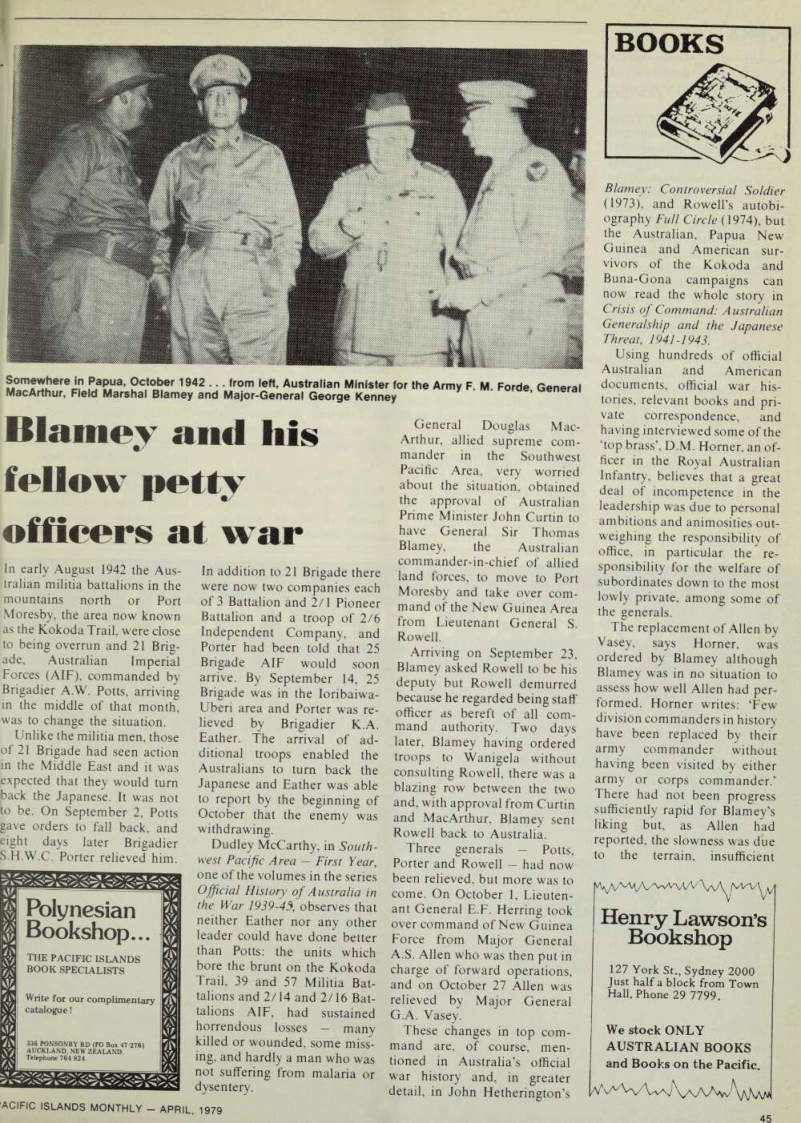

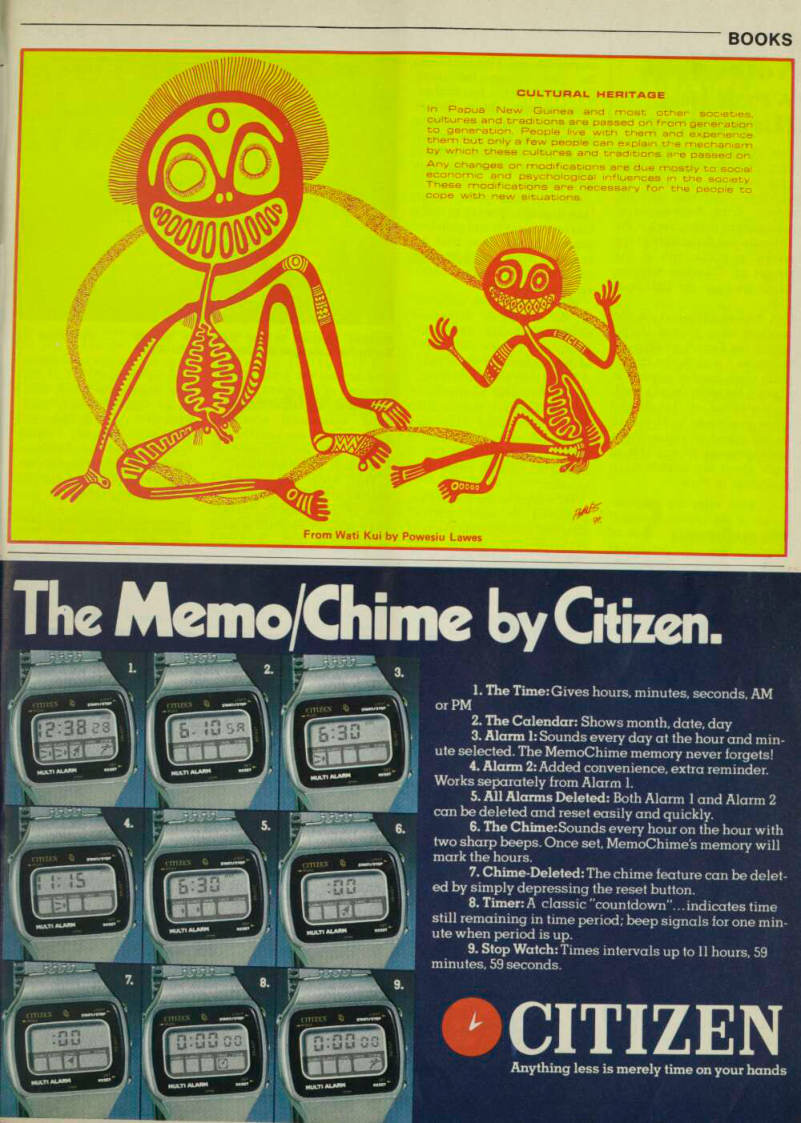
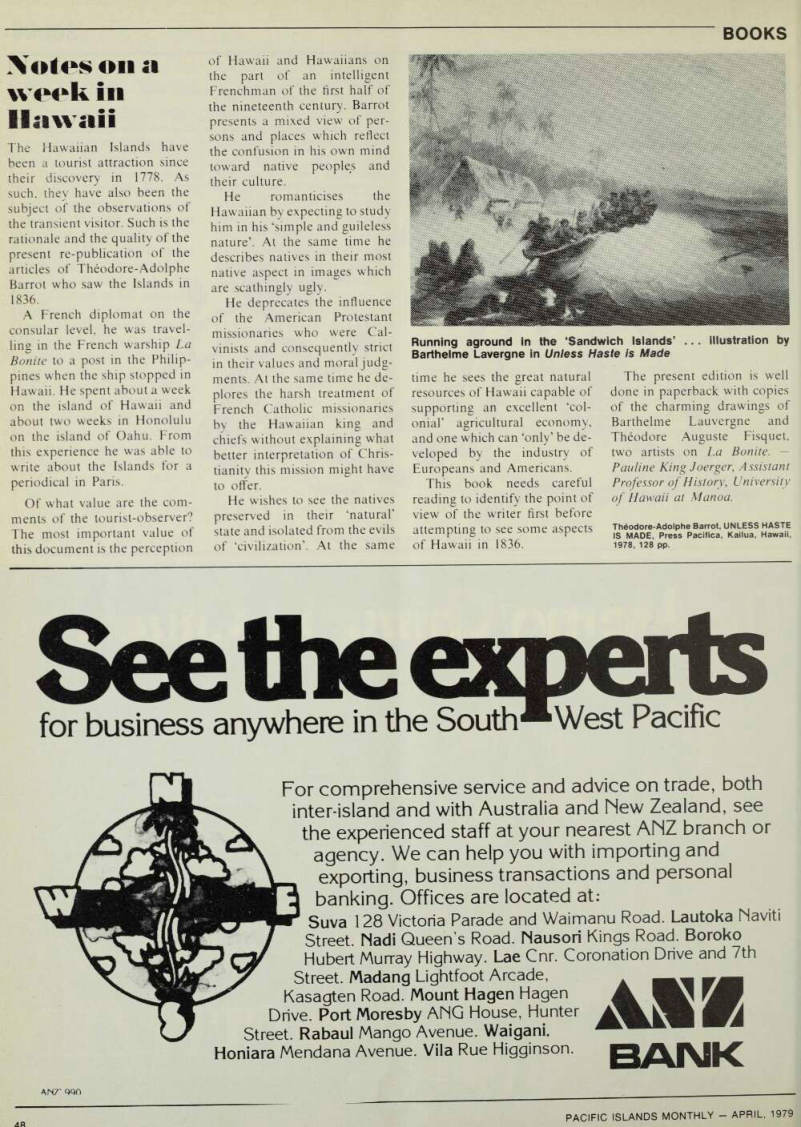
Blarney and his fellow petty officers at war
In early August 1942 the Aus tralian militia battalions in the mountains north or Port Moresby, the area now known as the Kokoda Trail, were close to being overrun and 21 Brig ade, Australian Imperial Forces (AIF), commanded by
Brigadier A.W. Potts, arriving
in the middle of that month, was to change the situation.
Unlike the militia men, those of 21 Brigade had seen action in the Middle East and it was expected that they would turn back the Japanese. It was not to be. On September 2, Potts gave orders to fall back, and
eight days later Brigadier
S.H.W.C. Porter relieved him.
In addition to 21 Brigade there were now two companies each of 3 Battalion and 2/1 Pioneer Battalion and a troop of 2/6
Independent Company, and
Porter had been told that 25 Brigade AIF would soon arrive. By September 14, 25 Brigade was in the loribaiwa- Überi area and Porter was re
lieved by Brigadier K.A.
Father. The arrival of ad ditional troops enabled the Australians to turn back the Japanese and Father was able to report by the beginning of October that the enemy was
withdrawing.
Dudley McCarthy, in South
west Pacific Area - First Year, one of the volumes in the series Official History of Australia in the War 1939-43, observes that neither Father nor any other leader could have done better than Potts: the units which bore the brunt on the Kokoda Trail, 39 and 57 Militia Bat talions and 2/14 and 2/16 Bat talions AIF, had sustained horrendous losses many killed or wounded, some miss ing, and hardly a man who was not suffering from malaria or
dysentery.
General Douglas Mac- Arthur, allied supreme com mander in the Southwest Pacific Area, very worried about the situation, obtained the approval of Australian Prime Minister John Curtin to have General Sir Thomas Blarney, the Australian commander-in-chief of allied land forces, to move to Port Moresby and take over com mand of the New Guinea Area from Lieutenant General S.
Rowell.
Arriving on September 23, Blarney asked Rowell to be his deputy but Rowell demurred because he regarded being staff officer as bereft of all com
mand authority. Two days
later, Blarney having ordered
troops to Wanigela without consulting Rowell, there was a blazing row between the two and, with approval from Curtin and MacArthur, Blarney sent Rowell back to Australia.
Three generals Potts, Porter and Rowell had now been relieved, but more was to come. On October 1, Lieuten ant General E.F. Herring took over command of New Guinea Force from Major General A.S. Allen who was then put in charge of forward operations, and on October 27 Allen was relieved by Major General
G.A. Vasey.
These changes in top com mand are, of course, men tioned in Australia’s official war history and, in greater detail, in John Hetherington’s
Blarney: Controversial Soldier (1973), and Rowell’s autobi ography Full Circle (1974), but the Australian, Papua New Guinea and American sur vivors of the Kokoda and Buna-Gona campaigns can now read the whole story in Crisis of Command: Australian Generalship and the Japanese Threat, 1941-1943.
Using hundreds of official Australian and American documents, official war his tories, relevant books and pri vate correspondence, and having interviewed some of the ‘top brass’, D M. Horner, an of ficer in the Royal Australian Infantry, believes that a great deal of incompetence in the leadership was due to personal ambitions and animosities out
weighing the responsibility of
office, in particular the re sponsibility for the welfare of subordinates down to the most lowly private, among some of the generals.
The replacement of Allen by Vasey, says Horner, was
ordered by Blarney although
Blarney was in no situation to assess how well Allen had per formed. Horner writes: ‘Few division commanders in history have been replaced by their army commander without having been visited by either army or corps commander.’
There had not been progress
sufficiently rapid for Blarney’s
liking but, as Allen had reported, the slowness was due to the terrain, insufficient
Somewhere in Papua, October 1942... from left, Australian Minister tor the Army F. M. Forde, General MacArthur, Field Marshal Blarney and Major-General George Kenney
supplies, units being under
strength, poor condition of troops, and difficult evacuation of wounded.
By the end of October, writes the author, the Australians had learnt two major lessons: that
jungle warfare requires
endurance and courage of the highest order and that ad
equate supply is important.
‘Through Blarney’s reluctance
to believe Allen’s account .. .
Blarney and MacArthurfailedto take heed of another lesson they did not understand the determination of the Japanese in defence his fanatical resis tance and willingness to die for his emperor.’ This lack of under
standing explains why lightly
armed troops were sent against the Japanese defences. Neither Blarney nor MacArthur had
given thought in peacetime to
the problems of tropical war fare in a mountainous area.
Blarney, as commander-in chief Australian Military Forces and commander Allied Land Forces under MacArthur, had a dual role which became more difficult
because of the attitude and temperament of MacArthur ‘who placed his subordinates in
difficult positions through his
inaccurate strategic assess ments in July and August 1942, through his determination to edge Blarney out as com mander of the land forces, through his interference in the technical conduct of the cam
paign, through his influence
over the Australian Govern ment and through his fears that an apparent military reverse might lead to his dismissal.’
‘Blarney was unwilling to
risk his own position by an af firmation of loyalty and trust in his subordinates,’ but even the unsatisfactory command ar rangements in Australia may not have had such a bad effect if Prime Minister Curtin had been more experienced and Blarney more tactful.
To the Diggers on the Kokoda Trail, ‘Pottsy’ (Potts),
‘Tubby’ (Allen) and ‘Bloody
George’ (Vasey) were good
blokes, to be followed through thick and thin. Their nickname for Blarney was ‘Brothel Tom’.
This book proves if proof is still needed that the French
politician Briand wasrightwhen
he told Britain’s Prime Minister Lloyd George, in World War I, that war is much too serious a thing to be left to military men.
Harry Jackman
Crisis of Command: Australian General ship and the Japanese Threat, 1941-43.
D.M. Horner. Published by Australian National University Press, Canberra, 1978. 515.95.
Tripping
with
Wad Kui
Sogeri National High School in the mountains behind Port
Moresby has produced yet
another superb collection of modern Papua New Guinea art. This time the featured art ist is Powesiu Lawes who matriculated at Sogeri in 1975.
The book is entitled Wati Kui, an expression of the Loniu people of the Los Negros Islands in Manus Province, Lawes’ home. Art adviser to
the publication, Marjorie
Walker of the school’s express ive art department, in the preface, says: ‘This expression is used by young boys as they become more aware of their growing power as they pass through adolescence into adulthood.’
In the case of Powesiu Lawes, wati kui does not stop at the simple achievement of Papua New Guinean adult
hood. Leafing through his
work, one feels a sense of curi osity and searching which pen etrates not just into earthly worlds beyond New Guinea’s shores but into the extraterres trial and decidedly abstract.
Powesiu obviously does not have his feet on the ground.
And, if he keeps them that way, we can look forward to more
pleasing flights of fancy. The
overall impact of his work is refreshing and it is most cer tainly original but there can be no doubt that Powesiu ranks among those who have de lighted in the works of Kauage, front-runner among PNG
modern art pioneers.
R.H.
Xotes on a
wwk in
Hawaii
The Hawaiian Islands have been a tourist attraction since their discovery in 1778. As such, they have also been the subject of the observations of the transient visitor. Such is the rationale and the quality of the present re-publication of the articles of Theodore-Adolphe Barrot who saw the Islands in 1836.
A French diplomat on the consular level, he was travel ling in the French warship La Bonite to a post in the Philip
pines when the ship stopped in
Hawaii. He spent about a week on the island of Hawaii and about two weeks in Honolulu on the island of Oahu. From this experience he was able to write about the Islands for a periodical in Paris.
Of what value are the com ments of the tourist-observer?
The most important value of this document is the perception
of Hawaii and Hawaiians on the part of an intelligent Frenchman of the first half of the nineteenth century. Barrot presents a mixed view of per sons and places which reflect the confusion in his own mind toward native peoples and their culture.
He romanticises the
Hawaiian by expecting to study
him in his ‘simple and guileless nature’. At the same time he describes natives in their most native aspect in images which
are scathingly ugly.
He deprecates the influence of the American Protestant missionaries who were Cal vinists and consequently strict in their values and moral judg ments. At the same time he de plores the harsh treatment of French Catholic missionaries by the Hawaiian king and chiefs without explaining what belter interpretation of Chris tianity this mission might have to offer.
He wishes to see the natives preserved in their ‘natural’ state and isolated from the evils of ‘civilization’. At the same
time he sees the great natural resources of Hawaii capable of supporting an excellent ‘col onial’ agricultural economy, and one which can ‘only’ be de
veloped by the industry of
Europeans and Americans.
This book needs careful
reading to identify the point of
view of the writer first before attempting to see some aspects of Hawaii in 1836.
The present edition is well done in paperback with copies of the charming drawings of Barthelme Lauvergne and Theodore Auguste Fisquet, two artists on La Bonite. - Pauline King Joerger, Assistant
Professor of History, University
of Hawaii at Manoa.
Th6odore-Adolphe Barrot, UNLESS HASTE IS MADE, Press Pacifica, Kailua, Hawaii, 1978, 128 pp.
Running aground in the ‘Sandwich Islands’... illustration by Barthelme Lavergne in Unless Haste is Made
Advertisements & other items, pp. 45-48 (4 items)
45
ACIFIC ISLANDS MONTHLY - APRIL, 1979
Bookshop,,.
Polynesian
THE PACIFIC ISLANDS
BOOK SPECIALISTS
Write for our complimentary catalogue! 336 PONSONBY RD (PO Box 47 276)
AUCKLAND, NEW ZEALAND
Telephone 764 824.
Henry Lawson’s
Bookshop
127 York St., Sydney 2000 Just half a block from Town Hall. Phone 29 7799.
We stock ONLY
AUSTRALIAN BOOKS
and Books on the Pacific.
The Supreme Status fAfatch!
- *- _— L. f : *' alarm
MULTI
y ‘
msaas
M
The only Timepiece of its hind
in the world.
No other timepiece comes close! Because here is a completely-new kind of time system. Incredibly complex, Yet marvelously simple to own and use.
Only the Citizen heritage of superb craftsmanship could achieve this multi-feature instrument. It can outperform every other watch in the world.
To own it is to know instant response.. .and supreme versatility.
Here is the Status Watch supreme.. .as unique as the exciting life style it was born to serve.
MEMO/CHIME Model #4O-1030-50
When you forget... Citizen remembers
Alarm 1 Alarm 2 Chime Timer Stop Watch
CULTURAL HERITAGE
■ m rapua i\jew bumea and most other socet.es. cultures and traditions are passed on from generation to generation. People live with them and experience them but only a few people can explain the mechanism by which these cultures and traditions are passed on.
Any changes or modifications are due mostly to social economic and psychological influences in the society.
These modifications are necessary for the people to cope with new situations. o mm m x’:> From Wati Kui by Powesiu Lawes
nen
map G i n •
MULTI
MULTI MLAW*
' HBSOag ■3 ■is multi multi Hi*** mw» '\V*
■nii
■■B nwuti or PM 1. The Time: Gives hours, minutes, seconds, AM 2. The Calendar: Shows month, date, day 3. Alarm 1: Sounds every day at the hour and minute selected. The Memo Chime memory never forgets! 4. Alarm 2: Added convenience, extra reminder.
Works separately from Alarm 1. 5. All Alarms Deleted: Both Alarm 1 and Alarm 2 can be deleted and reset easily and quickly, 6. The Chime:Sounds every hour on the hour with two sharp beeps. Once set, Memo Chimes memory will mark the hours. 7. Chime-Deleted: The chime feature can be deleted by simply depressing the reset button. 8. Timer: A classic "countdown".., indicates time still remaining in time period; beep signals for one minute when period is up. 9. Stop Watch: Times intervals up to 11 hours. 59 minutes. 59 seconds.
CITIZEN
Anything less is merely time on your hands
See the experts
for business anywhere in the South-West Pacific For comprehensive service and advice on trade, both inter-island and with Australia and New Zealand, see the experienced staff at your nearest ANZ branch or agency. We can help you with importing and exporting, business transactions and personal banking. Offices are located at: Suva 128 Victoria Parade and Waimanu Road. Lautoka Naviti Street. Nadi Queen’s Road. Nausori Kings Road. Boroko Hubert Murray Highway, Lae Cnr. Coronation Drive and 7th Street. Madang Lightfoot Arcade, Kasagten Road. Mount Hagen Hagen Drive. Port Moresby ANQ House, Hunter Street. Rabaul Mango Avenue. Waigani.
Honiara Mendana Avenue. Vila Rue Higginson. BANK
All.
Books
Books
Low Fares Drop
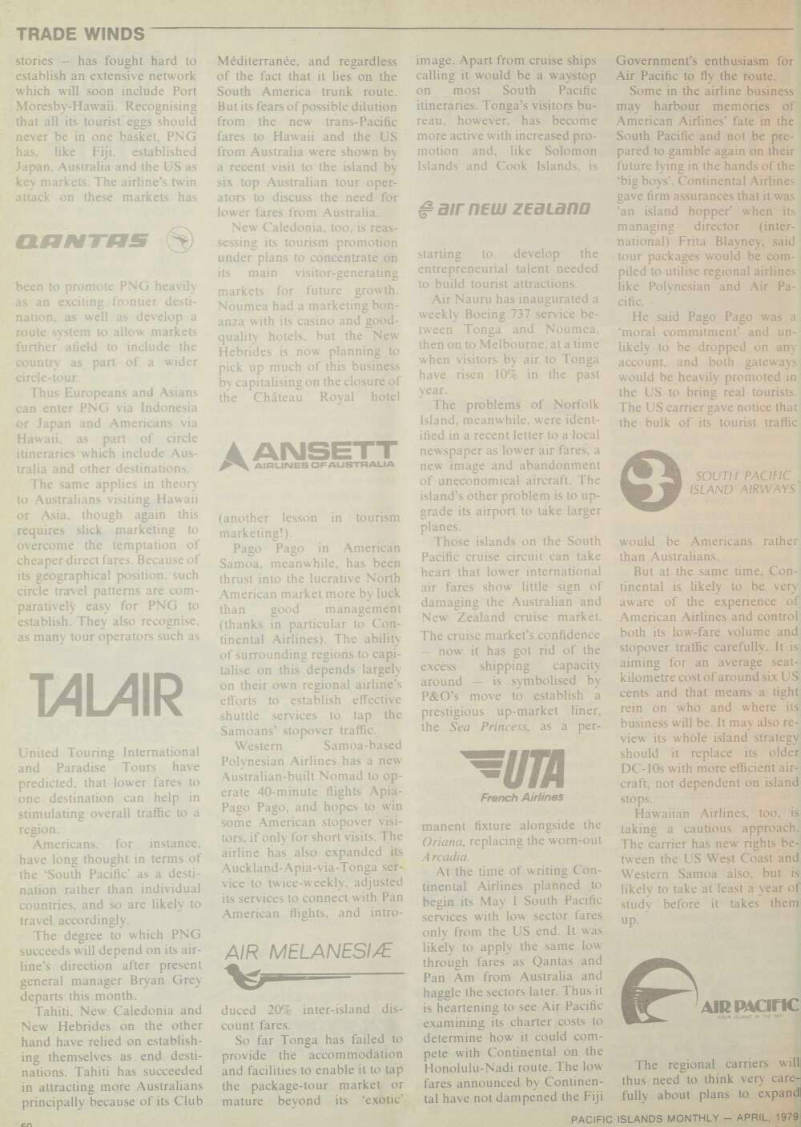

Trade
Winds
Island Airlines In
At Deep End
The Pacific Islands are facing their biggest marketing challenge since they accepted the importance of tourism to their economies, writes Rob Gwyther in Sydney. The prospect of being cast once again into the backwaters of the tourist tide by lower fares on trunk through-Pacific routes has thrown panic into the hearts of many Island tourism planners. The reality of today's situation, fortunately, was forced home some time ago by the new equipment which enabled end-market carriers like Qantas and Pan Am to begin overflying island stops.
The message was reinforced last year when the Australian Government went so far as to warn in advance that its pro posed new international avi ation policy would cause disadvantages to Pacific islands. The policy report recommended against Aus tralia attempting to ‘subsidise’ inter-island regional routes from its trunk operations to and from Australia.
It warned that Qantas should not operate direct flights to points which could not support ‘commercially viable’ traffic shared between the two coun tries’ airlines.
The report’s only concession was to allow Island carriers rights where there was a ‘genu-
ine need’ for new services to aid regional development.
The kneejerk response generated by such moves, and the overflying trend, was recog nised by Fiji’s new tourism chief, Fiji Visitors Bureau gen eral manager Malakai Gucake, in his first address to the indus try earlier this year.
He attempted to dispel the panic’ he found in Fiji’s tourist industry, over possible loss of
stopover traffic, by arguing
that Australia’s policy should work to Fiji’s advantage by strengthening its role as a tour ist destination. ‘Since 81% of our Australian visitors make Fiji their main destination, the new policy should work in our favour,’ he said.
His statement at once ident ified both the problem and a part-solution to countering the
attractions of competitive fares to destinations further away such as the US. He said Fiji
should become both more competitive in terms of its price and tourist lure, and must also look to new markets. But the eventual answer for other Pa cific countries could well be as varied as the visitors who presently visit their shores.
Main destinations such as Fiji, Papua New Guinea, and Tahiti have come to grips with the tourism issue long ago but each has the problem of facili ties which must now be kept utilised. Others, such as Tonga, New Hebrides and Western Samoa, are only now deciding where and when they want tourism. They are all finding out about the ‘how’.
The marketing challenge,
however, is common to all: to become more attractive desti nations in their own right as well as find new ways of tap ping the tourist dollar (or per
haps yen).
For instance, Fiji was handed a guiding beacon by its long-time supremo Paddy Doyle, whom Mr Gulacake replaced in January. Before leaving to run his own Fiji re sort, Mr Doyle called for new unity in the industry to im prove dealings with overseas travel packagers as well as overcome accommodation and image problems at home (the
recent rise in Fiji hotel prices is just one aspect).
Mr Doyle said countries whose tourist traffic was mainly stopovers faced a ‘lean time’ unless they became ‘des tination material’. He said Fiji’s visitor future under the new low fares lay more with the United States than with Aus tralia or New Zealand. From
the US, he said, there was a bet ter chance of getting both a lower fare and more traffic.
The US, he said, could stand up to 20 terminator flights a week. ‘A united Fiji tourist industry will be in a better position to press for more terminating
flights, plus a point-to-point air
fare with Fiji as one of the
points that is economically
comparable with the long-haul
fares now being touted.’
In saying so, he of course touched on the gulf between a country’s tourism aims and the ability of its airlines and indus try to carry them out. Air Pa cific has yet to prove itself an economic maverick, but it has
shown signs lately of becoming
much more aggressive in pick ing up the marketing gauntlet
since Qantas and Air New Zealand loosened their hold.
Air Pacific has negotiated strongly for its proposed ser vices to Hawaii, Sydney and Melbourne and has pinpointed ways of chartering larger air craft to get out and chase its own markets. Its success hinged on finding suitable aircraft to lease as both its finances and the lead-time on ordering new machines would delay replace ment of its BAC-llls until 1985, according to one source.
Because of the Australian Government’s preoccupation with other main routes, the vital question of a new bilateral
air rights agreement with Fiji has still to be tied up. The Fiji carrier hopes to start Sydney
and Melbourne flights some time after mid-year, and flights to Hawaii by year’s end.
It acknowledges, however that it will probably have to
change its opposition to
advance purchase air fares which are the basis of Aus tralia’s new lower rates. Fiji re jected Qantas proposals two years ago for an APEX fare to undercut the present SA3O6 return excursion fare because of its heavy dependence on package tour business and the fact that Fiji was still very much an ‘impulse market’ for Australians. They now concede there is ‘some room’ for a lower fare.
Mr Doyle estimated reopen ing of the Melbourne service alone would bring Fiji an extra 24000 visitors a year. (As a measure of the importance of visitor traffic, tourism last year earned Fiji SF9O million in rev enue plus $l2 million in foreign exchange, about half of which revenue stayed in the country. However, the fight for this business, as Air Nuigini, PNG’s national airline, has shown, can be played by some very hard rules.
Qantas showed how it
regarded bleating by disadvan
taged Islanders when its chair man, Sir Lenox Hewitt, produced figures to answer
criticism of its policies. They showed the airline’s Funjet traffic from Australia had risen steadily from 14000 in 1969 to 54543 last year, only dropping in 1977 because ‘Qantas pulled off the Brisbane—Nadi route in favour of Air Pacific’. It issued no forecasts for this year, how ever.
Air Niugini - in its fifth year one of the Pacific’s success
stories has fought hard to establish an extensive network which will soon include Port
Moresby-Hawaii. Recognising
that all its tourist eggs should never be in one basket, PNG has, like Fiji, established Japan. Australia and the US as key markets. The airline’s twin attack on these markets has
been to promote PNG heavily as an exciting frontier desti nation, as well as develop a route system to allow markets further afield to include the country as part of a wider circle-tour.
Thus Europeans and Asians can enter PNG via Indonesia or Japan and Americans via Hawaii, as part of circle itineraries which include Aus tralia and other destinations.
The same applies in theory to Australians visiting Hawaii or Asia, though again this
requires slick marketing to
overcome the temptation of cheaper direct fares. Because of
its geographical position, such
circle travel patterns are com paratively easy for PNG to
establish. They also recognise,
as many tour operators such as
United Touring International and Paradise Tours have predicted, that lower fares to one destination can help in stimulating overall traffic to a
region.
Americans, for instance, have long thought in terms of the ‘South Pacific’ as a desti nation rather than individual countries, and so are likely to travel accordingly.
The degree to which PNG succeeds will depend on its air line’s direction after present general manager Bryan Grey departs this month.
Tahiti, New Caledonia and New Hebrides on the other hand have relied on establish ing themselves as end desti nations. Tahiti has succeeded in attracting more Australians principally because of its Club
Mediterranee, and regardless of the fact that it lies on the South America trunk route.
But its fears of possible dilution from the new trans-Pacific fares to Hawaii and the US from Australia were shown by a recent visit to the island by six top Australian tour oper ators to discuss the need for lower fares from Australia.
New Caledonia, too, is reas
sessing its tourism promotion
under plans to concentrate on its main visitor-generating markets for future growth.
Noumea had a marketing bon anza with its casino and good quality hotels, but the New Hebrides is now planning to pick up much of this business by capitalising on the closure of the Chateau Royal hotel
(another lesson in tourism marketing!).
Pago Pago in American Samoa, meanwhile, has been thrust into the lucrative North American market more by luck than good management (thanks in particular to Con tinental Airlines). The ability of surrounding regions to capi talise on this depends largely on their own regional airline’s efforts to establish effective shuttle services to tap the Samoans’ stopover traffic.
Western Samoa-based Polynesian Airlines has a new Australian-built Nomad to op
erate 40-minute flights Apia-
Pago Pago, and hopes to win some American stopover visi tors, if only for short visits. The airline has also expanded its Auckland-Apia-via-Tonga ser vice to twice-weekly, adjusted its services to connect with Pan American flights, and intro-
duced 20% inter-island dis count fares.
So far Tonga has failed to provide the accommodation and facilities to enable it to tap the package-tour market or mature beyond its ‘exotic’
image. Apart from cruise ships calling it would be a waystop on most South Pacific itineraries. Tonga’s visitors bu reau. however, has become more active with increased pro motion and, like Solomon Islands and Cook Islands, is
starting to develop the
entrepreneurial talent needed to build tourist attractions.
Air Nauru has inaugurated a weekly Boeing 737 service be tween Tonga and Noumea, then on to Melbourne, at a time when visitors by air to Tonga have risen 10% in the past year.
The problems of Norfolk Island, meanwhile, were ident ified in a recent letter to a local newspaper as lower air fares, a new image and abandonment of uneconomical aircraft. The island’s other problem is to up grade its airport to take larger
planes.
Those islands on the South Pacific cruise circuit can take heart that lower international air fares show little sign of damaging the Australian and New Zealand cruise market.
The cruise market’s .confidence - now it has got rid of the
excess shipping capacity
around is symbolised by
P&O’s move to establish a
prestigious up-market liner,
the Sea Princess, as a per-
manent fixture alongside the Oriana, replacing the worn-out A rcadia.
At the time of writing Con tinental Airlines planned to begin its May 1 South Pacific services with low sector fares only from the US end. It was likely to apply the same low through fares as Qantas and Pan Am from Australia and haggle the sectors later. Thus it is heartening to see Air Pacific examining its charter costs to determine how it could com pete with Continental on the Honolulu-Nadi route. The low fares announced by Continen tal have not dampened the Fiji
Government’s enthusiasm for Air Pacific to fly the route.
Some in the airline business may harbour memories of American Airlines’ fate in the South Pacific and not be pre
pared to gamble again on their
future lying in the hands of the
‘big boys’. Continental Airlines
gave firm assurances that it was ‘an island hopper’ when its managing director (inter national) Frita Blayney, said tour packages would be com piled to utilise regional airlines like Polynesian and Air Pa cific.
He said Pago Pago was a ‘moral commitment’ and un likely to be dropped on any account, and both gateways would be heavily promoted in the US to bring real tourists.
The US carrier gave notice that the bulk of its tourist traffic
would be Americans rather than Australians.
But at the same time. Con tinental is likely to be very aware of the experience of American Airlines and control both its low-fare volume and stopover traffic carefully. It is aiming for an average seat kilometre cost of around six US cents and that means a tight rein on who and where its business will be. It may also re view its whole island strategy should it replace its older DC-10s with more efficient air craft, not dependent on island stops.
Hawaiian Airlines, too, is
taking a cautious approach.
The carrier has new rights be tween the US West Coast and Western Samoa also, but is likely to take at least a year of study before it takes them up.
The regional carriers will! thus need to think very care fully about plans to expandl
their route networks. It appears i unrealistic to expect them to I compete with Continental Air lines on sectors as they have neither the equipment nor expertise at present to make such services profitable. On the other hand Continental is by no means committed to lone-
term operation through Fiji,
and there is thus an inherent risk in reliance on outside poli cies.
There is no guarantee that
Continental’s island-hopping
will not see US tourists doing
more hopping than staying, with little tangible benefit for
the islands. Those who see Continental Airlines as a poss ible saviour in the present air line climate may well find them to be more of an un
balancing influence by merely
taking inter-island traffic away from the regional carriers.
Regional carriers’ future
long-haul operations also de
pend to some extent on Air New Zealand, which has its own problems with the Aus tralian policy. Air New
Zealand is well advanced in looking at ways to re-model its Pacific operations.
It is likely to see both an ag gressive inbound operation from the US and Asia, and strong regional operations, as ways of compensating for lost Australia/US rights. A possible lucrative Pacific round-circle fare, such as US/New Zea-
land/Australia/New Zealand, with Fiji and Tahiti stopovers outward and return, is one alternative foreshadowed by airline officials.
But, like Continental, Air New Zealand would seek to control the traffic from go to
whoa to make the operation vi able. Thus the regional carriers may well have to be content to remain just that.
The ultimate decision for the Islands in assessing their pos ition may well depend on which they rate highest: a healthy tourist industry, or an
active long-haul (though loss
making) national airline. It is
becoming increasingly clear
they cannot afford both.
Advertisements & other items, pp. 51-52 (1 item)
Bookshop
Travel the
.. isfeods
with PIM S
Mail Order
Bookshop
Pim knows the South Seas.
If you’d like us to introduce you to some of the people and places we know, clip the coupon overleaf . . .
PACIFIC
ISLANDS
COOKBO
GR^ t RC SOtO^ S
Si
WCIFIC ISLANDS
hrhoboo* IS® JrV now PtißV**
P«C»fW
Select your books from
this great list of South
Sea titles
Q WINGS OF GOLD. James Sinclair's acclaimed book on how the aeroplane developed New Guinea The true story of frontier pioneering More than 220,000 words, 150 historic photographs, 334 big pages $33, or SUS4O posted □ THE TONGANS. Writer Olaf Ruhen and photographer Jozef Vissel capture the Tongan life style in brilliant prose and 96 sparkling fullcolour pictures $9 00, SUSIO.SO posted □ IMAGES AND ISLANDS: GRASS ROOTS ART OF THE SOLOMONS.
Traditional Solomon Islands designs and art forms, edited by John and Sue Chick 96 pages, $5.50, or SUS 6 50 posted □ GRASS ROOTS ART OF NEW GUINEA. Traditional designs from the north coast of the main island of Papua New Guinea, collected by E F Hannemann $3 50, or SUS 4 50 posted □ THE LOST CARAVEL. Robert Langdon shatters traditional views in this historical whodunnit on early Pacific exploration and its consequences 368 pages $lB 00, or SUS 26 00 posted □ SUVA: A HISTORY AND GUIDE. Albert Schutz, with L G Usher, look at the colourful personalities who lent their names to Suva An historic browse around Suva Streets 52 pages $4.25 or SUSS 00 posted □ PACIFIC ISLAND COOKBOOK. Hundreds of practical recipes using ingredients found in most parts of the South Pacific, including a big section on fish Susan Parkinson and Peggy Stacy also give practical advice on meal planning and kitchen budgeting 120 pages $7 00 or SUSB 50 posted □ PACIFIC ISLANDS YEAR BOOK. 13th edition of the standard reference book on all the islands of the Pacific their government, population, statistics, etc Scores of maps Information for tourists, including hotels and tariffs 512 pages $22 50 or SUS 27 00 posted □ PAPUA NEW GUINEA HANDBOOK AND TRAVEL GUIDE. 9th edition For businessmen, schools, libraries, travellers, this guide covers everything you want to know about PNG today. Includes fold-out map 280 pages $8.50, or SUSIO.OO posted □ COLONIAL ERA CEMETERY OF NORFOLK ISLAND. R.N Dalkin gives a fascinating account of many of the people buried in historic Kingston cemetery Invaluable history and guide 92 pages $4 00, or SUSS 50 posted □ STORY OF THE SOLOMONS. The late Dr C E Fox's simple, lucid outline of the history of the Solomon Islands Frank and affectionate 88 pages $3 00, or $U53.75 posted □ MARINE SHELLS OF THE PACIFIC, Vol 11. Walter Cernohorsky carries on where his first book leaves off, with a further 600 species. His third volume will appear soon, and there are only limited stocks of this one 412 pages $17.00, or $U525.00 posted □ PERCY CHATTERTON’S PAPUA: DAY THAT I HAVE LOVED. Charming, evocative account of a changing Papua as Rev Percy Chatterton knew it over 50 years. 144 pages $6.00, or SUS6.SO posted Q LANGUAGE SERIES. Simple introductions to Pacific Island languages SAY IT IN FIJIAN, SAY IT IN FIJI HINDI, SAY IT IN TAHI- TIAN, all $2 50, or SUS 3 25 posted SAY IT IN MOTU, $2 00, or SUS 3 00 posted Mihalic's INTRODUCTION TO NEW GUINEA PIDGIN, $2.50, or SUS 3 00 □ COOK ISLANDS POLITICS: THE INSIDE STORY. Fascinating political drama behind the fall of Sir Albert Henry Written mainly by leading Cook Islanders. $7.50, or SUSB 75 posted □ FOLD-OUT MAP OF PACIFIC ISLANDS. Large and clear, up-to-date in colour. In plastic envelopes $2 50, or SUS3,OO posted
PACIFIC PUBLICATIONS 1
Mail Order Bookshop
ncz pinwAnnA Ctr/inAvr ofinn np o Rav Qd ns GttH a ncfvoiio onn i A. 76 Clarence St., Sydney, 2000, or G.P.O. Box 3408, Sydney, Australia 2001. x- I'm enclosing my payment for the following title/s from
PlM's one-stop Mail Order Bookshop:
(If you prefer, you can tick the books you want, and clip out this
whole page)
$ Please also send me a subscription to PIM for 12 months $
TOTAL $
YOU CAN ALSO USE
THIS COUPON TO
SUBSCRIBE TO PIM...
Then you'll be sure to
travel the Islands all
year round.
Name ...
Address
For subscription rates in your
area, refer to the list on the
'Contents' page of this issue.
city/state/country/postcode
Which rates first
Comment
Which rates first - tourism or communications?
It has taken time but the low air fare revolution is about to encompass the South Pacific.
Already planeloads of Australians are flying north to Honolulu and the US West Coast at fares that rate among the lowest in the world, and back down the reverse track growing numbers of planeloads of Americans are enjoying a similar low fare boom.
Beneath the wings of the 747 s and DClOs lie the Pacific Islands, where tourist interests would like to see the great travel boom in the sky come down to earth. Standing alongside the tourist interests are the small regional airlines which don’t see the low-fare explosion in the same rosy light as their col
leagues.
The division faces many governments with the dilemma should they try to tap this new boom in tourism, or should they work to maintain the identity of their own national airlines?
The airlines are characterised by being small, flying between sparsely populated centres, and operating equipment that is not only small in modern terms but one or two jumps behind in the technology that made the low fares possible.
Aircraft like the 747 can be operated profitably at ridiculously low fares - down to about 1.8 cents a seat/kilometre, or about a fifth the cost of a bus ride in Sydney because of their size, their 400-plus passenger capacity, and their highly efficient engines. There is no way that the BACII Is or Boeing 737 s opera-
ted in the Pacific can achieve anything like the economies of the big jets. So if tourism is to be enticed to or diverted through the Pacific Islands, the local carriers will have to see some of their rights to have access to an equal share of traffic into their home territory eroded. They will also have to be prepared to carry tourists from one airport to another at fares much lower
than at present, which, even with full aeroplanes, means they will be making book losses.
Airlines like Air Pacific, facing the dilemma of whether they will preserve their identity or act as ‘insurance’ for the tourism industry (as one opinion in the present debate in Suva defines the airline’s role), are talking about following Air Niugini’s example and buying used Boeing 707 s to participate in inter national routes.
But while this is a step up, it is by no means the answer. The older jets are less attractive to passengers and still have much higher operating costs than the newer airliners (which is why
airlines like Qantas and Air New Zealand are disposing of the
older jets).
Another solution is to charter capacity on somebody else’s aeroplane. Hypothetically, one cabin on a Qantas 747 operating to Sydney or Melbourne could be sold and staffed as Air Pacific.
But this does not go down well with the airlines and their staff.
They feel, at best, second rate.
Fortunately, a newer generation of aircraft is now taking shape on the drawing boards that may offer the ultimate solution to the Air Pacifies of this world. From Europe, the A3OO and A3lO offer passenger capacities of between 200 and 300, plus lots of freight space, and from the US the Boeing 767 is pitching for the same market. All these will offer competitive seat/km costs but will demand cripplingly high investments for small countries.
Beneath these is another categoy of 130-180 sealers, the first of which is the Boeing 757. These will also be expensive aero planes but may provide sizes more balanced to the requirements of the Pacific. At the bottom end of the size range, Fokker is briefing airlines on a 115-130 sealer development of its F2B that would be very attractive - but won’t be ready much before 1986.
There is no easy solution to the dilemma - which rates first, tourism or communications? There must be compromises. More importantly, there must be extremely skilled planning at a high level of technological understanding so that national priorities are met in the most efficient way in the difficult years to come.
Advertisements & other items, p. 54 (1 item)
and have their music, too.
wmmmmmmammsimm ■ : wmmm - - r , - ■- ' m i ' in iSSttiiW
WMZJL"
I morsjeer? (Tjg Hfcnmc Me KE-2000 TS-107
For those who want to travel
and have their music, too.
You’re young and staying in one place too long doesn’t suit your style. Your car is an extension of this mobility and the magic carpet that takes you where you want to go. Your music, like your car, is an important part of your life.
Enter Pioneer’s KE-2000/TS-107 car stereo system. Engineered with the precision of a Grand Prix racer. Specifically created to perform in the ambience of an automotive atmosphere. Built to withstand the toughest punishment and tested in the laboratory and on the road. A skillful blend of advanced electronic engineering and a delicate sensitivity to the needs of the four-wheeled traveler. Such as in the KE-2000 with FM. You see, at Pioneer, we believe that when a man takes to the open road, he shouldn’t have to go it alone.
KE-2000 Cassette Tape Player with AM/FM Tuner Power output (max.) 6 watts per channel Power source DCI3.BV (11 —16 V Wow & flutter No more than 0.28% (WRMS) Frequency response 30—12,000 Hz (—3dß) Signal-to-noise ratio More than 45d8 FM Tuner Frequency range Usable sensitivity Selectivity 88-108 MHz 1 2dBf (1 I|uV/75 ohms) 70dB (±4ookHz) AM Tuner Frequency range.
Sensitivity TS-107 Speakers Speaker Input power (max.
Frequency range.
Weight 525-1,605 kHz 30fxV ,102 mm (4 in.) high-compliance dual-cone with metallic center cap . 20 watts .50—20,000 Hz . 660 g (1 lb. 70z.)
OrD PIONEER
Pioneer products are available through:— Australia: Pioneer Marketing Service Pty. Ltd.. P.O. Box 317, Mordiafloc, Victoria, 3195 let. 90-9011 Fiji Islands: Brijlal & Company, G.P.O. Box No. 362, Suva, Fiji Islands Tel: 22258 New Zealand: Fountain Marketing Ltd., Maidstone Street, Auckland, New Zealand Tel: 763-064 Norfolk Island: Burns Philp (Norfolk Island) Ltd., Norfolk Island, South Pacific Nauru Island: Jacob Enterprises, P.O. Box No. 4, Republic of Nauru Tahiti: Ets, PERFECT B.P. 594, Papeete, Tahiti Tel: 20,407 M New Caledonia; Menard Freres Ville. B.P. H 2 Cedex, Noumea, New Caledonia Tel 27.52.22 American Samoa: Transpac Corporation. P.O, Box 1477, Pago Pago, American Samoa 9679 S Rarotonga; South Seas International Ltd., P.O. Boxjt9, Rarotonga, Cook >slands^Tel. 2327
Kaputin
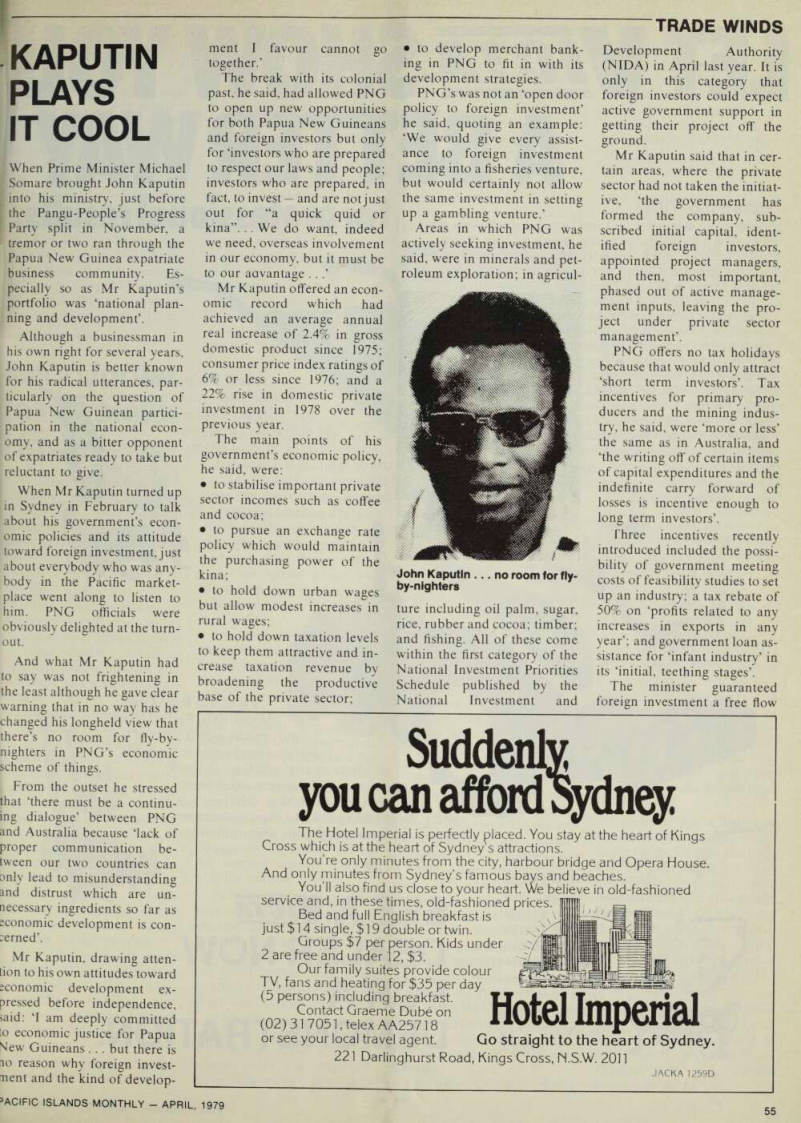

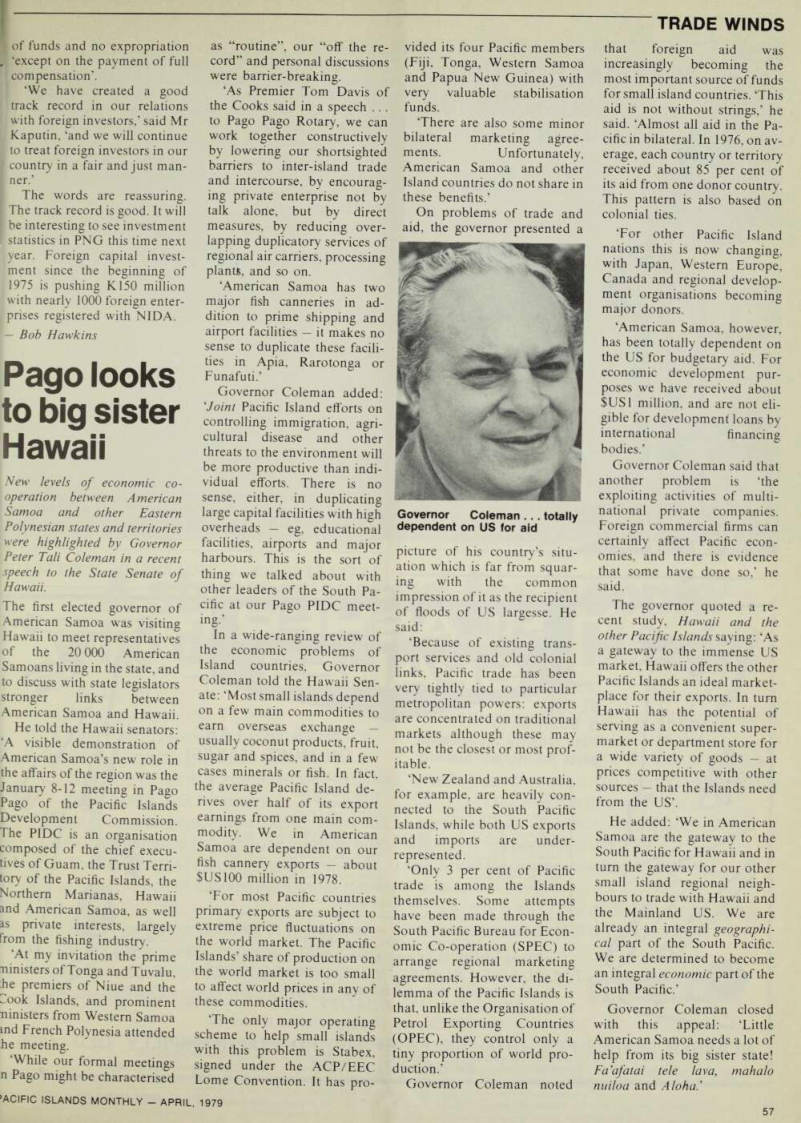
Plays
It Cool
When Prime Minister Michael
; Somare brought John Kaputin
into his ministry, just before
the Pangu-People’s Progress Party split in November, a tremor or two ran through the Papua New Guinea expatriate business community. Es pecially so as Mr Kaputin’s portfolio was ‘national plan
ning and development’.
Although a businessman in his own right for several years, John Kaputin is better known for his radical utterances, par ticularly on the question of
Papua New Guinean partici
pation in the national econ omy, and as a bitter opponent of expatriates ready to take but reluctant to give.
When Mr Kaputin turned up in Sydney in February to talk about his government’s econ omic policies and its attitude
toward foreign investment, just
about everybody who was any body in the Pacific market place went along to listen to him. PNG officials were obviously delighted at the turn out.
And what Mr Kaputin had to say was not frightening in the least although he gave clear warning that in no way has he changed his longheld view that there’s no room for fly-by nighters in PNG’s economic
scheme of things.
From the outset he stressed that ‘there must be a continu
ing dialogue’ between PNG
and Australia because ‘lack of proper communication be tween our two countries can
only lead to misunderstanding
and distrust which are un necessary ingredients so far as
economic development is con
:erned’.
Mr Kaputin, drawing atten
tion to his own attitudes toward
economic development ex
pressed before independence,
said; T am deeply committed
to economic justice for Papua
Slew Guineans ... but there is
no reason why foreign invest
ment and the kind of develop
ment I favour cannot go
together.’
The break with its colonial past, he said, had allowed PNG to open up new opportunities for both Papua New Guineans and foreign investors but only for ‘investors who are prepared to respect our laws and people; investors who are prepared, in fact, to invest and are not just out for “a quick quid or kina”. .. We do want, indeed we need, overseas involvement in our economy, but it must be to our advantage . ..’
Mr Kaputin offered an econ omic record which had achieved an average annual real increase of 2.4% in gross domestic product since 1975; consumer price index ratings of 6% or less since 1976; and a 22% rise in domestic private investment in 1978 over the
previous year.
The main points of his government’s economic policy, he said, were; • to stabilise important private sector incomes such as coffee and cocoa; • to pursue an exchange rate policy which would maintain the purchasing power of the kina; • to hold down urban wages but allow modest increases in rural wages; • to hold down taxation levels to keep them attractive and in crease taxation revenue by
broadening the productive
base of the private sector;
• to develop merchant bank ing in PNG to fit in with its development strategies.
PNG’s was not an ‘open door policy to foreign investment’ he said, quoting an example: ‘We would give every assist ance to foreign investment coming into a fisheries venture, but would certainly not allow the same investment in setting up a gambling venture.’
Areas in which PNG was actively seeking investment, he said, were in minerals and pet roleum exploration; in agricul-
ture including oil palm, sugar, rice, rubber and cocoa; timber; and fishing. All of these come within the first category of the National Investment Priorities Schedule published by the National Investment and
Development Authority
(NIDA) in April last year. It is only in this category that foreign investors could expect active government support in getting their project off the ground.
Mr Kaputin said that in cer tain areas, where the private sector had not taken the initiat ive, ‘the government has formed the company, sub scribed initial capital, ident ified foreign investors, appointed project managers, and then, most important, phased out of active manage ment inputs, leaving the pro ject under private sector management’.
PNG offers no tax holidays because that would only attract ‘short term investors’. Tax incentives for primary pro ducers and the mining indus try, he said, were ‘more or less’ the same as in Australia, and ‘the writing off of certain items of capital expenditures and the indefinite carry forward of losses is incentive enough to long term investors’.
Three incentives recently introduced included the possi
bility of government meeting
costs of feasibility studies to set up an industry; a tax rebate of 50% on ‘profits related to any increases in exports in any year’; and government loan as sistance for ‘infant industry’ in its ‘initial, teething stages’.
The minister guaranteed foreign investment a free flow
John Kaputin... no room for fly by-nighters
I of funds and no expropriation ‘except on the payment of full
compensation’.
‘We have created a good track record in our relations with foreign investors,’ said Mr Kaputin, ‘and we will continue j to treat foreign investors in our 1 country in a fair and just man ner.’
The words are reassuring.
The track record is good. It will be interesting to see investment statistics in PNG this time next
year. Foreign capital invest
ment since the beginning of 1975 is pushing Kl5O million with nearly 1000 foreign enter
prises registered with NIDA.
Bob Hawkins
Advertisements & other items, pp. 55-56 (2 items)
Trade Winds
youcanaffordSydney
Suddenly
The Hotel Imperial is perfectly placed. You stay at the heart of Kings Cross which is at the heart of Sydney’s attractions.
You’re only minutes from the city, harbour bridge and Opera House.
And only minutes from Sydney’s famous bays and beaches.
You’ll also find us close to your heart. We believe in old-fashioned service and, in these times, old-fashioned prices.
Bed and full English breakfast is just $l4 single, $l9 double or twin.
Groups $7 per person. Kids under 2 are free and under 12, $3.
Our family suites provide colour TV, fans and heating for $35 per day (5 persons) including breakfast.
Contact Graeme Dube on (02) 317051, telex AA25718 or see your local travel agent. Go straight to the heart of Sydney.
Hotel Imperial
221 Darlinghurst Road, Kings Cross, h.S.W. 2011
JACKA 1259 D
LET Vim SHOW YOU
A BETTER WAY
For professional results.
Victa 8 h.p. Tiller (Model 408). • Independent rear tine and wheel drive transmissions #5 forward speeds plus reverse #Chain driven totally enclosed gear boxes #Nine (9) handle positions instantly adjustable either vertically or horizontally by squeeze trigger • 14" dia. tines - 20" tilling width • Throttle, gear shift and handle adjustment levers are all conveniently located on handle assembly #Separate transmission levers for tine drive or wheel drive • Instant depth control with spring loaded pin engagement of multi-position depth bar ©Tractor tread tyres combined with front mounted counterweight for maximum traction. OPTIONAL ATTACHMENTS Hilling Plough: Twin ploughshares adjustable in width and in angle to produce hills or furrows.
Cultivating Points: Four cultivating point assemblies, adjustable in spacing.
NOTE: The above must be used with "A' Frame Assembly and two depth wheels, which are rear mounted.
Victa 5 h.p. Tiller (Model 355). Worm drive gear box. Forward speed plus neutral pr and reverse, and accepting a wide range of optional attachments. 5 h.p. B& S pull-start * k J 4-stroke engine. Heavy-duty A '** \ tines adjustable from 305 mm (12") to 660 mm (26") ' ipf * cultivating widths. f Weight 95 kg (210 lb), mm Victa 3 h.p. Till-it Tiller (Model 030). Lightweight, portable, compact tiller.
Special features include: 3 h.p. Briggs & Stratton engine with easy pullstart. Spring steel y tines adjust to 254 mm (10") or 457 mm (18") cultivating widths. Weight: 27 kg (60 lb).
Victa 3.5 h.p. Tiller (Model 100). Rugged heavy duty model with 3.5 h.p. B & S pull-start 4-stroke engine. Long-life oil filled cast iron gear box. 16 spring $ steel tines 12" diameter adjust from 305 mm (12") to 660 mm (26") cultivating widths. Weight 63 kg (140 lb). Optional attachments: Furrow opener, sweep plough, pneumatic front tyre kit.
SEE A VBS*
DEALER NOW
FORA
DEMONSTRATION.
Pago looks
to big sister Hawaii
New levels of economic co operation between American Samoa and other Eastern Polynesian states and territories were highlighted by Governor Peter Tali Coleman in a recent speech to the State Senate of Hawaii.
The first elected governor of American Samoa was visiting Hawaii to meet representatives of the 20 000 American Samoans living in the state, and to discuss with state legislators stronger links between American Samoa and Hawaii.
He told the Hawaii senators: ‘A visible demonstration of American Samoa’s new role in the affairs of the region was the
January 8-12 meeting in Pago
Pago of the Pacific Islands
Development Commission.
The PIDC is an organisation composed of the chief execu tives of Guam, the Trust Terri tory of the Pacific Islands, the Northern Marianas, Hawaii and American Samoa, as well
as private interests, largely
from the fishing industry.
‘At my invitation the prime ninisters of Tonga and Tuvalu, he premiers of Niue and the lslands, and prominent ninisters from Western Samoa
md French Polynesia attended
he meeting.
‘While our formal meetings n Pago might be characterised
as “routine”, our “off the re cord” and personal discussions
were barrier-breaking.
‘As Premier Tom Davis of the Cooks said in a speech .. . to Pago Pago Rotary, we can work together constructively
by lowering our shortsighted
barriers to inter-island trade and intercourse, by encourag
ing private enterprise not by
talk alone, but by direct measures, by reducing over
lapping duplicatory services of
regional air carriers, processing plants, and so on. ‘American Samoa has two major fish canneries in ad dition to prime shipping and airport facilities it makes no sense to duplicate these facili ties in Apia, Rarotonga or Funafuti.’
Governor Coleman added: ‘Joint Pacific Island efforts on
controlling immigration, agri
cultural disease and other threats to the environment will be more productive than indi vidual efforts. There is no sense, either, in duplicating large capital facilities with high overheads eg, educational facilities, airports and major harbours. This is the sort of thing we talked about with other leaders of the South Pa cific at our Pago PIDC meet ing.’
In a wide-ranging review of the economic problems of Island countries, Governor Coleman told the Hawaii Sen ate: ‘Most small islands depend on a few main commodities to earn overseas exchange usually coconut products, fruit, sugar and spices, and in a few cases minerals or fish. In fact, the average Pacific Island de rives over half of its export earnings from one main com modity. We in American Samoa are dependent on our fish cannery exports about SUSIOO million in 1978. ‘For most Pacific countries primary exports are subject to extreme price fluctuations on the world market. The Pacific Islands’ share of production on the world market is too small to affect world prices in any of these commodities. ‘The only major operating scheme to help small islands with this problem is Stabex, signed under the ACP/EEC Lome Convention. It has pro
vided its four Pacific members
(Fiji, Tonga, Western Samoa
and Papua New Guinea) with very valuable stabilisation funds. ‘There are also some minor bilateral marketing agree
ments. Unfortunately,
American Samoa and other Island countries do not share in these benefits.’
On problems of trade and aid, the governor presented a
picture of his country’s situ ation which is far from squar ing with the common impression of it as the recipient of floods of US largesse. He said: ‘Because of existing trans port services and old colonial links. Pacific trade has been very tightly tied to particular metropolitan powers: exports are concentrated on traditional markets although these may not be the closest or most prof itable. ‘New Zealand and Australia, for example, are heavily con nected to the South Pacific Islands, while both US exports and imports are under
represented.
‘Only 3 per cent of Pacific trade is among the Islands themselves. Some attempts have been made through the South Pacific Bureau for Econ omic Co-operation (SPEC) to
arrange regional marketing
agreements. However, the di lemma of the Pacific Islands is that, unlike the Organisation of Petrol Exporting Countries (OPEC), they control only a tiny proportion of world pro duction.’
Governor Coleman noted
that foreign aid was
increasingly becoming the
most important source of funds for small island countries. ‘This aid is not without strings,’ he said. ‘Almost all aid in the Pa cific in bilateral. In 1976, on av erage, each country or territory received about 85 per cent of its aid from one donor country.
This pattern is also based on colonial ties. ‘For other Pacific Island nations this is now changing,
with Japan, Western Europe,
Canada and regional develop
ment organisations becoming
major donors. ‘American Samoa, however, has been totally dependent on the US for budgetary aid. For economic development pur poses we have received about SUSI million, and are not eli
gible for development loans by
international financing
bodies.’
Governor Coleman said that another problem is ‘the exploiting activities of multi
national private companies.
Foreign commercial firms can certainly affect Pacific econ omies, and there is evidence that some have done so,’ he said.
The governor quoted a re cent study, Hawaii and the other Pacific Islands saying: ‘As a gateway to the immense US market, Hawaii offers the other Pacific Islands an ideal market place for their exports. In turn Hawaii has the potential of serving as a convenient super market or department store for a wide variety of goods at
prices competitive with other
sources - that the Islands need from the US’.
He added: ‘We in American Samoa are the gateway to the South Pacific for Hawaii and in turn the gateway for our other
small island regional neigh
bours to trade with Hawaii and the Mainland US. We are
already an integral geographi
cal part of the South Pacific.
We are determined to become an integral economic part of the South Pacific.’
Governor Coleman closed with this appeal: ‘Little American Samoa needs a lot of help from its big sister state!
Fa’afatai tele lava, mahalo nuiloa and Aloha.''
Governor Coleman... totally dependent on US for aid
Advertisements & other items, pp. 57-62 (2 items)
Trade Winds
57
ACIFIC ISLANDS MONTHLY - APRIL, 1979
National Housing
..TRADEWINDS INTELLIGENCE...TRADEWI
THE CARPENTER group, 100% shareholders in the Apia Morris Hedstrom’s operation, are to offer equity in the company to staff and public. Western Samoa’s Finance Minister Vapvasamanaia Filipo has said the government would not be taking a shareholding because such a move could lead to charges of‘unfair competition’ by other trading organisations.
THE PNG Public Service Commission this year plans to recruit about 500 officers from Australia, New Zealand and the United Kingdom and about 50 from the Philippines.
GERALD Lancaster has been appointed chairman of directors of Travel Holdings Fiji Limited, the operating company of the
Travelodge chain in Fiji.
BIG French oil company ELF-Aquitaine. which has held practically half ownership of New Caledonia’s Societe le Nickel (SLN). is pulling out of the ailing company, according to Noumea press reports. There is speculation that COGEMA, a subsidiary of the French Government’s Atomic Energy Commission, will move in in its stead.
KEN POWER, former general manager of Niugini Hotels, has returned to Papua New Guinea as manager of the Davara Hotel,
Port Moresby.
LAE airport will be closed from October to inter-provincial traffic, according to Papua New Guinea’s Transport and Civil Aviation Minister Paias Wingti, THE US Civil Aeronautics Board has granted Hawaiian Air permission to fly to Pago Pago.
POLYNESIAN Airlines and Qantas have signed a reciprocal general sales agreement, Qantas representing Polynesian in Australia and Polynesian representing Qantas in Western and American Samoa.
INTELLIGENCE...TRADEWINDS INTELLIGE
NATIONAL HOUSING
COMMISSION
PAPUA NEW GUINEA
ilk”
* Let the National k Housing Commission take care of your S staff housing needs.
Our competent and qualified technical staff will design and supervise the construction of your staff housing in Papua New Guinea.
For further information contact General Manager (Technical Division) National Housing Commission P.O. Box 1550 Boroko Papua New Guinea Telephone 253255
* 4 A
BLADE
& BUSH SETS
High Quality replacement SAVE DOLLARS
parts for Rotary Slashers ON MOST MAKES!
CHECK THIS SHORT LIST OF BLADE PRICES:
AND MANY MORE'
SLASHER
Prices per blade with bush where fitted, as at 1/6/77.
All Prices F.O.R. BRISBANE.
Prices subject to change without prior notice-.
TOP QUALITY BLADES IN HIGH GRADE STEEL Specially heat treated and Tempered.
PRICE RIGHT - QUALITY RIGHT
See your local Machinery Dealer or send Direct to: SPARES PTV. LTD., 782 FAIRFIELD RD., YEERONGPILLY, OLD. 4105,
PHONE: (07) 48 5554.
c
A strong word for people
who demand quality. Mazda
The longer you own a Mazda, the more you’ll appreciate how it’s built.
One strong reason is our insistence on highly engineered, durable protection against the perils that age a car prematurely.
Our Mazda 323, for example, is built by rust-fighting engineers to repel rain and salt through extensive anti-corrosion treatments.
The Mazda 323 also conquers the most frequent source of automotive problems: the electrical system.
Following a new concept in wiring, the number of electrical connecting pins has been drastically reduced. Simple and secure self-locking connectors are used when they are called for.
We’re also working hard to make our cars quieter.
The instrument panel in the Mazda 323 is made from a single mold. Sound insulation all around quiets the rattling noise of traveling over uneven road surfaces. Wind noise is reduced to a whisper.
And Mazda engineering comes through again.
We ask a lot of our cars. But we have the strongest reason in the world to be so demanding. You.
mazoa
AMERICAN SAMOA Island Pacific Agencies, Inc. P.O. Box 1018, Pago Pago, American Samoa 96799 SOLOMON ISLANDS Solomon Motors Ltd. P.O. Box 20, Honiara FIJI Niranjans Autoport Ltd. G P.O. Box 450, Suva GUAM Pacific Motors Corp. P.O. Box AJ, Agana, Guam 96910 NEW CALEDONIA Joseph Cheval & Cie 3, Rue Jean-Jaures, Noumea.
NEW ZEALAND Mazda Motors of New Zealand Ltd. 1 7 Bairds Rd„ Otahuhu, Auckland P.O. Box 22-472 NORFOLK ISLAND Duncombe Bay Garage P.O. Box 220, Norfolk Island South Pacific 2899 PAPUA NEW GUINEA P.N.G. Assoicated Industries Ltd. P.O. Box 1394, Boroko TAHITI Comptoir Polynesien B.P. 628, Papeete. Polynesia Frangaise The trademark MAZDA in this advertisement stands for AUTOMOBILES MAZDA as far as France and her territories are concerned.
*1
I rATgaP^.^S
* J ««r "S - - .
fSS-F' T*:^. .
CATERPILLAR SKIDDERS ARE BUILT TOUGH
TO STAY ON THE JOB.
MUFFLER
Cat-built Skidders have protection all
round. You get protection for man and
machine with the roll-over canopy and
other machine guarding. And you get
protection against excessive downtime with
dependable CAT construction, CAT dealer
backup and easy on the job maintenance.
THE CATERPILLAR 518 SKIDDER
features 120 flywheel
horsepower @ 2200 rpm,
powered by the Cat 3304
turbocharged engine, with an
operating weight of 20,400 lbs,
turning diameter of 34' 8" and
utilises a Gearmatic 119 winch
with a linepull (max.) of 32,000 lbs.
QUIET OPERATION
You get low noise levels from the 4-stroke cycle diesel, muffler and low-speed fan. You'll hear the difference in Cat-built Skidders.
STRONG DOZER BLADES
deck and bunch logs, clear brush, protect the radiator. The blades are high-strength steel with trunnions that never need greasing. Dozer blades are box-sectioned for greater strength and durability.
LOW RATED RPM
4 STROKE CYCLE DIESEL
MUFFLER LOW-SPEED
FAN RUGGED ARCH AND
FAIRLEAD
stand up under heavy loads.
The main roller is a Lifetime Lubricated hardened casting to reduce scarring that tears up cables. Side rollers are heat-treated for long life.
LOW RATED RPM
FAN
V 2
HASTINGS DEERING
LAE :
Milford Haven Road, Telephone 42 2355
PORT MORESBY :
Telephone 256650
BOUGAINVILLE :
Itakara Industrial Park, Arawa. Telephone 959077 e
carptrac
SUVA : Carpenter Street, Raiwai.
Private Mail Bag, GPO Suva. Fiji. Ph. 381622, Telex FJ2190 Cables CARPTRAC LAUTOKA : Veitari. Telephone 61877 LABASA ; Vulovi, Telephone 81888
YOUR
CATERPILLAR
DEALER
Caterpillar. Cat and 33 are Trademarks of Caterpillar Tractor Co BA 10441
I—
NDS INTELLIGENCE...TRADEWINDS INTEL
' A NOUMEA newspaper, Les Nouvelles, published a picture of the assembled 300 personnel of Noumea’s Chateau Royal Hotel with the caption ‘ln a fortnight they’ll be out of work Who cares about the closing of the Chateau?’ The paper commented: ‘Closing of the Chateau is a real blow to our development as a tourist destination. Even if it is only shut down for five months we will lose 10 000 to 20 000 tourists .. . There will also be the 300 employees out of a job and a large number of small auxiliary firms deprived of business.’ Closure of the Chateau Royal follows purchase of the hotel, and of the Isle of Pines resort, by Club Mediterranee. Both are to receive Club-Med type facelifts. But problems of the transfers appear far from having been ironed out.
THE AVERAGE retail price of a package of consumer goods in Western Samoa rose by 4% in the year to January. Food prices dropped marginally from December to January but prices were up on women’s footwear and underwear, children’s clothing, men’s shirts and umbrellas.
JOHN Witt has been appointed Air Niugini’s regional manager in Melbourne, his position as marketing development officer in Port Moresby being filled until the appointment of a permanent replacement by Robert Martin. Another Air Niugini appointment is Anthony B. Lavutul of Yawakaka village in East New Britain Province to the post of area manager for Morobe Province.
STATISTICS, published in the Noumea newspaper France Australe from the South Pacific Commission on the gross national product of various Pacific countries show New Caledonia, with a GNP of CFP3S9 000 ($A4126) a head in second place after American Samoa and ahead of French Polynesia. Fiji is sixth with CFP7B 780 (SA9OS), Tonga tenth with CFP29 406 ($338), and Niue thirteenth and last with CFP2I 528 ($247). France Australe’s comment: ‘Dependent countries are in a better economic situation.’
HEBRITEL, a new telecommunications company owned by the British and French, takes over the New Hebrides’ telecommunications this month. The company will operate its new earth station from the British Paddock in Vila. A giant antenna will transmit to and receive from a satellite 36 000 kilometres away. Subscribers from France, Germany, Australia and elsewhere will be able to dial direct to the New Hebrides without operator intervention at the Hebrides end. The company will provide jobs for about
eight expatriates and 25 local people.
THE FRENCH airline UTA plans an in-depth survey of the potential market for Pacific travel represented by the estimated 10 million US veterans of the Pacific War.
DHANNU Prasad and Sons, which operates a fleet of five buses in Labasa, Fiji, has extended its operations to the main island of Viti Levu by taking over Shere Punjab Limited, which has 12 buses on the busy Nausori-Suva service. The purchase price was reported to be $F 140 000.
SINCE it was opened in 1978, the abattoir at Santo, New Hebrides, has slaughtered 4000 cattle and has made eight shipments of frozen meat totalling about 300 tonnes to France. The abattoir has also marketed about 5000 cans of meat since August 1978. Reporting these developments, the Noumea newspaper Les Nouvelles commented: ‘Santo is industrialising. After the abattoir, there will be an expansion of the oil mill.’ It is expected that about half of the New Hebrides’ copra production will be processed in the expanded mill, which will have a capacity of about 50 tonnes of copra a day.
THE ANGORAM Hotel in PNG’s East Sepik Province is increasing its accommodation to 33 beds. Angoram is base for the Sepik Explorer I and II houseboats.
LICENCE...TRADEWINDS INTELLIGENCE..
r m . ■.
S ■ V:- 1 Will m m m . ■■
Ear?
r
GO FOR
THE BIG ONE
The enormous wealth in the Pacific must be tapped by Pacific nations themselves. But it needs power; cheap, dependable power: diesel power.
The great diesel power in the world is Detroit Diesel Allison the big one.
These diesel engines work the longest, hardest hours; their power-delivery is impressive; their cost efficiency unequalled.
Detroit Diesel Allison is the world's largest manufacturer of heavy-duty diesel engines with gas turbines and automatic and power shift transmissions, plus torque converters. A complete line of power products, trucks, work boats and heavy equipment. DDA engines range in power from 50 HP to 1600 HP, diesel-powered generator sets from 30 KW to 1100 KW and gas turbine engines up to 5,300 KW for marine and industrial use. We've got what you need to get the job done.
DETROIT DIESEL ALLISON
NOW AVAILABLE THROUGH NEW ZEALAND
For further information forward this coupon to: DETROIT DIESEL ALLISON INTERNATIONAL NEW ZEALAND DIVISION OF GENERAL MOTORS NEW ZEALAND LTD PRIVATE BAG UPPER HUTT.
Tick box for required brochure |\jopp|g □ Automotive diesel □ Industrial diesel □ Marine diesel AddreSS □ Generator set □ Transmissions □ Turbines
Detroit Diesel Allison
Division of General Motors Corporation
Try World Famous
P** m i * * i :rv ix> n sun f(Jfl
FLOWBf'
U SUN „
FLOWER
OSUN FLOWER
Al
C-SliN FLOWER
Al PILCHARDS
—5 N SMJCC
0 SUN „„
FLOWER
0 sun «
FLOWER
!fi » tomato sai irr
|SDNpUW^
* FLO" t:
O SUN
flower 0 sun nek., wPs flower , y
macke^
mackerel ni N Tomato sauce: iil
WORLD WIDE NETWORK
Saihara &Co v Ltd.
Sumitomo Seimei Kawaramachi Building, 37-5 Chome, Kawaramachi, Hlgashi-ku. Osaka, Japan Telephone; Osaka (06)202-2171. Telex: 5224820 HI NODE J Cable Address: HERMES OSAKA Sole Distributors in Papua New Guinea
BNG Trading Co., Ltd.
P.O. BOX 86 POM, TEL 212933
A member of the
Bums Philo
GROUP OF COMPANIES "
Resident agents in other Pacific territories.!
‘Operation
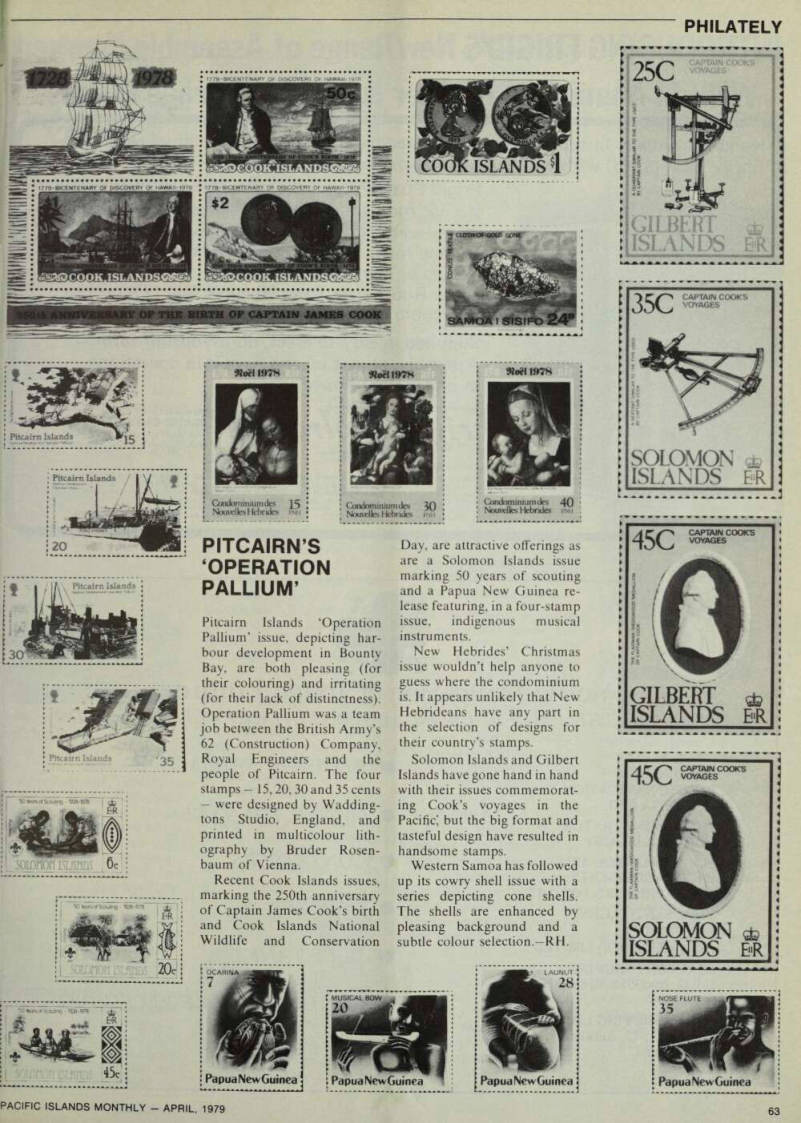
Pitcairn’S
Pallium’
Pitcairn Islands ‘Operation Pallium’ issue, depicting har
bour development in Bounty
Bay, are both pleasing (for
their colouring) and irritating
(for their lack of distinctness).
Operation Pallium was a team job between the British Army’s 62 (Construction) Company, Royal Engineers and the people of Pitcairn. The four stamps 15,20,30 and 35 cents were designed by Wadding tons Studio, England, and printed in multicolour lith ography by Bruder Rosen baum of Vienna.
Recent Cook Islands issues,
marking the 250th anniversary
of Captain James Cook’s birth and Cook Islands National Wildlife and Conservation
Day, are attractive offerings as are a Solomon Islands issue marking 50 years of scouting and a Papua New Guinea re lease featuring, in a four-stamp issue, indigenous musical instruments.
New Hebrides’ Christmas issue wouldn’t help anyone to guess where the condominium is. It appears unlikely that New Hebrideans have any part in the selection of designs for their country’s stamps.
Solomon Islands and Gilbert Islands have gone hand in hand with their issues commemorat ing Cook’s voyages in the Pacific' but the big format and tasteful design have resulted in handsome stamps.
Western Samoa has followed up its cowry shell issue with a series depicting cone shells.
The shells are enhanced by
pleasing background and a
subtle colour selection.
RH.
Advertisements & other items, p. 64 (1 item)
INTRODUCING FRIGID’S New Range of Assemble-Yourself
Walk-In Aluminium Freezer & Cooler Storage Rooms Hundreds already installed. Now with attractive timber grain aluminium exterior finish, (rust-proof) with white vinyl interior finish.
Frigid Foam Polyurethane insulation. 2" in cooler storage rooms is equal to 5" polystyrene foam. 3" in freezer storage rooms is equal to 8” polystyrene foam. Lower running costs. Best insulation available. Thin wall construction. Save in freight costs. Room sizes from 90 cubic feet (2 1 /2 m 3) to 930 cubic feet (25 1 /2 m 3).
Supplied in easy-to-erect, do-it-yourself form Assemble, plug it in, and have it in operation in under eight hours!
T 1 Manufactured by:
FRIGID CABINETS PTY. LTD.
14a Duffy Ave., Thornleigh, N.S.W. Aust. 2120. Ph. 848 8292.
AVAILABLE FROM:
AUSTRALIA NEW CALEDONIA EXPORTS, 363 George St., Sydney 2000. BRECKWOLDT & CO., G.P.O. Box 5027, Sydney 2001. HAGEMEYER (A'ASIA), 59 Anzac Pde., Kensington 2033. GEOFFREY HUGHES & CO., 167 Macquarie St., Sydney 2000. NELSON & ROBERTSON PTY. LTD., 197 Clarence St., Sydney 2000. E. RABOT (EXPORTS) PTY. LTD., 67 Castlereagh St., Sydney 2000. RABTRAD NIUGINI PTY. LTD., P.O. Box 1406, Lae.
A. RIETTE (PACIFIC) PTY. LTD., 20 Loftus St., Sydney 2000. C. SULLIVAN (EXPORT) PTY. LTD., G.P.O. Box 3373, Sydney 2001. W.S. TAIT & CO. PTY. LTD., 31 Macquarie Place, Sydney 2000.
N * * ♦
Pacific Navigation of Tonga Limited
SER VINGTHE PACIFIC FROM AUSTRALIA AND NEW ZEALAND
Yachts
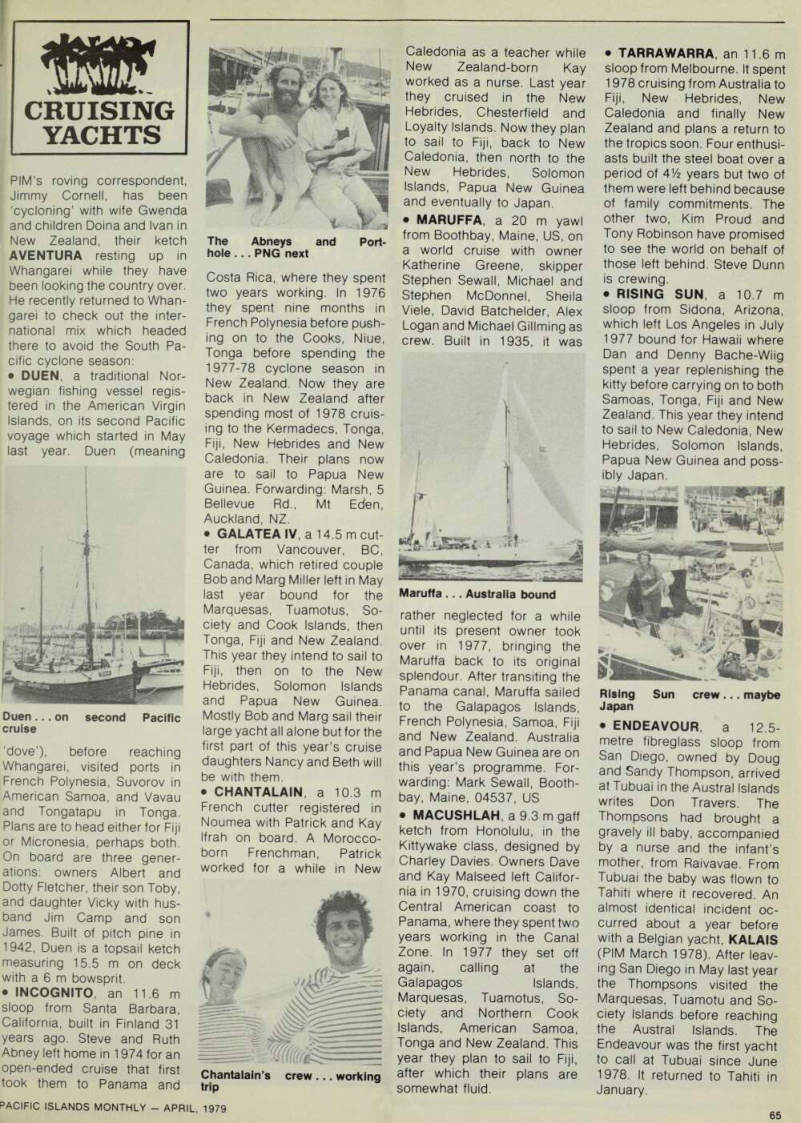
Cruising
PlM’s roving correspondent, Jimmy Cornell, has been ‘cycloning’ with wife Gwenda and children Doina and Ivan in New Zealand, their ketch AVENTURA resting up in Whangarei while they have been looking the country over.
He recently returned to Whan garei to check out the inter national mix which headed there to avoid the South Pa cific cyclone season; • DUEN, a traditional Nor wegian fishing vessel regis tered in the American Virgin Islands, on its second Pacific voyage which started in May last year. Duen (meaning
‘dove’), before reaching Whangarei, visited ports in French Polynesia, Suvorov in American Samoa, and Vavau and Tongatapu in Tonga.
Plans are to head either for Fiji or Micronesia, perhaps both.
On board are three gener ations: owners Albert and Dotty Fletcher, their son Toby, and daughter Vicky with hus band Jim Camp and son James. Built of pitch pine in 1942, Duen is a topsail ketch measuring 15.5 m on deck with a 6 m bowsprit.
• Incognito, An 11.6 M
sloop from Santa Barbara, California, built in Finland 31 years ago. Steve and Ruth Abney left home in 1974 for an open-ended cruise that first took them to Panama and
Costa Rica, where they spent two years working. In 1976 they spent nine months in French Polynesia before push ing on to the Cooks, Niue, Tonga before spending the 1977-78 cyclone season in New Zealand. Now they are back in New Zealand after spending most of 1978 cruis ing to the Kermadecs, Tonga, Fiji, New Hebrides and New Caledonia. Their plans now are to sail to Papua New Guinea. Forwarding: Marsh, 5 Bellevue Rd., Mt Edten, Auckland, NZ. • GALATEA IV, a 14.5 m cut ter from Vancouver, BC, Canada, which retired couple Bob and Marg Miller left in May last year bound for the Marquesas, Tuamotus, So ciety and Cook Islands, then Tonga, Fiji and New Zealand.
This year they intend to sail to Fiji, then on to the New Hebrides, Solomon Islands and Papua New Guinea.
Mostly Bob and Marg sail their large yacht all alone but for the first part of this year’s cruise daughters Nancy and Beth will be with them.
• Chantalain A 10.3 M
French cutter registered in Noumea with Patrick and Kay Ifrah on board. A Morocco born Frenchman, Patrick worked for a while in New
Caledonia as a teacher while New Zealand-born Kay worked as a nurse. Last year they cruised in the New Hebrides, Chesterfield and Loyalty Islands. Now they plan to sail to Fiji, back to New Caledonia, then north to the New Hebrides, Solomon Islands, Papua New Guinea and eventually to Japan. • MARUFFA, a 20 m yawl from Boothbay, Maine, US, on a world cruise with owner Katherine Greene, skipper Stephen Sewall, Michael and Stephen McDonnel, Sheila Viele, David Batchelder, Alex Logan and Michael Gillming as crew. Built in 1935, it was
rather neglected for a while until its present owner took over in 1977, bringing the Maruffa back to its original splendour. After transiting the Panama canal, Maruffa sailed to the Galapagos Islands, French Polynesia, Samoa, Fiji and New Zealand. Australia and Papua New Guinea are on this year’s programme. For warding: Mark Sewall, Booth bay, Maine, 04537, US • MACUSHLAH, a 9.3 m gaff ketch from Honolulu, in the Kittywake class, designed by Charley Davies. Owners Dave and Kay Malseed left Califor nia in 1970, cruising down the Central American coast to Panama, where they spent two years working in the Canal Zone. In 1977 they set off again, calling at the Galapagos Islands, Marquesas, Tuamotus, So ciety and Northern Cook Islands, American Samoa, Tonga and New Zealand. This year they plan to sail to Fiji, after which their plans are somewhat fluid.
• Tarrawarra, An 11,6 M
sloop from Melbourne. It spent 1978 cruising from Australia to Fiji, New Hebrides, New Caledonia and finally New Zealand and plans a return to the tropics soon. Four enthusi asts built the steel boat over a period of 414 years but two of them were left behind because of family commitments. The other two, Kim Proud and Tony Robinson have promised to see the world on behalf of those left behind. Steve Dunn is crewing. • RISING SUN, a 10 7 m sloop from Sidona, Arizona, which left Los Angeles in July 1977 bound for Hawaii where Dan and Denny Bache-Wiig spent a year replenishing the kitty before carrying on to both Samoas, Tonga, Fiji and New Zealand. This year they intend to sail to New Caledonia, New Hebrides, Solomon Islands, Papua New Guinea and poss ibly Japan.
• Endeavour A 12.5-
metre fibreglass sloop from San Diego, owned by Doug and Sandy Thompson, arrived at Tubuai in the Austral Islands writes Don Travers. The Thompsons had brought a gravely ill baby, accompanied by a nurse and the infant’s mother, from Raivavae. From Tubuai the baby was flown to Tahiti where it recovered. An almost identical incident oc curred about a year before with a Belgian yacht, KALAIS (RIM March 1978). After leav ing San Diego in May last year the Thompsons visited the Marquesas, Tuamotu and So ciety Islands before reaching the Austral Islands. The Endeavour was the first yacht to call at Tubuai since June 1978. It returned to Tahiti in January.
Duen... on second Pacific cruise
The Abneys and Port hole... PNG next
Chantalain’s crew... working trip
Maruffa... Australia bound
Rising Sun crew... maybe Japan
Advertisements & other items, p. 66 (1 item)
Beehive Building
94 Elizabeth Street Melbourne, Victoria Australia 3000 G.P.O. Box 8 Melbourne, Victoria Australia 3001 Telex: AA34552 Phone: 63 5094
Deaths
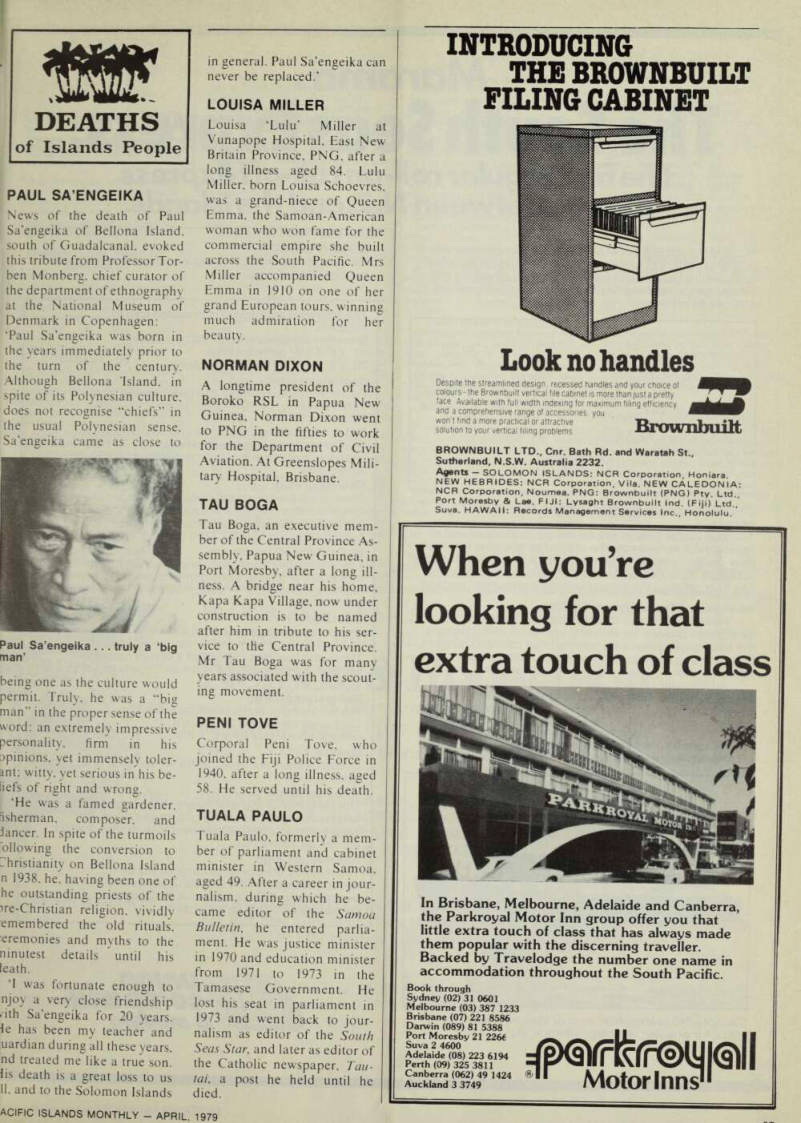
of Islands People
Paul Sa’Engeika
News of the death of Paul Sa’engeika of Bellona Island, south of Guadalcanal, evoked this tribute from Professor Tor ben Monberg. chief curator of
the department of ethnography
at the National Museum of Denmark in Copenhagen; ‘Paul Sa’engeika was born in the years immediately prior to the turn of the century.
Although Bellona ‘lsland, in spite of its Polynesian culture, does not recognise “chiefs” in the usual Polynesian sense.
Sa’engeika came as close to
being one as the culture would permit. Truly, he was a “big man” in the proper sense of the word: an extremely impressive personality, firm in his
Dpinions. yet immensely toler
ant: witty, yet serious in his be liefs of right and wrong. ‘He was a famed gardener, fisherman, composer. and iancer. In spite of the turmoils ollowing the conversion to rhristianity on Bellona Island n 1938. he. having been one of he outstanding priests of the
)re-Christian religion, vividly
emembered the old rituals, eremonies and myths to the ninutest details until his leath. ‘I was fortunate enough to njoy a very close friendship /ith Sa’engeika for 20 years, ie has been my teacher and uardian during all these years, nd treated me like a true son. lis death is a great loss to us 11. and to the Solomon Islands
in general. Paul Sa’engeika can never be replaced.’
Louisa Miller
Louisa ‘Lulu’ Miller at
Vunapope Hospital, East New
Britain Province. PNG. after a long illness aged 84. Lulu Miller, born Louisa Schoevres. was a grand-niece of Queen Emma, the Samoan-American woman who won fame for the commercial empire she built across the South Pacific. Mrs Miller accompanied Queen Emma in 1910 on one of her
grand European tours, winning
much admiration for her
beauty.
Norman Dixon
A longtime president of the Boroko RSL in Papua New Guinea, Norman Dixon went to PNG in the fifties to work for the Department of Civil Aviation. At Greenslopes Mili tary Hospital, Brisbane.
Tau Boga
Tau Boga, an executive mem ber of the Central Province As sembly, Papua New Guinea, in Port Moresby, after a long ill ness. A bridge near his home,
Kapa Kapa Village, now under
construction is to be named after him in tribute to his ser vice to the Central Province.
Mr Tau Boga was for many years associated with the scout
ing movement.
Peni Tove
Corporal Peni Tove, who joined the Fiji Police Force in 1940. after a long illness, aged 58. He served until his death.
Tuala Paulo
Tuala Paulo, formerly a mem ber of parliament and cabinet minister in Western Samoa, aged 49. After a career in jour nalism. during which he be came editor of the Samoa
Bulletin, he entered parlia
ment. He was justice minister in 1970 and education minister from 1971 to 1973 in the Tamasese Government. He lost his seat in parliament in 1973 and went back to jour nalism as editor of the South Seas Star, and later as editor of the Catholic newspaper. Tau tai, a post he held until he died.
Paul Sa’engeika... truly a ‘big man’
Advertisements & other items, pp. 67-68 (2 items)
67
ACIFIC ISLANDS MONTHLY APRIL, 1979
When you’re
INTRODUCING
THE BROWNBUILT
FILING CABINET
BROWNBUILT LTD., Cnr. Bath Rd. and Waratah St., Sutherland, N.S.W. Australia 2232.
Agents - SOLOMON ISLANDS: NCR Corporation, Honiara.
NEW HEBRIDES: NCR Corporation, Vila. NEW CALEDONIA: NCR Corporation, Noumea. PNG: Brownbuilt (PNG) Pty. Ltd., Port Moresby & Lae. FIJI: Lysaght Brownbuilt Ind. (Fiji) Ltd., Suva. HAWAII: Records Management Services Inc., Honolulu.
Look no handles
Despite the streamlined design, recessed handles and your choice of colours-the Brownbuilt vertical file cabinet is more than just a pretty face Available with full width indexing for maximum filing efficiency and a comprehensive range of accessories, you won't find a more practical or attractive solution to your vertical filing problems
Brownbuilt
When you’re
looking for that
extra touch of class
'H 9n
In Brisbane, Melbourne, Adelaide and Canberra,
the Parkroyal Motor Inn group offer you that little extra touch of class that has always made them popular with the discerning traveller.
Backed by Travelodgc the number one name in accommodation throughout the South Pacific.
Book through Sydney (02) 31 0601 Melbourne (03) 387 1233 Brisbane (07) 221 8586 Darwin (089) 81 5388 Port Moresby 21 226€ Suva 2 4600 Adelaide (08) 223 6194 Perth (09) 325 3811 Canberra (062) 49 1424 Auckland 3 3749
Motor Inns'*
Marama .
The South Seas Express.
The first regular roll-on
service between N.the Islands,
The introduction of Marama to the Islands trade will enable exporters to greatly increase their export potential by providing faster, more frequent sailings as well as the greater cargo handling flexibility which a roll-on, roll-off service can provide.
Co-ordinated transhipment facilities from other N.Z. centres Intermodal coastal roll-on roll-off services as well as rail and road services can be utilised by shippers in other New Zealand centres to take advantage of the new Marama schedule. Your nearest Union Company office can assist you in organising the most efficient transhipment method.
International Transhipment Facilities Flexibility in cargo modules catered by this new service can provide for shipping operators and exporters the advantage of reaching international markets using onforwarding services through Union Company contacts and expertise.
Additionally Union can also arrange for cargoes originating from overseas sources to be transhipped at ports covered by Marama’ to their final destination to the benefit of the importer in New Zealand or the Islands. m.v. Marama Your new export incentive 6350 deadweight tonnes.
Capacity 340 seafreighter units or their equivalent, plus space for wheeled vehicles, livestock, etc.
Greater Flexibility Means a more satisfactory and versatile way to ship your consignment.
The following equipment is provided free to shippers Standard dry general cargo ISO containers 20' x 8' x B'6" box container 20' x 8' x B'6" Opensided container.
Seafreighter Units For movement of general and bulk cargoes. (Internal) Length 13'9"(4.24M) width 7'6"(2.29M) height 5'(1.52M) N.B. Units are fully collapsible and open topped to facilitate loading cargoes in excess of 1,52 M height. A shower-proof cover is also provided free with every seafreighter.
Newsprint Flats These units are specifically designed for carriage of forest industry cargo but are also suitable for the carriage of other specified types of cargoes. (Internal) Length 15'6"(4.77M) Width 6'(1.830M) W. Containers These containers are totally enclosed suitable for the movement of smaller consignments or valuable ones. (Internal) Length 5'7"(1.75M) Width 4' (1.22 M) Height 5'6"(1.70M) Unit Loads This covers cargo that is unable to be containerised or is not covered by the term mobile equipment’.
These unit loadings must be of a secure nature to facilitate handling by a forklift with 5" gluts (loading forks).
Refrigerated Cargo The following containers will be available: Cold wrap containers 20' x 8' x 8' Integral containers 20' x 8' x B'6"
Livestock Livestock stalls are available for the carriage of all types of stock.
Wheeled Cargo The versatility of Marama means that all types of wheeled cargoes including cars, trucks, tractors, scrapers, machinery on mobile tracks, cranes, trailers etc can be catered for.
Hazardous Cargo The majority of hazardous cargoes will be accommodated on the vessels upper deck either in seafreighters, ISO containers or W. Containers. Full details are available on application.
/ company
amoving
Services
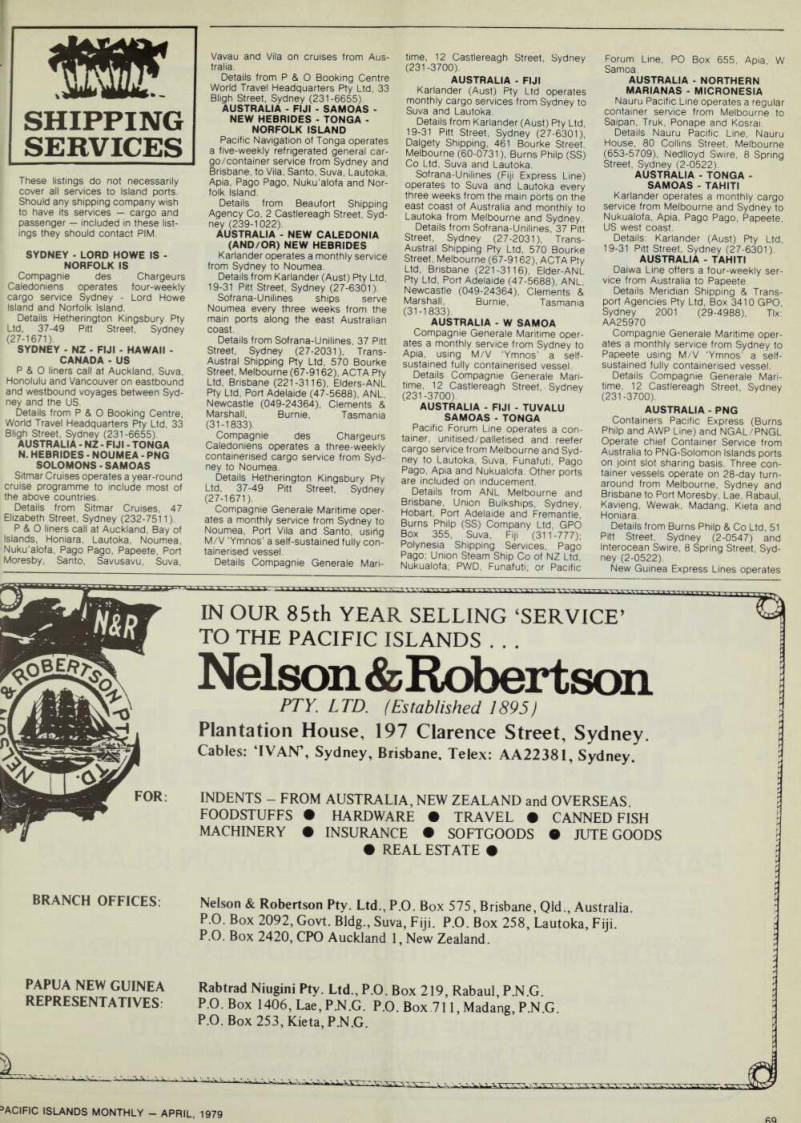
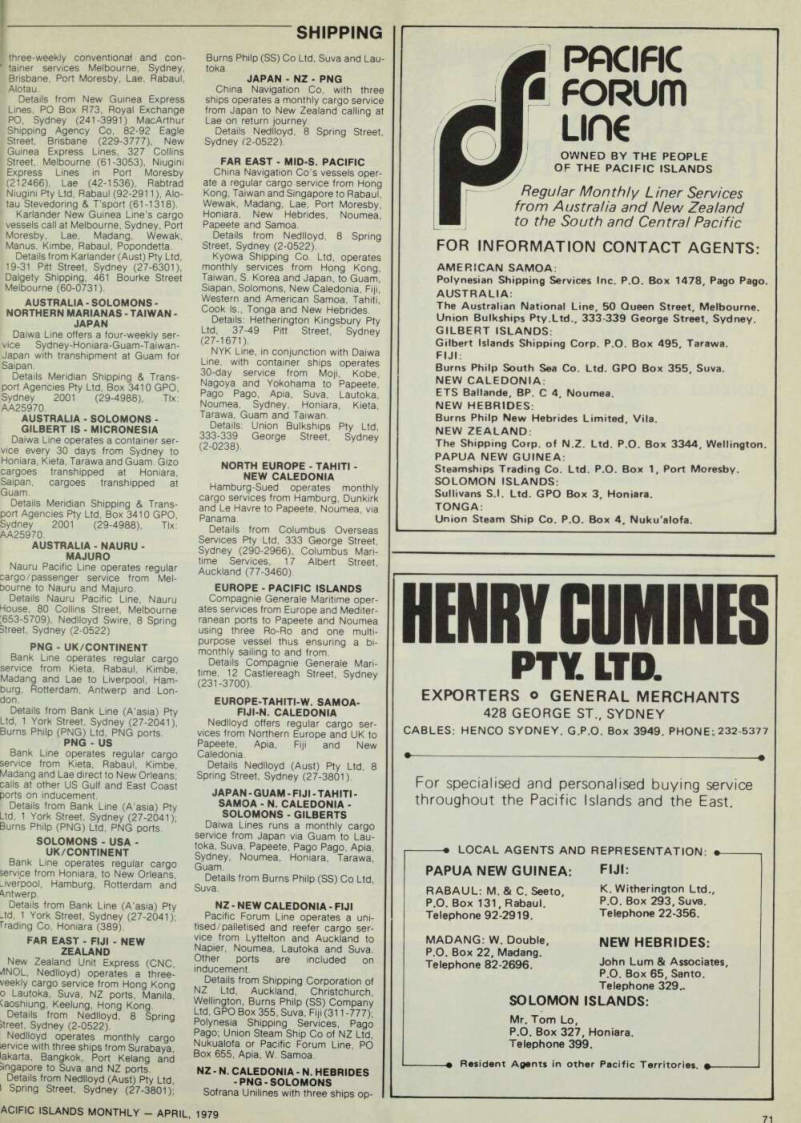
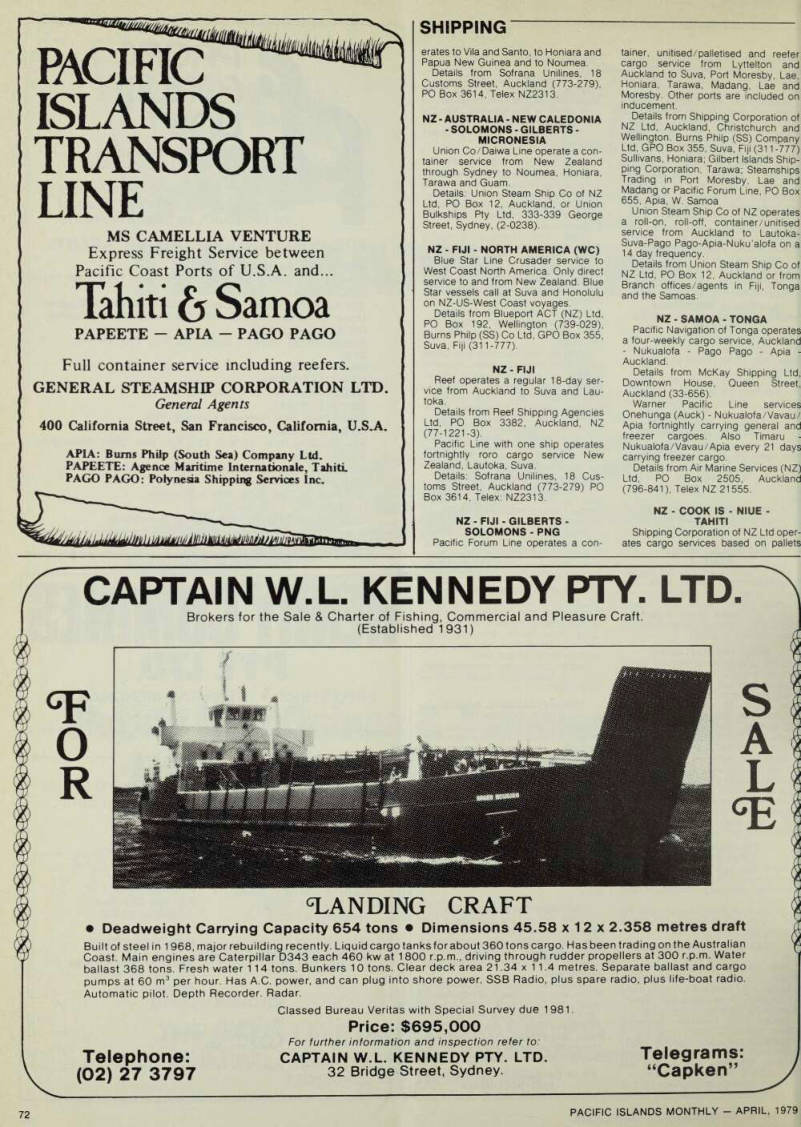
Shipping
These listings do not necessarily cover all services to Island ports.
Should any shipping company wish to have its services cargo and passenger included in these list ings they should contact PIM.
Sydney - Lord Howe Is -
Norfolk Is
Compagnie des Chargeurs Caledoniens operates four-weekly cargo service Sydney - Lord Howe Island and Norfolk Island, Details Hetherington Kingsbury Pty Ltd, 37-49 Pitt Street, Sydney (27-1671).
SYDNEY - NZ - FIJI - HAWAII -
Canada • Us
P & O liners call at Auckland, Suva, Honolulu and Vancouver on eastbound and westbound voyages between Syd ney and the US.
Details from P & O Booking Centre, World Travel Headquarters Pty Ltd, 33 Bligh Street, Sydney (231-6655).
AUSTRALIA - NZ - FIJI - TONGA
N. Hebrides - Noumea - Png
Solomons-Samoas
Sitmar Cruises operates a year-round cruise programme to include most of the above countries.
Details from Sitmar Cruises, 47 Elizabeth Street, Sydney (232-7511).
P & O liners call at Auckland, Bay of Islands, Honiara, Lautoka, Noumea, Nukualofa, Pago Pago, Papeete, Port Moresby, Santo, Savusavu, Suva,
Vavau and Vila on cruises from Aus tralia.
Details from P & O Booking Centre World Travel Headquarters Pty Ltd, 33 Bligh Street, Sydney (231-6655).
Australia - Fiji - Samoas -
New Hebrides - Tonga -
Norfolk Island
Pacific Navigation of Tonga operates a five-weekly refrigerated general car go/container service from Sydney and Brisbane, to Vila, Santo, Suva, Lautoka, Apia, Pago Pago, Nukualofa and Nor folk Island.
Details from Beaufort Shipping Agency Co, 2 Castlereagh Street, Syd ney (239-1022).
Australia - New Caledonia
(And/Or) New Hebrides
Karlander operates a monthly service from Sydney to Noumea.
Details from Karlander (Aust) Pty Ltd, 19-31 Pitt Street, Sydney (27-6301), Sofrana-Unilines ships serve Noumea every three weeks from the main ports along the east Australian coast.
Details from Sofrana-Unilines, 37 Pitt Street, Sydney (27-2031), Trans- Austral Shipping Pty Ltd, 570 Bourke Street, Melbourne (67-9162), ACTA Pty Ltd, Brisbane (221-3116), Elders-ANL Pty Ltd. Port Adelaide (47-5688), ANL, Newcastle (049-24364), Clements & Marshall, Burnie, Tasmania (31-1833).
Compagnie des Chargeurs Caledoniens operates a three-weekly containerised cargo service from Syd ney to Noumea.
Details Hetherington Kingsbury Pty Ltd, 37-49 Pitt Street, Sydney (27-1671).
Compagnie Generate Maritime oper ates a monthly service from Sydney to Noumea, Port Vila and Santo, usihg M/V 'Ymnos' a self-sustained fully con tainerised vessel.
Details Compagnie Generate Mari
time, 12 Castlereagh Street, Sydney (231-3700).
Australia - Fiji
Karlander (Aust) Pty Ltd operates monthly cargo services from Sydney to Suva and Lautoka.
Details from Karlander (Aust) Pty Ltd, 19-31 Pitt Street, Sydney (27-6301), Dalgety Shipping, 461 Bourke Street.
Melbourne (60-0731), Burns Philp (SS) Co Ltd, Suva and Lautoka.
Sofrana-Unilines (Fiji Express Line) operates to Suva and Lautoka every three weeks from the main ports on the east coast of Australia and monthly to Lautoka from Melbourne and Sydney.
Details from Sofrana-Unilines, 37 Pitt Street, Sydney (27-2031), Trans- Austral Shipping Pty Ltd, 570 Bourke Street, Melbourne (67-9162), ACTA Pty Ltd, Brisbane (221-3116), Elder-ANL Pty Ltd, Port Adelaide (47-5688), ANL, Newcastle (049-24364), Clements & Marshall, Burnie, Tasmania (31-1833).
Australia - W Samoa
Compagnie Generate Maritime oper ates a monthly service from Sydney to Apia, using M/V 'Ymnos' a self sustained fully containerised vessel.
Details Compagnie Generate Mari time, 12 Castlereagh Street, Sydney (231-3700).
Australia - Fiji - Tuvalu
Samoas - Tonga
Pacific Forum Line operates a con tainer, unitised/palletised and reefer cargo service from Melbourne and Syd ney to Lautoka, Suva, Funafuti, Pago Pago, Apia and Nukualofa. Other ports are included on inducement.
Details from ANL Melbourne and Brisbane, Union Bulkships, Sydney, Hobart, Port Adelaide and Fremantle, Burns Philp (SS) Company Ltd, GPO Box 355, Suva, Fiji (311-777); Polynesia Shipping Services, Pago Pago; Union Steam Ship Co of NZ Ltd, Nukualofa; PWD, Funafuti; or Pacific
Forum Line, PO Box 655, Apia, W Samoa.
Australia - Northern
Marianas - Micronesia
Nauru Pacific Line operates a regular container service from Melbourne to Saipan, Truk, Ponape and Kosrai.
Details Nauru Pacific Line, Nauru House, 80 Collins Street, Melbourne (653-5709), Nedlloyd Swire, 8 Spring Street, Sydney (2-0522).
Australia - Tonga -
Samoas - Tahiti
Karlander operates a monthly cargo service from Melbourne and Sydney to Nukualofa, Apia, Pago Pago, Papeete, US west coast.
Details: Karlander (Aust) Pty Ltd, 19-31 Pitt Street, Sydney (27-6301).
Australia - Tahiti
Daiwa Line offers a four-weekly ser vice from Australia to Papeete.
Details Meridian Shipping & Trans port Agencies Pty Ltd, Box 3410 GPO Sydney 2001 (29-4988), Tlx: AA25970 Compagnie Generate Maritime oper ates a monthly service from Sydney to Papeete using M/V ‘Ymnos' a self sustained fully containerised vessel.
Details Compagnie Generate Mari time, 12 Castlereagh Street, Sydney (231-3700).
Australia - Png
Containers Pacific Express (Burns Philp and AWP Line) and NGAL/PNGL Operate chief Container Service from Australia to PNG-Solomon Islands ports on joint slot sharing basis. Three con tainer vessels operate on 28-day turn around from Melbourne, Sydney and Brisbane to Port Moresby, Lae, Rabaul, Kavieng, Wewak, Madang, Kieta and Honiara.
Details from Burns Philp & Co Ltd, 51 Pitt Street, Sydney (2-0547) and Interocean Swire, 8 Spring Street, Syd ney (2-0522).
New Guinea Express Lines operates
three-weekly conventional and con * tainer services Melbourne, Sydney, Brisbane, Port Moresby, Lae, Rabaul, Alotau.
Details from New Guinea Express Lines. PO Box R 73, Royal Exchange PO, Sydney (241-3991) MacArthur Shipping Agency Co, 82-92 Eagle Street, Brisbane (229-3777), New Guinea Express Lines, 327 Collins ; Street, Melbourne (61-3053), Niugini Express Lines in Port Moresby (212466), Lae (42-1536), Rabtrad Niugini Pty Ltd, Rabaul (92-2911), Alo tau Stevedoring & T’sport (61-1318).
Karlander New Guinea Line’s cargo vessels call at Melbourne, Sydney, Port Moresby, Lae, Madang, Wewak, Manus, Kimbe, Rabaul, Popondetta.
Details from Karlander (Aust) Pty Ltd, 19-31 Pitt Street, Sydney (27-6301), Dalgety Shipping, 461 Bourke Street Melbourne (60-0731).
Australia - Solomons -
Northern Marianas - Taiwan -
Japan
Daiwa Line offers a four-weekly ser vice Sydney-Honiara-Guam-Taiwan- Japan with transhipment at Guam for Saipan.
Details Meridian Shipping & Trans port Agencies Pty Ltd, Box 3410 GPO, Sydney 2001 (29-4988), Tlx: AA25970.
Australia - Solomons -
Gilbert Is - Micronesia
Daiwa Line operates a container ser vice every 30 days from Sydney to Honiara, Kieta, Tarawa and Guam. Gizo cargoes transhipped at Honiara, Saipan, cargoes transhipped at Guam, Details Meridian Shipping & Trans port Agencies Pty Ltd, Box 3410 GPO, Sydney 2001 (29-4988), Tlx: AA25970.
Australia - Nauru -
Majuro
Nauru Pacific Line operates regular cargo /passenger service from Mel bourne to Nauru and Majuro.
Details Nauru Pacific Line, Nauru House, 80 Collins Street, Melbourne Nedlloyd Swire, 8 Spring Street, Sydney (2-0522)
Png - Uk/Continent
Bank Line operates regular cargo service from Kieta, Rabaul, Kimbe, Madang and Lae to Liverpool, Ham burg, Rotterdam, Antwerp and Lon don.
Details from Bank Line (A'asia) Pty Ltd, 1 York Street, Sydney (27-2041), Burns Philp (PNG) Ltd, PNG ports,
Png - Us
Bank Line operates regular cargo service from Kieta, Rabaul, Kimbe, Madang and Lae direct to New Orleans; calls at other US Gulf and East Coast ports on inducement.
Details from Bank Line (A’asia) Pty Ltd, 1 York Street. Sydney (27-2041); Burns Philp (PNG) Ltd, PNG ports,
Solomons - Usa -
Uk/Continent
Bank Line operates regular cargo service from Honiara, to New Orleans, Jverpool, Hamburg, Rotterdam and Antwerp.
Details from Bank Line (A’asia) Pty Jd, 1 York Street, Sydney (27-2041); rrading Co, Honiara (389).
Far East - Fiji - New
Zealand
New Zealand Unit Express (CNC, 4NOL, Nedlloyd) operates a three veekly cargo service from Hong Kong 0 Lautoka, Suva, NZ ports, Manila, (aoshiung, Keelung, Hong Kong.
Details from Nedlloyd, 8 Spring Street, Sydney (2-0522).
Nedlloyd operates monthly cargo lervice with three ships from Surabaya, Jakarta, Bangkok, Port Kelang and Singapore to Suva and NZ ports.
Details from Nedlloyd (Aust) Pty Ltd 1 Spring Street, Sydney (27-3801);
Burns Philp (SS) Co Ltd, Suva and Lau toka,
Japan - Nz - Png
China Navigation Co, with three ships operates a monthly cargo service from Japan to New Zealand calling at Lae on return journey.
Details Nedlloyd, 8 Spring Street, Sydney (2-0522).
Far East - Mid-S. Pacific
China Navigation Co's vessels oper ate a regular cargo service from Hong Kong, Taiwan and Singapore to Rabaul, Wewak, Madang, Lae, Port Moresby, Honiara, New Hebrides, Noumea, Papeete and Samoa.
Details from Nedlloyd, 8 Spring Street, Sydney (2-0522).
Kyowa Shipping Co. Ltd, operates monthly services from Hong Kong, Taiwan, S. Korea and Japan, to Guam, Siapan, Solomons, New Caledonia, Fiji, Western and American Samoa, Tahiti, Cook Is., Tonga and New Hebrides.
Details: Hetherington Kingsbury Pty Ltd, 37-49 Pitt Street, Sydney (27-1671).
NYK Line, in conjunction with Daiwa Line, with container ships operates 30-day service from Moji, Kobe, Nagoya and Yokohama to Papeete, Pago Pago, Apia, Suva, Lautoka, Noumea, Sydney, Honiara, Kieta, Tarawa, Guam and Taiwan, Details: Union Bulkships Pty Ltd, 333-339 George Street, Sydney (2-0238).
North Europe - Tahiti -
New Caledonia
Hamburg-Sued operates monthly cargo services from Hamburg, Dunkirk and Le Havre to Papeete, Noumea, via Panama.
Details from Columbus Overseas Services Pty Ltd, 333 George Street, Sydney (290-2966), Columbus Mari time Services, 17 Albert Street, Auckland (77-3460).
Europe - Pacific Islands
Compagnie Generale Maritime oper ates services from Europe and Mediter ranean ports to Papeete and Noumea using three Ro-Ro and one multi purpose vessel thus ensuring a bi monthly sailing to and from.
Details Compagnie Generale Mari time, 12 Castlereagh Street, Sydney (231-3700).
Europe-Tahiti-W. Samoa
Fiji-N. Caledonia
Nedlloyd offers regular cargo ser vices from Northern Europe and UK to Papeete, Apia, Fiji and New Caledonia.
Details Nedlloyd (Aust) Pty Ltd, 8 Spring Street, Sydney (27-3801).
JAPAN - GUAM - FIJI - TAHITI -
Samoa - N. Caledonia -
Solomons - Gilberts
Daiwa Lines runs a monthly cargo service from Japan via Guam to Lau toka, Suva, Papeete, Pago Pago, Apia, Sydney, Noumea, Honiara, Tarawa, Guam.
Details from Burns Philp (SS) Co Ltd, Suva.
Nz-New Caledonia-Fiji
Pacific Forum Line operates a uni tised / palletised and reefer cargo ser vice from Lyttelton and Auckland to Napier, Noumea, Lautoka and Suva.
Other ports are included on inducement.
Details from Shipping Corporation of NZ Ltd, Auckland, Christchurch, Wellington, Burns Philp (SS) Company Ltd, GPO Box 355, Suva, Fiji (311 -777); Polynesia Shipping Services, Pago Pago; Union Steam Ship Co of NZ Ltd, Nukualofa or Pacific Forum Line, PO Box 655, Apia, W. Samoa.
NZ - N. CALEDONIA - N. HEBRIDES
-Png-Solomons
Sofrana Unilines with three ships op
erates to Vila and Santo, to Honiara and Papua New Guinea and to Noumea.
Details from Sofrana Unilines, 18 Customs Street, Auckland (773-279), PC Box 3614, Telex NZ2313.
Nz - Australia - New Caledonia
- Solomons - Gilberts -
Micronesia
Union Co/Daiwa Line operate a con tainer service from New Zealand through Sydney to Noumea, Honiara, Tarawa and Guam.
Details: Union Steam Ship Co of NZ Ltd, PC Box 12, Auckland, or Union Bulkships Pty Ltd, 333-339 George Street, Sydney, (2-0238).
NZ - FIJI - NORTH AMERICA (WC) Blue Star Line Crusader service to West Coast North America. Only direct service to and from New Zealand. Blue Star vessels call at Suva and Honolulu on NZ-US-West Coast voyages.
Details from Blueport ACT (NZ) Ltd, PC Box 192, Wellington (739-029), Burns Philp (SS) Co Ltd, GPO Box 355, Suva, Fiji (311-777).
Nz - Fiji
Reef operates a regular 18-day ser vice from Auckland to Suva and Lau toka.
Details from Reef Shipping Agencies Ltd. PC Box 3382, Auckland, NZ (77-1221-3).
Pacific Line with one ship operates fortnightly roro cargo service New Zealand, Lautoka, Suva.
Details: Sofrana Unilines, 18 Cus toms Street, Auckland (773-279) PC Box 3614, Telex: NZ2313.
Nz - Fiji - Gilberts
Solomons - Png
Pacific Forum Line operates a con
tainer, unitised/palletised and reefer cargo service from Lyttelton and Auckland to Suva, Port Moresby, Lae, Honiara, Tarawa, Madang, Lae and Moresby. Other ports are included on inducement.
Details from Shipping Corporation of NZ Ltd, Auckland, Christchurch and Wellington. Burns Philp (SS) Company Ltd, GPO Box 355, Suva, Fiji (311 -777) Sullivans, Honiara; Gilbert Islands Ship ping Corporation, Tarawa; Steamships Trading in Port Moresby, Lae and Madang or Pacific Forum Line, PC Box 655, Apia, W. Samoa Union Steam Ship Co of NZ operates a roll-on, roll-off, container/unitised service from Auckland to Lautoka- Suva-Pago Pago-Apia-Nuku’alofa on a 14 day frequency.
Details from Union Steam Ship Co of NZ Ltd, PC Box 12, Auckland or from Branch offices/agents in Fiji, Tonga and the Samoas.
Nz- Samoa - Tonga
Pacific Navigation of Tonga operates a four-weekly cargo service, Auckland - Nukualofa - Pago Pago - Apia - Auckland.
Details from McKay Shipping Ltd, Downtown House, Oueen Street, Auckland (33-656).
Warner Pacific Line services Onehunga (Auck) - Nukualofa/Vavau/ Apia fortnightly carrying general and freezer cargoes. Also Timaru - Nukualofa/Vavau/Apia every 21 days carrying freezer cargo.
Details from Air Marine Services (NZ) Ltd. PC Box 2505, Auckland (796-841), Telex NZ 21555.
NZ - COOK IS - NIUE -
Tahiti
Shipping Corporation of NZ Ltd oper ates cargo services based on pallets
and similar units from Auckland to Niue, • Cook Islands and Tahiti.
Details from the Shipping Corp of NZ Ltd, PO Box 3420, Auckland (797-210); Waterfront Commission, PO Box 61, Rarotonga, Lighterage and Stevedoring Co, Aitutaki, Niue Govt Offices, Niue Island, Compagnie Mari time Polynesienne, B’P’ 368, Papeete, Tahiti.
Uk - Fiji
The Bank Line operates a direct, fast monthly service from Hull to Suva and Lautoka.
Details from The Bank Line (Aus tralasia) Pty Ltd, 1 York St, Sydney (27-2041); Burns Philp (South Sea) Co Ltd, Suva and Lautoka.
Uk/N. Continent - Tahiti -
N. Caledonia - N. Hebrides
Bank Line operates regular cargo service from Hull, Hamburg, Bremen, Antwerp and Rotterdam to Papeete and Noumea.
Details from Bank Line (A’asia) Pty Ltd, 1 York Street, Sydney (27-2041); Ets A M Fare UTE, Papeete; Ets Ballande, Noumea.
Uk/N. Continent - Png -
Solomons
Bank Line operates regular cargo service from Hull, Hamburg, Bremen, Antwerp and Rotterdam to Port Moresby, Lae, Madang, Kimbe, Rabaul, Kieta and Honiara and on inducement to Yandina.
Details from Bank Line (A’asia) Pty Ltd. 1 York Street, Sydney (27-2041); Burns Philp (PNG) Ltd, PNG ports; Trading Co Honiara.
Honolulu - Samoas - Tonga
Warner Pacific Line operates a unit
ized/palletized and reefer cargo ser vice Honolulu-Pago Pago-Apia- Nuku’alofa. Line Islands and Suva are included on inducement.
Details from Hawaii-Pacific Maritime, Inc, PO Box 3264 Honolulu, HI (531-4841) Tlx: 723330.
San Francisco - Honolulu -
Nauru - Micronesia
Nauru Pacific Line operates regular conventional/container service from San Francisco and Honolulu to Majuro, Nauru, Ponape, Truk and Saipan.
Details from Nauru Pacific Line, Nauru House, 80 Collins Street, Mel bourne (653-5709); North American Maritime Agencies, 100 California Street, San Francisco, California 9411 (981-0343).
US - FIJI - TAHITI - NZ -
Australia
Bank and Savill Line Ltd, operates regular cargo services from US Gulf ports to Australia and NZ. Calls at Suva, Lautoka and Papeete on demand.
Details from Bank Line (A’asia) Pty Ltd, 1 York Street. Sydney (27-2041) or Howard Smith Industries Pty Ltd, 1 York Street, Sydney (27-5611).
Us - Tahiti ■ Samoa
Pacific Islands Transport operates a 'five/six weekly cargo service from North America west coast ports to Papeete, Pago Pago, Apia.
Details from Trans-Austral Shipping Pty Ltd, 19 Pitt Street, Sydney (27-2441).
Polynesia Line operates container and general cargo service from US west coast ports to Papeete and Pago Pago, Details from Polynesia Shipping Ser vices Inc,. PO Box 1478, Pago Pago (9-6799).
Advertisements & other items, pp. 69-73 (4 items)
69
ACIFIC ISLANDS MONTHLY - APRIL. 1979
Nelson & Robert son
p6E/?> O <*. -o a C 2 6/
FOR
IN OUR 85th YEAR SELLING ‘SERVICE’
TO THE PACIFIC ISLANDS . . .
Nelson & Robert son
PTY.LTD. (Established 1895)
Plantation House, 197 Clarence Street, Sydney.
Cables: ‘IVAN’, Sydney, Brisbane. Telex: AA22381, Sydney.
INDENTS - FROM AUSTRALIA, NEW ZEALAND and OVERSEAS.
FOODSTUFFS • HARDWARE • TRAVEL • CANNED FISH MACHINERY • INSURANCE • SOFTGOODS • JUTE GOODS
• REAL ESTATE •
BRANCH OFFICES:
Nelson & Robertson Pty. Ltd., P.O. Box 575, Brisbane, Qld., Australia, P.O. Box 2092, Govt. Bldg., Suva, Fiji. P.O. Box 258, Lautoka, Fiji.
P-O. Box 2420, CPO Auckland 1, New Zealand.
PAPUA NEW GUINEA
REPRESENTATIVES:
Rabtrad Niugini Pty. Ltd., P.O. Box 219, Rabaul, P.N.G.
P.0.80x 1406, Lae, PN.G. P.O. Box 711, Madang, P.N.G.
P.O. Box 253, Kieta, P.N.G.
AX.. V
o
GLOBAL SERVICE FOR SHIPPERS
THE
LINE
Papua New Guinea & Solomon Islands
USA- UK /Continent Service
Regular direct monthly sailings
PAPAL) NEW GUINEA and SOLOMON ISLANDS
to; NORTH AMERICA • UNITED KINGDOM & CONTINENT For particulars apply:
THE BANK LINE (AUSTRALASIA) PTY LTD.
18th Floor ■ 1 York Street Sydney IM.SW. 2000 Australia Telephone; 272041 Telex: 24063
M PACIFIC
ffi FORUfn
Regular Monthly Liner Services
from Australia and New Zealand
to the South and Central Pacific
OWNED BY THE PEOPLE
OF THE PACIFIC ISLANDS
FOR INFORMATION CONTACT AGENTS:
AMERICAN SAMOA:
Polynesian Shipping Services Inc. P.O. Box 1478, Pago Pago.
AUSTRALIA:
The Australian National Line, 50 Queen Street, Melbourne.
Union Bulkships Pty.Ltd., 333-339 George Street, Sydney.
GILBERT ISLANDS:
Gilbert Islands Shipping Corp. P.O. Box 495. Tarawa.
FIJI:
Burns Philp South Sea Co. Ltd. GPO Box 355, Suva.
NEW CALEDONIA:
ETS Ballande, BP. C 4, Noumea.
NEW HEBRIDES:
Burns Philp New Hebrides Limited, Vila.
NEW ZEALAND:
The Shipping Corp. of N.Z. Ltd. P.O. Box 3344, Wellington.
PAPUA NEW GUINEA:
Steamships Trading Co. Ltd. P.O. Box 1, Port Moresby.
SOLOMON ISLANDS;
Sullivans S.l. Ltd. GPO Box 3, Honiara.
TONGA:
Union Steam Ship Co. P.O. Box 4, Nuku'alofa.
HENRY CUMINES
PTY.LTD.
EXPORTERS o GENERAL MERCHANTS
428 GEORGE ST., SYDNEY
CABLES: HENCO SYDNEY. G.P.O. Box 3949. PHONE; 232-5377 • - *
For specialised and personalised buying service
throughout the Pacific Islands and the East.
LOCAL AGENTS AND REPRESENTATION:
PAPUA NEW GUINEA:
RABAUL: M. & C. Seeto, P.O. Box 131, Rabaul.
Telephone 92-2919.
MADANG: W. Double, P.O. Box 22, Madang.
Telephone 82-2696.
SOLOMON
FIJI:
K. Witherington Ltd., P.O. Box 293, Suva.
Telephone 22-356.
NEW HEBRIDES;
John Lum & Associates, P.O. Box 65, Santo.
Telephone 329
ISLANDS:
Mr. Tom Lo, P.O. Box 327, Honiara.
Telephone 399. -• Resident A(jents in other Pacific Territories.
PAOFK^^I
ISLANDS
TRANSPORT
LINE
MS CAMELLIA VENTURE
Express Freight Service between Pacific Coast Ports of U.S.A. and...
Tahiti 6 Samoa
PAPEETE - APIA - PAGO PAGO
Full container service including reefers.
GENERAL STEAMSHIP CORPORATION LTD.
General Agents 400 California Street, San Francisco, California, U.S.A.
APIA: Bums Philp (South Sea) Company Ltd.
PAPEETE: Agence Maritime Internationale, Tahiti.
PAGO PAGO; Polynesia Shipping Services Inc.
CAPTAIN W.L. KENNEDY PTY. LTD
Brokers for the Sale & Charter of Fishing, Commercial and Pleasure Craft. (Established 1931) l I
LANDING CRAFT
• Deadweight Carrying Capacity 654 tons • Dimensions 45.58 xl2 x 2.358 metres draft Built of steel in 1968, major rebuilding recently. Liquid cargo tanks forabout 360 tons cargo. Has been trading on the Australian Coast. Main engines are Caterpillar D 343 each 460 kw at 1800 r.p.m., driving through rudder propellers at 300 r.p.m. Water ballast 368 tons. Fresh water 114 tons. Bunkers 10 tons. Clear deck area 21.34 x 11.4 metres. Separate ballast and cargo pumps at 60 m 3 per hour. Has A.C. power, and can plug into shore power. SSB Radio, plus spare radio, plus life-boat radio.
Automatic pilot. Depth Recorder. Radar.
Classed Bureau Veritas with Special Survey due 1981.
Price: $695,000
For further information and inspection refer to: Telephone: captain w.l. Kennedy pty. ltd. Telegrams: (02) 27 3797 32 Bridge Street, Sydney. “Capken
Contex
Agencies Ltd
240 Orakei Road, Auckland, New Zealand.
P.O. Box 42003.
PACIFIC AGENTS FOR:
“PERSONALITY”
Kit-Set Furniture
“WAITEMATA CAKES”
Choice Cakes, Biscuits, Pizzas
“CONTEMPORARY”
Pre-Cut Homes
SEND FOR CATALOGUE
AGENCIES AVAILABLE
TELEX NZ 2176 EXINST CONTEX
DAIWA LINE
JAPAN-SOUTH PACIFIC REGULAR SERVICE
AUSTRALIA SOUTH PACIFIC CONTAINER SERVICE
JAPAN-TAIWAN-GUAM SAIPAN REGULAR SERVICE
DAIWA LINE BRIDGES SOUTH PACIFIC
WITH RO/RO CAR &. CONTAINER CARRIER
japan-guam-lautoka-suva-papeete-pagopago-apia-noumea-
SYDNEY—HONIARA—KIETA—TARAWA—GUAM—TAIWAN—JAPAN
JAPAN—MAJURO— RAROTONGA—VILA—SANTO—NAURU—JAPAN
JAPAN—TAIWAN—GUAM—SAIPAN—JAPAN
V m
THE DAIWA MITIGATION CO.* LTD.
OSAKA: DAILINE
HEAD OFFICE
DAIICHI KYOGVO BLDG..
45,2-CHOME, AWAZAMINAMi-DORI,
NISHi-KU, OSAKA. JAPAN
TELEPHONE: (06) 531-0471-9
TELEX: 525-6324 & 525-6325
TOKYO: “FUNEDAILINE” *
TOKYO OFFICE
SHIN-DAIICHI BLDG.,
4-13, NIHONBASHI 3-CHOME, CHUO-KU,
TOKYO, JAPAN
TELEPHONE: (03) 274-3251-8
TELEX; 222-3343. J 23559
Shipping
71
iCIFIC ISLANDS MONTHLY APRIL, 1979
Shipping
73
a.CIFIC ISLANDS MONTHLY - APRIL, 1979
Sandalwood
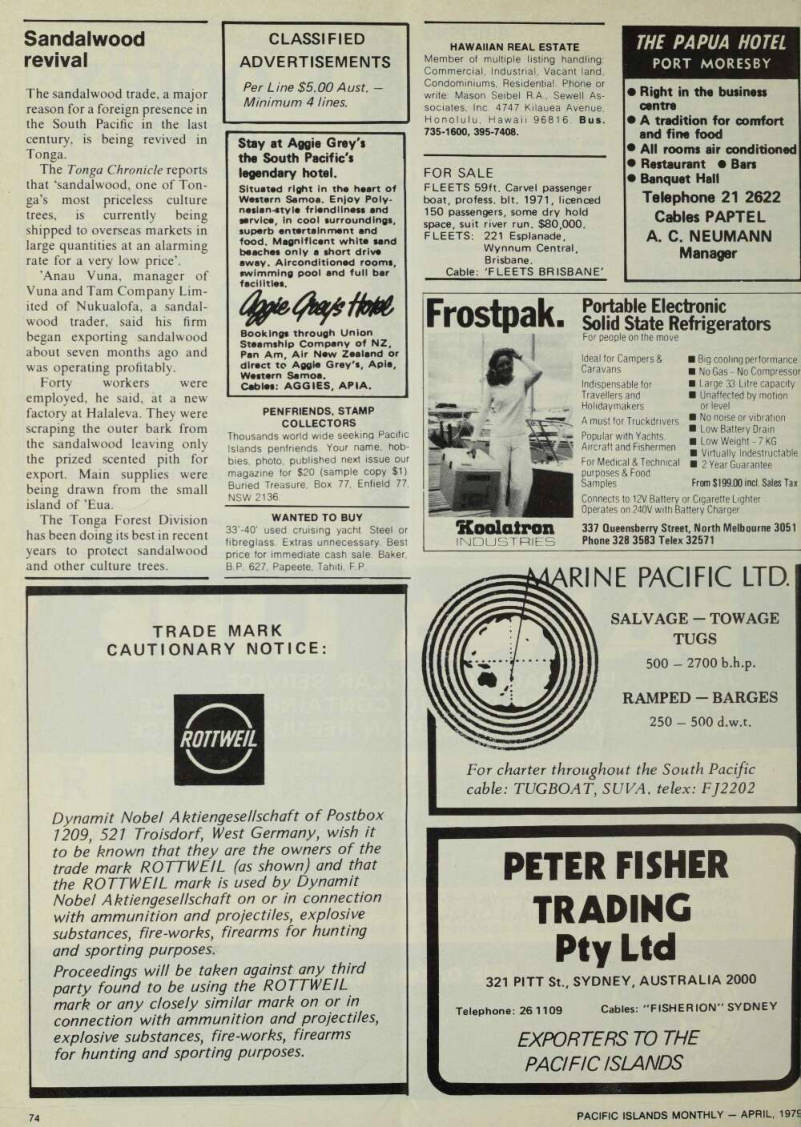
revival
The sandalwood trade, a major reason for a foreign presence in the South Pacific in the last century, is being revived in
Tonga.
The Tonga Chronicle reports that ‘sandalwood, one of Ton
ga’s most priceless culture
trees, is currently being
shipped to overseas markets in
large quantities at an alarming
rate for a very low price’. ’Anau Vuna, manager of Vuna and Tam Company Lim ited of Nukualofa, a sandal wood trader, said his firm
began exporting sandalwood
about seven months ago and
was operating profitably.
Forty workers were employed, he said, at a new factory at Halaleva. They were scraping the outer bark from the sandalwood leaving only the prized scented pith for export. Main supplies were being drawn from the small island of ’Eua.
The Tonga Forest Division has been doing its best in recent years to protect sandalwood and other culture trees.
Advertisements & other items, pp. 74-76 (1 item)
Frostpak
CLASSIFIED
ADVERTISEMENTS
Per Line $5.00 Aust.
Minimum 4 tines.
THE PAPUA HOTEL
PORT MORESBY
• Right in the business centre • A tradition for comfort and fine food • All rooms air conditioned • Restaurant • Bars • Banquet Hall Telephone 21 2622 Cables PARTE L
A. C. NEUMANN
Manager
HAWAIIAN REAL ESTATE
Member of multiple listing handling: Commercial, Industrial. Vacant land, Condominiums, Residential. Phone or write: Mason Seibel R.A., Sewell Associates, Inc. 4747 Kilauea Avenue, Honolulu, Hawaii 96816. Bus. 735-1600, 395-7408.
FOR SALE
FLEETS 59ft. Carvel passenger boat, profess, bit. 1971, licenced 150 passengers, some dry hold space, suit river run. $BO,OOO.
FLEETS: 221 Esplanade, Wynnum Central, Brisbane.
Cable: 'FLEETS BRISBANE'
Stay at Aggie Grey's
the South Pacific's
legendary hotel.
Situated right in the heart of Western Samoa. Enjoy Polynesian-style friendliness and service, in cool surroundings, superb entertainment and food. Magnificent white sand beaches only a short drive away. Airconditioned rooms, swimming pool and full bar facilities.
Bookings through Union Steamship Company of NZ, Pan Am, Air New Zealand or direct to Aggie Grey's, Apia, Western Samoa.
Cables: AGGIES, APIA.
Frostpak
f
Xoolatron
INDUSTRIES
Portable Electronic
Solid State Refrigerators
For people on the move Ideal for Campers & Caravans Indispensable for Travellers and Holidaymakers A must for Truckdrivers Popular with Yachts.
Aircraft and Fishermen ■ Big cooling performance ■ No Gas - No Compresso ■ Large 33 Litre capacity ■ Unaffected by motion or level ■ No noise or vibration ■ Low Battery Dram ■ Low Weight - 7 KG ■ Virtually Indestructable ■ 2 Year Guarantee From $199.00 incl. Sales Tax For Medical & Technical purposes & Food Samples Connects to 12V Battery or Cigarette Lighter Operates on 240 V with Battery Charger 337 Queensberry Street, North Melbourne 3051 Phone 328 3583 Telex 32571
PENFRIENDS, STAMP
COLLECTORS
Thousands world wide seeking Pacific Islands penfriends. Your name, hobbies, photo, published next issue our magazine for $2O (sample copy $1).
Buried Treasure, Box 77, Enfield 77,
NSW 2136.
WANTED TO BUY
33’-40' used cruising yacht. Steel or fibreglass. Extras unnecessary. Best price for immediate cash sale. Baker, B.P. 627, Papeete, Tahiti, F.P,
RINE PACIFIC LTD.
m
SALVAGE - TOWAGE
TUGS
500 - 2700 b.h.p.
RAMPED - BARGES
250 - 500 d.w.t.
For charter throughout the South Pacific cable: TUGBOAT, SUVA, telex: FJ2202
TRADE MARK
CAUTIONARY NOTICE:
Dynamit Nobel A ktiengesellschaft of Postbox 1209, 521 Troisdorf, West Germany, wish it to be known that they are the owners of the trade mark ROTTWEIL (as shown) and that the ROTTWEIL mark is used by Dynamit Nobel A ktiengesellschaft on or in connection with ammunition and projectiles, explosive substances, fire-works, firearms for hunting and sporting purposes.
Proceedings will be taken against any third party found to be using the ROTTWEIL mark or any closely simitar mark on or in connection with ammunition and projectiles, explosive substances, fire-works, firearms for hunting and sporting purposes.
PETER FISHER
TRADING
Pty Ltd
321 PITT St., SYDNEY, AUSTRALIA 2000
Telephone: 26 1109 Cables: “FISHERION” SYDNEY
EXPORTERS TO THE
PACIFIC ISLANDS
CRF-330K
s 5 n o r- * •
ICF-6700W
SO5f Y
'S67Q
ICF-5800W
r ' -■ v J &: .V s*” —— . % . * „ .i -»
SONV
rW ft * ■I -V- . : J* - * * * **. : > -
Tne Globescanners.
Turn on one of these Sony multi-band receivers and prepare to do some traveling. They're made to take you out of the country, off the continent, clear to the other side of the earth.
There's enough heavyweight communications technology inside Sony's lightweight 31-band ICF-6800W and 5-band ICF-6700W receivers to scan radio broadcasts from around the globe.
For example, the ICF-6800W's dual conversion superheterodyne circuitry for clear and stable reception. And phase-locked-loop synthesized tuning so that whatever you tune will be guaranteed quartz-accurate. It pulls in FM/MW and SW I ~SW 29 (1.6~30MHz), including the single side band and continuous wave band.
The ICF-6700W breaks its shortwave coverage into three zones spanning the same frequency range and puts it on three bands.
Sony's way of cutting the world to size. It also picks up FM/MW broadcasts.
Both models have LED digital readouts that display MW/SW frequencies with unfailing precision. You always know exactly where you're tuned without waiting for station identification.
The advanced technology found in these multi-band models comes right out of the electronic wizardry that went into Sony's CRF-330K, the 33-band wonder complete with a built-in cassette deck.
Take your pick of the three and get everything you need to explore the world via radio. Via Sony.
Datsun’s open
and shut case on doors
Every trip you take by car involves opening and closing the doors.
Have you ever thought how often that happens in a day? Or a year?
Or how much wear and tear the pulling, pushing and slamming represents for the doors themselves?
The answer is—one heck of a lot. So we make sure that Datsun doors can take it. Our test machine is pretty simple; a rod to close the door and a compressed air device to open it again. But the test itself is far from simple. Because the cycle of opening and closing is repeated, with varying degrees of force, 8 to 13 times a minute for up to 15 days.
Non-stop. That’s roughly equivalent to ten years of normal car use. And, if necessary, we make changes in the design of hinges or catches. Until the V P rove that they can come through it » all without needing to be replaced.
So when we claim that buying a Datsun means buying real durability—plus the extra economy that implies—we feel very confident.
Because we’ve got an open and shut case.
Tough tests: the Datsun way to total economy. s 'I
DATSUN
NISSAN MOTOR CQ LTD
Datsun Distributors: Boroko Motors Ltd. P.O. Box 1259, Boroko, Port Moresby, P.M.G. /Carpenters Motors, Sales Division 61-63 Foster St. Walu Bay, Suva, Fiji Islands Private Mail Bag/Morns Hedstrom Ltd. P.O. Box 189, Apia, Western Samoa/United Enterprises Ltd. P.O. Box 262, Honiara, Solomon Islands /Sirius Motors P.O. Box 34, Norfolk Island, South Pacific/ Jacob Enterprises P.O. Box 4, Republic of Nauru/Cook Islands Motor Center Ltd. P.O. Box 74, Rarotonga, Cook Islands, South Pacific/ Pentecost Pacific S.A. P.O. Box 119, Port Vila. New Hebndes/ Agence Alma S.A. B.P. A 3, Noumea Cedex, New Caledonia /Tahitibull S.A.R.L. B.P. 359, Papeete, Tahiti /Gilbert Islands Government, Supply Division P.O. Box 71, Bainki, Tarawa, Gilbert Islands