Pacific Islands Monthly

Pim
March 197 S
American Simoa USJ 1 .25 Australia Ml.oo* Fiji FSI.OO Hawaii US* 1.50 Maw Cal. a Fr PoI.CFP 140 Maw Hebrides ASI.OO NZ. Cook Is. a NiuaNZSI.OO Norfolk IsJaMl AJI 00 Papua Now Guiaaa Kl.OO Solomons SSI. 00 Toofa PI. 00 USTT S Guam US$l.25 Western Samoa 11.00 tßKommondod retail price only Ragutmrad for potting at a puolication -Category B
t
Pip W - • ■ .
Wu'-U 'Cik 4 *'
pH farf n ** *S tf£ t' i%p * B i *ih 1 r .~' , • ->#■ * -'■• ■ o>-
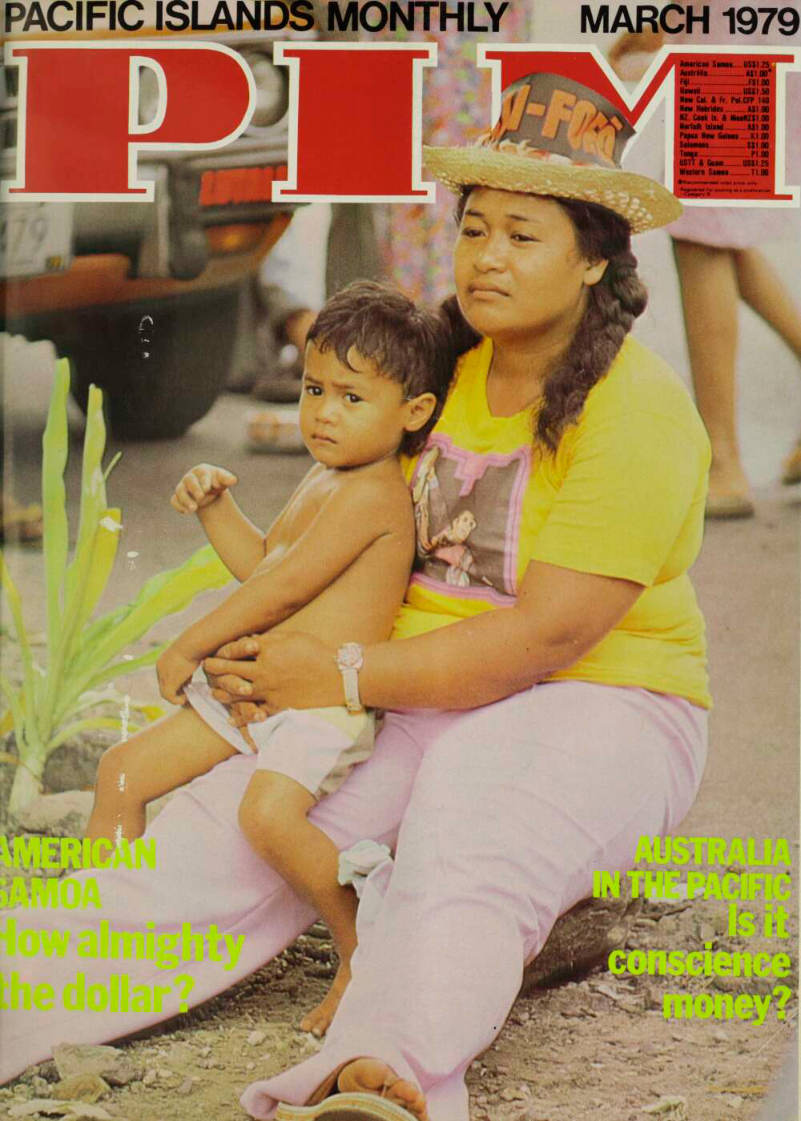
Cover: Bill Goodwin pho tographed this Samoan mother and child in Pago Pago last year.
Advertisements & other items, p. 2 (1 item)
Akai
World Command Performance
Yours to command ... the best of music from all round the world.
Discs, cassettes, or ultrahigh-quality open-reel tapes.
FM/AM stereo broadcasts, or the fun of making your own superb recordings.
AKAFs top-of-the-line audio products make them authentically yours, for enjoyment limited only by the horizons
of your taste.
«AI
AKAI
VKAI
SSI
D Ch ■ in • AA-1175 • SW-187 • GX-650D • AP-307 • GXC-570D-II Stereo receiver (75W/ch RMS, 80.) 3-Way speaker system Open reel tape deck Direct drive quartz lock turntable 3-Head 3-motor cassette del:
Audio & Video
AKAI
\KAI ELECTRIC CO., LTD.
lokyo, japan
P.N.G.
S.O. Svensson (N.G.) Ltd.
P.O. Box 705, Port Moresby Tel: 2275 Fiji Islands Motibhai & company Ltd.
P.O. Box 9175, Nadi International Airport Tel: 72-165 New Zealand Pye Ltd., Consumer Products Sector 110 Mt. Eden Rd., Mt. Eden, Auckland Tel: 686-437 New Caledonia Menard Pacifique s.a.r.l.
B.P. H 2, Noumea Tel: 275222 Tahiti Etablissements Comimpex P.O. Box 200, Papeete Tel: 20477 New Hebrides (Islands!
Burns Philp (New Hebrides) Co., Ltd.
P.O. Box 27, Port Vila, New Hebrides Islands Norfolk Island Burns Philp (Norfolk Island) Co., Ltd.
P.O. Box 21, Norfolk Island Samoa Islands Burns Philp (South Sea) Co., Ltd.
P.O. Box 129, Pago Pago, American Samoa Mariana Islands J.C. Tenorio Enterprises P.O. Box 137, Saipan Tel; 6444/8 Solomon Islands Security Electrical Co., Ltd.
P.O. Box 174, Honiara Tel: 881 Cook Islands JPS Enterprises Ltd.
P.O. Box 15, Rarotonga Tel: 2150, 2176 For more information, please send this coupon to our distributor in your country or to AKAI ELECTRIC CO., LJ 12-14, 2-Chome, Higashi-Kojiya, Ohta-ku, Tokyo, Japaiec Name Address
Pacific Islands Monthly
Pim
Vol. 50 No. 3
March 1979
(Usps 9524801
Elsewhere: SAI6 Payment by personal cheque is accepted in Australian, US, New Zealand, UK and Fiji currency. For other remit tances please obtain a bank draft in Australian dollars made payable to the ANZ Banking Group 88 Wentworth Avenue, Sydney, Australia.
Representatives
AUSTRALIA: Distribution; NSW & ACT; Allan Rodney Wright (Circulation) Pty Ltd, PO Box 907, Darlinghurst MSW 2010; Elsewhere: Gordon & Gotch (A/asia) Ltd Box 10, PO, Rosebery, NSW 2018 Advertising - Melbourne - Pacific Publications (Aust.) Pty Ltd, sth Floor Alley Building, 75-77 Flinders Lane, Melbourne 3000 tele )hone 63-0211, ext. 1565 Jeff Gates, ext, 1858 Ida Pad jett; Brisbane D. Wood, Anday Agency, Box 1918, 3PO. Brisbane 4001, telephone 44 3485, 44 1546' Adelaide - Hastwell Media, PO Box 30, 399 Glen )smond Rd, Glen Osmond, Adelaide 5064, telephone 9 1869, 79 5956; cables Hastmedia, Adelaide.
IJI: Distribution and subscriptions Desai Bookshops *0 Box 160, Suva, Fiji, telephone Suva 23036 Advertls ig - Fiji Times & Herald Ltd, 20 Gordon St Suva tele hone 312 111, telex FJ2124.
BENCH POLYNESIA: Distribution - Hachette 'acifique, 10 Ave Bruat, Papeete, telephone 2 5610.
IAWAJI. UNITED STATES: Distribution PIM, Hawaii 812 Kahawai St, Honolulu, Hawaii 96822, APAN: Advertising and subscriptions Universal L e i J !^o9 orporation ' CPO Box 46, Tokyo, telephone 56 3036.
EW CALEDONIA: Distribution Depot Centre de 7 5 2434 >en * eCOS *’ Noumea, telephone ? BALAND: Distribution - Gordon & Gotch, PO Box 34, 2 Carr Road, Mt. Roskill, Auckland 4 Advertising International Media Representatives Ltd, PO Box 2313 uckland, telephone 795 487; 493 389, cables Intereps' uckland. Subscriptions Pacific Publications GPO ox 2223. Auckland APUA NEW GUINEA: Distribution - Robert Brown & ssoc PO Box 3395, Port Moresby, telephone 2 5855. dvertislng PNG Post-Courier, PO Box 85 Port oresby, telephone 212577.
KITED KINGDOM: The Herald & Weekly Times Ltd 8-10 F ? t,er Lane ’ London EC4A IBU, telephone 831 6041, telex London 21989.
KITED STATES MAINLAND: Advertising Joshua B )wers Jr, Powers International Inc., 551 Fifth Ave New . 100017 ' tele P h °ne 867 9580. telex 6514 Subscriptions - PIM, Hawaii, 2812 Kahawai St molulu, Hawaii 96822.
Jblished monthly by Pacific Publications (Aust.) Pty Ltd id printed in Australia by Paramac, Alexandria, NSW jstralian cover price is recommended retail only Reais red at the GPO Sydney for transmission by post as a iblication category B. Second class postage paid at >n olulu. Hawaii. Copyright S 1978 Pacific Publications
(Aust.) Pty Ltd.
Postmaster Honolulu: Send address changes to PIM Hawaii, 2812 Kahawai St Honolulu, Hawaii 96822.
Aust.
Other American Samoa $13 $US16 Australia $12 Canada $14 $US18 Cook Islands $13 Fiji $12 $F12 French Polynesia $14
Cfp 1700
Guam $13 $US16 Gilbert Islands $13 Hawaii $13 $US16 Japan $16 Y4500 Micronesia $13 $US16 Nauru $13 New Caledonia $14
Cfp 1700
New Hebrides $13 New Zealand $12 $NZ13.50 Niue $13 Norfolk Island $12 Northern Marianas $13 $US16 Papua New Guinea $13 K12 Solomon Islands $13 Tonga $13 Tuvalu $13 United Kingdom $15 £10 US Mainland $14 $US18 Western Samoa $13
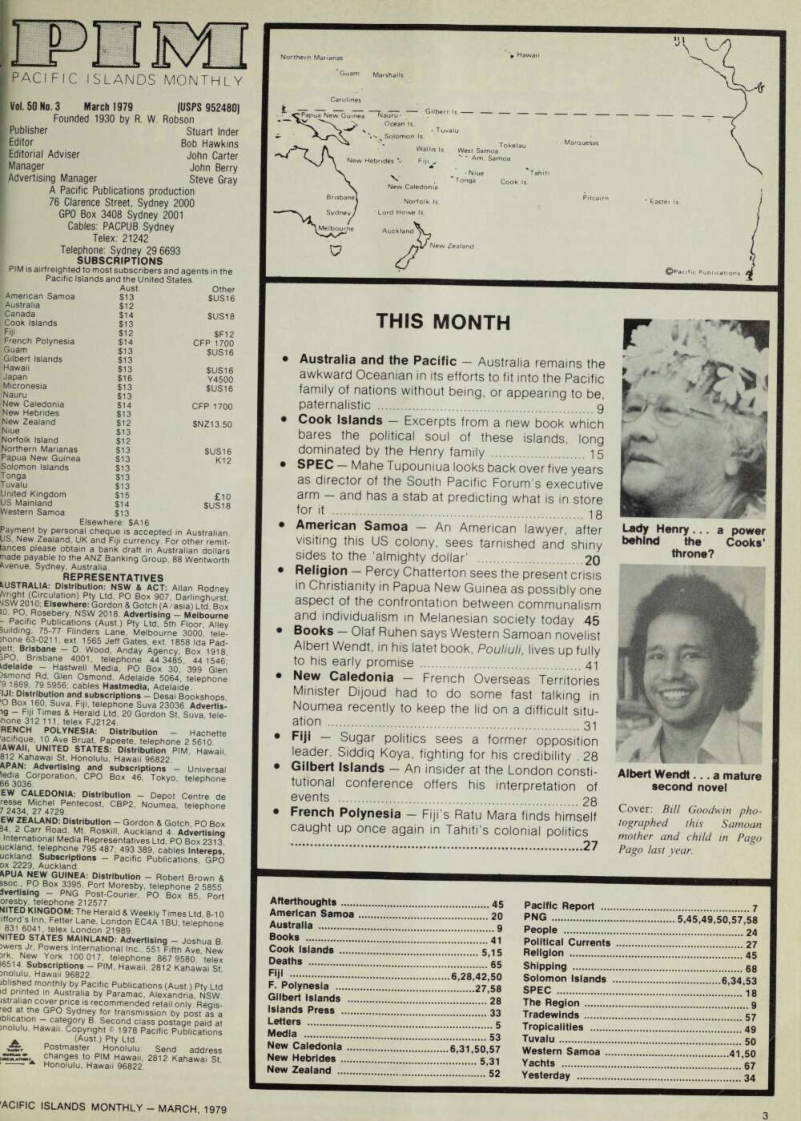
This Month
• Australia and the Pacific - Australia remains the awkward Oceanian in its efforts to fit into the Pacific family of nations without being, or appearing to be, paternalistic 9 • Cook Islands Excerpts from a new book which bares the political soul of these islands, long dominated by the Henry family 15 • SPEC - Mahe Tupouniua looks back over five years as director of the South Pacific Forum’s executive arm and has a stab at predicting what is in store for 18 • American Samoa An American lawyer, after visiting this US colony, sees tarnished and shiny sides to the ‘almighty dollar’ 20 • Religion - Percy Chatterton sees the present crisis in Christianity in Papua New Guinea as possibly one aspect of the confrontation between communalism and individualism in Melanesian society today 45 • Books - Olaf Ruhen says Western Samoan novelist Albert Wendt, in his latet book, Pouliuli, lives up fully to his early promise 41 • New Caledonia French Overseas Territories Minister Dijoud had to do some fast talking in Noumea recently to keep the lid on a difficult situ ation 31 • Fiji Sugar politics sees a former opposition leader, Siddiq Koya, fighting for his credibility . 28 • Gilbert Islands —An insider at the London consti tutional conference offers his interpretation of events 28 • French Polynesia - Fiji’s Ratu Mara finds himself caught up once again in Tahiti’s colonial politics 27
Afterthoughts 45
American Samoa 20 Australia " g Books ..". 41 Cook Islands 5 Deaths !".””!"!!...’... 65 F| j 6,28,42,50 F. Polynesia 2 7,58 Gilbert Islands 28 Islands Press Letters 5 Media gg New Caledonia 6,31,50,57 New Hebrides g 31 New Zealand ’52
Pacific Report
Png 5,45,49,50^57,58
People 24 Political Currents 27 Religion 45 Shipping Solomon Islands 6 34 53 spec 8 The Region Tradewinds Tropicalitles Tuvalu Western Samoa 41,50 Yachts 67 Yesterday
Lady Henry... a power behind the Cooks’ throne?
Albert Wendt... a mature second novel
Advertisements & other items, pp. 3-4 (2 items)
[ Subscriptions
3
'ACIFIC ISLANDS MONTHLY - MARCH, 1979
Founded 1930 by R. W. Robson Publisher Stuart Inder f Editor Bob Hawkins i Editorial Adviser John Carter ; Manager John Berry [Advertising Manager Steve Gray A Pacific Publications production 76 Clarence Street, Sydney 2000 GPO Box 3408 Sydney 2001 Cables; PACPUB Sydney Telex: 21242 Telephone; Sydney 29 6693
[ SUBSCRIPTIONS
: PIM is airfreighted to most subscribers and agents in the Pacific Islands and the United States.
the DC Amp System
Sansui presents
Ordinarily you’d expect to pay far more for the purity of true DC reproduction. But the ACI-317 integrated amplifier and matching TCi-317 FM/AM tuner were expressly designed to reproduce the full musical spectrum with astounding clarity. The power amplifier section is pure DC not only for low THD (total harmonic distortion) but also for low TIM (trasient intermodulation distortion).
Frequency response is from DC (zero Hz) to 200,000 Hz. Output is a hefty and clean 50 RMS watts per channel. The beautiful tuner features ultra-low distortion and superior selectivity. Perfectly complementing these black beauty components are the SC-1110 Direct-O-Matic cassette deck, the SR-232 auto-return turntable, the new 3-way speaker system SP-X 4400 and the GX-5 EIA audio rack on casters. This outstanding sonic picture is called the Sansui rms 317.
SANSUI rms 317 Or 1 >
Sansui.
Only hi-fi, everything hi-fi
SANSUI ELECTRIC CO., LTD. 14-1 Izumi 2-chome, Suginami-ku, Tokyo 168, Japan • Australia VANFI (Aust.) Pty. Ltd. 162, Albert Road, South Melbourne, Victoria 3205, Australia Phone: 699-5473/Suite 5, Uniline House, 5 Northcliff Street, Milsons Point, N.S.W. 2061, Australia Phone:929-0293 #F//7Prabhu Brothers Ltd. P.O. Box 183, Nadi Phone: 70183/4 • Papua New Guinea Oceania Indent Agency (P.N.G.) Pty. Ltd. Box 5518, Boroko, Port Moresby Phone: PM 256406 • New Zealand David Reid Electronics Ltd. C.P.O. Box 2630, Auckland, 1 Phone: 492-189 • New Caledonia Ets Michel MERCIER B.P. 1123, Noumea Phone: 27. 59. 11 • South Pacific Miltons Department Stores Limited P.O. Box 146, Norfolk Island 2899 • Central Pacific Nauru Co-operative Society Republic of Nauru • New Hebrides The Sound Poniro d o a Dnrt \/Ma A icianH iinitpH icianH TfriHprs Ltd. P.O. Box 1& 2. Rarotonaa ® Tahiti DIMECO P.O. Box 2622
Letters
‘Thank-You,
Don O’Bryan’
’ In August 1977 I spent two weeks on the island of Raro tonga. One of the reasons for my visit was to meet Tom Neale, the ‘hermit of Suwar row’, with whom I had been corresponding for a number of years. At the time of our meet ing, a most memorable one for me, Tom was in hospital undergoing treatment for can cer to which he finally succum bed on November 30, 1977, aged 75.
In September of 1978 I revisited Rarotonga'and one of the first things I did was search out the grave of my friend Tom. It is in the Veterans’
Cemetery right across the road from the airport. I visited the grave several times and, though rather spartan in appearance, it was obvious that someone who cared was looking after things.
That someone is Don O’Bryan, long with the Cook Islands
Trading Corporation, who was
Tom’s staunchest friend. Over the years it was Don who handled all of Tom’s business affairs in Rarotonga and saw to it that supplies and mail were put on the yachts and trading schooners that were scheduled to call in at Suwarrow.
I have seen Tom’s letters to Don and it is quite obvious that Tom would have had an extremely difficult time with out Don’s devotion to the wel fare of his friend. Don’s allegiance did not end with Tom’s death. In accordance with Tom’s will, Don was appointed trustee of the estate and upon him fell the responsi bility of retrieving Tom’s per
sonal belongings from
suwarrow along with arrang
ing the details of Tom’s burial.
M that time, in a letter to me, 3on wrote: ‘Tom now lies in vhite sand as he would have vished, and close to the sea.’
The grave when I saw it was without a headstone but a few
days before my departure I learned that Tom’s two chil dren, Stella and Arthur, had arrived from New Zealand with a headstone for their father’s grave. It was my good fortune to meet these two young people on the eve of my departure. Don assured them that the headstone would be
properly set.
I wish to take this oppor tunity to pay tribute to Don for his many years of dedication to Tom, and I’m sure that I speak for Tom’s many friends around the world when I say ‘Thanks,
Don O’Bryan.’
Byron W. Hart
Boulder Colorado USA
Not Enough
Said
It is of interest to note and com pare the two front covers of PIM December 1978 (Colonial
Hangover) and January 1979
(Somare, the Great Survivor).
Need I say more?
Paul Garvan
Kieta, North Solomons Province, Papua New Guinea (We would appreciate it if you would say more. Editor)
Sick Sic
... Tsk, Tsk!
The item in PIM January con cerning John Champion is of such meanness and stupidity that it does not even deserve to be dwelt upon. However, since the writer has thrown into question the professional integrity of the director and editor-in-chief of Nabanga, neither of us is prepared to ignore it, or the malice sur
rounding it.
What’s it about? Announc ing the departure of Mr John
Champion, your magazine
refers to the farewell interview with the former British Resi dent Commissioner which we published in our issue of November 7, 1978 ( Nabanga No. 91). PIM starts by devoting a few lines to Mr Champion’s remarks and then rapidly leaves them - as if they were not the substance of the matter! to offer Nabanga’s editors a lesson in journalism as gratu itous as it was derisory.
We were guilty, we are told.
of an unfortunate lapse of taste because we retained an ex pression in bad French used by Mr Champion. To support his case, our brilliant teacher might at least have quoted the incriminating passage: PIM readers would then have been able to judge the matter for what it was. Some knowledge of French and a minimum of intelligence would have suf ficed to show that there was ab solutely no harmful intent on our part. On the contrary.
If we retained the expression circuler la cervelle, put it in quotation marks and ac companied it with a sic, it was not because the expression was incorrect but because the
image thus employed by John
Champion had a lively charac ter in French that we ourselves would not have been able to achieve. In doing what we did, we wished only to pay tribute to the manner in which John Champion uses French. If the writer of your item did not understand this he (or she) should go to school.
We wish to point out that the whole of the interview with J.
Champion was tape-recorded.
The ex-British resident com missioner spoke in French, a language he speaks very well but in which quite naturally he makes numerous mis takes, just as when J. M. Laf font or J. Massias speak
English they make errors.
Where is the man anyway who can express himself as well in a foreign language as in his own? We listened to the
recording and, doing our duty
as journalists, we went right
through it correcting the slight
mistakes Mr Champion had made, with the exception and for the reasons already stated of the one which aroused the ire of the PIM writer.
We hope that these few re marks will dispel any misun derstanding about the so-called impropriety of which we are said to have been guilty. They would suffice in themselves if the PIM writer had not seen fit to go on and draw the lesson of the story. According to him such a ‘lapse of taste’ is a per fect illustration of the men tality inherited from the condominial organisation of
the New Hebrides. From this it is only a short step to claiming that we sought to play a ‘lousy trick’ on Mr Champion.
This imputation of evil motive, expressed in scarcely veiled terms, is not only insult ing but degrading to a maga zine which has built for itself a reputation throughout the Pacific region for its serious ness of approach. Before giving lessons, one needs to take some oneself. One of the first taught in the field of journalism is the need to separate fact from comment. The PIM writer con cerned appears to have for gotten this. He draws conclu sions from an unimportant detail and barely mentions the rest.
The truth is that N abanga No. 91 devoted four (not three) of its 20 pages to the departure of Mr Champion, with one photograph covering two thirds of its front page, and seven other photographs in the body of the interview. Further, our artist spent many hours drawing a black and white portrait of Mr Champion, which was pubished on page 8.
This ‘honour’ had not pre viously been accorded to any one but Mr Dijoud [French minister for overseas depart ments and territories] himself.
The lines with which we introduced the interview ex pressed quite unequivocally the affection and admiration felt by us for John Champion.
Certain phrases could well have been quoted, such as: • he was able to cope with
(circumstances) as they arose
without passion, and maintain the notion of a correct balance, even if this attitude sometimes involved personal risks. Pos sessed of a cool and clear head, his gaze turned firmly towards the future, anxious to con tribute to the unity of the country in peace and moder ation, John Champion served the New Hebrides well.’
Compared with ours, your presentation of the facts thus appears as incomplete and biased. More serious: it could damage the image of our publi
cation through the charges
made against two of its editors.
We are convinced that PIM will be true to the mission of information which it has
always espoused by printing the full text of this letter in its next issue.
Please accept, Mr Editor, our brotherly, saddened, greet ings.
J. MASSIAS, director, J. M. LAFFONT, editor-in-chief.
Nabanga.
Vila, New Hebrides (Copy to Mr John Champion.)
Fulfilling its mission of infor
mation, PIM has happily shouldered the task of translat ing this long letter on a matter that ‘does not even deserve to be dwelt upon ’. For the rest, we are unrepentant, despite the
ingenuity of the explanation
offered by Messrs Massias and Laffont. PIM believes that if these gentlemen had been much concerned to bring out the
‘liveliness ’ of Mr Champion’s
expression (which translates into English roughly as ‘lt makes the brain circulate’, whereas he meant something much closer to the English ex pression ‘lt keeps the mind active’) they would have taken much more trouble to explain themselves than simply putting quotation marks around the words and adding the word sic.
They should well understand that in this wicked world this little Latin tag is most often used to convey an impression of ridi cule of the words just cited. As a final comment, we would like to express our great satisfaction at the friendly terms in which Mr Massias and his colleague
now speak of Mr Champion.
Things have certainly changed
over the past 15 months or so,
for example, since November
1977, a period described by Mr
Champion in the Nabanga
interview as ‘the least agreeable ’ of his time in the New Hebrides.
At that time, among his other activities, Mr Massias rushed
out a special edition of Nabanga
a week before its due publication date in order, among other things, to maximise Mr Cham
pion’s political discomfiture
arising from the behaviour of
some British police personnel
during a civil disturbance in Vila on November 29. (Mr Mas sias could no doubt tell us whether this particular exercise in over-enthusiastic Gallic twist ing of the British lion’s tail rep resented one of those bavures, or botches, in the recent French re
cord in the New Hebrides which were criticised by Mr Dijoud during his visit to Vila last August.) But perhaps we should let Mr Champion have the final word on this matter. He told Messrs Massias and Laffont: ‘But I don’t want to go into this subject of November 1977. It’s already old history and I won 7 go back to it . . .’
Loyalty
Figures
In your article on the Loyalty Islands (PIM January) there are a few errors which I wish to correct.
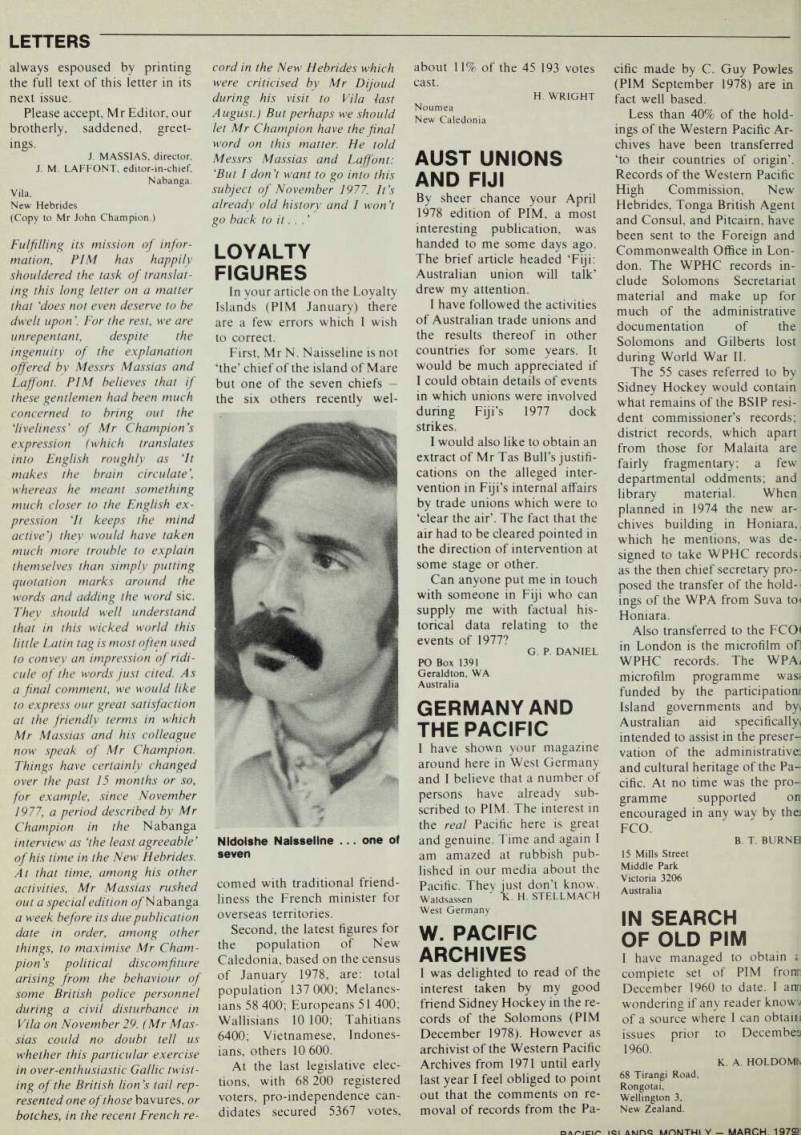
First, Mr N. Naisseline is not ‘the’ chief of the island of Mare but one of the seven chiefs the six others recently wel-
corned with traditional friend liness the French minister for overseas territories.
Second, the latest figures for the population of New Caledonia, based on the census of January 1978, are: total population 137 000; Melanes ians 58 400; Europeans 51 400; Wallisians 10 100; Tahitians 6400; Vietnamese, Indones ians, others 10 600.
At the last legislative elec tions, with 68 200 registered voters, pro-independence can didates secured 5367 votes,
about 11% of the 45 193 votes cast.
H. Wright
Noumea New Caledonia
Aust Unions
And Fiji
By sheer chance your April 1978 edition of PIM, a most
interesting publication, was
handed to me some days ago.
The brief article headed ‘Fiji: Australian union will talk’ drew my attention.
I have followed the activities of Australian trade unions and the results thereof in other countries for some years. It would be much appreciated if I could obtain details of events in which unions were involved
during Fiji’s 1977 dock
strikes.
I would also like to obtain an extract of Mr Tas Bull’s justifi cations on the alleged inter vention in Fiji’s internal affairs by trade unions which were to ‘clear the air’. The fact that the air had to be cleared pointed in the direction of intervention at some stage or other.
Can anyone put me in touch with someone in Fiji who can supply me with factual his torical data relating to the events of 1977?
G. P. Daniel
PO Box 1391 Geraldton, WA Australia
Germany And
The Pacific
I have shown your magazine around here in West Germany and I believe that a number of persons have already sub scribed to PIM. The interest in the real Pacific here is great and genuine. Time and again I am amazed at rubbish pub lished in our media about the Pacific. They just don’t know.
Waldsassen K H. STELLMACH West Germany
W. Pacific
Archives
I was delighted to read of the interest taken by my good friend Sidney Hockey in the re cords of the Solomons (PIM December 1978). However as archivist of the Western Pacific Archives from 1971 until early last year I feel obliged to point out that the comments on re moval of records from the Pa
cific made by C. Guy Powles (PIM September 1978) are in fact well based.
Less than 40% of the hold ings of the Western Pacific Ar chives have been transferred ‘to their countries of origin’.
Records of the Western Pacific High Commission, New Hebrides, Tonga British Agent and Consul, and Pitcairn, have been sent to the Foreign and Commonwealth Office in Lon don. The WPHC records in clude Solomons Secretariat material and make up for much of the administrative documentation of the Solomons and Gilberts lost during World War 11.
The 55 cases referred to by
Sidney Hockey would contain
what remains of the BSIP resi dent commissioner’s records; district records, which apart from those for Malaita are
fairly fragmentary; a few
departmental oddments; and library material. When planned in 1974 the new ar chives building in Honiara,, which he mentions, was de signed to take WPHC records; as the then chief secretary pro posed the transfer of the hold ings of the WPA from Suva to< Honiara.
Also transferred to the FCO< in London is the microfilm of] WPHC records. The WPAi microfilm programme was<
funded by the participation!
Island governments and by\ Australian aid specifically intended to assist in the preser vation of the and cultural heritage of the Pa cific. At no time was the pro gramme supported on encouraged in any way by the
Fco.
B. T. Burnh
15 Mills Street Middle Park Victoria 3206 Australia
In Search
Of Old Rim
I have managed to obtain * complete set of PIM from December 1960 to date. I am wondering if any reader knowv of a source where I can obtaiii issues prior to Decembea 1960.
K. A. Holdom
68 Tirangi Road, Rongotai, Wellington 3, New Zealand.
Nidoishe Naisseline ... one of seven
Advertisements & other items, pp. 5-6 (2 items)
'Acific Islands Monthly March 1979
Ici Amhq Mhmthi Y March. 197Ffi
Pacific Report
Heavy Gaol Terms In Papeete
I A Papeete, Tahiti, court in February sentenced two young mem- I bers °f the pro-independence Toto Topuna organisation to 20 E lm P nsonmen t' and three others to 18, 10 and five years I Well-known independence advocate Charlie Ching was acquit ted of charges of murder and bombing, but got 10 years for planning abortive attacks against military targets. The charoes \ arose fram iac,dents in 1977. The defendants strongly affirmed ; their political motivation, stating that they saw themselves as I soldiers in a war for independence and against nuclear pollution For the defence, eight senior lawyers from France vigorously attacked colonial-type justice', and claimed that the accused r were denied basic human and legal rights. They served notice grounds 7 W ° Ud appeal against the sentences on these
Whitlam Foresees Pacific Turmoil
The inevitable move to independence of the French possessions in the Pacific would create tension and even turmoil on Aus tralia’s doorstep, former Australian prime minister Gough Whitlam told a conference on sea power in Canberra in February. Mr Whitlam said the full implications of the declaration of 200-nautical mile fishing zones was only beginning to be understood. Practically the whole Pacific would soon be subject Jp control by countries in the region. Tonga, for example, would have a bigger sea domain than Japan a radical development in maritime politics. Mr Whitlam indicated that the role of the Australian navy in future would increasingly take on the charac ter of coastguard work. It was his view that its traditional role as part of a bigger allied force was gone forever.
Passive Resistance Move On Banaba
As PIM went to press the Banaban council of leaders were plan ning to fly from their Rabi Island, Fiji, to Nauru and then sail home to Banaba (Ocean Island) to demand that the British Phos phate Commission cease operations. This latest move to keep Banaba for the Banabans came at about the time the Gilbert glands independence bill was to be debated in the House of Commons. The bill would make Banaba part of the future Kiribati, the Gilberts’ chosen post-independence name. A Banaban spokesman said council members would be ac companied on their journey by Fiji Council of Trade Unions Usader Aptsai Tora and Fiji Government backbencher Fred Came, and would be met on the island by about 200 Banabans. . c °uncil planned to embark upon passive resistance sitting m tront of machinery and across roads - if the BPC did not stop work. Their move has been supported by Jai Ram Reddy, leader of the National Federation Party opposition in Fiji. The spokesman said that if the BPC tried to prevent pressmen land ing on Ocean Island the Banabans would invite them ashore as their own guests’ (PIM Political Currents).
‘Oil’ Rig For French N-Tests
After conducting 14 underground tests around the rim of French Polynesia s Mururoa atoll, France’s Centre d’Experimentations du Paafipue (CEP) will henceforth use the offshore techniques h . ' ho mpa + n ' eS dnll all further bomb P'ts from a platform ip IprpH P ntre ? f the lagoon - This was the main message -harne of thp P Pr 66 h° n reC6nt V ' Sit by General Dubost, in charge of the French nuclear test programme.
Soviet Envoy As Fence-Mender
-ence-mending seemed to be the order of the day during the Tird annual routine visit to Fiji made by the Soviet Union’s 9 am- SiY r Kpm Q Stra m A - V ' BaSOV - Reca,lin 9 Fiji Prime Minister ata S ' r Kamisese Maras remark (PIM August 1978) that he ? oub be Pretty scared’ to have a Soviet embassy in Suva Mr n aid n ,? b ? dy shou,d be scared’ of the Soviet Union The “.on had never threatened any other country or forced 1968 wLHnn ° th t? rS ' (What ha PP ened in Czechoslovakia in 968 was apparently something different.) But Mr Basov said
his country hoped to develop trade with Fiji in goods like agricul tural equipment, cars, radios, cameras and small power plants Fiji could find potential markets in the USSR for timber, sugar' copra and coconut oil. Mr Basov said that at no time during hSuva h3d raiSod thG matt6r ° f setting up a Soviet embassy
Png’S New Foreign Policy Moves
Papua NJew Guinea will establish overseas posts in Manila Philippines, and Flomara, Solomon Islands, this year. The moves will raise PNG’s number of overseas missions to 13. Meanwhile Foreign Minister Ebia Olewale has announced the appointment ot an Australian academic to conduct a six-month survey of PNG foreign policy, A key issue in the review, to be made by Dr Ted , Iters of Macquarie University, Sydney, is likely to be PNG’s relationships with China and the USSR
Fiji: Sugar Politics’ Victim
The eruption of Fiji’s sugar politics (PIM Political Currents) c aimed a top-level casualty with the resignation from cabinet of Minister for Communications and Works James Shankhar bmgh. Mr Singh, a cane farmer, was reported to have Teserva l? ns ??° u i the controversial new sugar farmers’ contract Warned by p n m e Minister Mara that he had to throw his weight behind the government campaign for it, or that ‘cabinet changes would be made affecting him’, he resigned,
Congratulations, Demos, For Hebrides
The new government of national unity of the New Hebrides (PIM February) has received goodwill messages from the govern ments of Britain, France, Australia and New Zealand. At the same time supporters of the ‘moderate’ parties have staged demonstrations in various places claiming that ‘too much power’ in the new government has gone to members of the Vanuaaku Party. In fact, the moderate parties and the VP each have five places in the government, with moderate Gerard Leymang as chief minister, having a casting vote. y
New Curbs On Fiji’S Press?
The Fiji Government is planning legislation for a press council Information Minister Ratu William Toganivalu said the govern ment was looking at relevant legislation from Singapore Sri Lanka and India. Ratu William said the Sri Lankan and Indian ordinances seemed to be ‘a bit on the rough side’ for Fiji but there was no harm in picking out what was wanted from them.
Mara On Politics And The Games
The future of the South Pacific Games could be affected if poli tics were brought into them, said Fiji’s Prime Minister, Ratu Sir Kamisese Mara. He was commenting on plans by an anti colonial and anti-nuclear group to stage demonstrations at the August-September games in Suva (PIM January). Asked if the government would stop such a demonstration Ratu Mara said it could only go by the law and either issue or not issue a permit for one. But if people spontaneously showed flags, as they had done elsewhere, there was not very much the government could do about it.
Micronesia’S Congress Meets
ASO-day session of the interim congress of the Federated States of Micronesia got under way on January 30 in Kolonia, Ponape.
I he meeting was held in newly renovated chambers at the for mer Ponape hospital.
Air Niugini Man Lashes Airport Decision
Upgrading of Port Moresby’s Jacksons Airport to accommodate Qantas Boeing 747 aircraft was ’disgraceful’, when Air Niugini could not get airfield improvements for domestic travellers according to Air Niugini’s general manager, Bryan Grey Mr Grey, who had announced his resignation from the airline’s top
job about a week before (PIM Tradewinds), said he agreed with government spokesmen that ‘what is good for Air Niugini is not necessarily good for PNG’, adding; ‘I would also like the plan ners and fund providers to realise that what is good for Qantas is likely to be a sight less good for Papua New Guinea.’
Women’S Resource Centre Closes Doors
Operation of the Pacific Women’s Resource Centre in Suva has been suspended until 1981, according to a decision of the sec ond Pacific women’s conference. Organiser Makereta Waqa vonovono said the suspension was due to the greater involvement of women in their own countries and the lack of secure and continuous funding for the activities of the centre.
Links would be maintained through the Peacesat satellite at the USP’s extension services and through quarterly newsletters.
More Lepers In Truk
A total of 89 active leprosy cases have been identified on several islands in the Truk Lagoon, Micronesia, after a survey held late last year. Sixty-nine had been previously registered, and 20 more were discovered during the survey.
New Sea Limits For Solomons
The Solomon Islands parliament has given the government power to declare new sea limits in addition to the 200-mile fishing zone introduced in January. The new powers will not be used immediately, but as it thinks fit the government may increase the territorial sea limit from three to 12 miles, as well as introduce a 200-mile economic zone.
Asian Police For Png?
Recruitment of police officers from Asian countries including Malaysia and Japan is under discussion in Papua New Guinea police circles. The idea is to train a crack squad of PNG police for top level security duties, including acting as security officers for top government officials and visiting dignitaries and providing security at airports.
Australian Aid For Png
Papua New Guinea would receive $A223 million in Australian aid in 1979-80 and $232 million in 1980-81, according to an announcement by Australian Minister for Foreign Affairs Andrew Peacock. Under arrangements which began on July 1, 1976, and which extend over five years, PNG receives a minimum of $lBO million in budgetary support aid from Australia each year.
Under the provision for annual supplements, the supplement will be $43 million in 1979-80 and $52 million in 1980-81.
Bulk Drug Buying By 15 Countries
A list of essential drugs for combined bulk purchasing has been adopted by 15 South Pacific countries at a meeting in Suva.
The meeting, sponsored by the World Health Organisation and the South Pacific Bureau for Economic Co-operation, brought together representatives of the 15 countries concerned American Samoa, Australia, Cook Islands, Fiji, Gilbert Islands, Guam, Nauru, New Hebrides, New Zealand, Papua New Guinea, Samoa, Solomon Islands, Tonga, Trust Territory of the Pacific Islands and Tuvalu.
Moonists’ Land In Tonga
The ‘Moonist’ religious cult, of Korean origin, has quietly implanted itself in Tonga, according to a report in the Tonga Chronicle. The newspaper says that so far' five Tongans, four teen-age boys and a young woman, have forsaken their homes to live permanently at the cult’s missionary centre at Peseti Latu’s housing complex at Pahu, Nukualofa.
Fiji’S First Loss In Lebanon
In Lebanon two Fiji soldiers were killed and four were wounded in a rocket and machine-gun attack by Arab guerillas on February 3. Dead are Corporal Vidya Sagar, 32, of Nasea, Labasa, and Private Alifereti Oaranivalu Leitubadei, 18, of Vunaqoro, Ruwailevu, Nadroga. Wounded were Private Lote Tuidravu, 30, of Wailevu, Labasa, Private Navitalai Nabobo, 20, of Suweni, Wairiki, Taveuni, Private Epeli Sivua, 32, of Nacula, Labasa, and Private Indar Sharma Deo, 25, of Labasa.
Norfolk Rejects Island Bill
Norfolk Island Council on February 7 unanimously rejected the
Norfolk Island Bill 1978 as unacceptable to the people of the island. The rejection comes in the wake of a build-up of sen timent spearheaded by the Society of Descendants of the Pit cairn Settlers. However, the council has invited Australian Minister for Home Affairs Bob Ellicott to resume negotiations for a bill which will give the islanders an acceptable degree of self government. The council also decided to seek Norfolk mem bership of the South Pacific Commission.
FIJI LOOKS BACK TO OLD VILLAGE SYSTEM Fiji is considering reintroduction of a traditional local govern ment system which was scrapped 30 years ago. Under the sys tem, Fijians run their local affairs as administrative units called tikinas, possibly led by an official known as the buli. Revival of the system, it is hoped, would check a decline in respect for law and order in the villages, coupled with unwillingness to fulfil communal duties.
Multi-Million ‘Political’ Fire In Png
Sympathisers of Irian Jaya freedom fighters have claimed responsibility for burning government offices in Port Moresby in January. The fire destroyed the finance department offices and caused damage estimated at several million dollars.
Arcadia For Breaker’S Yard
Well known in island ports throughout the South Pacific, the P&O cruise ship Arcadia was withdrawn from service in January, and prepared for the breaker’s yard in Taiwan. Arcadia will be replaced by the more modern Sea Princess, described by her owners as ‘ideally suited to cruising in South Pacific waters’.
Enjebi Folk May Go Back
Natives of Enjebi Island in Enewetak Atoll may be allowed to return to their nuclear-bombed homeland within the next few years. The director of the US Defence Nuclear Agency, Vice- Admiral Robert Monroe, said the SUSIOO million Enewetak clean-up had been so successful that the island, previously thought to be a nuclear desert, might be resettled.
Tuvalu Gets The Millions
An agreement has been signed in Suva between Britain and Tuvalu providing for $A4.65 million to be made available to Tuvalu by the British Government on grant terms. A special development fund providing for a further grant of about $A4.5 million was agreed at the constitutional conference in London last year, and a technical co-operation agreement is expected to be signed shortly. Forty-one projects have so far been agreed for Tuvalu including provision for a seaplane service between Funafuti and outer islands, completion of the electrification of Funafuti, and various construction, agricultural and marine projects.
Marshalls’ Fishing Future Bright
The Japan Marine Fishery Resources Centre has completed gathering data for research on the fish and fish bait resources of the Marshall Islands. Indications are that Marshalls waters had an average yield of 51 buckets of bait per day, which compares favourably with areas already engaged in large-scale commer cial fishing like Fiji, where the average was claimed to be 35-40 buckets per day, and Ponape 30 buckets per day.
Australian Pilots ‘Black’ Png Airline
The Australian Federation of Air Pilots has threatened to blacklist pilots joining or working for an internal Papua New Guinea air line, Douglas Airways. The threat follows the airline’s sacking in December of 17 striking pilots. The AFAP has threatened that pilots will be unable to get work with Australian airlines if they work for Douglas.
Bougainville Copper’S Profit Jump
Directors of Bougainville Copper have lifted final dividend from 50 to 12.60 a share following a sharp improvement in operating profit in the second half of 1978. Earnings before tax and exchange movements jumped from $A26.8 million in the first half to $35.7 million in the second half,
Diarrhoea Micronesia’S Top Killer
Diarrhoea! disease was the main cause of death in the US Trust Territory in 1977, health services officials said. Most deaths oc curred in the Marshalls and Truk districts.
Advertisements & other items, p. 7 (1 item)
’Acific Islands Monthly - March, 1979
The Awkward
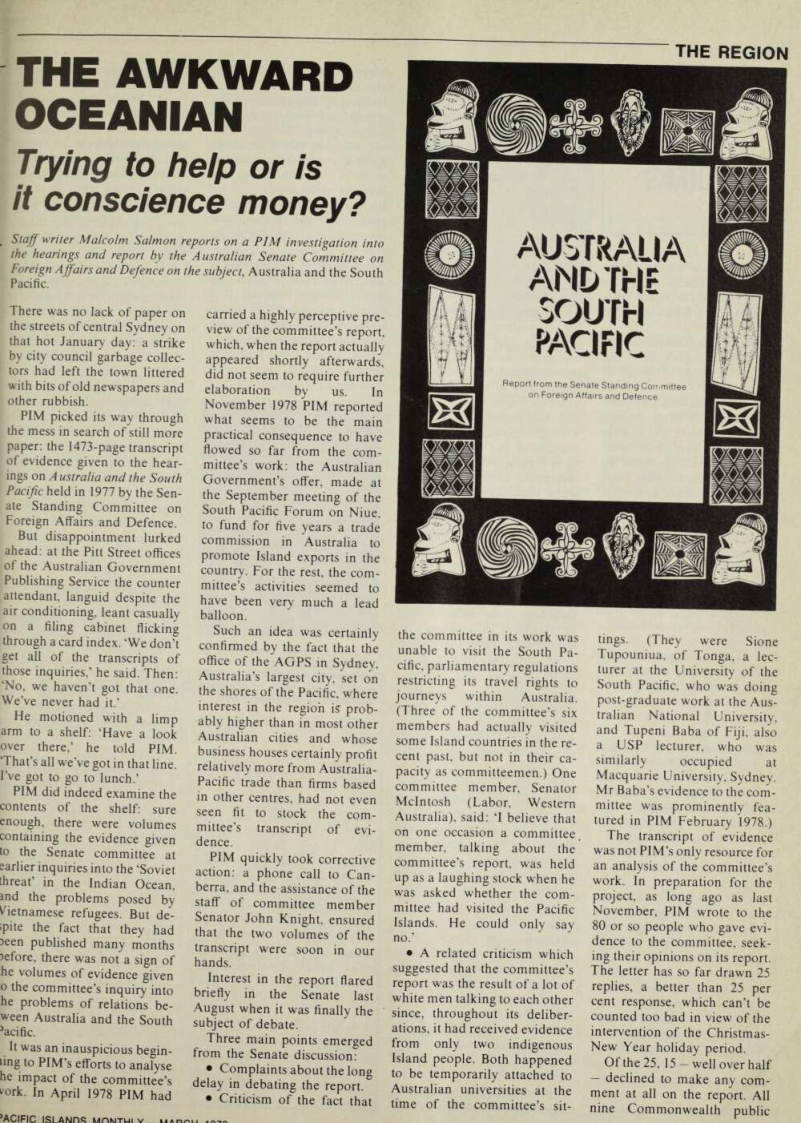
Oceanian
Trying to help or is it conscience money?
The Region
Staff writer Malcolm Salmon reports on a PIM investigation into the hearings and report by the Australian Senate Committee on Foreign Affairs and Defence on the subject, Australia and the South Pacific.
There was no lack of paper on the streets of central Sydney on that hot January day: a strike
by city council garbage collec
tors had left the town littered with bits of old newspapers and other rubbish.
PIM picked its way through the mess in search of still more
paper: the 1473-page transcript
of evidence given to the hear ings on A ustralia and the South Pacific held in 1977 by the Sen ate Standing Committee on Foreign Affairs and Defence.
But disappointment lurked ahead: at the Pitt Street offices of the Australian Government Publishing Service the counter
attendant, languid despite the
air conditioning, leant casually
on a filing cabinet flicking through a card index. ‘We don’t get all of the transcripts of those inquiries,’ he said. Then; ‘No, we haven’t got that one.
We’ve never had it.’
He motioned with a limp arm to a shelf: ‘Have a look over there,’ he told PIM. ‘That’s all we’ve got in that line.
Tve got to go to lunch.’
PIM did indeed examine the contents of the shelf: sure enough, there were volumes
containing the evidence given
to the Senate committee at earlier inquiries into the ‘Soviet threat in the Indian Ocean, md the problems posed by
Vietnamese refugees. But de
;pite the fact that they had seen published many months )efore, there was not a sign of he volumes of evidence given o the committee’s inquiry into he problems of relations be ween Australia and the South J acific.
It was an inauspicious begin ling to PlM’s efforts to analyse he impact of the committee’s ln April 1978 PIM had
carried a highly perceptive pre view of the committee’s report, which, when the report actually appeared shortly afterwards, did not seem to require further elaboration by us. In November 1978 PIM reported what seems to be the main practical consequence to have flowed so far from the com mittee’s work: the Australian Government’s offer, made at the September meeting of the South Pacific Forum on Niue, to fund for five years a trade commission in Australia to promote Island exports in the country. For the rest, the com mittee’s activities seemed to have been very much a lead balloon.
Such an idea was certainly confirmed by the fact that the office of the AGPS in Sydney, Australia’s largest city, set on the shores of the Pacific, where interest in the region is" prob ably higher than in most other Australian cities and whose business houses certainly profit relatively more from Australia- Pacific trade than firms based in other centres, had not even seen fit to stock the com mittee’s transcript of evi dence.
PIM quickly took corrective action: a phone call to Can berra, and the assistance of the staff of committee member Senator John Knight, ensured that the two volumes of the transcript were soon in our hands.
Interest in the report flared briefly in the Senate last August when it was finally the subject of debate.
Three main points emerged from the Senate discussion: • Complaints about the long delay in debating the report. • Criticism of the fact that
the committee in its work was unable to visit the South Pa cific, parliamentary regulations restricting its travel rights to journeys within Australia. (Three of the committee’s six members had actually visited some Island countries in the re cent past, but not in their ca pacity as committeemen.) One committee member. Senator Mclntosh (Labor, Western Australia), said; ‘I believe that on one occasion a committee, member, talking about the committee’s report, was held up as a laughing stock when he was asked whether the com mittee had visited the Pacific Islands. He could only say no.’ • A related criticism which suggested that the committee’s report was the result of a lot of white men talking to each other since, throughout its deliber ations, it had received evidence from only two indigenous Island people. Both happened to be temporarily attached to Australian universities at the time of the committee’s sit
tings. (They were Sione
Tupouniua, of Tonga, a lec turer at the University of the South Pacific, who was doing post-graduate work at the Aus tralian National University and Tupeni Baba of Fiji also a USP lecturer, who was
similarly occupied at
Macquarie University, Sydney,
Mr Baba’s evidence to the com mittee was prominently fea tured in PIM February 1978.) The transcript of evidence was not PlM’s only resource for an analysis of the committee’s work. In preparation for the project, as long ago as last November, PIM wrote to the 80 or so people who gave evi dence to the committee, seek ing their opinions on its report, The letter has so far drawn 25 replies, a better than 25 per cent response, which can’t be counted too bad in view of the intervention of the Christmas-
New Year holiday period.
Of the 25, 15 - well over half - declined to make any com ment at all on the report. All nine Commonwealth public
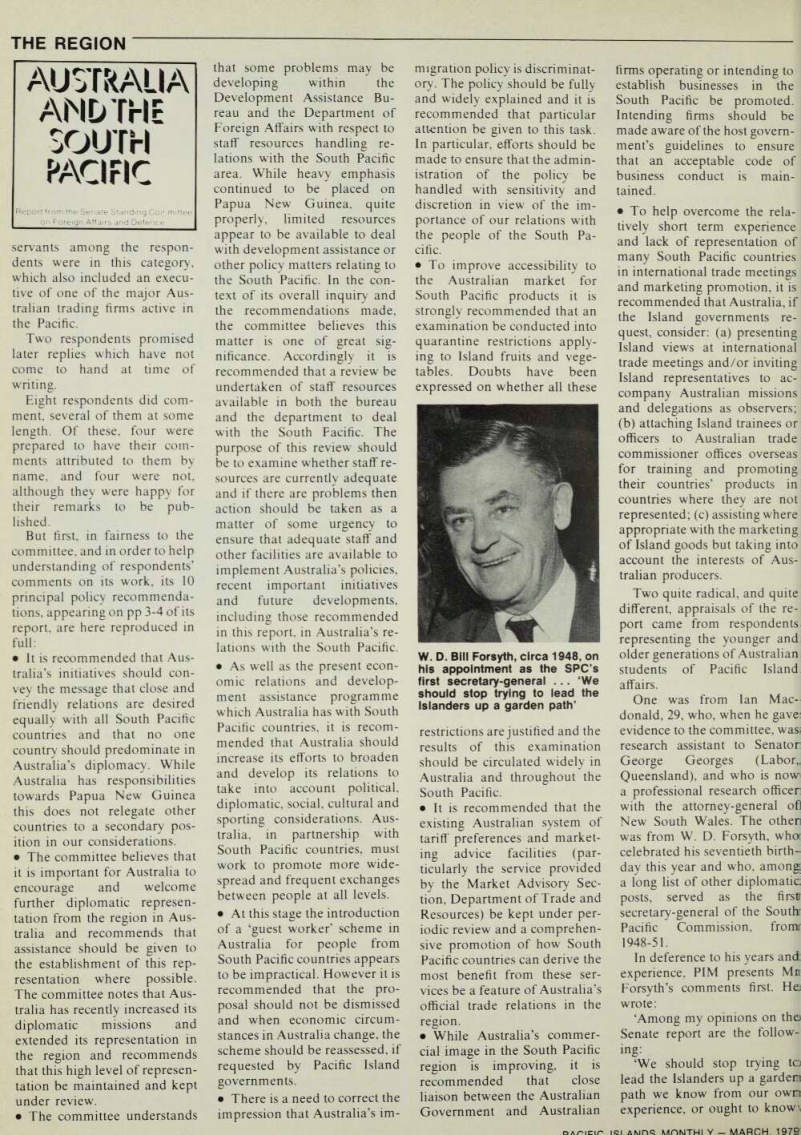
Australia
Andthe
South
Pacific
Report from the Seriate Standing Con.mittee on Foreign Affairs and Deface
servants among the respon dents were in this category, which also included an execu tive of one of the major Aus tralian trading firms active in the Pacific.
Two respondents promised
later replies which have not come to hand at time of
writing.
Eight respondents did com
ment, several of them at some length. Of these, four were prepared to have their com ments attributed to them by name, and four were not, although they were happy for their remarks to be pub lished.
But first, in fairness to the committee, and in order to help
understanding of respondents’
comments on its work, its 10
principal policy recommenda
tions, appearing on pp 3-4 of its report, are here reproduced in full: • It is recommended that Aus tralia’s initiatives should con vey the message that close and friendly relations are desired equally with all South Pacific countries and that no one country should predominate in Australia’s diplomacy. While Australia has responsibilities towards Papua New Guinea this does not relegate other countries to a secondary pos ition in our considerations. • The committee believes that it is important for Australia to encourage and welcome further diplomatic represen tation from the region in Aus tralia and recommends that assistance should be given to the establishment of this rep resentation where possible.
The committee notes that Aus tralia has recently increased its diplomatic missions and extended its representation in the region and recommends that this high level of represen tation be maintained and kept under review. • The committee understands
that some problems may be developing within the Development Assistance Bu reau and the Department of Foreign Affairs with respect to staff resources handling re lations with the South Pacific area. While heavy emphasis continued to be placed on
Papua New Guinea, quite
properly, limited resources appear to be available to deal with development assistance or other policy matters relating to the South Pacific. In the con text of its overall inquiry and the recommendations made, the committee believes this matter is one of great sig nificance. Accordingly it is recommended that a review be undertaken of staff resources available in both the bureau and the department to deal with the South Pacific. The purpose of this review should be to examine whether staff re sources are currently adequate and if there are problems then action should be taken as a matter of some urgency to ensure that adequate staff and other facilities are available to
implement Australia’s policies,
recent important initiatives and future developments, including those recommended in this report, in Australia’s re lations with the South Pacific. • As well as the present econ omic relations and develop ment assistance programme which Australia has with South Pacific countries, it is recom mended that Australia should increase its efforts to broaden and develop its relations to take into account political, diplomatic, social, cultural and sporting considerations. Aus tralia, in partnership with South Pacific countries, must work to promote more wide
spread and frequent exchanges
between people at all levels. • At this stage the introduction of a ‘guest worker’ scheme in Australia for people from South Pacific countries appears to be impractical. However it is recommended that the pro posal should not be dismissed and when economic circum stances in Australia change, the scheme should be reassessed, if
requested by Pacific Island
governments. • There is a need to correct the impression that Australia’s im
migration policy is discriminat ory. The policy should be fully and widely explained and it is recommended that particular attention be given to this task.
In particular, efforts should be made to ensure that the admin istration of the policy be handled with sensitivity and discretion in view of the im portance of our relations with the people of the South Pa cific. • To improve accessibility to the Australian market for South Pacific products it is strongly recommended that an examination be conducted into quarantine restrictions apply ing to Island fruits and vege tables. Doubts have been expressed on whether all these
restrictions are justified and the results of this examination should be circulated widely in Australia and throughout the South Pacific. • It is recommended that the existing Australian system of tariff preferences and market ing advice facilities (par
ticularly the service provided
by the Market Advisory Sec tion, Department of Trade and Resources) be kept under per iodic review and a comprehen sive promotion of how South Pacific countries can derive the most benefit from these ser vices be a feature of Australia’s official trade relations in the
region.
• While Australia’s commer cial image in the South Pacific region is improving, it is recommended that close liaison between the Australian Government and Australian
firms operating or intending to establish businesses in the South Pacific be promoted.
Intending firms should be made aware of the host govern ment’s guidelines to ensure that an acceptable code of business conduct is main tained. • To help overcome the rela
tively short term experience
and lack of representation of many South Pacific countries in international trade meetings and marketing promotion, it is recommended that Australia, if the Island governments re quest, consider: (a) presenting Island views at international
trade meetings and/or inviting
Island representatives to ac company Australian missions and delegations as observers; (b) attaching Island trainees or officers to Australian trade commissioner offices overseas
for training and promoting
their countries’ products in countries where they are not
represented; (c) assisting where
appropriate with the marketing
of Island goods but taking into account the interests of Aus
tralian producers.
Two quite radical, and quite different, appraisals of the re port came from respondents: representing the younger and older generations of Australian: students of Pacific Island affairs.
One was from lan Mac donald, 29, who, when he gave; evidence to the committee, was? research assistant to Senator George Georges (Labor,, Queensland), and who is now\ a professional research officer with the attorney-general ofl New South Wales. The other was from W. D. Forsyth, whoc celebrated his seventieth birth day this year and who, among a long list of other diplomatic posts, served as the firstt secretary-general of the Southr Pacific Commission, fromr 1948-51.
In deference to his years and experience, PIM presents Mn Forsyth’s comments first. He wrote: ‘Among my opinions on the Senate report are the follow
ing;
‘We should stop trying to lead the Islanders up a garden path we know from our own experience, or ought to know\
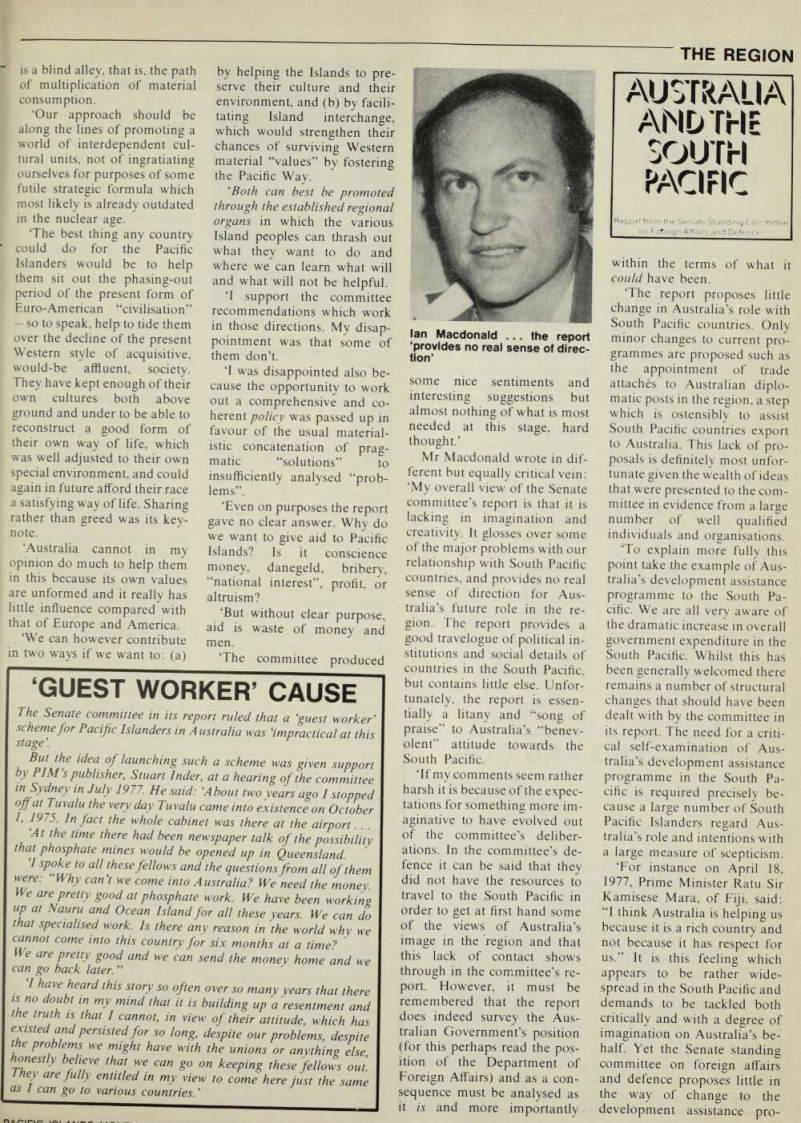
W. D. Bill Forsyth, circa 1948, on his appointment as the SPC’s
first secretary-general . . . ‘We
should stop trying to lead the Islanders up a garden path’
is a blind alley, that is, the path of multiplication of material
consumption.
‘Our approach should be along the lines of promoting a world of interdependent cul tural units, not of ingratiating ourselves for purposes of some futile strategic formula which most likely is already outdated in the nuclear age. ‘The best thing any country could do for the Pacific Islanders would be to help them sit out the phasing-out period of the present form of Euro-American “civilisation” - so to speak, help to tide them over the decline of the present Western style of acquisitive, would-be affluent, society.
They have kept enough of their
own cultures both above ground and under to be able to reconstruct a good form of their own way of life, which was well adjusted to their own special environment, and could again in future afford their race a satisfying way of life. Sharing rather than greed was its key note. ‘Australia cannot in my opinion do much to help them in this because its own values are unformed and it really has little influence compared with that of Europe and America. ‘We can however contribute in two ways if we want to; (a)
by helping the Islands to pre serve their culture and their environment, and (b) by facili tating Island interchange, which would strengthen their chances of surviving Western
material “values” by fostering
the Pacific Way. ‘ Both can best be promoted
through the established regional
organs in which the various Island peoples can thrash out what they want to do and where we can learn what will and what will not be helpful. ‘I support the committee recommendations which work in those directions. My disap pointment was that some of them don’t. ‘I was disappointed also be cause the opportunity to work out a comprehensive and co herent policy was passed up in favour of the usual material istic concatenation of prag matic “solutions” to
insufficiently analysed “prob
lems”. ‘Even on purposes the report gave no clear answer. Why do we want to give aid to Pacific Islands? Is it conscience
money, danegeld, bribery,
“national interest”, profit, or altruism? ‘But without clear purpose, aid is waste of money and men. ‘The committee produced
some nice sentiments and interesting suggestions but almost nothing of what is most needed at this stage, hard
thought.’
Mr Macdonald wrote in dif ferent but equally critical vein; ‘My overall view of the Senate committee’s report is that it is
lacking in imagination and
creativity. It glosses over some of the major problems with our relationship with South Pacific countries, and provides no real sense of direction for Aus tralia’s future role in the re gion. The report provides a good travelogue of political in stitutions and social details of countries in the South Pacific, but contains little else. Unfor tunately. the report is essen
tially a litany and “song of
praise” to Australia’s “benev olent” attitude towards the South Pacific. ‘lf my comments seem rather harsh it is because of the expec tations for something more im aginative to have evolved out of the committee’s deliber ations. In the committee’s de fence it can be said that they did not have the resources to travel to the South Pacific in order to get at first hand some of the views of Australia’s image in the region and that this lack of contact shows through in the committee’s re port. However, it must be remembered that the report does indeed survey the Aus tralian Government’s position (for this perhaps read the pos ition of the Department of Foreign Affairs) and as a con sequence must be analysed as it is and more importantly
Australia
And The
South
Pacific
Report from the Senate Standing Con mitlee on Foteiqn Attairs and Detnnc e
within the terms of what it could have been.
The report proposes little change in Australia’s role with South Pacific countries. Only minor changes to current pro grammes are proposed such as the appointment of trade attaches to Australian diplo matic posts in the region, a step which is ostensibly to assist South Pacific countries export to Australia. This lack of pro posals is definitely most unfor tunate given the wealth of ideas that were presented to the com mittee in evidence from a large number of well qualified individuals and organisations.
To explain more fully this point take the example of Aus tralia’s development assistance programme to the South Pa cific. We are all very aware of the dramatic increase in overall government expenditure in the South Pacific. Whilst this has been generally welcomed there remains a number of structural changes that should have been dealt with by the committee in its report. The need for a criti cal self-examination of Aus tralia’s development assistance programme in the South Pa cific is required precisely be cause a large number of South Pacific Islanders regard Aus tralia’s role and intentions with a large measure of scepticism. ‘For instance on April 18, 1977, Prime Minister Ratu Sir Kamisese Mara, of Fiji, said: “I think Australia is helping us because it is a rich country and not because it has respect for us.” It is this feeling which appears to be rather wide spread in the South Pacific and demands to be tackled both critically and with a degree of imagination on Australia’s be half. Yet the Senate standing committee on foreign affairs and defence proposes little in the way of change to the development assistance pro-
Ian Macdonald ... the report ‘provides no real sense of direc tion’
Australia
Amdthe
South
Pacific
Report from the Sennle Standing Committee on Foreign Affairs and Defence
gramme, and more particularly proposes no improvements in the assistance delivery system that would enable South Pacific Islanders themselves to more actively participate in the decision-making process. This is the core of the committee’s failure in relation to the South Pacific. No sense of partnership is proposed for the development assistance programme, Australia continues to pull the
strings.
‘lt is a report full of complacency on the issue of development assistance and indeed towards several other areas of Australia’s role in the South Pacific. ‘The neo-colonialist relationship of Australia to the South Pacific is ignored. There are no proposals contained in the report dealing with the
problems created by Australian
investment in the region. We cannot escape the fact that Australian investment in the New Hebrides, Fiji, Solomon Islands and Papua New Guinea is large and has major
effects on these countries, es pecially on local economic pro grammes, resources utilisation and on the lifestyles of the
indigenous peoples. Yet the
committee in its report chose to
ignore proposals designed to
regulate Australian business activity such as the implemen tation of a “code of ethics” for companies operating in the re
gion.
‘Further, the report does not point out that Australian companies such as W. R. Car penter, Burns Philp, Steam
ships Trading Company,
Qantas and the National Bank tend to dominate the economic lives of South Pacific Islands
through diversified subsidiary
holdings and takeovers of local companies. The net effect of this business activity in the South Pacific has led to what I described in my submission to the committee as a “block-out effect”. The spread of
Australian-owned companies
within the indigenous econom ies has tended to block out local initiative and industry formation. In the face of these problems the committee chose to ignore or avoid proposing changes which could limit Aus tralia’s economically dominant role in the economies of the South Pacific. South Pacific local ownership and control, with some overseas economic investment and assistance, should have been the direction aimed at by Australia. Yet the
report fails to point towards this concept decisively and
clearly.
‘These are my basic criti cisms of the report. I feel that the committee has treated the
topic with a large degree of
complacency and little crea tivity. The report will serve as a guide for higher school cer tificate students but will tell us nothing of how Australia’s re lations with the developing Pa cific Island countries will or should proceed. It proposes little change as we enter the 1980 s. Australia the paternalist is the spirit of the report, rather than, dare we suggest, Aus tralia as a full partner.’
Australia’s heavy economic clout in the South Pacific was also evoked by another respon dent, who wrote: i am not so sure that Australia realises the extent to which it has influence through businesses in the South Pacific. Nor am I sure that Australia is likely to give away much, for example, in the civil aviation sphere if for no other reason than that it must deal bilaterally with the emerg ent Island states and they themselves are overly sus picious of each other. ‘To do something for one
would possibly cause problems
with the others, at the same time weakening the Australian
airline’s position.
‘To do nothing much at all is the easy line. To concentrate on helping with communi cations will also facilitate the activities of Australian businesses as much as Island ones probably more so until
Australia makes it easier for Island imports into Australia in
competition with locally pro
duced items. ‘I think the committee was honest enough to admit that there is considerable self interest in the aid given, and that it is not exactly what the Islanders themselves want. But to get that want defined exactly is a very difficult process.’
Improvements in Australia’s economic performance, with
special emphasis on the
importance of the concept of partnership raised by Mr Mac donald, were the main concern of an executive of an Aus tralian manufacturing firm active in the Islands. He wrote: ‘Given the wide scope of the in vestigation, which embraced the major part of the South Pa cific region, I felt the com mittee’s report was a creditable one. My main concern is that the inquiry was, in fact, too am bitious, resulting in many of its
elements lacking depth.
‘The conclusions and recom mendations reached by the committee are heavily directed towards social issues and inter governmental relations, at the expense, I felt, of any real attempt to analyse the econ omic potential of the region and the help Australia might contribute towards commercial
development. The original
Senate resolution of Sep tember 23, 1976, referred to “the need for an increased Aus tralian commitment towards development in the South Pa cific’’. This commitment was examined by the committee more in terms of diplomatic re lations, aid, environment, edu cation, health, welfare, etc, than in terms of basic economic realities. ‘ln the evidence presented on behalf of my own company, I endeavoured to bring out the value of the partnership ap proach to commercial ventures in developing countries ... We
have applied this philos
ophy ... and have found it of immense value to have a sig nificant local equity which is active in the business. If, com bined with this, there is a
meaningful relationship be
tween dividends paid out and funds ploughed back into the business, then a basis exists for
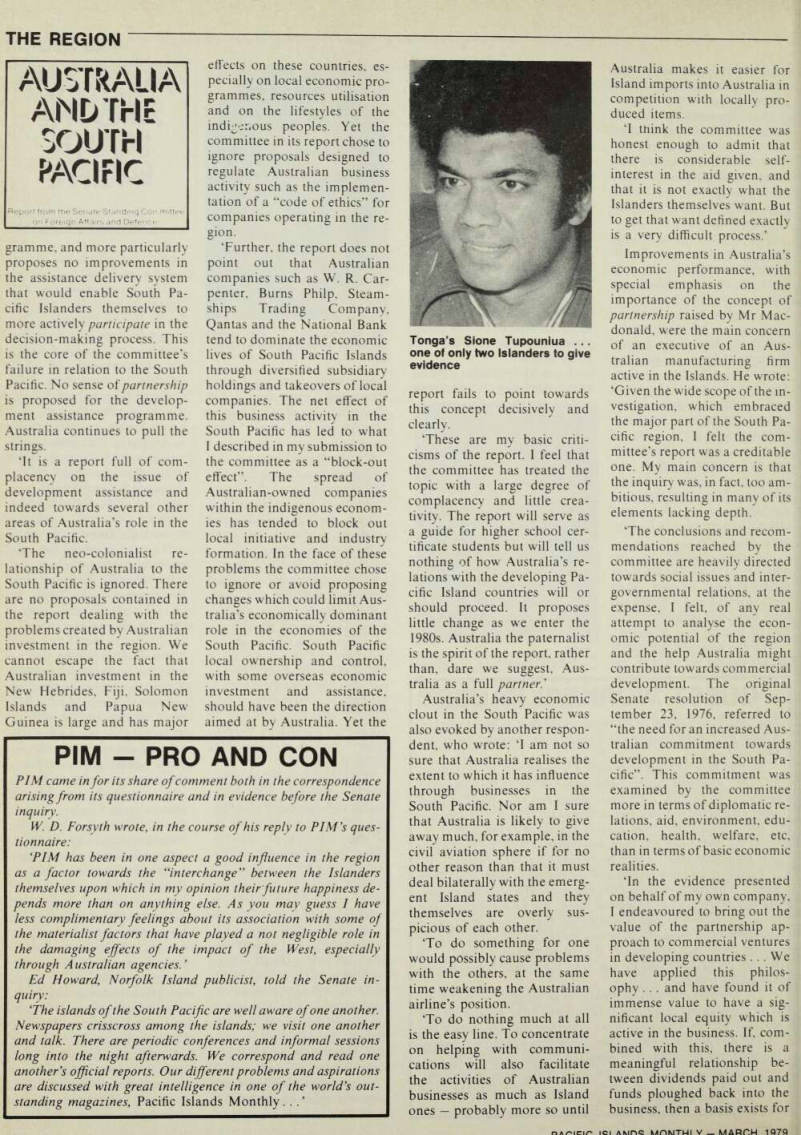
Tonga’s Slone Tupouniua ...
one of only two Islanders to give evidence
a constructive contribution by an outside corporation to local economic development. The committee might perhaps have addressed itself to some of these matters with a view to providing some support and impetus for the larger Aus tralian companies to look more
closely at regional economic
development.
‘As a general overview of the South Pacific, the report is ad equate and well prepared.
However, in terms of develop mental help by Australian industry, the report dealt only with the status quo and did not provide any useful leads for the future.’
Ed Howard, editor of the Norfolk Island News, wrote at length, voicing his ‘serious con cern and disapproval’ at the re port. He said: ‘My testimony, briefly, was that Australia’s re lations with South Pacific Islands are importantly af fected by Australia’s observ able attitudes toward its one remaining South Pacific Island territory, Norfolk Island. I sug gested that these observable attitudes spoke louder than words, and that Australia in its own interest ought to take a more enlightened, less col onial, stance toward Nor folk . . . ‘The committee’s report re
sponded to my testimony in a quite extraordinary way; Nofolk Island has simply been eliminated. It doesn’t exist, except for my name in the list of those who gave evidence, and the island’s location on the map inside the back cover.. .
Whatever the reason for the omission, it was made, as can be seen from the list of all South Pacific countries and ter ritories on page 7. After Niue comes Papua New Guinea.
Norfolk Island doesn’t exist...
The trouble is that Norfolk Island has not vanished ... ‘lf you wish to weigh the genuineness of the report’s brotherly sentiments toward the Islands and peoples of the South Pacific, you may like to ask the committee whether it proposes to apply the prin ciples it espouses in the case of the one South Pacific island where it can put them into practice if it in fact believes them. ‘What will Australia actually do, in the event? A parliamen tary bill has been introduced to bestow on Norfolk the right to administer its roads, drains and noxious weeds on Australia’s behalf, and to reaffirm Aus tralia’s colonial control over all meaningful governmental mat ters. This proposed new form of administration would draw
its authority not from the free will of those governed, but by Australian fiat. ‘Throughout the South Pa cific and elsewhere, thoughtful individuals who are concerned to know what Australia’s real policies toward the Islands are will be able to observe a re markable moment in history. A simple question can the peoples of the Islands safely rely on Australia’s word? is about to be answered, defi nitely, on Norfolk Island.’
Finally, two respondents took up with vigour problems raised in the August Senate de bate: the lack of opportunity for the committee as such to visit South Pacific countries, and the consequent lack of evi dence from Islanders.
An academic wrote: ‘One basic deficiency of the report. 1 feel, was that the committee was unable to talk directly with Pacific Islanders in any num ber and therefore the com mittee’s comments do seem to accept that there is relatively little criticism of Australia’s activities in the Pacific from within the Pacific. ‘lt seems to me that this is the public official view of many Pacific governments. But if one speaks to people off the record, when they feel that their com ments will not adversely affect their aid grants, etc, then one hears deeply-felt criticisms.
These do not necessarily sur face on the cocktail circuit, but anyone who spends any length of time in close contact with Pa-
Australia
And The
South
Pacific
Report from the Senate Standing Coi> mittee on Foreign AM,ms and Defence
cific Islanders soon uncovers many resentments against Aus tralia’s past and present role in
the region.’
A representative of a volun tary aid body active in the South Pacific made a similar point; ‘Perhaps if the com mittee had had the advantage of more input from the Islanders themselves it would have proved of greater value in our understanding of the pre sent situation of our relation ship with the area.
‘Although I ploughed
through the transcript recorded
in a Hansard publication, and found this to be most educational and enlightening, I did not consider that the report itself reflected to any great degree the concerns expressed in evidence by many of the witnesses at Australia’s attitude towards the South Pacific region. In fact, I found most of the criticism of business houses, government, and Australian tourists was not emphasised, and I would venture to say that our relation ship with the region will not be enhanced by the majority of
the findings.
in regard to my own evi dence, enough said. I was sur prised at much of the
aggressive questioning by some
of the Senators (not all), when one was only present in the hope of assisting. Also I found the general knowledge among the committee of the econom ies and cultures of the diverse peoples in the region to be of a very poor standard.
Mr P. C. Best, group general manager of Burns Philp & Co Ltd, while finding the Senate inquiry ‘timely’, lashed out at the failure by the Australian Government to take the slight est follow-up action on its find
ings. His seven-point reply
said: ‘l. It was timely for the Aus-
Burns Philp’s Philip Best... the Australian Government will lose much in goodwill
Australia
Amd The
South
Pacific
Report from the Senate Standing Con mittee on Foreign-Atfairs and Defence
tralian Government to assess ds position in respect of its relations with the countries of the Pacific region. We say “timely” because with the recent independence of Solomon Islands, Papua New Guinea, Ellice Islands (Tuvalu), and the
approaching independence of
the New Hebrides and the Gilbert Islands, the reference point for an exchange of views
has been progressively changed
from absentee governments to those of the people. In a short 10 years almost all of the islands of the South Pacific are now self-governed, with in-
dependent thought and pur-
pose. ‘2. Australia plays a dominant role in these areas because of its proximity, its economic dominance through Australian-owned commercial enterprises, and as a supplier of
the major portion of food and
allied products.
‘3. The report and most sub missions to the committee emphasised this fact but did not, in reality, confirm whether it was good or bad and whether Australia and the people of the region might expect the pos ition to remain the same. ‘4. We are disappointed that the committee did not see fit to make directives for the atten tion of the ministries of foreign affairs, trade, transport, indus trial relations and immigration to investigate those areas of criticism covering those minis tries. ‘5. We are disappointed that we, as one of the major Australian-based companies in the region, have not been in vited by the Australian Government to amplify some of the views expressed and suggestions made in our sub mission. ‘6. There is no evidence to suggest that the Australian Government, through its ministries, has made any effort to utilise the information con tained in the report, or to seek, by invitation, the views of the Island governments and people on the constructive aspects of the report.
‘7. Although the major shareholding of the Burns
Philp companies is domiciled
in Australia, we see our oper ations in the South Pacific working for the benefit of the economic development of those countries in which we trade and to align our businesses in the direction of the individual government’s wishes. The Australian Government, as distinct from
Australian companies, will lose much in goodwill and the ability to keep itself informed if it remains aloof from this ad ditional source of input.’
Mr Best adds; ‘We said in the beginning that the need for this committee was timely, but what happens next? Is any benefit to accrue from this effort by members of the Sen ate? We think not and more is
the pity.’
Advertisements & other items, pp. 9-10 (2 items)
Pacific Islands Mfimtui V Uad/Hi
□ Aoinr Ici Amfvq Mdmthi Y March. 1979'
THE REGION
‘Guest Worker’ Cause
The Senate committee in its report ruled that a ‘guest worker ’ scheme for Pacific Islanders in A ustralia was ‘impractical at this stage ’.
But the idea of launching such a scheme was given support by PI M’s publisher, Stuart Inder, at a hearing of the committee m Sydney in July 1977. He said: ‘ About two years ago I stopped ofi at Tuvalu the very day Tuvalu came into existence on October I, 1975. In fact the whole cabinet was there at the airport At the time there had been newspaper talk of the possibility that phosphate mines would be opened up in Queensland.
I s P° ke t 0 all these fellows and the questions from all of them were: “Why can’t we come into Australia? We need the money We are pretty good at phosphate work. We have been working up at Nauru and Ocean Island for all these years. We can do that specialised work. Is there any reason in the world why we cannot come into this country for six months at a time? ' We are pretty good and we can send the money home and we can go back later. ”
I have heard this story so often over so many years that there is no doubt in my mind that it is building up a resentment and the truth is that I cannot, in view of their attitude, which has existed and persisted for so long, despite our problems, despite the problems we might have with the unions or anythin e else honestly believe that we can go on keeping these fellows out.
They are fully entitled in my view to come here just the same as 1 can go to various countries. ’
Advertisements & other items, p. 11 (1 item)
The Region
Pim - Pro And Con
PIM came in for its share of comment both in the correspondence arising from its questionnaire and in evidence before the Senate inquiry.
W. D. Forsyth wrote, in the course of his reply to PI M’s ques tionnaire: ‘ PIM has been in one aspect a good influence in the region as a factor towards the “interchange” between the Islanders themselves upon which in my opinion their future happiness de pends more than on anything else. As you may guess I have less complimentary feelings about its association with some of the materialist factors that have played a not negligible role in the damaging effects of the impact of the West, especially through Australian agencies.’
Ed Howard, Norfolk Island publicist, told the Senate in quiry: ‘The islands of the South Pacific are well aware of one another.
Newspapers crisscross among the islands; we visit one another and talk. There are periodic conferences and informal sessions long into the night afterwards. We correspond and read one another’s official reports. Our different problems and aspirations are discussed with great intelligence in one of the world’s out standing magazines. Pacific Islands Monthly
Advertisements & other items, p. 12 (1 item)
□ Apinr Ici Amnq Momtmi V March 1979
A Maori Speaks
From an article by Maori Manuka Mita Puku, in Development News Digest December 1978: In many respects it would be a good thing from a Maori and Aborigine point view for the economies of Australia and New Zealand to collapse because it would be a wonderful test of the sincerity and commitment on the part of the European immigrants. Those who are committed will stay, those who are here for their own ends will go back to Europe just as the Europeans left India, China, the Belgian Congo, Angola and Mozambique. Just as the white Rhodesians are now leaving Zimbabwe. ‘This trend is apparent now in New Zealand. As our economy has become very shaky, we have the spectacle of more people leaving New Zealand than coming in. Where are they heading?
To the other white enclaves, Australia first, perhaps Canada, but many are returning ‘home’ to Europe. ‘ln the meantime the Maori will continue to wait patiently for the Pakeha to sort out his and her identity crisis, to seek reconciliation of their historical guilt complex and to transform their latent colonial attitudes, and finally to integrate with the indigenous peoples of our part of the world. ‘lt is important for all of us that the Pakeha solve their prob lems, because the Pakeha dreams of building new societies in Australia and New Zealand are becoming Maori and Aborigine
nightmares. ’
Advertisements & other items, p. 13 (1 item)
The Region
PACIFIC ISLANDS MflNim v M A DPU -i
A Fiji Christian View
From an interview by Mark Raper with Lorini Tevi, general sec retary of the Pacific Council of Churches, in Development News Digest December 1978: In the Pacific there seems to be an ambiguous attitude towards Australia and New Zealand. Perhaps a sense of fear and a desire to keep these larger countries out?
It is not a totalfear, but there is a realfear of the great damage they would do. We know now what Australia has done to the Pacific, for example in Fiji. A ustralia has the greater portion of profits and investments here; they are not really helping us to sustain ourselves to be self-supporting. If there is a power that dominates economic life, then we cannot play our role in part nership together. This moment in the Pacific is like our ado lescent period where we are trying to find our identity. It is better to get the parents out sometimes. Once we really gain our identity and solidarity, then we can realise our interdependencies. We want to come to a more mature and solid basis of exchange where we can discuss things openly and honestly without that feeling of inferiority that you are the father and that you have everything and that you are just giving it out to us. That is the
struggle. ’
Pim Says
The outcome of the Australian Senate inquiry into ‘Australia and the South Pacific’ was fairly predictable. In fact, so predict able, that, according to one Foreign Affairs officer, ‘by the time the report came ouf we had all its recommendations in hand anyway’. A smug, self-congratulatory statement, we think, though true in most respects. This kind of statement only helps to confirm the suspicion that Australia’s Department of Foreign Affairs has no more imagination than the Senators who came up with such a bland report.
Whether Australia likes it or not, and despite its exceptional financial generosity to the Islands in comparison with the offer ings of other ex-colonials, its stocks are not high in the South Pacific. If they had been, would Fiji have gone out of its way to humiliate Australia at last October’s South Pacific Conference in Noumea?
The Australian Government should accept this report for what it is a ‘first’. And. like every ‘first’, it has obvious flaws, many of which are pointed out in the accompanying article.
Equally obvious, such a serious subject will have to be tackled again sooner rather than later.
Some lessons for the next time round are already appar ent: • The absurd regulation which prevented the committee from doing any work on the spot in the Pacific Islands must not pre vail. • The number of Islander witnesses must be dramatically in creased. The excuse used by the committee at one point in its
report that Islanders written to did not reply to its letters is just
not good enough.
• The philosophy of the inquiry must be much more clearly thought out. That is, its political and moral terms of reference must be made much clearer than they were this time. (The com mittee’s original terms were The need for an increased Aus tralian commitment toward development in the South 'Pacific’.
But the Senate later backed off even this mildly affirmative for mulation and opted for the completely neutral ‘Australia and the South Pacific’.) Perhaps the central moral dilemma is spelt out by the com mittee itself when it says: There has been a considerable amount of criticism that Aus tralians in general have tended to be paternalistic in their deal ings with Islanders. The committee recognises these sentiments but throughout our hearings this inquiry has had stressed to it that Australians have now generally learnt to guard against appearing paternalistic and, more importantly, that their actions are in no way intended to be paternalistic. Only the sincerity of Australia’s present and future dealings in the region can allay these sentiments.’ (Our emphasis.) Some progress has probably been made by the Australians concerned in the first respect guarding against appearing paternalisitic. But anyone who believes that much progress has been made with the second is simply not looking straight at the problem tough, complex, historically developed problem that it is. Too much of Australia’s performance is paternalistic.
Only the glib and the irresponsible would pretend that this problem can be easily or quickly solved.
Cooks Broth
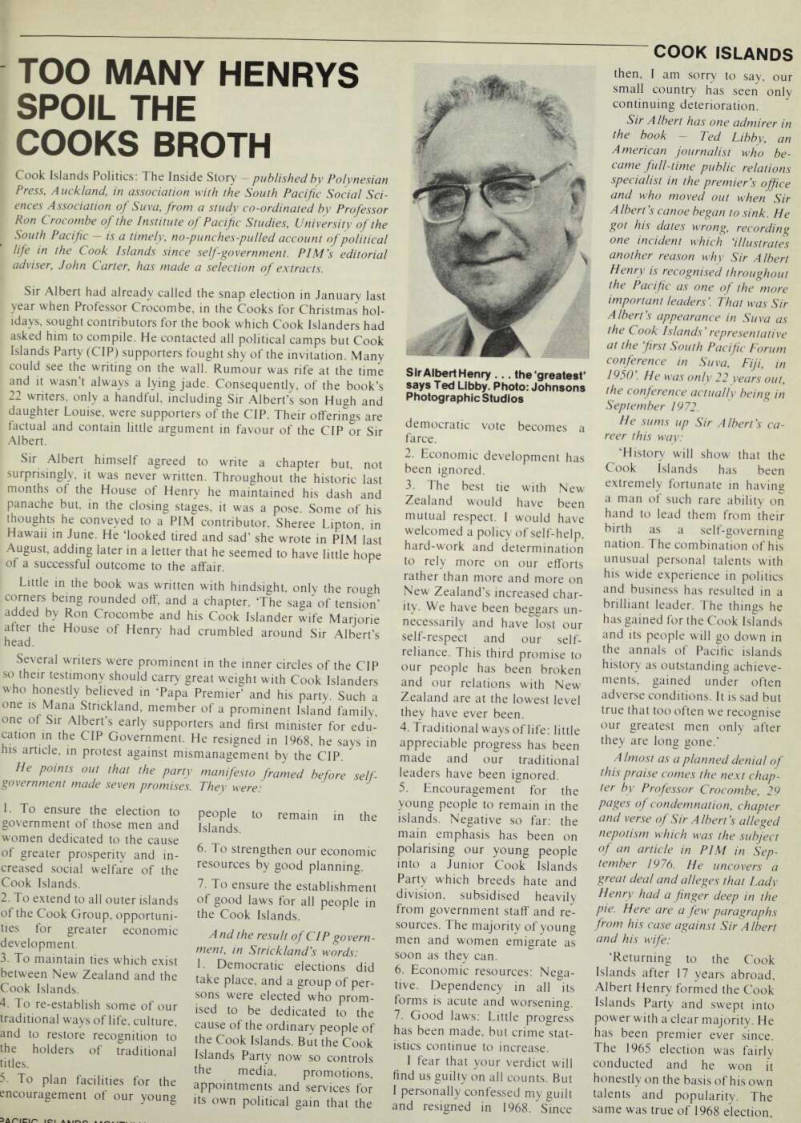
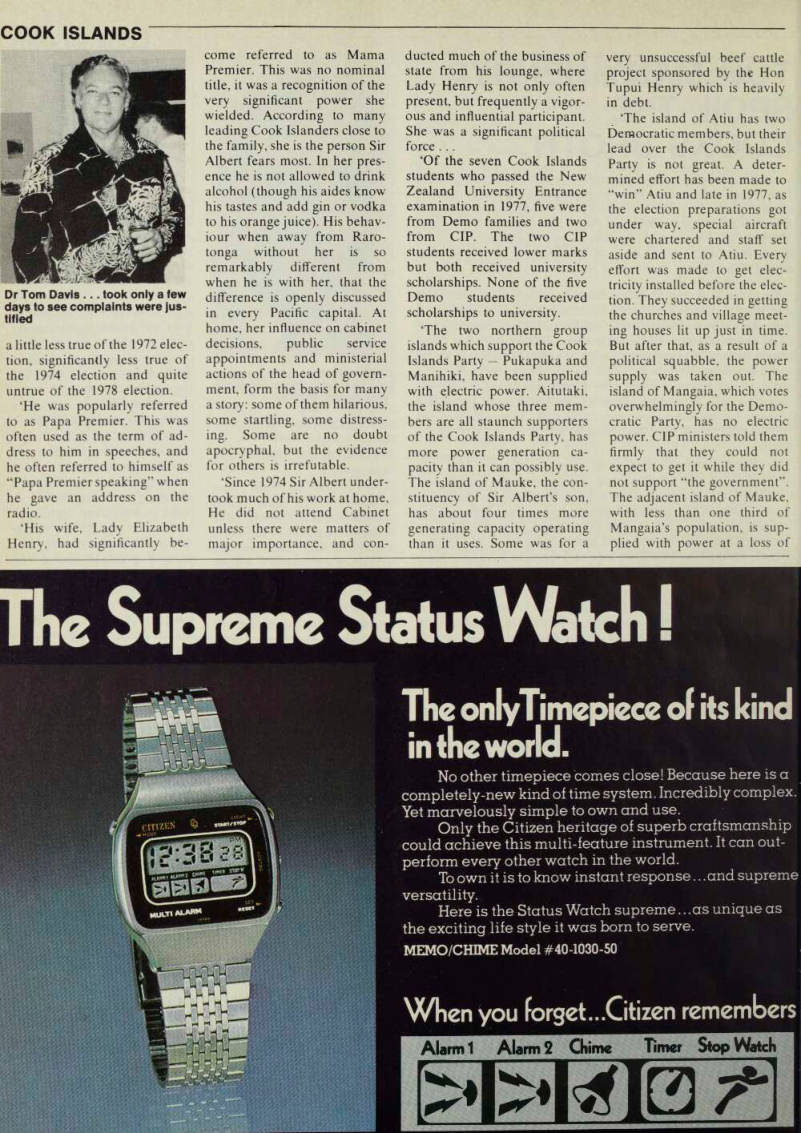
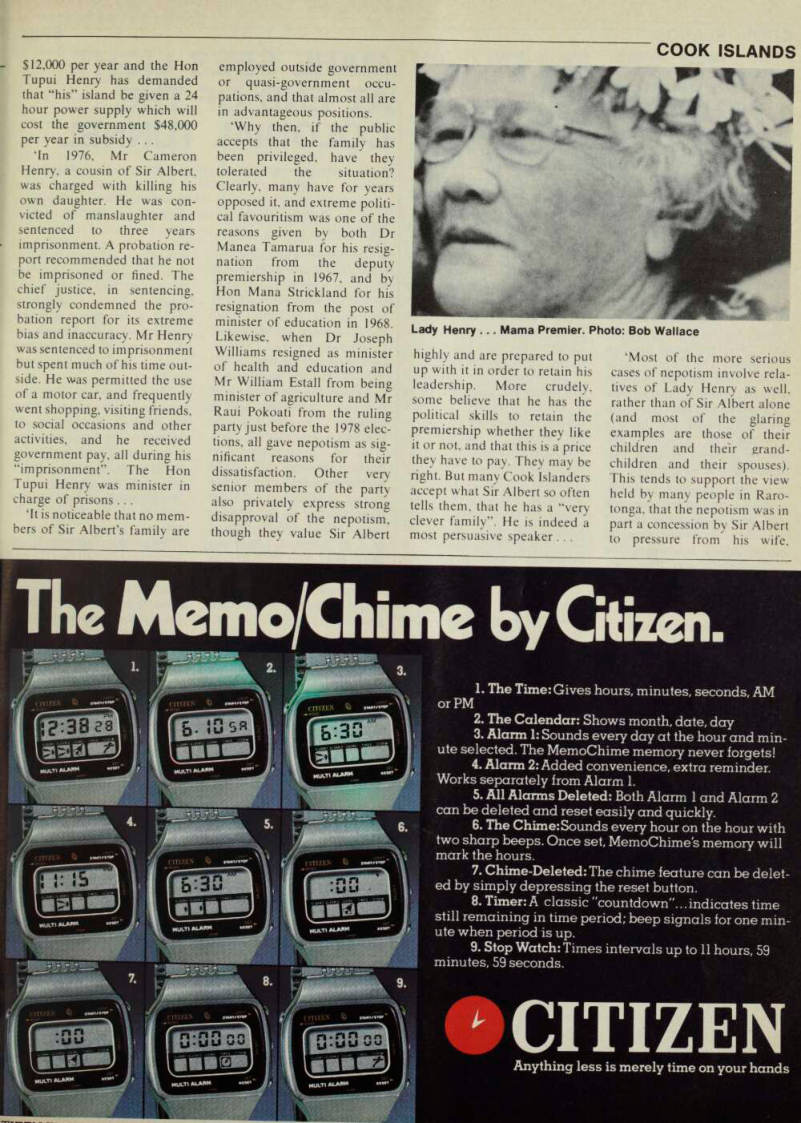
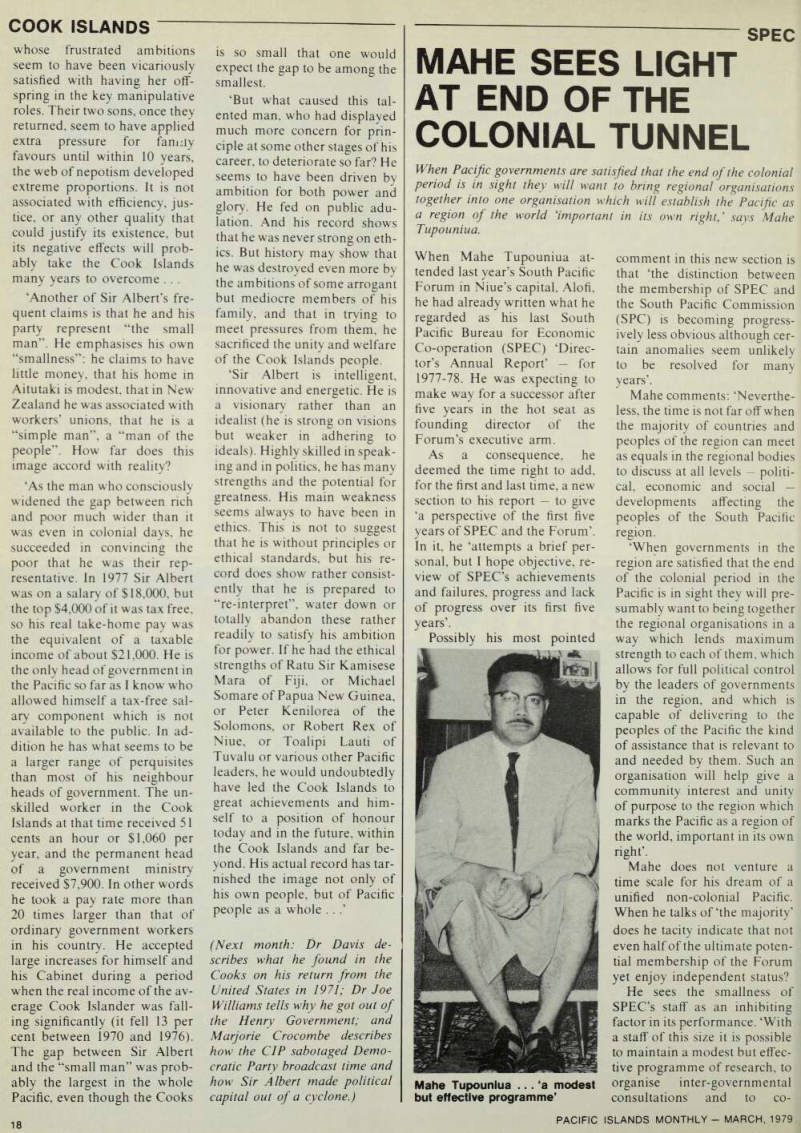
Cook Islands
Too Many Henrys
Spoil The
Cooks Broth
I Cook Islands Politics: The Inside Story - published by Polynesian Press, A uckland, in association with the South Pacific Social Sci ences Association of Suva, from a study co-ordinated by Professor Ron Crocombe of the Institute of Pacific Studies, University of the South Pacific - is a timely, no-punches-pulled account of political life in the Cook Islands since self-government. PI M's editorial adviser, John Carter, has made a selection of extracts.
Sir Albert had already called the snap election in January last year when Professor Crocombe, in the Cooks for Christmas hol idays, sought contributors for the book which Cook Islanders had asked him to compile. He contacted all political camps but Cook Islands Party (CIP) supporters fought shy of the invitation. Many could see the writing on the wall. Rumour was rife at the time and it wasn’t always a lying jade. Consequently, of the book’s 22 writers, only a handful, including Sir Albert’s son Hugh and daughter Louise, were supporters of the CIP. Their offerings are factual and contain little argument in favour of the CIP or Sir Albert.
Sir Albert himself agreed to write a chapter but, not surprisingly, it was never written. Throughout the historic last months of the House of Henry he maintained his dash and panache but, in the closing stages, it was a pose. Some of his thoughts he conveyed to a PIM contributor, Sheree Lipton, in Hawaii in June. He ‘looked tired and sad’ she wrote in PIM last August, adding later in a letter that he seemed to have little hope of a successful outcome to the affair.
Little in the book was written with hindsight, only the rough corners being rounded off, and a chapter. The saga of tension’ added by Ron Crocombe and his Cook Islander wife Marjorie after the House of Henry had crumbled around Sir Albert’s head.
Several writers were prominent in the inner circles of the CIP so their testimony should carry great weight with Cook Islanders who honestly believed in ‘Papa Premier’ and his party. Such a one is Mana Strickland, member of a prominent Island family, one of Sir Albert’s early supporters and first minister for edu cation m the CIP Government. He resigned in 1968, he says in his article, in protest against mismanagement by the CIP.
He points out that the party manifesto framed before self government made seven promises. They were:
1. To ensure the election to government of those men and women dedicated to the cause of greater prosperity and in creased social welfare of the Cook Islands. 2. To extend to all outer islands of the Cook Group, opportuni ties for greater economic
development.
3. To maintain ties which exist between New Zealand and the Cook Islands. 4. To re-establish some of our traditional ways of life, culture, and to restore recognition to the holders of traditional titles. 5. To plan facilities for the encouragement of our young
people to remain in the Islands. 6. To strengthen our economic
resources by good planning.
7. To ensure the establishment of good laws for all people in the Cook Islands.
A nd the result of CIP govern ment, in Strickland’s words: 1. Democratic elections did take place, and a group of per sons were elected who prom ised to be dedicated to the cause of the ordinary people of the Cook Islands. But the Cook Islands Party now so controls the media, promotions, appointments and services for its own political gain that the
democratic vote becomes a farce. 2. Economic development has been ignored. 3. The best tie with New Zealand would have been mutual respect. I would have welcomed a policy of self-help, hard-work and determination to rely more on our efforts rather than more and more on New Zealand’s increased char ity. We have been beggars un necessarily and have lost our self-respect and our self reliance. This third promise to our people has been broken and our relations with New Zealand are at the lowest level they have ever been. 4. Traditional ways of life; little appreciable progress has been made and our traditional leaders have been ignored. 5. Encouragement for the young people to remain in the islands. Negative so far: the main emphasis has been on polarising our young people into a Junior Cook Islands Party which breeds hate and division, subsidised heavily from government staff and re sources. The majority of young men and women emigrate as soon as they can. 6. Economic resources: Nega tive. Dependency in all its forms is acute and worsening. 7. Good laws: Little progress has been made, but crime stat istics continue to increase.
I fear that your verdict will find us guilty on all counts. But I personally confessed my guilt and resigned in 1968. Since
then, I am sorry to say, our small country has seen only
continuing deterioration.
Sir Albert has one admirer in the book - Ted Libby, an American journalist who be came full-time public relations specialist in the premier's office and who moved out when Sir A Ibert’s canoe began to sink. He got his dates wrong, recording one incident which ‘illustrates another reason why Sir Albert
Henry is recognised throughout
the Pacific as one of the more important leaders'. That was Sir Albert's appearance in Suva as the Cook Islands' representative at the first South Pacific Forum conference in Suva, Fiji, in 1950. He was only 22 years out, the conference actually being in
September 1972.
He sums up Sir Albert's ca reer this way: ‘History will show that the Cook Islands has been
extremely fortunate in having
a man of such rare ability on hand to lead them from their birth as a self-governing nation. The combination of his unusual personal talents with his wide experience in politics and business has resulted in a brilliant leader. The things he has gained for the Cook Islands and its people will go down in the annals of Pacific islands
history as outstanding achieve
ments, gained under often adverse conditions. It is sad but true that too often we recognise our greatest men only after
they are long gone.’
A Imost as a planned denial of this praise comes the next chap ter by Professor Crocombe, 29
pages of condemnation, chapter
and verse of Sir A Ibert's alleged nepotism which was the subject of an article in PIM in Sep tember 1976. He uncovers a great deal and alleges that Lady Henry had a finger deep in the pie. Here are a few paragraphs from his case against Sir A Ibert and his wife: ‘Returning to the Cook Islands after 17 years abroad, Albert Henry formed the Cook Islands Party and swept into power with a clear majority. He has been premier ever since.
The 1965 election was fairly conducted and he won it honestly on the basis of his own talents and popularity. The same was true of 1968 election.
Sir Albert Henry ... the‘greatest’ says Ted Libby. Photo: Johnsons Photographic Studios
a little less true of the 1972 elec tion, significantly less true of the 1974 election and quite untrue of the 1978 election. ‘He was popularly referred to as Papa Premier. This was often used as the term of ad dress to him in speeches, and he often referred to himself as
“Papa Premier speaking” when
he gave an address on the radio. ‘His wife. Lady Elizabeth
Henry, had significantly be
come referred to as Mama Premier. This was no nominal title, it was a recognition of the very significant power she wielded. According to many leading Cook Islanders close to the family, she is the person Sir Albert fears most. In her pres ence he is not allowed to drink alcohol (though his aides know his tastes and add gin or vodka to his orange juice). His behav iour when away from Raro tonga without her is so remarkably different from when he is with her, that the difference is openly discussed in every Pacific capital. At home, her influence on cabinet decisions, public service appointments and ministerial actions of the head of govern ment, form the basis for many a story: some of them hilarious, some startling, some distress ing. Some are no doubt apocryphal, but the evidence for others is irrefutable. ‘Since 1974 Sir Albert under took much of his work at home.
He did not attend Cabinet unless there were matters of
major importance, and con
ducted much of the business of state from his lounge, where
Lady Henry is not only often
present, but frequently a vigor ous and influential participant.
She was a significant political force ... ‘Of the seven Cook Islands students who passed the New Zealand University Entrance examination in 1977, five were from Demo families and two from CIP. The two CIP students received lower marks but both received university scholarships. None of the five Demo students received
scholarships to university.
‘The two northern group islands which support the Cook
Islands Party Pukapuka and
Manihiki, have been supplied with electric power. Aitutaki, the island whose three mem bers are all staunch supporters of the Cook Islands Party, has more power generation ca pacity than it can possibly use.
The island of Mauke, the con stituency of Sir Albert’s son, has about four times more
generating capacity operating
than it uses. Some was for a
very unsuccessful beef cattle
project sponsored by the Hon
Tupui Henry which is heavily
in debt.
The island of Atiu has two Democratic members, but their lead over the Cook Islands Party is not great. A deter mined effort has been made to “win” Atiu and late in 1977, as the election preparations got under way, special aircraft were chartered and staff set aside and sent to Atiu. Every effort was made to get elec tricity installed before the elec tion. They succeeded in getting the churches and village meet ing houses lit up just in time.
But after that, as a result of a
political squabble, the power
supply was taken out. The island of Mangaia, which votes overwhelmingly for the Demo cratic Party, has no electric power. CIP ministers told them firmly that they could not expect to get it while they did not support “the government”.
The adjacent island of Mauke, with less than one third of
Mangaia’s population, is sup
plied with power at a loss of
Dr Tom Davis ... took only a few
days to see complaints were jus
tified
$12,000 per year and the Hon
Tupui Henry has demanded
that “his” island be given a 24 hour power supply which will cost the government $48,000 per year in subsidy ... in 1976, Mr Cameron Henry, a cousin of Sir Albert, was charged with killing his own daughter. He was convicted of manslaughter and sentenced to three years imprisonment. A probation report recommended that he not be imprisoned or fined. The
chief justice, in sentencing,
strongly condemned the probation report for its extreme bias and inaccuracy. Mr Henry was sentenced to imprisonment but spent much of his time outside. He was permitted the use of a motor car, and frequently
went shopping, visiting friends,
to social occasions and other activities, and he received government pay, all during his “imprisonment”. The Hon Tupui Henry was minister in
charge of prisons ...
It is noticeable that no members of Sir Albert’s family are
employed outside government or quasi-government occu pations, and that almost all are in advantageous positions, ‘Why then, if the public accepts that the family has been privileged, have they tolerated the situation?
Clearly, many have for years opposed it, and extreme politi cal favouritism was one of the reasons given by both Dr Manea Tamarua for his resig nation from the deputy premiership in 1967, and by Hon Mana Strickland for his resignation from the post of minister of education in 1968.
Likewise, when Dr Joseph Williams resigned as minister of health and education and Mr William Estall from being minister of agriculture and Mr Raui Pokoati from the ruling party just before the 1978 elec tions, all gave nepotism as sig nificant reasons for their dissatisfaction. Other very senior members of the party also privately express strong disapproval of the nepotism, though they value Sir Albert
highly and are prepared to put up with it in order to retain his
leadership. More crudely,
some believe that he has the political skills to retain the premiership whether they like it or not, and that this is a price they have to pay. They may be right. But many Cook Islanders accept what Sir Albert so often tells them, that he has a “very clever family”. He is indeed a most persuasive speaker ...
‘Most of the more serious cases of nepotism involve rela tives of Lady Henry as well, rather than of Sir Albert alone (and most of the glaring examples are those of their children and their grand children and their spouses).
This tends to support the view held by many people in Raro tonga, that the nepotism was in part a concession by Sir Albert to pressure from his wife.
Lady Henry ... Mama Premier. Photo: Bob Wallace
whose frustrated ambitions seem to have been vicariously satisfied with having her off
spring in the key manipulative
roles. Their two sons, once they returned, seem to have applied extra pressure for family favours until within 10 years, the web of nepotism developed extreme proportions. It is not
associated with efficiency, jus
tice, or any other quality that could justify its existence, but its negative effects will prob ably take the Cook Islands many years to overcome . . . ‘Another of Sir Albert’s fre quent claims is that he and his party represent “the small man”. He emphasises his own “smallness”; he claims to have little money, that his home in Aitutaki is modest, that in New Zealand he was associated with workers’ unions, that he is a “simple man”, a “man of the people”. How far does this
image accord with reality?
‘As the man who consciously widened the gap between rich and poor much wider than it was even in colonial days, he succeeded in convincing the poor that he was their rep resentative. In 1977 Sir Albert was on a salary of $ 18,000, but the top $4,000 of it was tax free, so his real take-home pay was the equivalent of a taxable income of about $21,000. He is the only head of government in the Pacific so far as I know who allowed himself a tax-free sal ary component which is not available to the public. In ad dition he has what seems to be a larger range of perquisites than most of his neighbour heads of government. The un skilled worker in the Cook Islands at that time received 51 cents an hour or $1,060 per year, and the permanent head of a government ministry received $7,900. In other words he took a pay rate more than 20 times larger than that of ordinary government workers in his country. He accepted large increases for himself and his Cabinet during a period when the real income of the av erage Cook Islander was fall ing significantly (it fell 13 per cent between 1970 and 1976).
The gap between Sir Albert and the “small man” was prob ably the largest in the whole Pacific, even though the Cooks
is so small that one would expect the gap to be among the smallest. ‘But what caused this tal ented man, who had displayed much more concern for prin ciple at some other stages of his career, to deteriorate so far? He seems to have been driven by ambition for both power and glory. He fed on public adu lation. And his record shows that he was never strong on eth ics. But history may show that he was destroyed even more by the ambitions of some arrogant but mediocre members of his family, and that in trying to meet pressures from them, he sacrificed the unity and welfare of the Cook Islands people. ‘Sir Albert is intelligent, innovative and energetic. He is a visionary rather than an idealist (he is strong on visions but weaker in adhering to ideals). Highly skilled in speak ing and in politics, he has many strengths and the potential for greatness. His main weakness seems always to have been in ethics. This is not to suggest that he is without principles or ethical standards, but his re cord does show rather consist ently that he is prepared to “re-interpret”, water down or totally abandon these rather readily to satisfy his ambition for power. If he had the ethical strengths of Ratu Sir Kamisese Mara of Fiji, or Michael Somare of Papua New Guinea, or Peter Kenilorea of the Solomons, or Robert Rex of Niue, or Toalipi Lauti of Tuvalu or various other Pacific leaders, he would undoubtedly have led the Cook Islands to great achievements and him self to a position of honour today and in the future, within the Cook Islands and far be yond. His actual record has tar nished the image not only of his own people, but of Pacific people as a whole . . .’ (Next month: Dr Davis de scribes what he found in the Cooks on his return from the United States in 1971; Dr Joe Williams tells why he got out of the Henry Government; and Marjorie Crocombe describes how the CIP sabotaged Demo cratic Party broadcast time and how Sir Albert made political
capital out of a cyclone.)
Advertisements & other items, pp. 15-17 (4 items)
3Apicip 101 T I
Cook Islands
The Supreme Status Watch!
*n>jn/r»o» :•t ■ > Lj:-: MW!
MULTI ALARM
MB. s - : ■
WOHSKm
The only Timepiece of its kind
in the world.
No other timepiece comes close! Because here is a completely-new kind of time system. Incredibly complex.
Yet marvelously simple to own and use.
Only the Citizen heritage of superb craftsmanship could achieve this multi-feature instrument. It can outperform every other watch in the world.
To own it is to know instant response.. .and supreme versatility.
Here is the Status Watch supreme.. .as unique as the exciting life style it was born to serve.
MEMO/CHIME Model #4O-1030-50
When you forget... Citizen remembers
Alarm 1 Alarm 2 Chime Timer Stop Watch
igagaießi
le by Citizen.
1. The Time; Gives hours, minutes, seconds, AM or PM 2. The Calendar; Shows month, date, day 3. Alarm 1: Sounds every day at the hour and minute selected. The Memo Chime memory never forgets! 4. Alarm 2: Added convenience, extra reminder.
Works separately from Alarm 1. 5. All Alarms Deleted; Both Alarm 1 and Alarm 2 can be deleted and reset easily and quickly. 6. The Chime: Sounds every hour on the hour with two sharp beeps. Once set, Memo Chime's memory will mark the hours. 7. Chime-Deleted: The chime feature can be deleted by simply depressing the reset button. 8. Timer: A classic "countdown”... indicates time still remaining in time period; beep signals for one minute when period is up. 9. Stop Watch; Times intervals up to 11 hours, 59 minutes, 59 seconds.
* CITIZEN
Anything less is merely time on your hands
Cook Islands
Colonial Tunnel
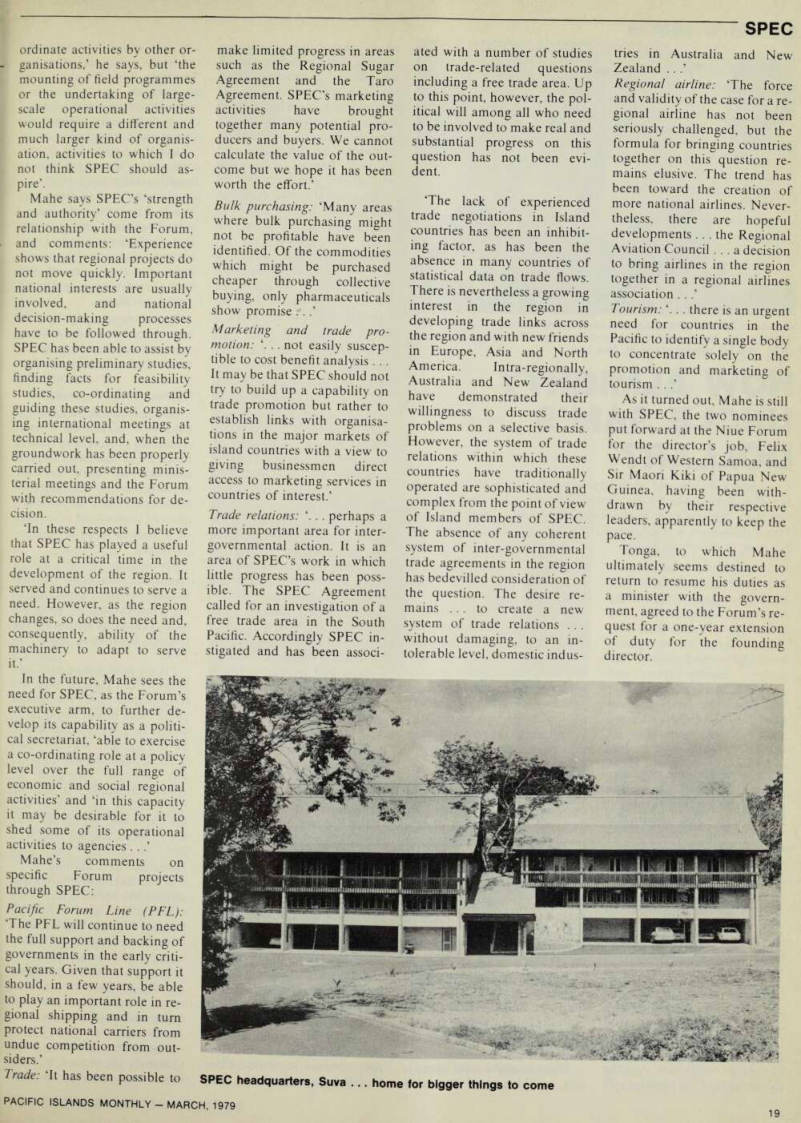
Spec
Make Sees Light
At End Of The
Colonial Tunnel
When Pacific governments are satisfied that the end of the colonial period is in sight they will want to bring regional organisations together into one organisation which will establish the Pacific as a region of the world ‘important in its own right,’ says Mahe Tupouniua.
When Mahe Tupouniua at tended last year’s South Pacific Forum in Niue’s capital, Alofi, he had already written what he regarded as his last South Pacific Bureau for Economic Co-operation (SPEC) ‘Direc tor’s Annual Report’ for 1977-78. He was expecting to make way for a successor after five years in the hot seat as founding director of the Forum’s executive arm.
As a consequence, he deemed the time right to add, for the first and last time, a new section to his report to give ‘a perspective of the first five years of SPEC and the Forum’.
In it, he ‘attempts a brief per sonal, but I hope objective, re view of SPEC’s achievements and failures, progress and lack of progress over its first five
years’.
Possibly his most pointed
comment in this new section is that ‘the distinction between the membership of SPEC and the South Pacific Commission (SPC) is becoming progress ively less obvious although cer tain anomalies seem unlikely to be resolved for many years’.
Mahe comments: ‘Neverthe less, the time is not far off when the majority of countries and peoples of the region can meet as equals in the regional bodies to discuss at all levels politi cal, economic and social
developments affecting the
peoples of the South Pacific
region.
‘When governments in the region are satisfied that the end of the colonial period in the Pacific is in sight they will pre sumably want to being together the regional organisations in a way which lends maximum strength to each of them, which allows for full political control by the leaders of governments in the region, and which is capable of delivering to the peoples of the Pacific the kind of assistance that is relevant to and needed by them. Such an
organisation will help give a
community interest and unity
of purpose to the region which marks the Pacific as a region of the world, important in its own
right’.
Mahe does not venture a time scale for his dream of a unified non-colonial Pacific.
When he talks of‘the majority’ does he tacity indicate that not even half of the ultimate poten tial membership of the Forum
yet enjoy independent status?
He sees the smallness of SPEC’s staff as an inhibiting factor in its performance. ‘With a staff of this size it is possible to maintain a modest but effec tive programme of research, to
organise inter-governmental
consultations and to co
Mahe Tupouniua ... ‘a modest but effective programme’
ordinate activities by other or ■ ganisations,’ he says, but ‘the mounting of field programmes or the undertaking of large scale operational activities would require a different and much larger kind of organis ation, activities to which I do ! not think SPEC should as
pire’.
Mahe says SPEC’s ‘strength and authority’ come from its relationship with the Forum, and comments: ‘Experience shows that regional projects do
not move quickly. Important
national interests are usually involved, and national
decision-making processes
have to be followed through.
SPEC has been able to assist by
organising preliminary studies,
finding facts for feasibility
studies, co-ordinating and
guiding these studies, organis
ing international meetings at
technical level, and, when the groundwork has been properly carried out, presenting minis terial meetings and the Forum with recommendations for de cision. ‘ln these respects I believe that SPEC has played a useful role at a critical time in the development of the region. It served and continues to serve a need. However, as the region changes, so does the need and,
consequently, ability of the
machinery to adapt to serve it.’
In the future, Mahe sees the need for SPEC, as the Forum’s executive arm, to further de velop its capability as a politi cal secretariat, ‘able to exercise a co-ordinating role at a policy level over the full range of economic and social regional activities’ and ‘in this capacity it may be desirable for it to shed some of its operational
activities to agencies ...’
Mahe’s comments on specific Forum projects
through SPEC:
Pacific Forum Line (PFL): ‘The PFL will continue to need the full support and backing of governments in the early criti cal years. Given that support it should, in a few years, be able to play an important role in re gional shipping and in turn protect national carriers from undue competition from out siders.’
Trade: ‘lt has been possible to
make limited progress in areas such as the Regional Sugar Agreement and the Taro Agreement. SPEC’s marketing activities have brought together many potential pro ducers and buyers. We cannot calculate the value of the out come but we hope it has been worth the effort. ’
Bulk purchasing: ‘Many areas
where bulk purchasing might
not be profitable have been identified. Of the commodities which might be purchased
cheaper through collective
buying, only pharmaceuticals
show promise ..
Marketing and trade pro motion: ‘. .. not easily suscep tible to cost benefit analysis ...
It may be that SPEC should not try to build up a capability on trade promotion but rather to establish links with organisa tions in the major markets of island countries with a view to giving businessmen direct access to marketing services in countries of interest.’
Trade relations: ‘.. . perhaps a
more important area for inter governmental action. It is an area of SPEC’s work in which little progress has been poss ible. The SPEC Agreement called for an investigation of a free trade area in the South Pacific. Accordingly SPEC in stigated and has been associ
ated with a number of studies on trade-related questions including a free trade area. Up to this point, however, the pol itical will among all who need to be involved to make real and substantial progress on this question has not been evi dent. ‘The lack of experienced trade negotiations in Island countries has been an inhibit ing factor, as has been the absence in many countries of statistical data on trade flows.
There is nevertheless a growing interest in the region in developing trade links across the region and with new friends in Europe, Asia and North
America. Intra-regionally,
Australia and New Zealand have demonstrated their willingness to discuss trade problems on a selective basis.
However, the system of trade relations within which these countries have traditionally operated are sophisticated and complex from the point of view of Island members of SPEC.
The absence of any coherent system of inter-governmental trade agreements in the region has bedevilled consideration of the question. The desire re mains ... to create a new system of trade relations . . . without damaging, to an in tolerable level, domestic indus
tries in Australia and New Zealand . .
Regional airline: ‘The force and validity of the case for a re gional airline has not been
seriously challenged, but the
formula for bringing countries together on this question re mains elusive. The trend has been toward the creation of more national airlines. Never theless, there are hopeful developments ... the Regional Aviation Council... a decision to bring airlines in the region together in a regional airlines association .. .’
Tourism: *.. . there is an urgent need for countries in the
Pacific to identify a single body
to concentrate solely on the promotion and marketing of tourism . . .’
As it turned out, Mahe is still with SPEC, the two nominees put forward at the Niue Forum for the director’s job, Felix Wendt of Western Samoa, and Sir Maori Kiki of Papua New Guinea, having been with drawn by their respective leaders, apparently to keep the pace.
Tonga, to which Mahe ultimately seems destined to return to resume his duties as a minister with the govern ment, agreed to the Forum’s re quest for a one-year extension of duty for the founding director.
SPEC headquarters, Suva ... home for bigger things to come
Uncle Sam’S
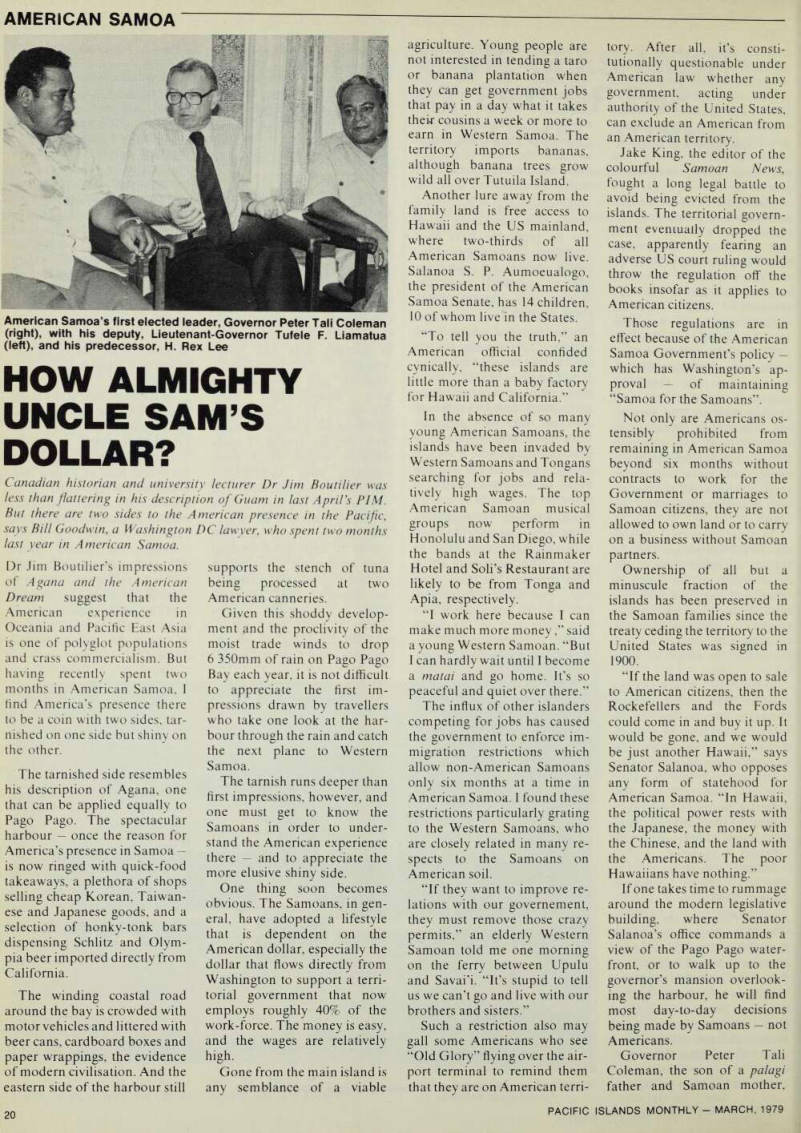
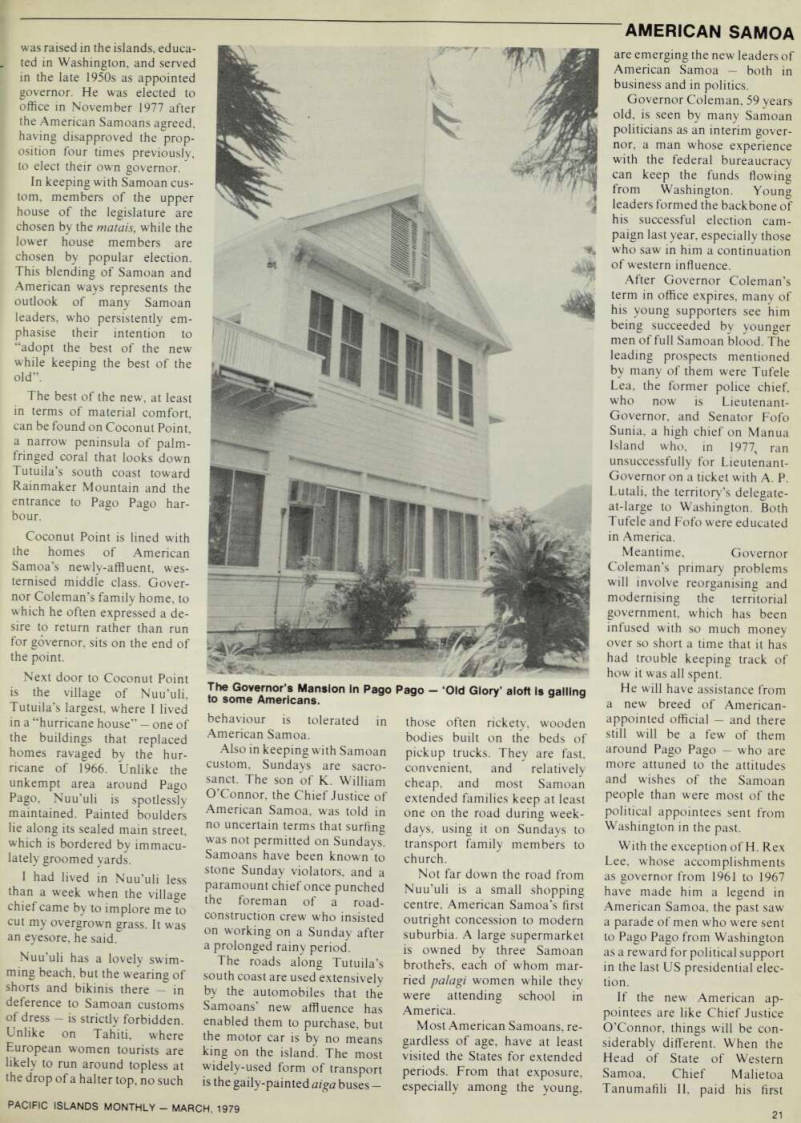
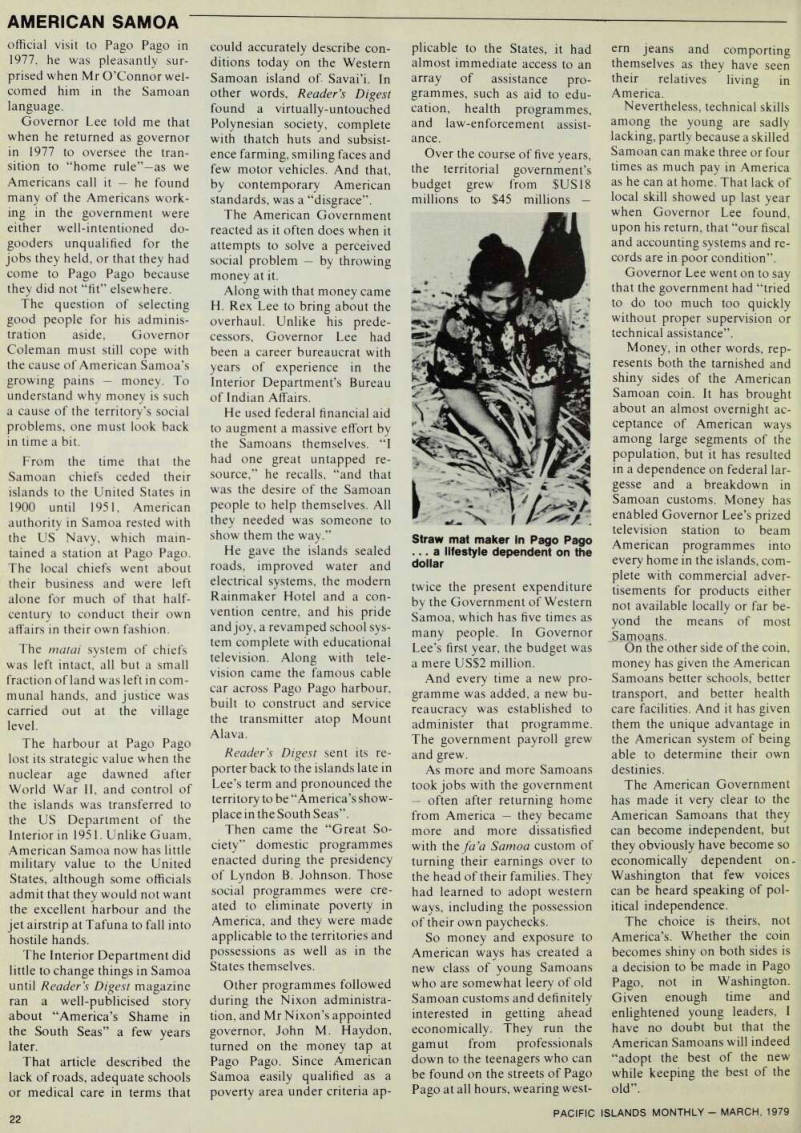
American Samoa
How Almighty
Dollar?
Canadian historian and university lecturer Dr Jim Boutilier was less than flattering in his description of Guam in last April’s PIM.
But there are two sides to the American presence in the Pacific, says Bill Goodwin, a Washington DC lawyer, who spent two months last year in American Samoa.
Dr Jim Boutilier’s impressions of Agana and the American Dream suggest that the American experience in Oceania and Pacific East Asia is one of polyglot populations and crass commercialism. But
having recently spent two
months in American Samoa, I find America’s presence there to be a coin with two sides, tar nished on one side but shiny on the other.
The tarnished side resembles his description of Agana, one that can be applied equally to
Pago Pago. The spectacular
harbour once the reason for America’s presence in Samoa is now ringed with quick-food
takeaways, a plethora of shops
selling cheap Korean, Taiwan
ese and Japanese goods, and a selection of honky-tonk bars
dispensing Schlitz and Olym
pia beer imported directly from
California.
The winding coastal road around the bay is crowded with motor vehicles and littered with beer cans, cardboard boxes and paper wrappings, the evidence of modern civilisation. And the eastern side of the harbour still
supports the stench of tuna
being processed at two
American canneries.
Given this shoddy develop
ment and the proclivity of the moist trade winds to drop 6 350 mm of rain on Pago Pago Bay each year, it is not difficult to appreciate the first im
pressions drawn by travellers
who take one look at the har bour through the rain and catch the next plane to Western Samoa.
The tarnish runs deeper than first impressions, however, and one must get to know the Samoans in order to under stand the American experience there and to appreciate the more elusive shiny side.
One thing soon becomes obvious. The Samoans, in gen eral, have adopted a lifestyle that is dependent on the American dollar, especially the dollar that flows directly from Washington to support a terri torial government that now employs roughly 40% of the work-force. The money is easy, and the wages are relatively
high.
Gone from the main island is any semblance of a viable
agriculture. Young people are not interested in tending a taro or banana plantation when they can get government jobs that pay in a day what it takes their cousins a week or more to earn in Western Samoa. The
territory imports bananas,
although banana trees grow wild all over Tutuila Island.
Another lure away from the family land is free access to Hawaii and the US mainland, where two-thirds of all American Samoans now live.
Salanoa S. P. Aumoeualogo, the president of the American Samoa Senate, has 14 children, 10 of whom live in the States.
“To tell you the truth,” an American official confided cynically, “these islands are little more than a baby factory for Hawaii and California.”
In the absence of so many young American Samoans, the islands have been invaded by Western Samoans and Tongans searching for jobs and rela tively high wages. The top American Samoan musical groups now perform in Honolulu and San Diego, while the bands at the Rainmaker Hotel and Soli’s Restaurant are likely to be from Tonga and
Apia, respectively.
“I work here because I can make much more money,” said a young Western Samoan. “But I can hardly wait until I become a matai and go home. It’s so peaceful and quiet over there.”
The influx of other islanders competing for jobs has caused the government to enforce im migration restrictions which allow non-American Samoans only six months at a time in American Samoa. I found these
restrictions particularly grating
to the Western Samoans, who are closely related in many re spects to the Samoans on American soil.
“If they want to improve re lations with our governement, they must remove those crazy
permits,” an elderly Western
Samoan told me one morning on the ferry between Upulu and Savai’i. “It’s stupid to tell us we can’t go and live with our brothers and sisters.”
Such a restriction also may gall some Americans who see “Old Glory” flying over the air port terminal to remind them that they are on American terri
tory. After all, it’s consti tutionally questionable under American law whether any government, acting under authority of the United States, can exclude an American from an American territory.
Jake King, the editor of the colourful Samoan News,
fought a long legal battle to
avoid being evicted from the islands. The territorial govern ment eventually dropped the
case, apparently fearing an
adverse US court ruling would throw the regulation off the books insofar as it applies to American citizens.
Those regulations are in effect because of the American Samoa Government’s policy which has Washington’s ap proval of maintaining “Samoa for the Samoans”.
Not only are Americans os
tensibly prohibited from
remaining in American Samoa beyond six months without contracts to work for the Government or marriages to Samoan citizens, they are not allowed to own land or to carry on a business without Samoan partners.
Ownership of all but a minuscule fraction of the islands has been preserved in the Samoan families since the treaty ceding the territory to the United States was signed in 1900.
“If the land was open to sale to American citizens, then the Rockefellers and the Fords could come in and buy it up. It would be gone, and we would be just another Hawaii,” says Senator Salanoa, who opposes any form of statehood for American Samoa. “In Hawaii, the political power rests with the Japanese, the money with the Chinese, and the land with the Americans. The poor Hawaiians have nothing.”
If one takes time to rummage around the modern legislative building, where Senator Salanoa’s office commands a view of the Pago Pago water front, or to walk up to the governor’s mansion overlook ing the harbour, he will find most day-to-day decisions being made by Samoans not Americans.
Governor Peter Tali Coleman, the son of a palagi father and Samoan mother,
American Samoa’s first elected leader, Governor Peter Tali Coleman (right), with his deputy, Lieutenant-Governor Tufele F. Liamatua (left), and his predecessor, H. Rex Lee
was raised in the islands, educa ted in Washington, and served in the late 1950 s as appointed governor. He was elected to office in November 1977 after the American Samoans agreed,
having disapproved the prop
osition four times previously, to elect their own governor.
In keeping with Samoan cus tom, members of the upper house of the legislature are chosen by the matais, while the lower house members are chosen by popular election.
This blending of Samoan and American ways represents the outlook of many Samoan leaders, who persistently em phasise their intention to “adopt the best of the new while keeping the best of the old”.
The best of the new, at least in terms of material comfort, can be found on Coconut Point, a narrow peninsula of palm fringed coral that looks down Tutuila’s south coast toward Rainmaker Mountain and the entrance to Pago Pago har bour.
Coconut Point is lined with the homes of American Samoa’s newly-affiuent, wes ternised middle class. Gover nor Coleman’s family home, to which he often expressed a de sire to return rather than run for governor, sits on the end of the point.
Next door to Coconut Point is the village of Nuu’uli, Tutuila’s largest, where I lived in a “hurricane house” - one of the buildings that replaced homes ravaged by the hur ricane of 1966. Unlike the
unkempt area around Pago
Pago, Nuu’uli is spotlessly
maintained. Painted boulders lie along its sealed main street, which is bordered by immacu lately groomed yards.
I had lived in Nuu’uli less than a week when the village chief came by to implore me to cut my overgrown grass. It was an eyesore, he said.
Nuu’uli has a lovely swim ming beach, but the wearing of shorts and bikinis there in deference to Samoan customs of dress - is strictly forbidden.
Unlike on Tahiti, where European women tourists are likely to run around topless at the drop of a halter top, no such
behaviour is tolerated in American Samoa.
Also in keeping with Samoan custom, Sundays are sacro sanct. The son of K. William O’Connor, the Chief Justice of American Samoa, was told in no uncertain terms that surfing was not permitted on Sundays.
Samoans have been known to stone Sunday violators, and a paramount chief once punched the foreman of a road construction crew who insisted on working on a Sunday after
a prolonged rainy period.
The roads along Tutuila’s south coast are used extensively by the automobiles that the Samoans’ new affluence has enabled them to purchase, but the motor car is by no means king on the island. The most widely-used form of transport is the gaily-painted aiga buses
those often rickety, wooden bodies built on the beds of pickup trucks. They are fast, convenient, and relatively cheap, and most Samoan extended families keep at least one on the road during week days, using it on Sundays to transport family members to church.
Not far down the road from Nuu’uli is a small shopping centre, American Samoa’s first outright concession to modern suburbia. A large supermarket is owned by three Samoan brothers, each of whom mar ried palagi women while they were attending school in America.
Most American Samoans, re gardless of age, have at least visited the States for extended periods. From that exposure, especially among the young,
are emerging the new leaders of American Samoa both in business and in politics.
Governor Coleman, 59 years old, is seen by many Samoan politicians as an interim gover nor, a man whose experience with the federal bureaucracy can keep the funds flowing
from Washington. Young
leaders formed the backbone of his successful election cam paign last year, especially those who saw in him a continuation of western influence.
After Governor Coleman’s term in office expires, many of his young supporters see him
being succeeded by younger
men of full Samoan blood. The leading prospects mentioned by many of them were Tufele Lea, the former police chief, who now is Lieutenant- Governor, and Senator Fofo Sunia, a high chief on Manua Island who, in 1977, ran unsuccessfully for Lieutenant- Governor on a ticket with A. P.
Lutali, the territory’s delegate
at-large to Washington. Both
Tufele and Fofo were educated in America.
Meantime. Governor
Coleman’s primary problems
will involve reorganising and modernising the territorial government, which has been infused with so much money over so short a time that it has had trouble keeping track of how it was all spent.
He will have assistance from a new breed of American appointed official - and there still will be a few of them around Pago Pago who are more attuned to the attitudes and wishes of the Samoan people than were most of the political appointees sent from Washington in the past.
With the exception of H. Rex Lee, whose accomplishments as governor from 1961 to 1967 have made him a legend in American Samoa, the past saw a parade of men who were sent to Pago Pago from Washington as a reward for political support in the last US presidential elec tion.
If the new American ap pointees are like Chief Justice O’Connor, things will be con siderably different. When the Head of State of Western Samoa, Chief Malietoa Tanumafili 11, paid his first
The Governor’s Mansion in Pago Pago - ‘Old Glory’ aloft is galling to some Americans.
official visit to Pago Pago in 1977, he was pleasantly sur prised when Mr O’Connor wel comed him in the Samoan
language.
Governor Lee told me that when he returned as governor in 1977 to oversee the tran sition to “home rule”—as we Americans call it he found many of the Americans work ing in the government were either well-intentioned do
gooders unqualified for the
jobs they held, or that they had come to Pago Pago because they did not “fit” elsewhere.
The question of selecting
good people for his adminis tration aside. Governor Coleman must still cope with the cause of American Samoa’s
growing pains money. To
understand why money is such a cause of the territory’s social problems, one must look back in time a bit.
From the time that the Samoan chiefs ceded their islands to the United States in 1900 until 1951, American authority in Samoa rested with the US Navy, which main tained a station at Pago Pago.
The local chiefs went about their business and were left alone for much of that half century to conduct their own affairs in their own fashion.
The matai system of chiefs was left intact, all but a small fraction of land was left in com munal hands, and justice was carried out at the village level.
The harbour at Pago Pago lost its strategic value when the nuclear age dawned after World War 11, and control of the islands was transferred to the US Department of the Interior in 1951. Unlike Guam, American Samoa now has little military value to the United States, although some officials admit that they would not want the excellent harbour and the jet airstrip at Tafuna to fall into hostile hands.
The Interior Department did little to change things in Samoa until Reader’s Digest magazine ran a well-publicised story about “America’s Shame in the South Seas” a few years later.
That article described the lack of roads, adequate schools or medical care in terms that
could accurately describe con ditions today on the Western Samoan island of Savai’i. In other words, Reader's Digest found a virtually-untouched
Polynesian society, complete
with thatch huts and subsist ence farming, smiling faces and few motor vehicles. And that, by contemporary American standards, was a “disgrace”.
The American Government reacted as it often does when it attempts to solve a perceived
social problem by throwing
money at it.
Along with that money came H. Rex Lee to bring about the overhaul. Unlike his prede cessors, Governor Lee had been a career bureaucrat with years of experience in the Interior Department’s Bureau of Indian Affairs.
He used federal financial aid to augment a massive effort by the Samoans themselves. “I had one great untapped re source,” he recalls, “and that was the desire of the Samoan people to help themselves. All they needed was someone to show them the way.”
He gave the islands sealed roads, improved water and electrical systems, the modern Rainmaker Hotel and a con vention centre, and his pride and joy, a revamped school sys tem complete with educational television. Along with tele vision came the famous cable car across Pago Pago harbour, built to construct and service the transmitter atop Mount Alava.
Reader’s Digest sent its re porter back to the islands late in Lee’s term and pronounced the territory to be “America’s show place in the South Seas”.
Then came the “Great So ciety” domestic programmes
enacted during the presidency
of Lyndon B. Johnson. Those social programmes were cre ated to eliminate poverty in America, and they were made applicable to the territories and possessions as well as in the States themselves.
Other programmes followed during the Nixon administra tion, and Mr Nixon’s appointed governor, John M. Haydon, turned on the money tap at Pago Pago. Since American Samoa easily qualified as a poverty area under criteria ap
plicable to the States, it had almost immediate access to an array of assistance pro grammes, such as aid to edu cation, health programmes, and law-enforcement assist ance.
Over the course of five years, the territorial government’s budget grew from SUSIB millions to $45 millions
twice the present expenditure by the Government of Western Samoa, which has five times as many people. In Governor Lee’s first year, the budget was a mere US$2 million.
And every time a new pro gramme was added, a new bu reaucracy was established to administer that programme.
The government payroll grew and grew.
As more and more Samoans took jobs with the government often after returning home from America they became more and more dissatisfied with the fa’a Samoa custom of turning their earnings over to the head of their families. They had learned to adopt western ways, including the possession of their own paychecks.
So money and exposure to American ways has created a new class of young Samoans who are somewhat leery of old Samoan customs and definitely interested in getting ahead economically. They run the gamut from professionals down to the teenagers who can be found on the streets of Pago Pago at all hours, wearing west
ern jeans and comporting themselves as they have seen their relatives living in America.
Nevertheless, technical skills among the young are sadly lacking, partly because a skilled Samoan can make three or four times as much pay in America as he can at home. That lack of local skill showed up last year when Governor Lee found, upon his return, that “our fiscal and accounting systems and re cords are in poor condition”.
Governor Lee went on to say that the government had “tried to do too much too quickly without proper supervision or technical assistance”.
Money, in other words, rep resents both the tarnished and shiny sides of the American Samoan coin. It has brought about an almost overnight ac ceptance of American ways among large segments of the population, but it has resulted in a dependence on federal lar gesse and a breakdown in Samoan customs. Money has enabled Governor Lee’s prized television station to beam American programmes into every home in the islands, com plete with commercial adver tisements for products either not available locally or far be yond the means of most Samoans.
On the other side of the coin, money has given the American Samoans better schools, better transport, and better health care facilities. And it has given them the unique advantage in the American system of being able to determine their own destinies.
The American Government has made it very clear to the American Samoans that they can become independent, but they obviously have become so
economically dependent on
Washington that few voices can be heard speaking of pol
itical independence.
The choice is theirs, not America’s. Whether the coin becomes shiny on both sides is a decision to be made in Pago Pago, not in Washington.
Given enough time and enlightened young leaders, I have no doubt but that the American Samoans will indeed “adopt the best of the new while keeping the best of the old”.
Straw mat maker in Pago Pago ... a lifestyle dependent on the dollar
Advertisements & other items, p. 23 (1 item)
charade
DAIHATSU Continues To Press Forward
In Its Quest For A Harmonious “Automobile Society”
A new car born of logic.,
created to meet
the practical need
of today’s world
» (.. ; • I# •>. model XG
DAIHATSU
charade
The Daihtsu Charade is a car in which a family of 5 can travel in comfort. A car with a special functionality, thanks to its hatch-back door, and with plenty of power for excellent maneuverability under a wide variety of conditions ranging from crowded cities to fast highways. Very definitely a car of economy ... but still a car in which all of these attributes have been concentrated into a compact body in a very logical way.
Today we no longer live in an age in which we can afford the luxury of determining a car’s worth by its luxurious fittings and its great engine displacement. The Daihatsu Charade is therefore a new - and most logical - alternative for those who will enjoy the simple life and its simple pleasures. ■■ •V
4-Wheel Drive...ideal for highways,
sand, rocks or mountain trails
Because it can go “almost anywhere’’. And that includes highways, rocky trails, sand, river sides. Dry, wet, rocky, sandy surfaces.
That’s what sets this 4-Wheel Drive so far apart - and ahead - when the going gets tough. Excellent acceleration superb hill climbing, amazing tenacity . . . that’s the story of Daihatsu 4-Wheel Drive!
DAIHATSU
4 WHEEL DRIVE
DAIHATSU
DAIHATSU MOTOR CO, LTD.
DAIHATSU MOTOR SALES CO, LTD.
Head Office: 2'J^ IHATSU CHO ' IKEDA CITY, OSAKA PREFECTURE, JA
PHONE: IKEDA (0727) 51-8811
TLX53 22224 DAIHATSU IKEDA OSAKA
TELEX NO.: 0-5322-251 JAPAN, 0-5322-224 JAPAN
Tokyo Office:
7, NIHONBASHI-HONCHO 2-CHOME, CHUO-KU TOKYO
PHONE: TOKYO (03) 279-0811
CABLE ADDRESS: DAIHATSU TOKYO
TELEX NO.: 0-222-3377 JAPAN
TAHITI N ETS G ROBERT G r Q P 1047 P G / klcwiP™ Rabaul/F 1J h PRAKASH MOTORS LIMITED, P.O. Box 370, Suva/ COMPANY pn R RnI E 4J'Q B ‘ ; TAOAr P c ee l e/ K NEW CALEDONIA: 5.1.D.A., B.P. 2548, Noumea/ NEW HEBRIDES: SANTO BUS IXeS Vo BO 333' Hon?' / RPPMRI ir nc S ES ' BP ‘ 627 ' Port Vila/ SOLOMON ISLANDS: HERTZ CAR RENTALS UNITED ENTERPRISES' NAURU COOPERATIVE SOCIETY/ NIUE ISLAND: NIUE ISLAND ISLANDS: & SONS LTD ' PO ' Bo * 86 ' Bu '"< Pi " e/ GILBERT
People
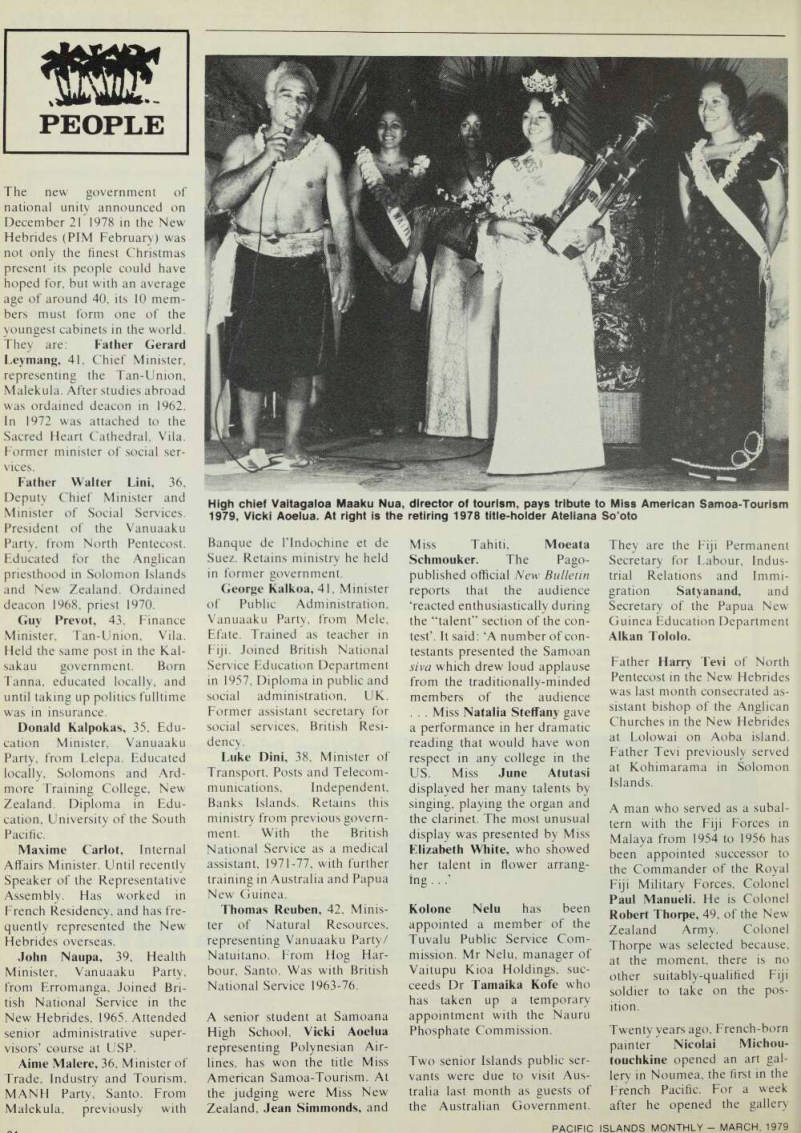
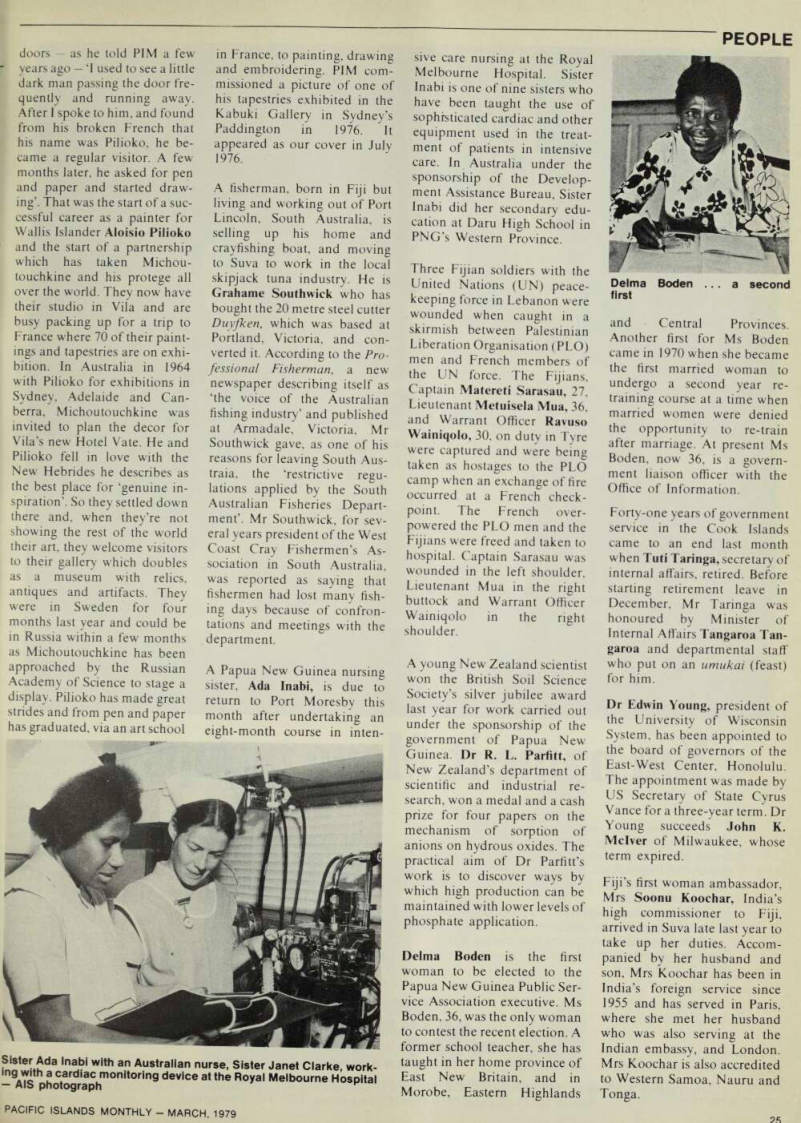
The new government of national unity announced on December 21 1978 in the New Hebrides (PIM February) was not only the finest Christmas present its people could have hoped for, but with an average age of around 40, its 10 mem bers must form one of the youngest cabinets in the world.
They are: Father Gerard Leymang, 41, Chief Minister, representing the Tan-Union, Malekula. After studies.abroad was ordained deacon in 1962.
In 1972 was attached to the Sacred Heart Cathedral. Vila.
Former minister of social ser vices.
Father Walter Fini, 36, Deputy Chief Minister and Minister of Social Services.
President of the Vanuaaku Party, from North Pentecost.
Educated for the Anglican priesthood in Solomon Islands and New Zealand. Ordained deacon 1968, priest 1970.
Guy Prevot, 43, Finance Minister, Tan-Union, Vila.
Held the same post in the Kal sakau government. Born Tanna, educated locally, and until taking up politics fulltime was in insurance.
Donald Kalpokas, 35, Edu cation Minister, Vanuaaku Party, from Lelepa. Educated locally, Solomons and Ard
more Training College, New
Zealand. Diploma in Edu cation, University of the South Pacific.
Maxime Carlot, Internal Affairs Minister. Until recently
Speaker of the Representative
Assembly. Has worked in French Residency, and has fre
quently represented the New
Hebrides overseas.
John Naupa, 39, Health Minister, Vanuaaku Party, from Erromanga, Joined Bri tish National Service in the New Hebrides, 1965. Attended senior administrative super visors’ course at USP.
Aime Malere, 36, Minister of Trade, Industry and Tourism, MANH Party, Santo. From Malekula, previously with
Banque de Tlndochine et de Suez. Retains ministry he held in former government.
George Kalkoa, 41, Minister of Public Administration, Vanuaaku Party, from Mele, Efate. Trained as teacher in Fiji. Joined British National Service Education Department in 1957, Diploma in public and social administration. UK.
Former assistant secretary for social services, British Resi
dency.
Luke Dini, 38, Minister of Transport. Posts and Telecom
munications. Independent,
Banks Islands. Retains this
ministry from previous govern
ment. With the British National Service as a medical assistant. 1971-77, with further training in Australia and Papua New Guinea.
Thomas Reuben, 42, Minis ter of Natural Resources, representing Vanuaaku Party/ Natuitano. From Hog Har bour, Santo. Was with British National Service 1963-76.
A senior student at Samoana High School, Vicki Aoelua
representing Polynesian Air
lines, has won the title Miss American Samoa-Tourism. At the judging were Miss New Zealand, Jean Simmonds, and
Miss Tahiti, Moeata Schmouker. The Pago published official New Bulletin reports that the audience
‘reacted enthusiastically during
the “talent” section of the con test’. It said ; ‘A number of con testants presented the Samoan siva which drew loud applause from the traditionally-minded members of the audience . . . M iss Natalia Steffany gave a performance in her dramatic reading that would have won respect in any college in the US. Miss June Atutasi displayed her many talents by singing, playing the organ and the clarinet. The most unusual
display was presented by Miss
Elizabeth White, who showed her talent in flower arrang
ing . . .'
Kolone Nelu has been appointed a member of the Tuvalu Public Service Com mission. Mr Nelu, manager of Vaitupu Kioa Holdings, suc ceeds Dr Tamaika Kofe who has taken up a temporary appointment with the Nauru Phosphate Commission.
Two senior Islands public ser vants were due to visit Aus tralia last month as guests of the Australian Government.
They are the Fiji Permanent Secretary for Labour, Indus trial Relations and Immi gration Satyanand, and Secretary of the Papua New Guinea Education Department Alkan Tololo.
Father Harry Tevi of North Pentecost in the New Hebrides was last month consecrated as sistant bishop of the Anglican Churches in the New Hebrides at Lolowai on Aoba island.
Father Tevi previously served at Kohimarama in Solomon Islands.
A man who served as a subal tern with the Fiji Forces in Malaya from 1954 to 1956 has been appointed successor to the Commander of the Royal Fiji Military Forces, Colonel Paul Manueli. He is Colonel Robert Thorpe, 49, of the New Zealand Army. Colonel Thorpe was selected because, at the moment, there is no
other suitably-qualified Fiji
soldier to take on the pos ition.
Twenty years ago, French-born painter Nicolai Michou touchkine opened an art gal lery in Noumea, the first in the French Pacific. For a week after he opened the gallery
High chief Vaitagaloa Maaku Nua, director of tourism, pays tribute to Miss American Samoa-Tourism 1979, Vicki Aoelua. At right is the retiring 1978 title-holder Ateliana So’oto
doors as he told PIM a few years ago ‘I used to see a little dark man passing the door fre
quently and running away.
After I spoke to him, and found from his broken French that his name was Pilioko, he be came a regular visitor. A few months later, he asked for pen and paper and started draw ing’. That was the start of a suc cessful career as a painter for Wallis Islander Aloisio Pilioko and the start of a partnership which has taken Michou touchkine and his protege all over the world. They now have their studio in Vila and are busy packing up for a trip to France where 70 of their paint ings and tapestries are on exhi bition. In Australia in 1964 with Pilioko for exhibitions in Sydney, Adelaide and Can berra, Michoutouchkine was invited to plan the decor for Vila’s new Hotel Vate. He and Pilioko fell in love with the New Hebrides he describes as the best place for ‘genuine in spiration’. So they settled down there and, when they’re not showing the rest of the world their art, they welcome visitors to their gallery which doubles as a museum with relics,
antiques and artifacts. They
were in Sweden for four months last year and could be in Russia within a few months as Michoutouchkine has been
approached by the Russian
Academy of Science to stage a display. Pilioko has made great strides and from pen and paper has graduated, via an art school
in France, to painting, drawing and embroidering. PIM com missioned a picture of one of his tapestries exhibited in the
Kabuki Gallery in Sydney’s
Paddington in 1976. It appeared as our cover in July 1976.
A fisherman, born in Fiji but living and working out of Port Lincoln, South Australia, is selling up his home and
crayfishing boat, and moving
to Suva to work in the local skipjack tuna industry. He is Grahame Southwick who has bought the 20 metre steel cutter Duyfken, which was based at Portland, Victoria, and con verted it. According to the Pro fessional Fisherman, a new newspaper describing itself as ‘the voice of the Australian
fishing industry’ and published
at Armadale, Victoria, Mr Southwick gave, as one of his reasons for leaving South Aus traia, the ‘restrictive regu lations applied by the South Australian Fisheries Depart ment’. Mr Southwick, for sev eral years president of the West Coast Cray Fishermen’s As sociation in South Australia, was reported as saying that fishermen had lost many fish ing days because of confron tations and meetings with the
department.
A Papua New Guinea nursing sister, Ada Inabi, is due to return to Port Moresby this month after undertaking an eight-month course in inten-
sive care nursing at the Royal Melbourne Hospital. Sister Inabi is one of nine sisters who have been taught the use of sophisticated cardiac and other equipment used in the treat ment of patients in intensive care. In Australia under the
sponsorship of the Develop
ment Assistance Bureau, Sister Inabi did her secondary edu cation at Daru High School in PNG’s Western Province.
Three Fijian soldiers with the United Nations (UN) peace keeping force in Lebanon were wounded when caught in a skirmish between Palestinian Liberation Organisation (PLO) men and French members of the UN force. The Fijians, Captain Matereti Sarasau, 27, Lieutenant Metuisela Mua, 36, and Warrant Officer Ravuso Wainiqolo, 30, on duty in Tyre were captured and were being taken as hostages to the PLO camp when an exchange of fire occurred at a French check point. The French over powered the PLO men and the Fijians were freed and taken to
hospital. Captain Sarasau was
wounded in the left shoulder.
Lieutenant Mua in the right buttock and Warrant Officer
Wainiqolo in the right
shoulder.
A young New Zealand scientist won the British Soil Science
Society’s silver jubilee award
last year for work carried out under the sponsorship of the government of Papua New Guinea. Dr R. L. Parfitt, of New Zealand’s department of scientific and industrial re search, won a medal and a cash prize for four papers on the mechanism of sorption of anions on hydrous oxides. The practical aim of Dr Parfitt’s work is to discover ways by which high production can be maintained with lower levels of
phosphate application.
Delma Boden is the first woman to be elected to the Papua New Guinea Public Ser vice Association executive. Ms Boden, 36, was the only woman to contest the recent election. A former school teacher, she has taught in her home province of East New Britain, and in Morobe, Eastern Highlands
and Central Provinces.
Another first for Ms Boden came in 1970 when she became the first married woman to undergo a second year re training course at a time when married women were denied the opportunity to re-train after marriage. At present Ms Boden, now 36, is a govern ment liaison officer with the Office of Information.
Forty-one years of government service in the Cook Islands came to an end last month when Tuti Taringa, secretary of internal affairs, retired. Before starting retirement leave in December, Mr Taringa was honoured by Minister of Internal Affairs Tangaroa Tan garoa and departmental staff who put on an umukai (feast) for him.
Dr Edwin Young, president of the University of Wisconsin System, has been appointed to the board of governors of the East-West Center, Honolulu.
The appointment was made by US Secretary of State Cyrus Vance for a three-year term. Dr Young succeeds John K.
Mclver of Milwaukee, whose
term expired.
Fiji’s first woman ambassador, Mrs Soonu Koochar, India’s
high commissioner to Fiji,
arrived in Suva late last year to take up her duties. Accom panied by her husband and son, Mrs Koochar has been in India’s foreign service since 1955 and has served in Paris, where she met her husband who was also serving at the Indian embassy, and London.
Mrs Koochar is also accredited to Western Samoa, Nauru and
Tonga.
Sister Ada Inabi with an Australian nurse, Sister Janet Clarke, work ing with a cardiac monitoring device at the Royal Melbourne Hospital - AIS photograph
Delma Boden ... a second first
Advertisements & other items, p. 26 (1 item)
You name it, Mono pumps it.
Tell us your needs, we’llshowyouthepump. Forover 30 years, we’ve been pumping liquids of every viscosity, under all kinds of conditions. Fresh water, sand and water, food ingredients, chemicals, acids, corrosives and abrasives, sludges and waste, effluent and sewage, even solids in suspension.
If it can be conveyed through a pipeline, we can move it, meter it or mix it, as quickly or slowly as you wish.
And we can provide pumps that run on petrol, kerosene, diesel, electricity, or PTO tractor drive (in fact even bicycle drive).
If there’s anything you want to know about pumping, write to us at Mono. We’ve got the pumps and the experience.
Please send me details of your pumps for (describe purposes); Name: Address: Send coupon to Head Office & Works (address below).
MONO
JAPUMPS
AUSTRALIA PTY. LTD.
MOVE IT WITH MONO
Head Office & Works: “Mono House”. 338-348 Lower Dandenong Rd., Mordialloc, Vic. 3195. Australia.
Agents in: Papua and New Guinea, Indonesia. Fiji, The Philippines. 344-p-7i7?c
Political
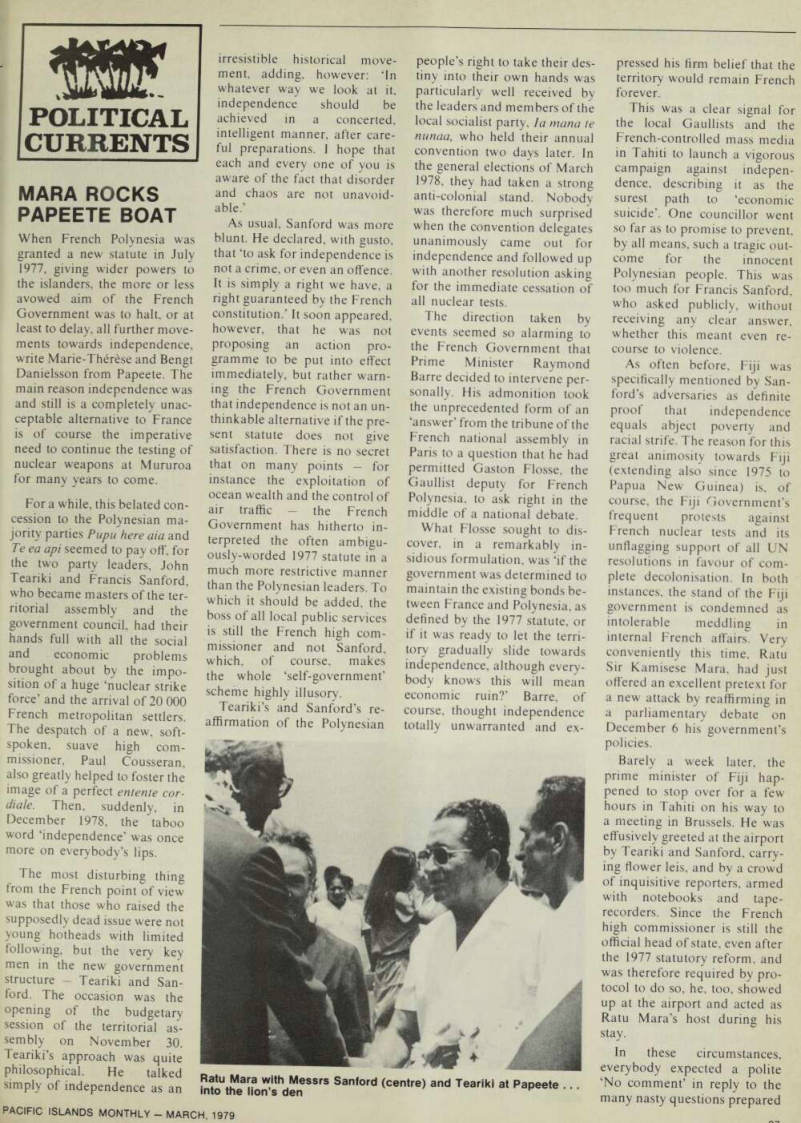
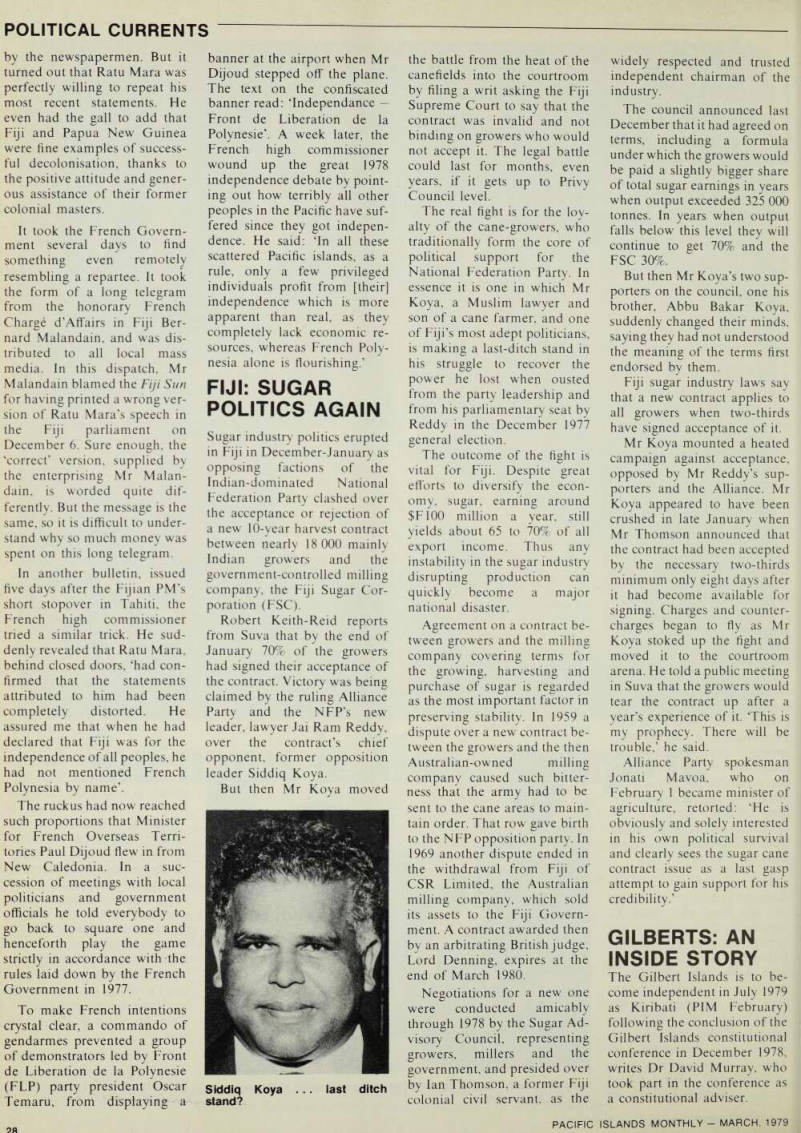
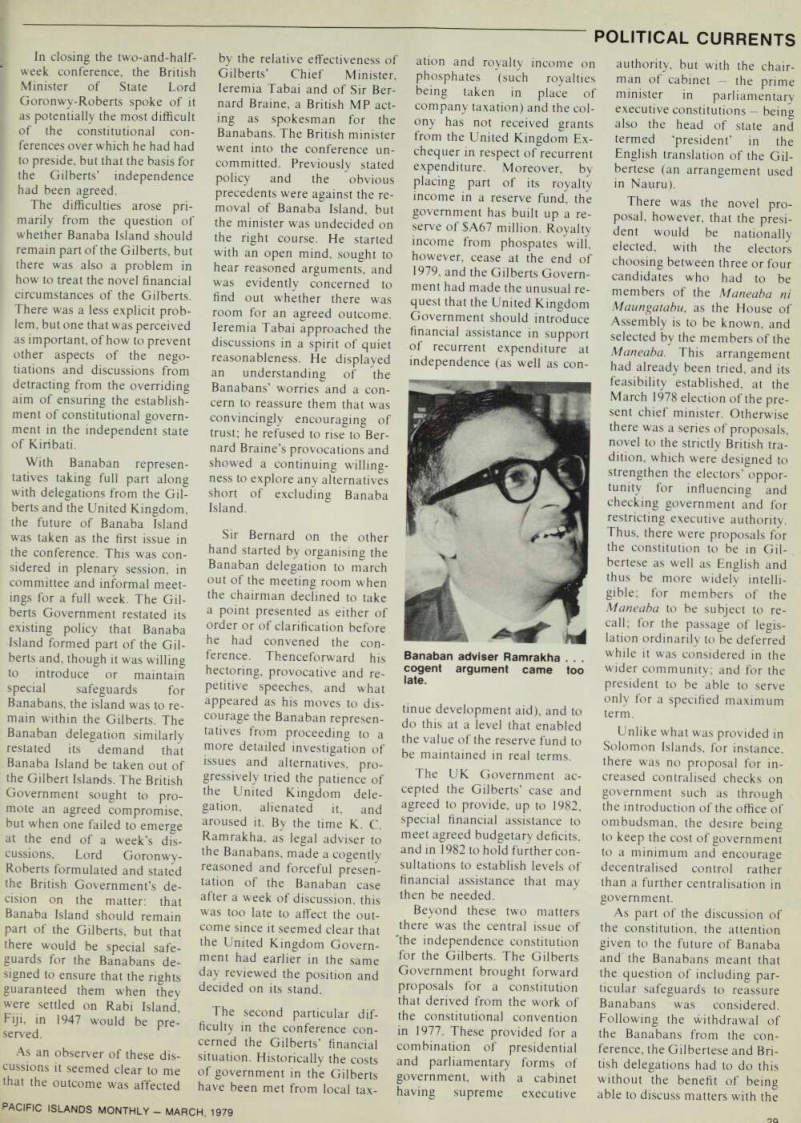

Currents
irresistible historical move ment, adding, however: ‘ln whatever way we look at it, independence should be achieved in a concerted, intelligent manner, after care ful preparations. I hope that each and every one of you is aware of the fact that disorder and chaos are not unavoid able.’
As usual, Sanford was more blunt. He declared, with gusto, that ‘to ask for independence is not a crime, or even an offence.
It is simply a right we have, a right guaranteed by the French constitution.’ It soon appeared, however, that he was not proposing an action pro gramme to be put into effect immediately, but rather warn ing the French Government that independence is not an un thinkable alternative if the pre sent statute does not give satisfaction. There is no secret that on many points for instance the exploitation of ocean wealth and the control of air traffic the French Government has hitherto in terpreted the often ambigu ously-worded 1977 statute in a much more restrictive manner than the Polynesian leaders. To which it should be added, the boss of all local public services is still the French high com missioner and not Sanford, which, of course, makes the whole ‘self-government’
scheme highly illusory.
Teariki’s and Sanford’s re affirmation of the Polynesian
Mara Rocks
Papeete Boat
When French Polynesia was granted a new statute in July 1977, giving wider powers to the islanders, the more or less avowed aim of the French Government was to halt, or at least to delay, all further move ments towards independence, write Marie-Therese and Bengt Danielsson from Papeete. The main reason independence was and still is a completely unac ceptable alternative to France is of course the imperative need to continue the testing of nuclear weapons at Mururoa for many years to come.
For a while, this belated con cession to the Polynesian ma jority parties Pupu here aia and Te ea api seemed to pay off, for the two party leaders, John Teariki and Francis Sanford, who became masters of the ter ritorial assembly and the government council, had their hands full with all the social and economic problems brought about by the impo sition of a huge ‘nuclear strike force’ and the arrival of 20 000 French metropolitan settlers.
The despatch of a new, soft spoken, suave high com missioner, Paul Cousseran, also greatly helped to foster the image of a perfect entente cor diale. Then, suddenly, in December 1978, the taboo word ‘independence’ was once
more on everybody’s lips.
The most disturbing thing
from the French point of view was that those who raised the supposedly dead issue were not young hotheads with limited following, but the very key men in the new government structure - Teariki and San ford. The occasion was the opening of the budgetary session of the territorial as sembly on November 30.
Teariki’s approach was quite philosophical. He talked simply of independence as an
people’s right to take their des tiny into their own hands was
particularly well received by
the leaders and members of the local socialist party, la mana te nunaa, who held their annual convention two days later. In the general elections of March 1978, they had taken a strong anti-colonial stand. Nobody was therefore much surprised when the convention delegates unanimously came out for independence and followed up with another resolution asking for the immediate cessation of all nuclear tests.
The direction taken by events seemed so alarming to the French Government that Prime Minister Raymond Barre decided to intervene per sonally. His admonition took the unprecedented form of an ‘answer’ from the tribune of the French national assembly in Paris to a question that he had permitted Gaston Flosse, the Gaullist deputy for French Polynesia, to ask right in the middle of a national debate.
What Flosse sought to dis cover, in a remarkably in sidious formulation, was ‘if the government was determined to maintain the existing bonds be tween France and Polynesia, as defined by the 1977 statute, or if it was ready to let the terri tory gradually slide towards
independence, although every
body knows this will mean economic ruin?’ Barre, of
course, thought independence
totally unwarranted and ex-
pressed his firm belief that the territory would remain French forever.
This was a clear signal for the local Gaullists and the French-controlled mass media in Tahiti to launch a vigorous campaign against indepen dence, describing it as the surest path to ‘economic suicide’. One councillor went so far as to promise to prevent, by all means, such a tragic out come for the innocent Polynesian people. This was too much for Francis Sanford, who asked publicly, without receiving any clear answer, whether this meant even re course to violence.
As often before, Fiji was specifically mentioned by San ford’s adversaries as definite proof that independence equals abject poverty and racial strife. The reason for this
great animosity towards Fiji
(extending also since 1975 to Papua New Guinea) is, of course, the Fiji Government’s frequent protests against French nuclear tests and its unflagging support of all UN resolutions in favour of com plete decolonisation. In both instances, the stand of the Fiji government is condemned as intolerable meddling in internal French affairs. Very conveniently this time, Ratu Sir Kamisese Mara, had just offered an excellent pretext for a new attack by reaffirming in a parliamentary debate on December 6 his government’s policies.
Barely a week later, the prime minister of Fiji hap pened to stop over for a few hours in Tahiti on his way to a meeting in Brussels. He was effusively greeted at the airport by Teariki and Sanford, carry ing flower leis, and by a crowd of inquisitive reporters, armed with notebooks and tape recorders. Since the French high commissioner is still the official head of state, even after the 1977 statutory reform, and was therefore required by pro tocol to do so, he, too, showed up at the airport and acted as Ratu Mara’s host during his stay.
In these circumstances, everybody expected a polite ‘No comment’ in reply to the many nasty questions prepared
Rafu Mara with Messrs Sanford (centre) and Teariki at Papeete ... into the lion’s den
by the newspapermen. But it turned out that Ratu Mara was perfectly willing to repeat his most recent statements. He even had the gall to add that Fiji and Papua New Guinea were fine examples of success ful decolonisation, thanks to the positive attitude and gener ous assistance of their former colonial masters.
It took the French Govern ment several days to find
something even remotely
resembling a repartee. It took the form of a long telegram from the honorary French Charge d’Affairs in Fiji Ber nard Malandain, and was dis tributed to all local mass media. In this dispatch, Mr Malandain blamed the Fiji Sun for having printed a wrong ver sion of Ratu Mara’s speech in
the Fiji parliament on
December 6. Sure enough, the
‘correct’ version, supplied by
the enterprising Mr Malan dain, is worded quite dif ferently. But the message is the same, so it is difficult to under stand why so much money was spent on this long telegram.
In another bulletin, issued five days after the Fijian PM’s short stopover in Tahiti, the French high commissioner tried a similar trick. He sud denly revealed that Ratu Mara, behind closed doors, ‘had con firmed that the statements attributed to him had been completely distorted. He assured me that when he had declared that Fiji was for the independence of all peoples, he had not mentioned French
Polynesia by name’.
The ruckus had now reached such proportions that Minister for French Overseas Terri tories Paul Dijoud flew in from New Caledonia. In a suc cession of meetings with local politicians and government officials he told everybody to go back to square one and henceforth play the game strictly in accordance with the rules laid down by the French Government in 1977.
To make French intentions crystal clear, a commando of
gendarmes prevented a group
of demonstrators led by Front de Liberation de la Polynesie (FLP) party president Oscar Temaru, from displaying a
banner at the airport when Mr
Dijoud stepped off the plane.
The text on the confiscated banner read: Tndependance Front de Liberation de la Polynesie’. A week later, the French high commissioner wound up the great 1978
independence debate by point
ing out how terribly all other peoples in the Pacific have suf fered since they got indepen dence. He said: Tn all these scattered Pacific islands, as a rule, only a few privileged individuals profit from [their] independence which is more apparent than real, as they completely lack economic re sources, whereas French Poly nesia alone is flourishing.’
Fiji: Sugar
Politics Again
Sugar industry politics erupted
in Fiji in December-January as opposing factions of the Indian-dominated National Federation Party clashed over the acceptance or rejection of a new 10-year harvest contract between nearly 18 000 mainly Indian growers and the
government-controlled milling
company, the Fiji Sugar Cor
poration (FSC).
Robert Keith-Reid reports from Suva that by the end of January 70% of the growers had signed their acceptance of the contract. Victory was being claimed by the ruling Alliance Party and the NFP’s new leader, lawyer Jai Ram Reddy, over the contract’s chief opponent, former opposition leader Siddiq Koya.
But then Mr Koya moved
the battle from the heat of the canefields into the courtroom by filing a writ asking the Fiji Supreme Court to say that the contract was invalid and not binding on growers who would not accept it. The legal battle could last for months, even years, if it gets up to Privy Council level.
The real fight is for the loy alty of the cane-growers, who traditionally form the core of political support for the National Federation Party. In essence it is one in which Mr Koya, a Muslim lawyer and son of a cane farmer, and one of Fiji’s most adept politicians, is making a last-ditch stand in his struggle to recover the power he lost when ousted from the party leadership and from his parliamentary seat by Reddy in the December 1977
general election.
The outcome of the fight is vital for Fiji. Despite great efforts to diversify the econ omy, sugar, earning around SFIOO million a year, still yields about 65 to 70% of all export income. Thus any instability in the sugar industry
disrupting production can
quickly become a major
national disaster.
Agreement on a contract be tween growers and the milling company covering terms for
the growing, harvesting and
purchase of sugar is regarded as the most important factor in preserving stability. In 1959 a dispute over a new contract be tween the growers and the then
Australian-owned milling
company caused such bitter ness that the army had to be sent to the cane areas to main tain order. That row gave birth to the NFP opposition party. In 1969 another dispute ended in the withdrawal from Fiji of CSR Limited, the Australian milling company, which sold its assets to the Fiji Govern ment. A contract awarded then by an arbitrating British judge.
Lord Denning, expires at the end of March 1980.
Negotiations for a new one were conducted amicably
through 1978 by the Sugar Ad
visory Council, representing growers, millers and the government, and presided over by lan Thomson, a former Fiji colonial civil servant, as the
widely respected and trusted independent chairman of the
industry.
The council announced last December that it had agreed on terms, including a formula under which the growers would
be paid a slightly bigger share
of total sugar earnings in years when output exceeded 325 000 tonnes. In years when output falls below this level they will continue to get 70% and the
Fsc 30%.
But then Mr Koya’s two sup porters on the council, one his brother, Abbu Bakar Koya,
suddenly changed their minds,
saying they had not understood the meaning of the terms first endorsed by them.
Fiji sugar industry laws say that a new contract applies to all growers when two-thirds have signed acceptance of it.
Mr Koya mounted a heated
campaign against acceptance,
opposed by Mr Reddy’s sup porters and the Alliance. Mr Koya appeared to have been crushed in late January when Mr Thomson announced that the contract had been accepted by the necessary two-thirds
minimum only eight days after
it had become available for
signing. Charges and counter
charges began to fly as Mr
Koya stoked up the fight and moved it to the courtroom arena. He told a public meeting in Suva that the growers would tear the contract up after a year’s experience of it. This is my prophecy. There will be trouble,’ he said.
Alliance Party spokesman Jonati Mavoa, who on February 1 became minister of agriculture, retorted: ‘He is
obviously and solely interested
in his own political survival and clearly sees the sugar cane contract issue as a last gasp attempt to gain support for his
credibility.’
Gilberts: An
Inside Story
The Gilbert Islands is to be come independent in July 1979 as Kiribati (PIM February) following the conclusion of the Gilbert Islands constitutional conference in December 1978, writes Dr David Murray, who took part in the conference as a constitutional adviser.
Siddiq Koya ... last ditch stand?
In closing the two-and-half week conference, the British Minister of State Lord Goronwy-Roberts spoke of it as potentially the most difficult of the constitutional con ferences over which he had had to preside, but that the basis for the Gilberts’ independence had been agreed.
The difficulties arose pri marily from the question of whether Banaba Island should remain part of the Gilberts, but there was also a problem in how to treat the novel financial circumstances of the Gilberts.
There was a less explicit prob lem, but one that was perceived as important, of how to prevent other aspects of the nego tiations and discussions from
detracting from the overriding
aim of ensuring the establish ment of constitutional govern ment in the independent state of Kiribati.
With Banaban represen tatives taking full part along with delegations from the Gil berts and the United Kingdom, the future of Banaba Island was taken as the first issue in the conference. This was con sidered in plenary session, in committee and informal meet ings for a full week. The Gil berts Government restated its
existing policy that Banaba
Island formed part of the Gil berts and, though it was willing to introduce or maintain
special safeguards for
Banabans, the island was to re main within the Gilberts. The
Banaban delegation similarly
restated its demand that Banaba Island be taken out of the Gilbert Islands. The British Government sought to pro mote an agreed compromise, but when one failed to emerge at the end of a week’s dis cussions, Lord Goronwy- Roberts formulated and stated the British Government’s de cision on the matter; that Banaba Island should remain part of the Gilberts, but that there would be special safe guards for the Banabans de signed to ensure that the rights guaranteed them when they were settled on Rabi Island.
Fiji, in 1947 would be pre served.
As an observer of these dis cussions it seemed clear to me that the outcome was affected
by the relative effectiveness of Gilberts’ Chief Minister, leremia Tabai and of Sir Ber nard Braine, a British MP act ing as spokesman for the Banabans. The British minister went into the conference un committed. Previously stated policy and the obvious precedents were against the re moval of Banaba Island, but the minister was undecided on the right course. He started with an open mind, sought to hear reasoned arguments, and was evidently concerned to find out whether there was room for an agreed outcome, leremia Tabai approached the discussions in a spirit of quiet reasonableness. He displayed an understanding of the Banabans’ worries and a con cern to reassure them that was
convincingly encouraging of
trust; he refused to rise to Ber nard Braine’s provocations and
showed a continuing willing
ness to explore any alternatives short of excluding Banaba Island.
Sir Bernard on the other hand started by organising the Banaban delegation to march out of the meeting room when the chairman declined to take a point presented as either of order or of clarification before he had convened the con ference. Thenceforward his hectoring, provocative and re petitive speeches, and what appeared as his moves to dis courage the Banaban represen tatives from proceeding to a more detailed investigation of issues and alternatives, pro gressively tried the patience of the United Kingdom dele gation. alienated it, and aroused it. By the time K. C.
Ramrakha, as legal adviser to the Banabans, made a cogently reasoned and forceful presen tation of the Banaban case after a week of discussion, this was too late to affect the out come since it seemed clear that the United Kingdom Govern ment had earlier in the same day reviewed the position and decided on its stand.
The second particular dif ficulty in the conference con cerned the Gilberts’ financial situation. Historically the costs of government in the Gilberts have been met from local tax
ation and royalty income on phosphates (such royalties being taken in place of company taxation) and the col ony has not received grants from the United Kingdom Ex chequer in respect of recurrent expenditure. Moreover, by placing part of its royalty income in a reserve fund, the government has built up a re serve of SA67 million. Royalty income from phospates will, however, cease at the end of 1979, and the Gilberts Govern ment had made the unusual re quest that the United Kingdom Government should introduce financial assistance in support of recurrent expenditure at independence (as well as con-
tinue development aid), and to do this at a level that enabled the value of the reserve fund to be maintained in real terms.
The UK Government ac cepted the Gilberts’ case and agreed to provide, up to 1982, special financial assistance to meet agreed budgetary deficits, and in 1982 to hold further con sultations to establish levels of financial assistance that may then be needed.
Beyond these two matters there was the central issue of 'the independence constitution for the Gilberts. The Gilberts Government brought forward proposals for a constitution that derived from the work of the constitutional convention in 1977. These provided for a combination of presidential and parliamentary forms of government, with a cabinet having supreme executive
authority, but with the chair man of cabinet the prime minister in parliamentary executive constitutions - being also the head of state and termed ‘president’ in the English translation of the Gil bertese (an arrangement used in Nauru).
There was the novel pro posal, however, that the presi dent would be nationally elected, with the electors choosing between three or four candidates who had to be members of the Maneaba ni Maungatabu, as the House of Assembly is to be known, and selected by the members of the Maneaba. This arrangement had already been tried, and its feasibility established, at the March 1978 election of the pre sent chief minister. Otherwise there was a series of proposals, novel to the strictly British tra dition, which were designed to strengthen the electors’ oppor
tunity for influencing and
checking government and for
restricting executive authority.
Thus, there were proposals for the constitution to be in Gil bertese as well as English and thus be more widely intelli gible; for members of the Maneaba to be subject to re call; for the passage of legis lation ordinarily to be deferred while it was considered in the wider community; and for the president to be able to serve only for a specified maximum term.
Unlike what was provided in Solomon Islands, for instance, there was no proposal for in creased contralised checks on government such as through the introduction of the office of ombudsman, the desire being to keep the cost of government to a minimum and encourage decentralised control rather than a further centralisation in government.
As part of the discussion of the constitution, the attention given to the future of Banaba and the Banabans meant that the question of including par ticular safeguards to reassure Banabans was considered.
Following the withdrawal of the Banabans from the con ference, the Gilbertese and Bri tish delegations had to do this without the benefit of being able to discuss matters with the
Banaban adviser Ramrakha . . . cogent argument came too late.
■ Banabans themselves. In the event, the safeguards decided upon were as outlined in PIM
in February.
It was recognised as unfor tunate that the way time had been spent appeared to rel egate discussion of the consti tution in the scale of priorities, and it was appropriate that in his final address the British
minister began by emphasising
the importance of the consti tution and the decisions of the conference on it.
Dijoud Wins
Out In Noumea
France’s State Secretary for Overseas Territories Paul Dijoud arrived in Noumea on December 18 to face some op position, writes Andre Chaville. From early December the press had been publishing letters from local
politicians, mainly Europeans
worried about statements by ethnologist Jean Guiart, who had been suggesting, among other things, that the white population of New Caledonia should be ready to pack up and leave. Mr Guiart had been regarded, in Noumea, as an adviser to Mr Dijoud.
There had also been a marked fall-out from French
politics. With Jacques Chirac,
leader of the Gaullist party in France, threatening President Giscard D’Estaing with with drawal of support, it seemed
only natural for Jacques
Lafleur, leader of the local Gaullist group, to do the same to Mr Dijoud, President Gis card’s spokesman on overseas territories.
To add to the apparent op position, Jean-Gabriel Eriau, after five years of service as high commissioner, left the ter ritory 24 hours before Mr
Dijoud’s arrival. Although it
was rumoured that Mr Eriau had asked to be withdrawn be cause of his disapproval of Mr
Dijoud’s plans, the high com
missioner never revealed such feelings in public. But it was significant that for the first time in the history of New
Caledonia, the departing high
commissioner and his suc cessor, Claude Charbonniaud, held a private meeting at La
Tontouta airport.
Millionaire-parliamentarian
Jacques Lafleur also dropped a bombshell early in the month by announcing that he thought New Caledonia would eventu ally and inevitably become a department of France. His ar gument was that the territory could no longer support the cost of its inflated public ser vice, nor could it offer com plete social security to its inhabitants.
But many New Caledonians, white and black, are not keen on such an idea. Although will ing to remain within the French sphere of influence, they are determined to see the island maintain and improve its present advantages of autonomy and tax-free incomes. This attitude has not been favourable to the Lafleur group as it has given Lionel Cherrier, New Caledonia’s representative in the French Senate, the opportunity to take a firm stand in favour of the Dijoud plan. He is supported by the moderate parties even though he took up his post on the death of Mr Lafleur’s father. Also the teenage Gaullist movement has split, some of its members following the senator.
To add to the general atmo sphere of unpleasantness
accompanying Mr Dijoud’s
arrival, the evening of his first day was marked by dramatic events in Orly Square. Pro independence leaders, includ
ing Yann Celene Uregei,
attempted to organise an im promptu demonstration against Mr Dijoud’s visit.
Though they received little support, the violence of police shocked many bystanders. The meeting was broken up by a truncheon charge at spm and witnessed by many shoppers on their pre-Christmas buying spree.
The demonstration was too late. Mr Dijoud had already practically won the battle that morning in his speech to the territorial assembly. He told councillors he did not believe that the Melanesian pro independence movement was important. But, on the other hand, he considered that there was an urgent need to improve the Melanesians’ standing within the community. He was
critical of the belligerent atti tude of the die-hard ‘Cal doches’ and said that any attempts to provoke armed racial feuds would be severely restrained by the high com missioner under his authority.
Mr Dijoud considered most people were not in favour of extremists of either group. He also criticised political squab bling in the assembly among the numerous parties. He an nounced that he would suggest a change in the system of elec tion to both the assembly and the government council so that the territory would be gov
erned by a large majority,
chosen by the electors. But he also praised the attitudes of some politicians, such as Jean- Pierra Aifa, and hoped that the ‘moderate’ parties would unite.
These parties, in fact, are sup porting Giscard in France and, consequently, the Dijoud pol icy for New Caledonia.
Mr Dijoud said Mr Guiart was not his adviser, nor was he, Dijoud, supporting Union Caledonienne. His attitude was to listen to all opinions and suggestions before coming to his own conclusions.
Surprisingly enough, Mr
Dijoud has the full support of the moderate parties, encouragement from the Union Caledonienne, and the approval of the socialists. Only the pro-independence Fulk and Palika are openly hostile, while Mr Lafleur is forced to
give reserved and grudging
approval.
Finally, Mr Dijoud submit
ted a 23-point plan to the as
sembly, saying he hoped that
both the assembly and the government council would adopt his proposals. If not, he said he might ask the popu lation itself for an opinion. It appeared to be a veiled threat to organise a referendum.
Mr Dijoud’s plan is not a cal culated programme. It is more like a philosopher’s declaration of rights, using vague terms such as the development of mutual respect for each com munity’s culture, the pro motion of tourism, and the
development of agriculture
and light industry. It is a pro posal for a long-term contract, a plan which would maintain the territorial status of New
Caledonia with France, in turn, guaranteeing the cultural, social and professional welfare of all inhabitants, whatever their origin.
Hebrides ‘No’
To Refugees
The council of chiefs of the New Hebrides island of Maewo has spoken out strongly against an offer by Na Griamel’s president Jimmy Moli Stephens to resettle 2300 Vietnamese refugees on the island, according to a report in New Hebrides News, published by the British residency in Vila.
In making the offer to a Catholic lay organisation in Brisbane, Australia, Mr Stephens claimed to be the paramount chief of Maewo. He said that in this capacity he would be prepared to resettle all 2300 refugees stranded aboard the freighter Tung Han in Manila Bay, Philippines.
The council of chiefs of Maewo denied that Mr Stephens was the paramount chief of Maewo, said he was not from that island, had no relatives there, and claimed that the island was not a mem ber of Na Griamel and con tained only two villages that supported Stephens’ party.
New Hebrides’ Chief Minis ter Gerard Leymang said, in a broadcast statement, that the New Hebrides Government was not aware of Mr Stephens’ offer. Deputy Chief Minister and Minister of Social Services Father Walter Lini said; ‘Such an offer made by a member of the public could cause disunity among the people of the New Hebrides and might disrupt future relations with overseas countries.’
Walter Lini . . . refugees could cause ‘disunity’.
Advertisements & other items, pp. 30-32 (1 item)
Come uptokool
The cool refreshing taste of menthol.
TheVkcta Professional 460
built to handle£he tough
jobs with ease
PROFESSIONAL 460 FEATURES
Victa Hi-Torque 6 two-stroke 160 cc engine.
Larger fuel tank 2.3 litres as against 1 litre Heavy duty wheels.
Easy pull zip starter Safety blade disc 46 cm (18”) cut Concealed throttle cable LM carburettor Folding handle 8 position height adjuster Noise reducing muffler Side chute with safety cover Lightweight (weighs only 54 lb) Rugged 14-gauge steel baseplate Specifications and models subject to alteration without notice or obligation
ICTA
TURNS GRASS INTO LAWN
Islands
From the
Press
From a letter in The Norfolk Islander Would that I could enlighten and inspire with the spoken word that which, of necessity, must be conveyed with the cold and factual analysis of the written word. The time is short, the danger is acute. You were saved on the very brink of destruction by the elimination of the Whitlam government. You passed through the horror and aftermath of the Nimmo Report to be beguiled and blindly led to the brink of the Norfolk Island Bill where you now stand on the very edge of disaster that is, if you who are Norfolk, think as I do. In the divisive past it was different but today you have your rallying points in the struggle for freedom. Let me, in cold analysis, without emotional overtones and as a critical lawyer, examine the bill as concisely and as non-technically as possible ... Graeme Skinner.
News Drum, Honiara, Solomon Islands Soon after parliament resumed last Friday, the Speaker, Mr Maepeza Gina, suspended proceedings for five minutes. This came after a personal clash between the Minister of Finance, Mr Kinika, and the Leader of the Opposition, Mr Ulufa’alu. Mr Kinika later apologised to the House for the inconvenience caused.
The Fiji Times Fiji followers of teenage Guru Maharaj-Ji are reportedly using a secret eye technique which medical opinion says can blind them.
The technique involves pressing the eyeballs from the sides with the fingers until flashes of light and stars appear. A man who said he had been initiated into the sect but had left after an eye specialist warned it was dangerous, demonstrated the method to Fiji Times reporters.
Caption in PNG Post-Courier Bums Philp (Mt Hagen) has given up! The main street of Mt Hagen is a sea of plywood sheets replacing broken glass. BPs has decided to use more permanent cladding and cover all its glass.
The Coconut Telegraph, Savusavu, Fiji
We like the story of Peter Togaibai, of Natakea, Savusavu. During Cyclone Fay, the iron roof of his house wanted to go on a joyride, but Peter was determined to prevent it, so he tied a length of rope onto a rafter and hung on to it. With every gust of wind, the roof rose four feet, and Peter rose with it, hanging on grimly.
He reckons he had just enough weight to keep that roof anchored, but if Cyclone Fay had lasted more than two hours he wouldn’t have had a hope.
Letter in Cook Island News It is with concern I write regarding the present political situation now developing in our country. It reminds me of the situation the Shah is now having in Iran. Although we haven’t reached the stage (pray God we don’t) of mass assembly, bloodshed and violence, the build up now visible and invisible may very well take us there ... The way I look at it signs ain’t good . . . Speaking for myself I m seriously considering going overseas for a few years until things settle down here . . . Yours sincerely, Shaky.
From a letter in the PNG Post-Courier Mr Kwan is quite right when he asks, ‘Who would copy the NBC (National Broadcasting Commission)?’ I would add: ‘Who in his
right mind would copyright the NBC?’. . . Carolus Ketsimur, Program Director, NBC.
The Norfolk Island News Page 1 headline: ‘Australia’s Plan to Keep Norfolk a Colony’.
Page 5 headline: ‘New Deal for Abos’.
The Fiji Times Customs men at Nadi International Airport yesterday seized bottles of holy water from the River Jordan and bibles containing soil from the Holy Land in a crackdown on Fiji soldiers back from Lebanon. The items were confiscated when Customs officers made a thorough man-by-man search of the baggage of the 140 soldiers of the First Battalion Fiji Infantry Regiment who arrived
home yesterday morning.
The Tonga Chronicle An 18-year-old Tonga Defence Services private has survived from an alleged bullet shot into his head at Motutapu Island early on
Tuesday morning.
Savali, Apia, Western Samoa
Last year the police did not catch anybody with their pants down, or their lavalavas absent, the annual report of the police department says ... in 1977 nobody was arrested for adultery.
In 1976 two people were arrested.
Tohi Tala Niue A ‘petrol scare’ late last week caused chaos at Niue’s one and only petrol station. Niue Island United Enterprises became the island’s most sought after spot last week as cars and motorbikes of all descriptions formed almost one-mile long queues at both entrances to the station.
PNG Post-Courier We're left without a leg to stand on. An observant North Solomons reader has pointed out that the picture we published on page4ofTuesday’sissueofwarriorsatthe Eastern Highlands Show was a ‘little suspect’ because all the blokes in the front row are left-handed . Sure enough they are carrying their spears in the left hand, but we must put matters right. Somehow we reversed the picture during the block-making process .. .
From a letter to News Drum, Solomon Islands Please let us try and prevent and minimise the rate of manslaughter with hard law as death penalty. Do not rely on ‘Love one another as thyself and find your throat cut open in your bedroom by your best friend.
PNG Post-Courier No doubt Finance Minister Barry Holloway will be interested in the latest definition of inflation. It’s this: ‘lnflation is easily recognisable as that time when necessities and luxuries are selling for about the same price.’
Tohi Tala Niue For ten years up to 1974, we asked ourselves what future we wanted and discussed who should make the decisions on the future a Niue Cabinet or New Zealand Government officials.
The lengthy and serious discussions led to the biggest decision yet made by us the people of Niue - the vote for self-government.
In 1979 we will be asked to contribute our views on the type of Niue we want in the 1980 s and on how we can work towards it. . .
From a letter to the PNG Post-Courier Not three cheers but three million cheers for good Michael Somare! Somare, you have come a long way. It will be disastrous to pause (let alone stop). Keep going until we, the people, say: ‘Nick off, Mick!’ And we haven’t said it yet. ..’ - Max Pandurai, Korobosea.
Forgetting? No
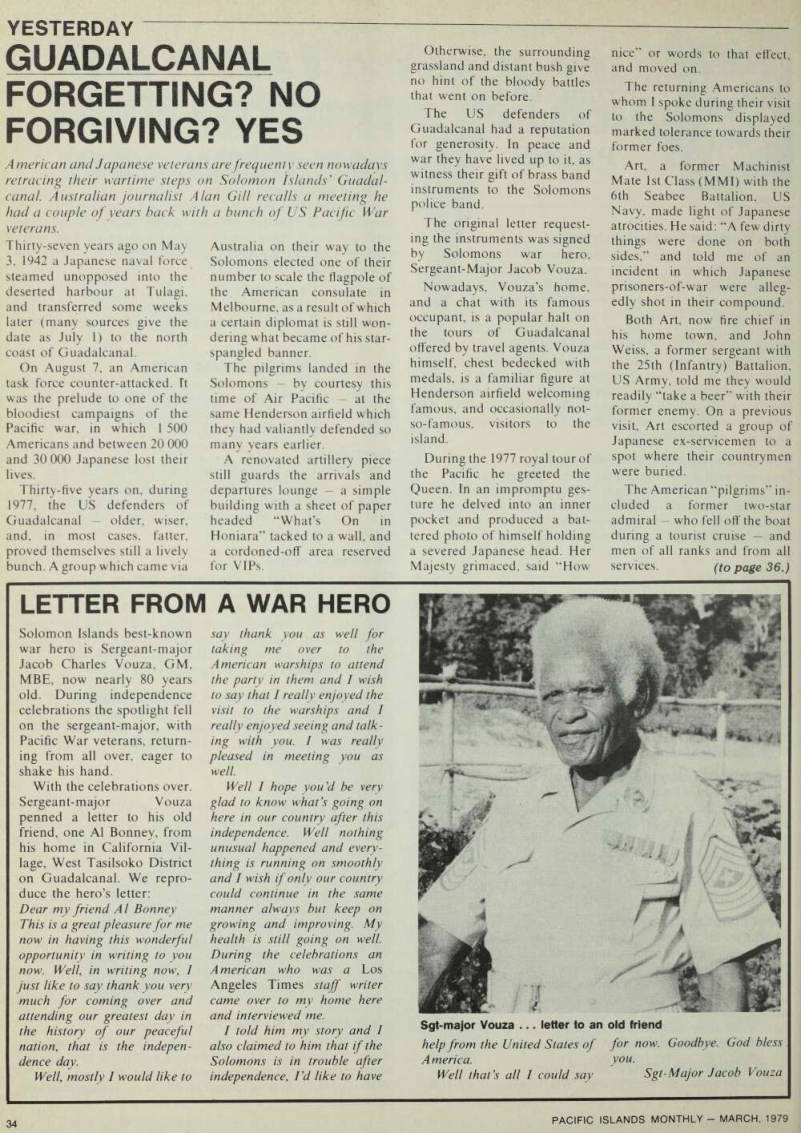


Yesterday
Guadalcanal
Forgiving? Yes
A merican and Japanese veterans are frequenty seen nowadays retracing their wartime steps on Solomon Islands' Guadal canal. Australian journalist Alan Gill recalls a meeting he had a couple of years back with a bunch of US Pacific War veterans.
Thirty-seven years ago on May 3, 1942 a Japanese naval force steamed unopposed into the deserted harbour at Tulagi, and transferred some weeks later (many sources give the date as July 1) to the north coast of Guadalcanal.
On August 7, an American task force counter-attacked. Ft was the prelude to one of the bloodiest campaigns of the Pacific war, in which 1 500 Americans and between 20 000 and 30 000 Japanese lost their lives.
Thirty-five years on, during
1977, the US defenders of Guadalcanal older, wiser, and, in most cases, fatter, proved themselves still a lively bunch. A group which came via
Australia on their way to the Solomons elected one of their number to scale the flagpole of the American consulate in Melbourne, as a result of which a certain diplomat is still won dering what became of his star spangled banner.
The pilgrims landed in the Solomons by courtesy this time of Air Pacific at the same Henderson airfield which they had valiantly defended so many years earlier.
A renovated artillery piece
still guards the arrivals and
departures lounge a simple
building with a sheet of paper headed “What’s On in Honiara” tacked to a wall, and a cordoned-off area reserved for VIPs.
Otherwise, the surrounding grassland and distant bush give no hint of the bloody battles that went on before.
The US defenders of Guadalcanal had a reputation for generosity. In peace and war they have lived up to it, as witness their gift of brass band instruments to the Solomons
police band.
The original letter request ing the instruments was signed by Solomons war hero, Sergeant-Major Jacob Vouza.
Nowadays, Vouza’s home, and a chat with its famous occupant, is a popular halt on the tours of Guadalcanal offered by travel agents. Vouza himself, chest bedecked with medals, is a familiar figure at Henderson airfield welcoming famous, and occasionally not so-famous, visitors to the island.
During the 1977 royal tour of the Pacific he greeted the Queen. In an impromptu ges ture he delved into an inner pocket and produced a bat tered photo of himself holding a severed Japanese head. Her
Majesty grimaced, said “How
nice” or words to that effect, and moved on.
The returning Americans to whom I spoke during their visit to the Solomons displayed marked tolerance towards their former foes.
Art, a former Machinist Mate Ist Class (MMI) with the 6th Seabee Battalion. US Navy, made light of Japanese atrocities. He said; “A few dirty things were done on both sides,” and told me of an incident in which Japanese prisoners-of-war were alleg edly shot in their compound.
Both Art, now fire chief in his home town, and John Weiss, a former sergeant with the 25th (Infantry) Battalion, US Army, told me they would readily “take a beer” with their former enemy. On a previous visit. Art escorted a group of Japanese ex-servicemen to a spot where their countrymen were buried.
The American “pilgrims” in cluded a former two-star admiral who fell off the boat during a tourist cruise and men of all ranks and from all
services.
(to page 36.)
I was educated in the ways and customs of the Seabees by Art, and by Jim Trainer, from Cuba. Missouri, a former chief ship fitter with the 6th Seabee Battalion; his companion, Edward Anderson, a former Machinist Mate 2nd Class, from Omaha, Nebraska ribbed by his friends for his re semblance to an actor in the TV series “My Favourite Mar tian”; and Elmer Sommer, from Stone Lake, Wisconsin, formerly a gunner Ist class in the 26th Seabee Battalion.
Seabees were, certainly in the early stages, an all volunteer force of, in the main, older men whose technical skills were in great demand.
The term Seabee is derived from the initials CB Con struction Battalion, US Navy.
Its members had another term - “Confused bastards” to match the initials.
However, my contacts with the Seabees were as nothing to the friendship and cheer 1 received from John Weiss,
from Indianapolis, whose story was among the strangest of all.
One day in September, 1942, John and other members of his platoon were led to a cave where they had been told Japanese troops were in hid
ing.
There was a flash which is all John remembers. He woke up several days later, minus a
leg, in a military hospital Tn
Wellington, New Zealand.
John told me: “1 suppose the older we get the more sen timental we become. I have wanted for years to come back and find the spot where it hap
pened.”
He came well-armed with ordnance survey and other maps to assist him in his search.
As luck would have it he found a former scout who knew the cave. The same man had led one of eight Japanese survivors of the incident to the same spot a year earlier.
After it was all over 1 had a drink with John Weiss in
Honiara’s Hotel Mendana.
“Last night I lay awake for hours wondering ‘when the time comes would you really know the spot if you saw it?’ ”
He would now like to meet
the eight Japanese survivors.
“There’s no point in bitterness.
Us peasants are called in to do the dirty work fixed by govern ments. How you feel about it doesn’t change the outcome.”
John now works full-time for a disabled ex-servicemen’s as sociation which helps veterans with compensation and other benefit claims, and assists in the welfare and education of their children.
In front of the Hotel Men dana stands a tree used by Japanese snipers as a vantage point. Within a few metres of the hotel are roadside notices,
generally inserted discreetly
among flowerbeds, proclaim ing various landmarks and dates in the savage fighting in
this now tranquil setting.
Many of the returning
Americans were surprised at
the motor traffic and other “advances” on the island. John Weiss told me in mock horror “Why, it took me 10 minutes just to cross the road.”
Today the war is remem bered not only in travel agents’
outings to Sergeant-Major
Vouza and the “war museums” which have sprouted in resi dents’ gardens, but in the sur vival of certain songs there is a pidgin number called “Japani ha! ha! and a fond ness for American chewing gum.
At Honiara’s Point Cruz cin ema I saw an advertisement which stated; PK tru lang altogeta tais (PK’s taste lasts
longer).
The Japanese, also, have their pilgrimages and mem orials. A simple monument on Mount Austin, Guadalcanal, is inscribed in Japanese and English. The latter version states in a creditable effort at English: “This is a memorial of all country’s unknown soldiers died on these fields during the war.”
Letter From A War Hero
Solomon Islands best-known war hero is Sergeant-major Jacob Charles Vouza, GM, MBE, now nearly 80 years
old. During independence
celebrations the spotlight fell on the sergeant-major, with Pacific War veterans, return ing from all over, eager to shake his hand.
With the celebrations over.
Sergeant-major Vouza
penned a letter to his old
friend, one A 1 Bonney, from
his home in California Vil lage, West Tasilsoko District on Guadalcanal. We repro duce the hero’s letter: Dear my friend AI Bonney This is a great pleasure for me now in having this wonderful opportunity in writing to you now. Well, in writing now, I just like to say thank you very much for coming over and attending our greatest day in
the history of our peaceful
nation, that is the indepen
dence day.
Well, mostly I would like to
say thank you as well for taking me over to the American warships to attend the party in them and I wish to say that I really enjoyed the visit to the warships and I really enjoyed seeing and talk ing with you. I was really pleased in meeting you as well.
Well I hope you'd be very glad to know what’s going on here in our country after this independence. Well nothing unusual happened and every thing is running on smoothly and I wish if only our country could continue in the same manner always but keep on growing and improving. My health is still going on well.
During the celebrations an American who was a Los
Angeles Times staff writer
came over to my home here and interviewed me.
I told him my story and I also claimed to him that if the Solomons is in trouble after independence, I’d like to have
help from the United States of for now. Goodbye. God bless A merica. you.
Well that's all I could say Sgt-Major Jacob Vouza
Sgt-major Vouza ... letter to an old friend
Advertisements & other items, pp. 35-40 (2 items)
"high performance.”
Only Pioneer could call its
lowest priced receiver
PM f c (T f f f m C r»to^ een sx 580 Our SX-580 stereo receiver is not the best model we make. It’s not our second best, either. But, even coming from the bottom of our line, Pioneer’s SX-580 offers some of the same features that are found on our more powerful and costlier models.
The SX-580 delivers a continuous power output of 20 watts per channel, minimum at 8 ohms from 20 to 20,000 Hz with no more than 0.3% total harmonic distortion. And like its higher priced cousins, the SX-580 has twin power meters enabling you to precisely control power output to your speakers.
Just as important, it has the sophistication to easily handle that power and give the listener maximum control over sound reproduction. Such features as two low-noise transistors in the phono equalizer to achieve wide dynamic range, RIAA equalization accuracy within ±0.5d8 and individual clickstopped controls for bass and treble.
The FM section gets you where the sounds are through a dual-gate MOS FET and 3-gang variable capacitor to increase sensitivity and selectivity, plus an exclusive Pioneer 1C for dependable performance. Also there is an automatic FM pilot signal canceller to prevent even the slightest amount of interference from the 19kFlz pilot signal.
All in all, the Pioneer SX-580 is the receiver we recommend for those who only want to buy what they really need.
So, in this case, starting at the bottom means you get top musical enjoyment.
dDPIOIMEER
Pioneer products are available through: TeTS'-Ibn 0 " 66 ' Marketin 9 Service R y- Ltd., RO. Box 317, Mordialloc, Victoria, 3195 Rii islands: Brijlal & Company. G.P.O. Box No. 362, Suva, Fiji Islands Tel 22258 t 5. 76?gS? : 310 Marketin 9 Ltd • Maidstone Street. Auckland, New Zealand w! rf °w If*"* ® UmS (Norfolk lsland > Ltd • Norfolk Island. South Pacific New Hebrides: Burns Philp (New Hebrides) Ltd., Vila, New Hebrides Nauru Island: Jacob Enterprises, PO. Box No. 4 Republic of Nauru Tahiti: Els. PERFECT, B P. 594, Papeete, Tahiti Tel: 20 407 New Caledonia; Menard Freres Ville, B.P H 2 Cedex, Noumea, New Caledonia Tel: 27.5 i TeT&^S&T 03 Traspac Corporation, PO. Box 1477. Pago Pago, American Samoa 96 Rarotonga: South Seas International Ltd., PO Box 49, Rarotonga Cook Islands Tel 23 Papua New Guinea; Bali Marrhantc Ptv, itn do cmo n . .
Houseman Service to Industry
I*
Boiler systems
The highest standard of Water Treatment is essential.
For both external and Internal water needs, Houseman Hegro has an unrivalled range and coupled with our dosing and control equipment ensures trouble free and efficient boiler systems operation.
Other Requirements
Potable Water Supplies
Sewage & Effluent
Industrial Water
Reverse Osmosis
Ultra-filtration,Chemical Dosing
Demineralisers. Softeners, Etc. etc.
IN SHORT - - - TOTAL SERVICE.
Cooling systems
Corrosion, scale deposition and microbiological growth can seriously reduce the efficency of cooling systems and with inadequate treatment can ultimately cause shutdowns and consequent loss of production.
The Houseman Hegro range of chemical treatments are specifically formulated to suit any conditions of water and cooling system design, whether open or closed.
Air Conditioning Systems
Air conditioning systems are becoming increasingly sophisticated. Houseman Hegro's technology and experience have kept pace with this progress so that we provide a total range of treatments for the prevention and control of scale, corrosion and biological contamination within all the complex open and closed water circuits of the modern plant.
Portals
Portals Water Treatment (NZ) Ltd P.O. Box 13-558. Auckland 6, New Zealand Candy House. 11 Spring Street. Onehunga. Auckland Telephone: 661-079 (7 lines) Telex: NZ 21175 Telegrams: Portals Auckland.
PCI-PATERSON CANDY. PERMUTIT. BOBY. STELLA-META
PORTACEL* HOUSEMAN - ALL PORTALS GROUP.
We’ve made the
world of difference
to Tonga’s communications.
With the opening of the Cable & Wireless earth station, the people of Tonga can enjoy the benefits of the fastest, most efficient and reliable telephone, telex and telegraph links to the rest of the world. Via satellite.
At Cable & Wireless we have over a century of experience in the design, installation and maintenance of communications systems throughout the world. To date we have been involved with over 30 earth stations, each designed to meet their individual climatic and geographic conditions.
So, for more information, do a little communicating yourself. Contact us. £ 1 HeadO
& Wireless
oftoday’s communications.
Tonga.
Jds Road, London WCM |R X. Tel: 01-242 4433 Telex 23181
% ■i- '"-'i - ' ..i.* ...
. I JST ;;- :
... : - ■ i* ■ . i- . ■M pP -» m ?'•■ .« I f *ot W%
k rt 4
- 4 * -.5%
I #., |B J
«r~,. c % sb*®*' ' ■ ««
IBP’
r 4 The Toyota truck range. Built to be unbeatable.
Bad weather conditions, no problem.
Bad roads and driving surfaces, eaten up.
Difficult loads, no contest. Built tough. Built to take it.
There's a Toyota truck built for you.
TOYOTA Land Cruiser Pickup
TOYOTA Dyna
TOYOTA Stout TOYOTA Toyo-Ace -‘l!
lil
TOYOTA Hi-Lux
TOYOTA Truck
TOYOTA
For unbeatable after service: PAPUA NEW GUINEA; ELA MOTORS LIMITED, Scratchley Rd„ Badili, P.O. Box 75, Port Moresby. U.S. TRUST TERRITORY: MICROL CORPORATION, nr! ?T X r. 26 J^ Sa .'^t n -.' U ' ,SLANDS: AUTOMOTIVE SUPPLIES CO., LTD., G.P.O. Box 355, Suva. AMERICAN SAMOA; BURNS PHILP (SOUTH SEA) on'cT e'iiofV 057, Pa9 ° Pa 9° VVESTERN SAMOA: BURNS PH I LP (SOUTH SEA) LTD., P.O. Box 1 88, Apia. GUAM: ATKINS, KROLL (GUAM) LTD., irn °p X n 4 o 8 ' Ta, ] rlun ' n 9 NEVV HEBRIDES: NEW HEBRIDES MOTORS LTD., P.O. Box 18, Vila SOLOMON ISLANDS; MENDANA ENTERPRISES (5.1.), Pn r °qo B o X 174 ' H °rf.J AHIT,: NIPPON AUTOMOTO, B.P. 342, Papeete. COOK ISLANDS: COOK ISLANDS TRADING CORPORATION LTD.
P.O. Box 92, Rarotonga. NAURU ISLAND: NAURU COOPERATIVE SOCIETY. GILBERT & ELLICE ISLANDS COLONY: Tarawa NORFOLK ISLAND: MARIE'S NORFOLK TOURS, LTD., P.O. Box 276. NEW CALEDONIA: Bairik nu PAriPim ip
TARAWA MOTORS, Box 36,
SOCIETE IMPORTATION AUTOMOBILE
iiiSiii .
L-J- 1 i.'O
@ ss 1 H 1
You’ll like our money-saving
ways to speed products.
Import or export, quicker, but safer the faster you move too. Talk Air Cargo merchandise, the less convenience it can cost. Air Cargo and savings with does it not only Air New Zealand. air new zeai The economic move.
ANZ 78/6
Pacific Iri Amds Mfimtmi V _ Maoru 107 Q
PACIFIC IRI AMDS MfIMTMI V MAoru 107 Q
Wendt lives up
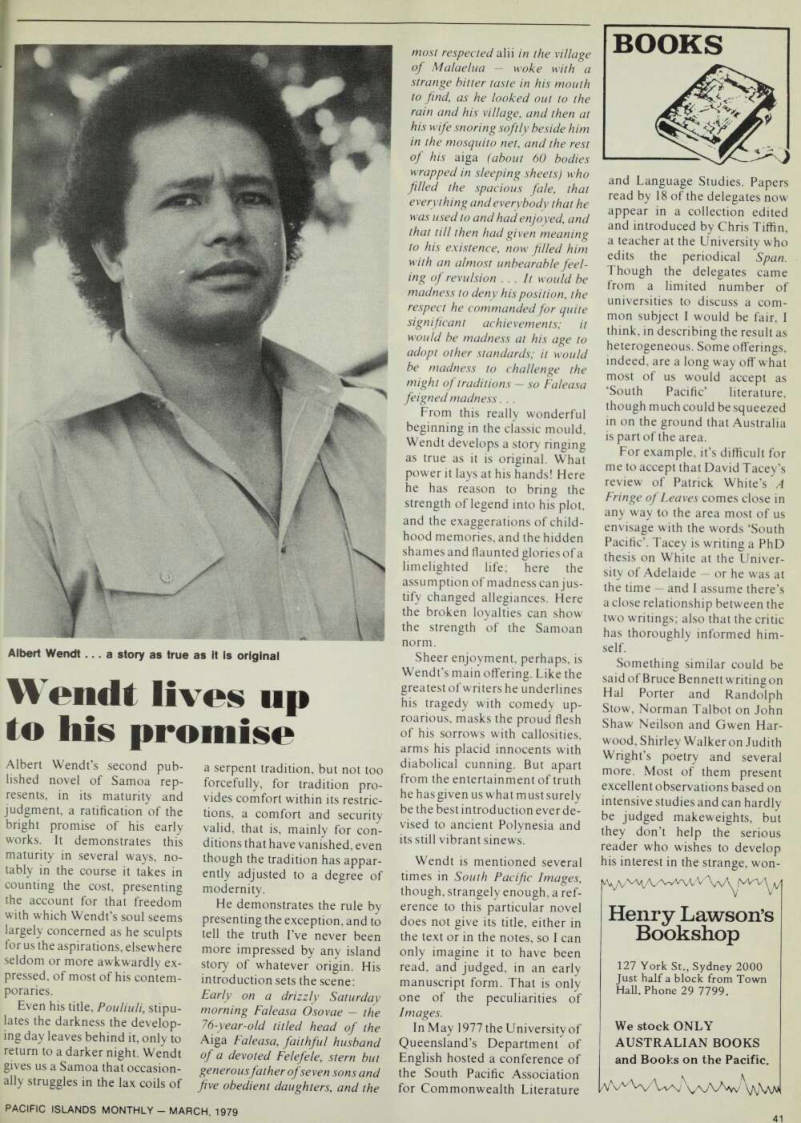
Books
Wendt lives up to his promise
Albert Wendt’s second pubfished novel of Samoa represents, in its maturity and judgment, a ratification of the bright promise of his early works. It demonstrates this maturity in several ways, notably m the course it takes in
counting the cost, presenting
the account for that freedom with which Wendt’s soul seems largely concerned as he sculpts for us the aspirations, elsewhere seldom or more awkwardly expressed, of most of his contemhven his title, Pouliuli, stipulates the darkness the developmg day leaves behind it, only to return to a darker night. Wendt gives us a Samoa that occasionally struggles in the lax coils of
a serpent tradition, but not too forcefully, for tradition pro vides comfort within its restric tions, a comfort and security valid, that is, mainly for con ditions that have vanished, even though the tradition has appar
ently adjusted to a degree of
modernity,
He demonstrates the rule by presenting the exception, and to tell the truth I’ve never been more impressed by any island story of whatever origin. His introduction sets the scene: Early on a drizzly Saturday morning Faleasa Osovae the 76-year-old titled head of the Aiga Faleasa, faithful husband of a devoted Felefele, stern but generous father of seven sons and five obedient daughters, and the
most respected alii in the village of Malaelua woke with a strange bitter taste in his mouth to find, as he looked out to the rain and his village, and then at his wife snoring softly beside him in the mosquito net, and the rest of his aiga (about 60 bodies wrapped in sleeping sheets) who filled the spacious fa/e, that everything and everybody that he was used to and had enjoyed, and that till then had given meaning to his existence, now filled him with an almost unbearable feel ing of revulsion ... It would be madness to deny his position, the respect he commanded for quite significant achievements; it would be madness at his age to adopt other standards; it would be madness to challenge the might of traditions so Faleasa
feigned madness. ..
From this really wonderful beginning in the classic mould, Wendt develops a story ringing as true as it is original. What power it lays at his hands! Here he has reason to bring the
strength of legend into his plot,
and the exaggerations of child hood memories, and the hidden shames and flaunted glories of a limelighted life; here the assumption of madness can jus
tify changed allegiances. Here
the broken loyalties can show the strength of the Samoan norm.
Sheer enjoyment, perhaps, is
Wendt’s main offering. Like the greatest of writers he underlines his tragedy with comedy up roarious, masks the proud flesh of his sorrows with callosities, arms his placid innocents with diabolical cunning. But apart from the entertainment of truth he has given us what must surely be the best introduction ever de vised to ancient Polynesia and its still vibrant sinews.
Wendt is mentioned several times in South Pacific Images,
though, strangely enough, a ref
erence to this particular novel does not give its title, either in the text or in the notes, so I can only imagine it to have been read, and judged, in an early manuscript form. That is only one of the peculiarities of
Images.
In May 1977 the University of Queensland’s Department of English hosted a conference of the South Pacific Association for Commonwealth Literature
and Language Studies. Papers
read by 18 of the delegates now appear in a collection edited and introduced by Chris Tiffin, a teacher at the University who
edits the periodical Span.
Though the delegates came
from a limited number of universities to discuss a com mon subject I would be fair, I think, in describing the result as
heterogeneous. Some offerings,
indeed, are a long way off what most of us would accept as ‘South Pacific’ literature, though much could be squeezed in on the ground that Australia is part of the area.
For example, it’s difficult for me to accept that David Tacey’s review of Patrick White’s A Fringe of Leaves comes close in any way to the area most of us envisage with the words ‘South Pacific’. Tacey is writing a PhD thesis on White at the Univer sity of Adelaide or he was at the time and I assume there’s a close relationship between the two writings; also that the critic has thoroughly informed him self.
Something similar could be said of Bruce Bennett writing on Hal Porter and Randolph Stow, Norman Talbot on John Shaw Neilson and Gwen Har wood, Shirley Walker on Judith Wright’s poetry and several more. Most of them present excellent observations based on intensive studies and can hardly
be judged makeweights, but
they don’t help the serious reader who wishes to develop his interest in the strange, won
Albert Wendt ... a story as true as It is original
derful and exciting back
grounds and developments in
the Islands.
Colonialism, of course, gets a sound rub-a-dub-dub, without much clearance of the slung mud that exaggerates its (cer
tainly plentiful) internal grime.
It was pleasing to note Satendra Nandan, a lecturer from Fiji’s University of the South Pacific,
examining the healing function
of a local and largely indigenous literature in terms of the colonised.
Colonialism has been around a very long time and it hasn’t changed very much as, from the middle distance, Caedmon Cadwallader could testify. We are all of us inheritors of the assets of colonialism as well as its unsettled debits, and colonialism could well be a very happy influence in our history.
For creative writing in itself is a form of revolt, and a revolution ary has to have something to oppose. Out of revolution comes the consciousness of entity, a fact which, for example, the Constitution of the United States recognises and the literature of that country has responded vigorously to this. So it is good to see colonialism as a target for some such capable marksman as Nandan.
In the newer countries a con fusion has emerged between anti-colonialism and the gener ation gap, which is an antagon ism to tradition. Someone should ask, perhaps, whether English literature would ever have risen to its admitted height without England’s many ex
periences of being colonised;
and one can argue at least that its American branch dominated
and still dominates the whole vigorous tree because of the fierce resistance colonialism
engendered there.
Trinidad is also a long way from the South Pacific, but the inheritance of Nandan in Fiji, and of his subject, that great writer V.S. Naipaul in the Caribbean, have similarities, though each is qualified by a very different transplant ex perience. - Olaf Ruhen.
POULIULI. By Albert Wendt. Published by Longman Paul. Hardcover 5A6.95, paper
5A4.95. South Pacific Images. Ed.
Chris Tlflln. Published by the South Pacific Association for Literature and Language Studies. 5A7.50.
Of minor
moiipy
■unitors
Ray Parkinson was a public servant in Fiji for 23 years.
After his death in 1969 a mem orial fund was established to finance a recurrent series of lectures to ‘improve public and official understanding of basic economic principles and their relevance to public policy de cisions’. This book comprises the 1977 lectures plus several other papers which deal with monetary policy in small developing countries. It is edited by the professor of econ omics at the University of the South Pacific.
The book starts with two
articles by David Maynard.
The first a perfectly standard account of monetary policies
(policies influencing the vol
ume, cost and direction of credit) in developed econom ies. The second, dealing with small developing countries,
brings out several important
points. Some monetary policy measures are weak in develop ing countries: for example, the lending policy of the central bank may be of little influence if commercial banks do not borrow from it. On the other hand, direct controls may be very powerful in terms of res training credit because the small size of the economy means that alternative sources of credit do not exist. As the size and sophistication of the financial system grows, this
advantage will disappear. In
general, Maynard concludes,
meaningful monetary policy in
a small developing country is very difficult to achieve.
The next two papers on Fiji’s
Central Monetary Authority
are fairly unexciting but a sum mary of the authority’s credit policy 1976-77 indicates the difficulties of trying to stimu late activity via monetary pol icy while following a liberal
foreign exchange control pol
icy which imposes no limits on current payments.
The manager of Barclays Bank in Suva outlines some of
the operational problems of
profit-seeking organisations in
an environment where
development projects often are
long term and of an uncertain risk. He evaluates four
approaches to increasing pub
lic control over private banks nationalisation, increased local
participation in existing banks,
setting up a local bank in com
petition and through central
bank monetary policy. Not
surprisingly, the writer pushes
for a monetary policy allowing plenty of scope for market forces to operate.
The final narrative paper is
by Secretary of the Ministry of
Finance Savenaca Siwatibau and deals with the fiscal measures (control of taxation and government expenditure) available to meet government objectives. This paper is more incisive than its companions for the simple reason that fiscal policy itself is much more effective. There is an interest ing discussion of the elasticity of Fiji’s tax system (the ability of tax revenue to change more than in proportion to changes in gross domestic product, thus reducing the impact of both re cession and boom).
The editor notes that he be lieves this book is the first deal ing with monetary policy in small developing countries.
The reason for this, of course, is the limited effectiveness on monetary policy in this context and, as several contributors note, its greater influence as a restraining device rather than as an encouragement. Without the last paper linking monetary policy with fiscal policy, the positive contribution of the book would have been fairly small. Whilst it could plausibly be argued that the book has met its objectives, I feel that mention should have been made of policy objectives other than stabilisation and the scope for wages, prices and incomes policy and for exchange rate variations, especially in econ omies so vulnerable to inter national influences. G. T.
Harris, Agricultural Economics Research Unit, Lincoln College, New Zealand.
S. Schavio-Campo (ed) MONETARY POL
Icy In A Small Developing Country,
The Ray Parkinson memorial lectures, 1977, University of the South Pacific, Suva, 1978, 5F4.50.
Advertisements & other items, pp. 41-44 (1 item)
Henry Lawson’s
Bookshop
127 York St., Sydney 2000 Just half a block from Town Hall. Phone 29 7799.
We stock ONLY
AUSTRALIAN BOOKS
and Books on the Pacific.
Airlines spreads its wings
Now weekly flights between Vtestem Samoa
Tonga and New Zealand.
WESTERN SAMOA
For further information see your Travel Agent or write to
, AMERICAN
•SAMOA
G)
POLYNESIAN/AIRUNES
P.O. Box 599, £ Serving the heart of Polynesia Apia, Western Samoa.
AUCKLAND
8230
Trayel the
glands
with PIMS
Mail Order
Bookshop
Pim knows the South Seas.
If you’d like us to introduce you to some of the people and places we know, clip the coupon overleaf . . . oflaagSJMO* of
»C»FIC ISLANDS
hMl oboo*
YEAR
BOOK
7^ w * w iV
Select your books from
this great list of South
Sea titles
□ WINGS OF GOLD. James Sinclair's acclaimed book on how the aeroplane developed New Guinea The true story of frontier pioneering More than 220,000 words, 150 historic photographs. 334 big pages $33, or SUS4O posted □ THE TONGANS. Writer Olaf Ruhen and photographer Jozef Vissel capture the Tongan life style in brilliant prose and 96 sparkling fullcolour pictures $9 00, SUSIO.SO posted □ IMAGES AND ISLANDS: GRASS ROOTS ART OF THE SOLOMONS.
Traditional Solomon Islands designs and art forms, edited by John and Sue Chick. 96 pages, $5.50, or SUS6.SO posted □ GRASS ROOTS ART OF NEW GUINEA. Traditional designs from the north coast of the main island of Papua New Guinea, collected by E F Hannemann $3 50, or SUS 4 50 posted □ THE LOST CARAVEL. Robert Langdon shatters traditional views in this historical whodunnit on early Pacific exploration and its consequences 368 pages. $lB.OO, or $U526.00 posted □ SUVA; A HISTORY AND GUIDE. Albert Schutz, with L G Usher, look at the colourful personalities who lent their names to Suva. An historic browse around Suva Streets 52 pages $4,25 or SUSS 00 posted D PACIFIC ISLAND COOKBOOK. Hundreds of practical recipes using ingredients found in most parts of the South Pacific, including a big section on fish Susan Parkinson and Peggy Stacy also give practical advice on meal planning and kitchen budgeting 120 pages $7 00 or SUSB 50 posted O PACIFIC ISLANDS YEAR BOOK. 13th edition of the standard reference book on all the islands of the Pacific their government, population, statistics, etc Scores of maps Information for tourists, including hotels and tariffs 512 pages $22 50 or SUS 27 00 posted □ PAPUA NEW GUINEA HANDBOOK AND TRAVEL GUIDE. 9th edition For businessmen, schools, libraries, travellers, this guide covers everything you want to know about PNG today. Includes fold-out map 280 pages $8 50, or SUSIO.OO posted □ COLONIAL ERA CEMETERY OF NORFOLK ISLAND. R.N. Dalkin gives a fascinating account of many of the people buried in historic Kingston cemetery Invaluable history and guide 92 pages. $4 00, or SUSS.SO posted D STORY OF THE SOLOMONS. The late Dr. C.E Fox’s simple, lucid outline of the history of the Solomon Islands, Frank and affectionate 88 pages $3.00, or SUS 3 75 posted. 1~l MARINE SHELLS OF THE PACIFIC, Vol 11. Walter Cernohorsky carries on where his first book leaves off, with a further 600 species. His third volume will appear soon, and there are only limited stocks of this one 412 pages $17.00, or $U525.00 posted. □ PERCY CHATTERTON’S PAPUA: DAY THAT I HAVE LOVED. Charming, evocative account of a changing Papua as Rev. Percy Chatterton knew it over 50 years 144 pages $6 00, or SUS 6 50 posted □ LANGUAGE SERIES. Simple introductions to Pacific Island languages SAY IT IN FIJIAN, SAY IT IN FIJI HINDI, SAY IT IN TAHI- TIAN. all $2 50, or $U53.25 posted SAY IT IN MOTU, $2.00, or SUS3.OO posted Mihalic’s INTRODUCTION TO NEW GUINEA PIDGIN, $2 50,
or SUS3.OO
□ COOK ISLANDS POLITICS: THE INSIDE STORY. Fascinating political drama behind the fall of Sir Albert Henry, Written mainly by leading Cook Islanders. $7.50, or SUSB.7S posted □ FOLD-OUT MAP OF PACIFIC ISLANDS. Large and clear, up-to-date, in colour. In plastic envelopes $2.50, or SUS 3 00 posted
PACIFIC PUBLICATIONS’
Mail Order Bookshop
76 Clarence St., Sydney, 2000, or G.P.O. Box 3408, Sydney, Australia 2001.
X-
city/state/country/postcode
Melanesia Today?
What Role For
Religion In
AFTERTHOUGHTS with Percy Chatterton in Port Moresby.
By and large Christian missions in Papua New Guinea have done a good job. They have contributed extensively to the development of the country and have been appreciated by its people. ‘Papua New Guinea is a Christian country’ is a phrase frequently heard from the lips of our leaders and of people generally throughout the country. This is probably because in the earlier years of the colonial period missionaries who came here were sent by the major historic churches of mainstream Christianity.
On the whole, relations between the various missions were good, with a minimum of overlapping and rivalry. There was it would be foolish to deny it - a good deal of animosity between Protestant and Roman Catholic missionaries, an animosity which it took Vatican II to cure us of.
Relations between the missions and the colonial governments were also reasonably good, especially in Papua, though the mis sionaries did not hesitate to criticise and oppose governmental actions which they thought were wrong.
Missions are frequently criticised nowadays for ‘collaboration’ with colonialism. These critics should pause to consider what the alternative to colonialism would have been. Flad the European colonial powers not come into the Pacific during the nineteenth century, the alternative would have been a free go for all the riff raff of Europe, with the gun-power to terrorise the islands people and to murder, rape and blackbird at will. Pioneer missionaries encouraged and supported the colonial administrations because they knew that the alternative to colonial rule was something much worse.
The early years of the twentieth century saw the arrival of some additional missions, notably the Seventh Day Adventists who, while creating a few problems on the religious front, have made a contribution to Papua New Guinean education worthy of the highest praise. Such, in broad terms, was the situation at the out break of the Pacific War in 1942.
After the war, the picture changed in several ways. In the first place, self-governing churches emerged from the work of the older-established missions. The extent of the autonomy so established varied according to the ecclesiastical structure of the ‘parent’ church. In the case of the United Church of Papua New Guinea and the Solomon Islands, with its Methodist/Congrega tionalist background, independence is complete, though the church looks to overseas mission boards to help it in securing such expatriate staff as it still needs, and for some financial assist ance.
In the second place, a number of small missions, in some cases of American origin, began work in Papua New Guinea, par ticularly in the Highlands. Theologically these missions were of the kind usually described as ‘evangelical’, and scripturally most of them would claim to be fundamentalist. A few have, over the years, effected the vital transition from ‘mission’ to ‘church’
Others have not.
The confusion caused by this increase in the number of missions and churches operating in Papua New Guinea has been somewhat re leved by the formation of two ecumenical bodies, the Melanesian Council of Churches and the Evangelical Alliance 1 he former comprises seven of PNG’s larger and older religious bodies, including the Roman Catholic Church. The latter knits together a large number of smaller bodies carrying on religious
work of varying kinds. Relations between these two bodies are cordial and there is some co-operation between them.
Recently, however, something of a furore has been created by the irruption into Papua New Guinea of further new religious groups which differ in important respects both from the major missions of the early colonial period and from the newer missions of the post-war period.
In the main they have been established by expatriates who have secured entry into Papua New Guinea as workers in secular occu pations and who carry on their religious work in their spare time.
Their appeal is generally a highly emotional one of the kind vari ously described as ‘charismatic’ or ‘pentecostal’.
Now while there is an emotional element in religion, as there is in nationalism, dire results can in either case ensue to individuals, communities and nations when the emotions get out of hand.
When I hear of teenage high school girls weeping all night over their sins, I find myself wondering whether they are really all that wicked, and, if they are, whether in between their lachryma tory exercises they are trying as hard as they might to abandon their wickedness and amend their lives.
I do not doubt that some of the phenomena that occur at the meetings of these groups are expressions of genuine religious ex perience. But some of them have an uncomfortable resemblance to the kind of hysteria evoked in their fans by pop singers.
What to do about it? A seminar was recently held at the Univer sity of Papua New Guinea on these issues and some quite horrify
ing suggestions were made.
An administrative secretary wanted the government to ‘stop churches from manipulating the people’. Fair enough if we also stop politicians, and for that matter administrative secretaries too, from being allowed to manipulate the people. In passing it may be explained that administrative secretaries are the successors to the district commissioners who, in their heyday, were champion
people-manipulators.
The same administrative secretary wanted the government ‘to set guidelines for the churches so that they will work in line with policies of the government’.
It has, of course, been the aim of dictators throughout the ages, from the pre-Christian divine emperors down to Hitler and his German Christians’ to make religion subservient to the state. But in a Christian democracy, which Papua New Guinea claims to be, the church should be the conscience of the nation, not the lackey of its government.
But the issue, perhaps, goes deeper. Is religion the expression of the religious life of the community, or is it a matter of the relationship between an individual and his or her god?
Traditionally in Melanesia, as in ancient Israel, religion was an activity of the community, and non-conformists got short shrift. The people of Papua New Guinea have tended to carry over into their Christianity the idea of religion as a community activity, and the historic missions, and the churches which have grown out of them, seem to have, tacitly if not explicitly, gone along with this idea. So we now have a (national) Lutheran bishop complaining of‘harassment by minority religious sects of villagers in Lutheran-dominated areas’, and that freedom of religion as established under the constitution ‘served as a passport for new religious groups into areas already covered by other churches’.
Clearly he is thinking of religion as a community activity rather than as an individual faith.
This view of religion is of course hotly contested not only by the charismatics and the pentecostalists but also by the evan gelicals who constantly exhort people to ‘accept Christ as their personal saviour’.
The present crisis, if it may be called so, in Papua New Guinean Christianity may well be one aspect of the confrontation between communalism and individualism in present-day Melanesian
society.
Advertisements & other items, p. 46 (1 item)
developing the
n.' -# vs *r
wheel loaders
Throughout the Pacific Islands you will find CATERPILLAR working to develop the land.
Caterpillar wheel loaders are among those machines. They are dependable, with the adjustment-free Cat diesel engine, rugged planetary power shift transmission and long-life sealed hydraulic system to keep you working.
Caterpillar wheel loaders give you 4-wheel drive, articulated steering and caliper disc brakes to get you in, out and around, fast. You can rely on Caterpillar to get the job done economically and efficiently.
HASTINGS DEERING
BA 10451
LAE :
Milford Haven Road, Telephone 42 2355
PORT MORESBY :
Telephone 256650
BOUGAINVILLE :
Itakara Industrial Park, Arawa. Telephone 959077
PLUS
All CATERPILLAR equipment is backed by CAT PLUS service. CAT PLUS is a package of programmes designed to help you protect your investments and get the maximum return on your machines. CAT PLUS is the most comprehensive service programme available. .. .anytime, anywhere.
When you invest in CATERPILLAR equipment you have the full backing of your CAT Dealer and
CAT PLUS.
0 SUVA : Carpenter Street, Raiwai.
Private Mail Bag, GPO Suva. Fiji. Ph. 381622, Telex FJ2190 Cables CARPTRAC LAUTOKA : Veitari. Telephone 61877 LABASA : Vulovi, Telephone 81888
YOUR
CATERPILLAR
DEALER
Caterpillar. Cat and IB are Trademarks of Caterpillar Tractor Co.
Thursday Island
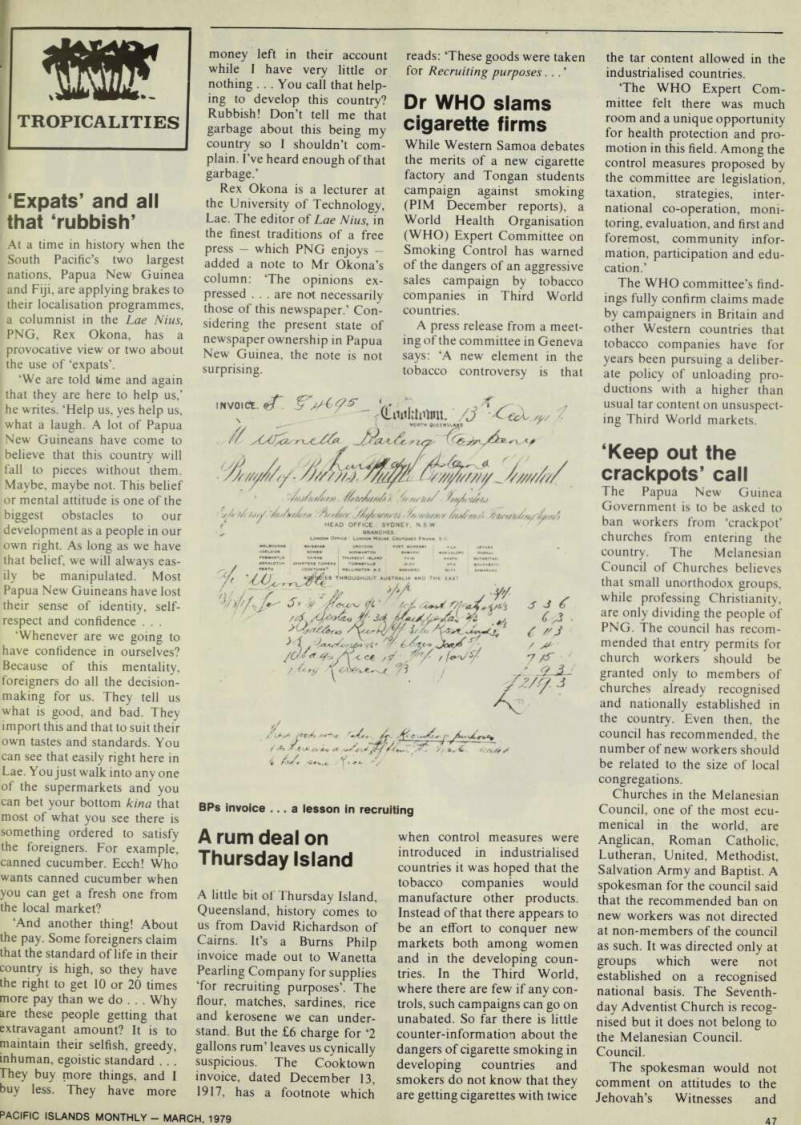

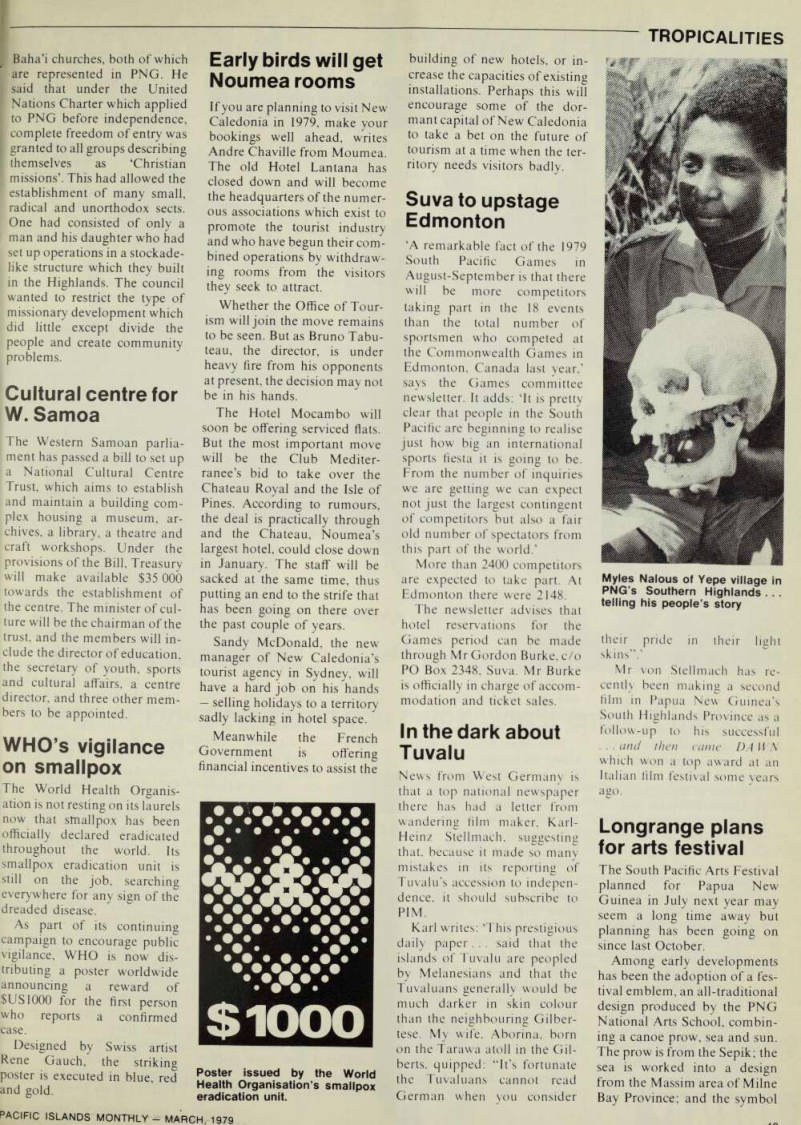
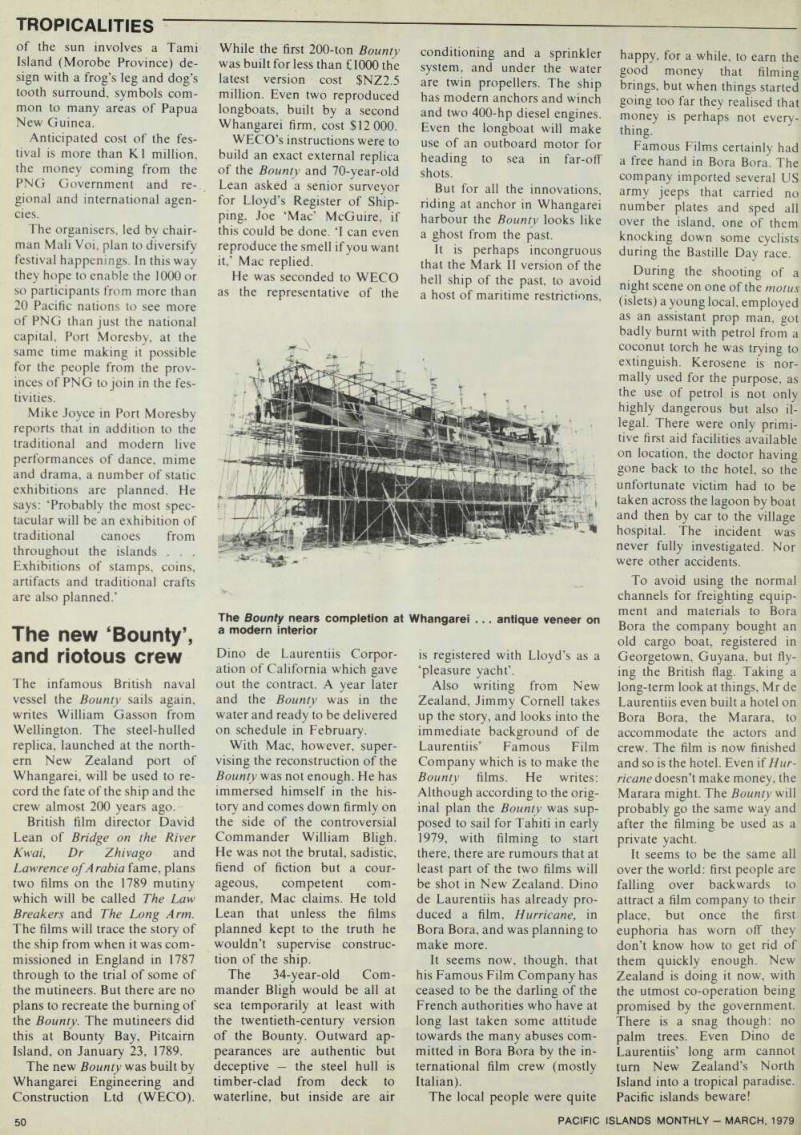
Tropicalities
‘Expats’ and all
that ‘rubbish’
At a time in history when the South Pacific’s two largest nations, Papua New Guinea and Fiji, are applying brakes to their localisation programmes, a columnist in the Lae Nius, PNG, Rex Okona, has a provocative view or two about the use of ‘expats’. ‘We are told time and again that they are here to help us,’ he writes. ‘Help us, yes help us, what a laugh. A lot of Papua New Guineans have come to believe that this country will fall to pieces without them.
Maybe, maybe not. This belief or mental attitude is one of the biggest obstacles to our development as a people in our own right. As long as we have that belief, we will always eas
ily be manipulated. Most
Papua New Guineans have lost their sense of identity, self
respect and confidence . . .
‘Whenever are we going to have confidence in ourselves?
Because of this mentality, foreigners do all the decision making for us. They tell us what is good, and bad. They import this and that to suit their own tastes and standards. You can see that easily right here in Lae. You just walk into any one of the supermarkets and you can bet your bottom kina that most of what you see there is
something ordered to satisfy
the foreigners. For example,
canned cucumber. Ecch! Who wants canned cucumber when you can get a fresh one from the local market? ‘And another thing! About the pay. Some foreigners claim that the standard of life in their
country is high, so they have
the right to get 10 or 20 times more pay than we do . . . Why
are these people getting that
extravagant amount? It is to
maintain their selfish, greedy,
inhuman, egoistic standard . . .
They buy more things, and I
buy less. They have more
money left in their account while I have very little or nothing . . . You call that help
ing to develop this country?
Rubbish! Don’t tell me that garbage about this being my country so I shouldn’t com plain. I’ve heard enough of that
garbage.’
Rex Okona is a lecturer at
the University of Technology,
Lae. The editor of Lae Nius , in the finest traditions of a free press which PNG enjoys added a note to Mr Okona’s column: ‘The opinions ex pressed ... are not necessarily those of this newspaper.’ Con sidering the present state of
newspaper ownership in Papua
New Guinea, the note is not
surprising.
reads: ‘These goods were taken for Recruiting purposes . . . ’
Dr WHO slams
cigarette firms
While Western Samoa debates the merits of a new cigarette factory and Tongan students campaign against smoking (PIM December reports), a World Health Organisation (WHO) Expert Committee on Smoking Control has warned of the dangers of an aggressive sales campaign by tobacco companies in Third World countries.
A press release from a meet ing of the committee in Geneva says: ‘A new element in the tobacco controversy is that
A rum deal on
Thursday Island
A little bit of Thursday Island, Queensland, history comes to us from David Richardson of Cairns. It’s a Burns Philp invoice made out to Wanetta Pearling Company for supplies ‘for recruiting purposes’. The flour, matches, sardines, rice and kerosene we can under stand. But the £6 charge for ‘2 gallons rum’ leaves us cynically suspicious. The Cooktown invoice, dated December 13, 1917, has a footnote which
when control measures were introduced in industrialised countries it was hoped that the tobacco companies would manufacture other products.
Instead of that there appears to be an effort to conquer new markets both among women and in the developing coun tries. In the Third World, where there are few if any con trols, such campaigns can go on unabated. So far there is little counter-information about the dangers of cigarette smoking in developing countries and smokers do not know that they are getting cigarettes with twice
the tar content allowed in the industrialised countries. ‘The WHO Expert Com mittee felt there was much room and a unique opportunity for health protection and pro motion in this field. Among the control measures proposed by the committee are legislation, taxation, strategies, inter national co-operation, moni toring, evaluation, and first and foremost, community infor mation, participation and edu cation.’
The WHO committee’s find ings fully confirm claims made by campaigners in Britain and other Western countries that tobacco companies have for years been pursuing a deliber ate policy of unloading pro ductions with a higher than usual tar content on unsuspect ing Third World markets.
‘Keep out the
crackpots’ call
The Papua New Guinea Government is to be asked to ban workers from ‘crackpot’ churches from entering the country. The Melanesian Council of Churches believes that small unorthodox groups,
while professing Christianity,
are only dividing the people of PNG. The council has recom mended that entry permits for church workers should be granted only to members of churches already recognised and nationally established in the country. Even then, the council has recommended, the number of new workers should be related to the size of local congregations.
Churches in the Melanesian Council, one of the most ecu menical in the world, are Anglican, Roman Catholic, Lutheran, United, Methodist, Salvation Army and Baptist. A spokesman for the council said that the recommended ban on new workers was not directed at non-members of the council as such. It was directed only at groups which were not established on a recognised national basis. The Seventh day Adventist Church is recog nised but it does not belong to the Melanesian Council.
Council.
The spokesman would not comment on attitudes to the Jehovah’s Witnesses and
BPs invoice ... a lesson in recruiting
j Baha’i churches, both of which are represented in PNG. He [ said that under the United [ Nations Charter which applied I to PNG before independence, I complete freedom of entry was
I granted to all groups describing
[ themselves as ‘Christian ’ missions’. This had allowed the [ establishment of many small, radical and unorthodox sects.
One had consisted of only a f man and his daughter who had set up operations in a stockade like structure which they built in the Highlands. The council wanted to restrict the type of
missionary development which
did little except divide the
people and create community
problems.
Cultural centre for
W. Samoa
I The Western Samoan parlia ment has passed a bill to set up a National Cultural Centre Trust, which aims to establish and maintain a building com plex housing a museum, ar chives, a library, a theatre and craft workshops. Under the provisions of the Bill, Treasury will make available $35 000 towards the establishment of the centre. The minister of cul ture will be the chairman of the trust, and the members will in clude the director of education, the secretary of youth, sports and cultural affairs, a centre director, and three other mem bers to be appointed.
WHO’s vigilance
on smallpox
The World Health Organis ation is not resting on its laurels now that smallpox has been officially declared eradicated throughout the world. Its smallpox eradication unit is still on the job, searching everywhere for any sign of the dreaded disease.
As part of its continuing campaign to encourage public vigilance, WHO is now dis tributing a poster worldwide announcing a reward of SUSIOOO for the first person who reports a confirmed case.
Designed by Swiss artist
Rene Gauch, the striking poster is executed in blue, red
and gold.
Early birds will get
Noumea rooms
If you are planning to visit New Caledonia in 1979, make your bookings well ahead, writes Andre Chaville from Moumea.
The old Hotel Lantana has closed down and will become the headquarters of the numer ous associations which exist to promote the tourist industry and who have begun their com bined operations by withdraw ing rooms from the visitors they seek to attract.
Whether the Office of Tour ism will join the move remains to be seen. But as Bruno Tabu teau, the director, is under heavy fire from his opponents at present, the decision may not be in his hands.
The Hotel Mocambo will soon be offering serviced flats.
But the most important move will be the Club Mediter ranee’s bid to take over the Chateau Royal and the Isle of Pines. According to rumours, the deal is practically through and the Chateau, Noumea’s largest hotel, could close down in January. The staff will be sacked at the same time, thus putting an end to the strife that has been going on there over the past couple of years.
Sandy McDonald, the new manager of New Caledonia’s tourist agency in Sydney, will have a hard job on his hands
selling holidays to a territory
sadly lacking in hotel space.
Meanwhile the French Government is offering financial incentives to assist the
building of new hotels, or in crease the capacities of existing installations. Perhaps this will encourage some of the dor mant capital of New Caledonia to take a bet on the future of tourism at a time when the ter
ritory needs visitors badly.
Suva to upstage
Edmonton
‘A remarkable fact of the 1979 South Pacific Games in August-September is that there will be more competitors taking part in the 18 events than the total number of sportsmen who competed at the Commonwealth Games in Edmonton, Canada last year,’ says the Games committee newsletter. It adds: ‘lt is pretty clear that people in the South Pacific are beginning to realise just how big an international sports fiesta it is going to be.
From the number of inquiries we are getting we can expect
not just the largest contingent
of competitors but also a fair old number of spectators from this part of the world.’
More than 2400 competitors are expected to take part. At Edmonton there were 2148.
The newsletter advises that hotel reservations for the Games period can be made through Mr Gordon Burke, c/o PO Box 2348, Suva. Mr Burke is officially in charge of accom modation and ticket sales.
In the dark about
Tuvalu
News from West Germany is that a top national newspaper there has had a letter from wandering film maker. Karl- Heinz Stellmach. suggesting that, because it made so many mistakes in its reporting of Tuvalu’s accession to indepen dence, it should subscribe to
Pim.
Karl writes: ‘This prestigious daily paper . . . said that the islands of Tuvalu are peopled by Melanesians and that the Tuvaluans generally would be much darker in skin colour than the neighbouring Gilber tese. My wife. Aborina. born on the Tarawa atoll in the Gil berts. quipped: “It’s fortunate the Tuvaluans cannot read German when you consider
their pride in their light skins”.' Mr von Stellmach has re cently been making a second film in Papua New Guinea’s South Highlands Province as a follow-up to his successful . and then came DA H A which won a top award at an Italian film festival some years ago.
Longrange plans
for arts festival
The South Pacific Arts Festival
planned for Papua New
Guinea in July next year may seem a long time away but planning has been going on since last October.
Among early developments
has been the adoption of a fes tival emblem, an all-traditional
design produced by the PNG
National Arts School, combin ing a canoe prow, sea and sun.
The prow is from the Sepik; the sea is worked into a design from the Massim area of Milne Bay Province; and the symbol
Poster issued by the World Health Organisation's smallpox eradication unit.
Myles Nalous of Yepe village in PNG’s Southern Highlands . . . telling his people's story
of the sun involves a Tami Island (Morobe Province) de sign with a frog’s leg and dog’s tooth surround, symbols com mon to many areas of Papua New Guinea.
Anticipated cost of the fes tival is more than K 1 million, the money coming from the PNG Government and re gional and international agen cies.
The organisers, led by chair man Mali Voi, plan to diversify festival happenings. In this way they hope to enable the 1000 or so participants from more than 20 Pacific nations to see more of PNG than just the national capital. Port Moresby, at the same time making it possible for the people from the prov inces of PNG to join in the fes tivities.
Mike Joyce in Port Moresby reports that in addition to the traditional and modern live performances of dance, mime and drama, a number of static exhibitions are planned. He says: ‘Probably the most spec tacular will be an exhibition of traditional canoes from
throughout the islands . . .
Exhibitions of stamps, coins, artifacts and traditional crafts are also planned.’
The new ‘Bounty’,
and riotous crew
The infamous British naval vessel the Bounty sails again, writes William Gasson from Wellington. The steel-hulled replica, launched at the north ern New Zealand port of Whangarei, will be used to re cord the fate of the ship and the crew almost 200 years ago.
British film director David Lean of Bridge on the River Kwai, Dr Zhivago and Lawrence of Arabia fame, plans two films on the 1789 mutiny which will be called The Law Breakers and The Long Arm.
The films will trace the story of the ship from when it was com missioned in England in 1787 through to the trial of some of the mutineers. But there are no plans to recreate the burning of the Bounty. The mutineers did this at Bounty Bay, Pitcairn Island, on January 23, 1789.
The new Bounty was built by
Whangarei Engineering and
Construction Ltd (WECO).
While the first 200-ton Bounty was built for less than £lOOO the latest version cost SNZ2.S million. Even two reproduced longboats, built by a second Whangarei firm, cost $l2 000.
WECO’s instructions were to build an exact external replica of the Bounty and 70-year-old Lean asked a senior surveyor
for Lloyd’s Register of Ship
ping, Joe ‘Mac’ McGuire, if this could be done. T can even reproduce the smell if you want it,’ Mac replied.
He was seconded to WECO as the representative of the
Dino de Laurentiis Corpor ation of California which gave out the contract. A year later and the Bounty was in the water and ready to be delivered on schedule in February.
With Mac, however, super vising the reconstruction of the Bounty was not enough. He has immersed himself in the his tory and comes down firmly on the side of the controversial Commander William Bligh.
He was not the brutal, sadistic, fiend of fiction but a cour ageous, competent com mander, Mac claims. He told Lean that unless the films planned kept to the truth he wouldn’t supervise construc tion of the ship.
The 34-year-old Com mander Bligh would be all at sea temporarily at least with the twentieth-century version of the Bounty. Outward ap pearances are authentic but deceptive the steel hull is timber-clad from deck to waterline, but inside are air
conditioning and a sprinkler system, and under the water are twin propellers. The ship has modern anchors and winch and two 400-hp diesel engines.
Even the longboat will make use of an outboard motor for heading to sea in far-off shots.
But for all the innovations, riding at anchor in Whangarei harbour the Bounty looks like a ghost from the past.
It is perhaps incongruous
that the Mark II version of the hell ship of the past, to avoid a host of maritime restrictions,
is registered with Lloyd’s as a
‘pleasure yacht’.
Also writing from New Zealand, Jimmy Cornell takes up the story, and looks into the immediate background of de Laurentiis’ Famous Film Company which is to make the Bounty films. He writes:
Although according to the orig
inal plan the Bounty was sup posed to sail for Tahiti in early 1979, with filming to start there, there are rumours that at least part of the two films will be shot in New Zealand. Dino de Laurentiis has already pro duced a film. Hurricane, in Bora Bora, and was planning to make more.
It seems now, though, that his Famous Film Company has ceased to be the darling of the French authorities who have at long last taken some attitude towards the many abuses com mitted in Bora Bora by the in ternational film crew (mostly Italian).
The local people were quite
happy, for a while, to earn the
good money that filming
brings, but when things started going too far they realised that money is perhaps not every
thing.
Famous Films certainly had a free hand in Bora Bora. The company imported several US army jeeps that carried no number plates and sped all over the island, one of them knocking down some cyclists during the Bastille Day race.
During the shooting of a night scene on one of the motus (islets) a young local, employed as an assistant prop man, got badly burnt with petrol from a coconut torch he was trying to extinguish. Kerosene is nor mally used for the purpose, as the use of petrol is not only highly dangerous but also il
legal. There were only primi
tive first aid facilities available on location, the doctor having gone back to the hotel, so the unfortunate victim had to be taken across the lagoon by boat and then by car to the village hospital. The incident was
never fully investigated. Nor
were other accidents.
To avoid using the normal
channels for freighting equip
ment and materials to Bora Bora the company bought an old cargo boat, registered in
Georgetown, Guyana, but fly
ing the British flag. Taking a
long-term look at things, Mr de Laurentiis even built a hotel on Bora Bora, the Marara, to accommodate the actors and crew. The film is now finished and so is the hotel. Even if Hur ricane doesn’t make money, the Marara might. The Bounty will probably go the same way and after the filming be used as a
private yacht.
It seems to be the same all over the world: first people are falling over backwards to attract a film company to their place, but once the first euphoria has worn off they don’t know how to get rid of
them quickly enough. New
Zealand is doing it now, with
the utmost co-operation being
promised by the government.
There is a snag though: no palm trees. Even Dino de Laurentiis’ long arm cannot turn New Zealand’s North Island into a tropical paradise.
Pacific islands beware!
The Bounty nears completion at Whangarei .. . antique veneer on a modern interior
Advertisements & other items, pp. 48-52 (1 item)
Let Ym Show You
Victa 8 h.p. Tiller
(Model 408). © Independent rear tine and wheel drive transmissions ©5 forward speeds plus reverse ©Chain driven totally enclosed gear boxes ©Nine (9) handle positions instantly adjustable either vertically or horizontally by squeeze trigger © 14" dia. tines - 20" tilling width © Throttle, gear shift and handle adjustment levers are all conveniently located on handle assembly ©Separate transmission levers for tine drive or wheel drive © Instant depth control with spring loaded pin engagement of multi-position depth bar ©Tractor tread tyres combined with front mounted counterweight for maximum traction. OPTIONAL ATTACHMENTS: Hilling Plough: Twin ploughshares adjustable in width and in angle to produce hills or furrows.
Cultivating Points: Four cultivating point assemblies, adjustable in spacing.
NOTE: The above must be used with "A' Frame Assembly and two depth wheels, which are rear mounted.
A BETTER WAT
professional results.
Victa 5 h.p. Tiller (Model 355). Worm drive gear box. Forward speed plus neutral and reverse, and accepting a wide range of optional attachments. 5 h.p. B & S pull-start J 4-stroke engine. Heavy-duty A \ V w Victa 2 h.p. Till-it Tiller (Model 020), Lightweight, portable, compact tiller.
Special features include: 2 h.p. Briggs & Stratton engine with easy pull- © start. Spring steel J? tines adjust to 254 mm (10") or 457 mm (18") cultivating widths. Weight: 27 kg (60 lb).
Victa 3.5 h.p. Tiller (Model 100). Rugged heavy duty model with 3.5 h.p. B & S pull-start 4-stroke engine. Long-life oil filled cast iron gear box. 16 spring $ steel tines 12" diameter adjust from 305 mm (12") to 660 mm (26") cultivating widths. Weight 63 kg (140 lb). Optional attachments: Furrow opener, sweep plough, pneumatic front tyre kit.
see ai
DEALER NOW
FORA
DEMONSTRATION.
Yamaha 85... Three cylinders
for Triple Excitement.
•• T 7 L. * u.
isms
ft!
Whatever kind of boating you enjoy, you’ll enjoy it more with
the Yamaha 85.
The exciting new Yamaha 85 is packed with performance and convenience features to put more fun into any kind of boating. From the specially designed prop to its 1140 cc powerhead, it delivers more than any other outboard in its class.
If you’re a skier, you’ll opt for its awesome, full-throttle power, a full 85hp worth. Pull a whole family at the same time or put the most accomplished slalom expert though his paces. There’s never a hesitation with the 85’s C.D.I. ignition, specially-ported Schnule scavenging system and pefectly tuned carburetion.
For inland and off-shore cruising, the 85 has all the long-range performance and operating eco- From 2 to 85. Power for any purpose.
YAMAHA
» nomy you could ask for. The almost perfectly balanced geometry of its three-cylinder design eliminates vibration for smoother running, while the through-the-prop exhuast and oversize intake silencer and muffler reduce noise to a minimum.
Fishermen will appreciate how much faster it gets them to their favorite fishing ground. And when they get there, the’ll be amazed at the 85’s trolling performance. Yamaha’s famous reed valve intake and specially-slit exhaust ports give the 85 great low-speed performance.
Power, reliability and economy at all speeds and for all boats. It’s your with the Yamaha 85.
Outboard
with
ITT7TTTTI
Total service ...
plumbing supplies
You can get all your needs from one supply source: water taps, valves, copper tube, tools and a host of other fittings and related plumbing equipment for domestic, industrial and multi-storey buildings.
Watson & Crane Pty Ltd have over 20,000 plumbing items in stock at their central warehouse located at Waterloo, NSW, Australia.
Years of experience in handling and shipping right throughout the South Pacific add up to another big reason for you to deal with Watson & Crane Pty Ltd.
Representatives call regularly at Papua New Guinea, the Solomons, New Hebrides and Fiji Islands to personally discuss your requirements and appropriate credit arrangements.
Write, cable or telephone today for complete plumbers' supplies service. !• . « Watson & Crane Pty. Ltd. 1037 Bourke Street, Waterloo,
NSW 2017.
Phone: Sydney 699-1333.
Telex: AA 25548.
Cables: "Watcrane" Sydney.
CRANE
GROUP
Pacific island distributors of Crane Enfield copper tube for water, sanitation, engineering, refrigeration and air conditioning.
WATSON & CRANE
are organised to fulfil your needs
wherever you are in the South Pacific
Getting The
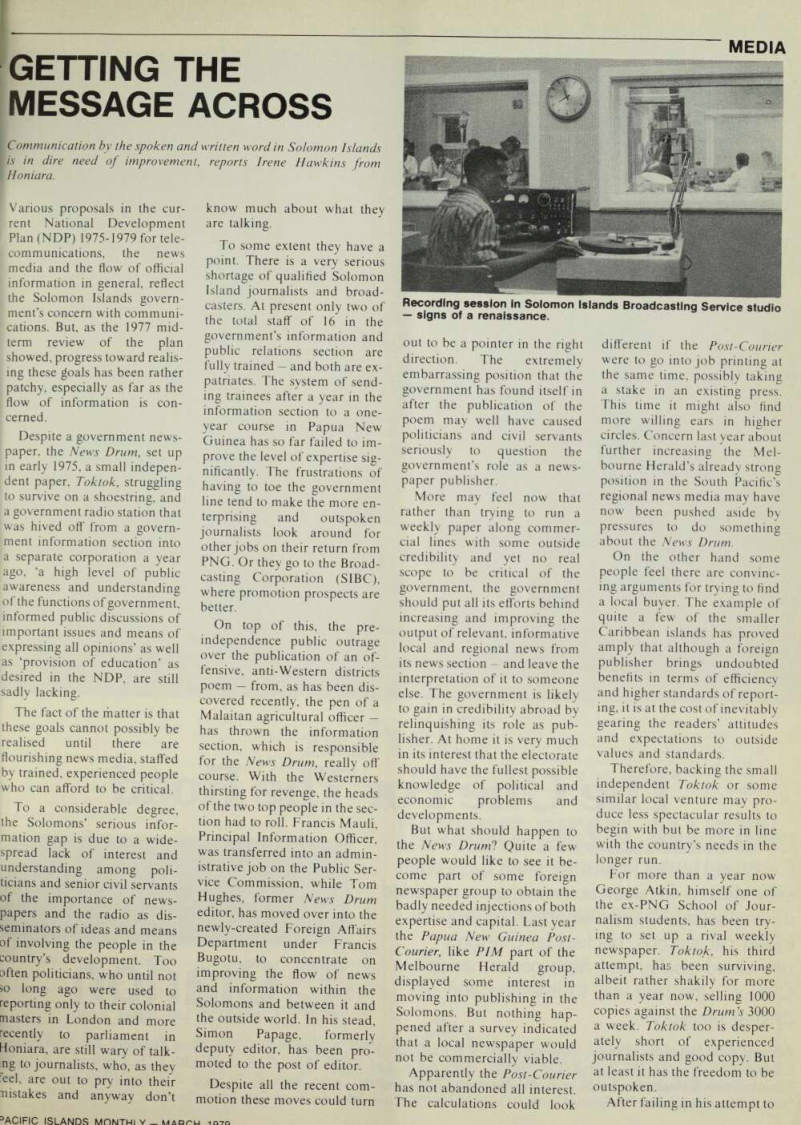
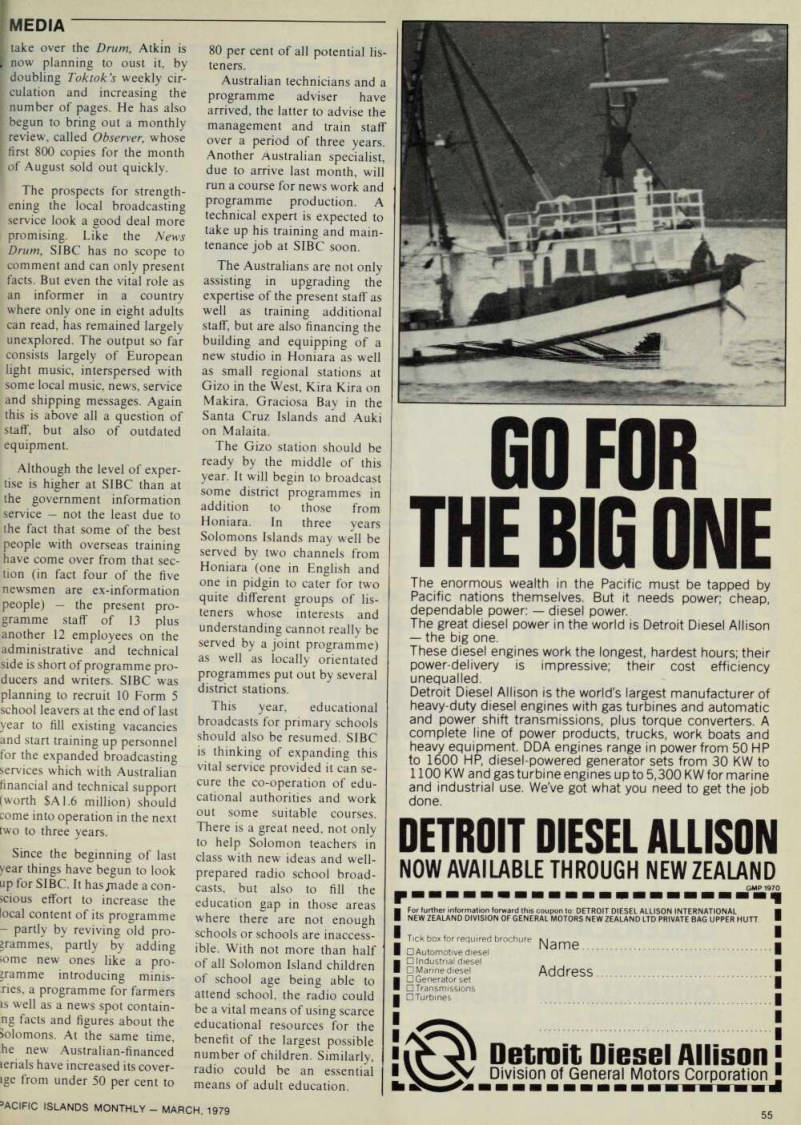
Media
Message Across
Communication by the spoken and written word in Solomon Islands is in dire need of improvement, reports Irene Hawkins from Honiara.
f Various proposals in the cur rent National Development Plan (NDP) 1975-1979 for tele- I communications, the news media and the flow of official information in general, reflect the Solomon Islands govern ment’s concern with communi cations. But, as the 1977 mid term review of the plan showed, progress toward realis ing these goals has been rather patchy, especially as far as the flow of information is con cerned.
Despite a government news paper, the News Drum, set up in early 1975, a small indepen dent paper, Toktok, struggling to survive on a shoestring, and a government radio station that was hived off from a govern ment information section into a separate corporation a year ago, ‘a high level of public awareness and understanding of the functions of government, informed public discussions of important issues and means of expressing all opinions’ as well as ‘provision of education’ as desired in the NDP, are still
sadly lacking.
The fact of the matter is that these goals cannot possibly be realised until there are flourishing news media, staffed
by trained, experienced people
who can afford to be critical.
To a considerable degree, the Solomons’ serious infor mation gap is due to a wide spread lack of interest and
understanding among poli
ticians and senior civil servants of the importance of news papers and the radio as dis seminators of ideas and means
of involving the people in the
country’s development. Too
often politicians, who until not so long ago were used to reporting only to their colonial masters in London and more
recently to parliament in
Honiara, are still wary of talk
ing to journalists, who, as they
"eel, are out to pry into their mistakes and anyway don’t
know much about what they
are talking.
To some extent they have a point. There is a very serious shortage of qualified Solomon Island journalists and broad casters. At present only two of the total staff of 16 in the government’s information and public relations section are fully trained - and both are ex patriates. The system of send ing trainees after a year in the information section to a one year course in Papua New Guinea has so far failed to im prove the level of expertise sig nificantly. The frustrations of having to toe the government line tend to make the more en
terprising and outspoken
journalists look around for other jobs on their return from PNG. Or they go to the Broad
casting Corporation (SIBC),
where promotion prospects are better.
On top of this, the pre
independence public outrage
over the publication of an of fensive, anti-Western districts poem - from, as has been dis covered recently, the pen of a Malaitan agricultural officer has thrown the information section, which is responsible for the News Drum, really off course. With the Westerners thirsting for revenge, the heads of the two top people in the sec tion had to roll. Francis Mauli, Principal Information Officer, was transferred into an admin istrative job on the Public Ser vice Commission, while Tom Hughes, former News Drum editor, has moved over into the
newly-created Foreign Affairs
Department under Francis Bugotu, to concentrate on improving the flow of news and information within the Solomons and between it and the outside world. In his stead,
Simon Papage, formerly
deputy editor, has been pro moted to the post of editor.
Despite all the recent com motion these moves could turn
out to be a pointer in the right direction. The extremely
embarrassing position that the
government has found itself in after the publication of the poem may well have caused politicians and civil servants seriously to question the government’s role as a news
paper publisher.
More may feel now that rather than trying to run a
weekly paper along commer
cial lines with some outside credibility and yet no real scope to be critical of the government, the government should put all its efforts behind
increasing and improving the
output of relevant, informative local and regional news from its news section and leave the interpretation of it to someone else. The government is likely
to gain in credibility abroad by
relinquishing its role as pub lisher. At home it is very much in its interest that the electorate should have the fullest possible knowledge of political and economic problems and
developments.
But what should happen to the News Drum ? Quite a few people would like to see it be come part of some foreign newspaper group to obtain the badly needed injections of both expertise and capital. Last year the Papua New Guinea Post- Courier, like PIM part of the Melbourne Herald group, displayed some interest in moving into publishing in the
Solomons. But nothing hap
pened after a survey indicated that a local newspaper would not be commercially viable.
Apparently the Post-Courier has not abandoned all interest.
The calculations could look
different if the Post-Courier were to go into job printing at the same time, possibly taking a stake in an existing press.
This time it might also find more willing ears in higher circles. Concern last year about further increasing the Mel bourne Herald’s already strong position in the South Pacific’s regional news media may have now been pushed aside by pressures to do something about the News Drum.
On the other hand some people feel there are convinc ing arguments for trying to find a local buyer. The example of quite a few of the smaller Caribbean islands has proved
amply that although a foreign
publisher brings undoubted benefits in terms of efficiency and higher standards of report ing, it is at the cost of inevitably gearing the readers’ attitudes and expectations to outside values and standards.
Therefore, backing the small independent Toktok or some similar local venture may pro duce less spectacular results to begin with but be more in line with the country’s needs in the
longer run.
For more than a year now George Atkin, himself one of the ex-PNG School of Jour nalism students, has been try ing to set up a rival weekly newspaper. Toktok, his third attempt, has been surviving, albeit rather shakily for more than a year now, selling 1000 copies against the Drum’s 3000 a week. Toktok too is desper
ately short of experienced
journalists and good copy. But at least it has the freedom to be
outspoken.
After failing in his attempt to
Recording session In Solomon Islands Broadcasting Service studio - signs of a renaissance.
I take over the Drum, Atkin is now planning to oust it, by
doubling Toktok’s weekly cir
i culation and increasing the j number of pages. He has also t begun to bring out a monthly I review, called Observer, whose first 800 copies for the month j of August sold out quickly.
The prospects for strength
ening the local broadcasting
service look a good deal more promising. Like the News Drum, SIBC has no scope to comment and can only present facts. But even the vital role as an informer in a country where only one in eight adults can read, has remained largely unexplored. The output so far
consists largely of European
light music, interspersed with
some local music, news, service
and shipping messages. Again
this is above all a question of staff, but also of outdated
equipment.
Although the level of exper tise is higher at SIBC than at the government information service not the least due to the fact that some of the best
people with overseas training
have come over from that sec tion (in fact four of the five newsmen are ex-information people) the present pro gramme staff of 13 plus another 12 employees on the administrative and technical side is short of programme pro ducers and writers. SIBC was planning to recruit 10 Form 5 school leavers at the end of last year to fill existing vacancies and start training up personnel
for the expanded broadcasting
services which with Australian financial and technical support (worth SAI.6 million) should come into operation in the next two to three years.
Since the beginning of last
year things have begun to look
up for SIBC. It has/nade a con scious effort to increase the local content of its programme
- partly by reviving old pro
grammes, partly by adding
some new ones like a pro
gramme introducing minis
ries, a programme for farmers is well as a news spot contain ing facts and figures about the Solomons. At the same time, he new Australian-financed terials have increased its cover age from under 50 per cent to
80 per cent of all potential lis teners.
Australian technicians and a programme adviser have arrived, the latter to advise the management and train staff over a period of three years.
Another Australian specialist, due to arrive last month, will run a course for news work and programme production. A technical expert is expected to take up his training and main tenance job at SIBC soon.
The Australians are not only
assisting in upgrading the
expertise of the present staff as well as training additional staff, but are also financing the building and equipping of a new studio in Honiara as well as small regional stations at Gizo in the West, Kira Kira on Makira, Graciosa Bay in the Santa Cruz Islands and Auki on Malaita.
The Gizo station should be ready by the middle of this year. It will begin to broadcast some district programmes in addition to those from Honiara. In three years Solomons Islands may well be served by two channels from Honiara (one in English and one in pidgin to cater for two quite different groups of lis teners whose interests and
understanding cannot really be
served by a joint programme) as well as locally orientated programmes put out by several district stations.
This year, educational broadcasts for primary schools should also be resumed. SIBC is thinking of expanding this vital service provided it can se cure the co-operation of edu cational authorities and work out some suitable courses.
There is a great need, not only to help Solomon teachers in class with new ideas and well prepared radio school broad casts, but also to fill the education gap in those areas where there are not enough schools or schools are inaccess ible. With not more than half of all Solomon Island children of school age being able to attend school, the radio could be a vital means of using scarce educational resources for the benefit of the largest possible number of children. Similarly, radio could be an essential means of adult education.
Advertisements & other items, pp. 53-56 (3 items)
- > ACIFIC ISLANDS MDMTi-11 v _ . y adpu 1 n7n
- > ACIFIC ISLANDS MDMTi-11 v . y adpu 1 n7n
Clarion
The One For The Road
Clarion reliability, proven on the toughest oads and in the hottest weather. Easy-operjtion design, for your convenience and added driving safety. A wide selection of easy-tonstall car stereos, backed by Clarion’s enowned quality and high performance.
Clarion—the best way to listening and driving pleasure.
W \ S* > r-, -10 ■ H « 18 fS CC'.V. 58 .'MI > M < 103 •X» m ij - JT"
FM FM AM AM am
0 Clarion Co., Ltd. Tokyo, Japan PE-758 Australia: Amalgamated Wireless (Australasia) Ltd. 554 Parramatta Road, Ashfield N.S.W., 2131/Ncw Zealand: AWA New Zealand!
Jmited P.O. Box 50-248 Porirua /Fiji Islands: Brijlal & Co., Ltd. G.P.O. Box 362 Suva/Tahiti: ETS Comimpex B.P. 200' ’apeete /New Caledonia: Caldis B.P. Ml Noumea Cedex/Guam: Guam Radio & TV Shop P.O. Box 1939Agana, Guam )6910 /New Hebrides: The Sound Centre P.O. Box 434 Vi la /Cook Islands: South Seas International Ltd. P.O. Box 49 Rarotonga i
IS ■ a as Mi * r 4 r s . : „
GO FOR
THE BIG ONE
The enormous wealth in the Pacific must be tapped by Pacific nations themselves. But it needs power; cheap, dependable power: diesel power.
The great diesel power in the world is Detroit Diesel Allison the big one.
These diesel engines work the longest, hardest hours; their power-delivery is impressive; their cost efficiency unequalled.
Detroit Diesel Allison is the world's largest manufacturer of heavy-duty diesel engines with gas turbines and automatic and power shift transmissions, plus torque converters. A complete line of power products, trucks, work boats and heavy equipment. DDA engines range in power from 50 HP to 1600 HP, diesel-powered generator sets from 30 KW to 1100 KW and gas turbine engines upto 5,300 KW for marine and industrial use. We’ve got what you need to get the job done.
DETROIT DIESEL ALLISON
NOW AVAILABLE THROUGH NEW ZEALAND
For further information forward this coupon to: DETROIT DIESEL ALLISON INTERNATIONAL NEW ZEALAND DIVISION OF GENERAL MOTORS NEW ZEALAND LTD PRIVATE BAG UPPER HUTT Tick box for required brochure [\Jgppo □ Automotive diesel □ Industrial diesel □ Marine diesel AddreSS □ Generator set □ Transmissions □ Turbines
Detroit Diesel Allison
Division of General Motors Corporation
BLADE
& BUSH SETS
High Quality replacement
parts for Rotary Slashers
SAVE DOLLARS
ON MOST MAKES!
CHECK THIS SHORT LIST OF BLADE PRICES:
MASSE Y-McLEOD
ANDYS 5' $10.50
FORD 505 5' $lO 60
BLUELINE (See PAGE)
GOLD SEAL (MAR 1N0)... $g 20
HOWARD 4' & 5' $620
HOWARD 6' $7 00
MOBILCO EDGCLIFFE .. $8 80
MOBILCO WALLACE $lO 00
MASSE Y-McLEOD
-SHEARER 4' $12.20
-SHEARER 5' sr3 75
MASSE Y-McLEOD
-SHEARER 6' $l7 QO
PAGE (BLUELINE) 4'6"., $9.50
PAGE (BLUELINE) 5' $ll 50
PAGE (BLUELINE) 6' $l3 20
PAGE 10', 12', 20' $l4 50
NEW HOLLAND 60-72 ... $15.00
WOODS $lO.BO
AND MANY MORE!
Prices per blade with bush where fitted, as at 1/6/77 All Prices F.O.R. BRISBANE, yy. Prices subject to change without prior notice-.
TOP QUALITY BLADES IN HIGH GRADE STEEL ■"—” n Specially heat treated and Tempered.
PRICE RIGHT - QUALITY RIGHT
See your local Machinery Dealer or send Direct to: SLASHER SPARES PTY. LTD., 782 FAIRFIELD RD., YEERONGPILLY
PHONE: (07) 48 5554.
c
OLD. 4105.
offers expert insurance service
throughout the Islands.
QBE INSURANCE LIMITED
Central Office: 82 Pitt Street, Sydney.
NEW CALEDONIA T.A. Hagen, Ste. W.A. Johnston, S.A.R.L. - Noumea.
NEW HEBRIDES Manager: G.F. Donnelly, Vila; Santo Santr: Burns Phi/p (New Hebrides) Ltd.
TAHITI Arthur Chung: Immeuble 8.1., Front de Mer, Papeete.
NIUE, NORFOLK ISLAND, SAMOA, TONGA and other South Sea Islands - Burns Phi/p (South Sea) Company L id.
QBE
QUEENSLAND INSURANCE (FIJI) LIMITED
Head Office, 34 Usher St., SUVA. General Manager; L.G. Liddell. A.A.1.1.
Assistant Managers: Vijay Lai and J.T. Laidlaw. LAUTOKA Office, Burns Philp Bldg. District Manager: J. Dalton.
QUEENSLAND INSURANCE (RN.C.) LIMITED
PAPUA NEW GUINEA -
Head Office, PORT MORESBY. General Manager; J.M. Dawe. Assistant Manager; R.V. Maskell.
District Managers at; LAE; I.R. Martin. MOUNT HAGEN: D.F. Carroll. ARAWA: J Longbut. MADANG: R.W.V. Ceilings. RABAUL: W.F. Tinker.
Media
55
3 ACIFIC ISLANDS MONTHLY MARCH, 1979
Search Of A
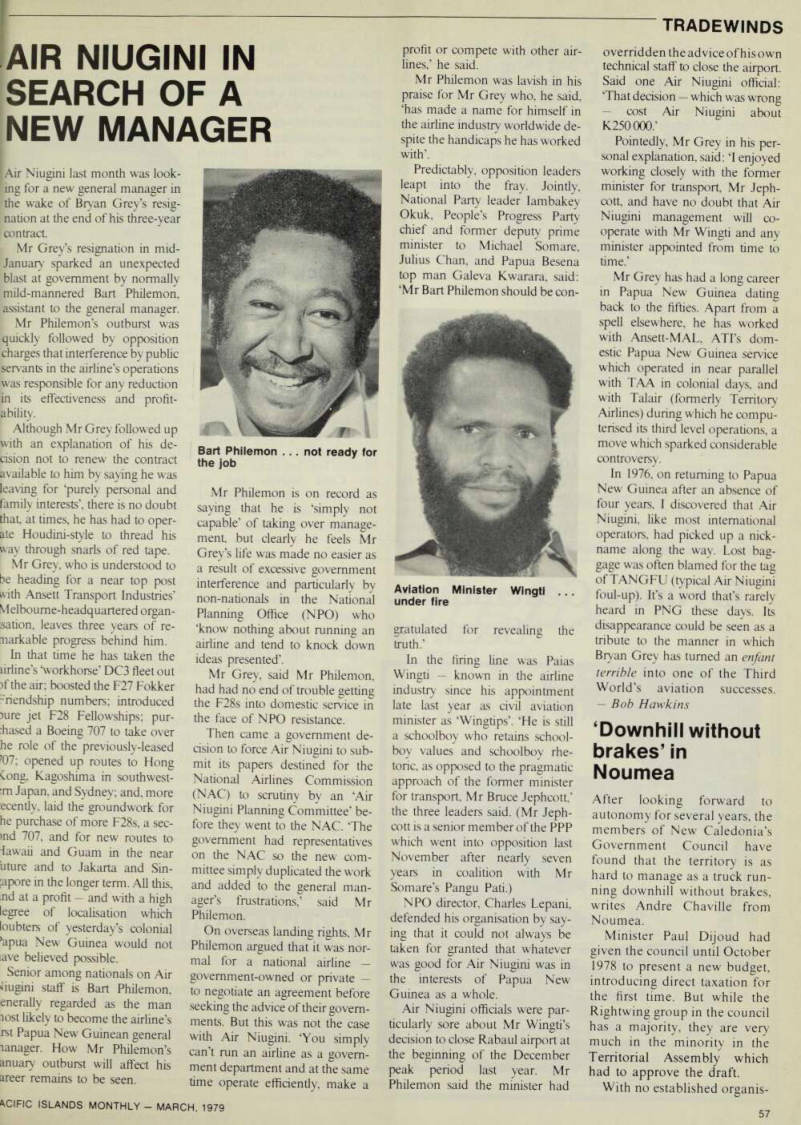
Tradewinds
Air Niugini In
New Manager
' Air Niugini last month was look ing for a new general manager in the wake of Bryan Grey’s resig nation at the end of his three-year contract.
Mr Grey’s resignation in mid- January sparked an unexpected blast at government by normally mild-mannered Bart Philemon, assistant to the general manager.
Mr Philemon’s outburst was quickly followed by opposition charges that interference by public servants in the airline’s operations was responsible for any reduction in its effectiveness and profit ability.
Although Mr Grey followed up with an explanation of his de cision not to renew the contract available to him by saying he was leaving for ‘purely personal and family interests’, there is no doubt that, at times, he has had to oper ate Houdini-style to thread his way through snarls of red tape.
Mr Grey, who is understood to be heading for a near top post
with Ansett Transport Industries’
Melbourne-headquartered organ
sation, leaves three years of re markable progress behind him.
In that time he has taken the tirline’s ‘workhorse’ DCS fleet out )f the air; boosted the F 27 Fokker friendship numbers; introduced Hire jet F2B Fellowships; pur :hased a Boeing 707 to take over he role of the previously-leased 'O7; opened up routes to Hong
Cong, Kagoshima in southwest
ern Japan, and Sydney; and, more ecendy, laid the groundwork for he purchase of more F2Bs, a sec >nd 707, and for new routes to Jawaii and Guam in the near uture and to Jakarta and Sin ;apore in the longer term. All this, nd at a profit - and with a high legree of localisation which loubters of yesterday’s colonial J apua New Guinea would not iave believed possible.
Senior among nationals on Air liugini staff is Bart Philemon, enerally regarded as the man lost likely to become the airline’s rst Papua New Guinean general lanager. How Mr Philemon’s anuary outburst will affect his areer remains to be seen.
Mr Philemon is on record as saying that he is ‘simply not capable’ of taking over manage ment, but clearly he feels Mr Grey’s life was made no easier as a result of excessive government
interference and particularly by
non-nationals in the National Planning Office (NPO) who ‘know nothing about running an airline and tend to knock down ideas presented’.
Mr Grey, said Mr Philemon, had had no end of trouble getting the F2Bs into domestic service in the face of NPO resistance.
Then came a government de cision to force Air Niugini to sub mit its papers destined for the National Airlines Commission (NAC) to scrutiny by an ‘Air
Niugini Planning Committee’ be
fore they went to the NAC. ‘The government had representatives on the NAC so the new com mittee simply duplicated the work and added to the general man ager’s frustrations,’ said Mr Philemon.
On overseas landing rights, Mr Philemon argued that it was nor mal for a national airline government-owned or private to negotiate an agreement before seeking the advice of their govern ments. But this was not the case with Air Niugini. ‘You simply can’t run an airline as a govern ment department and at the same time operate efficiently, make a
profit or compete with other air lines,’ he said.
Mr Philemon was lavish in his praise for Mr Grey who, he said, ‘has made a name for himself in the airline mdustiy worldwide de spite the handicaps he has worked with’.
Predictably, opposition leaders
leapt into the fray. Jointly,
National Party leader lambakey
Okuk, People’s Progress Party
chief and former deputy prime minister to Michael Somare, Julius Chan, and Papua Besena top man Galeva Kwarara, said; ‘Mr Bart Philemon should be con-
gratulated for revealing the
truth.’
In the firing line was Paias Wingti known in the airline
industiy since his appointment
late last year as civil aviation minister as ‘Wingtips’. ‘He is still a schoolboy who retains school boy values and schoolboy rhe toric, as opposed to the pragmatic approach of the former minister for transport, Mr Bruce Jephcott,’ the three leaders said. (Mr Jeph cott is a senior member of the PPP which went into opposition last November after nearly seven years in coalition with Mr Somare’s Pangu Pati.) NPO director. Charles Lepani, defended his organisation by say ing that it could not always be taken for granted that whatever was good for Air Niugini was in the interests of Papua New Guinea as a whole.
Air Niugini officials were par ticularly sore about Mr Wingti’s decision to close Rabaul airport at the beginning of the December peak period last year. Mr Philemon said the minister had
overridden the advice of his own technical staff to close the airport.
Said one Air Niugini official: That decision which was wrong cost Air Niugini about K250000.’
Pointedly, Mr Grey in his per sonal explanation, said: i enjoyed working closely with the former minister for transport, Mr Jeph cott, and have no doubt that Air Niugini management will co operate with Mr Wingti and any minister appointed from time to time.’
Mr Grey has had a long career in Papua New Guinea dating back to the fifties. Apart from a spell elsewhere, he has worked with Ansett-MAL, ATl’s dom estic Papua New Guinea service which operated in near parallel with TAA in colonial days, and
with Talair (formerly Territory
Airlines) during which he compu terised its third level operations, a move which sparked considerable controversy.
In 1976, on returning to Papua New Guinea after an absence of four years, I discovered that Air Niugini, like most international operators, had picked up a nick name along the way. Lost bag gage was often blamed for the tag of TANGFU (typical Air Niugini foul-up). It’s a word that’s rarely heard in PNG these days. Its disappearance could be seen as a tribute to the manner in which
Biyan Grey has turned an enfant
terrible into one of the Third World’s aviation successes.
Bob Hawkins
‘Downhill without
brakes’ in
Noumea
After looking forward to autonomy for several years, the members of New Caledonia’s Government Council have found that the territory is as hard to manage as a truck run ning downhill without brakes, writes Andre Chaville from Noumea.
Minister Paul Dijoud had given the council until October 1978 to present a new budget, introducing direct taxation for the first time. But while the Rightwing group in the council has a majority, they are very much in the minority in the Territorial Assembly which had to approve the draft.
With no established organis
Bart Philemon ... not ready for the job
Aviation Minister Wingti ... under fire
ation to collect direct taxes and no experience of income tax, the councillors sought an easy solution by taxing salaries and wages. At the same time, they proposed a decrease in tax on nickel ore exports and left the independent businessmen and entrepreneurs almost free to declare whatever income they thought fit. With most associ ations, chambers and unions
rejecting the plan or suggesting
more efficient methods of tax ing their social opponents, the council’s recommendations were doomed.
That the Bill was rejected was only half a surprise. But that it was knocked back by an unexpected coalition of cen trists, autonomists, socialists and advocates of independence was more of a shock.
While the wheelings and dealings, so typical of French politics, draw interested atten tion, the territory runs up its debts. Despite the enormous resources of its nickel reserves, the good potential of its
agriculture, and a budding
touris. industry, the territory is
going bankrupt. The general
atmosphere is of indifference or despair and capital invest ment is at its lowest ebb.
The old supporters of auton omy are bitter. Self government during the boom would have been easy to
organise, by encouraging
foreign investment and taxing
the new industries. Today capi tal is pouring in the opposite direction. Socialist Alain Ber nut continues to claim that the first people to tax are those transferring their money over seas.
With theoretical autonomy, New Caledonia is even more dependent on France than be fore. As the daily Les Nouvelles declared: ‘Paul Dijoud asked for our help, but he is the one who holds the purse strings.’
New confidence
for PNG tourism
Three reasons for an improved tourist industry year in Papua New Guinea are offered by Peter Barter, managing direc
tor of the Madang-based Melanesian Tourist Services.
Mr Barter hails the appoint ment, at last, of a new director of tourism; Air Niugini’s in creased activity in tourist pro motion, establishment of over seas offices and planned services to Honolulu, Jakarta, Singapore and Auckland; and the commencement of services
by Philippine Airlines from
Manila and Cathay Pacific Air lines from Hongkong.
Skipjack team
in F. Polynesia
By year’s end about 1500 recaptures had been reported in the South Pacific Com mission’s skipjack survey and assessment programme which began its second year of oper ations last October.
Surveys had been completed in the waters of Guam, the Trust Territory of the Pacific Islands, Tokelau and the north ern Cook Islands and, in December, the chartered vessel, Hatsutori Mam moved into French Polynesian waters
to work in the Society Island and the Tuamotus.
At the end of 1978 more thai 54 000 fish had been tagged
• Union Steam Ship Company has appointed lan Campbell (pictured) freight sales manager for the Pacific region, Mr Campbell, who has been with the company nine years in Suva and Lautoka, will be based in Suva.
Ian Campbell ... Union Steam promotion
Advertisements & other items, pp. 57-64 (7 items)
57
ACIFIC ISLANDS MONTHLY - MARCH, 1979
Security
To Future Generations,
Horyuji Japan's 7th century "l'i, temple links the past to the present with the solemn beauty.
Social welfare is a subject of serious consideration in most modern societies. Man in the twentieth century accepts his responsibility to bequeath to the next generation a society better than his own.
Daiwa Bank is not unique in accepting this responsibility, but Daiwa is unique in making acceptance of this role in society an integral part of their banking service.
Daiwa is the only Japanese city bank to combine banking and trust business. Daiwa is thus a fully
integrated banking institution, comprising banking,
international financing, trust, pension trust, and real estate business. This integration is part of our effort to fulfil our social responsibility consistent with society's needs in a contemporary environment. a fully integrated banking service
DAIWA BANK
Head Office: Osaka, Japan London and Frankfurt Branches New York and Los Angeles Agencies Singapore, Sydney, Sao Paulo, Hong Kong and Houston Representative Offices Subsidiary: Daiwa Bank Trust Company, New York Joint Venture Banks; P.T. Bank Perdania, Jakarta, International Credit Alliance, Ltd., Hong Kong
The
Modulock
System;
A unique
building method
Modulock is a high quality, low maintenance building system. It allows an infinite variety of designs ideal for homes, offices, schools - indeed all low rise buildings.
Modulock is quick to deliver and assemble, low on labour, compact, easy to ship and particularly suited to conditions in the Pacific: For further information contact
MODULOCK
Modulock (N.Z.) Limited, P.O. Box 51-099, Pakuranga, Auckland, New Zealand. Telephone 47-069 Papatoetoe, Telex N.Z. 2290.
■ tradewinds intelligence...tradewinds intellige BANANA production in Tonga this year is expected to be half l that of 1978 as a result of Cyclone Fay which hit plantations in Tongatapu and outer islands.
INFLATION in Fiji last year was measured at 6.1%, down from [7% in 1977. Food contributed only 2.1% to inflation last year (against 3% in 1977.
TUVALU Government has imposed a $2.50 airport departure tax at Funafuti, effective from January 1.
JOSEPH Chan, who has joined Melanesian Tourist Services in Papua New Guinea as operations manager, was for many years involved in tour operations in Malaysia.
AKG (NG) Pacific has been awarded a K 520 000 contract to build a radio station at Vanimo for the West Sepik Province, and Golesons (PNG) has won a similar contract at Daru, Western Province, valued at K 325 000.
RUBBER is being considered as a fourth tree crop after copra, oil palm and cocoa in Solomon Islands.
JAPAN Air Lines has appointed Masato Inoue administration manager in its Sydney office, and John Winters, from Qantas, is JAL’s new Sydney sales representative.
BOUGAINVILLE Development Corporation has acquired a minority shareholding in Aviation Developments (PNG) in which General Credits has the major holding.
A ONE-for-three free scrip issue, subject to the approval of a February shareholders’ meeting, was to be made to shareholders on the books at February 16 by Fiji Industries, the first in its 19 years of operations.
THE PNG Government has parliamentary approval to borrow K 1.6 million from the European Investment Bank to buy shares in the K5O million Higaturu Processing oil palm project in Northern Province.
THE GOVERNMENT’S newest ferry, the Pu/eono, which arrived in Western Samoa from Singapore recently, has a passenger capacity of 100 and can carry up to 20 small vehicles.
HAWAIIAN Airlines has filed a route application with the US Civil Aeronautics Board for a service between California,
Honolulu and Pago Pago.
LUFTHANSA German Airlines has been appointed Polynesian Airlines general sales agent in West Germany and West Berlin.
A SUPPLEMENT of SA43 million sets Australia’s 1979-80 aid to Papua New Guinea at $223 million.
NEW ZEALAND s Pacific Islands Industrial Development Scheme (PUDS) up to November had committed just over SNZ3OO 000 to ventures in Fiji, Western Samoa, Tonga, the Cook Islands and Niue.
Fiji’s exports to European Economic Community countries last /ear totalled SFB2 million against EEC exports of $27 million to Fiji, according to Eberhard Stahn, European Commission delegate in Suva. \ MINISTRY of transport is being set up in Western Samoa with :ivil aviation, shipping and road transport under its control.
VEWSPAPERS of Fiji Ltd, publishers of the Fiji Sun and the Sunday Sun, had an operating loss of $77 476 in the year ended September 30, 1978.
HENDANA International Travel of Solomon Islands, is in volunry liquidation in a corporate rationalisation move by the Solair 'roup, the directors of which emphasise that it in no way reflects company i n its ability to meet financial commitments. lUNGA received about $17.7 million in foreign aid in the 12 nonths ended June 30, 1978, from Australia ($2.03 million). New 'ealand ($1.6 million), Japan ($1.3 million), UK ($978 000), iuropean Economic Community ($919 000), UNDP ($3OO 000)’
Vsian Development Bank ($245 000) and ‘others’ ($284 000).
PHE ROTAN family, of Rabi island, Fiji, Jias built a SF3B 000
XIGENCE..-TRADEWINDS INTELLIGENCE.. .TRADEWINDS
Jt^elLlxl
HEAT
SEALING.
SHRINK
mckaging.
CONTACT A USTRA LI A'S
FOREMOST MANUFACTURERS
OF FIE A T SEALING EQUIPMENT
SERVING INDUSTRY
IN AUSTRALIA & THE PACIFIC ISLANDS
FOR OVER 25 YEARS.
HELIX ELECTRICAL PRODUCTS PTY. LTD.
27 Rosebery Avenue, Rosebery, NSW 2018, Australia. 663 0487.
INTRODUCING FRIGID’S New Range of Assemble-Yourself
Walk-In Aluminium Freezer & Cooler Storage Rooms Hundreds already installed. Now with attractive timber grain aluminium exterior finish, (rust-proof) with white vinyl interior finish.
Frigid Foam Polyurethane insulation. 2" in cooler storage rooms is equal to 5" polystyrene foam. 3” in freezer storage rooms is equal to 8“ polystyrene foam. Lower running costs. Best insulation available. Thin wall construction. Save in freight costs. Room sizes from 90 cubic feet (2 1 / 2 m 3) to 930 cubic feet (25 1 / 2 m 3).
Supplied in easy-to-erect, do-it-yourself form Assemble, plug it in, and have it in operation in under eight hours!
Manufactured by:
FRIGID CABINETS PTY. LTD.
14a Duffy Ave., Thornleigh, N.S.W. Aust. 2120. Ph. 848 8292, n
AVAILABLE FROM:
£i£ T 5 ALIA CALEDONIA EXPORTS, 363 George St., Sydney 2000, BRECKWOLDT & CO. G.P.O. Box 5027, Sydney 2001. HAGEMEYER (A'ASIA), 59 Anzac Pde., Kensington 2033 GEOFFREY HUGHES & CO 167 Macquarie St , Sydney 2000, NELSON & ROBERTSON PTY. LTD., 197 Clarence St. Sydney 2000 E RABOT (EXPORTS) PTY. LTD ,67 Castlereagh St., Sydney 2000. RABTRAD NIUGINI PTY LTD PO Box 1406 Lae (P ~£i F,C) PTY LTD " 20 Loftus ST. Sydney 2000. C, SULLIVAN (EXPORT) PTY. LTD. G.P.O. Box 3373, Sydney 2001 W.S. TAIT & CO. PTY. LTD,, 31 Macquarie Place, Sydney 2000.
Sun Flower’s
mackerel & tuna
tops in flavor
and convenience
Sahara & Co., Ltd.
Osaka, Japan.
Sole Distributors in Papua New Guinea The B.N.G.Trading Co., Ltd. (a member of the Burns Philp group of companies) Resident agents in other Pacific territories.
The KINGSTON 500
DISPLACEMENT HULL CRUISER
with built-in diesel power
Would you like to take six people out for a full day's cruising and fishing offshore and inshore for less than $5 of fuel? This fine economical and safe Kingston 580 can give you all that plus a 12 month warranty, ‘ • Fibreglass construction for economical maintenance • Does up to 14 knots with ease • Big self-drained cockpit • Choice of 12, 15, 24 or 33 hp diesel engines • Lock up cabin with 2 bunks • Plenty of room 5.80 metres long Available also Kingston Angler. Same hull, open boat version.
Ideal Mackerel boat For brochure and name of your nearest dealer phone or write. wroi lICCD CAI ETC
CRUISER SALES PTY. LTD.
179 South Creek Road, Dee Why, N.S.W., 2099.
Teleohone: 981 3508
ITRADEWINDS INTELLIGENCE...TRADEWINDS INTELLIGE
' fishing boat, the Nei Wairara, to operate in Fiji waters, all catches [ to be sold to the Fiji Fisheries Department.
THE BANK of New South Wales (PNG) reports a profit of K 956 000 for the year ended September 30, 1977, K 354 000 less f than the previous year.
THE ASIAN Development Bank has approved a third loan, worth [SUS4 million, to the Development Bank of Western Samoa, to make loans for industrial (50%), agriculture (25%), group/village (15%) and service (10%) projects.
THE PACIFIC Forum Line has re-routed the Toa Moana to operate a New Zealand-New Caledonia-Fiji service on a threeweekly basis, calling at Auckland, Napier, Noumea, Suva and Lautoka.
PROJECTS in Tuvalu, including a seaplane service, electrification at Funafuti, a road, a seawall, hospital and school buildings and agricultural and marine schemes, will be paid for out of a grant of $T4.3 million from Britain already approved, and a further grant of about $4.2 million yet to be approved.
THE WESTERN Samoa Trust Estates Corporation reported a record net profit of SWS 1.06 million in 1977, an increase of 213% on the 1976 figure of $315 405.
ASIAN Development Bank excutives were due to visit Papua New Guinea in February to inspect projects funded by the ADB.
POLYNESIAN Airlines cnartered Air Nauru jets for six flights between Apia and Auckland to carry holiday passengers in December and January.
THE WESTERN Samoa parliament has authorised the government to borrow SWSI.6 million locally, $BOO 000 overseas, DM 1 million from West Germany, and $2.5 million from the
European Development Fund.
HAWAIIAN Air has promoted Mike Walters to regional manager for Australia and New Zealand, based in Sydney.
FOREIGN investment in Papua New Guinea in 1978 is provisionally estimated at K9O million, up from K 69 million the previous year. \IR NAURU was due to start its direct service between Tonga and New Caledonia last month, bringing to 17 the number of airports Air Nauru now serves.
BETTER production and mineral prices, and a favourable kina- Jollar exchange rate, gave Bougainville Copper improved figures n the second half of last year.
THE SOUTH Pacific Bureau for Economic Co-operation has firm commitments for ‘substantial and increased’ financial support for the proposed South Pacific Forum Fisheries Agency from UNDP/FAO and the Commonwealth Secretariat and a promise of SA4O 000 from the United Kingdom. \IR SERVICES to Tonga increased 10% in 1978 with visitors increasing from 11 000 to 12 000.
K. A. McKECHNIE has been appointed managing director of the Australian Overseas Projects Corporation, a new government body to assist Australian industry to ‘participate in larger and
more complex overseas development projects ...’
SOLOMON Islands has imposed a 50% duty on laundry soap to assist its local soap industry. Imported toilet soaps and detergents are not affected ...
COOK Islands is expected to use Pago Pago as a transhipment 3ort for imports from, and exports to, the US, following a visit ;o American Samoa by a trade delegation from the Cook islands...
HOLIDAY makers visiting Papua New Guinea in 1977 numbered 16 095, an increase of 11.1% on the previous year’s figure of 14 493. They spent K 382.38 each and stayed an average of 6.2
days ...
7 1JI expects copra production of about 29 000 tonnes this year is long as conditions remain favourable . ..
INTELLIGENCE...TRADEW1NDS INTELLIGENCE...TRADE
HENRY CUMINES
PTY LTD.
EXPORTERS o GENERAL MERCHANTS
428 GEORGE ST., SYDNEY
CABLES: HENCO SYDNEY. G.P.O. Box 3949. PHONE:, 232-5377
For specialised and personalised buying service
throughout the Pacific Islands and the East.
LOCAL AGENTS AND REPRESENTATION:
PAPUA NEW GUINEA: FIJI:
RABAUL: M. & C. Seeto.
P.O. Box 131, Rabaul.
Telephone 92-2919.
K. Witherington Ltd,, P.O. Box 293, Suva.
Telephone 22-356.
MADANG: W. Double, NEW HEBRIDES:
P.O. Box 22, Madang.
Telephone 82-2696. John Lum & Associates, P.O. Box 65, Santo.
Telephone 329..
SOLOMON ISLANDS:
Mr, Tom Lo, P.O. Box 327, Honiara.
Telephone 399.
Resident Agents in other Pacific Territories. •-
misTmumi
spoßimc
GOODS
Store winning soles
Australia has produced champions in most sports. It’s a winning quality that’s also apparent in Australian sporting goods. You’ll see it in their styling, in their strength, in their superior construction. It’s a quality that sells. The big range of Australian sporting goods includes water sports gear, tennis equipment, billiard tables, golf clubs and buggies, fishing reels, boats, marine equipment, even coin operated amusement machines.
Most likely Australia has the sporting products to suit your needs.
Quality and value that’s only hours away The Australian Trade Commissioner will be pleased to give you details of suppliers. You can contact him at:— 7th Floor, Dominion House, Thomson Street, Suva, FIJI. (Post Office Box 1252).
Telephone; 312844, or; Post Office Box 9129, Hohola, Port Moresby, P.N.G. Telephone: 25 9333.
Ask the Australian Trade Commissioner
TKADEWI NDS INTELLIGENCE .. .TRADEWI NDS 1 NTELLK'.I TWO PAPUA New Guinea Banking Corporation officers are training in banking systems and operations with the Bank of New Zealand in Suva and a Western Samoan artisan is on a six-month attachment to the Public Works Department in Suva. All three are on SPEC Fellowship Scheme scholarships .
HAWAIIAN Air has appointed Don Adams director of marketing analysis and programs. Mr Adams was formerly divisional marketing director (Pacific) for Pan American Airways, a company he had been with since 1962 .
THREE unions in the Gilbert Islands the BKAM, Line Islands and Banaban planned to amalgamate last month. The merger would result in a union membership of about 2000 .
AUSTRALIA is sending a ‘survey mission’ to Papua New Guinea to assess investment potential as a result of a PNG request. Australian investment - which represents two-thirds of all foreign investment in PNG has declined considerably since independence in 1975 ...
PAPUA New Guinea’s first budget for a financial year corresponding with the calendar year totalled SA67O million, including Australia’s aid component of $220 million. Five years ago Australia contributed two-thirds of the PNG budget . . .
WEST Germany has lent Tonga Deutschemark 20 million (about STB.9 million), to buy a roll-on roll-off ship. Dl7 million is to be repaid over 30 years with a 15-year period of grace at an interest rate of 1%, The balance is to be repaid over 15 years (three-year period of grace) at 7.8% .. . :NCE. . .TRADEWJ NIKS I NTELLJ GEIMCE. . .TRADEWI NDS IN
EX pORISS
pACifit
THE
TO
BREWO
Breekwoldt & Co
Pty Ltd
Suite 1909, 19th Floor, King George Tower,
Corner King & George Streets, Sydney.
G.P.O. Box 5027, Sydney 2001.
CABLES: 'BREWO' SYDNEY. TELEX: AA22890.
TELEPHONES: 233 2366, 232 2315, 233 1462.
PACIFIC ISLAND OFFICES
BRECKWOLDT & CO (PNG) PTY. LTD.
PO BOX 1549, BOROKO, PORT MORESBY.
PO BOX 222, RABAUL
PO BOX 72, KIETA
PO BOX 178, WEWAK
PO BOX 185, MADANG
PO BOX 237, MT. HAGEN
PO BOX 1188, LAE
BRECKWOLDT & CO., PO BOX 47, APIA BRECKWOLDT & CO. (SI) LTD. PO BOX 140, HONIARA
BRECKWOLDT SARL BP 2369, NOUMEA
OFFICES IN:
HAMBURG
LONDON
MILAN
& WEST AFRICA
ALSO AT:
SINGAPORE
KUALA LUMPUR
BANGKOK
& HONG KONG
ENQUIRIES
FROM OVERSEAS MANUFACTURERS INVITED.
I s m th s on a ss
s!iss
Sg 55 '••mK mm 4mm m 8? qaiiii , jB « *** „ k - ***
THE
BOULEVARD HOTEL
TO W «V££i STREET - SYDNEY NSW 2011
TEL 357 2277 TELEX AA24350
SToSB age™ AVELODGE xkervations
I & Beehive Building 94 Elizabeth Street Melbourne, Victoria Australia 3000 G.P.O. Box 8 Melbourne, Victoria Australia 3001.. -Mi Telex: AA34552 Phone: 63 5094
YOUR GUARANTEE
59
’ACIFIC ISLANDS MONTHLY - MARCH. 1979
61
3 ACIFIC ISLANDS MONTHLY - MARCH, 1979
62
t
'Acific Islands Monthly March 1979
64
Dfimrir' ici amhc AAfiMTUI V MARP.H IQ7Q
Deaths
of Islands People
Ratu Meli Qoro
Chief of Namoli village, Lau toka, aged 63. Ratu Meli was a former Lautoka Town coun cilor, school teacher and ship ping executive. He was a keen sportsman, with cricket his favourite, and took a major interest in the boy scout move ment. He was made a justice of the peace in 1964. Ratu Meli leaves a widow and four chil dren.
Koream Urekit
The longest serving member of the Papua New Guinea Parlia ment, Koream Urekit, 62, in Port Moresby. Mr Urekit, who became a member of the PNG Legislative Council in 1961, tvas flown to his home in East Mew Britain Province for burial. He was member for Pomio.
A. R. Sahu Khan
Abdul Rahiman Sahu Khan, former Fiji civil servant, law clerk, and nominated member of the old Legislative Council, in Suva, aged 78. An active worker for the National Feder ation Party, he leaves a widow, four sons and four daughters.
C. S. Brocket!
Charles Stephen Brocket!,
principal of Nasinu Training
College in Fiji from 1957 to 1961, in Auckland, aged 60. He was dean of Auckland Second ary Teachers College when he died. After service in the Fleet Air Arm in World War 11, Mr Brockett held a number of senior appointments in NZ
teacher training colleges. He
leaves a widow, son and daugh ter.
B. L. Gregg
Bertrand Lovell Gregg, who was in the colonial service in Fiji from 1919 to his retirement in 1963, in Suva, aged 74. Mr Gregg, a solicitor, became
registrar-general and registrar
of titles in 1950.
Advertisements & other items, pp. 65-66 (2 items)
APITIP 101 a ti/MiTi H v / . . . » .
Nelson&Robertson
INTRODUCING
THE BROWNBUILT
FILING CABINET
BROWNBUILT LTD., Cnr. Bath Rd. and Waratah St., Sutherland, N.S.W. Australia 2232.
Agents - SOLOMON ISLANDS; NCR Corporation, Honiara.
NEW HEBRIDES: NCR Corporation, Vila. NEW CALEDONIA: NCR Corporation, Noumea. PNG: Brownbuilt (PNG) Pty. Ltd.
Port Moresby & Lae. FIJI: Lysaght Brownbuilt Ind. (Fiji) Ltd.,’
Suva. HAWAII; Records Management Services Inc., Honolulu.
Look no handles
and a comprehensive range of accessories, you won't find a more practical or attractive solution to your vertical filing problems Despite the streamlined design, recessed handles and your choice of colours-the Brownbuilt vertical file cabinet is more than just a pretty face Available with full width indexing for maximum filing efficiency
Brownbuilt
nBE/?> o -o & 4/
FOR
IN OUR 85th YEAR SELLING ‘SERVICE’
TO THE PACIFIC ISLANDS . . .
Nelson&Robertson
PTY. LTD. (Established 1895)
Plantation House, 197 Clarence Street, Sydney.
Cables: IVAN’, Sydney, Brisbane. Telex: AA22381, Sydney.
INDENTS - FROM AUSTRALIA, NEW ZEALAND and OVERSEAS.
FOODSTUFFS • HARDWARE • TRAVEL • CANNED FISH MACHINERY • INSURANCE • SOFTGOODS • JUTE GOODS
• REAL ESTATE •
BRANCH OFFICES: Nelson & Robertson Pty. Ltd., P.O. Box 575, Brisbane, Qld., Australia.
P.O. Box 2092, Govt. Bldg., Suva, Fiji. P.O. Box 258, Lautoka, Fiji.
P.O. Box 2420, CPO Auckland 1, New Zealand.
PAPUA NEW GUINEA Rabtrad Niugini Pty. Ltd., P.O. Box 219, Rabaul, P.N.G.
REPRESENTATIVES: P.O. Box 1406, Lae, P.N.G. P.O. Box 711, Madang, P.N G P.O. Box 253, Kieta, P.N.G.
HOOD
pacific
HOOD RACING and CRUISING SAILS
In World Famous Hood Sailcloth £ Hood Service. We regularly service the Pacific.
Hood Managing Director Tony Bouzaid calls frequently through the area; sailing seminars for clubs and associations by arrangement.
Deliveries. Improved air services bring New Zealand closer to you we can offer speedy deliveries at short notice.
Hoods have representatives in Noumea. /- ' Papeete, Port Moresby. Rabaul, Suva, Singapore.
Write to Hood Sail Consultants in New Zealand for quotes, advice and for prompt answers to your sails queries.
HOOD
/ * $ v * <3 * ) £ £ <3 V O' <3 S' 0 0 0 <c s> $ 0 S' 0 o 0 S' 0
SPAR
0 O' <5
and
V o V
RIGGIN
$ 0 0 Hood Racing Sails have the top international race-winning record. Recent successes include: Half Ton Cup. One Ton Cup, Southern Cross Cup, Whitbread Round-the-World Race, World Ocean Racing Championship, Sydney- Hobart Race, N.Z. to Vila / Ocean Race. Single-handed Transtasman,/ etc., etc. / & Hood Cruising Sails in Hood Wide ' Panel Sailcloth are soft, easy to handle and stow, lasting. and longer
HOOD
NEW ZEALAND
LIMITED
23 Poore St,. St.
Bay. Phone 794-060 P.O. Box 415.
Auckland, / New Zealand. / Cables;Hoodsai]/ Telex: x NZ21200
HOODNZ
Whether you have a racing or cruising yacht and require full new rigs or replacements, contact us for prompt and efficient service. We offer Spars, Rigging, Halyards, Accessories from Quarter Ton to Maxis. For immediate service, write, phone or telex giving fullest details including sketches for replacements, and sail plans with yacht’s leading dimensions, including displacements and ballast, for new rigs.
Write for our very comprehensive catalogue.
YACHTSR4RS
NEW ZEALAND LIMITED
P.O. Box 1492, Auckland. Phone 485-955, 485-536 Telex; Hood 21200. Cables: Yachts Auckland.
Yachts
Cruising
The Royal Papua Yacht Club, with Air Niugini sponsorship and assistance from the Cairns Cruising Yacht Squad ron, is organising the first official yacht race between Australia and Papua New Guinea.
Preparations are well in hand for the race from Cairns in northern Queensland to Port Moresby starting on April 29. There will be two divisions lOR and cruising.
All entries must be single hulled, self-righting vessels, having an lOR Mark 111 rating of not less than 21 feet, or a LWL of 22 feet. However, at the discretion of the sailing committee, yachts with a mini mum lOR rating of not less than 18 feet may be accepted.
Yachts entering the lOR div ision must have a copy of their current rating certificate.
Closing date for entries is March 30.
Among other PNG business houses supporting the event is the South Pacific Brewery.
The RPYC reports that vessels from Port Moresby which have entered include EVEN, line honours winner of the 1955 Sydney-Hobart event, two Clansmen 30s, two or more Formosan 645, the half-tonne MEKIM SAVE which won the production boat trophy in the 1977 world titles in Sydney, two Holland 25s and a quarter-tonne Laurie Davidson. Several yachts will be racing to Port Moresby after competing in the Dunk Island race on the Great Barrier Reef.
Entries for the Sydney- Noumea yacht race starting on June 16 were over subscribed by the turn of the year, 54 having been received.
The host club, Cercle Nau tique Caledonie, had put a limit of 50 on the event because of restricted mooring space in the Noumea marina. However, race director Peter Rysdyck of
the Cruising Yacht Club of Australia, said he intended to consult with the CNC to see if it was possible to squeeze a few more vessels in.
Among early entries was the 72 m French four-masted
Club Mediterranee With
Alain Colas as skipper. How ever by February Mr Colas was presumed dead after disappearing while competing in the MANUREVA in the Route du Rhum (Rum Run) race from St Malo, France, to Guadeloupe in the French West Indies, which began in early November.
Mr Rysdyck is still hoping that the Club Mediterranee will compete and that it will tie up alongside the Opera House in Sydney harbour for public dis play for about 10 days before the race starts.
It is expected that the fastest vessels will cover the 1750 km course in about 6-7 days with other entries taking up to 15 days.
Mr Rysdyck reports that the French Extension event, from Noumea to Vila in the New Hebrides, to be run about 10 days after completion of the
Sydney-Noumea event, has already attracted 30 entries. • TAU, 27.4 m, owned by Colin Philp of Lami, Fiji, left Suva on November 30 for Hobart. Colin Philp, Hobart born and 72, was ac companied by three sons aged between seven and 14, and three crew. He plans to return to Fiji early this year. • TRITHEAM, a trimaran which disappeared from Fiji and later turned up, under the name of ANDATRIX in Solomon Islands, has been sailed back to Australia. The owner of the boat, Dr lan McDonald, of Toowoomba, Queensland, was reported critical of the Fiji Director of Public Prosecutions, Kulen Ratneser, for not attempting to have prosecuted the person alleged to have taken the Tritheam. The trimaran was up for sale when it was taken from Fiji. Mr Ratneser said that if the Tritheam’s owner had been a Fiji citizen his office would have been justified in taking measures despite high costs.
However, the matter did not concern Fiji.
Your Cruiser
(For $1000)
When a conversation turns to cruising small craft, visions are usually conjured up of husky well-found ketches, schooners, cutters and the like. When it comes to power the same sort of idea seems to prevail. .. that of the large trawler type, with steadying sail, big diesel and tankage for a thousand miles or more.
It’s this sort of thing that puts
off many cruising enthusiasts
who aren’t too well-heeled.
Provided such a person sticks to coastal hopping in reason able weather and doesn’t expect too many frills there is no reason why he can’t go
:ruising on a workaday
budget.
The main rule is not to con
tuse economy and cheapness
vith shoddy and unsafe
naterials. Whether you use an mclosed toilet or a bucket on i lanyard isn’t going to matter i great deal. But a rudder that s unlikely to stay in one piece or more than a couple of days
is another matter entirely.
A small displacement-type hull can be driven quite effec tively with a small, slow rev ving motor and their economy borders on the smell of an oily rag. This writer’s own craft, while 5 m long with berths for two adults, can be driven to maximum hull speed by a single cylinder petrol motor of only V/i hp at 900 rpm. Fuel
consumption is something like
one pint per hour. With a 45gallon tank in the bows this gives a range never likely to be used to the full, but it’s nice to know it’s there, and besides the tank provides excellent buoy ancy.
Auxiliary sails play their part and a good secondhand rig from one of the larger racing dinghies doesn’t cost the earth.
As well as supplementing the engine it also acts to steady your boat in a swell. If your budget won’t run to a forward and reverse gearbox, a good pair of oars will never go astray.
It has been said that there is
nothing more seaworthy than a corked bottle. Folk who cruise in what may be termed ‘tab loid’ boats should get as close as possible to this model. A raised deck is probably the best
start. This configuration gives
vast deck space, is stronger than a trunk cabin and allows the entrance hatch to the cabin to be divorced from the cockpit or steering well.
For sailing performance, to
save cutting holes in the boat’s bottom to fit a centreboard case that will invariably leak, a pair of leeboards are cheaper, easier to use, and more efficient, even if they do look a little ugly.
Accommodation is best kept simple. A pair of stretched can vas hammock type bunks, with
sleeping bags where necessary,
are surprisingly comfortable. A small one or two burner kero sene stove is probably most efficient, and though slow will cope with a cruise of up to two weeks before becoming tire some. Besides stores and a locker for extra clothing, a pair
of plastic buckets will just about complete the ‘fitting out’
If self-righting ability is re quired, the amount of ballast needed is best left to an expert to calculate. Once calculated there are many economical ways of adding the required
weight. If the bilges are deep,
some concrete with iron or steel punchings mixed in, works well, or worn-out rollers from
caterpillar-tracks set in poly
ester resin are cheap, effective and easily weighed. If your boat is to be careened to scrub the bottom to save slipping fees, movable ballast such as pigs of iron or lead or even sand bags could be the answer.
There is no reason why a small ship’s boat or similar craft cannot be converted into a serviceable if stately cruiser for under $lOOO. So long as you don’t want to double the Horn or circumnavigate the Pacific she’ll give you lots of pleasure poking up creeks and seeing what’s around the next head
land.
John Collins.
Advertisements & other items, pp. 67-68 (3 items)
JAOin/' ioi a > .xn. ... .... . .
JAOin/' ioi a > .xn. ... ... . .
68
PAriPir i<si ANin« mdmthi y march 1979
Transport
ISLANDS
LINE
MS CAMELLIA VENTURE
Express Freight Service between Pacific Coast Ports of U.S.A. and...
Tahiti 6 Samoa
PAPEETE APIA - PAGO PAGO
Full container service including reefers.
GENERAL STEAMSHIP CORPORATION LTD.
General Agents 400 California Street, San Francisco, California, U.S.A.
APIA: Bums Philp (South Sea) Company Ltd.
PAPEETE: Agenoe Maritime Internationale, Tahiti.
PAGO PAGO: Polynesia Shipping Services Inc.
» I* u * - “ >•(! .
BJS -M CB
General & Refrigerated
Cargo Service to
Cook Islands,
Niue, and Tahiti.
CONTACT YOUR LOCAL AREA AGENT FOR FULL DETAILS Niue: Government Shipping office, Alofi.
Cook Islands: Waterfront Commission, PO Box 61, Rarotonga.
Telex: Shipping RG 2002 Tahiti; Compaignie Maritime Polynesienne, PO Box 368 Papeete. Telex; Taporo FP2SB 136
The Shipping Corporation
of New Zealand Limited
Sea Carrier to the Nation
AUCKLAND: PO Box 3420, Phone 797-210 Telex: NZ2822
Express Freight Service between U S. Pacific Coast Ports &
PAPEETE ■ APIA - PAGO PAGO
Full Container Service including Refrigeration
GENERAL AGENTS
4ft POLYNESIA LINE, LTD.
AGENTS
PAPEETE - MORGAN; Vernex Boite Postale 449. Papeete Phone; 309 Cables; MOREX PAGO PAGO POLYNESIA SHIPPING SERVICES. INC.. Pago Pago Phpne; 633-5169 Cables: POLYSHIP APIA - UNION S.S. CO., of N.Z. Ltd., P O. Box 50. Apia, Western Samoa Phone; 570 Cables: UNION
fURNESS INTEROCE4N
CORPOMHON
465 CALIFORNIA STREET SAN FRANCISCO. CA 94104 Cable INTERCQ) • TWX 910372 7350 • RCA 27S 207
TEL I4ISI 396 2000
a
PACIFIC
FORUm
unc
OWNED BY THE PEOPLE
OF THE PACIFIC ISLANDS
Regular Monthly Liner Services
from Australia and New Zealand
to the South and Central Pacific
FOR INFORMATION CONTACT AGENTS:
AMERICAN SAMOA:
Polynesian Shipping Services Inc. P.O. Box 1478, Pago Pago
AUSTRALIA:
The Australian National Line, 50 Queen Street, Melbourne.
Union Bulkships Pty.Ltd., 333-339 George Street, Sydney.
GILBERT ISLANDS;
Gilbert Islands Shipping Corp. P.O. Box 495, Tarawa.
FIJI:
Burns Philp South Sea Co. Ltd. GPO Box 355, Suva.
NEW CALEDONIA:
ETS Ballande, BP. C 4, Noumea.
NEW HEBRIDES:
Burns Philp New Hebrides Limited, Vila.
NEW ZEALAND:
The Shipping Corp. of N.Z. Ltd. P.O. Box 3344, Wellington
PAPUA NEW GUINEA:
Steamships Trading Co. Ltd. P.O. Box 1, Port Moresby.
SOLOMON ISLANDS;
Sullivans S.l. Ltd. GPO Box 3, Honiara.
TONGA:
Union Steam Ship Co. P.O. Box 4, Nukualofa.
Services
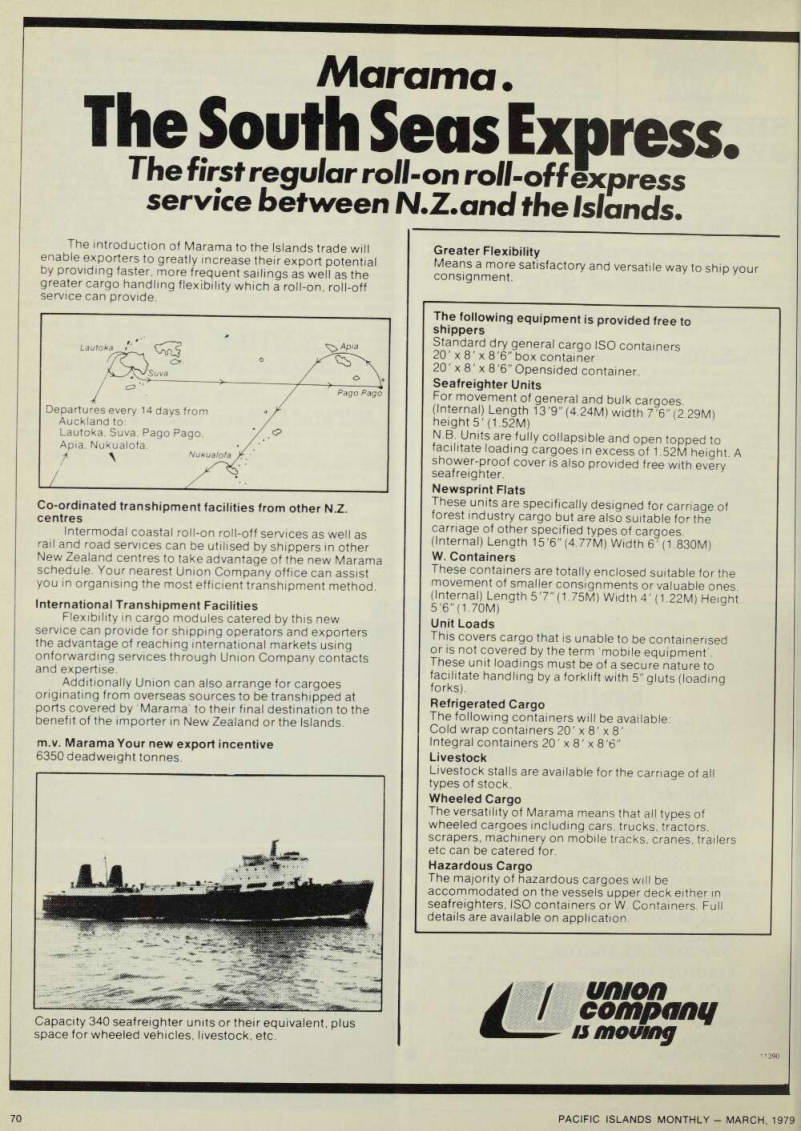
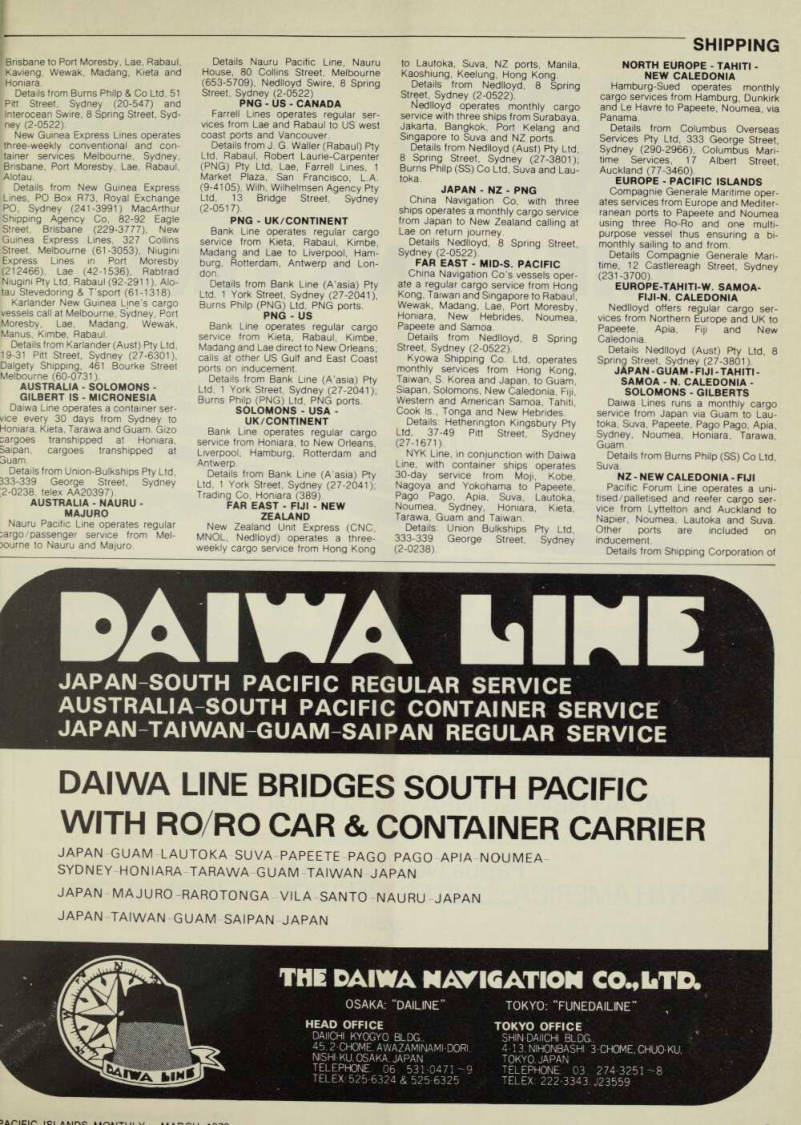
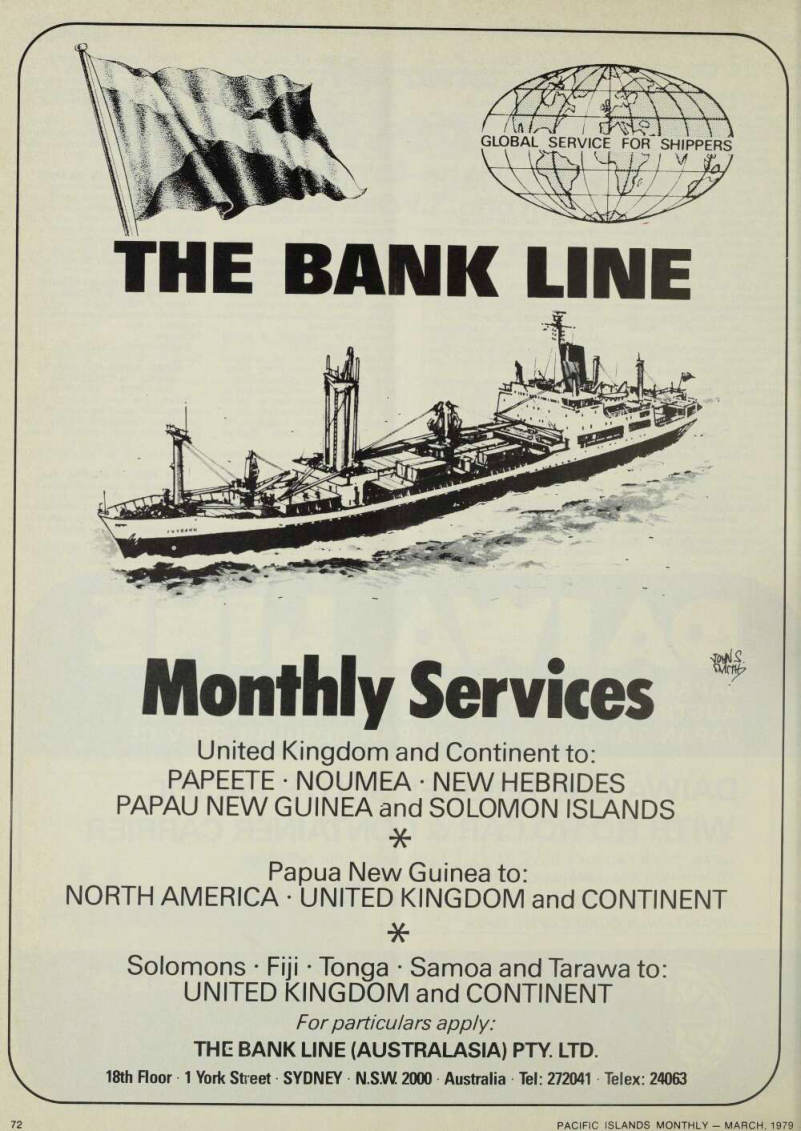
Shipping
These listings do not necessarily 1 cover all services to Island ports.
Should any shipping company wish to have its services cargo and passenger included in these list ings they should contact PIM.
Sydney - Lord Howe Is -
Norfolk Is
Compagnie des Chargeurs Caledoniens operates four-weekly cargo service Sydney - Lord Howe Island and Norfolk Island.
Details Hetherington Kingsbury Pty Ltd, 37-49 Pitt Street, Sydney (27-1671).
SYDNEY • NZ - FIJI - HAWAII -
Canada - Us
P & O liners call at Auckland, Suva, Honolulu and Vancouver on eastbound and westbound voyages between Syd ney and the US.
Details from P & O Booking Centre, World Travel Headquarters Pty Ltd, 33 Bligh Street, Sydney (231-6655).
AUSTRALIA - NZ - FIJI - TONGA
N. Hebrides • Noumea - Png
Solomons-Samoas
Sitmar Cruises operates a year-round cruise programme to include most of the above countries.
Details from Sitmar Cruises, 47 Elizabeth Street, Sydney (232-7511).
Royal Viking Line, with first-class cruise ships Royal Viking Star, Royal Vi king Sky and Royal Viking Sea, cruises the Pacific from Sydney and Cairns call
ing at a variety of Pacific and Asian ports.
Details from Wilh, Wilhelmsen Agency Pty Ltd, 13-15 Bridge Street, Sydney (2-0517).
P & O liners call at Auckland, Bay of Islands, Honiara, Lautoka, Noumea, Nukualofa, Pago Pago, Papeete, Port Moresby, Santo, Savusavu, Suva, Vavau and Vila on cruises from Aus tralia.
Details from P & O Booking Centre World Travel Headquarters Pty Ltd, 33 Bligh Street, Sydney (231-6655).
Australia - Fiji - Samoas -
New Hebrides - Tonga -
Norfolk Island
Pacific Navigation of Tonga operates a five-weekly refrigerated general car go/container service from Sydney and Brisbane, to Vila. Santo, Suva, Lautoka, Apia, Pago Pago, Nuku’alofa and Nor folk Island, Details from Beaufort Shipping Agency Co, 2 Castlereagh Street, Syd ney (239-1022),
Australia - New Caledonia
(And/Or) New Hebrides
Karlander operates a monthly service from Sydney to Noumea.
Details from Karlander (Aust) Pty Ltd. 19-31 Pitt Street, Sydney (27-6301).
Sofrana-Unilines ships serve Noumea every three weeks from the main ports along the east Australian coast.
Details from Sofrana-Unilines, 37 Pitt Street, Sydney (27-2031), Trans- Austral Shipping Pty Ltd, 570 Bourke Street, Melbourne (67-9162), ACTA Pty Ltd, Brisbane (221-3116), Elders-ANL Pty Ltd, Port Adelaide (47-5688), ANL, Newcastle (049-24364), Clements & Marshall, Burnie, Tasmania (31-1833).
Compagnie des Chargeurs Caledonians operates a three-weekly containerised cargo service from Syd ney to Noumea.
Details Hetherington Kingsbury Pty Ltd, 37-49 Pitt Street, Sydney (27-1671).
Compagnie Generale Maritime oper ates a monthly service from Sydney to Noumea, Port Vila and Santo, using M/V ‘Ymnos’ a self-sustained fully con tainerised vessel.
Details Compagnie Generale Mari time, 12 Castlereagh Street, Sydney (231-3700).
Australia - Fiji
Karlander (Aust) Pty Ltd operates monthly cargo services from Sydney to Suva and Lautoka.
Details from Karlander (Aust) Pty Ltd, 19-31 Pitt Street, Sydney (27-6301), Dalgety Shipping, 461 Bourke Street.
Melbourne (60-0731), Burns Philp (SS) Co Ltd, Suva and Lautoka.
Sofrana-Unilines (Fiji Express Line) operates to Suva and Lautoka every three weeks from the main ports on the east coast of Australia and monthly to Lautoka from Melbourne and Sydney Details from Sofrana-Unilines, 37 Pitt Street, Sydney (27-2031). Trans- Austral Shipping Pty Ltd, 570 Bourke Street, Melbourne (67-9162), ACTA Pty Ltd, Brisbane (221-3116), Elder-ANL Pty Ltd, Port Adelaide (47-5688), ANL, Newcastle (049-24364), Clements & Marshall, Burnie, Tasmania (31-1833).
Australia - W Samoa
Compagnie Generale Maritime oper ates a monthly service from Sydney to Apia, using M/V ‘Ymnos’ a self sustained fully containerised vessel.
Details Compagnie Generale Mari time, 12 Castlereagh Street, Sydney (231-3700).
Australia - Fiji - Tuvalu
Samoas - Tonga
Pacific Forum Line operates a con tainer, unitised/palletised and reefer cargo service from Melbourne and Syd ney to Lautoka, Suva, Funafuti, Pago Pago, Apia and Nukualofa. Other ports
are included on inducement.
Details from ANL Melbourne and Brisbane, Union Bulkships, Sydney, Hobart, Port Adelaide and Fremantle, Burns Philp (SS) Company Ltd, GPO Box 355, Suva, Fiji (311-777); Polynesia Shipping Services, Pago Pago; Union Steam Ship Co of NZ Ltd, Nukualofa; PWD, Funafuti; or Pacific Forum Line, PC Box 655, Apia, W Samoa.
Australia - Northern
Marianas - Micronesia
Nauru Pacific Line operates a regular container service from Melbourne to Saipan, Truk, Ponape and Kosrai.
Details Nauru Pacific Line, Nauru House, 80 Collins Street, Melbourne (653-5709), Nedlloyd Swire, 8 Spring Street, Sydney (2-0522).
Australia - Tonga -
Samoas - Tahiti
Karlander operates a monthly cargo service from Melbourne and Sydney to Nukualofa, Apia, Pago Pago, Papeete, US west coast.
Details: Karlander (Aust) Pty Ltd, 19-31 Pitt Street. Sydney (27-6301).
Australia - Tahiti
Daiwa Line offers a four-weekly ser vice from Australia to Papeete.
Details: Union Bulkships Pty Ltd, 333-339 George Street, Sydney (2-0238).
Compagnie Generale Maritime oper ates a monthly service from Sydney to Papeete using M/V ‘Ymnos’ a self sustained fully containerised vessel Details Compagnie Generale Mari time, 12 Castlereagh Street, Sydney (231-3700).
Australia - Png
Containers Pacific Express (Burns Philp and AWP Line) and NGAL/PNGL Operate chief Container Service from Australia to PNG-Solomon Islands ports on joint slot sharing basis Three con tainer vessels operate on 28-day turn around from Melbourne, Sydney and
f Brisbane to Port Moresby, Lae, Rabaul, Kavieng, Wewak, Madang, Kieta and
[ Honiara,
Details from Burns Philp & Co Ltd, 51 Pitt Street, Sydney (20-547) and Interocean Swire, 8 Spring Street, Sydney (2-0522).
New Guinea Express Lines operates three-weekly conventional and container services Melbourne, Sydney, Brisbane, Port Moresby, Lae, Rabaul, Alotau.
Details from New Guinea Express Lines, PC Box R 73, Royal Exchange PC, Sydney (241-3991) MacArthur Shipping Agency Co, 82-92 Eagle Street. Brisbane (229-3777), New Guinea Express Lines, 327 Collins Street, Melbourne (61-3053), Niugini Express Lines in Port Moresby (212466), Lae (42-1536), Rabtrad Niugini Pty Ltd, Rabaul (92-2911), Alotau Stevedoring & T’sport (61-1318).
Karlander New Guinea Line’s cargo vessels call at Melbourne, Sydney, Port Moresby, Lae, Madang, Wewak, Manus, Kimbe, Rabaul.
Details from Karlander (Aust) Pty Ltd, 19-31 Pitt Street, Sydney (27-6301), Dalgety Shipping, 461 Bourke Street Melbourne (60-0731 > S ‘ ’
Gilbert Is - Micronesia
Daiwa Line operates a container service every 30 days from Sydney to Honiara, Kieta, Tarawa and Guam. Gizo cargoes transhipped at Honiara, saipan, cargoes transhipped at auam.
Details from Umon-Bulkships Pty Ltd, George Street, Sydney ,2-0238, telex AA20397).
Australia - Nauru -
Majuro
Nauru Pacific Line operates regular :argo/passenger service from Mel- X)urne to Nauru and Majuro.
Details Nauru Pacific Line, Nauru House, 80 Collins Street, Melbourne (653-5709), Nedlloyd Swire, 8 Spring Street, Sydney (2-0522)
Png - Us - Canada
Farrell Lines operates regular ser vices from Lae and Rabaul to US west coast ports and Vancouver, Details from J. G. Waller (Rabaul) Pty Ltd, Rabaul, Robert Laurie-Carpenter (PNG) Pty Ltd, Lae, Farrell Lines, 1 Market Plaza, San Francisco, L.A. (9-4105), Wilh, Wilhelmsen Agency Pty Ltd, 13 Bridge Street, Sydney (2-0517).
Png - Uk/Continent
Bank Line operates regular cargo service from Kieta, Rabaul, Kimbe, Madang and Lae to Liverpool, Ham burg, Rotterdam, Antwerp and Lon don Details from Bank Line (A'asia) Pty Ltd, 1 York Street, Sydney (27-2041) Burns Philp (PNG) Ltd, PNG ports,
Png - Us
Bank Line operates regular cargo service from Kieta, Rabaul, Kimbe, Madang and Lae direct to New Orleans calls at other US Gulf and East Coast ports on inducement.
Details from Bank Line (A’asia) Pty Ltd ' 1 York StreeY Sydney (27-2041); Burns Philp (PNG) Ltd, PNG ports.
Solomons - Usa -
Uk/Continent
Bank Line operates regular cargo service from Honiara, to New Orleans, Liverpool, Hamburg, Rotterdam and Antwerp, Details from Bank Line (A’asia) Pty Ltd, 1 York Street, Sydney (27-2041); Trading Co, Honiara (389)
Far East - Fiji - New
Zealand
New Zealand Unit Express (CNC MNOL, Nedlloyd) operates a three weekly cargo service from Hong Kong
to Lautoka, Suva, NZ ports, Manila, Kaoshiung, Keelung, Hong Kong.
Details from Nedlloyd, 8 Spring Street, Sydney (2-0522).
Nedlloyd operates monthly cargo service with three ships from Surabaya, Jakarta, Bangkok, Port Kelang and Singapore to Suva and NZ ports.
Details from Nedlloyd (Aust) Pty Ltd, 8 Spring Street, Sydney (27-3801); Burns Philp (SS) Co Ltd, Suva and Lautoka
Japan - Nz - Png
China Navigation Co, with three ships operates a monthly cargo service from Japan to New Zealand calling at Lae on return journey.
Details Nedlloyd, 8 Spring Street, Sydney (2-0522),
Far East - Mid-S. Pacific
China Navigation Co's vessels operate a regular cargo service from Hong Kong, Taiwan and Singapore to Rabaul, Wewak, Madang, Lae, Port Moresby, Honiara, New Hebrides, Noumea, Papeete and Samoa Details from Nedlloyd, 8 Spring Street, Sydney (2-0522).
Kyowa Shipping Co. Ltd, operates monthly services from Hong Kong, Taiwan, S. Korea and Japan, to Guam, Siapan, Solomons, New Caledonia, Fiji, Western and American Samoa, Tahiti, Cook Is., Tonga and New Hebrides Details: Hetherington Kingsbury Pty Ltd, 37-49 Pitt Street, Sydney (27-1671) NYK Line, in conjunction with Daiwa Line, with container ships operates 30-day service from Moji, Kobe, Nagoya and Yokohama to Papeete, Pago Pago, Apia, Suva, Lautoka, Noumea, Sydney, Honiara, Kieta, Tarawa, Guam and Taiwan Details; Union Bulkships Pty Ltd, 333-339 George Street, Sydney (2-0238).
North Europe - Tahiti -
New Caledonia
Hamburg-Sued operates monthly cargo services from Hamburg, Dunkirk and Le Havre to Papeete, Noumea, via Panama.
Details from Columbus Overseas Services Pty Ltd, 333 George Street Sydney (290-2966), Columbus Mari time Services, 17 Albert Street Auckland (77-3460).
Europe - Pacific Islands
Compagnie Generale Maritime oper ates services from Europe and Mediter ranean ports to Papeete and Noumea using three Ro-Ro and one multi purpose vessel thus ensuring a bi monthly sailing to and from.
Details Compagnie Generale Mari time, 12 Castlereagh Street, Sydney (231-3700).
Europe-Tahiti-W. Samoa
Fiji-N. Caledonia
Nedlloyd offers regular cargo ser vices from Northern Europe and UK to Papeete, Apia, Fiji and New Caledonia Details Nedlloyd (Aust) Pty Ltd, 8 Spring Street, Sydney (27-3801)
Japan-Guam-Fiji-Tahiti
Samoa - N. Caledonia -
Solomons - Gilberts
Daiwa Lines runs a monthly cargo service from Japan via Guam to Lau toka, Suva, Papeete, Pago Pago, Apia, Sydney, Noumea. Honiara, Tarawa, Guam Details from Burns Philp (SS) Co Ltd Suva
Nz - New Caledonia - Fiji
Pacific Forum Line operates a uni tised/palletised and reefer cargo ser vice from Lyttelton and Auckland to Napier, Noumea, Lautoka and Suva Other ports are included on inducement.
Details from Shipping Corporation of
NZ Ltd, Auckland, Christchurch, f Wellington, Burns Philp (SS) Company Ltd, GPO Box 355, Suva, Fiji (311 -777); Polynesia Shipping Services, Pago Pago; Union Steam Ship Co of NZ Ltd, Nukualofa or Pacific Forum Line, PO Box 655, Apia, W. Samoa.
NZ - N. CALEDONIA - N. HEBRIDES
-Png-Solomons
Sofrana Unilines with three ships op erates to Vila and Santo, to Honiara and Papua New Guinea and to Noumea.
Details from Sofrana Unilines, 18 Customs Street, Auckland (773-279), PO Box 3614, Telex NZ2313.
Nz - Australia - New Caledonia
- Solomons - Gilberts -
Micronesia
Union Co/Daiwa Line operate a con tainer service from New Zealand through Sydney to Noumea, Honiara, Tarawa and Guam, Transhipment to Saipan, Majuro and Gizo.
Details: Union Steam Ship Co of NZ Ltd, PO Box 12, Auckland, or Union Bulkships Pty Ltd, 333-339 George Street, Sydney, (2-0238).
NZ - FIJI - NORTH AMERICA (WC) Blue Star Line Crusader service to West Coast North America. Only direct service to and from New Zealand. Blue Star vessels call at Suva and Honolulu on NZ-US-West Coast voyages.
Details from Blueport ACT (NZ) Ltd, PO Box 192, Wellington (739-029), Burns Philp (SS) Co Ltd, GPO Box 355, Suva, Fiji (311-777).
Nz - Fiji
Reef operates a regular 18-day ser vice from Auckland to Suva and Lau toka.
Details from Reef Shipping Agencies Ltd, PO Box 3382, Auckland, NZ (77-1221-3).
Pacific Line with one ship operates fortnightly roro cargo service New Zealand, Lautoka, Suva.
Details: Sofrana Unilines, 18 Cus toms Street, Auckland (773-279) PO Box 3614, Telex: NZ2313.
Nz - Fiji • Gilberts -
Solomons - Png
Pacific Forum Line operates a con tainer, unitised/palletised and reefer cargo service from Lyttelton and Auckland to Suva, Port Moresby, Lae, Honiara, Tarawa, Madang, Lae and Moresby. Other ports are included on inducement.
Details from Shipping Corporation of NZ Ltd, Auckland, Christchurch and Wellington. Burns Philp (SS) Company Ltd, GPO Box 355, Suva, Fiji (311-777) Sullivans, Honiara; Gilbert Islands Ship ping Corporation, Tarawa; Steamships Trading in Port Moresby, Lae and Madang or Pacific Forum Line, PO Box 655, Apia, W. Samoa Union Steam Ship Co of NZ operates a roll-on, roll-off, container/unitised service from Auckland to Lautoka- Suva-Pago Pago-Apia-Nuku’alofa on a 14 day frequency.
Details from Union Steam Ship Co of NZ Ltd, PO Box 12, Auckland or from Branch offices/agents in Fiji, Tonga and the Samoas.
Nz- Samoa - Tonga
Pacific Navigation of Tonga operates a four-weekly cargo service, Auckland - Nukualofa - Pago Pago - Apia - Auckland.
Details from McKay Shipping Ltd, Downtown House, Queen Street, Auckland (33-656).
Warner Pacific Line services Onehunga (Auck) - Nukualofa/Vavau/ Apia fortnightly carrying general and freezer cargoes. Also Timaru - Nukualofa/Vavau/Apia every 21 days carrying freezer cargo.
Details from Air Marine Services (NZ) Ltd, PO Box 2505, Auckland (796-841), Telex NZ 21555.
NZ - COOK IS - NIUE -
Tahiti
Shipping Corporation of NZ Ltd oper ates cargo services based on pallets and similar units from Auckland to Niue, Cook Islands and Tahiti.
Details from the Shipping Corp of NZ Ltd, PO Box 3420, Auckland (797-210); Waterfront Commission, PO Box 61. Rarotonga, Lighterage and Stevedoring Co, Aitutaki, Niue Govt Offices, Niue Island, Compagnie Mari time Polynesienne, B'P’ 368, Papeete, Tahiti.
Uk - Fiji
The Bank Line operates a direct, fast monthly service from Hull to Suva and Lautoka.
Details from The Bank Line (Aus tralasia) Pty Ltd, 1 York St, Sydney (27-2041); Burns Philp (South Sea) Co Ltd, Suva and Lautoka.
Uk/N. Continent - Tahiti -
N. Caledonia - N. Hebrides
Bank Line operates regular cargo service from Hull, Hamburg, Bremen, Antwerp and Rotterdam to Papeete, Noumea and Vila.
Details from Bank Line (A’asia) Pty Ltd, 1 York Street, Sydney (27-2041); Ets A M Fare UTE, Papeete; Ets Ballande, Noumea, Burns Philp (NH) Ltd, Vila.
Uk/N. Continent - Png -
Solomons
Bank Line operates regular cargo service from Hull, Hamburg, Bremen, Antwerp and Rotterdam to Port Moresby, Lae. Madang, Kimbe, Rabaul, Kieta and Honiara and on inducement to Yandina, Tarawa and Nauru.
Details from Bank Line (A’asia) Pty Ltd, 1 York Street, Sydney (27-2041); Burns Philp (PNG) Ltd, PNG ports; Trading Co Honiara,
San Francisco - Honolulu -
Nauru - Micronesia
Nauru Pacific Line operates regular conventional/container service from San Francisco and Honolulu to Majuro, Nauru, Ponape, Truk and Saipan.
Details from Nauru Pacific Line, Nauru House, 80 Collins Street, Mel bourne (653-5709); North American Maritime Agencies, 100 California Street, San Francisco, California 9411 (981-0343).
US - FIJI - TAHITI - NZ -
Australia
Bank and Savill Line Ltd, operates regular cargo services from US Gulf ports to Australia and NZ. Calls at Suva, Lautoka and Papeete on demand.
Details from Bank Line (A’asia) Pty Ltd, 1 York Street, Sydney (27-2041) or Howard Smith Industries Pty Ltd, 1 York Street, Sydney (27-5611).
US - A. SAMOA - NZ - AUST Farrell Lines LASH ships operate regularly from US to Australia, via Pago Pago and Auckland and Canada.
Details from Wilh, Wilhelmsen Agency Pty Ltd, 13 Bridge St., Sydney (2-0517); 60 Market Street, Melbourne (61-0301); Farrell Lines, 1 Market Plaza, San Francisco, LA, (415-777-3300); Dalgety NZ Ltd, Auckland (7-1859); Kneubuhl Maritime Services, Pago Pago (633-5121).
Us - Tahiti - Samoa
Pacific Islands Transport operates a five/six weekly cargo service from North America west coast ports to Papeete, Pago Pago, Apia, Details from Trans-Austral Shipping Pty Ltd, 19 Pitt Street, Sydney (27-2441).
Polynesia Line operates container and general cargo service from US west coast ports to Papeete and Pago Pago.
Details from Polynesia Shipping Ser vices Inc,, PO Box 1478, Pago Pago (9-6799).
Advertisements & other items, pp. 69-76 (2 items)
Pacific Navigation of Tonga Limited
m ♦ * *
SERVING THE PACIFIC FROM AUSTRALIA AND NEW ZEALAND
NUKUALOFA; •
PACIFIC NAVIGATION
OF TONGA LTD.
THE ADMINISTRATOR *
NORFOLK ISLAND
SUVA, LAUTOKA, APIA, •
PAGO PAGO AGENTS:
BURNS PHILP (S.S.) CO. LTD.
VILA, SANTO AGENT: •
BURNS PHILP
(NEW HEBRIDES) LIMITED
BEAUFORT SHIPPING *
G.P.O. Box 3988, Sydney N.S.W.
Australia
McKAY SHIPPING LIMITED
P.O. Box 1372, Auckland New Zealand A
REGULAR SAILINGS
OWNED TONNAGE
CONTAINERS
FREEZER
DEEP TANKS
CONTINUOUS PRE-RECEIVING
HEA VY LIFTS
Mamma .
The South Seas Express.
The first regular roll-on roll-off express
service between N.Z.and the Islands.
The introduction of Manama to the Islands trade will enable exporters to greatly increase their export potential by providing faster, more frequent sailings as well as the greater cargo handling flexibility which a roll-on, roll-off service can provide.
Co-ordinated transhipment facilities from other N.Z. centres Intermodal coastal roll-on roll-off services as well as rail and road services can be utilised by shippers in other New Zealand centres to take advantage of the new Manama schedule. Your nearest Union Company office can assist you in organising the most efficient transhipment method.
International Transhipment Facilities Flexibility in cargo modules catered by this new service can provide for shipping operators and exporters the advantage of reaching international markets using onforwarding services through Union Company contacts and expertise.
Additionally Union can also arrange for cargoes originating from overseas sources to be transhipped at ports covered by Marama' to their final destination to the benefit of the importer in New Zealand or the Islands. m.v. Marama Your new export incentive 6350 deadweight tonnes. > »* , w Capacity 340 seafreighter units or their equivalent, plus space for wheeled vehicles, livestock, etc.
Greater Flexibility
Means a more satisfactory and versatile way to ship your consignment.
The following equipment is provided free to shippers iou uunidiners 20 xB' x B'6'' box container 20' xB' x B'6" Opensided container.
Seafreighter Units
For movement of general and bulk cargoes (Internal) Length 13'9"(4.24M) width 7'6"(2 29M) height 5' (1.52 M) N.B. Units are fully collapsible and open topped to facilitate loading cargoes in excess of 1 52M height, shower-proof cover is also provided free with every seafreighter.
Newsprint Flats These units are specifically designed for carriage of forest industry cargo but are also suitable for the carriage of other specified types of cargoes (Internal) Length 15'6"(4.77M) Width 6' (1.830 M) W. Containers These containers are totally enclosed suitable for the movement of smaller consignments or valuable ones (Internal) Length 5'7"(1.75M) Width 4' (1.22 M) Height 5'6"(1.70M) y Unit Loads This covers cargo that is unable to be containerised or is not covered by the term mobile equipment.
These unit loadings must be of a secure nature to facilitate handling by a forklift with 5" gluts (loading forks). y Refrigerated Cargo The following containers will be available: Cold wrap containers 20' x 8' x 8' Integral containers 20' x 8' x B'6"
Livestock Livestock stalls are available for the carriage of all types of stock.
Wheeled Cargo The versatility of Marama means that all types of wheeled cargoes including cars, trucks, tractors, scrapers, machinery on mobile tracks, cranes, trailers etc can be catered for.
Hazardous Cargo The majority of hazardous cargoes will be accommodated on the vessels upper deck either in seafreighters, ISO containers or W. Containers. Full details are available on application.
company
amoving
BAIWA LINE
JAPAN-SOUTH PACIFIC REGULAR SERVICE
AUSTRALIA SOUTH PACIFIC CONTAINER SERVICE
JAPAN-TAIWAN-GUAM-SAIPAN REGULAR SERVICE
DAIWA LINE BRIDGES SOUTH PACIFIC
WITH RO/RO CAR & CONTAINER CARRIER
JAPAN GUAM LAUTOKA SUVA PAPEETE PAGO PAGO APIA NOUMEA
SYDNEY HONIARA TARAWA-GUAM TAIWAN JAPAN
JAPAN MAJURO RAROTONGA VILA SANTO NAURU JAPAN
JAPAN TAIWAN GUAM SAIPAN JAPAN
y
THE DAIWA MATIGATIOH CO., LTD.
OSAKA: “DAILINE” TOKYO; “FUNEDAILINE”
HEAD OFFICE
DA 11 CHI KYOGYO BLDG
45, 2-CHOME. AWAZAMINAMI-DORI.
NISHI-KU, OSAKA. JAPAN
TELEPHONE 06. 531-0471 '9
TELEX: 525-6324 & 525-6325
TOKYO OFFICE
SHIN-DAIICHI BLDG..
4-13. NIHONBASHI 3-CHOME, CHUO-KU,
TOKYO. JAPAN
TELEPHONE: 03, 274-3251 '8
TELEX: 222-3343. J 23559
o 0
GLOBAL SERVICE FOR SHIPPERS
THE BANK LINE
Monthly Services
United Kingdom and Continent to:
PAPEETE • NOUMEA • NEW HEBRIDES
PAPAU NEW GUINEA and SOLOMON ISLANDS
Papua New Guinea to: NORTH AMERICA • UNITED KINGDOM and CONTINENT * Solomons • Fiji • Tonga • Samoa and Tarawa to:
UNITED KINGDOM and CONTINENT
For particulars apply:
THE BANK LINE (AUSTRALASIA) PTY. LTD.
18th Floor 1 York Street SYDNEY N.S.W 2000 Australia Tel: 272041 Telex: 24063
w KYOWA LINE
V YOUR TRADING PARTNER
Monthly Services
Hong Kong, Taiwan, S. Korea, Japan
To: British Solomon, New Caledonia, Fiji, W Samoa, A. Samoa. Tahiti, Cook Is., Tonga, New Hebrides.
Ellice Is.,
Taiwan,Hong Kong,Singapore,Jakarta,
Philippine
To: Australia, Papua New Guinea, Sabah & Sarawak.
Hong Kong, Taiwan, S. Korea, Japan
To: Guam, Saipan, Truk, Ponape, Other Pacific Islands.
JAGENTSi
Taiwan: Royal Steamship Corp. Ltd , Taipei S. Korea; Dong Sue Shipping Co.. Ltd . Seoul Hong Kong: Dahzun Enterprises Ltd.
Singapore: Ocean Shipping & Enterprises Pte, Ltd.
Guam: Maritime Agencies of Pacific Ltd , Guam Saipan; Saipan Shipping Co, Inc, Saipan 8.5.1. P.: Solomon Taiyo Ltd , Honiara Tahiti: J.A. Cowan & Fils, Papeete Cooks: Eastern Associates Ltd., Rarotonga Tonga: E M Jones Ltd , Nukualofa New Hebrides: Agence Maritime Raymond Velicite, Port Vila A.Samoa: Island Pacific Agencies Inc, Pago Pago W. Samoa: Morris Hedstrom Ltd , Apia Fiji: Carpenter Shipping, Suva & Lautoka PNG: C arpenter Shipping Agencies, Port Moresby, Rabaul New Caledonia: Agence Maritime Du Rond Point Du Pacific, Noumea Indonesia: P.T. Porodisa Raya Shipping Lines. Jakarta Sabah: KOH Han Ming Shipping & Forwarding Agent., Kotakmabalu Sarawak: Pan Sarawak Agencies Sdn. Bhd., Sibu & Kuching Australia: Hethenngton Kingsbury Pty. Ltd , Sydney, N S W Newzealand: Sofrana Unilmes S.A , Auckland
KYOWA SHIPPING CO., LTD.
HEAD OFFICE
sth Fl„ Suzumaru Bldg. 39-8, 2-chome, Nishi-Shinbashi, Minato-ku, Tokyo, Japan.
Phone : 03(437)2885(Pep.) Cables : “MARIQUEEN” Tokyo. Telex : 242-4651 Kyowa J.
OSAKA OFFICE
Frontier Bldg., 3-13 Hirano-cho, Higashi-ku, Osaka, Japan.
Phone : 06(227)0422(Rep.) Cables : “MARIQUEEN” Osaka. Telex : 522-3896 Kyowa 0.
BUSH CUTTER
WEIGHT ONLY 5.5 kg
EARTH AUGER
UP TO 10” HOLE
PORTABLE
POWER
TAS OUTBOARD
MOTOR
1.2 & 2.5 hp
WEIGHT ONLY 5 kg
PETROL POWER DRILL
WEIGHT ONLY 4 kg
ENGINE PUMP
WEIGHT ONLY 6 kg
PARKLANDS TRADING CO. PTY. LTD
810 PRINCES HIGHWAY, TEMPE (SYDNEY) 2044.
Telephone (02) 559 3711. Telex 'SYPARK' AA26581.
DISTRIBUTOR ENQUIRIES WELCOME
PETER FISHER
TRADING
Pty Ltd
321 PITT St., SYDNEY, AUSTRALIA 2000
Telephone: 26 1109 Cables: “FISHERION” SYDNEY
EXPORTERS TO THE
PACIFIC ISLANDS
Frostpak
n*. 1 •V
Portable Electronic
Solid State Refrigerators
For people on the move Ideal for Campers & Caravans
Xoolatron
INDUSTRIES
Indispensable for Travellers and Holidaymakers A must for Truckdrivers Popular with Yachts.
Aircraft and Fishermen For Medical & Technical purposes & Food Samples Connects to 12V Battery or Cigarette Lighter Operates on 240 V with Battery Charger 337 Queensberry Street, North Melbourne 3051 Phone 328 3583 Telex 32571 Big cooling performance No Gas - No Compressor Large 33 Litre capacity Unaffected by motion or level No noise or vibration Low Battery Drain Low Weight -7 KG Virtually Indestructable 2 Year Guarantee From 5199.00 incl. Sales Tax
FOR SALE
FLEETS 36ft steel ketch bit. 1973. MD3 diesel, s.s. rigging Dacron sails, 6 berths, toilet.
Good anchor gear. $27,300.
FLEETS, 221 Esplanade, Wynnum Central, Brisbane
Cable: FLEETS BRISBANE.
FOR SALE
Bread makeup line 4 Pocket Brown & Kidd Divider, Rounder, Intermediate Proofer and moulder capable of up to 4000 x 11b (450 gm) dough pieces per hour. $3500 (negotiable).
Contact: Bake n Serve. D. Collins, 149 Magowak Rd, Girraween, NSW 2145. Phone Sydney (02) 631-7844.
ATTENTION:
HOTEL BUILDERS,
LAND DEVELOPERS,
LIGHT INDUSTRY ... I have two acres of fee simple land in Western Samoa situated on the main cross-island road just above Robert Lewis Stevenson's former estate and near the New Zealand Consulate home. This choice property is being offered for lease on a long term basis (50 years or more). Interested parties should write to: W.N. Luke 94-530 Holaniku Street, Militant Tn. Hawaii 96789.
THE PAPUA HOTEL
PORT MORESBY
• Right in the business centre • A tradition for comfort and fine food • All rooms air conditioned • Restaurant • Bars • Banquet Hall Telephone 21 2622 Cables PARTE L
A. C. NEUMANN
Manager
When you come to Sydney
head straight for the heart.
The Hotel Imperial is perfectly placed. You stay at the heart of Kings Cross which is at the heart of Sydney’s attractions.
You’re only minutes from the city, harbour bridge and Opera House.
And only minutes from Sydney’s famous bays and beaches.
You’ll also find us close to your heart. We believe in old-fashioned service and, in these times, old-fashioned prices.
Bed and full English breakfast is just $l4 single, $l9 double or twin.
Groups $7 per person. Kids under 2 are free and under 12, $3.
Our family suites provide colour TV, fans and heating for $35 per day (5 persons) including breakfast.
Contact Graeme Dube on (02) 317051, telex AA25718 or see your local travel agent. Go straight to the heart of Sydney. 221 Darlinghurst Road, Kings Cross, H.S.W. 2011
Hotel Imperial
JACKA 1259 C
CLASSIFIED
ADVERTISEMENTS
Per L ine $5.00 A ust.
Minimum 4 lines ,
CRF-330K
Y.O«_i ZOM cv-JSOK
ISB 1 0
ICF-6700W
" ; ' -A'- \L^ IT . •; r -
T it V
Sony •• »
IJ? fi aOs
ICF-6800W
4 -j5” ■•"/$?. ;>*': ~r \~\ - -V -* ''S -a «r t * % *g* © of
SONY S
*N y? — ' ** r„: ,56*70 - - < / • m tM*-*
The Globescanners.
Turn on one of these Sony multi-band receivers and prepare to do some traveling. They're made to take you out of the country, off the continent, clear to the other side of the earth.
There's enough heavyweight communications technology inside Sony's lightweight 31-band ICF-6800W and 5-band ICF-6700W receivers to scan radio broadcasts from around the globe.
For example, the ICF-6800W's dual conversion superheterodyne circuitry for clear and stable reception. And phase-locked-loop synthesized tuning so that whatever you tune will be guaranteed quartz-accurate. It pulls in FM/MW and SWi~SW 29 (1.6~30MHz), including the single side band and continuous wave band.
The ICF-6700W breaks its shortwave coverage into three zones spanning the same frequency range and puts it on three bands.
Sony's way of cutting the world to size. It also picks up FM/MW broadcasts.
Both models have LED digital readouts that display MW/ SW frequencies with unfailing precision. You always know exactly where you're tuned without waiting for station identification.
The advanced technology found in these multi-band models comes right out of the electronic wizardry that went into Sony's CRF-330K, the 33-band wonder complete with a built-in cassette deck.
Take your pick of the three and get everything you need to explore the world via radio. Via Sony.
Datsun’s road is right
outside your house.
A .■ i y- ■: The kind of road you normally drive on naturally depends on where you live —a city, suburbs, or out in the wilds of the country. But does your car stand up to local road conditions as well as you expected when you bought it?
To Datsun, building cars to suit their export destination is a responsibility that can’t be ignored. That’s why we’ve created over 20 different road types to test on —from smooth highways to cobbles, brick roads, gravel tracks and some of the roughest, bumpiest surfaces imaginable.
These roads let us simulate conditions almost anywhere in the world.
And meet them with the appropriate modifications to the suspension and body construction.
Thus, the country where you buy your Datsun is the country where it performs its best. With reliability and lower maintenance costs starting right by your own front door.
And that’s when the saving really comes home to you.
Tough tests: the Datsun way to total economy.
DATSUN
Datsun Distributors: Boroko Motors Ltd. P.O. Box 1259, Boroko, Port Moresby, P.N.G./ Carpenters Motors, Sales Division 61-63 Foster St. Walu Bay, Suva, Fiji Islands Private Mail Bag/Morris Hedstrom Ltd. P.O. Box 189, Apia, Western Samoa/United Enterprises Ltd. P.O. Box 262, Honiara, Solomon Islands/Sirius Motors P.O. Box 34, Norfolk Island, South Pacific/ Jacob Enterprises P.O. Box 4, Republic of Nauru/Cook Islands Motor Center Ltd. PO. Box 74, Rarotonga, Cook Islands, South Pacific/ Pentecost Pacific S.A. P.O. Box 119, Port Vila, New Hebrides/ Agence Alma S.A. B.P. A 3, Noumea Cedex, New Caledonia /Tahitibull S.A.R.L B.P. 359, Papeete, Tahiti /Gilbert Islands Government, Supply Division P.O. Box 71, Bairiki, Tarawa. Gilbert Islands
NISSAN
NISSAN MOTOR CO. LTD
Shipping
SAPICIP ICI A MHO IJAkITi ii v/ ii a i