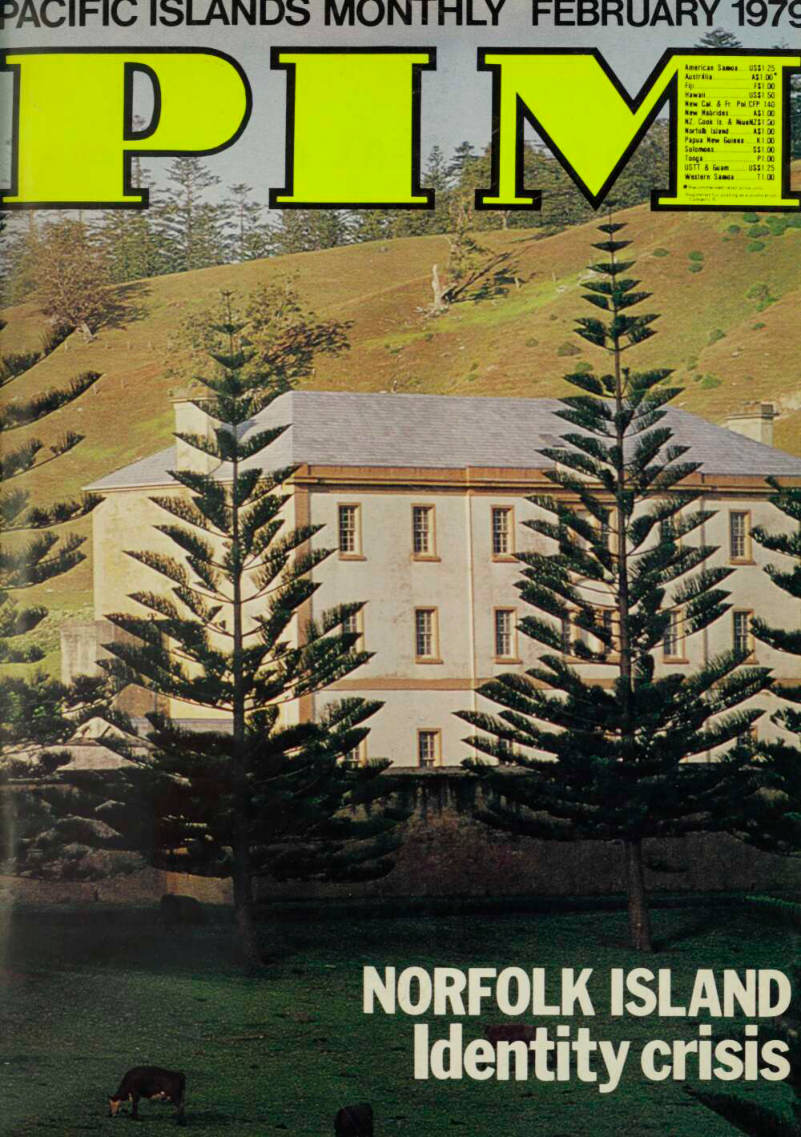
Identity crisis

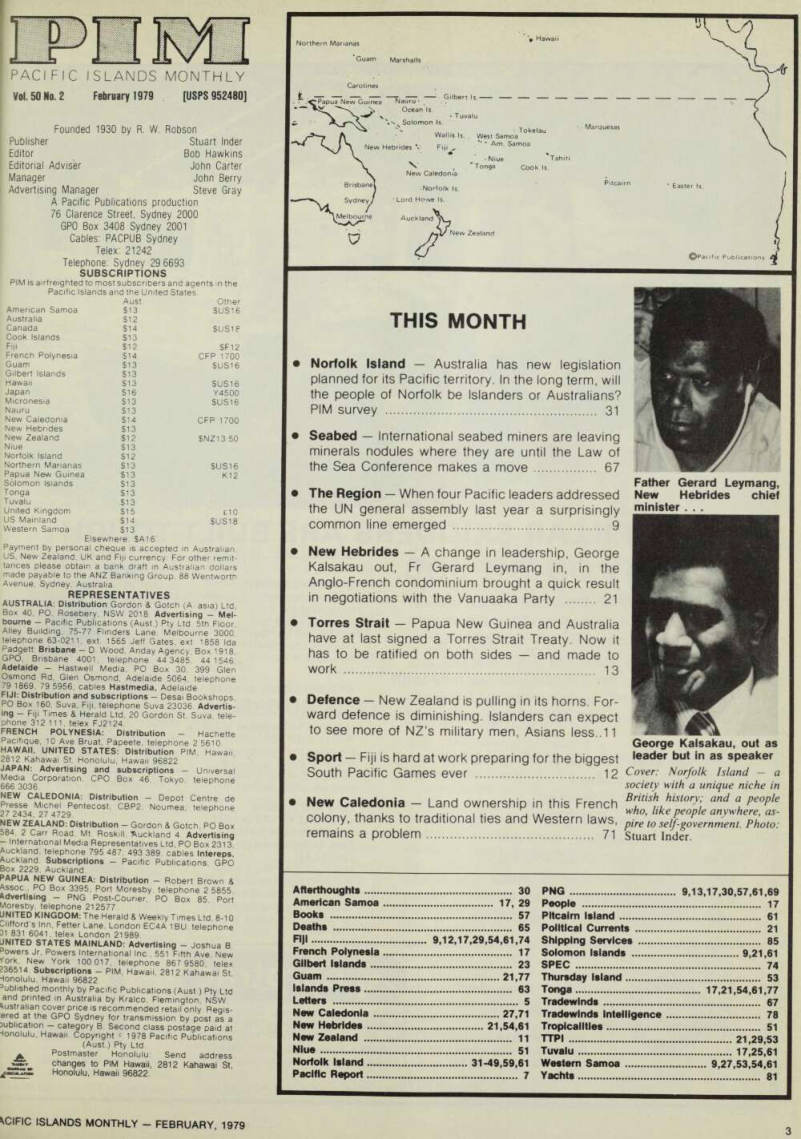
pacific; islands monthly
Pim
February 197S
American Samoa USSI 25 Australia AJI 00* Fiji FSI 00 Hawaii USSI 50 New Cal i Ff Poi CFP 140 New Hebrides AS 00 NZ Cook It S NtueNZSI 00 Nona* itiato AS I 00 Papua New Guinea K 1 00 Solomons SSI 00 loofla PI 00
Ustt A Guam Ussi.2S
Wulern Samoa T 1 00
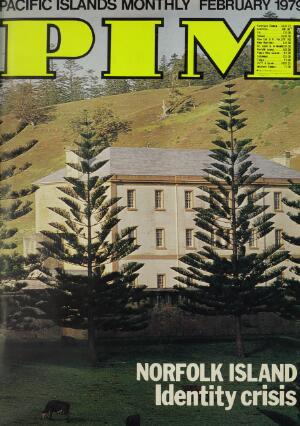
Norfolk Island
Identity crisis
Cover: Norfolk Island a society with a unique niche in British history; and a people who, like people anywhere, as
pire to self-government. Photo:
Stuart Inder.
Advertisements & other items, p. 2 (1 item)
Toyota
How to find a REAL economy car.
When you look at a car billed as an economy
model, ask yourself a few questions.
What sort of fuel consumption can be expected?
Low? Good.
What about other operating costs? Oil, lubrication, that kind of thing. Low again? Great.
How about maintenance? The car has a low-breakdown record? You are definitely on the right track.
What is the average life of the car? Is it better than the average in your area? Super. That’s important in an economy car.
How. How is the after service? Buying a car is not all in the price you know. Plenty of service outlets?
One economy car coming up. All you have to do is check the price. Then you can tell if you are really getting an economy car.
You will probably find, after asking these questions about town, that REAL economy cars come down to Toyota, the world’s economy car builder.
See Toyota first. Then you won’t have to shop around.
IHE HAPPY ECONOMIZER
TOYOTA STARLET
The car that says economy in every way.
And you will be happy for it. Big inside Small outside. Miserly with petrol.
Without sacrificing comfort. A good buy in an economy car even for Toyota. \ k
PAPUA NEW GUINEA:
ELA MOTORS LIMITED,
Scratchley Rd., Badili, P.O. Box 75, Port Moresby.
U.S. TRUST
TERRITORY: MICROL
CORPORATION,
P.O. Box 267, Saipan.
FIJI ISLANDS:
AUTOMOTIVE
SUPPLIES CO., LTD.,
G.P.O. Box 355, Suva.
AMERICAN SAMOA:
BURNS PHILP
(SOUTHSEA) CO., LTD.,
P.O. 1057, Pago Pago.
WESTERN SAMOA:
BURNS PHILP
(SOUTHSEA) LTD.,
P.O. Box 188, Apia.
GUAM: ATKINS, KROLL
(GUAM) LTD., P.O. Box
6248, Tamuning.
NEW HEBRIDES:
NEW HEBRIDES
MOTORS LTD.,
P.O. Box 18, Vila.
SOLOMON ISLANDS:
MENDANA
TOYOTA
SERVICE
TOYOTA
ENTERPRISES (5.1.)
LTD., P.O. Box 174,
Honiara.
TAHITI: NIPPON
AUTOMOTO, B.P. 342,
Papeete.
COOK ISLANDS:
COOK ISLANDS
TRADING
CORPORATION LTD.,
P.O. Box 92, Rarotonga.
NAURU ISLAND:
NAURU COOPERATIVE
SOCIETY.
GILBERT ISLANDS:
TARAWA MOTORS,
Box 36, Bairjki Tarawa.
NORFOLK ISLAND:
MOUNT PITT
(ENTERPRISES) LTD.,
P.O. Box 169
NEW CALEDONIA:
SOCIETE
IMPORTATION
AUTOMOBILE DE
PACIFIQUE,
Rond-Point du Pacific (Station Total) B.P. 438, Noumea.
The Toyota range includes: Toyota 1000, Toyota Starlet, Toyota Corolla, Toyota Celica, Toyota Corona, Toyota Cressida, Toyota Crown
[Usps 952480]
Pim
Pacific Islands Monthly
Vol. 50 No. 2
February 1979
[Usps 952480]
Elsewhere $A16 Payment by personal cheque is accepted in Australian, US, New Zealand, UK and Fiji currency. For other remit tances please obtain a bank draft in Australian dollars made payable to the ANZ Banking Group. 88 Wentworth Avenue, Sydney, Australia
Representatives
AUSTRALIA: Distribution Gordon & Gotch (A asia) Ltd, Box 40, PO, Rosebery, NSW 2018 Advertising - Mel bourne - Pacific Publications (Aust.) Pty Ltd 5th Floor, Alley Building. 75-77 Flinders Lane, Melbourne 3000 telephone 63-0211, ext 1565 Jeff Gates, ext 1858 Ida Padgett; Brisbane - D. Wood, Anday Agency. Box 1918, GPO, Brisbane 4001, telephone 44 3485 44 1546 Adelaide - Hastwell Media, PO Box 30, 399 Glen Osmond Rd, Glen Osmond, Adelaide 5064, telephone 79 1869, 79 5956; cables Hastmedia, Adelaide FIJI: Distribution and subscriptions - Desai Bookshops, PO Box 160, Suva, Fiji, telephone Suva 23036 Advertis ing - Fiji Times & Herald Ltd, 20 Gordon St, Suva tele phone 312 111, telex FJ2124 FRENCH POLYNESIA; Distribution — Hachette Pacifique, 10 Ave Bruat, Papeete, telephone 2 5610 HAWAII, UNITED STATES: Distribution PIM, Hawaii 2812 Kahawai St, Honolulu, Hawaii 96822 JAPAN: Advertising and subscriptions - Universal Media Corporation, CPO Box 46. Tokyo, telephone 666 3036.
NEW CALEDONIA; Distribution — Depot Centre de Presse Michel Pentecost, CBP2, Noumea, telephone 27 2434, 27 4729.
NEW ZEALAND: Distribution - Gordon & Gotch. PO Box 584, 2 Carr Road, Mt. Roskill, Auckland 4 Advertising - International Media Representatives Ltd, PO Box 2313 Auckland, telephone 795 487; 493 389, cables Intereps, Auckland. Subscriptions - Pacific Publications, GPO Box 2229, Auckland.
PAPUA NEW GUINEA: Distribution — Robert Brown & Assoc., PO Box 3395, Port Moresby, telephone 2 5855.
Advertising — PNG Post-Courier, PO Box 85 Port Moresby, telephone 212577 UNITED KINGDOM: The Herald & Weekly Times Ltd, 8-10 Clifford's Inn, Fetter Lane, London EC4A 1BU, telephone D1 831 6041, telex London 21989 UNITED STATES MAINLAND: Advertising - Joshua B p owers Jr, Powers International Inc , 551 Fifth Ave New fork. New York 100 017, telephone 867 9580 telex ?36514 Subscriptions - PIM, Hawaii, 2812 Kahawai St Honolulu, Hawaii 96822 published monthly by Pacific Publications (Aust.) Pty Ltd and printed in Australia by Kralco, Flemington, NSW Australian cover price is recommended retail only Regis ered at the GPO Sydney for transmission by post as a Dublication — category B. Second class postage paid at Honolulu, Hawaii. Copyright e 1978 Pacific Publications (Aust.) Pty Ltd.
Postmaster Honolulu Send address changes to PIM Hawaii, 2812 Kahawai St, Honolulu, Hawaii 96822.
This Month
• Norfolk Island Australia has new legislation planned for its Pacific territory. In the long term, will the people of Norfolk be Islanders or Australians?
PIM survey 31 • Seabed International seabed miners are leaving minerals nodules where they are until the Law of the Sea Conference makes a move 67 • The Region When four Pacific leaders addressed the UN general assembly last year a surprisingly common line emerged 9 • New Hebrides A change in leadership, George Kalsakau out, Fr Gerard Leymang in, in the Anglo-French condominium brought a quick result in negotiations with the Vanuaaka Party 21 • Torres Strait Papua New Guinea and Australia have at last signed a Torres Strait Treaty. Now it has to be ratified on both sides and made to work 13 • Defence New Zealand is pulling in its horns. For ward defence is diminishing. Islanders can expect to see more of NZ’s military men, Asians less..ll • Sport Fiji is hard at work preparing for the biggest South Pacific Games ever 12 • New Caledonia Land ownership in this French colony, thanks to traditional ties and Western laws, remains a problem 71
Afterthoughts 30 American Samoa 17, 29 Books 57 Deaths 65
Fiji 9,12,17,29,54,61,74
French Polynesia 17 Gilbert Islands 23 Guam 21,77 Islands Press 63 Letters 5 New Caledonia 27,71 New Hebrides 21,54,61 New Zealand 11 Niue 51 Norfolk Island 31-49,59,61 Pacific Report 7
Png 9,13,17,30,57,61,69
People 17 Pitcairn Island 61 Political Currents 21 Shipping Services 85 Solomon Islands 9,21,61
Spec 74
Thursday Island 53 Tonga 17,21,54,61,77 Tradewlnds 67 Tradewinds Intelligence 78 Troplcallties 51
Ttpi 21,29,53
Tuvalu 17,25,61 Western Samoa 9,27,53,54,61 Yachts 81
Father Gerard Leymang, New Hebrides chief minister . . .
George Kalsakau, out as leader but in as speaker
Advertisements & other items, pp. 3-4 (2 items)
3
\CIFIC ISLANDS MONTHLY FEBRUARY, 1979
Founded 1930 by R. W. Robson Publisher Stuart Inder Editor Bob Hawkins Editorial Adviser John Carter Manager John Berry Advertising Manager Steve Gray A Pacific Publications production 76 Clarence Street, Sydney 2000 GPO Box 3408 Sydney 2001 Cables; PACPUB Sydney Telex: 21242 Telephone: Sydney 29 6693
carptrac
w *1
I n&TEPPSUAg
‘“•"H
".'.air.
as 4 >~- % >«* •*.
' ,: *V >^-
LOW RATED RPM
CATERPILLAR SKIDDERS ARE BUILT TOUGH
TO STAY ON THE JOB.
Cat-built Skidders have protection all
round. You get protection for man and
machine with the roll-over canopy and
other machine guarding. And you get
protection against excessive downtime with
dependable CAT construction, CAT dealer
backup and easy on the job maintenance.
MUFFLER
QUIET OPERATION
You get low noise levels from the 4-stroke cycle diesel, muffler and low-speed fan. You'll hear the difference in Cat-built Skidders.
THE CATERPILLAR 518 SKIDDER
features 120 flywheel
horsepower @ 2200 rpm,
powered by the Cat 3304
turbocharged engine, with an
operating weight of 20,400 lbs,
turning diameter of 34' 8" and
utilises a Gearmatic 119 winch
with a linepull (max.) of 32,000 lbs.
STRONG DOZER BLADES
deck and bunch logs, clear brush, protect the radiator. The blades are high-strength steel with trunnions that never need greasing. Dozer blades are box-sectioned for greater strength and durability.
LOW RATED RPM
4 STROKE CYCLE DIESEL
MUFFLER LOW-SPEED
FAN RUGGED ARCH AND
FAIRLEAD
stand up under heavy loads.
The main roller is a Lifetime Lubricated hardened casting to reduce scarring that tears up cables. Side rollers are heat-treated for long life.
LAE :
Milford Haven Road, Telephone 42 2355
PORT MORESBY :
Telephone 256650
BOUGAINVILLE :
Itakara Industrial Park, Arawa. Telephone 959077 €
carptrac
SUVA : Carpenter Street, Raiwai.
Private Mail Bag, GPO Suva. Fiji. Ph. 381622, Telex FJ2190 Cables CARPTRAC LAUTOKA : Veitari. Telephone 61877 LABASA : Vulovi, Telephone 81888
YOUR
CATERPILLAR
DEALER
Caterpillar, Cat and 03 are Trademarks of Caterpillar Tractor Co BA 10441
Letters
A. Samoa: The
Possibilities
The December issue of PIM came on sale here this morning.
May I begin by stating how much I appreciate PIM, having been a faithful reader since coming to Samoa in 1940. Your caption on page 70, states ‘Western Samoa’s Salanoa ...’ although you correctly identify Salanoa as the president of the Senate here in American Samoa in your text.
The Political Study Com mission, of which Salanoa is chairman, has already adver tised public hearings this month (December) on the very subject of possible changes in the status of American Samoa.
Possibilities suggested, among others, were: the status quo, as sociation with the State of Hawaii, status similar to that of the Commonwealth of Puerto Rico, status similar to that of the Marianas, independence, association with Western Samoa ... Obviously the local authorities believe in free pub lic discussion of the issues.
Should somebody make a speech at the United Nations calling for the liberation of the American Samoans from ‘American colonialism’, or ‘imperialism’ if you prefer that label, I have no doubt that there would be many sup porters for such a motion.
However if you were to consult the people concerned, the US lationals resident here, my )wn feeling is that apart from he question of possible change n status, the vote would be :lose to 100 per cent in favour )f retaining the tie with the US. would go further and suggest hat if you also consulted the nore or less permanent resi ients of Western Samoan or ongan origin, the vote would •e equally enthusiastic in avour of the US relation
hip.
The people of American amoa have liberty and free onl within the US system and
do not want ignorant outsiders to impose their own ideas on them. They have only to look to the difficulties that their Western Samoan relatives now have in respect to entry to New Zealand to convince them selves of the folly of giving up an association which gives them right of entry to the USA. (Would Australia give them equal opportunities?) Furthermore the economic factor is a consideration. For example: last night the local radio and television stations, WVUV and KVZK-TV, held a fund-raising telethon to raise money to organise a sports meeting next March and to send local representatives, to be chosen from the results at that meeting, to the US later in 1979 to a mini-olympic games for handicapped children. The cash received plus pledges in one aftemoon-evening session amounted to approximately $5O 000. I doubt if Western Samoa, with five times the population, could get any where near that amount. May I repeat, as an outsider, I am convinced that the people of American Samoa now enjoy more freedom moral, politi cal and economic than they could get in any other way.
And they are shrewd enough to
appreciate it.
S.J. Bourke
Pago Pago American Samoa
Us Memorial At
Six Mile
The recent comment by one of your readers on the absence of a memorial to the United States servicemen in Papua New Guinea is not quite cor rect (PIM November).
Not far from Port Moresby city in the Six Mile area there used to be a stone cairn with a plaque attached in memory of the United States Fifth Air force erected by the Twenty seventh Depot Repair Squadron.
Unhappily, this memorial was smashed by vandals in the
1960 s and the plaque stolen.
The cairn was inscribed with the words: ‘ln memory of our comrades who gave their lives in the service of our country there is erected at Port Moresby, New Guinea, a
monument in stone. To all who pass it gives testimony of their devotion.’
The concrete base of the cairn was all that remained of this memorial in 1967.
V. T. Sanders
Hohola Papua New Guinea
Manureva
Mix-Up
In your article on the Club Mediterranee (PIM November) I would point out that the Manureva was not a Polynesian catamaran but a trimaran of Western (European) concep tion, built of aluminium and raced by Eric Tabarly in the OSTAR (Observer Trans- Atlantic Race) 1972 under the name of Pen Duick IV.
He came second.
And a note of reassurance: The Club Mediterranee's uranium keel is well past its radioactive days - unless Club Med starts taking people on sightseeing tours to Mururoa.
Yacht Aventura South Pacific
Jimmy Cornell
Let’S Look
Further Back
The newly formed Pacific
Heritage Society, described in
your November 1978 issue, is to be encouraged in its efforts to preserve the architectural heritage of the South Seas.
Unfortunately, the text of your article and particularly the il lustrations chosen perhaps leave the impression that the only architectural treasures worth saving are those build
ings built by Europeans.
Someone must speak up, and speak up soon, for the preser vation of the traditional, pre- European architecture of the Pacific. A visitor might search far and wide in US administered Micronesia and not see a single specimen of traditional architecture, and in New Guinea’s Sepik region the haus tambaran is fast becoming an ‘endangered species’.
I would like to point out, however, that at least one Pa cific people the Gogodala of Papua New Guinea appear to be swimming against the tide of architectural destruction. In August 1974, at Balimo, Prime Minister Somare helped to dedicate the ‘Gogodala Cul
tural Centre’, housed in th< first traditional longhouse bull in the area since the earb 19505.
Originally each Gogodah
village occupied such <
longhouse, some up to 180 m ir length, but by the 1970 s all bu one had been pulled down, vic tims of the twin onslaught ol missionaries and ‘progress’
The thought occurs to me thai
perhaps the Balimo longhouse
could serve as a model for simi lar architectural reconstruction projects elsewhere in the Pa cific.
James A. Baldwin
Instructor in Geography State University Bowling Green Ohio, US
Looking Fora
Swap
I am very interested in collect ing stamps (mint and used) from the Australian dependen cies and Papua New Guinea.
In the past, I have been able to work to earn the money to
spend on this fascinating
hobby without depriving my
family (I have three sons) but, because of arthritis, I have had to give up my job.
I also enjoy letter-writing
and am very keen to learn more about the countries whose stamps I have been collecting.
I would be very happy to corre spond with any of your readers interested in Australia and who would also like to swap their countries’ stamps.
I have lived in both country and city and, together with my husband and children, have
travelled extensively through
out the southern half of Aus tralia, so feel fairly well qualified to supply some in formative details.
(Mrs) Marlene Windsor
6 Anderson Way, Thornlie 6108.
Western Australia.
Solomons
Search
I am anxious to contact rela tives and friends of these people who lived in Solomon Islands pre-World War II: J. S.
Speirs who died in Malaita in 1937, and Dr Lucy Holt- McCrimmon who lived at Su-u, Malaita, in the 1920 s and 19305.
J. A. Bennett
Research School of Pacific Studies Canberra, ACT Australia
Advertisements & other items, pp. 5-6 (2 items)
Acific Islands Monthly - February, 1979
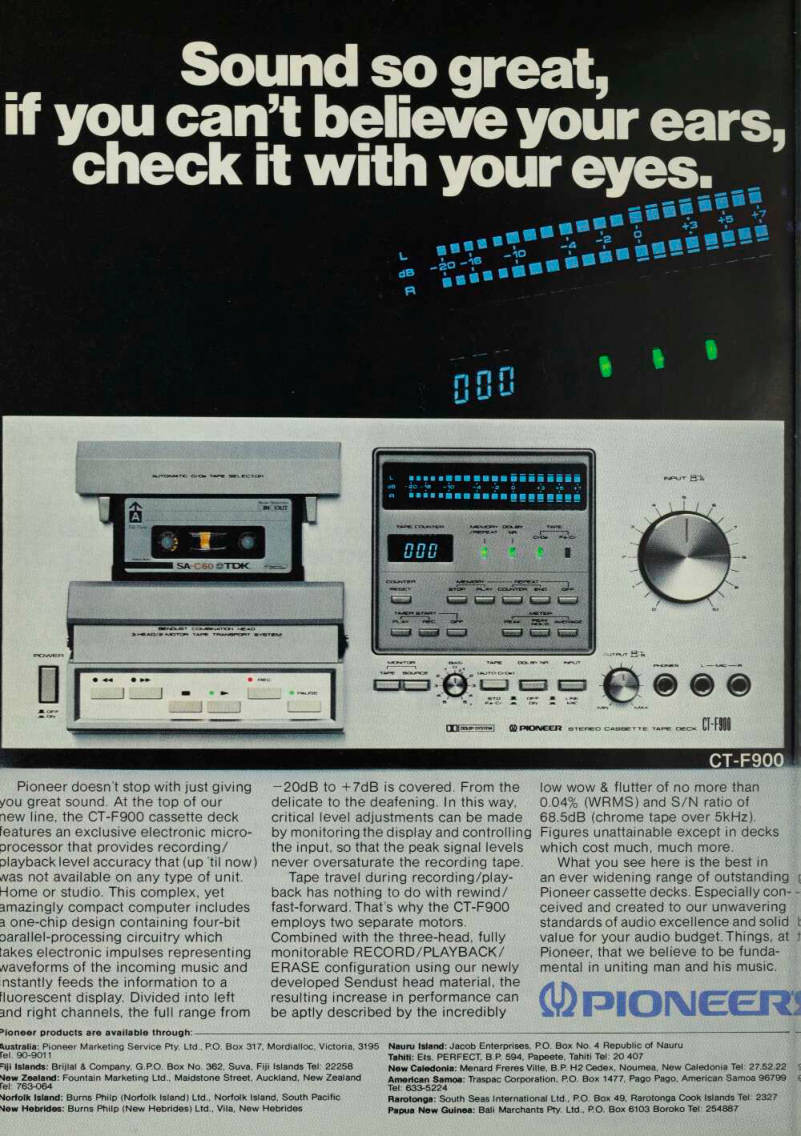
Sound so great,
if you can’t believe your ea
check it with your eyes.
d© -so "I 6 g 000 » » a
OUT
CSO^TIDK
SA I - - --- W: a t 1
WPUT
a e
STO ML OF*f* M
0“« O® ® ®
STEREO CASSETTE TAPE DECK
CI-FSII
CT-F9OO
-20 dB to + 7dß is covered. From the delicate to the deafening. In this way, critical level adjustments can be made by monitoring the display and controlling the input, so that the peak signal levels never oversaturate the recording tape.
Tape travel during recording/pi ayback has nothing to do with rewind/ fast-forward. That's why the CT-F9OO employs two separate motors.
Combined with the three-head, fully monitorable RECORD/PLAYBACK/ ERASE configuration using our newly developed Sendust head material, the resulting increase in performance can be aptly described by the incredibly low wow & flutter of no more than 0.04% (WRMS) and S/N ratio of 68.5d8 (chrome tape over skHz).
Figures unattainable except in decks which cost much, much more.
What you see here is the best in an ever widening range of outstanding e Pioneer cassette decks. Especially con- ceived and created to our unwavering standards of audio excellence and solid t value for your audio budget. Things, at t Pioneer, that we believe to be fundamental in uniting man and his music.
Cd PIONEER!
Pioneer doesn’t stop with just giving /ou great sound. At the top of our new line, the CT-F9OO cassette deck features an exclusive electronic microprocessor that provides recording/ playback level accuracy that (up til now) was not available on any type of unit.
Home or studio. This complex, yet amazingly compact computer includes a one-chip design containing four-bit carallel-processing circuitry which takes electronic impulses representing waveforms of the incoming music and nstantly feeds the information to a fluorescent display. Divided into left and right channels, the full range from 3 ioneer products are available through: Australia: Pioneer Marketing Service Pty. Ltd., P.O. Box 317, Mordialloc, Victoria, 3195 fel. 90-9011 =iji Islands: Brijlat & Company, G.P.O. Box No. 362, Suva. Fiji Islands Tel: 22258 Slew Zealand: Fountain Marketing Ltd., Maidstone Street, Auckland, New Zealand rel: 763-064 Slorfolk Island: Burns Philp (Norfolk Island) Ltd., Norfolk Island, South Pacific Mew Hebrides; Burns Philp (New Hebrides) Ltd., Vila, New Hebrides Nauru Island: Jacob Enterprises, P.O. Box No. 4 Republic of Nauru Tahiti: Ets. PERFECT. B.P. 594, Papeete, Tahiti Tel: 20 407 New Caledonia: Menard Freres Ville, B.P. H 2 Cedex, Noumea, New Caledonia Tel: 27.52.22 S American Samoa; Traspac Corporation, P.O. Box 1477, Pago Pago, American Samoa 96799 € Tel: 633-5224 Rarotonga: South Seas International Ltd., P.O. Box 49, Rarotonga Cook Islands Tel: 2327 Papua New Guinea: Bali Merchants Pty. Ltd., P.O. Box 6103 Boroko Tel: 254887
Pacific Report
Dissecting Sir Albert Henry’S Reign
Cook Islands Politics: The Inside Story, from a small new pub lisher, Polynesian Press of Auckland, released in January is re quired reading for Cook Islands politicians many of whom won't like what it says. The book published in association with the South Pacific Social Sciences Association of Suva, from a study co-ordinated by Professor Ron Crocombe of the Institute of Pacific Studies, University of the South Pacific comprises chapters from 20 Cook Islanders involved in some way with Cook Islands politics during the reign of Sir Albert Henry, but particularly with his sudden demise. Most pull no punches as they outline their experiences of Sir Albert’s personal style of administration, which mainly seems to have involved putting his family and friends in plum jobs. Writes Dr Joe Williams who re signed from Sir Albert’s cabinet in 1978: ‘I could no longer sup port Sir Albert Henry as premier of this country and allow him to continue destroying the heritage of my country, my fore fathers and my children.’ PIM will be printing extracts next month.
Danielsson Loses Diplomatic Status
Bengt Danielsson has had his exequatur official consular recognition as honorary consul for Sweden withdrawn by the French authorities in French Polynesia. Danielsson and his wife Marie-Therese, PlM’s accredited correspondents in French Polynesia, have been unpopular with the French for years because of their journalistic activities. The French found their book Mururoa, mon amour, dealing with nuclear testing on Mururoa atoll, particularly irritating. The Danielssons report that the French move will not stop them writing but indicate that it is possible 'that they will one day expel us’. At the end of last year the Danielssons wrote an open letter to French President Giscard d Estaing defending their right to express opinion freely even here in a colony’.
Australia And Png Sign Border Pact
Neither side saw any serious problems in achieving ratification from their respective parliaments for the Torres Strait border treaty signed in Sydney on December 18. The signing marked the end of six years of negotiations, triggered from the Papua New Guinea side and started by Australia’s then prime minister, Gough Whitlam. Australian Foreign Affairs sources admitted that PNG had shown a sympathetic understanding toward Australia’s complicated constitutional position on federa;-state relations on the issue (page 13).
South Pacific Games Souvenir Programme
A souvenir programme for the sixth South Pacific Games in Fiji in August-September this year, providing a wealth of infor mation, historical and current, and selling at SFI plus postage, has been produced by the games organising committee. The programme has a four-colour cover and appears to have r eceived encouraging business support. Copies can be obtained Dy writing to PO Box 8, Suva, Fiji. (SP Games preview, page .9.)
(Vest Germany To Help Western Samoa
Western Samoa and West Germany have signed an agreement or technical co-operation which provides for the establishment )f research and training centres, preparation of studies and re ports, the secondment of specialists, training of personnel and he supply of materials and equipment to Western Samoa. >pecific projects include a rhinoceros beetle eradication pro jramme a marine training centre and an agricultural complex it Salelologa in the island of Savaii.
*H Teachers Disillusioned
eachers in English-speaking schools in the New Hebrides mgio-French condominium are reported to be ‘disillusioned and inxious at events since their one month strike for pay and con rtions last August. The strike followed a year of inconclusive tegotiations in which teachers sought a 25-30% pay increase
improved housing and an acceptable compensation scheme which they said would bring them into line with conditions avail able to public servants generally. The strike ended with a 12% salary increase and some assistance with housing costs.
Christmas Windfall For Micronesians
The US Government handed out SUSI 2.6 million in war claims to Micronesians in December. This Christmas windfall, writes Paul Addison in Agana, came after controversial discussions stretching back a decade. The payments were for use of Micronesians’ land by the US military after the Pacific War.
Micronesians are still claiming millions of dollars for deaths, use of land and destruction of property during and before’ the war.
Banabans Look To Australia And N.Z.
The Banabans, continuing their fight for independence from the Gilberts, are likely to put pressure on the Australian and New Zealand governments. The Banabans argue, according to their legal adviser, K. C. Ramrakha, MP, of Fiji, that, as Australia and New Zealand have benefited for years from cheap phosphate they got from their homeland, Ocean island, they now have a moral responsibility to stand by the Banabans, who were told in London at the constitutional conference between the UK Government and the Gilbertese that Ocean Island (Banaba) would remain part of the Gilberts. Warned Mr Ramrakha: ‘By insisting that Banaba be part of their country, the Gilbertese will be undermining their future stability’ (See page 21).
Major Cabinet Reshuffle In Nauru
Two new ‘old’ faces are in the Nauru cabinet following President Hammer Deßoburt’s big reshuffle in December. Lagumot Harris, who was in former president Bernard Dowiyogo’s cabinet and, for a few days last year, actually became president of the repub lic before Head Chief Deßoburt took over again, comes in as minister for works and community services, taking over from Totouwa Depaune, The other returnee is Kenas Aroi, prominent in Dowiyogo’s ‘young turks’ era, who has been given the justice portfolio. Robidok Buraro Detudamo has relinquished justice for finance, taking over from James Bop. The president made no changes in his own portfolios and Joseph Detsimea has kept his job as health and education minister.
Polynesian Airlines To Get Nomad
A 12-seater Australian Nomad aircraft is to be used by Polynesian Airlines on its route between the Western and American Samoan capitals early this year. The Britten Norman Islander, which has been making occasional Apia-Pago Pago flights will then go back onto the internal service between Upolu and Savaii islands in Western Samoa.
Torres Separatists Petition Pm
Separatist leaders in Australia’s north Queensland Torres Strait region were planning in December to petition Prime Minister Mal colm Fraser for a federal royal commission to inquire into claims that voting in elections in the islands had been rigged. They are also seeking a United Nations investigation of the claims.
New Home For Fiji Visitors Bureau
Fiji Visitors Bureau is now in its new Suva city centre premises after spending two years in temporary offices. Minister for Tour ism Tomasi Vakatora, calling for business support for the FVB warned: ‘Do not sit back and reap profits hoping that government will continue to foot the bill.’ FVB chairman Mahendra Patel at the same time announced that board meetings would once again be open to the press, having been closed to the press for a three-month period. The FVB’s marketing and promotion budget for the coming year is $F325 000.
Png Passes Copyright Law
Papua New Guinea now has a copyright act to protect the work of Papua New Guinean artists, composers and writers, and to
prevent PNG from becoming ‘a centre for the production of pira ted material,’ said Deputy Prime Minister Ebia Olewale. It also means that PNG will have to pay for foreign copyright works.
The act apparently does not cover material appearing in the printed news media.
Cooks Newspaper In Contempt
A Morningstar, Cook Islands, cartoon had suggested that Mr Justice Donne, who overturned last year’s general election re sult in the Cooks, had not acted impartially, said Mr Justice Beat tie after hearing charges of contempt brought by the Cook Islands Advocate-General against Morningstar editor Tupui Ariki Henry and the publishers, Cook Islands Publications Ltd. The cartoon depicted two boxers in a ring with a referee, a caricature of Mr Justice Donne, holding either a gavel or a mallet. Mr Jus tice Beattie in his written judgement, said the ‘sting’ in the car toon ‘comes when one examines the picture and finds that there are lines in the drawing connecting the mallet or gavel with a strong swinging motion, and directly above the head of the recumbent CIP (Cook Islands Party) boxer appears a star with the word “Wham”.’ The inference, he said, was that the judge was not impartial and had descended into the fighting arena.
In a second charge, Mr Justice Beattie said an article reprinted in Morningstar from People's Voice, a New Zealand communist paper, was ‘a one-sided scurrilous attack’ and its effect was ‘to lower the integrity and reflect on the impartiality of the court . . .’ Mr Henry was fined SNZ 150 and Cook Islands Publi cations $250.
Internal Self-Rule For Kosrae And Yap
Headed by its first governor, Jacob Nena, Kosrae (ex-Kusaie) in the eastern Caroline Islands began the new year as a full, internal self-governing district of the United States Trust Terri tory. Seven days later, in northern Palau, Yap Island’s new government with Senator John Mangefel as governor was inaugurated.
Floating Oil Stores In Pacific
The Japanese Government is stockpiling crude oil on 200 000-tonne tankers drifting to the east of the Bonin Islands and Iwojima Island, southeast of Japan. Ryozo Doi from Tokyo reports that at the end of 1978, 20 tankers were in the area, each with a crew of 28. They return to port every three months to replenish fuel and supplies. The stockpiling is planned to con tinue for two years until permanent land storage facilities are constructed. Although the tankers’ engines are kept ready for use at all times experts are worried about what may happen if a typhoon hits the area. The Japanese Government’s intention is to help the recession-hit Japanese shipping industry and to reduce Japanese dollar holdings by buying more crude oil.
Tonga’S Bank Gets New Backer
The privy council in Tonga has agreed to re-charter the Bank of the South Pacific with John Lister, as governor, and with a subscribed capital of $T 10 million. The bank is expected to have a five-man board with directors from the United States, Switzer land, Canada and Japan. Mr Lister is described in the Tonga Chronicle as an Englishman with a bank in Australia.
Australian Surveillance Initiatives
Ten Australian designed and built Nomad aircraft are to be used on coastal surveillance activities. Announcing initiatives in coastal surveillance, Minister for Transport Peter Nixon also revealed that contracts had been won by two aviation companies for aerial patrol work. Trans West Air Charter of Western Aus tralia will patrol the coastline from Geraldton to the Kimberleys (about 3200 km) and Executive Airlines of Essendon, Victoria, will partrol the 3200 km from Thursday Island to Gove. Tenders for the stretch from Gove to the Kimberleys are being called.
Mr Nixon said the performance of the Nomads would be closely monitored and their effectiveness will be assessed as part of ‘the major review of coastal surveillance. . . before mid-1980’.
Png Call For Pacific Decolonisation
Although supporting Papua New Guinea Deputy Prime Minister Ebia Olewale’s call for Pacific colonists to accelerate the decolonisation process, Opposition Leader lambakey Okuk said it was hypocritical ‘for the prime minister and his deputy to talk
about breaches of human rights in Africa and in the Pacific as a whole while they neglect cleaning their own backyard’ Mv Okuk, referring to the jailing of West Papua leader Jacob Prs and Otto Ondawame, said that ‘if the government is to be hones: and true to its principles . . . then the West Papua people ought to be treated with dignity, not only because PNG has a regard for the basic human rights but also because they am an oppressed and colonised Pacific people’.
Nz Concern Over Shipping Services
Inadequate shipping to Cook Islands and French Polynesia ha:£ led to the New Zealand Export Institute setting up an action corrrr mittee charged with finding ways of improving the services Exporters are claiming there is less capacity on the NZ-Tahili run than there was a year ago and that goods can be shipper from Australia to Tahiti (a greater distance) at 10 cents a kiUI less (sometimes 16 cents) than from New Zealand.
Beefing Up Pago’S Tv Image
Three new transmitters, increasing the strength of visual trans mission from 40kW to 72, are to be installed in American Samo.c this year on Mount Alava, broadening station KVZK-TV’s coven; age. Aural transmission will also be improved. KVZK’s signs is also received in Western Samoa.
Help For Refugees In Png
The Committee for the Assistance of Refugees in Papua New Guinea (CARP), set up in Sydney in December, is ‘compilinor a record of past and current events that have affected the well being of the West Papuan people since the UN ceded the terrir tory to Indonesia'. CARP has links with Community Aioi Abroad.
SI PM SITS TIGHT AFTER BUDGET DEFEAT Solomon Islands Prime Minister Peter Kenilorea, commentinor on the defeat of his government’s ‘rural growth budget’ in December, said he would resign only if there were a vote oo no-confidence. While a new budget is being prepared the parlias ment has approved the use of money from consolidated fundi for a period of four months. No developmental projects can b*c funded from this source. The budget was defeated 19-18 wittt one member of parliament absent. It seemed all agreed thas more money had to be put into rural areas but agreement wa:£ not forthcoming on how this should be done.
Cma Sees Upturn In Fiji Economy
The Central Monetary Authority in Fiji reports that ‘economioi conditions during the third quarter (of 1978) indicate a moderate] recovery in business activity ... the brightest spots being thei pick-up in tourist arrivals, the increased activity in the buiidinoi and construction trade and the recovery in world sugar prices’
It says that, with a good sugar cane crop in 1979 and the possi-i. bility of an increased quota under the international sugar agrees ment, ‘the economy seems poised for an upturn in 1979’.
Making The Crown Of Thorns Pay
American Samoa has paid out USS3O 000 in bounty money to: people who have collected and killed the alamea or crown otc thorns starfish which is blamed for damaging reefs arounoi Tutuila Island. Since the programme began in January last year£ 486 000 alamea have been collected. Bounty money has nowv run out and the government is seeking new means of coping: with the problem.
Process Your Own, Islands Told
The best industrial prospects for a number of Island groups liei in processing their own agricultural and forestry products,a reported an Australian trade and development survey mission which visited Fiji, Tonga, Western Samoa, Nauru and Solomon Islands late last year.
Solomons Rejects Death Penalty
By 19 votes to 11 the Solomon Islands Parliament rejected s private member’s bill to restore the death penalty. Early last yeaiE a motion supporting the death penalty was passed 17-16. Primer Minister Peter Kenilorea argued that punishment for crimes was£ meant to teach as well as being a corrective measure.
Advertisements & other items, p. 7 (1 item)
7
ACIFIC ISLANDS MONTHLY - FEBRUARY. 1979
Pacific Nations

The Region
Speak To Un
With One Voice
There may be regional differences in the South Pacific which emerge at the annual Forum and Conference get togethers but at the United Nations, Island representatives sound very much alike.
For the first time a total of four Pacific Island countries took the rostrum at last year’s thirty third session of the General As sembly of the United Nations in New York, writes a UN cor
respondent. They were West
ern Samoa, Fiji, Papua New Guinea and Solomon Islands.
Tonga has associations with specialised agencies of the UN but is not a member of the
General Assembly.
The speeches of the Islands representatives offer a vivid reflection of their common concerns.
For example, questions of economic development loomed large in every speech.
Western Samoa’s Minister of Finance Vaovasamanaia
Filipo, expressing his ‘despair’
at the widening gap between
the developed and developing
countries, criticised developed countries for their failure to ap proach the aid target of 0.7% of gross national product which was agreed by the UN in 1970.
In real terms, he said, aid today was less than it was in the early 19605.
For Fiji’s Berenado Vunibobo, the growing trend towards protectionism in the international economic com munity was a matter for ‘regret and some concern’. He said: ‘We do not merely view this trend as unhealthy. It also makes us wonder as to the sin cerity of those who have been loud in their assurances and commitment to a more equi able distribution of the world’s vealth.’
Papua New Guinea’s Minis er for Foreign Affairs and Hade Ebia Olewale ham nered the same theme, saying: If meaningful progress is to be
ichieved, developed industrial
lations must address them elves to the question of im )roved access to their markets
places of security for them and their families. ‘Now that our region has been exposed to nuclear pol lution we can only hope that cessation of testing and time will restore our environment to something like its original pu
rity.’
The Fiji and PNG spokes men also expressed the un equivocal opposition of their
for the goods of developing countries. It is a recognised fact that developing countries are an important market for the exports of industrialised coun tries. If these markets are to re main open, greater efforts must be made to enable Third World countries to increase their
export earnings.’
Speaking for UN ‘new boy’
Solomon Islands, Prime Minis ter Peter Kenilorea was more restrained in his comments but still urged the international community to ‘give greater rec ognition to the special prob lems of the small territories and grant them special measures to give added impetus to social and economic development’.
They were also vocal on issues of disarmament, taking up particularly the question of the continued testing of nu clear weapons.
For Western Samoa Vaovasamanaia Filipo said: ‘lt is a fact that the world has spent SUSI. 4 trillion on arms over the last five years and it is also a fact that there are more than 650 million people with out enough to eat let alone
countries to continued nuclear testing in the South Pacific, Mr Olewale saying: ‘There is one fact we know for sure. Man and his environment will never be the same. We have been told that radiation effects are insig nificant. This we find hard to believe. We in the South Pa cific have repeatedly expressed our opposition to nuclear tests in the region. However, our protests fall on deaf ears, and testing still continues.’
Islands delegates all in vari ous ways expressed their coun tries’ hopes for benefits from the wealth of the oceans sur
rounding them, while making
no secret of the difficulties ex perienced in current nego tiations of the South Pacific Forum to establish a South Pa cific fisheries organisation.
Perhaps their strongest language was reserved for the problem of decolonisation, with France, and to a lesser extent the United States, though not being named, serv ing as main targets.
Vaovasamanaia Filipo
voiced his country’s ‘deep con cern’ that some Pacific coun tries which want to gain
independence have yet to do so.
He said: ‘ln some cases their wish and their right to aspire to independence have not even been acknowledged by the col onial powers concerned. ‘We would wish to see an end to this situation as soon as possible. The Pacific peoples who have achieved indepen dence have for the most part followed peaceful paths to that goal. This has been due to a combination of patience and forbearance on the part of the people concerned and some measure of goodwill on the part of the colonial powers involved. We would not wish to see any of our neighbours re main in a situation which may
strain their patience beyond
endurance.’
Mr Vunibobo expressed ‘dis couragement’ that ‘a number of territories remain under col onial rulership’ and called upon the UN to ensure that ‘all that are under any form of foreign domination should be given the opportunity to exer cise their inalienable right to self-determination’. He
pledged that Fiji, through its
membership of relevant inter national organs, including the Committee of 24, will continue to work for those goals.
Mr Olewale was more out
spoken, saying: ‘Some colonial
powers, in particular one metropolitan state represented here today, has seen fit not to give people under its colonial rule the chance to express their views in line with various UN resolutions on decolonisation.
‘My delegation hopes that
this particular metropolitan
power will change its attitude towards decolonisation in the South Pacific, and will ensure that the people in those terri tories under its administration will be given the opportunity to exercise their right to self determination and indepen dence, rather than exploiting them by saying that those terri tories are an integral part of the
metropolitan state. My delega
tion cannot accept this argu ment because they are
definitely not.’
Whatever differences they have in their relations with each other, Pacific Island nations represented in the UN
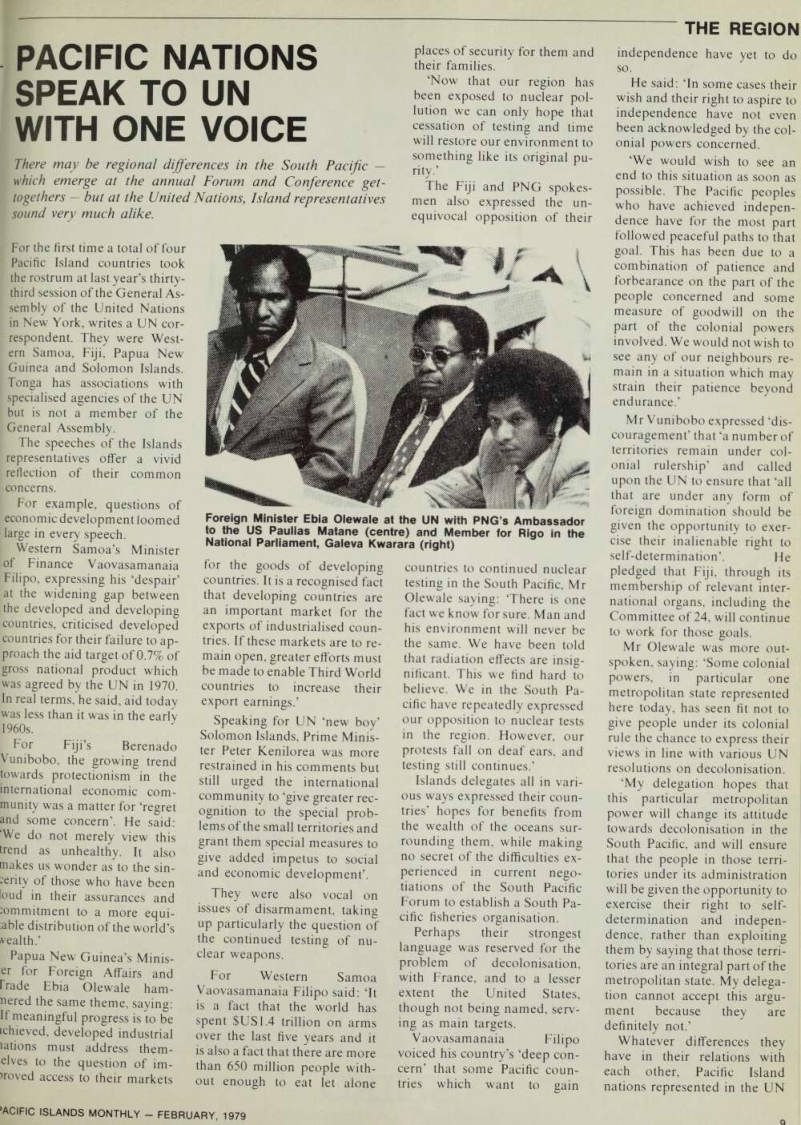
Foreign Minister Ebia Olewale at the UN with PNG’s Ambassador to the US Paulias Matane (centre) and Member for Rigo in the National Parliament, Galeva Kwarara (right)
certainly spoke with a regional “ voice, confirming a point made in his speech by Mr Olewale when he said: ‘The South Pacific region is often thought to consist of many small island nations
without a regional identity.
This is no longer true. The re gion now has an identity with
the coming into being of the South Pacific Forum seven years ago. ‘This is an organisation which strives to solve problems that confront our people in the South Pacific region and to consider differing ways in which economic growth can be achieved in the region. t ‘Proper utilisation of our natural resources, in particular fish, is one such way that this goal can be reached. The South Pacific contains what may be the world’s only under-utilised tuna resource and this, for sev eral South Pacific nations, rep resents the only natural resource available to them and, as such, is vital to their future
economic growth.
‘lt is for this reason that the South Pacific Forum is seeking to establish the South Pacific
Regional Fisheries Organis
ation (SPRFO) which will ensure that it is the people of the South Pacific who obtain the maximum benefits from the vast stocks of tuna that live in our waters, and not the
major distant water fishing
nations.’
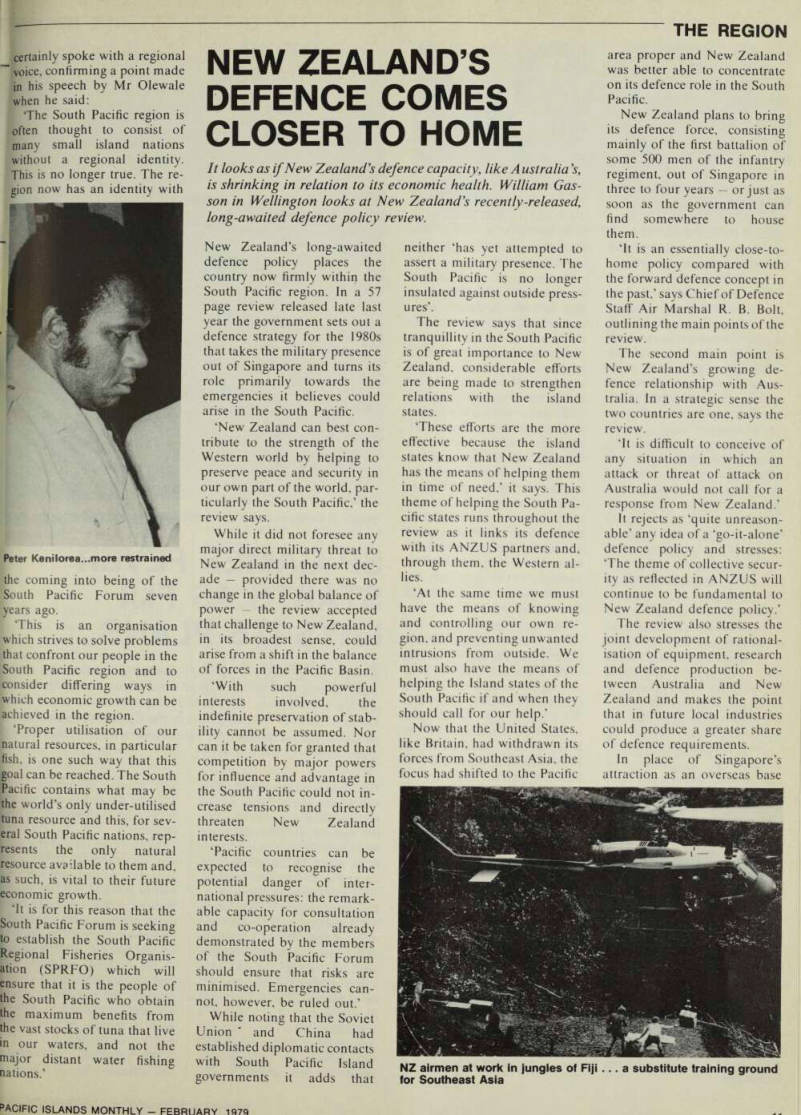
Peter Kenilorea...more restrained
Advertisements & other items, pp. 9-10 (2 items)
9
‘ACIFIC ISLANDS MONTHLY FEBRUARY, 1979
Sports 100
new peaks to sailing windy seas, there’s a rugged companion for your adventurous life:
Seiko Quartz
*9s r >1 % m m T Designed for today's men of action by the world eader in quartz technology. Sailing, swimming or mountain climbing, these watches are rugged enough ;o meet their active lifestyles, handsome enough to eflect their good taste, accurate enough to meet heir high standards.
Every Seiko Quartz SPORTS 100 is water-tested to 100 meters, and so efficiently designed that it can run five years on a single ordinary battery. All are shock resistant and feature day/date calendars.
Hardlex scratch-protected crystal, stainless steel cases and bracelets. Seiko Quartz.
oMT \ 1 / S
SEIKO
‘W QUARTZ
WED 2
- -tP I oc
SEIKO
Someday all watches will be made this way.
New Zealand’S
Defence Comes
Closer To Home
It looks as if New Zealand’s defence capacity, like A ustralia’s, is shrinking in relation to its economic health. William Gas son in Wellington looks at New Zealand’s recently-released,
long-awaited defence policy review.
New Zealand’s long-awaited
defence policy places the
country now firmly within the South Pacific region. In a 57 page review released late last year the government sets out a defence strategy for the 1980 s that takes the military presence out of Singapore and turns its role primarily towards the emergencies it believes could arise in the South Pacific. ‘New Zealand can best con tribute to the strength of the Western world by helping to preserve peace and security in our own part of the world, par ticularly the South Pacific,’ the review says.
While it did not foresee any major direct military threat to New Zealand in the next dec ade provided there was no change in the global balance of power the review accepted that challenge to New Zealand, in its broadest sense, could arise from a shift in the balance of forces in the Pacific Basin. ‘With such powerful interests involved, the indefinite preservation of stab ility cannot be assumed. Nor can it be taken for granted that
competition by major powers
for influence and advantage in the South Pacific could not in crease tensions and directly threaten New Zealand interests. ‘Pacific countries can be expected to recognise the potential danger of inter national pressures; the remark able capacity for consultation
and co-operation already
demonstrated by the members of the South Pacific Forum should ensure that risks are minimised. Emergencies can not, however, be ruled out.’
While noting that the Soviet Union ' and China had established diplomatic contacts with South Pacific Island governments it adds that
neither ‘has yet attempted to assert a military presence. The South Pacific is no longer insulated against outside press ures’.
The review says that since tranquillity in the South Pacific is of great importance to New Zealand, considerable efforts are being made to strengthen relations with the island states. ‘These efforts are the more effective because the island states know that New Zealand has the means of helping them in time of need,’ it says. This theme of helping the South Pa cific states runs throughout the review as it links its defence with its ANZUS partners and, through them, the Western al lies. ‘At the same time we must have the means of knowing and controlling our own re
gion, and preventing unwanted
intrusions from outside. We must also have the means of helping the Island states of the South Pacific if and when they should call for our help.’
Now that the United States, like Britain, had withdrawn its forces from Southeast Asia, the focus had shifted to the Pacific
area proper and New Zealand was better able to concentrate on its defence role in the South Pacific.
New Zealand plans to bring its defence force, consisting mainly of the first battalion of some 500 men of the infantry regiment, out of Singapore in three to four years or just as soon as the government can find somewhere to house them. ‘lt is an essentially close-to
home policy compared with
the forward defence concept in the past,’ says Chief of Defence Staff Air Marshal R. B. Bolt, outlining the main points of the review.
The second main point is New Zealand’s growing de fence relationship with Aus tralia. In a strategic sense the two countries are one, says the review. ‘lt is difficult to conceive of any situation in which an attack or threat of attack on Australia would not call for a response from New Zealand.’
It rejects as ‘quite unreason able’ any idea of a ‘go-it-alone’ defence policy and stresses: ‘The theme of collective secur ity as reflected in ANZUS will continue to be fundamental to New Zealand defence policy.’
The review also stresses the
joint development of rational
isation of equipment, research and defence production be tween Australia and New Zealand and makes the point that in future local industries could produce a greater share of defence requirements.
In place of Singapore’s
attraction as an overseas base
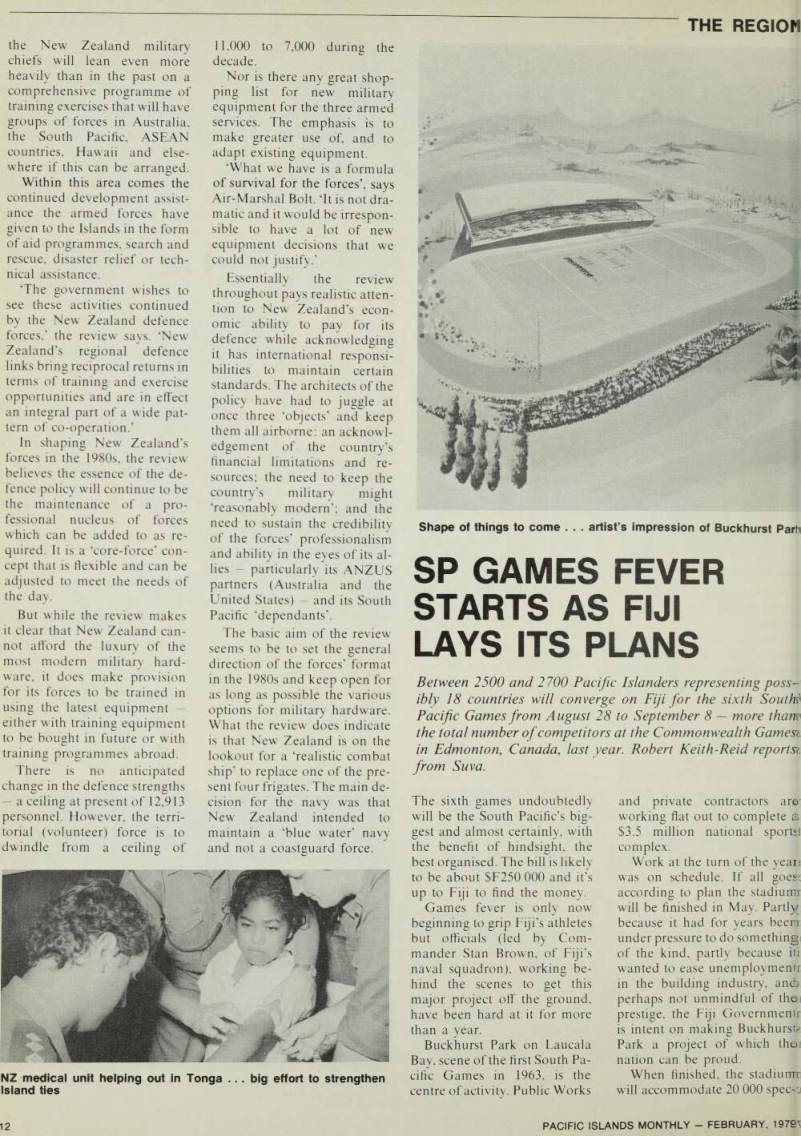
NZ airmen at work in jungles of Fiji ... a substitute training ground for Southeast Asia
the New Zealand military chiefs will lean even more heavily than in the past on a comprehensive programme of training exercises that will have groups of forces in Australia, the South Pacific, ASEAN countries, Hawaii and else where if this can be arranged.
Within this area comes the continued development assist ance the armed forces have given to the Islands in the form of aid programmes, search and rescue, disaster relief or tech nical assistance. ‘The government wishes to see these activities continued by the New Zealand defence forces,' the review says. ‘New Zealand’s regional defence links bring reciprocal returns in terms of training and exercise opportunities and are in effect an integral part of a wide pat tern of co-operation.’
In shaping New Zealand’s forces in the 1980 s, the review believes the essence of the de fence policy will continue to be the maintenance of a pro fessional nucleus of forces which can be added to as re quired. It is a ‘core-force’ con cept that is flexible and can be adjusted to meet the needs of
the day.
But while the review makes it clear that New Zealand can not afford the luxury of the most modern military hard ware, it does make provision for its forces to be trained in using the latest equipment -
either with training equipment
to be bought in future or with training programmes abroad.
There is no anticipated change in the defence strengths - a ceiling at present of 12,913 personnel. However, the terri torial (volunteer) force is to dwindle from a ceiling of
11,000 to 7,000 during the decade.
Nor is there any great shop ping list for new military equipment for the three armed services. The emphasis is to make greater use of, and to
adapt existing equipment.
‘What we have is a formula of survival for the forces’, says Air-Marshal Bolt. Tt is not dra matic and it would be irrespon sible to have a lot of new equipment decisions that we could not justify.’
Essentially the review throughout pays realistic atten tion to New Zealand’s econ omic ability to pay for its defence while acknowledging it has international responsi bilities to maintain certain standards. The architects of the policy have had to juggle at once three ‘objects’ and keep them all airborne: an acknowl edgement of the country’s financial limitations and re sources; the need to keep the
country’s military might
‘reasonably modern’; and the need to sustain the credibility of the forces’ professionalism and ability in the eyes of its al lies - particularly its ANZUS partners (Australia and the United States) and its South
Pacific ‘dependants’.
The basic aim of the review seems to be to set the general direction of the forces’ format in the 1980 s and keep open for as long as possible the various
options for military hardware.
What the review does indicate is that New Zealand is on the lookout for a ‘realistic combat ship’ to replace one of the pre sent four frigates. The main de cision for the navy was that New Zealand intended to maintain a ‘blue water’ navy and not a coastguard force.
NZ medical unit helping out in Tonga ... big effort to strengthen Island ties
Sp Games Fever
Starts As Fiji
Lays Its Plans
Between 2500 and 2700 Pacific Islanders representing poss ibly 18 countries will converge on Fiji for the sixth Souths Pacific Games from August 28 to September 8 more tham the total number of competitors at the Commonwealth Gamesi in Edmonton, Canada, last year. Robert Keith-Reid report si
from Suva.
The sixth games undoubtedly will be the South Pacific’s big gest and almost certainly, with the benefit of hindsight, the best organised. The bill is likely to be about SF2SO 000 and it’s up to Fiji to find the money.
Games fever is only now
beginning to grip Fiji’s athletes
but officials (led by Com mander Stan Brown, of Fiji’s naval squadron), working be hind the scenes to get this
major project off the ground,
have been hard at it for more than a year.
Buckhurst Park on Laucala Bay, scene of the first South Pa cific Games in 1963, is the centre of activity. Public Works
and private contractors are* working flat out to complete a $3.5 million national sportsl
complex.
Work at the turn of the yean was on schedule. If all according to plan the stadiunrr will be finished in May. Partial because it had for years beem under pressure to do something] of the kind, partly because iti wanted to ease unemployment!: in the building industry, ancbi perhaps not unmindful of ther
prestige, the Fiji Government!!
is intent on making Buckhurste Park a project of which ther nation can be proud.
When finished, the stadiumn will accommodate 20 000 spec-o
Shape of things to come . . . artist’s impression of Buckhurst Parh[?]
tators with more than 4000 undercover. It will have an all weather track surrounding a rugby union and soccer pitch and areas for athletics field events. It will be floodlit and have a gymnasium with seating for 2000.
The ‘Games Village’, con veniently, will be on the University of the South Pacific campus which adjoins Buckhurst Park.
Apart from some soccer and rugby matches which will be played at Lautoka 250 km by road from Suva on Viti Levu’s west coast and about a 90 min ute trip by air and bus all ■ events will be held inside the Suva city limits.
A fund-raising committee has set itself a target of $lOO 000, pinning its hopes on
f running a successful lottery
with a $53 000 first prize.
Another source of revenue will be from an arrangement with a company which has been given exclusive rights to use the I games emblem.
The committee is also trying : to persuade the Harlem Globe trotters basketball team to visit Fiji to ‘christen’ the gym [ nasium with exhibition ; matches.
The 18 games sports will be athletics, basketball, lawn ten i nis, soccer, swimming, bowls,
boxing, cricket, golf, hockey,
judo, netball, weightlifting,
yachting, rugby union, squash,
table tennis and volleyball.
At the end of December, 17 entries had been received with Tokelau saying that it would make a decision at its January meeting of chiefs. ‘lf Tokelau are in it, it will be the first games in which all 18 eligible countries will compete together,’ said the secretary of the games committee Brian
Wightman.
Papua New Guinea will be
fielding the largest visiting
squad - 320 - with Tahiti sending 263. New Caledonia has chartered four aircraft for spectators alone. Other entrants are: American Samoa, Cook Islands, Fiji, Gilberts, Guam, Nauru, New Hebrides, Niue, Solomon Islands, Tonga, SP Trust Territory, Tuvalu, Wallis and Futuna and West ern Samoa.
Torres
Strait
Now To
Make
Torres
Work
That the road to a treaty on the Torres Strait had been a tough one, with bitter milestones along the way, was somehow confirmed by the manner in which each speaker at the
December Sydney signing
almost fell over himself to con gratulate everyone else con cerned on the brilliance of their achievements.
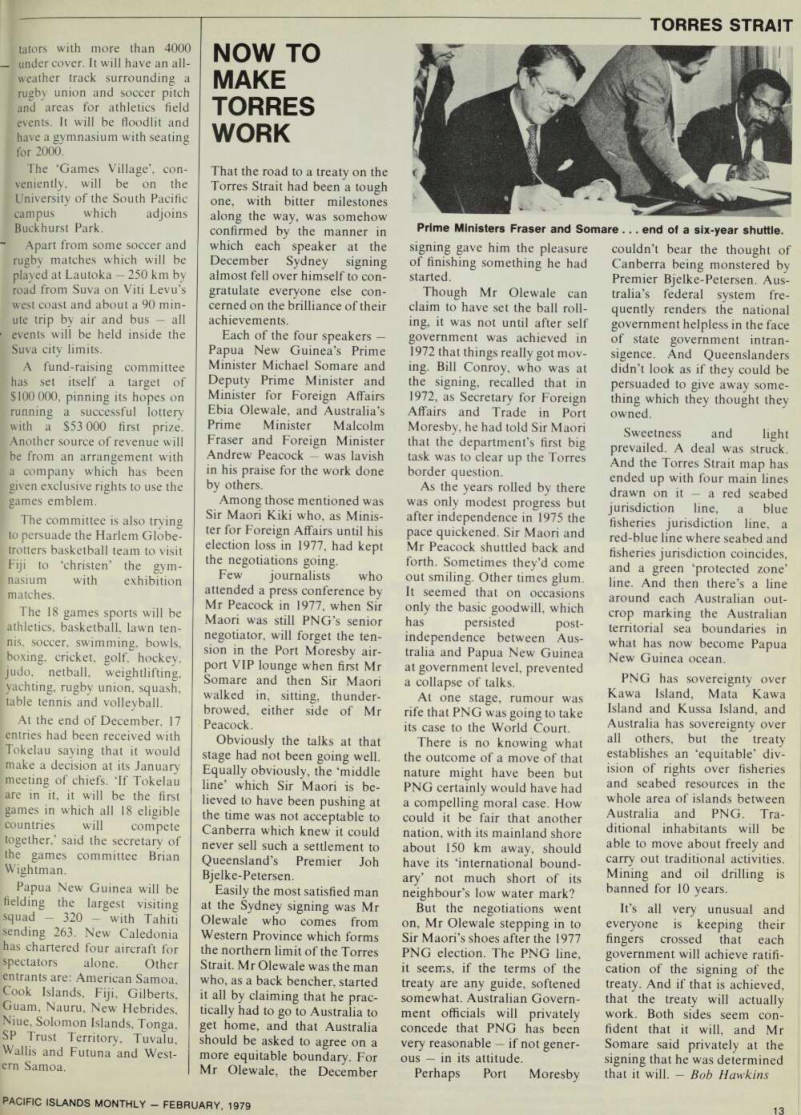
Each of the four speakers Papua New Guinea’s Prime Minister Michael Somare and Deputy Prime Minister and Minister for Foreign Affairs Ebia Olewale, and Australia’s Prime Minister Malcolm Fraser and Foreign Minister Andrew Peacock was lavish in his praise for the work done
by others.
Among those mentioned was Sir Maori Kiki who, as Minis ter for Foreign Affairs until his election loss in 1977, had kept
the negotiations going.
Few journalists who attended a press conference by Mr Peacock in 1977, when Sir Maori was still PNG’s senior negotiator, will forget the ten sion in the Port Moresby air port VIP lounge when first Mr Somare and then Sir Maori walked in, sitting, thunder browed, either side of Mr Peacock.
Obviously the talks at that stage had not been going well.
Equally obviously, the ‘middle
line’ which Sir Maori is be lieved to have been pushing at the time was not acceptable to Canberra which knew it could never sell such a settlement to Queensland’s Premier Joh
Bjelke-Petersen.
Easily the most satisfied man at the Sydney signing was Mr Olewale who comes from Western Province which forms the northern limit of the Torres Strait. Mr Olewale was the man who, as a back bencher, started it all by claiming that he prac tically had to go to Australia to get home, and that Australia should be asked to agree on a
more equitable boundary. For
Mr Olewale, the December
signing gave him the pleasure of finishing something he had started.
Though Mr Olewale can claim to have set the ball roll ing, it was not until after self government was achieved in 1972 that things really got mov ing. Bill Conroy, who was at the signing, recalled that in 1972, as Secretary for Foreign Affairs and Trade in Port Moresby, he had told Sir Maori that the department’s first big task was to clear up the Torres border question.
As the years rolled by there was only modest progress but after independence in 1975 the pace quickened. Sir Maori and Mr Peacock shuttled back and forth. Sometimes they’d come out smiling. Other times glum.
It seemed that on occasions only the basic goodwill, which has persisted post independence between Aus tralia and Papua New Guinea at government level, prevented a collapse of talks.
At one stage, rumour was rife that PNG was going to take its case to the World Court.
There is no knowing what the outcome of a move of that nature might have been but PNG certainly would have had a compelling moral case. How could it be fair that another nation, with its mainland shore about 150 km away, should have its ‘international bound ary’ not much short of its neighbour’s low water mark?
But the negotiations went on, Mr Olewale stepping in to Sir Maori’s shoes after the 1977 PNG election. The PNG line, it seems, if the terms of the treaty are any guide, softened somewhat. Australian Govern ment officials will privately concede that PNG has been very reasonable if not gener ous in its attitude.
Perhaps Port Moresby
couldn’t bear the thought of
Canberra being monstered by
Premier Bjelke-Petersen. Aus tralia’s federal system fre quently renders the national government helpless in the face of state government intran sigence. And Queenslanders didn’t look as if they could be persuaded to give away some
thing which they thought they
owned.
Sweetness and light prevailed. A deal was struck.
And the Torres Strait map has ended up with four main lines drawn on it a red seabed jurisdiction line, a blue fisheries jurisdiction line, a red-blue line where seabed and fisheries jurisdiction coincides, and a green ‘protected zone’ line. And then there’s a line around each Australian out crop marking the Australian territorial sea boundaries in what has now become Papua New Guinea ocean.
PNG has sovereignty over Kawa Island, Mata Kawa Island and Kussa Island, and Australia has sovereignty over all others, but the treaty establishes an ‘equitable’ div ision of rights over fisheries and seabed resources in the whole area of islands between Australia and PNG. Tra ditional inhabitants will be able to move about freely and carry out traditional activities.
Mining and oil drilling is banned for 10 years.
It’s all very unusual and everyone is keeping their fingers crossed that each government will achieve ratifi cation of the signing of the treaty. And if that is achieved, that the treaty will actually work. Both sides seem con fident that it will, and Mr Somare said privately at the signing that he was determined that it will. Bob Hawkins
Prime Ministers Fraser and Somare ... end of a six-year shuttle.
Advertisements & other items, p. 14 (1 item)
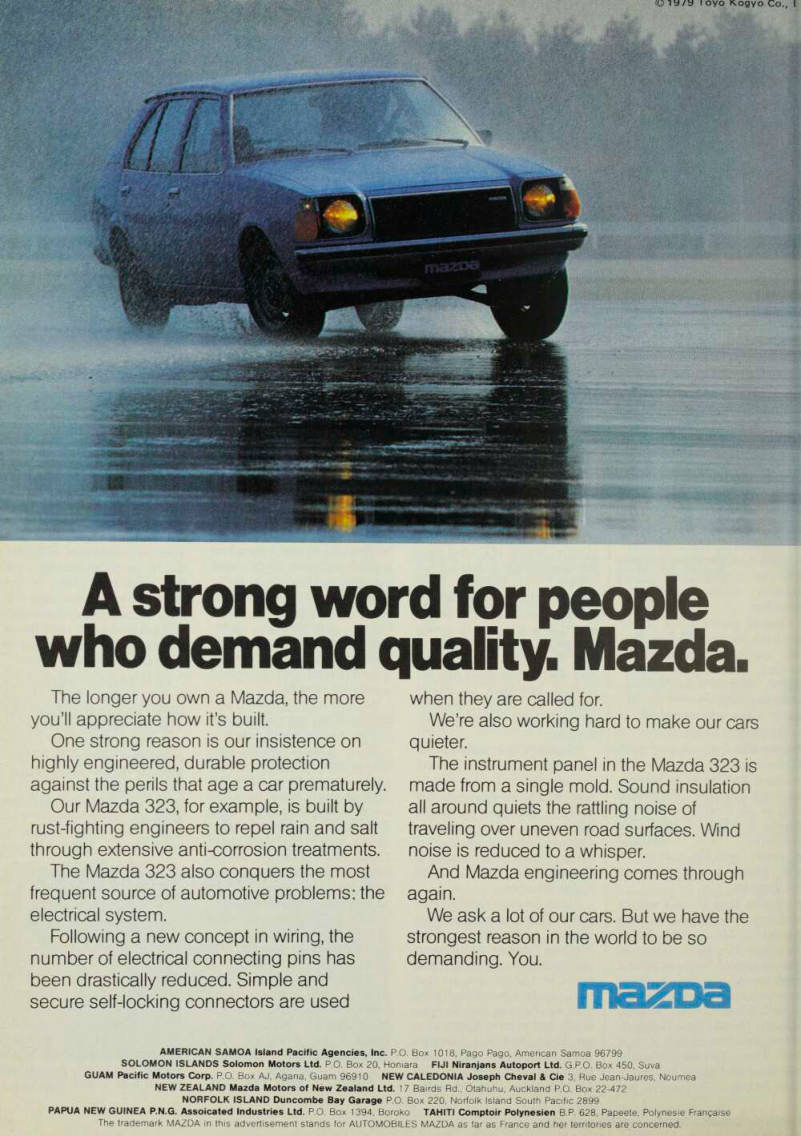
who demand quality. Mazda
A strong word for people
The longer you own a Mazda, the more you’ll appreciate how it’s built.
One strong reason is our insistence on highly engineered, durable protection against the perils that age a car prematurely.
Our Mazda 323, for example, is built by rust-fighting engineers to repel rain and salt through extensive anti-corrosion treatments.
The Mazda 323 also conquers the most frequent source of automotive problems: the electrical system.
Following a new concept in wiring, the number of electrical connecting pins has been drastically reduced. Simple and secure self-locking connectors are used when they are called for.
We’re also working hard to make our cars quieter.
The instrument panel in the Mazda 323 is made from a single mold. Sound insulation all around quiets the rattling noise of traveling over uneven road surfaces. Wind noise is reduced to a whisper.
And Mazda engineering comes through again.
We ask a lot of our cars. But we have the strongest reason in the world to be so demanding. You.
mazoa
AMERICAN SAMOA Island Pacific Agencies, Inc. P.O. Box 1018, Pago Pago, American Samoa 96799 SOLOMON ISLANDS Solomon Motors Ltd. P.O. Box 20, Honiara FIJI Niranjans Autoport Ltd. G.P.O. Box 450, Suva GUAM Pacific Motors Corp. P.O. Box AJ, Agana, Guam 96910 NEW CALEDONIA Joseph Cheval & Cie 3, Rue Jean-Jaures, Noumea NEW ZEALAND Mazda Motors of New Zealand Ltd. 1 7 Bairds Rd., Otahuhu, Auckland P.O. Box 22-472 NORFOLK ISLAND Duncombe Bay Garage P.O. Box 220, Norfolk Island South Pacific 2899 PAPUA NEW GUINEA P.N.G. Assoicated Industries Ltd. P.O. Box 1394, Boroko TAHITI Comptoir Polynesien B.P. 628, Papeete, Polynesie Franqaise The trademark MAZDA in this advertisement stands for AUTOMOBILES MAZDA as far as France and her territories are concerned.
People
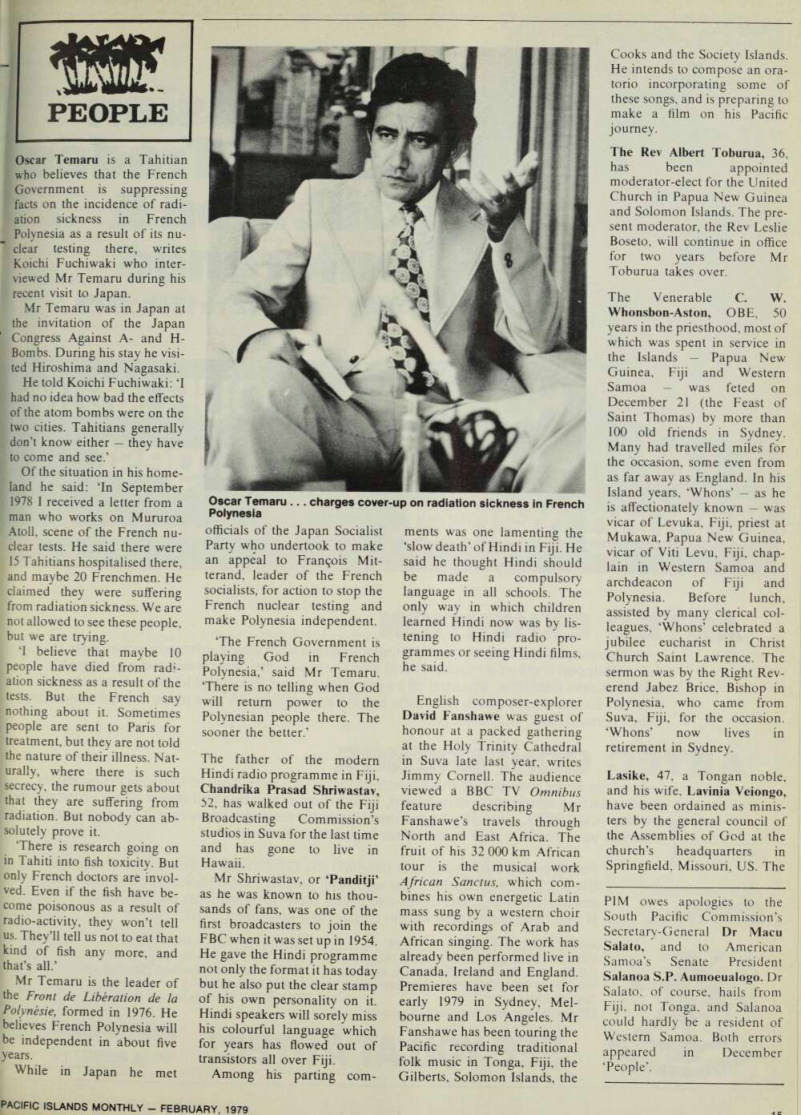
Oscar Temaru is a Tahitian who believes that the French
1 Government is suppressing
facts on the incidence of radi ation sickness in French Polynesia as a result of its nu clear testing there, writes Koichi Fuchiwaki who inter viewed Mr Temaru during his recent visit to Japan.
Mr Temaru was in Japan at the invitation of the Japan Congress Against A- and H- Bombs. During his stay he visi ted Hiroshima and Nagasaki.
He told Koichi Fuchiwaki: T had no idea how bad the effects of the atom bombs were on the two cities. Tahitians generally don’t know either they have to come and see.’
Of the situation in his home land he said: ‘ln September 1978 I received a letter from a man who works on Mururoa Atoll, scene of the French nu clear tests. He said there were 15 Tahitians hospitalised there, and maybe 20 Frenchmen. He
claimed they were suffering
from radiation sickness. We are not allowed to see these people, but we are trying.
T believe that maybe 10 people have died from rad»ation sickness as a result of the tests. But the French say nothing about it. Sometimes people are sent to Paris for treatment, but they are not told the nature of their illness. Nat urally, where there is such secrecy, the rumour gets about that they are suffering from radiation. But nobody can ab solutely prove it. ‘There is research going on in Tahiti into fish toxicity. But only French doctors are invol ved. Even if the fish have be come poisonous as a result of
radio-activity, they won’t tell
us. They’ll tell us not to eat that kind of fish any more, and that’s all.’
Mr Temaru is the leader of the Front de Liberation de la Polynesia, formed in 1976. He believes French Polynesia will be independent in about five years.
While in Japan he met
officials of the Japan Socialist Party who undertook to make an appeal to Francois Mit terand, leader of the French socialists, for action to stop the French nuclear testing and
make Polynesia independent.
‘The French Government is playing God in French Polynesia,’ said Mr Temaru. ‘There is no telling when God will return power to the
Polynesian people there. The
sooner the better.’
The father of the modem Hindi radio programme in Fiji, Chandrika Prasad Shriwastav, 52, has walked out of the Fiji
Broadcasting Commission’s
studios in Suva for the last time and has gone to live in Hawaii.
Mr Shriwastav, or ‘Panditji’ as he was known to his thou sands of fans, was one of the first broadcasters to join the FBC when it was set up in 1954.
He gave the Hindi programme not only the format it has today but he also put the clear stamp of his own personality on it.
Hindi speakers will sorely miss his colourful language which for years has flowed out of transistors all over Fiji.
Among his parting com
ments was one lamenting the ‘slow death’ of Hindi in Fiji. He said he thought Hindi should be made a compulsory language in all schools. The only way in which children learned Hindi now was by lis tening to Hindi radio pro grammes or seeing Hindi films, he said.
English composer-explorer
David Fanshawe was guest of honour at a packed gathering at the Holy Trinity Cathedral in Suva late last year, writes Jimmy Cornell. The audience viewed a BBC TV Omnibus feature describing Mr Fanshawe’s travels through North and East Africa. The fruit of his 32 000 km African tour is the musical work African Sanctus, which com bines his own energetic Latin mass sung by a western choir with recordings of Arab and African singing. The work has already been performed live in Canada, Ireland and England.
Premieres have been set for early 1979 in Sydney, Mel bourne and Los Angeles. Mr Fanshawe has been touring the Pacific recording traditional folk music in Tonga, Fiji, the Gilberts, Solomon Islands, the
Cooks and the Society Islands.
He intends to compose an ora torio incorporating some of these songs, and is preparing to make a film on his Pacific
journey.
The Rev Albert Toburua, 36, has been appointed moderator-elect for the United Church in Papua New Guinea and Solomon Islands. The pre sent moderator, the Rev Leslie Boseto, will continue in office for two years before Mr Toburua takes over.
The Venerable C. W.
Whonsbon-Aston, OBE, 50 years in the priesthood, most of which was spent in service in the Islands Papua New Guinea, Fiji and Western Samoa was feted on December 21 (the Feast of Saint Thomas) by more than 100 old friends in Sydney.
Many had travelled miles for the occasion, some even from as far away as England. In his Island years, ‘Whons’ as he is affectionately known was vicar of Levuka, Fiji, priest at Mukawa, Papua New Guinea, vicar of Viti Levu, Fiji, chap lain in Western Samoa and archdeacon of Fiji and Polynesia. Before lunch, assisted by many clerical col leagues, ‘Whons’ celebrated a jubilee eucharist in Christ Church Saint Lawrence. The sermon was by the Right Rev erend Jabez Brice, Bishop in Polynesia, who came from Suva, Fiji, for the occasion. ‘Whons’ now lives in retirement in Sydney.
Lasike, 47, a Tongan noble, and his wife, Lavinia Veiongo, have been ordained as minis ters by the general council of the Assemblies of God at the church’s headquarters in Springfield, Missouri, US. The
PIM owes apologies to the South Pacific Commission’s Secretary-General Dr Macu Salato, and to American Samoa’s Senate President Salanoa S.P. Aumoeualogo. Dr Salato, of course, hails from Fiji, not Tonga, and Salanoa could hardly be a resident of Western Samoa. Both errors appeared in December
‘People’.
Oscar Temaru . . . charges cover-up on radiation sickness In French Polynesia
first Tongans ordained to the fellowship, they have been assigned to work with the Ton gan community in Santa Cruz, California. They left Tonga in 1974 with their four sons and two daughters with the aim of furthering the children’s edu cation in California.
Kevin Conlan, 43, has taken up the newly created post of coun sellor (development assistance) . at the Australian High Com mission in Fiji. He will head a four-man team responsible for the administration of Aus tralia’s aid programme to Fiji, Tonga, Western Samoa and Tuvalu. Mr Conlan has pre
vious diplomatic experience in
Kuala Lumpur and Jakarta.
Before his new appointment he was acting head of the Multi lateral Financial Institutions Section of the Australian Development Assistance Bu reau in Canberra.
Raman Nair, Fiji’s first high commissioner to Australia, is back in diplomatic service as his country’s first consul general in Sydney. Mr Nair’s public service career, which stretched from beginnings as a school teacher in 1941 to 1976 when he left his diplomatic post in Canberra, retired at 53 to work in private enterprise.
But last year, with Fiji deter mined to build up its drive for
improved trading links with
Australia and to encourage Australian investment in Fiji, he was asked to open the
consulate-general in Sydney.
Mr Nair, now 55, with elec tricians busily laying the lines of communication to the Aus tralian businessworld in his
third floor Papua New Guinea House, Clarence Street, office, said: ‘I have taken on a number
of challenging jobs during my
career but this is the most chal lenging. If I can make some im provement here in Fiji’s relationship with Australia it will be the most satisfying re sult of my whole career. It will be a real contribution to Fiji if I am successful.’ Mr Nair, look ing around for an Australia based marketing officer, obviously was warming to the
challenge of whittling away
Australia’s enormously favour able balance of trade.
Douglas Law, 42, will bring considerable experience of Asian affairs to the job of New Zealand High Commissioner to Western Samoa when he takes up the post in March. His appointment comes at a time when more Asian countries, including China, are taking a close interest in the South Pa cific. Mr Law who succeeds Don Harper, joined the NZ Ministry of Foreign Affairs in 1957 and has served in Sin gapore, New Delhi, Canberra and Tokyo. When appointed to the Western Samoa post he was deputy head of mission at the
NZ Embassy in Tokyo.
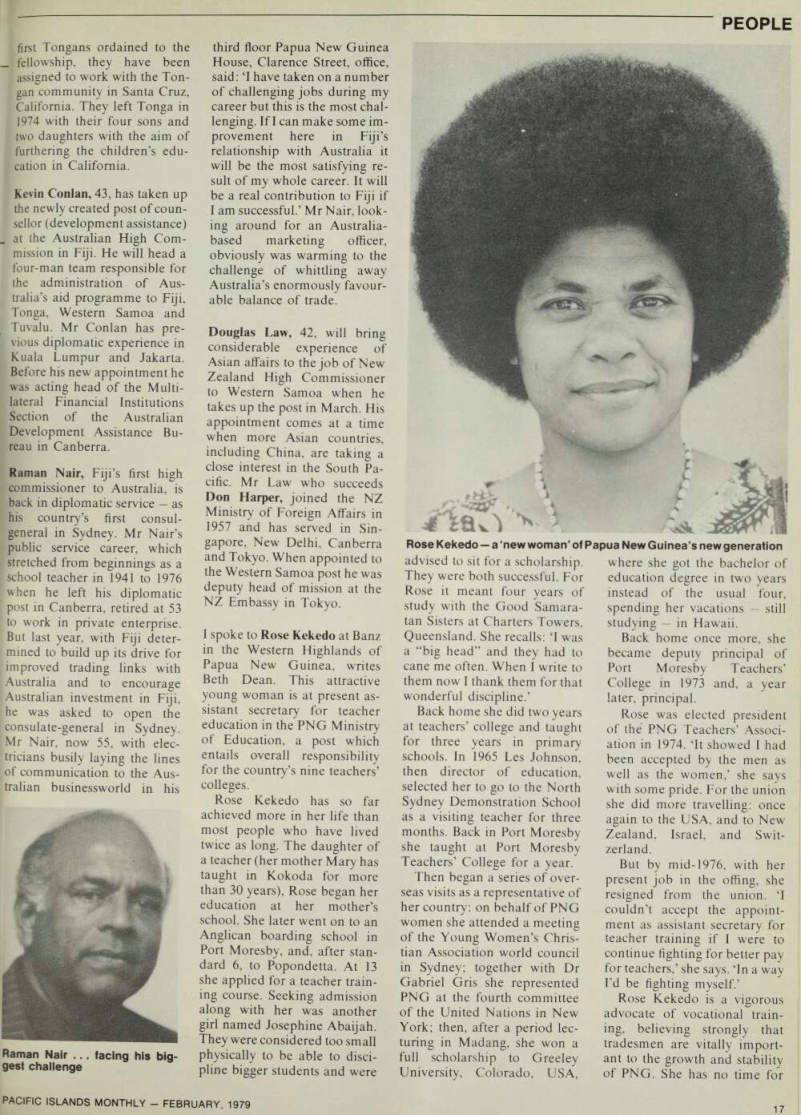
I spoke to Rose Kekedo at Banz in the Western Highlands of Papua New Guinea, writes Beth Dean. This attractive young woman is at present as sistant secretary for teacher education in the PNG Ministry of Education, a post which entails overall responsibility for the country’s nine teachers’
colleges.
Rose Kekedo has so far achieved more in her life than most people who have lived twice as long. The daughter of a teacher (her mother Mary has taught in Kokoda for more than 30 years). Rose began her education at her mother’s school. She later went on to an
Anglican boarding school in
Port Moresby, and, after stan dard 6, to Popondetta. At 13 she applied for a teacher train
ing course. Seeking admission
along with her was another
girl named Josephine Abaijah.
They were considered too small physically to be able to disci pline bigger students and were
advised to sit for a scholarship.
They were both successful. For Rose it meant four years of study with the Good Samaratan Sisters at Charters Towers, Queensland. She recalls: T was a “big head’’ and they had to cane me often. When I write to them now I thank them for that
wonderful discipline.’
Back home she did two years at teachers’ college and taught for three years in primary schools. In 1965 Les Johnson, then director of education, selected her to go to the North Sydney Demonstration School as a visiting teacher for three months. Back in Port Moresby she taught at Port Moresby Teachers’ College for a year.
Then began a series of overseas visits as a representative of her country: on behalf of PNG women she attended a meeting of the Young Women’s Christian Association world council in Sydney; together with Dr Gabriel Gris she represented PNG at the fourth committee of the United Nations in New York; then, after a period lecluring in Madang, she won a
full scholarship to Greeley
University, Colorado, USA,
where she got the bachelor of education degree in two years instead of the usual four, spending her vacations still studying in Hawaii.
Back home once more, she
became deputy principal of
Port Moresby Teachers’
College in 1973 and, a year
later, principal.
Rose was elected president of the PNG Teachers’ Associ ation in 1974. ‘lt showed I had been accepted by the men as well as the women,’ she says with some pride. For the union she did more travelling: once again to the USA, and to New Zealand, Israel, and Swit zerland.
But by mid-1976, with her present job in the offing, she resigned from the union. T couldn’t accept the appoint ment as assistant secretary for teacher training if I were to continue fighting for better pay for teachers,’ she says. Tn a way
I’d be fighting myself.’
Rose Kekedo is a vigorous advocate of vocational train
ing, believing strongly that
tradesmen are vitally import
ant to the growth and stability of PNG. She has no time for
Raman Nair ... facing his big gest challenge
Rose Kekedo a‘new woman’ of Papua New Guinea’s new generation
people who won’t dirty their hands. She says; ‘The young s people who go away to train .* thinking only of desk jobs and when they come back find
■ themselves posted to outlying
f areas soon learn that the need is to build classrooms, do
agriculture and many things
that require manual skills. I say to my students; “Do something with your hands. Learn to be practical. Don’t expect some one else always to be on hand.
Do it yourself.” I get people in my classes to build maybe a basketball court. Or I get them to raise a pig or chickens, make a garden. Teachers of English, science and maths are certainly needed. But they must be able to cope with the problems of village life too.’
Rose Kekedo is no desk ad ministrator. She is one of the ; new generation who are moulding the future of PNG.
As she says: ‘Today differs from the past for me, a woman.
Even the men come to me for advice now. I’ve been asked to stand for parliament. I said no.
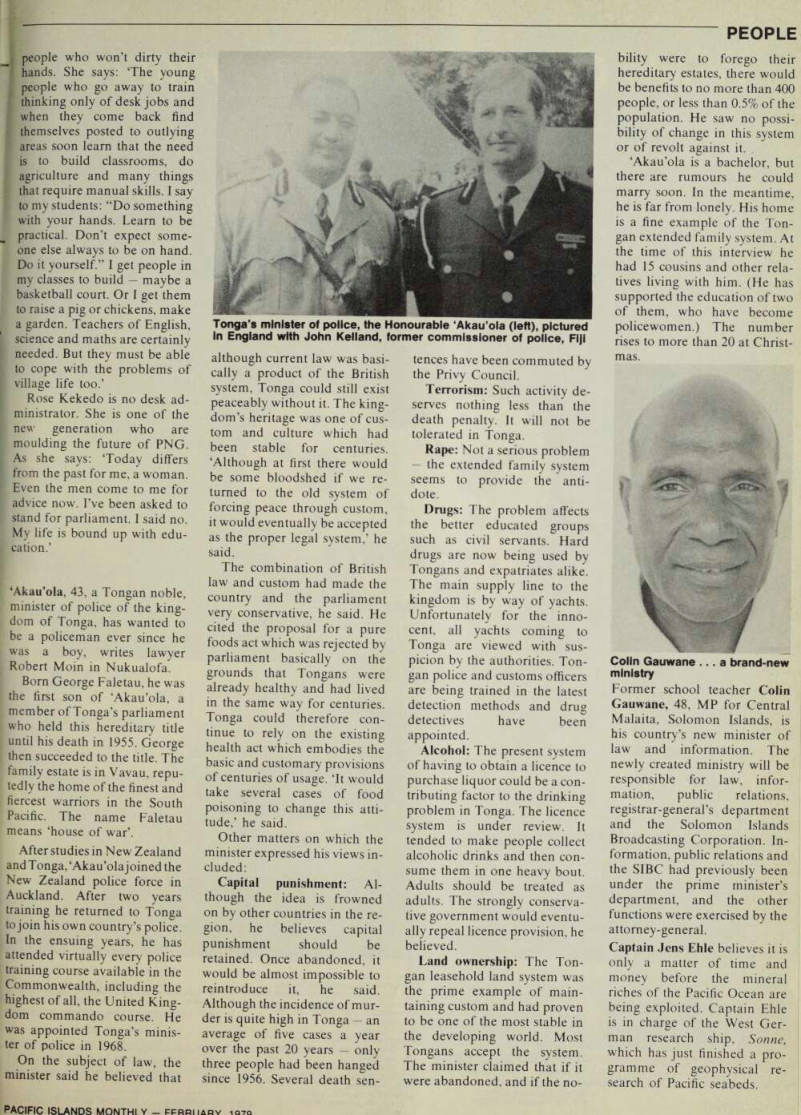
My life is bound up with edu cation.’ ‘Akau’ola, 43, a Tongan noble, minister of police of the king dom of Tonga, has wanted to be a policeman ever since he was a boy, writes lawyer Robert Moin in Nukualofa.
Born George Faletau, he was the first son of ‘Akau’ola, a member of Tonga’s parliament who held this hereditary title until his death in 1955. George then succeeded to the title. The family estate is in Vavau, repu tedly the home of the finest and fiercest warriors in the South Pacific. The name Faletau means ‘house of war’.
After studies in New Zealand and Tonga,‘Akau’olajoined the New Zealand police force in Auckland. After two years training he returned to Tonga
to join his own country’s police.
In the ensuing years, he has attended virtually every police training course available in the
Commonwealth, including the
highest of all, the United King dom commando course. He
was appointed Tonga’s minis
ter of police in 1968.
On the subject of law, the minister said he believed that
although current law was basi cally a product of the British system, Tonga could still exist peaceably without it. The king dom’s heritage was one of cus tom and culture which had been stable for centuries. ‘Although at first there would be some bloodshed if we re turned to the old system of
forcing peace through custom,
it would eventually be accepted as the proper legal system,’ he said.
The combination of British law and custom had made the country and the parliament very conservative, he said. He cited the proposal for a pure foods act which was rejected by parliament basically on the grounds that Tongans were already healthy and had lived in the same way for centuries.
Tonga could therefore con tinue to rely on the existing health act which embodies the basic and customary provisions of centuries of usage. Tt would take several cases of food poisoning to change this atti tude,’ he said.
Other matters on which the minister expressed his views in cluded: Capital punishment: Al though the idea is frowned on by other countries in the re
gion, he believes capital
punishment should be retained. Once abandoned, it would be almost impossible to reintroduce it, he said.
Although the incidence of mur der is quite high in Tonga an average of five cases a year over the past 20 years only three people had been hanged since 1956. Several death sen
tences have been commuted by the Privy Council.
Terrorism: Such activity de serves nothing less than the death penalty. It will not be tolerated in Tonga.
Rape: Not a serious problem the extended family system seems to provide the anti dote.
Drugs: The problem affects the better educated groups such as civil servants. Hard
drugs are now being used by
Tongans and expatriates alike.
The main supply line to the kingdom is by way of yachts.
Unfortunately for the inno cent, all yachts coming to Tonga are viewed with sus picion by the authorities. Ton gan police and customs officers are being trained in the latest detection methods and drug detectives have been
appointed.
Alcohol: The present system of having to obtain a licence to purchase liquor could be a con tributing factor to the drinking problem in Tonga. The licence system is under review. It tended to make people collect alcoholic drinks and then con sume them in one heavy bout.
Adults should be treated as adults. The strongly conserva tive government would eventu ally repeal licence provision, he believed.
Land ownership: The Ton gan leasehold land system was the prime example of main taining custom and had proven to be one of the most stable in the developing world. Most Tongans accept the system.
The minister claimed that if it were abandoned, and if the no
bility were to forego their hereditary estates, there would be benefits to no more than 400 people, or less than 0.5% of the population. He saw no possi bility of change in this system or of revolt against it. , ‘Akau’ola is a bachelor, but there are rumours he could marry soon. In the meantime, he is far from lonely. His home is a fine example of the Ton gan extended family system. At the time of this interview he had 15 cousins and other rela tives living with him. (He has supported the education of two of them, who have become policewomen.) The number rises to more than 20 at Christ mas.
Former school teacher Colin Gauwane, 48, MP for Central Malaita, Solomon Islands, is his country’s new minister of law and information. The newly created ministry will be responsible for law, infor mation, public relations,
registrar-general’s department
and the Solomon Islands Broadcasting Corporation. In formation, public relations and the SIBC had previously been under the prime minister’s department, and the other functions were exercised by the attorney-general.
Captain Jens Ehle believes it is only a matter of time and money before the mineral riches of the Pacific Ocean are
being exploited. Captain Ehle
is in charge of the West Ger man research ship, Sonne, which has just finished a pro gramme of geophysical re search of Pacific seabeds.
Tonga’s minister of police, the Honourable ‘Akau’ola (left), pictured in England with John Kelland, former commissioner of police, Fiji
Colin Gauwane ... a brand-new ministry
Advertisements & other items, pp. 16-20 (2 items)
Boating Trades
A T e c
SYDNEY
Australasian
Boating Trades
Exhibition &
Conference
SYDNEY June 12 to 15th 1979
to get YOUR share
of the world’s* 3rd largest
boating market.
* (Guiness Book of Yachting Facts and Feats)
ABTEC EXHIBITION
will show you the latest in everything connected with Boating from raw materials to fully equipped craft of all types. It will also show you the latest tools and equipment, evsn business machines, essential to be competitive and successful in this industry today.
ABTEC Exhibition is where the Trade buying and selling will take place in ideal conditions, free of crowds and 'hull thumpers'.
ABTEC CONFERENCE
Sponsored by —is where every member of this growth Industry can learn how to improve his products, productivity, techniques, management, accounting, marketing and above all his profitability g through the 1980's. June 12—14 inclusive could be the most important 3 days of your business year, so do it now send your registration form today. in conjunction with Free transport will commute between the Conference at Sebel Townhouse and the Exhibition at Sydney Showground. Special block bookings will keep accommodation costs down and group travel arrangements can make big savings.
If you need more information contact the organisers NOW.
AUSTRALASIAN BOATING TRADES
EXHIBITION & CONFERENCE (ABTEC)
P.O. Box 574, Crows Nest, NSW 2065. Australia.
Tel: (02) 92 9501; Cable: "Boating Crows Nest"
Telex: AA27045, 220 Pacific Highway Crows Nest, Australia.
MAURICE ABNEY-HASTINGS
Unit 2, Barton Park Industrial Estate Chickenhall Lane, Eastleigh, Southampton
ENGLAND. SO5 SRR
Tel: (0703) 611456; Telex: 47536
SEE YOU AT ABTEC!
FLV fiaNTai >
A AIMSETT
AIRUNEB OF AUBTPAUA
The Conation Specialists 81A21.25.18cm n
* Tv w
flb
'Sir
S’- JA *
* * . V J»/ • *—sS? < X’V V-O >.:;• rCtLc*/ * *Y** V V. . ” .. v> •/ * X, \ X s' : ***': -> ... id
RSK
' -r- x><*' *■-; -*» ■ ✓ A K > >' / P* .'■•■ • •-< ©lO
World Command Performance
Yours to command ... the best of music from all round the world.
Discs, cassettes, or ultrahigh-quality open-reel tapes.
FM/AM stereo broadcasts, or the fun of making your own superb recordings.
AKAFs top-of-the-line audio products make them authentically yours, for enjoyment limited only by the horizons
of your taste.
0
ACM
o
AKAI
% mm * w
• GXC-570D-II
\A-1175
Stereo receiver (75W/ch RMS, 8 Cl)
SW-187
3-Way speaker system
GX-650D
Open reel tape deck AP-307 Direct drive quartz lock turntable 3-Head 3-motor cassette deo;
jdio & Video
AKAI
KAI ELECTRIC CO, LTD.
)kyo, Japan
P.N.G.
S.O. Svensson (N.G.) Ltd.
P.O. Box 705, Port Moresby Tel: 2275 Fiji Islands Motibhai & company Ltd.
P.O. Box 9175, Nadi International Airport Tel: 72-165 New Zealand Pye Ltd., Consumer Products Sector lIOMt. Eden Rd., Mt. Eden, Auckland Tel: 686-437 New Caledonia Menard Pacifique s.a.r.l.
B.P. H 2, Noumea Tel: 275222 Tahiti New Hebrides (Islands) Burns Philp (New Hebrides) Co., Ltd.
P.O. Box 27, Port Vila, New Hebrides Islands Norfolk Island Burns Philp (Norfolk Island) Co., Ltd.
P.O. Box 21, Norfolk Island Samoa Islands Burns Philp (South Sea) Co., Ltd.
P.O. Box 129, Pago Pago, American Samoa Mariana Islands J.C. Tenorio Enterprises P.O. Box 137, Saipan Tel: 6444/8 Solomon Islands Security Electrical Co., Ltd.
P.O. Box 174, Honiara Tel: 881 Cook Islands For more information, please send this coupon to our distributor in your country or to AKAI ELECTRIC CO., LTiT 12-14, 2-Chome, Higashi-Kojiya, Ohta-ku, Tokyo, Japan n Name Address
Pacific Islands Monthi Y _ Pfrri Ia D V 1070
PACIFIC ISLANDS MONTHI Y pfrri IA D V 1070
PEOPLE
Political
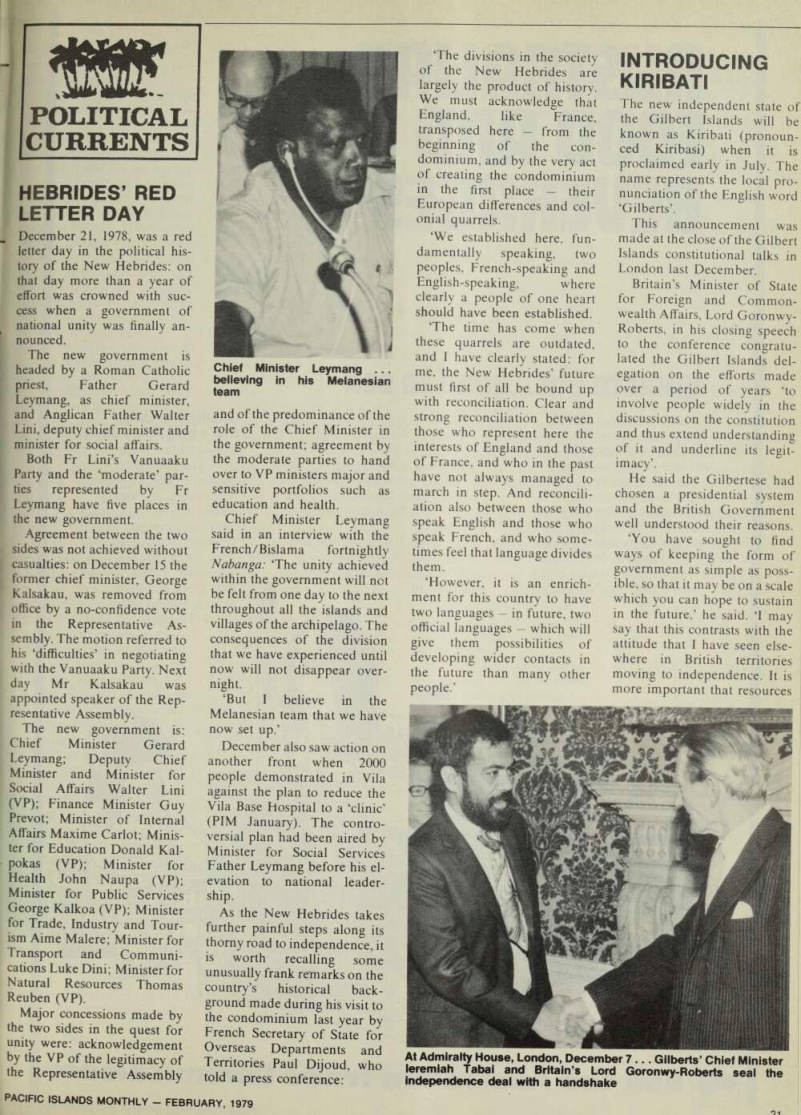

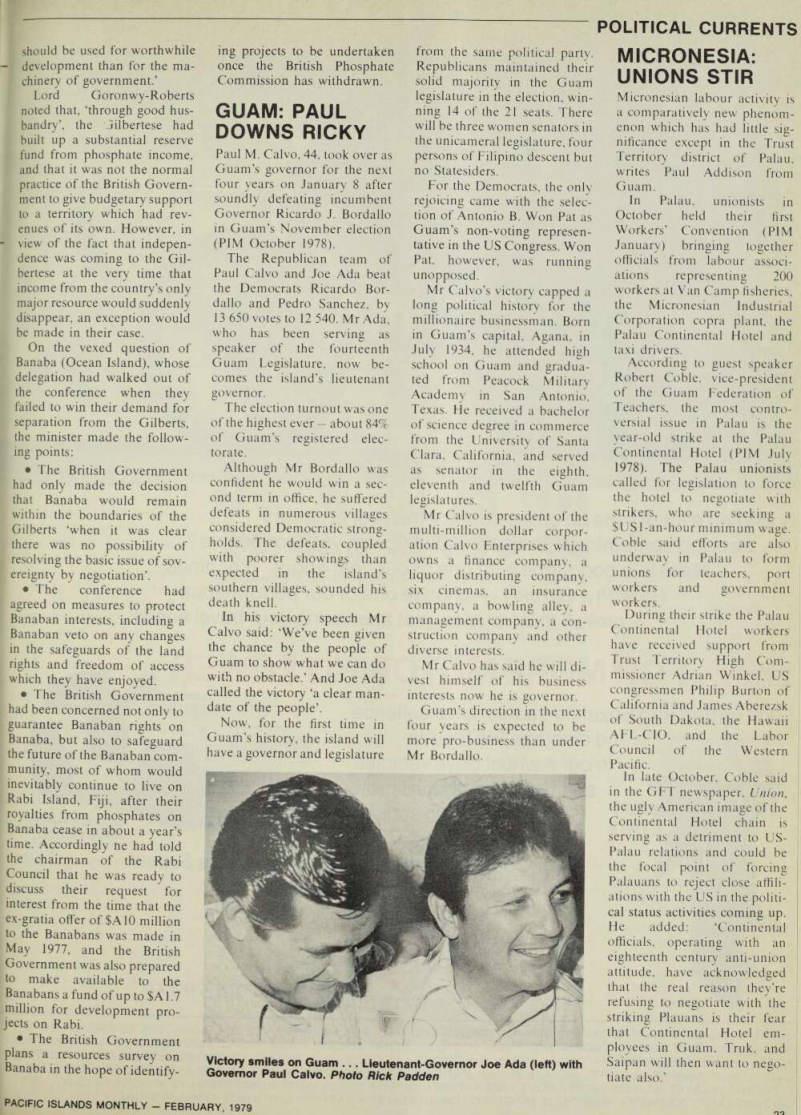

Currents
Hebrides’ Red
Letter Day
December 21, 1978, was a red letter day in the political his tory of the New Hebrides: on that day more than a year of effort was crowned with suc cess when a government of national unity was finally an nounced.
The new government is headed by a Roman Catholic priest. Father Gerard Leymang, as chief minister, and Anglican Father Walter Lini, deputy chief minister and minister for social affairs.
Both Fr Lini’s Vanuaaku Party and the ‘moderate’ par ties represented by Fr Leymang have five places in the new government.
Agreement between the two sides was not achieved without casualties: on December 15 the former chief minister, George Kalsakau, was removed from office by a no-confidence vote in the Representative As sembly. The motion referred to his ‘difficulties’ in negotiating with the Vanuaaku Party. Next day Mr Kalsakau was appointed speaker of the Rep
resentative Assembly.
The new government is: Chief Minister Gerard
Leymang; Deputy Chief
Minister and Minister for Social Affairs Walter Lini (VP); Finance Minister Guy Prevot; Minister of Internal Affairs Maxime Carlot; Minis ter for Education Donald Kal pokas (VP); Minister for Health John Naupa (VP); Minister for Public Services George Kalkoa (VP); Minister for Trade, Industry and Tour ism Aime Malere; Minister for Transport and Communi cations Luke Dini; Minister for Natural Resources Thomas Reuben (VP).
Major concessions made by the two sides in the quest for
unity were: acknowledgement
by the VP of the legitimacy of
the Representative Assembly
and of the predominance of the role of the Chief Minister in the government; agreement by the moderate parties to hand over to VP ministers major and sensitive portfolios such as education and health.
Chief Minister Leymang said in an interview with the
French/Bislama fortnightly
Nabanga: ‘The unity achieved within the government will not be felt from one day to the next throughout all the islands and villages of the archipelago. The consequences of the division that we have experienced until now will not disappear over
night.
‘But I believe in the Melanesian team that we have now set up.’
December also saw action on another front when 2000 people demonstrated in Vila against the plan to reduce the Vila Base Hospital to a ‘clinic’ (PIM January). The contro versial plan had been aired by Minister for Social Services Father Leymang before his el evation to national leader
ship.
As the New Hebrides takes further painful steps along its thorny road to independence, it is worth recalling some unusually frank remarks on the country’s historical back ground made during his visit to the condominium last year by French Secretary of State for Overseas Departments and Territories Paul Dijoud, who told a press conference:
‘The divisions in the society of the New Hebrides are largely the product of history.
We must acknowledge that England, like France, transposed here from the beginning of the con dominium, and by the very act of creating the condominium in the first place their European differences and col onial quarrels. ‘We established here, fun
damentally speaking, two
peoples, French-speaking and
English-speaking, where
clearly a people of one heart should have been established. ‘The time has come when these quarrels are outdated, and I have clearly stated; for me, the New Hebrides’ future must first of all be bound up with reconciliation. Clear and strong reconciliation between those who represent here the interests of England and those of France, and who in the past have not always managed to march in step. And reconcili ation also between those who speak English and those who speak French, and who some times feel that language divides them. ‘However, it is an enrich ment for this country to have two languages - in future, two official languages which will
give them possibilities of
developing wider contacts in the future than many other
people.’
Introducing
Kiribati
The new independent state of the Gilbert Islands will be known as Kiribati (pronoun ced Kiribasi) when it is proclaimed early in July. The name represents the local pro nunciation of the English word ‘Gilberts’.
This announcement was made at the close of the Gilbert Islands constitutional talks in London last December.
Britain’s Minister of State for Foreign and Common wealth Affairs, Lord Goronwy- Roberts, in his closing speech to the conference congratu lated the Gilbert Islands del egation on the efforts made over a period of years ‘to involve people widely in the discussions on the constitution and thus extend understanding of it and underline its legit
imacy’.
He said the Gilbertese had chosen a presidential system and the British Government well understood their reasons. ‘You have sought to find ways of keeping the form of government as simple as poss ible, so that it may be on a scale which you can hope to sustain in the future,’ he said. ‘I may say that this contrasts with the attitude that I have seen else where in British territories moving to independence. It is more important that resources
Chief Minister Leymang ... believing in his Melanesian team
At Admiralty House, London, December 7... Gilberts’ Chief Minister leremiah Tabal and Britain’s Lord Goronwy-Roberts seal the independence deal with a handshake
should be used for worthwhile - development than for the ma chinery of government.’
Lord Goronwy-Roberts
noted that, ‘through good hus bandry’, the Tilbertese had built up a substantial reserve fund from phosphate income, and that it was not the normal practice of the British Govern ment to give budgetary support to a territory which had rev enues of its own. However, in * view of the fact that indepen dence was coming to the Gil bertese at the very time that income from the country’s only
major resource would suddenly
disappear, an exception would be made in their case.
On the vexed question of Banaba (Ocean Island), whose delegation had walked out of the conference when they failed to win their demand for \ separation from the Gilberts, the minister made the follow
i ing points;
• The British Government had only made the decision that Banaba would remain within the boundaries of the I Gilberts ‘when it was clear there was no possibility of I resolving the basic issue of sov
ereignty by negotiation’.
• The conference had agreed on measures to protect Banaban interests, including a Banaban veto on any changes in the safeguards of the land rights and freedom of access
which they have enjoyed.
• The British Government had been concerned not only to guarantee Banaban rights on Banaba, but also to safeguard the future of the Banaban com munity, most of whom would inevitably continue to live on Rabi Island, Fiji, after their royalties from phosphates on Banaba cease in about a year’s time. Accordingly ne had told the chairman of the Rabi Council that he was ready to discuss their request for interest from the time that the ex-gratia offer of SAIO million to the Banabans was made in May 1977, and the British Government was also prepared to make available to the Banabans a fund of up to $A 1.7 million for development pro jects on Rabi. • The British Government plans a resources survey on Banaba in the hope of identify
ing projects to be undertaken once the British Phosphate Commission has withdrawn.
Guam: Paul
Downs Ricky
Paul M. Calvo, 44, took over as Guam’s governor for the next four years on January 8 after
soundly defeating incumbent
Governor Ricardo J. Bordallo in Guam’s November election (PIM October 1978).
The Republican team of Paul Calvo and Joe Ada beat the Democrats Ricardo Bor dallo and Pedro Sanchez, by 13 650 votes to 12 540. Mr Ada, who has been serving as speaker of the fourteenth Guam Legislature, now be comes the island’s lieutenant governor.
The election turnout was one of the highest ever about 84% of Guam’s registered elec torate.
Although Mr Bordallo was confident he would win a sec ond term in office, he suffered defeats in numerous villages considered Democratic strong holds. The defeats, coupled with poorer showings than expected in the island’s southern villages, sounded his death knell.
In his victory speech Mr Calvo said; ‘We’ve been given the chance by the people of Guam to show what we can do with no obstacle.’ And Joe Ada called the victory ‘a clear man date of the people’.
Now, for the first time in Guam’s history, the island will have a governor and legislature
from the same political party.
Republicans maintained their solid majority in the Guam legislature in the election, win ning 14 of the 21 seats. There will be three women senators in the unicameral legislature, four persons of Filipino descent but no Statesiders.
For the Democrats, the only rejoicing came with the selec tion of Antonio B. Won Pat as Guam’s non-voting represen tative in the US Congress. Won Pat. however, was running unopposed.
Mr Calvo' ’s victory capped a
long political history for the
millionaire businessman. Born in Guam’s capital, Agana, in July 1934, he attended high school on Guam and gradua ted from Peacock Military Academy in San Antonio.
Texas. He received a bachelor of science degree in commerce from the University of Santa Clara, California, and served as senator in the eighth, eleventh and twelfth Guam
legislatures.
Mr Calvo is president of the multi-million dollar corpor ation Calvo Enterprises which owns a finance company, a
liquor distributing company,
six cinemas, an insurance company, a bowling alley, a management company, a con struction company and other diverse interests.
Mr Calvo has said he will di vest himself of his business interests now he is governor.
Guam’s direction in the next four years is expected to be more pro-business than under Mr Bordallo.
Micronesia:
Unions Stir
Micronesian labour activity is
a comparatively new phenom
enon which has had little sig nificance except in the Trust Territory district of Palau, writes Paul Addison from Guam.
In Palau, unionists in October held their first Workers’ Convention (PIM
January) bringing together
officials from labour associ ations representing 200 workers at Van Camp fisheries, the Micronesian Industrial Corporation copra plant, the Palau Continental Hotel and taxi drivers.
According to guest speaker Robert Coble, vice-president of the Guam Federation of Teachers, the most contro versial issue in Palau is the year-old strike at the Palau Continental Hotel (PIM July 1978). The Palau unionists called for legislation to force the hotel to negotiate with strikers, who are seeking a SUS 1-an-hour minimum wage.
Coble said efforts are also underway in Palau to form unions for teachers, port workers and government workers.
During their strike the Palau Continental Hotel workers have received support from
Trust Territory High Com
missioner Adrian Winkel, US congressmen Philip Burton of California and James Aberezsk of South Dakota, the Hawaii AFL-CIO, and the Labor Council of the Western Pacific.
In late October, Coble said in the GFT newspaper. Union , the ugly American image of the Continental Hotel chain is serving as a detriment to US- Palau relations and could be the focal point of forcing Palauans to reject close affili ations with the US in the politi cal status activities coming up.
He added: ‘Continental officials, operating with an eighteenth century anti-union attitude, have acknowledged that the real reason they’re refusing to negotiate with the striking Plauans is their fear that Continental Hotel em ployees in Guam. Truk, and Saipan will then want to nego tiate also.’
Victory smiles on Guam ... Lieutenant-Governor Joe Ada (left) with Governor Paul Calvo. Photo Rick Padden
GFT and the Labor Coun -| cil’s efforts to support the strikers have included financial ' contributions and a ‘Boycott Continental’ advertising cam
paign.
The present labour scene on \ Guam appears to justify the al- I leged fears of Continental officials. Here, high pressure unionism is fast becoming a way of life for thousands of
previously unrepresented
‘ workers.
Spearheading developments
[ is the Operating Engineers
f Local 3 which last year made significant advances towards turning Guam into a major union base.
Until 1978, the GFT, representing such diverse groups as teachers, bus drivers and port workers, was the dominant island union. Other unions on Guam include local , chapters of the American Fed eration of Government Em ployees, the American Postal Workers’ Union and the Team sters’ Union. Almost 4000 of the islands 31 000 workforce belong to labour unions.
But with a series of person-
I nel changes and quick-witted
actions, the Operating i Engineers, a branch of one of American’s largest unions, has
been rapidly establishing itself
as a vocal proponent of
workers’ rights.
‘We’re here to stay,’ Joaquin Perez, 32, Operating Engineers’ business represen tative, told PIM in mid- November. ‘What we’re saying is, don’t put your heads in the sand. Because when you come up we’ll still be here.’
The union’s inroads into Guam’s labour scene started in August 1977 when the US Labor Department came to Guam to look into the multi million dollar construction industry. Construction, one of Guam’s largest industries, was until then, and still is, manned largely by some 4000 aliens from the Philippines and Korea. US Labor officials had a two-pronged remedy to the situation raise construction wages by controlled increases to increase the number of Guamanians working in the
industry, and implement train
mg programmes for local workers.
Pay increases went into effect in September 1977 and have increased every six months since. The training pro grammes took longer to im plement and are still a matter of bitter dispute.
Both Guam employers and Operating Engineers wanted to operate the lucrative pro grammes. The union finally won contracts (PIM October 1978), but not before em ployers had complained the union had circumvented com petitive bidding requirements.
Guam employers complained to Secretary of Labor Ray Marshall who started an inves tigation into the procedures.
Seven months after the investi gation there was still no report, and the frustrated employers complained to US Senators Jesse Helms and Orrin Hatch, conservative Republicans, who have taken the matter up with US authorities.
In spite of the disputes, a training programme operated by the union with $1.75 million
Labor Department contracts, has gone ahead and has so far trained about 100 workers in 10-week construction skills programmes.
In October, disturbed by re ports that Guam employers were not taking on many of the union-trained workers, the executive director of the train ing programme, a union em ployee, Mark Stechbart, filed charges with the US Labor Department and the US Immi gration and Naturalisation Ser vice, against Heide Cook, a Guam construction employer.
The union charged that Heide Cook had violated federal
labor regulations.
Stechbart then accused the Guam Employers’ Council, the union’s most vociferous opponent, of fomenting a ‘con spiracy of silence’ among Guam contractors to destroy the programme. The council acknowledged it had sent out more than 50 letters pointing out problems in Stechbart’s op eration along with a magazine
article called ‘Locking up Guam for (Operating Engineers) Local 3’. The coun cil is currently trying to set up its own training programme in competition with the union’s.
Operating Engineers’ battle with employers has left scars.
Three companies involved in the union training programme protested to the US Labor Department about Stechbart and said his actions could jeop ardise the training pro gramme’s future. ‘lf he has had difficulty placing the first group of trainees the second group of trainees will be almost imposs ible to place as local contrac tors are not very receptive to threats of US Labor and Im migration investigations by a known union employee,’ they wrote to the Labor Depart ment.
Operating Engineers was not
discouraged. After battling the
employers. Local 3 took on the port’s manager and the Guam Federation of Teachers. It
lodged charges with the
government of Guam alleging unfair labour practices by the manager. The GET was ac cused, in charges presented to the American Federation of
Labor, of ‘raiding’ Operating
Engineers’ territory at the port and signing up members who should rightfully belong to it.
Both the 1800-member GET and the 500-member Engineers belong to the Labor Council of the Western Pacific, which monitors labour activity on Guam and throughout most of Micronesia.
Tuvalu And
Uncle Sam
Although the proposed treaty of friendship between the United States and Tuvalu (PIM January) was concerned with the renunciation of US claims to islands in the Tuvalu group, the questions involved go much further than that, writes a correspondent on Funafuti.
The US claims to Funa futi, Nukufetau, Nukulaelae and Niulakita were orig inally made in the so-called Guano Act of the US Congress i in 1856, and were reaffirmed as recently as 1965.
Advertisement in Guam's Pacific Daily News . . . stirrings of unionism in Micronesia
Tuvalu's secretary to govern - ment, lonatana lonatana, says that the purpose of the nego § nations was to ‘make official’ the amiable attitudes now existing between the two coun tries, with mutual and maxi mum benefit to both.
The Tuvalu Government I came to the conference table
primarily seeking American
developmental and or financial I assistance, recognition of its * 200-mile fisheries zone, and
guaranteed defence against
military aggression. The US.
; on the other hand, wanted as * surance of non-discrimination J for its fishing vessels wishing to [ operate in Tuvalu waters, and I access to, as well as use of, the nine-island group during times ! of emergency or international
[ crisis.
During the course of the two-day talks it was agreed that there would be no specific ref erence in the treaty to either military or development aid. or fisheries licensing, and that the main thrust of the document would be to declare simple friendship between the two nations. It is generally under stood, however, that the treaty opens a wide door for licensing negotiations with fish can neries in American Samoa,
which are partially supplied
with tuna by Taiwan and Korean vessels operating in Tuvalu seas. It is also expected that further Tuvalu-US talks will be held on diplomatic mat ters, such as additional Peace Corps support and cultural exchanges between the two countries.
The recent negotiations mark the second time that Prime Minister Lauti and
William Bodde, director of the State Department’s Office of Pacific Island Affairs, have met regarding a friendship treaty.
Mr Lauti, who journeyed to Honolulu last September hoping that the US claims in Tuvalu could be renounced on the new nation’s independence day. is confident that no further talks between the governments will be needed before a treaty acceptable to both can be signed. There remain, how ever. certain points in the wording of the draft treaty which Mr Bodde will have to refer to Washington before making a further visit to Funafuti.
Refugees For
W. Samoa?
Moya McTamney, a New Zea land Red Cross field officer, has suggested that Western Samoa might consider accept ing a quota of refugees from Indochina. She told the weekly Savali that most of the refugees at present were of Chinese ori gin, and that the Chinese com munity in Apia would be able to help them.
Ms McTamney was with the Red Cross in Vietnam from 1969 to 1971, and has since worked with refugees, includ ing a recent group of 200 who were taken into New Zea land.
Reporting her remarks, Savali editor Mike Field writes that the government of West ern Samoa has not given official consideration to taking refugees from Southeast Asia but that ‘some senior govern ment officials have mentioned the possibility of taking or
phans from the region’.
Field comments: ‘This indi cates a considerable lack of
knowledge about the refugee
situation. At no stage during the Vietnam war, or since, has there ever been a large number
of refugee orphans. Orphaned
Vietnamese children were, and are, popular among parents looking for children to adopt.
The situation has got to the
point where largescale kidnap
ping and selling of children is carried out in South Korea, the Philippines, Thailand and Malaysia so that Western fam ilies can have Oriental chil dren’.
Mr Field says of Ms
McTamney’s suggestion: ‘Re
cent groups of refugees coming out of Vietnam have been suspected of not being genuine
refugees. Suggestions have
been made that they bought their way out of Vietnam and that they left with the under cover assistance of the Viet namese government. But the large numbers of Vietnamese, Cambodians and Lao people on the Thailand border are un
doubtedly refugees and if
Samoa were to offer its assist ance it would at least be a token gesture to help overcome what is almost a desperate situ ation.’
The Return
Of Maurice
Divisions among the former Rightwing controllers of New Caledonia’s Government Council, for many years their stronghold, led to a major turn about in the November 15, 1978, elections to the council, writes Andre Chaville from Noumea.
In the elections, the oppo sition obtained a majority on the council, and Maurice Lenormand came back into power after 20 years’ absence.
Who is Maurice Lenor mand? Probably the first European in New Caledonia to imagine that it was possible to vote against the ‘Tories’ of New Caledonia. Until then, poli ticians came from the major
trading companies, or were
wealthy miners or cattle breeders. In addition he was a
‘Metropolitan’, a Frenchman from France, so obviously a ‘foreigner’, who in addition had married a Melanesian
girl.
Maurice Lenormand did not only take a Melanesian wife.
He took up the defence of the Melanesian people, obtained for them the right to vote, to attend schools, to live outside of the reserves, to buy beer and obtain French citizenship. His party, the Union Caledonienne
governed the territory during
the Loi Cadre period of the mid-fifties, thanks to the Melanesian votes. It was only by breaking down the whole structure of self-government and returning to the status of a territory, that the Europeans were able to retrieve at least part of their privileges. The re sult of this political blunder was to place the territory in a position to be restricted by the Billotte laws, limiting its powers of decision concerning its own mineral resources.
Those laws are applicable today, and claimed by many to be the main reason for the pre sent economic recession.
After being found guilty of attempting to blow up the offices of his own political party, Maurice Lenormand was banned from the political scene for many years. This providential bomb did more than misfire, it in fact took the reins of the party out of his hands and caused the gradual fragmentation of the Union Caledonienne. Today, if all its original members were to return under its banner, the party would still have a ma
jority in the assembly.
The Melanesian vote was also split and attracted else where. Today Union Caledon ienne is not the official Melanesian party, although it still represents a fair share of that population. It is not a ‘black man’s party’ either, having many staunch sup porters among the Europeans.
On November 26, the as sembly elected a new presi dent. A moderate, Jean-Pierre Aifa, was successful. Strangely enough, Aifa, not so long ago, was Lenormand’s lieutenant in Union Caledonienne, and his son-in-law, strange coinci dence!
Tuvalu Secretary to Government
lonatana lonatana ... making
amiable attitudes official.
New Caledonia’s Maurice Lenormand ... aged a little since this photograph was taken but still capable of a second coming’
Sus Aren’T
The Answer
An editorial writer in the Honolulu Advertiser recently took a searching look at the US I colonial record in American Samoa and Micronesia and was not much impressed. The editorial said: ‘lt’s more with sadness than surprise that one learns a new General Accounting Office re port finds American Samoa gets more money than it can handle, doesn’t know on what the money is being spent, and has failed to make progress toward economic indepen dence. ‘The same things might also be said about the Trust Terri tory which the US has adminis tered in Micronesia since World War 11. In both cases, US policy has ranged from
unbenign neglect in the 1950 s
to over-indulgence in the 1970 s with little guidance toward real economic development. The result is territories over
dependent on a continuing
flow of federal funds from
Washington for jobs and basic support. With a mixture of gen
erosity, ignorance and some
design, we have fostered con tinuing client states.
‘Complete self-sufficiency is
unlikely if not impossible for American Samoa because of its small size (less than the District of Columbia) and growing population of some 30 000
which is relieved only by steady
out-migration to Hawaii and the West Coast. In fact, all states are dependent in degrees on federal funds. But Washing ton has too often pumped money and federal aid programmes into American Samoa beyond the capacity to manage them, notes the GAE, an investigating agency of Congress. This has too often been done without proper oversight and technical assis tance and without relationship to economic development. The result is a form of uninspired welfare state. ‘The long-range answer may be some form of unity with the much larger, poorer, yet often
more impressive nearby nation
of Western Samoa, indepen dent since 1962. But at best that is a long way off, given American Samoan attitudes and options as American nationals. ‘This problem predates the US territory’s first elected Governor, Peter Coleman, who took office late last year. The GAO report says he agrees with the findings. But it will be Coleman’s difficult job to bring more private economic development and make better use of federal programmes. .. ‘ln Micronesia, the prospects are somewhat different be cause most of the area is going into a form of complete inter nal self-government that will involve a continuing relation ship with the US with reduced
funding from Washington.
Local leaders there have ack nowledged the need to cut back, perhaps by 50%, a bu reaucracy which, as in American Samoa, has grown fat with federal funding. Last year, almost 11 000 of some 18 000 jobs in the Trust Terri tory were government posi tions. Some reductions, or at least alterations, in the present standard of living there seem inevitable. ‘As with American Samoa, economic development in Micronesia with a growing population and limited land is a major problem. But with ocean resources and perhaps increasing interest from the Japanese (who in the 1930 s had producing economies in the area) there are possibilities. US aid will also continue in a var iety of ways. ‘There are positive aspects in
the US colonial record, a re cord under which some would include the Philippines, Hawaii and Puerto Rico. We have been best in education and political development and perhaps some aspects of public health. But, in their small but significant ways, American Samoa and Micronesia present
lingering challenges for the
world’s greatest power. As in Vietnam in its different and larger way, we can realise the answer is not as simple as
spending money.
‘Nor is it in taking a kind of perverse pride as some do in saying Americans were never very good colonists anyway.
We have to do better even if it costs less.’
The editorial was repro duced in full by the American Samoa Government’s official News Bulletin.
A Coalition
For Fiji?
Ratu Sir Kamisese Mara, Prime Minister of Fiji, has not given up his hope that Fiji may one day have a coalition government. He has long had doubts about the Westminster style of government in the Fiji context.
He now intends to have par liament debate the question of a national government, which he would like to see come about through an agreement between both parties, the rul ing Alliance Party, and the faction-ridden National Feder ation Party, which grew out of troubles in the canefields in the
early sixties.
Advertisements & other items, pp. 22-29 (1 item)
nusißfumn
FOOD ROD
BEUERHCES
goad to eat...good to sell
Australian food and beverages give the consumer quality and value. They give the importer increased business. And there’s such a great variety available.
Widely different climatic conditions enable Australia to produce some of the finest food in the world.
Australia is one of the world’s largest suppliers of wheat, sugar, meat, canned fruits, dried fruits, fresh fruits and dairy products.
There is also strong international demand for Australian seafoods, honey, jam, vegetables, wines and beers.
Over 100 countries are supplied by Australia.
And the list of customers is growing Quality and value that’s only hours away The Australian Trade Commissioner will be pleased to give you details of suppliers. You can contact him at: — 7th Floor, Dominion House, Thomson Street, Suva, FIJI. (Post Office Box 1252).
Telephone: 312844, or: Post Office Box 9129, Hohola, Port Moresby, P.N.G. Telephone: 25 9333.
I
Sjggll Sfca
fslslsi
E 3 TJ as
tOQO
m a
Ask the Australian Trade Commissioner
spending a lot of time on cross-country travel or errands?
Seeking something with dependable power, yet economical?
Make it in good time with one of our “get-about” machines.
Go with a Suzuki! choose one of our performanceproven motorcycles, just answering your travel needs.
and... FOR MORE MOTORING
DLOMON ISLANDS SOLOMON ISLAND SERVICE STATION LTD. • FIJI M.H. MOTORS • NEW CALEDONIA STE. SUPERCAL • PAPUA EW GUINEA TUTT BRYANT PACIFIC LTD. • NEW HEBRIDES HENRI LEROUX • NIUE ISLAND BURNS PHILP (SOUTH SEA) CO., TD. • PONAPE LEO ETSCHEIT • TAHITI NIPPON AUTOMOTO • ELLICE ISLAND TUVALU COOPERATIVE WHOLESALE SOCIETY TD. • GUAM ISLAND CYCLERY, INC. • NORFOLK MARTIN'S AGENCIES LTD. • AMERICAN SAMOA PACIFIC PRODUCTS, INC.
TARAWA GILBERT ISLANDS COOPERATIVE FEDERATION LIMITED • TONGA MORRIS HEDSTROM LTD. • WESTERN CAROLINES ECHESRRAK T. COMPANY • AMBROSE D. MINGINFEL'S WHOLESALER • EASTERN CAROLINES KIOMASA STORE .ook further into Suzuki’s traditional excellence rrwM and discover the results Imfmsawm in our 4-wheel drive vehicles and fleet of outboard motors something to satisfy you every motoring need.
Going by land or by sea... go with a Suzuki.
SUZUKI 4 WHEEL
DRIVE VEHICLE
SUZUKI MOTOR CO , LTD
Hamamatsu, Japan
SUZUKI
Before you buy
just any video equipment
put JVC to the test.
The GC4BOOE Colour Camera The main feature is it's easy to use, simply select the lighting selector and record.
Complete with inbuilt microphone. 6 x zoom lens with macro position enabling up to 1" close up video pictures. Useful colour pictures under normal lighting.
GC4BOOE
CR44OOE Portable Recorder A unique feature of the CR44OOE %" U-Format is the Automatic Edit Function which allows the user to avoid the need for elaborate studio editing equipment, as each pause during recording is automatically assemble edited on to that already recorded. This compact, lightweight colour video recorder accepts power from three sources - battery pack, or car battery, for complete outdoor mobility, or 240 V. AC, It records and plays back video cassette tapes in the %" U-Format.
The colour amplifier is built-in, and the extensive use of IC's enable JVC fo build-in functions normally found on much larger units. To complement its compact design, we have the GC4BOOE Colour Camera.
The main feature is its ease of use.
Simply selecf fhe Lighting Selector and record. Complete with inbuilt microphone CR6OOOE Recorder Important features are the feather-touch controls which protect both machine and tape from operator error: Optional remote control over playback functions; an instant stop and auto search/ repeat facility; two audio channels, and compact lightweight design.
CR6O6OE/D Recorder The CR6O6OE is a Full Remote Control %"
U-Format with full solenoid confrol. 8 funcf ions - Fasf Forward, Play, Stop, Rewind, Record, Audio Dub (CFI-1), Pause/Still and Frame Advance-
CPSO6OED
m
CR44OOE
can be operated locally, or with the addition ofthe optional Control Unit, can be operated remotely.
Can be used with a TU2OE Tuner Timer. Additionally, NTSC colour signals can be played back at the touch of a button.
CPSO6OED Colour Video Cassette Player CP5060 JVC 3/4" U-format PAL/NTSC player only with remote control optionally available. Features FF, REW, PLAY, STOP, STILL FRAME and FRAME ADVANCE, Eminently suitable for product promotion as the machine can be setup for constant playback.
NTSC playback on all JVC 3/4" machines is selected by one push button on the front panel ofthe machine. The monitor then switches automatically to whichever signal, either PAL or NTSC, is being played by the machine. Remote control unit RM6O controls the functions listed above FF, REW, ETC.
7765AUM/D
All JVC 3 A" U-Format recorders feature the advanced E-to-E mode. 7765AUM/D TV Monitor A 48cm (20") colour monitor with 'APACON'-a
CR6O6OE/ED
right choice
feature usually found only in professional studio monitors. This feature allows you to choose soft, standard, or extra-clear picture definition.
Picture quality is also enhanced by the automatic picture tune control.
The Test...
This is just a small part of the JVC Video range.
Just contact the JVC representative in your area.
He'll discuss your specific requirements and arrange for you to put JVC to the test.
PAPUA NEW GUINEA...
HAGEMEYER (P.N.G.) PTY. LTD.
Post Office Box 90, Lae Post Office Box 673, Madang Post Office Box 1428, Boroko Post Office Box 63, Rabaul Post Office Box 11, Mount Hagen Post Office Box 501, Wewak WT596/78
iet straight to the heart of hi-fi.
Music “centers” and speakers-thrown-in stereo systems can
look attractive and convenient.
But it can be a costly mistake to purchase a no-name brand stereo set that turns out to produce less than satisfactory sound.
With a specialist maker like Kenwood, you’re on safer ground.
All the hi-fi components you see here were designed from the drawing board up to perform a specific audio job.
What’s more, they all match each other perfectly in
performance.
So that nothing of the sound quality is wasted at any point
in the music reproduction chain.
Kenwood has been in the business long enough to know that there are many ways to hi-fi.
And the best is the straightest.
KA-5700 Stereo integrated amplifier 40 watts per channel 0.04% THD. 0.008% THD at half rated power. 76d8 phono S/N (2.5mV input); 88dB (10mV input). 180mV max. phono overload, 0.04%
THD, IkHz.
KT-5500 FM/AM tuner FM sensitivity 10.8dBf (I.9mV). 68dB stereo S/N at 65dBf. 0.2% THD at 65dBf, IkHz.
Frequency response +0.2, -2dß, 30 to 15kHz. 60dB selectivity. 45d8 separation at IkHz, 35d8 50 to 15kHz.
KX-530 Front loading cassette deck Dolby* noise reduction.
Frequency response 30 to 16kHz(chrome). 64d8 S/N, Dolby* ON (chrome). 0.07% (WRMS) wow-and-flutter.
Separate Bias and Equalizer controls.
KD-1500 Belt-drive turntable Automatic Up-and-Cut toneamn. 0.05% (WRMS) wow-and-flutter. -65d8 rumble (DIN wtd).
Anti-resonant base.
LS-660 Linear Response speaker system 70 watts maximum input. 2-way, 2-speaker bass reflex system.
Sensitivity 92d8/Wat 1-meter.
Frequency response 40 to 20kHz.
fcIED/
Trademark of Dolby Labs, Inc * i
ill
ill
-KENWOOD CORPORATION 6-17, 3-chome, Aobadai, Meguro-ku, Tokyo 153, Japan LI A TRIO-KENWOOD (AUSTRALIA) PTY. LTD. Australia Tel 439-4322 \LAND JOHN GILBERT & CO.. LTD Auckland Tel 30-839 NORFOLK ISLAND BURNS PHILP (NORFOLK ISLAND) LTD. TAHITI MAISON AURORE Papeete Tel. 29703 SOLOMON ISLANDS TECHNIQUE RADIOS CENTRE LTD Honiara Tel 416 AMERICAN SAMOA ISLAND PACIFIC AGENCIES. INC. Pago Pago Tel 633-4687
Chnsfcq HAMMER MILLS
These mills, which are normally used for grinding cereals, corn cobs, dried grass, spices, beans and peas & similar materials for human & animal consumption are also, now, being used in Pacific areas for pounding
YAQONA (KAVA).
The ‘YEOMAN '
- two models either for electric motor or diesel engine drive.
J Christy & Norris Ltd. Chelmsford, England CMI 1 SA Cable address: Christy Chelmsford. Telex 99266
ATTENTION:
HOTEL BUILDERS,
LAND DEVELOPERS,
LIGHT INDUSTRY ... I have two acres of fee simple land in Western Samoa situated on the main cross-island road just above Robert Lewis Stevenson's former estate and near the New Zealand Consulate home. This choice property is being offered for lease on a long term basis (50 years or more). Interested parties should write to: W.N. Luke 94-530 Holaniku Street, Militant Tn. Hawaii 96789.
Condom Caper Is
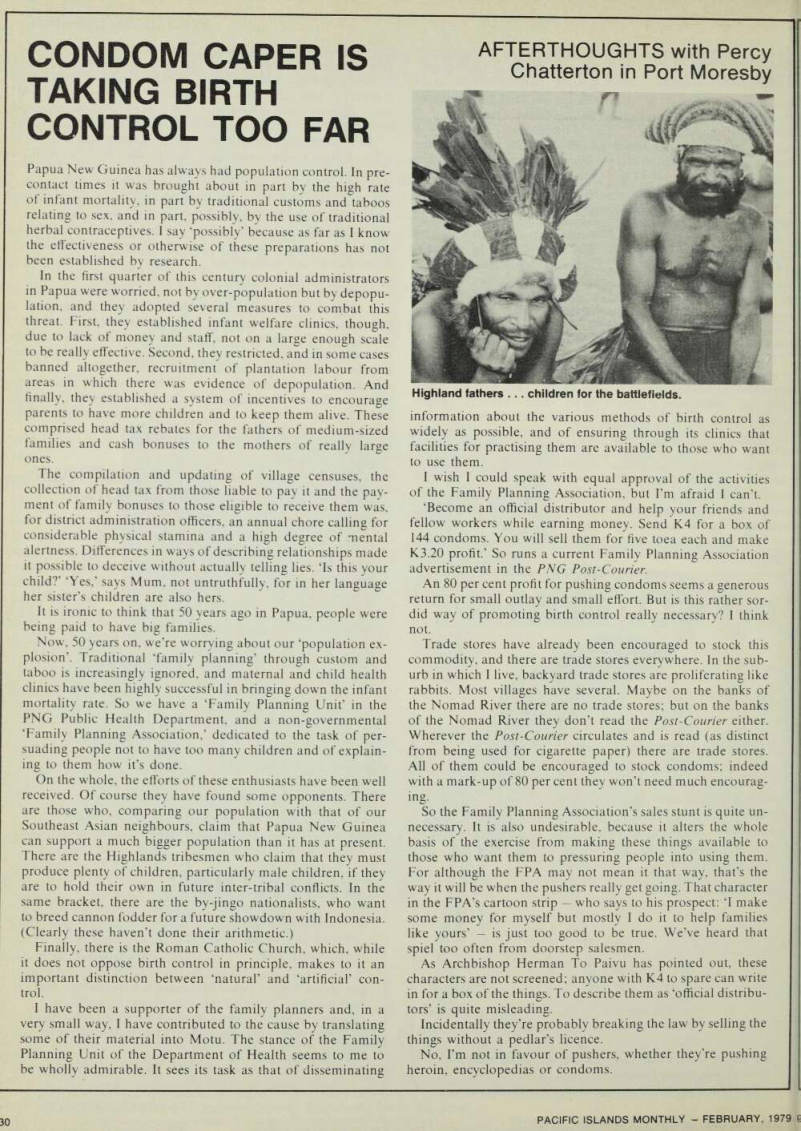
Taking Birth
Control Too Far
Papua New Guinea has always had population control. In pre contact times it was brought about in part by the high rate of infant mortality, in part by traditional customs and taboos relating to sex, and in part, possibly, by the use of traditional herbal contraceptives. I say ‘possibly’ because as far as I know the effectiveness or otherwise of these preparations has not been established by research.
In the first quarter of this century colonial administrators in Papua were worried, not by over-population but by depopu lation. and they adopted several measures to combat this threat. First, they established infant welfare clinics, though, due to lack of money and staff, not on a large enough scale to be really effective. Second, they restricted, and in some cases banned altogether, recruitment of plantation labour from areas in which there was evidence of depopulation. And finally, they established a system of incentives to encourage parents to have more children and to keep them alive. These comprised head tax rebates for the fathers of medium-sized families and cash bonuses to the mothers of really large ones.
The compilation and updating of village censuses, the collection of head tax from those liable to pay it and the pay ment of family bonuses to those eligible to receive them was, for district administration officers, an annual chore calling for considerable physical stamina and a high degree of mental alertness. Differences in ways of describing relationships made it possible to deceive without actually telling lies. ‘ls this your child?’ ‘Yes,’ says Mum, not untruthfully, for in her language her sister’s children are also hers.
It is ironic to think that 50 years ago in Papua, people were
being paid to have big families.
Now, 50 years on, we’re worrying about our ‘population ex plosion'. Traditional ‘family planning’ through custom and taboo is increasingly ignored, and maternal and child health clinics have been highly successful in bringing down the infant mortality rate. So we have a ‘Family Planning Unit’ in the PNG Public Health Department, and a non-governmental ‘Family Planning Association,’ dedicated to the task of per suading people not to have too many children and of explain ing to them how it’s done.
On the whole, the efforts of these enthusiasts have been well received. Of course they have found some opponents. There are those who, comparing our population with that of our Southeast Asian neighbours, claim that Papua New Guinea can support a much bigger population than it has at present.
There are the Highlands tribesmen who claim that they must produce plenty of children, particularly male children, if they are to hold their own in future inter-tribal conflicts. In the same bracket, there are the by-jingo nationalists, who want to breed cannon fodder for a future showdown with Indonesia. (Clearly these haven’t done their arithmetic.) Finally, there is the Roman Catholic Church, which, while it does not oppose birth control in principle, makes to it an important distinction between ‘natural’ and ‘artificial’ con trol.
I have been a supporter of the family planners and, in a very small way, I have contributed to the cause by translating some of their material into Motu. The stance of the Family Planning Unit of the Department of Health seems to me to be wholly admirable. It sees its task as that of disseminating
AFTERTHOUGHTS with Percy Chatterton in Port Moresby
information about the various methods of birth control as widely as possible, and of ensuring through its clinics that facilities for practising them are available to those who want to use them.
I wish I could speak with equal approval of the activities of the Family Planning Association, but I’m afraid I can’t. ‘Become an official distributor and help your friends and fellow workers while earning money. Send K 4 for a box of 144 condoms. You will sell them for five toea each and make K 3.20 profit.’ So runs a current Family Planning Association advertisement in the PNG Post-Courier.
An 80 per cent profit for pushing condoms seems a generous return for small outlay and small effort. But is this rather sor did way of promoting birth control really necessary? I think not.
Trade stores have already been encouraged to stock this commodity, and there are trade stores everywhere. In the sub urb in which I live, backyard trade stores are proliferating like rabbits. Most villages have several. Maybe on the banks of the Nomad River there are no trade stores; but on the banks of the Nomad River they don’t read the Post-Courier either.
Wherever the Post-Courier circulates and is read (as distinct from being used for cigarette paper) there are trade stores.
All of them could be encouraged to stock condoms; indeed with a mark-up of 80 per cent they won’t need much encourag
ing.
So the Family Planning Association’s sales stunt is quite un necessary. It is also undesirable, because it alters the whole basis of the exercise from making these things available to those who want them to pressuring people into using them.
For although the FPA may not mean it that way, that’s the way it will be when the pushers really get going. That character in the FPA’s cartoon strip who says to his prospect: T make some money for myself but mostly I do it to help families like yours’ is just too good to be true. We’ve heard that spiel too often from doorstep salesmen.
As Archbishop Herman To Paivu has pointed out, these characters are not screened; anyone with K 4 to spare can write in for a box of the things. To describe them as ‘official distribu
tors’ is quite misleading.
Incidentally they’re probably breaking the law by selling the things without a pedlar’s licence.
No, I’m not in favour of pushers, whether they’re pushing heroin, encyclopedias or condoms.
Highland fathers ... children for the battlefields.
Norfolk island in identity crisis
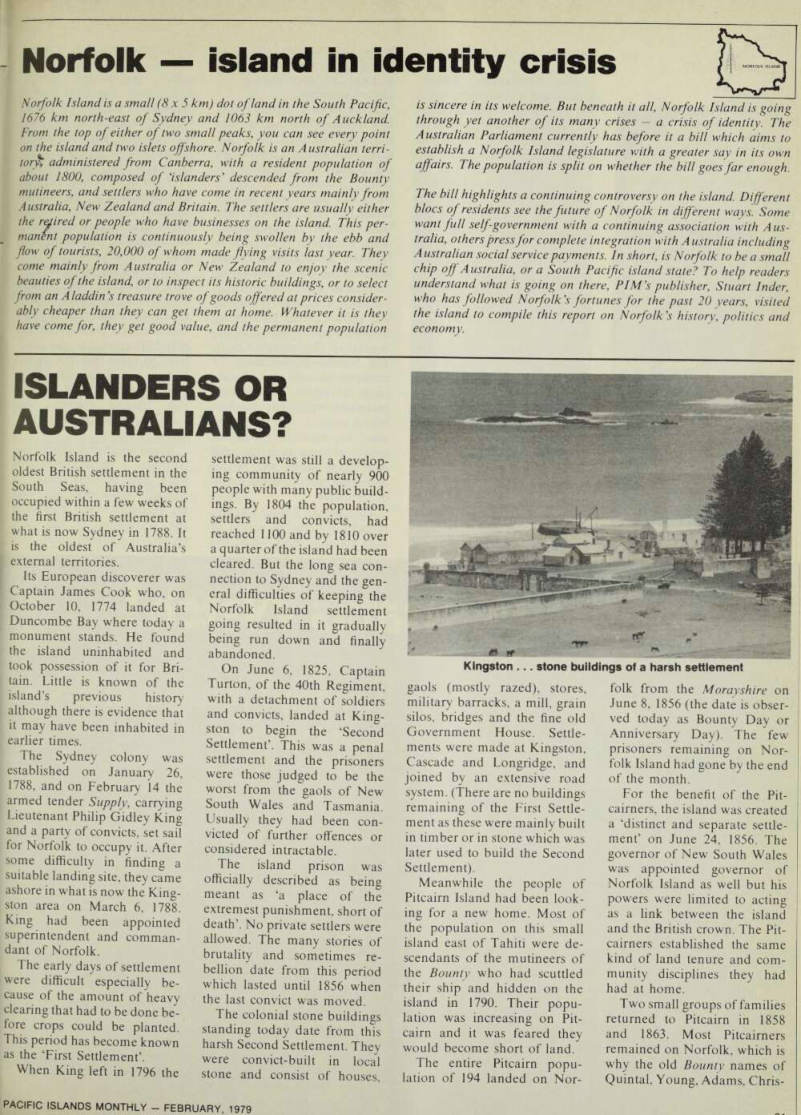
Norfolk Island is a small (Bxs km) dot of land in the South Pacific, 1676 km north-east of Sydney and 1063 km north of Auckland.
From the top of either of two small peaks, you can see every point on the island and two islets offshore. Norfolk is an Australian terri tory administered from Canberra, with a resident population of about 1800, composed of ‘ islanders’ descended from the Bounty mutineers, and settlers who have come in recent years mainly from Australia, New Zealand and Britain. The settlers are usually either the refired or people who have businesses on the island. This per manent population is continuously being swollen by the ebb and flow of tourists, 20,000 of whom made flying visits last year. They come mainly from Australia or New Zealand to enjoy the scenic beauties of the island, or to inspect its historic buildings, or to select from an Aladdin’s treasure trove of goods offered at prices consider ably cheaper than they can get them at home. Whatever it is they have come for, they get good value, and the permanent population
is sincere in its welcome. But beneath it all, Norfolk Island is going through yet another of its many crises a crisis of identity. The Australian Parliament currently has before it a bill which aims to establish a Norfolk Island legislature with a greater say in its own a ff airs • The population is split on whether the bill goes far enough.
The bill highlights a continuing controversy on the island. Different blocs of residents see the future of Norfolk in different ways. Some want full self-government with a continuing association with Aus tralia, others press for complete integration with A ustralia including A ustralian social service payments. In short, is Norfolk to be a small chip °ff Australia, or a South Pacific island state? To help readers understand what is going on there, PI M’s publisher, Stuart Inder, who has followed Norfolk’s fortunes for the past 20 years, visited the island to compile this report on Norfolk’s history, politics and economy.
Islanders Or

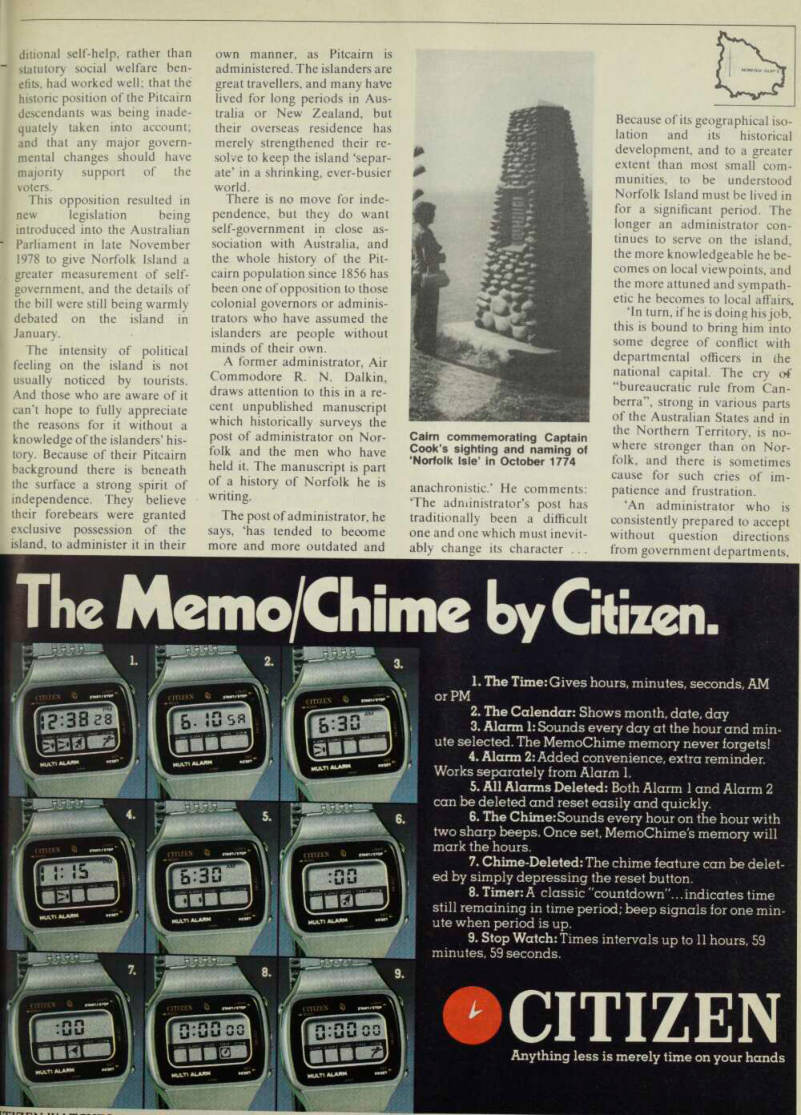
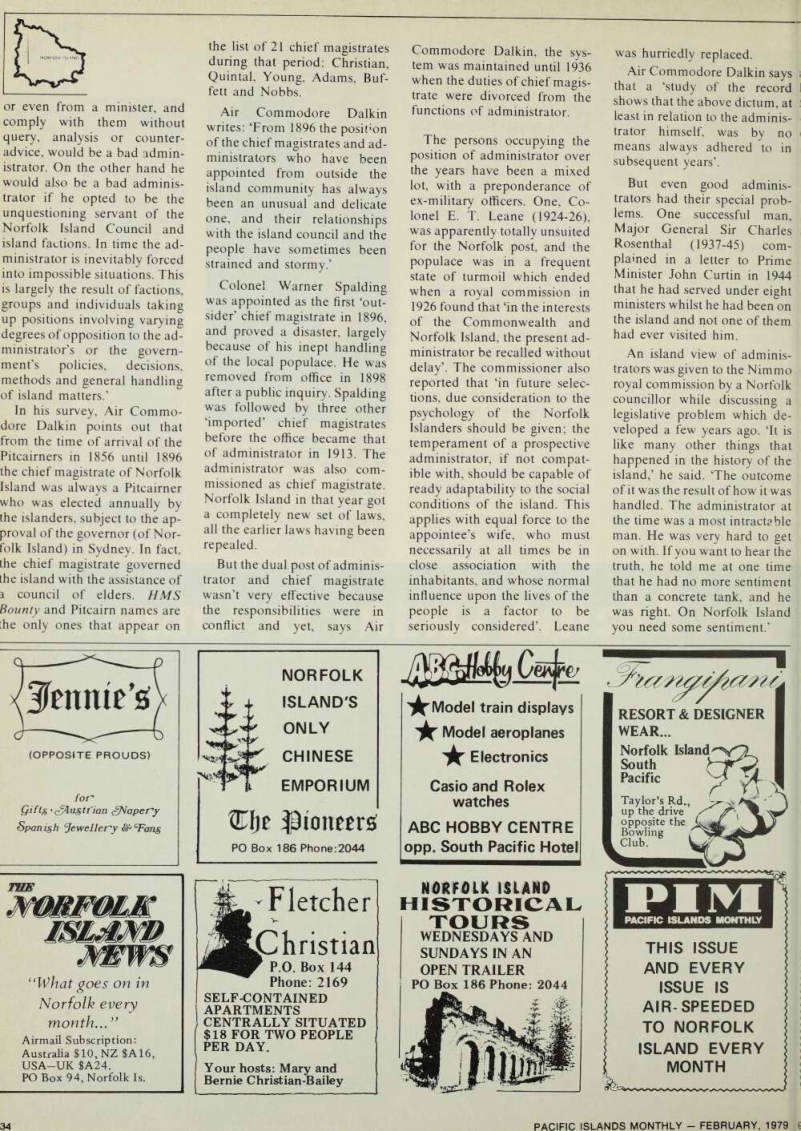
Australians?
Norfolk Island is the second oldest British settlement in the South Seas, having been occupied within a few weeks of the first British settlement at what is now Sydney in 1788. It is the oldest of Australia’s external territories.
Its European discoverer was Captain James Cook who, on October 10, 1774 landed at Duncombe Bay where today a monument stands. He found the island uninhabited and took possession of it for Britain. Little is known of the island’s previous history although there is evidence that it may have been inhabited in earlier times.
The Sydney colony was
established on January 26, 1788, and on February 14 the
armed tender Supply, carrying
Lieutenant Philip Gidley King
and a party of convicts, set sail for Norfolk to occupy it. After some difficulty in finding a suitable landing site, they came ashore in what is now the Kingston area on March 6, 1788.
King had been appointed superintendent and commandam of Norfolk.
The early days of settlement were difficult especially because of the amount of heavy clearing that had to be done before crops could be planted. 1 his period has become known as th ® FirSt Settlement ’- When King left in 1796 the
settlement was still a develop ing community of nearly 900 people with many public build ings. By 1804 the population, settlers and convicts, had reached 1100 and by 1810 over a quarter of the island had been cleared. But the long sea con nection to Sydney and the gen eral difficulties of keeping the Norfolk Island settlement going resulted in it gradually being run down and finally abandoned, On June 6, 1825, Captain Turton, of the 40th Regiment, with a detachment of soldiers and convicts, landed at King ston to begin the ‘Second Settlement’. This was a penal settlement and the prisoners were those judged to be the worst from the gaols of New South Wales and Tasmania.
Usually they had been con victed of further offences or considered intractable The island prison was officially described as being meant as ‘a place of the extremes! punishment, short of death’. No private settlers were allowed. The many stories of brutality and sometimes re bellion date from this period which lasted until 1856 when the last convict was moved The colonial stone buildings standing today date from this harsh Second Settlement. They were convict-built in local stone and consist of houses,
gaols (mostly razed), stores,
military barracks, a mill, grain silos, bridges and the fine old Government House. Settle ments were made at Kingston, Cascade and Longridge, and joined by an extensive road system. (There are no buildings remaining of the First Settle ment as these were mainly built in timber or in stone which was later used to build the Second Settlement).
Meanwhile the people of Pitcairn Island had been look ing for a new home. Most of the population on this small island east of Tahiti were de scendants of the mutineers of the Bounty who had scuttled their ship and hidden on the island in 1790. Their popu lation was increasing on Pit cairn and it was feared they would become short of land.
The entire Pitcairn popu lation of 194 landed on Nor
folk from the Morayshire on June 8, 1856 (the date is obser
ved today as Bounty Day or
Anniversary Day). The few
prisoners remaining on Nor
folk Island had gone by the end of the month.
For the benefit of the Pit cairners, the island was created a ‘distinct and separate settle ment’ on June 24, 1856. The governor of New South Wales was appointed governor of Norfolk Island as well but his powers were limited to acting as a link between the island and the British crown. The Pit cairners established the same kind of land tenure and com
munity disciplines they had
had at home.
Two small groups of families returned to Pitcairn in 1858 and 1863. Most Pitcairners remained on Norfolk, which is why the old Bounty names of Quintal, Young, Adams, Chris-
Kingston ... stone buildings of a harsh settlement
tian and McCoy are still promi nent.
The Melanesian mission established a missionary train
ing school and headquarters
for the Bishop of Melanesia on the island in October 1866. The station was named Saint Bar nabas, on whose feast day the site was selected. The beautiful Saint Barnabas Chapel was completed in 1880. From this base on Norfolk Island the mission took Christianity to the islands in the Western Pacific until 1920 when mission head quarters was moved north to the Solomons and Norfolk affairs were terminated.
In 1897 full administration of Norfolk Island became the responsibility of the governor of New South Wales. The island remained a separate Bri tish colony but the islanders lost their rights to elect a local head of government and to enact or repeal the island’s laws.
This continued until 1914 when, under the Norfolk Island Act, the island became a territory of the Common wealth of Australia. Various
legislative changes later gave
the island, among other things, a local advisory council of ■elected members.
In its modem history, Nor folk Islanders have had various inquiries instituted as to the exact constitutional position of the island with Australia, it being claimed on the island time and again that Britain meant the Pitcairners to run their affairs independently when it transferred them there in 1856. Petitions have been made to the Queen and to the Australian governor-general.
The most exhaustive inquiry was conducted in 1975-76 by Sir John Nimmo, a judge of the Australian Industrial Court.
The Nimmo Report made 74 recommendations on a wide range of topics. Its essential proposals were that Norfolk Island should be integrated into the Australian political system of laws, social benefits and taxes, with the island becoming part of the electorate of Canberra.
The Nimmo Report was and remains a valuable record of facts about Norfolk Island but
the commissioner’s recommen dations and some of his com ments precipitated intense controversy. The eight elected members of the Norfolk Island Council unanimously opposed the proposal that the island should lose its separate politi cal status and, in February 1977, acting as private citizens, they appealed to the United Nations to protect Norfolk
Island from being integrated
into Australia without the con sent of the electors.
A petition signed by 158 resi
dents favouring the Nimmo Report was cited by the respon sible Australian minister as an indication of feelings on the island. The petition was coun tered by more than 600 signed ‘solemn declarations’ from more than two-thirds of Nor folk Island’s electors who wanted separate status to con tinue.
Island arguments against the Nimmo recommendations were: that Norfolk Island is
basically self-supporting; that
the proposals would jeopardise
the economics of the only industry, tourism; that tra
Sir John Nimmo ... 74 recom mendations
ditional self-help, rather than statutory social welfare ben efits, had worked well; that the historic position of the Pitcairn descendants was being inade quately taken into account; and that any major govern mental changes should have majority support of the voters.
This opposition resulted in
new legislation being
introduced into the Australian Parliament in late November 1978 to give Norfolk Island a greater measurement of self government, and the details of the bill were still being warmly debated on the island in January.
The intensity of political feeling on the island is not
usually noticed by tourists.
And those who are aware of it
can’t hope to fully appreciate
the reasons for it without a knowledge of the islanders’ his tory. Because of their Pitcairn background there is beneath the surface a strong spirit of
independence. They believe
their forebears were granted exclusive possession of the island, to administer it in their
own manner, as Pitcairn is administered. The islanders are great travellers, and many have lived for long periods in Aus tralia or New Zealand, but their overseas residence has merely strengthened their re solve to keep the island ‘separ ate’ in a shrinking, ever-busier world.
There is no move for inde pendence, but they do want self-government in close as sociation with Australia, and the whole history of the Pit cairn population since 1856 has been one of opposition to those colonial governors or adminis trators who have assumed the islanders are people without minds of their own.
A former administrator, Air Commodore R. N. Dalkin, draws attention to this in a re
cent unpublished manuscript
which historically surveys the post of administrator on Nor folk and the men who have held it. The manuscript is part of a history of Norfolk he is
writing.
The post of administrator, he says, ‘has tended to become more and more outdated and
anachronistic.’ He comments: ‘The administrator’s post has traditionally been a difficult one and one which must inevit ably change its character .. .
Because of its geographical iso lation and its historical development, and to a greater extent than most small com munities, to be understood Norfolk Island must be lived in for a significant period. The longer an administrator con tinues to serve on the island, the more knowledgeable he be comes on local viewpoints, and the more attuned and sympath etic he becomes to local affairs. ‘ln turn, if he is doing his job, this is bound to bring him into some degree of conflict with departmental officers in the national capital. The cry of “bureaucratic rule from Can berra”, strong in various parts of the Australian States and in the Northern Territory, is no where stronger than on Nor folk, and there is sometimes cause for such cries of im patience and frustration. ‘An administrator who is consistently prepared to accept without question directions from government departments,
Cairn commemorating Captain Cook’s sighting and naming of ‘Norfolk Isle’ in October 1774
or even from a minister, and comply with them without query, analysis or counter advice, would be a bad admin istrator. On the other hand he would also be a bad adminis trator if he opted to be the unquestioning servant of the Norfolk Island Council and island factions. In time the ad ministrator is inevitably forced into impossible situations. This is largely the result of factions, groups and individuals taking
up positions involving varying
degrees of opposition to the ad ministrator’s or the govern ment’s policies, decisions,
methods and general handling
of island matters.’
In his survey, Air Commo dore Dalkin points out that from the time of arrival of the Pitcairners in 1856 until 1896 the chief magistrate of Norfolk Island was always a Pitcairner
who was elected annually by
the islanders, subject to the ap proval of the governor (of Nor folk Island) in Sydney. In fact,
the chief magistrate governed
the island with the assistance of a council of elders. HMS Bounty and Pitcairn names are the only ones that appear on
the list of 21 chief magistrates during that period: Christian, Quintal, Young, Adams, Buf fett and Nobbs.
Air Commodore Dalkin writes: ‘From 1896 the position of the chief magistrates and ad ministrators who have been appointed from outside the
island community has always
been an unusual and delicate one, and their relationships with the island council and the people have sometimes been strained and stormy.’
Colonel Warner Spalding was appointed as the first ‘out sider’ chief magistrate in 1896, and proved a disaster, largely because of his inept handling of the local populace. He was removed from office in 1898
after a public inquiry. Spalding
was followed by three other
‘imported’ chief magistrates
before the office became that of administrator in 1913. The administrator was also com missioned as chief magistrate.
Norfolk Island in that year got a completely new set of laws, all the earlier laws having been repealed.
But the dual post of adminis trator and chief magistrate wasn’t very effective because the responsibilities were in conflict and yet, says Air
Commodore Dalkin, the sys tem was maintained until 1936 when the duties of chief magis trate were divorced from the functions of administrator.
The persons occupying the position of administrator over the years have been a mixed lot, with a preponderance of ex-military officers. One, Co lonel E. T. Leane (1924-26), was apparently totally unsuited for the Norfolk post, and the populace was in a frequent state of turmoil which ended when a royal commission in 1926 found that ‘in the interests of the Commonwealth and Norfolk Island, the present ad ministrator be recalled without delay’. The commissioner also reported that ‘in future selec tions, due consideration to the psychology of the Norfolk Islanders should be given; the temperament of a prospective administrator, if not compat ible with, should be capable of ready adaptability to the social conditions of the island. This applies with equal force to the appointee’s wife, who must necessarily at all times be in close association with the inhabitants, and whose normal influence upon the lives of the people is a factor to be seriously considered’. Leane
was hurriedly replaced.
Air Commodore Dalkin says that a ‘study of the record shows that the above dictum, at least in relation to the adminis trator himself, was by no means always adhered to in
subsequent years’.
But even good adminis trators had their special prob lems. One successful man, Major General Sir Charles Rosenthal (1937-45) com plained in a letter to Prime Minister John Curtin in 1944 that he had served under eight ministers whilst he had been on the island and not one of them had ever visited him.
An island view of adminis trators was given to the Nimmo royal commission by a Norfolk councillor while discussing a legislative problem which de veloped a few years ago. ‘lt is like many other things that happened in the history of the island,’ he said. ‘The outcome of it was the result of how it was handled. The administrator at the time was a most intractable man. He was very hard to get on with. If you want to hear the truth, he told me at one time that he had no more sentiment than a concrete tank, and he was right. On Norfolk Island you need some sentiment.’
Advertisements & other items, pp. 32-34 (1 item)
The Supreme Status Watch!
is mm mm b \l\7A L.r- :
MULTI ALARM
ill ail s
The only Timepiece of its kind
in the world.
No other timepiece comes close! Because here is a completely-new kind of time system. Incredibly complex!
Yet marvelously simple to own and use.
Only the Citizen heritage of superb craftsmanship could achieve this multi-feature instrument. It can outperform every other watch in the world.
To own it is to know instant response.. .and supreme versatility.
Here is the Status Watch supreme.. .as unique as the exciting life style it was born to serve.
MEMO/CHIME Model #4O-1030-50
When you forget... Citizen remembers?
Alarm 1 Alarm 2 Chime Timer Stop Watch
IaHEIIOBI
The Memo/Chime by Citizen.
MULTI
kult.ala"** ■SB KB 0 ■■
MULTI
MULTI
■a
MULTI
*OLTI ALA"**
MULTI
1. The Time: Gives hours, minutes, seconds, AM or PM 2. The Calendar: Shows month, date, day 3. Alarm 1: Sounds every day at the hour and minute selected. The Memo Chime memory never forgets! 4. Alarm 2: Added convenience, extra reminder.
Works separately from Alarm 1. 5. All Alarms Deleted: Both Alarm 1 and Alarm 2 can be deleted and reset easily and quickly. 6. The Chime: Sounds every hour on the hour with two sharp beeps. Once set, Memo Chime's memory will mark the hours. 7. Chime-Deleted: The chime feature can be deleted by simply depressing the reset button. 8. Timer: A classic "countdown''...indicates time still remaining in time period; beep signals for one minute when period is up. 9. Stop Watch: Times intervals up to 11 hours, 59 minutes, 59 seconds.
CITIZEN
Anything less is merely time on your hands
(OPPOSITE PROUDS)
for Qifts- papery Spanish ‘Jewellery & ‘Tans NO
NORFOLK
ISLAND'S
ONLY
CHINESE
EMPORIUM
QL\)t pioneers?
PO Box 186 Phone:2o44
TBE
.YOHFOUC
isMjm
mws
“What goes on in Norfolk every month... ”
Airmail Subscription: Australia SlO, NZ SAI6,
USA-UK SA24.
PO Box 94, Norfolk Is.
Fletcher
v
Christian
P.O. Box 144 Phone: 2169
SELF-CONTAINED
APARTMENTS
CENTRALLY SITUATED
$lB FOR TWO PEOPLE
PER DAY.
Your hosts; Mary and Bernie Christian-Bailey C 2 train displays Model aeroplanes Electronics Casio and Rolex watches
ABC HOBBY CENTRE
opp. South Pacific Hotel
NORFOLK ISLAND
HISTORICAL
TOURS
WEDNESDAYS AND
SUNDAYS IN AN
OPEN TRAILER
PO Box 186 Phone: 2044 n
RESORT & DESIGNER
WEAR...
Norfolk Island' South Pacific Taylor’s Rd., up the drive opposite the.
Bowling Club.
PACIFIC ISLANDS MONTHLY
THIS ISSUE
AND EVERY
ISSUE IS
AIR-SPEEDED
TO NORFOLK
ISLAND EVERY
MONTH
Shopping
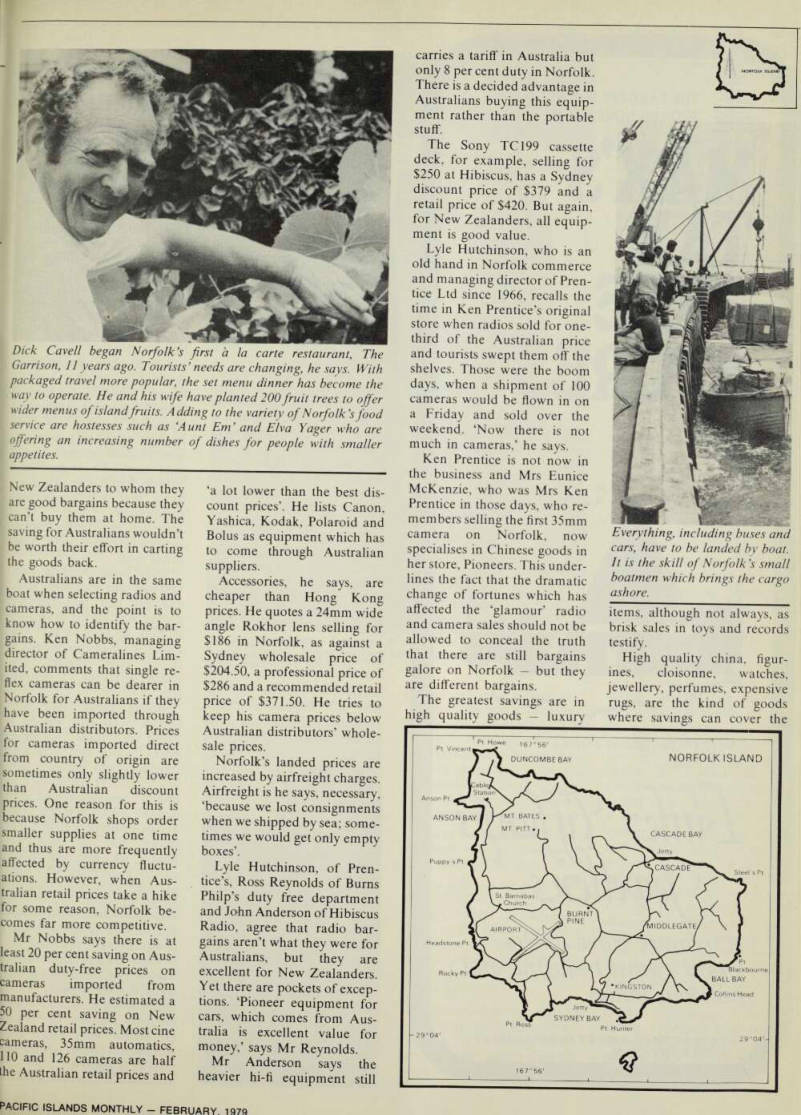

Low Duty
Is A Big
Come On
Mr Justice Nimmo, who in 1976 held a royal commission into the affairs of Norfolk Island, did not delude himself that Norfolk’s famous low
duty shopping possesses only
marginal appeal to tourists, as some experts had tried to tell him. ‘Human nature being what it is,’ the commissioner said in his report, ‘one should not accept too readily assertions that opportunities to save money do not weigh significantly in the
thoughts of high-minded tour
ists purporting to be mere seekers of rustic charms. The
authority responsible for set
ting customs duties should always take care to maintain opportunity for these seekers
of simple pleasures to indulge
their acquisitive instincts by the purchase of goods at prices up to a third less than mainland
prices.
‘The loss in customs revenue will not be large and will be outweighed by the benefits to the island’s economy. It is fre quently commented that the air fare of a tourist to Norfolk can
be virtually recouped by the savings effected on purchases made in the island. That, com bined with the relative cheap ness of accommodation in Norfolk, enables many to have a holiday they could not other wise afford. It is an important component of the whole tourist
industry.’
In Norfolk’s last financial year to June 30, the island imported goods to a total value of almost $8 million.
Exports were less than $1 million. In fact the greater part of that import figure represents invisible exports, because visi tors took goods out of the island almost as soon as they arrived.
A study of import details re veals the picture. This island of only about 1800 residents last year imported footwear to the total value of $370,000, jewellery $293,000, cosmetics $109,000, clocks and watches $189,000, drapery and fabrics $820,000, photographic goods $220,000, radios $304,000, ‘fancy goods’ $295,000, and
liquor a staggering $386,000.
The shopkeepers who imported and sold these goods
paid comparatively little duty
and no income or company taxes.
Nearly all that footwear was sold by two shops, Max Craig’s
Quality Shop (for women’s
shoes) and Ray Spragg’s Franks Shoe Store (for men).
In the Quality Shop, a best
seller is Rayne’s Raquette,
straight from London and sell ing at $59 compared with $lO5 in Melbourne. All the high fashion shoes from London, Paris, Rome and Spain are there at similar discounts, air mailed in by parcel post and backed up by a storeroom on the premises stacked with shoes insured for a third of a million dollars.
Ray Spragg, who is a former New Guinea plantation ‘old hand’, can bring shoes direct from Europe and sell them 40% cheaper than Australian retail and 50% cheaper than in New Zealand. He says it wouldn’t pay him to import from Aus tralia.
This, generally, ii the secret of Norfolk’s lower prices: di rect imports from overseas, usually from the manufac turers. Some shops which do import mostly from Australia can survive because they pitch their sales to New Zealanders who have to pay considerably more for most goods at home.
Consequently items which give Australians a small saving can be excellent bargains for New Zealanders. This is especially true of electrical goods and
clothing.
Danny Yager, of Leeside, who buys mostly from Aus tralia, considers that New Zealanders purchase Aus tralian goods because of price and quality, and that Aus tralians go for English and US goods for the same reason.
Peter Woodward, of Pete’s Place, sells a steady supply of Monier crockpots at $25 to
Ric Irvine, NZ-born proprietor of Irvines Limited, says Nor folk's economic base today is much stronger than when he arrived 14 years ago. The "get rich-quick' business type has gone to the wall, he says. Today Norfolk is ‘value for money' and a 'nice place to live'.
New Zealanders to whom they are good bargains because they can’t buy them at home. The saving for Australians wouldn’t be worth their effort in carting the goods back.
Australians are in the same boat when selecting radios and cameras, and the point is to know how to identify the bar gains. Ken Nobbs, managing director of Cameralines Lim ited, comments that single re flex cameras can be dearer in Norfolk for Australians if they
have been imported through
Australian distributors. Prices for cameras imported direct from country of origin are
sometimes only slightly lower
than Australian discount prices. One reason for this is because Norfolk shops order smaller supplies at one time and thus are more frequently affected by currency fluctu ations. However, when Aus tralian retail prices take a hike for some reason, Norfolk be comes far more competitive.
Mr Nobbs says there is at least 20 per cent saving on Aus tralian duty-free prices on cameras imported from manufacturers. He estimated a 50 per cent saving on New Zealand retail prices. Most cine cameras, 35mm automatics, 110 and 126 cameras are half the Australian retail prices and
‘a lot lower than the best dis count prices’. He lists Canon Yashica, Kodak, Polaroid and Bolus as equipment which has to come through Australian suppliers.
Accessories, he says, are
cheaper than Hong Kong
prices. He quotes a 24mm wide angle Rokhor lens selling for $lB6 in Norfolk, as against a Sydney wholesale price of $204.50, a professional price of $286 and a recommended retail price of $371.50. He tries to keep his camera prices below Australian distributors’ whole sale prices, Norfolk’s landed prices are
increased by airfreight charges,
Airfreight is he says, necessary, ‘because we lost consignments when we shipped by sea; some times we would get only empty boxes’, Lyle Hutchinson, of Pren tice’s, Ross Reynolds of Burns
Philp’s duty free department
and John Anderson of Hibiscus Radio, agree that radio bar gains aren’t what they were for Australians, but they are excellent for New Zealanders, Yet there are pockets of excep tions. ‘Pioneer equipment for cars, which comes from Aus tralia is excellent value for money,’ says Mr Reynolds Mr Anderson says the heavier hi-fi equipment still
carries a tariff in Australia but only 8 per cent duty in Norfolk.
There is a decided advantage in
Australians buying this equip
ment rather than the portable stuff.
The Sony TCI99 cassette deck, for example, selling for $250 at Hibiscus, has a Sydney discount price of $379 and a retail price of $420. But again, for New Zealanders, all equip ment is good value.
Lyle Hutchinson, who is an old hand in Norfolk commerce and managing director of Pren tice Ltd since 1966, recalls the time in Ken Prentice’s original store when radios sold for one third of the Australian price and tourists swept them off the shelves. Those were the boom days, when a shipment of 100 cameras would be flown in on a Friday and sold over the weekend. ‘Now there is not much in cameras,’ he says.
Ken Prentice is not now in the business and Mrs Eunice McKenzie, who was Mrs Ken Prentice in those days, who re members selling the first 35mm camera on Norfolk, now specialises in Chinese goods in her store, Pioneers. This under lines the fact that the dramatic change of fortunes which has affected the ‘glamour’ radio and camera sales should not be allowed to conceal the truth that there are still bargains galore on Norfolk but they are different bargains.
The greatest savings are in
high quality goods - luxury
items, although not always, as brisk sales in toys and records testify.
High quality china, figur ines, cloisonne, watches, jewellery, perfumes, expensive rugs, are the kind of goods where savings can cover the
Dick Cavell began Norfolk's first a la carte restaurant. The Garrison, 11 years ago. Tourists' needs are changing, he says. With packaged travel more popular, the set menu dinner has become the way to operate. He and his wife have planted 200 fruit trees to offer wider menus of island fruits. Adding to the variety of Norfolk's food service are hostesses such as Aunt Em' and Elva Yager who are off erin g on increasing number of dishes for people with smaller appetites.
Everything, including buses and
cars, have to be landed by boat.
It is the skill of Norfolk's small boatmen which brings the cargo ashore.
tourist’s airfare. Shops like Little Tiffany’s in Max’s store and BJ’s, depend on this when it comes to jewellery. The greater the expenditure the greater the saving.
Bob Fitzgibbons of BJ’s buys his raw stones overseas and has them made up overseas. He will buy rubies in Bangkok, diamonds in South Africa and have them made up, perhaps, in London. Tt makes sense to buy on the best market, and markets vary depending on what stones you want and what styles you want made up,’ says Mr Fitzgibbons, who has been selling jewellery in Norfolk for 13 years and in his own shop for nine.
As an example, he recently
bought a rough ruby of almost
a carat in Burma, took delivery in Bangkok, where he had it cut, and sent it to London for setting with eight diamonds.
The first tourist who saw it bought it for $593, with an insurance valuation from Fitz gibbons of $l3OO. He says a
typical price for good jewellery
in Norfolk shops would be $6OO for a ring selling in Syd ney for $ 1100. Jewellery can be taken duty free into Australia or New Zealand if the pur chaser carries it as her personal property.
In the watch trade, Tony Mathys of Swiss House says the best bargains are in the expens ive watches. Swiss watches haven’t increased to the same
extent as Japanese watchesz (due to the upward valuation inr the yen) and Norfolk can selll the higher price Swiss models 2 at half the Australian prices ‘cheaper than in Switzerland.’ ' Direct importing is thes answer but Australian distribu tors do not all endorse this andt there have been strong andt sometimes successful pressuresg from some Australian whole salers aimed at getting overseas 2 manufacturers of various pro ducts to cease supplying Nor folk direct.
Bill Blucher, president ofl committees of the Island Council, and a leadings Norfolk businessman (Martin’s 2
Agencies), says
business would be strangled if! these pressure groups achievedt their aims. He stresses that!
Norfolk Island is an island ter ritory that will attain self government and that!
Australian distributors have noo automatic rights over fran chises there.
Some other Norfolk busi nessmen take a stronger standb and say that abroad who persist in treatingg Norfolk as part of the Aus-. tralian mainland run the risk oft
finding their products boy
cotted in favour of competi-i tors.
Honda agent, Jack Fitz-: patrick, who sells Honda ali about two-thirds Australian!
prices, points out that high!
freights would penalise Nor-i
folk car buyers and hirers if hes couldn’t buy direct. And if hes
bought spares through Aus-;
tralian distributors he would bea
paying duty on duty. Ceo:
Bunker, who hires out 80 carsg" and 31 motorbikes, says tour-i ists can’t do without transport! on the Island.
lanand Joan Kenney, tour oper[?] ators, say better informed visi-[?] tors now arenas keen to inspec[?] Norfolk's historical sites as they[?] are to visit the shopping centr[?] Marie Bailey of Marie’s Tours,[?] has made a hit with her ‘behin[?] the hedges’ tours which tak[?] visitors into historic homes an[?]
gardens of Norfolk.
Norfolk’S Income
The tourist industry enables Norfolk Island to balance its official budget. The island also earns a handy income from the sale of postage stamps to collectors and from company fees.
Norfolk’s budget for the financial year to June 30 last is fairly typical. Norfolk earned $2,020,732 and spent $1,782,386.
Major items of revenue, in round figures: sales of stamps $550,000; customs duty $472,000; company fees $237,000; liquor bond $233,000; motor registration fees and licences $73,000; departure tax $35,000. The
Australian government grant was $126,000.
Major items of expendi ture; administration $704,000; education $290,000; repairs and main tenance $251,000; health and welfare $250,000.
There is no income or company tax on Norfolk Island and duties on export goods are low with many goods duty free. The duty on cameras and photographic equipment for example is 8%, on clothing and footwear 5%, building materials 5%, watches 17%, electrical goods for the kitchen 5%, radios, re corders, records and tapes 8% jewellery 10%, motor cars 15%.
The Norfolk administrat ion gains in two ways on
liquor. It applies a duty and
then makes a profit on sales because it is the sole importer of liquor on the island. Most dutiable goods, including liquor, leave the island again with the tourists.
Although the boom days of company registrations are past, Norfolk still earns con siderable revenue from company fees. It charges $350 for incorporating a company and a filing fee of $3OO for the company’s annual return. As at September 30 last, 1066 companies were registered on the island, an increase on the figure for the previous year but below the record of 1571 companies in 1971. Most companies registered at that
time are defunct either abandoned or liquidated, having served their purpose.
The companies were formed because Norfolk Island was used at that time for tax avoidance on income actually earned elsewhere. After millions of dollars in tax were lost to Australia, Canberra closed the major loopholes in 1973.
Companies continued to be registered on the island be cause it is still possible to arrange tax minimising schemes, particularly estate planning, because of the absence of gift, stamp and estate duties. The govern ment doesn’t plan to make any more changes to the tax laws so this is likely to con tinue.
Advertisements & other items, pp. 36-38 (3 items)
DAf'ici/ - ' ici AMnc momti-II V _ PPRRIIARY 1Q79
DAf'ici/ - ' ici AMnc momti-II V PPRRIIARY 1Q79
Gallerv
raE
Ponderosa
Single and two-bedroom apartments.
Fully equipped...
Barbecues in the grounds!
Box 76 Cable: Ponderosa.
Phone: 2188.
the
GALLERV
Home of fine English Bone China
ROYAL CROWN DERBY
ROYAL DOULTON
ROYAL WORCESTER
SPODE
ROYAL ALBERT"
Figurines, teasets and dinner sets.
Mens’ English two piece suits and shirts. f"
Norfolk Island’s largest
stockists of Cassettes
and Records
Popular Brands of Radios, Cassettes and Hi Fi, including JVC Stereo . . . * Also Jewellery * GE Appliances * Nivada Watches * All Kinds of Gifts
Norfolk Island’s largest
range of Sporting Goods
* Marlin Depth Sounders * Diving and Fishing Gear * Adidas Sports Gear * Firearms
TAYLOR’S ROAD, P.O. Box 437.
MAIL ORDERS WELCOME
International Duty Dree
Norfolk Island Sporting and Gift Centre
Norfolk Island
Airlines
REGULAR SERVICES
CONNECTING NORFOLK
ISLAND WITH BRISBANE
AND LORD HOWE ISLAND.
CHARTERS AVAILABLE TO NOUMEA, FIJI
AND AUCKLAND
BRISBANE: Level C, Queens Arcade. Telex: AA41421
ALL STATES - ANSETT AIRLINES.
CABLE: "AIRNORFOLK" NORFOLK ISLAND
BJ’s
SPECIALISTS IN DIAMONDS
AND OTHER PRECIOUS STONES
STRAND ARCADE, TA YLOR ’S ROAD.
P.O. Box 291. Phone: 2194 Cables: ‘NORCO’
Proprietor R.E. Fitzgibbons.
THE LARGEST TAX FREE
SHOP ON NORFOLK ISLAND
STORES
I
IN MAX'S BUILDING YOU'LL
ALSO FIND...
A treasure trove of the
world’s most beautiful and
precious things
SAVE FROM 60-100% BY PURCHASING AT
LITTLE TIFFANYS!
Paoifin Isi Ands Monthly February, 197Jy
the Norfolk
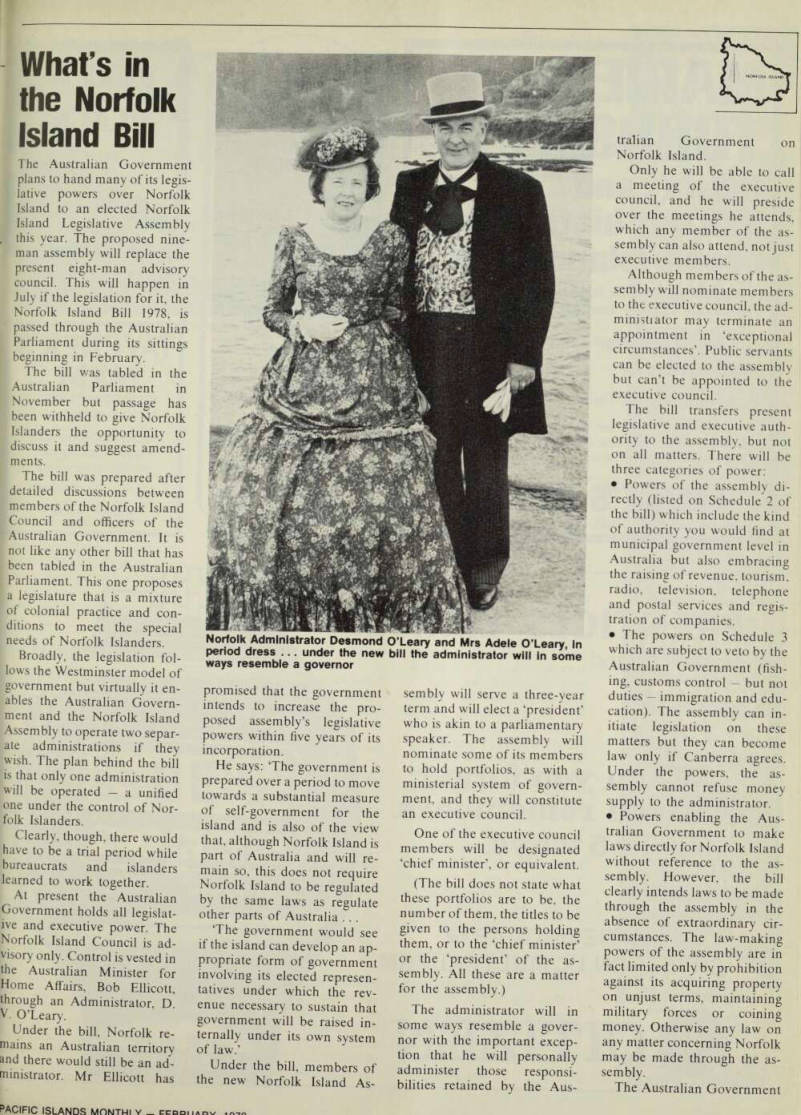
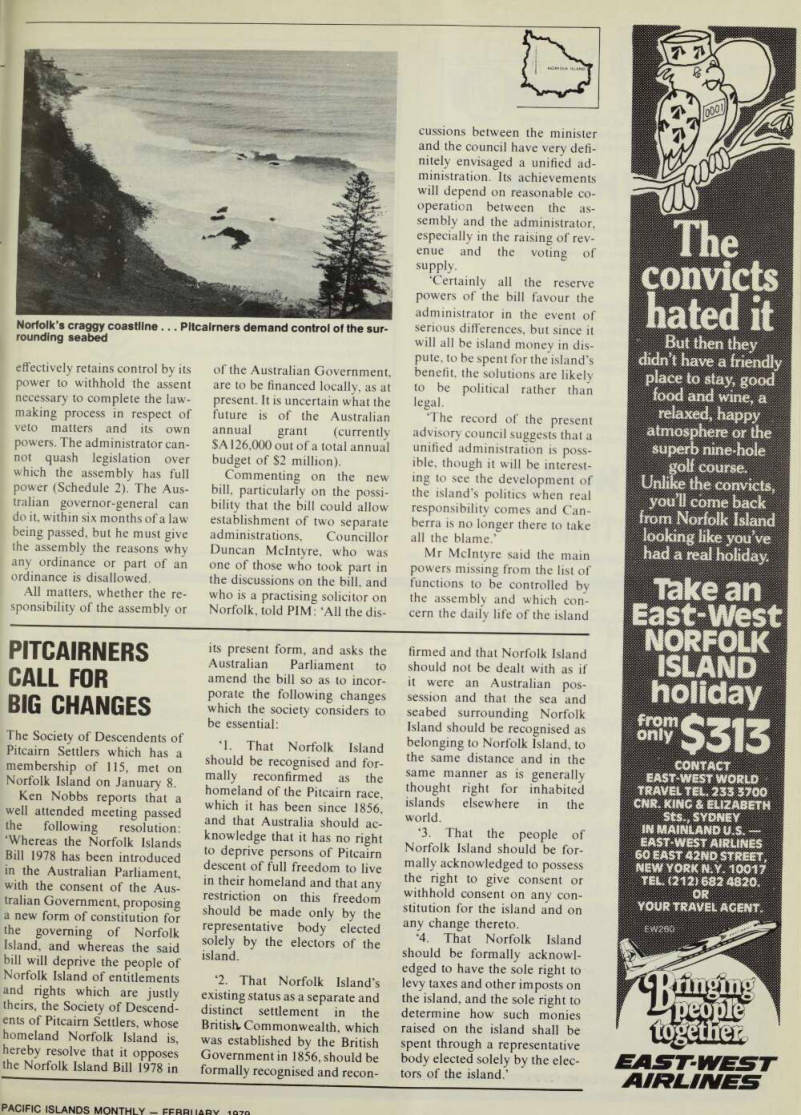
What’s in the Norfolk Island Bill
The Australian Government plans to hand many of its legis lative powers over Norfolk Island to an elected Norfolk Island Legislative Assembly . this year. The proposed nine man assembly will replace the present eight-man advisory council. This will happen in July if the legislation for it, the Norfolk Island Bill 1978, is passed through the Australian
Parliament during its sittings
beginning in February.
The bill was tabled in the Australian Parliament in November but passage has been withheld to give Norfolk Islanders the opportunity to discuss it and suggest amend ments.
The bill was prepared after detailed discussions between members of the Norfolk Island I Council and officers of the Australian Government. It is not like any other bill that has been tabled in the Australian Parliament. This one proposes a legislature that is a mixture of colonial practice and con ditions to meet the special needs of Norfolk Islanders.
Broadly, the legislation fol
lows the Westminster model of government but virtually it en ables the Australian Govern ment and the Norfolk Island Assembly to operate two separ ate administrations if they wish. The plan behind the bill is that only one administration will be operated - a unified one under the control of Nor folk Islanders.
Clearly, though, there would
have to be a trial period while bureaucrats and islanders learned to work together.
At present the Australian Government holds all legislat ive and executive power. The Norfolk Island Council is ad visory only. Control is vested in the Australian Minister for Home Affairs, Bob Ellicott, through an Administrator, D.
V. O’Leary.
Under the bill, Norfolk re
mains an Australian territory
and there would still be an ad ministrator. Mr Ellicott has
promised that the government intends to increase the pro
posed assembly’s legislative
powers within five years of its
incorporation.
He says: ‘The government is prepared over a period to move towards a substantial measure of self-government for the island and is also of the view that, although Norfolk Island is part of Australia and will re main so, this does not require Norfolk Island to be regulated by the same laws as regulate other parts of Australia . . . ‘The government would see if the island can develop an ap propriate form of government involving its elected represen tatives under which the rev enue necessary to sustain that government will be raised in ternally under its own system of law.’
Under the bill, members of the new Norfolk Island As
sembly will serve a three-year term and will elect a ‘president’ who is akin to a parliamentary speaker. The assembly will nominate some of its members to hold portfolios, as with a ministerial system of govern ment, and they will constitute an executive council.
One of the executive council members will be designated ‘chief minister’, or equivalent. (The bill does not state what these portfolios are to be, the number of them, the titles to be given to the persons holding them, or to the ‘chief minister’ or the ‘president’ of the as sembly. All these are a matter for the assembly.) The administrator will in some ways resemble a gover nor with the important excep tion that he will personally administer those responsi bilities retained by the Aus-
tralian Government on Norfolk Island.
Only he will be able to call a meeting of the executive council, and he will preside over the meetings he attends, which any member of the as sembly can also attend, not just executive members.
Although members of the as sembly will nominate members to the executive council, the ad ministiator may terminate an appointment in ‘exceptional circumstances’. Public servants can be elected to the assembly but can’t be appointed to the executive council.
The bill transfers present legislative and executive auth ority to the assembly, but not on all matters. There will be three categories of power: • Powers of the assembly di rectly (listed on Schedule 2 of the bill) which include the kind of authority you would find at municipal government level in Australia but also embracing the raising of revenue, tourism, radio, television, telephone and postal services and regis tration of companies. • The powers on Schedule 3 which are subject to veto by the Australian Government (fish ing, customs control - but not duties immigration and edu cation). The assembly can in itiate legislation on these matters but they can become law only if Canberra agrees.
Under the powers, the as sembly cannot refuse money supply to the administrator. • Powers enabling the Aus tralian Government to make laws directly for Norfolk Island without reference to the as sembly. However, the bill clearly intends laws to be made through the assembly in the absence of extraordinary cir cumstances. The law-making powers of the assembly are in fact limited only by prohibition against its acquiring property
on unjust terms, maintaining
military forces or coining
money. Otherwise any law on any matter concerning Norfolk may be made through the as
sembly.
The Australian Government
Norfolk Administrator Desmond O’Leary and Mrs Adele O’Leary In period dress ... under the new bill the administrator will In some ways resemble a governor
effectively retains control by its power to withhold the assent necessary to complete the law making process in respect of veto matters and its own powers. The administrator can not quash legislation over which the assembly has full power (Schedule 2). The Aus tralian governor-general can do it, within six months of a law being passed, but he must give the assembly the reasons why any ordinance or part of an ordinance is disallowed.
All matters, whether the re sponsibility of the assembly or
of the Australian Government, are to be financed locally, as at present. It is uncertain what the future is of the Australian annual grant (currently $A 126,000 out of a total annual budget of $2 million).
Commenting on the new bill, particularly on the possi bility that the bill could allow establishment of two separate administrations, Councillor Duncan Mclntyre, who was one of those who took part in the discussions on the bill, and who is a practising solicitor on Norfolk, told PIM; ‘All the dis-
cussions between the minister and the council have very defi nitely envisaged a unified ad ministration. Its achievements will depend on reasonable co operation between the as sembly and the administrator, especially in the raising of rev enue and the voting of
supply.
‘Certainly all the reserve powers of the bill favour the administrator in the event of serious differences, but since it will all be island money in dis pute, to be spent for the island’s benefit, the solutions are likely to be political rather than
legal.
‘The record of the present advisory council suggests that a unified administration is poss ible, though it will be interest ing to see the development of the island’s politics when real responsibility comes and Can berra is no longer there to take all the blame.’
Mr Mclntyre said the main powers missing from the list of functions to be controlled by the assembly and which con cern the daily life of the island
Norfolk’s craggy coastline ... Pitcairners demand control of the sur rounding seabed
are those involving health, wel fare, police and land. ‘The government has prom ised periodic review with a view towards the growth of powers, and in any such review health and welfare should be passed to the assembly at an early date,’ said Mr Mclntyre. ‘With those items in assembly hands there would be little impediment to making the as sembly responsible for all rev enue raising. The bill makes it possible to increase the as
sembly’s powers by adding to
Schedules 2 and 3 by regu lation, so one doesn’t have to go through the full parliamen tary process.’
Councillor Mclntyre said control of air traffic was not likely to be handed over as it
was political, and, in any case, it was paid for by Canberra. He added; ‘ln vehemently oppos ing the Nimmo Report, the islanders sought to obtain guarantees against Australian integration. The present bill is not an unconditional guaran tee; it reserves more power to Australia than many islanders would like. It can be changed by any subsequent Australian parliament, and there is nothing in it to stop a later government bent on inte gration, regardless of the politi cal consequences. ‘But, remembering the promise of further growth of the assembly’s powers, the bill represents a real opportunity for Norfolk Island to establish its political identity in a most forceable way. A good political performance by the assembly would therefore seem to be the best guarantee for the future that the island could have.’
President of Committees of the Norfolk Island Council, Bill Blucher, said in Sydney last
month that he would like to have assurances from the Aus tralian Government that it intends to grant self-govern ment to Norfolk Island.
Mr Blucher said he had no doubts about the intentions of the new Norfolk Island Bill and of the Australian Govern ment but these needed to be spelled out to make it clear to everybody that the bill would lead to a transfer of powers. He wants to see powers transferred within five years.
Mr Blucher believes amend ments to the bill are required, but not its rejection. ‘The coun cil wants what the people want,’ he said.
Exactly what Norfolk Islanders felt about the bill was not clear in early January.
Controversy was developing
but no clear picture had emerged. Mr Blucher read out a precis of the bill at a council meeting on December 13 but there was no discussion. Coun
cillors apparently were waiting
to get more public reaction be fore debating it.
The Norfolk Island News, a
monthly newspaper edited by
Ed Howard, came out in its
December/January issue
against the bill, describing it as ‘Australia’s plan to keep Nor folk a colony’. Mr Howard said it was ‘nothing but a rehashed version of the same colonial rule that has caused anguish and protest on Norfolk gener ation after generation, ever since self-government on the island was crushed in 1896’. He demanded that Australia give clear reasons why it thought the bill benefited the island.
Bill Blucher . . . wants to see power transferred in five years
Advertisements & other items, pp. 39-40 (3 items)
Pacific Islands Month! V _ . Ccqdi Ladv/
PACIFIC ISLANDS MONTH! v . CCQDI lADV/
40
da/-'ici/ - ' ici AMncs momthi Y FEBRUARY. 1979?
O Citizen
i a
THE GIFT CENTRE
IN THE STRAND
ARCADE
lITTALA GLASSWARE
KOSTA BODA
CROWN CORNING
HOLLY HOBBIE
CERAMICS
SNOOPY PRODUCTS
LOCAL
COTTAGE
POTTERY
PROPRIETRESS
JAN CHRISTIAN
PETE’S
PLACE
FOR
S? c® v
MARIE'S
TfIIIOO^EJOS
I UUHsST-
full day and
half day historic and
scenic island tours
Guides are all Norfolk Islanders descended from the famous 'Bounty' mutineer Fletcher Christian. ♦ Behind the Hedges Tours ♦ Island Dinners ♦ Mystery Night Tours The people who remember Norfolk for all its historical beauty are those who first explored with Marie's Tours Then broused at their leisure They didn't miss a thing
MARIE'S TOURS
P.O. Box 276, Norfolk Island, Phone: 2174
TAYENEk’S
FARM
GUEST HOUSE
STEELE'S POINT
Accommodation with Home Cooking and homely atmosphere En suite or standard Mrs Esme Tavener Phone: 2086
PRENTICES LIMITED
Norfolk Island
When you forget.
Citizen remembers.
5 ways.
CITIZEN QUARTZ
CRYSTRON LC MULTI ALARM.
O CITIZEN
NMI B 4
CITIZEN «a
Mi ? m m* is m m m RtAD/5tT af-SET
MULTI ALARM
Pitcairners
Call For
Big Changes
The Society of Descendents of Pitcairn Settlers which has a membership of 115, met on Norfolk Island on January 8.
Ken Nobbs reports that a well attended meeting passed the following resolution; ‘Whereas the Norfolk Islands Bill 1978 has been introduced in the Australian Parliament, with the consent of the Aus tralian Government, proposing a new form of constitution for the governing of Norfolk Island, and whereas the said bill will deprive the people of Norfolk Island of entitlements and rights which are justly theirs, the Society of Descend ents of Pitcairn Settlers, whose homeland Norfolk Island is, hereby resolve that it opposes the Norfolk Island Bill 1978 in
its present form, and asks the Australian Parliament to amend the bill so as to incor
porate the following changes
which the society considers to be essential; T. That Norfolk Island should be recognised and for mally reconfirmed as the homeland of the Pitcairn race, which it has been since 1856, and that Australia should ac knowledge that it has no right to deprive persons of Pitcairn descent of full freedom to live in their homeland and that any restriction on this freedom should be made only by the representative body elected solely by the electors of the island. ‘2. That Norfolk Island’s existing status as a separate and distinct settlement in the British, Commonwealth, which was established by the British Government in 1856, should be formally recognised and recon
firmed and that Norfolk Island should not be dealt with as if it were an Australian pos session and that the sea and seabed surrounding Norfolk Island should be recognised as belonging to Norfolk Island, to the same distance and in the same manner as is generally thought right for inhabited islands elsewhere in the world. ‘3. That the people of Norfolk Island should be for mally acknowledged to possess the right to give consent or withhold consent on any con stitution for the island and on any change thereto. ‘4. That Norfolk Island should be formally acknowl edged to have the sole right to levy taxes and other imposts on the island, and the sole right to determine how such monies raised on the island shall be spent through a representative body elected solely by the elec tors of the island.’
Advertisements & other items, pp. 41-43 (2 items)
hated it
The
convicts
didn't have a friendly place to stay, good food and wine, a relaxed, happy atmosphere or the superb nine-hole 1 course. the convicts, you'll come back from Norfolk Island looking like you've had a real holiday
Take an
East-west
NORFOLK
ISLAND
holiday
■ CONTACT
EAST-WEST WORLD
TRAVEL TEL. 235 3700
CNR. KINGS ELIZABETH
Sts., SYDNEY
IN MAINLAND U.S.-
EAST-WEST AIRLINES
60 EAST 42ND STREET,
NEW YORK NtY. 10017
TEL. (212) 682 4820.
OR
YOUR TRAVEL AGENT.
But then they from only $313
LONGINES
ORIS
SPEAKING ABOUT -
Presumably you go to the Baker to buy bread, not to the Butcher - Likewise it makes sense to purchase your watch from
SWISS HOUSE
The owner being Swiss, we have the unequalled background of the Swiss horological industry.
We will help you to pick the tree from the forest and if you want the proverbial Swiss accuracy confirmed we can test it on our most up-to-date Quartz Apparatus.
Several factories of very high repute have entrusted us with their sole agency in Norfolk Island. These manufacturers maintain service centres in Australia and New Zealand, so your international guarantee is "guaranteed".
Finally, a Swiss Watch need not be expensive.
In fact we invite you to compare our duty-free prices with watches of other provenance. Most probably you will come back to
SWISSHOUSE
CERTINA
ROTARY
TOURIST BUREAU
P.0.80X 211 • NORFOLK ISLAND • 2899 • SOUTH PACIFIC
TELEPHONE 2147 • CABLES.'TOURBUREAU’
LET US BOOK YOUR:
ACCOMMODATION
Hotel, Motel, Flat, Guest House.
TOURS
Island, Coral Reef, Historical, Garden Horse Riding, Mystery.
ENTERTAINMENT
Island Dinner, Progressive Dinner, Sporting Fixtures.
TRANSPORT
Car, Scooter.
Plan your visit to coincide with the colourful ‘Bounty Week’ Festival in June. Ask us for programme details.
MARTIN’S AGENCIES LTD.
NORFOLK ISLAND
IMPORT/EXPORT AGENTS
GENERAL COMMISSION AGENTS and DISTRIBUTORS - WHOLESALERS - RETAILERS
AGENTS FOR
■ MOBILOIL AUST. LTD. Petrol and Oils
■ KARLANDER (AUST.) PTY. LIMITED Shipping
■ SOCIETE MARITIME CALEDONIENE Shipping
■ MacDONALD HAMILTON & CO. LTD. Shipping ■ GENERAL ACCIDENT GROUP (Yorkshire Insurance Co. Limited) ■ REMINGTON Shavers, Home and personal care products ■ SUZUKI MOTORS (JAPAN) Cars, trucks and motorcycles ■ BRIDGESTONE TYRES (JAPAN) Truck, car & cycle tyres ■ MASPORT (N.Z.) LIMITED Mowers, rotohoes ■ W.A.FLICK & CO LIMITED Pest control experts ■ HOWARD ROTAVATOR PTY. LIMITED Rotavators, hoes, all agricultural implements
WHOLESALERS/RETAILERS
REFRIGERATORS - FREEZERS - GAS STOVES - POULTRY & STOCK FEED FERTILISERS - BUILDING MATERIALS - WATER TANKS ETC. - ROOFING
MATERIALS - GUTTERING.
If you think we may be able to help you please ask us We appreciate inquiries.
mt
Norfolk
Manlier
Editor: TOM LLOYD
ON SALE AT HOTELS
SHOPS AND FLATS
EVERY SATURDAY
MORNING...
NORFOLK ISLAND'S ONLY
WEEKLY NEWSPAPER
LEESIDE
(NORFOLK ISLAND)
LIMITED
FOR:
i CHINA & GLASSWARE
i ARTIFICIAL FLOWERS
i FOOTWEAR
i JEWELLERY
i SUITCASES
AGENTS FOR:
REVLON COSMETICS
■ FELICIA WATCHES
■ OSTI FROCKS
■ BISLEY SHIRTS & SUITS
■ HENSELITE BOWLING
EQUIPMENT
TAYLORS ROAD
P.0.80x 219
The Famous
aunt ems
(Jean Mitchell)
$24 per day with share facilities. Twin, $26 per day each, with own facilities.
All meals are included.
TAYLOR’S ROAD
BOX 121
Phone 2373
HIBISCUS RADIO
CCP%#|£r NORFOLK'S SOUND CENTRE
KHV IVt IMPORT AND RETAIL OF
• HI-FI STEREO •VIDEO EQUIPMENT
• RADIO CASSETTES ®CAR RADIOS
• SHORTWAVE & VHF RECEIVERS
• RADIO DIRECTION FINDERS
• AMATEUR RADIO
ELECTRONICS SPECIALIST
P.O. BOX 19
NORFOLK ISLAND
SEE BEAUTIFUL NORFOLK
ISLAND BY RENTING A CAR
OR SCOOTER FROM CEC'S
0*
PHONE: 2142 CABLE: 'CECHIRE
VALLEY VIEW
RESTAURANT
ISLAND OWNED
meals for the
BUDGET MINDED
NEW CASCADE ROAD..
TEL. 2185.
Dancir Ici Am Ns Momthi Y February. 1979 G
Looking

Back In
Pride
Australia is spending $1.25
nillion over five years on res oration and preservation of listoric buildings in the King ton area of Norfolk Island.
Kingston is unique as a Georgian military establish nent in an Arcadian setting,
mhindered by later develop
nent. And Norfolk’s people
dm to keep it that way. Con tois on building on the green,
oiling hills overlooking King
;ton are designed to keep the vhole area free of intrusions. :t’s unfortunate that one or two :yesores were built before the
xmtrols operated, but public
ippreciation of Kingston’s irchitectural heritage is now growing to the extent that pub-
lie opinion may eventually
force major modifications to these buildings, if not their demolition. Appreciation of
Norfolk’s heritage is only fairly
recent. For many years islanders tended to regard the convict buildings as represent ing a shameful aspect of the island’s past. They were allowed to fall into ruin, or demolished to use their stone elsewhere.
The Australian Government scheme, which is now almost complete, has resulted in the
restoration of the public build ings and cottages in Quality Row. Most spectacular has been the restoration of the old military barracks on the Rooty Hill Road comer which will be finished in the next two or three months. Stone cottages
farther along Quality Row
have also been restored. All interiors are being finished in true Georgian colours greys and pinks. The Sydney firm of restoration architects directing the work, Philip Cox and Part ners, are furnishing some of the
buildings with original period
furniture. It is planned to make this area a living museum. The buildings are being lived in and used. One of the recently restored and furnished, houses is occupied by a government medical officer and his fam
ily.
Administrator D. V.
O’Leary, who takes a keen interest in the architectural res toration, hopes he can keep together the team of 22 artisans plus sub-contractors who have been doing the work. ‘lf we are not restoring we should be
maintaining,’ he said. There is work to be done almost
indefinitely.’
Something new is always
turning up. Restoration of the old barracks has revealed the original convict built stone drains, in excellent order. Ex cavations around the old crank mill on the seafront have uncovered dressed stone piers wich may indicate the building was erected over something earlier.
The restoration of buildings goes hand in hand with conser vation of other aspects of the island. John Anderson, presi dent of the Norfolk Conser vation Society, wants to see the whole island on the register of the Australian Heritage Com mittee. The society is pressing for a positive programme of
park control with professional
rangers, and particularly the development of the Mount Pitt reserve as a national park. ‘Norfolk Island has had its bonanza,’ said a local business man. ‘lt’s over. I’m an environ mentalist and I don’t want
Norfolk exploited.’
lan McGilllvray, Philip Cox’s supervising architect, inspects convict drains recently uncovered
Advertisements & other items, p. 44 (1 item)
«S* e
wj \\° \o \o< S c ° xs p B a<*>
Wl4®® X
„«*** < e< ' 6 „<■■ aS ?,o* 3 ' AeX° x p O- ?' oP ' \o' xaN
Of Convicts, Cows And
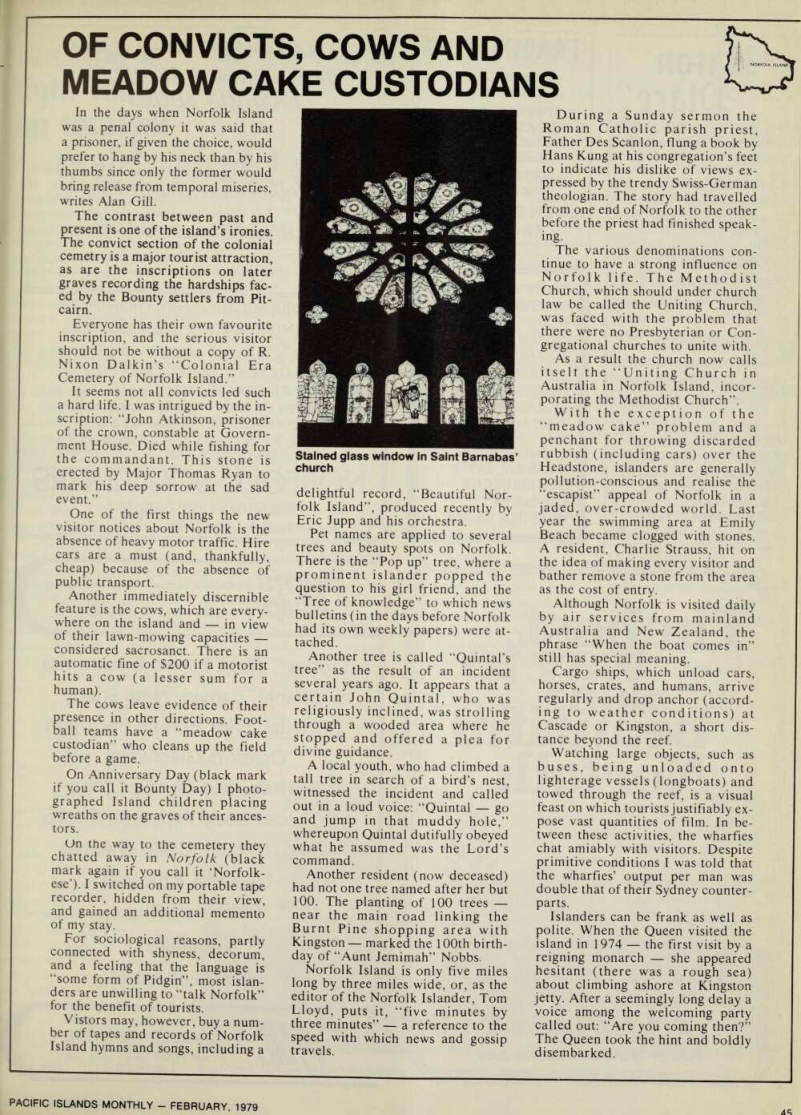
Meadow Cake Custodians
In the days when Norfolk Island was a penal colony it was said that a prisoner, if given the choice, would prefer to hang by his neck than by his thumbs since only the former would bring release from temporal miseries, writes Alan Gill.
The contrast between past and present is one of the island’s ironies.
The convict section of the colonial cemetry is a major tourist attraction, as are the inscriptions on later graves recording the hardships fac ed by the Bounty settlers from Pit cairn.
Everyone has their own favourite inscription, and the serious visitor should not be without a copy of R.
Nixon Dalkin’s “Colonial Era Cemetery of Norfolk Island.”
It seems not all convicts led such a hard life. I was intrigued by the in scription: “John Atkinson, prisoner of the crown, constable at Govern ment House. Died while fishing for the commandant. This stone is erected by Major Thomas Ryan to mark his deep sorrow at the sad event.”
One of the first things the new visitor notices about Norfolk is the absence of heavy motor traffic. Hire cars are a must (and, thankfully, cheap) because of the absence of public transport.
Another immediately discernible feature is the cows, which are every where on the island and in view of their lawn-mowing capacities considered sacrosanct. There is an automatic fine of $2OO if a motorist hits a cow (a lesser sum for a human).
The cows leave evidence of their presence in other directions. Foot ball teams have a “meadow cake custodian” who cleans up the field before a game.
On Anniversary Day (black mark if you call it Bounty Day) I photo graphed Island children placing wreaths on the graves of their ances tors.
On the way to the cemetery they chatted away in Norfolk (black mark again if you call it ‘Norfolk ese’). I switched on my portable tape recorder, hidden from their view, and gained an additional memento of my stay.
For sociological reasons, partly connected with shyness, decorum, and a feeling that the language is “some form of Pidgin”, most islan ders are unwilling to “talk Norfolk” for the benefit of tourists.
Vistors may, however, buy a num ber of tapes and records of Norfolk Island hymns and songs, including a
delightful record, “Beautiful Nor folk Island”, produced recently by Eric Jupp and his orchestra.
Pet names are applied to several trees and beauty spots on Norfolk.
There is the “Pop up” tree, where a prominent islander popped the question to his girl friend, and the “Tree of knowledge” to which news bulletins (in the days before Norfolk had its own weekly papers) were at tached.
Another tree is called “Quintal’s tree” as the result of an incident several years ago. It appears that a certain John Quintal, who was religiously inclined, was strolling through a wooded area where he stopped and offered a plea for divine guidance.
A local youth, who had climbed a tall tree in search of a bird’s nest, witnessed the incident and called out in a loud voice: “Quintal go and jump in that muddy hole,” whereupon Quintal dutifully obeyed what he assumed was the Lord’s command.
Another resident (now deceased) had not one tree named after her but 100. The planting of 100 trees near the main road linking the Burnt Pine shopping area with Kingston marked the 100th birth day of “Aunt Jemimah” Nobbs.
Norfolk Island is only five miles long by three miles wide, or, as the editor of the Norfolk Islander, Tom Lloyd, puts it, “five minutes by three minutes” a reference to the speed with which news and gossip travels.
During a Sunday sermon the Roman Catholic parish priest, Father Des Scanlon, flung a book by Hans Kung at his congregation’s feet to indicate his dislike of views ex pressed by the trendy Swiss-German theologian. The story had travelled from one end of Norfolk to the other before the priest had finished speak ing.
The various denominations con tinue to have a strong influence on Norfolk life. The Methodist Church, which should under church law be called the Uniting Church, was faced with the problem that there were no Presbyterian or Con gregational churches to unite with.
As a result the church now calls itselt the “Uniting Church in Australia in Norfolk Island, incor porating the Methodist Church”.
With the exception of the “meadow cake” problem and a penchant for throwing discarded rubbish (including cars) over the Headstone, islanders are generally pollution-conscious and realise the “escapist” appeal of Norfolk in a jaded, over-crowded world. Last year the swimming area at Emily Beach became clogged with stones.
A resident, Charlie Strauss, hit on the idea of making every visitor and bather remove a stone from the area as the cost of entry.
Although Norfolk is visited daily by air services from mainland Australia and New Zealand, the phrase “When the boat comes in” still has special meaning.
Cargo ships, which unload cars, horses, crates, and humans, arrive regularly and drop anchor (accord ing to weather conditions) at Cascade or Kingston, a short dis tance beyond the reef.
Watching large objects, such as buses, being unloaded onto lighterage vessels (longboats) and towed through the reef, is a visual feast on which tourists justifiably ex pose vast quantities of film. In be tween these activities, the wharfies chat amiably with visitors. Despite primitive conditions I was told that the wharfies’ output per man was double that of their Sydney counter parts.
Islanders can be frank as well as polite. When the Queen visited the island in 1974 the first visit by a reigning monarch she appeared hesitant (there was a rough sea) about climbing ashore at Kingston jetty. After a seemingly long delay a voice among the welcoming party called out; “Are you coming then?”
The Queen took the hint and boldly disembarked.
Stained glass window in Saint Barnabas’ church
Advertisements & other items, p. 46 (1 item)
Kenny’S
TRMIN& POST
Hospital Comer
near the Airport
NEWSAGENTS AND
BOOKSELLERS -
Australian and New Zealand Newspapers
SUPERMARKET
(Milk and Bread)
SEVEN DAYS A WEEK
TRADING!
REMARKABLE SA VINGS ON
THE WORLD’S LEADING
FASHION SHOES
The Quality Shop
Norfolk Villmrp Rrjmt Pine 1 Norfolk Village, Burnt Pine Exclusive Knitwear Selection o o
“iPaton
Harp”
;For the discriminating buyer ;who is looking for something different
CLOISONNE WARE -
Hand enamelled, copperabased vases, jars, bowls etc.
Trom Peking.
SCOTTISH MOHAIR -
Rugs, blankets, capes, stoles, iberet-and-scarf sets by iGlen Cree.
PHILIPPINE SHIRTS-
:For men women and childreri Blouses and cotton dresses— Wood and Ivory carvings.
:PATON PLACE
On Taylors Road toward Kingston, just past Queen Elizabeth Avenue, Directly opposite Nimpex and Hillcrest Hotel.
TELEPHONE: 2181
Box 28 NORFOLK ISLAND
WE'RE INTERESTED
IN HEARING ABOUT
GOODS FROM
OTHER PACIFIC
ISLANDS -
THERE'S DIRECT
SHIPPING TO
NORFOLK PER
“KALIA ”...
contact the principles -
K.E.& J.M. JAVIS
DISTRIBUTORS
P.0.80x 46
NORFOLK ISLAND
Some of the best and cheapest shopping for
SOUVENIRS - GIFTS - JEWELLERY
SAPHIRES - RUBIES - IRON ORE - SHELL CORAL - OPALS - JADE - AGATE -
CHRYSOPHRASE - PEARLS -
MOTHER of PEARL - IVORY - ONYX
SILVER and GOLD CHAINS - STAMPS
NORFOLK PAINTINGS - HANDICRAFTS
MAIL ORDERS
NORFOLK SOUVENIRS
“THE SHOP IN THE GARDEN”
Box 84 Norfolk Island 2899 Taylors Road
Bums
PhHp
ISLAND) LTD »
MERCHANTS, SHIPPING AND GENERAL AGENTS
(NORFOLK ISLAND) LTD
INCORPORATED IN NORFOLK ISLAND
A MEMBER OF THE BURNS PHILP GROUP ) Pioneer, Akai, Sanyo Electronics Chanel, Lanvin, Nina Ricci, Christian Dior French Perfumes Orrefors Glassware Noritake and Denby China American Lady Pepperell Sheets Seiko, Citizen, Casio Watches Dalkeith Knitwear PGF Golf Clubs Jewellery
AND SUPERMARKET
Burns
PhHp
LAND LTD. "
NORFOLK ISLAND LTD
TRAVEL SERVICE
PLAN YOUR NEXT HOLIDAY
WITH US
The best,
way to
beautiful
Norfolk
Scenic Island Tours, Airport Transfers, Coral Reef glassbottomed boat Tours, Convict Settlement Tours.
Also available are shopping trips and church transport.
Block bookings a specialty.
KENNY’S
TOURS
Box 57 Norfolk Is. Phone 2386
tight rein
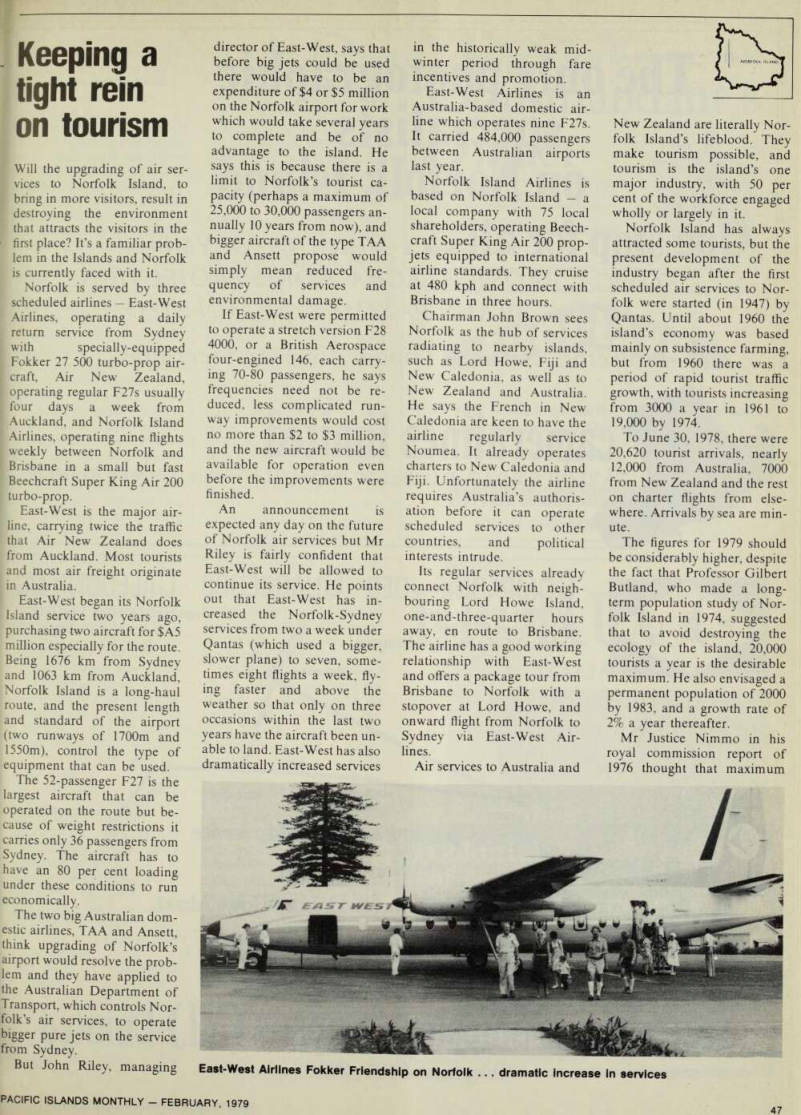
Keeping a tight rein on tourism
Will the upgrading of air ser i vices to Norfolk Island, to bring in more visitors, result in destroying the environment that attracts the visitors in the 1 first place? It’s a familiar prob lem in the Islands and Norfolk is currently faced with it.
Norfolk is served by three scheduled airlines East-West
Airlines, operating a daily
return service from Sydney
; with specially-equipped
Fokker 27 500 turbo-prop air craft, Air New Zealand,
f operating regular F27s usually
I four days a week from Auckland, and Norfolk Island
f Airlines, operating nine flights
weekly between Norfolk and Brisbane in a small but fast Beechcraft Super King Air 200
turbo-prop.
East-West is the major air line, carrying twice the traffic that Air New Zealand does from Auckland. Most tourists and most air freight originate in Australia.
East-West began its Norfolk Island service two years ago, purchasing two aircraft for SAS million especially for the route.
Being 1676 km from Sydney and 1063 km from Auckland, Norfolk Island is a long-haul route, and the present length and standard of the airport
(two runways of 1700 m and
1550 m), control the type of equipment that can be used.
The 52-passenger F 27 is the largest aircraft that can be operated on the route but be cause of weight restrictions it carries only 36 passengers from Sydney. The aircraft has to have an 80 per cent loading under these conditions to run
economically.
The two big Australian dom estic airlines, TAA and Ansett, think upgrading of Norfolk’s airport would resolve the prob lem and they have applied to the Australian Department of Transport, which controls Nor folk’s air services, to operate bigger pure jets on the service
from Sydney.
But John Riley, managing
director of East-West, says that before big jets could be used there would have to be an expenditure of $4 or $5 million on the Norfolk airport for work which would take several years to complete and be of no advantage to the island. He says this is because there is a limit to Norfolk’s tourist ca pacity (perhaps a maximum of 25,000 to 30,000 passengers an nually 10 years from now), and bigger aircraft of the type TAA and Ansett propose would simply mean reduced fre quency of services and
environmental damage.
If East-West were permitted to operate a stretch version F2B 4000, or a British Aerospace four-engined 146, each carry ing 70-80 passengers, he says frequencies need not be re duced, less complicated run way improvements would cost no more than $2 to $3 million, and the new aircraft would be available for operation even before the improvements were finished.
An announcement is expected any day on the future of Norfolk air services but Mr Riley is fairly confident that East-West will be allowed to continue its service. He points out that East-West has in creased the Norfolk-Sydney services from two a week under Qantas (which used a bigger, slower plane) to seven, some
times eight flights a week, fly
ing faster and above the weather so that only on three occasions within the last two years have the aircraft been un able to land. East-West has also dramatically increased services
in the historically weak mid winter period through fare incentives and promotion.
East-West Airlines is an Australia-based domestic air line which operates nine F27s.
It carried 484,000 passengers between Australian airports last year.
Norfolk Island Airlines is based on Norfolk Island a local company with 75 local shareholders, operating Beech craft Super King Air 200 prop
jets equipped to international
airline standards. They cruise at 480 kph and connect with Brisbane in three hours.
Chairman John Brown sees Norfolk as the hub of services radiating to nearby islands, such as Lord Howe, Fiji and New Caledonia, as well as to New Zealand and Australia.
He says the French in New Caledonia are keen to have the airline regularly service Noumea. It already operates charters to New Caledonia and
Fiji. Unfortunately the airline
requires Australia’s authoris ation before it can operate scheduled services to other countries, and political interests intrude.
Its regular services already connect Norfolk with neigh bouring Lord Howe Island,
one-and-three-quarter hours
away, en route to Brisbane.
The airline has a good working relationship with East-West and offers a package tour from Brisbane to Norfolk with a stopover at Lord Howe, and onward flight from Norfolk to Sydney via East-West Air lines.
Air services to Australia and
New Zealand are literally Nor folk Island’s lifeblood. They make tourism possible, and tourism is the island’s one major industry, with 50 per cent of the workforce engaged wholly or largely in it.
Norfolk Island has always attracted some tourists, but the present development of the industry began after the first scheduled air services to Nor folk were started (in 1947) by Qantas. Until about 1960 the island’s economy was based
mainly on subsistence farming,
but from 1960 there was a period of rapid tourist traffic
growth, with tourists increasing
from 3000 a year in 1961 to 19.000 by 1974.
To June 30, 1978, there were 20,620 tourist arrivals, nearly 12.000 from Australia, 7000 from New Zealand and the rest on charter flights from else where. Arrivals by sea are min ute.
The figures for 1979 should
be considerably higher, despite
the fact that Professor Gilbert Butland, who made a long term population study of Nor folk Island in 1974, suggested that to avoid destroying the ecology of the island, 20,000 tourists a year is the desirable maximum. He also envisaged a permanent population of 2000 by 1983, and a growth rate of 2% a year thereafter.
Mr Justice Nimmo in his royal commission report of 1976 thought that maximum
East-West Airlines Fokker Friendship on Norfolk .. . dramatic increase in services
tourist figure might have to be ■ revised but he warned that the views of experts like Professor Rutland should not be
disregarded lightly.
Certainly the trend of expert advice in recent years is that the island must avoid the ‘boom mentality’ that will cause con gestion of the island’s re sources. This can best be done by restricting arrivals and ac commodation on the island to acceptable limits. So far this has happened without there having to be a firm official pol
icy, but the point is probably
quickly being reached where a firm plan has to be adopted
and policed.
Justice Nimmo stressed the [ vital importance of tourism to Norfolk’s economy, and com mented: ‘Norfolk’s main charms are the scenic beauty of its land and seascapes, the rus tic tranquillity of its environ- I ment, the historical interest of its past, its superb fish ing grounds and the low
duty shopping opportunities.
Clearly, for the island to have any economic future it must be based on this tourist industry.
No other viable alternative is at
present predictable.
‘lf any circumstance caused the cessation or serious reduc tion of the tourist industry, hundreds of residents would have to leave the island or face a near-subsistence type of liv ing. The island would be un able to pay for its imported necessities and a large part of its essential services. In such a precarious situation, it behoves policy makers and adminis trators alike to do nothing which may place the tourist industry in jeopardy or even cause its downturn.’
In support of this view, the administration has continued a programme of restoration and maintenance of historic build ings, moved for higher stan dards of new building control and town planning, and sup ported the continuance of low
duty shopping.
But one of the difficulties so far about Norfolk’s depen dence on tourism is the lack of reliable information about just what tourists spend, what they spend it on, and the distri bution of the money in the Norfolk economy.
A clearer picture of the anat omy of tourism will be avail able shortly as a result of the
Norfolk Island feasibility study
being conducted for the Aus tralian Government by Pro fessor R. C. Gates, vice chancellor of New England University, NSW, with the as sistance of Professor M. Tread gold, Professor of Economics at
the University.
For one month in November-December all air passengers departing from Norfolk Island were asked to fill in a form giving details of their expenditure on the island,
including accommodation,
meals, transport and tax-free goods. The information was
given anonymously, and the
facts are being put through a
computer. The picture they
give will be included in a wider report on the island’s economy which Professor Gates expects to submit to the government in
mid-February.
Preliminary work on the visi tor expenditure has confirmed the major importance of the tourist industry and indicates that individual tourists spend greater sums on the island than has been realised.
The feasibility study also in cludes a detailed census of the Norfolk population, held on October 24. Apart from the usual questions about age, marital status and housing, Norfolk Islanders were asked to disclose their income from all sources, whether they were of Pitcairn descent, whether they had life assurance or pen sions of any kind, what food was produced within the household, such as vegetables, milk, meat and fish and whether they gave any of their foodstuffs free to friends and
neighbours. The questions
were aimed at finding out more about the islanders’ life style.
The economic census of business enterprises that has been done as part of the econ omic study should give a more reliable picture of tourism’s importance to local commerce, and the Gates report is awaited with great interest.
Advertisements & other items, pp. 47-50 (3 items)
47
’ACIFIC ISLANDS MONTHLY - FEBRUARY. 1979
specialists
The only photographic
on Norfolk Island One stop for all .. • MINOLTA, OLYMPUS,
KONICA, BRONICA, AGFA, NORIS PROJECTION,
SIGMA, BRA UN PAXIMA T, BRA UN NIZO.
Projectors, Screens, Tripods, Camera Accessories.
' cameralines limited
TAYLOR’S ROAD, P.O. Box 29. phone 2131, cable “CAMERALINES”
COMPAGNIE DES CHARGEURS CaLEDOIMIEWS
P.O. Box 833, Noumea.
Telephone: 27 3246.
Cables: “CHARCAL”, Noumea.
Registered Office NOUMEA
S.A. 37.890.000 CFP
R.C. No. 69 B 2903
NOUMEA
LORD-HOWE NORFOLK
Operating a four-weekly service
to Norfolk Island
SYDNEY
MEtBOU m*
from Noumea, Sydney, Auckland, Lord Howe Island, Agents in Sydney: Hetherington Kingsbury Pty. Ltd., 37 Pitt St., phone 27 1671.
Agents in Auckland: Sofrana Unilines, 42 Customs St., phone 773 279.
Agent in Lord Howe Island: Clive Wilson.
Agents in Norfolk Island:
AUCKLAND
WELLINGTON
South Pacific Shipping Company (N. 1.) Limited
Telephone 2131,2018
a great Norfolk Island feature •yr pj p every Tuesday from 7.30 pm
Commandant’s
Dinner
In person Guitarist/Folksinger Don Reynolds sings the songs and chanteys of old Norfolk. at The Garrison Restaurant phone 2073
WE WELCOME DINERS CLUB AND
AMERICAN EXPRESS CARDHOLDERS
All your needs in groceries, meat and vegetables at supermarket prices. One stop shopping!
Narfolk Island Supermarkets ltd.
TAYLORS ROAD.
FIORUCCI
ITALIAN JEANS
AND SPORTSWEAR
FRENCH CHILDREN S
CLOTHING
P.O. BOX 146 NORFOLK ISLAND 289
By R. Nixon Dalkm Fascinating, detailed account of the historic Kingston graves, including a fold-out plan of the cemetery. An essential guide for visitors.
Tremendous value at $3.50 from Jensen's Newsagency, the Trading Post, Burns Philp, the Tourist Bureau or Leeside. Also ask for Merval Hoare's’
Ramblers Guide to Norfolk Island.
II m w IF § Beehive Building 94 Elizabeth Street Melbourne, Victoria Australia 3000 G.P.O. Box 8 Melbourne, Victoria Australia 3001 Cables: ''SET”
Telex; AA34552 Phone: 63 5094
EXPORTERS AND BUYERS
FOR THE PACIFIC ISLANDS
TELEGRAMS, all offices: "SET mi:
°Acific Islands Monthly - February, 1979
USP: agent of
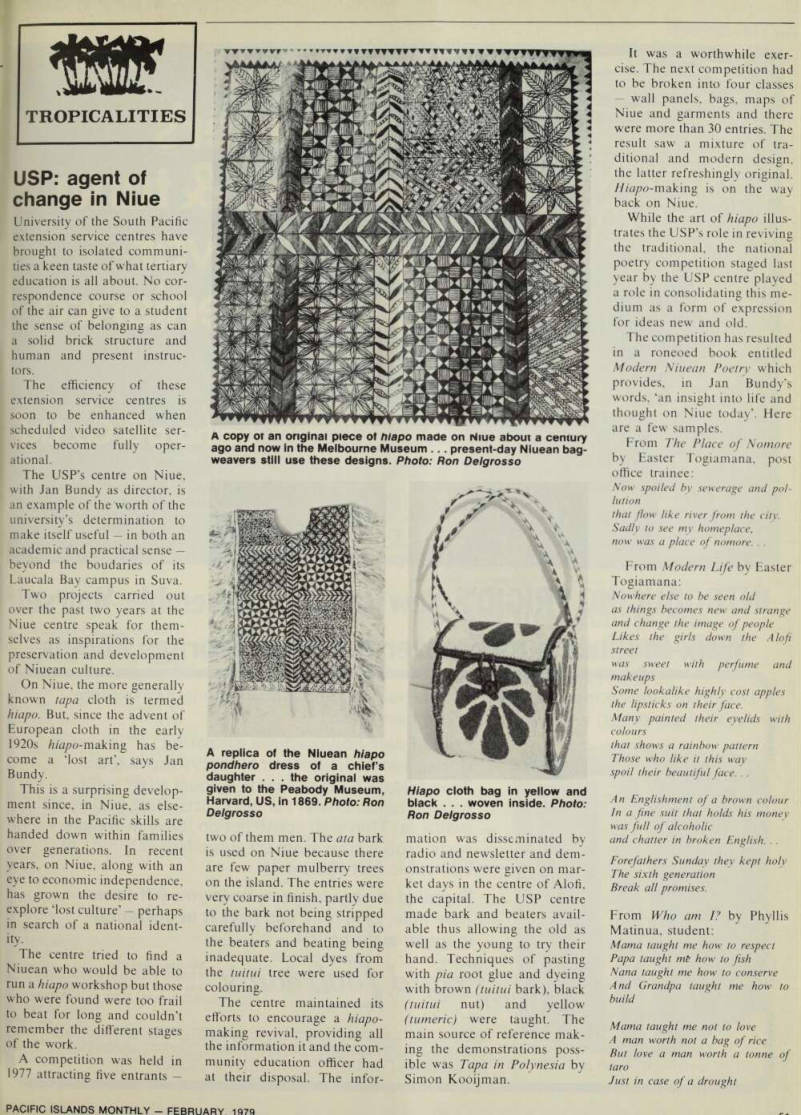

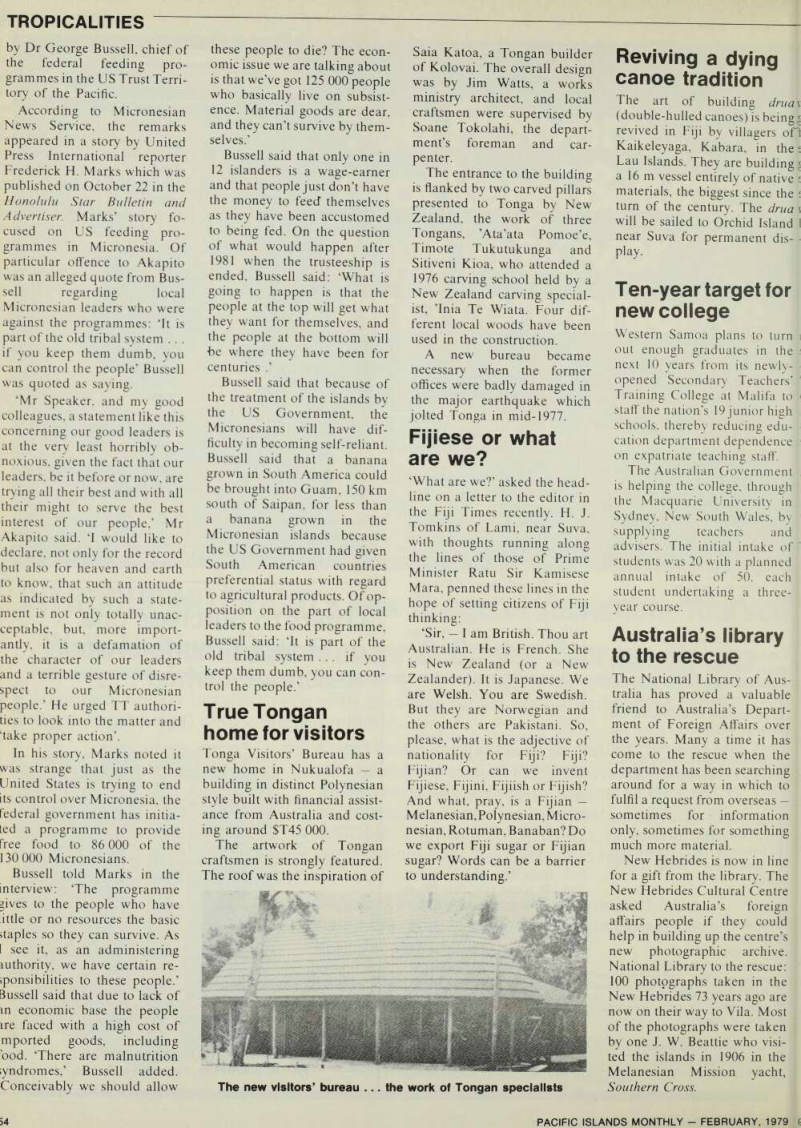
Tropicalities
change in Niue
University of the South Pacific extension service centres have brought to isolated communi ties a keen taste of what tertiary education is all about. No cor respondence course or school of the air can give to a student the sense of belonging as can a solid brick structure and human and present instruc tors.
The efficiency of these extension service centres is soon to be enhanced when scheduled video satellite ser vices become fully oper ational.
The USP’s centre on Niue, with Jan Bundy as director, is an example of the worth of the university’s determination to make itself useful in both an academic and practical sense beyond the boudaries of its Laucala Bay campus in Suva.
Two projects carried out over the past two years at the Niue centre speak for them selves as inspirations for the preservation and development of Niuean culture.
On Niue, the more generally known tapa cloth is termed hiapo. But, since the advent of European cloth in the early
1920 s hiapo- making has be
come a ‘lost art’, says Jan
Bundy.
This is a surprising develop ment since, in Niue, as else where in the Pacific skills are handed down within families over generations. In recent years, on Niue, along with an eye to economic independence, has grown the desire to re
explore ‘lost culture’ perhaps
in search of a national ident
ity.
The centre tried to find a Niuean who would be able to run a hiapo workshop but those who were found were too frail to beat for long and couldn’t remember the different stages of the work.
A competition was held in 1977 attracting five entrants -
two of them men. The ata bark is used on Niue because there are few paper mulberry trees on the island. The entries were very coarse in finish, partly due to the bark not being stripped carefully beforehand and to the beaters and beating being
inadequate. Local dyes from
the tuitui tree were used for
colouring.
The centre maintained its efforts to encourage a hiapo
making revival, providing all
the information it and the com munity education officer had at their disposal. The infor-
mation was disseminated by radio and newsletter and dem onstrations were given on mar ket days in the centre of Alofi, the capital. The USP centre made bark and beaters avail able thus allowing the old as well as the young to try their
hand. Techniques of pasting
with pia root glue and dyeing with brown (tuitui bark), black (tuitui nut) and yellow (tumeric) were taught. The main source of reference mak ing the demonstrations poss ible was Tapa in Polynesia by
Simon Kooijman.
It was a worthwhile exer cise. The next competition had to be broken into four classes - wall panels, bags, maps of Niue and garments and there were more than 30 entries. The result saw a mixture of tra ditional and modern design,
the latter refreshingly original.
Hiapo- making is on the way back on Niue.
While the art of hiapo illus trates the USP’s role in reviving the traditional, the national
poetry competition staged last
year by the USP centre played a role in consolidating this me dium as a form of expression for ideas new and old.
The competition has resulted in a roneoed book entitled Modern Niuean Poetry which provides, in Jan Bundy’s words, ‘an insight into life and thought on Niue today’. Here are a few samples.
From The Place of Nomore
by Easter Togiamana, post
office trainee: Now spoiled by sewerage and pol lution that flow like river from the city.
Sadly to see my homep/ace, now was a place of nomore. . .
From Modern Life by Easter
Togiamana:
Nowhere else to be seen old as things becomes new and strange and change the image of people Likes the girls down the Alofi street was sweet with perfume and makeups Some lookalike highly cost apples the lipsticks on their face.
Many painted their eyelids with colours that shows a rainbow pattern Those who like it this way spoil their beautiful face. . .
An Englishment of a brown colour In a fine suit that holds his money was full of alcoholic and chatter in broken English. . .
Forefathers Sunday they kept holy The sixth generation Break all promises.
From Who am I? by Phyllis Matinua, student: Mama taught me how to respect Papa taught me how to fish Nana taught me how to conserve And Grandpa taught me how to build Mama taught me not to love A man worth not a bag of rice But love a man worth a tonne of taro Just in case of a drought
A copy or an original piece of hiapo made on Niue about a century ago and now in the Melbourne Museum . . . present-day Niuean bag weavers still use these designs. Photo: Ron Delgrosso
A replica of the Niuean hiapo pondhero dress of a chief’s daughter . . . the original was given to the Peabody Museum, Harvard, US, in 1869. Photo: Ron Delgrosso
Hiapo cloth bag in yellow and black . . . woven inside. Photo: Ron Delgrosso
Papa taught me how to dig a hole Just in case he said i You'd marry a fly When you should marry an earth worm . . .
White is for papalagi
Uli is for Niuean
Knife and fork is for papalagi
Matalima is for Niuean.
Table is for papalagi
floor is for Niuean
Me-don-no-how-to-spiki-ingilisi
Niue fia palagi.
From Coming to School by P.
A. Funaki, fifth former: At lunch time I've to stared At the children eating happily But poor me all I have to do is to Drink a lot of water To fill up my hungry stomach At period 6 I was very weak I didn't hear anything The teacher said I was very hungry to worry about School work . . .
When I reach home I was sick I think to myself Am I using my parents hard time
Buying new uniforms, foods for me
Ami going to pay that back or I am
wasting
My time going to school It's better to stay home Rather than wasting my parents time.
Birtha Lisimoni’s Twentieth Century perhaps tells us more about modern Niuean poetry than any other offering in the book. Predicatable it may be.
But somehow it embodies the torment which must afflict the Island mind when expressing
its thoughts, not just in English,
but in a fast-changing world in which the time available to pick the good from the bad is concertina-ed into a space, the like of which the Westerner, in
his lethargic 2000-year advance
to ‘modernity’, never had to suffer.
Culture What does it mean A dying custom coconut leaves Kerosene took advantage
Ti-pa-io cancelled
by funkie boogie dances
Beauty spots
A Itered for safety
They say
So why pollute ancient caves Tourist attraction beaches But it’s all
Progress
Customs Forgotten for ever Progress dominates Change in Inevitable Nature Soon to be destroyed Space age Has arrived Try to preserve At least a custom The rhyme, metre and unor thodox approach may leave the purists perplexed, but Niue, through USP publishing, is now on the map as a source of poetry. We look forward to publishing some of the entries in this year’s national Niue
poetry competition.
An inspiration to
all beer-drinkers
Apia’s brewery caused quite a ferment in Western Samoa.
There were, of course, many against (who made a lot of noise) and many for (who were willing to sit and wait to taste the local brew).
But when the brewery was opened in November at least one man had got the whole
thing into perspective Father
Louis Beauchemin, a French- American Catholic priest, who has been in Samoa more than half a century. His feelings were eloquently expressed in a prayer he delivered at the opening ceremony, a trans lation of which appeared in the government newspaper Savali.
Here it is: ‘Let us pray: God, our loving Father, we are here gathered in your name, not just two or three but many, and we know that you are present in this gathering. And as we reflect, in your presence, on the condition of our human existence, which you took upon yourself in your Son Jesus Christ, we realise that life is not tidy, that life is often ambiguous a mixture of good and bad. ‘Father, we have come together for the opening of this
industrial plant geared prin
cipally to the brewing of beer, a product which is good and also bad. ‘We are aware of its good ness when used in moder ation to enhance the taste of food; to relax after heavy work; to meet with friends and
relatives; to reduce tension; and to foster fellowship with
other people.
‘But again, we remember how bad it can be, when wrongly used. We think of the many people in our hospitals, injured and maimed in drunken brawls and motor accidents brought on by drunken drivers. We think of people in our jails for crimes induced by drink. We recall the many women, enslaved to alcoholic husbands. We remember husbands and wives broken apart through drink; the children scattered; and houshold fur-
nishings broken to pieces.
when the father of the family is a drunkard, and, worse still, when both father and mother are in the habit of getting drunk. ‘Father, such thoughts frighten us, and we pray that
this elaborate plant, brought
here from far away, may not become a scourge to our tiny is| and h ° me ' We pray for all those re sponsible for the functioning of this plant that they be inspired to take all precautions and safety measures to protect
our workers from injury and
health hazards. May they
honestly avoid polluting our
life-giving lagoon,
‘Also we pray that no adver tisements be put over the air, or in newspapers, urging people to drink the beer, es pecially the youth of our coin munities, lest, come the day, governments and companies from overseas will take advan tage of our little country, when all our own people may have become alcoholics, ‘Finally, Father, we ask you to inspire all who drink beer, to do so in strict moderation, May others, too, be inspired to abstain altogether, as a witness and a help to those who have a weakness, ‘Father, do receive this dedi cation prayer for the sake of our Lord and Saviour, Jesus Christ, Amen, g
In© Obnoxious’
Dr Bussell
Julio Akapito, Truk represen tative in the Interim Congress of Micronesia, has described as ‘horribly obnoxious’ comments
by Dr George Bussell, chief of the federal feeding pro grammes in the US Trust Terri tory of the Pacific.
According to Micronesian News Service, the remarks appeared in a story by United Press International reporter Frederick H. Marks which was published on October 22 in the Honolulu Star Bulletin and Advertiser. Marks’ story fo cused on US feeding pro grammes in Micronesia. Of
particular offence to Akapito
was an alleged quote from Bus sell regarding local Micronesian leaders who were against the programmes: ‘lt is part of the old tribal system . . . if you keep them dumb, you can control the people’ Bussell
was quoted as saying.
‘Mr Speaker, and my good colleagues, a statement like this concerning our good leaders is at the very least horribly ob noxious, given the fact that our leaders, be it before or now, are trying all their best and with all their might to serve the best interest of our people,’ Mr Akapito said. ‘1 would like to declare, not only for the record but also for heaven and earth to know, that such an attitude as indicated by such a state ment is not only totally unac
ceptable, but, more import
antly, it is a defamation of the character of our leaders and a terrible gesture of disre spect to our Micronesian people.’ He urged TT authori ties to look into the matter and take proper action’.
In his story, Marks noted it was strange that just as the United States is trying to end its control over Micronesia, the federal government has initia ted a programme to provide free food to 86 000 of the 130 000 Micronesians.
Bussell told Marks in the interview: ‘The programme *ives to the people who have ittle or no resources the basic staples so they can survive. As [ see it, as an administering juthority, we have certain re
sponsibilities to these people.’
Bussell said that due to lack of m economic base the people ire faced with a high cost of
mported goods, including
'ood. ‘There are malnutrition lyndromes,’ Bussell added.
Conceivably we should allow
these people to die? The econ omic issue we are talking about is that we’ve got 125 000 people who basically live on subsist ence. Material goods are dear, and they can’t survive by them selves.’
Bussell said that only one in 12 islanders is a wage-earner and that people just don’t have the money to feed themselves as they have been accustomed to being fed. On the question of what would happen after 1981 when the trusteeship is ended. Bussell said: ‘What is going to happen is that the people at the top will get what they want for themselves, and the people at the bottom will ■be where they have been for centuries .’
Bussell said that because of the treatment of the islands by the US Government, the Micronesians will have dif
ficulty in becoming self-reliant.
Bussell said that a banana grown in South America could be brought into Guam, 150 km south of Saipan, for less than a banana grown in the Micronesian islands because the US Government had given South American countries preferential status with regard to agricultural products. Of op position on the part of local leaders to the food programme, Bussell said: it is part of the old tribal system ... if you keep them dumb, you can con trol the people.’
True Tongan
home for visitors
Tonga Visitors’ Bureau has a new home in Nukualofa a
building in distinct Polynesian
style built with financial assist ance from Australia and cost ing around ST4S 000.
The artwork of Tongan craftsmen is strongly featured.
The roof was the inspiration of
Saia Katoa, a Tongan builder of Kolovai. The overall design was by Jim Watts, a works ministry architect, and local craftsmen were supervised by Soane Tokolahi, the depart ment’s foreman and car penter.
The entrance to the building is flanked by two carved pillars presented to Tonga by New Zealand, the work of three Tongans, ’Ata’ata Pomoe’e, Timote Tukutukunga and Sitiveni Kioa, who attended a 1976 carving school held by a New Zealand carving special ist, ’lnia Te Wiata. Four dif ferent local woods have been used in the construction.
A new bureau became necessary when the former offices were badly damaged in
the major earthquake which
jolted Tonga in mid-1977.
Fijiese or what
are we?
‘What are we?’ asked the head line on a letter to the editor in the Fiji Times recently. H. J.
Tomkins of Lami, near Suva,
with thoughts running along
the lines of those of Prime Minister Ratu Sir Kamisese Mara, penned these lines in the
hope of setting citizens of Fiji
thinking:
‘Sir, I am British. Thou art Australian. He is French. She is New Zealand (or a New Zealander). It is Japanese. We are Welsh. You are Swedish.
But they are Norwegian and the others are Pakistani. So, please, what is the adjective of
nationality for Fiji? Fiji?
Fijian? Or can we invent
Fijiese, Fijini, Fijiish or Fijish?
And what, pray, is a Fijian Melanesian, Polynesian, Micro nesian, Rotuman, Banaban? Do we export Fiji sugar or Fijian sugar? Words can be a barrier
to understanding.’
Reviving a dying
canoe tradition
The art of building drua (double-hulled canoes) is being
revived in Fiji by villagers of
Kaikeleyaga, Kabara, in the Lau Islands. They are building a 16 m vessel entirely of native materials, the biggest since the turn of the century. The drua will be sailed to Orchid Island near Suva for permanent dis
play.
Ten-year target for
new college
Western Samoa plans to turn out enough graduates in the next 10 years from its newly opened Secondary Teachers’
Training College at Malifa to staff the nation’s 19 junior high
schools, thereby reducing edu
cation department dependence
on expatriate teaching staff.
The Australian Government
is helping the college, through
the Macquarie University in
Sydney, New South Wales, by supplying teachers and advisers. The initial intake of students was 20 with a planned annual intake of 50. each student undertaking a three year course.
Australia’s library
to the rescue
The National Library of Aus tralia has proved a valuable friend to Australia’s Depart ment of Foreign Affairs over the years. Many a time it has come to the rescue when the
department has been searching
around for a way in which to fulfil a request from overseas sometimes for information
only, sometimes for something
much more material.
New Hebrides is now in line for a gift from the library. The New Hebrides Cultural Centre asked Australia’s foreign affairs people if they could help in building up the centre’s new photographic archive.
National Library to the rescue: 100 photographs taken in the New Hebrides 73 years ago are now on their way to Vila. Most of the photographs were taken by one J. W. Beattie who visi ted the islands in 1906 in the Melanesian Mission yacht, Southern Cross.
The new visitors’ bureau ... the work of Tongan specialists
Advertisements & other items, pp. 52-56 (1 item)
tops in flavor
Sun Flower’s
mackerel & tuna
and convenience
,N natural **Joi light meat
Saihara &Co v Ltd
Osaka, Japan.
Sole Distributors in Papua New Guinea The B.N.G.Trading Co., Ltd. (a member of the Burns Philp group of companies) Resident agents in other Pacific territories
INTRODUCING FRIGID’S New Range of Assemble-Yourself
Walk-In Aluminium Freezer & Cooler Storage Rooms Hundreds already installed. Now with attractive timber grain aluminium exterior finish, (rust-proof) with white vinyl interior finish.
Frigid Foam Polyurethane insulation. 2" in cooler storage rooms is equal to 5" polystyrene foam. 3" in freezer storage rooms is equal to 8" polystyrene foam. Lower running costs. Best insulation available. Thin wall construction. Save in freight costs. Room sizes from 90 cubic feet (2 1 /2 m 3) to 930 cubic feet (25 1 / 2 m 3).
Supplied in easy-to-erect, do-it-yourself form Assemble, plug it in, and have it in operation in under eight hours! fh Manufactured by:
FRIGID CABINETS PTY. LTD.
14a Duffy Ave., Thornleigh, N.S.W. Aust. 2120. Ph. 848 8292.
AVAILABLE FROM:
AUSTRALIA NEW CALEDONIA EXPORTS, 363 George St., Sydney 2000. BRECKWOLDT & CO., G.P.O. Box 5027, Sydney 2001. HAGEMEYER (A'ASIA), 59 Anzac Pde., Kensington 2033. GEOFFREY HUGHES & CO 167 Macquarie St., Sydney 2000. NELSON & ROBERTSON PTY. LTD., 197 Clarence St., Sydney 2000. E. RABOT (EXPORTS) PTY. LTD., 67 Castlereagh St,, Sydney 2000. RABTRAD NIUGIN I PTY. LTD., P.O. Box 1406, Lae.
A. RIETTE (PACIFIC) PTY. LTD,, 20 Loftus St., Sydney 2000. C. SULLIVAN (EXPORT) PTY. LTD. G.P.O. Box 3373, Sydney 2001. W.S. TAIT & CO. PTY. LTD., 31 Macquarie Place, Sydney 2000.
Offers to purchase one
or more of the following
vessels are invited .. . at Lae, in the Morobe Province.
To be sold on an "as is, where is" basis. No warranties as to specification, condition or otherwise can be given.
U. CONWAY, HANCOCK & OFFNER
P.O. Box 376, Lae, Papua New Guinea.
Travel the islands with PIM’S Mail Order
Bookshop
Pim knows the South Seas.
If you’d like us to introduce you to some of the people and places we know, clip the coupon overleaf . . .
Select your books from
this great list of South
Sea titles
□ WINGS OF GOLD. James Sinclair s acclaimed book on how the aeroplane developed New Guinea The true story of frontier pioneering More than 220,000 words, 150 historic photographs, 334 big pages $33, or SUS4O posted D THE TONGANS. Writer Olaf Ruhen and photographer Jozef Vissel capture the Tongan life style in brilliant prose and 96 sparkling fullcolour pictures $9 00, SUSIO 50 posted □ IMAGES AND ISLANDS: GRASS ROOTS ART OF THE SOLOMONS.
Traditional Solomon Islands designs and art forms, edited by John and Sue Chick 96 pages, $5.50, or SUS6.SO posted. □ GRASS ROOTS ART OF NEW GUINEA. Traditional designs from the north coast of the main island of Papua New Guinea, collected by E.F Hannemann $3.50, or SUS4.SO posted □ THE LOST CARAVEL. Robert Langdon shatters traditional views in this historical whodunnit on early Pacific exploration and its consequences 368 pages. $lB.OO, or $U526.00 posted □ SUVA: A HISTORY AND GUIDE. Albert Schutz, with LG. Usher, look at the colourful personalities who lent their names to Suva. An historic browse around Suva Streets 52 pages $4.25 or SUSS 00 posted I - "! PACIFIC ISLAND COOKBOOK. Hundreds of practical recipes using ingredients found in most parts of the South Pacific, including a big section on fish Susan Parkinson and Peggy Stacy also give practical advice on meal planning and kitchen budgeting 120 pages $7 00 or SUSB.SO posted C] PACIFIC ISLANDS YEAR BOOK. 13th edition of the standard reference book on all the islands of the Pacific their government, population, statistics, etc Scores of maps. Information for tourists, including hotels and tariffs. 512 pages $22.50 or $U527.00 posted □ PAPUA NEW GUINEA HANDBOOK AND TRAVEL GUIDE. 9th edition For businessmen, schools, libraries, travellers, this guide covers everything you want to know about PNG today. Includes fold-out map 280 pages $8.50, or SUSIO.OO posted. □ COLONIAL ERA CEMETERY OF NORFOLK ISLAND. R.N, Dalkin gives a fascinating account of many of the people buried in historic Kingston cemetery. Invaluable history and guide. 92 pages. $4.00, or SUSS.SO posted □ STORY OF THE SOLOMONS. The late Dr. C.E Fox’s simple, lucid outline of the history of the Solomon Islands. Frank and affectionate 88 pages. $3.00, or $U53.75 posted □ MARINE SHELLS OF THE PACIFIC. Vol 11. Walter Cernohorsky carries on where his first book leaves off, with a further 600 species His third volume will appear soon, and there are only limited stocks of this one. 412 pages. $17.00, or $U525.00 posted □ PERCY CHATTERTON'S PAPUA: DAY THAT I HAVE LOVED. Charming, evocative account of a changing Papua as Rev Percy Chatterton knew it over 50 years. 144 pages $6.00, or SUS6.SO posted □ LANGUAGE SERIES. Simple introductions to Pacific Island languages SAY IT IN FIJIAN, SAY IT IN FIJI HINDI, SAY IT IN TAHI- TIAN, all $2.50, or $U53.25 posted. SAY IT IN MOTU, $2.00, or SUS3.OO posted Mihalic's INTRODUCTION TO NEW GUINEA PIDGIN $2 50
or SUS3.OO.
□ COOK ISLANDS POLITICS: THE INSIDE STORY. Fascinating political drama behind the fall of Sir Albert Henry. Written mainly by leading Cook Islanders. $7.50, or SUSB.7S posted. □ FOLD-OUT MAP OF PACIFIC ISLANDS. Large and clear, up-to-date, in colour. In plastic envelopes. $2.50, or SUS3.OO posted
PACIFIC PUBLICATIONS’
Mail Order Bookshop i
76 Clarence St., Sydney, 2000, or G.P.O. Box 3408, Sydney, Australia 2001. ® I'm enclosing my payment for the following titie/s from
PlM's one-stop Mail Order Bookshop:
(If you prefer, you can tick the books you want, and clip out this
whole page)
$ $
SUBSCRIPTION FORM
Please send me a
subscription to PIM
so I can travel the
Islands all year round.
$ $
TOTAL $
Attached is my
payment of
for 12 months, at the
rate shown on the
first page of this issue.
Name
Address
city/state/country/postcode
A Big And Bold
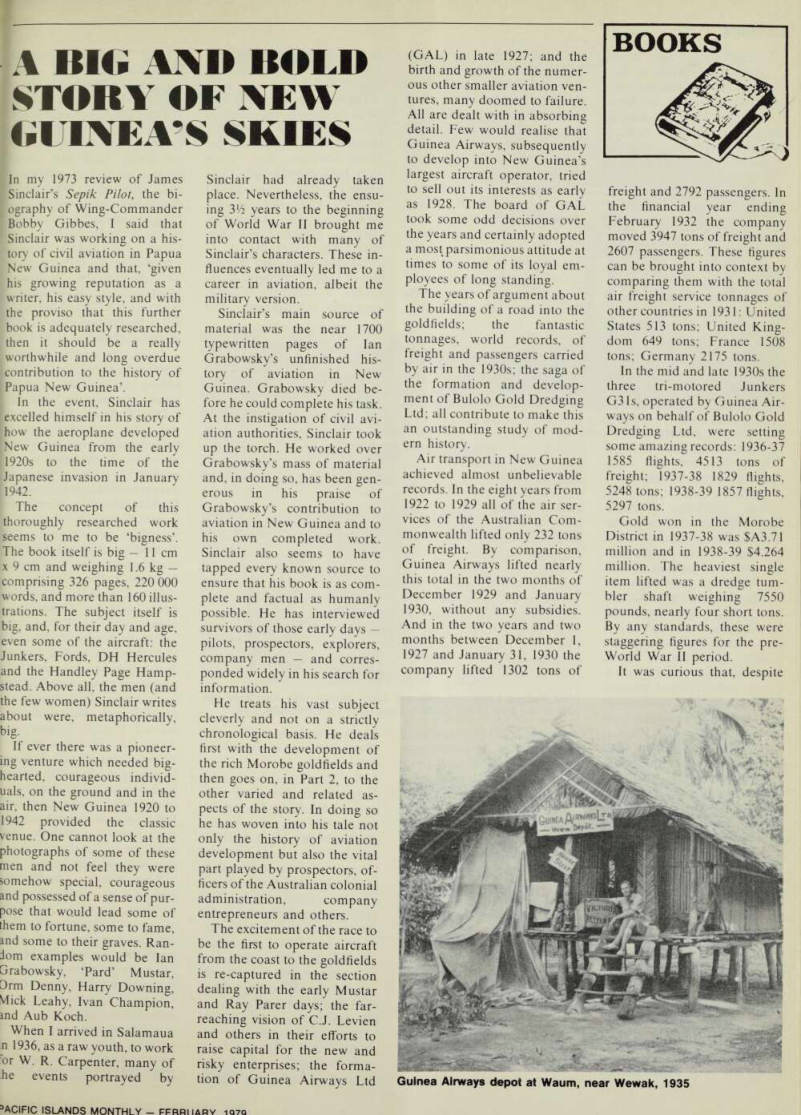
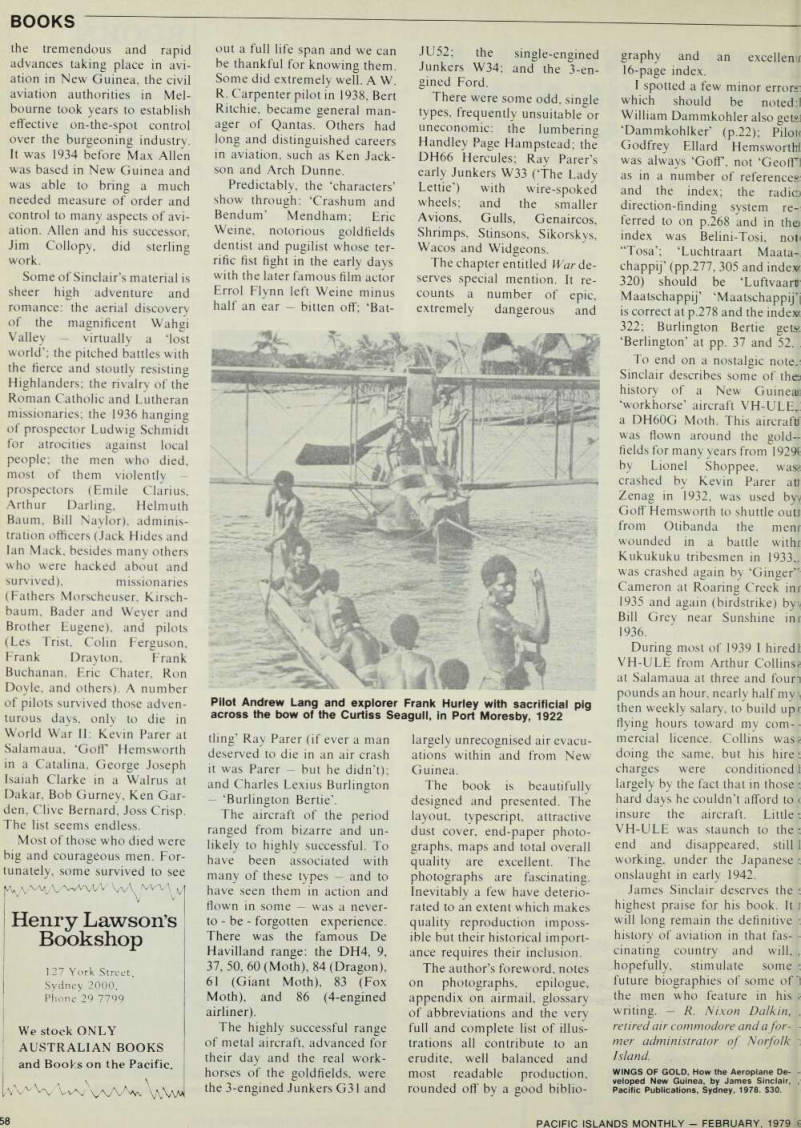
Books
Story Of New
Guinea’S Skies
In my 1973 review of James Sinclair’s Sepik Pilot, the bi
ography of Wing-Commander
Bobby Gibbes, I said that Sinclair was working on a his tory of civil aviation in Papua New Guinea and that, ‘given
; his growing reputation as a
writer, his easy style, and with the proviso that this further book is adequately researched, then it should be a really I worthwhile and long overdue contribution to the history of Papua New Guinea’.
In the event, Sinclair has excelled himself in his story of
how the aeroplane developed
New Guinea from the early 1920 s to the time of the
Japanese invasion in January
1942.
The concept of this thoroughly researched work seems to me to be ‘bigness’.
The book itself is big 11 cm x 9 cm and weighing 1.6 kg comprising 326 pages, 220 000 words, and more than 160 illus trations. The subject itself is big, and, for their day and age, even some of the aircraft: the Junkers, Fords, DH Hercules
and the Handley Page Hamp
stead. Above all, the men (and the few women) Sinclair writes
about were, metaphorically,
big.
If ever there was a pioneer ing venture which needed big hearted, courageous individ uals, on the ground and in the air, then New Guinea 1920 to 1942 provided the classic venue. One cannot look at the photographs of some of these men and not feel they were
somehow special, courageous
and possessed of a sense of pur pose that would lead some of them to fortune, some to fame, and some to their graves. Ran dom examples would be lan Grabowsky, ‘Pard’ Mustar,
Grm Denny, Harry Downing,
Mick Leahy, Ivan Champion,
and Aub Koch.
When I arrived in Salamaua n 1936, as a raw youth, to work or W. R. Carpenter, many of he events portrayed by
Sinclair had already taken place. Nevertheless, the ensu ing 3‘/ 2 years to the beginning of World War II brought me into contact with many of Sinclair’s characters. These in fluences eventually led me to a career in aviation, albeit the
military version.
Sinclair’s main source of material was the near 1700 typewritten pages of lan Grabowsky’s unfinished his tory of aviation in New Guinea. Grabowsky died be fore he could complete his task.
At the instigation of civil avi ation authorities, Sinclair took up the torch. He worked over Grabowsky’s mass of material and, in doing so, has been gen erous in his praise of Grabowsky’s contribution to aviation in New Guinea and to his own completed work.
Sinclair also seems to have tapped every known source to ensure that his book is as com plete and factual as humanly possible. He has interviewed survivors of those early days
pilots, prospectors, explorers,
company men and corres ponded widely in his search for information.
He treats his vast subject cleverly and not on a strictly chronological basis. He deals first with the development of the rich Morobe goldfields and then goes on, in Part 2, to the other varied and related as pects of the story. In doing so he has woven into his tale not only the history of aviation development but also the vital part played by prospectors, of ficers of the Australian colonial administration, company entrepreneurs and others.
The excitement of the race to be the first to operate aircraft from the coast to the goldfields is re-captured in the section dealing with the early Mustar and Ray Parer days; the far reaching vision of C.J. Levien and others in their efforts to raise capital for the new and
risky enterprises; the forma
tion of Guinea Airways Ltd
(GAL) in late 1927; and the birth and growth of the numer ous other smaller aviation ven tures, many doomed to failure.
All are dealt with in absorbing detail. Few would realise that
Guinea Airways, subsequently
to develop into New Guinea’s largest aircraft operator, tried to sell out its interests as early as 1928. The board of GAL took some odd decisions over the years and certainly adopted a most parsimonious attitude at times to some of its loyal em
ployees of long standing.
The years of argument about the building of a road into the goldfields; the fantastic tonnages, world records, of freight and passengers carried by air in the 19305; the saga of the formation and develop ment of Bulolo Gold Dredging Ltd; all contribute to make this an outstanding study of mod
ern history.
Air transport in New Guinea achieved almost unbelievable records. In the eight years from 1922 to 1929 all of the air ser vices of the Australian Com monwealth lifted only 232 tons
of freight. By comparison,
Guinea Airways lifted nearly
this total in the two months of December 1929 and January 1930, without any subsidies.
And in the two years and two months between December 1, 1927 and January 31, 1930 the company lifted 1302 tons of
freight and 2792 passengers. In the financial year ending February 1932 the company moved 3947 tons of freight and 2607 passengers. These figures can be brought into context by comparing them with the total air freight service tonnages of other countries in 1931: United States 513 tons; United King dom 649 tons; France 1508 tons; Germany 2175 tons, In the mid and late 1930 s the three tri-motored Junkers G 3 Is, operated by Guinea Air ways on behalf of Bulolo Gold
Dredging Ltd, were setting
some amazing records: 1936-37 1585 flights, 4513 tons of
freight; 1937-38 1829 flights,
5248 tons; 1938-39 1857 flights, 5297 tons, Gold won in the Morobe District in 1937-38 was $A3.71 million and in 1938-39 $4,264 million. The heaviest single item lifted was a dredge tum bier shaft weighing 7550 pounds, nearly four short tons.
By any standards, these were staggering figures for the pre- World War II period, It was curious that, despite
Guinea Airways depot at Waum, near Wewak, 1935
the tremendous and rapid advances taking place in avi ation in New Guinea, the civil aviation authorities in Mel bourne took years to establish effective on-the-spot control
over the burgeoning industry.
It was 1934 before Max Allen was based in New Guinea and was able to bring a much needed measure of order and control to many aspects of avi ation. Allen and his successor,
Jim Collopy, did sterling
work.
Some of Sinclair’s material is sheer high adventure and romance: the aerial discovery
of the magnificent Wahgi
Valley - virtually a ‘lost world’; the pitched battles with the fierce and stoutly resisting Highlanders; the rivalry of the Roman Catholic and Lutheran missionaries; the 1936 hanging of prospector Ludwig Schmidt for atrocities against local people; the men who died, most of them violently prospectors (Emile Clarius, Arthur Darling, Helmuth Baum, Bill Naylor), adminis tration officers (Jack Hides and lan Mack, besides many others who were hacked about and survived), missionaries (Fathers Morscheuser, Kirsch baum, Bader and Weyer and Brother Eugene), and pilots (Les Trist, Colin Ferguson, Frank Drayton, Frank Buchanan, Eric Chater, Ron Doyle, and others). A number of pilots survived those adven turous days, only to die in World War II: Kevin Parer at Salamaua, ‘Goff Hemsworth in a Catalina, George Joseph Isaiah Clarke in a Walrus at Dakar, Bob Gurney, Ken Gar den, Clive Bernard, Joss Crisp.
The list seems endless.
Most of those who died were big and courageous men. For tunately, some survived to see
out a full life span and we can be thankful for knowing them.
Some did extremely well. A W.
R. Carpenter pilot in 1938, Bert Ritchie, became general man ager of Qantas. Others had
long and distinguished careers
in aviation, such as Ken Jack son and Arch Dunne.
Predictably, the ‘characters’ show through: ‘Crashum and Bendum’ Mendham; Eric Weine, notorious goldfields dentist and pugilist whose ter rific fist fight in the early days with the later famous film actor Errol Flynn left Weine minus half an ear - bitten off; ‘Bat-
JUS2; the single-engined Junkers W 34; and the 3-en gined Ford.
There were some odd, single types, frequently unsuitable or uneconomic: the lumbering Handley Page Hampstead; the DH66 Hercules; Ray Parer’s early Junkers W 33 (The Lady Lettie’) with wire-spoked wheels; and the smaller Avions, Gulls, Genaircos, Shrimps, Stinsons, Sikorskys, Wacos and Widgeons.
The chapter entitled War de serves special mention. It re counts a number of epic, extremely dangerous and
tling’ Ray Parer (if ever a man deserved to die in an air crash it was Parer - but he didn’t); and Charles Lexius Burlington
‘Burlington Bertie’.
The aircraft of the period ranged from bizarre and un likely to highly successful. To have been associated with many of these types and to have seen them in action and flown in some was a never to -be - forgotten experience.
There was the famous De Havilland range: the DH4, 9, 37, 50, 60 (Moth), 84 (Dragon), 61 (Giant Moth), 83 (Fox Moth), and 86 (4-engined airliner).
The highly successful range of metal aircraft, advanced for their day and the real work horses of the goldfields, were the 3-engined Junkers G3l and
largely unrecognised air evacu
ations within and from New Guinea.
The book is beautifully
designed and presented. The
layout, typescript, attractive
dust cover, end-paper photo graphs, maps and total overall quality are excellent. The
photographs are fascinating.
Inevitably a few have deterio rated to an extent which makes
quality reproduction imposs
ible but their historical import ance requires their inclusion.
The author’s foreword, notes
on photographs, epilogue,
appendix on airmail, glossary
of abbreviations and the very full and complete list of illus trations all contribute to an erudite, well balanced and most readable production, rounded off by a good biblio
graphy and an excelled
16-page index.
I spotted a few minor erron which should be noted: William Dammkohler also gets
‘Dammkohlker’ (p. 22); Pilot
Godfrey Ellard Hemsworth was always ‘Goff, not ‘Geoff as in a number of references and the index; the radio direction-finding system re ferred to on p. 268 and in the index was Belini-Tosi, nol “Tosa’; ‘Luchtraart Maata
chappij’ (pp. 277, 305 and index
320) should be ‘Luftvaart
Maatschappij’ ‘Maatschappij
is correct at p. 278 and the index 322; Burlington Bertie gets ‘Berlington’ at pp. 37 and 52.
To end on a nostalgic note.
Sinclair describes some of the history of a New Guinea ‘workhorse’ aircraft VH-ULE, a DH6OG Moth. This aircraft was flown around the gold fields for many years from 1929
by Lionel Shoppee, was
crashed by Kevin Parer at Zenag in 1932, was used by Goff Hemsworth to shuttle out from Otibanda the men wounded in a battle with Kukukuku tribesmen in 1933,
was crashed again by ‘Ginger’
Cameron at Roaring Creek in 1935 and again (birdstrike) by Bill Grey near Sunshine in 1936.
During most of 1939 I hired VH-ULE from Arthur Collins at Salamaua at three and four pounds an hour, nearly half my then weekly salary, to build up flying hours toward my com mercial licence. Collins was doing the same, but his hire charges were conditioned largely by the fact that in those hard days he couldn’t afford to insure the aircraft. Little VH-ULE was staunch to the end and disappeared, still working, under the Japanese
onslaught in early 1942.
James Sinclair deserves the highest praise for his book. It will long remain the definitive history of aviation in that fas cinating country and will, hopefully, stimulate some future biographies of some of the men who feature in his writing. R. Nixon Dalkin, retired air commodore and a for
mer administrator of Norfolk
Island.
WINGS OF GOLD, How the Aeroplane De veloped New Guinea, by James Sinclair, Pacific Publications, Sydney, 1978. $3O.
Pilot Andrew Lang and explorer Frank Hurley with sacrificial pig across the bow of the Curtiss Seagull, in Port Moresby, 1922
Advertisements & other items, pp. 57-58 (2 items)
3 Acific Islands Monthly Ffrriiary Iq7Q
Henry Lawson’s
Bookshop
127 York Street, Sydney 2000.
Phone 29 7799 We stock ONLY
AUSTRALIAN BOOKS
and Books on the Pacific,
Lament From
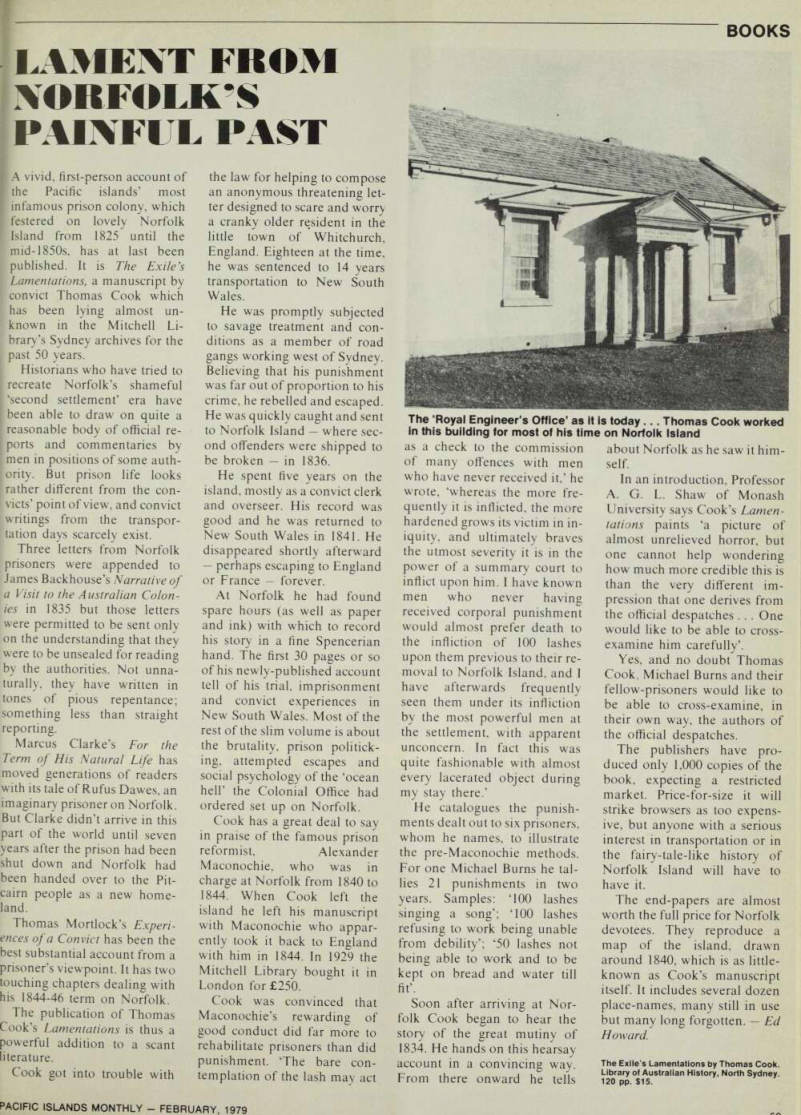
Norfolk’S
Painful Past
K A vivid, first-person account of I the Pacific islands’ most
I infamous prison colony, which
I festered on lovely Norfolk Island from 1825 until the mid-1850s, has at last been published. It is The Exile's [ Lamentations, a manuscript by [ convict Thomas Cook which has been lying almost un [ known in the Mitchell Li brary’s Sydney archives for the past 50 years.
Historians who have tried to recreate Norfolk’s shameful I ‘second settlement’ era have been able to draw on quite a I reasonable body of official re ports and commentaries by men in positions of some auth ority. But prison life looks rather different from the con victs’ point of view, and convict writings from the transpor
tation days scarcely exist.
Three letters from Norfolk
prisoners were appended to
James Backhouse’s Narrative of a Visit to the Australian Colon ies in 1835 but those letters were permitted to be sent only on the understanding that they were to be unsealed for reading by the authorities. Not unna turally, they have written in tones of pious repentance;
something less than straight
reporting.
Marcus Clarke’s For the Term of His Natural Life has moved generations of readers with its tale of Rufus Dawes, an
imaginary prisoner on Norfolk.
But Clarke didn’t arrive in this part of the world until seven years after the prison had been shut down and Norfolk had been handed over to the Pit cairn people as a new home land.
Thomas Mortlock’s Experi ences of a Convict has been the best substantial account from a prisoner’s viewpoint. It has two
touching chapters dealing with
his 1844-46 term on Norfolk.
The publication of Thomas Cook’s Lamentations is thus a powerful addition to a scant literature.
Cook got into trouble with
the law for helping to compose an anonymous threatening let ter designed to scare and worry a cranky older resident in the little town of Whitchurch, England. Eighteen at the time, he was sentenced to 14 years transportation to New South Wales.
He was promptly subjected
to savage treatment and con ditions as a member of road gangs working west of Sydney.
Believing that his punishment
was far out of proportion to his crime, he rebelled and escaped.
He was quickly caught and sent to Norfolk Island where sec ond offenders were shipped to be broken in 1836.
He spent five years on the island, mostly as a convict clerk and overseer. His record was good and he was returned to New South Wales in 1841. He
disappeared shortly afterward
- perhaps escaping to England
or France forever.
At Norfolk he had found spare hours (as well as paper and ink) with which to record his story in a fine Spencerian hand. The first 30 pages or so of his newly-published account tell of his trial, imprisonment and convict experiences in New South Wales. Most of the rest of the slim volume is about
the brutality, prison politick
ing, attempted escapes and
social psychology of the ‘ocean hell’ the Colonial Office had ordered set up on Norfolk.
Cook has a great deal to say in praise of the famous prison reformist, Alexander Maconochie, who was in charge at Norfolk from 1840 to 1844. When Cook left the island he left his manuscript with Maconochie who appar ently took it back to England with him in 1844. In 1929 the Mitchell Library bought it in London for £250.
Cook was convinced that Maconochie’s rewarding of good conduct did far more to rehabilitate prisoners than did punishment. ‘The bare con templation of the lash may act
as a check to the commission of many offences with men who have never received it,’ he wrote, ‘whereas the more fre quently it is inflicted, the more hardened grows its victim in in
iquity, and ultimately braves
the utmost severity it is in the power of a summary court to inflict upon him. I have known men who never having received corporal punishment would almost prefer death to the infliction of 100 lashes upon them previous to their re moval to Norfolk Island, and I have afterwards frequently seen them under its infliction by the most powerful men at the settlement, with apparent unconcern. In fact this was quite fashionable with almost
every lacerated object during
my stay there.’
He catalogues the punish ments dealt out to six prisoners, whom he names, to illustrate the pre-Maconochie methods.
For one Michael Burns he tal lies 21 punishments in two years. Samples: TOO lashes singing a song’; TOO lashes refusing to work being unable from debility’; ‘5O lashes not being able to work and to be kept on bread and water till fit’.
Soon after arriving at Nor folk Cook began to hear the story of the great mutiny of 1834. He hands on this hearsay account in a convincing way.
From there onward he tells
about Norfolk as he saw it him self.
In an introduction. Professor A. G. L. Shaw of Monash University says Cook’s Lamen tations paints ‘a picture of almost unrelieved horror, but
one cannot help wondering
how much more credible this is than the very different im pression that one derives from the official despatches ... One would like to be able to cross examine him carefully’.
Yes, and no doubt Thomas Cook, Michael Burns and their fellow-prisoners would like to be able to cross-examine, in their own way, the authors of the official despatches.
The publishers have pro duced only 1,000 copies of the book, expecting a restricted market. Price-for-size it will strike browsers as 100 expens ive, but anyone with a serious interest in transportation or in
the fairy-tale-like history of
Norfolk Island will have to have it.
The end-papers are almost worth the full price for Norfolk
devotees. They reproduce a
map of the island, drawn around 1840, which is as little known as Cook’s manuscript itself. It includes several dozen place-names, many still in use but many long forgotten. Ed Howard.
The Exile’s Lamentations by Thomas Cook.
Library of Australian History, North Sydney. 120 pp. $l5.
The 'Royal Engineer’s Office’ as It is today . . . Thomas Cook worked in this building for most of his time on Norfolk Island
Advertisements & other items, pp. 60-62 (1 item)
The Giobescanners.
Mmw
CRF-330K
2»i s»-398< 5 S n- w.
V-*-
ICF-6700W
ICF-6800W
j: '> > ‘ 3* ' >
J J ,J- ' * .
■ > m
SONV '
jr''“ , y s r.
The Giobescanners.
Turn on one of these Sony multi-band receivers and prepare to do some traveling. They're made to take you out of the country, off the continent, clear to the other side of the earth.
There's enough heavyweight communications technology inside Sony's lightweight 31-band ICF-6800W and 5-band ICF-6700W receivers to scan radio broadcasts from around the globe.
For example, the ICF-6800W's dual conversion superheterodyne circuitry for clear and stable reception. And phase-locked-loop synthesized tuning so that whatever you tune will be guaranteed quartz-accurate. It pulls in FM/MW and SWI-SW29 (1.6~30MHz), including the single side band and continuous wave band.
The ICF-6700W breaks its shortwave coverage into three zones spanning the same frequency range and puts it on three bands.
Sony's way of cutting the world to size. It also picks up FM/MW broadcasts.
Both models have LED digital readouts that display MW/SW frequencies with unfailing precision. You always know exactly where you're timed without waiting for station identification.
The advanced technology found in these multi-band models comes right out of the electronic wizardry that went into Sony's CRF-330K, the 33-band wonder complete with a built-in cassette deck.
Take your pick of the three and get everything you need to explore the world via radio. Via Sony.
8 30 35 40 c
INDEPENDENCE
IST
OCTOBER
1978
INDEWUOfWrrTMST OtTOIER 1978
I INDEPENDENCE Tf^
;TUVALU
1978
tBOT
ST OCTO
Norfolk
TUVALU
m 10
INDEPENDENCE
IST OCT
1978
T UVJfLU
Islaqds
TUVALU
WHAT’S
NEW IN
ISLAND
STAMPS
15'i
TUVALU
Tuvalu , whose economy depends heavily on stamp revenue, has started its career as an independent nation with two superb issues: a seven-stamp independence set and a four-stamp flora series, both released last October.
Tuvalu’s 1979 programme goes like this: January 24 —fish
definitives; February 14
bicentenary of the death of Cap-
tain Cook; May 16 fifteenth anniversary of the first air service to Tuvalu; August 20 centenary of the death of Sir Rowland Hill, founder of Britain ’s fenny post ’ and adhesive stamp as we know it today; October 20 International Year of the Child.
Papua New Guinea recently issued a set of five in tribute to the Royal Papua New Guinea
Constabulary.
Norfolk Island’s contribution to Christmas 1978 was a floral series. It also has a two-stamp issue marking the 250th anni-
versary oj the death of Captain
James Cook.
Western Samoa’s Christmas 1978 issue features the art of Albrecht Durer.
Other recent issues include: Solomon Islands commemorating 50 years of scouting; Tonga depicting
endangered Tongan wildlife
species; Pitcairn Island - illustrating the story of this remote island’s harbour development; Fiji - depicting festivals; and New Hebrides a Christmas issue. m Hi W kite frangipani v * Sir & .*
DENCE
TOBER
! PAPUA NEW GUINEA
! TUVALU
2a
SAMOA ISISIFO
IMOA I SISIFO
SAMOA I SISIFO
SAMOA I SISIFO
i 20
PAPUA NEW GUINEA
§m mm f 30 25 2 b
PAPUA NEW GUINEA
PAPUA NEW GUINEA
90 aaM m if "Wk % M r .<♦*
You name it, Mono pumps it.
Tell us your needs, we’llshowyouthepump. Forover 30 years, we’ve been pumping liquids of every viscosity, under all kinds of conditions. Fresh water, sand and water, food ingredients, chemicals, acids, corrosives and abrasives, sludges and waste, effluent and sewage, even solids in suspension.
If it can be conveyed through a pipeline, we can move it, meter it or mix it, as quickly or slowly as you wish.
And we can provide pumps that run on petrol, kerosene, diesel, electricity, or PTO tractor drive (in fact even bicycle drive).
If there’s anything you want to know about pumping, write to us at Mono. We’ve got the pumps and the experience.
Please send me details of your pumps for (describe purposes): Name: Address: Send coupon to Head Office & Works (address below).
MONO
AAPUMPS
AUSTRALIA pty. ltd.
MOVE IT WITH MONO
Head Office & Works: “Mono House”, 338-348 Lower Dandenong Rd., Mordialloc, Vic. 3195, Australia.
Agents in: Papua and New Guinea, Indonesia, Fiji, The Philippines. 344-P-7177
Islands
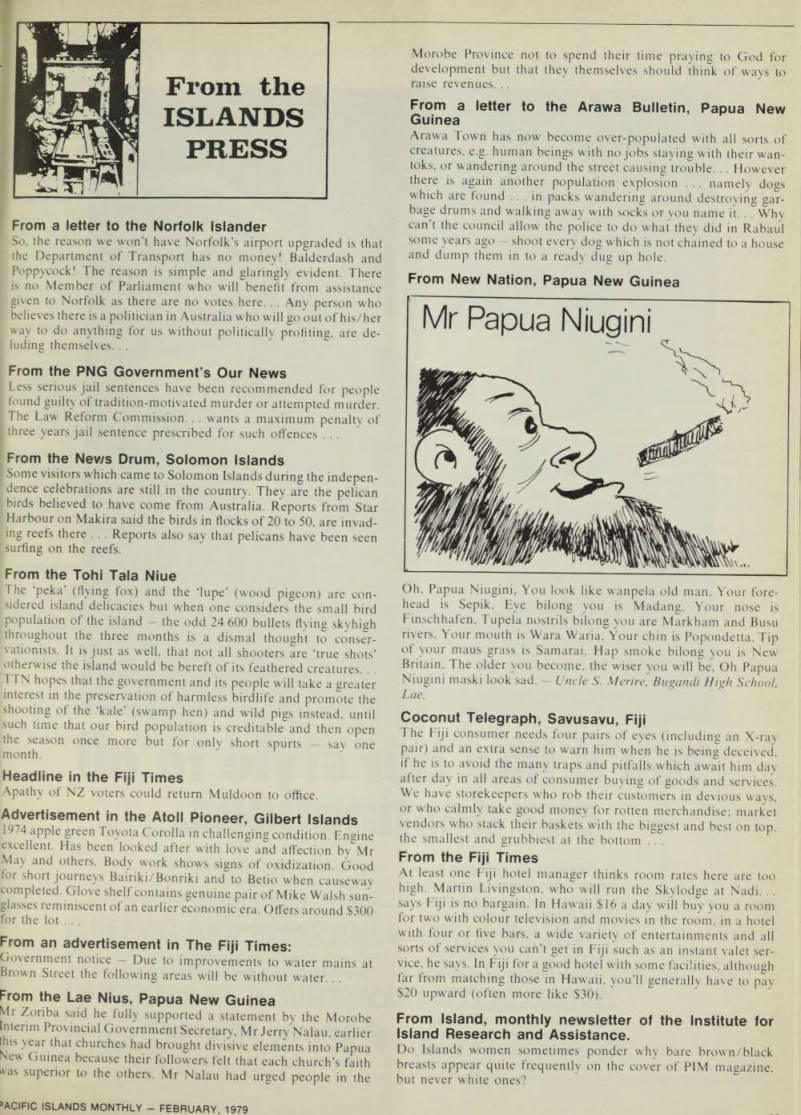
From the
Press
From a letter to the Norfolk Islander f So, the reason we won’t have Norfolk’s airport upgraded is that the Department of Transport has no money! Balderdash and Poppycock! The reason is simple and glaringly evident. There is no Member of Parliament who will benefit from assistance given to Norfolk as there are no votes here. . . Any person who I believes there is a politician in Australia who will go out of his/her way to do anything for us without politically profiting, are de
j luding themselves. . .
From the PNG Government’s Our News Less serious jail sentences have been recommended for people found guilty of tradition-motivated murder or attempted murder.
The Law Reform Commission. . . wants a maximum penalty of I three years jail sentence prescribed for such offences . . .
From the News Drum, Solomon Islands Some visitors which came to Solomon Islands during the indepen dence celebrations are still in the country. They are the pelican birds believed to have come from Australia. Reports from Star Harbour on Makira said the birds in flocks of 20 to 50, are invad ing reefs there . . . Reports also say that pelicans have been seen surfing on the reefs.
From the Tohi Tala Niue The peka (flying fox) and the ‘lupe’ (wood pigeon) are con sidered island delicacies but when one considers the small bird population of the island - the odd 24 600 bullets flying skyhigh throughout the three months is a dismal thought to conser vationists. It is just as well, that not all shooters are ‘true shots’ otherwise the island would be bereft of its feathered creatures.
TTN hopes that the government and its people will take a greater interest in the preservation of harmless birdlife and promote the shooting of the ‘kale’ (swamp hen) and wild pigs instead, until such time that our bird population is creditable and then open the season once more but for only short spurts - say one month.
Headline in the Fiji Times Apathy of NZ voters could return Muldoon to office.
Advertisement in the Atoll Pioneer, Gilbert Islands 1974 apple green Toyota Corolla in challenging condition. Engine excellent. Has been looked after with love and affection by Mr May and others. Body work shows signs of oxidization. Good for short journeys Bairiki/Bonriki and to Betio when causeway completed. Glove shelf contains genuine pair of Mike Walsh sun glasses reminiscent of an earlier economic era. Offers around $3OO for the lot .. .
From an advertisement in The Fiji Times: Government notice - Due to improvements to water mains at Brown Street the following areas will be without water.
From the Lae Nius, Papua New Guinea Mr Zonba said he fully supported a statement by the Morobe Interim Provincial Government Secretary, Mr Jerry Nalau, earlier this year that churches had brought divisive elements into Papua New Guinea because their followers felt that each church’s faith was superior to the others. Mr Nalau had urged people in the
Morobe Province not to spend their time praying to God for development but that they themselves should think of ways to raise revenues. . .
From a letter to the Arawa Bulletin, Papua New Guinea Arawa Town has now become over-populated with all sorts of creatures, e.g. human beings with no jobs staying with their wan toks, or wandering around the street causing trouble. . . However there is again another population explosion . . . namely dogs which are found ... in packs wandering around destroying gar bage drums and walking away with socks or you name it. . . Why can't the council allow the police to do what they did in Rabaul some years ago shoot every dog which is not chained to a house and dump them in to a ready dug up hole.
From New Nation, Papua New Guinea
Oh. Papua Niugini. You look like wanpela old man. Your fore head is Sepik, Eye bilong you is Madang, Your nose is Finschhafen, Tupela nostrils bilong you are Markham and Busu rivers. Your mouth is Wara Waria, Your chin is Popondetta, Tip of your maus grass is Samarai, Hap smoke bilong you is New Britain. The older you become, the wiser you will be. Oh Papua Niugini maski look sad. - Uncle S. Mehre , Bugandi High School, Lae.
Coconut Telegraph, Savusavu, Fiji
The Fiji consumer needs four pairs of eyes (including an X-ray pair) and an extra sense to warn him when he is being deceived, if he is to avoid the many traps and pitfalls which await him day after day in all areas of consumer buying of goods and services.
We have storekeepers who rob their customers in devious ways, or who calmly take good money for rotten merchandise; market vendors who stack their baskets with the biggest and best on top, the smallest and grubbiest at the bottom . . .
From the Fiji Times At least one Fiji hotel manager thinks room rates here are too high. Martin Livingston, who will run the Skylodge at Nadi, says Fiji is no bargain. In Hawaii $l6 a day will buy you a room for two with colour television and movies in the room, in a hotel with four or five bars, a wide variety of entertainments and all sorts of services you can’t get in Fiji such as an instant valet ser vice. he says. In Fiji for a good hotel with some facilities, although far from matching those in Hawaii, you’ll generally have to pay $2O upward (often more like $3O).
From Island, monthly newsletter of the Institute for Island Research and Assistance.
Do Islands women sometimes ponder why bare brown/black breasts appear quite frequently on the cover of PIM magazine, but never white ones?
Advertisements & other items, pp. 63-64 (2 items)
J Acific Islands Monthly February, 1979
63
You’ll like our style to all
our destinations.
We have many flights to many destinations, but on each and every one you can be sure of one thing: attentive and friendly service. Plus of course good food and fine wines served in big jet comfort.
Today this special style of Air New Zealand is yours to enjoy on direct flights to New Zealand, or on your way around the Pacific; even to the East now that the fast, friendly way there is first to fly south with us! And of course to Honolulu, Los Angeles and on to Canada, London or Europe.
Your travel agent or Air New Zealand is ready now to help you plan the trip and the fares that suit you best wherever you want to fly.
air new Z
We fly the Pacific.
ANZ7B/3
Deaths
of Islands People
Sarvan Singh
A member of the opposition in the Fiji House of Represen tatives, aged 45. Sarvan Singh was bom in Labasa where he was a practising solicitor. He was a member of the Fiji Sen ate before entering the lower house in 1974.
L Jamieson
Leo Jamieson, former manager of Tutt Bryant, Port Moresby, in Brisbane. After leaving Papua New Guinea; he retired to Bribie Island, Queensland.
Joseph Anthony
General secretary of the Build ing Workers Union in Fiji, sud
denly, aged 42. Joseph
Anthony, also closely associa
ted with charity activities,
leaves a widow and six chil dren.
Alexander
Grantham
Sir Alexander Grantham, often described as one of the finest governors sent by the Colonial Office to Fiji, has died at 79.
He went to Fiji in 1945 after service in Hong Kong, the West Indies and Nigeria. He left Fiji in 1947, returning to Hong Kong as governor.
Paddy Garrett
Sea captain who served on all six vessels of the Cable and Wireless fleet, in Brisbane. At his own request, Captain Gar rett’s ashes, his whistles and identification tags, were cast into the sea off Suva by Cap tain John Killick, master of the cableship Retriever, after a shipboard ceremony con ducted by the Rev Winston
Halapua of the Anglican
Church’s Laucala Bay parish.
J. Boyd Mackenzie
A veteran employee of the ad ministration of the US Trust Territory of the Pacific, in
Honolulu, at 60. From 1954 until his death he held a variety of positions in the administra tion, finally rising to the post of
acting high commissioner in
1977. He was known through out Micronesia for his many brushes with death in aircraft accidents. The esteem in which he was held was demonstrated a few weeks before his death when the Congress of Micronesia conferred upon him and members of his family
honorary citizenship of the
Trust Territory.
Patrick Murphy
Father Patrick Murphy, co ordinator of the Pacific Con ference society programme, aged 51, after an accident in Papua New Guinea. Born in
Sydney, Father Murphy was
ordained in the United States in 1953. After working in the Philippines and India he arrived in Papua New Guinea in 1962 where he founded the
Holy Spirit Seminary of the
Roman Catholic Church in Lae. Among his students were
two prominent Papua New Guineans, Father John Momis and Leo Hannet. He later be came editor of the magazine Catalyst, taking radical and controversial stands on social justice in the Pacific. He then served as secretary and adviser to Roman Catholic bishops in Melanesia.
Babs Kongsted
Wife of the Qantas manager in New Caledonia, while scuba-diving. In more than 10 years in New Caledonia, she became an extremely popular figure, renowned for her varied talents, including her piano
playing and dress-making. She
is survived by her husband and two children.
Betty Archibald
Mrs Betty Archibald, 81, at her home, Loganimasi Estate, Savusavu West, Fiji. Mrs Archibald, whose late husband is sometimes credited with being the first to discover gold at Mount Kaisi, was a school teacher for many years, mainly in Suva.
Advertisements & other items, pp. 65-66 (2 items)
3 Acific Islands Monthly - February. 1979
Qbe Insurance Limited
offers expert insurance service
throughout the Islands.
Central Office: 82 Pitt Street, Sydney.
NEW CALEDONIA - T.A. Hagen, Ste. lA/.A. Johnston, S.A.R.L. - Noumea.
NEW HEBRIDES - Manager: G.F. Donnelly, Vila; Santo Santc: Burns Philp (New Hebrides) Ltd.
TAHITI - Arthur Chung: Immeuble 8.1., Front de Mer, Papeete.
NIUE, NORFOLK ISLAND, SAMOA, TONGA and other South Sea Islands Burns Philp (South Sea) Company L id.
Q E
QUEENSLAND INSURANCE (FIJI) LIMITED
Head Office, 34 Usher St., SUVA. General Manager: L.G. Liddell A A I I Assistant Managers: Vijay Lai and J.T. Laidlaw. LAUTOKA Office, Burns Philp Bldg. District Manager-
QUEENSLAND INSURANCE (RN.C.) LIMITED
PAPUA NEW GUINEA -
J. Dalton.
District^Managers^ 1 MORESBY ' General Manager: J.M. Dawe. Assistant Manager: R.V. Maskell.
LAE: I.R. Martin. MOUNT HAGEN: D.F. Carroll. ARAWA: J Longbut. MADANG: R.W.V. Ceilings. RABAUL: W.F. Tinker.
See the experts
for business anywhere in the South-West Pacific For comprehensive service and advice on trade, both inter-island and with Australia and New Zealand, see the experienced staff at your nearest ANZ branch or agency. We can help you with importing and exporting, business transactions and personal banking. Offices are located at: Suva 128 Victoria Parade and Waimanu Road. Lautoka Naviti Street. Nadi Queen's Road. Nausori Kings Road. Boroko Hubert Murray Highway. Lae Cnr. Coronation Drive and 7th Street. Madang Lightfoot Arcade, Kasagten Road. Mount Hagen Hagen ▲mm Drive. Port Moresby AMG House, Hunter Street. Rabaul Mango Avenue. Waigani.
Honiara Mendana Avenue. Vila Rue Higginson.
BANK
AN7' QQD
afc m m
'Vbu’ll Find We’re
OnThe Ball
at\brkshire Imperial
Quality, reliability and economy are three standards Australian plumbers want most. Yorkshire Imperial knows this and is on the ball when it comes to meeting plumbers’ requests.
Quality control at Yorkshire Imperial most of the company’s capillary fittings are approved to Australian Standard 1585 has always been the best of its kind in the country.
Reliability in meeting supply has always been a by-word of Yorkshire Imperial service.
Economy is afforded through the efficient way Yorkshire Imperial employees face their tasks, helping keep overheads down and prices fair.
The ball’s in your court ask your supplier for Yorkshire Imperial products today. YLR7P Full range of capillary fittings tees, elbows, couplings, connectors, reducing pieces, stopends, bushes and nipples plus flared compression fittings, recess cock bodies, Edsun gas cocks, steel pipe unions, flux, asbestos mats, and tap reseating kits.
Supplied direct to all parts of the Pacific by: Yorkshire Imperial Australia Pty. Ltd. 144-154 Milperra Road, Revesby, NSW 2212, Australia. Phone: 02 770561.
Telex: 21517.
YORKSHIRE
IMPERIAL
Seabed prospectors
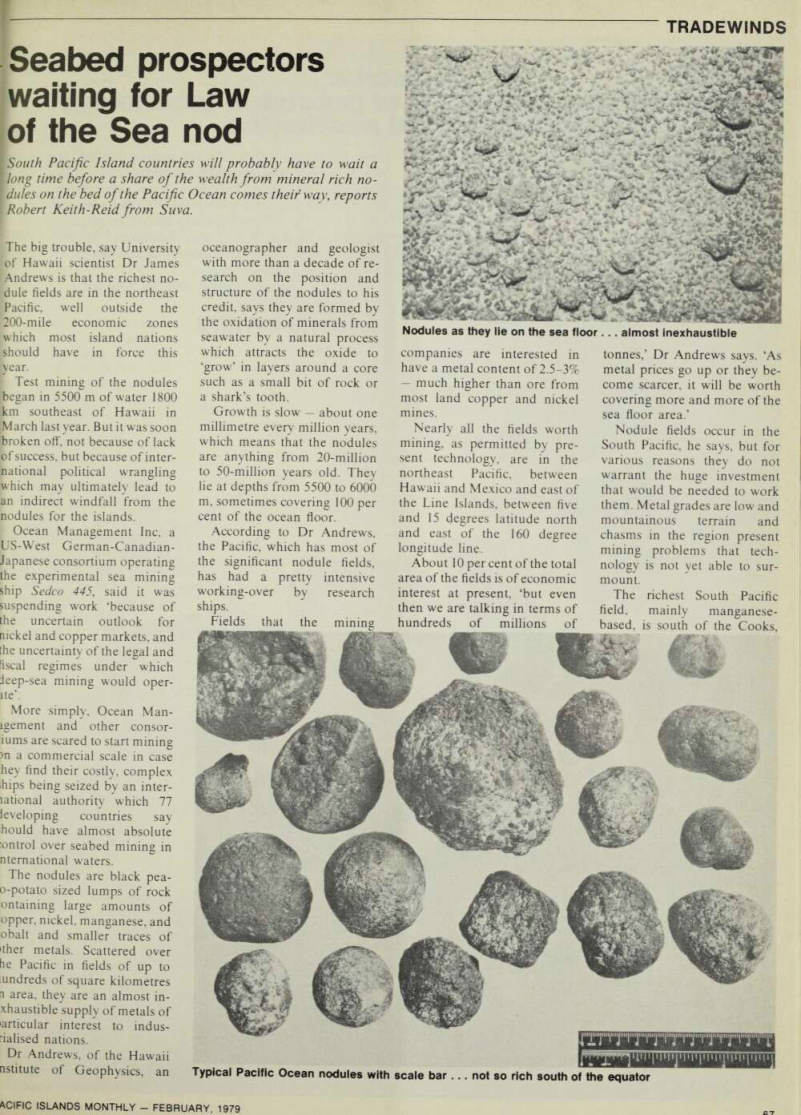
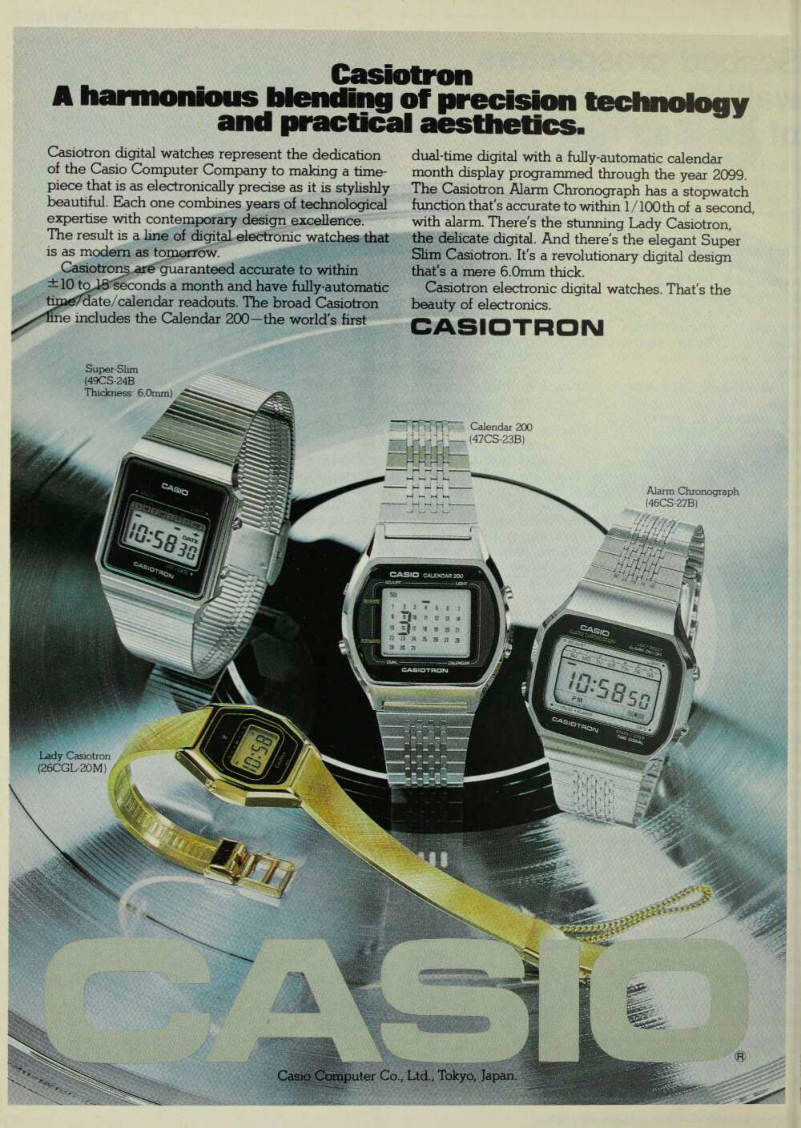
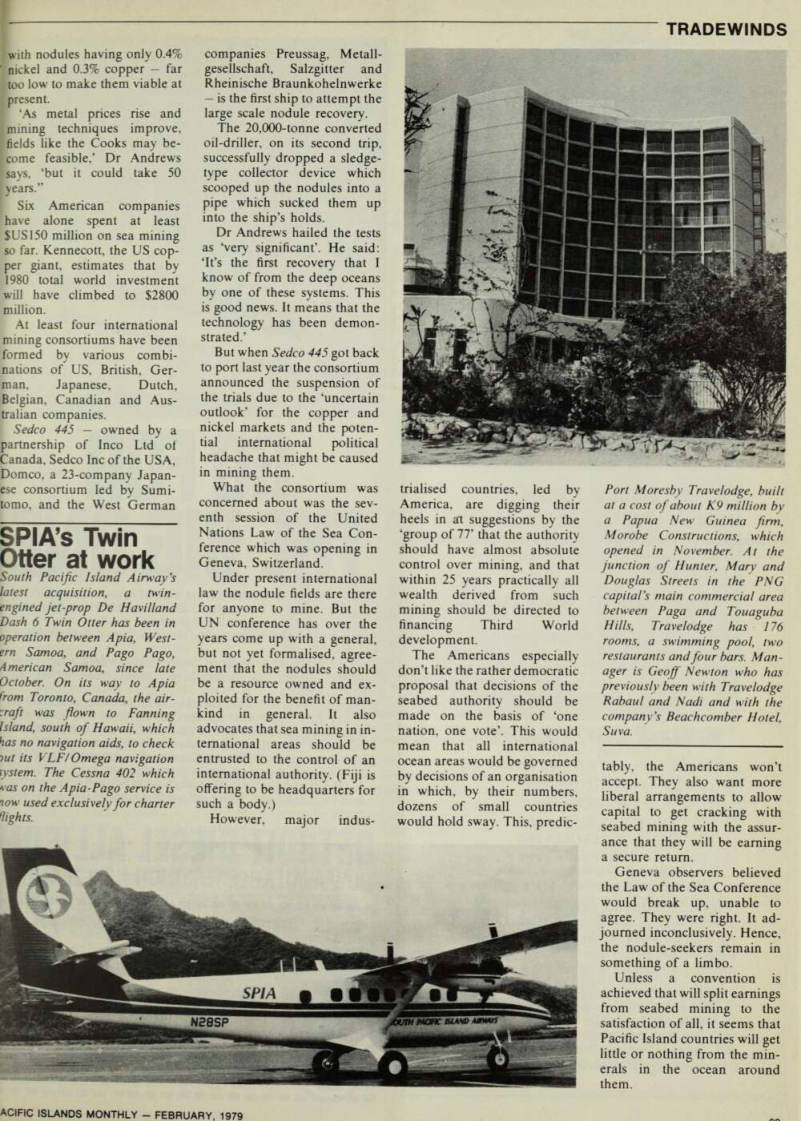
Tradewinds
Seabed prospectors waiting for Law of the Sea nod
Sowr/z Pacific Island countries will probably have to wait a long time before a share of the wealth from mineral rich no dules on the bed of the Pacific Ocean comes their way, reports Robert Keith-Reid from Suva.
The big trouble, say University of Hawaii scientist Dr James Andrews is that the richest no dule fields are in the northeast Pacific, well outside the 200-mile economic zones which most island nations should have in force this wear.
Test mining of the nodules began in 5500 m of water 1800 km southeast of Hawaii in March last year. But it was soon broken off, not because of lack of success, but because of inter national political wrangling which may ultimately lead to an indirect windfall from the nodules for the islands.
Ocean Management Inc, a US-West German-Canadian-
Japanese consortium operating
the experimental sea mining
ship Sedco 445, said it was suspending work ‘because of the uncertain outlook for nickel and copper markets, and
the uncertainty of the legal and
fiscal regimes under which
Jeep-sea mining would oper
ite’.
More simply. Ocean Man igement and other consor iums are scared to start mining )n a commercial scale in case
hey find their costly, complex
hips being seized by an inter
lational authority which 77
leveloping countries say hould have almost absolute ontrol over seabed mining in ntemational waters.
The nodules are black pea o-potato sized lumps of rock
ontaining large amounts of
upper, nickel, manganese, and obalt and smaller traces of •ther metals. Scattered over tie Pacific in fields of up to undreds of square kilometres n area, they are an almost in xhaustible supply of metals of articular interest to indus "ialised nations.
Dr Andrews, of the Hawaii
nstitute of Geophysics, an
oceanographer and geologist
with more than a decade of re search on the position and structure of the nodules to his credit, says they are formed by the oxidation of minerals from seawater by a natural process which attracts the oxide to ‘grow’ in layers around a core such as a small bit of rock or a shark’s tooth.
Growth is slow about one millimetre every million years, which means that the nodules are anything from 20-million to 50-million years old. They lie at depths from 5500 to 6000 m, sometimes covering 100 per cent of the ocean floor.
According to Dr Andrews, the Pacific, which has most of the significant nodule fields, has had a pretty intensive
working-over by research
ships.
Fields that the mining
companies are interested in have a metal content of 2.5-3% much higher than ore from most land copper and nickel mines.
Nearly all the fields worth mining, as permitted by pre sent technology, are in the northeast Pacific, between Hawaii and Mexico and east of the Line Islands, between five and 15 degrees latitude north and east of the 160 degree
longitude line.
About 10 per cent of the total area of the fields is of economic interest at present, ‘but even then we are talking in terms of hundreds of millions of
tonnes,’ Dr Andrews says. ‘As metal prices go up or they be come scarcer, it will be worth covering more and more of the sea floor area.’
Nodule fields occur in the South Pacific, he says, but for various reasons they do not warrant the huge investment that would be needed to work them. Metal grades are low and mountainous terrain and chasms in the region present
mining problems that tech
nology is not yet able to sur mount.
The richest South Pacific field, mainly manganese based, is south of the Cooks,
Typical Pacific Ocean nodules with scale bar . . . not so rich south of the equator
Nodules as they lie on the sea floor. . . almost inexhaustible
with nodules having only 0.4% ‘ nickel and 0.3% copper - far I too low to make them viable at
I present.
f ‘As metal prices rise and ■ mining techniques improve, fields like the Cooks may be [come feasible,’ Dr Andrews says, ‘but it could take 50
[years.”
Six American companies have alone spent at least SUSISO million on sea mining so far. Kennecott, the US cop per giant, estimates that by 1980 total world investment will have climbed to $2BOO million.
At least four international mining consortiums have been formed by various combi nations of US, British, Ger man, Japanese, Dutch, Belgian, Canadian and Aus tralian companies.
Sedco 445 owned by a partnership of Inco Ltd of Canada, Sedco Inc of the USA,
Domco, a 23-company Japan
ese consortium led by Sumi tomo, and the West German
companies Preussag, Metall
gesellschaft, Salzgitter and
Rheinische Braunkohelnwerke is the first ship to attempt the large scale nodule recovery.
The 20,000-tonne converted oil-driller, on its second trip,
successfully dropped a sledge
type collector device which scooped up the nodules into a pipe which sucked them up into the ship’s holds.
Dr Andrews hailed the tests as ‘very significant’. He said: ‘lt’s the first recovery that I know of from the deep oceans by one of these systems. This is good news. It means that the technology has been demon strated.’
But when Sedco 445 got back to port last year the consortium announced the suspension of the trials due to the ‘uncertain outlook’ for the copper and nickel markets and the poten tial international political headache that might be caused in mining them.
What the consortium was concerned about was the sev enth session of the United Nations Law of the Sea Con ference which was opening in Geneva, Switzerland.
Under present international law the nodule fields are there for anyone to mine. But the UN conference has over the years come up with a general, but not yet formalised, agree ment that the nodules should be a resource owned and ex ploited for the benefit of man kind in general. It also advocates that sea mining in in ternational areas should be entrusted to the control of an
international authority. (Fiji is
offering to be headquarters for such a body.) However, major indus-
trialised countries, led by America, are digging their heels in at suggestions by the ‘group of 77’ that the authority should have almost absolute control over mining, and that within 25 years practically all wealth derived from such mining should be directed to financing Third World
development.
The Americans especially don’t like the rather democratic proposal that decisions of the seabed authority should be made on the basis of ‘one nation, one vote’. This would mean that all international ocean areas would be governed by decisions of an organisation in which, by their numbers, dozens of small countries would hold sway. This, predic
tably, the Americans won’t accept. They also want more liberal arrangements to allow capital to get cracking with seabed mining with the assur ance that they will be earning a secure return.
Geneva observers believed the Law of the Sea Conference would break up, unable to agree. They were right. It ad
journed inconclusively. Hence,
the nodule-seekers remain in something of a limbo.
Unless a convention is achieved that will split earnings from seabed mining to the satisfaction of all, it seems that Pacific Island countries will get little or nothing from the min erals in the ocean around them.
Port Moresby Travelodge, built
at a cost of about K9 million by a Papua New Guinea firm, Morobe Constructions, which opened in November. At the junction of Hunter, Mary and Douglas Streets in the PNG capital's main commercial area
between Paga and Touaguba
Hills, Travelodge has 176 rooms, a swimming pool, two restaurants and four bars. Man ager is Geoff Newton who has
previously been with Travelodge
Rabaul and Nadi and with the company's Beachcomber Hotel, Suva.
Advertisements & other items, pp. 67-68 (2 items)
67
ACIFIC ISLANDS MONTHLY - FEBRUARY, 1979
A harmonious blending off precision technology
Casiotron
and practical aesthetics.
Casiotron digital watches represent the dedication of the Casio Computer Company to making a timepiece that is as electronically precise as it is stylishly beautiful. Each one combines years of technological expertise with contemporary design excellence.
The result is a line of digital electronic watches that is as modem as tomorrow.
Casiotrons are guaranteed accurate to within ± 10 a month and have fully-automatic calendar readouts. The broad Casiotron ine includes the Calendar 200—the world's first dual-time digital with a fully-automatic calendar month display programmed through the year 2099.
The Casiotron Alarm Chronograph has a stopwatch function that's accurate to within 1/100 th of a second, with alarm. There's the stunning Lady Casiotron, the delicate digital. And there's the elegant Super Slim Casiotron. It's a revolutionary digital design that's a mere 6.omm thick.
Casiotron electronic digital watches. That's the beauty of electronics.
CASIOTRON
Super-Slim (49CS-248 Thickness: 6.omm) rrrrrn Calendar 200 (47CS-238) Alarm Chronograph (46CS-278) fn ss >u in
erf
3 n >U 3& s*o Lady Casiotron
(26CGL-20M) I
Casio Computer Co., Ltd., Tokyo, Japan.
[?]SPIA’s Twin
[?]Otter at work
South Pacific Island Airway’s latest acquisition, a twin engined jet-prop De Havilland Dash 6 Twin Otter has been in operation between Apia, West ern Samoa, and Pago Pago, American Samoa, since late October. On its way to Apia from Toronto, Canada, the air :raft was flown to Fanning Island, south of Hawaii, which has no navigation aids, to check fut its VLF/ Omega navigation ystem. The Cessna 402 which >vas on the Apia-Pago service is ww used exclusively for charter lights.
Advertisements & other items, pp. 69-70 (2 items)
Tradewinds
Go For
mmm w L u
The
Modulock System
A unique building method
Modulock is a high quality, low maintenance building system. It allows an infinite variety of designs ideal for homes, offices, schools indeed all low rise buildings.
Modulock is quick to deliver and assemble, low on labour, compact, easy to ship and particularly suited to conditions in the Pacific: For further information contact
MODULOCK
Modulock (N.Z.) Limited, P.O. Box 51-099, Pakuranga, Auckland, New Zealand. Telephone 47-069 Papatoetoe, Telex N.Z. 2290.
GO FOR
THE BIG ONE
The enormous wealth in the Pacific must be tapped by Pacific nations themselves. But it needs power; cheap, dependable power: diesel power.
The great diesel power in the world is Detroit Diesel Allison the big one.
These diesel engines work the longest, hardest hours; their power-delivery is impressive; their cost efficiency unequalled.
Detroit Diesel Allison is the world’s largest manufacturer of heavy-duty diesel engines with gas turbines and automatic and power shift transmissions, plus torque converters. A complete line of power products, trucks, work boats and heavy equipment. DDA engines range in power from 50 HP to 1600 HP, diesel-powered generator sets from 30 KW to 1100 KW and gas turbine enginesupto 5,300 KWfor marine and industrial use. We've got what you need to get the job done.
DETROIT DIESEL ALLISON
NOW AVAILABLE THROUGH NEW ZEALAND
For further information forward this coupon to: DETROIT DIESEL ALLISON INTERNATIONAL NEW ZEALAND DIVISION OF GENERAL MOTORS NEW ZEALAND LTD PRIVATE BAG UPPER HUTT.
Tick box for required brochure |\Jgppo □ Automotive diesel □ Industrial diesel □ Marine diesel AddrGSS □ Generator set □ Transmissions □ Turbines
Detroit Diesel Allison!
Division of General Motors Corporation ■
FREDERICK W. ROHLFING
Attorney at Law and former Hawaii State Senator, takes pleasure in announcing resumption of his private practice of law upon completion of six months service in Pago Pago as Acting Attorney General & Special Counsel to the American Samoa Government.
ROHLFING, ROBERTSON & SMITH
Attorneys at Law Suite 1400, Pioneer Plaza, 900 Fort St. Mall Honolulu, Hawaii 96813 in association with
ROY J. D. HALL, JR.
HALL & ASSOCIATES
P.O. Box 2506 Haleck’s Professional Building Pago Pago, American Samoa 96799 General practice of law in Hawaii State courts, Federal courts, the High Court of American Samoa & the Supreme Court of Western Samoa.
Services available to individuals, firms, or government agencies. Specializing in Pacific Islands’ international development and investment, governmental relations, legislative analysis and advocacy, admiralty, general and personal injury litigation, labor relations and immigration law.
Maze Of Ifs, Buts
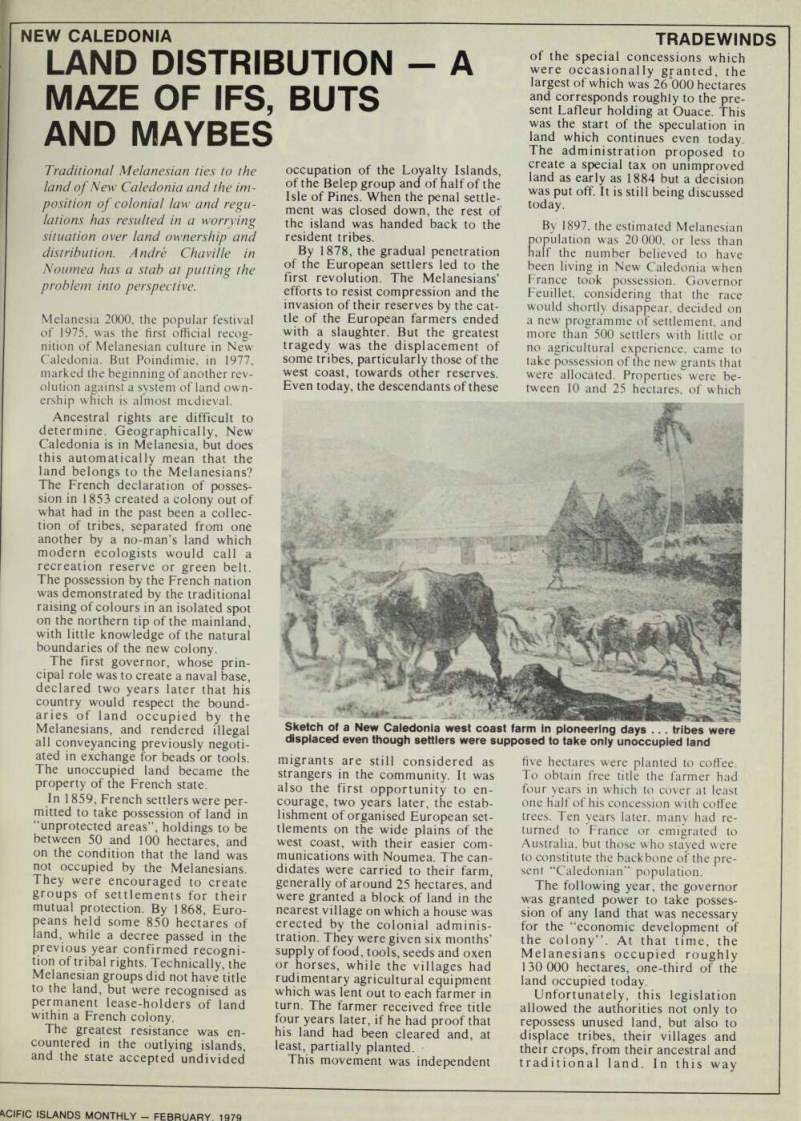

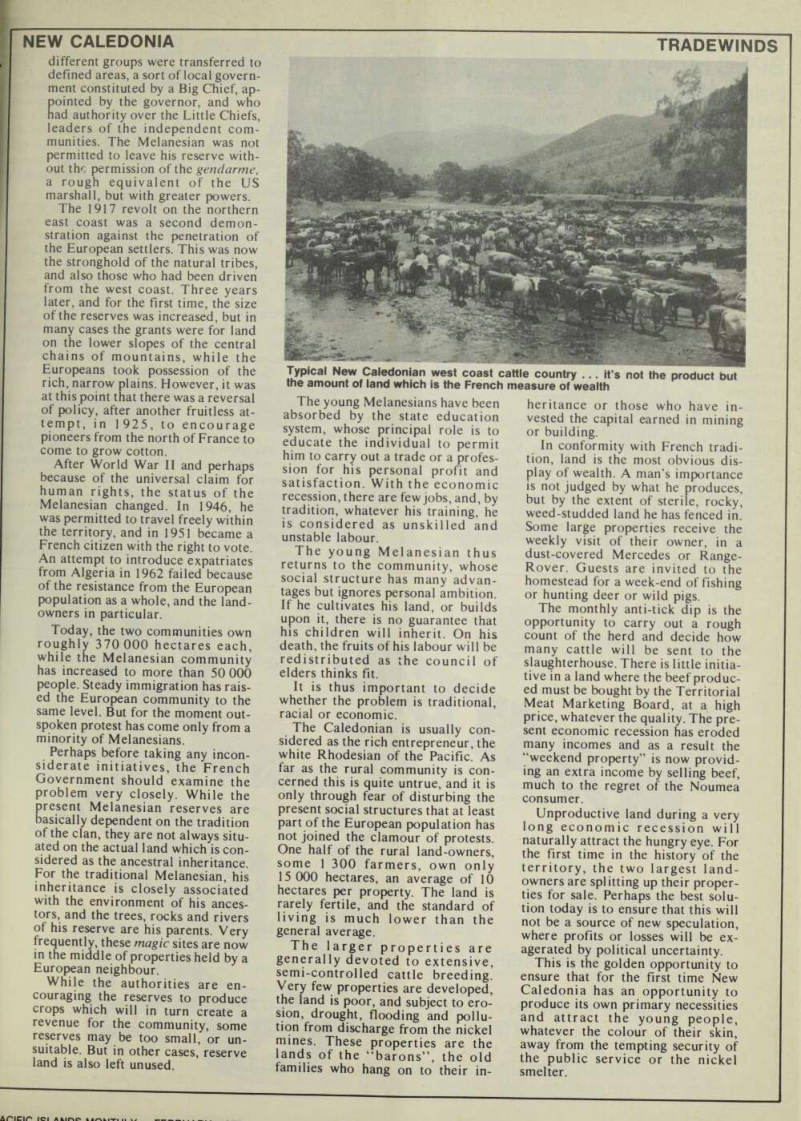
New Caledonia
Land Distribution - A
And Maybes
Traditional Melanesian ties to the land of New Caledonia and the im position of colonial law and regu lations has resulted in a worrying situation over land ownership and distribution. Andre Chaville in Noumea has a stab at putting the
problem into perspective.
Melanesia 2000, the popular festival of 1975, was the first official recog nition of Melanesian culture in New Caledonia. But Poindimie, in 1977, marked the beginning of another rev olution against a system of land own ership which is almost medieval.
Ancestral rights are difficult to determine. Geographically, New Caledonia is in Melanesia, but does this automatically mean that the land belongs to the Melanesians?
The French declaration of posses sion in 1853 created a colony out of what had in the past been a collec tion of tribes, separated from one another by a no-man’s land which modern ecologists would call a recreation reserve or green belt.
The possession by the French nation was demonstrated by the traditional raising of colours in an isolated spot on the northern tip of the mainland, with little knowledge of the natural boundaries of the new colony.
The first governor, whose prin cipal role was to create a naval base, declared two years later that his country would respect the bound aries of land occupied by the Melanesians, and rendered illegal all conveyancing previously negoti ated in exchange for beads or tools.
The unoccupied land became the property of the French state.
In 1859, French settlers were per mitted to take possession of land in “unprotected areas”, holdings to be between 50 and 100 hectares, and on the condition that the land was not occupied by the Melanesians.
They were encouraged to create groups of settlements for their mutual protection. By 1868, Euro peans held some 850 hectares of land, while a decree passed in the previous year confirmed recogni tion of tribal rights. Technically, the Melanesian groups did not have title to the land, but were recognised as permanent lease-holders of land within a French colony.
The greatest resistance was en countered in the outlying islands, and the state accepted undivided
occupation of the Loyalty Islands, of the Belep group and of half of the Isle of Pines. When the penal settle ment was closed down, the rest of the island was handed back to the resident tribes.
By 1878, the gradual penetration of the European settlers led to the first revolution. The Melanesians’ efforts to resist compression and the invasion of their reserves by the cat tle of the European farmers ended with a slaughter. But the greatest tragedy was the displacement of some tribes, particularly those of the west coast, towards other reserves.
Even today, the descendants of these
of the special concessions which were occasionally granted, the largest of which was 26 000 hectares and corresponds roughly to the pre sent Lafleur holding at Ouace. This was the start of the speculation in land which continues even today.
The administration proposed to create a special tax on unimproved land as early as 1884 but a decision was put off. It is still being discussed
today.
By 1897, the estimated Melanesian population was 20 000, or less than half the number believed to have been living in New Caledonia when France took possession. Governor Feuillet. considering that the race would shortly disappear, decided on a new programme of settlement, and more than 500 settlers with little or no agricultural experience, came to take possession of the new grants that were allocated. Properties were be tween 10 and 25 hectares, of which
migrants are still considered as strangers in the community. It was also the first opportunity to en courage, two years later, the estab lishment of organised European set tlements on the wide plains of the west coast, with their easier com munications with Noumea. The can didates were carried to their farm, generally of around 25 hectares, and were granted a block of land in the nearest village on which a house was erected by the colonial adminis tration. They were given six months’ supply of food, tools, seeds and oxen or horses, while the villages had rudimentary agricultural equipment which was lent out to each farmer in turn. The farmer received free title four years later, if he had proof that his land had been cleared and, at least, partially planted.
This movement was independent
five hectares were planted to coffee.
To obtain free title the farmer had four years in which to cover at least one half of his concession with coffee trees. Ten years later, many had re turned to France or emigrated to Australia, but those who stayed were to constitute the backbone of the pre sent “Caledonian” population.
The following year, the governor was granted power to take posses sion of any land that was necessary for the “economic development of the colony”. At that time, the Melanesians occupied roughly 130 000 hectares, one-third of the land occupied today.
Unfortunately, this legislation allowed the authorities not only to repossess unused land, but also to displace tribes, their villages and their crops, from their ancestral and traditional land. In this way
Sketch of a New Caledonia west coast farm In pioneering days . . . tribes were displaced even though settlers were supposed to take only unoccupied land
different groups were transferred to defined areas, a sort of local govern ment constituted by a Big Chief, ap pointed by the governor, and who had authority over the Little Chiefs, leaders of the independent com munities. The Melanesian was not permitted to leave his reserve with out the permission of the gendarme, a rough equivalent of the US marshall, but with greater powers.
The 1917 revolt on the northern east coast was a second demon stration against the penetration of the European settlers. This was now the stronghold of the natural tribes, and also those who had been driven from the west coast. Three years later, and for the first time, the size of the reserves was increased, but in many cases the grants were for land on the lower slopes of the central chains of mountains, while the Europeans took possession of the rich, narrow plains. However, it was at this point that there was a reversal of policy, after another fruitless at tempt, in 1925, to encourage pioneers from the north of France to come to grow cotton.
After World War II and perhaps because of the universal claim for human rights, the status of the Melanesian changed. In 1946, he was permitted to travel freely within the territory, and in 1951 became a French citizen with the right to vote.
An attempt to introduce expatriates from Algeria in 1962 failed because of the resistance from the European population as a whole, and the land owners in particular.
Today, the two communities own roughly 370 000 hectares each, while the Melanesian community has increased to more than 50 000 people. Steady immigration has rais ed the European community to the same level. But for the moment out spoken protest has come only from a minority of Melanesians.
Perhaps before taking any incon siderate initiatives, the French Government should examine the problem very closely. While the present Melanesian reserves are basically dependent on the tradition of the clan, they are not always situ ated on the actual land which is con sidered as the ancestral inheritance.
For the traditional Melanesian, his inheritance is closely associated with the environment of his ances tors, and the trees, rocks and rivers of his reserve are his parents. Very frequently, these magic sites are now in the middle of properties held by a European neighbour.
While the authorities are en couraging the reserves to produce crops which will in turn create a revenue for the community, some reserves may be too small, or un suitable. But in other cases, reserve land is also left unused.
The young Melanesians have been absorbed by the state education system, whose principal role is to educate the individual to permit him to carry out a trade or a professton for his personal profit and satisfaction. With the economic recession, there are few jobs, and, by tradition, whatever his training, he is considered as unskilled and unstable labour.
The young Melanesian thus returns to the community, whose social structure has many ad vantages but ignores personal ambition.
If he cultivates his land, or builds upon it, there is no guarantee that his children will inherit. On his death, the fruits of his labour will be redistributed as the council of elders thinks fit.
It is thus important to decide whether the problem is traditional, racial or economic.
The Caledonian is usually considered as the rich entrepreneur, the white Rhodesian of the Pacific. As far as the rural community is concerned this is quite untrue, and it is only through fear of disturbing the present social structures that at least part of the European population has not joined the clamour of protests.
One half of the rural land-owners, u farmers, own only 15 000 hectares, an average of 10 hectares per property. The land is rarely fertile, and the standard of living is much lower than the general average.
The larger properties are generally devoted to extensive, semi-controlled cattle breeding.
Very few properties are developed, the land is poor, and subject to erosion drought, flooding and pollution from discharge from the nickel mines. These properties are the lands of the “barons”, the old ramifies who hang on to their in-
heritance or those who have in vested the capital earned in mining or building.
In conformity with French tradi tion, land is the most obvious dis play of wealth. A man’s importance is not judged by what he produces, but by the extent of sterile, rocky, weed-studded land he has fenced in.
Some large properties receive the weekly visit of their owner, in a dust-covered Mercedes or Range- Rover. Guests are invited to the homestead for a week-end of fishing or hunting deer or wild pigs.
The monthly anti-tick dip is the opportunity to carry out a rough count of the herd and decide how many cattle will be sent to the slaughterhouse. There is little initia tive in a land where the beef produc ed must be bought by the Territorial Meat Marketing Board, at a high price, whatever the quality. The pre sent economic recession has eroded many incomes and as a result the “weekend property” is now provid ing an extra income by selling beef, much to the regret of the Noumea consumer.
Unproductive land during a very long economic recession will naturally attract the hungry eye. For the first time in the history of the territory, the two largest land owners are splitting up their proper ties for sale. Perhaps the best solu tion today is to ensure that this will not be a source of new speculation, where profits or losses will be ex agerated by political uncertainty.
This is the golden opportunity to ensure that for the first time New Caledonia has an opportunity to produce its own primary necessities and attract the young people, whatever the colour of their skin, away from the tempting security of the public service or the nickel smelter.
Typical New Caledonian west coast cattle country ... it’s not the product but the amount of land which is the French measure of wealth
SPEC move to
bring shipping
into line
With the aim of establishing uniform maritime standards across the Pacific, a South Pa cific Bureau for Economic Co
operation (SPEC) advisory
committee came up with sev eral ideas at a recent meeting in Honiara, Solomon Islands.
It was suggested that: • a Pacific regional certifi cation structure for officers should be established, based on accepted international stan dards, with countries issuing national certificates to trainees
reaching prescribed common
standards. • uniform syllabuses should be prepared for various grades of Pacific region certificates by a sub-committee. (It was decided that Fiji, Solomon Islands and Papua New Guinea should
appoint representatives to a
sub-committee to report to the next session of the advisory committee.) • length should be used as the
measure of a ship’s size, rather than tonnage, with tonnage considered only if a vessel
traded beyond the region.
The committee argued that acceptance of uniform stan dards would create a favour able climate for rationalising training facilities within the re
gion.
SPEC arranged the Honiara meeting after decisions on shipping by the South Pacific
Forum Regional Shipping
Council and the South Pacific Forum at Niue in September last year. Members of the coun cil are Australia, Cook Islands, Fiji, Gilbert Islands, Nauru, New Zealand, Niue, Papua New Guinea, Solomon Islands, Tuvalu, Tonga and Western Samoa.
Representatives from Aus tralia, Fiji, Nauru, New Zealand, Papua New Guinea, Solomon Islands and Tuvalu attended the Honiara meeting.
Observers were present from the Economic Social Com mission for Asia and the Pacific and the International Maritime
Consultative Organisation.
Fiji looks to
NZ zone
for tuna
Fiji is looking for access to his torical fishing grounds in New Zealand’s 200-mile economic zone to provide sufficient tuna to enable it to expand its fish
canning industry, writes
William Gasson in Welling ton.
At present the tuna canning plant earns Fiji from SF7 million to $lO million in exports a year. The question of access to some of New Zealand’s surplus tuna re sources came in recent talks be tween a Fiji Government
delegation led by Secretary of
Foreign Affairs Jioji Kotobal
avu and New Zealand officials
in Wellington.
‘New Zealand has given an assurance that it will look at our request sympathetically,’
Mr Kotobalavu said, ‘so there will be further discussions.’
At the end of December, how ever, a foreign affairs official said no request for fishing
access had been received fromr
the Fiji Government. Fiji’s'
point is that it has fished im some of the waters now encom-i passed by New Zealand’s far-i reaching economic zone foi( some 10 years. In Fijian eyes; this gives them an historic] claim at least to return to those,
fishing areas.
‘We would now like to safe-; guard the right of access to oun fleet to the resources of youm waters which are surplus to
your own catching capacity,V
Mr Kotobalavu said in am interview. ‘ln our economioi zone we have skipjack but im order to support our canneries; we have to have access to other; species of tuna like albacor© which are found in New* Zealand waters.’
In 1977 Fiji had about 30 long-line tuna vessels fishing im and around New Zealand’s' present economic zone which! only came into force this yean They caught about 7000 tonnes.
Last year the vessels were fishing outside the zone although Mr Kotobalavu wasi not exactly sure of their where-;
I abouts but with the canning I factory’s demand for albacore I expected to climb to 10 000 I tonnes by 1980, the Fijian I Government is keen to cross into the economic zone.
Fiji operates its canning fac-
I tory through a joint fishing
I venture with a Japanese company which charters mainly Taiwan and South Korean vessels to catch tuna.
While New Zealand is likely to be sympathetic to the Fijian fishing request, the use of Taiwan fishing vessels presents a problem since Taiwan is not
recognised by the New
Zealand Government.
Then again New Zealand officials will need to prescribe a licensing formula for the South Korean fishing boats used by Fiji that fits in with licences already issued to South Koreans.
New Zealand at present finds it difficult to establish an allowable catch for foreign tuna vessels because it does not know enough about tuna stocks within its economic zone.
Mr Kotobalavu said that Fiji
was developing its own tuna fishing fleet which in time would also seek access to his torical fishing grounds.
The growth of the fishing industry in Fiji reflects the im portance placed on its future economic role. ‘Our prospects in agriculture are good but for us the development of marine resources is even more import ant in the coming years,’ Mr Kotobalavu said,
Qjg textile plant
\Jiu3Iti
The first major manufacturing
company to locate on Guam for more than three years is expected to open a factory in mid-1979, writes Paul Addison from Agana.
The South Seas Trading Company, which has offices in New York and a factory in the Philippines, is in the final stages of buying land and a building on the island. The company expects to employ about 200 persons at first and up to 2000 within five years.
They will manufacture gloves.
shirts, pants and other textile products, according to company officials.
The company has adopted the local name ‘Guamsons’ and hopes to bring in about 50 trainers from the Philippines early in 1979 to instruct workers m textiles skills. It is planned that training will be earned out in the recently CoTe e ° Uam C ° mmUnity e £ e ' ... .
Guam already has a number of small textile plants but has been hindered in attracting large plants by US import regulations. Although company president Osvay Lipetz said his company has been thinking of relocating on Guam for years, deteriorating political conditions in the Philippines were apparently major factors in the timing of the decision.
I .. incentive for
Tongan copra
Oil Mills of Tonga Ltd’s pressing factory is in production and, barring the unforeseen, unprocessed copra has been
exported for the last time, The director of Oil Mills, Charles Kerry, said that the last shipment of copra left Tonga in November with all future pro duction being held for crush
ing.
Commenting on an apparent d of about 2000 tonnes in )978 against , 977 production> Mr K said that oi , Mills were offering local growers an incentive payment of 5% above wha( ~h e world ice wou|d warrant’ K He said; ‘ We are buying all our co P ra from the Commodi des Board but when the copra quantity is handed over to us we are P a y in g more for it.
That • • must be passed on in full t 0 the growers ..
Mr Kerry said there was ‘an
incredible variety of products’
to be made out of copra and copra oil and while ‘I don’t know today what we are going to produce two or three years from now... I guarantee there will be lines we haven’t even thought of which we are going to manufacture’.
Advertisements & other items, pp. 71-80 (4 items)
Tradewinds
ISLANDS MONTHLY FEBRUARY 1979
the DC Amp System
Sansui presents
Ordinarily you’d expect to pay far more for the purity of true DC reproduction. But the AG-317 integrated amplifier and matching TG-317 FM/AM tuner were expressly designed to reproduce the full musical spectrum with astounding clarity. The power amplifier section is pure DC not only for low THD (total harmonic distortion) but also for low TIM (trasient intermodulation distortion).
Frequency response is from DC (zero Hz) to 200,000 Hz. Output is a hefty and clean 50 RMS watts per channel. The beautiful tuner features ultra-low distortion and superior selectivity. Perfectly complementing these black beauty components are the SC-1110 Direct-O-Matic cassette deck, the SR-232 auto-return turntable, the new 3-way speaker system SP-X 4400 and the GX-5 EIA audio rack on casters. This outstanding sonic picture is called the Sansui rms 317.
SANSUI rms 317
ScltlstilL
7 j ✓ «■ IM; *
Only hi-fi, everything hi-fi.
SANSUI ELECTRIC CO., LTD. 14-1 Izumi 2-chome, Suginami-ku, Tokyo 168, Japan • Australia VANFI (Aust.) Pty. Ltd. 162, Albert Road, South Melbourne. Victoria 3205, Australia Phone: 699-5473/Suite 5, Uniline House, 5 Northcliff Street, Milsons Point, N.S.W. 2061, Australia Phone:929-0293 • Fiji Prabhu Brothers Ltd. P.O. Box 183, Nadi Phone; 70183/4 • Papua New Guinea Oceania Indent Agency (P.N.G.) Pty. Ltd. Box 5518, Boroko, Port Moresby Phone; PM 256406 • New Zealand David Reid Electronics Ltd. C.P.O. Box 2630, Auckland. 1 Phone: 492-189 • New Caledonia Ets Michel MERCIER B.P. 1123, Noumea Phone: 27. 59. 11 • South Pacific Miltons Department Stores Limited P.O. Box 146, Norfolk Island 2899 • Central Pacific Nauru Co-operative Society Republic of Nauru • New Hebrides The Sound Centre P.O. Box 4.34 Port Vila • Cook Island United Island Traders Ltd. P.O. Box 1& 2. Rarotonga • Tahiti DIMECO P.O. Box 2622
*0
PACKED BY:
NIPPON SUISAN KAISHA, LTD.
EXPORTED BY:
UNITRADE COMPANY, LIMITED
11-12 3-chome Hachobori Chuo-ku Tokyo
TELEX NO.; “252-4665 KANDK J”
CABLE ADDRESS ; “ KAYANDKAY TOKYO”
& AS sr Vi S'.
CONSTRUCTIVE
ADVICE.
siu*a7\>
Komatsu makes 76-ton Bulldozers Radio-Controlled Bulldozers and Dozer Shovels.
Q Wheel Loaders.
As well as Motor Scrapers.
Small 2-ton Bulldozers. 9 iw 'r- I Swamp Bulldozers I as well as Swamp Dozer Shovels. li ,U 7 Electric Powered Dozer Shovels.
A wide range of Pipelayers.
Amphibious Bulldozers.
St A wide selection of Off-Highway Dump Trucks.
Soil Compactors. #rf|
f-ir/ 7jJ
waSBBi
ano
u D Trash Compactors.
Towing Tractors.
B M -S Vibratory Rollers. Diesel Generator Sets. *,v mL ■ r~TTw i
XiTWjI
Portable Air Compressors.
A wide selection of Diesel Engines.
N Machine Tools. % <» -
tjSr
J' .. m Meehan,cal and Hydraulic Presses. A variety of Maypres Presses. OBS Power Presses. Tunnel-Boring Machines.
We’re constructive in other ways. We offer castings, foundries, and important advice on construction and manufacturing projects.
•H KOMATSU LTD
Tokyo, Japan 3 ’ m™/■. Ba " 9kok . Bangalore, Teheran, Dubai, Jeddah, Riyadh, Ad Dammam, Baghdad, Ankara.
Arlington, - Lee, y, ana, Manama, bao Paulo, Caracas, Lima, Buenos Aires, and distributors in over 100 countries around the world.
CHLORIDE
for all applications
0C V * & £ ». m n M m\ m '*e~ uvSCk m r n« mi ■ p l
Fi-a -r?
L imi * 1 ft} -J Chloride is the largest and only manufacturer of both lead acid and nickel cadmium alkaline batteries in Australia.
The Company is equipped and qualified to offer advice, guidance and service on any battery requirement no matter how large or small.
On the question of size, it could be as small as a battery for a hearing aid the dimensions of a coat button or a power station battery weighing as much as 40 tonnes.
Again it could be a no break D.C Power System for a computer or emergency lighting for a hospital The Chloride Company operates in 40 countries throughout the world, and when you consider that in Australia alone its production is approaching 1% million batteries per year, it gives some idea of the far reaching role that batteries play in our lives.
Chloride Batteries Australia Limited
P.O. Box 141, Bankstown. IM.S.W. 2200. Australia. Telephone: 77 0177. Telex: 21262
To Future Generations,
Security
Social welfare is a subject of serious consideration in most modern societies. Man in the twentieth century accepts his responsibility to bequeath to the next generation a society better than his own.
Daiwa Bank is not unique in accepting this responsibility, but Daiwa is unique in making acceptance of this role in society an integral part of their banking service.
Daiwa is the only Japanese city bank to combine banking and trust business. Daiwa is thus a fully integrated banking institution, comprising banking, international financing, trust, pension trust, and real estate business. This integration is part of our effort to fulfil our social responsibility consistent with society's needs in a contemporary environment. a fully integrated banking service
DAIWA BANK
Head Office: Osaka, Japan London and Frankfurt Branches New York and Los Angeles Agencies Singapore, Sydney, Sao Paulo, Hong Kong and Houston Representative Offices Subsidiary; Daiwa Bank Trust Company, New York Joint Venture Banks; P.T. Bank Perdania, Jakarta, International Credit Alliance, Ltd., Hong Kong
)EWINDS INTELLIGENCE...TRADEWINDS INTELLIGENCE...TRAD
DUTY has been taken off imported agricultural and building materials under a set of tariff and customs duties approved by
Tonga’s Legislative Assembly . . .
POLYNESIAN Airlines began its second weekly service from Apia to Auckland in November using a Boeing 737 leased from Air New Zealand ...
TONGA’S consumer price index for the July-September quarter fell by 0.4 per cent, the first drop since the first quarter of 1976 ...
A GARMENT factory, employing nearly 50 and costing SSI 100 000 was opened in Honiara in November by Tong Poy and Sons Limited ...
FIJI’S first travellers’ cheques are now available, issued by the Bank of Fiji, with the National Bank to follow suit . . .
THE BANK Line introduced the first direct container service between Britain and Fiji in November .. .
FIJI’S cost of living dropped 0.1 per cent in October, the consumer price index for Suva and Nadi standing at 159 and for Western division at 152.6 ...
TUVALU has appointed Kamuta Latasi as its first high commissioner, to serve in Fiji, and plans to take office space in the former Club Hotel building . . .
TOURIST figures for Fiji in the first seven months of 1978 were up to 100 790 against 93 907 in the same period of 1977, with 45 per cent of visitors from Australia and 33 per cent from New Zealand ...
PAPUA New Guinea’s palm oil kernel is now subject to a 2.5 per cent export tax because of the improvement from K22 to K33 per tonne ...
FOREIGN private investment in mineral and petroleum prospecting over the past 18 months has amounted to K40 million.
reported Papua New Guinea’s Minister for Minerals and Energy Karl Kitchens ...
FIJI has budgeted to spend $F209.1 million in 1979 AIR NIUGIN1 was to take delivery from Canada last month of two Fokker Fellowship F28 jets at a cost of K6.7 million including spares. This would increase the airline’s jet fleet to four and reduce its F27 Friendship fleet by three .. .
FIJI expected that about half of $90 million spent by tourists in 1978 would remain in the country, while the other half would pay for imports (sold to tourists) and repatriated profits and dividends .. .
PAPUA New Guinea has become a full member of the International Silk Association .. .
FIJI Air is expected soon to take over internal services covering Suva, Savusavu, Bua and Taveuni, leaving Air Pacific to concentrate on shuttle services from Suva to Nadi. Labasa and Rotuma, and regional and international services . . .
CHINA is to buy 64 000 tonnes of copper from Papua New Guinea over the next three years ...
CONTROL of the Stinson-Pearce group has returned to Fiji through the acquisition of a 70 per cent interest by Peter Stinson, son of Fiji’s finance minister, from Hong Kong-based Jardine Matheson ...
DOUGLAS Airways, a third level operator in Papua New Guinea, has opened a pilot training school at Port Moresby. Flying instructor Wes Guy said of the first 32 applications for instruction received, 30 were from Papua New Guineans ...
WILLIAMS Shipping Limited of Fiji is replacing the 400-tonne Komaiwai on inter-island routes with the 600-tonne Taoniu, which may also be used to run a service to Solomon Islands ...
W. R. CARPENTER Holdings Ltd in the quarter to September
.TRADEWINDS INTELLIGENCE...TRADEWINDS INTELLIGENCE..
Epiglass Everdure Timber preservative and sealer.
Hardens,protects
and densities timber.
Kills all mould spores and permanently seals out moisture.
lS S I
Epiglass 90 Epoxy Resin and glass cloth.
Easy to apply.
Strengthens hulls, eliminates water absorption and rot and increases the value and life of your boat. i
iEWINDS INTELLIGENCE...TRADEWINDS INTELLIGENCE.
.TRAI
f 30, 1978, showed a net profit of $2.15 million .. .
MOTIBHAI and Company Limited, which has operated the duty free concession at Nadi Airport for several years, has won the right to continue to operate it from January 1, 1981, when the current lease expires, to December 31, 1990.
THE FIRST co-operative industrial enterprise in Tonga, a clothing factory at Ma’ufariga, opened in November with a staff of' seven.
JAPAN has made a grant of yen200 million (about $US1 million) f to Tonga for a nutrition improvement project, the money to be used to buy Japanese products such as canned tuna and bonita.
FIJI Bio Marine Ltd wants to take over more than 60-year old Suva Town Hall and spend about $F 170 000 converting it into
a large aquarium.
FIJI’S foreign exchange spending in 1977 was SF331.8 million, compared with $294.3 million in 1976 and $269.3 million in 1975.
THE NEWLY-formed Savusavu Shipping Co Ltd of Fiji has bought the 120-tonne inter-island trader Lawedua and has renamed it Tui Nasavusavu.
RADIO Fiji broadcasts 19 hours and 13 minutes of advertising each week; Hindustani, nine hours and 24 minutes in 78 hours of programmes; Fijian, five hours and 40 minutes in 64 hours; and English, four hours nine minutes in 101 hours.
THE METRIC Advisory Board has been reactivated in Western Samoa to prepare for an orderly changeover from the imperial system at a date yet to be announced . . .
THE COMMISSION of the European Communities has made available more than $F1.6 million for the construction of four jetties at Saqani on Vanua Levu, and on Koro, Kadavu and Moala
islands. The money is made available as a loan on special terms (40 years, 10 years grace, 1% interest) with a grant element of about 85% ...
AIR PACIFIC had a record profit of $F626 747 in 1977-78 following its loss of more than $ 1 million in the previous year. But directors say the airline must develop as a major carrier on routes to the US, Australia and New Zealand if Fiji is to retain its share of tourist traffic from those countries .. .
RABI Holdings Limited, the Fiji-based Banaban investment company, had an estimated loss of $F4.5 million at the end of September last year. The company has decided to scale down its business activities, which include shipping, a grocery store, real estate and engineering, and concentrate on investment . ..
THE ANNUAL budgetary meeting of the SPEC Committee endorsed a total budget proposal of $F585 446 for the current calendar year, $560 646 for ordinary expenditure, $24 800 for
capital expenditure ...
QANTAS and Air New Zealand have voluntarily withdrawn their representatives from the board of Air Pacific leaving the airline solely under the control of five Pacific Island countries — Fiji, Western Samoa, the Gilberts, Tonga and Solomon Islands. But both airlines remain shareholders ...
PAPUA New Guinea’s exports to New Zealand rose from $NZ2.1 million in 1976-77 to $5.5 million last year. New Zealand’s exports to PNG in the same period rose from $10.6 million to $16.9 million . . .
A MEETING of South Pacific Bureau of Economic Co-operation (SPEC) members was due to be held late last month to examine proposals in the Commonwealth Secretariat/SPEC report on industrial development and trade relations in the South Pacific.
TRADEWINDS INTELLIGENCE...TRADEWINDS INTELLIGENCE...
Epiglass E-Type
Antifouling.
Gives up to 12
months
growth-free
performance.
Racing Red/
Blue, Green
and Gold.
T]
ICJ-
A S
PACIFIC AREA STOCKISTS
COOK ISLANDS: Cook Island Trading Corporation Ltd FIJIAN ISLANDS: Burns Philp (SS) Co. Ltd NEW HEBRIDES: Burns Philp (NH) Ltd NOUMEA: Guy Limousin, Pacific Yachting NUIE ISLAND: Nuie Island United PAGO PAGO; Max Haleck Inc, Burns Philp (SS) Ltd PAPUA NEW GUINEA; KIETA: Nikana Wholesalers. LAE; Faulkner-Tait (NG) Pty Ltd, MADANG; Burns Philp NG) Co Ltd, PORT MORESBY: S.A. Heath Co. Ltd. RABAUL; Elvee Trading Pty Ltd, WEWAK: Burns Philp (P N G.).
SOLOMON ISLANDS: Man Sang Co
TAHITI: Marine Corail, Tahiti Sport.
TONGA: Riechelmann Bros.
WESTERN SAMOA: Burns Philp (SS) Co. Ltd, E. A. Coxon Ltd, Gold Star Transport Co. Ltd, Morris Hedstrom Ltd.
A I I
S 4/LM,AKERS TO THE PACIFIC
HOOD RACING and CRUISING SAILS
.V k In World Famous Hood Sailcloth Hood Racing Sails have the top international race-winning record. Recent successes include: Half Ton Cup, One Ton Cup, Southern Cross Cup, Whitbread Round-the-World Race World Ocean Racing Championship, Sydney- Hobart Race, N.Z. to Vila / (k* Ocean Race, Single-handed Transtasman, / etc., etc. / Hood Cruising Sails in Hood Wide ' Panel Sailcloth are soft, easy to $ handle and stow, lasting. and longer Hood Service. We regularly service the Pacific Hood Managing Director Tony Bouzaid calls frequently through the area; sailing seminars for clubs and associations by arrangement.
Deliveries. Improved air services bring New Zealand closer to you we can /^ offer speedy deliveries at short notice.
Hoods have representatives in Noumea,
SPA
and
RIGGI
Papeete. Port Moresby. Rabaul Suva, Singapore.
Write to Hood Sail Consultants in New Zealand for quotes, advice and for prompt answers to your sails queries. 0 -G
HOOD
NEW ZEALAND
LIMITED
23 Poore St., St. Marys Bay, Phone 794-060 P.O. Box 415.
Auckland, / New Zealand. / Cables:Hoodsaiy jy Telex: NZ21200
HOODNZ
Whether you have a racing or cruising yacht and require full new rigs or replacements, contact us for prompt and efficient service. We offer Spars, Rigging, Halyards, Accessories from Quarter Ton to Maxis. For immediate service, write, phone or telex giving fullest details including sketches for replacements, and sail plans with yacht’s leading dimensions, including displacements and ballast, for new rigs.
Write for our very comprehensive catalog
YACHTSB4RS
NEW ZEALAND LIMITED
P.O. Box 1492, Auckland. Phone 485-955, 485-536 Telex; Hood 21200. Cables; Yachts Auckland. ue, ill . .
Tradewinds
ISLANDS MONTHLY FEBRUARY, 1979
\Cific Islands Monthly February, 1979
Cruising
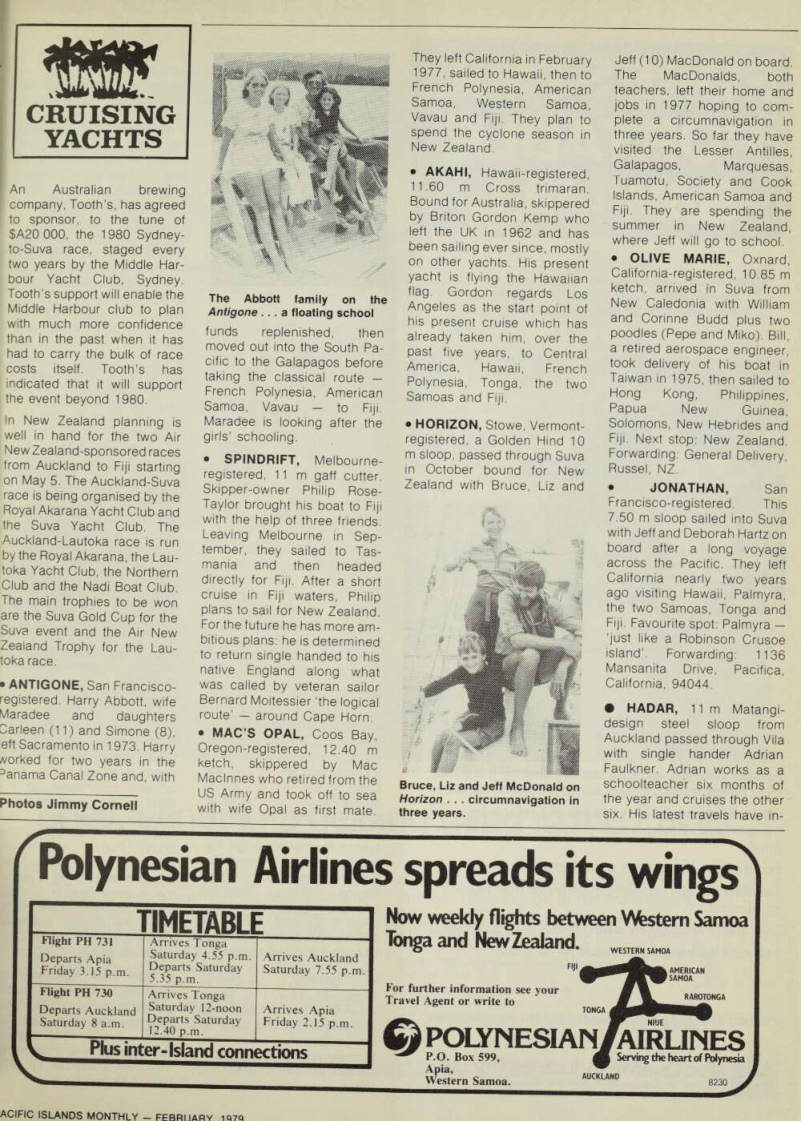
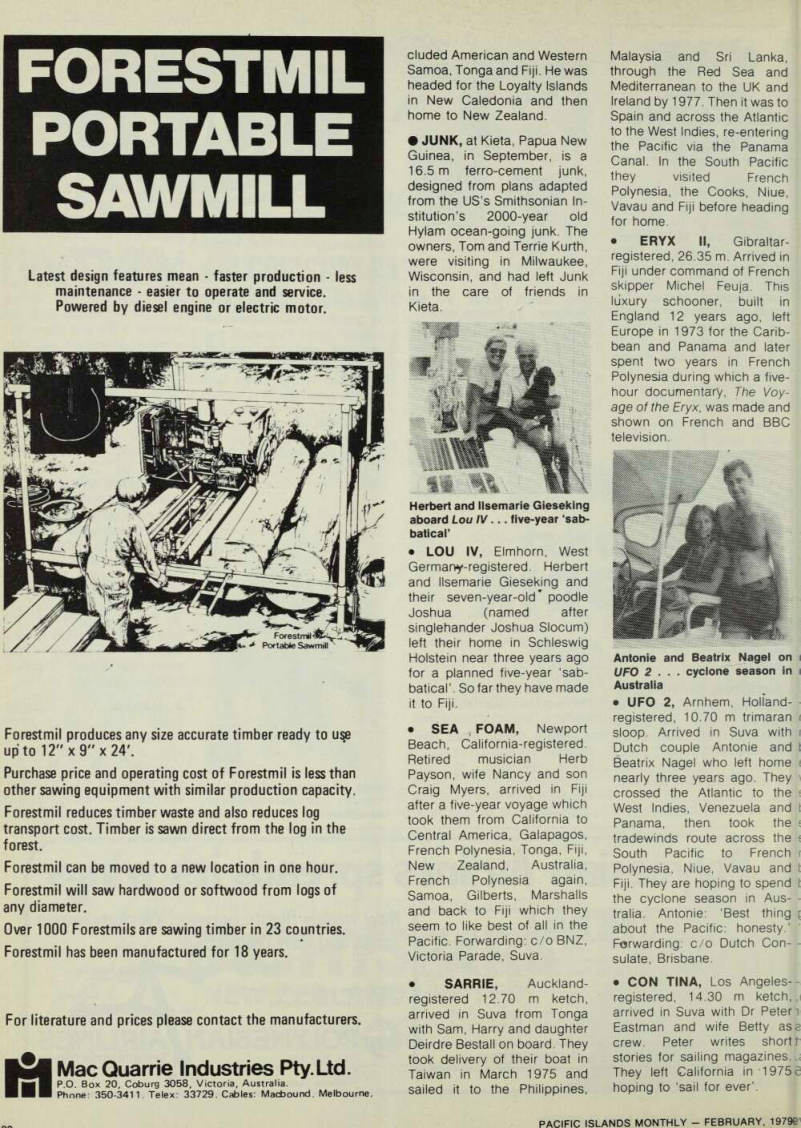
Yachts
An Australian brewing company, Tooth’s, has agreed [ to sponsor, to the tune of SA2O 000, the 1980 Sydney to-Suva race, staged every two years by the Middle Har bour Yacht Club, Sydney.
Tooth’s support will enable the Middle Harbour club to plan with much more confidence than in the past when it has had to carry the bulk of race costs itself. Tooth’s has indicated that it will support the event beyond 1980.
In New Zealand planning is well in hand for the two Air New Zealand-sponsored races from Auckland to Fiji starting on May 5. The Auckland-Suva race is being organised by the Royal Akarana Yacht Club and the Suva Yacht Club. The Auckland-Lautoka race is run by the Royal Akarana, the Lau toka Yacht Club, the Northern Club and the Nadi Boat Club.
The main trophies to be won are the Suva Gold Cup for the Suva event and the Air New Zealand Trophy for the Lau toka race. • ANTIGONE, San Francisco registered. Harry Abbott, wife Maradee and daughters Carleen (11) and Simone (8), eft Sacramento in 1973. Harry /vorked for two years in the 3 anama Canal Zone and, with Photos Jimmy Cornell
funds replenished, then moved out into the South Pa cific to the Galapagos before taking the classical route French Polynesia, American Samoa, Vavau to Fiji.
Maradee is looking after the girls’ schooling. • SPINDRIFT, Melbourne registered, 11 m gaff cutter.
Skipper-owner Philip Rose- Taylor brought his boat to Fiji with the help of three friends.
Leaving Melbourne in Sep tember, they sailed to Tas mania and then headed directly for Fiji. After a short cruise in Fiji waters, Philip plans to sail for New Zealand.
For the future he has more am bitious plans; he is determined to return single handed to his native England along what was called by veteran sailor Bernard Moitessier ‘the logical route’ around Cape Horn. • MAC’S OPAL, Coos Bay, Oregon-registered, 12.40 m ketch, skippered by Mac Maclnnes who retired from the US Army and took off to sea with wife Opal as first mate.
They left California in February 1977, sailed to Hawaii, then to French Polynesia, American Samoa, Western Samoa, Vavau and Fiji. They plan to spend the cyclone season in New Zealand. • AKAHI, Hawaii-registered, 11.60 m Cross trimaran.
Bound for Australia, skippered by Briton Gordon Kemp who left the UK in 1962 and has been sailing ever since, mostly on other yachts. His present yacht is flying the Hawaiian flag. Gordon regards Los Angeles as the start point of his present cruise which has already taken him, over the past five years, to Central America, Hawaii, French Polynesia, Tonga, the two Samoas and Fiji. • HORIZON, Stowe, Vermont registered, a Golden Hind 10 m sloop, passed through Suva in October bound for New Zealand with Bruce, Liz and
Jeff (10) MacDonald on board.
The MacDonalds, both teachers, left their home and jobs in 1977 hoping to com plete a circumnavigation in three years. So far they have visited the Lesser Antilles, Galapagos, Marquesas, Tuamotu, Society and Cook Islands, American Samoa and Fiji. They are spending the summer in New Zealand, where Jeff will go to school. • OLIVE MARIE, Oxnard, California-registered, 10.85 m ketch, arrived in Suva from New Caledonia with William and Corinne Budd plus two poodles (Pepe and Miko). Bill, a retired aerospace engineer, took delivery of his boat in Taiwan in 1975, then sailed to Hong Kong, Philippines, Papua New Guinea, Solomons, New Hebrides and Fiji. Next stop: New Zealand.
Forwarding: General Delivery, Russel, NZ.
• Jonathan, San
Francisco-registered. This
7.50 m sloop sailed into Suva with Jeff and Deborah Hartz on board after a long voyage across the Pacific. They left California nearly two years ago visiting Hawaii, Palmyra, the two Samoas, Tonga and Fiji. Favourite spot: Palmyra ‘just like a Robinson Crusoe island’. Forwarding: 1136 Mansanita Drive, Pacifica, California, 94044. • HADAR, 11 m Matangi design steel sloop from Auckland passed through Vila with single hander Adrian Faulkner. Adrian works as a schoolteacher six months of the year and cruises the other six. His latest travels have in
The Abbott family on the Antigone ... a floating school
Bruce, Liz and Jeff McDonald on
Horizon . . . circumnavigation in
three years.
eluded American and Western Samoa, Tonga and Fiji. He was headed for the Loyalty Islands in New Caledonia and then home to New Zealand. • JUNK, at Kieta, Papua New Guinea, in September, is a 16.5 m ferro-cement junk, designed from plans adapted from the US’s Smithsonian In stitution’s 2000-year old Hylam ocean-going junk. The owners, Tom and Terrie Kurth, were visiting in Milwaukee, Wisconsin, and had left Junk in the care of friends in Kieta.
• LOU IV, Elmhorn, West Germany-registered. Herbert and llsemarie Gieseking and their seven-year-old' poodle Joshua (named after singlehander Joshua Slocum) left their home in Schleswig Holstein near three years ago for a planned five-year ‘sab batical’. So far they have made it to Fiji. • SEA FOAM, Newport Beach, California-registered.
Retired musician Herb Payson, wife Nancy and son Craig Myers, arrived in Fiji after a five-year voyage which took them from California to Central America, Galapagos, French Polynesia, Tonga, Fiji, New Zealand, Australia, French Polynesia again, Samoa, Gilberts, Marshalls and back to Fiji which they seem to like best of all in the Pacific. Forwarding; c/o BNZ, Victoria Parade, Suva. • SARRIE, Auckland registered 12.70 m ketch, arrived in Suva from Tonga with Sam, Harry and daughter Deirdre Bestall on board. They took delivery of their boat in Taiwan in March 1975 and sailed it to the Philippines,
Malaysia and Sri Lanka, through the Red Sea and Mediterranean to the UK and Ireland by 1977. Then it was to Spain and across the Atlantic to the West Indies, re-entering the Pacific via the Panama Canal. In the South Pacific they visited French Polynesia, the Cooks, Niue, Vavau and Fiji before heading for home. • ERYX 11, Gibraltar registered, 26.35 m. Arrived in Fiji under command of French skipper Michel Feuja. This luxury schooner, built in England 12 years ago, left Europe in 1973 for the Carib bean and Panama and later spent two years in French Polynesia during which a five hour documentary, The Voy age of the Eryx, was made and shown on French and BBC television.
• UFO 2, Arnhem, Holland registered, 10.70 m trimaran i sloop. Arrived in Suva with i Dutch couple Antonie and I Beatrix Nagel who left home s nearly three years ago. They ' crossed the Atlantic to the « West Indies, Venezuela and 1 Panama, then, took the < tradewinds route across the ; South Pacific to French ( Polynesia, Niue, Vavau and t Fiji. They are hoping to spend I the cyclone season in Aus- tralia. Antonie: ‘Best thing [ about the Pacific: honesty.’ ’
Forwarding: c/o Dutch Con- sulate, Brisbane. • CON TINA, Los Angeles-registered, 14.30 m ketch,, arrived in Suva with Dr Peten Eastman and wife Betty ase crew. Peter writes short f stories for sailing magazines. .< They left California in 1975 2 hoping to ‘sail for ever’.
Herbert and llsemarie Gieseking aboard Lou IV ... five-year ‘sab batical’
Antonie and Beatrix Nagel on UFO 2 . . . cyclone season in Australia
Advertisements & other items, pp. 81-84 (2 items)
Acific Islands Monthly February Iq7Q
Polynesian Airlines spreads its wings
Now weekly flights between Wjstern Samoa
Tonga and New Zealand.
WESTERN SAMOA
For further information see your Travel Agent or write to
. AMERICAN
> SAMOA
NIUE
POLYNESIAN/AIRLINES
Serving the heart of Polynesia P.O. Box 599 Apia, Western Samoa.
AUCKLAND
8230
FORESTMIL
PORTABLE
SAWMILL
Latest design features mean - faster production - less maintenance - easier to operate and service.
Powered by diesel engine or electric motor.
V 4* / A <l5 K Forestmil Portable Sawmill Forestmil produces any size accurate timber ready to use up to 12”x9"x24'.
Purchase price and operating cost of Forestmil is less than other sawing equipment with similar production capacity, Forestmil reduces timber waste and also reduces log transport cost. Timber is sawn direct from the log in the forest.
Forestmil can be moved to a new location in one hour.
Forestmil will saw hardwood or softwood from logs of any diameter.
Over 1000 Forestmils are sawing timber in 23 countries.
Forestmil has been manufactured for 18 years.
For literature and prices please contact the manufacturers.
til
MacQuarrie Industries Pty.Ltd.
P.O. Box 20, Coburg 3058, Victoria, Australia.
Phone: 350-3411. Telex: 33729. Cables: Macbound. Melbourne.
w STv* r mm^ \- K ft; ft is? \ <> 1 <r fe ->4 Shell. Lending a helping hand in the Pacific For 50 years now, Shell’s role in the Pacific has been a continuing one of assisting,
aiding and encouraging development.
Shell’s success can be seen today in
mining, fishing, aviation, tourism, sugar
cane, ships’ bunkering and other vital areas.
This development has benefited the Pacific region and its people as a whole and that’s a role that Shell proudly intends to continue and extend in the years ahead.
Shell Papua New Guinea Pty. Limited, P.O. Box 169, Port Moresby, Papua New Guinea.
Shell Company (Pacific Islands) Limited, Box 168, Suva, Fiji.
Societe des Petroles Shell des lies Franchises du Pacifique Boite postale L 2, Noumea, New Caledonia.
II Look for your “Shell and the Pacific 1979” calendar in this issue, also available from P.I.M. agents or by writing to your nearest Shell office in the Pacific area.
V
THE BANK LINE
Monthly Services
United Kingdom and Continent to:
PAPEETE • NOUMEA • NEW HEBRIDES
PAPAU NEW GUINEA and SOLOMON ISLANDS
United Kingdom to:
FIJI
* Papua New Guinea and Solomon Islands to: NORTH AMERICA • UNITED KINGDOM and CONTINENT For particulars apply:
THE BANK LINE (AUSTRALASIA) PTY. LTD.
18th Floor ■ 1 York Street SYDNEY N.S.W 2000 Australia Tel: 272041 Telex; 24063
Services
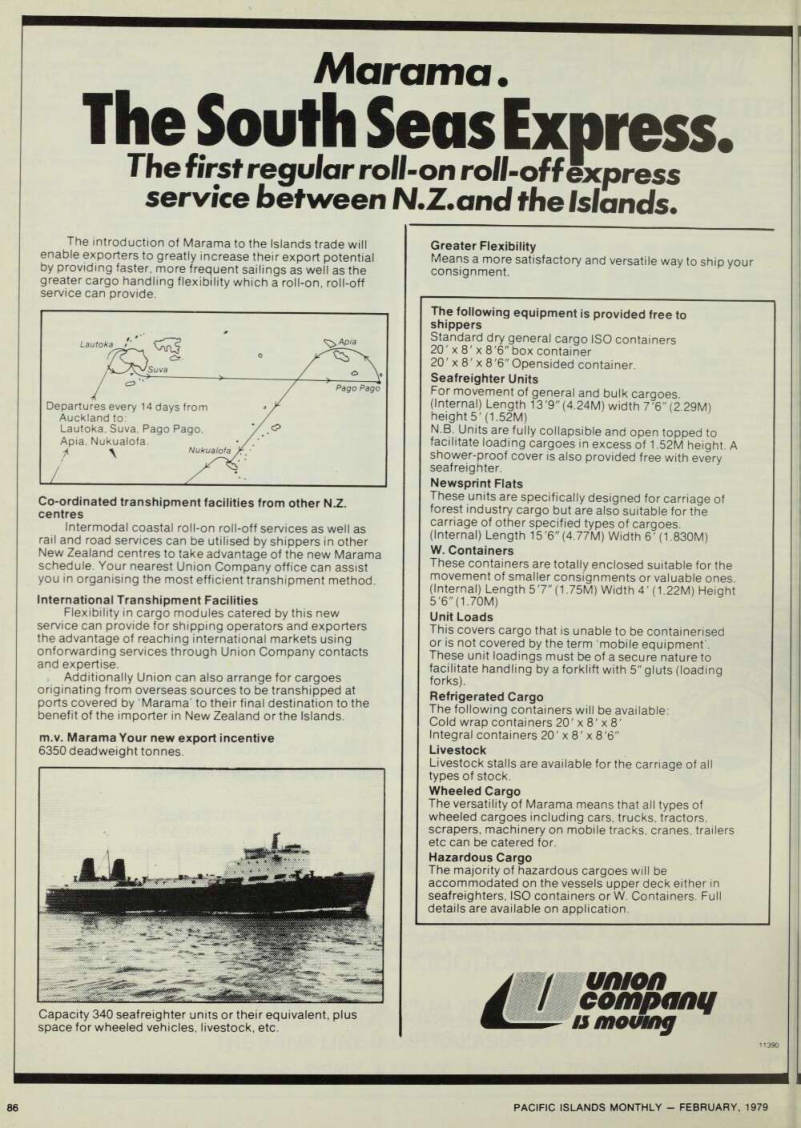
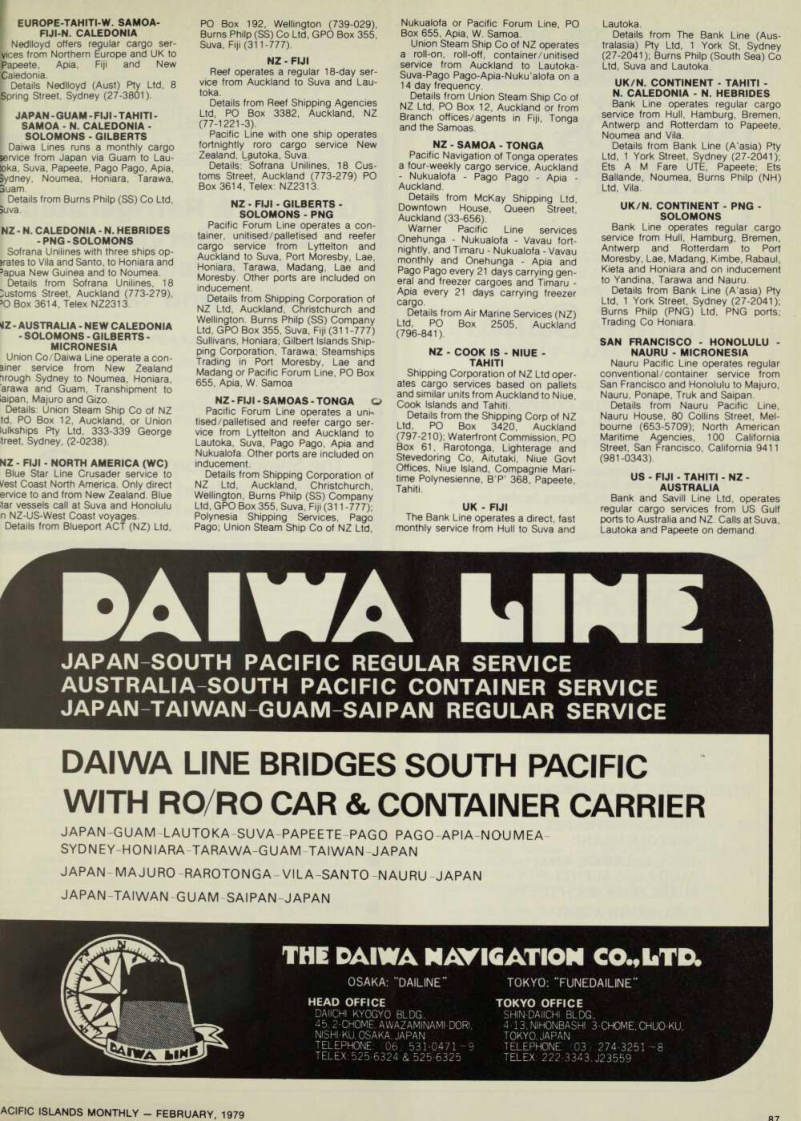
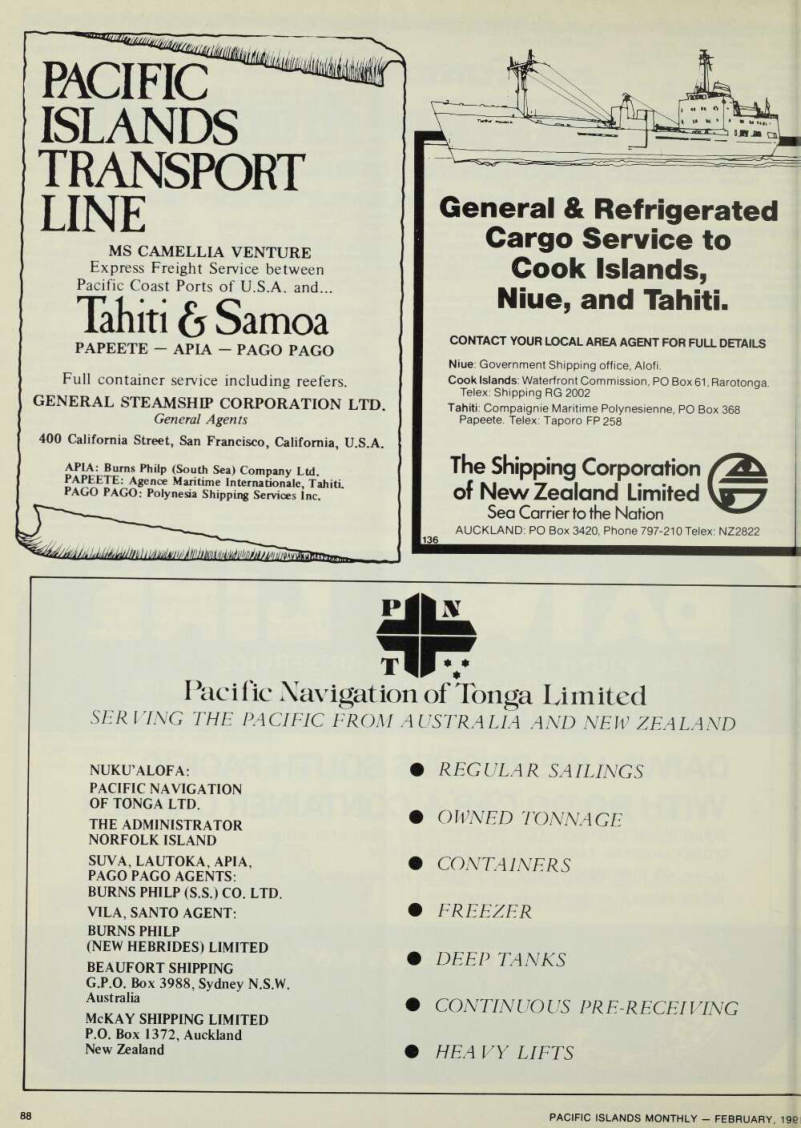
Shipping
These listings do not necessarily cover all services to Island ports.
Should any shipping company wish to have its services cargo and passenger included in these list ings they should contact PIM.
Sydney - Lord Howe Is -
Norfolk Is
Compagnie des Chargeurs Caledoniens operates four-weekly cargo service Sydney - Lord Howe Island and Norfolk Island.
Details Hetherington Kingsbury Pty Ltd, 37-49 Pitt Street, Sydney (27-1671).
SYDNEY - NZ - FIJI - HAWAII -
Canada - Us
P & O liners call at Auckland, Suva, Honolulu and Vancouver on eastbound and westbound voyages between Syd aey and the US.
Details from P & O Booking Centre, A/orld Travel Headquarters Pty Ltd, 33 3ligh Street, Sydney (231-6655).
AUSTRALIA - NZ - FIJI - TONGA
N. Hebrides - Noumea - Png
Solomons-Samoas
Sitmar Cruises operates a year-round :ruise programme to include most of he above countries.
Details from Sitmar Cruises, 47 Elizabeth Street, Sydney (232-7511).
Royal Viking Line, with first-class ■ruise ships Royal Viking Star, Royal Vi ing Sky and Royal Viking Sea, cruises le Pacific from Sydney and Cairns call ig at a variety of Pacific and Asian orts.
Details from Wilh, Wilhelmsen
Agency Pty Ltd, 13-15 Bridge Street, Sydney (2-0517).
P & O liners call at Auckland, Bay of Islands, Honiara, Lautoka, Noumea, Nuku’alofa, Pago Pago, Papeete, Port Moresby, Santo, Savusavu, Suva, Vavau and Vila on cruises from Aus tralia.
Details from P & O Booking Centre World Travel Headquarters Pty Ltd, 33 Bligh Street, Sydney (231-6655).
Australia - Fiji - Samoas -
New Hebrides - Tonga -
Norfolk Island
Pacific Navigation of Tonga operates a five-weekly refrigerated general car go/container service from Sydney and Brisbane, to Vila, Santo, Suva, Lautoka, Apia, Pago Pago, Nuku’alofa and Nor folk Island.
Details from Beaufort Shipping Agency Co, 2 Castlereagh Street, Syd ney (239-1022).
Australia - New Caledonia
(And/Or) New Hebrides
Karlander operates a monthly service from Sydney to Noumea.
Details from Karlander (Aust) Pty Ltd, 19-31 Pitt Street, Sydney (27-6301).
Sofrana-Unilines ships serve Noumea every three weeks from the main ports along the east Australian coast.
Details from Sofrana-Unilines, 37 Pitt Street, Sydney (27-2031), Trans- Austral Shipping Pty Ltd, 570 Bourke Street, Melbourne (67-9162), ACTA Pty Ltd, Brisbane (221-3116), Elders-ANL Pty Ltd, Port Adelaide (47-5688), ANL, Newcastle (049-24364), Clements & Marshall, Burnie, Tasmania (31-1833).
Compagnie des Chargeurs Caledoniens operates a three-weekly containerised cargo service from Syd ney to Noumea.
Details Hetherington Kingsbury Pty Ltd, 37-49 Pitt Street, Sydney (27-1671).
Compagnie Generale Maritime oper ates a monthly service from Sydney to Noumea, Port Vila and Santo, using Ro-Ro vessels.
Details Compagnie Generale Mari time, 12 Castlereagh Street, Sydney (231-3700).
Australia - Png
Containers Pacific Express (Burns Philp and AWP Line) and NGAL/PNGL Operate chief Container Service from Australia to PNG-Solomon Islands ports on joint slot sharing basis. Three con tainer vessels operate on 28-day turn around from Melbourne, Sydney and Brisbane to Port Moresby. Lae, Rabaul, Kavieng, Wewak, Madang, Kieta and Honiara.
Details from Burns Philp & Co Ltd, 51 Pitt Street, Sydney (20-547) and Interocean Swire, 8 Spring Street, Syd ney (2-0522).
Farrell Lines operates a service every month from Tasmania, Melbourne, Syd ney and Brisbane to Lae and Rabaul.
Details from Wilh Wilhelmsen Agency Pty Ltd, 13 Bridge Street, Sydney (2-0517), 60 Market Street Melbourne (61-3031), J. C. Waller (Rabaul) Pty Ltd, Rabaul, Robert Laurie-Carpenter (NG) Pty Ltd, Lae.
New Guinea Express Lines operates three-weekly conventional and con tainer services Melbourne, Sydney, Brisbane, Port Moresby, Lae, Rabaul, Alotau.
Details from New Guinea Express Lines, PC Box R 73, Royal Exchange PC, Sydney (241-3991) MacArthur Shipping Agency Co, 82-92 Eagle Street, Brisbane (229-3777), New Guinea Express Lines, 327 Collins Street, Melbourne (61-3053), Niugini Express Lines in Port Moresby (212466), Lae (42-1536). Rabtrad Niugini Pty Ltd. Rabaul (92-2911).
Karlander New Guinea Line's cargo vessels call at Melbourne, Sydney, Port Moresby, Lae. Madang, Wewak, Manus, Kimbe, Rabaul.
Details from Karlander (Aust) Pty Ltd, 19-31 Pitt Street, Sydney (27-6301), Dalgety Shipping, 461 Bourke Street Melbourne (60-0731).
Australia - Solomons -
Gilbert Is - Micronesia
Daiwa Line operates a container ser vice every 30 days from Sydney to Honiara, Kieta, Tarawa and Guam. Gizo cargoes transhipped at Honiara, Saipan, cargoes transhipped at Guam.
Details from Union-Bulkships Pty Ltd, 333-339 George Street, Sydney (2-0238, telex AA20397).
Australia - Nauru -
Majuro
Nauru Pacific Line operates regular cargo/passenger service from Mel bourne to Nauru and Majuro.
Details Nauru Pacific Line, Nauru House, 80 Collins Street, Melbourne (653-5709), Nedlloyd Swire, 8 Spring Street, Sydney C 2-0522)
Us - Png
Farrell Lines operates regular ser vices from all US west coast ports to Lae and Rabaul.
Details from Wilh, Wilhelmsen Agency Pty Ltd. 13 Bridge Street, Syd ney (2-0517), Farrell Lines, 1 Market Plaza, San Francisco. L A. (9-4105). J.
C. Waller (Rabaul) Pty Ltd, Rabaul, Burns Philp (NG) Ltd, Kieta, Robert Laurie-Carpenter (PNG) Pty Ltd, Lae.
Png - Us - Canada
Farrell Lines operates regular ser vices from Lae and Rabaul to US west coast ports and Vancouver.
Details from J. G. Waller (Rabaul) Pty Ltd, Rabaul, Robert Laurie-Carpenter (PNG) Pty Ltd, Lae, Farrell Lines, 1 Market Plaza, San Francisco, L.A. (9-4105), Wilh, Wilhelmsen Agency Pty Ltd, 13 Bridge Street, Sydney (2-0517).
North Europe - Tahiti -
New Caledonia
Hamburg-Sued operates monthly cargo services from Hamburg, Dunkirk and Le Havre to Papeete, Noumea, via Panama Details from Columbus Overseas Services Pty Ltd, 333 George Street, Sydney (290-2966), Columbus Mari time Services, 17 Albert Street, Auckland (77-3460).
Europe - Pacific Islands
Compagnie Generale Maritime oper ates services from Europe and Mediter ranean ports to Papeete and Noumea using three Ro-Ro and three multi purpose vessels thus ensuring a bi monthly sailing to and from.
Details Compagnie Generale Mari time, 12 Castlereagh Street, Sydney (231-3700).
Europe-Tahiti-W. Samoa
Fiji-N. Caledonia
Nedlloyd offers regular cargo ser vices from Northern Europe and UK to Papeete, Apia, Fiji and New Caledonia. [ Details Nedlloyd (Aust) Pty Ltd, 8 (Spring Street, Sydney (27-3801).
JAPAN - GUAM - FIJI - TAHITI -
Samoa - N. Caledonia •
Solomons - Gilberts
Daiwa Lines runs a monthly cargo service from Japan via Guam to Lau loka, Suva, Papeete, Pago Pago, Apia, Sydney, Noumea, Honiara, Tarawa, 3uam, Details from Burns Philp (SS) Co Ltd, Suva.
NZ - N. CALEDONIA - N. HEBRIDES
-Png-Solomons
Sofrana Unilines with three ships op iates to Vila and Santo, to Honiara and 3 apua New Guinea and to Noumea.
Details from Sofrana Unilines, 18 Customs Street. Auckland (773-279), >OBox 3614, Telex NZ2313.
4Z - Australia - New Caledonia
- Solomons - Gilberts -
Micronesia
Union Co/Daiwa Line operate a con ainer service from New Zealand trough Sydney to Noumea, Honiara, arawa and Guam, Transhipment to laipan, Majuro and Gizo.
Details: Union Steam Ship Co of NZ td, PO Box 12, Auckland, or Union lulkships Pty Ltd, 333-339 George treet, Sydney, (2-0238).
NZ - FIJI - NORTH AMERICA (WC) Blue Star Line Crusader service to Vest Coast North America. Only direct ervice to and from New Zealand. Blue tar vessels call at Suva and Honolulu n NZ-US-West Coast voyages.
Details from Blueport ACT (NZ) Ltd,
PO Box 192, Wellington (739-029), Burns Philp (SS) Co Ltd, GPO Box 355, Suva, Fiji (311-777).
Nz - Fiji
Reef operates a regular 18-day ser vice from Auckland to Suva and Lau toka.
Details from Reef Shipping Agencies Ltd, PO Box 3382, Auckland, NZ (77-1221-3).
Pacific Line with one ship operates fortnightly roro cargo service New Zealand, Lautoka, Suva.
Details: Sofrana Unilines, 18 Cus toms Street, Auckland (773-279) PO Box 3614, Telex: NZ2313.
Nz ■ Fiji - Gilberts -
Solomons - Png
Pacific Forum Line operates a con tainer, unitised/palletised and reefer cargo service from Lyttelton and Auckland to Suva, Port Moresby, Lae, Honiara, Tarawa, Madang, Lae and Moresby. Other ports are included on inducement.
Details from Shipping Corporation of NZ Ltd, Auckland, Christchurch and Wellington. Burns Philp (SS) Company Ltd, GPO Box 355, Suva, Fiji (311 -777) Sullivans, Honiara; Gilbert Islands Ship ping Corporation, Tarawa; Steamships Trading in Port Moresby, Lae and Madang or Pacific Forum Line, PO Box 655, Apia, W. Samoa
Nz-Fiji-Samoas-Tonga O
Pacific Forum Line operates a unH tised/palletised and reefer cargo ser vice from Lyttelton and Auckland to Lautoka, Suva, Pago Pago, Apia and Nukualofa. Other ports are included on inducement.
Details from Shipping Corporation of NZ Ltd, Auckland, Christchurch, Wellington, Burns Philp (SS) Company Ltd. GPO Box 355, Suva, Fiji (311 -777); Polynesia Shipping Services, Pago Pago; Union Steam Ship Co of NZ Ltd,
Nukualofa or Pacific Forum Line, PC Box 655, Apia, W. Samoa.
Union Steam Ship Co of NZ operates a roll-on, roll-off, container/unitised service from Auckland to Lautoka- Suva-Pago Pago-Apia-Nuku’alofa on a 14 day frequency.
Details from Union Steam Ship Co of NZ Ltd, PC Box 12, Auckland or from Branch offices/agents in Fiji, Tonga and the Samoas.
Nz- Samoa - Tonga
Pacific Navigation of Tonga operates a four-weekly cargo service, Auckland - Nukualofa - Pago Pago - Apia - Auckland.
Details from McKay Shipping Ltd, Downtown House, Queen Street, Auckland (33-656).
Warner Pacific Line services Onehunga - Nukualofa - Vavau fort nightly. and Timaru - Nukualofa - Vavau monthly and Onehunga - Apia and Pago Pago every 21 days carrying gen eral and freezer cargoes and Timaru - Apia every 21 days carrying freezer cargo.
Details from Air Marine Services (NZ) Ltd, PO Box 2505, Auckland (796-841).
NZ - COOK IS - NIUE -
Tahiti
Shipping Corporation of NZ Ltd oper ates cargo services based on pallets and similar units from Auckland to Niue, Cook Islands and Tahiti.
Details from the Shipping Corp of NZ Ltd, PO Box 3420, Auckland (797-210); Waterfront Commission, PO Box 61. Rarotonga, Lighterage and Stevedoring Co, Aitutaki, Niue Govt Offices, Niue Island, Compagnie Mari time Polynesienne, B'P’ 368, Papeete, Tahiti.
Uk - Fiji
The Bank Line operates a direct, fast monthly service from Hull to Suva and
Lautoka.
Details from The Bank Line (Aus tralasia) Pty Ltd, 1 York St, Sydney (27-2041); Burns Philp (South Sea) Co Ltd, Suva and Lautoka.
Uk/N. Continent - Tahiti -
N. Caledonia - N. Hebrides
Bank Line operates regular cargo service from Hull, Hamburg. Bremen, Antwerp and Rotterdam to Papeete, Noumea and Vila.
Details from Bank Line (A’asia) Pty Ltd, 1 York Street, Sydney (27-2041); Ets A M Fare LITE, Papeete; Ets Ballande, Noumea, Burns Philp (NH) Ltd. Vila.
Uk/N. Continent - Png -
Solomons
Bank Line operates regular cargo service from Hull, Hamburg, Bremen, Antwerp and Rotterdam to Port Moresby, Lae, Madang, Kimbe, Rabaul, Kieta and Honiara and on inducement to Yandina, Tarawa and Nauru.
Details from Bank Line (A’asia) Pty Ltd, 1 York Street, Sydney (27-2041); Burns Philp (PNG) Ltd, PNG ports; Trading Co Honiara.
San Francisco - Honolulu -
Nauru - Micronesia
Nauru Pacific Line operates regular conventional/container service from San Francisco and Honolulu to Majuro.
Nauru, Ponape, Truk and Saipan.
Details from Nauru Pacific Line.
Nauru House, 80 Collins Street, Mel bourne (653-5709); North American Maritime Agencies, 100 California Street, San Francisco, California 9411 (981 -0343).
US - FIJI - TAHITI - NZ -
Australia
Bank and Savill Line Ltd, operates regular cargo services from US Gulf ports to Australia and NZ. Calls at Suva, Lautoka and Papeete on demand.
I Details from Bank Line (A’asia) Pty Ltd, 1 York Street, Sydney (27-2041) or Howard Smith Industries Pty Ltd, 1 York Street, Sydney (27-5611).
Us - A. Samoa-Nz-Aust
■ Farrell Lines LASH ships operate regularly from US to Australia, via Pago Pago and Auckland and Canada.
I Details from Wilh, Wilhelmsen Agency Pty Ltd, 13 Bridge St., Sydney [2-0517); 60 Market Street, Melbourne 1)1-0301); Farrell Lines, 1 Market Plaza, San Francisco, L.A. [415-777-3300); Dalgety NZ Ltd.
Auckland (7-1859); Kneubuhl Maritime pervices, Pago Pago (633-5121).
Us - Tahiti - Samoa
[ Pacific Islands Transport operates a ive/six weekly cargo service from Morth America west coast ports to »apeete, Pago Pago, Apia.
Details from Trans-Austral Shipping >ty Ltd, 19 Pitt Street, Sydney 27-2441).
Polynesia Line operates container md general cargo service from US west least ports to Papeete and Pago 'ago Details from Polynesia Shipping Ser ices Inc,. PO Box 1478, Pago Pago 9-6799).
Png - Uk/Continent
Bank Line operates regular cargo ervice from Kieta, Rabaul, Kimbe, ladang and Lae to Liverpool, Ham urg, Rotterdam, Antwerp and Lon on.
Details from Bank Line (A'asia) Pty td, 1 York Street, Sydney (27-2041), urns Philp (PNG) Ltd, PNG ports.
Png - Us
Bank Line operates regular cargo irvice from Kieta, Rabaul, Kimbe, adang and Lae direct to New Orleans; tils at other US Gulf and East Coast )rts on inducement.
Details from Bank Line (A’asia) Pty d, 1 York Street, Sydney (27-2041); jrns Philp (PNG) Ltd, PNG ports.
Solomons - Usa -
Uk/Continent
Bank Line operates regular cargo rvice from Honiara, to New Orleans, /erpool, Hamburg, Rotterdam and i twerp.
Details from Bank Line (A’asia) Pty i, 1 York Street, Sydney (27-2041); ading Co, Honiara (389).
Far East - Fiji - New
Zealand
New Zealand Unit Express (CNC, 'JOL, Nedlloyd) operates a three >ekly cargo service from Hong Kong Lautoka, Suva, NZ ports, Manila, loshiung, Keelung, Hong Kong.
Details from Nedlloyd, 8 Spring eet, Sydney (2-0522).
Nedlloyd operates monthly cargo rvice with three ships from Surabaya, karta, Bangkok, Port Kelang and igapore to Suva and NZ ports.
Details from Nedlloyd (Aust) Pty Ltd, Spring Street, Sydney (27-3801); irns Philp (SS) Co Ltd, Suva and Lau ca.
Japan - Nz - Png
Dhina Navigation Co, with three ps operates a monthly cargo service m Japan to New Zealand calling at e on return journey.
Details Nedlloyd, 8 Spring Street dney (2-0522).
Far East - Mid-S. Pacific
Dhina Navigation Co’s vessels oper a regular cargo service from Hong ng, Taiwan and Singapore to Rabaul, wak, Madang, Lae, Port Moresby, niara, New Hebrides, Noumea, Deete and Samoa.
Details from Nedlloyd, 8 Spring eet. Sydney (2-0522). (yowa Shipping Co. Ltd, operates nthly services from Hong Kong, wan, S. Korea and Japan, to Guam, pan, Solomons, New Caledonia, Fiji,
Western and American Samoa, Tahiti, Cook Is., Tonga and New Hebrides and 45-day container/break bulk cargo ser vice from Kobe, Nagoya and Yokohama to Guam, Suva, Lautoka and Noumea, Details. Hetherington Kingsbury Pty Ltd, 37-49 Pitt Street, Sydney (27-1671).
NYK Line, in conjunction with Daiwa Line, with container ships operates 30-day service from Moji, Kobe, Nagoya and Yokohama to Papeete, Pago Pago, Apia, Suva, Lautoka, Noumea, Sydney, Honiara, Kieta, Tarawa, Guam and Taiwan.
Details: Union Bulkships Pty Ltd, 333-339 George Street, Sydney (2-0238).
Australia - Fiji
Karlander (Aust) Pty Ltd operates monthly cargo services from Sydney to Suva and Lautoka.
Details from Karlander (Aust) Pty Ltd, 19-31 Pitt Street, Sydney (27-6301), Dalgety Shipping, 461 Bourke Street.
Melbourne (60-0731). Burns Philp (SS) Co Ltd, Suva and Lautoka.
Sofrana-Unilines (Fiji Express Line) operates to Suva and Lautoka every three weeks from the main ports on the east coast of Australia and monthly to Lautoka from Melbourne and Sydney.
Details from Sofrana-Unilines. 37 Pitt Street, Sydney (27-2031), Trans- Austral Shipping Pty Ltd, 570 Bourke Street, Melbourne (67-9162), ACTA Pty Ltd, Brisbane (221-3116), Elder-ANL Pty Ltd, Port Adelaide (47-5688), ANL, Newcastle (049-24364), Clements & Marshall, Burnie, Tasmania (31-1833).
Australia - W Samoa
Compagnie Generate Maritime oper ates a monthly service from Sydney to Apia, using Ro-Ro vessels.
Details Compagnie Generate Mari time, 12 Castlereagh Street, Sydney (231-3700).
Australia - Fiji - Tuvalu
Samoas- Tonga
Pacific Forum Line operates a con tainer, unitised/palletised and reefer cargo service from Melbourne and Syd ney to Lautoka, Suva, Funafuti, Pago Pago, Apia and Nukualofa. Other ports are included on inducement.
Details from ANL Melbourne and Brisbane, Union Bulkships, Sydney, Hobart, Port Adelaide and Fremantle, Burns Philp (SS) Company Ltd, GPO Box 355, Suva, Fiji (311-777); Polynesia Shipping Services, Pago Pago; Union Steam Ship Co of NZ Ltd, Nukualofa: PWD, Funafuti; or Pacific Forum Line, PO Box 655, Apia, W Samoa.
Australia - Northern
Marianas - Micronesia
Nauru Pacific Line operates a regular container service from Melbourne to Saipan. Truk, Ponape and Kosrai.
Details Nauru Pacific Line, Nauru House, 80 Collins Street, Melbourne (653-5709), Nedlloyd Swire, 8 Spring Street, Sydney (2-0522).
Australia - Tonga -
Samoas - Tahiti
Karlander operates a monthly cargo service from Melbourne and Sydney to Nukualofa, Apia, Pago Pago. Papeete, US west coast.
Details: Karlander (Aust) Pty Ltd, 19-31 Pitt Street, Sydney (27-6301).
Australia - Tahiti
Daiwa Line offers a four-weekly ser vice from Australia to Papeete.
Details: Union Bulkships Pty Ltd, 333-339 George Street, Sydney (2-0238).
Compagnie Generate Maritime oper ates a monthly service from Sydney to Papeete using Ro-Ro vessels.
Details Compagnie Generate Mari time, 12 Castlereagh Street, Sydney (231-3700).
Advertisements & other items, pp. 85-92 (4 items)
85
ISLANDS MONTHLY - FEBRUARY, 1979
Nelson &Robertson
/I t o -o cT» V o
FOR
BRANCH OFFICES:
PAPUA NEW GUINEA
REPRESENTATIVES:
-A.- W-*-*. ■ -- •> i -i-i ■. V-ii-'--— l l-mru.T^L-r^^
IN OUR 84th YEAR SELLING ‘SERVICE’
TO THE PACIFIC ISLANDS...
Nelson &Robertson
PTY. LTD. (Established 1895)
Plantation House, 197 Clarence Street, Sydney.
Cables: ‘IVANT, Sydney, Brisbane. Telex: AA22381, Sydney.
INDENTS - FROM AUSTRALIA, NEW ZEALAND and OVERSEAS.
FOODSTUFFS • HARDWARE • TRAVEL • CANNED FISH MACHINERY • INSURANCE • SOFTGOODS • JUTE GOODS
• REAL ESTATE •
Nelson & Robertson Pty. Ltd., P.O. Box 575, Brisbane, Qld., Australia.
P-O. Box 2092, Govt. Bldg., Suva, Fiji. P.O. Box 258, Lautoka, Fiji.
P.O, Box 2420, CPO Auckland 1, New Zealand.
Rabtrad Niugini Pty, Ltd., P.O. Box 219, Rabaul, P.N.G.
P.0.80x 1406, Lae, PJ9.G. P.O. Box 711, Madang, P.N.G P.O. Box 253, Kieta, P.N.G. 55
Marama .
The South Seas Express.
The first regular roll-on roll-offexpress
service between N.Z.and the Islands.
The introduction of Marama to the Islands trade will enable exporters to greatly increase their export potential by providing faster, more frequent sailings as well as the greater cargo handling flexibility which a roll-on, roll-off service can provide.
LautokaS_ Suva Departures every 14 days from Auckland to: Lautoka, Suva, Pago Pago.
Apia, Nukualofa. f \ Nukualofa <sZ>Apia Co-ordinated transhipment facilities from other N.Z. centres Intermodal coastal roll-on roll-off services as well as rail and road services can be utilised by shippers in other New Zealand centres to take advantage of the new Marama schedule. Your nearest Union Company office can assist you in organising the most efficient transhipment method.
International Transhipment Facilities Flexibility in cargo modules catered by this new service can provide for shipping operators and exporters the advantage of reaching international markets using onforwarding services through Union Company contacts and expertise.
Additionally Union can also arrange for cargoes originating from overseas sources to be transhipped at ports covered by Marama’ to their final destination to the benefit of the importer in New Zealand or the Islands. m.v. Marama Your new export incentive 6350 deadweight tonnes.
Capacity 340 seafreighter units or their equivalent, plus space for wheeled vehicles, livestock, etc.
Greater Flexibility
Means a more satisfactory and versatile way to ship your consignment.
The following equipment is provided free to shippers Standard dry general cargo ISO containers 20' xB' x B'6" box container 20' xB' x B'6" Opensided container.
Seafreighter Units
For movement of general and bulk cargoes. (Internal) Length 13'9"(4.24M) width 7'6"(2.29M) height 5' (1.52 M) N.B. Units are fully collapsible and open topped to facilitate loading cargoes in excess of 1.52 M height. A shower-proof cover is also provided free with every seafreighter.
Newsprint Flats These units are specifically designed for carriage of forest industry cargo but are also suitable for the carriage of other specified types of cargoes. (Internal) Length 15'6" (4.77 M) Width 6' (1.830 M) W. Containers These containers are totally enclosed suitable for the movement of smaller consignments or valuable ones. (Internal) Length 5 7" (1.75 M) Width 4' (1.22 M) Height 5'6"(1.70M) Unit Loads This covers cargo that is unable to be containerised or is not covered by the term mobile equipment’.
These unit loadings must be of a secure nature to facilitate handling by a forklift with 5" gluts (loading forks).
Refrigerated Cargo The following containers will be available; Cold wrap containers 20' x 8' x 8' Integral containers 20' x 8' x B'6"
Livestock Livestock stalls are available for the carriage of all types of stock.
Wheeled Cargo The versatility of Marama means that all types of wheeled cargoes including cars, trucks, tractors, scrapers, machinery on mobile tracks, cranes, trailers etc can be catered for.
Hazardous Cargo The majority of hazardous cargoes will be accommodated on the vessels upper deck either in seafreighters, ISO containers or W. Containers. Full details are available on application.
companq
h moving
JAPAN SOUTH PACIFIC REGULAR SERVICE
AUSTRALIA-SOUTH PACIFIC CONTAINER SERVICE
JAPAN-TAIWAN-GUAM-SAIPAN REGULAR SERVICE
DAIWA LINE BRIDGES SOUTH PACIFIC
WITH RO/RO CAR & CONTAINER CARRIER
JAPAN-GUAM-LAUTOKA-SUVA-PAPEETE-PAGO PAGO-APIA-NOUMEA
SYD N E Y-HONIARA-TARAWA-GU AM TAIWAN-JAPAN
JAPAN-MAJURO-RAROTONGA-VILA-SANTO -NAURU-JAPAN
JAPAN-TAIWAN-GUAM-SAIPAN-JAPAN
m.
THE DAIWA M/fcfIGATION CO., LTD*
OSAKA: “DAILINE” TOKYO: “FUNEDAILINE”
HEAD OFFICE
DAIICHI KYOGYO BLDG.
45.2-CHOME. AWAZAMINAMI-DORI.
NISHI-KU. OSAKA. JAPAN
TELEPHONE; 06 531-0471'9
TELEX: 525-6324 & 525-6325
TOKYO OFFICE
SHIN-DAIICHI BLDG.,
4-13. NIHONBASHI 3-CHOME, CHUO-KU,
TOKYO. JAPAN
TELEPHONE: 03; 274-3251 '8
TELEX: 222-3343. J 23559
PACIFIC
ISLANDS
TRANSPORT
LINE
MS CAMELLIA VENTURE
Express Freight Service between Pacific Coast Ports of U.S.A. and...
Tahiti 6 Samoa
PAPEETE APIA PAGO PAGO
Full container service including reefers.
GENERAL STEAMSHIP CORPORATION LTD.
General Agents 400 California Street, San Francisco, California, U.S.A.
APIA: Bums Philp (South Sea) Company Ltd.
PAPEETE: Agence Maritime Internationale, Tahiti PAGO PAGO: Polynesia Shipping Services Inc.
General & Refrigerated
Cargo Service to
Cook Islands,
Niue, and Tahiti.
CONTACT YOUR LOCAL AREA AGENT FOR FULL DETAILS Niue: Government Shipping office, Alofi.
Cook Islands: Waterfront Commission, PO Box 61, Rarotonga.
Telex: Shipping RG 2002 Tahiti: Compaignie Maritime Polynesienne, PO Box 368 Papeete. Telex; Taporo FP2SB 136
The Shipping Corporation
of New Zealand Limited
Sea Carrier to the Nation @ AUCKLAND: PO Box 3420, Phone 797-210 Telex: NZ2822
'JLU
tWv
Pacific Navigation of Tonga Limited
SER VINGTHE PACIFIC FROM AUSTRALIA AND NEW ZEALAND
NUKUALOFA:
PACIFIC NAVIGATION
OF TONGA LTD.
THE ADMINISTRATOR
NORFOLK ISLAND
SUVA, LAUTOKA, APIA,
PAGO PAGO AGENTS:
BURNS PHILP (S.S.) CO. LTD.
VILA, SANTO AGENT:
BURNS PHILP
(NEW HEBRIDES) LIMITED
BEAUFORT SHIPPING
G.P.O. Box 3988, Sydney N.S.W.
Australia
McKAY SHIPPING LIMITED
P.O. Box 1372, Auckland New Zealand
• REGULAR SAILINGS
• OWNED TONNAGE
• CONTAINERS
• FREEZER
• DEEP TANKS
• CONTINUOUS PRE-RECEIVING
• HEA VY LIFTS
HENRY CUMINES
PTY. LTD.
EXPORTERS o GENERAL MERCHANTS
428 GEORGE ST., SYDNEY
CABLES: HENCO SYDNEY. G.P.O. Box 3949. PHONE:, 232-5377 •
For specialised and personalised buying service
throughout the Pacific Islands and the East.
* LOCAL AGENTS AND REPRESENTATION: •-
PAPUA NEW GUINEA:
RABAUL: M. & C. Seeto, P.O. Box 131, Rabaul.
Telephone 92-2919.
MADANG: W. Double, P.O. Box 22, Madang.
Telephone 82-2696.
SOLOMON
FIJI:
K. Witherington Ltd., P.O. Box 293, Suva.
Telephone 22-356.
NEW HEBRIDES:
John Lum & Associates, P.O. Box 65, Santo.
Telephone 329
ISLANDS:
Mr. Tom Lo, P.O. Box 327, Honiara.
Telephone 399, -• Resident Agents in other Pacific Territories. %-
PACIFIC
i FORUm
Line
OWNED BY THE PEOPLE
OF THE PACIFIC ISLANDS
Regular Monthly Liner Services
from Australia and New Zealand
to the South and Central Pacific
FOR INFORMATION CONTACT AGENTS:
AMERICAN SAMOA:
Polynesian Shipping Services Inc. P.O. Box 1478, Pago Pago
AUSTRALIA:
The Australian National Line, 50 Queen Street, Melbourne.
Union Bulkships Pty.Ltd., 333-339 George Street, Sydney.
GILBERT ISLANDS:
Gilbert Islands Shipping Corp. P.O. Box 495, Tarawa.
FIJI:
Burns Philp South Sea Co. Ltd. GPO Box 355, Suva.
NEW CALEDONIA;
ETS Ballande, BP. C 4, Noumea.
NEW HEBRIDES:
Burns Philp New Hebrides Limited, Vila.
NEW ZEALAND:
The Shipping Corp. of N.Z. Ltd. P.O. Box 3344, Wellington.
PAPUA NEW GUINEA:
Steamships Trading Co. Ltd. P.O. Box 1, Port Moresby.
SOLOMON ISLANDS:
Sullivans S.l. Ltd. GPO Box 3, Honiara.
TONGA:
Union Steam Ship Co. P.O. Box 4, Nukualofa.
FLEETS 80 ft Twin Diesel general purpose Cruiser, profess, bit. 1947, coppered, 4 w.t. bulkheads, 10 berths, $65,000, FLEETS, 221 Esplanade, Wynnum Central, Brisbane. Cable
FLEETS BRISBANE.
NOTICE - TRADE MARK.
Dynamit Nobel Aktiengese/lschaft of P.O.
Box 1209, 521, Troisdorf, West Germany wish it to be known that they are the owners of the Trade Mark: and that this Trade Mark is used by Dynamit Nobel Aktiengese/lschaft on or in connection with ammunition and projectiles, explosive substances, fireworks, firearms for hunting and sporting purposes, optical apparatus and instruments.
Proceedings will be taken against any third party found to be using the above Trade Mark on or in connection with ammunition and projectiles, explosive substances, fireworks, firearms for hunting and sporting purposes, optical apparatus and instruments.
McCUBBERY TRAIN LOVE & THOMAS
Barristers and Solicitors, Port Moresby, Agents for Davies and Co/lison, Trade Mark Agents for the proprietors.
CLASSIFIED
ADVERTISEMENTS
Per L ine 55.00 Aust.
Minimum 4 lines.
PETER FISHER
TRADING
Pty Ltd
321 PITT St., SYDNEY, AUSTRALIA 2000
Telephone: 261109 Cables: "FISHERION" SYDNEY
EXPORTERS TO THE
PACIFIC ISLANDS
RINE PACIFIC LTD.
FS
SALVAGE - TOWAGE
TUGS
500 - 2700 b.h.p.
RAMPED - BARGES
250 500 d.w.t.
For charter throughout the South Pacific cable: TUGBOAT, SUVA, telex: FJ2202
THE PAPUA HOTEL
PORT MORESBY
• Right in the business centre • A tradition for comfort and fine food • All rooms air conditioned • Restaurant • Bars • Banquet Hall Telephone 21 2622 Cables PARTE L
A. C. NEUMANN
Manager
KNOX SCHLAPP Sydney, for sale on behalf of client one skid mounted radiator cooled, 250 KVA Delco Generator Set Model E 5259 H 2-3 Phase complete power 12V71 GM.
Price $15,000. Contact Mr. C.
McKenzie 699 8333. A.H. 868 2701.
SHIP FOR SALE. Suva. Twin screw 150 Ton Steel Cargo Vessel In need of repair. Enquiries: PO Box 3055, Lami, Fiji Tall Ingots Brisbane Aust. Tel 392 2033 12, Tennyson Memorial Drive Yeerongpilly Bris. Aust 4105. V Sanders Port Moresby Tel 25 6915. PO Box 9128 Hohola Port Moresby
If you're coming to Sydney
put yourself in our position.
The Hotel Imperial is perfectly placed. You stay at the heart of Kings Cross which is at the heart of Sydney’s attractions.
You’re only minutes from the city, harbour bridge and Opera House.
And only minutes from Sydney’s famous bays and beaches.
You’ll also find us close to your heart. We believe in old-fashioned service and, in these times, old-fashioned prices.
Bed and full English breakfast is just $l4 single, $l9 double ortwin.
Groups $7 per person. Kids under 2 are free and under 12, $3.
Our family suites provide colour TV, fans and heating for $35 per day (5 persons) including breakfast. ¥ Contact Graeme Dube on (02) 31 7051, telex AA25718 or see your local travel agent. 221 Darlinqhurst Road, Kings Cross, H.S.W. 2011
JACKA 12598
Hotel Imperial
Go straight to the heart of Sydney. \x\x\HilM
- COCXXXDOCXXXXXXyXXX
-wasior
'/// I -M \ ' \
Stay at Aggie Grey's
the South Pacific's
legendary hotel.
Situated right in the heart of Western Samoa. Enjoy Polyneslan-style friendliness and service, in cool surroundings, superb entertainment and food. Magnificent white sand beaches only a short drive away. Airconditioned rooms, swimming pool and full bar facilities.
Bookings through Union Steamship Company of NZ, Pan Am, Air New Zealand or direct to Aggie Grey's, Apia, Western Samoa.
Cables: AGGIES, APIA.
Yamaha 85... Three cylinders
for Triple Excitement.
• • * •wi
isin9
qo 'o^ Whatever kind of boating you enjoy, you’ll enjoy it more with
the Yamaha 85.
The exciting new Yamaha 85 is packed with performance and convenience features to put more fun into any kind of boating. From the specially designed prop to its 1140 cc powerhead, it delivers more than any other outboard in its class.
If you’re a skier, you’ll opt for its awesome, full-throttle power, a full 85hp worth. Pull a whole family at the same time or put the most accomplished slalom expert though his paces. There’s never a hesitation with the 85’s CD,I. ignition, specially-ported Schnule scavenging system and pefectly tuned carburetion.
For inland and off-shore cruising, the 85 has all the long-range performance and operating eco- From 2 to 85. Power for any purpose.
YAMAHA
nomy you could ask for. The almost perfectly balanced geometry of its three-cylinder design eliminates vibration for smoother running, while the through-the-prop exhuast and oversize intake silencer and muffler reduce noise to a minimum.
Fishermen will appreciate how much faster it gets them to their favorite fishing ground. And when they get there, the’ll be amazed at the 85’s trolling performance. Yamaha’s famous reed valve intake and specially-slit exhaust ports give the 85 great low-speed performance.
Power, reliability and economy at all speeds and for all boats. It’s your with the Yamaha 85.
Outboard
with
YAMAHA
Datsun’s smoke cloud lets
you breathe easy
Ever found yourself yawning at the wheel when all the windows are up? Or opened the door to be greeted by a smell of stale air? Yes, a stuffy atmosphere can sure take the pleasure out of motoring.
At Datsun, we go to a lot of trouble to ensure that the air you breathe is fresh. For one thing, we fill the car with smoke. This confirms its airtightness. More importantly, it checks the efficiency of the air exhaust outlets. And by placing the car in a wind tunnel, we can observe and analyze the smoke’s reaction under simulated driving conditions. It’s all part of Datsun’s tough test program. And what we learn from the smoke allows us to design a more efficient ventilation system.
One which provides you with a constant, controlled flow of fresh air.
This way you get to breathe easy.
Drive comfy. And that’s what makes the Datsun ride such a refreshing experience.
Tough tests: the Datsun way to total economy.
DATSUN
T
THE NAME Of QUALITY
NISSAN MOTOR CO. LTD
Datsun Distributors: Boroko Motors Ltd. P.O. Box 1259, Boroko, Port Moresby, P.N.G. /Carpenters Motors, Sales Division 61-63 Foster St. Walu Bay, Suva, Fiji Islands Private Mail Bag/Morris Hedstrom Ltd. P.O. Box 189, Apia, Western Samoa/United Enterprises Ltd. P.O. Box 262, Honiara, Solomon Islands/Sirius Motors P.O. Box 34, Norfolk Island, South Pacific/ Jacob Enterprises P.O. Box 4, Republic of Nauru/Cook Islands Motor Center Ltd. P.O. Box 74, Rarotonga, Cook Islands, South Pacific/ Pentecost Pacific S.A. P.O. Box 119, Port Vila, New Hebrides/ Agence Alma S.A B.P. A 3, Noumea Cedex, New Caledonia /Tahitibull S.AR.L. B.P. 359, Papeete, Tahiti /Gilbert Islands Government. Supply Division P.O. Box 71, Bairiki, Tarawa, Gilbert Islands
87
ACIFIC ISLANDS MONTHLY - FEBRUARY, 1979
89
CIFIC ISLANDS MONTHLY FEBRUARY, 1979