Survivor
Pacific Islands Monthly
Pim
January 197!
American Samoa USSI.2S Australia AS I.OO*
Fiji FII.OO
Hawaii US$l.5O New Cal. & Fr. Poi.CFP 140 New Hebrides AS 100 M 2. Cook Is. ft NiuoNZSI.OO Norfolk Island ASI.OO Papua New Guinea KI 00 Solomons SSI. 00
Tonga Pl.OO
Ush A Guam Ussi.2S
Western Samoa H OC Registered for posting as e publication
50Mare
Ihe Great
Survivor
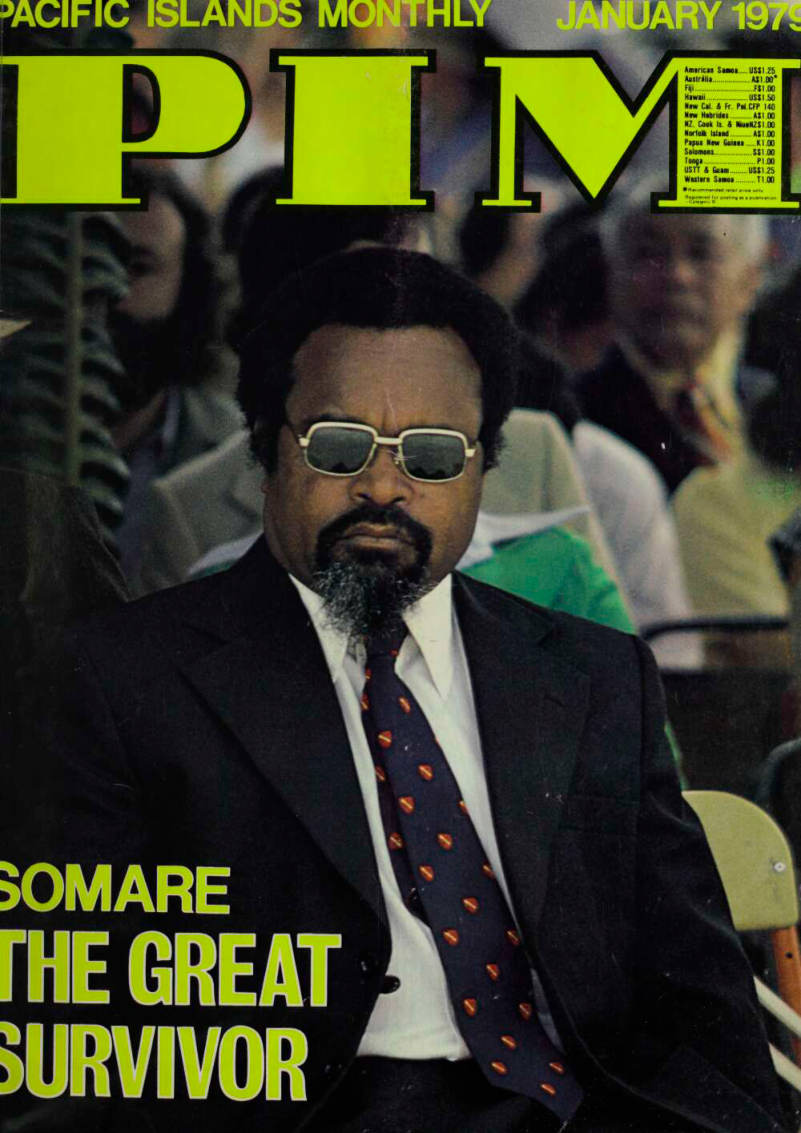
Cover: Prime Minis ter Michael Somare of Papua New Guinea in Alofi for the Niue South Pa cific Forum con ference in Sept ember.
Photo: Bob Hawkins.
Advertisements & other items, pp. 2-4 (1 item)
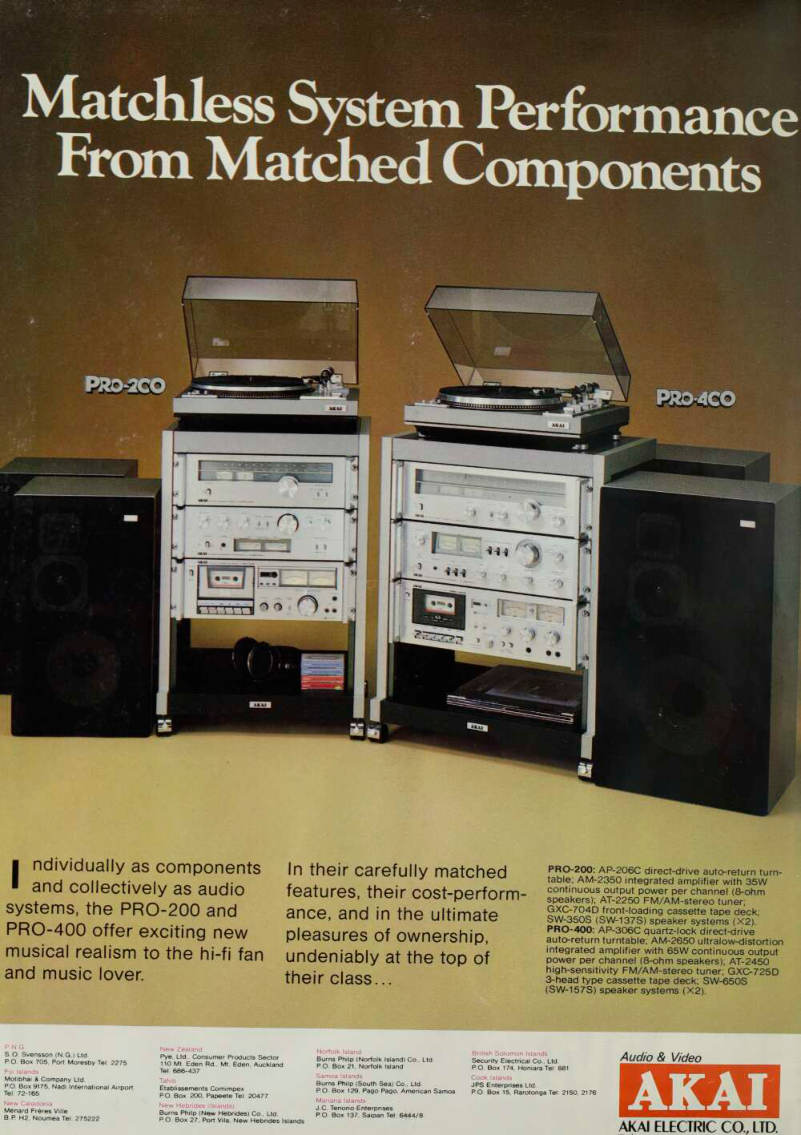
Matchless System Performance
From Matched Components
PRO-2CO
-. ■* C ms
mmm
sr.
and collectively as audio
systems, the PRO-200 and
PRO-400 offer exciting new
musical realism to the hi-fi fan
and music lover.
In their carefully matched
features, their cost-perfornrv
ance, and in the ultimate
pleasures of ownership,
undeniably at the top of
their class...
PRO-200: AP-206C direct-dtive autoreturn turn-
table; AM-2350 integrated amplifier with 35W
continuous output power per channel (8-ohm
speakers); AT-2250 FM/AM-stereo tuner;
GXC-704D front-loading cassette tape deck;
SW-350S (SW-1375) speaker systems (X 2).
PRO-400: AP-306C quartz-lock direct-drive
autoreturn turntable; AM-2650 ultralow-distortion
integrated amplifier with 65W continuous output
power per channel (8-ohm speakers); AT-2450
high-sensitivity FM/AM-stereo tuner; GXC-725D
3-head type cassette tape deck; SW-650S
(SW-1575) speaker systems (X 2).
PNG
S O. Svensson (N.G.) Ltd.
RO. Box 705, Port Moresby Tel: 2275 Fiji Islands Motibhai & Company Ltd, RO. Box 9175, Nadi International Airport Tel: 72-165 New Zealand Pye. Ltd., Consumer Products Sector 110 Mt. Eden Rd., Mt Eden, Auckland Tel: 686-437 Tahiti Etablissements Comimpex RO. Box 200. Papeete Tel: 20477 New Hebrides (Islands) Burns Philp (New Hebrides) Co., Ltd.
RO. Box 27. Port Vila. New Hebrides Islands Norfolk Island Burns Philp (Norfolk Island) Co.. Ltd.
PO. Box 21. Norfolk Island Samoa Islands Burns Philp (South Sea) Co., Ltd.
PO Box 129, Pago Pago. American Samoa Mariana Islands J.C. Tenorio Enterprises PO. Box 137. Saipan Tel 6444/8 British Solomon Islands Security Electrical Co.. Ltd.
RO. Box 174, Honiara Tel: 881 Cook Islands JPS Enterprises Ltd.
PO. Box 15, Rarotonga Tel: 2150, 2176
Audio & Video
AKAI
AKAI ELECTRIC CO., LTD.
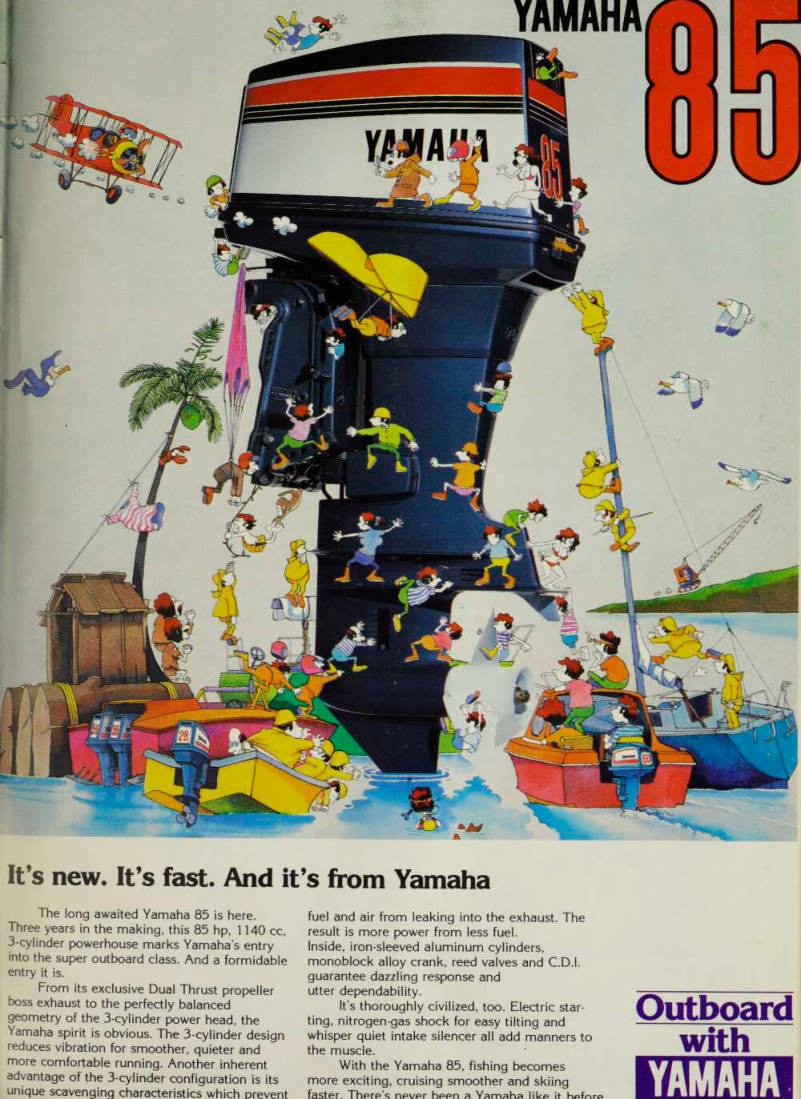
It’s new. It’s fast. And it’s from Yamaha The long awaited Yamaha 83 is here.
Three years in the making, this 85 hp, 1140 cc, 3-cylinder powerhouse marks Yamaha’s entry into the super outboard class. And a formidable entry it is.
From its exclusive Dual Thrust propeller boss exhaust to the perfectly balanced geometry of the 3-cylinder power head, the Yamaha spirit is obvious. The 3-cylinder design reduces vibration for smoother, quieter and more comfortable running. Another inherent advantage of the 3-cylinder configuration is its unique scavenging characteristics which prevent fuel and air from leaking into the exhaust. The result is more power from less fuel.
Inside, iron-sleeved aluminum cylinders, monoblock alloy crank, reed valves and C.D.I. guarantee dazzling response and utter dependability.
It’s thoroughly civilized, too. Electric starting, nitrogen-gas shock for easy tilting and whisper quiet intake silencer all add manners to the muscle.
With the Yamaha 85, fishing becomes more exciting, cruising smoother and skiing faster. There’s never been a Yamaha likp it hpfnrp
Outboard
with
YAMAHA
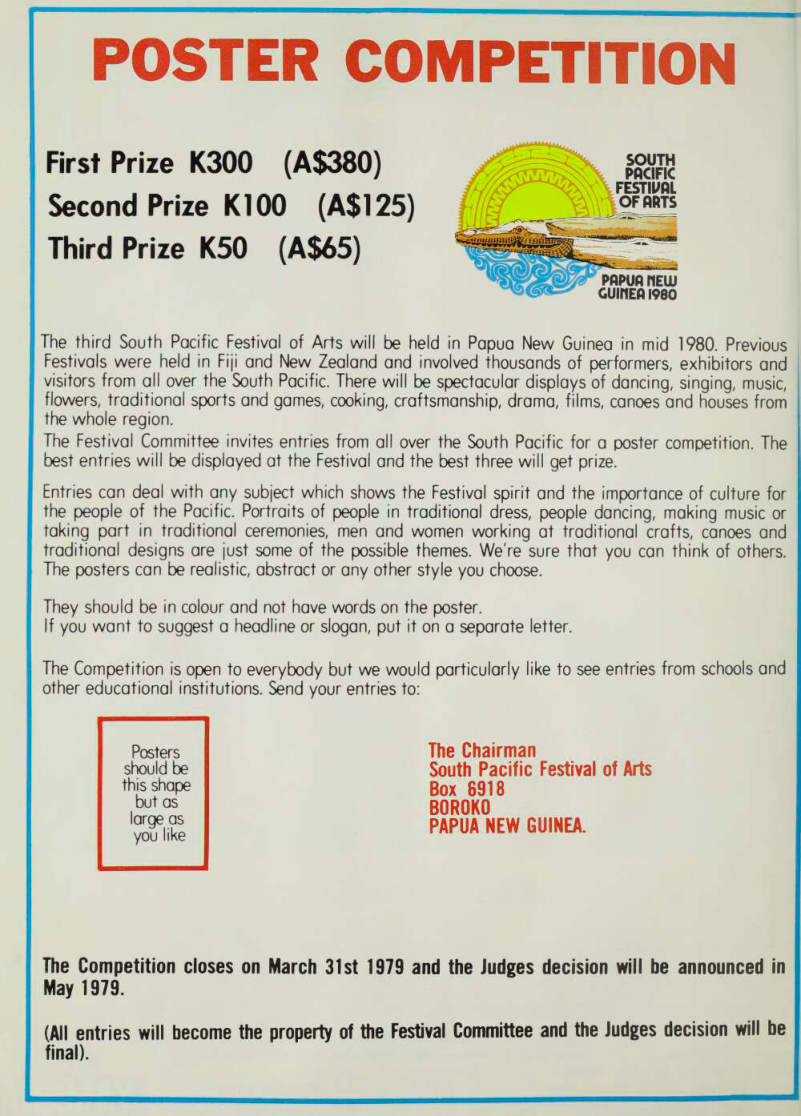
POSTER COMPETITION
First Prize K3OO (As3Bo)
Second Prize KlOO (Asl2s)
Third Prize K5O (As6s)
SOUTH
PACIFIC
FESTIVAL
OF ARTS
PAPUA nEUI
CUIMEA i 960
The third South Pacific Festival of Arts will be held in Papua New Guinea in mid 1980. Previous Festivals were held in Fiji and New Zealand and involved thousands of performers, exhibitors and visitors from all over the South Pacific. There will be spectacular displays of dancing, singing, music, flowers, traditional sports and games, cooking, craftsmanship, drama, films, canoes and houses from the whole region.
The Festival Committee invites entries from all over the South Pacific for a poster competition. The best entries will be displayed at the Festival and the best three will get prize.
Entries can deal with any subject which shows the Festival spirit and the importance of culture for the people of the Pacific. Portraits of people in traditional dress, people dancing, making music or taking part in traditional ceremonies, men and women working at traditional crafts, canoes and traditional designs are just some of the possible themes. We're sure that you can think of others.
The posters can be realistic, abstract or any other style you choose.
They should be in colour and not have words on the poster.
If you want to suggest a headline or slogan, put it on a separate letter.
The Competition is open to everybody but we would particularly like to see entries from schools and other educational institutions. Send your entries to: Posters should be this shape but as large as you like The Chairman South Pacific Festival of Arts Box 8918
BOROKO
PAPUA NEW GUINEA.
The Competition closes on March 31st 1979 and the Judges decision will be announced in May 1979. (All entries will become the property of the Festival Committee and the Judges decision will be final).
Pacific Islands Monthly
Pim
Vol. 50 No. I
January 1979
(952480)
Elsewhere: SAI6 Payment by personal cheque is accepted in Australian, US, New Zealand, UK and Fiji currency. For other remit tances please obtain a bank draft in Australian dollars made payable to the ANZ Banking Group, 88 Wentworth Avenue, Sydney, Australia.
Representatives
AUSTRALIA: Distribution Gordon & Gotch (A/asia) Ltd Box 40, PO, Rosebery, NSW 2018 Advertising - Mel bourne - Pacific Publications (Aust.) Pty Ltd, sth Floor, Alley Building, 75-77 Flinders Lane, Melbourne 3000 telephone 63-0211, ext. 1565 Jeff Gates, ext 1858 Ida Padgett: Brisbane - D. Wood, Anday Agency, Box 1918, GPO, Brisbane 4001, telephone 44 3485, 44 1546; Adelaide - Hastwell Media, PO Box 30, 399 Glen Osmond Rd, Glen Osmond, Adelaide 5064, telephone 79 1869, 79 5956; cables Hastmedia, Adelaide FIJI: Distribution and subscriptions - Desai Bookshops, PO Box 160, Suva, Fiji, telephone Suva 23036 Advertis ing - Fiji Times & Herald Ltd, 20 Gordon St, Suva, tele phone 312 111, telex FJ2124 FRENCH POLYNESIA: Distribution Hachette Pacifique, 10 Ave Bruat, Papeete, telephone 2 5610.
HAWAII, UNITED STATES: Distribution PIM, Hawaii 2812 Kahawai St, Honolulu, Hawaii 96822.
JAPAN: Advertising and subscriptions - Universal Media Corporation, CPO Box 46. Tokyo, telephone 666 3036.
NEW CALEDONIA: Distribution Depot Centre de Presse Michel Pentecost, CBP2, Noumea, telephone 27 2434, 27 4729.
NEW ZEALAND: Distribution Gordon & Gotch PO Box 584, 2 Carr Road, Mt, Roskill, Auckland 4 Advertising - International Media Representatives Ltd, PO Box 2313 Auckland, telephone 795 487; 493 389, cables Intereps, Auckland Subscriptions - Pacific Publications GPO Box 2229, Auckland PAPUA NEW GUINEA: Distribution - Robert Brown & Assoc,, PO Box 3395, Port Moresby, telephone 2 5855 Advertising - PNG Post-Courier, PO Box 85 Port Moresby, telephone 212577. rftl TED KINGDOM: The Herald & Weekly Times Ltd, 8-10 Clifford’s Inn, Fetter Lane, London EC4A IBU, telephone 01 831 6041, telex London 21989.
UNITED STATES MAINLAND; Advertising Joshua B Powers Jr, Powers International Inc., 551 Fifth Ave New York, New York 100 017, telephone 867 9580, telex 236514 Subscriptions - PIM, Hawaii, 2812 Kahawai St Honolulu, Hawaii 96822.
Published monthly by Pacific Publications (Aust.) Pty Ltd and printed in Australia by Kralco, Flemington, NSW Australian cover price is recommended retail only Regis tered at the GPO Sydney for transmission by post as a publication category B. Second class postage paid at nonolulu, Hawaii. Copyright c 1978 Pacific Publications
(Aust.) Pty Ltd.
Postmaster Honolulu: Send address changes to PIM Hawaii, 2812 Kahawi St Mr >nolulu, Hawaii 96822.
Subscriptions
PIM is airfreighted to most subscribers and agents in the Pacific Islands and the United States Aust.
Other American Samoa $13 $US16 Australia $12 Canada $14 $US18 Cook Islands $13 Fiji $12 $F12 French Polynesia $14
Cfp 1700
Guam $13 $US16 Gilbert Islands $13 Hawaii $13 $US16 Japan $16 Y4500 Micronesia $13 $US16 Nauru $13 New Caledonia $14
Cfp 1700
New Hebrides $13 New Zealand $12
Snz13.50
Niue $13 Norfolk Island $12 Northern Marianas $13 $US16 Papua New Guinea $13 K12 Solomon Islands $13 Tonga $13 Tuvalu $13 United Kingdom $15 £10 US Mainland $14 $US18 Western Samoa $13
Advertisements & other items, pp. 5-6 (2 items)
Pacific Islands Monthly January 197 Q
Founded 1930 by R. W. Robson Publisher Stuart Inder Editor Bob Hawkins Editorial Adviser John Carter Manager John Berry Advertising Manager Steve Gray A Pacific Publications production 76 Clarence Street, Sydney 2000 GPO Box 3408 Sydney 2001 Cables: PACPUB Sydney Telex; 21242 Telephone: Sydney 29 6693
O' *j*
& * V? , vV 6 ’ vv »’>
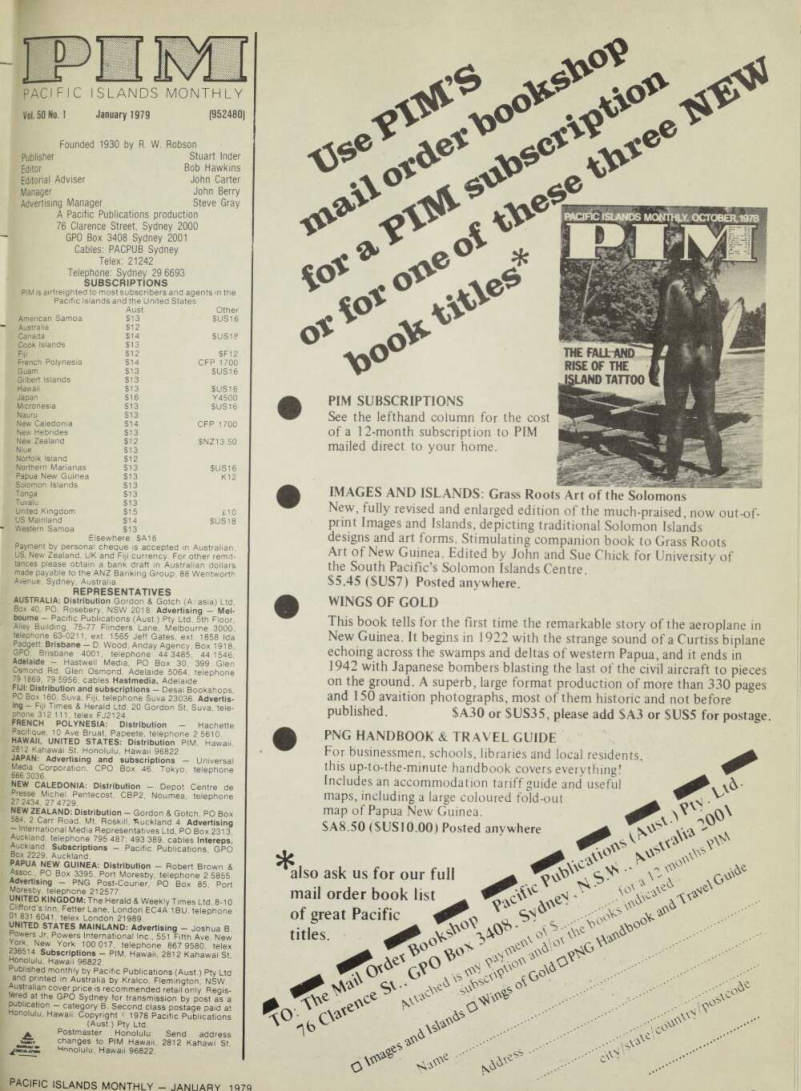
PIM SUBSCRIPTIONS
See the lefthand column for the cost of a 12-month subscription to PIM mailed direct to your home.
IMAGES AND ISLANDS; Grass Roots Art of the Solomons New, fully revised and enlarged edition of the much-praised, now out-ofprint Images and Islands, depicting traditional Solomon Islands designs and art forms. Stimulating companion book to Grass Roots Art of New Guinea. Edited by John and Sue Chick for University of the South Pacific’s Solomon Islands Centre. 55.45 (SUS 7) Posted anywhere.
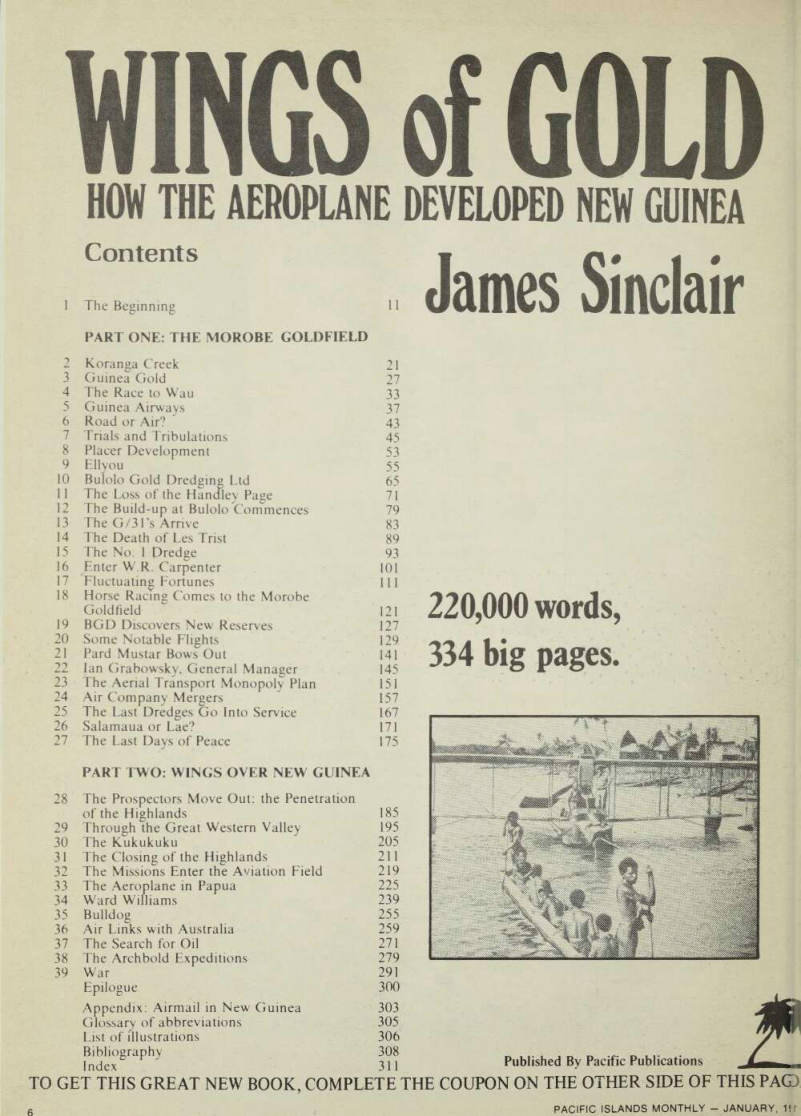
WINGS OF GOLD
This book tells for the first time the remarkable story of the aeroplane in New Guinea. It begins in 1922 with the strange sound of a Curtiss biplane echoing across the swamps and deltas of western Papua, and it ends in 1942 with Japanese bombers blasting the last of the civil aircraft to pieces on the ground. A superb, large format production of more than 330 pages and 150 avaition photographs, most of them historic and not before published. SA3O or SUS3S, please add SA3 or SUSS for postage
PNG HANDBOOK & TRAVEL GUIDE
For businessmen, schools, libraries and local residents, this up-to-the-minute handbook covers everything!
Includes an accommodation tariff guide and useful maps, including a large coloured fold-out map of Papua New Guinea. 5A8.50 (SUS 10.00) Posted anywhere N
THE FALL AND
RISE OF THE
ISLAND TATTOO
also ask us for our full mail order book list of great Pacific lilies. ,>°V % - „ V' & \' c Ns a.® o*° S° „ S' & O A* A* o iW acp a c\^ v
WINGS of GOLD
HOW THE AEROPLANE DEVELOPED NEW GUINEA
Contents
1 The Beginning
James Sinclair
PART ONE: THE MOROBE GOLDFIELD
2 Koranga Creek 21 3 Guinea Gold 27 4 The Race to Wau 33 5 Guinea Airways 37 6 Road or Air? 43 7 Trials and Tribulations 45 8 Placer Development 53 9 Ellyou 55 10 Bulolo Gold Dredging Ltd 65 11 The Loss of the Handley Page 71 12 The Build-up at Bulolo Commences 79 13 The G/3Ts Arrive 83 14 The Death of Les Trist 89 15 The No. 1 Dredge 93 16 Enter W.R. Carpenter 101 17 Fluctuating Fortunes 111 18 Horse Racing Comes to the Morobe Goldfield 121 19 BGD Discovers New Reserves 127 20 Some Notable Flights 129 21 Pard Mustar Bows Out 141 22 lan Grabowsky, General Manager 145 23 The Aerial Transport Monopoly Plan 151 24 Air Company Mergers 157 25 The Last Dredges Go Into Service 167 26 Salamaua or Lae? 171 27 The Last Days of Peace 175
PART TWO: WINGS OVER NEW GUINEA
28 The Prospectors Move Out: the Penetration of the Highlands 29 Through the Great Western Valley 30 The Kukukuku 31 The Closing of the Highlands 32 The Missions Enter the Aviation Field 33 The Aeroplane in Papua 34 Ward Williams
35 Bulldog
36 Air Links with Australia 37 The Search for Oil 38 The Archbold Expeditions 39 War
Epilogue
Appendix; Airmail in New Guinea Glossary of abbreviations List of illustrations
Bibliography
Index 185 195 205 211 219 225 239 255 259 271 279 291 300 303 305 306 308 311
220,000 words,
334 big pages.
Published By Pacific Publications TO GET THIS GREAT NEW BOOK, COMPLETE THE COUPON ON THE OTHER SIDE OF THIS PAGD
This Month
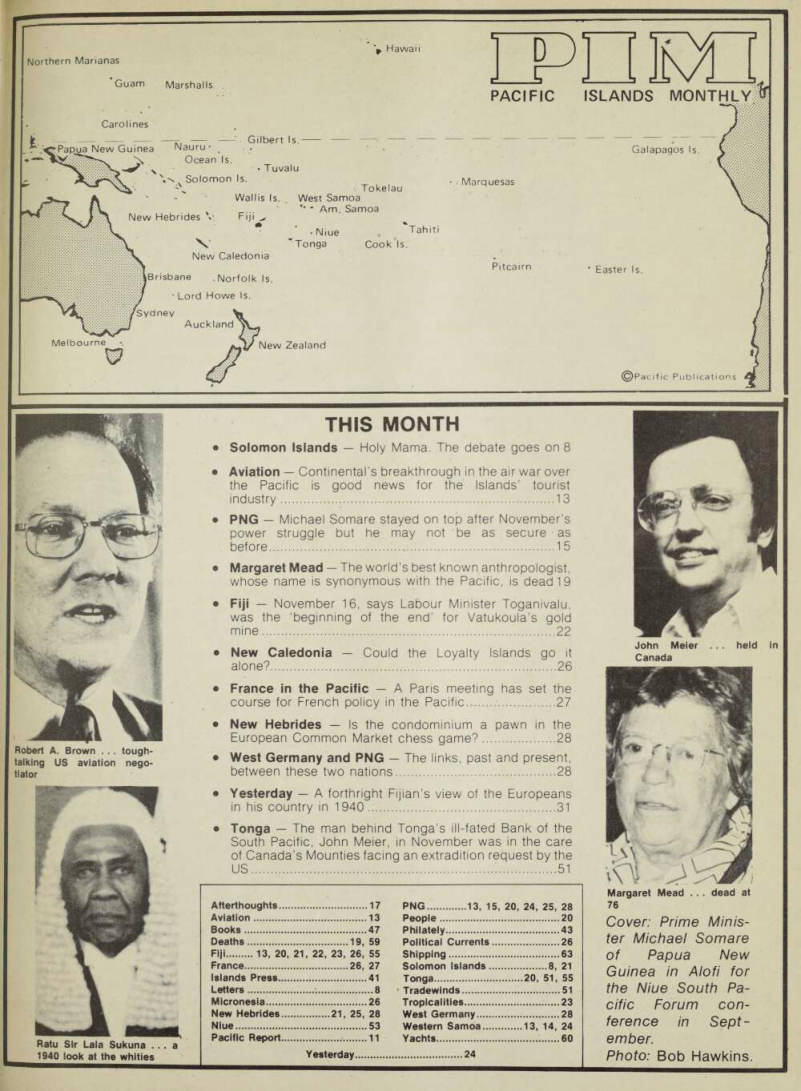
• Solomon Islands Holy Mama. The debate goes on 8 • Aviation Continental’s breakthrough in the air war over the Pacific is good news for the Islands’ tourist industry 13 • PNG Michael Somare stayed on top after November’s power struggle but he may not be as secure as before 15 • Margaret Mead The world’s best known anthropologist, whose name is synonymous with the Pacific, is dead 19 • Fiji November 16, says Labour Minister Toganivalu, was the ‘beginning of the end’ for Vatukoula’s gold mine 22 • New Caledonia Could the Loyalty Islands go it alone? 26 • France in the Pacific A Paris meeting has set the course for French policy in the Pacific 27 • New Hebrides Is the condominium a pawn in the European Common Market chess game? 28 • West Germany and PNG The links, past and present, between these two nations 28 • Yesterday A forthright Fijian’s view of the Europeans in his country in 1940 31 • Tonga The man behind Tonga’s ill-fated Bank of the South Pacific, John Meier, in November was in the care of Canada’s Mounties facing an extradition request by the US 51
Afterthoughts 17 Aviation 13 Books 47 Deaths 19, 59 Fiji 13, 20, 21, 22, 23, 26, 55 France 26, 27 Islands Press 41 Letters 8 Micronesia 26 New Hebrides 21, 25, 28 Niue 53 Pacific Report 11
PNG 13, 15, 20, 24, 25, 28 People 20 Philately 43 Political Currents 26 Shipping 63 Solomon Islands 8, 21 Tonga 20, 51, 55 • Tradewinds 51 Tropicalities 23 West Germany 28 Western Samoa 13, 14, 24 Yachts 60
Yesterday 24
Robert A. Brown . . . tough talking US aviation nego tiator
Ratu Sir Lala Sukuna ... a 1940 look at the whities
John Meier ... held in Canada
Margaret Mead . . . dead at 76
Letters
Who’S Seen
Crusader?
I appeal to yachtsmen to con sult their logs to help in my
continuing inquiry into the
missing yacht Crusader which
was seen at Sabang Pulau Weh on the northern tip of Sumatra, Indonesia, in November- December last year. It was moored next to a ‘black yacht’.
Can the owner of this ‘black yacht’ confirm my information.
Perhaps Crusader’s crew disclosed where they were heading and how much dam age they had suffered during the November 16, 1977, cyc lone.
A yacht, possibly Crusader,
was observed at 5 pm on Sep tember 16 this year, by a small
plane, moored at Ko-la-dang,
an island in the Butang group in the heart of pirate territory on the Thailand-Malaysia border. 16 kilometres north of
Langkawi.
Crusader is on the Van couver, Canada, register.
Owner-skipper is Don Sorte of the US. Crew members are Glenn McDonald of Australia.
Danny Duffy, US, Judy Vaughan, Rosemary Collier and Stephen Bower, all of the UK. Crusader was last in radio contact on November 16, 1977.
It is a 15.6 m sloop with a 3.3 m beam. It has a white
fibreglass-sheathed timber
hull, single mast, a white boom with a blue cover, and a white
fibreglass dinghy. Would any
one with information about the Crusader please contact me.
Bob Mcdonald
103 Holt Road Taren Point Sydney Australia
A Cry From
Darwin
I have been reading PIM for a couple of years now and, for the first time, find that Darwin is mentioned, (page 32, October), but I am hurt and bewildered to note in a rather
derogatory way —‘. .. starting
from, of all the unlikely places, Darwin?. . .’
What, may I ask. is so un likely about Darwin? Here it is, in the extreme north of Aus tralia, in many people’s opinion a part of Southeast Asia, if not of the South Pacific.
I am sure that the estimable Mr John Womersley would agree that the residents of this city are
mostly keen gardeners and
horticulturists. There is a lively import of orchids from Asia; there is a flourishing orchid so ciety; Darwin growers exhibi ted their blooms in Singapore in the last showing there: a bouquet of local orchids was presented to Queen Elizabeth during her visit last year.
We, the people of Darwin, are alive and well. Admittedly, we regard the rest of Australia as rather ‘unlikely’.
Mrs P. Rice-Chapman
Darwin Australia
Holy Mama
Again
G.G. Carter’s letter (PIM October) is inaccurate and very misleading, a disgrace to the writer and to the church he rep resents. Mistakes abound in Mr Carter’s letter, not in Chesher’s Holy Mama article. ‘Mama’ can be interpreted as either ‘father’ or ‘priest’. Certainly in the context which Chesher uses, ‘priest’ is the proper, or at least acceptable, translation. In case Carter does not have a dic tionary, his own language de fines ‘father’ as ‘any priest’ in connection with religion.
Carter’s assertion that: ‘Silas Eto received training in the conduct of worship like every other Methodist pastor of his day no more and no less,’ was preposterous. Do they teach young pastors in England the way Silas Eto must have been taught? Come now. Eto had no bible in his own language. He spent his time harvesting coco nuts for the mission leaders, tending to chores around the mission, and so on. He still does not read or speak English very well. His education in the Western Solomons in 1915
could hardly have qualified
him to conduct services any where but in the Western Solomons.
The idea that the warriors of the Kusaghe people killed 400 enemy in one day is funny coming from a man whose own race killed hundreds of thou sands in one day. The poor Solomon Islanders were treated to a series of exhi bitions of the white man’s ‘love one another’ policy which would shake any headhunter to the roots. First when Her Maj
esty’s gun-boats sailed along
their coasts destroying villages
with cannons, and again in World War II when the killing was enough to satisfy even the most blood-crazed savage.
Carter’s statement that he and Holy Mama had their dis agreements is the understate ment of the year. Holy Mama was involved with what is known as a charitic religion, one in which the congregation participated in an occasional bout of ecstatic joy. They felt ‘seized by God’,
Many early Christians
achieved this state and were so
inwardly gratified by this
intense experience that they
were able to be devoured by Roman lions without fear.
Even today many religious
groups experience these states of ecstasy. The English Methodists, of course, are not one of them. Such seizures
recur frequently through the
history of mankind. They all resulted in ‘love’ religions.
They were all brutally persecu ted.
A person who is in a psychic rapture of love, his own body in control of some greater will, has no need for a ‘church’ or its dogma. He needs no middleman to tell him about love or God or Jesus. He understands. Without dogma, the missionaries are powerless (not superior). There is no need to have what the missionaries call ‘thanksgiving’ tributes paid by the islanders to the missionaries that made the mission stations economically self-sufficient.
Carter, fearing an end to his own superiority, had his ‘boys’ travel throughout the Western
Solomons telling people the
government would throw them in gaol if they followed Holy Mama. They claimed Holy Mama was an evil spirit, that people would laugh at the fools
who followed Holy Mam They added that the inteia feelings of love, called 1
coming of the Holy Spiic
would cause people to insane. Carter had Holy Mam arrested and tried to get hi imprisoned in his own villsl so he could not visit others as tell his simple message of and love. All of these incm ible actions resulted in r government memo whd attests to the atmosphere s which Carter involved hiir self: This notice is to tell you t,\ the people are free to come a go as they wish. No one, excp a magistrate's court, has a power to stop or restrict peop,v\ movements. Similarly peas' are free to worship as they h and their children to attend a school they like. No one has a right to interfere with anothtd religion.
The purpose of this notice to stop silly rumours that h& been going around Simbo, pr\ ticularly that the council 1 stopped the Christian Felled ship Church from comings Simbo. This is quite untrue a the council has no powers make any such order. Janus s 25, 1963. John Field, D.C.
The government thus foiic Carter’s direct open attaor But Carter need not h;rl bothered. As he, himszi points out (by hindsight), T Christian Fellowship Chuu ... has some of the same tt dencies to keep itself to itsea Those missionaries are rascals. I recommend terested readers to get a coo of Dr Gunson’s Messengers Grace (reviewed PI October). Also, a wealth rl data is presented by Framj Harwood in her dissertate The Christian Fellows w Church, A Revitalisation Mo\ ment in Melanesia (Univem of Chicago, 1971).
Gary Bartt.
Fort Myers Florida US
Paternal
Acidity
As a Solomon Islander, I w©\ like to comment on G. .1 Carter’s letter (PIM OctobJc in reference to Dr RichE Chesher’s article on H
Mama. G. G. Carter’s opening
- and concluding paragraphs
cannot be justified in his whole
letter historically.
First, the ‘mistakes’ that Carter referred to, are open to further historical investi gations. ‘Mama’ may mean ‘father’ or ‘mother’, or ‘priest’ or ‘God’. The two words ‘Holy Mama’ were first used after a miraculous event whereby Silas Eto’s spirit was seen ’ together with the spirit of God.
It is highly likely that ‘mama’ in reference to Eto simply means ‘God’. On the other hand, ‘mama’ may mean ‘priest’ in the same way as Catholics use the word.
It is true that ‘Silas Eto received training in the con duct of worship like every other Methodist pastor of his day - no more, no less’. How ever, it is good to bear in mind that although he was a ‘dull’ student, he was never satisfied with what he was taught but always expected to find his own answers by himself. He there fore, in his twenties and thir
ties, developed an independent
mentality that so many pastors were not able to do in his time.
Menakasapa, as an outstand
ing village, was mainly the cre
ation of Holy Mama. He left college in 1932 and the village, as it was described by W. C.
Groves in 1939, depicted the ‘dreams’ and ‘visions’ of the Holy Mama. The ‘model’ of Menakasapa is also seen in other villages of the Christian Fellowship Church (CFC) where the Holy Mama helped
in their building projects.
Kusaghe section of the then Methodist mission, was very
rarely visited and leadership
responsibilities were mainly given to southern New Geor gians (especially the Munda area). These situations tended to enhance a feeling of neglect in the minds of the people of Kusaghe. The mission, because of doctrinal differences, gave* no recognitions to the work of Holy Mama, let alone his vil
lage models.
The CFC mainly kept to itself for the simple reason that the Methodist mission (now the Solomon Islands Region of the United Church of PNG and the Solomon Islands) adopted
a policy which was very paternalistic and regarded the CFC as a church of ‘evil’ spirits. This tendency was done away with when local leaders took up key positions of the church whereby both the CFC and the United Church are now beginning to learn from each other.
Although the CFC was formed in the sixties (1960 was the date for the breakaway from Methodism and 1965 saw the celebration of the CFC constitution), the issues leading up to its formation can be seen in the fifties. G. G. Carter him self came to play the vital role as the ‘opposition’ leader to the CFC. Another missionary called it the New Way move ment. The end result was that the ‘loyal Methodists’ rallied behind G. G. Carter while the CFC followed the Holy Mama.
Unlike G. G. Carter, I be lieve that PIM could not have done any better than to focus on the CFC as a feature in re lation to the Solomon Islands Independence. It was very ap propriate for a number of reasons. First, the CFC is truly a local church, started by a local leader although it sprang from Methodism. Their forms of worship, their hymns and symbols used are ‘traditional’.
They have been self-supported,
self-propagated and self administered since 1960. Sec ond, they have taught the Solomons what community development can be. What church is there in the Solomons, which, through the initiative of a local leader, has turned more than 2,000 acres of bush land into communally owned plantations? Isn’t this an essential ingredient of com munal living in Melanesia?
Thirdly, through their religious
experience (through enthusi asm, taturu), they have been motivated to work things out ‘their way’ self determination. These reasons convinced me to call Holy Mama a ‘prophet’ in Melanesia in an article entitled ‘Silas Eto
of New Georgia’, in Prophets of
Melanesia, edited by Dr Garry Trompf, published in 1977. For these reasons, Dr Chesher should be congratulated for his article in your July issue.
Finally, may I express my concern over Mr Carter’s letter.
I can’t feel that the Carter whose letter was published in your October issue is truly the G. G. Carter 0f‘1959 to 1965’.
Carter has no historical basis (at least in his letter) to prove
his opening and concluding
paragraphs. The relationship
which now exists between the CFC and the United Church (Solomons Region), as well as with the western people as a whole, would seem to suggest that Mr Carter’s letter is quite absurd.
Wherever there exists a re lationship which involves a re ciprocal measure of ‘give and take’, Mr Carter’s bold and blind statements should be withdrawn. How can one assume to have some respect for another if one only sees the bad sides to another? The 1960 s
have already disappeared with
their ‘paternal’ acids and may we remind ourselves of the need not to bring the negative bearings of such an era to the
Esau Tuza
seventies.
Melanesian Institute Goroka Papua New Guinea
All You Need
Is Love
When I wrote about Holy Mama (PIM. July) I wanted to tell you there was a way to live without hate, envy, ridicule, and jealousy. It is hard to do.
Hard to live that way. Hard to write that way. For the world is not full of love and peace and togetherness. When I read the negative, spiteful words of the former Methodist who spearheaded 20 years of ven
omous attacks against Holy
Mama I wanted to write and tell you of his history. But . . .
Need I tell you? Can you not see?
If the good Reverend has nothing but bad things to say; if the poor old man can still not see the beauty of Holy Mama; if the white missionary can so delude himself that he must attack a quiet praise for a happy old man in the woods of the Western Solomons; then we must do what Holy Mama would do ... love one another, be of one mind, work
together.
I have no attack for you, Dr Carter. Jesus said we must love
even our enemies. He said we should understand. And in our understanding, we shall find the comforter. Which is what Holy Mama has been trying to tell you, Dr Carter. You, per sonally, for all these years.
It is easy to see how a small minded, puritanical, meddle first think later attitude could have frosted the window of your soul; could have hid den reality from your eyes. The business of being a leader in the church does that to people.
It is hard to love one another, be of one mind, and work together, when you are a bureaucrat.
Is it too late for you Dr Carter? Can you not find love
and understandng for Holy
Mama? How often he has offered you his love and the other cheek?
Is it too late for you Dr Carter? Can you not find love and understanding for a simple story of a simple man which I have related exactly as I per sonally saw it and read about it?
Remember, the issue of PIM was the issue honouring the independence of Solomon Islands. Will you have no love for those men and women of the Solomons who now wish to stand before men and God in their own way? Should they not have freedom to worship in their own way? Even if it means clapping hands and dancing in the church? Can you not realise your dark talons of jealousy and see the Solomon butterfly dance away into the heavens? Are you afraid, if the world knows there is such a man as Holy Mama, that you will seem to have been his keeper rather than his friend?
Love
Richard H. Chesher
Cairns Queensland Australia.
Sanchez And
Company
After reading your feature article on one of Guam’s own ‘Frankie Sanchez, a young Guamanian of many parts’
I would like to congratulate you for a fine article on a truly remarkable individual. From what I’ve seen, he is the best.
In your story, however, you
make mention of a ‘Jose’
Sablan. This should be Johnny, not Jose. We have several other entertainers who have come nowhere near accomplishing Mr Sanchez’s feats outside of Guam but, because they sing in Chamorro vernacular, they de serve a mention: Jimmy Dee, (deputy director of the Guam Visitors Bureau). Bill James, ‘J.
D. Crutch (real name Joe Buenas), The Charfauros Brothers (owners of the only local recording studio on Guam), and the Delgado Brothers.
Although I won’t comment on the professionalism of any of them (because I do not understand Chamorro), they nonetheless deserve mention ing because they are well
known locally.
Guam
Linda Connolly
Justice In
Tonga
The leading article in Tonga Chronicle (October 6) aptly sta ted ‘Judge Lambastes Jury’.
The article referred to the ‘not guilty’ verdict by a seven-man jury in the Supreme Court of Tonga. A trial of 11 young males between the ages of 14 and 24 had just concluded be fore Justice Henry H. Hill and
the jury. Three (one aged 16
and two aged 17) had been charged with murder and the
others with manslaughter.
The charges arose following
the death of a member of the Tonga Defence Services after
suffering two depressed frac
tures of the skull. The pros
ecution had alleged that a fight
had broken out between the accused and some soldiers who were attending a dance at the
airport village of Fua’amotu.
Some had chased the soldiers.
The deceased was found by another soldier and died later
in hospital.
The crown called 16 wit nesses and tendered ‘con
fession statements’ allegedly
made by the accused. The de fence did not object to these statements, neither was any de fence witness called. The ob servation was made that none nf these ‘confession statements’ admitted to striking the blow or blows which caused the fatal
injuries.
When the jury returned its verdict, the judge was visibly distressed and proceeded to
speak to the jury stating: ‘Your
verdict is a disgrace to the ad ministration of public justice.
Three of the accused were on their own admission clearly guilty of manslaughter and I pointed this out in my sum ming up. I do not see how, if you had been true to the oath you took, you could possibly have acquitted in all three cases. I am therefore going to ask the minister of police to investigate this matter to see if there has been improper influ ence. If he finds any such thing he will no doubt refer his find ings to the crown solicitor.’
Mr Justice Jill has completed his first two-year term as chief justice of Tonga and a few days after this ‘lambasting’ returned to the United Kingdom on two months leave. Interestingly enough, crown solicitor David Tupou has become the acting
justice.
I had previously questioned
the various aspects raised by the existence throughout the South Pacific of expatriate judges and the administration of the British system of justice, which of course includes trial
by jury.
In this particular case there has now been the obvious suggestion that the jury had not followed the judge’s direction either because they did not be lieve the accused were in fact
guilty notwithstanding the al
leged ‘confession statements’, or, more likely the case, be cause the extended family sys tem caused some or all of the jurors to assure acquittal.
Tongan custom would seem to create myriad brothers, sisters and cousins. The giving and receiving of ‘favours’ is
universally accepted and a
‘favour’ given becomes an ‘ob ligation’ to be returned. Would an ‘obligation’ therefore be paramount in the mind of a juror to the preservation of Bri tish justice? Would a friend ship, the participation in a feast or perhaps some remote family connection be sufficient to sway the verdict?
While in Nukualofa recently I asked the crown solicitor whether he considered that he was ready to take a permanent
appointment to the bench. ‘The pressures of trying to stay aloof would at this stage be too
great,’ was his reply.
Minister of Police ‘Akau’ola believes that Tonga should cer tainly try to maintain the Bri tish system of justice, law and order, but that it could exist without it. Its customs were such as to maintain for cen turies a fairly stable system of law and order.
Was the jury’s verdict a vic tory for ‘custom’? Judge Hill obviously was not impressed.
Sydney Australia
Robert W. Moin
Png’S Wartime
Hangings
Recently, 33 years after the end of the war in the Pacific, the matter of the wartime trial and subsequent execution of a number of New Guinea natives on a charge of treason has been cropping up. Well to the fore front of this has been Mr Barry Jones MP, who, in a letter (PIM September) raised a number of queries: whether the accused had been fairly tried; under what law, civil or
military; by whom defended;
why were the sentences not re ferred to Canberra; did the accused understand the nature of the offences; and, finally, was the charge of treason ap
propriate to unsophisticated
indigenes?
The charge of treason was
obviously laid against natives
who were sophisticated enough
to conclude that the Australian sun had set in New Guinea
following the initial Japanese
successes and were only too anxious to ingratiate them selves with the invaders by as suming the role of traitors, betrayers and informers, and to lead the enemy to the hideouts of a number of Australian coastwatchers and forward scouts which resulted in their capture and execution by vari ous methods.
Those of us New Guinea residents who lost friends and
colleagues through the treach
ery of erstwhile trusted em ployees would not be too queasy as to the procedures which led to their extinction at the business end of a rope. And it was that very trust that existed pre-war between
Europeans and their native sen; vants and employees whicHc made us so vulnerable tot betrayal by a few opporn tunists.
The writer would have been: claimed a dozen times by therl sea, rivers, jungle or hostile natives in pre-war days had ii not been for the watchfulness and protective loyalty oo
valued ‘boys’.
If Mr Jones is intent on raiszi ing painful memories and oo stepping back into the qukii arena, in which he at one timer excelled, why not apply his lisgJ of queries to the manner ini which a score of Australian! army sisters were executed bye the Japanese on the island olo Banka, or the mission girlsT were dealt with at Popondetta.£ If native executions wonyi him I could give him baebi dreams by citing one case imi 1927 when a Markham Valley; villager was taken to Rabaulu and tried for wife murder — as common offence — foundbi guilty and sentenced to bo< taken back whence he cam©
and executed by hanging.
On the appointed day ther condemned man was led to the spot, seemingly rather proud olo being the centre of attraction to) the hundreds of assembled vil-Ii lagers, and, pausing from time r to time to give gay little wavesg; hand-shakes and friendly grinsr to relatives and others in ther crowd.
However the execution in nor way produced the anticipateoi expressions of awe and gasps o o fear from the spectators. On( the contrary, the convulsive final death gymnastics of theri man were greeted with howl:l of mirth and loud handb
clapping.
Sydney Australia
Bert E. Westomo
Please
Write ...
I would very much like to makol contact as soon as possible witlJi any relative of Teokotai PaitiJi Rarotonga, Cook Islands.
Would any such persoio please write to Miss Noramalu Bin Doraho, PO Box 133, Milli man St, Thursday Islancbr Queensland, Australia, 4875. i
N. Bin Dorahoh
Thursday Island Queensland
Pacific Report
Apisai Tora’S ‘Developing Mind’
H Apisai Tora, for 20 years a stormy petrel of Fiji’s politics and trade unionism, has announced he is leaving the National Feder- I ation Party and hopes to join the more conservative ruling Al liance Party. Asked how he felt about joining a party of which I he had been sharply critical over the years, Tora said; ‘This is politics and I for one am of the belief that a changing mind is a developing mind.'
Vanuaaku To Join Government
I The Vanuaaku Party plans to accept the offer of seven ministerial I positions in the New Hebrides Government (PIM November 1978), according to reports from Vila. The VP sees the new ad p ministration as a ‘caretaker government’, rather than a ‘govern ; ment of national unity’ as it is described by the ‘moderate’ parties. It is planned that the new government will lead the f country until new elections. According to reports, among VP f plans is one for a ‘mock election’ in April designed to test the i party’s public support.
France Charts Its Pacific Course
A top-level Paris meeting has indicated the likely course of f French policy in the Pacific for the next 10 years (Political Cur rents).
Towards A Tuvalu-Us Friendship Treaty
f The governments of Tuvalu and the United States were reported close to agreement on the renunciation of US claims to four of the nine islands in the Tuvalu group Funafuti, Nukufetau, Niikulaelae and Niulakita. The two governments have been dis cussing the terms of a general treaty of friendship.
Constitutional Moves In Norfolk
A measure of self-government will come to Norfolk Island in July if a bill just presented to the Australian Parliament is passed at its session beginning in February. The bill establishes a nine man elected Legislative Assembly with an executive council whose members have ministerial functions. Australia reserves powers on fishing, customs, immigration and education. The post of administrator is retained, but with reduced powers. The Australian Government says it will consider whether there is any need for amendments to the bill in light of Norfolk Island reaction.
Early reaction on Norfolk, an Australian territory populated by the descendants of the Bounty mutineers, was that the bill might not go far enough toward self-government. PIM will be putting the spotlight on Norfolk Island in its February issue.
Guam Changes Governors
Republican Paul M. Calvo, 44, takes over as Guam’s governor for the next four years on January 8 after soundly defeating the incumbent Democrat Ricardo J. Bordallo in Guam’s November election (PIM October 1978).
Moscow Gold For Tahiti?
Using a Dutch bank as intermediary, the Soviet Union will pay the legal costs of imprisoned Tahitian independence advocate, Charlie Ching, according to a report in the Papeete newspaper la Depeche de Tahiti. The paper said its information had come from a recent visitor to Paris who had met one of Mr Ching’s three lawyers there. Despite his Chinese name, Mr Ching is of olynesian culture, and a nephew of famed Tahitian freedom fighter, the late Pouvaana a Oopa.
Andrew Stuart The Last?
Saymg he believed he would be the last person ever to hold the office, the United Kingdom’s Andrew Stuart has been sworn m as British Resident Commissioner in the New Hebrides. He succeeds John Champion.
Of Meier, Khashoggi And Munk
American John Meier (Tradewinds) is not the only foreign Businessman with Pacific Island connections who is under fire, baudi Arabian tycoon Adnan Khashoggi, whose money is behind me development of Fiji’s Pacific Harbour resort at Deuba, was
described in the Fiji Senate in November as ‘an undesirable’, ‘evil’ and ‘an international crook’. Senator Kuar Battan Singh said Mr Khashoggi’s international arms dealings and alleged corrupt practices could put Fiji in a situation in which he could ‘try to blackmail and hold the country to ransom’. Senator Singh named two other directors of Mr Khashcggi’s Southern Pacific Properties, Peter Munk and David Gilmour, and alleged: 'They are wanted in Canada for fraud charges.’ Passing through Aus tralia at about the same time, Mr Munk appeared to have his mind on other matters. In an interview with an Australian daily newspaper, he let fly with a stinging attack on the policies of the Australian Government towards tourism. They’re crazy,’ he said in one of his milder comments.
W. Samoa: A Matter Of Matai
As part of the bumpy run-up to Western Samoa’s February elec tions (page 14) the registrar of the Land and Titles Court struck almost 1500 matai titles from the rolls. He said there were too many titles of the same type. The move caused a public outcry as the 45 Samoan members of the Legislative Assembly are elected exclusively by holders of matai titles and the deregistra tions enhanced the voting power of matai remaining on the rolls.
Head of State Malietoa Tanumafili intervened, calling an emerg ency meeting of the Executive Council. In the upshot, the deregistered titles were restored. A special committee studying constitutional reform has recommended the extension of the franchise to all Samoan citizens over 21. This could come into force some time after 1982. However, even under this system, only holders of matai titles could stand as candidates.
Now Png-Solomon Border Talks
With its Torres Strait border with Australia virtually sewn up, the Papua New Guinea Government is about to enter a new series of border talks with the government of Solomon Islands. The talks, to begin early this year, will be held in response to a com plaint about border crossings by Acting Premier Taniung of PNG’s North Solomons Province.
Workers Get Together On Palau
The year-long strike by workers at the Palau Continental Hotel (PIM July 1978) was the focal point of discussion at the first Workers’ Convention in November on Palau. Present were rep resentatives of workers at the Van Camp fisheries, the Micronesian Industrial Corporation copra plant, the Palau Con tinental Hotel and local taxi drivers. Continental Hotel workers are seeking a SUSI an hour minimum wage.
Australian Exporters Told Smarten Up’
‘Pull your socks up, or else’ that was the message for Aus tralian exporters to the Pacific Islands at a seminar in Sydney in November. Sponsored by the Australian Government, the seminar was told that Australia, traditional supplier to much of the Pacific, was facing increasing competition from the US, UK, Japan, Taiwan, Hong Kong, South Korea and New Zealand. An example; New Zealand sold SAI7 million worth of goods to Papua New Guinea last year, starting from a zero base only a few years ago. The NZ gain had been at Australia’s expense.
1981 Games For Apia?
Western Samoa has offered to host the 1981 South Pacific Games. Improvements are already being made to Apia Park in preparation tor the event. They include a new grandstand com plex with changing rooms, showers and a meeting room on the ground floor, and VIP and press and radio sections in the stand.
A Ginger Group Revived
The Pacific People’s Action Front has been resurrected in Port Moresby following two years of inactivity. ThereJs still an active PPAF in Suva, Fiji. Focus of the revived organisation’s attentions will be the West Papua freedom movement, continuing French intransigence on independence for French Pacific territories,
and American desires to be in on the South Pacific Forum’s fish ing agency. The PPAF draws in a small band of people Melanesians and Polynesians, refugees and rebels who could prove a significant ginger group.
French Ship Saved By German ‘Horses’
The French freighter, Alize 11, was stuck fast for five days in November on a coral reef off the New Hebrides island of Emai.
All efforts by local tugs to free her failed. But help was at hand: the ultra-modern German tug Schepelsturm was resting up in Noumea after doing contract work in Australian waters. A deal was struck with the owners of the Alize II and the Schepelsturm made haste to Emai where, with her capacity of 11 000 ‘horses’, she had the freighter off the reef in a matter of minutes, Alize II was not badly damaged.
‘Spare That Tree’ Says Peter Coleman
American Samoa has adopted a tree conservation programme aimed at preserving the territory’s natural beauty. Governor Peter T. Coleman said no coconut or other tree was to be re moved or destroyed in connection with any government project without express approval from the director of agriculture.
Fiji Passes 600 000 Mark
Fiji’s population at December 31, 1977, was estimated at 601 484, passing 600 000 for the first time. Racial breakdown was; Fijians 266 833 (44.4%), Indians 300 697 (50%), Europeans 10 477, Rotumans 7499, Chinese 4612, other Pacific Islanders 5955, all others 970.
Lady Cleland Goes Home
Lady Rachel Cleland, widow of the late Sir Donald Cleland, an administrator of pre-independence Papua New Guinea, has re turned to live in Australia after 27 years in PNG.
American Samoa And Washington
By 1980, American Samoa could have a non-voting delegate in the US House of Representatives. The US Congress in October passed the enabling bill, and sent it to President Carter for signature. Senator I. F. Sunia, meanwhile, had a convincing win fn an election for delegate-at-large of American Samoa in Washington.
Americans Looking At Fiji Gold
Two American companies may buy an interest in the Vuda gold prospects, near Lautoka, Fiji. Atherton Antimony NL, a Sydney registered company with Fiji mining interests, is reported to be at ‘an advanced stage’ in talks on the matter with the two companies, which have not been named (page 22).
Row On Communist’S Visit To Png
A November visit to Papua New Guinea by Australian communist trade union official Norman Docker stirred political controversy.
Veteran politician Sir John Guise said Fiji was reaping a harvest of trouble through having allowed communist influence in its union movement, and now PNG faced the same fate. Mr Docker had been invited by the president of the PNG Trade Union Con gress, Tony lla, who is also a cabinet minister, to advise on ‘reor ganising the trade union movement’.
Herbal Medicines Tops On Manus
Patients from each of the 20 provinces of Papua New Guinea have beaten a path to the Plitty Aid Post in Manus Province for treatment with traditional herbal medicines. The post, run by husband and wife team Luke and Augusta Tau, has had such success that in October 1978 it treated 78 patients, while the nearest government aid post, using European medicines, treated one. Luke Tau says steps must now be taken to blend the best of old and new medical treatments. To this end his 19year-old son Richard starts medical studies at the University of PNG this year.
Solomon Islands’ First Deportees
To its record of three sedition trials (PIM December), the newly independent Solomon Islands Government has now added its first deportation order against foreign nationals. They were the German family Enrique Daehler, his wife Geb Berthold and their son Marius, sent packing back to Frankfurt in December after
illegal entry in the trimaran Tritheam. Solomon Islands Govern-n ment had to foot the bill for the deportation after the West Gen man Government refused to pay, despite the fact that Daehleie is wanted by German police for an alleged offence (See : Yachts).
Sir Albert Henry On Fraud Charges
Sir Albert Henry, former Cook Islands premier, faces chargese of misappropriation, fraud and bribery connected with the Cooks’ general election last March. On fraud charges with Siiic Albert are Leader of the Opposition Geoffrey Henry, formeie deputy premier Apenera Short, former advocate general Charlese Maxwell Turner, managing director of the Cook Islands Develop-q ment Company Jim Little and American financier Finbar Kennyy Mr Justice Beattie issued an order for the arrest of Kenny as the December 12 court hearing in Rarotonga. On bribery! charges with Sir Albert are Short and Geoffrey Henry. Sir Alberts Geoffrey Henry, Short, Turner and Little were released om unsecured bail of $5OO and ordered to surrender their passportss: The hearing was adjourned to March 12. The charges money from the Cook Islands Philatelic Bureau and the chartee of aircraft to fly in Cook Islands voters from New Zealand.
Tongan ‘Overstayers’ Win Appeal
Eleven Tongans convicted of overstaying temporary permits: won appeals in a test case in the Supreme Court in Auckland,b New Zealand, in November. Judge Motler ruled that a regulation concerning entry permits was invalid. The regulation purporteo to delegate power to the Minister of Immigration, but that poweie had already been delegated to the Governor-General and no one else.
Solomon Is. Goes For ‘Rural Growth’
Solomon Islands’ finance minister Benedict Kinika has presented parliament with a ‘rural growth’ budget aimed at con-r centrating the country’s efforts and money on the needs of rurais areas. He warned that outside this policy the budget would b© ‘very tight’, telling MPs and public servants there could be nor pay rises for them next year.
You Don’T Play With ‘Maydays’
Captain Viliame Baleikasavu, 58, fleet superintendent of-the Fijiji Marine Department, was sentenced to three months gaol imi November after being found guilty of having sent a false call while acting as master of the Lawedua. His action sparkecb an air-sea rescue operation. The magistrate, Mr Kenneth Moore,e described Baleikasavu’s action as ‘infantile behaviour on ther part-of a mature man of the seas’. Baleikasavu gave notice ofo appeal.
Irianese Rebel Chiefs Bow Out
Irian Jaya rebel leaders Jacob Prai and Otto Ondawame (PIMlv November 1978) have told friends who visited them in prisom in Papua New Guinea that they are pulling out of the anti-n; Indonesian rebel movement and ‘just want somewhere wheree they can live in peace’. The PNG Government has refused thein request for asylum in that country and is reported to be urging the government of Solomon Islands not to accept them either."
Frederick Eiserman, an Australian of German origin convicted: earlier of harbouring ‘illegal immigrants’ Messrs Prai and: Ondawame, had his six-months gaol sentence and convictiom quashed, but was told he must leave PNG. A fourth actor im the drama, Irianese Nicholas Meset, convicted on the samesf charge as Mr Eiserman, has been served with a deportationn order by the PNG Government. It was reported earlier that Mn!\ Meset had been offered a job and a free house by the Indonesians Government if he went back home after completion of his sen-r fence. But in December there were indications that he woulcbl be deported to Senegal, Africa, base of rival rebel leader Irianeses- Seth Rumkorem, and thus the scene of some danger for thosess of Mr Meset’s political persuasion. An appeal against the convic-o tion and sentencing of Prai and Ondawame, financed largely*! by supporters at the University of Papua New Guinea, was be-e fore a Port Moresby court in December. PIM correspondent,Jr Angus Smales said the outcome of the appeal would determinesr whether the two men had been ‘clapped into gaol by PNG withit enthusiasm rather than justice’. The appeal was lost.
The South
Aviation
New Wings Over
Pacific
Aviation initiatives late last year add up to a bright new ray of hope for the Islands’ ailing tourist industries . A PIM avi ation writer looks at the consequences of the United States’ antipodean excursion to negotiate rights for Continental Air lines and at a new idea being cooked up in Port Moresby which could realise the dreams of advocates of a regional air line system.
When America catches a cold, the old story goes, the whole world sneezes. Well, when President Jimmy Carter de cided to deregulate the airline business, sooner or later it had to reach the Pacific.
The chosen vehicle is to be Continental Airlines, no stranger to the central Pacific area where it is the main force in Air Micronesia and where, under its own flag, it is carrying through from Guam to Taipei.
Now, after a series of well publicised jousts. Continental is set to fly into Australia and New Zealand from May 1 and hopefully the airline’s DC 10s will once again be bringing tourists and business visitors on island-hopping routes that the other Pacific carriers forgot about several years ago.
Continental is in fact making a virtue of necessity. The Los Angeles carrier operates the shorter-ranged DC 10-10 s, which are the same size as the DC 10-30, as operated by Air New Zealand among others.
But they are of a lower all-up weight and carry less fuel. Con
sequently they can’t overfly
languishing ports like Pago
Pago in American Samoa, and Nadi in Fiji and must land there.
Continental is set to run four flights a week into Sydney from Los Angeles. Two flights a week (Mondays and Thurs days) will leave Los Angeles at 10 am (a common departure time for all Pacific flights) and travel via Nadi to Sydney. On
Wednesdays and Saturdays,
the flights will go via Pago
Pago. On Sundays, Tuesdays
and Fridays, Auckland will be the destination.
In all cases, the aircraft will overnight at destination and leave on Wednesdays and Saturdays for Nadi, Honolulu and Los Angeles and on Mon days and Fridays for the Pago
Pago route. Auckland flights
will depart Tuesdays, Thurs
days and Sundays.
So far. fares are still up in the air. During the Canberra nego tiations the US chief nego tiator, Mr Robert A. Brown, from the State Department, focused on landing rights for Continental as the main issue and pressed the US case for clearing away all rules and
regulations seen by the
Americans as hampering inter national civil aviation. Aus tralia’s Transport Minister Peter Nixon, who has spoken loud and long on low air fares, with particular reference to routes between Australia and Europe, tied a lower fare pack age to the Continental ap
proval.
The lowest fare in his ‘indicative’ package was a
45-day advance booking one
that would cost $450 return for Australia-West Coast. Con tinental weighed in with a less
complicated but slightly more
costly fare proposal, and at time of writing final decision had yet to be made.
Continental, which regards simplicity of fare structures as being as desirable as low costs, was dismayed by the Nixon
proposals under which roughly
one-third of the year is divided between high, shoulder and low seasons, with two periods in each category, making a total of six fare-basing seasons each way each year. It’s not im possible. But, Continental be lieves, it would be difficult to market. One proposal the Americans were floating is that the Australian fares be charged into and out of Australia, while US fares were tried on the American market.
The Australian fares flow, in part, from the Australian dis like of the budget ‘cheapies’ which Pan American went for and which Air New Zealand
also espoused. These provide
for about 2% of total capacity to be available at extra cheap rates, with a limit of 15% on any one flight. Passengers book in advance for a particular
week and are told when during that week they can fly. Even with these restrictive . con ditions, the fares have been popular and are booked out months in advance.
Nixon believes the budget fares are too discriminatory and has pushed for a regime of lower fares to be available to all comers at the expense of a certain inconvenience in forward-booking periods. Con tinental, on the other hand, has gone for one-way point-to
point fares which theoretically
could take the island-hopper to several destinations before
reaching the journey’s end
point.
Negotiations will still be re quired to see which concept
prevails.
From the Islands’ point of view. Continental’s must be the favoured approach. The US
carrier is deliberately setting
out to provide tourist services from the hinterland in the southwest and west into the Pa cific, taking the traffic which it now generates as far as Hawaii,
and luring it beyond
Honolulu.
This can only be good news for places like Fiji, which have been upset at the overflight tendency for years, and for Pago Pago, which is incensed at losing its previous Pan Am con nections. In the Samoas, Con
tinental is evidently planning
to make a feature of Western Samoa. It considers Apia’s pos sibilities as most attractive and looks on the existing network of regional services out of Fiji and Samoa as stepping stones to other islands.
At present the tourist flow across the Pacific is most un balanced. Australians and New Zealanders headed east greatly outnumber Americans going the other way. There is obvious room to squeeze up the gap.
The eventual pattern of routes and flows has still to take shape. The American
deregulatory offensive, led by
Bob Brown, began in Honolulu with a fast negotiation with Papua New Guinea. Air
Niugini has long sought a route
east to Honolulu to tap the US tourist flow pattern. They asked for this and got it almost
immediately. Air Niugini also
got Guam and charter rights
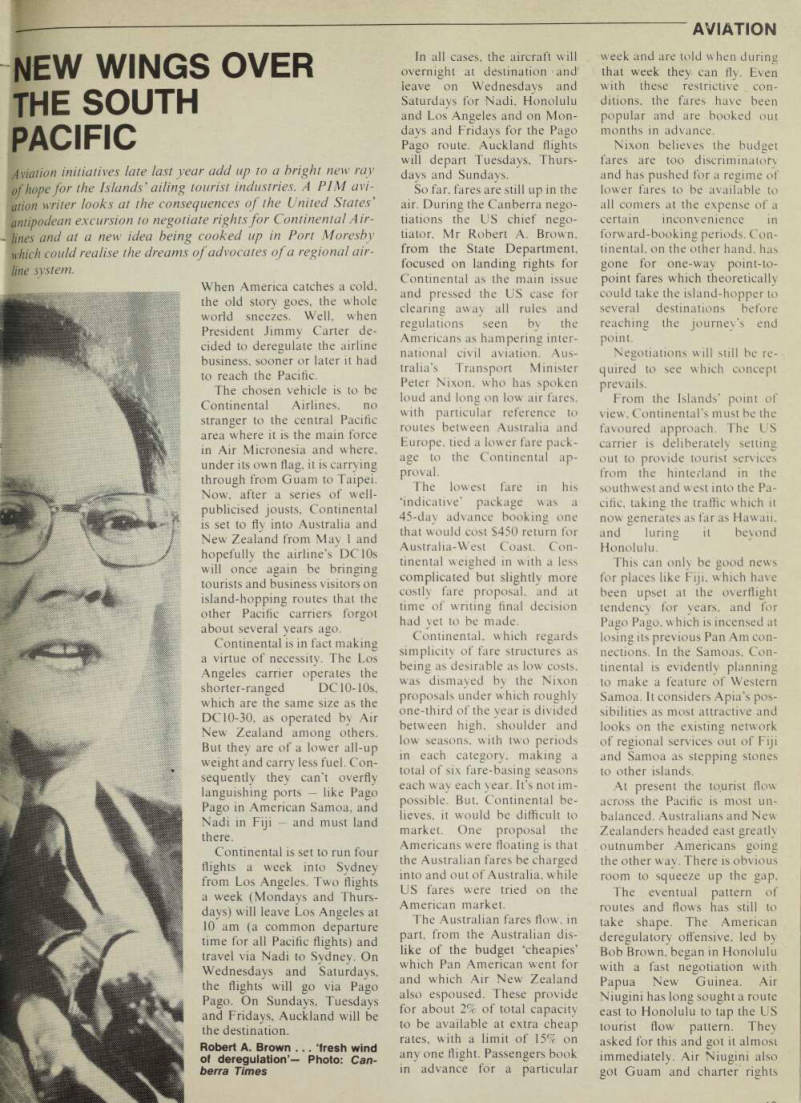
Robert A. Brown ... ‘fresh wind of deregulation’ —Photo: Can berra Times
from PNG to these places as well. On the eve of the opening of the new Travelodge in Port Moresby, this must have been music to the ears of local tour ism entrepeneurs.
Mr Brown’s next port of call was Fiji. And from all accounts, Fiji did even better.
This prompted second thoughts from PNG which in late November hied up to Manilla to see the Americans again, this time with a proposal that they be allowed to service the US mainland. The Americans were disposed at time of writing to offer them Oakland, the under-utilised terminal across the Bay from San Francisco Airport.
After Fiji came New Zealand. Heie there was little standing in the way of offering Continental rights. But there was a serious problem of a national election underway with no one around to sign a permit. Prime Minister Mul doon suggested it be put to the first cabinet meeting after the elections and the Americans agreed.
In Australia. Mr Brown met much stiffer opposition. He caught Mr Nixon and his departmental officials off guard with an airport press conference where he made it clear that unless Australia con ceded what the Americans saw as the bilateral treaty right for a second designated US carrier to arrive, the Americans would >tart lopping off Qantas ser vices at the rate of one a month.
It’s the Italian kidnap victim
syndrome.' one negotiator
explained. ‘First month vou cut aff one flight a week say a inger then next an arm. And
io it goes.’
Although the issue hadn’t aeen fully resolved, it seemed hat the lightly veiled threat
vas eventually unnecessarv.
\ustralia tabled its low-fare proposals and at time of vriting was reported to be >reparing an agreement.
But Continental, of course, is mly the first stage. In the long un the charter flights, opera ed by Island and American :arriers, may prove to be the )ig generator of tourst traffic
hroughout the region.
If lasting prosperity is to ome. however, there will have
to be significant reforms. Much of the accommodation industry and other tourist plant will have to be reorganised, and the airlines themselves wilfhave to re-examine equipment plans.
Air Niugini’s general man ager. Bryan Grey, got in under the fence just "before PNG’s November political upheaval and got executive council per mission to import two more F2Bs that will come into service this year. But to take advantage of his rights, he will need another 707 or its equivalent and this may be harder to arrange in the present cli mate.
Air Pacific, embroiled in rights fights with Australia and New Zealand, must also start
looking at new equipment.
The quandary of both re gional carriers lends some enchantment to a new idea, being cooked up in Port Moresby of an association of smaller airlines under which each maintains its sovereignty and national personality but which come together to operate special flights such as the pro posed charters and American services when necessary.
Such a move would also allow small carriers like Air Niugini and Air Pacific to con sider modern wide-bodied
equipment, which they must
eventually have to combat fuel price rises and other operating problems. ‘At first you think of two fleas getting together to buy a dog,’ a manufacturer’s representative said. “But the more you look at the idea, the more attractive it gets. The key must be to maintain individual national identities and oppor tunities.’
Places like Fiji and Papua New Guinea have been subser vient to the airline ambitions of the bigger powers for so long that it is only in the past couple of years they have started look ing at their own geographical locations on the globe. Both are ideally suited to handle ser vices on a new South Pacific route from Honolulu through to Southeast Asia. Both can also launch north-south flights to the new nodal point of Guam and on to Tokyo and other places, as Air Niugini is
already doing.
The Crystal
Western Samoa
Is Cloudy
Western Samoans go to the polls next month in Samoan fashion with voting confined to heads of families (except for two of the 47 seats in the Legis lative Assembly) and without political parties. The two ‘odd seats’ are the only ones filled by universal vote.
As there are no party leaders, the big question, as usual, is: Who will be prime minister?
Prime Minister Tupuola Taisi Efi - elected in 1976 - is not even certain of retaining a seat in the assembly. His election three years ago broke with tra
dition. Tupuola Efi becoming
Western Samoa’s first prime minister without a Tama Aiga title, the Tama Aiga being the ‘four royal sons’, the traditional
royal chiefs.
In Samoan politics, the strong men, the ideas men. attract supporters, one group allying themselves with one prospective leader, another following his (or her. and that could be important this time) rival for the position.
Tupuola Efi beat one ofthe Tama Aiga , Tupua Tamasese Leolofi IV. by 31 votes to 16 to become prime minister in March 1976.
Tupuola Efi, many agree, has done a good job. They feel his administration has been a progressive one and that it can point to many achievements.
Finance Minister Vaovasa Filipo has presided over an im provement in the country’s financial position.
It is difficult for an outsider
to understand Samoan politics?
In the past. Western Samo;o prime ministers have stood oo fallen on the reputations anor performances of their chosem ministers as well as theiii: own.
There have been several scandals in the past three yearn and several cabinet ministern have been accused of irrespon-n sible behaviour. All this hasc rubbed off on Tupuola Efi ancbi he could very well find himselll opposed by strong candidates?: Even his assembly seat could! be in danger. On that scores however, he has a couple ole options. He can stand for higi present constituency ale Leulumoega, where he holds! his Tupuola title, or he cam. stand in the Asau constituencx' where he holds the prestigiousi. title of Taisi. It is rumoured): that he is losing popularity atr Leulumoega but that he still 1 has a strong band of supporters! there. If he chooses to fightr Asau he will have stiff compe-j tition from Vaai Kolone, an oldb campaigner. At the time oftc writing it seemed more he would defend his seat attx
Leulumoega.
Masiofo Fetaui Mataafa,.* widow of the late Prime Minis--* ter Mataafa is a possible can-n didate. She is no stranger too
Samoa’s political scene, havingg
been regarded as the reallx power behind the throne whenn Mataafa was prime minister.
Masiofo Fetaui is regardedb as one of the most capable? women in Samoa in severalh spheres but can she overcome? male prejudice? Finance?: Minister Vaovasa Filipo, as mountain of a man, couldb attract much support if he? stands. So could Speaker Leotan Leuluaialii I.Ale. veteran poli--i tician Tofilau Eti. or Asi Eikeniir who, as a minister, has done? ; well in his dealings over air ser--i vices.
Tupuola's main advantage,,?
of course, is that there are feww people of his calibre around..!
But anyone who tries to make? firm forecasts of the course ofL political events in Western n Samoa may just as well tryy
catching moonbeams.
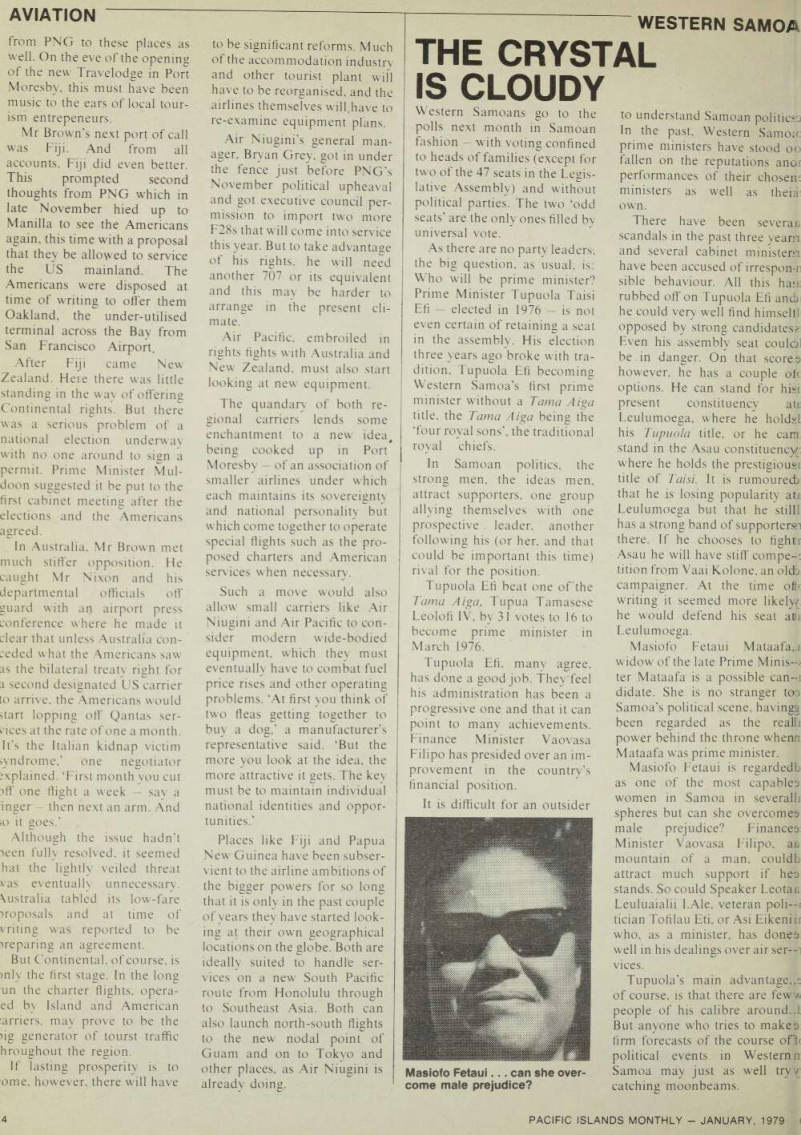
Masiofo Fetaui... can she over come male prejudice?
Survivor
Papua New Guinea
Somare - The
Great
Survivor
When Michael Somare with the help of Papua New Guinea’s first efficient, cohesive political machine (in the form of the Pangu Pati) snatched victory from the jaws of United Party (UP) defeat in April 1972, there were a few slack jaws around Port Moresby, especially white ones. Most expatriates had anticipated that the heavily planter-backed and financed Highlands-based UP would have little difficulty in obtaining the support of the small number of MPs it required for co alition rule. Said one European in Port Moresby at the time, attempting to rationalise his fear: ‘Never mind. Let the rad icals try and fail. The UP will be in before Independence. ’
The UP at the time was recog nised as the 'solid, sensible, pragmatic (read conservative) party' which would keep things sweet for white investors in the emerging nation. As it turned out, Chief Minister Somare didn ’tjail. But his spots as a rad icalfaded somewhat. And by the time he became Prime Minister Michael Somare on September 16, 1975, his ‘conservatism' was beginning to worry some of the more extreme elements of his own party.
In nearly seven years at his country's helm, Mr Somare has brought to Papua New Guinea a stability envied by much of the Third World. Yet, in doing so, he has not sold his soul to the West, East, or anywhere else.
PNG has emerged with a repu
tation for being ready to do
business with anyone as long as they're willing to give a fair go' to Papua New Guineans invol ved in the various investment projects.
Ironically, those who now decry his performance are voices from the inside. Nearly seven years of stability, it seems, is not evidence enough that well should be left alone. Mr Somare is charged with taking too many decisions without con sulting his coalition partners.
Nineteen-seventy-eight, for
Prime Minister Somare, in many ways resembled 1975 for Australia's Prime Minister Gough Whitlam. But where Mr Whitlam was brought down at the November 11 hurdle, Mr Somare bounded home with deceptive ease in the November
16 no-confidence stakes in the PNG National Parliament. At last reports, he looked set to run into 1979 with a reasonable hope of survival.
PIM assigned its Port Moresby correspondent, Angus Smales, to look into the events surrounding the November 16 political climax in the PNG capital; profile those in the star ring roles; analyse the parallels and differences in the policies of the continuing Somare coalition government (oddly now a team of old enemies) and the oppo sition grouping (equally strange bedfellows); and to consider Mr Somare's retirement plans. And then comes Percy Chatterton's view of the latest bout of politi cal confusion.
November
-Blow
By Blow
Papua New Guinea’s National Parliament had only just begun its November sittings in Port Moresby when the word went round the lobbies that the
People’s Progress Party (PPP)
was pulling out of the govern ment.
Julius Chan, leader of the party and deputy prime minis ter, had bowed to the pressure of his back-benchers who were angry at their party’s lack of in volvement in government decision-making, so the story went. Mr Chan, cornered by two journalists when he left the chamber, denied the develop
ment. Waving a sheaf of papers, he said: ‘lf you had my job you would want to resign a thousand times a day, but do you think I would still be sign ing these papers if I was leav ing?’ Later he again denied the story' in a telephone conver sation.
Eighteen hours later, after a series of emergency meetings with his party, he stood up in parliament and announced the withdrawal of his party’s sup port from the government. In a matter of fact statement, with little emotion, and unmarked by interjections, he gave three main reasons for the move: His party was no longer being al lowed to play a role in govern ment; it was being denied a voice in the management of the coalition to which it belonged; and it was concerned at a dangerous brand of per sonalised control which had taken national management out of the cabinet room.
He detailed a long list of
developments in which, he said his party’s voice had not been
sought, culminating the pre
vious week in a cabinet re shuffle, made without consul tation.
The departure of Mr Chan and his 18 followers left the Pangu Pati led by Mr Somare, without the numbers to govern
although constitutionally they
were still secure in office until parliament decided their
future by majority vote,
Mr Somare defended his position in parliament and in public statements, but made no attempt to gloss over the claim that consultation with his part ners had been lacking. He freely conceded a shortage of consultation, but explained that situations had arisen where he had been forced to take decisive action ‘as a leader’. ‘No one leads by fail ing to make decisions when they are needed.’
He attempted to persuade PPP into remaining with him
but by noon the following day
talks had petered out. ‘l’m on my way back to the office to pack up,’ Mr Chan told news men waiting outside the cabi net room. Four hours later Mr Somare was able to announce he had accepted an offer from the United Party leader,
Raphael Doa. to join him. giv
ing him roughly the same strength in numbers as he had before the PPP defection. The UP had laid down no con ditions, he said, and had been given six ministries in 25.
An offer from Opposition Leader Okuk had been turned down because he had laid down conditions, said Mr Somare. One of the conditions is believed to have been that Mr Okuk should become deputy prime minister, a pos ition now held by one of Mr
Somare’s Pangu supporters,
Ebia Olewale.
The new coalition partners, the UP, came to Mr Somare as i faction from within the op oosition. Once it had been the opposition in its own right and
the biggest single party in par
iament. Obviously still smart ng from earlier events which tad whittled away its strength md influence, it decided it was ime to cross the floor and Mr >omare had little choice but to :mbrace it.
About the time that Mr
Jomare was announcing his
lew coalition, Mr Okuk was innouncing that Mr Chan’s *PP had joined his ranks. The
ipposition took advantage of
he disruptive events in parlia
ment to move a vote of no confidence in the government - the second in three months.
This is a constitutional remedy which can overthrow an ailing government without the need for an election, but an essential ingredient is that the new prime minister be named.
Mr Okuk was duly named in the motion which then had to wait seven days under consti tutional requirements. A bitter
lobbying fight for support
broke out during the waiting period, marked by individual
changes of heart one way or the other, and including the defec tion of Mr Somare’s housing minister, Thomas Kavali.
The galleries couldn’t hold the crowds which came to see the vote. All 109 members attended, including cabinet member Father John Momis who came from hospital, and
opposition Papua Besena
leader Josephine Abaijah who returned from a visit to Syd ney.
Mr Okuk, no doubt impres sed by the calibre of some of
his new supporters, tried tot amend the motion so that ML Chan could be prime ministers But the amendment was deal feated.
The Somare government des feated the no-confidenceo motion 63-45. Sir John Guises; 64. did not vote, but ther speaker, Kingsford Dibelac did.
Sir John, former governors general and veteran politiciann who became deputy leader during a reshuffle! earlier in the year, was the onlyl member of the 109-seat House? who abstained from voting.
His deliberate walkout each: time a division was calico; (there were three divisions ini the debate) was obviously s Guise-type curtain raiser foie the planned announcement which he made immediately! after the debate.
His announcement, com-r plete with photo-copies pf a> formal letter to the oppositions leader, Mr Okuk, was that hoi was resigning as deputy leader.!
His official reason was that*
membership of the opposition!
had changed so greatly that thoi front benches needed reor-i ganising. Sir John felt hesi should give more time to hisfi electorate and allow the oppo-( sition to reorganise its ranks..?
Tm plain John Guise whco wants to devote all his time too representing the people whoo elected him,’ he said.
Despite the reason given, it's?’ hard to avoid the conclusionn that Sir John felt put out by thes almost unconscious way he hadb been left aside following thes arrival of Mr Chan on the op--( position scene. After all, he was?i supposed to be deputy leaden; of the opposition, but thes choice for prime minister-i designate was between leaden; and newcomer not leaden; and deputy leader.
Parliament has now sorted b itself out for the time being but Ji echoes of the disruption re- main. In real terms forT instance, as distinct from num- bers, Mr Somare is probably in n a weaker position than he was ? before. A few members are agi- tating for a general election, p and Opposition Leader lam- bakey Okuk is talking about Ji forming a new party based on n
Highlands electorates.
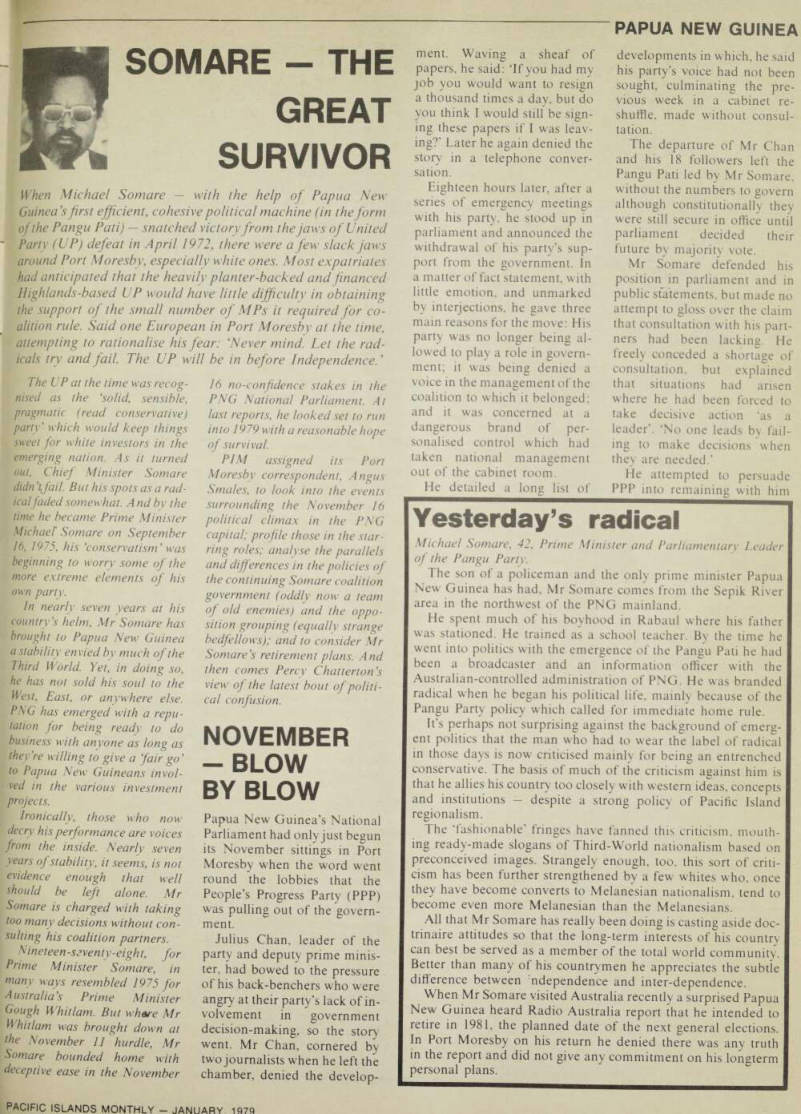
Yesterday’s radical
Michael Somare, 42, Prime Minister and Parliamentary Leader
of the Pangu Party.
The son of a policeman and the only prime minister Papua New Guinea has had, Mr Somare comes from the Sepik River area in the northwest of the PNG mainland.
He spent much of his boyhood in Rabaul where his father was stationed. He trained as a school teacher. By the time he went into politics with the emergence of the Pangu Pati he had been a broadcaster and an information officer with the Australian-controlled administration of PNG. He was branded radical when he began his political life, mainly because of the Pangu Party policy which called for immediate home rule.
It’s perhaps not surprising against the background of emerg ent politics that the man who had to wear the label of radical in those days is now criticised mainly for being an entrenched conservative. The basis of much of the criticism against him is that he allies his country too closely with western ideas, concepts and institutions - despite a strong policy of Pacific Island
regionalism.
The ‘fashionable’ fringes have fanned this criticism, mouth ing ready-made slogans of Third-World nationalism based on preconceived images. Strangely enough, too. this sort of criti cism has been further strengthened by a few whites who, once they have become converts to Melanesian nationalism, tend to become even more Melanesian than the Melanesians.
All that Mr Somare has really been doing is casting aside doc trinaire attitudes so that the long-term interests of his country can best be served as a member of the total world community.
Better than many of his countrymen he appreciates the subtle difference between and inter-dependence.
When Mr Somare visited Australia recently a surprised Papua New Guinea heard Radio Australia report that he intended to retire in 1981, the planned date of the next general elections.
In Port Moresby on his return he denied there was any truth in the report and did not give any commitment on his longterm personal plans.
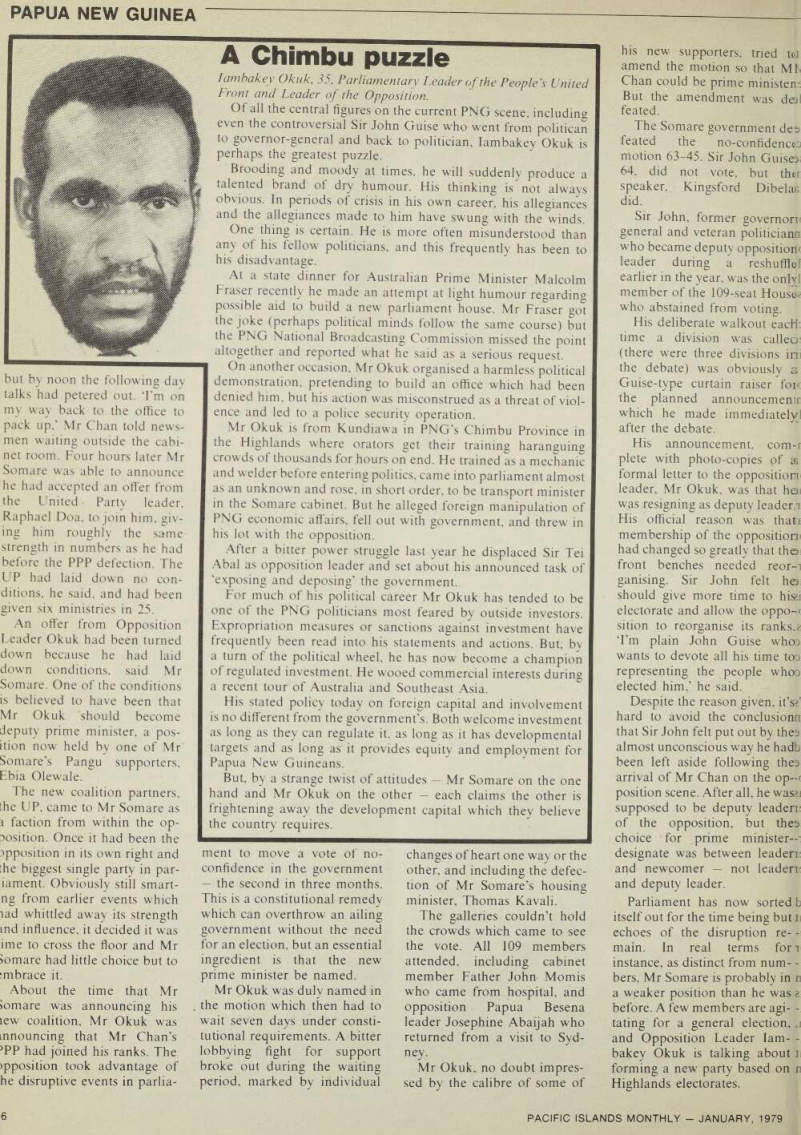
A Chimbu puzzle
lambakey Okuk , 35, Parliamentary Leader of the People's United Front and Leader of the Opposition.
Of all the central figures on the current PNG scene, including even the controversial Sir John Guise who went from politican to governor-general and back to politician, lambakey Okuk is perhaps the greatest puzzle.
Brooding and moody at times, he will suddenly produce a talented brand of dry humour. His thinking is not always obvious. In periods of crisis in his own career, his allegiances and the allegiances made to him have swung with the winds.
One thing is certain. He is more often misunderstood than any of his fellow politicians, and this frequently has been to
his disadvantage.
At a state dinner for Australian Prime Minister Malcolm Fraser recently he made an attempt at light humour regarding possible aid to build a new parliament house. Mr Fraser got the joke (perhaps political minds follow the same course) but the PNG National Broadcasting Commission missed the point altogether and reported what he said as a serious request.
On another occasion, Mr Okuk organised a harmless political demonstration, pretending to build an office which had been denied him, but his action was misconstrued as a threat of viol ence and led to a police security operation.
Mr Okuk is from Kundiawa in PNG’s Chimbu Province in the Highlands where orators get their training haranguing crowds of thousands for hours on end. He trained as a mechanic and welder before entering politics, came into parliament almost as an unknown and rose, in short order, to be transport minister in the Somare cabinet. But he alleged foreign manipulation of PNG economic affairs, fell out with government, and threw in his lot with the opposition.
After a bitter power struggle last year he displaced Sir Tei Abal as opposition leader and set about his announced task of ‘exposing and deposing’ the government.
For much of his political career Mr Okuk has tended to be one of the PNG politicians most feared by outside investors.
Expropriation measures or sanctions against investment have frequently been read into his statements and actions. But, by a turn of the political wheel, he has now become a champion of regulated investment. He wooed commercial interests during a recent tour of Australia and Southeast Asia.
His stated policy today on foreign capital and involvement is no different from the government's. Both welcome investment as long as they can regulate it, as long as it has developmental targets and as long as it provides equity and employment for Papua New Guineans.
But, by a strange twist of attitudes - Mr Somare on the one hand and Mr Okuk on the other - each claims the other is frightening away the development capital which they believe the country requires.
Advertisements & other items, p. 17 (1 item)
S^tm^w‘°e„S g
TESTING
TIMES
AHEAD
In terms of numbers alone, Mr Somare has neither won’nor lost as a result of the November upheaval. Before the two-way crossing of Parliament occured he could afford to lose about nine supporters to the oppo sition before losing his ma jority. The non-confidence motion figures suggest this
margin still applies.
But some victories strengthen and others weaken, and on this occasion Mr Somare would appear to have emerged in real terms in a somewhat weaker position. He has lost a nucleus of experi enced and competent ministers who will not be idle as mem hers of the re-formed oppo sition.
His new partners have
much wav'of'expertise'
same strong bonds which hive press a^ ofthePe ° Ple ’ S S y ' For the first time, too, Mr Somare has had his image rather than his politics eroded m strong terms within Parha ment. John Noel, who moved
m ° ,ion ° f ’ fi dence, ™ “""T
sdf-gOTernment
and independence’.
The honour and the glory of the accomplishment had gone to Mr Somare, Mr Noel said, but the truth was that the accomplishment had been a
team effort. He tnferred that rehad " his The November events led
S^tm^w‘°e„S g
a period of political instability. ‘A little Africa on our doorstep’ was the comment of one news paper in Australia. But this was hardly fair because PNG con tinues to follow its democratic
constitutional processes. There have been no attempts at short cuts to power. Australia’s own ‘political stability’ has been cause for concern in recent years.
But one thing is obvious. Mr Somare now faces a testing period far more intense than anything he has had to face so far in his Parliamentary ca reer.
Man in the middle
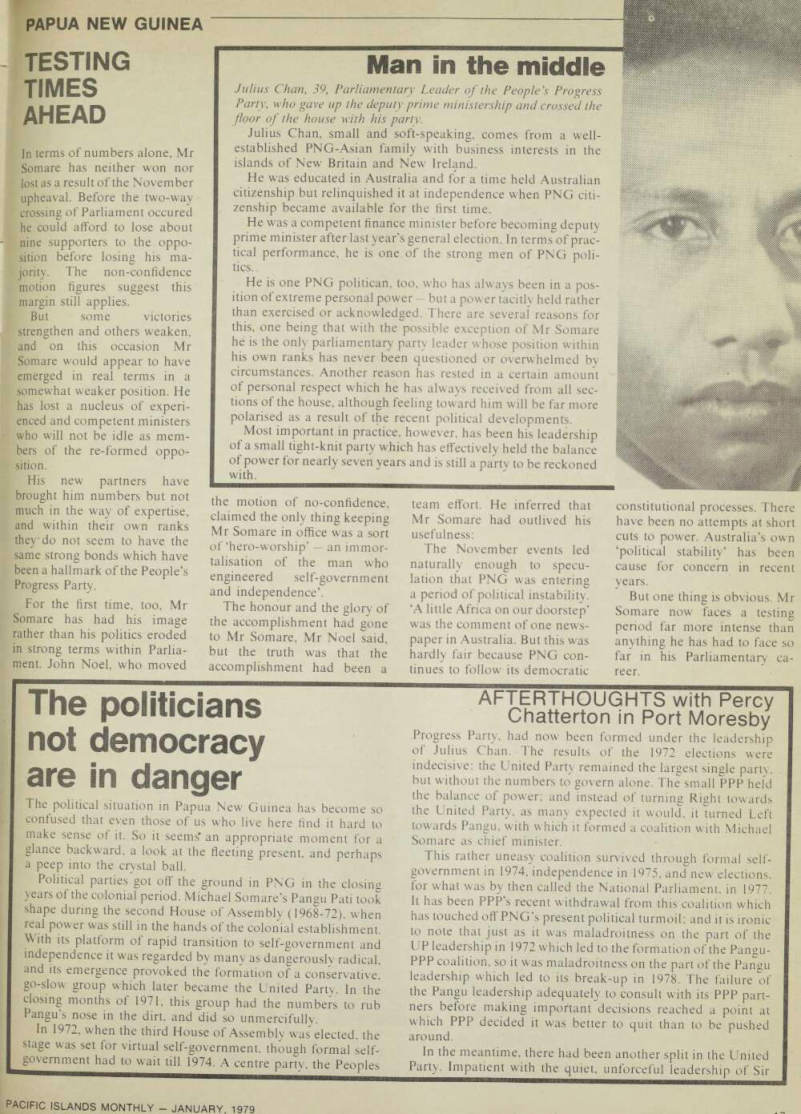
Julius Chan, 39, Parliamentary Leader of the People’s Progress Party, who gave up the deputy prime ministership and crossed the floor of the house with his party.
Julius Chan, small and soft-speaking, comes from a well established PNG-Asian family with business interests in the islands of New Britain and New Ireland.
He was educated in Australia and for a time held Australian citizenship but relinquished it at independence when PNG citi zenship became available for the first time.
He was a competent finance minister before becoming deputy prime minister after last year’s general election. In terms of prac tical performance, he is one of the strong men of PNG poli tics.
He is one PNG politican, too, who has always been in a pos ition of extreme personal power - but a power tacitly held rather than exercised or acknowledged. There are several reasons for this, one being that with the possible exception of Mr Somare he is the only parliamentary party leader whose position within his own ranks has never been questioned or overwhelmed by circumstances. Another reason has rested in a certain amount of personal respect which he has always received from all sec tions of the house, although feeling toward him will be far more polarised as a result of the recent political developments.
Most important in practice, however, has been his leadership of a small tight-knit party which has effectively held the balance of power for nearly seven years and is still a party to be reckoned with.
not democracy
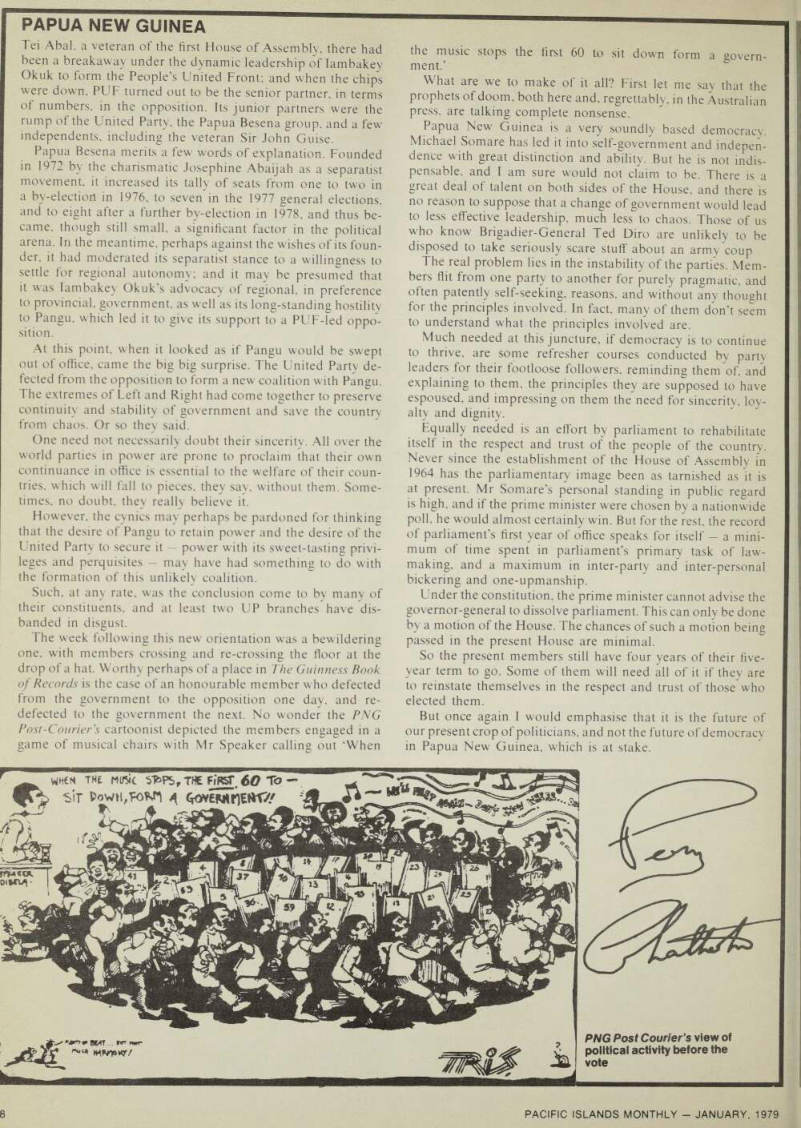
The politicians not democracy are in danger
The political situation in Papua New Guinea has become so confused that even those of us who live here find it hard to make sense of it. So it an appropriate moment for a glance backward, a look at the fleeting present, and perhaps a peep into the crystal ball.
Political parties got off the ground in PNG in the closing years of the colonial period. Michael Somare’s Pangu Pati took shape during the second House of Assembly (1968-72), when real power was still in the hands of the colonial establishment.
With its platform of rapid transition to self-government and independence it was regarded by many as dangerously radical, and its emergence provoked the formation of a conservative, go-slow group which later became the United Party. In the closing months of 1971. this group had the numbers to rub Pangu s nose in the dirt, and did so unmercifully.
In 1972, when the third House of Assembly was elected, the stage was set for virtual self-government, though formal self government had to wait till 1974. A centre party, the Peoples
AFTERTHOUGHTS with Percy Chatterton in Port Moresby
Progress Party, had now been formed under the leadership ot Julius Chan. The results of the 1972 elections were indecisive: the United Party remained the largest single party, but without the numbers to govern alone. The small PPP held the balance of power; and instead of turning Right towards the United Party, as many expected it would, it turned Left towards Pangu. with which it formed a coalition with Michael Somare as chief minister.
This rather uneasy coalition survived through formal self government in 1974, independence in 1975. and new elections, for what was by then called the National Parliament, in 1977.
It has been PPP’s recent withdrawal from this coalition which has touched oft'PNG’s present political turmoil; and it is ironic to note that just as it was maladroitness on the part of the UP leadership in 1972 which led to the formation of the Pangu- PPP coalition, so it was maladroitness on the part of the Pangu leadership which led to its break-up in 1978. The failure of the Pangu leadership adequately to consult with its PPP part ners before making important decisions reached a point at which PPP decided it was better to quit than to be pushed around.
In the meantime, there had been another split in the United Party. Impatient with the quiet, unforceful leadership of Sir
Tei Abal. a veteran of the first House of Assembly, there had been a breakaway under the dynamic leadership of lambakey Okuk to form the People’s United Front; and when the chips were down, PUF turned out to be the senior partner, in terms of numbers, in the opposition. Its junior partners were the rump of the United Party, the Papua Besena group, and a few independents, including the veteran Sir John Guise.
Papua Besena merits a few words of explanation. Founded in 1972 by the charismatic Josephine Abaijah as a separatist movement, it increased its tally of seats from one to two in a by-election in 1976, to seven in the 1977 general elections, and to eight after a further by-election in 1978, and thus be came, though still small, a significant factor in the political arena. In the meantime, perhaps against the wishes of its foun der, it had moderated its separatist stance to a willingness to settle for regional autonomy; and it may be presumed that it was lambakey Okuk’s advocacy of regional, in preference to provincial, government, as well as its long-standing hostility to Pangu, which led it to give its support to a PUF-led oppo sition.
At this point, when it looked as if Pangu would be swept out of office, came the big big surprise. The United Party de fected from the opposition to form a new coalition with Pangu.
The extremes of Left and Right had come together to preserve continuity and stability of government and save the country from chaos. Or so they said.
One need not necessarily doubt their sincerity. All over the world parties in power are prone to proclaim that their own continuance in office is essential to the welfare of their coun tries, which will fall to pieces, they say. without them. Some times. no doubt, they really believe it.
However, the cynics may perhaps be pardoned for thinking that the desire of Pangu to retain power and the desire of the United Party to secure it power with its sweet-tasting privi leges and perquisites - may have had something to do with the formation of this unlikely coalition.
Such, at any rate, was the conclusion come to by many of their constituents, and at least two UP branches have dis banded in disgust.
The week following this new orientation was a bewildering one, with members crossing and re-crossing the floor at the drop of a hat. Worthy perhaps of a place in The Guinness Book of Records is the case of an honourable member who defected from the government to the opposition one day, and re defected to the government the next. No wonder the PNG Post-Courier's cartoonist depicted the members engaged in a game of musical chairs with Mr Speaker calling out ‘When
the music stops the first 60 to sit down form a govern ment.’
What are we to make of it all? First let me say that the prophets of doom, both here and, regrettably, in the Australian press, are talking complete nonsense.
Papua New Guinea is a very soundly based democracy.
Michael Somare has led it into self-government and indepen dence with great distinction and ability. But he is not indis pensable, and I am sure would not claim to be. There is a great deal of talent on both sides of the blouse, and there is no reason to suppose that a change of government would lead to less effective leadership, much less to chaos. Those of us who know Brigadier-General Ted Diro are unlikely to be disposed to take seriously scare stuff about an army coup The real problem lies in the instability of the parties. Mem bers flit from one party to another for purely pragmatic, and often patently self-seeking, reasons, and without any thought for the principles involved. In fact, many of them don’t seem to understand what the principles involved are.
Much needed at this juncture, if democracy is to continue to thrive, are some refresher courses conducted by party leaders for their footloose followers, reminding them of. and explaining to them, the principles they are supposed to have espoused, and impressing on them the need for sincerity, loy
alty and dignity.
Equally needed is an effort by parliament to rehabilitate itself in the respect and trust of the people of the country.
Never since the establishment of the House of Assembly in 1964 has the parliamentary image been as tarnished as it is at present. Mr Somare’s personal standing in public regard is high, and if the prime minister were chosen by a nationwide poll, he would almost certainly win. But for the rest, the record of parliament’s first year of office speaks for itself - a mini mum of time spent in parliament’s primary task of law making, and a maximum in inter-party and inter-personal
bickering and one-upmanship.
Under the constitution, the prime minister cannot advise the governor-general to dissolve parliament. This can only be done by a motion of the House. The chances of such a motion being passed in the present House are minimal.
So the present members still have four years of their five year term to go. Some of them will need all of it if they are to reinstate themselves in the respect and trust of those who elected them.
But once again I would emphasise that it is the future of our present crop of politicians, and not the future of democracy in Papua New Guinea, which is at stake.
PNG Post Courier’s view of political activity before the vote
Margaret Mead
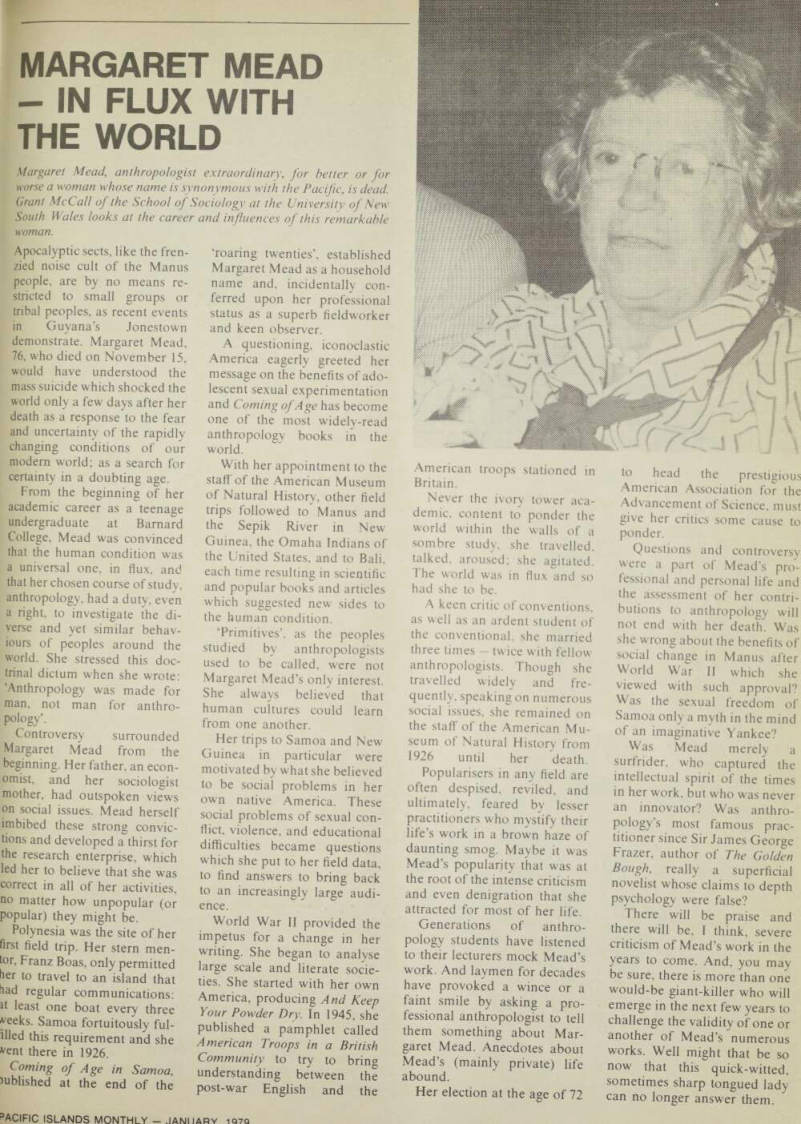
- In Flux With
The World
Margaret Mead, anthropologist extraordinary, for better or for worse a woman whose name is synonymous with the Pacific, is dead.
Grant McCall of the School of Sociology at the University of New South Wales looks at the career and influences of this remarkable woman.
Apocalyptic sects, like the fren zied noise cult of the Manus people, are by no means re stricted to small groups or tribal peoples, as recent events in Guyana’s Jonestown demonstrate. Margaret Mead, 76, who died on November 15, would have understood the mass suicide which shocked the world only a few days after her death as a response to the fear and uncertainty of the rapidly changing conditions of our modem world; as a search for certainty in a doubting age.
From the beginning of her academic career as a teenage undergraduate at Barnard College, Mead was convinced that the human condition was a universal one, in flux, and that her chosen course of study, anthropology, had a duty, even a right, to investigate the di verse and yet similar behav iours of peoples around the world. She stressed this doc trinal dictum when she wrote: ‘Anthropology was made for man, not man for anthro
pology’.
Controversy surrounded
Margaret Mead from the beginning. Her father, an econ omist, and her sociologist mother, had outspoken views on social issues. Mead herself imbibed these strong convic tions and developed a thirst for the research enterprise, which led her to believe that she was correct in all of her activities, no matter how unpopular (or
popular) they might be.
Polynesia was the site of her first field trip. Her stern men tor, Franz Boas, only permitted tier to travel to an island that had regular communications: it least one boat every three Samoa fortuitously ful illed this requirement and she vent there in 1926.
Coming of Age in Samoa, )üblished at the end of the
‘roaring twenties’, established Margaret Mead as a household name and, incidentally con ferred upon her professional status as a superb fieldworker and keen observer, A questioning, iconoclastic America eagerly greeted her message on the benefits of ado lescent sexual experimentation and Coming of Age has become one of the most widely-read anthropology books in the world.
With her appointment to the staff of the American Museum of Natural History, other field trips followed to Manus and the Sepik River in New Guinea, the Omaha Indians of the United States, and to Bali, each time resulting in scientific and popular books and articles which suggested new sides to the human condition, ‘Primitives’, as the peoples
studied by anthropologists
used to be called, were not Margaret Mead’s only interest She always believed that human cultures could learn from one another.
Her trips to Samoa and New Guinea in particular were motivated by what she believed to be social problems in her own native America These social Problems of sexual con flict, violence, and educational difficulties became questions which she put to her field data to find answers to bring back to an increasingly large audi ence.
World War II provided the im P e,us for a chan § e in her "'riling. She began to analyse lar ge scale and literate socie hes. She started with her own
America, producing Keep
Your Powder Dry. 1n1945 she published a pamphlet called i mer,can . a “ Community to try to bring understanding between the post-war English and the
American troops stationed in Britain.
Never the ivory tower aca demic, content to ponder the world within the walls of a sombre study, she travelled, talked, aroused; she agitated.
The world was in flux and so had she to be.
A keen critic of conventions, as well as an ardent student of the conventional, she married three times - twice with fellow
anthropologists. Though she
travelled widely and fre
quently, speaking on numerous
social issues, she remained on the staff of the American Mu seum of Natural History from 1926 until her death.
Popularises in any field are often despised, reviled, and
ultimately, feared by lesser
practitioners who mystify their life’s work in a brown haze of daunting smog. Maybe it was Mead’s popularity that was at the root of the intense criticism and even denigration that she attracted for most of her life.
Generations of anthro pology students have listened to their lecturers mock Mead’s work. And laymen for decades have provoked a wince or a faint smile by asking a pro fessional anthropologist to tell them something about Mar garet Mead. Anecdotes about Mead’s (mainly private) life abound.
Her election at the age of 72
to head the prestigious American Association for the Advancement of Science, must give her critics some cause to ponder.
Questions and controversy were a part of Mead’s pro fessional and personal life and the assessment of her contri butions to anthropology will not end with her death. Was she wrong about the benefits of social change in Manus after World War II which she viewed with such approval?
Was the sexual freedom of Samoa only a myth in the mind of an imaginative Yankee?
Was Mead merely a surfrider, who captured the intellectual spirit of the times in her work, but who was never an innovator? Was anthro pology’s most famous prac titioner since Sir James George Frazer, author of The Golden
Bough, really a superficial
novelist whose claims to depth psychology were false?
There will be praise and there will be, I think, severe criticism of Mead’s work in the years to come. And, you may be sure, there is more than one would-be giant-killer who will emerge in the next few years to challenge the validity of one or another of Mead’s numerous works. Well might that be so now that this quick-witted,
sometimes sharp tongued lady
can no longer answer them.
Advertisements & other items, p. 19 (1 item)
“Acific Islands Monthly - January Iq7Q
People
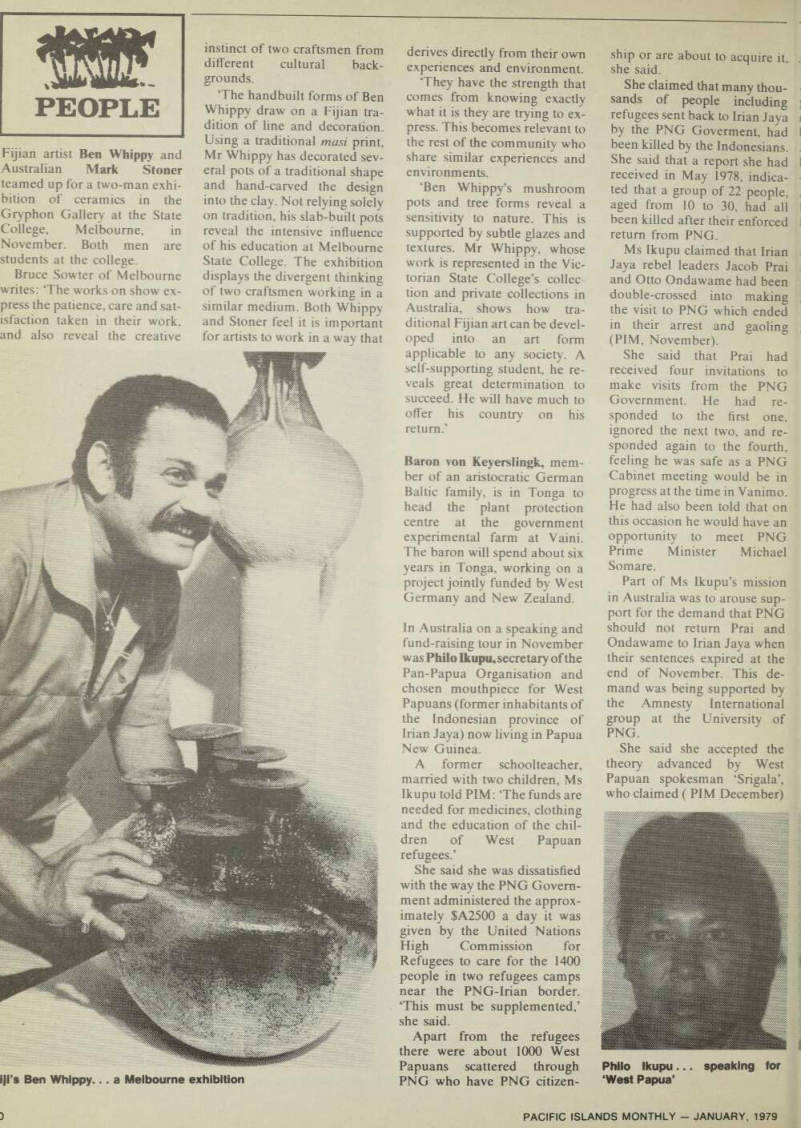
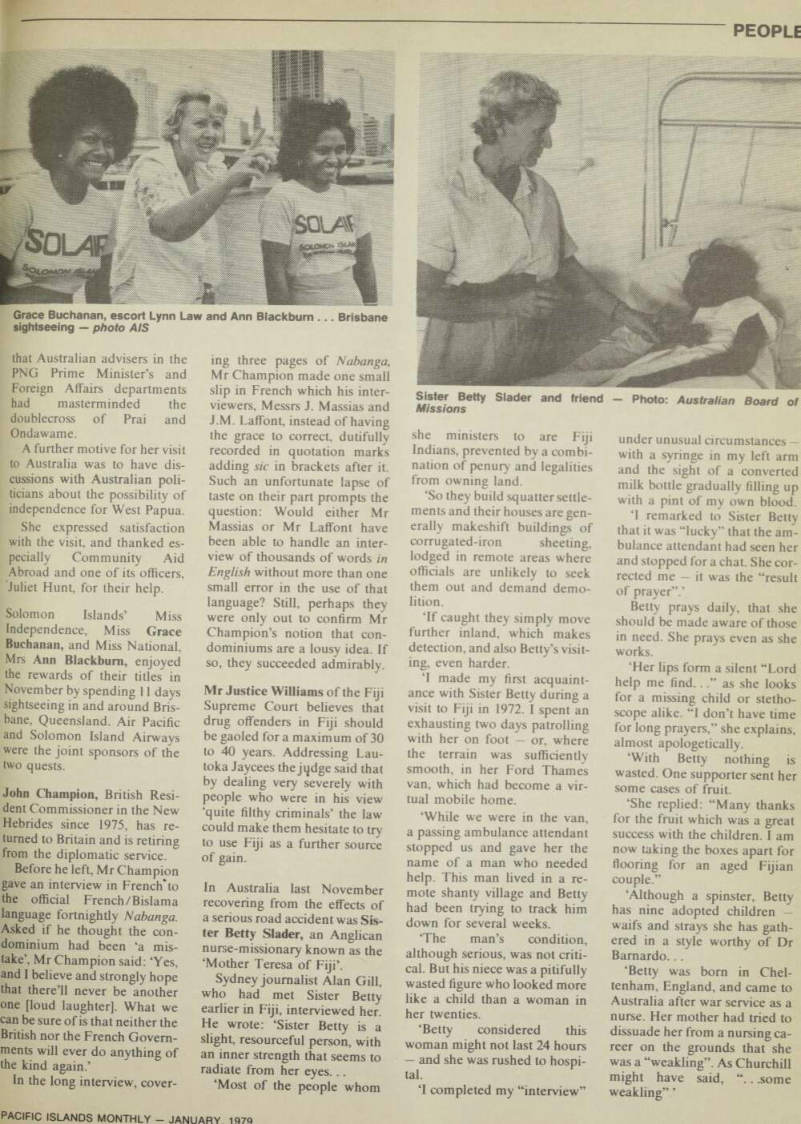
instinct of two craftsmen from different cultural back grounds.
The handbuilt forms of Ben Whippy draw on a Fijian tra dition of line and decoration.
Using a traditional masi print, Mr Whippy has decorated sev eral pots of a traditional shape and hand-carved the design
into the clay. Not relying solely
on tradition, his slab-built pots reveal the intensive influence of his education at Melbourne State College. The exhibition
displays the divergent thinking
of two craftsmen working in a similar medium. Both Whippy and Stoner feel it is important for artists to work in a way that
Fijian artist Ben Whippy and Australian Mark Stoner teamed up for a two-man exhi bition of ceramics in the Gryphon Gallery at the State College, Melbourne, in November. Both men are students at the college.
Bruce Sowter of Melbourne writes; ‘The works on show ex press the patience, care and sat isfaction taken in their work, and also reveal the creative
derives directly from their own experiences and environment.
They have the strength that
comes from knowing exactly
what it is they are trying to ex press. This becomes relevant to the rest of the community who share similar experiences and environments. ‘Ben Whippy’s mushroom pots and tree forms reveal a sensitivity to nature. This is supported by subtle glazes and textures. Mr Whippy, whose work is represented in the Vic torian State College’s collec tion and private collections in Australia, shows how tra ditional Fijian art can be devel oped into an art form applicable to any society. A self-supporting student, he re veals great determination to succeed. He will have much to offer his country on his return.’
Baron von Keyerslingk, mem ber of an aristocratic German Baltic family, is in Tonga to head the plant protection centre at the government experimental farm at Vaini.
The baron will spend about six years in Tonga, working on a
project jointly funded by West
Germany and New Zealand.
In Australia on a speaking and fund-raising tour in November was Philo Ikupu, secretary of the
Pan-Papua Organisation and
chosen mouthpiece for West Papuans (former inhabitants of the Indonesian province of Irian Jaya) now living in Papua New Guinea.
A former schoolteacher, married with two children, Ms Ikupu told PIM: The funds are needed for medicines, clothing and the education of the chil dren of West Papuan
refugees.’
She said she was dissatisfied with the way the PNG Govern ment administered the approx imately $A2500 a day it was given by the United Nations High Commission for Refugees to care for the 1400 people in two refugees camps near the PNG-Irian border.
This must be supplemented,’ she said.
Apart from the refugees there were about 1000 West
Papuans scattered through
PNG who have PNG citizen
ship or are about to acquire it, she said.
She claimed that many thou sands of people including refugees sent back to Irian Jaya by the PNG Goverment, had been killed by the Indonesians.
She said that a report she had received in May 1978, indica ted that a group of 22 people, aged from 10 to 30, had all been killed after their enforced return from PNG.
Ms Ikupu claimed that Irian Jaya rebel leaders Jacob Prai and Otto Ondawame had been double-crossed into making the visit to PNG which ended in their arrest and gaoling (PIM, November).
She said that Prai had received four invitations to make visits from the PNG Government. He had re sponded to the first one, ignored the next two, and re sponded again to the fourth, feeling he was safe as a PNG Cabinet meeting would be in progress at the time in Vanimo.
He had also been told that on this occasion he would have an opportunity to meet PNG Prime Minister Michael Somare.
Part of Ms Ikupu’s mission in Australia was to arouse sup port for the demand that PNG should not return Prai and Ondawame to Irian Jaya when their sentences expired at the end of November. This de
mand was being supported by
the Amnesty International group at the University of
Png.
She said she accepted the
theory advanced by West
Papuan spokesman ‘Srigala’,
who claimed ( PIM December)
Fiji’s Ben Whippy... a Melbourne exhibition
Philo Ikupu ... speaking for ‘West Papua’
that Australian advisers in the PNG Prime Minister’s and
Foreign Affairs departments
had masterminded the doublecross of Prai and Ondawame.
A further motive for her visit to Australia was to have dis cussions with Australian poli ticians about the possibility of
independence for West Papua.
She expressed satisfaction with the visit, and thanked es
pecially Community Aid
Abroad and one of its officers, Juliet Hunt, for their help.
Solomon Islands’ Miss Independence, Miss Grace Buchanan, and Miss National, Mrs Ann Blackburn, enjoyed the rewards of their titles in
November by spending 11 days
sightseeing in and around Bris bane, Queensland. Air Pacific and Solomon Island Airways were the joint sponsors of the two quests.
John Champion, British Resi dent Commissioner in the New Hebrides since 1975, has re turned to Britain and is retiring from the diplomatic service.
Before he left, Mr Champion gave an interview in French*to the official French/Bislama
language fortnightly Nabanga.
Asked if he thought the con dominium had been ‘a mis take’, Mr Champion said: ‘Yes, and I believe and strongly hope that there’ll never be another one [loud laughter]. What we can be sure of is that neither the British nor the French Govern ments will ever do anything of the kind again.’
In the long interview, cover
ing three pages of Nabanga, Mr Champion made one small slip in French which his inter viewers, Messrs J. Massias and J.M. Laffont, instead of having the grace to correct, dutifully recorded in quotation marks adding sic in brackets after it.
Such an unfortunate lapse of taste on their part prompts the question: Would either Mr Massias or Mr Laffont have been able to handle an inter view of thousands of words in English without more than one small error in the use of that
language? Still, perhaps they
were only out to confirm Mr Champion’s notion that con dominiums are a lousy idea. If
so, they succeeded admirably.
Mr Justice Williams of the Fiji Supreme Court believes that drug offenders in Fiji should be gaoled for a maximum of 30 to 40 years. Addressing Lau toka Jaycees the jqdge said that
by dealing very severely with
people who were in his view ‘quite filthy criminals’ the law could make them hesitate to try to use Fiji as a further source
of gain.
In Australia last November recovering from the effects of a serious road accident was Sis ter Betty Slader, an Anglican nurse-missionary known as the ‘Mother Teresa of Fiji’.
Sydney journalist Alan Gill,
who had met Sister Betty earlier in Fiji, interviewed her.
Fie wrote: ‘Sister Betty is a slight, resourceful person, with an inner strength that seems to radiate from her eyes. ‘Most of the people whom
she ministers to are Fiji Indians, prevented by a combination of penury and legalities from owning land.
So they build squatter settlements and their houses are gen-
erally makeshift buildings of
corrugated-iron sheeting,
lodged in remote areas where officials are unlikely to seek them out and demand demo- ■ • .
If caught they simply move
further inland, which makes detection, and also Betty’s visiting, even harder. ‘I made my first acquaintance with Sister Betty during a visit to Fiji in 1972. I spent an
exhausting two days patrolling
with her on foot or, where the terrain was sufficiently smooth, in her Ford Thames van, which had become a virtual mobile home. ‘While we were in the van, a passing ambulance attendant stopped us and gave her the name of a man who needed help. This man lived in a re-
mote shanty village and Betty
had been trying to track him down for several weeks. ‘The man’s condition, although serious, was not critical. But his niece was a pitifully wasted figure who looked more like a child than a woman in her twenties.
Betty considered this woman might not last 24 hours - and she was rushed to hospita l- ‘I completed my “interview”
under unusual circumstances— with a syringe in my left arm and the sight of a converted milk bottle gradually filling up with a pint of my own blood ‘I remarked to Sister Betty that it was “lucky” that the am bulance attendant had seen her and stopped fora chat. She cor reeled me - it was the “result of prayer”.’
Bett y prays daily, that she should be made aware of those in need. She prays even as she works. ‘Her |ip S f ori n a silent “Lord help me find...” as she looks for a missing child or stetho scope alike. “I don’t have time for long prayers,” she explains,
almost apologetically,
‘With Betty nothing is
wasted. One supporter sent her some cases of fruit,
‘She replied: “Many thanks
for the fruit which was a great success with the children. I am now taking the boxes apart for flooring for an aged Fijian
couple.”
‘Although a spinster, Betty
has nine adopted children waifs and strays she has gath ered in a style worthy of Dr Bamardo. ‘Betty was bom in Chel tenham, England, and came to Australia after war service as a nurse. Her mother had tried to dissuade her from a nursing ca reer on the grounds that she was a “weakling”. As Churchill might have said, . .some
weakling’”
Grace Buchanan, escort Lynn Law and Ann Blackburn ... Brisbane sightseeing - photo AIS
Sister Betty Slader and friend - Photo: Australian Board of Missions
Vatukoula: The
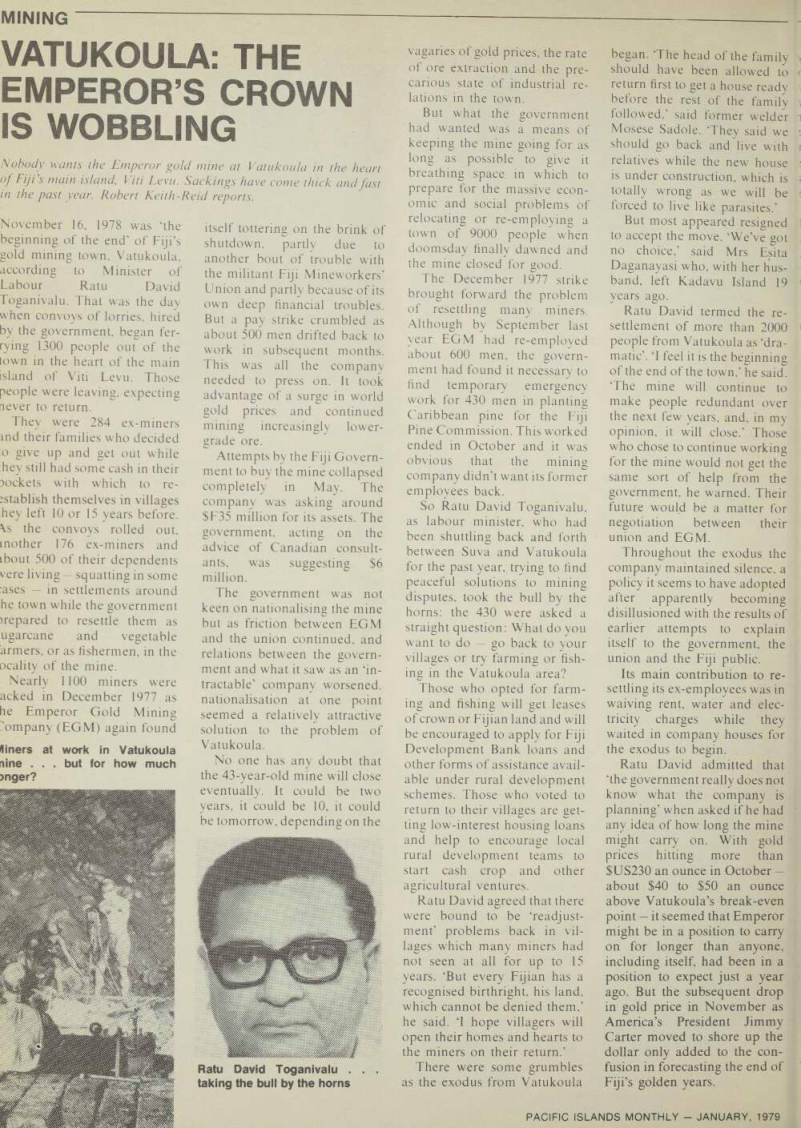
Mining
Emperor’S Crown
Is Wobbling
Nobody wants the Emperor gold mine at Vatukoula in the heart °f Fiji s wain island, Viti Leva. Sackings have come thick and fast in the past year. Robert Keith-Reid reports.
November 16. 1978 was ‘the beginning of the end’ of Fiji’s
gold mining town. Vatukoula,
according to Minister of Labour Ratu David Toganivalu. That was the day when convoys of lorries, hired by the government, began fer rying 1300 people out of the town in the heart of the main island of Viti Levu. Those
people were leaving, expecting
never to return.
They were 284 ex-miners ind their families who decided ;o give up and get out while hey still had some cash in their Dockets with which to re
establish themselves in villages
hey left 10 or 15 years before. \s the convoys rolled out. mother 176 ex-miners and ibout 500 of their dependents
vere living squatting in some
:ases in settlements around he town while the government >repared to resettle them as ugarcane and vegetable armers, or as fishermen, in the ocality of the mine.
Nearly 1100 miners were acked in December 1977 as
he Emperor Gold Mining
Company (EGM) again found
itself tottering on the brink of shutdown, partly due to another bout of trouble with the militant Fiji Mineworkers’
Union and partly because of its own deep financial troubles.
But a pay strike crumbled as about 500 men drifted back to work in subsequent months.
This was all the company needed to press on. It took advantage of a surge in world
gold prices and continued
mining increasingly lower
grade ore.
Attempts by the Fiji Govern ment to buy the mine collapsed
completely in May. The
company was asking around SF3S million for its assets. The government, acting on the advice of Canadian consult ants, was suggesting $6 million.
The government was not keen on nationalising the mine but as friction between EGM and the union continued, and relations between the govern ment and what it saw as an ‘in tractable’ company worsened, nationalisation at one point seemed a relatively attractive solution to the problem of Vatukoula.
No one has any doubt that the 43-year-old mine will close eventually. It could be two years, it could be 10, it could be tomorrow, depending on the
vagaries of gold prices, the rate of ore extraction and the pre carious state of industrial re lations in the town.
But what the government had wanted was a means of keeping the mine going for as long as possible to give it breathing space in which to prepare for the massive econ omic and social problems of
relocating or re-employing a
town of 9000 people when
doomsday finally dawned and
the mine closed for good.
The December 1977 strike brought forward the problem of resettling many miners.
Although by September last
year EGM had re-employed about 600 men, the govern ment had found it necessary to find temporary emergency work for 430 men in planting Caribbean pine for the Fiji Pine Commission. This worked ended in October and it was obvious that the mining company didn’t want its former employees back.
So Ratu David Toganivalu, as labour minister, who had been shuttling back and forth between Suva and Vatukoula for the past year, trying to find peaceful solutions to mining disputes, took the bull by the horns: the 430 were asked a straight question: What do you want to do go back to your villages or try farming or fish ing in the Vatukoula area?
Those who opted for farm ing and fishing will get leases of crown or Fijian land and will be encouraged to apply for Fiji Development Bank loans and other forms of assistance avail able under rural development schemes. Those who voted to return to their villages are get
ting low-interest housing loans
and help to encourage local rural development teams to start cash crop and other
agricultural ventures.
Ratu David agreed that there were bound to be ‘readjust ment’ problems back in vil lages which many miners had not seen at all for up to 15 years. ‘But every Fijian has a recognised birthright, his land, which cannot be denied them,’ he said. T hope villagers will open their homes and hearts to the miners on their return.’
There were some grumbles as the exodus from Vatukoula
began. The head of the family should have been allowed to return first to get a house ready before the rest of the family followed,’ said former welder Mosese Sadole. They said we should go back and live with relatives while the new house is under construction, which is totally wrong as we will be forced to live like parasites.’
But most appeared resigned to accept the move. ‘We’ve got no choice,’ said Mrs Esita Daganayasi who, with her hus band, left Kadavu Island 19 years ago.
Ratu David termed the re settlement of more than 2000 people from Vatukoula as ‘dra matic’. ‘I feel it is the beginning of the end of the town,’ he said.
The mine will continue to make people redundant over the next few years, and, in my opinion, it will close.’ Those who chose to continue working for the mine would not get the same sort of help from the government, he warned. Their future would be a matter for negotiation between their union and EGM.
Throughout the exodus the company maintained silence, a policy it seems to have adopted
after apparently becoming
disillusioned with the results of earlier attempts to explain itself to the government, the union and the Fiji public.
Its main contribution to re settling its ex-employees was in waiving rent, water and elec
tricity charges while they
waited in company houses for the exodus to begin.
Ratu David admitted that ‘the government really does not know what the company is planning’ when asked if he had any idea of how long the mine might carry on. With gold prices hitting more than SUS23O an ounce in October about $4O to $5O an ounce above Vatukoula’s break-even point it seemed that Emperor might be in a position to carry on for longer than anyone, including itself, had been in a position to expect just a year ago. But the subsequent drop in gold price in November as America’s President Jimmy Carter moved to shore up the dollar only added to the con fusion in forecasting the end of Fiji’s golden years.
Miners at work in Vatukoula mine ... but for how much
longer?
Ratu David Toganivalu . . . taking the bull by the horns
of friendship
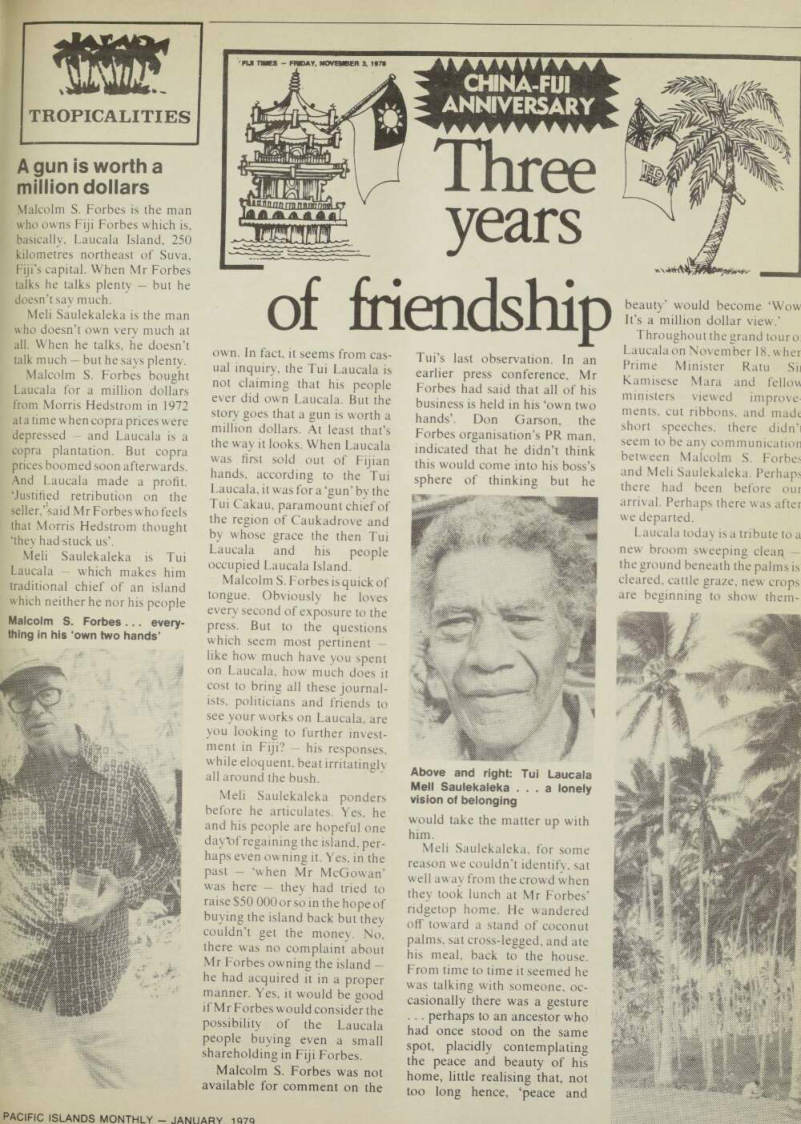
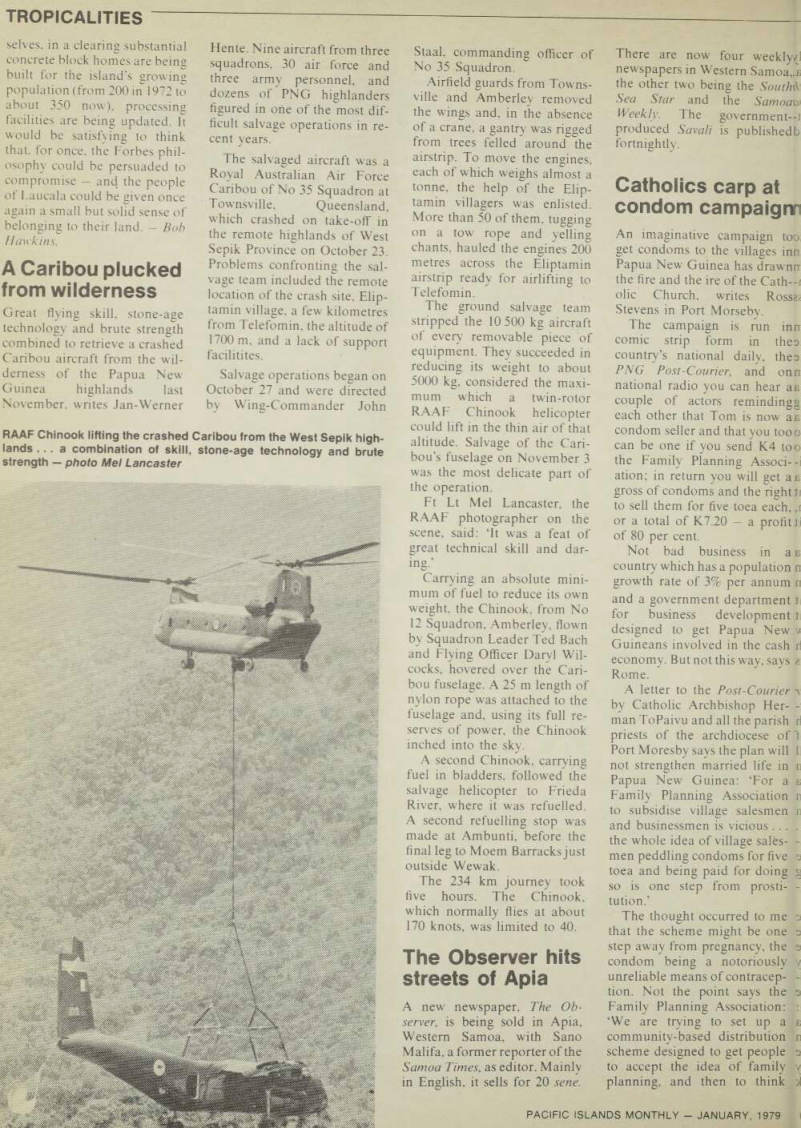
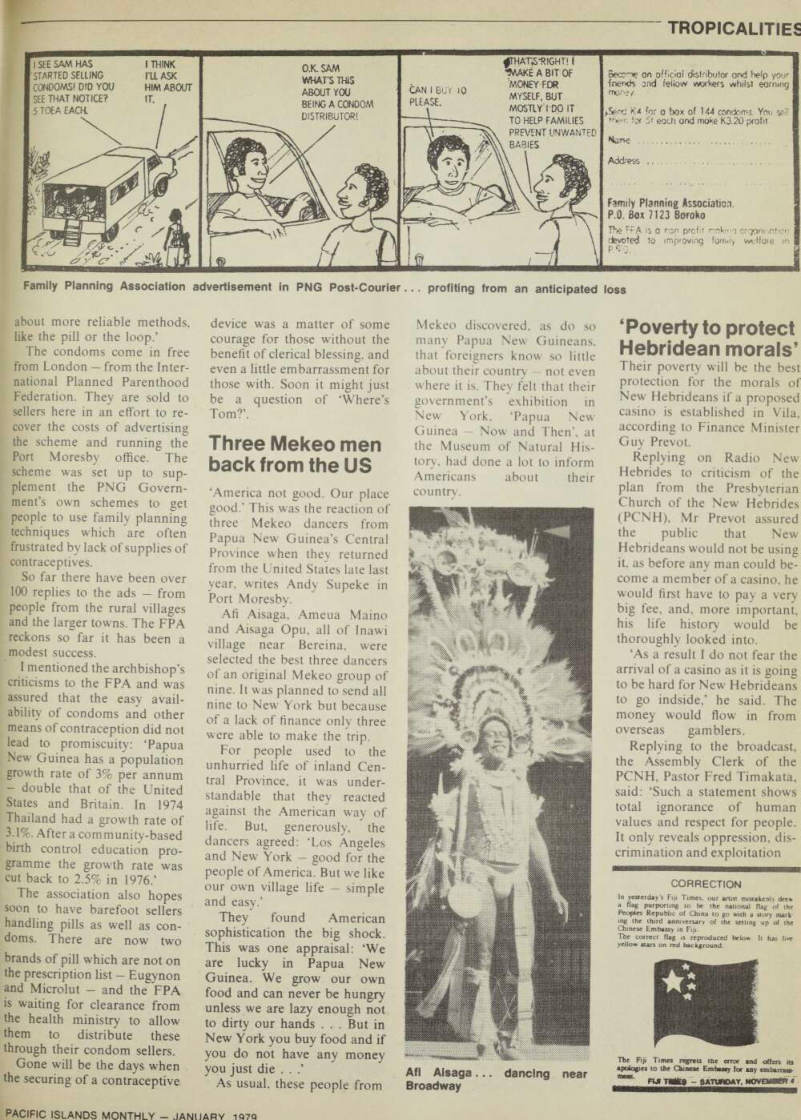
Tropicalities
Three years
A gun is worth a
million dollars
Malcolm S. Forbes is the man who owns Fiji Forbes which is, basically. Laucala Island, 250 kilometres northeast of Suva, Fiji’s capital. When Mr Forbes talks he talks plenty but he doesn’t say much.
Meli Saulekaleka is the man who doesn’t own very much at all. When he talks, he doesn’t talk much but he says plenty.
Malcolm S. Forbes bought Laucala for a million dollars from Morris Hedstrom in 1972 at a time when copra prices were depressed - and Laucala is a copra plantation. But copra prices boomed soon afterwards.
And Laucala made a profit. ‘Justified retribution on the seller, ’ said Mr Forbes who feels that Morris Hedstrom thought ‘they had-stuck us’.
Meli Saulekaleka is Tui Laucala which makes him traditional chief of an island which neither he nor his people
own. In fact, it seems from cas ual inquiry, the Tui Laucala is not claiming that his people ever did own Laucala. But the story goes that a gun is worth a million dollars. At least that’s the way it looks. When Laucala was first sold out of Fijian hands, according to the Tui Laucala, it was for a ‘gun’ by the Tui Cakau, paramount chief of the region of Caukadrove and by whose grace the then Tui Laucala and his people occupied Laucala Island.
Malcolm S. Forbes is quick of tongue. Obviously he loves every second of exposure to the press. But to the questions which seem most pertinent like how much have you spent on Laucala, how much does it cost to bring all these journal ists, politicians and friends to see your works on Laucala, are you looking to further invest ment in Fiji? his responses,
while eloquent, beat irritatingly
all around the bush.
Meli Saulekaleka ponders before he articulates. Yes, he and his people are hopeful one day'of regaining the island, per haps even owning it. Yes, in the past ‘when Mr McGowan’ was here - they had tried to raise $5O 000 or so in the hope of buying the island back but they couldn’t get the money. No, there was no complaint about Mr Forbes owning the island he had acquired it in a proper manner. Yes, it would be good if Mr Forbes would consider the possibility of the Laucala people buying even a small
shareholding in Fiji Forbes.
Malcolm S. Forbes was not available for comment on the
TT▼T»▼ T ' r ▼ w ▼
China-Fui
Anniversary
I_.M.„A . A A . . A
Tui’s last observation. In an earlier press conference, Mr Forbes had said that all of his business is held in his ‘own two hands’. Don Garson, the Forbes organisation’s PR man, indicated that he didn’t think this would come into his boss’s sphere of thinking but he
would take the matter up with him.
Meli Saulekaleka, for some reason we couldn’t identify, sat well away from the crowd when they took lunch at Mr Forbes’ ridgetop home. He wandered off toward a stand of coconut palms, sat cross-legged, and ate his meal, back to the house.
From time to time it seemed he was talking with someone, oc casionally there was a gesture ... perhaps to an ancestor who had once stood on the same
spot, placidly contemplating
the peace and beauty of his home, little realising that, not too long hence, ‘peace and
beauty’ would become ‘Wow It’s a million dollar view.’
Throughout the grand touro: Laucala on November IS.wher Prime Minister Ratu Sii Kamisese Mara and felloe ministers viewed improve ments. cut ribbons, and made short speeches, there didn’t seem to be any communication between Malcolm S. Forbes and Meli Saulekaleka. Perhaps there had been before our arrival. Perhaps there was after
we departed.
Laucala today is a tribute to a new broom sweeping clean the ground beneath the palms is cleared, cattle graze, new crops are beginning to show them-
Malcolm S. Forbes ... every thing in his ‘own two hands’
Above and right: Tui Laucala Mell Saulekaleka ... a lonely vision of belonging
selves, in a clearing substantial concrete block homes are being built for the island's growing population (from 200 in 1972 to about 350 now), processing facilities are being updated. It would be satisfying to think that, for once, the Forbes phil osophy could be persuaded to compromise - and the people of Laucala could be given once again a small but solid sense of belonging to their land. - Bob Hawkins.
A Caribou plucked
from wilderness
Great flying skill, stone-age
technology and brute strength
combined to retrieve a crashed Caribou aircraft from the wil derness of the Papua New Guinea highlands last November, writes Jan-Werner
Hente. Nine aircraft from three squadrons, 30 air force and three army personnel, and
dozens of'PNG highlanders
figured in one of the most dif ficult salvage operations in re cent years, .
D Th f salva S e , d airc . raft was a r ustrahan Air Force of No 35 Squadron at T ° w " svllle - Queensland.
"n u uT in
tbe remot e highlands of West Sepik Province on October 23.
Problem s confronting the sal vage team included the remote location of the crash site, Elip tamin village, a few kilometres from Telefomin, the altitude of 1200 m. and a lack of support facilitites.
Salvage operations began on
October 27 and were directed
by Wing-Commander John
Staal, commanding officer of No 35 Squadron.
Airfield guards from Towns ville and Amberley removed the wings and, in the absence of a crane, a gantry was rigged from trees felled around the airstrip. To move the engines, each of which weighs almost a tonne, the help of the Elip tamin villagers was enlisted.
More than 50 of them, tugging on a tow rope and yelling chants, hauled the engines 200 metres across the Eliptamin
airstrip ready for airlifting to
Telefomin.
The ground salvage team stripped the 10 500 kg aircraft of every removable piece of
equipment. They succeeded in
reducing its weight to about 5000 kg, considered the maxi mum which a twin-rotor RAAF Chinook helicopter could lift in the thin air of that altitude. Salvage of the Cari bou’s fuselage on November 3 was the most delicate part of the operation.
Ft Lt Mel Lancaster, the RAAF photographer on the scene, said: ‘lt was a feat of great technical skill and dar
ing.’
Carrying an absolute mini mum of fuel to reduce its own weight, the Chinook, from No
12 Squadron, Amberley, flown
by Squadron Leader Ted Bach and Flying Officer Daryl Wil cocks, hovered over the Cari bou fuselage. A 25 m length of nylon rope was attached to the fuselage and, using its full re serves of power, the Chinook inched into the sky.
A second Chinook, carrying fuel in bladders, followed the
salvage helicopter to Frieda
River, where it was refuelled.
A second refuelling stop was made at Ambunti. before the final leg to Moem Barracks just outside Wewak.
The 234 km journey took five hours. The Chinook, which normally flies at about 170 knots, was limited to 40.
The Observer hits
streets of Apia
A new newspaper. The Ob server, is being sold in Apia, Western Samoa, with Sano Malifa, a former reporter of the Samoa Times, as editor. Mainly in English, it sells for 20 sene.
There are now four weeklyyl newspapers in Western Samoa,.£ the other two being the Souths Sea Star and the Samoan Weekly. The government-J produced Savail is publishedb
fortnightly.
Catholics carp at
condom campaigrrt
An imaginative campaign too;
get condoms to the villages inn Papua New Guinea has drawnn the fire and the ire of the Cath-i olic Church, writes Rossg< Stevens in Port Morseby.
The campaign is run inn comic strip form in thes country’s national daily, thes PNG Post-Courier, and onn national radio you can hear a£
couple of actors remindingg
each other that Tom is now as condom seller and that you tooo can be one if you send K 4 too
the Family Planning Associ--i
ation; in return you will get as gross of condoms and the right Ji to sell them for five toea each, or a total of K 7.20 a profitti of 80 per cent.
Not bad business in a£ country which has a population n growth rate of 3% per annum n and a government department Jj for business development Ji designed to get Papua New v Guineans involved in the cash rl economy. But not this way, says g Rome.
A letter to the Post-Courier -v by Catholic Archbishop Her- man ToPaivu and all the parish rl priests of the archdiocese of 1 Port Moresby says the plan will II not strengthen married life in n Papua New Guinea: ‘For a £
Family Planning Association n
to subsidise village salesmen n and businessmen is vicious ... the whole idea of village sales- men peddling condoms for five 3 toea and being paid for doing § so is one step from prosti- tution.’
The thought occurred to me 3 that the scheme might be one 3 step away from pregnancy, the 3 condom being a notoriously y unreliable means of contracep- tion. Not the point says the 3
Family Planning Association: :
‘We are trying to set up a £ community-based distribution n scheme designed to get people 3 to accept the idea of family y planning, and then to think d
RAAF Chinook lifting the crashed Caribou from the West Sepik high lands ... a combination of skill, stone-age technology and brute strength - photo Mel Lancaster
about more reliable methods, like the pill or the loop.’
The condoms come in free from London from the Inter national Planned Parenthood Federation. They are sold to sellers here in an effort to re cover the costs of advertising the scheme and running the Port Moresby office. The scheme was set up to sup plement the PNG Govern ment’s own schemes to get
people to use family planning
techniques which are often frustrated by lack of supplies of
contraceptives.
So far there have been over 100 replies to the ads from people from the rural villages and the larger towns. The FPA reckons so far it has been a modest success.
I mentioned the archbishop’s criticisms to the FPA and was assured that the easy avail ability of condoms and other means of contraception did not
lead to promiscuity: ‘Papua
New Guinea has a population growth rate of 3% per annum - double that of the United States and Britain. In 1974 Thailand had a growth rate of 3.1%. After a community-based birth control education pro gramme the growth rate was cut back to 2.5% in 1976.’
The association also hopes soon to have barefoot sellers handling pills as well as con doms. There are now two brands of pill which are not on
the prescription list Eugynon
and Microlut - and the FPA is waiting for clearance from the health ministry to allow them to distribute these through their condom sellers.
Gone will be the days when the securing of a contraceptive
device was a matter of some courage for those without the benefit of clerical blessing, and even a little embarrassment for those with. Soon it might just be a question of ‘Where’s Tom?’.
Three Mekeo men
back from the US
‘America not good. Our place good.’ This was the reaction of three Mekeo dancers from Papua New Guinea’s Central Province when they returned from the United States late last year, writes Andy Supeke in
Port Moresby.
Afi Aisaga, Ameua Maino and Aisaga Opu, all of Inawi village near Bereina, were selected the best three dancers of an original Mekeo group of nine. It was planned to send all nine to New York but because of a lack of finance only three were able to make the trip.
For people used to the unhurried life of inland Cen tral Province, it was under standable that they reacted against the American way of life. But, generously, the
dancers agreed: ‘Los Angeles
and New York good for the people of America. But we like our own village life simple
and easy.’
They found American
sophistication the big shock.
This was one appraisal: ‘We are lucky in Papua New Guinea. We grow our own food and can never be hungry unless we are lazy enough not to dirty our hands . . . But in New York you buy food and if you do not have any money you just die . . .’
As usual, these people from
Mekeo discovered, as do so many Papua New Guineans, that foreigners know so little about their country not even where it is. They felt that their government’s exhibition in New York, ‘Papua New Guinea - Now and Then’, at the Museum of Natural His tory, had done a lot to inform Americans about their country.
‘Poverty to protect
Hebridean morals’
Their poverty will be the best protection for the morals of New Hebrideans if a proposed casino is established in Vila, according to Finance Minister
Guy Prevot.
Replying on Radio New Hebrides to criticism of the
plan from the Presbyterian
Church of the New Hebrides (PCNH), Mr Prevot assured the public that New Hebrideans would not be using it, as before any man could be come a member of a casino, he would first have to pay a very big fee, and, more important, his life history would be thoroughly looked into. ‘As a result I do not fear the arrival of a casino as it is going to be hard for New Hebrideans to go indside,’ he said. The money would flow in from
overseas gamblers.
Replying to the broadcast, the Assembly Clerk of the PCNH, Pastor Fred Timakata, said: ‘Such a statement shows total ignorance of human values and respect for people.
It only reveals oppression, dis crimination and exploitation
Family Planning Association advertisement in PNG Post-Courier... profiting from an anticipated loss
Afi Aisaga ... dancing near Broadway
Advertisements & other items, p. 25 (1 item)
Correction
In yesterday's Fiji Times, our artist mistakenly drew a flag purporting to be the national flag of the Peoples Republic of China to go with a story marking the third anniversary of the setting up of the
Chinese Embassy in Fiji.
The correct flag is reproduced below It has five yellow stars on red background. hi The Fiji Times regrets the error and offers its apologies to the Chinese Embassy for any embarrasa ° >e * t FIJI TWfes - SATURDAY, NOVEMOCR «
Political
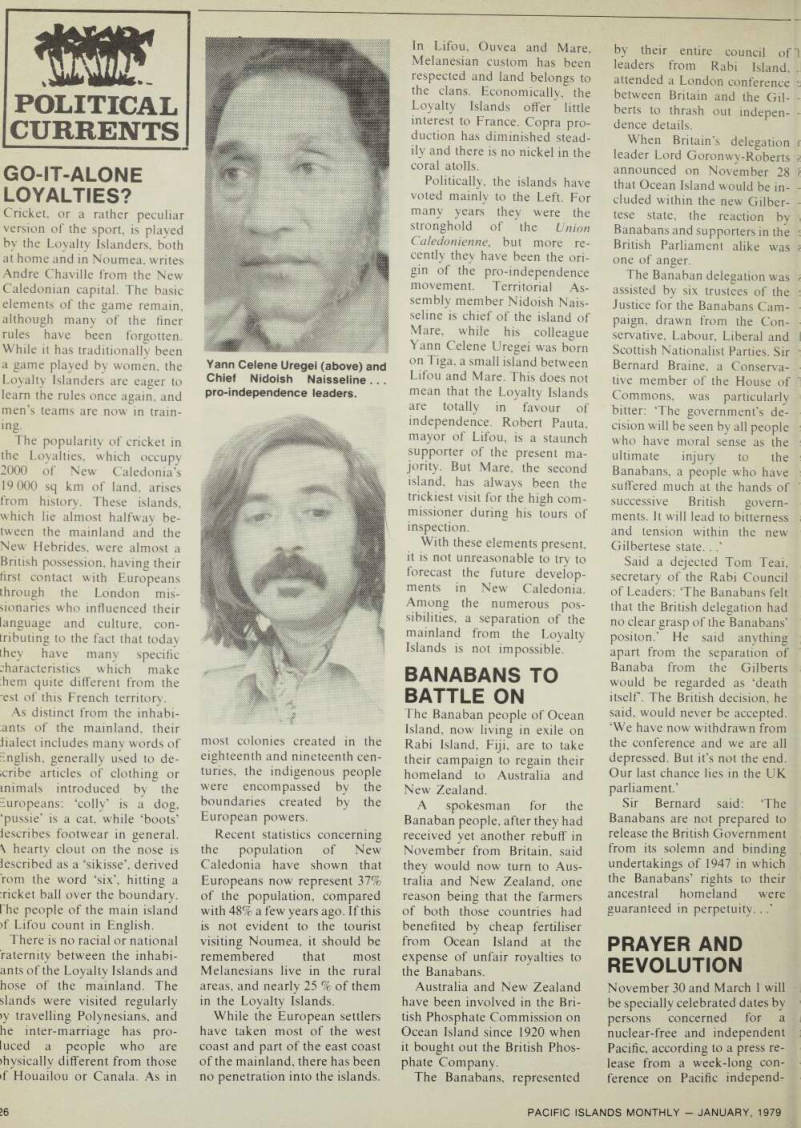
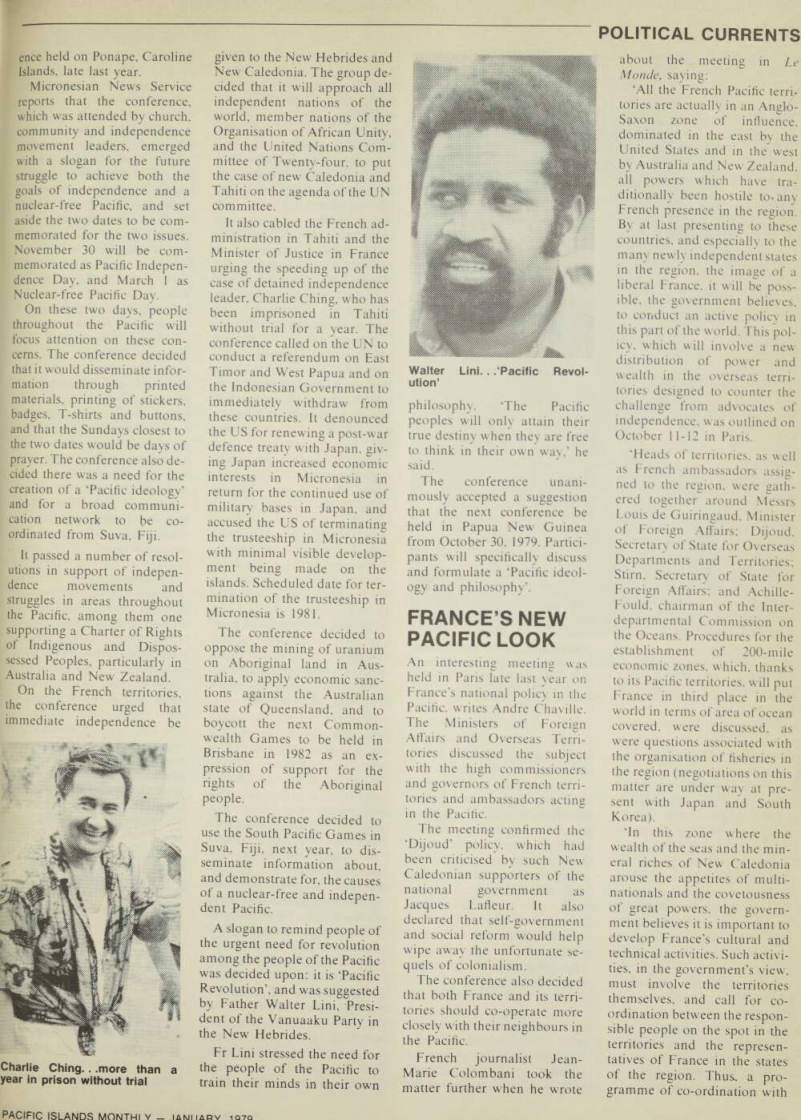
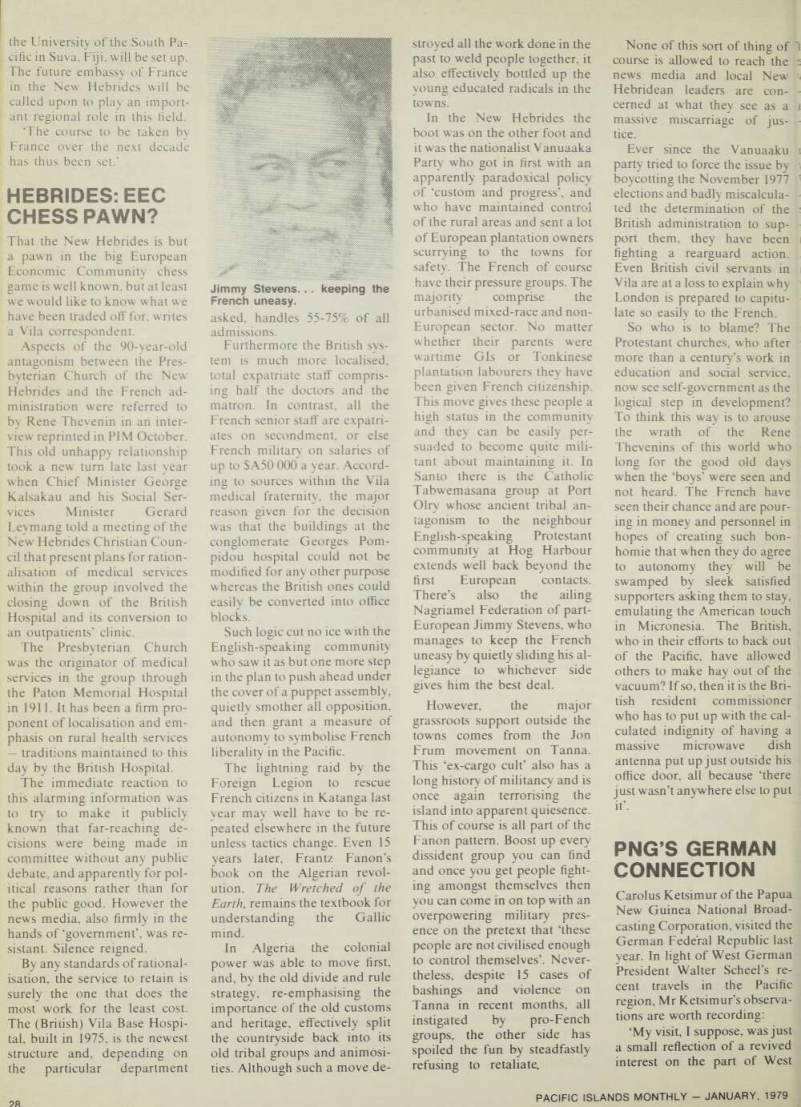
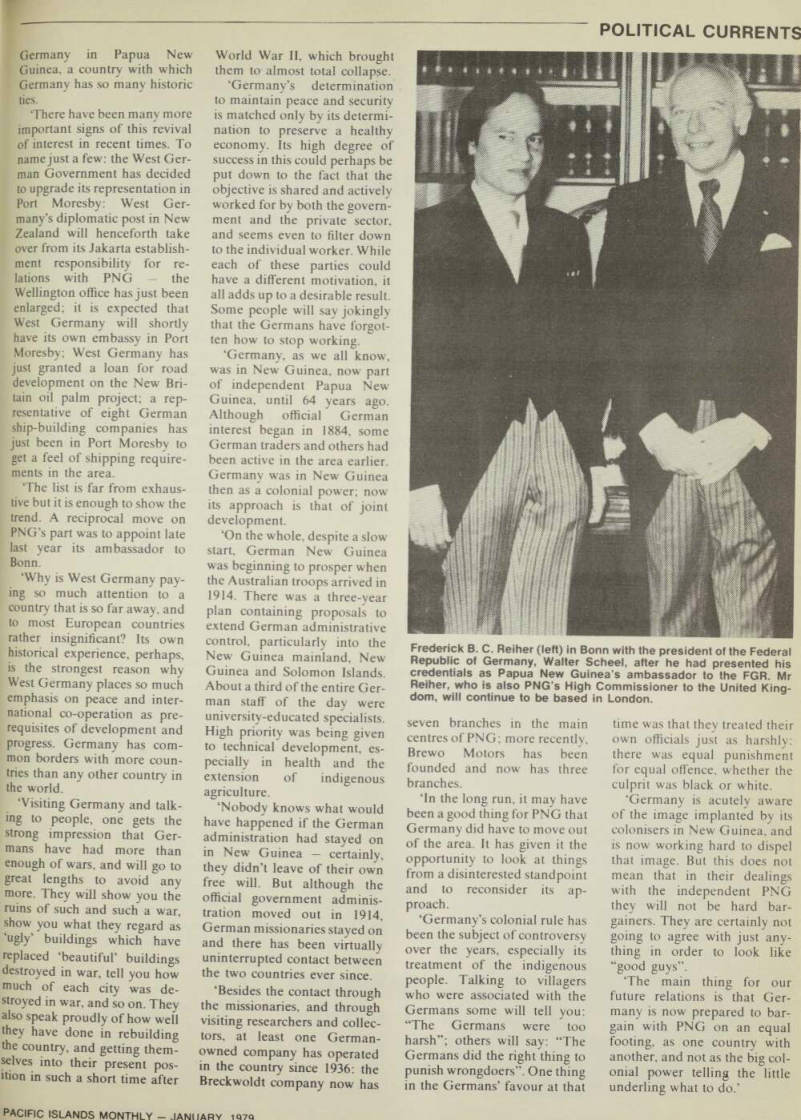
Currents
Go-It-Alone
Loyalties?
Cricket, or a rather peculiar version of the sport, is played by the Loyalty Islanders, both at home and in Noumea, writes Andre Chaville from the New Caledonian capital. The basic elements of the game remain, although many of the finer rules have been forgotten.
While it has traditionally been a game played by women, the Loyalty Islanders are eager to learn the rules once again, and men’s teams are now in train
ing.
The popularity of cricket in the Loyalties, which occupy 2000 of New Caledonia’s 19 000 sq km of land, arises from history. These islands, which lie almost halfway be tween the mainland and the New Hebrides, were almost a
British possession, having their
first contact with Europeans
through the London mis sionaries who influenced their language and culture, con tributing to the fact that today
they have many specific
:haracteristics which make them quite different from the *est of this French territory.
As distinct from the inhabi tants of the mainland, their iialect includes many words of English, generally used to de ;cribe articles of clothing or
mimals introduced by the
Europeans: ‘colly’ is a dog,
‘pussie’ is a cat, while ‘boots’ lescribes footwear in general. \ hearty clout on the nose is lescribed as a ‘sikisse’, derived rom the word ‘six’, hitting a Ticket ball over the boundary, fhe people of the main island )f Lifou count in English.
There is no racial or national raternity between the inhabi ants of the Loyalty Islands and hose of the mainland. The
slands were visited regularly
>y travelling Polynesians, and
he inter-marriage has pro
luced a people who are >hysically different from those T Houailou or Canala. As in
most colonies created in the eighteenth and nineteenth cen turies, the indigenous people were encompassed by the boundaries created by the
European powers.
Recent statistics concerning the population of New Caledonia have shown that Europeans now represent 37%
of the population, compared
with 48% a few years ago. If this is not evident to the tourist visiting Noumea, it should be remembered that most Melanesians live in the rural areas, and nearly 25 % of them in the Loyalty Islands.
While the European settlers have taken most of the west coast and part of the east coast of the mainland, there has been no penetration into the islands.
In Lifou, Ouvea and Mare, Melanesian custom has been respected and land belongs to the clans. Economically, the Loyalty Islands offer little interest to France. Copra pro duction has diminished stead ily and there is no nickel in the coral atolls.
Politically, the islands have voted mainly to the Left. For many years they were the stronghold of the Union Caledonienne, but more re cently they have been the ori
gin of the pro-independence
movement. Territorial As sembly member Nidoish Nais seline is chief of the island of Mare, while his colleague Yann Celene Uregei was born on Tiga, a small island between Lifou and Mare. This does not mean that the Loyalty Islands are totally in favour of independence. Robert Pauta, mayor of Lifou, is a staunch supporter of the present ma jority. But Mare, the second island, has always been the trickiest visit for the high com missioner during his tours of
inspection.
With these elements present, it is not unreasonable to try to forecast the future develop ments in New Caledonia.
Among the numerous pos sibilities, a separation of the mainland from the Loyalty Islands is not impossible.
Banabans To
Battle On
The Banaban people of Ocean Island, now living in exile on Rabi Island, Fiji, are to take their campaign to regain their homeland to Australia and New Zealand.
A spokesman for the Banaban people, after they had received yet another rebuff in November from Britain, said they would now turn to Aus tralia and New Zealand, one reason being that the farmers of both those countries had benefited by cheap fertiliser from Ocean Island at the expense of unfair royalties to the Banabans.
Australia and New Zealand have been involved in the Bri tish Phosphate Commission on Ocean Island since 1920 when it bought out the British Phos
phate Company.
The Banabans, represented
by their entire council of leaders from Rabi Island, attended a London conference between Britain and the Gil berts to thrash out indepen dence details.
When Britain’s delegation leader Lord Goronwy-Roberts announced on November 28 that Ocean Island would be in cluded within the new Gilber tese state, the reaction by Banabans and supporters in the British Parliament alike was one of anger.
The Banaban delegation was assisted by six trustees of the Justice for the Banabans Cam paign, drawn from the Con servative, Labour, Liberal and Scottish Nationalist Parties. Sir Bernard Braine, a Conserva tive member of the House of Commons, was particularly bitter: The government’s de cision will be seen by all people who have moral sense as the ultimate injury to the Banabans, a people who have suffered much at the hands of successive British govern ments. It will lead to bitterness and tension within the new Gilbertese state...’
Said a dejected Tom Teai, secretary of the Rabi Council of Leaders: ‘The Banabans felt that the British delegation had no clear grasp of the Banabans’
positon.’ He said anything
apart from the separation of Banaba from the Gilberts would be regarded as ‘death itself. The British decision, he said, would never be accepted. ‘We have now withdrawn from the conference and we are all depressed. But it’s not the end.
Our last chance lies in the UK
parliament.’
Sir Bernard said: ‘The Banabans are not prepared to release the British Government from its solemn and binding undertakings of 1947 in which the Banabans’ rights to their ancestral homeland were guaranteed in perpetuity. ..’
Prayer And
Revolution
November 30 and March 1 will be specially celebrated dates by persons concerned for a nuclear-free and independent Pacific, according to a press re lease from a week-long con ference on Pacific independ
Yann Celene Uregei (above) and Chief Nidoish Naisseline ... pro-independence leaders.
ence held on Ponape, Caroline Islands, late last year.
Micronesian News Service reports that the conference, which was attended by church,
community and independence
movement leaders, emerged with a slogan for the future struggle to achieve both the goals of independence and a nuclear-free Pacific, and set aside the two dates to be com memorated for the two issues.
November 30 will be com memorated as Pacific Indepen dence Day, and March 1 as Nuclear-free Pacific Day.
On these two days, people throughout the Pacific will focus attention on these con cerns. The conference decided that it would disseminate infor
mation through printed
materials, printing of stickers, badges, T-shirts and buttons, and that the Sundays closest to the two dates would be days of prayer. The conference also de cided there was a need for the creation of a ‘Pacific ideology’ and for a broad communi cation network to be co ordinated from Suva, Fiji.
It passed a number of resol utions in support of indepen dence movements and
struggles in areas throughout
the Pacific, among them one supporting a Charter of Rights
of Indigenous and Dispos
sessed Peoples, particularly in
Australia and New Zealand.
On the French territories, the conference urged that immediate independence be
given to the New Hebrides and New Caledonia. The group de cided that it will approach all independent nations of the world, member nations of the
Organisation of African Unity,
and the United Nations Com mittee of Twenty-four, to put the case of new Caledonia and Tahiti on the agenda of the UN committee.
It also cabled the French ad ministration in Tahiti and the Minister of Justice in France urging the speeding up of the case of detained independence leader, Charlie Ching, who has been imprisoned in Tahiti without trial for a year. The conference called on the UN to conduct a referendum on East Timor and West Papua and on the Indonesian Government to immediately withdraw from these countries. It denounced the US for renewing a post-war defence treaty with Japan, giv ing Japan increased economic interests in Micronesia in return for the continued use of military bases in Japan, and accused the US of terminating the trusteeship in Micronesia with minimal visible develop ment being made on the islands. Scheduled date for ter mination of the trusteeship in Micronesia is 1981.
The conference decided to oppose the mining of uranium on Aboriginal land in Aus tralia, to apply economic sanc tions against the Australian state of Queensland, and to boycott the next Common wealth Games to be held in Brisbane in 1982 as an ex pression of support for the
rights of the Aboriginal
people.
The conference decided to use the South Pacific Games in Suva, Fiji, next year, to dis seminate information about, and demonstrate for, the causes of a nuclear-free and indepen dent Pacific.
A slogan to remind people of the urgent need for revolution among the people of the Pacific was decided upon: it is ‘Pacific Revolution’, and was suggested by Father Walter Lini, Presi dent of the Vanuaaku Party in the New Hebrides.
Fr Lini stressed the need for the people of the Pacific to train their minds in their own
philosophy. The Pacific peoples will only attain their true destiny when they are free to think in their own way,’ he said.
The conference unani
mously accepted a suggestion
that the next conference be held in Papua New Guinea from October 30, 1979. Partici pants will specifically discuss and formulate a ‘Pacific ideol ogy and philosophy’.
France’S New
Pacific Look
An interesting meeting was
held in Paris late last year on France’s national policy in the Pacific, writes Andre Chaville.
The Ministers of Foreign Affairs and Overseas Terri tories discussed the subject with the high commissioners and governors of French terri tories and ambassadors acting in the Pacific.
The meeting confirmed the
‘Dijoud’ policy, which had
been criticised by such New Caledonian supporters of the national government as Jacques Lafleur. It also declared that self-government and social reform would help wipe away the unfortunate se quels of colonialism.
The conference also decided that both France and its terri tories should co-operate more closely with their neighbours in the Pacific.
French journalist Jean- Marie Colombani took the matter further when he wrote
about the meeting in Le Monde , saying: ‘All the French Pacific terri tories are actually in an Anglo- Saxon zone of influence, dominated in the east by the United States and in the west by Australia and New Zealand, all powers which have tra ditionally been hostile to. any French presence in the region.
By at last presenting to these countries, and especially to the
many newly independent states
in the region, the image of a liberal France, it will be poss ible. the government believes, to conduct an active policy in this part of the world. This pol icy, which will involve a new distribution of power and wealth in the overseas terri tories designed to counter the challenge from advocates of independence, was outlined on October 11-12 in Paris. ‘Heads of territories, as well as French ambassadors assig ned to the region, were gath ered together around Messrs Louis de Guiringaud. Minister
of Foreign Affairs; Dijoud.
Secretary of State for Overseas Departments and Territories; Stirn. Secretary of State for Foreign Affairs; and Achille- Fould. chairman of the Inter departmental Commission on the Oceans. Procedures for the establishment of 200-mile economic zones, which, thanks to its Pacific territories, will put France in third place in the world in terms of area of ocean covered, were discussed, as were questions associated with the organisation of fisheries in the region (negotiations on this matter are under way at pre sent with Japan and South Korea). ‘ln this zone where the wealth of the seas and the min eral riches of New Caledonia arouse the appetites of multi nationals and the covetousness of great powers, the govern ment believes it is important to develop France’s cultural and technical activities. Such activi ties, in the government’s view, must involve the territories themselves, and call for co ordination between the respon sible people on the spot in the territories and the represen tatives of France in the states of the region. Thus, a pro gramme of co-ordination with
Charlie Ching...more than a year in prison without trial
Walter Lini. . .‘Pacific Revol ution’
the University of the South Pa cific in Suva. Fiji, will be set up.
The future embassy of France in the New Hebrides will be called upon to play an import ant regional role in this field.
'The course to be taken by France over the next decade has thus been set.’
Hebrides: Eec
Chess Pawn?
That the New Hebrides is but a pawn in the big European Economic Community chess game is well known, but at least we would like to know what we have been traded off for, writes a Vila correspondent.
Aspects of the 90-year-old antagonism between the Pres byterian Church of the New Hebrides and the French ad ministration were referred to by Rene Thevenin in an inter view reprinted in PIM October.
This old unhappy relationship
took a new turn late last year when Chief Minister George Kalsakau and his Social Ser vices Minister Gerard Leymang told a meeting of the New Hebrides Christian Coun cil that present plans for ration alisation of medical services within the group involved the closing down of the British Hospital and its conversion to an outpatients’ clinic.
The Presbyterian Church was the originator of medical services in the group through the Paton Memorial Hospital in 1911. It has been a firm pro ponent of localisation and em phasis on rural health services traditions maintained to this
day by the British Hospital.
The immediate reaction to this alarming information was to try to make it publicly known that far-reaching de cisions were being made in committee without any public debate, and apparently for pol itical reasons rather than for the public good. However the news media, also firmly in the hands of ‘government’, was re sistant. Silence reigned.
By any standards of rational isation, the service to retain is surely the one that does the most work for the least cost.
The (British) Vila Base Hospi tal, built in 1975, is the newest structure and, depending on
the particular department
asked, handles 55-75% of all admissions.
Furthermore the British sys tem is much more localised, total expatriate staff compris ing half the doctors and the matron. In contrast, all the French senior staff are expatri ates on secondment, or else French military on salaries of up to SASO 000 a year. Accord ing to sources within the Vila medical fraternity, the major reason given for the decision was that the buildings at the conglomerate Georges Pom pidou hospital could not be modified for any other purpose whereas the British ones could easily be converted into office blocks.
Such logic cut no ice with the
English-speaking community
who saw it as but one more step in the plan to push ahead under the cover of a puppet assembly,
quietly smother all opposition,
and then grant a measure of autonomy to symbolise French liberality in the Pacific.
The lightning raid by the
Foreign Legion to rescue
French citizens in Katanga last year may well have to be re peated elsewhere in the future unless tactics change. Even 15 years later, Frantz Fanon’s book on the Algerian revol ution, The Wretched of the Earth, remains the textbook for understanding the Gallic mind.
In Algeria the colonial power was able to move first, and, by the old divide and rule strategy, re-emphasising the importance of the old customs
and heritage, effectively split
the countryside back into its old tribal groups and animosi ties. Although such a move de
stroyed all the work done in the past to weld people together, it also effectively bottled up the young educated radicals in the towns.
In the New Hebrides the boot was on the other foot and it was the nationalist Vanuaaka Party who got in first with an apparently paradoxical policy of ‘custom and progress’, and who have maintained control of the rural areas and sent a lot
of European plantation owners
scurrying to the towns for safety. The French of course have their pressure groups. The majority comprise the urbanised mixed-race and non- European sector. No matter whether their parents were wartime Gls or Tonkinese
plantation labourers they have
been given French citizenship.
This move gives these people a high status in the community and they can be easily per suaded to become quite mili tant about maintaining it. In Santo there is the Catholic Tabwemasana group at Port Olry whose ancient tribal an
tagonism to the neighbour
English-speaking Protestant
community at Hog Harbour
extends well back beyond the first European contacts.
There’s also the ailing Nagriamel Federation of part-
European Jimmy Stevens, who
manages to keep the French
uneasy by quietly sliding his al
legiance to whichever side gives him the best deal.
However, the major grassroots support outside the towns comes from the Jon Frum movement on Tanna.
This ‘ex-cargo cult’ also has a long history of militancy and is
once again terrorising the
island into apparent quiesence.
This of course is all part of the Fanon pattern. Boost up every dissident group you can find and once you get people fight ing amongst themselves then you can come in on top with an overpowering military pres ence on the pretext that ‘these people are not civilised enough to control themselves’. Never theless, despite 15 cases of bashings and violence on Tanna in recent months, all
instigated by pro-Fench
groups, the other side has spoiled the fun by steadfastly refusing to retaliate.
None of this sort of thing of course is allowed to reach the news media and local New Hebridean leaders are con cerned at what they see as a massive miscarriage of jus tice.
Ever since the Vanuaaku party tried to force the issue by boycotting the November 1977 elections and badly miscalcula ted the determination of the British administration to sup port them, they have been fighting a rearguard action.
Even British civil servants in Vila are at a loss to explain why London is prepared to capitu late so easily to the French.
So who is to blame? The Protestant churches, who after more than a century’s work in education and social service, now see self-government as the
logical step in development?
To think this way is to arouse the wrath of the Rene Thevenins of this world who
long for the good old days
when the ‘boys’ were seen and not heard. The French have seen their chance and are pour ing in money and personnel in hopes of creating such bon homie that when they do agree to autonomy they will be swamped by sleek satisfied supporters asking them to stay, emulating the American touch in Micronesia. The British, who in their efforts to back out of the Pacific, have allowed others to make hay out of the vacuum? If so, then it is the Bri tish resident commissioner who has to put up with the cal culated indignity of having a massive microwave dish antenna put up just outside his office door, all because ‘there just wasn’t anywhere else to put it’.
Png’S German
Connection
Carolus Ketsimur of the Papua New Guinea National Broad
casting Corporation, visited the
German Federal Republic last year. In light of West German President Walter Scheel’s re cent travels in the Pacific region. Mr Ketsimur’s observa tions are worth recording: ‘My visit, I suppose, was just a small reflection of a revived interest on the part of West
Jimmy Stevens. . . keeping the French uneasy.
Germany in Papua New Guinea, a country with which Germany has so many historic ties. ‘There have been many more important signs of this revival of interest in recent times. To name just a few: the West Ger man Government has decided to upgrade its representation in Port Moresby; West Ger many’s diplomatic post in New Zealand will henceforth take over from its Jakarta establish ment responsibility for re lations with PNG the Wellington office has just been enlarged; it is expected that
West Germany will shortly
have its own embassy in Port
Moresby; West Germany has
just granted a loan for road development on the New Bri tain oil palm project; a rep resentative of eight German ship-building companies has just been in Port Moresby to get a feel of shipping require ments in the area. ‘The list is far from exhaus tive but it is enough to show the trend. A reciprocal move on PNG’s part was to appoint late last year its ambassador to Bonn. ‘Why is West Germany pay ing so much attention to a country that is so far away, and to most European countries rather insignificant? Its own
historical experience, perhaps,
is the strongest reason why West Germany places so much emphasis on peace and inter national co-operation as pre
requisites of development and
progress. Germany has com mon borders with more coun tries than any other country in the world.
‘Visiting Germany and talk
ing to people, one gets the strong impression that Ger mans have had more than enough of wars, and will go to great lengths to avoid any more. They will show you the ruins of such and such a war, show you what they regard as
‘ugly’ buildings which have
replaced ‘beautiful’ buildings destroyed in war, tell you how much of each city was de stroyed in war, and so on. They also speak proudly of how well they have done in rebuilding the country, and getting them selves into their present pos ition in such a short time after
World War 11, which brought them to almost total collapse.
‘Germany’s determination
to maintain peace and security is matched only by its determi nation to preserve a healthy economy. Its high degree of success in this could perhaps be put down to the fact that the objective is shared and actively worked for by both the govern ment and the private sector, and seems even to filter down to the individual worker. While each of these parties could have a different motivation, it all adds up to a desirable result.
Some people will say jokingly that the Germans have forgot ten how to stop working. ‘Germany, as we all know, was in New Guinea, now part
of independent Papua New
Guinea, until 64 years ago.
Although official German interest began in 1884. some German traders and others had been active in the area earlier.
Germany was in New Guinea then as a colonial power; now its approach is that of joint
development.
‘On the whole, despite a slow start, German New Guinea was beginning to prosper when the Australian troops arrived in 1914. There was a three-year
plan containing proposals to
extend German administrative control, particularly into the New Guinea mainland. New Guinea and Solomon Islands.
About a third of the entire Ger man staff of the day were
university-educated specialists.
High priority was being given
to technical development, es pecially in health and the extension of indigenous
agriculture.
‘Nobody knows what would have happened if the German administration had stayed on in New Guinea certainly, they didn’t leave of their own free will. But although the official government adminis tration moved out in 1914, German missionaries stayed on and there has been virtually uninterrupted contact between the two countries ever since. ‘Besides the contact through the missionaries, and through visiting researchers and collec tors, at least one German owned company has operated in the country since 1936: the Breckwoldt company now has
seven branches in the main centres of PNG; more recently, Brewo Motors has been founded and now has three branches. ‘ln the long run, it may have been a good thing for PNG that Germany did have to move out of the area. It has given it the opportunity to look at things from a disinterested standpoint and to reconsider its ap-
proach.
‘Germany’s colonial rule has been the subject of controversy over the years, especially its treatment of the indigenous
people. Talking to villagers
who were associated with the Germans some will tell you: “The Germans were too harsh”; others will say: “The Germans did the right thing to
punish wrongdoers”. One thing
in the Germans’ favour at that
time was that they treated their own officials just as harshly:
there was equal punishment
for equal offence, whether the culprit was black or white.
‘Germany is acutely aware
of the image implanted by its
colonisers in New Guinea, and is now working hard to dispel that image. But this does not mean that in their dealings with the independent PNG they will not be hard bar
gainers. They are certainly not
going to agree with just any thing in order to look like
“good guys”,
‘The main thing for our future relations is that Ger many is now prepared to bar gain with PNG on an equal footing, as one country with another, and not as the big col onial power telling the little underling what to do.’
Frederick B. C. Reiher (left) in Bonn with the president of the Federal Republic of Germany, Walter Scheel, after he had presented his credentials as Papua New Guinea’s ambassador to the FGR. Mr Reiher, who is also PNG’s High Commissioner to the United King dom, will continue to be based in London.
Advertisements & other items, pp. 27-30 (2 items)
Political Currents
PACIFIC ISLANDS MONTHI Y iami iarv iqtq
to Tonga’s communications.
We’ve made the
world of difference
With the opening of the Cable & Wireless earth station, the people ofTonga can enjoy the benefits of the fastest, most efficient and reliable telephone, telex and telegraph links to the rest of the world. Via satellite.
At Cable & Wireless we have over a century of experience in the design, installation and maintenance of communications systems throughout the world. To date we have been involved with over 30 earth stations, each designed to meet their individual climatic and geographic conditions.
So, for more information, do a little communicating yourself. Contact us. € * ■ Always a Step ahead oftoday’s communications.
Comer of Queen Salote KotO & Fongoloa, Tonga.
Head Office: Mercury House, Road, London mm §RX. Tel: 01-242 4433 Telex 23181
The Englishman
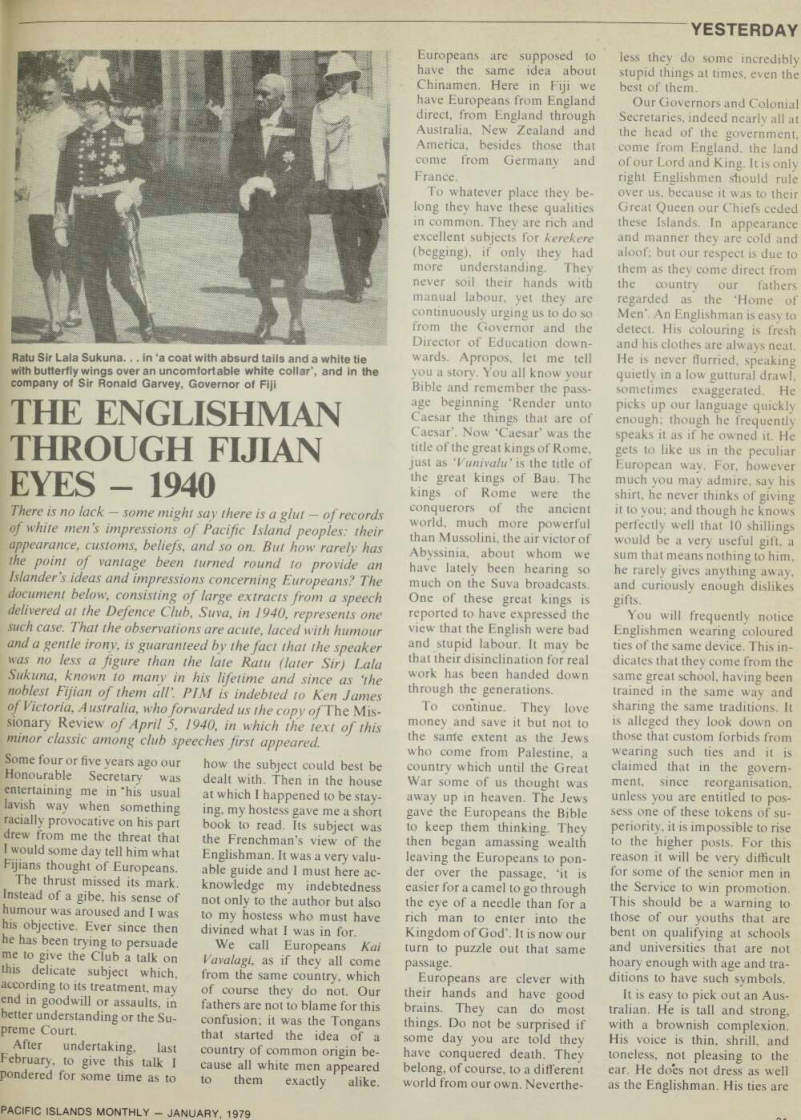
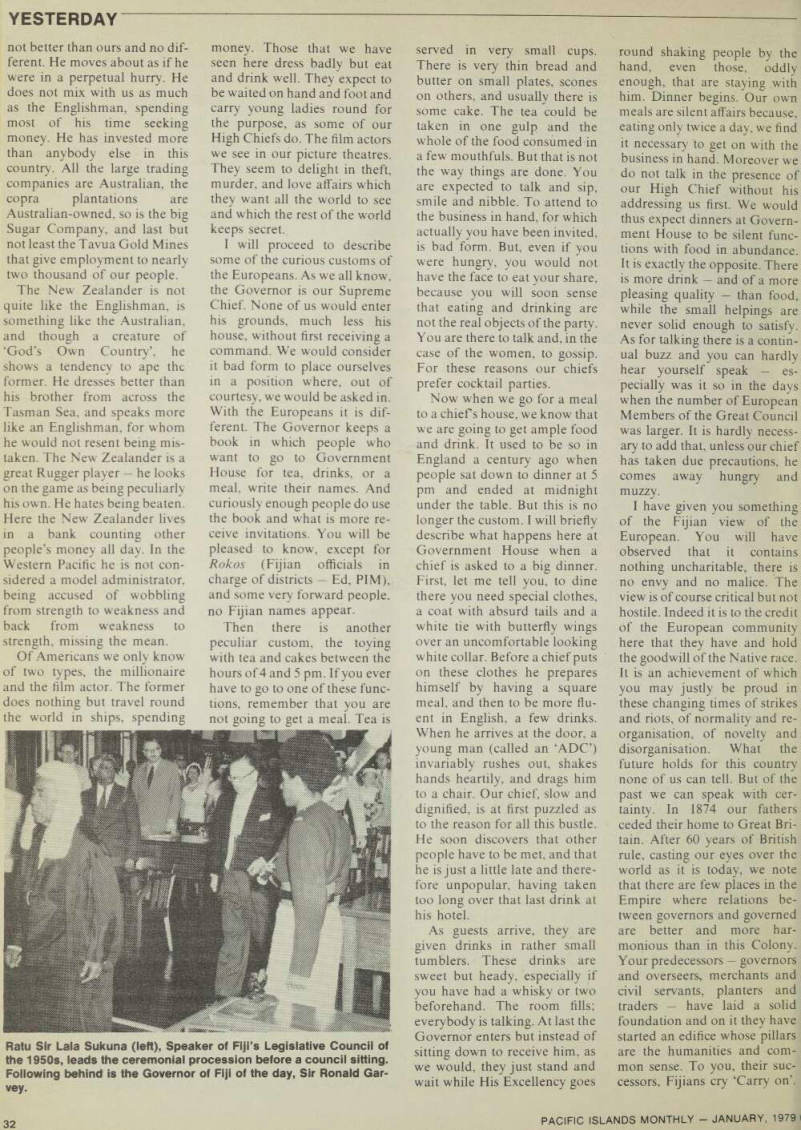
Through Fijian
Eyes - 1940
There is no lack - some might say there is a glut - of records of white men’s impressions of Pacific Island peoples: their appearance, customs, beliefs, and so on. But how rarely has the point of vantage been turned round to provide an Islander’s ideas and impressions concerning Europeans? The document below, consisting of large extracts from a speech delivered at the Defence Club, Suva, in 1940, represents one such case. That the observations are acute, laced with humour and a gentle irony, is guaranteed by the fact that the speaker was no less a figure than the late Ratu (later Sir) Lala Sukuna, known to many in his lifetime and since as ‘the noblest Fijian of them all’. PIM is indebted to Ken James of Victoria, Australia, who forwarded us the copy o/The Mis sionary Review of April 5, 1940, in which the text of this minor classic among club speeches first appeared.
Some four or five years ago our Honourable Secretary was entertaining me in ’his usual lavish way when something racially provocative on his part drew from me the threat that I would some day tell him what
Fijians thought of Europeans.
The thrust missed its mark.
Instead of a gibe, his sense of humour was aroused and I was his objective. Ever since then he has been trying to persuade me to give the Club a talk on this delicate subject which, according to its treatment, may end in goodwill or assaults, in better understanding or the Su preme Court.
After undertaking, last February, to give this talk I pondered for some time as to
how the subject could best be dealt with. Then in the house at which I happened to be stay ing, my hostess gave me a short book to read. Its subject was the Frenchman’s view of the Englishman. It was a very valu able guide and I must here ac knowledge my indebtedness not only to the author but also to my hostess who must have divined what I was in for.
We call Europeans Kai Vavalagi, as if they all come from the same country, which of course they do not. Our fathers are not to blame for this confusion; it was the Tongans that started the idea of a country of common origin be cause all white men appeared to them exactly alike.
Europeans are supposed to
have the same idea about Chinamen. Here in Fiji we
have Europeans from England
direct, from England through
Australia, New Zealand and America, besides those that come from Germany and France.
To whatever place they be long they have these qualities in common. They are rich and excellent subjects for kerekere
(begging), if only they had
more understanding. They
never soil their hands with manual labour, yet they are continuously urging us to do so from the Governor and the Director of Education down wards. Apropos, let me tell you a story. You all know your Bible and remember the pass age beginning ‘Render unto Caesar the things that are of Caesar’. Now ‘Caesar’ was the title of the great kings of Rome, just as ‘Vunivalu' is the title of the great kings of Bau. The kings of Rome were the conquerors of the ancient world, much more powerful than Mussolini, the air victor of Abyssinia, about whom we have lately been hearing so much on the Suva broadcasts.
One of these great kings is reported to have expressed the view that the English were bad and stupid labour. It may be that their disinclination for real work has been handed down through the generations.
To continue. They love money and save it but not to the same extent as the Jews who come from Palestine, a country which until the Great War some of us thought was away up in heaven. The Jews gave the Europeans the Bible
to keep them thinking. They
then began amassing wealth
leaving the Europeans to pon der over the passage, ‘it is easier for a camel to go through the eye of a needle than for a rich man to enter into the Kingdom of God’. It is now our turn to puzzle out that same passage.
Europeans are clever with their hands and have good brains. They can do most things. Do not be surprised if some day you are told they have conquered death. They belong, of course, to a different world from our own. Neverthe
less they do some incredibly stupid things at times, even the best of them.
Our Governors and Colonial Secretaries, indeed nearly all at the head of the government, come from England, the land of our Lord and King. It is only right Englishmen should rule over us, because it was to their Great Queen our Chiefs ceded these Islands. In appearance and manner they are cold and aloof: but our respect is due to them as they come direct from the country our fathers regarded as the ‘Home of Men’. An Englishman is easy to detect. His colouring is fresh and his clothes are always neat.
He is never flurried, speaking quietly in a low guttural drawl, sometimes exaggerated. He
picks up our language quickly
enough; though he frequently
speaks it as if he owned it. He gets to like us in the peculiar European way. For, however much you may admire, say his shirt, he never thinks of giving it to you; and though he knows perfectly well that 10 shillings would be a very useful gift, a sum that means nothing to him,
he rarely gives anything away,
and curiously enough dislikes
gifts.
You will frequently notice
Englishmen wearing coloured
ties of the same device. This in dicates that they come from the same great school, having been trained in the same way and sharing the same traditions. It is alleged they look down on those that custom forbids from wearing such ties and it is claimed that in the govern ment, since reorganisation, unless you are entitled to pos sess one of these tokens of su periority, it is impossible to rise to the higher posts. For this reason it will be very difficult for some of the senior men in the Service to win promotion.
This should be a warning to those of our youths that are bent on qualifying at schools and universities that are not hoary enough with age and tra ditions to have such symbols.
It is easy to pick out an Aus tralian. He is tall and strong, with a brownish complexion.
His voice is thin, shrill, and toneless, not pleasing to the ear. He does not dress as well as the Englishman. His ties are
Ratu Sir Lala Sukuna... in ‘a coat with absurd tails and a white tie with butterfly wings over an uncomfortable white collar’, and in the company of Sir Ronald Garvey, Governor of Fiji
not better than ours and no different. He moves about as if he were in a perpetual hurry. He does not mix with us as much
as the Englishman, spending
most of his time seeking money. He has invested more than anybody else in this country. All the large trading companies are Australian, the copra plantations are Australian-owned, so is the big Sugar Company, and last but not least the Tavua Gold Mines
that give employment to nearly
two thousand of our people.
The New Zealander is not quite like the Englishman, is something like the Australian, and though a creature of ‘God’s Own Country’, he shows a tendency to ape the former. He dresses better than his brother from across the Tasman Sea, and speaks more like an Englishman, for whom he would not resent being mistaken. The New Zealander is a great Rugger player he looks on the game as being peculiarly his own. He hates being beaten.
Here the New Zealander lives in a bank counting other people’s money all day. In the Western Pacific he is not considered a model administrator,
being accused of wobbling
from strength to weakness and back from weakness to
strength, missing the mean.
Of Americans we only know of two types, the millionaire and the film actor. The former does nothing but travel round the world in ships, spending
money. Those that we have seen here dress badly but eat and drink well. They expect to be waited on hand and foot and carry young ladies round for the purpose, as some of our High Chiefs do. The film actors we see in our picture theatres, They seem to delight in theft, murder, and love affairs which they want all the world to see and which the rest of the world
keeps secret,
I will proceed to describe some of the curious customs of the Europeans. As we all know, the Governor is our Supreme Chief. None of us would enter his grounds, much less his house, without first receiving a command. We would consider it bad form to place ourselves in a position where, out of courtesy, we would be asked in.
With the Europeans it is dif ferent. The Governor keeps a book in which people who want to go to Government House for tea, drinks, or a meal, write their names. And
curiously enough people do use
the book and what is more re ceive invitations. You will be pleased to know, except for Rokos (Fijian officials in charge of districts Ed, PIM), and some very forward people, no Fijian names appear, Then there is another
peculiar custom, the toying
with tea and cakes between the hours of 4 and 5 pm. If you ever have to go to one of these func tions, remember that you are not going to get a meal. Tea is
served in very small cups.
There is very thin bread and butter on small plates, scones on others, and usually there is some cake. The tea could be taken in one gulp and the whole of the food consumed in a few mouthfuls. But that is not the way things are done. You are expected to talk and sip, smile and nibble. To attend to the business in hand, for which actually you have been invited, is bad form. But, even if you were hungry, you would not have the face to eat your share, because you will soon sense that eating and drinking are not the real objects of the party.
You are there to talk and, in the case of the women, to gossip.
For these reasons our chiefs
prefer cocktail parties.
Now when we go for a meal to a chiefs house, we know that we are going to get ample food and drink. It used to be so in England a century ago when people sat down to dinner at 5 pm and ended at midnight under the table. But this is no longer the custom. I will briefly describe what happens here at Government House when a chief is asked to a big dinner.
First, let me tell you. to dine there you need special clothes, a coat with absurd tails and a white tie with butterfly wings over an uncomfortable looking white collar. Before a chief puts on these clothes he prepares himself by having a square meal, and then to be more flu ent in English, a few drinks.
When he arrives at the door, a young man (called an ‘ADC’) invariably rushes out, shakes hands heartily, and drags him to a chair. Our chief, slow and dignified, is at first puzzled as to the reason for all this bustle.
He soon discovers that other people have to be met, and that he is just a little late and there
fore unpopular, having taken
too long over that last drink at his hotel.
As guests arrive, they are given drinks in rather small tumblers. These drinks are sweet but heady, especially if you have had a whisky or two beforehand. The room fills; everybody is talking. At last the Governor enters but instead of sitting down to receive him, as we would, they just stand and wait while His Excellency goes
round shaking people by the hand, even those, oddly enough, that are staying with him. Dinner begins. Our own meals are silent affairs because, eating only twice a day, we find it necessary to get on with the business in hand. Moreover we do not talk in the presence of our High Chief without his addressing us first. We would thus expect dinners at Govern ment House to be silent func tions with food in abundance.
It is exactly the opposite. There is more drink - and of a more pleasing quality - than food, while the small helpings are never solid enough to satisfy.
As for talking there is a contin ual buzz and you can hardly
hear yourself speak es
pecially was it so in the days when the number of European Members of the Great Council was larger. It is hardly necess ary to add that, unless our chief has taken due precautions, he comes away hungry and muzzy.
I have given you something of the Fijian view of the European. You will have observed that it contains nothing uncharitable, there is no envy and no malice. The view is of course critical but not hostile. Indeed it is to the credit
of the European community
here that they have and hold the goodwill of the Native race.
It is an achievement of which you may justly be proud in these changing times of strikes and riots, of normality and re
organisation, of novelty and
disorganisation. What the future holds for this country none of us can tell. But of the past we can speak with cer tainty. In 1874 our fathers ceded their home to Great Bri tain. After 60 years of British rule, casting our eyes over the world as it is today, we note that there are few places in the Empire where relations be tween governors and governed are better and more har monious than in this Colony.
Your predecessors governors and overseers., merchants and civil servants, planters and traders have laid a solid foundation and on it they have started an edifice whose pillars are the humanities and com mon sense. To you, their suc cessors, Fijians cry ‘Carry on’.
Ratu Sir Lala Sukuna (left), Speaker of Fiji’s Legislative Council of the 1950s, leads the ceremonial procession before a council sitting.
Following behind is the Governor of Fiji of the day, Sir Ronald Gar vey.
Advertisements & other items, pp. 31-40 (2 items)
Yesterday
charade
DAIHATSU Continues To Press Forward
In Its Quest For A Harmonious “Automobile Society”
A new car born of logic
created to meet
the practical need
of today’s world
* model XG s
SEE 2
charade
The Daihtsu Charade is a car in which a family of 5 can travel in comfort. A car with a special functionality, thanks to its hatch-back door, and with plenty of power for excellent maneuverability under a wide variety of conditions ranging from crowded cities to fast highways. Very definitely a car of economy ... but still a car in which all of these attributes have been concentrated into a compact ■- ■v.. w r r ■ body in a very logical way.
Today we no longer live in an age in which we can afford the luxury of determining a car’s worth by its luxurious fittings and its great engine displacement. The Daihatsu Charade is therefore a new - and most logical - alternative for those who will enjoy the simple life and its simple pleasures.
4-Wheel Drive...ideal for highways,
sand, rocks or mountain trails
Because it can go “almost anywhere”. And that includes highways, rocky trails, sand, river sides. Dry, wet, rocky, sandy surfaces.
That’s what sets this 4-Wheel Drive so far apart and ahead - when the going gets tough. Excellent acceleration superb hill climbing, amazing tenacity . . . that’s the story of Daihatsu 4-Wheel Drive!
DAIHATSU
4 WHEEL DRIVE
DAIHATSU
DAIHATSU MOTOR CO, LTD.
DAIHATSU MOTOR SALES CO, LTD.
Head Office; 1, DAI HATS U-CHO, IKEDA CITY, OSAKA PREFECTURE, JAPAN
PHONE: IKEDA (0727) 51-8811
CABLE ADDRESS: TLX5322224 DAIHATSU IKEDA OSAKA
TELEX NO.: 0-5322-251 JAPAN, 0-5322-224 JAPAN
Tokyo Office:
7, NIHONBASH l-HONCHO 2-CHOME, CHUO-KU, TOKYO.
PHONE: TOKYO (03) 279-0811
CABLE ADDRESS: DAIHATSU TOKYO
TELEX NO.; 0-222-3377 JAPAN
£auVti N fW, GU,NEA: AGQUIP NEW GUINEA, P.O. Box 1121, Rabaul/ FIJI: PRAKASH MOTORS LIMITED, P.O. Box 370, Suva/ BP - 1047 ' Pa P eete / NEW CALEDONIA: 5.1.D.A., B.P. 2548, Noumea/ NEW HEBRIDES: SANTO BUS Box 45 ' Santo ' GARAGE RANTY & JAMMES, B.P. 627, Port Vila/ SOLOMON ISLANDS: HERTZ CAR RENTALS . L^l T " D ’.^ Box 333 ' Honiara/ REPUBLIC OF NAURU: NAURU COOPERATIVE SOCIETY/ NIUE ISLAND: NIUE ISLAND li? ?a E S' c £ ,a Box 4/ NORFOLK ISLAND: W.W. SANDERS & SONS LTD., P.O. Box 86, Burnt Pine/ GILBERT ISLANDS: JONG KUM KEE BROTHERS' STORE, P.O. Box 504, Betio Tarawa
Electronic technology that shines
on your wrist.
Casiotron. The shining example of an incredibly functional, fully-automatic precision electronic timepiece at its technological best. A timepiece that stands apart from others in its quality.
Accuracy guaranteed to within —lO~l5 seconds a month, and fully-automatic Time Date Calendar readouts, for starters. And performance second to none. All backed by Casio's 20 years of advanced digital electronics know-how.
The choice is yours. There are Casiotrons with a stopwatch function accurate to within 1 TOO of a second plus alarm, and Casiotrons with 12- and 24-hour system changeover. And there's the super-slim Casiotron, only 6.omm thick, and a Lady Casiotron designed to compliment a woman's wrist. Or choose the Casiotron Calendar 200, the first digital timepiece in the world to offer a full calendar month display .along with dual time function.
Casiotron. A shining example of precision time and sterling performance that sets a new standard in digital electronic timepieces.
CASIOTRON
* "\ Super-Slim • G 53248 Thickness 6.omm) 1 I
CASIO
1 £ ssc/ a* 7 *
QUARTZ
7 - - - Calendar 2oo (47GS-238) :4 10 24 Hour Co
(54QS/1SB)-
Alarm Chronograph (46CS-278) Lady Casiotron y I .. -1 ■ i Casio Computer Co., Ltd., Tokyo, Japan.
Get straight to the heart of hi-fi, Music “centers” and speakers-thrown-in stereo systems can
look attractive and convenient.
But it can be a costly mistake to purchase a no-name brand stereo set that turns out to produce less than satisfactory sound.
With a specialist maker like Kenwood, you’re on safer ground.
All the hi-fi components you see here were designed from the drawing board up to perform a specific audio job.
What’s more, they all match each other perfectly in
performance.
So that nothing of the sound quality is wasted at any point
in the music reproduction chain.
Kenwood has been in the business long enough to know that there are many ways to hi-fi.
And the best is the straightest.
KA-5700 Stereo integrated amplifier 40 watts per channel 0.04% THD. 0.008% THD at half rated power. 76d8 phono S/N (2.5mV input); 88dB (10mV input). 180mV max. phono overload, 0.04%
THD, IkHz.
KT-5500 FM/AM tuner FM sensitivity 10.8dBf (TQ^V). 68dB stereo S/N at 65dBf. 0.2% THD at 65dBf. IkHz.
Frequency response +0.2, -2dß, 30 to 1J 60dB selectivity. 45d8 separation at IkHz, 35d8 50 tolskh KX-530 Front loading cassette deck Dolby* noise reduction.
Frequency response 30 to 16kHz (chrome 64d8 S/N, Dolby* ON (chrome). 0.07% (WRMS) wow-and-flutter.
Separate Bias and Equalizer controls.
KD-1500 Belt-drive turntable Automatic Up-and-Cut tonearm, 0.05% (WRMS) wow-and-flutter. —6sdß rumble (DIN wtd).
Anti-resonant base.
LS-660 Linear Response speaker system 70 watts maximum input. 2-way, 2-speaker bass reflex system.
Sensitivity 92d8/Wat 1-meter.
Frequency response 40 to 20kHz Trademark of Dolby Labs. Inc. f M V » i • * >■».■« • •Hi Ml TRIO-KENWOOD CORPORATION 6-17, 3-chome, Aobadai, Meguro-ku, Tokyo 153, Japan Al IRTR AI IA TDIA vCki\»/AAri /a ■ i atp* nm , .—— TRIO-KENWOOD (AUSTRALIA) PTY LTD. Australia Tel 439-4322 NEW ZEALAND JOHN GILBERT 4 CO.. LTD Auckland Tel 30-839 FIJI THE DOMINION import a pypnoi Doouonnkic a.~_. -r_, c^. R X2^.?oV V .^ URNS PHILP (NORFOLK ISLAND) LTD TAHITI MAISON AUROtiE Papeete Tel 29703 ?.9. L . C !M o^i^ LANC>S TECHNIQUE RADIOS CENTRE LTD. Honiara Tel 416 AMERICAN SAMOA ISLAND PACIFIC AGENCIES INC Raon Pa nn To I RWj
is - I as r* * * r '
w^mrw*
* % -» ,f C c ** *fw ap * • % * u \ u. '■*& ll®»- mmmio"' 3 ■ ♦
Ilf
ill
* DS \ % k
TOYOTA
The Toyota truck range. Built to be unbeatable.
Bad weather conditions, no problem.
Bad roads and driving surfaces, eaten up.
Difficult loads, no contest. Built tough. Built to take it.
There's a Toyota truck built for you.
TOYOTA Land Cruiser Pickup m
TOYOTA Dyna
J.
TOYOTA Stout ..JE TOYOTA Toyo-Ace 111
TOYOTA Hi-Lux
TOYOTA Truck
TOYOTA
For unbeatable after service: P^ PU * N EA cf a LIMITED - Scratchley Rd„ Badili, P.O. Box 75, Port Moresby U.S. TRUST TERRITORY: MICROL CORPORATION CO LTD p'n inR7 p 1t A l°!° T,VE SUPPLIES CO., LTD., G.P.O. Box 355. Suva AMERICAN SAMOA: BURNS PHILP (SOUTH SEA) PO rT fidoTr ' 90 WESTERN SAM OA: BURNS PHILP (SOUTH SEA) LTD,, P.O. Box 188. Apia. GUAM: ATKINS. KROLL (GUAM) LTD LTD PO i rrr T/l R ! D f,Ln EW HEBRIDES MOTORS LTD., P.O. Box 18, Vila. SOLOMON ISLANDS: MENDANA ENTERPRISES (S.l.)' PO Box R a nt ' HO «*, a ,oTf^, T l‘ kI « PPON A UTOMOTO, B p 342 . Papeete. COOK ISLANDS: COOK ISLANDS TRADING CORPORATION LTD i a NOR n pO LKqTa M n c' c 'x!rw-> ER AT I V E SOCIETY GILBERT & ELLICE ISLANDS COLONY: TARAWA MOTORS. Box 36 ' MARIES NORFOLK TOURS. LTD.. P.O. Box 276. NEW CALEDONIA: SOCIETE IMPORTATION AUTOMOBILE uu KAUMUUE, Rond-Pomt du Pacific (Station Total B.P 438 Nnumm
I ,v£ m m ■ w & -j ; . m mm ES -■-
You’ll like our style to all
our destinations.
We have many flights to many destinations, but on each and every one you can be sure of one thing: attentive and friendly service. Plus of course good food and fine wines served in big jet comfort.
Today this special style of Air New Zealand is yours to enjoy on direct flights to New Zealand, or on your way around the Pacific; even to the East now that the fast, friendly way there is first to fly south with us! And of course to Honolulu, Los Angeles and on to Canada, London or Europe.
Your travel agent or Air New Zealand is ready now to help you plan the trip and the fares that suit you best wherever you want to fly.
0= air /if 11/ ZEBLano
” We fly the Pacific.
ANZ7B/3
Another Technological Breakthrough from SEIKf
The LC Digital Quartz
ALARM CHRONOGRAPH
It tells time and day, month and date, turns into a stopwatch and has an alarm, too.
As you'd expect, Seiko was the one to create a Multi-Mode LC Digital in which all four modes can function simultaneously. Seiko's dedication to technology makes this watch possible in a surprisingly compact case. Seiko's concern with human engineering makes it the easiest multi-mode quartz watch to operate.
Naturally, it has continuous readout, built-in illumination, battery life approximately two years, and the assurance of incomparable quality because it's by Seiko, world leader in quartz. Seiko Quartz.
Fb Sa
TIME DISPLAY
Continuous readout in hours on a 12-hour basis, minutes, seconds and day of week.
Ic
CALENDAR DISPLAY
Month, day and date are displayed at the push of a button. Calendar automatically adjusts for odd and even months (except February of leap years).
ALARM DISPLAY
Alarm can be set to sound daily at the designated AM or PM time. nn
CHRONOGRAPH DISPLAY
Chronograph mode displays hours, minutes and seconds up to 12 hours for recording elapsed time and lap time with 1/10 second readout for initial 20-minute period.
SEIKO
Someday all watches will be made this way.
Sound so great,
if you can’t believe your ea
check it with your eyes.
u
o o o
I *
SAC SC
STTDK
Eee#es T 1 a* ©:•<=
m m m
O Bfl
CT-F9OO
Pioneer doesn’t stop with just giving you great sound. At the top of our new line, the CT-F9OO cassette deck features an exclusive electronic microprocessor that provides recording/ playback level accuracy that (up til now) was not available on any type of unit.
Home or studio. This complex, yet amazingly compact computer includes a one-chip design containing four-bit parallel-processing circuitry which takes electronic impulses representing waveforms of the incoming music and instantly feeds the information to a fluorescent display. Divided into left and right channels, the full range from -20 dB to +7dß is covered. From the delicate to the deafening. In this way, critical level adjustments can be made by monitoring the display and controlling the input, so that the peak signal levels never oversaturate the recording tape.
Tape travel during recording/pi ayback has nothing to do with rewind/ fast-forward. That’s why the CT-F9OO employs two separate motors.
Combined with the three-head, fully monitorable RECORD/PLAYBACK/ ERASE configuration using our newly developed Sendust head material, the resulting increase in performance can be aptly described by the incredibly low wow & flutter of no more than 0.04% (WRMS) and S/N ratio of 68.5d8 (chrome tape over skHz).
Figures unattainable except in decks ; which cost much, much more.
What you see here is the best in an ever widening range of outstandingor Pioneer cassette decks. Especially con-m ceived and created to our unwavering gi standards of audio excellence and solidoi value for your audio budget. Things, ats Pioneer, that we believe to be funda- mental in uniting man and his music.
ADpioimeori
Pioneer products are available through; Australia: Pioneer Marketing Service Pty. Ltd , P.O. Box 317. Mordialloc, Victoria, 3195 Tel. 90-9011 Fiji Islands: Brijlal & Company, G.P.O. Box No. 362, Suva, Fiji Islands Tel: 22258 New Zealand: Fountain Marketing Ltd., Maidstone Street, Auckland, New Zealand Tel: 763-064 Norfolk Island: Burns Philp (Norfolk Island) Ltd., Norfolk Island, South Pacific New Hebrides; Burns Philp (New Hebrides) Ltd., Vila, New Hebrides Nauru Island; Jacob Enterprises, P.O. Box No. 4 Republic of Nauru Tahiti: Ets. PERFECT. B.P. 594, Papeete, Tahiti Tel: 20 407 New Caledonia: Menard Freres Ville, B.P. H 2 Cedex, Noumea, New Caledonia Tel: 27.52.22 SS American Samoa: Traspac Corporation, P.O. Box 1477, Pago Pago, American Samoa 96799 G 9 Tel: 633-5224 Rarotonga; South Seas International Ltd., P.O. Box 49, Rarotonga Cook Islands Tel: 2327 '\ Papua New Guinea; Bali Merchants F>ty. Ltd., P.O. Box 6103 Boroko Tel: 254887
Islands
From the
Press
From PNG Post-Courier Dear Lifeline, I have two problems which are causing me worry in my life. I’ve been married for almost one year now, and although my wife and I have frequent intercourse every weekend, when she is ovulating, she has not become pregnant. I am disappointed in her, and no longer get satisfaction from our sex fife. I am also concerned about my alcohol problem. I spend up to K6O a week buying beer, and am often drunk. How can I overcome this problem? Double Worries.
From The Fiji Times At least one Fiji hotel manager thinks room rates here are too high. Martin Livingston, who will run the Skylodge at Nadi.. . compares us with Hawaii and says Fiji is no bargain. In Hawaii $F 16 a day will buy you a room with colour television and movies in the room, in a hotel with four or five bars, a wide variety of entertainments, and all sorts of services you can’t get in Fiji such as an instant valet service, he says. In Fiji for a good hotel with some facilities, although far from matching those in Hawaii, you’ll generally have to pay $2O upward (often more like $3O). . .
From a letter in Atoll Pioneer, Gilbert Islands Let us now focus on the dress rule in the Otintai Hotel. The insistence upon the presence of shoes and long trousers is totally discriminatory and unjustifiable as it tends to deny the right to equally participate in social and cultural life, and I just can’t comprehend a Gilbertese being discriminated against in his own land...
From The Samoa Times, Apia The scene at the inter-island wharf at Salelologa Monday was ‘a mad house’. Crowds got out of control trying to get on board the Limulimutau and drivers of two vehicles which collided got into a fight and created hell for everybody. ‘lt was lucky that a vehicle hadn’t plunged over the side of the ramp leading onto the boat. Scores of people would have been killed,’ Mr Mike Kneubuhl, a Samoan businessman from California, told the Samoa Times. ..
From The Coconut Telegraph, Savusavu, Fiji In a recent radio broadcast, a representative of the Consumer Council of Fiji said ‘Nobody fools an informed consumer’. True enough but the big question is ‘How does a consumer become informed?’ The Fiji consumer needs four pairs of eyes (including an X-ray pair) and an extra sense to warn him when he is being deceived if he is to avoid the many traps and pitfalls which await him day after day in all areas of consumer buying of goods and services..
From a Micronesian News Service report on the final meeting of the Congress of Micronesia, which has re-formed as the Interim Congress of the Federated States of Micronesia Congressman Daro Weital cited the Bible in remarks concerning the dissolution of the Congress of Micronesia. Said he: ‘As the book of Ecclesiastes tells us, there is a time for everything.’ The following is his amendment to the holy book to fit the Micronesian situation. ‘There is a time to sow, and a time to reap; there is a time for free feeding programmes, and a time not to have free feeding programmes; (and in terms of this Congress)
there is a time for unity, and there is a time for selfishness; there is a time for nonsense, and a time for good sense; and there is a time to live, and a time to die.. .In our case, there is a time for this Congress to die, but there is also a time to be born, and this Congress will be born again.’
How to moke sure your letter is published as demonstrated by letter-writer Peter Eru in the PNG Post-Courier Thank you for the space you are going to allow me for my views on the political happenings in our country . . .
From the Fiji Times Princess Margaret’s ‘official’ visit to Fiji cost SF3S 350, even though she did not make it. By the time she cancelled the visit, because of illness, arrangements to welcome her had been taken too far to avoid the cost... Costs included $2500 for a buffet lunch, $5OOO for a youth rally, $5200 for an Island night, $5500 for film and press arrangements, $2700 for security and $ 1000
for protocol.
From Savali, Apia
The annual Apia Yard Sale was on.. . nearly a ton of well-oiled flesh in 14 lots on parade. There were 40 feet of breasts, 24 feet of waists and 42 feet of hips. The Miss Samoa contest, the ‘social highlight of the year’. Others would call it a straight mammary glands and gluteus maximus spectacle (there is another way of
saying that)...
From the Tonga Chronicle Diarrhoea is so widespread in developing countries of the Western Pacific that each child under five years of age can get this intestinal infection frequently, often three or four times a year. In these developing countries, the frequency rates of the diarrhoeal diseases are 100 times more than those in the
economically-advanced countries.
From Atoll Pioneer, Gilbert Islands Christmas Island has some of the most spectacular colonies of seabirds in the world. Despite H-bomb tests which blinded and killed millions from nuclear ‘flash’ in the sixties the birds have come back under the protection of the government wildlife officer. No longer do the colonies of nesting species suffer from ‘egging’ and other disturbances as they did in the past. In fact they are so tame that one can walk among them without upsetting them. Man and nature are in harmony on this, the largest coral atoll in the world.. .
From the Tonga Chronicle Pacific Islanders visiting relatives in New Zealand are being increasingly used by drug traders to smuggle narcotics through Auckland international airport. .. As the Islands are not seen as likely sources for drug shipments and Customs manpower limits the number of visitors who can be checked Islanders tend to have easy passage through Customs. Knowing this, local drug dealers have hired Islanders to import narcotics originally
bought in Asia.. .
From the Papua New Guinea Post-Courier Port Moresby is certainly a tough town. So tough in fact that the latest University of Papua New Guinea newsletter carries this warning under the heading ‘Back Road Unsafe’: ‘ln view of the number of incidents involving cars being stopped and occupants assaulted, staff, students and other persons are asked not to use the back road leading to the housing estate after nightfall’...
From The Samoa Times, Apia After selling her Apian Way hotel to the Nauruan government for a reported SWS2BO 000 Mrs Mary Croudace has suddenly found herself with plenty of time to visit her children and grandchildren overseas. T am planning to visit the United States soon to visit my aiga but my heart will always be in Samoa. I do not want to live anywhere else but in Samoa,’ Mrs Croudace told the Samoa Times in an interview...
Advertisements & other items, pp. 42-46 (1 item)
Beehive Building
94 Elizabeth Street Melbourne, Victoria Australia 3000 G.P.O. Box 8 Melbourne, Victoria Australia 3001 Cables; "SET"
Telex; AA34552 Phone; 63 5094 «« r ?
EXPORTERS AMD BUYERS
FOR THE PACIFIC ISLANDS
4$ TELEGRAMS, all offices: "SET
awn
s
PHILATELY
, < ISAB«UA
fi
CHRISTMAS
CHRISTMAS
$ cmtmmtm
CHRISTMAS WS
s im rv\ P l A mw iuann M W «T island 45 QIU«T 151 ms
Olll«T ISLANDS
CART
■t cooks am
ISLAND STAMP
BUREAUS
BUSY
tm Albrecht Dur«t tsw 50L
ti6BBB4S
WOW IWJITSBOV GASBCW
SIMM I SlsTfl i
Recent issues by island philatelic bureaus include a ‘Four Apostles" series from Solomon Islands; nine stamps depicting shells and four stamps marking the 250th anniversary of the birth of Captain James Cook from Western Samoa; two stamps from Norfolk Island, the sixth of seven issues leading up to the bi-centenary of Cook’s death next year; four stamps from Fiji illustrative of Fijian culture; and four stamps showing designs used in head decorations for Gilbert Islands ceremonial and festive occasions.
Wt Mmwmmrm v
liiuiswn
Sim
Kill
BURNS PHILP INTRODUCES
eetWater
•%mc ... > • v * , '• ' .
issif
na
NOW YOU CAN CONVERT
SEA WATER BORE WATER
or any impure water
into fresh, clean, drinking
water with new Sweetwater
TM
SWEETWATER"...
The only Portable Desalination Unit made for Australian conditions, that produces 800 litres of fresh water daily.
Sweet Water™ is distributed in Australasia by
Bums
Philp
ENVIRO SYSTEMS B
I I
Stock will soon be available at:
P O. Box 164.
Enfield 2136. Tel. (02) 642.7955 Telex AA 27033 Burns Philp Enviro Systems is part of the Burns Philp Group of Companies, aimed at developing environmental consciousness. This Group is dedicated to the conservation and maximum use of all natural resources.
Burns Philp Cairns g Burns Philp Darwin I Burns Philp Townsville Ela Motors Ltd . Papua New Guinea Port Moresby & Lae ■ Burns Philp Motor Division, Suva. Fiji ■ Burns Philp Motor Division. Apia. Western Samoa Burns Philp Motor Division. Pago Pago. American Samoa
w ms. r
CATE«fi!^£s
WttUll / f i *-
Ite
M Bi ■ Nf \ -• * > & X * •4-* im
SStfh
'■ *. . - r-f -»■ < «, ,
LOW RATED RPM
CATERPILLAR SKIDDERS ARE BUILT TOUGH
TO STAY ON THE JOB.
Cat-built Skidders have protection all
round. You get protection for man and
machine with the roll-over canopy and
other machine guarding. And you get
protection against excessive downtime with
dependable CAT construction, CAT dealer
backup and easy on the job maintenance.
MUFFLER
THE CATERPILLAR 518 SKIDDER
features 120 flywheel
horsepower @ 2200 rpm,
powered by the Cat 3304
turbocharged engine, with an
operating weight of 20,400 lbs,
turning diameter of 34' 8" and
utilises a Gearmatic 119 winch
with a linepull (max.) of 32,000 lbs.
QUIET OPERATION
You get low noise levels from the 4 stroke cycle diesel, muffler and low-speed fan. You'll hear the difference in Cat-built Skidders.
STRONG DOZER BLADES
deck and bunch logs, clear brush, protect the radiator. The blades are high strength steel with trunnions that never need greasing. Dozer blades are box sectioned for greater strength and durability.
LOW RATED RPM
4-STROKE CYCLE DIESEL
MUFFLER LOW SPEED
FAN RUGGED ARCH AND
FAIRLEAD
stand up under heavy loads.
The main roller is a Lifetime Lubricated hardened casting to reduce scarring that tears up cables. Side rollers are heat treated for long life.
DIESEL
LOW-SPEED
FAN
HASTINGS DEERING
LAE :
Milford Haven Road, Telephone 42 2355
PORT MORESBY :
Telephone 256650
BOUGAINVILLE ;
Itakara Industrial Park, Arawa. Telephone 959077 €
carptrac
SUVA : Carpenter Street, Raiwai.
Private Mail Bag, GPOSuva. Fiji. Ph. 381622, Telex FJ2190 Cables CARPTRAC LAUTOKA : Veitari. Telephone 61877 LABASA : Vulovi, Telephone 81888 Caterpillar, Cat and 33 are Trademarks of Caterpillar Tractor Co
YOUR
CATERPILLAR
DEALER
BA 10441
FindWeVe
OnThe Ball
at\brkshire Imperial
Quality, reliability and economy are three standards Australian plumbers want most. Yorkshire Imperial knows this and is on the ball when it comes to meeting plumbers’ requests.
Quality control at Yorkshire Imperial most of the company’s capillary fittings are approved to Australian Standard 1585 has always been the best of its kind in the country.
Reliability in meeting supply has always been a by-word of Yorkshire Imperial service.
Economy is afforded through the efficient way Yorkshire Imperial employees face their tasks, helping keep overheads down and prices fair.
The ball’s in your court ask your supplier for Yorkshire Imperial products todey. YLR7P Full range of capillary fittings tees, elbows, couplings, connectors, reducing pieces, stopends, bushes and nipples plus flared compression fittings, recess cock bodies, Edsun gas cocks, steel pipe unions, flux, asbestos mats, and tap reseating kits.
Supplied direct to all parts of the Pacific by: Yorkshire Imperial Australia Pty. Ltd. 144-154 Milperra Road, Revesby, NSW 2212, Australia. Phone: 02 770561 Telex: 21517.
YORKSHIRE
IMPERIAL
To Future Generations,
Security
Social welfare is a subject of serious consideration in most modern societies. Man in the twentieth century accepts his responsibility to bequeath to the next generation a society better than his own.
Daiwa Bank is not unique in accepting this responsibility, but Daiwa is unique in making acceptance of this role in society an integral part of their banking service.
Daiwa is the only Japanese city bank to combine banking and trust business. Daiwa is thus a fully integrated banking institution, comprising banking, international financing, trust, pension trust, and real estate business. This integration is part of our effort to fulfil our social responsibility consistent with society's needs in a contemporary environment. a fully integrated banking service
DAIWA BANK
Head Office: Osaka, Japan London and Frankfurt Branches New York and Los Angeles Agencies Singapore, Sydney, Sao Paulo, Hong Kong and Houston Representative Offices Subsidiary; Daiwa Bank Trust Company, New York joint Venture Banks; P.T. Bank Perdania, Jakarta, International Credit Alliance, Ltd., Hong Kong
Makogai: the fight
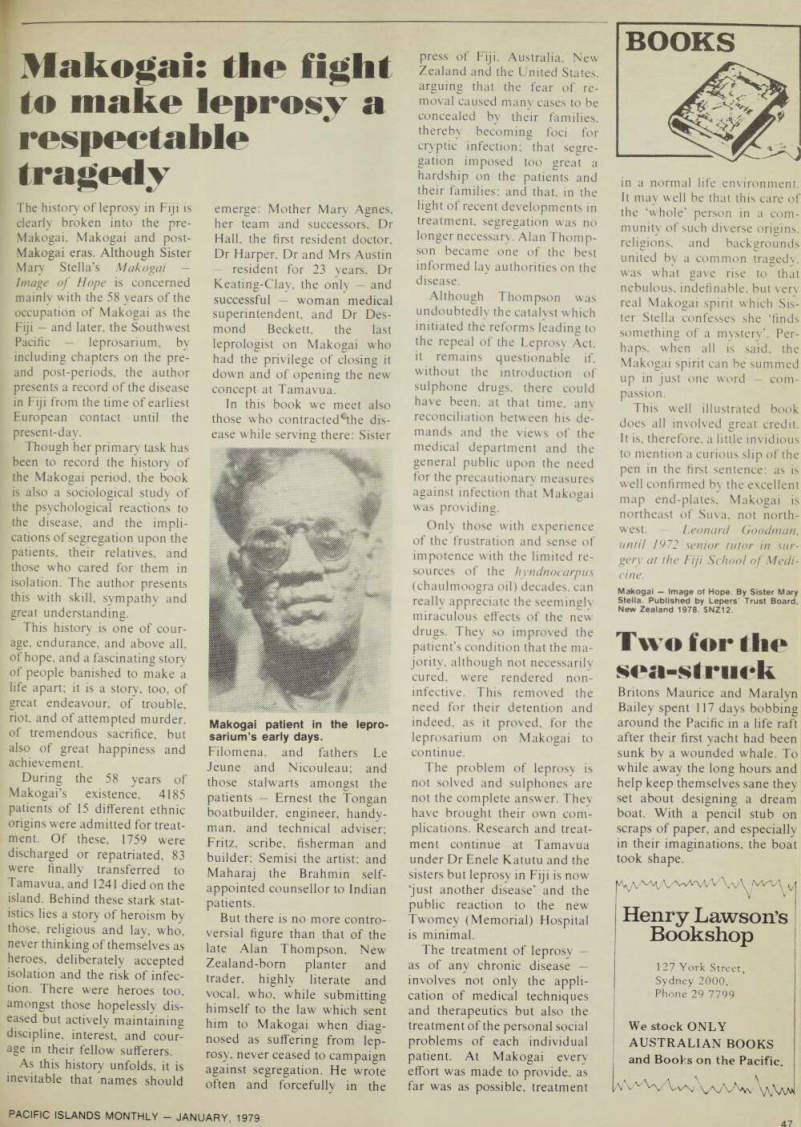
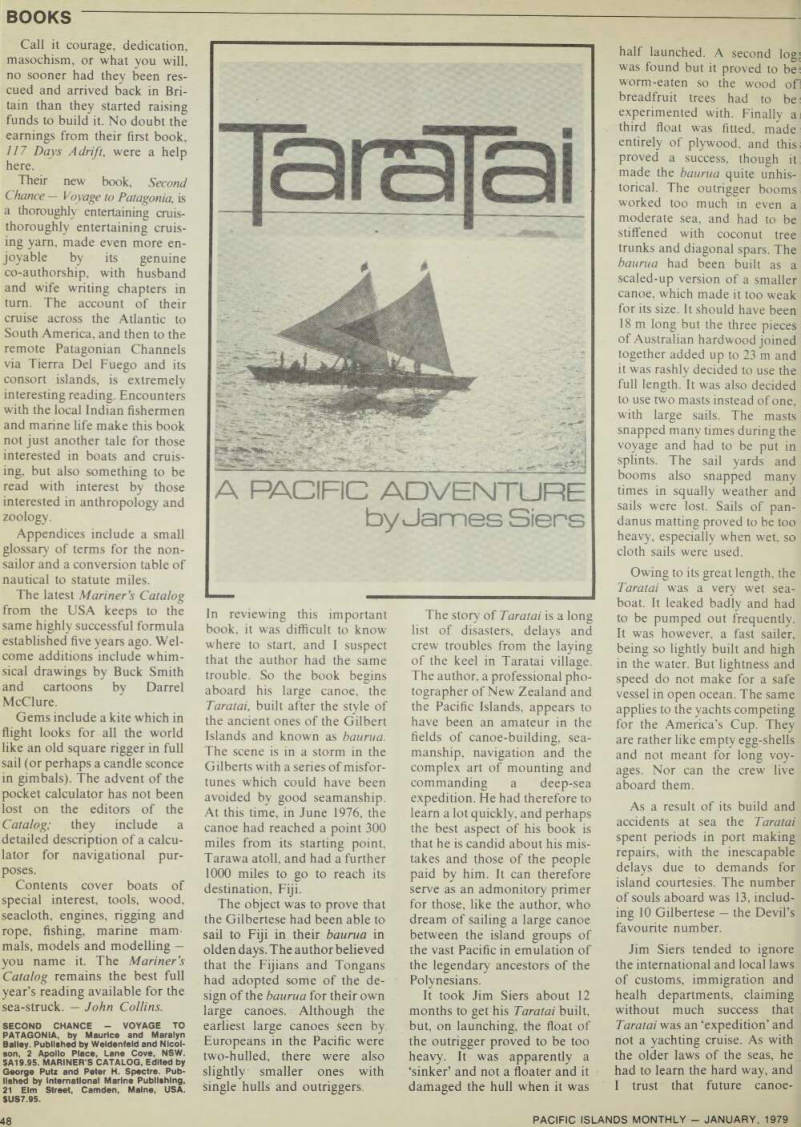
Books
Makogai: the fight to make leprosy a respectable tragedy
The history of leprosy in Fiji is clearly broken into the pre-
Makogai, Makogai and post-
Makogai eras. Although Sister
Mary Stella’s Makogai Image of Hope is concerned mainly with the 58 years of the occupation of Makogai as the Fiji and later, the Southwest
Pacific leprosarium, by
including chapters on the pre and post-periods, the author presents a record of the disease in Fiji from the time of earliest European contact until the
present-day.
Though her primary task has been to record the history of the Makogai period, the book is also a sociological study of the psychological reactions to the disease, and the impli cations of segregation upon the patients, their relatives, and those who cared for them in isolation. The author presents this with skill, sympathy and
great understanding.
This history is one of cour age. endurance, and above all, of hope, and a fascinating story of people banished to make a life apart; it is a story, too, of great endeavour, of trouble, riot, and of attempted murder, of tremendous sacrifice, but also of great happiness and achievement.
During the 58 years of Makogai’s existence, 4185 patients of 15 different ethnic origins were admitted for treat ment. Of these, 1759 were discharged or repatriated. 83 were finally transferred to Tamavua, and 1241 died on the island. Behind these stark stat istics lies a story of heroism by those, religious and lay, who, never thinking of themselves as heroes, deliberately accepted isolation and the risk of infec tion. There were heroes too, amongst those hopelessly dis
eased but actively maintaining
discipline, interest, and cour age in their fellow sufferers.
As this history unfolds, it is inevitable that names should
emerge: Mother Mary Agnes, her team and successors. Dr Hall, the first resident doctor.
Dr Harper, Dr and Mrs Austin - resident for 23 years. Dr
Keating-Clay, the only and
successful woman medical superintendent, and Dr Des mond Beckett, the last
leprologist on Makogai who
had the privilege of closing it down and of opening the new concept at Tamavua.
In this book we meet also those who dis ease while serving there: Sister
Filomena, and fathers Le Jeune and Nicouleau; and those stalwarts amongst the
patients Ernest the Tongan
boatbuilder. engineer, handy
man, and technical adviser; Fritz, scribe, fisherman and builder; Semisi the artist; and Maharaj the Brahmin self appointed counsellor to Indian patients.
But there is no more contro versial figure than that of the late Alan Thompson, New Zealand-born planter and trader, highly literate and vocal, who, while submitting himself to the law which sent him to Makogai when diag nosed as suffering from lep rosy, never ceased to campaign
against segregation. He wrote
often and forcefully in the
press of Fiji. Australia, New Zealand and the United States, arguing that the fear of re moval caused many cases to be concealed by their families,
thereby becoming foci for
cryptic infection; that segre gation imposed too great a hardship on the patients and their families: and that, in the light of recent developments in treatment, segregation was no
longer necessary. Alan Thomp
son became one of the best informed lay authorities on the disease.
Although Thompson was
undoubtedly the catalyst which
initiated the reforms leading to the repeal of the Leprosy Act. it remains questionable if. without the introduction of sulphone drugs, there could have been, at that time, any reconciliation between his de mands and the views of the medical department and the general public upon the need for the precautionary measures
against infection that Makogai
was providing.
Only those with experience
of the frustration and sense of impotence with the limited re sources of the hyndnocarpus (chaulmoogra oil) decades, can
really appreciate the seemingly
miraculous effects of the new
drugs. They so improved the
patient’s condition that the ma
jority, although not necessarily
cured, were rendered non infective. This removed the need for their detention and indeed, as it proved, for the
leprosarium on Makogai to
continue.
The problem of leprosy is not solved and sulphones are not the complete answer. They have brought their own com plications. Research and treat ment continue at Tamavua under Dr Enele Katutu and the sisters but leprosy in Fiji is now ‘just another disease’ and the public reaction to the new
Twomey (Memorial) Hospital
is minimal.
The treatment of leprosy as of any chronic disease involves not only the appli cation of medical techniques and therapeutics but also the treatment of the personal social problems of each individual
patient. At Makogai every
effort was made to provide, as far was as possible, treatment
in a normal life environment.
It may well be that this care of the ‘whole' person in a com munity of such diverse origins,
religions, and backgrounds
united by a common tragedy, was what gave rise to that nebulous, indefinable, but verv real Makogai spirit which Sis ter Stella confesses she ‘finds something of a mystery’. Per haps, when all is said, the Makogai spirit can be summed up in just one word — com
passion.
This well illustrated book does all involved great credit.
It is, therefore, a little invidious to mention a curious slip of the pen in the first sentence: as is well confirmed by the excellent
map end-plates, Makogai is
northeast of Suva, not north west. — Leonard Goodman , until 1972 senior tutor in sur gery at the Fiji School of Medi cine.
Makogai — Image of Hope. By Sister Mary Stella. Published by Lepers' Trust Board, New Zealand 1978. SNZ12.
Two for I ho
sea-struek
Britons Maurice and Maralyn
Bailey spent 117 days bobbing
around the Pacific in a life raft after their first yacht had been sunk by a wounded whale. To while away the long hours and
help keep themselves sane they
set about designing a dream boat. With a pencil stub on scraps of paper, and especially in their imaginations, the boat
took shape.
Makogai patient in the lepro sarium’s early days.
Call it courage, dedication, masochism, or what you will, no sooner had they been res cued and arrived back in Bri tain than they started raising funds to build it. No doubt the earnings from their first book, 117 Days Adrift, were a help here.
Their new book. Second Chance Voyage to Patagonia, is
a thoroughly entertaining cruis
thoroughly entertaining cruis
ing yam, made even more en
joyable by its genuine
co-authorship, with husband and wife writing chapters in turn. The account of their cruise across the Atlantic to South America, and then to the remote Patagonian Channels via Tierra Del Fuego and its consort islands, is extremely
interesting reading. Encounters
with the local Indian fishermen and marine life make this book not just another tale for those interested in boats and cruis ing, but also something to be read with interest by those interested in anthropology and
zoology.
Appendices include a small glossary of terms for the non sailor and a conversion table of nautical to statute miles.
The latest Mariner's Catalog from the USA keeps to the same highly successful formula established five years ago. Wel come additions include whim sical drawings by Buck Smith and cartoons by Darrel McClure.
Gems include a kite which in flight looks for all the world like an old square rigger in full sail (or perhaps a candle sconce in gimbals). The advent of the pocket calculator has not been lost on the editors of the
Catalog; they include a
detailed description of a calcu lator for navigational pur poses.
Contents cover boats of special interest, tools, wood,
seacloth, engines, rigging and
rope, fishing, marine mam mals, models and modelling you name it. The Mariner's Catalog remains the best full year’s reading available for the sea-struck. John Collins.
Second Chance - Voyage To
PATAGONIA, by Maurice and Maralyn Bailey. Published by Weldenfeld and Nlcol son, 2 Apollo Place, Lane Cove, NSW.
5A19.95. Mariner’S Catalog, Edited By
George Putz and Peter H. Spectre. Pub lished by International Marine Publishing, 21 Elm Street, Camden, Maine, USA. 5U57.95.
In reviewing this important
book, it was difficult to know where to start, and I suspect that the author had the same trouble. So the book begins aboard his large canoe, the Taratai, built after the style of the ancient ones of the Gilbert Islands and known as baurua.
The scene is in a storm in the Gilberts with a series of misfor tunes which could have been
avoided by good seamanship.
At this time, in June 1976, the canoe had reached a point 300 miles from its starting point, Tarawa atoll, and had a further 1000 miles to go to reach its
destination, Fiji.
The object was to prove that the Gilbertese had been able to sail to Fiji in their baurua in olden days. The author believed that the Fijians and Tongans had adopted some of the de sign of the baurua for their own
large canoes. Although the
earliest large canoes seen by Europeans in the Pacific were two-hulled, there were also slightly smaller ones with single hulls and outriggers.
The story of Taratai is a long list of disasters, delays and crew troubles from the laying of the keel in Taratai village.
The author, a professional pho tographer of New Zealand and the Pacific Islands, appears to have been an amateur in the fields of canoe-building, sea
manship, navigation and the
complex art of mounting and
commanding a deep-sea
expedition. He had therefore to leam a lot quickly, and perhaps the best aspect of his book is that he is candid about his mis takes and those of the people paid by him. It can therefore serve as an admonitory primer for those, like the author, who dream of sailing a large canoe between the island groups of the vast Pacific in emulation of the legendary ancestors of the
Polynesians.
It took Jim Siers about 12 months to get his Taratai built, but, on launching, the float of the outrigger proved to be too heavy. It was apparently a ‘sinker’ and not a floater and it damaged the hull when it was
half launched. A second log* was found but it proved to be; worm-eaten so the wood ofl breadfruit trees had to be; experimented with. Finally aj third float was fitted, made: entirely of plywood, and this; proved a success, though it; made the baurua quite unhis
torical. The outrigger booms;
worked too much in even a moderate sea, and had to be stiffened with coconut tree trunks and diagonal spars. The baurua had been built as a scaled-up version of a smaller canoe, which made it too weak for its size. It should have been 18 m long but the three pieces of Australian hardwood joined together added up to 23 m and it was rashly decided to use the full length. It was also decided to use two masts instead of one, with large sails. The masts snapped many times during the voyage and had to be put in splints. The sail yards and booms also snapped many times in squally weather and sails were lost. Sails of pan danus matting proved to be too heavy, especially when wet, so cloth sails were used.
Owing to its great length, the Taratai was a very wet sea boat. It leaked badly and had to be pumped out frequently.
It was however, a fast sailer,
being so lightly built and high
in the water. But lightness and speed do not make for a safe vessel in open ocean. The same
applies to the yachts competing
for the America’s Cup. They are rather like empty egg-shells and not meant for long voy ages. Nor can the crew live aboard them.
As a result of its build and accidents at sea the Taratai spent periods in port making
repairs, with the inescapable
delays due to demands for island courtesies. The number of souls aboard was 13, includ ing 10 Gilbertese the Devil’s favourite number.
Jim Siers tended to ignore the international and local laws of customs, immigration and
healh departments, claiming
without much success that Taratai was an ‘expedition’ and not a yachting cruise. As with the older laws of the seas, he had to learn the hard way, and I trust that future canoe
‘ adventurers, who are bound to I follow, will pay some heed to the lessons in this book.
The story of the voyage of I the Taratai occupies only about f 50 pages, including calls at f Abemama. South Tabiteuea, Rotuma and finally Fiji, where [ the expedition ended. Siers had I intended continuing on to * Tonga, Samoa, the Marquesas I and Tahiti and ultimately to I New Zealand. On reaching [ Fiji, however, he was convin l ced that the Taratai was not built well enough for ocean voyaging. He decided to build another canoe in Fiji and con tinue his grand design, and the old Taratai was shipped to Wellington to the National Museum.
The new canoe, called Tara [ tai 11, was to be built mainly of Fijian kauri timber, and to I be shorter and stronger in all respects. It was built again in Gilbertese style but not of tra ditional timbers. Its voyage began on June 29, 1977, from Suva, and only 40 days later in a heavy sea snapped the outrig ger booms. The canoe laid on its side and had to be aban doned. Presumably there was no ballast in the hull to keep it upright without the outrig ger.
The full story of Taratai II is promised in a new book.
Jim Siers and his 10-year-old son, Conrad, and the five man crew of the Taratai 11, were lucky to survive two weeks in an inflatable life-raft before being picked up by a tug on a delivery voyage from Sin gapore to Chile. It landed them at Niue Island. Brett Milder.
TARATAI. By James Siers. Published by Millwood Press, Wellington, N.Z. 306 po 5NZ16.95.
Islanders
on the
move
When is the Pacific not the Pa cific? The question must be asked by those interested in the Pacific Islands when they see documents whose titles state that they are concerned with the Pacific but turn out to be concerned only with the edges and not with the centre of the
region.
Yunshik Chang and Peter J.
Donaldson have edited Popu lation Change in the Pacific Re gion and I took it up hoping that I might find within it papers examining in depth the
pressing population problems
of Pacific Islands countries. I suppose it was a natural out come of the conference from which the book sprang, but I found the emphasis disap pointing as it focused on Japan, China, Korea, Taiwan and Thailand. If the Pacific is to be seen in terms of the major countries bordering the ocean, then why does nothing emerge in this publication of the popu lation problems of Australia, the west coast of the USA, and South America?
Of the 16 papers in the book, only three are directly con cerned with Pacific Islands people. Jean Fages in his Mi gration and Urbanisation in French Polynesia, very cor rectly brings to our notice that, almost unheralded, French Polynesia has become one of the most urbanised of the Pa cific Island countries. He shows us that this is because of invest ments in tourism and the French government’s expendi ture on installations and sup porting services associated with its nuclear testing programme.
The paper provides a timely
warning to planners, pointing
out that ‘the foundations of this
urban development are fragile,
because the development is the result of an artificial economic revolution. It is based not on the territory’s economic pos sibilities, but on its political connections with France’.
The presence of large num bers of Pacific Islanders in New Zealand has opened up a wide field of inquiry into demo graphic trends in that country.
David Pitt, in his Social Bound aries and Migration in New Zealand, brings to light an as pect of the attitudes of Pacific Islands migrants that will un
doubtedly strongly affect the
development of these emigre
groups. Pitt says: ‘Our recent work has shown . .. that mi gration has strengthened rather than diluted Samoan customs, first by providing cash for the support of the traditional insti tutions in the islands, secondly by creating vibrant new com munities in New Zealand
based on traditional insti tutions.’ The author points out that these manifestations may
have lasting sociological and
economic consequences for New Zealand, and that ‘the essential problem of migration may well be not so much the migrants but the rationali sations and restrictions of the bureaucrats and politicians.’
The third paper to be men tioned is Judith Huntsman’s The Impact of Cultural Exchange on Health and Dis ease Patterns: the Tokelau Island Migrant Study. This paper is to be commended as it spotlights many little
publicised aspects of migration
of Tokelauans to New Zealand. Two interesting points emerge. First, that de spite the efforts of the New Zealand Government to
reduce the population by
introducing a resettlement scheme, much of the move ment of Tokelauans may be attributed to the desires and efforts of the people them selves. Second, almost
paradoxically, Tokelauans are showing a marked tendency to return to their home islands,
despite the often emphasised
evils of over population.
Judith Huntsman rightly points the way for further, intensive research to be con ducted into the patterns of mi gration of Pacific Islanders to the major urbanised countries.
She says: ‘By continuing our research among this small eth nic group from a remote Pa cific homeland, we may be able to untangle somewhat that complex of factors which affect health and well-being.’
For those interested in the
principles of demographic
change this collection of papers has some value. For those con cerned with the population movements of Pacific Islanders, the papers of Fages, Pitt and Huntsman are of very considerable interest. W. G.
Coppell.
Population change In the Pacific Region; Papers presented In the Symposia on Pa cific Populations during the thirteenth Pa cific Science Congress. Yunshik Chang and Peter J. Donaldson, Editors. Pacific Science Association, Vancouver. 5C4.00.
Advertisements & other items, pp. 47-50 (1 item)
Henry Lawson’s
Bookshop
127 York Street, Sydney 2000.
Phone 29 7799 We stock ONLY
AUSTRALIAN BOOKS
and Books on the Pacific.
< |M "S ■ '" -., ">>' v ' :T?MSk.r x " --w r- .^,, 4» <| <#4
A PACIFIC ADVENTURE
by James Siers
The
Modulock System.
f
aM6s@Si>g
53 -^lia 3ps;
A unique building method
Modulock is a high quality, low maintenance building system. It allows an infinite variety of designs ideal for homes, offices, schools - indeed all low rise buildings.
Modulock is quick to deliver and assemble, low on labour, compact, easy to ship and particularly suited to conditions in the Pacific: For further information contact
MODULOCK
Modulock (N.Z.) Limited, P.O. Box 51-099, Pakuranga, Auckland, New Zealand. Telephone 47-069 Papatoetoe, Telex N.Z. 2290.
offers expert insurance service
throughout the Islands.
QBE INSURANCE LIMITED
Central Office: 82 Pitt Street, Sydney.
NEW CALEDONIA - T.A. Hagen, Ste. W.A. Johnston, S.A.R.L. - Noumea.
NEW HEBRIDES Manager: G.F. Donnelly, Vila; Santo Santc: Burns Phi Ip (New Hebrides) Ltd.
TAHITI - Arthur Chung: Immeub/e 8.1., Front de Mer, Papeete.
NIUE, NORFOLK ISLAND, SAMOA, TONGA and other South Sea Islands Burns Philp (South Sea) Company L td.
QUEENSLAND INSURANCE (FIJI) LIMITED
Head Office, 34 Usher St., SUVA. General Manager: L.G. Liddell. A.A.1.1.
Assistant Managers: Vijay Lal and J.T. Laidlaw. LAUTOKA Office, Burns Philp Bldg. District Manager- J Dalton
QUEENSLAND INSURANCE (RN.C.) LIMITED
PAPUA NEW GUINEA -
Head Office, PORT MORESBY. General Manager; J.M. Dawe. Assistant Manager; R.V. Maskell.
District Managers at; LAE: I.R. Martin. MOUNT HAGEN: D.F. Carroll. ARAWA: J. Longbut. MADANG; R.W.V. Ceilings. RABAUL W.F. Tinker.
|q|b|e
INTRODUCING FRIGID’S New Range of Assemble-Yourself
Vfajkjn Aluminium Freezer & Cooler Storage Rooms Hundreds already installed. Now with attractive timber grain aluminium exterior finish, (rust-proof) with white vinyl interior finish.
Frigid Foam Polyurethane insulation. 2" in cooler storage rooms is equal to 5” polystyrene foam. 3" in freezer storage rooms is equal to 8" polystyrene foam. Lower running costs. Best insulation available. Thin wall construction. Save in freight costs. Room sizes from 90 cubic feet (2 1 /2 m 3) to 930 cubic feet (25 1 /2 m 3).
Supplied in easy-to-erect, do-it-yourself form Assemble, plug it in, and have it in operation in under eight hours!
Th Manufactured by;
FRIGID CABINETS PTY. LTD.
14a Duffy Ave., Thornleigh, N.S.W. Aust. 2120. Ph. 848 8292.
AVAILABLE FROM:
AUSTRALIA NEW CALEDONIA EXPORTS, 363 George St., Sydney 2000. BRECKWOLDT & CO., G.P.O. Box 5027, Sydney 2001. HAGEMEYER (A'ASIA), 59 Anzac Pde,, Kensington 2033. GEOFFREY HUGHES & CO., 167 Macquarie St., Sydney 2000. NE LSON & ROBERTSON PTY. LTD., 197 Clarence St., Sydney 2000. E. RABOT (EXPORTS) PTY. LTD., 67 Castlereagh St., Sydney 2000. RABTRAD NIUGINI PTY. LTD. P.O. Box 1406 Lae A. RIETTE (PACIFIC) PTY. LTD., 20 Loftus St., Sydney 2000. C. SULLIVAN (EXPORT) PTY. LTD. GPO Box 3373, Sydney 2001. W.S. TAIT & CO. PTY. LTD., 31 Macquarie Place, Sydney 2000
Mounties
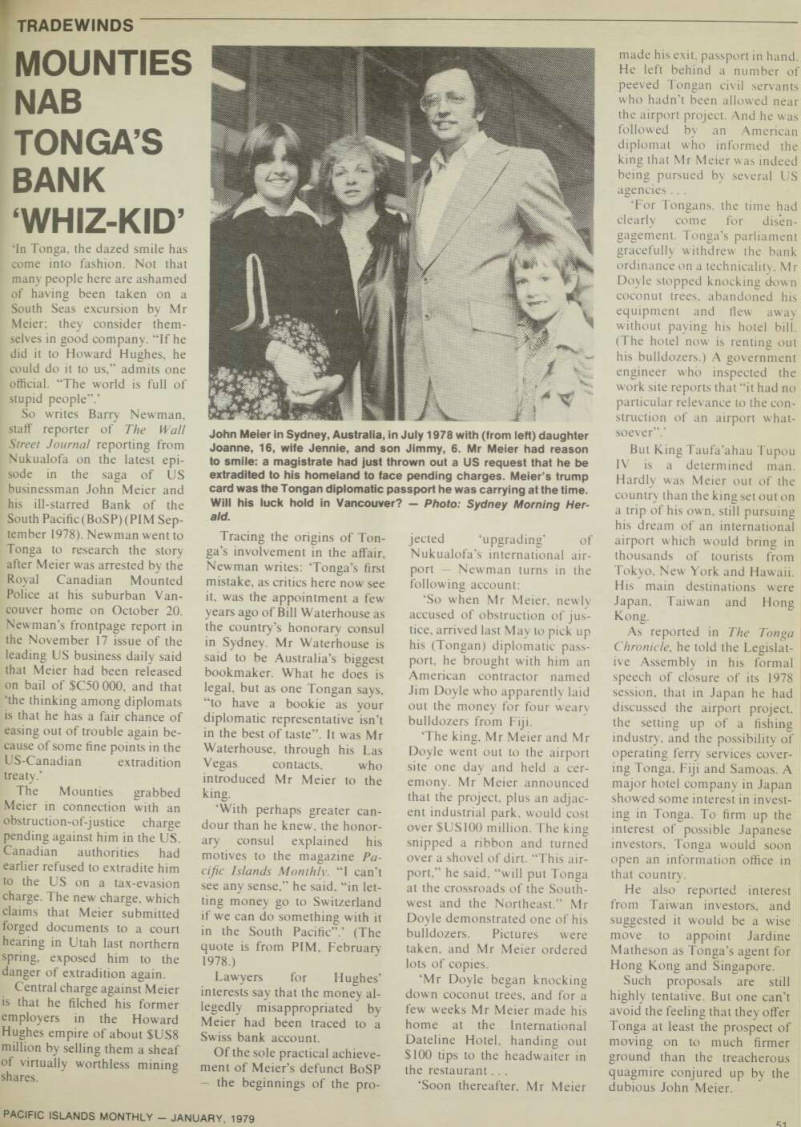

Tradewinds
Nab
Tonga’S
Bank
‘Whiz-Kid’
‘ln Tonga, the dazed smile has [ come into fashion. Not that many people here are ashamed of having been taken on a South Seas excursion by Mr Meier; they consider them selves in good company. “If he did it to Howard Hughes, he could do it to us,” admits one official. “The world is full of
stupid people”.’
So writes Barry Newman, staff reporter of The Wall Street Journal reporting from Nukualofa on the latest epi sode in the saga of US businessman John Meier and his ill-starred Bank of the South Pacific (BoSP) (PIM Sep tember 1978). Newman went to Tonga to research the story after Meier was arrested by the Royal Canadian Mounted Police at his suburban Van couver home on October 20.
Newman’s frontpage report in the November 17 issue of the leading US business daily said that Meier had been released on bail of SCSO 000, and that
‘the thinking among diplomats
is that he has a fair chance of easing out of trouble again be cause of some fine points in the US-Canadian extradition treaty.’
The Mounties grabbed Meier in connection with an
obstruction-of-justice charge
pending against him in the US.
Canadian authorities had earlier refused to extradite him to the US on a tax-evasion charge. The new charge, which claims that Meier submitted forged documents to a court hearing in Utah last northern spring, exposed him to the
danger of extradition again.
Central charge against Meier
is that he filched his former employers in the Howard Hughes empire of about SUSB million by selling them a sheaf
of virtually worthless mining
shares.
Tracing the origins of Ton ga’s involvement in the affair, Newman writes: ‘Tonga’s first mistake, as critics here now see it, was the appointment a few years ago of Bill Waterhouse as
the country’s honorary consul
in Sydney. Mr Waterhouse is said to be Australia’s biggest bookmaker. What he does is legal, but as one Tongan says, “to have a bookie as your diplomatic representative isn’t in the best of taste”. It was Mr Waterhouse, through his Las Vegas contacts, who introduced Mr Meier to the
king.
‘With perhaps greater can dour than he knew, the honor ary consul explained his motives to the magazine Pa cific Islands Monthly. “I can’t see any sense,” he said, “in let ting money go to Switzerland if we can do something with it in the South Pacific”.’ (The quote is from PIM, February 1978.)
Lawyers for Hughes’
interests say that the money al
legedly misappropriated by
Meier had been traced to a Swiss bank account.
Of the sole practical achieve ment of Meier’s defunct BoSP the beginnings of the pro
jected ‘upgrading’ of
Nukualofa’s international air port Newman turns in the
following account:
‘So when Mr Meier, newly accused of obstruction of jus tice, arrived last May to pick up
his (Tongan) diplomatic pass
port, he brought with him an American contractor named Jim Doyle who apparently laid out the money for four weary bulldozers from Fiji. ‘The king, Mr Meier and Mr Doyle went out to the airport site one day and held a cer emony. Mr Meier announced that the project, plus an adjac ent industrial park, would cost over SUSIOO million. The king snipped a ribbon and turned over a shovel of dirt. “This air port,” he said, “will put Tonga at the crossroads of the South west and the Northeast.” Mr Doyle demonstrated one of his bulldozers. Pictures were taken, and Mr Meier ordered lots of copies.
‘Mr Doyle began knocking
down coconut trees, and for a few weeks Mr Meier made his home at the International Dateline Hotel, handing out $lOO tips to the headwaiter in the restaurant... ‘Soon thereafter. Mr Meier
made his exit, passport in hand.
He left behind a number of peeved Tongan civil servants who hadn’t been allowed near the airport project. And he was followed by an American diplomat who informed the king that Mr Meier was indeed being pursued by several US
agencies...
‘For Tongans, the time had clearly come for disen gagement. Tonga’s parliament gracefully withdrew the bank ordinance on a technicality, Mr
Doyle stopped knocking down
coconut trees, abandoned his equipment and flew away without paying his hotel bill. (The hotel now is renting out his bulldozers.) A government
engineer who inspected the
work site reports that “it had no particular relevance to the con struction of an airport what soever”.’
But King Taufa’ahau Tupou
IV is a determined man.
Hardly was Meier out of the country than the king set out on a trip of his own, still pursuing his dream of an international airport which would bring in thousands of tourists from Tokyo, New York and Hawaii.
His main destinations were
Japan, Taiwan and Hong
Kong.
As reported in The Tonga Chronicle, he told the Legislat ive Assembly in his formal speech of closure of its 1978 session, that in Japan he had
discussed the airport project,
the setting up of a fishing industry, and the possibility of
operating ferry services cover
ing Tonga, Fiji and Samoas. A
major hotel company in Japan showed some interest in invest ing in Tonga. To firm up the interest of possible Japanese investors, Tonga would soon open an information office in that country.
He also reported interest from Taiwan investors, and suggested it would be a wise move to appoint Jardine Matheson as Tonga’s agent for
Hong Kong and Singapore.
Such proposals are still highly tentative. But one can’t avoid the feeling that they offer Tonga at least the prospect of moving on to much firmer ground than the treacherous
quagmire conjured up by the
dubious John Meier.
John Meier in Sydney, Australia, in July 1978 with (from left) daughter Joanne, 16, wife Jennie, and son Jimmy, 6. Mr Meier had reason to smile: a magistrate had just thrown out a US request that he be extradited to his homeland to face pending charges. Meier’s trump card was the Tongan diplomatic passport he was carrying at the time.
Will his luck hold in Vancouver? - Photo: Sydney Morning Her ald.
Niue: sex
and the
passionflower
Little more than a centimetre separates Niue from a golden bounty in passionfruit.
The critical measurement is in the flower of the yellow pas sionfruit which is too elongated for the bees to be effective in pollination.
As they forage for nectar the bees pass underneath and make no contact with the pollen-laden anthers.
A fruitless death ensues for the flower which opens but once and then for only half a
day.
In the circumstances hand pollination is the only way to achieve a crop.
It is work to which, tradition ally, children are assigned, and which requires vigilance and a delicate hand work which the children of Niue, being like children in most places, are in clined to do fitfully.
Fruit set is generally disap
pointing.
In 1977 only one flower in five produced the yellow pack
age of seed and sweet pulp which represents an export industry bigger than the rest of Niue’s exports combined.
From an average fruit set of 17% Niue exported 75 tonnes of pulp and juice in the nine month season to August, 1976.
Production last year was 86 tonnes, all of which was shipped to New Zealand.
When the New Zealand market complained last April it had to have more passionfruit or it would look elsewhere, the Niue Government resolved to boost the industry.
A special task force, working in conjunction with the Niue Development Board, was told to make an all-out effort to maximise production from the existing 20 hectares of pas sionfruit vines and to plant,
plant, plant...
The target for new plantings in 1977 was set at 40 ha double the total existing pas sionfruit stands which cling to the scattered shallow pockets of soil with wire, wooden sup ports and concrete stays.
The harsh terrain, domi nated by jagged coral,' is no encouragement to horticulture.
Indeed, for most Niueans, pas sionfruit production is ad hoc to a job in the public service.
This is how a stand is established; The property holder indi cates interest to the Develop ment Board which inspects the site for suitability then calls in a bulldozer and gangs to work up the soil.
Lines of poles made from native Tavahe are wired some what like a fence with wide strands. Concrete pegs are buried at the end of each line to brace the assembly.
Planters engaged by the
Development Board tie up the young passionfruit vines, sup plied by the government nur sery at Vaipapahi.
At the first flowering, the board hands over the stand to the owner. He, then, is respon sible for pollination, main tenance and harvesting.
Half the revenue from the crop goes to the grower and half to the board until the costs of establishing the stand are re paid.
New Zealand assistance to Niue’s passionfruit industry
Hand pollination of passionfruit flowers is traditionally a job for children in Niue
has largely centred on ways of
improving pollination.
An obvious suggestion was to try a bigger bee. The Italian variety, common in New Zealand, flourishes on Niue.
Of the tropical bees, how \ ever, only the Carpenter is big enough to make the necessary contact in the yellow pas sionfruit flower and this species is considered the last re sort because of its nasty habit of tunnelling in wood, buil dings included, to build nests.
Other species of passionfruit
are being studied but according to Dr Murray Hopping, of the NZ Department of Scientific and Industrial Research plant diseases division in Auckland, it would take at least three years before a hybrid combin ing the fruit quality of the yel low passionfruit with a flower structure suitable for bee polli nation could be released for planting on Niue.
Fiji boosts its
floating stock
Two new vessels on the Fiji scene are the Vasua and the Cagidonu. The Vasua was
brought from Singapore, more
than 8500 kilometres away, under the command of Captain John Kerbyson and a Fijian crew of 11, to replace the ferry Tabilai which sank in 1977.
Chief engineer on the trip was Mike Tuvali and chief officer was Waisale Salu.
The Cagidonu, the first sail
ing ship and the fifty-fourth
vessel to be built at the govern ment’s Suva shipyard, was launched in November by Adi Ateca, eldest daughter of Prime Minister Ratu Sir Kamisese Mara.
Tonga pelts
NZ with its
tomatoes
Tongan tomatoes in New Zealand have been causing mild apoplexy among local growers, writes William Gas son from Wellington. The problem is that island tomatoes play havoc with local prices.
New Zealand growers, with SNZI2O million tied up in glass
houses, land and equipment,
and employing a labour force of 2000, worry that Tonga’s tomatoes will destroy that investment if allowed to flood the country. ‘We’re not yelling protect us,’ the executive officer of the Vegetable and Produce Growers Federation (Vegfed), Trevor Brown, insisted. He, and local growers, want the Tongans to divert their grow ing skills to other non competitive vegetables and fruit such as bananas, pea nuts, root crops and a fruit called Indian apple which has a white flesh and should appeal to New Zealand palates.
A Vegfed delegation, led by
the market division chairman, Jim Clayton, visited Tonga in August to look at the tomato issue first hand. They took with them their argument that Ton gan tomatoes were not opposed
in principle just so long as
they did not compete directly with New Zealand supplies.
They saw a need to regulate the size of Tongan shipments, subject to existing licences.
They also favoured limiting
Tongan supplies to sale by auc tion not fixed prices that in fluenced prices for local supplies.
The delegation reported
back to Wellington that the
Tongan growers’ philosophy
not surprisingly was that while they were getting reason able prices in New Zealand
they would continue consign
ing as much as the New Zea land Government would allow.
Nor were they impressed
with the auction argument -
they preferred the certainty ol
fixed prices to fluctuating auc tion prices. Nor did the del
egation find much sympathy
from Tonga’s bureaucrats whc took an ‘uncompromising atti tude’. One insisted there was great scope for Tongan tom atoes in New Zealand and re jected entirely fears that the livelihood of New Zealand growers would be jeopar dised.
Faced with this attitude the
Vegfed delegation repaired to
Wellington and concluded their salvation lay in directing government aid towards Ton gan horticultural production and the wide-scale commercial
production of non-competing
crops.
On that theme the del
egation also suggested Tongan
officials be invited to New
Zealand to look at the market potential here for these non
competing crops.
Tonga has the capability of growing almost any variety of vegetables at certain times of the year and therefore must be counted as a potential supplier of these products to New
Zealand as shipping improves
and the New Zealand Govern ment allows, the Vegfed dele
gation reported.
Meanwhile it is up to the Vegfed people to prove to the New Zealand Government that the increased import li cences given last year for Ton gan tomatoes actually had a detrimental impact on the local
industry.
Above: The Vasua leaving Singapore; below: artist’s detail of the Cagidonu
Success brews
for SI rice
growers
Brewer Solomons Associates rice project on the Guadal canal Plains in the Solomons, is but one of a number of agricultural projects being con ducted around the world by Hawaiian Agronomics (Inter national), a wholly-owned sub sidiary of the Hawaii-based multinational C. Brewer and Co. Ltd., writes Peter L. Young in Honiara. The business of these concerns is agriculture, or ‘agribusiness’ as the company brochures put it.
On the Guadalcanal Plains, Brewer Solomons has 405 ha under cultivation and hopes to double that in the next two to ;hree years. The operation here s a highly-mechanised one in xamparison with the tra ditional, labour-intensive meth ods of south-east and east \sia. The company has con tracted a large rice mill for accessing the crop and has >aid particular attention to the iroblems of storage in tropical dimates an aspect of rice reduction that has been the lownfall of some rice projects a Papua New Guinea re
ently.
It is hoped that locally- Toduced rice will be able to ffectively supplant imports of iustralian rice into the olomons and thereby help the
ewly-independent nation’s
alance of trade.
The present problem in larketing local rice is a prefer nce for the Australian pro ud. However, the company is ttempting to counter this
irough advertising on
olomons’ radjo.
The company has been able » export small quantities of alomons’ rice to Papua New uinea and New Zealand and as recently gained an order om Fiji. Jim Macaweo de ribes the future for small ale exports as “very •omising” despite the prob ms of freight costs in this part ' the Pacific.
The original task of growing :e in the Solomons was taken > by a company called uadalcanal Plains Ltd. Prob-
lems of climate and insect pests overcame that venture and
Brewer Solomons paid just
under $1 million for the company in receivership. To the end of fiscal year 1978, the total Brewer Solomons invest ment in the rice project is expected to be approximately $6 million.
The main problem that has had to be overcome is the pres ence of one of the greatest insect pests known to rice culti vators, the brown plant hopper Nilaparvata Lugens. Even reputedly resistant strains of rice plant have failed to with stand this pest in the Solomons.
The ‘hopper’ can devastate a crop, leaving the plants with a distinctive, scorched appear ance.
The rice project on Guadal canal still has the pest to con tend with, but aerial spraying has brought it under control.
Now a natural predator is being introduced and this has allowed a reduction of spray
ing.
In the past few weeks the project has become a joint ven ture with the Solomons Government. Returning from the recent meeting of the Asian Development Bank in Vienna, Solomons Finance Minister Benedict Kinika visited Honolulu. There he put the final touches to the agreement between C. Brewer and the Solomons Government which had been negotiated in Honiara in February.
Mr Kinika also visited Brewer’s facilities there includ ing a sugar mill and the central laboratory. On his return, Mr Kinika said he was impressed by what he had seen and that some of the diverse operations of the company in tropical
agriculture might well be
suited to the Solomons.
The company is seeking to recruit Solomon Islander graduates and has sent some of its local staff on courses in the Philippines. The number of
tertiary and higher technical
graduates employed in the local operation is at present eight and this is expected to in crease as the project grows.
The Brewer company and the Government of Solomon Islands reached agreement in October on a SSI 3 million joint venture which will eventually take over all Brewer assets in the country. These include the rice operation, and a butchery and self-service store in Honiara. The new company, known as Brewers Solomons Agriculture Ltd, is owned 45% by the Government and 55% by Brewer.
PNG increases
rice imports
Papua New Guinea bought
77 426 tonnes of rice from Rice Growers’ Co-op Mills of Aus tralia in the year ended June 30 1978. The cost of the rice, SA29 422 142, was 21.4% up on
the previous year’s expendi
ture.
Australia enjoys a growing
rice market in the Gilberts, but exports to Western Samoa, Fiji and Solomon Islands are start ing to fall away as those countries work toward
self-sufficiency.
Drivers hit by Fiji
budget
A savage 11.36 cents a gallon hike on petrol duty formed part of the Fiji Government’s November budget strategy to lift revenue in 1979 by more than SFS million.
Other items hit by duty in creases were tyres and tubes, petrol-powered vehicles, beer, tobacco, some foods, paints, plastic baskets, stationery and some clothing and linen.
Interest rates on loans and overdrafts were lifted by 0.5% to 10.5% and the lending rate for the Central Monetary Authority from 5.5% to 6.5%.
All this adds up to an accelerated rate of inflation in Fiji. The only sops in a budget questionably described as ‘mild’ were an increase of half a per cent to 4.5% interest on savings bank deposits and the lifting of estate values from $ 10 000 to $5O 000 before death duties are payable. All in all, not much for the living.
Finance Minister Charles Stinson indicated there might be a ‘mini’ budget after he had received a report from a fiscal review committee at the end of March. He said he was antici
pating recommendations by
the committee on tax reform. The Papuan New Guinea Government has moved to stop expatriate trade store owners
from expanding their existing
set-ups. The Minister of Labour and Industry, Mr Lemeki, said such owners would no longer be given li cences to expand. There was a need to localise such activities, he said. However, there was also a need for expatriate man agement of those activities, where local people did not have the management skills re quired. The National Invest
ment Development Authority
is reviewing the future of ex patriate trade store owners who set up before the NIDA Act came into effect.
Rice paddy in Solomons . . . plan to double cultivation
Advertisements & other items, pp. 52-58 (1 item)
Portable
FORESTMIL
SAWMILL
Latest design features mean - faster production - less maintenance - easier to operate and service.
Powered by diesel engine or electric motor. % Fofestmil*fe importable Sawmill Forestmil produces any size accurate timber ready to use up to 12"x9"x24'.
Purchase price and operating cost of Forestmil is less than other sawing equipment with similar production capacity.
Forestmil reduces timber waste and also reduces log transport cost. Timber is sawn direct from the log in the forest.
Forestmil can be moved to a new location in one hour.
Forestmil will saw hardwood or softwood from logs of any diameter.
Over 1000 Forestmilsare sawing timber in 23 countries.
Forestmil has been manufactured for 18 years.
For literature and prices please contact the manufacturers.
MacQuarrie Industries Pty.Ltd.
P.O. Box 20, Coburg 3058, Victoria, Australia.
Phone: 350-3411. Telex: 33729. Cables: Macbound, Melbourne.
U;«Yny
Breekwoldt & Co
P ij Ltd
Suite 1909, 19th Floor, King George Tower,
Corner King & George Streets, Sydney.
G.P.O. Box 5027, Sydney 2001.
CABLES: 'BREWO' SYDNEY. TELEX; AA22890.
TELEPHONES: 233 2366. 232 2315, 233 1462. •
PACIFIC ISLAND OFFICES
BRECKWOLDT & CO (PNG) PTY. LTD.
PO BOX 1549. BOROKO. PORT MORESBY.
PO BOX 222, RABAUL
PO BOX 72. KIETA
PO BOX 178, WEWAK
PO BOX 185, MADANG
PO BOX 237, MT. HAGEN
PO BOX 1188, LAE
BRECKWOLDT & CO., PO BOX 47, APIA BRECKWOLDT & CO. (SI) LTD. PO BOX 140, HONIARA
BRECKWOLDT SARL BP 2369, NOUMEA
OFFICES IN:
HAMBURG
LONDON
MILAN
& WEST AFRICA
ALSO AT:
SINGAPORE
KUALA LUMPUR
BANGKOK
& HONG KONG
ENQUIRIES
FROM OVERSEAS MANUFACTURERS INVITED.
llMfflffi
fC Mirex is a bait concentrate that spells death to cockroach, ant and wasp*.
Mirex not only kills the individual insect but in the case of wasps and ants it also destroys the whole nest.
Mirex is sold in 10 gram sachets or 25 sachet outers.
Mirex is available in Papua New Guinea from South Pacific Machinery Pty Limited, P.O. Box 6115 Boroko, Port Moresby. Telephone: 253184.
Available in Fiji from South Pacific Chemicals, P.O. Box 899, Lautoka. Telephone: 62-889.
MIREX A
P.O. BOX 87 NELSON NEW ZEALAND AGCHEM
HENRY GUMINES
PTY. LTDI
EXPORTERS o GENERAL MERCHANTS
428 GEORGE ST., SYDNEY
CABLES: HENCO SYDNEY. G.P.O. Box 3949. PHONE} 232-5377 For specialised and personalised buying service throughout the Pacific Islands and the East.
LOCAL AGENTS AND REPRESENTATION:
PAPUA NEW GUINEA:
RABAUL: M. & C. Seeto, P.O. Box 131, Rabaul.
Telephone 92-2919.
MADANG; W. Double, P.O. Box 22, Madang.
Telephone 82-2696.
SOLOMON
FIJI:
K. Witherington Ltd., P.O. Box 293, Suva.
Telephone 22-356.
NEW HEBRIDES:
John Lum & Associates, P.O. Box 65, Santo.
Telephone 329.*
ISLANDS:
Mr, Tom Lo, P.O, Box 327, Honiara.
Telephone 399.
Resident Agents in other Pacific Territories. •-
for business anywhere in the South*West Pacific For comprehensive service and advice on trade, both inter-island and with Australia and New Zealand, see the experienced staff at your nearest ANZ branch or agency. We can help you with importing and exporting, business transactions and personal banking. Offices are located at: Suva 128 Victoria Parade and Waimanu Road. Lautoka Naviti Street. Had! Queen s Road. Nausori Kings Road. Boroko Hubert Murray Highway. Lae Cnr. Coronation Drive and 7th Street. Madang Lightfoot Arcade, Kasagten Road. Mount Hagen Hagen Drive. Port Moresby AHG House, Hunter Street. Rabaul Mango Avenue. Waigani.
Honiara Mendana Avenue. Vila Rue Higginson.
AX X
AN7' QQD
Houseman Service to Industry
Boiler systems
The highest standard of Water Treatment is essential.
For both external and Internal water needs. Houseman Hegro has an unrivalled range and coupled with our dosing and control equipment ensures trouble free and efficient boiler systems operation.
Cooling systems
Corrosion, scale deposition and microbiological growth can seriously reduce the efficency of cooling systems and with inadequate treatment can ultimately cause shutdowns and consequent loss of production.
The Houseman Hegro range of chemical treatments are specifically formulated to suit any conditions of water and cooling system design, whether open or closed.
Air Conditioning Systems
Air conditioning systems are becoming increasingly sophisticated. Houseman Hegro's technology and experience have kept pace with this progress so that we provide a total range of treatments for the prevention and control of scale, corrosion and biological contamination within all the complex open and closed water circuits of the modem plant.
Other Requirements
Potable Water Supplies
Sewage & Effluent
Industrial Water
Reverse Osmosis
Ultra-filtration,Chemical Dosing
Demineralisers, Softeners, Etc. etc.
Portals
IN SHORT
TOTAL SERVICE.
Portals Water Treatment (NZ) Ltd P.O. Box 13-558. Auckland 6. New Zealand Candy House. 11 Spring Street. Onehunga. Auckland Telephone: 661-079 (7 lines) Telex: NZ 21175 Telegrams: Portals Auckland.
PCI-PATERSON CANDY. PERMUTIT. BOBY. STELLA-META
PORTACEL, HOUSEMAN - ALL PORTALS GROUP.
3396
JOHN VINCENT
TRAWLER/SHIPBROKER
The Esplanade, Mooloolaba, Qld., Aust. 4557. Ph: (071) 44 1677. 56' x 17’ x 7' 2’/j year old Steel Trawler. 260 hp Catt. 4V4 to 1 RE- DUCTION, 3000 galls fuel, 1000 water. Radar, Two Sounders, Pilot SSB Radio, Anchor Winch, Twin
Gear, AIR-CONDITIONED Crew
Quarters, Shower/Toilet, Hot & Cold Water, Galley, Refrigeration to D.P.I. 20,000 lbs DRY & 6000 lbs BRINE, Driven by Auxiliary Perkins with back-up Compressor.
Price $A 180,000.
THE PAPUA HOTEL
PORT MORESBY
• Right in the business centre • A tradition for comfort and fine food • All rooms air conditioned • Restaurant • Bars • Banquet Hall Telephone 21 2622 Cables PARTEL
A. C. NEUMANN
Manager
Stay at Aggie Grey's
the South Pacific's
legendary hotel.
Situated right in the heart of Western Samoa. Enjoy Polyneslan-style friendliness and service, in cool surroundings, superb entertainment and food. Magnificent white sand beaches only a short drive away. Airconditioned rooms, swimming pool and full bar facilities.
Bookings through Union Steamship Company of N 2, Pan Am, Air New Zealand or direct to Aggie Grey's, Apia, Western Samoa.
Cables: AGGIES, APIA.
Try World Famous
§un
Slower
BRAND
CANNED FISH
IN NATURAL OIL-
P ANcy
light meat t
OTHER LINES: Steel & Wooden Desks & Chairs—Lockers & Cabinets—Slotted Angles & Shelves—Lighting Fixtures
CENTENARY 1878-1978
Saihara & Co., Ltd.
Sumitomo Seimei Kawaramachi Building, 37-5 Chome, Kawaramachi Higashi-ku, Osaka, Japan Telephone: Osaka (06) 202-2171. Telex: 5224820 HINODE J Cable Address; “HERMES OSAKA’’
TRADEWINDS INTELLIGENCE...TRADEWINDS INTELLIGEI'
DUE FOR completion this month is a report on the problems of creating a national airline for the future independent New Hebrides. In Vila and Sydney last October for discussions on the matter with Qantas and other interested parties was Jean Darras, executive responsible for the Far East and Pacific of the French I airline UTA.
TONGA is getting SA3 million from Australia for a variety of aid projects in the year to June 30, 1979 . . .
TRAVELLERS to the' United States can now take in up to SUS6OO worth of non-US-made merchandise provided at least $3OO worth is purchased in Guam.
A NEW Zealand research vessel, the Acheron recently completed the first stage of a search for minerals in the ocean surrounding Tuvalu.
THE WORLD Bank has granted Papua New Guinea a loan of SUS3.S million (K 2.4 million) to improve port facilities in Port
Moresby.
THE TONGA fisheries division headquarters at Neiafu in Vavau, paid for by Australia at a cost of SABO 000, comprises two offices, a laboratory, a mechanical maintenance workshop, a 10-tonne capacity cold store and a block ice plant.
FISHING rights talks between Papua New Guinea and Japan have collapsed, with the Japanese refusing to come within SASOO 000 of the K 1.5 million ($A 1.9 million) demanded by PNG for unlimited access for Japanese fishermen within its 200-mile limit from January 31 to December 31, 1979. It seemed odds-on that Japanese fishermen would be without rights to fish PNG seas for the first time since 1957. The previous nine-month, K 1 million agreement expires on January 31, 1979.
AN ASIAN Development Bank loan of SUSS.4 million has been made to Papua New Guinea to provide Madang town with a water reticulation system.
WESTERN Samoa is negotiating with Australia to buy for its Polynesian Airlines, a Nomad aircraft, designed and built by Australia’s Government Aircraft Factory, and already in use in Papua New Guinea.
THE EEC has made a grant of $T 1.5 million to be spent on equipment for the Tonga Ministry of Works .. .
WEST GERMANY is lending Papua New Guinea DM 10 million (about K 3.5 million), at 2% with 20 years to repay with a grace period of 10 years, to finance the Silanga-Balimo access road project in West New Britain Province . . .
FIJI Air is to buy a SFSOO 000 18-seat de Havilland Twin Otter aircraft for its Lakeba, Vanua Balavu, Gau and Rabi routes ...
THREE of Papua New Guinea’s maritime unions are to amalgamate into a national body known as the PNG Waterside Workers’ and Seamen’s Union. The move comes in the wake of one of PNG’s most troubled years on the waterfront. . .
THE PACIFIC Fishing Company of Levuka, Fiji, has won a contract worth SF4 million to supply canned albacore tuna to British Columbia Packers of Vancouver, Canada ...
THE AMERICAN Samoa Government plans to spend SUSSO.B million in 1979, a 14% increase on 1978’s budgeted expenditure of $44.55 million ...
THE US Government has made a grant of SUS32S 000 to the US-based Foundation for the Peoples of the South Pacific, to be spent on five rural development projects in Tonga ...
A JAPANESE loan of Yen 3.5 million (about K 12.7 million) is to be used by Papua New Guinea on hydro-electric, water supply and sewerage projects in the East New Britain, Enga and Eastern
Highlands Provinces respectively ...
TONGA has opened a STI.2 million mariculture centre for the cultivation of marine organisms such as mussels, oysters and clams and fish bait for tuna fishing. ..
ELLIGENCE...TRADEWINDS INTELLIGENCE...TRADEWIND
V
GLOBAL SERVICE SHIPPERS
THE BANK LINE
Monthly Services
United Kingdom and Continent to:
PAPEETE • NOUMEA • NEW HEBRIDES
PAPAU NEW GUINEA and SOLOMON ISLANDS
United Kingdom to:
FIJI
Papua New Guinea and Solomon Islands to: NORTH AMERICA • UNITED KINGDOM and CONTINENT For particulars apply:
THE BANK LINE (AUSTRALASIA) PTY LTD.
18th Floor 1 York Street SYDNEY NS W 2000 Australia Tel: 272041 Telex: 24063
Deaths
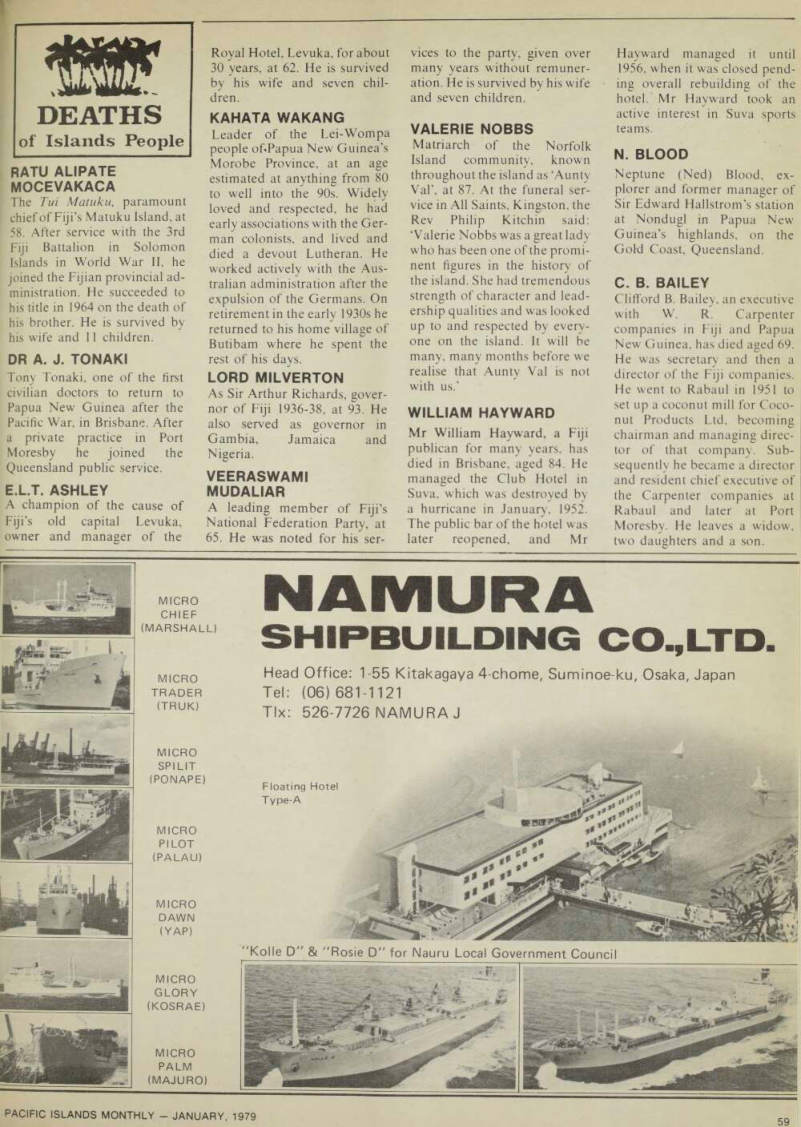
of Islands People
Ratu Alipate
Mocevakaca
The Tui Matuku, paramount chief of Fiji’s Matuku Island, at 58. After service with the 3rd Fiji Battalion in Solomon Islands in World War 11, he
joined the Fijian provincial ad
ministration. He succeeded to his title in 1964 on the death of his brother. He is survived by his wife and 11 children.
Dr A. J. Tonaki
Tony Tonaki, one of the first civilian doctors to return to Papua New Guinea after the Pacific War, in Brisbane. After a private practice in Port
Moresby he joined the
Queensland public service.
E.L.T. Ashley
A champion of the cause of
Fiji’s old capital Levuka,
owner and manager of the
Royal Hotel, Levuka, for about 30 years, at 62. He is survived by his wife and seven chil dren.
Kahata Wakang
Leader of the Lei-Wompa people oTPapua New Guinea’s Morobe Province, at an age estimated at anything from 80 to well into the 90s. Widely loved and respected, he had early associations with the Ger man colonists, and lived and died a devout Lutheran. He worked actively with the Aus tralian administration after the expulsion of the Germans. On retirement in the early 1930 s he returned to his home village of Butibam where he spent the rest of his days.
Lord Milverton
As Sir Arthur Richards, gover nor of Fiji 1936-38, at 93. He also served as governor in Gambia, Jamaica and
Nigeria.
Veeraswami
Mudaliar
A leading member of Fiji’s National Federation Party, at 65. He was noted for his ser
vices to the party, given over many years without remuner ation. He is survived by his wife and seven children.
Valerie Nobbs
Matriarch of the Norfolk Island community, known throughout the island as ‘Aunty Val’, at 87. At the funeral ser vice in All Saints, Kingston, the Rev Philip Kitchin said: ‘Valerie Nobbs was a great lady who has been one of the promi nent figures in the history of the island. She had tremendous strength of character and lead ership qualities and was looked up to and respected by every one on the island. It will be many, many months before we realise that Aunty Val is not with us.’
William Hayward
Mr William Hayward, a Fiji publican for many years, has died in Brisbane, aged 84. He managed the Club Hotel in Suva, which was destroyed by a hurricane in January, 1952.
The public bar of the hotel was later reopened, and Mr
Hayward managed it until 1956, when it was closed pend ing overall rebuilding of the hotel. Mr Hayward took an active interest in Suva sports teams.
N. Blood
Neptune (Ned) Blood, ex plorer and former manager of Sir Edward Hallstrom’s station at Nondugl in Papua New Guinea’s highlands, on the Gold Coast, Queensland.
C. B. Bailey
Clifford B. Bailey, an executive with W. R. Carpenter companies in Fiji and Papua New Guinea, has died aged 69.
He was secretary and then a director of the Fiji companies.
He went to Rabaul in 1951 to set up a coconut mill for Coco nut Products Ltd, becoming chairman and managing direc tor of that company. Sub sequently he became a director and resident chief executive of
the Carpenter companies at
Rabaul and later at Port Moresby. He leaves a widow, two daughters and a son.
Advertisements & other items, p. 59 (1 item)
Namura
MICRO
CHIEF
(MARSHALL)
MICRO
TRADER
(TRUK)
MICRO
SPILIT
(PONAPE)
MICRO
PILOT
(PALAU)
MICRO
DAWN
(YAP)
MICRO
GLORY
(KOSRAE)
MICRO
PALM
(MAJURO)
NAMURA
SHIPBUILDING CO.,LTD.
Head Office: 1-55 Kitakagaya 4-chome, Suminoe-ku, Osaka, Japan
Tel: (06)681-1121
Tlx: 526-7726 NAMURA J
T?
Floating Hotel Type-A . i ** 0. f* m i I "Kolle D" & ''Rosie D" for Nauru Local Government Council » mjt
Cruising
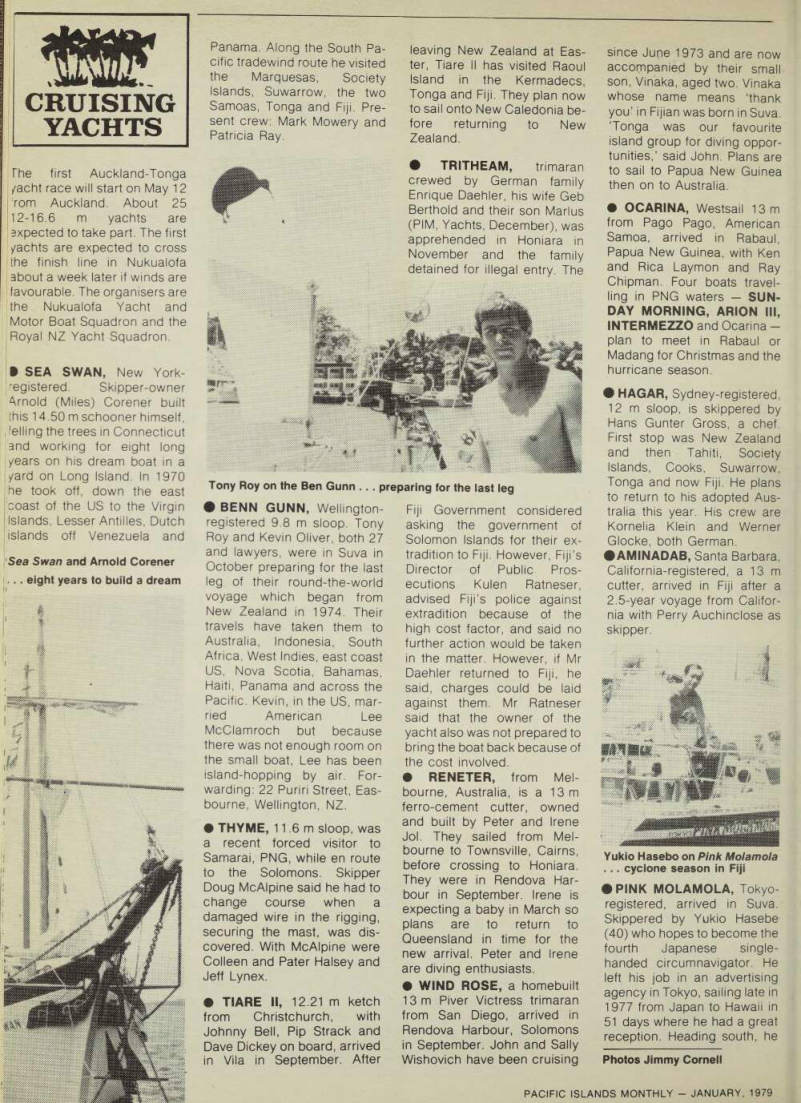
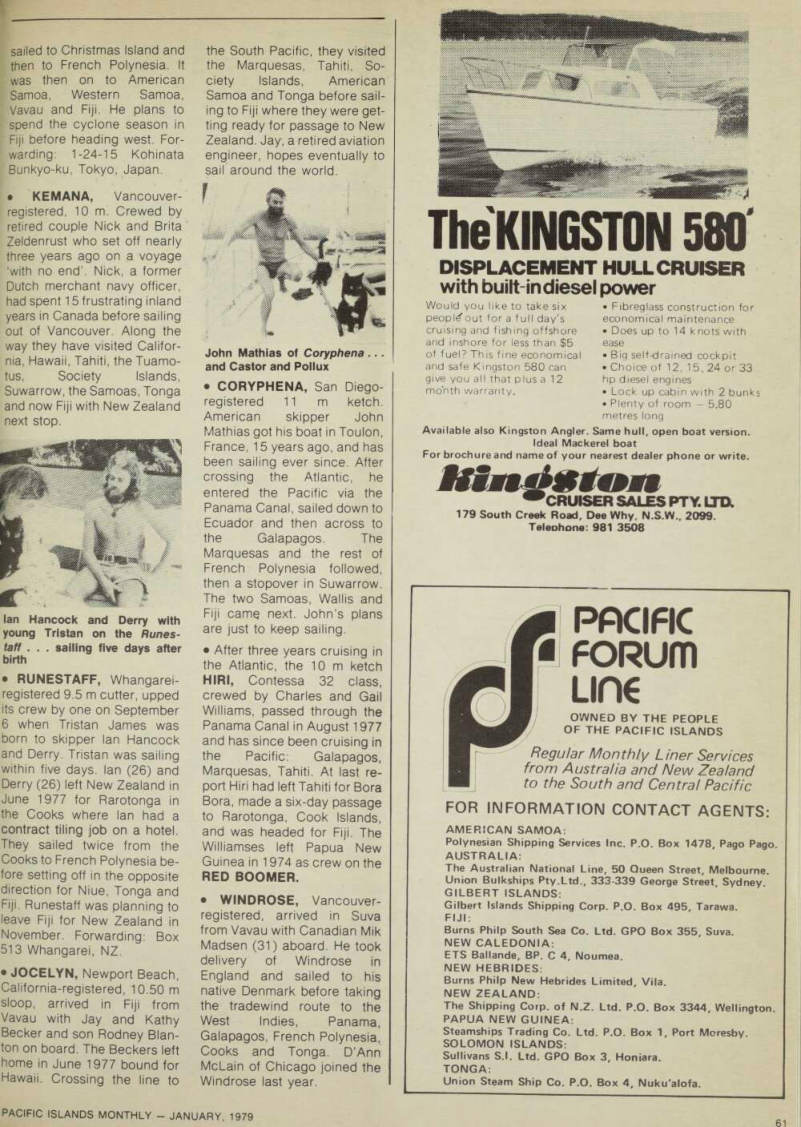
Yachts
The first Auckland-Tonga /acht race will start on May 12 , : rom Auckland. About 25 12-16.6 m yachts are axpected to take part. The first yachts are expected to cross the finish line in Nukualofa about a week later if winds are favourable. The organisers are the Nukualofa Yacht and Motor Boat Squadron and the Royal NZ Yacht Squadron. • SEA SWAN, New York registered. Skipper-owner Arnold (Miles) Corener built this 14.50 m schooner himself, felling the trees in Connecticut and working for eight long /ears on his dream boat in a yard on Long Island. In 1970 he took off, down the east coast of the US to the Virgin Islands, Lesser Antilles, Dutch islands off Venezuela and
Panama. Along the South Pa cific tradewind route he visited the Marquesas, Society Islands, Suwarrow, the two Samoas, Tonga and Fiji. Pre sent crew: Mark Mowery and Patricia Ray.
• BENN GUNN, Wellington registered 9.8 m sloop. Tony Roy and Kevin Oliver, both 27 and lawyers, were in Suva in October preparing for the last leg of their round-the-world voyage which began from New Zealand in 1974. Their travels have taken them to Australia, Indonesia, South Africa, West Indies, east coast US, Nova Scotia, Bahamas, Haiti, Panama and across the Pacific. Kevin, in the US, mar ried American Lee McClamroch but because there was not enough room on the small boat, Lee has been island-hopping by air. For warding: 22 Puriri Street, Eas bourne, Wellington, NZ. • THYME, 11.6 m sloop, was a recent forced visitor to Samarai, PNG, while en route to the Solomons. Skipper Doug McAlpine said he had to change course when a damaged wire in the rigging, securing the mast, was dis covered. With McAlpine were Colleen and Pater Halsey and Jeff Lynex. • TIARE 11, 12.21 m ketch from Christchurch, with Johnny Bell, Pip Strack and Dave Dickey on board, arrived in Vila in September. After
leaving New Zealand at Eas ter, Tiare II has visited Raoul Island in the Kermadecs, Tonga and Fiji. They plan now to sail onto New Caledonia be fore returning to New Zealand. • TRITHEAM, trimaran crewed by German family Enrique Daehler, his wife Geb Berthold and their son Marius (PIM, Yachts, December), was apprehended in Honiara in November and the family detained for illegal entry. The
Fiji Government considered asking the government of Solomon Islands for their ex tradition to Fiji. However, Fiji’s Director of Public Pros ecutions Kulen Ratneser, advised Fiji’s police against extradition because of the high cost factor, and said no further action would be taken in the matter. However, if Mr Daehler returned to Fiji, he said, charges could be laid against them. Mr Ratneser said that the owner of the yacht also was not prepared to bring the boat back because of the cost involved. • RENETER, from Mel bourne, Australia, is a 13 m ferro-cement cutter, owned and built by Peter and Irene Jol. They sailed from Mel bourne to Townsville, Cairns, before crossing to Honiara.
They were in Rendova Har bour in September. Irene is expecting a baby in March so plans are to return to Queensland in time for the new arrival. Peter and Irene are diving enthusiasts. • WIND ROSE, a homebuilt 13 m Piver Victress trimaran from San Diego, arrived in Rendova Harbour, Solomons in September. John and Sally Wishovich have been cruising
since June 1973 and are now accompanied by their small son, Vinaka, aged two. Vinaka whose name means ‘thank you’ in Fijian was born in Suva. ‘Tonga was our favourite island group for diving oppor tunities,’ said John. Plans are to sail to Papua New Guinea then on to Australia. • OCARINA, Westsail 13 m from Pago Pago, American Samoa, arrived in Rabaul, Papua New Guinea, with Ken and Rica Laymon and Ray Chipman. Four boats travel ling in PNG waters SUN
Day Morning, Arion 111,
INTERMEZZO and Ocarina plan to meet in Rabaul or Madang for Christmas and the hurricane season. • HAGAR, Sydney-registered, 12 m sloop, is skippered by Hans Gunter Gross, a chef.
First stop was New Zealand and then Tahiti, Society Islands, Cooks, Suwarrow, Tonga and now Fiji. He plans to return to his adopted Aus tralia this year. His crew are Kornelia Klein and Werner Glocke, both German. • AMINADAB, Santa Barbara, California-registered, a 13 m cutter, arrived in Fiji after a 2.5-year voyage from Califor nia with Perry Auchinclose as skipper.
• Pink Molamola, Tokyo
registered, arrived in Suva.
Skippered by Yukio Hasebe (40) who hopes to become the fourth Japanese single handed circumnavigator. He left his job in an advertising agency in Tokyo, sailing late in 1977 from Japan to Hawaii in 51 days where he had a great reception. Heading south, he
Photos Jimmy Cornell
Sea Swan and Arnold Corener . . .eight years to build a dream
Tony Roy on the Ben Gunn . . . preparing for the last leg
Yukio Hasebo on Pink Molamola ... cyclone season in Fiji
sailed to Christmas Island and then to French Polynesia. It was then on to American Samoa, Western Samoa, Vavau and Fiji. He plans to spend the cyclone season in Fiji before heading west. For warding: 1-24-15 Kohinata Bunkyo-ku, Tokyo, Japan. • KEMANA, Vancouver registered, 10 m. Crewed by retired couple Nick and Brita Zeldenrust who set off nearly three years ago on a voyage ‘with no end’. Nick, a former Dutch merchant navy officer, had spent 15 frustrating inland years in Canada before sailing out of Vancouver. Along the way they have visited Califor nia, Hawaii, Tahiti, the Tuamo tus, Society Islands, Suwarrow, the Samoas, Tonga and now Fiji with New Zealand next stop.
• RUNESTAFF, Whangarei registered 9.5 m cutter, upped its crew by one on September 6 when Tristan James was born to skipper lan Hancock and Derry. Tristan was sailing within five days. lan (26) and Derry (26) left New Zealand in June 1977 for Rarotonga in the Cooks where lan had a contract tiling job on a hotel.
They sailed twice from the Cooks to French Polynesia be fore setting off in the opposite direction for Niue, Tonga and Fiji. Runestaff was planning to leave Fiji for New Zealand in November. Forwarding: Box 513 Whangarei, NZ. • JOCELYN, Newport Beach, California-registered, 10.50 m sloop, arrived in Fiji from Vavau with Jay and Kathy Becker and son Rodney Blan ton on board. The Beckers left home in June 1977 bound for Hawaii. Crossing the line to
the South Pacific, they visited the Marquesas, Tahiti, So ciety Islands, American Samoa and Tonga before sail ing to Fiji where they were get ting ready for passage to New Zealand. Jay, a retired aviation engineer, hopes eventually to sail around the world.
• CORYPHENA, San Diego registered 11 m ketch.
American skipper John Mathias got his boat in Toulon, France, 15 years ago, and has been sailing ever since. After crossing the Atlantic, he entered the Pacific via the Panama Canal, sailed down to Ecuador and then across to the Galapagos. The Marquesas and the rest of French Polynesia followed, then a stopover in Suwarrow.
The two Samoas, Wallis and Fiji came next. John's plans are just to keep sailing. • After three years cruising in the Atlantic, the 10 m ketch HIRI, Contessa 32 class, crewed by Charles and Gail Williams, passed through the Panama Canal in August 1977 and has since been cruising in the Pacific: Galapagos, Marquesas, Tahiti. At last re port Hiri had left Tahiti for Bora Bora, made a six-day passage to Rarotonga, Cook Islands, and was headed for Fiji. The Williamses left Papua New Guinea in 1974 as crew on the
Red Boomer.
• WINDROSE, Vancouver registered, arrived in Suva from Vavau with Canadian Mik Madsen (31) aboard. He took delivery of Windrose in England and sailed to his native Denmark before taking the tradewind route to the West Indies, Panama, Galapagos, French Polynesia, Cooks and Tonga. D’Ann McLain of Chicago joined the Windrose last year.
John Mathias of Coryphena . . . and Castor and Pollux
Ian Hancock and Derry with young Tristan on the Runes taff ... sailing five days after birth
Advertisements & other items, pp. 61-62 (1 item)
Thekingston 580
DISPLACEMENT HULL CRUISER
with built-in diesel power
• Fibreglass construction for economical maintenance • Does up to 14 knots with ease • Big self-drained cockpit • Choice of 12, 15, 24 or 33 hp diesel engines • Lock up cabin with 2 bunks • Plenty of room 5.80 metres long Available also Kingston Angler. Same hull, open boat version.
Ideal Mackerel boat For brochure and name of your nearest dealer phone or write.
Would you like to take six people out for a full day's cruising and fishing offshore and inshore for less than $5 of fuel? This fine economical and safe Kingston 580 can give you all that plus a 12 month warranty.
Iffiv^illon
WADI lICCD CAI ETC
CRUISER SALES PTY LTD.
179 South Creek Road. Dee Why, N.S.W., 2099.
Telephone: 981 3508
Regular Monthly Liner Services
from Australia and New Zealand
to the South and Central Pacific
OWNED BY THE PEOPLE
OF THE PACIFIC ISLANDS
PACIFIC
FORUm
Line
FOR INFORMATION CONTACT AGENTS:
AMERiCAN SAMOA:
Polynesian Shipping Services Inc, P.O. Box 1478, Pago Pago.
AUSTRALIA:
The Australian National Line, 50 Queen Street, Melbourne.
Union Bulkships Pty.Ltd., 333-339 George Street Sydney
GILBERT ISLANDS:
Gilbert Islands Shipping Corp. P.O. Box 495, Tarawa.
FIJI:
Burns Philp South Sea Co. Ltd. GPO Box 355, Suva.
NEW CALEDONIA:
ETS Ballande, BP. C 4, Noumea.
NEW HEBRIDES:
Burns Philp New Hebrides Limited, Vila.
NEW ZEALAND:
The Shipping Corp. of N.Z. Ltd. P.O. Box 3344, Wellington.
PAPUA NEW GUINEA:
Steamships Trading Co. Ltd. P.O. Box 1, Port Moresby.
SOLOMON ISLANDS:
Sullivans S.l. Ltd. GPO Box 3, Honiara.
TONGA:
Union Steam Ship Co. P.O. Box 4, Nukualofa.
Tiood;
cmakersTO tH£ PACIFIC
HOOD RACING and CRUISING SAILS
In World Famous Hood Sailcloth 7 Hood Racing Sails have the top international race-winning record. Recent successes include: Half Ton Cup, One Ton Cup, Southern Cross Cup, Whitbread Round-the-World Race, World Ocean Racing Championship, Sydney- Hobart Race, N.Z. to Vila /A Ocean Race. Single-handed Transtasman, / etc., etc. / Hood Cruising Sails in Hood Wide / jC^ Panel Sailcloth are soft, easy to /Cy handle and stow, and longer ' ' lasting.
Hood Service. We regularly service the Pacific.
Hood Managing Director Tony Bouzaid calls frequently through the area; sailing seminars for clubs and associations by arrangement.
Deliveries. Improved air services bring / New Zealand closer to you we can / rv offer speedy deliveries at short notice. ' Hoods have representatives in Noumea, Papeete, Port Moresby, Rabaul, Suva, Singapore.
Write to Hood Sail Consultants in New Zealand for quotes, advice and for prompt answers to your A o v £ $ <3 V 8 sails queries.
HOOD
O G S) G 0 <3 $ «3 & s> *
SPA
candH
RICCIN
HOOD
NEW ZEALAND
LIMITED
23 Poore St.. St. Marys Bay. Phone 794-060, P.O. Box 415.
Auckland. / A’
New Zealand. / Q Cables:Hoodsail/ Telex: ' NZ21200
HOODNZ
Whether you have a racing or cruising yacht and require full new rigs or replacements, contact us for prompt and efficient service. We offer Spars, Rigging, Halyards, Accessories from Quarter Ton to Maxis. For immediate service, write, phone or telex giving fullest details including sketches for replacements, and sail plans with yacht’s leading dimensions, including displacements and ballast, for new rigs.
Write for our very comprehensive catalogue.
YACHTSR4RS
NEW ZEALAND LIMITED
P.O. Box 1492, Auckland. Phone 485-955, 485-536 Telex: Hood 21200. Cables: Yachts Auckland. > % >
Shipping
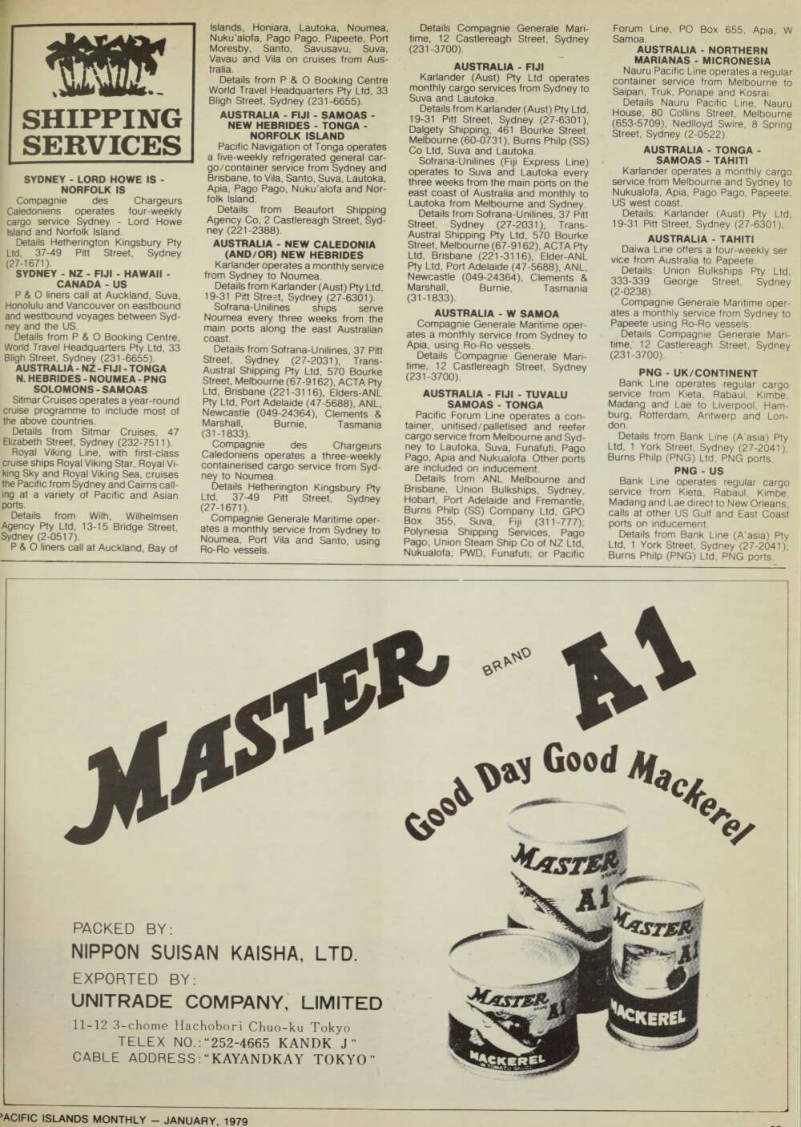
Services
Sydney - Lord Howe Is -
Norfolk Is
Compagnie des Chargeurs Caledoniens operates four-weekly cargo service Sydney - Lord Howe Island and Norfolk Island.
Details Hetherington Kingsbury Pty Ltd. 37-49 Pitt Street. Sydney (27-1671).
SYDNEY - NZ - FIJI - HAWAII -
Canada - Us
P & O liners call at Auckland, Suva, Honolulu and Vancouver on eastbound and westbound voyages between Syd ney and the US.
Details from P & O Booking Centre.
World Travel Headquarters Pty Ltd, 33 Bligh Street, Sydney (231-6655).
AUSTRALIA - NZ - FIJI - TONGA
N. Hebrides - Noumea - Png
Solomons-Samoas
Sitmar Cruises operates a year-round cruise programme to include most of the above countries.
Details from Sitmar Cruises. 47 Elizabeth Street, Sydney (232-7511).
Royal Viking Line, with first-class cruise ships Royal Viking Star, Royal Vi king Sky and Royal Viking Sea. cruises the Pacific from Sydney and Cairns call ing at a variety of Pacific and Asian ports.
Details from Wilh, Wilhelmsen Agency Pty Ltd, 13-15 Bridge Street, Sydney (2-0517).
P & O liners call at Auckland. Bay of
Islands, Honiara, Lautoka, Noumea, Nuku’alofa, Pago Pago, Papeete, Port Moresby, Santo, Savusavu, Suva, Vavau and Vila on cruises from Aus tralia.
Details from P & O Booking Centre World Travel Headquarters Pty Ltd, 33 Bligh Street. Sydney (231 -6655).
Australia - Fiji - Samoas -
New Hebrides - Tonga -
Norfolk Island
Pacific Navigation of Tonga operates a five-weekly refrigerated general car go/container service from Sydney and Brisbane, to Vila, Santo, Suva, Lautoka, Apia, Pago Pago. Nuku’alofa and Nor folk Island.
Details from Beaufort Shipping Agency Co, 2 Castlereagh Street, Syd ney (221-2388).
Australia - New Caledonia
(And/Or) New Hebrides
Karlander operates a monthly service from Sydney to Noumea.
Details from Karlander (Aust) Pty Ltd, 19-31 Pitt Strest, Sydney (27-6301).
Sofrana-Unilines ships serve Noumea every three weeks from the main ports along the east Australian coast.
Details from Sofrana-Unilines. 37 Pitt Street. Sydney (27-2031), Trans- Austral Shipping Pty Ltd, 570 Bourke Street, Melbourne (67-9162), ACTA Pty Ltd, Brisbane (221-3116), Elders-ANL Pty Ltd. Port Adelaide (47-5688), ANL, Newcastle (049-24364), Clements & Marshall, Burnie. Tasmania (31-1833).
Compagnie des Chargeurs Caledoniens operates a three-weekly containerised cargo service from Syd ney to Noumea.
Details Hetherington Kingsbury Pty Ltd, 37-49 Pitt Street. Sydney (27-1671).
Compagnie Generate Maritime oper ates a monthly service from Sydney to Noumea, Port Vila and Santo, using Ro-Ro vessels.
Details Compagnie Generate Mari time, 12 Castlereagh Street. Sydney (231-3700).
Australia - Fiji
Karlander (Aust) Pty Ltd operates monthly cargo services from Sydney to Suva and Lautoka.
Details from Karlander (Aust) Pty Ltd, 19-31 Pitt Street. Sydney (27-6301), Dalgety Shipping, 461 Bourke Street.
Melbourne (60-0731). Burns Philp (SS) Co Ltd, Suva and Lautoka.
Sofrana-Unilines (Fiji Express Line) operates to Suva and Lautoka every three weeks from the main ports on the east coast of Australia and monthly to Lautoka from Melbourne and Sydney.
Details from Sofrana-Unilines, 37 Pitt Street. Sydney (27-2031), Trans- Austral Shipping Pty Ltd. 570 Bourke Street, Melbourne (67-9162). ACTA Pty Ltd, Brisbane (221-3116), Elder-ANL Pty Ltd, Port Adelaide (47-5688), ANL, Newcastle (049-24364). Clements & Marshall, Burnie, Tasmania (31-1833).
Australia - W Samoa
Compagnie Generate Maritime oper ates a monthly service from Sydney to Apia, using Ro-Ro vessels Details Compagnie Generate Mari time. 12 Castlereagh Street, Sydney (231 -3700).
Australia - Fiji - Tuvalu
Samoas - Tonga
Pacific Forum Line operates a con tainer, unitised/palletised and reefer cargo service from Melbourne and Syd ney to Lautoka, Suva, Funafuti, Pago Pago, Apia and Nukualofa. Other ports are included on inducement.
Details from ANL Melbourne and Brisbane, Union Bulkships, Sydney, Hobart, Port Adelaide and Fremantle, Burns Philp (SS) Company Ltd. GPO Box 355, Suva. Fiji (311-777); Polynesia Shipping Services, Pago Pago; Union Steam Ship Co of NZ Ltd, Nukualofa; PWD, Funafuti; or Pacific
Forum Line, PO Box 655, Apia, W Samoa.
Australia - Northern
Marianas - Micronesia
Nauru Pacific Line operates a regular container service from Melbourne to Saipan, Truk, Ponape and Kosrai.
Details Nauru Pacific Line, Nauru House, 80 Collins Street, Melbourne (653-5709), Nedlloyd Swire, 8 Spring Street, Sydney (2-0522).
Australia - Tonga -
Samoas - Tahiti
Karlander operates a monthly cargo service from Melbourne and Sydney to Nukualofa, Apia, Pago Pago, Papeete, US west coast.
Details: Karlander (Aust) Pty Ltd, 19-31 Pitt Street. Sydney (27-6301).
Australia - Tahiti
Daiwa Line offers a four-weekly ser vice from Australia to Papeete.
Details: Union Bulkships Pty Ltd, 333-339 George Street, Sydney (2-0238).
Compagnie Generate Maritime oper ates a monthly service from Sydney to Papeete using Ro-Ro vessels.
Details Compagnie Generate Mari time, 12 Castlereagh Street, Sydney (231-3700).
Png - Uk/Continent
Bank Line operates regular cargo service from Kieta, Rabaul, Kimbe, Madang and Lae to Liverpool, Ham burg, Rotterdam, Antwerp and Lon don.
Details from Bank Line (A’asia) Pty Ltd. 1 York Street, Sydney (27-2041), Burns Philp (PNG) Ltd, PNG ports.
Png • Us
Bank Line operates regular cargo service from Kieta, Rabaul, Kimbe, Madang and Lae direct to New Orleans; calls at other US Gulf and East Coast ports on inducement.
Details from Bank Line (A’asia) Pty Ltd. 1 York Street, Sydney (27-2041); Burns Philp (PNG) Ltd, PNG ports.
Australia - Png
Containers Pacific Express (Burns Philp and AWP Line) and NGAL/PNGL Operate chief Container Service from Australia to PNG-Solomon Islands ports on joint slot sharing basis. Three con tainer vessels operate on 28-day turn around from Melbourne, Sydney and Brisbane to Port Moresby, Lae, Rabaul, Kavieng, Wewak, Madang, Kieta and Honiara, Details from Burns Philp & Co Ltd, 51 Pitt Street, Sydney (20-547) and Interocean Swire, 8 Spring Street, Syd ney (2-0522).
Farrell Lines operates a service every month from Tasmania, Melbourne, Syd ney and Brisbane to Lae and Rabaul.
Details from Wilh Wilhelmsen Agency Pty Ltd, 13 Bridge Street, Sydney (2-0517), 60 Market Street Melbourne (61-3031), J. C. Waller (Rabaul) Pty Ltd, Rabaul, Robert Laurie-Carpenter (NG) Pty Ltd, Lae.
New Guinea Express Lines operates three-weekly conventional and con tainer services Melbourne, Sydney, Brisbane, Port Moresby, Lae, Rabaul, Alotau.
Details from New Guinea Express Lines, PC Box R 73, Royal Exchange PC, Sydney (241-3991) MacArthur Shipping Agency Co, 82-92 Eagle Street, Brisbane (229-3777), New Guinea Express Lines, 327 Collins Street, Melbourne (61-3053), Niugini Express Lines in Port Moresby (214436), Lae (42-1536), Rabtrad Niugini Pty Ltd, Rabaul (92-2911).
Karlander New Guinea Line’s cargo vessels call at Melbourne, Sydney, Port Moresby, Lae, Madang, Wewak, Manus, Kimbe, Rabaul.
Details from Karlander (Aust) Pty Ltd, 19-31 Pitt Street, Sydney (27-6301), Dalgety Shipping, 461 Bourke Street Melbourne (60-0731).
Australia - Solomons -
Gilbert Is - Micronesia
Daiwa Line operates a container ser vice every 30 days from Sydney to Honiara, Kieta, Tarawa and Guam. Gizo cargoes transhipped at Honiara, Saipan, cargoes transhipped at Guam.
Details from Union-Bulkships Pty Ltd, 333-339 George Street, Sydney (2-0238, telex AA20397).
Australia - Nauru -
Majuro
Nauru Pacific Line operates regular cargo/passenger service from Mel bourne to Nauru and Majuro.
Details Nauru Pacific Line, Nauru House, 80 Collins Street, Melbourne (653-5709), Nedlloyd Swire, 8 Spring Street, Sydney (2-0522)
Us - Png
Farrell Lines operates regular ser vices from all US west coast ports to Lae and Rabaul.
Details from Wilh, Wilhelmsen Agency Pty Ltd, 13 Bridge Street, Syd ney (2-0517), Farrell Lines, 1 Market Plaza, San Francisco. L A. (9-4105). J.
C. Waller (Rabaul) Pty Ltd, Rabaul, Burns Philp (NG) Ltd, Kieta, Robert Laurie-Carpenter (PNG) Pty Ltd, Lae,
Png - Us - Canada
Farrell Lines operates regular ser vices from Lae and Rabaul to US west coast ports and Vancouver.
Details from J. G. Waller (Rabaul) Pty Ltd, Rabaul, Robert Laurie-Carpenter (PNG) Pty Ltd, Lae, Farrell Lines, 1 Market Plaza, San Francisco, L.A. (9-4105), Wilh, Wilhelmsen Agency Pty Ltd, 13 Bridge Street, Sydney (2-0517).
Solomons - Usa -
Uk/Continent
Bank Line operates regular cargo service from Honiara, to New Orleans, Liverpool, Hamburg, Rotterdam and Antwerp.
Details from Bank Line (A’asia) Pty Ltd, 1 York Street, Sydney (27-2041); Trading Co, Honiara (389).
Far East - Fiji - New
Zealand
New Zealand Unit Express (CNC,
MNOL, Nedlloyd) operates a three weekly cargo service from Hong Kong to Lautoka, Suva, NZ ports, Manila, Kaoshiung, Keelung, Hong Kong.
Details from Nedlloyd, 8 Spring Street, Sydney (2-0522).
Nedlloyd operates monthly cargo service with three ships from Surabaya, Jakarta, Bangkok, Port Kelang and Singapore to Suva and NZ ports.
Details from Nedlloyd (Aust) Pty Ltd, 8 Spring Street, Sydney (27-3801); Burns Philp (SS) Co Ltd, Suva and Lau toka.
Japan - Nz - Png
China Navigation Co, with three ships operates a monthly cargo service from Japan to New Zealand calling at Lae on return journey.
Details Nedlloyd, 8 Spring Street, Sydney (2-0522).
Far East - Mid-S. Pacific
China Navigation Co’s vessels oper ate a regular cargo service from Hong Kong, Taiwan and Singapore to Rabaul, Wewak, Madang, Lae, Port Moresby, Honiara, New Hebrides, Noumea, Papeete and Samoa.
Details from Nedlloyd, 8 Spring Street, Sydney (2-0522).
Kyowa Shipping Co. Ltd, operates monthly services from Hong Kong, Taiwan, S. Korea and Japan, to Guam, Siapan, Solomons, New Caledonia, Fiji, Western and American Samoa, Tahiti, Cook Is., Tonga and New Hebrides and 45-day container/break bulk cargo ser vice from Kobe, Nagoya and Yokohama to Guam, Suva, Lautoka and Noumea.
Details: Hetherington Kingsbury Pty Ltd, 37-49 Pitt Street, Sydney (27-1671).
NYK Line, in conjunction with Daiwa Line, with container ships operates 30-day service from Moji, Kobe, Nagoya and Yokohama to Papeete, Pago Pago, Apia, Suva, Lautoka, Noumea, Sydney, Honiara, Kieta, Tarawa, Guam and Taiwan.
Details: Union Bulkships Pty Ltd, 333-339 George Street, Sydney (2-0238).
North Europe - Tahiti -
New Caledonia
Hamburg-Sued operates monthly cargo services from Hamburg, Dunkirk and Le Havre to Papeete, Noumea, via Panama.
Details from Columbus Overseas Services Pty Ltd, 333 George Street, Sydney (290-2966), Columbus Mari time Services, 17 Albert Street, Auckland (77-3460).
Europe - Pacific Islands
Compagnie Generale Maritime oper ates services from Europe and Mediter ranean ports to Papeete and Noumea using three Ro-Ro and three multi purpose vessels thus ensuring a bi monthly sailing to and from.
Details Compagnie Generale Mari time, 12 Castlereagh Street, Sydney (231-3700).
Europe-Tahiti-W. Samoa
Fiji-N. Caledonia
Nedlloyd offers regular cargo ser vices from Northern Europe and UK to Papeete, Apia, Fiji and New Caledonia.
Details Nedlloyd (Aust) Pty Ltd, 8 Spring Street, Sydney (27-3801).
J Ap An - Guam-Fiji-Tahiti -
Samoa - N. Caledonia -
Solomons - Gilberts
Daiwa Lines runs a monthly cargo service from Japan via Guam to Lau toka, Suva. Papeete, Pago Pago, Apia, Sydney, Noumea, Honiara, Tarawa, Guam.
Details from Burns Philp (SS) Co Ltd, Suva.
NZ - N. CALEDONIA • N. HEBRIDES
-Png-Solomons
Sofrana Unilines with three ships op erates to Vila and Santo, to Honiara and Papua New Guinea and to Noumea.
Details from Sofrana Unilines, 18 Customs Street, Auckland (773-279), PC Box 3614, Telex NZ2313.
Nz- Australia - New Caledonia
- Solomons - Gilberts -
Micronesia
\ Union Co/Daiwa Line operate a con- I tainer service from New Zealand ‘ through Sydney to Noumea, Honiara, r Tarawa and Guam, Transhipment to i Saipan, Majuro and Gizo.
Details. Union Steam Ship Co of NZ r Ltd, PO Box 12, Auckland, or Union [ Bulkships Pty Ltd, 333-339 George r Street, Sydney, (2-0238).
NZ ■ FIJI - NORTH AMERICA (WC) Blue Star Line Crusader service to f West Coast North America. Only direct : service to and from New Zealand. Blue Star vessels call at Suva and Honolulu on NZ-US-West Coast voyages.
Details from Blueport ACT (NZ) Ltd, PO Box 192, Wellington (739-029), Burns Philp (SS) Co Ltd, GPO Box 355, Suva, Fiji (311-777).
Nz - Fiji
Reef operates a regular 18-day ser vice from Auckland to Suva and Lau toka.
Details from Reef Shipping Agencies Ltd, PO Box 3382, Auckland, NZ (77-1221-3).
Pacific Line with one ship operates fortnightly roro cargo service New Zealand, Lautoka, Suva.
Details: Sofrana Unilines, 18 Cus toms Street, Auckland (773-279) PO Box 3614, Telex: NZ2313.
Nz - Fiji - Gilberts -
Solomons - Png
Pacific Forum Line operates a con tainer, unitised /palletised and reefer cargo service from Lyttelton and Auckland to Suva, Port Moresby, Lae, Honiara, Tarawa, Madang, Lae and Moresby. Other ports are included on inducement.
Details from Shipping Corporation of NZ Ltd, Auckland, Christchurch and
Wellington. Burns Philp (SS) Company Ltd, GPO Box 355, Suva, Fiji (311 -777) Sullivans, Honiara: Gilbert Islands Ship ping Corporation, Tarawa; Steamships Trading in Port Moresby, Lae and Madang or Pacific Forum Line, PO Box 655, Apia, W. Samoa NZ - FIJI - SAMOAS - TONGA Pacific Forum Line operates a uni tised / palletised and reefer cargo ser vice from Lyttelton and Auckland to Lautoka, Suva, Pago Pago, Apia and Nukualofa. Other ports are included on inducement, Details from Shipping Corporation of NZ Ltd, Auckland, Christchurch, Wellington, Burns Philp (SS) Company Ltd, GPO Box 355, Suva, Fiji (311 -777); Polynesia Shipping Services, Pago Pago; Union Steam Ship Co of NZ Ltd, Nukualofa or Pacific Forum Line, PO Box 655, Apia, W. Samoa.
Union Steam Ship Co of NZ operates a roll-on, roll-off, unitised service from Auckland to Lautoka-Suva-Pago Pago- Apia-Nuku’alofa on a 14 day fre quency.
Details from Union Steam Ship Co of NZ Ltd, PO Box 12, Auckland or from Branch offices/agents in Fiji, Tonga and the Samoas,
Nz- Samoa - Tonga
Pacific Navigation of Tonga operates a four-weekly cargo service, Auckland - Nukualofa - Pago Pago - Apia - Auckland.
Details from McKay Shipping Ltd, Downtown House, Queen Street, Auckland (33-656).
Warner Pacific Line services Onehunga - Nukualofa •- Vavau fort nightly, and Timaru - Nukualofa - Vavau monthly and Onehunga - Apia and Pago Pago every 21 days carrying gen eral and freezer cargoes and Timaru - Apia every 21 days carrying freezer cargo.
Details from Air Marine Services (NZ) Ltd, PC Box 2505, Auckland (796-841).
NZ - COOK IS - NIUE -
Tahiti
Shipping Corporation of NZ Ltd oper ates cargo services based on pallets and similar units from Auckland to Niue, Cook Islands and Tahiti.
Details from the Shipping Corp of NZ Ltd, PO Box 3420, Auckland (797-210); Waterfront Commission, PO Box 61, Rarotonga, Lighterage and Stevedoring Co, Aitutaki, Niue Govt Offices, Niue Island Compagnie Mari time Polynesienne, BP’ 368, Papeete.
Uk - Fiji
The Bank Line operates a direct, fast monthly service from Hull to Suva and Lautoka.
Details from The Bank Line (Aus tralasia) Pty Ltd, 1 York St, Sydney (27-2041); Burns Philp (South Sea) Co Ltd, Suva and Lautoka,
Uk/N. Continent - Tahiti -
N. Caledonia - N. Hebrides
Bank Line operates regular cargo service from Hull, Hamburg, Bremen, Antwerp and Rotterdam to Papeete, Noumea and Vila.
Details from Bank Line (A'asia) Pty Ltd, 1 York Street. Sydney (27-2041); Ets A M Fare UTE, Papeete; Ets Ballande, Noumea, Burns Philp (NH) Ltd, Vila.
Uk/N. Continent - Png -
Solomons
Bank Line operates regular cargo service from Hull, Hamburg, Bremen, Antwerp and Rotterdam to Port Moresby, Lae, Madang, Kimbe, Rabaul, Kieta and Honiara and on inducement to Yandina, Tarawa and Nauru.
Details from Bank Line (A'asia) Pty Ltd. 1 York Street, Sydney (27-2041) Burns Philp (PNG) Ltd, PNG ports; Trading Co Honiara.
San Francisco - Honolulu -
Nauru - Micronesia
Nauru Pacific Line operates regular conventional/container service from San Francisco and Honolulu to Majuro, Nauru, Ponape, Truk and Saipan.
Details from Nauru Pacific Line Nauru House, 80 Collins Street, Mel bourne (653-5709); North American Maritime Agencies, 100 California Street, San Francisco, California 9411 (981-0343), US - FIJI - TAHITI - NZ
Australia
Bank and Savill Line Ltd, operates regular cargo services from US Gulf ports to Australia and NZ. Calls at Suva, Lautoka and Papeete on demand.
Details from Bank Line (A'asia) Pty Ltd, 1 York Street, Sydney (27-2041) or Howard Smith Industries Pty Ltd, 1 York Street, Sydney (27-5611).
Us-A. Samoa - Nz-Aust
Farrell Lines LASH ships operate regularly from US to Australia, via Pago Pago and Auckland and Canada.
Details from With, Wilhelmsen Agency Pty Ltd, 13 Bridge St., Sydney (2-0517); 60 Market Street, Melbourne (61-0301); Farrell Lines, 1 Market Plaza, San Francisco, LA. (415-777-3300); Dalgety NZ Ltd Auckland (7-1859); Kneubuhl Maritime Services, Pago Pago (633-5121)
Us - Tahiti - Samoa
Pacific Islands Transport operates a five/six weekly cargo service from North America west coast ports to Papeete, Pago Pago, Apia.
Details from Trans-Austral Shipping Pty Ltd, 19 Pitt Street, Sydney (27-2441).
Polynesia Line operates container and general cargo service from US west coast ports to Papeete and Pago Pago.
Details from Polynesia Shipping Ser vices Inc, PO Box 1478, Pago Pago (9-6799)
Advertisements & other items, pp. 63-72 (4 items)
’Acific Islands Monthly - January. 1979
Packed By;
NIPPON SUISAN KAISHA, LTD.
EXPORTED BY;
UNITRADE COMPANY, LIMITED
11-12 3-chome Hachobori Chuo-ku Tokyo
TELEX N0.;“252-4665 KANDK J”
CABLE ADDRESS:“KAYANDKAY TOKYO"
s*> T V
* vS' o r Q V * G
FOR:
BRANCH OFFICES;
IN OUR 84th YEAR SELLING ‘SERVICE’
TO THE PACIFIC ISLANDS...
Nelson & Robertson
PTY. LTD. (Established 1895)
Plantation House, 197 Clarence Street, Sydney.
Cables: ‘IVAN’, Sydney, Brisbane, Telex: AA22381, Sydney.
INDENTS - FROM AUSTRALIA, NEW ZEALAND and OVERSEAS FOODSTUFFS • HARDWARE • TRAVEL • CANNED FISH MACHINERY • INSURANCE • SOFTGOODS • JUTE GOODS
• REAL ESTATE •
Nelson & Robertson Pty. Ltd., P.O. Box 575, Brisbane, Qld., Australia.
P.O. Box 2092, Govt. Bldg., Suva, Fiji. P.O. Box 258, Lautoka, Fiji.
P.O. Box 2420, CPO Auckland 1, New Zealand. is i
PAPUA NEW GUINEA
REPRESENTATIVES;
Rabtrad Niugini Pty. Ltd., P.O. Box 219, Rabaul, P.N.G.
P.0.80x 1406, Lae, P.N.G. P.O. Box 711, Madang, P.N.G.
P.0.80x 253, Kieta, P.N.G.
X. &***•>* ) H J S > I a > »
DAIWA
LINE 1
JAPAN-SOUTH PACIFIC REGULAR SERVICE
AUSTRALIA SOUTH PACIFIC CONTAINER SERVICE
JAPAN-TAIWAN-GUAM-SAIPAN REGULAR SERVICE
DAIWA LINE BRIDGES SOUTH PACIFIC
WITH RO/RO CAR & CONTAINER CARRIER
JAPAN GUAM LAUTOKA SUVA PAPEETE-PAGO PAGO-APIA NOUMEA
SYDNEY-HONIARA TARAWA-GUAM TAIWAN JAPAN
JAPAN-MAJURO-RAROTONGA-VILA-SANTO-NAURU-JAPAN
JAPAN-TAIWAN-GUAM-SAIPAN-JAPAN
71
THE DAIWA N/ftfIGATIOM CO-. LTD.
OSAKA: “DAILINE” TOKYO: “FUNEDAILINE”
HEAD OFFICE
DAIICHI KYOGYO BLDG.
45. 2-CHOME, AWAZAMINAMI-DORI.
NISHI-KU, OSAKA. JAPAN
TELEPHONE: 'O6. 531-0471-9
TELEX: 525-6324 & 525-6325
TOKYO OFFICE
SHIN-DAIICHI BLDG.,
4-13, NIHONBASHI 3-CHOME. CHUO-KU,
TOKYO, JAPAN
TELEPHONE: 03; 274-3251 -8
TELEX: 222-3343, J 23559
Express Freight Service between U S. Pacific Coast Ports &
PAPEETE - APIA ■ PAGO PAGO
Full Container Service including Refrigeration
GENERAL AGENTS
« FURNESS INTEROCE4N
465 CALIFORNIA STREET SAN FRANCISCO. CA 94104 Cable INTERCQj • TWX 910372 7350 • RCA 278 207
• TEL 14151 398 2000
A POLYNESIA LINE, LTD
AGENTS
PAPEETE - MORGAN; Vernex Boite Postale 449. Papeete Phone; 309 Cables: MOREX PAGO PAGO POLYNESIA SHIPPING SERVICES. INC.. Pago Pago Phone; 633-5169 Cables; POLYSHIP APIA - UNION S.S. CO., of N.Z. Ltd.. PO Box 50. Apia. Western Samoa Phone; 570 Cables; UNION » i*
General & Refrigerated
Cargo Service to
Cook Islands,
Niue, and Tahiti.
CONTACT YOUR LOCAL AREA AGENT FOR FULL DETAILS Niue: Government Shipping office, Alofi.
Cook Islands: Waterfront Commission, PO Box 61, Rarotonga.
Telex: Shipping RG 2002 Tahiti: Compaignie Maritime Polynesienne, PO Box 368 Papeete. Telex: Taporo FP2SB 136
The Shipping Corporation
of New Zealand Limited
Sea Carrier to the Nation
AUCKLAND: PO Box 3420, Phone 797-210 Telex: NZ2822
PACIFIC
ISLANDS
TRANSPORT
LINE
MS CAMELLIA VENTURE
Express Freight Service between Pacific Coast Ports of U.S.A. and...
Tahiti 6 Samoa
PAPEETE APIA PAGO PAGO
Full container service including reefers.
GENERAL STEAMSHIP CORPORATION LTD.
General Agents 400 California Street, San Francisco, California, U.S.A.
APIA: Bums Philp (South Sea) Company Ltd.
D^S?v E I E^ Agence Maritime Internationale, Tahiti, rAGO PAGO: Polynesia Shipping Services Inc.
h_sJj_>c
HEAT
SEALING.
SHRINK
PACKAGING.
CONTACT AUSTRA LIA'S
FOREMOST MANUFACTURERS
OF HEA TSEALING EQUIPMENT
SERVING INDUSTRY
IN AUSTRALIA & THE PACIFIC ISLANDS
FOR OVER 25 YEARS.
HELIX ELECTRICAL PRODUCTS PTY. LTD.
27 Rosebery Avenue, Rosebery, NSW 2018, Australia. 663 0487.
N * * *
Pacific Navigation of Tonga Limited
SER VING THE PACIFIC FROM AUSTRALIA AND NEW ZEALAND
NUKUALOFA:
PACIFIC NAVIGATION
OF TONGA LTD.
THE ADMINISTRATOR
NORFOLK ISLAND
SUVA, LAUTOKA, APIA,
PAGO PAGO AGENTS:
BURNS PHILP (S.S.) CO. LTD.
VILA, SANTO AGENT:
BURNS PHILP
(NEW HEBRIDES) LIMITED
BEAUFORT SHIPPING
G.P.O. Box 3988, Sydney N.S.W.
Australia
McKaY SHIPPING LIMITED
P.O. Box 1372, Auckland New Zealand
• REGULAR SAILINGS
• OWNED TONNAGE
• CONTAINERS
• FREEZER
• DEEP TANKS
• CONTINUOUS PRE-RECEIVING
• HEA EY LIFTS
KYOWA LINE
YOUR TRADING PARTNER
Monthly Services AGENTS
Hong Kong, Taiwan, S. Korea, Japan
To: British Solomon, New Caledonia, Fiji, W Samoa, A. Samoa. Tahiti, Cook Is., Tonga, New Hebrides.
Ellice Is.,
Taiwan,Hong Kong,Singapore,Jakarta,
Philippine
To: Australia, Papua New Guinea, Sabah & Sarawak.
Hong Kong, Taiwan, S. Korea, Japan
To: Guam, Saipan, Truk, Ponape, Other Pacific Islands.
Taiwan: Royal Steamship Corp, Ltd , Taipei S. Korea: Dong Sue Shipping Co , Ltd , Seoul Hong Kong: Dahzun Enterprises Ltd Singapore: Ocean Shipping & Enterprises Pie. Ltd Guam: Maritime Agencies of Pacific Ltd , Guam Saipan: Saipan Shipping Co, Inc, Saipan 8.5.1. P.: Solomon Taiyo Ltd. Honiara Tahiti: J A Cowan & Fils, Papeete Cooks: Eastern Associates Ltd, Rarotonga Tonga: E M Jones Ltd , Nukualofa New Hebrides: Agence Maritime Raymond Velrcite. Port Vila A.Samoa: Island Pacific Agencies Inc. Pago Pago W. Samoa: Morris Hedstrom Ltd , Apia Fiji: Carpenter Shipping, Suva & Lautoka PNG: Carpenter Shipping Agencies, Port Moresby, Rabaul New Caledonia: Agence Maritime Du Rond Point Du Pacific.
Noumea Indonesia; PI Porodisa Rava Shipping Lines, Jakarta Sabah; KOH Han Ming Shipping & Forwarding Agent, Kotakmabalu Sarawak; Pan Sarawak Agencies Sdn Bhd , Sibu & Kuching Australia: Hethenngton Kingsbury Pty Ltd, Sydney. NSW Newzealand: Sofrana Umlmes S.A , Auckland
KYOWA SHIPPING CO., LTD.
HEAD ° FFICE OSAKA OFFiCE
sth FI.. Suzumaru Bldg. 39-8, 2-chome, Nishi-Shinbashi, Minato-ku, Tokyo, Japan. Frontier Bldg., 3-13 Hirano-cho, Higashi-ku. Osaka, Japan. one • 03(437)2885(Rep.) Cables • “MARIQUEEN” Tokyo. Telex : 242-4651 Kyowa J. Phone : 06(227)0422(Rep.) Cables : "MARIQUEEN" Osaka. Telex : 522-3896 Kyowa 0.
YACHT CHANDLERS, RIGGERS & BROKERS
Cnr, Parkyn Pde. & River Esplanade Mooloolaba, Qld, Australia 4557 As a service to yachtsmen and mariners of the Pacific we offer mail-order charts. British Admiralty and Australian charts are available at the following ratesincluding packing and airmail postage.
Aust. Charts 5A5.00 ea.
B.A. Charts SA6.soea. (FOR 5 CHARTS OR MORE. 1 to 4 charts add 70c per chart) Registered Mail $2.00 extra per parcel.
Our position is 26°41'S, 153° 7.2'E, we have a quiet, safe harbour, white beaches, slow moving lifestyle, good rum, and at the southern end of the Great Barrier Reef just out of reach of cyclones. Come and see us!
ATTENTION:
HOTEL BUILDERS,
LAND DEVELOPERS,
LIGHT INDUSTRY... I have two acres of fee simple land in Western Samoa situated on the main cross-island road just above Robert Lewis Stevenson's former estate and near the New Zealand Consulate home. This choice property is being offered for lease on a long term basis (50 years or more). Interested parties should write to: W.N. Luke 94-530 Holaniku Street, MHHani Tn. Hawaii 96789.
PETER FISHER
TRADING
Pty Ltd
321 PITT St., SYDNEY, AUSTRALIA 2000
Telephone: 26 1109 Cables: "FISHER ION” SYDNEY
EXPORTERS TO THE
PACIFIC ISLANDS
Please find enclosed SA being for the
following charts:
Name Address
FOR SALE
Cruising Ketch —36 V2 1 Timber 12 H P Yanmar Diesel (1977). New Main, Mizzen, Jib. Built 1966 Sleeps 4. Aft Cabin Large cockpit doghouse.
Large fridge 4 burner stove with Oven. Complete with nav gear, linen, crockery, Fuel, Booze and Food.
Dinghy and 2 H P, Johnston . Full price A 521,000. Cash Box 827, PORT
VILLA.
FOR SALE CAIRNS
1 40' Trawler 1 Taxi Older type Queensland Home on 2063 m 2 land.
For further details phone (070) 55 1329.
Box 672, Cairns.
FOR SALE
FLEETS 59ft. Carvel passenger boat, profess, bit. 1971, licenced 150 passengers, some dry hold space, suit river run, $BO,OOO.
FLEETS; 221 Esplanade, Wynnum Central, Brisbane.
Cable: 'FLEETS BRISBANE'
FOR SALE SHELL
"Glory of the Sea'" (Conus Gloriamaris). Persons interested: P.O.
Box 307, Smithfield 2164, NSW, Australia.
OFFERS ARE INVITED
FOR THIS 2-MASTED
AUXILIARY VESSEL.
"VIKING AHOY
Specifications: Built of seasoned Australian hardwood with copper and bronze fastenings, 2 x 120 hp six-cylinder Lees Marine Engine.
Measurements; 50' x 15' x 6'.
Tonnage: Gross 33.56 tons, net 18.05 tons.
Carrying Capacity: 33 day passengers and 11 night passengers with 4 crew.
Trading within Fiji waters. Speed approximately 10-11 knots.
Inspect by arrangement with:
FIJI DEVELOPMENT BANK
360 Victoria Parade, Suva.
Telephone: 25 661.
Cables: DEVBANK, Suva.
FLATS FOR SALE
Brisbane Southside near new brick.
Five flats furnished. Returns exceed 11%. Price $120,000.00. Specialising in Property Management and Rent Collection Gloria Dawson, 425 Logan Rd, Stones Comer, 4120.
FOR SALE CAIRNS
21 squares cavity brick bungalow near racecourse-hotel-shopping and movie drive-in. $45 000 will negotiate. Phone (070) 55 7199 or write J. White, 9 Janett Street, Yorkeys Knob, Old. 4871
Plan your Sydney trip
around us.
The Hotel Imperial is perfectly placed. You stay at the heart of Kings Cross which is at the heart of Sydney’s attractions.
You’re only minutes from the city, harbour bridge and Opera House.
And only minutes from Sydney’s famous bays and beaches.
You’ll also find us close to your heart. We believe in old-fashioned service and, in these times, old-fashioned prices.
Bed and full English breakfast is just $l4 single, $l9 double or twin.
Groups $7 per person. Kids under 2 are free and under 12, $3.
Our family suites provide colour TV, fans and heating for $35 per day (5 persons) including breakfast.
Contact Graeme Dube on (02) 31 7051, telex AA25718 or see your local travel agent. Go straight to the heart of Sydney.
Hotel Imperial
221 Darlinghurst Road, Kings Cross, H.S.W. 2070
JACKA 1259 A
OB '93 ■3O ■ IQo Mt
530 700 1000 1300 MOO khi IWMIIII nolle 6CIGOT AUTO TUH I •r«i»~»~'~ir~T~w —-• 1 m W?
I f?h % a : V V 6 : ■ r:m I VC.-: '•am
Stop Wishing.
Start Thrilling To Clarion
Now, you can experience component stereo system sound quality on the road. The Clarion G-Series transforms any car into a concert hall by filling it to overflowing with rich, natural hi-fidelity stereo music. Superb G-Series system features include Dolby* noise reduction, Clarion’s renowned cassette mechanism, twin monaural power amps for greater channel separation, 25W + 25W power output and 3-way speakers.
Move up to Clarion hi-fi component car stereo. *
C Clarion
In Car Entertainment Company
Clarion Co., Ltd. Tokyo, Japan
Australia: Amalgamated Wireless (Australasia) Ltd. 554 Parramatta Road. Ashfield N.S.W.. 2131 /New Zealand: AWA New Zealand Limited P.O. Box 50-248 Porirua /Fiji Islands: Brijlal & Co.. Ltd. GPO. Box 362 Suva/Tahiti: ETS Comimpex BP 200 alm e o * Caledonia: Caldis B.P. Ml Noumea Cedex/Guam; Guam Radio & TV Shop P.O. Box I939Agana Guam 46910/IMew Hebrides: The Sound Centre P.O. Box 434 Vila /Cook Islands: South Seas International Ltd, P.O Box 49 Rarolonoa.
Statesman
CORONA
STATESMAN
HALF CORONA
5
STATESMAN
CORVETTE
5
STATESMAN
LANCERS
to
STATESMAN
yi
COMMODORE
PAKSTEUA
5
STATESMAN
PANATELLA
■ S'
STATESMAN
o
LONG
PANATELLA
STATESMAN
Smooth, mild cigars.
© W. D. & H. O. WILLS (AUSTRALIA) LIMITED B
Sony offers you
SONY:
Optional wireless microphone with remote control available for M-301.
lIP
SOiVy
ill
RSC
3ATT
«-30 J / flu, 0 d . % /SO 8a ff ** &9 'i ' **% •^LR
SSP£
<>* wm l micro-cassette recorder with FM/AM on the de. A recorder for standard size cassettes nof inch bigger than the cassette itself. And our super M/AM radio so lustrous you can almost see yourself in its itin finish. The new class of Sony portables.
Making them small was one thing. It took all the electronic finesse ony has been able to develop and improve upon over the last three decades.
Hut making them beautiful was another matter. at required taste. So think of them as gems by Sony. In a class by themselves.
Sony offers you
uperthin • ■ - w
a little class.
red-hot idea
for keeping you cool.
'S v s When summer comes and the weather warms up, you really feel the urge to get out and about. And the last thing you want is to have the fun spoiled by car problems. Like an overheated engine that makes you stop and wait miles from anywhere. Or an inefficient cooler that leaves you to sweat it out in a stuffy interior.
At Datsun, we aim to build cars that know how to keep their cool.
To prove it, we rigged up a test chamber with 372 infrared lights and enough heaters to generate oven-like temperatures of up to 60°C (140°F). And whenf we pop the car inside, it doesn’t just sit there idling; we put it through a series of cruising and acceleration tests as tough as we can devise. Makinor sure that it can keep on going without overheating. And that the interior stays cool enough for relaxed and comfortable driving however hot it gets outside.
An added benefit from all this is that it helps you keep your cool by keeping your repaiiii bills down. Which is an idea you’ll probably likes We think it’s red-hot. mm, m Tough tests: the Datsun way to total economy.
DATSUN
NISSANH
NBSAN MOTOR CO. Util jOD
Datsun Distributors: Boroko Motors Ltd. P.O. Box 1259, Boroko, Port Moresby, P.N.G./Carpenters Motors, Sales Division 61-63 Foster St. Walu Bay, Suva, Fiji Islands Private Mail Bag/Morrno Hedstrom Ltd. P.O. Box 189, Apia, Western Samoa/United Enterprises Ltd. P.O. Box 262, Honiara, Solomon Islands/Sirius Motors P.O. Box 34, Norfolk Island, South Pacific/Jacob Entesln prises P.O. Box 4, Republic of Nauru/Cook Islands Motor Center Ltd. P.O. Box 74, Rarotonga, Cook Islands, South Pacific/Pentecost Pacific S.A. P.O. Box 119, Port Vila, New Hebridesisb Agence Alma S.A. B.P. A 3, Noumea Cedex, New Caledonia/Tahitibull S.A.R.L. B.P. 359, Papeete, Tahiti/Gilbert Islands Government, Supply Division P.O. Box 71, Bairiki, Tarawa, Gilbert Islanons