Pacific Islands Monthly


Pim
L/Bv/Uvidun, Ic7Iu
Aaaricaa Sanaa US$1.25 Aastralia Ml. 00*
Fiji FSU»
Hawaii.. US$1.50 Haw Cal 4 Ft. Pai.CFP 140 Haw Htbndtt AS) .00 HZ. Caak It. & NMCSI.00 Nariotk Itlaad Ml.00 Papaa Haw Gaiaaa K1.00 Salowaai. SSI.00 Ttofa PI. 00
Ustt 4 Gum Uss1.25
Wastara Sanaa II.00 tRKommandad ratail priea on hr Rapratarad for potting m a publication
u VJUL - / L —— l
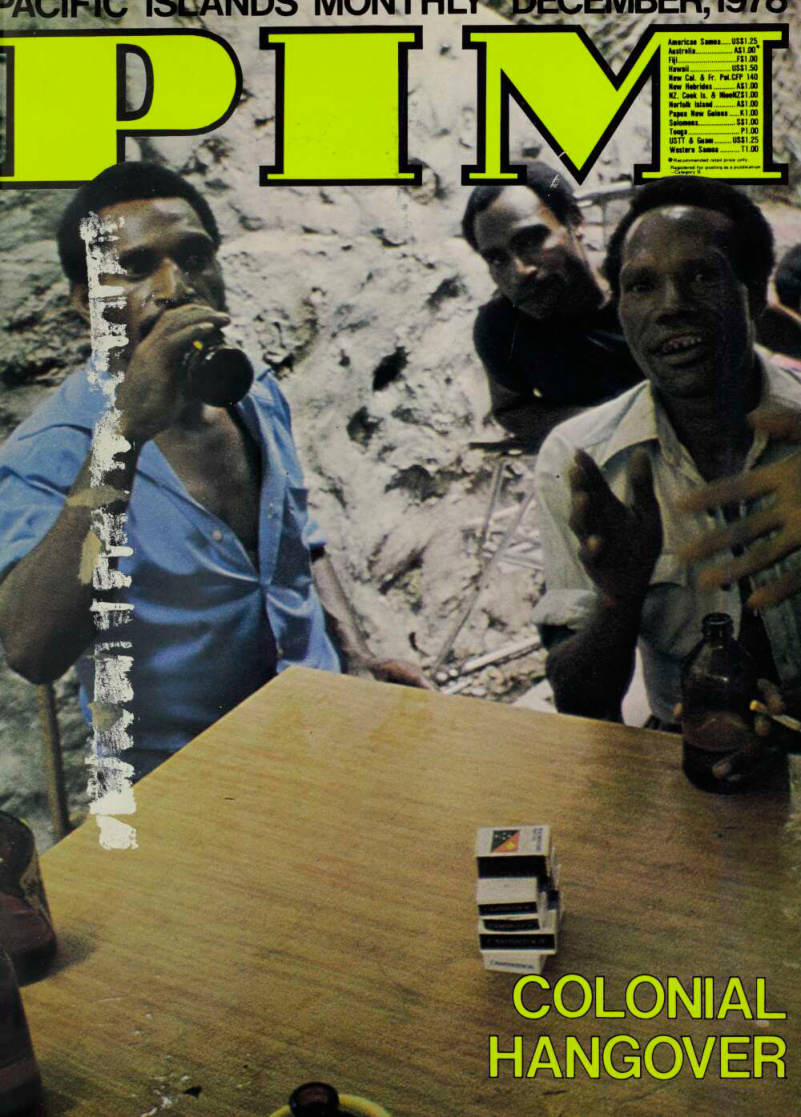
COVER: Papua New Guineans enjoy a few beers in Port Moresby.
Percy Chatterton, as
an Afterthought,
points out that once Melanesia had no tra ditional alcoholic drink. Page 24. Photo: Bob Hawkins.
Advertisements & other items, pp. 2-4 (1 item)
Toyota
How to find a REAL economy car* When you look at a car billed as an economy
model, ask yourself a few questions.
What sort of fuel consumption can be expected?
Low? Good.
What about other operating costs? Oil, lubrication, that kind of thing. Low again? Great.
How about maintenance? The car has a low-breakdown record? You are definitely on the right track.
What is the average life of the car? Is it better than the average in your area? Super. That’s important in an economy car.
Now. How is the after service? Buying a car is not all in the price you know. Plenty of service outlets?
One economy car coming up. All you have to do is check the price. Then you can tell if you are really getting an economy car.
You will probably find, after asking these questions about town, that REAL economy cars come down to Toyota, the world’s economy car builder.
See Toyota first. Then you won’t have to shop around.
IHE HAPPY ECONOMIZER
TOYOTA STARLET
The car that says economy in every way.
And you will be happy for it. Big inside.
Small outside. Miserly with petrol Without sacrificing comfort. A good buy in an economy car even for Toyota.
ill ;
W k v
PAPUA NEW GUINEA:
ELA MOTORS LIMITED,
Scratchley Rd, Badili, P.O. Box 75, Port Moresby.
U.S. TRUST
TERRITORY: MICROL
CORPORATION,
P.O. Box 267, Saipan.
FIJI ISLANDS:
AUTOMOTIVE
SUPPLIES CO., LTD.,
G.P.O. Box 355, Suva.
AMERICAN SAMOA:
BURNS PHILP
(SOUTHSEA) CO., LTD.,
P.O. 1057, Pago Pago.
WESTERN SAMOA:
BURNS PHILP
(SOUTHSEA) LTD.,
P.O. Box 188, Apia.
GUAM: ATKINS, KROLL
(GUAM) LTD., P.O. Box
6248, Tamuning.
NEW HEBRIDES:
NEW HEBRIDES
MOTORS LTD.,
P.O. Box 18, Vila.
SOLOMON ISLANDS:
MENDANA
TOYOTA
SERVICE
TOYOTA
ENTERPRISES (5.1.)
LTD., P.O. Box 174,
Honiara.
TAHITI: NIPPON
AUTOMOTO, B.P. 342,
Papeete.
COOK ISLANDS:
COOK ISLANDS
TRADING
CORPORATION LTD.,
P.O. Box 92, Rarotonga.
NAURU ISLAND:
COOPERATIVE
SOCIETY.
GILBERT ISLANDS;
TARAWA MOTORS,
Box 36, Bairiki Tarawa.
NORFOLK ISLAND:
MOUNT PITT
(ENTERPRISES) LTD.,
P.O. Box 169
NEW CALEDONIA:
SOCIETE
IMPORTATION
AUTOMOBILE DE
PACIFIQUE,
Rond-Point du Pacific (Station Total) B.P. 438, Noumea.
The Toyota range includes: Toyota 1000, Toyota Starlet, Toyota Corolla, Toyota Celica, Toyota Corona, Toyota Cressida, Toyota Crown
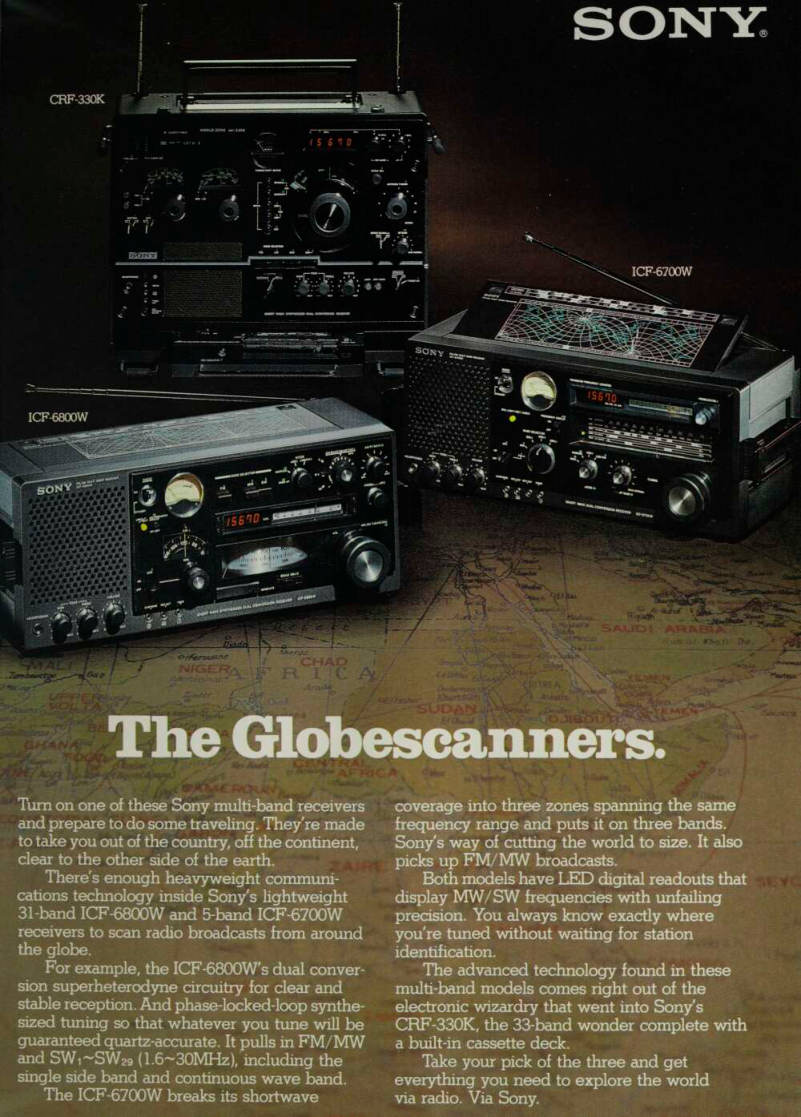
CRF-330K
iss n o f r • *-'■
ICF-6700W
V- F Tr • T \: ■’*; ««
, S ,ONV 855^
■ -®ai 9 's b no & *
ICF-6800W
- .■£~VI ■?'.
V* ■>
SONV-- oSk]
.■ C • " *' / •• /56 *7 u - /'I * s 'T - "" MM . * ■ .*L -fckr* *
j wmm*
The Globescanners.
Turn on one of these Sony multi-band receivers and prepare to do some traveling. They're made to take you out of the country, off the continent, clear to the other side of the earth.
There's enough heavyweight communications technology inside Sony's lightweight 31-band ICF-6800W and 5-band ICF-6700W receivers to scan radio broadcasts from around the globe.
For example, the ICF-6800W's dual conversion superheterodyne circuitry for clear and stable reception. And phase-locked-loop synthesized tuning so that whatever you tune will be guaranteed quartz-accurate. It pulls in FM/MW and SWi~SW 29 (1.6~30MHz), including the single side band and continuous wave band.
The ICF-6700W breaks its shortwave coverage into three zones spanning the same frequency range and puts it on three bands.
Sony's way of cutting the world to size. It also picks up FM/MW broadcasts.
Both models have LED digital readouts that display MW/SW frequencies with unfailing precision. You always know exactly where you're tuned without waiting for station identification.
The advanced technology found in these multi-band models comes right out of the electronic wizardry that went into Sony's CRF-330K, the 33-band wonder complete with a built-in cassette deck.
Take your pick of the three and get everything you need to explore the world via radio. Via Sony.
Coleman* Poly-Lites:
Feature for feature, dollar for dollar
the best values under the sun.
• •• These are the ones that proved just how tough “plastic” coolers and jugs can be. How efficient in holding the cold. How good-looking.
So take a close look at a Coleman Poly-Lite, like our 45 liter cooler or the 4 liter jug shown here.
Start with the most basic point.
All Coleman coolers and jugs are insulated with urethane, the best material available. And lots of it.
So they hold the cold.
Next, think tough. That highdensity polyethelene hide shrugs off all the rocks and hard places.
Keeps its bright color in the sun.
Won’t rust or corrode, even in salt water.
You’ll also find special touches.
Like handles that are smooth and round, won’t pinch. They swing ss out for carrying, like on most coolers. But they also lift straight up for tight places, like a car trunk.
The snap latch is fumble proof, inside the lid where it can’t break off. Close the lid firmly for traveling. Softly, and you get the “quickseal” position so you can open it easily with one hand.
Poly-Lite coolers and jugs. Sizes, styles, colors for anyone. And the price is right.
For more information contact your local Coleman dealer or write us.
Remember: Coleman equipment can come in handy in storms, typhoons and power losses too. m im % iS
Qqjeman^
A Name You Can Trust
r 2111 E. 37th St. N. • Wichita, Kansas 67219 • USA m
Pacific Islands Monthly
Pim
Vol. 49 No. 12
December 1978
(952480)
Elsewhere: $A16 ayment by personal cheque is accepted in Australian, 'S, New Zealand, UK and Fiji currency. For other remit tees please obtain a bank draft in Australian dollars lade payable to the ANZ Banking Group, 88 Wentworth venue, Sydney, Australia.
Representatives
USTRALIA: Distribution Gordon & Gotch (A/asia) Ltd, ox 40, PO, Rosebery, NSW 2018. Advertising — Mel ourne — Pacific Publications (Aust.) Pty Ltd, 5th Floor, Hey Building, 75-77 Flinders Lane, Melbourne 3000, ilephone 63-0211, ext. 1565 Jeff Gates, ext. 1858 Ida adgett; Brisbane — D. Wood, Anday Agency, Box 1918, PO, Brisbane 4001, telephone 44 3485, 44 1546; delalde - Hastwell Media, PO Box 30, 399 Glen 'smond Rd, Glen Osmond, Adelaide 5064, telephone 9 1869, 79 5956; cables Hastmedla, Adelaide IJI: Distribution and subscriptions — Desai Bookshops, 0 Box 160, Suva, Fiji, telephone Suva 23036. Advertls ig — Fiji Times & Herald Ltd, 20 Gordon St, Suva, tele hone 312 111, telex FJ2124.
RENCH POLYNESIA: Distribution - Hachette acifique, 10 Ave Bruat, Papeete, telephone 2 5610.
AWAII, UNITED STATES; Distribution PIM, Hawaii, 312 Kahawai St, Honolulu, Hawaii 96822. &PAN: Advertising and subscriptions — Universal edia Corporation, CPO Box 46, Tokyo, telephone 36 3036.
EW CALEDONIA; Distribution — Depot Centre de resse Michel Pentecost, CBP2, Noumea, telephone 7 2434, 27 4729.
EW ZEALAND: Distribution - Gordon & Gotch, PO Box 34, 2 Carr Road, Mt. Roskill, Auckland 4 Advertising International Media Representatives Ltd, PO Box 2313, uckland, telephone 795 487; 493 389, cables Intereps, uckland Subscriptions — Pacific Publications, GPO ox 2229, Auckland.
APUA NEW GUINEA; Distribution — Robert Brown & ssoc., PO Box 3395, Port Moresby, telephone 2 5855. dvertlslng — PNG Post-Courier, PO Box 85, Port loresby, telephone 212577.
NITED KINGDOM: The Herald & Weekly Times Ltd, 8-10 lifford's Inn, Fetter Lane, London EC4A 1BU. telephone 1 831 6041, telex London 21989.
NITED STATES MAINLAND: Advertising - Joshua B. owers Jr, Powers International Inc., 551 Fifth Ave, New ork, New York 100 017, telephone 867 9580, telex 36514. Subscriptions - PIM, Hawaii, 2812 Kahawai St, onolulu, Hawaii 96822. ublished monthly by Pacific Publications (Aust.) Pty Ltd and printed in Australia by Kralco, Flemington, NSW. ustralian cover price is recommended retail only. Regis sred at the GPO Sydney for transmission by post as a ublication — category B. Second class postage paid at onolulu, Hawaii. Copyright c 1978 Pacific Publications (Aust.) Pty Ltd.
Subscriptions
PIM is airfreighted to most subscribers and agents in the Pacific Islands and the United States Aust.
Other American Samoa $13 $US16 kustralia $12 Canada $14 $US18 /ook Islands $13 iji $12 $F12 Tench Polynesia $14
Cfp 1700
>uam $13 $US16 Hilbert Islands $13 fawaii $13 $US16 apan $16 Y4500 licronesia $13 $US16 lauru $13 Jew Caledonia $14
Cfp 1700
lew Hebrides $13 lew Zealand $12 $NZ13.50 Hue $13 lorfolk Island $12 lorthern Marianas $13 $US16 'apua New Guinea $13 K12 lOlomon Islands $13 onga $13 uvalu $13 Inited Kingdom $15 £10 IS Mainland $14 $US18 Western Samoa $13
Advertisements & other items, pp. 5-6 (2 items)
Islands Monthly - December, 1978
Founded 1930 by R. W. Robson Publisher Stuart Inder Editor Bob Hawkins Editorial Adviser John Carter Manager John Berry Advertising Manager Steve Gray A Pacific Publications production 76 Clarence Street, Sydney 2000 GPO Box 3408 Sydney 2001 Cables: PACPUB Sydney Telex: 21242 Telephone: Sydney 29 6693
<r
•V/V O v *V , i o<
A° vV
O V*
PACIFIC ISLANDS MONTHLY AUGUST, 1878
PIM SUBSCRIPTIONS
See the lefthand column for the cost of a 12-month subscription to P!M -mailed direct to your home.
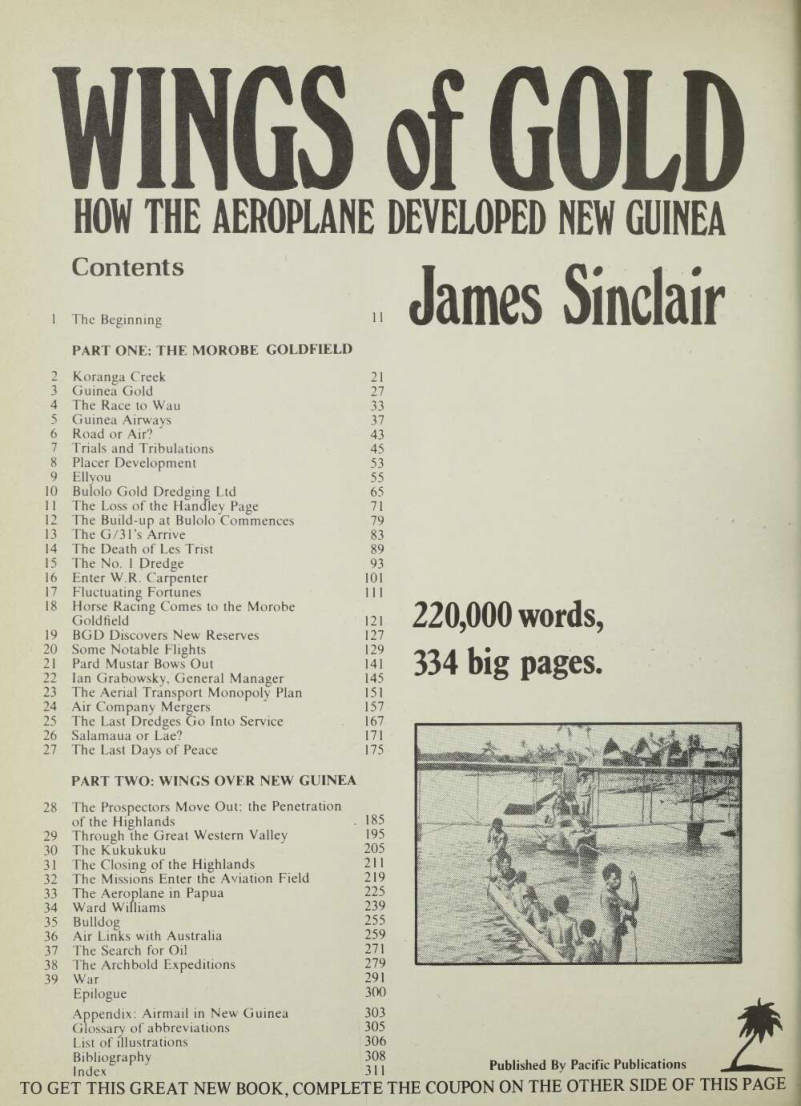
WINGS OF GOLD
This book tells for the first time the remarkable story of the aeroplane in New Guinea. It begins in 1922 with the strange sound of a Curtiss biplane echoing across the swamps and deltas of western Papua, and it ends in 1942 with Japanese bombers blasting the last of the civil aircraft to pieces on the ground. A superb, large format production of more than 330 pages and 150 avation photographs, most of them historic and not before published. SA3O or SUS3S, please add SA3 or SUSS for postage
THE TONGANS
Leading South Pacific writer Olaf Ruhen and photographer Jozef Vissel capture the lifestyle of the people of the last Polynesian kingdom.
Brilliant prose and 96 sparkling full-colour photographs depict today's Tongans at work, in church, at play. 5A9.00 (SUSIO.SO) Posted any when
PNG HANDBOOK & TRAVEL GUIDE
For businessmen, schools, libraries and local residents this up-to-the-minute handbook covers everything!
Includes an accommodation tariff guide and useful maps, including a large coloured fold-out map of Papua New Guinea. 5A8.50 (SUS 10.00) Posted anywhere v v & * -A' A \V titles. also ask us for our full mail order book list
V'A A\V~ . ~<\o
of great Pacific * G* V & \\ nW' V O* G 0° o"
A A o -Ah
WINGS of GOLD
HOW THE AEROPLANE DEVELOPED HEW GUINEA
James Sinclair
Contents
1 The Beginning
PART ONE: THE MOROBE GOLDFIELD
2 Koranga Creek 3 Guinea Gold 4 The Race to Wau 5 Guinea Airways 6 Road or Air? 7 Trials and Tribulations 8 Placer Development
9 Ellyou
10 Bulolo Gold Dredging Ltd 11 The Loss of the Handley Page 12 The Build-up at Bulolo Commences 13 The G/31’s Arrive 14 The Death of Les Trist 15 The No. 1 Dredge 16 Enter W.R. Carpenter 17 Fluctuating Fortunes 18 Horse Racing Comes to the Morobe Goldfield 19 BGD Discovers New Reserves 20 Some Notable Flights 21 Pard Mustar Bows Out 22 Ian Grabowsky, General Manager 23 The Aerial Transport Monopoly Plan
24 Air Company Mergers
25 The Last Dredges Go Into Service 26 Salamaua or Lae? 27 The Last Days of Peace
PART TWO: WINGS OVER NEW GUINEA
28 The Prospectors Move Out: the Penetration of the Highlands 29 Through the Great Western Valley 30 The Kukukuku 31 The Closing of the Highlands 32 The Missions Enter the Aviation Field 33 The Aeroplane in Papua 34 Ward Williams
35 Bulldog
36 Air Links with Australia 37 The Search for Oil 38 The Archbold Expeditions 39 War
Epilogue
Appendix: Airmail in New Guinea Glossaiy of abbreviations List of illustrations
Bibliography
Index 11 21 27 33 37 43 45 53 55 65 71 79 83 89 93 101 111 121 127 129 141 145 151 157 167 171 175 185 195 205 211 219 225 239 255 259 271 279 291 300 303 305 306 308 311
220,000 words,
334 big pages.
Published By Pacific Publications t TO GET THIS GREAT NEW BOOK, COMPLETE THE COUPON ON THE OTHER SIDE OF THIS PAGE
This Month
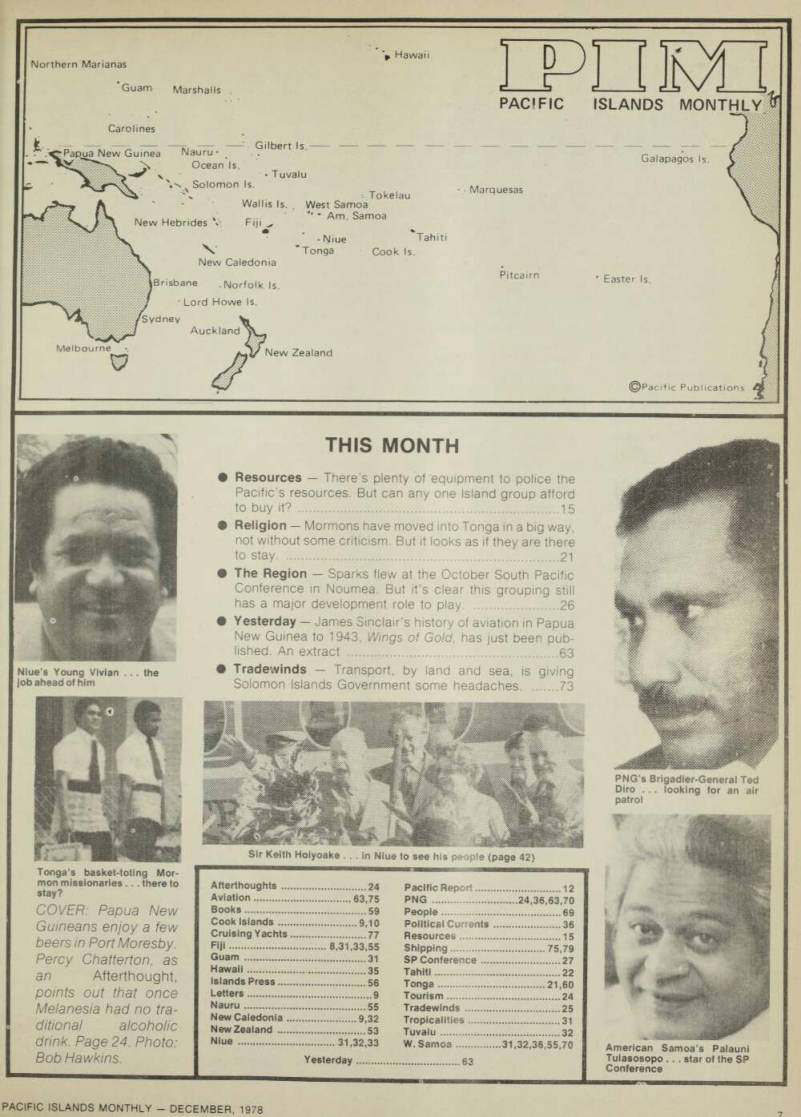
• Resources There’s plenty of equipment to police the Pacific’s resources. But can any one Island group afford to buy it? 15 • Religion Mormons have moved into Tonga in a big way, not without some criticism. But it looks as if they are there to stay 21 • The Region Sparks flew at the October South Pacific Conference in Noumea. But it’s clear this grouping still has a major development role to play 26 • Yesterday James Sinclair’s history of aviation in Papua New Guinea to 1943, Wings of Gold, has just been pub lished. An extract 63 • Tradewinds Transport, by land and sea, is giving Solomon Islands Government some headaches 73
Afterthoughts 24 Aviation 63,75 Books 59 Cook Islands 9,10 Cruising Yachts 77 Fiji 8,31,33,55 Guam 31 Hawaii 35 Islands Press 56 Letters 9 Nauru 55 New Caledonia 9,32 New Zealand 53 Niue 31,32,33
Pacific Report 12
Png 24,36,63,70
People 69 Political Currents 36 Resources 15 Shipping 75,79 SP Conference 27 Tahiti 22 Tonga 21,60 Tourism 24 Tradewinds 25 Tropicalities 31 Tuvalu 32 W. Samoa 31,32,36,55,70
Yesterday 63
Niue’s Young Vivian ... the job ahead of him
Tonga’s basket-toting Mor mon missionaries . . . there to stay?
Sir Keith Holyoake ... in Niue to see his people (page 42)
PNG’s Brigadier-General Ted Diro . . . looking for an air patrol
American Samoa’s Palauni Tuiasosopo . . . star of the SP Conference
Letters
In Defence
Of Guam
Response from readers is a sign your magazine is being read.
On Guam, PIM is being read.
Unhappily.
In your April issue, a chap who spent perhaps a day here, wrote an article about us in the tone that Guam was an un pleasant place indeed. I doubt if, in his few hours, he ventured farther than a mile from his hotel.
In June PIM hit us with an unreasonable report on the new obscenity law and again on local drug problems.
If you were deliberately attempting to discredit us as a
good neighbour among Pacific
islands I question whether you could have selected a better trio of discouraging articles.
Guam is, in fact, one of the
more progressive and delight
ful islands of all the Pacific. We think your readers deserve to know this rather than be sub jected to cute and quaint flash stories based on partial facts for isolated situations.
Martin Pray
General Manager Guam Visitors Bureau Agana
Beware Of
The Bull
The firm stand taken by Prime Minister Ratu Sir Kamisese Mara of Fiji and Michael Somare of Papua New Guinea,
against obvious US political
manoeuvres at the recent South Pacific Forum in Niue, de serves the admiration of all citi zens of the Pacific region, likewise other regional leaders of Tonga, Nauru, the Gilberts and the Solomons who stood
by them.
I refer to their determined stand against US pressures for membership ‘on its own terms’ in a regional fisheries agency.
In his address for ‘Pacific Week’ at the University of the South Pacific, US ambassador
John Condon referred to the Pacific as the ‘last frontier’. US actions of late show, or at least clarify, what he really meant by this reference in his strictly ‘diplomatic’ address; but more
interestingly, they explain the
real motives behind the mask.
The American stand which created the first serious rift within the Forum, clearly illus trates the principle upon which ‘aid’ to developing countries has often been, if not always, ‘given’. I recall the words of an American educational consult ant who visited the Cook Islands last year: ‘Aid is a mis nomer; in reality it is just another technique generated
by donor-nations to justify
their economic exploitation of
recipient countries.’
The essence of these words aptly explains much of the re cent increase in American in volvement in the Pacific, not to mention similar Soviet inten tions. But this is not to deny the fact that US aid has ben efited the Pacific region. On the contrary, it has helped advance technology in certain fields. The recent US grant of $705 000 for expansion of sat ellite communications through out the region is an example.
What is questionable how ever, are the real motives which suddenly generated a renewed ‘determination’ to offer aid.
Ironically, what we now see is the picture of certain ‘doctors’ anxious to cause bodily harm on a family of fairly healthy individuals, in order to treat
them and thereby increasing
the doctors’ earnings a million tiffies over.
For Pacific nations, small and limited as we are in some resources, our leaders must
guard against masked inten
tions. It is tragic that Niue, the Cook Islands and Western Samoa succumbed to exploita tive manoeuvres. The fact that the ‘American government will not recognise Pacific Island claims on tuna stocks, except on its own terms’ (Fiji Times
September 28), clearly demon
strates where American interest really lies. In essence, it reveals the falsehood of heart in American foreign aid pol
icy.
It is time that Pacific nations
followed the example of the PNG leadership, where foreign aid is accepted only on terms dictated by and acceptable to the recipient country. Like Americans and like Russians, we have every right to safe guard the interests of our own peoples, and to decide for our selves.
It is time that America recog nised by word and deed the political independence of Pa cific nation states.
Let us as a small family of nations make regionalism a liv ing reality. Let us all stand as one. but neutral against the invading ideological monsters.
It is our only hope of maintain ing our independence and con stitutional sovereignty. What ever the cost, the right of Pacific peoples to self-determination must never be sacrificed.
Let each Pacific leader, as the elected representative of his country, remain the ‘master’ of his family, of his people and of his country.
Suva
John J. Herman
Fiji
How Fair
Australia?
Why is Australia so ill disposed towards people from the Pa cific Islands? We admit Indo- Chinese refugees by the score - rightly in my view in most cases though criminals and tor turers of the former corrupt regime in South Vietnam may be among them yet we throw the whole weight of the federal
immigration department, com
monwealth and state police against any unfortunate Pacific Islander who finds his or her way to these shores and who transgresses even in the most minor or technical way.
We look after former offi cers and officials from South Vietnam yet Fijian nurses
helping old people in Sydney
are ruthlessly deported, a Pa cific Island-born woman is de ported or threatened with deportation when her marriage to an Australian-born husband breaks up and the police spend countless hours searching for the few hapless Islanders who may be illegal migrants.
The immigration minister does not appear to be racist
when dealing with Indo- ■ Chinese yet is undoubtedly so when it comes to Pacific i Islanders. Is it because Aus tralia still has a guilt conscience about the days of ‘blackbird ing’ and the genocide Australia continued to practise against
the Aborigines by plying them
with alcohol or whatever?
Australia has done very well out of the Pacific Islands in the past. Surely the time is long overdue for a more Christian and understanding attitude to Pacific Islands peoples.
It is all very well to give economic aid and toast high officials at diplomatic recep tions but the effect is destroyed totally when such a blatant racial bias is shown against many Pacific Islanders who find their way here.
Ballarat
Bruce Turner
Victoria Australia
Cruelty To
Children
A family institution such as that of the Indian, which is cen turies old, must certainly have some good aspects for it to have survived the test of time. Yet
your correspondent, in looking
at the family institution among Fiji Indians (PIM September), mentions nothing commend able about how it has uniquely modified itself in Fiji. Instead reference at length, and to excess, is made only of pit falls in the Indian family institution.
Because of this, your readers have been presented with a misleading view, in that, for example: • thousands of Indian parents use ‘children as emotional beds’; • arranged marriages exist as ‘cruelty extending into later stages of a child’s life’.
Certainly there have been isolated cases of child-bashing by parents in the Indian com munity, but no worse in num ber than in any other society, and certainly not to the extent your correspondent makes out.
Otherwise our courts and our papers would be filled with such cases. This is not the case.
Arranged marriages in the past have, at times, been cruel, but they are much less today,
primarily because both parties
have more say in their choice of partners than in the past.
Finally, naturally the ‘afflu ent Gujarati society will furi ously and firmly deny’ all the cruelty that is extended to the teenage daughters-in-law mainly because cruelty, as reported, does not take place.
Because many Gujarati homes have servant-girls, the teenage daughters-in-law do not be come ‘house-girls’. Most are so well and expensively dressed, it would be hard to imagine that mothers-in-law had purchased
their daughters-in-law’s
clothes, underwear etc. Though de-facto relations exist in the Indian community as a whole (and where does not this exist?), none so far from the
Gujarati society has been
brought to trial.
In brief, the correspondent
has erred badly in presenting a
grossly misleading picture
today of the ‘Family Institution among the Fiji Indians’ in
Fiji today.
Suva
Hari K. Narsey
Fiji
Liberte
I was intrigued by the letter of Kaliou of Noumea, New
Caledonia, in July PIM
advocating a free Micronesia.
What Kaliou says may well be
true. Imperialism and dis
guised neo-colonialism should be ended. America’s continued occupation of eastern Samoa is a case in point. However, one is left wondering what Kaliou would advocate as the future for New Caledonia, Tahiti, Wallis, Futuna, etc?
Bruce Turner
Ballarat, Victoria Australia
Spellbound
Viumber Two
Ve have had continual inquir es from various parts of the vorld from friends and ac
[uaintances regarding
ncidents aboard a vessel,
Spellbound, in the Society
slands early this year. Several >eople were reported to have lied and I believe the police in were called in to inves igate.
We are living aboard a fin ish yacht named Spellbound /, 15.8 m, sorrel-coloured top ides, ketch rigged, and have
been based in Fiji since 1976.
My husband has been employed by the Fiji Govern ment as divisional veterinary officer since April 1975. We are now commencing a second tour of contract in Fiji after cruising to New Zealand with our respective families from England also a coincidence.
I know of no other yacht named Spellbound and therefore would be grateful if you could publish these details.
Suva Fiji
Carol Irwin
The Stamp
Of Authority
It has been brought to my attention, as Premier of the Cook Islands, that your publi cation has carried on its pages articles concerning the postage stamps of the Cook Islands which contain factual mis statements.
So that you and your readers will have no misunderstanding of the procedures governing the issuance and sale of Cook Islands postage stamps I here with officially advise you of the
following facts:
The Cook Islands postal sys tem was originally set up by the New Zealand GPO and the New Zealand GPO presently handles its international accounting under Universal Postal Union procedures.
The chief postmaster of the Cook Islands is a New Zealander. The issuance of new stamps is completely under the control of the Cook Islands Government. Every order for new stamps is a government matter and sent over my signature or that of the postmaster general directly to
the same security printers
which are used by the New Zealand Government.
Upon completion of the
printing all produced stamps
are shipped to the Cook Islands Post Office and sold in the islands by the post offices. To assist overseas philatelists a Post Office Philatelic Bureau was established in the Cook Islands which advises overseas residents of new stamps to be issued and fills orders properly prepaid for the face value and return postage.
The philatelic bureau is a
Cook Islands operation, com
pletely staffed by Cook
Islanders and it is under the directorship of a Cook Islander. For maximum efficiency and economy in its services the government em ploys experienced inter national technical guidance, but such guidance is solely ad visory, as the philatelic bureau is fully under government con trol and it has no authority of its own.
The procedures for the sale of stamps in the post offices are strictly controlled, as is the sale of stamps by the philatelic bu reau which is just a subordinate unit providing services to
philatelists.
Recommendations for new stamp issues may originate with individuals in the Cook Islands, with officials of the government, with the philatelic bureau, or with the postmaster.
But the final decision rests with the government and any new stamps issued have denomi nations which conform to
postal rates.
In the interests of fair play to philatelists, to your readers, and to this government, we trust that you will publish the above official facts in your publication so that any incor rect conclusions which may have been formed by material
previously appearing on your
pages can be clarified or cor rected.
Thomas R.A.H. Davis
Premier Cook Islands
Archives On
The Move
Re the article on the Western Pacific Archives by C. Guy Powles (PIM, September), Mr Powles has been misinformed.
The Western Pacific archives are being transferred to their countries of origin.
In the case of Solomons Islands, 55 cases containing the archives have already been received from Suva and are
being held in safe custody by
the Ministry of Youth and Cul tural Affairs, pending the com pletion of a new archives
building and the appointment
of an archivist and staff.
S. W. Hockey
Library Adviser Honiara
Australian
Obscenities
Unabashed racist statements by some Australians working in Papua New Guinea while I was there lead me to agree with
you (Tropicalities, September)
that MP John Jaminam has a point. Imported dress stan dards for PNG licensed prem ises do constitute an unwritten colour and/or class bar.
I report one personal instance of these inappropriate
regulations being applied in a
colourblind fashion. Having enjoyed a stimulating double feature at a Mount Hagen cin ema The Annapolis Story and Wind A cross the Everglades as I recall a friend and I de cided to repair to a local hos telry. As nothing stonger than coffee had passed our lips along the dusty road from Goroka, a beer seemed in order.
The Hagen Park was recom mended and there we headed.
We had got no closer to the bar than 10 metres when we were pushed backwards all the way to the door by the European manager and his national as sistant. When we asked the reason for this unexpected bum’s rush, my friend’s thongs were cited. We both wore clean longs and sports shirts. My friend’s pants were brown dress denim.
Nonplussed by this inhospi
tality but still thirsty we ad journed to the main street.
Spotting a warm glow from a second storey window, we headed up the stairs to find a cozy bar-cum-billiard room.
Hearing our tale of woe, the burly Ockers perched at the bar said ‘Good on ’em’ and sug gested that we push off from their premises as well. Un gracious? Yes. Boorish? Cer tainly. But free of racial
prejudice.
Which brings me to an ex amination of this propriety in dress which seems to pre occupy the antipodean male Caucasian.
The main criteria for accept able tropical dress, whether for office or club, seem to be the übiquitous white knee socks.
Never mind that the shorts above are worn because it’s hot. One must, as with Vic
torian table legs, cover any
potential immodesty. With the
exception of socks with toes, this leaves the inexpensive and cool thongs or sandals out of the running. Plastic New Zealand Kay-Dees or school issue Roman sandals are ac ceptable however.
The supreme irony lies in lining up the Aussie in proper gear to the ‘scruffy native’. In profile the pendulous Aus tralian beer gut and alcohol veined nose are the ultimate obscenities when compared to the fit Melanesian physique.
Knee socks fall a little short of distracting the eye from the monuments built up by 30 years of Foster’s. I say good on Mr Jaminam and his Discrimi natory Practices Amendment Bill.
Neiafu Vavau
Tonga
Bill Gusen
Charitable
Questions
As a regular reader of PIM, I commend you upon the new layout of the magazine but I feel that in your Political Cur rents section you are in grave
danger of taking a particular
political slant. Maybe this is deliberate.
As perhaps a minor aspect of this view, I must admit to feel
ing that the appellation
accorded to me, as a former British supermarket mogul, has unjustifiable connotations in view of the fact that I was, some seven years ago, the managing director only of a compara tively small, by British and other standards, supermarket chain. I certainly never regarded myself as either Mon golian or a tycoon, which I be lieve to be alternative definitions of a mogul.
Perhaps more importantly,
in your correspondent’s article on the visit of Paul Dijoud to New Caledonia, your corres pondent, Andre Chaville writes, and I quote: ‘ln fact, there never was a cocktail party with Rotary, the Lions or any other expensive charitable or ganisations favoured by the
local aristocracy.’
As a member of Rotary, and one who sees how much the Lions Clubs are doing, I can only say that the motto of
Rotary is ‘Service above Self and the motto of Lions is ‘We Serve’.
As a past president of the Rotary Club of Norfolk Island, and one who has seen over .the years Rotary in action in many parts of the world, I can only feel this is a very unfair and biased outlook towards these two service clubs. I certainly believe that both these service clubs have contributed greatly by their efforts to both the bet terment of all members and of the community in which they exist, and indeed understand ing throughout the world, re gardless of race, creed or walk of life. I am sorry that Andre Chaville has such a poor
understanding of the principles
of these two service clubs.
I would hope that although clearly some of your comments must be of a political nature, you do not allow your corre spondents to show personal and unwarranted political bias.
Paddock Wood Norfolk Island
B.K. Nunn
Of Henry
And Davis
It was disturbing to find that September PIM covered the advent of the new Democratic Party Government in the Cook Islands with such inaccuracies and emotion.
Surely, when a new govern ment is elected by the people and a major Pacific magazine has a cover story, the newly elected premier should feature, not only on the front page, but also in the feature article! PIM chose instead to feature the old leader, one who had commit ted acts of a questionable nature during his tenure'as our country’s leader.
PIM also calls the event ‘Cooks’ unhappy historic “first” ’. ‘Unhappy’ for whom?
The majority of residents of Rarotonga certainly felt jubi lant after the July 24 court de cision that declared the fly-in votes invalid. It is obvious from the election results that they had voted for a new govern ment at the outset. If PIM had read the judgement which in cluded the results you would have noted that the people voted for the Democratic Party
candidates, not the Cook Islands Party.
PIM describes the events following the decision as a
‘stunning’ take-over, implying
that it was done in a hasty dic tatorial manner. In fact, it was all planned well in advance.
Your allegation that Chief Jus tice Donne ‘handed back power to a new government so swiftly that he probably crea ted some sort of constitutional record’ is unfair and mislead ing. It is a normal procedure that once a new government is declared duly elected, they take over the reins immediately.
The events described in such detail in your account would have taken place on March 31 if the illegal fly-in votes had not been included in the initial election results.
No one will disagree that Sir Albert Henry is a South Pacific personality and one whom many admire as a charismatic person. However, the evidence against him and members of his former cabinet are serious.
They have been charged with unlawful conduct of ‘monumental dimensions’ and this can’t be overlooked.
As a Cook Islander who was in Rarotonga during the elec tions and the court decision I feel that you have sorely mis
represented what happened
politically in the Cook Islands.
The general feeling in Raro tonga after July 24 was one of relief, not from the court proceedings but relief from 13 years of corruption and nepot ism. Our new government has the difficult task of guiding a country that has suffered econ omically in the past because of careless spending. Surely you could give them some support and encouragement.
Pamela Takiora
Ingram Pryor
Honolulu
Hawaii USA • Stuart Inder, who wrote the September cover story, com ments: Sorry, but I reject the view of my friend Pam Pryor (nee Ingram) that there are any inaccuracies in my report. I invite her to name them. As to its objectivity, clearly this is a matter of opinion, in which emotions play their part.
PIM reported not on the appointment of a new govern ment but on the dismissal of an
old one in unique and dramatic i
circumstances. Premier Henry I
for 13 years was the most con troversal political figure in the South Pacific and my story con- I centrated on the way of his pol ideal demise, which stunned the electorate in the real sense of the word, whether voters were for j him or agin him.
His picture was chosen for
PI M’s front cover before we knew in Sydney the result of Chief Justice Donne’s decision, for we knew he would be a focal point of the news that month.
Of course PIM read the judg ment. If Mrs Pryor re-reads her own copy of it she’ll see that, without the banned fly-in voters, the CIP on Rarotonga still has significant electoral support, with a handful of voters deter
mining the final result. I found
on Rarotonga joy and relief at
the court decision and I said so in my story. I also found ‘shock, puzzlement and bitterness’, and I added that I didn’t know, not even after being a week there,
‘what proportions of each of
these varied ingredients make up
the final recipe’. Pam Pryor
clearly is in no doubt. Half her luck!
In suggesting that the events
surrounding the changeover of
government were merely pro cedures that would have oc curred anyway, I find Mrs Pryor breathtaking. There was nothing normal about the
despatching of police from NZ
in case of violence, about the ban on radio broadcasts for two days, about the police locking and
guarding the door of the Legis
lative Assembly to prevent any
body entering.
These and other measures
were painstakingly planned by
the Queen’s representative (in advance, as Mrs Pryor says) and carried out with commendable speed, to avoid what he con sidered to be the possibility of civil disorder and violence. That this didn’t occur was a tribute to Mr Justice Donne’s planning and the basic good sense of Cook Islanders and their leaders, cer tainly of Tom Davis and, not the least, A Ibert Henry. PI M’s story I thought, paid tribute to this in its approach. We will have to wait for Mr Justice Donne’s memoirs to hear the full story of that anxious and historic time, if he can be encouraged to tell it.
Pacific Report
Sedition Charges Booming In Solomons
Three men charged with sedition since independence in July that is the performance chalked up by Solomon Islands. First to face the courts was Lemuel Loefanua Maealatha, who col lected a three-month sentence in late September for publishing a poem in the official newspaper, Solomons News Drum, which was judged by the court to be designed to provoke ill-will and hostility between the people of the Western Province and peoples of other provinces, with seditious intentions. Then in October George Atkin, publisher of the newspaper Solomons Toktok, and Colin Bently, the writer of a letter published in Atkin’s paper, faced similar charges. Bently’s letter ended with the words; ‘lf you want any local war between Malaita and Suadalcanal (two of the Solomons’ main islands) okay let us go.’ Both men pleaded not guilty and were released on SSI 100 Dail each, with their cases adjourned to December. In a follow-up :o the first case, the central government offered a sum of $7OOO :o the Western Provincial Assembly as compensation from the :entral government information service. The assembly haughtily ejected the offer, saying that local custom demanded a greater >um.
Yew Political Party In New Hebrides?
Fhe tangled politics of the New Hebrides saw new developments when; the Vanuaaku Party issued a statement in October effec lively rejecting the government’s offer of seven ministerial posts PIM November) and demanding the dissolution of the present Representative Assembly: and the Minister for the Interior, Vin cent Boulekone, announced he had resigned from his party, the moderate’ Union des Communautes des Nouvelles Hebrides ’UCNH), and intended to form a new party. Mr Boulekone’s statements on resignation expressed markedly conciliatory atti udes to the Vanuaaku Party.
V. Samoa Demands No Pacific N-Tests
call for an early end to nuclear weapons tests in the Pacific vas made at the United Nations General Assembly in October >y Western Samoa’s Finance Minister Vaovasamanaia Filipo.
Voicing the hope that the Pacific environment could be restored d ‘something approaching its original purity’, he said that if the ’acific people had been consulted on the question in the first >lace they would have wanted the area to be nuclear-free.
Lumpy Start For New Us Policy
he new-look US policy of closer interest in Pacific Island affairs PIM November) got off to a bumpy start when the question of JS membership of the proposed South Pacific fisheries agency ireatened to split the South Pacific Forum in Niue in September, lut the State Department’s man at the South Pacific Con srence, Bill Bodde, told PIM: ‘We remain hopeful that by work ig together we will find a mutually satisfactory solution.’ For is part, Australian Prime Minister, Malcolm Fraser, in Port loresby in late October, said Australia would work to ensure lat any agency which emerges is established along lines vanted by the Island countries themselves. Said he; ‘lt’s the ma ority view of the Pacific Island countries that matters.’
Iji’S Drug-Running Christina/Susan
22-year-old New Zealand girl, in court as Christina Doreen kipper, appealed against a six-year sentence handed down in iji on drug-running charges. She succeeded in having her sen dee on a heroin-related charge reduced to five years. But ppeal judge Mr Justice Williams showed he was not in a gener us mood by adding a three-year sentence on a second Indian emp charge, and ordering that the sentences be served con scutively. Result: after appeal, an eight-year sentence instead f six years. The prisoner will spend most of her time sewing
and gardening in the precincts of the women’s wing of Suva gaol with a super-close watch no doubt being kept in the gar den on her choice of plants for cultivation. The case took a bizarre turn when a New Zealand housewife, Mrs Christina Doreen Whitaker (nee Skipper), claimed that the girl under sen tence had improperly used her name on a passport application.
The girl’s true name is believed to be Susan Florence Jay Ren nie.
Torres Islanders Okay New Border
Torres Strait Islanders in November voiced approval of the terms of the draft treaty being negotiated between Australia and Papua New Guinea on their border running through Torres Strait. Even Queensland Premier Joh Bjelke-Petersen seems willing to go along with it.
Palikir Is A New Capital
The capital of the Federated States of Micronesia (FSM) will be in the Palikir area, on Ponape, Caroline Islands. An official an nouncement of the decision said that in the interests of local landowners ‘that portion of Palikir which is presently used by
homesteadersforfarming’willbeexcludedfromthegeneralareaof
the capital. The FSM will consist of the districts of Yap, Truk, Ponape and Kosrae, which in July approved by referendum the proposed FSM constitution. The Marshalls and Palau districts rejected the constitution.
Coalition Musical Chairs In Png
PNG’s Deputy Prime Minister Julius Chan announced on November 7 in Parliament that he was withdrawing his People’s Progress Party support from Prime Minister Michael Somare’s coalition government. Mr Chan accused Mr Somare of leading PNG into a ‘highly personalised form of government’ and said the PPP could not allow itself to be used just to keep the co alition’s numbers up. Mr Somare, who had a few days earlier reshuffled his cabinet to the PPP’s disadvantage, the following day announced a new coalition with the United Party, lambakey Okuk’s Opposition numbers being made up by the support of the PPP. The situation, at press time, remained fluid with a ‘no confidence’ motion pending.
Okuk’S ‘Significant Australians’
Speaking at a state dinner to welcome Australian Prime Minister Malcolm Eraser in Port Moresby in October, Papua New Guinea’s parliamentary opposition leader, lambakey Okuk, declared: ‘I have just returned from a visit to Australia where regrettably I was not able to meet you. However I met your deputy prime minister, I met Mr Whitlam, and I met the Premier of Queensland. Now that I have met you I am sure I have now spoken to all the most significant people in Australia. Mr Fraser was in PNG for the formal opening of PNG’s national library, Australia’s independence gift to the new nation. He took the opportunity to assure PNG that Australian aid, which at present represents about a third of the PNG budget, would continue after the current agreement expires in 1981.
‘Sexual Blackmail’ - Fiji Reaction
The story ‘Fiji: Where a girl may have to pay to get a job’ (PIM October) aroused keen public controversy in that country. PIM correspondent in Suva, Robert Keith-Reid, sought some local reactions. His report: Mr Jack Meyer, director of the Fiji Em ployers’ Consultative Association, read the article and said: ‘lt’s a lot of bloody crap.’ He had no doubt that there were ‘certain liaisons going on’. But to suggest that Fiji’s working girls were the victims of mass assault was ridiculous. If this were the case ‘it would be attracting a lot more expatriates here’. A member
of the board of the Fiji Young Women’s Christian Association who did not want to be named said; ‘I am certain sexual black mail is used. It is particularly despicable in the Fiji situation of gross unemployment. A lot of young women are forced to use their bodies to hold down their jobs. I believe this is most frequent in small commercial businesses and shops.’ The head of the Fiji National Council of Women, Mrs Gyan Paras Ram, said she was ‘most concerned’ about the allegations in the story but did now want to comment until she had thought about it more.
Micronesia’S ‘Christmas Drop’ On Again
Micronesia’s traditional ‘Christmas drop’ programme will be on again this year from December 12-21. The 54th weather recon naissance squadron of the US air force parachute-drop gifts col lected on Guam to outer islands of Micronesia. Begun about 20 years ago, the ‘Christmas drop’ was suspended in 1973 due to the fuel crisis. But it resumed last year, with the military drop ping about 25 000 kg of gifts to people on more than 50 Micronesian islands.
Top Golfers At Fiji’S Pacific Harbour
Fiji played host in October to leading amateur golfers from 24 countries at the world amateur golf championships played on the Pacific Harbour course at Deuba, near Suva. The men’s event, for the Eisenhower trophy, was won by the US, with Canada and Australia second and third. Fiji finished third from the bottom, but the leading Fijian player, E. Koroi Lutunatabua, had a four-round total of 319, good enough to rate him among the world’s best 20 amateur golfers. The women’s event, the Espiritu Santo trophy, was won by Australia by one stroke from Canada.
Png Students Act On Irian Issues
A Committee for Melanesian Refugees has been formed at the University of Papua New Guinea with the aim of providing em ployment and health care, and meeting other needs, of refugees in PNG from Irian Jaya. Earlier, the UPNG Students’ Represen tative Council had made an appeal for funds to hire a lawyer for an appeal against the conviction by a PNG court of Irian Jaya rebel leaders Jacob Prai anad Otto Ondawame (PIM November).
Strike By Condominium Workers
Two hundred daily-rated employees of the New Hebrides con dominium administration went on strike in October demanding compensation at end of service with the condominium on the same basis as British National Service staff. They marched to the main government offices to present letters stating their de mand.
Yanks To Salvage Mainline Wreck
An American company, Coral Surf Resort Ltd, will finish the building of a luxury hotel on Fiji’s coral coast which has lain incomplete since its Australian builders Mainline Corporation, went bust in 1974. The 250-bed project will be managed by Hyatt International and known as Hyatt Regency Fiji. It should be ready for guests next year.
Tt Officials Beat Path To China
Two senior agricultural and fisheries officials from the US Trust Territory of the Pacific Islands were in the People’s Republic of China in October-November for a two-week seminar on small and medium-scale industrial development. They were the second group of TT officials to visit China. Senior TT medical personnel recently attended a seminar on health care delivery systems in China.
New Floating Dock For Guam
The US Army Corps of Engineers plans a floating dock in Apra Harbour, Guam, for use by pleasure motorboats and yachts, and to provide safe berthing facilities for small sailboats.
Were Irianese Rebels Double-Crossed?
An Irian Jaya spokesman in Papua New Guinea claims that rebel leaders Jacob Prai and Otto Ondawame, now in gaol in PNG (PIM November), were victims of a double-cross when they were arrested in Vanimo in September. The spokesman, known as Srigala, says the two men had travelled to Vanimo with the approval of the PNG Government to receive medical treatment, and to hold discussions with PNG officials among other matters on the possibility of granting asylum to an Irianese chaplain in the Indonesian army whom they were holding at the time. The Irianese, according to Srigala, be lieve the double-cross was organised by white Australian advisers in the PNG Prime Minister’s Department, and the Department of Foreign Affairs.
Visa-Free Entry To Micronesia
Visitors from countries other than the US can now enter Micronesia without a visa. If they do not intend to seek employ ment or stay more than 30 days they need show only passport (or other evidence of citizenship) and air ticket for departure from the territory.
Anti-Typhoid Action In American Samoa
Health officials in American Samoa are urgently investigating local water and sewerage systems in a bid to control the recent outbreak of typhoid (PIM November). Eleven cases were reported in late September, and two in the first half of October.
Western Samoa has not been affected by the outbreak. Health officials in Apia say that in the January-October period only four cases of typhoid were recorded.
Air Niugini Charters For Usa
Air Niugini has been granted unrestricted charter rights into the USA, opening the possiblity of a Pacific charter circuit operated by the airline together with American Airlines. However, Air Niugini sources said they did not expect to be allowed to operate charter flights into Australia.
Tongan Students Slam Smoking
Students at Tonga High School have launched a campaign against smoking, with emphasis on its dangers to health. A pet ition prepared by them calls for legislation to ban cigarette adver tising, and for ‘health hazard’ warnings to be printed on packets of cigarettes and tobacco. (Political Currents, Apia; Smoke of Battle).
Old Hurricane To Blow Again
A remake of the film Hurricane, first shot in 1937, is being done at Bora Bora, French Polynesia. The plot of the original novel, set in American Samoa in the 19205, has been changed to a love affair between an American girl and a Polynesian chief, rather than between two Polynesians. American Samoa was re jected as the setting because it was considered not picturesque enough and had no low islands for a hurricane to roll over.
TONGA RUNS OWN DEFENCE - IT’S OFFICIAL Last year’s transfer of command of the Tonga Defence Services from a New Zealand to a Tongan officer has been formalised with the handing over of a ceremonial sword by Air-Marshal R.
B. Bolt, chief of the New Zealand Defence Staff, to Crown Prince Tupouto’a, Colonel-in-Chief of the Tonga Defence Services.
Latest On Noumea’S Parking Meter War
Noumea has for months been involved in fierce public contro versy over parking meters. The affair took a new turn when a court ruled the meters illegal. It appeared that the authorities had failed, as required by law, to put up signs on the city’s access roads announcing that parking meters were in use. The ruling wiped out unpaid fines of up to SASOO for some offenders.
Immediately it was announced, the authorities ordered a crash programme for erection of the signs, and the city’s female park ing police returned to the fray with a new edge of aggressive ness.
Advertisements & other items, pp. 11-14 (2 items)
11
ACIFIC ISLANDS MONTHLY - DECEMBER. 1978
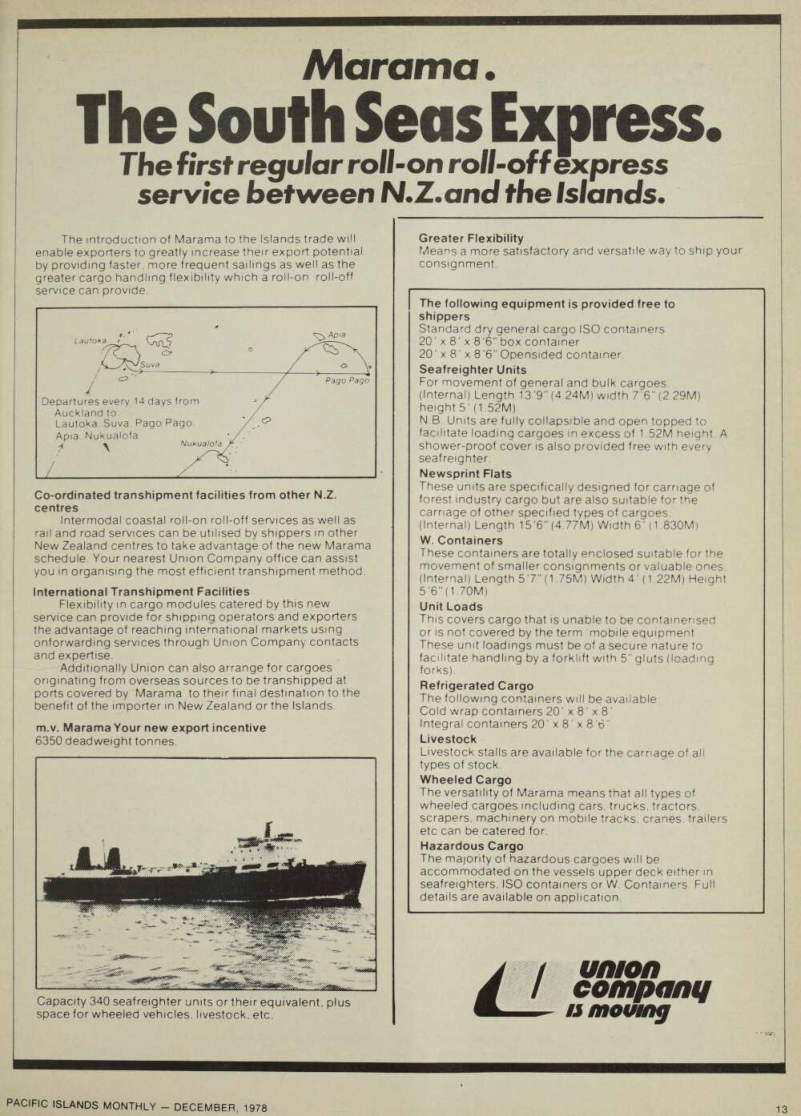
The South Seas Express.
Marama.
The first regular roll-on roll-off express
service between N.Z.and the Islands.
The introduction of Marama to the Islands trade will enable exporters to greatly increase their export potential by providing faster, more frequent sailings as well as the greater cargo handling flexibility which a roll-on roll-off service can provide Co-ordinated transhipment facilities from other N.Z. centres Intermodal coastal roll-on roll-off services as well as rail and road services can be utilised by shippers in other New Zealand centres to take advantage of the new Marama schedule. Your nearest Union Company office can assist you in organising the most efficient transhipment method.
International Transhipment Facilities Flexibility in cargo modules catered by this new service can provide for shipping operators and exporters the advantage of reaching international markets using onforwarding services through Union Company contacts and expertise.
Additionally Union can also arrange for cargoes originating from overseas sources to be transhipped at ports covered by Marama to their final destination to the benefit of the importer in New Zealand or the Islands. m.v. Marama Your new export incentive 6350 deadweight tonnes. %
JUi**
Capacity 340 seafreighter units or their equivalent, plus space for wheeled vehicles, livestock, etc.
Greater Flexibility Means a more satisfactory and versatile way to ship your consignment.
The following equipment is provided free to shippers Standard dry general cargo ISO containers 20' xB' x B'6" box container 20' x 8' x B'6"Opensided container.
Seafreighter Units
For movement of general and bulk cargoes. (Internal) Length 13'9"(4.24M) width 7'6"(2.29M) height 5' (1.52 M) N.B. Units are fully collapsible and open topped to facilitate loading cargoes in excess of 1 52M height A shower-proof cover is also provided free with every
seafreighter.
Newsprint Flats These units are specifically designed for carriage of forest industry cargo but are also suitable for the carriage of other specified types of cargoes. (Internal) Length 15’6" (4.77 M) Width 6’ (1 830 M) W. Containers These containers are totally enclosed suitable for the movement of smaller consignments or valuable ones. (Internal) Length 5'7" (1.75 M) Width 4' (1.22 M) Height 5'6" (1.70 M) Unit Loads This covers cargo that is unable to be containerised or is not covered by the term mobile equipment These unit loadings must be of a secure nature to facilitate handling by a forklift with 5" gluts (loading forks).
Refrigerated Cargo
The following containers will be available Cold wrap containers 20' x 8' x 8' Integral containers 20' x 8' x B'6'' Livestock Livestock stalls are available for the carriage of all types of stock.
Wheeled Cargo
The versatility of Marama means that all types of wheeled cargoes including cars, trucks, tractors, scrapers, machinery on mobile tracks, cranes, trailers etc can be catered for.
Hazardous Cargo
The majority of hazardous cargoes will be accommodated on the vessels upper deck either in seafreighters. ISO containers or W. Containers Full details are available on application.
union
company
u moving
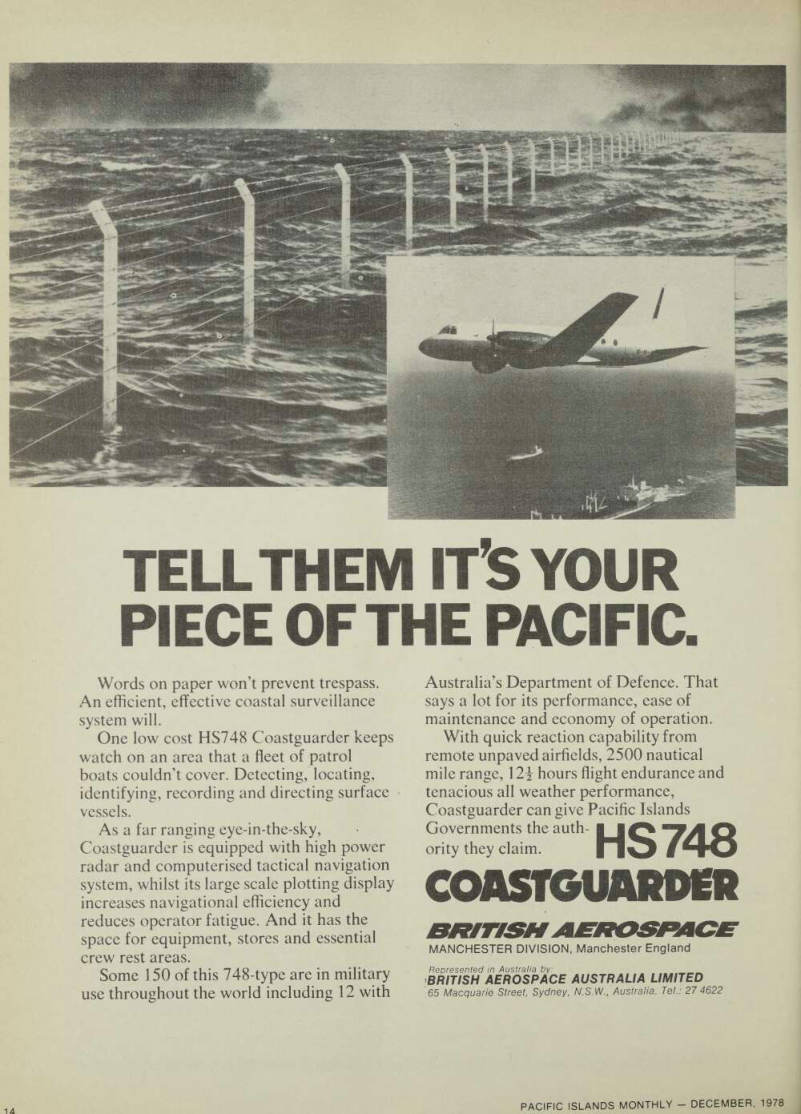
TELL THEM IT’S YOUR
PIECE OF THE PACIFIC.
Words on paper won’t prevent trespass.
An efficient, effective coastal surveillance system will.
One low cost HS74B Coastguarder keeps watch on an area that a fleet of patrol boats couldn’t cover. Detecting, locating, identifying, recording and directing surface vessels.
As a far ranging eye-in-the-sky, Coastguarder is equipped with high power radar and computerised tactical navigation system, whilst its large scale plotting display increases navigational efficiency and reduces operator fatigue. And it has the space for equipment, stores and essential crew rest areas.
Some 150 of this 748-type are in military use throughout the world including 12 with Australia’s Department of Defence. That says a lot for its performance, ease of maintenance and economy of operation.
With quick reaction capability from remote unpaved airfields, 2500 nautical mile range, 12i hours flight endurance and tenacious all weather performance, Coastguarder can give Pacific Islands Governments the auth- ority they claim. m
COASTGUARDER
BRITISH AEROSPACE
MANCHESTER DIVISION, Manchester England Represented in Australia by:
BRITISH AEROSPACE AUSTRALIA LIMITED
65 Macquarie Street, Sydney. Australia. Tel.: 274622
The Islands
Resources
Surveillance
A View From
The Islands
November saw the completion by Hawker de Havilland Aus tralia Pty Ltd of the mammoth job of compiling a verbatim record of the three-day international symposium it sponsored in Sydney in June on coastal and fisheries protection. The record makes a volume of almost 700 pages a rich source of information on the problems of surveillance of national economic zones, and in particular on the vast range of equip ment available to carry out this work. PIM staff writer Mal colm Salmon was at the symposium, talked to Islands representatives there, and has now studied the printed re cord.
The transition from the con :ept of open seas to the various
forms of national sovereignty
3ver very large areas of ocean s a highly complex undertak ng, requiring a great deal of
Datience, foresight and clear
funking on the part of all lations taking part in the Law )f the Sea Conventions. This process can be either organised md orderly, or chaotic and
itormy.’
So says Stan Schaetzel, tech lical director of Hawker de -lavilland Australia Pty Ltd in lis preface to the record of the nternational symposium on :oastal and fisheries protej:ion. Mr Schaetzel was sym >osium convenor.
Most people would agree that n the few words quoted above dr Schaetzel said a mouthful, iut then nobody who was at he symposium will be sur >rised at that. Mr Schaetzel, san, and looking very much ike a middle-aged but still lighly active faun, played an bsolutely key role in its ardu ous proceedings. He was into verything, on his feet when ver a tangled discussion
ceded unravelling, fielding
uestions both inside and far utside his professional sphere
f engineering, and cooling
ituations when, as happened
ften enough, participants’
onflicting interests, business nd otherwise, generated some
personal heat. The drab term ‘convenor’ does not do justice to his role. Presiding genius is much closer to the mark.
The symposium attracted almost 200 participants from more than 20 countries. They
represented aircraft and ship
building companies, manufac
turers of electronic equipment, governments, armed services, and a number of specialist pub lications.
Pacific Island countries rep resented included Papua New Guinea, Fiji. Tonga, the Gil bert Islands, and Nauru. The South Pacific Bureau for Econ omic Co-operation (SPEC) was represented by its assistant research officer, Mr Tamarii Pierre. The South Pacific Com mission was represented by Dr Robert Kearney of the skipjack tuna tagging programme.
Proceedings inevitably
sometimes looked more like a cockfight than anything else. In one incident a Canberra bu reaucrat let slip that a certain American electronics company had won an Australian Government contract. He was
immediately challenged from
the floor by the representative of a rival American tenderer who pointed out hotly that the Australian government depart ment concerned had not yet made any public announce ment of its decision on the ten ders. All the bureaucrat’s flair
for beating about the bush did not save him from leaving the platform with a large and messy amount of egg on his face. As PNG’s chief fisheries inspector, Mr A. E. Adams, remarked to me: ‘We came here expecting a lot of com mercial barrow-pushing, and in this respect we have cer
tainly not been disappointed.’
But the symposium served many useful purposes. In par
ticular, by exposing par
ticipants to the views and concerns of others, it helped them to gain a clearer idea of just what their own precise re quirements are in the still vaguely understood tasks of coastal and fisheries protec tion.
For example, the represen tatives of PNG and Fiji were at one in rejecting some of the options presented at the sym posium. PNG’s Mr Adams told me: ‘High-speed small sea going craft may be okay for some people and some pur poses, but our actual job re
quires something quite
different. ‘We feel we need a trawler design craft rather than pursuit-type vessels. What we need must be able to go out to sea and stay out for a number of weeks. We need long range and long endurance in the vessels we use, with strong em phasis on crew comfort and
proper amenities. We need something very like the craft we are trying to catch. ‘After all, our job is to detect
trawler-type vessels fishing in
our economic zone. The efficiency of the smaller patrol boats drops rapidly as the sea state rises, but the efficiency of the poaching trawlers is hardly affected at all. They come across some of the worst seas in the world to get into our waters, and still they are able to stay out. They have an endurance of something like three months, and what we are after must be able to match that, or something very close to it.’ PNG is at present using five Attack class patrol boats on marine surveillance.
Commander Stan Brown, head of the naval squadron.
Royal Fiji Military Forces,
talked along much the same lines. He told me: ‘From our point of view, coastal sur veillance is not an appropriate description of what we have to do. Our task is really sea sur veillance. We in Fiji have more ocean to cover than the United
Kingdom within our respective
200-mile zones and this is de spite the enormous difference in the resources of the two countries. Fiji rates about twentieth in the world in the matter of the area of ocean to be kept under surveillance - Australia ranks first. ‘Fiji at present has three patrol vessels and one hydro
graphic survey ship. The patrol
vessels are US-built Bluebird class minesweepers converted to a patrol boat role. I would say that a ship that can stay at sea for three weeks is an absol ute requisite for us. Our Blue bird class ships can do this. For us to accept any shorter endurance term would be to evade the problem.
‘Among the equipment
being promoted here I must say I have seen nothing that is ideal for us so far - it all seems either too small or too big. An up-dated version of what we already have would seem to me to provide most of the answers for us.’
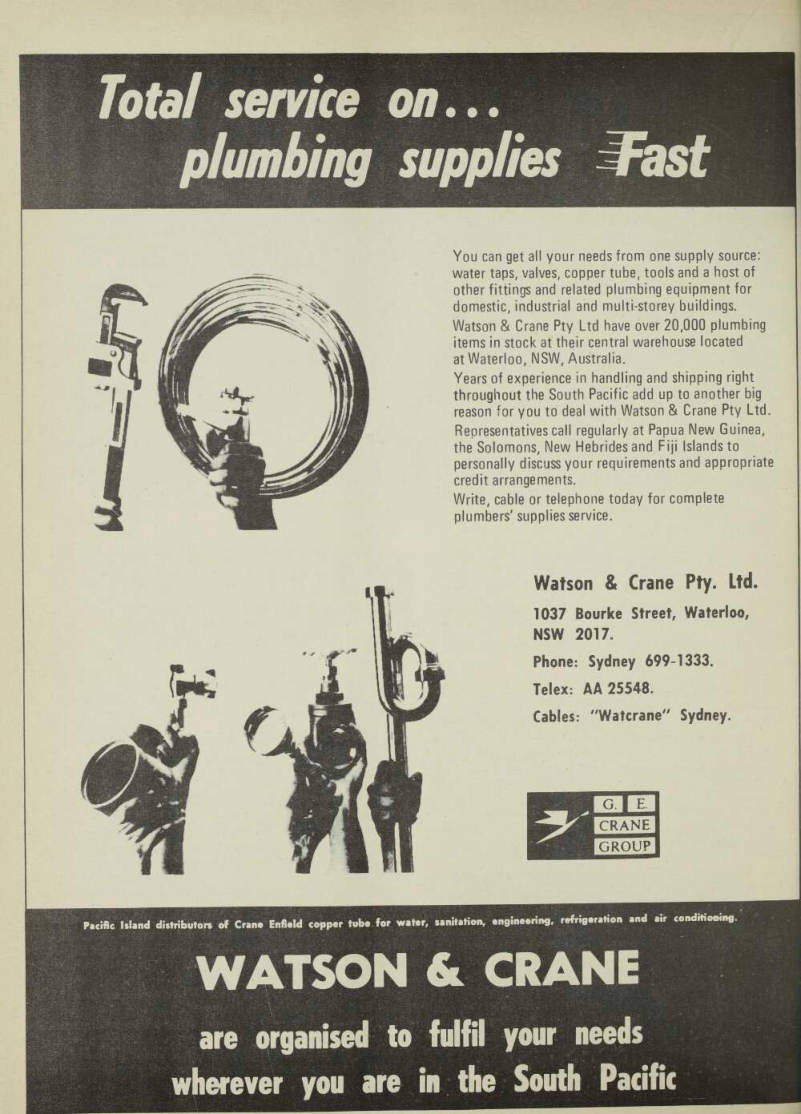
Stan Schaetzel.. . presiding ge nius
Both Mr Adams and Com mander Brown agreed that there had to be a mix of aerial and sea surveillance of their countries' fishing zones. PNG is at present using four Dakotas and three Nomads for aerial surveillance. Fiji uses aircraft chartered from companies in which the Fiji government has a considerable interest, mainly Air Pacific and Fiji Air Ser vices.
A point forcefully and
painfully brought home to
Islands delegates was the
yawning gulf between rich and poor when it comes to paying for much of the surveillance equipment promoted at the
symposium.
Peter Wilson, director of
Fisheries in PNG’s Depart
ment of Primary Industry, put
it starkly when he told the sym
posium's final session: ‘the
question is. how are the Pacific Islanders going to benefit from their stocks of tuna? If vou take an area such as Tuvalu, the Marshall Islands, the Gilberts, and so on they do not have the expertise, they do not have the money, to be able to run out and do their own enforce ment programme. ‘Their total national in comes. I would hate to guess, but they would be considerably lower than the cost of some of the aircraft we have been dis
cussmg today.’
But Mr Wilson saw hope in one direction, the time honoured line of action of the poor: in combination, organis ation. the pooling of resources to do a job that none could attempt alone. He said: ‘There is only one way that Pacific countries can act to ensure that they benefit from the tuna stocks in their waters, and that is by having agreements bind ing the region as a whole, which will make it possible for the fishing nations to pay a fair percentage of the value of the catch taken within each
country’s waters.
‘The reason for forming the
South Pacific Forum was so that the Pacific nations could deal in strength with the distant water fishing nations. We do have an organisation which has come out of these meetings.
Exactly how this problem is going to be resolved has not yet been determined, because the organisation has yet to be for
mally established.
'However, if you look at the
problem from the standpoint
of the distant water fishing nations, they do not, and I be lieve cannot, pay a fee such as
PNG recently charged the
Japanese for fishing rights
within our waters on an interim basis, which came to a million kina just for the right to come in and go fishing. You multiplv that through the rest of the Pa cific nations and obviously the price becomes astronomical for any one particular nation, and as a consequence it just won't work. ‘However. the fishing nations such as Japan and the United States have expressed a very definite interest in paying a low access fee into the region and then, let’s say a tax on the fish they have actually taken
from within a country’s waters. ‘lf that is done on a uniform
basis throughout the region
everyone fishing in the Pacific will know that they are going to have to pay a percentage and they are going to say: “What the hell, why not report it accu
rately, because regardless of
where we take it we're going to have to pay for it”.’
For SPEC. Tamarii Pierre took the matter further, saying: i am of course, a servant of the Forum as I am an officer of SPEC, but I would now like to speak as a Pacific Islander. I have been listening with great interest and more recently with growing concern over the like lihood that the benefits of our fisheries resources will accrue not to the peoples of the region but to others, if we are to accept the statements on the types of
equipment required for effec
tive policing and surveillance of our fisheries zones. ‘I have listened intently to the speakers and now find it difficult to reorientate myself
[?]Firt area surveryed in the South pacific Commission's skipjack tuna tagging programe was in Papua New Guinea waters. Sheded areas show the PNG waters surveryed by the ship Hatsutori Maru in October- November 1977 with her crew of nine Japanese and nine Fijins. The eight scientists aborad were [?]ed by Rodbert kearney, co-ordinator of the programme.
HRH Prince Tupouto’a . . . few words
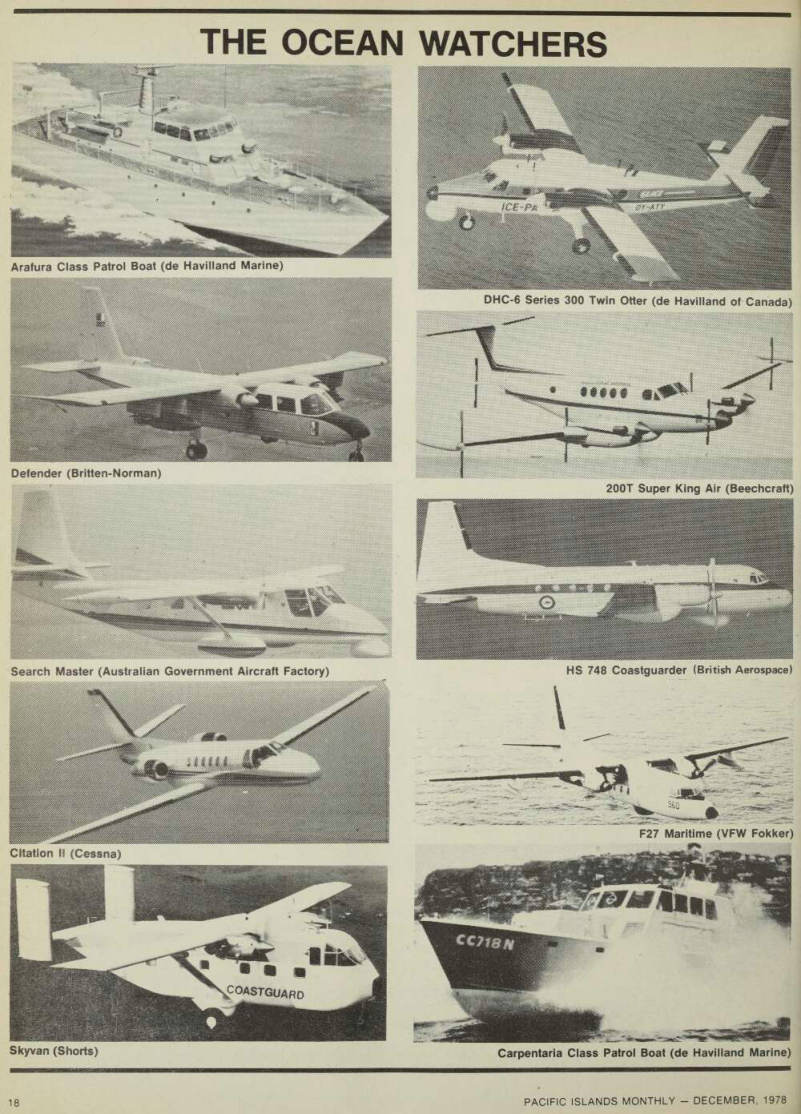
The Ocean Watchers
Arafura Class Patrol Boat (de Havilland Marine)
Defender (Britten-Norman)
Search Master (Australian Government Aircraft Factory)
Citation II (Cessna)
Skyvan (Shorts)
DHC-6 Series 300 Twin Otter (de Havilland of Canada)
200 T Super King Air (Beechcraft)
HS 748 Coastguarder (British Aerospace)
F27 Maritime (VFW Fokker)
Carpentaria Class Patrol Boat (de Havilland Marine)
o the reality of the scarce inancial resources of the coun ries in the region. ‘Not only can we not afford ill this equipment that has >een displayed to us. I think in he Pacific way we should try o look after each other. We, as ‘acific Islanders, would want nore to co-operate with each •ther than to try to equip our elves for confrontation.
T don’t think the possibility
T regional co-operative action,
r perhaps sub-regional co
operative action in surveillance has been adequately touched upon at the symposium.' On the same theme. PNG’s Peter Wilson said that in the light of the Forum’s directive for the establishment of a fisheries organisation, his
department had been looking
at the possibility of satellite coverage of the Forum area.
He said: ‘Satellites, when we are looking at satellite coverage of PNG, our part of the world, is too darned expensive for us to think about. However, we do feel that from the standpoint of a regional area, the Forum area . . . satellite coverage will now become feasible, par
ticularly with the co-operation
of the United States.’
Other Islands spokesmen proved more sparing with their
words. His Royal Highness Prince Tupouto’a. Tonga’s as sistant secretary for foreign affairs, told me with all the grace born of his royal nurture: T have been much more interested in the technical con tent of the papers than in the more political aspects of the discussion.’ And that was that.
Mr M. Adkin, from the Gil berts’ ministry of natural re source development, wondered whether the Gilberts would do anything about surveillance at all. The government would first need to be convinced that what they were out to protect was worth more than what it would cost them to protect it.
They were waiting for the re sults of the South Pacific Com mission’s skipjack tuna survey
before making up their minds.
Nauru’s legal adviser. Mr K.
P. Whitcombe, was more guarded still. He told me: ‘Our role here has been primarily of
an information-gathering
character. This information will be presented to the govern ment for decision when we have completed our report.' It was noteworthy that not one of the more than 30 papers
presented to the symposium
was delivered by an Islands
representative. Perhaps none
came forward to offer one. but from the point of view of the Island countries it was a weak ness of the symposium just the same.
This weakness was frankly
acknowledged in summing-up
remarks made at the close of the symposium by Mr T. F. C.
Lawrence, from Australia’s
department of productivity.
He said: T was disappointed that we concentrated too much on the Australian context, and some of the comments that have been made subsequently indicate that some others were also a little disappointed that it was the Australian problem that was identified, rather than the South Pacific area problem for instance.’
But all were agreed that as symposiums go, this one was more useful than most. It ident ified many problems that had not been recognised before. As such it made a contribution to clarifying a crucial issue of the future economic development of the Island countries an issue which, as the September meeting of the South Pacific Forum in Niue (PIM Novem ber) dramatically showed, is still far from being resolved.
One thing is clear; for many of the manufacturers of equip ment promoted at the sym posium it’s ‘back to the drawing board’ if they’re ever going to come up with sur veillance systems within the financial and technical reach of many of the Pacific Island countries. Their need for such
equipment could hardly be
more urgent.
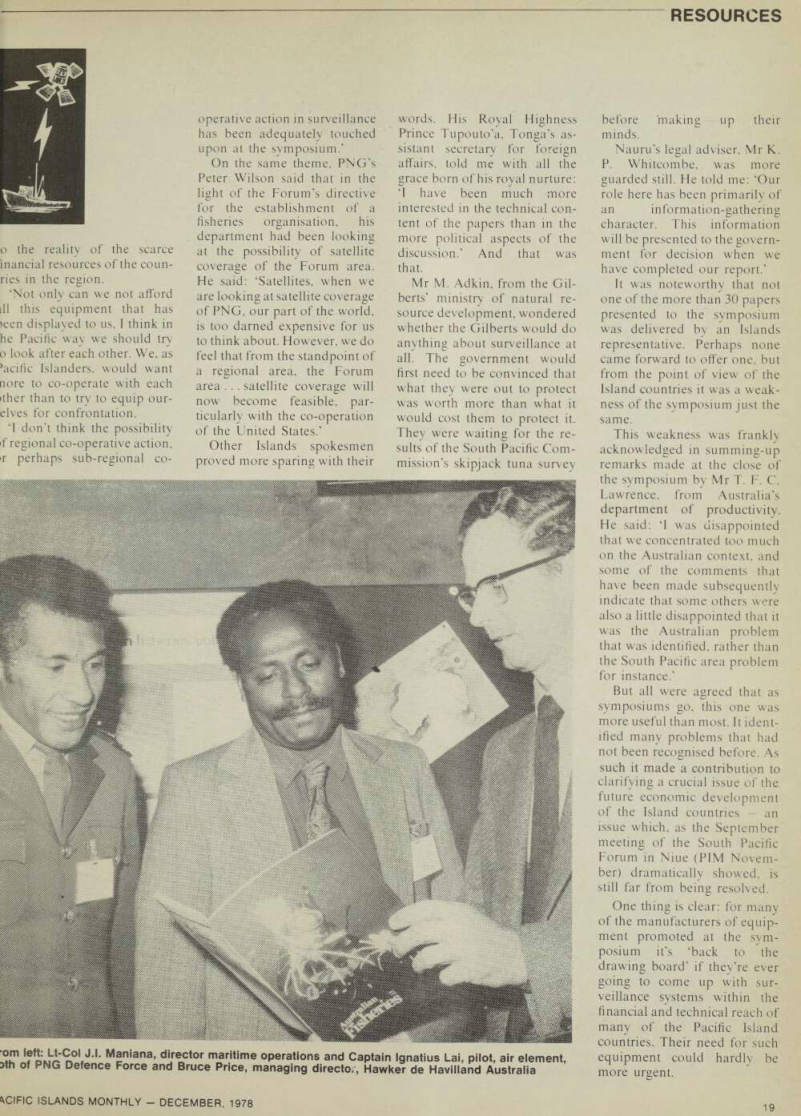
[?]rom director maritime operations and Captain Ignatius Lai, pilot, air element, [?]th of PNG Defence Force and Bruce Price, managing directo., Hawker de Havilland Australia
Advertisements & other items, pp. 15-20 (4 items)
15
ACIFIC ISLANDS MONTHLY - DECEMBER, 1978
are organised to fulfil your needs
I You can get all your needs from one supply source: water taps, valves, copper tube, tools and a host of other fittings and related plumbing equipment for domestic, industrial and multi-storey buildings.
Watson & Crane Pty Ltd have over 20,000 plumbing items in stock at their central warehouse located at Waterloo, NSW, Australia.
Years of experience in handling and shipping right throughout the South Pacific add up to another big reason for you to deal with Watson & Crane Pty Ltd.
Representatives call regularly at Papua New Guinea, the Solomons, New Hebrides and Fiji Islands to personally discuss your requirements and appropriate credit arrangements.
Write, cable or telephone today for complete plumbers' supplies service.
Watson & Crane Pty. Ltd. 1037 Bourke Street, Waterloo,
NSW 2017.
Phone: Sydney 699-1333.
Telex: AA 25548.
Cables: "Watcrane" Sydney.
CRANE
GROUP
Pacific Island distributors of Crane Enfield copper tube for water, sanitation, engineering, refrigeration and air conditioning.
V..v ‘ ■ ' - -
are organised to fulfil your needs
wherever you are in the South Pacific
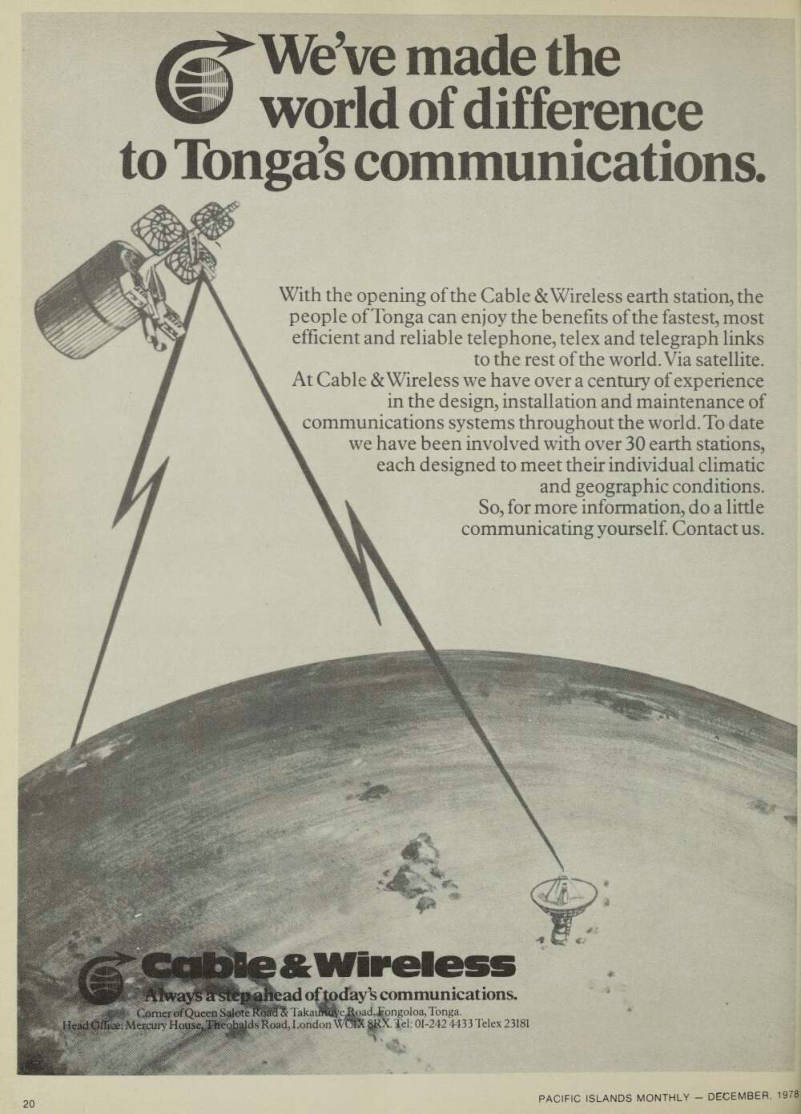
We’ve made the
world of difference
to Tonga’s communications.
With the opening of the Cable & Wireless earth station, the people ofTonga can enjoy the benefits of the fastest, most efficient and reliable telephone, telex and telegraph links to the rest of the world. Via satellite.
At Cable & Wireless we have over a century of experience in the design, installation and maintenance of communications systems throughout the world. To date we have been involved with over 30 earth stations, each designed to meet their individual climatic and geographic conditions.
So, for more information, do a little communicating yourself. Contact us.
Mlmhh ■ . m *i i ad of today’s communications. id,J|ongoloa, Tonga. . Tel: 01-242 4433 Telex 23181
Resources
17
ACIFIC ISLANDS MONTHLY DECEMBER, 1978
Resources
19
ISLANDS MONTHLY - DECEMBER, 1978
basket-toting
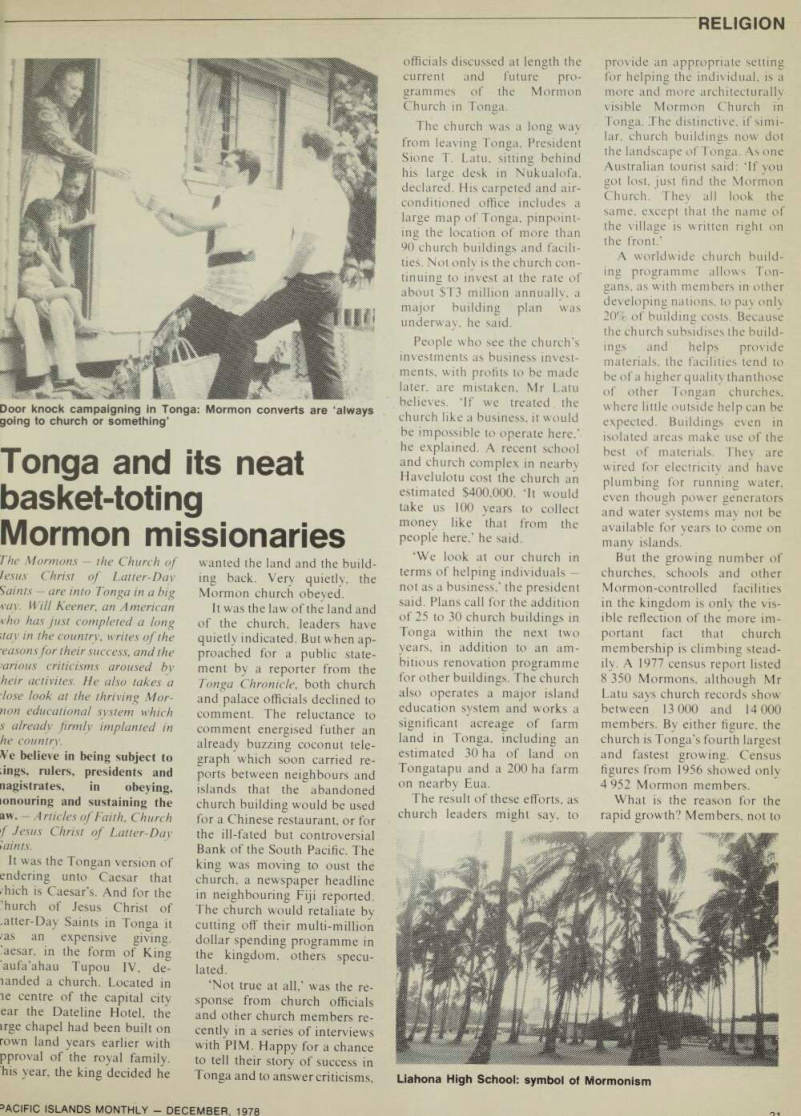
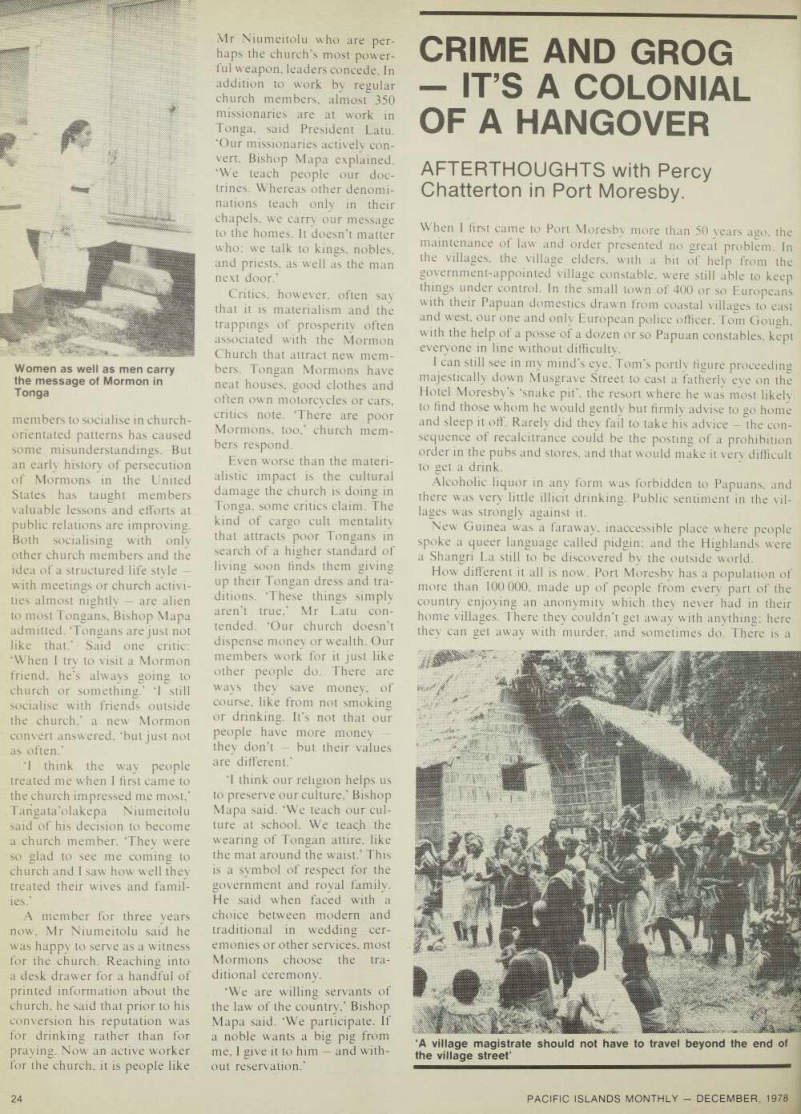
Tonga and its neat basket-toting Mormon missionaries
The Mormons - the Church of Jesus Christ of Latter-Day Saints are into Tonga in a big xay. Will Keener, an American vho has Just completed a long Uay in the country, writes of the ■easons for their success, and the ’arious criticisms aroused by heir activites. He also takes a 'lose look at the thriving Mornon educational system which s already firmly implanted in
he country.
Ve believe in being subject to dngs, rulers, presidents and nagistrates, in obeying, lonouring and sustaining the a "- Articles of Faith, Church f J esus Christ of Latter-Day * aints ■ It was the Tongan version of endering unto Caesar that /hich is Caesar’s. And for the hurch of Jesus Christ of .atter-Day Saints in Tonga it an expensive giving. aesar, in the form of King aufa’ahau Tupou IV, delanded a church. Located in le centre of the capital city ear the Dateline Hotel, the irge chapel had been built on rown land years earlier with pproval of the royal family. his year, the king decided he
wanted the land and the build
ing back. Very quietly, the
Mormon church obeyed.
It was the law of the land and of the church, leaders have quietly indicated. But when ap proached for a public state ment by a reporter from the Tonga Chronicle, both church and palace officials declined to comment. The reluctance to comment energised futher an
already buzzing coconut tele
graph which soon carried re ports between neighbours and islands that the abandoned church building would be used for a Chinese restaurant, or for the ill-fated but controversial Bank of the South Pacific. The king was moving to oust the church, a newspaper headline
in neighbouring Fiji reported.
The church would retaliate by cutting off their multi-million dollar spending programme in the kingdom, others specu lated. ‘Not true at all,’ was the re sponse from church officials and other church members re cently in a series of interviews with PIM. Happy for a chance to tell their story of success in Tonga and to answer criticisms,
officials discussed at length the current and future pro grammes of the Mormon Church in Tonga.
The church was a long way from leaving Tonga. President Sione T. Latu, sitting behind his large desk in Nukualofa, declared. His carpeted and air conditioned office includes a large map of Tonga, pinpoint ing the location of more than 90 church buildings and facili ties. Not only is the church con tinuing to invest at the rate of about ST3 million annually, a major building plan was underway, he said.
People who see the church’s investments as business invest ments, with profits to be made later, are mistaken. Mr Latu believes. Tf we treated the church like a business, it would be impossible to operate here,' he explained. A recent school and church complex in nearby Havelulotu cost the church an estimated $400,000. Tt would take us 100 years to collect money like that from the people here,’ he said. ‘We look at our church in terms of helping individuals not as a business,’ the president said. Plans call for the addition of 25 to 30 church buildings in Tonga within the next two years, in addition to an am bitious renovation programme for other buildings. The church also operates a major island education system and works a significant acreage of farm land in Tonga, including an estimated 30 ha of land on Tongatapu and a 200 ha farm on nearby Eua.
The result of these efforts, as church leaders might say. to
provide an appropriate setting for helping the individual, is a more and more architecturally visible Mormon Church in Tonga. The distinctive, if simi lar. church buildings now dot the landscape of Tonga. As one Australian tourist said; Tf you got lost, just find the Mormon Church. They all look the same, except that the name of the village is written right on the front.' A worldwide church build ing programme allows Ton gans, as with members in other developing nations, to pay only 20% of building costs. Because the church subsidises the build
ings and helps provide
materials, the facilities tend to be of a higher quality thanthose of other Tongan churches, where little outside help can be
expected. Buildings even in
isolated areas make use of the best of materials. They are wired for electricity and have
plumbing for running water,
even though power generators and water systems may not be available for years to come on many islands.
But the growing number of churches, schools and other Mormon-controlled facilities in the kingdom is only the vis ible reflection of the more im portant fact that church
membership is climbing stead
ily. A 1977 census report listed 8 350 Mormons, although Mr Latu says church records show between 13 000 and 14 000 members. By either figure, the church is Tonga’s fourth largest and fastest growing. Census figures from 1956 showed only 4 952 Mormon members.
What is the reason for the rapid growth? Members, not to
Door knock campaigning in Tonga: Mormon converts are ‘always going to church or something’
Liahona High School: symbol of Mormonism
mention critics, suggest several.
Explained Mr Latu; ‘lt's the truth of the church that people see. That’s the simplest way I can think of to explain it.' The Mormon emphasis on personal cleanliness, health and family living, part of the truth referred to by Mr Latu. appears to be an attraction for
Tongans. The neatly dressed.
basket-toting Mormon
missionaries, walking in pairs
along streets in Tonga, have become a symbol of the church here. The same kind of neatness and cleanliness extends beyond the body to home, garden and plantation as well.
The homes of my Mormon friends are always the cleanest
and the most orderly when I visit,’admitted one non-church member from Vavau.
Bishop Peni Mapa, minister
and head of the church’s 22member translation depart ment. explained that the Mormon emphasis on the fam ily fits well with the Tongan tradition of close family ties. ‘We do a lot of social things to allow our members to get together and mingle with one another and not with other
people.' Bishop Mapa said,
‘We always try to keep our
people busy, especially our
young people.' In the midst of new interest among Tongans in the Mormon Church's activi ties in Tonga, this tendency of
Mormon church in Nukualofa and basket-toting proselytisers
members to socialise in church orientated patterns has caused some misunderstandings. But
an early history of persecution
of Mormons in the United States has taught members valuable lessons and efforts at
public relations are improving.
Both socialising with only
other church members and the idea of a structured life style with meetings or church activi ties almost nightly are alien
to most Tongans, Bishop Mapa
admitted. ‘Tongans are just not like that.’ Said one critic: ‘When I try to visit a Mormon friend, he’s always going to church or something.’ ‘1 still socialise with friends outside the church.' a new Mormon convert answered, ‘but just not as often.' T think the way people treated me when I first came to the church impressed me most.’
Tarigata’olakepa Niumeitolu
said of his decision to become a church member. ‘They were so glad to see me coming to church and I saw how well they treated their wives and famil ies.’
A member for three years now, Mr Niumeitolu said he was happy to serve as a witness for the church. Reaching into a desk drawer for a handful of printed information about the church, he said that prior to his conversion his reputation was for drinking rather than for praying. Now an active worker for the church, it is people like
Mr Niumeitolu who are per haps the church’s most power ful weapon, leaders concede. In addition to work by regular church members, almost 350 missionaries are at work in Tonga, said President Latu. ’Our missionaries actively con
vert. Bishop Mapa explained.
’We teach people our doc trines. Whereas other denomi nations teach only in their chapels, we carry our message to the homes. It doesn’t matter who; we talk to kings, nobles, and priests, as well as the man next door.’
Critics, however, often say that it is materialism and the
trappings of prosperity often
associated with the Mormon Church that attract new mem bers. Tongan Mormons have neat houses, good clothes and often own motorcycles or cars, critics note. There are poor Mormons, too,’ church mem bers respond.
Even worse than the materi alistic impact is the cultural damage the church is doing in Tonga, some critics claim. The kind of cargo cult mentality that attracts poor Tongans in search of a higher standard of living soon finds them giving up their Tongan dress and tra ditions. ‘These things simply aren’t true,’ Mr Latu con tended. ‘Our church doesn’t dispense money or wealth. Our members work for it just like other people do. There are ways they save money, of course, like from not smoking or drinking. It’s not that our people have more money they don’t — but their values are different.’ ‘1 think our religion helps us to preserve our culture,' Bishop Mapa said. ‘We teach our cul ture at school. We teach the wearing of Tongan attire, like the mat around the waist.’ This is a symbol of respect for the
government and royal family.
He said when faced with a choice between modern and traditional in wedding cer emonies or other services, most Mormons choose the tra ditional ceremony. ‘We are willing servants of the law of the country,’ Bishop Mapa said. ‘We participate. If a noble wants a big pig from me, I give it to him — and with out reservation.’
Women as well as men carry the message of Mormon in Tonga
Advertisements & other items, pp. 21-22 (2 items)
21
3 ACIFIC ISLANDS MONTHLY - DECEMBER 1978
RELIGION
Designed for Freedom
Arrange it any way you want.
With Onkyo’s UC-100 you get high fidelity sound and more.
Stack up the amp, tuner, and turntable, lay them flat between the speakers, or use the optional floor rack. You choose the design, and let Onkyo technology take care of the music.
Then sit back and enjoy. The powerful integrated amplifier and sensitive AM/FM stereo tuner feature a full range of front panel controls. And the UCTOO comes complete with a precision fully
automatic turntable and 3-way
semi-bass reflex speakers.
Visit your Onkyo dealer and discover the exciting freedom of designing your own component system.
Using the optional floor rack and with the addition of a stereo cassette deck, this vertical setup offers added space for your record collection.
The turntable tn* right on top of the amp/tuner cabinet in this space-saving layout. p ut all your components right on the floor for a sleek modern look.
Artistry in Sound nternational Division: No. 24 Mori Bldg., 23-5,3-chome vlishi-shinbashi, Minato-ku, Tokyo, Japan, telex 242-3551 ONKYO J Tel. 03-432-6981 mmmm V.. ml V . ..
Si m m 'Mt >
iiiSii
m ■*. i ■ /E ARE LOOKING FOR: distributors in South Pacific Territories except Australia and Tahiti, ontact Onkyo Corp. in Tokyo.
You might just as well be
well be in Florida
You could believe you were in Southern California or Florida.
There are low. white brick houses, fire hydrants, street signs and sidewalks. There are American cars in the driveways, palm trees. American toys in the yards and neat gardens.
But the dusty, pot-holed coral roads leading there won't let you forget. And the palm trees have coconuts in them, some thing American urban planners omitted. The thatched huts, or [ale Tonga , just beyond the compound, are another re minder of where you really are. And if all that weren’t enough, the 2000 green-and-white uniformed Tongan students who pour on to the campus each weekday certainly would be.
Located almost in the centre of Tonga's main island.
Liahona High School is a symbol of the many things the Church of Jesus Christ of Latter-day Saints means in Tonga.
The isolation of the campus, surrounded by chain-link fence and miles from the nearest village, is symbolic of the Mormon tendency to stick together, mixing little with those outside the church. The vast, landscaped campus reminds one of the more than 90 church buildings and other facilities throughout the kingdom, most constructed since the Pacific War. And there are dozens of details pointing towards the great American con nection, the fusion of material prosperity flowing from the brothers in the United States, that has come to mark Mor monism in Tonga.
Setting symbols aside is worth the effort, however. For what you have left is probably the finest education system in Tonga and. assuredly, the best equipped. From the glass basketball backboards in the large gymnasium, to the IBM typewriters and 3M copying machines in the office. Liahona is remarkably free of the space and equipment problems that hamper the educational process at other church and government schools in the kingdom. And Liahona is not alone. A new sl-million campus at Nieafu. neamed Saineha High School, now offers the same level of physical facilities for students in the Vavau island group. Neatly terraced and landscaped into a hillside, the complex is so new that the students really haven't learned how to make the best use of it yet, said an American teacher on the campus.
These two high schools and 13 middle schools are part of a church-sponsored education network that is now attended by more than 14 000 young Tongans, officials estimate. And the number is growing. Sione T. Latu. president of the Mor mon Church in Tonga, said a third high school in the king dom’s middle Haapai island group is under consideration. The growing educational system offers multiple advantages not only for the church but for Tonga in general.
Taking some of the burden of education away from govern ment schools, the comprehensive Mormon school system is also working to slow the drain of families with school-aged children from the kingdom’s outer islands to the Nukualofa area, observers note. Saineha High School in Vavau and the high school being considered for Haapai are very important in keeping families from crowding into the capital city, they say.
For the church itself, the education serves two valuable func tions. First it helps in recruitment of new members. Second it provides future leadership. ‘The schools are important sources for membership,’ Siaosi Fangalua, a church worker at the Mission Center in Nukualofa, explained. Many non- Mormons choose to attend Mormon schools and many will convert to the Mormon faith during their years at school, he said. A convert at 16, after studying at Liahona High School, Mr Fangalua said that most of his family had now been con verted to the church. Following the dream of many church
members, he received further education in Hawaii after high school and now works fulltime within the church organisation.
More than 190 Mormons with university or graduate degrees have returned to Tonga from schools in the USA to work for the church. President Latu said. Still more, at the rate of about 50 per year, are being educated at church schools in Hawaii and Salt Lake City.
Like other overseas education programmes for Tongans, there have been some problems with students who have chosen not to return to Tonga after school. But critics of the church have tended to over-emphasise this problem, church officials said. ‘Because we send more students overseas to study than other denominations, a few more will tend to stay,’ said Bishop Peni Mapa. ‘But those who do stay are doing so against the wishes of the worldwide president of the church. Our goal is to have the highest educational level we can get. We want our people to go and have their study and come back to help. This is it.’
A recent news account in the Tonga Chronicle estimated the total Tongan population in Salt Lake City, world centre of the Mormon faith, at about 1500. Although the number of non-Mormons in this group is unknown, the article reported the formation of a new Methodist Church by more than 150 members of the Tongan community there. ‘I think most of those who have stayed on are the ones who haven’t succeeded with their education.' President Latu said of the problem, i would say that 90% of those who have suc ceeded in their education have returned to Tonga to work for the church.’
It’S A Colonial
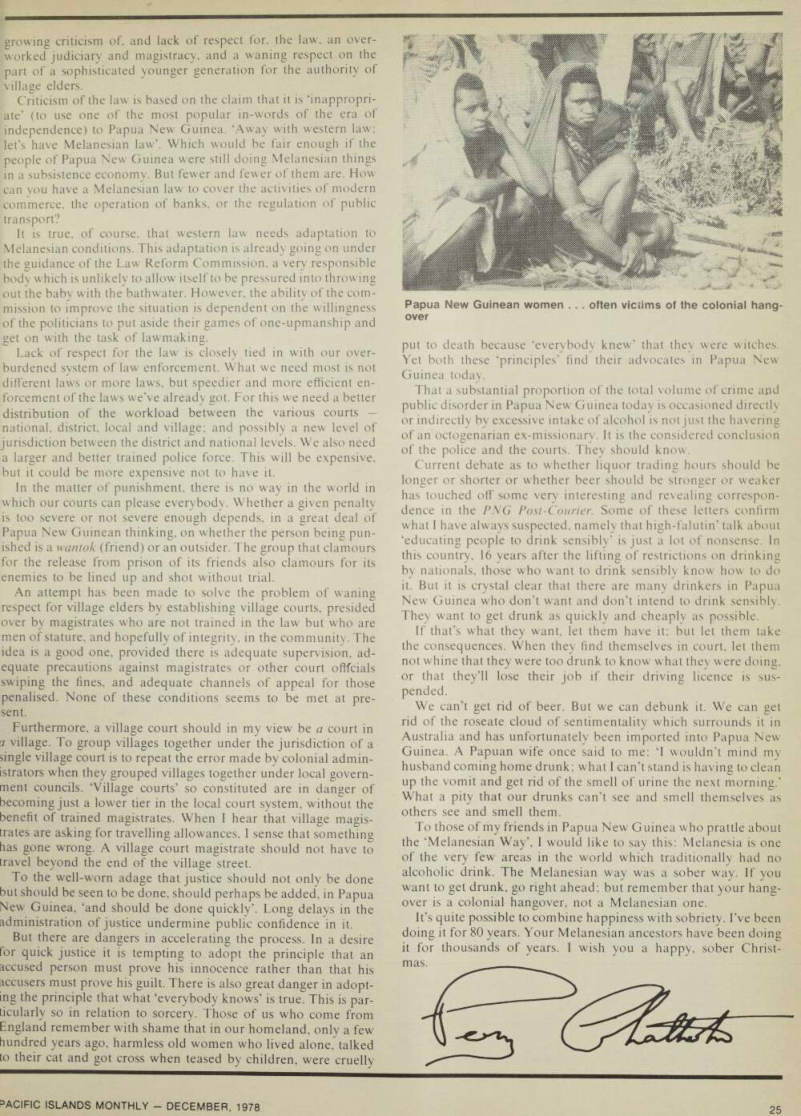
Crime And Grog
Of A Hangover
AFTERTHOUGHTS with Percy Chatterton in Port Moresby.
When I first came to Port Moresby more than 50 years ago. the maintenance of law and order presented no great problem. In the villages, the village elders, with a bit of help from the government-appointed village constable, were still able to keep things under control. In the small town of 400 or so Europeans with their Papuan domestics drawn from coastal villages to east and west, our one and only European police officer. Tom Gough, with the help of a posse of a dozen or so Papuan constables, kept everyone in line without difficulty.
I can still see in my mind’s eye, Tom’s portly figure proceeding majestically down Musgrave Street to cast a fatherly eye on the Hotel Moresby’s ‘snake pit’, the resort where he was most likely to find those whom he would gently but firmly advise to go home and sleep it off. Rarely did they fail to take his advice the con sequence of recalcitrance could be the posting of a prohibition order in the pubs and stores, and that would make it very difficult to get a drink.
Alcoholic liquor in any form was forbidden to Papuans, and there was very little illicit drinking. Public sentiment in the vil lages was strongly against it.
New Guinea was a faraway, inaccessible place where people spoke a queer language called pidgin: and the Highlands were a Shangri La still to be discovered by the outside world.
How different it all is now. Port Moresby has a population of more than 100 000, made up of people from every part of the country enjoying an anonymity which they never had in their home villages. There they couldn’t get away with anything; here they can get away with murder, and sometimes do. There is a
A village magistrate should not have to travel beyond the end of the village street’
growing criticism of. and lack of respect for. the law. an over worked judiciary and magistracy, and a waning respect on the part of a sophisticated younger generation for the authority of
village elders.
Criticism of the law is based on the claim that it is ‘inappropri ate’ (to use one of the most popular in-words of the era of independence) to Papua New Guinea. ‘Away with western law; let’s have Melanesian law'. Which would be fair enough if the people of Papua New Guinea were still doing Melanesian things in a subsistence economy. But fewer and fewer of them are. How can you have a Melanesian law to cover the activities of modern commerce, the operation of banks, or the regulation of public
transport?
It is true, of course, that western law needs adaptation to Melanesian conditions. This adaptation is already going on under the guidance of the Law Reform Commission, a very responsible body which is unlikely to allow itself to be pressured into throwing out the baby with the bathwater. However, the ability of the com mission to improve the situation is dependent on the willingness of the politicians to put aside their games of one-upmanship and get on with the task of lawmaking.
Lack of respect for the law is closely tied in with our over burdened system of law enforcement. What we need most is not different laws or more laws, but speedier and more efficient en forcement of the laws we’ve already got. For this we need a better distribution of the workload between the various courts national, district, local and village; and possibly a new level of jurisdiction between the district and national levels. We also need a larger and better trained police force. This will be expensive, but it could be more expensive not to have it.
In the matter of punishment, there is no way in the world in which our courts can please everybody. Whether a given penalty is too severe or not severe enough depends, in a great deal of Papua New Guinean thinking, on whether the person being pun ished is a wantok (friend) or an outsider. The group that clamours for the release from prison of its friends also clamours for its enemies to be lined up and shot without trial.
An attempt has been made to solve the problem of waning respect for village elders by establishing village courts, presided over by magistrates who are not trained in the law but who are men of stature, and hopefully of integrity, in the community. The idea is a good one, provided there is adequate supervision, ad equate precautions against magistrates or other court officials swiping the fines, and adequate channels of appeal for those penalised. None of these conditions seems to be met at pre sent.
Furthermore, a village court should in my view be a court in i village. To group villages together under the jurisdiction of a single village court is to repeat the error made by colonial admin istrators when they grouped villages together under local govern ment councils. ‘Village courts’ so constituted are in danger of becoming just a lower tier in the local court system, without the benefit of trained magistrates. When I hear that village magis trates are asking for travelling allowances, I sense that something has gone wrong. A village court magistrate should not have to travel beyond the end of the village street.
To the well-worn adage that justice should not only be done but should be seen to be done, should perhaps be added, in Papua New Guinea, ‘and should be done quickly’. Long delays in the administration of justice undermine public confidence in it.
But there are dangers in accelerating the process. In a desire for quick justice it is tempting to adopt the principle that an accused person must prove his innocence rather than that his accusers must prove his guilt. There is also great danger in adopt ing the principle that what ‘everybody knows’ is true. This is par ticularly so in relation to sorcery. Those of us who come from England remember with shame that in our homeland, only a few hundred years ago, harmless old women who lived alone, talked to their cat and got cross when teased by children, were cruelly
put to death because ‘everybody knew’ that they were witches.
Yet both these ‘principles' find their advocates in Papua New
Guinea today.
That a substantial proportion of the total volume of crime and public disorder in Papua New Guinea today is occasioned directly or indirectly by excessive intake of alcohol is not just the havering of an octogenarian ex-missionary. It is the considered conclusion of the police and the courts. They should know.
Current debate as to whether liquor trading hours should be longer or shorter or whether beer should be stronger or weaker has touched off some very interesting and revealing correspon dence in the PNG Post-Courier. Some of these letters confirm what 1 have always suspected, namely that high-falutin’ talk about ‘educating people to drink sensibly’ is just a lot of nonsense. In this country, 16 years after the lifting of restrictions on drinking by nationals, those who want to drink sensibly know how to do it. But it is crystal clear that there are many drinkers in Papua New Guinea who don't want and don’t intend to drink sensibly.
They want to get drunk as quickly and cheaply as possible.
If that’s what they want, let them have it; but let them take the consequences. When they find themselves in court, let them not whine that they were too drunk to know what they were doing, or that they’ll lose their job if their driving licence is sus
pended.
We can’t get rid of beer. But we can debunk it. We can get rid of the roseate cloud of sentimentality which surrounds it in Australia and has unfortunately been imported into Papua New Guinea. A Papuan wife once said to me: ‘I wouldn’t mind my husband coming home drunk; what I can’t stand is having to clean up the vomit and get rid of the smell of urine the next morning.' What a pity that our drunks can’t see and smell themselves as others see and smell them.
To those of my friends in Papua New Guinea who prattle about the ‘Melanesian Way’, I would like to say this; Melanesia is one of the very few areas in the world which traditionally had no alcoholic drink. The Melanesian way was a sober way. If you want to get drunk, go right ahead; but remember that your hang over is a colonial hangover, not a Melanesian one.
It’s quite possible to combine happiness with sobriety. I’ve been doing it for 80 years. Your Melanesian ancestors have been doing it for thousands of years. I wish you a happy, sober Christ mas.
Papua New Guinean women . . . often victims of the colonial hang over
Advertisements & other items, p. 25 (1 item)
25
3 ACIFIC ISLANDS MONTHLY - DECEMBER, 1978
Conference
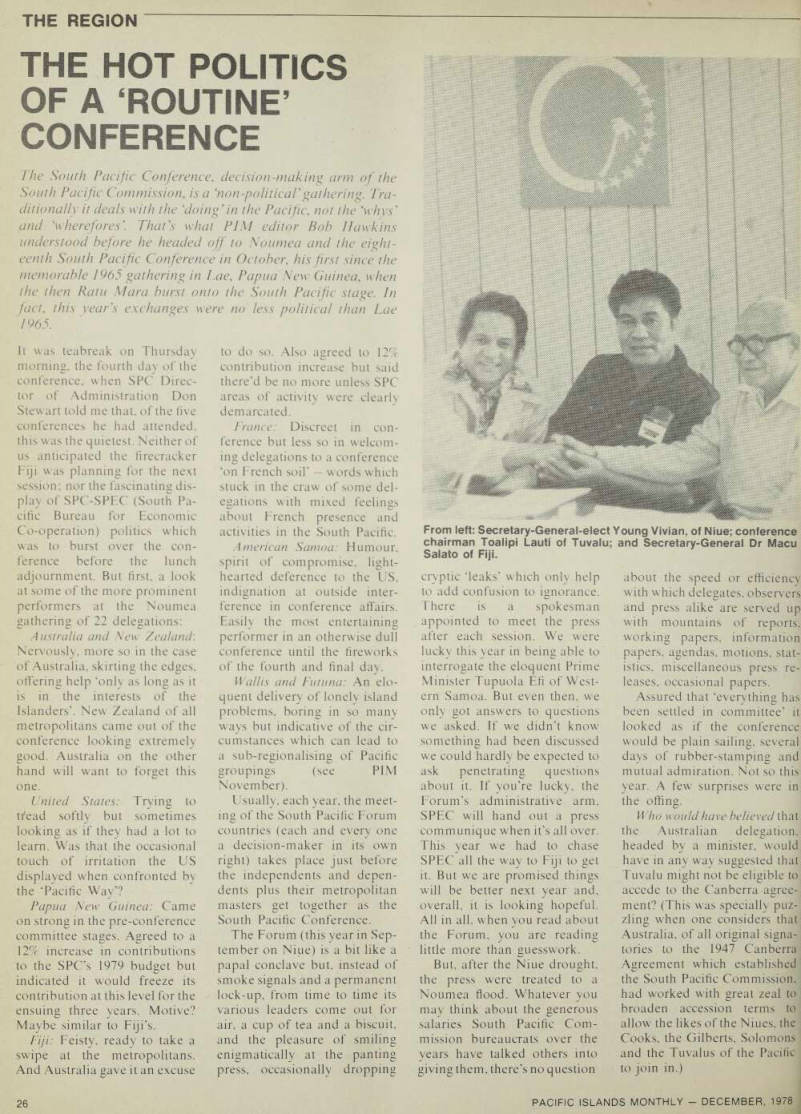
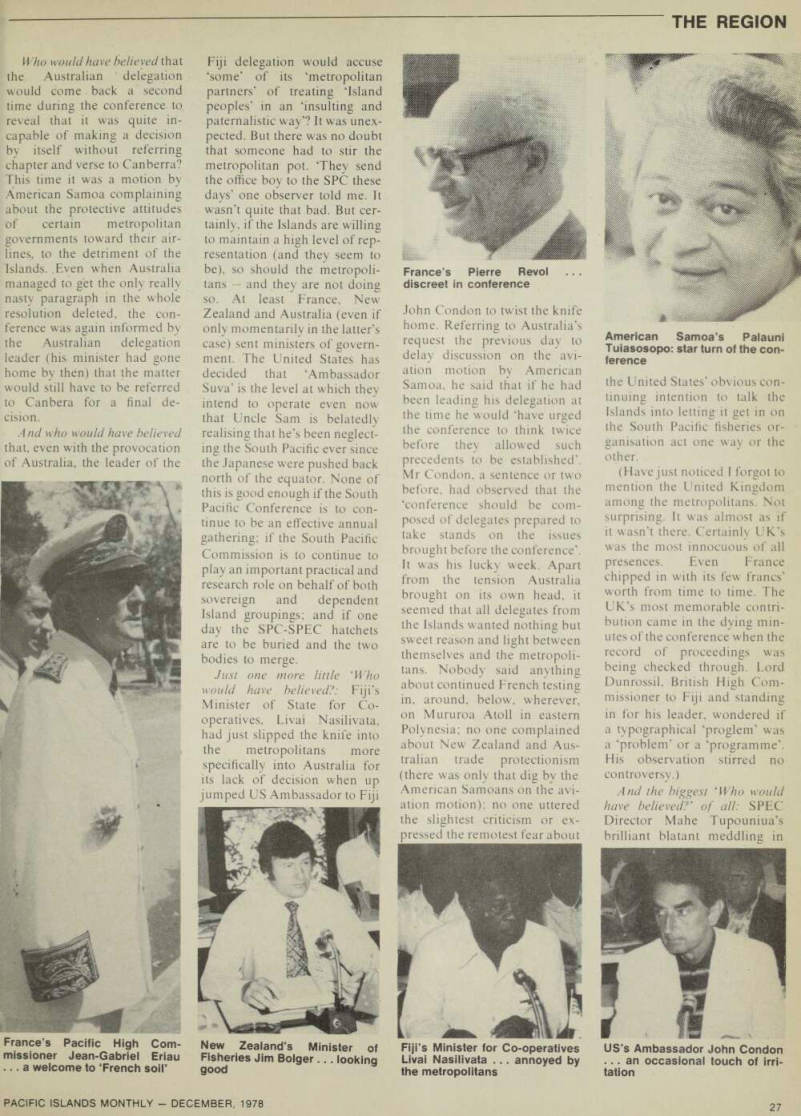
The Hot Politics
Of A ‘Routine’
The South Pacific Conference, decision-making arm of the South Pacific Commission, is a ‘non-political'gathering. Tra ditionally it deals with the ‘doing'in the Pacific, not the ‘whys' and ‘wherefores'. That’s what PIM editor Bob Hawkins understood before he headed off to Noumea and the eight eenth South Pacific Conference in October, his first since the memorable 1965 gathering in Lae, Papua New Guinea, when the then Ratu Mara burst onto the South Pacific stage. In fact, this year's exchanges were no less political than Lae 1965.
It was teabreak on Thursday morning, the fourth day of the conference, when SPC Direc tor of Administration Don Stewart told me that, of the five conferences he had attended, this was the quietest. Neither of us anticipated the firecracker Fiji was planning for the next session; nor the fascinating dis play of SPC-SPEC (South Pa cific Bureau for Economic
Co-operation) politics which
was to burst over the con ference before the lunch adjournment. But first, a look at some of the more prominent performers at the Noumea
gathering of 22 delegations:
Australia and New' Zealand : Nervously, more so in the case of Australia, skirting the edges, offering help ‘only as long as it is in the interests of the Islanders’. New Zealand of all metropolitans came out of the
conference looking extremely
good. Australia on the other hand will want to forget this one.
United States: Trying to tread softly but sometimes looking as if they had a lot to learn. Was that the occasional touch of irritation the US
displayed when confronted by
the ‘Pacific Way’?
Papua New Guinea: Came on strong in the pre-conference committee stages. Agreed to a 12% increase in contributions to the SPC’s 1979 budget but indicated it would freeze its contribution at this level for the ensuing three years. Motive?
Maybe similar to Fiji’s.
Fiji: Feisty, ready to take a
swipe at the metropolitans.
And Australia gave it an excuse
to do so. Also agreed to 12% contribution increase but said there’d be no more unless SPC areas of activity were clearly demarcated.
France: Discreet in con ference but less so in welcom ing delegations to a conference ‘on French soil’ words which stuck in the craw of some del
egations with mixed feelings
about French presence and activities in the South Pacific.
American Samoa: Humour,
spirit of compromise, light
hearted deference to the US, indignation at outside inter ference in conference affairs.
Easily the most entertaining
performer in an otherwise dull conference until the fireworks of the fourth and final day.
Wallis and Futuna: An elo quent delivery of lonely island problems, boring in so many ways but indicative of the cir cumstances which can lead to a sub-regionalising of Pacific groupings (see PIM November).
Usually, each year, the meet ing of the South Pacific Forum countries (each and every one a decision-maker in its own right) takes place just before the independents and depen dents plus their metropolitan masters get together as the South Pacific Conference.
The Forum (this year in Sep tember on Niue) is a bit like a papal conclave but, instead of smoke signals and a permanent lock-up, from time to time its various leaders come out for air, a cup of tea and a biscuit, and the pleasure of smiling enigmatically at the panting press, occasionally dropping
cryptic ‘leaks’ which only help
to add confusion to ignorance.
There is a spokesman appointed to meet the press after each session. We were lucky this year in being able to
interrogate the eloquent Prime
Minister Tupuola Efi of Western Samoa. But even then, we only got answers to questions we asked. If we didn't know something had been discussed we could hardly be expected to
ask penetrating questions
about it. If you’re lucky, the Forum’s administrative arm, SPEC will hand out a press communique when it’s all over.
This year we had to chase SPEC all the way to Fiji to get it. But we are promised things will be better next year and, overall, it is looking hopeful.
All in all, when you read about the Forum, you are reading little more than guesswork.
But, after the Niue drought. the press were treated to a Noumea flood. Whatever you may think about the generous salaries South Pacific Commission bureaucrats over the 1 years have talked others into giving them, there’s no question
about the speed or efficiency with which delegates, observers and press alike are served up with mountains of reports, working papers, information papers, agendas, motions, stat istics, miscellaneous press re leases, occasional papers, Assured that ‘everything has been settled in committee' it looked as if the conference would be plain sailing, several
days of rubber-stamping and
mutual admiration. Not so this year. A few surprises were in
the offing.
Who would have believed that the Australian delegation. headed by a minister, would have in any way suggested that Tuvalu might not be eligible to accede to the Canberra agree ment? (This was specially puz zling when one considers that Australia, of all original signa tories to the 1947 Canberra Agreement which established the South Pacific Commission, had worked with great zeal to broaden accession terms to allow the likes of the Niues, the Cooks, the Gilberts, Solomons and the Tuvalus of the Pacific to join in.)
From left: Secretary-General-elect Young Vivian, of Niue; conference chairman Toalipi Lauti of Tuvalu; and Secretary-General Dr Macu Salato of Fiji.
Who would have believed that the Australian delegation would come back a second time during the conference to reveal that it was quite in capable of making a decision
by itself without referring
chapter and verse to Canberra?
This time it was a motion by American Samoa complaining about the protective attitudes of certain metropolitan governments toward their air lines, to the detriment of the Islands. Even when Australia
managed to get the only really
nasty paragraph in the whole resolution deleted, the con ference was again informed by the Australian delegation leader (his minister had gone home by then) that the matter would still have to be referred to Canbera for a final de cision.
And who would have believed that, even with the provocation of Australia, the leader of the
Fiji delegation would accuse
‘some’ of its ‘metropolitan partners’ of treating ‘lsland peoples’ in an ‘insulting and paternalistic way’? It was unex pected. But there was no doubt that someone had to stir the
metropolitan pot. ‘They send
the office boy to the SPC these days’ one observer told me. It wasn’t quite that bad. But cer tainly, if the Islands are willing to maintain a high level of rep resentation (and they seem to be), so should the metropoli tans and they are not doing so. At least France, New Zealand and Australia (even if only momentarily in the latter’s case) sent ministers of govern ment. The United States has decided that ‘Ambassador Suva’ is the level at which they intend to operate even now that Uncle Sam is belatedly realising that he’s been neglect ing the South Pacific ever since the Japanese were pushed back north of the equator. None of this is good enough if the South Pacific Conference is to con tinue to be an effective annual gathering; if the South Pacific Commission is to continue to
play an important practical and
research role on behalf of both
sovereign and dependent
Island groupings; and if one day the SPC-SPEC hatchets are to be buried and the two bodies to merge.
Just one more little ‘Who would have believed?: Fiji’s Minister of State for Co operatives, Livai Nasilivata, had just slipped the knife into the metropolitans more specifically into Australia for its lack of decision when up jumped US Ambassador to Fiji
John Condon to twist the knife home. Referring to Australia’s request the previous day to delay discussion on the avi ation motion by American Samoa, he said that if he had been leading his delegation at the time he would ‘have urged the conference to think twice before they allowed such precedents to be established’.
Mr Condon, a sentence or two before, had observed that the ‘conference should be com
posed of delegates prepared to
take stands on the issues brought before the conference’.
It was his lucky week. Apart from the tension Australia brought on its own head, it seemed that all delegates from the Islands wanted nothing but sweet reason and light between themselves and the metropoli
tans. Nobody said anything
about continued French testing in, around, below, wherever, on Mururoa Atoll in eastern Polynesia; no one complained about New Zealand and Aus tralian trade protectionism (there was only that dig by the American Samoans on the avi ation motion); no one uttered the slightest criticism or ex pressed the remotest fear about
the United States’ obvious con tinuing intention to talk the Islands into letting it get in on the South Pacific fisheries or ganisation act one way or the other. (Have just noticed I forgot to mention the United Kingdom among the metropolitans. Not surprising. It was almost as if it wasn't there. Certainly UK’s was the most innocuous of all presences. Even France chipped in with its few francs’ worth from time to time. The UK’s most memorable contri bution came in the dying min utes of the conference when the record of proceedings was
being checked through. Lord
Dunrossil. British High Com missioner to Fiji and standing in for his leader, wondered if
a typographical ‘proglem’ was
a ‘problem’ or a ‘programme’.
His observation stirred no controversy.) And the biggest ‘Who would have believed'?’ of all: SPEC Director Mahe Tupouniua’s brilliant blatant meddling in
France’s Pacific High Com missioner Jean-Gabriel Eriau ... a welcome to ‘French soil’
New Zealand’s Minister of
Fisheries Jim Bolger. . . looking
good
France’s Pierre Revol... discreet in conference
Fiji’s Minister for Co-operatives Livai Nasilivata ... annoyed by the metropolitans
American Samoa’s Palauni Tuiasosopo: star turn of the con ference
US’s Ambassador John Condon ... an occasional touch of irri tation
the conference’s affairs. The topic was an environment progamme for the South Pa cific. (See Mahe; Forum before self.)
Spc Faces A
Budget
Freeze
Contributions beyond 1979 to the South Pacific Commission budget are under threat. Papua New Guinea and Fiji indicated at the October Noumea South Pacific Conference that their contributions for the three years after 1979 are likely to be frozen at the 1979 level. Be cause of the unanimity rule enshrined in the Canberra Agreement which established the SPC in 1947, Fiji’s and PNG’s refusal to increase their contributions would prevent other SPC members from upping their own contri butions.
Some delegates and ob servers at the Noumea con ference saw the decision by Fiji and PNG as a move to clip the wings of the SPC yet another manifestation of the unspoken struggle between SPC and SPEC. The pressure is on the SPC. A freezing of contri butions after 1979 would not
just prevent SPC expansion.
Inflationary factors alone would force the organisation to cut back on its activities should its budget remain static.
One day, maybe, SPEC and SPC may come to terms. But until island territories can meet the criteria demanded for
SPEC membership basically
the ability to make decisions without resort to their metro politan masters there has to be a continuing role for the SPC. In the meantime, the
retiring secretary-general of
the SPC. Dr Macu Salato of Fiji, will spend much of his final half-year in office con sulting with the director of SPEC, Mahe Tupouniua of Tonga, in an attempt to achieve
several things, most important,
a friendlier relationship be tween the two bodies. Another task will be to sort out a clear picture of the roles of each
other’s organisations.
While several delegation leaders at Noumea showed
concern at the Fiji-PNG de cision on contributions. Dr Salato adopted a much more
philosophical stance. Happy
with the unanimous decision to raise contributions in 1979 by 12 per cent over 1978, his atti tude was that the 1980 bridge should be crossed when it was reached.
Total contributions by the nine member countries to the 1979 SPC budget add up to CEP 319 134 700 (SA3 545 941 at CEP 90 to $A 1).
The breakdown of the 1979 budget on assessed 1978 contributions is:
Voluntary contributions from terri tories and countries which are not par ticipating governments totalled CFP4 017 000 (SA44 633). They were: American Samoa - SUS 7 500 (up 100%), Cook Islands - 5A4140, French Polynesia - CFPI2B 800 (12%), Gilbert Islands - 5A2663 (12%), Guam - SUSIO 819 (12%). New Caledonia CFP2S7 600 (12%), New Hebrides CFP33O 600 (12%), Niue 5A1939 (12%). Solomon Islands 5512937 (12%), Tokelau - $ All2O (12%), Tonga - ST2OOO, Trust Territory of the Pacific Islands SUS3OOO (12%), Tuvalu 5A1344 (12%), Wallis and Futuna
Cfp64 400 (12%).
• An American Samoan motion called on metropolitan governments ‘to resolve at the earliest possible time the issues involved in the provision of air services in the region, keeping in mind the very considerable interests of the Island states and territories of the Pacific, in obtaining reliable and ad equate commercial air service’.
A paragraph in the American Samoan motion was struck out at Australia’s suggestion. It read: ‘Whereas, certain metro politan governments which op
erate or regulate major
commercial air carriers have been very protective of their flag carrier in granting new air
carriers operating rights to
their country and/or have failed to require air carriers to which they have awarded routes to provide adequate and reliable service . . .' Sometimes the Islands are far too obliging in the face of metropolitan requests.
Member 9 C of
Cfp
budget (00s) Australia 33.60 1 072 293
Fiji
0.85 27 126 France 14.00 446 789 Nauru 0.85 27 126 New Zealand 18.00 574 443 Papua New Guinea 0.85 27 126
United Kingdom
14.00 446 789 United Stales 17.00 542 529 Western Samoa 0.85 27 126 Total 3 191 347
Mahe: Forum
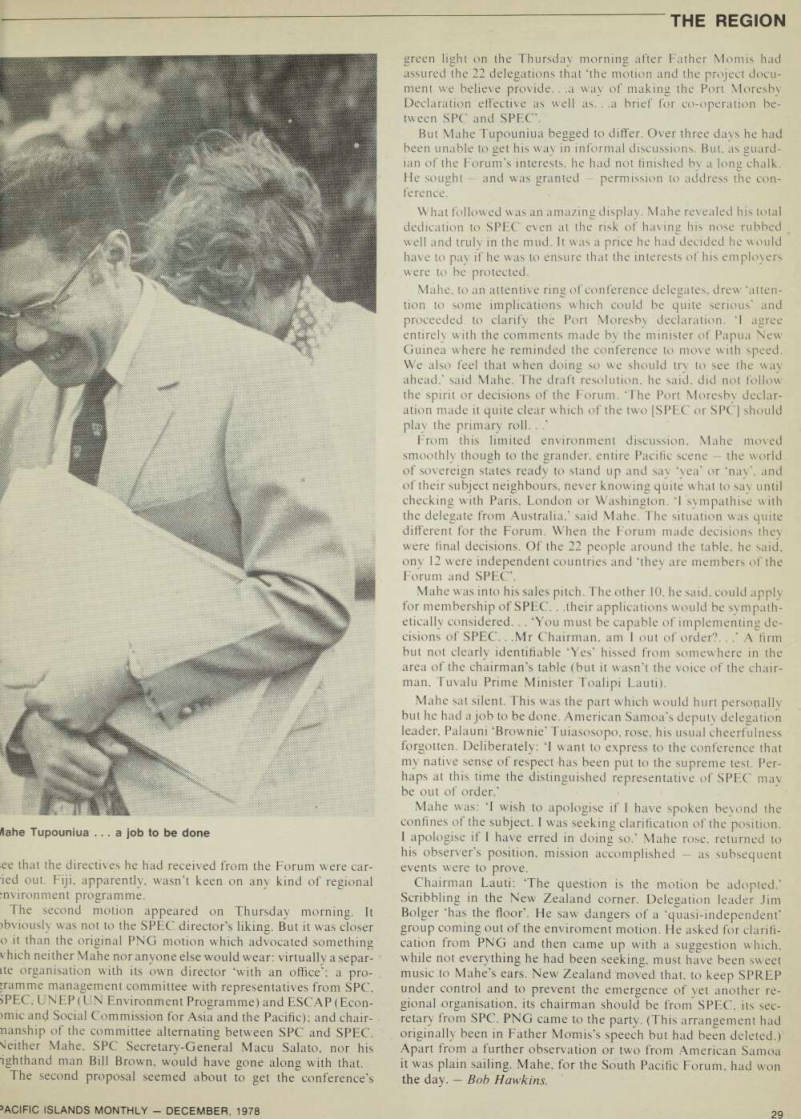
Before Self
So little met the eye. So much went on behind the scenes. Surely the South Pacific Conference debate on a proposed ‘South Pacific Regional Environment Programme’ (SPREP) had more at its heart than lofty dreams about preserving the world in which we live.
So, let’s first dispose of the cynicism. Probably without even admitting it to themselves, the participants in the environment debate, in informal closed session and in the final fiery full con ference session, were locked in a power struggle SPC versus SPEC. On evidence available the small but growing SPEC de feated the big, but in danger of stagnating, SPC.
Though SPC staff tended to shrug off the loss of the chairman’s job on the SPREP to SPEC as something of no consequence, they would have been much happier to have had an alternating share of that position. Instead they’ve got the job they’re best at the
secretary’s.
The environment debate culminated in what can only be de scribed as an extraordinary scene on the final morning of the con ference.
But back to somewhere near the beginning of what has been a long story. Its roots go back to before the 1977 South Pacific Forum in Port Moresby. However, it was that meet ing which got things on the move and, from available evidence, SPEC has made the running ever since but with SPC assist ance.
Briefly, SPEC got together a small working group in October last year with SPC, the Univeristy of the South Pacific and the PNG Government represented. It agreed SPEC should find a con " sultant to prepare ‘a case for a regional environment programme, assess financial implications and examine the institutional options for management of the programme’, according to the SPEC Director’s Annual Report 1977-78.
From the consultant’s papers SPEC prepared a single document and SPEC and SPC met in June this year in Noumea to consider the proposed programme. That meeting, ‘well attended by rep resentatives from Island governments’, produced a proposal for a ‘specifc programme of action including a regional conference aimed at launching a South Pacific Regional Environment Pro
gramme’.
That report was considered by the Niue Forum in September and the result was a curiously worded release which, in con clusion. ‘. . .recommended that the Forum instructs its represen tatives to the South Pacific Conference to ensure that full weight was given to the recommendation of the Port Moresby resolu tion. . .and further that SPEC continue its negotiations with the SPC to the same effect. ..' Even curiouser, . .the (SPEC) com mittee recommended that these efforts at the South Pacific Con- ; ference should not be carried out in an atmosphere of destructive confrontation but in a true spirit of regional co-operation’.
Conclusions to be drawn; all was not harmony in the South Pacific environment; was the SPREP programme to become the catalyst for SPEC-SPC co-operation or confrontation in the same way that the convention for the draft fisheries organisation had been used by PNG and Fiji to reassert their determination that no cracks would appear in the overall defences of the South Pa- ; cific Forum?
SPREP action started when environmentalist Dr Peter Ellyard whirled into Noumea as an adviser to Papua New Guinea’s del egation leader. Father John Momis, Minister for Decentralis ation. Between Monday and Thursday three SPREP drafts were to be circulated, the second as a result of on-going informal nego- i tiations which, it seemed, almost threatened the chances of the issue ever coming before the conference, such were the differences and such was SPEC Director Mahe Tupouniua’s determination to
ee that the directives he had received from the Forum were ear ned out. Fiji, apparently, wasn’t keen on any kind of regional
mvironment programme.
The second motion appeared on Thursday morning. It ibviously was not to the SPEC director’s liking. But it was closer o it than the original PNG motion which advocated something vhich neither Mahe nor anyone else would wear: virtually a separ ite organisation with its own director ‘with an office’; a pro gramme management committee with representatives from SPC, iPEC, UNEP (UN Environment Programme) and ESCAP(Econ >mic and Social Commission for Asia and the Pacific); and chair nanship of the committee alternating between SPC and SPEC.
Neither Mahe. SPC Secretary-General Macu Salato, nor his ighthand man Bill Brown, would have gone along with that.
The second proposal seemed about to get the conference’s
green light on the Thursday morning after Father Momis had assured the 22 delegations that ‘the motion and the project docu ment we believe provide. . .a way of making the Port Moresby Declaration effective as well as. . .a brief for co-operation be tween SPC and SPEC’.
But Mahe Tupouniua begged to differ. Over three days he had been unable to get his way in informal discussions. But, as guard ian of the Forum’s interests, he had not finished by a long chalk.
He sought and was granted permission to address the con ference.
What followed was an amazing display. Mahe revealed his total dedication to SPEC even at the risk of having his nose rubbed well and truly in the mud. It was a price he had decided he would have to pay if he was to ensure that the interests of his employers were to be protected.
Mahe. to an attentive ring of conference delegates, drew ‘atten tion to some implications which could be quite serious' and proceeded to clarify the Port Moresby declaration. ‘I agree entirely with the comments made by the minister of Papua New Guinea where he reminded the conference to move with speed.
We also feel that when doing so we should try to see the way ahead.’ said Mahe. The draft resolution, he said, did not follow the spirit or decisions of the Forum. ‘The Port Moresby declar ation made it quite clear which of the two [SPEC or SPC] should
play the primary roll. . .'
From this limited environment discussion. Mahe moved smoothly though to the grander, entire Pacific scene the world of sovereign states ready to stand up and say ‘yea’ or ‘nay’, and of their subject neighbours, never knowing quite what to sav until checking with Paris, London or Washington. ‘I sympathise with the delegate from Australia.’ said Mahe. The situation was quite different for the Forum. When the Forum made decisions they were final decisions. Of the 22 people around the table, he said, ony 12 were independent countries and ‘they are members of the Forum and SPEC’.
Mahe was into his sales pitch. The other 10, he said, could apply for membership of SPEC. . .their applications would be sympath etically considered. . . ‘You must be capable of implementing de cisions of SPEC.. .Mr Chairman, am I out of order?. ..' A firm but not clearly identifiable ‘Yes’ hissed from somewhere in the area of the chairman’s table (but it wasn’t the voice of the chair man. Tuvalu Prime Minister Toalipi Lauti).
Mahe sat silent. This was the part which would hurt personally but he had a job to be done. American Samoa's deputy delegation leader. Palauni ‘Brownie’ Tuiasosopo, rose, his usual cheerfulness forgotten. Deliberately: T want to express to the conference that my native sense of respect has been put to the supreme test. Per haps at this time the distinguished representative of SPEC may be out of order.’
Mahe was: ‘I wish to apologise if I have spoken beyond the confines of the subject. I was seeking clarification of the position.
I apologise if I have erred in doing so.’ Mahe rose, returned to his observer’s position, mission accomplished as subsequent events were to prove.
Chairman Lauti; ‘The question is the motion be adopted.’
Scribbling in the New Zealand corner. Delegation leader Jim Bolger ‘has the floor’. He saw dangers of a ‘quasi-independent’ group coming out of the enviroment motion. He asked for clarifi cation from PNG and then came up with a suggestion which, while not everything he had been seeking, must have been sweet music to Mahe’s ears. New Zealand moved that, to keep SPREP under control and to prevent the emergence of yet another re gional organisation, its chairman should be from SPEC, its sec retary from SPC. PNG came to the party. (This arrangement had originally been in Father Monus's speech but had been deleted.) Apart from a further observation or two from American Samoa it was plain sailing. Mahe, for the South Pacific Forum, had won
the day.
Bob Hawkins.
Mahe Tupouniua ... a job to be done
Advertisements & other items, pp. 29-30 (2 items)
The Region
29
3 ACIFIC ISLANDS MONTHLY - DECEMBER, 1978
Nelson & Robertson
r .’./ , ,-v rm.-j-’ y fl •./..:. r .r.TZ- VWfci 1 oBEf?/ O -o 2: o >o> V 6/ o
FOR
BRANCH OFFICES:
PAPUA NEW GUINEA
REPRESENTATIVES:
IN OUR 84th YEAR SELLING ‘SERVICE
TO THE PACIFIC ISLANDS...
Nelson & Robertson
PTY. LTD. (Established 1895)
Plantation House, 197 Clarence Street, Sydney
Cables: ‘IVAN% Sydney, Brisbane. Telex: AA22381, Sydney.
INDENTS - FROM AUSTRALIA, NEW ZEALAND and OVERSEAS FOODSTUFFS • HARDWARE • TRAVEL • CANNED FISH MACHINERY • INSURANCE • SOFTGOODS • JUTE GOODS
• REAL ESTATE •
Nelson & Robertson Pty. Ltd., P.O. Box 575, Brisbane, Qld., Australia.
P.O. Box 2092, Govt. Bldg., Suva, Fiji. P.O. Box 258, Lautoka, Fiji.
P.O. Box 2420, CPO Auckland 1, New Zealand.
Rabtrad Niugini Pty. Ltd., P.O. Box 219, Rabaul, P.N.G.
P.0.80x 1406, Lae, P.N.G. P.O. Box 711, Madang, P.N.G.
P.0.80x 253, Kieta, P.N.G.
To Future Generations,
Security
Social welfare is a subject of serious consideration in most modern societies. Man in the twentieth century accepts his responsibility to bequeath to the next generation a society better than his own.
Daiwa Bank is not unique in accepting this responsibility, but Daiwa is unique in making acceptance of this role in society an integral part of their banking service.
Daiwa is the only Japanese city bank to combine banking and trust business. Daiwa is thus a fully integrated banking institution, comprising banking, international financing, trust, pension trust, and real estate business. This integration is part of our effort to fulfil our social responsibility consistent with society's needs in a contemporary environment. a fully integrated banking service
DAIWA BANK
Head Office: Osaka, Japan London and Frankfurt Branches New York and Los Angeles Agencies Singapore, Sydney, Sao Paulo, Hong Kong and Houston Representative Offices Subsidiary: Daiwa Bank Trust Company, New York Joint Venture Banks: P.T. Bank Perdania, Jakarta, International Credit Alliance, Ltd., Hong Kong
Cruelty and
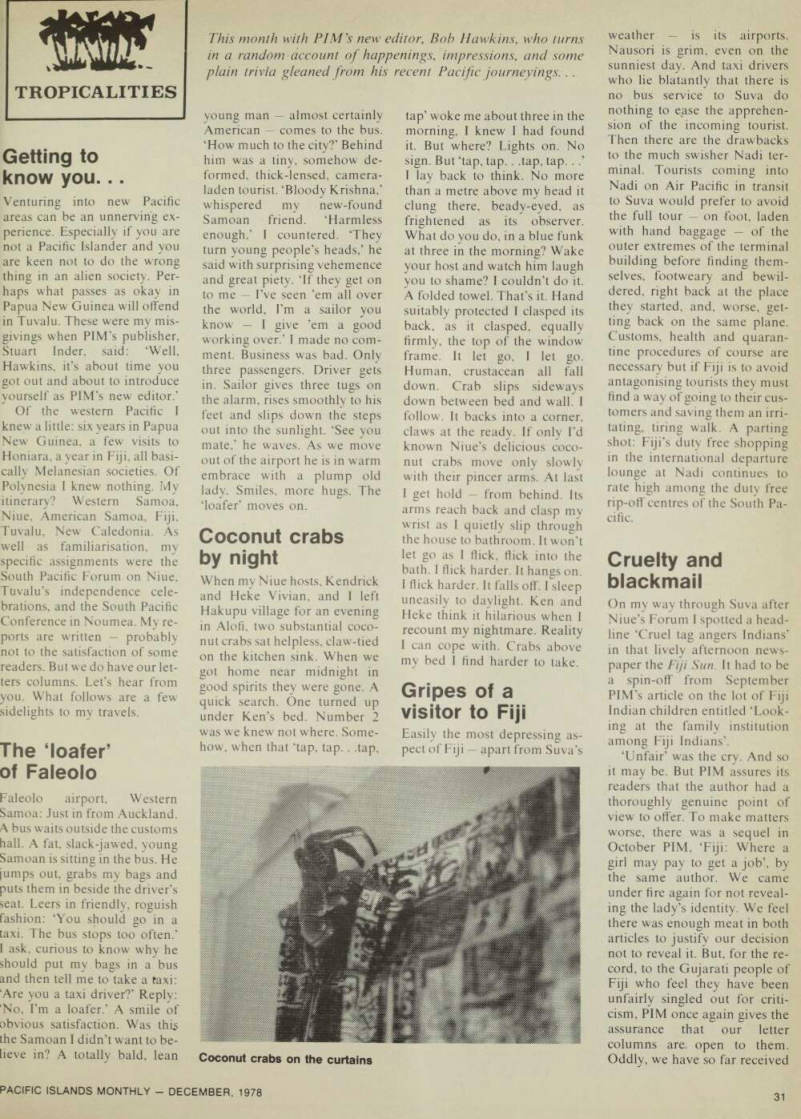
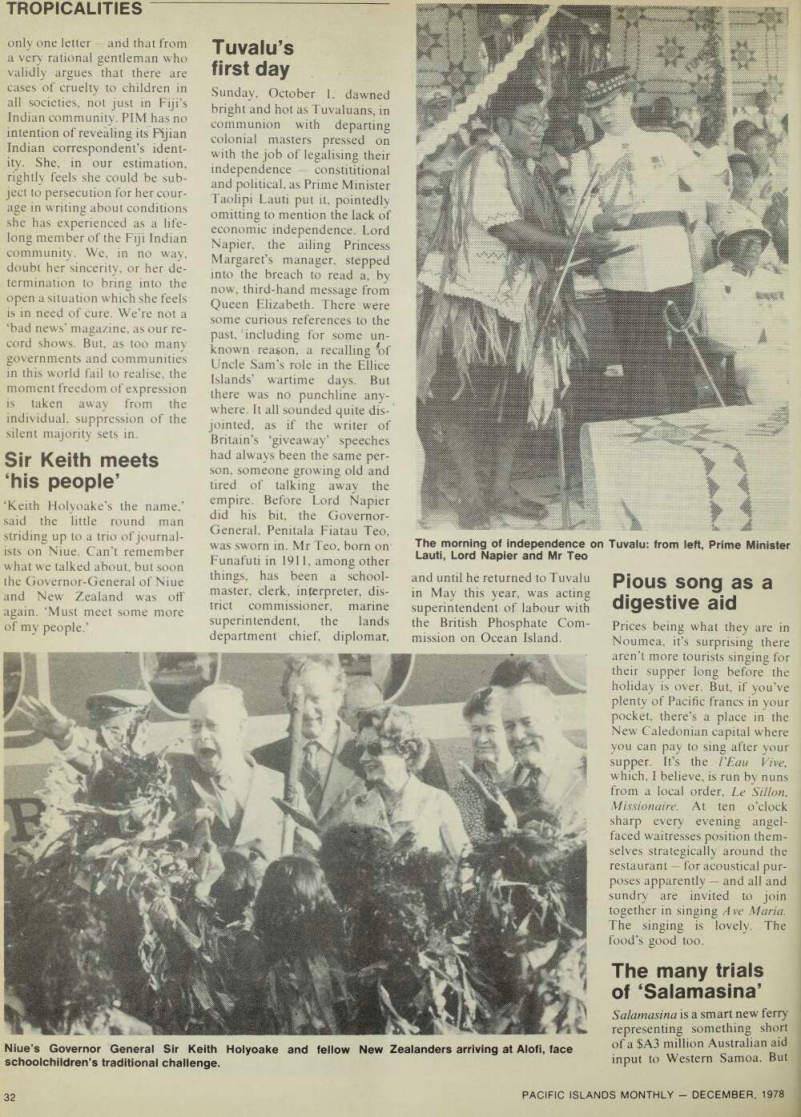

Tropicalities
This month with PI M’s new editor, Bob Hawkins, who turns in a random account of happenings, impressions, and some plain trivia gleaned from his recent Pacific journeyings. . .
Getting to
know you...
Venturing into new Pacific areas can be an unnerving ex perience. Especially if you are not a Pacific Islander and you are keen not to do the wrong thing in an alien society. Per haps what passes as okay in Papua New Guinea will offend in Tuvalu. These were my mis
givings when PlM’s publisher,
Stuart Inder, said: ‘Well, Hawkins, it’s about time you got out and about to introduce yourself as PlM’s new editor.’
Of the western Pacific I knew a little: six years in Papua New Guinea, a few visits to Honiara, a year in Fiji, all basi cally Melanesian societies. Of
Polynesia I knew nothing. My
itinerary? Western Samoa, Niue, American Samoa, Fiji, Tuvalu, New Caledonia. As well as familiarisation, my
specific assignments were the
South Pacific Forum on Niue, Tuvalu’s independence cele brations, and the South Pacific Conference in Noumea. My re ports are written probably not to the satisfaction of some readers. But we do have our let ters columns. Let’s hear from you. What follows are a few sidelights to my travels.
The ‘loafer’
of Faleolo
Faleolo airport. Western
Samoa: Just in from Auckland.
A bus waits outside the customs hall. A fat, slack-jawed, young Samoan is sitting in the bus. He
jumps out, grabs my bags and
puts them in beside the driver’s
seat. Leers in friendly, roguish
fashion: ‘You should go in a taxi. The bus stops too often.’
I ask, curious to know why he should put my bags in a bus and then tell me to take a taxi: Are you a taxi driver?’ Reply: ‘No, I’m a loafer.’ A smile of obvious satisfaction. Was this the Samoan I didn’t want to be lieve in? A totally bald, lean
young man almost certainly American comes to the bus. ‘How much to the city?’ Behind him was a tiny, somehow de formed, thick-lensed, camera laden tourist. ‘Bloody Krishna,’ whispered my new-found Samoan friend. ‘Harmless enough,’ I countered. ‘They turn young people’s heads,’ he said with surprising vehemence and great piety. ‘lf they get on to me I’ve seen ’em all over the world. I’m a sailor you know I give ’em a good working over.’ I made no com ment. Business was bad. Only three passengers. Driver gets in. Sailor gives three tugs on the alarm, rises smoothly to his feet and slips down the steps out into the sunlight. ‘See you mate,’ he waves. As we move out of the airport he is in warm embrace with a plump old lady. Smiles, more hugs. The ‘loafer’ moves on.
Coconut crabs
by night
When my Niue hosts, Kendrick and Heke Vivian, and I left
Hakupu village for an evening
in Alofi, two substantial coco nut crabs sat helpless, claw-tied on the kitchen sink. When we got home near midnight in good spirits they were gone. A quick search. One turned up under Ken’s bed. Number 2 was we knew not where. Some how, when that ‘tap, tap.. .tap.
tap’ woke me about three in the morning, I knew I had found it. But where? Lights on. No sign. But ‘tap, tap.. .tap, tap. ..’
I lay back to think. No more than a metre above my head it
clung there, beady-eyed, as
frightened as its observer.
What do you do. in a blue funk at three in the morning? Wake your host and watch him laugh you to shame? I couldn’t do it.
A folded towel. That’s it. Hand
suitably protected I clasped its
back, as it clasped, equally firmly, the top of the window frame. It let go, I let go.
Human, crustacean all fall
down. Crab slips sideways
down between bed and wall. I follow. It backs into a corner, claws at the ready. If only I’d known Niue’s delicious coco nut crabs move only slowly with their pincer arms. At last I get hold - from behind. Its arms reach back and clasp my
wrist as I quietly slip through
the house to bathroom. It won’t let go as I flick, flick into the bath. I flick harder. It hangs on.
I flick harder. It falls off. I sleep uneasily to daylight. Ken and Heke think it hilarious when I
recount my nightmare. Reality
I can cope with. Crabs above my bed I find harder to take.
Gripes of a
visitor to Fiji
Easily the most depressing as pect of Fiji - apart from Suva’s
weather is its airports.
Nausori is grim, even on the sunniest day. And taxi drivers who lie blatantly that there is no bus service to Suva do nothing to ease the apprehen sion of the incoming tourist.
Then there are the drawbacks to the much swisher Nadi ter minal. Tourists coming into Nadi on Air Pacific in transit to Suva would prefer to avoid the full tour on foot, laden with hand baggage of the outer extremes of the terminal
building before finding them
selves, footweary and bewil dered, right back at the place they started, and, worse, get ting back on the same plane.
Customs, health and quaran tine procedures of course are necessary but if Fiji is to avoid
antagonising tourists they must
find a way of going to their cus tomers and saving them an irri
tating, tiring walk. A parting
shot: Fiji’s duty free shopping
in the international departure lounge at Nadi continues to rate high among the duty free rip-off centres of the South Pa cific.
Cruelty and
blackmail
On my way through Suva after Niue’s Forum I spotted a head line ‘Cruel tag angers Indians’ in that lively afternoon news paper the Fiji Sun. It had to be
a spin-off from September
PI M's article on the lot of Fiji Indian children entitled ‘Look ing at the family institution among Fiji Indians’. ‘Unfair’ was the cry. And so it may be. But PIM assures its readers that the author had a
thoroughly genuine point of
view to offer. To make matters worse, there was a sequel in October PIM, ‘Fiji: Where a girl may pay to get a job’, by the same author. We came under fire again for not reveal
ing the lady’s identity. We feel
there was enough meat in both articles to justify our decision not to reveal it. But, for the re cord, to the Gujarati people of Fiji who feel they have been unfairly singled out for criti cism, PIM once again gives the assurance that our letter columns are open to them.
Oddly, we have so far received
Coconut crabs on the curtains
only one letter and that from a very rational gentleman who validly argues that there are cases of cruelty to children in all societies, not just in Fiji’s Indian community. PIM has no intention of revealing its Fijian Indian correspondent’s ident ity. She, in our estimation, rightly feels she could be sub ject to persecution for her cour age in writing about conditions she has experienced as a life long member of the Fiji Indian community. We, in no way, doubt her sincerity, or her de termination to bring into the open a situation which she feels is in need of cure. We’re not a ‘bad news’ magazine, as our re cord shows. But, as too many governments and communities in this world fail to realise, the moment freedom of expression is taken away from the individual, suppression of the silent majority sets in.
Sir Keith meets
‘his people’
‘Keith Holyoake’s the name,’ said the little round man striding up to a trio of journal ists on Niue. Can’t remember what we talked about, but soon the Governor-General of Niue and New Zealand was off again. ‘Must meet some more of my people.’
Tuvalu’s
first day
Sunday, October 1. dawned bright and hot as Tuvaluans, in communion with departing colonial masters pressed on with the job of legalising their
independence constititional
and political, as Prime Minister Taolipi Lauti put it, pointedly omitting to mention the lack of economic independence. Lord
Napier, the ailing Princess
Margaret’s manager, stepped into the breach to read a, by now, third-hand message from Queen Elizabeth. There were some curious references to the past, 'including for some un known reason, a recalling *of Uncle Sam’s role in the Ellice Islands’ wartime days. But there was no punchline any where. It all sounded quite dis jointed, as if the writer of
Britain’s ‘giveaway’ speeches
had always been the same per son, someone growing old and tired of talking away the empire. Before Lord Napier did his bit, the Governor- General. Penitala Fiatau Teo, was sworn in. Mr Teo, born on Funafuti in 1911, among other things, has been a school master, clerk, interpreter, dis trict commissioner, marine superintendent, the lands
department chief, diplomat.
and until he returned to Tuvalu in May this year, was acting superintendent of labour with the British Phosphate Com mission on Ocean Island.
Pious song as a
digestive aid
Prices being what they are in Noumea, it’s surprising there aren’t more tourists singing for their supper long before the holiday is over. But, if you’ve plenty of Pacific francs in your pocket, there’s a place in the New Caledonian capital where you can pay to sing after your supper. It’s the VEau Vive, which, I believe, is run by nuns from a local order, Le Sillon, Missionaire. At ten o’clock
sharp every evening angel
faced waitresses position them selves strategically around the restaurant for acoustical pur poses apparently and all and sundry are invited to join together in singing A ve Maria.
The singing is lovely. The food’s good too.
The many trials
of ‘Salamasina’
Salamasina is a smart new ferry
representing something short
of a SA3 million Australian aid input to Western Samoa. But
Niue’s Governor General Sir Keith Holyoake and fellow New Zealanders arriving at Alofi, face schoolchildren’s traditional challenge.
The morning of independence on Tuvalu: from left, Prime Minister Lauti, Lord Napier and Mr Teo
it’s been far from plain sailing since Salamasina arrived in Western Samoa, its main task being to ferry vehicles between the two main islands Savai’i in the west and Upolu. Only trouble was the channel into the Upolu berth turned out to be not quite wide enough to take the Salamasina. There were red faces all around, par ticularly on the Australian side.
After all. ultimately it was their job to know that what they were giving could do the job it was intended for. Last we heard, Salamasina is now ply ing between Apia and eastern Savai’i and between Apia and Pago Pago, capital of neigh bouring American Samoa but without carrying vehicles.
They’re a-building a ramp at Apia wharf to make it possible to get vehicles onto the Salamasina it might even be complete by now. Someone told me along my way that in many respects they find both New Zealand and Australian aid a nuisance. The New Zealanders, he said, paid far too much attention to how their money was spent. The Aus tralians, he said, did not pay
enough attention.
Tracts from afar
left Niue cold
A steady south-easter was
whistling through Tamakau
tonga village, just down the coast from Niue’s capital Alofi.
I took a walk with my camera
down over the village green to stand on the cliffs just below the pastor’s house. I wanted a shot looking south along the coastline to Avatele. Somehow I wasn’t ready for the bits of printed paper which blew around my feet. ‘Communists did this,’ ‘Communism is a lie' the papers read, with gruesome pictures captioned ‘Com munist terror in Africa’. This didn’t fit in with my idea of Niue. Nor, it seemed, did the anti-communist news sheets, produced by the Christian Mission to the Communist World of Lautoka, appeal to the Ekalesia Niue Christians.
Scores of leaflets had been abandoned to the weather. The terrors of communism in far away Africa, if in fact the photographs were authentic, were all too remote for the leader of this particular Niuean flock.
The rampant
guava
The guava is under fire again in Fiji. At a time when there is talk of expanding guava or chards, beef farmers in Fiji, where the guava tree is a declared noxious weed, are get ting worried. The guava’s prob lem is that it competes far too
successfully with crop plants
and pasture grasses. A good fruit to eat and an ingredient for very tasty jam, the guava’s sheer flamboyance has lined it up to become a victim of the chemicals of Fiji’s beef farmers.
Busy scholars
on Niue
Little Niue, population 5 000, is getting its full share of aca demic attention these days.
Under the auspices of the Insti tute of Pacific Studies, which is part of the University of the South Pacific, Niuean projects now under way include: • A history of Niue, jointly written by about a dozen Niuean school teachers and
educational administrators; • A study of Niuean politics, written by three Niueans; • A study of land tenure in Niue From two angles: the rights of Niuean women to land tenure, and the methods of settling disputes over land two Niueans are engaged on this; • An autobiography by Prem ier Robert R. Rex the IPS
made taperecording equip
ment available to Mr Rex for this purpose, and he’s just about finished the job.
In search of the
fastest paddler
The Diamond Head Paddle Board Race ‘to find the world's fastest paddler’ will be staged this year with four basic changes to the ground rules. The race will be run on December 30 instead of Christ mas Day in the hope of attract
ing more foreign challengers.
Two of the traditional board classes the open (unlimited) and paddleboard (stockboard) - have been deleted ‘to equal ise competition’. For the first time there will be a single board class with only two speci fications; a maximum overall length of 3.6 m and no rudder.
The course* this year will be 10 000 m. beginning and end ing at Sans Souci Beach, and will be around the Diamond Head and Wreck Buoys. The fourth change is the introduc tion of a division for women.
The race was founded 26 years ago by the Waikiki Surf Club.
It is now organised by the Out rigger Canoe Club of Hawaii whose ambition is to have it
accepted as an Olympic
event.
Anti-communist poster: nobody wants them in Tamakautonga
The Salamasina alongside Apia’s wharf . . . vehicle capacity but ramp a-building
The Tahitian community’s new centre in Noumea, opened during the South Pacific Conference in October
Advertisements & other items, pp. 33-34 (1 item)
Csoo*S
GOODfYEAR
0800
RADIAL PLY TYRE
You get extra tyre toughness,
longer tread life and more
fuel economy from Goodyear
GBOO, Custom GBOO Rib or
GBOO Grand Prix.
i S2= r \ w v --
GOOD-YEAR
CSOO*S
STEEL BELTED RADIAL TYRE
A high-performance steel
belted radial tyre with a polyester
cord body that offers excellent stabil-
ity and driving response on wet or dry
highway surfaces. Safe, sure, durable
and extra long-wearing.
GOODfYEAR
08
CROSS PLY TYRE
G 8 offers you improved wet-
skid protection smoother
handling and quieter softer
ride. Three choices:
G 8 Custom G 8
Super Cushion G 8
rtt
, rr IS «: / S * GOODYEAR DISTRIBUTORS IN S.E. ASIA AND PACIFIC BASIN Richard Pieris & Co., Ltd.
Colombo. Sh Lanka Nepal Motor Company (P) L Brratnagar, Nepal Havana Ltd.
Dacca, Bangladesh Diet helm & Co., Ltd.
Bangkok. Thailand Landis Brothers & Co., Ltd.
Hong Kong Guam Tire & Supply Co.
Agana. Guam Susupe Enterprises Saipan. Manana is Microl Corporation Saipan. Manana Is Truk Trading Co.
Truk E . Caroline Is Koloma. Ponape Island Transport Service Co.
Majuro. Marshall Is Yap Cooperative Ass.
Yap. W Caroline Is Cook Islands Motor Centre Ltd.
Rarotonga. Cook Is Ngiratkel Etpison Co., Ltd.
Koror. Palau Boroko Motors Ltd.
Port Moresby, Papua New Guinea Solomon Motors Ltd.
Honiara. Solomon Is Santo Engineers Santo. New Hebndes Pacific Motors Vila. New Hebndes
S.G.A.
Noumea. New Caledonia Buncombe Bay Garage Norfolk Is Coral Island Motors Suva, Fiji Morris Hedstrom Ltd.
Nukualofa. Tonga Morris Hedstrom Ltd.
Apia. Western Samoa Western Samoa Transport Cooperative Society Ltd.
Apia. Western Samoa Samoa Motors Inc.
Pago Pago. American Samoa Service Mobil Papeete. Tahiti
GOODYEAR SUBSIDIARIES
The Goodyear Tyre & Rubber Co (Aust) Ltd.
Sydney, AUSTRALIA Tel: 31-0311 Goodyear India Limited New Delhi 1. INDIA Tel 46886/9 PT Goodyear Indonesia Bogor, Republic of Indonesia Tel; 3371/2 Nippon Goodyear Kabushiki Kaisha Tokyo, JAPAN Tel 582-0481 8 Goodyear Malaysia Berhad Selangor, MALAYSIA Tel; 362501/5 The Goodyear Tyre & Rubber Co. of New Zealand. Limited Lower Hutt. NEW ZEALAND Tel 684-389 The Goodyear Tyre & Rubber Company of the Philippines, Limited Makati-Metro Manila.
Republic of the Philippines Tel 89-20-41 Goodyear Singapore Pvt Limited Geylang SINGAPORE 14 Tel 408281 3 Goodyear Taiwan Limited Taipei. TAIWAN Tel 5117135/8 Goodyear (Thailand) Limited Bangkok. THAILAND Tel 252-6141/5
FOR FURTHER INFORMATION,
PLEASE CONTACT
Goodyear International Corporation Room 1603. Wing On Center 111 Connaught Road Central
HONG KONG Tel: 5-433331
A
P ACIFIC
HOOD RACING and CRUISING SAILS
In World Famous Hood Sailcloth Hood Racing Sails have the top international race-winning record. Recent successes include: Half Ton Cup, One Ton Cup, Southern Cross Cup, Whitbread Round-the-World Race, World Ocean Racing Championship, Sydney- Hobart Race, N.Z. to Vila / Ocean Race, Single-handed Transtasman, / y & Hood Cruising Sails in Hood Wide Panel Sailcloth are soft, easy to handle and stow, and longer lasting.
Hood Service. We regularly service the Pacific.
Hood Managing Director Tony Bouzaid calls frequently through the area; sailing seminars for clubs and associations by arrangement.
Deliveries. Improved air services bring New Zealand closer to you we can offer speedy deliveries at short notice. /
SPAR
and
RIGGIN
Hoods have representatives in Noumea Papeete, Port Moresby, Rabaul, Suva, Singapore.
Write to Hood Sail Consultants in /^ New Zealand for quotes, advice /C; and for prompt answers to your / Q sails queries.
HOOD
V
HOOD
NEW ZEALAND
LIMITED
23 Poore St., St. Marys Bay, Phone 794-060 P.O. Box 415, Auckland, / A’
New Zealand. / Cables: Hoodsail Telex: / /-v NZ21200 / / / •v Whether you have a
racing or cruising yacht
and require full new rigs or replacements, contact us for prompt and efficient service. We offer
Spars, Rigging, Halyards,
Accessories from Quarter Ton to Maxis. For immediate service, write, phone or telex giving fullest details including sketches for replacements, and sail plans
with yacht's leading dimensions, including
displacements and ballast, for new rigs.
Write for our very comprehensive catalogue.
HOODNZ
YACHTSR4RS
NEW ZEALAND LIMITED
P.O. Box 1492, Auckland. Phone 485-955, 485-536 Telex: Hood 21200. Cables: Yachts Auckland.
Political
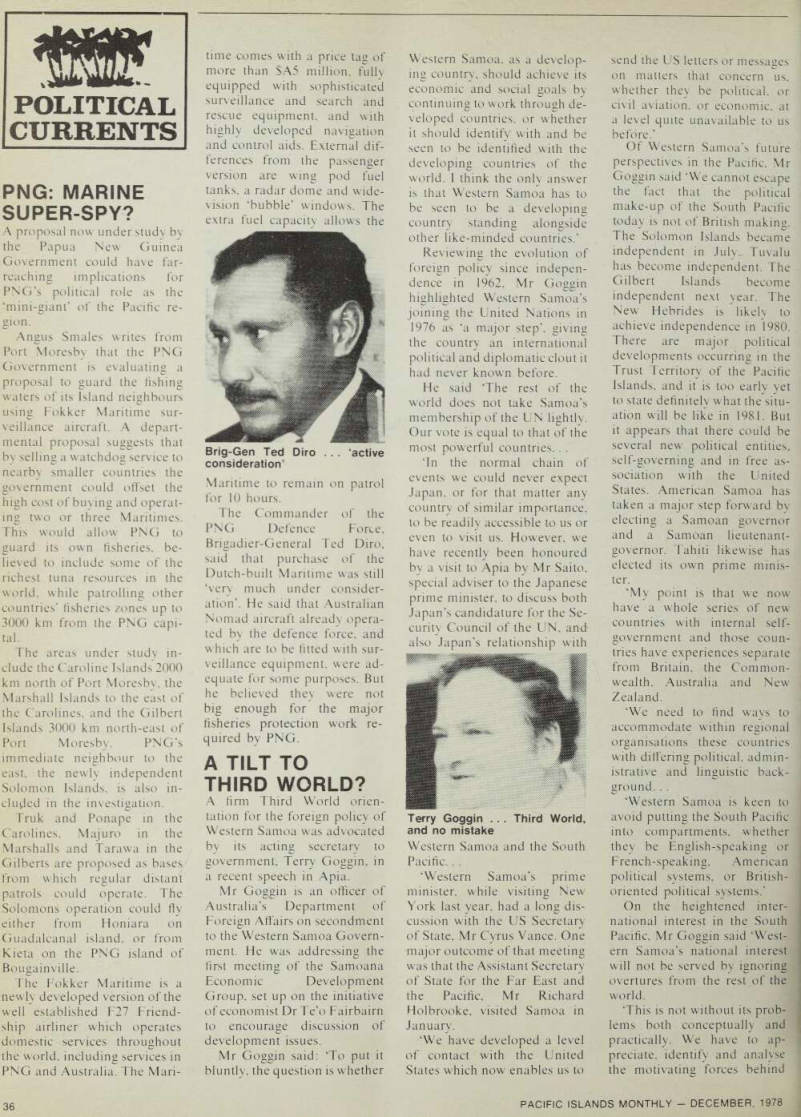


Currents
Png: Marine
Super-Spy?
A proposal now under study by the Papua New Guinea Government could have far reaching implications for PNG’s political role as the ‘mini-giant’ of the Pacific re
gion.
Angus Smales writes from Port Moresby that the PNG Government is evaluating a proposal to guard the fishing waters of its Island neighbours using Fokker Maritime sur veillance aircraft. A depart mental proposal suggests that
by selling a watchdog service to
nearby smaller countries the government could offset the high cost of buying and operat ing two or three Maritimes.
This would allow PNG to guard its own fisheries, be lieved to include some of the richest tuna resources in the world, while patrolling other countries’ fisheries zones up to 3000 km from the PNG capi tal.
The areas under study in clude the Caroline Islands 2000 km north of Port Moresby, the Marshall Islands to the east of the Carolines, and the Gilbert Islands 3000 km north-east of Port Moresby. PNG’s immediate neighbour to the east, the newly independent Solomon Islands, is also in cluded in the investigation.
Truk and Ponape in the Carolines, Majuro in the Marshalls and Tarawa in the Gilberts are proposed as bases from which regular distant patrols could operate. The Solomons operation could fly either from Honiara on Guadalcanal island, or from Kieta on the PNG island of
Bougainville.
The Fokker Maritime is a newly developed version of the well established F 27 Friend ship airliner which operates domestic services throughout the world, including services in PNG and Australia. The Mari
time comes with a price tag of more than SAS million, fully equipped with sophisticated surveillance and search and rescue equipment, and with
highly developed navigation
and control aids. External dif ferences from the passenger version are wing pod fuel tanks, a radar dome and wide vision ‘bubble’ windows. The extra fuel capacity allows the
Maritime to remain on patrol for 10 hours.
The Commander of the PNG Defence Force, Brigadier-General Ted Diro, said that purchase of the Dutch-built Maritime was still ‘very much under consider ation’. He said that Australian Nomad aircraft already opera ted by the defence force, and which are to be fitted with sur veillance equipment, were ad equate for some purposes. But he believed they were not
big enough for the major
fisheries protection work re
quired by PNG.
A Tilt To
Third World?
A firm Third World orien tation for the foreign policy of Western Samoa was advocated by its acting secretary to government, Terry Goggin, in a recent speech in Apia.
Mr Goggin is an officer of Australia’s Department of Foreign Affairs on secondment to the Western Samoa Govern ment. He was addressing the first meeting of the Samoana Economic Development Group, set up on the initiative of economist DrTe’o Fairbairn to encourage discussion of development issues.
Mr Goggin said; ‘To put it bluntly, the question is whether
Western Samoa, as a develop ing country, should achieve its economic and social goals by continuing to work through de veloped countries, or whether it should identify with and be seen to be identified with the developing countries of the world. I think the only answer is that Western Samoa has to be seen to be a developing
country standing alongside
other like-minded countries.’
Reviewing the evolution of
foreign policy since indepen
dence in 1962. Mr Goggin highlighted Western Samoa’s joining the United Nations in
1976 as ‘a major step’, giving
the country an international political and diplomatic clout it had never known before.
He said ‘The rest of the world does not take Samoa’s membership of the UN lightly.
Our vote is equal to that of the
most powerful countries.. .
‘ln the normal chain of events we could never expect Japan, or for that matter any country of similar importance, to be readily accessible to us or even to visit us. However, we have recently been honoured by a visit to Apia by Mr Saito, special adviser to the Japanese prime minister, to discuss both Japan’s candidature for the Se curity Council of the UN, and
also Japan’s relationship with
Western Samoa and the South Pacific.. . ‘Western Samoa’s prime minister, while visiting New York last year, had a long dis cussion with the US Secretary of State, Mr Cyrus Vance. One major outcome of that meeting was that the Assistant Secretary of State for the Far East and the Pacific, Mr Richard Holbrooke, visited Samoa in
January.
‘We have developed a level of contact with the United States which now enables us to
send the US letters or messages on matters that concern us, whether they be political, or civil aviation, or economic, at a level quite unavailable to us before.’
Of Western Samoa’s future perspectives in the Pacific. Mr Goggin said ‘We cannot escape the fact that the political make-up of the South Pacific today is not of British making.
The Solomon Islands became
independent in July.. Tuvalu
has become independent. The Gilbert Islands become independent next year. The New Hebrides is likelv to achieve independence in 1980.
There are major political
developments occurring in the
Trust Territory of the Pacific Islands, and it is too early yet to state definitely what the situ ation will be like in 1981. But it appears that there could be several new' political entities, self-governing and in free as sociation with the United States. American Samoa has taken a major step forward by electing a Samoan governor and a Samoan lieutenant governor. Tahiti likewise has elected its own prime minis ter. ‘My point is that we now have a whole series of new countries with internal self government and those coun tries have experiences separate from Britain, the Common wealth. Australia and New Zealand. ‘We need to find ways to accommodate within regional organisations these countries
with differing political, admin
istrative and linguistic back
ground. . .
‘Western Samoa is keen to avoid putting the South Pacific into compartments, whether
they be English-speaking or
French-speaking, American
political systems, or British
oriented political systems.’
On the heightened inter national interest in the South Pacific. Mr Goggin said ‘West ern Samoa’s national interest will not be served by ignoring overtures from the rest of the world. ‘This is not without its prob lems both conceptually and practically. We have to ap
preciate. identify and analyse
the motivating forces behind
Brig-Gen Ted Diro .. . active consideration’
Terry Goggin . . . Third World, and no mistake
the interest that other countries show in this region. ‘We also have to have an ad ministrative capacity to cope with the policy issues that come with these overtures. We have to have, if I can put in a plug, a professional foreign service.’
‘Localise
The Experts’
Waeta Ben. speaking as acting prime minister of Solomon Islands, has urged a careful examination by Pacific govern ments of the use of expatriate experts.
He told a seminar on cus tomary land registration in Melanesia at the University of the South Pacific; ‘At present we have a self-perpetuating expert industry . . . Experts are employed by Pacific govern ments on all sorts of issues, and their advice is often good and
appropriate.
‘But some accounting of the cost of using experts must be made, not only to the aid donor
who usually pays the expert, but the cost to the local society.
A large amount of time is spent by government officials helping the experts collect the required information. Even be fore they arrive, much time and effort are expended in making arrangements for them.’
Mr Ben said that Solomon Islanders lacked experience in analysing problems and mak ing recommendations. ‘And as long as we continue to rely on experts, this second sort of ex perience will never be gained,’ he added.
The government was attempting to put the self
reliance concept into practice in the current seminar. Instead of getting an ‘expert on cus tomary land’, somebody had been recruited to help design the research project and train Solomon Islanders to do the re search and analysis that experts
usually did.
‘This is still using a form of expertise,’ Mr Ben said, ‘but it is using it in a way that gives Solomon Islanders the oppor tunity to gain the necessary ex perience. You could say that we are attempting to localise experts.’ Papua New Guinea and Fiji each sent two rep resentatives to the seminar.
Politics Of
Chamorro
Until this year, the language of Guam. Chamorro, has been essentially a spoken rather than a written language, writes Paul Addison from Agana. Few books have been printed in Chamorro and there is much disagreement about the spell ing of many Chamorro words.
To overcome the problems, the government set up a Chamorro Language Commission which has proposed a new alphabet and the holding of hearings in Guam’s 19 villages to debate its merits.
Despite the commission’s recommendations. Governor Ricardo J. Bordallo stunned
Chamorro speakers and politi
cal pundits alike when in Sep tember he issued an executive order to begin using the new al
phabet immediately.
The alphabet, which separ ates the Chamorro spoken on Guam from that in the North ern Marianas, changes the spelling of numerous common words. ‘New Chamorro’ scholars have applauded the changes as making it easier for the language to be understood and to perpetuate its existence.
They fear that children, bom barded on all sides by the
English language, are neglect
ing their native tongue.
Already, few island children speak Chamorro fluently and it has become common practice to speak English in the home, mixed in with a few Chamorro phrases. Proponents of the new alphabet have real grounds for
concern Chamorro is spoken only on Guam and in the Northern Marianas by a total of less than 50 000 people.
Clotilde Gould, from the Department of Education’s Chamorro language and cul ture division, was less than ex cited about Bordallo’s executive order. ‘lt’s like we’ve been caught with our pants down and now we have to ad here to it but we’re not finan cially prepared,’ she told a Pacific Daily News reporter.
Gould's concerns, voiced by many senior citizens and vil lage commissioners who want to retain present spellings, were heeded by Bordallo. The day after his order became publicly known, he reversed it and gave the six-member language com mission a year in which to con duct public hearings.
His sudden about-face was doubtless due to the political
repercussions of his arbitrary
order. Guamanians were to go to the polls to elect a new governor at the beginning of November, and Democrat Bor dallo was fighting hard to retain his position against a
strong challenge from Repub
lic candidate Paul Calvo (PIM October).
While many Guamanians are still debating the pros and cons of changing traditional spellings, one group, called PARA (People’s Alliance for Responsive Alternatives), has
gained widespread support in
its efforts to stop the decline of both the language and culture.
In March, hundreds of banner toting Guamanians marched to the offices of the Pacific Daily News and successfully demon
strated against the paper’s pol
icy of refusing to print advertisements in Chamorro
without an English trans lation.
At the newspaper rally, a PARA spokesman, Robert Underwood, summed up the feelings of the group; ‘Support of this kind of movement, is like being for justice or against justice,’ he said. Tt’§ easy to make the oppression of a language the oppression of an ethnic group. There obviously is a nationalistic sentiment in this language movement. You can’t divorce the language from the people who speak it.'
Nzbc Goes
Pacific’
Radio in New Zealand took on a new dimension in October when the Minister of Broad
casting. Mr Hugh Templeton,
opened Te Reo o Aotearoa , the Maori and Pacific Islands broadcasting unit of the New Zealand Broadcasting Corpor ation.
William Gasson writes from Wellington that the new unit has been created as a counter to demands for a Radio Polynesia to cater to the grow ing numbers of Polynesians liv ing in New Zealand. Mr Templeton rejected this idea on the grounds that ‘it would have been too limited in con centrating on Auckland’. He said: T believe it was more effective for Radio New Zealand to broaden its Maori programmes and to develop Pacific Island programmes to meet the needs of the Pacific Island communities here.' As the Polynesian com munity in New Zealand grows, with Auckland already the big gest Polynesian city in the world, there has been a height ened awareness in broadcast ing circles of the need to communicate with these com munities in their own languages.
Mr Templeton said the government hoped to expand and develop Radio New Zealand’s shortwave service to the Pacific a far cry from the situation two years ago when the government attempted to close down the shortwave ser vice but was stopped by a mass ive wave of protests.
Waeta Ben ... a close look at the expert industry’
Governor Ricky J. Bordallo . . . sharp about-turn
‘Two Chinas’
In Suva
The Fiji Government wants nothing to do with Taiwan
diplomatically, but is prepared
to continue commercial re lations. One of its latest moves was to advise senior public ser vants not to attend the Taiwan national day dinner-dance in October. One of the organisers of the function was Mr C.L.
Cheng, a member of the Chinese community in Suva and former Suva City Coun cillor.
In a memorandum, the government asked senior civil servants to note that it does not recognise the Government of the Republic of China (Taiwan). As Fiji had established full diplomatic re lations with the People’s Re public of China, or mainland China, it advised non acceptance of the invitation to celebrate the national day of Taiwan.
Acceptance of the invitation
might imply that Fiji supported
Taiwan, said Mr Jioji Kotobalavu, Secretary for Foreign Affairs. Fiji had to abide by its commitment to China, and wanted China to know it was doing so. However, that would not stop Fiji from having commercial relations with Taiwan. Taiwan’s East Asian Trade Centre (Fiji) Ltd had been set up for purely commercial reasons.
A Chinese mission is to visit Fiji for a three-month study on the commercial and economic development of the country.
The amount of money to be offered as aid would be de cided when Fiji said what pro jects it wanted.
Ironically, several Taiwan technical experts are in Fiji
working on the big Seaqaqa
cane project in Vanua Levu for the native Land Development
Corporation.
Mr Lin, of the East Asian Trade Centre, said government officers had been invited to the dinner-dance, but as individuals and not in their
official capacities.
Mr Meng Te-yi, commercial
secretary at the Chinese Embassy, described the dinner dance as an illegal function.
Hammer’S Big
Libel Throw
Representatives of President Hammer Deßoburt of Nauru in October filed a SUS7.S million libel suit against the Gannett Publishing Group (PIM November). The suit was filed in the US District Court in Honolulu.
The charge is based on a story appearing in Gannett’s Guam newspaper, the Pacific Daily News, on May 30. The headline on the frontpage item was: ‘Marshalls separatist movement gets secret funds from Nauru’. Written by PDN reporter Cisco Uludong, it charged that ‘the Republic of Nauru secretly is backing the separation of the Marshall Islands from Micronesia’. PDN said that Deßoburt flew to the Marshall Islands ‘to personally deliver the cheque’ for a $678 600 secret loan, which the newspaper called ‘illegal’. It went on to say that the ‘phosphate-rich country has loaned thousands of dollars to finance a campaign by the Marshalls Political Status Commission, which supports separation, to reject the pro posed Micronesian consti tution’.
President Deßoburt, in his suit against Gannett, said the story was ‘untrue in every sig nificant respect’. The suit states that the news story, if true, would constitute an accusation of commission of four separate, serious criminal offences under Nauru law, including violation of the Nauru constitutional provision on handling of public funds, violation of the Nauru public monies ordinance, and violation of the statutes regard ing abuse of office and stealing.
The suit also charges that the PDN accused Deßoburt of a ‘violation of accepted and established international stan dards of diplomacy and inter national relations’. In its story, the newspaper wrote: ‘The sources said Marshallese separ atist leaders had earlier ap
proached Deßoburt’s prede
cessors about the loan but were politely turned down because Nauru officials did not want to be accused of “meddling” in Micronesia’s internal affairs.’
The suit says the news story was published with ‘reckless and malicious disregard as to whether it was false or not, without respect to damage which would inevitably be caused to the character and reputation of President Deßoburt’.
A release from President Deßoburt’s public relations firm, Communications-Pacific Inc. of Honolulu, reports Nauruan Secretary of Justice David Lang as saying in PIM in August that he had been involved in arranging a loan by the Republic of Nauru Finance Corporation to the Marshall Islands. Lang was quoted by PIM as saying the finance cor poration was ‘not connected with the government and operated as a separate statutory
company’.
Apia: Smoke
Of Battle
‘New Zealand gave us the money to build our hospital and now they are giving us money to fill it with patients.’
Bitter words, but they capture well the temper of debate now raging in Western Samoa over a plan to set up a cigarette fac tory at Vaitele near Apia. The speaker, a Mormon represen tative, Tufuga Sam Atoa, was
addressing a public protest
meeting in Apia.
Rothmans Industries (NZ) Ltd plan to establish the fac tory with assistance from the Western Samoa Government, which would use New Zealand bilateral aid money to finance its part in the project. Roth mans will own 51% of shares in the venture while Western Samoa will hold 40%. The remaining 9% will be offered to other Pacific countries.
Dr John Atherton, chief sur geon at Apia’s National Hospi tal’, told the protest meeting: in 1965 Western Samoa imported 12 million cigarettes; in 1970 this figure was 27 million; in 1975, the last figure available, it was 79 million. I estimate that this year the figure will be more than 100 million.
‘Cigarette smoking is
increasing at an alarming rate.
I say alarming because it is alarming to me. For the ciga rette companies it must be any thing but alarming. It must be a very satisfying state of affairs.’
The meeting’s chairman.
Professor Felix Wendt of the University of the South Pacific
School of Agriculture, urged
the government to reassess the situation and stop the factory.
Conceding that it would take courage to admit that a mistake had been made, he said; ‘Mak ing such a decision takes more than a politician it takes a statesman.’
William Gasson reports from Wellington that the issue has been making waves in New Zealand as well. Gasson quotes an Auckland Star editorial as saying: ‘There will be many who will think it a pity that New Zealand’s money couldn’t have gone to a more labour intensive industry one less hazardous to heath. .. ‘ln July the Minister of Trade and Industry, Mr Adams-Schneider, replied to Samoan claims that the project had been approved without
considering the long-term
health risks from smoking. He said the health implications had not been overlooked.
Smoking was clearly well
established in Western Samoa, observed the minister. It seemed reasonable that Samoa should ask to minimise the foreign exchange cost of cigar ettes and to benefit from the substantial number of jobs which would be created.’
The New Zealand Govern ment denied claims that it had put $2OO 000 into the project, and that aid money will go di rectly towards cigarette making. But it admitted that about $l5O 000 of New Zealand money will be used to build the factory.
President Hammer DeRoburt. . . ‘untrue in every significant re spect’
Advertisements & other items, pp. 37-55 (2 items)
Hi-Fi
Kenwood’s specialist-designed separate audio
components are for people who want only the very best that modem life can offer. Like pure
tonal quality in reproduced music.
There s proof in the performance data. Ask your Kenwood dealer for a test listening. And discover what sound quality really means! •KA-5700 Stereo Integrated amplifier •KX-520 Cassette deck with Dolby* N.R. • KD-2000 Automatic return turntable • LS-770 MKII Coaxial passive cone speaker system ‘Trademark of Dolby Labs Inc.
LS-770 mkH KX-520 1 KA 5700 KD-2000
cJPTT
TRIO-KENWOOD CORPORATION 6-17, 3-chome, Aobadai, Meguro-ku, Tokyo 153, Japan LTD Austral,a Tel “39-4322 NORFOLK ISLAND BURNS PHILP (NORFOLK ISLAND) LTD TAHITI MAISON AURORE Papeete Tel 29703 pI j M UsJi O M pS d t mmt! rvv k ... SOLOMON ISLANDS TECHNIQUE RADIOS CENTRE LTD Honiara Tel 416 AMERICAN SAMOA ISLAND PACIFIC AGENCIES. INC Pago Tel 633papmal£2 rn 2^ S « Nad ' Tel T 72 ' 165 NEW CALEDONIA HI-FI VOX Noumea Tel 27-2466 REPUBLIC OF NAURU NAURU CO-OPERATIVE SOCIETY PAPUA NEW GUINEA S O SVENSSON (N.G ) LTD. Port Moresby Tel 24-2275/2285 NEW HEBRIDES RUE HIGGINSON Vila Tel 2556 MARIANA ISLANDS J C TENORIO ENTERPRISES Saipan Tel 6445
A strong word for people
who demand quality. Mazda
The longer you own a Mazda, the more you’ll appreciate how it’s built.
One strong reason is our insistence on highly engineered, durable protection against the perils that age a car prematurely.
Our Mazda 323, for example, is built by rust-fighting engineers to repel rain and salt through extensive anti-corrosion treatments.
The Mazda 323 also conquers the most frequent source of automotive problems: the electrical system.
Following a new concept in wiring, the number of electrical connecting pins has been drastically reduced. Simple and secure self-locking connectors are used when they are called for.
We’re also working hard to make our cars quieter.
The instrument panel in the Mazda 323 is made from a single mold. Sound insulation all around quiets the rattling noise of traveling over uneven road surfaces. Wind noise is reduced to a whisper.
And Mazda engineering comes through again.
We ask a lot of our cars. But we have the strongest reason in the world to be so demanding. You.
ITI3ZD3
AMERICAN SAMOA Island Pacific Agencies, Inc. P.O. Box 1018, Pago Pago, American Samoa 96799 SOLOMON ISLANDS Solomon Motors Ltd. P.O. Box 20, Honiara FIJI Niranjans Autoport Ltd. G.P.O. Box 450, Suva GUAM Pacific Motors Corp. P.O. Box AJ, Agana, Guam 96910 NEW CALEDONIA Joseph Cheval & Cie 3, Rue Jean-Jaures, Noumea NEW ZEALAND Mazda Motors of New Zealand Ltd. 17 Bairds Rd., Otahuhu, Auckland P.O. Box 22-472 NORFOLK ISLAND Duncombe Bay Garage P.O. Box 220, Norfolk Island South Pacific 2899 PAPUA NEW GUINEA P.N.G. Assoicated Industries Ltd. P.O. Box 1394, Boroko TAHITI Comptoir Polynesien B.P. 628, Papeete, Polynesie Franqaise The trademark MAZDA in this advertisement stands for AUTOMOBILES MAZDA as far as France and her territories are concerned.
tSS»P
Coleman Gas Appliances:
We've got what you need.
Coleman gas products. No matter which one you choose, you get the one feature that only Coleman offers our exclusive pressure regulator.
It controls bottle-to-
appliance
fuel flow* at a steady 15 PSI (pounds per sq. inch).
That means even cooking temperatures on our stoves. And even light output from our lanterns ... from full bottle to empty.
The Coleman gas. line includes both single mantle and double mantle lanterns. A catalytic heater with a variable output up to 4,000 BTU’s. Plus standard and deluxe two-burner jstoves. And 4 a compact oneburner stove.
WeVe got all the accessories you’ll need including extension hoses, adaptors, and refillable bottles for butane gas.
If you’re into gas, look into Coleman ... for quality and a
price that’s right.
For more information on these or other fine Coleman products write us at Coleman International.
Remember: Coleman equipment in storms, hand\ can come in typhoons and powe„ sses too !&.*> jaaffcj ' % m mu m t IIKI i *i •
mumr
Casiotron timepieces.
Electronic technology that shines
on your wrist.
Casiotron. The shining example of an incredibly functional, fully-automatic precision electronic timepiece at its technological best. A timepiece that stands apart from others in its quality.
Accuracy guaranteed to within 10~15 seconds a month, and fully-automatic Time Date Calendar readouts, for % starters. And performance second to none. All backed by Casio's 20 years of advanced digital electronics know-how.
The choice is yours. There are Casiotrons with a stop- % watch function accurate to within 1 100 of a second plus i alarm, and Casiotrons with 12- and 24-hour system changeover. And there's the super-slim Casiotron, only 6.omm thick, and a Lady Casiotron designed to compliment a woman's wrist Or choose the Casiotron Calendar 200, the first digital timepiece in the world to offer a full calendar month display along with dual time function.
Casiotron. A shining example of precision time and sterling performance that sets a new standard in digital electronic timepieces
CASIOTRON
6.omm) \ V
iMm
CAS®
A Mir. d
CAB>P
OJABTZ
ta Calendar ■ 12 24 Hour
(54QS-1SB)
Alarm Chronograph (46CS-278) Lady-Casiotron ) I Casio Computer Co., Ltd., Tokyo, Japan.
PERFORMERS
ATER
i m
g/fff
■ - <tt * w . - Taking to the open sea or to calmer waters?
Going for sport or for labor?
Get there and back in style with dependability.
Go with a Suzuki! choose that outboard motor among our powerful fleet, just matching your boating needs.
and...FOR POWER ON LAND
Look into the traditional excellence of Suzuki’s performance-proven motorcycles and 4-wheel drive vehicles something to satisfy your every motoring need Going by sea or by land... go with a Suzuki. o
SUZUKI 4 WHEEL
DRIVE VEHICLE
SUZUKI TSI2S
SUZUKI
SUZUKI MOTOR CO, LTD.
Hamamatsu, Japan SOLOMON ISLANDS SOLOMON ISLAND SERVICE STATION LTD. • FIJI M.H. MOTORS • NEW CALEDONIA STE. SUPERCAL • PAPUA NEW GUINEA TUTT BRYANT PACIFIC LTD. • NEW HEBRIDES HENRI LEROUX • NIUE ISLAND BURNS PHILP (SOUTH SEA) CO., LTD. • PONAPE LEO ETSCHEIT • TAHITI NIPPON AUTOMOTO • ELLICE ISLAND TUVALU COOPERATIVE WHOLESALE SOCIETY LTD. • GUAM ISLAND CYCLERY, INC. • NORFOLK MARTIN'S AGENCIES LTD. • AMERICAN SAMOA PACIFIC PRODUCTS, INC. • TARAWA GILBERT ISLANDS COOPERATIVE FEDERATION LIMITED • TONGA MORRIS HEDSTROM LTD. • WESTERN CAROLINES BECHESRRAK T. COMPANY • AMBROSE D. MINGINFEL'S WHOLESALER • EASTERN CAROLINES KIOMASA STORE
£V' , VfJr>
v h: ft*-.* * * * »«
r * s teheo ADPioNeen SA-706 Pioneer’s SA-706 integrated stereo amplifier brings high fidelity out of the high price range.
Features and performance that were previously available only on expensive models are now easily within reach of the demanding music listener whose budget is limited.
Power is a respectable 60 watts per channel, minimum at 8 ohms from 20 to 20,000 Hz with no more than 0.04% total harmonic distortion.
Visually displayed on the large, accurate direct-readout meters, it is very easy to read power output in either channel. LED peak indicators respond instantly to warn you of the output clipping level. Advanced circuitry lowers distortion and improves response at high frequencies. Twin power supply systems with separate transformers and electrolytic capacitors ensure stable power in reserve under all musical conditions.
At 86dB (IHF), the signal-to-noise ratio is the best in its class. And even when playing the latest, most dynamic records, RIAA curve deviation is no more than ±2dß over the full range 20— 20,000 Hz. What this means to you is more musical enjoyment and less annoying distortion.
Pioneer’s SA-706 stereo amplifier. Even with all these great performance ideas, one of its greatest features is the money it leaves behind for the other good things in life.
VY/i
Australia: Pioneer Electronics Australia Pty. Ltd.. 178-184 Boundary Road, Braeside, Victoria 3196, Tel: 909011, Sydney 93-0246, Brisbane 59-7457, Adelaide 433379.
Perth 24-9899 Fiji Islands: Brijlal & Company. G.P.O. Box No. 362, Suva. Fiji Islands Tel: 22258 New Zealand: Fountain Marketing Ltd., Maidstone Street. Auckland, New Zealand Tel: 763-064 Norfolk island: Burns Philp (Norfolk Island) Ltd.. Norfolk island. South Pacific New Hebrides: Bums Philp (New Hebrides) Ltd., Vila, New Hebrides Nauru Island; Jacob Enterprises. P.O. Box No. 4 Republic of Nauru Tahiti: Ets. PERFECT, B P. 594, Papeete. Tahiti Tel: 20 407 New Caledonia: Menard Freres Vide, B.P. H 2 Cedex. Noumea. New Caledonia Tel: 27.52.22 American Samoa: Traspac Corporation, P.O. Box 1477, Pago Pago. American Samoa 96799 Tel: 633-5224 Rarotonga; South Seas International Ltd., P.O. Box 49. Rarotonga Cook Islands Tel; 2327 Papua New Guinea: Bali Merchants Pty. Ltd.. P.O. Box 6103 BorokoTel: 254887
t
WHY THE
REPUBLIC OF NAURU
(POPULATION 6200) HAS AN
INTERNATIONAL AIRLINE.
You will discover the Republic of Nauru on a map of the Pacific if you run your finger along the Equator until it arrives at the point marked 166°55' East. We are 26 miles south of that point.
Having now put your finger on us, and taken a long look around, you will be able to make the same observation that we made long ago, which is that, in the general geographic scheme of things, we are not only one of the smallest nations of the world (about nine square miles, including a chunk of our coral reef), but also one of the most isolated.
Frankly, a location 2,500 miles from Sydney, 2,600 miles from Honolulu and 3,000 or so miles from Tokyo—let alone 190 miles from our nearest neighbor, Ocean Island—seems reason enough for having an international airline. And we do admit, when pressed, that having a jet fleet in the
HONG KONG
Pacific helps immeasurably to expedite our affairs of state.
And so, ladies and gentlemen, you will discover, when you fly with us, that Air Nauru is, on the one hand, an airline that helps link us with our Micronesian, Melanesian and Polynesian neighbors. And that, on the other, it is an opportunity for you to share memorable, even profound, travel adventures.
Today, Air Nauru—the airline of the Central Pacific—flies Boeing 727 s and 737 s to 16 ports of call and our own home island. We’re the first airline to link Asia with the three great ethnic regions of the Pacific. You can board us in Hong Kong and fly with us through Nauru all the way to Melbourne. You can fly a truly significant airline route that links distant, distinctive places that, in many cases, have never before been linked by jet.
No matter how you like to travel, you’ll have to admit, when you glance at our route map, that Air Nauru can provide you with some tantalizing travel alternatives.
And that’s why the Republic of Nauru has an interne national airline.
KAGOSHIMA
TAIPEI
OKINAWA
MANILA
PONAPE
GUAM
NAURU
HONIARA
NAURU
” AIRLINE OF THE CENTRAL PACIFIC
For ticketing, reservations and flight information, telephone: 740 in Apia, Western Samoa'; 477-7106 in Guam; 595 or 727 in Honiara, Solomon Islands; 229 in Majuro, Marshall Islands; 312-377 in Suva, Fiji; 27-33-22 in Noumea, New Caledonia; 458 in Ponape, Caroline Islands; 27-39 in Vila, New Hebrides; 72795 in Nadi, Fiji; 448 in Tarawa, Gilbert Islands; and 653-5709 in Melbourne, Australia.
•VV»e
sVa ,,n<JsO
s\a" d‘ e ' e wpP® C " W . nrt ,P oV>o '^ e,c V«'' . t*** M *t%<»“ ca '' 0 e»«'* e ’ \o» l ' c ’ A P ovX . . eW> . ■*s£>'* W S»sV s \a
ortso'^aod^w.
s^O°' we
»d- 0 ° \r*M a\ua
rt spec'*
uXfl' . • dc^ ce * o* le^ 8 V\o>N cW'C pa M\d®* on \ut® ~^> c °' tf e9 aiettee ' pa c«W
* 0 h o o 7 J - \ >
More than
500 pages
in the big
new 13th
edition
To: The Mail Order Bookshop—Pacific Publications (Aust.) Pty. Ltd., 76 Clarence Street, or G.P.O. Box 3408, Sydney, N.S.W., Australia 2001.
Attached is my payment of $A 19.50 plus $A3.00 postage (or SUS 27 postage paid), for my copy of PACIF 1C ISLANDS YEAR BOOK.
I name address .postcode
<D 1
You’ll like our money-saving
ways to speed products.
Import or export, quicker, but safer the faster you move too. Talk Air Cargo merchandise, the less convenience it can cost. Air Cargo and savings with does it not only Air New Zealand. air new zeatarw caroo The economic move.
ANZ7B/6
Mrkliksays
’Riveting is for everybody
i A ■ n/i
DRIVER
.SHEEI ZjgmsSpSSlcm Introduce yourself to Marson
MARSON MARSON
HOME MASTER
RIVETING KITS
No. 250 MASTER MARINER. Designed for boat building and maintenance, as well as for repair and construction work in areas near the sea. Contains HP2/4 hand plier plus an assortment of over 200 rivets in copper, stainless steel and marine specification aluminium in handy steel carry-case with correct size drill.
No. 220 WORKSHOP MASTER. A similar kit to the No. 250 but containing over 200 assorted rivets suitable for tradesman and handyman application.
Here's what they do
Replaces screws, bolts and nuts, ordinary rivets, solder and adhesives. The fastening is quicker, stronger, cheaper and resistant to vibration. Use on boats, bicycles, prams, caravans, trailers, roofing, guttering, farm sheds, silos, troughing, pens, screens, awnings, metal furniture, and hundreds of other repair and construction needs around the home, farm or boat.
Here's how they work
© . © pre-dnlled fasten.
Non Rust
STAINLESS STEEL
KUK-FAST
RIVETS
STEEL IS STRENGTH
FOR SHIPS, BOATS,
SEABOARD, MARINE AND
LIFETIME APPLICATIONS.
ALWAYS USE
MARSON
STAINLESS STEEL
RIVETS
Specification: 305/384 MARSON TOOLS ARE GUARANTEED FOR 24 MONTHS BECAUSE OF BUILT-IN STRENGTH
BY MARSON AUSTRALIA
AVAILABLE THROUGH ALL LEADING TOOL STORES
Another Technological Breakthrough from SEIKO
The LC Digital Quartz
ALARM CHRONOGRAPH
It tells time and day, month and date, turns into a stopwatch and has an alarm, ' As you'd expect, Seiko was the one to create a Multi-Mode LC Digital in which all four modes can function simultaneously. Seiko's dedication to technology makes this watch possible in a surprisingly compact case. Seiko's concern with human engineering makes it the easiest multi-mode quartz watch to operate.
Naturally it has continuous readout, built-in illumination, battery life approximately two years, and the assurance of incomparable quality because it's by Seiko, world leader in quartz. Seiko Quartz.
BLi^8 L i^
Id nn uu
TIME DISPLAY
Continuous readout in hours on a 12-hour basis, minutes, seconds and day of week.
CALENDAR DISPLAY
Month, day and date are displayed at the push of a button. Calendar automatically adjusts for odd and even months (except February of leap years).
ALARM DISPLAY
Alarm can be set to sound daily at the designated AM or PM time.
CHRONOGRAPH DISPLAY
Chronograph mode displays hours, minutes and seconds up to 12 hours for recording elapsed time and lap time with 1/10 second readout for initial 20-minute period.
SEIKO
Someday all watches will be made this way.
World Command Performance
Yours to command ... the best of music from all round the world.
Discs, cassettes, or ultra high-quality open-reel tapes.
FM/AM stereo broadcasts, or the fun of making your own superb recordings.
AKAFs top-of-the-line audio products make them authentically yours, for enjoyment limited only by the horizons
of your taste.
* it
A c e 09
„ r * w LLli AA-1175
Stereo receiver (75W/ch RMS, Bf 2)
SW-187
3-Way speaker system
GX-650D
Open reel tape deck A P-307 Direct drive quartz lock turntable
GXC-570D-II
3-Head 3-motor cassette dc
Audio & Video
AKAI
AKAI ELECTRIC CO., LTD.
Tokyo, Japan
P.N.G.
S.O. Svensson (N.G.) Ltd.
P.O. Box 705, Port Moresby Tel: 2275 Fiji Islands Motibhai & company Ltd.
P.O. Box 9175, Nadi International Airport Tel: 72-165 New Zealand Pye Ltd., Consumer Products Sector 110 Mt. Eden Rd., Mt. Eden, Auckland Tel: 686-437 New Caledonia Menard Freres Ville B.P. H 2, Noumea Tel: 275222 Tahiti Etablissements Comimpex P.O. Box 200 Paneete Tel- 20477 New Hebrides (Islands) Burns Philp (New Hebrides) Co., Ltd.
P.O. Box 27, Port Vila, New Hebrides Islands Norfolk Island Burns Philp (Norfolk Island) Co., Ltd.
P.O. Box 21, Norfolk Island Samoa Islands Burns Philp (South Sea) Co., Ltd.
P.O. Box 129, Pago Pago, American Samoa Mariana Islands J.C. Tenorio Enterprises P.O. Box 137, Saipan Tel; 6444/8 British Solomon Islands Security Electrical Co., Ltd.
P.O. Box 174, Honiara Tel: 881 Cook Islands JPS Enterprises Ltd.
D r\ Dav 1S Rarnt/inA3 Tol. OIKO 011 R For more information, please send this coupon to our distributor in your country or to AKAI ELECTRIC CO., L 12-14, 2-Chome, Higashi-Kojiya, Ohta-ku, Tokyo, Japai Name Address
. • ■ i *♦'• • * * , •> ; •ssr -55 ■ - *
NJ&N
r.
The two-way nib.
The entirely new way
to write.
Parker 180.
Test-write with one now.
You’ll write with new verve and character.
This revolutionary 14ct gold nib gives you thick lines or thin. Great contrast.
You just turn the pen 180° from front to back.
Extremely elegant, too. in four French designs.
Silver plated, gold plated, 22ct gold electroplate and stainless steel.
All convertible to take ink fill or cartridge.
Ball-point pens to match. - *WorlxJ& most wanted pens •*' ,*.♦ -'\ * . ' : • . , - ■■ • . »* «' ' r '7 "
V ' ' ' •' ■ •• " •• V-^Vn ■'f -V ' "> - , ' ■: ■' h’.
' nr -5;--- - J' *<f / * /♦, * ■■■ : .' . - •' > - .. . -t*.. ... r- - - "■ ■ -;::r \ s % Oft, - Vk ■■ % mh . ’ -■ - PRICES IN THE PARKER COLLECTION RANGE M FROM ALMOST $2,000 TO LESS THAN $4.00, WITH ABOUT 140 IN BETWEEN. %
I i Beehive Building 94 Elizabeth Street Melbourne, Victoria Australia 3000 G.P.O. Box 8 Melbourne, Victoria Australia 3001 Cables; "SET"
Telex: AA34552 Phone: 63 5094
EXPORTERS AND BUYERS
FOR THE PACIFIC ISLANDS
TELEGRAMS, all offices: "SET sy " l l
55
POUT lUAL UUhMtN I O
PACIFIC ISLANDS MONTHLY - DECEMBER, 1978
Islands
From the
Press
From Micronesian Independent, Majuro, Marshall Islands He’s been shot three times, once in the gut when his partner got killed intervening in a family hassle, once with a home-made .22 calibre zip gun, and once in the neck. He claims that his second wife split on the issue of his being a cop. too ready a target for lead. Now, after 16 years experience as a police officer, Wally Wotring has come to roost, 38 years of age, a bachelor, in the relatively calm outback of Chief of Police. Marshall Islands . . .
From the Norfolk Islander ‘One of the lowest types of thieving’ has occurred recently in the theft of money from the offertory boxes in the Chapel. One box contained money from the sale of the Chapel booklets and the other for Chapel maintenance . . .
From Cook Islands News The postmaster of the Cook Islands Post Office Mr Colin P.
McAuliffe has recently received complaints regarding a chain letter which has been circulated on Rarotonga and in some of the outer Islands. Apparently the letter upsets many of the people receiving it due to its implications that bad luck or even a hint of death may befall the receiver if 20 more copies are not written
and posted ...
From Tohi Tala Niue Niue’s international birthday cake was the biggest surprise of the day. The spontaneous gesture of the Bell family in Niue was presented to the governor-general by two members of the Bell family and two local lasses. The cake was accepted with much delight and the four lighted candles were blown out successfully by Sir Keith Holyoake. TTN newsreporters were a few of the lucky ones offered a titbit...
From the Tonga Chronicle PERSONAL NOTICE. Gentleman, never-married, 38, looking for nice, non-smoking, never-married girl, for marriage. Write to PO Box K 754, Haymarket, 2000, Australia . . .
From The Coconut Telegraph, Savusavu, Fiji Housing: It is interesting to see at firsthand some samples of the types of accommodation provided by the Housing Authority as they move into the Naqere area in Savusavu. Some are concrete blocks each containing five units, each 20' x 20' (about the size of a lounge in a high-class ‘executive’ home). The individual homes also measure about 20' x 20' (possibly less) and the plan is said to include two bedrooms, lounge/dining room, kitchen, bathroom, toilet, etc. These types of housing are said to cater for people earning $ 140 per week or less.
From Arawa Bulletin, North Solomons Province, PNG The member for Teo-Tinputz in the Provincial Assembly, Mr Clement Dana, has called on all Community Government leaders in the Province to keep a close watch on people who gamble or play cards for money. Mr Dana said gambling is increasing in some parts of this Province and on the plantations. He said that
it community (government leaders do not keep gambling under close scrutiny many families will become very poor because husbands will lose money in these games . .
From Pitcairn Miscellany, Pitcairn Island The pitch and outfield at Hulianda had been lovingly prepared by a D 4 bulldozer, although the odd protruding guava stick provided a tricky obstacle for the fielder running to take a high ball. And then we were into it, Carol leading one team and Yvonne leading the other. The hollow clanging of the kerosene tin wicket heralded the rapid fall of wickets. Ribald comments, cheers and laughter from the spectators helped give the game a carnival atmosphere, and Dobrey provided further comic relief by stuffing toilet paper down the trousers of those who scored a duck. (What a gal she is!).. .
From an interview with Mr Julius Chan, Papua New Guinea’s Deputy Prime Minister, reported in Ailans Nius ... As for becoming Prime Minister, “it never dawned on my mind. I did not enter Parliament to play politics. I just wanted to serve my country. If called upon, Ed do the best I could. I’ve never turned down any challenge.”
From Savali, Western Samoa A man armed with a .38 revolver and 100 rounds of ammunition was allowed to fly on a Polynesian Airlines flight between Pago Pago and Apia . . . American Samoan security officials at Tafuna international airport allowed the man onto the flight with the concealed weapon in violation of Federal Aviation Agency regulations. Savali understands the pilot of the flight was not informed. The man, Patrick O’Leary, a United States citizen, was an employee of Ed Daly, the multi-millionaire president of World
Airways .. .
From The Norfolk Islander NO PAPER NEXT WEEK With an air freight embargo in force from New Zealand and the delay of the ship from Auckland ‘there is no paper for the paper’ so while the time is opportune, Tom is off to Sydney to look at printing machines.
From Atoll Pioneer, Gilbert Islands Methylated spirit is reported to have been greatly misused by the public. A great number of people have been drinking the stuff instead of using it for the right purpose. For this reason both the Betio Town Council and the Teinainano Urban Council have passed a new by-law whereby members of the public should first obtain authority slips from the councils before methylated spirit can be bought from any store . . .
From The Tonga Chronicle ‘Your verdict (the jury verdict) is a disgrace to the administration of public justice,’ the Judge of Supreme Court, Mr Henry H. Hill, told a seven- man jury in Nukualofa .. . Three of the 11 accused were clearly guilty of manslaughter and I pointed this out in my summing up. I do not see how, if you had been true to the oath you took, you could possibly have acquitted in all three cases ...
From News Bulletin, American Samoa, which is running a series of explanations of Samoan sayings I lafoia i le alogalu. May (you) be cast on the land side of the reef. A logalu is the lee side of a wave just about to break, that is the lagoon side. The saying refers to a boat trying to enter the lagoon through a narrow passage in the reef. This is not without danger because of the currents and the breakers. Samoan expression meaning ‘May you overcome all difficulties’. It can be changed to indicate joy when a difficulty has been successfully encountered: Ua lafoia i le alogalu.
Advertisements & other items, pp. 57-58 (1 item)
with the machines from MARK of Italy
* A A
BLADE
& BUSH SETS QA\/r nm I ar^
High Quality replacement SAV lit°h
parts for Rotary Slashers ON MOST MAKES.
CHECK THIS SHORT LIST OF BLADE PRICES:
ANDYS 5' $10.50
FORD 505 5' $10.60
BLUELINE (See PAGE)
GOLD SEAL (MARINO)... $9.20
HOWARD 4' & 5' $6.20
HOWARD 6' $7.00
MOBILCO EDGCLIFFE ... $B.BO
MOBILCO WALLACE $lO.OO
MASSE Y-McLEOD
-SHEARER 4' $12.20
MASSE Y-McLEOD
-SHEARER 5' $13.75
MASSE Y-McLEOD
-SHEARER 6' $17.00
PAGE (BLUELINE) 4'6''.. $9.50
PAGE (BLUELINE) 5' $11.50
PAGE (BLUELINE) 6' $13.20
PAGE 10', 12', 20' $14.50
NEW HOLLAND 60-72 ... $15.00
WOODS $lO.BO
AND MANY MORE!
Prices per blade with bush where fitted, as at 1/6/77.
All Prices F.O.R. BRISBANE. v>r x y Prices subject to change without prior notice-. 0% TOP QUALITY BLADES IN HIGH GRADE STEEL —» Specially heat treated and Tempered.
PRICE RIGHT - QUALITY RIGHT
See your local Machinery Dealer or send Direct to: SLASHER SPARES PTY. LTD., 782 FAIRFIELD RD„ YEERONGPILLY duomc. im\ aq 0"
OLD. 4105.
The easy way to make ICE CREAM with the machines from MARK of Italy Batch and Continuous Ice Cream Freezers of many different sizes available for Hotels, shops and manufacturers. Also Pasteurizers, cup fillers, cooling vats, etc.
ALL YOU NEED IS ELECTRICITY AND WATER!
Thousands of units operating all over the world, particularly in small places.
Available from: GREGORSON & Co Pty Ltd 35-37 ALBION STREET, SYDNEY, N.S.W., AUSTRALIA 2010
LET yim SHOW YOU
Victa
Professional
5 h.p. Tiller
Model 370
Suggested
Retail 2 forward speeds neutral and reverse Depth control bar swings up to travel a. *r> V tr* "X 9* m m 5 h.p. B & S 4-stroke engine, easy pull start.
Long-life bevel
gearbox cast iron
housing.
Adjustable
cultivating widths—
-305 mm to 660 mm (12"-26").
The heavy duty tiller with all the
right features mall the right places.
The Victa 5 h.p. Tiller is built rugged and versatile for the professional grower, at a price that brings it within the reach of the home gardeners and weekend farmers.
A dependable time and money saver backed by Victa after sales service and spares. Optional attachments include a 203 mm (8") furrow opener, 380 mm (15") sweep plough; cultivating points and hilling plough.
Victa 3V2 h.p. single speed Tiller Model 100 features 3 1 /2 h.p. B& S 4-stroke engine, easy pull start, cast iron gearbox, housing, and simple tine adjustment.
Alternative cultivation widths from 305 mm to 660 mm (12"-26"). Furrow opener and sweep plough optional attachments.
NEW Victa 2 h.p. Till-it Portable Tiller Model 020. Designed specially for the home grower, folds to car-boot size, weighs only 27 kg (60 lb) and cultivates from 254 mm (10") to 457 mm (18") wide. 2 h.p.
Model 020 3 1 /2 h.p.
Model 100 J : r 1
SEE A Vim DEALER NOW
FOR A DEMONSTRATION.
L 84.0167
Landrover Too?
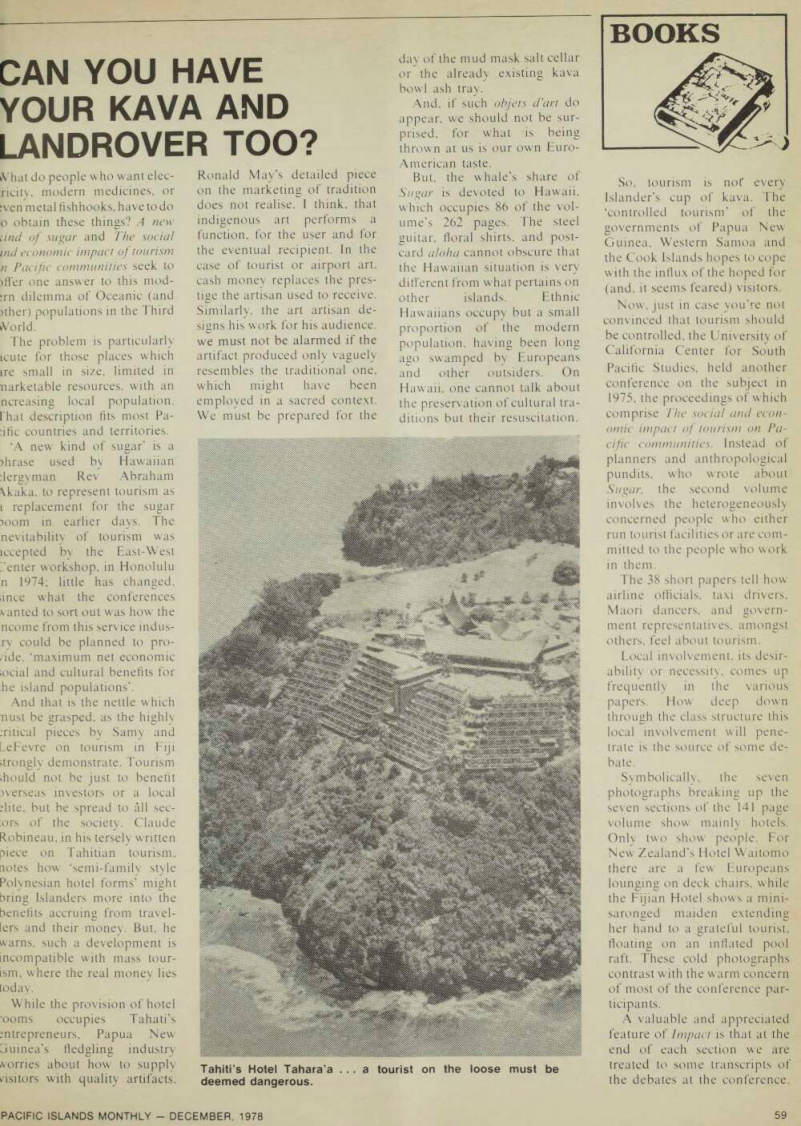
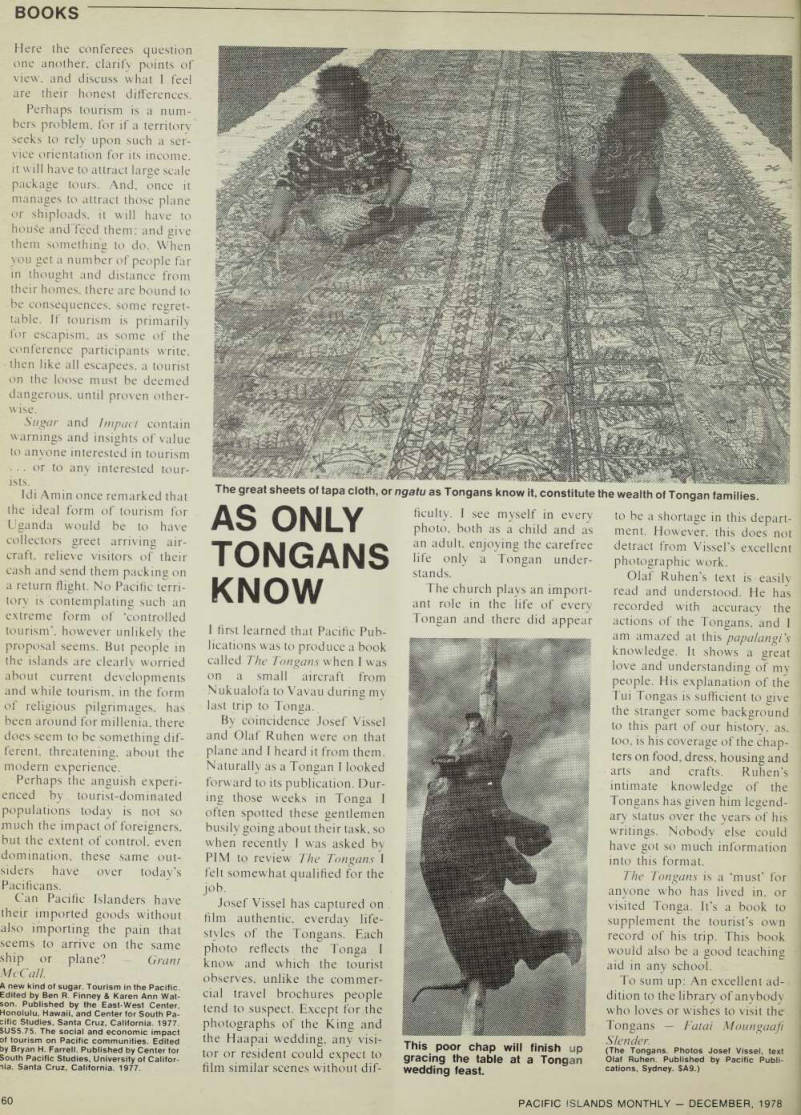
Books
Can You Have
Your Kava And
Landrover Too?
Ahat do people who want elec ricity, modern medicines, or wen metal fishhooks, have todo 0 obtain these things? A new iind of sugar and The social md economic impact of tourism n Pacific communities seek to )ffer one answer to this mod ern dilemma of Oceanic (and nher) populations in the Third World.
The problem is particularly
icute for those places which ire small in size, limited in narketable resources, with an
ncreasing local population,
fhat description fits most Pa :ific countries and territories. ‘A new kind of sugar’ is a
)hrase used by Hawaiian
dergyman Rev Abraham \kaka, to represent tourism as 1 replacement for the sugar worn in earlier days. The nevitability of tourism was iccepted by the East-West renter workshop, in Honolulu n 1974; little has changed. ;ince what the conferences vanted to sort out was how the ncome from this service indus ry could be planned to pro vide. ‘maximum net economic ;ocial and cultural benefits for he island populations’.
And that is the nettle which
nust be grasped, as the highly
:ritical pieces by Sarny and LeFevre on tourism in Fiji ;trongly demonstrate. Tourism ihould not be just to benefit overseas investors or a local elite, but be spread to all sec ;ors of the society. Claude Robineau. in his tersely written piece on Tahitian tourism,
notes how 'semi-family style
Polynesian hotel forms’ might bring Islanders more into the
benefits accruing from travel
lers and their money. But. he warns, such a development is incompatible with mass tour ism, where the real money lies today.
While the provision of hotel
‘ooms occupies Tahati’s
entrepreneurs, Papua New guinea’s fledgling industry worries about how to supply
visitors with quality artifacts.
Ronald May’s detailed piece on the marketing of tradition does not realise. I think, that indigenous art performs a function, for the user and for the eventual recipient. In the case of tourist or airport art. cash money replaces the pres tige the artisan used to receive.
Similarly, the art artisan de signs his work for his audience, we must not be alarmed if the
artifact produced only vaguely
resembles the traditional one. which might have been employed in a sacred context.
We must be prepared for the
day of the mud mask salt cellar or the already existing kava bowl ash tray.
And. if such objets d'art do appear, we should not be sur prised, for what is being thrown at us is our own Euro- American taste.
But, the whale’s share of Sugar is devoted to Hawaii, which occupies 86 of the vol ume’s 262 pages. The steel guitar, floral shirts, and post card aloha cannot obscure that the Hawaiian situation is very different from what pertains on other islands. Ethnic Hawaiians occupy but a small proportion of the modern
population, having been long
ago swamped by Europeans
and other outsiders. On Hawaii, one cannot talk about the preservation of cultural tra ditions but their resuscitation.
So, tourism is nof every Islander’s cup of kava. The ‘controlled tourism’ of the governments of Papua New Guinea, Western Samoa and the Cook Islands hopes to cope with the influx of the hoped for (and. it seems feared) visitors.
Now, just in case you’re not convinced that tourism should be controlled, the University of California Center for South Pacific Studies, held another conference on the subject in 1975, the proceedings of which comprise The social unci econ omic impact of tourism on Pa cific communities. Instead of
planners and anthropological
pundits, who wrote about Sugar , the second volume involves the heterogeneously concerned people who either run tourist facilities or are com mitted to the people who work in them.
The 38 short papers tell how airline officials, taxi drivers, Maori dancers, and govern ment representatives, amongst others, feel about tourism.
Local involvement, its desir ability or necessity, comes up frequently in the various papers. How deep down through the class structure this local involvement will pene trate is the source of some de bate.
Symbolically, the seven photographs breaking up the seven sections of the 141 page volume show mainly hotels.
Only two show people. For New Zealand’s Hotel Waitomo there are a few Europeans lounging on deck chairs, while the Fijian Hotel shows a mini
saronged maiden extending
her hand to a grateful tourist, floating on an inflated pool raft. These cold photographs contrast with the warm concern of most of the conference par
ticipants.
A valuable and appreciated feature of Impact is that at the end of each section we are treated to some transcripts of the debates at the conference.
Tahiti’s Hotel Tahara’a ... a tourist on the loose must be deemed dangerous.
Here the conferees question one another, clarify points of view, and discuss what I feel are their honest differences.
Perhaps tourism is a num bers problem, for if a territory seeks to rely upon such a ser vice orientation for its income, it will have to attract large scale package tours. And. once it manages to attract those plane or shiploads, it will have to houSe and Teed them: and give them something to do. When you get a number of people far in thought and distance from their homes, there are bound to be consequences, some regret table. If tourism is primarily for escapism, as some of the conference participants write, then like all escapees, a tourist on the loose must be deemed dangerous, until proven other wise.
Sugar and Impact contain warnings and insights of value to anyone interested in tourism ... or to any interested tour ists.
Idi Amin once remarked that the ideal form of tourism for Uganda would be to have collectors greet arriving air craft, relieve visitors of their cash and send them packing on a return flight. No Pacific terri tory is contemplating such an extreme form of ‘controlled tourism’, however unlikely the proposal seems. But people in the islands are clearly worried about current developments and while tourism, in the form
of religious pilgrimages, has
been around for millenia, there does seem to be something dif ferent, threatening, about the modern experience.
Perhaps the anguish experi
enced by tourist-dominated populations today is not so much the impact of foreigners, but the extent of control, even domination, these same out siders have over today’s Pacificans.
Can Pacific Islanders have their imported goods without also importing the pain that seems to arrive on the same
ship or plane?
Grant
McCall.
A new kind of sugar. Tourism in the Pacific.
Edited by Ben R. Finney & Karen Ann Wat son. Published by the East-West Center, Honolulu, Hawaii, and Center for South Pa cific Studies, Santa Cruz, California. 1977.
SUSS.7S. The social and economic impact of tourism on Pacific communities. Edited by Bryan H. Farrell. Published by Center for South Pacific Studies, University of Califor oia, Santa Cruz, California. 1977.
Advertisements & other items, p. 59 (1 item)
59
•ACIFIC ISLANDS MONTHLY - DECEMBER, 1978
Tongans
As Only
Know
I first learned that Pacific Pub lications was to produce a book called The Tongans when I was on a small aircraft from Nukualofa to Vavau during my
last trip to Tonga.
By coincidence Josef Vissel and Olaf Ruhen were on that plane and I heard it from them.
Naturally as a Tongan I looked forward to its publication. Dur ing those weeks in Tonga I often spotted these gentlemen busily going about their task, so when recently I was asked by PIM to review The Tongans I felt somewhat qualified for the
job.
Josef Vissel has captured on film authentic, everday life styles of the Tongans. Each photo reflects the Tonga I know and which the tourist observes, unlike the commer cial travel brochures people tend to suspect. Except for the photographs of the King and the Haapai wedding, any visi tor or resident could expect to film similar scenes without dif
ficulty. I see myself in every photo, both as a child and as an adult, enjoying the carefree life only a Tongan under stanc*s* The church plays an import ant role in the life of every Tongan and there did appear
to be a shortage in this depart ment. However, this does not detract from Vissel’s excellent
photographic work.
Olaf Ruhen’s text is easily read and understood. He has recorded with accuracy the actions of the Tongans, and I am amazed at this papalangi’s knowledge. It shows a great love and understanding of my people. His explanation of the Tui Tongas is sufficient to give the stranger some background to this part of our history, as, too, is his coverage of the chap ters on food, dress, housing and arts and crafts. Ruhen’s intimate knowledge of the Tongans has given him legend ary status over the years of his
writings. Nobody else could
have got so much information into this format.
The Tongans is a ‘must’ for anyone who has lived in, or visited Tonga. It’s a book to supplement the tourist’s own record of his trip. This book would also be a good teaching aid in any school.
To sum up; An excellent ad dition to the library of anybody who loves or wishes to visit the
Tongans
Fatal Moungaafi
Slender.
(The Tongans. Photos Josef Vissel, text Olaf Ruhen. Published by Pacific Publi cations, Sydney. SA9.)
The great sheets of tapa cloth, or ngatu as Tongans know it, constitute the wealth of Tongan families.
This poor chap will finish up gracing the table at a Tonqan
wedding feast.
ego-tripping
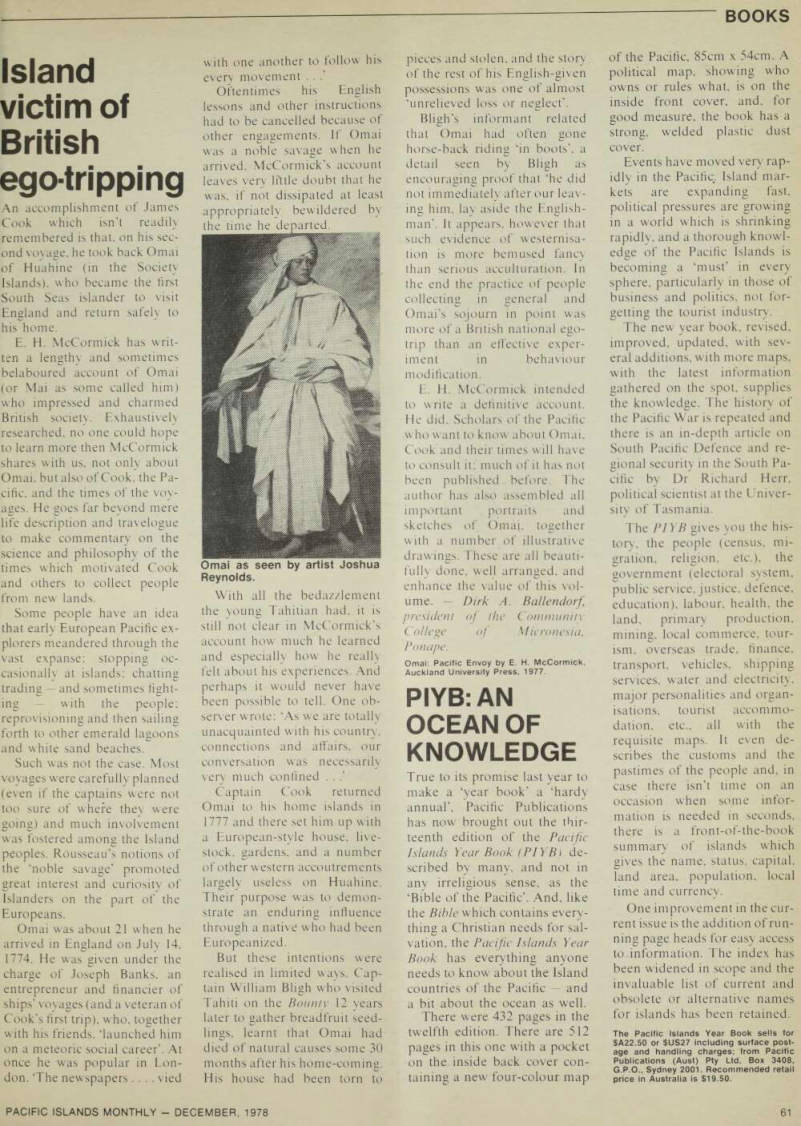
Island victim of British ego-tripping
An accomplishment of James Cook which isn’t readily remembered is that, on his sec ond voyage, he took back Omai of Huahine (in the Society Islands), who became the first South Seas islander to visit England and return safely to his home.
E. H. McCormick has writ ten a lengthy and sometimes belaboured account of Omai (or Mai as some called him) who impressed and charmed British society. Exhaustively researched, no one could hope to learn more then McCormick shares with us. not only about Omai. but also of Cook, the Pa cific. and the times of the voy ages. He goes far beyond mere
life description and travelogue
to make commentary on the science and philosophy of the times which motivated Cook and others to collect people from new lands.
Some people have an idea that early European Pacific ex
plorers meandered through the
vast expanse: stopping oc
casionally at islands: chatting
trading and sometimes fight
ing with the people: reprovisioning and then sailing forth to other emerald lagoons and white sand beaches.
Such was not the case. Most voyages were carefully planned (even if the captains were not too sure of where they were going) and much involvement was fostered among the Island peoples. Rousseau’s notions of the ‘noble savage’ promoted great interest and curiosity of Islanders on the part of the
Europeans.
Omai was about 21 when he arrived in England on July 14. 1774. He was given under the charge of Joseph Banks, an entrepreneur and financier of ships’ voyages (and a veteran of Cook’s first trip), who, together with his friends, ‘launched him on a meteoric social career’. At once he was popular in Lon don. ‘The newspapers ... vied
w ith one another to follow his every movement . . .’
Oftentimes his English lessons and other instructions had to be cancelled because of other engagements. If Omai was a noble savage when he arrived. McCormick’s account leaves very Ifttle doubt that he was, if not dissipated at least
appropriately bewildered by
the time he departed.
With all the bedazzlement the young Tahitian had. it is still not clear in McCormick’s account how much he learned and especially how he really felt about his experiences. And perhaps it would never have been possible to tell. One ob server wrote: ‘As we are totally unacquainted with his country, connections and affairs, our conversation was necessarily very much confined . . .’
Captain Cook returned Omai to his home islands in 1777 and there set him up with a European-style house, live stock. gardens, and a number of other w estern accoutrements largely useless on Huahine.
Their purpose was to demon strate an enduring influence through a native who had been
Europeanized.
But these intentions were realised in limited ways. Cap tain William Bligh who visited Tahiti on the Bounty 12 years later to gather breadfruit seed lings, learnt that Omai had died of natural causes some 30 months after his home-coming.
His house had been torn to
pieces and stolen, and the story of the rest of his English-given possessions was one of almost ‘unrelieved loss or neglect'.
Bligh’s informant related that Omai had often gone horse-back riding ‘in boots', a detail seen by Bligh as encouraging proof that ‘he did not immediately after our leav
ing him. lay aside the English
man'. It appears, however that such evidence of westernisa tion is more bemused fancy than serious acculturation. In the end the practice of people
collecting in general and
Omai’s sojourn in point was more of a British national ego trip than an effective exper iment in behaviour modification.
E. H. McCormick intended to write a definitive account.
He did. Scholars of the Pacific who want to know about Omai.
Cook and their times will have to consult it; much of it has not been published before. The author has also assembled all important portraits and sketches of Omai. together with a number of illustrative drawings. These are all beauti fully done, well arranged, and enhance the value of this vol ume. Dirk A. Ballendorfi president of the Community
College of Micronesia ,
Ponape.
Omai: Pacific Envoy by E. H. McCormick, Auckland University Press, 1977.
Omai as seen by artist Joshua Reynolds.
Piyb: An
Ocean Of
Knowledge
True to its promise last year to make a ‘year book' a ‘hardy annual’. Pacific Publications has now brought out the thir teenth edition of the Pacific Islands Year Book (PIYB) de scribed by many, and not in any irreligious sense, as the ‘Bible of the Pacific’. And, like the Bible which contains every thing a Christian needs for sal vation, the Pacific Islands Year Book has everything anyone needs to know about the Island countries of the Pacific and a bit about the ocean as well.
There were 432 pages in the twelfth edition. There are 512 pages in this one with a pocket on the inside back cover con taining a new four-colour map
of the Pacific, 85cm x 54cm. A
political map, showing who
owns or rules what, is on the inside front cover, and, for good measure, the book has a strong, welded plastic dust cover.
Events have moved very rap idly in the Pacific. Island mar kets are expanding fast,
political pressures are growing
in a world which is shrinking rapidly, and a thorough knowl edge of the Pacific Islands is becoming a ‘must’ in every sphere, particularly in those of business and politics, not for getting the tourist industry.
The new year book, revised,
improved, updated, with sev
eral additions, with more maps, with the latest information gathered on the spot, supplies the knowledge. The history of the Pacific War is repeated and there is an in-depth article on South Pacific Defence and re gional security in the South Pa cific by Dr Richard Herr, political scientist at the Univer sity of Tasmania.
The PI) B gives you the his tory, the people (census, mi
gration. religion, etc.), the
government (electoral system,
public service, justice, defence,
education), labour, health, the
land, primary production,
mining, local commerce, tour ism, overseas trade, finance, transport, vehicles, shipping services, water and electricity,
major personalities and organ
isations, tourist accommo dation, etc., all with the requisite maps. It even de scribes the customs and the pastimes of the people and, in case there isn’t lime on an occasion when some infor mation is needed in seconds, there is a front-of-the-book summary of islands which gives the name, status, capital, land area, population, local time and currency.
One improvement in the cur rent issue is the addition of run ning page heads for easy access to information. The index has been widened in scope and the invaluable list of current and obsolete or alternative names for islands has been retained.
The Pacific Islands Year Book sells tor 5A22.50 or SUS 27 including surface post age and handling charges; from Pacific Publications (Aust) Pty Ltd, Box 3408, G.P.0., Sydney 2001. Recommended retail price in Australia is $19.50.
Advertisements & other items, p. 62 (1 item)
Chloride Batteries Australia Limited
Chloride is the largest and only manufacturer of both lead acid and nickel cadmium alkaline batteries in Australia.
The Company is equipped and qualified to offer advice, guidance and service on any battery requirement no matter how large or small.
On the question of size, it could be as small as a battery for a hearing aid the dimensions of a coat button or a power station battery weighing as much as 40 tonnes.
Again it could be a no break D.C. Power System for a computer or emergency lighting for a hospital.
The Chloride Company operates in 40 countries throughout the world, and when you consider that in Australia alone its production is approaching 1% million batteries per year, it gives some idea of the far reaching role that batteries play in our lives.
A selection of Chloride Automotive and Industrial Batteries
Chloride Batteries Australia Limited
P.O. Box 141, Bankstown. IM.S.W. 2200. Australia. Telephone: 77 0177. Telex: 21262
Ng Missionaries
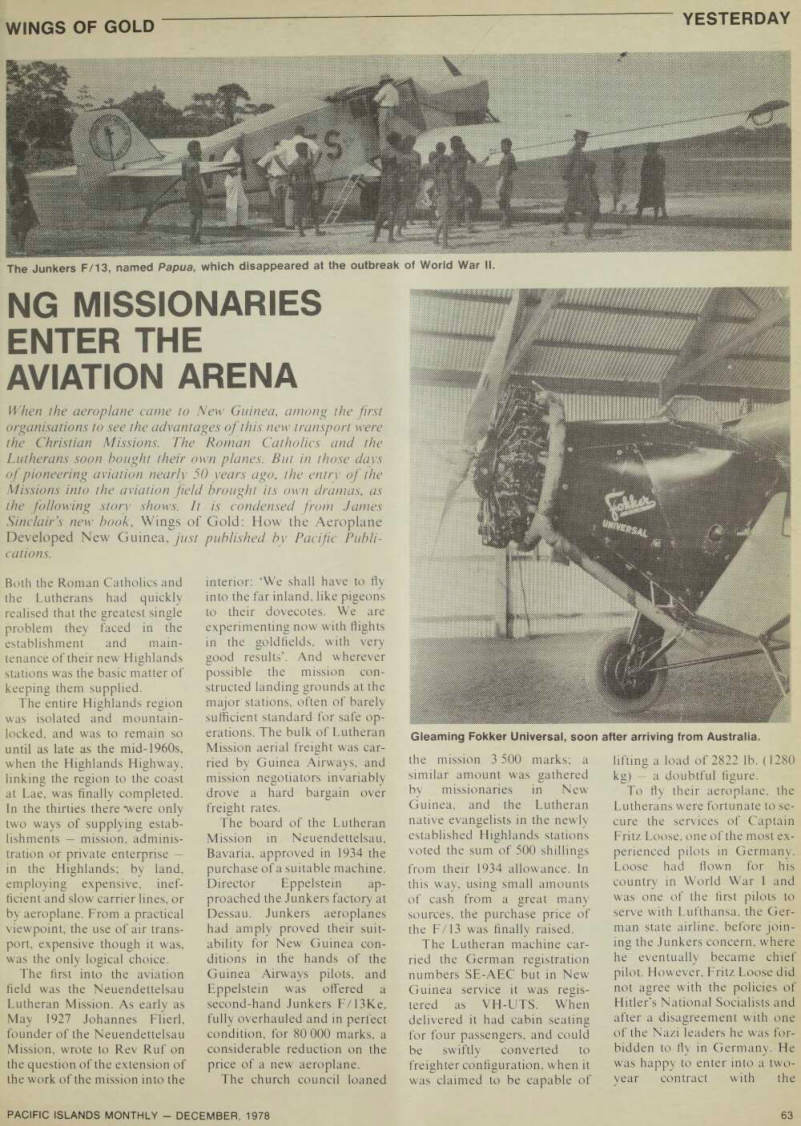

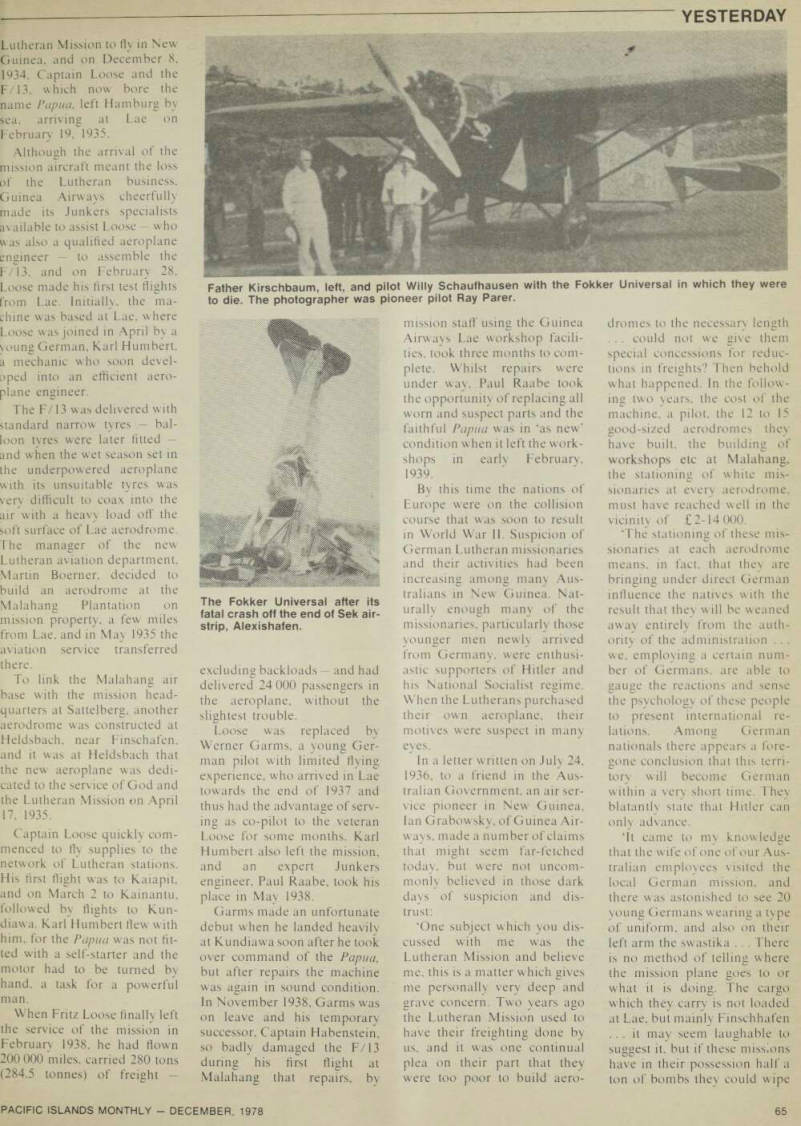

Yesterday
Wings Of Gold
Enter The
Aviation Arena
When the aeroplane came to New Guinea, among the first organisations to see the advantages of this new transport were the Christian Missions. The Roman Catholics and the Lutherans soon bought their own planes. But in those days of pioneering aviation nearly 50 years ago, the entry of the Missions into the aviation field brought its own dramas, as the following story shows. It is condensed from James Sinclair's new book. Wings of Gold: How the Aeroplane Developed New Guinea, just published by Pacific Publi cations.
Both the Roman Catholics and the Lutherans had quickly realised that the greatest single problem they faced in the establishment and main tenance of their new Highlands stations was the basic matter of
keeping them supplied.
The entire Highlands region was isolated and mountain locked, and was to remain so until as late as the mid-19605,
when the Highlands Highway,
linking the region to the coast at Lae, was finally completed.
In the thirties there *were only two ways of supplying estab lishments mission, adminis tration or private enterprise in the Highlands; by land, employing expensive, inef ficient and slow carrier lines, or
by aeroplane. From a practical
viewpoint, the use of air trans port, expensive though it was, was the only logical choice.
The first into the aviation field was the Neuendettelsau Lutheran Mission. As early as May 1927 Johannes Flierl, founder of the Neuendettelsau Mission, wrote to Rev Ruf on the question of the extension of the work of the mission into the
interior: ‘We shall have to fly into the far inland, like pigeons to their dovecotes. We are
experimenting now with flights
in the goldfields, with very good results’. And wherever possible the mission con structed landing grounds at the major stations, often of barely sufficient standard for safe op erations. The bulk of Lutheran Mission aerial freight was car ried by Guinea Airways, and
mission negotiators invariably
drove a hard bargain over
freight rates.
The board of the Lutheran Mission in Neuendettelsau, Bavaria, approved in 1934 the purchase of a suitable machine.
Director Eppelstein ap proached the Junkers factory at Dessau. Junkers aeroplanes had amply proved their suit ability for New Guinea con ditions in the hands of the
Guinea Airways pilots, and
Eppelstein was offered a second-hand Junkers F/13Ke, fully overhauled and in perfect condition, for 80 000 marks, a considerable reduction on the price of a new aeroplane.
The church council loaned
the mission 3 500 marks; a similar amount was gathered by missionaries in New Guinea, and the Lutheran native evangelists in the newly established Highlands stations voted the sum of 500 shillings from their 1934 allowance. In this way, using small amounts of cash from a great many sources, the purchase price of the F/13 was finally raised.
The Lutheran machine carried the German registration numbers SE-AEC but in New Guinea service it was registered as VH-UTS. When delivered it had cabin seating for four passengers, and could be swiftly converted to
freighter configuration, when it
was claimed to be capable of
lifting a load of 2822 lb. (1280
kg) a doubtful figure.
To fly their aeroplane, the Lutherans were fortunate to se cure the services of Captain Fritz Loose, one of the most ex
perienced pilots in Germany.
Loose had flown for his country in World War I and was one of the first pilots to serve with Lufthansa, the Ger man state airline, before join ing the Junkers concern, where he eventually became chief pilot. However, Fritz Loose did not agree with the policies of Hitler’s National Socialists and after a disagreement with one of the Nazi leaders he was for bidden to fly in Germany. He was happy to enter into a two year contract with the
The Junkers F/13, named Papua, which disappeared at the outbreak of World War II.
Gleaming Fokker Universal, soon after arriving from Australia.
Lutheran Mission to fly in New Guinea, and on December 8. 1934. Captain Loose and the F/13, which now bore the name Papua, left Hamburg by sea. arriving at Lae on February 19. 1935.
Although the arrival of the mission aircraft meant the loss of the Lutheran business, Guinea Airways cheerfully
made its Junkers specialists
available to assist Loose who was also a qualified aeroplane engineer to assemble the F/13, and on February 28.
Loose made his first test flights from Lae. Initially, the ma chine was based at Lae. where Loose was joined in April by a young German. Karl Humbert, a mechanic who soon devel oped into an efficient aero
plane engineer.
The F/13 was delivered with standard narrow tyres bal loon tyres were later fitted and when the wet season set in
the underpowered aeroplane
with its unsuitable tyres was very difficult to coax into the air with a heavy load off the soft surface of Lae aerodrome.
The manager of the new Lutheran aviation department.
Martin Boerner. decided to build an aerodrome at the Malahang Plantation on mission property, a few miles from Lae. and in May 1935 the aviation service transferred there.
To link the Malahang air base with the mission head quarters at Sattelberg, another aerodrome was constructed at Heldsbach. near Finschafen. and it was at Heldsbach that the new aeroplane was dedi cated to the service of God and the Lutheran Mission on April 17. 1935.
Captain Loose quickly com
menced to fly supplies to the network of Lutheran stations.
His first flight was to Kaiapit, and on March 2 to Kainantu. followed by flights to Kun diawa. Karl Humbert flew with him, for the Papua was not fit ted with a self-starter and the motor had to be turned by hand, a task for a powerful man.
When Fritz Loose finally left the service of the mission in February 1938, he had flown 200 000 miles, carried 280 tons (284.5 tonnes) of freight -
excluding backloads and had delivered 24 000 passengers in the aeroplane, without the
slightest trouble.
Loose was replaced by
Werner Garms, a young Ger man pilot with limited flying experience, who arrived in Lae towards the end of 1937 and thus had the advantage of serv ing as co-pilot to the veteran Loose for some months. Karl Humbert also left the mission, and an expert Junkers engineer, Paul Raabe, took his
place in May 1938.
Garms made an unfortunate debut when he landed heavily at Kundiawa soon after he took over command of the Papua, but after repairs the machine was again in sound condition.
In November 1938, Garms was on leave and his temporary successor. Captain Habenstein, so badly damaged the F/13 during his first flight at
Malahang that repairs, by
mission staff using the Guinea
Airways Lae workshop facili
ties, took three months to com plete. Whilst repairs were under way, Paul Raabe took the opportunity of replacing all worn and suspect parts and the faithful Papua was in ‘as new’ condition when it left the work
shops in early February,
1939.
By this time the nations of Europe were on the collision course that was soon to result in World War 11. Suspicion of German Lutheran missionaries and their activities had been increasing among many Aus tralians in New Guinea. Nat urally enough many of the missionaries, particularly those younger men newly arrived from Germany, were enthusi astic supporters of Hitler and his National Socialist regime.
When the Lutherans purchased their own aeroplane, their motives were suspect in many eyes.
In a letter written on July 24, 1936, to a friend in the Aus tralian Government, an air ser vice pioneer in New Guinea, lan Grabowsky, of Guinea Air ways, made a number of claims that might seem far-fetched today, but were not uncom monly believed in those dark days of suspicion and dis trust; ‘One subject which you dis cussed with me was the Lutheran Mission and believe me. this is a matter which gives me personally very deep and grave concern. Two years ago the Lutheran Mission used to have their freighting done by us, and it was one continual plea on their part that they were too poor to build aero
dromes to the necessary length ... could not we give them special concessions for reduc tions in freights? Then behold what happened. In the follow ing two years, the cost of the machine, a pilot, the 12 to 15
good-sized aerodromes they
have built, the building of
workshops etc at Malahang,
the stationing of white mis sionaries at every aerodrome, must have reached well in the vicinity of £2-14 000.
The stationing of these mis sionaries at each aerodrome means, in fact, that they are bringing under direct German influence the natives with the result that they will be weaned away entirely from the auth ority of the administration . . . we. employing a certain num ber of Germans, are able to gauge the reactions and sense the psychology of these people to present international re lations. Among German nationals there appears a fore gone conclusion that this terri tory will become German within a very short time. They blatantly state that Hitler can
only advance.
‘lt came to my knowledge that the wife of one of our Aus tralian employees visited the local German mission, and there was astonished to see 20 young Germans wearing a type of uniform, and also on their left arm the swastika . . . There is no method of telling where the mission plane goes to or what it is doing. The cargo which they carry is not loaded at Lae, but mainly Finschhafen ... it may seem laughable to suggest it, but if these missions have in their possession half a ton of bombs they could wipe
The Fokker Universal after its fatal crash off the end of Sek air strip, Alexishafen.
Father Kirschbaum, left, and pilot Willy Schaufhausen with the Fokker Universal in which they were to die. The photographer was pioneer pilot Ray Parer.
)ut all our aircraft in half an lour and the whole of our istablishment. ..’
Grabowsky went on to admit hat his fears could well attract /ery adverse criticism but that le would be failing in his duty o Australia if he did not ex cess his views.
There is no doubt that the
Papua was employed purely on
he religious business of the Mission, but the leroplane vanished from the Mew Guinea scene in a mys erious, and curious, way. As he month of August 1939 drew 0 a close war in Europe ippeared inevitable, and in 'act it was to come within days, Werner Garms and Paul Raabe loaded the Papua with
:argo for Ogelbeng. the
Lutheran station near Mt.
Hagen and flew away from Vlalahang never to return.
While they were in the Highl ands war was declared and LJarms and Raabe decided on
1 bold move: they would fly
he aeroplane out of the Man dated Territory of New Guinea md endeavour to escape to
Europe. They flew to Kaiapit
md refuelled from mission >tocks there and on takeoff the lunkers was seen to turn away from Lae, to the south-west.
Later, it was found that they bad reached Merauke, in Dutch New Guinea.
There was indignation in New Guinea when the news of the escape of Garms and Raabe became known, and the authorities were blamed for failing to arrest the Junkers. ‘An executive officer of one
aviation company sought per
mission from the administra tion to send a machine out to seize the foreign and its crew,’ ran a report in Pacific
Islands Monthly. ‘Authority
was not obtained, and the Ger man machine disappeared from the Territory.’
The ultimate fate of the Papua is unknown. Garms and Raabe made their way by steamer to Japan and travelled
via the Trans-Siberia Railway
through Russia into Germany
where both of these brave men joined the Luftwaffe. Garms died in his blazing warplane over the Crimean front when the Germans invaded Russia.
The German Catholic
Mission of the Holy Ghost. So ciety of the Divine Word. East ern New Guinea, was established in 1896 and in 1909 the principal station of the mission was developed at Sek.
Alexishafen. 10 miles (16 km) north of Madang.
When the Catholic faith was extended to the Highlands, church authorities were as quick as the Lutherans to move to acquire their own aero planes. An aerodrome was con structed. 2.5 miles (4 km) from
with their Junkers Papua were making a greater success of their aerial operations than were the Catholics and the mission agreed to purchase a more suitable aeroplane. Suit able machines available in Australia were inspected, and
the aeroplane finally chosen
was a Fokker Universal, an
American-designed high-wing
monoplane built by Atlantic
Aircraft Corporation, a sub sidiary of the Fokker Aircraft Corporation of America.
Sek. equipped with hangar and workshops, and on August 5, 1935. the mission purchased its first aeroplane, a German Klemm L2sd-2 Swallow low
wing monoplane.
The pretty little Klemm. a two-seater, was christened Paulus and was soon flying supplies to the main mission
outstations. The pilot, Willy
Schaufhausen. was skilful and dedicated to the service of the mission and although the Klemm was hardly a freighter, it proved to be so valuable to the Eastern New Guinea mission that another was acquired in April 1937. This machine was given the name Petrus; a young priest. Father John Glover with less than 100
hours flying experience, com
menced piloting the little Klemm in 1938 and rapidly im proved his skill.
But the two Klemms. useful
as they were, were really only
sports machines; the Lutherans
The Fokker Universal had been flying in Australia since January 1929. A bulky ma chine. with a wing span of just under 48 feet (14.7 m) the Universal could carry two crew and four passengers at a maxi mum speed of 118 mph (190 km/h) and it was decid edly a better aeroplane for the work of the mission than were the Klemms.
In May 1939. the mission’s
chief pilot, Willy
Schaufhausen, took delivery of the Fokker in Adelaide. With him was veteran New Guinea pilot Ray Parer. Schaufhausen lacked experience of heavy air craft and long distance flying and wisely the mission engaged Parer to pilot the aeroplane back to Alexishafen.
Willy Schaufhausen was a
good pilot. During his years of
flying in the little Klemm monoplanes he had four times
experienced flying accidents;
on one occasion after an engine
failure he kept his machine in the for half an hour and suc ceeded in reaching an aero drome: on another he was caught in a steep mountain valley by a powerful down draught. and the aeroplane lost 2000 feet (520 m) of altitude in seconds before Schaufhausen regained control after the Klemm passed over a huge grass fire which provided his light machine with vital lift. No pilot cound have survived five years of New Guinea flying if he was incompetent.
It is, however, a fact that the
pilot of an aeroplane is legally
in command and bears the
final responsibility of ensuring
that the machine is in air
worthy condition, properly
loaded, before he takes off.
The terrible accident that de stroyed the Fokker. its crew and passengers the worst disaster in New Guinea avi ation history to that time must therefore be blamed upon
the pilot.
On August 6, 1939.
Schaufhausen prepared for a flight to Salamaua. The Fokker was loaded with a quantity of
freight and three missionary
priests the renowned Fr Franz Joseph Kirschbaum. Fr Superior Jakob Weyer, vicar to Bishop Wolf at Alexishafen. and Fr Otto Bader took their seats in the aeroplane, together with a native mission worker.
When Schaufhausen com menced his takeoff run from Sek aerodrome at 8.30 am the Fokker was overloaded by some 50%. Two hundred yards
beyond the aerodrome, just
after becoming airborne, the Fokker plunged into a grove of coconut palms killing all occupants.
There is no doubt that the Fokker had been overloaded; aircraft inspector P. L. Taylor, who was on the scene the same day. established this conclus
ively.
The bodies were recovered but terribly mangled, and all five were buried in a common grave that evening. Of the vic tims, the best known was Fr Kirschbaum. A priest of the Central New Guinea mission.
Fr Kirschbaum had lived in the Mandated Territory for over 25 years, most of which he spent on the mighty Sepik River.
Captain Fritz Loose, left, with German associates and the Junkers F/13.
Advertisements & other items, pp. 64-68 (1 item)
Let ¥!Ota Show You
■- Automatic Hydrostatic Transaxle transmission with limited slip differential Speed ranges°o-4 and 0-8 m.p.h. mm / m ♦ r
cultivates, mows and doesn't
cost the earth.
OPTIONAL ATTACHMENTS
Moldboard Plough Attachment. Rolling coulter slices a big 31 cm (12") furrow.
Rotary Tiller. Tills 84 cm (33") wide. Cast iron wheel weights available to increase penetration.
Meet the Victa 16 h.p. heavy duty Compact Tractor. It gives you advanced labour saving features and versatile job capabilities at a price and running cost that are right for the casual farmer or smallholder. Features include: 16 h.p. Briggs & Stratton 4-stroke engine and electric key start. Safety interlock switching. Hydraulic rear lift linkage and automatic transmission with two speed ranges. Alternator charging and dual sealed beam headlights allow for after-dark working.
Rear drawbar with power take-off to drive rotary attachment.
Victa After Sales Service and Spare Parts are available throughout Australia and the Pacific Islands. 1.27 m (50") Triple Blade Cutting Head is PTO driven, follows ground contours for closer, more even mowing.
Spring Shank Cultivator.
Shank position adjustable for crop width. 4 gang, 16 disc, Tandem harrow, also available.
SEE A
DEALER NOW
FOR A DEMONSTRATION
L 84.0082
miHj^
Save hundreds of dollars 1
on Australia's most efficient I
WALK IN, ALUMINIUM I
COOLiOOMS AND ***
FREEZE ROOMS! I
Hundreds already installed! The most economical supplementary coolrooms for bottles and food, providing the largest storage capacity of any comparable coolrooms of the same exterior dimensions. Five sizes—from 90-360 cu. ft. capacity; 16 models offering normal temp., two temp., deep freeze, or for pastry and ice storage applications. White vinyl interior, embossed rustproof aluminium exterior.
Q SUPPLIED IN EASY-TO-ERECT, DO-IT-YOURSELF KIT FORM.
AVAILABLE FROM;
AUSTRALIAN NEW CALEDONIA EXPORTS. 363 George St, Sydney,2ooo BRECKWOLDT & CO., Cnr King & George St., Sydney,2ooo HAGEMEYER (A'SIA). 59 Anzac Pde., Kensington,2o33.
GEOFFREY HUGHES & CO., 167 Macquarie St. Sydney 2000 NELSON & ROBERTSON PTY.LTD. 197 Clarence St Sydney 2000 E. RABOT (EXPORTS) PTY. LTD., 67 Castlereagh St. Sydney 2000 RABTRAD NIUGINI PTY. LTD. PO Box 1406 Lae.
A. RIETTE (PACIFIC) PTY.LTD., 300 George St., Sydney 2000 C. SULLIVAN (EXPORT) PTY.LTD., GPO Box 3373, Sydney,2ool W.S. TAIT & CO., pty.ltd., 31 Macquarie Place, Sydney,2ooo
Manufactured by:
frigid loofrooms
FRIGID CABINETS PTY. LTD,,
14A Puffy Ave., Thornleigh, N.S.W. 2120 Ausf. Ph. 848 8292. pd
Q E
offers expert insurance service
throughout the Islands.
QBE INSURANCE LIMITED
Central Office: 82 Pitt Street, Sydney.
NEW CALEDONIA - T.A. Hagen, Ste. I/V.A. Johnston, S.A.R.L. - Noumea.
NEW HEBRIDES - Manager: G.F. Donnelly, Vila; Santo Santr; Borns Phi Ip (New Hebrides) Ltd.
TAHITI - Arthur Chung: Immeub/e B.L, Front de Mer, Papeete.
NIUE, NORFOLK ISLAND, SAMOA, TONGA and other South Sea Islands Burns Philp (South Sea) Company L td.
QUEENSLAND INSURANCE (FIJI) LIMITED
Head Office, 34 Usher St., SUVA. General Manager: L.G. Liddell. A.A.1.1.
Assistant Managers: Vijay Lai and J.T. Laidlaw. LAUTOKA Office, Burns Philp Bldg. District Manager- J Dalton
QUEENSLAND INSURANCE (P.N.C.) LIMITED
PAPUA NEW GUINEA -
Head Office, PORT MORESBY. General Manager; J.M. Dawe. Assistant Manager- R V Maskeil District Managers at: LAE; I.R. Martin. MOUNT HAGEN: D.F. Carroll. ARAWA: J. Longbut. MADANG. R.W.V. Ceilings. RABAUL. W.F. Tinker.
'T
isa
r*.&rmP^3
>* / f »»,r H '•>** s . • % i** 5* ~vv > ? - «S^«h
CATERPILLAR SKIDDERS ARE BUILT TOUGH
TO STAY ON THE JOB
Cat-built Skidders have protection all
round. You get protection for man and
machine with the roll-over canopy and
other machine guarding. And you get
protection against excessive downtime with
dependable CAT construction, CAT dealer
backup and easy on the job maintenance.
THE CATERPILLAR 518 SKIDDER
features 120 flywheel
horsepower @ 2200 rpm,
powered by the Cat 3304
turbocharged engine, with an
operating weight of 20,400 lbs,
turning diameter of 34' 8" and
utilises a Gearmatic 119 winch
with a linepull (max.) of 32,000 lbs.
QUIET OPERATION
You get low noise levels from the 4-stroke cycle diesel, muffler and low-speed fan. You'll hear the difference in Cat-built Skidders.
STRONG DOZER BLADES
deck and bunch logs, clear brush, protect the radiator. The blades are high-strength steel with trunnions that never need greasing. Dozer blades are box-sectioned for greater strength and durability.
LOW RATED RPM
4 STROKE CYCLE DIESEL
MUFFLER LOW-SPEED
FAN RUGGED ARCH AND
FAIRLEAD
stand up under heavy loads.
The main roller is a Lifetime Lubricated hardened casting to reduce scarring that tears up cables. Side rollers are heat-treated for long life.
MUFFLER
LOW RATED RPM
FAN
ML SP
HASTINGS DEERING
LAE :
Milford Haven Road, Telephone 42 2355
PORT MORESBY :
Telephone 256650
BOUGAINVILLE :
Itakara Industrial Park, Arawa. Telephone 959077 c
carptrac
SUVA : Carpenter Street, Raiwai.
Private Mail Bag, GPOSuva. Fiji. Ph. 381622, Telex FJ2190 Cables CARPTRAC LAUTOKA : Veitari. Telephone 61877 LABASA : Vulovi, Telephone 81888 Caterpillar, Cat and 33 are Trademarks of Caterpillar Tractor Co
YOUR
CATERPILLAR
DEALER
BA 10441
People
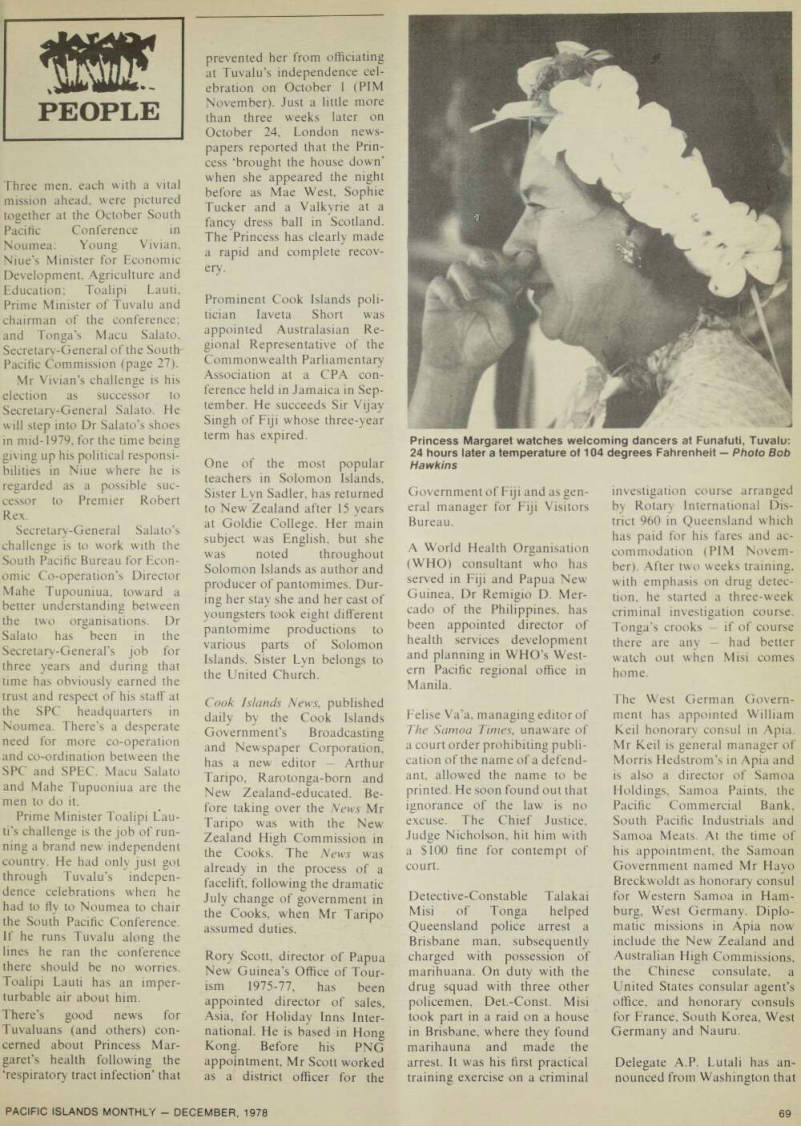
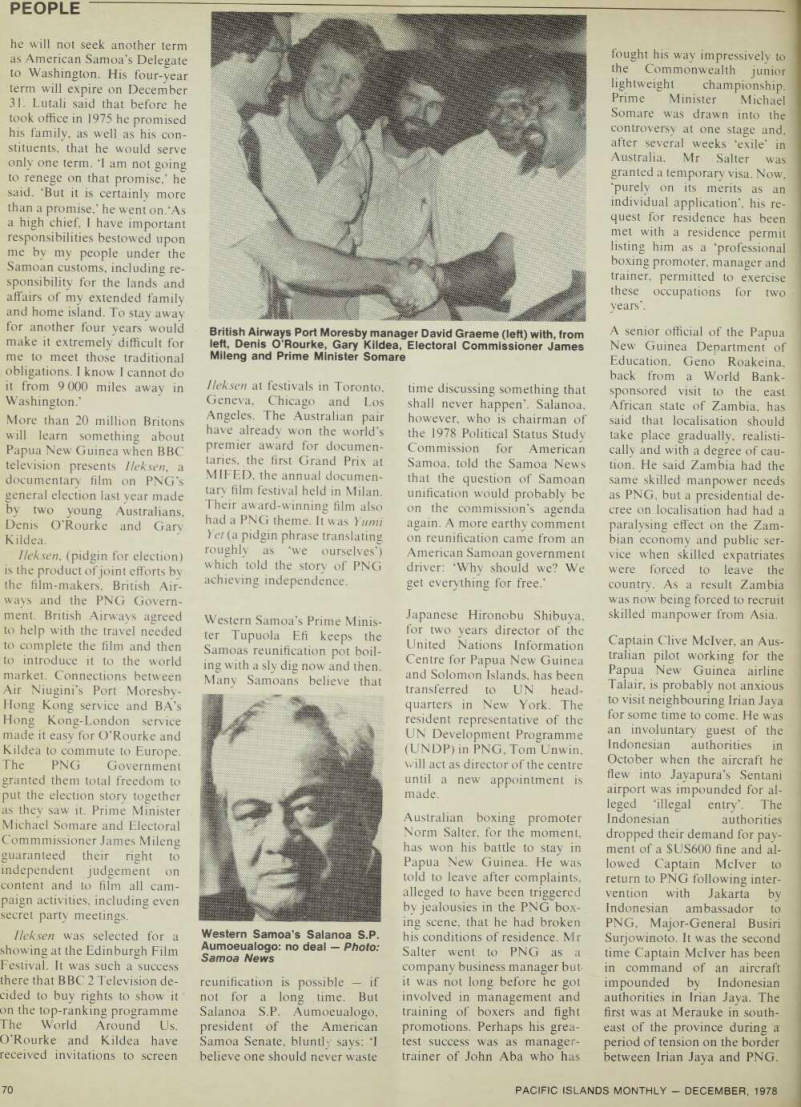
Three men, each with a vital mission ahead, were pictured together at the October South Pacific Conference in Noumea: Young Vivian, Niue’s Minister for Economic Development, Agriculture and Education; Toalipi Lauti, Prime Minister of Tuvalu and chairman of the conference; and Tonga’s Macu Salato, Secretary-General of the South' Pacific Commission (page 27).
Mr Vivian’s challenge is his election as successor to Secretary-General Salato. He will step into Dr Salato’s shoes in mid-1979, for the time being
giving up his political responsi
bilities in Niue where he is regarded as a possible suc cessor to Premier Robert Rex.
Secretary-General Salato’s
challenge is to work with the South Pacific Bureau for Econ omic Co-operation’s Director Mahe Tupouniua, toward a better understanding between the two organisations. Dr Salato has been in the Secretary-General’s job for three years and during that time has obviously earned the trust and respect of his staff at the SPC headquarters in Noumea. There’s a desperate need for more co-operation and co-ordination between the SPC and SPEC. Macu Salato and Mahe Tupuoniua are the men to do it.
Prime Minister Toalipi Lau d’s challenge is the job of run ning a brand new independent country. He had only just got
through Tuvalu’s indepen
dence celebrations when he had to fly to Noumea to chair the South Pacific Conference.
If he runs Tuvalu along the lines he ran the conference there should be no worries.
Toalipi Lauti has an imper turbable air about him.
There’s good news for Tuvaluans (and others) con cerned about Princess Mar
garet’s health following the
‘respiratory tract infection’ that
prevented her from officiating at Tuvalu’s independence cel ebration on October 1 (PIM November). Just a little more than three weeks later on October 24, London news papers reported that the Prin cess ‘brought the house down’ when she appeared the night before as Mae West, Sophie Tucker and a Valkyrie at a fancy dress ball in Scotland.
The Princess has clearly made a rapid and complete recov ery.
Prominent Cook Islands poli tician laveta Short was appointed Australasian Re gional Representative of the Commonwealth Parliamentary Association at a CPA con ference held in Jamaica in Sep tember. He succeeds Sir Vijay
Singh of Fiji whose three-year
term has expired.
One of the most popular teachers in Solomon Islands, Sister Lyn Sadler, has returned to New Zealand after 15 years at Goldie College. Her main subject was English, but she was noted throughout Solomon Islands as author and
producer of pantomimes. Dur
ing her stay she and her cast of youngsters took eight different pantomime productions to various parts of Solomon Islands. Sister Lyn belongs to the United Church.
Cook Islands News, published daily by the Cook Islands
Government’s Broadcasting
and Newspaper Corporation,
has a new editor Arthur Taripo, Rarotonga-born and New Zealand-educated. Be fore taking over the News Mr Taripo was with the New Zealand High Commission in the Cooks. The News was already in the process of a facelift, following the dramatic July change of government in the Cooks, when Mr Taripo assumed duties.
Rory Scott, director of Papua New Guinea’s Office of Tour ism 1975-77, has been appointed director of sales, Asia, for Holiday Inns Inter national. He is based in Hong Kong. Before his PNG appointment, Mr Scott worked as a district officer for the
Government of Fiji and as gen eral manager for Fiji Visitors Bureau.
A World Health Organisation (WHO) consultant who has served in Fiji and Papua New Guinea, Dr Remigio D. Mer cado of the Philippines, has been appointed director of health services development and planning in WHO’s West ern Pacific regional office in Manila.
Felise Va’a, managing editor of The Samoa Times, unaware of a court order prohibiting publi cation of the name of a defend ant, allowed the name to be printed. He soon found out that ignorance of the law is no excuse. The Chief Justice, Judge Nicholson, hit him with a $lOO fine for contempt of court.
Detective-Constable Talakai Misi of Tonga helped Queensland police arrest a Brisbane man, subsequently charged with possession of marihuana. On duty with the drug squad with three other policemen, Det.-Const. Misi took part in a raid on a house in Brisbane, where they found marihauna and made the arrest. It was his first practical training exercise on a criminal
investigation course arranged by Rotary International Dis trict 960 in Queensland which has paid for his fares and ac commodation (PIM Novem ber). After two weeks training, with emphasis on drug detec tion, he started a three-week criminal investigation course.
Tonga’s crooks if of course there are any had better watch out when Misi comes home.
The West German Govern ment has appointed William Keil honorary consul in Apia.
Mr Keil is general manager of Morris Hedstrom’s in Apia and is also a director of Samoa Holdings, Samoa Paints, the Pacific Commercial Bank, South Pacific Industrials and Samoa Meats. At the time of his appointment, the Samoan Government named Mr Hayo Breckwoldt as honorary consul for Western Samoa in Ham
burg, West Germany. Diplo
matic missions in Apia now include the New Zealand and Australian High Commissions, the Chinese consulate, a United States consular agent’s office, and honorary consuls for France, South Korea, West Germany and Nauru.
Delegate A.P. Lutali has an nounced from Washington that
Princess Margaret watches welcoming dancers at Funafuti, Tuvalu: 24 hours later a temperature of 104 degrees Fahrenheit Photo Bob Hawkins
he will not seek another term as American Samoa’s Delegate
to Washington. His four-year
term will expire on December 31. Lutali said that before he took office in 1975 he promised his family, as well as his con stituents, that he would serve only one term. T am not going to renege on that promise,’ he said. ‘But it is certainly more than a promise,’ he went on.‘As a high chief, I have important responsibilities bestowed upon me by my people under the Samoan customs, including re sponsibility for the lands and affairs of my extended family and home island. To stay away for another four years would make it extremely difficult for me to meet those traditional obligations. I know I cannot do it from 9 000 miles away in
Washington.’
More than 20 million Britons will learn something about Papua New Guinea when BBC television presents Ileksen, a documentary film on PNG’s general election last year made by two young Australians, Denis O'Rourke and Gary Kildea.
Ileksen, (pidgin for election) is the product of joint efforts by the film-makers, British Air ways and the PNG Govern
ment. British Airways agreed
to help with the travel needed to complete the film and then to introduce it to the world market. Connections between
Air Niugini’s Port Moresby-
Hong Kong service and BA’s
Hong Kong-London service
made it easy for O’Rourke and Kildea to commute to Europe.
The PNG Government granted them total freedom to put the election story together as they saw it. Prime Minister Michael Somare and Electoral Commmissioner James Mileng guaranteed their right to
independent judgement on
content and to film all cam
paign activities, including even
secret party meetings.
Ileksen was selected for a showing at the Edinburgh Film Festival. It was such a success there that BBC 2 Television de cided to buy rights to show it
on the top-ranking programme
The World Around Us.
O’Rourke and Kildea have received invitations to screen
Ileksen at festivals in Toronto, Geneva, Chicago and Los Angeles. The Australian pair have already won the world’s premier award for documen taries. the first Grand Prix at MIFED, the annual documen tary film festival held in Milan.
Their award-winning film also had a PNG theme. It was Yumi Yet (a pidgin phrase translating roughly as ‘we ourselves’) which told the story of PNG
achieving independence.
Western Samoa’s Prime Minis ter Tupuola Efi keeps the Samoas reunification pot boil ing with a sly dig now and then.
Many Samoans believe that
reunification is possible if not for a long time. But Salanoa S.P. Aumoeualogo, president of the American Samoa Senate, bluntly says: ‘I believe one should never waste
time discussing something that
shall never happen’. Salanoa, however, who is chairman of the 1978 Political Status Study Commission for American Samoa, told the Samoa News that the question of Samoan unification would probably be on the commission’s agenda again. A more earthy comment on reunification came from an American Samoan government driver: ‘Why should we? We get everything for free.’
Japanese Hironobu Shibuya,
for two years director of the United Nations Information Centre for Papua New Guinea and Solomon Islands, has been transferred to UN head quarters in New York. The resident representative of the
UN Development Programme
(UNDP) in PNG, Tom Unwin, will act as director of the centre until a new appointment is made.
Australian boxing promoter Norm Salter, for the moment, has won his battle to stay in Papua New Guinea. He was told to leave after complaints, alleged to have been triggered by jealousies in the PNG box ing scene, that he had broken his conditions of residence. Mr Salter went to PNG as a company business manager but it was not long before he got involved in management and training of boxers and fight promotions. Perhaps his grea test success was as manager trainer of John Aba who has
fought his way impressively to the Commonwealth junior
lightweight championship.
Prime Minister Michael Somare was drawn into the controversy at one stage and, after several weeks ‘exile’ in Australia, Mr Salter was granted a temporary visa. Now, ‘purely on its merits as an individual application’, his re quest for residence has been met with a residence permit listing him as a ‘professional boxing promoter, manager and trainer, permitted to exercise these occupations for two years’.
A senior official of the Papua New Guinea Department of Education, Geno Roakeina, back from a World Bank sponsored visit to the east African state of Zambia, has said that localisation should
take place gradually, realisti
cally and with a degree of cau tion. He said Zambia had the same skilled manpower needs as PNG, but a presidential de cree on localisation had had a paralysing effect on the Zam bian economy and public ser vice when skilled expatriates were forced to leave the country. As a result Zambia was now being forced to recruit skilled manpower from Asia.
Captain Clive Mclver, an Aus tralian pilot working for the Papua New Guinea airline Talair, is probably not anxious to visit neighbouring Irian Jaya for some time to come. He was an involuntary guest of the Indonesian authorities in October when the aircraft he flew into Jayapura’s Sentani airport was impounded for al
leged ‘illegal entry’. The
Indonesian authorities dropped their demand for pay ment of a SUS6OO fine and al lowed Captain Mclver to return to PNG following inter vention with Jakarta by Indonesian ambassador to PNG, Major-General Busiri Surjowinoto. It was the second time Captain Mclver has been in command of an aircraft
impounded by Indonesian
authorities in Irian Jaya. The first was at Merauke in south east of the province during a period of tension on the border between Irian Jaya and PNG.
British Airways Port Moresby manager David Graeme (left) with, from left, Denis O’Rourke, Gary Kildea, Electoral Commissioner James Mileng and Prime Minister Somare
Western Samoa’s Salanoa S.P.
Aumoeualogo: no deal -Photo: Samoa News
Deaths
of Islands People
)R N. N. Malua
)r Nacanieli Namosi Malua, 16. after collapsing at a rugby natch. Head of Lautoka
Jospital’s general outpatient
lepartment. Dr Malua was videly known in Fiji for his >rowess as an athlete and ugby footballer in student lays. Leaves a widow and three hildren.
Tji Johnson
Villiam Granger Johnson, bet er known to people in Fiji as fui (‘Chief) Johnson, has died n Australia at 78. Mr Johnson vas the managing director of Carpenters Ltd and gave long ervice as a member of Fiji’s >ld Legislative Council in the olonial government. Suva’s brmer mayor, Len Usher, in a
tribute in the Fiji Times , wrote: ‘Mr Johnson’s close association with the Fijian people, and his deep concern for their progress and welfare, began in his early youth, when he acquired the name Tui. Ratu Sir Lala Sukuna demonstrated the high regard in which he held him by naming him as executor of his estate.’ Mr Johnson lived in Fiji for 70 years.
Mrs E. Havea
Mrs Etina Havea, wife of Dr Sione ‘Amanaki Havea, prin cipal of the Pacific Theological College (PTC), in Suva, Fiji.
Dr Havea took his wife home to Tonga for burial.
808 Mackie
Bob Mackie has died in Madang, aged 66. Born in the United Kingdom and educated in Australia, he came to PNG during World War II and never left. He worked mainly in the Sepik and Madang areas.
Discharged from the army in PNG he became a labour recruiter.
Advertisements & other items, pp. 71-72 (1 item)
Henry Cumines
PACIFIC
ISLANDS
TRANSPORT
LINE
MS CAMELLIA VENTURE
Express Freight Service between Pacific Coast Ports of U.S.A. and...
Tahiti 6 Samoa
PAPEETE - APIA PAGO PAGO
Full container service including reefers.
GENERAL STEAMSHIP CORPORATION LTD.
General Agents 400 California Street, San Francisco, California, U.S.A.
APIA: Bums Philp (South Sea) Company Ltd.
PAPEETE: Agence Maritime Internationale, Tahiti.
PAGO PAGO: Polynesia Shipping Services Inc.
HENRY CUMINES
PTY LTD.
EXPORTERS o GENERAL MERCHANTS
428 GEORGE ST., SYDNEY
CABLES: HENCO SYDNEY. G.P.O. Box 3949. PHONE:, 232-5377
For specialised and personalised buying service
throughout the Pacific Islands and the East.
LOCAL AGENTS AND REPRESENTATION: •-
PAPUA NEW GUINEA;
RABAUL: M. & C. Seeto, P.O. Box 131, Rabaul.
Telephone 92-2919.
MADANG: W, Double, P.O. Box 22, Madang.
Telephone 82-2696.
FIJI:
K. Witherington Ltd., P.O. Box 293, Suva.
Telephone 22-356.
NEW HEBRIDES:
John Lum & Associates, P.O. Box 65, Santo.
Telephone 329.*
SOLOMON ISLANDS:
Mr. Tom Lo, P.O. Box 327, Honiara.
Telephone 399.
Resident Agents in other Pacific Territories. •-
World Wide
Finance
Corporation
PTY. LTD.
FOR:
EQUITY PARTICIPATION
DEVELOPMENT FUNDING
RE FINANCE, OFF-SHORE FUNDING
JOINT VENTURES
COMPETITIVE INTEREST RATES
INQUIRIES:
P.O. BOX 2397, BRISBANE.
PHONE: (07) 221 7151.
A.H. 378 3341.
You better deal with...
DEMKA
(AUSTRALIA) PTY LTD.
...if you want to deal better
...with the many manufacturers, established in various parts of the world, but on an exclusive basis and...
in the South Pacific only.
We are an exception for every manufacturer we represent, which is to the...
buyer’s advantage.
The management and staff wish you all and your families a Merry Christmas and a Happy and Healthy New Year 7 Coggins Place, Mascot, Sydney 2020. Telex: 21416. Telephone: 669 5344.
Headaches Galore
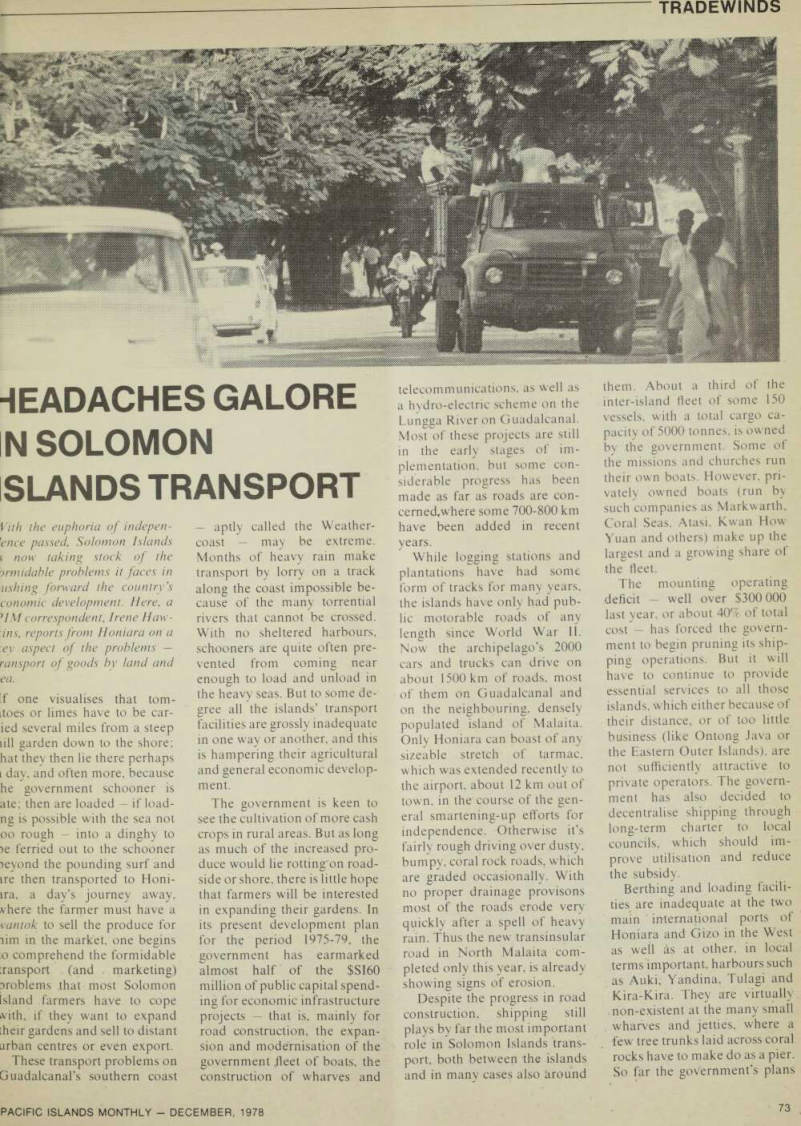
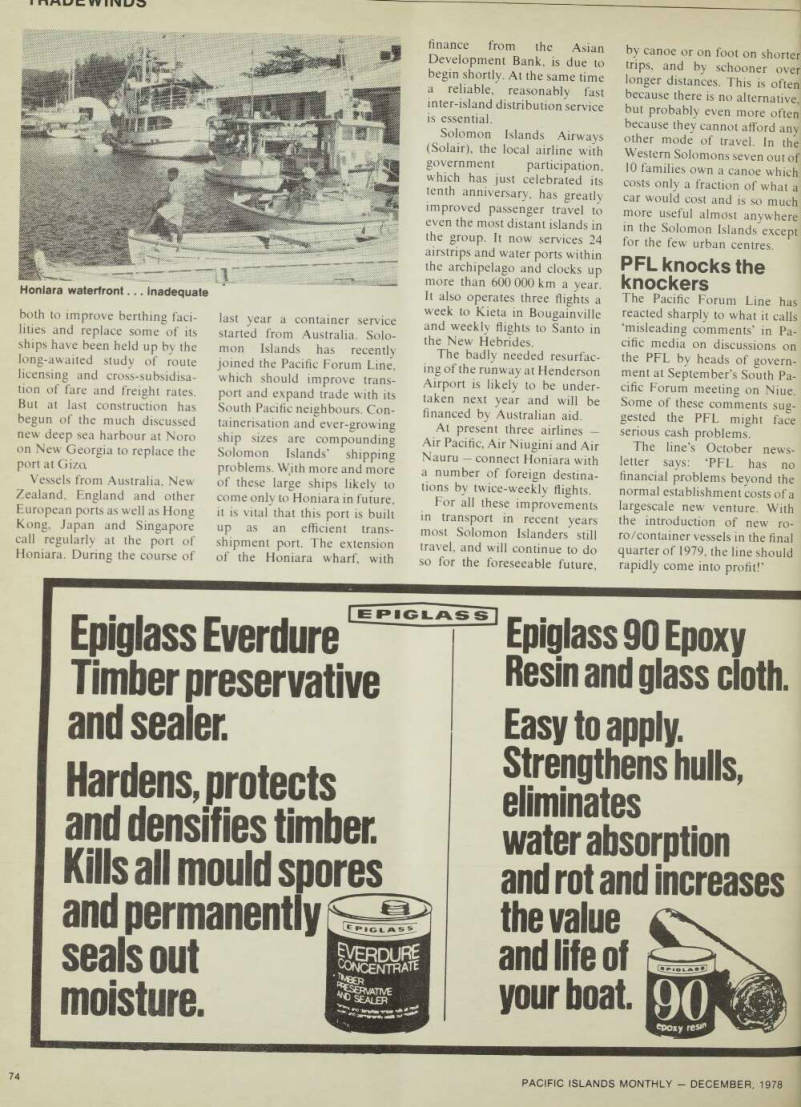
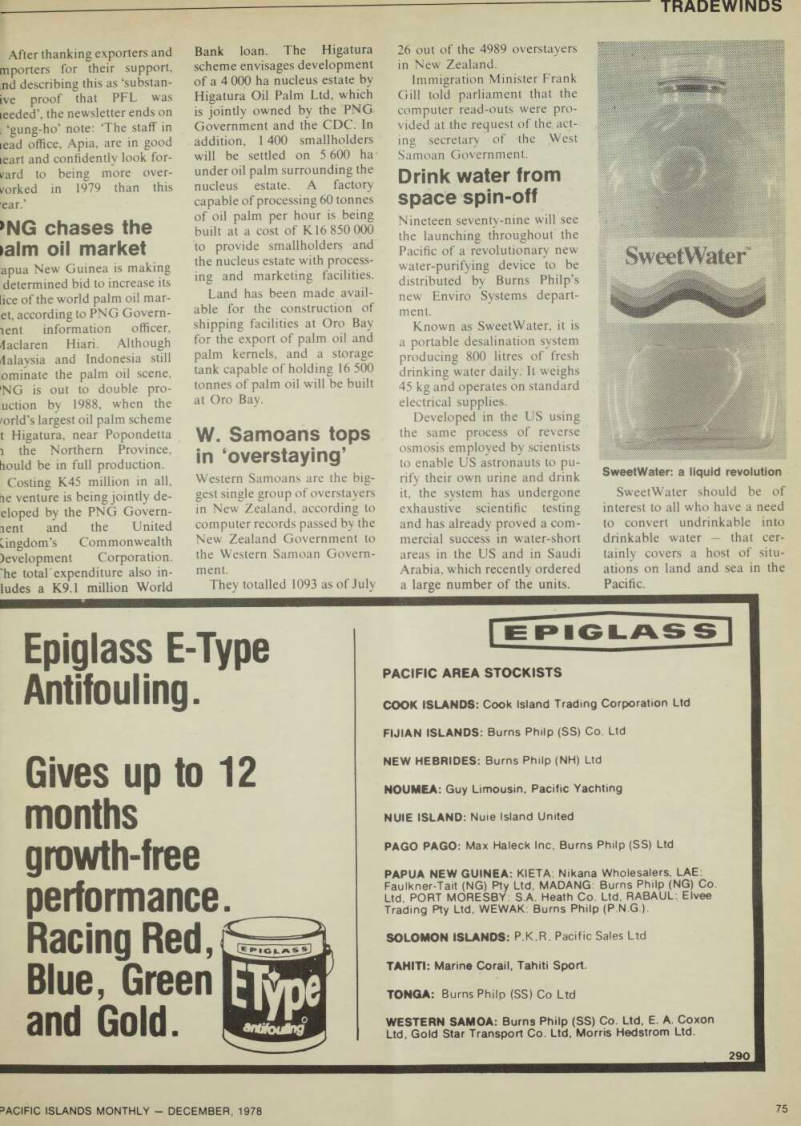
Tradewinds
Nsolomon
Slands Transport
Vith the euphoria of indepen
dence passed, Solomon Islands
? now taking stock of the ormidable problems it faces in ashing forward the country's conomic development. Here , a
*IM correspondent , Irene Haw
ins, reports from Honiara on a
:ey aspect of the problems
ransport of goods by land and
ea.
T one visualises that tom itoes or limes have to be car ied several miles from a steep fill garden down to the shore; hat they then lie there perhaps i day, and often more, because he government schooner is ate; then are loaded if load ng is possible with the sea not oo rough into a dinghy to )e ferried out to the schooner )eyond the pounding surf and ire then transported to Honi
ira, a day’s journey away,
vhere the farmer must have a xantok to sell the produce for lim in the market, one begins
;o comprehend the formidable
transport (and marketing)
Droblems that most Solomon Island farmers have to cope
with, if they want to expand
their gardens and sell to distant urban centres or even export.
These transport problems on Guadalcanal’s southern coast
telecommunications, as well as a hydro-electric scheme on the Lungga River on Guadalcanal.
Most of these projects are still in the early stages of im plementation, but some con siderable progress has been made as far as roads are con cemedtwhere some 700-800 km have been added in recent years.
While logging stations and plantations have had some form of tracks for many years, the islands have only had pub lic motorable roads of any length since World War 11.
Now the archipelago’s 2000 cars and trucks can drive on about 1500 km of roads, most of them on Guadalcanal and
on the neighbouring, densely
populated island of Malaita.
Only Honiara can boast of any sizeable stretch of tarmac, which was extended recently to the airport, about 12 km out of town, in the course of the gen eral smartening-up efforts for independence. Otherwise it’s fairly rough driving over dusty, bumpy, coral rock roads, which
are graded occasionally. With
no proper drainage provisons
most of the roads erode very quickly after a spell of heavy rain. Thus the new transinsular road in North Malaita com
pleted only this year, is already
showing signs of erosion.
Despite the progress in road construction, shipping still
plays by far the most important
role in Solomon Islands trans port, both between the islands and in many cases also around
them. About a third of the inter-island fleet of some 150 vessels, with a total cargo ca pacity of 5000 tonnes, is owned by the government. Some of the missions and churches run their own boats. However, pri vately owned boats (run by such companies as Markwarth, Coral Seas, Atasi, Kwan How Yuan and others) make up the largest and a growing share of the fleet.
The mounting operating
deficit well over $3OO 000 last year, or about 40% of total cost - has forced the govern ment to begin pruning its ship ping operations. But it will have to continue to provide essential services to all those islands, which either because of their distance, or of too little business (like Ontong Java or the Eastern Outer Islands), are not sufficiently attractive to private operators. The govern ment has also decided to
decentralise shipping through
long-term charter to local councils, which should im prove utilisation and reduce
the subsidy.
Berthing and loading facili ties are inadequate at the two main in-temational ports of Honiara and Gizo in the West as well as at other, in local terms important, harbours such as Auki, Yandina, Tulagi and Kira-Kira. They are virtually non-existent at the many small wharves and jetties, where a few tree trunks laid across coral rocks have to make do as a pier.
So far the government’s plans
- aptly called the Weather coast - may be extreme.
Months of heavy rain make transport by lorry on a track along the coast impossible be cause of the many torrential rivers that cannot be crossed.
With no sheltered harbours, schooners are quite often pre vented from coming near enough to load and unload in the heavy seas. But to some de gree all the islands’ transport
facilities are grossly inadequate
in one way or another, and this
is hampering their agricultural
and general economic develop
ment.
The government is keen to see the cultivation of more cash crops in rural areas. But as long as much of the increased pro duce would lie rotting”on road side or shore, there is little hope that farmers will be interested in expanding their gardens. In its present development plan for the period 1975-79, the government has earmarked almost half of the SSI6O
million of public capital spend
ing for economic infrastructure projects that is, mainly for road construction, the expan sion and modernisation of the government fleet of boats, the construction of wharves and
both to improve berthing faci lities and replace some of its ships have been held up by the
long-awaited study of route
licensing and cross-subsidisa tion of fare and freight rates.
But at last construction has begun of the much discussed new deep sea harbour at Noro on New Georgia to replace the port at Giza Vessels from Australia, New Zealand, England and other European ports as well as Hong
Kong, Japan and Singapore
call regularly at the port of Honiara. During the course of
last year a container service started from Australia. Solo mon Islands has recently joined the Pacific Forum Line, which should improve trans port and expand trade with its South Pacific neighbours. Con tainerisation and ever-growing
ship sizes are compounding
Solomon Islands’ shipping problems. With more and more
of these large ships likely to
come only to Honiara in future, it is vital that this port is built up as an efficient trans shipment port. The extension of the Honiara wharf, with
finance from the Asian Development Bank, is due to begin shortly. At the same time a reliable, reasonably fast inter-island distribution service is essential.
Solomon Islands Airways (Solair), the local airline with
government participation,
which has just celebrated its
tenth anniversary, has greatly
improved passenger travel to even the most distant islands in the group. It now services 24 airstrips and water ports within the archipelago and clocks up more than 600 000 km a year.
It also operates three flights a week to Kieta in Bougainville and weekly flights to Santo in the New Hebrides.
The badly needed resurfac ing of the runway at Henderson Airport is likely to be under taken next year and will be financed by Australian aid.
At present three airlines Air Pacific, Air Niugini and Air Nauru - connect Honiara with a number of foreign destina
tions by twice-weekly flights.
For all these improvements in transport in recent years most Solomon Islanders still travel, and will continue to do so for the foreseeable future,
by canoe or on foot on shorter trips, and by schooner over longer distances. This is often because there is no alternative, but probably even more often because they cannot afford any other mode of travel. In the Western Solomons seven out of 10 families own a canoe which costs only a fraction of what a car would cost and is so much more useful almost anywhere in the Solomon Islands except for the few urban centres.
PFL knocks the
knockers
The Pacific Forum Line has reacted sharply to what it calls ‘misleading comments’ in Pa cific media on discussions on the PFL by heads of govern ment at September’s South Pa cific Forum meeting on Niue.
Some of these comments sug gested the PFL might face serious cash problems.
The line’s October news letter says; ‘PFL has no financial problems beyond the normal establishment costs of a largescale new venture. With the introduction of new ro ro/container vessels in the final quarter of 1979, the line should rapidly come into profit!’
Honiara waterfront. .. inadequate
After thanking exporters and mporters for their support, ,nd describing this as ‘substan ive proof that PFL was iceded’, the newsletter ends on t ‘gung-ho’ note: ‘The staff in lead office, Apia, are in good ieart and confidently look for ward to being more over worked in 1979 than this ear.’
>NG chases the
talm oil market
apua New Guinea is making determined bid to increase its lice of the world palm oil mar et, according to PNG Govem icnt information officer, daclaren Hiari. Although Malaysia and Indonesia still ominate the palm oil scene, •NG is out to double pro motion by 1988, when the world’s largest oil palm scheme
t Higatura, near Popondetta
i the Northern Province, hould be in full production.
Costing K 45 million in all, tie venture is being jointly de eloped by the PNG Govern lent and the United
kingdom’s Commonwealth
)evelopment Corporation,
"he total expenditure also in ludes a K 9.1 million World
Bank loan. The Higatura scheme envisages development of a 4 000 ha nucleus estate by Higatura Oil Palm Ltd, which is jointly owned by the PNG Government and the CDC. In addition, 1 400 smallholders will be settled on 5 600 ha under oil palm surrounding the nucleus estate. A factory capable of processing 60 tonnes of oil palm per hour is being built at a cost of Kl 6 850 000 to provide smallholders and the nucleus estate with process ing and marketing facilities.
Land has been made avail able for the construction of shipping facilities at Oro Bay for the export of palm oil and palm kernels, and a storage tank capable of holding 16 500 tonnes of palm oil will be built at Oro Bay.
W. Samoans tops
in ‘overstaying’
Western Samoans are the big gest single group of overstayers in New Zealand, according to computer records passed by the New Zealand Government to the Western Samoan Govern ment.
They totalled 1093 as of July
26 out of the 4989 overstayers in New Zealand.
Immigration Minister Frank Gill told parliament that the computer read-outs were pro vided at the request of the act ing secretary of the West Samoan Government.
Drink water from
space spin-off
Nineteen seventy-nine will see the launching throughout the Pacific of a revolutionary new water-purifying device to be distributed by Burns Philp’s
new Enviro Systems depart
ment.
Known as Sweet Water, it is a portable desalination system producing 800 litres of fresh
drinking water daily. It weighs
45 kg and operates on standard
electrical supplies.
Developed in the US using the same process of reverse
osmosis employed by scientists
to enable US astronauts to pu rify their own urine and drink it, the system has undergone exhaustive scientific testing and has already proved a com mercial success in water-short areas in the US and in Saudi Arabia, which recently ordered a large number of the units.
Sweet Water should be of interest to all who have a need to convert undrinkable into drinkable water that cer tainly covers a host of situ ations on land and sea in the Pacific.
Sweet Water: a liquid revolution
Advertisements & other items, pp. 74-76 (3 items)
74
I imuL. ȴ iniuo
PACIFIC ISLANDS MONTHLY - DECEMBER, 1978
Epiglass E verdure
IGLAS S
Timber preservative and sealer.
Hardens, protects and densities timber.
Kills all mould spores and permanently gg® seals out moisture.
tVERDURE
concentrate
SSfRVAHVE
sealer Epiglass 90 Epoxy Resin and glass cloth.
Easy to apply.
Strengthens hulls, eliminates water absorption and rot and increases the value and life of your boat. i I
EPIGLAS S
PACIFIC AREA STOCKISTS
COOK ISLANDS: Cook Island Trading Corporation Ltd FIJIAN ISLANDS: Burns Philp (SS) Co. Ltd NEW HEBRIDES: Burns Philp (NH) Ltd NOUMEA: Guy Limousin. Pacific Yachting NUIE ISLAND: Nuie Island United PAGO PAGO: Max Haleck Inc, Burns Philp (SS) Ltd PAPUA NEW GUINEA: KIETA: Nikana Wholesalers. LAE: Faulkner-Tait (NG) Pty Ltd, MADANG; Burns Philp (NG) Co.
Ltd, PORT MORESBY; S.A. Heath Co. Ltd, RABAUL; Elvee Trading Pty Ltd, WEWAK: Burns Philp (P N G ).
SOLOMON ISLANDS: P.K.R. Pacific Sales Ltd TAHITI: Marine Corail, Tahiti Sport.
TONGA: Burns Philp (SS) Co Ltd WESTERN SAMOA: Burns Philp (SS) Co. Ltd. E. A. Coxon Ltd, Gold Star Transport Co. Ltd, Morris Hedstrom Ltd.
Epiglass E-Type Antifouling.
Gives up to 12 months growth-free performance.
Racing Red, Blue, Green and Gold. •XI
ICJ-
, {dm i ■ v-4v ' nB ■I .
'% A' X/ * * ,y? »
~fc~-«T •
C Mm& f,. * xmm^ :•«, ■ :;X :i: :v- -' ,; '■*■>' ’ m j ■ ■u-.;.
TRADEWINDS INTELLIGENCE ...TRADEWINDS INTELLIGI
UNEMPLOYMENT in New Zealand has sparked criticism ii the Motueka tobacco fields at the top of the South Island of th« Government’s decision to allow 186 Fijians to work in the field this summer . . .
CARLTON Brewery (Fiji) beer sales in the year ended Marcl 31 were $F9.9 million, nearly half a million dollars up on th« previous year, but net profit was down $74 182 to $607 952, allow ing a 17.5% dividend for the year.. .
A TROPICAL hardwoods seminar, with delegates from all ove the Pacific, was held in Suva last month with the aim of finding ways for regional co-operation in field research . . .
WARNER Pacific Line’s latest acquisition, the Sami , is to tak< over from Aidan on the Nukualofa-New Zealand (via Vavau) ser vice, while the Aidan will handle the new Nukualofa-Hawaii (vi; Vavau, Apia. Pago Pago and Christmas Island) service . . .
W.R. CARPENTER Holdings blamed a sharp profit fall for th< year ended June 30 - $F355 000 from $10.3 million last year on adverse trading conditions in Fiji but held its dividend at 112 cents a share . . .
EVERGREEN International Airlines of Arizona has been giver temporary authority by the US Civil Aeronautics Board to pro vide a supplementary service to American Samoa from the US mainland and Hawaii. . .
AIR NIUGINEs Chicago office, its first in the US, has beer opened by PNG Ambassador to the United Nations, Paulia Matane . ..
THE SHIPPING Corporation of Polynesia, taking over operation of Tonga’s inter-island fleet of three, in a move to increase safety measures, has banned passengers from travelling on the
cargo barge Kao . . .
CENTRAL Rentals of Fiji is now operating under the name of Hertz, having acquired the international Hertz Rent A Car licence . ..
GOROKA, Mount Hagen and Rabaul airports in Papua New Guinea are to be upgraded, at a cost of K 1.5 million, to take F2B Fokker Fellowship twin passenger jets . . .
WILLIAMS Shipping Company of Fiji has opened three transshipment routes - Suva-Ratuma-Funafuti, Suva-Santo-Port Vila, and Suva-Futuna-Wallis taking on foreign shipping concerns and the Pacific Forum Line . . .
THE TRANS Tourist Corporation of Fiji showed a net profit of SFIO4 515 in the year ended May 31, $lO 000 up on last year, from sales of $2.9 million, up 20% on the previous year. ..
THE ASIAN Development Bank is planning a survey of agricultural prospects in Solomon Islands, Papua New Guinea, Fiji, Tonga, Western Samoa, the Gilberts and Cook Islands . . .
A CONSORTIUM of three Fiji lumber companies has sold its first shipment of half a million super feet of dakua timber to the US for SF2OS 000 ...
WORK is in progress at the J.J. Sietas shipyard, Hamburg, on two roll-on roll-off container vessels, one each for the Tongan and Western Samoan Governments, both vessels to be leased to the Pacific Forum Line .. .
A GRANT of Yen 200 million (more then SWSBOO 000) has been made by the Japanese Government to Western Samoa to assist
in nutrition improvement.. .
FIJI Sugar Corporation reports a profit of $F6.69 million from sales of $97.7 million in 1977-78 and that 1978-79 production is expected to hit a record 400 000 tonnes . ..
THE PAPUA New Guinea Government is to spend K6O 000 on a cement factory feasibility study in the Highlands . . .
EWINDS INTELLIGENCE...TRADEWINDS INTELLIGENCE.
GO FOR
THE BIG ONE
The enormous wealth in the Pacific must be tapped by Pacific nations themselves. But it needs power; cheap, dependable power: diesel power.
The great diesel power in the world is Detroit Diesel Allison the big one.
These diesel engines work the longest, hardest hours; their power-delivery is impressive; their cost efficiency unequalled.
Detroit Diesel Allison is the world's largest manufacturer of heavy-duty diesel engines with gas turbines and automatic and power shift transmissions, plus torque converters. A complete line of power products, trucks, work boats and heavy equipment. DDA engines range in power from 50 HP to 1600 HP, diesel-powered generator sets from 30 KW to 1100 KW andgasturbineenginesuptos,3oo KW for marine and industrial use. We’ve got what you need to get the job done.
DETROIT DIESEL ALLISON
NOW AVAILABLE THROUGH NEW ZEALAND
For further information forward this coupon to: DETROIT DIESEL ALLISON INTERNATIONAL NEW ZEALAND DIVISION OF GENERAL MOTORS NEW ZEALAND LTD PRIVATE BAG UPPER HUTT Tick box for required brochure |\Jgppjg □ Automotive diesel □ Industrial diesel □ Marine diesel AddreSS □ Generator set □ Transmissions □ Turbines
Detroit Diesel Allison
Division of General Motors Corporation
75
TRADEWINDS
3 ACIFIC ISLANDS MONTHLY - DECEMBER, 1978
Cruising
Yachts
I The next Sydney-Noumea 'acht race is scheduled to itart from Sydney on June 16 lext year. Organisers expect ibout 50 entries and that there vill be at least one all-female ;rew. The last Sydney- Noumea race, in 1977, ittracted 35 starters. » TRITHEAM, a trimaran, jisappeared from the Bay of slands, Suva, in October after a yacht broker, David Lackey, eceived inquiries about it rom a German, Enrique Daehler, Mr Daehler, his wife, 3eb Berthold, and their son, yiarius, who were in Fiji, disap peared about the same time. _ater, a yacht said to resemble he Tritheam, was seen in Solomon Islands but was not ound after Fiji police asked for a check on its identity. Mr.
C.D. Sharma, director of the Fiji Criminal Investigation Department, said Mr. Daehler was wanted by police in sev eral countries to face fraud charges. • EOS, 12.5 m ferro-cement ketch, was a recent arrival in Fiji from San Diego, Acapulco, the Marquesas, Tahiti, the Cook Islands, American and Western Samoa and Tonga.
Eos was built by its owner, a nephew of Jerry Schipper of Union City, California, who took us to task for omitting his nephew’s name from a pre vious reference (July). Unfor tunately he did not tell us his favourite nephew’s name. • ULAH, an Aboriginal name meaning ‘Ripple on the water’, is a 13 m fibre-glass Swanson from Sydney the first hull from the mold. In September, Ulah was at anchor with sister ship SUNBIRD, in the Marovo Lagoon in Solomon Islands. A 1 and Cecily Parks sailed Ulah from Sydney in May 1977 with their daughter, Martine, now aged 12. They made their way
north through the Barrier Reef, then cruised the Louisiade Archipelago to Guadalcanal.
Martine has acquired a mag nificent multi-coloured parrot, Longjohn, which stands watch in the cockpit. On Sunbird are John and Marilyn Morris who sailed from Cairns, Queensland, in August.
Daughters Wendy, 20, and Janet, 17, cruise with their parents during school holidays from James Cook University in Townsville, Queensland. SEALOVE, 9.2 m steel
sloop from Los Angeles, arrived in Vila late September frorfi Fiji. On board were Bob Gibson and Dena Jensen, whose future plans include a stint in Papua New Guinea after extensive cruising through the northern New Hebrides and Solomon Islands. • SCORPIO, an 11.5. m ferro cement cutter-rigged ketch from Kieta, Papua New Guinea, has been built by Keith and Anne Cree. Plans were to sail from Kieta to Rus sel in New Zealand.
Advertisements & other items, pp. 77-78 (1 item)
Frostpak.
HOLDS 48 CANS
Portable Electronic
Solid State Refrigerators
For people on the move Ideal for Campers & Caravans Indispensable for Travellers and Holidaymakers A must for Truckdnvers Popular with Yachts Airciatt and Fishermen ■ Biq cooling performance ■No Gas No Compressor ■ irge 33 Litre capacity ■ Unaffected by motion or level • No noise 01 vibration ■ Low Battery Dram ■ Low Weight - 7 KG ■ Virtually Inoestructable ■ 2 Year Guarantee From 5199 00 mcl Sales Tax For Medical & Technical purposes & Food Samples Connects to 12V Battery or Cigarette Lighter Operates on 240 V with Battery Charger Unitndge 337 Queensben y Street North Melbourne 3051 Phone 328 3583 Telex 32571
Monthly Services
AGENTS
Hong Kong, Taiwan, S. Korea, Japan
To: British Solomon, New Caledonia, Fiji, W Samoa, A. Samoa. Tahiti, Cook Is., Tonga, New Hebrides.
Ellice Is.,
Taiwan,Hong Kong,Singapore,Jakarta,
Philippine
To: Australia, Papua New Guinea, Sabah & Sarawak.
Hong Kong, Taiwan, S. Korea, Japan
To: Guam, Saipan, Truk, Ponape, Other Pacific Islands.
Taiwan: Royal Steamship Corp. Ltd . Taipei S. Korea: Dong Sue Shipping Co , Ltd , Seoul Hong Kong: Dahzun Enterprises Ltd Singapore: Ocean Shipping & Enterprises Pie, Ltd Guam: Maritime Agencies of Pacific Ltd , Guam Saipan: Saipan Shipping Co. Inc. Saipan 8.5.1. P.: Solomon Taiyo Ltd, Honiara Tahiti: J A Cowan & Fils. Papeete Cooks: Eastern Associates Ltd . Rarotonga Tonga: E M Jones Ltd , Nukualofa New Hebrides; Agence Maritime Raymond Velicite, Port Vila A.Samoa: Island Pacific Agencies Inc, Pagd Pago W. Samoa: Morns„ Hedstrom Ltd , Apia Fiji: Carpenter Shipping, Suva & Lautoka PNG: Carpenter Shipping Agencies, Port Moresby, Rabaul New Caledonia: Agence Maritime Du Rond Point Du Pacific, Noumea Indonesia: P T Porodisa Raya Shipping Lines, Jakarta Sabah: KOH Han Ming Shipping & Forwarding Agent..
Kotakmabalu Sarawak: Pan Sarawak Agencies Sdn Bhd . Sibu & Kuching Australia: Hethenngton Kingsbury Pty Ltd.. Sydney, NSW Newzealand: Sofrana Unilines S.A, Auckland
KYOWA SHIPPING CO., LTD.
HEAD OFFICE OSAKA OFFICE
sth FL, Suzumaru Bldg. 39-8, 2-chome, Nishi-Shinbashi, Minatoku, Tokyo, Japan. Frontier Bldg., 3-13 Hirano-cho, Higashi-ku, Osaka, Japan.
Phone : 03(437)2885(Rep.) Cables : “MARIQUEEN” Tokyo. Telex : 242-4651 Kyowa J. Phone : 06(227)0422(Rep.) Cables : “MARIQUEEN” Osaka. Telex : 522-3896 Kyowa 0.
FULL STEAM AHEAD
For all marine repairs, dock inspections, annual overhaul or building of tugs, barges, pleasure crafts Consult the Professionals.
Industrial
"Leaders in Industry"
Phone 312133. Telex FJ2195.
BA 10902
Cruise and fish
in displacement comfort
without burning a hole
in your pocket. ..
9
VSIS&Q&iki'E
DB DIESEL
5.5 m CRUISER
A boat that makes real good sense. Just about the roomiest, uncluttered cockpit around, a lock-up cabin with 2 bunks, galley unit, toilet and good standing room.B Yanmar knots at around 2 litres per hour pushes the low maintenance f/glass hull (trailable if you want). No wonder thinking boaters are switching to Deltacraft!
ADAPTS TO WORKBOAT, TUG, COMMERCIAL FISHER TOO !
DELTACRAFT BOATS, 128 OLD PITTWATER ROAD,
BROOKVALE, NSW, 2100. PH 938 3049.
PACKED BY:
NIPPON SUISAN KAISHA, LTD.
EXPORTED BY:
UNITRADE COMPANY, LIMITED
11-12 3-chome Hachobori Chuo-ku Tokyo
TELEX NO.: “252-4665 KANDK J”
CABLE ADDRESS: “KAYANDKAY TOKYO”
** cT V
4
Shipping
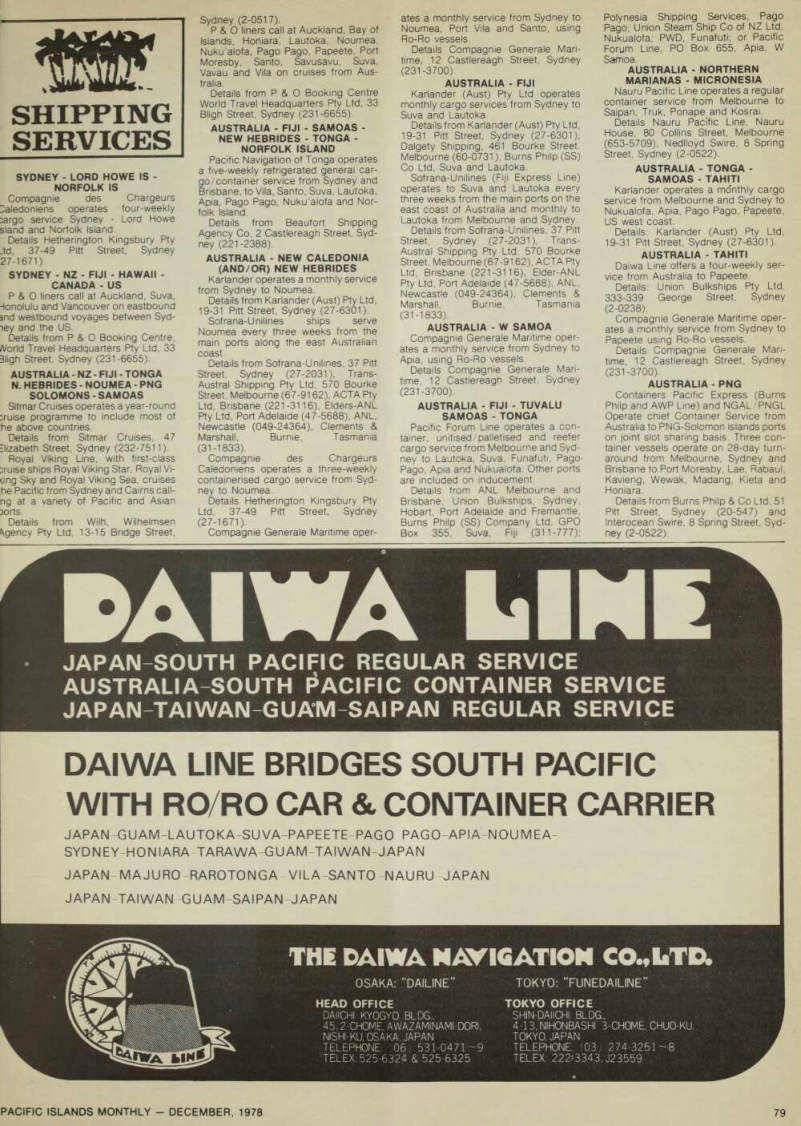
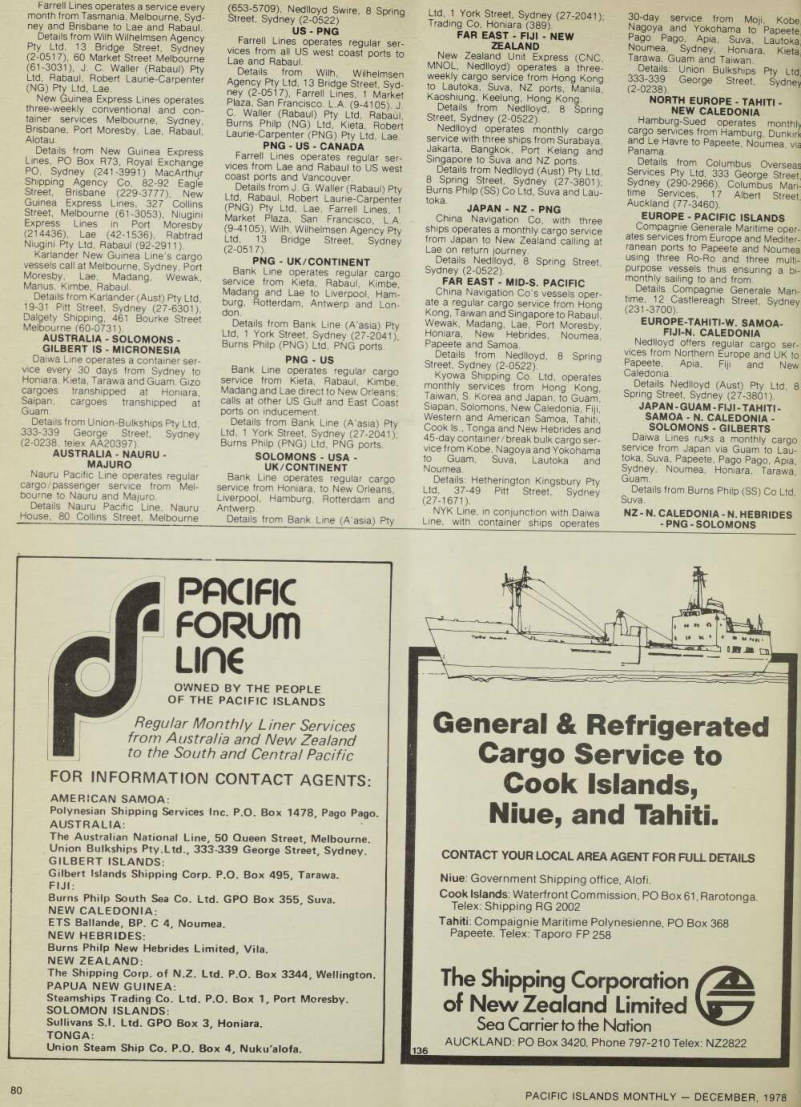
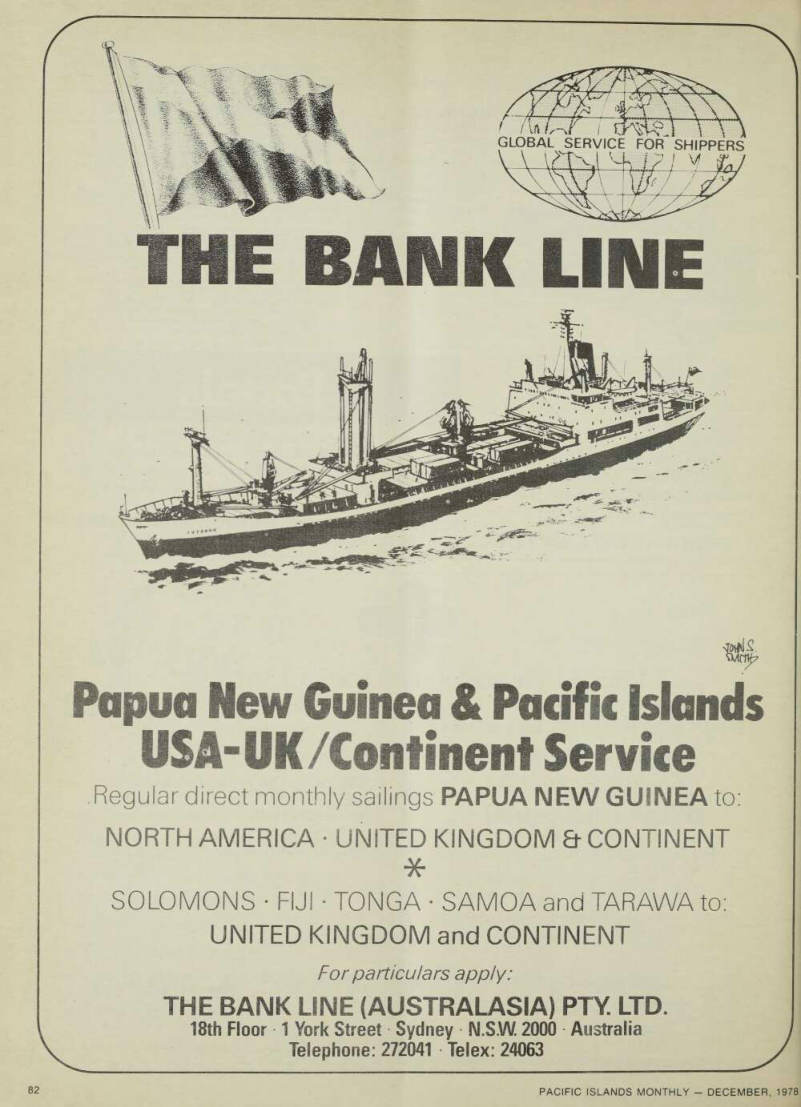
Services
Sydney - Lord Howe Is -
Norfolk Is
Compagnie des Chargeurs Daledoniens operates four-weekly ;argo service Sydney - Lord Howe sland and Norfolk Island.
Details Hetherington Kingsbury Pty _td. 37-49 Pitt Street. Sydney 27-1671).
SYDNEY - NZ - FIJI - HAWAII -
Canada - Us
P & O liners call at Auckland, Suva, Honolulu and Vancouver on eastbound md westbound voyages between Syd ley and the US.
Details from P & O Booking Centre, A/orld Travel Headquarters Pty Ltd, 33 Bligh Street, Sydney (231-6655).
AUSTRALIA - NZ - FIJI - TONGA
N. Hebrides - Noumea - Png
Solomons-Samoas
Sitmar Cruises operates a year-round :ruise programme to include most of he above countries.
Details from Sitmar Cruises, 47 Elizabeth Street, Sydney (232-7511).
Royal Viking Line, with first-class :ruise ships Royal Viking Star. Royal Vi cing Sky and Royal Viking Sea, cruises he Pacific from Sydney and Cairns call ng at a variety of Pacific and Asian Dorts.
Details from Wilh, Wilhelmsen \gency Pty Ltd, 13-15 Bridge Street,
Sydney (2-0517).
P & O liners call at Auckland, Bay of Islands, Honiara, Lautoka, Noumea, Nukualofa, Pago Pago, Papeete, Port Moresby, Santo, Savusavu, Suva, Vavau and Vila on cruises from Aus tralia.
Details from P & O Booking Centre World Travel Headquarters Pty Ltd, 33 Bligh Street, Sydney (231-6655).
Australia - Fiji - Samoas -
New Hebrides - Tonga -
Norfolk Island
Pacific Navigation of Tonga operates a five-weekly refrigerated general car go/container service from Sydney and Brisbane, to Vila, Santo, Suva, Lautoka, Apia, Pago Pago, Nuku’alofa and Nor folk Island.
Details from Beaufort Shipping Agency Co, 2 Castlereagh Street, Syd ney (221-2388).
Australia - New Caledonia
(And/Or) New Hebrides
Karlander operates a monthly service from Sydney to Noumea.
Details from Karlander (Aust) Pty Ltd, 19-31 Pitt Street, Sydney (27-6301).
Sofrana-Unilines ships serve Noumea every three weeks from the main ports along the east Australian coast.
Details from Sofrana-Unilines, 37 Pitt Street, Sydney (27-2031), Trans- Austral Shipping Pty Ltd, 570 Bourke Street, Melbourne (67-9162), ACTA Pty Ltd, Brisbane (221-3116), Elders-ANL Pty Ltd, Port Adelaide (47-5688), ANL, Newcastle (049-24364), Clements & Marshall, Burnie, Tasmania (31-1833).
Compagnie des Chargeurs Caledoniens operates a three-weekly containerised cargo service from Syd ney to Noumea.
Details Hetherington Kingsbury Pty Ltd, 37-49 Pitt Street, Sydney (27-1671).
Compagnie Generate Maritime oper
ates a monthly service from Sydney to Noumea, Port Vila and Santo, using Ro-Ro vessels.
Details Compagnie Generate Mari time, 12 Castlereagh Street, Sydney (231-3700).
Australia - Fiji
Karlander (Aust) Pty Ltd operates monthly cargo services from Sydney to Suva and Lautoka.
Details from Karlander (Aust) Pty Ltd, 19-31 Pitt Street, Sydney (27-6301), Dalgety Shipping, 461 Bourke Street.
Melbourne (60-0731), Burns Philp (SS) Co Ltd, Suva and Lautoka.
Sofrana-Unilines (Fiji Express Line) operates to Suva and Lautoka every three weeks from the main ports on the east coast of Australia and monthly to Lautoka from Melbourne and Sydney.
Details from Sofrana-Unilines, 37 Pitt Street, Sydney (27-2031), Trans- Austral Shipping Pty Ltd, 570 Bourke Street, Melbourne (67-9162), ACTA Pty Ltd, Brisbane (221-3116), Elder-ANL Pty Ltd, Port Adelaide (47-5688), ANL, Newcastle (049-24364), Clements & Marshall, Burnie, Tasmania (31-1833).
Australia - W Samoa
Compagnie Generate Maritime oper ates a monthly service from Sydney to Apia, using Ro-Ro vessels.
Details Compagnie Generate Mari time, 12 Castlereagh Street, Sydney (231 -3700).
Australia - Fiji - Tuvalu
Samoas - Tonga
Pacific Forum Line operates a con tainer, unitised/palletised and reefer cargo service from Melbourne and Syd ney to Lautoka, Suva, Funafuti, Pago- Pago, Apia and Nukualofa. Other ports are included on inducement.
Details from ANL Melbourne and Brisbane, Union Bulkships, Sydney, Hobart, Port Adelaide and Fremantle, Burns Philp (SS) Company Ltd, GPO Box 355, Suva, Fiji (311-777);
Polynesia Shipping Services, Pago Pago; Union Steam Ship Co of NZ Ltd, Nukualofa; PWD, Funafuti; or Pacific Forum Line, PO Box 655, Apia, W Samoa.
Australia - Northern
Marianas - Micronesia
Nauru Pacific Line operates a regular container service from Melbourne to Saipan, Truk, Ponape and Kosrai.
Details Nauru Pacific Line, Nauru House, 80 Collins Street, Melbourne (653-5709), Nedlloyd Swire, 8 Spring Street, Sydney (2-0522).
Australia - Tonga -
Samoas - Tahiti
Karlander operates a mo'nthly cargo service from Melbourne and Sydney to Nukualofa, Apia, Pago Pago, Papeete, US west coast.
Details: Karlander (Aust) Pty Ltd, 19-31 Pitt Street, Sydney (27-6301).
Australia - Tahiti
Daiwa Line offers a four-weekly ser vice from Australia to Papeete.
Details: Union Bulkships Pty Ltd, 333-339 George Street. Sydney (2-0238).
Compagnie Generate Maritime oper ates a monthly service from Sydney to Papeete using Ro-Ro vessels.
Details Compagnie Generate Mari time. 12 Castlereagh Street, Sydney (231-3700).
Australia - Png
Containers Pacific Express (Burns Philp and AWP Line) and NGAL/PNGL Operate chief Container Service from Australia to PNG-Solomon Islands ports on joint slot sharing basis. Three con tainer vessels operate on 28-day turn around from Melbourne. Sydney and Brisbane to Port Moresby, Lae, Rabaul, Kavieng, Wewak, Madang, Kieta and Honiara.
Details from Burns Philp & Co Ltd, 51 Pitt Street, Sydney (20-547) and Interocean Swire, 8 Spring Street, Syd ney (2-0522).
Farrell Lines operates a service every month from Tasmania, Melbourne, Syd ney and Brisbane to Lae and Rabaul.
Details from Wilh Wilhelmsen Agency Pty Ltd, 13 Bridge Street, Sydney (2-0517), 60 Market Street Melbourne (61-3031), J. C. Waller (Rabaul) Pty Ltd, Rabaul, Robert Laurie-Carpenter (NG) Pty Ltd, Lae.
New Guinea Express Lines operates three-weekly conventional and con tainer services Melbourne, Sydney, Brisbane. Port Moresby, Lae, Rabaul, Alotau.
Details from New Guinea Express Lines, PO Box R 73, Royal Exchange PO, Sydney (241-3991) MacArthur Shipping Agency Co, 82-92 Eagle Street, Brisbane (229-3777), New Guinea Express Lines, 327 Collins Street, Melbourne (61-3053), Niugini Express Lines in Port Moresby (214436), Lae (42-1536), Rabtrad Niugini Pty Ltd, Rabaul (92-2911).
Karlander New Guinea Line’s cargo vessels call at Melbourne, Sydney, Port Moresby, Lae. Madang, Wewak, Manus, Kimbe, Rabaul.
Details from Karlander (Aust) Pty Ltd 19-31 Pitt Street. Sydney (27-6301).
Dalgety Shipping, 461 Bourke Street Melbourne (60-0731).
Australia - Solomons -
Gilbert Is - Micronesia
Daiwa Line operates a container ser vice every 30 days from Sydney to Honiara, Kieta, Tarawa and Guam. Gizo cargoes transhipped at Honiara, Saipan, cargoes transhipped at Guam.
Details from Union-Bulkships Pty Ltd, 333-339 George Street, Sydney (2-0238, telex AA20397).
Australia - Nauru -
Majuro
Nauru Pacific Line operates regular cargo/passenger service from Mel bourne to Nauru and Majuro.
Details Nauru Pacific Line, Nauru House, 80 Collins Street, Melbourne
(653-5709), Nedlloyd Swire, 8 Spring Street, Sydney (2-0522)
Us-Png
Farrell Lines operates regular ser vices from all US west coast ports to Lae and Rabaul.
Details from Wilh, Wilhelmsen Agency Pty Ltd, 13 Bridge Street, Syd ney (2-0517), Farrell Lines, 1 Market Plaza, San Francisco. L.A. (9-4105) J C. Waller (Rabaul) Pty Ltd, Rabaul Burns Philp (NG) Ltd, Kieta, Robert Laurie-Carpenter (PNG) Pty Ltd Lae
Png - Us - Canada
Farrell Lines operates regular ser vices from Lae and Rabaul to US west coast ports and Vancouver.
Details from J. G. Waller (Rabaul) Pty Ltd, Rabaul, Robert Laurie-Carpenter (PNG) Pty Ltd, Lae, Farrell Lines, 1 Market Plaza, San Francisco, L.A. (9-4105), Wilh, Wilhelmsen Agency Pty Ltd, 13 Bridge Street, Sydney (2-0517).
Png - Uk/Continent
Bank Line operates regular cargo service from Kieta, Rabaul, Kimbe, Madang and Lae to Liverpool, Ham burg, Rotterdam. Antwerp and Lon don.
Details from Bank Line (A’asia) Pty Ltd, 1 York Street. Sydney (27-2041) Burns Philp (PNG) Ltd, PNG ports.
Png - Us
Bank Line operates regular cargo service from Kieta. Rabaul, Kimbe, Madang and Lae direct to New Orleans calls at other US Gulf and East Coast ports on inducement.
Details from Bank Line (A’asia) Pty Ltd, 1 York Street, Sydney (27-2041); Burns Philp (PNG) Ltd, PNG ports.
Solomons - Usa -
Uk/Continent
Bank Line operates regular cargo service from Honiara, to New Orleans, Liverpool, Hamburg, Rotterdam and Antwerp.
Details from Bank Line (A’asia) Pty
y d ’ Street, Sydney (27-2041); Trading Co, Honiara (389 T
Far East - Fiji - New
Zealand
New Zealand Unit Express (CNC, MNOL, Nedlloyd) operates a threeweekly cargo service from Hong Kong to Lautoka, Suva, NZ ports, Manila, Kaoshiung Keetung, Hong Kong.
Details from Nedlloyd, 8 Spring St M e Hii Sy H ney (2 ‘ 0522 )- Nedlloyd operates monthly cargo service with three ships from Surabaya, Jakarta, Bangkok, Port Kelang and Singapore to Suva and NZ ports.
Details from Nedlloyd (Aust) Pty Ltd, (2 7‘ ^ol); burns Philp (SS) Co Ltd, Suva and Lau-
Toka Japan-Nz-Png
China Navigation Co, with three ships operates a monthly cargo service from Japan to New Zealand calling at Lae on return journey.
Details Nedlloyd, 8 Spring Street Sydney (2-0522). ’
Far East - Mid-S. Pacific
China Navigation Co’s vessels operate a regular cargo service from Hong Kong, Taiwan and Singapore to Rabaul, Wewak, Madang, Lae, Port Moresby, Honiara, New Hebrides, Noumea Papeete and Samoa, ’
Details from Nedlloyd, 8 Spring Street, Sydney (2-0522).
Kyowa Shipping Co. Ltd, operates monthly services from Hong Kong Taiwan, S. Korea and Japan, to Guam’
Siapan, Solomons, New Caledonia, Fiji,’
Western and American Samoa, Tahiti’
Cook Is., Tonga and New Hebrides and 45-day container/break bulk cargo service from Kobe, Nagoya and Yokohama to Guam, Suva, Lautoka and Noumea.
Details: Hetherington Kingsbury Pty Ltd, 37-49 Pitt Street, Sydney (27-1671).
NYK Line, in conjunction with Daiwa Line, with container ships operates
30-day service from Moji, Kobe, Nagoya and Yokohama to Papeete Pago Pago, Apia, Suva, Lautoka!
Noumea, Sydney, Honiara, Kieta, Tarawa, Guam and Taiwan.
Details: Union Bulkships Pty Ltd 333-339 George Street, Sydney (2-0238).
North Europe - Tahiti -
New Caledonia
Hamburg-Sued operates monthly cargo services from Hamburg, Dunkirk and Le Havre to Papeete, Noumea via Panama, Details from Columbus Overseas Services Pty Ltd, 333 George Street Sydney (290-2966), Columbus Mari time Services, 17 Albert Street Auckland (77-3460).
Europe - Pacific Islands
Compagnie Generale Maritime oper ates services from Europe and Mediter ranean ports to Papeete and Noumea using three Ro-Ro and three multi purpose vessels thus ensuring a bi monthly sailing to and from.
Details Compagnie Generale Mari time, 12 Castlereagh Street, Sydney (231-3700).
Europe-Tahiti-W. Samoa
Fiji-N. Caledonia
Nedlloyd offers regular cargo ser vices from Northern Europe and UK to Papeete, Apia, Fiji and New Caledonia.
Details Nedlloyd (Aust) Pty Ltd, 8 Spring Street, Sydney (27-3801).
Japan-Guam - Fiji-Tahiti -
Samoa - N. Caledonia -
Solomons - Gilberts
Daiwa Lines ruSs a monthly cargo service from Japan via Guam to Lau toka, Suva, Papeete, Pago Pago, Apia, Sydney, Noumea, Honiara, Tarawa Guam.
Details from Burns Philp (SS) Co Ltd Suva.
NZ - N. CALEDONIA ■ N. HEBRIDES
-Png-Solomons
Sofrana Unilines with three ships op rates to Vila and Santo, to Honiara and 'apua New Guinea and to Noumea.
Details from Sofrana Unilines, 18 tustoms Street, Auckland (773-279), O Box 3614, Telex NZ2313.
Iz - Australia - New Caledonia
- Solomons - Gilberts -
Micronesia
Union Co/Daiwa Line operate a con liner service from New Zealand trough Sydney to Noumea. Honiara, arawa and Guam, Transhipment to aipan, Majuro and Gizo.
Details: Union Steam Ship Co of NZ td, PO Box 12, Auckland, or Union ulkships Pty Ltd, 333-339 George treet, Sydney, (2-0238).
MZ - FIJI - NORTH AMERICA (WC) Blue Star Line Crusader service to test Coast North America. Only direct jrvice to and from New Zealand. Blue tar vessels call at Suva and Honolulu n NZ-US-West Coast voyages.
Details from Blueport ACT (NZ) Ltd, O Box 192, Wellington (739-029), urns Philp (SS) Co Ltd, GPO Box 355, uva, Fiji (311-777).
Nz - Fiji
Reef operates a regular 18-day ser ce from Auckland to Suva and Lau ika.
Details from Reef Shipping Agencies d, PO Box 3382, Auckland, NZ 7-1221-3).
Pacific Line with one ship operates rtnightly roro cargo service New saland, Lautoka, Suva.
Details; Sofrana Unilines, 18 Cus ms Street, Auckland (773-279) PO ox 3614, Telex: NZ2313.
Nz-Fiji - Gilberts
Solomons•Png
Pacific Forum Line operates a con iner, unitised/ palletised and reefer irgo service from Lyttelton and uckland to Suva, Port Moresby, Lae, oniara, Tarawa, Madang. Lae and oresby. Other ports are included on ducement.
Details from Shipping Corporation of Z Ltd, Auckland, Christchurch and tellington. Burns Philp (SS) Company d, GPO Box 355, Suva, Fiji (311 -777) jllivans, Honiara; Gilbert Islands Ship ng Corporation, Tarawa; Steamships •ading in Port Moresby. Lae and adang or Pacific Forum Line, PO Box 55, Apia, W. Samoa NZ - FIJI - SAMOAS - TONGA Pacific Forum Line operates a uni >ed/palletised and reefer cargo ser ce from Lyttelton and Auckland to autoka, Suva, Pago Pago, Apia and ukualofa. Other ports are included on ducement.
Details from Shipping Corporation of Z Ltd, Auckland, Christchurch, tellington, Burns Philp (SS) Company td, GPO Box 355, Suva, Fiji (311 -777); olynesia Shipping Services, Pago ago; Union Steam Ship Co of NZ Ltd, ukualofa or Pacific Forum Line, PO ox 655, Apia, W. Samoa.
Union Steam Ship Co of NZ operates roll-on, roll-off, unitised service from uckland to Lautoka-Suva-Pago Pago pia-Nuku'alofa on a 14 day fre uency.
Details from Union Steam Ship Co of IZ Ltd, PO Box 12, Auckland or from ranch offices/agents in Fiji, Tonga nd the Samoas.
Nz- Samoa - Tonga
Pacific Navigation of Tonga operates four-weekly cargo service, Auckland Nukualofa - Pago Pago - Apia uckland.
Details from McKay Shipping Ltd, owntown House, Queen Street, uckland (33-656).
Warner Pacific Line services 'nehunga - Nukualofa - Vavau fort ightly, and Timaru - Nukualofa - Vavau tonthly and Onehunga - Apia and ago Pago every 21 days carrying gen ral and freezer cargoes and Timaru pia every 21 days carrying freezer argo.
Details from Air Marine Services (NZ)
Ltd, PO Box 2505, Auckland (796-841).
NZ - COOK IS - NIUE -
Tahiti
Shipping Corporation of NZ Ltd oper ates cargo services based on pallets and similar units from Auckland to Niue, Cook Islands and Tahiti.
Details from the Shipping Corp of NZ Ltd. PO Box 3420, Auckland (797-210); Waterfront Commission, PO Box 61, Rarotonga, Lighterage and Stevedoring Co, Aitutaki, Niue Govt Offices. Niue Island Compagnie Mari time Polynesienne, B'P' 368, Papeete.
Uk • Fiji
The Bank Line operates a direct, fast monthly service from Hull to Suva and Lautoka.
Details from The Bank Line (Aus tralasia) Pty Ltd, 1 York St, Sydney (27-2041); Burns Philp (South Sea) Co Ltd, Suva and Lautoka.
Uk/N. Continent - Tahiti -
N. Caledonia - N. Hebrides
Bank Line operates regular cargo service from Hull, Hamburg, Bremen, Antwerp and Rotterdam to Papeete, Noumea and Vila.
Details from Bank Line (A’asia) Pty Ltd, 1 York Street, Sydney (27-2041); Ets A M Fare UTE, Papeete; Ets Ballande, Noumea, Burns Philp (NH) Ltd, Vila.
Uk/N. Continent - Png -
Solomons
Bank Line operates regular cargo service from Hull, Hamburg, Bremen, Antwerp and Rotterdam to Port Moresby, Lae, Madang, Kimbe, Rabaul, Kieta and Honiara and on inducement to Yandina, Tarawa and Nauru.
Details from Bank Line (A’asia) Pty Ltd, 1 York Street, Sydney (27-2041); Burns Philp (PNG) Ltd, PNG ports; Trading Co Honiara.
San Francisco - Honolulu -
Nauru - Micronesia
Nauru Pacific Line operates regular conventional/container service from San Francisco and Honolulu to Majuro, Nauru, Ponape, Truk and Saipan.
Details from Nauru Pacific Line, Nauru House, 80 Collins Street. Mel bourne (653-5709); North American Maritime Agencies, 100 California Street, San Francisco, California (981-0343).
US - FIJI - TAHITI - NZ -
Australia
Bank and Savill Line Ltd, operates regular cargo services from US Gulf ports to Australia and NZ. Calls at Suva, Lautoka and Papeete on demand.
Details from Bank Line (A’asia) Pty Ltd, 1 York Street, Sydney (27-2041) or Howard Smith Industries Pty Ltd, 1 York Street, Sydney (27-5611).
Us-A. Samoa-Nz-Aust
Farrell Lines LASH ships operate regularly from US to Australia, via Pago Pago and Auckland and Canada.
Details from Wilh, Wilhelmsen Agency Pty Ltd, 13 Bridge St., Sydney (2-0517); 60 Market Street, Melbourne (61-0301); Farrell Lines, 1 Market Plaza, San Francisco, L.A. (415-777-3300); Dalgety NZ Ltd, Auckland (7-1859); Kneubuhl Maritime Services. Pago Pago (633-5121).
Us - Tahiti - Samoa
Pacific Islands Transport operates a five/six weekly cargo service from North America west coast ports to Papeete, Pago Pago, Apia.
Details from Trans-Austral Shipping Pty Ltd, 19 Pitt Street, Sydney (27-2441).
Polynesia Line operates container and general cargo service from US west coast ports to Papeete and Pago Pago.
Details from Polynesia Shipping Ser vices Inc,. PO Box 1478, Pago Pago (9-6799).
Advertisements & other items, pp. 79-88 (3 items)
■Aiwa Lime
JAPAN SOUTH PACIFIC REGULAR SERVICE
AUSTRALIA SOUTH PACIFIC CONTAINER SERVICE
JAPAN TAIWAN GUAM SAIPAN REGULAR SERVICE
DAIWA LINE BRIDGES SOUTH PACIFIC
WITH RO/RO CAR & CONTAINER CARRIER
JAPAN-GUAM-LAUTOKA SUVA PAPEETE PAGO PAGO-APIA NOUMEA
SYDNEY HONIARA TARAWA-GUAM-TAIWAN JAPAN
JAPAN-MAJURO -RAROTONGA VILA SANTO -NAURU-JAPAN
JAPAN-TAIWAN GUAM SAIPAN JAPAN
THE DAIWA MATIGATIOM CO., LTD.
OSAKA; “DAILINE” TOKYO: “FUNEDAILINE”
HEAD OFFICE TOKYO OFFICE
DA 11 CHI KYOGYO BLDG.. SHIN-DAIICHI BLDG.,
45,2-CHOME. AWAZAMINAMI-DORI, 4-13, NIHONBASHI 3-CHOME, CHUO-KU,
NISHI-KU, OSAKA, JAPAN TOKYO. JAPAN
TELEPHONE; 06, 531-0471 ~9 TELEPHONE; 'O3 y 274-3251 ~8 TELEX: 525-6324 & 525-6325 TELEX; 222>3343, J 23559 MV %
General & Refrigerated
Cargo Service to
Cook Islands,
Niue, and Tahiti.
CONTACT YOUR LOCAL AREA AGENT FOR FULL DETAILS Niue: Government Shipping office, Alofi.
Cook Islands: Waterfront Commission, PO Box 61, Rarotonga.
Telex: Shipping RG 2002 Tahiti; Compaignie Maritime Polynesienne, PO Box 368 Papeete. Telex; Taporo FP2SB (6
The Shipping Corporation
of New Zealand Limited
Sea Carrier to the Nation
AUCKLAND; PO Box 3420, Phone 797-210 Telex: NZ2822
pacific
• fOßum
one
OWNED BY THE PEOPLE
OF THE PACIFIC ISLANDS
Regular Monthly Liner Services
from Australia and New Zealand
to the South and Central Pacific
FOR INFORMATION CONTACT AGENTS:
AMERICAN SAMOA:
Polynesian Shipping Services Inc. P.O. Box 1478, Pago Pago.
AUSTRALIA:
The Australian National Line, 50 Queen Street, Melbourne.
Union Bulkships Pty.Ltd., 333-339 George Street Sydney
GILBERT ISLANDS:
Gilbert Islands Shipping Corp. P.O. Box 495, Tarawa.
FIJI:
Burns Philp South Sea Co. Ltd. GPO Box 355, Suva.
NEW CALEDONIA:
ETS Ballande, BP. C 4, Noumea.
NEW HEBRIDES:
Burns Philp New Hebrides Limited, Vila.
NEW ZEALAND:
The Shipping Corp. of N.Z. Ltd. P.O. Box 3344, Wellington.
PAPUA NEW GUINEA:
Steamships Trading Co. Ltd. P.O. Box 1, Port Moresby.
SOLOMON ISLANDS:
Sullivans S.l. Ltd. GPO Box 3, Honiara.
TONGA:
Union Steam Ship Co. P.O. Box 4, Nuku'alofa.
Houseman Service to Industry
Cooling systems
Boiler systems
\l -ifri M The highest standard of Water Treatment is essential.
For both external and Internal water needs, Houseman Hegro has an unrivalled range and coupled with our dosing and control equipment ensures trouble free and efficient boiler systems operation.
Corrosion, scale deposition and microbiological growth can seriously reduce the efficency of cooling systems and with inadequate treatment can ultimately cause shutdowns and consequent loss of production.
The Houseman Hegro range of chemical treatments are specifically formulated to suit any conditions of water and cooling system design, whether open or closed.
Air Conditioning Systems
Air conditioning systems are becoming increasingly sophisticated. Houseman Hegro's technology and experience have kept pace with this progress so that we provide a total range of treatments for the prevention and control of scale, corrosion and biological contamination within all the complex open and closed water circuits of the
Other Requirements
Potable Water Supplies
Sewage & Effluent
Industrial Water
Reverse Osmosis
Ultra-filtration,Chemical Dosing
Demineralisers, Softeners. Etc. etc.
IN SHORT - - - TOTAL SERVICE.
Portals
Portals Water Treatment (NZ) Ltd P.O. Box 13-558, Auckland 6. New Zealand Candy House. 11 Spring Street, Onehunga. Auckland Telephone: 661-079 (7 lines) Telex: NZ 21175 Telegrams: Portals Auckland.
PCI-PATERSON CANDY. PERMUTIT. BOBY. STELLA-META
PORTACEL* HOUSEMAN - ALL PORTALS GROUP.
N * * ♦
SER
Pacific Navigation of Tonga Limited
7NG THE PACIFIC FROM AUSTRALIA AND NEW ZEALAND
NUKU’ALOFA:
PACIFIC NAVIGATION •
OF TONGA LTD.
THE ADMINISTRATOR *
NORFOLK ISLAND
SUVA, LAUTOKA, APIA,
PAGO PAGO AGENTS: •
BURNS PHILP
(S.S.) CO. LTD. q
BEAUFORT SHIPPING
G.P.O. Box 3988, Sydney, N.S.W. • Australia.
McKAY SHIPPING LIMITED •
P.O. Box 1372, Auckland, New Zealand. 0
REGULAR SAILINGS
OWNED TONNAGE
CONTAINERS
FREEZER
DEEP TANKS
CONTINUOUS PRE-RECEIVING
HEA VY LIFTS
£
GLOBAL SERVICE FOR SHIPPERS
THE BANK LINE
Papua New Guinea & Pacific Islands
USA- UK /Continent Service
Regular direct monthly sailings PAPUA NEW GUINEA to: NORTH AMERICA • UNITED KINGDOM & CONTINENT SOLOMONS • FIJI • TONGA • SAMOA and TARAWA to;
UNITED KINGDOM and CONTINENT
For particulars apply:
THE BANK LINE (AUSTRALASIA) PTY LTD.
18th Floor 1 York Street Sydney N.S.W. 2000 Australia Telephone: 272041 Telex; 24063
FARM & ENGINEERING WORKSHOP EQUIPMENT
Prefabricated Cattle and Sheep Yards and Crushes • Hay Feeders • Farm Gates • Fencing Wire Unwinders • Post Drivers and Lifters, etc • Hydraulic Pipe Benders • Power Hacksaws • Shears • Flat and Rod Benders • Pipe Notchers • Crimpers • Garage Presses • Farm Meat Saws, etc.
Contact: R.P.M. Manning Ltd. Auckland N.Z. / South Pacific Machinery Pty. Ltd. / Boroko, New Guinea / Pacific Australian Trading, Sydney / Australia-New Caledonia Exports, Sydney / Agquip Machinery Pty. Ltd. New Guinea.
STEER ENGINEERING PTY. LTD.
218 Grange Road, Fairfield, Vic., 3078, Aust. Phone 497-1844
PETER FISHER
TRADING
Pty Ltd
321 PITT St., SYDNEY, AUSTRALIA 2000
Telephone; 261109 Cables: "FISHERION" SYDNEY
EXPORTERS TO THE
PACIFIC ISLANDS
TRY RE-CONDITIONED
VEHICLES AND EQUIPMENT
ECONOMICAL AND RELIABLE
All Inspected by Government Authorities for Export Passenger Cars, Trucks, Buses, Tractors, Fork Lifts, Cranes, Rock Crushers, Tug Boats, Generators, Pile Hammers, Graders.
YOU NAME IT. WE HAVE IT.
INCLUDING ALL SPARE PARTS.
WRITE TO:
JO P.0.80X 1983 CENTRAL POST OFFICE, TOKYO, JAPAN.
UNCHRISTENED
PIM has been advised that no name has yet been decided for the fishing company to be formed in East Sepik Province, Papua New Guinea, which was named as Star-Kist in a report in PIM. Tradewinds. November.
PI M’s statement was based on information appearing in a press release from the PNG Office of Information. Port
Moresby.
WANTED TO BUY
Island or coastal property.
Preferably established small agricultural/horticultural/tourist accomidation. Fullest details photographs to; P. King, c/ P.O. Box 3824, Wellington, New Zealand.
FOR SALE
57ft. Carvel solid construction GM diesel, Volvo aux., large freezer, suit cargo, 500 gal. fuel. $57,000.
Phone (07)396 4803.J.M.Tickle, 75 Nelson Parade, Manly,Brisbane, Queensland.
POSITION WANTED
QUALIFIED ACCOUNTANT and
practising Management Consultant available for short and long term assignments anywhere. Reply: B.Wilson, GPO Box 3408, Sydney, NSW. 2001
CLASSIFIED
ADVERTISEMENTS
Per Line $5.00 Aust.
Minimum 4 lines.
Dynamit Nobel Aktienge.sells cli aft of P.O. Box 1209, 521 , Troisdorf West Germany wish it to he known that they are the owners of the Trade Mark. and that this Trade Mark is used by Dynamit Nobel A ktiengesellschaft on or in connection with ammunition and projectiles, explosive substances , fireworks , firearms for hunting and sporting purposes , optical apparatus and instruments. Proceedings will be taken against any third party found to be using the above I rade Mark or any closely similar mark on or in connection wnh ammunition and projectiles
explosive substances, fireworks, firearms for
hunting and sporting purposes, optical apparatus and instruments.
Stay at Aggie Grey's
the South Pacific's
legendary hotel.
Situated right in the heart of Western Samoa. Enjoy Polynesian-style friendliness and service, in cool surroundings, superb entertainment and food. Magnificent white sand beaches only a short drive away. Airconditioned rooms, swimming pool and full bar facilities.
fa# faM
Bookings through Union Steamship Company of NZ, Pan Am, Air New Zealand or direct to Aggie Grey's, Apia, Western Samoa.
Cables: AGGIES, APIA.
FOR SALE
FLEETS 36ft steel ketch bit. 1973. MD3 diesel, s.s. rigging Dacron sails, 6 berths, toilet.
Good anchor gear. $27,300.
FLEETS, 221 Esplanade, Wynnum, Central Brisbane.
Cable: FLEETS BRISBANE.
THE PAPUA HOTEL
PORT MORESBY
• Right in the business centre • A tradition for comfort and fine food • All rooms air conditioned • Restaurant • Bars • Banquet Hall Telephone 21 2622 Cables PAPTEL
A. C. NEUMANN
Manager
NATIONAL HOUSING
COMMISSION
PAPUA NEW GUINEA
Let the National Housing Commission take care of your staff housing needs.
Our competent and qualified technical staff will design and supervise the construction of your staff housing in Papua New Guinea.
For further information contact ; General Manager (Technical Division) National Housing Commission P.O. Box 1550 Boroko Papua New Guinea Telephone 253255
Henry Lawson’s
Bookshop
127 York Street, Sydney 2000.
Phone 29 7799 We stock ONLY
AUSTRALIAN BOOKS
and Books on the Pacific,
A/*V*AvVvaJ\
t
Hot just a pretty face
■ r ' ’imik m The high performance section of the Bridgestone circuit. r e Bridgestone tyres look good, but that’s not only advantage they have on their side, act, every Bridgestone tyre is the product of extensive development and testing 'gramme. And Bridgestone place so much )ortance on tyre development they invested million in the construction of one of the rld’s most advanced tyre proving grounds, s means that when you fit Bridgestone tyres car, you have the assurance of intensive /elopment and research. Mileage, 'formance, wet weather handling, noise els and riding comfort are all subjected to nanding test conditions, next time you are attracted by the wide, low, Drty look of a Bridgestone tyre ... remember, > not just a pretty face. s - »• %
TOKYO, JAPAN
dgestone Distributors in the Pacific Area % f r r n An aerial shot of the Bridgestone tyre proving ground, just north of Tokyo. tralia: Marubeni-Bridgestone Tyres (N S W.) Pty. Ltd./Kingstone Tire Agency Pty. Ltd./Bridgestone Tyres (W.A.) Pty. Ltd./Bridgestone Tyres (OLD.) Ltd./Marubeni-Bridgestone Tyres (S.A.) Pty Ltd Papua New Guinea: N.G.G. Trading Company/Lae Tyre Service/Madang Tyre Service/Moresby Service/Rabaul Tyre Service/Kieta Tyre Service New Zealand: Bridgestone Tyres (N.Z.) Ltd Fiji: Caines Tire Ltd Western Samoa: Gold Star isport Co., Ltd New Hebrides: Fung Kuei New Caledonia: Pacific Import Export Co., Ltd Solomon Islands: Lee Kwok Kuen & Co., Ltd. Guam: n Tire Shop American Samoa: G.H.C. Reid & Co, Ltd /Haleck’s Service Center Tahiti: Tahiti Automoto. Norfolk Islands: Martins Agencies Ltd.
m §. % M ■K I ■ i H I m m m mm rf ►
ss-s
MULTI MOD!
With exclusive Multi-Mode Deck that makes cassette operation as easy as 1-2-3. r — Now, quality music systems are so easy-to-operate, you’re going to wonder why you ever considered any other kind of stereo.
Look what Pioneer has created in one magnificent unit.
A solid-state stereo amplifier with plenty of 90-watt music power for beautiful music.
A stereo FM/MW/SW tuner that is especially effective in pulling in station signals from long distances.
An auto-return FG servo belt-drive turntable, complete with built-in strobe and fine-adjust pitch control that guarantees perfect turntable rotation and thus perfect music reproduction.
Our ingeniously versatile Multi-Mode Cassette Deck; With exclusive Song Finder Switch, to actually “choose” the music you like on the tape. An auto-repeat switch, so you can continuously repeat an entire side of a cassette. One-touch recording button, to let you instantly start recording by pressing only one button instead of two. And Dolby* noise reduction system and soft-touch operation buttons.
Plus-yes there’s more-a pair of handsome Pioneer 3-way 3-speaker bass-reflex speaker systems with 25cm woofer, designed for well-balanced and full-range sound reproduction.
Music
Systems.
You can choose from four different Pioneer Music Systems.
The Music System 850 (pictured) is the top of the line. The Music System 750 has nearly all the features described here, with less frills. And Music System 810 and 710, which do not include the turntable.
Whatever it takes to make your music more enjoyable, we’ll do it for you.
Now with Pioneer’s Music Systems, beautiful stereo sound is as easy as 1-2-3. * Dolby is a trademark of Dolby Laboratories. Inc.
=—lMe
Music System 050
Pioneer products are available through: Australia: Pioneer Electronics Australia Pty. Ltd., 178-184 Boundary Road. Braeside, Victoria 3195, Tel: 90-9011, Sydney 93-0246, Brisbane 59-7457. Adelaide 433379, Perth 24-9899 Fiji Islands: Brijlal & Company, G.P.O. Box No. 362, Suva, Fiji Islands Tel 22258 New Zealand: Fountain Marketing Ltd., Maidstone Street, Auckland, New Zealand Tel: 763-064 Norfolk Island: Burns Philp (Norfolk Island) Ltd , Norfolk Island, South Pacific New Hebrides: Burns Philp (New Hebrides) Ltd., Vila, New Hebrides
M PIONEER
Nauru Island: Jacob Enterprises, P.O. Box No. 4 Republic of Nauru Tahiti: Ets. PERFECT, B P 594, Papeete, Tahiti Tel: 20 407 New Caledonia; Menard Freres Ville, B.P. H 2 Cedex, Noumea, New Caledonia Tel: 27.52.22 American Samoa: Traspac Corporation, P.O. Box 1477, Pago Pago, American Samoa 96799 Tel 633-5224 Rarotonga; South Seas International Ltd , P.O. Box 49, Rarotonga Cook Islands Tel: 2327 Papua New Guinea; Bali Marchants Pty Ltd , P.O. Box 6103 Boroko Tel: 254887
Unidentified Floating Object
The rumours are already about. A few have even seen it. And in a very short time, your Yamaha dealer will have it.
In the meantime, we’ll give you a few hints to make this exciting CJFO a little less unidentifiable. • It’s red, white, blue, black and bound to win all over. • It’s almost as fast as a speeding bullet, much lighter than a locomotive and leaps tall waves in a single bound. • Its ancestors are the fastest things on two wheels, but it has none itself. • It owns 85 horses and two cycles, yet can’t ride any of them.
And, since it’s crafted by the mechanical wizards at Yamaha, you can be sure it works as long as it does hard.
Watch for its landing in your area soon.
Outboard
with
We’ve got our eye onyoi
When you ride in a car as the front seat passenger, you can look around at the passing scenery as much as yoq? like. But when you’re the driver, you have tp watch the road like a hawk. Because everi*W short lapse in concentration can put you in real danger.
So here’s what nac Datsun did to help you. Using a special camera, we filmed the eye moveir of one of our test drivers on several typical journeys. Subsequent analysis the results gave us a clear picture of what we could do to increase visibilit and cut down distraction. We made the pillars narrower. Enlarged the win screen and rear window. Eliminated distortion from interior glass items the rear-view mirror. Reduced the light reflection and obtrusiveness of m< ings and side-view mirrors. And made night-time meter illumination easie
SWI
39R on your eyes.
Of course, concentration is mostly up you, the driver. But Datsun believes that any measures to economize on the eyestn you face could make a big difference to yo safety.
And that’s something we’ve always gc eye on.
Tough tests: the Datsun way to total economy.
DATSUN
sun Distributors: Boroko Motors Ltd. P.O. Box 1259. Boroko. Port 10. foxS^oS'S'artsLth''Scifl^l Istrom Ltd. P.O. Box 189, Apia, Western Samoa/United Enterprises Ltd. P.O. Box 262, ls^ds,',ciflc/Pentecost Pacific S.A. P.O. Box 119, Port Vila. Me
81
ACIFIC ISLANDS MONTHLY - DECEMBER, 1978
83
ACIFIC ISLANDS MONTHLY - DECEMBER, 1978