fellow petty
pp. 45-48 · Read in the full issue
Blarney and his fellow petty officers at war
In early August 1942 the Aus tralian militia battalions in the mountains north or Port Moresby, the area now known as the Kokoda Trail, were close to being overrun and 21 Brig ade, Australian Imperial Forces (AIF), commanded by
Brigadier A.W. Potts, arriving
in the middle of that month, was to change the situation.
Unlike the militia men, those of 21 Brigade had seen action in the Middle East and it was expected that they would turn back the Japanese. It was not to be. On September 2, Potts gave orders to fall back, and
eight days later Brigadier
S.H.W.C. Porter relieved him.
In addition to 21 Brigade there were now two companies each of 3 Battalion and 2/1 Pioneer Battalion and a troop of 2/6
Independent Company, and
Porter had been told that 25 Brigade AIF would soon arrive. By September 14, 25 Brigade was in the loribaiwa- Überi area and Porter was re
lieved by Brigadier K.A.
Father. The arrival of ad ditional troops enabled the Australians to turn back the Japanese and Father was able to report by the beginning of October that the enemy was
withdrawing.
Dudley McCarthy, in South
west Pacific Area - First Year, one of the volumes in the series Official History of Australia in the War 1939-43, observes that neither Father nor any other leader could have done better than Potts: the units which bore the brunt on the Kokoda Trail, 39 and 57 Militia Bat talions and 2/14 and 2/16 Bat talions AIF, had sustained horrendous losses many killed or wounded, some miss ing, and hardly a man who was not suffering from malaria or
dysentery.
General Douglas Mac- Arthur, allied supreme com mander in the Southwest Pacific Area, very worried about the situation, obtained the approval of Australian Prime Minister John Curtin to have General Sir Thomas Blarney, the Australian commander-in-chief of allied land forces, to move to Port Moresby and take over com mand of the New Guinea Area from Lieutenant General S.
Rowell.
Arriving on September 23, Blarney asked Rowell to be his deputy but Rowell demurred because he regarded being staff officer as bereft of all com
mand authority. Two days
later, Blarney having ordered
troops to Wanigela without consulting Rowell, there was a blazing row between the two and, with approval from Curtin and MacArthur, Blarney sent Rowell back to Australia.
Three generals Potts, Porter and Rowell had now been relieved, but more was to come. On October 1, Lieuten ant General E.F. Herring took over command of New Guinea Force from Major General A.S. Allen who was then put in charge of forward operations, and on October 27 Allen was relieved by Major General
G.A. Vasey.
These changes in top com mand are, of course, men tioned in Australia’s official war history and, in greater detail, in John Hetherington’s
Blarney: Controversial Soldier (1973), and Rowell’s autobi ography Full Circle (1974), but the Australian, Papua New Guinea and American sur vivors of the Kokoda and Buna-Gona campaigns can now read the whole story in Crisis of Command: Australian Generalship and the Japanese Threat, 1941-1943.
Using hundreds of official Australian and American documents, official war his tories, relevant books and pri vate correspondence, and having interviewed some of the ‘top brass’, D M. Horner, an of ficer in the Royal Australian Infantry, believes that a great deal of incompetence in the leadership was due to personal ambitions and animosities out
weighing the responsibility of
office, in particular the re sponsibility for the welfare of subordinates down to the most lowly private, among some of the generals.
The replacement of Allen by Vasey, says Horner, was
ordered by Blarney although
Blarney was in no situation to assess how well Allen had per formed. Horner writes: ‘Few division commanders in history have been replaced by their army commander without having been visited by either army or corps commander.’
There had not been progress
sufficiently rapid for Blarney’s
liking but, as Allen had reported, the slowness was due to the terrain, insufficient
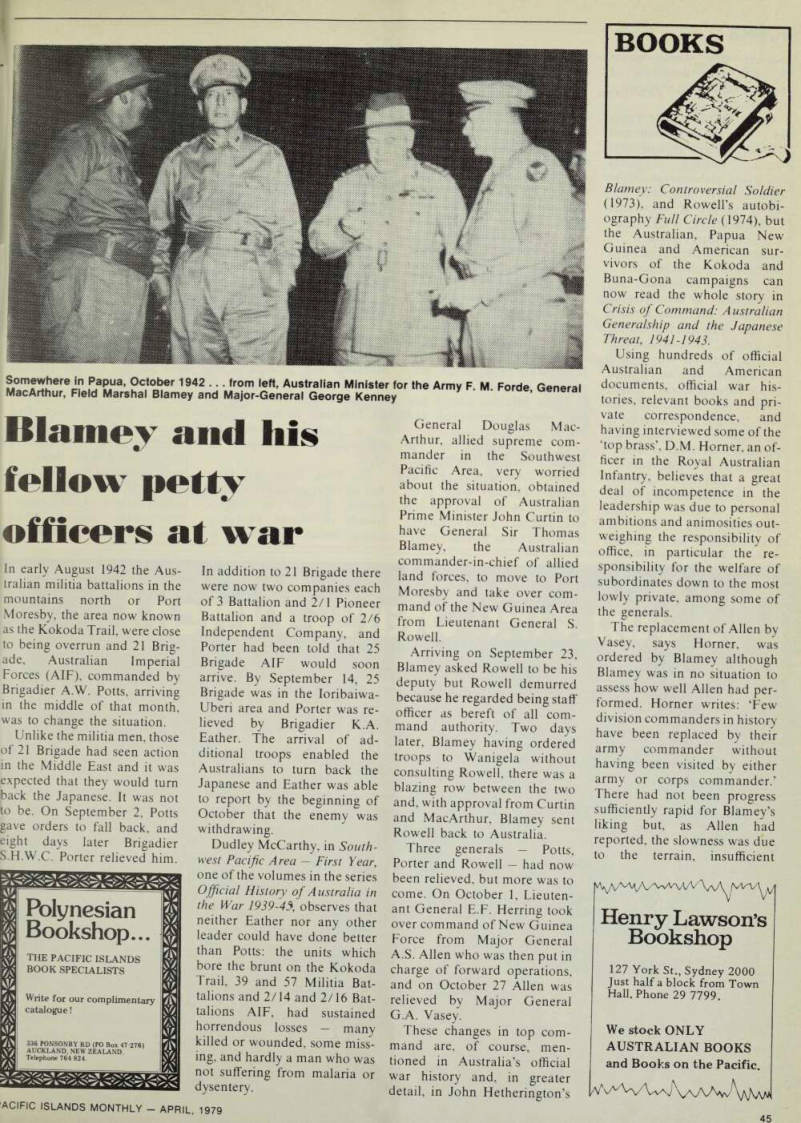
Somewhere in Papua, October 1942... from left, Australian Minister tor the Army F. M. Forde, General MacArthur, Field Marshal Blarney and Major-General George Kenney
supplies, units being under
strength, poor condition of troops, and difficult evacuation of wounded.
By the end of October, writes the author, the Australians had learnt two major lessons: that
jungle warfare requires
endurance and courage of the highest order and that ad
equate supply is important.
‘Through Blarney’s reluctance
to believe Allen’s account .. .
Blarney and MacArthurfailedto take heed of another lesson they did not understand the determination of the Japanese in defence his fanatical resis tance and willingness to die for his emperor.’ This lack of under
standing explains why lightly
armed troops were sent against the Japanese defences. Neither Blarney nor MacArthur had
given thought in peacetime to
the problems of tropical war fare in a mountainous area.
Blarney, as commander-in chief Australian Military Forces and commander Allied Land Forces under MacArthur, had a dual role which became more difficult
because of the attitude and temperament of MacArthur ‘who placed his subordinates in
difficult positions through his
inaccurate strategic assess ments in July and August 1942, through his determination to edge Blarney out as com mander of the land forces, through his interference in the technical conduct of the cam
paign, through his influence
over the Australian Govern ment and through his fears that an apparent military reverse might lead to his dismissal.’
‘Blarney was unwilling to
risk his own position by an af firmation of loyalty and trust in his subordinates,’ but even the unsatisfactory command ar rangements in Australia may not have had such a bad effect if Prime Minister Curtin had been more experienced and Blarney more tactful.
To the Diggers on the Kokoda Trail, ‘Pottsy’ (Potts),
‘Tubby’ (Allen) and ‘Bloody
George’ (Vasey) were good
blokes, to be followed through thick and thin. Their nickname for Blarney was ‘Brothel Tom’.
This book proves if proof is still needed that the French
politician Briand wasrightwhen
he told Britain’s Prime Minister Lloyd George, in World War I, that war is much too serious a thing to be left to military men.
Harry Jackman
Crisis of Command: Australian General ship and the Japanese Threat, 1941-43.
D.M. Horner. Published by Australian National University Press, Canberra, 1978. 515.95.
Tripping
with
Wad Kui
Sogeri National High School in the mountains behind Port
Moresby has produced yet
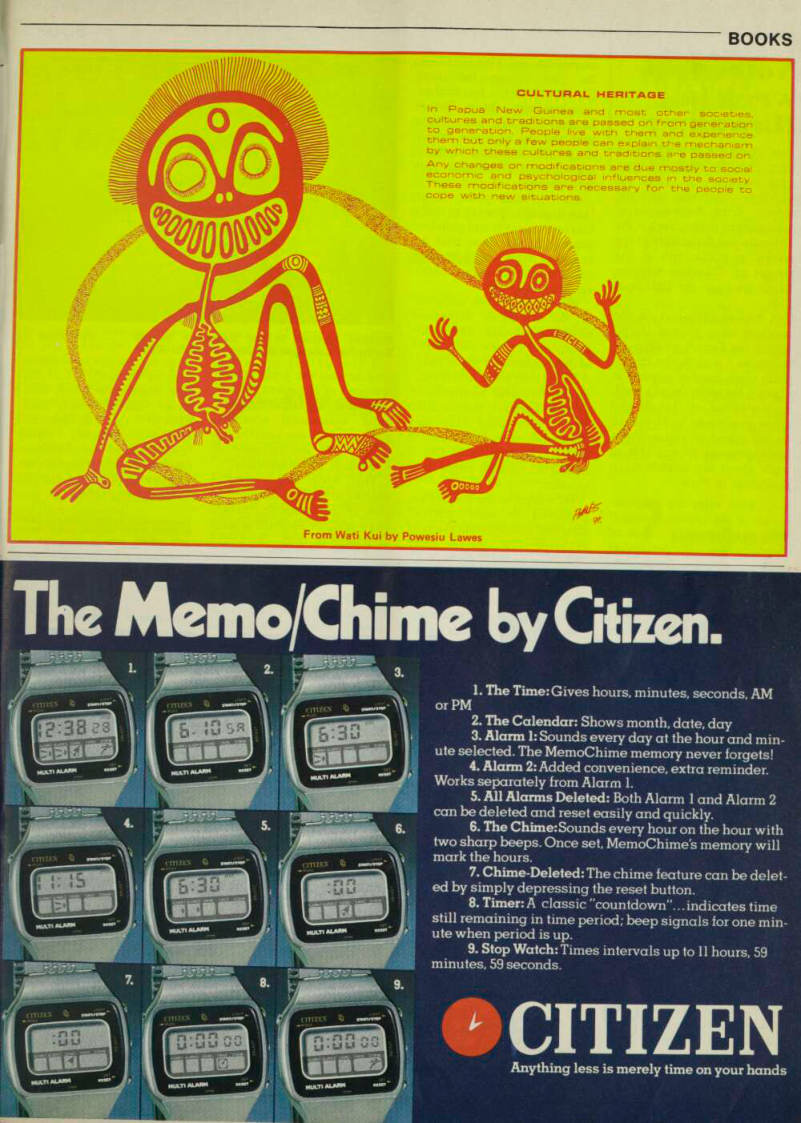
another superb collection of modern Papua New Guinea art. This time the featured art ist is Powesiu Lawes who matriculated at Sogeri in 1975.
The book is entitled Wati Kui, an expression of the Loniu people of the Los Negros Islands in Manus Province, Lawes’ home. Art adviser to
the publication, Marjorie
Walker of the school’s express ive art department, in the preface, says: ‘This expression is used by young boys as they become more aware of their growing power as they pass through adolescence into adulthood.’
In the case of Powesiu Lawes, wati kui does not stop at the simple achievement of Papua New Guinean adult
hood. Leafing through his
work, one feels a sense of curi osity and searching which pen etrates not just into earthly worlds beyond New Guinea’s shores but into the extraterres trial and decidedly abstract.
Powesiu obviously does not have his feet on the ground.
And, if he keeps them that way, we can look forward to more
pleasing flights of fancy. The
overall impact of his work is refreshing and it is most cer tainly original but there can be no doubt that Powesiu ranks among those who have de lighted in the works of Kauage, front-runner among PNG
modern art pioneers.
R.H.
Xotes on a
wwk in
Hawaii
The Hawaiian Islands have been a tourist attraction since their discovery in 1778. As such, they have also been the subject of the observations of the transient visitor. Such is the rationale and the quality of the present re-publication of the articles of Theodore-Adolphe Barrot who saw the Islands in 1836.
A French diplomat on the consular level, he was travel ling in the French warship La Bonite to a post in the Philip
pines when the ship stopped in
Hawaii. He spent about a week on the island of Hawaii and about two weeks in Honolulu on the island of Oahu. From this experience he was able to write about the Islands for a periodical in Paris.
Of what value are the com ments of the tourist-observer?
The most important value of this document is the perception
of Hawaii and Hawaiians on the part of an intelligent Frenchman of the first half of the nineteenth century. Barrot presents a mixed view of per sons and places which reflect the confusion in his own mind toward native peoples and their culture.
He romanticises the
Hawaiian by expecting to study
him in his ‘simple and guileless nature’. At the same time he describes natives in their most native aspect in images which
are scathingly ugly.
He deprecates the influence of the American Protestant missionaries who were Cal vinists and consequently strict in their values and moral judg ments. At the same time he de plores the harsh treatment of French Catholic missionaries by the Hawaiian king and chiefs without explaining what belter interpretation of Chris tianity this mission might have to offer.
He wishes to see the natives preserved in their ‘natural’ state and isolated from the evils of ‘civilization’. At the same
time he sees the great natural resources of Hawaii capable of supporting an excellent ‘col onial’ agricultural economy, and one which can ‘only’ be de
veloped by the industry of
Europeans and Americans.
This book needs careful
reading to identify the point of
view of the writer first before attempting to see some aspects of Hawaii in 1836.
The present edition is well done in paperback with copies of the charming drawings of Barthelme Lauvergne and Theodore Auguste Fisquet, two artists on La Bonite. - Pauline King Joerger, Assistant
Professor of History, University
of Hawaii at Manoa.
Th6odore-Adolphe Barrot, UNLESS HASTE IS MADE, Press Pacifica, Kailua, Hawaii, 1978, 128 pp.
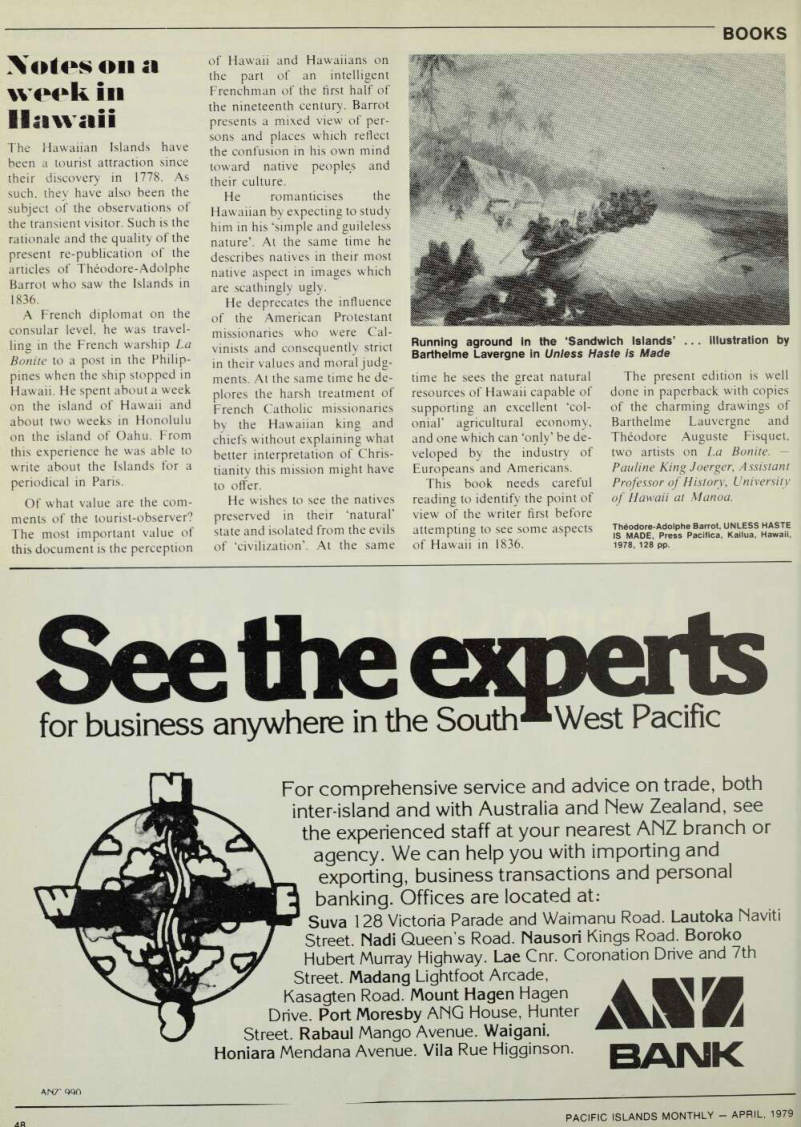
Running aground in the ‘Sandwich Islands’... illustration by Barthelme Lavergne in Unless Haste is Made