Caledonia revolt
pp. 35-37 · Read in the full issue

Yesterday
Echoes of the 1878 New Caledonia revolt
It is a rare event for an Australian history student’s thesis, written for a BA Honours degree and unpublished in her own country, to become a focus of public controversy in Noumea, New Caledonia.
But this has been the fate of the 1974 thesis, The 1878 Revolt on New Caledonia, written by Linda Latham, then a student at the Australian National University, Canberra. Noted French eth nologist Professor Jean Guiart of the Musee de I’Homme. Paris, who has made a study of New Caledonia, offers his appraisal of Ms Latham’s work, discusses the possible political implications of its publication in Noumea, and ponders the impact of Ms Latham s research on an emerging generation of educated Melanesians.
The paper by the Australian re searcher Linda Latham on the causes of the 1878 rebellion in New Caledonia should have been left in decent obscurity.
Its translation into French and its subsequent publication by the Societe d’Etudes His toriques de la Nouvelle Caledonie, a pseudo
historically-minded associ
ation in Noumea, raises an acute problem - that of the possible political impact of re search of this type.
My main argument with the Latham paper, however, is not with its pro-settler approach, but with its lack of scientific content. She writes as if she were wielding a critical tool vis d-vis the colonial archives she has studied. In fact, she follows closely the path traced in these archives - and what docu ments there are on the subject
in Sydney’s Mitchell Library
are also part of the colonial ar chives.
What I mean is that any writ ten document of the colonial period (New Caledonia, like New Zealand, is still in the col onial period) must be checked thoroughly, not in regard to its trustworthiness, since such documents are always untrust worthy in a way, but for what ever useful information may be elicited from it. Such an effort requires a whole battery of checks and counter-checks, and involves much time and effort.
The very first problem is to
know what exactly happened,
in the field, at that time. As to 1878, this has yet to be shown.
Events, as related by colonial
history, are doubtful. The ar chives were compiled to fit contemporary local prejudices and conceal the more disgrace ful aspects of European actions. Nevertheless, even as much as is established appears not to worry Miss Latham, who
conveniently disregards the
wholesale murder of the inhabitants of the so-called ‘thieves’ village’ high up on the Dumbea river, and the shoot ing, as spies, of Melanesians wanting to cross the lower reaches of the Dumbea in the first hours of the panic that gripped Noumea after it was known what had happened further north.
What is needed is not value judgments on the situation, nor on such and such an author, but inventories of weapons, of am munition spent, of soldiers' pay, of special combat allo cations. The need to augment the soldier’s basic pay appears to explain a number of other wise inexplicable and useless
military expeditions. A cut-to
the-bone budget was the reason for the care with which officers looked after ammu nition and tried in every way to wage a ‘silent war’.
The delays in securing re placements and reinforcements
explain why commanding offi
cers such as Major Riviere were so wary about losing their men, and so keen to organise auxili ary troops from among natives, convicts and even mounted Australian gentlemen, using them to bear the brunt of the fighting. An unbalanced diet too much meat of dubious freshness, and too much
inferior alcohol explains the relative lack of success of the
regular troops. The highly
racist general outlook of the settler community - ‘a good Kanaka is a dead Kanaka’ accounts for the clamour for revenge from the European population, which drew its economic and in part its cultural patterns from nearby Queensland.
One of the problems of colonial government in New Caledonia has always been
white-organised provocations,
designed to secure a reaction on the part of the natives which
would justify further military
action and confiscation of l an d.
Curiously for a person writing in our day. Miss Latham seems to think that European land-grabbing on the scale on which it was conducted before 1878 around La Foa had some justification, Pushing Melanesians away from their house sites, sacred groves, cemeteries, and good and rare agricultural lands, is condoned by her. (If somebody
did it to her own kin, we can imagine her shrill cries!) She has not taken a hard look at what this ‘treasure island’ of New Caledonia is really like. Good, cultivable land is in fact the rarest of its assets. This fact she would not have found mentioned in the colonial archives, but a study of soil science publications deal ing with New Caledonia would no doubt have enlightened her.
Good farmland in New Caledonia is most often made up of irregular strips, often no more than a meter wide, at the bottom of otherwise sterile
slopes.
Most of New Caledonia is of niaouli trees thriving on acid soils. Whites and blacks have fought over about 10% to 20% of the whole land mass, the rest being infertile or mineral-rich only. In most valleys it was per fectly silly to have believed that
a European agricultural com
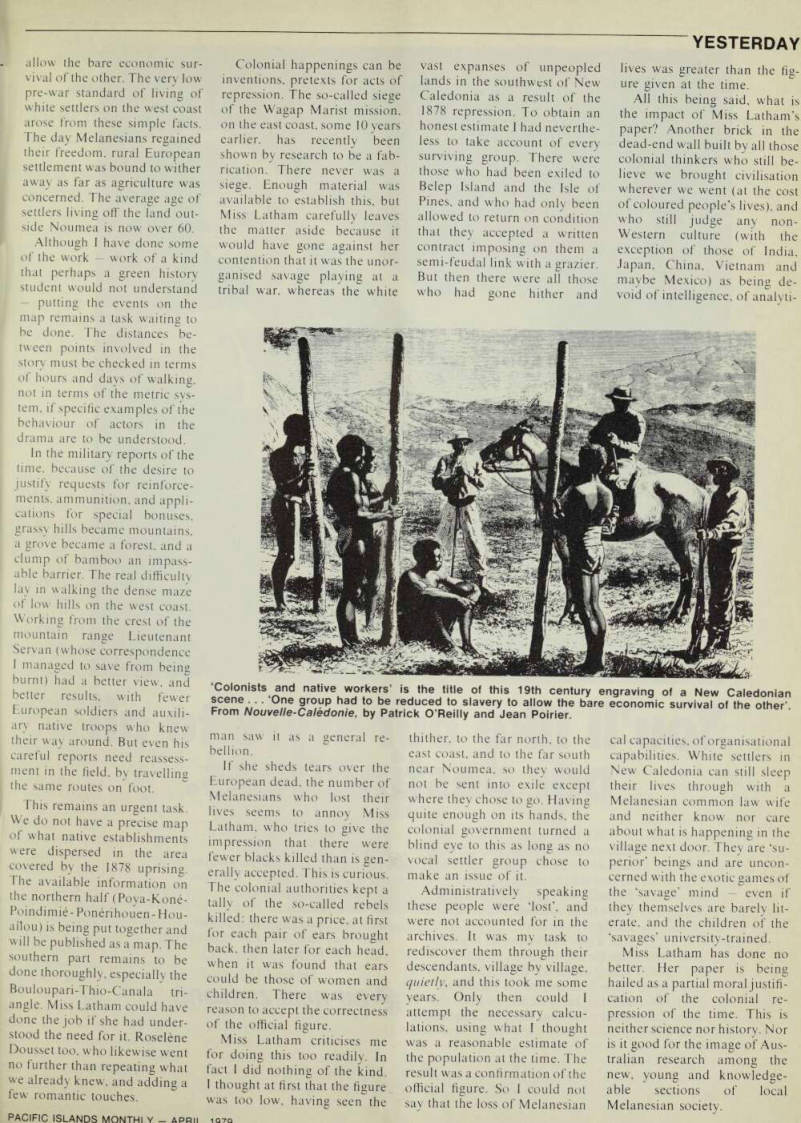
munity could be settled close to a Melanesian group. There simply was not enough useful soil to go round. One group had to be reduced to slavery to
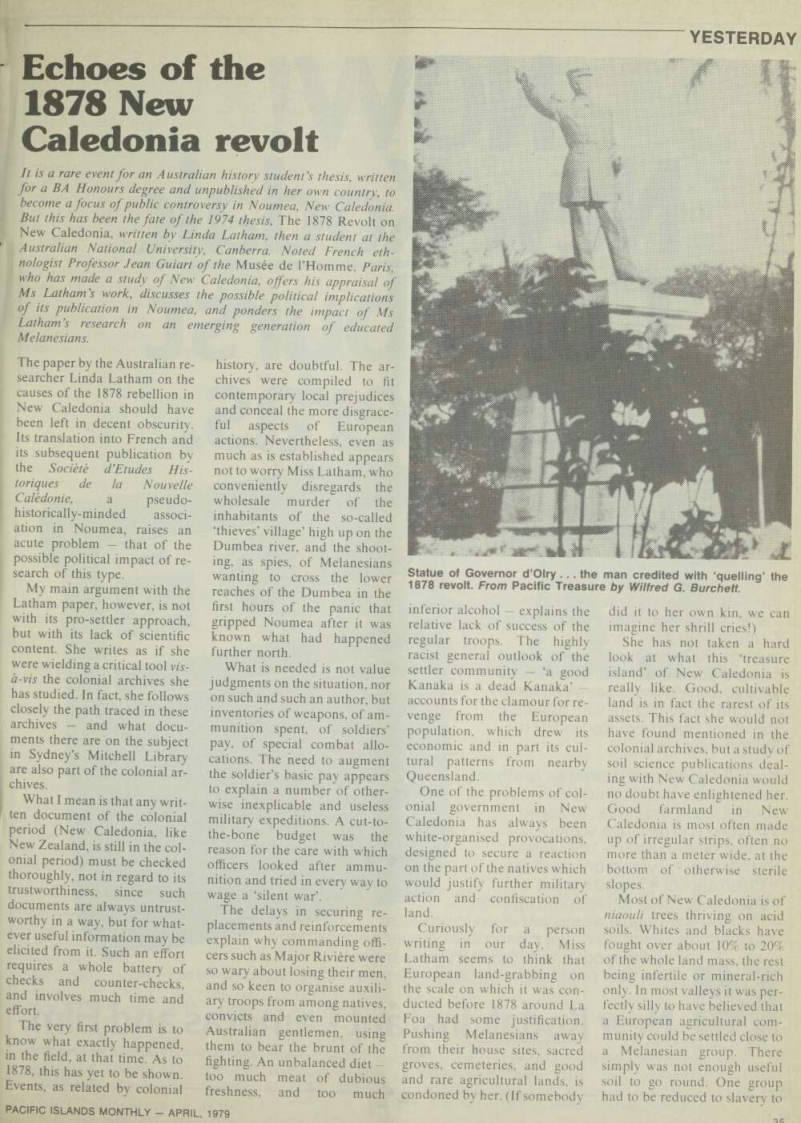
Statue of Governor d’Olry... the man credited with ‘quelling’ the 1878 revolt. From Pacific Treasure by Wilfred G. Burchett.
allow the bare economic sur vival of the other. The very low pre-war standard of living of white settlers on the west coast arose from these simple facts.
The day Melanesians regained their freedom, rural European settlement was bound to wither away as far as agriculture was concerned. The average age of settlers living off the land out side Noumea is now over 60.
Although I have done some of the work work of a kind that perhaps a green history student would not understand - putting the events on the map remains a task waiting to be done. The distances be tween points involved in the story must be checked in terms of hours and days of walking, not in terms of the metric sys tem. if specific examples of the behaviour of actors in the drama are to be understood.
In the military reports of the time, because of the desire to justify requests for reinforce ments. ammunition, and appli cations for special bonuses, grassy hills became mountains, a grove became a forest, and a clump of bamboo an impass able barrier. The real difficulty lay in walking the dense maze of low hills on the west coast.
Working from the crest of the mountain range Lieutenant Servan (whose correspondence I managed to save from being burnt) had a better view, and better results, with fewer European soldiers and auxili ary native troops who knew their way around. But even his careful reports need reassess ment in the field, by travelling the same routes on foot This remains an urgent task.
We do not have a precise map of what native establishments were dispersed in the area covered by the 1878 uprising.
The available information on the northern half (Poya-Kone- Poindimie- Ponerihouen- Hou ailou) is being put together and will be published as a map. The southern part remains to be
done thoroughly, especially the
Bouloupari-Thio-Canala tri
angle. Miss Latham could have done the job if she had under stood the need for it. Roselene Dousset too, who likewise went no further than repeating what we already knew, and adding a few romantic touches.
Colonial happenings can be inventions, pretexts for acts of
repression. The so-called siege
of the Wagap Marist mission, on the east coast, some 10 years earlier, has recently been shown by research to be a fab rication. There never was a
siege. Enough material was
available to establish this, but Miss Latham carefully leaves the matter aside because it would have gone against her contention that it was the unor ganised savage playing at a tribal war, whereas the white
man saw it as a general re bellion.
If she sheds tears over the European dead, the number of Melanesians who lost their lives seems to annoy Miss Latham, who tries to give the impression that there were fewer blacks killed than is gen erally accepted. This is curious.
The colonial authorities kept a tally of the so-called rebels killed: there was a price, at first for each pair of ears brought back, then later for each head, when it was found that ears could be those of women and children. There was every reason to accept the correctness of the official figure.
Miss Latham criticises me for doing this too readily. In fact I did nothing of the kind.
I thought at first that the figure was too low, having seen the
vast expanses of unpeopled lands in the southwest of New Caledonia as a result of the 1878 repression. To obtain an honest estimate I had neverthe less to take account of every surviving group. There were those who had been exiled to Belep Island and the Isle of Pines, and who had only been allowed to return on condition that they accepted a written contract imposing on them a semi-feudal link with a grazier.
But then there were all those who had gone hither and
thither, to the far north, to the east coast, and to the far south near Noumea, so they would not be sent into exile except where they chose to go. Having quite enough on its hands, the colonial government turned a blind eye to this as long as no vocal settler group chose to make an issue of it.
Administratively speaking
these people were ‘lost’, and were not accounted for in the archives. It was my task to rediscover them through their
descendants, village by village,
quietly, and this took me some years. Only then could I attempt the necessary calcu lations. using what I thought was a reasonable estimate of the population at the time. The result was a confirmation of the official figure. So I could not say that the loss of Melanesian
lives was greater than the fig ure given at the time.
All this being said, what is the impact of Miss Latham’s paper? Another brick in the dead-end wall built by all those colonial thinkers who still be lieve we brought civilisation wherever we went (at the cost of coloured people’s lives), and who still judge any non- Western culture (with the exception of those of India.
Japan, China, Vietnam and maybe Mexico) as being de void of intelligence, of analyti
cal capacities, of organisational capabilities. White settlers in New Caledonia can still sleep their lives through with a Melanesian common law wife and neither know nor care about what is happening in the village next door. They are ‘su perior’ beings and are uncon cerned with the exotic games of the ‘savage’ mind even if they themselves are barely lit erate, and the children of the
‘savages’ university-trained.
Miss Latham has done no better. Her paper is being hailed as a partial moral justifi cation of the colonial re pression of the time. This is neither science nor history. Nor is it good for the image of Aus tralian research among the new, young and knowledge able sections of local Melanesian society.
‘Colonists and native workers’ is the title of this 19th century engraving of a New Caledonian scene... One group had to be reduced to slavery to allow the bare economic survival of the other' From Nouvelle-Caledonie, by Patrick O’Reilly and Jean Poirier.