‘Subjection’
pp. 14-16 · Read in the full issue
Cook Islands
Davis Returns
To ‘Fear’ And
‘Subjection’
Fear he had seen among the people of Haiti and the Dominican Republic was to be seen in the people of the Cook Islands on his return in 1971, writes Dr Tom Davis, now the Cooks premier, in Cook Islands Politics: The Inside Story published by Polynesian Press, Auckland, in association with the South Pacific Social Sci ences Association of Suva, from a study co-ordinated by Professor Ron Crocombe of the Institute of Pacific Studies, University of the South Pacific. PI M’s editorial adviser, John Carter, presents a sec ond selection of extracts. The first appeared in PIM last month.
Dr Tom Davis, born in the Cooks in 1917, graduate of the University of Otago (NZ), ex
fellow of Sydney University, ex
surgeon specialist to the Cook Islands Medical Service, ex medical monitor of the US Pro ject Mercury moon shots and renowned in America as a phys ician and now Premier of the Cook Islands, devotes five pages to the ‘Rise of the Democratic Party'. Considering his battles with the CIP after answering an appeal from Cook Islanders ‘to come home\ Dr Davis' story is told with great restraint. But it
pulls few punches when he tells
of what he found during a short stay on Rarotonga in July 1971: i came back in 1971 to have a look and see for myself. I spent two weeks in Rarotonga, but it took only a few days to see that the complaints about the Henry Government were justified. The sense of an all pervasive fear in the people
was overpowering and highly
disturbing. The people as I remembered them of yore were self-assured, stood up for their rights, laughed a great deal and were always full of joy in meet ing an old friend. This was no longer the case. I was avoided by people with whom I had grown up. Former patients and people whose health if not their lives I had given back to them, were cold toward me. People whose homes were as homes to me were no longer friends. I no longer could distinguish friend from foe. There were few who
openly showed their pleasure
at seeing me again.
‘lt was obviously no secret that I had returned with the possibility that I might oppose
the existing government.
Indeed I had been away for 19 years, but I had been pre viously away for 16 years and had been welcomed home as a
conquering hero. My achieve
ments in the USA were not un known to them and these were more notable than my achieve ments during the 16 years absence at school and medical school. The fear was real and existed in all but a few. It was what 1 had seen in Haiti and the Dominican Republic and elsewhere where people’s sur
vival depended on subjection
to those in political power. It was sad to see this in my once happy homeland. If there was one single factor which made me resolve to return, it was this. ‘There were other factors, of course. The two weeks’ stay
showed clearly the nepotism,
the deliberate distortion of
democracy to gain politically
‘True to expect ations Albert Henry... offered me head of state or deputy premier.
self-serving ends, the political subjection of the public service, the deliberate use of people’s ignorance to gain credence with half truths as well as blatant misrepresentations, the purposeful destruction of both traditional and national leader ship, the “happy the body and to hell with the mind” ap proach to the young, the under mining of the natural industriousness of our people with “no work” jobs, the re moval of people from pro-
ductive efforts to unproductive and unnecessary government jobs, the attack and deliberate
downgrading of qualified and
trained individuals, the victimisation of those foolish enough to voice criticisms of government, the rewarding of those whose only qualification was that they supported the Henry regime. The list goes on. All these helped me to make up my mind ...’
After returning to the United States to wind up his affairs. Dr Davis ‘arrived back in Rarotonga on October 1, 1971 to start what proved to be a long relentless road of political battles and personal abuse against a backdrop of corruption, dishonesty, deceit, discrimination, intimidation, economic ignorance and administrative ineptness. All of this I had expected, having known Albert of the silvery tongue long ago. True to expectations Albert Henry, both on my first visit and soon after my return, approached me and offered me head of state or deputy premier. Both were
firmly refused.
‘The opposition party in the
Cook Islands at that time was the United Cook Islanders Party (UCI) which was not really a party but a loosely organised group of sincere and honest citizenry dedicated to the downfall of Albert Henry, Their politics were emotionally charged, well-intentioned, but
unsophisticated. They had
little chance against the ruling Cook Islands Party under the leadership of Albert Henry who had received the pur posive training of the New Zealand Communist Party, This basic training was obvious in the political prac tices that he put into effect which, as has happened else where, eventually resulted
in a grossly over-controlling
government with party oriented benefits of political office, and economic
chaos . . .’
Dr Joe Williams, once regarded as Sir Albert’s most likely successor and a firm sup porter for years, ‘ defected ’ in January, 1978, when he was minister of health and edu cation. Dr Williams spills the beans in the eight pages he writes:
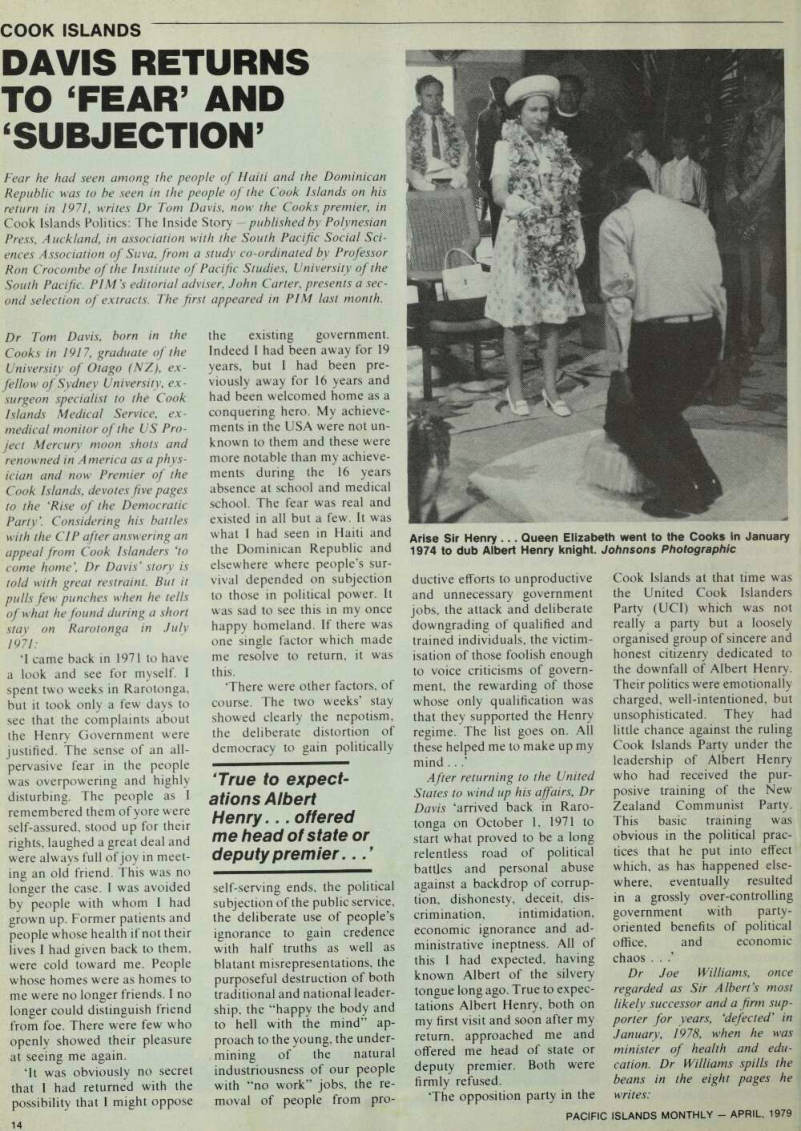
Arise Sir Henry... Queen Elizabeth went to the Cooks in January 1974 to dub Albert Henry knight. Johnsons Photographic
‘ln January 1978 two Cabi net ministers resigned. William
Estall (agriculture) and myself
(health and education). It was said that we were “power hungry academics” who re signed from our posts as minis ters of the crown and from the Cook Islands Party because we were “greedy for position and money”. Does a minister resign from a prestigious position be cause of greed for power? Does a minister resign from the sec
ond highest paid position in the
Cook Islands Government be cause of greed for money? I re
signed to uphold the principles
that I believe in; to uphold jus tice, to fight injustice and an ineffective system of govern ment. I have come through the very heart of the Cook Islands Party government. I am
intelligent enough to know
what is wrong and what is right.
To continue to be part of a government that is riddled with discrimination, nepotism, ex
ploitation, favouritism,
authoritarianism and inef ficiency at the expense of the
well-being of the community
would be the greatest injustice that I would commit in my pol itical career . . .
T joined the Cook Islands Cabinet in January 1975. My first reaction was one of disillusionment. I thought I was joining the highest execu tive authority, “the mana” of the country to take part in high level discussions for the benefit of our people. But instead, we wasted time in Cabinet meet
‘... even relatives of relatives have been included on the bandwagon
ings on trivial matters such as overseas travel of public ser vants, appointments to the
public service, scholarships,
etc. One of the fundamental criteria for approval was politi cal loyalty; “Yes” to CIPs and generally “No” to Demos. This procedure of Cabinet con
tinued with systematic appli
cation of discriminatory
principles until my resignation.
Important matters such as the economy, dependency, em
ployment, cost of living,
business opportunities for Cook Islanders etc, received very little attention. Hence the retarded state of development in almost every facet of the
Cook Islands society ...
T have always found nepot ism a little hard to swallow. But being part of CPI political ma chinery and having had a very high regard and admiration for
the premier, I partly ignored
nepotism in the Cook Islands government hierarchy. But the expansion of the Henry dyn asty over recent years with
appointments made on family
ties became too overbearing for me to accept. ‘What was once a joke be came blatant full-blown nepot ism. It would be foolish for anyone to deny the expansion
of nepotistic practices or to jus
tify it in terms of the Henrys
being a “clever” family as they
feel. It has reached the stage where almost every close rela tive or associate of the premier is in a high ranking or comfort able position. Even the media is dominated by the fruits of
nepotism.
‘ln 1968 when I joined the Cook Islands Party, there were few Henrys in Government.
Since then, the number has in creased so much that even rela tives of relatives have been included on the band wagon. ‘ln this 1978 general election, four new CIP candidates within the family circle were nominated, Hugh Henry (premier’s son), Tepou Boaza (speaker’s son-in-law), Eric Ponia (Geoffrey Henry’s brother-in-law) and Charlie Carlson (husband of Lady
Henry’s niece).
‘The first thunderbolt jolt for me to have a hard look at nep otism was in the 1974 general election when all standing CIP candidates were surnamed Henry by the Henrys to “jus
tify” the family government
image, and thus neutralise Op position criticism of it. I resented being called Joe
Henry . . .
‘lt was decided after we lost the Atiu seats by a narrow mar gin in 1974 that Atiu would be developed to “buy Atiu”. Man gaia was neglected because it would not accept the premier and the CIP and the gap was too big to close. Again after
CIP lost the 1977 by-election in Mangaia, it was decided to “punish Mangaia” by minimis ing government expenditure there. Mauke received top pri ority because of the “special privileges and favour” of its CIP member, Hon Tupui Ariki Henry ... ‘The large-scale persecution was of civil servants. Pro motions of government officers were much influenced by ministers. Loyalty and service to the Cook Islands Party was a major criterion in promotion, appointment and the provision of training and travel oppor
as soon as was realised that Cyclone Charles had political potential, the meteorologists were asked to dismount...’
tunities. For example Mr Tutu Ina was chief health inspector, but a strong supporter of the Democratic Party. We ensured that he was denied normal and
justified salary increases and
opportunities so that he would resign once he realised that he would suffer if he remained.
The strategy succeeded and he resigned and migrated to New Zealand. We replaced him by a strong supporter of the Cook Islands Party ...’
All political parties were sup posed to have access to radio which was controlled by the Henry family and friends. Mrs Marjorie Crocombe describes how the CIP sabotaged Demo cratic Party time on the air: ‘The Democratic Party al leged a number of other minor media harassments. These in
elude “technical problems” leading to the radio stopping
broadcasting during key
Democratic Party speeches, but not during Cook Islands Party
speeches, the postponing of
materials booked and paid for at peak listening time until the peak was over, giving poor quality transmission to the
Democratic Party’s English
speaking meeting but not to any Cook Islands Party meet ing, and turning up the volume for the clapping at meetings of the Cook Islands Party which were broadcast. Ironically, ex-CIP Cabinet minister Dr Williams also complained about unfair actions by the CIBNC to his Unity Move ment, but no complaints were heard from the CTP..
Sir Albert even managed to
make political capital out of a
cyclone. Mrs Crocombe illus trates: ‘ln the last week of February, Cyclone Charles de veloped north of Palmerston atoll. It was election time, and as soon as it was realised that
Cyclone Charles had political
potential, the meteorologists
were asked to dismount. The premier swung into the saddle, with his closest henchmen clinging firmly behind, and they rode the storm across the radio waves like cowboys in a rodeo. But it was handled like a TV rodeo rather than a live one, so the media men could use the zoom lens and the sound effects to make the bronco appear more dangerous and the riders more courageous than was true in real life. Sir Albert used to the full his su perb talent for making his sup porting audience feel that they were riding with him, vicari
ously sharing every prance.’
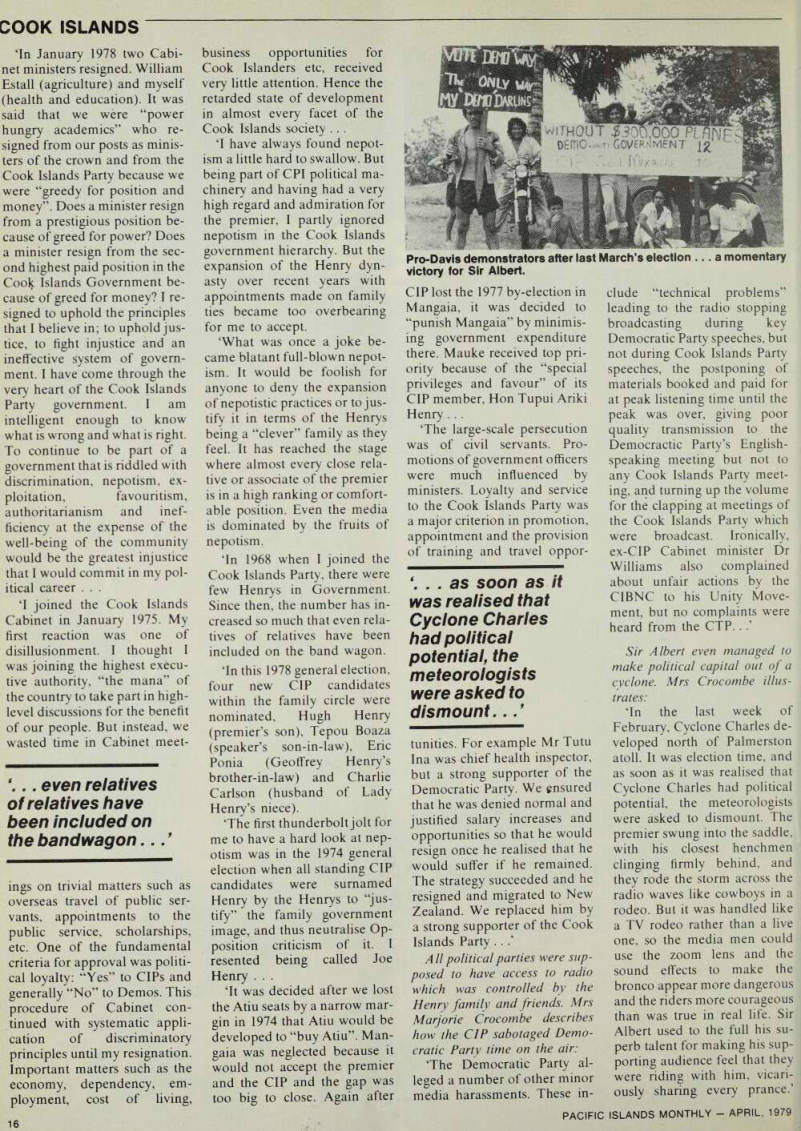
Pro-Davis demonstrators after last March’s election... a momentary victory for Sir Albert.