Neo-Polynesian art
pp. 12-13 · Read in the full issue
through Bobby Holcomb’s eyes
Born in Hawaii where ‘Polynesian culture has all but died ’
Bobby Holcomb is developing what he calls his ‘ neo - Polynesian ’ art form on the French Polynesian Island of Huahine. Robert F. Kay, a contributor to the San Francisco Chronicle, who spent six months recently in French Polynesia, reports.
Bobby Holcomb stared defiantly at the young Tahitian man and repeated: T will not
paint racing stripes on your
pirogue (canoe).’ the Tahitian tried to convince him otherwise but with no success.
The man finally left and Bobby shook his head in despair.
Bobby is usually glad to do
a favour for a villager but as far as he was concerned, the Tahitian was asking him to desecrate a genuine Hawaiianstyle outrigger canoe. ‘lf he had asked me to ornament the boat in a Polynesian fashion I would have been happy to do it but to decorate it like a sports car is out of the question.’
Bobby Holcomb is a young
artist determined to keep tra ditional Polynesian art forms alive as well as creating new ones. Bom in Hawaii in 1947, the son of a black American serviceman and a Hawaiian- Portuguese mother, he was raised in the ramshackle hous ing projects of Honolulu.
Through a scholarship he attended the University of Redlands in Southern Califor nia and later travelled through the United States, Europe and Asia.
In his travels he was again fortunate. Sympathetic patrons of the arts and famous artists such as Salvador Dali saw promise in him. Bored with life in Europe, Bobby decided it
was time to return to his roots in Hawaii. He boarded an ocean liner but never made it to Honolulu. On the ship he met a French artist living in Tahiti who urged him to see the island of Huahine in French
Polynesia. Bobby boarded a
flight for Huahine the same day. He has been there ever since.
On that island he and his
Swiss-American companion,
Kim Dios, live in a square brown clapboard house. Their home is at the foot of a holy mountain, Moua Tapu, near the ruins of several marde (temples). Huahine has over 500 temples and according to tradition it is one of the centres of mana (power) in
Polynesia.
Huahine is also legendary for its proud and obstinate inhabitants. They are a combi nation of proud obstinacy and the spirituality of the ancient past. The environment for Hol comb is perfect. It is within these holy ruins that he finds
inspiration for his paintings.
Bobby does not consider his artistic style unique but sees it rather as a new motif for
Polynesian art. He explains:
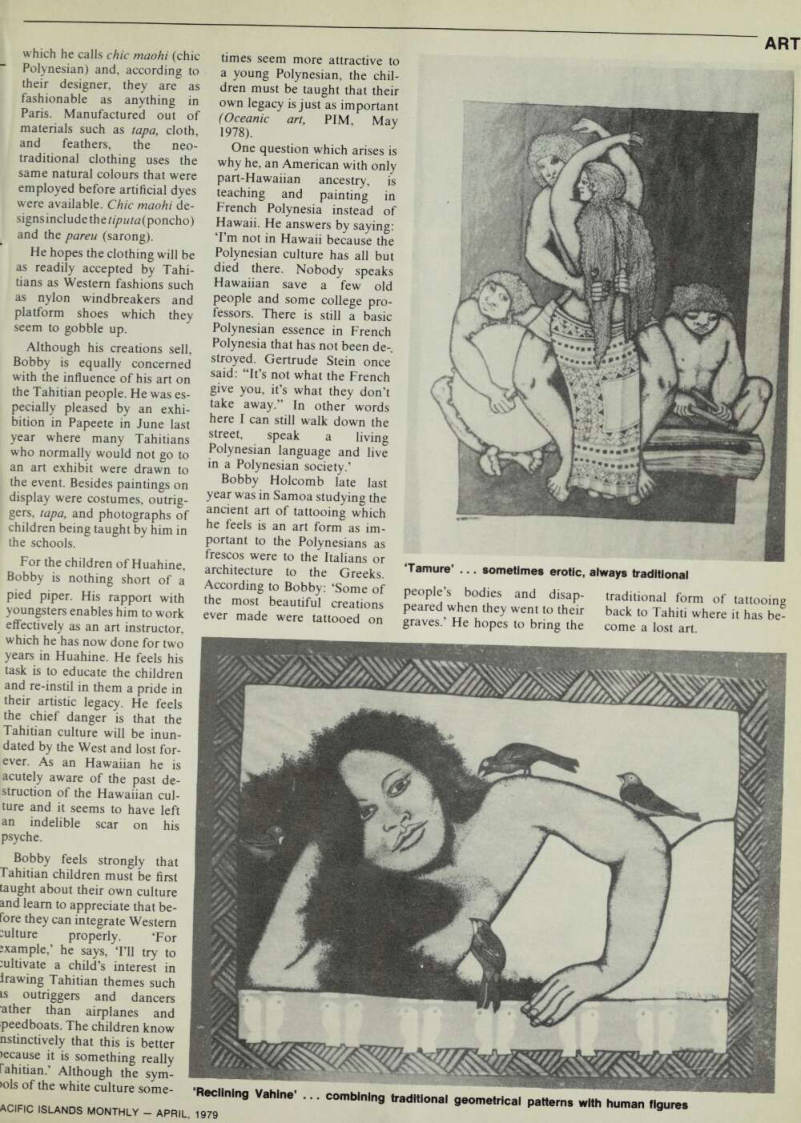
Traditionally Tahitian and other Polynesian artists used geometric patterns in their tapa and tattooing to create a har monious design much like the Moorish style. My work com bines the traditional geometric patterns with human and ani mal figures. It’s a new school of art. I call it ‘neo-
Polynesian’.
He emphasises that Polynesian art is a sophistica ted art form and by his defi nition cannot be pigeon-holed as ‘primitive’. He adds: ‘When Tahitians decorated their tapas and tattooed their bodies they did so for the pure aesthetic: pleasure of it rather than for utilitarian (religious or sym bolic) purposes. It is the utili tarian aspect which for me: characterises primitive art.’
His works are richly coloured, finely detailed* sometimes erotic, and often have a mythical or ‘phantas
magorical’ touch. His paintings
evoke an emotional response and express the all-pervading sensuousness that is part of the essence of Polynesia.
In Tahiti Bobby has startec a trend in women’s gowm. modified from Tahitian styles:
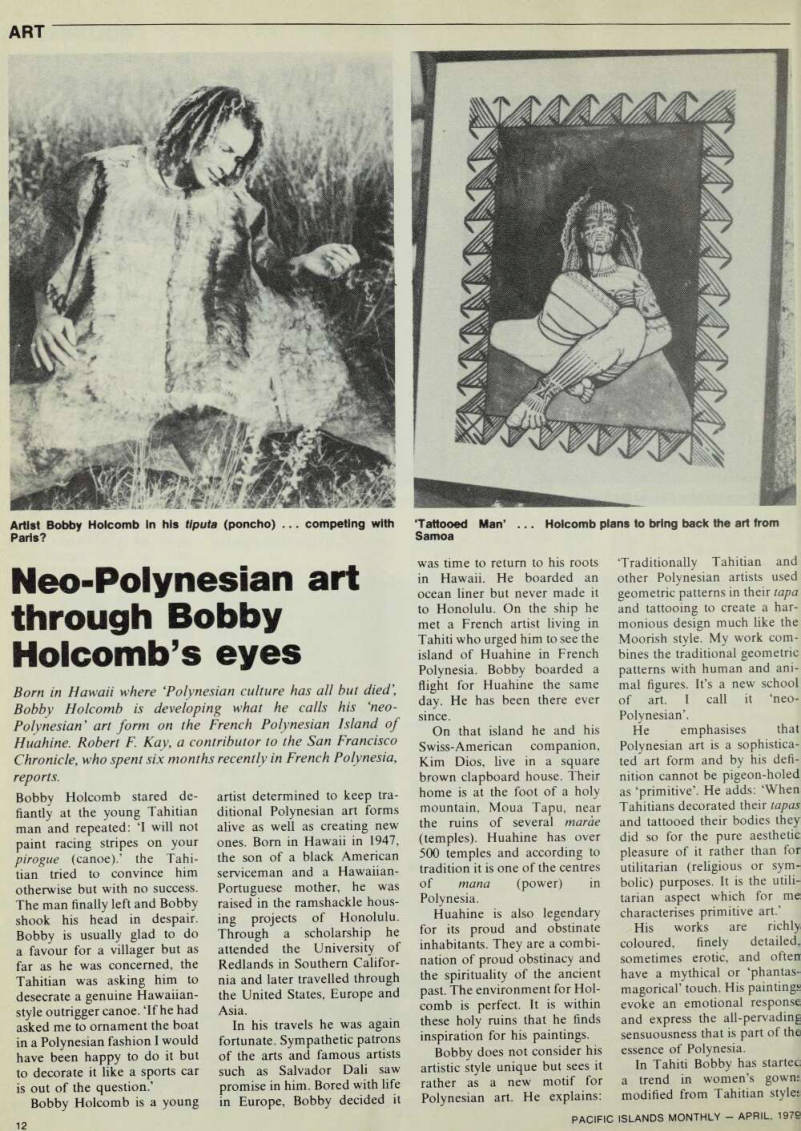
Artist Bobby Holcomb in his tiputa (poncho)... competing with Paris?
'Tattooed Man’ ... Holcomb plans to bring back the art from Samoa
which he calls chic maohi (chic Polynesian) and, according to their designer, they are as fashionable as anything in Paris. Manufactured out of materials such as tapa, cloth, and feathers, the neo traditional clothing uses the same natural colours that were employed before artificial dyes were available. Chic maohi de signs include the tiputa{poncho) and the pareu (sarong).
He hopes the clothing will be as readily accepted by Tahi tians as Western fashions such as nylon windbreakers and platform shoes which they seem to gobble up.
Although his creations sell, Bobby is equally concerned with the influence of his art on the Tahitian people. He was es pecially pleased by an exhi bition in Papeete in June last year where many Tahitians who normally would not go to an art exhibit were drawn to the event. Besides paintings on
display were costumes, outrig
gers, tapa, and photographs of children being taught by him in the schools.
For the children of Huahine, Bobby is nothing short of a pied piper. His rapport with youngsters enables him to work effectively as an art instructor, which he has now done for two years in Huahine. He feels his task is to educate the children and re-instil in them a pride in their artistic legacy. He feels the chief danger is that the Tahitian culture will be inun dated by the West and lost for ever. As an Hawaiian he is acutely aware of the past de struction of the Hawaiian cul ture and it seems to have left an indelible scar on his psyche.
Bobby feels strongly that
Tahitian children must be first taught about their own culture and leam to appreciate that be
fore they can integrate Western
culture properly. ‘For
Jxample,’ he says, ‘l’ll try to cultivate a child’s interest in Irawing Tahitian themes such
is outriggers and dancers
ather than airplanes and peedboats. The children know nstinctively that this is better
)ecause it is something really
fahitian.’ Although the sym
bols of the white culture some
times seem more attractive to a young Polynesian, the chil dren must be taught that their own legacy is just as important (Oceanic art, PIM, May 1978).
One question which arises is why he, an American with only part-Hawaiian ancestry, is
teaching and painting in
French Polynesia instead of Hawaii. He answers by saying: ‘l’m not in Hawaii because the Polynesian culture has all but died there. Nobody speaks Hawaiian save a few old people and some college pro fessors. There is still a basic Polynesian essence in French Polynesia that has not been de-. stroyed. Gertrude Stein once said; “It’s not what the French give you, it’s what they don’t take away.” In other words here I can still walk down the street, speak a living
Polynesian language and live
in a Polynesian society.’
Bobby Holcomb late last year was in Samoa studying the ancient art of tattooing which he feels is an art form as im portant to the Polynesians as frescos were to the Italians or architecture to the Greeks.
According to Bobby; ‘Some of the most beautiful creations ever made were tattooed on
people’s bodies and disap peared when they went to their graves.’ He hopes to bring the
traditional form of tattooing back to Tahiti where it has be come a lost art.
'Tamure’... sometimes erotic, always traditional
Reclining Vahme'... combining traditional geometrical patterns with human figures