Tahiti: Political
pp. 9-11 · Read in the full issue
Trial With
New Politics
When the long delayed, twice postponed, trial of young Tahi tians accused of having bombed the Papeete telephone exchange and murdered a French businessman (PIM November 1977, August 1978) ended on February 2, the roles of accusers and accused had been completely reversed, write Marie-Therese and Bengt Danielsson from Papeete.
One after the other, the de fendants had risen and sol emnly accused France of an even more serious crime that of slowly murdering the popu lation of French Polynesia with its nuclear explosions. Even be fore the final declarations of these main protagonists in the drama, the eight spirited law -1 yers for the defence had con demned the whole rotten i colonial system within which the trial was taking place a I system maintained, as they pointed out, with the help of I thousands of gendarmes, foreign legionnaires and para troops.
Such a sudden transform -1 ation of the court, officially f convened to judge a few com mon criminals, into a political forum made a strong im pression on the jury they took three and a half hours to reach their verdict. When, at 7pm, it was finally read to a hushed audience made up mainly of government officials, French gendarmes and plainclothes police flown in from Paris for the occasion, it
jwas considerably more lenient
than the death penalties and life sentences for which the
government-inspired mass
media had long been clamour
ing.
Self-confessed killer Marcel Tahutini, and his brother Jonas, who was captain of the so-called Toto tupuna (Blood of our Ancestors) guerrilla group, were sentenced to 20 years apiece, while the three other members got off with 18, 10 and five years.
It can however be argued that the sentence of 10 years meted out to Charlie Ching, president of the legally consti
tuted Tahitian People’s
Independence Party, was less
warranted. He had been found innocent of the main charges of
having personally organised
and directed the bomb attack and the murder.
In view of the fact that the trial had repeatedly shown glaring denials of basic human and legal rights, the defence
immediately lodged an appeal.
For those of us who had wit nessed in 1959 how Charlie Ching’s uncle, the old freedom fighter Pouvanaa a Oopa had been shamelessly framed with the help of police snoopers and false evidence, and then sent off to linger for eight long years in French gaols, the 1979 trial was nevertheless a milestone.
All credit for this must how ever go to the relatives and friends of the accused who took
the unprecedented step of hir ing first-rate French metropoli tan lawyers, willing and able to speak up and denounce all the denials of justice and irregularities which in the past have been simply overlooked or condoned. The presence of these lawyers had the salutary effect of obliging the French Government to despatch to Tahiti, at the last moment, a new presiding judge who was presented as being extremely liberal’. What this meant, in the event, was that he did his best, as all judges should, to give everybody a fair hearing.
To most people in French Polynesia it came as a new and rather shocking experience to hear, or to read, throughout the five-day trial, the constant self descriptions of the accused as ‘soldiers in a liberation army, whose duty it was to kill the enemy’.
Actually none of the boys, all in their early twenties, looked exactly like a bloodthirsty killer. People who know them well describe them as kind and mild-mannered.
But apart from such personal qualities they had another thing in common: they were school drop-outs who had been rejected by the harsh new
European-type society which has come into being in Tahiti since the nuclear era began.
They had ended up believing that their failure was not of their own doing but inherent in the system imposed by their French colonial masters. A few
meetings with Charlie Ching
had confirmed them in this be lief and helped them to articu late their feelings better, the feeling of hatred in particular.
The Toto tupuna commando members, ever since their arrest more than a year ago, had not only admitted but almost boasted of their deeds.
The only really suspenseful as pect of the trial, therefore, was provided by the public pros ecutor’s attempts to implicate Charlie Ching in the bomb attack and murder.
Mr Ching admitted freely
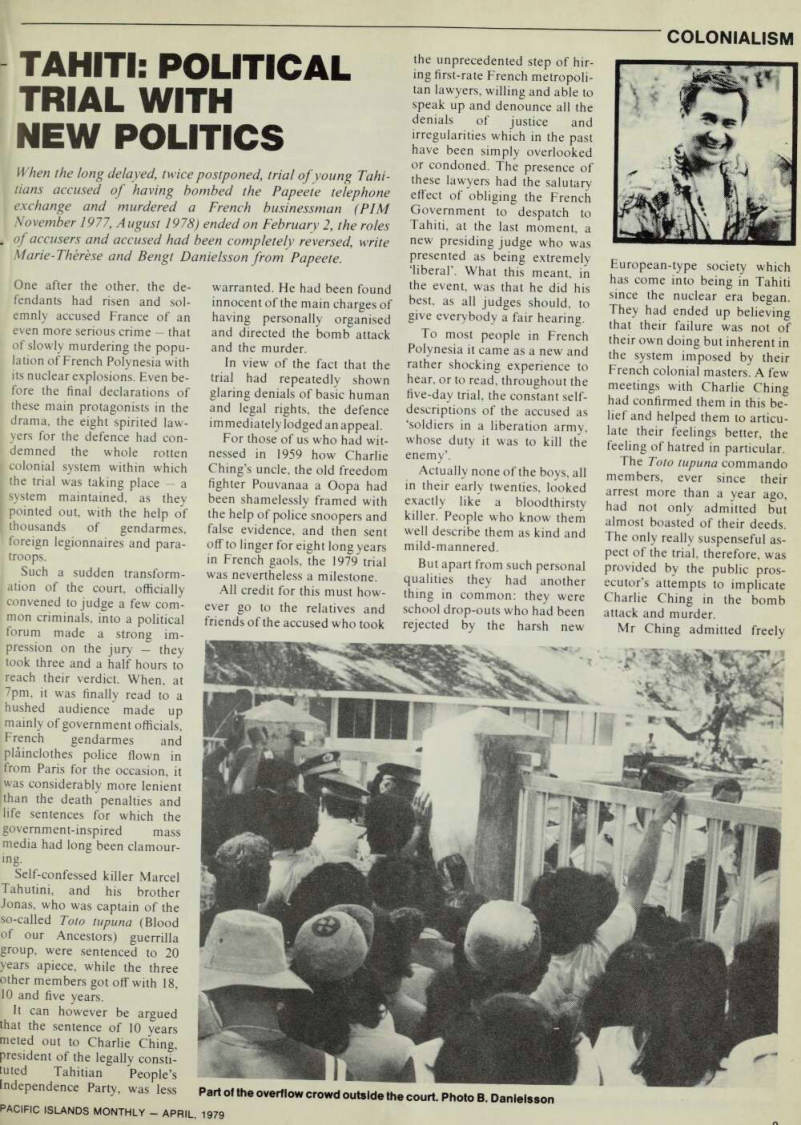
Part of the overflow crowd outside the court. Photo B. Danielsson
that he had, indeed, organised the Toto tupuna commando group. But he had done so only in order to attack military tar gets, such as the aircraft and
warships maintaining the
shuttle run between Tahiti and Mururoa, site of France’s nu
clear testing.
The only human .target he had selected was the principal upholder and defender of the colonial system, the then minister for overseas territories Olivier Stirn. However, when Mr Ching found out, at the time of the planned attack, that the military airfield and navy harbour to be visited by Stirn
were closely guarded by armed
soldiers accompanied by dogs
he put off all action for the time
being.
Jonas Tahutini, captain of the Toto tupuna commando, bitterly frustrated by this hesi tation on the part of Charlie Ching, then took over. He de cided to mount his own attacks
against less protected civilian
targets in order to sow terror and panic in the enemy ranks.
His men swore to follow him wherever he led them.
One evening in August 1977, during a visit by Olivier Stirn
to Tahiti, they placed charges
of stolen dynamite against the walls of the Papeete telephone exchange. Only one went off and damage was quite limited.
But the message left on the spot aroused strong psychological shockwaves: ‘Take your flag, your people and your statute, Stirn, and go home!’
Two weeks later Jonas Tahu tini drove his men to an exclusive residential section on the west coast, where most homes belong to Europeans.
After failing to trap two Frenchwomen, they came upon an isolated villa where they found a French business man sound asleep. Marcel Tahutini shot him in cold blood. The message left behind said; ‘We do not want any more Frenchmen in our
country.’
Throughout the trial Charlie Ching stuck to his guns, so to speak. He swore that he had no advance notice of this shift in tactics to civilian and non official targets, of which he
strongly disapproved. From
the beginning the public pros ecutor pooh-poohed this state ment as a patent lie. He was evidently bent of securing a life sentence for the ‘obnoxious’
Mr Ching. He was however un able to muster a single witness to support the charge that Mr
Ching organised the bomb
attack and murder. All the Toto tupuna boys emphatically exonerated him. Marcel Tahu tini went a step further and accused the French police of trying to persuade him to bear
false witness against Ching.
The betrayal was to be rewarded by an extremely lenient sentence. In his final speech the public prosecutor
dropped this charge altogether
and maintained only the very vague one of ‘consorting with proven criminals’.
When their turn came, the defence lawyers devoted their final addresses wholly to the wider issue of who was ulti
mately responsible for the
mounting tide of violence and crime in Tahiti. To a man they pointed the finger at the French Government which has consistently refused to let French Polynesia follow the road of all other Pacific peoples, except the Kanaks of the other French colony of New Caledonia, towards self rule and independence. Even worse, they claimed, there was a deliberate policy of flooding the Islands with French settlers from the ‘mother country’ and from former African colonies.
There are now 20 000 of them, and they are still coming in at the rate of 1000 a year. The purpose of this belated colonis-
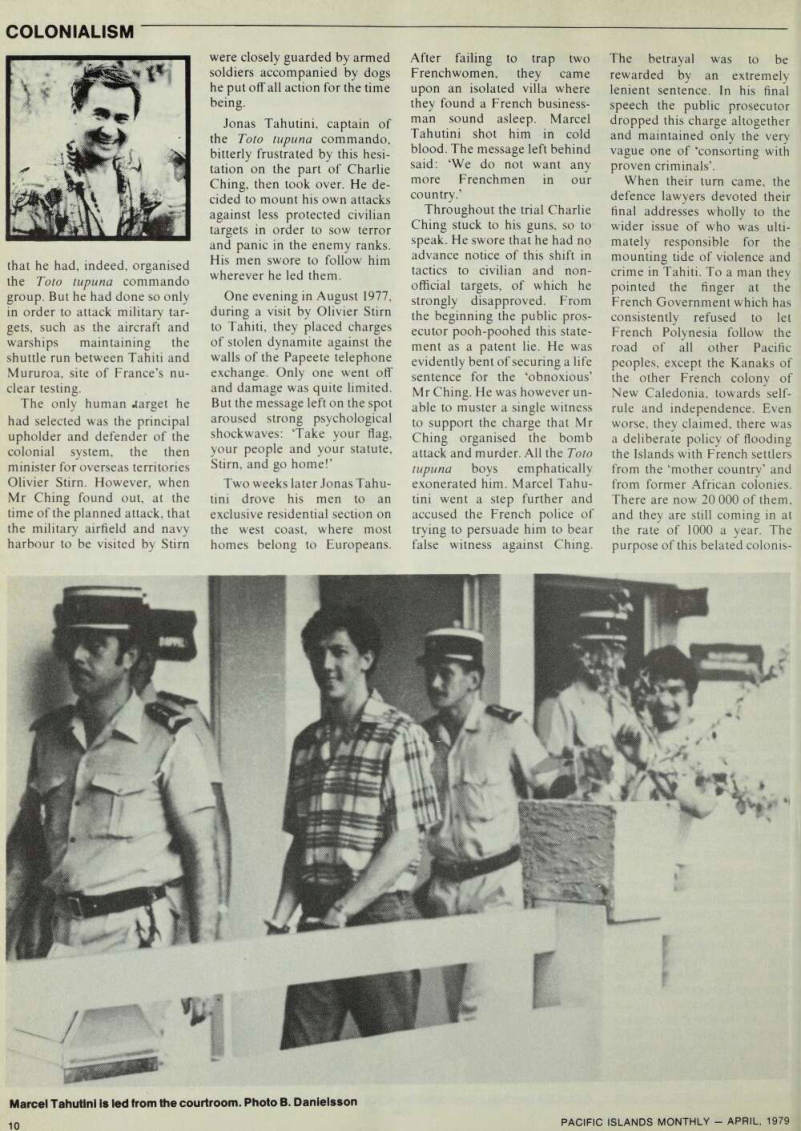
Marcel Tahutini is led from the courtroom. Photo B. Danielsson
ation, in the worst nineteenth century tradition, is to make the Islands ‘safe’ for the con tinued nuclear tests which by now have poisoned the whole population.
Another more insidious French policy denounced by the defence lawyers is the systematic destruction of the Polynesian culture and
personality, with the help
of French-language schools, powerful. government controlled mass media, and
compulsory military training
programmes. For every Polynesian on a decent income, 10 live in slums. It is not surprising, therefore, argued the lawyers, if many young Polynesians do not see any alternative to armed revolt.
One of the black-robed accusers, who happened to be born in Algeria, drew a telling parallel between the Tahitian situation and the total blind ness shown in Algeria by the French authorities and settlers who, almost to the bitter end, >aw the Arab freedom fighters is nothing but criminals and bandits.
Quite revealing of the gen eral turn taken by the debate it this stage was the appear mce in the witness box of the dumber One local politician.
Vice-President Francis San ford a man who at each elec tion musters at least a two-thirds majority. Sanford had no inhibitions whatsoever about repeating what he had so often said in the past - that although he is opposed to viol ent methods, he does not blame those who wish to obtain independence for the
Polynesian people, adding that
their activities do not constitute criminal conspiracy but rep
resent an undisputed right,
guaranteed by the French con sititution and the United Nations charter. As to the bomb, Sanford declared that he was as opposed as ever to continued nuclear testing in the Islands.
The defence lawyers also pointed to unjust aspects of the colonial system as demon
strated by court proceedings.
For example, the jury was com posed of four persons only, instead of nine as in France.
The four would obviously have much less chance of imposing their views on the three presid ing judges than would the larger number. The defence counsel also pointed to the
injustice of French-language
skills being required of jurors, a requirement which unavoid ably made it very difficult for
accused persons, who are mostly Polynesians, to get a fair
hearing.
In their final salvoes, the de fence lawyers enumerated a
long series of irregularities
committed during the prep arations for the trial. They es
pecially singled out for
criticism the disappearance of
potentially embarrassing docu
ments, and brutal interrog ations carried out not, as the
law prescribes, by examining
magistrates, but by various police officers. One of the lat ter, who had made the mistake of being present in the court room at the time, was promptly pointed out by his victim. On other occasions, the interrog ators had made the accused sign depositions in French that did not correspond to their statements in Tahitian. In a surprise move, the lawyers also brought to the witness box a convicted criminal, Manuel Tauhiro, who started the prison riots in January 1978 (PIM April 1978). Mr Tauhiro had an even more gruesome tale to tell. Two officers from the
French ‘thought police’, Ren
seignements Generaux, had promised him parole if he killed Charlie Ching, who con veniently happened to be in the cell next to his own. Mr
Tauhiro cheerfully gave the names of the officers con cerned Lecam and Noel.
Last but not least there had been a serious denial of justice in that during the first six months of their detention the accused were not assisted by defence counsel at all. It appeared that the local justice
department had actually
appointed several local lawyers to perform this task, as the law prescribes in the case of ‘paupers’. But the lawyers con cerned had never found time to visit their ‘clients’. This was the main reason why the relatives and friends of Charlie Ching and the Toto tupuna boys eventually set about raising the necessary funds to call in metropolitan lawyers.
In view of all this, there seemed to be abundant grounds for quashing the ver dicts and ordering a retrial. At least, everybody expected the sentenced men to remain in custody in Tahiti until the de cision of the appeals court had been made. However, four days later, in a surprise move, the prisoners were taken out of their cells, bundled into a mili tary plane at Faaa airport, flown to the atoll of Hao, the army base in the Tuamotu group where nuclear bombs are assembled, and transferred to another plane which im mediately took off for France, via the French West Indies.
Their final destination may well be Baumettes prison in Marseilles where Charlie Ching has already served two years.
The only possible expla
nation for such a hasty removal of the prisoners is the fear felt in Paris that their continued presence in Tahiti will remind the population too forcefully of the issues raised by their trial.
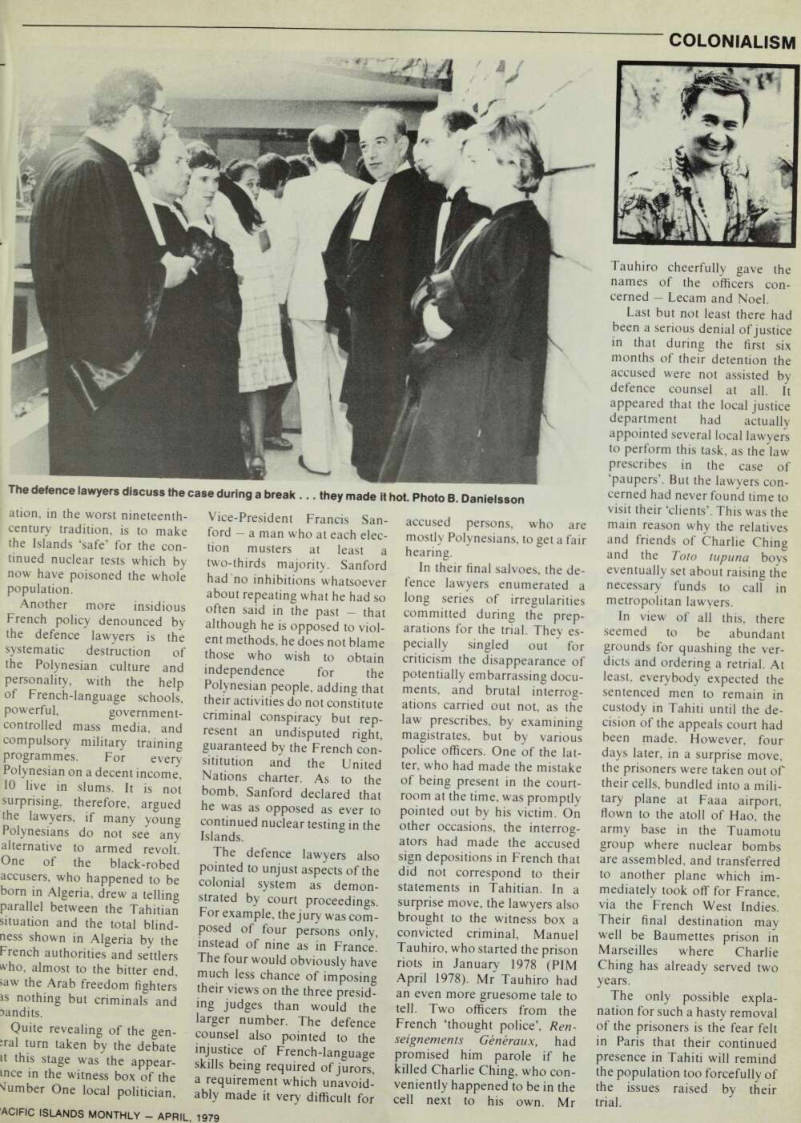
The defence lawyers discuss the case during a break... they made It hot. Photo B, Danielsson