Uncle Sam Dips
pp. 17-19 · Read in the full issue

Into The ‘Sea
Of The Future’
The inquiry into Australia and the South Pacific conducted by the Australian Senate Standing Committee on Foreign Affairs and De fence (PIM March) is not the only such effort made recently by an off dal body of a ‘metropolitan' power. In July 1978 the Sub committee on East Asian and Pacific Affairs of the United States Senate Committee on Foreign Relations devoted a morning to the subject of the ‘Emerging Pacific Island Community'. Staff writer Malcolm Salmon examines the report.
Opening the hearing the
chairman, former astronaut Senator John Glenn, recalled that Queen Victoria had once described the Pacific as the ‘Sea of the Future’. He sug gested her idea was proving correct. He noted also that Pa cific Island countries were ‘often overshadowed by their more powerful neighbours’ in the deliberations of his com mittee, but that the region ‘has too much economic and politi cal significance to be overlooked any longer’.
It is fair to say that past rela tive neglect of Pacific Island countries by the committee showed through in Senator Glenn’s own remarks. His claim that they ‘form a com munity of equal and sovereign nations’, for example, com pletely ignored the very real problem of the continuing pol itical dependence of a good number of them, notably on France and on his own country, the United States. Similarly, his reference to the ‘lO - South Pacific Forum’ would have been more im pressive if he had got the num ber of Forum members right. It was 11 at the time of the hear
ing.
First witness was Richard Holbrooke, assistant secretary for East Asian and Pacific Affairs at the US State Depart ment, and the man generally credited with the initiatives of establishing the new ‘Office of Pacific Affairs’ within the department, and the appoint ment of a new deputy assistant secretary with special responsi bilities for the South Pacific not, as Mr Holbrooke himself Jiad the modesty to tell the committee, that ‘within the
context of the vast Washington bureaucracy’, these are ‘earth
shaking moves’.
Sketching in the background
to the new US concerns, Mr Holbrooke noted: ‘There are, to be sure, signs of growing Soviet and Chinese interest in the area. However, at this time the Soviet side seems to be con
cerned largely with advancing
their fishing interests in the re
gion and promoting their
diplomatic standing vis-a-vis
our own and that of the People’s Republic of China.
Peking is also interested in
expanding its diplomatic pres
ence in competition not only with Moscow but also with
Taipei.’
As for the line of future US action, he said: ‘We do not need to develop massive pro grammes for the South Pacific; this would be contrary to the interests of the islands and our own. Nor should we seek a dominant role as initiator, helper, and guide. We do not wish in any way to impinge
upon the sovereignty of these free peoples or to usurp the leadership role that belongs to them and to their near neigh bours, Australia and New Zealand.’
The theme of smallness, of the modesty of scale of any future US aid projects in the Pacific, recurred again and again during the hearing. The main reason for this can be summed up in one word: Micronesia.
Senator Glenn introduced the Micronesian theme, saying: ‘We saw an article in The Washington Post last week, a
rather devasting critique,
which was critical of how we have handled our programmes in Micronesia .. . The article spelled out how because of our influence there and our moving in with large amounts of money and programmes from the outside, we have pretty much devastated their econ omy. We have made people largely dependent on what will be, at least in part, government
Us In The Pacific
dole. It seemed to me that per haps for certain islands which were used for nuclear testing it was inevitable that all the re quirements for support would mean that local people would
become partially dependent on
us. I can understand a few situ ations like that. But if that article is even halfway correct - and I presume it is - we have pretty much devastated the normal, the better, patterns of
development that might have
been followed in those areas’.
The late Dr Frank Mahony, formerly of the South Pacific Commission, took up the theme, saying; ‘Micronesia got
along during the 1950 s and
until mid-1969 on a budget of about SUSS million a year.
Then there was a massive in flux of aid, and the budget went up tenfold and twenty fold. It was far more than Micronesia could digest very
easily.
To cite one example, funds were budgeted to build schools, but there was so much money available that outside contrac tors from places like Korea and
Hong Kong were brought in
and they built the schools. It would have been much better to train local people and get local contractors established and have them build the schools so that the schools would be built by the people themselves ... What you find today is that the schools that were built by these outside con tractors are being defaced now.
People scratch them up, write on the walls, throw rocks at them, and so on. But there have been a few projects, done when the programme ran out of money and outside funds were brought in to help people con struct their own schools where they really wanted them, which are being much better cared for. These were much more successful kinds of projects.’
Consensus at the committee hearing was that the best hope for the future lay in what were described as ‘accelerated
impact programmes’ jointly
mounted by the Peace Corps and the US Agency for Inter
national Development. They
were described to the com mittee by AID representative John Sullivan as ‘small-scale,
self-help projects, primarily
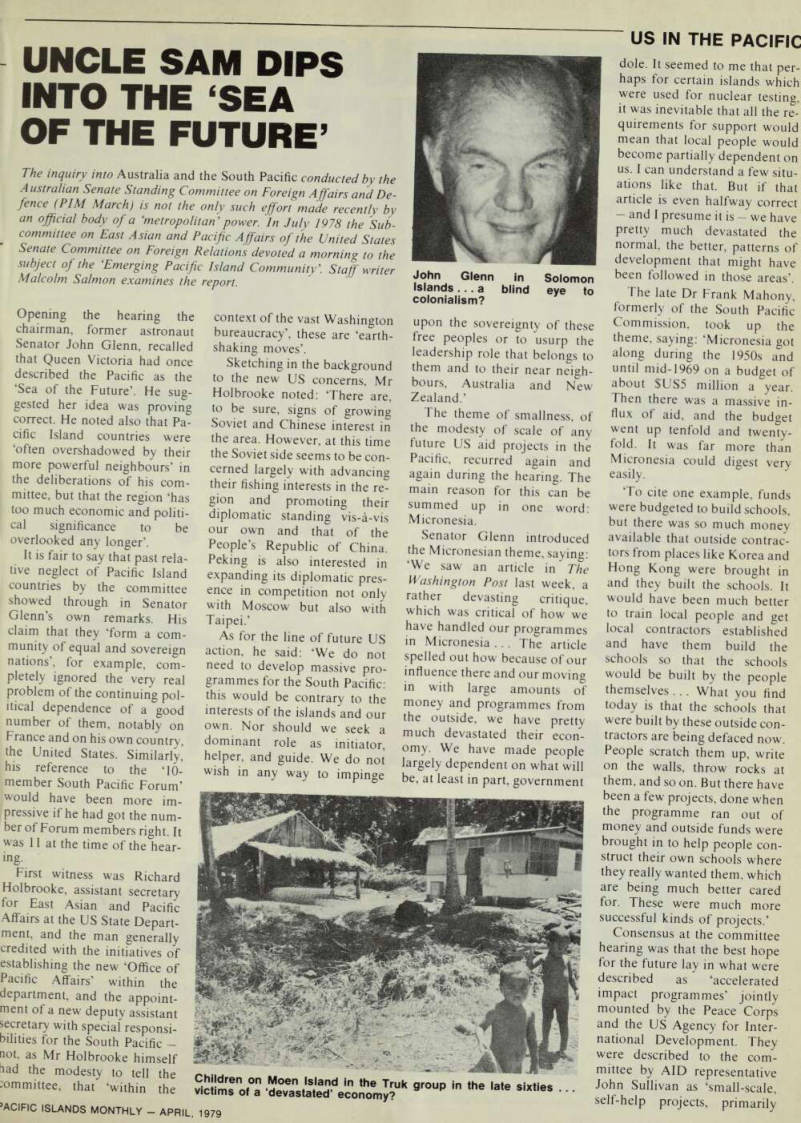
John Glenn In Solomon Islands... a blind eye to colonialism?
Children on Moen Island in the Truk group in the late Sixties... victims of a 'de vastated economy?
aimed at community and rural development’. Each individual project would have a $lO 000 limit and would be carried out in close co-operation with the Peace Corps.
Mr Sullivan’s attempt to give a ‘concrete example’ of an ‘accelerated impact pro gramme’ in a Pacific country led to a polite wrangle with Senator Glenn one of the many indications provided by the committee hearing that the US is still a long way from having got its thinking straight on just where it is going with its new policies.
Mr Sullivan’s example: ‘Let us say that the Peace Corps identifies a need for water, fresh water. In the past, they would have the idividuals available who could give the technical assistance to provide that water. But the Peace Corps does not bring material re sources. So, if they needed a well digger, it would have to be provided by the host country or not provided at all. Under accelerated impact, AID would provide that well digger to the Peace Corps and then volun teers would carry out the pro gramme. In effect, we are bringing material resources to bear on Peace Corps pro grammes.’
Senator Glenn’s response: ‘lt will be interesting to see how that develops ... The strength of the Peace Corps was that people went out, they gave of themselves, of their own exper tise, of their own knowledge and their own ingenuity, in using what was there, on hand, to help people better their own 10t5... This is a different ap proach ... Now we are coming in and instead of the people getting out their local equip ment, whatever that is, and dig ging the hole for their well, we are now bringing in a well dig ger. That is your example of this. We now bring in a mechanised tool. Then, one of these days, when it breaks, and we don’t have a new well dig ger, no wells will get dug.
Under the earlier system they might have dug wells by local
indigenous methods.’
The senator concluded by
stressing the importance of
follow-up’ in such schemes, something he had found sadly
lacking in AID practice in the past. Said he: i think unless we can show what is working and what isn’t, we don’t want to pour money down a rathole.’
The retreat from ‘giantism’ in US concepts of aid is cer tainly timely and necessary.
But the confusion as to what is to be put in its place was pain
fully clear and clearly disap
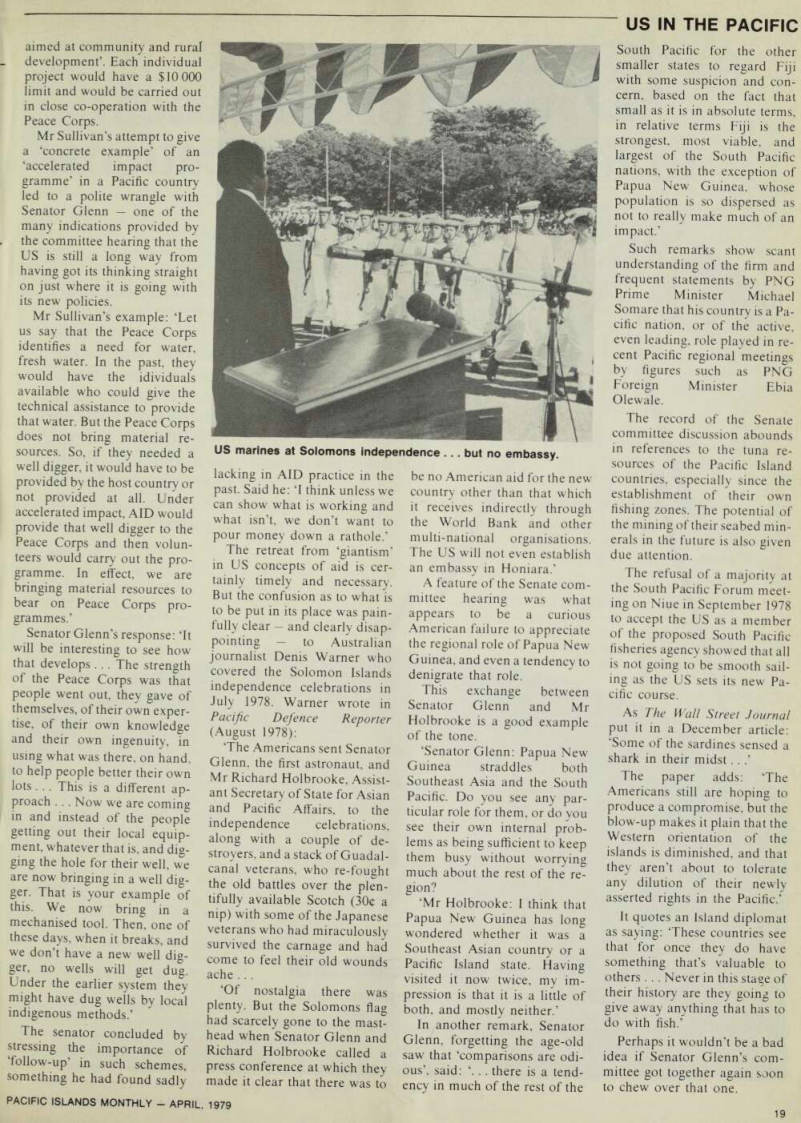
pointing - to Australian journalist Denis Warner who covered the Solomon Islands independence celebrations in July 1978. Warner wrote in Pacific Defence Reporter (August 1978); ‘The Americans sent Senator Glenn, the first astronaut, and Mr Richard Holbrooke, Assist ant Secretary of State for Asian and Pacific Affairs, to the
independence celebrations,
along with a couple of de stroyers, and a stack of Guadal canal veterans, who re-fought the old battles over the plen tifully available Scotch (30c a nip) with some of the Japanese veterans who had miraculously survived the carnage and had come to feel their old wounds ache ... ‘Of nostalgia there was plenty. But the Solomons flag had scarcely gone to the mast head when Senator Glenn and Richard Holbrooke called a press conference at which they made it clear that there was to
be no American aid for the new country other than that which
it receives indirectly through
the World Bank and other multi-national organisations.
The US will not even establish an embassy in Honiara.’
A feature of the Senate com mittee hearing was what appears to be a curious American failure to appreciate the regional role of Papua New Guinea, and even a tendency to denigrate that role.
This exchange between Senator Glenn and Mr Holbrooke is a good example of the tone. ‘Senator Glenn; Papua New Guinea straddles both Southeast Asia and the South Pacific. Do you see any par ticular role for them, or do you see their own internal prob lems as being sufficient to keep them busy without worrying much about the rest of the re gion? ‘Mr Holbrooke; I think that Papua New Guinea has long wondered whether it was a Southeast Asian country or a Pacific Island state. Having visited it now twice, my im pression is that it is a little of both, and mostly neither.’
In another remark. Senator Glenn, forgetting the age-old saw that ‘comparisons are odi ous’, said: ‘. . . there is a tend ency in much of the rest of the
South Pacific for the other smaller states to regard Fiji with some suspicion and con cern, based on the fact that small as it is in absolute terms, in relative terms Fiji is the strongest, most viable, and largest of the South Pacific nations, with the exception of Papua New Guinea, whose population is so dispersed as not to really make much of an
impact.’
Such remarks show scant understanding of the firm and
frequent statements by PNG
Prime Minister Michael Somare that his country is a Pa cific nation, or of the active, even leading, role played in re
cent Pacific regional meetings
by figures such as PNG Foreign Minister Ebia Olewale.
The record of the Senate committee discussion abounds in references to the tuna re sources of the Pacific Island countries, especially since the establishment of their own fishing zones. The potential of the mining of their seabed min erals in the future is also given due attention.
The refusal of a majority at the South Pacific Forum meet ing on Niue in September 1978 to accept the US as a member of the proposed South Pacific fisheries agency showed that all is not going to be smooth sail ing as the US sets its new Pa cific course.
As The Wall Street Journal put it in a December article; ‘Some of the sardines sensed a shark in their midst.. .’
The paper adds: ‘The Americans still are hoping to produce a compromise, but the blow-up makes it plain that the Western orientation of the islands is diminished, and that they aren’t about to tolerate any dilution of their newly asserted rights in the Pacific.’
It quotes an Island diplomat as saying: ‘These countries see that for once they do have something that’s valuable to others. . . Never in this stage of
their history are they going to
give away anything that has to do with fish.’
Perhaps it wouldn’t be a bad idea if Senator Glenn’s com mittee got together again soon to chew over that one.
US marines at Solomons independence... but no embassy.