Getting The
pp. 53-55 · Read in the full issue


Media
Message Across
Communication by the spoken and written word in Solomon Islands is in dire need of improvement, reports Irene Hawkins from Honiara.
f Various proposals in the cur rent National Development Plan (NDP) 1975-1979 for tele- I communications, the news media and the flow of official information in general, reflect the Solomon Islands govern ment’s concern with communi cations. But, as the 1977 mid term review of the plan showed, progress toward realis ing these goals has been rather patchy, especially as far as the flow of information is con cerned.
Despite a government news paper, the News Drum, set up in early 1975, a small indepen dent paper, Toktok, struggling to survive on a shoestring, and a government radio station that was hived off from a govern ment information section into a separate corporation a year ago, ‘a high level of public awareness and understanding of the functions of government, informed public discussions of important issues and means of expressing all opinions’ as well as ‘provision of education’ as desired in the NDP, are still
sadly lacking.
The fact of the matter is that these goals cannot possibly be realised until there are flourishing news media, staffed
by trained, experienced people
who can afford to be critical.
To a considerable degree, the Solomons’ serious infor mation gap is due to a wide spread lack of interest and
understanding among poli
ticians and senior civil servants of the importance of news papers and the radio as dis seminators of ideas and means
of involving the people in the
country’s development. Too
often politicians, who until not so long ago were used to reporting only to their colonial masters in London and more
recently to parliament in
Honiara, are still wary of talk
ing to journalists, who, as they
"eel, are out to pry into their mistakes and anyway don’t
know much about what they
are talking.
To some extent they have a point. There is a very serious shortage of qualified Solomon Island journalists and broad casters. At present only two of the total staff of 16 in the government’s information and public relations section are fully trained - and both are ex patriates. The system of send ing trainees after a year in the information section to a one year course in Papua New Guinea has so far failed to im prove the level of expertise sig nificantly. The frustrations of having to toe the government line tend to make the more en
terprising and outspoken
journalists look around for other jobs on their return from PNG. Or they go to the Broad
casting Corporation (SIBC),
where promotion prospects are better.
On top of this, the pre
independence public outrage
over the publication of an of fensive, anti-Western districts poem - from, as has been dis covered recently, the pen of a Malaitan agricultural officer has thrown the information section, which is responsible for the News Drum, really off course. With the Westerners thirsting for revenge, the heads of the two top people in the sec tion had to roll. Francis Mauli, Principal Information Officer, was transferred into an admin istrative job on the Public Ser vice Commission, while Tom Hughes, former News Drum editor, has moved over into the
newly-created Foreign Affairs
Department under Francis Bugotu, to concentrate on improving the flow of news and information within the Solomons and between it and the outside world. In his stead,
Simon Papage, formerly
deputy editor, has been pro moted to the post of editor.
Despite all the recent com motion these moves could turn
out to be a pointer in the right direction. The extremely
embarrassing position that the
government has found itself in after the publication of the poem may well have caused politicians and civil servants seriously to question the government’s role as a news
paper publisher.
More may feel now that rather than trying to run a
weekly paper along commer
cial lines with some outside credibility and yet no real scope to be critical of the government, the government should put all its efforts behind
increasing and improving the
output of relevant, informative local and regional news from its news section and leave the interpretation of it to someone else. The government is likely
to gain in credibility abroad by
relinquishing its role as pub lisher. At home it is very much in its interest that the electorate should have the fullest possible knowledge of political and economic problems and
developments.
But what should happen to the News Drum ? Quite a few people would like to see it be come part of some foreign newspaper group to obtain the badly needed injections of both expertise and capital. Last year the Papua New Guinea Post- Courier, like PIM part of the Melbourne Herald group, displayed some interest in moving into publishing in the
Solomons. But nothing hap
pened after a survey indicated that a local newspaper would not be commercially viable.
Apparently the Post-Courier has not abandoned all interest.
The calculations could look
different if the Post-Courier were to go into job printing at the same time, possibly taking a stake in an existing press.
This time it might also find more willing ears in higher circles. Concern last year about further increasing the Mel bourne Herald’s already strong position in the South Pacific’s regional news media may have now been pushed aside by pressures to do something about the News Drum.
On the other hand some people feel there are convinc ing arguments for trying to find a local buyer. The example of quite a few of the smaller Caribbean islands has proved
amply that although a foreign
publisher brings undoubted benefits in terms of efficiency and higher standards of report ing, it is at the cost of inevitably gearing the readers’ attitudes and expectations to outside values and standards.
Therefore, backing the small independent Toktok or some similar local venture may pro duce less spectacular results to begin with but be more in line with the country’s needs in the
longer run.
For more than a year now George Atkin, himself one of the ex-PNG School of Jour nalism students, has been try ing to set up a rival weekly newspaper. Toktok, his third attempt, has been surviving, albeit rather shakily for more than a year now, selling 1000 copies against the Drum’s 3000 a week. Toktok too is desper
ately short of experienced
journalists and good copy. But at least it has the freedom to be
outspoken.
After failing in his attempt to
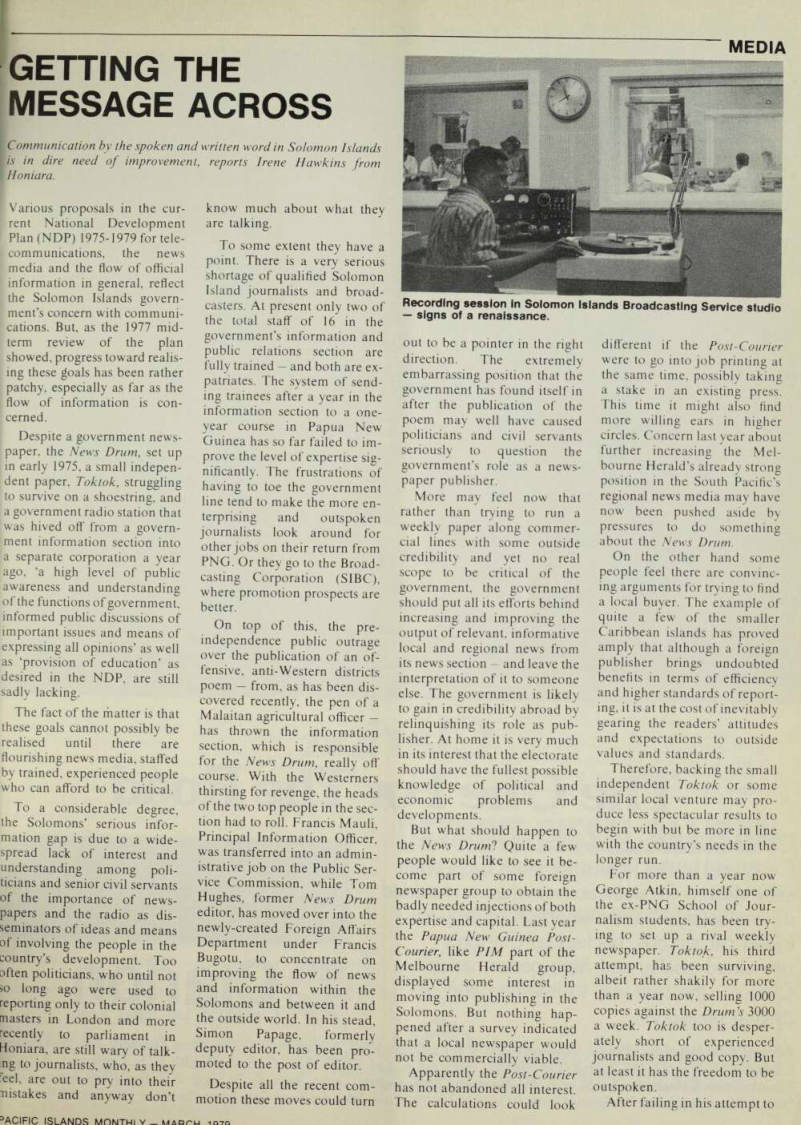
Recording session In Solomon Islands Broadcasting Service studio - signs of a renaissance.
I take over the Drum, Atkin is now planning to oust it, by
doubling Toktok’s weekly cir
i culation and increasing the j number of pages. He has also t begun to bring out a monthly I review, called Observer, whose first 800 copies for the month j of August sold out quickly.
The prospects for strength
ening the local broadcasting
service look a good deal more promising. Like the News Drum, SIBC has no scope to comment and can only present facts. But even the vital role as an informer in a country where only one in eight adults can read, has remained largely unexplored. The output so far
consists largely of European
light music, interspersed with
some local music, news, service
and shipping messages. Again
this is above all a question of staff, but also of outdated
equipment.
Although the level of exper tise is higher at SIBC than at the government information service not the least due to the fact that some of the best
people with overseas training
have come over from that sec tion (in fact four of the five newsmen are ex-information people) the present pro gramme staff of 13 plus another 12 employees on the administrative and technical side is short of programme pro ducers and writers. SIBC was planning to recruit 10 Form 5 school leavers at the end of last year to fill existing vacancies and start training up personnel
for the expanded broadcasting
services which with Australian financial and technical support (worth SAI.6 million) should come into operation in the next two to three years.
Since the beginning of last
year things have begun to look
up for SIBC. It has/nade a con scious effort to increase the local content of its programme
- partly by reviving old pro
grammes, partly by adding
some new ones like a pro
gramme introducing minis
ries, a programme for farmers is well as a news spot contain ing facts and figures about the Solomons. At the same time, he new Australian-financed terials have increased its cover age from under 50 per cent to
80 per cent of all potential lis teners.
Australian technicians and a programme adviser have arrived, the latter to advise the management and train staff over a period of three years.
Another Australian specialist, due to arrive last month, will run a course for news work and programme production. A technical expert is expected to take up his training and main tenance job at SIBC soon.
The Australians are not only
assisting in upgrading the
expertise of the present staff as well as training additional staff, but are also financing the building and equipping of a new studio in Honiara as well as small regional stations at Gizo in the West, Kira Kira on Makira, Graciosa Bay in the Santa Cruz Islands and Auki on Malaita.
The Gizo station should be ready by the middle of this year. It will begin to broadcast some district programmes in addition to those from Honiara. In three years Solomons Islands may well be served by two channels from Honiara (one in English and one in pidgin to cater for two quite different groups of lis teners whose interests and
understanding cannot really be
served by a joint programme) as well as locally orientated programmes put out by several district stations.
This year, educational broadcasts for primary schools should also be resumed. SIBC is thinking of expanding this vital service provided it can se cure the co-operation of edu cational authorities and work out some suitable courses.
There is a great need, not only to help Solomon teachers in class with new ideas and well prepared radio school broad casts, but also to fill the education gap in those areas where there are not enough schools or schools are inaccess ible. With not more than half of all Solomon Island children of school age being able to attend school, the radio could be a vital means of using scarce educational resources for the benefit of the largest possible number of children. Similarly, radio could be an essential means of adult education.